Valentine’s Day 2025 – Reflecting on Wines
In my previous post, I complained about frustration with choosing the right wine for the right moment. That post ended with a picture of the wines I selected for Valentine’s Day 2025 – and now I want to talk about those wines.
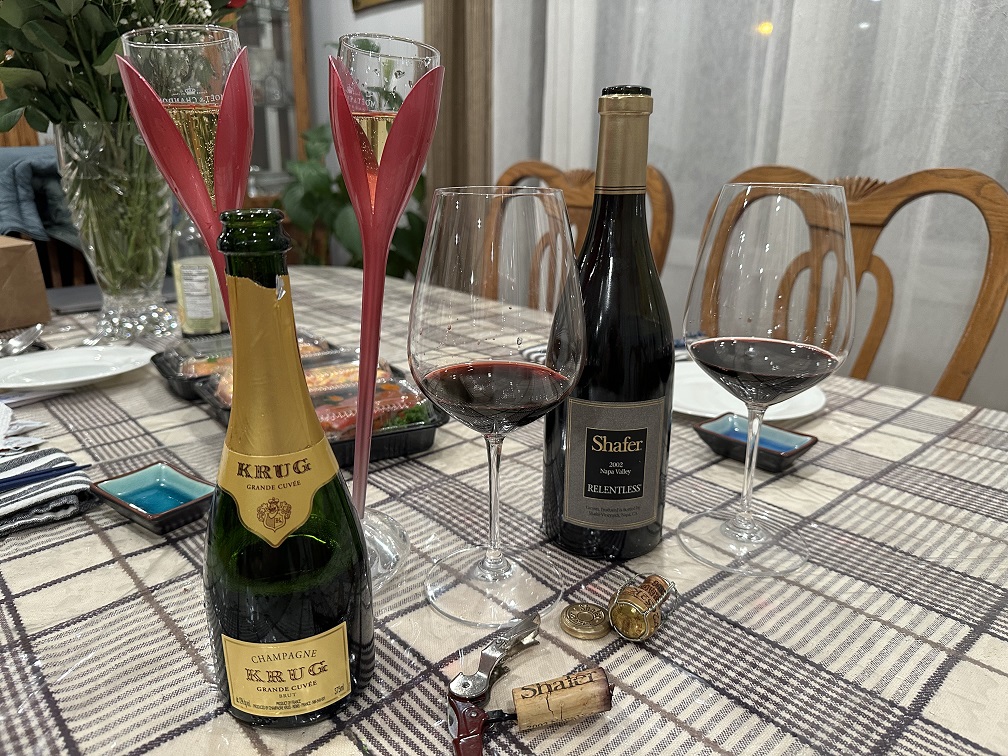
Following my own advice, our first wine was sparkling. Not just any sparkling – it was Champagne. And not just any Champagne – it was Krug.
I don’t want to sound elitist, but the only way to put is this: those who know, know Krug.
For the wine lovers en masse, the epitome of champagne is Dom Perignon. Maybe also Crystal on a good day. Krug definitely is lesser known, but for those who know, Krug is a cult, a religion, the only Champagne one can drink.
I joined that cult after experiencing Krug vintage and non-vintage wines during the PJ Wine Grand tasting in New York in 2010. Krug was an absolute revelation, I have never tasted anything like that ever before.
Then a few years later, in 2012, I came across an article by Alice Feiring, talking about changes in winemaking at Krug in 2003 which she said resulted in more or less the “end of Krug”. I referred to her article in my post, but unfortunately, the original article can’t be found so I can’t share any more details. I only remember tasting Krug at the trade tasting in the same year or maybe the year after, and thinking “well, it is not as good as I remembered it“.
Trade tasting is not always the best place to fully understand the wine, so Krug remained high on my “wines I want” list. Then a few years back, I got this half-bottle of Krug as a present for the new year, and this year I decided that Valentine’s Day is a perfect reason to open that bottle.
After struggling a bit with the cork, I managed to get the wine into our flutes (I know, I know – but it is a holiday, okay?). Smelling and tasting it left both me and my wife underwhelmed. Crisp and acidic for sure, but that’s what literally every other Champagne has, and Krug should really give you more. A few more sips and I closed the bottle, and back into the fridge it went.
Not so long ago, I read an article from a champagne pro, and he suggested that Champagne, similar to any other still wine, can and usually improves after opening. It can be placed into the fridge and enjoyed slowly over the next few days, and many of the Champagnes simply taste better the next day.
Why is this important? When I poured what was left of Krug into the glass the next day (okay, it was a regular glass), that was a totally different wine. Rich, layered, with toasted bread and apples. This was the real deal and it was delicious. I can’t tell you if it tasted like the one I was blown away by in 2010, but it was definitely an excellent Champagne. I guess there is an interesting lesson here for future encounters with Champagne, and not only with Krug.


After Krug’s image was somewhat restored in my eyes, I decided to learn more about the wine. Nowadays every bottle of Krug comes with its own unique code. When you go to the Krug website and type in the code, you get the most detailed information about the wine you can wish for – here are a few excerpts related to my bottle:
“Krug Grande Cuvée 170ème Édition
Composed around the harvest of 2014, Krug Grande Cuvée 170ème Édition is a blend of 195 wines from 12 different years. The youngest is from the year 2014 and the oldest dates back to 1998.
In all, reserve wines from the House’s extensive library made up 45% of the final blend, bringing the breadth and roundness so essential to each Édition of Krug Grande Cuvée.
The final composition of this champagne is 51% Pinot Noir, 38% Chardonnay and 11% Meunier.
Time in the cellar:
This half-bottle spent around 7 years in Krug’s cellars developing its generosity and elegance, receiving its cork in Autumn 2020.”
According to Julie Cavil, Krug Cellar Master:
“In this blend, the dynamic Pinot Noirs of 2014 came from a wide range of plots throughout the Champagne region, while fruity and full-bodied Chardonnays were selected from plots in the Montagne de Reims, Sézannais and Côte des Blancs. The Meuniers from the Vallée de la Marne Rive Gauche were particularly bright, with magnificent fruit expression from plots in Leuvrigny. To complement the wines of the year, we selected reserve Pinot Noirs from plots in the Montagne de Reims Sud renowned for their structure, including an Ambonnay from 2005. Reserve Chardonnays from plot’s wines from Avize and Mesnil-sur-Oger over a wide spectrum of years have a nice share of voice in this blend, while reserve plot’s wines of Meuniers add freshness, intensity and chiselled structure.”
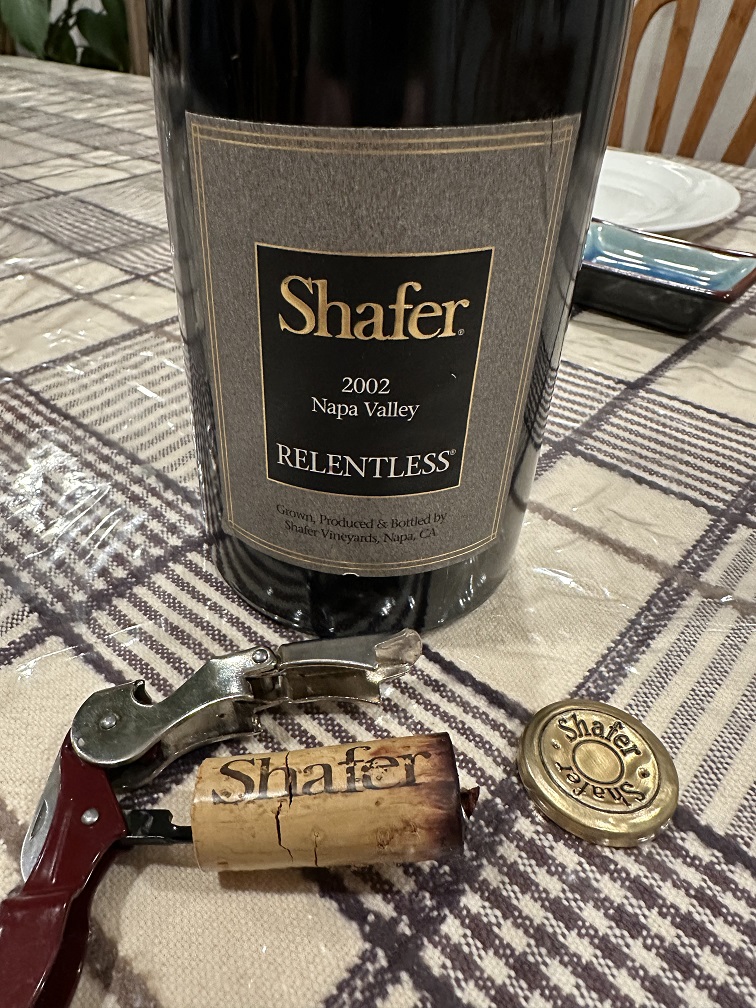
And then there was 2002 Shafer Relentless Napa Valley (14.5% ABV, 80% Syrah, 20% Petite Sirah). I tasted this wine a few times before at the trade tastings, but never had an opportunity to really spend some time with it.
Shafer needs no introductions to California wine lovers, with its fame closely associated with the flagship wine, Shafer Hillside Select Cabernet Sauvignon. Shafer Relentless is not as well known, but this Syrah blend has been around for more than two decades, named in honor of Shafer’s [relentless] winemaker, Elias Fernandez.
We didn’t decant the wine – it would probably help a bit, but I just didn’t want to deal with it. At first, the wine was tight, with well-noticeable tannins and an interplay of tar and cherries, with the addition of pepper. After some time in the glass and opened bottle, the tar subsided, leaving delicious peppery cherries to be admired around a layered but firm core. This 23 years old wine showed beautifully and it was a real treat.
Now the last piece – food. We stopped going out to the restaurants on Valentine’s Day a long time ago – the experience just not worth it. We were craving sushi for some reason, so that is what completed our Valentine’s Day dinner – here you can see some creative rolls from an Asian restaurant not too far from our house.


There you are my friends – our V-day reflections. How was your celebration? Any special wine experiences? Do tell! And until the next time – cheers!
Frustration of the Oenophile – Choosing Wine
First-world problems, I know. Nevertheless, let’s talk about them.
I guess we, oenophiles, are tender creatures. Doesn’t take much to get us frustrated. Wine not tasting the way we expect; not enjoying critic’s choice 100-points wine; close friends not sharing your excitement about the wine in the glass. We can go on and on about these little insignificant things, each one a source of the full-blown frustration. Oenophile’s frustration looks different every day. And mine right now might be the biggest one of all (remember – taste is subjective, so are the feelings) – inability to choose the wine.
Assuming I will be able to finish this post today, tomorrow we are celebrating Valentine’s Day – and what says “I love you” better than a luscious, voluptuous, sexy, and seductive bottle of wine? Forget flowers, flowers don’t stand a chance against such a bottle of wine. But what wine will be luscious, voluptuous, sexy, and seductive? The need to choose that wine properly becomes the cause of the ultimate frustration. But that’s not all, because merely in a week we have to deal with OTBN – Open That Bottle Night – and this is the ultimate “oenophile frustration” cause, as now we need to decide what bottle we kept not opening waiting for a special moment which might either never arrive or already be in the past?
Decisions, decisions, decisions. Trying to select the right bottle of wine for the occasion, you have only a few minutes to agree with yourself on the proper bottle. If you will not arrive at the decision within those few minutes, the next 2, 3, 4 days will be miserable. You are going to pull a bottle, look at it, think about it for a moment, sigh, and put it back. Then repeat the process over and over again, pretty much until you force yourself to feel that you got the right bottle. Possibly to change your mind again in a few hours, or even 20 minutes before the bottle needs to be opened. If you are an oenophile, and you are not going through this pitiful “decision paralysis”, I envy you and congratulate you. And for the rest of us – I share your pain.
So what wine should you select for Valentine’s Day? I already told you – it should be luscious, voluptuous, sexy, and seductive – or not. Of course, there is a big dependency on the food, but don’t try to achieve a perfect match – it’s okay to enjoy your food and wine independently. I have to say that I’m not a big fan of still Rosé wines for Valentine’s Day – yes, it matches the pink color of all the all V-day paraphernalia – but it might not deliver the pleasure you are looking for. I also would suggest avoiding “thought-provoking” wines – rare grapes, natural wines, skin-contact wines, wines from the forgotten corners of the Earth. On a normal day, I’m the first one to ask for an obscure wine, but for Valentine’s Day, wine should give you pleasure, elevate your mood, it should be easy to understand. If upon the first sip you will not say “ahh, this is good”, you’ve chosen the wrong wine – put the cork back and go fetch another bottle.
I love to have bubbles for Valentine’s Day – of course, nothing can beat the classic Champagne (and it perfectly can be pink), but you can’t go wrong with Cremants, Franciacorta, Trento DOC, Cava, and all other méthode champenoise wines. If you like white wines, Chardonnay is your best choice of white V-day wine, pretty much from anywhere in the world, as long as it is not a lifeless purposefully unoaked rendition.
And then, of course, the red. Ideally, the red should have an age on it, to truly deliver all that pleasure upon a first sip. Amarone, Brunello (I would avoid Barolo unless you perfectly know what you are doing), Cabernet Sauvignon and Bordeaux/Cabernet blends, Super-Tuscans, Spanish Grenache, Rioja from a good producer, Syrah and Zinfandel. I’m not trying to make other wines feel bad, but for Valentine’s Day, this is what I would pick from.
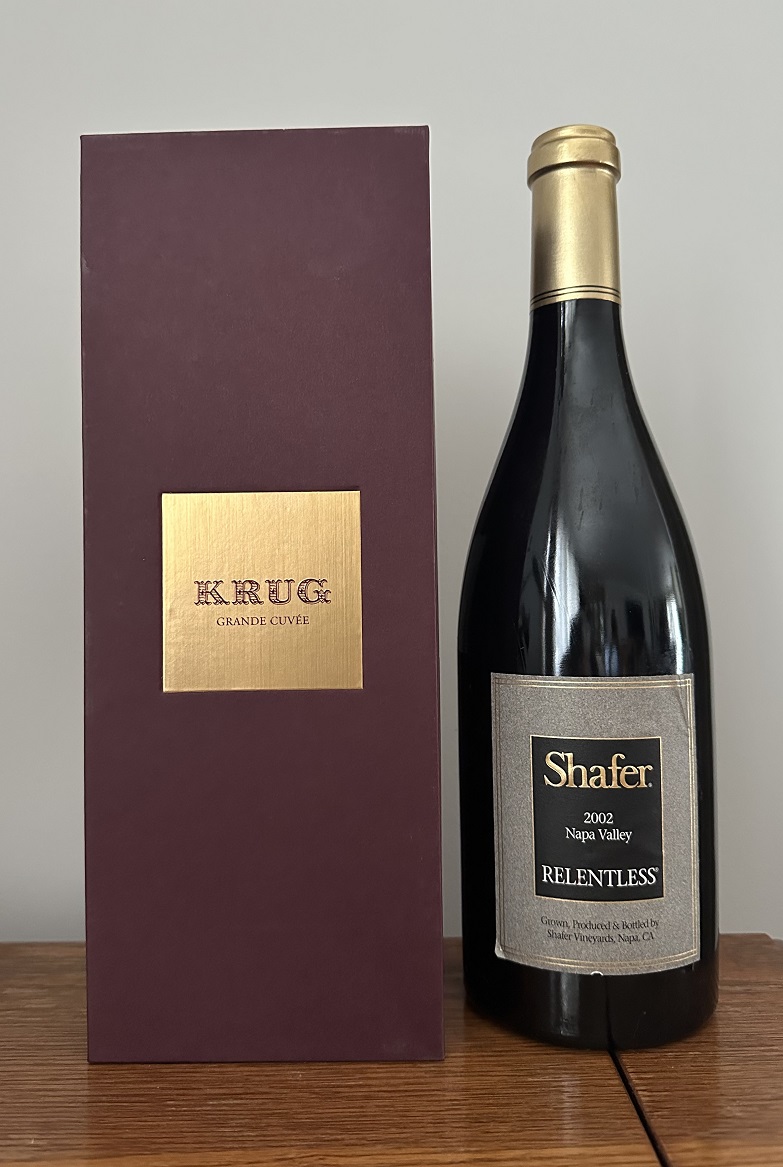
Here is actually what I picked – Champagne and Syrah from California – and I will tell you all about it later on.
If you thought selecting wine for Valentine’s Day was frustrating, it is nothing in comparison with selecting the wine for OTBN.
OTBN (Open That Bottle Night) was invented in 1999 by Dorothy J. Gaiter and John Brecher, writers behind the Wall Street Journal’s wine column at that time. The purpose of the OTBN, which is always celebrated on the last Saturday in February, is to encourage wine lovers around the world to open that special, stashed far away bottle. We all have those bottles that can be categorized as “not today”. These wines typically exist in single quantities in our cellars and always have a memory attached to them.
This is what makes the selection process very difficult – to open or not to open? I have only one such bottle. What if I open it too early – I will never know how amazing it could become over the next 10 years? Once I open that bottle which was gifted by a dear friend, brought back from the amazing trip, acquired in the moment splurge, will my memories be lost forever? Should I just hold on to that bottle instead? Will I open this wine in the right company? Will people truly appreciate the sacrifice I’m making?
Frustrated, frustrated oenophile. It is hard to make wine decisions.
I hope you got my point. And I hope I helped you, at least a tiny bit, to select a proper bottle of wine, at least for Valentine’s Day. And please don’t ignore the OTBN – the right time to open a special bottle of wine is now – you never know, tomorrow the wine might be gone, or you might be gone. Truly, live in the wine moment – at least on the last Saturday in February.
Do you have frustrated oenophile moments of your own? Please share! And I wish you a happy, quick, and not-frustrating-at-all wine selection process, for all the special moments to come. Cheers!
FeedSpot 100 Best Wine Blogs of 2025
 When I started this blog about 15 years ago (you will hear about it more this year) after extensive nudging from friends, I did some “soul searching” as a novice blogger. When you write something “in the open” you want someone to read it, right? Along these lines, one of the important soul-searching questions was: “Who am I writing for” – again, every writer is looking for readers, so what can or should I do to attract them? The best answer I found was ” you don’t write for anyone, you only write for yourself” – and ever since this was exactly what I have done.
While I’m writing for myself, I obviously appreciate any form of acknowledgment – it is nice to know that somewhere out there there is at least someone who might read a word or two from this blog. So when I got an email from FeedSpot informing me that the Talk-a-Vino blog was featured as one of the Top 100 Wine Blogs of 2025, this was a happy and humbling moment, this exact acknowledgment.
It is an honor to be featured in the list which includes Wine Spectator, James Suckling, and Decanter blogs. And of course, it is great to be in the wonderful company of wine bloggers I’ve known for many years – 1 Wine Dude, the drunken cyclist, Dallas Wine Chick, Food Wine Click just to name a few.

There was also an unexpected benefit of this recognition :). When I went to add the FeedSpot badge to the sidebar of my blog page I discovered that at some point I missed a change in the theme I’m using on WordPress, and my blog roll disappeared along with a few other lists I always considered important. I had to spend a bit of time restoring the blog to the way I always liked it to be, but now you can again see the list of blogs I’m following, along with the list of my favorite places to buy wine and some wine travel website recommendations.
And with that, let me get back to the gazillion of the posts I need to finish – onward and upward.
Grape For The Future, Wine For Today
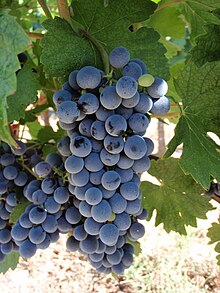
Source: Wikipedia
Have you heard of the grape called Marselan?
If you have – great, pat yourself on the back as you are ahead of many wine lovers.
If you have not – even better, as we are going to fix it right now.
Some grapes have been around seemingly forever (the winemaking is getting older and older with every new discovery – I just learned today that based on the latest research, the wines were made around 11,000 years ago – quite an age), and it is impossible to tell when particular grapes were born. For others, the history is much more definite, as those grapes have been bred with a purpose, and thus their “birthday” is well known.
Marselan is one such grape. It was bred by Professor Paul Truel in 1961. Marselan is a cross of Cabernet Sauvignon and Grenache, and it was bred to be heat-resistant and disease-resistant. While having those desired qualities, Marselan had small-sized berries, which was not a great trait in the 1960s – the desired grape was supposed to have a high yield, thus Marselan ended up on a shelf. As the climate was changing and the temperatures were rising, the need for heat-resistant and disease-resistant grapes became more apparent, and Marselan was brought back to life, entering an official INRA grape registry in France in 1990.
Marselan was bred by Professor Truel in Languedoc near the French coastal town of Marseillan which gave Marselan its name. Marselan is a blue-skinned late-ripening variety, producing large clusters of small berries, leading to a high skin to juice ratio in the winemaking. Marselan prefers dry soil and hot climate, and it has strong disease resistance to botrytis bunch rot, powdery mildew, and other grape malaises. While born in France, Marselan found its great fame in China, where it might be considered a “signature” grape according to Decanter magazine.
Marselan is best known as a blending grape. Nevertheless, varietal Marselan wines started being produced in Languedoc in 2002. Today, about 70 wineries in Languedoc produce varietal Marselan wines. In 2019, Marselan was one of four new red grapes authorized for use in the production of Bordeaux wines. In Bordeaux, Marselan can make up to 10% of Bordeaux Superior and Bordeaux AOC blends, though it cannot be listed on labels. In addition to France and China, Marselan today is growing in Spain, Switzerland, California, Brazil, Uruguay, Israel and other places.
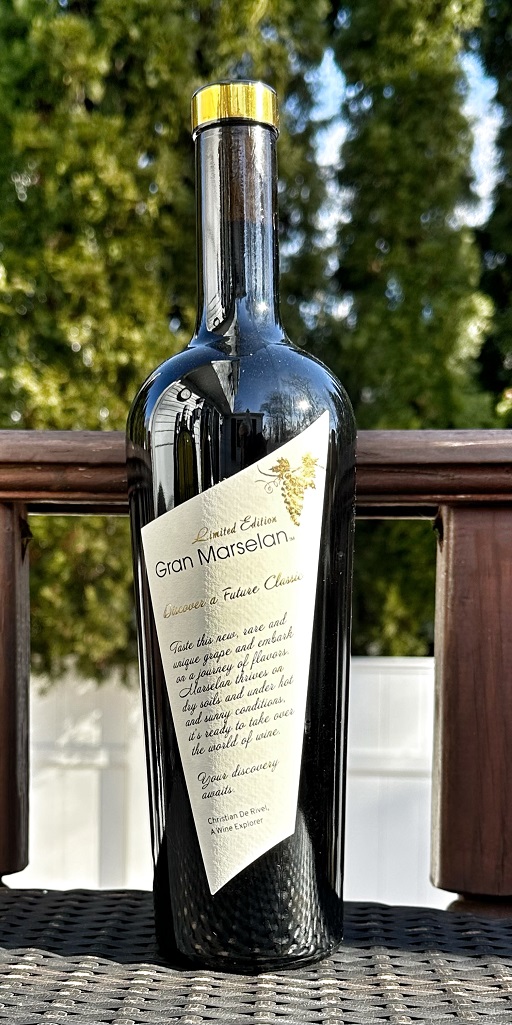
Okay, the formal introduction is over, let’s move on to the fun part – tasting probably the best of the best wine Marselan has to offer – NV Gran Marselan Cuvée du Centenaire Vin de France (14.5% ABV, $169, 100% Marselan, 15 months in 2-years old French oak barrels, 1,716 bottles produced).
This wine had been produced by EdenGrapes with the grapes coming from two best and oldest (40+ year old vines) blocks of Marselan vineyards in Languedoc, discovered after an extensive search. The wine was released in 2024 to celebrate the 100th birthday of Paul Truel, creator of Marselan, who was born in 1924, hence the Cuvée du Centenaire designation.
While speaking with Christian de Rivel, the producer of Gran Marselan, he suggested that it would be very important to decant the wine for anywhere between 2 and 5 hours to let it shine. Well, you never need to ask the wine geek twice to play with his wine.
Long decant? Ha! I got you!
There are many ways to decant the wine. I don’t want to go too far on the tangent here, so I will just give you a “short brief”, and hopefully a more in-depth decanting rundown later in another post. I prepared a few decanting instruments I have at my disposal – a classic decanter, a couple of aerators – VersoVino and Venturi, and even a super-decanting tool, or rather a “hyper-decanting” tool, the blender.
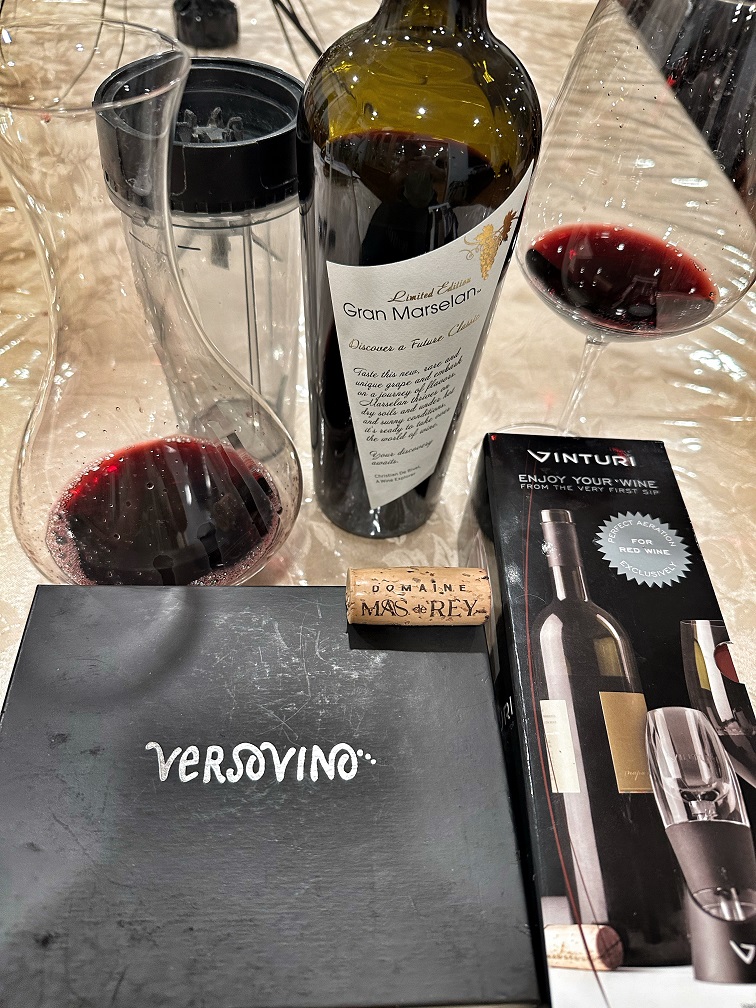
Wine Geek’s Mise an Place
Even if decanting is suggested, to decant or not to decant is a personal choice. I had to taste the wine to decide what I would like to do in terms of decanting, so first I just poured some wine into the glass:
Upon opening
Beautiful color, bright garnet
Nose of wild raspberries and wild blueberries, superb, earthy undertones
Beautiful palate of wild berries, well integrated velvety tannins, firm structure, good acidity, excellent balance 8+/9-, delicious overall and dangerous.
Based on tasting the wine “as is”, hyper-decanting was ruled out – the wine was perfectly drinkable from the get-go, no need for extreme measures. But I had to try the tools nevertheless:
VersoVino
Nose a bit more pronounced and open, adding tart cherries to the aromatics
Palate is a bit smoother, tannins become silkier, overall wine is more polished. I really didn’t expect that. Wow. 9-
Venturi
High intensity nose, now more Cabernet-like profile, a touch of eucalyptus
Excellent palate expression – it doesn’t have cassis, but instead offers gobs of dark fruit, good acidity, more of a chewy structure. After Venturi, the wine actually begs for a steak. It shows bigger. But it is now more in Grenache territory, with dark chocolate undertones. 8+
I definitely like the effect of VersoVino more. The wine is softer and more elegant with VersoVino compared to Venturi.
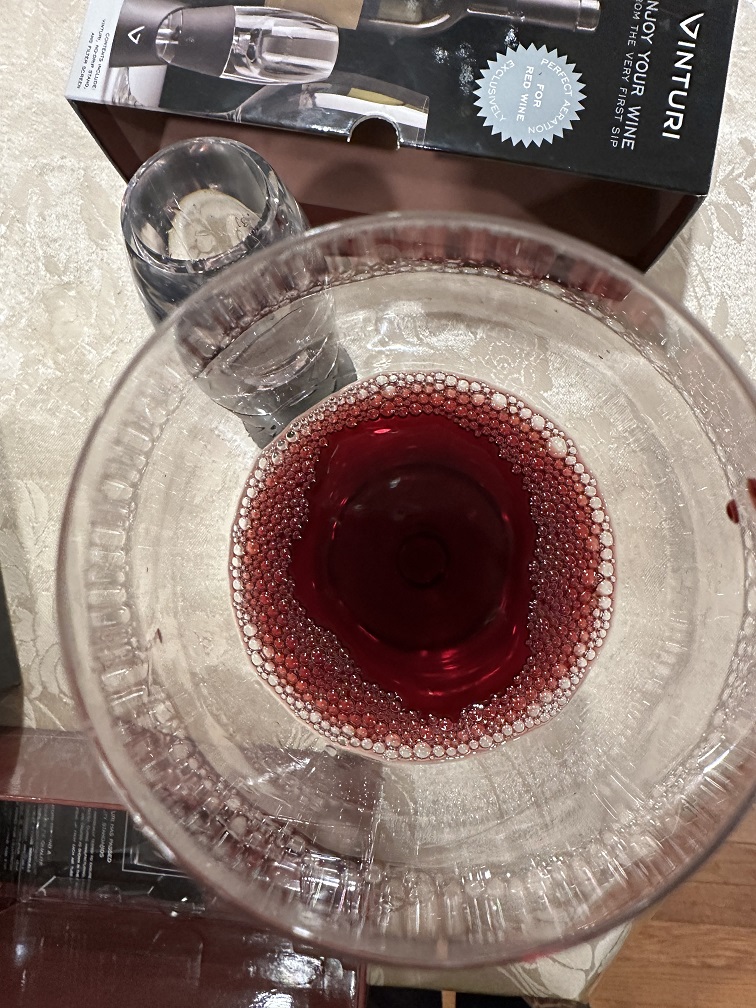
Bubbles – an effect of Venturi
Now we wait.
1 hour control point from decanter
Nose changed, now offering some sapidity undertones, became lean and powerful. Now nose promises big, “serious” wine
Delicious bouquet on the palate. Dark fruit, elegant, balanced, tart cherries woven over the firm structure. Elegant, delicious. 9-
2 hours later
Tart nose, earthy undertones, cherries
Lots of tart cherries on the palate, different representation, firm, tight, lots of energy, now gripping tannins which cut finish somewhat short. Wine is evolving. 8
4.5 hours later
Fresh berries returned on the nose with some earthy undertones
On the palate, the wine is tight with some brushy tannins, good clean dark fruit finish. The wine would perfectly complement steak, but for sipping I would prefer one of the earlier versions. 8
Second day
Still pretty much tastes like the wine after a few hours of decanting.
So what did I learn after tasting the Gran Marselan, besides the fact that I really didn’t need to decant it more than for an hour? The conclusion is easy. The grape has great future potential. But you don’t need to wait for the future – you can simply enjoy the wine right now. Also, I know what you are thinking – this Gran Marselan is expensive. While I can’t argue with that, if you are ever willing to spend $170 on a bottle of a special wine then this wine is well worth your consideration. I know of many California Cabernet Sauvignons in the same price range which will deliver much less pleasure, so this wine is definitely worth it. Maybe one day we will be able to compare the notes? Until that time – cheers!
Pinot Noir Battle – Let the Best (but Most Unexpected) Win…Again
It all started with a few tweets. I noticed a very high praise for the German Pinot Noirs shared by some of the European wine lovers I’m connected to on Twitter (still can’t make myself call it X, so you will have to forgive me for that). Particularly, Pinot Noir from Ahr was regarded as the best in the world, handily beating Burgundies on any occasion. I was intrigued and started searching for the Pinot Noir from Ahr, which proved to be challenging.
Ahr is a tiny region, one of the smallest in Germany – according to Wines of Germany, Ahr has only about 529 hectares of vineyards (around 1,323 acres), which comprises 40 single vineyards. 65% of the vineyard area is planted with Pinot Noir, about 860 acres – for comparison, the Jackson Family mostly Pinot Noir plantings in Oregon alone amount to roughly 600 acres. You can imagine that finding Pinot Noir from Ahr in the US was rather challenging.
The more I saw Ahr Pinot-praising tweets, the more I wanted to try it. Then one day I checked Wine.com, and there it was – Pinot Noir from Ahr, made by Meyer-Näkel. I quickly went to the Twitter folks to check if this wine would sufficiently represent the Ahr region, got an approving nod, and bought a bottle.
Once the wine arrived, I thought of the best way to try it. When it comes to learning about wine, tasting wines side by side is the best way to learn. Oh yeah, and if you want to be honest with yourself, blind tasting is the only way. We tend to be led by what we know, by our beliefs. Once we know that the wine costs $100, we want to believe that it is better than the bottle which costs $50. Once we see a bottle of Cabernet Sauvignon from Napa Valley in California, we automatically assume that it will be much better than the Cabernet Sauvignon from Lake County or Lodi. Nothing is wrong with us, this is how the brain works – so once you remove all the factors of influence, once you get one on one with the liquid in your glass without knowing the producer, the region, the price – it is very easy to be honest with yourself. So blind tasting it is.
Sometimes we don’t realize how fast the time passes. I love talking about blind tastings when I’m talking about wine, and I have a few of my favorite blind tasting examples, one of them particularly being the Pinot Noir blind tasting we have done in the past. What I didn’t realize is that the particular wine tasting I remember so well took place almost 15 years ago (time flies, isn’t it). The outcome of the tasting was very surprising, with South African Pinot Noir from Hamilton Russell beating California, Burgundy, and others – 15 years ago I didn’t even know that South Africa produced Pinot Noir!
Many things have happened in the wine world over these 15 years – of course, Pinot Noir is one of the oldest red wines produced in the world, but now it is literally produced everywhere – I don’t know if today there is a country which doesn’t produce Pinot Noir wines (maybe Spain?). Also, the quality of Pinot Noir throughout the world got a lot higher. The tasting you are about to read about is the perfect illustration of both points – the widespread geography and quality.
Okay, a blind tasting of Pinot Noir. The Ahr Pinot Noir got high praise, so we need to compare it with the best of the best – which means that we have to have California, Oregon, and Burgundy in the tasting, plus whatever else we might be able to find. I asked for a few samples of Oregon Pinot Noir. Very conveniently, Last Bottle had an offer for Chacra Pinot Noir from Patagonia – a different Pinot Noir from Chacra was James Suckling’s wine of the year recently, so this was a good addition to the tasting. Bottle by bottle, we assembled 12 Pinot Noirs from around the world, and the battlefield was ready to be set up.
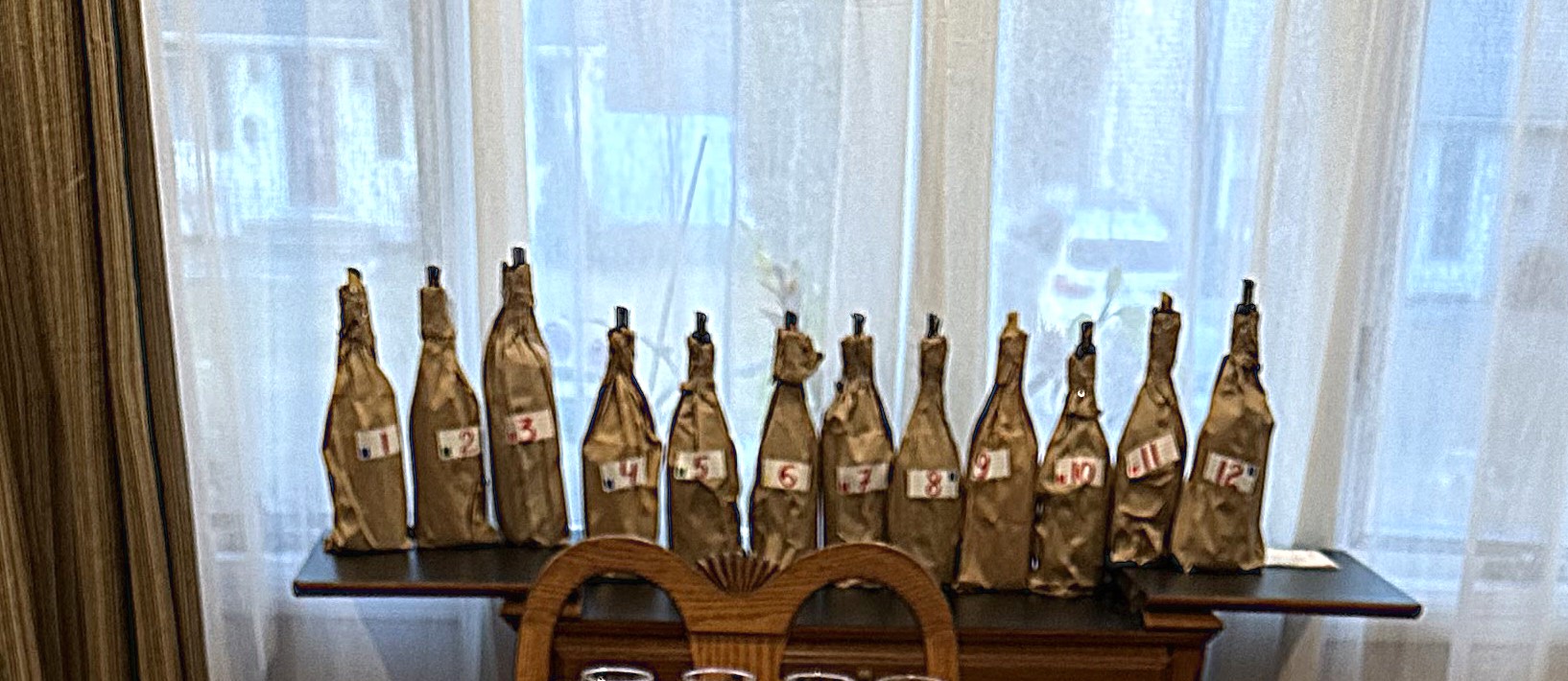
This is a blind tasting, so we placed all bottles in the paper bags, and then my daughter who was now a participant in the tasting put the labels randomly on the bags (15 years ago her role was limited only to attaching the labels :)). I also prepared a few of the “reference points” for everybody to use in the form of the crushed fruit in the glass – I didn’t find plums in the store, but we had many other relevant “references” – cherries, pomegranate, blueberries, raspberries, blackberries, and even liquid smoke.


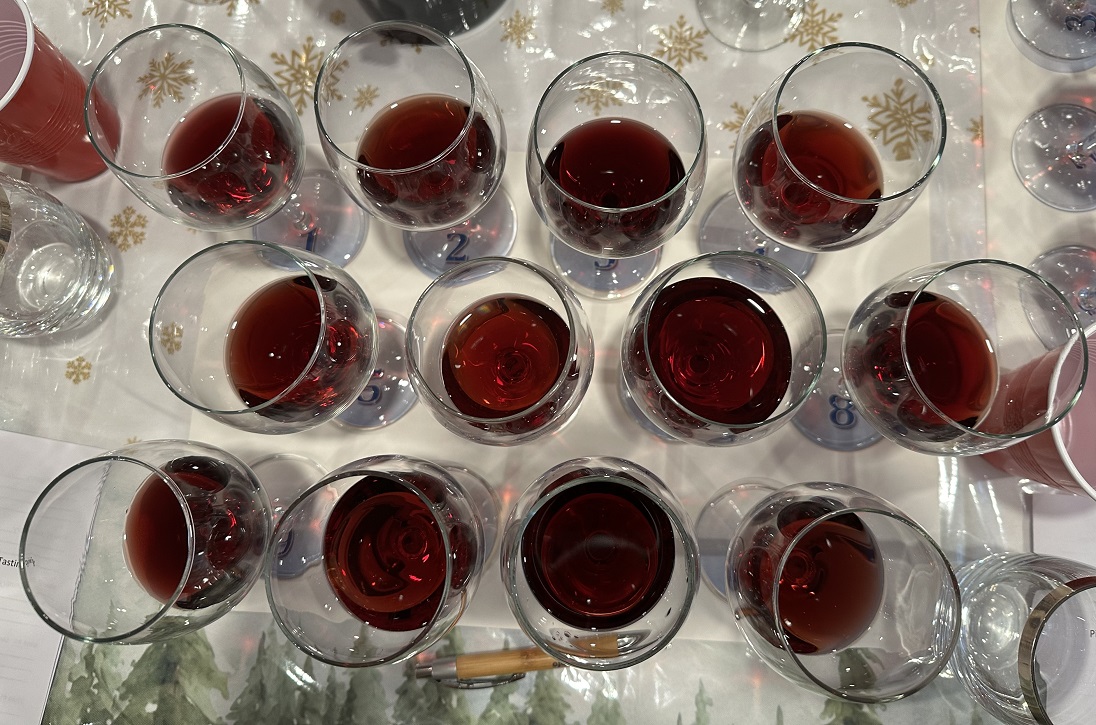
We also had paper for taking notes, and as a reference, I included all the countries that were present in the tasting so we could try guessing the countries for each wine. All countries except the two, as both Zak and I brought in one “surprise” each – Pinot Noir from the countries that are not really known as Pinot Noir producers – we didn’t know what wine the other person was bringing. Here is the list of countries that were offered for everyone’s reference: Argentina (Patagonia), California (Santa Rita Hills), France (Burgundy), Germany (Ahr), New York (Finger Lakes), New Zealand (Central Otago), Oregon (Willamette Valley, 2 wines), Poland, Washington, Surprise 1 (European country not listed above), Surprise 2.
Off we went, tasting and discussing the wines, trying to figure out what was what. Consciously tasting 12 wines in a row is not an easy fit, especially when you try to at least identify the countries. Also, each person (there were 8 of us) was supposed to decide on 3 of their favorite wines so we would be able to vote for the most popular wine of the night, so we had to score each wine. Here score is simply comparative within your notes – 1 through 5, E to A, doesn’t matter, as long as everyone can decide on their favorites.
Here are my notes for all 12 wines as the tasting was happening.
Wine #1: Country: New World (have no idea what I was thinking, I guess something outside of Europe), Vintage: 2021. Cherries, lots of cherries, raspberries, tart cherries on the palate, good balance, nice. Score: 8
Wine #2: Country: Oregon, Vintage: 2021. Iodine, cherries, tart, pepper, tannins, earthy, rocky. Score: 8+
Wine #3: Country: Poland?, Vintage: 2021. Cherries, initially fresh berries, fresh raspberries, sweet cherries, good balance. Score: 8
Wine #4: Country: Argentina?, Vintage: 2019. Gunflint, fresh, crisp, tart, rocky, cherries, excellent. Score:8/8+. Tasting again at the end of the tasting, the wine lost something, so finally score is 8
Wine #5: Country: California?, Vintage: ? Almost black color, dark, aged, medicinal nose, iodine, sweet cherries on the palate, tart. Score: 8-, after retesting later – 8, wine improved.
Wine #6: Country: Oregon? No, Vintage: ?, carrot juice on the nose, very grippy tannins on the palate, cherries. Score: 7+
Wine #7: Country: ? , Vintage: ? Beautiful color, Rutherford dust, hint of cherries, tannins and cherries on the palate, good balance. Score: 8 initially, 8+ after breathing
Wine #8: Country: Germany, Vintage: ? Love the garnet color, smoke, tar, concentrated nose. Wow! Superb – cherries, concentrated, good acidity, good balance. Score: 8++
Wine #9: Country: Oregon, Vintage: ? Pencil shavings, Rutherford dust, tannins, cherries, elegant but needs a touch more acidity. Score: 8
Wine #10: Country: ?, Vintage: ? Pomegranate seeds, cherries, very tight. Cool aid, cherry cola Score: 8-
Wine #11: Country: Finger Lakes, Vintage: ? Smoke and rubber, tar, on the nose. Rubber, tannins, cherries, became more balanced after breathing Score: 7+ initially, improved to 8 on the second tasting.
Wine #12: Country: Oregon, Vintage: ? Cherries, vegetation, cool aid on the nose. Cherries, good balance, good acidity, excellent. Score: 8+, went down to 8 after re-tasting as the finish showed sugar candy.
Ugh, this was not an easy tasting, but it was finally complete. Time to decide on favorites. First, everyone had to make their own decisions for the 3 favorite wines. After re-tasting and struggling, my list of favorites in descending order looked like this:
1st favorite: #8
2nd favorite: #2
3rd favorite: #7
Next, the vote. Remember, each person (there were 8 of us) was allowed to vote for 3 favorite wines, thus we just called the wine number and asked to see a show of hands. Here are the results.
Wine #1 – 1
Wine #2 – 5
Wine #3 – 1
Wine #4 – 0
Wine #5 – 0
Wine #6 – 3
Wine #7 – 3
Wine #8 – 3
Wine #9 – 3
Wine #10 – 1
Wine #11 – 1
Wine #12 – 3
Therefore we had a clear winner – wine number 2, and 5 wines in the second place with 3 votes each – #6, #7, #8, #9, and #12.
Next came the best and final part of the blind tasting – the reveal! Would you believe me If I told you that the revealed bottle elicited a loud “oh, wow, really” literally from everyone? Surprise after surprise after surprise.
The most popular wine? Pinot Noir from (drum roll, please)
Japan!
Seriously, Japan??? How? Yes, Japan makes wine, but to make Pinot Noir that shows better than Oregon, California, Burgundy, and all other countries? Just wow. Apparently, this is an impossible-to-get “cult” wine, produced in minuscule quantities, $100 wholesale but $300 retail if you can even find it? That was the first “surprise” wine.


Pinot Noir from Poland that was very good? How about that? My favorite wine of the tasting, Southern Lines from Central Otago, by some absolute miracle was $15 per bottle – how is that even possible (it is a case buy if you can find it at that price).
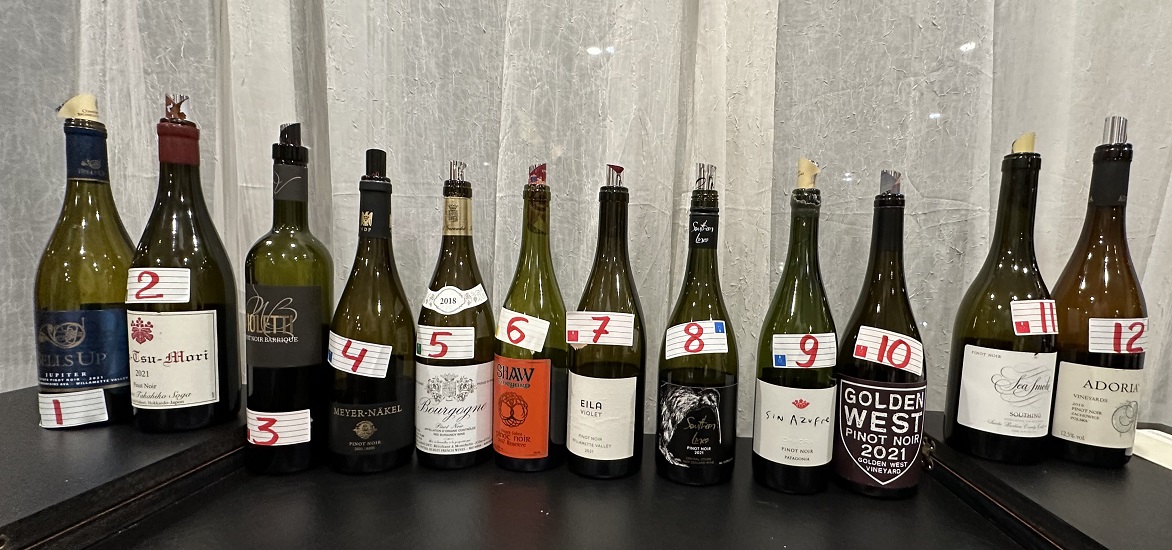
Here is the full list of wines in the numbered order:
- 2021 Bells Up Jupiter Pinot Noir Estate Chehalem Mountains AVA (13.5% ABV, $50)
- 2021 Domaine Takahiko Soga Nana-Tsu-Mori Pinot Noir Hokkaido Japan (13% ABV, $300?)
- 2022 Violetti-Rebbau Pinot Noir Barrique Vin de Pays Suisse (13% ABV, $N/A)
- 2021 Meyer-Näkel Pinot Noir Ahr Germany (12.5% ABV, $56 at Wine.com)
- 2018 Paul Garaudet Pinot Noir Bourgogne AOC (13% ABV, $39)
- 2017 Shaw Vineyard Pinot Noir Reserve Finger Lakes New York (13% ABV, $N/A)
- 2021 EILA Violet Pinot Noir Willamette Valley (12.7% ABV, $65)
- 2021 Southern Lines Pinot Noir Central Otago New Zealand (13.5% ABV, $15)
- 2022 Chakra Sin AzuFre Pinot Noir Patagonia Argentina (12% ABV, $30 Last Bottle)
- 2021 Golden West Pinot Noir Goden West Vineyard Royal Slope Washington (14% ABV, $21)
- 2011 Sea Smoke Southing Pinot Noir Santa Rita Hills Santa Barbara County (14.5% ABV, $100?)
- 2021 Adoria Vineyards Pinot Noir Zachowice Poland (12.5% ABV, $25)
You see, this is what blind tasting does. Under the guise of the brown bag, all wines are “the same”. You are not influenced by anything – “ahh, I brought this wine, it must be better”, “ahh, the guy in the store was raving about it so much”, “ahh, it got 99 points from Suckling” – none of this matters. You let your palate be the judge. Wine has to give you pleasure.


As the wines were left at my house after the tasting, I was the lucky bastard who had an opportunity to taste them over the few next days. This is not how the general population consumes wines, so this has very little bearing on the results and the whole tasting process, but I can tell you that for example, the Sea Smoke Southing became literally my favorite wine – it developed a depth of flavor and a beautiful complexity – if it would taste like that during the tasting it would be handily the wine number 1, for sure for me. The Pinot Noir from Ahr also developed additional layers, with gunflint and roasted meat notes now dominating the flavor profile in a very respectful manner, making it a lot more pleasant to drink – again, in that state it would again get a much higher rating in my book. And pretty much across the board, the Pinot Noirs continued their evolution and most of them were still drinkable even 5 days after being open – a testament to quality.
Here we are. 15 years later, the most unexpected Pinot Noir wins again. But this is the beauty of wine. The mystery, the enigma, the art. Wine is a liquid art form, and this tasting delivered an unmeasurable amount of pleasure and created new memories. This is what life is all about, isn’t it? Creating good great memories. And wine is exceptionally good at that. Onward and upward.
Celebrating New Year 2025 In Style
New Year is my favorite celebration. It is simply a celebration of life as it happens. Forget all this “new year, new you” nonsense, forget all the resolutions – new year resolutions don’t work, you can’t do something once in 365 days and expect that the effect will last for the next 364. So the New Year celebration for me is just an opportunity to spend time with your friends and family, and maybe enjoy some special treats – yes, I’m talking about wine and food, of course (in that specific order).
New Year celebration is an opportunity to open a special bottle (or 2, or 3, or more). I always want to decide on my celebratory wines in advance, and then the decisions are still happening at the last minute. Here is what I decided on to celebrate the new year 2025:
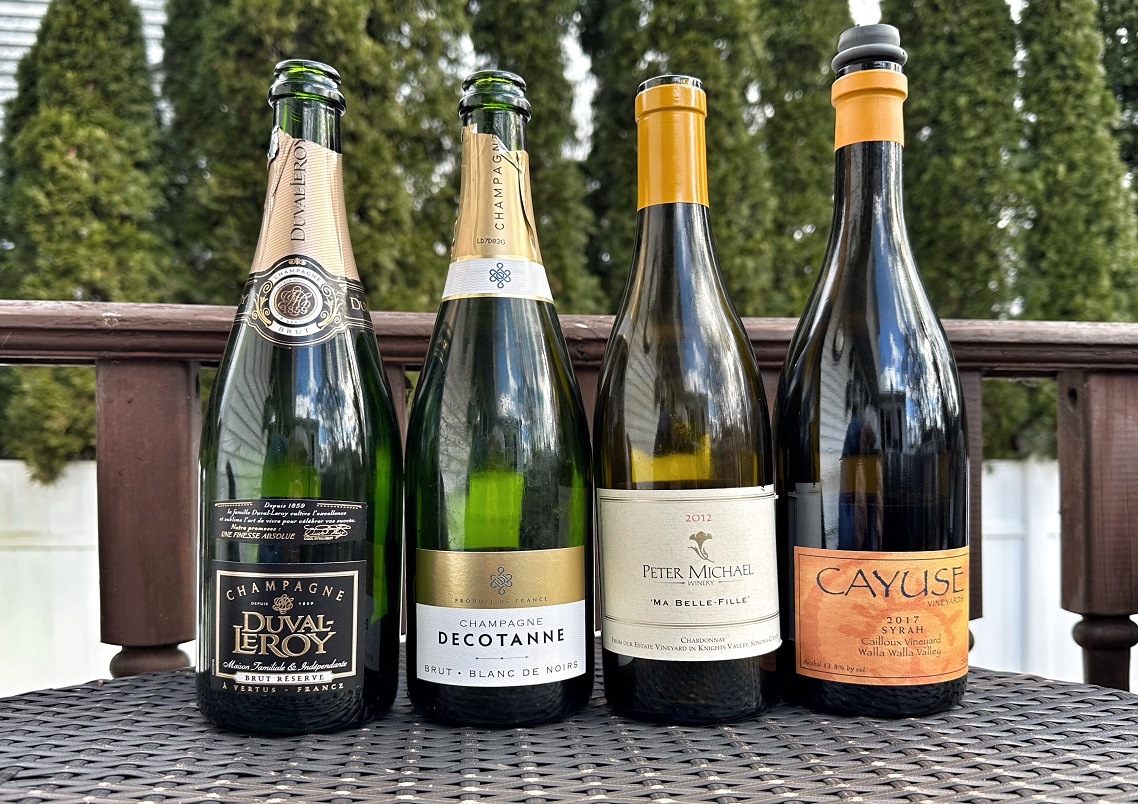
We started with NV Champagne Duval Leroy Brut Reserve (12% ABV), which showed beautifully with a yeasty, toasty nose, and then freshly baked bread and apples on the palate, spread over the fine mousse. Supple acidity completed the presentation, and the bottle was emptied in a matter of a few minutes.
One bottle of bubbles is never enough, so we continued our New Year celebration with NV Champagne Decotanne Brut Blanc de Noirs (12% ABV). Not so much of the toasted notes but nice fresh apples instead, followed by creamy, apple-forward fine mousse, rounder and just a tiny bit sweeter than the previous Champagne, possibly with simply a perceived sweetness just because of the fuller body. Overall elegant and delicious to the last drop.
Next I decided to open the 2012 Peter Michael Ma Belle-Fille Chardonnay Knights Valley Sonoma County (15.6% ABV). I have a complicated relationship with Peter Michael wines. When I tasted Peter Michael Chardonnay for the first time (probably 2008 vintage), I instantly fell in love and signed up for the mailing list (got on relatively quickly). Then a few of the subsequent vintages were not as good, while the price continued to go higher, so I dropped off the mailing list, and now just slowly finishing the bottles I have with various degrees of success (read: enjoyable, pleasure-inducing wines). This 2012 Chardonnay should be remembered as a success, showing a serious punch of vanilla and overripe apples on the nose, and continuing with the exact same profile on the palate. The acidity was in check, making the wine “pleasant to drink” but not much beyond that. A bit more acidity would have perfectly freshened up the wine, but oh well. Still, a very decent California Chardonnay specimen at 12 years of age.
Last but not least – 2017 Cayuse Syrah Cailloux Vineyard Walla Walla Valley (13.8% ABV). I know, 7 years is not really an age for the Cayuse wines, but hey, that’s what the New Year celebration is for – to motivate you to open a special bottle of wine. I decanted the wine for a few hours, and it opened up beautifully with smokey, earthy cherries, granite, and iodine – both on the nose and on the palate. A very elegant and delicious wine in its own right.
Not sure if food is as exciting as wine, but the New Year celebration also requires a celebratory set of dishes, something along these lines:
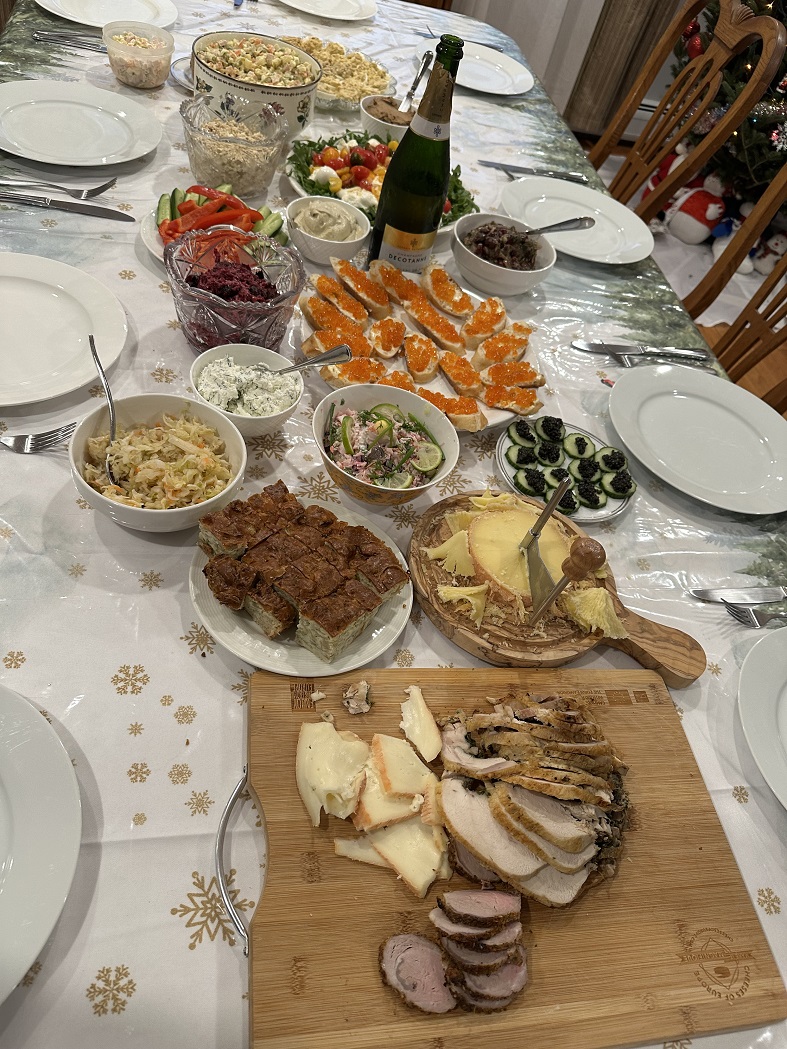


This year was also very special as Hanukkah and Christmas overlapped, which only happened 5 times over the past 125 years – in 1910, 1921, 1959, 2005, and now 2024. As the last day of Hanukkah overlapped with New Year Day, I took this picture to preserve such memory:

So, how was your New Year celebration? Amy special wines, special food? I’m eager to know, do tell.
And until the next time – cheers!
Happy New Year 2025!
I want to take a moment to wish everyone a healthy, peaceful, happy New Year 2025, filled with amazing experiences, wonderful, memorable life moments, good conversations, loving families and friends, and very importantly, delicious, memorable wines!

Top 24 of 2024
 See how well this rhymes?
Top 24 of 2024.
When I posted my list of top wines of the year for the first time in 2010, the desire was to create a list of the top 10 wines. This was almost successful, as the list included 12 wines, so I decided that “my thing” would be Top Dozen. I managed to maintain that limit of a dozen wines in 2010 and 2011. But then in 2012, I failed miserably, and that list included 26 wines. And ever since, all the top wine lists have had about two dozen wines or so.
I’m glad that in 2024, I don’t need to even look for any excuses as to why the top list contains so many wines. 24 wines is perfectly suitable for 2024, so that’s what we are going to do.
The selection process for the wines to be included in the Top Wines of the Year is very simple – the wine has to be memorable. These are the wines that solicited emotion, and thus became memorable. They don’t have to be the highest rated wines, even though they often are, but they have to be memorable.
I never try to calculate how many wines I taste during the year. Including all the tasting events and wine dinners I’m lucky enough to attend, I would guess this number is close to a thousand, so I believe selecting two dozen wines out of a thousand is reasonable. And please believe me when I say that decision is never easy, especially when it comes to deciding on the top spot – 2024 was no exception, and you will see why as you follow along.
Without further ado, let me present to you Talk-a-Vino Top Wines of 2024:


25. 2021 Bodegas El Nido El Nido Jumilla Do Spain ($150) – very much last-second addition to the list, but I would be upset if I did not include this wine. El Nido is generally a massive wine – pop and pour drinkability of this 2021 flagship of Gil Estates wines was very surprising and definitely memorable. Voluptuous, generous, yet perfectly balanced – one memorable wine – which is the main criterion for the inclusion into this list.
24. 2021 Le Clos du Caillou Cotes du Rhone Cuvee Unique Vieilles Vignes ($19, Last Bottle) – I’m generally a bit concerned about Cotes du Rhone wines, as I had many underwhelming specimens over the years. Not this wine though – beautiful, round, supple without being overbearing, very easy to drink.
23. 2021 FIOL Rosé Prosecco DOC Millesimato ($22) – everyday bubbles. Can I say just that? Okay, fine, if you insist – it was delicious, with a lot of energy and the fizz more reminiscent of a good champagne. Strawberries, anyone?
22. 2023 MAIA Winery Mare White Israel ($25) – Was looking for an Israeli wine to celebrate Rosh Hashanah, and came across this wine at the local Total Wine. Somehow this wine spoke to me, and I’m glad it did – it was all-around delicious with a structure that would make a good Chardonnay proud.
21. 2017 Campochiarenti San Nicola Riserva Chianti Colli Senesi DOCG (€19) – There is something special about Italian wines, like they can speak directly to your wine lover’s soul. Cherries galore, beautifully and tightly packaged to put a smile on your face. Don’t believe me? Try it for yourself.


20. 2021 Keeler Estate White Wine Blend Eola-Amity Hills AVA ($20, Last Bottle) – as you peruse this Top wines list, you will see many finds courtesy of Last Bottle. Yes, Last Bottle knows how to present their wines in a very appealing way – but Last Bottle can’t force the wine to appear in this list, this would be my doing. So this wine was delicious – light, citrusy, with just the right amount of complexity.
19. 1997 Chateau Haut-Piquat Lussac Saint-Emilion AOC ($19.99, Wine Exchange) – I don’t drink a lot of Bordeaux, so I’m glad I had at least one wine worthy of inclusion in this Top list. I found this wine a few years back with the help of Wine Exchange, and it was an excellent find – a classic old-world Claret, still youthful and delightfully drinkable.
18. 2014 Le Casalte Vino Nobile di Montepulciano DOCG ($N/A) – another “first of” wine on this list – first of the great wine finds we experienced during our family European trip earlier this year. Not only was this wine tasty, but it was also very memorable as I ordered this Vino Nobile wine at a restaurant at the very heart of the Brunello land – in Montalcino. Well, good Sangiovese is a good Sangiovese, what can I say. This one was delicious.
17. 2022 Gran Bousquet Organic Cabernet Sauvignon Uco Valley ($25) – Cabernet Sauvignon of this quality for this price is simply unreal. And it is organic. If you like Cabernet Sauvignon, this is a must-try.
16. 2017 Saxum Heart Stone Vineyard Paso Robles Adelaida District ($110) – this wine could probably wait for another 3-4 years (or much longer) – still, it delivered enough pleasure as it was. Powerful, concentrated, delicious.


15. 2017 Royal Tokaji Borászat Mad Royal Tokaji Aszú 5 Puttonyos ($N/A) – One of the highlights of the trip to Hungary. Seductively sweet and refreshingly acidic – a dessert wine to seek.
14. 2022 Petit Sauvage Rouge Vin de France ($17.99, Wine.com) – This wine forced a deep search in my wine lover’s vocabulary to find the words to describe it properly. I rather failed with the search, but I enjoyed the process – you can read more in the post. A rare grape and a very memorable experience.
13. 2018 Anaperenna by Ben Glaetzer Barossa Valley Australia ($49, Last Bottle) – I need to drink more Australian wine, as this one was delicious on all levels.
12. NV Champagne Camille Jacquet Brut Grand Cru Chardonnay A Le Mesnil-sur-Oger ($35, Last Bottle) – yes, another Last Bottle, and an absolute steal of Champagne for the money. Toasted notes on the nose and the palate, lots of energy and finesse. Also comes with regrets – why did I only buy 3 bottles?
11. 2021 Banfi Poggio Alle Mura Rosso di Montalcino DOC ($25) – another Sangiovese, another wine associated with our family’s European trip and a first wine from Banfi (spoilers: there will be more). We had this wine during our lunch at Castello Banfi, and it stopped everyone in their tracks – even kids who are not really into the wines.


10. 2018 Ramos Pinto ‘Urtiga’ Terracos Pre-Filoxericos Douro DOC ($300) – talk about unique wines – this one will be hard to beat. It comes from the vineyard where each vine has its own GPS and sensors, and can be tracked. Made from 63 unique varieties. Delicious, elegant wine, as memorable as they ever get…
9. 2012 No Girls Tempranillo La Paciencia Vineyard Walla Walla Valley ($90) – liquid rock, tamed. End of the description. Seriously, smokey and brooding wine, full of granite and iodine, mature enough to let the fruit show through. Definitely an experience.
8. 2020 Avignonesi Desiderio Toscana IGT Merlot ($60) – What is it with Italian Merlot? It is as good as Sangiovese gets. Unmistakably Italian, round, classic, delicious.


7. 2009 Sauvella Luscinia Canta Costers del Segre DO ($30) – when my friend said ” you will love this wine” it didn’t register with me. Then I opened the bottle, and the next thought was “oh my god, this is so good, what is it???”. A Spanish wine of an unusual pedigree (Syrah and Cabernet Sauvignon in leading roles), smooth, well-structured, scrumptious. And I don’t even want to mention the price…
6. 2022 Terra Alpina Chardonnay Vigneti Delle Dolomiti IGT ($20) – I’ve had Terra Alpina wines before, I guess this is what convinced me to get this bottle at Whole Foods in Florida. I’m a sucker for a good Chardonnay, and this high-altitude, Alpine-climate-driven rendition was just spectacular, round and succulent. A delightful wine all the way.
5. 2021 Juan Gil Red Blend Jumilla DO ($15) – Another surprising business trip Whole Foods find. I grabbed this wine strictly based on price. Once I poured it into the glass, I was blown away by both the aromatics and the bouquet of ripe fresh berries, sweet oak, chewy but elegant tannins, the whole package for mere $15.
4. 2018 Smith-Madrone Cook’s Flat Reserve Spring Mountain District Napa Valley ($225) – Textbook Cabernet Sauvignon. Precise flavor, immaculate delivery, the wine to experience.
3. 2019 Ramos Pinto Quinta de Ervamoira Douro DOC ($100+) – here we go – the second wine from Ramos Pinto. This is a single-vineyard wine, coming from a single vineyard designated as a UNESCO World Heritage site. Dark fruit, earthy, powerful, and precise.
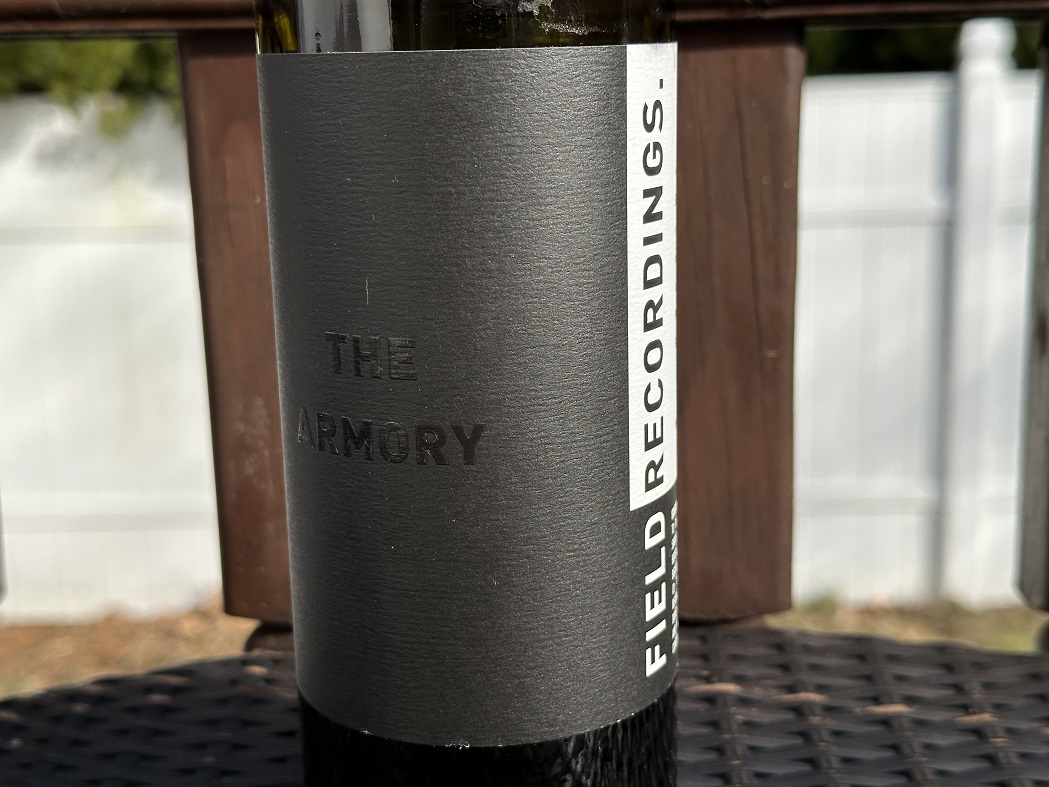
2. 2019 Field Recordings The Armory Paso Robles ($85) – This wine was really something else. I poured this wine for our guests on Thanksgiving, while continuing to drink whatever I had before. Judging by the facial expressions and overall reaction of our guests, I decided that it might be a big mistake if I will not try it. I don’t know what kind of dark voodoo magic was used to make this wine, but it was unique. This is 100% Cabernet Sauvignon, and while the wine had all the traits of a classic cab, every taste element had its own amplified energy, it was vibrant and alive. A truly unique experience.
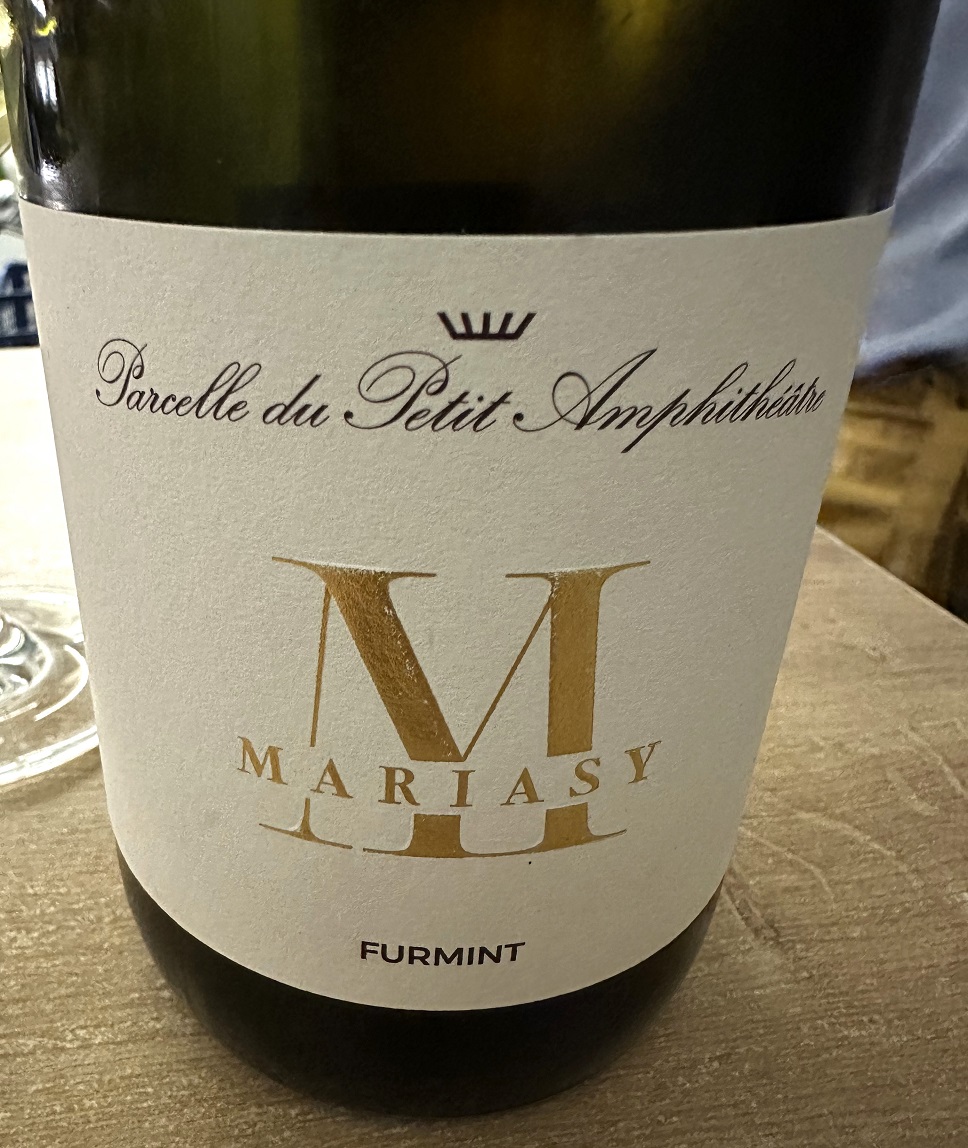
1. 2020 Mariasy Tokaji Furmint Hungary ($N/A) – yes, I did it again. Two #1 wines. In my mind, this was the only way. Chardonnay-like and Chardonnay. This Furmint wine was full-bodied, succulent, offering hints of vanilla and toasted notes and even imaginary butter, while being bright and energetic.
1. 2022 Banfi Fontanelle Chardonnay Toscana IGT ($30) – And now, the Chardonnay. Vanilla, apples, honey, bright, zingy, refreshing, and dangerous. Really dangerous – I would drink a bottle by myself.
This completes the presentation of the Top 24 (actually, 26, but who would count) Wines of 2024. Lots of well-worthy wines didn’t make it to the list, but I think I got a good representation here.
What was your wine(s) of the year 2024?
An Evening of Pure Pleasure
Do you know what makes an oenophile’s heart melt and pound, what fills it with joy? Hearing their friends say after you pour the wine into their glasses
“Oh my god, this is so good!”
This brings a double pleasure – it is not only you now getting the pleasure from the aroma and the bouquet – but your friends also enjoying it as much as you do. Wine is meant for sharing, and this makes sharing so much more enjoyable…
Wine can never be taken for granted. Let’s remember that the wine continues changing even after bottling – each time we open the bottle, we find the content of the bottle in its unique state. Yes, we can hope that if you open all 12 bottles from the case at the same time, all wines will taste the same – but it is still a game of probabilities, with opportunities for the “bottle variation” to be increasingly more noticeable as the wine ages. And I’m not even talking about potential wine faults…
Next, there are expectations. Expectations are a big deal for the oenophile. Just one look at the bottle and an oenophile forms expectations – bottle appearance, place, producer, type of wine, vintage – everything is taken into account, and we know what to expect. It is the most joyous moment when the liquid in the glass meets expectations – and the most daunting when it does not (let’s not get to the corner case of Two Bucks Chuck, please). But there is more to the expectations in wine. One of the biggest challenges with wine expectations lies in the fact that it doesn’t matter how much you like the wine and how well your great expectations are met – everyone’s palate is different. It is hard learning to be okay with the fact that while you enjoy the wine immensely, your friend doesn’t care for it. It doesn’t make the wine bad. It doesn’t mean that you are wrong or did anything wrong. It simply means that taste is personal, you just need to learn to accept this simple fact of life – and not get upset.
You might wonder why I am talking about all this wine geek mumbo jumbo, why is that important? Simple. No matter how familiar you are with the wine you are pouring, or how many times you have had the wine from the same vintage and producer, when the wine reaches the glass, it is always the moment of revelation. Double that (triple? quadruple?) when you are poring wine for your friends. And even if you think that wine is perfectly perfect, you can never assume your friends will think the same. Wine can never be taken for granted.
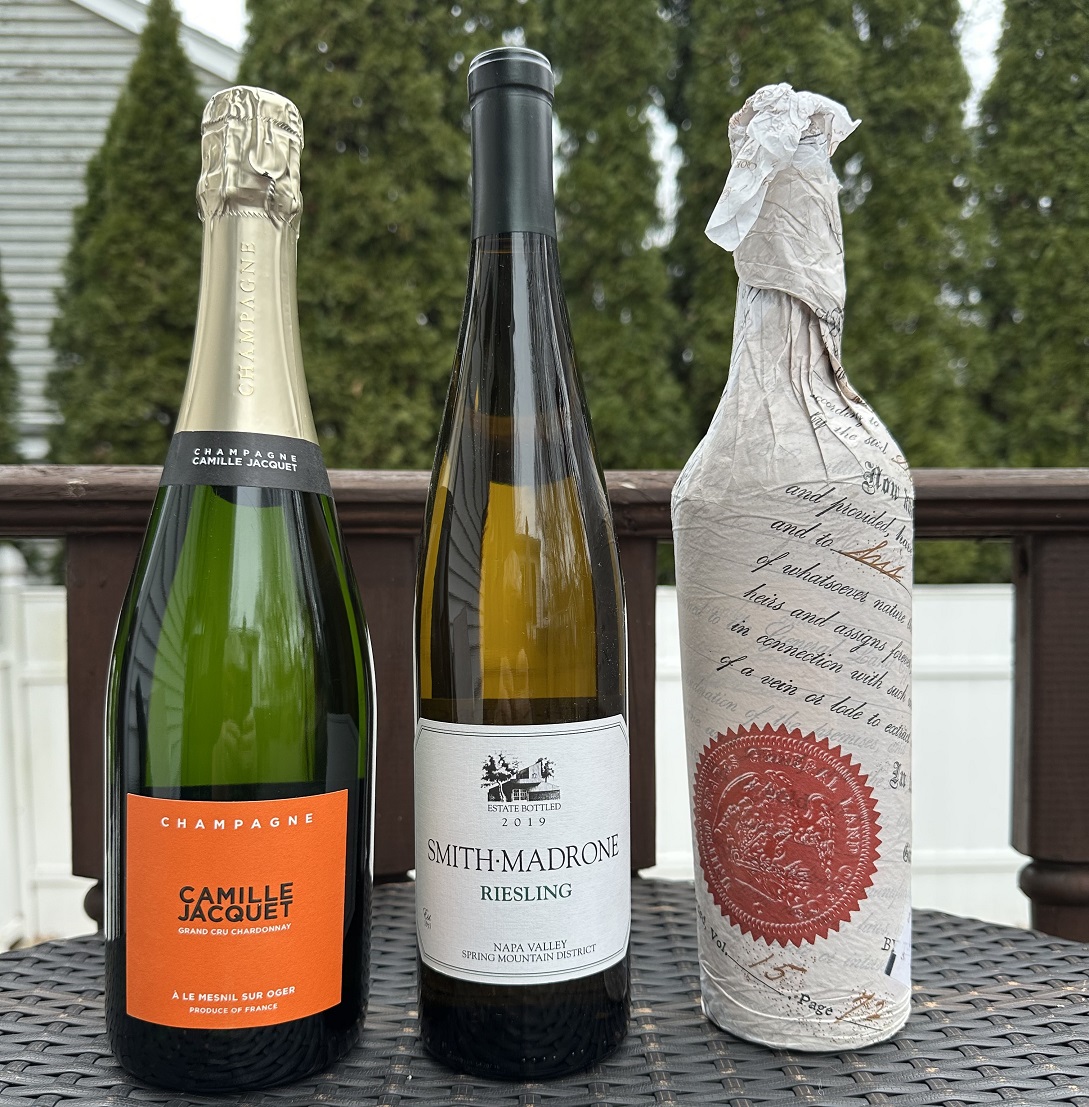 I guess I got lucky. At last weekend’s evening with our dear friends, I managed to hit a double “trifecta” :). Three delicious wines out of three, and my friends loved all three to the “oh my god, this is so good!” moment.
First wine – NV Champagne Camille Jacquet Brut Grand Cru Chardonnay A Le Mesnil-sur-Oger (12% ABV). I do not know the producer, but I had high expectations for this wine possibly for a silly reason. A small village Le Mesnil-sur-Oger is well known for the quality of its Chardonnay vineyards and a home to some of the best (if not the best ) Blanc de Blancs Champagnes in the world – Salon le Mesnil and Krug Clos du Mesnil. Knowing that Camille Jacquet Champagne comes from basically the same vineyard gave me high hopes (silly, as I said) for this Champagne. And my high expectations were perfectly met. Beautiful nose of toasted bread with a touch of apple, impeccably crisp, fresh and precise on the palate. The acidity was fully in check with the complexity of the toasted, baked goods on the palate, leading to an impeccable (yes, I know I already used that word) balance. “Oh my god, this is so good!” said my friends, and the wine disappeared in a jiffy.
Next, two beautiful wines from one of my favorite producers ever. Over the years, I wrote about Smith-Madrone wines extensively. Cooks’s Flat had been one of the Talk-a-Vino Top 10 Wines of the Year 2019 top wines (that year, I had 3 #1 wines, tell me about my inability to make decisions), and Smith-Madrone Cabernet Sauvignon was #3 on the Talk-a-Vino Top 23 of 2023. So I was very happy that I got the samples of Riesling and Cook’s Flat and was able to share both wines with my friends (I will also taste a nice vertical of Smith-Madrone Riesling, it will take a central stage on these pages soon).
Smith-Madrone Riesling is one of my favorite Rieslings in the world – it is one of the 3 if you are interested – Grosset Polish Hill Claire Valley Australia, Smith-Madrone from Napa Valley, and Brooks Ara from Oregon. This 2019 Smith-Madrone Riesling Spring Mountain District Napa Valley (13.3# ABV) was spectacular. First, it offered a tremendous pop of petrol on the nose – and nothing makes my Riesling lover’s heart happier than these petrol aromatics, coupled with a whiff of honeysuckle. On the palate, it was fresh, energetic, with a wide range of citrus flavors readily present, from Meyer lemon to oranges and mandarines, supported by clean acidity and a perfectly cleansing acidic finish. Delicious, and the second “oh my god, this is so good!” wine.


Finally, the 2018 Smith-Madrone Cook’s Flat Reserve Spring Mountain District Napa Valley (14.2% ABV, 87% Cabernet Sauvignon, 13% Cabernet Franc, 20 months in new French Oak). This wine is designated as “Reserve” and this is not random – it represents the best of the best Smith-Madrone makes, using the best plots, best grapes, and produced only in the best years. This wine also has a historical connection to the parcel of land where Smith-Madrone vineyards where replanted in 1972 – the tissue wrapping the Cook’s Flat bottle is a copy of a land grant document, signed by the President of the United States. Here is the description from the Smith-Madrone website:
“Cook’s Flat Reserve is a proprietary name for a wine that is the culmination of our 50 years of growing grapes and making wine in the mountains of the Spring Mountain District. The name refers to George Cook, the first owner of the property. ‘Cook’s Flat’ was the local oldtimers’ name for the eight-acre plateau-like vineyard block which was replanted in 1972.
The packaging expresses the property’s history and an uncompromising attention to detail. Each bottle is numbered and only around one thousand bottles are produced in each vintage. Each bottle is wrapped in tissue which has been printed with a multi-colored copy of the U.S. Land Office Patent which granted ownership to George Cook and was signed by President Chester Arthur on December 5, 1885. We proudly display the original at the winery.”
What I love about Smith-Madrone wines is textbook precision. So far literally everything I tasted from the winery had this textbook precision of flavor – Riesling is unmistakably Riesling, Chardonnay is unmistakably Chardonnay, Cabernet Sauvignon is unmistakably Cabernet Sauvignon.
This 2018 Cook’s Flat, a blend of Cabernet Sauvignon and Cabernet Franc, was also unmistakably a Cabernet. A core of black currant, a.k.a. cassis, and eucalyptus, supported by sweet tobacco and sweet oak, with a whiff of the bell pepper (love it). On the palate, the textbook flavors continued with succulent cassis, eucalyptus, a touch of mint and bell peppers, firm structure, perfectly integrated and perfectly present tannins, impeccable balance. Just a pure joy. “Oh my god, this is so good!” wine again disappeared in no time, with the last drops almost squeezed out of the bottle.
Here you are, my friends. An evening of pure pleasure – and a happy oenophile who managed to make his friends “oh my god, this is so good!” happy.
I have more happy stories to tell – stay tuned…
Fun With Numbers – Analyzing 2024 Top 100 Lists
 Do you like numbers?
Do you like to play with numbers?
I do – so let’s have a bit of a [almost traditional] fun with wine numbers. I’m talking about analyzing the Top 100 lists from the major wine publications.
Top 100 is one of the most anticipated and coveted topics in the wine world. There is a lot of anxiety and activities surrounding the Top 100 lists. Wineries proudly put their Top 100 “membership” on the bottles; publications, such as Wine Spectator, create a lot of drama, slowly unveiling their Top 100 selections over a week; wine stores are anxious to get and offer as many of the Top 100 selections as possible; consumers get an extra reason to buy the Top 100 wines as their greatness had been established by the experts. So let us take a closer look at the Top 100 Wines of 2024 lists from the major publications and compare them side by side.
The majority of the wine publications present their Top 100 lists, many of the publications even offering a multitude of Top 100 lists – for example, James Suckling publishes separate Top 100 lists for most of the major wine countries; Wine Enthusiast offers Best Buys, Cellar Selection and Enthusiast 100 lists. As I have done in the past, for this comparison I’m using Top 100 lists from James Suckling, Wine Enthusiast, and Wine Spectator. For the Wine Enthusiast, I’m using the Enthusiast 100 list. Also note that while James Suckling and Wine Enthusiast 2024 Top 100 list links are specific to the year, Wine Spectator has one link for all top 100 lists from 1988 until 2024 (going through those is a fun exercise in itself).
Now, let’s discuss the particulars.
Wine of the Year
Let’s start with the Top wines of 2024. Out of the 3 top wines, 2 are reds and one is sparkling – not very surprising as red wines dominated the top 100 lists at all three publications. James Suckling’s Top wine of 2024 was the 2015 Bertani Amarone della Valpolicella Classico (JS100, $125). Wine Enthusiast’s Top wine of 2024 was the 2013 Roco RMS Brut Delayed Disgorgement 10-Year Sparkling Willamette Valley (WE98, $125). Lastly, the Wine Spectator Top wine of 2024 was the 2021 Viña Don Melchor Cabernet Sauvignon Puente Alto Puente Alto Vineyard Chile (WS96, $175).
Regions
Here is how the three Top 100 lists stuck up when it comes to the wine regions of the world:
| Region | JS | WS | WE |
| Argentina | 6 | 3 | 4 |
| Australia | 5 | 3 | 3 |
| Austria | 4 | 1 | 3 |
| California | 12 | 26 | 37 |
| Canada | 3 | ||
| Chile | 6 | 4 | 2 |
| China | 1 | ||
| France | 18 | 16 | 14 |
| Georgia | 1 | ||
| Germany | 12 | 1 | 1 |
| Greece | |||
| Hungary | 1 | 1 | |
| Israel | 1 | ||
| Italy | 26 | 20 | 13 |
| New York | |||
| New Zealand | 4 | ||
| Oregon | 5 | 5 | |
| Portugal | 4 | 5 | |
| South Africa | 1 | 1 | 2 |
| Spain | 6 | 6 | 3 |
| Uruguay | |||
| Washington | 3 | 4 | 3 |
I purposefully left all regions that were included in the previous years so you get a better picture. As you can see James Suckling’s list was dominated by Italian wines. Wine Spectator had a penchant for California, but not as much as the Wine Enthusiast, where almost 40% of the Top 100 wines came from California. New entrants compared with the previous years were the wines from Georgia and China.
Wine Types
Here is the comparison classified by the wine types:
| Type | JS | WS | WE |
| Dessert | 3 | 1 | 2 |
| Fortified | 2 | 1 | 1 |
| Red | 60 | 67 | 68 |
| Rosé | 1 | 2 | |
| Sparkling | 2 | 2 | 8 |
| White | 33 | 28 | 19 |
As you can see, red wines dominated all of the lists. The last time I did this comparison back in 2021, and compared to that table I had to add a row for the fortified wines. I’m happy to see that all 3 Top 100 lists included at least one fortified wine. Also, Wine Enthusiast included a good number of sparkling wines, with most of them coming from Oregon out of all places (and those will be even harder to find than Champagne due to a very limited production).
Ratings
Ratings continue to be radically different between all three lists. James Suckling ratings don’t go lower than 97, and Wine Spectator’s top rating was 98 with only a single showing.
| Rating | JS | WS | WE |
| 100 | 20 | ||
| 99 | 58 | 1 | |
| 98 | 17 | 1 | 3 |
| 97 | 5 | 8 | 13 |
| 96 | 6 | 19 | |
| 95 | 12 | 16 | |
| 94 | 19 | 16 | |
| 93 | 17 | 22 | |
| 92 | 11 | 8 | |
| 91 | 10 | 2 | |
| 90 | 16 |
I don’t know why there is such a disparity in ratings, but that makes this comparison even more interesting.
Prices
Prices are always an interesting subject, and the presentation of the prices was different this year among all 3 lists. Wine Spectator had prices for all wines included in the description – I can only assume those are suggested retail prices. James Suckling had no prices listed but instead had prepared links for the Wine Searcher to retrieve a current market price for each wine – which makes sense as many of these wines might be on the market for a while and might command premium even before they were included in the Top 100 lists. Wine Enthusiast had prices listed for most of the wines, and also had buying links for all of the wines that were tailored to a specific source – some to Wine.com, some to Wine Searcher.
In the Wine Spectator’s Top 100, the most expensive wine was priced at $375 (MSRP). 19 wines on the list were priced at $100 or higher. The least expensive wine was only priced at $12 (#49 on the list). There were 6 wines on the list priced under $20, a very reasonable number. The top 10 wines, if you could find and buy them all at once, would cost you $1,032.
The most expensive wine on James Suckling’s list was priced at $407 (market price). Only 37 wines were priced at less than $100, which makes 63 wines to be priced above $100 – again, keep in mind that these are market prices according to wine-searcher, so YMMV. The least expensive wine and the only one under $20 was priced at $17, however, interestingly enough, it was wine #2 on the Top 100 list. The top 10 wines combined would cost you $677.
Lastly, the Wine Enthusiast’s Top 100. The most expensive wine was also the most expensive among all 3 lists, priced at $612. 33 wines were priced above $100, so 67 wines were priced at less than $100. The least expensive wine and the only one under $20 was priced at $19 (wine #35, price from wine-searcher). The top 10 wines would cost you $1,100.
Conclusion
I was happy to see lots of familiar – not just familiar, but rather, favorite – producer names sprinkled across the lists. Turley Zinfandel as #14 on Wine Spectator’s list, Carlisle Zinfandel as #21, San Felice Chianti, Calera, Elena Walch; Lopez de Heredia and Cayuse Bionic Frog on the James Suckling list; Inniskillin Cab Franc Ice Wine and Wente Vineyards on the Wine Enthusiast list. I’m sure you will find lots of familiar names too.
I hope you are having as much fun looking through the data I presented here as I had compiling it. There is nothing to be concluded from this exercise, but I find it fun. If you think there is any other data you would like to see as part of this analysis – I will be happy to oblige.
Enjoy!
Last Bottle Sign Up ($10 credit)




 Talk-A-Vino