Drinking With Purpose
Drinking with purpose.
Okay, so what are we talking about here?
First of all, we are talking about wine. Usually, we drink wine for pleasure. Of course, sometimes people drink just for the buzz, to forget, to relax – there are many reasons why people use alcohol, but wine (I hope) stands a bit apart from the rest of the alcohol. Wine helps us to converse with friends, create memories, enhance our food experiences and simply derive pleasure from the simple moment of existence. Then what is this purpose I’m talking about?
Wine is the product of passion. At least this is how we, wine lovers, want to see it. Wine also enables passion. Not even passion, but passions. It solicits passions. Wine is surrounded by desire, obsession, exclusivity, mysticism, glamor, science, greed, mystery, art, and devotion, it evokes all of these and many other feelings and emotions. Wine allows everyone to find their own passion.
One such passion is collecting. Yes, some people are collecting the wine. In a lot of cases, they simply do this to feel superior to others, as they have something which other people want but can’t have. We can leave this aside, as this is a boring aspect of wine. Collecting unopened bottles is not the only thing to collect around wines.
The wine offers lots of artifacts. People collect unique bottles. People collect unique labels (hundreds of thousands of different wines are produced every year around the world – and many labels can change every year – think of an endless potential here). People collect champagne and sparkling wine bottle caps – this hobby even has an official name, placomusophilia. Peope collect corks and screwtops. I collect grapes and experiences.
Many, many, years ago I came across The Wine Century Club. No, you don’t have to be 100 years old or drink 100 years old wines. It is all about grapes. Anyone who tasted 100 different grapes (obviously, in wines) – don’t have to be individual grapes, blends are totally fine – is welcome to apply to become a member of the club. The application is honor-based (well, if you lie, your palate would be cursed forever – who would want to risk that), and you get the certificate sometime after you submit the application. Tasting the first 100 grapes was relatively easy. By the time I was done with the first 100, the club was already offering the 200 grapes level (Doppel), then 300 (Treble), 400 (Quattro), 500 (Pentavini), and now even 600 (Hexavin).
After I passed the 100 grapes level, hunting for the new grapes became an obsession, which I thoroughly documented on this very blog. I had friends reaching out and asking if I already had such and such grape. I spent countless hours looking for the grape information online, trying to figure out what grapes went into this particular wine from this particular vintage. Hunting down new grapes became drinking with purpose. I didn’t care if I would like the new wine or not – if it had the grapes I didn’t taste before, that was all I needed.
As I mentioned before, I collect not only grapes but also experiences. Wines are made in all of the 50 states in the USA. Wines are made at least in 60 countries around the world, maybe more. I have a personal goal to experience (read: taste) wines of all 50 states. I also would love to taste wines made in all the different countries around the world.
This is how I collect the grapes and experiences. And this is how drinking with purpose happens. A wine from the new state or a country – yes, please! The wine with new grapes? Yes, pretty please!
Recently, I managed to find a few wines with grapes I never had before. Not only that but one of the wines was made in the region which was new to me, so the two proverbial birds were killed with one stone – err, bottle. Here are the quick notes on these wines:


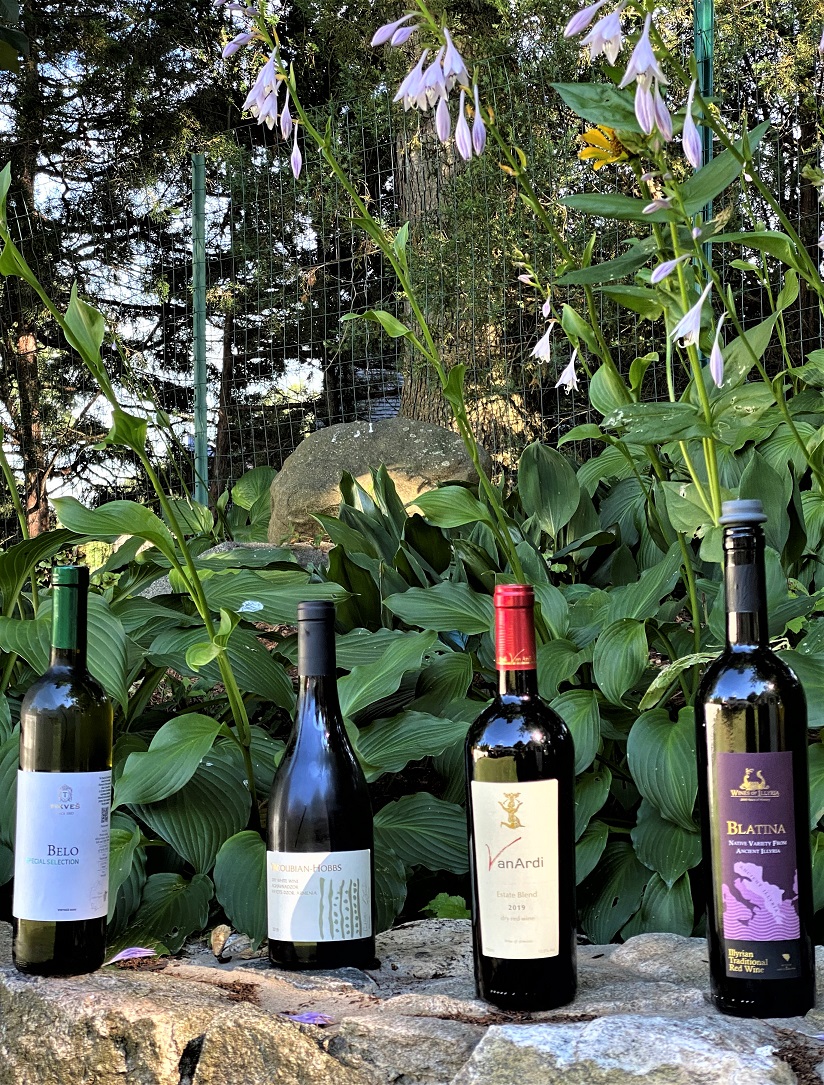
First, two wines from Eastern Europe. I never had the wines of Bosnia and Herzegovina, so this was a new country I was able to add to the list. Both wines were tasty, and Tikveš Belo was probably my favorite wine out of these 4. New grapes are marked in bold:
2015 Čitluk Winery Blatina Bosnia & Herzegovina (13% ABV, 100% Blatina)
Brickish red
Plums, dried fruits, medium intensity
Sour cherries, soft, round, medium body, good acidity, soft tannins
7+, not sure how it was stored. It is still nice, simple, and easy to drink, but probably on the decline.
8, on the second day. Interesting transformation – tertiary aromas are gone, plums, cherries and sage on the palate, nice, round, pleasant.
2020 Tikveš Belo Special Selection North Macedonia (11.5% ABV, Smederevka, Riesling, Marsanne, Roussanne)
A light greenish hue
A hint of gunflint, Whitestone fruit, medium intensity but very confident nose
Lemon, a hint of grass, salivating acidity.
8, this is a beautiful food wine, will compliment a wide range of foods.


It is my second time drinking Armenian wines. I was really looking forward to Yacoubian-Hobbs white, but the wines ended up being a disappointment. The Armenian red was quite drinkable. In any case, when you drink with a purpose, you don’t complain.
2018 Yacoubian-Hobbs Dry White Wine Aghavnadzor Vayots Dzor Armenia (14% ABV, blend of Voskehat, Khatuni, Qrdi, Garan Demak)
Golden color
Stewed fruit on the nose
The palate had some stewed plums, it was overwhelming and had no acidity. The wine was devoid of balance.
N/R, Maybe a bad bottle? Cork broke while I was opening the wine using a standard waiter corkscrew. But the wine didn’t seem oxidized, maybe heat damage?
2019 VinArdi Estate Blend Dry Red Wine Armenia (13.5% ABV, 40% Areni, 35% Haghtanak, 25% Milagh)
Dark Ruby red
Wild berries on the nose
Wild berries, dried herbs, medium+ body, good structure, good acidity, excellent balance.
8-, easy to drink
Now you know all about my wine obsessions. And I get to increase the counter you see on the top of the page from 561 to 567. Little by little…
By the way, there is no stopping in sight. While I’m trying to close on 600, there are people in The Wine Century Club discussing the 800 mark. Talk about obsessions… Enjoy your wine. Cheers!
Celebrate Pinot Noir!
Celebrate Pinot Noir!
Another grape holiday is upon us. This time we celebrate none less than Pinot Noir.
None less, huh? Is Pinot Noir so unique and special? Well, you be the judge.
Pinot Noir is the grape behind the world’s most expensive wines. While there are 10 or so major red grapes (Cabernet Sauvignon, Cabernet Franc, Merlot, Pinot Noir, Sangiovese, Tempranillo, Syrah, Grenache, Zinfandel, Nebbiolo), the ultimate supremacy crown can only be decided between Pinot Noir and Cabernet Sauvignon. Yes, it is bad to use money as a measure of influence, but it is one of the “objective” characteristics of wine in the free market. According to the Wine-Searcher lists of most expensive wines (by the way, there is a new feature on this blog – a new page Most Expensive Wines allows you to see always current list of most expensive wines for a select number of grapes and regions), red Burgundies (made out of 100% Pinot Noir) on average are 12 times (!) more expensive than Cabernet Sauvignon wines
Pinot Noir might be the most versatile red grape out there. Unlike most other red grapes, it produces a full range of wine styles. Let’s see.
White wine? Check. Pinot Noir Blanc is increasingly popular in Oregon and not only. Remember, the juice of Pinot Noir is clear, so it is not a problem to produce white Pinot Noir.
Sparkling wine? Triple check, I guess. Champagne Blanc de Noir is very often made from 100% Pinot Noir grapes and needs to introduction to wine lovers.
Rosé? Check. An increasingly popular addition to the repertoire of any Pinot Noir producer, in Oregon, California, and beyond.
Red wine? Well, duh. No check needed – first and foremost, Pinot Noir is a king of red wines.
Sweet/dessert? This is the only category that is still more an exception than the norm, but if you will look, you will have no problems finding late harvest Pinot Noir wines or Port-style Pinot Noir wines.
See – the whole range of wine styles. You can easily pair a whole dinner, from oysters to fish to steak and then dessert with Pinot Noir wines – try that with Cabernet.
One more unique fact about Pinot Noir is that it is practically never blended with any other grapes, with the exception of Champagne/sparkling wines. There can be lots of Pinot Noir clones mixed together – some of the producers grow 20 clones and more – but still, those are just clones. Of course, there are 100% Cabernet Sauvignon wines out there, but this is far from being the norm.
Pinot Noir is featured frequently on this very blog. As I was preparing this post, I decided to look at some statistics. It appears that Pinot Noir is the second most frequently mentioned red grape on the blog, with 356 posts related to the Pinot Noir (Cabernet Sauvignon is mentioned in 445 posts). It is interesting that Chardonnay is mentioned in the 357 posts, literally identical to Pinot Noir.
But it is not just the mentions – there are many memories associated with Pinot Noir.
I love saying that blind tasting is the best arbiter of the wines – in a blind tasting, it is just you and the liquid in the glass, nothing else influences your impression of the wine. It seems that our Pinot Noir blind tasting took place only yesterday – I was literally shocked to see that this post is 12 years old – the tasting took place in August of 2010. Who couldn’ve thought that 2008 Hamilton Russell Pinot Noir from South Africa would be our group’s favorite wine, beating grand cru Burgundy and cult Californian Pinot? I still have a bottle of that wine and I’m looking forward to experiencing the 12 years of evolution.
Another favorite Pinot Noir memory is the 1966 Louis M. Martini California Mountain Pinot Noir – an accidental $25 buy that ended up being a transcendental experience tasting the 48 years old wine from the Cabernet Sauvignon producer who is absolutely not known for the Pinot Noir wines.
And then there are lots and lots of memories of not only the wines but also of the people, passionate Pinot Noir winemakers, acquired through the work on the Stories of Passion and Pinot, an ongoing series of posts dedicated to Oregon Pinot Noir producers and Oregon Pinot Noir wines.
Did I prove my point? Is Pinot Noir the true King of Grapes? I don’t know. But for sure it is a grape worth celebrating. Cheers!
Making The Same Mistakes
Are we humans prone to repeat ourselves all the time? Good and bad – first we repeat what was done again and again, then wonder why we achieve exactly the same result as before. There is nothing wrong with repeating the good things, except that we might be limiting ourselves – think about bench-pressing 150 lb all the time, without ever trying to increase the weight. That’s a good weight to press, of course, but you need to increase the weight if you want your muscles to grow.
The process of repeating the bad things is far more peculiar. We know that something doesn’t work. We know that we did something in the past and it painfully didn’t work. Should we learn? Should the brain have a mental capacity to remember the bad result of the past and then simply remember not to repeat it? You think? This is so obvious, and yet unattainable at the same time. Why? Really, why?
Case in point. My business trip took me to Anaheim in California. Going to Anaheim, people who travel occasionally would fly to LAX (Los Angeles airport), and then have quite an expensive (and potentially very long) taxi ride to get to Anaheim. People who travel know that the closest airport to Anaheim is John Wayne, a.k.a. Orange County a.k.a. Santa Ana airport. As I belong to the second group (I generally travel for business), I took an early morning flight from Newark, NJ to John Wayne airport, arriving even faster than anticipated and enjoying the easy trip.
When traveling inside the US, ideally you want to take the early flight – outside of mechanical and horrible weather issues, you stand the best chance to arrive at your destination on time and in a happy state of mind. As the day progresses, travel becomes more chaotic, as flight schedules start shifting, and every slight delay aggregates to bigger and bigger ones. See, I know my flying rules. And what I said is 10 times true for the most overloaded (and badly run) airports in the country – Newark, Washington Dulles, Houston, Boston are all stand out in this category – by the end of the day, Newark would typically aggregate about 2 to 3 hours delay – and this is in the best weather throughout the country, God forbid it rains somewhere.
See, I know my traveling stuff, right? Do you think this knowledge helped me? Yep. Of course, you figured out the answer already. No, it did not. Instead of taking 6:30 AM out of John Wayne airport to fly back to Newark, I decided to fly at 12:30. Would you expect me to apply my knowledge? Of course, but I didn’t not. After arriving at the airport about two hours prior to my on-time departure, I spent the next 4 and a half hours (that includes 2.5 hours of an actual delay) literally swearing at myself, at United, at Newark, and back to myself. What’s even worse, I managed to repeat yet another old mistake again.
Insanity – repeating the same thing over and over again, every time expecting a different result
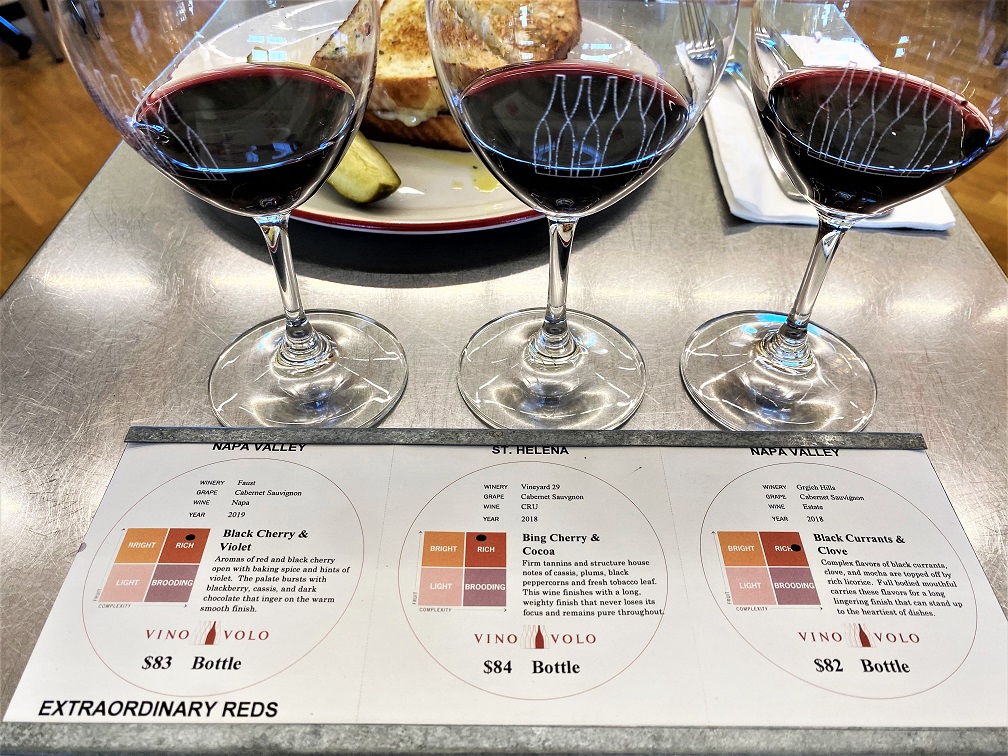
If you like wine, and if you ever traveled through Austin, Portland, San Francisco (and many other) airports, I’m sure you noticed restaurants/bars called Vino Volo. There are more than 50 Vino Volo locations around the country. Everything in Vino Volo revolves around wine. Every restaurant has a great selection of wines by the glass and wines to buy by the bottle – as they are located past security, you can buy a bottle of wine to bring to your destination if you are so inclined.
However, my main attraction at Vino Volo is wine tasting flights. At any given moment, Vino Volo offers 6-8 different tasting flights, red, white, Rosé, each flight typically consisting of 3 wines. Each flight is accompanied by detailed tasting notes. Very often you can find a selection of local wines offered as part of the flights – Oregon wines in Portland, Texas wines in Austin, and so on. When I have time, I never pass on an opportunity to visit a Vino Volo store and taste some new wines.
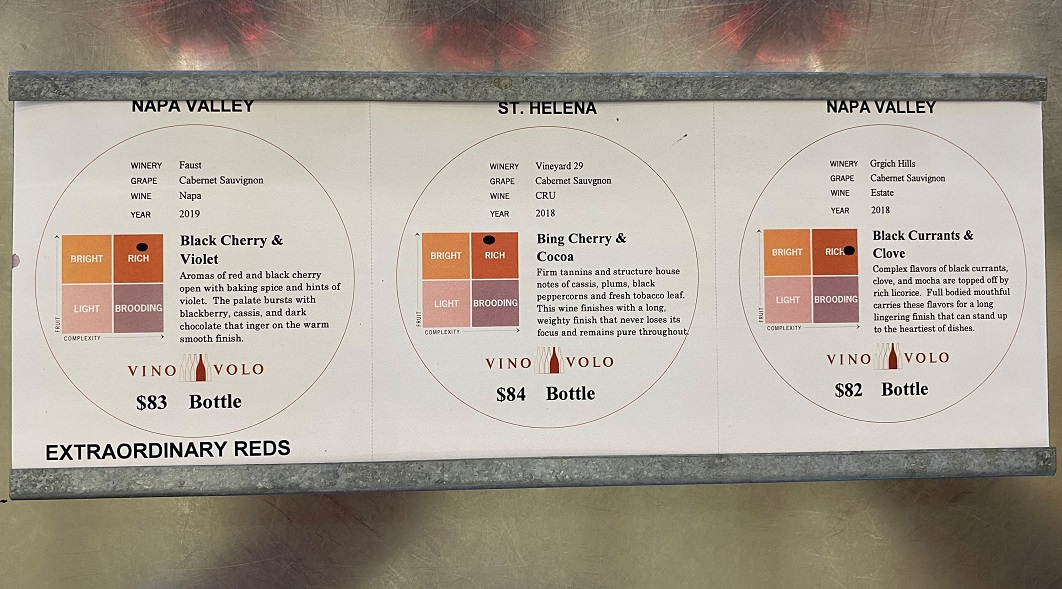
This brings us back to the subject of repeated mistakes. I know full well that young and expensive California Cabernet Sauvignon wines are undrinkable, 9 out of 10. I generally enjoy Vino Volo flights, with one memorable exception being Californian Bordeaux blend Overture, the second label of Opus, which I didn’t enjoy at all. And now, while at the John Wayne airport, I chose the flight of 3 high-end but young California Cabernet Sauvignon wines, instead of taking one of the other 7 or so. Why? Was a driven by the bad mood due to the flight already being delayed? Was there a hidden, subconscious desire to exacerbate the pain? I don’t know. But this was the flight I ordered. And it successfully exacerbated my pain – which you can see in these tasting notes:
2019 Faust Cabernet Sauvignon Napa Valley ($83)
Black currant, cherries, eucalyptus
Gripping tannins, green notes, black currants, tart finish.
Not enjoyable now.
2018 Vineyard 29 CRU Cabernet Sauvignon St. Helena ($84)
Cherries, dust
A bit more balanced than the previous wine, still weaved on the core of green notes, but definitely more approachable and enjoyable than the previous wine. Glimpses of greatness. Maybe decanting for an hour would make a miraculous change.
7+
2018 Grgich Hills Cabernet Sauvignon Estate Napa Valley ($82)
Distant hint of black currants and nutmeg
Tart, green, fruit is hiding. Almost flat in terms of soliciting an emotion.
Why do we do these bad things to ourselves? This question is half rhetorical, half actual. If you know the answer – or have a story to tell – please, I’m all ears.
A Refreshing Trip Around The World
Have wine, will travel.
I love saying that.
Have wine, will travel.
While we might be dreaming about all those ways to instantly travel from our living room to Mount Everest, Bora Bora, or Singapore, wine has this magical ability to transpose, to let us be where we want to be in a blink of an eye. It works best with the bottle of wine you are familiar with, especially if you have had a chance to visit the winery and acquired some great memories. But even if you have never visited the winery, a bottle of wine is quite a unique product – every bottle of wine proudly advertises where it was made, right on the front label – when you see “Italy”, it is not difficult to picture Rome or Bologna. France probably would solicit the image of the Eiffel tower. Does Australia bring up an image of a boxing kangaroo? Oops, this can be just me. Anyway, I’m sure you know what I’m talking about.
So today, let’s take advantage of the instantaneous travel only wine can offer, and let’s go on that trip around the world.
The weather is hot in the Northern hemisphere, so today we will hop onboard of the white wine express.

Our first stop will be in Spain. Thinking about Spanish white wines, what grapes come to mind? To ease up on this question – boy, it is hot outside – what is the first Spanish white wine you can think of? While you are pondering that question, I can give you my answer – Albariño. Of course, you have Viura, Verdejo, Godello, and others, but to me the first association for the Spanish white wine is Albariño.
As you might have suspected already, our first stop is in Rias Baixas, roughly a 3,000 square kilometers region located along the Atlantic ocean’s coast in Galicia, in northwest Spain, where Albariño is the king. Pazos de Lusco winery is farming 12.5 acres of Albariño grapes in the south of the region, 40 km away from the coast. The name of the winery comprises two typical Galician words – “pazo”, which stands for home, usually in the countryside, and “lusco” which defines the beautiful moment between dusk and nightfall.
2021 Pazo de Lusco Albariño Rias Baixas DO (13% ABV, $24.95, Vegan)
Straw pale
Intense aromatics, ripe white fruit, peach, tropical fruit
Nicely restrained palate, crisp, tart, lemon, the wine makes you salivate and want food even if you are not hungry.
8, excellent. Should be great with oysters.
For our next stop, we are staying in Spain but traveling east almost to the French border, to the region called Somontano, where the wine had been produced for more than 2,000 years. In Somontano, there lies the Secastillo Valley (the valley of 7 castles), boasting 100 years old Garnacha vines at 2,100+ feet of elevation and a special Mediterranean microclimate defined by close proximity to Pyrenees mountains. This is where our next wine is coming from, Garnacha Blanca produced at the Pagos de Secastilla:
2020 La Miranda Secastilla Garnacha Blanca Somontano DO (13.5% ABV, $18, 4 months in French oak)
Straw pale
Minerality, a touch of gunflint, underripe white fruit
Beautifully playful, fresh white fruit and berries medley, crisp and clean acidity, excellent balance, delicious.
8


As I was deciding when I will taste these wines, the overarching thought came in – oysters. I want fresh oysters. Luckily, we have a new fish monger opened nearby, so procuring a few dozens of oysters was really simple. I tried Albariño and Garnacha Blanca with the fresh oysters, and while the pairing with Garnacha Blanca was not bad, the Albariño and oysters were simply a match made in heaven. Albariño was a perfect chaser, amplifying the delicious salinity of the oyster juice and if you would close your eyes, it was very easy to imagine yourself standing right next to the ocean waves and smelling the salty, fishy water. If you will have an opportunity – spoil yourself, oysters and Albariño are really tasty together.
Now that we are not hungry, we can continue our journey. We are now traveling northeast to the heart of Europe – we are going to Austria. Let me ask you the same question as before – what grape would you associate with Austria first and foremost? I hope your answer will be the same as mine, as mine is rather obvious – Grüner Veltliner.
Grüner Veltliner is unquestionably the most famous Austrian grape, with more than 37,000 acres planted. It appears to originate in Austria and as it was recently established, it is a natural cross between Traminer and St. Georgen (an almost lost grape, only recently rediscovered). Gruner is capable of a wide variety of expressions, depending on the soil types and the yield. But what sets the grape apart in the world of white grapes is rotundone, which is present in the skin of Grüner Veltliner. I only recently mentioned rotundone in the post about Syrah – rotundone is a chemical compound found in the skin of the grape that is responsible for the peppery flavors in the wine. Such peppery flavors are usually attributed to red wines – but Grüner Veltliner can happily join the “peppery family”.
The first mentions of Domäne Wachau go back to the 12th century. Today, this is one of the leading wine cooperatives in the world – 250 vintners sustainably farm about 1,000 acres of vines, and the wines are exported to 40 countries. Talk about Grüner Veltliner – Domäne Wachau produces more than 3 dozens of different Grüner Veltliner wines. As a fun historical fact, I want also to mention that in the 1930s Domäne Wachau was already producing single-vineyard Grüner Veltliner wines. And if you are a wine nerd like me, Domäne Wachau has assembled a wonderful collection of the Nerd Notes on their website, offering in-depth coverage on the terroir, soils, sustainability, cork stoppers, and lots more.
I had an opportunity to taste two of the Domäne Wachau wines – both delicious:
2020 Domäne Wachau Loess Grüner Veltliner Austria (12.5% ABV, $14 1L bottle)
Straw pale
Whitestone fruit, apple, fresh lemon – inviting and bright
Crisp, grassy notes, cut through acidity, fresh, delicious.
8, delicious and outstanding QPR
2021 Domäne Wachau Grüner Veltliner Federspiel Terrassen Wachau Austria (12.5% ABV, $18.99)
Straw pale
Tropical fruit, candied lemon, herbal undertones, generous, inviting
Crisp, fresh, lemon, a hint of grass, cleansing and vibrant, perfectly balanced.
8, I should’ve tried it with oysters too – the acidity is pronounced, it could’ve worked well.
Now we will have to travel to the Southern hemisphere for our last stop – Chile.
Chilean wines need no introduction to wine lovers. All classic grape varieties are doing extremely well in Chile, producing world-class wines. But as we are taking the white wine express, that reduces the number of available options. The spotlight today is on the Sauvignon Blanc, produced by one of my favorite, all-organic Chilean wineries – Ritual. I extensively wrote about Ritual before, so instead of regurgitating the information here, I would like to ask you to read that post. Ritual Sauvignon Blanc was exactly as one could expect – delicious:
2019 Ritual Sauvignon Blanc Casablanca Valley (13.5% ABV, $20.99, organic grapes)
Straw pale
Open, inviting, clean, intense, a hint of freshly cut grass and currant leaf
Clean, round, full of energy, uplifting, lemon, freshly cut grass, delicious.
8, outstanding.
This concludes our wine journey around the world. Well, of course, you can continue it on your own. And if you will find something tasty, please share it with the rest of us.
Celebrate Syrah!
Celebrate Syrah Shiraz!
Is it Shiraz or Syrah? The official holiday today is recently enacted “Shiraz Day”, celebrated on the 4th Thursday in July, so it is July 28th in 2022. But Shiraz is simply a typical name of the Australian wine produced from Syrah grapes – it is really Syrah that we should be celebrating here (if you disagree, feel free to express yourself in the comments section).
Syrah is one of the 9 or maybe 10 major red grapes – Cabernet Sauvignon, Cabernet Franc, Merlot, Pinot Noir, Sangiovese, Tempranillo, Syrah, Grenache, Zinfandel (I live in the US, so don’t mind me) and maybe Nebbiolo. It was recently established that Syrah is an offspring of two obscure grapes, Dureza and Mondeuse Blanche, originally appearing somewhere in the southeast of France. Today, Syrah wines are successfully produced all around the world – France, Australia, Chile, Argentina, Italy, California, Washington, Israel, South Africa, and everywhere in between.
It is difficult (and pointless) to compare the wines based on prices, but the price can be used to measure their relative popularity (your liking of the wine in the glass has no relation to its price). Based on prices, Syrah wines are far behind red Burgundy (no wines can match the level of Burgundy prices – out of the 25 most expensive Burgundy wines, the “cheapest” on the list is $8K a bottle), and they are trailing Bordeaux first growth and California cult Cabernet Sauvignon wines. If you want to see for yourself, here are the lists of the most expensive Syrah and Shiraz wines – Wine-Searcher tracks these two categories separately.
We can also say a few words about the most famous producers around the world. Again, these are not absolute positions – unless you are “deeply in the space”, the names might be meaningless, but nevertheless, it is still a fun exercise. As a nod to the exact name of the holiday, Shiraz Day, we can look into the Australian Shiraz world’s first, where Penfolds (iconic Grange, anyone?) and Henschke are probably lead uncontestedly, with Torbeck, Jim Barry, d’Arenberg, Two Hands, Mollydooker, Tahblik definitely worth mentioning as well.
In France, great Syrah wines are concentrated in Hermitage, Cote Rotie, St. Joseph, and Cornas regions. J.L. Chave, E. Guigal, and M. Chapoutier would be on top of my list, and I don’t drink enough of the Northern Rhone wines to extend this list further.
When it comes to the USA, California, and Washington are by far the top Syrah producers, with some notable successes coming also from Oregon. In California, Sine Qua Non, Alban, and Saxum would probably be the ones I would like to mention first, but there is no shortage of other notable Syrah producers such as Carlisle, Zaca Mesa, Andrew Murray, Beckmen, and many, many others.
And then there is Washington. Syrah might truly be a king of Washington wines, produced literally by each and every winemaker, small and large. In that sea of Syrah, Christophe Baron is standing a head and shoulders above all others with his iconic Cayuse, No Girls, Horsepower, and Hors Categorie lines.
I didn’t tell you from the beginning, but if you ask me about my favorite wine grape, I will probably have to decide between Cabernet Sauvignon and Syrah, both in their pure, singular, non-blended expression. My favorite two tell-tale properties of Syrah are pepper and barnyard. I recently learned that pepper notes in the wine are caused by the chemical compound called rotundone, found in the grape skins. It is not very clear why the pepper is most often associated with Syrah, it can be found in the other grapes too, but I always equate the significant presence of black pepper with Syrah. And for the barnyard smell… Ohh, I know I can be beaten up for this, as this is considered to be a fault in wine – according to the Wine Spectator, “Brettanomyces, or “brett,” is a spoilage yeast with aromatic elements that are politely described as “barnyard.”“. I can’t argue with the experts, but nevertheless, I often find the barnyard smell in Syrah wines, and yes, I do like it.
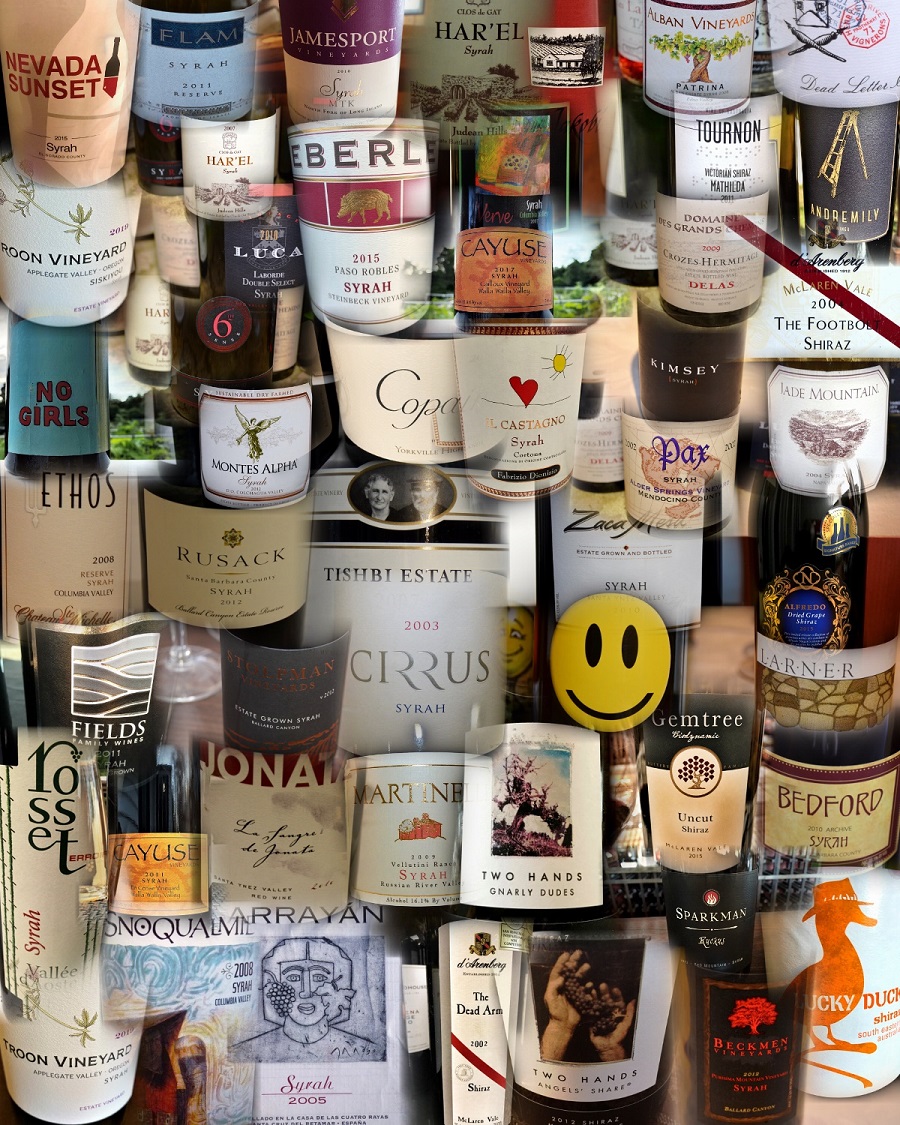
To finish our Syrah conversation on a memorable note, how about a memory exercise?
First, pour yourself a glass of Syrah or Shiraz, whatever your heart desires. Take a piece of paper and a pen. Give yourself, let’s say, 5 minutes of time, and write down the names of the most memorable Syrah/Shiraz wines or Syrah/Shiraz experiences you ever encountered.
Done?
We are not going to compare notes (there are hundreds of thousands of wines in this world), but here are some of mine.
My most memorable encounter with Syrah – actually, Shiraz – is Michel Chapoutier Tournon Mathilda Shiraz. When I tasted this wine for the first time, I was literally blown away by the purity of the black pepper expression. Ever since this is my goto example of the classic Syrah wine. Another one will be a bit unusual, but it was Elephant Hill Syrah Hawke’s Bay from New Zealand – again, beautiful black pepper, and my very first encounter with Syrah produced in the land of Sauvignon Blanc and Pinot Noir.
Then there is Troon Vineyard Estate Syrah from Applegate Valley in Oregon – organic, biodynamic wine of beautiful clarity and finesse. Zaca Mesa Syrah Santa Ynez Valley is a connection to the beautiful experience of visiting Santa Barbara County for my first Wine Bloggers Conference in 2014. Zaca Mesa was my first stop after arrival to Santa Barbara – both hospitality at the winery and the wines themselves created this memory knot, a connection easy to reach out for. Another connection to the same WBC14 was the first encounter with the first (and the only?) AVA dedicated to Syrah wines – Ballard Canyon. The AVA status was just granted to the Ballard Canyon exactly during our visit there, and I attended a session about the Syrah wines of Ballard Canyon where Stolpman Syrah Ballard Canyon for some reason got stuck in my head – another memory connection.
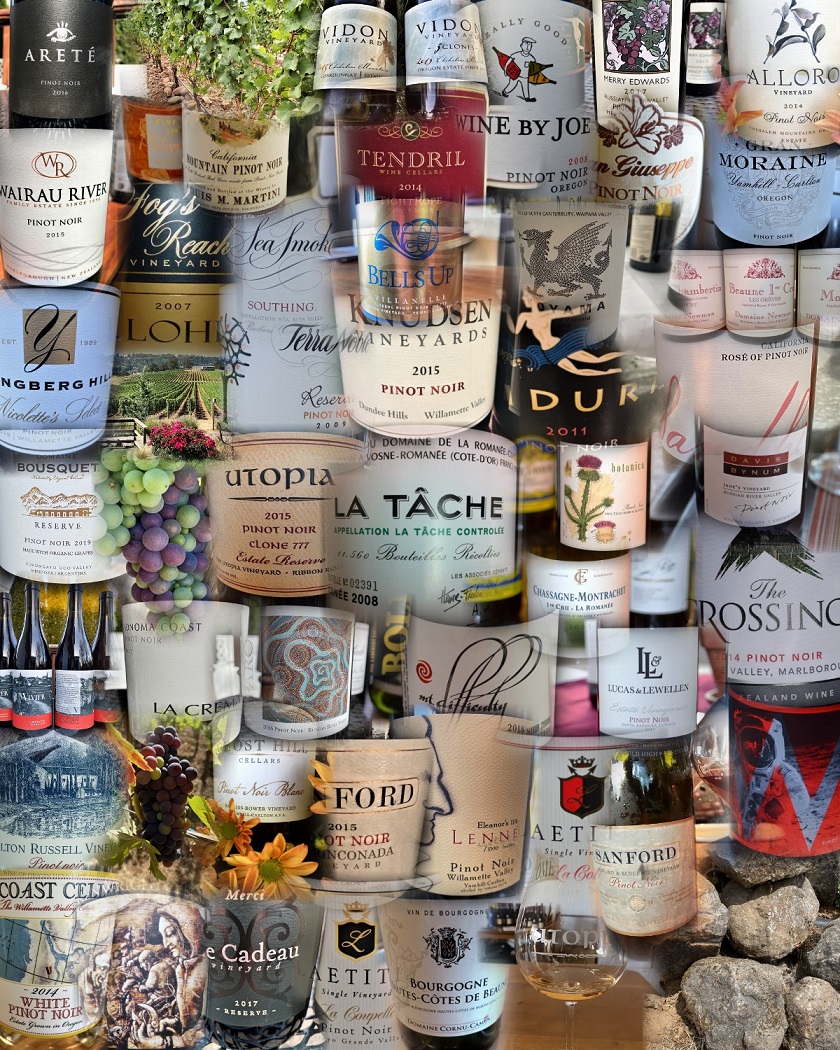
There are uncountably more Syrah wine experiences (just look at the labels in the collage), but hey, the purpose of the exercise was to focus on the few of the first – and this is exactly what I did.
Here you go, my friends – another grape holiday is about to become history. Hope you had something tasty to drink, and if you care to share your most memorable Syrah and Shiraz encounters, this is what the comments section is for.
Anatomy of Flavor
Anatomy of Flavor???
The author clearly goes on a tangent here. Everyone knows what anatomy means, and it has nothing to do with the wine. And nevertheless, let’s take a look at some definitions and see if we can actually analyze the anatomy of flavor.
Webster’s dictionary defines anatomy in a few different ways:


Definition number five describes anatomy as
structural makeup especially of an organism or any of its parts
Anatomy explains to us how living things are constructed. How do they move, jump, roll, smile, and cry.
Of course, the flavor is not a living being – but it is amorous, it changes, it morphs, it is perceived, and it is perceived differently every time, depending on many, many, many factors that we can spend days and days discussing.
I like definition number three more, as it is more appropriate for our purposes:
the art of separating the parts of an organism in order to ascertain their position, relations, structure, and function
Anatomy offers a firm structure – can we apply the same to flavor and understand how our perception of it works? Mostly, and luckily, no – we can’t. We have no idea how we will perceive the flavor of the particular wine once it is open – of course, we have expectations, but this is only one of the subjective factors in our perception of flavor, one of many. Instead, I can offer you to look at how the flavor is being built.
There is also definition number six:
a separating or dividing into parts for detailed examination
Anatomy explains to us how our muscles work and how they grow. Let’s see if we can take a similar look at the flavor of the wine.
We can’t do this with any random wine – if someone makes single-grape Syrah, Grenache, and Pinot Noir wines, all those wines are not connected to each other, they are unique and different – we can not taste Syrah and make expectations about Pinot Noir (assuming these are good quality wines) – as they have nothing in common. Most importantly, they better taste differently. But – there are wines which are perfectly suitable for our exercise. Do I have an example? Of course, glad you asked, but before we talk about particular wines, let’s take a look at the region they are coming from. Let’s go to Northern Italy, to the region called Valpolicella.
Valpolicella is a winemaking region east of Lake Garda, in the province of Verona, which is in turn located in Veneto. The region is influenced by the Alps to the north, Lake Garda to the west, and the Adriatic Sea to the east. Valpolicella received its DOC status in 1968, and Amarone and Recioto received the DOCG status in 2009. In terms of DOC wine production volume, Valpolicella is the second region in Italy after Chianti.
There are a few types of wines produced in the region – Valpolicella DOC, light wines considered to be similar in style to Beaujolais, Valpolicella Superiore, which should be aged at least one year, Valpolicella Ripasso, and, the most coveted wines, Amarone and Recioto.
It is not exactly known when winemaking started in Valpolicella. Still, it is typically associated with the ancient Greeks who were famous for making sweet wines made from partially dried grapes. That tradition of drying grapes before pressing is also a requirement for both Recioto and Amarone wines – this converts grapes to almost raisins and concentrates flavors. A lot of attention is also paid to preventing any sort of rot setting on the grapes as this imparts undesirable flavors.
Talking about red grapes, Corvina, Corvinone, Rondinella, and Molinara are considered the main winemaking grapes, even though many winemakers are trying to avoid Molinara as of late. Corvina should constitute between 45% and 95% of the blend – but up to 50% of Corvina can be substituted with Corvionone, which was identified as a distinct variety and not a clone of Corvina only in 1993. Out of all Val[policella wines, Ripasso stands aside as quite unique – it is made by macerating the Valpolicella wine with the pomace (grape skins) left after making Amarone and Recioto wines, which enriches the flavor of the wine – Valpolicella Ripasso is often referred to as “baby Amarone” (or “poor man Amarone” – you take your pick).
Of all wines made in Valpolicella (most of them are red), Amarone stands apart as the most sought-after. The grapes have to dry for anywhere between 3 and 4 months before they can be pressed to make Amarone. Those dried fruit flavors are retained by the final wine, assuming it is well made. The combination of the dried fruit aromas and powerful, dry, usually high-alcohol wine creates really a unique experience – if you have not had Amarone before, this is something that needs to be experienced by any wine lover.
Also going back to our “premise” with this post – to take a deeper look at the build-up, the anatomy of the flavor, Valpolicella wines offer an almost unique opportunity. Most of the Valpolicella wines are made from the same set of grapes, sometimes even used in the same proportions. The winemaking process is what creates the difference. Base Valpolicella wine can be aged for a year to get to Superiore designation. The same base wine can be macerated with Amarone pomace to become the Ripasso. The same grapes that are used for basic Valpolicella can also dry for 3-4 months, and then become an Amarone.
Let’s go one level deeper and look at some practical examples, shall we?
Tedeschi family ancestors purchased vineyards in Valpolicella four centuries ago, in 1630. The modern history of the Tedeschi winemaking family started 200 years ago, in 1824 when the family winery was established by Niccolò Tedeschi. Today the winery is operated by the fifth generation of the family, continuing the winemaking traditions.
Tedeschi estate is located in the village of Pedemonte di Valpolicella, with 75 acres of vineyards planted on the 200 acres estate. Tedeschi firmly believe that good wines are made in the vineyard, and they focus not only on showcasing the terroir but also conduct studies to understand the soil composition in the vineyard. Another important winemaking element is the use of not only the main 3 Valpolicella grapes (Corvine, Covinone, Rondinella) but the full range of grapes including Rossignola, Oseleta, Negrara, Dindarella, and Forselina. They also produce all types of Valpolicella wines – Valpolicella, Valpolicella Superiore, Ripasso, Amarone, and Recioto.
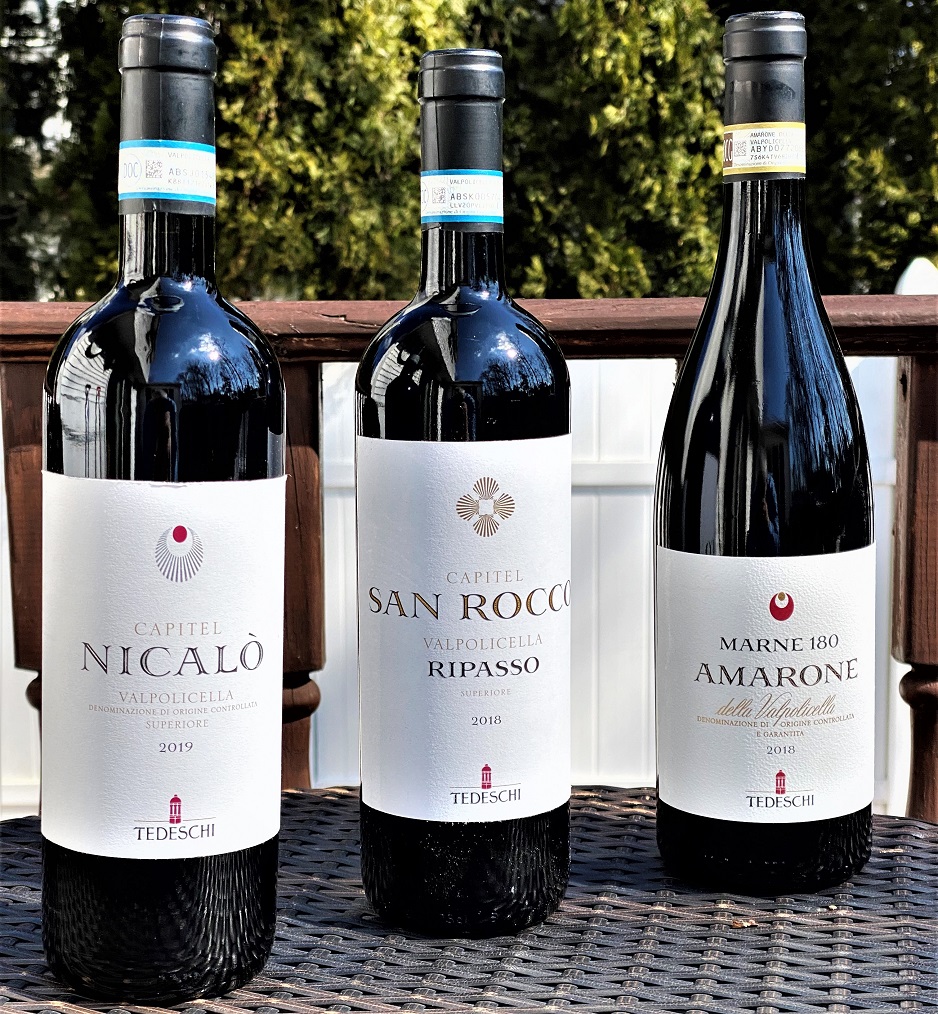
For our “anatomy” exercise, I had an opportunity to taste 3 of the Tedeschi wines – Valpolicella Superiore, Valpolicella Ripasso and Amarone della Valpolicela. All three wines are made from the identical set of grapes, used in the same proportions, so the difference is only in the winemaking techniques. Below are my notes with some additional information about the wines.
2019 Capitel Nicalò Valpolicella Superiore DOC (13.5% ABV, 35% Corvina, 35% Corvinone, 20% Rondinella, 10% Rossignola, Oseleta, Negrara, Dindarella, grapes drying for 1 month, 1-1.5 years in Slavonian oak barrels, 6 months in the bottle)
Dark ruby
Captivating nose of earthy dark fruit, tobacco, rocks
Beautiful fruit, blackberries, cherries, cherry pit, tart, focused, perfectly structured, perfectly balanced – lots of pleasure.
8/8+. Delicious.
2018 Capitel San Rocco Valpolicella Ripasso Superiore DOC (14.5% ABV, 14.5% ABV, 35% Corvina, 35% Corvinone, 20% Rondinella, 10% Rossignola, Oseleta, Negrara, Dindarella, alcoholic fermentation on the marc of Amarone and Recioto for 8-10 days, 1/2 years in Slavonian oak barrels, 6 months in the bottle)
Garnet
A hint of dried fruit, toasted nuts
Round fruit, cherries, soft, approachable, earthy undertones, well-integrated tannins, a hint of tobacco on the finish.
8/8+, delicious.
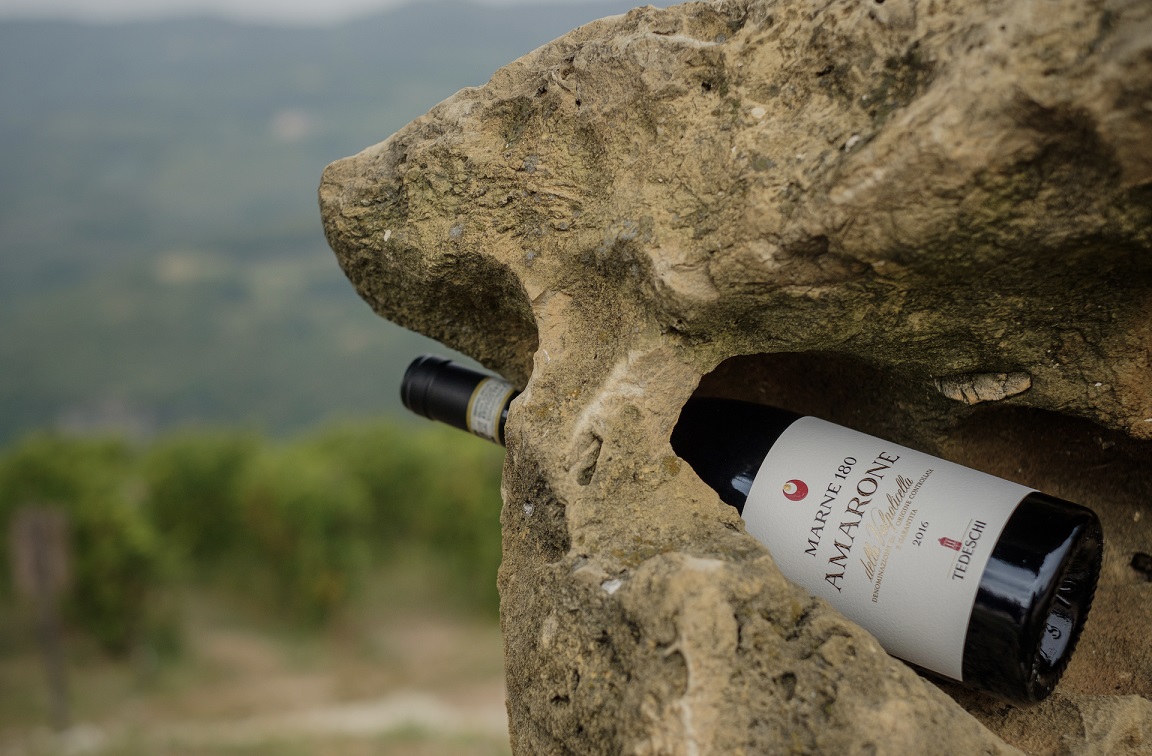
The name Marne 180 is a nod to the marl soils where the vineyard is located and 180 is degrees of exposure, from south-east to south-west. Source: Tedeschi
2018 Marne 180 Amarone della Valpolicella DOCG (16.5% ABV, 14.5% ABV, 35% Corvina, 35% Corvinone, 20% Rondinella, 10% Rossignola, Oseleta, Negrara, Dindarella, grapes drying for 4 months, 30 months in Slavonian oak barrels, 6 months in the bottle)
Dark garnet
Dark, concentrated, forest underbrush
Dried fruit, cherries, intermingled layers, powerful, well structured, delicious.
8+
Can we conclude anything from our flavor research? The wines share some similarities, but this is probably all I can say. I don’t see a clear progression from one wine to another, they are simply tasty wines, each one in its own right. Does it mean that we can’t talk about the anatomy of the flavor? I think we still can, but it is definitely more complicated than it seems.
The important outcome of this research project is three tasty wines from Tedeschi which I’m happy to recommend to you for your daily drinking pleasure. And this is the best conclusion we can make. Cheers!
Wednesday’s Meritage #161
 Meritage Time!
I’m soooo behind on my posts it is not even funny. Probably good 15+ posts behind, and it is not a good feeling. Not being a professional writer, I never developed a habit of just writing no matter what. Not having such a habit definitely gets in the way. Oh well, such is life.
Today’s Meritage is once again mostly focused on this very blog. Of course, a lot is happening in the wine world, but nothing really caught my eye as worth repeating. Even the record heat wave in Europe doesn’t have much coverage as it relates to the vineyards. I checked to see if I can find anything worth sharing about extreme heat in Europe and vineyards, and only found plenty of articles from 2019, but none from 2022. It will be really interesting scary like hell to see the effects of this extreme heat on the 2022 wines in a few years, but yes, we will have to wait a bit.
For the local “news”, outside of the fact that I’m grossly (understatement of the century) behind on my writing and my postings, I spent some time cleaning up and updating references on the front page of the blog.
On the right side of the screen (assuming you are using a PC – it will be all different on a mobile), there are links grouped into 4 categories – social media, blogroll, wine buying, and wine travel. I went over all of the links in these sections and removed all of the dead ones. In the blogroll, some of the links will connect you to the sites which had not been updated for years – but as long as the link is not dead and you can actually reach the content, I left those links in place.
I also realized that I’m missing some of the references I actually should have. I added a few blogs I’m reading semi-regularly (I won’t tell you what they are though :)). I also added a few links to the wine buying section.
Wine.com was a notable absence from the wine buying section, as I was not a fan. I gradually changed my opinion – I wouldn’t say that Wine.com is my only or even preferred source of wine buying, but they have plenty of interesting and unique wines (Grosset Polish Hill Riesling, for example, or Masciarelli Marina Cvetic Reserva), which are also priced at an “average retail” level, which I’m okay with (I despise with passion overpaying for wine). I also like the extensive information provided on Wine.com on all the wines, whether they are in stock or not.
Same with the Wine Exchange – I gradually warmed up to their e-mails and even bought a few interesting wines based on their suggestions. They also carry a good inventory of well-aged wines at reasonable prices – for example, there you can find Chateau Lestage from the Listrac-Medoc, 2000 (legendary!) vintage for $39.98, or Shiraz from Barossa Valley from 2004 vintage (18 years old wine) for $29.99.
The last addition to the wine buying section is not even about the wines – it is about a close relative, cognac. I came across the Cognac Expert website as I was looking for interesting cognac tasting sets to share with a friend who was supposed to visit. There is a tremendous Cognac selection on the website, plus every cognac has a very extensive description of its history, tasting notes, and more. They also charge reasonable shipping rates (I think) for the cognacs delivered from France, so if you like cognac, this is definitely a site to visit.
Okay, just to step outside of my blog’s realm, a few more news items:
There are 5 days left to enter the Web Wine Writing competition conducted by the Hungarian Wines organization. I know this is not enough time, but in case you wrote about Hungarian wines recently, this might be a great opportunity for you. Details can be found here.
International Shiraz Day is the next grape holiday, coming up on July 28th. Shiraz or Syrah, Australia, France, Italy, or Washington – I’m sure it is not difficult to find a tasty bottle and enjoy it in honor of one of the major red grapes.
And the month-long wine celebration is almost upon us – August is Washington Wine Month. From Bordeaux blends and GSM to the world-class, cult quality, single vineyard Cab, Syrah, Grenache, and everything in between – folks in Washington know how to wine. Just get a bottle of your favorite Washington wine and you are ready to celebrate.
That’s all I have for you for today. The glass is empty, but the refill is on the way. Cheers!
Trapiche: Beautiful Perfection
Over my lifespan as a wine lover and especially, as a blogger, I tasted tens of thousands of wines. This is not a bragging statement, but purely statistical. Also, out of all those wines, every year a few hundred wines are covered in this blog.
Out of all these wines, there are probably 50 or so that are near and dear to my heart, These are my reference wines. These are the wines I would reach out to illustrate the comparison or simply deliver the message. For example, Bogle Petite Sirah is my favorite example of a budget-priced (typically around $9.99), delicious, consistently drinkable wine. Of course, I occasionally come across wines which equally or even tastier and cost even less, but Bogle is still the wine that is ingrained in my memory, and hence it is my ready-to-use reference.
I always think that all of my reference wines are already covered on the blog – 50-60 wines is not a high number spread out over the 12 years of blogging, and yet from time to time I engage in a futile search for the articles about some of these reference wines, only to say to myself “really?”.
When it comes to Argentinian Malbec, my reference wine is Trapiche Broquel Malbec. Malbec definitely came of age lately, especially with a dramatic increase in popularity over the last few years. While I tasted lots and lots of absolutely delicious renditions of Argentinian Malbec, it is still generally not my go-to wine. But if presented with the Trapiche Broquel Malbec, nobody would need to ask me twice to have a glass or a three.
There are 145 posts in this blog that include the word “Malbec” (not including the one you are reading now). None of these posts talk about my reference wine, Trapiche Broquel Malbec. Well, this is not entirely true – in a few posts, Trapiche Broquel Malbec is used precisely as I presented it here – as a reference. Nevertheless, there are no posts discussing any particular vintages of this wine or presenting any tasting notes.
And so will not be the post you are reading at the moment. But – at least this post is about two of the Trapiche wines I had an opportunity to taste (but none of them are Broquel Malbec).
It is so interesting when you think that you know something, and then it appears that no, you really don’t. I knew the Trapiche name and had a number of their wines over the years, but I had no idea that Trapiche is the biggest winery in Argentina. Founded in 1883, the winery stayed in the family for a long time, transitioning from father to son, until it was acquired by the Grupo Peñaflor, one of the 10 largest wine producers in the world, exporting its wines to more than 90 countries.

Trapiche vineyards span throughout Mendoza, the most famous winemaking region in Argentina from the Andes mountains to the Atlantic ocean around the town of Chapadmalal. Trapiche is using biodynamic farming methods and is very much focused on farmland diversity and sustainability. Trapiche’s hard work and dedication didn’t go unnoticed, acknowledged by multiple international awards, such as the “50 Most Admired Wine Brands” selection by Dinks International (the only winery in Argentian to get on that list 5 times over 5 different vintages), or Wine Enthusiast’s “The New World Winery of the Year” in 2019.
I had two bottles of Trapiche wines to try – 2020 Trapiche Broquel Cabernet Sauvignon Mendoza (14% ABV, $14.99, 100% Cabernet Sauvignon, 14 months in oak barrels) and 2019 Trapiche Gran Medalla Malbec Mendoza (14.5% ABV, $24.99, 100% Malbec, 18 months in new French oak, 1 year in the bottle). I have to tell you that I opened the bottles not without trepidation. I never had either one of these wines, I really like Broquel Malbec, and I really wanted to avoid disappointment…
First I opened Cabernet Sauvignon. The initial nose was not the one typical of the Cabernet Sauvignon – it did smell like a typical Argentinian Malbec would. I wanted to compare the nose side by side, so I quickly opened and poured in the glass the Malbec. The smell was practically identical – the vanilla, warm herbs, plums, with the Malbec bottle offering a bit more intensity. While I appreciate this nose on Malbec, I like the Cabernet Sauvignon to be a bit more traditional.
But the palate of the Cabernet Sauvignon didn’t disappoint, showing cassis with a wallop of dark cherries, a touch of bell peppers, and eucalyptus. As the wine was opening up, it transitioned through a few stages, making cassis more explicit and then adding up the level of acidity on the finish. A very good rendition with an excellent QPR (Drinkability: 8-).
The Gran Medalla Malbec was produced to commemorate the 125th anniversary of the winery, and it is sourced from the best Trapiche vineyard parcels in Uco Valley. And boy, did this wine delivered… This was Malbec like no other. The was the wine that stops you in your tracks; you want the time to stop so you can enjoy that perfect flavor in your mouth endlessly. The wine had the perfect amount of ripe, succulent dark cherries, sweet oak, and sage, weaved around a perfect core of smooth tannins, delivering layers upon layers of pure pleasure. This was the wine that you always dream of drinking, but it is so hard to find. Thinking about the $25 suggested retail price, this wine has great QPR and it is literally a steal if you will be able to find it. (Drinkability: 9-).
There you are, my friends – a case of wine’s beautiful perfection. Which also doesn’t need you to break the bank. Cheers!
A Weekend in [Great] Wines
 What is a great wine?
Does the wine made by a famous producer make it great? Does a high price make it great?
Wine should give you pleasure. Is there a measurable amount of pleasure to declare wine “great”? 5 units of pleasure? 25 units of pleasure?
Of course, “great” is a subjective definition. The infamous “the truth is in the eye of the beholder”. Every wine lover has their own way to declare wine great, and it is not just one way – there are many ways.
I love the harmony in the wine. The perfect balance of all the components. A unique flavor. A thought-provoking bouquet that makes you want to take a sip, and another sip, and try to understand. Or the wine which makes you disconnect from the world and all of its problems, and just get lost in your own thoughts. I also love the wine which perfectly matches your expectations.
I’m sure “expectations” is yet another loaded term, but if you are into the wine, for sure you have expectations when opening a bottle of wine. You expect to find freshly cut grass and maybe a proverbial “cat pee” on the bottle of Sancerre. I love gunflint on my young Chablis. I expect a good bottle of well-aged cold climate Chardonnay to show honey and apple notes. I want succulent cherries in my Brunello. And I need cassis in my Bordeaux, and gobs and gobs of cassis on my bottle of the Napa Cabernet Sauvignon. Don’t get me wrong – the wine can be great if it doesn’t match expectations at all, but this is the subject for another post.
That is what I want to talk about here – the wines matching expectations. The wines that were simply perfect. And a few others that were maybe not perfect, but still delicious.
The last Sunday was Father’s Day. I usually open a good bottle or a few in honor of the holiday, but this weekend of wines started a few days prior. My sister-in-law, who lives on Cape Cod, had her milestone birthday recently, and as she loves wine, I wanted to bring a few wines that would be worthy of a moment. She used to love California Pinot, but as of the last few years California Cabernet Sauvignon became the thing, so I grabbed a few bottles of Turley Estate Cabernet, which generally doesn’t disappoint. And of course, a few other bottles, as we had to drink something for 3 days, okay?


Before we got to the reds, there were whites. We started with 2020 Château Montet Blanc Bordeaux AOC (12% ABV, Sauvignon) which was a nice, middle-of-the-road, Bordeaux white wine, offering a hint of freshly cut grass and some Meyer lemons. We also opened a bottle of 2018 Alban Vineyards Viognier Edna Valley (14.9% ABV). It was nicely perfumy and complex on the nose, and quite big and powerful on the palate, with an interesting flavor that I could not discern – on overripe wild plum maybe. I tried this Viognier with the fresh oysters, but this was not necessarily a winning combination. Our last white was 2016 Turley The White Coat California (13.5% ABV, 40% Roussanne, 40% Grenache Blanc, 20% Vermentino) – a full-bodied, elegant white wine, plump and round on the palate, perfectly fresh and clean overall.


Summer asks for a Rosé, even though the weather was rather on the cool side – our choice of Rosé was 2021 Turley Zinfandel Rosé California (12% ABV), which was delicious. Strawberries and cranberries on the nose and on the palate, crisp, clean, refreshing – it had everything you want from Rosé.
And then there were reds. Some were more of the “placeholders”, the wines you open just to drink something before you get to the main program – as was 2021 Field Recordings Nouveau Edna Valley (12.9% ABV, Pinot Noir). Young, fresh, grapey, and tart, as you would expect from the Nouveau. We treated somewhat similarly 2018 Pedra Cancela Winemaker Selection Dão DOC (13% ABV, 40% Touriga Nacional, 30% Alfrocheiro, 30% Tinta Roriz), even though this is an excellent wine in its own right – dark fruit, cherries, nice minerality, medium body, fresh acidity, and overall good balance. 2016 Pedra Cancela was wine #7 on my Top 20 of 2020 list – I think I would prefer 2016 over 2018, but I need to try this wine again by itself and not “among others” before I will be able to form an opinion.
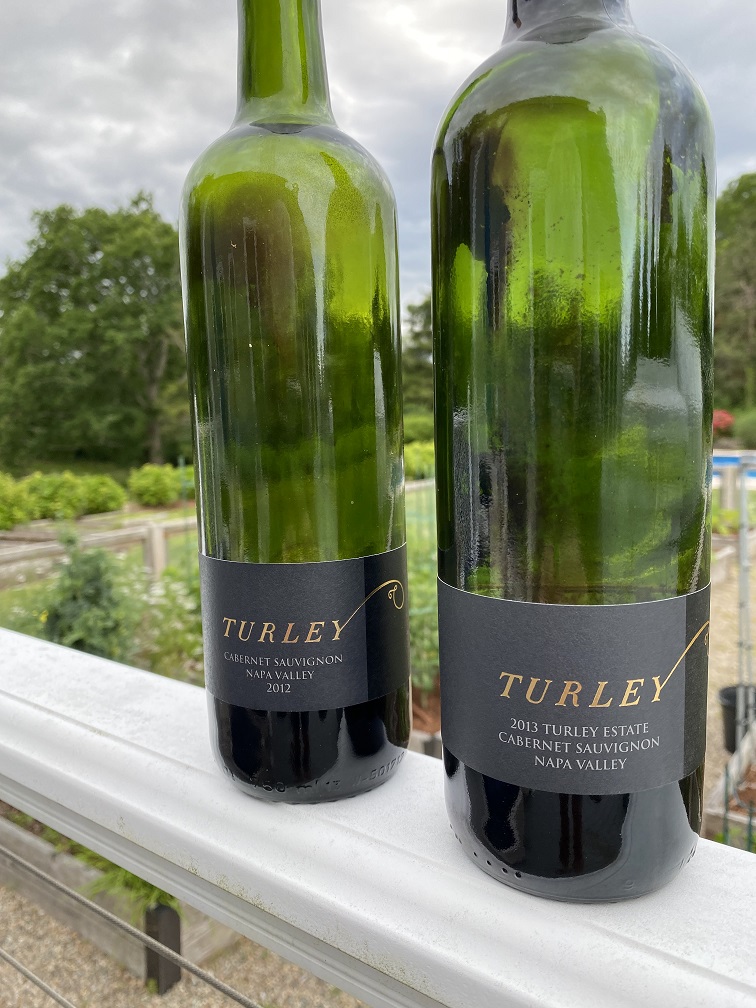
Next was the time for magic, so the bottle of 2012 Turley Estate Cabernet Sauvignon Napa Valley (14.1% ABV) was open. I have a long history with Turley Cabernet Sauvignon wines, ever since they debuted with the 2010 vintage – this post describes my perception of the 2010 vintage and also provides some details on my initially rocky relationship with this wine. The first 2 vintages were called “The Label”, becoming simply Turley Estate Cabernet Sauvignon starting from the 2012 vintage. The last time I tasted the 2012 Turley Cabernet Sauvignon was exactly two years ago – you can read the tasting notes here. These 2 years made a difference, and the wine was delicious from the get-go. Cassis on the nose and the palate, layered with soft tannins, generous and powerful. Upon opening, it was varietally correct and simply superb, worthy of a great wine designation.
You take a sip of wine, you think you discovered the perfection, and you are reveling in the happy state. Then you open another bottle, catch a whiff from the glass, take a sip, and wonder how the absolute happiness you experienced a second ago can be toppled? And yet this is exactly what happened when we opened the 2013 Turley Estate Cabernet Sauvignon Napa Valley (14.1% ABV). 2013 was almost the same as 2012 – except it was better refined, more elegant, cleaner. Cassis was beautifully pronounced supported by a touch of mint and a distant note of bell pepper. Perfectly on point, perfectly matching the expectations.


The next day I wanted to deviate a bit from the Bordeaux direction with 2015 AR PE PE Grumello Rocca de Piro Nebbiolo Valtellina Superiore DOCG (13% ABV). ARPEPE is an excellent producer in the Valtellina region in Italian Alps in Lombardy, crafting Nebbiolo wines. This wine had a beautiful vibrancy of the fresh cherries, not overripe, but just ripe enough, to offer an “unmistakably Italian” feeling on the first sip. Fresh, lip-smacking cherries, herbs, well-integrated but noticeable tannins – this wine offered a well-needed break from the power of California Cabernet Sauvignon. Unfortunately, a very short break as the bottle was gone in no time.


And then the story repeated itself. We opened 1998 Château Tournefeuille Lalande de Pomerol AOC (12.5% ABV, 70% Merlot, 30% Cabernet Franc), the wine I knew nothing about. I got this wine from Benchmark Wine Group a few years ago, for $30 or so. I simply got it based on the vintage and the price – the vintage is one of the few I try to collect, and the price was reasonable. First I was pleasantly surprised with the condition of the cork, which was intact – for a 24-year-old wine, this is not always the case. But then the whiff and the sip… Oh my… The precision of cassis was elevated on yet another level – don’t know how is that possible. The wine had pure, pristine cassis on the nose and the palate with a small addition of bell pepper and eucalyptus, a perfect round bouquet, a perfect balance of fruit, acidity, and tannins, just superb. After the first sip, I asked my sister-in-law what does she think about this wine by itself and in comparison with two of the previous bottles of Turley (we still had wine left there on the second day). She said that she really doesn’t want to make me upset, but she really likes it even more than the 2013 Turley Cab – and I’m fully agreeing with her. If I were to rate these 3 wines on my Drinkability scale, Turley 2012 would be an 8+, Turley 2013 is 9-/9, and the Château Tournefeuille is a solid 9 or maybe even 9+, and definitely a memorable experience.
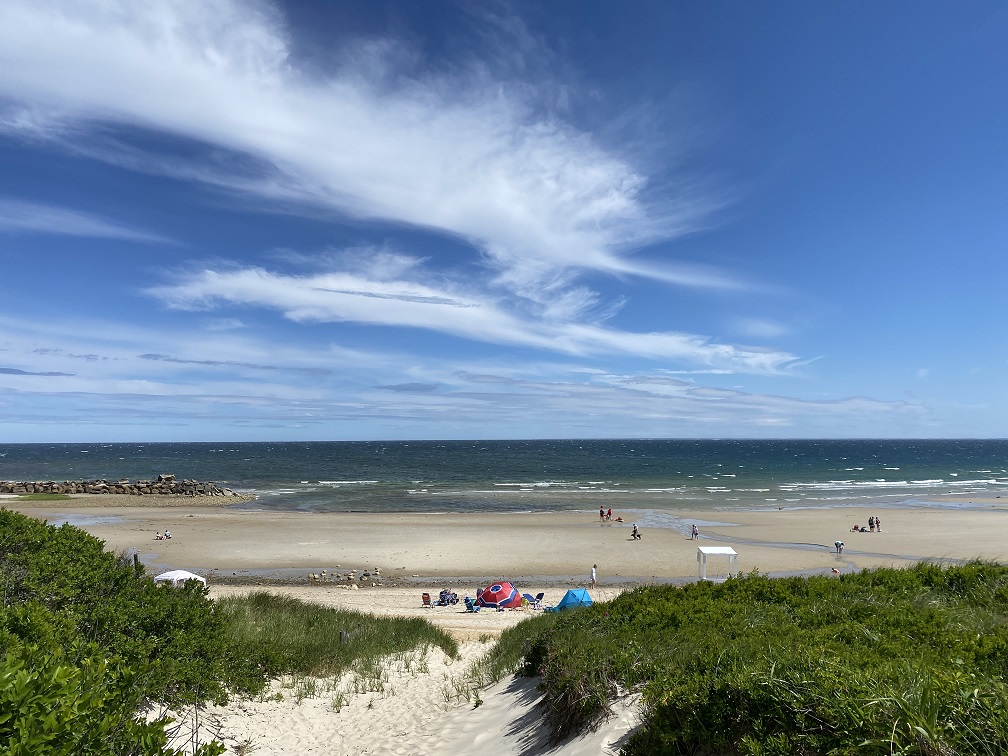
It was not just the wine – the food and the views were quite good, despite somewhat gloomy weather during most of our visit. Local oysters were delicious. I had an opportunity to try the Swiss cheese called Tête de Moine, which also comes with its own special curler. The kabobs were delicious too. And the views of the ocean never get tiring.



We came back home on Sunday, to have Father’s day dinner with the kids. Of course, Father’s Day celebration requires a special bottle of wine. I was thinking about opening the 2005 Jordan Cabernet Sauvignon Estate Alexander Valley (13.5% ABV) for a while at this point, so I decided that the celebration gives me a good enough reason to pull the cork, which I did. The last time I had this exact wine was in 2018 when I brought a bottle for a special wine dinner in Singapore. At that time the wine showed as overly sweet. 4 years later, the wine lost all of its sweetness, and now was showing as a classic Cabernet Sauvignon with cassis on the palate, but somehow now the wine was showing very lean and underwhelming. I think the wine could’ve further improved over the next 5-10 years, but as this was my last bottle, now there will be someone else who will make the discovery. I had this wine with a special burger from Darien Butcher Shop – I had fried egg, fried onion, and bacon as flavor enhancers with the burger, so the wine didn’t stand a chance to show well, but at least it was not fighting with the food.


That concludes my story of a few great wines. What are great wines in your book?
Wine, Beer, and Road Trip
Some road trips require long planning. Some are just spontaneous. The road trip we took two weekends ago was somewhat in between, more on the spontaneous side. I had a Marriott certificate expiring by the end of the month, and I couldn’t let it go to waste. Balancing places I would like to visit with the low value of this certificate, travel madness ensuing in the country, and the desire to stay within a 3-hour driving radius from home narrowed down the search. The town of Reading in Pennsylvania offered a reasonable combination of all the factors I mentioned above, so this is where we decided to go.
There are many advantages when traveling by car, such as ultimate flexibility of the schedule. The ability to bring your own bottle of wine to the hotel is another big one. This is exactly what we did.
I don’t know what possessed me to bring 2016 Saxum as the wine of choice, but this is what I did. By the time we settled in the room and were ready to have a glass of wine, the day reached my favorite “Kodak moment” – the sunset. I obviously couldn’t miss such a beautiful sky painting – at the same time, I couldn’t resist an opportunity to include the bottle of Saxum in the picture. First the bottle, then the glass.


You know how they say “no people/animals/objects were damaged during the filming of this video”, right? This was not a video, just a picture. And no animals were hurt. No people were hurt either (I think?). As for the objects… Well, the glass didn’t survive my adventurous stupidity. This was a standard wine glass, which can’t really stand on top of the wine bottle. It almost felt, and I was lucky enough to catch it before it went down. Someone with a better belief in the laws of statistics would take this “almost fall” as a fair warning. But not this guy. I put the glass back and continued taking pictures, trying to get the wine label into the picture. Until glass finally met the ground (ground – 1, glass – 0), giving my wife and me an opportunity to dance next to the window sill for the next 20 minutes trying not to cut ourselves with the tiniest remnants and also remove wine traces from surrounding surfaces. Felt like an idiot for the next 2 days. Oh well – maybe I will learn? Or not…
On the positive side, the 2016 Saxum Bone Rock James Berry Vineyard Paso Robles Willow Creek District (15.9% ABV, 72% Syrah, 10% Mataro, 9% Graciano, 6% Grenache, 3% Roussanne) was absolutely surprising and spectacular. The surprising part was that this 6-year-old wine from California was perfectly drinkable upon opening – I would never expect it. The spectacular part was in the layers and gobs of fresh, succulent fruit, unending pleasure of interplay of blueberries, blackberries, cherries, and sweet oak, balancing acidity and full-bodied power each sip was offering. The wine was even better on the second day, becoming a touch more mellow. The same wine perfectly complemented the cigar on day 4. I’m sorry about the glass, but I’m really happy with my first Saxum experience.
 Then there was beer. Clearly, I drink a lot less beer than wine. Nevertheless, I have a full appreciation for a glass of well-made beer (about 25 years ago I was one of the first members of the Beer Across America club, at the very beginning of the American craft beer revolution). Even more than a glass of beer, I like the opportunity to experience a tasting flight – which we found at the Chatty Monks Brewery in West Reading.
The Chatty Monks brewery binds itself as a “nano-brewery”. I have no idea what that means, I can only assume that they are implying that their production is much less than the microbrewery (microbrewery in itself is a highly contested term – for a long time Samual Adams defined itself as a microbrewery, while their volumes were clearly not at the “micro” level). Anyway, let’s leave the size aside and talk about the taste.
A tasting flight at Chatty Monks includes 4 beers which you can select from the list of beers available on tap. Out of the 14 available beers I went with Alondra which was a stout – the only dark beer available and I prefer dark beer whenever I can; Split Face which is defined as Pretzel-Style amber lager (no idea what pretzel-style means); Pray for More, a New England IPA, and Tree Trimming, which is described as “winter warmer” – again, no idea what that means.
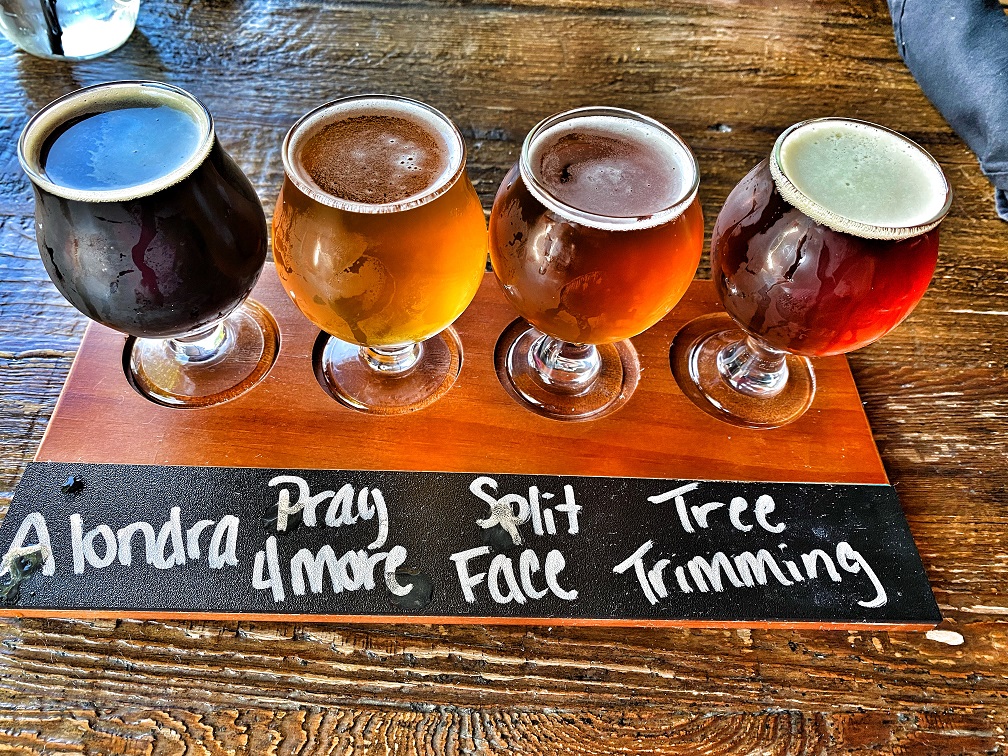


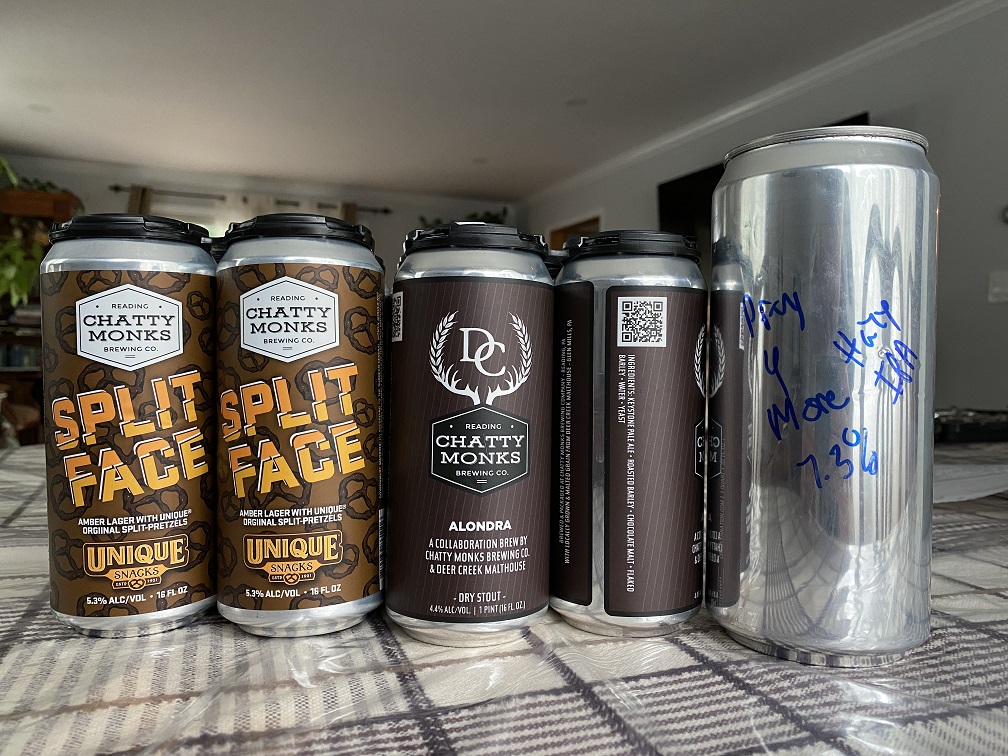
Of these 4, we absolutely loved 3, which were each delicious in their own way. The beer lovers will have to forgive the wine lover trying to describe the beer experience, but Alondra, Split Face, and Pray for More were perfectly balanced and round, each in their own category. I rarely perceive the bitterness of the stouts, including Guinness, and the Alondra was just rich, creamy, coffee-like, and delicious. Split Face was fresh and bright, with enough body to complement fried foods. And Pray for More was probably the most exciting IPA I ever tasted – while it had the characteristic bitterness, it was complemented and leveled by bright citrus, and orange notes – altogether making it irresistible. We loved the beers so much that even got all 3 to bring home – except that Pray for More was sold out in the standard cans so we got one big 32 oz can which was made for us right on the spot. If you are ever in the area – this is the beer to crave.
We talked about wine. We talked about beer. Now, the last part – the road trip. We had more or less one full day for all of the explorations. Luckily, we had been to this part of Pennsylvania many times, so exploring Amish villages, lifestyle and museums was not on the itinerary. In addition to immensely enjoying driving around green pastures with cows, sheep, and horses, going up and down little hills on the narrow country roads, we visited a couple of places we had not seen before. One was Reading Pagoda, a fully authentic rendition of a traditional Asian structure, enacted first in 1908. Apparently, this is the only pagoda in the world with a fireplace and a chimney – which we were unable to see as the building itself was closed. But we were able to fully enjoy the views of the town of Reading, from the south end of Mount Penn where the pagoda is located. You can also see it through the lens of my trusted iPhone:


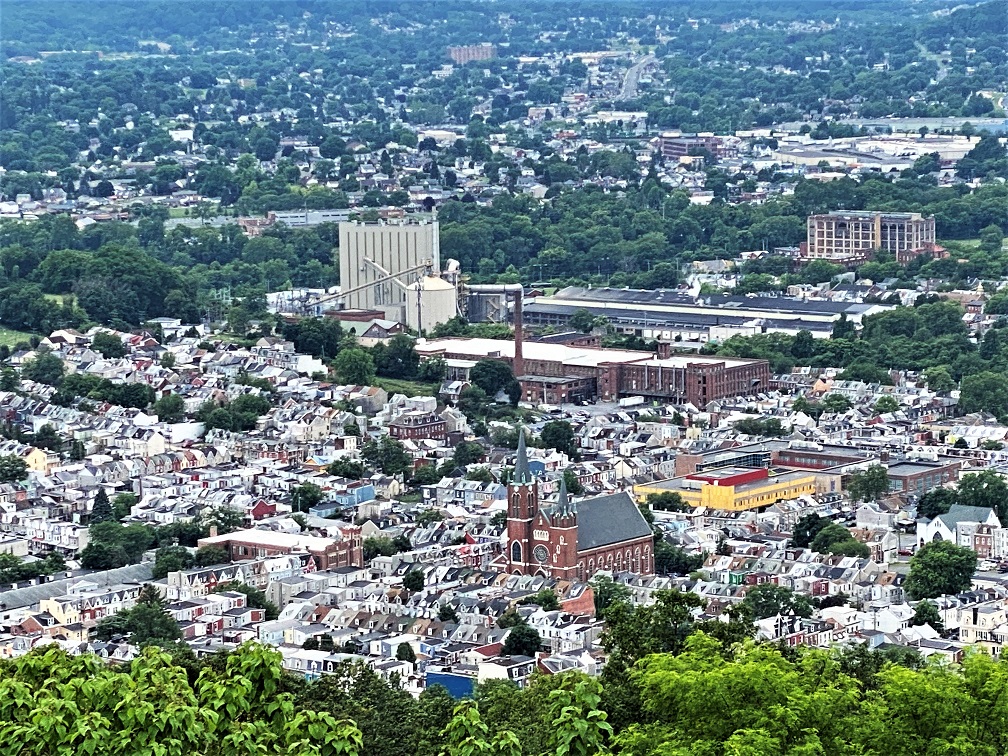


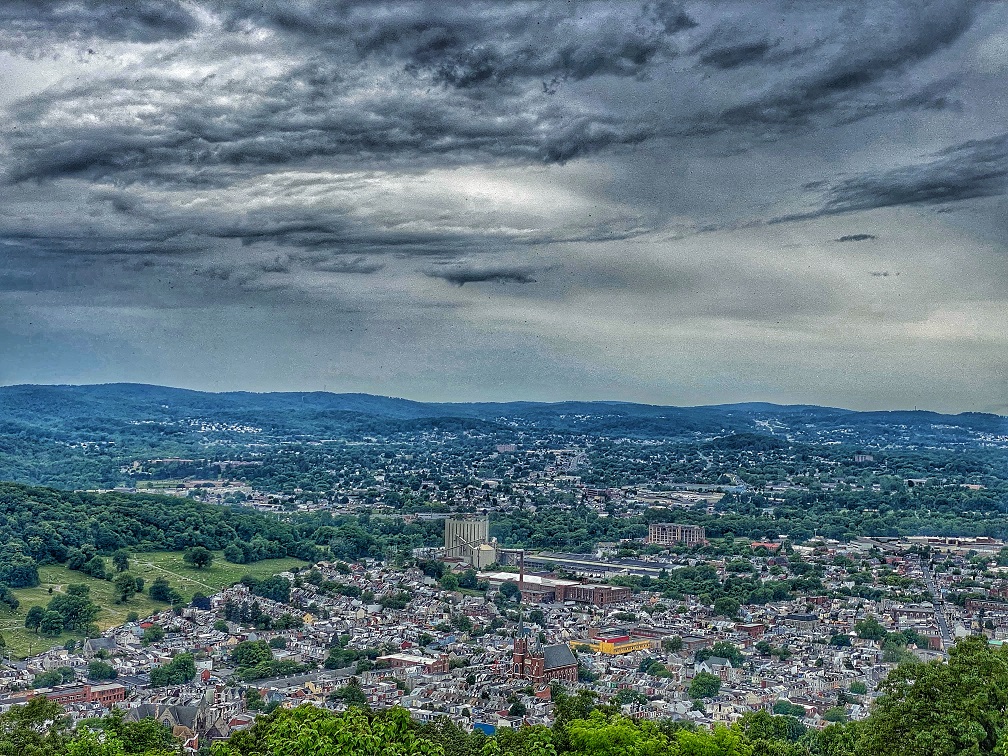
Another stop we made was to see the covered bridge called Wertz’s Covered Bridge, one of the covered bridges located in the Berks County – also the longest single-span covered bridge in Pennsylvania at 204 feet across. It was really fun imagining all of those carriages traversing the creek since 1867 when the bridge was built. You can close your eyes and hear the sound of the horseshoes hitting the wood pavement as carriages are slowly pulled through the bridge… Well, here are a few pictures, I’m sure you can add the horses as you see fit…
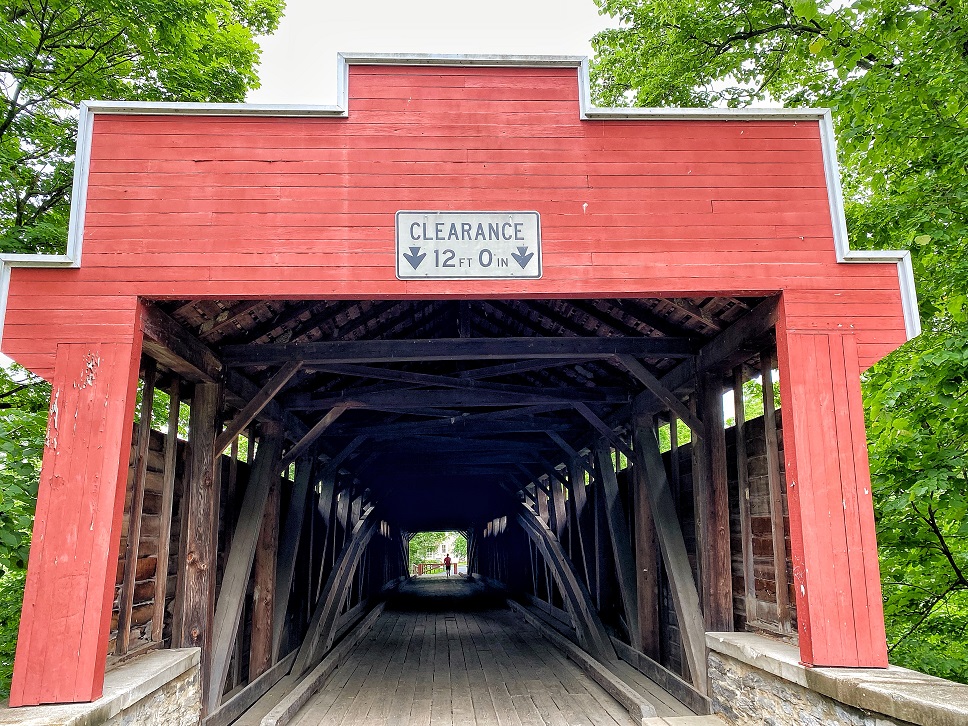


That makes it a full account of the wine, beer, and road trip experiences. Next, we will talk about some fun wine experiences on Cape Cod. Stay tuned…
Last Bottle Sign Up ($10 credit)




 Talk-A-Vino