Archive
When in Sweden…
 Here I am, talking about travel again. Well, this will be mostly about wine, but let’s talk about travel first.
This was my third time visiting Sweden (all three times were for work reasons). My first visit was to Malmo, a town located in the southern part of Sweden close to Copenhagen, and that visit was fully documented here (and here is the bonus part about my day in Copenhagen).
My other two visits were to Gothenburg (also known as Göteborg), the second-largest city in Sweden and the birthplace of Volvo cars. Both times I stayed at the Gothia Towers Hotel. Here comes an interesting (funny?) part. As I made it to the hotel this time, I noticed a large amusement park called Liseberg right across from the hotel entrance, with a Ferris wheel and rollercoasters. While walking with someone to the hotel from the bus stop, I asked if the amusement park was just built, and in response I got a very surprised look and the answer that the park was there even 20 years ago. Turns out my first visit to Gothenburg was in January of 2018, and spending all of the light hours inside the building didn’t give me a chance to see what’s actually around. Kind of funny and strange, I know.
I also remember from the previous visit that I wanted to find a Swedish wine to try. I remember walking into a large liquor store close to the hotel and asking someone if they had any Swedish wine I could buy – and I remember the salesperson telling me apologetically that they didn’t have anything on hand, but that he would be happy to order the wine for me which would take some time to arrive – that, of course, didn’t work for my schedule. Coming back now gave me some sense of hope of finding the local wine to try and adding one more check mark to the Wines of the World table.
Once I got situated at the hotel, my next trip was a traditional walk to the supermarket. For the absolute majority of trips, this is my standard routine – I generally prefer to drink sparkling water in the room, and this is the easiest way to get it (not even the question of least expensive – in many cases, hotels simply can’t supply bottled sparkling water). I’m also always eager to see the wine shelves at the supermarket, to see what is there and at what price. In Sweden, however, it is a bit tricky – alcohol sales are a government monopoly – Systembolaget is the chain of stores that can sell alcohol and liquor in Sweden, and of course, they control the prices and the selection.
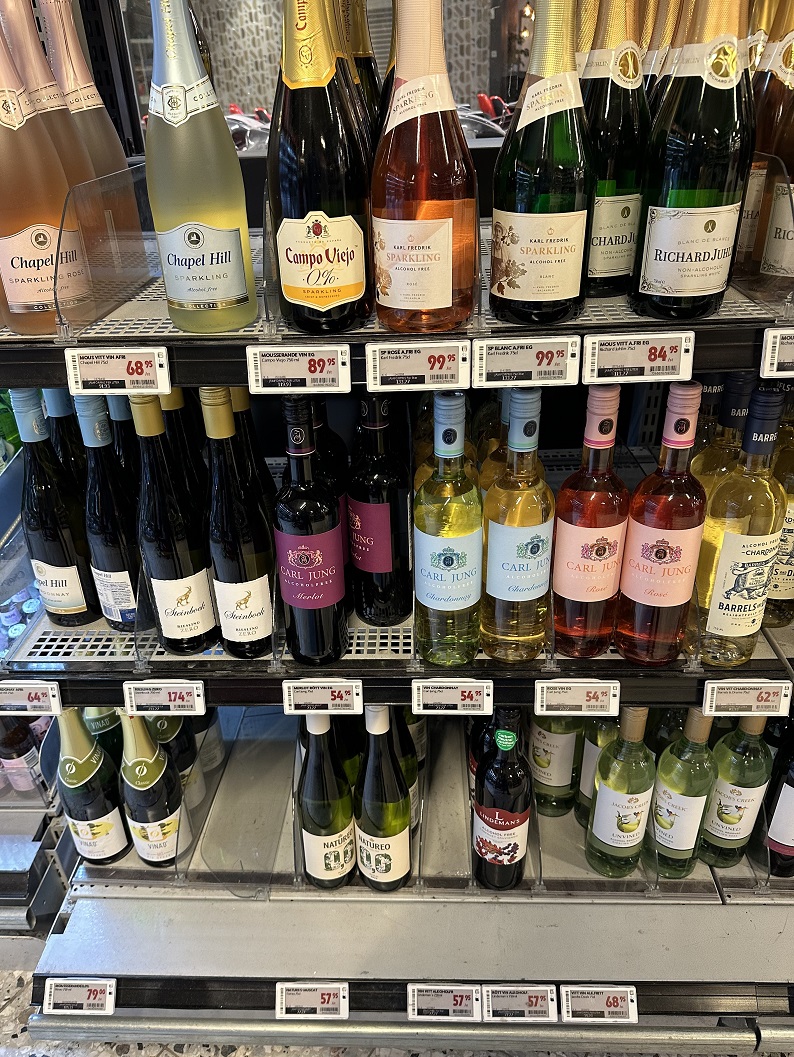
I visited the supermarket on Sunday, and Systembolaget stores are simply closed on Sunday (or at least the one I was near in Gothenburg). The supermarket actually offered wine – alcohol-free wine that is. I guess alcohol-free wine is a thing in Sweden, both locally produced (mostly from fruit, not grapes) and imported wines – and imported alcohol-free selection even included some familiar names, such as Campo Viejo, for example – you can see the sample selection in the pictures below:


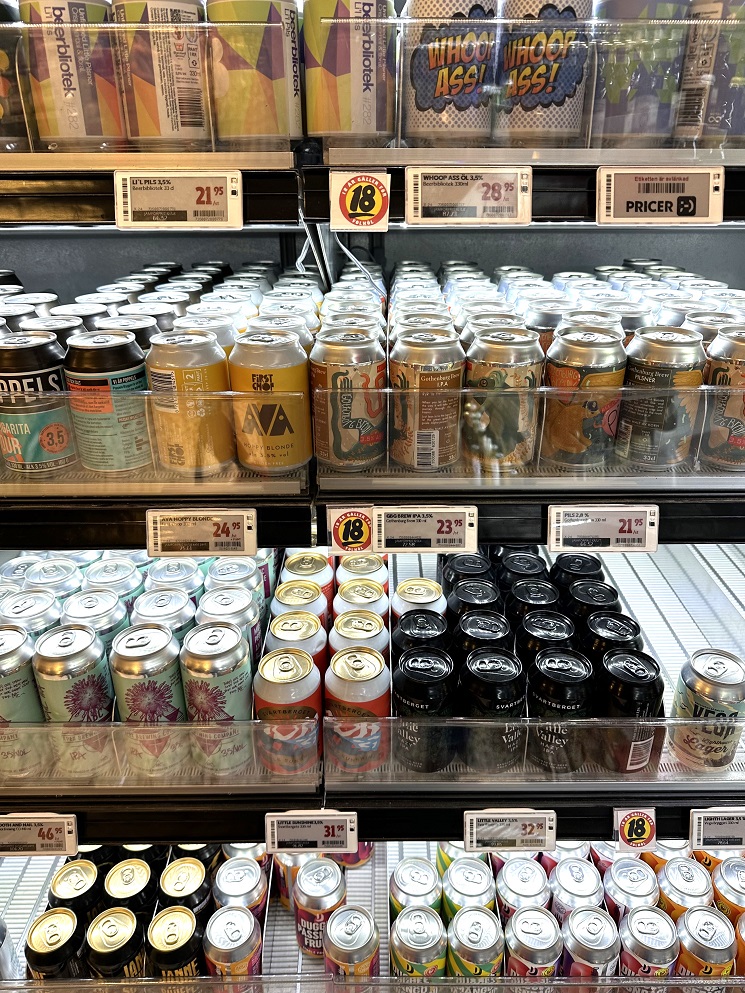
Apparently, low-alcohol beverages are allowed for sale at the supermarket, as there was a good selection of beer, and I even got a few to enjoy later in the room. Moreover, beer was a drink of choice at many of my dinners – while traveling when it comes to the “by glass” selection, I usually prefer beer as it is generally cheaper than wine and more error-prone. I had a number of good local beers during this trip.


And speaking about dinners, some were good, some were barely okay, and some were absolutely stunning (okay, not “some”, just one), as I already wrote about my visit to SK Mat & Manniscor. Actually, outside of that spectacular dinner, I had the best dish at lunch when we stopped by some random Italian place – the wild mushroom risotto was so good I had to literally stop myself from leaking the bowl (no picture though).


Before I will inundate you with pictures of the wines, just a few images of the town. As I mentioned before, this time around I was able to see the amusement park, and my room on the 17th floor afforded pretty good views as well – here is a little assemblage for you.




As I told you before, finding the Swedish wine was an important mission, so I tried to accomplish that at the first opportunity – I only didn’t realize that Systembolaget simply closes at 7 pm, and my meetings are typically not done until almost 8. The first half of the week went by and Thursday was my last hope before I would have to fly back on Friday. I found a little break in the meetings around 5 pm and went to the store.
The store was nice and spacious. After I made a few circles on my own, I realized that I would need some help finding the Swedish wine I was looking for. I asked the lady working there for help – she didn’t look very confident at first but with the help of the computer she was able to locate 3 different Swedish wines – real wines, with alcohol and made from grapes! (Ah, I’m so easily excitable).
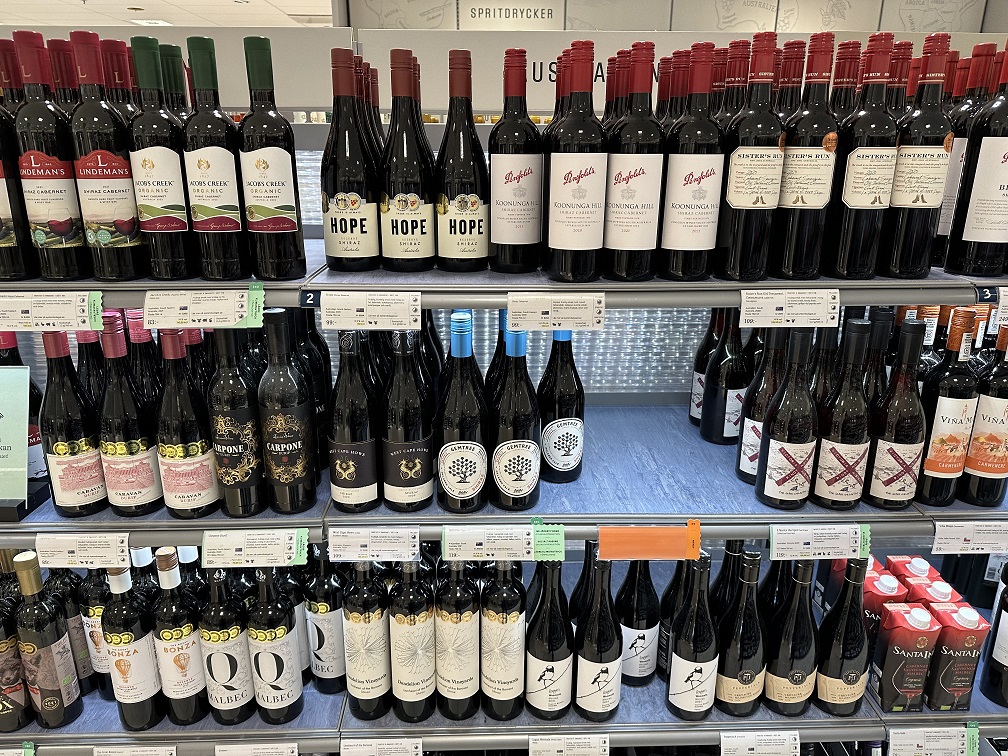
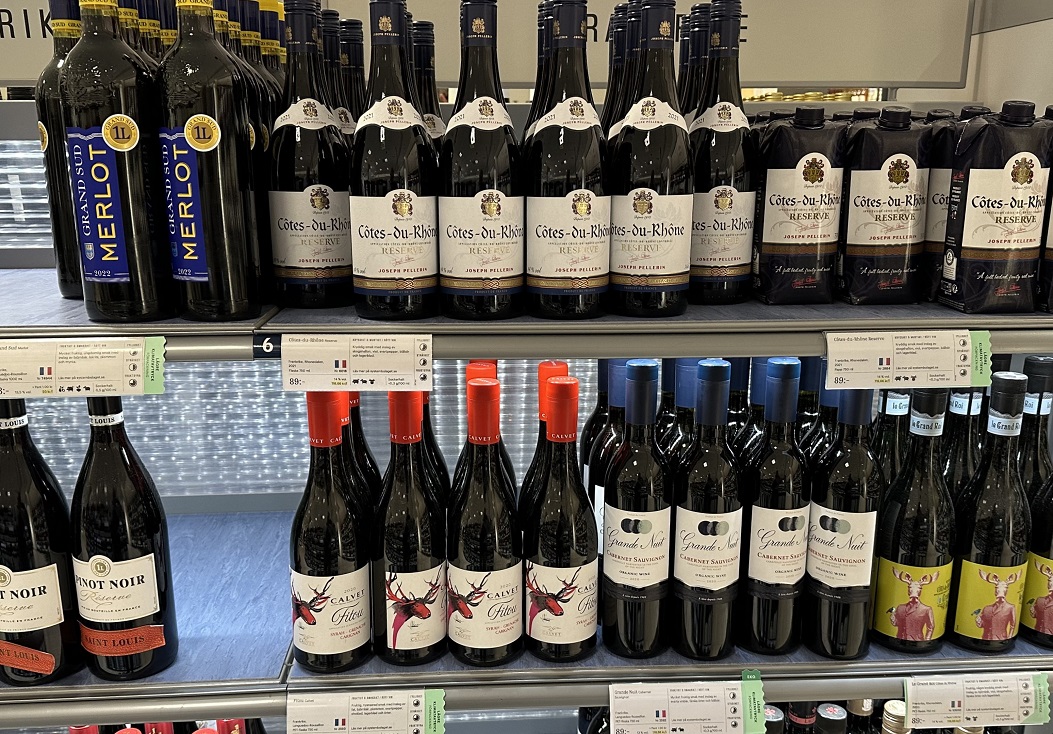
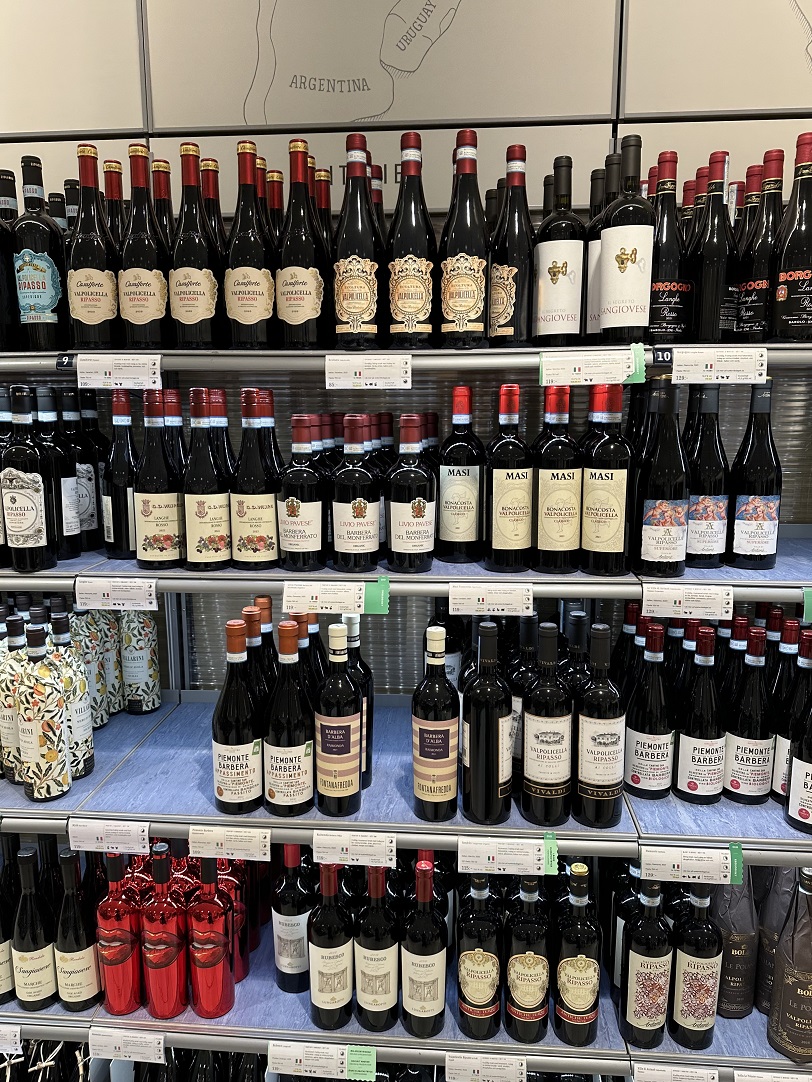
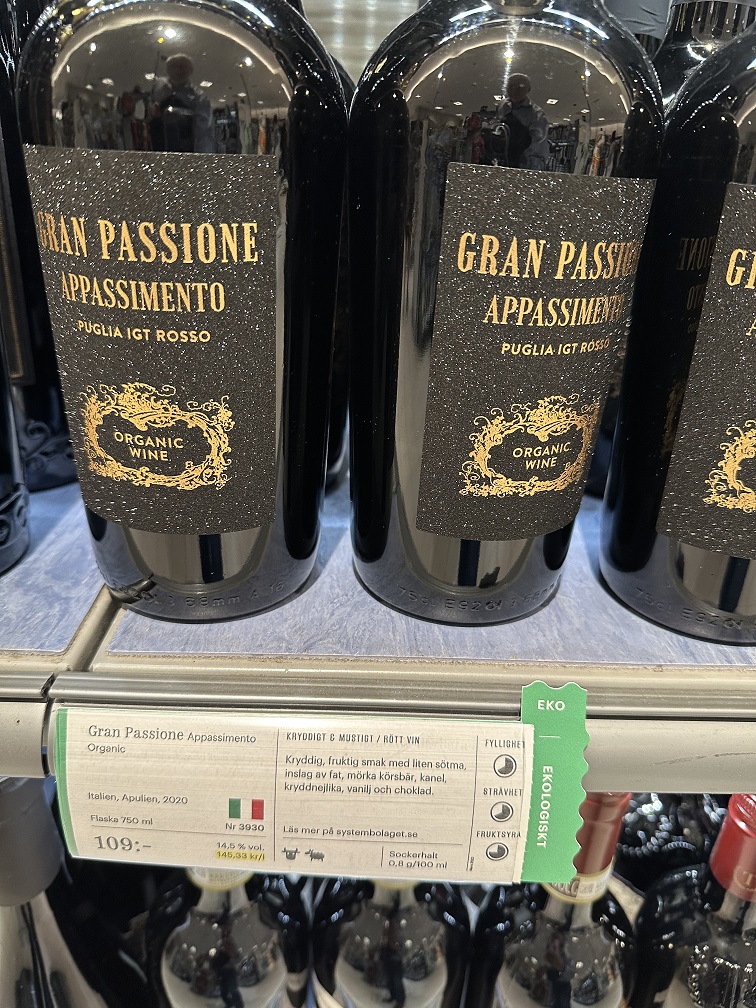
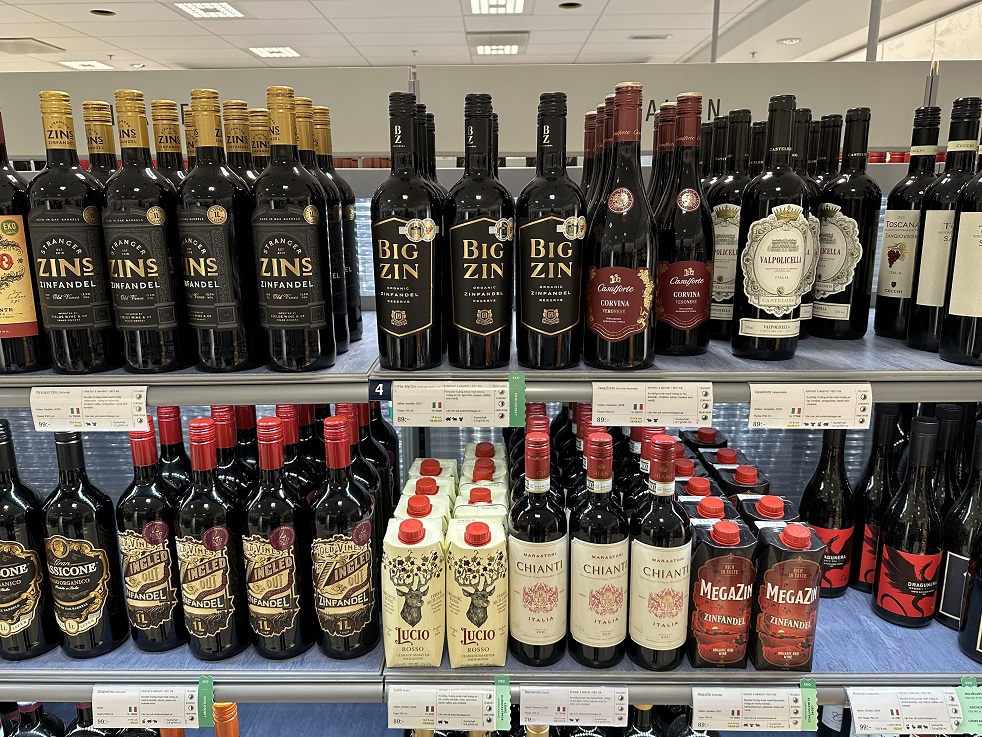
As a general observation, I saw a good number of wines at a reasonable price, around $10 or less (divide the price you see in Swedish krona by 10 or 11 – that will give you the price in dollars).
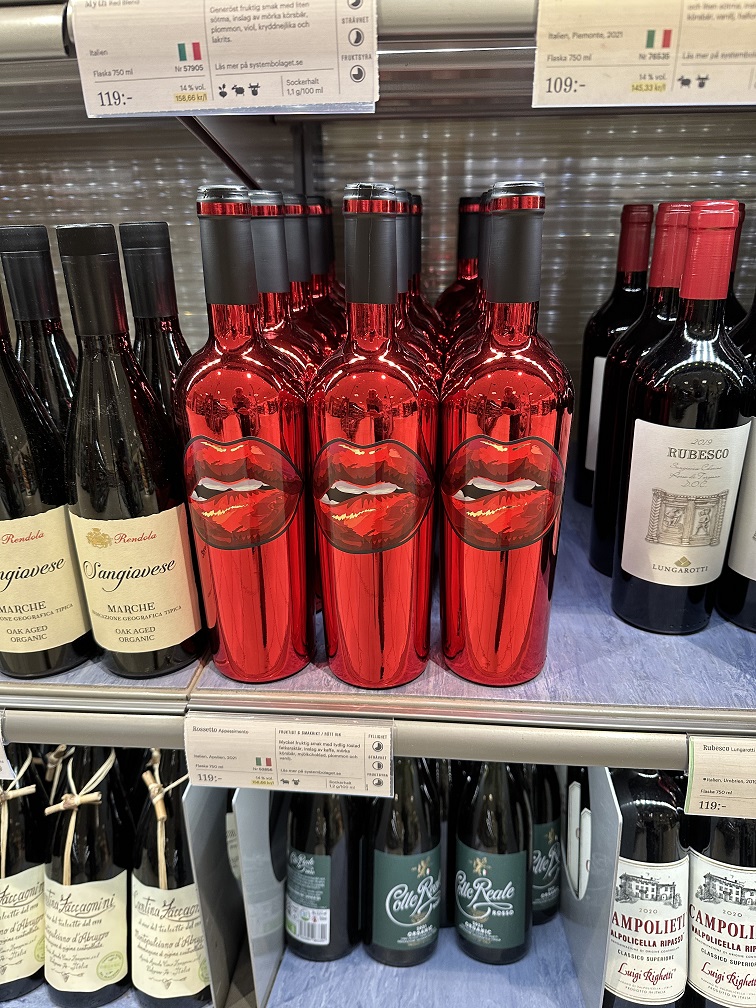
Some of the bottles looked like fun – if I were going on a hot date, I could’ve settled for this one with the lips:
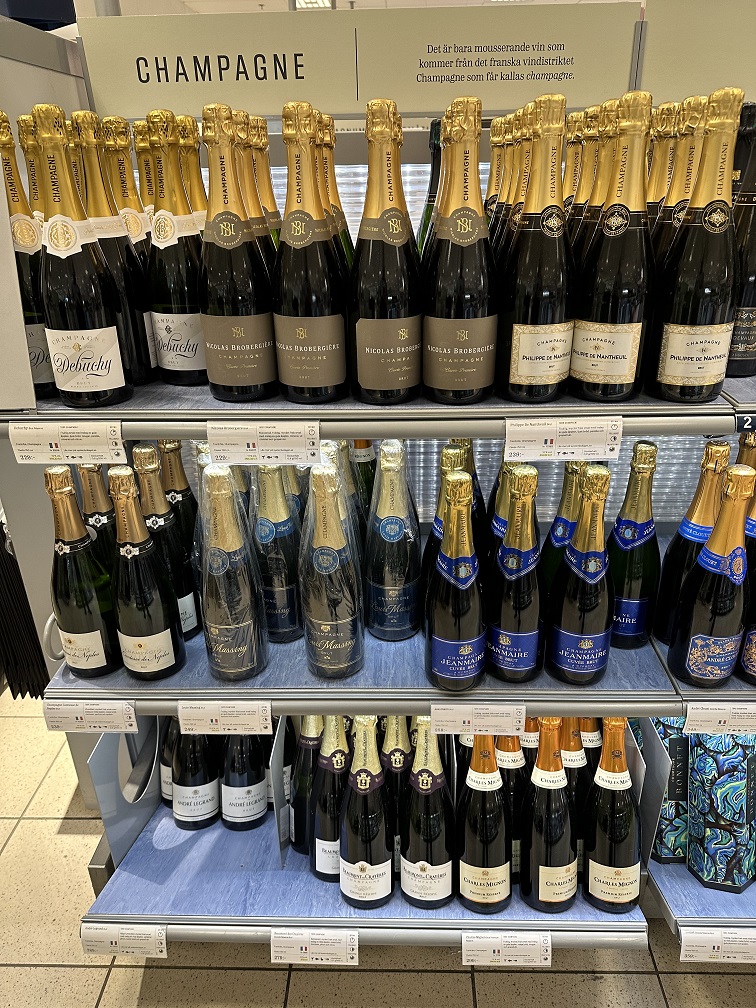
There was a good selection of reasonably priced Champagne, at least considering how much Champagne now costs in the US:
Lots of reasonably priced wines from Italy, France, and Australia:
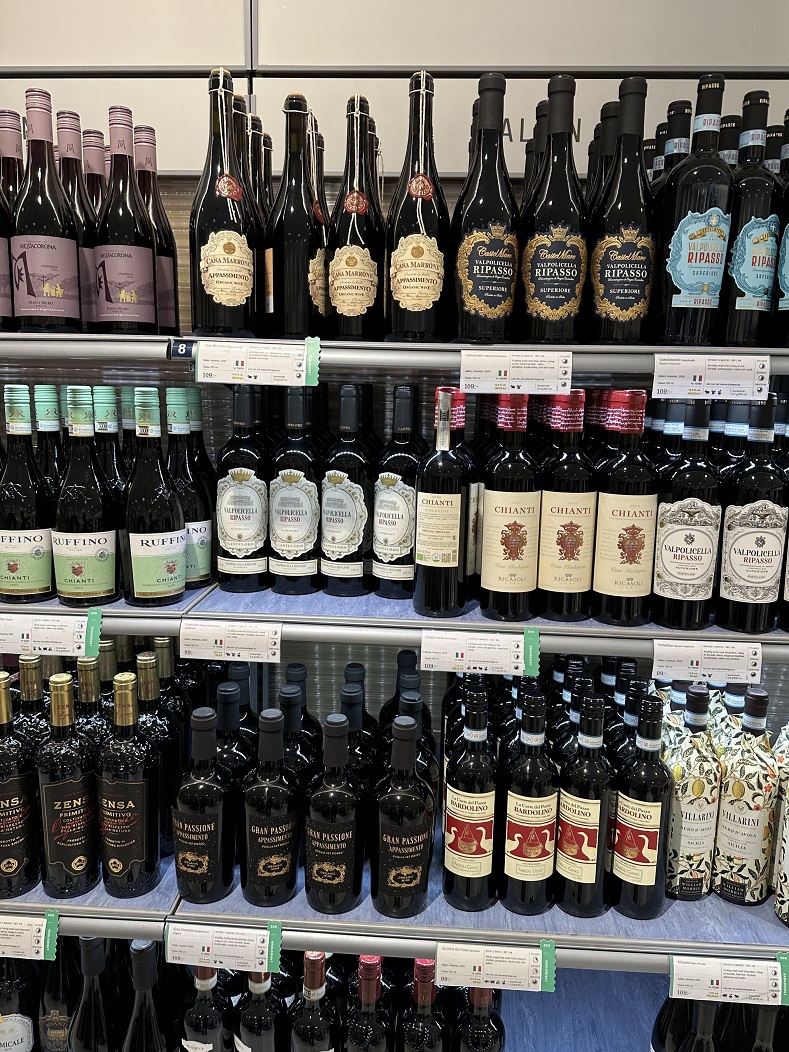
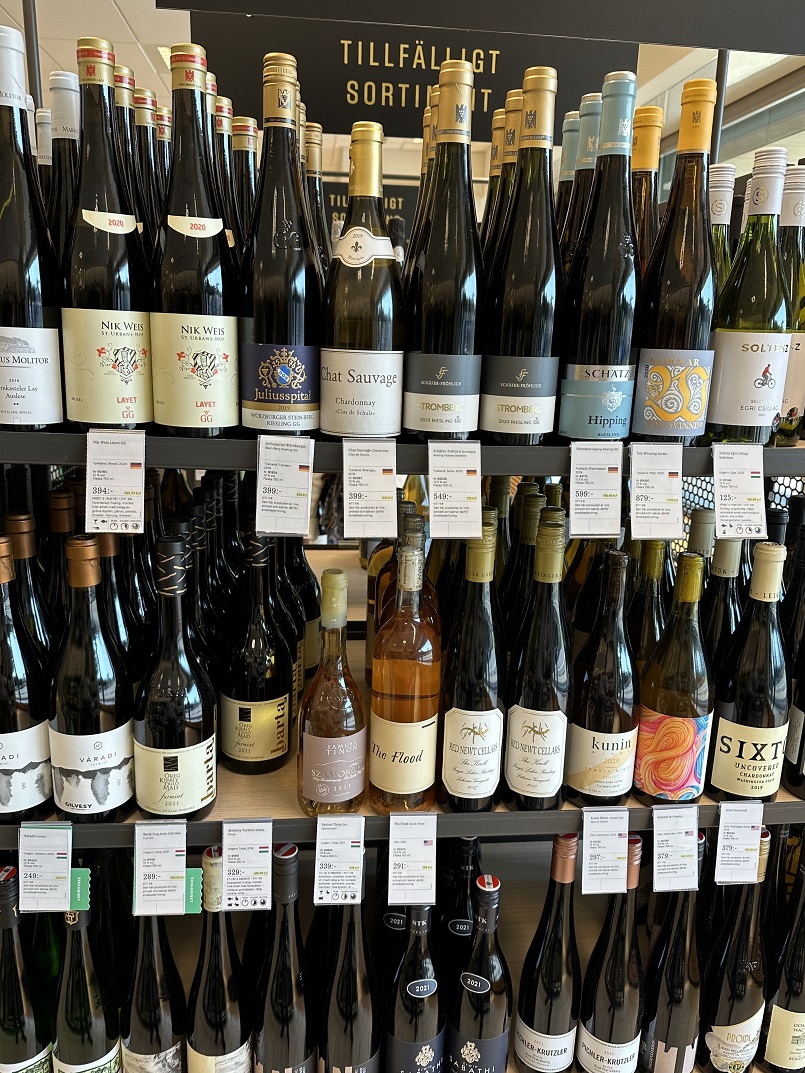
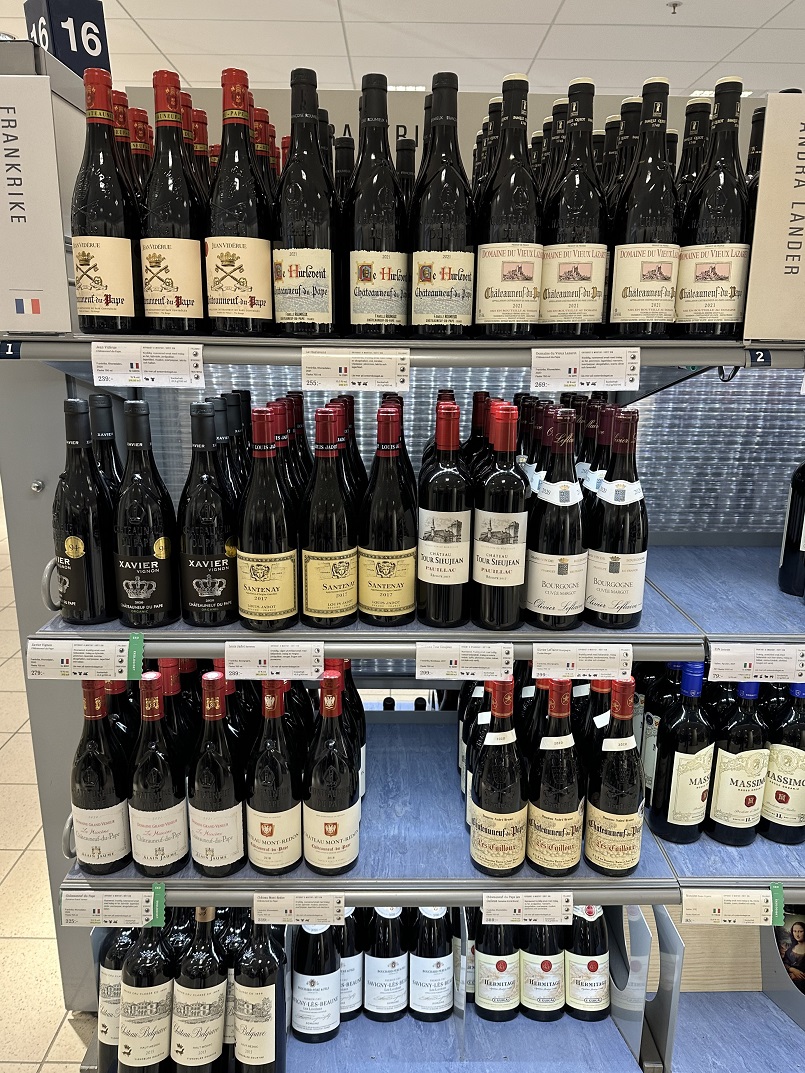
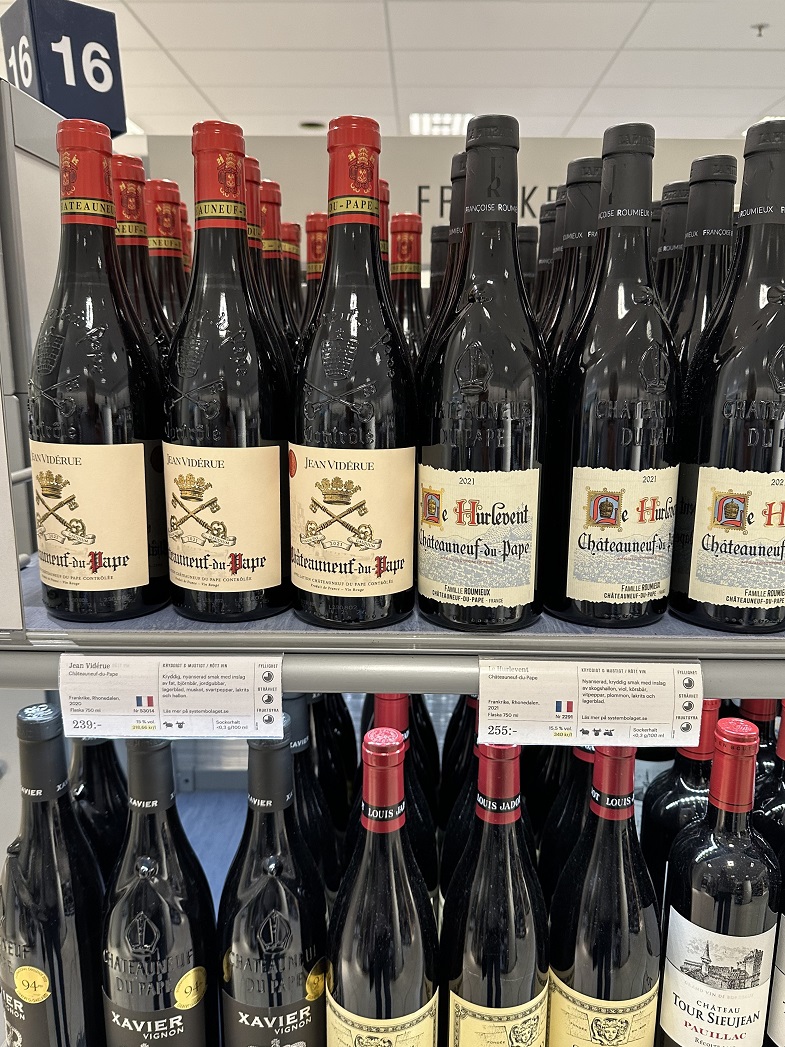
And here we are, the culmination point of the search – Swedish wines. These are quite expensive – yes, I understand it is not easy to grow grapes in Sweden.
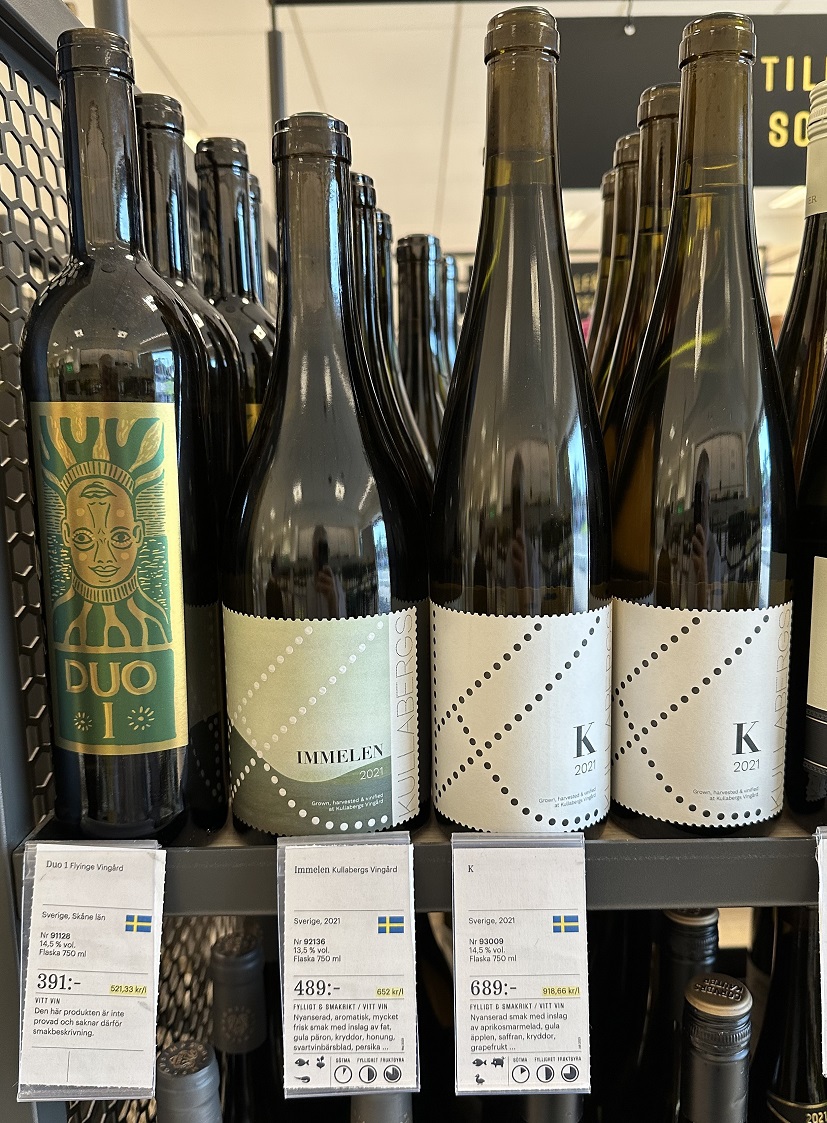
I settled for the “second cheapest wine”, which amounted to the hefty $45 – but hey, the price we pay for our hobbies…


Once I got into the hotel, I had to find a way to quickly chill the bottle, as it was my last evening to taste it and I had no intention of checking my luggage because of a random bottle. I got ice from the machine, added water, and did my best to submerge the bottle into the tiny ice bucket…
Before we talk about the taste, let’s talk about the wine itself – 2021 Kullabergs Vingård Immelen (13.5% ABV, mostly Solaris grape). The winery is located in the southwest part of Sweden, on the Kullaberg peninsula which is also a nature reserve (sometimes called Cape Kullaberg). The Kullabergs vineyard was planted in 2006. One of the main grapes at the vineyard is called Solaris – the grape selected in Germany in 1975, specifically developed to cope with cold climates. The wine I got from the store was mostly made from Solaris, at least according to the back label, even though the only technical note I found on the website was for Immelen 2019 which had 86% Solaris and 7% each of two other grapes.
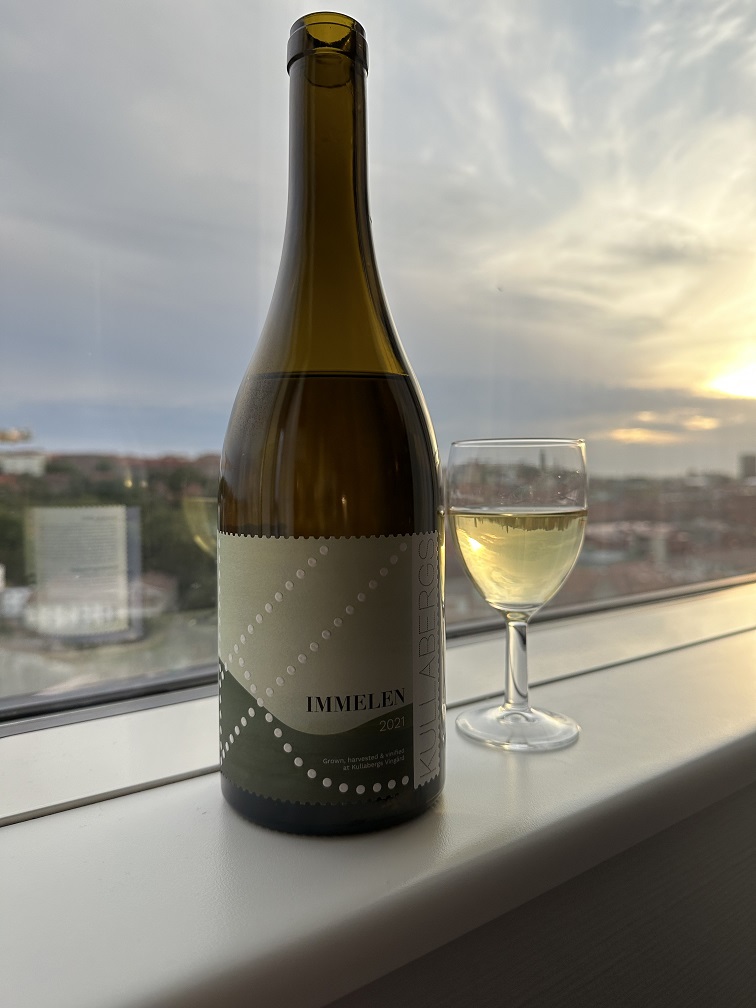
The wine was interesting. I wish I was able to fully chill it, but probably at around 55F it was showing a bit heavy, had notes of tropical fruit on the nose, plump and round body on the palate with a hint of grapefruit peel which offered a touch of bitter notes. Good acidity, and not a bad wine overall. It was reminiscent of Marsanne/Roussanne blends from the Southern Rhone if such a comparison would help. I’m happy I had an opportunity to taste this wine, add a checkmark to my wines of the world list, and a rare grape to the Hexavini journey. At $45, it is okay as once in a while exotic experience, but I will not pay this much for this wine a second time.
Here you are, my friends – a quick report from the trip to Sweden, mostly in pictures.
Hey, I heard Finland is starting to plant vines… guess what I will be hunting down next…
Frustration of the Oenophile
We have enough sources of frustration in our lives, so wine shouldn’t be one of them. This statement works fine until you become obsessed with wine. Then it becomes a source of joy, happiness, fun, and, of course, frustration.
The concept of frustration is very personable, there is really nothing objective about it. It is generally a choice – you can decide to get frustrated, or you can choose to ignore whatever bothers you. It is not always that simple, of course.
For example, corked wines are a great source of frustration for oenophiles. A corked bottle bothers me very much, but considering my experience with corked wines is not anywhere near the proverbial 8% (knock on wood), I just accept it as an unfortunate part of the wine world. Plastic corks can be a great source of frustration, and so are the bottles with wax tops when the wax is not done right. We can go on with this list and I’m sure every oenophile can choose what frustrates them the most. Most importantly, we feel frustrated with different things on different days.
What prompted this post was frustration with my own choices. And Cayuse wines.
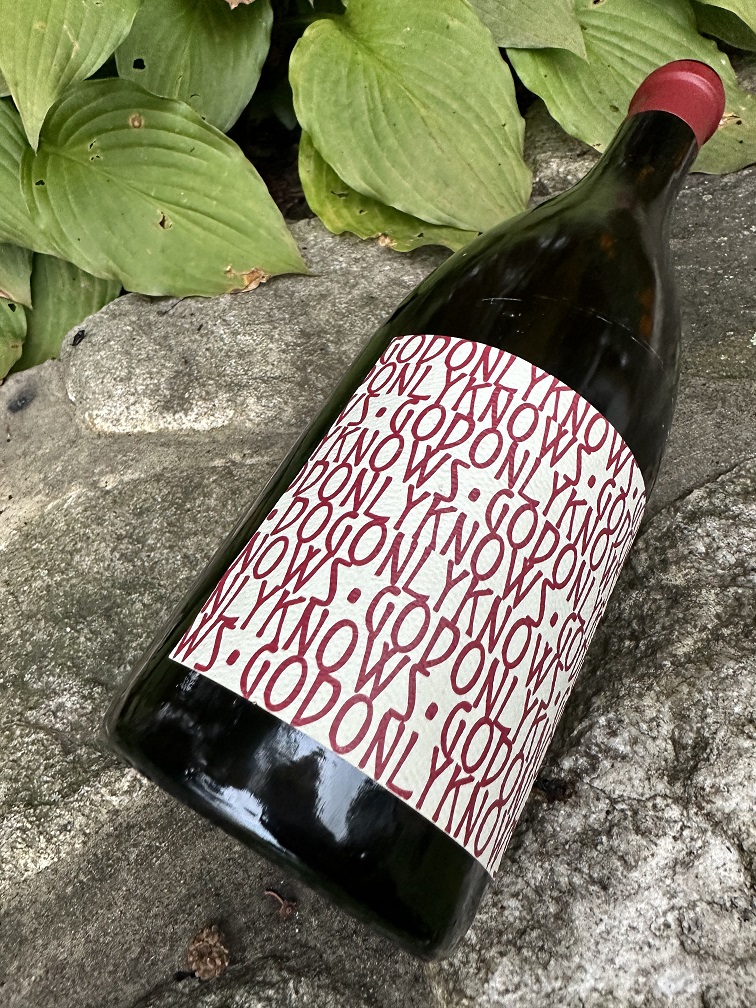
Many years back I was closely following wine writer W. Blake Gray, who was writing a wine column at that time, I believe, for the San Fransico Chronicle. In one of the articles, he mentioned Cayuse Vineyards wines as possibly the best wines produced in the United States. Talk about influences… These got stuck in my head, and getting my hands on the wines of Cayuse became one of my obsessions. I signed up for the mailing list and stayed on the waiting list for close to 10 years until I finally got on.
Cayuse wines are produced by Christophe Baron, a French-born winemaker who fell in love with the rocky soils of Walla Walla Valley. While Cayuse was his original project which brought fame and recognition, Christophe Baron also started a number of other successful projects – No Girls, Horsepower Vineyards, Hors Catégorie Vineyard, and Champagne Christophe Baron (with this he really went back to his roots as he was born in Champagne). While waiting for Cayuse, I actually managed to get on all other mailing lists – but let’s leave those wines aside for a moment and get back to Cayuse.
I’m sure you are curious to see where the aforementioned frustration is coming from – and let me tell you, it is not related to the long wait. My frustration is tied to the wine itself. How? Easy. I don’t enjoy it.
Here, I said it.
Okay, let’s not generalize. I actually enjoyed very much a 9-year-old wine from Cayuse – 2011 Syrah from En Cerise Vineyard in Walla Walla Valley which I had on Thanksgiving in 2020. I liked the wine so much that it became wine #2 on the Top Wines list of 2020. But this happened once. And a few Cayuse bottles that I opened made me question my choices – and became the source of frustration.
The latest case in point – 2017 Cayuse God Only Knows Armada Vineyard Walla Walla Valley (13.8% ABV). This is 100% Grenache. The wine had somewhat of a muted nose, mostly mineral. At first, the palate had a lot of “liquid rock” power – iodine, pencil shavings, granite, maybe cherry pits. I thought that maybe the wine was too young at 6 years of age, pumped the air out, and let it stand until the next day. The next day didn’t improve the situation much. On the third day, the wine simply became bitter.
When I’m supposedly drinking one of the best wines produced in the US, and I derive no pleasure from it, it becomes concerning. It becomes frustrating. What is wrong with me? How come I can’t appreciate this wine? If I look a the reviews, frustration only deepens. Jeb Dunnuck gave this wine 99 points in 2020, and described it as having a “gorgeous nose of framboise, wild strawberries, sweet mulch, sappy flowers, ground pepper, and liquid violets” – how come I don’t get any of this? Do I have to be a professional wine critic to be able to enjoy the wine? By the way, the continuation of the same review made me say WTF: “This carries to a medium to full-bodied, Burgundian Grenache” – Burgundian Grenache? But Grenache is not produced in Burgundy? Yeah, whatever. The same review also suggests the drinking window between 2021 and 2033, so I’m perfectly in the range. And yet I didn’t enjoy the wine.
I love Grenache wines. Admittedly, many of my great Grenache experiences are connected to Spain, where it is known as Garnacha – how about some Alto Moncayo, for example. I very much enjoy Grenache from France – CdP, Gigondas, other places. Also, California is perfectly capable of producing the most delicious Grenache – we don’t even need to go to the Rhone Rangers – Bokisch and McCay in Lodi do a damn good job representing delicious Grenache. And yet I don’t enjoy what should be one of the best renditions of Grenache in the world. Frustrating.
Cayuse will not be the first “serious” wine I’m unable to enjoy (serious = expensive here, this bottle costs north of $130). Opus One, Joseph Phelps, Corison, Chateau Montelena, many of the Heitz bottlings, Far Niente… There are a number of wines out there I do not seek. But I was really dreaming about getting my hands on Cyuse bottles. This wine was an object of desire and now… this?
I believe Bionic Frog was the wine that made Cayuse famous. Bionic Frog (made from Syrah) is still not a part of my allocation, so I will try to stay the course for now. I will give more chances to Cayuse wines to prove that my latest experience was just a fluke, but I’m afraid I have to leave Cayuse wines aside at the moment and see if time will be able to bring out the pleasure.
Yes, I realize full well that my frustration is the first world problem – and if you have a problem with that, feel free…
For now, I will remain oenophile frustrated.
Latest Wine News and Updates
While wine production is one of the oldest industries in the world, the amount of new, innovative products and scientific breakthroughs in the wine world is nothing short of breathtaking. Let’s take a look at some of the latest news from the field.
Everyone agrees that fake wine is a big problem for the wine industry. There are many tools employed by winemakers to protect the identity of their wines, but the quest for the perfect solution is still ongoing. After 15 years of intensive research, the French INAO (The National Institute of origin and quality), together with the College of Veterinary Medicine at Auburn University in the US announced the successful results of the initial trials of dogs being able to sniff fake wines. As part of the Canine Performance Sciences program, dogs had been trained to identify wines that don’t match the original wine. The training is a very involved process requiring the dog to spend about 2 years at the winery memorizing the original flavor profile of the wines. Once trained, the dogs can easily distinguish the original bottles from the fakes, the same as working dogs who identify illegal substances at customs in airports. The training process is intense and costs about $50K per dog, so this solution is not for every winery. Nevertheless, according to INAO, it will take about 7 years to satisfy all the requests for the dogs received to date.
There are plenty of wine lovers who crave massive, tannin-loaded wines. Such wines are often quite expensive as they require a long aging time in the oak barrels which are costly. What if the oak flavor can be concentrated in the grape itself while it is growing? Impossible, you say? Scientists from UC Davis in California think otherwise. Instead of using the traditional rootstock, UC Davis scientists managed to graft Cabernet Sauvignon vines onto the french Limousin oak rootstock, and after about 7 years of experimentation it seems that resulting wines demonstrate much higher tannin concentration than the wines obtained from the same clone of Cabernet Sauvignon but not grafted on the oak rootstock. Obtaining the same level of tannins would require about 6 months of age for the wines in the control group. Once the research is complete, it will result in significant savings for the wine producers which [hopefully] will be passed on to wine lovers. We should expect to find the first wines based on the results of this research by approximately 2028.
Many wine lovers live with a simple motto – coffee in the morning, wine in the evening. The next news I would like to share with you will, in a way, be related to both beverages. How so? Everyone knows Nespresso, a French company that mastered the simplicity of the perfect cup of espresso at any time with the help of a tiny coffee capsule. Working on a special (very sizeable) grant from French LVMH conglomerate, Nespresso just announced a brand-new machine called – maybe you guessed it – Winepresso. Nespresso scientists found a way to convert the content of the wine bottle to the dry form which is encapsulated in the tiny wine capsule, literally identical to the coffee one. Now, with a push of a button, a perfect glass of your favorite beverage is in your hand at any moment. Based on the opinion of the expert panel, the Winepresso-produced wine is practically identical to the original wine, which is a pretty amazing achievement in itself. The initial set of capsules available upon commercial availability of Winepresso will include two Bordeaux reds, one red from Burgundy, and 3 whites from Loire. It is also known that Nespresso is actively involved in conversations with a few of the famous wineries in Napa Valley. The capsules will be sold in the 5-packs (to be identical to the standard 5 glasses in the bottle of wine). Winepresso machines are expected to appear at select retailers such as Williams-Sonoma and Bloomingdales in time for Christmas shopping. The prices for the capsules and the machines had not been disclosed yet. If successful, you can only imagine how successful this product will be from point of view of sustainability and reduction of the carbon footprint.
Open any news source today, and you are guaranteed to read about ChatGPT, artificial intelligence (AI) software. ChatGPT writes poems, articles, and marketing materials, conducts market research and lots more. It appears that the wine world is starting also to embrace ChatGPT in a variety of ways, many of them quite unexpected. Champagne Piper Heidsieck just announced that they will start a new line of non-vintage Champagne, called Piper Heidsiek AI, where ChatGPT will play the role of the Chef de Cave, responsible for blending the final wines. After the initial offering, both Blanc de Blancs and Blanc de Noirs will be produced. While it is an interesting announcement in itself, I’m concerned with the impact of the ChatGPT on all areas of human lives, now including even wine production. Well, we will see how this story will unfold.
That’s all the latest news I have for you, my friends. Until the next time – cheers!
Happy New Year 2023!

Source: Pixabay
Happy New Year 2023 to everyone! Health, peace, happiness, lots of amazing wines and lots and lots of memorable moments and experiences for everyone! Cheers!
The Case for $3.49 Wine
My latest (hopefully the last for the year) travel took me to Washington, DC. After arriving in the evening, I wanted a glass of wine and a bite to eat. The restaurant at the hotel was closed. I’m sure it would have been easy to find a place to eat nearby, but Whole Foods right across the street offered a different option.
I walked into the store only thinking about the food. But the entrance took me directly to the wine section, so obviously, I had to stop and look around. There were definitely some interesting options available, including some Virginia wines. And then I saw Cabernet Sauvignon for $3.49. When I travel, I love to explore the wine options, especially the cheap inexpensive wines, so the wine looked absolutely irresistible.
When in Europe, I’m very confident about such inexpensive wines – chances for disappointment are quite low. The US is a different story. Trader Joe’s is the only place where you can find wines for $4-$5, and sometimes you win, and sometimes you learn. Of course, Trader Joe’s has its own $3.49 wine, Charles Shaw, formerly known as Two Buck Chuck. I had Two Buck Chuck before, and my curiosity was satisfied. Now I needed to find out how this $3.49 wine would fare.
Before we talk about this particular wine let’s talk about the concept of inexpensive (cheap?) wine. “Cheap wine” sounds almost offensive so let’s use the gentler “inexpensive” term.
I’m sure a lot of serious wine lovers in the US would frown upon the wine at such a low price. They might get a bottle for cooking, but even then there is a well-known adage that you should cook with the wine you will enjoy drinking. But beyond cooking, to buy a bottle for $3.49 to drink or entertain friends would be a big “no-no”.
My case for such an inexpensive wine would be for both uses, of course assuming the wine is palatable – this is clearly the most important requirement. Cooking is no brainer – when I make a beef roast in a slow cooker for 7 hours, I honestly believe that whether I will use a $3.49 bottle, or $349 bottle of La Joie Vérité, it wouldn’t make a detectable difference, so even if one can afford it, the question is why.

Now the friends’ entertainment aspect is also essential. You see, I have a group of friends who all love wine. I would never offer $3.49 wine to these friends at dinner, with the exception of maybe a curiosity sip. I’m always ready to open whatever bottle I have in the cellar when we get together, with no exceptions. And then I have other friends, who I love equally as much, but who don’t care about wine at all. $349 wine would not make them excited even the tiniest bit and would be clearly a waste of wine (not even talking about the money).
Don’t get me wrong – this is not for the lack of trying. Believe me, I tried. We don’t need to single out those really expensive bottles, as nobody tries to show off or prove any points. There are plenty of absolutely amazing wines under $20 which would bring me literally into the nirvana state – and would never extort even the hint of “wow” from my friends, just at the best a polite “hmmm, this is nice”. Serving a $3.49 bottle under such circumstances makes absolutely perfect sense – especially if you, the wine snob in disguise approve that $3.49 bottle.
Those of you who know me well already figured that I wouldn’t go into such a diatribe if I wouldn’t have the $3.49 wine I want to bring to your attention. But of course…
Non-vintage Three Wishes American Cabernet Sauvignon (13% ABV, $3.49), produced by Three Wishes Vineyards in California – in a few words, well-balanced and inoffensive – or maybe smooth is a better word. This is not a concentrated Napa Cab, which instantly takes ownership of your palate – this wine is mellow, it has black and red berries to offer, it is not sweet, and it has a good amount of acidity. Yes, it is simple. Yes, it is not thought-provoking. But for the price, there are plenty of people who enjoy an occasional unpretentious glass of wine who would be absolutely delighted with this wine. What’s important is that majority of the wine drinkers should be either unaware of the price, or simply grow up above the wine snob level. This is unfortunate, but wine is really one of those products where people are afraid to spend too little (and this can be the subject of another post). Bottom line – if you are simply looking for a glass of wine with your meal and not for the wine experience – you can get it with this wine.
And now I rest my case.
A Weekend in [Great] Wines
 What is a great wine?
Does the wine made by a famous producer make it great? Does a high price make it great?
Wine should give you pleasure. Is there a measurable amount of pleasure to declare wine “great”? 5 units of pleasure? 25 units of pleasure?
Of course, “great” is a subjective definition. The infamous “the truth is in the eye of the beholder”. Every wine lover has their own way to declare wine great, and it is not just one way – there are many ways.
I love the harmony in the wine. The perfect balance of all the components. A unique flavor. A thought-provoking bouquet that makes you want to take a sip, and another sip, and try to understand. Or the wine which makes you disconnect from the world and all of its problems, and just get lost in your own thoughts. I also love the wine which perfectly matches your expectations.
I’m sure “expectations” is yet another loaded term, but if you are into the wine, for sure you have expectations when opening a bottle of wine. You expect to find freshly cut grass and maybe a proverbial “cat pee” on the bottle of Sancerre. I love gunflint on my young Chablis. I expect a good bottle of well-aged cold climate Chardonnay to show honey and apple notes. I want succulent cherries in my Brunello. And I need cassis in my Bordeaux, and gobs and gobs of cassis on my bottle of the Napa Cabernet Sauvignon. Don’t get me wrong – the wine can be great if it doesn’t match expectations at all, but this is the subject for another post.
That is what I want to talk about here – the wines matching expectations. The wines that were simply perfect. And a few others that were maybe not perfect, but still delicious.
The last Sunday was Father’s Day. I usually open a good bottle or a few in honor of the holiday, but this weekend of wines started a few days prior. My sister-in-law, who lives on Cape Cod, had her milestone birthday recently, and as she loves wine, I wanted to bring a few wines that would be worthy of a moment. She used to love California Pinot, but as of the last few years California Cabernet Sauvignon became the thing, so I grabbed a few bottles of Turley Estate Cabernet, which generally doesn’t disappoint. And of course, a few other bottles, as we had to drink something for 3 days, okay?


Before we got to the reds, there were whites. We started with 2020 Château Montet Blanc Bordeaux AOC (12% ABV, Sauvignon) which was a nice, middle-of-the-road, Bordeaux white wine, offering a hint of freshly cut grass and some Meyer lemons. We also opened a bottle of 2018 Alban Vineyards Viognier Edna Valley (14.9% ABV). It was nicely perfumy and complex on the nose, and quite big and powerful on the palate, with an interesting flavor that I could not discern – on overripe wild plum maybe. I tried this Viognier with the fresh oysters, but this was not necessarily a winning combination. Our last white was 2016 Turley The White Coat California (13.5% ABV, 40% Roussanne, 40% Grenache Blanc, 20% Vermentino) – a full-bodied, elegant white wine, plump and round on the palate, perfectly fresh and clean overall.


Summer asks for a Rosé, even though the weather was rather on the cool side – our choice of Rosé was 2021 Turley Zinfandel Rosé California (12% ABV), which was delicious. Strawberries and cranberries on the nose and on the palate, crisp, clean, refreshing – it had everything you want from Rosé.
And then there were reds. Some were more of the “placeholders”, the wines you open just to drink something before you get to the main program – as was 2021 Field Recordings Nouveau Edna Valley (12.9% ABV, Pinot Noir). Young, fresh, grapey, and tart, as you would expect from the Nouveau. We treated somewhat similarly 2018 Pedra Cancela Winemaker Selection Dão DOC (13% ABV, 40% Touriga Nacional, 30% Alfrocheiro, 30% Tinta Roriz), even though this is an excellent wine in its own right – dark fruit, cherries, nice minerality, medium body, fresh acidity, and overall good balance. 2016 Pedra Cancela was wine #7 on my Top 20 of 2020 list – I think I would prefer 2016 over 2018, but I need to try this wine again by itself and not “among others” before I will be able to form an opinion.
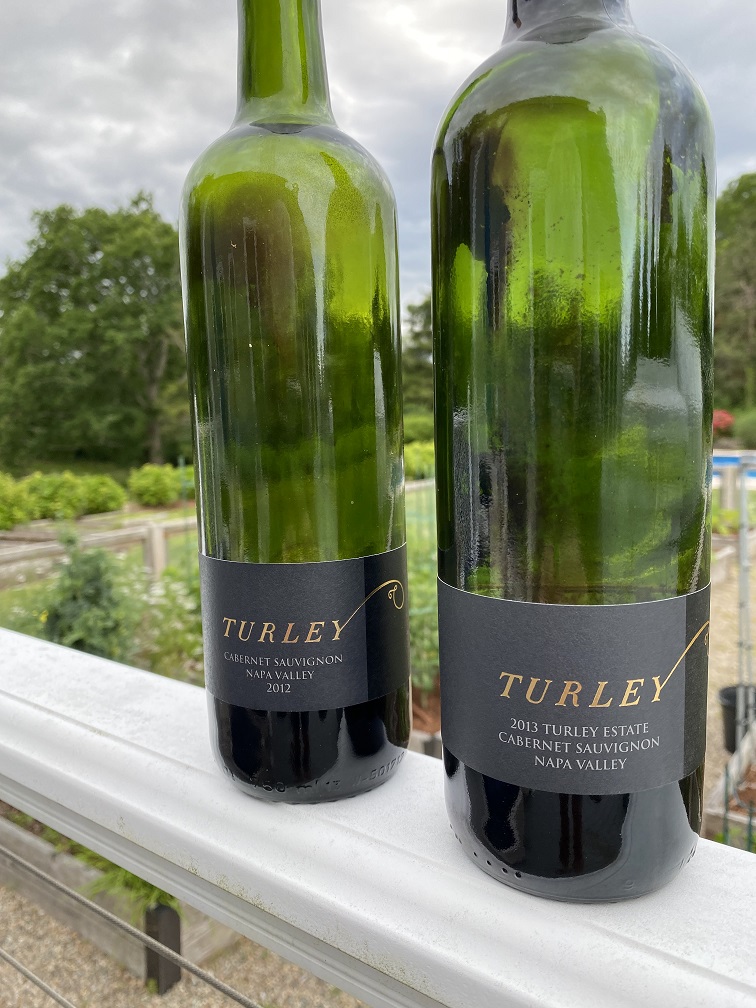
Next was the time for magic, so the bottle of 2012 Turley Estate Cabernet Sauvignon Napa Valley (14.1% ABV) was open. I have a long history with Turley Cabernet Sauvignon wines, ever since they debuted with the 2010 vintage – this post describes my perception of the 2010 vintage and also provides some details on my initially rocky relationship with this wine. The first 2 vintages were called “The Label”, becoming simply Turley Estate Cabernet Sauvignon starting from the 2012 vintage. The last time I tasted the 2012 Turley Cabernet Sauvignon was exactly two years ago – you can read the tasting notes here. These 2 years made a difference, and the wine was delicious from the get-go. Cassis on the nose and the palate, layered with soft tannins, generous and powerful. Upon opening, it was varietally correct and simply superb, worthy of a great wine designation.
You take a sip of wine, you think you discovered the perfection, and you are reveling in the happy state. Then you open another bottle, catch a whiff from the glass, take a sip, and wonder how the absolute happiness you experienced a second ago can be toppled? And yet this is exactly what happened when we opened the 2013 Turley Estate Cabernet Sauvignon Napa Valley (14.1% ABV). 2013 was almost the same as 2012 – except it was better refined, more elegant, cleaner. Cassis was beautifully pronounced supported by a touch of mint and a distant note of bell pepper. Perfectly on point, perfectly matching the expectations.


The next day I wanted to deviate a bit from the Bordeaux direction with 2015 AR PE PE Grumello Rocca de Piro Nebbiolo Valtellina Superiore DOCG (13% ABV). ARPEPE is an excellent producer in the Valtellina region in Italian Alps in Lombardy, crafting Nebbiolo wines. This wine had a beautiful vibrancy of the fresh cherries, not overripe, but just ripe enough, to offer an “unmistakably Italian” feeling on the first sip. Fresh, lip-smacking cherries, herbs, well-integrated but noticeable tannins – this wine offered a well-needed break from the power of California Cabernet Sauvignon. Unfortunately, a very short break as the bottle was gone in no time.


And then the story repeated itself. We opened 1998 Château Tournefeuille Lalande de Pomerol AOC (12.5% ABV, 70% Merlot, 30% Cabernet Franc), the wine I knew nothing about. I got this wine from Benchmark Wine Group a few years ago, for $30 or so. I simply got it based on the vintage and the price – the vintage is one of the few I try to collect, and the price was reasonable. First I was pleasantly surprised with the condition of the cork, which was intact – for a 24-year-old wine, this is not always the case. But then the whiff and the sip… Oh my… The precision of cassis was elevated on yet another level – don’t know how is that possible. The wine had pure, pristine cassis on the nose and the palate with a small addition of bell pepper and eucalyptus, a perfect round bouquet, a perfect balance of fruit, acidity, and tannins, just superb. After the first sip, I asked my sister-in-law what does she think about this wine by itself and in comparison with two of the previous bottles of Turley (we still had wine left there on the second day). She said that she really doesn’t want to make me upset, but she really likes it even more than the 2013 Turley Cab – and I’m fully agreeing with her. If I were to rate these 3 wines on my Drinkability scale, Turley 2012 would be an 8+, Turley 2013 is 9-/9, and the Château Tournefeuille is a solid 9 or maybe even 9+, and definitely a memorable experience.
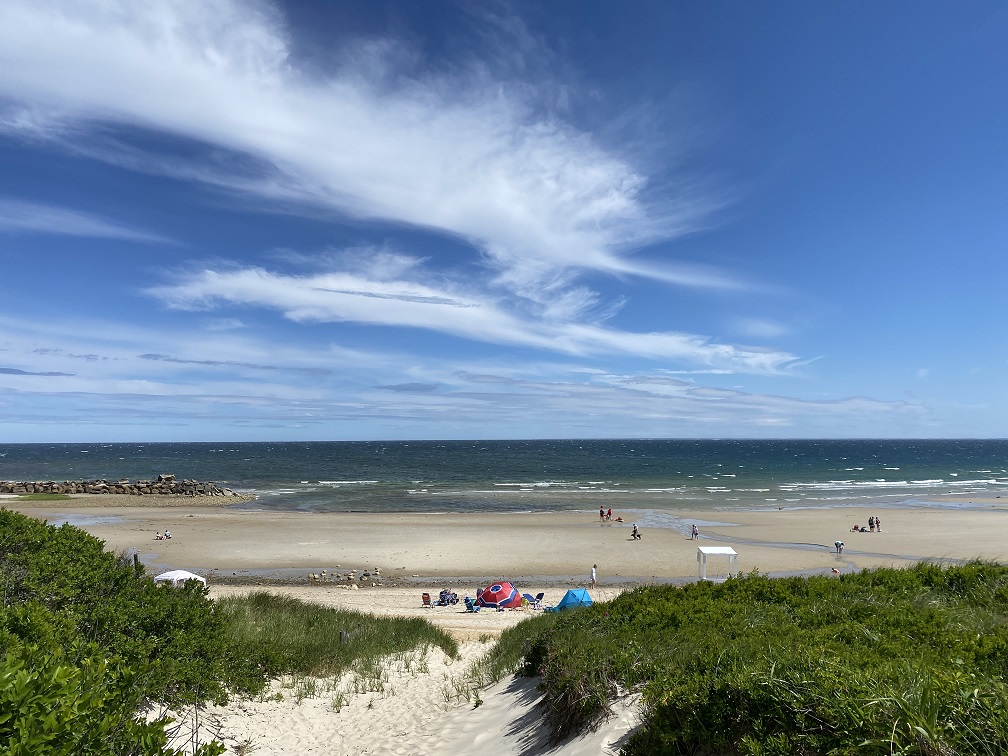
It was not just the wine – the food and the views were quite good, despite somewhat gloomy weather during most of our visit. Local oysters were delicious. I had an opportunity to try the Swiss cheese called Tête de Moine, which also comes with its own special curler. The kabobs were delicious too. And the views of the ocean never get tiring.



We came back home on Sunday, to have Father’s day dinner with the kids. Of course, Father’s Day celebration requires a special bottle of wine. I was thinking about opening the 2005 Jordan Cabernet Sauvignon Estate Alexander Valley (13.5% ABV) for a while at this point, so I decided that the celebration gives me a good enough reason to pull the cork, which I did. The last time I had this exact wine was in 2018 when I brought a bottle for a special wine dinner in Singapore. At that time the wine showed as overly sweet. 4 years later, the wine lost all of its sweetness, and now was showing as a classic Cabernet Sauvignon with cassis on the palate, but somehow now the wine was showing very lean and underwhelming. I think the wine could’ve further improved over the next 5-10 years, but as this was my last bottle, now there will be someone else who will make the discovery. I had this wine with a special burger from Darien Butcher Shop – I had fried egg, fried onion, and bacon as flavor enhancers with the burger, so the wine didn’t stand a chance to show well, but at least it was not fighting with the food.


That concludes my story of a few great wines. What are great wines in your book?
Wine, Beer, and Road Trip
Some road trips require long planning. Some are just spontaneous. The road trip we took two weekends ago was somewhat in between, more on the spontaneous side. I had a Marriott certificate expiring by the end of the month, and I couldn’t let it go to waste. Balancing places I would like to visit with the low value of this certificate, travel madness ensuing in the country, and the desire to stay within a 3-hour driving radius from home narrowed down the search. The town of Reading in Pennsylvania offered a reasonable combination of all the factors I mentioned above, so this is where we decided to go.
There are many advantages when traveling by car, such as ultimate flexibility of the schedule. The ability to bring your own bottle of wine to the hotel is another big one. This is exactly what we did.
I don’t know what possessed me to bring 2016 Saxum as the wine of choice, but this is what I did. By the time we settled in the room and were ready to have a glass of wine, the day reached my favorite “Kodak moment” – the sunset. I obviously couldn’t miss such a beautiful sky painting – at the same time, I couldn’t resist an opportunity to include the bottle of Saxum in the picture. First the bottle, then the glass.


You know how they say “no people/animals/objects were damaged during the filming of this video”, right? This was not a video, just a picture. And no animals were hurt. No people were hurt either (I think?). As for the objects… Well, the glass didn’t survive my adventurous stupidity. This was a standard wine glass, which can’t really stand on top of the wine bottle. It almost felt, and I was lucky enough to catch it before it went down. Someone with a better belief in the laws of statistics would take this “almost fall” as a fair warning. But not this guy. I put the glass back and continued taking pictures, trying to get the wine label into the picture. Until glass finally met the ground (ground – 1, glass – 0), giving my wife and me an opportunity to dance next to the window sill for the next 20 minutes trying not to cut ourselves with the tiniest remnants and also remove wine traces from surrounding surfaces. Felt like an idiot for the next 2 days. Oh well – maybe I will learn? Or not…
On the positive side, the 2016 Saxum Bone Rock James Berry Vineyard Paso Robles Willow Creek District (15.9% ABV, 72% Syrah, 10% Mataro, 9% Graciano, 6% Grenache, 3% Roussanne) was absolutely surprising and spectacular. The surprising part was that this 6-year-old wine from California was perfectly drinkable upon opening – I would never expect it. The spectacular part was in the layers and gobs of fresh, succulent fruit, unending pleasure of interplay of blueberries, blackberries, cherries, and sweet oak, balancing acidity and full-bodied power each sip was offering. The wine was even better on the second day, becoming a touch more mellow. The same wine perfectly complemented the cigar on day 4. I’m sorry about the glass, but I’m really happy with my first Saxum experience.
 Then there was beer. Clearly, I drink a lot less beer than wine. Nevertheless, I have a full appreciation for a glass of well-made beer (about 25 years ago I was one of the first members of the Beer Across America club, at the very beginning of the American craft beer revolution). Even more than a glass of beer, I like the opportunity to experience a tasting flight – which we found at the Chatty Monks Brewery in West Reading.
The Chatty Monks brewery binds itself as a “nano-brewery”. I have no idea what that means, I can only assume that they are implying that their production is much less than the microbrewery (microbrewery in itself is a highly contested term – for a long time Samual Adams defined itself as a microbrewery, while their volumes were clearly not at the “micro” level). Anyway, let’s leave the size aside and talk about the taste.
A tasting flight at Chatty Monks includes 4 beers which you can select from the list of beers available on tap. Out of the 14 available beers I went with Alondra which was a stout – the only dark beer available and I prefer dark beer whenever I can; Split Face which is defined as Pretzel-Style amber lager (no idea what pretzel-style means); Pray for More, a New England IPA, and Tree Trimming, which is described as “winter warmer” – again, no idea what that means.
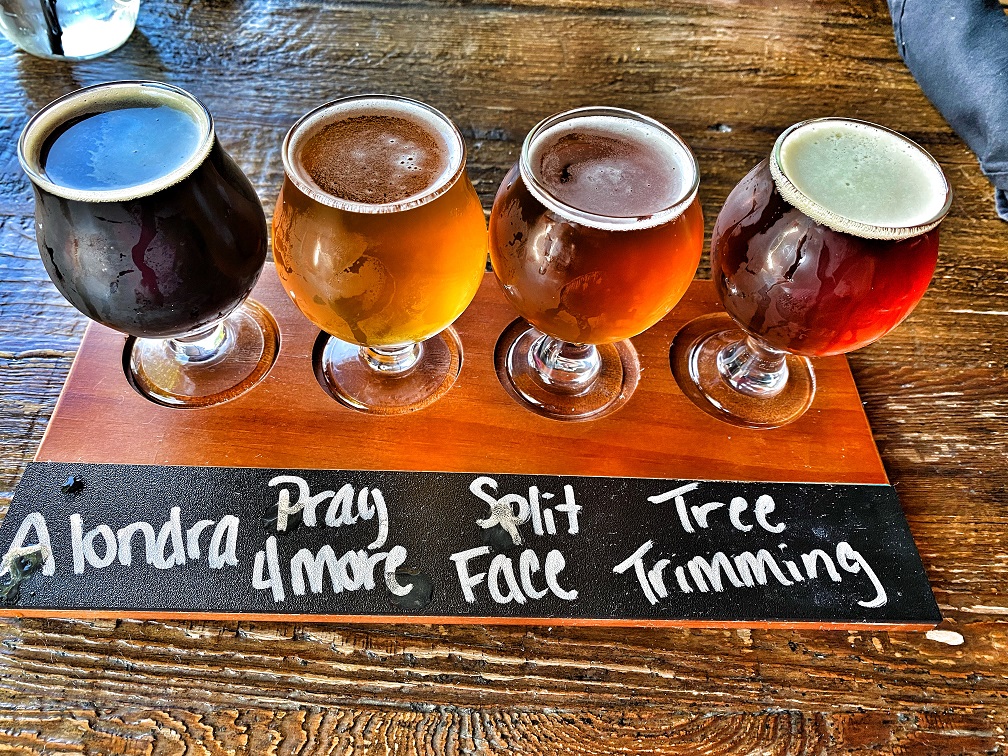


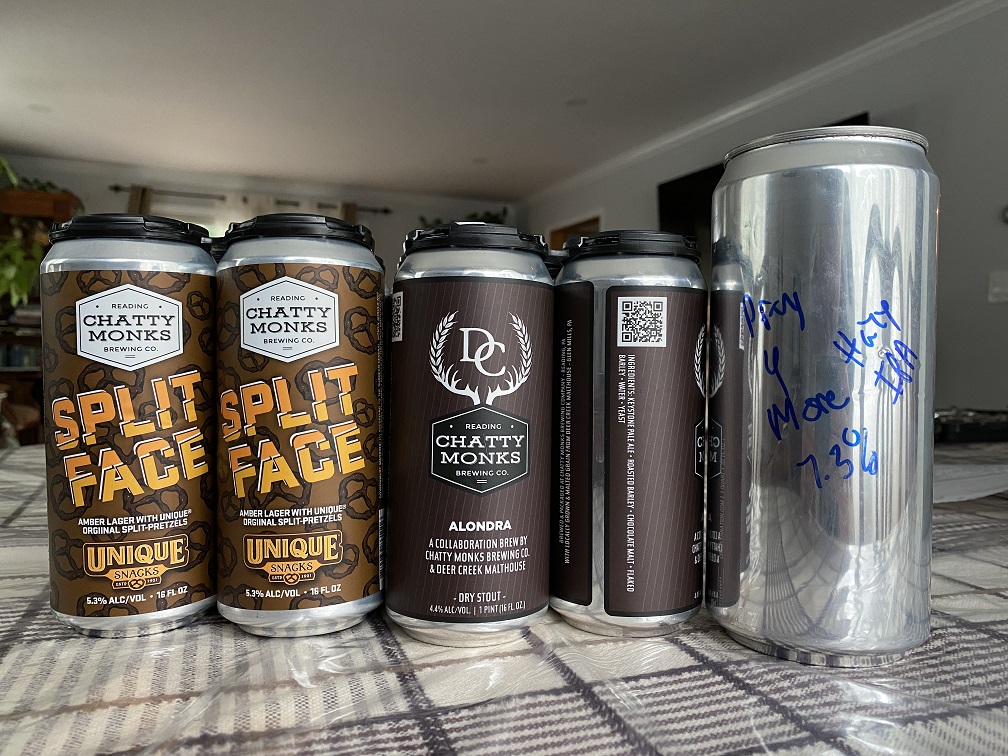
Of these 4, we absolutely loved 3, which were each delicious in their own way. The beer lovers will have to forgive the wine lover trying to describe the beer experience, but Alondra, Split Face, and Pray for More were perfectly balanced and round, each in their own category. I rarely perceive the bitterness of the stouts, including Guinness, and the Alondra was just rich, creamy, coffee-like, and delicious. Split Face was fresh and bright, with enough body to complement fried foods. And Pray for More was probably the most exciting IPA I ever tasted – while it had the characteristic bitterness, it was complemented and leveled by bright citrus, and orange notes – altogether making it irresistible. We loved the beers so much that even got all 3 to bring home – except that Pray for More was sold out in the standard cans so we got one big 32 oz can which was made for us right on the spot. If you are ever in the area – this is the beer to crave.
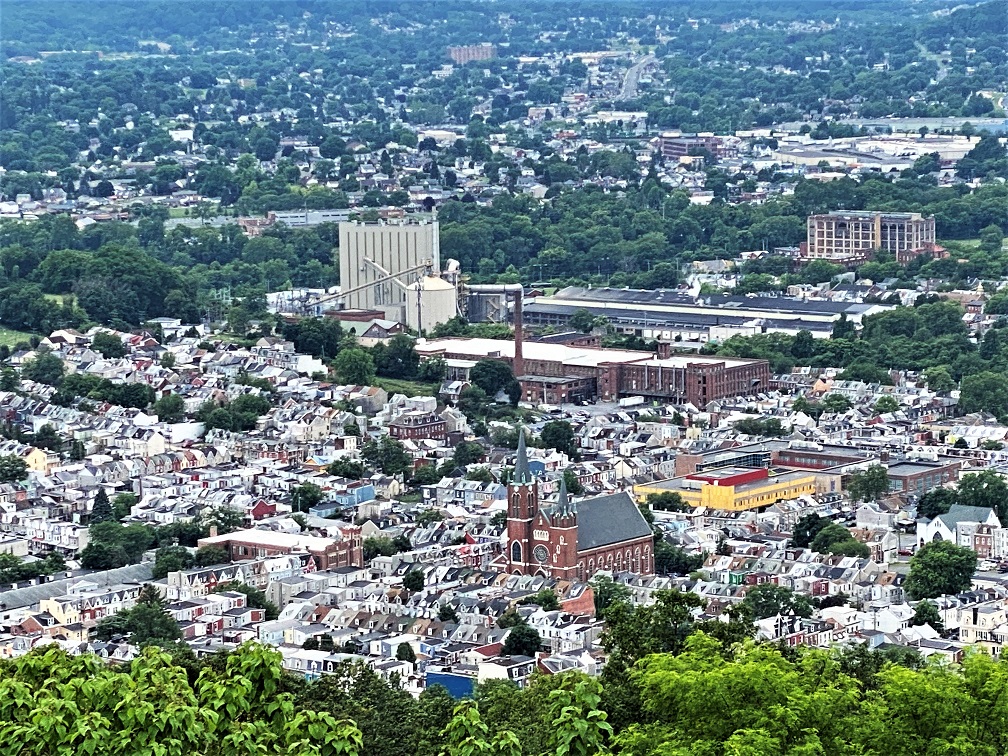
We talked about wine. We talked about beer. Now, the last part – the road trip. We had more or less one full day for all of the explorations. Luckily, we had been to this part of Pennsylvania many times, so exploring Amish villages, lifestyle and museums was not on the itinerary. In addition to immensely enjoying driving around green pastures with cows, sheep, and horses, going up and down little hills on the narrow country roads, we visited a couple of places we had not seen before. One was Reading Pagoda, a fully authentic rendition of a traditional Asian structure, enacted first in 1908. Apparently, this is the only pagoda in the world with a fireplace and a chimney – which we were unable to see as the building itself was closed. But we were able to fully enjoy the views of the town of Reading, from the south end of Mount Penn where the pagoda is located. You can also see it through the lens of my trusted iPhone:





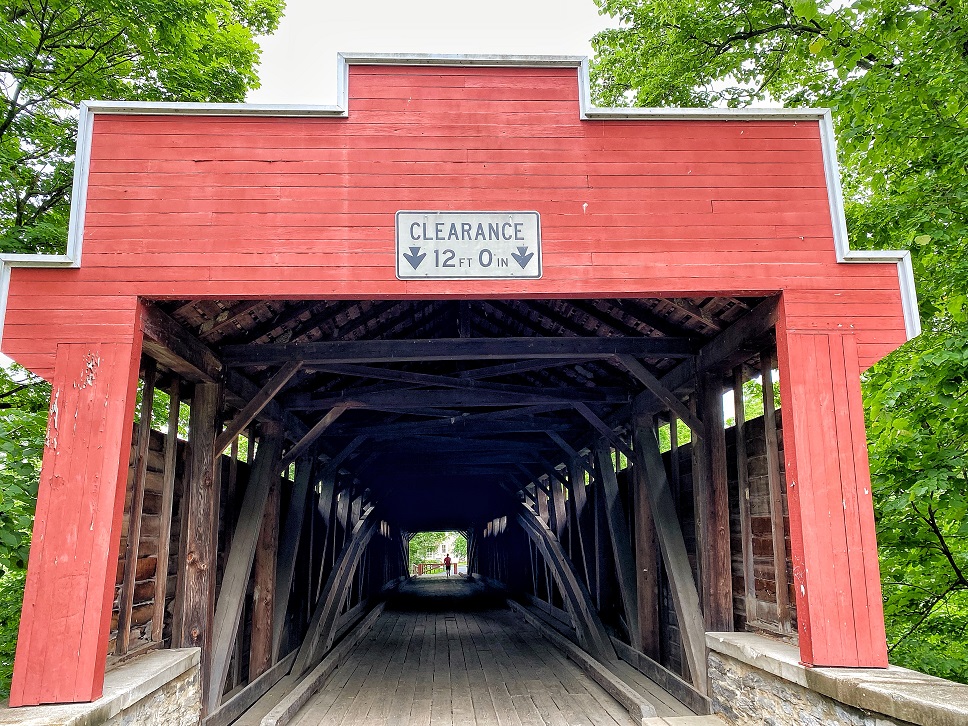
Another stop we made was to see the covered bridge called Wertz’s Covered Bridge, one of the covered bridges located in the Berks County – also the longest single-span covered bridge in Pennsylvania at 204 feet across. It was really fun imagining all of those carriages traversing the creek since 1867 when the bridge was built. You can close your eyes and hear the sound of the horseshoes hitting the wood pavement as carriages are slowly pulled through the bridge… Well, here are a few pictures, I’m sure you can add the horses as you see fit…


That makes it a full account of the wine, beer, and road trip experiences. Next, we will talk about some fun wine experiences on Cape Cod. Stay tuned…
Celebrate Spring and Creativity with Aridus Wines
 Spring is here in Connecticut. There is still some frost on the cars’ windshields in the morning, but the greens are popping out everywhere, daffodils abound, and cherry trees look pretty in pink. It still feels surreal with the horrible events unfolding in Ukraine, but yes, the Spring has arrived.
Okay, so we acknowledged the Spring, now let’s talk about wines and creativity.
Spring is not only about flowers. Spring is also about new wine releases, such as the one from Aridus Wine Company in Arizona.
Aridus is a family winery in southeastern Arizona, the area where the majority of Arizona’s grape growing is concentrated. Aridus, which means in Latin “dry or arid”, is a young family winery, built on the passion and the desire to make world-class wine. The winery started by purchasing 40 acres of farmland in the Turkey Creek area in 2009. In 2012, a state-of-the-art winery was built, first making wines from the grapes brought in from the vineyards in Arizona, New Mexico, and California. The white grapes were first planted on the estate’s land in 2015, followed by the red grapes in 2017, all using sustainable farming methods.
The white grapes are already used in the estate wines, such as Sauvignon Blanc and Viognier. Being curious about the estate red grape program, I asked Lisa Strid, the Aridus winemaker, when does Aridus plan to produce estate red wines, and here is the answer I received: “We are in the process of transitioning over to estate reds – our first vintage of reds from the vineyard was in 2019 when the Cabernet Sauvignon was on its third leaf. However, I’m not certain as yet whether we’ll be bottling that as 100% estate. We weren’t sure what yields would look like, so in order to ensure we’d have enough Cab for the vintage, we also purchased a few tons from our favorite grower in New Mexico. So it may wind up being a blend for the Aridus tier, and we’ll almost certainly do an estate bottling for the Barrel Select Tier. We just bottled the 2018 Cab Sauv two weeks ago, so it will be at least another year before we actually bottle and release the 2019.
I tasted Aridus wines last year, and I was impressed with the quality. This year, I had an opportunity to taste Aridus wines again, and now I’m impressed not only with the quality but with the creativity. How so? I thought you would never ask – but thank you for this question. To answer I will do something which I generally work very hard to avoid – directly citing the tasting notes. But in this case, the description of the 2019 Aridus Viognier from the tasting notes is simply perfect and worth quoting:
“This year, we conducted extensive testing both in the vineyard and the winery in order to better understand the optimal conditions for growing and fermenting this fruit from our unique corner of the winegrowing world. In the vineyard, we tested a range of UV–blocking netting. We had noticed that since this variety tends to hang below the canopy, it is particularly susceptible to sunburn. We netted two rows each with: 1) a thick bee and wasp netting; 2) Chromatinet Red 30% UV blocking; and 3) Chromatinet Gray 30–35% UV
blocking. These lots were picked separately once they hit brix targets and fermented in identical stainless steel barrels. In the winery, we experimented both with yeast and with fermentation vessels. It is our standard practice to ferment whites in stainless steel, but this year we decided to ferment a control in stainless steel, an experimental lot in a sandstone jar, and another in an acacia wood barrel. In 2018 we performed extensive yeast trials and had alit upon Ferm Aroma White as our favorite of all the yeasts tested. This year, one of our technical reps asked if we wouldn’t mind testing Christian Hansen Jazz direct inoculation yeast on a white variety, and we decided Viognier was the best option. When the bulk of the
Viognier arrived at the winery, we pressed it all to one large tank before racking it off to each of the vessels for fermentation to ensure homogenous juice to best assess the differences between the lots. All in all, we wound up with eight separate trial lots. We definitely found ourselves gravitating towards certain treatments over others (we unanimously loved the sandstone jar), but when it came time to blend, we found that we loved the way that all the lots tasted blended in proportion to the volumes of each of the trials.”
Protecting grapes from sunburn using different methods? Deciding on the best fermentation vessel and playing with the yeast? Aridus might be a young winery, but I would say that older wineries should definitely take notice, especially considering the climate change which is not going to go anywhere.

Moving on from creativity to the glass, here are my notes for the 4 wines I tasted:
2021 Aridus Sauvignon Blanc Cochise County Arizona (13.3% ABV, $35, 90% stainless steel, 10% 4 months in oak, 100% estate fruit)
Straw pale, almost translucent
Tropical fruit, golden delicious apples, round, intense
Tropical fruit, initial sweetness impression quickly replaced by crisp, vibrant acidity, with acidity on the finish. I would say it is Torrontés in the blind tasting, but still, a nice wine.
Drinkability: 8-, easy to drink. A crowd-pleaser – I opened this bottle during dinner with friends – both of my friends loved this wine, and even my kids, who generally don’t drink wine, said that it was excellent.
2019 Aridus Viognier Cochise County Arizona (14.4% ABV, $35, 19 months in oak, 100% estate fruit)
Straw pale
Nicely floral and perfumy on the nose, round, inviting, medium ++ intensity
Round, restrained, elegant, plump, roll-off-your tongue, good acidity
Drinkability: 8-/8, nice and elegant. Was improving over a few days as the bottle was open.
2018 Aridus Syrah Cochise County Arizona (14.5% ABV, $46, 90% Syrah, 10% Viognier, 32 months in oak, 50% new, 50% neutral)
Dark garnet
The nose of plums, cherries, and meat stew
Medium body, tart, firm structure, some underripe dark fruit. Under-extracted for my palate – I want a bigger body on this wine.
Drinkability: 7+, needs time – these were 1st-day impressions
In 4-5 days, 8/8-, round, good amount of fruit, good balance
2019 Aridus Graciano Cochise County Arizona (16.6% ABV, $46, 99% Graciano, 1% Petit Verdot, 16 months in oak)
Dark garnet
Beautiful intense nose, plums, earth, smoke, sage, complex
Cherries, plums, well-integrated tannins, firm structure, generous, layered, perfectly balanced
Drinkability: 8/8+, outstanding. This was my personal favorite from the tasting, offering a good Rioja impersonation. Very well done.
Here you are, my friends. Spring, wine, and creativity. I will gladly drink to all.
Wine News and Updates
When it comes to the wine world, there is never a dull moment – things are happening all the time. Today, the world of wine is indelible from the world of technology, with no shortage of exciting products. Wine is also a business, big and important business, again, with no shortage of exciting developments. Let’s take a look at some of the latest business and technology wine news from around the globe.
Let’s start with something unexpected – cars. Cars and wine should never be mixed together – driving is one of the most dangerous tasks humans routinely perform, and it requires a clear sober head. So what can we talk about here? Let me tell you. last week Elon Musk made an interesting announcement. As Tesla feels the heat of the serious competition from all leading automakers, the electric carmaker decided to differentiate itself with the addition of an (albeit optional) reverse osmosis accessory which can remove alcohol from wine. This option, available exclusively for models S and X, would add about 5 grand to the list price of the vehicle. but the opportunity to enjoy your precious Latour or Harlan during the ride can not be passed on lightly. Open the compartment, pour in the bottle, and the spout on the dashboard will become operational once the alcohol is removed from the wine. Based on preliminary market data, Tesla has a hard time fulfilling all the requests for the accessory. We shall see if the other manufacturers will follow the suit.
The next news is almost a no-brainer. It is the one from the series “how I didn’t think of it before”. Coca-Cola company entered into a partnership agreement with Bacardi USA to produce a range of Rum and Coke products. The product line will include all possible permutations of Coke (Diet, Zero, and the others) with the full line of Bacardi rums – light rum, dark rum, and the others. The new product is expected to hit the store shelves at the end of May, just in time for the grilling season. Retail prices will start at $20 for the 4 pack, with consumers already waiting impatiently for the product. I’m really curious how Pepsi will respond, if ever – is Rum and Pepsi even a thing?
Our next news comes from the wine glassware leader, Riedel, which never stops innovating. As you know, Riedel glasses are developed to enhance the aromas of a specific type of wine – Pinot Noir, Cabernet Sauvignon, Chardonnay, and many other wines have glasses of the specific shape offering the best sensory experience to the wine drinkers. The only disadvantage of the wine-specific glasses is that you need to have them all on hand, as you never know what bottle of wine you will decide to open, and even storing so many different glasses might become a challenge in itself. To address the issue, it appears that for the past 10 years, Riedel was secretly working on a project with the United States Air Force Research laboratory to develop a glass that can change its form based on the request from the smartphone app. The glass is made of some smart material – again, the exact details and fiercely guarded – which responds to the electric impulses from the control module embedded in the stem and changes its shape as needed. The glass will appears soon in the wine catalogs, with the expected price tag of $750 for two – it is expected that the price will drop over the next 2-to 3 years as production will increase.
Can we talk about wine today and not talk about NFTs (Non-fungible tokens)? Of course not. Gallo family company, which had been producing wines in California since 1933, teamed up with Beeple, one of the most famous NFT artists in the world. to produce a series of unique labels, each one of them having its unique value, as is always the case with NFT art. About 14,000 cases of the 2021 Gallo Hearty Burgundy will be adorned with Beeple’s artwork and will be available at select retailers around the USA. Gallo will dictate the initial price for the NFT-labeled bottles, but the retailers will be allowed to sell the wine in the auction-like model, with 25% of the extra money going back to Gallo. These NFT-labeled bottles are expected to be a big hit with consumers, and reportedly many wine producers around the world, such as Torres in Spain, Concha y Toro from Chile, Cavit from Italy are in talks with NFT artists to create their own collections.
Our last news piece might be the most bazaar of them all. As you know, Korbel Champagne Cellars in California produces wine in California under the Champagne brand (California Champagne). Based on the source speaking on condition of anonymity, Bernard Arnault, top executive of the French luxury goods conglomerate LVMH (Louis Vuitton Moet Hennesy), got fed up with Champagne’s name being used outside of the Champagne region in France alongside coveted LVMH brands such as Krug, Dom Perignon, and Ruinart, and announced that LVMH entered into the definitive agreement to acquire Korbel at an undisclosed amount. The deal is subject to the approval of the boards of directors of both companies, expected to be closed in 6 months. Once the deal is complete, Korbel California Champagne will be renamed the Korbel California Sparkling wine.
That’s all the news I wanted to share at the moment. Cheers!
Wine and War
 I don’t want to write this post.
I really don’t want to write this post.
Mere thinking about the war unfolding right now in Ukraine literally gives me pain. What started on February 24th is pure, unthinkable, unfathomable madness. Brothers were sent to kill brothers. All on the orders of the egomaniac who lost his mind and belongs in jail or a mental institution – at least I wish this was the case. In reality, it was all well thought through and calculated, so the ruler of Russia really belongs in jail as a war criminal. The country that was a subject of merciless, unjustifiable aggression 80 years ago became a merciless, unjustifiable aggressor itself. Unfathomable.
Of course, wine has nothing to do with the war. At the same time, everything has its role in the war. Here is how.
Instead of bottling the wines, Ukrainian wineries are bottling “Molotov cocktail” and helping in any way they can – wine writer Lyn Archer wrote an excellent piece detailing what is happening at the wineries in Ukraine and beyond.
Speaking against the war in a totalitarian regime is an act of courage that almost guarantees to land you in jail. Nevertheless, a group of top Russian sommeliers wrote an open letter to Putin, expressing their strong opposition to Russia’s attack on Ukraine.
Russia is not the biggest wine market in the world, but from 2015 through 2019 was consistently the fastest growing one at about 15% growth every year. As multinational conglomerates declared their exit from Russian markets, it is still a very difficult decision for the majority of the wine producers – but a necessary one. La Rioja Alta, one of the best Rioja producers in Spain, suspended its trade relations with Russia.
To protest Russia’s invasion of Ukraine, Sweden’s government-owned liquor stores Systembolaget stopped selling any types of Russian-made alcohol. A similar boycott was announced by Finnish stores Alko. Also, Russian-made vodka was removed from the shelves of many wine stores in the USA.
The world doesn’t need war. After 2 years of the pandemic, the war is absolutely the last thing we need right now. I don’t know how, but I really, really want it to be over. Now. Before it is too late.
Last Bottle Sign Up ($10 credit)




 Talk-A-Vino