Archive
Few World Class Wines, Kosher Too
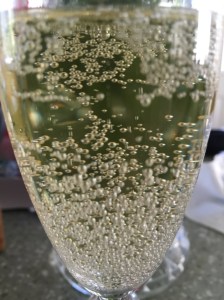 What is world class wine, you ask? Well, this question has multiple answers – there is a good chance that every responder will give you a different answer. Heck, I will give you different answer every time you will ask this question. So for today, how about this one: in a blind tasting, world-class wine can be easily mistaken for a wine coming from the well established and world famous wine region. For instance, a sparkling wine which tastes like Champagne. Or Chardonnay which resembles classic white Burgundy. Or a Rosé which tastes like… you know, how about just “delicious”?
How often do you drink Israeli wines? Hmmm, that would actually make it for an interesting “unknown wine regions” survey – note to self. Okay, back to the question, what do you say? I would bet that 9 out of 10 people never had an Israeli wine, and 9.5 out of 10 didn’t even know that Israel produces wine. Which is a shame, as even modern winemaking history (never mind the biblical times) in Israel goes back to 1880s. But of course with ups and downs, Israeli “wines of notice” started to appear in the late 1980s.
Today Israel has more than 250 wineries (depends on who counts, I guess), which includes both large commercial wineries and garage-level productions; israel even sports some “cult wines” – the wines which lots of people want, but can’t get (do the search for the wines produced by Lewinsohn, for instance). About 25% of the Israeli wines are exported, out of which amount about 60% go to the United States, and the rest to Europe and Asia. Most (but not all) wines produced in Israel are kosher – which, by the way, doesn’t take away from the quality of the wines even the tiniest bit – scratch that Manischewitz image and taste from your head, once and for all. While in general Israel might have a very long wine history, the vineyards were never continuously preserved – as the result, absolute majority of the grapes grown in Israel are of international varieties (Cabernet Sauvignon, Chardonnay, Merlot, Syrah, Grenache, etc.), with Emerald Riesling being one of the rare exceptions. Otherwise, Israel produces full range of wines, from Sparkling, Rosé and whites to the Bordeaux and GSM blends and single varietal masterpieces.
Golan Heights Winery was founded in 1983, and the first wine was released in 1984 (well, they vineyards were planted in 1976, so it all makes sense); it might be considered a foundation of renaissance of Israeli wine industry. Today the Golan Heights Winery farms 600 hectares (1500 acres) of vines, which subsequently consist of 28 vineyards and 400 unique parcels within those vineyards. Vineyards are spanning for about 65 km (40 miles), and elevations are ranging from 400 meters (about 1300 feet) to 1200 meters (about 3900 feet). The fruit from each parcel is tended to individually, as you can imagine that growing conditions would be different in such a stretch of the land and with such a difference in altitude. Of course you can imagine that winery makes quite a range of wines.


I had an opportunity to taste a three wines from the Golan Heights Winery and its sister winery called Galil Mountain, which impressed me enough to come up with this “world-class” title for the post. Don’t get me wrong – I had absolutely mind-blowing Israeli wines before, but somehow this Blanc de Blancs put the experience for me to the next level. Here are the notes:
2008 Yarden Blanc de Blancs Brut Sparkling White Wine Golan Heights Israel (12% ABV, SRP $32, 100% Chardonnay, 5 years on the lees, kosher, non-mevushal)
C: pale straw
N: Classic sparkling wine – touch of yeast, hint of Apple, touch of fresh baked bread
P: creamy mouthfeel, fresh acidity, hint of yeast, fresh lemon, fine mousse, perfect balance
V: 8/8+, outstanding, world class sparkler
2014 Yarden Galilee Chardonnay Odem Vineyard Golan Heights Israel (13.9% ABV, SRP $22, 100% Chardonnay, 7 month barrel aging, kosher, non-mevushal)
C: light golden
N: white stone fruit, hay, touch of lemon, candied fruit as wine was warming up
P: plump, full body, vanilla, creamy round mouthfeel, touch of butter, good acidity, fresh.
V: 8-/8, full bodied without heavy butter or oak, more reminiscent of Marsanne/Roussane. What I loved about the wine that it stayed perfectly delicious at the room temperature, which is not an easy fit for many white wines.
2014 Galil Mountain Rosé Upper Galilee, Israel (12.5% ABV, SRP $12, 74% Sangiovese, 23% Pinot Noir, 3% Grnache, kosher, non-mevushal)
C: beautiful, concentrated pink
N: strawberries, minerality, very promising, touch of lemon
P: fresh strawberries, herbs, clean balancing acidity, soft, medium body, very round.
V: 8-, an excellent summer day (or all year around) treat, very easy to drink
Have you had Israeli wines? What do you think of them? Cheers!
Celebrate Malbec!
This very blog exists for more than 6 years, so in my mind, I’m sure I’ve written about pretty much everything, especially when it comes to such a heart-warming subject as grape holidays.
Only it turns out I have not.
Sunday, April 17th is 6th (!) annual celebration of World Malbec Day. So how many times over those 6 special occasions I’ve written a post for the Malbec Day? Aha, you got that. Zero.
Well, this is incorrect. None for the previous five, but we are talking about Malbec today, so the problem is finally fixed.
Thinking about grapes with long and turbulent history, Malbec might be the most prolific example of such. Taking its roots in Middle Ages, being a choice wine of the kings, shining in Bordeaux and all over the France and then literally disappearing from the face of the earth, but luckily, finding its second, and very prosperous life in Argentina – not too many grapes can brag about such an adventurous life. By the way, if you are curious about the events I mentioned here, you can test your knowledge of Malbec with this quiz, or you can just jump straight to the answers.
Starting from the second half of 19th century, Malbec found its new home in Argentina. Consistently dry climate of Mendoza happened to be just what Malbec needed to strive. As there are two sides to everything, the ideal growing conditions lead to overproduction and subsequently dull wines. It was not until the 1980s that Malbec commanded proper attention for the quality instead of quantity, and slowly became one of the darlings of the wine world – depending on who you would talk to, Malbec is considered the hottest wine at the moment. Starting from the bottom of Andes in Mendoza, plantings of Malbec are now extending to the higher and higher elevations, offering new range of expression of already delicious wines.
Argentinian Malbec wines are easy to like for many palates – while appearing big and powerful in the glass with its inky, almost black color, Malbec wines are usually round, soft and mellow, avoiding spikes of tannins and acidity which often upset wine drinkers looking for relaxing glass of wine. Interestingly enough, Malbec from other regions, such as Cahors in south of France, shows totally differently and often offers very forceful personality, so if you are looking for that soft and mellow Malbec, you might want to ask for the Argentinian Malbec by name.
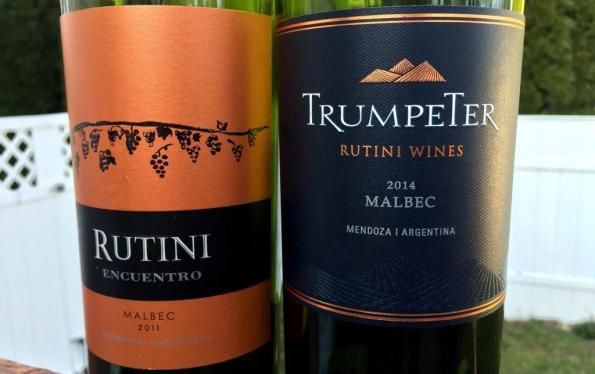
Today I want to bring to your attention two Malbec wines I had pleasure of tasting recently. It is not the first time I’m talking about Rutini wines from Argentina in this blog – here you can find my interview with Mariano Di Paola, winemaker at Rutini wines, as well as tasting notes for few other Rutini wines. Here are the notes for the two Malbec wines:
2014 Rutini Trumpeter Malbec Mendoza Argentina (14% ABV, SRP $11.99)
C: dark garnet
N: freshly crushed fruit, sage, savory notes
P: clean, earthy, tart cherries with hint of licorice, touch of sweet tobacco
V: 7+/8-, nice, refreshing, round, great QPR
2011 Rutini Encuentro Malbec Mendoza Argentina (13.5% ABV, SRP $18.99)
C: dark garnet, inky
N: roasted notes, tar, cherries, warm, inviting, touch of barnyard
P: soft, round, sweet berries, concentrated, good acidity, perfect balance. Became dark and concentrated on the day 2/3.
V: 8, very enjoyable, easy to drink; will evolve with time – you should forget few bottles in the cellar…
Here you are, my friends. Celebrate Malbec, this grape definitely worth your attention. Cheers!
3 Sensual Reds For Your Valentine’s Day
As the Valentine’s day is getting closer, I want to succumb to the popular trend and offer you some wine recommendations for that special overcommercialized-pink-hearts-everywhere-please-buy-at-least-something holiday.
Any day is what we chose to make out of it – including the holidays. What I like about Valentine’s day is that if anything, it is a celebration of love – and that I support wholeheartedly.
Are there special wines which are better suited to celebrate love and romance? Of course, however, I don’t have in mind any wines with special aphrodisiac qualities, or anything which will make one magically more desirable after staffing oneself with 32 oz of hearty porterhouse stack. Instead, I want to talk about sensual wines.
What is a sensual wine? First of all, this is the wine of impeccable balance and harmony – fruit, acidity and tannins are perfectly present and well noticeable, but everything is precisely weaved together, nothing sticks out, you just want to say “wow” after each and every sip. It is the wine which has luscious mouthfeel, it rolls of effortlessly, offering layers and layers of pleasure. But every sip still holds a mystery which makes you want to know “what is next”, it is like work of an artist which gives you just enough curves to let your imagination go wild. It is so easy, effortless to drink that you simply can’t put the glass down, as every sip leaves you desire for more. A beautiful foreplay, if you will.
Of course the truth is in the eye of the beholder, and if you tired of me talking nonsense, feel free to click away. However, if you will allow me, I will be glad to recommend three of such wines to extend the pleasure of your Valentine’s Day. As an added bonus I want to mention that you will not need to break the bank to get either one of these wines.


Let me start with 2012 Kaiken Ultra Malbec Uco Valley, Argentina. When I tasted this wine for the first time, I was blown away by the silky layers, succulent fruit and perfect balance; I couldn’t find better way to describe this wine than to call it “sexy” – this is a perfect example of the sensual wine.
Sensual wine number 2 is 2011 Emiliana Coyam Colchagua Valley, Chile. Very similar to the previous wine, it is velvety, smooth and layered. And mind-blowing. The fruit is bright and clean, and delivered with a tight core of round tannins; overall, a perfectly playful wine.
Third sensual wine I want to recommend is 2013 Willamette Valley Vineyards Estate Pinot Noir Willamette Valley, Oregon. Of course Oregon is a world power when it comes to Pinot Noir. Talking about Oregon Pinot, I would typically use terms such as “powerful”, “thought-provoking”, of course “elegant” is quite appropriate too. However, “sensual” would be a perfect descriptor for this Willamette Valley Vineyards Pinot. Abundance of the fruit and berries which are rarely found together in one glass – cranberries, strawberries, blueberries, all clean, vibrant, layered, polished and practically effervescent. Ultimately seductive, as you can’t put the glass down until every drop is savored out of that bottle. As sensual as the wine can be.
Here we go, my friends – a few recommendations to make your Valentine’s Day even more romantic and yes, sensual. Cheers!
Presidents’ Day Wine Recommendations
Wine recommendations for the Presidents’ Day? Which also falls on Monday? In the other words, wine recommendations for Monday? Really?
I can see that you might be surprised, but why not? Monday is as perfect day for a glass of wine as Sunday. Or Saturday. Or Friday. I hope you are okay with wine on Monday, so let’s move on.
First of all, especially if you don’t live in the United States, let’s me briefly explain the holiday. Presidents’ Day commemorates birthday of the first president of United States, George Washington, and it is always celebrated on the third Monday in February. While the original holiday was linked to the actual birthday of George Washington on February 22nd, some states also celebrated birthday of Abraham Lincoln (February 12th), and some even add Thomas Jefferson (third President) to the mix, thus the holiday is collectively called Presidents’ Day (if you are interested in exploring the subject further, here is the link to Wikipedia article). Presidents’ Day is an official Federal holiday, which means that all the branches of the US government are closed – however, it is typically a regular work day for most of the companies.
Now, let’s talk about wine choices for the holiday which always falls on Monday. Does Monday calls for a special bottle of wine? Well, it is the first day of the week, which often is difficult enough in itself, so may be we need a bottle of wine on the lighter side? I happened to come across the wine which I think would be perfect for any Monday, but it is incredibly fitting this special Monday – and I will tell you why in a second.
Let me introduce to you The Federalist – the winery in California, founded in 2007 with the goal to commemorate our Founding Fathers. The first wine produced by The Federalist was called Visionary Zinfandel, and it is dedicated to Alexander Hamilton, who pioneered The Federalist Party. Currently winery offers 5 different wines, all of them dedicated to the people who defined The United States of America.
Now, for the holiday at hand, I would like to offer you two wines – Zinfandel and Cabernet Sauvignon, both from Lodi in California. Zinfandel is dedicated to … very conveniently, I have to say … George Washington, the first President of the USA and the man who’s birthday we are celebrating on the Presidents’ Day. The Cabernet Sauvignon bears the picture of Benjamin Franklin – while I’m sure many of you are familiar with Ben Franklin as the man who’s face emboldens the $100 bill, Ben Franklin is often called The First American for advocating unity of the colonies, and he was one of the key participants in drafting The Declaration of Independence.

Here are my notes on the wines:
2014 The Federalist Zinfandel Lodi, California (14.5% ABV, SRP $17.76, 93% Zinfandel, 7% Syrah, 12 months in 25% new American Oak)
C: dark ruby
N: fresh, open, medium intensity, blackberries, ripe raspberries
P: delicious, clean, round tobacco and raspberries, perfectly clean Zinfandel profile, smooth, clean, perfect balance
V: 8-, outstanding rendition of Zinfandel, good for everyday drinking with this QPR
2014 The Federalist Cabernet Sauvignon Lodi, California (13.9% ABV, SRP $17.76, 87% Cabernet Sauvignon, 6% Merlot, 4% Cabernet Franc, 2% Petite Syrah, 1% Sangiovese, 15 months in 35% new Oak)
C: garnet
N: eucalyptus, cassis, restrained
P: bright, fresh, delicious, red currant, cranberries, crisp acidity, medium body.
V: 8-, quite atypical of traditional California cab – much lighter style, but very delicious
So, have I convinced you to raise the glass to honor first American Presidents on Monday? I hope I did, so grab a bottle of The Federalist and let’s celebrate! Cheers!
One on One with Winemaker: Aurelio Montes of Montes Winery, Part 2
As promised, here is the continuation of our conversation with Aurelio Montes Sr – Founder and Chief Winemaker of Montes Winery. You can find first part of the interview here.
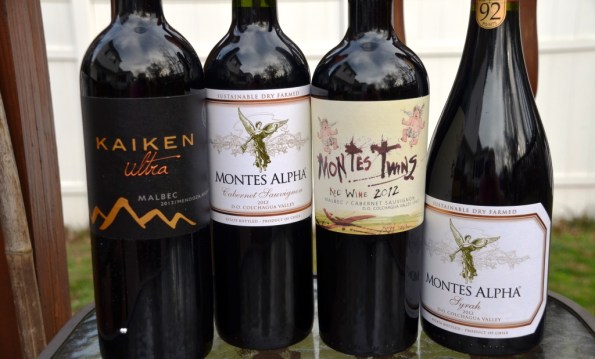 While the first part offered insight into unique (and unexpected) areas such as using of Feng Shui principles and Gregorian Chants at the Montes winery, this second half of the interview is also full of interesting details about present and future of Chilean winemaking. Here we go:
Q7: Do you use natural yeast in production of your wines?
A: Not for white varieties, although we have made Chardonnay trials in coastal areas, but in most cases result in that we obtain a very slow and long fermentation, which jeopardizes the final quality of the wine.
We prefer to use selected yeasts in white varieties, which ensure us a good rate of fermentation, working at low temperatures and retaining maximum aromatic potential of the wine.
In the case of reds it is different. We love to work with natural yeast when possible. They tend to express terroir better than the selected ones. However, much will depend on the conditions of the season, that is, if the season was very warm and the fruit arrives to the winery with a very high potential alcohol, we then prefer to use selected yeast that will ensure a good end fermentation. In the case of very rainy seasons, where the grapes arrive at the winery in bad conditions with some presence of fungi, we prefer to don´t take any risk and use selected yeast as well.
Under normal harvest of red grapes, without rain during maturity or heat peak’s that can cause an exaggerated increases in sugar content, we can then use natural yeast, maintaining important regimes of oxygen during fermentation and also moderated temperatures, in order to not stress these yeasts that behave in some cases very sensitive when the conditions are adverse during fermentation.
Q8: Montes Alpha had been a pioneer in many areas of winemaking in Chile. Particularly, it was the first winery to produce Syrah wines. How would you describe your Syrah compare to Northern Rhone, California or Australian wines?
A; Our Syrah, because of the natural conditions, and some winemaking policies, is different to Rhone or Australian Syrah. Ours is midway between the two mentioned valleys. It is ripe but not as jammy as the Australian one…is austere but still far more friendly and approachable than the Rhone style. This puts us in a perfect position, in terms of quality, and in fact my opinion is that the best New World Syrah comes from Chile
Q9: What was your most favorite vintage of Montes Alpha Syrah and why?
A: I think the 2006 vintage was a very good harvest, where this wine was well known. But I feel that the 2012 was even better. We had a very good season in terms of absence of spring frosts, an accumulation of rain water which enabled us to reach harvest with a low level of risk, and also a free of summer rains and reasonable temperatures. In particular, our Syrah from Apalta that comes from mountain grown fruit behaved very well, controlling a balanced amount of clusters per vine, allowing us to concentrate fruit color and body. Elegance and aromatic complexity found in the Apalta Syrah is really incredible. From this estate also comes the Syrah that goes to our Icon Folly made 100% out of Syrah.
Q10: In the wine world, there is always a conversation of the “next big grape”, which is usually country and region specific – like Sauvignon Blanc in Argentina, for instance, or Chardonnay in Oregon. Is there a “next big grape” for Chile?
A: I like to believe that the Carmenère can be our “next big grape”. But we struggled to position it, despite the efforts the sector makes. Chile has a high level of quality in this variety, considering various valleys and different heights, in the central and even coastal areas of Chile. After this many years of experience we must remain vigilant and continue working and learning in order to deliver the best quality Carmenère in the world.
I would like to add that recently Chile also has been making quite some noise on varieties such as Pais, Cinsault, Muscat, Grenache, Carignan, etc. In this last varieties with very good results.
In our case we crafted the Outer Limits line, which allows us to be more adventurous, dreamers, and let our imagination fly to experiment;
However I believe that the Cabernet Sauvignon is still the king of varieties that Chile has. Not only well renowned for the great quality but also because it represents the productive power and essence of the Chilean wine.
Q11: Does Montes Alpha have plans for the new grapes to be planted? Anything you are experimenting with right now?
A: We are not closed to the possibility. We are always looking for new things, but today to plant new surface is a sensitive issue. Chile is going through a time of overstock of wine, which forces us to be cautious about increasing our production. In the northern hemisphere the situation is similar, which puts us at a critical point.
Without adding the irrigation problem that the viticulture is facing around the world, which forces us to be very astute at this point. Today, more than planting new varieties on new surfaces, we are willing to replace those varieties and vineyards that do not meet our expectations, and replace this to try some new things.
For example, we have had very good reviews on our Tempranillo and Tannat 2015, after years of testing and harvesting dates, and exploring winemaking forms. Maybe we can do something about those varieties in the near future.
We are also touring various new areas as Cachapoal Valley, in search of a distinctive variety with unique quality and expression. Is under this inspiration that we have found and made quite interesting things, such as Pink Moscatel from Curtiduría, or a Pais from Lolol and other interesting projects that currently are still in the oenological kitchen … but this strategy of seeking other wine realities has given us many satisfactions to myself and the team.
Q12: when you are not drinking Chilean wines, can you give me a few examples of your favorite wines, regions and producers?
A: In terms of wines, if I were to pick an outstanding wine I would choose an Ornellaia Masseto. And if I could delight and reward myself with another, it could be an old vintage of Pétrus.
And we are done with the interview. It is time to take a look at another two Alpha Montes wines I tasted:


2012 Montes Alpha Syrah Colchagua Valley, Chile (14.5% ABV, $25)
C: very dark garnet, almost black
N: blueberries, violet, sage, fresh, touch of tobacco
P: silky smooth, round, roll-of-your-tongue, restrained, nice minerality, balanced fresh berries, touch of spice, touch of sweet licorice, excellent overall balance
V: 8, easy to drink, will greatly evolve
2012 Kaiken Ultra Malbec Uco Valley, Argentina (14.5% ABV, $25)
C: dark garnet, practically black
N: concentrated, dark fruit, plums, violet, tar, tobacco, very, very inviting – super sexy, first analogy
P: wow, concentrated fruit, luscious, polished, layered, round, balanced, great dark power, well integrated tannins
V: 8+, outstanding, wow and dangerous (and sexy! – I rarely designate wines like this, but … of well, I will wait for you to try it)
And we are finally done here. I hope you enjoyed our conversation as much as I did, and may be even learned something new. Until the next time – cheers!
One on One with Winemaker: Aurelio Montes of Montes Winery
 Things in life often connect in most unexpected ways. Few years ago I read an article about the ways music affects the winemaking. I was unable to find that article or much references ever since. Many times I came across the wine with an interesting label and somewhat peculiar name of Montes Alpha – but I never tasted one.
Few weeks ago I got a note about wine samples from the winery called Montes Alpha from Chile. That note also mentioned Gregorian Chants and Feng Shui been essential elements in wine production at that very winery. This was enough to send my curiosity through the roof and ask for more information – and talk about the way things connect in life, right?
Who can better answer questions wine and winery questions if not the winemaker? I gladly used an opportunity to [yet again] sit down (yes, virtually) with the winemaker and send the barrage of questions his way. I have to tell you that all my questions were answered well in depth – and I think you will find this conversation interesting too. Here is our dialog with Aurelio Montes Sr – Founder and Chief Winemaker of Montes Winery.
Q1: I understand that your winery was built using Feng Shui principles. Are there any specifics in using Feng Shui specifically for the wineries? Do you have any followers from other wineries who came to learn from Montes Alpha experience?
A: We seek to apply the principle of balance and harmony of space in our winery. If you live and / or work in nice balance places, the energy will continue their natural rhythms and will lead to welfare in all its aspects.
It is in this sense, it was incorporated as a fundamental principle in the early stages of design and construction of our winery, the inclusion of all basic elements such as water, metal, wood, stone, etc., in accordance with the principles of this Asian discipline, to ensure this harmony and above all a positive atmosphere.
For example at the entrance to the building is the wooden bridge over a small lagoon, whose water flows toward the building. A fundamental principle of Feng Shui is that prosperity will only come if the water, which represents energy, flows into the center of the building, rather than away from it.
I understand that no other winery has incorporated the Feng shui principle. In our case, one of our founders, Douglas Murray, was always fascinated with this concept and idea of building a harmonious winery and wine with our environment, therefore we hired the advise of an expert in this field to introduce the principles of feng shui in the foundations of our construction.
Q2: Did you apply or can you even apply Feng Shui principles in the design of the vineyards?
A: Feng shui is related to harmonize spaces. In our case it was considered to harmonize the spaces between the vineyards, winery and of course, our people. To get, as a result, the best wine we can possibly achieve. I believe that in a balanced environment, all pieces come together to perfectly to achieve a greater result.
I am not an expert on the subject though, and not sure how Feng shui can be applied to the vineyard. However our vineyards are planted according to quality policies, soil conditions, variety, etc. I believe that the harmony in the management of our vineyards is the result of the best possible quality grapes we can achieve, keeping always in mind the sustainable conditions.
Q3: I heard about Gregorian chants at the winery. How and where do you use them?
A: The Gregorian chants play constantly in the icon barrel room of our winery at our La Finca de Apalta Estate. The wine seems to enjoy it and I love it. In my opinion, besides the physical effect on wine, it does have an important effect on people’s moods and they work with more happiness and confidence. It keeps us calm in the cellar.

Q4: Did you try to test the effect of Gregorian chants on aging of the wines by creating a “control group” of same exact wine from same exact vintage and aging it under regular conditions (no music), and then comparing the two wines in the blind tasting?
A: For long now I have been interested in the effects of music in wine. I am happy to share with you a study we funded at Heriot Watt University about the effect of background music in wine tasting.
In terms of wine tasting the “control” with no music at all had a score 20% lower than the tasting held in presence of music.
Q5: Did you experiment with impact of music on the grapes in the vineyard? I remember reading about some of the experiments in that area, and I wonder if you have any information you can share here
A: Not yet and I don’t know of anyone that has done it. I presume there are so many uncontrollable variables such as temperature oscillation, different weather conditions, etc that would make it difficult to assess the particular influence of music in the vineyards.
Q6: Montes Alpha is certified Sustainable winery. Do you have any plans to become an organic or may be even biodynamic winery?
A: From our beginnings, our philosophy has been to produce wines of the highest quality, always concerned with the care of the environment, developing a sustainable viticulture in all stages of winemaking.
We believe sustainability covers a broader spectrum and a larger concept than being only an organic or biodynamic winery. It not only concerns the caring of our vineyards and the environment that surrounds it, but also the legacy that we leave for the next generations. We are very careful with our habitat, natural resources and above all improving conditions for the community.
Being sustainable also takes care of the social aspects of our workers – having a profitable operation permitting us to offer a stable place to work.
We also minimize our use of energy and treat our waste-water to reuse it in the irrigation of our vineyards.
Having said all the above we still have some plans to develop a line of biodynamic wines in a few years. We have also moved forward in improving our carbon footprint, becoming one of the few carbon neutral wineries in Chile. We have not only traveled to improve our carbon footprint but also to significantly reduce the use of pesticides and replace them with more friendly environmental agents.


No, we are not done yet with the interview, but I don’t want to overload you with an information. I can also bet you are thirsty now, so let me present to you two of the Montes Alpha wines I had an opportunity to taste:
2012 Montes Alpha Montes Twins DO Colchagua Valley (14% ABV, $15, 50% Cabernet Sauvignon, 50% Malbec)
C: very dark garnet, almost black
N: a bit of funk, herbs, blackberries, hint of black currant, inviting
P: good dark fruit, chalk, firm structure, pencil shavings, tart acidity on the finish, restrained. Next day the wine acquired some umami complexity with notes of tobacco.
V: 8-/8, an excellent wine hiding under simplistic packaging; outstanding QPR
2012 Montes Alpha Cabernet Sauvignon Colchagua Valley (14% ABV, $25, 90% Cabernet Sauvignon, 10% Merlot)
C: dark garnet, almost black
N: cedar, cassis, classic
P: cassis, dark fruit, clean, round, soft
V: 8, outstanding, round, easy to drink
Here you go, my friends. Do you use Feng Shui in your life? What do you think of wine and music? And of course, did you have any of the Montes Alpha wines? I have two more wines to talk to you about, and continuation of our conversation with Aurelio Montes Sr. to share, so stay tuned.
To be continued…
Trader Joe’s Wine Finds – December 2015
Trader Joe’s wines are not a new subject in this blog – you can read some of the earlier posts here. Every time I’m in a close proximity to a Trader Joe’s store which sells wine (not all of them do – I know, you would’ve never thought that it can be the case, especially if you live in California), I always make an effort to buy a few wines, usually trying to spend as little as possible, but to try as many wines as possible. Here is the report on the last visit to the Trader Joe’s store in Brookline, Massachusetts.


2014 Lazy Bones Cabernet Franc Paso Robles (13.9% ABV, $6.99)
C: Ruby
N: touch of the cotton candy, mint, hint of black currant
P: light to medium body, fresh blackberries, good acidity, easy to drink
V: 7, it is drinkable, but bigger body and some structure is desired.
NV ONX MOON Red Wine California (13.5% ABV, $8.99)
C: dark garnet
N: dark fruit, dark chocolate, very inviting
P: good power, round, more dark chocolate, good structure
V: 7+, very good wine
2014 Laurent Dublanc Tradition et Terroir Côtes-du-Rhône AOP (13% ABV, $6.99)
C: Garnet
N: plums, sweet chocolate, touch of eucalyptus
P: open, clean, fresh cherries, medium body, round, touch of herbal notes.
V: 7+, nice, soft and simple, very round.


2014 Sauvignon de Seguin Vin de Bordeaux AOC (12% ABV), $6.99)
C: straw pale
N: intense, inviting, candied lemon, fresh citrus, very promising
P: perfect. Fresh, grassy, crisp, laid back, touch of fresh lemon, just excellent.
V: 7+/8-. Very impressive for the money, but even ignoring the cost – this is simply delicious, well drinkable wine.
2013 Purple Moon Shiraz California (12% ABV or less, $3.99)
C: dark ruby
N: fresh crushed berries, intense fruity
P: ripe blackberries, tobacco, touch of pepper, good acidity
V: 7-/7, simple, easy to drink, a simple BBQ wine, will go great with ribs. Excellent QPR at this price
2013 Archeo Nero d’Avola Terre Siciliane IGP (13% ABV, $4.99)
C: garnet
N: vegetative, restrained, hint of blackberries, distant touch of gunflint
P: presence of volcanic soil, good acidity, leather, nice astringency, good overall balance
V: 7+, pleasant with an excellent QPR
2013 Columbia River Landing Riesling Columbia Valley Washington (10.5% ABV, $4.99)
C: light golden
N: inviting, hint of honey, candied fruit
P: round, ripe apples, candied lemon, good acidity, perflctly smooth balance
V: 8-, may be best of tasting. Great classic Riesling expression with all the taste components being in perfect balance – not an easy fit for white wines in general, and Riesling particularly. I guess I have to call QPR on this wine “phenomenal”.
There you have it, my friends. What were your latest value wine discoveries? Cheers!
Sparkle Your Holidays!
The holidays are still upon us, and nobody would argue that bubbles in your glass make you feel excited and festive, and that is exactly what we want for these special days.
Bubbles – let’s properly call them “sparkling wines”, so nobody would think that we are talking about condiments for your bath time – come today absolutely from everywhere. Forget the times when Champagne was one and only, and Cava and Prosecco were known only to a few professionals. Now literally each and every winery offers at least one sparkling wine, even if it is produced in a few hundred cases for the tasting room only.
Such an abundance is great for the oenophiles, as you always have something new to try. Today I want to bring to your attention few of the sparklers I tried recently, which would go great with whatever holiday festivities you are planning. As an extra bonus, these sparkling wines can also serve as a perfect illustration to diversity of places and production methods.
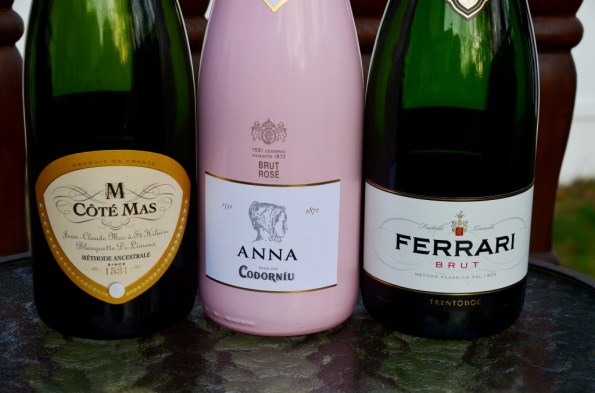
Let’s start from Champagne’s homeland, France – however, this wine is not produced using Méthode Champenoise. NV Coté Mas St. Hilaire Blanquette de Limoux Méthode Ancestrale (7.5% ABV, $15.99, 100% Mauzac) is produced using so called Méthode Ancestrale, which is very close to traditional method and most definitely precedes it. In case of Méthode Ancestrale, first fermentation is stopped before all sugar is converted into alcohol, and then secondary fermentation takes place in bottle with additional only of the yeast (no sugar is added). Unlike Champagne, Méthode Ancestrale sparkling wines undergo very short bottle ageing (3 month versus minimal 12 month and typical 2-3 years for Champagne). This Paul Mas’ sparkler had light golden color, showing yeast with touch of apple, good intensity, promise of a classic sparkling wine on the nose, and then touch of honey and honeysuckle, hint of ripe peach on the palate. As one would expect from only 7.5% ABV, it was quite sweet (similar to spatlese level of Riesling), but with the help of fine mousse, perceived very light and refreshing. I would serve it at the end of a good meal with a sharp cheese, they should go together very well. Drinkability: 7+
From south of France, it is short trip east to Italy, where outstanding sparkling wines are crafted in the northern region called Trento. Here the wines made using “metodo calsssico“, which an Italian name for Méthode Champenoise/Méthode Traditionelle. The requirements for metodo classico wines are even stricter than those for Champagne, with minimal bottle age starting from 15 month to the 10 years for the Riserva. And who can represent Trento DOC better than Ferrari – pioneer in both Chardonnay plantings and classic wine production in the region (Ferrari winery started in 1902). NV Ferrari Brut Metodo Classico Trentodoc (12.5% DOC, $25, 100% Chardonnay) had delicious nose of yeast and fresh apples, and clean acidity on the palate, with lemon and green apple. Classic, classic classic – clean, crisp and refreshing. Drinkability: 7+


Conversation about Sparkling wines would be incomplete without mentioning Cava – Spanish wine produced using classic Méthode Champenoise. Production of Cava is every bit as laborious as classic Champagne, with main differences been slightly shorter minimum bottle ageing requirements (9 month) and typical use of Spanish indigenous grape varietals. Anna Codorniu is one of the best representations of Cava and Spanish winemaking overall, producing wine since 1551 and pioneering Cava production in 1872. I wrote about NV Anna de Codorniu Brut Rosé Penedes DO (12% ABV, $14.99, 70% Pinot Noir, 30% Chardonnay) a few month ago – the wine is delicious, fresh, with fine mousse and pleasant body weight – it will complement any of your holiday festivities perfectly well. Drinkability: 8-
Now, I have two more interesting sparklers for you to consider, both coming from the USA. However, the place is rather unexpected – Finger Lakes region in New York. First one is made using the classic Méthode Champenoise – 2006 Glenora Brut Métode Champenoise Sparkling Wine Finger Lakes (12% ABV, $29.99, 52% Chardonnay, 48% Pinot Noir). Wine had light yellow color, fizz of light intensity. Classic nose – yeast, fresh bread, overall delicate. On the palate, it showed Granny Smith apples, touch of lemon, good acidity, fresh, clean. Overall, it was a good rendition of classic sparkling wine, however, to be consumed in one single day, as it lost all fizz by the second day. I can’t help to mention that at $29.99, QPR is not great. Drinkability: 7+.


To round off, while our last wine is also produced in Finger lakes, it is made using one more significant sparkling wine production technique – Transfer method, where after second fermentation in the bottle (6 month minimum), the wine is transferred to the pressurized tank, thus greatly reducing cost and labor which go into production of Méthode Champenoise wines. Italian Prosecco is made in somewhat similar way (sans the second fermentation in the bottle), and this Finger Lakes wine was modeled exactly after the Prosecco. 2013 Damiani Bollicini Bottle Fermented Sparkling Wine Finger Lakes (12.4% ABV, $15.99, 47% Cayuga, 35% Chardonnay + Pinot Noir, 16% Chardonnay, 2% Pinot Meunier) had straw pale color, touch of tropical fruit on the nose, complemented by a hint of gunflint. Nice creaminess on the palate, delicate fizz, clean, refreshing, crisp. Excellent overall, pleasure to drink, and would complements lots of different foods. Drinkability: 7+
That’s all I have for you for today. I wish you sparkling holidays, whatever bubbles tickle your fancy. Cheers!
Possibly The Best QPR Wines In The World Today?
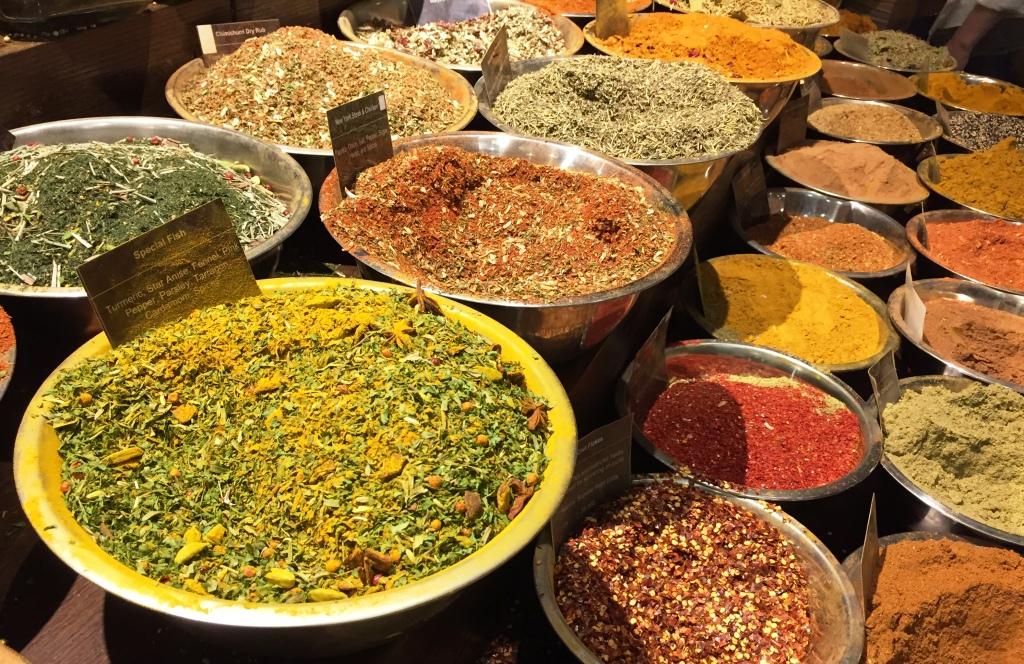 Today, I want to talk about wine and value. “Value” has an interesting meaning in the world of wine – may be as subjective as the concept of a “good wine” itself. To me, the value is not an absolute amount of money one paid for the bottle of wine – if you paid $3, but poured the bottle down the drain after half-finished first sip because it tasted terribly – was that still a “value”? Or was that a pure waste of money? By the same token, if the $20 bottle of wine gave you lots of pleasure in every tiniest drop (including the one you licked of the table), would that be a “good value”? Talking about the “value” of the wine, I prefer to use a proverbial term QPR, so happily adapted by the wine lovers – a Quality Price Ratio (this is what QPR stands for) conveys the “value” concept of wine a lot better than the sheer price itself.
One of the easiest and most straightforward ways to classify and analyze thousands and thousands of wines produced today in the world is by region, as wines from the same geographic area would typically have some similarities. Thinking about all the different wine producing regions in the world, which region do you think delivers the best QPR today? I’m really asking here to think about the region as a whole, rather then individual wines. Yes, you can find delicious Napa reds for $10, but this is rather an anomaly, as on average, you need to spend at least $25 – $30 for a good bottle, so we are definitely not talking about Napa here. Thus the question stands – what is your best QPR wine region in the world?
This question might be more difficult than it seems. Wine regions don’t stand still – they are constantly evolving. As the region becomes better known and more demanded, the price increase often accompanies this rise in popularity – which obviously affects the QPR. I used to consider Greek wines as a great QPR – but many Greek wines are now pushing the $30 boundary, while not consistent in quality – this immediately drives QPR down. I used to think of Israeli wines as a great value – but same thing is happening there, with lots of better wines moving north of $30, and wines under $20 been more of “hit and miss”. My next “go to” wines were Portuguese – but even here I now have a problem – wines under $20 are often only randomly tasty; wines at around $30 and up are consistently excellent, rivaling $100+ wines from the other regions, so in relative terms, they still offer a great value – but probably not the best QPR?
“Knowing what I know now”, the region which I think consistently delivers the best QPR at the moment (!) is Georgia – not the state down south in the US, of course, but an independent country. I always loved Georgian wines, but what prompted this broad statement about QPR was a recent Georgian Wine tasting I attended a week ago at Chelsea Market in New York. Wine after wine was delicious, and priced under $20 – that is a QPR I’m definitely happy about.
You don’t have to take my word for it – you should find a bottle of Georgian wine and try it for yourself. I really hope you did just that last Sunday, October 4th, as it was a #GeorgianWineDay in the social media – and if you actually had Georgian wine, I’m curious to know what it was. In any case, let me share the notes for the wines I tasted at the “Discover Georgia in New York” event at the colorful Chelsea Market. Below are the notes, using the “+” ratings. Pay attention to the prices and corresponding ratings – don’t know what you think, but I think the “QPR” is spelled very clearly across the full range of wines I tasted.


2013 Telavi Wine Cellar Marani Rkatsiteli Kakheti, Georgia ($10.99) – +++, very acidic, requires food
2013 Telavi Wine Cellar Marani Mtsvane-Kisi Kondoli Vineyards Kakheti, Georgia ($14.99) – +++, excellent, clean, lemon notes, touch of food


2013 Telavi Wine Cellar Marani Saperavi Kakheti, Georgia ($11.99) – +++, excellent, simple, an everyday wine, red fruit, crushed berries
2009 Telavi Wine Cellar Marani Red Kvareli Special Vicultural area, Kakheti, Georgia ($15.99) – ++++, beautiful, clean, great depth
2012 Telavi Wine Cellar Marani Saperavi Kondoli Vineyards Kakheti, Georgia ($18.99, 18 months in oak, starting from fermentation) – ++++, stunning! round and delicious


2007 Telavi Wine Cellar Marani Reserve SAPERAVI block Kondoli vineyards, Kakheti, Georgia ($70) – ++++1/2, off the charts, produced only in the best years, complex, round, delicious. Yes, it is $70, and it might be to expensive for an amazing QPR, but you should taste this wine first…


2006 Wineman Cabernet Sauvignon Kakheti, Georgia ($10.99) – ++++, wow!, pick of maturity, dark notes, concentrated – another wow!
2010 Wineman Ikhalto Red Kakheti, Georgia ($12.99, 50% Saperavi, 50% Cabernet Franc) – ++++, wow!, acidity, beautiful wine
2013 Wineman Kindzmarauli Special Viticultural Area Red Semi-Sweet Kakheti, Georgia (12% ABV, $15.99, 100% Saperavi) – ++++, beautiful, perfectly balanced sweetness


2011 Shalvino Kardenakhi Special Viticultural Area Kakheti, Georgia (18% ABV, $18.99, Blend of Rkatsiteli, Khikhvi, Goruli and Mtsvane) – ++++, made using Solera method, delicious, Pedro Ximenez like with a delicate balance
2013 Telavi Wine Cellar Satrapezo Rkatsiteli Ice Wine Kakheti, Georgia (10% ABV, $29.99 500ml) – +++1/2, beautiful, perfect balance, not overly sweet


2013 Teliani Valley Tsinandali White Kakheti, Georgia ($12.99) – +++, great acidity
2012 Teliani Valley Special Vicultural area Kakheti, Georgia ($17.99) – +++, great acidity, perfect, food friendly


2013 Schuchmann Rkatsiteli White Kakheti, Georgia ($15.99) – +++, touch of sweetness, nice balance
2013 Schuchmann Saperavi Red Kakheti, Georgia ($15.99) – +++, perfect, clean, great balance


2012 Vinoterra Kisi Kakheti, Georgia (13% ABV, $NA, Qvevri fermentation, Oak maturation) – +++, complex, very intense, unusual, thought provoking
What do you think? I understand that QPR is subjective and relative term – first, you have to like the wine, and then everyone’s idea of “value” is different – but I was (once again) blown away by the quality and consistency of what I tasted – I didn’t skip a single wine, those are all the wines which were presented in the tasting. This would make it 16 wines out of 16, which I would gladly drink again. I hope it gives you good frame of reference for my experience.
Thinking about the wines of the world, what would be your top region for the best QPR? And if you tasted any of the Georgian wines, what is your opinion about them? Cheers!
Daily Glass: Summer Perfect
Is there a such thing as “summer wines”? When I think about this subject, I’m always torn. I don’t have any problems drinking Provençal Rosé or crisp light white wine in the winter, and I would never refuse a glass of heavy and hedonistic California Cabernet in the summer. But is it only in my mind that I’m so open-minded (hmmm, was that a pun, and was that intended?) – in reality, I would usually gravitate towards reds in the winter, and Rosé and white wines as the temperatures starts rising. After all, there might some merit to the summer wines concept. Anyway, let’s proceed.
Today I want to bring to your attention a summer-perfect collection of White and Rosé wines – they were all samples I got recently (some are even not so recently), but most importantly, they will perfectly brighten up your summer day.


Let’s start with the two of the excellent Rosé wines from France – Domaines Paul Mas. Last year, I was lucky to taste through the Paul Mas portfolio of red wines, and after tasting Rosé wines this year, I can only say that it is not for nothing Paul Mas is considered a specialist in “Affordable Luxury”. The first wine was 2014 Côté Mas Rosé Aurore Sud De France Pays d’Oc IGP (13% ABV, 30% Cinsault, 20% Syrah, 50% Grenache, $12.99 SRP, 1L bottle) beautiful concentrated pink color. Fresh strawberries, lemon zest and limestone on the nose, fresh strawberries and lemon zest on the palate, vibrant acidity, very balanced, medium finish – a perfectly refreshing wine for the hot summer day. This wine creates a feeling of a calm and relaxation, it is like a lazy summer day (Saturday!) distilled in the glass. (Drinkability: 8-/8) I have to add that I love the festive label, and of course the wine has an amazing QPR at $12.99/1L bottle.
The second wine was even more interesting – NV Paul Mas Cote Mas Cremant de Limoux Brut Rose, Languedoc-Roussillon, France ($18.99 SRP, 12% ABV, 70% Chardonnay, 20% Chenin, 10% Pinot Noir). This sparkling wine comes form the cradle of the sparkling wines winemaking – St. Hilaire, which claims to start production of sparkling wines in 1531. Well, this is not a subject of this post – the wine itself was outstanding though. Beautiful salmon pink color, touch of yeast and toasty bread on the nose. Perfectly present toasty bread on the palate, clean acidity, light creaminess. Right from the fridge shows very astringent. As the wine breathes and warms up in the glass, it shows more minerality while staying very dry. Drinkability: 8-


From France, let’s move two Italy – here I have two summer wines from the Banfi selection. First, NV Maschio Prosecco Brut Treviso DOC (SRP $13, 11% ABV, 100% Glera)- nice, clean nose of white peach. Palate restrained and quite dry, with touch of peach, light creaminess, very refreshing overall. The wine complemented well spicy food as well as chocolate dessert. Drinkability: 7+
Next wine – 2013 Fontana Candida Terre dei Grifi Frascati DOC (SRP $13, 13% ABV, 50% Malvasia Bianca di Candia, 30% Trebbiano Toscano, 10% Greco, 10% Malvasia del Lazio) – on the nose, touch of candied fruit, white flowers, touch of lemon, overall very pleasant. On the palate, lemon, candied lemon peel, touch of tropical fruit, good acidity, medium-long finish. Drinkability: 7


Continuing our European tour, we are now arriving to Spain. First up – delicious sparkling wine – NV Anna de Codorniu Brut Rosé Penedes DO (SRP $14.99, 12% ABV, 70% Pinot Noir, 30% Chardonnay). This Cava, a Spanish sparkling wine produced by the same method as Champagne, has very interesting story behind it. Anna was a name of the heiress of the Codorniu winemaking family which started making wines in 1551. In 1659 Anna married winemaker Miguel Raventós, and their direct descendant José Raventós was the first to commercially produce Cava in 1872 using méthode traditionelle. The wine itself was excellent – fresh, slightly yeasty nose, fine mousse, firm on the palate with crisp acidity and touch of strawberries. This wine would make a perfect sip any time, summer day or not. Drinkability: 8-
Next wine is another Spanish classic – 2014 CVNE Monopole Rioja (SRP $14.99, 12.5% ABV, 100% Viura). Monopole was the oldest white wine from Rioja, starting from 1915. The wine has dry and pleasant nose, with a hint of white fruit. On the palate – touch of the white stone fruit, lemon, and crisp and bright acidity. This wine needs time to fully develop in the bottle, so if you have some space in the cellar, throw a few bottles in and forget it for the next 5 years or even longer. Drinkability: 7+
Another wine from CVNE, which was a first time experience for me – 2014 CVNE Viña Real Rosado Rioja (SRP $13.99, 12.5% ABV, 85% Viura, 15% Tempranillo). The wine was perfectly Provençal in style – hint of strawberries on the nose, dry, crisp and restrained on the palate, steely acidity combined with firm structure, light but noticeably present wine. The wine would perfectly fit any hot summer day (and not so hot too). Drinkability: 7+/8-
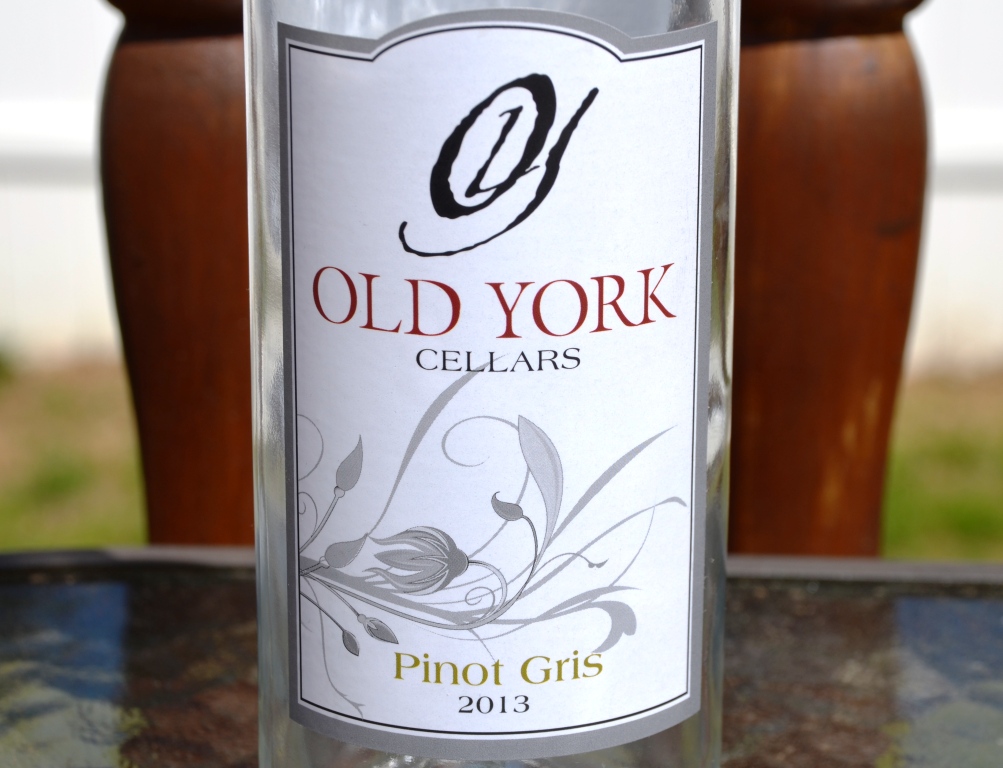 I have one last wine to present to you. This time, we are crossing Atlantic ocean and arriving at New Jersey. Yes, New Jersey makes wines, and I wrote about them before. Today I’m bringing to your attention an excellent summer wine from the same winery – 2013 Old York Cellars Pinot Gris American Table wine, New Jersey (SRP $18, 12% ABV) – clean and crisp nose, touch of Chablis-like minerality. On the palate – restrained white fruit, crisp acidity, touch of minerality. Overall very refreshing. Drinkability: 7+/8-
And we are done here. Enjoy the summer with the glass in your hand. Cheers!
Last Bottle Sign Up ($10 credit)




 Talk-A-Vino