Archive
Made With Organic Grapes: Domaine Bousquet
Today we will be talking about two subjects we already discussed in the past. The first subject is the wines made from organic grapes. Organic grapes are becoming more and more available, and winemakers around the world are more eager to use organic grapes in winemaking, especially as wine consumers happily embrace the trend.
The second subject is the wines of Domaine Bousquet in Argentina. Last time we talked about unpretentious and delicious Domaine Bousquet bubbles, sparkling wines well suitable for every day. Today we want to continue that conversation and talk about few more wines.
The organic viticulture is fair and square a centerpiece of Domaine Bousquet winemaking. The picture below perfectly summarizes it – these are all the certifications that the domain already has:
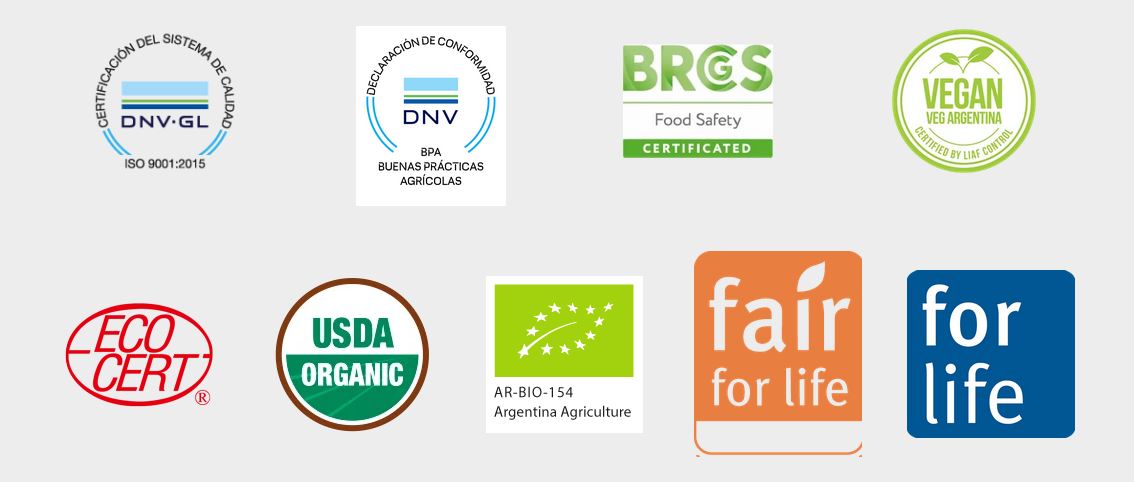
Source: Domaine Bousquet website
Organic viticulture is only a stepping stone for Domaine Bousquet – the goal is to convert to biodynamic farming in 2021/2022, which is not an easy task, considering the sheer size of Domaine Bousquet’s vineyards (more than 500 acres) and the fact that biodynamic viticulture is 30% more labor-intense compared with traditional methods, and 15% more intense than sustainable. But once you get on this road, there is no turning back.
Organic/sustainable/biodynamic is an important part, but still only a part of the story. The terroir is essential, and it is a classic combination of the soil and climate which contributes to the quality of the Domaine Bousquet wines. Many of the Domain Bousquet vineyards are located in the Gualtallary region of Uco Valley, at an altitude of about 4,200 feet. The high altitude by itself doesn’t guarantee the quality of the wines, but it helps. Domaine’s vineyards are located on the patches of sandy soils, which are great for the vines as they limit the spread of the disease, provide good drainage and force the vines to work hard to get to the water.
Gaultallary offers a desert-like climate, with constant winds blowing for the Andes, and less than 8 inches of rain being total precipitation for the year. In such conditions, it is important that Domaine Bousquet vineyards are located in areas with access to the ground water – not everybody in the Gaultallary is that lucky. And then there are Zonda winds (Zonda in local dialect means “The Witch’s Wind”, which are showing up in the spring, and they are dry (relative humidity of 0), strong, and unpredictable – but they help to reduce the crop size and concentrate the flavor.
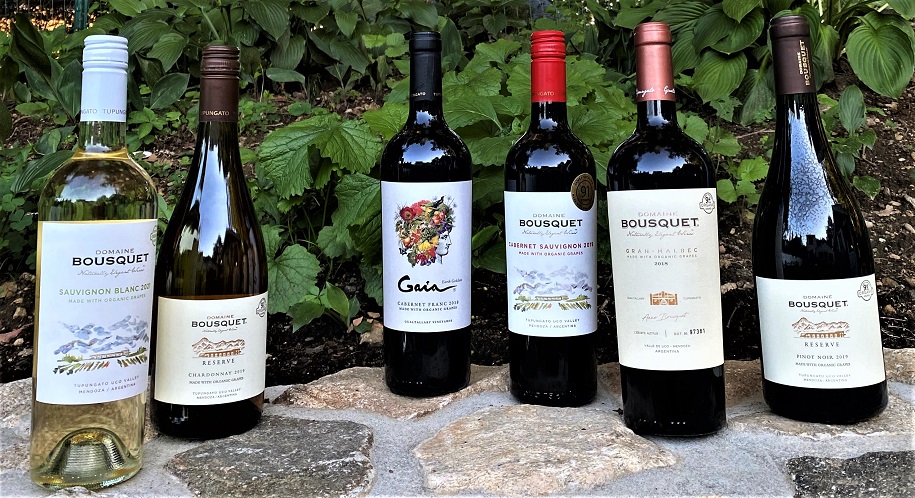
Domaine Bousquet produces about 10 different lines of wines. I was able to taste wine belonging to the 4 different lines (samples). Below are my notes.
First, 2 wines from the Premium selection:


2021 Domaine Bousquet Sauvignon Blanc Tupungato Uco Valley (12.5% ABV, $13)
Straw pale
Ultimately inviting nose, a touch of fresh grass, lemon, uplifting intensity.
Crisp, clean, lemony, grassy, tart, fresh, pure delight.
8+, perfect, delicious.
2019 Domaine Bousquet Cabernet Sauvignon Tupungato Uco Valley Mendoza (14% ABV, $13, no oak – unusual)
Dark Ruby
A touch of bell pepper, dark berries, medium-plus intensity
Bell pepper, eucalyptus, mint, blackberries, good acidity, fresh, good energy, good balance
8-/8, easy to drink. And I have to say that unoaked Cabernet Sauvignon is mind-boggling.
Next were two wines form the Reserve line:


2019 Domaine Bousquet Chardonnay Reserve Tupungato Uco Valley (14.5% ABV, $18)
Straw pale
Vanilla, a hint of butter, inviting, generous
Crisp, vibrant, a touch of butter and vanilla, tightly weaves around the citrus core. Excellent balance, delicious.
8+, superb. If this wine can age, it might be amazing, if this bright acidity will evolve into the honey note as it works with the best Chardonnays.
2019 Domaine Bousquet Pinot Noir Reserve Tupungato Uco Valley (14.5% ABV, $18, 6-8 months in French oak)
Dark ruby
Not very expressive, a hint of tart cherries
Tart cherries, bright acidity, crisp, tart
7/7+, not my wine, but should be okay as food wine or for those who like austere, bone-dry wines.
Next was the wine from the Gaia line – the wines dedicated to the goddess of Earth, Gaia, sporting a very attractive label. This is the second time I was able to taste the wine from the Gaia line – the first was Gaia Rosé, which was excellent. 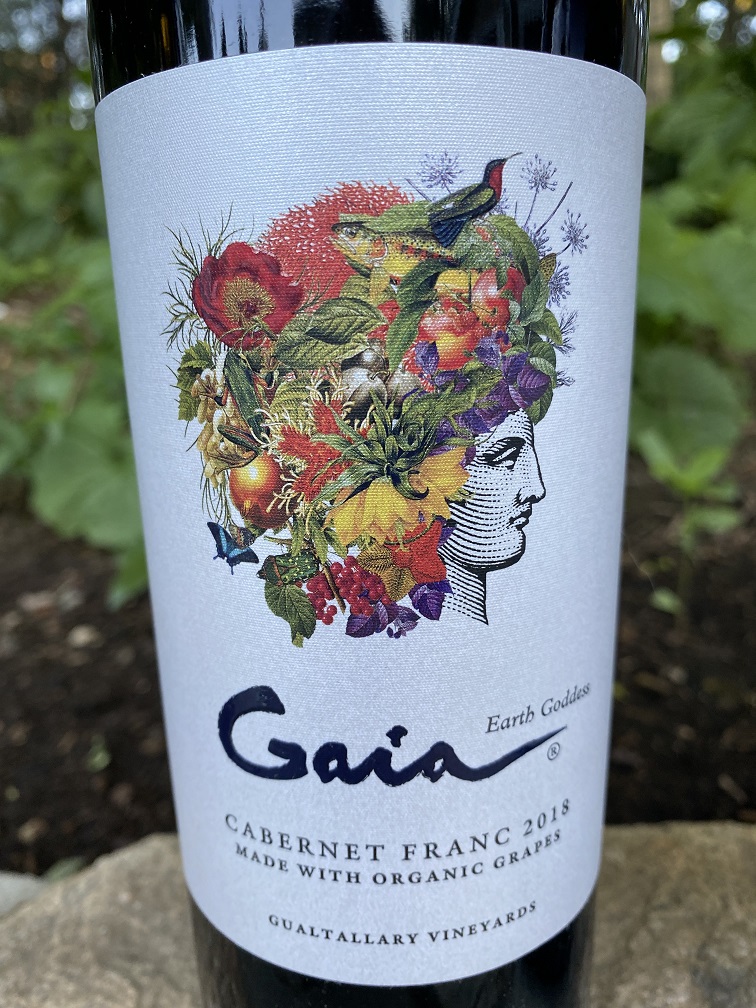
2019 Domaine Bousquet Gaia Cabernet Franc Gualtallary Vineyards (15% ABV, $20, 8-10 months in French oak)
Dark garnet
A touch of barnyard, earthy notes, dark berries
Dark fruit, explicit minerality, a distant hint of bell pepper, mint, dense, good structure
8-, not the most striking Cab Franc, but interesting on its own
And the last one for today – the wine from the Gran series:
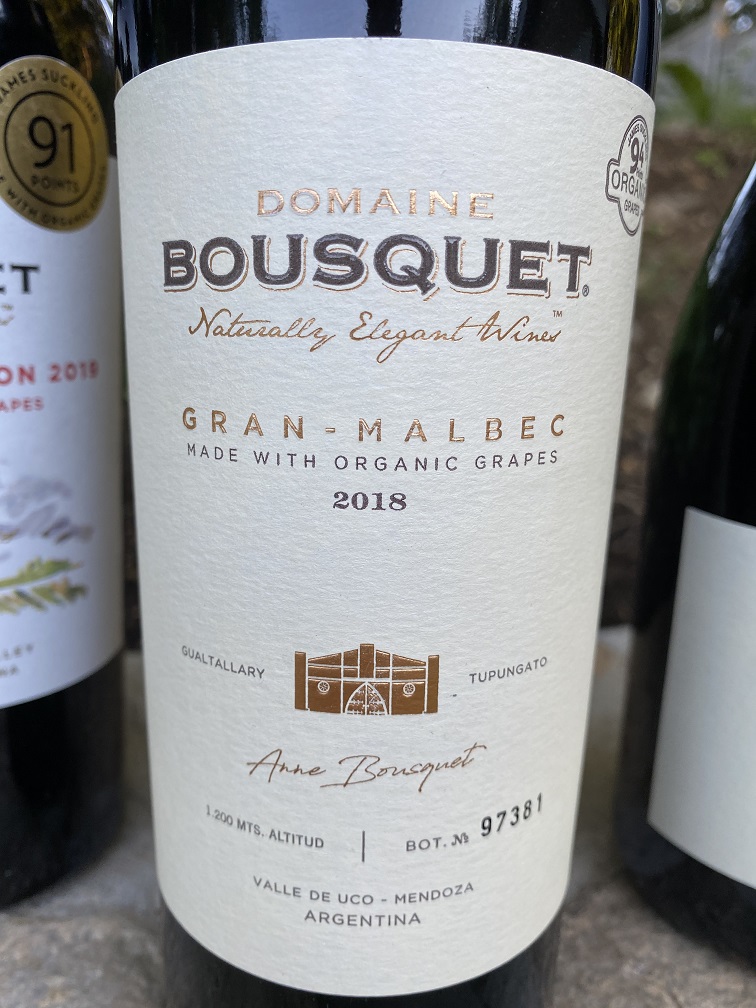
2018 Domaine Bousquet Gran-Malbec Valley de Uco (14.5% ABV, $25, 85% Malbec, 5% Cabernet Sauvignon, 5% Merlot, 5% Syrah, 10 months in French oak)
Dark garnet, almost black with purple hues
Dark fruit, eucalyptus, cassis, intense, powerful
Beautiful fruit on the palate, firm structure, big, brooding, perfectly balanced
8+, outstanding
Here you are, my friends – more organic wines you can choose from. As an added bonus, with Domaine Bousquet, you don’t have to break the bank to enjoy delicious organic wines any time you want. Cheers!
Beyond ABC – Wines of Southern Italy

Source: Sud Top Wine
I know, ABC is a loaded acronym. Outside of all the proper uses, it is “Anything But C…”, like it would be in Anything But Chardonnay sentiment. Today, however, let’s give Chardonnay a break, this is not the angle I would like to pursue. ABC here is just a homemade abbreviation, and it simply identifies some of the best-known Italian wines – those which everyone wants to drink.
I’m sure you can decipher this acronym with ease. A in Italian wines would stand for … Amarone, of course! Amarone is one of the most coveted Italian wines, and the best Amarone wines have simply a legendary following.
B is even easier than A. B should be really upgraded, as it is not just B, but rather BBB – Barbaresco, Barolo, Brunello. Some of the most thought-after wines from Piedmont and Tuscany.
And C, of course, is as straightforward as it gets – I know you got it already. Yes, C stands for Chianti, possibly the most famous Italian wine out there.
But today we are leaving our ABCs alone, and traveling down to the Southern part of Italy, hoping to discover some of the local wine treasures. To assist in our quest, we will enlist the help of the Sud Top Wine competition, organized by the Italian food and wine publication Cronachedigusto.it.
Sud Top Wine competition is in its second year, and it covers the wines produced in the Southern regions of Sicily, Sardinia, Basilicata, Calabria, Campania, and Apulia. It is not only the climate that makes Southern regions unique, it is also the grapes that are typically not grown anywhere else in Italy (every rule has an exception, but this is not important at the moment). When it comes to the white grapes, you should expect to find Grillo, Greco di Tufo, Catarratto, Vermentino. For the reds, we are talking about Aglianico, Nero d’Avola, Nerello Moscalese, Primitivo, Cannonau (a.k.a. Grenache).
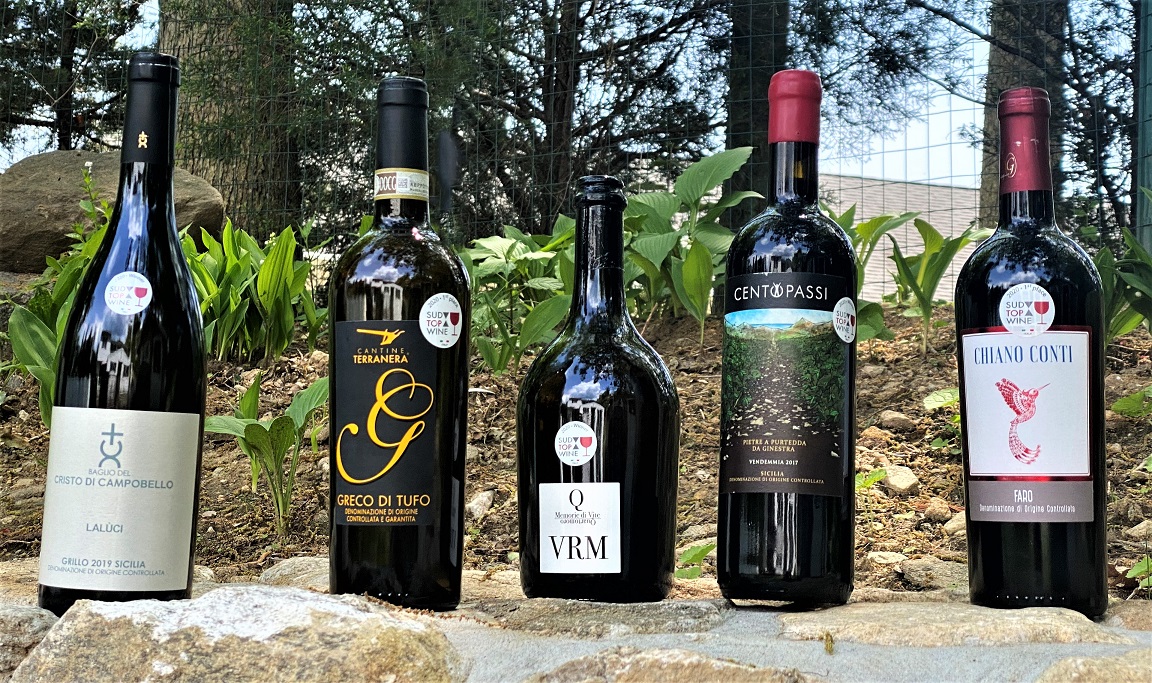 I had an opportunity to taste some of the top awarded wines (samples) from the 2020 competition, so below are my notes:
2018 Cantine Terranera Greco di Tufo DOCG (13% ABV, Sud Top Wine 2020 1st Place)
Light Golden
Whitestone fruit, a touch of honeysuckle
A touch of sweetness, good acidity, nice depth and structure, lemon notes with a hint of candied lemon, excellent balance
8, excellent white wine
2017 Pietre a Purtedda da Ginestra Centopassi Rosso Sicilia DOC (14% ABV, Nerello Moscalese, bio certified, Sud Top Wine 2020 Winner)
Bright ruby
Fresh cherries
Tart cherries, fresh, crisp, succulent, medium body, medium finish, nicely present tannins
8-
2014 Chiano Conti Rosso Faro DOC (13.5% ABV, Nerello Mascalese, Nerello Capuccio, Nero d’Avola, Nocera, Sud Top Wine 2020 1st Place)
Red currant, herbs, earthiness, tobacco
Tart cherries, underbrush, light and earthy
7+, it’s okay, not exactly my style
2016 Quartomoro VRM Memorie di Vite Vermentino di Sardegna DOC (13.5% ABV, Sud Top Wine 2020 Winner)
Light Golden
Intense nose with gunflint, white stone fruit, a touch of vanilla
Beautiful, full-bodied, plump, round, white plums, Meyer lemon, good acidity, good balance
8, delicious.
2019 Baguio del Cristo di Campobello Lalùci Grillo Sicilia DOC (13.5% ABV, Sud Top Wine 2020 Winner)
Straw pale
Complex nose of granite, gunflint, whitestone fruit
Crisp, fresh, a touch of gunflint, fresh lemony acidity, delicious
8+, superb
As you can tell, I really preferred the whites over the reds – but your experience might be different. If you will come across any of these wines, give them a try – you might be pleasantly surprised. Cheers!
Discovering Armenian Wine
I love wine.
I’m a collector.
Based on these two statements, how easy it is to assume that I’m a wine collector? No brainer, right?
And nevertheless, I don’t see myself as a wine collector. The only reason I have a wine cellar (a bunch of wine fridges, rather) is that I like to drink aged wines – not for any bragging or financial reasons.
So what am I collecting then?
Experiences. I love to collect experiences. Tasting the wines I didn’t taste before (an easy one – every year, I should have what, 500,000 options?) Tasting the wines made from the grapes I never tasted before. Tasting the wines from the new places.
Growing up in the 80s in the USSR, I knew about Georgian wines – those were the most famous (Georgia was one of the 15 republics in the former Soviet Union). I also knew about Georgian cognac (yeah, should be called brandy, but do you think anyone cared there about the trademarks?) – but those were not the best. The best cognacs (okay, okay, brandies) were coming from Armenia (another republic then) though. Not being really into wines and grape growing, I never thought of a possible connection between the wine and cognac (both are made from grapes), thus I never thought that it is entirely possible that Armenia might be also making wines if they already got the grapes.
Turns out that it would be an excellent guess to connect the dots err, grapes, as it appears that wine had been made in Armenia for the past 6,000 years or so. I’m not here to debate the crowning of the “cradle of winemaking” title – whether it is Armenia, Georgia, or Turkey is all fine by me, please accept my sincere gratitude for bringing wine into this world.

Armenian Wine Regions. Source: Storica Wines
As we said, Armenia is one of the oldest wine-producing countries in the world, which had been shown through the archaeological excavations, discovering the wine production facility located in Areni cave complex and dating back to around 4000 BC. Considering such a long history, it is safe to say that wine is an indelible part of the Armenian lifestyle.
In more recent days, during the Soviet rule, Armenia was producing wine and brandy, but the majority of the wine was produced in the Sherry style (it is interesting to note that similar to the wines of the Sherry region in Spain, Armenian “Sherry” wines can also develop a thin protective layer (flor) on the surface. Needless to say that production of fine wines was never encouraged during the soviet era.
Armenia’s terroir is conducive for the production of fine wine – predominantly volcanic soils, rich in nutrients, and high vineyard elevation (2,000 – 5,000+ feet above sea level) help to produce good quality grapes. About 30 indigenous grape varieties also help to produce wines of unique flavor profile and character.
I had an opportunity to sample two of the Armenian wines, courtesy of Storica wines, an importer and online retailer of Armenian wines in the USA.
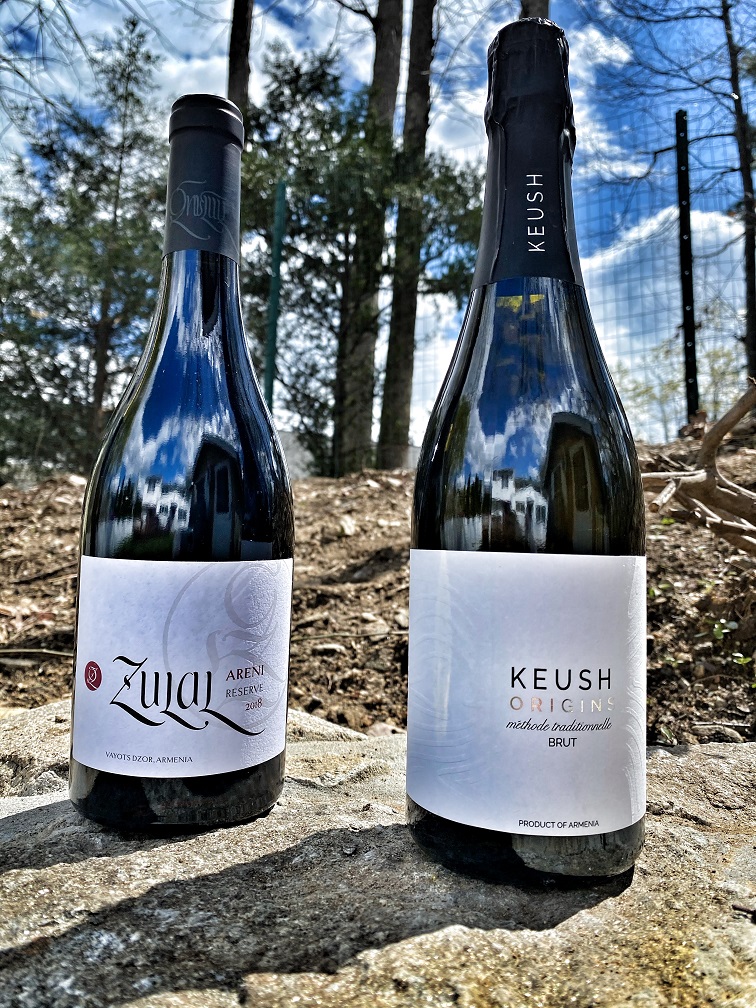
The first wine I tried was traditional method sparkling wine produced by Keush. Keush winery was established in 2013, however, they use 100–120 years old vines, growing at the 5,200 feet elevation above sea level, some of the highest vineyards in Armenia. This classic method sparkling wine was produced from the indigenous grape varieties, and I have to honestly admit that the wine greatly exceeded my expectations.
The second wine I tasted was produced by one of the youngest wineries in Armenia, Zulal (the word means “pure” in Armenian). The winery produces about 10,000 cases per year, focusing on Areni and Voskehat grapes sourced from about 40 villages from Aghavnadzor, Rind, Arpa Valley, and Vayots Dzor regions.
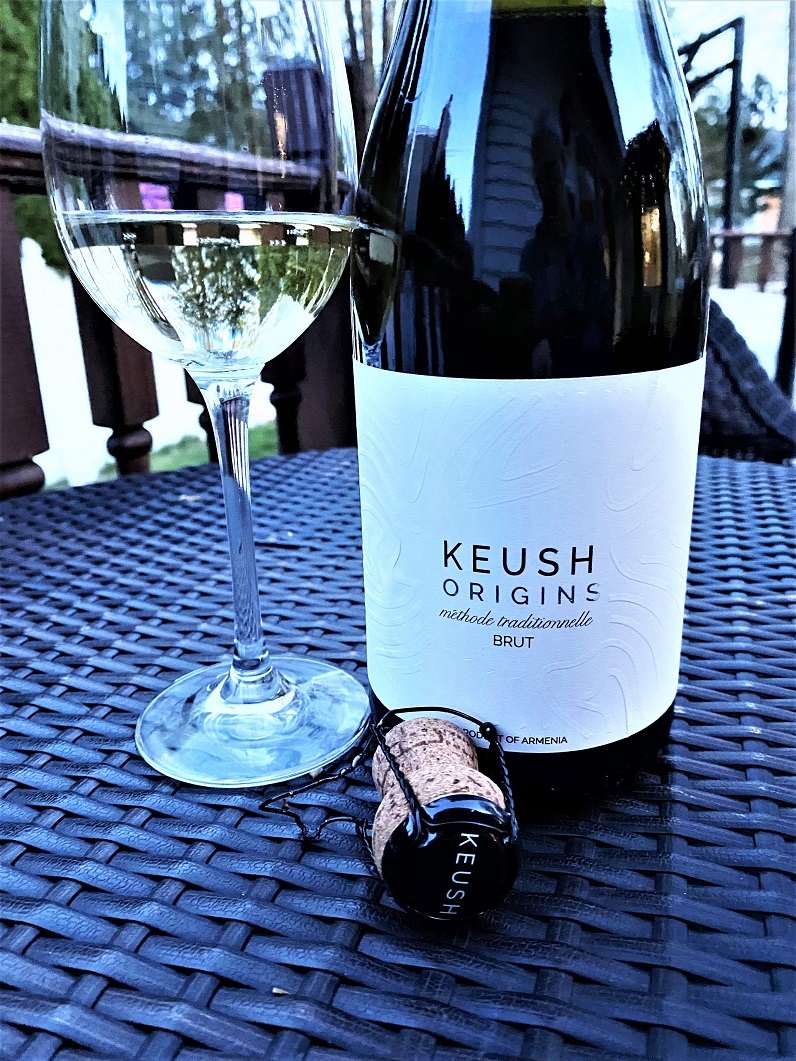
NV Keush Origins Brut Methode Traditionelle Armenia (12% ABV, $25.99, 60% Voskehat, 40% Khatouni, at least 22 months on the lees, Lot 08.15)
Light golden color
Beautiful nose of toasted bread, a touch of yeast, clean, inviting, classic
Beautiful minerality, fresh, toasted notes, vibrant, clean acidity, fine creamy bubbles coating your mouth.
Outstanding, 8+
2018 Zulal Areni Reserve Vayots Dzor, Armenia (13% ABV, $32.99, 100% Areni, 12 months in Caucasian and French oak barrels)
Dark garnet
Not an expressive nose, underbrush, herbal undertones, a touch of fresh berries
Black pepper, wild berries, dried herbs, soft, clean, easy to drink
8, simple, quaffable, easy to drink, perfect for the conversation
As a wine drinker, I’m very happy with my discovery. Keush sparkling was outstanding, both delicious and a great QPR. Zulal Areni was also quite delightful. As a collector, I’m also very happy, as I get to add 3 new grapes, plus a checkmark to the list of the winemaking countries I had an opportunity to taste the wines from. Most importantly, I had an experience of drinking the wines made in the country which is an indelible part of the world’s winemaking history. All in all, a good day.
Have you ever had Armenian wines? If you had, what do you think of them? If you didn’t, are you ready to rectify things? Cheers!
Guest Post: The Purpose of Oak Barrels in the Wine Making Process
Today, I’m offering to you a guest post by Rachel Moore who works as a Marketing Manager at Rocky Mountain Barrel Company. Rocky Mountain Barrel Company provides used wooden barrels for spirits, like bourbon barrels, whiskey barrels, rum barrels, and wine barrels. Rachel Moore loves her combination of nature, wine, and nerdy friends who appreciate her homemade wines.
The long history of wine and oak is worth exploring, mainly because oak barrels are being used in wine aging literally forever. Oak is used as a flavored seasoning to bring aroma and quality to the wine. Whether French, Hungarian, American, or others, Oak contributions leave a lasting impression on the bottled wine.

What Is the Aim of Aging Wines in Oak Barrels?
Before the invention of glass bottles (the 1600s and earlier), most wines were processed and packaged in wooden barrels. In reality, paintings from this era often depict wine barrels strewn about. Although we’ve outgrown the need for barrels to store and ship wine, we’ve developed a taste for it. Oak Wooden Barrels are an essential feature of the modern winemaking process.
What Benefits Do Oak Barrels Have for Wine?
Oak makes three significant contributions to wine:
- It includes spice compounds such as cocoa, clove, haze, and coconut aromas.
- It allows for the intake of oxygen, making wine taste a lot more complex.
- It produces an optimal condition for metabolic processes to occur, which results in creamier-tasting wines.
Let’s see some other advantages of using an oak barrel for the winemaking process.
1. Superior Aging Capability
In general, wines aged in oak barrels have greater aging capacity than those aged in steel tanks (or with alternatives, such as oak chips or oak staves). For example, if you age your red wine in an oak barrel, you are supplying your consumer with a commodity that can mature much more elegantly than red wine processed in a steel tank.

2. Re-Use Used Oak Barrels
First, used oak barrels can be used for the aging and fermentation process of the wine imparting milder flavors compared with brand new oak barrels. Second, oak wooden barrels can be purchased used at a substantial cost. Though bear in mind that the oak can lose the capacity to infuse after a few “cycles,” so pay particular attention to the aroma/flavor profile of your blend to ensure that the oak is strong enough. Moreover, oak barrels can be reused many times, reducing the initial investment.
3. High-End Brands’ Premium Association
It’s a myth that oak barrels are needed for luxury wines; in reality, many high-end wineries are transitioning to steel tanks for white wines and lighter wines intended to be consumed “fresh.”
However, there is no denying that there is a certain cachet synonymous with the use of oak barrels in the wine industry. Wines fermented in steel tanks are frowned upon in some circles. When deciding whether to use oak barrels or steel tanks, remember to think about your audience and how they will respond.
Two oak varieties are used to produce barrels worldwide: White oak from the United States and European oak from Europe. Of course, European oak barrels are not exclusive to European winemakers and vice versa.
Staves, which are broad pieces of oak wood closely fixed along with metal hoops, are used to make wooden barrels. Over a burn, the barrels are toasted to a normal, medium, or dark toast standard. Fresh barrels with a mild toast will have many vanilla and caramel flavors, while a darker toast will have various smokey, charred aromas.
The amount of oak taste transferred to the wine by oak wine barrels is affected by its age and size. Since they make more interaction between the wood and the wine, smaller barrels impart more oak flavor. Oak barrels lose their distinctive flavor compounds with age, necessitating replacement every few vintages.
Fresh oak aging alters the tannin composition of red wines in addition to incorporating oak flavors. Tannins from the wood leach into the wine, giving it a more robust structure. This helps a wine’s age-ability, just how long it lasts in the bottle. The wood also assists in the stabilization of tannins from grape skin, resulting in a silkier finish.
The Various Kinds of Oak Barrels Used in Winemaking
The American oak barrel and the French oak barrel are the two most popular wooden barrels used in winemaking.
As compared to French oak, American oak barrels are less expensive, have a larger grain, and have lower wood tannins. They also have a more substantial impact on the wine’s taste and aromatic ingredients, often imparting vanilla flavors with a much sweeter palate profile than French oak.
On the other hand, French oak is the wine industry’s “gold standard,” with higher wood tannins and tighter wood grains that have a more negligible effect on the aromatics and taste of the wine.

In a Nutshell
Whatever barrel you choose for the winemaking process, be sure it is of high-quality wood, and don’t forget to clean the barrels after use!
These were some of the purposes and uses of using oak barrels in the winemaking process. I hope this article was helpful to you and you select your oak barrels wisely!
Wednesday’s Meritage #157
Meritage time!
Ohh, it’s been two months since the last Meritage issue – well, let’s get to it.
We have 12 months in the year, right? I’m not trying to keep track, but it seems that April is disappropriately loaded in the world of wine. I will let you be the judge – here is what we are celebrating in April 2021:
April is the 2nd annual Walla Walla Valley Wine Month – I was lucky to already celebrate Walla Walla wines in style with brand new wine from Cayuse – Double Lucky #8, but if you need any tips regarding Walla Walla valley wines you can find them here.
April is Sonoma County Wine Month. For celebration tips, use this link.
April is California Wines – Down To Earth Month. Sustainability is a big thing in California winemaking – you can learn more about it here.
April is Michigan Wine Month. I never tasted a wine from Michigan, so I would happily join this celebration – if I would know how (Michigan wines are not sold in Connecticut).
April is British Columbia Wine Month – another region that is very difficult to celebrate here in Connecticut. If the world of wine has mysteries, a complete absence of Canadian wines in the USA (okay – for sure in Connecticut) is one of them.
I think this sums up wine months celebrations, but let’s not forget the grapes! According to the Traveling Corkscrew wine blog, the following grapes are celebrated in April (are you ready?):
April 14 (today) – Tannat Day
April 17 – Malbec World Day
April 27 – World Marselan Day
To ensure you never miss a grape holiday in 2021, here is the link for you for the Traveling Corkscrew post summarizing all of the grape holidays of 2021.
Wine is the product of the Earth – above and beyond all of the wine months celebration, April is the Earth Month, and April 22nd is celebrated as Earth Day since 1970. Here is you can find the history of the Earth Day celebration. If you need any tips for how to celebrate Earth Month 2021, you might find useful this link.
Do you now see that April 2021 is really a special month?
Before we are done for today, I have one more wine story to share with you. Porch.com, an “everything about home” portal, compiled the list of recommendations from wine folks regarding cellaring and enjoying wines at home (a few words from yours truly are included) – you can find this informative post here.
That’s all I have for you today. The glass is empty, but the refill is on the way. Cheers!
In Rhythm With The Earth – Hawk and Horse Wines
 Wine is Art.
Wine is Magic.
Wine is a Mystery.
When you drink wine for pleasure (don’t take it for granted – there are many reasons why people drink wine – to fit into the crowd, to be socially accepted, to show your status – drinking for pleasure is only one of the reasons), mystery, art, magic – call it whatever way you want, but it all comes to a play when you take a sip. Wine is a complete mystery as you have no idea what will be your conscious and subconscious reaction to the experience of that sip – what memories will come to mind? What emotions will take you over? The magic is there, waiting for you in every glass of wine.
The magic and mystery in wine go well beyond that sip. “Well before” might be a better descriptor though. The creation of the delicious bottle of wine is not an exact science. It is an art. It is magic. It is a mystery. Mother Nature, who gifts us grapes, never repeats itself. Every year, every vintage is different. Every day of the growing season never repeats itself. It is up to the craft, the skill of the grape grower and the winemaker to create the wine which can magically transport you. And this magic starts in the vineyard.
I’m about to step into the controversial, really controversial space – the biodynamics. As I’m not an expert on the subject by any means, let me just share the definition of biodynamics from the Oxford Languages. Actually, here are two definitions:
Biodynamics is
1. The study of physical motion or dynamics in living systems.
2. A method of organic farming involving such factors as the observation of lunar phases and planetary cycles and the use of incantations and ritual substances.
It is the second definition that is interesting for us. And it is the last part of that definition, “the use of incantations and ritual substances”, which makes biodynamics so controversial for many people – I’m sure you heard of cow horns filled with manure and buried in the vineyard as part of biodynamic farming. Is that magic or pseudoscience? This is the question I don’t care to answer or get an answer for. Taken out of the context, that might sound strange. But the whole point of biodynamics is in creating a healthy ecosystem of the living things – bacteria in the soil, plants, vines, grapes, animals – everything should co-exist in harmony with each other and the Earth, create a habitat where the problems take care of themselves (magic!). When the vineyard is farmed biodynamically, it simply means that the grapes will be produced in the most natural way with the utmost attention on the health of all the elements of the ecosystem.
Delving into the depth of biodynamics rules is completely outside of the scope of this post – if you want to further your knowledge of biodynamics, there is no shortage of great books, articles, and blogs. My reason to share the excitement about biodynamics is simple – tasty wine.
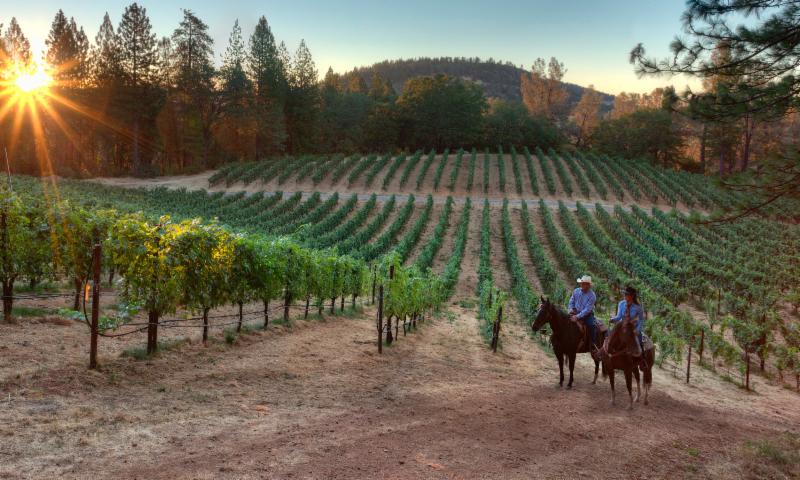
Source: Hawk and Horse Vineyard
Hawk and Horse Vineyards started as the dream of David Boies, who purchased an abandoned horse breeding farm in Lake County in California. His partners Mitch and Tracey Hawkins planted the first vineyard in 2001 in the red rocky volcanic soil, at an elevation of 1,800 to 2,200 feet. The first wine, released in 2004, was a great success. The 18 acres farm became California Certified Organic (CCOF) in 2004, and biodynamic Demeter-certified in 2008. If you want to have an example of what biodynamic farming is, you can read about the Hawk and Horse Vineyard biodynamic practices here – it will be well worth a few minutes of your time.
Hawk and Horse Vineyard grows primarily Bordeaux varieties. I had an opportunity to taste (sample) 5 wines from Hawk and Horse Vineyard, and I was literally blown away from the very first sip I took (magic!). Here are the notes:
2017 Hawk and Horse Vineyards Cabernet Franc Red Hills Lake County (14.3% ABV, $65, 100% French oak (40% new), 150 cases produced)
Garnet color
Wild strawberries, mint, mineral notes
Cassis, fresh black berries, sweet tobacco, well-integrated tannins, firm, tight, perfect structure, excellent balance. Worked perfectly with the steak.
Drinkability: 8+, wow
2017 Hawk and Horse Vineyards Petite Sirah Red Hills Lake County (14.1% ABV, $65, 100% French oak (40% new), 150 cases produced)
Garnet
Tobacco, earth, sandalwood
Silky smooth, round, tart cherries, perfect acidity, dark and powerful, perfect balance.
Drinkability: 8+
2017 Hawk and Horse Vineyards Petit Verdot Red Hills Lake County (14.1% ABV, $65, 100% French oak (40% new), 90 cases produced)
Dark garnet
Cherries, eucalyptus
Tart sweet cherries, dark fruit, dry tannins, firm structure. Super enjoyable over 3 days, the addition of tobacco and sweet dark fruit with balancing acidity. Succulent. Superb.
Drinkability: 8+
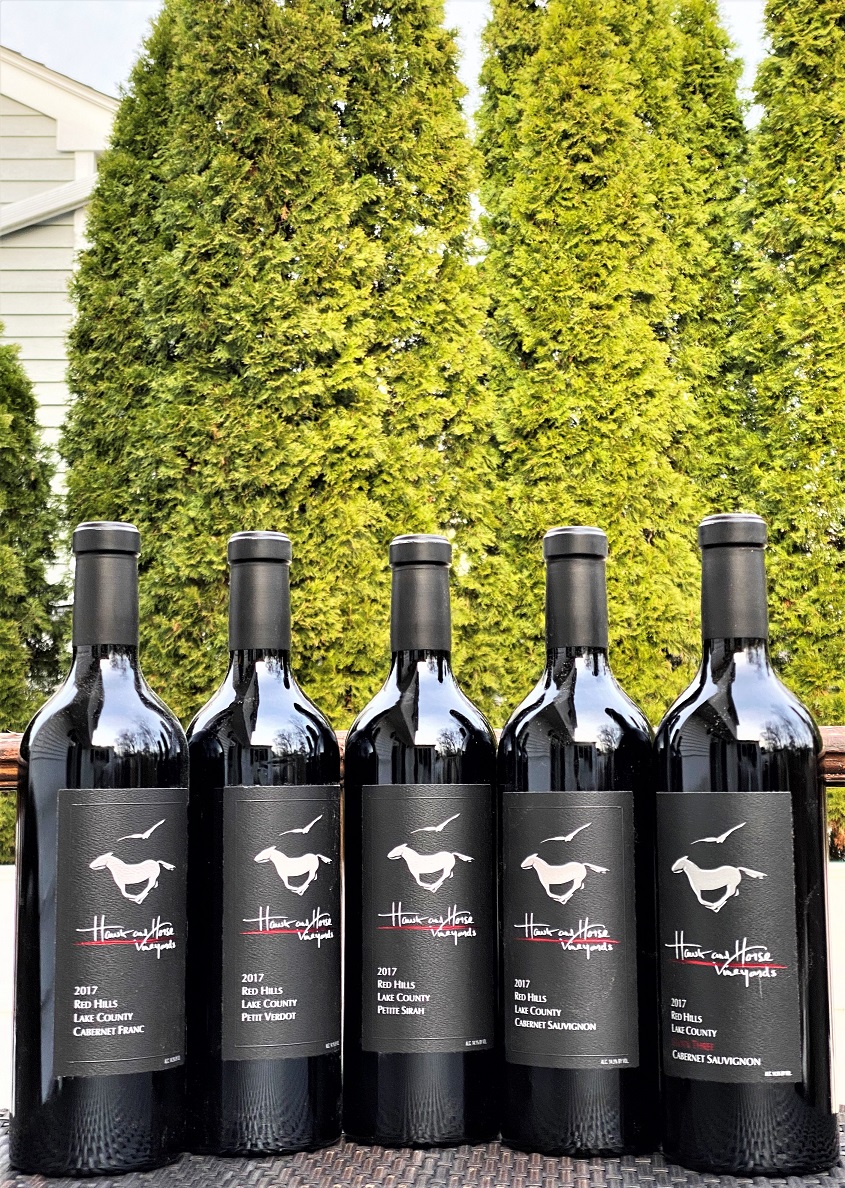
2017 Hawk and Horse Vineyards Cabernet Sauvignon Red Hills Lake County (14.3% ABV, $75, 98% Cabernet Sauvignon, 2% Petit Verdot, 100% French oak (80% new), 1800 cases produced)
Dark garnet
Earthy flavors, eucalyptus, a hint of cassis
Good acidity, well-integrated tannins, the lightest wine so far.
3 days later ( no air pumping, just reclosed)
The nose has a similar profile (cherries, eucalyptus, mint), maybe a touch higher intensity
Delicious on the palate, dark well-integrated fruit, firm tannins, tight core, lots of energy, a hint of espresso, perfect balance, medium-long finish.
This wine can be enjoyed now, especially with food. Or left alone for the next 15 years. Your choice.
Drinkability:8+
2017 Hawk and Horse Vineyards Cabernet Sauvignon Block Three Red Hills Lake County (14.3% ABV, $60, 85% Cabernet Sauvignon, 10% Petit Verdot, 5% Cabernet Franc, 100% French oak, 150 cases produced)
Dark garnet
Warm, inviting, succulent cherries, a hint of bell pepper, very delicate. Overall, ripe Bordeaux nose
It took this wine 4 days to fully open up. Bordeaux style, ripe berries with herbal undertones, well-integrated tannins, soft and dreamy.
Drinkability: 8/8+
Cabernet Franc, Petit Verdot, and Petite Sirah were absolutely delicious from the get-go. Both of the Cabernet Sauvignon wines, coming from the same vineyard and the same vintage really needed time – I don’t know if the type of oak used can make such a difference, but from my observations, it was clear that using more of the new oak made the wine a lot more concentrated and requiring the time in the cellar.
Here it is, my encounter with [magically], [mysteriously] delicious biodynamic wines. What do you think of biodynamics and biodynamic wines? What do you think of the magic of wines (no, you don’t have to answer that 🙂 ). Cheers!
Beyond Wine? Before Wine? Instead of Wine?
Today, class, we are going to talk about grape juice. The real grape juice.
Am I about to descend into the rat hole of “clear and unclear wine” with this “real juice” statement? Nope. Not at all. Today we are talking about pure, unadulterated, varietal grape juice which stayed in the form of juice without becoming the wine.
When I got an offer to receive a sample of the Castello di Amorosa varietal grape juices, my first reaction was “seriously???”. Juice is juice no matter what it is produced from, right? It is usually cloyingly sweet and not something I generally enjoy. I had a great experience tasting the juice of just-harvested Merlot grapes at Paumanok winery on Long Island, and I still remember how incredibly sweet it was, so I don’t really see it as a product on its own. But then curiosity prevailed, and I asked for the sample to be shipped.
I got three juices shipped to me – Muscat Canelli, Gewurztraminer, and a Sparkling Red blend, all beautifully packaged in the Riesling-style bottles and labeled exactly as the wine would. Muscat Canelli and Gewurztraminer are 100% pure varietal, and red blend consists of 90% Gamay, 5% Cabernet Sauvignon and 5% Grenache. All juices priced at $14 per bottle and available at the winery or online.
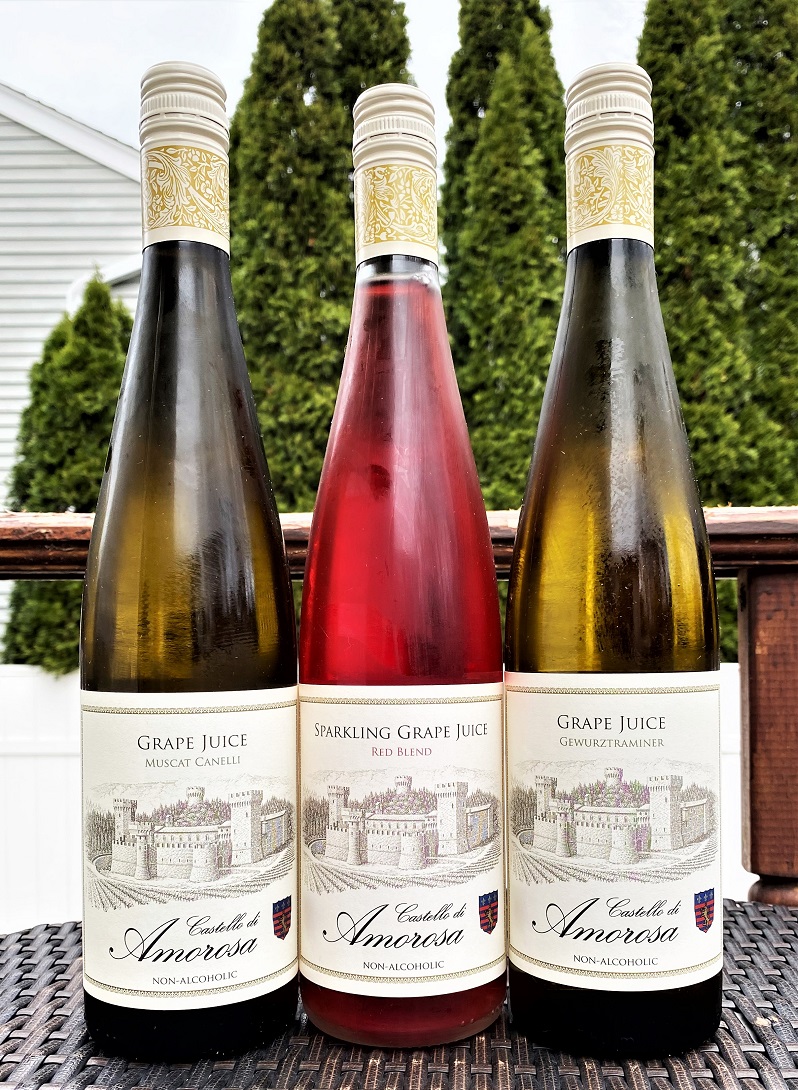
When I first tasted the juices, I really didn’t treat them as wines – I didn’t try to analyze the profile and understand individual flavors, the nose, the palate – I looked at them more as binary “like/don’t like” type of experience. I also made the mistake of judging the “wine” by the first taste – thus I declared Muscat, which was open the first, to be “too sweet”. Gewürztraminer was open second and showed nicely (read: surprisingly) balanced. The sparkling red blend was my favorite – it was barely fizzed (”sparkling” is a big word here) and had a nice tangy mid-palate feel, sort of a burst of the wild berries – really, really delicious.
It is interesting to note that these juices not only taste like wines, they also behave like wines. On the second day, the initial sweetness of Muscat subsided – just a little bit, but it was enough to make the juice appear more balanced and the Muscat instantly became my favorite for the evening.
I had been writing about wines for more than 10 years. While writing about the wine, all the little details – technical details, shall I say – summarized in the tasting notes, published by the wineries for all the wines and all the vintages – are quite helpful. This is where you find the details about the vintage, grape composition of the wine, fermentation, and oak regimen. At least, this is what I typically use in my writing. Talking about wine’s technical details, you can also often find there some of the analytical data – namely, pH and amount of residual sugar. And so in my 10+ years of writing, I literally never paid any attention to pH and residual sugar – it took nothing less than unfermented grape juices to make me look at those. Let me share those details with you:
Castello di Amorosa Gewurztraminer Grape Juice – residual sugar: 200.9 g/l, pH: 3.19
Castello di Amorosa Muscat Grape Juice – residual sugar: 18.5 Brix (199.12 g/l), pH: 3.35
Castello di Amorosa Sparkling Grape Juice Red Blend – residual sugar: 18.6 Brix (200.28 g/l), pH: 3.25
As you see, all juices have about 200 grams of sugar per liter – for comparison, there are 113 grams of sugar in one liter of Coke. We can also compare these juices with world-famous dessert wines – Sauternes, which typically sport between 80 and 120 grams of sugar per liter, occasionally reaching 160 or even higher. When it comes to pH values, wines are typically falling in the range between 3 and 4, and the lower the pH value is, the more acidic the wine will be perceived (note that pH is not a direct measure of acidity in wine), so as you can tell the pH values of these juices are quite comparable with the wines.
At the end of the day, it all comes down to balance. Everyone’s palate is different, and your perception of sweetness, acidity, and bitterness can perfectly differ from mine, however, balanced wines exist in each one of our personal worlds. So I have to tell you that each one of these juices was perfectly balanced for me, and therefore, I’m aptly impressed by the mastery of the winemakers here. To make my excitement clear – these are unadulterated beverages. There is nowhere to hide. No flavor-enhancing yeasts, no oak, no blending. Nothing. You need to know when to harvest and when to bottle. Nowhere to hide.
As you can tell, I can wholeheartedly recommend these juices. They are perfect on their own. Perfect any time you desire a little sweet fix after the meal. They will perfectly well support a wide variety of dishes. And I have a number of friends who only drink sweet wines with very little alcohol in them – considering the quality of these juices, I would much rather prefer to serve them these juices instead of Bartenura Moscato di Asti or a similar plonk (my apologies).
You know me well, so I’m sure you understand that it is improbable that I wouldn’t have any gripes – of course, I have them. While winery information on the back label is nice to have, I would like to know when these juices were bottled. How they should be stored. For how long they can be stored. How the opened bottles can be stored (I’m presuming in the refrigerator, but still), and how quickly the opened juices should be consumed.
Nevertheless, this was a great surprise and a delicious discovery. We might be looking at the trend here – hard to tell, but I expect that there will be wineries that will follow Castello di Amorosa’s lead. And I personally would be happy to have a few bottles always on hand to delight oneself or a special guest. Next time someone offers you a glass of varietal grape juice, say “thank you” and enjoy. Cheers!
Double Lucky Number 8
Luck.
An interesting term.
Luck is extremely subjective, personable, and relative. There are many definitions of luck, starting with the cliche one “when preparation meets opportunity” – not sure how that would apply for example, in the case when the brick is accidentally falling off the roof of the building and missing your head by the quarter of an inch. Or when you win the lottery. When you miss your train and meet the love of your life – what kind of luck is that? Okay, let’s not get hung up on the research of the true meaning of “luck” as this is not the goal of this post.
Last year, 2020, can hardly be called a “lucky” year. Quite on contrary, for 99.9% of people living today, this was probably the unluckiest year of their lives to date (who knows what the future hold). Or was it? Yes, we lost the ability to travel, eat out, enjoy the concerts, and socialize with friends. And yet many of us who kept our jobs managed to pay off debt (Americans paid off the record of $83B in credit card debt), invest into their homes (the price of lumber doubled in certain markets in the USA, due to very high demand), and even get well on the path to early retirement. And those of us obsessed with wine even got access to the wines we couldn’t dream of before (thanks to the restaurants not buying those wines anymore), and meet lots and lots of winemakers who happily visited our houses – via zoom. Everything has its silver lining.
A few months ago I got an email from Cayuse, saying that I will be getting a bottle of wine called Double Lucky #8 – a free sample, plus there will be a special zoom with the winemakers to introduce the new wine. Cayuse, and all of the “sister” wines – No Girls, Horsepower, Hors Categorie – are super-allocated (never mind expensive), so the free bottle sounded very lucky.
The wine arrived a few days ago. A beautiful bottle that solicited an array of thoughts. Cayuse wines are better with age – 2017 is clearly too young to be enjoyed now. Also, I love sharing the wine – so what should I do – to open or not to open? I decided that as this will be a unique opportunity to taste this wine together with the winemakers, I should just open the bottle and go with the flow. But also do it in a smart way – open a few hours in advance and decant it – which I did.
I remember reading an article by W. Blake Gray, the wine writer and a critic I respect very much, who mentioned that Cayuse wines might be the best wines made in the USA. Ever since then, tasting Cayuse wines became a dream, which required more than 10 years of waiting to get on the mailing list. Obviously, meeting Christophe Baron was a similar dream, which materialized thanks to pandemic and zoom.

Our zoom session was moderated by Owen Bargreen, the wine critic from Washington, with Christophe Baron and Elizabeth Bourcier, the winemaker, talking about all of the wines produced by Cayuse – well, that is not exactly correct. As introduced by Christophe Baron, it is all the wines produced by Bionic Wines, the new overarching brand, which includes Cayuse, No Girls, Horsepower, Hors Categorie, and Champagne Christophe Baron.
It is all about the rocks (Cayuse is derived from Cailloux which means stones or rocks in French). If I would give you a cliff note on what Christophe Baron does, it would sound something like “he finds the great location, establishes new vineyard, and makes new wine” – really, this is the story behind various Cayuse wines, No Girls, Horsepower…
Everything at Cayuse is done in full respect and harmony with nature – all the vineyards are farmed biodynamically since 2002 – the only biodynamic winery in Washington. As Christophe put it eloquently during the webinar, Mother Nature is the Master, and we are all her servants – it is Mother Nature who produces the grapes, and the winemaker needs to covert those into the wine, hence the utmost respect and attention to producing the wines in full harmony with nature.
We talked about all the wines under the Bionic wines umbrella, how they came to being (remember, new vineyard – new wine), and what is the philosophy behind them all. Almost at the end of the session (the time flew unnoticed, all thanks to the incredible energy and enthusiasm of Christophe), we finally talked about 2017 Double Lucky #8, a blend of Grenache, Syrah, and Tempranillo, the same three varieties which comprise No Girls offering. Double Lucky is Elizabeth Bourcier’s project, from start to the finish – her idea, her execution. She wanted to create the wine similar to Cotes du Rhône – simple and approachable from the get-go, a sort of Cotes du Walla Walla if you will. Was she successful? Let’s talk about it.

When I poured the wine at first, it literally jumped out of the glass. I call Cayuse wines “liquid rocks” – Double Lucky was no exception, with granite, iodine, and smoke being prevalent both on the nose and on the palate. The wine was definitely drinkable, though not for the faint at heart – if you like massive wines, you would be pleased. 2 hours in a decanter made the wine more mellow, shifting the balance towards some cherries and herbs. For my palate, the wine continued up and down until it was gone.
Elizabeth shared her winemaking philosophy, which includes whole cluster fermentation and use of the stems, as stems “give the wines freshness” in her own words. I’m rather cautious about both – I guess my palate is overly sensitive to the tannins extracted from the stems – I perceive them as “green” tannins, which are unpleasantly bitter, and thus I’m generally not a fan. So I don’t have a strong opinion on Double Lucky #8, and while the wine is influenced by Cote du Rhône, it will last for the next 10–20 years, unlike Cote du Rhône wines, which typically have only a few years to be enjoyed, so I would definitely mark it as “needs time” right now. One more parallel with Cote du Rhône – those wines are usually inexpensive – and Double Lucky will be the cheapest wine in Bionic Wines portfolio, at $44 when it will be officially released next winter as part of the No Girls wines release. While the wine is a blend of Grenache, Syrah, and Tempranillo, there are no exact proportions, as the blend will change every year. I can only guess Grenache makes the majority of the blend, given Elizabeth’s propensity for use of Grenache as she does in her own sought-after wine, La Rata.
I have to tell you that while the zoom is exceptional, it is hard to keep attention all the time. As the result, I don’t know if it was just me, but I didn’t really get the real story behind the intriguing name (Double Lucky) and the meaning of #8. Was that the blend #8 which became the winning one? Was the idea behind this wine associated with some lucky moment? I would love to know, but I have no idea. Hopefully, someone will be luckier than me and we will learn the story behind the name.
Was that a lucky break drinking Double Lucky and listening to Christophe Baron? Oh yes, it was. I wish all of us lots and lots of luck, whether we are prepared for it or not.
Wine News and Updates
It seems that the wine world is moving at an ever-increasing pace, with new wines and wine products continuing to surprise even the most adventurous wine lovers. Today, we want to cover some of the most interesting news and announcements.
Loic Pasquet is the winemaker at Liber Pater, the winery in Graves, producing some of the most expensive wines in the world. He is well known for his unique approach to winemaking, using pre-phylloxera vines and old grape varieties which are not used in winemaking in Bordeaux anymore, thus forcing his wines not even carry Graves appellation on the label. It appears that Loic is also an avid coffee lover. After tasting Kopi luwak, the coffee produced in Asia from the beans partially digested by the rodent, Loic decided to try to replicate the same in the winemaking, training presumably marmots (this work is done in full secrecy, so very little information is available) to eat grapes which they can’t fully digest. We hear that in the blind tasting, the wine made from partially digested grapes showed an immense promise, but I guess it will take it a few more years for those wines to become available to the wine lovers (you can imagine production quantities of a few cases a year, each bottle probably costing around $100K – but at the moment, we can only speculate about it).
Continuing the wine and coffee theme, it appears that Starbucks entered a partnership with E.&J. Gallo Winery to produce wine directly from the coffee berries. The coffee berries (or cherries, as they are properly called) are imported from Guatemala and Costa Rica at the moment. Coffee cherries are crushed and fermented at the E.&J. Gallo facility in Northern California, with some batches undergoing malolactic fermentation. Once fermentation is complete, the coffee wines are aged in ceramic eggs for 9–12 months and additional 6 months in the bottle. Few of the wine critics already had an opportunity to taste the wines and had been wildly raving about them. Starbucks and Gallo are currently in conversation with coffee farms in Kona, Hawaii, to add famous Kona coffee to its line of coffee wines. The new coffee wines, branded CoStarWin, should appear in Starbucks shops next year, first in San Francisco and Seattle, with more locations getting access to the much-desired beverage.
The unbound creativity of Coravin is widely known – the non-stop innovation coming from the maker of the famous wine preservation system is simply incredible. It was recently reported in the news that Coravin partnered with none other than Patek Philippe, a famous Swiss watchmaker, to create a new version of Coravin which allows to age wine for a precise number of years as the wine been poured into the glass. Let’s say you want to drink Opus One, and you only have the current vintage of the wine. Take your trusted Coravin, set the dial to 15 years, pour a glass, and enjoy delicious Opus One in its prime, tasting exactly as it would 15 years from now. The technology behind the new gadget had not been revealed, however, it is known that Coravin filed 16 patent applications with USPTO in conjunction with this new product. The new device, aptly named Coravin Patek WineTime, is supposed to be available in time for Christmas shopping this year and will retail for $1199.
I’m sure you will find the next news update quite surprising – Procter and Gamble is not readily associated with wine, but still. It was recently leaked to the press that Procter and Gamble, or P&G for short, is developing a new type of toilet paper using … yes, grape skins! – as the main source material. The project started out of a desire to find a new use for the abundantly available grape skins, and quickly developed into a major R&D undertaking. The first results are very encouraging, with users raving about the pleasure of using the colored toilet paper instead of just the boring white. It appears also that grape-skin-based toilet paper has excellent skin-soothing properties, so this product definitely has a bright future. It seems that Walmart got exclusive distribution rights for Charmin Grape Magic Ultra, so look for it starting in January 2022, and see how you will like it.
The last one for today is again, somewhat unexpected. Wine is usually associated with gourmet food, and Velveeta, the infamous cheese spread, is as far from gourmet food as it can be. Nevertheless, in an attempt to expand its customer base, Velveeta just announced a new line of cheese products called BoozyV. The BoozyV cheese spreads are made with the addition of the wine directly into the spread. As wine is added at the end of the mixing cycle and right before packaging, it doesn’t lose any alcohol content and offers the best of both worlds for the wine and cheese lovers – the product which instantly combines both together. Initially, the BoozyV line includes Cabernet Sauvignon, Syrah, and Zinfandel cheese spreads, with a nice buttery Chardonnay version hitting the stores at the beginning of the next year. As BoozyV products contain alcohol at full strength, they will be exclusively available at fine wine retailers nationwide.
That’s all I have for you for today, my friends. Cheers!
Wednesday’s Meritage #156
Meritage time!
Once again I’m starting with Open That Bottle Night. February 27th, rain, snow, or shine, will be the time to open that special bottle. If you are not familiar with Open That Bottle Night, please check the previous issue of Meritage or this post. I plan to have a virtual OTBN with friends – anyone who is interested in joining, please send me a message (email, Twitter, Insta – all work), and I will let you know how to connect. Now, I need to make up my own mind and decide what I’m going to open – easier said than done, believe me.
Next, in a bit of a “local news”, I would like to promote the series of posts which I had been running for a long time on this blog – the wine quizzes. These wine quizzes used to be a weekly endeavor until they became just a few a year and then stopped completely. I restarted the series about half a year ago, with the hope of posting a new quiz once every two weeks. I had a number of the wine quiz themes over the years, with one of my favorites asking the readers to identify the wine producer by the image of the top of the bottle – foil, cork, or wax – here is an example of such a quiz. But now I have a new twist on that theme, asking the readers to identify the producers by the fragment of the image of the label, which should be easier than doing it using the bottle tops. Here is an example of such a new quiz. So all I want to do is to encourage all of you who are reading this right now to give it a try – you have nothing to lose!
And now, for the real, global wine news, how about some global wines, or maybe rather “Wines of the World”? It appears that Penfolds, one of the most iconic Australian wine producers (Grange, anyone?), just unveiled the line of California wines. The wines are made from the grapes coming from the vineyards in Napa, Sonoma, and Paso Robles. Continuing Penfolds naming tradition, the wines are identified by the bin numbers, starting from Bin 600 Cabernet-Shiraz, priced at $50, and going to the flagship Quantum Bin 98 Cabernet Sauvignon at $700 per bottle. The top two wines, Quantum Bin 98 and Bin 149 have some of the Australian wine as part of the blend, hence the “Wine of the World” moniker. For more details, you can read the whole story in the Wine Spectator here.
That’s all I have for you today. The glass is empty, but the refill is on the way. Cheers!
Last Bottle Sign Up ($10 credit)





