Archive
Top 24 of 2024
 See how well this rhymes?
Top 24 of 2024.
When I posted my list of top wines of the year for the first time in 2010, the desire was to create a list of the top 10 wines. This was almost successful, as the list included 12 wines, so I decided that “my thing” would be Top Dozen. I managed to maintain that limit of a dozen wines in 2010 and 2011. But then in 2012, I failed miserably, and that list included 26 wines. And ever since, all the top wine lists have had about two dozen wines or so.
I’m glad that in 2024, I don’t need to even look for any excuses as to why the top list contains so many wines. 24 wines is perfectly suitable for 2024, so that’s what we are going to do.
The selection process for the wines to be included in the Top Wines of the Year is very simple – the wine has to be memorable. These are the wines that solicited emotion, and thus became memorable. They don’t have to be the highest rated wines, even though they often are, but they have to be memorable.
I never try to calculate how many wines I taste during the year. Including all the tasting events and wine dinners I’m lucky enough to attend, I would guess this number is close to a thousand, so I believe selecting two dozen wines out of a thousand is reasonable. And please believe me when I say that decision is never easy, especially when it comes to deciding on the top spot – 2024 was no exception, and you will see why as you follow along.
Without further ado, let me present to you Talk-a-Vino Top Wines of 2024:


25. 2021 Bodegas El Nido El Nido Jumilla Do Spain ($150) – very much last-second addition to the list, but I would be upset if I did not include this wine. El Nido is generally a massive wine – pop and pour drinkability of this 2021 flagship of Gil Estates wines was very surprising and definitely memorable. Voluptuous, generous, yet perfectly balanced – one memorable wine – which is the main criterion for the inclusion into this list.
24. 2021 Le Clos du Caillou Cotes du Rhone Cuvee Unique Vieilles Vignes ($19, Last Bottle) – I’m generally a bit concerned about Cotes du Rhone wines, as I had many underwhelming specimens over the years. Not this wine though – beautiful, round, supple without being overbearing, very easy to drink.
23. 2021 FIOL Rosé Prosecco DOC Millesimato ($22) – everyday bubbles. Can I say just that? Okay, fine, if you insist – it was delicious, with a lot of energy and the fizz more reminiscent of a good champagne. Strawberries, anyone?
22. 2023 MAIA Winery Mare White Israel ($25) – Was looking for an Israeli wine to celebrate Rosh Hashanah, and came across this wine at the local Total Wine. Somehow this wine spoke to me, and I’m glad it did – it was all-around delicious with a structure that would make a good Chardonnay proud.
21. 2017 Campochiarenti San Nicola Riserva Chianti Colli Senesi DOCG (€19) – There is something special about Italian wines, like they can speak directly to your wine lover’s soul. Cherries galore, beautifully and tightly packaged to put a smile on your face. Don’t believe me? Try it for yourself.


20. 2021 Keeler Estate White Wine Blend Eola-Amity Hills AVA ($20, Last Bottle) – as you peruse this Top wines list, you will see many finds courtesy of Last Bottle. Yes, Last Bottle knows how to present their wines in a very appealing way – but Last Bottle can’t force the wine to appear in this list, this would be my doing. So this wine was delicious – light, citrusy, with just the right amount of complexity.
19. 1997 Chateau Haut-Piquat Lussac Saint-Emilion AOC ($19.99, Wine Exchange) – I don’t drink a lot of Bordeaux, so I’m glad I had at least one wine worthy of inclusion in this Top list. I found this wine a few years back with the help of Wine Exchange, and it was an excellent find – a classic old-world Claret, still youthful and delightfully drinkable.
18. 2014 Le Casalte Vino Nobile di Montepulciano DOCG ($N/A) – another “first of” wine on this list – first of the great wine finds we experienced during our family European trip earlier this year. Not only was this wine tasty, but it was also very memorable as I ordered this Vino Nobile wine at a restaurant at the very heart of the Brunello land – in Montalcino. Well, good Sangiovese is a good Sangiovese, what can I say. This one was delicious.
17. 2022 Gran Bousquet Organic Cabernet Sauvignon Uco Valley ($25) – Cabernet Sauvignon of this quality for this price is simply unreal. And it is organic. If you like Cabernet Sauvignon, this is a must-try.
16. 2017 Saxum Heart Stone Vineyard Paso Robles Adelaida District ($110) – this wine could probably wait for another 3-4 years (or much longer) – still, it delivered enough pleasure as it was. Powerful, concentrated, delicious.


15. 2017 Royal Tokaji Borászat Mad Royal Tokaji Aszú 5 Puttonyos ($N/A) – One of the highlights of the trip to Hungary. Seductively sweet and refreshingly acidic – a dessert wine to seek.
14. 2022 Petit Sauvage Rouge Vin de France ($17.99, Wine.com) – This wine forced a deep search in my wine lover’s vocabulary to find the words to describe it properly. I rather failed with the search, but I enjoyed the process – you can read more in the post. A rare grape and a very memorable experience.
13. 2018 Anaperenna by Ben Glaetzer Barossa Valley Australia ($49, Last Bottle) – I need to drink more Australian wine, as this one was delicious on all levels.
12. NV Champagne Camille Jacquet Brut Grand Cru Chardonnay A Le Mesnil-sur-Oger ($35, Last Bottle) – yes, another Last Bottle, and an absolute steal of Champagne for the money. Toasted notes on the nose and the palate, lots of energy and finesse. Also comes with regrets – why did I only buy 3 bottles?
11. 2021 Banfi Poggio Alle Mura Rosso di Montalcino DOC ($25) – another Sangiovese, another wine associated with our family’s European trip and a first wine from Banfi (spoilers: there will be more). We had this wine during our lunch at Castello Banfi, and it stopped everyone in their tracks – even kids who are not really into the wines.


10. 2018 Ramos Pinto ‘Urtiga’ Terracos Pre-Filoxericos Douro DOC ($300) – talk about unique wines – this one will be hard to beat. It comes from the vineyard where each vine has its own GPS and sensors, and can be tracked. Made from 63 unique varieties. Delicious, elegant wine, as memorable as they ever get…
9. 2012 No Girls Tempranillo La Paciencia Vineyard Walla Walla Valley ($90) – liquid rock, tamed. End of the description. Seriously, smokey and brooding wine, full of granite and iodine, mature enough to let the fruit show through. Definitely an experience.
8. 2020 Avignonesi Desiderio Toscana IGT Merlot ($60) – What is it with Italian Merlot? It is as good as Sangiovese gets. Unmistakably Italian, round, classic, delicious.


7. 2009 Sauvella Luscinia Canta Costers del Segre DO ($30) – when my friend said ” you will love this wine” it didn’t register with me. Then I opened the bottle, and the next thought was “oh my god, this is so good, what is it???”. A Spanish wine of an unusual pedigree (Syrah and Cabernet Sauvignon in leading roles), smooth, well-structured, scrumptious. And I don’t even want to mention the price…
6. 2022 Terra Alpina Chardonnay Vigneti Delle Dolomiti IGT ($20) – I’ve had Terra Alpina wines before, I guess this is what convinced me to get this bottle at Whole Foods in Florida. I’m a sucker for a good Chardonnay, and this high-altitude, Alpine-climate-driven rendition was just spectacular, round and succulent. A delightful wine all the way.
5. 2021 Juan Gil Red Blend Jumilla DO ($15) – Another surprising business trip Whole Foods find. I grabbed this wine strictly based on price. Once I poured it into the glass, I was blown away by both the aromatics and the bouquet of ripe fresh berries, sweet oak, chewy but elegant tannins, the whole package for mere $15.
4. 2018 Smith-Madrone Cook’s Flat Reserve Spring Mountain District Napa Valley ($225) – Textbook Cabernet Sauvignon. Precise flavor, immaculate delivery, the wine to experience.
3. 2019 Ramos Pinto Quinta de Ervamoira Douro DOC ($100+) – here we go – the second wine from Ramos Pinto. This is a single-vineyard wine, coming from a single vineyard designated as a UNESCO World Heritage site. Dark fruit, earthy, powerful, and precise.
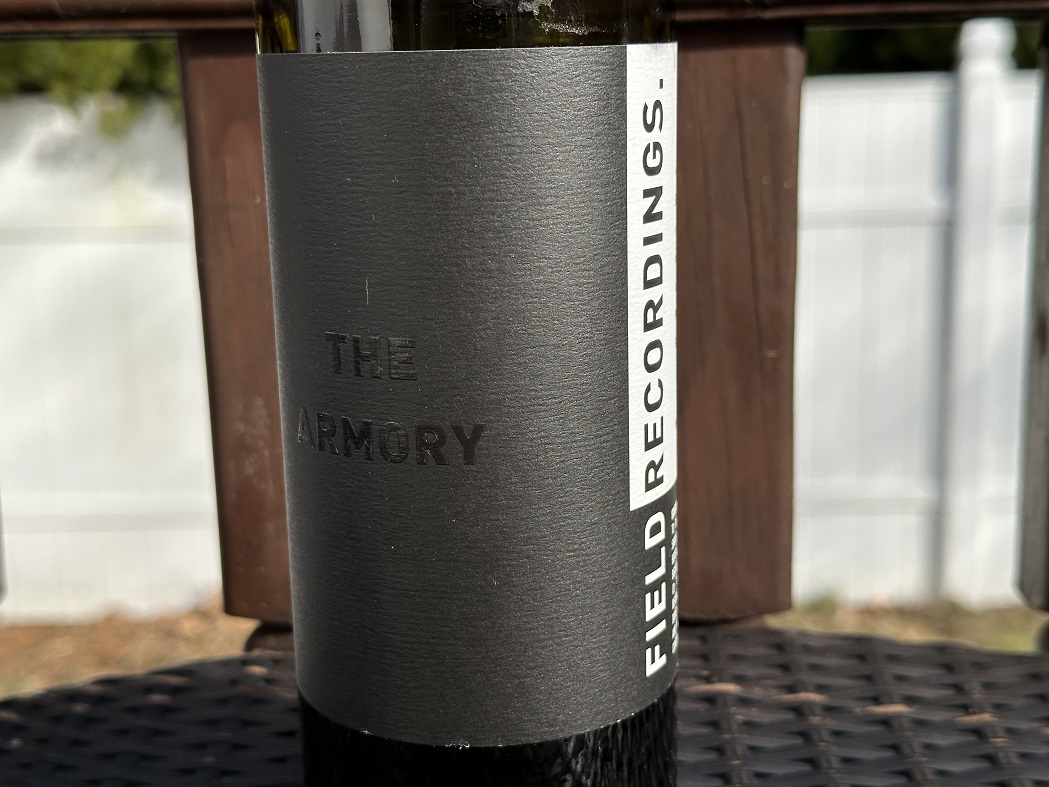
2. 2019 Field Recordings The Armory Paso Robles ($85) – This wine was really something else. I poured this wine for our guests on Thanksgiving, while continuing to drink whatever I had before. Judging by the facial expressions and overall reaction of our guests, I decided that it might be a big mistake if I will not try it. I don’t know what kind of dark voodoo magic was used to make this wine, but it was unique. This is 100% Cabernet Sauvignon, and while the wine had all the traits of a classic cab, every taste element had its own amplified energy, it was vibrant and alive. A truly unique experience.
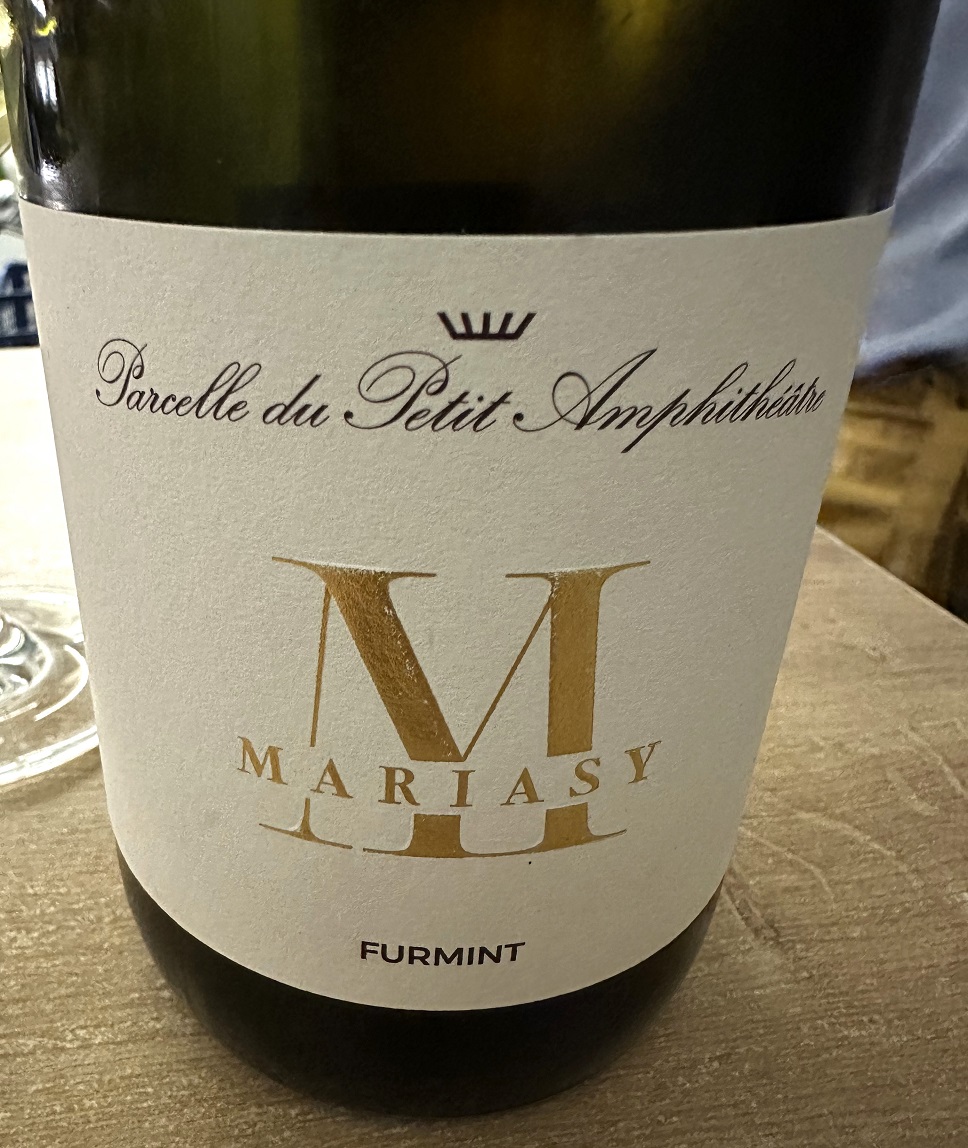
1. 2020 Mariasy Tokaji Furmint Hungary ($N/A) – yes, I did it again. Two #1 wines. In my mind, this was the only way. Chardonnay-like and Chardonnay. This Furmint wine was full-bodied, succulent, offering hints of vanilla and toasted notes and even imaginary butter, while being bright and energetic.
1. 2022 Banfi Fontanelle Chardonnay Toscana IGT ($30) – And now, the Chardonnay. Vanilla, apples, honey, bright, zingy, refreshing, and dangerous. Really dangerous – I would drink a bottle by myself.
This completes the presentation of the Top 24 (actually, 26, but who would count) Wines of 2024. Lots of well-worthy wines didn’t make it to the list, but I think I got a good representation here.
What was your wine(s) of the year 2024?
Fun With Numbers – Analyzing 2024 Top 100 Lists
 Do you like numbers?
Do you like to play with numbers?
I do – so let’s have a bit of a [almost traditional] fun with wine numbers. I’m talking about analyzing the Top 100 lists from the major wine publications.
Top 100 is one of the most anticipated and coveted topics in the wine world. There is a lot of anxiety and activities surrounding the Top 100 lists. Wineries proudly put their Top 100 “membership” on the bottles; publications, such as Wine Spectator, create a lot of drama, slowly unveiling their Top 100 selections over a week; wine stores are anxious to get and offer as many of the Top 100 selections as possible; consumers get an extra reason to buy the Top 100 wines as their greatness had been established by the experts. So let us take a closer look at the Top 100 Wines of 2024 lists from the major publications and compare them side by side.
The majority of the wine publications present their Top 100 lists, many of the publications even offering a multitude of Top 100 lists – for example, James Suckling publishes separate Top 100 lists for most of the major wine countries; Wine Enthusiast offers Best Buys, Cellar Selection and Enthusiast 100 lists. As I have done in the past, for this comparison I’m using Top 100 lists from James Suckling, Wine Enthusiast, and Wine Spectator. For the Wine Enthusiast, I’m using the Enthusiast 100 list. Also note that while James Suckling and Wine Enthusiast 2024 Top 100 list links are specific to the year, Wine Spectator has one link for all top 100 lists from 1988 until 2024 (going through those is a fun exercise in itself).
Now, let’s discuss the particulars.
Wine of the Year
Let’s start with the Top wines of 2024. Out of the 3 top wines, 2 are reds and one is sparkling – not very surprising as red wines dominated the top 100 lists at all three publications. James Suckling’s Top wine of 2024 was the 2015 Bertani Amarone della Valpolicella Classico (JS100, $125). Wine Enthusiast’s Top wine of 2024 was the 2013 Roco RMS Brut Delayed Disgorgement 10-Year Sparkling Willamette Valley (WE98, $125). Lastly, the Wine Spectator Top wine of 2024 was the 2021 Viña Don Melchor Cabernet Sauvignon Puente Alto Puente Alto Vineyard Chile (WS96, $175).
Regions
Here is how the three Top 100 lists stuck up when it comes to the wine regions of the world:
| Region | JS | WS | WE |
| Argentina | 6 | 3 | 4 |
| Australia | 5 | 3 | 3 |
| Austria | 4 | 1 | 3 |
| California | 12 | 26 | 37 |
| Canada | 3 | ||
| Chile | 6 | 4 | 2 |
| China | 1 | ||
| France | 18 | 16 | 14 |
| Georgia | 1 | ||
| Germany | 12 | 1 | 1 |
| Greece | |||
| Hungary | 1 | 1 | |
| Israel | 1 | ||
| Italy | 26 | 20 | 13 |
| New York | |||
| New Zealand | 4 | ||
| Oregon | 5 | 5 | |
| Portugal | 4 | 5 | |
| South Africa | 1 | 1 | 2 |
| Spain | 6 | 6 | 3 |
| Uruguay | |||
| Washington | 3 | 4 | 3 |
I purposefully left all regions that were included in the previous years so you get a better picture. As you can see James Suckling’s list was dominated by Italian wines. Wine Spectator had a penchant for California, but not as much as the Wine Enthusiast, where almost 40% of the Top 100 wines came from California. New entrants compared with the previous years were the wines from Georgia and China.
Wine Types
Here is the comparison classified by the wine types:
| Type | JS | WS | WE |
| Dessert | 3 | 1 | 2 |
| Fortified | 2 | 1 | 1 |
| Red | 60 | 67 | 68 |
| Rosé | 1 | 2 | |
| Sparkling | 2 | 2 | 8 |
| White | 33 | 28 | 19 |
As you can see, red wines dominated all of the lists. The last time I did this comparison back in 2021, and compared to that table I had to add a row for the fortified wines. I’m happy to see that all 3 Top 100 lists included at least one fortified wine. Also, Wine Enthusiast included a good number of sparkling wines, with most of them coming from Oregon out of all places (and those will be even harder to find than Champagne due to a very limited production).
Ratings
Ratings continue to be radically different between all three lists. James Suckling ratings don’t go lower than 97, and Wine Spectator’s top rating was 98 with only a single showing.
| Rating | JS | WS | WE |
| 100 | 20 | ||
| 99 | 58 | 1 | |
| 98 | 17 | 1 | 3 |
| 97 | 5 | 8 | 13 |
| 96 | 6 | 19 | |
| 95 | 12 | 16 | |
| 94 | 19 | 16 | |
| 93 | 17 | 22 | |
| 92 | 11 | 8 | |
| 91 | 10 | 2 | |
| 90 | 16 |
I don’t know why there is such a disparity in ratings, but that makes this comparison even more interesting.
Prices
Prices are always an interesting subject, and the presentation of the prices was different this year among all 3 lists. Wine Spectator had prices for all wines included in the description – I can only assume those are suggested retail prices. James Suckling had no prices listed but instead had prepared links for the Wine Searcher to retrieve a current market price for each wine – which makes sense as many of these wines might be on the market for a while and might command premium even before they were included in the Top 100 lists. Wine Enthusiast had prices listed for most of the wines, and also had buying links for all of the wines that were tailored to a specific source – some to Wine.com, some to Wine Searcher.
In the Wine Spectator’s Top 100, the most expensive wine was priced at $375 (MSRP). 19 wines on the list were priced at $100 or higher. The least expensive wine was only priced at $12 (#49 on the list). There were 6 wines on the list priced under $20, a very reasonable number. The top 10 wines, if you could find and buy them all at once, would cost you $1,032.
The most expensive wine on James Suckling’s list was priced at $407 (market price). Only 37 wines were priced at less than $100, which makes 63 wines to be priced above $100 – again, keep in mind that these are market prices according to wine-searcher, so YMMV. The least expensive wine and the only one under $20 was priced at $17, however, interestingly enough, it was wine #2 on the Top 100 list. The top 10 wines combined would cost you $677.
Lastly, the Wine Enthusiast’s Top 100. The most expensive wine was also the most expensive among all 3 lists, priced at $612. 33 wines were priced above $100, so 67 wines were priced at less than $100. The least expensive wine and the only one under $20 was priced at $19 (wine #35, price from wine-searcher). The top 10 wines would cost you $1,100.
Conclusion
I was happy to see lots of familiar – not just familiar, but rather, favorite – producer names sprinkled across the lists. Turley Zinfandel as #14 on Wine Spectator’s list, Carlisle Zinfandel as #21, San Felice Chianti, Calera, Elena Walch; Lopez de Heredia and Cayuse Bionic Frog on the James Suckling list; Inniskillin Cab Franc Ice Wine and Wente Vineyards on the Wine Enthusiast list. I’m sure you will find lots of familiar names too.
I hope you are having as much fun looking through the data I presented here as I had compiling it. There is nothing to be concluded from this exercise, but I find it fun. If you think there is any other data you would like to see as part of this analysis – I will be happy to oblige.
Enjoy!
Asti: Everyday Wine You Love To Drink But Afraid To Admit It
 Let me ask you a favor: can you please be honest with me?
No, scrap that. Can you please be honest with yourself?
When/if you read this, can you honestly answer a question for yourself: do you like sweet wines?
Be honest with yourself. This is strictly between you and you. Nobody will ever know what you will say. But if you do, have at least the courage to admit it to yourself – “yes, I like sweet wines”.
We are afraid of sugar. When we consume it, we prefer not to even think of it. We are so ashamed at the thought that someone might think we like sugar. You are supposed to hate sugar. We are supposed to enjoy things that are not associated with sugar. Sugar is bad news. Period. This is why nobody would ever want to publicly admit they like sweet wines, as they are evil.
Even if you are not afraid to admit to your affection, sweet wines are a special category. It seems that even the smallest bottle is usually too big. And by the time the dessert is served, nobody wants to drink more wine. But leaving that aside, there is a critical element for the sweet wine to be called enjoyable. I’m sure you can easily guess it, but I will give you a moment to think about it.
Got it?
That element is important across all wines, but in the sweet wines it is really critical – and this element is balance. Balance of all elements can make or break any wine, but in sweet wines, it has to be impeccable for the wine to be enjoyable. The sweetness must be balanced by acidity. If it is not, the wine becomes simply cloying, and not enjoyable (yes, I’m talking about lack of acidity in the sweet wines – never tasted the one with too much acidity). And perfectly balanced sweet wine becomes an ultimate indulgence. Perfectly balanced sweet wine is so sensual, so seductive that… well, I better let your imagination run wild.
Now, is there a way to make this sweet wine experience better? Of course – what if we will add some fizz to this perfectly balanced sweet wine? And make it affordable? And reduce the amount of alcohol – not eliminate, but simply reduce? Would you enjoy it every day? I’m sure the answer is yes. And I have a wine to suggest which will perfectly fit this profile – Asti wines from Northern Italy.

Source: Consorzio Asti DOCG

Source: Consorzio Asti DOCG

Source: Consorzio Asti DOCG
Sweet wines of notice were produced around the towns of Asti and Alba in southeastern Piedmont as early as the 17th century using a grape called Moscato Bianco. It is possible that the wines were produced even earlier, as Moscato Bianco had been growing in Piedmont as long as the Piedmont’s king was, Nebbiolo. The Classic Method of Champagne production has traveled to Piedmont and the first sweet classic sparkling wine was produced in the region in 1870. After the Martinotti method of producing sparkling wines in the tank instead of the bottles was invented in 1895 by Federico Martinotti, it quickly displaced Methode Champenoise as less expensive and significantly less time-consuming. The same method is used in the production of Prosecco. Oh, and look at these beautiful vineyards…

Source: Consorzio Asti DOCG
In 1932, Consorzio per la Tutela dell’Asti (Consortium for the Protection of Asti) was established to develop and ensure the guidelines for the production of Asti wines, known at that time as Asti Spumante. Things were going well until Asti Spumante became a victim of its own success. After World War II, American soldiers coming back were bringing light, sweet, fizzy Asti wines with them, bringing a surge in popularity. As the history of many wine regions shows (Chianti, Amarone, Australian wines at the beginning of the 2000s), such an increase in demand leads to overproduction and a dramatic drop in quality – exactly what happened with the Asti wines which subsequently lost their popularity due to poor quality.
Moving forward, Asti had to redefine itself, step by step. When Asti Spumante DOC was promoted to DOCG status in 1993, producers decided to ditch the Spumante portion of the name, becoming simply Asti instead of Asti Spumante. Producers also changed their production methods and quality controls, often moving towards a less sweet, drier style. The consortium also established a maximum yield for the grapes’ harvest and minimum alcohol levels that need to be achieved after fermentation.
While Asti wines are perfectly enjoyable on their own, they also make one of the very best food-pairing wines. Craving spicy food? Asti will work perfectly with that. Something substantial and salty? Bring on the Asti. Maybe most importantly – and uniquely – Asti wines are incomparable when it comes to pairing with desserts. If you never experienced a glass of Asti with an apple tart or a peach cobbler, you are missing on some of the greatest pleasures in life – you really should try it next time.
As Consorzio is expanding its presence in the US, I had an opportunity to sit down (virtually) with Consorzio per la Tutela dell’Asti Director Giacomo Pondini and ask him a few questions about Asti wines. Here is what transpired in our conversation.
[TaV]: What is the history of wine production in the region? Is Moscato Bianco the only grape that has been cultivated in the region? What kind of wines were produced there before the introduction of sparkling wines in 1865?
[GP]: As in many other places around Europe, the Romans have imported the wine production in Piedmont. And since then, it has thrived. Beyond Moscato Bianco, the historical grapes in the region are red varieties: Barbera, Freisa, Nebbiolo. Probably the most important step towards a more modern style of winemaking, at that time, was made by Camillo Benso Conte di Cavour. Before becoming a fundamental politician in Italian history, he devoted himself to the production of a wine based on Nebbiolo, named Barolo. In the history of Asti wines, the production of vermouth has laid the economical basis for developing the sparkling wine industry, based on Moscato Bianco grapes.
[TaV]: What is the difference between Asti Spumante DOCG and Moscato d’Asti DOCG wines?
[GP]: The main difference lies in the pressure – Asti Spumante, a proper sparkling wine, has to have at least 3.5 bar pressure, while Moscato d’Asti, which is a fizzy wine, 2.5. Then the difference lies in the residual sugar, higher in Moscato d’Asti, where sugars are less fermented and, therefore also less alcohol.
[TaV]: I understand that Asti Spumante wines can be produced using Classic and Charmat methods. What are the styles of Asti Spumante wines produced in the region, the official classification?
[GP]: The classification goes from pas dosè to sweet. Historically speaking, the sweet typology was the only one allowed until 2017, when extra dry, dry, demi-sec were introduced. From 2020, pas dosé, extra brut and brut were also authorized.
[TaV]: What are the best food pairings for the Asti Spumante wines? I know that in Sauternes in France, the region famous for its sweet wines, it is possible to have a full dinner paired with sauternes wines, from appetizer through the dessert. Is it possible to do the same with the Asti Spumante wines? If yes, can you share a sample menu for such a dinner?
[GP]: We know that in many countries Moscato d’Asti and Asti spumante are paired with a wide range of food: from the traditional desserts to cheese, from barbecue to Thai soups, to raw fish and curry.

Source: Consorzio Asti DOCG
[TaV]: What is the annual production of the Asti Spumante wines across all styles and including both DOCGs? How many producers and grape growers are in the region? Any other statistics you would want to share?
[GP]: In 2022 the annual production has reached 102 million bottles, 60% Asti Spumante and 40% Moscato d’Asti. Around 3,000 grape growers and 250 producers.
[TaV]: What countries are the main importers of the Asti Spumante wines? What percentage of annual production is going for export versus domestic consumption?
[GP]: Export covers 90% of the production, both for Asti Spumante and Moscato d’Asti. The main export markets for Asti Spumante are the USA, Russia, Great Britain, and Germany; USA by far is the most important market for Moscato d’Asti.
[TaV]: What is ahead of the Asti Spumante wines, let’s say, over the next 10 years?
[GP]: In commercial terms, an increasing presence in the Asian markets, while also growing the value and the perception. And also, a reason to visit Langhe-Roero Monferato, the area of production in Piedmont, UNESCO world heritage.
[TaV]: Sustainability and organic viticulture – are they used in the region? What percentage of the producers practices sustainable viticulture? Same for the organic?
[GP]: Around 25% of the growers are sustainable or moving in that direction. As a Consorzio we have just started the process of becoming a “sustainable territory”, a certification that involves all the grape growers and wineries in our area of production.
[TaV]: If someone had never had an Asti Spumante wine, how would you convince that person to try the wine for the first time?
[GP]: The aromatic profile of Asti Spumante, as well as Moscato d’Asti, cannot be found in any other wine. An immediate pleasure that makes these wines suited for any pairing or in any joyful moment.
I had an opportunity to taste several Asti wines of different styles – dry (it is Asti dry, not Champagne Brut Nature dry), sweet, sparkling and still. Acidity rules the pleasure in Asti wines – as long as the wine has enough acidity, all of the sweet elements – peaches, apricots, apples, pears, honey – will appear utmost delicious. As a reference, here are the wines I tasted and am happy to recommend – the first two being the most favorite:
NV Acquesi Asti DOCG (7% ABV)
NV Capetta Asti DOCG (7% ABV)
NV BOSCA Esploro Secco (dry) Asti DOCG (11% ABV, sugar 17–23 g/l)
NV Giacomo Scagliola “SiFaSol” Moscato d’Asti Canelli DOCG (5.5% ABV)
NV Bersano Monteolivo Moscato d’Asti DOCG (5.5% ABV)
NV Cascina Cerutti Siri Sandrinet Moscato d’Asti DOCG (5.5% ABV)
NV Matteo Soria Bric Prima Bella Asti DOCG Extra Dry (12% ABV)
2022 Vittorio Bear Moscato d’Asti DOCG (5% ABV)
NV Sanmaurizio SATI Asti DOCG Secco (11.5% ABV)
NV Arione Asti DOCG Extra Secco (12.5% ABV)
NV Tosti Asti DOCG (12% ABV)
NV Bussi Piero Moscato d’Asti DOCG (5.3% ABV)
Before we part, let me ask you something.
Are you convinced now that sweet wines are not evil, or do you still need more convincing? Let’s do a simple math here. A typical glass of Asti wine contains between 8 and 12 grams of sugar (dry Asti will have only about 4, but let’s leave dry Asti aside for now). That same glass of Asti, at 5% ABV, will have about 7 grams of alcohol (1 standard wine glass is 5 oz, which is equal to 142 (rounded up) grams, 5% from 142 is 7.1). According to the formulae I presented in this post, considering that 1 gram of sugar has 4 calories, and 1 gram of alcohol has 7, that glass of Asti will cost you 4*12+7*7 = a whopping 97 calories. Plus lots and lots of pleasure. Considering that a can of Coke has 140 calories, what would you choose?
The choice is yours, of course, but my choice would be pleasure. Any day. Wine should give you pleasure, this is the only reason to drink it, and Asti is good at that.
The holidays are upon us. But even between the holidays, you have to celebrate every day whose name ends with the “y”. And please promise me that you will try a glass of Asti with dessert. You owe it to yourself. Please…
Let’s drink sweet wines and to the sweet wines. There is nothing to be ashamed of. Cheers!
American Pleasures #10: Meyye Wines
Wine should give you pleasure – there is no point in drinking wine if it does not. Lately, I have had a number of samples of American wines that were delicious standouts – one after another, making me even wonder if someone cursed my palate. I enjoyed all those wines so much that I decided to designate a new series to them – the American Pleasures.
And we are back to talk about more delicious American wines.
Rob Campbell got into winemaking in 1992 when he started helping his future father-in-law Bruce Tichenor at Story Winery in Plymouth, California. 20 years and three other careers later, Rob decided that it was the time to go into the winemaking all the way, taking over the wine-making at the Story Winery. While producing award-winning wines at the Story Winery, Rob realized that he could also produce ultra-premium wines, capitalizing on the success of his 2014 Zinfandel. When the family decided to sell Story Winery in 2019, Rob finally got an opportunity to start making the wines he had always dreamt of, and he founded Meyye Wines.

With Meyye Wines, Rob wanted to honor his Native American heritage. Rob Campbell is a member of the Federated Indians of Graton Rancheria (Coastal Miwok/Southern Pomo), the tribe is based in Rohnert Park, California, which lies within Sonoma County. Meyye (pronounced may-yea) means ‘bird’ in the Coastal Miwok language, and the first 4 wines that Rob started producing are all called after the birds native to the different regions where Rob was sourcing the fruit from, using native Miwok names for the birds. You can also appreciate the beauty of these wine labels which started as photographs taken by acclaimed wildlife photographer Steve Zamek, expertly rendered to create a three-dimensional representation of an image of each bird.
As Rob explains:
“Native Americans have been making wine in California for over 250 years. I descend from multiple Mission Indians who worked vineyards or made wine in three different California missions in the 19th century (Mission San Jose, Sonoma, and San Rafael). I’m intentionally using the Coast Miwok language since the language was considered ‘officially dead’ in the past, but my people are making a concerted effort to restore it. In addition to being ultra-premium wines that taste great, it’s my small way of preserving our language by sharing it with native and non-native people alike. “
I had an opportunity to taste 4 of Rob’s wines, and they were literally one better than the other. I’m also sure you would be able to recognize the names of the vineyards and appreciate the pedigree of these wines.
Here are my notes:
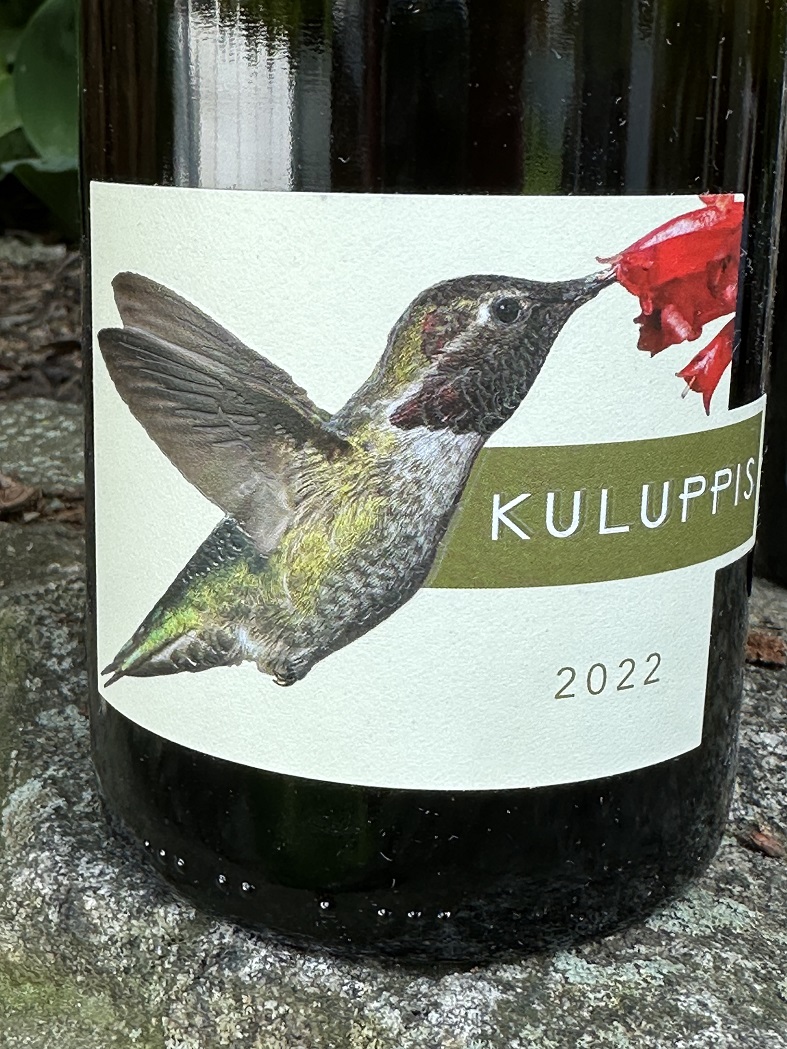
2022 Meyye Wines Kuluppis Chardonnay Sonoma County Los Carneros (13.7% ABV, $55, Sangiacomo vineyards, Kuluppis pronounced kuh-luu-pee; Anna’s hummingbird)
Light golden
Immediately upon opening – rich, opulent, butter, vanilla and tropical fruit on the nose, buttery toast on the palate, big, rich, hedonistic.
Literally 30 seconds later – a lot more restrained and leaner wine, all butter is gone, just some apples left. Well, no, there is still butter, just the toast is gone 🙂 nice and elegant, well balanced. Some perceived bitterness on the palate. Let’s see how it will develop.
Second day showed some honey notes and improved balance. Overall – excellent.
8+
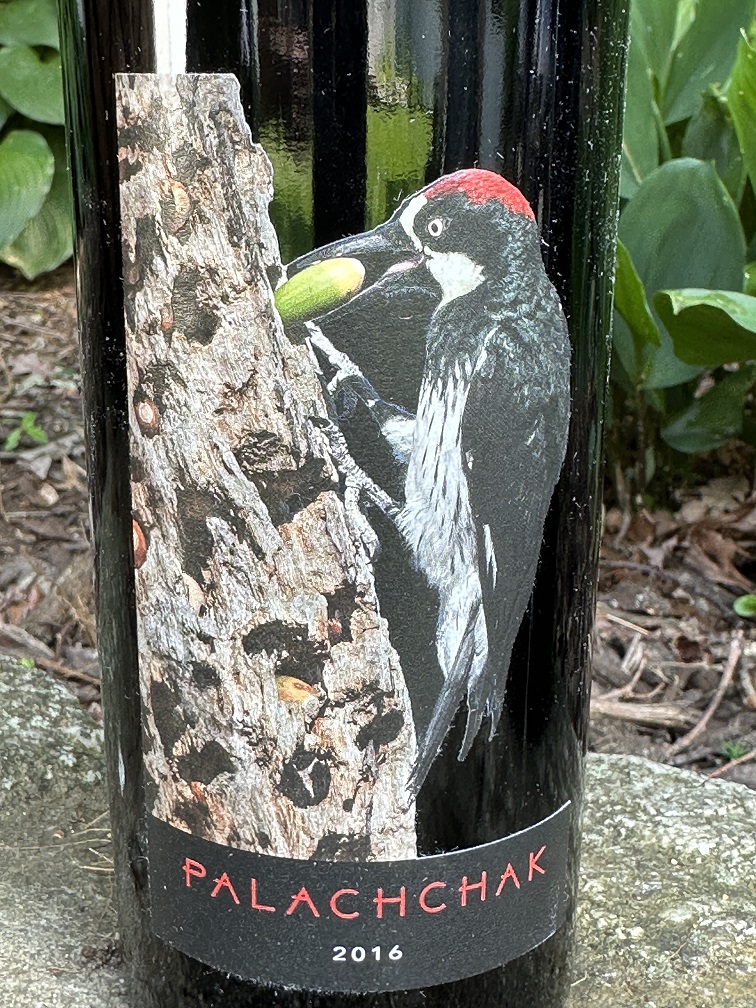
2016 Meyye Wines Palachchak Zinfandel Shenandoah Valley (15.5% ABV, $70, 90% Zinfandel, 10% Syrah, Palachchak pronounced pah-lah-chak; red-headed acorn woodpecker)
Dark chocolate and black currant, intense and beautiful
Blackberries and blueberries on the first day,
Dark chocolate with a touch of pepper, cherries, good structure, full body, clean acidity, good balance. Lasted for 4 days. Became a bit more round.
8
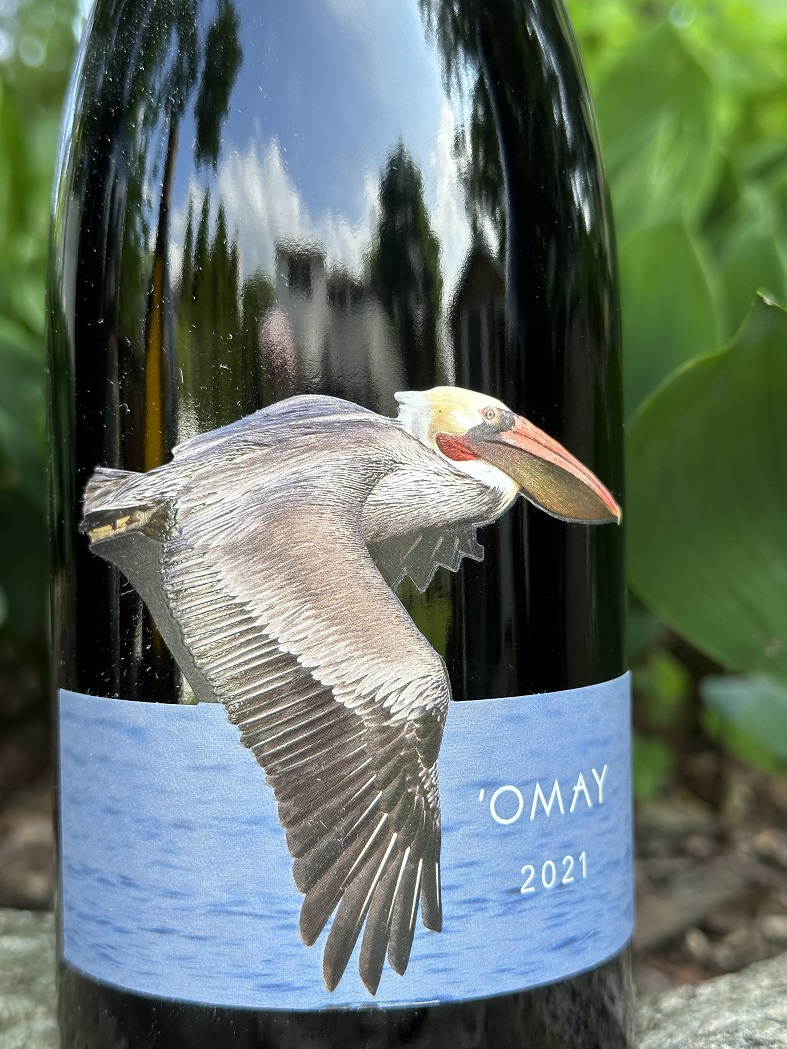
2021 Meyye Wines ‘Omay Pinot Noir Sonoma County Petaluma Gap AVA (13.9% ABV, $75, 100% Pommard Clone, Sangiacomo Vineyard, ‘Omay pronounced oh-may; brown pelican)
garnet
Smoke and plums, classic CA Pinot
Black Plums, violets, lavender, clean acidity, medium to full body – delicious.
8
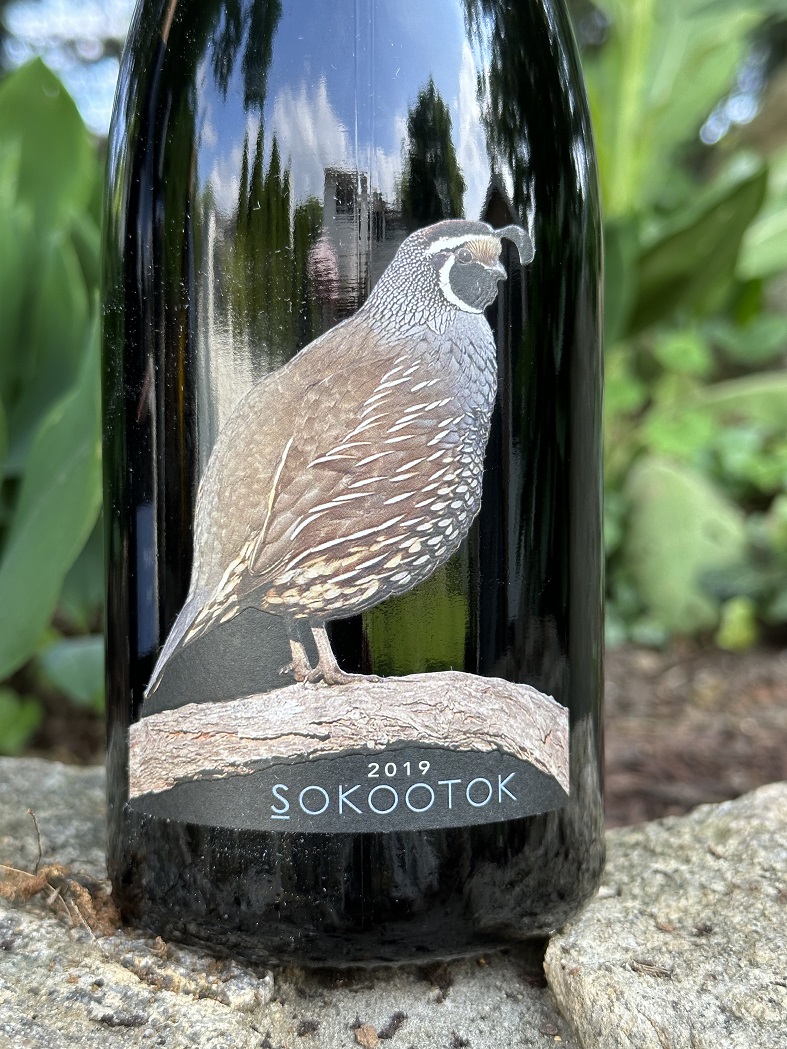
2019 Meyye Wines Sokootok Red Blend Sierra Foothills (14.5% ABV, $60, 50% Grenache, 28% Syrah, 10% Petite Sirah, 9% Counoise,
3% Zinfandel, Sokootok pronounced show-koh-tock; California quail)
Dark Ruby
Dark fruit, hint of minerality, sweet cherries, herbs
Black and red fruit, medium body, well-integrated tannins, good acidity, then tannins grip the finish – in a nice, but assertive way. This will develop nicely over the next 10-15 years.
8+, delicious.
Here you go, my friends. Another story of American Pleasures – delicious wines well worth seeking. And Meyye wines you will actually have to seek, due to their ultra-low production, so good luck to you.
Until the next time – cheers!
Wines of Uruguay: Delicious, Interesting, Unique
Uruguay is the second-smallest country in mainland South America (only Suriname is smaller than Uruguay). It also has the highest level of education in South America, and the highest level of beef consumption in the entire world – and cows outnumber people in Uruguay 4 to 1.
Uruguay also makes world-class wines.
There are 14, 804 acres of vineyards in Uruguay, occupying an area a little bit bigger than Saint-Émilion in Bordeaux and a little bit smaller than Alexander Valley in California. Uruguay is the only South American winemaking country whose terroir is affected by the Atlantic Ocean. It is also interesting to note that the vineyards of Maldonado, the largest winemaking region in Uruguay, are planted above some of the oldest rocks on earth, the Río de La Plata craton, which is 2.5 billion years old. Currently, there are 168 wineries in Uruguay, producing 70 million bottles annually.

Bodega Garzón. Source: Uruguay Wine
Uruguay is best known for its Tannat wines, and Tannat occupies about 27% of all the area under vine in Uruguay. Actually, Merlot is the second most planted variety, followed by Cabernet Sauvignon, Cabernet Franc, Marselan, Sauvignon Blanc, Chardonnay, Albariño, and others. There are also six main winemaking regions in Uruguay – Northern Shore, Southern Shore, Metropolitan, Oceanic, Center, and North, each divided into subregions. There are also five distinctive terroirs across these six winemaking regions, influenced by the Atlantic Ocean, rivers, amounts of rain (these can differentiate widely), and winds.
For more grapey details and the latest statistics, I need to refer you to the Uruguay Wine website, where we will talk about delicious, interesting, and unique.
The last time I tasted Uruguayan wines was about a year and a half ago. This year, I had a “double exposure” to the wines from Uruguay – Tannat red wines at the beginning of the year, and then the whites a few weeks ago. So the delicious part is easy, as many of the wines were simply delicious. Interesting and unique require some explanations.
Typically, when it comes to food (and wine), “interesting” is rarely a positive descriptor. However, in our case, it is also not negative, and it really should be processed together with unique. The white wines were interesting, as while they were made from the familiar grapes (Riesling, Sauvignon Blanc, Viognier, Albariño), they didn’t taste much like familiar grapes, maybe with the exception of the Sauvignon Blanc and Viognier to some degree. Another unique trait of this group was in the fact that the wines kept evolving for probably 2 weeks after being first opened, mostly just getting better and rounder as time passed. I have some reflections on this in the notes, so this is what you will see below.
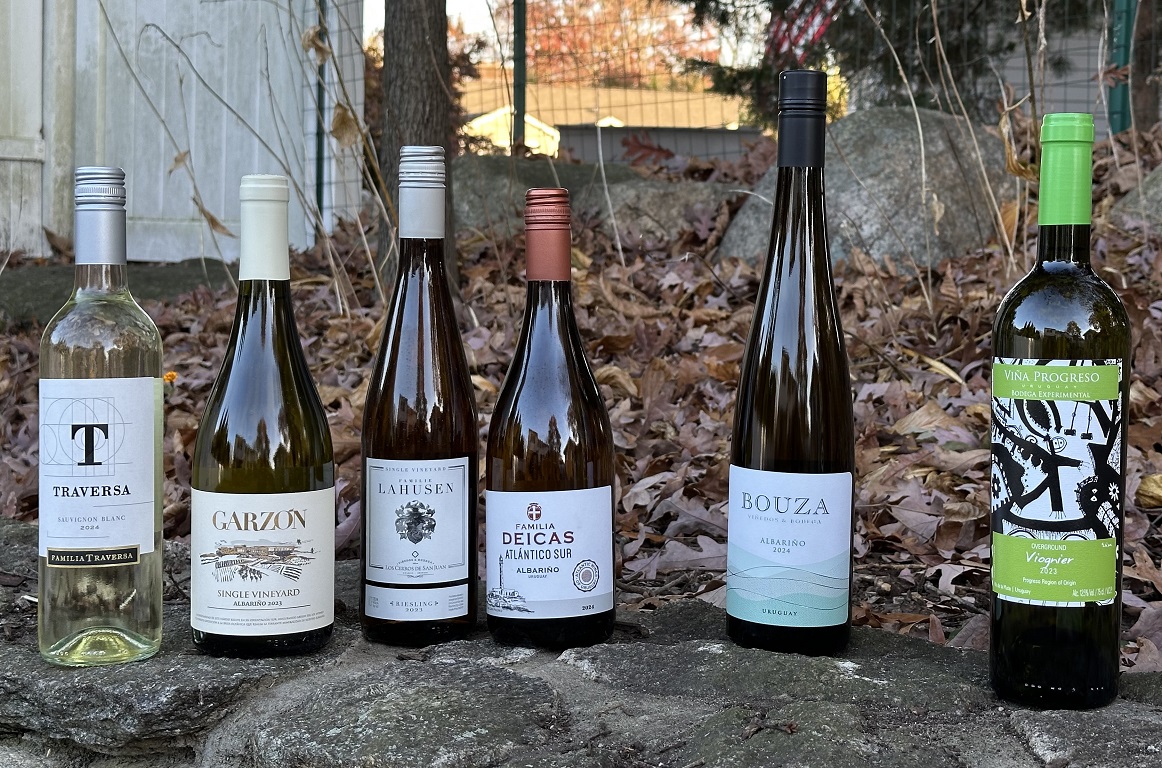
Here are my notes:
2023 Famile Lahusen Riesling Los Cerros de San Juan (12.3% ABV, $25) – the oldest winery in Uruguay, producing wines since 1854.
Straw pale
Herbs, Meyer lemon
Sweet fruit on palate, doesn’t taste like Riesling at all. Better tasting on the 3rd day, a bit more balanced.
Not bad, 7+
It actually became better over the next few days, getting to an 8- rating, but by no means this is your classic Riesling…
2024 Traversa Sauvignon Blanc Montevideo (13.5% ABV, $16)
Light Straw pale
Citrus, freshly cut grass, delicate, inviting
A touch of freshly cut grass, but mostly whitestone fruit on the 3rd day.
8-, enjoyable.
2013 Viña Progreso Bodega Experimental Overground Viognier Progreso Region (12.5% ABV, $26)
Straw pale
Interesting nose with a hint of brown butter notes, hints on plumpiness of the wine (day 3)
A hint of butter on the palate, quickly displaced by cut-through acidity. The wine had a lot more Viognier aromatics on the 1st day, but now feels like a nice Chardonnay (in blind tasting this would be my only guess)
8, very nice. One of my favorite whites of the tasting.
2024 Bouza Albariño Uruguay (12.5 % ABV, $28)
Straw pale
Perfumy, flowery nose with tropical fruit notes
Guava, a tropical fruit on the palate. Missing characteristic acidity and salinity. Not a bad wine, but doesn’t sing “Albariño” for me
7+
2023 Garzón Single Vineyard Albariño Maldonado (14% ABV, $35)
Light golden
Second day nose – hint of gunflint, butter, a distant hint of honey (first day the smell was not great)!
Second day palate – excellent, salinity, acidity, very much resembling a classic Albariño, still with a distant hint of kerosene, but now it can be ignored. The first day was chemically undrinkable.
8, needs time
2024 Familia Deicas Atlántico Sur Albariño Uruguay (12.3% ABV, $20)
Greenish/very light golden color
On the first day, the nose was very sweet. Second day- less sweet, tropical fruit.
Sweet but now with salinity coming through – this is on the second day. The first day the wine was cloyingly sweet.
7+, it is drinkable, but don’t try pairing oysters with it.
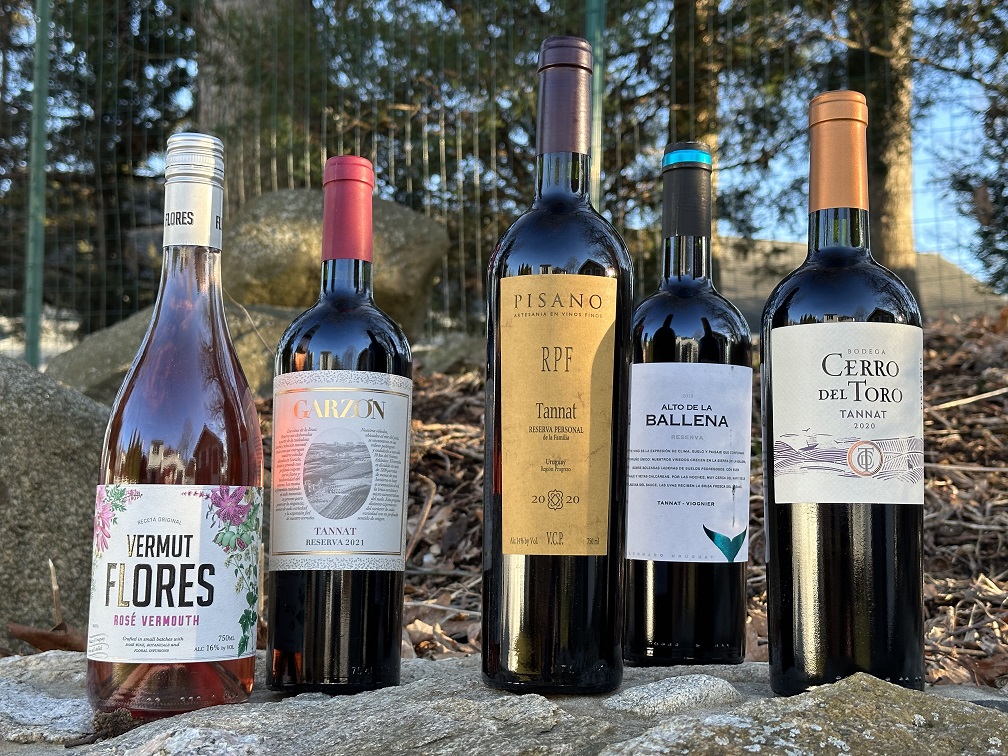
And now, for the reds:
2018 Alto de La Ballena Reserva Tannat Viognier Maldonado Uruguay (14% ABV, 85% Tannat, 15% Viognier)
Dark garnet, almost black
Dark cherries, tobacco, inviting
Tart cherries, minerality, crisp acidity, well integrated tannins, a bit of chalk, perfectly balanced
8+ – happy to see that I continue liking this wine the year after tasting it for the first time (last year’s notes can be found here)
2020 Cerro del Torro Tannat Maldonado Uruguay (15% ABV)
Dark garnet
A hint of a barnyard, herbs, dark fruit
Cherries, earthiness, pronounced minerality, a hint of tobacco, good acidity, tart finish.
7+/8-
2021 Garzón Tannat Reserva Uruguay (14% ABV)
Dark garnet
Ripe dark fruit, stony minerality, herbs, distant hint of barnyard
Dark fruit, espresso, cherries, firm structure, clean acidity, round, well balanced.
8-/8
2020 Pisano RPF Tannat Reserva Personal de la Familia Uruguay (14% ABV)
Dark Ruby
Red fruit, herbs, medium+ intensity
Tart, crisp, tart cherries, medium body, firm structure, cut-through acidity.
8-, food wine more than anything.
If you took a moment to glance at the notes, I’m sure you found them all – delicious, interesting, and unique. The whites definitely need some additional work, but they are unquestionably interesting, and I do mean it in a positive way. There are plenty of simply delicious wines from Uruguay, definitely worth seeking, so I hope that I encouraged you to give them a try when you have an opportunity. Cheers!
[Beaujolais] Nouveau Est Arrivé! 2024 Edition
Beaujolais Nouveau Est Arrivé!
Nouveau Est Arrivé!
Yes, it is the third Thursday in November, and it is an important day for those of us who still believe in the magic of wine – even if you shrug off the Beaujolais Nouveau as a marketing gimmick, you are still aware of the importance of the day, and whether you like it or not, consider yourself included 🙂
Every third Thursday in November and not a day earlier, Beaujolais Nouveau appears in wine stores around the world. Beaujolais Nouveau is the first wine of the new vintage in France, a young wine made to celebrate a new harvest. Georges Duboeuf is credited with making a centuries-old tradition into a marketing phenomenon more than 35 years ago – I’m not sure how much clout the celebration has today in the US, but it still has my attention.
Let me expand a bit on this. I’m traveling this week for work in Orlando, Florida. In Florida, wine is sold everywhere, from pharmacies to supermarkets to specialty wine stores. I visited the ABC Wines store (one of the popular wine retailers here, similar to Total Wines) at the beginning of the week and asked if they would be selling Beaujolais Nouveau on Thursday. The lady was not sure and suggested to call on Thursday to find out.
Today is that Thursday, and I started calling the store I visited on Monday. It took me four tries, but I finally got to a human. The lady on the phone said that they don’t have Beaujolais Nouveau at her store, but she was kind enough to check in the system and said that another ABC Wines store about 5 miles from the first one has it in stock.
Next, I decided to check if Whole Foods might have the wine in stock. I got to the human relatively quickly, but then the human said that she would go and check if they had Beaujolais Nouveau in stock. After 15+ minutes of music on hold, I decided that I would simply have to drive to the store to find out myself after I was done with work.
My first inclination was to drive to the ABC Wines location that was supposed to have the wine. After seeing that it would take me 35+ minutes to get there, I decided to try my luck with Whole Foods. Well, that didn’t work – no such luck. And now I was even further from ABC Wines which had the wine. Before giving up, I decided to make one more attempt – this time, with Trader Joe’s, which was only a mile away. A mile is not a mile in Florida, considering how overloaded the roads are and how long Florida traffic lights take… But nevertheless…
I arrived at Trader Joe’s, and found nothing after scouring the wine section for a few rounds. But unlike Whole Foods, in Trader Joe’s there is always someone you can ask (a floor manager). When I asked about Beaujolais Nouveau, there was a short pause during which I decided that there will be no Beaujolais Nouveau for me today, but then I heard – “hmmm, I think we got something last night, let me check”. 2 minutes later, the floor manager showed up with the bottle of Beaujolais Nouveau, which put a huge (huge!) smile on my face, and I thanked him profusely but managed not to hug him. After all, I was going to taste Beaujolais Nouveau on the day when it was released!
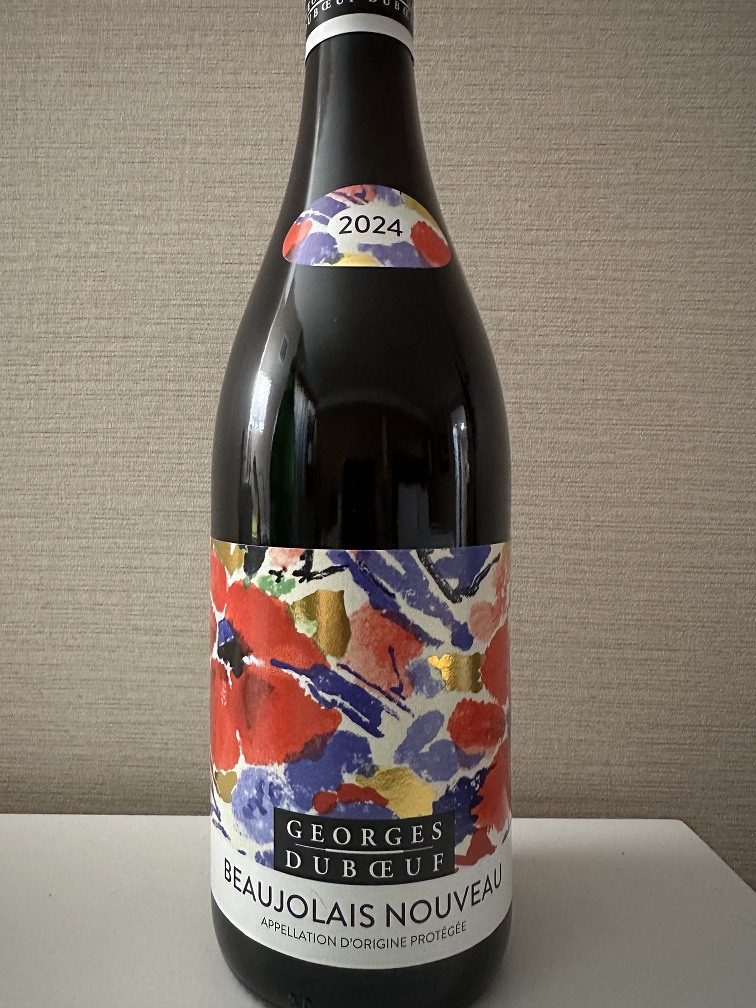
Every year I say that the quality of Beaujolais Nouveau gets better and better. I guess if I would sum up those statements, this Beaujolais Nouveau should taste better than DRC… I don’t know if it gets better every year anymore – at this point, I believe Beaujolais Nouveau got to the point of consistently high quality, good enough that I’m happy to drink it every year – at least Georges Duboeuf’s rendition for sure – here are my notes.
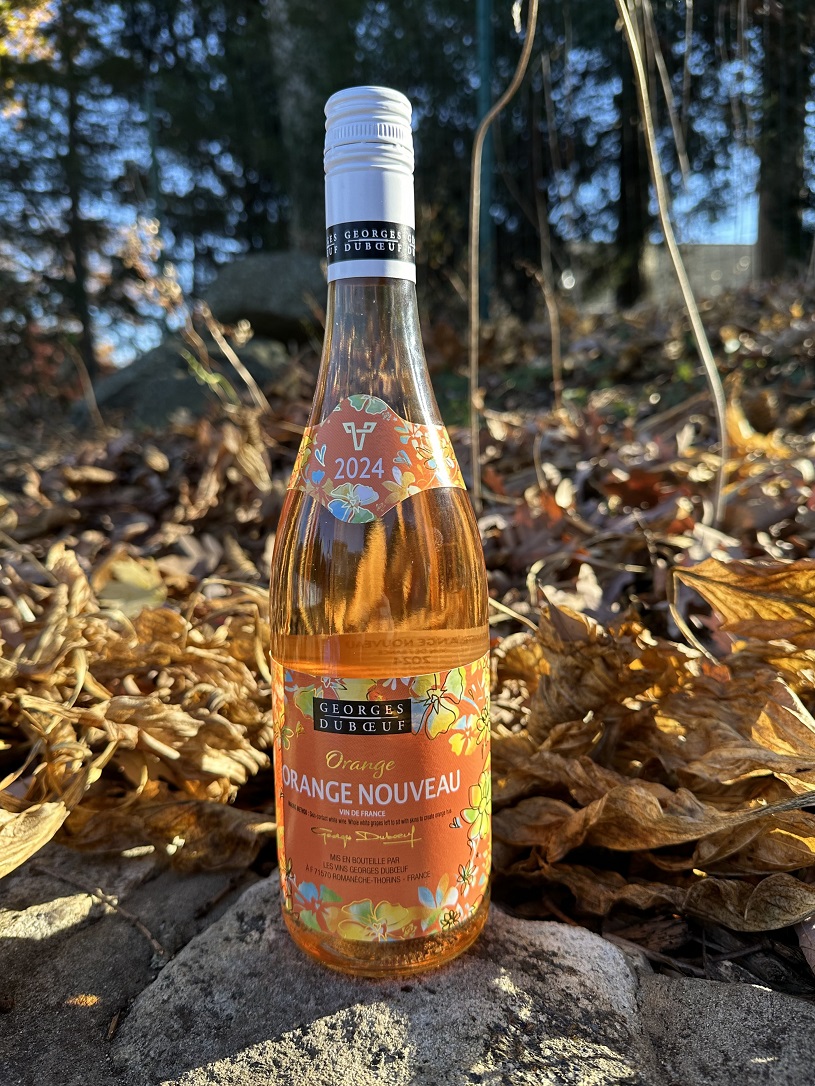


Lastly, here is a little treat for you:
Every year, the bottles of Beaujolais Nouveau are adorned with specially designed labels, sometimes even multiple labels from the same producer for the same wine – I have no idea how that works. As I have been writing about Beaujolais Nouveau every year since this blog started, I can offer you a collection of labels starting with the 2010 vintage. As Georges Dubouef is the one and only producer I was able to taste every year, below is my little “show and tell” limited only to the labels of Georges Duboeuf wines I tasted throughout the years. In case you feel like it, you can even choose your favorite label and share it in the comments (sorry, this is not a competition so no prizes will be awarded).
Here we go:


Beaujolais Nouveau 2024 has arrived, and if you haven’t tasted one yet – what are you waiting for? Taste it now and let me know what you think! Cheers!
Travel Diaries: Cote d’Azur, Pink Sunsets and Rare Grapes
Cote d’Azur.
French Riviera.
One of the most coveted vacation destinations in the world. I didn’t know that, but according to Wikipedia, “Riviera is an Italian word that originates from the ancient Ligurian territory of Italy, wedged between the Var and Magra rivers. Côte d’Azur is originally a nickname given by France to the County of Nice after its annexation in 1860, because the climate was similar to that of the north of Italy, even in winter, with “a sky as blue as its sea”.” I know it is summer, but here is my illustration of the point above:


An evening in Antibes
Over the past 10 years, I had to travel to Nice a good number of times, and always for business. As a business traveler, I always held a grudge against these trips to the South of France – I don’t like Nice airport, it is one of the most uncomfortable ones, and I had my share of bad experiences in Nice. But the last trip was admittedly better perceived – I stayed at a brand new Marriott property, Moxy in Sophia-Antipolis, which was very nice. And we spent most of our free evenings in Antibes, which is a beautiful small town – still with lots of tourists, but overall incomparable to the crowds of Nice itself.
As you already know, I’m here to inundate you with pictures. As we visited Antibes (and Nice once) only in the evening, the majority of the pictures are related to the sunset. Here you go:


It is not only the sunsets that provided a source of enjoyment during our walks. Thought-provoking, creative statues by Nicolas Lavarenne were another great entertaining element of the Antibes boardwalk – I have to say that I really enjoyed them. Here are a few of the highlights:


Here are more of the sunset pictures:


And now my most favorite, the one I promised you in the title of this post – pink sunset:

Before we part, a few words about the wine. I had a few of the decent wines during the week, some local, some not. 2023 Estandon Brise Marine Blanc Méditerranée IGP (Clairette, Ugni Blanc) and 2023 Estandon Brise Marine Rosé Méditerranée IGP (Cinsault, Grenache, Syrah) were both on point, crisp, refreshing and light. 2020 Caves de Rauzan Mascottes Olga Cabernet Sauvignon Merlot Bordeaux AOC (13.5% ABV) was also very good, on par with the excellent 2020 vintage, and overall very generous and supple.


My personal highlight was the 2020 Château de Bellet Rouge Bellet AOP (14.5% ABV, 35% Folle Noire, 25% Braquet, 40% Grenache). This was a super-local wine, with the vineyards and winery located in the Nice area. The wine had a nice core of dark fruit, a hint of my beloved barnyard and a silky-smooth texture. Not only the wine was delicious, but it also added two new rare grapes to my collection, inching closer to the coveted Hexavin goal.
That’s all I have for you today. Hope you enjoyed looking at the pictures as much as I had fun taking them.
Latest Wine News and Updates
There is never a dull moment in the world of wine – and there is not enough time in the day to track all the latest happenings. Here is a collection of recent and most notable wine news and updates.
Mars – wine’s next frontier
Yes, it is Mars, the fourth planet from the Sun. What Mars has to do with wine? If you ask Elon Musk, a lot. A relentless entrepreneur now has his sights on the world of wine, and apparently, he found a way to connect wine with another one of his passions – space. It appears that the 4 years long study conducted at UC Davis demonstrated that grown in space, the grapes had shown great potential for developing unparalleled taste profile while offering a substantial yield per vine, enabling the production of top-level wines at somewhat reasonable prices. Elon Musk teamed up with Paul Hobbs who was a consulting winemaker on the UC Davis project, and now he is building a fully enclosed vineyard set that will be delivered to Mars using a Space XM rocket. The vineyard will be installed and managed by the robotic staff, and the first harvest is expected to take place in 2030. The wine will be fully processed on Mars up to the bottling stage and will be delivered to Earth by the same Space XM rocket. No other details are available at the moment.
Screaming Eagle is going to produce what?
Screaming Eagle, the most iconic of all California wineries is secretly working on a new project, and it is not wine. Starting in 2028, the top 10% of the Screaming Eagle mailing list customers will have an opportunity to purchase the Marijuana extract, dissolved in neutral spirit and packaged into 175 ml bottles. The Marijuana plants are growing right between the Cabernet Sauvignon vines at Screaming Eagle vineyards. The plants are harvested by hand and processed within 3 hours of arrival to the winery, to retain absolute freshness. By growing in such symbiotic conditions with grape vines, marijuana plants acquire unique tasting characteristics and the elixir earned lots of praise from the focus group involved in the testing of this new product. The availability will be extremely limited. The pricing had not been publicly disclosed yet.
Coravin + AI =
Coravin, the utmost innovator and maker of wine tech gadgets teamed up with Google and Nvidia to add AI technology to the new top-tier A+W wine preservation systems. Each A+W device will be equipped with a Nvidia chip and connected to the Google AI cloud. The A+W device will be conducting real-time organoleptic analysis of the wine and the results will be further processed by the AI cloud to be able to assess the aging of the wine and drinking habits of the Coravin customers. All collected data will be also shared with the producers. It is expected that the next model of A+W will be able to detect non-ideal serving conditions of the wine and heat, cool, or filter the wine as needed for the optimum taste while the wine is being poured. Coravin’s chief scientist also predicts that at some point the Coravin devices will become smart enough to talk to each other and share their owner’s stories.
Amazon wine
Amazon finally decided to join the wine fray and start producing its own wines. Well, it is too early to talk about Amazon vineyards – for now, Amazon teamed up with Washington’s hallmark producer, Chateau St. Michelle to produce wine under Amazon labels. Amazon decided to use creative names for their wines, so the inaugural release will see “Mine is Better” Merlot, “Mine is Bigger” Cabernet Sauvignon, “Bottoms Up” Chardonnay, and “Sugar Rush” dessert wine.
Also taking the wine story even further, all the wine mentions in the Kindle books will become clickable in the text and readers will be able to order wines mentioned in the books with one click directly from their Kindle device. Inadvertent orders might be a concern here, so 007 readers, beware – Bollinger Champagne recently increased in price…
Wine G to Z
A concern about Gen Z not being interested in wine had been widely circulated throughout wine industry publications. E & J Gallo Winery, the biggest wine producer in the US, decided not to leave the wine story of Gen Z to a chance. E&J Gallo developed a special application called WineGZ to allow Gen Zs to fully customize their wine experience. As project director, Lotta Drinkin, explained “Gen Zs of the verified drinking age based on their country of residence will be able to fully customize their wine experience by selecting grapes, type, material and shape of the bottles, and many other characteristics to their exact liking”. For example, the grapes can be chosen strictly based on the carbon footprint of the vineyards, the ESG rating of the country of origin, and the social score of the winemaker. There is a choice of material for the bottle from glass to plastic to cardboard to metal to clay, and the shape of the bottle can be round, rectangular, or even “upload your own design” shapes. Based on the initial raving feedback, this project is expected to revolutionize the relationship between Gen Zs and the wine industry.
That’s all I have for you for today, but more news is coming. Cheers to the wine news and updates!
Month in Wines – January 2024
Ahh, the difference between the picture in your head and the reality. I know that I’ve written “Month in Wines” posts in the past, to discuss the wines I had during a given month. What I didn’t realize was that the last “Month in Wines” post was written 9 years ago, in 2015. Oh well, such is life. Let’s get to our subject – the wines I had during January of this year.
I would say that January, and December for that matter, are usually a bit more special, as both months are centered around holidays and celebrations. For a variety of reasons, we got to celebrate New Year, our most favorite holiday, on 3 separate occasions, and every one of those celebrations involved bubbles and special wines. Here are my brief notes on what transpired in January 2024, sorted by the type of wines.
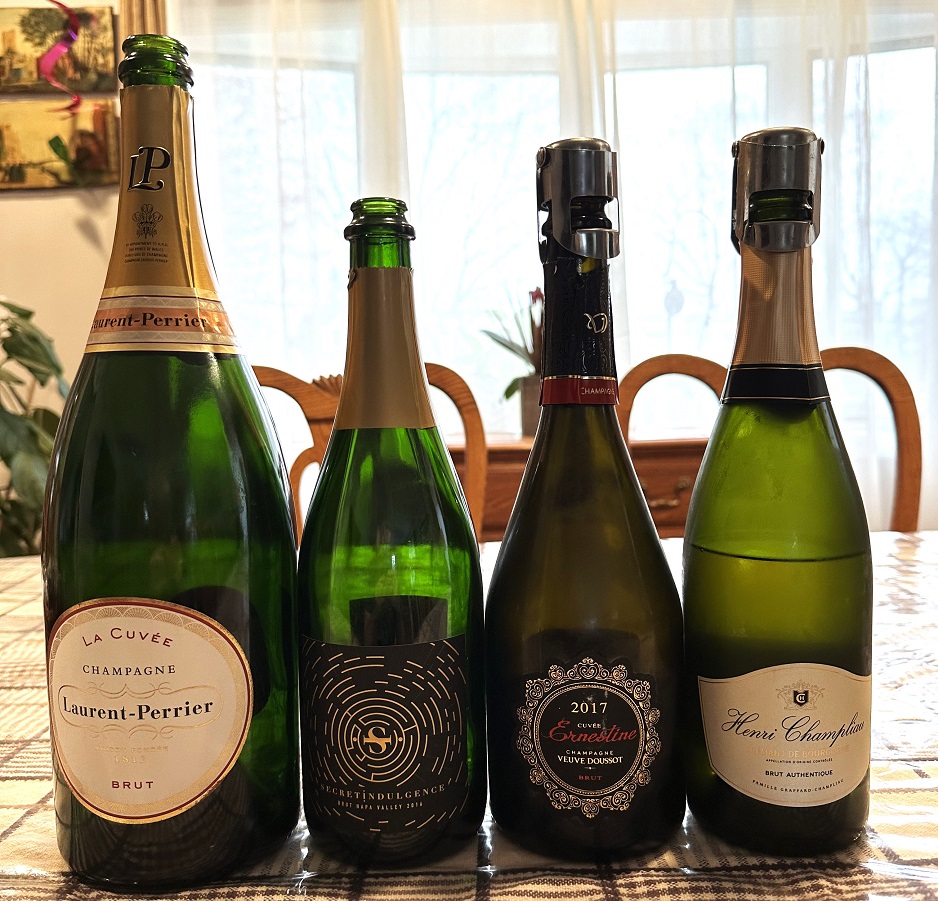
Some of the sparkling wines
Sparkling:
NV Veuve Clicquot Brut Champagne (12% ABV) – of course, no introduction is needed. As the most marketed Champagne brand, I find it annoying and thus drink rarely. We had a few bottles that my wife received as a present at work a few years back, so I decided to open one of them. The wine was not bad, I guess better than I expected. Not anything that would blow your mind off, but solid and drinkable (but not craveable if this is even a word).
NV André Chemin Brut Tradition Blanc de Noirs Champagne (12% ABV) – my favorite Champagne available from WTSO (or at least it used to be, great value at $26.99). Round, playful, beautiful toasty notes and perfectly balanced.
NV Laurent-Perrier La Cuvée Brut Champagne (12% ABV) – everything is better from the magnum right? Nice, clean, classic.
2016 Secret Indulgence Brut Blanc de Blancs Sparkling Wine Napa Valley (12.5% ABV) – a bit more substance than a typical Champagne. Just a touch more body, a bit more fruit, but overall perfectly restrained.
NV Maison Laudacius Cuvée Réservée Brut Méthode Traditionnelle Montlouis-sur-Loire AOP (12% ABV) – I grabbed this Cremant from the WTSO selection right before the holidays. This was nice and round, with clean acidity and just a touch of the fruit.
2017 Veuve Doussot Brut Cuvée Ernestine Champagne (12.5% ABV, 70% Pinot Noir, 30% Chardonnay, disgorged January 2022) – this one was just okay. Bubbles, but not much else to report.
NV Duval-Leroy Brut Reserve Champagne (12% ABV) – nice, round, clean, classic. A hint of apple, perfect acidity.
2011 Castello Bonomi Cru Perdu Millisimato Franciacorta (12.5% ABV) – excellent. Very generous, round, refreshing, a clean profile with a touch of fruit and a great substance.
2012 Charles Clément Brut Champagne (12% ABV, 60% Chardonnay, 20% Pinot Noir, 20% Pinot Meunier) – excellent specimen of a vintage Champagne. Toasted notes, brioche, fine mousse, all around delicious.
NV Henri Champliau Brut Authentique Crémeant de Bourgogne AOC (12.5% ABV, 85% Pinot Noir, 15% Chardonnay) – Zak, who brought this wine, mentioned that a “tik-tok sommelier” compared this wine with Veuve Clicquot and said that they are literally identical in the taste profile with this Cremant only costing a fraction of the Veuve. Upon first taste, we found no similarities, and the wine overall was kind of subpar, so we had to put it aside enclosed with the Champagne bottle sealer. The next day the wine was still not interesting. On the third day, it showed a much bigger body and became much more round and pleasant. I still don’t think the comparison with Veuve stands, but go figure…
NV Giacomo Scagliola SiFaSol Moscato d’Asti DOCG (5.5% ABV) – of course, this is a lightly fizzed sweet wine, but we had it as an aperitif, hence is it listed with other sparkling wines. When it comes to Asti wines, it is all about balance and acidity – and succulent white peaches in this wine were perfectly balanced by the lemony acidity, so overall the experience was light and refreshing.
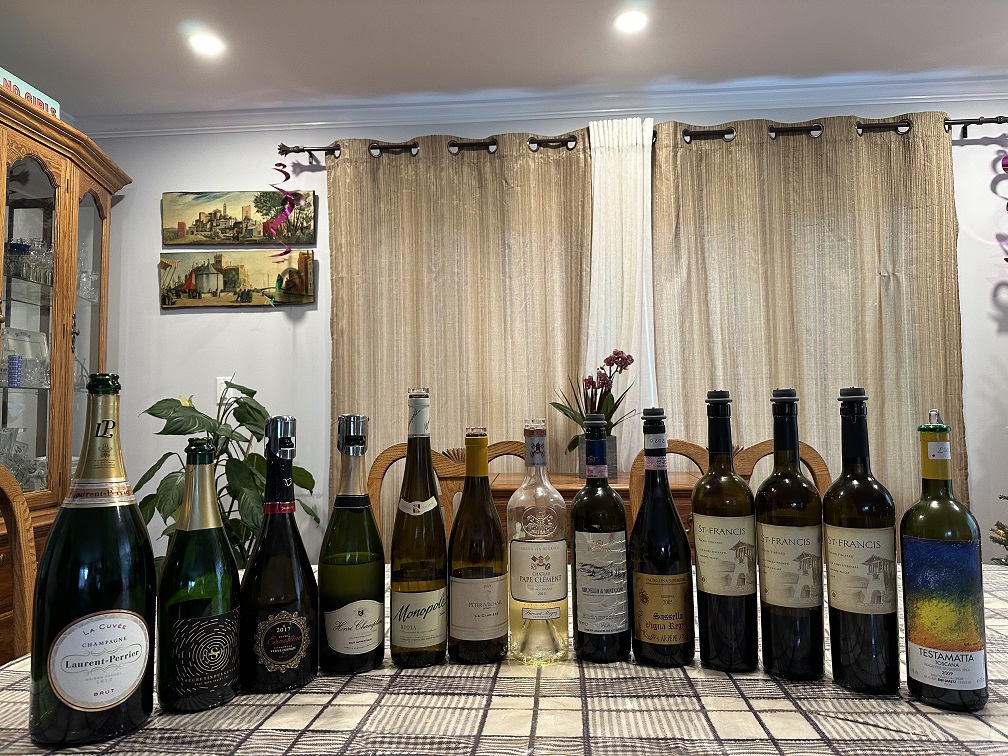
Final group
Whites:
2010 CVNE Monopole Rioja White Wine (13% ABV, 100% Viura) – I love unexpected [good] surprises, and this was definitely the one. I always enjoyed Monopole, the oldest white wine produced in Rioja (the first vintage was produced 110 years ago – in 2014) – but typically as a fresh, young wine. I kept one bottle as an experiment, not expecting anything special. The wine was excellent – not at the level of mature Riesling or a well-made white Burgundy, but it was good in its own class, with white-stone fruit, white plum, and lemon on the palate, and a tiny hint of oxidative/sherry notes, still with freshness and well noticeable acidity. Don’t know if it would age for much longer, and I was happy that I opened it now.
2015 Château Pape Clément Grand Cru Pessac-Leognan (14.5% ABV) – unlike the previous wine, this was not a good surprise. A very strange palate which I can’t even describe – kind of medicinal profile with basil and currant leaves, rather overwhelming. “Strange” would be the best descriptor.
2011 Peter Michael La Carrière Chardonnay Knights Valley Sonoma County (15.2% ABV) – another disappointing wine. 2011 was not a good year in California, and this wine was simply bitter and lacked any sort of balance.
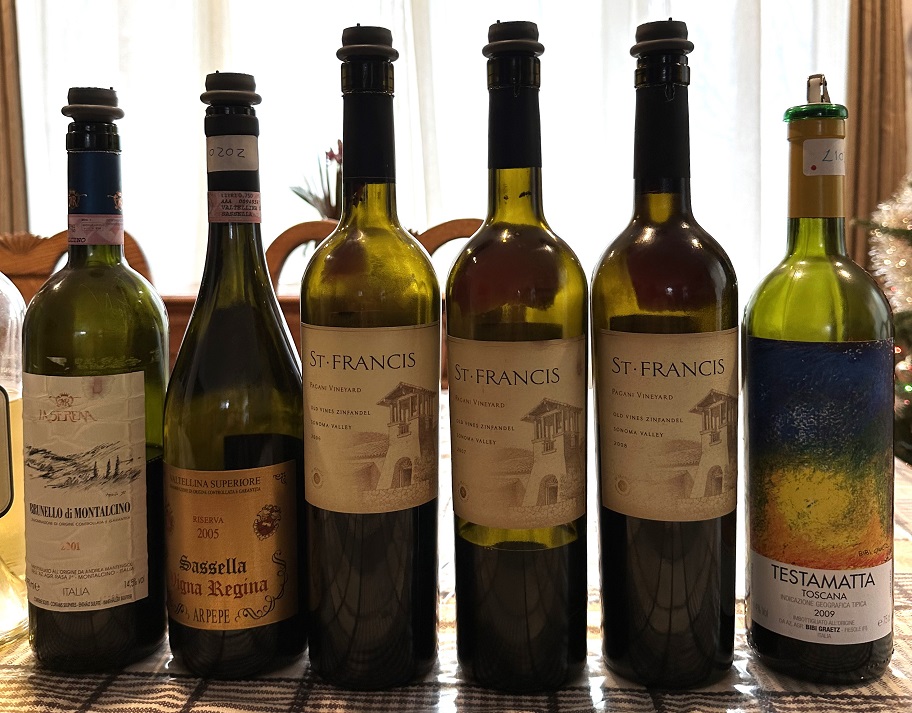
Reds
Reds:
2006 St. Francis Old Vines Zinfandel Pagani Vineyard Sonoma Valley (15.6% ABV) – I kept this trio for a while but decided that the time had come to drink them. All 3 wines were very similar, focusing on blackberries, a hint of cherries and fresh herbs, round and delicious. I can’t complain about either one – they were all gone very quickly.
2007 St. Francis Old Vines Zinfandel Pagani Vineyard Sonoma Valley (15.4% ABV) – 2007 was the biggest wine of the 3, still retaining the same core of the fruit and herbs, but more assertive in its expression on the palate.
2008 St. Francis Old Vines Zinfandel Pagani Vineyard Sonoma Valley (15.4% ABV) – possibly the most elegant of the 3. Again, same profile, but with more finesse and restraint, focused on elegance.
2009 Bibi Graetz Testamatta Toscana IGT (14% ABV) – I was hoping it would be great, and it was not. Another disappointment of the tasting.
2005 ArPePe Sassella Vigna Regina Riserva Valtellina Superiore DOCG (13% ABV) – I have a lot of respect for ArPePe wines, but for whatever reason, this was far from amazing. I would describe it as “lean”. It is possible that the wine was open during its “sleeping” phase, but I would never be able to find out now.
2001 La Serena Brunello di Montalcino DOCG (14.5% ABV) – this was an interesting experience. From the get-go, the wine was not bad, with a pleasant dark cherries profile and good acidity. It was lacking a body a bit, so we decided to decant it. The decanter didn’t make much of a difference, with the wine remaining pleasant but not exciting. During the next two days, the wine transformed, showing a powerful structure and becoming more assertive. This wine could probably wait for another 5-10 years. Oh well…
2016 Carlisle Two Acres Russian River Valley Sonoma County (14.9% ABV, Mourvèdre, Petite Sirah, Syrah, Pelourcin, Carignane, Alicante Bouschet) – a rare case of Carlisle missing the mark. I can only assume I opened the wine while it was in its “sleeping” phase – at the moment it was simply lacking balance, and it didn’t improve even over the next few days. Strange, but happens.
2010 Clarendon Hills Brookman Merlot Wine of Australia (14.5% ABV) – I saw a very discouraging review of this wine somewhere online (might be Vivino), but somehow was convinced that my experience would be very different. No such luck. If I would ever decide to present the list of the worst wines of the year, this would be definitely one of the top contenders. This was a wine that showed nothing – not on the nose, not on the palate. Not good…
2017 Quinta do Vale Dão DOP (13% ABV, 40% Touriga Nacional, 40% Tinta Roriz, 20% Alfrocheiro) – Portuguese wines represent amazing value, and this was a simple proof of that. For under $10, this wine was singing – fresh, succulent berries, perfectly integrated tannins, playful, delicious.


2009 Sauvella Luscinia Canta Costers del Segre DO (14.1% ABV, Syrah, Cabernet Sauvignon, Grenache) – Spain never ceases to amaze. An eclectic mix of grapes (who blends Cabernet Sauvignon with Syrah and Grenache?) delivering outstanding wine – fragrant, playful, full of fresh succulent dark fruit and herbs, well-integrated tannins and long finish. By the way, 2009 is a current release (available in the stores now) and thought-provoking.
2017 Campochiarenti San Nicola Riserva Chianti Colli Senesi DOCG (14.5% ABV) – classic and precise. Beautiful, layered Chianti with all the attributes – succulent dark cherries, sweet tobacco, leather, perfect minerality, wonderful bouquet and overall just a quintessential Italian wine.
2008 Achaval-Ferrer Quimera Mendoza Argentina (14% ABV, Malbec, Merlot, Cabernet Sauvignon, Cabernet Franc, Petit Verdot, 12 months in 40% new and 60% old French oak barrels) – my last bottle. I can’t recall why but I was not happy about the previous bottle opened a few years back, so I had a bit of trepidation opening this one on the last day of the month. The wine was just perfect. Roll-off-your-tongue smooth, velvety tannins, succulent cherries surrounded by the black fruit. Perfectly balanced and supremely delicious.
This concludes the story of January month in wines. As you can tell, there were clear highs and there were clear lows. How was your January in wines?
The work on a sequel has already started.
Cheers!
The Art Of Italian Wine: Masciarelli
Italian wines are special.
Well, this statement says a lot and nothing at the same time.
Remember, wine is personable and subjective. Everyone has a right to have their own opinion, and that opinion can only be subjective.
What makes Italian wines special? I will allow myself to make a bold claim – Italian wines are distinguishable. At least the well-made Italian wines produced from the core Italian grape varieties. What I’m saying is that when you taste Chianti, Brunello, Nero d’Avola, Montepulciano, Barolo and others, you might not identify the exact wine and the exact producer, but you would be reasonably sure you are drinking an Italian wine.
When you drink wine made from Cabernet Sauvignon or Chardonnay, you might be well able to identify the grape, but the origin of the wine can be equally anywhere in the world – Bordeaux, California, Italy, Spain, Washington, Australia, Chile and everywhere in between can be a source of a great Cabernet Sauvignon. This would be also true for the absolute majority of the so-called international grape varieties – Cabernet Sauvignon, Merlot, Pinot Noir, Grenache, Syrah, Chardonnay, Sauvignon Blanc. But when you taste Sangiovese made in Italy, you might be easily mistaken about the exact region, but you would be reasonably certain you are drinking an Italian wine. An important disclaimer – it would definitely help if this would be a well-made Italian wine.
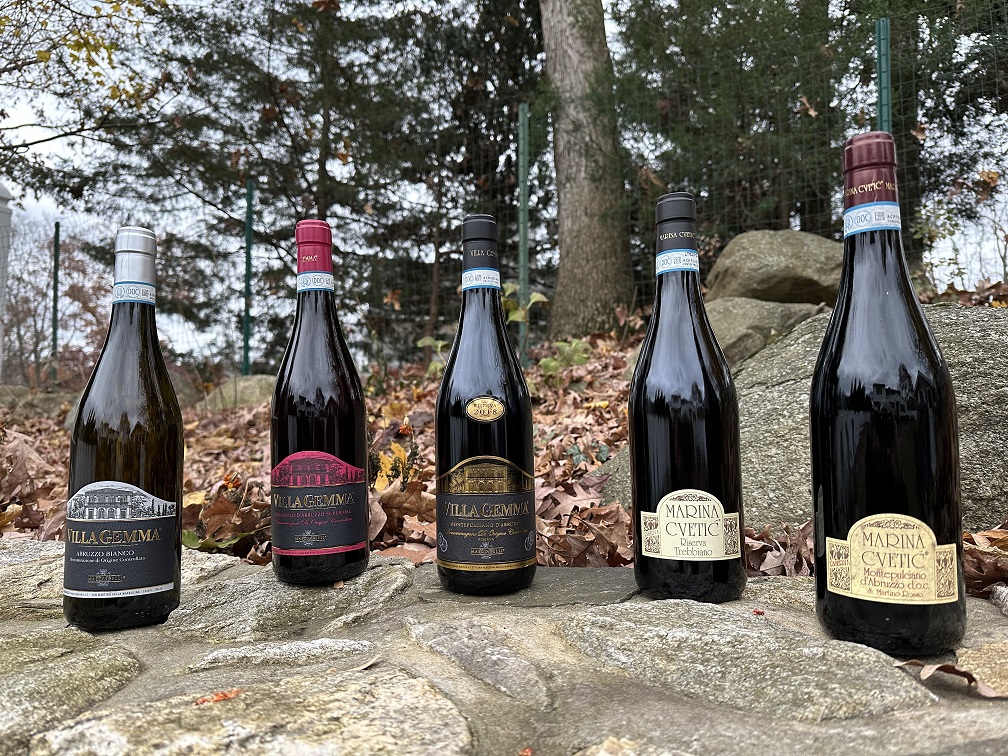
Here is a great example of the well-made, and thus easily recognizable Italian wine – or, rather, wines – Tenute Masciarelli in Abruzzo in Italy.
In terms of “wine time”, Masciarelli is a very young winery, founded in 1981 by Gianni Masciarelli. However, the impact in the wine world is not directly a function of time. Wine has been continuously produced throughout Italy for a few thousand years. In Abruzzo, a province located in central Italy along the Adriatic Sea, Montepulciano is the king. Simple Montepulciano red wines were produced forever in the region, perfectly quaffable, but not really comparable, for example, to the wines of Tuscany. Gianni Masciarelli spearheaded the change in the region, both in grape growing (he introduced the French Guyot training system for vines in the region) and production – he was the first to start using French oak barrels for aging the Montepulciano Abruzzo and Trebbiano d’Abruzzo wines. 1984 saw the first vintage of the Villa Gemma Montepulciano d’Abruzzo, the first of its kind single-vineyard Montepulciano d’Abruzzo wine, which will be celebrating 40 years of production this year.
Today, Masciarelly sustainably produces wines from all 4 provinces in Abruzzo. Annual wine production exceeds 1 million bottles across 7 different lines and 22 wine labels. A few months back, I had an opportunity to review Masciarelli’s introductory Linea Classica – 3 very well-made wines that were not only tasty but easily lasted for 5 days after being open – a testament to quality. Now, I had the pleasure of reviewing the latest releases from two more wine lines – Marina Cvetic and Villa Gemma.
Marina Cvetic line includes 2 of the classics – Trebbiano d’Abruzzo Riserva and Montepulciano d’Abruzzo – the second one is my perrenial favorite, I’m always happy to drink it. Additionally, the Marina Cvetic line includes four of international grape varieties (Chardonnay, Cabernet Sauvignon, Syrah, and Merlot) – however, I don’t think those are available in the US.
Villa Gemma, the winery’s flagship and the oldest produced line, includes three of the Abruzzo’s classics – white blend, Rosé, and Montepulciano d’Abruzzo Riserva.


Here are my notes:
2020 Masciarelli Marina Cvetić Trebbiano D’Abruzzo Riserva DOC (14% ABV, $60, 100% Trebbiano Abruzzese, 20-50 yo vines)
Light golden
A hint of tropical fruit, Whitestone fruit, honeysuckle
Round, clean, fresh, a hint of butter, soft and creamy texture with Meyer lemon finish
8, the wine is a bit aggressive when just opened, don’t over-chill it (I would serve it around 50F) and let it breathe, maybe 30 minutes in a decanter. Will stay fresh in the fridge for a few weeks.
2022 Masciarelli Villa Gemma Abruzzo Bianco DOC (14% ABV, $24, 50% Trebbiano, 30% Pecorino, 20% Cococciola)
Straw pale
whitestone fruit, lemon, clean, inviting
Crisp, clean, good acidity, lemon, expressive minerality, good balance
8, excellent
2022 Masciarelli Villa Gemma Cerasuolo D’Abruzzo Superiore DOC (14% ABV, $24, 100% Montepulciano)
Beautiful cranberry pink
Restrained nose of fresh strawberries, pleasant
Strawberries, cranberries, fresh, bright, excellent acidity, good balance, delicious
8
2019 Masciarelli Marina Cvetić Montepulciano d’Abruzzo Reserva DOC (14.6% ABV, $38, 100% Montepulciano, 15-30 yo vines, 12 months in French oak barrels)
Dark garnet, almost black
Dark cherries, espresso, tar, mocha, medium intensity
Dark cherries, silky smooth with beautifully present tannins, layered, round, well present, delicious.
8+, these are day 2 and day 6 notes, this wine is made of the long haul, was not very enjoyable upon opening, you need to decant it for 2-3 hours or forget it in the cellar for 10-15 years as the least.
2018 Masciarelli Villa Gemma Riserva Montepulciano D’Abruzzo DOC (15% ABV, $98, 100% Montepulciano, 35 yo vines, 12 months in French oak barrels)
Dark garnet, practically black
Black cherries, a hint of a barnyard
Black cherries, cherry pits, silky smooth roll-of-the-tongue texture, good acidity, excellent balance
8+, this is a big wine. It is surprisingly pop’n’pour, but will improve with the cellaring.
Here you are, my friends – wine, a liquid art form, made in Italy.
Do you think that Italian wines are easily distinguishable? What are your favorite Italian wine producers?
Last Bottle Sign Up ($10 credit)




 Talk-A-Vino