Archive
Latest Wine News and Updates
While wine production is one of the oldest industries in the world, the amount of new, innovative products and scientific breakthroughs in the wine world is nothing short of breathtaking. Let’s take a look at some of the latest news from the field.
Everyone agrees that fake wine is a big problem for the wine industry. There are many tools employed by winemakers to protect the identity of their wines, but the quest for the perfect solution is still ongoing. After 15 years of intensive research, the French INAO (The National Institute of origin and quality), together with the College of Veterinary Medicine at Auburn University in the US announced the successful results of the initial trials of dogs being able to sniff fake wines. As part of the Canine Performance Sciences program, dogs had been trained to identify wines that don’t match the original wine. The training is a very involved process requiring the dog to spend about 2 years at the winery memorizing the original flavor profile of the wines. Once trained, the dogs can easily distinguish the original bottles from the fakes, the same as working dogs who identify illegal substances at customs in airports. The training process is intense and costs about $50K per dog, so this solution is not for every winery. Nevertheless, according to INAO, it will take about 7 years to satisfy all the requests for the dogs received to date.
There are plenty of wine lovers who crave massive, tannin-loaded wines. Such wines are often quite expensive as they require a long aging time in the oak barrels which are costly. What if the oak flavor can be concentrated in the grape itself while it is growing? Impossible, you say? Scientists from UC Davis in California think otherwise. Instead of using the traditional rootstock, UC Davis scientists managed to graft Cabernet Sauvignon vines onto the french Limousin oak rootstock, and after about 7 years of experimentation it seems that resulting wines demonstrate much higher tannin concentration than the wines obtained from the same clone of Cabernet Sauvignon but not grafted on the oak rootstock. Obtaining the same level of tannins would require about 6 months of age for the wines in the control group. Once the research is complete, it will result in significant savings for the wine producers which [hopefully] will be passed on to wine lovers. We should expect to find the first wines based on the results of this research by approximately 2028.
Many wine lovers live with a simple motto – coffee in the morning, wine in the evening. The next news I would like to share with you will, in a way, be related to both beverages. How so? Everyone knows Nespresso, a French company that mastered the simplicity of the perfect cup of espresso at any time with the help of a tiny coffee capsule. Working on a special (very sizeable) grant from French LVMH conglomerate, Nespresso just announced a brand-new machine called – maybe you guessed it – Winepresso. Nespresso scientists found a way to convert the content of the wine bottle to the dry form which is encapsulated in the tiny wine capsule, literally identical to the coffee one. Now, with a push of a button, a perfect glass of your favorite beverage is in your hand at any moment. Based on the opinion of the expert panel, the Winepresso-produced wine is practically identical to the original wine, which is a pretty amazing achievement in itself. The initial set of capsules available upon commercial availability of Winepresso will include two Bordeaux reds, one red from Burgundy, and 3 whites from Loire. It is also known that Nespresso is actively involved in conversations with a few of the famous wineries in Napa Valley. The capsules will be sold in the 5-packs (to be identical to the standard 5 glasses in the bottle of wine). Winepresso machines are expected to appear at select retailers such as Williams-Sonoma and Bloomingdales in time for Christmas shopping. The prices for the capsules and the machines had not been disclosed yet. If successful, you can only imagine how successful this product will be from point of view of sustainability and reduction of the carbon footprint.
Open any news source today, and you are guaranteed to read about ChatGPT, artificial intelligence (AI) software. ChatGPT writes poems, articles, and marketing materials, conducts market research and lots more. It appears that the wine world is starting also to embrace ChatGPT in a variety of ways, many of them quite unexpected. Champagne Piper Heidsieck just announced that they will start a new line of non-vintage Champagne, called Piper Heidsiek AI, where ChatGPT will play the role of the Chef de Cave, responsible for blending the final wines. After the initial offering, both Blanc de Blancs and Blanc de Noirs will be produced. While it is an interesting announcement in itself, I’m concerned with the impact of the ChatGPT on all areas of human lives, now including even wine production. Well, we will see how this story will unfold.
That’s all the latest news I have for you, my friends. Until the next time – cheers!
Guest Post: How to Enjoy a Glass of Wine By Yourself
Today, I’m offering you a guest post by Darshan Somashekar, a serial entrepreneur. He previously founded Drop.io, which was sold to Facebook, and Imagine Easy Solutions which was sold to Chegg. He recently started Solitaired, to connect brain training to classic games.
Having drinks with your friends is great! But have you ever enjoyed a glass of wine by yourself?
People often see drinking alone as a cry for help or a way to escape life. Honestly, that’s the case most of the time.
But it doesn’t have to be – especially if the drink is sophisticated, like a bottle of wine. Wine is one of those things you can enjoy on your own without feeling weird about it – if you know what you’re doing.
Feeling inspired? Read on to learn some tips for enjoying wine by yourself like a pro.
1. Enjoy your glass of wine with some music

Source: Pixabay
The type of music I’m referring to here is not that record you’ve listened to over a thousand times. Find a playlist that speaks to you and play it in the background while you enjoy a glass of your favorite red or white varietals.
For example, while enjoying a Château Subercaseaux Bordeaux Rouge 2014, I’d play a classic like “The days of wine and roses” by Bobby Darin. Enjoying a glass of Casillero del Diablo Rosé? Then you’d listen to “Summer Wine” by Nancy Sinatra & Lee Hazelwood. “How does the wine taste” by Barbra Streisand is perfect for enjoying a Casillero del Diablo Cabernet Sauvignon.
As you sip, feel the music and the flavors come together harmoniously, allowing the two to engulf your senses. You’d be surprised how doing this can improve the taste of the wine.
2. Savour the flavors

Source: Pixabay
This time, without the music, take tiny sips from your glass to really taste each flavor as it hits your taste buds. Don’t drink the wine out of the bottle before it’s had a chance to open up. Then, bring your glass to your nose and take a whiff, breathing in the smells that waft up from the glass. What aromas are you getting? Do you smell fruit? Earth? Citrus? Tropical Fruit? The smell can tell you a lot about what you’ll taste next. Now you’re ready to drink!
3. A special delicacy
Is there a recipe you’ve always wanted to try? Perhaps there is a dish that has been on your menu list, but you’ve been putting off ordering it.
A lovely time to satisfy your cravings for that special meal would be while sipping a glass of wine on your own – it’s the perfect way to treat yourself. Some awesome classic wine and food combos include champagne and Oysters, Cabernet Sauvignon & Steak, Sauternes & Foie Gras, Provence Rosé & Niçoise Salad, Chianti & Lasagna Bolognese.
Plus, a glass of wine can take away any unappetizing tastes that the dish may have left in your mouth. Yeah, a wine glass can really come in handy.
4. Play a game
I am definitely not talking about a drinking game like quarters on a pool table. Come on, a glass of wine is too sophisticated for that. Think chess, checkers, or even a classic game of cards like the Solitaire game, and now they even come with a customized deck featuring wine selections. How fun is that!
These games are entertaining and can occupy your mind while you sip a nice glass of red wine or a full-bodied white varietal.
5. Spend time in nature

Source: Pixabay
Imagine this…..you are on your patio in your backyard or at a park bench, sipping your favorite white wine and enjoying the sound of the birds chirping around you.
Everything is quiet except for the soft murmur of conversation from other people in the park nearby or the rustling of the leaves in the trees above you. You can’t beat that ambiance.
6. Giving yourself some TLC ( Tender Loving Care)

Source: Pixabay
Another brilliant idea for enjoying a glass of wine by yourself is to treat yourself to a period or two of self-love. Run a bath, light some candles, and pour yourself a glass of wine. Slip into the tub and feel yourself relax as the warm bubbles envelope your body.
Sip your wine as you soak in your bath. The wine will make you warm and fuzzy, while the bath will make you feel melty and soft.
Then, you can doze off to sleep after the bath cleanses your body of toxins and release all your stress. Enjoy!
7. Watch Netflix and Chill
Can you tell we love Netflix? We watch it all the time – with wine, of course! You get a certain satisfaction from watching a good TV series while sipping a glass of your favorite white or red wine. Why not do that – with yourself? We strongly suggest you watch episodes of Master of None or Aziz Ansari’s stand-up specials while sipping a glass of Pinot Gris or Pinot Noir!
One more tip for you: change the routine now and then! Drinking wine alone can get stale if you keep doing the same thing over and over.
So, switch it up! Add a new flavor to the mix, step into nature, listen to new music, play a game, or change venues. There is no end to the possibilities – enjoy!
And A Little Bit Of Cognac
– I’m tired of drinking scotch. Next time, can we try something else? How about cognac, for example?
– Cognac? Why not? Next time, we will drink cognac.
This was a conversation with my high-school friend earlier this year. She visits a few times a year, and it is customary for us to taste 10-15 different whiskeys during one of the nights during her visit. This is easy to do, as, after the wine, whiskey (primarily scotch or equivalents, such as Japanese whiskey) is my next favorite type of alcohol. At any given moment I have probably 20+ bottles opened – unlike wine, once opened, whiskey can still last forever, so I have no issues opening a bottle, even for a tiny sip. Whiskey tasting on short notice? No problem, let’s do it. But cognac?
I like cognac as well. Totally different bouquet compared with whiskey, the pleasure of eloping the brandy sniffer and letting the aromatics charm you as the amber liquid gently heats up in your hand… Love cognac – however, I still prefer whiskey on an average day. As a result, if I can find 20+ open whiskey bottles on a given day, I would only have 1, 2, or maybe 3 cognac bottles on hand – that doesn’t make it an interesting tasting by any means.
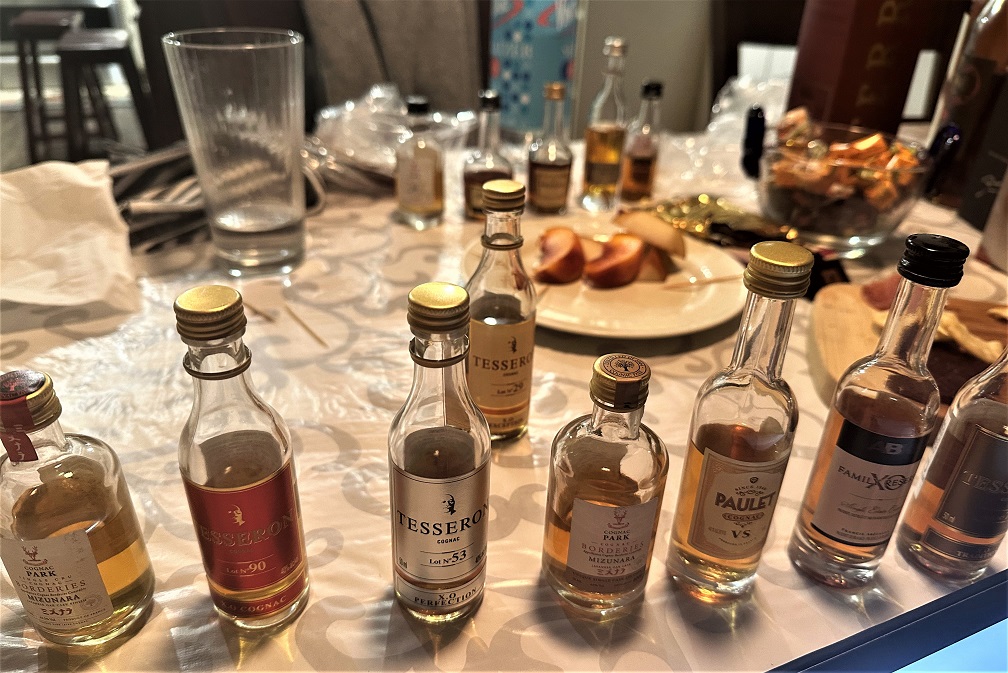
Let’s take a few minutes to talk about cognac first. Same as scotch is a type of whiskey, cognac belongs to the broader spirits category called brandy. Brandy is defined as the hard liquor (35% – 60% alcohol by volume) produced from wine, which can be a grape wine or a fruit wine, by the process of distillation. Cognac is the most famous type of brandy, produced in France in the Cognac region – as you might expect, Cognac name is protected and Cognac can only come from the Cognac region in France.
There are a few classifications that are important for Cognac. The first one is geographic – not any different from any wine classifications. Cognac can be sub-divided into 6 growing areas, or crus – Grande Champagne, Petite Champagne, Borderies, Fins Bois, Bons Bois, and Bois Ordinaires (you can find all the detailed explanations and a map in this excellent blog post). These crus are always identified on the label if the appellation’s requirements are satisfied – but the majority of the cognacs are simply identified as “cognac”, meaning that the grapes can be coming from any vineyard within the Cognac region. There is one more classification that is not precisely geographically delimited – Fine Champagne, which allows mixing grapes from Grand Champagne (at least 50%) and Petite Champagne regions. Of course, there are single vineyard options, but those are rare.
Another classification that potentially has higher prominence for cognac lovers is the age of the liquid in the bottle. Upon distillation, future cognac is clear. All of the beautiful amber colors are acquired during aging in the oak barrels. The age classifications are typically depicted on the bottles in the form of the following abbreviations:
VS (Very Special) – aged at least 2 years in the barrel
VSOP (Very Special Old Pale) – at least 4 years
XO (Extra Old) – at least 10 years
There are other age classification types – XXO, Napoleon, Extra, Réserve – but I would like to offer you another excellent article if you are interested in learning more. While the price of cognac will depend on age, it is not the only dependency – the producer’s name and geographic region need to be taken into account to understand the pricing. You can often find an XO cognac from an unknown producer to cost less than a simple VS from a well-known one, so the age statement alone doesn’t identify the price.
One more note before we get back to our tasting. Approximately 150 miles southeast of Cognac lies another famous french brandy region – Armagnac. Armagnac is also made out of grapes and has its own geographical and aging classifications we are not going to get into here. While there are aromatic and stylistic differences between Cognac and Armagnac, it is important to know that Armagnac is typically cheaper than cognac at the same level of quality. Also, lots of Armagnacs specify the year they were distilled, which makes them an amazing birthday present…
And then, of course, there are brandies, which sometimes can be amazing, and sometimes … just not. Unlike Cognac or Armagnac, brandies are typically not regulated, which means that you need to know what you are buying. Some of the brandies can be amazingly tasty – my favorite brandy when vacationing in Mexico is 10 years old Torres – easily beats all of the big names lifeless VS…
Now, let’s get back to our cognac tasting story. As you might imagine, I decided not to limit the selection to the Cognac alone, and include brandy and Armagnac as it would be possible – however, talking about the prep to the tasting, I would generally use the term “cognac” while talking about my quest.
As I promised the cognac tasting I had to actually find what we will be tasting. And it is much easier said than done. Go to your neighborhood liquor store and compare the size of the cognac and whiskey sections (if your store doesn’t have the cognac section at all, don’t get upset). A typical cognac selection at the store is very limited – and it gets very expensive very quickly,
Okay, so I will be very smart about it, I thought. I need to look for the miniature bottles (50 ml, sometimes 100ml), and tasting sets.
While working on this post, I decided to look at the “popularity” of cognac through the sales numbers. According to this article, cognac sales increased substantially, not only in value but also in volume, comparing 2021 sales with 2020 and even with 2019. As theoretical numbers, it is easy to accept, especially with the value – the average price for the XO cognac almost doubled over the past 5 years. In practical terms, the cognac shelves at most of the wine stores I visited are very short and sometimes even not existing. What’s even worse, finding the miniatures (50 ml) of cognac was mission impossible, with some stores having only one type, and many having none. Our local Total Wine in Norwalk offered a breakthrough – I was able to pick up 6 cognacs and brandies at once.


My friend Zak was able to find me a tasting set from cognac Tesseron, which included 4 different bottlings of XO-level cognac. The set contains 4 different cognacs – Lot No 90, Lot No 76, Lot No 53, and Lot No 29, where the number gives you an approximate year(s) when the cognac was distilled – in 1990 – 1991, 1976, 1050-1952, and 1930s. Lot 29 contains a third of the cognac from the 1906 vintage – it is not every day you get to drink alcohol at such an age. Lot 29 also received 100 points from Robert Parker (not that it matters, but still).
I found the second set on the Cognac-Expert website – Park Cognac Mizunara cognac, a set of 3 Park cognacs from Bordieres finished in Japanese oak called Mizunara. Note of advice – if you like cognac, cognac-expert might be a site for you.
With this, we were all set for tasting. Finally, my friend arrived at the end of September, and we were able to get to it.
Below are my notes from the tasting. The notes are similar to any wine notes I would put out in this blog. Does it make sense for the cognac? Maybe yes, maybe no, but this is the best I can do. As a bare minimum, you will get an idea. During the tasting, we also decided which cognacs/brandies would be worth re-tasting (round 2) and then we rated all the cognacs to decide on our top favorites. Without further ado, here are the results:

E&J V.S. Brandy
Sweet fruit on the nose
Caramel candy on the palate, just caramel.
E&J V.S.O.P. Grand Blue Brandy
Sweet fruit on the nose, dry fruit
Burnt sugar on the palate, pure milk chocolate candy with fruit preserve. Horrible.
Paul Mason Grande Amber Brandy
Dark red fruit, herbs
Touch of sweetness, good restrained, good balance
Hennessy Very Special Cognac
Dry fruit on the nose
Wooden notes, a touch of sweetness, lacks excitement
Courvoisier V.S. Cognac
Oak notes on the nose
Nice restraint, but mostly flat
A. De Fussigny Sélection Fine Cognac
Beautiful nose, sandalwood, nice perfume
Disjointed on the palate, needs more balance
Paulet VS Cognac
Nice complexity on the nose
Good fruity palate, perfectly integrated, excellent balance.
Very good, perfectly elegant, round 2 – final verdict #3
ABK6 Family Reserve XO Single Estate Cognac
Beautiful nose, you can smell the grapes
Perfect complexity, wild apricot, wild apricot pit, a hint of sweetness, but dry finish
Excellent, round 2 – final verdict #6
Park Cognac Borderies AOC Mizunara Japanese Oak Cask Finish
Wow. Cigar box, medicine box, great complexity
Amazing complexity, perfect balance, cigar box, apricot, one of the very best
Wow. Round 2 – final verdict – #1, best of the tasting
Park Cognac Borderies AOC Mizunara Japanese Oak Cask Finish Single Cru 10 years aged
Very complex nose
On the palate, effervescent, but not as impressive as the second one
Very good, round 2 – final verdict #11
Park Cognac Borderies AOC Mizunara Japanese Oak Cask Finish Unique Single Cask Edition Distilled 2004
Amazing nose, very complex
Very complex, spicy oak, delicious
Excellent, round 2 – final verdict #9
Tesseron Cognac Lot N 90 XO
Wow, spicy pepper nose, sweet fruit, amazing
Great complexity, fruity notes, excellent balance
Round 2 – final verdict – #5
Tesseron Cognac Lot N 76 XO Tradition
Dry fruit, wild flowers
Interesting complexity, but not harmonious
Round 2, final verdict – #10
Tesseron Cognac Lot N 53 XO Perfection
Very feminine on the nose, delicate, perfumy, plums, vanilla
Floral complexity, elegant, delicious
Excellent, round 2 – final verdict – #8
Tesseron Cognac Lot N 29 XO Exception
Beautiful nose, complex, round
Herbal notes, plums, spices, perfectly balanced.
Very good, round 2 – final verdict #7
Saint-Vivant Armagnac AOC
Lemon and herbs on the nose
Touch of oak, good acidity, a touch of herbs.
Pierre Ferrand 1er Cru de Cognac Reserve Grand Champagne AOC
Fruity, elegant
Beautiful fruit on the palate, plums, a touch of chocolate, perfectly balanced
Excellent, round 2 – final verdict – #4
1966 Darroze Bas-Armagnac
Very complex, Forrest underbrush, spices, white pepper
Dark chocolate, dried fruit, perfectly restrained
Superb, round 2 – final verdict – #2
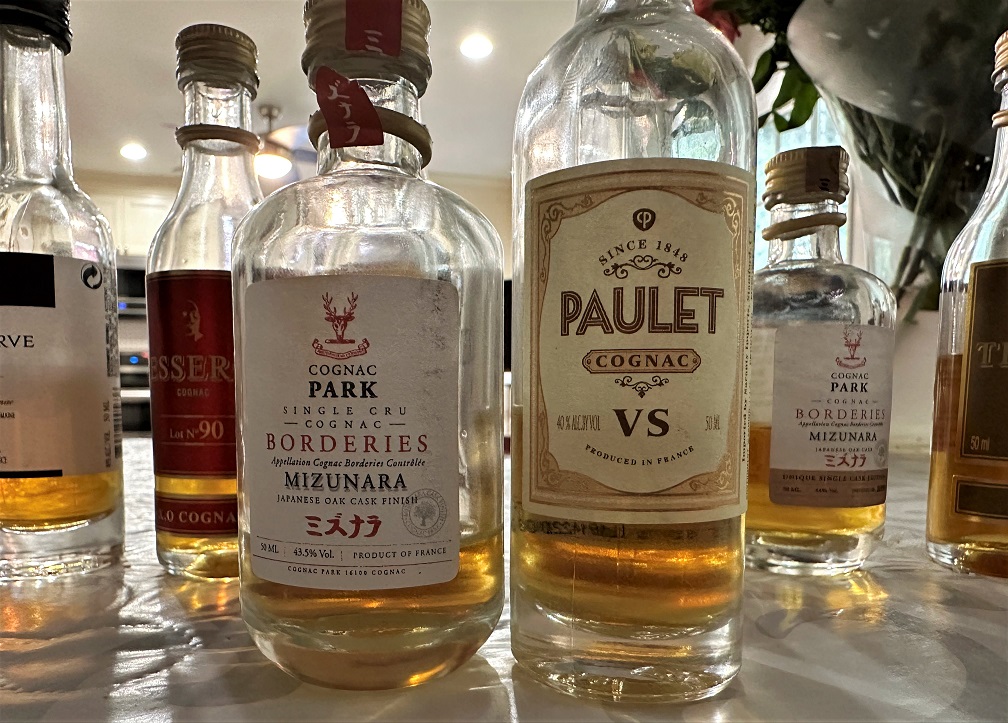
As you can tell, Cognac Park Mizunara Borderies AOC was our top choice, followed by the 1966 Darroze Bas-Armagnac and then Paulet VS cognac ($25 at Total Wine, winery direct program).
Here you go, my friends – an account of the cognac tasting. With the exception of E&J, which humans should not drink, this was a great tasting.
What do think of cognac? Do you like drinking it? Any favorites?
Drinking With Purpose
Drinking with purpose.
Okay, so what are we talking about here?
First of all, we are talking about wine. Usually, we drink wine for pleasure. Of course, sometimes people drink just for the buzz, to forget, to relax – there are many reasons why people use alcohol, but wine (I hope) stands a bit apart from the rest of the alcohol. Wine helps us to converse with friends, create memories, enhance our food experiences and simply derive pleasure from the simple moment of existence. Then what is this purpose I’m talking about?
Wine is the product of passion. At least this is how we, wine lovers, want to see it. Wine also enables passion. Not even passion, but passions. It solicits passions. Wine is surrounded by desire, obsession, exclusivity, mysticism, glamor, science, greed, mystery, art, and devotion, it evokes all of these and many other feelings and emotions. Wine allows everyone to find their own passion.
One such passion is collecting. Yes, some people are collecting the wine. In a lot of cases, they simply do this to feel superior to others, as they have something which other people want but can’t have. We can leave this aside, as this is a boring aspect of wine. Collecting unopened bottles is not the only thing to collect around wines.
The wine offers lots of artifacts. People collect unique bottles. People collect unique labels (hundreds of thousands of different wines are produced every year around the world – and many labels can change every year – think of an endless potential here). People collect champagne and sparkling wine bottle caps – this hobby even has an official name, placomusophilia. Peope collect corks and screwtops. I collect grapes and experiences.
Many, many, years ago I came across The Wine Century Club. No, you don’t have to be 100 years old or drink 100 years old wines. It is all about grapes. Anyone who tasted 100 different grapes (obviously, in wines) – don’t have to be individual grapes, blends are totally fine – is welcome to apply to become a member of the club. The application is honor-based (well, if you lie, your palate would be cursed forever – who would want to risk that), and you get the certificate sometime after you submit the application. Tasting the first 100 grapes was relatively easy. By the time I was done with the first 100, the club was already offering the 200 grapes level (Doppel), then 300 (Treble), 400 (Quattro), 500 (Pentavini), and now even 600 (Hexavin).
After I passed the 100 grapes level, hunting for the new grapes became an obsession, which I thoroughly documented on this very blog. I had friends reaching out and asking if I already had such and such grape. I spent countless hours looking for the grape information online, trying to figure out what grapes went into this particular wine from this particular vintage. Hunting down new grapes became drinking with purpose. I didn’t care if I would like the new wine or not – if it had the grapes I didn’t taste before, that was all I needed.
As I mentioned before, I collect not only grapes but also experiences. Wines are made in all of the 50 states in the USA. Wines are made at least in 60 countries around the world, maybe more. I have a personal goal to experience (read: taste) wines of all 50 states. I also would love to taste wines made in all the different countries around the world.
This is how I collect the grapes and experiences. And this is how drinking with purpose happens. A wine from the new state or a country – yes, please! The wine with new grapes? Yes, pretty please!
Recently, I managed to find a few wines with grapes I never had before. Not only that but one of the wines was made in the region which was new to me, so the two proverbial birds were killed with one stone – err, bottle. Here are the quick notes on these wines:


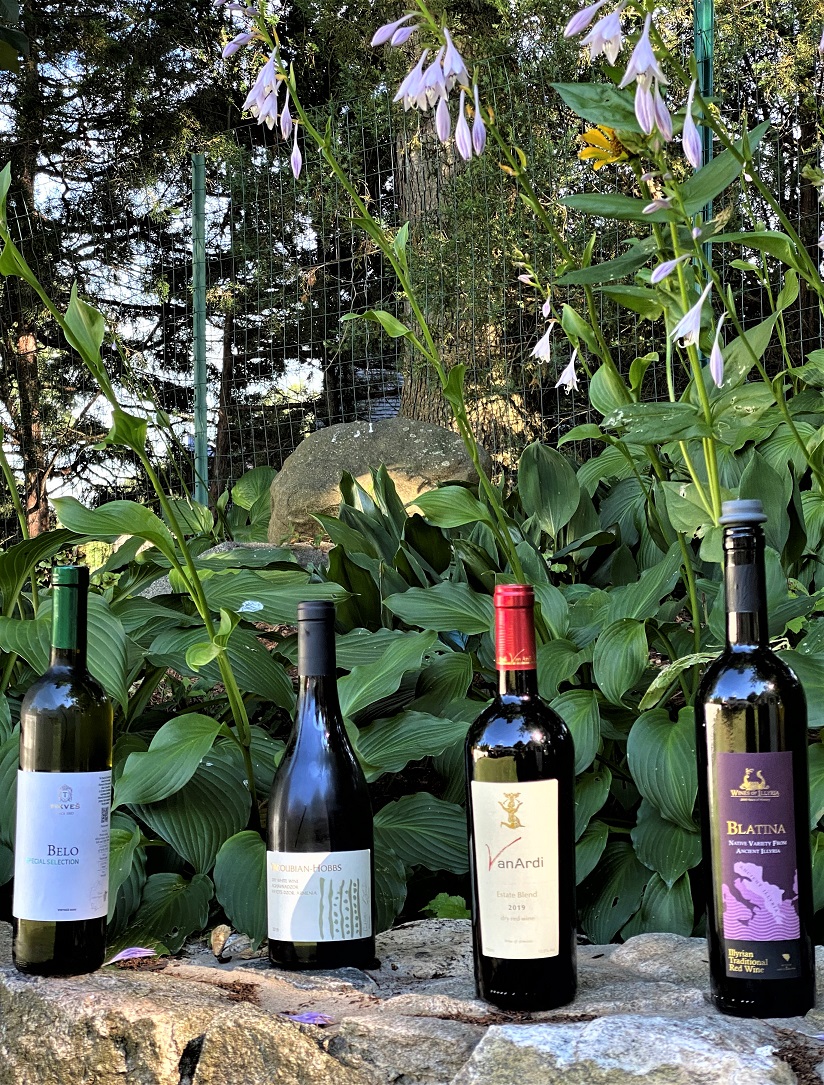
First, two wines from Eastern Europe. I never had the wines of Bosnia and Herzegovina, so this was a new country I was able to add to the list. Both wines were tasty, and Tikveš Belo was probably my favorite wine out of these 4. New grapes are marked in bold:
2015 Čitluk Winery Blatina Bosnia & Herzegovina (13% ABV, 100% Blatina)
Brickish red
Plums, dried fruits, medium intensity
Sour cherries, soft, round, medium body, good acidity, soft tannins
7+, not sure how it was stored. It is still nice, simple, and easy to drink, but probably on the decline.
8, on the second day. Interesting transformation – tertiary aromas are gone, plums, cherries and sage on the palate, nice, round, pleasant.
2020 Tikveš Belo Special Selection North Macedonia (11.5% ABV, Smederevka, Riesling, Marsanne, Roussanne)
A light greenish hue
A hint of gunflint, Whitestone fruit, medium intensity but very confident nose
Lemon, a hint of grass, salivating acidity.
8, this is a beautiful food wine, will compliment a wide range of foods.


It is my second time drinking Armenian wines. I was really looking forward to Yacoubian-Hobbs white, but the wines ended up being a disappointment. The Armenian red was quite drinkable. In any case, when you drink with a purpose, you don’t complain.
2018 Yacoubian-Hobbs Dry White Wine Aghavnadzor Vayots Dzor Armenia (14% ABV, blend of Voskehat, Khatuni, Qrdi, Garan Demak)
Golden color
Stewed fruit on the nose
The palate had some stewed plums, it was overwhelming and had no acidity. The wine was devoid of balance.
N/R, Maybe a bad bottle? Cork broke while I was opening the wine using a standard waiter corkscrew. But the wine didn’t seem oxidized, maybe heat damage?
2019 VinArdi Estate Blend Dry Red Wine Armenia (13.5% ABV, 40% Areni, 35% Haghtanak, 25% Milagh)
Dark Ruby red
Wild berries on the nose
Wild berries, dried herbs, medium+ body, good structure, good acidity, excellent balance.
8-, easy to drink
Now you know all about my wine obsessions. And I get to increase the counter you see on the top of the page from 561 to 567. Little by little…
By the way, there is no stopping in sight. While I’m trying to close on 600, there are people in The Wine Century Club discussing the 800 mark. Talk about obsessions… Enjoy your wine. Cheers!
Celebrate Syrah!
Celebrate Syrah Shiraz!
Is it Shiraz or Syrah? The official holiday today is recently enacted “Shiraz Day”, celebrated on the 4th Thursday in July, so it is July 28th in 2022. But Shiraz is simply a typical name of the Australian wine produced from Syrah grapes – it is really Syrah that we should be celebrating here (if you disagree, feel free to express yourself in the comments section).
Syrah is one of the 9 or maybe 10 major red grapes – Cabernet Sauvignon, Cabernet Franc, Merlot, Pinot Noir, Sangiovese, Tempranillo, Syrah, Grenache, Zinfandel (I live in the US, so don’t mind me) and maybe Nebbiolo. It was recently established that Syrah is an offspring of two obscure grapes, Dureza and Mondeuse Blanche, originally appearing somewhere in the southeast of France. Today, Syrah wines are successfully produced all around the world – France, Australia, Chile, Argentina, Italy, California, Washington, Israel, South Africa, and everywhere in between.
It is difficult (and pointless) to compare the wines based on prices, but the price can be used to measure their relative popularity (your liking of the wine in the glass has no relation to its price). Based on prices, Syrah wines are far behind red Burgundy (no wines can match the level of Burgundy prices – out of the 25 most expensive Burgundy wines, the “cheapest” on the list is $8K a bottle), and they are trailing Bordeaux first growth and California cult Cabernet Sauvignon wines. If you want to see for yourself, here are the lists of the most expensive Syrah and Shiraz wines – Wine-Searcher tracks these two categories separately.
We can also say a few words about the most famous producers around the world. Again, these are not absolute positions – unless you are “deeply in the space”, the names might be meaningless, but nevertheless, it is still a fun exercise. As a nod to the exact name of the holiday, Shiraz Day, we can look into the Australian Shiraz world’s first, where Penfolds (iconic Grange, anyone?) and Henschke are probably lead uncontestedly, with Torbeck, Jim Barry, d’Arenberg, Two Hands, Mollydooker, Tahblik definitely worth mentioning as well.
In France, great Syrah wines are concentrated in Hermitage, Cote Rotie, St. Joseph, and Cornas regions. J.L. Chave, E. Guigal, and M. Chapoutier would be on top of my list, and I don’t drink enough of the Northern Rhone wines to extend this list further.
When it comes to the USA, California, and Washington are by far the top Syrah producers, with some notable successes coming also from Oregon. In California, Sine Qua Non, Alban, and Saxum would probably be the ones I would like to mention first, but there is no shortage of other notable Syrah producers such as Carlisle, Zaca Mesa, Andrew Murray, Beckmen, and many, many others.
And then there is Washington. Syrah might truly be a king of Washington wines, produced literally by each and every winemaker, small and large. In that sea of Syrah, Christophe Baron is standing a head and shoulders above all others with his iconic Cayuse, No Girls, Horsepower, and Hors Categorie lines.
I didn’t tell you from the beginning, but if you ask me about my favorite wine grape, I will probably have to decide between Cabernet Sauvignon and Syrah, both in their pure, singular, non-blended expression. My favorite two tell-tale properties of Syrah are pepper and barnyard. I recently learned that pepper notes in the wine are caused by the chemical compound called rotundone, found in the grape skins. It is not very clear why the pepper is most often associated with Syrah, it can be found in the other grapes too, but I always equate the significant presence of black pepper with Syrah. And for the barnyard smell… Ohh, I know I can be beaten up for this, as this is considered to be a fault in wine – according to the Wine Spectator, “Brettanomyces, or “brett,” is a spoilage yeast with aromatic elements that are politely described as “barnyard.”“. I can’t argue with the experts, but nevertheless, I often find the barnyard smell in Syrah wines, and yes, I do like it.
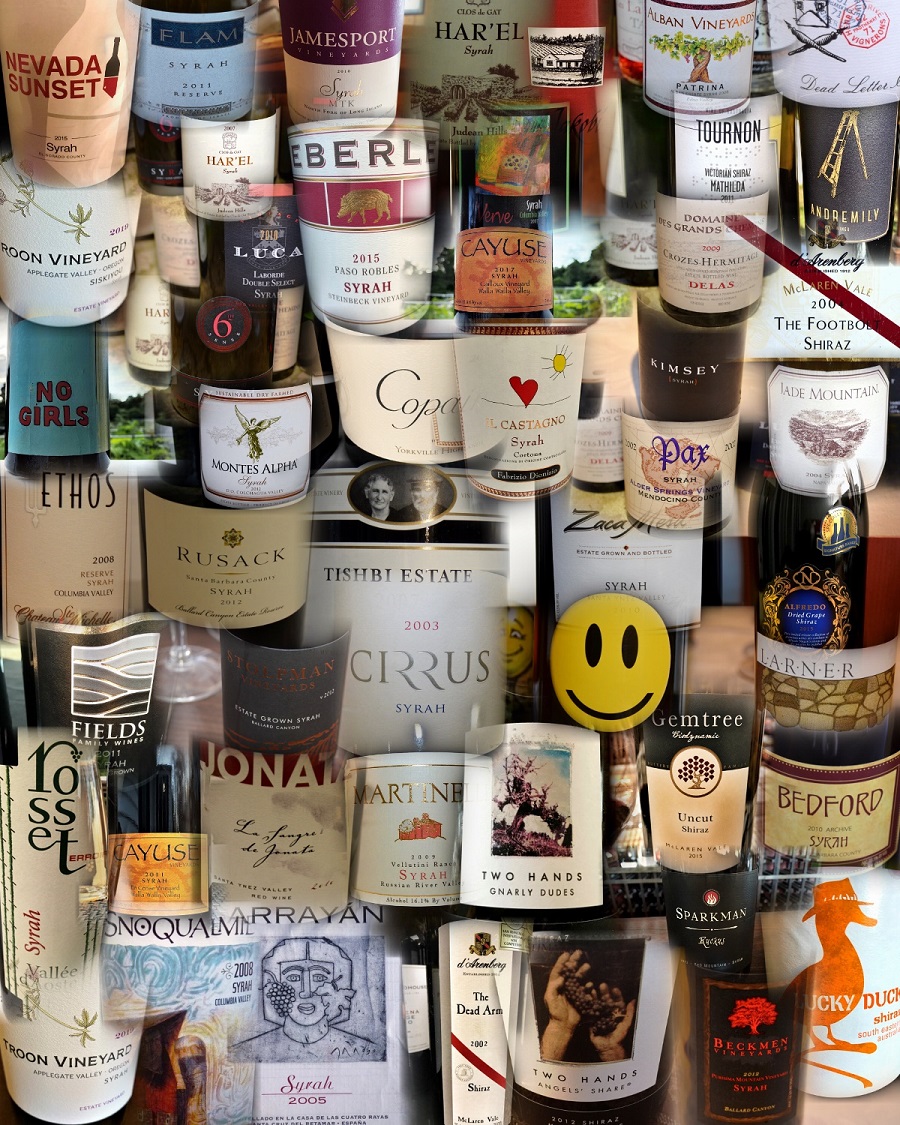
To finish our Syrah conversation on a memorable note, how about a memory exercise?
First, pour yourself a glass of Syrah or Shiraz, whatever your heart desires. Take a piece of paper and a pen. Give yourself, let’s say, 5 minutes of time, and write down the names of the most memorable Syrah/Shiraz wines or Syrah/Shiraz experiences you ever encountered.
Done?
We are not going to compare notes (there are hundreds of thousands of wines in this world), but here are some of mine.
My most memorable encounter with Syrah – actually, Shiraz – is Michel Chapoutier Tournon Mathilda Shiraz. When I tasted this wine for the first time, I was literally blown away by the purity of the black pepper expression. Ever since this is my goto example of the classic Syrah wine. Another one will be a bit unusual, but it was Elephant Hill Syrah Hawke’s Bay from New Zealand – again, beautiful black pepper, and my very first encounter with Syrah produced in the land of Sauvignon Blanc and Pinot Noir.
Then there is Troon Vineyard Estate Syrah from Applegate Valley in Oregon – organic, biodynamic wine of beautiful clarity and finesse. Zaca Mesa Syrah Santa Ynez Valley is a connection to the beautiful experience of visiting Santa Barbara County for my first Wine Bloggers Conference in 2014. Zaca Mesa was my first stop after arrival to Santa Barbara – both hospitality at the winery and the wines themselves created this memory knot, a connection easy to reach out for. Another connection to the same WBC14 was the first encounter with the first (and the only?) AVA dedicated to Syrah wines – Ballard Canyon. The AVA status was just granted to the Ballard Canyon exactly during our visit there, and I attended a session about the Syrah wines of Ballard Canyon where Stolpman Syrah Ballard Canyon for some reason got stuck in my head – another memory connection.
There are uncountably more Syrah wine experiences (just look at the labels in the collage), but hey, the purpose of the exercise was to focus on the few of the first – and this is exactly what I did.
Here you go, my friends – another grape holiday is about to become history. Hope you had something tasty to drink, and if you care to share your most memorable Syrah and Shiraz encounters, this is what the comments section is for.
Wednesday’s Meritage #161
 Meritage Time!
I’m soooo behind on my posts it is not even funny. Probably good 15+ posts behind, and it is not a good feeling. Not being a professional writer, I never developed a habit of just writing no matter what. Not having such a habit definitely gets in the way. Oh well, such is life.
Today’s Meritage is once again mostly focused on this very blog. Of course, a lot is happening in the wine world, but nothing really caught my eye as worth repeating. Even the record heat wave in Europe doesn’t have much coverage as it relates to the vineyards. I checked to see if I can find anything worth sharing about extreme heat in Europe and vineyards, and only found plenty of articles from 2019, but none from 2022. It will be really interesting scary like hell to see the effects of this extreme heat on the 2022 wines in a few years, but yes, we will have to wait a bit.
For the local “news”, outside of the fact that I’m grossly (understatement of the century) behind on my writing and my postings, I spent some time cleaning up and updating references on the front page of the blog.
On the right side of the screen (assuming you are using a PC – it will be all different on a mobile), there are links grouped into 4 categories – social media, blogroll, wine buying, and wine travel. I went over all of the links in these sections and removed all of the dead ones. In the blogroll, some of the links will connect you to the sites which had not been updated for years – but as long as the link is not dead and you can actually reach the content, I left those links in place.
I also realized that I’m missing some of the references I actually should have. I added a few blogs I’m reading semi-regularly (I won’t tell you what they are though :)). I also added a few links to the wine buying section.
Wine.com was a notable absence from the wine buying section, as I was not a fan. I gradually changed my opinion – I wouldn’t say that Wine.com is my only or even preferred source of wine buying, but they have plenty of interesting and unique wines (Grosset Polish Hill Riesling, for example, or Masciarelli Marina Cvetic Reserva), which are also priced at an “average retail” level, which I’m okay with (I despise with passion overpaying for wine). I also like the extensive information provided on Wine.com on all the wines, whether they are in stock or not.
Same with the Wine Exchange – I gradually warmed up to their e-mails and even bought a few interesting wines based on their suggestions. They also carry a good inventory of well-aged wines at reasonable prices – for example, there you can find Chateau Lestage from the Listrac-Medoc, 2000 (legendary!) vintage for $39.98, or Shiraz from Barossa Valley from 2004 vintage (18 years old wine) for $29.99.
The last addition to the wine buying section is not even about the wines – it is about a close relative, cognac. I came across the Cognac Expert website as I was looking for interesting cognac tasting sets to share with a friend who was supposed to visit. There is a tremendous Cognac selection on the website, plus every cognac has a very extensive description of its history, tasting notes, and more. They also charge reasonable shipping rates (I think) for the cognacs delivered from France, so if you like cognac, this is definitely a site to visit.
Okay, just to step outside of my blog’s realm, a few more news items:
There are 5 days left to enter the Web Wine Writing competition conducted by the Hungarian Wines organization. I know this is not enough time, but in case you wrote about Hungarian wines recently, this might be a great opportunity for you. Details can be found here.
International Shiraz Day is the next grape holiday, coming up on July 28th. Shiraz or Syrah, Australia, France, Italy, or Washington – I’m sure it is not difficult to find a tasty bottle and enjoy it in honor of one of the major red grapes.
And the month-long wine celebration is almost upon us – August is Washington Wine Month. From Bordeaux blends and GSM to the world-class, cult quality, single vineyard Cab, Syrah, Grenache, and everything in between – folks in Washington know how to wine. Just get a bottle of your favorite Washington wine and you are ready to celebrate.
That’s all I have for you for today. The glass is empty, but the refill is on the way. Cheers!
Wednesday’s Meritage #160
Meritage Time!
It’s been a while since I published one of these, but hey, life takes precedence. I don’t have a lot of the true wine news to share, but there are a few things I would like to highlight – you will have to pardon my SSP (for those not aware of the abbreviation, SSP stands for Shameless Self Promotion).
Oregon Wine Month
May is Oregon wine month! Basically, it means that during the month of May you are only allowed to drink wines from Oregon. What, you don’t have any on hand? Shame on you – and you have to go to the wine shop to fix this right now. But all the jokes aside, Oregon makes wonderful wines well worth celebrating. Pinot Noir, Chardonnay, Pinot Gris, Riesling, sparkling wines, Syrah, Cabernet Sauvignon, Cabernet Franc – we can go on and on. Oregon got something for every wine lover’s palate – Oregon wines are well worth seeking and enjoying, during Oregon wine month or at any other time.
Stories of Passion and Pinot
Stories of Passion and Pinot is one of the longest running series of posts on this blog. The series started in September 2016 via my collaboration with Carl Giavanti, a wine industry publicist. In this series, we are profiling Oregon winemakers who are obsessed with Pinot Noir via interviews. Currently, the series includes 21 posts, profiling 13 wineries and winemakers from Willamette Valley. I finally had the time to create a dedicated page for the whole series, which you can access through the top Interviews menu, or by clicking here. Also, I have a number of new interviews coming up on these pages, including Adesheim Vineyard, Gran Moraine, and WillaKenzie Estates.
More Interviews and More [Italian] Wines
Another “local” update. It seems that Italian wines are the wines I have the biggest exposure to, at least from the outreach point of view. Next week I will publish an interview with an Italian winemaker Lucio Salamini from Luretta in Colli Piacentini in Emilia-Romagna. I also lately had a number of delicious Italian wines from Tedeschi (including my eternal love, Amarone), San Felice who just celebrated 50 years since the production of Vigorello, the first “super-Tuscan” wine in Chianti Classico, and more. All of this is coming soon on these pages, so watch this space.
That’s all I have for you for today. The glass is empty, but the refill is on the way. Cheers!
Wednesday’s Meritage #159
Meritage Time!
January is almost over, and as many people talked about “dry January”, it was reasonably dry – not in terms of wines, but in terms of wine events. However, February promises to compensate abundantly and offers lots to look forward to.
Let’s start with the grape holidays. Next Tuesday, February 1st, is International Furmint Day. Furmint is one of the most famous Hungarian grapes, best known as the grape behind Tokaji, heavenly nectar. Furmint also can be vinified dry, although much harder to find compared to Tokaji. Either way, you have a holiday to celebrate. Two weeks later, on February 16th, we will celebrate one of my favorite grapes – Syrah, via International Syrah Day. Syrah should be much easier to find, so no excuses. There is also Global Drink Wine Day on February 18th, but for someone who drinks the wine every day, that is not something I can particularly celebrate.
Continuing the theme of celebrations, let’s talk about celebrating not a particular grape, but the whole wine region. Monday, February 7th, will mark the beginning of the New Zealand Wine Week. Two webinars will be offered – one focused on the New Zealand wines on the global wine scene, and the second one diving deep into the world of New Zealand Pinot Noir.
To complete the subject of celebration, the last one for today is the main wine holiday of the year – Open That Botte Night, or OTBN for short. The holiday was created 22 years ago by Dorothy J. Gaiter and John Brecher, writers of the Wall Street Journal’s Tastings column. The goal of the holiday is to help people to happily part with their prized bottles, taste those wines themselves, and share them with friends, hopefully while both wines and people are in their prime. OTBN is always celebrated on the last Saturday in February, which will be February 26th this year. It is time for you to already start thinking about those special bottles you would want to open.
The next event I want to bring to your attention is Oregon Wine Symposium. While this is definitely a technical event, focused on the winegrowers, winemakers, and winery owners, the event offers excellent educational content for any wine lover. This year’s event will consist of two parts. Virtual part with all the educational content will take place February 15-17, and then the Oregon Wine Symposium Live portion will follow on March 8-9. Virtual sessions will cover in-depth Oregon wine industry, looking into the overall state of the industry, the direct-to-consumer market, the management of the supply chain, and lots more. Again, this is a technical event, offering lots to learn for those who want to learn.
Last but not least will be the first trade tasting I plan to attend in person this year – the Tre Bicchieri 2022, taking place on Friday, February 25th. This event is a culmination point of the Gambero Rosso wine publication, offering an opportunity to taste the best of the best Italian wines selected during the prior year, those awarded three glasses rating by the publication. Tre Bicchiery is one of my favorite tastings of the year, usually full of great discoveries – here is the retrospective of the events I attended in the past. Considering that there was no Tre Bicchiery event in 2021, I can only hope that we will see some great wines at the event, and I will actually be able to plan my attendance properly to taste the most coveted wines, instead of finding a table with only empty bottles, as already happened at my first Tre Bicchieri event, and the empty bottles at the table were the legendary Masseto. The event will travel around the USA, with the stops in Los Angeles, San Francisco, Chicago, New York, Boston, and Houston, so hopefully, you will get your chance to attend.
That’s all I have for you for today. The glass is empty, but the refill is on the way. Cheers!
Wine Lover Geeking Out: Pairing Soup and Wine
 Finally, the snow was coming. Cold weather can be perfectly paired with the soup. So this was an easy equation to solve – snow means soup.
New England Clam Chowder is one of my all-time favorite soups. I’m generally happy with restaurant versions, but I have a recipe that is much lighter than a typical restaurant version, as it uses half and half instead of heavy cream. One day I might be able to share that recipe, but as this is not my recipe, I would need first to get permission. I can tell you that the main ingredients there are bacon, potatoes, celery, and good quality clams (so far I find that ocean clams are the best). And half and half as I mentioned before.
In the morning, I realized that I’m not sure what wine I should pair with this soup, and I decided to ask the wine folks on the twitter for a recommendation. This turned out into a fun conversation. Here are the recommendations I received (I will try not to miss any, but I can’t guarantee):
- lightly oaked, moderate-climate Chardonnay
- Austrian Gruner
- Siegerrebe, Pinot Blanc, and Chenin Blanc (from South Africa or Loire)
- Riesling or Pinot Blanc / Gris from Alsace
- Brut Sparkling
- Viognier (I missed this recommendation when it was originally sent)
- Ribolla Gialla, perhaps even a skin-contact (e.g. Gravner)
- Godello
- Manzanilla
Not a bad list, isn’t it?
My goal was to use what I have on hand and not to go to the store. This eliminated Austrian Gruner, Siegerrebe (had to use Google to learn about this obscure grape), Pinot Blanc, anything from Alsace, Ribolla Gialla, and especially Ribolla Gialla with skin contact (I wish I had a bottle of Gravner), Viognier, Godello, and Manzanilla. So the only 2 options I had from this list were lightly oaked Chardonnay and sparkling Brut. After careful consideration, I realized that I probably don’t have lightly oaked Chardonnay on hand either. And I didn’t feel like opening Champagne – besides, Champagne perfectly pairs with everything anyway, so this would not be a fun exercise anyway.
Then I realized that I have a few samples of Portuguese wines, as well as a few Sherries – this was enough to experiment, which is exactly what I did.

These are the wines I tried with the soup:
2020 Esporão Branco Colheita Alentejo (Antão Vaz, Viosinho, Alvarinho, 4 months on the lees) – didn’t work. Creamy and round wine clashed with the soup.
2020 Esporão Branco Reserva Alentejo (Antão Vaz, Arinto, Roupeiro, six months in stainless steel tanks and in new American and French oak barrels) – it worked! The pairing was complementary, probably because the wine had a good amount of clean acidity, and so it was the most food-friendly by definition.
2018 Esporão Tinto Colheita Alentejo (Alicante Bouschet, Touriga Nacional, Aragonez, Cabernet Sauvignon, Touriga Franca, 6 months in concrete tanks) -trying this wine with the soup was a mistake – can I leave it at that?
Gonzalez Byass Alfonso Oloroso – I had big expectations for this pairing, and it didn’t work. The combination was not bad – the wine and the soup simply stayed in their own worlds without impacting each other.
González Byass Solera 1847 Cream Dulce – big mistake. That sweetness of the wine just didn’t go well with the soup.
Here is my report on this simple experiment. I might try a few more combinations tomorrow and will update the post if I will encounter something exciting.
What would you pair a clam chowder with? What do you think of pairing soup and wine in general – does that even makes sense?
Daily Glass: Surprised Not Surprised
First, I want to use this opportunity again to wish everyone a healthy and happy New Year 2022!
Today, I want to talk about a couple of wines – one was surprising (and not), and another one was simply interesting.
Let’s talk about surprises first.
Have you heard of Harry and David? No, not about some random guys named Harry and David, but one of the most famous gourmet food gift catalogs? I don’t know if Harry and David has international fame, but in the USA this is definitely the most famous food gift catalog in existence. I remember for many many years literally drooling over the description of their most famous, and spoon-ready, Royal Riviera® Pears.
Harry and David’s food gifts are not limited to fruit, cheese, and crackers. Many gift selections also include wine, mostly from well-known California wineries – J Vineyards, Talbott, Louis M Martini, and others. And it turns out Harry and David also offers wine under its own label – Harry and David.
When we opened a holiday shipment from our friends, the appearance of Harry and David wines caught me by surprise – I really didn’t expect to see that name on the bottles. To be entirely honest, I’m not a big fan of food gift baskets, even though often they are the most convenient presents. Seeing a catalog-branded wine got my suspicion to the next level though. It is so easy to cut corners and put some random plonk into the bottle with a private label…
To make me worry even more, this was also a bottle of sparkling wine – and for my palate, finding a tasty sparkling wine is even trickier than a regular still wine. So I had a spare bottle of Champagne ready for the backup and only then proceeded with the opening of the Harry and David sparkling wine. The first sip made me instantly grab the bottle and look at the back label. My reaction to the second line on that back label was “aaah, of course, this is why the good taste is not surprising“. The wine was delicious, and the second line on that label said “Southern Oregon”, which instantly lead to the “not surprised” notion – having spent a week in August 2021 in Oregon, good Oregon bubbles are simply expected.


This 2020 Harry and David Vineyards Sparkling Wine Southern Oregon (11.7% ABV) was simply delightful – creamy, consistent mousse on the palate, a touch of fresh apples on the nose, and more of the fresh apples with a touch of the lemon notes on the palate, clean acidity, crisp, perfect balance, pleasure in every sip.
It is a pity that it is practically impossible to find actual wine information on the Harry and David website – or maybe I just lost my searching skills. I spent some time with google and was able to find this article from Oregon Wine Press, from which I learned that in 2012, Harry and David, which is headquartered in Medford, Oregon since 1934, has hired winemaker Linda Donovan of Pallet Wine Company in Medford to make wines for Harry and David. The grapes are primarily sourced from the vineyards in the Rogue Valley in Oregon. I would love to have more details about the vineyards, how they are managed, how the wine is made, and so on, but hey, good wine is a good wine.
Now, let’s talk about interesting wine. I was looking for a wine gift for a friend and came across Sandhi Rosé. Sandhi wines are not widely known, but as I had the pleasure of tasting Sandhi Pinot Noir and Chardonnay, I was definitely interested in trying the Rosé. Sandhi wines are produced by Rajat Parr in Santa Barbara in California, and the whole project was born out of the desire to produce supremely balanced low-alcohol wines.
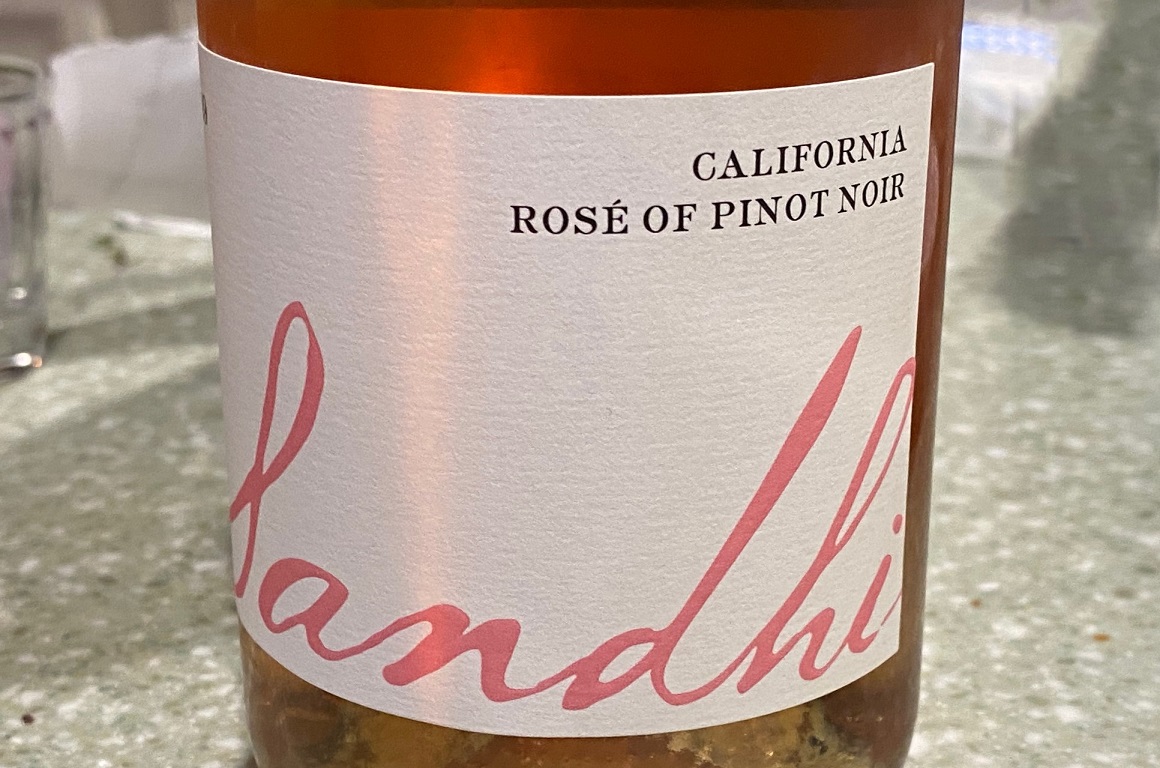
2019 Sandhi Rosé of Pinot Noir California (12.5% ABV, $20) was definitely an interesting wine. In my vocabulary, “interesting” wine or food is rarely a positive descriptor. This Rosé was if not interesting, then puzzling. Taken out of the refrigerator (so probably at around 38°F – 40°F, the wine was mostly closed, offering a bit of sapidity and onion peel, both on the nose and the palate. After warming up in the glass for about 10 minutes, the wine opened up offering a hint of strawberries with a touch of lemon, still void of any sugar but getting much closer to the traditional Provençal in its presentation. The need to play with the temperature was taking a bit away from otherwise a nice wine.
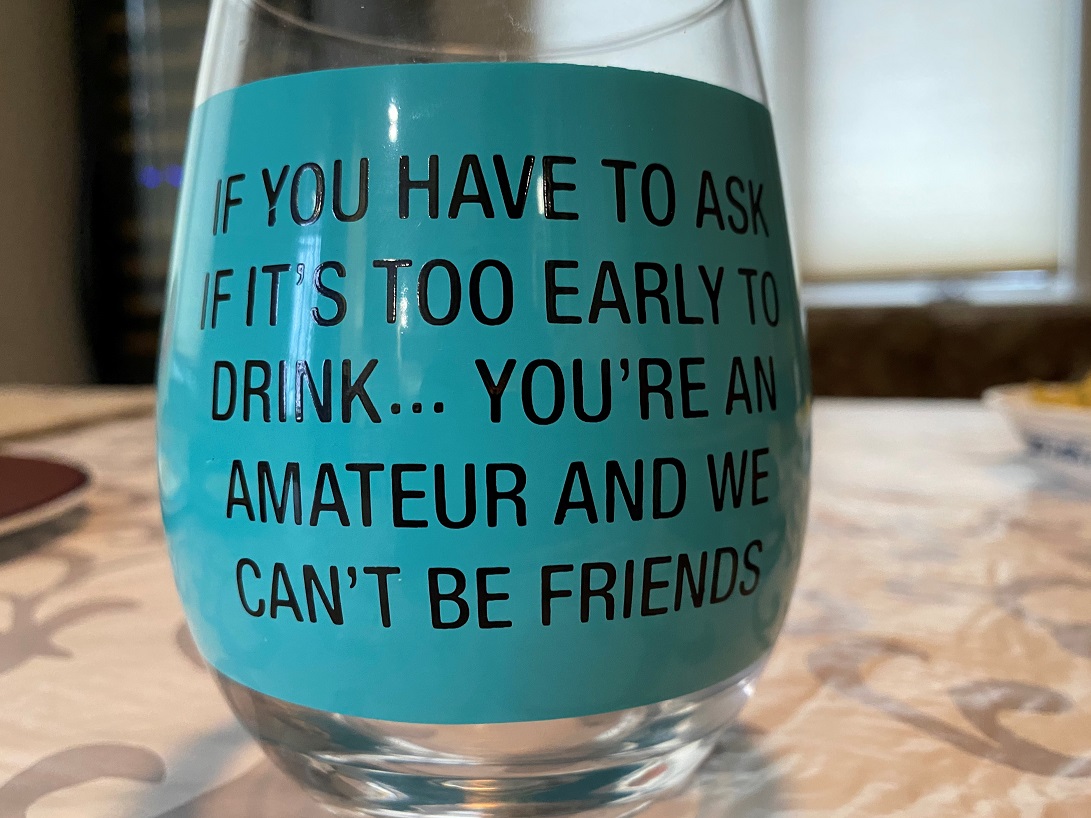
That is my first story of 2022. I want to leave you with a picture of the little present, a wine glass, I got from friends – looks like they know me well! Cheers!
Last Bottle Sign Up ($10 credit)





