Archive
Spain’s Great Match, 2021 Edition
Spanish wines are some of my most favorite wines in the world.
Spain’s Great Match event in New York is one of my most favorites wine events of the year, always offering an opportunity to discover something new.
And I had not been to New York City in the past 18 months – lots of good reasons to be excited, would you agree?
For the second time in a row, Spain’s Great Match event was held at Mercado Little Spain, a Mecca of Spanish cuisine in one of New York’s hottest new neighborhoods, Hudson Yards. I was able to attend the walk-around tasting and two of the seminars, so here I want to share my impressions.
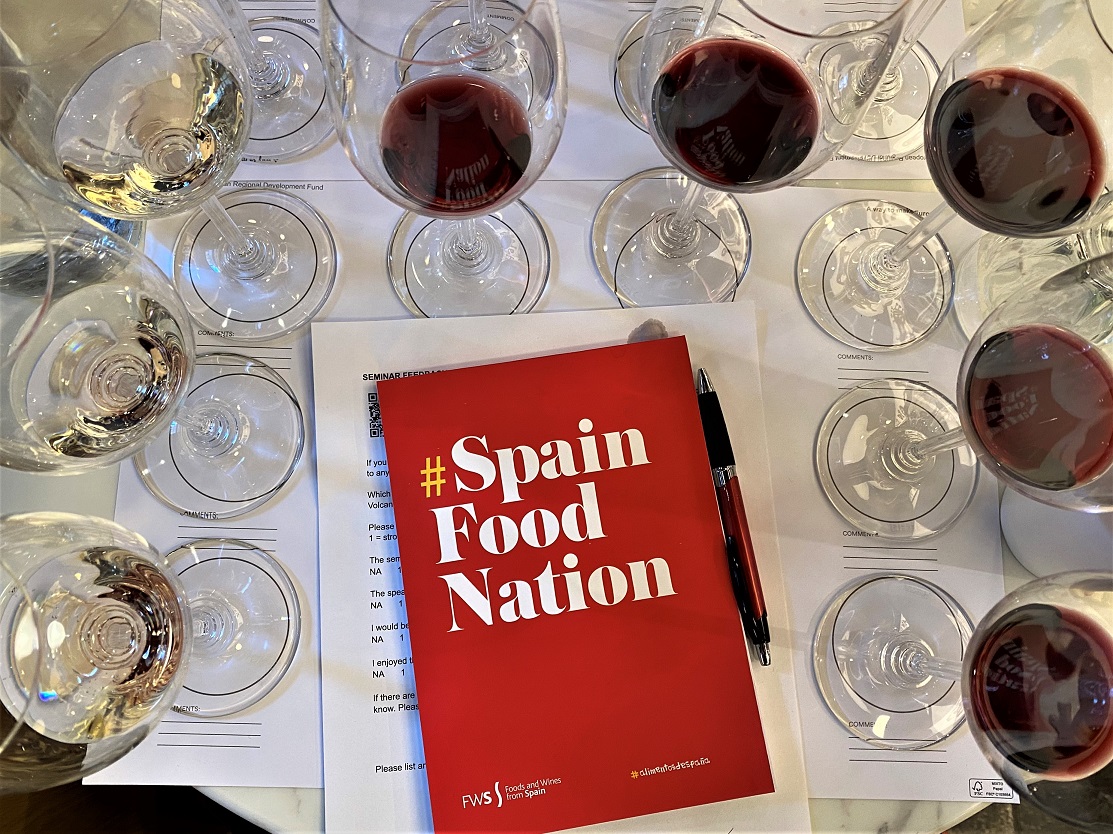
Before we get to the event, just a few facts about Spain’s wine industry. Spain has the biggest grape planting area in the world – more than 2.9 million acres. Spain today (2021) is the second-largest wine producer in the world after Italy. There are more than 600 grape varieties grown in Spain (only about 20 are used to produce the majority of the wines though). Spain has more than 130 defined wine-growing areas.
Now, let me share my observations.
First, Spanish wines are popular. Duh? I can’t argue – I’m starting with the most banal conclusion, but let me explain. Spanish wines were always regarded as the best-kept secret among wine professionals – whatever the general public likes to drink is fine, but the wine professionals would most often resort to the Spanish wines to share amongst themselves and with friends. I don’t know how many people attended the consumer portion of the event in the evening, but the trade event was incredibly busy, also with a significant number of MS and MW in the audience – I never saw these many Masters of Wine and Master Sommeliers attending this event. It might be just me not seeing it before, or it might be a testament to the growing popularity of Spanish wines. I think this popularity is also reflected in the increased prices of the Spanish wines – don’t know if supply issues are muddying things up, but otherwise, it seems that the prices are inching higher.
The trend of “internationalization”. Spanish Rioja and Ribera del Duero wines, the keystones of Tempranillo expression, always had its unique taste profile, driven by well-integrated tannins, minerality, and spicy undertones. This character was largely defined by the use of American oak which was traditional in Rioja. I didn’t taste each and every Rioja wine presented at the event, but based on what I managed to taste, it seems that there is a shift towards using the French oak, which completely changes the presentation of the wine, leading with grippy, mouth-drying tannins which completely lock the front of your mouth for a few minutes after the sip. Barolo used to be like that, and it became much better with tannins lately. Now Rioja is offering this internationally indistinguishable style which becomes borderline boring. If I want to drink a grippy powerful wine, I got plenty of choices outside of Rioja – I understand that this might be a trend with young wine drinkers, but it will be very difficult to maintain individuality and build a following if you are simply “one of many similar ones”.
Where did the Godello go? I saw a very little presence of Godello wines, which was surprising. I always thought that this white grape has an excellent future – this might still be the case, but this was not obvious with 3 whites ruling the show – Rioja Blanco, Albariño, and Verdejo Rueda.
Jerez is absolutely delightful. My love of Jerez is back, and the wines we tasted during the seminar (more details forthcoming) were simply superb.
Don’t forget Spanish bubbles. I tasted a bunch of Cavas, and none of them were mediocre. Fresh, clean, approachable, and reasonably priced – great QPR wines for every day.
Now, here are the wines I tasted during the event (with the exception of the seminar wines). Everything which is mentioned below was well drinkable, and the specific favorites are marked (bold) as such.


2020 Santiago Ruiz Santiago Ruiz D.O. Rias Baixas ($25)
2017 Bodegas LAN Rioja Crianza D.O.Ca. Rioja ($18) – probably my favorite from the Bodegas LAN selection. The most approachable and balanced from this group.
2015 Bodegas LAN Rioja Reserva D.O.Ca. Rioja ($24)
2017 Bodegas LAN D-12 D.O.Ca. Rioja ($25) – single vineyard
2017 Bodegas LAN Xtreme 2017 D.O.Ca. Rioja ($25)
2015 Bodegas LAN Viña Lanaciano D.O.Ca. Rioja ($30)
2018 Bodegas LAN Edicion Limitada D.O.Ca. Rioja ($55)
2015 Bodegas LAN Culmen D.O.Ca. Rioja ($70)
2016 Vins el Cep Gelida Brut Gran Reserva D.O. Cava ($20)
NV Bodegas Llopart Brut Reserva Rosé Corpinnat ($28)
2020 Bodegas Vatán Nisia Las Suertes D.O. Rueda ($32)
2018 Bodegas La Caña Navia D.O. Rias Baixas ($32)
2019 Bodegas Avancia Mencía Old Vines D.O. Valdeorras ($35)
2018 Bodegas Breca Garnacha D.O. Calatayud ($16) – clean, simple
2018 Bodegas Vatán Tritón Tinta de Toro D.O. Toro ($20)
2018 Bodegas Vatán Tinta de Toro D.O. Toro ($45)


2018 Bodegas Muga Flor de Muga Blanco D.O.Ca. Rioja ($50) – my favorite wine white of the event – clean, round, fresh, elegant
2014 Bodegas Muga Prado Enea Gran Reserva D.O.Ca. Rioja ($100) – surprisingly ready to drink
2011 Bodegas Sierra Cantabria Gran Reserva D.O.Ca. Rioja ($40)
2014 Bodegas Alvear Alvear Fino en Rama D.O. Montilla Moriles ($22) – outstanding. It is very rare to find dry sherry made from 100% Pedro Ximenes grapes.
2016 Sierra Salinas Mira Salinas D.O. Alicante ($18, Monastrell) – Elegant, fresh, perfect acidity
2016 Ramirez de la Piscina Ramirez de la Piscina Reserva D.O.Ca. Rioja ($22)
2018 Rafael Cañizares Bodegas Volver Tempranillo Single Vineyards D.O. La Mancha ($20)
2020 Rafael Cañizares Bodegas Volver Paso A Paso Tempranillo Tierra De Castilla ($35) – excellent, elegant, open


All three were excellent:
2013 Agustí Torelló Mata Cava Agustí Torelló Mata Brut Nature Gran Reserva D.O. Cava ($26)
2017 Agustí Torelló Mata Cava Agustí Torelló Mata Brut Reserva D.O. Cava ($21)
2011 Agustí Torelló Mata | Cava Kripta Brut Nature Gran Reserva D.O. Cava ($85) – unique and different, would make a perfect geeky present
2019 Bodegas San Valero S.Coop Cabeza Casa D.O. Cariñena ($11, Garnacha) – elegant, round, excellent QPR
2018 Bodegas San Valero Celebrities Syrah D.O. Cariñena ($11)
MV Bodegas San Valero 801 D.O. Cariñena ($20, blend of 2014 Cabernety Sauvignon, 2015 Merlot, 2016 Syrah) – very good, unusual, multi-vintage
2019 Bodegas San Valero Particular Garnacha D.O. Cariñena ($12)
Now, the seminars. The Jerez seminar was superb, offering lots and lots of knowledge about the fascinating world of sherries. Three white grapes – Palomino Fino, Pedro Ximenez, and Moscatel – are behind the tremendous range of wines, all with unique characters and tastes ranging from absolutely bone dry (sugar content less than 5 g/l) to the syrup level with more than 300 grams of sugar per liter. Another fascinating element of Sherry is the Solera production method, where the resulting wine might technically have trace amounts of 200+ years old wines. Lots and lots of care and attention go into the Sherry production. During the “Spotlight on Sherry” seminar, led by incomparable César Saldaña, General Director of the Jerez Control Board, we learned a lot about sherries and tasted through the outstanding flight of 8 wines (with the exception of the last 2 which I didn’t enjoy that much).
Here are my notes regarding the 8 wines we tasted:
Bodegas Hidalgo Manzanilla La Gitana
4 years Solera
Almonds, hazelnut, sage, brioche
Crisp, dry, fresh, hazelnut, pecorino cheese, sapidity, dusty palate
Excellent, perfect aperitif, and perfect for food
2021 Tio Pepe Fino Tio Pepe en Rama-Saca
Unique and different, blend of selection of 82 butts of Tio Pepe Solera
Bottled unfiltered
Beautiful floral nose,
Crisp, clean, elegant, mostly lemon and 0 sugar, chalky note – typical for this type of wine.
Great complexity, elegant
Valdespino Jerez Fino Ynocente
Single Vineyard in Pago Macharnudo
50 years old Palomino Fino vines
Fermented in cask
10 years Solera, Criaderras Solera
Very elegant, apples, lemon
Chalk, lemon, sapidity, 0 sugar
Williams Humber Amontillado Don Zoilo
Solera 12 years
Biologically aged until the full absence of flor
Butterscotch!
Crisp, fresh, herbaceous
Lustau Almagenista Oloroso Pata de Gallina
Almagenista: Juan Garcia Jarana
38 casks, aged on average 15 years
Butterscotch, caramel
Crisp acidity, sapidity, great complexity, hazelnut
Osborne Palo Cortado Capuchin VORS
Solera was founded in 1790! Potentially, there were traces of 230 years old wine!
5 criaderas
Average age 30 years
Tobacco, mint, basil
Pepper, tobacco, caramel, complex, long finish.
Superb
Bodegas Tradicion Cream Tradicion VOS
Blend of 30 years Oloroso (70%), 6 years old Pedro Ximénez (30%)
Average age 25 years
Dry fruit
Concentrated sugar, not great.
Barbadillo Pedro Ximénez la Chila
Solera system average 5 years
Amazing nose – raisins, figs,
Pure liquid raisins on the palate. I would like more acidity.
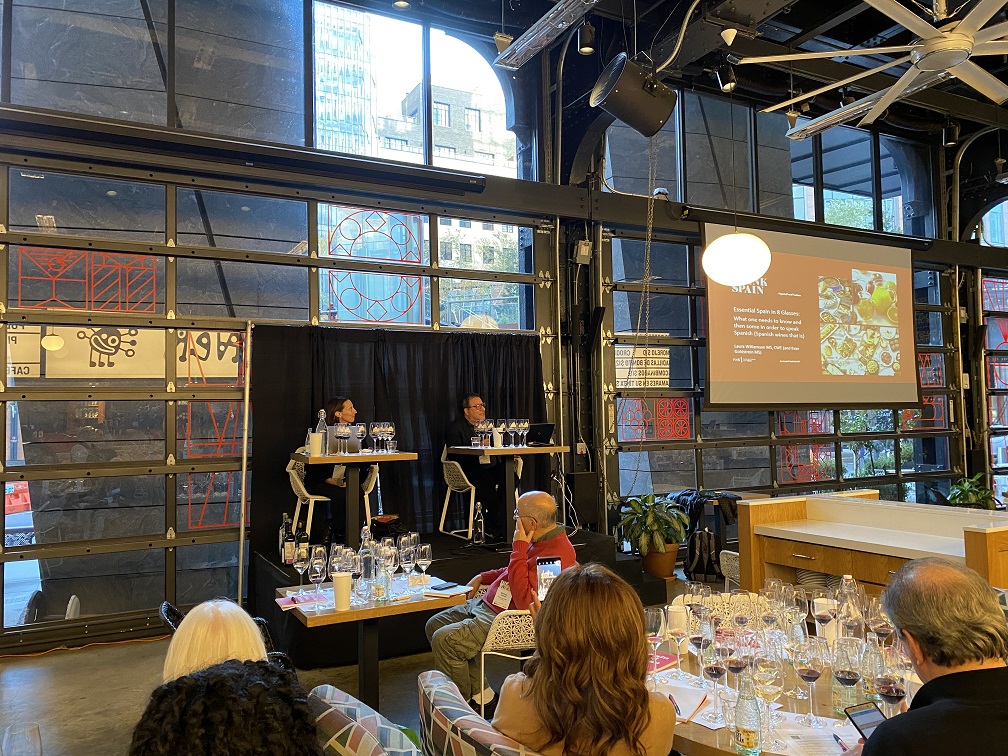
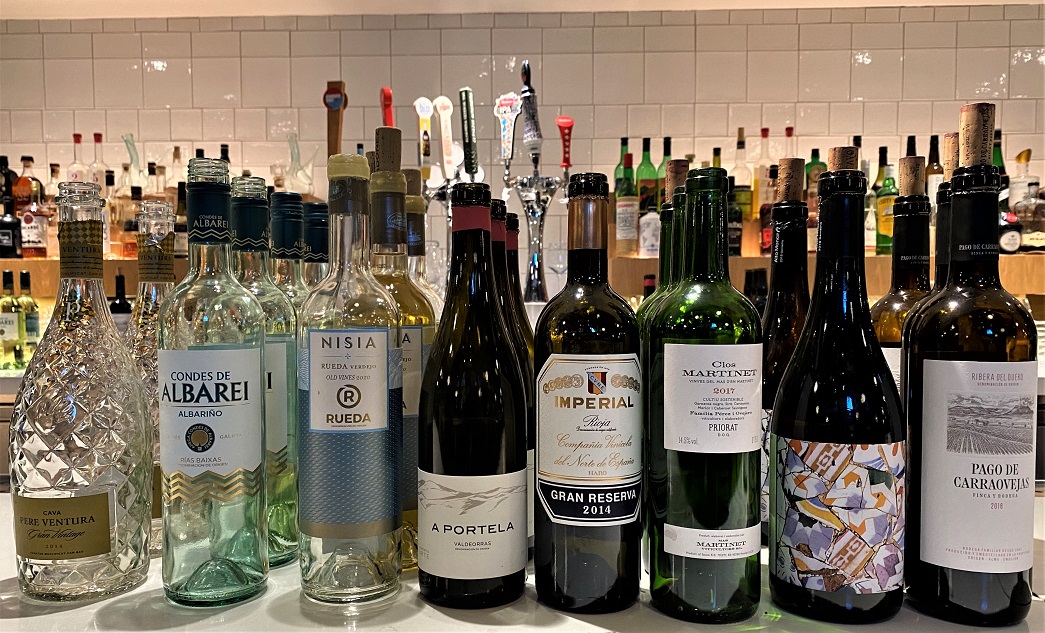
Finally, I attended the seminar called “Essential Spain in 8 Glasses”, presented by Laura Williamson, MS, and Evan Goldstein, MS.
If the country is the second-largest wine producer in the world, cultivating about 600 different grape varieties, is it even fathomable to present such a complex wine world in the format of 8 wines? While it is not easy, you can get reasonably close. I think the presenters made a good effort by including Cava, Albariño, Verdejo, Mencia, Rioja, Priorat, Garnacha, and Ribera del Duero.
2012 Pere Ventura Gran Vintage Brut Paraje Clasificada Cava DO ($55)
Yeasty nose, fresh dough
Crisp, yeasty, yeasty, yeasty, yeasty – not my wine
2020 Condes de Albarei Albariño ($16)
Tropical fruit nose
Acidic, Whitestone fruit, crisp, simple
2020 Bodegas Ordoñez Nisa Verdejo Old World Rueda ($32)
Intense nose with a hint of freshly cut grass, flowers
Rich, caramel component, overdone
2015 Ole Imports a-Portela Mencia ($29)
Very nice nose, fresh, open, fresh berries
Beautiful herbal/gamey component, but then very bitter on the palate – whole cluster not done right?
2014 Imperial Gran Reserva Rioja ($85)
Outstanding. Delicious all around.
2017 Clos Martinet Priorat (65% Grenache, 20% Syrah, 10% Carignan, 4% Merlot, 1% Cabernet Sauvignon)
Smoke, roasted notes
Red and black fruit, perfect balance, great acidity, a touch of chocolate
2018 Also Moncayo VERATON ($35, Garnacha)
Plums, cherries,
Good acidity, fresh, cherries, crisp, great finesse
2018 Pago de Carraovejas Ribera Duero ($39)
Chalk, a hint of cherries,
Cherries, dark concentrated fruit, restrained. Very nice.
Last but not least – there was food! The food was carried around in all the different forms – I didn’t have much time to enjoy it, so I was mostly grabbing pieces of Jamon and Manchego between the tastings – these are the pictures I will leave you with.


This concludes my report. Have you had any Spanish wine discoveries as of late? What are your thoughts about the new wines and new styles?
Celebrate Versatility of Sherry
Sherry. Jerez. Xerez.
I’m sure you’ve seen the name, at least one of the three. But when was the last time you actually had a sip of sherry? While you are trying to recall, let’s talk about it.
The winemaking area where the eponymous wine is produced, Jerez-Xérès-Sherry, is located in the south of Spain and is one of the oldest winemaking areas in Spain and in the world, producing wines since 1100 BC. Nowadays, Sherry is known as a fortified wine – meaning that a neutral spirit was added during wine production to stop the process of fermentation. However, the fortification of Sherry is relatively a young phenomenon, developed in the 17th-18th centuries – until then, Sherry was simply known as a high-quality wine. After developing its unique style as fortified wines aged typically for 8 years using the solera method (the wine is partially taken from the barrel for bottling, and the barrel is topped off with the wine from the new vintage, repeating the process for many years), Sherry became one of the most popular Spanish wines, competing for the crown with Rioja. Phylloxera infestation at the end of the 19th century delivered a lethal blow to the Sherry wine industry, from which it never fully recovered.

Sherry wines are unique and even mysterious. Only three grapes – Palomino, Pedro Ximénez, and Moscatel, are used in the production of sherries. Actually, Palomino is used in the production of about 95% of all Sherry wines. Five different styles of dry Sherry – Fino, Manzanilla, Amontillado, Palo Cortado, and Oloroso, are produced from the same palomino grape, each one with its own unique characteristics. Then you have a range of Cream sherries, typically combining one of the Palomino-based dry sherries with Pedro Ximénez, to achieve various degrees of sweetness. Last but not least would be Pedro Ximénez (typically abbreviated as PX) and Moscatel sherries, delivering oozing sweetness – but, when done properly, offering balancing acidity, and becoming heavenly nectar.
I discovered the world of Sherries more than 10 years ago, and really enjoyed that discovery for a while. Until for some mysterious reason (there is a mystery in Sherry, I’m telling you), I stopped enjoying most of them with the exception of PX. I was a bit confused as to why and how it happened and even shared my frustration and the attempted comeback in this post. Then a few months back, I poured myself a little glass of Oloroso from the leftover bottle from the past tasting (the beauty of Sherry – it can keep almost indefinitely after opening, don’t try that with wine), looking for the pre-dinner drink – and I was back in love. Pure mystery, but I’m not complaining.
Considering its range of styles, Sherry is one of the most versatile wines out there. You can pair it with your mood, as the expressions of the dry sherries are literally unmatched in the world of wine offering non-fruity complexity (nuttiness, salinity, herbaceousness, crisp acidity, and more); sweet sherries simply bring you into the world of hedonistic indulgences. You can also perfectly pair a whole dinner with Sherry, starting with a simple aperitif, as I did with the aforementioned Oloroso, and ending with PX, either by itself (good enough) or with a dessert (even better).
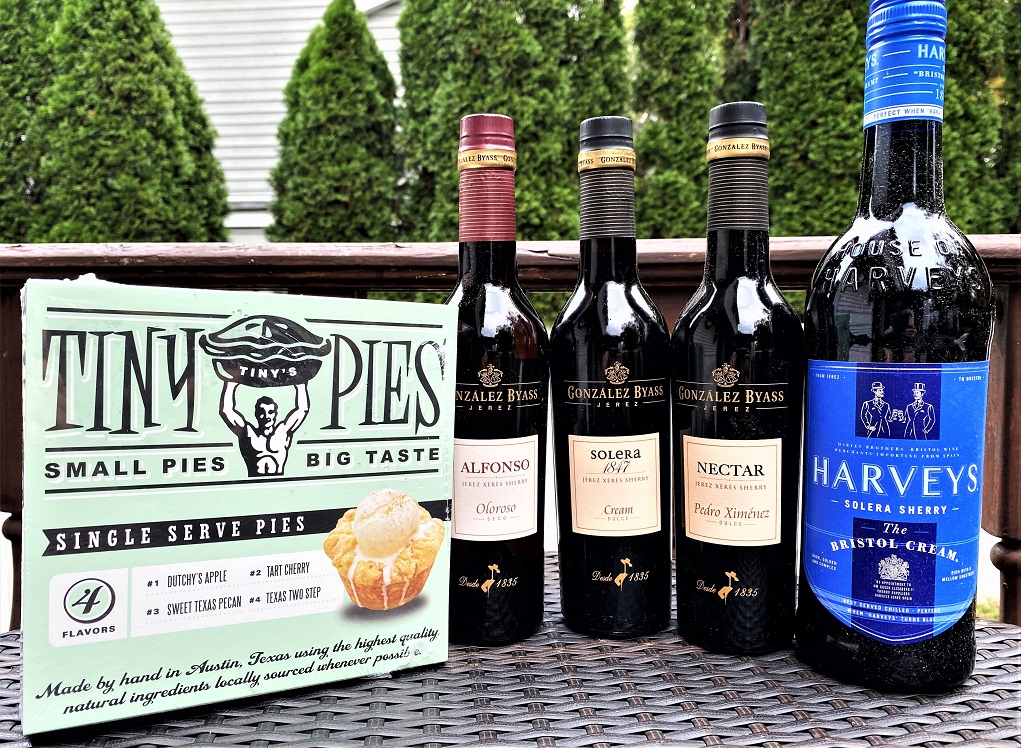
Oh yes, the dessert. This week, November 8 – 14, 2021, is designated as Sherry Week (#SherryWeek2021), a worldwide celebration of this unique wine. As part of the festivities, I received samples of the Sherry wines produced by González Byass, one of the purveyors of the fine Sherry wines. Moreover, the sherries were accompanied by dessert, and suggested pairings! I got a selection of pies from Tiny Pies to pair along with the Gonzalez Byass Sherries as follows:
- Apple Pie with Gonzalez Byass Alfonso Oloroso
- Pecan Pie with Harveys Bristol Cream
- Texas Two Step (a pecan and chocolate brownie pie) with Gonzalez Byass Solera 1847 Cream
- Cherry Pie with Gonzalez Byass Néctar Pedro Ximenez
Let me say first a few words about Tiny Pies. Tiny Pies company was born in 2010, in Austin, Texas, with its history starting from a simple question – quoting from the Tiny Pies website in the words of one of the founders, Amanda: “One day in 2010, my son, Andrew, innocently asked why he couldn’t take a piece of apple pie to school. I tried explaining to him that it wouldn’t be easy to eat. Andrew then suggested that we make a pie he “could eat with his hands””. The rest is history- today Tiny Pies operate 4 locations in Austin, and they also ship their pies countrywide, and yes, you can eat them with your hands.
Now, the sherries. Out of the four sherries I received, I was well familiar with 3 – Oloroso, Harveys Bristol Cream, and Néctar – instead of repeating my notes, you can find them in this post. González Byass Solera 1847 Cream Dulce (18% ABV, $17/375 ml, 75% Palomino, 25% Pedro Ximénez) was a new wine for me. At first, I got very excited about 1847 in the name, as I thought that maybe this is when the original solera was started and maybe it is still going (which would make it a 170 years old wine, not bad, right? :)). I asked the publicist this question, and the answer was a bit more prosaic but still worthwhile: The founder of González Byass, Manuel Maria González, founded the winery in 1835. His son turned 1 in 1847, so he decided to name the Sherry after the year he turned 1. Otherwise, the wines spent 8 years in solera, and each barrel is used for approximately 30 years. So one way or the other, but 1847 is not a random number.

Of course, I tasted the wine by itself, and it was delicious – dark amber color, complex and herbaceous nose. The palate was full of dried fruit, chocolate, and figs, with good acidity and perfect balance.
And now, to the pairing!
I obviously went along with the recommendations – here are my notes:
Apple Pie with Gonzalez Byass Alfonso Oloroso:
Interesting. Some contrasting notes, but not great. Best pairing – Pedro Ximenez. Worked perfectly, matching the cinnamon profile of the apple pie.
Pecan Pie with Harveys Bristol Cream:
Very nice. Excellent match on the nuttiness. Not so good with Cream 1847. Harveys complements perfectly and refreshes the palate after the bite.
Texas Two Step (a pecan and chocolate brownie pie) with Gonzalez Byass Solera 1847 Cream
Very good, pairing by the contrast. Sherry perfectly cuts through the sweetness.
Cherry Pie with Gonzalez Byass Néctar Pedro Ximenez
Not good. Néctar flavors clashed with the Cherry pie. Tried with all the sherries, and the only working was Harveys Bristol Cream, as it complimented the flavors of the cherry pie.
This was definitely a fun exercise – it is interesting to note that at least one of the 3 sweet sherries paired perfectly with the dessert – however, the Oloroso pairing with dessert was lost on my palate.
While I’m sharing my experience here, I’m really hoping that this would spark at least a little interest in you, my readers, to seek and try a sherry. Sherry wines are not gimmicks, they are versatile, inexpensive, and give you almost unlimited time to finish that bottle. No need to wait for Sherry Week 2022 to experience Sherry – visit your favorite retailer and give it a try. And then let’s compare notes…
Magnificent Rioja: CVNE Deep Dive
It is no secret that I have a special relationship with Rioja – I happily admitted it many times. When asked about my favorite wine, I always say that I don’t have one. And every time I give this answer, deep inside there is a bit of the uneasy feeling, the one you get when you know you are not lying, but somewhat flirting with the truth, as Rioja is probably “the one”.
What would make the Rioja so special for me? For one, it was a pivotal experience at the PJ Wine Rioja seminar, where I tasted through an incredible lineup, including a 45 years old Rioja, and it was still absolutely beautiful (later on I tasted 65 years old Rioja which was, again, superb). Also, when it comes to Rioja, I can easily give you a bunch of producer names, whose wines I would wholeheartedly recommend to a friend and also would be excited to drink at any time myself – come to California, I might have to pause for a moment while looking for the favorites to recommend – I hope it tells you something.
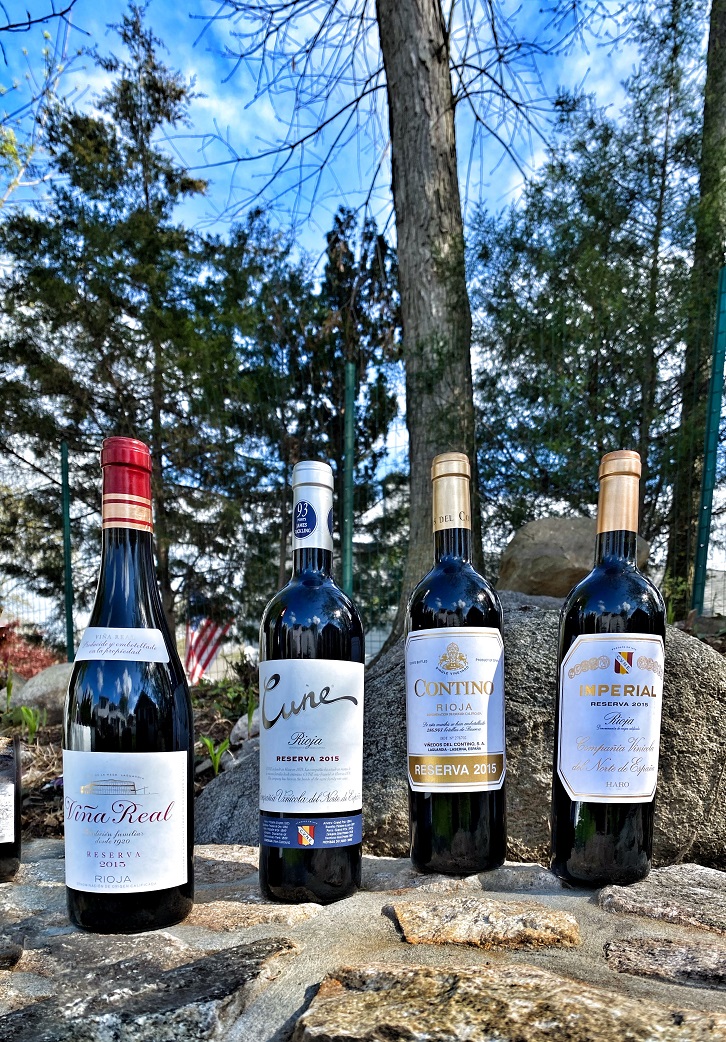
Speaking about favorite Riojas, I want to talk to you today about CVNE, also known as Cune due to a typesetting mistake. In 1879, the Real de Asúa brothers arrived in Haro for the reason not related to wine. Nevertheless, that’s how the story of Compañía Vinícola del Norte de España (C.V.N.E.), one of the most prominent Rioja producers, has begun. During its 140 years, CVNE remained a hallmark of quality and creativity. In 1915, CVNE introduced the very first White Rioja wine, Monopole. In 1973, CVNE founded Vinedos del Contino, the very first single-vineyard Rioja. Now in its 5th generation, CVNE continues to be a family winery and continues its advancement, now venturing even outside of Rioja, into Ribera del Duero and Valdeorras.
CVNE Rioja wines are produced at 5 wineries. First, there is the original Cune, which is simply a misspelled word for the CVNE, founded in 1879. In 1920, CVNE started production of Viña Real and Imperial Riojas. Viña Real was envisioned to be a more modern rendition of Rioja (in the 1920s), and Imperial was specifically produced for English markets. Imperial went on to become one of the most coveted Rioja wines, even becoming the wine #1 on the Wine Spectator’s Top 100 Wines list in 2013.
In 1973, Viñedos del Contino was created to become the first single-vineyard Rioja wine. In 1994, CVNE started its latest Rioja project, Real de Asúa, to honor the founders of the winery and create the most modern rendition of Rioja, using grapes from high altitude Villalba vineyards in Rioja Alta area.
Each one of these Riojas has its own, unique style. But can we taste the differences? I had a perfect opportunity to try answering this question. I got samples of 3 of the CVNE Rioja Reserva wines – Cune, Viña Real, and Imperial, all from 2015,. I also happened to have a few bottles of 2015 Contino Reserva and altogether this set out a perfect stage to try 4 different Rioja wines from the same vintage and technically, the same producer.
Before we get to wines, let’s say a few words about the vintage. Production of Rioja wines is strictly regulated by its governing body, Rioja Consejo Regulador, to ensure quality, and subsequently, the reputation of the Rioja wines around the world. All the vintages in Rioja have their official vintage ratings – Excellent, Very Good, Good, Medium, Normal. 2015 was officially designated as Very Good (not Excellent, such as 2001, 2004, or 2010, but still Very Good), which should still set a good level of expectations. 2015 vintage had a couple of unique characteristics, though. 2015 had the earliest harvest in the history of Rioja, starting early in September. It was also a very short harvest – typically, the harvest in Rioja takes about 2 months, with the feast of Virgen del Pilar usually taking place on October 12th, to celebrate the peak of the picking season. In 2015, the harvest was completed in 4 weeks so by October 12th all the picking was pretty much complete. How does any of this manifest in wines? I’m honestly not sure, that would require actually a vertical tasting – which I would be happy to conduct if I would have an opportunity.


So how were the wines? In a word – amazing. All four wines were absolutely gorgeous, delicious right now, and will continue to be delicious for the many years ahead. Here are my notes:
2015 Viña Real Reserva Rioja DOCa (14% ABV, $37, 90% Tempranillo, 10% Garnacha, Graciano, and Mazuelo)
Dark Garnet
Dark fruit, tobacco, espresso, expressive
Red and black fruit, cedar box, herbs, forest underbrush, firm, good structure
8/8+, lip smacking goodness. Delicious. If you are looking for a massive, earth-shattering wine, such as Walla Walla or California Cab, this is not the wine for you. But if you are looking for the wine which seduces and sings to you, give this wine a try.
2015 CVNE Cune Reserva Rioja DOCa (14% ABV, $29, 85% Tempranillo, 15% Garnacha, Graciano, and Mazuelo)
Dark garnet, almost black
Dark, brooding, minerality, cedar box, funk
Dark fruit, plums, explicit tannins, firm structure, fresh, good acidity.
8/8+, excellent, comforting, powerful, impossible to stop drinking.
2015 Contino Reserva Rioja DOCa (14% ABV, $46, 85% Tempranillo, 10% Graciano, 5% Mazuelo and Garnacha)
Dark garnet, almost black
Plums, cigar box, sweet tobacco
Complex, multilayered, earthy, dark fruit, clean acidity, lots of energy
8/8+, This is very early for this wine, but it is very enjoyable now, and it will be amazing with age


2015 Imperial Reserva Rioja DOCa (14% ABV, $50, 85% Tempranillo, 15% Graciano, Mazuelo, and Garnacha)
Dark Garnet
Earthy, spicy, red and black fruit, medium-plus intensity
Dark fruit, cigar box, firm, perfectly structured, delicious.
8+/9-, outstanding, lots of pleasure.
Believe it or not, but Imperial Rioja was my accidental pairing with BBQ chicken pizza, and the wine worked perfectly with it.
So now the secret is out. I’m lying when I’m claiming that I don’t have a favorite wine, and Rioja is the one. Well, I’m quite happy with my choice of affection – but do you have enough courage to name your favorite wine? Oh yes, with the coming holidays, any one of these Riojas would make a perfect present – to a friend, or to yourself. Go ahead, find it – everyone deserves a tasty Rioja. Cheers!
Everyday Bubbles
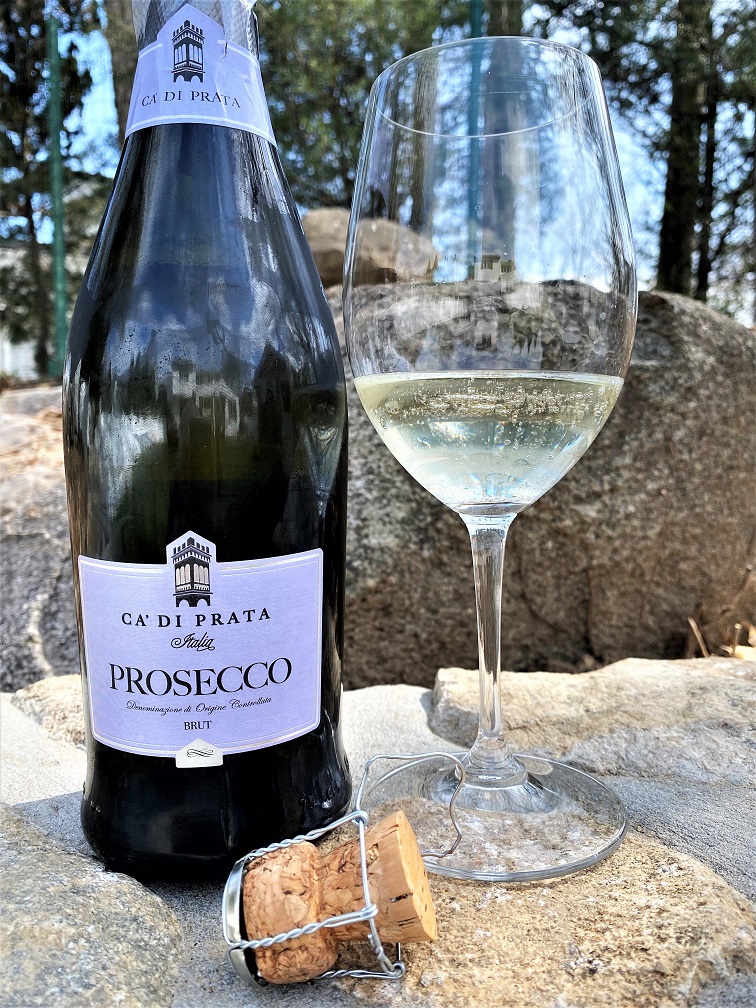 Do you have an everyday wine? An everyday wine is a wine you are happy to open on any day that has a name ending with “y”, like Monday, without any second thoughts. For the wine lover, there is always a ritual to choose the proper wine for each and every occasion (read: an evening after work), so the everyday wine is the wine allowing to circumvent that ritual, just open a bottle, get a glass, pour wine, and instantly feel better.
I would bet that for the majority of the wine lovers, the everyday wine would be a still wine – white, red, maybe a Rosé, but a still wine. There is an aura surrounding the sparkling wines – you can’t open bubbles without a special occasion, and “just another Monday” might not be it. There are many reasons the sparkling wines not considered appropriate for a casual evening. Sparkling wines have the whole celebratory mindset attached to them – “if I’m drinking sparkling wine I have something to celebrate”. Sparkling wines are usually more expensive than quality-comparable still wines. And so it is somewhat difficult to find a sparkling wine that can be designated as an “everyday wine”.
Difficult, but not impossible. Well, yes, it all depends. If you insist on drinking only Champagne, an “everyday Champagne” might be a challenge – at least a financial one. But if you are willing to look outside of Champagne, then Cava, Cremant, and Prosecco offer some good options. I want to bring two of such “everyday bubbles” to your attention.


First, Prosecco. Prosecco, produced in Northern Italy, is a sparkling wine that had been around almost as long as Champagne – with the only difference that it became internationally known only about 30 years ago (you can read the story here). But today, Prosecco is everywhere, and it offers lots of great options to consider for everyday bubbles. As, for example, Ca’ Di Prata, produced by Latentia Winery, and distributed by Mack and Schuhle I already wrote about a few months ago. Ca’ Di Prata takes its name from the town of Prata di Pordenone in Friuli, one of the epicenters of Prosecco production. I had an opportunity to try a few of the Ca’ Di Prata Prosecco wines (samples), and below are my notes:
Ca’ Di Prata Brut Prosecco DOC (11% ABV, $15.99)
Practically clear, nice tangy mousse
Touch of tropical fruit, a hint of honey
Refreshing, Meyer lemon, good acidity, mellow, good volume, a hint of sweet apples
8, very good, easy to drink, simple. Quaffable on its own, but should be perfect for cocktails (Mimosa, anyone?)
Ca’ Di Prata Rosé Extra Dry Prosecco DOC (11% ABV, $16.99, 85% Glera, 15% Pinot Nero)
Light pinkish color, abundant bubbles
Hint of strawberries
Strawberries all the way, a touch of lemon, creamy, inviting, a touch of sweetness, very well balanced.
8-, perfect everyday bubbles
Ca’ Di Prata Extra Dry Valdobbiadene Prosecco DOCG (11% ABV, $17.99)
Almost clear with a greenish hue, good amount of bubbles
Distant hint of an apple and flower petals, refreshing
Green apple, fresh, crisp, initially had a hint of sweetness which subsided, a touch of lemon.
8-, excellent for what it is – easy bubbles.
And then, of course, there is Cava – another perfect candidate for everyday bubbles. Cava is a Spanish sparkling wine, produced in exactly the same way as Champagne (secondary fermentation in the bottle) in Penedes in Catalonia. Cava is currently trying to change its image of simple, inexpensive, and often mediocre quality wine by introducing new categories and new subzones in the region – but this should be a subject for a separate post.
The Cava which I want you to consider for the everyday wine is one of my favorites, both aesthetically and taste-wise – Vilarnau Barcelona. I already wrote about Vilarnau at length before, so for the history, I would like to offer you this link. For this post, I tasted two wines (samples) from the beautifully appointed, Gaudi inspired bottles – here are my notes:
NV Vilarnau Brut Reserva Cava DO (11.5% ABV, $14.99, 50% Macabeo, 35% Parellada, 15% Xarel Lo, 15+ months in the bottle)
Light gold
Herbal, earthy, apple, lemon
Fresh, clean, apples, creamy, good body
7+, perfect for every day
NV Vilarnau Brut Reserva Rosé Cava DO (12% ABV, $15.99, 85% Garnacha, 15% Pinot Noir, 15+ months in the bottle)
Salmon pink
Fresh strawberries, a touch of gunflint
Fresh strawberries, crisp, clean, energetic,
Delicious.
8, excellent
What do you think? Would you make any of these wines your everyday wine? Cheers!
Hey, Rioja, What’s New?
I love Rioja.
But you already know that.
Well-made Rioja, opened in its due time, is one of the ultimate indulgences wine lovers can experience. I can bet this is also nothing new for you.
So what’s new with Rioja?
Every new vintage of any wine is unique and different, true, but talking about new vintages unquestionably banal. How about then Rioja made from organic grapes? What do you think about classic Rioja made from organic grapes – and timely conversation during April, the Earth Month?
CVNE, Compañía Vinícola del Norte del España, one of the oldest producers in Rioja (CVNE celebrated 140th anniversary last year), requires no introduction to any Spanish wine lover. CVNE produces a number of different Rioja lines – Cune, Viña Real, Imperial, Contino are some of the best known. Now, the Cune line has brand new Rioja to brag about – the first Rioja red wine made with organic grapes. The wine is made out of 100% Tempranillo (not very common) from the vineyards which were organically farmed, from the vintage with an Excellent rating (2019 was rated Excellent by Rioja DOC). The wine is also Vegan certified, and even sports the label produced from recycled materials. Most importantly, this is a simple, and tasty wine:
2019 CVNE Cune Rioja DOC (13.5% ABV, $15, 100% Tempranillo, organic grapes, Vegan certified, wild yeast fermentation, 4 months aging in oak)
Dark ruby with purple hues
Dark berries and cedar box
Soft, round, good acidity, soft ripe fruit, medium-long finish mostly acidic.
7+, food-friendly, simple, and easy to drink.
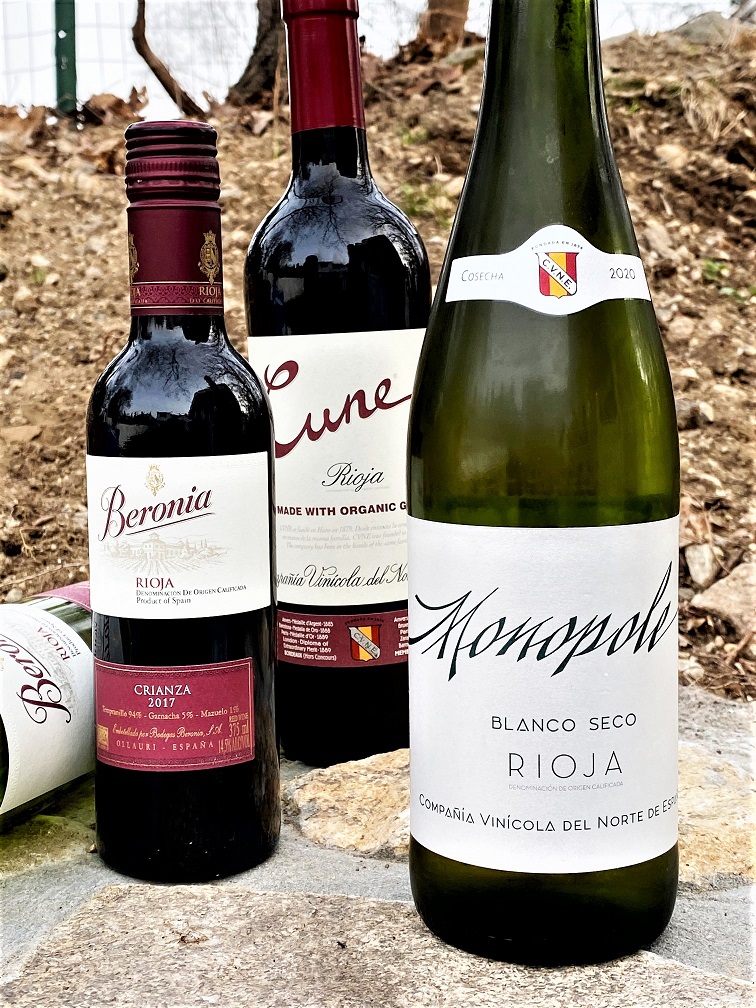
Back in 1915, CVNE produced Rioja’s first white wine – Monopole. It was not only the first white Rioja – this was the first white wine produced in Spain.
I had the pleasure of tasting many vintages of CVNE Monopole, and I have to honestly say that this 2020 was by far my favorite Monopole I tasted – I know I said talking about new vintages is banal, and here I am, yeah. Oh well. The wine needed a bit of time to open, but after 20 minutes in the glass, it was absolutely beautiful.
2020 CVNE Monopole Blanco Seco Rioja DOC (12.5% ABV, $16, 100% Viura, Vegan certified)
Straw pale, literally clear
Explicit minerality, a touch of gunflint
Crisp, tight, lean, hint of whitestone fruit, explicit minerality.
8+, outstanding.
Bodegas Beronia is much younger than CVNE, founded in 1973 by a group of friends from the Basque country. In 1982, Bodegas Beronia became a part of González Byass’s portfolio, and at that point, Bodegas Beronia wines appeared on the international market.
Bodegas Beronia is known for its innovative approach to winemaking. Rioja wines are traditionally aged in American oak, which gave them a rustic, “traditional” taste profile. Recently, many winemakers switched to using the French oak, which gives the Rioja more of the international, “modern” taste profile, making wines also more approachable at a younger age. Bodegas Beronia pioneered the use of specially made barrels, which use both American and French oak in its construction, to create a unique taste profile, an intersection of tradition and modernity.
In this release of 2017 Crianza, Bodegas Beronia recognized the new realities of 2021, where people have to spend more time by themselves, and added the 375 ml, a half bottle to the portfolio, making it easier for the wine lovers to open a bottle for a solo night.
2017 Bodegas Beronia Crianza Rioja DOC (14.5% ABV, $14.99/750ml bottle, $7.99/375ml bottle, 94% Tempranillo, 5% garnacha, 1% Mazuelo)
Ruby red
Freshly crushed red berries, a touch of barnyard, smoke, earthy
Red fruit, eucalyptus, clean acidity, excellent balance.
7+ at the moment, needs time
There you have it, my friends. A brand new organic wine from Rioja, a superb white Rioja, and a thoughtful Rioja, coming in different formats, all reasonably priced, perfectly suited for life at the moment. Cheers!
Daily Glass: Vinous Vino
This post could’ve been filed under lots of different titles – “confusion of the oenophile”, “beautiful labels”, “how mistakes are made”, “one has to pay attention”, and I’m sure many others.
The story here is rather simple. I saw the wine on the Last Bottle offered at $26. If you ever saw the Last Bottle offer descriptions, it is full of exclamation marks, explanations that they never had the wine like that before and their collective socks were blown away the second they smelled the wine, and the wine will be gone before anyone can even say the name of the wine which is offered. I really can’t pay attention to the text like that, so with a quick glance, I established that this was a Tempranillo wine from Spain, and it was produced by Elias Mora. When reading every other word or less, mistakes are bound to happen. Somehow, my brain transformed Elias Mora into Emilio Moro, one of the very best producers in the Ribera Del Duero region, and at $26 with 4 bottles to buy to get free shipping and $30 of available credit, that sounded like a great deal, so I quickly completed the purchase.
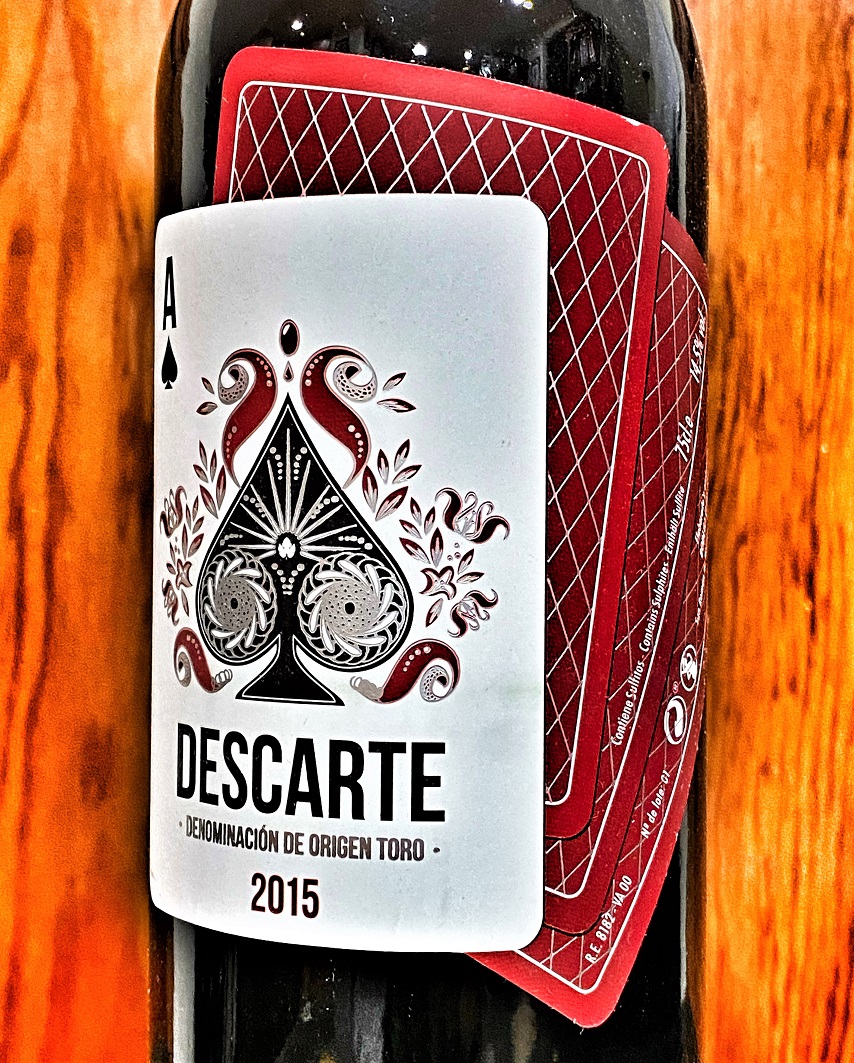
When the wine arrived, first I admired a beautiful label. I don’t know what you think, but to me, this is one of the most beautiful and creative labels I ever saw. Then I noticed the word Toro on the label, which made me instantly question what I have done, as Emilio Moro doesn’t produce wines in Toro. I quickly realized that while the label is beautiful, I have no way to relate to the content of the bottle, except knowing that it is a Tempranillo from the Toro region.
Tempranillo is one of the most popular red grapes in Spain, and while Tempranillo wines are produced absolutely everywhere, it is Rioja and Ribera Del Duero which make Spanish Tempranillo famous. In addition to Rioja and Ribera Del Duero, Toro is the third Tempranillo-focused region. Tempranillo is often called Ink of Toro in the Toro region, and it might be slightly a different clonal variation of Tempranillo, similar to Sangiovese in Chianti and Sangiovese Grosso in Brunello. Compared to a typical Rioja or Ribera del Duero renditions, Toro always packs a lot more power into that same Tempranillo-based wine and typically needs time to mellow out.
I tried to find out if Elias Mora and Emilio Moro might be related in any way, but the Elias Mora website offers little to no information about the history of the estate, primarily focusing on just selling the wine. I also tried to no avail learn the idea behind the unique and creative label – the wine description provides technical details but no explanation whatsoever why the bottle is decorated with an elaborate image of playing cards – of course, it matches the name “Descarte”, but I’m sure there should be something deeper there (if you know the story, I would greatly appreciate a comment).
Now, most importantly – how was the 2015 Elias Mora Descarte Toro DO (14.5% ABV, 12 months in French oak, comes from the plot of 50 years old vines)? It was a typical Toro wine. On the first day after opening, I had nothing but regrets about buying this wine. Freshly opened Toro is just too much for my palate. It is literally an espresso, made from the darkest roast and in the tiniest amount – if you enjoy that powerful punch, you should try a young Toro wine. If you don’t, and you are opening a bottle of Toro, decanter might be of help. On the third day, however, my first sip instantly generated the “vinous vino” words in my mind, so I needed not to worry about the title of this post. The wine transformed into the medley of the dark fruit, perfect aromatics of the wine cellar, cedar, eucalyptus, now just a touch of espresso instead of the whole ristretto shot, clean acidity, and delicious, perfectly balanced, finish. (Drinkability: 8)
There you are, my friends. If you will see this wine, you can definitely buy a few bottles, preferably to forget them in your cellar for the next 5-10 years. And take your time to read wine descriptions – or not, as life might be more fun if you don’t. Cheers!
Jerez – A Tasty Treat and Halloween Candy Solution
 Yes, I know. Halloween is history now, so why am I even mentioning it?
Because I know that those Halloween candies are still lurking around, and will be for a while. And Halloween candy is not something which would make you crave the wine. But it doesn’t have to be that way. There are wines out there which will help you get rid of the candies – with pleasure. What am I suggesting? Let’s talk about Sherry, also known as Jerez.
Jerez wines (officially known as Jerez-Xérès-Sherry) take its name from the town Jerez de la Frontera in Andalusia, Spain, with the grapes coming from the vineyards surrounding the town. Jerez is one of the oldest winemaking regions in Europe, tracing its roots to more than 3,000 years back. Sherry is a fortified wine, and it came to being around the 8th century when the distillation process was invented. As a fortified wine Sherry can be compared to Port, however, the major difference is that Port is typically fortified in the middle of the fermentation process, to preserve the sugars in the wine, where Sherry wines are typically fully fermented, and then fortified, so with the exception of the particular style of Pedro Ximénez, most of the Sherries are dry wines.
There are many styles of Sherry wines, offering various levels of dryness, complexity, and oxidative qualities. Sherry wines are often also produced using the solera method, where the wines of the different vintages or constantly combined and resulting wines might represent a blend of hundred of vintages. The world of Sherry is quite complex, so if you want to read about all the different styles, this Wikipedia article contains a lot of good information.
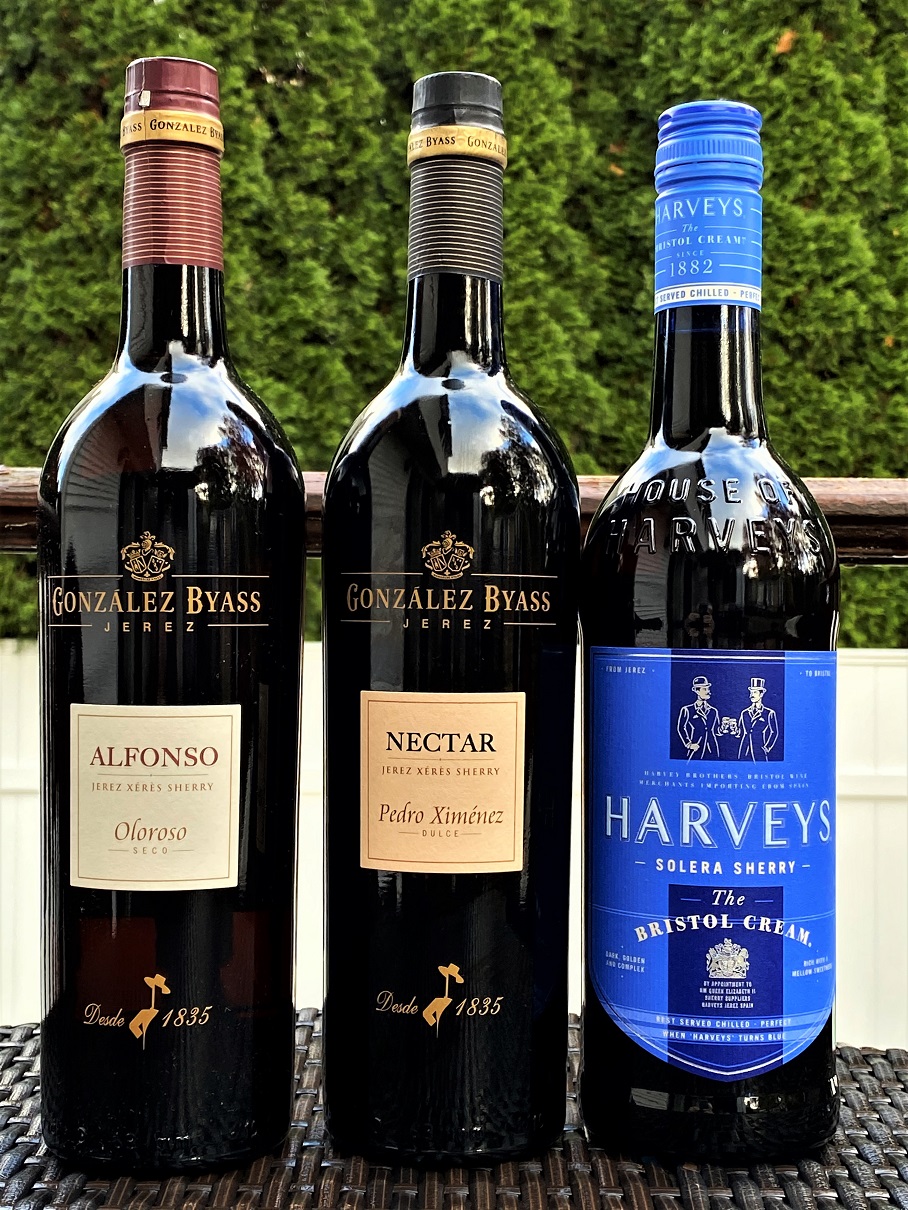
González Byass started in 1835 in Jerez de la Frontera, in the heart of the Sherry country. Now in the 5th and 6th generation, González Byass is one of the major sherry producers, combining a number of Sherry brands under one umbrella. I had three sherries from González Byass to play with the candies – let me tell you how did it go.

First, the dry wine – Gonzalez Byass Alfonso Jerez Oloroso Seco. As it is a dry wine, it expectedly didn’t work too well with most of the candies, but I found some options:
Gonzalez Byass Alfonso Jerez Oloroso Seco (18% ABV, $25, Palomino 100%, aged for 8 years in solera)
Light amber color
Hazelnuts, sapidity, herbs
Hazelnuts, clean acidity, Rosemary, beautifully complex
Worked best with Payday because of explicit saltiness – not really with Reese’s or KitKat

The bottle on the right is directly from the wine fridge and it is ready to drink – the Harveys letters are blue
I recently wrote about Harveys – after years of personal neglect, this became a gateway wine for me to warm up again to the world of Jerez. As Harveys is quite sweet but not super-sweet, it provided the best pairing option for the majority of candies.
Harveys The Bristol Cream (17.5% ABV, $20, 80% Palomino, 20% Pedro Ximénez, a blend of 7 yo Fino, Oloroso, PX and Amontillado Soleras)
Dark amber color
Light herbaceous nose, a touch of dried fruit
Dried fruit on the palate, good acidity, refreshing
Nice with Reese’s, works well with KitKat, excellent with Payday
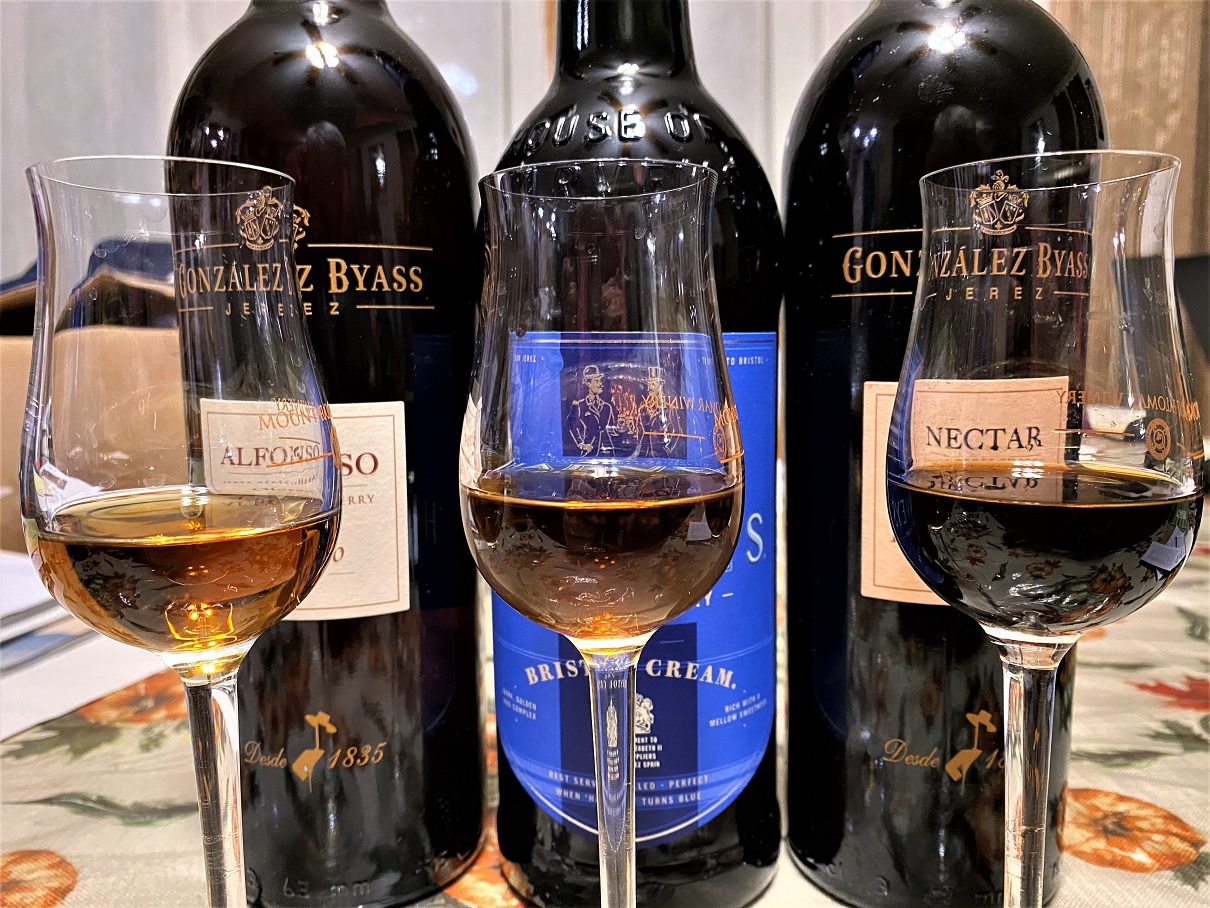
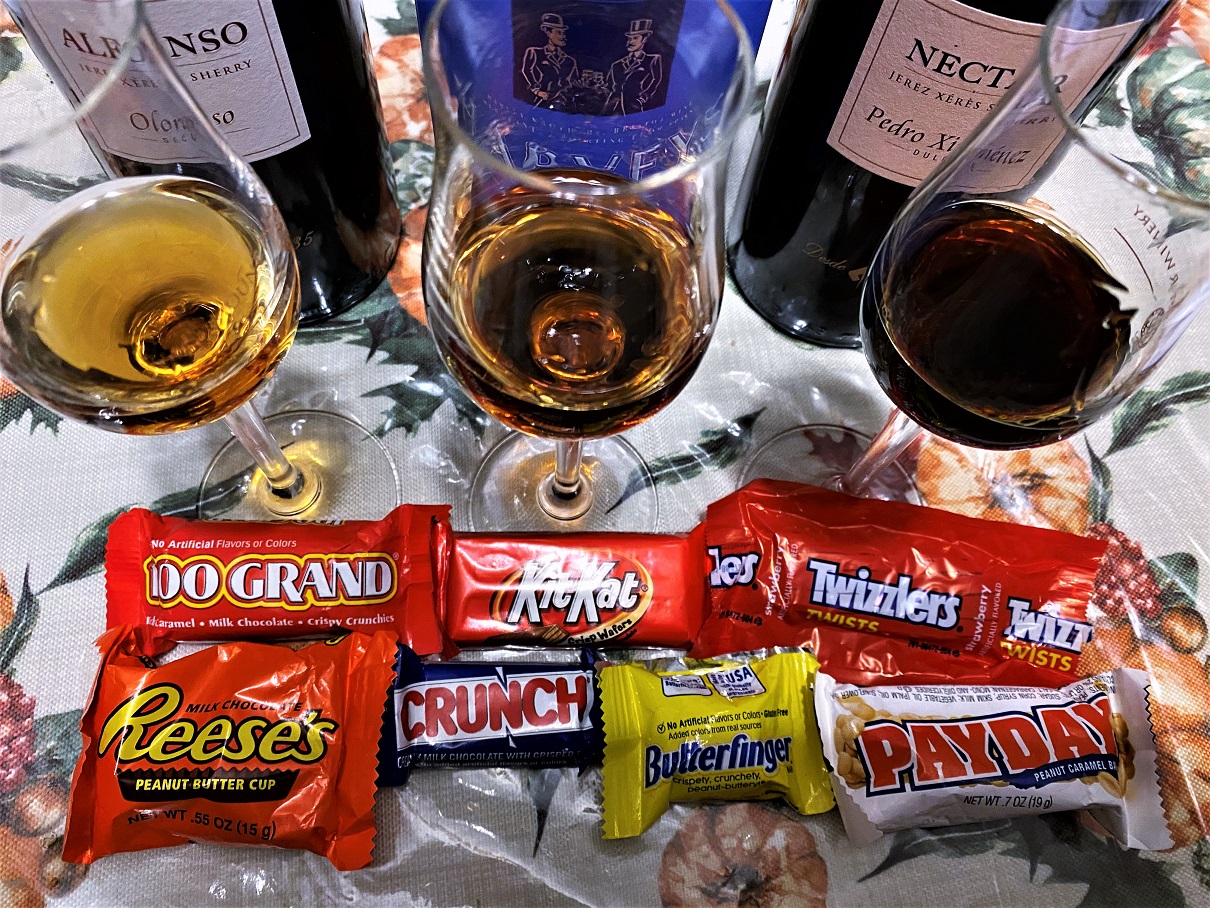
Nectar is seriously sweet wine (residual sugar of 370 grams per liter), but it is nevertheless very balance and delivers tremendous pleasure. The Pedro Ximénez (usually abbreviated as PX) is one of my most favorite dessert wines in general. The Pedro Ximénez grapes are dried on the mats for 2 weeks before pressing, losing 40% of liquid and becoming practically raisins – this explains the depth of color you can see in the picture above.
Gonzalez Byass Nectar Pedro Ximénez Dulce (15% ABV, 25%, 100% Pedro Ximénez, aged for about 8 years in solera)
Very dark amber color, almost black
Dried figs, dates, inviting.
Dried figs all the way, delicious, clean acidity on the finish, perfect balance
Great with KitKat, complements
Excellent with Reese’s, okay with Payday, Butterfinger – not so much
There you are, my friends. Don’t sweat the Halloween candies – pair them with a good Sherry. Or you know what – you can actually dump the candy – Sherry should be enough to keep you happy. Cheers!
A Quick Trip To Spain
 Hey friends!
Who else is feeling travel-deprived? Who else is dreaming of the airline food and 2-hours long passport control line after 12 hours flight?
I know it is not only me. I know we all do. But we still have to wait until any of that is a reality. For now, travel is just virtual.
Virtual travel has many ways. You can go back to the pictures you took while vacationing. You can go on Instagram or Pinterest, type in “Italy”, “Amalfi Coast”, “Maldives”, “Everest”, or “Machu Pichu”, and get lost for hours, exploring every little angle of the paradise through the eyes of others. You can find plenty to read, from blogs to books to everything in between, making it easy to imagine yourself in a French cafe, on the beach in Goa, or looking at the world while standing on the Great Wall.
Then, of course, there is food. There are many cuisines available within anyone’s reach today, no matter where you live. You can have paella at the Spanish restaurant, Mexican street corn at the Mexican place, black truffle risotto at Italian, or cassoulet at the French restaurant. Will that be an authentic experience that will bring back happy memories? That depends. The food might be amazing, but if you will not get the exact match to your expectations, to what you experienced during the travel, that might end up being a great meal, but not memory-inducing at all. For sure my own experience with paella or cassoulet is always hit and miss.
And then there is wine – of, course, you knew that it will all end up at “have wine, will travel”, right? Remember that proverbial “sense of place”? The sense of place is an indelible part of the wine. Even more importantly, wine can trigger an outpour of memories even before it will be opened and poured. One quick glance at the label is often enough to start the emotions going, to recall, to remember, to re-live. Of course, you can find authentic dishes in restaurants and market places. There are tons of original and authentic foods imported and readily available. It still doesn’t mean that on the moment’s notice you can retrieve that aged Swiss Gruyère, French Raclette, or a Spanish Jamón and have a smile from ear to ear. However, take out that bottle of Brunello, Australian Shiraz, Provençal Rosé, or Spanish Rioja – and watch out for that smile.
Ahh, I just said “Rioja” – remember I promised you a quick trip to Spain? Instead of musing on the subject, how about we will actually take this trip – and we don’t even need to pack a suitcase or wait for a taxi – get a bottle of Rioja, and you can instantly imagine yourself strolling the streets of Barcelona, or maybe admiring the old train station in Haro. Have wine, will travel – who is with me?
The Rioja I would like to bring to your attention today is as classic as it gets – coming from CVNE (Compañía Vinícola del Norte del España), one of the oldest producers in Rioja, who celebrated it’s 140th anniversary last year. CVNE produces a number of distinct lines of Rioja wines, under Cune, Imperial, Viña Real, and Contino labels, but the company is also expanding into areas such as Ribera Del Duero, Valdeorras, and others.


I recently had two delicious samples of the latest offerings from CVNE – you really can’t go wrong with either one of them, and the QPR is absolutely unbeatable:
2019 Cune Rosado Rioja DO (14.5% ABV, $13, 100% Tempranillo)
Cranberry juice color
Fresh cranberries, herbal notes, sage and violets
Fresh, crunchy cranberries, with characteristic acidity and tiny bitter undertones. Bone dry and very present. Balanced and elegant. Un-Provence and proud.
8/8+. If you are looking for Rosé with an umpf, this is your wine.
2016 Viña Real Crianza Rioja DOC (14.5% ABV, $17, 90% Tempranillo, 10% Garnacha, Graciano and Mazuelo)
Intense garnet
Eucalyptus, sage, crunchy berries, tobacco
Fresh red fruit, elegant, medium body, good acidity, a touch of sapidity, excellent balance
8, fresh and delightful. Daughter said it was good with an ice cream cake (surprise!)
Where would you like to go next? Cheers!
Playing With Celebrity Wines
Celebrity wine – is there such a thing?
Of course.
If you will look at this Wikipedia page, you will see the list of 100+ famous people who own vineyards, wineries, or both. Like all of us, some of the celebrities happen to love wine, and they are not shy of associating with what they love.
Every year or so, a new celebrity finds their love of wine and joins the ranks. 2020 had two celebrities (so far) joining the wine club of their own making – singer Post Malone and actress Cameron Diaz brought to the market their wine offerings – which I was eager to try, hence this post.
I’m always curious about celebrity wines. Celebrity status greatly simplifies the marketing of the product, no matter what the celebrity associates with. The celebrity status easily overshadows the product itself – this removes the need for the product to be excellent, as we love our celebrities so much that we are willing to blindly take whatever they are endorsing – and so my inner skeptic always wants to know – how good is the particular product? Is it a real deal or simply a cover up for something mediocre?
I had no idea who Post Malone is until I saw a Netflix movie called Spencer Confidential. Afterward, I learned that Post Malone is actually a popular singer. Then I read an article talking about the upcoming release of Post Malone’s wine, so here it is – a celebrity wine which needs to be tasted. After waiting for almost a month, the wine finally appeared in Connecticut, and I was able to buy my bottle.
When I’m faced with celebrity wine, the celebrity factor goes aside. I’m happy to know that somewhere there is a famous name associated with the wine – but the only thing I care about is the wine itself. Where was it made, what grapes it is made out of, terroir, winemaking, smell, taste, and pleasure – this is what is important. Knowing I’m drinking the wine associated with a famous person doesn’t give me pleasure – tasty, delicious wine does. I always say that the proof is in the glass – that is the only thing that matters. So celebrity wine or not, I treat it exactly like any other bottle.
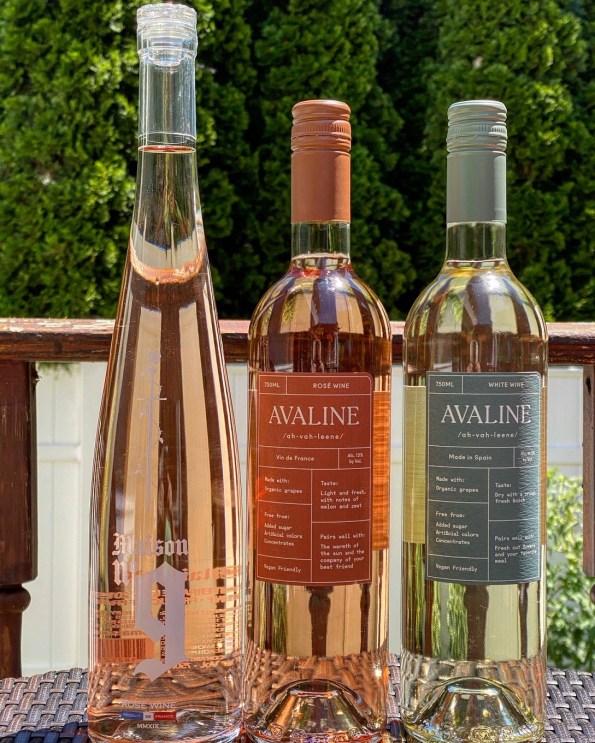
From that point of view, Maison No 9 represents a mixed bag. When it comes to the wine – it is superb. 2019 Maison No 9 Rosé Méditerranée IGT (12.5% ABV, $24, blend of Grenache, Merlot, Cinsault, Syrah) has a beautiful light pink color, has a nose of fresh strawberries with a touch of lemon, and bursts in your mouth with fresh strawberries and lemon, perfect minerality and raw, vibrant energy – all scrumptiously balanced (Drinkability: 8+). I love the bottle, it definitely stands out with an engraved front label depicting the sword and the rose. However, the problems start as soon as you try to dig deeper.
The website of Maison No 9 has no information about the wine, the vineyards, or the winemaker. All pictures on the web site feature Post Malone, and the only purpose of the website is to make sure you will buy something – either merchandise (T-shirt? Would it make wine taste better?), or the wine. This is in stark contrast with Miraval website, for example – Miraval is clearly a celebrity wine project (Angelina Jolie and Brad Pitt) – where it is all about the land, terroir, and wine. Website or not, but my problem is that the only place with any information about the Maison No 9 wine was this Forbes article. That is where I learned the story behind this wine, or that the wine was made by a well known French winemaker Alexis Cornu, or that the “new wine is named Maison No. 9, a reference to the Nine of Swords tarot card” (by the way, I searched the meaning of Nine of Swords tarot card and seems to be nothing good, but I’m not going to talk about things I have no idea about). So the bottom line here is that the wine is good, but the whole story is lacking. Does it worth $24? If this is your budget for Rosé, yes, but if not – you got options.
The Maison No 9 story, while almost non-existent, is still perfect compared to our next two wines, Avaline, which come with quite a story – and not really a good one. Avaline, which I believe means “bird” in Latin, is a product of the imagination of two long time friends, Cameron Diaz, a famous actress, and Katherine Power, a well-known entrepreneur. The duo decided to come up with a concept of a “clean wine” to advertise their creation, and this was a grave mistake, as it made the professional wine world fuming.
I’m not going to regurgitate any of the articles – just go search “clean wine Avaline”, you will find plenty of “critical acclaim”. The problem with using terms such as “clean wine” is that as soon as you designate your wine to be “clean”, you automatically imply that all other wines are “dirty” because no other wines advertise themselves as “clean”. When someone says on the label “Free from added sugars, artificial colors, concentrates”, I can’t keep my eyebrow from going up as my immediate reaction is “huh”? Really? I can’t speak with confidence about Two Buck Chuck, but I have serious doubts that they use any of these said additives. I don’t know who was advising Avaline on the wine marketing, but to me, this is a complete failure. Forget “clean wine” – another serious problem I have with these wines is that there is no information whatsoever about the wines – who made them, where the wines were made, from what grapes… yes, Wine.com, which sells both wines, has information on the grape composition. But then the white wine is designated as “Product of Spain” – another “huh?” from me as I never saw another wine with such designation, and the Rosé is identified as Vin de France. Another interesting element here (strategy????) is that both wines don’t list the vintage. So when you come to buy the wine in the store, you have no idea for how long the wine was sitting on that shelf… Nice…
So how were the wines? Both wines were actually quite tasty: NV Avaline White Wine Spain (11.5% ABV, $24, blend of Xarel·lo, Macabeo, Malvasia) – white stone fruit on the nose, nicely restrained, fresh flowers, a touch of minerality. Fresh ripe plums, sage, Meyer lemon, clean acidity, medium-long finish (Drinkability: 8, nicely done). NV Avaline Rosé Vin de France (13% ABV, $24, blend of Cinsault, Grenache, Cabernet Sauvignon, Syrah, Caladoc) – gentle pink color, a hint of sweet ripe strawberries, nicely restrained, candied strawberries and strawberry jam on the palate, good acidity, good balance, not over the top. Short finish, easy to drink (Drinkability: 8-).
While the Avaline are tasty wines, I see a serious problem here, outside of any “clean/dirty” concepts. You are asked to pay $24 for the wines of unknown pedigree, unknown vintage, made by someone somewhere, with a clean (pun intended), but a seriously unattractive label. I can splurge $5 on such a wine if I will get a recommendation – I guarantee you I will pass a wine like that if I will just see it on the shelf.
Here you go, my friends – 3 celebrity wine for your attention. All three are well drinkable, but you seek them at your own peril. Cheers!
Have Grenache, Will Travel
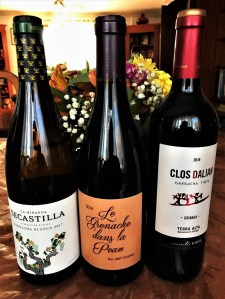 “Have wine, will travel” is one of my favorite openings for a post about wine because this is exactly what wine does – even before you take a sip, just a glance at the label is often sufficient to let your imagination run wild and yes, imagine yourself instantly somewhere 5,000 miles away from where you are now. But never in my scariest, horror-filled dreams, I would imagine that wine, along with pictures, might become the only way for us to travel, even for a day. Sigh.
So today I want to offer you a quick trip with the help of one of the most versatile, most widely planted grape in the world – Grenache, also known as Garnacha.
Grenache is a versatile grape on many different levels. First, it is widely planted. While supremacy of Grenache can be debated between France and Spain, literally every other winemaking country – Australia, Argentina, Chile, Israel, Italy, South Africa, USA, New Zealand – all have significant plantings of Grenache. Next, when we say Grenache, we typically assume red grape and red wine, of course – but Grenache family also includes Grenache Blanc and Grenache Gris. Grenache is capable of an ultra-wide range of expressions – from light and simple, such as Borsao Tres Picos or Delas Côtes du Rhône to bombastic, tremendously concentrated expressions, such as Clos Erasmus, Horsepower and Sine Qua Non. Last but not least is pricing versatility. It wouldn’t surprise anyone that $100 bottle of wine drinks well – any grape can do this. But in under $10 range, very few grapes can excel – but Grenache is one of them, for example, in the form of Honoro Vera.
Today our journey will not be too long, but we are going to make two stops in the countries which can be designated as “classic” Grenache – France and Spain. To help with our travel we can even enlist the help of the website put together to promote European Grenache and Garnacha – you can find the link here.


Our first stop is in the south of France, in the small region called Maury, which in turn is a part of the Roussillon wine region. Winemaking in that area goes back a few thousand years. Maury located on the border with Spain, and it became a part of France only after 1659, so even today there is a lot of Spanish influence in the region. Grenache is the main grape used in the production of Maury wines, and it is considered to be one of the best in France. Maury is best known for its fortified wines, produced in the style similar to port, with the addition of the spirits in the middle of fermentation, which kills the yeast and leaves the sugar level high in the resulting wine. However, it is not the Maury AOC wine I want to offer to you today, but Maury Sec, which is a designation for the dry wines produced in the same region. Our first wine is produced by Jeff Carrel, and it is predominantly Grenache with the addition of Syrah:
2016 Jeff Carrel Le Grenache dans la Peau Maury Sec AOP (15.5% ABV, 80% Grenache / 20% Syrah)
Dark ruby
High Intensity, sweet cherries, cherry compote, tobacco, sweet basil
Sweet cherries, unexpected astringency, good acidity. High alcohol is surprisingly unnoticeable.
7/7+ on the first day, 5 minutes after opening.
8-/8 second day, much more balanced and round, adds a touch of pepper, astringency is gone, excellent.
Now, let’s go to Spain. As we are now in Spain, let’s switch to the proper name for our grape – now it is Garnacha to you. Once here, how about some Garnacha Blanca? The wine had been made in Somontano, an area up north close to the French border for more than 2000 years. Garnacha Blanca is one of the permitted and popular varieties in Somontano. Once in Somontano, we are going to visit Secastillo, the valley which takes its name from the seven castles overlooking it.
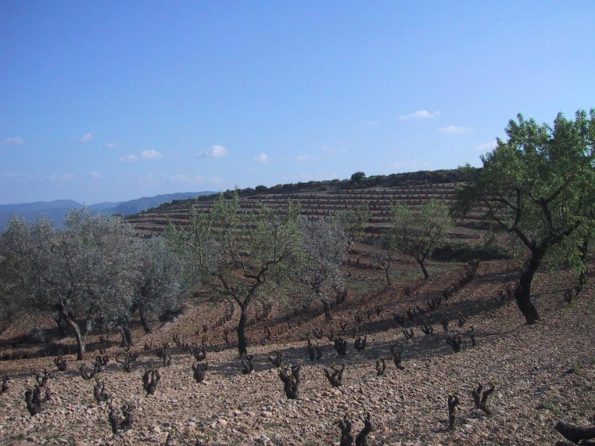
Vinas del Vero vineyards in Secastilla. Source: Gonzales Byass
Viñas del Vero produces the wines here, sourcing the grapes from 100 years old Garnacha vines, growing mostly at the elevation of 2,100+ feet.
2017 Secastilla La Miranda Garnacha Blanca Sonomontano DO (14% ABV)
Straw Pale
Lemon, fresh grass, lemon zest
Whitestone fruit, Meyer lemon, clean acidity, nice and refreshing
7+/8-, very good
Let’s continue our trip going a bit more down south. Now we are in Catalonia, in Terra Alto DO (Terra Alta means High land), where Cellers Unió had been producing wine from the beginning of Terra alto DO been formally established in 1982 (Cellers Unió is a conglomeration of cooperatives which operates across 5 DOs, 11,000 acres of vineyards and includes 20,000 families of growers across 186 cooperatives). Now it is time to drink some classic Garnacha:
2016 Cellers Unio Clos Dalian Garnacha Tinta Crianza Terra Alta DO (13.5% ABV)
Dark Garnet
Cherry Coolaid, sweet cherry, candy
Cherries, fresh sour cherries, wow. Touch of tobacco, earthy undertones, perfect balance, soft and round.
8, excellent
Our trip is over, unfortunately – but see how easy it was? I wish you many great journeys, all enabled with the power of wine glass in your hand. Until we travel again – cheers!
Last Bottle Sign Up ($10 credit)




 Talk-A-Vino