Archive
Moscato d’Asti – The Joy of Sharing
 Wine should give you pleasure.
This pleasure can come in many forms.
The simplest one is a pure hedonistic pleasure of that sip itself, the burst of flavor overwhelming your taste buds, and the opportunity to mindfully reflect on that very burst.
Or, with one sip of familiar wine, you can be instantly transposed in time and space – the wine can bring back memories. You can instantly imagine yourself being in Italy 5 years ago, experiencing this wine for the first time, vividly seeing the faces of the people you were there with, and reliving that beautiful moment again.
And then there is possibly the biggest pleasure of all – an opportunity to share wine with people. It is great to enjoy good wine by yourself – but that pleasure amplifies disproportionally when you pour the wine for your guests and you hear the collective “oh, it is so good!”.
I’m happy to share all of my wines with my guests, but then there are some wines that I even prefer to share. Let me explain.
I’m happy to open a bottle of Cabernet Sauvignon, Chardonnay, Syrah, any still red, white, or Rosé. Even if nobody would share it with me, I can drink it by myself over the next 2-3 days, no problem. But I would be very reluctant to open a bottle of sparkling wine for myself – I definitely prefer to share it with friends. Especially if this is a dessert sparkling wine, such as Moscato d’Asti.
I love doing that at the end of the dinner, when nobody expects that more wine might be coming. Seeing another bottle being brought up to the table, guests’ usual and immediate reaction is “what, more wine???”. This question requires no answer; I just wait for the people to taste the wine first.
Moscato d’Asti might be one of the hidden gems of the wine world, lightly fizzed, low alcohol, and deliciously, “just enough” sweet. This wine, made from the Moscato Bianco (white Muscat) grape, comes from the area in Piedmont where Moscato wines have been made for hundreds of years. Moscato d’Asti wine in its present, lightly fizzed form was born in the 1870s, when a number of winemakers started producing it in commercial quantities. Yet despite its 150+ years of history, I would still call it a hidden gem, as many winelovers are not aware of this wine or have the wrong ideas because of its sweetness.
The beauty of Moscato d’Asti is in its lightness and effervescence, and sweetness well balanced with acidity. If you want a glass of wine with your dessert, you will have to search far and wide to find the wine that would pair better with literally any type of dessert. And at a typical 5.5% alcohol level, it is guaranteed not to overwhelm your dining experience with a heavy punch of alcohol.
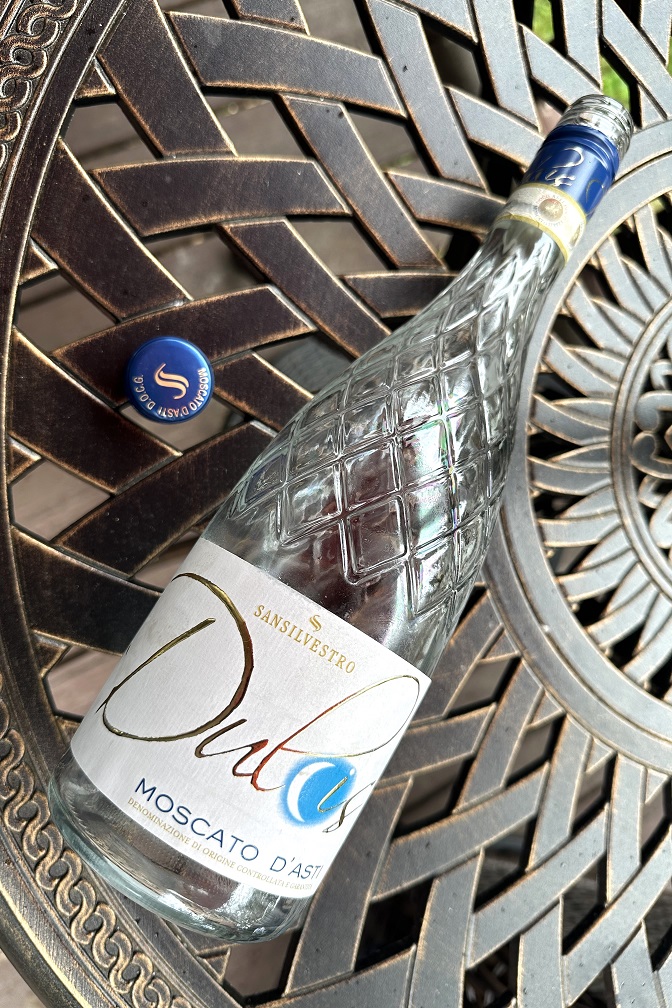
I recently had an opportunity to experience this “pleasure moment” when I opened the bottle of 2024 Sansilvestro Dulcis Moscato d’Asti DOCG (5.5% ABV) to serve with dessert. Overcoming the “what, more wine” resistance, I poured the wine for my guests and encouraged them just to take a sip. The next thing I heard was “oh my god, this is so good! Can I have more, please?” – there it is, that exact oenophile’s pleasure moment, equally as pleasant as taking a sip of the wine.
Moscato d’Asti is generally well priced, with a great selection of the wines at around $15 or less, so it definitely offers a great QPR and lots of pleasure without the need for an expense account. You should always have a bottle on hand, just in case you are craving a simple pleasure – double though considering the upcoming holiday season and all the get-togethers with friends.
By the way, on the subject of Moscato – back on May 9th, we celebrated Moscato Day (it is always celebrated on May 9th). I attended wonderful festivities in New York and never wrote about them, so if you care to see some of the images from that celebration, feel free to click “more” below.
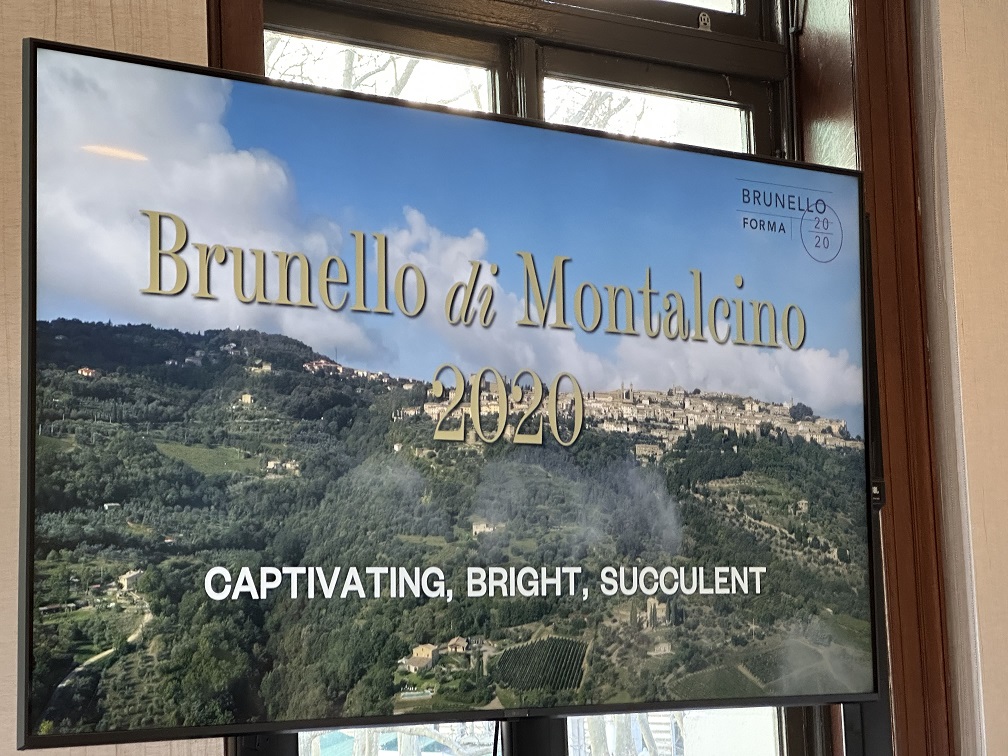
Brunello di Montalcino 2020: Captivating, Bright, Succulent
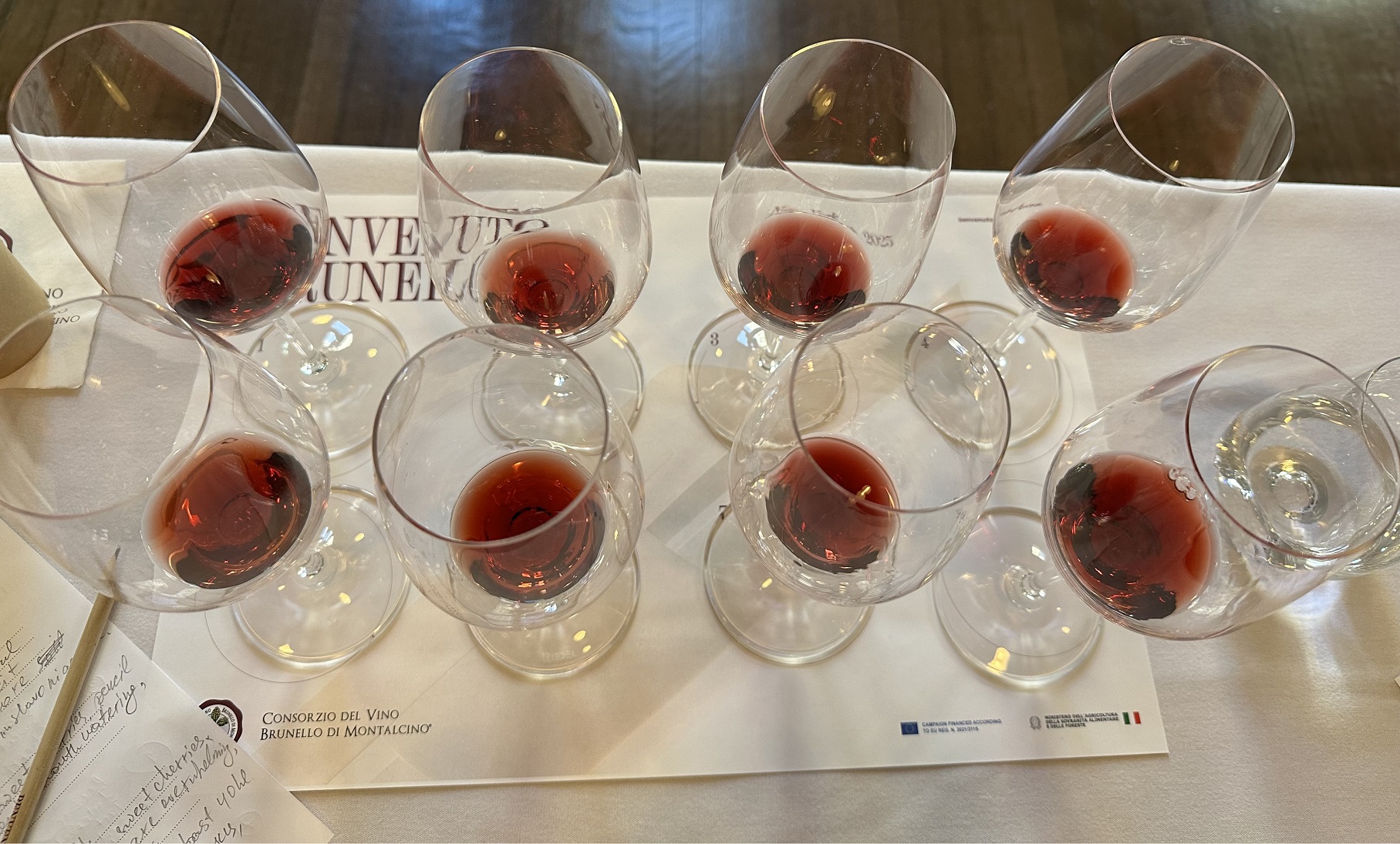
Benvenutto Brunello is one of my favorite wine tasting to attend. If you like Italian wines, Brunello needs no introduction (and if you don’t, I’m not sure we can be friends) – one of the 3 big Bs of Italian winemaking – Barolo, Barbaresco, and Brunello.
Brunello is an epitome of the expression of the best known Italian red grape – Sangiovese. The Sangiovese growing in the Brunello di Montalcino proper is considered a clone – Sangiovese Grosso, but it is a Sangiovese nevertheless.
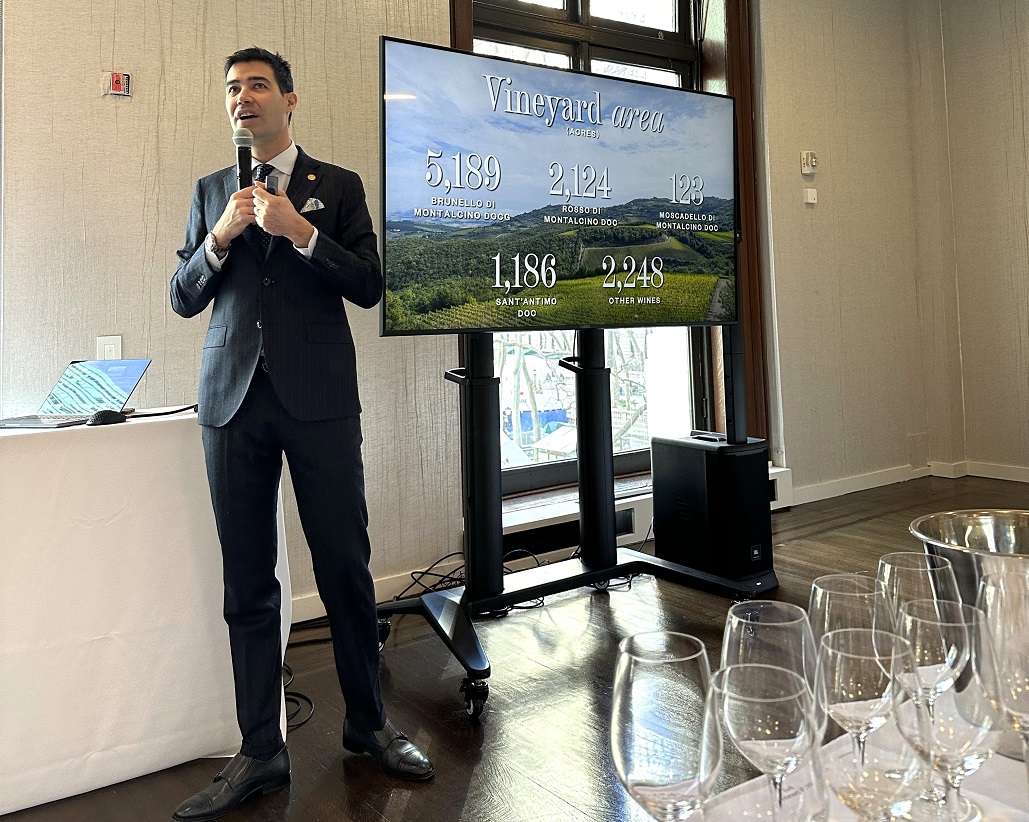
Brunello de Montalcino appellation is almost square, all located around the hill crowned with the town of Montalcino, with vineyards densely occupying 5,189 acres and located at various altitudes over a range of different soils. Different microclimate conditions, terroirs, guarantee a great diversity of styles among 200 or so producers in Brunello di Montalcino DOCG. Another interesting appellation within Brunello proper is Rosso di Montalcino DOC, occupying 2,124 acres (after expansion in 2020) of dedicated vineyards (Rosso DOC vineyards are only used for production of Rosso di Montalcino DOC). Take a look at this wonderful video providing an excellent overview of the Brunello di Montalcino region:
Gabrielle Gorelli, MW, led our highly informative Brunello Masterclass, providing a detailed overview of the 2020 vintage and the changes in vintage assessment that just went into effect.
The 2020 was a pivotal vintage for Brunello di Montalcino. Not because of the Brunello 2020 wines per se, but because of the fundamental changes made in assessment of the 2020 vintage and all future vintages to come.
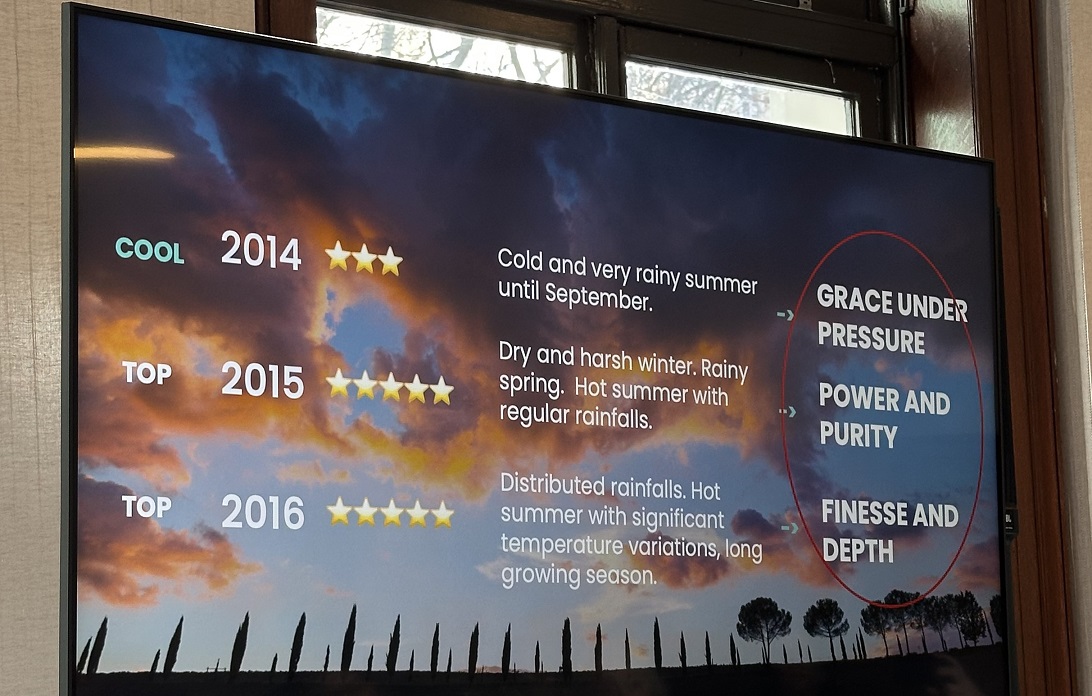
Until 2020, Brunello di Montalcino vintages had quality assessment specified with the stars (from 1 to 5 stars) and a short slogan characterizing the vintage. For example, the 2014 vintage had a rating of 3 stars and was called “Grace under pressure”. 2015 had a rating of 5 stars, and it was called “Power and Purity”; the 2016 vintage was also rated 5 stars and called “Finesse and depth”.
The 2020 Brunello vintage marks the end of the star ratings – this is the last vintage awarded a star rating (5 stars, in case you are wondering). Instead, Consorzio Brunello di Montalcino is introducing Brunello Forma, which will only provide a verbal description of the vintage moving forward.
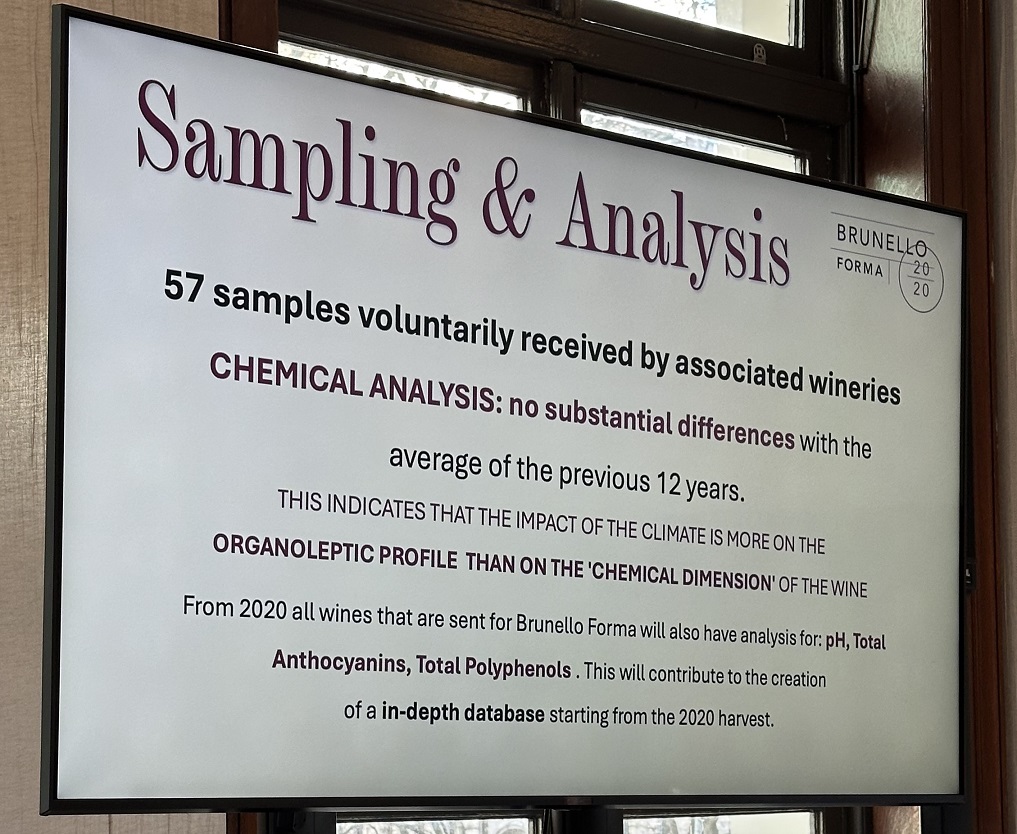
A significant amount of effort went into the creation of the new system. 39 weather stations were installed around the region to collect the microclimate data. Historical data of the past 12 years were collected and a significant number of samples from the past vintages were blind tasted to come up with the set of data which will allow to make vintage assessment more scientific, I guess.
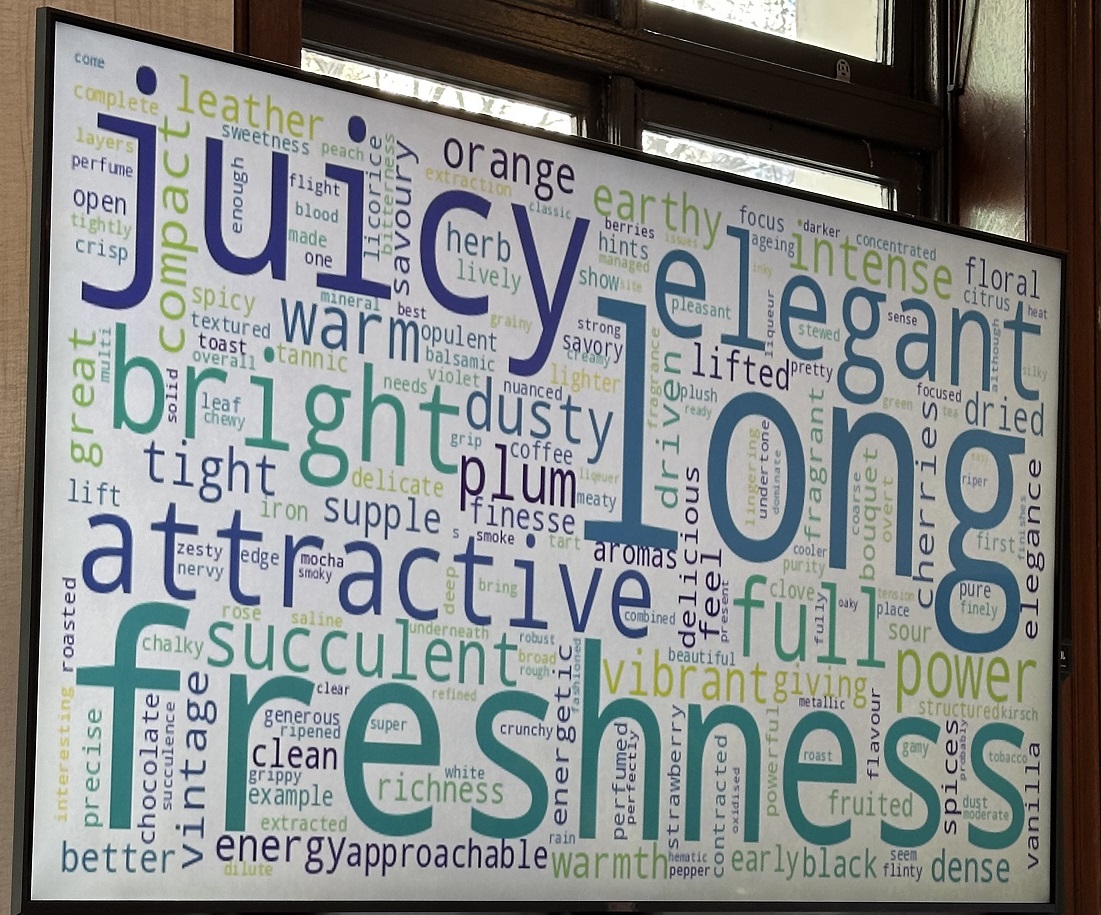
To come up with the vintage verbal assessment, a panel of industry experts (masters of wine, wine distributors, wine writers) ran extensive tasting of the 2020 wines, then collected and processed a large number of descriptors used by the panel members to crystallize the 2020 Brunello vintage description into these three words:
Captivating, Bright, Succulent
As an engineer at heart, I’m not a fan of words. Simple numerical (3 stars, 92) or verbal (fair, good, very good) rating quickly gives me everything I need to know about the vintage in general – captivating or succulent doesn’t set my expectations about a given wine – not now, and especially, not in the future.
However, as it was explained later on during the dinner with Giacomo Bartolommeo, Brunello winemaker at Caprili, the star ratings were hurting the wineries, as wine buyers preferred to ignore wines from 3-star vintages and focus on acquiring better-rated vintages, without much regard to the qualities of the particular wine. Moving to verbal descriptors eliminates the opportunity for a quick rating-based decision. Well, winemakers are in the business of selling their wines, so it is not my place to complain or judge.
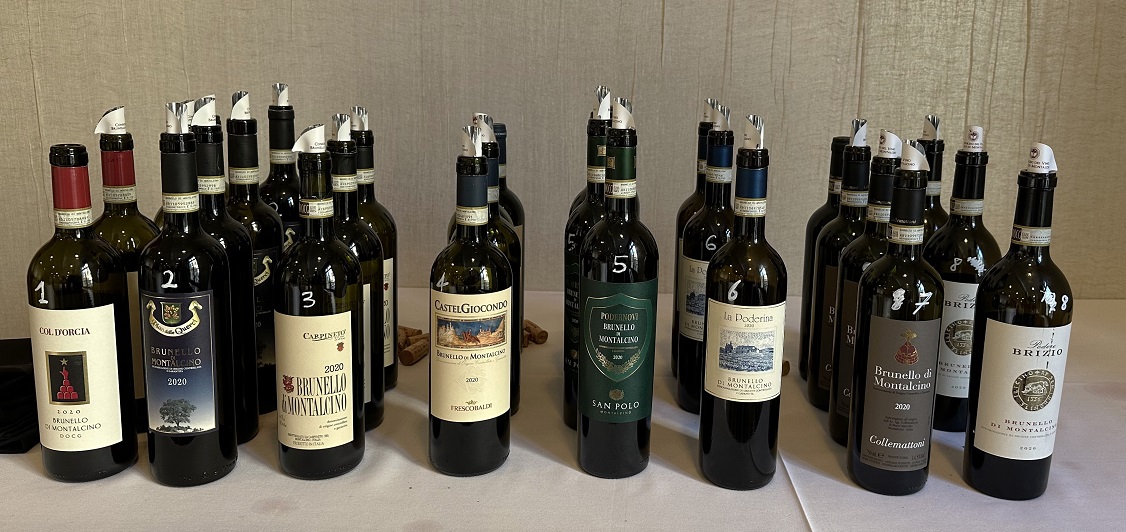
Then, of course, there were wines. I have to say that in the traditional Italian style (please take no offence), the tasting order was changed by our presenter, Gabrielle Gorelli, MW, compared to the order written on the notes page. However, I have to say that our tasting order was definitely the right one, showing progression from very tight and lean wines to wines that were softer and more approachable now. I attended both seminars, so below are my notes:
Morning Seminar
Col D’Orcia Brunello di Montalcino 2020
Ruby Color
Interesting nose, sapidity, earthy undertones, leather
Tart is the first sensation; tart cherries, expressive tannins, crisp acidity
Pian Delle Querci Brunello di Montalcino 2020 (36 months in Slavonian oak)
Dark ruby color
Sweet cherries, perfumy, very playful
Not as tart as the previous wine, but has very explicit tannins, good acidity, but lacking fruit, very lean
Carpineto Brunello di Montalcino 2020 (vineyards planted on the oldest soils, 3 years in big oak barrels)
Garnet color
Sweet tobacco, cherries, plums, attractive
Initially showed beautiful cherries, the tartness kicked in, followed by very dry finish with big but well integrated tannins
Marchesi Frescobaldi Castelgiocondo Brunello di Montalcino 2020 (single vineyard, aged in big casks)
Garnet color
Beautiful nose, elegant, perfumy, with a touch of sweet cherries.
Tart cherries on the palate, herbs, tart finish with well pronounced tannings.
San Polo Podernovi Brunello di Montalcino 2020 (30 months in light-toast 40hl casks)
Garnet color with bright reddish hues
Beautiful nose, elegant, perfumy, sweet cherries, eucalyptus.
Tart cherries, tannins are overwhelming, but the most elegant finish so far.
Probably can be enjoyed now after decanting
La Poderina Brunello di Montalcino 2020
Dark Garnet
Playful, bright red fruit, cherries, herbs, sweet oak.
Palate is a tad bitter, strange, had to swallow the wine instead of spitting to establish that it was not corked. Overall, not bad, but the nose is way better than the palate.
Collematoni Brunello di Montalcino 2020
Dark ruby color, beautiful
Beautiful nose, sweet fruit, cherries, sage, beautiful.
The best palate so far – round, with sweet and tart cherries, elegant, delicious.
8+
2020 Podere Brizio Brunello di Montalcino 2020 (38 months in oak)
Dark garnet
Beautiful, open, sweet fruit, sweet cherries, pencil shavings.
Tart cherries, explicit balsamic notes, succulent, mouthwatering, round, delicious, beautiful, superb.
8+
My favorite two wines of the morning seminar:


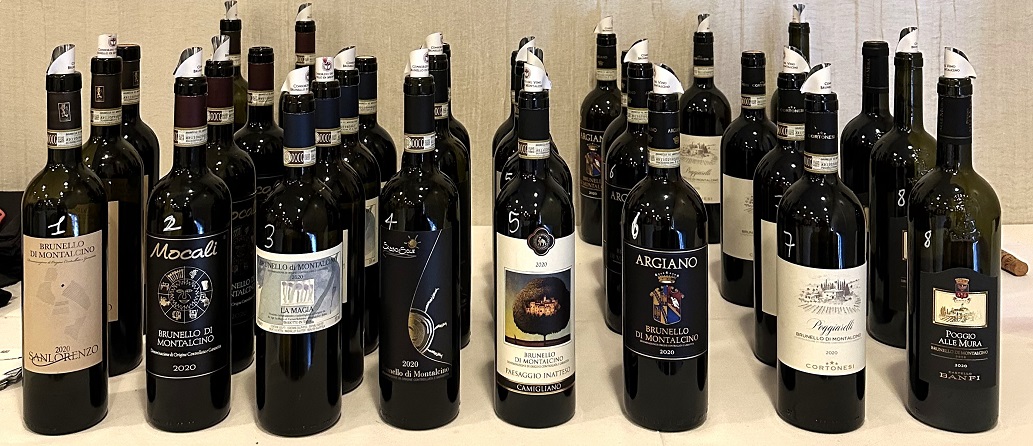
Afternoon seminar
Sanlorenzo Brunellodi Montalcino 2020 (aged in oak for about 3 years)
Garnet color
Beautiful, sweet fruit, cherries, dark undertones, earthiness.
Intense fruit quickly dissipates into very tart, very high expression tannins and acidity on the finish. Super-lean.
Mocali Brunello di Montalcino 2020
Dark garnet
Interesting nose, maybe racy is a good descriptor? Garrigue, some cherries show up a bit later.
Lots of sweet cherries which instantly disappear, but the finish is a bit less tart than the previous wine.
La Magia Brunello di Montalcino 2020
Very dark, practically black, darkest of the tasting so far
The nose is restrained, earthy and herbaceous
Sweet cherries, sweet oak, then tart, acidic, and ultra-tannic on the finish, very dry
Sassodisole Brunello di Montalcino 2020 (minimum 24 months in oak)
Dark Garnet
Cherries, sage, perfume, nice and open
Tart cherries, leather, well-integrated tannins
So far, the most approachable wine of the tasting
Camigliano Paesaggio Inatteso Brunello di Montalcino 2020 (30 months in oak barrels, 10 months in cement tanks after)
Bright ruby
Underbrush, a hint of smoke
Tart cherries, fresh cleansing acidity, acidic finish with some tannins, not bad.
Argiano Brunello di Montalcino 2020 (30 months in Slovenian oak casks of different capacities)
Dark garnet
Nice, inviting, round, dark fruit, a touch of crushed rocks.
Sweet cherries, crunchy and succulent, great energy, cherries on the finish, delicious.
8+, the best of the second seminar
Cortonesi Poggiarelli Brunello di Montalcino 2020 (24 months in oak)
Dark garnet, almost black, with bright hues
Amazing nose. Cherries that magically pull you in.
Fish and powerful opening on the palate, but bitter tannins set in.
Best nose of both tastings, 9-/9. Palate is not great right now – 7+
Banfi Poggio Alle Mura Brunello di Montalcino 2020 (24+ months in French oak)
Dark garnet with bright hues
Nice, open nose with lots of fresh herbs – sage, thyme.
Sweet dark fruit on the palate initially, then the palate is quickly shut down in front of the mouth. Again, if you swallow this wine instead of spitting, the wine is a lot more generous. Succulent is a perfect descriptor for such a wine. 8+
Best wines of the second seminar:


In addition to the seminars, there was tasting on the “main floor”. There were more of the excellent 2020 Brunellos, such as San Felice, Caprili, or Corte Pavone. There were also many of the 2019 Brunello di Montalcino Riserva wines, which were simply outstanding. Additionally, 2023 Rosso di Montalcino were presented by almost all participating wineries and were excellent across the board.
My Brunello deep immersion didn’t stop there. After the event was over, we went for dinner with John Fodera and Giacomo Bartolommei, the winemaker at Caprili, to the wonderful Italian New York restaurant Zero Otto Nove, famous not only for genuine Italian food but for the amazing wine list. There, Giacomo found 2001 Cerbaiona Brunello di Montalcino, which we ordered.
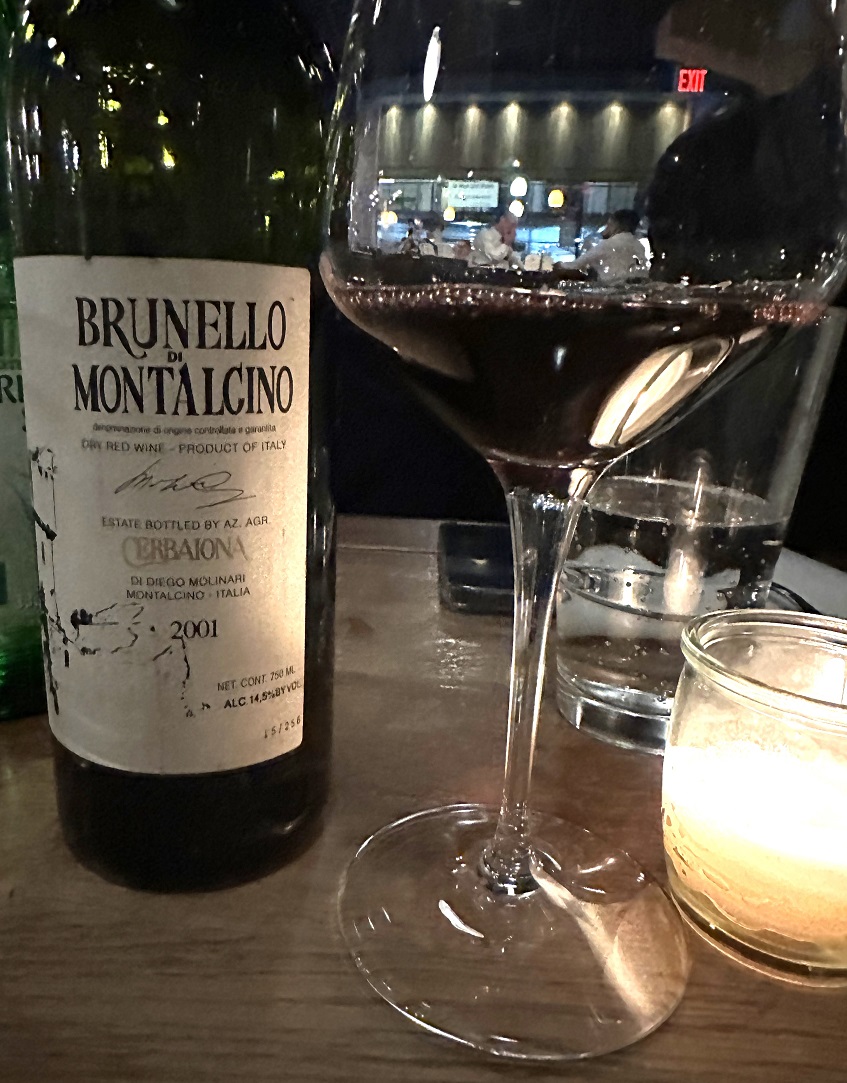


Wow, what a pleasure it was. Perfumy nose of succulent cherries, anis, eucalyptus. You can’t stop smelling the wine, you don’t even think of drinking it for a few minutes. Then you take a careful sip and experience an explosion of flavor with succulent cherries, balscami vinegar, iodine, and magic that only an Italian wine with age can offer. The experience was not identical to 1999 Soldera, but it was pretty darn close.
And now my Brunello report is complete. The 2020 vintage offers beautiful aromatics; it is approachable, it is succulent, it is captivating. Let’s raise the glass to the new era in Brunello and more tasty Brunello wines for us. Cheers!
Asti: Everyday Wine You Love To Drink But Afraid To Admit It
 Let me ask you a favor: can you please be honest with me?
No, scrap that. Can you please be honest with yourself?
When/if you read this, can you honestly answer a question for yourself: do you like sweet wines?
Be honest with yourself. This is strictly between you and you. Nobody will ever know what you will say. But if you do, have at least the courage to admit it to yourself – “yes, I like sweet wines”.
We are afraid of sugar. When we consume it, we prefer not to even think of it. We are so ashamed at the thought that someone might think we like sugar. You are supposed to hate sugar. We are supposed to enjoy things that are not associated with sugar. Sugar is bad news. Period. This is why nobody would ever want to publicly admit they like sweet wines, as they are evil.
Even if you are not afraid to admit to your affection, sweet wines are a special category. It seems that even the smallest bottle is usually too big. And by the time the dessert is served, nobody wants to drink more wine. But leaving that aside, there is a critical element for the sweet wine to be called enjoyable. I’m sure you can easily guess it, but I will give you a moment to think about it.
Got it?
That element is important across all wines, but in the sweet wines it is really critical – and this element is balance. Balance of all elements can make or break any wine, but in sweet wines, it has to be impeccable for the wine to be enjoyable. The sweetness must be balanced by acidity. If it is not, the wine becomes simply cloying, and not enjoyable (yes, I’m talking about lack of acidity in the sweet wines – never tasted the one with too much acidity). And perfectly balanced sweet wine becomes an ultimate indulgence. Perfectly balanced sweet wine is so sensual, so seductive that… well, I better let your imagination run wild.
Now, is there a way to make this sweet wine experience better? Of course – what if we will add some fizz to this perfectly balanced sweet wine? And make it affordable? And reduce the amount of alcohol – not eliminate, but simply reduce? Would you enjoy it every day? I’m sure the answer is yes. And I have a wine to suggest which will perfectly fit this profile – Asti wines from Northern Italy.

Source: Consorzio Asti DOCG

Source: Consorzio Asti DOCG

Source: Consorzio Asti DOCG
Sweet wines of notice were produced around the towns of Asti and Alba in southeastern Piedmont as early as the 17th century using a grape called Moscato Bianco. It is possible that the wines were produced even earlier, as Moscato Bianco had been growing in Piedmont as long as the Piedmont’s king was, Nebbiolo. The Classic Method of Champagne production has traveled to Piedmont and the first sweet classic sparkling wine was produced in the region in 1870. After the Martinotti method of producing sparkling wines in the tank instead of the bottles was invented in 1895 by Federico Martinotti, it quickly displaced Methode Champenoise as less expensive and significantly less time-consuming. The same method is used in the production of Prosecco. Oh, and look at these beautiful vineyards…

Source: Consorzio Asti DOCG
In 1932, Consorzio per la Tutela dell’Asti (Consortium for the Protection of Asti) was established to develop and ensure the guidelines for the production of Asti wines, known at that time as Asti Spumante. Things were going well until Asti Spumante became a victim of its own success. After World War II, American soldiers coming back were bringing light, sweet, fizzy Asti wines with them, bringing a surge in popularity. As the history of many wine regions shows (Chianti, Amarone, Australian wines at the beginning of the 2000s), such an increase in demand leads to overproduction and a dramatic drop in quality – exactly what happened with the Asti wines which subsequently lost their popularity due to poor quality.
Moving forward, Asti had to redefine itself, step by step. When Asti Spumante DOC was promoted to DOCG status in 1993, producers decided to ditch the Spumante portion of the name, becoming simply Asti instead of Asti Spumante. Producers also changed their production methods and quality controls, often moving towards a less sweet, drier style. The consortium also established a maximum yield for the grapes’ harvest and minimum alcohol levels that need to be achieved after fermentation.
While Asti wines are perfectly enjoyable on their own, they also make one of the very best food-pairing wines. Craving spicy food? Asti will work perfectly with that. Something substantial and salty? Bring on the Asti. Maybe most importantly – and uniquely – Asti wines are incomparable when it comes to pairing with desserts. If you never experienced a glass of Asti with an apple tart or a peach cobbler, you are missing on some of the greatest pleasures in life – you really should try it next time.
As Consorzio is expanding its presence in the US, I had an opportunity to sit down (virtually) with Consorzio per la Tutela dell’Asti Director Giacomo Pondini and ask him a few questions about Asti wines. Here is what transpired in our conversation.
[TaV]: What is the history of wine production in the region? Is Moscato Bianco the only grape that has been cultivated in the region? What kind of wines were produced there before the introduction of sparkling wines in 1865?
[GP]: As in many other places around Europe, the Romans have imported the wine production in Piedmont. And since then, it has thrived. Beyond Moscato Bianco, the historical grapes in the region are red varieties: Barbera, Freisa, Nebbiolo. Probably the most important step towards a more modern style of winemaking, at that time, was made by Camillo Benso Conte di Cavour. Before becoming a fundamental politician in Italian history, he devoted himself to the production of a wine based on Nebbiolo, named Barolo. In the history of Asti wines, the production of vermouth has laid the economical basis for developing the sparkling wine industry, based on Moscato Bianco grapes.
[TaV]: What is the difference between Asti Spumante DOCG and Moscato d’Asti DOCG wines?
[GP]: The main difference lies in the pressure – Asti Spumante, a proper sparkling wine, has to have at least 3.5 bar pressure, while Moscato d’Asti, which is a fizzy wine, 2.5. Then the difference lies in the residual sugar, higher in Moscato d’Asti, where sugars are less fermented and, therefore also less alcohol.
[TaV]: I understand that Asti Spumante wines can be produced using Classic and Charmat methods. What are the styles of Asti Spumante wines produced in the region, the official classification?
[GP]: The classification goes from pas dosè to sweet. Historically speaking, the sweet typology was the only one allowed until 2017, when extra dry, dry, demi-sec were introduced. From 2020, pas dosé, extra brut and brut were also authorized.
[TaV]: What are the best food pairings for the Asti Spumante wines? I know that in Sauternes in France, the region famous for its sweet wines, it is possible to have a full dinner paired with sauternes wines, from appetizer through the dessert. Is it possible to do the same with the Asti Spumante wines? If yes, can you share a sample menu for such a dinner?
[GP]: We know that in many countries Moscato d’Asti and Asti spumante are paired with a wide range of food: from the traditional desserts to cheese, from barbecue to Thai soups, to raw fish and curry.

Source: Consorzio Asti DOCG
[TaV]: What is the annual production of the Asti Spumante wines across all styles and including both DOCGs? How many producers and grape growers are in the region? Any other statistics you would want to share?
[GP]: In 2022 the annual production has reached 102 million bottles, 60% Asti Spumante and 40% Moscato d’Asti. Around 3,000 grape growers and 250 producers.
[TaV]: What countries are the main importers of the Asti Spumante wines? What percentage of annual production is going for export versus domestic consumption?
[GP]: Export covers 90% of the production, both for Asti Spumante and Moscato d’Asti. The main export markets for Asti Spumante are the USA, Russia, Great Britain, and Germany; USA by far is the most important market for Moscato d’Asti.
[TaV]: What is ahead of the Asti Spumante wines, let’s say, over the next 10 years?
[GP]: In commercial terms, an increasing presence in the Asian markets, while also growing the value and the perception. And also, a reason to visit Langhe-Roero Monferato, the area of production in Piedmont, UNESCO world heritage.
[TaV]: Sustainability and organic viticulture – are they used in the region? What percentage of the producers practices sustainable viticulture? Same for the organic?
[GP]: Around 25% of the growers are sustainable or moving in that direction. As a Consorzio we have just started the process of becoming a “sustainable territory”, a certification that involves all the grape growers and wineries in our area of production.
[TaV]: If someone had never had an Asti Spumante wine, how would you convince that person to try the wine for the first time?
[GP]: The aromatic profile of Asti Spumante, as well as Moscato d’Asti, cannot be found in any other wine. An immediate pleasure that makes these wines suited for any pairing or in any joyful moment.
I had an opportunity to taste several Asti wines of different styles – dry (it is Asti dry, not Champagne Brut Nature dry), sweet, sparkling and still. Acidity rules the pleasure in Asti wines – as long as the wine has enough acidity, all of the sweet elements – peaches, apricots, apples, pears, honey – will appear utmost delicious. As a reference, here are the wines I tasted and am happy to recommend – the first two being the most favorite:
NV Acquesi Asti DOCG (7% ABV)
NV Capetta Asti DOCG (7% ABV)
NV BOSCA Esploro Secco (dry) Asti DOCG (11% ABV, sugar 17–23 g/l)
NV Giacomo Scagliola “SiFaSol” Moscato d’Asti Canelli DOCG (5.5% ABV)
NV Bersano Monteolivo Moscato d’Asti DOCG (5.5% ABV)
NV Cascina Cerutti Siri Sandrinet Moscato d’Asti DOCG (5.5% ABV)
NV Matteo Soria Bric Prima Bella Asti DOCG Extra Dry (12% ABV)
2022 Vittorio Bear Moscato d’Asti DOCG (5% ABV)
NV Sanmaurizio SATI Asti DOCG Secco (11.5% ABV)
NV Arione Asti DOCG Extra Secco (12.5% ABV)
NV Tosti Asti DOCG (12% ABV)
NV Bussi Piero Moscato d’Asti DOCG (5.3% ABV)
Before we part, let me ask you something.
Are you convinced now that sweet wines are not evil, or do you still need more convincing? Let’s do a simple math here. A typical glass of Asti wine contains between 8 and 12 grams of sugar (dry Asti will have only about 4, but let’s leave dry Asti aside for now). That same glass of Asti, at 5% ABV, will have about 7 grams of alcohol (1 standard wine glass is 5 oz, which is equal to 142 (rounded up) grams, 5% from 142 is 7.1). According to the formulae I presented in this post, considering that 1 gram of sugar has 4 calories, and 1 gram of alcohol has 7, that glass of Asti will cost you 4*12+7*7 = a whopping 97 calories. Plus lots and lots of pleasure. Considering that a can of Coke has 140 calories, what would you choose?
The choice is yours, of course, but my choice would be pleasure. Any day. Wine should give you pleasure, this is the only reason to drink it, and Asti is good at that.
The holidays are upon us. But even between the holidays, you have to celebrate every day whose name ends with the “y”. And please promise me that you will try a glass of Asti with dessert. You owe it to yourself. Please…
Let’s drink sweet wines and to the sweet wines. There is nothing to be ashamed of. Cheers!
The Art Of Living Nobile – The Avignonesi Way
 Have you heard of Vino Nobile di Montepulciano? If you have – great, if you have not – don’t despair, this is what we want to talk about today. Not to confuse anyone, we will be talking here about wines produced near the town in Tuscany called Montepulciano, where the wines are made from the same grape that shines everywhere in Tuscany – Sangiovese, and not about the grape called Montepulciano.
Wines had been produced in the Montepulciano area for a very long time (it’s Italy to you), and in 1685 Montepulciano wine was declared a “king of all wines“. But it was not until the 1930th when the name “Nobile” made it on the wine label thanks to the efforts of winemaker Adamo Fanetti. From there on, the wines previously known as “special Montepulciano red wines” became known as Vino Nobile di Montepulciano.
Okay, what is this “Living Nobile” all about you might ask. Let’s talk about it.
I asked the glorified search engine, now also known as AI “What does it mean to live Nobile” – and here is the answer I received:
“To live nobile” means to live a life characterized by high moral principles, displaying qualities like kindness, integrity, generosity, and a strong sense of duty towards others, essentially embodying the idea of “nobility” in one’s actions and character; it signifies living with a focus on doing good and acting with dignity, rather than seeking personal gain or power.”
This seems to be reasonably clear, would you agree? But where is the connection to the wine?
Ahh, I thought you would never ask. Cue in Avignonesi, one of the premier wineries in the Vino Nobile di Montepulciano area, founded in 1974.
Avignonesi was instrumental in advancing the whole region forward, being the driving force behind Vine Nobile di Montepulciano becoming one of the very first regions in Italy to be awarded DOCG (Denominazione di Origine Controllata e Garantita) status, the highest level of quality in Italian wine denomination system, along with all the famous “B”s – Barolo, Brunello, and Barbaresco.
That is not all. Avignonesi today is a certified organic and biodynamic winery, and it is also a certified B Corporation since July of 2022. Now this gives is even better connection to the “live Nobile” concept as outlined above.
To become a B (B stands for Benefit) Corporation, a for-profit company has to be certified (every 3 years) to meet high level standards for social and environmental performance. As of February 2024, there were 8,254 certified B Corporations across 162 industries in 96 countries. Out of that total number, there are only 52 wineries, and Avignonesi is one of them.
Here are more helpful suggestions from the AI:
Wineries that become B Corps often commit to:
Using low impact farming methods
Managing resources responsibly
Treating their workforce, community, and natural surroundings fairly and responsibly
As you can tell, these are perfecly aligned with the “living Nobile” concept.

To promote “living Nobile” concept, Avignonesi recently engaged in an entire campaign promoting this concept. The winery also created a special release of their flagship 2014 Vino Nobile de Montepulciano wine adorned with a special label designed by the artist Amrita Marino. I had an opportunity to sit down (virtually) with Avignonesi CEO, Matteo Giustiniani, have him explain the concept behind “living nobile” and answer a few of my questions. Here is what transpired in our conversation:
[TaV]: Can you explain the idea behind ““living Nobile””?
[MG]: We always keep in mind our extra long-term vision: to be good ancestors, planting trees under whose shade we will never sit. Recently, we started asking ourselves how we could deeper connect with our consumers, deepening their understanding of the Nobile di Montepulciano appellation and bridging the gap in understanding the values that drive us in caring for each grape, each bottle, and every consumer, beyond all technical aspects that do remain fundamental to our striving for excellence.
And here it came! The Live Nobile communication platform: a veritable movement that brings wine into cultural conversations and gives it a fresh and renewed relevance. It tells us what living Nobile means, highlighting the importance of lightheartedness and enlisting the help of Amrita Marino to illustrate our points, supporting us in telling what Live Nobile is. For us, Live Nobile it’s sharing ravioli, saving seats, arriving on time, or celebrating small wins. Yet, it’s also about embracing slow living or it’s the impromptu refill; and again, it’s also the airplane mode and being the designated driver. But most important, looking forward, it’s everything we can recognize aligned to our deepest set of values, giving to us spectrum for so many facets and personal interpretations.
[TaV]: What is the inspiration behind these “artist label” releases?
[MG]: We see our featured artists to our greater end. Today it’s Amrita, but tomorrow it could be a visual artist, writer, photographer, or calligrapher. We are selecting key individuals to represent the aesthetic values of our platform, Live Nobile.
[TaV]: Why ten new labels for the 2014 release? Will all of these labels be available in all of the markets? What is the inspiration behind these labels?
[MG]: 10 labels as we are marking a decade since we first harvested grapes, giving through each label a visual life to our already imagined platform.
[TaV]: Do you plan to continue these special “artist label” releases? Will you have such a special release next year? Will you work with different artists for he subsequent releases?
[MG]: Absolutely, yes! We will have special releases next year (and the following ones) featuring a variety of creative people.
[TaV]: I’m assuming this 2014 is also considered a “vintage release”? The tech note you sent me is for the regular 2014 Vino Nobile di Montepulciano – was the wine with the artist labels simply a part of the same general 2014 batch, or were they specially selected?
[MG]: The 2014 Vino Nobile di Montepulciano was originally released as part of the standard vintage back in 2014. However, 10 years ago, we made the decision to set aside a very limited number of bottles to age in our cellar, and we are now re-releasing them with updated packaging. These bottles are still part of the general 2014 batch.
[TaV]: Were some wines released under the general label, and some reserved for the later release, bottled, stored at the winery, then recently labeled and offered as an “artist series”?
[MG]: Yes, this is correct
[TaV]: Or were these special-label wines from different plots/vineyards?
[MG]: No, same general batch.
As you can tell, living Nobile is simple, and we should all embrace this beautiful concept. You can learn more about living Nobile on the Avignonesi website, and also there you can see all ten artistic labels celebrating this special release.
So how were the wines? I had an opportunity to try both nicely aged classic Vino Nobile and a special treat – a super-Tuscan wine called Desiderio.
2014 Avignonesi Vino Nobile di Montepulciano DOCG (13.5% ABV)
Ruby with brickish hues
Leather, tobacco, a hint of a gunflint
Cherries, leather, roasted notes, earthy notes, good acidity, cherries on the finish.
Drinkability: 8, very nice

I think Desiderio wine deserves a little introduction, and I’m not going to regurgitate a perfect explanaton as it appears on Avignonesi website. Here it is:
“Desiderio was a bull which lived on Avignonesi’s Capezzine farm more than one hundred years ago. The largest bull in Tuscany at that time, this majestic animal helped define the Chianina cattle race, specific to the Bistecca Fiorentina. It came as a natural choice to dedicate this Merlot to the beloved bull as a testimony to the wines’ origin. This is Merlot from Tuscany at its best.
The iconic white bull is today an illustration of the vintage. There is more to the label than meets the eyes. Compare them with each other, and you will notice a few clues about the climate. Look at the sky, and you will understand whether it was cold, hot, or balanced and you can decipher many other hints.”
2020 Avignonesi Desiderio Toscana IGT Merlot (14.5% ABV, 100% Merlot, organic grapes)
Garnet
Cherries, eucalyptus
Dark cherries, firm structure, well integrated pleasant tannins, hint of bell peppers and cassis leaves, perfect balance, medium-long finish
Drinkability: 8+, excellent
The world will definitely be a better place if we would all adopt this simple “living Nobile” concept. Let’s try to do just that.
Everyday Bubbles: Prosecco FIOL
 It might be hot outside. It might be a holiday, birthday, or a celebration. Or you just might be craving something refreshing after a long day.
May I suggest a glass of cold wine?
Wait, we can make it even better – how about cold wine with refreshing bubbles? May I interest you in a glass of Prosecco?
Prosecco is so popular today that it is an easy choice when one wants to enjoy some fizz in a glass. At the same time, it is interesting to note that Prosecco’s real story only started in 1989, literally being sold door to door in London. For comparison, Champagne was already in demand by the kings more than 200 years before that. But just to put things into perspective – based on 2023 data, Prosecco produced 2.5 times more bottles than Champagne – 880 million versus 299 million, and there were 4 times more of the Prosecco bottles imported into the US in 2022 – 134 million versus 33.7 million.
While both Champagne and Prosecco belong to the category of sparkling wines, they are different in many ways – grapes, production method, blending, ability to age, prices, and so on. But we should look at them exactly as they are – these are two types of wines in two different categories, each one suitable for different life moments. Yes, even the cheapest Champagne is typically at least twice as expensive as Prosecco – but in wine, the price is not a guarantee of pleasure – we can enjoy a glass of Processo as much as we might enjoy a glass of Champagne. Heck, we might enjoy a glass of Prosecco a lot more than a glass of Champagne. First-hand example – I really enjoyed a glass of Aperol Spritz in Italy, made with a no-name Prosecco – and I was really not happy about seemingly the same glass of Aperol Spritz proudly made with Mumm Champagne while in France – no-name Prosecco in this particular case was way better than the coveted Mumm. Don’t get me wrong – by no means am I encouraging you to stop drinking Champagne and wholeheartedly switch to Prosecco – I’m merely suggesting that each one can have its own joyful moment. The wine has to give you pleasure, that’s what matters – and pleasure is subjective.
So today, let’s enjoy a glass (or two or more) of Prosecco, and I have a Prosecco for you in mind.
Let me present Prosecco FIOL to you – a beautiful rendition of Prosecco that is well worth seeking.
First, let’s talk about the name. As per Prosecco FIOL’s website:
FIOL (/fee-ol/ • noun)
a term of endearment for a young man, originating from the old Venetian Republic language (1400s), similar to “son” or “chap” in English.
Prosecco FIOL was started in 2011 by 3 lifelong friends – Giovanni, Gian Luca, and Pietro, who found a way to express their passion for the land and the Italian and Venetian way of life. It is interesting to note that the fruit for production of FIOL is selected from about 2,300 (not a typo!) farmers, accounting for a combined 14,800+ acres of vineyards and terroirs to achieve the perfect blend.
I had an opportunity to try both Rosé and regular Prosecco, so here are my impressions.
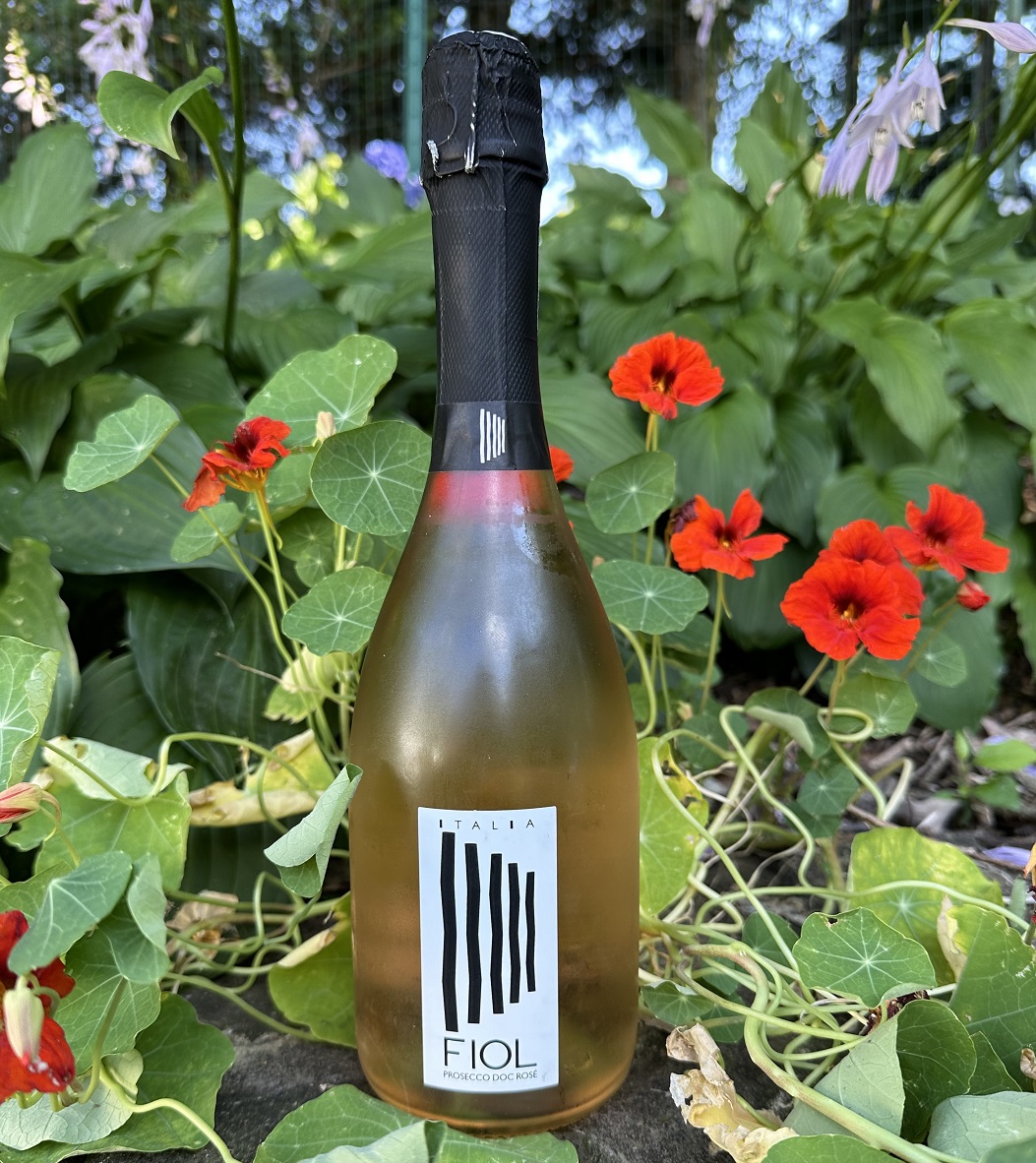
2021 FIOL Rosé Prosecco DOC Millesimato (11% ABV, $22, 85% Glera, 15% Pinot Nero)
Beautiful Salmon pink color
A whiff of strawberries on the nose, also a hint of strawberries on the palate, very generous mousse with lots of energy, a bit more plump than a typical brut champagne, exquisitely refreshing, and constantly encouraging another sip.
Superb.
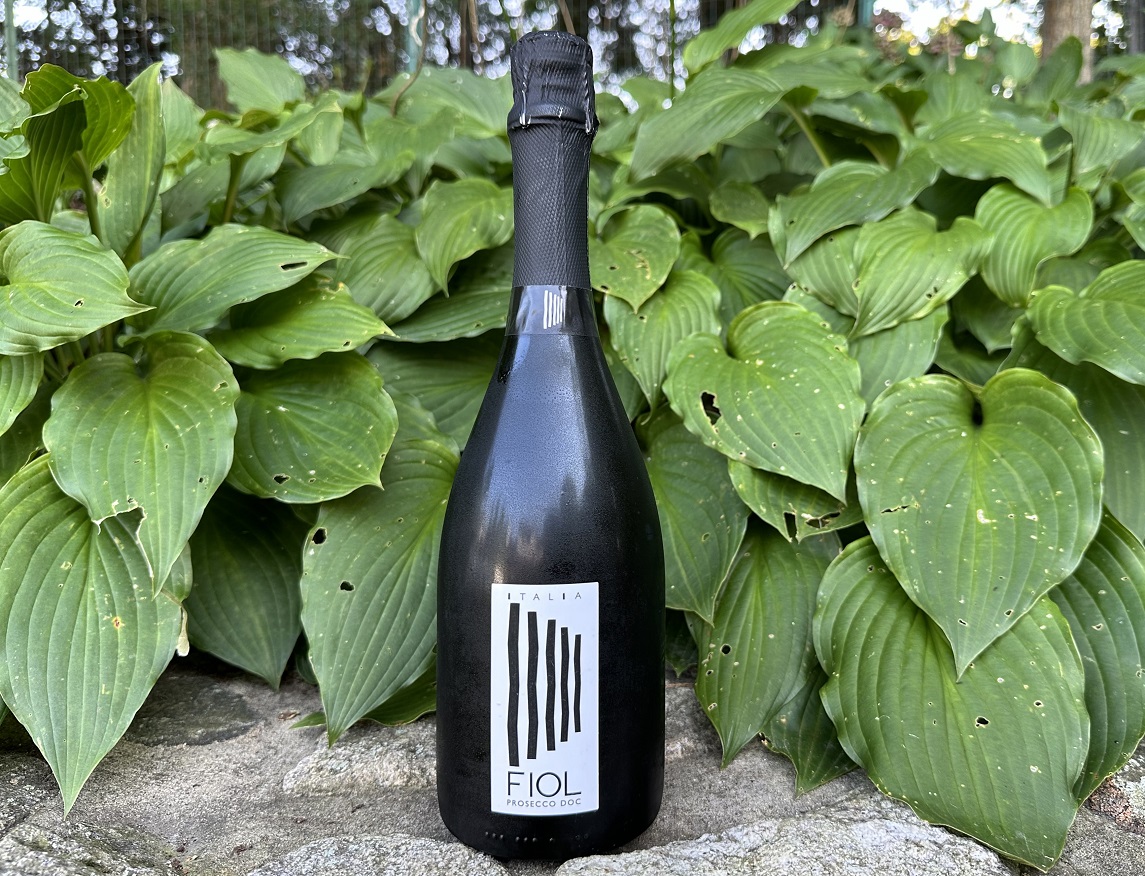
NV FIOL Prosecco Extra Dry Prosecco DOC (11% ABV, SRP $19/750 ml | $39/1.5 L)
Beautiful straw pale color, fine mousse
Apples, white flowers, fresh pear, light, inviting
Delicious apples on the palate, good body weight, light plumpiness, off-dry, long pleasant finish.
Made for a delicious Aperol, better than 90+ Prosecco
Here we go – two Prosecco bottlings, both delicious and perfectly suitable for everyday’s consumption without worrying about breaking the bank.
“Every day above ground is a great day”, so let’s celebrate it. With FIOL Prosecco in hand. Cheers!
The Art Of Italian Wine: Masciarelli
Italian wines are special.
Well, this statement says a lot and nothing at the same time.
Remember, wine is personable and subjective. Everyone has a right to have their own opinion, and that opinion can only be subjective.
What makes Italian wines special? I will allow myself to make a bold claim – Italian wines are distinguishable. At least the well-made Italian wines produced from the core Italian grape varieties. What I’m saying is that when you taste Chianti, Brunello, Nero d’Avola, Montepulciano, Barolo and others, you might not identify the exact wine and the exact producer, but you would be reasonably sure you are drinking an Italian wine.
When you drink wine made from Cabernet Sauvignon or Chardonnay, you might be well able to identify the grape, but the origin of the wine can be equally anywhere in the world – Bordeaux, California, Italy, Spain, Washington, Australia, Chile and everywhere in between can be a source of a great Cabernet Sauvignon. This would be also true for the absolute majority of the so-called international grape varieties – Cabernet Sauvignon, Merlot, Pinot Noir, Grenache, Syrah, Chardonnay, Sauvignon Blanc. But when you taste Sangiovese made in Italy, you might be easily mistaken about the exact region, but you would be reasonably certain you are drinking an Italian wine. An important disclaimer – it would definitely help if this would be a well-made Italian wine.
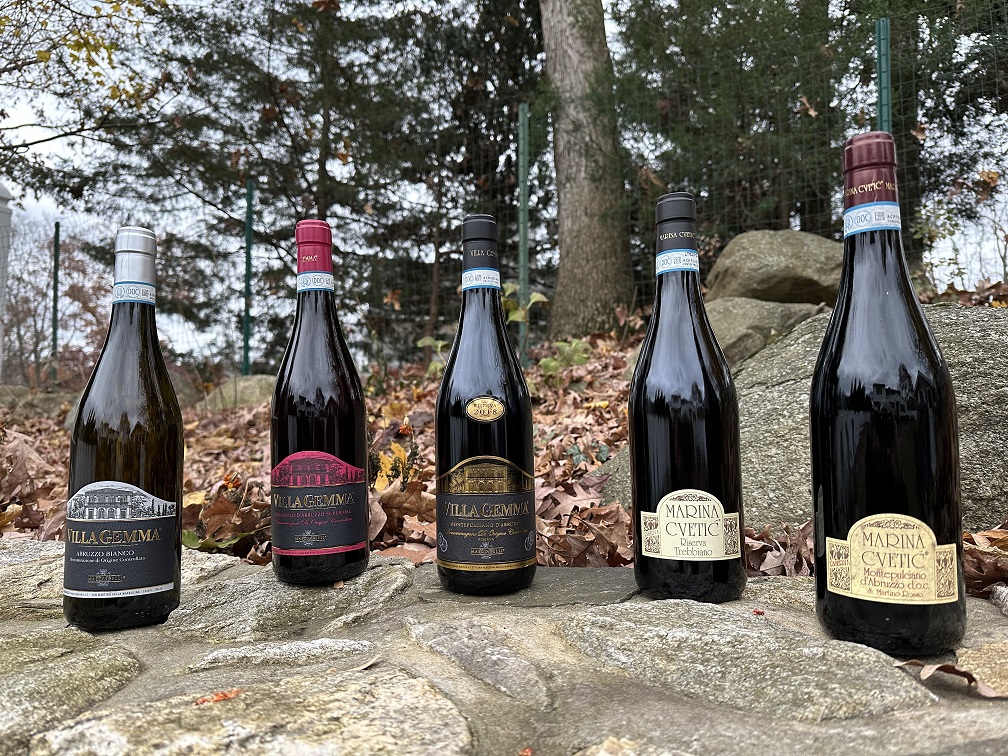
Here is a great example of the well-made, and thus easily recognizable Italian wine – or, rather, wines – Tenute Masciarelli in Abruzzo in Italy.
In terms of “wine time”, Masciarelli is a very young winery, founded in 1981 by Gianni Masciarelli. However, the impact in the wine world is not directly a function of time. Wine has been continuously produced throughout Italy for a few thousand years. In Abruzzo, a province located in central Italy along the Adriatic Sea, Montepulciano is the king. Simple Montepulciano red wines were produced forever in the region, perfectly quaffable, but not really comparable, for example, to the wines of Tuscany. Gianni Masciarelli spearheaded the change in the region, both in grape growing (he introduced the French Guyot training system for vines in the region) and production – he was the first to start using French oak barrels for aging the Montepulciano Abruzzo and Trebbiano d’Abruzzo wines. 1984 saw the first vintage of the Villa Gemma Montepulciano d’Abruzzo, the first of its kind single-vineyard Montepulciano d’Abruzzo wine, which will be celebrating 40 years of production this year.
Today, Masciarelly sustainably produces wines from all 4 provinces in Abruzzo. Annual wine production exceeds 1 million bottles across 7 different lines and 22 wine labels. A few months back, I had an opportunity to review Masciarelli’s introductory Linea Classica – 3 very well-made wines that were not only tasty but easily lasted for 5 days after being open – a testament to quality. Now, I had the pleasure of reviewing the latest releases from two more wine lines – Marina Cvetic and Villa Gemma.
Marina Cvetic line includes 2 of the classics – Trebbiano d’Abruzzo Riserva and Montepulciano d’Abruzzo – the second one is my perrenial favorite, I’m always happy to drink it. Additionally, the Marina Cvetic line includes four of international grape varieties (Chardonnay, Cabernet Sauvignon, Syrah, and Merlot) – however, I don’t think those are available in the US.
Villa Gemma, the winery’s flagship and the oldest produced line, includes three of the Abruzzo’s classics – white blend, Rosé, and Montepulciano d’Abruzzo Riserva.


Here are my notes:
2020 Masciarelli Marina Cvetić Trebbiano D’Abruzzo Riserva DOC (14% ABV, $60, 100% Trebbiano Abruzzese, 20-50 yo vines)
Light golden
A hint of tropical fruit, Whitestone fruit, honeysuckle
Round, clean, fresh, a hint of butter, soft and creamy texture with Meyer lemon finish
8, the wine is a bit aggressive when just opened, don’t over-chill it (I would serve it around 50F) and let it breathe, maybe 30 minutes in a decanter. Will stay fresh in the fridge for a few weeks.
2022 Masciarelli Villa Gemma Abruzzo Bianco DOC (14% ABV, $24, 50% Trebbiano, 30% Pecorino, 20% Cococciola)
Straw pale
whitestone fruit, lemon, clean, inviting
Crisp, clean, good acidity, lemon, expressive minerality, good balance
8, excellent
2022 Masciarelli Villa Gemma Cerasuolo D’Abruzzo Superiore DOC (14% ABV, $24, 100% Montepulciano)
Beautiful cranberry pink
Restrained nose of fresh strawberries, pleasant
Strawberries, cranberries, fresh, bright, excellent acidity, good balance, delicious
8
2019 Masciarelli Marina Cvetić Montepulciano d’Abruzzo Reserva DOC (14.6% ABV, $38, 100% Montepulciano, 15-30 yo vines, 12 months in French oak barrels)
Dark garnet, almost black
Dark cherries, espresso, tar, mocha, medium intensity
Dark cherries, silky smooth with beautifully present tannins, layered, round, well present, delicious.
8+, these are day 2 and day 6 notes, this wine is made of the long haul, was not very enjoyable upon opening, you need to decant it for 2-3 hours or forget it in the cellar for 10-15 years as the least.
2018 Masciarelli Villa Gemma Riserva Montepulciano D’Abruzzo DOC (15% ABV, $98, 100% Montepulciano, 35 yo vines, 12 months in French oak barrels)
Dark garnet, practically black
Black cherries, a hint of a barnyard
Black cherries, cherry pits, silky smooth roll-of-the-tongue texture, good acidity, excellent balance
8+, this is a big wine. It is surprisingly pop’n’pour, but will improve with the cellaring.
Here you are, my friends – wine, a liquid art form, made in Italy.
Do you think that Italian wines are easily distinguishable? What are your favorite Italian wine producers?
Deceptive Simplicity: Masciarelli Linea Classica
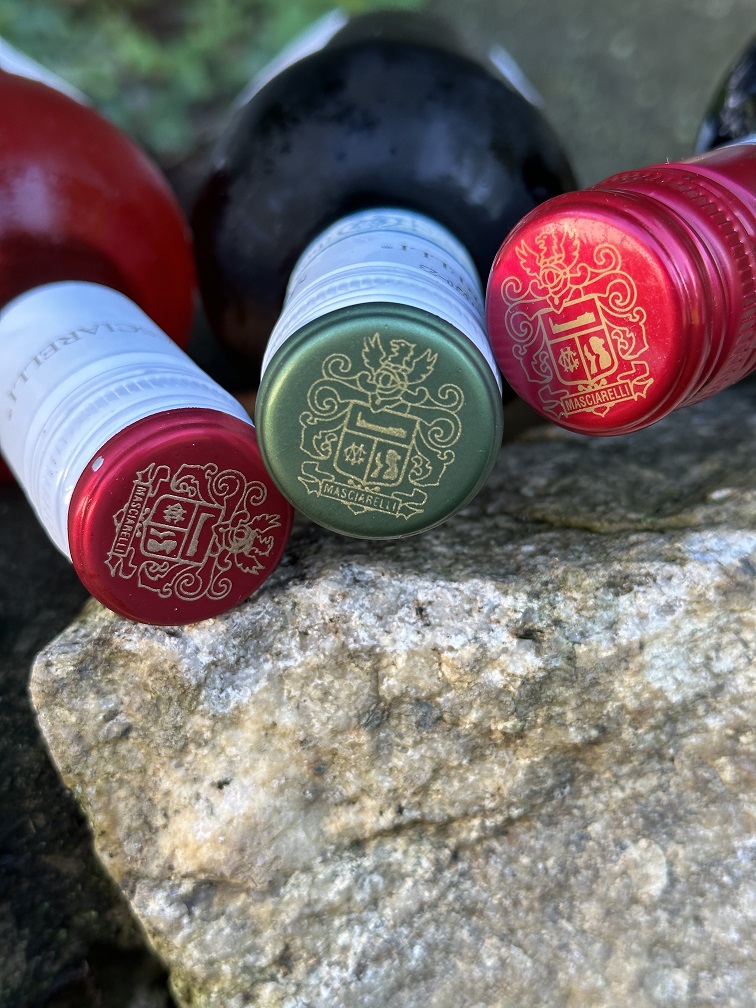 Simple is an interesting word to use around food and wine – there is a lot of dependency on the context.
I love simple recipes – one of my favorite recipes for sauteed eggplant has only 5 ingredients in it, takes 30 minutes to make and the result is consistently delicious. Air-fried salmon bites take less than a minute to prep, consist of only salmon and seasoning, and again, are consistently delicious. Near East couscous takes 5 minutes to make – and it is a perfect side dish every time it is made. When it comes to food, “simple” usually is a good word.
Calling the wine simple requires clarifications, it requires real context. “Simple wine” often means inexpensive, and this is a good thing – as long as the wine tastes good, as long as wine gives you pleasure “simple/inexpensive” is a good word (nobody likes “inexpensive” but crappy). Simple can apply to the label and overall packaging. The wine can also taste simple, and here the truth is in the eye of the beholder – many people prefer simpler-tasting wines so they will not interfere with the food. But if someone is craving complex, thought-provoking, multi-layered wine, “simple” is the last descriptor that someone will be happy about. “Simple wine” has a meaning only in the context.
The interesting part of a “simple wine” designation is that once we call the wine simple based on price and appearance, we make assumptions about the taste. Once we say “simple wine”, we are intuned to take it all the way – assuming that this simply looking wine will be also simply tasting wine.
Can simple packaging and a reasonable price hide the wine of a much grander standing than it appears to be? In other words, can simplicity be deceiving? Of course. Let me present my case to you – a classic lineup (Linea Classica) of wines from Tenuta Agricola Masciarelli in Abruzzo Italy.
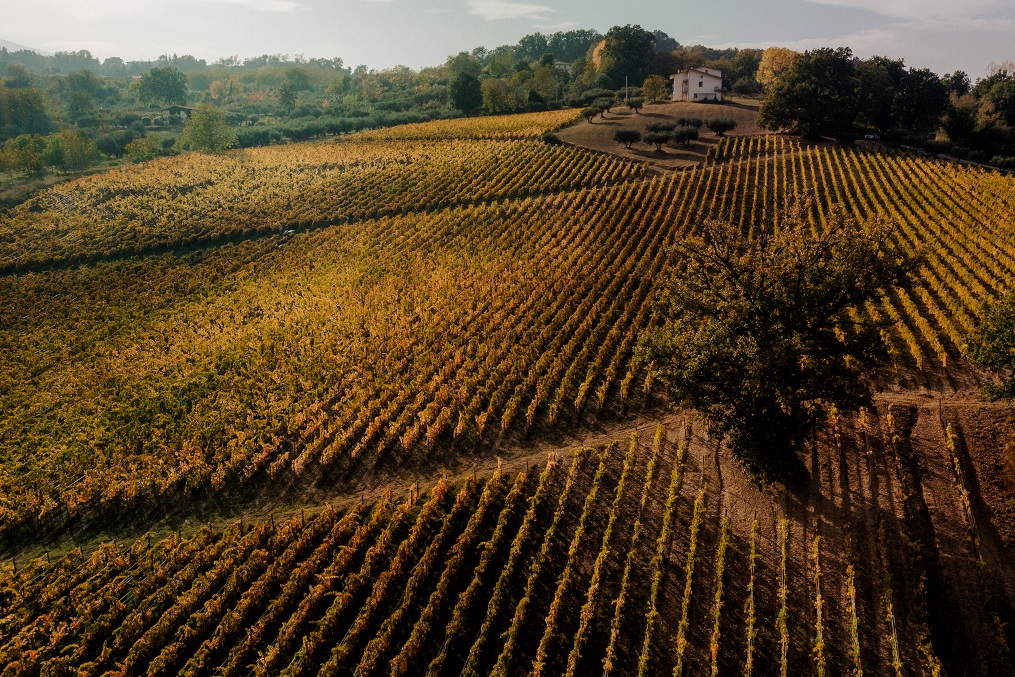
Masciarelli Vineyards. Source: Tenuta Agricola masciarelli
Gianni Masciarelli produced his first vintage of red, white, and Rosé in 1981 from the 5 acres vineyard owned by his grandfather and located near the family house in San Martino in the province of Chieti in Abruzzo. Abruzzo region, located east of Rome along the Adriatic coast is best known for its – here it comes again – simple white and red wines, produced, respectively, from Trebbiano and Montepulciano. From the very beginning, Gianno was convinced that Abruzzo was capable of producing world-class wines. He worked very hard not only in his own winery but pushing forward the whole region. Gianny was the first to introduce a French Guyot training system for the vines and French oak barrels for aging the Montepulciano and Trebbiano wines. By the way, while Trebbiano is a popular white grape that grows all over Italy, Trebbiano Abruzzese is a local ancient Trebbiano clone that is growing only in Abruzzo. Trebbiano Abruzzese has lower yields and produces wines that can age.
Today, Tenuta Agricola Masciarelli is run by Giovanni’s wife, Marina Cvetić, together with their eldest daughter, Miriam Lee Masciarelli. Tenuta Masciarelli is the only winery that owns vineyards in all four provinces in Abruzzo (Chieti, Pescara, Teramo, l’Aquila). The vineyards span 740 acres (300 hectares) and consist of 60 non-adjacent parcels. Masciarelli produces 7 different lines of wines, 4 out of which are exported to the USA. The winery produces about 2.2 million bottles of wine every year that gets exported to 55 countries.
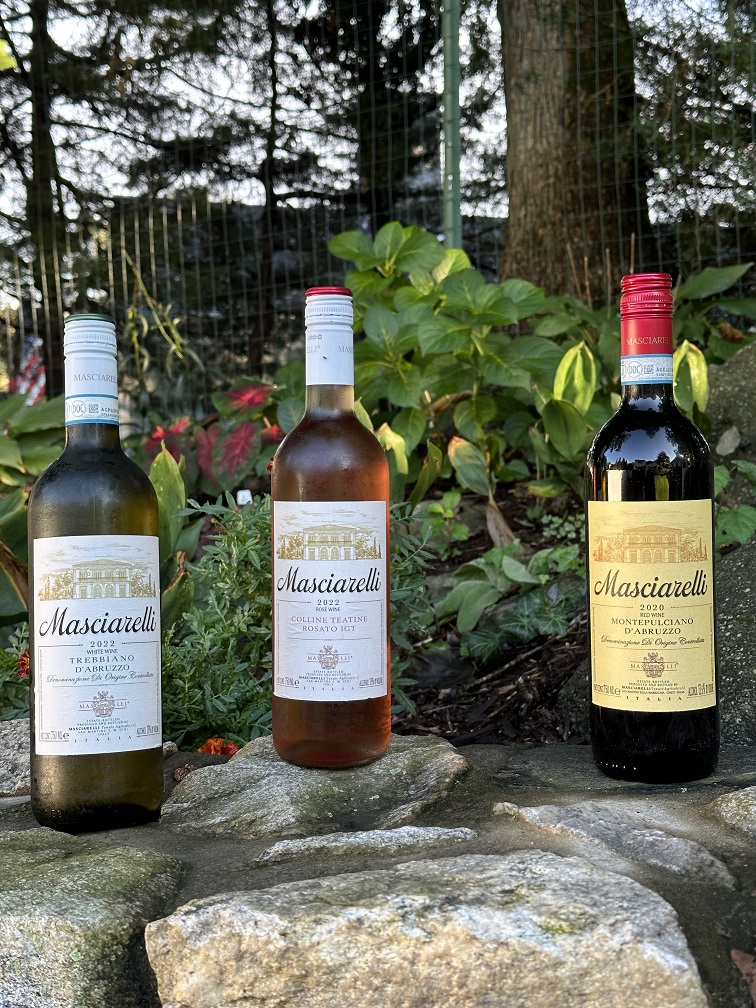 Here are my notes for the Linea Classica wines I had an opportunity to try:
2022 Masciarelli Trebbiano di Abruzzo DOC (13% ABV, $15)
Light golden
Tropical fruit, peach, minerality, medium intensity, inviting
Crisp, fresh, lemon notes, tart minerality, medium long refreshing finish, cleansing acidity, very nice
8-/8
2022 Masciarelli Colline Teatine Rosato IGT (13% ABV, $14)
Beautiful salmon pink
Fresh strawberries on the nose
Strawberries, brilliant fresh strawberries, cranberries, perfect acidity, good mouthfeel presence, crisp and clean finish. Excellent.
8
2020 Masciarelli Montepulciano di Abruzzo DOC (13.5% ABV, $15)
Dark garnet
Earthy, restrained, hint of cherries
Dark tart cherries, succulent, a touch of tobacco, dark, earthy, minerality, good acidity, good balance, medium to full body.
8, excellent
All three wines are unoaked and … yes… simple. At least in their presentation and pricing. But here is the interesting part. You can’t treat them as “simple wines”. Despite being unoaked, all three wines improved on the next day. And the next day. And even the next day. Truth be told, after I just opened and tried the Montepulciano, I was simply upset – the wine was not drinkable. For sure for my palate – green and tart. It became better the next day. And it really blossomed on the third day. In total, I enjoyed this screwtop-capped wine over the 6 days – pouring a glass, twisting the cap back, and leaving it on until the next day on the counter. And the wine kept getting better and better. This is a testament to the quality of this simple wine. And this simple wine can definitely age and it will become better with age. All for under $15.
Simplicity can be deceiving. Don’t take my word for it – try Masciarelli Linea Classica for yourself and let’s compare the notes. Cheers!
What Can You Do With One Grape? Ask Lugana Winemakers
What can you do with one grape? We are not talking about the quantity of the grape berries in your possession – we are talking about one variety. Especially if this is the white grape variety such as Turbiana (a.k.a Trebbiano di Lugano), for example?
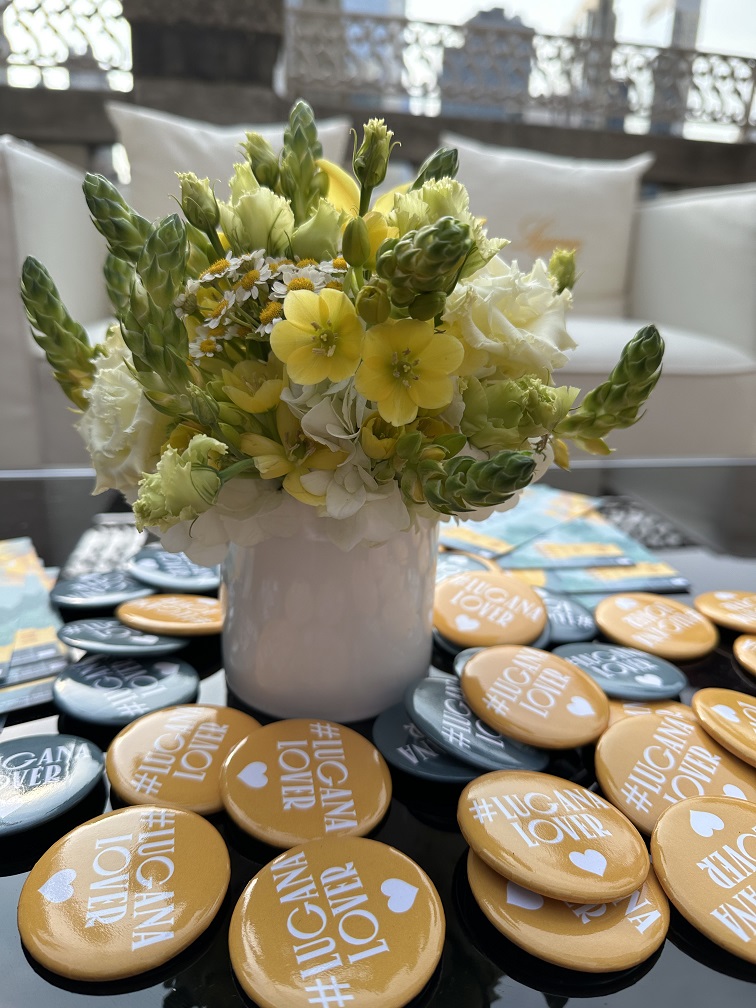
Before I’m publicly ostracized, let me be clear. I’m not trying to say that Lugana is the only region in the winemaking world with only one official grape – Brunello, Barolo, Barbaresco, Burgundy, Albariño (Rias Baixas) are all single grape variety greats. But comparing Lugana with Brunello, for example, wouldn’t be fair. I will explain.
Feel free to disagree, but I always say that delicious white wine is harder to make than red wine. In white wine, you have nowhere to hide – typically, no oak, no skin contact – the grape itself either delivers or not. Besides, Brunello and the others we mentioned above already built their reputation, and a single grape is all people want.
Even in the white wine world, Lugana is not the only “one grape” place – we already mentioned Rias Baixas with its Albariño, and then there is Sancerre, Condrieu, Vouvray, and many others. However, as I tasted the delicious range of Lugana wines last week at the Destination Lugana event, I couldn’t help but wonder about Lugana winemakers’ ingenuity. So what can you do with one grape?
Lugana DOC wines can be produced in 5 different styles. First, there is a regular Lugana DOC wine, which requires minimum aging of 4–5 months in the bottle. Next, there is Lugana Superiore DOC, which has to be aged at least 12 months. Lugana Riserva requires a minimum of 24 months of aging, 6 of which have to be in the bottle. Two more styles to complete the list: Vendemmia Tardiva (late harvest), which also required a minimum of 12 months of aging, the same as Superiore. And last but not least is Spumante, which can be produced using both Classic and Charmat methods.
At the Destination Lugana event, we were able to taste all the different styles with the exception of late harvest. As the event was taking place at the rooftop bar in downtown Manhattan, I didn’t even attempt to take any sort of reasonable notes. As one general note, I can only tell you that there was not a single Lugana wine I didn’t like. Fresh, clean wines with beautiful acidity – if I have to use a serious descriptor, I would have to call them “happy wines”.
Here is the list of the Lugana DOC wines I was able to taste (we have to add to this a bunch of Lugana sparkling wines I didn’t take the pictures of the labels from):
2022 Tenuta Roveglia Linne Lugana DOC
2022 Zeni 1870 Vigne Alte Lugana DOC
2022 Ottella Le Creete Lugana DOC
2022 Cà Maiol Prestige Lugana DOC
2022 Tommasi Le Fornaci Lugana DOC
2022 Vigneti Villabella Lugana DOC
2022 Cantina Valpantena Torre del Falasco Lugana DOC
2022 Cantina Cereasa Ceresa Lugana DOC
There was also food. Fresh sushi, made right there on the spot – perfectly complemented by Lugana wines. Few different types of fresh pasta – I can’t even tell you if I had a favorite, all were tasty. And pizza, a simple pizza. All worked quite well with the wines.
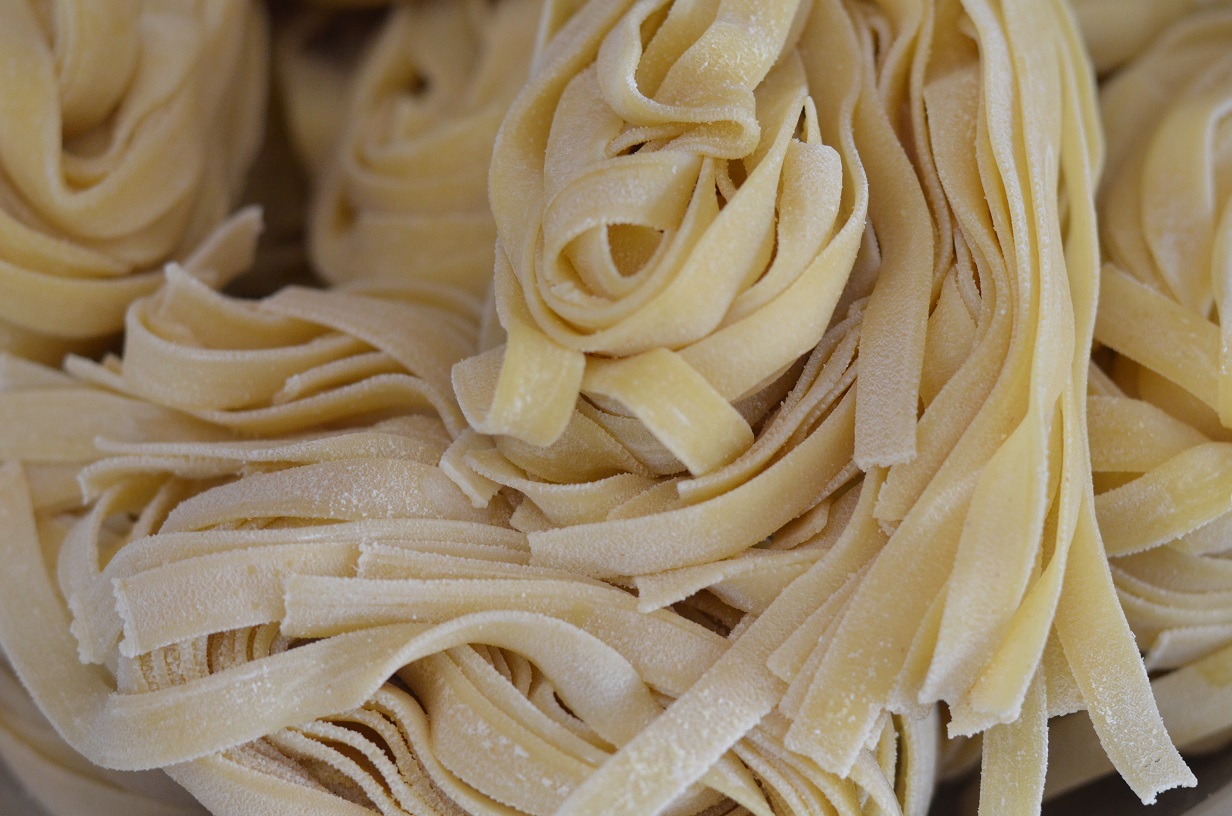


Let’s get back to wine. So what else can you do with one grape? For example, you can take multiple harvests. As an example, in Oregon, early-picked grapes are used for sparkling wines (higher acidity), and then the later harvest is used to produce regular still wines. In the case of Lugana wines, we had an opportunity to taste such two wines from Scolari. While both belong to the standard Lugana DOC category, the first one, 2022 Scolari Lugana DOC was harvested about a month earlier than the second one, 2022 Scolari Premium Lugana DOC. While the first had cut-through acidity as a main trait, the second wine was more round and unquestionably more complex. Add to this a bit of time with the skin contact, and you get beautiful light tannic tartness from the wine which never saw an inside of the oak barrel.


And then, of course, you can age your wines, to produce Superiore and Riserva styles. We had an opportunity to try wines from 2017, 2019, and 2021 vintages, and I would be hard-pressed to name a favorite out of these three – I would just suggest you should find them and try them for yourself (you will not regret!).
2017 Corte Sermana Riserva Lugana DOC
2019 Le Morette Riserva Lugana DOC
2021 Perla Del Garda Madonna Della Scoperta Lugana Superiore DOP


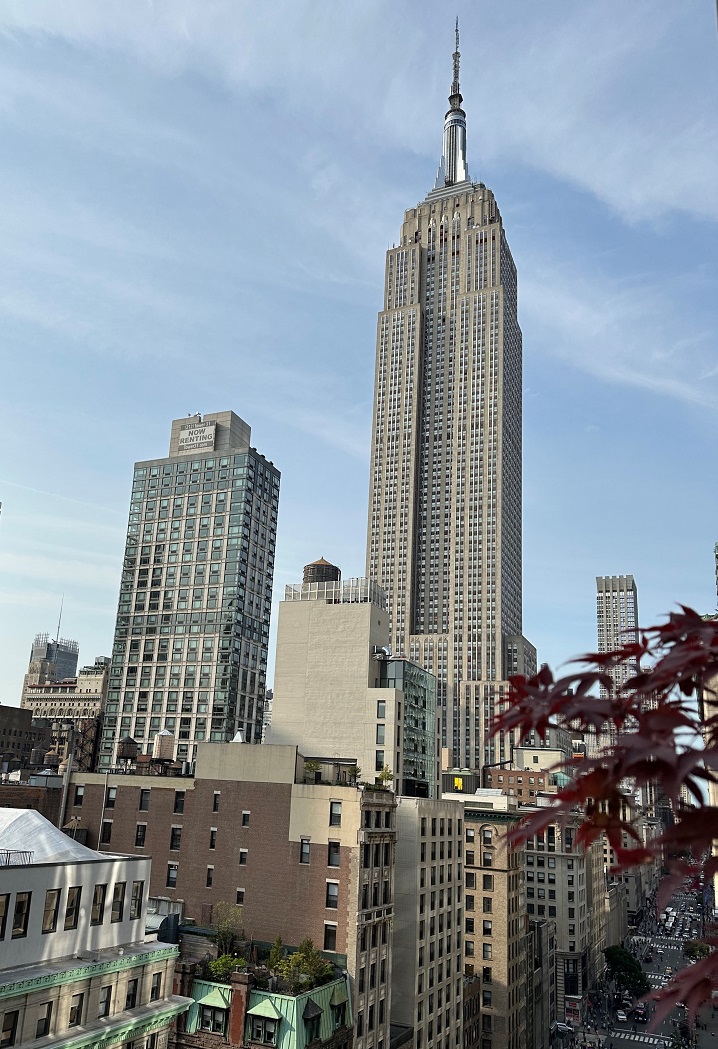
And, of course, the rooftop bar means views, and it means I have an opportunity to inundate you a bit with the city’s pictures.


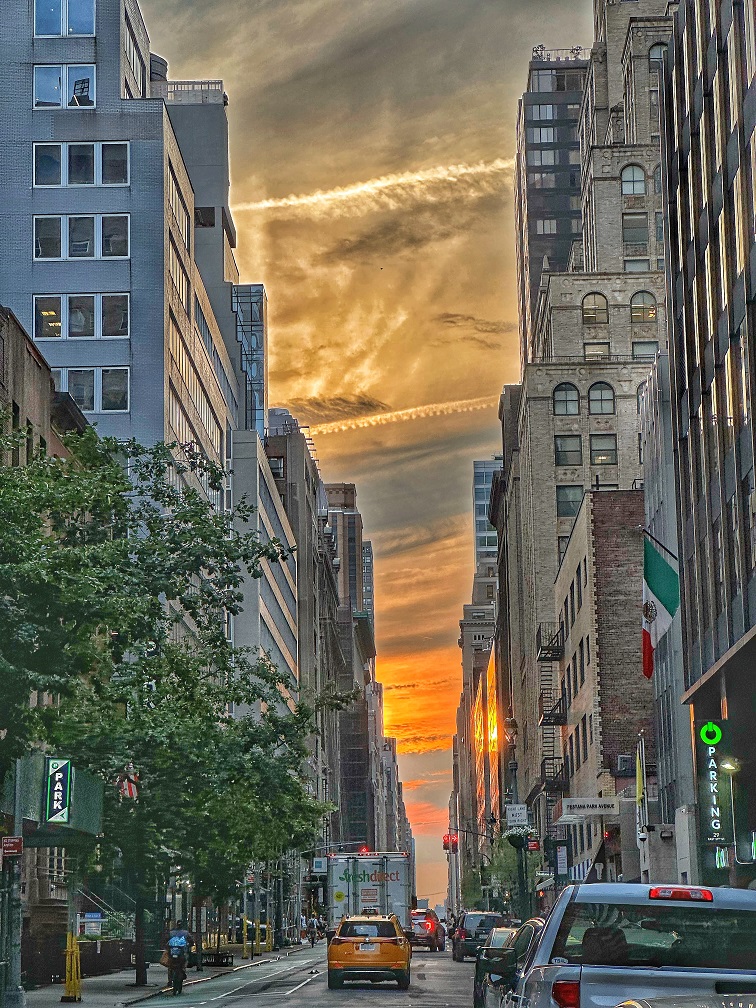

Here you are, my friends. Lugana wines are happy wines, I said it. Moreover, they are versatile, food-friendly, and will not make you break the bank to enjoy them. Do yourself a favor – visit your favorite wine store, grab a few bottles of Lugana wine, and then leave me a happy comment. Cheers!
Experience Lugana in New York
“Drink your Lugana young, very young and you will enjoy its freshness. Drink it after two or three years and you will enjoy its fullness. Drink it after ten years and you will be amazed by its dignified authoritativeness. Lugana wines, a rarity of their kind, have an extraordinary ability to make themselves known. If you taste a Lugana, and you are a competent taster, you cannot forget it”
– Luigi Veronelli
Imagine yourself sitting by the lake, a beautiful lake.
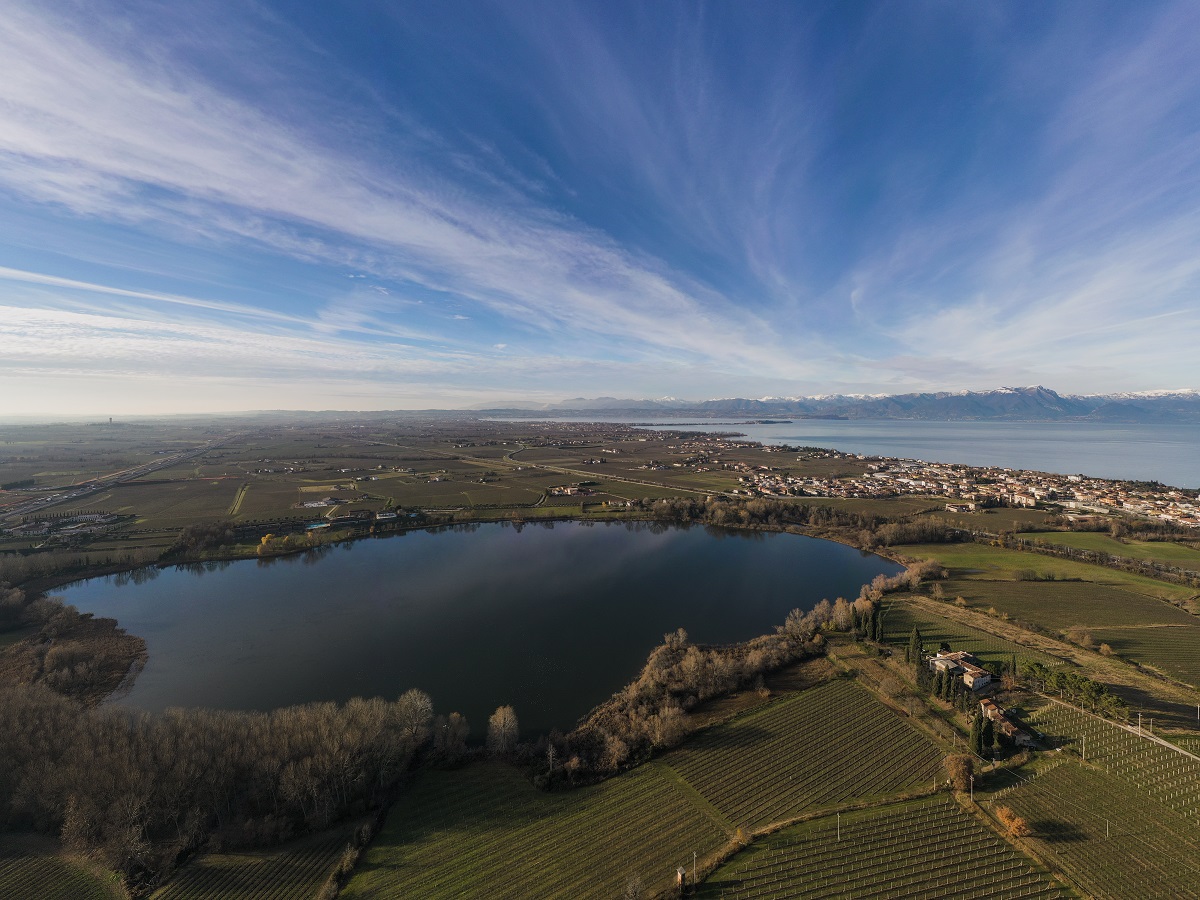
Source: Consorzio Tutela Lugana DOC
Let’s make it more precise, to make the picture vivid.
Imagine yourself sitting by Lake Garda in Northern Italy, on a beautiful summer day. The water is tranquil, there are tiny waves and an endless horizon. Next to you, there is a little table with a glass of white wine. You take the glass, take a sip of the wine. The wine is delicious, it is locally made, it is called Lugana, and you take another sip of the liquid pleasure. You capture the moment of this pure, hedonistic pleasure in your memory, Next, you put the glass down and go back to your happy thoughts. In that moment, life is absolutely perfect.
What if I will tell you that you don’t have to travel to Italy right this moment to experience this life’s perfection? What if this experience can come to you?
If you live in New York or the New York area or plan to visit the city over the next few weeks, you are in luck. Instead of you going to Lugana, Lugana is coming to you. The Lugana wine experience is coming to New York. And this Lugana experience will move past just the Lugana wine itself – it will bring you the ultimate gourmet’s salvation – wine and food paired together.
Starting on Monday, June 12th, 19 producers from Lugana will have their wines paired at a series of dinners taking place at 6 New York restaurants (I will give you a full list of restaurants and producers in a minute). All the wines will be specifically paired with the dishes – and as someone who never visited Lugana, I was really curious about what one can expect to find on such special dinner menus. I reached out to Consorzio Tutela Lugana DOC which is organizing this event, and asked a simple question (or two): What is the traditional Lugana food? What are the traditional pairings for the Lugana dishes and wines? Here is the reply that I received:
“Like all Italian wines with century-long traditions linking them to their place of origin, Lugana is lovingly paired with the classic gastronomic repertoire of the region. This of course includes dishes of freshwater fish: from the lake, river or stream, whether noble or poor. But even better-known sea fish can be happily matched with this refined and versatile white. Therefore the “base” version can be readily paired with seafood antipasti, fried pessìn (small fish or whitebait from the paddy fields), boiled bass, boiled shrimps and large carp. The Superiore and the Riserva are literally the perfect partner for richer and more complex dishes, such as pike in sauce (boiled pike with anchovies lightly sautéed in oil, from Lake Garda of course), grilled eel, trout with grape, risotto with frogs, as well as grilled crustaceans, peppered clams, salted bass, and several white meat dishes, such as chicken, capon and rabbit (especially roasted in the oven). The Vendemmia Tardiva (late harvest) wines are ideally matched with cheeses, from the fresher varieties such as ricotta, robiola and crescenza, to the more seasoned and flavoursome such as several exquisite D.O.P. cheeses like Monte Veronese, Grana Padano and Provolone Valpadana. Spumante has a broad range of possible pairings, since this “bubbly” wine can be served right throughout the meal. However, since a spumante is usually uncorked at the beginning of a lunch or dinner, why not try it with all types of antipasto, ranging from the broad range of tasty local cold meats to the wide variety of egg-based dishes. Instead avoid serving it with dessert. The versatility of this wine does not stop here. International tastes are certainly no obstacle for Lugana. This white wine, either in its “base” version, Spumante, Superiore or Riserva, is in fact the perfect match for raw fish, from the Japanese sashimi and sushi to all the variations on the theme proposed at the international level. It is also ideal with salmon and tuna and the perfect match for seafood finger food. Ideal serving temperature (in broad bowl tulip-shaped wine glasses for all varieties): Lugana Spumante at 8°C; Lugana “base” at 12°C; Lugana Superiore and Riserva at 14°C; Lugana Vendemmia Tardiva at 12°C.”

Lugana wines are produced from the local indigenous variety called Turbiana. Lugana wines can be still, sparkling, and late harvest (sweet), but no matter what the style is, they are literally guaranteed to be delicious. I had an opportunity to do a little preview of what someone might anticipate experiencing during the tasting – here are my notes on 3 wines that will be presented during the tasting:
2022 Corte Sermana Cromalgo Lugana DOC (13% ABV)
Straw pale
Beautiful intensity of tropical fruit, lemon and honey
Lemon and lemon zest, a hint of white peach and underripe white plum, tart, perfectly structured, with medium-long, tart finish
8, delicious.
2022 Ottella Lugana DOC (12.5% ABV)
Straw pale
Tropical fruit, guava, lemon, honey, herbaceous undertones
Crisp, fresh, tight, Meyer lemon, clean acidity, a tiny hint of gunflint.
8, imbues seafood craving
2022 Perla del Garda Lugana DOP (12.5% ABV)
Straw pale
Tropical fruit, honey, fresh, inviting, enticing, seductive. It says “drink me”
Beautiful. Fresh Whitestone fruit, cut through acidity, lemon. Crisp, fresh, delicious. A happy wine that can transpose you.
8+, superb. Had a few friends try this wine too, and they were literally blown away by it.
As promised, here is the list of participating restaurants, dinner dates, and the wines which will be poured at each:
IL FIORISTA (Monday, June 12, 2023)
Le Morette, Mandorlara 2022
Cantine Di Verona, Torre di Falasco 2022
Tommasi, Le Fornaci
VICEVERSA (Tuesday, June 13, 2023)
Ca’ Maiol, Lugana Prestige 2022
Scolari, Lugana Doc Premium 2022
Zenato, Riserva 2020
GNOCCO (Monday, June 19, 2023)
Sguardi di Terra, Riserva 2018 Fachetnabia
Selva Capuzza, Selva 2021
Ceresa, Ceresa 2022
Montonale, Montunal 2022
HEARTH (Monday, June 19, 2023)
Zeni 1870, Vigne Alte 2022
Tenuta Roveglia, Vigne Catullo Riserva 2019
Famiglia Olivini, Lugana 2022
MISIRIZZI (Wednesday, June 21, 2023)
Pasini, Il Lugana 2022
Perla del Garda, Madonna della Scoperta 2021
Citari, Conchiglia 2022
OSTERIA CARLINA TRIBECA (Thursday, June 22, 2023)
Corte Sermana, Riserva 2017
Vigneti Villabella, Lugana 2022
Ottella, Lugana 2022
You can find additional details of the Lugana festivities in New York on the Destination Lugana website.
This is not every day that instead of you going to your travel destination to experience delicious life’s offerings, the travel destination comes to you. This is your chance for a memorable experience and I hope you will not miss it.
And I will be sure to tell you more… Who knows, maybe we will run into each other during one of the dinners. Cheers!
Study in Sustainability: Lugana DOC
If you like wine and read about it from time to time, I’m sure you can easily identify all the buzzwords – organic, biodynamic, sustainable, clean, natural, and there are probably a few more I’m missing. Some of these terms are well defined and well understood, such as organic (even though the meaning of “organic wine” differs in Europe and the USA). Some of those terms are unquestionably controversial, such as “natural”, and don’t even think about discussing “clean” wines. And while I like the “organic” concept, and “biodynamic” sounds whimsical, I believe sustainability is the most important word here.
If we will check the Oxford Languages definition, sustainability is defined as “the ability to be maintained at a certain rate or level”. The second definition is a bit closer to our subject of farming (growing grapes is just one of the farming applications, of course) – “avoidance of the depletion of natural resources in order to maintain an ecological balance” – I’m stressing the word “balance” here, Balance is the name of the game. We get what we want (grapes and wine) without destroying the source, so those who will come after us will have enough left for them, and once they are gone, there will be enough left for yet the others. Primitive drawing skills I have, no doubt, but I’m sure you got the picture I’m trying to paint.
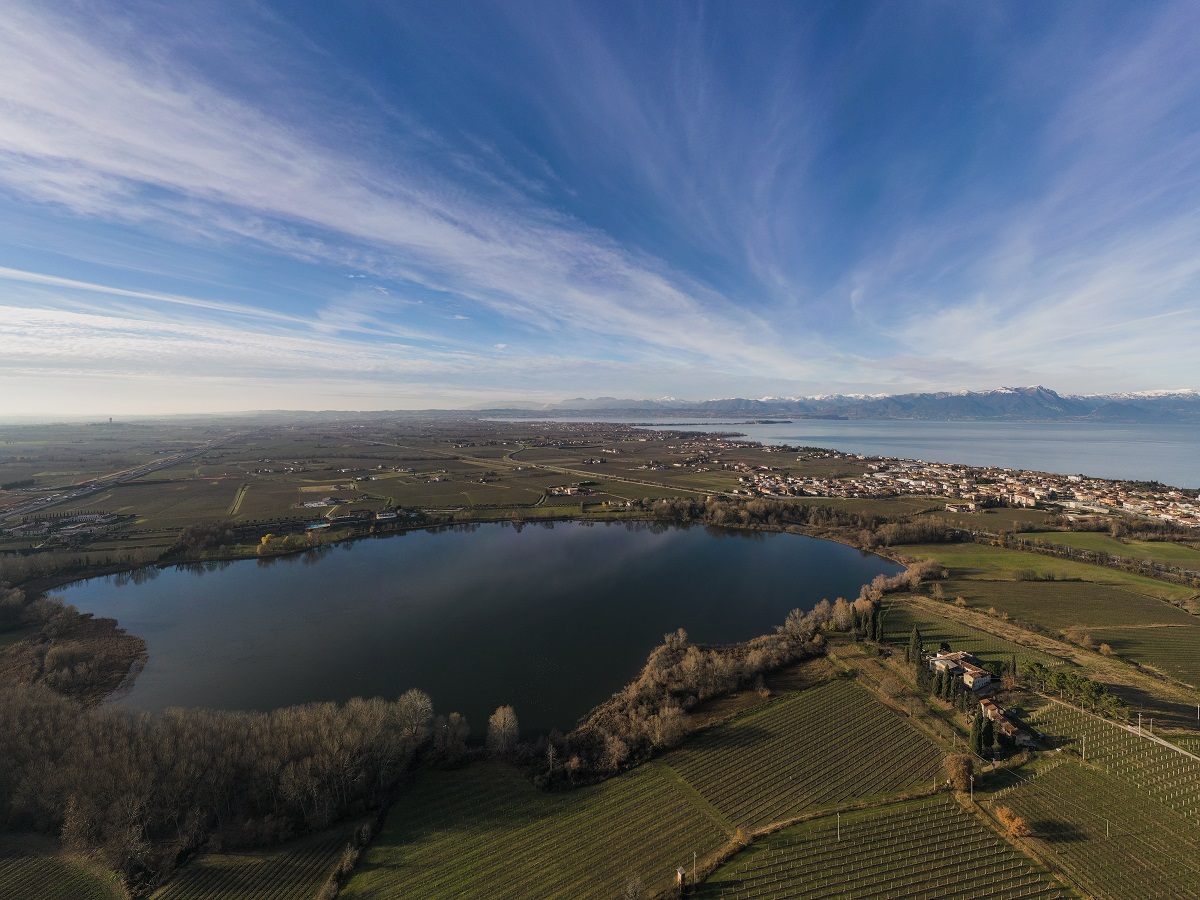
Source: Consorzio Tutela Lugana D.O.C

Source: Consorzio Tutela Lugana D.O.C
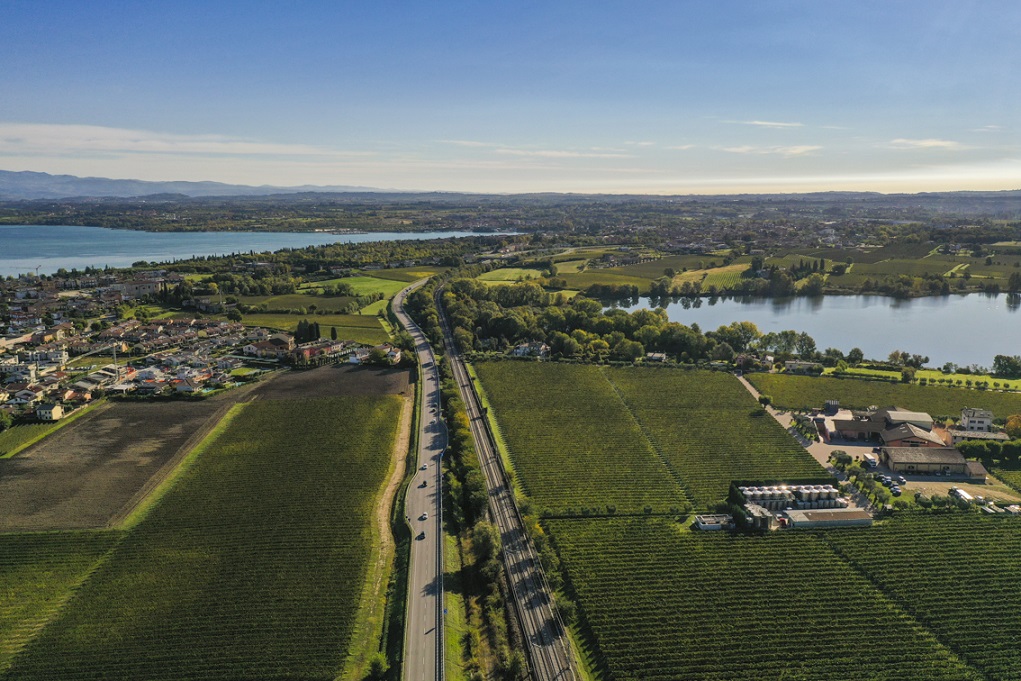
Lugana is one of the oldest designated wine-growing areas in Italy, after obtaining its DOC status in 1967, the first in Lombardy, with about 1,000 acres under the vines. Lugana is also one of the few unique DOCs in Italy, spanning two regions and two provinces – the province of Brescia in Lombardy and the province of Verona in Veneto. Most of Lugana’s 5,500 acres of vineyards are adjacent to Lake Garda, which creates a unique, mild microclimate, atypical for Northern Italy. Most of the wine produced in Lugana is white, made out of a local indigenous grape called Turbiana. For a long time, Turbiana was erroneously considered to be Trebbiano di Lugana, until DNA analyses had shown that Turbiana is its own, unique variety.
As in most of Italy, the history of winemaking in Lugana goes back to Roman times, with the wines from the area praised on multiple occasions throughout the times. Lugana managed to stay a best-kept secret for a long time in the 20th century, with its wines being best known to the tourists flocking to the picturesque villages surrounding the lake. Slowly, the quality of the wines prevailed and the wines became thought after around the world, in part due to their excellent aging ability. In 2018, there were 17.5 million bottles produced in Lugana, 70% of which were exported around the world, with the US being Lugana’s 4th largest market.

Source: Consorzio Tutela Lugana D.O.C
Sustainability is definitely a trend among the wineries in Lugana. The winemakers want to preserve their land, their farms, and their vineyards for many generations to come and do everything in their power to make this happen. I wanted to give you a first-hand account of sustainability and virtually sat down with the kind folks at 6 wineries, who answered the same group of questions. Grab a glass of wine (or two), and hear it for yourself.
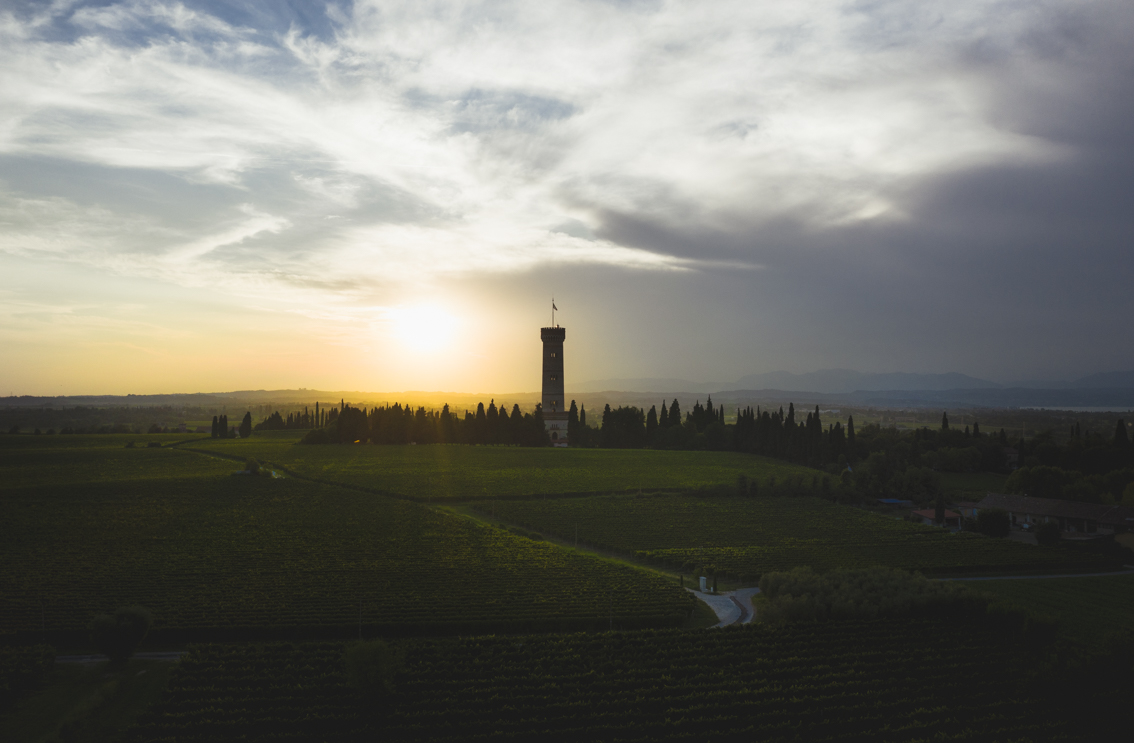
Source: CITARI
Source: CITARI
CITARI:
CITARI winery was founded in 1975, and today is farming about 90 acres of vineyards, producing about 300,000 bottles of wine annually. CITARI takes advantage of the close proximity of the winery to the vineyards, ensuring that the grapes are processed in the shortest time after the harvest, preserving aromatics and minimizing oxidative processes. CITARI had been recognized as a “Low Environmental Impact Farm” and won the “Verallia Ecofriendly Company” award over a number of years.
Here is our conversation:
– Why sustainability is important to you?
Wine producers, as farmers, are the guardians and keepers of a territory. Sustainability is necessary.
It also helps to obtain a superior quality product, and to maintain this high quality over time.
– How do you define sustainability for your winery, vineyards, and business?
Sustainability helps us to preserve the soil, the area, the quality.
– When did you start the conversion to sustainable viticulture and operations?
About 6 years ago
– How long did it take to achieve your goals?
We are still working on improving the best practices
– Was it worth it?
Of course!
– Would you do it again?
Yes, but better planning first all the costs, even in terms of time spent and bureaucracy.
– When did you achieve sustainability? Do you see a difference in the wines before you used sustainable viticulture and after?
The sustainable agricultural method we use (reductions of treatments and products used, regular controls on soil and plants) respects the soil, the plants and give us a healthier product. We do not have direct feedback from customers about it, but customers are increasing and they like our wines very much!
– What is next – organic, biodynamic, or are you happy with where you are right now?
We are thinking about adding green manure to preserve bees and other “good” insects.
– What advice would you offer to those who are starting a sustainability journey right now?
It is not easy, but it is necessary, be prepared!

Source: Consorzio Tutela Lugana D.O.C
Le Morette:
Azienda Agricola Valerio Zenato Le Morette was founded in 1955, and today farms about 75 acres of vineyards. Sustainability is at the core of operations at Le Morette, and here is how the winery describes this work: “In the vineyard, Le Morette Agricultural Company has chosen precise working methods aimed at a sustainable agriculture, favoring those natural processes that allow to preserve the “environmental resource”, with great attention to the use of water, favoring blooms and proliferation of numerous species of insects useful for the vineyard ecosystem, maintaining the biodiversity of flora and fauna.”
Here is what transpired in our conversation:
– Why sustainability is important to you?
To respect the environment is the key factor for us and means to deeply know every single aspect of it: sustainability, habitat and knowledge represents the focus to carry on a conscious development in the vineyard and in the winery. For us to produce “healthier wine” is a choice, not a constriction.
– How do you define sustainability for your winery, vineyards, and business?
To be Sustainable we follow the “Three E” rules:
1. ECONOMICS: Sustainable means to salvaguard the Companies’ income via the use of techniques with a low environmental impact and measures to avoid wasting water and other natural resources. Costs have to be affordable to be sustainable on a long term basis. Only when the winemaker is earning properly, he’s able to think and develop a proper Environmental and Social Sustainability.
2. ENVIRONMENT: Sustainable winegrowing conserves natural resources, improves air and water quality, and protects ecosystems and wildlife habitat. Sustainability is good for grapes and wine, as well: winegrowing requires in-depth attention to detail and continuous improvement resulting in high quality wine grapes and wine.
3. EQUITY (SOCIAL): Sustainable winegrowing promotes stewardship of natural and human resources, as per eg. supporting internships and education programs for young employees or carrying on healthcare classes and social charity events, contributing to our community culturally and socially.
– When did you start the conversion to sustainable viticulture and operations? How long did it take to achieve your goals?
We’ve always been following sustainable principles since 1960, when our business started with the first few hectares along the Frassino Lake bank in San Benedetto di Lugana, a natural protected site recognized by the European Community. We began as vinenursers and still we are after three generations. Our roots and knowledge of the indigenous variety Turbiana design our path.
– Was it worth it? Would you do it again?
Sure, when you have an inner green soul you have to stay stuck with it. It’s a heritage we’ve received from our grandfather Gino Zenato and is part of our identity. It’s inevitable to be in tune with Nature for us and we are proud to respect our environment every day with a set of concrete approaches and practices to preserve and improve this legacy.
– When did you achieve sustainability? Do you see a difference in the wines before you used sustainable viticulture and after? Do you think your regular customers can also tell the difference?
We received the official Biodiversity Certificate in 2020 from the WBA (World Biodiversity Association) but we’ve always applied sustainable principles since the beginning. We don’t have any difference, then: it belongs to our philosophy.
– What is next – organic, biodynamic, or are you happy with where you are right now?
Our next step is to improve and protect biodiversity in our ecosystem. We already do it but we want to do more, with the belief that a Biodiversity is the key choice for a healthier process whole based on sustainable principles.
– What advice would you offer to those who are starting a sustainability journey right now?
To set up some virtuous practices, essential to advocate biodiversity in the vineyard. Biodiversity is the first pillar for sustainability and whoever wants to start this journey, has to be conscious that being sustainable is not only an ideal choice, but a set of concrete actions that you have to put into practice on a daily basis.

Source: Consorzio Tutela Lugana D.O.C
Famiglia Olivini
Famiglia Olivini was founded in 1970, and today is farming 80 acres of vineyards. With the utmost focus on sustainability, Famiglia Olivini registered a brand called Agricoultura Regionata. In the words of the winery, “Agricoltura Ragionata identifies our working method during the entire vinification process: starting from the seed, soil, vine ending with bottled product. Our main goal is to act in a reasonable (ragionata) and thoughtful way, starting from the work we do in our fields, into the winery and then reflected with how our staff treats the product. We take all these actions in order to insure we avoid any invasive and harmful practices to agriculture (agricoltura).”
Here is what transpired in our conversation:
– Why sustainability is important to you?
Sustainability for us is not just a philosophy, a way of thinking and talk about our daily taking care of the land but is truly a way of working passed down for generations by our founder it is an approach that preserves the territory, the lands, and ultimately shows in all of our products
– How do you define sustainability for your winery, vineyards, and business?
Being sustainable is our working method starting from the seed, soil, vine ending with the bottled product and in every process of the business. The essence of sustainability for us on each of this aspect is ‘keep everything in balance’.
– When did you start the conversion to sustainable viticulture and operations? How long did it take to achieve your goals?
We have conceived our sustainable viticulture in our own registered brand which is Agricoltura Ragionata (Reasonable Agriculture). Before that, our vineyard were already sustainable certified. It did not take much because since ever our ‘best practices’ were naturally considered sustainable.
– Was it worth it? Would you do it again?
Even after the certification, we did not ‘spent’ any logo on the label. Talking about sustainability and Agricoltura Ragionata brand is part of our storytelling. But we have noticed that more and more people are interested to this and like to know that the wines they are drinking are coming from a sustainable viticulture
– When did you achieve sustainability? Do you see a difference in the wines before you used sustainable viticulture and after? Do you think your regular customers can also tell the difference?
Once again, for us the sustainable certification was not a ‘conversion’ but just a certification of our everyday practice in the field. So, we did not see any impact in the quality of the wine. We think people likes to know and be informed about sustainability but not really interested in looking for a difference in the products.
– What is next – organic, biodynamic, or are you happy with where you are right now?
For us it will be nice to make Agricoltura Ragionata a shared brand about sustainability, involving other producers in the use of this brand and practices
– What advice would you offer to those who are starting a sustainability journey right now?
Find your real way before finding a protocol. Sustainability can’t be just a set of rules, must be your way of thinking your land, winery, wines.

Source: Consorzio Tutela Lugana D.O.C
Marangona
Maragonia was founded in 1970, and today farming about 75 acres of land. Some of the vines are 50 years old. Today Marangona is an Organic Farm and uses cement tanks and amphorae in production.
Here is what transpired during our conversation:
– Why sustainability is important to you?
None of us have zero impact on the environment. We all have to do our best to minimize that impact. A careful farm has a big difference compared to a not careful one.
– How do you define sustainability for your winery, vineyards, and business?
Commit day by day to try to make the best decisions to make environment and profit coexist
– When did you start the conversion to sustainable viticulture and operations? How long did it take to achieve your goals?
My sister and I are the new management of the family business, since 2007. Initially in low environmental impact, since 2012 in organic conversion, since 2017 fully certified, both vineyards and cellar.
– Was it worth it? Would you do it again?
Of course,
– When did you achieve sustainability? Do you see a difference in the wines before you used sustainable viticulture and after? Do you think your regular customers can also tell the difference?
Unfortunately, I don’t believe that true sustainability can be achieved.
I believe more about limiting the impact to the minimum possible.
For me the difference is a lot.
For some customers too, for others nothing changes.
So there are no contraindications
– What is next – organic, biodynamic, or are you happy with where you are right now?
At the moment we are certified organic and from a bureaucratic point of view it suits us well, We don’t think we want to increase the amount of paper and documents.
I find the next step of the Biodynamics to be a very remote possibility in our production area. Not all areas and varieties are predisposed to such a strict philosophy.
So for now the goal is to continue learning new things about our vineyards to reduce the environmental impact to a minimum while keeping the qualitative objective we want to have very clear.
– What advice would you offer to those who are starting a sustainability journey right now?
Advice none.
Comparisons on how to deal with different problems certainly as often as possible.

Source: Consorzio Tutela Lugana D.O.C
Montonale
Motonale is the oldest winery we are discussing today, founded in 1911. The winery went through a turbulent history, starting from cleaning 3+ acres of land only with a shovel. In the 60s, the winery expanded to more than 150 acres, only to shrink to harvesting 10 rows in 1998. Two years later, a great-uncle got involved and that became a second birth for the winery. which is now solely focused on sustainability, using manual harvest and local indigenous yeast among many other things.
Here is our conversation:
– Why sustainability is important to you?
Sustainability is important to us because our wines are Mother Earth’s products. We owe her respect, because we do not have to think only about us, but also about the future generations.
– How do you define sustainability for your winery, vineyards, and business?
At Montonale, sustainability is understood as an all-round attitude, all aspects of the production chain are involved. I bring a very topical practical example, considering the critical issues we are experiencing in Europe in terms of energy: the roof of our cellar is entirely covered with photovoltaic panels and to make the most of them we concentrate consumption during the day. A winning choice, because once again this year we will close the winery’s energy consumption balance.
– When did you start the conversion to sustainable viticulture and operations? How long did it take to achieve your goals?
The conversion began 10 years ago with the fourth generation. Our main goal for the next 10 years is to reach a zero-carbon footprint.
– Was it worth it? Would you do it again?
It was obviously worth it and we would do it again. We must preserve our heritage which is connected to the Earth, to the weather and to the environment.
– When did you achieve sustainability? Do you see a difference in the wines before you used sustainable viticulture and after? Do you think your regular customers can also tell the difference?
We have seen and also perceived the difference in tasting our wines, since the process of their production was respectful to the environment where they were born.
– What is next – organic, biodynamic, or are you happy with where you are right now?
As previously mentioned, our main goal is to reach zero CO2 emissions.
– What advice would you offer to those who are starting a sustainability journey right now?
Do it before it is too late, there is no planet B.
Sguardi di Terra
Societa Agricola Sguardi di Terra is the youngest and smallest in our group, founded in 2015 and having around 17 acres under vine. From the moment the winery was formed, the focus was on sustainability and organic viticulture.
In lieu of Q&A, Sguardi di Terra offered the following sustainability information:
Our winery is organically certificated since we bought the vineyards in 2016. This also means that every year deducted audit bodies check that we respect the rules for organic viticulture and every year renew our certificate.
Our company does not have a cellar, we cooperate with Giovanni Pasini winery which is organic too and reflects our values. So we bring them our grapes and then we follow each step of vinification in their cellar.
The decision to buy organic vineyards wasn’t accidental. We truly believe in respect for the environment, by limiting the exploitation of natural resources and contributing to the preservation of biodiversity. Moreover, drinking organic wines is a way to prevent the accumulation of harmful residues in the body. Drinking organic wines = respecting nature + your body.
The advice that we would offer to those who are starting a sustainability journey right now is:
Believe in an ethical approach at every stage of the wine production chain. This is something you must feel inside, not because of the trend. Organic farming is not regarding only the present. It’s about the future too. We should choose organic farming to leave better soil for posterity than we have found.

Are you still here? This is definitely the longest post ever at Talk-a-Vino, and we didn’t even get yet to the wines.
I had an opportunity to try the wines from these 6 wineries (provided as samples), so here are my notes:
2021 Marangona Lugana DOC (12.5% ABV, organic grapes)
Brilliant straw pale
Beautiful, inviting, a touch of lemon, very fresh
Clean, crips, mellow and round. Mayer lemon, perfect acidity, delicious.
8, outstanding
2021 Famiglia Olivini Lugana DOC (13% ABV)
Straw pale, almost clear
A touch of honey, tropical fruit, lemon undertones
Clean, crisp, a hint of honey presence without the sweetness, round, delicious
8-
2021 Citari Conchiglia Lugana DOC (12.5% ABV)
Light straw pale, practically clear
Herbaceous nose, restrained
A hint of tropical fruit, good acidity, clean, refreshing, short to medium finish
8-
2021 Valerio Zenato Le Morette Mandolara Lugana DOC (12.5% ABV)
Straw pale
Hint of Whitestone fruit, very restrained
Peach, herbal undertones, round, plump. Short finish.
8-
2021 Sguardi di Terra Scapüscia Lugana DOC (13% ABV)
Very light golden
Complex nose, honey, spices, open and inviting
A touch of honey, herbs, freshly cut grass.
8-
2021 Montonale Montunal Lugana DOC (13.5% ABV)
Straw pale
Complex, Whitestone fruit, precise
white stone fruit, a touch of honey, good acidity, round, fresh, plump
8, excellent
Here you are, my friends – the story of sustainable viticulture in Lugana.
Hey, and there is more!
Starting on November 7th, Destination Lugana will be celebrated in New York City:
Destination Lugana is a full week of celebration of Lugana DOC wines, during which 28 producers will offer their latest vintages to 13 restaurants in Manhattan. Each location will create a special menu to enhance the qualities and main characteristics of these wines. The project is made possible by the Consorzio Tutela Lugana D.O.C, which has been monitoring, defending, and promoting Lugana D.O.C. wines since 1990.
You will find more information at the official website: https://www.destinationlugana.com/, Here you will also find the list of 13 restaurants in Manhattan that will create special menus.
And we are done. Now it is your chance to discover the beautiful wines of Lugana. Cheers!
Last Bottle Sign Up ($10 credit)




 Talk-A-Vino