Archive
Celebrate Chardonnay! 2025 Edition
 Okay, I missed it again.
On Thursday, May 22, we celebrated Chardonnay Day. And I didn’t post about it.
Well, I didn’t entirely miss it. There was Charodnnay in my glass, so I only missed writing about it on time, but the celebration itself – yes, I participated.
Chardonnay is one of my favorite grapes. Well, those who know me understand that this is a difficult thing for me to say. I love wine in general, and therefore, I really don’t have grapes I don’t like. I might not be a fan of some producers, but grapes or varietal wines per se—I love them all. And yet, when it comes to favorite grapes, I have to shortlist Chardonnay among 20-30 ones I feel comfortable calling “favorites”.
Chardonnay is one of the most versatile grapes, perfectly capable of creating delicious wines from the bone-dry, unoaked versions to the full-on, hedonistic bombs. Chardonnay wines can be wonderful in still, sparkling, and even late harvest renditions, and they are produced literally everywhere – Asia, Middle East, Europe, North America, South America – see, I’m not even trying to be any more region specific, as it is pointless, or I would almost have to name every appellation in existence.
I also have another proof of the “favorite” status. In last year’s Chardonnay’s celebratory post, I counted the number of times Chardonnay wines were included in the Talk-a-Vino Top Wines of the year lists. During 14 years, there were only two years when Chardonnay wines were not present in the top two dozens, and a total of 19 Chardonnay wines were included in those top lists. Then, last year, 2024, the top wines list had 3 Chardonnay wines in it, including the 2024 wine of the year – an Italian Chardonnay from Banfi.
The pleasure of the well-made Chardonnay starts from the very first whiff from the glass. Vanilla, fresh apples, a touch of butter, and, if you are lucky, the honey. This is what makes me say “ahh” in the first place. And then, when vanilla, apples, butter, honey, smothered with a touch of lemon, continue in the first sip, this is where you say “oh my god…”. The key to this Chardonnay pleasure is in full harmony and balance of the flavors – if any of the components sticks out or is absent, this is where the pleasure instantly stops. Of course, the balance is a key element of any wine, but some of the wines can get away with too much acidity or too much oak and still give you pleasure, including a generic Chardonnay. But the harmony and balance are what differentiate a great Chardonnay from an average one.
I also love to use great Chardonnay as a reference point. For example, I compared my 2022 wine of the year, 2020 Abadia Retuerta L’Domaine from Ribera Del Duero, a Sauvignon Blanc-based blend, with Chablis. Chardonnay was also my analogy for the 2024 wine of the year, 2020 Mariasy Tokaji Furmint from Hungary, made from Furmint. And a few weeks ago, I had Grande Rocim White from Alentejo in Portugal (I have yet to write about it), made from 100% Portuguese native Arinto grape, which would successfully compete with Puligny-Montrachet I never had.


The wine I opened to celebrate Chardonnay Day was 2022 Maison Matisco Les Buis Saint-Véran AOC (13% ABV), one of my recent WTSO finds. The wine had a beautiful light golden color, and had a perfect Chardonnay profile as I described above – apples, vanilla, a distant hint of honey and butter (the last two might be just my imagination). The same profile continued on the palate, with the addition of the lemon. The wine initially had a slightly bitter aftertaste, which dissipated after a few hours. This wine will not make a list of great Chardonnays here at Talk-a-Vino, but I will be happy to open it any time I crave a Chard.
There, I told you my story. How did you celebrate Chardonnay Day?
American Pleasures #10: Meyye Wines
Wine should give you pleasure – there is no point in drinking wine if it does not. Lately, I have had a number of samples of American wines that were delicious standouts – one after another, making me even wonder if someone cursed my palate. I enjoyed all those wines so much that I decided to designate a new series to them – the American Pleasures.
And we are back to talk about more delicious American wines.
Rob Campbell got into winemaking in 1992 when he started helping his future father-in-law Bruce Tichenor at Story Winery in Plymouth, California. 20 years and three other careers later, Rob decided that it was the time to go into the winemaking all the way, taking over the wine-making at the Story Winery. While producing award-winning wines at the Story Winery, Rob realized that he could also produce ultra-premium wines, capitalizing on the success of his 2014 Zinfandel. When the family decided to sell Story Winery in 2019, Rob finally got an opportunity to start making the wines he had always dreamt of, and he founded Meyye Wines.

With Meyye Wines, Rob wanted to honor his Native American heritage. Rob Campbell is a member of the Federated Indians of Graton Rancheria (Coastal Miwok/Southern Pomo), the tribe is based in Rohnert Park, California, which lies within Sonoma County. Meyye (pronounced may-yea) means ‘bird’ in the Coastal Miwok language, and the first 4 wines that Rob started producing are all called after the birds native to the different regions where Rob was sourcing the fruit from, using native Miwok names for the birds. You can also appreciate the beauty of these wine labels which started as photographs taken by acclaimed wildlife photographer Steve Zamek, expertly rendered to create a three-dimensional representation of an image of each bird.
As Rob explains:
“Native Americans have been making wine in California for over 250 years. I descend from multiple Mission Indians who worked vineyards or made wine in three different California missions in the 19th century (Mission San Jose, Sonoma, and San Rafael). I’m intentionally using the Coast Miwok language since the language was considered ‘officially dead’ in the past, but my people are making a concerted effort to restore it. In addition to being ultra-premium wines that taste great, it’s my small way of preserving our language by sharing it with native and non-native people alike. “
I had an opportunity to taste 4 of Rob’s wines, and they were literally one better than the other. I’m also sure you would be able to recognize the names of the vineyards and appreciate the pedigree of these wines.
Here are my notes:
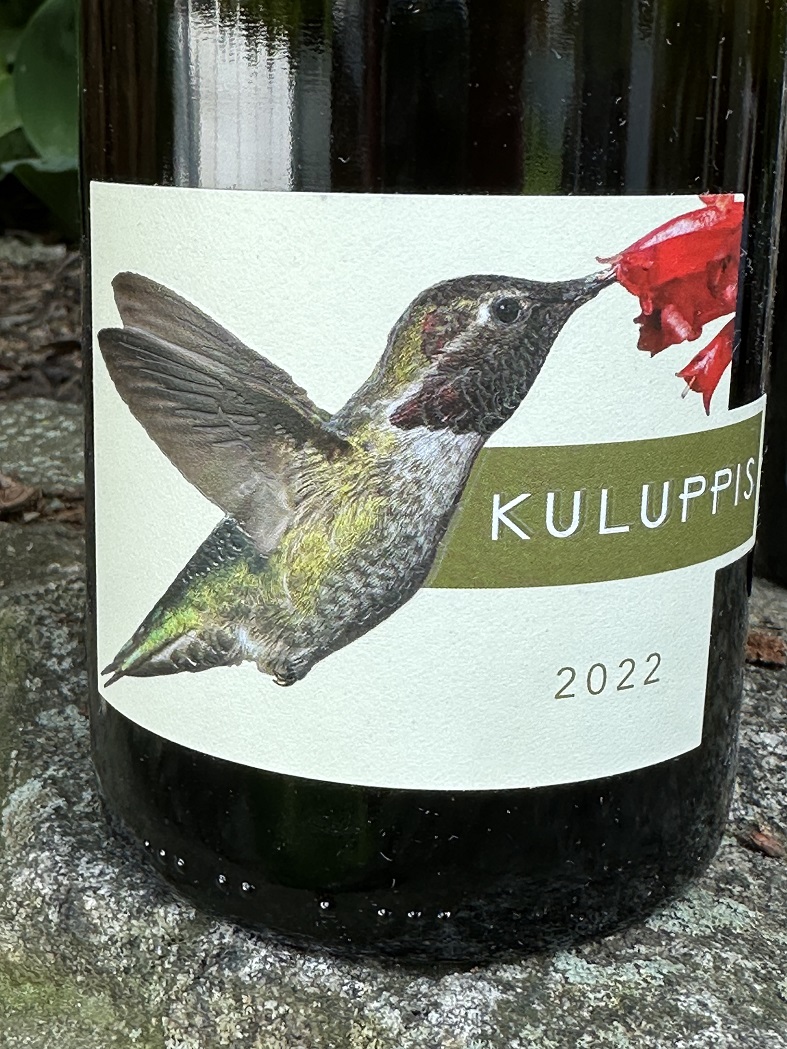
2022 Meyye Wines Kuluppis Chardonnay Sonoma County Los Carneros (13.7% ABV, $55, Sangiacomo vineyards, Kuluppis pronounced kuh-luu-pee; Anna’s hummingbird)
Light golden
Immediately upon opening – rich, opulent, butter, vanilla and tropical fruit on the nose, buttery toast on the palate, big, rich, hedonistic.
Literally 30 seconds later – a lot more restrained and leaner wine, all butter is gone, just some apples left. Well, no, there is still butter, just the toast is gone 🙂 nice and elegant, well balanced. Some perceived bitterness on the palate. Let’s see how it will develop.
Second day showed some honey notes and improved balance. Overall – excellent.
8+
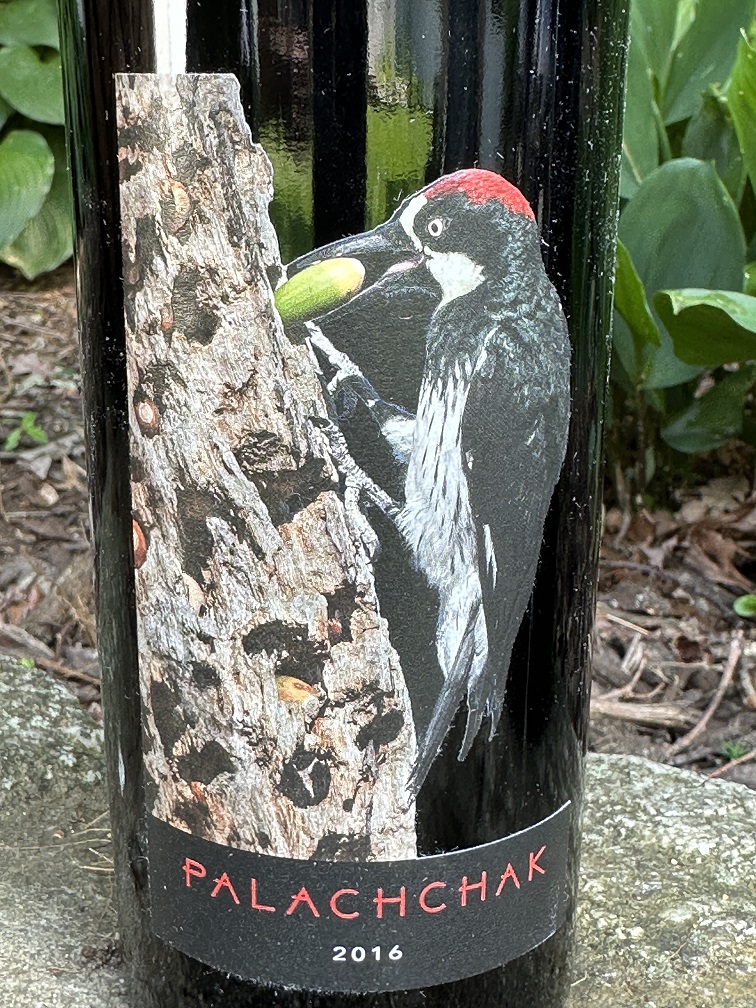
2016 Meyye Wines Palachchak Zinfandel Shenandoah Valley (15.5% ABV, $70, 90% Zinfandel, 10% Syrah, Palachchak pronounced pah-lah-chak; red-headed acorn woodpecker)
Dark chocolate and black currant, intense and beautiful
Blackberries and blueberries on the first day,
Dark chocolate with a touch of pepper, cherries, good structure, full body, clean acidity, good balance. Lasted for 4 days. Became a bit more round.
8
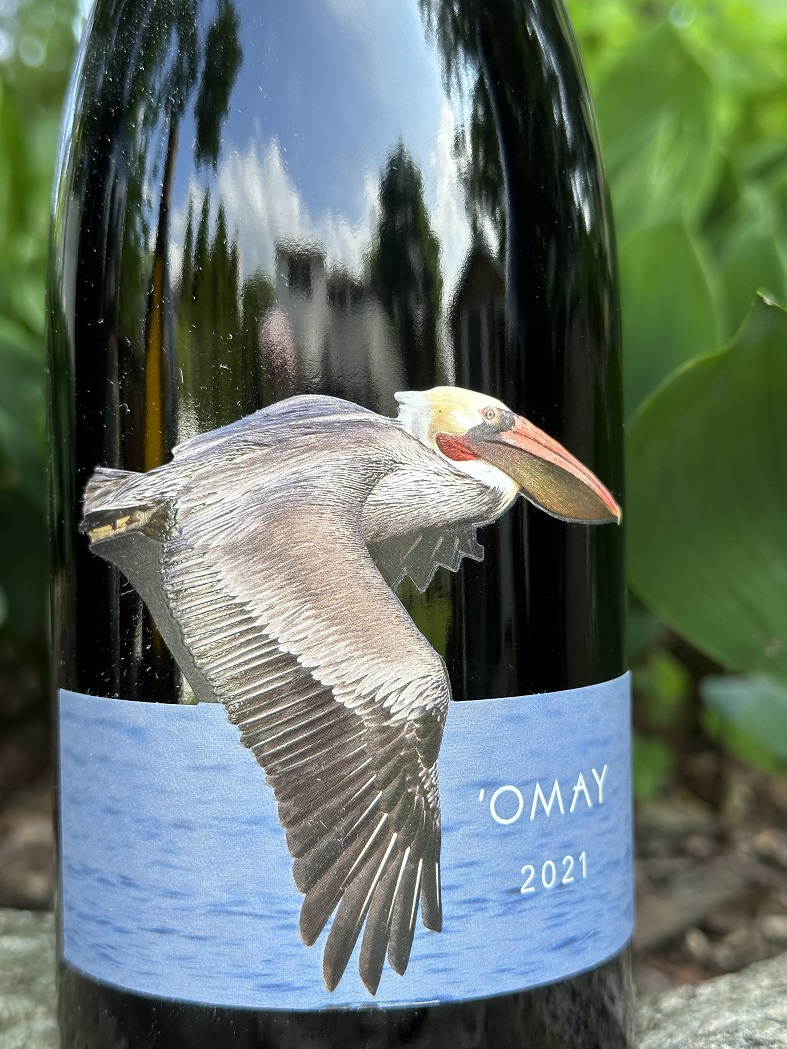
2021 Meyye Wines ‘Omay Pinot Noir Sonoma County Petaluma Gap AVA (13.9% ABV, $75, 100% Pommard Clone, Sangiacomo Vineyard, ‘Omay pronounced oh-may; brown pelican)
garnet
Smoke and plums, classic CA Pinot
Black Plums, violets, lavender, clean acidity, medium to full body – delicious.
8
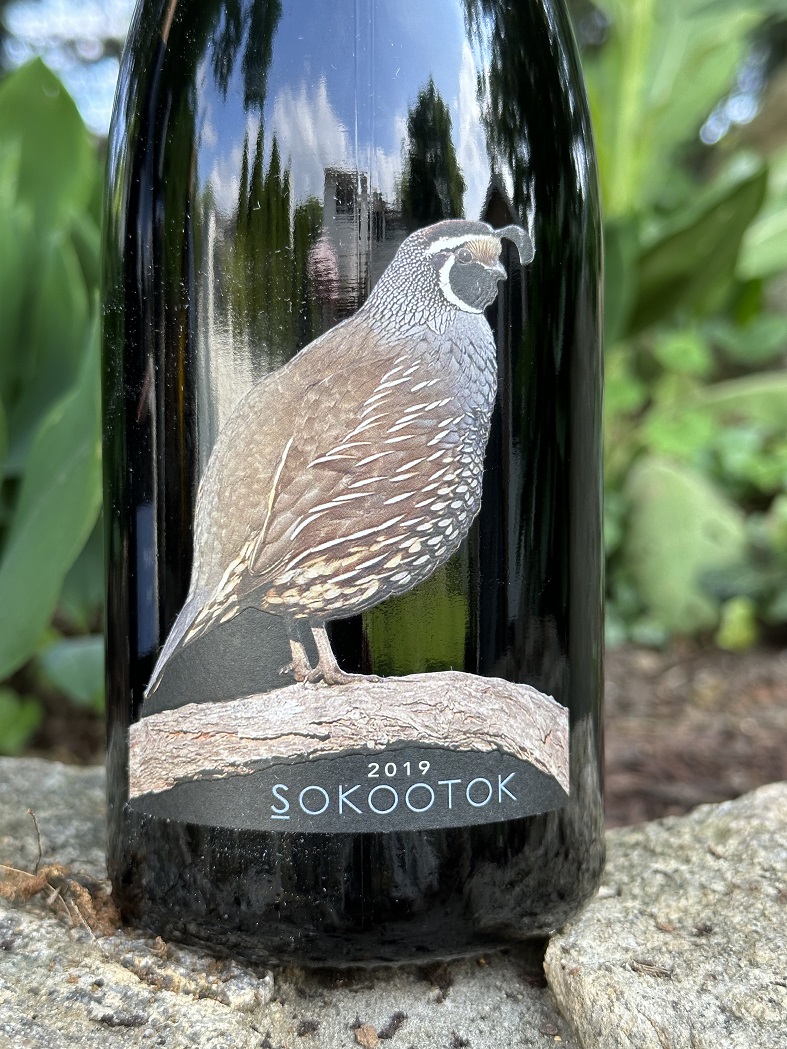
2019 Meyye Wines Sokootok Red Blend Sierra Foothills (14.5% ABV, $60, 50% Grenache, 28% Syrah, 10% Petite Sirah, 9% Counoise,
3% Zinfandel, Sokootok pronounced show-koh-tock; California quail)
Dark Ruby
Dark fruit, hint of minerality, sweet cherries, herbs
Black and red fruit, medium body, well-integrated tannins, good acidity, then tannins grip the finish – in a nice, but assertive way. This will develop nicely over the next 10-15 years.
8+, delicious.
Here you go, my friends. Another story of American Pleasures – delicious wines well worth seeking. And Meyye wines you will actually have to seek, due to their ultra-low production, so good luck to you.
Until the next time – cheers!
Reminiscing About Chardonnay
It’s been two weeks since the Chardonnay Day (May 23rd). So far I missed all the grape holidays this year, so why bother bringing it up, right?
Well, there are a few reasons. First, after carefully checking the blog, I realized that I never wrote about Chardonnay Day, which is a pity, because…
And here is the next reason – Chardonnay is one of my most favorite grapes. Of course, as a wine lover, you can say that I share this sentiment about every grape. Somewhat true, and yet in my book Chardonnay is different than most other white grapes.
While considered to originate in France, Chardonnay today is growing everywhere. I’m not sure if there is any well-known winemaking country that doesn’t produce Chardonnay – France, Italy, Australia, New Zealand, USA (everywhere – New York, Pennsylvania, California, Washington, Oregon, Virginia, Texas…), Chile, Argentina, South Africa and literally everywhere else.
Chardonnay can be produced in all wine “forms” – still, sparkling, dessert. In still wines, Chardonnay is best known as a solo player, even though sometimes it can be added to the blend. In sparkling wines, Chardonnay can be used just by itself, producing Blanc de Blancs sparklers, but it also plays very well with others, such as Pinot Noir and Pinot Meunier in the case of classic French Champagne. But even in the still format, the range of Chardonnay’s expressions is endless, from steely, razor-sharp cut-through acidity in the young Chablis or some of the unoaked Chardonnay wines from the new world to the big, buttery, “love my every curve” wines that almost are not made anymore in California. And speaking about dessert, let’s not forget “stickies” from Australia.
Another important characteristic of Chardonnay – properly made wines can age. There are very few aging-capable white wines. Riesling probably holds a crown there, but anyone who tried well-aged Chablis or Burgundy knows the joy of the heavenly, honey-and-lemon liquid which forces you to meditate over a glass of wine, not just drink it.
To prove my “special affinity” to Chardonnay, I decided to enlist the help of my Top Wine of the Year lists. At the end of every year, I publish the list of the most memorable wines of the year – what can be a better proof of recognition? I analyzed all of the lists from 2010 to 2023 to see how often Chardonnay was included, and only in its pure form, not as a part of the blend – and it appears that Chardonnay wines were a part of the Top Wines lists in 12 out of 14 years. For comparison, my beloved Rioja only made it into the 8 Top lists out of 14.
For what it is worth, in addition to my favorite collage picture of the Chardonnay wine labels over the years, I’m including here the list of my favorite Chardonnays of all time. I’m sure there are other wonderful Chardonnay wines that simply didn’t make it to the top list, but the list of wines below is still well-representative, Let’s take a look, in chronological order:
2010, #11 – Cambria Bench Break Chardonnay 2006, Santa Maria
2011, #4 – 2009 Peter Michael “Belle Cote” Estate Chardonnay
2012, #13 – 2008 Kovacs Nimrod Battonage Chardonnay, Eger Winery, Hungary
2013, a double entry
#12 – 2008 Seresin Chardonnay Reserve Marlboro New Zealand
#2 – 2005 Frédéric Gueguen Chablis Les Grandes Vignes
2015, #14 – 2012 Marchesi de’ Frescobaldi Pomino Bianco Benefizio Riserva DOC
2016, again a double-entry
#17 – 2001 The Lucas Winery Chardonnay Lodi California
#9 – 2015 Vidon Vineyard Chardonnay Estate Chehalem Mountains, Oregon
2017, yet another double
#13 – 2012 Sandhi Chardonnay Santa Barbara County
#12 – 2016 Salabka LA COQUINE Chardonnay Praha Czech Republic
2018, #6 – 2015 Domaine Jean-Noel Gagnard Chassagne-Montrachet Blanc 1er Cru Les Caillerets
2019, a triple!
#17 – 2017 Oceano Chardonnay Spanish Springs Vineyard San Luis Obispo County
#16 – 1990 Dom Ruinart Ruinart Blanc de Blancs Champagne
#9 – 2005 Giulio Ferrari Riserva del Fondatory Metodo Classico Trento
2020, a double
#10 – 2016 Domaine Anderson Estate Chardonnay Anderson Valley California
#8 – 2018 Landmark Vineyards Overlook Chardonnay Sonoma County
2021, a double again
#9 – 2013 Lynmar Estate Chardonnay Russian River Valley
#4 – 2018 Le Cadeau Vineyard Chardonnay Willamette Valley
2023, #1 – 2021 Balverne Chardonnay Russian River Valley AVA
Just to give you another bit of information, among the 19 wines listed above (creme de la creme of Talk-a-Vino Chardonnay experiences) there are 2 sparkling wines, the rest are still wines from 7 different countries and winemaking regions – France, Italy, California, Oregon, New Zealand, Hungary, Czech Republic.
Here you are, my friends. I already feel better – two weeks later, but I acknowledged one of my most favorite grapes.
What are your most memorable Chardonnay wines?
American Pleasures #9: Balverne Wines
Wine should give you pleasure – there is no point in drinking wine if it does not. Lately, I have had a number of samples of American wines that were delicious standouts – one after another, making me even wonder if someone cursed my palate. I enjoyed all those wines so much that I decided to designate a new series to them – the American Pleasures.
And we are back to talk about more delicious American wines (after a long and unintended break).
I love how wine not only entices your senses but lets you play a sleuth, a researcher, a scientist, a philosopher – a different role on a different day, or all of them at once – take your pick.
I can give it to you right now [spoilers alert]: I got a sample of three California wines, one better than another, one of them possibly even WOTY 2023 (told ya, spoilers) – and ended up doing the whole research (thanks, Google) trying to connect layers one by one. From the roles I mentioned above, I played mostly a sleuth trying to understand how far history was taking me and how all the little pieces fit together. Ah, never mind, let’s just get to it.
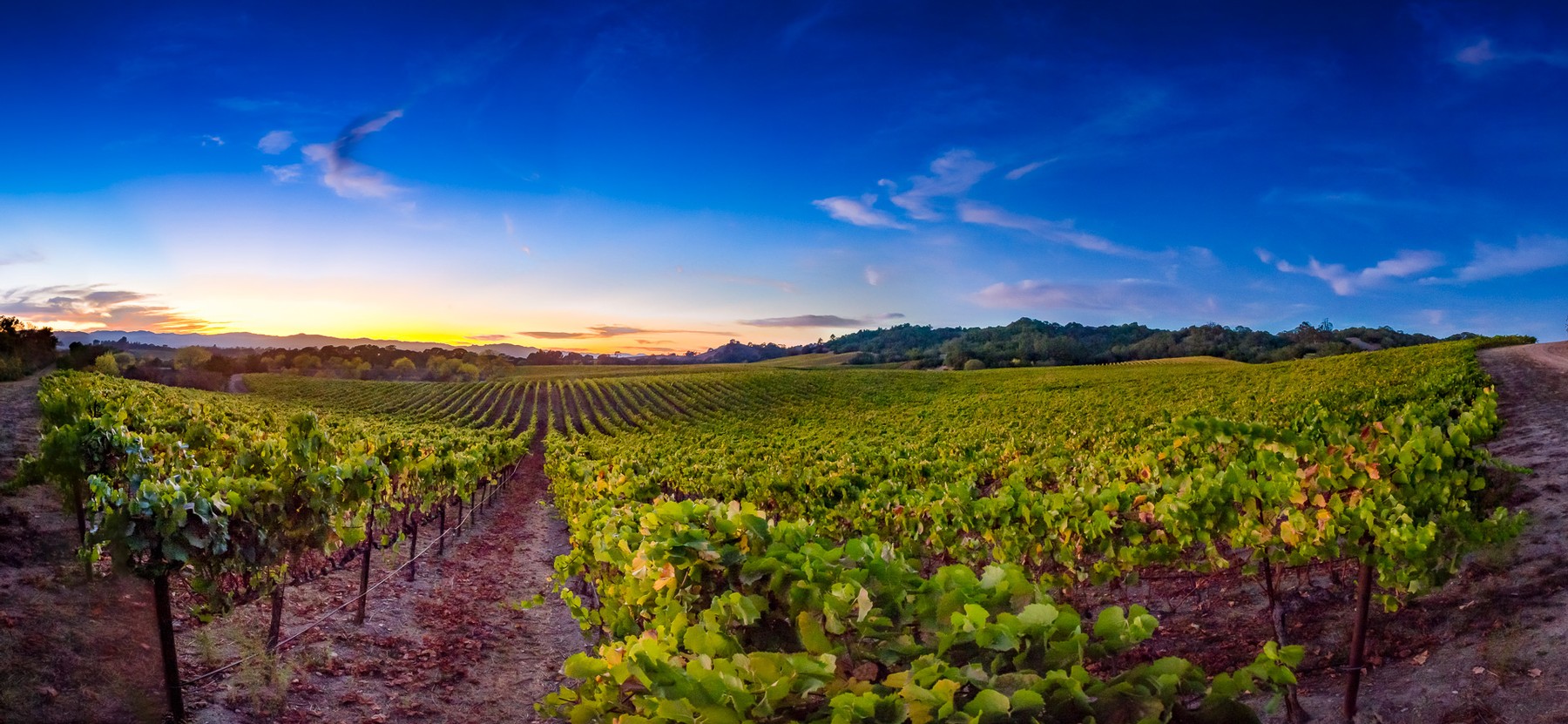
Source: Notre Vue Estates
In the center of this excitement are the wines produced by the Notre Vue Estate (Notre Vue stands for Our View in French) and called Balverne. Notre Vue is a 710 acres estate located in the heart of Sonoma County next to Healdsburg and acquired by Bob and Renee Stein in 1992. The history of the land where the estate is situated goes all the way back to 1841 when it was the part of Rancho Sotoyome land grant of 1841. The grapes had been growing on the estate starting from 1869, and commercially starting from 1907 – I’m assuming after the estate was acquired by Antonio Perelli-Minetti.
Let’s take a quick stop here – have you heard of Antonio Perelli-Minetti? I have to shamefully admit that I never have. We all know who Rober Mondavi and Andrew Tschelisteff are, but Antonio Perelli-Minetti? When Antonio Perelli-Minetti died in August of 1976 at the age of 95, his obituary in S.F. Chronicle was titled “Dean of winemakers is dead at 95″. Dean of winemakers – and with all my passion for wine, all the reading and learning, I never came across his name? Well, it may be just me… But then there is almost nothing written about him, for sure online… Okay, moving along…
The winemaking at the estate started in 1972 under the name of Balverne Cellars – supposedly, Balverne is a hybrid Anglo-French term meaning “a place of trees”, which is very appropriate for the estate. In the 1980s, two recent UC Davis graduates, Doug Nalle and John Kongsgaard (I’m sure both names need no introduction), made the estate famous with Balvernet Cellars wines being served at the White House dinners and at some of the finest restaurants in Los Angeles and New York. After Steins acquired the estate in 1992 they were mostly selling the estate grapes to some of the best wineries in California. The winemaking was reintroduced at the estate in 2005 under the name of Windsor Oaks Vineyards, and in 2013, the Balverne name was brought back.
Whew, done with the history. Let’s talk about the present.
At the heart of the Notre Vue estate lays 350 acres of “Forever Wild” Nature Preserve, covered by a variety of oak trees and inhabited by red-tailed hawks (Red-Tailed Hawk is a symbol of Balverne, depicted on every label), wild turkeys, owls, bluebirds, coyotes, bobcats, grey foxes, hares, rabbits and lots more. This Forever Wild nature oasis is a critical element of sustainable viticulture practiced throughout 250 acres of surrounding vineyards. These Sonoma’s Certified Sustainable vineyards are split into multiple blocks growing 18 grape varieties, and they span two of Sonoma County’s prominent AVAs – Russian River Valley and Chalk Hill.
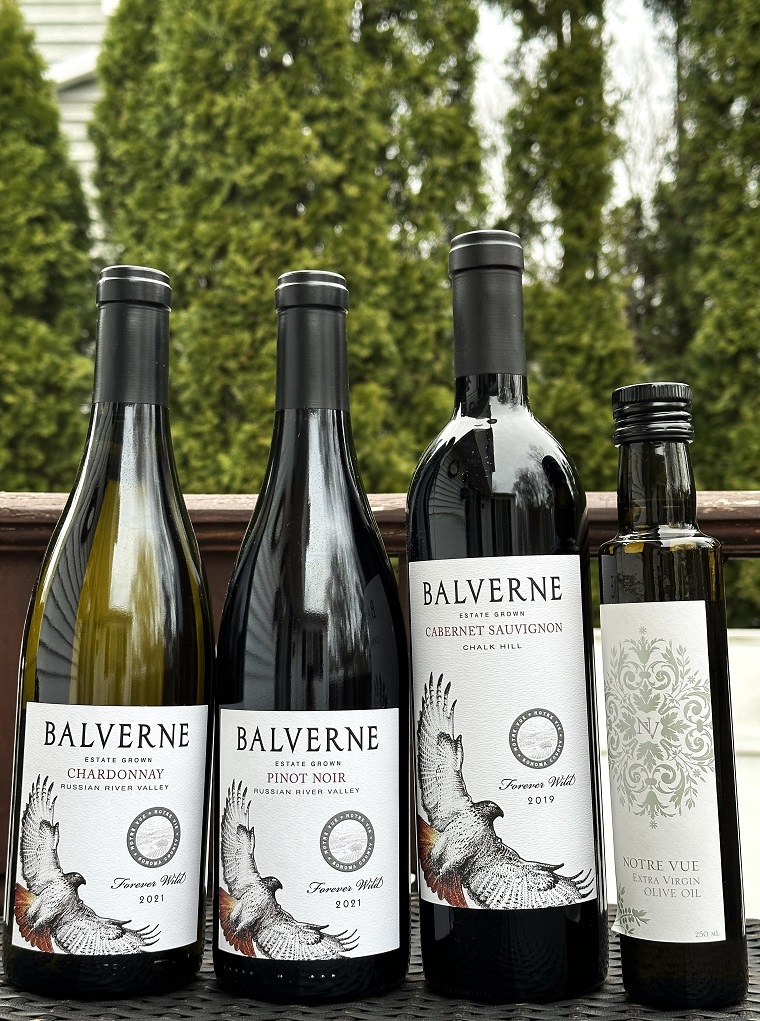 I had an opportunity to try 3 of Balverne’s recent releases – Pinot Noir, Cabernet Sauvignon, and Chardonnay. I would typically start tasting with the white wine – here, as I was tasting in the comfort of the house instead of the tasting room, I started with the red – Pinot Noir. The wine was excellent, tightly woven which is not always the case with California Pinot.
2021 Balverne Pinot Noir Russian River Valley AVA (14% ABV, $35, Pinot Noir clones 459 and 667 with a small percentage of 114 and 115, 9 months in 25% new French oak)
Dark garnet
Plums, violets, intense, inviting
Nicely restrained, dark cherries, tart, crisp, lean, well structured
8, excellent
Cabernet Sauvignon followed, being nothing short of excellent, and perfectly drinkable from the first pour.
2019 Balverne Cabernet Sauvignon Chalk Hill AVA (14.3% ABV, $48, 79% Cabernet Sauvignon, 9% Petit Verdot, 9% Malbec, 3% Cabernet Franc, 18 months in French oak)
Dark garnet
Eucalyptus, cassis
Everything weaves around the acidic core. Perfectly restrained, nice Bordeaux/old world style, harmonious, balanced, delicious.
8+, outstanding.
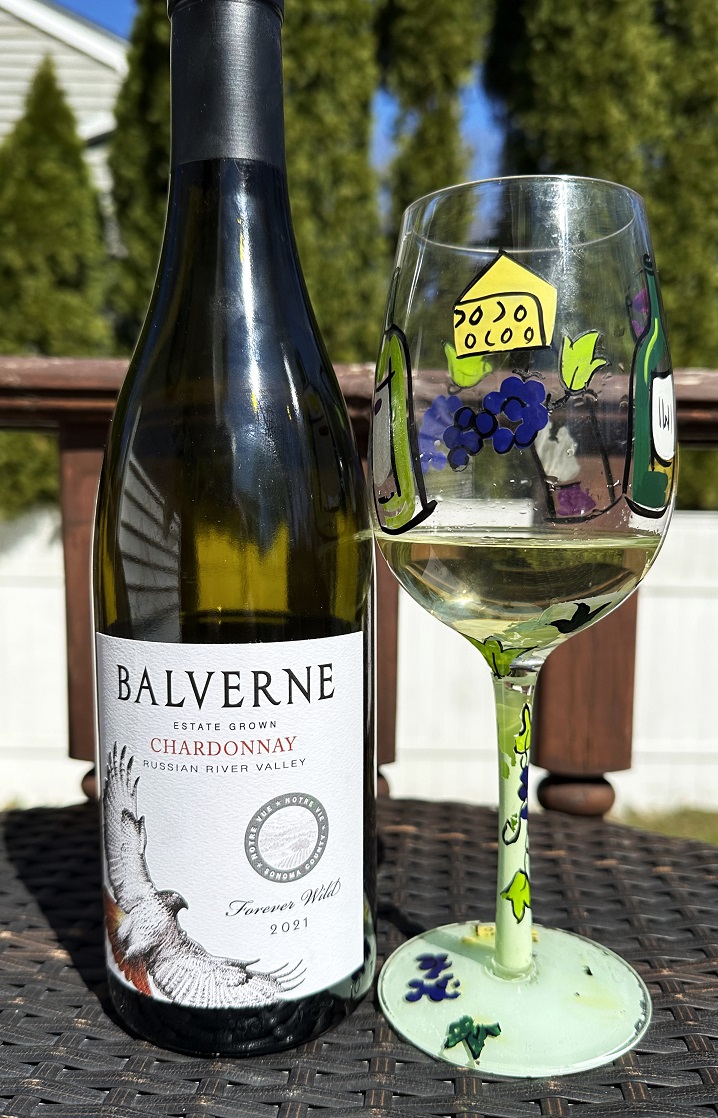 And then came Balverne Chardonnay.
I poured a glass without much thought. Sometimes, it is best to have no expectations – not low, not high, just none. This was the case, even after the first two very successful reds. White wine is difficult. With white wine, the winemaker has nowhere to hide. Even if it will be two out of three, this would be a successful encounter.
The very first whiff of the glass made me literally speechless. The following sip confirmed my excitement:
2021 Balverne Chardonnay Russian River Valley AVA (14.2% ABV, $35, clone 17, 5 months in 20% new French oak)
Light golden
Beautiful, varietally correct nose – vanilla, apple, lemon
The first sip blows your mind – vanilla, golden delicious apple, honey, lemon, minerality – impeccable balance and beauty only a Chardonnay is capable of expressing.
9, spectacular. This wine is just something. Something special.
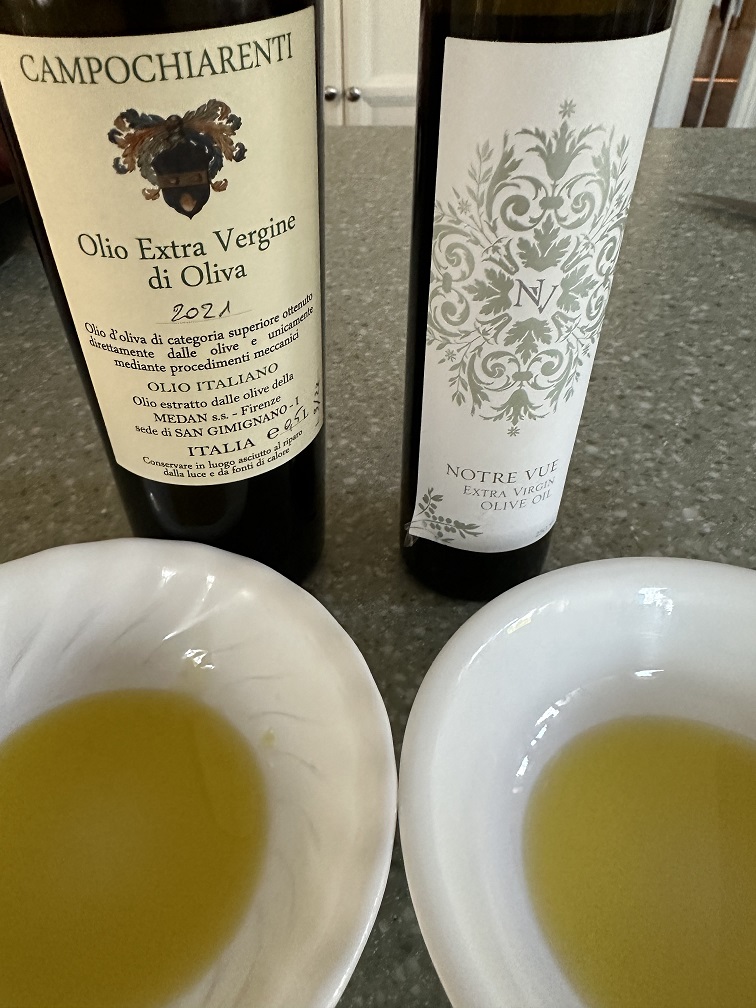
As you might see in one of the pictures above, my sample set went beyond wine – The Notre Vue’s own California Extra Virgin Olive Oil was a part of the package. I decided to do [an unfair] comparison between Californian and Italian EVOO. Both olive oils were expectedly different, with the Italian one showing green, tight, and peppery, and the Californian one being much more fruity. The beauty – it is not a competition, depending on what dish you are using the olive oil for, each one would have its own advantages.
Now you have a complete experience report, including my uninvited research (but everyone is entitled to their own version of fun). What’s important is that I presented to you three excellent wines, both on their own and as a value. Once you taste this Chardonnay, believe me, you’ll understand…
And we are done here. But – I always have more American pleasures to share, so stay tuned…
Virgen Wines – No SO2 Organic and Delicious
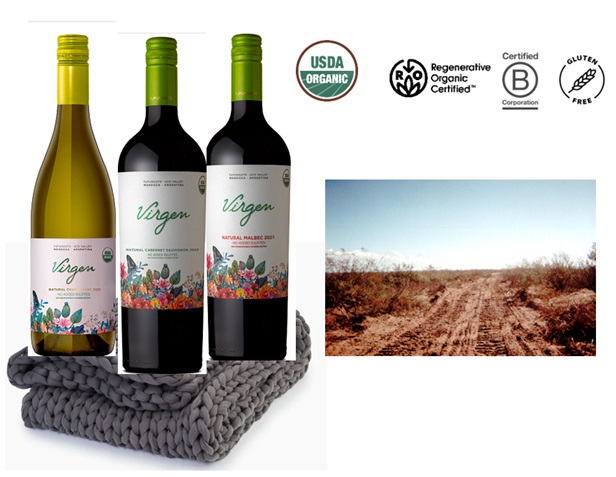 No added SO2.
Organic.
Delicious.
Simple, right?
Organic seems to be the word of the town. Four years ago, in 2019, 6.2% of the vineyards in the world were certified organic. In absolute terms, it doesn’t sound impressive. However, we need to take into account a few factors. First, many vineyards practice organic farming but are not inclined to undergo an official certification process due to the high cost. Second, and probably more important, is that from 2005 till 2019 the organic vineyard plantings increased by 13% per year, compared with non-organic vineyard plantings’ growth rate of 0.4% per year, according to the article in Drinks Business. I have a feeling that the organic vineyard growth could even have accelerated over the last four years, but we will need to wait to see the official data.
But grapes from organic vineyards don’t automatically mean that the wine can be called organic too – this gets a bit tricky, as every country has different rules for what wine can be called “organic” – this is why you can see on many labels the statement “made with organic grapes” instead of simple “organic”.
SO2, an abbreviation for Sulfur Dioxide, is an essential element in winemaking. It is used literally at every stage of the winemaking process because of a few important properties. SO2 is an anti-microbial agent, regulating harmful yeast and bacteria growth in wine. It also has anti-oxidative properties, protecting the wine from oxidation. It is important though that the use of SO2 is not excessive for a variety of reasons – one of such is an allergic reaction it can cause.
So here is the culprit – if you want to import your wine to the USA, and you want to be able to simply state on the label “organic”, you are not allowed to add sulfites (it is okay to add sulfites to the organic wine in Europe and Canada). This doesn’t mean that the wine will have no sulfites – sulfites are a natural by-product of fermentation, and they are always present in wine – but they will be present in minuscule quantities in the organic wines. However, not adding sulfites is not for the faint at heart – considering how many things can go wrong in the winemaking process – this is why today you see the majority of wines labeled with “made from organic grapes”.
Domain Bousquet was founded in 1990 in the high-altitude desert in Tupungato Uco Valley in Mendoza, Argentina, on the pure vision, passion, and conviction of its founder, Jean Bousquet. Jean was told that he is making a mistake of his life when he purchased 1,000 acres of nothing but dry, empty, arid land. Today, Domain Bousquet sustainably and organically farms 667 acres of vineyards, produces 50 million liters of wine, 95% of which is exported to 50 countries around the world, and ranks among the top 20 Argentinian wineries in terms of export. Domaine Bousquet also just extended its leadership in organic winemaking by introducing the wines produced without adding any SO2 – and this is exactly what we are talking about today.
Three new wines were just added to Domaine Bousquet’s collection, under the name of Virgen – Chardonnay, Cabernet Sauvignon, and Malbec. All three are certified USDA organic, unoaked, and have no added SO2. To ensure the proper handling that these wines require, Domaine Bousquet even decided to ship them wrapped in a blanket.
When I received an invitation to review these new wines, my instant inclination was a simple “nope, not doing that”. No USDA organic wines made me excited so far. But the next thought was … well, these are just the samples, it might be interesting – especially if I can compare them with the same wines made in the traditional way – and this is pretty much what I was able to do.

Winemaker Rodrigo Serrano. Source Domaine Bousquet
In my mind, producing wines without SO2 requires a leap of heart. So even before I got the wines, I decided to ask Domaine Bousquet’s winemaker, Rodrigo Serrano, a few questions about his inspiration and goals – here is our short conversation:
[TaV]: You had been farming organically since the beginning, so your wines have always been made from organic grapes. Getting USDA Organic certified is another test, as you now need to certify the entire winemaking process. Why did you decide to opt for this certification?
[RS/DB]: We did it because we had the opportunity to experience it in 2018. Little by little I moved away from the use of SO2, until I suggested trying a wine without using it. I felt like an innovator, without knowing the real magnitude of this.
[TaV]: Virgen wines do not have SO2 added, so special care must be taken during the transport of wines. How did you come up with the idea for a blanket? How does it help protect wines?
[RS/DB]: The theory says that the temperature is very harmful, so in a wine like this, in which there is no protection, extreme care is taken. Today with experience, we understand that both in Virgin and in the rest, the temperature is harmful, so we put the blanket in all shipments. It helps by generating an air chamber between the wall of the transport container and the wine box, obtaining less impact from the outside temperature on our bottles.
[TaV]: What is the expected shelf life of Virgen wines?
[RS/DB]: Initially I was not optimistic, today with more than 5 years of experience, we still have 2018 stock, and it remains correct.
[TaV]: Somewhat related question: Once virgin wines have arrived at someone’s home, how should they be stored? How long can they be stored before having to consume them?
[RS/DB]: It must be stored like the rest, away from light, with a temperature no higher than 20°C and no less than 5°C.
[TaV]: Can “SO2-free” wines age? Did you experiment with that?
[RS/DB]: It is a challenge that we have ahead of us, to work with sulfite-free wines for aging, we are working on it, but for the moment they are only projects.
[TaV]: I see that Domaine Bosquet is not only organic, it is also certified Organic Regenerative. How is Regenerative Organic different from just Organic? What did you have to do to obtain the Regenerative Organic certification? How long did it take you?
[RS/DB]: ROC is something incredible, and for this I recommend watching KISS the Ground. He will answer better than anyone. It took us a few years to certify it, but I don’t work extra, considering that our philosophy coincides 100%
[TaV]: Last question. Far beyond viticulture, Domaine Bosquet is also a certified B Corp. Why did you decide to become a B Corp? Why is this important for you?
[RS/DB]: As with ROC, the coincidence in our philosophy, measuring the social and environmental impact, led us to this certification in a natural way.


Obviously, the proof is in the pudding glass, so next I tasted the wines, and – spoiler alert – was blown away. Here are my notes in the exact order I tasted the wines:
2021 Domaine Bousquet Virgen Natural Cabernet Sauvignon Tupungato Uco Valley Mendoza Argentina (14% ABV, $13, no added SO2)
Dark garnet
Chocolate and tobacco on the nose, a hint of berries
Blackberries, a hint of cassis, black plums, minerally driven, rich and luscious, good structure, crisp acidity.
8, outstanding on its own, and a great surprise as the wine is unoaked.
2021 Domaine Bousquet Virgen Natural Malbec Tupungato Uco Valley Mendoza Argentina (14% ABV, $13, no added SO2)
Dark Garnet
A hint of barnyard upon opening. On the second day barnyard smell disappeared, leaving behind only dark fruit.
On the palate, the wine is just spectacular. Imagine taking a load of perfectly ripe, perfectly crunchy, perfectly fresh berries – blueberries, raspberries, and wild strawberries, and sending it into your mouth – now you know how this wine tastes. Perfect structure, perfect balance, perfect acidity.
8+/9-, kudos to the winemaker.
2022 Domaine Bousquet Virgen Natural Chardonnay Tupungato Uco Valley Mendoza Argentina (13.5% ABV, $13, no added SO2)
Light golden
Asian pear, herbs
The palate is matching the nose, Asian pear, a touch of honey, herbs.
7/7+ first day. The wine somewhat improved on the second day, but overall didn’t go anywhere near the reds
And here is my “Frame of reference”:
2021 Domaine Bousquet Cabernet Sauvignon Reserve Tupungato Uco Valley Mendoza (14.5% ABV, $19.99)
Garnet
Dark berries, cherries
A touch of cassis, eucalyptus, clean, classic, perfectly balanced, good acidity.
8, very good
2021 Domaine Bousquet Malbec Reserve Tupungato Uco Valley Mendoza (14.5% ABV, $19.99)
Garnet
Dark fruit, espressoFresh berries, salivating acidity, medium body, playful, perfectly balanced.
8+, delicious.
Let’s discuss our tasting.
First, both of the no SO2 reds were outstanding. The unadulterated fresh berries are really something to experience when they are delivered in a fully balanced, perfectly structured way. No SO2 Cabernet Sauvignon was perfectly on par with the reserve Cabernet Sauvignon; I liked no SO2 Malbec even more than the reserve version, even though I wouldn’t complain about either. Second, I managed to get the answer to the question about the aging of the no SO2 wines. I left both no SO2 Cabernet Sauvignon and Malbec on the countertop, closing back the screw cap, and the wines were perfectly delicious on the second and third days. In my book, that means that the wines have at least another 10 years of life easily. Not that I’m suggesting that you should age these wines, but it is good to know that you really don’t have to consume them the same day you got them from the store.
Here you are, my friends – organic, no SO2, and delicious. These wines are worth seeking out, whether you care about sulfites or not. And if you have friends who complain about headaches and sulfites – they might love you even more after they will taste these wines. If you had a chance to taste these wines already – let me know what you think!
White Wines, Simple and Complex
Is there a definition for simple wine? What about the complex? I’m sure every wine lover can offer their own definition, and everyone will be correct in their own right.
We are not here to search for an absolute truth. We are just having a casual conversation.
In many cases, “simple” would just refer to the price. People don’t want to stress “inexpensive” or “cheap”, they would just say “yeah, I’m just having a glass of this simple wine”.
Another possibility is referring to the taste of wine as “simple” – the wine which is quaffable, but not exciting, not thought-provoking, something you would drink because it is just conveniently available. By no means “simple” implies “bad” – it is still a good wine, but that simplicity makes it a perfect accompaniment for let’s say, a pepperoni pizza or a loaded hot dog. In many cases, simple wine is all you want.
I understand that the title of this post might be a bit misleading, as simple can’t be complex at the same time. But – I have a reason for that. If you will, I’m trying to share a bit of a puzzle here.
Before I will explain the puzzle, let me share my general take on modern wines. I’m talking here about the wines made anywhere in the world, by winemakers who want to make a quality wine – at any price point. I’m talking about the overall quality of the winemaking. Healthier vineyards around the world bear better-quality grapes. A better understanding of the unique composition of the vineyards. A better understanding of the winemaking process. A better understanding of how to keep the winery clean. An increased body of winemaking knowledge. All of these are contributing factors to the better quality of wine which I perceive with many of the simple, everyday wines.
Where am I going with this and what the quality of wines has to do with simple wines? Here it is. I tasted 4 new sample wines for this post. One of them was perfect from the get-go. Three others were well-maid, but not my favorites. After playing with each one of those 3 for a few hours, I put back the corks and the screwtops and left the wines on the countertop for about a week. After that I reluctantly moved those wines into the fridge, thinking that I will taste them one more time later before discarding them.
About a month or so later, I remembered that I have those wines in the fridge, and I should decide what to do with them. To my great surprise, each one of the 3 showed much, much better. The wines became actually delightful, and instead of just discarding the wines, I slowly finished them with pleasure. Here is your puzzle – how and why these simple wines improved, despite not being even stored properly. My only thought is that the answer is probably quite complex, but it probably has something to do with the better quality of the wines – and that’s how it is connected to the diatribe above.
Here are the wines I tasted.
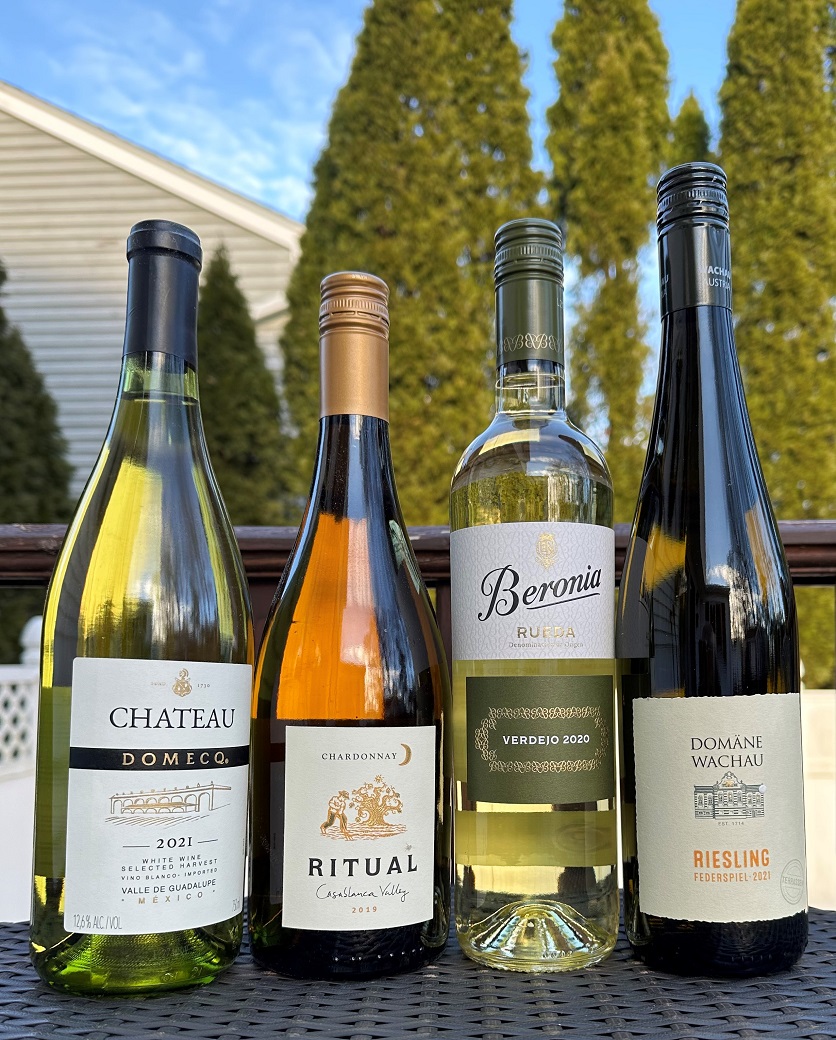
First, 2019 Ritual Chardonnay Casablanca Valley Chile (13.5% ABV, $20.99, organic grapes, certified sustainable). Ritual is an organic wine producer from Chile. I had Ritual wines in the past, and I liked them quite a bit. This Chardonnay, however, was the least exciting out of the four – until those 30+ days later:
Light golden with greenish hue
Gunflint, steel, Whitestone fruit
Green apple, tart, crisp, herbaceous, a touch of smoke. Medium to full body, powerful
7+, needs food, almost asking for a steak.
Second try: outstanding. Better integrated, showing customary Chardonnay apple and vanilla, more round and very well balanced.
Drinkability: 8/8+
Next, 2020 Bodegas Beronia Verdejo Ruedo Spain (13.5% ABV, $13.99, vegan). Bodegas Beronia is a well-known Rioja producer, who also makes wines in Rueda. I had their Rueda bottlings in the past, and always liked them. While initially faring just a bit better than the Ritual, this wine also improved after 30+ days in the fridge:
Light golden
Lemon, sapidity, medium+ intensity
Meyer lemon, lemon zest, crisp, tight and refreshing, good acidity.
8-, an easy supper but will go well with light appetizers.
Second try: the wine became more round, better integrated and better balanced.
Drinkability: 8
From Spain we are moving to Austria – 2021 Domäne Wachau Riesling Federspiel Austria (12% ABV, $18.99, certified sustainable). Domäne Wachau is one of the very best producers in Austria, offering a tremendous range of single vineyard and village wines. I had Domäne Wachau Grüner Veltliner in the past, but this was my first encounter with the Riesling:
Light golden
Meyer lemon, a touch of honey, pleasant
Honey, pear, lemon, beautifully round with cleansing acidity and acidic finish. Delicious.
8/8+, delicious. There was nothing left for the second try 🙂
For our last wine, we are traveling back to the Americas, to Mexico this time – 2021 Chateau Domecq White Wine Valle de Guadalupe México (12.6% ABV, $13.99, 60% Chardonnay, 40% Viognier, fermented and aged in 2nd use French oak barrels for 6 months) – my first encounter with the producer, and possibly the first white wine from Mexico.
Light golden
Heavy nose with sapidity and roasted notes. In a double-blind tasting (black glass) this wine would perfectly qualify as red
Interesting. Unusual. I think Chardonnay and Viognier just have their own lives in this wine.
After a few minutes in the glass, the nose didn’t dissipate, but the palate became a lot cleaner – plump round wine with notes of vanilla and a hint of tropical fruit. Not a bad effort at all.
Drinkability: 8-, unusual.
Second try: after 30+ days, sapidity and roasted meat notes were gone, and similarly to the previous two wines, it became more round and better integrated.
Drinkability: 8-/8
Here you are, my friends – simple wines with a complex story. I might be making things more complicated for no reason – you might be right about that. But if I can make one conclusion from this experience – even if you don’t like the wine, give it a second chance. You might be positively surprised by an outcome.
Stories and Passion and Pinot: Shane Moore of Gran Moraine
“Gran Moraine prides itself on producing experiential art in the form of Chardonnay, Pinot Noir and sparkling wines made to express the exquisite terroir of our Yamhill-Carlton Estate Vineyards.”
Experiential Art.
Not a bad way to introduce the winery, what do you think? Wine is art, all wine lovers can sign under such a statement, so “experiential art” sounds very near and dear to any wine lover’s heart.

Gran Moraine vineyard was planted in 2004 by Premier Pacific Vineyards in the Yamhill-Carlton district of Willamette Valley in Oregon, with 200 acres of hillside vines of Pinot Noir and Chardonnay. The vineyard took its name from moraines, glacial sediment left after the glacier movements in the last ice age. In 2013, the Gran Moraine Vineyard was acquired by Jackson Family and it is one of the 4 major properties owned by the Jackson Family in Oregon Willamette Valley.
I visited Gran Moraine last August and had an opportunity to taste a number of the wines and have a quick chat with the winemaker, Shane Moore. Then I followed up with the usual, virtual “conversation” and here is what transpired:
[TaV]: Was there a pivotal wine in your life?
{SM]: I’ve had plenty of wines that have possibly changed my life’s trajectory. However, I feel like the most pivotal wines in my existence have been those that seem to stop time. These wines provide my most fond wine moments and provide me with the most inspiration.
[TaV]: Is there a winemaker you would call your mentor? Someone you learned the most from as a winemaker?
[SM]: I think if I gave any specific shoutouts I’d be doing a disservice to so many of the amazingly talented and thoughtful winemakers I have had the pleasure to have worked with. Over my time I worked with and under at least 40 winemakers – I for sure learned a great deal from all of them. Another great group I both learned a lot and derived much inspiration from are the seasonal cellar workers we hire each year. With that I’m proud to say many have went on to become winemakers themselves.
[TaV]: Pinot Noir and Chardonnay wines are all about blocks and clones. How many clones of Pinot Noir and how many clones of Chardonnay do you grow? How many individual blocks do you identify for the Pinot Noir and Chardonnay?
[SM]: At the Gran Moraine Vineyard, there are 6 different clones of Pinot Noir and only 2 of Chardonnay. Every block is harvested and vinified separately. At any given time, there are around 100-120 different lots of wines. There are approximately 80 blocks – I don’t bring them all in – it’s too big of a vineyard for that – I bring in what I think of as around the top 30% of the acres.
[TaV]: Following up on the previous question – what is your approach to the blending of the final wines, both Pinot Noir and Chardonnay? Do you ever produce single block or single clone wines, and if you don’t do it now, do you have a plan to start producing such wines in the future?
[SM]: Blending final wines starts with having an abstract notion of the experience which you would like to have said “wine endue.” Then you purposely work within the parameters of the vineyard, the growing season and your production capabilities to craft something with that end goal in mind.
We will sometimes produce single clone or block wines when the wine is so profound that it would be a disservice to humanity to blend it away.
[TaV]: You already produce a few of the sparkling wines. What is your approach to harvesting the grapes for those wines – do you have specific plots which you designate for sparkling wines, or do you take an early pass through the vineyard prior to general harvest to get the grapes for the sparkling wine production?
[SM]: You know when you eat something so acidic that it makes your ears ring? I like to pick the fruit for sparkling wine when it’s just a little riper than that. We use specific blocks for the sparkling wine that are purposely farmed. Generally, these blocks are some of the most marginal sites on the vineyard; for example, north facing and heavier soils.
[TaV]: How much focus the sparkling wines program gets at Gran Moraine? Do you expect to produce more sparkling wines in the future, or you expect to stay at the level where you are at?
[SM]: Sparkling wine is currently about 15% of our production. I can see it growing some, it seems to be very popular.
[TaV]: Gran Moraine is a ~200 acres vineyard. If I understand it correctly, it is all planted with Pinot Noir and Chardonnay. Do you plan to plant any other grapes – Pinot Gris, for example, or will it stay strictly as it is right now?
[SM]: The suitable acres on the piece of land are pretty much planted out. I don’t think we’ll be grafting any of the Chardonnay or Pinot Noir over to anything else anytime soon.
[TaV]: When you make Gran Moraine Chardonnay, is there a specific style you are trying to achieve?
[SM]: I want the Chardonnay to have umami, electricity and tension. Of course, I also want it to be delicious.
[TaV]: Same question for the Gran Moraine Pinot Noir?
[SM]: With the Pinot I try to focus on it being beautiful and sleek creating power and complexity daftly by DJing with great music and surrounding it with happy people.
[TaV]: What are your favorite producers in Oregon? In the USA? In the world?
[SM]: Oregon: Adelsheim, Antica Terra, Antiquim Farm, Alexana, Belle Ponte, Brickhouse, Beaux Freres, Bethel Heights…..that’s just getting to the B’s! Too many really to mention – I’m always trading wine with people. I’m totally in love with Oregon wine.
USA: I’d have to go to CA and say some of my favorites there are Ridge, Drew, Papapietro Perry, Navarro, Hartford.
[TaV]: Is there a winemaker you would love to work with? A dream winemaker so to speak?
[SM]: Jean-Herve and Laurent Chiquet of Jacquesson. I hope they are listening. I’ve got ideas.
[TaV]: What’s ahead for Gran Moraine? Where do you see it in 10 years?
[SM]: We’ll probably be doing the same thing but hopefully with even more intention and weirder.
[TaV]: Is there a dream wine you always wanted to make? What would that be?
[SM]: A great New World Nebbiolo.


Here are the tasting notes for a few of the Gran Moraine wines I had an opportunity to taste during the visit:
Gran Moraine Brut Rosé Sparkling Wine Yamhill-Carlton (58% Pinot Noir, 41% Chardonnay, 6% Pinot Meunier)
Toasted notes on the nose
toasted bread, a touch of yeast, good acidity, crisp, clean
8, delicious
2018 Gran Moraine Chardonnay Yamhill-Carlton
A touch of honey notes, vanilla
Good acidity, good acidity, needs time
7+
2018 Gran Moraine Pinot Noir Estate
Brilliant fresh cherry notes, sage
Crisp, restrained, tart cherries and earthy notes, fresh tannins
7+
2017 Gran Moraine Upland Pinot Noir
Restrained nose, a touch of funk, cherries
Light palate, fresh, bright, cherries and cranberries
8-
Here you go, my friends. Another winery, another story of Passion and Pinot. Until the next time – cheers!
This post is a part of the Stories of Passion and Pinot series – click the link for more stories…
Passion and Pinot Updates: Lenné Estate
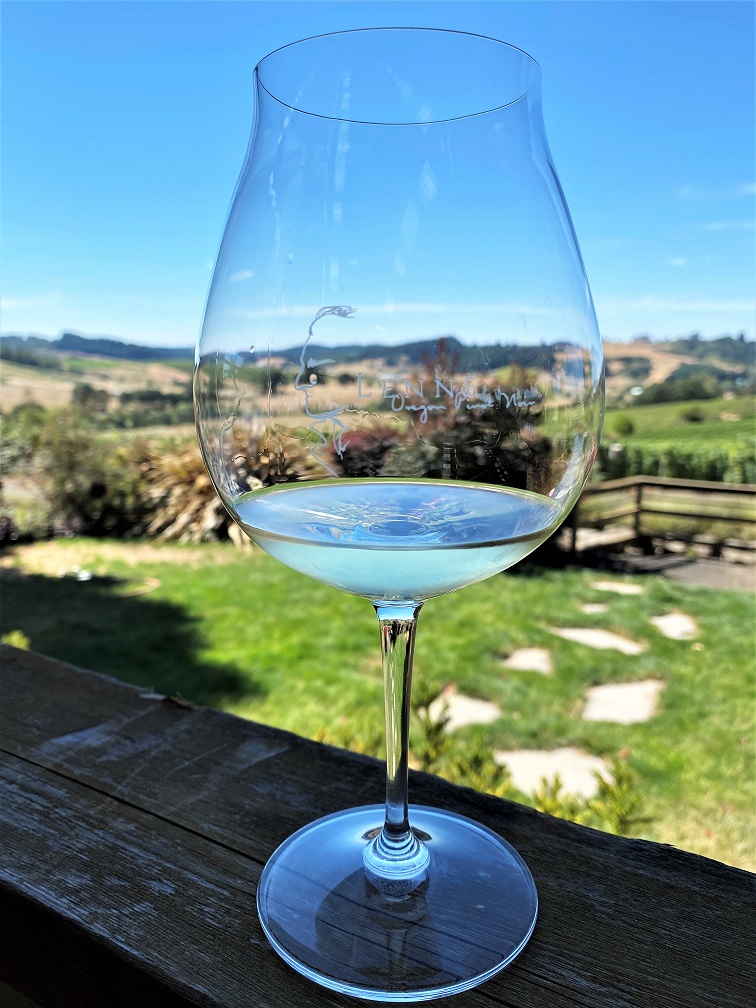 Out of the 13 Oregon wineries profiled to the date in the Stories of Passion and Pinot series, Lenné Estate stands aside. I had my first encounter with Steve Lutz and Lenné Estate in 2014, two years before the Stories of Passion and Pinot series was born, when Steve participated in the #WineChat event on Twitter. This is when I heard for the first time about Peavine soils, a mixture of clay and rocks, and Steve’s relentless, passionate pursuit of Pinot Noir winemaking in the place where it seems no vine can ever grow – read this original post to see what I mean. This passion I learned about while “listening” to Steve for the first time, the passion for the finicky grape became the reason for the name of the series.
When I spoke (virtually) to Steve in 2016 (you can find this conversation here), I learned a lot more about all the hard work establishing the vineyard, about Kill Hill, and about the wines which Steve produces, so when we arrived at Lenné Estate with Carl Giavanti, I felt like I knew Steve for a long time, and almost felt at home in the vineyard.
It is one thing to listen to someone talking about the soil, and it is totally different when you look at it (you can touch it too if you want) and think “how anything, really anything can grow in this soil”? Dry farming, no irrigation, and then you look at the soil – and you look at the grapes which it perfectly produces, and you can only say “wow”. I can tell you that out of the number of vineyards we already visited during the trip, the grapes at Lenné looked the best – tight bunches, beautiful colors of veraison, just a pleasure to look at.


More grapes:


We took a walk to the top of Kill Hill, and I can tell you that it was one steep walk. But the views from the vineyard were nothing short of spectacular.


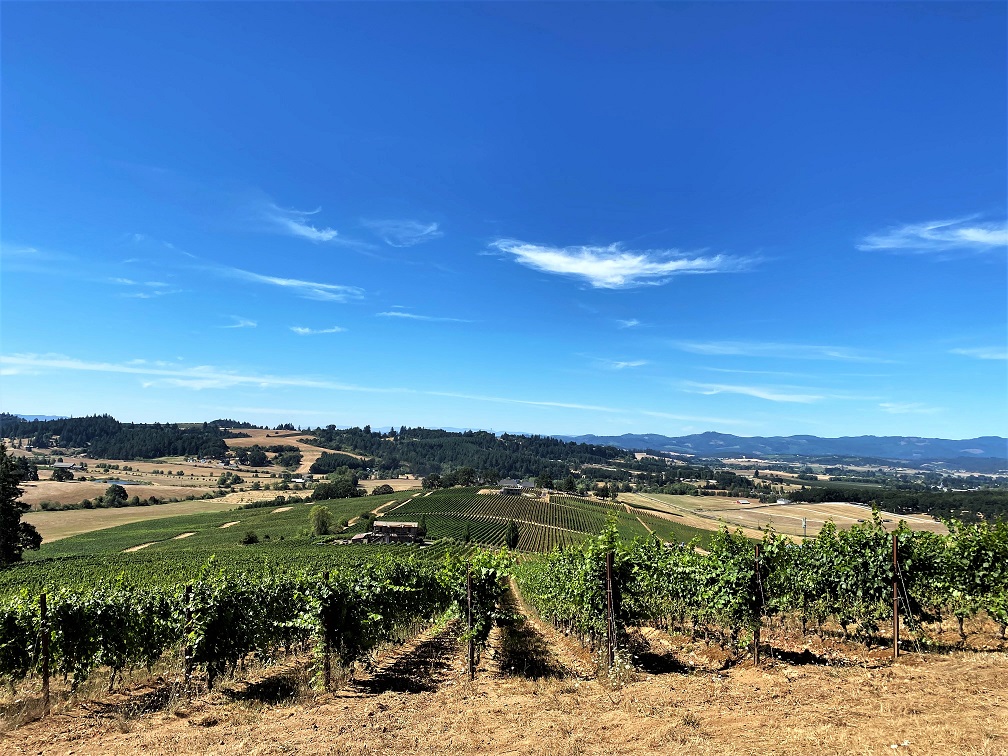

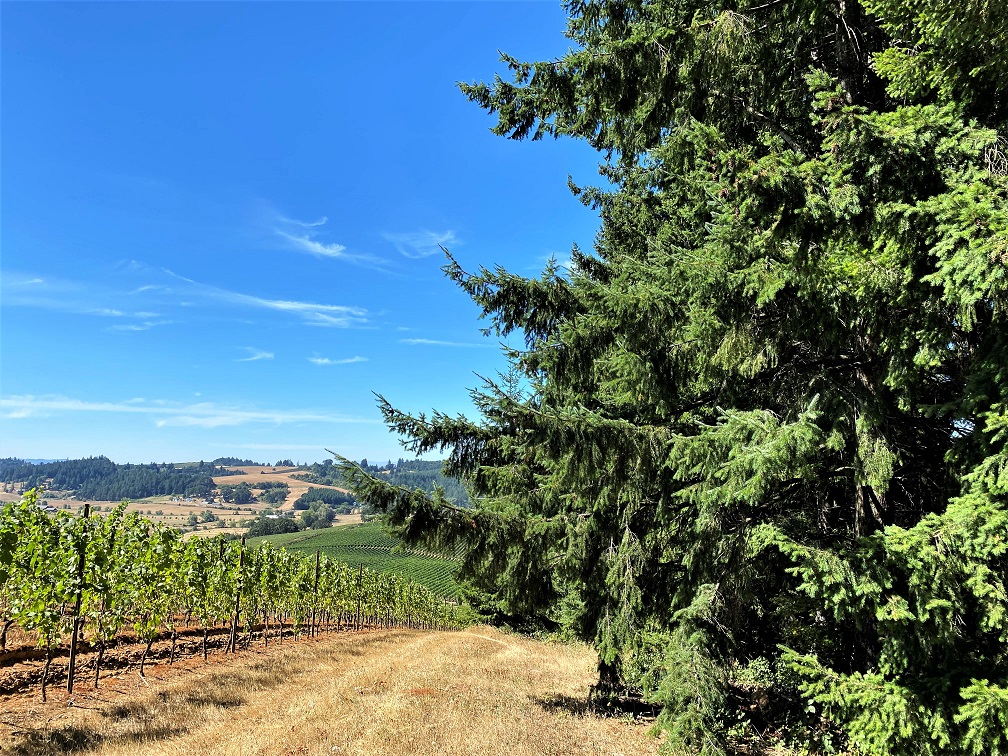
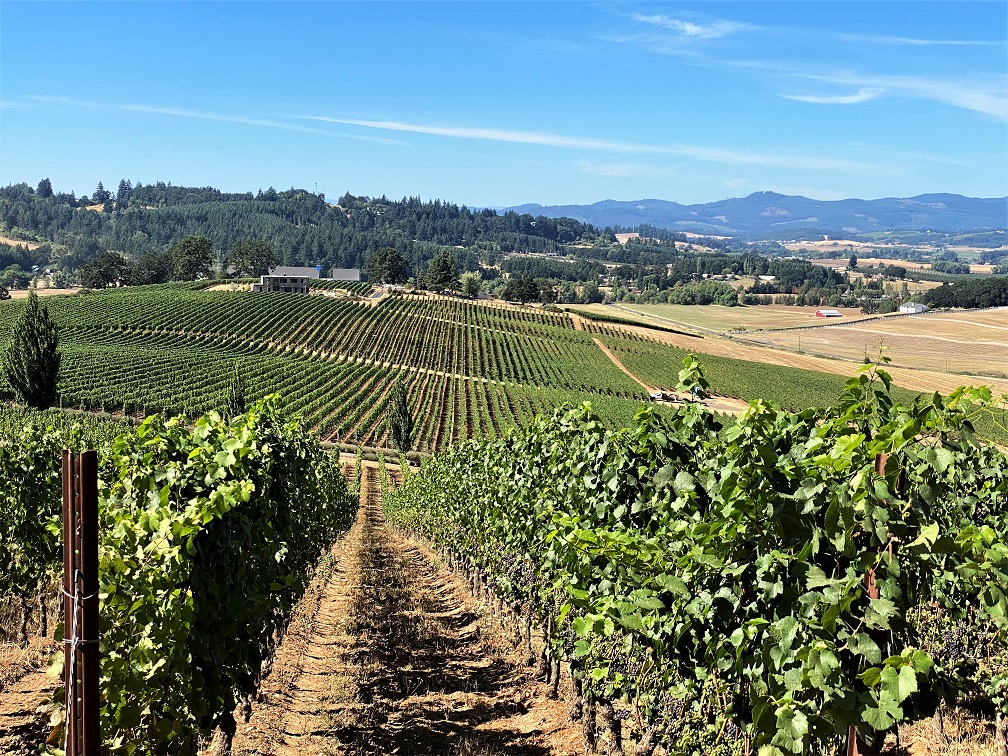
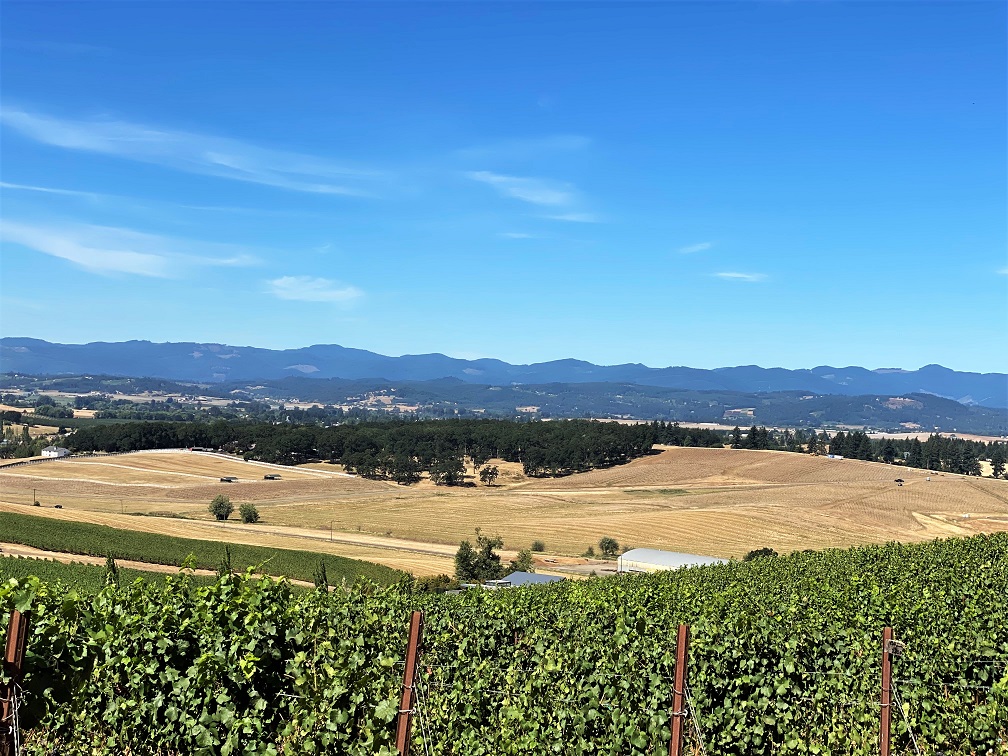
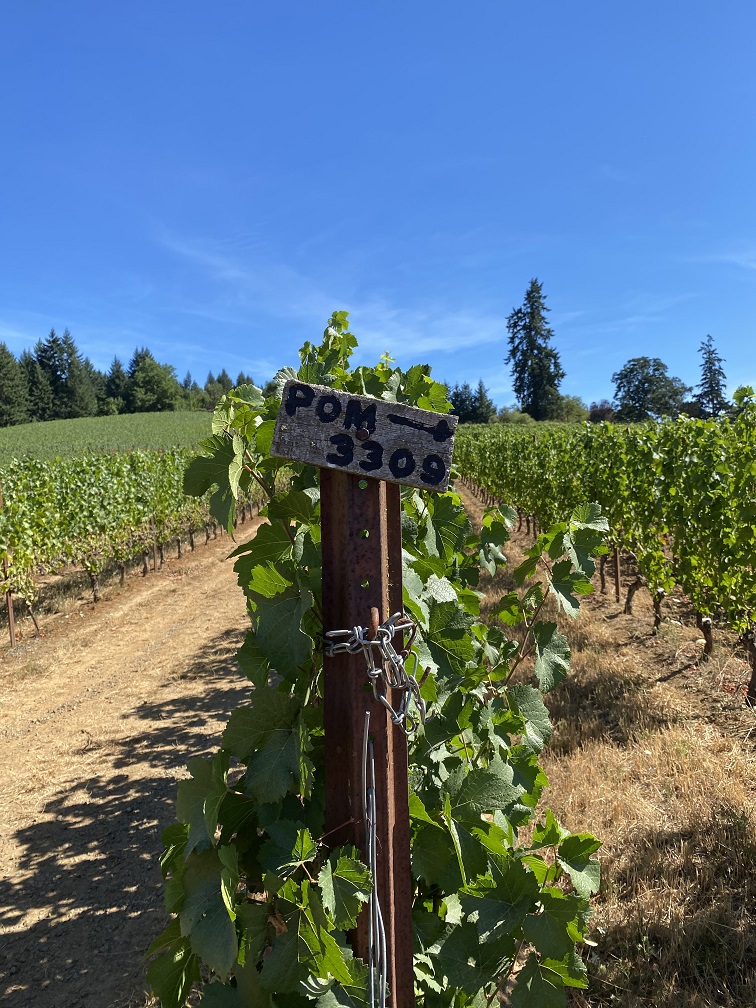
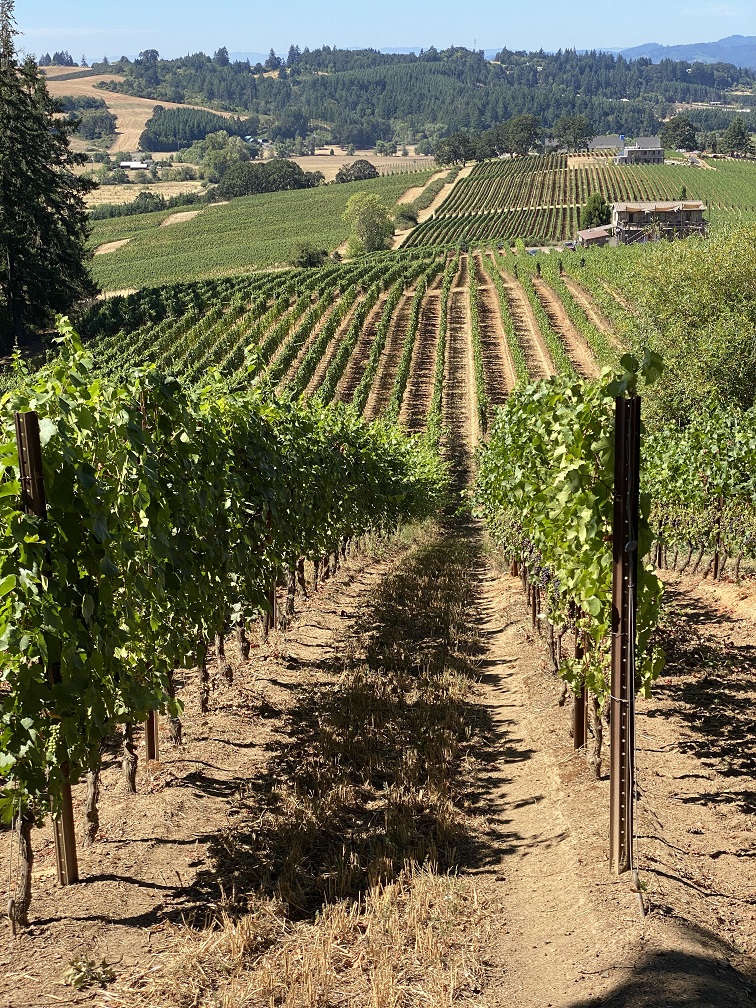
Yes, it is steep!
We talked about winemaking, and Steve mentioned that he typically prefers using commercial yeasts, because they produce more reliable and predictable results – however, he is not foreign to the idea of indigenous yeast, as we tasted in one of the wines. When we spoke back in 2016, Steve was not very big on producing white wines – I was happy to see that he changed his mind and now offers Lenné Estate Chardonnay. However, more as an exception to the rule at this point, Steve is still not ready to produce sparkling wines – however, I hope that this will change at some point – we will have to see.
After the walk, we went back to the tasting room, where Steve set up a full tasting, including the charcuterie and cheese boards.


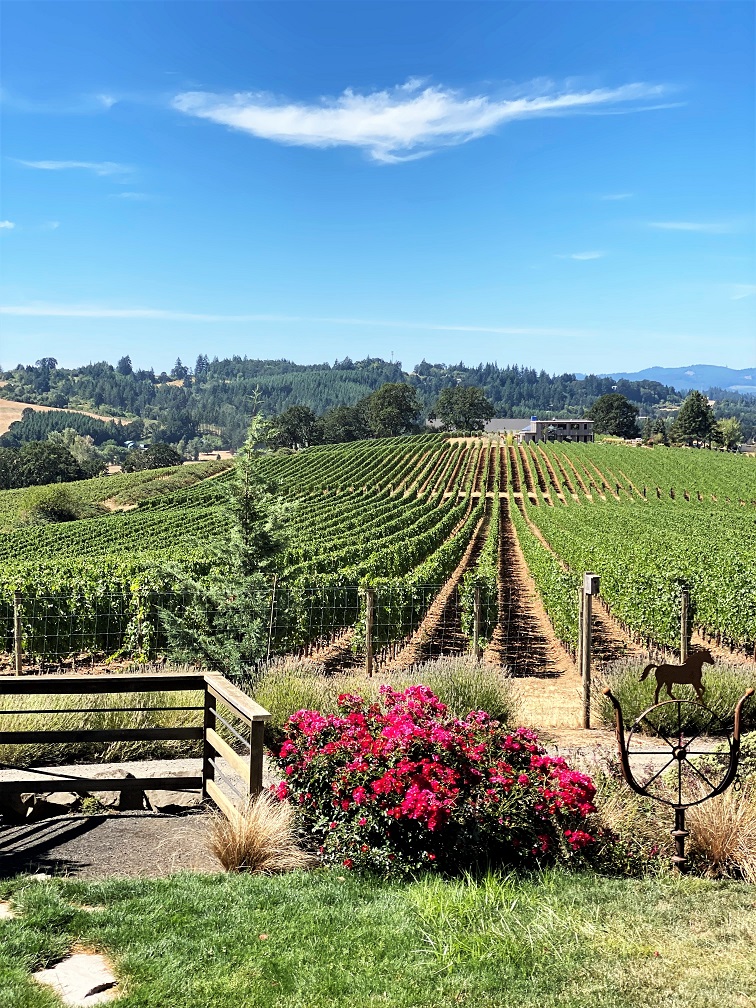
View from the tasting room
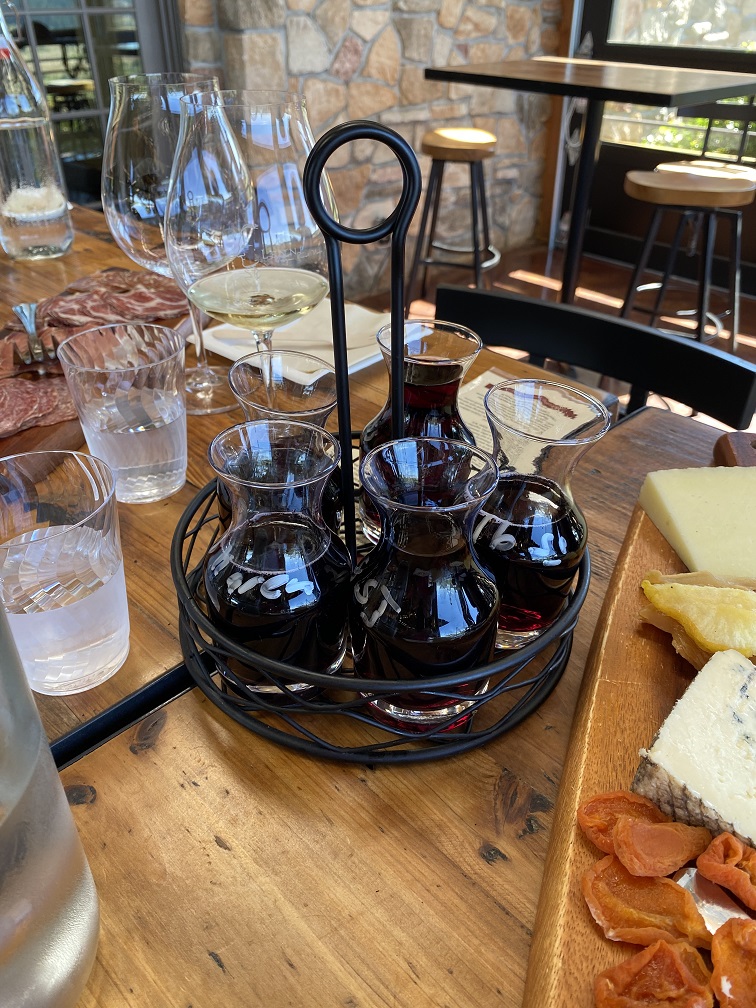
We started tasting with the Chardonnay, which was excellent
2019 Lenné Estate Scarlett’s Reserve Chardonnay Yamhill-Carlton AVA ($58)
A touch of honey, herbs, restrained
Crisp acidity, fresh, bright, Granny Smith apples, a touch of vanilla, creamy, excellent
8
Next, of course, we moved to the Pinot Noirs, where we tasted the whole range – here are tasting notes for the wines including some additional comments regarding the vintage and winemaking:
2017 Lenné Estate South Slope Pinot Noir Yamhill-Carlton AVA ($55)
Hot vintage with a big fruit set
Beautiful nose of sweet cherries and raspberries
Wow, red fruit all the way, cut through acidity, perfect balance
9-, superb
2016 Lenné Estate South Slope Pinot Noir Yamhill-Carlton AVA ($55)
Early vintage, cool August, harvest done by mid-September
Cherries, sage, floral notes
Clean, tart cherries, warm notes, good acidity,
8-
2018 Lenné Estate Sad Jack 777 Pinot Noir Yamhill-Carlton AVA ($55)
Indigenous yeast, spontaneous malolactic
Tart cherries, a hint of cherry pie, savory note
Tart cherries, clean, balanced, crisp, superb
8+
2018 Lenné Estate Karen’s Pommard Pinot Noir Yamhill-Carlton AVA ($60)
Commercial yeast and forced malolactic
Cherry, cherry pie, sweet oak
Tart cherries, dark fruit, good balance, well integrated tannins
8


The last wine was a culmination point of the tasting. “Cinq Élus” means “five chosen”, which in the case of this wine means five best barrels and 5 clones. The wine was simply superb:
2018 Lenné Estate Cinq Élus Pinot Noir Yamhill-Carlton AVA ($85)
5 best barrels from the vintage, 5 clones
The succulent nose of red and black berries, distant hint of gunflint, herbs, great complexity
Restrained, cherries, layered, complex, perfectly integrated, tannins come through on the finish, superb
9-
While we were tasting the wines, we also talked about blind tasting events which Steve runs at the winery, where attendees get an opportunity, for example, to compare Oregon Pinot Noir with the Burgundy, or Yamhill-Carlton Pinot Noir with Dundee Hills Pinot Noir and so on – here you can see what blind tastings are offered. Steve also leads European wine cruises where everything revolves around food and wine, as you can imagine – here you can find information about those.
On the Lenné Estate website, there is also an interesting section called Vintage Charts. Here you can find general information regarding the suggested drinking window for Oregon Pinot Noir in general, as well as particular recommendations specifically pertaining to the Lenné Estate wines.
There you are, my friends. If you are looking for mature, confident, and simply delicious Oregon Pinot Noir, you don’t need to look further than Lenné Estate.
But we are not done here yet. More Passion and Pinot updates are coming – stay tuned…
This post is a part of the Stories of Passion and Pinot series – click the link for more stories…
Passion and Pinot Updates: Youngberg Hill Vineyard
I virtually met with Wayne Bailey of Youngberg Hill Vineyards in September of 2016. Now, 5 years later, I was able to actually shake his hand, listen to the stories face to face and taste the latest wines.
We arrived at the winery in the morning and went on to meet Wayne at the winery building, which also serves as Bed and Breakfast. The views from the terrace of that building were simply incredible – I walked around trying to snap as many pictures as I could.
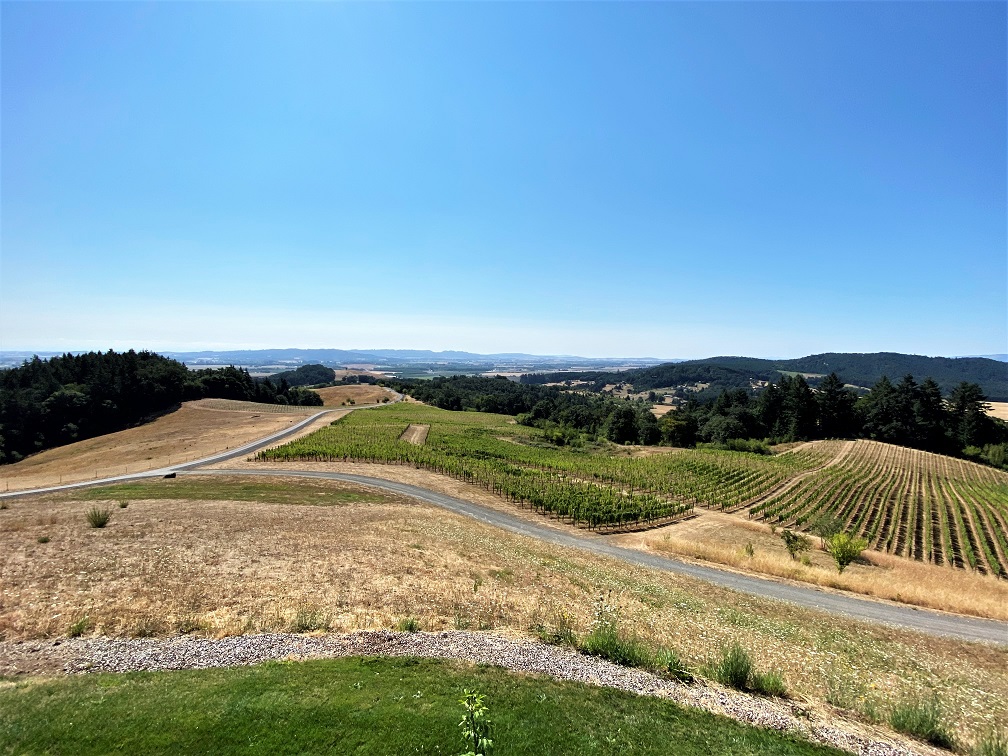
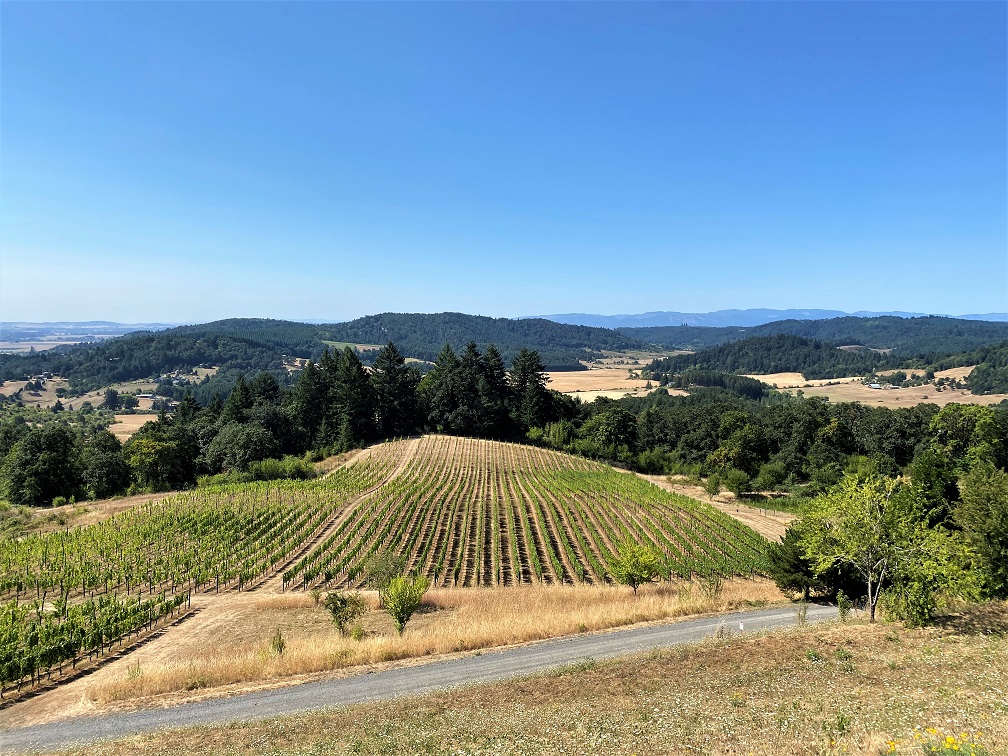
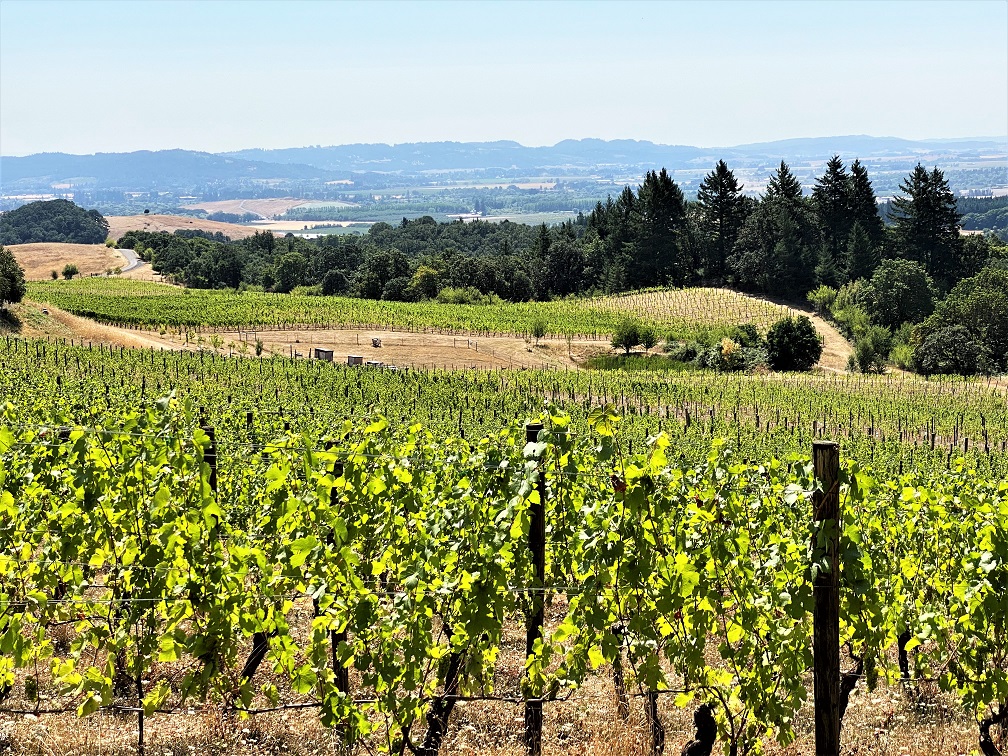
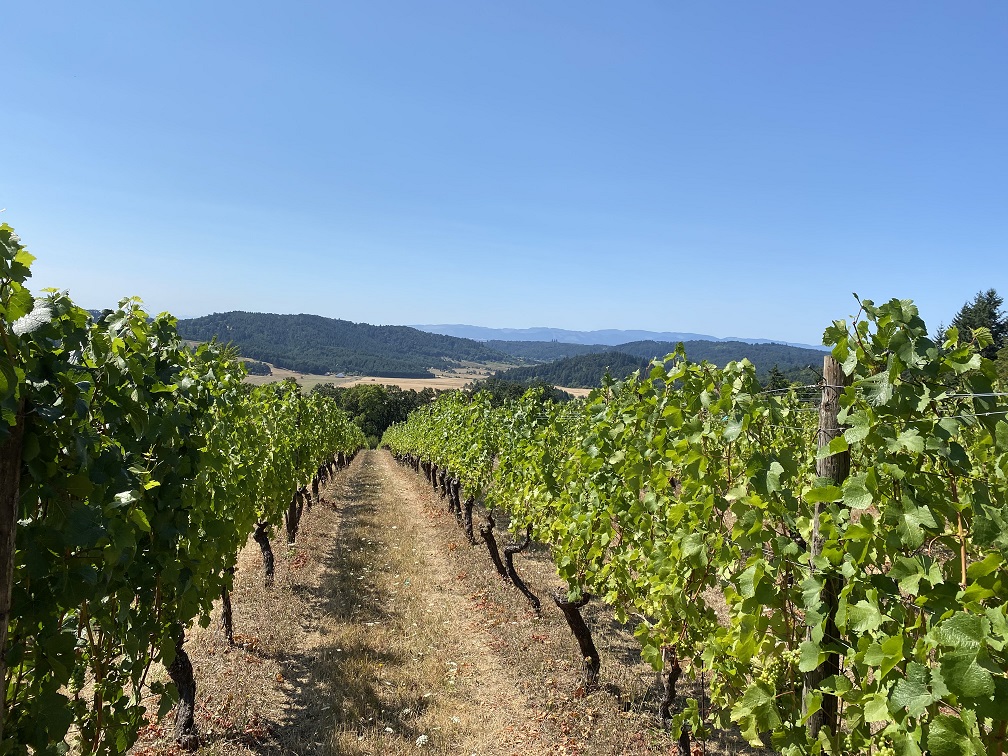
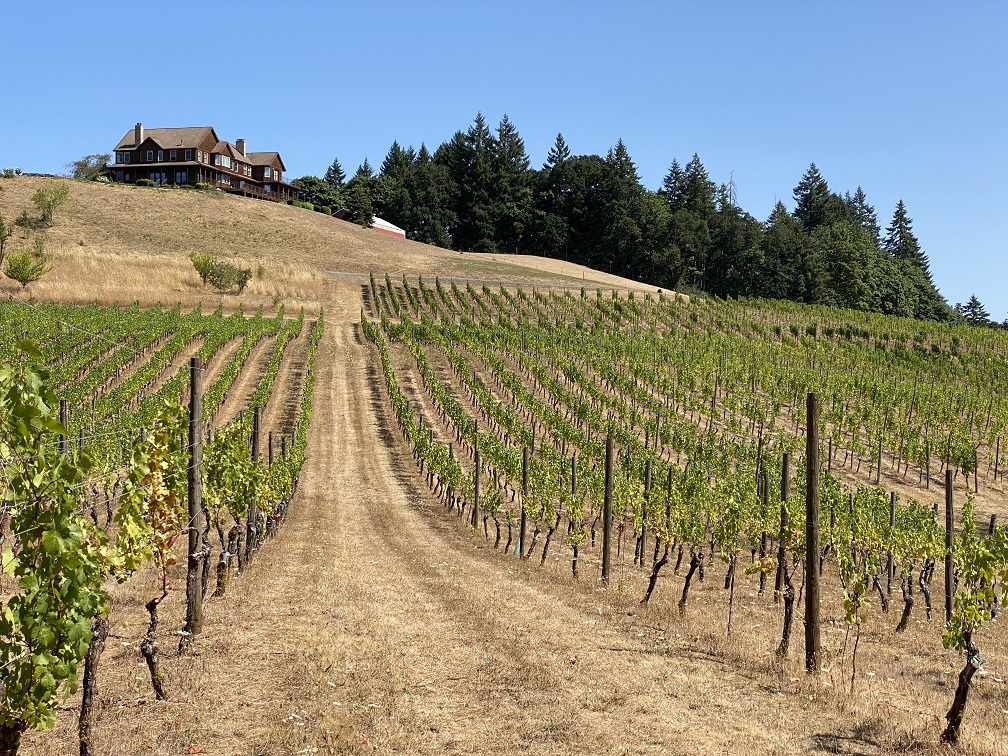


After meeting Wayne, we went on a tour of the estate. Actually, we drove around the vineyards in the baggie which Wayne was driving. Again, more of the beautiful views all around. We also got to meet a few of the cute animals which call Youngberg Hill home.


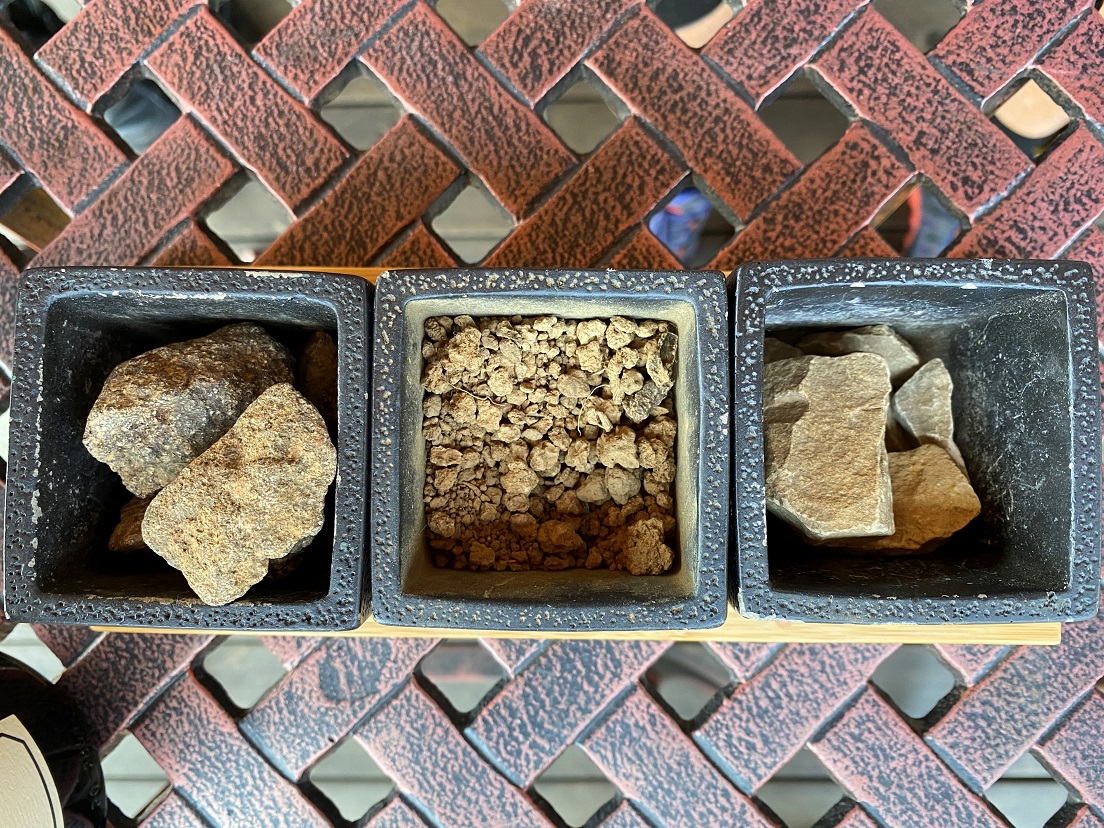
At the Youngberg Hill estate, it is all about the Bailey family – Wayne, his wife Nicolette, and daughters Natasha, Jordan, and Aspen. The Youngberg Hill vineyards were first planted in 1989 when the estate was founded, 12 acres of Pinot Noir vines. These 12 acres are divided into two blocks – 7 acres of Natasha block at the altitude of 600 feet on marine sediment soils, and 5 acres of Jordan block on volcanic soils at the altitude of 800 feet. There is 2 degrees difference in average temperatures between these two blocks, and as the Jordan block is a little bit cooler, the grapes usually ripen later than the ones on Natasha Block, with about 10 days difference in pick time.


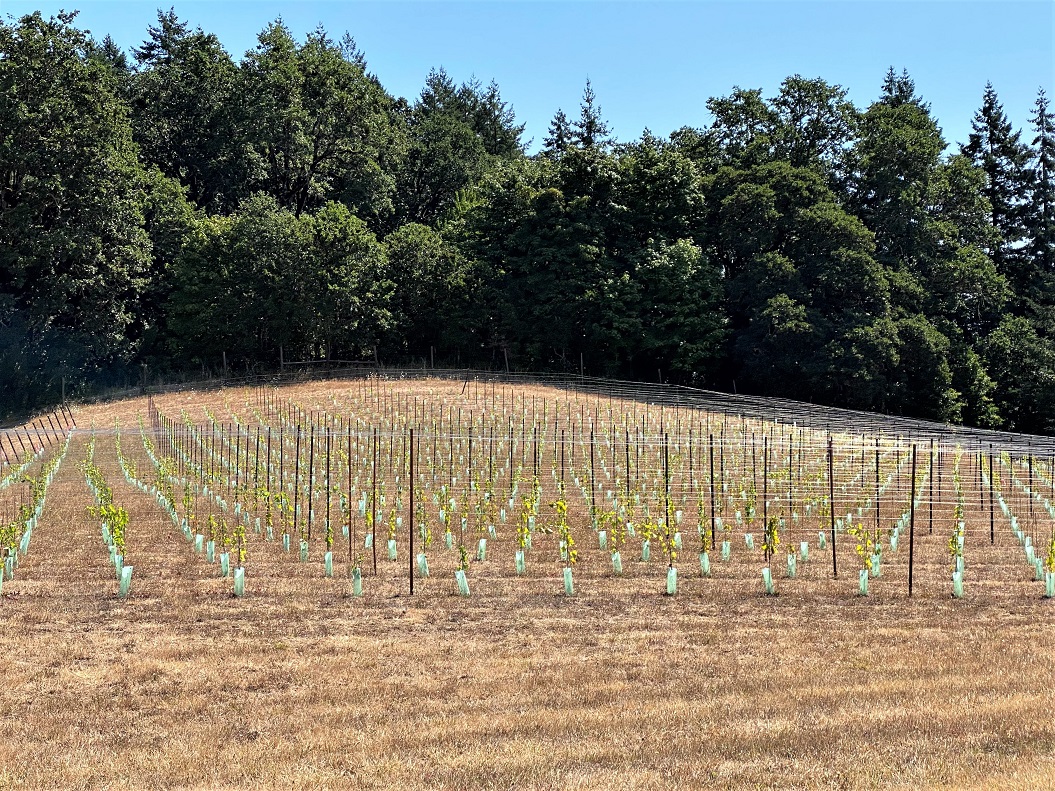
Aspen block was first planted in 2006 with 5 acres of Pinot Gris. In 2014, half of the block (2.5 acres) was grafted over to Chardonnay. In 2008, Bailey’s block was planted with 3 acres of Pinot Noir, at 700 feet altitude and predominantly volcanic soils.
When we spoke back in 2016, 20 acres of vineyards were planted on the 50 acres estate. I asked Wayne if he has any plans to add additional plantings, and got a simple “no” answer. Well, I guess the old adage of “never say never” is perfectly at play here, as in 2018, 3 acres of Wayne’s World block was planted with two more clones of Pinot Noir, bringing a total to 5 clones, if I’m not mistaken. This block was planted mostly on marine sediment soils at an altitude between 500 and 600 feet.
 Here you can see a sample of the soils at Youngberg Hill Vineyards.
After we finished the tour, it was time to taste the wines.


I was happy that we started our tasting with the sparkling wine – this is almost something you now expect from Oregon wineries. Similar to the sparkling wine we had at Le Cadeau, this wine was also made with first-pass grapes. The wine spent 2.5 years on the lees, so it is called the Extended Tirage sparkling.
2018 Youngberg Hill Vineyards Extended Tirage Sparkling Eola-Amity AVA (12.5% ABV, $55)
A touch of apple and vanilla
Crisp apple notes, fresh, good acidity, good body, delicious. Lingering acidity on the finish
8, excellent


Next, again to my delight, we had a couple of Chardonnays:
2019 Youngberg Hill Vineyards Aspen Chardonnay McMinnville AVA (12% ABV, $45)
Beautiful nose of apples, vanilla, and a touch of honey
Crisp, clean, great acidity, wow.
8, it would be amazing with age
Another change at the Youngberg Hill Vineyards since we last spoke was the new wine label introduced in 2019 – Bailey Family Wines. Bailey Family wines comprise a selection of the best plots and barrels. In addition to sparkling, Chardonnay, and Pinot Noir, the Bailey Family wines range also includes Grenache sourced from the Rogue Valley. We tasted the latest vintage of Bailey Family Chardonnay which was superb:
2018 Bailey Family Chardonnay McMinnville AVA Willamette Valley (13.4% ABV, $85)
Herbal notes, a touch of butter, honey, minerality
Great complexity, mouthwatering acidity, lean, green apples, a touch of sage. Perfect balance
8/8+


Next, we had the pleasure of going through the selection of the Pinot Noir wines, both current vintages from Natasha and Jordan blocks, as well as reserve wine, Nicolette’s Select:
2018 Youngberg Hill Vineyards Natasha Block Pinot Noir McMinnville AVA (14% ABV, $60)
Ripe cherries and cranberries
Restrained, tart cherries, firm structure, dusty palate, excellent balance.
8+
2018 Youngberg Hill Vineyards Jordan’s Block Pinot Noir McMinnville AVA (13.8% ABV, $60)
Cherries and violets
Bright popping ripe cherries, good acidity, perfect balance.
Both [Natasha Block and Jordan Block] are built for the long haul.
8+
2015 Youngberg Hill Vineyards Nicolette’s Select Pinot Noir McMinnville AVA (14.1% ABV, $85)
Great bouquet on the nose, cherries, pencil shavings, underbrush
Wow, an interplay of cherries, cranberries, mushrooms, dusty palate, layered, balanced
9-, superb.
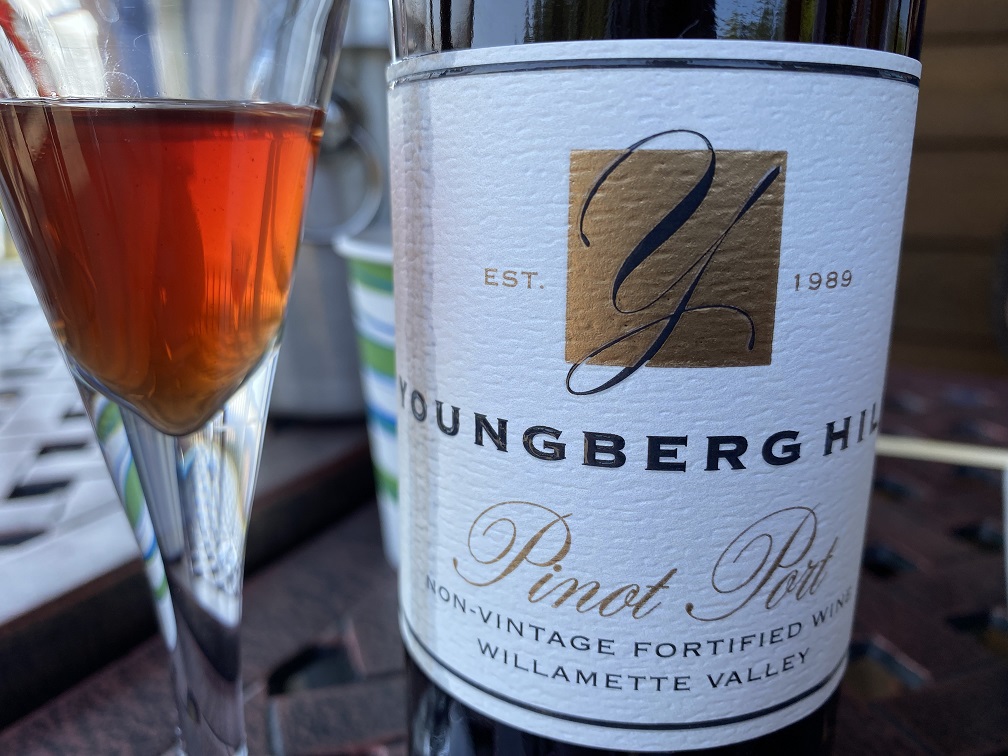
I keep going back to our 2016 conversation with Wayne. While preparing the interview questions I learned that Youngberg Hill produces a really unique wine – Pinot Port, as it was called – a Port-style wine made out of Pinot Noir grapes, something which I never heard of before. So now, being at the winery, I couldn’t miss the opportunity to taste the Pinot Port. Wayne was somewhat hesitant about it, as I don’t believe he is making this wine anymore, but I had my wish granted and had a sip of this delicious beverage:
NV Youngberg Hill Vineyards Pinot Port (19% ABV, $NA, 25 cases produced)
Nicely aged wine, dried fruit, good balance, very pleasant
There you are, my friends. Another story of Passion and Pinot, with the Pinot Noir (and Chardonnay, and bubbles) of truly a world-class, and in its own, Oregon style. These wines are worth seeking, and if you want to spend a few days in the wine country, surrounded by incredible views and delicious wines, that Inn at the Youngberg Hill sounds really, really attractive.
I got more of the Passion and Pinot updates to share with you, so until the next time…
This post is a part of the Stories of Passion and Pinot series – click the link for more stories…
American Pleasures #5: Burgundy in California, or the Wonders of Pop’n’Pour
Wine should give you pleasure – there is no point in drinking the wine if it does not. Lately, I had a number of samples of American wines, that were the delicious standouts – one after another, making me even wonder if someone cursed my palate. I enjoyed all of those wines so much that I decided to designate a new series to them – the American Pleasures.
Burgundy in California. Nonsense, right? Burgundy is located in France, and the last thing you want to hear is a review of Hearty Burgundy, proudly produced by Gallo (believe it or not, but you can still buy this wine at about $9 for 1.5L – a great deal, huh?). Rest assured – Gallo is the last wine I want to ever discuss on this blog. I would like, however, to talk about Burgundy’s star grape varieties, which are also working amazingly well in California – yes, you got it – Chardonnay and Pinot Noir.
California produces a lot of wine (#4 in the world, with 248 million cases in 2018), using a lot of different grapes – no matter where those grapes are typically from – from Clairette Blanc to Viura to Nebbiolo to Grenache to Tempranillo, you should expect to find them all in Californian wines. Aside from all of the abundance, there are some grapes that can be called California superstars.
With the white grapes, it is easy – Chardonnay clearly steals the show. California made Chardonnay its own way back, with Chateau Montelena already proving its prowess to the whole world by winning Judgement of Paris in 1976. Chardonnay’s style changed and changed again since those early days of success, and when you are opening a bottle of California Chardonnay today, very often you don’t know what to expect – too much butter, too little butter, too much oak, no oak. Most importantly, you have no guarantees that you will enjoy that bottle.
Speaking about red grapes, ask a wine lover to name the most famous California red grape, and I’m sure 9 out of 10 will say Cabernet Sauvignon. I love California Cabernet Sauvignon as much as every one of those 9 out of 10 people. But based on my experience, the majority of the California Cabernet Sauvignon need time and time again to mellow down, to transform, to become truly enjoyable, and not just “drink the label and keep smiling” type of beverages. California Pinot Noir typically give you a lot more hope for finding the delicious Pop’n’Pour wines. And don’t forget – Pinot Noir, Chardonnay – it is the pleasure we are looking for here, so “pop, pour, drink, and ask for a second glass” is a sequence of events we are hoping for in here.
Here is a collection of the well-known wines I had the pleasure of enjoying – and have been blown away by the Pop’n’Pour quality, truly.
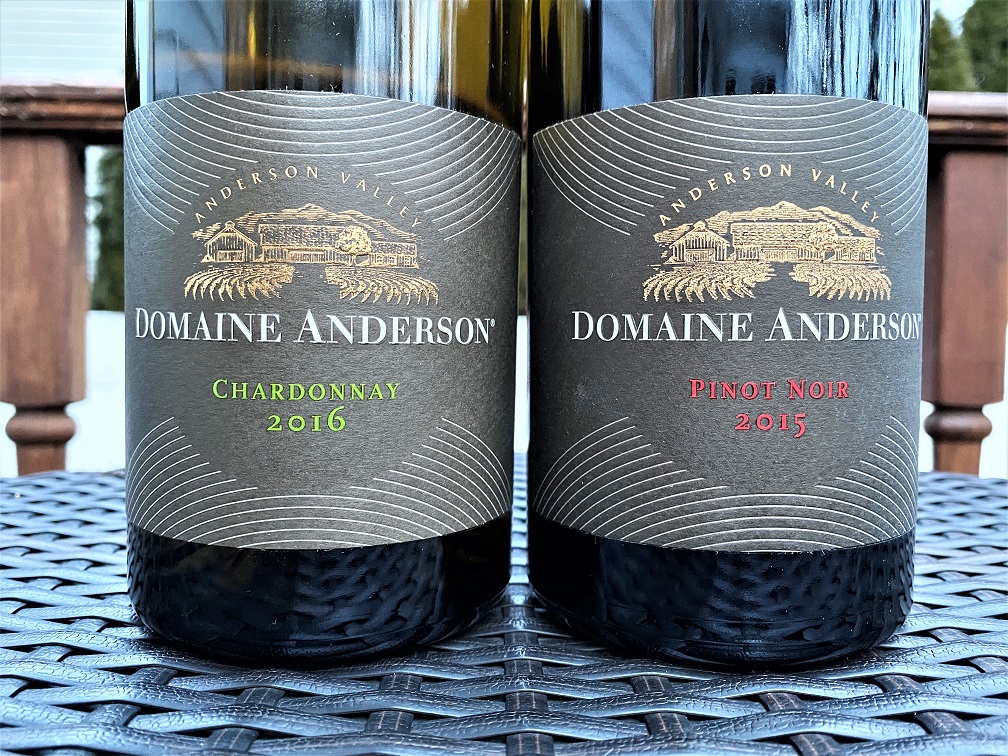
Domaine Anderson takes its roots from 1981, when Jean-Claude Rouzaud, patriarch of the Louis Roederer family came across Anderson Valley along the Mendocino coast in California, in search of the perfect spot to grow Chardonnay and Pinot Noir. Today, Domaine Anderson continues to be run by the Roederer family, farming organically and biodynamically 50 acres of Chardonnay and Pinot Noir vineyards. Here are 3 wines I had an opportunity to taste which were all just a perfection from the moment they were poured into the glass:
2017 Domaine Anderson Chardonnay (13.5% ABV, $30)
Light golden
Touch of honey, a hint of smoke, minerality
Clean acidity, tart lemon, a touch of smoke, texturally present, medium-plus body, earthy underpinning.
8/8+, this wine screams Chablis to me. Superb.
2015 Domain Anderson Pinot Noir Anderson Valley (13.8% ABV, $39.99, 15 months in French oak barrels, 19% new)
Dark ruby
Smoke, violets, earthy notes
Nicely restrained, good minerality, a touch of tart cherries
8, delicious
2017 Domaine Anderson Pinot Noir Anderson Valley (13.6% ABV, $45, 15 months in French oak barrels, 8% new)
Dark Ruby
Stewed plums, smoke, earthy undertones
Plums, cherries, lavender, tar, smoke, sweet tobacco, crisp, fresh, clean acidity, excellent balance
8, nicely restrained Pinot Noir, not over the board.
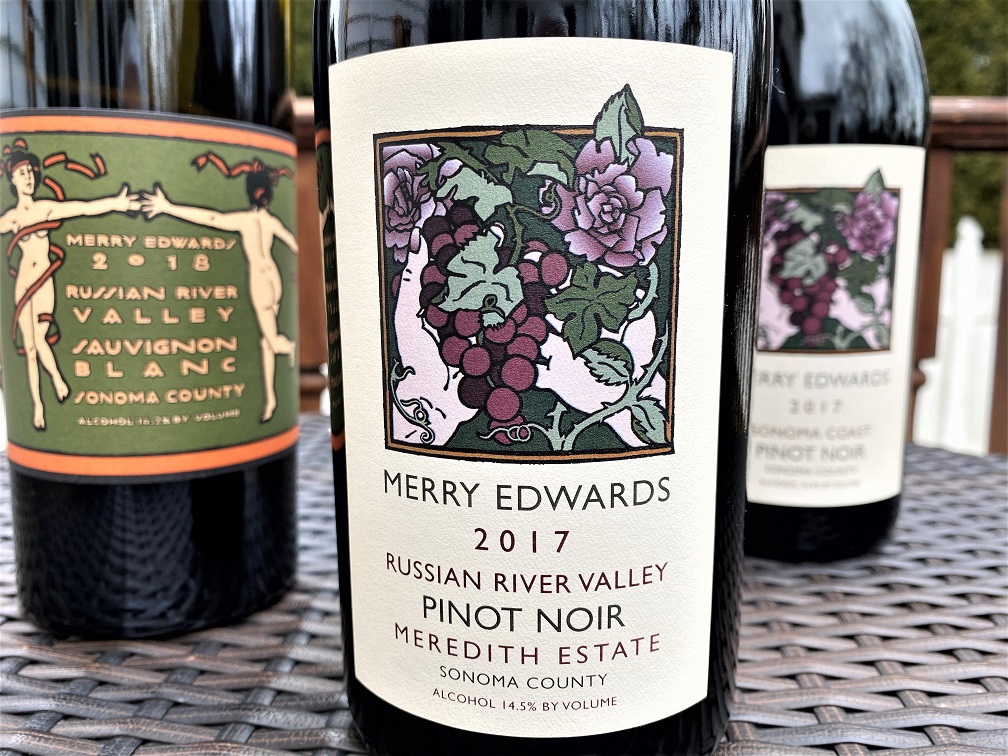
Merry Edwards Winery needs no introduction to wine lovers. Bright and noticeable labels always stand out on the shelf, it is hard to miss them. Merry Edwards’s sole focus is on the Russian River Valley Pinot Noir, which was first produced in 1999 (vintage 1997) – but she is also well known for her Sauvignon Blanc which was first produced in 2001. In addition to the passionate pursuit of Pinot Noir, Merry Edwards is also very passionate about sustainability, which is fully embraced at the winery and in the vineyards – you can read more about sustainability philosophy here.
2017 Merry Edwards Pinot Noir Meredith Estate Russian River Valley Sonoma County (14.5% ABV, $68)
Dark Garnet
Sage, tar, coffee, eucalyptus, freshly crushed dark berries
Tart, fresh cherries, crisp acidity, bright, invigorating
8, very uncalifornian, more Italian than anything else.
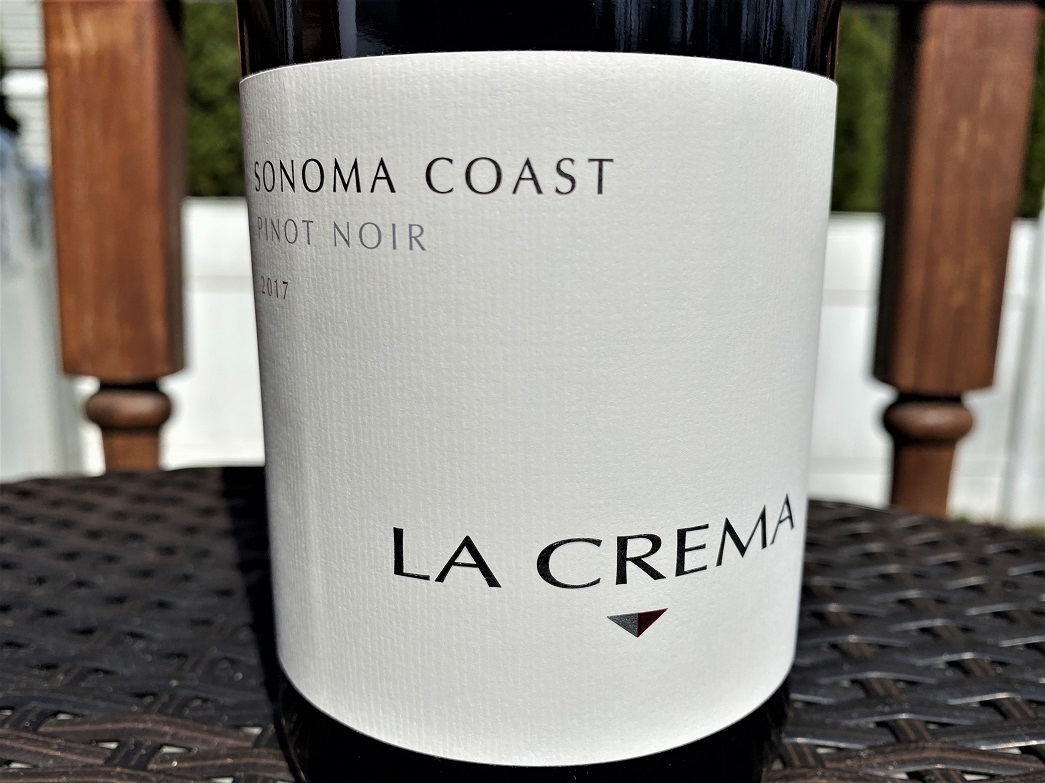
Considering how widely available La Crema wines are, I always made an effort to avoid them as “mass-produced”. After I tasted the wine, I completely changed my opinion – the wines might be produced in large quantities, but these are well-made wines. Also, the winery website has lots of good and well-presented information.
2017 La Crema Pinot Noir Sonoma Coast (13.5% ABV, $25)
Dark intense Ruby
Plums, fresh herbs, mineral undertones
Ripe fresh plums, mint, a touch of stewed strawberries, good acidity, good balance. Interestingly spicy finish.
8-, nice
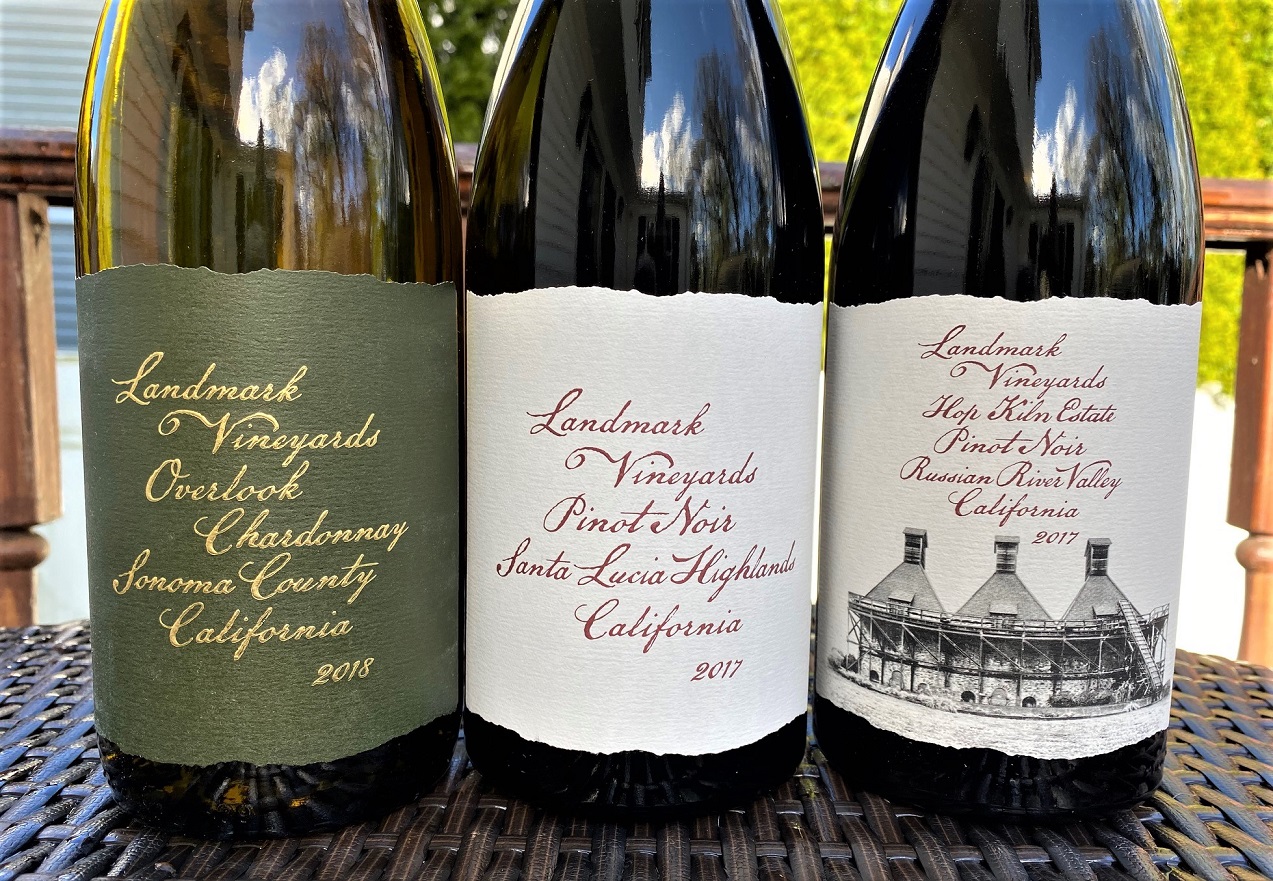


Landmark Vineyards was founded in 1974 by a group of people that included Damaris Deere Ford, the great-great-granddaughter of John Deere. In 1991, Damaris Deere Ford, now a sole proprietor of the Landmark Vineyards, focused exclusively on the production of Chardonnay and released the first vintage of the flagship Overlook Chardonnay. In 1993, Helen Turley started working as a consulting winemaker helping to create the Landmark’s signature style. Two years later, Landmark released the first vintage of its Pinot Noir under the name of Great Detour. In 2016, Landmark Vineyards extended into the Russian River Valley via the acquisition of the Hop Kiln Estate – and this was one of the wines I had an opportunity to taste.
2018 Landmark Vineyards Overlook Chardonnay Sonoma County (14.3% ABV, $27)
Light golden
Vanilla, apple, lemon
Vanilla, a touch of butter, golden delicious apples, citrus profile, roll-off-your-tongue round, excellent balance, delicious
8/8+, excellent
2017 Landmark Vineyards Pinot Noir Santa Lucia Highlands (14.3% ABV, $45, 14 months in French oak, 35% new)
Dark ruby
Plums, dirt, forest floor
Plums, cherries, tobacco, iodine, short finish, good acidity, good balance.
8-, excellent and classic
2017 Landmark Vineyards Pinot Noir Hop Kiln Vineyard Russian River Valley (14.5% ABV, $40, aged in 40% new French oak)
Intense ruby
Cherries, underbrush, the nose says Oregon with dark intensity
Tart cherries, dark chocolate, tobacco, complex bouquet
8/8+, superb.
Here are you – a collection of delicious Pop’n’Pour American Pleasures. And don’t worry, I have a lot more wines to share with you. Cheers!
Last Bottle Sign Up ($10 credit)




 Talk-A-Vino