Archive
Month in Wines – October 2013
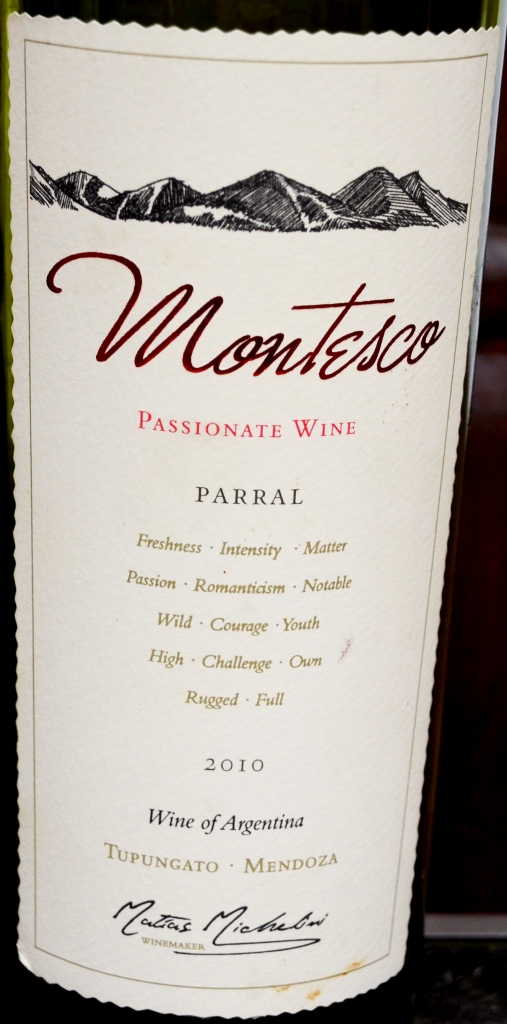
Montesco Passionate Wine
Another month is passing by, and it is the time to summarize the best experiences. Definite highlight of this month were all the wonderful wines I tasted in Portugal – the 1970 White Port is hard to topple – but there were other great wines…
Without any particular order, here we go:
2010 Montesco Passionate Wine Parral, Tupungato, Mendoza (14% ABV, 40% Malbec, 30% Cabernet Sauvignon, 30% Bonarda) – the name says it all. Very inviting nose, layers of fruit, dark cherries, blackberries, supple tannins, energetic acidity and joy in every sip – excellent wine all around. 8+
2009 Turley Zinfandel Tofanelli Vineyard, Napa Valley (15.2% ABV) – dark, concentrated, with the core of traditional Zinfandel’s blackberry aromatics and palate, perfectly accentuated by espresso and dark chocolate notes. Perfectly dry, structured, firm and balanced, with a long finish. 9-
NV Lagranja 360 Cava Brut (11.5% ABV, 70% Xarel-lo, 30% Parellada) – simple and elegant, perfectly refreshing, just a touch of sweetness, good acidity, very balanced overall. 8-
NV Egly-Ouriet Brut Tradition Grand Cru, Ambonay (70% Pinot Noir, 30% Chardonnay) – a beautiful wine. Touch of yeast on the nose, crisp acidity and noticeable fruit notes on the palate. Outstanding. 8+
NV H. Blin Brut, Vincelles (80% Pinot Meunier, 20% Chardonnay) – perfect acidity with somewhat of a medium body, nice mid-palate weight, very round. Excellent. 8-
NV Pierre Gimonnet & Fils 1er Cru Brut Blanc de Blancs Sélection Belles Anneés (100% Charodnnay) – very nice nose of brioche and touch of apple, same on the palate with some interesting mineral undertones. Very good. 8-
2003 Quevedo Colheita Tawny Port (barrel tasted) – mature, dried fruit, like figs and may be dried apricots, but it was very balanced and still perfectly fresh. 8+
1996 Quevedo Colheita Tawny Port (barrel tasted) – outstanding, mature, with the perfect medley of dried fruit, figs, raisins, and excellent supporting acidity. 9-
1970 Quevedo White Port (barrel tasted) – Elegant, complex, somewhat reminiscent of the mature Pedro Ximenez sherry, but with the dialed back sweetness, perfectly mature fruit, hazelnuts and, believe it or not, still very refreshing and all around spectacular. 9+
1974 Quevedo Colheita Tawny Port (tasted pre-bottled) – very complex, with the good amount of dried fruit, that nuttiness which only well aged Port or Jerez can demonstrate, all with still very present acidity. 9
2007 Arrayán Petit Verdot, DO Mentrida, Spain (14% ABV, 100% Petit Verdot) – concentrated, powerful, very dense, firm and structured, but showing some nice blueberries. Noticeable earthiness with some pencil shavings. 8
2007 Jamesport Vineyards Petit Verdot Reserve, Long Island, NY – powerful, all around dark fruit, notes of the dark chocolate, soft tannins, balancing acidity. Needs some time to open. Will age nicely for the next 10-15 years. 8
2005 Jamesport Vineyards Merlot Block E, Long Island, NY (13.5% ABV, 80% Merlot, 10% cabernet Sauvignon, 10% Syrah) – beautiful nose of dark fruit and chocolate. Velvety, silky slick on the palate, layers of supple dark fruit, soft tannins, clean acidity, overall very balanced with long, sexy finish. 8+
2012 Ernie Els “Big Easy” Chenin Blanc, Western Cape, South Africa – nice body presence – medium to full body, somewhat plump with white stone fruit notes and soft acidity. Overall, very pleasant. 8-
That should be about all for the month of October. Did you have any memorable wine experiences? Care to share? Cheers!
Port Barrels and Harvest
There are days when everything goes wrong. And then there are days when everything goes right (hmm, which one do you prefer?). And sometimes the bad day just … changes in the middle, and becomes a great day (yes, the worst case scenario is when the best day becomes a complete disaster, but let’s not go there, okay?).
My day didn’t start all that well. During the trip to Portugal, I had one and only one free day when I could take a drive along the Douro river and visit some wineries. Before the arrival, I asked the hotel to reserve the rental car, which should be automatic (yeah, I know, it is a substantial handicap – never learned how to drive the manual) and have GPS. Hotel’s email said “no problems, all arranged as you requested”.
We arrived at the Europcar rental pretty much as planned – a little bit after 9 am. I figured we will get a car, drive for about 2 hours, and will have enough time to visit 3 wineries. For some reason, the lady at the counter took about 40 minutes to do the paperwork. Finally, we get portable GPS, and then we are doing the walk around of a small car (I’m happy – my preference in Europe is to drive the compact car, as in the end of the day you need to park the car somewhere, and small car is a lot easier to deal with). All the little scratches are noted, we get inside. I put the key in the ignition, stat the car, and … oh shit, I can’t drive it – it is a stick-shift. I’m walking back to tell the lady that this is not the car which was requested, and that I can’t drive this car (meanwhile, I’m literally swearing at myself for not asking from the beginning about type of the transmission the car has – pretty much an hour of time is wasted). The lady (to be honest with you – I had a sneaky desire to avoid her from the first minute I saw her), proudly tells me that I got the car I requested. And after I explained that I can’t drive stick-shift, and I need an automatic car, she also happily informed me that there is nothing she can do.
Luckily, the second agent is free now, and I plead my case to her (the perspective of simply spending the day aimlessly wandering around Porto somehow doesn’t excite me even for a second). She at least tells me “let me see what I can do” – I also see the face of her colleague (the first lady) clearly expressing the hope that I would just walk away, not drive away in one of their coveted automatic cars.
The girl who is trying to help us is making a quick call and then tells me that yes, she has a car – but it will cost twice as much (€140). At this point, again, we have no choice, so yes, thank you, this is wonderful, can we have that car as soon as possible? Well, not so fast, she says – the car must be washed and re-fueled. My plea that dirty car will be just fine, and that I know how to fill the car, dies in vein. “It will be only 15 minutes”, she says. Finally, one hour later, we are presented with the white behemoth. We get in, and we pretty much have to start driving immediately as we are blocking someone’s private garage entrance, and the person who is trying to get out is not very happy with that. I barely manage to get this car to move, as some genius designed the parking on/off knob to be a separate button to the left of the steering column, functionally co-located with the parking brake…
I pull to the other side of the street and try to operate GPS – you see, that winery, called a “Quinta” in Portugal (which simply means “a farm”), doesn’t have a street address. The genius of the car design definitely had its say on GPS, as in that particular GPS you can’t enter a zip code, nor you can find a POI, as it only allows you to search for the places located right around you, and not at a distance of 140 km… Anyway, while I’m about to go back and to say that I’m not driving that piece of sh.. anywhere, my friend manages to enter just the town for our destination, and he also manages to calm me down (thank you, Sumit!), so off we go…
Once we get to the highway, my mood is improving (I actually love driving). Once we get off the highway (which is about 25 miles down the road), and we hit the small road going mostly along the river, I’m in nirvana… And who will not be, when this is what you see all around:


After driving for about 2 hours, we arrived to the town of S. Joao da Pesqueira (our destination). It is really time for lunch, and we are so behind our planned schedule. We managed to find an open restaurant – on Sunday, outside of the tourist area, food gets a little tricky. While in the restaurant, I’m desperately trying to get the Google maps on my Blackberry to work. We are asking for the directions – no such luck, as we also don’t have the detailed map of the S. Joao da Pesqueira, the town where the Quevedo, our destination, is located, and there is clear and present language barrier. I don’t really remember what I had for lunch, as I was all worried that we will not make it (yep, that little worried child inside got completely out of control).
After the lunch, based on the glimpses of GPS navigation, our waitress’ hand gestures and common sense, we continue driving forward. About 5 minutes later, we see this:
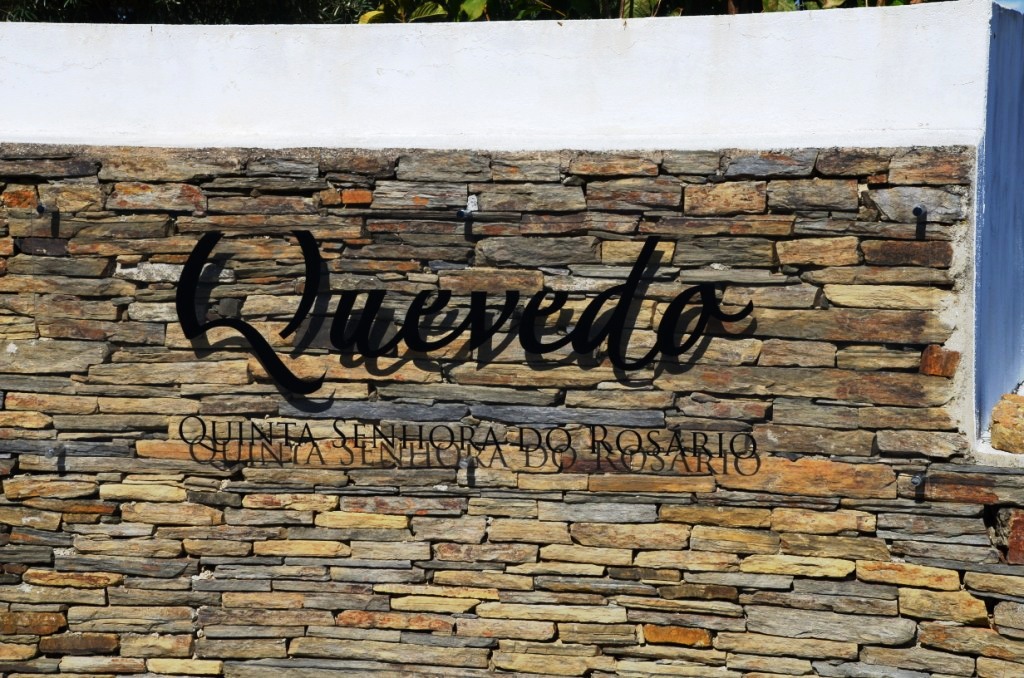 And the happy day didn’t stop from there on.
Here are the few pictures of what were looking at once we stepped out of the car:


As we were walking in, we were quickly greeted by Oscar, who I met during my previous visit to Porto. Oscar represents a fifth generation of the winemakers in Quevedo family, which had being making Port wines for about 300 years. Quevedo makes about 750,000 bottles of Port per year, and with Oscar’s efforts (in addition to being a winemaker, he also heads up all the export operations for Quevedo), about 97% of what they make is being exported. We also met Claudia, Oscar’s sister, who is in charge of making decisions on the final blend of the Port. You see, outside of Vintage, Late Bottled Vintage and Colheita Ports, which are all made out of the single vintage grapes, absolute majority of the Port wines are blends – and Claudia has the final say on deciding what goes into the bottle.
Actually, the day we arrived was right in a middle of the harvest, so Oscar was completely torn between talking to us, accepting incoming grapes (which requires assessment, weighting, calculating), and also taking care of the other groups of visitors ( mostly locals, if I’m guessing correctly). Nevertheless, Oscar gave us a full tour of the winery and a cellar tasting!
As it was the harvest time, we were lucky enough to see the full process of grapes being unloaded, destemmed by the machine and then going into the fermentation tank. I have the pictures for you down below, but while looking at them, you need to imagine a scent of freshly crashed grapes filling the air…


There is a lot of stainless steel at the winery. And of course they have their own bottling line.


After seeing all around the winery, we finally made it to the cellar – and this is where all the fun began.


Oscar brought 3 glasses, and we went from the barrel to the barrel, tasting the different port wines, right from the barrel! We started from 2010 Port, which Oscar said might become a LBV or Colheita – the determination will be made later on (for more on the Port classification and terminology, you can take a look at my earlier post here):
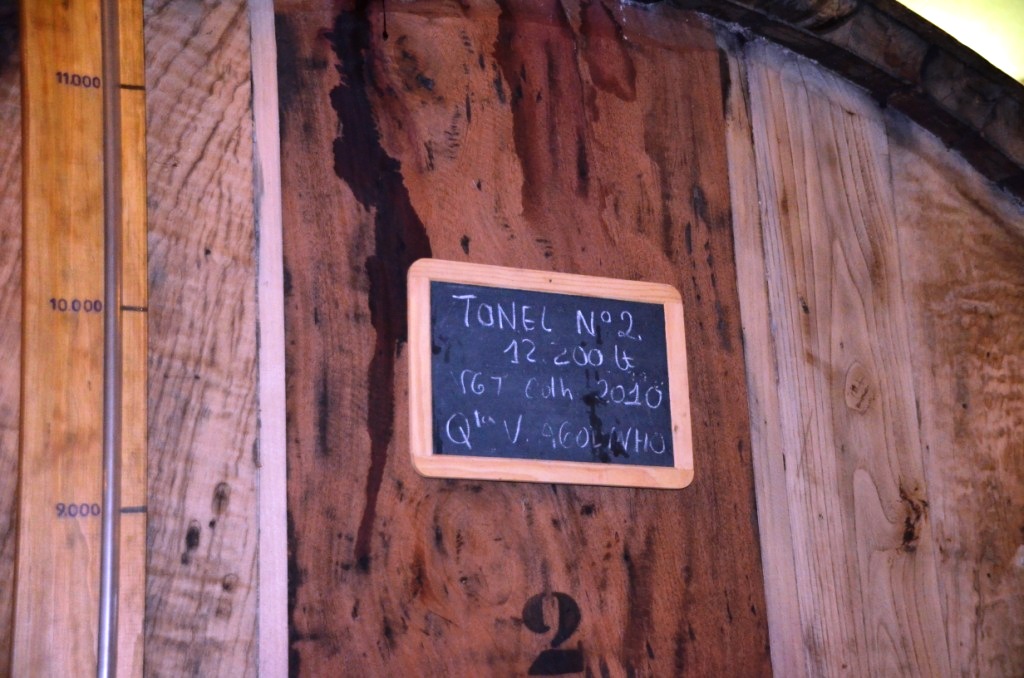
2010 Quevedo Port, may be LBV, may be Colheita
This 2010 Port was perfectly fresh, with blueberries and blackberries, great power, perfect acidity, and just bright and uplifting character.
Next we moved to the 2003 Colheita:

2003 Quevedo Colheita
2003 was a very hot year, but still it was declared a vintage year by many Port houses – which means that overall quality of the grapes was very high. This Port scaled more towards mature, dried fruit, like figs and may be dried apricots, but it was very balanced and still perfectly fresh.
Next up – 1996, and I finally managed to take a picture of Oscar’s hands pouring the Port:
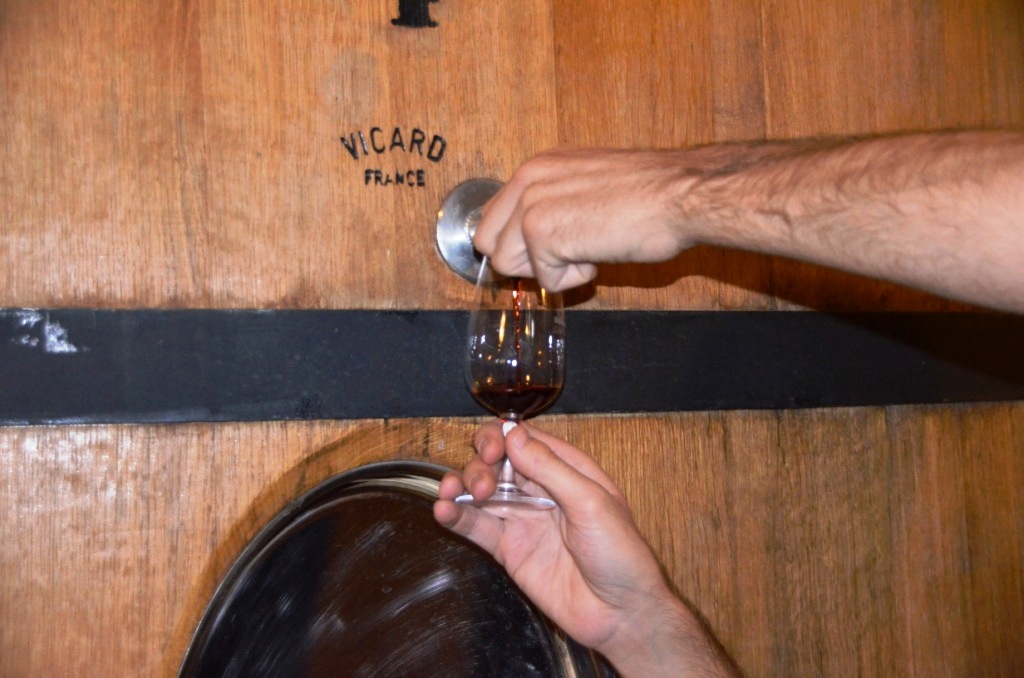
The best you can see in the cellar – Port is getting into YOUR glass!

1996 Quevedo Colheita
This 1996 Port was outstanding, mature, with perfect medley of dried fruit, figs, raisins, and excellent supporting acidity – I would gladly drink this every day ( who wouldn’t!).
And then there were two gems. First, 1970 White Port. Many people, even in Portugal, don’t know that aged white Port exists. Meanwhile, this Port of absolutely, unquestionably spectacular:

1970 White Port
Elegant, complex, somewhat reminiscent of the mature Pedro Ximenez sherry, but with the dialed back sweetness, perfectly mature fruit, hazelnuts and, believe it or not, still very refreshing and all around spectacular – this wine is definitely a candidate for the Wine of 2013. I really can’t put any “Drinkability” rating on this wine – this simply is something to be experienced.
And we finished with 1974 Colheita, which was in the final blending stages, to be bottled next year (2014) to commemorate 40 years:
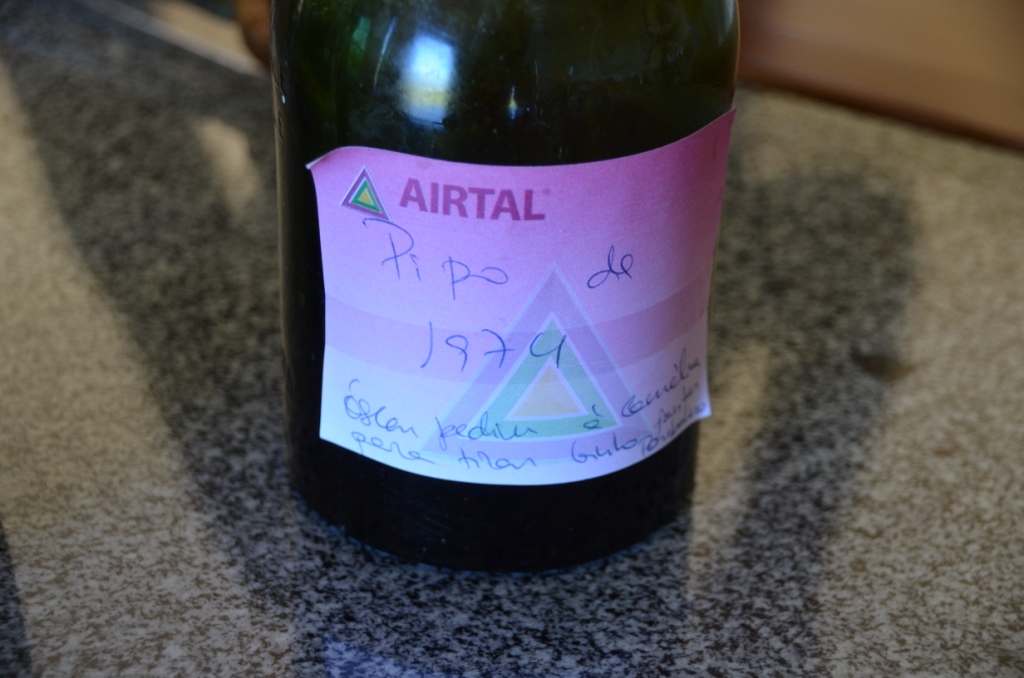
This Port will be bottled next year
There will be only 700 bottles produced. This Port was absolutely spectacular, very much on par with the white port we had before – very complex, with good amount of dried fruit, that nuttiness which only well aged Port or Jerez can demonstrate, all with still very present acidity. Same as the previous wine, this was really an experience, not just a sip of wine.
That’s was the end of our amazing tasting. We went for a walk around the vineyard, soaking up the sun and beginning of the autumnal beauty, enjoying the rest of the day which started ohh so not great.
I want to thank Oscar very much for finding the time in his extremely busy day and letting us experience those incredible wines. I also waht to thank my friend Sumit for bearing with my morning craziness and finally getting us to our destination. Let’s raise the glass for any day to become a perfect day, no matter how that day started. Cheers!
Southern Fun in South Norwalk
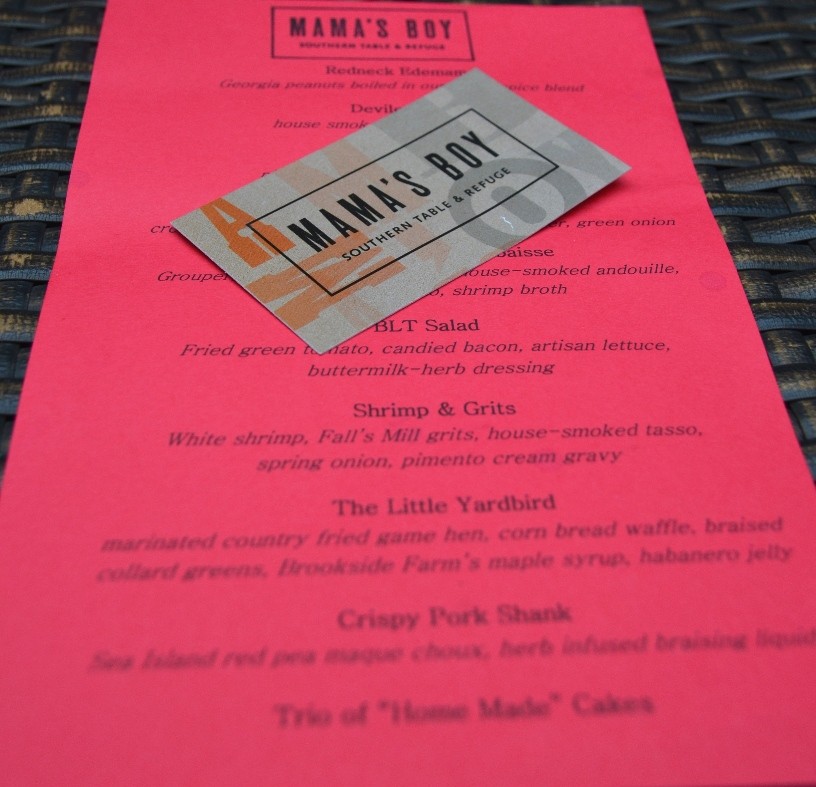 Looking for the Southern hospitality, great food, great cocktails and a great time? Shhhh… I got a place for you. Read on, but…may be you should eat something first, as there will be pictures. An aspiring food porn pictures. Yes, consider yourself warned.
And the Connecticut bloggers got together again! This time we visited a restaurant in Norwalk, Connecticut, called Mama’s Boy. The restaurant defines itself as “southern table and refuge”. On outside, the restaurant is located on the first floor of the ultra-modern glass-and-metal building. Inside, it is rustic, simple and inviting. You know you will be comfortable from the moment you walk through the door and set your foot on the dark wooden floor.
The first thing not to miss in Mama’s Boy is the bar. The bar is well stocked, showing the top shelf full of great southern favorites – bourbons and whiskeys. When you get the cocktail from the list, you know exactly what you are getting – it will not be just some vodka of questionable pedigree – depending on the cocktail you know that you are getting Ciroc, or Three Olives, or Fire Fly.
We had a few cocktails to start. The Dirty South (Homemade Sweet Tea, Fire Fly Vodka, Lemon) was outstanding and super dangerous – you have a full impression of drinking just a nicely sweetened iced tea with the slice of lemon, delicious and refreshing. You think you can have many of those. Until you realize that you talk slower. And need more time to move around.
Then I had the Blood Orange Jalapeno Margarita (Chinaco Blanco, Blood orange puree, Jalapeno). First of all, I was very impressed with the fact that they actually used Chinaco – this is very rare and one of the absolutely best tequilas you can find. And the taste was purely spectacular – a perfect balance of spicy and refreshing, with just enough sweetness. This was definitely my best cocktail I ever had. Until Chris, the maestro behind the bar counter, offered something which was not even on the menu – gin-based, barrel aged cocktail which didn’t have the official name, so it was called The Drink.

The Drink, in the process of creation
The Drink was based on gin, but then there were cucumbers of a different kind, as well as many other ingredients – it was a pleasure watching Chris really engaged in the process of creation of this masterpiece, tasting, adding, tasting again – until he reached the point of perfection. Once I tasted it, I realized that while previous cocktail was spectacular, The Drink was simply amazing – it got my “best ever” title, with the refreshing and uplifting combination of all the ingredients.


And then, there was food. The bread was presented in the form of a basket of warm cornbread muffins, accompanied by butter and a tangy “jelly”. The first dish which already was on the table was Redneck Edamame (Georgia peanuts boiled in house spice blend) – believe it or not, but these peanuts had practically complete textural identity with edamame! Definitely this was a very interesting dish to start with.
Next up – Deviled Eggs (house-smoked Tasso, okra pickles). I’m very particular about devilled eggs, as this was one of the dishes I grew up with, and we make it quite often at home. The Mama’s Boy devilled eggs were outright delicious, very generous, with bacony goodness of Tasso perfectly coming through in the creamy filling.


Fried Chicken Skins (pickled beets, jalapeno-garlic honey) were perfectly resembling fired calamari – I actual think it should be renamed on the menu into Redneck Calamari – but then they already have one Redneck dish listed : ) Light, crunchy, delicious – if you don’t read the name “chicken skin”, you would never guess what this dish was made out of. The sauce was delicious, tangy with a spicy twist.
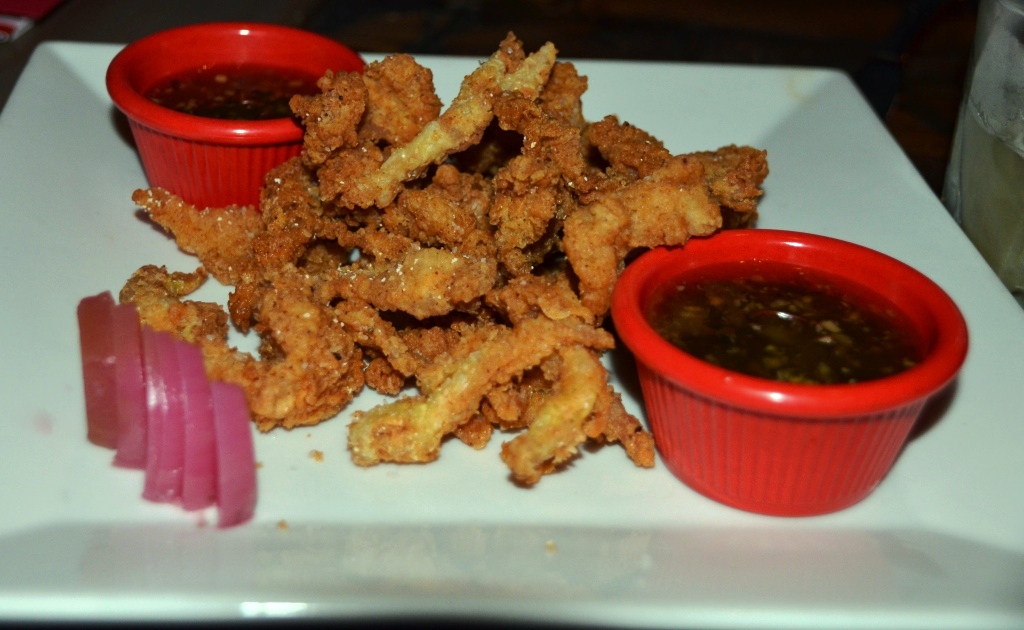
Fried Chicken Skins
Charleston Crab Cake (creamed corn, house smoked bacon, red pepper, green onion) came up next. As we tasted it, Valerie, who was sitting next to me, commented that she spent many years in Maryland, and she knows real crab cakes – and this one was probably one of the best she ever had (I fully concur). Big lumps of crab meat, perfectly seasoned, nice creamy corn goodness surrounding it – that was one delicious crabcake.
Once we were done with the crab cake, we were given small bowls, and then the big pot showed up in a middle of every table – Low-country Bouillabaisse (Grouper, white shrimp, mussels, house-smoked andouille, baby corn, potato, shrimp broth). I’m big fun of bouillabaisse dishes – if there is one on the menu, there is a high probability that it would be my choice. I know I’m abusing the word “perfect” throughout this post – but it is very difficult to fully represent the food and try to stay within the precise culinary terms – so let me continue abusing “perfect” and “delicious”, as there is not much else I have to say. This dish was Delicious! Touch of heat from andouille sausage, sweetness of mussels and baby corn, all perfectly wrapped around together. I’m glad we had bread, as it would be a crime to waste a single drop of that broth…


So at this point I was practically full (okay, not yet) – but I didn’t expect anything to topple our experience so far. And then the BLT Salad (fried green tomato, candied bacon, artisan lettuce, buttermilk-herb dressing) arrived… What can be so special about BLT, right? Well, everything, if B stands for lightly candied bacon, L stands for super-fresh and crunchy lettuce, and T stands for fried green tomatoes – every bite was ahh so good!
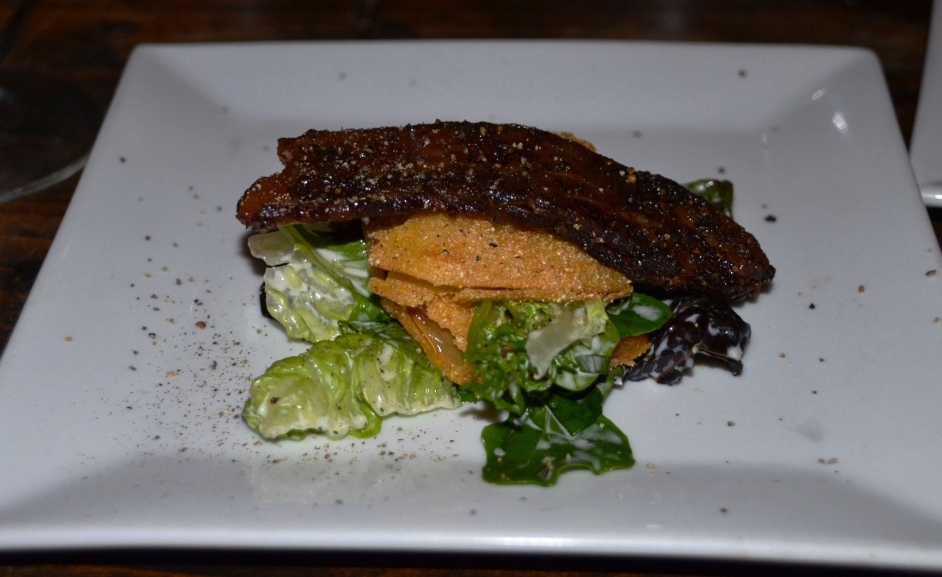
BLT Salad
Tired of the food pictures – here is the a little break for you – the back of the shirt of one of the waiters, and then Greer Fredericks, one of the owners of the Mama’s Boy, talking to Bonnie from The Home Place and her husband:


Next up – Shrimp and Grits (white shrimp, Fall’s Mill grits, house-smoked Tasso, spring onion, pimento cream gravy) – yes, I had no doubts that we will experience a southern favorite such as Shrimp and Grits. Beautifully presented, very delicious – creamy grits, perfectly cooked shrimp, nice complement of smoky bacon – all in all, an excellent ( and very filling) dish.
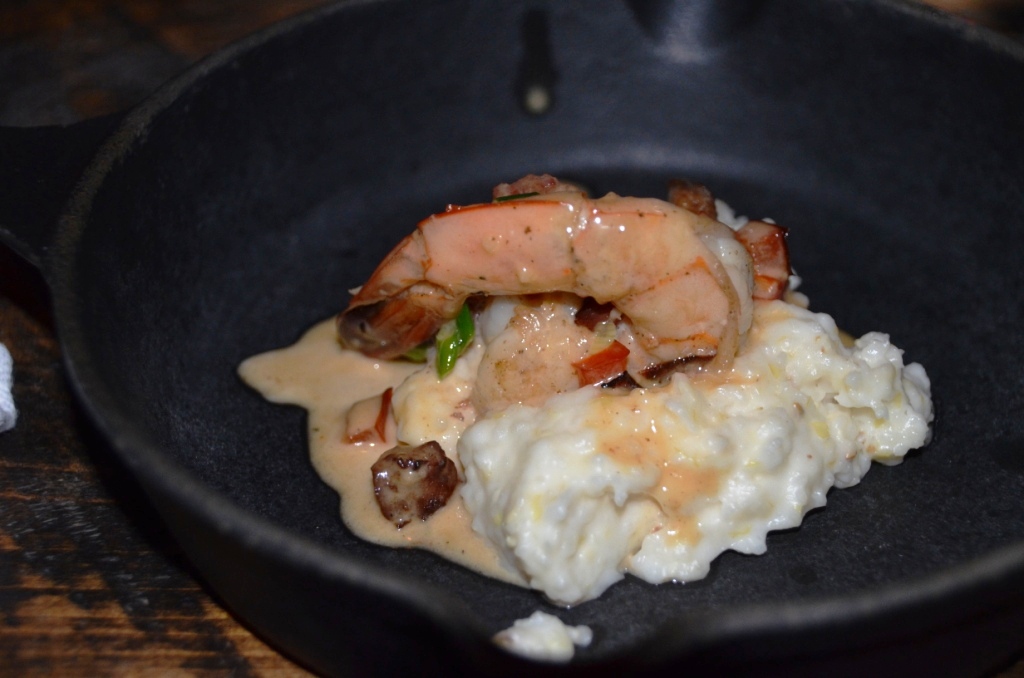
Shrimp and Grits
Next The Little Yardbird (marinated country fried game hen, corn bread waffle, braised collard greens, Brookside Farms maple syrup, habanero jelly) arrived – the cornbread waffle was perfectly supportive of the maple syrup, and the whole dish perfectly worked together, as you would expect of “chicken and waffles”.


Last but not least was Crispy Pork Shank (Sea Island red pea maque choux, herb infused braising liquid) – the peas and the borth were immaculate, and the shank was incredibly crispy and succulent at the same time. This was the only moment when people at the table regret having each other’s company – this shank required quiet, intimate one on one time with two hands on the bone…


We finished our southern food extravaganza with Trio of “Home Made” Cakes – that included Red Velvet Cake, Spice Cake and Carrot Cake. While I think consensus favorite was the spice cake, my personal winner was the carrot cake – I’m a carrot cake junkie, and I love when it is balanced in flavor so cinnamon and cloves and overall sugar are all together – so this cake was exactly like that.
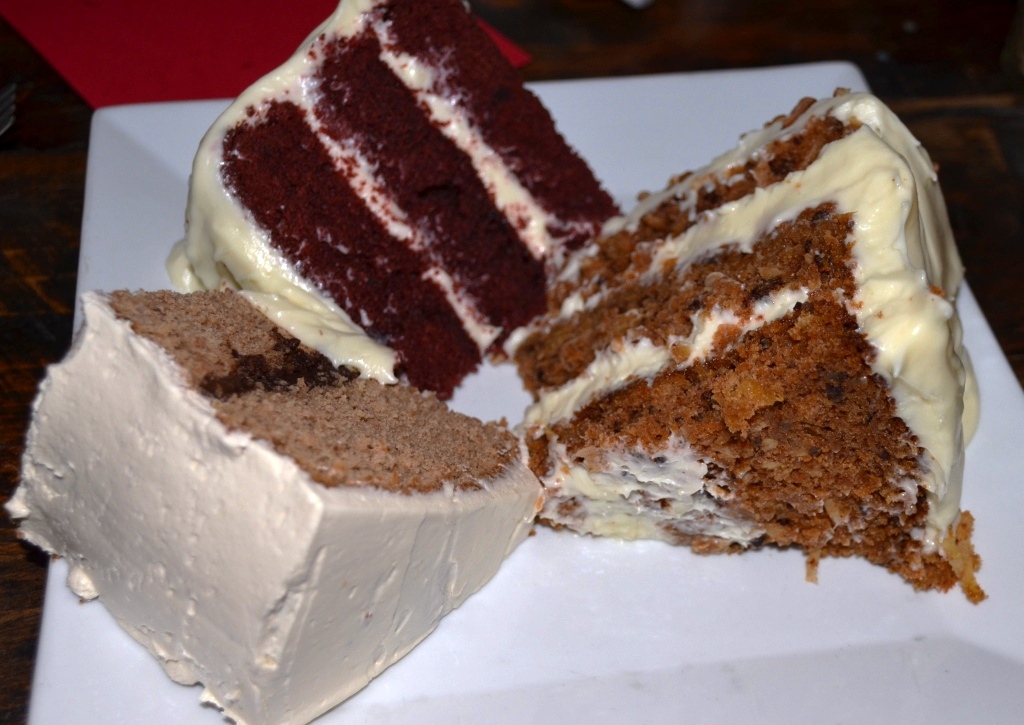
Red Velvet Cake, Spice Cake, Carrot Cake
You know how it is easy to understand that you just visited a great restaurant? If the next day you crave the food you had the day before, that is clearly the sign of greatness. While the group was torn between Bouillabaisse and BLT, we were all chatting next day how great it would be to experience that wonderful food again – this constitutes glowing endorsement in my book. All left to say here is thank you – Thank you, Chef Scott Ostrander, for the wonderful meal. We will be back…
Disclaimer: I attended the dinner as a guest of management. All opinions are my own.
Mama’s Boy
19 North Water Street
South Norwalk, CT 06854
203.956.7171
http://www.mamasboyct.com
Facebook: mamasboyct
Twitter: @mamasboyct

Italian Tapas? Sì, Signore!
 Can’t tell you why, but this local Stamford restaurant, called Zaza Italian Gastorbar, had been on my “must try” list for a while. Something in that name, Zaza Gastorbar, is utterly attractive – the same way as you look at the creative wine label and say “wow, cool label, wonder how it tastes like”, the name “Zaza Gastrobar” had that effect on me. I guess it was a promise of a unique experience hiding in a word “gastrobar“. Finally, the convenient occasion presented itself, and off we went.
While it is hard to say that Stamford has its culinary Mecca section of the town, if anything, an intersection of Broad, Bedford, Summer and Atlantic streets can be designated as one – this is where lots of restaurants are located. The good thing in Stamford is that you don’t need to worry about the parking. Unlike many towns nearby, where you need to run circles looking for the street parking, downtown Stamford has plenty of parking garages to accommodate all the hungry people. Well, okay, enough about parking, let’s talk about the restaurant.
Zaza doesn’t accept reservations, but we had no problems finding the table for 6 on Thursday at 6:30. From the moment we walked in, I liked the way the restaurant is decorated, it felt modern but comfortable. One thing you need to be aware of – the place gets noisy. But, when the restaurant is good and busy, which doesn’t?
I love trying food as opposed to just eating. Whenever available, my strong preference is tapas, chef tasting menu, dim sum, or any variation on the theme of small plates. Now, when you think of an Italian restaurant, do you think of it in terms of the small plates? I’m sure first thing which comes to mind is a full plate of pasta, or pizza, or mozzarella sticks. But Zaza, to my absolute delight, has a whole menu section, which is called… yes, Italian Tapas! Luckily, our friends share the same outlook on food, so this was an Italian Tapas night!
Before we get to the food ( mostly in pictures), few words about the wines. I would call the wine list somewhat limited – however, considering that it contains the options starting from $25/bottle, I can’t really complain. We started with 2012 Honig Sauvignon Blanc Napa Valley, which is one of the best examples of Napa Sauvignon Blanc – just enough citrus notes, with some fresh grass and delicate finish, very round – that was definitely a great start to our meal. At $46 on the list, it was also a relative bargain (about triple retail).
And then, there was food. In no particular order:
Calamari Fritti, lightly fried, tomato sauce – very well done, light, crispy:
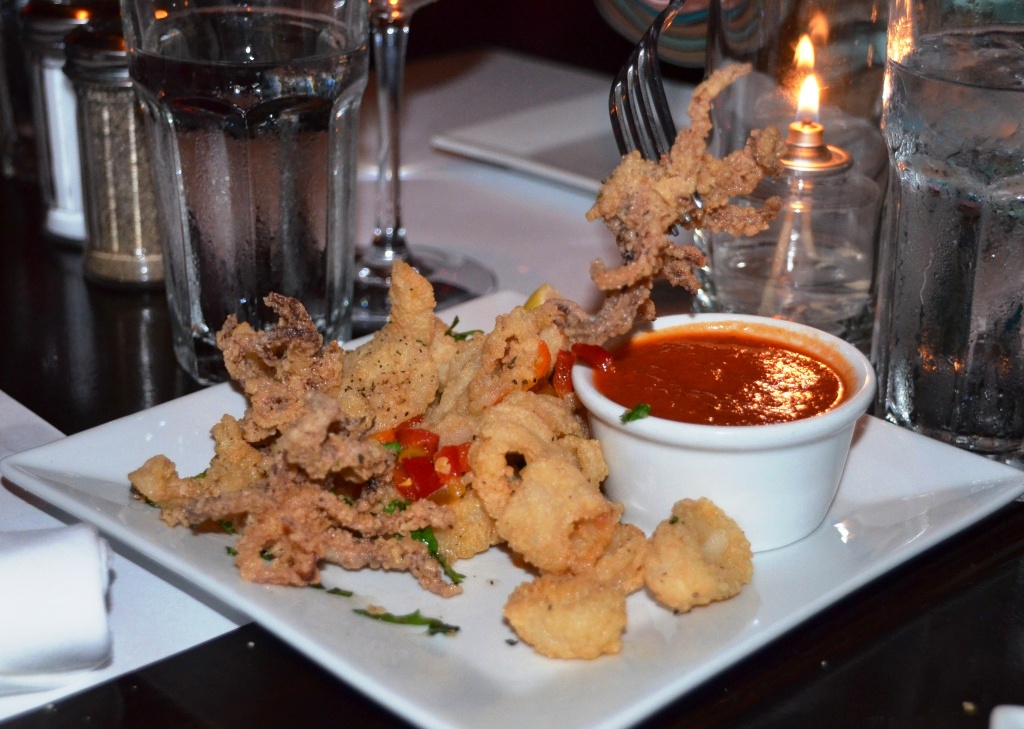
Calamari Fritti
Potato Gnocchi, Butternut Squash, Cream Sauce – not only it was a butternut squash sauce, but butternut squash was perfectly present in the dish. Lightly sweet and delicious together.
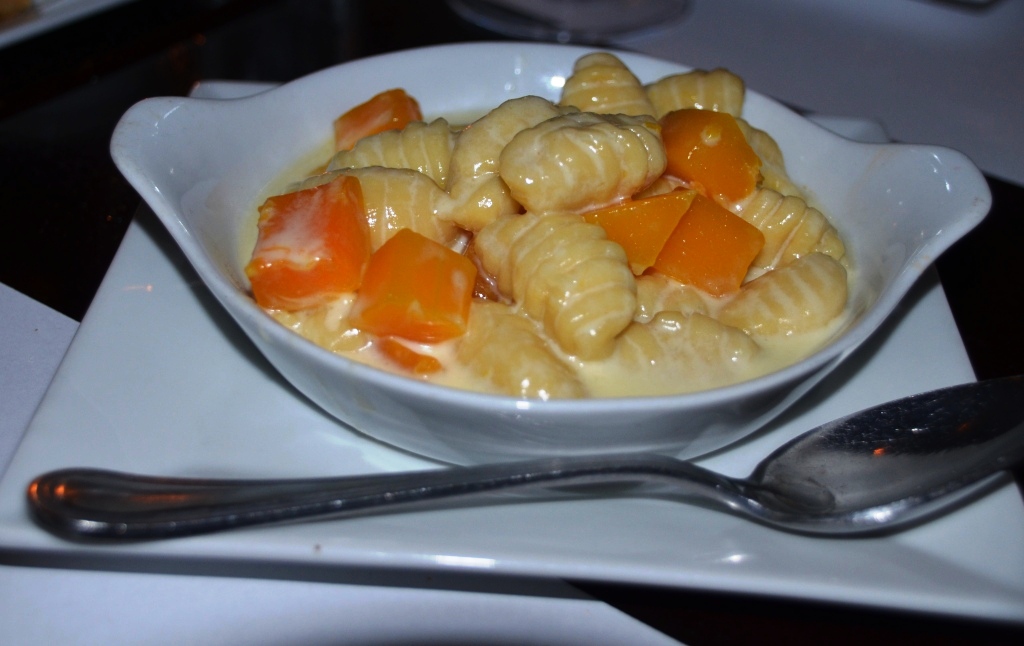
Potato Gnocchi
Tuscan Beans, Spicy Tomatoes, Garlic, Pancetta, Olive oil – pancetta makes everything taste better, right? I’m a sucker for white beans, and this dish was perfectly balanced, great flavor profile with a light crunch of crispy fried pancetta.

Tuscan Beans
Lamb Sliders, lamb, polenta, Barolo wine sauce – you expect to see a bun on the traditional sliders – but not on this Zaza slider. Polenta cake was topping off the lamb patty, resembling bun in the appearance -but of course it was no bun at all. Excellent herbal flavor profile on lamb, not overpowering, but working together – this dish just transports you to Mediterranea…

Lamb Sliders with Polenta Cake
Next up – Tuscan Tuna Tartare, fresh Tuna, tomato, capers, basil, balsamic. Love tuna tartare, but I’m typically very dreadful when ordering it. My problem is that a number of tuna tartare dishes I tasted had the same issue – flavor is only on the outside, and once you dig in, the flavor is gone and you are one of one with fresh, but almost tasteless fish. This time, the dish was perfect. Every little morsel was tasty, in and out – a great combination of refreshing lemony acidity, balsamic, saltiness – very successful dish.

Tuscan Tuna Tartare
Next up – Baby Lamb Chop, rosemary, olive oil, arugula, balsamic. I have to admit – I’m a snob when it comes to the lamb chop. About 15 years ago, I was spoiled back in Montreal – the lamb chop I had there was a surreal perfection. Now I measure everything against that experience. I’m glad to report that Zaza’s lamb chop was very close to that perfection – succulent and delicious.
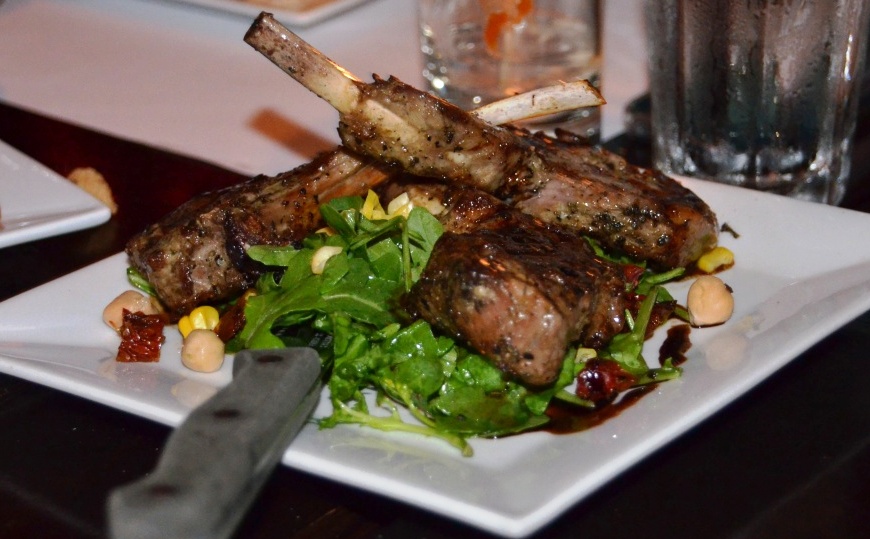
Baby Lamb Chop
I need to mention another wine we ordered. We wanted to drink something red, and I had a problem selecting the wine, both in terms of what I want to drink and what I want to pay. I asked for the taste of the two wines I didn’t know – Montepulciano and red blend from California. While the red blend was not perfect, it was still better than Montepulciano. Thus our choice of red was 2009 Lost Angel Mischief Red Wine, California (13.5% ABV), a blend of Cabernet Sauvignon, Merlot and Zinfandel.

Lost Angel Red Wine
My goal was to find an inexpensive, but palatable wine. At $35, it was definitely inexpensive as the wine list prices are concerned. Had I known that you can find this wine in retail for about $8 – $10, I would probably not ordered it. However, to be entirely honest, it was drinkable – while it was clearly the fruit forward with almost a sweet finish, it carried enough weight and balance to be pleasant (didn’t have any of that over-extracted fruit, which I personally can’t stand). I would not buy this wine to drink at home, but if this would be my only “budget” choice on the wine list, I will drink it again.
Almost as an afterthought, but at the same time very apropos, we ordered a cheese sampler platter right after we were done with the most of the meal. The Cheese Sampler included Buffala Mozarella, Burrata, Stracciatella and Scamorza. Burrata is one of my all time favorite Italian cheeses, and then there was creamy and spreadable Stracciatella – wow, the word “delicious” does only half justice to the way this cheese tastes.
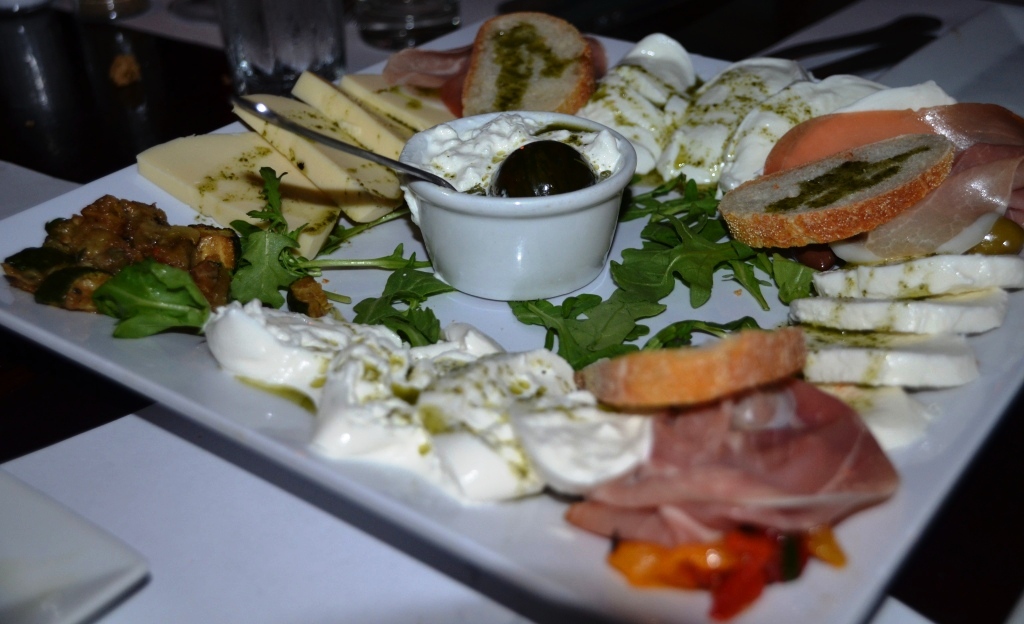
Cheese Sampler
And then of course there was the dessert – everything was very tasty, and I’m not going to inundate you with the details – you can drool on your own:


It is time to conclude the report on this culinary extravaganza. The food was delicious, service was excellent – prompt, attentive, with the smile – the way you want to be treated in a restaurant. I will gladly come back to Zaza at any time. My only concern is the limited selection on the wine list, so next time I might come back with my own bottle – but this is not the wine bar, after all, it is a Gastrobar – and I think it suits this description perfectly.
And we are done here. Until the next time – cheers!
Zaza Italian Gastrobar
122 BROAD STREET
STAMFORD, CT
PHONE: 203.348.2300

Foodies Get Together at Nola Oyster Bar in Norwalk, CT
Since its opening in March of 2013, Nola Oyster Bar in Norwalk, CT was a subject of multiple blogger reviews, so I will not inundate you with the details which you can easily find online. This was our first visit to Nola, and I can tell you – we had the best time. The reason? Simple. Yes, the restaurant has a very good food, drinks and service, but what makes your restaurant visit special is the company. We visited Nola with the group of food bloggers! We only knew a few people at first, but you know, when you share a passion, the connection sparks faster than the lit match can fire up a stack of dry hay. From the moment we got at the table, we were in the company of the old friends – the conversation was flowing, and uncomfortable silence never took place. It was a great pleasure to share this experience with Wendy and Greg from Connecticut Bloggers, Bonnie from Home Place, Kaitlin from the For Love of Carrots, Jeff and Cristina from Cooking with Jeff and Cristina, Jenn from That’s So Jenn, Alicia The Natural Princess, and Linda from MaxExposure, who got us all together.
It is very interesting to see 8 cameras pointing at the same dish – when nobody would yell at you to stop using the flash (yep, this was my experience a few weeks ago). When the food is served, you almost feel as a judge on Chopped with all the comments like “hmmm, interesting, I think this is a bit too acidic”, “I would slightly reduce the sweetness”, “ahh, the regular waffle would become too soggy, this is why the corn flour is used”, “I would make this dish a bit differently”. I can tell you, despite this level of attention, there was not a single dish which we didn’t like, so I think it tells something about the mastery of Chef Kardos.
Let me tell you about the dishes.
I started from the tiny cocktail – as it was called on the menu, “soon to be famous” oyster shooter. Think of it as a shot of Bloody Mary with a fresh oyster right inside, perfect combination of spiciness, saltiness and freshness:
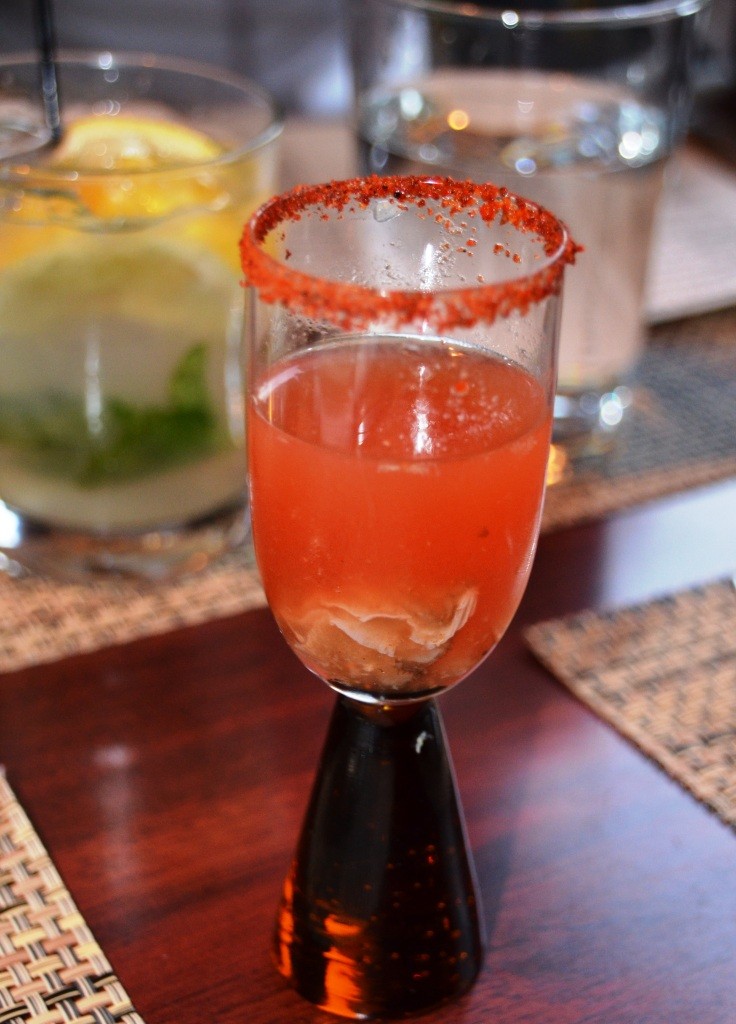
“soon to be famous” oyster shooter
We started with Crab & Artichoke Fondue (bacon, smoked Gouda, sriracha, crackers) – perfect texture, nicely put together without being too heavy, as some of the artichoke dips do:

Crab and Artichoke Fondue
Next up – Beer Braised Mussels – smoked ham broth, chipotle butter, toast. Tasty, flavourful broth is a key to this dish – and we got it. Glad we also had enough pieces of bread, not to leave any goodness on the plate.
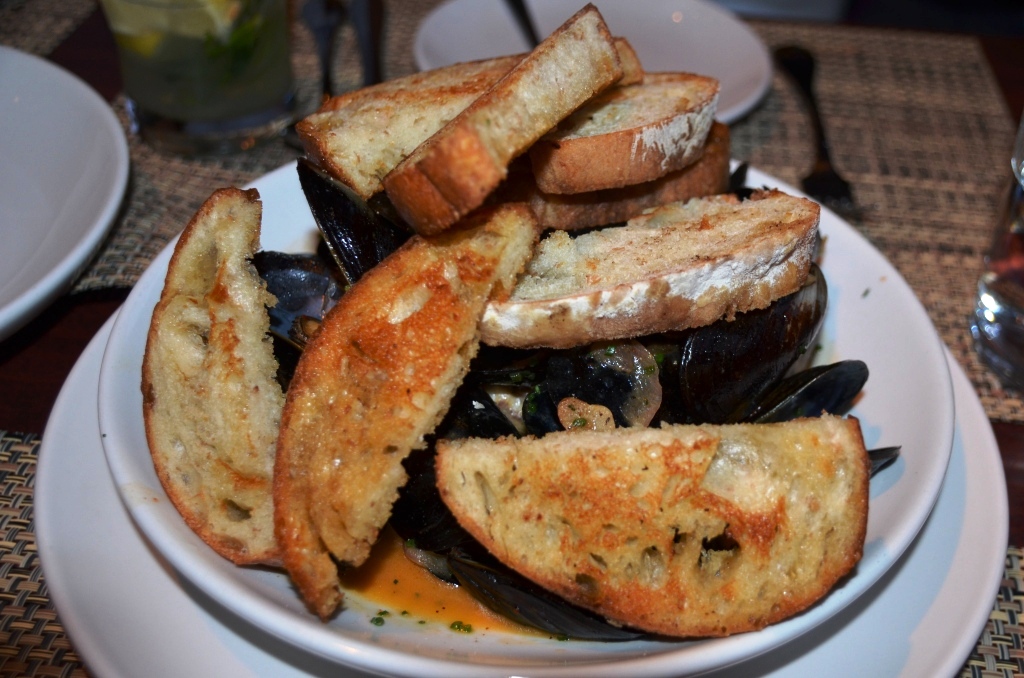
Beer Braised Mussles
Our next dish was Cornmeal Fried Oysters & Braised Pork (creamed spinach, pearl onion jam, aleppo chili flakes):
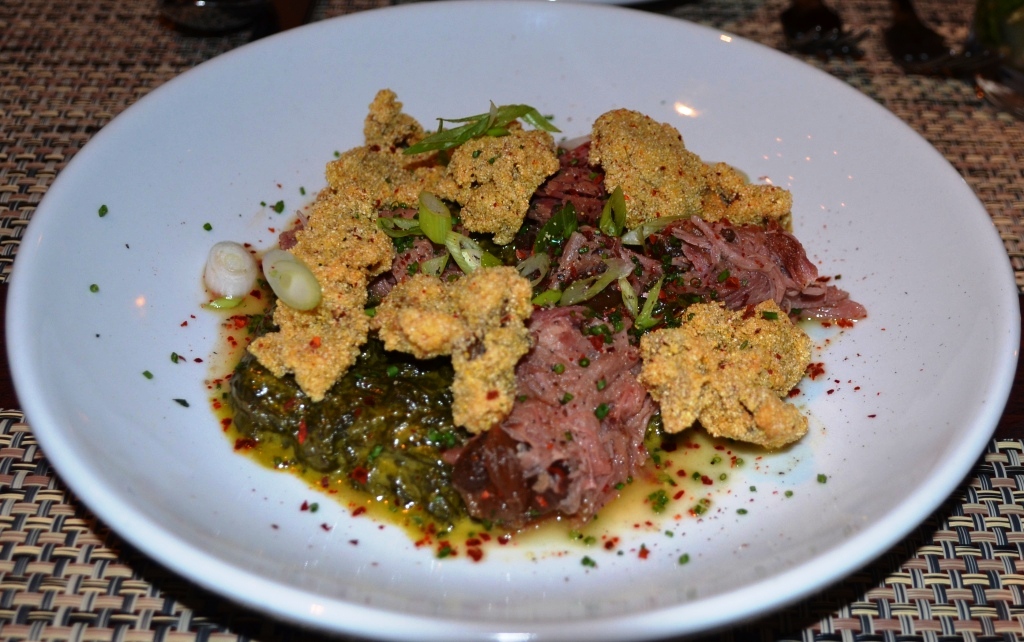
Oysters and Pulled Pork
This was definitely an unexpected combination for someone used to the New England seafood style – I’m sure this dish has New Orleans roots. Cornmeal fried oysters were delicious, and so was the pulled pork. Just enough spice without overpowering. I probably could live without creamed spinach in this dish, but all in all it was very tasty.
Meal is not a meal without a vegetable, right kids? Our vegetable was a side of Fried Brussels Sprouts (bacon, maple, coder vinegar, pistachio):
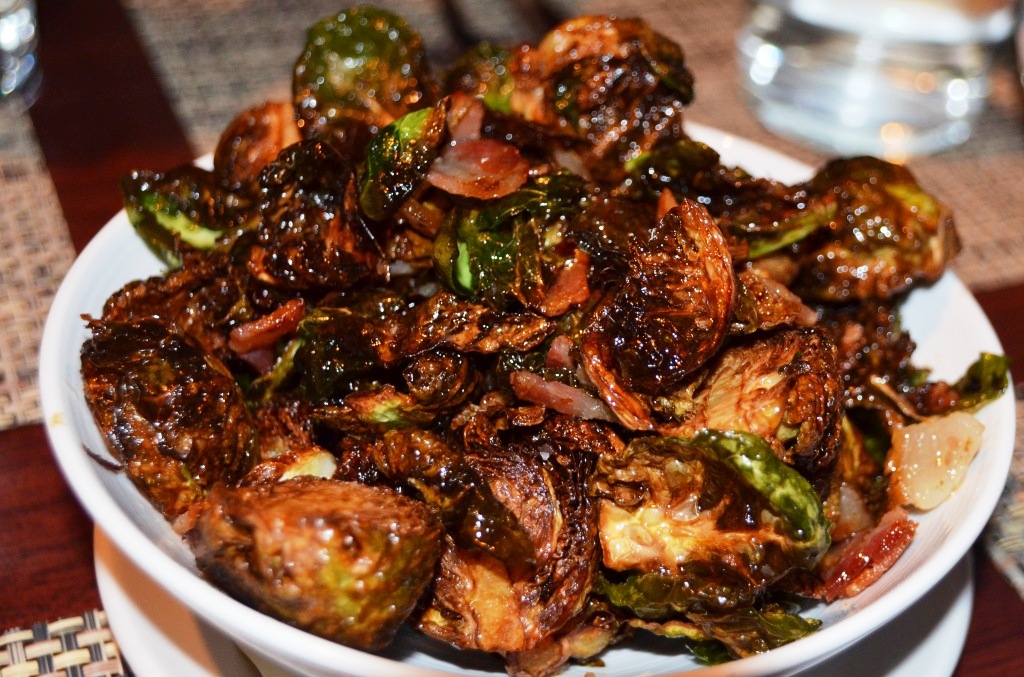
Fried Brussels Sprouts
Very tasty, and again very unusual. Definitely unique texture, due to deep frying instead of pan frying – crispy flakes, with some sweetness of the maple syrup , cut through by the cider vinegar. I have to admit that I love Brussels sprouts and could’ve eaten the whole dish just by myself.
A culmination point of the meal – Poached Lobster & Cornbread Waffle (butter-poached lobster, griddled scallions, Queso Fresco):

Poached Lobster & Cornbread waffle
In my book, lobster is a very difficult ingredient – yes, of course it is considered a luxury, but in a lot of cases, it simply doesn’t taste well, no matter how expensive the restaurant is. This lobster was excellent. Tender, very flavorful, and it worked very well with the cornbread waffle. This cornbread waffle was the one which solicited the discussion as to why the cornbread ( heavy and dense) and not the regular waffle (which would become too soggy). Needless to say, this dish was devoured in a blink.
We finished the main course with Blackened Shrimp & Pork Fried Rice (soy, sprouts, egg, scallion, sesame):

Blackened Shrimp with Fried Rice
Perfectly cooked shrimp (some of the best I ever had), very tasty rice, overall very successful dish – this was a nice to finish our main course.
For dessert we were served Maple and Pistachio Panna Cotta (apple jam, pistachios) and Chocolate and Peanut Butter Pot Pie Cream (whipped cream, roasted peanuts):


Chocolate and peanut butter tasted almost like Nutella, only with a slightly different texture. Panna Cotta tasted very light – both dishes were quite successful, and I would gladly have them again.
That is all I have for you, folks, as an account of our great evening. Nola Oyster Bar is definitely recommended as a place where you will find the New England traditional seafood with the New Orleans, southern twist. If you live in the area or visiting, take the opportunity to try it for yourself.
Disclaimer: I attended the dinner as a guest of management. All opinions are my own.
Nola Oyster Bar
68 Washington Street
South Norwalk, CT 06854
Phone: 203-957-3352
http://www.nolact.com/

How Possessive Are The Wine Lovers?
 If you are following wine blogs, you might have noticed the theme “possession” showing up here are there. Yes, this is no accident – the common linking factor is the Monthly Wine Writing Challenge (MWWC for short), in its third incarnation.
The theme for the first challenge was “transportation” – it was relatively easy to tie up to the wine both directly and allegorically. The theme for the next challenge was “trouble”, which sent me home scrambling – “trouble” is not the first thing which comes to mind when you are looking at a glass of wine. In the end of the day, many bloggers successfully found the connection and produced a lot of interesting posts. The current theme, “Possession”, is a whole different game. On one side, it has a direct connection to the wine – but it is too direct for the nice intricate piece. “I possess wine. Sometimes, wine possesses me. The end”. On another side, it is almost forcing you to go into pretty much the exorcism route, which can be played, but this is not necessarily pretty (need examples? Do a google search for “wine possession” – you will find some stuff which might make you afraid to visit your cellar when it is dark).
So as you can deduce from my rant, I don’t have a good play on the theme. What you will find below is rather a collection of random thoughts, centered on the wine appreciation, with the nod towards the “possessive” relationship of wine lovers with the subject of their love.
So how possessive the wine lovers are? We can find few different types of “possessiveness” among the wine lovers as such. First, there are wine collectors (of course, that is an obvious one). But even among wine collectors there is one extreme group which I would like to exclude from the actual category of the wine lovers. That is the group which rather collect the money than anything else. Wine is strictly an investment for them, and they never think about bottle of wine in terms of the actual content. For this group, the wine is only an object which will appreciate in value, and at some point it will be exchanged for cash and profit. This group also includes the worst possible type – the wine-possessive ego-maniacs. For this group the wine which they stock in their cellars is intended to be an ego-booster – “I spent on that bottle 10 times more than you did”, and “my bottle is bigger and more round than yours”. In the end of the day, I’m not even sure if this group even belongs to the true wine lovers category.
Then there are those who love wine, but don’t care to possess it at all. Folks in this group happily drink the wine at any occasion, they serve the wine at their parties, and they buy a bottle on the way home when they feel like it. But they really don’t “possess” wine, as they don’t keep much wine in the house, and most importantly, they don’t assign any special attributes to any bottles.
And then comes the rest. The group of wine lovers who possesses the wine and actually, is possessed by the wine at the same time (I’m including myself in this group, so I’m continuing here from the collective of “we”). We keep the wine. We make the wine special by associating special mementos with those bottles – “ahh, this is the year we got married”, “remember we had this wine in Tuscany”, “this is the year our son was born”, “remember that winery visit”. We do our best to keep those bottles cool, quiet and comfortable. And then we wait. While buying the wine with mementos, we are also investing, of course. We are investing into exciting anticipation of how special this wine will taste when we will finally open it. While we hold on to the bottle, we can re-live that future moment over and over. We are possessed with finding the right moment for that special bottle. But what is important, that right moment also includes the right people. How many times have you thought “ohh, if they (whomever “they” are) are coming over, I got this special bottle we have to open”. Yes, we are possessed with wine. But we don’t buy it just to enjoy by ourselves. We are also possessed to share. We want to share the experience. We want to share the special moment. We don’t want to keep it to ourselves. Without special moment or a special company, that bottle never gets to be opened.
And that is what I want to leave you with. Possessed by wine. Possessed to share.
Bar Q – Good Beer, But The Food Can Be Improved
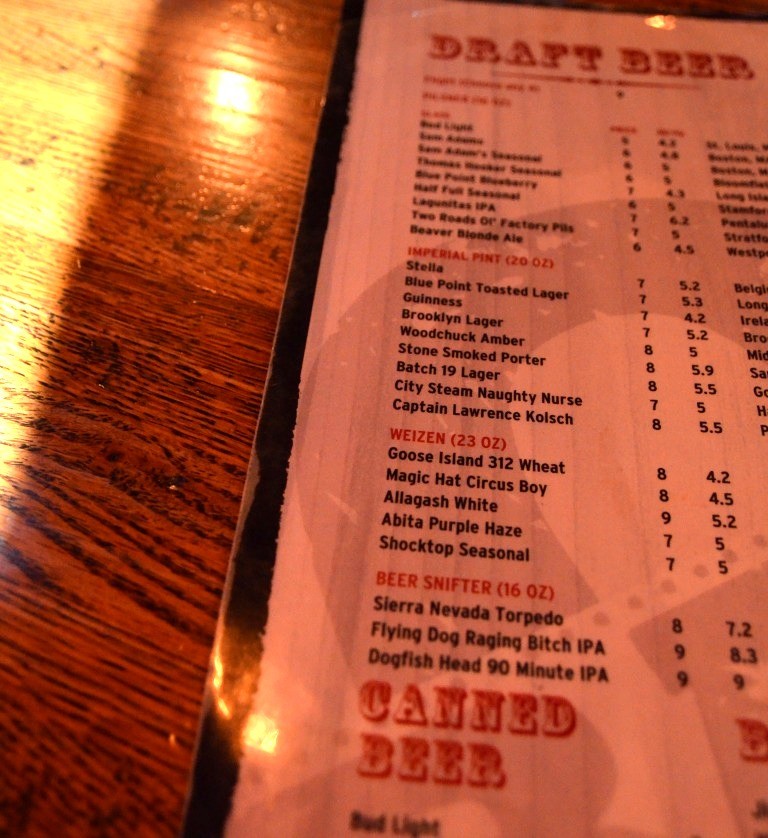
Beer list at Bar Q
It seems that one of the unwritten rules of the blogosphere is that everybody tends to share positive experiences, and for everything else – well, that is what critics are for. Yes, we rant from time to time, but more to discuss a general problem, and not for any particular reason. Thinking about it, having a true picture is important. If someone provides mediocre product or service, we often just “vote with our feet” – instead, providing some criticism could be the best thing to do, as this is the only way for someone to find out that improvements are needed. As you already got my point, this post is about experience which could’ve being better.
We went to the Bar Q BBQ & Grill in Stamford during the restaurant week (a couple of weeks ago). This was our second visit – we were there last year at about the same time (also during the restaurant week), and we had a very tasty experience, so we were very much looking forward to visiting the restaurant again.
As you can guess from the name, Bar Q is focused on serving the American barbecue. Their wine list is very limited, but the draft beer selection is excellent (and the beer is more appropriate for the BBQ anyway). Also, the menu offers to create a beer tasting flight – 3 oz of beer, 4 beers in the flight, all for $9.

Beer flight at Bar Q
Our flight included Allagash White, Belgian style wheat ale – perfectly refreshing, Goose Island 312 Urban Wheat – had a bit more weight compare to Allagash, still quite refreshing, Woodchuck Amber Draft Cider – very dangerous to have in the presence of kids, as in appearance it is not any different than Ginger Ale – light, fizzy taste with some sweet notes – perfectly quaffable. The last beer was Blue Point Toasted Lager, which is in the category of so called Red Lager – it had some bitter notes, medium weight on the palate – quite enjoyable as well.
So the beer flight was great, the service was also very good – friendly and prompt, but the food – not so much, unfortunately.
We always like to try different things, so we ordered 4 different appetizers.
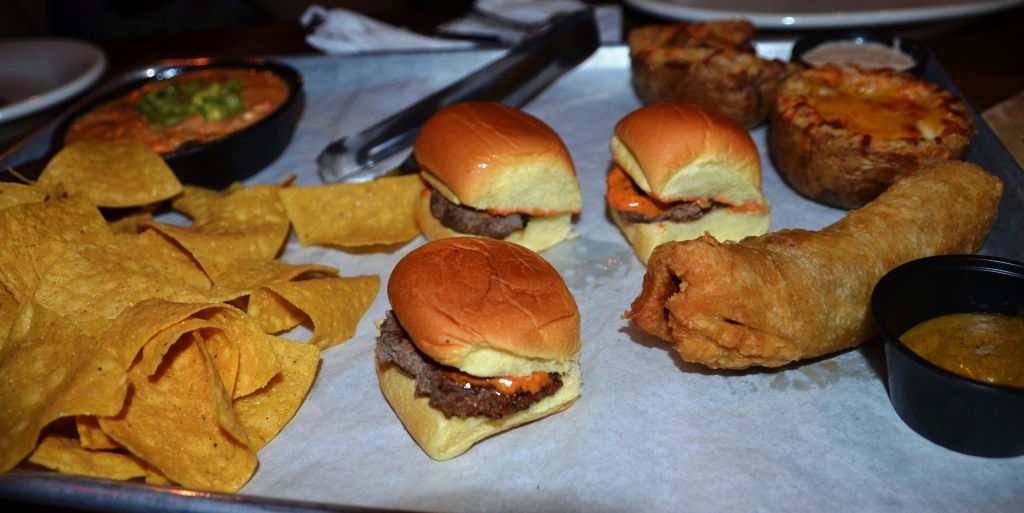
Appetizers round at Bar Q
Out of Truck Stop Queso Dip, Pig in a Blanket, Chipotle Meat Sliders and Potato Pig Skins, only Queso Dip was tasty, and the sliders were okay. The potato skins were mushy and had no taste, and the pig in the blanket was a tasting disaster.
Our “main course”, a variety of BBQ items, was not great either.


We took pretty much everything from the BBQ “small plates” menu which was not a poultry – St. Louis Cut Sticky Ribs, Classic Pulled Pork, Sliced Beef Brisket, Beef Burnt Ends, House Smoked Kielbasa Sausage, Grilled BBQ Shrimp, Smoked Pork Belly and Memphis Dry Rubbed Baby Back Ribs. Most of the dishes were okay, but none of them was at the “wow” level. “Burnt ends” dish was a disappointment by comparison – last year we couldn’t get enough of it – it was so flavorful and delicious. This time, it was only “well, okay”. And the smoked pork belly was a disaster – a blob of dribbling fat, smothered in the BBQ sauce. Yes, it was cooked, but the piece itself was such that in my opinion it should be never served in the restaurant as a dish (may be only used as a cooking fat). The sides dishes were [unfortunately] the best part of the meal.
To conclude, I wouldn’t put this as a “terrible experience” – it was an okay food experience, and drinks and service were excellent. But the problem is, this restaurant is no longer on my “I would love to do it again” list. No, I’m not asking for an absolute perfection – but, there should be at least one “wow” moment, an anchor which will pull us back – and this time around, Bar Q clearly didn’t have one. I hope it might be different in a future, and I will be glad to give Bar Q another try – but someone will have to convince me that it is well worth it.
Bar Q BBQ & Grill
261 Main St. (Behind Black Bear)
Stamford, CT 06901
PHONE: 203.316.0278
http://www.barqstamford.com

Cabernet Day 2013: 1996 Burgess Cabernet Sauvignon
I’m glad we have all those Grape days – Grenache Day, Chardonnay Day, Cabernet Day, Tempranillo Day (it is also great when those grape days are not overlapping, as Cabernet Day and Tempranillo Day had in 2011). Not that we need an extra reason to have a glass of wine – no, we don’t. But when you have a Grape day to celebrate, that greatly helps with the difficult oenophile issue – what do I open tonight? What do I open, what do I open… Shiraz? No, just had it two days ago… Rioja? Well, may be, but I have only a few bottles… Zinfandel? Not in the mood for… Okay, I’m sure you got the point, and being there, done that uncountable number of times.
When you plan to celebrate a “grape day”, you are done with a good half of the problem – you know what type of wine it should be. As today is a Cabernet Day, my decision was very simple. Need a good bottle of Cabernet Sauvignon, preferably ready to drink. I actually have very few bottles of Cabernet which I consider to be ready to drink (my criteria – 10+ years of age). My choice for today? 1996 Burgess Cellars Cabernet Sauvignon Library Release.

Burgess Cabernet Sauvignon
Burgess Cellars is located on outskirts of Howell Mountain in Napa, and it had being producing wine since 1972. In 1980, the winery started a Library program for its Cabernet Sauvignon wine – each year, a 500 cases or so are put aside in the wine cellar, to let the wine age in the ideal conditions. The wines are released to the consumers after 10 or 15 years of ageing, when they are actually ready to drink. The wine we opened for the Cabernet Day was the part of this exact Library Release.
Before I will share the tasting notes with you, let me lament for a moment about the wine being an amazing memory facilitator. We shared the bottle with my wife, as we usually do, and once we looked at the label, one of the first thoughts was “ahh, 1996 – this is when we first met!”. My own recollection later on was of an exciting discovery of Wine Til Sold Out (WTSO) – this was one of the very first wines I ordered from WTSO in 2010 at an amazing discount (MSRP: $69, WTSO price: $22.50). Wine’s capability to tune you into the “memory lane” is nothing short of spectacular and truly fascinating. Now, let’s get back to the wine.
1996 Burgess Cellars Cabernet Sauvignon Library Release Nape Valley (13% ABV; 80% Cabernet Sauvignon, 12% Merlot, 8% Cabernet Franc) – Wine was poured into the decanter, but rather to prevent sediment from getting in the glass, not so much for breathing. Dark ruby color, bright enough for 17 years old wine. Dark fruit, some dust and plums on the nose, raspberries and cherries on the palate, high acidity, tannins on the finish. Doesn’t show as typical California Cabernet, rather closer to the Claret style, with high pitch acidity and dialed back fruit. As the wine was breathing, it showed a bit more of the fruit with the warm notes. Drinkability: 8-
There you have it, my friends – my Cabernet Day experience. What was yours? Cheers!
Gumption, Tenacity and Whiskey
 Ralph Erenzo had a dream. Being an avid rock-climber, he had a vision of building a “resort” for the rock climbers, a place where they will be able to relax and have fun. With that vision in mind, in 2001, he acquired an old 35 acres farm in upstate New York, about 80 miles up north from New York City.
It appears that his new neighbors had their own idea of who the rock climbers are, as the first thing they told him was that they will do everything in their power to prevent him from successfully realizing his dream – they don’t need all these “bad people rock climbers” to come to their quiet neighborhood. And they did. Two years down the road, having sold 15 acres out of the 35 and practically out of money, Ralph had to think about what to do next.
He talked to the local authorities, asking “what can I do here”, and he got somewhat of an obvious answer – well, it is a farm, so nobody can object if you will use it as a farm. So, what can you do at the farm? Creating a vineyard was one option – but the wait time until the vines will be able to bear decent fruit was not acceptable to Ralph. Then something interesting caught his eye – New York state passed the law encouraging creation of the small distilleries, thus reducing the license fees from $60,000 to only $1,000 for three years. That was an “aha” moment, and this is how Tuthilltown distillery was born.
Ralph had no idea about spirits and distillation, but he was eager to learn – thus he built his first distilling apparatus out of the copper tea kettle and proceeded with practical exercises in the comfort of his own kitchen (boy, am I glad the Prohibition was over) – you can now see that original machinery on display in the tasting room at the distillery:

how the things started…
From there on, there was a lot of excitement, learning, selling, upgrading, building of a real business, selling it and much much more. You know what – let me ask for the 18 minutes of your time – you will much better learn everything which happened from the Ralph Erenzo himself. In return, I will tell you that you will learn about gumption and tenacity, and may be some of you will even feel encouraged to do something they’ve being postponing for the long time. Watch this TEDx video, and then come back for more fun facts and pictures.
When we visited distillery few weeks ago, Ralph Erenzo was leading our tour.

Ralph Erenzo leading our tour
It was really a great experience, listening to someone who “made it”, and who is nevertheless very much down to earth. I hope you watched the video, as I don’t plan to repeat what was said there. In the day to day operations of Tuthilltown, there is a constant desire to optimize, improve, waste nothing, be self-sufficient and most importantly, to be a fun place to work at (the distillery currently employs 25 people on staff). Just to give you few examples of the mindset:
Ralph showed us their new steam boiler waiting to be installed – acquired on eBay for the absolute fraction of the price of the new one.
Big solar panels are installed right on property – on a good sunny day, they generate enough electricity to power up the whole production and return electricity back to the grid.
Tuthilltown also grows its own apples (750 trees are planted, and another 750 will be planted soon), some of them on those 15 acres which Ralph had to sell, but later was able to buy back.
The distillery owns a cooperage, so they have control over the wooden casks, which are [the most] important part of making the whiskey.
After the grains are crushed, fermented and converted to liquid with alcohol, the leftover mass needs to be removed. Today, it means hauling it to the town dump and paying for the disposal. The distillery is about to install the machine which will convert the leftovers into the water (which will be used back at the distillery) and a little bit of ash – making the distillery completely green and even more self-sufficient.
The distillery needs grains to make whiskey. The grains are typically stored in silos. Say the word “silo” – what picture comes to mind? A super-boring, huge column, colored in gray or brown, right? Well, not at Tuthilltown. The graffiti artists were invited, to make the silos look like the museum pieces:

Silos at Tuthilltown Distillery

you can see solar panels in the back
Let’s talk quickly about how the whiskey are made (yes, I have a few more pictures to share). To make a whiskey, you need corn, or rye, or barley, or some other grain – something like you see below, only in slightly bigger quantities:

The beginning of whiskey
Then you have to run it through the mill, like this one used at Tuthilltown distillery (circa 1930s):
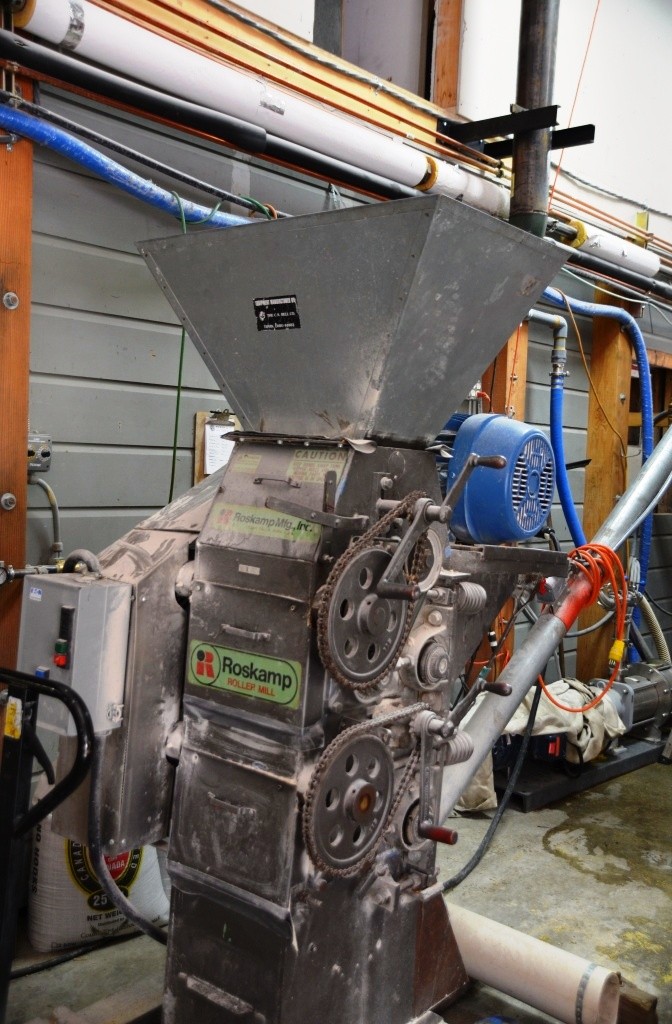
Manually operated (!) grain mill
Add water and yeast to the coarsely ground grains, get some heat going, and fermentation will start. Once you are done fermenting, the leftovers mash will be disposed, and the water with alcohol will go through the distillation process, where they will be separated.

Distillation column at Tuthilltown
Once you have the alcohol, it can be either bottled as is, or it can be aged in the barrels. When it comes to ageing, Tuthilltown uses heavily charred new American Oak casks (made by the cooperage which they own).

Small American oak cask
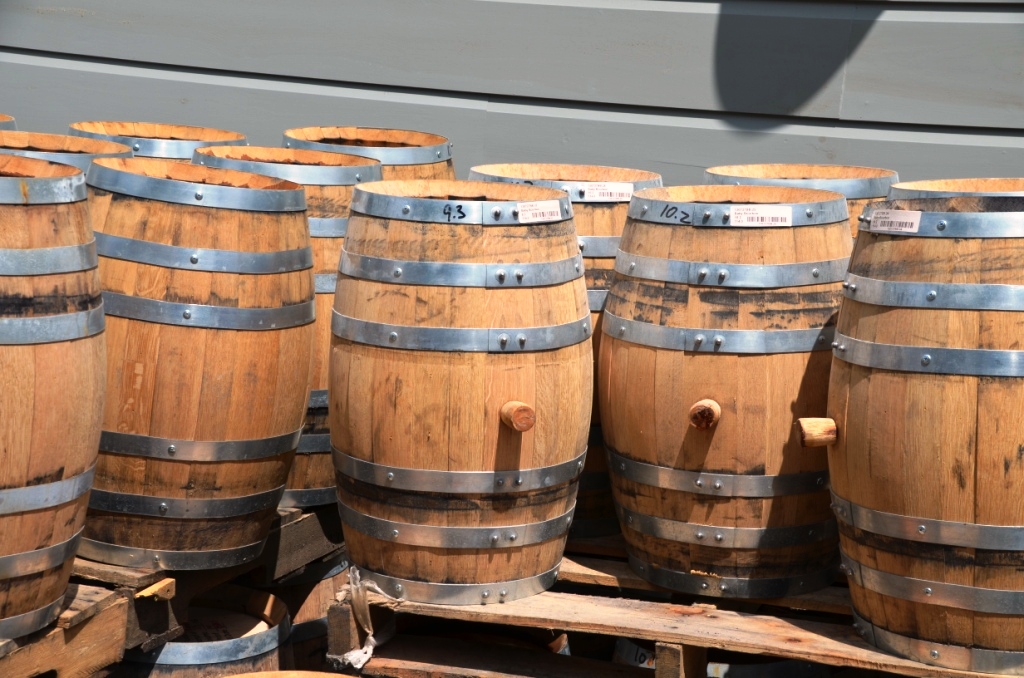
Ageing goodness
American whiskey is typically aged for 30-40 days per gallon, so if you have a 10 gallon cask, it will take a bit longer than a year to reach the proper age – of course whiskey can be aged for any period of time, but at least today Tuthilltown doesn’t produce any whiskey with extended ageing.
Once the ageing is done or close to be done, bottlers will decide when the particular batch is ready to be bottled. The bottling operation is located in the basement of Tuthilltown distillery. The process starts from filling the empty bottles:
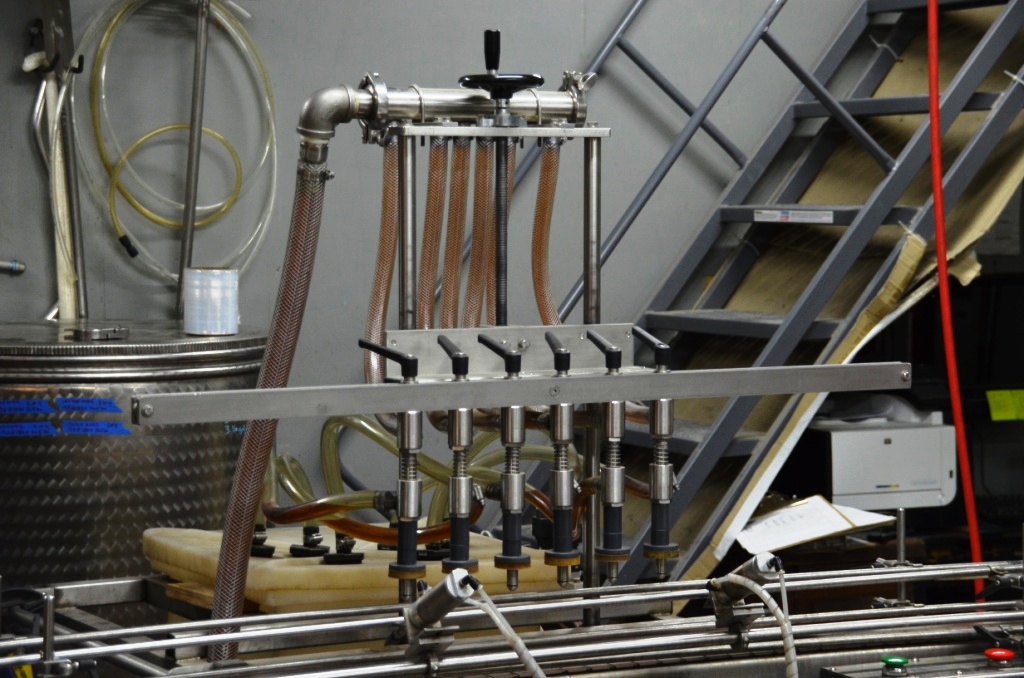
this is where the bottles are filled
Then the bottles are closed with cork, and dipped into the hot wax and lastly, labeled:
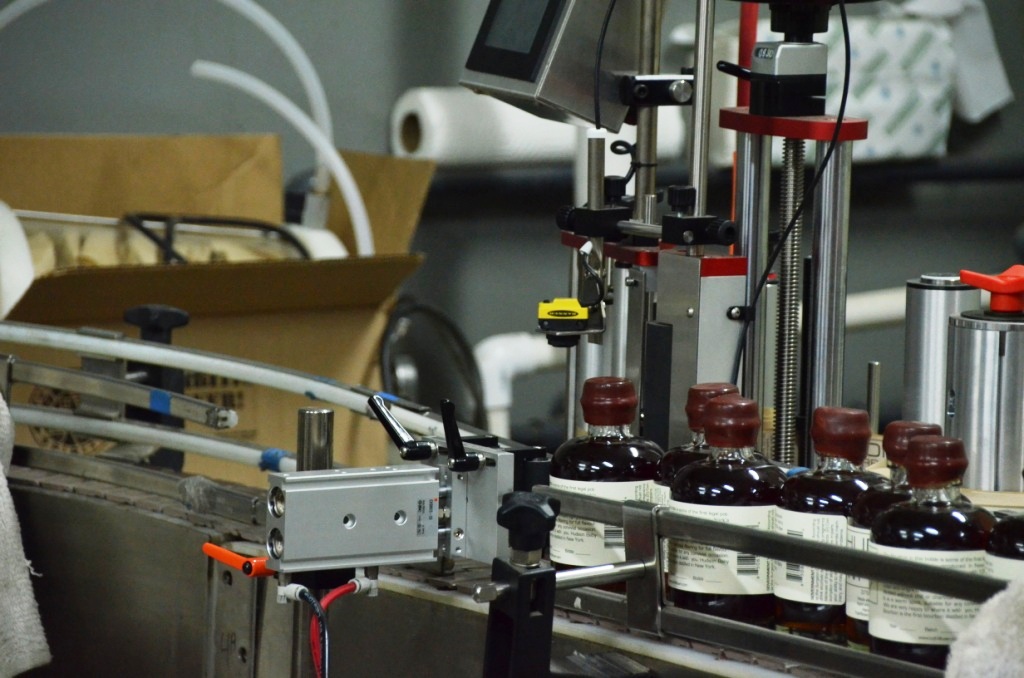
labeling part
Labeling was one of the most mundane tasks which Tuthilltown automated very recently. By automating this task, it allowed people to use the freed up time for something useful and creative – and the new product, called Basement Bitters was born ( beautiful aromatic drops for your cocktail).
And once you are done with the labeling, you get … lots of whiskey, ready to be numbered (by hand!) and shipped for all of us to enjoy:
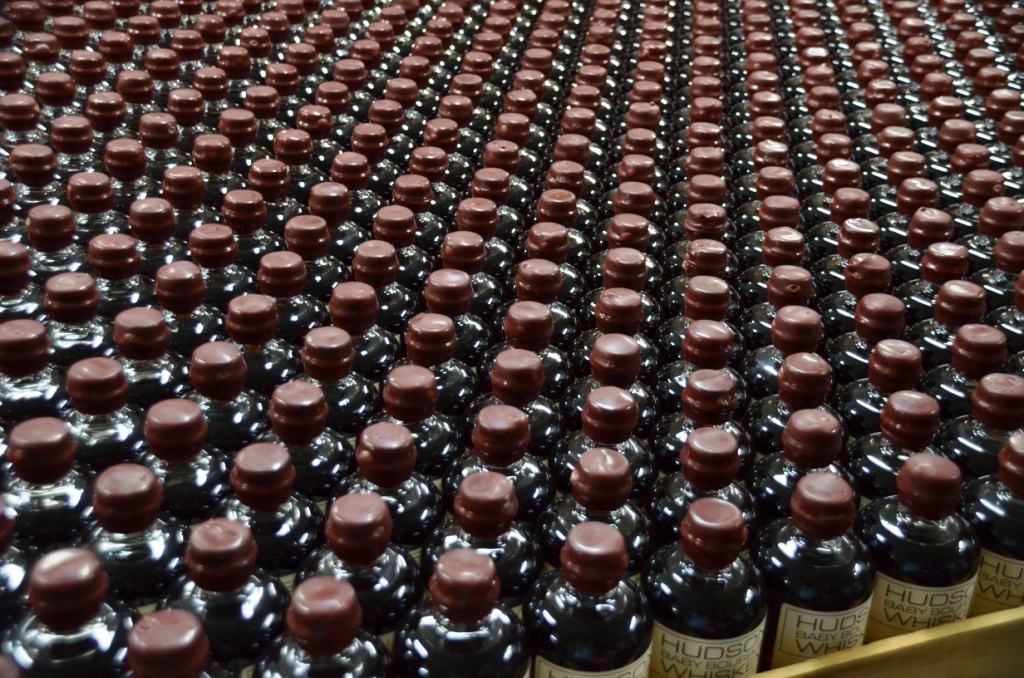
Ready to go

yes, ready
And of course after the tour you can go and taste the whiskey (and vodka, and gin) in the tasting room:

Tasting time!

Don’t forget the bitters
Tuthilltown lineup includes Indigenous Vodka (made out of apples), Half Moon Orchard Gin, Hudson New York Corn Whiskey (unaged), Hudson Baby Bourbon, Hudson Four Grains Bourbon and Hudson Manhattan Rye Whiskey ( last three are all aged whiskeys). Hudson Baby Bourbon is my favorite, but hey, you have to taste it for yourself.
And I think we are done here. I hope you found the time to watch the video. And what I want to leave you with is this:
Dictionary.com defines “gumption” as:
2. courage; spunk; guts
Follow your dreams! Cheers!
Oak Hills Restaurant: Great Food, Great Wine
I recently shared with you my take on the Madonia restaurant in Stamford. Few weeks after visiting Madonia, we went to another restaurant with the similar type of cuisine – Mediterranean with Italian flair. This restaurant is called Oak Hills Restaurant on the Green and it is located in Norwalk, Connecticut, at the Oak Hills Park (it is actually a municipal golf course).
When the restaurant is located on the golf course, what do you think it can come with? Of course, the view! We were sitting outside on the terrace, overlooking beautiful greens. Yes, you can watch the crowd French style, sitting right in a middle of the street with cup of coffee or glass of wine. Or you can just relax and admire the serenity around you – this is where the golf course is simply a good place to be.
First, let me say a few words about the wine. The wine list was short, but had a few good values. My eye stopped at Barbi Rosso di Montalcino – at $40/bottle, this was quite reasonable wine to get, considering that it retails at around $20.
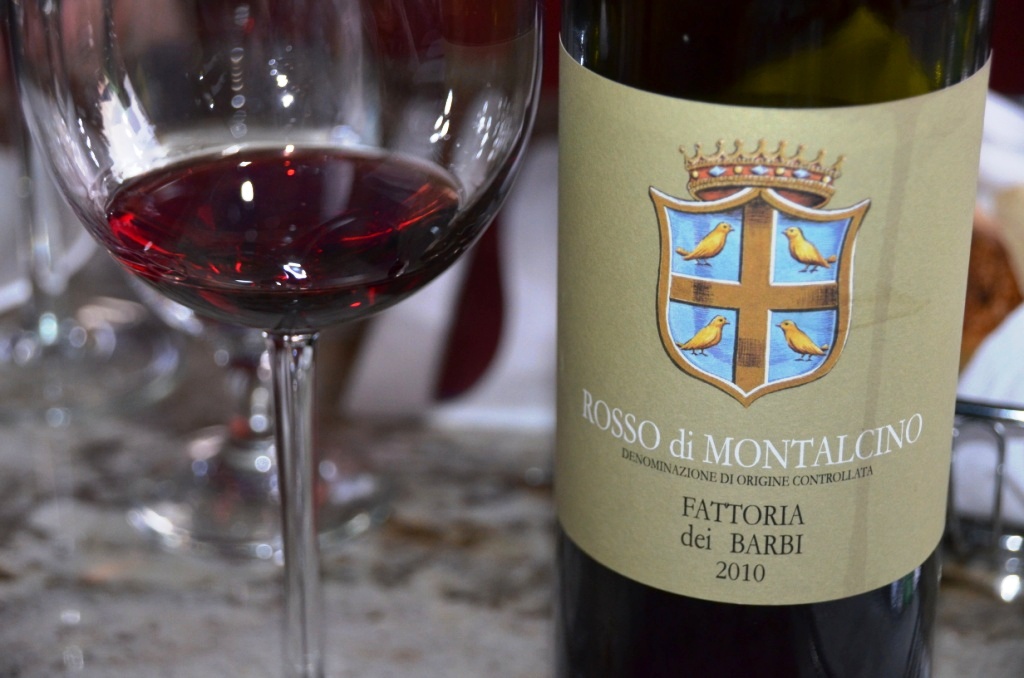
Barbi Rosso di Montalcino
This 2010 Fattoria dei Barbi Rosso di Montalcino DOC was very nice, ready to drink from the get go. Light ruby color in the glass, rustic nose of light cherries with hint of leather, more cherries on the palate, perfect acidity, soft and round – this wine was perfectly fitting our appetizers. For the appetizers, we had a few dishes, here are two of the memorable ones:
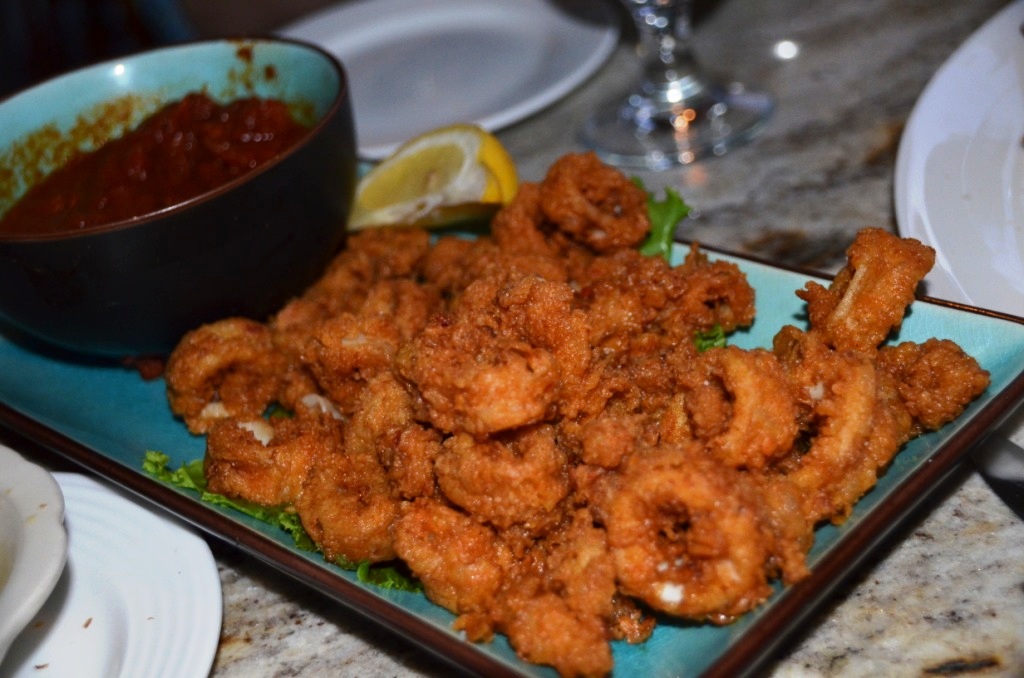
Fried Calamari
Calamari were perfectly done, with just the right amount of breading, crispy with perfect texture, and delicious sauce with just enough bite.
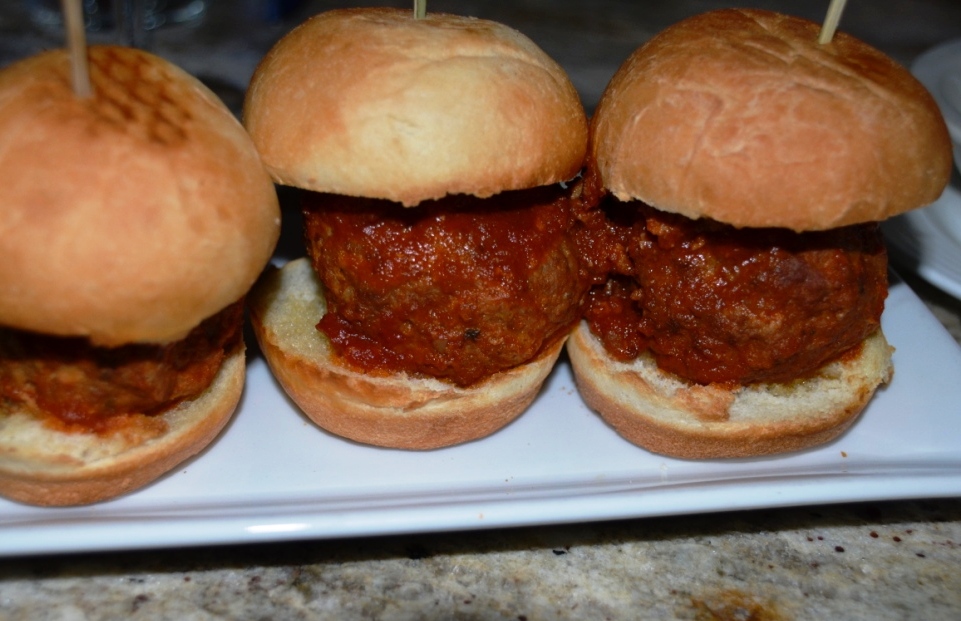
Meatball Sliders
Generous meatballs paired perfectly with our Rosso di Montalcino wine.
Then it was time to get another bottle of wine. We decided to continue with the same wine – but Omar, Maître D and co-owner of the restaurant, insisted that we would get the big brother of the Rosso di Montalcino, the Brunello. It was listed on the wine list for $80 (still a good price), but he offered us the wine at the same price as the first one, so we couldn’t resist. The wine also came with the story – Omar told us that in the very old times (1300s), Barbi family were the assassins in the village of Montalcino, and they were offered the land in exchange of promise to stop killing people (which they did). I tried to find some confirmation of this story on the internet ( including Fattoria Barbi’s web site), but was unsuccessful. If you heard anything about it, I would be very curious to learn more.
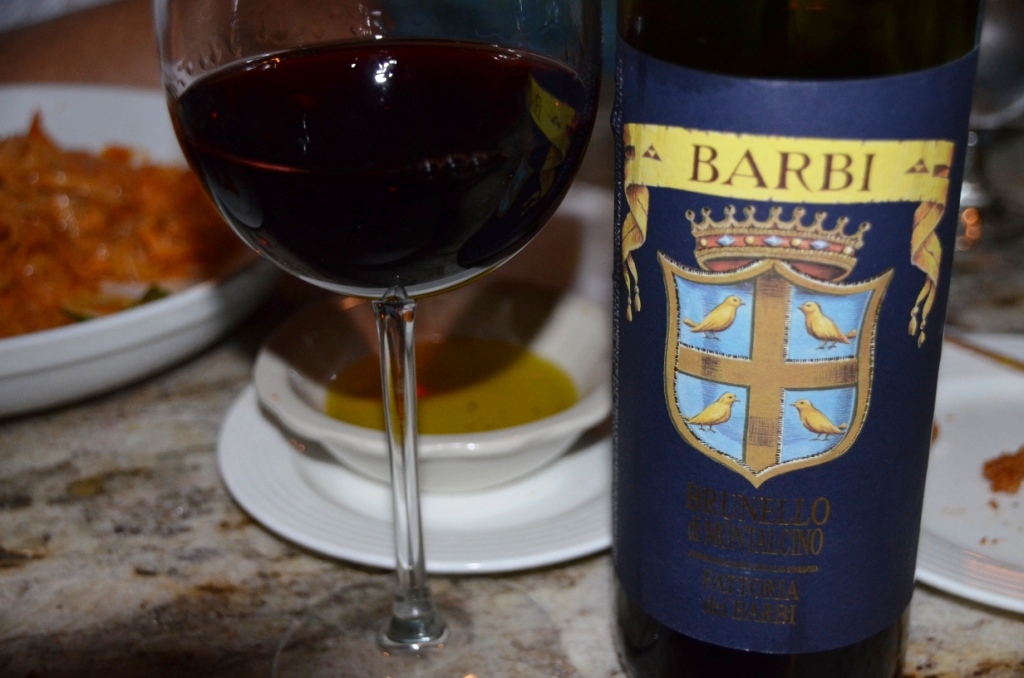
Barbi Brunello di Montalcino
This 2006 Fattoria dei Barbi Brunello di Montalcino DOCG was decanted for a short period of time. Dark garnet color in the glass, invigorating nose of the dark fruit and spices, full bodied, slightly chewy, dense wine on the palate, with lots of dark fruit, cherries and blackberries, touch of tobacco, powerful, but well balanced tannins – this was definitely a great wine.
Here are couple of examples of our entrees:
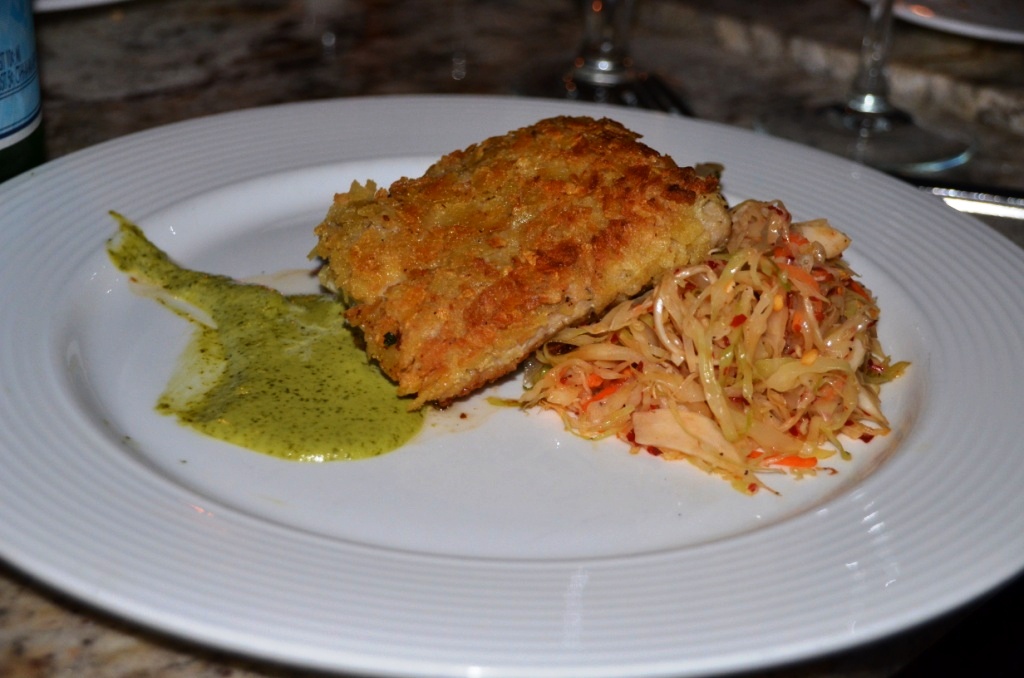
Potato Chip Crusted Mahi Mahi
My wife got this potato-chips encrusted Mahi Mahi. I can tell you – my wife is very picky about her fish – and she said this was probably the best fish she ever had. I have to agree with her – it was absolutely delicious.
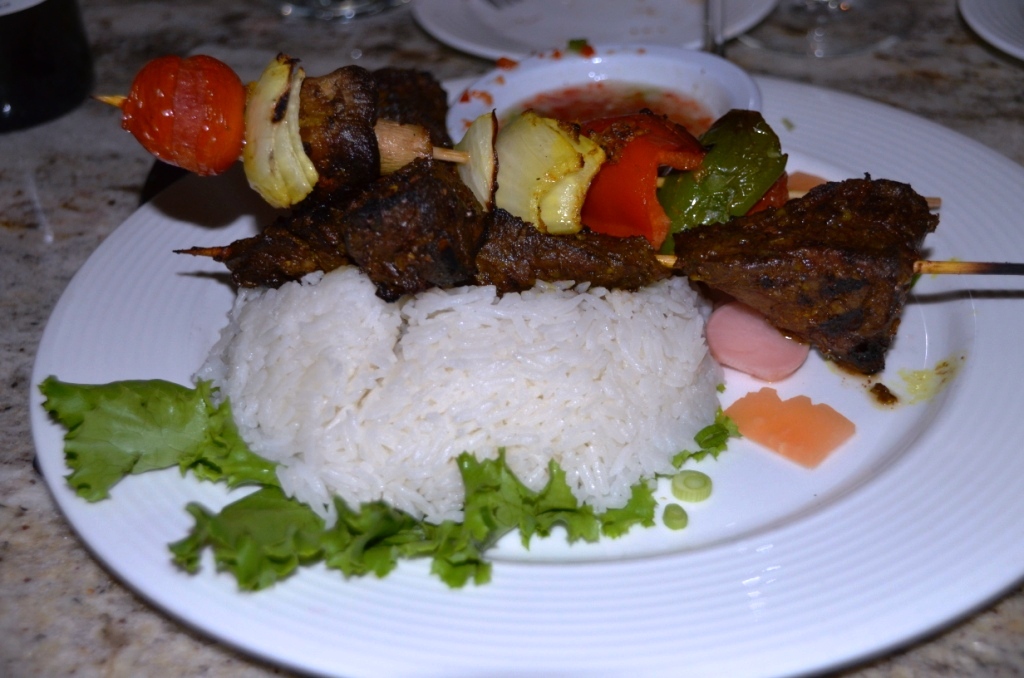
Thai style Kabob
I’m generally skeptical about beef kabob (you need lamb or pork for the best tasting kabob – both chicken and beef have a tendency to come out too dry) – but this execution was just perfect! Meat was perfectly tender, with wonderfully refreshing Thai-style spicy sauce. Definitely an excellent dish.
And then of course was dessert:

French Cannoli
Imagine Italian Cannoli, only with the French crepe instead of the typical Cannoli crust – with banana cream filling, covered with chocolate sauce and scoop of ice cream on top. I rest my case.
All in all, this was a great experience – all is left to do it so thank Chef Vinny La Forte for the delicious meal.
Until the next time – cheers!
Oak Hills Restaurant on the Green
165 Fillow Street,
Norwalk, CT, 06850
(203) 855-1800

Last Bottle Sign Up ($10 credit)




 Talk-A-Vino