Archive
Sequel in Reverse – More About Wines of Southwest France
What’s up with the “sequel in reverse”, you ask? Easy. All we need to do is flip the timeline. This post is a continuation of the previous post about wines of Southwest France – however, the tasting I want to share with you took place almost 6 months ago, at the end of the last year 2017, hence the “reverse” notion.
Outside of the sequence of the events, the two tastings are perfectly aligned – they are both squarely dedicated to the wines of one of the oldest wine-producing regions in the world – Southwest France.
I can’t explain why, but I feel that I need to make a confession. If you look through the pages of this blog – and there are a few here – I’m sure you will come to a conclusion that I primarily drink wines from California, Spain, and Italy, with an occasional sprinkle of everything else. And you will not be wrong. However, truth be told, my true love to wine started from French wines. I read the most about French wine and French wine regions. I was obsessed with trying to find an amazing Bordeaux for less than $10. Côtes du Rhône wines were a staple at the house. I spent countless hours in the France aisles of the wine stores (luckily, I was working in a close proximity of the Bottle King in New Jersey), looking for the next great experience with the wines from the Loire, Rhône, Bordeaux, Chablis, and others. French wines were “it” – unquestionably, a sacred territory. As the time was going by, and Bordeaux and Burgundy prices were going up faster than the weeds growing after the rain, the French wines moved mostly into a category of a rare encounter.
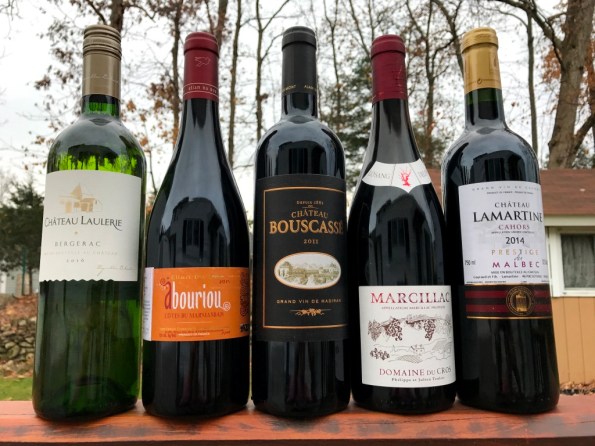
Last December was not the first time I participated in the virtual tasting about the French wines – but somehow, when I opened the box with these wines, something warm and fuzzy came over, and my first reaction was “ahh, I really, really want to drink these wines!”. There is nothing special about this particular set – no big names (I don’t believe Southwest France has much of “big names” anyway), no flashy, ultra-modern labels – and nevertheless, there was a promise of a great time in their simplicity and authenticity. These wines also perfectly played to my other “wine obsession” – the love to obscure and lesser-known wines, so altogether, I took a great pleasure in anticipation of the tasting.
As this was a virtual tasting, I had both the wines and time at my disposal, so unlike the previous post, here are my detailed notes in the usual format:


2016 Chateau Laulerie Bergerac AOC (12% ABV, $12, 85% Sayvignon Blanc, 15% Semillon)
C: Light gold
N: beautiful, fresh, medium+ intesnsity, honeysuckle, white flowers, peach
P: fresh, crisp, excelllent lemony acidity, white stone fruit, restrained
V: 8-, delicious, will be great with food and without, great QPR
2015 Domaine Elian Da Ros Abouriou Côtes du Marmandais AOC (12% ABV, $23.99, 90% Abouriou, 10% Merlot)
C: dark ruby
N: freshly chrushed berries, leafy notes, cherries, anis
P: ripe plums, sweet tobacco, eucalyptus, medium long sweet tobacco finish
V: 8-, would love to try it with an actual cigar. Needs a bit of time. And a new grape – Abouriou


2015 Domaine du Cros Marcillac AOP (12.5% ABV, $15.99, 100% Fer Servadou)
C: Ruby
N: earthy notes, mint, some medicinal notes (iodine?)
P: beautiful fresh pepper on the palate, tobacco, cherries – that pepper is delicious, love the wines like that
V: 8/8+, delicious, excellent QPR
2014 Château Lamartine Prestige du Malbec Cahors AOC (12.5% ABV, $17.99, 100% Cot (Malbec))
C: dark garnet
N: vegetative, tobacco, a touch of cherries
P: bright acidity, dark fruit, tart cherries and cherry pit, noticeable tannins.
V: 8-, pleasant, will work great with the steak, but needs time
2011 Château Bouscassé Grand Vin de Madiran (14.5% ABV, $17.95, 60% Tannat, 25% Cabernet Franc, 15% Cabernet Sauvignon)
C: dark garnet
N: eucalyptus, forest floor, a touch of eucalyptus,
P: initial tannins attach, pepper, dark round fruit, excellent extraction, layers of flavor, firm structure
V: 8+, outstanding, powerful, balanced, needs time!
The Southwest France wines are a treasure trove for the wine lovers – they capitalize on tremendous history, experience, unique terroir and unique grapes, offering oenophiles lots of pleasure in every sip. Look for the wines of Southwest France – and you can thank me later.
The Region Which Started It All
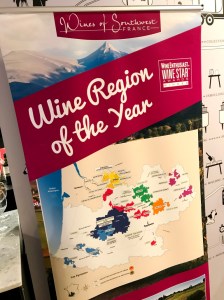 The wine had been made in the Southwest of France ( Sud-Ouest in French) almost forever – in terms of human life, 2,000+ years well classified as “forever”. The region is considered one of the “cradles of winemaking” in Europe, and it maintains its uniqueness and diversity today – for example, out of 300 grape varieties used in the winemaking in the region, 120 are not found anywhere else.
Of course, we know that winemaking started about 8,000 years ago, and not in the Southwest of France. So what’s up with “started it all” claim? Glad you asked! Let me explain.
We live in the times when the wine is a part of daily life of many. Drinking wine is a norm and normal, simply a part of the daily routine for many, not a luxury or a weird exception anymore. Yes, that’s how it was in Europe forever – but now I’m talking about the rest of the world, countries such the USA, and even China now heading that way. The demand for wine had been constantly increasing since the late 1990s, and even Great Recession of 2008 didn’t kill it (just shifted the “acceptable” price ranges). Is it all just a normal course of events? We can, of course, settle for this. However, I believe that on a deeper level, there are exact reasons, “tip the scale” moments for many things which seem to happen just on its own – however, sometimes it is not easy to identify those “reasons”.
Remember the impact of the movie Sideways on consumption and production of the Merlot in the USA? That movie was the reason for a huge slump after 2004, and production and interest to Merlot are still in the recovery mode even now, 14 years later.
Late in the 1980s, the world started talking about The French Paradox – French eat cheese and foie gras, cook with butter and duck fat daily, and nevertheless, the coronary disease rates are much less than in the countries with comparable living standards and much lesser fat consumption. Possible explanation? Red wine. French consume lots of red wine, and resveratrol, one of the prominent substances found in seeds and skins of the red grapes, acts as a defense against clogging of the arteries. That was the outcome of the extensive medical research study conducted in France, which became known in the world as French Paradox.
In 1991, CBS in the USA dedicated one of their popular programs, 60 Minutes, to the French Paradox, and you know how Americans are, right? We are always looking for an easy way out, so wine sounded like an easy enough cure, and I believe this became a pivotal moment which triggered a renewed interest in the wine. Almost 40 years later, it seems that the wine successfully keeps the momentum. And before you will attack me with all the facts from the latest research – yes, I’m aware of many articles pointing to the issues with the study. Whether French Paradox study conclusions were medically solid I have to leave to professionals to debate and decide on. But it was still that pivotal “tip the scale” moment which changed the perception of the wine for many in the world.
At this point, I’m sure you want to see the connection between the title, the Southwest of France, and the story of the French Paradox, right? Here it is. While attending the tasting of the wines of Southwest France, I was listening to the presentation by sommelier André Compeyre, who mentioned that Southwest France has the biggest number of centenarians in France and it was one of the main regions where the French Paradox study was conducted – here we go, now everything is connected and explained. Is it time for a glass of wine?


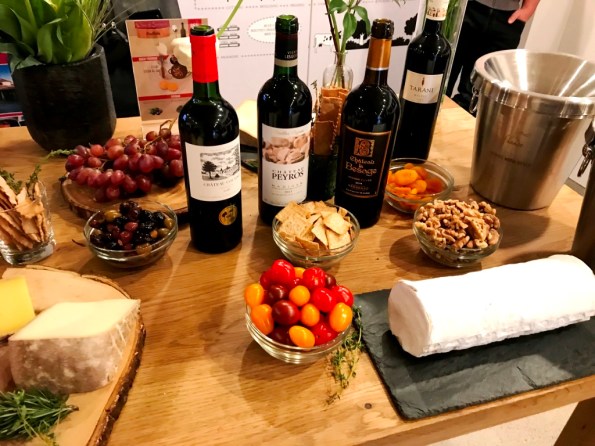
The tasting took place at the little store in New York called the French Cheese Board – what can be better than wine with a little cheese, right? Especially if both come from the same region, where they trained to live together for a few thousand years…
We started tasting with the sparkling wine, moved to the white and then red. As usual in such events, there was not enough time (and desire) for the formal notes, so below is the best I can offer. However, overall, the word is “outstanding” – the wines of Southwest France are well worth seeking – and you will not be disappointed.


NV Domaine du Moulin Mauzac Méthode Ancestrale Gaillac AOP (12% ABV, $15, 100% Mauzac) – very nice and simple. 7+
2017 Domaine du Tariquet Premières Grives Côtes de Gascogne IGP (11.5% ABV, $14, 100% Gros Manseng) – semi-sweet wine. It appears to be a traditional wine in the Southwest of France, which people are accustomed to drinking. It is possible that the wine was not cold enough when I tasted it, but I really didn’t appreciate it. If you like sweeter wines – this might be the one for you.
2016 Héritage Blanc Saint-Mont AOP (13% ABV, blend of Gros Manseng, Petit Courbu, Arrufiac) – excellent, bright, crisp, but very complex and thought-provoking. A touch of grass, vanilla, ta ouch of honey on the palate, green apples, wow. Excellent acidity. Great complexity. 8. And let’s not forget 2 new grapes – Petit Courbu and Arrufiac
2017 Domaine de Joy l’Eclat Côtes de Gascogne AOP (12% ABV, $7, blend of Colombard, Ugni Blanc, Gros Manseng and Sauvignon Blanc) – crisp, clean, superb. 8


2012 Château de Haute Serre Cahors AOP (13.5% ABV, $22) – superb, ripe berries, blueberries, round, delicious, acidity, vanilla, the backbone of minerality. 8+
2012 Château Montus Madiran AOP (15% ABV, $32.99, blend of Tannat and Cabernet Sauvignon) – smoke, campfire, tobacco, great concentration, powerful, excellent, great acidity, outstanding. 8
2011 Jean-Luc Baldès Triguedina Clos Triguedina Cahors AOP (14.5% ABV, $40, 85% Malbec, 10% Merlot, 5% Tannat, 12 months in oak) – touch of barnyard on the nose, delicious fruit, ta ouch of funkiness on the palate, great acidity. 8
2015 Domaine de Terrisses Terre Originelle Gaillac AOP (13% ABV, $16, blend of Braucol (Fer) and Prunelart) – beautiful Cabernet nose, crisp, cassis, Bordeaux style -outstanding. 8. and a new grape – Prunelart
2015 Réserve Bélingard Côtes de Bergerac AOP ($15, 50% Cabernet Sauvignon, 50% Merlot) – beautiful, warm nose, vanilla, cassis, beautiful, soft. 8
2013 Chateau Peyros Vieilles Vignes Madiran AOP (13% ABV, $18, 80% Tannat, 20% Cabernet Franc) – excellent, soft. 8-
2017 Domaine de Joy l’Eclat Côtes de Gascogne AOP (12% ABV, $7, blend of Colombard, Ugni Blanc, Gros Manseng and Sauvignon Blanc) – crisp, clean, superb. 8
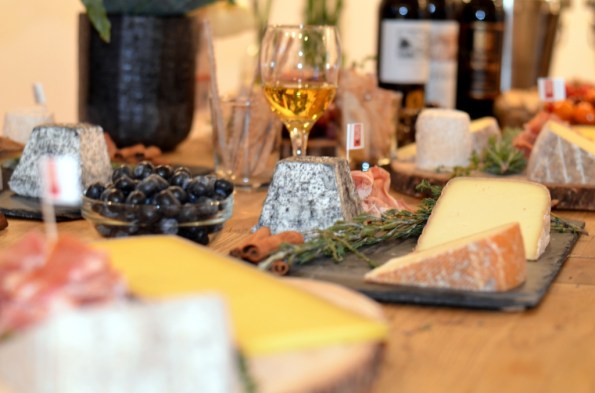


In addition tot he wines, we had an opportunity to indulge on the local cheeses of Southwest France – Ossau Iraty, Buche de Lucay, Bethmale Chèvre, Chabichou, Valencay, and Comté. Sorry, I’m not going to give you any individual notes, but all the cheese were superb. If you are like me and accustomed to the Comté cheese from Costco – that Comté in the tasting was the whole different game (go visit the store and taste, you don’t have to believe me).
There you go, my friends. Have you had wines of Southwest France lately? Any favorites you want to mention? Let’s raise the glass to many happy wine discoveries – and some red wine as a solution to all our problems. Cheers!
An Evening With Friends – In Singapore
For years I had been following the Oz’s Travels blog, commenting from time to time on the great wine (and food) experiences described there. Over these years, we built a virtual friendship with Oz (Anthony), the author of that blog, with one recurrent theme “one day you will make it to Singapore, and then…”. As amazing as the life is, that “one day” actually happened about two months ago when my business travel finally brought me to Singapore.
Maybe you saw my very excited post about Gardens of Singapore – but the evening before I experienced all the gardens, I was able to meet, shake hands, and share a few (okay, more than a few) bottles with Oz and his friends.
Oz picked me up from the hotel with his friend Rob and we proceeded to the restaurant, where another Oz’s friend (also Rob), was already waiting for us. Then, there was food, wine, and scotch – but let’s take it all in steps.
First, the restaurant – newly open Garang Grill (a sequel to the already successful Garang Grill at another location). The restaurant allows guests to bring their own alcohol, which we took an advantage of – while restaurant provided glasses and decanters. During the course of our dinner, I had an opportunity to experience a variety of creative dishes. Skewers of sauteed foie gras were melt-in-your-mouth delicious. Luncheon meat fries (yes! talk about creative!) were superb with delicious dipping sauce. I since made the same dish at home and everyone loved it. Crab rillette, steak – everything was delicious and tasty. Here is an account of our dinner – in pictures.


And then there was wine. What I love about Oz’s parties is the abundance of wine, and not just any wine, but nicely aged wine – and you know how much I admire the wine with a little (or not so little) age on it. Here is what went down:


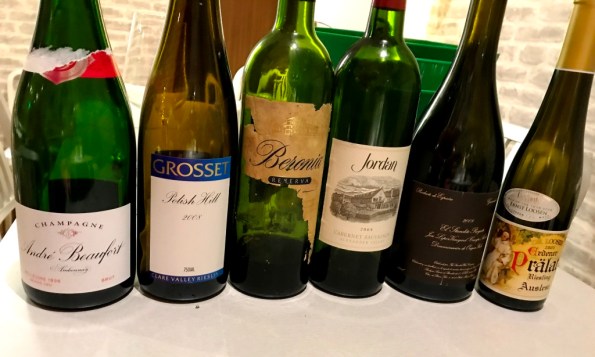
1996 André Beaufort Champagne Grand Cru Ambonnay. Never had it and never heard of André Beaufort Champagne before. Meanwhile, this happens to be one of the oldest all-organic grape growers in Champagne. This 1996 was disgorged in 2014. The wine had great acidity, green apples, still perfect fizz, candied apples with a hint of cinnamon showing on the nose. Yeast showed up later. Excellent. That was a real treat.
2008 Grosset Polish Hill Riesling Clare Valley. Australian Riesling is not a simple wine. I remember trying young Australian Rieslings many years ago, and putting them into the category of “I never want to drink this again”. It takes a bit of time to understand the beauty of the wine devoid of any sweetness and instead offering in-your-face acidity and minerality. But once you turn the corner, this becomes the style you crave. This particular wine at hand was, in many ways, an encounter with the legend. You see, Clare Valley is one of the best regions for Australian Riesling. Polish Hill is one of the very best vineyards. And Jeffrey Grosset is a legendary producer, one of the best winemakers in the world. Now you add a bit of age, say, 10 years – and you almost get heaven on Earth – petrol on the nose, restrained palate, minerality through the roof, great acidity, just a pure delight in every sip.


1994 Bodegas Beronia Rioja Reserva. Behind damaged label was an excellent wine – still fresh, good fruit, good acidity, excellent. Still has time to evolve. Based on the color also still young – just starts showing age.
2005 Jordan Cabernet Sauvignon Alexander Valley. This was my contribution to our lineup. Jordan needs no introduction to the Cabernet Sauvignon wine lovers. This wine was very good, typical California Cab. The wine had an interesting amount of sweetness, more than I expected – as it showed no age, I would assume it still needs more time to evolve. I have one more bottle from the same vintage – will have to wait with that one for a bit.
2008 Standish Wine Company El Standito Proyecto Garnacha Tintorera Yecla DO. This is a Spanish wine, of course – produced by Standish Wines from Australia. Yecla is the best known for their Monastrell wines – this wine, however, was made from the grape called Garnacha Tintorera, which is also known as Alicante Bouschet, which can produce massive, dense wines. This wine was no exception – excellent, restrained, good balance, good fruit, good acidity – and still in need 0f at least another 20 years to evolve.


2005 Dr. Loosen Erdner Prälat Riesling Auslese Mosel-Saar-Ruwer. You can’t finish such an evening without a dessert wine, can’t you? 13 years old Auslese by Dr. Losen – need I say more? The wine was amazing, great balance, a touch of candied plum, great acidity, fresh, simply superb.
This was the end of our dinner, but not the end of our evening. A short taxi ride took us to the unassuming building (well, it was dark, so maybe it is not as unassuming during the day) which happened to be a Rendezvous Hotel, one of the oldest in Singapore. After taking a flight of stairs up, we entered the room where my jaw literally hit the floor. The “room” was called The Auld Alliance – the scotch and whiskey bar (primarily) with more than 1,600 (!) different whiskeys available to taste and purchase. I never saw anything like that in my life, and the selection there was simply beyond words:
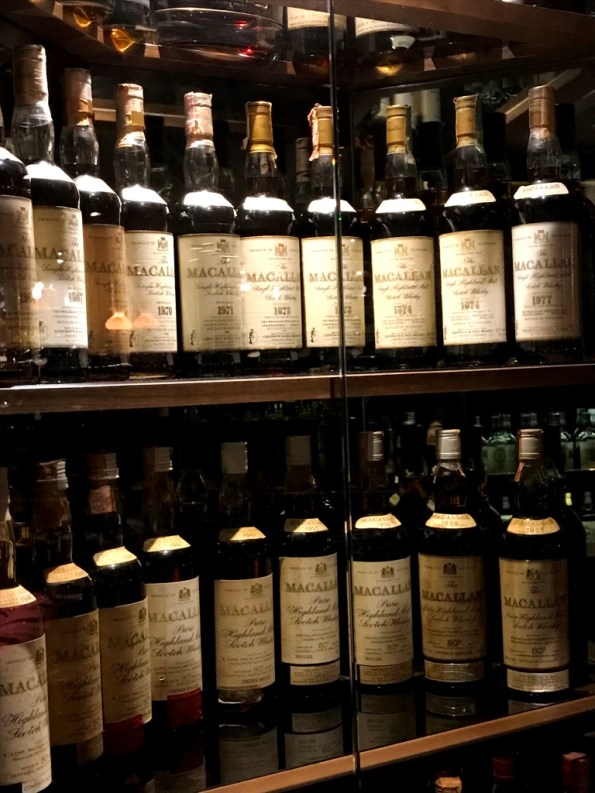


In addition to many whiskeys available by the glass, The Auld Association also offers a number of tasting flights – I had the one called “Smoke around the world” and it was definitely fun (I hope you don’t expect my tasting notes after 18 hours of non-stop travel and prior dinner with all the wines).


So this is my account of an amazing evening in Singapore. It was definitely a pleasure meeting Oz and his friends, and the whole evening was simply beyond expectations. Cheers!
Open That Bottle Night – 2018 edition
We all have THAT bottle. How I mean it, you ask? Simple. We all have bottles which have special meaning for us. This one was brought home from the vacation 5 years ago. That one was given by a generous friend with the recommendation to wait for a special moment to drink it. Those in the corner came from the parent’s cellar. Ahh, these I found on a garage sale – would you believe it? Oh yes, and those I got during a great sale – yes, one of each, as I couldn’t afford to buy any more of them.
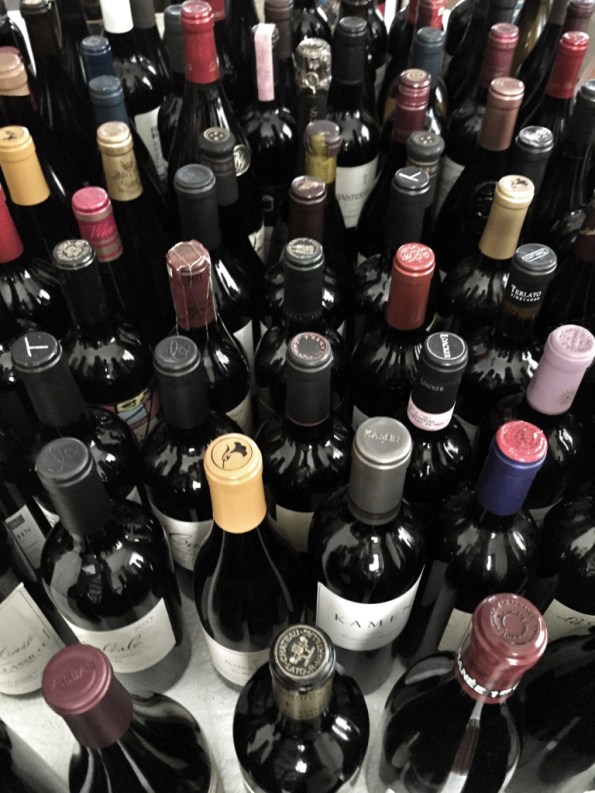
Wine is a perfect vehicle for creating special moments. Maybe the best there is. But this also is a problem in itself. We get attached to those special bottles, always doubting if this is the right moment to open them and keep waiting and waiting for a perfect one. Yes, the wine improves with age, but nothing is forever. There is always a chance that at the proper moment, the wine might not be there for us anymore, and we might not be there for the wine.
To help people with THAT bottle dilemma, Dorothy Gaiter and John Brecher, the journalists behind Wall Street Journal’s Tastings column at a time, created a special event which they called Open That Bottle Night (OTBN for short) back in 1999, celebrated always on the last Saturday in February. Now, almost for 20 years, OTBN helped wine aficionados around the world to ease the pain of parting with those special bottles and actually enjoy the wine in its prime time (or at least that is the intent and the hope).
The OTBN is truly all about the wine, so the oenophile gets its chance to agonize about the impossible choice, going from one bottle to another bottle and finding the reasons why this is not yet the time to claim for it to be THAT bottle. I went multiple times through all my wine fridges, joyfully finding and immediately grudgingly rejecting my choices. Three days later, I just grabbed two bottles which jumped to my attention and said “this is it! no more!”.
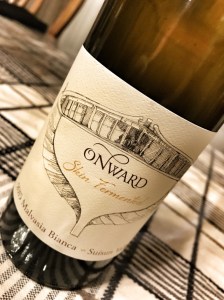 Let’s talk about our OTBN wines – there should be at least some reason for the wines to be “it”, right? So the white wine was interesting in many ways. First, it came to our house via the Secret Wine Santa exchange, courtesy of inimitable Drunken Cyclist. The wine is made out of the rare grape (Malvasia) which is absolutely uncommon for California; the wine is Skin Fermented, which seems now to be a popular term for what was known before as “orange wine” – the grapes are fermented in contact with skin, which is not typical for the white wine. Lastly, the wine comes from the Suisun Valley, which seems to be an up and coming region in California – for example, Caymus, a California wine powerhouse, recently released the new wine called Grand Durif (Durif is original French name for Petite Sirah), made from the grapes grown in the Suisun Valley.
2015 Onward Skin Fermented Malvasia Suisun Valley (12.8% ABV) – light golden in the glass (nothing says “orange wine”), beautiful tropical fruit on the nose – guava, passion fruit. On the palate, initially showed light fizz which went away in about 15 minutes. Cut through acidity, peppery spiciness, white underripe fruit, there is a touch of funk or maybe rather oxidative notes which hint at extended skin contact; overall – different and delicious (Drinkability: 8). Also much rounder on the second day. Probably requires food.
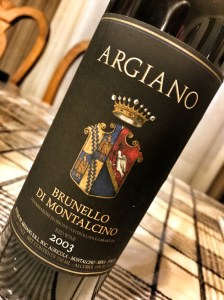 Now, the red doesn’t really have a story. I have no idea how did it make it into our house. Yes, it is a Brunello, which is generally good (one of the 3 big Bs of the Italian wines – Barolo, Barbaresco, and Brunello); Argiano seems to be a good producer even though I don’t know much about them. Lastly, the wine has good age on it, however, it is not much of an age for any of the big Bs. Oh yes, and it was my only bottle, which squarely puts it into THAT category.
2003 Argiano Brunello di Montalcino DOCG (14% ABV) – needed a bit of help from the decanter to open up (about an hour) – dark concentrated garnet color, no hint of age, deep tobacco and roasted meat on the nose, leather, cherry, cherry pit and a touch of plums on the palate. Right after opening, the wine seemed that it was either at prime or maybe already even past prime – after 3 hours in the decanter and a glass, the wine started closing, with fruit disappearing and fresh, young tannins taking its place. This wine would probably last for another 10 years – but I stand no chance to find out as this was my one and only bottle. Still, the verdict is simple – delicious (Drinkability: 8+/9-).
That sums it up, folks. I love OTBN, as the wine is meant to be drunk, and OTBN helps us to get THAT bottle out and experience it before its too late. How was your OTBN? Cheers!
Cooking as an Ultimate Expression of Love, or Early Valentine’s Day Experiences
I’m always happy to admit that Valentine’s Day is one of my favorite holidays. Of course this is a personal statement, and of course, I perfectly understand that I’m lucky to be able to say it wholeheartedly, as this is not a universal truth.
Outside of presents (which is fun), overpriced flowers and cheesy cards (nevermind all the heart-shaped chocolates, I don’t even want to mention those), Valentine’s Day is all about food and wine. Many years ago, we ditched the tradition of oversubscribed and underdelivering restaurants, offering strictly timed moments of celebration in favor of homemade dinners, which also include the whole family.
Valentine’s Day dinners at home offer a lot of pleasure in itself – you get to contemplate and select the menu, and you have an opportunity to touch lots and lots of bottles until you grab the one which somehow, magically, will become “it”. And then you get to cook that dinner, and most importantly, if everything works as you are hoping it will, you get an extra dose of happiness looking at the happy faces around the dinner table. By the way, if you need any wine recommendations for the Valentine’s Day, I wrote a few of them in the recent years – here and here are two of my favorite ones.
This year, Valentine’s Day dinner came in early – we will be leaving for vacation exactly on the February 14th, thus in order to maintain the tradition of family celebration, the dinner had to take place earlier – on Sunday before the Valentine’s Day. And so the next idea was – why don’t we start early on Sunday, let’s say with a nice breakfast?
What is your favorite celebratory breakfast meal? Eggs Benedict is definitely one of my favorites, so that was an easy decision. Smoked salmon is one of my favorite choices for the eggs benedict, so the prep for the breakfast started two days prior, first by making smoked salmon (you can find the recipe here).
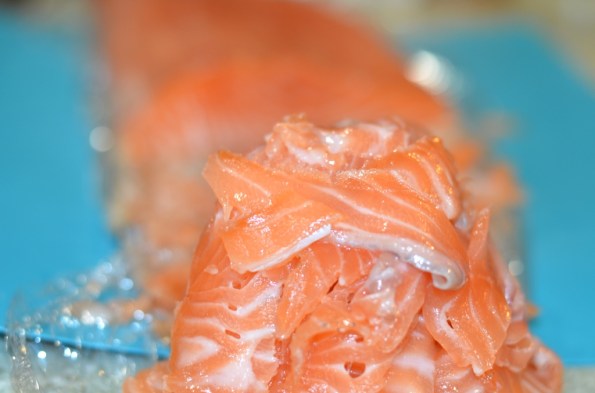
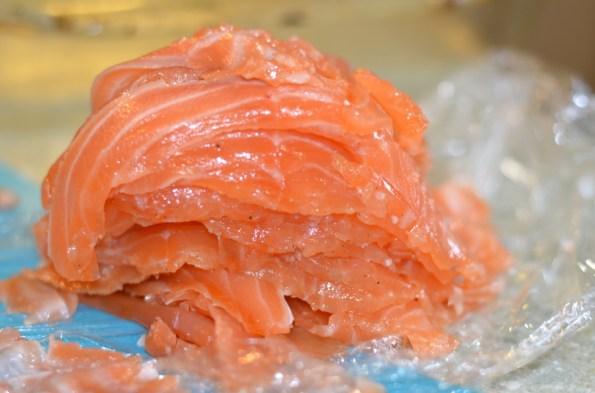
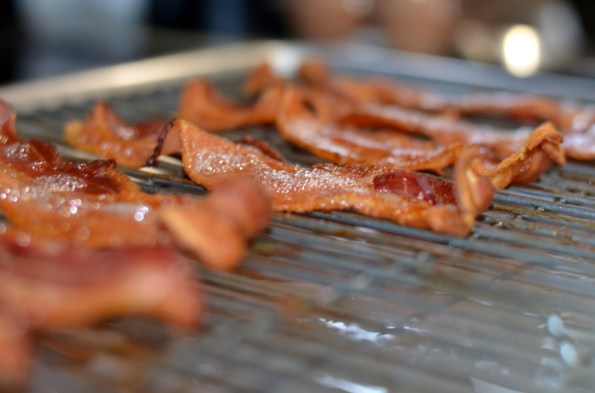
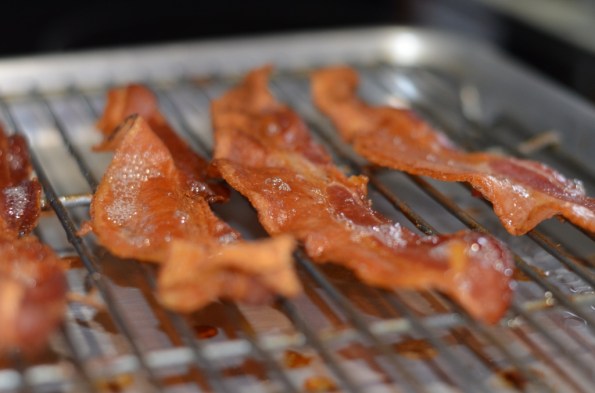
This is Valentine’s Day dinner, so we need to up the game, right? What can elevate breakfast better than some crispy bacon? Yep, bacon it is!
 Traditional Eggs Benedict are served on top of the English muffin. Truth be told, I don’t like English muffin – not with eggs benedict, not by itself. So my choice of bread? A fresh biscuit. I have friends who can easily whip a batch of biscuits on a moment’s notice, but I have my limits – thus buttermilk biscuits by Pillsbury work just perfectly for me.

Next, we need to make the Hollandaise sauce. It is somewhat of a tedious process, involving a double-boiler and some serious skills – unless you have a recipe from Suzanne, which is very simple and guarantees a perfect result – as long as you follow it precisely. The Hollandaise came out perfect, both taste and texture, so last prep step was to poach some eggs. All you need to do is to get hot water with vinegar to borderline boil (it shouldn’t be actively boiling, so take your time to adjust the heat) in a deep skillet, then carefully crack the eggs, set the timer and voilà. To my shame, I have to admit this is where I failed – I set the timer for 10 minutes (this is what I read in one of the recipes online), and this was a mistake – I completely overcooked the eggs. I believe the right time would be 5 minutes at the most.
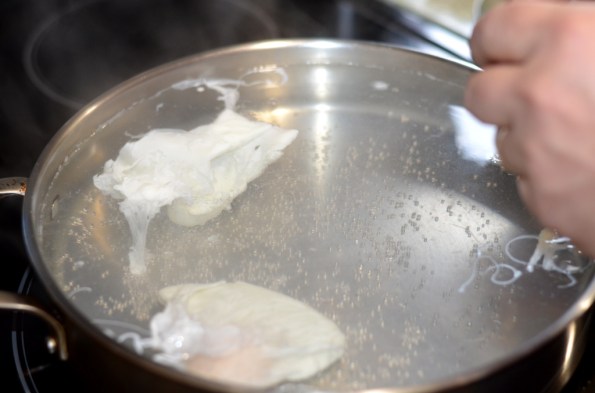
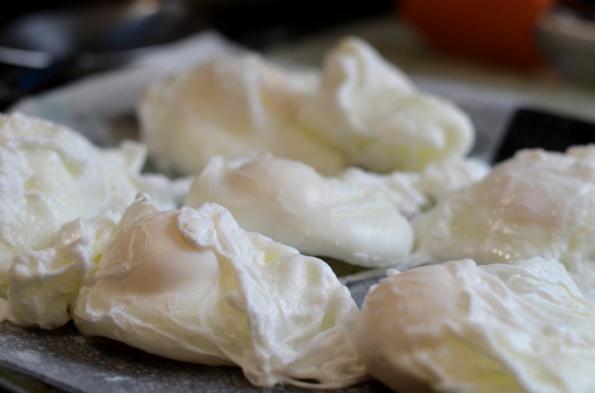
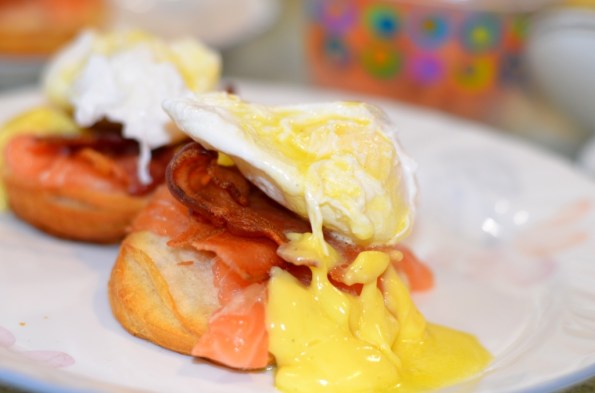
Another important step – let the eggs cool off after cooking (ice bath recommended) – I didn’t do it, and as the result, Hollandaise was not covering the eggs properly – oh well, it was still really tasty. So the last step was to assemble the Eggs Benedict – the biscuit on the bottom, then smoked salmon, bacon, egg, and Hollandaise.
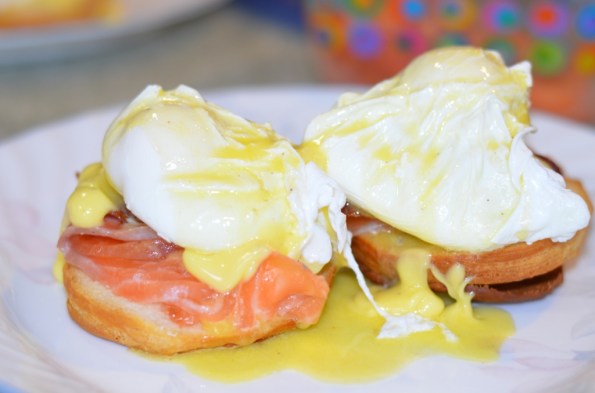
Now it is time to make dinner. More often than not, simplicity is your friend when it comes to food. Going the simple route, our Valentine’s Day dinner plan was simple – steak and potatoes.
For the potatoes, we have a recipe where potatoes are thinly sliced on the mandoline, then slices are stacked at the little angle and fried – it is a great recipe except that my fingers and mandoline are not great together, but love requires sacrifices, right?


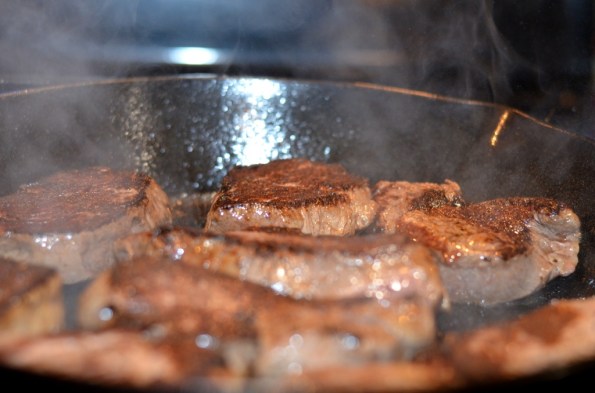
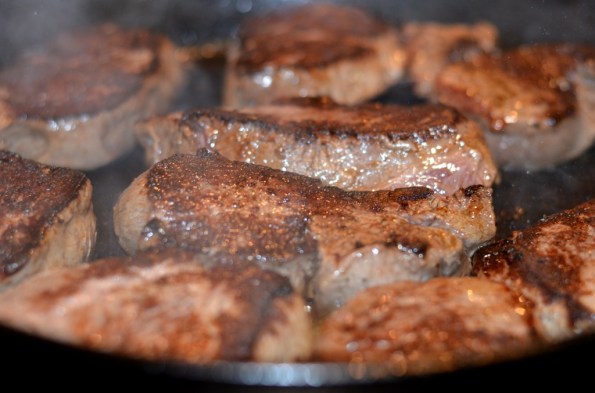
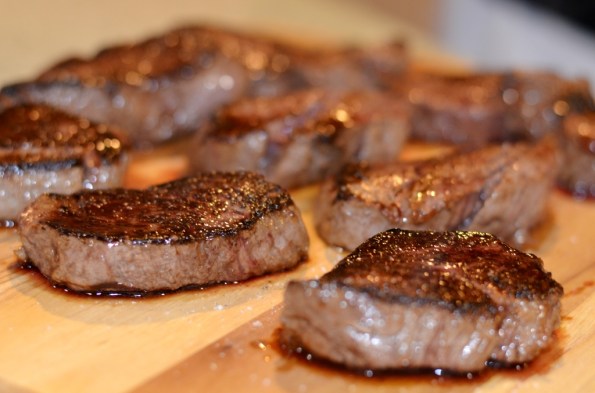
And for the steak – you can’t beat the simplicity of the pan-fried filet mignon:
Where there is steak, there is also wine. As I mentioned, after spending good 20 minutes going through the different shelves of the wine coolers, I pulled out the bottle which happened to deliver an insane amount of pleasure – 2005 Neyers AME Cabernet Sauvignon Napa Valley.


I like to know critics scores for the wines, but only out of curiosity – my buying decisions are not based on those scores at all. Besides, my own take on the wine rarely correlates with the critic’s opinion. Except for this wine – when I read Robert Parker’s description, to my surprise and delight, it was well aligned with the way I perceived it – so here is Robert Parker’s take on this 2005 Neyers AME:
” 93 points Robert Parker’s Wine Advocate
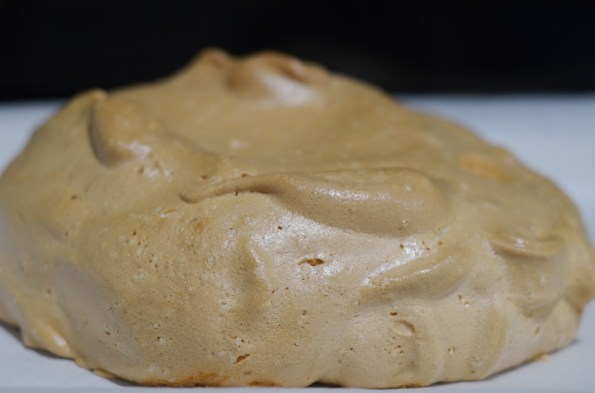
 Here you are, my friends – our early Valentine’s Day dinner experience. Happy Valentine’s Day! Cheers!
Art and Science of a Perfect Cup of Coffee
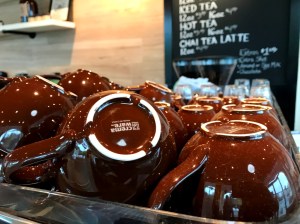 Please close your eyes. Oops, no, not for real – please keep your eyes open to read, but do it at least in your mind. Imagine the aroma of the freshly brewed coffee – the unique smell in the air which nothing else can compare to. Sometimes that is the smell of a new day. Sometimes, it is a quiet moment in the afternoon. Sometimes, it is winding down the evening. Was this hard to imagine, even if you didn’t close your eyes? If you love coffee, I would bet that was a very easy exercise. And I hope you do love it, as coffee is what I want to talk about today.
I love comparing coffee with wine. Similar to the wine, coffee has a dependency on its area of origin. Kona, Jamaican Blue Mountain, Costa Rica, Ethiopia – each region imparts its own unique tasting profile. Similar to the wine, sustainability, and coffee growing process matter. Similar to the wine grapes, the best coffee is harvested by hand. Similar to the wine grapes, the coffee beans are sorted to achieve the best quality and consistency. Most importantly – similar to the perfect glass of wine, a perfect cup of coffee delivers lots and lots of pleasure.
Notice how I went from coffee bean growing to the coffee cup, skipping a few steps in between? Those few steps are what differentiates coffee from wine, making coffee ultimately a more complicated subject. Before you jump off a chair and click away, as the writer here clearly a lunatic, please allow me to explain.
Once the good quality grapes are obtained, they are pressed, fermented, aged, and finally, bottled. The bottle is the final form in which wine will reach you, the consumer. Now, to enjoy the glass of wine, all you need to do is to pop that cork (twist the screw top, if you insist), pour the liquid into the glass and voilà! Yes, there are few extra steps and hurdles which oenophiles happily enact for themselves to enjoy the wine “more better”, but really – unless someone does something really stupid, like leaving a wine bottle for a day in a hot car, the good wine in the bottle will easily translate to the good wine in the glass.
The things are different when it comes to the coffee. The final product of the coffee grower is dried green beans. Before coffee can be enjoyed, it has to be roasted and brewed. Roasting typically takes about 20 minutes, and those 20 minutes can either create a thing of beauty or an awful, terrible concoction which one can drink, but never able to enjoy. Brewing also offers multiple opportunities to convert those beautifully roasted, full of promise and anticipation beans into a dull or simply bad tasting brown liquid.
The process of coffee brewing is where the aromatics and flavors are transferred from the roasted beans to the water, which results in your final object of desire, a perfect cup. Before brewing, coffee beans have to be ground. The way coffee will be ground depends on what type of coffee would you like to drink – espresso requires the very fine grind, so higher flavor concentration can be achieved. For so-called “drip coffee”, the coffee particles are typically very coarse, as water is not pushed through the coffee with the high pressure, as it is done for the espresso. Now, let’s leave espresso aside and talk about the “drip coffee”, the one which we consume most often.
It turns out that there are many factors which are matter here, on the way to arriving at that perfect cup – temperature of the water (to the single degree of Fahrenheit!), the ratio of water to the coffee and the speed of extraction (how long the water will stay in contact with the coffee grinds). Just for you to understand: the ideal coffee brewing temperature is 201°F – and 203°F will result in the burnt taste! You need to maintain the ratio of water to coffee at 15.5 to 1 (15.5 grams of water per 1 gram of coffee). And you need to spend about 4 minutes making that perfect cup. How about it? Will you ever look at your morning coffee cup the same way again, after I shared with you all this information? Well, didn’t mean to scare you, honestly – all you need to do is just to taste the difference.
A couple of years ago I talked about a visit to the Shearwater Organic Coffee Roasters, the organic coffee artisans in Trumbull, Connecticut, where we learned about intricacies of the proper treatment of the fresh coffee beans from Ed Freedman, the owner of the company (here you can read about that experience). This year, Ed decided to deliver a full [proper] coffee experience to the people by opening Shearwater Coffee Bar in Fairfield in Connecticut. I had an opportunity to visit it few month ago and get exposed to the science and art of a perfect coffee cup.
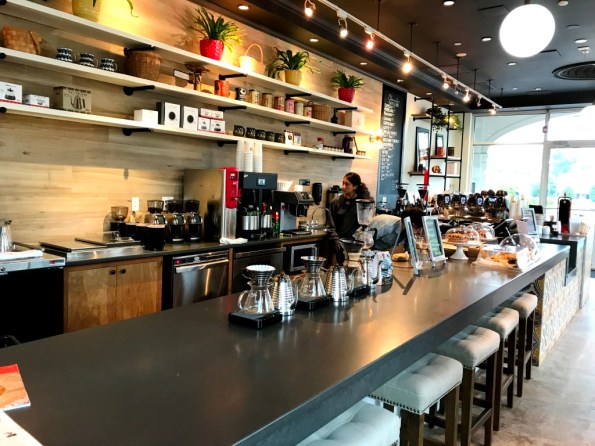
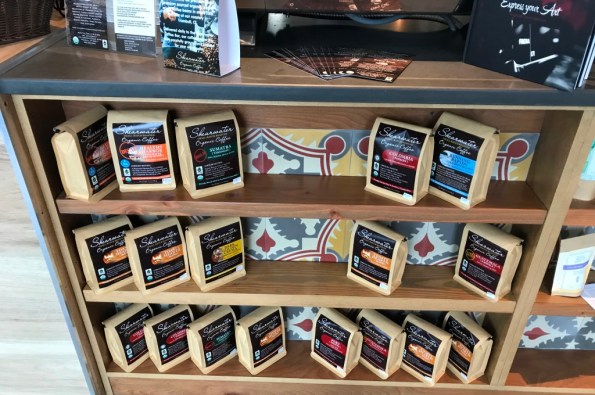
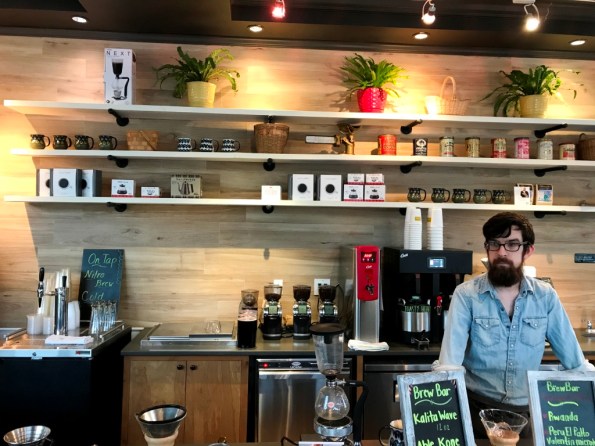
Jason The Barista is ready for action

The choice is yours
If the words “coffee bar” elicit an image of Starbucks in your head, shun that away please, as the Shearwater Coffee Bar is nothing like. Similar to the regular bar we are all used to, you can sit in front of the barista, have a conversation and watch as your beverage of choice is unhurriedly prepared in front of you. Unlike a typical bar, you sit comfortably on the normal height chairs, not on the “bar stools” which are not so much fun to get on and off. But if you ever observed a cocktail master who produced a drink which made you say “wow”, this coffee bar delivers exactly the same experience.

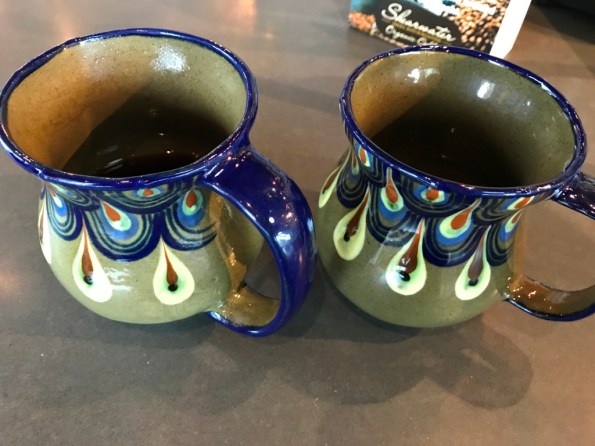
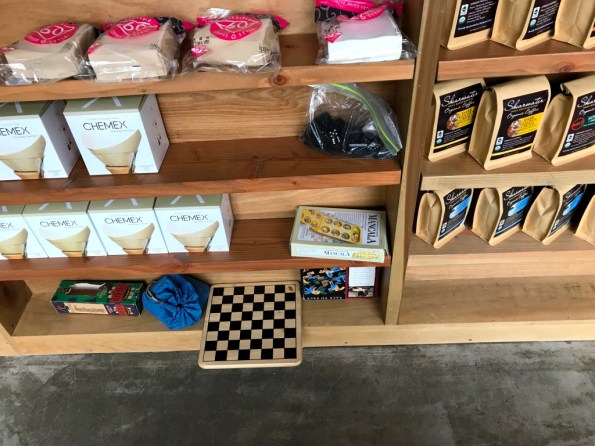

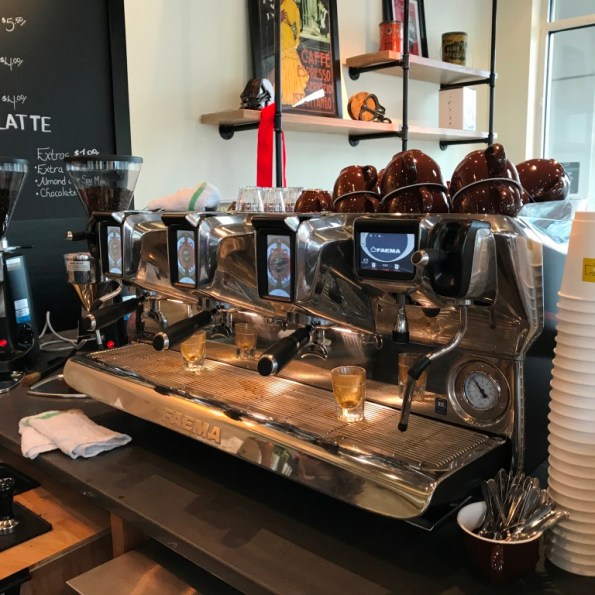
At Shearwater Coffee Bar, you have a choice of coffee to begin with – different origins, different roasts. Then you can choose your method – Pour Over, Chemex, Siphon – of course, espresso and cappuccino are available too if that is something you want.


Once you decide on what you want, the magic begins with the grinding of the coffee beans and then putting the glass vessel on the scale. The coffee goes in, the water is dispensed at the exact temperature (201°F, remember?), and then poured over (if you asked for Chemex or Pour Over), while the barista is carefully watching the scale. A few (4!) minutes later, the magic is complete and coffee goes into your cup – can you smell the aroma?


We tried Pour Over and Chemex coffees – the were some slight variations but I wouldn’t dare to try to give you any differentiating descriptors. Jason, our barista, also attempted to make a siphon coffee (this technology actually comes from Japan, where the fine art of coffee is well recognized). In the siphon method, the water is heated from the bottom, and once it reaches a proper boiling point (which is not truly “boiling” temperature), it should slowly percolate up and travel slowly through the coffee to gently extract the flavor. Something went wrong, the water went through too fast, and Jason refused to pour us that “bad” coffee. Well, this is why we are talking about art here – and if the artist is not happy with creation, it goes down the drain.


The creativity at Shearwater Coffee Bar doesn’t stop here. First, you have the cold brew. The cold brew is when coffee is made without heating up the water. It takes about 18 hours to make coffee using cold brew method – but the resulting coffee is much less acidic compared to the standard coffee cup, thus people who can’t drink regular coffee because it is too acidic for them can perfectly enjoy the cup of the cold brew.


Now, let’s add a little bit of nitrogen (yep, you heard me right) to the mix, and you got … the Nitro! Do you like Guinness beer? If you do, then Nitro is your drink, as it is a coffee which looks like beer with a perfect thick foam on top, tastes like beer (yes, it makes you say “ahh” after a sip) – but has no alcohol in it, so you are really not limited in how many Nitro you can consume before driving back home.


So what is your take on a perfect coffee cup? If you are looking beyond just a punch of caffeine and a bite of a pronouncedly bitter taste, then you should really seek the art and indulgence of a delicious drink, taking as much of the pleasure as it can offer. Don’t take my word for it – visit Shearwater Coffee Bar and see taste for yourself. Cheers!
Shearwater Coffee Bar
1215 Post Road
Fairfield, CT 06824
https://www.facebook.com/ShearwaterCoffeeBar
Ph: (203) 955-1098
For The Love of Chowder – 2017, 10th Anniversary Edition
Last Sunday, October 1st, we had fun. Too-much-of-a-good-food, coma-inducing fun. The 10th Annual Chowdafest was on – the biggest and the busiest of them all (well, maybe not “all”, as I attended only last 3 – but for sure the busiest of the 3).
When I saw traffic slowing down on I-95 about two miles away from our exit, I jokingly said to my wife “see, they are all coming to the Chowdafest”. As we kept driving slower and slower, eventually pretty much succumbing to a complete halt, the smile disappeared from my face. The joke was on me, as yes, this was the traffic getting into the exit of the Sherwood Island Park, and it was moving really, really slow.
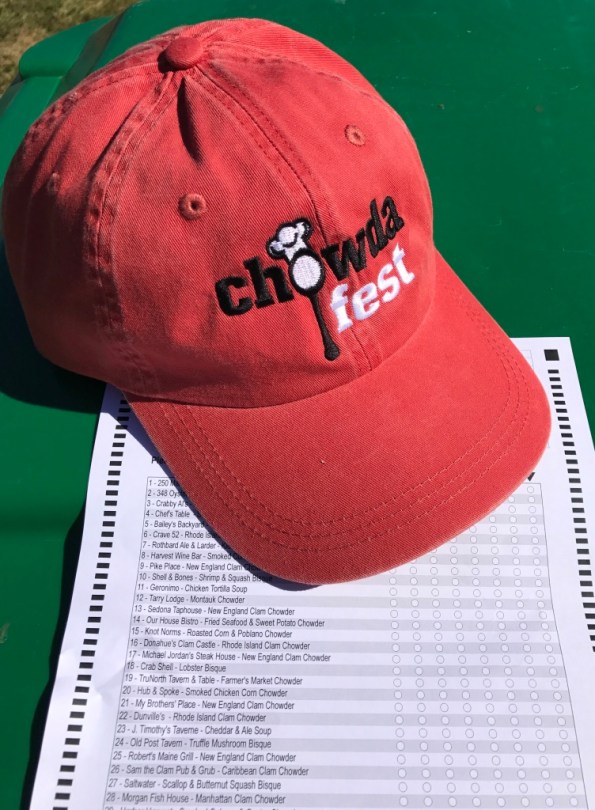 All the fears of looking for parking for a long time quickly disappeared once we managed to actually enter the park, and then to find the parking within a minute. A quick walk, getting your hand stamped and – hello, chowder!
What can I tell you about Chowdafest 2017, outside of the fact that it was a great fun? The format was somewhat the same as the last 2 years I attended – there were again 40 restaurants, competing for the “best” title. In addition to 4 of the staples – Classic New England, Traditional (Rhode Island and Manhattan), Creative and Soup/Bisque, the new category for added for the Vegetarian Chowder. Everybody had a ballot and a pencil and were rating chowders on the scale from 7 to 10.5. The ballots were processed right at the event (I saw that magic for the first time – there are few pictures for you down below), and the winners were announced two days after the event – you can see the names of the winning restaurants here.
Unlike last year, the weather was amazing. And I guess the weather, coupled with a great promotion and the 10th Anniversary nature of the event, really drove a lot of people over. Some of the lines required 10+ minutes waiting, but I really can’t complain, as everything was flowing very efficiently. Here it is, the weather and the people:


What a day!


You can’t ask for a better weather

Beautiful day, isn’t it?
Overall, everything offered was very solid – of course, some were better than the others, but the level was quite high – I only had 4 soups rated at 7, and 3 out of those 4 had a burned flavor. Many soups were really, really delicious. in addition to all the chowders, there were lots of other food offered for tasting – potato chips, cheeses, sodas, iced teas, juices, ice cream – there was definitely something for everyone. Here are my notes – in pictures, of course:


These are some of my favorite decorations:


Pouring chowder requires focus!
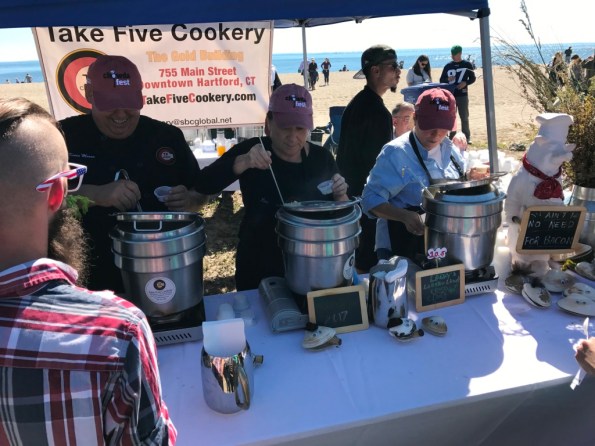
… and smile
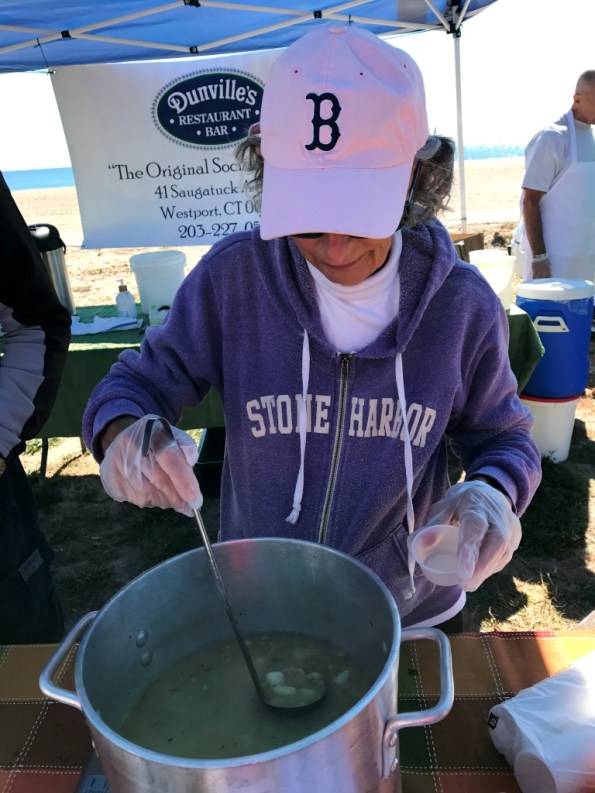 Now, some of my absolute favorites:
Our House Bistro from Winooski, VT – all those condiments, super-tasty:


Truffle mushroom bisque from Old Post Tavern in Fairfield, CT and traditional chowder from Two-fifty Market in Portsmouth, NH:


Here are the winners in the traditional category – Pike’s Place from Seattle, WA:


Last but not least, may be the biggest surprise of the day – vegetarian Smoked Corn & Squash Chowder from Harvest Wine Bar in Westport, CT:


Here you can see all the results getting tallied in the real time by the folks from Blum Shapiro:


Here you can see my vote (yep, with a few stains on it):
 Comparing my thoughts with public opinion, I’m very happy to see Our House Bistro winning Creative Chowder category with Fried Seafood & Sweet Potato Chowder, and with Old Post Tavern taking top spot in the Vegetarian category with Truffle Mushroom Bisque and Harvest Wine Bar taking second place in the same category with Smoked Corn & Squash Chowder.
I can also get on board with B.R.Y.A.C taking the second spot in Classic New England Chowder category, but Pike’s Place winning that category for the 3rd year in the row simply baffles me – their chowder was overdone – super round and super creamy, it lacked the real burst of flavor of the classic New England clam chowder which both B.R.Y.A.C and Two-Fifty Market had perfectly visible. My only theory is that people get intimidated with all the medals at the Pike’s Place stand, and simply don’t want to be wrong when they think that so many people were right before.
Anyway, this one is done and we can already start thinking (and drooling) about Chowdafest 2018 – I know it is early, but still, mark your calendars for Sunday, September 30th, and see you there!
Guest Post: 5 Wonderful Reasons Why Should Go a Culinary and Wine Vacation for Your Next Travel Getaway
Today I want to offer to your attention a guest post by Lystia Putranto, a personal & professional development blogger for BookCulinaryVacations.com. Lystia is a lover of travel, a self-professed foodie, and an amateur cook who admittedly spends way too much time surfing the web.
As the last quarter of the year is around the corner, many of us are taking advantage of this time to plan our next great adventure. If you happen to be a food and wine lover and you’re on the hunt for travel ideas, there’s no better way to indulge in your passions than by going on a culinary and wine focused vacation!
For starters, did you know that by 2015, 77% of leisure travelers can already be classified as culinary travelers? This trend has continued to rise and is predicted to rise even higher in the coming year. So, if you have yet to join in this exciting (and not to mention delectable) bandwagon, it’s about time that you do so.
As a lover of travel, food, and wine, I can personally attest that there’s much to gain and experience through this unique type of holidays. But if you’re not yet convinced, on this post, I’m sharing with you five of the many wonderful reasons why you should sign up for a culinary vacation too:
1. You’ll Discover New & Exciting Flavors

In order to truly make the most of our travels, keep in mind that we can only grow and enrich our lives by doing something we have yet to try. So instead of setting yourself up for yet another touristy sight-seeing trip, why not try (and taste) something different for a change?
With a new destination comes plenty of delicious local eats & drinks. Through culinary holidays, you’ll get an amazing opportunity to explore a variety of new and exciting flavors through its delicacies and locally produced beverages – and yes, in many sought after destinations such as France, South Africa, Chile, and California, this certainly includes a whole lot of wine!
As you already know, food is almost always much more delicious and authentic when we enjoy it in the country or place of origin. You’d also be interested to know that some local dishes and ingredients are extremely rare and would not be easily found anywhere else in the world so this the time to take full advantage of it.
2. You’ll Expand Your Knowledge

Looking to deepen your culinary and/or wine knowledge? During a wine vacation, for example, you won’t only be tasting the various wine that the winery produces, you’ll get to learn all about wine far beyond what you would learn in a wine tasting event such as how to harvest grapes as well as the steps of the entire wine production right up to its bottling process.
3. You’ll Learn How to Prepare Authentic Delicacies

Image credit: Alila Manggis Bali
What makes culinary vacations stand out from the usual “run-of-the-mill” vacations or food tours is that you also get the opportunity to prepare them from scratch yourself! This way, you can learn to recreate them back home. That is the simple yet powerful beauty of a hands-on cooking experience.
As a self-professed foodie, I adore all type of cuisines – but I must admit that Thai food is amongst my top 3 favorites. So, on my last trip to Thailand, I decided to sign up for a cooking class in Bangkok to learn how to prepare authentic Thai dishes such as Tom Yum Goong and Pad Thai.
In the end, not only did I thoroughly enjoyed the experience, thanks to the warm guidance of the school’s professional instructors, I was also genuinely impressed how fun and easy it all was!
As an added bonus, some cooking vacations may include visits to the local markets where you get to purchase the ingredients for your meal or even pick your own fresh produce straight from their own farm. In this case, it’s not uncommon that everything you make is farm-to-table ready, making your holiday that much more special.
4. You’ll Make New Friends

Image credit: Porto Club Travel Services
Whether you prefer traveling solo, with a partner or in a group, through a cooking vacation, you are bound to meet plenty of new people. This includes both locals as well as other travelers from all corners of the globe. This is your chance to cultivate a better understanding of the diverse culture and languages of the world. Who knows? Perhaps some of the people you meet on your trip may just end up becoming (new) lifelong friends!
5. You’ll Immerse Yourself in the Local Culture

Image credit: Cris Puscas
They say that travel is the only thing that one can buy that makes us richer. I personally believe this to be true. It allows us to learn more about what our beautiful world has to offer. And there’s no better group of people that will be able to teach us a destination’s local culture than the locals themselves.
Culinary travel allows you to center your trip on cultural immersion – meeting the locals, sampling local cuisines and beverages, and indulging yourself in the local ways of life. It’s an experience that will not only tantalize your taste buds but also one that will open your eyes and mind to a whole new perspective of seeing the world.
For The Love of Chowder – October 1, 2017 – Be There Or Else
 So the time has come to put your chowder face on … wait, is there such thing as a “chowder face”? I know there is a “game face” and a “poker face”, but “chowder face”? Okay, don’t want to make it too complicated – if you like chowder, then happy face with an ear to ear smile is all you need, as 10th annual ChowdaFest is coming up in mere 3 weeks!
On Sunday, October 1st, starting at 11 AM, at the Sherwood Island State Park in Westport, Connecticut, 40 restaurants (click for the list) will compete for YOUR vote to become Chowda Champions! I attended two of the past competitions, in 2015 and 2016, and I can tell you from the experience – you don’t want to miss this event. Chowdafest is an incredible amount of fun, good time and good food.
This year, the participants will compete in 5 categories:
- Classic New England Clam Chowder
- Traditional Chowder (Rhode Island and Manhattan)
- Creative Chowder
- Soup/Bisque (think Lobster Bisque)
- Vegetarian (new category for 2017!)
2017 Chowdafest will go way beyond Chowder – you will also be able to sample artisan bread and sauces, salsas and chips, farm fresh ice cream, yogurts, cheeses, and lots more.
Just to give you an idea of what was happening in the past years, here is a brief summary:

Everybody get a spoon, a pencil, and a voting chart – you can rate all the chowders on the scale from 7.0 to 10.5, and the best restaurant in each category will be tallied up shortly after the event will end. In case you are curiuous, here you can find the list of the past winners of the Chowdafest.
That’s all I wanted to tell you, my friends. Mark your calendars, cancel whatever non-essentiall activities you had for that day, and just be there, with your family and friends, briging a good appetite and the desire to have fun. You can get your tickets on the Chowdafest website – the link is here for your convenience (note that AAA members get a good discount).
For the love of Chowder – cheers!
Restaurant Files: Unbound Creativity at Killer B in Norwalk, Connecticut
 If you don’t love bacon, burgers, beer and bourbon, this post is not for you. If you love bacon, burgers, beer and bourbon, but you are hungry – I can’t say this post is not for you, but I highly suggest you will go eat before continuing reading. For the rest of you, folks, let’s have some bacon, burgers, beer and bourbon fun!
More often than not, it is easy to categorize a restaurant. “Fine dining” would easily invoke an image of the white tablecloth with perfectly arranged plates and silverware, and the waitstaff enamored with the bowties. “Burger joint” would bring you an image of maybe the ketchup bottles and simple wooden tables and chairs, and, of course, lots of burgers on the menu. “Bistro” would probably not have a strong mental image associated with the category, but it means “easy and fun place”, for sure to me.
When it comes to Killer B in Norwalk, Connecticut, it is not easy to place it into a specific category. Okay, for sure this is not fine dining establishment, it is not snuffed up like that, and you will definitely feel that when the check will arrive. But it is not a burger joint either – I feel we need a new category – maybe a “burger bistro”, just to signify that Killer B is simply a place where creativity is unbound. And by the way, the “B” actually stands for “bacon, burgers, beer and bourbon”.


Talking about creative, let’s start with the drinks. Killer B offers a number of interesting cocktails. But maybe “interesting” is just not the right word. Two of the cocktails on the list get smoked right in front of your eyes – right at the table. A small glass box arrives together with your cocktail, the pipe with aromatic chips is lit, and the smoke fills up the box. And you are witnessing all the magic.


I tried a few cocktails – Bourbon Mule (knob creek rye, lime juice, ginger beer) was tasty, not too sweet and with the good balance. Bite The Bulleit (Bulleit bourbon, house made ghost pepper honey, lime juice, orange juice, muddled jalapeños, topped with red bull, maple smoked right at your table) was very good, but not as spicy as I would expect, seeing the “ghost pepper” to be a part of the ingredients. But the smoke was there, so the cocktail was definitely a treat. Smokin’ B (Jim Beam black bourbon, bittermilk smoked honey sour aromatic bitters, strained over an ice sphere, garnished with a toasted orange slice, smoked right at your table) was, well, smokey, and yes, tasty too, nicely balanced and very cool to look at.
Then the Bacon Flight (flavors: bourbon, butterscotch, fire, honey, orange) arrived, and this is when I realize how the real adult candy should taste like. Thick cut, perfectly crispy, and with tons of flavor – this bacon disappeared in the blink of an eye. Seriously, that bacon was simply something else – if you would have an opportunity, bacon at Killer B is a must experience.


What arrived next was simply amazing – Lazy Man Lobster Mac (3 lbs of lobster, Monterey jack, cheddar, served in a lobster shell) – can’t be described using any words other than “super-creative” – and whole lobster shell, filled with mac and cheese and lobster – just wow.


Time for a salad, right? First, we had the Wedge Salad (boston lettuce, diced tomatoes, red onions, bleu cheese crumbles, creamy bleu cheese dressing and signature bacon), fresh and crunchy. The Cheeseburger Salad (mixed greens, burger, tomato, onion, pickles, American cheese, creamy bacon bourbon dressing) – was one of one of the “wow” moments for me – how many times you really wanted the burger but not the bun? Here it is – a salad which tastes like fully composed burger (lettuce, tomatoes, pickles), but without the bun! Another simple, but the wildly creative dish, if you ask me.


We continued with Volcano Potatoes (bacon-wrapped baked potato, onion, sriracha, honey, oozing melted cheese) – very tasty and again, creative – just look at the color of that dish. Beer Cheese & Bacon Nachos (house made potato chips, beer cheese, bacon, salsa fresca, black olives, sour cream) were simply dangerous – nobody could stop eating this dish until the last tiny morsel disappeared! Bacon-wrapped Fried Mozz (fried bacon wrapped mozzarella, bourbon bacon sauce) was another delicious concoction – who can say no to bacon and melted cheese?


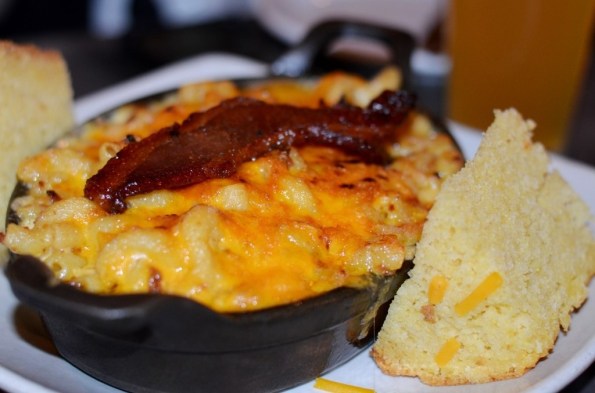
Then we had Bacon Cast Iron Mac and Cheese (candied bourbon bacon, bacon, more bacon) which I’m not sure I can properly represent (I mean how good it was), so let me explain it to you this way. I brought the leftovers of this dish home. My daughter loves mac and cheese (who doesn’t?), but she doesn’t like bacon. As the leftovers didn’t have any visual bacon presence, I decided not to tell her and see her reaction. She starts eating, she is clearly happy, then she turns her head to me and says “it has bacon, right?”. “Yep” was my short answer. She continues “it’s soooo good!”. So yep, that’s how good this mac and cheese was.
Now, we finally arrived at the burgers! We had an opportunity to try 3 different burgers, each with its own unique presentation and its own taste profile.
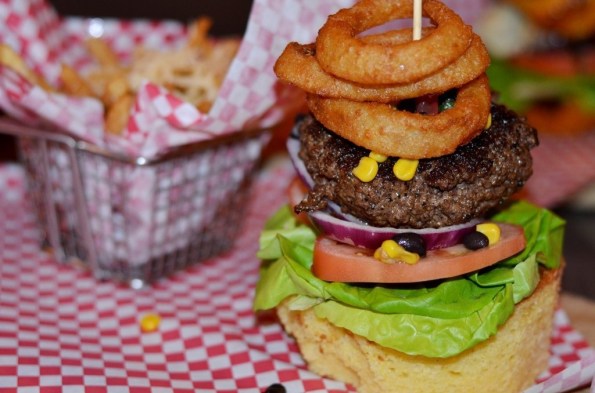
Killer B (double-decker pork patty & beef patty seasoned with bourbon & Guinness bourbon candied bacon, LTOP, bourbon bacon mayo, between two bacon grilled cheese sandwiches) was a bit scary to look at – so it definitely accomplished its purpose of bringing a “wow” to the table. But beyond the looks, each component was tasty, by itself and together. The Stinger (jalapeño patty, pepper jack, lettuce, chipotle mayo, jalapeños, sriracha, spicy bacon, chili flake bun) was not too spicy, but what I really enjoyed is the fact that you could taste jalapeño everywhere – so if you like jalapeño, this would be unbeatable. Country Style (open faced, Lettuce Tomato, BBQ sauce, black bean corn salsa, onion rings, corn bread) was also unique, sporting some of the very best onion rings I ever had – crispy and crunchy, overall – an excellent burger.


 Now, I have two questions for you (hoping you are still reading). First, do you think we left without trying the dessert? Second, do you think our dessert didn’t contain any bacon?
No and No!
Our first dessert was Coconut Peanut Butter & Double Trouble Milkshake, which was outstanding, fun to look at, tasty and perfect for sharing. And then (drumroll, please) we had Fried Oreo Cookies with … bacon! Yep, inside of each little roll of goodness, yes, there it was, a bacon. Clear, wild standout – a great finish to the great experience.


There you have it, my friends. I hope you successfully survived this bacon and burger juggernaut, and maybe I even made you crave some. If you are ever in a proximity of Killer B (I use “proximity” loosely here – when you crave something, distance shortens greatly), don’t miss your chance for an unforgettable bacon, burger, beer and bourbon experience. Cheers!
Killer B
80 Washington Street
Norwalk, CT 06854
Ph: 203.853.2326
http://www.killerbsono.com
Last Bottle Sign Up ($10 credit)




 Talk-A-Vino