Archive
One on One With Cristina Mercuri, Master of Wine
As you might know, I love interviews.
That didn’t happen from the first day of blogging. It took me some time to realize the value of conversation. But once it “clicked”, interviews became one of my favorite subjects on this blog – “Stories of Passion and Pinot” series might be the best proof of that.
Today’s interview is a bit different than the most. The majority of my interviews are with winemakers. However, today I would like to offer to your attention my conversation (virtual, as it often goes, even though this is one of the cases where I would much prefer a face-to-face format) with Cristina Mercuri, Master of Wine.
Cristina Mercuri is the first woman Master of Wine (MW) in Italy, and the fourth Italian MW overall. To put things in perspective, only 521 people have become Master of Wine since 1953, according to the Institute of Master of Wine as of February 2026. This is definitely an achievement to celebrate, so I was very excited when I got an opportunity to talk to Cristina. She is also the founder of Cristina Mercuri Wine Club – we will touch on that in our conversation below.
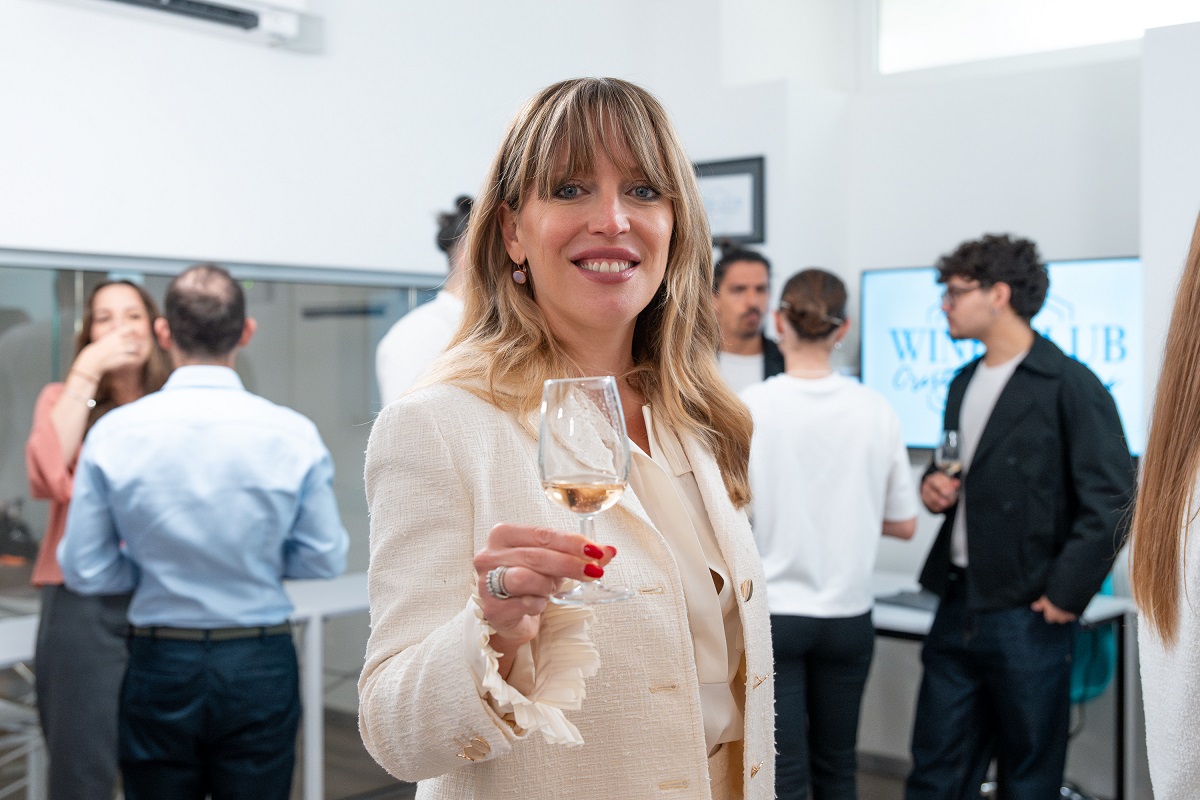
Cristina Mercuri
Here is what transpired in our conversation:
[TaV]: This might be a “duh” question, as you grew up in Italy, and yet – as a wine lover, not as a wine professional, how did you get into the world of wine? Family traditions? Was there a pivotal wine in your life?
[CM]: Wine was always present in my life in the way it often is in Italy: around the table, as part of everyday culture rather than something intellectualized. It belonged to meals, to conversations, to conviviality.
My real entry into the wine world happened much later. I was working as a lawyer and, despite having built a solid career, I felt increasingly bored and disconnected from what I was doing. I needed a radical change, something intellectually stimulating and culturally rich. Wine offered exactly that.
I began studying through the WSET programmes while still working in law, initially out of curiosity. Very quickly that curiosity turned into a serious commitment. By the end of 2015 I decided to leave the legal profession entirely and dedicate myself to wine. What started as a personal exploration became a new professional path.
[TaV]: What made you switch from a successful career in law to the unpredictable world of wine?
[CM]: Law gave me a very strong analytical framework, discipline and the ability to structure complex reasoning. But at a certain point I felt the need to work in a field where cultures creativity and human connection were more present.
Wine offered exactly that. It is an industry where agriculture, craftsmanship, economics and storytelling coexist. Each bottle represents a product, but also a narrative about land, people and time. I realized that the skills I had developed in law — critical thinking, precision, strategic analysis — could be applied in a different way to the wine world.
Leaving law was a significant decision, but it never felt like abandoning something. It felt like redirecting the same intellectual energy toward a field that resonates deeply with identity, culture and global exchange.
[TaV]: You recently became the first woman Master of Wine in Italy (and only the 4th in Italy overall) – how does it feel? What was the hardest part of the MW journey? What was your favorite part of studying?
[CM]: Becoming the first Italian woman Master of Wine is both a personal achievement and a symbolic milestone. In a different world it would be big news that another professional became an MW. In today’s reality, it also represents a small step toward greater diversity in a sector where leadership has long been male-dominated.
The hardest part of the journey is consistency. The MW programme is not only intellectually demanding, it requires years of sustained discipline while continuing to work professionally. Preparing for the Stage 2 examination felt almost like an Olympic training period: blind tasting every day, theory study, mock exams, mental preparation.
My favorite part was the intellectual depth of the programme. It forces you to think about wine from every possible perspective: viticulture, economics, geopolitics, consumer behaviour, communication. It teaches you that wine is not only about what is in the glass, but about the entire system around it.
[TaV]: If at all possible in this format, can you share with us the gist of your master thesis, “Wine, Women and Fascism: A Visual Analysis of the Representation of Women in Propaganda in Enotria (1922–1942)”?
[CM]: My research paper examined how women were represented in the Italian wine magazine Enotria during the Fascist period. I analyzed the covers published between the 1920s and early 1940s using visual semiotics and historical analysis.
What emerged was a very clear pattern: women were rarely portrayed as producers, professionals or decision-makers within the wine world. Instead, they appeared mainly as decorative figures, symbols of beauty, domesticity or national mythology. The visual language reflected broader political and cultural narratives of the time, where gender roles were tightly controlled and instrumentalized.
The research was interesting because it connects visual culture, political ideology and wine communication. It also helps explain why certain stereotypes persisted for decades in the way wine — and women in wine — have been represented.
[TaV]: I heard many times that women are better tasters than men. Do you share the same opinion?
[CM]: I don’t think wine tasting is determined by gender. Sensory ability can vary enormously between individuals, but excellence in tasting comes primarily from training, discipline and experience.
The best tasters I know share certain qualities: concentration, memory, analytical thinking and intellectual humility. Blind tasting especially is a skill that develops through repetition and structured practice.
Reducing tasting ability to gender risks oversimplifying something that is actually much more complex. Wine evaluation is a professional competence that can be developed by anyone willing to dedicate the time and rigor required.
[TaV]: There is a lot of talk everywhere that the world of wine at large is in trouble, as younger people either don’t drink wine at all, or have very specific requirements (low alcohol seems to be one of the most important ones, no oak, etc.). What do you think about young adults and wine? Does the wine industry at large need to do something to address it, or is it just a part of the cycle?
[CM]: I think the conversation around younger consumers often starts from the wrong assumption. It is not that young people reject wine; it is that they expect wine to speak a language that resonates with them.
For decades the industry communicated mainly through tradition, hierarchy and technical jargon. Younger consumers tend to look instead for transparency, authenticity and clarity. They want to understand what is in the glass, who made it, how it was produced and why it matters.
This requires a shift in communication more than a reinvention of wine itself. When wine is presented with honesty, clarity and relevance, younger audiences respond very positively. The future of wine depends largely on our ability to listen to those audiences and adapt the narrative accordingly.
[TaV]: Do you have a favorite Italian wine and/or producer?
[CM]: Italy is incredibly diverse, so choosing one wine is almost impossible. But if I had to mention a style that fascinates me deeply, I would say Etna Bianco. The combination of volcanic soils, altitude and Mediterranean light produces wines with remarkable tension, precision and aging potential.
Producers such as Maugeri or Palmento Costanzo are doing extraordinary work in expressing the subtle differences between contrade and elevations. Etna is a perfect example of how a historic territory can also represent the future of Italian wine.
[TaV]: Same question, taking the view of the world – can you share some names of your favorite wines and/or producers from around the world?
[CM]: I have always been deeply fascinated by Burgundy, particularly producers like Olivier Leflaive or Alain Chavy, who express incredible precision and terroir transparency in Chardonnay.
In Champagne, houses like Krug, Philipponnat or Yann Alexandre represent a philosophy of blending and long maturation that creates wines of extraordinary depth and longevity.
I also admire producers who work with clarity and restraint in different parts of the world — those who allow the vineyard to speak rather than imposing heavy stylistic signatures, like Creation in South Africa.
[TaV]: Do you have a wine cellar? If you do, what would we find there?
[CM]: Yes, I do have a cellar, although I tend to think of it as a working cellar rather than a collector’s one. You would find a mix of Italian classics — Barolo, Brunello, Etna — alongside Champagne and Burgundy.
There are also many bottles linked to personal moments: wines opened to celebrate milestones, wines shared with friends, wines connected to travel or professional encounters. For me a cellar is not only about aging potential; it is also a memory archive.
[TaV]: Can you tell us more about your project, Mercuri Wine Club? What are your aspirations? What are you trying to achieve? How do you see this project evolving over the next 10 years?
[CM]: Mercuri Wine Club was born from a desire to combine education, communication and strategic consultancy within the wine sector.
The project has two main dimensions. One focuses on education, offering structured training programmes that help professionals and enthusiasts understand wine with clarity and depth. The second focuses on strategic consultancy, helping wineries and wine institutions position themselves more effectively in international markets.
Over the next ten years I see the project evolving into a broader platform that connects education, market intelligence and communication. The wine industry needs more bridges between production, markets and consumers, and that is precisely the space where Mercuri Wine Club operates.
[TaV]: Last question: have you had a chance to watch Drops of God series on Apple TV? If you have, what do you think of it? If not, I can’t recommend it highly enough 🙂 [CM]: Yes, I have watched it, and I found it fascinating from a cultural perspective. The series captures something very real about wine: the emotional dimension, the role of memory, and the intensity of sensory perception. In that sense it does a good job of showing that tasting is not just technical evaluation, but also interpretation and personal experience.
At the same time, what slightly disappointed me is the risk of portraying wine tasting as something almost supernatural or accessible only to a few exceptional individuals. In reality, tasting wine is a skill that anyone can develop with curiosity, attention and practice. Blind tasting is not about superpowers, and it certainly shouldn’t be intimidating.
If anything, wine should invite people in, not push them away. The real beauty of tasting is that it sharpens perception and encourages dialogue. Anyone can sit at a table, taste a wine blind, and enjoy the process of discovering it. That sense of curiosity and shared exploration is what truly makes wine special.
Here you are, my friends. I hope you enjoyed reading our conversation, and until the next time – cheers!
OTBN 2026 – What a night!
Open That Bottle Night (OTBN for short) is one of my favorite wine holidays of the year – possibly simply the favorite.
The event, always taking place on the last Saturday in February, was created by Dorothy J. Gaiter and John Brecher, writers of the Wall Street Journal wine column, 27 years ago. The purpose of the event or a holiday, if you will, is simple. Every wine lover has a special bottle waiting for a special moment. Let’s declare that special moment has arrived, and let’s open that special bottle to enjoy it now – nobody knows what’s ahead in life, so we should enjoy things while we can.
As I said, this is possibly my favorite wine holiday, I always make an effort to participate, and a few times even wrote about them (here are posts from 2016, 2019, 2020, 2023, and 2025). Whether I’m celebrating with friends or just with my wife, I always make an effort to make that day wine-special – I believe I have never been disappointed so far, judging by “what a night!” being a favorite descriptor.
OTBN 2026 was no exception. Typically, my OTBN experience starts with self-inflicted drama – what to open???? I have more than a few bottles worthy of a “special” designation, and it is always hard (very hard!) to decide which one or two should be called special in a given year. In 2026, somehow I managed to solve this conundrum somewhat easily – the decision just materialized on its own as I was mindlessly moving wine cabinet shelves in and out.
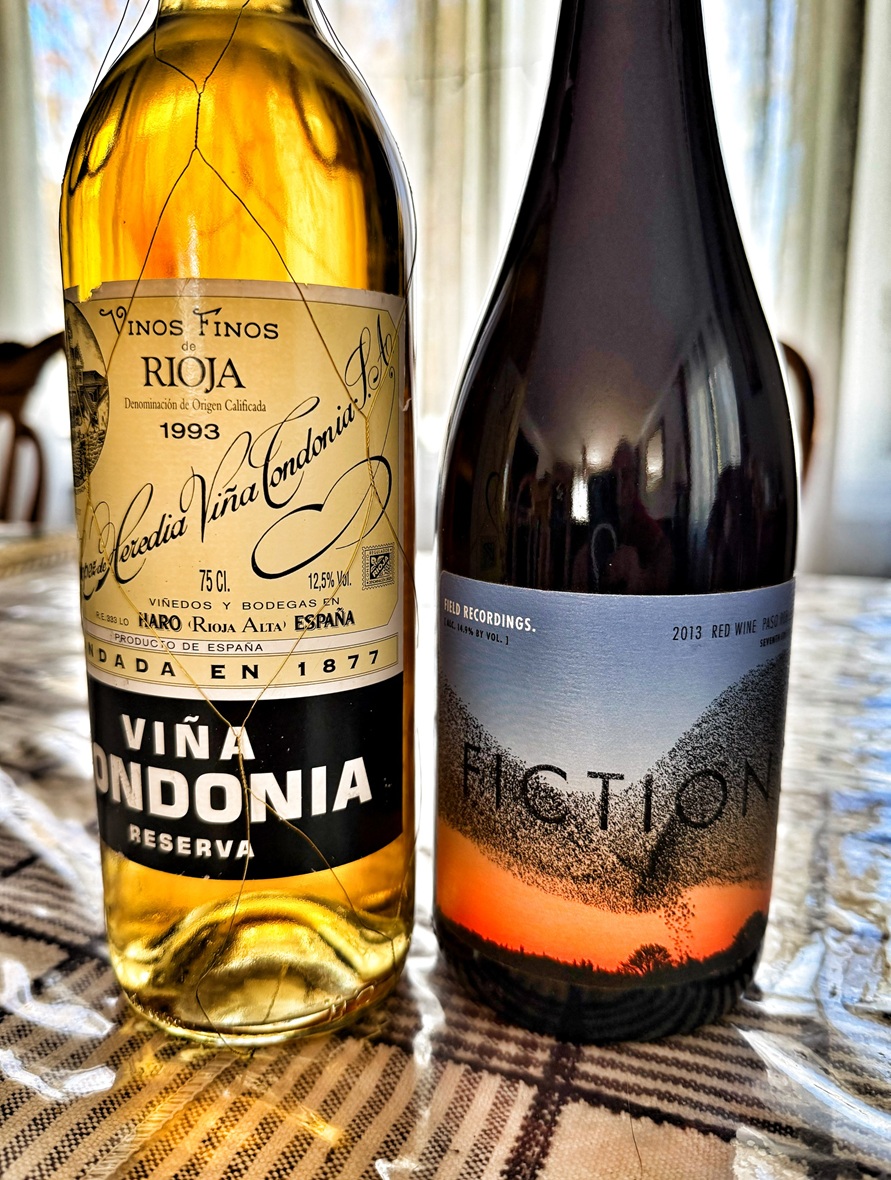
Lopez de Heredia needs no introduction to wine lovers. Way, way back, Lopez de Heredia Blanco was my first foray into white Rioja wines, and I have been a devoted follower ever since. Fiction by Field Recordings was the first wine that led to the discovery of the Field Recordings wines 17+ years ago, and it has been a perennial staple ever since. I can’t say what led to the decision on the 33-year-old white Rioja and 13-year-old California red blend, but this became one of the most memorable wine experiences ever.
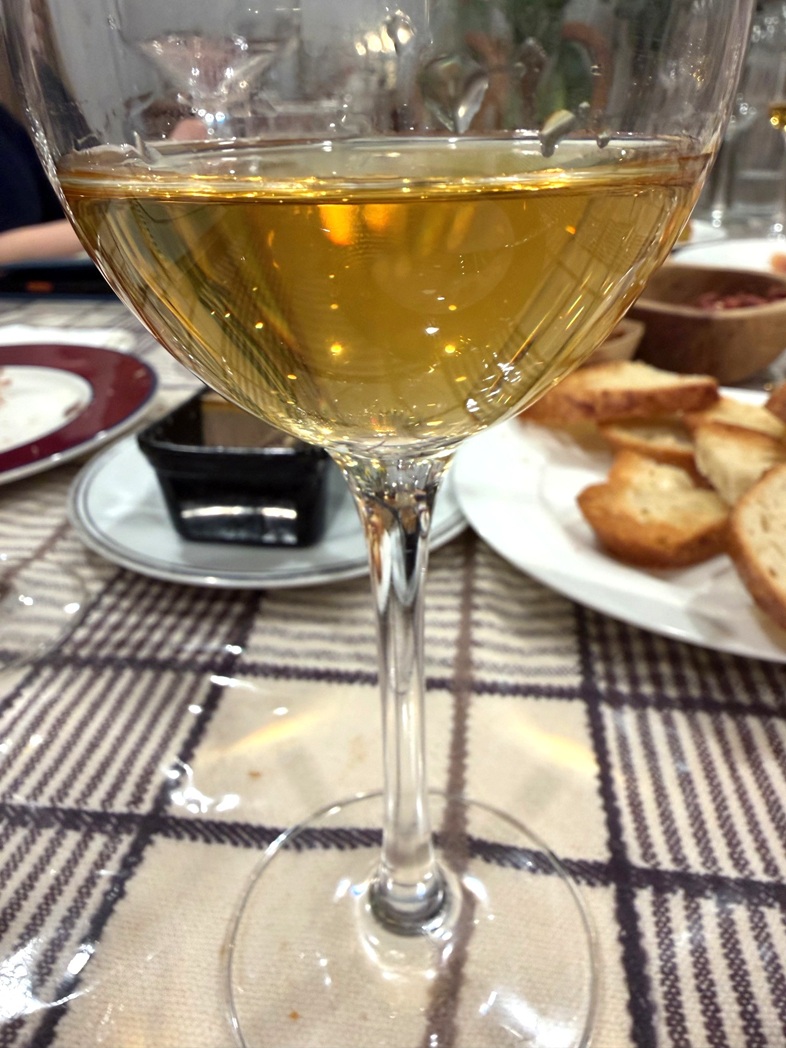
Let’s talk about 1993 Lopez de Heredia Viña Tondonia Blanco Rioja (12.5% ABV). I have to start by saying that I’m not a fan of oxidative white wines. When I mentioned on Twitter that I plan to open this bottle for the OTBN, some comments expressed excitement about oxidative and nutty notes, which I was supposed to find, similar to what you would find in a glass of Jerez. And so I was expecting to find that, and was wondering if I would be able to like that wine. And then there were literally none! Nothing oxidative on the nose, mostly minerality and whitestone fruit. And then a beautiful, complex, powerful structure on the palate, somewhat along the lines of a good Roussanne, still with perfect acidity and freshness. Oxidative notes were lurking in the background, showing up and instantly dissipating a few times, but those were only tiny glimpses, not taking anything away from the wine. An absolutely delightful experience, a 33-year-old white Rioja possibly at its peak (but I wouldn’t dare to insist).
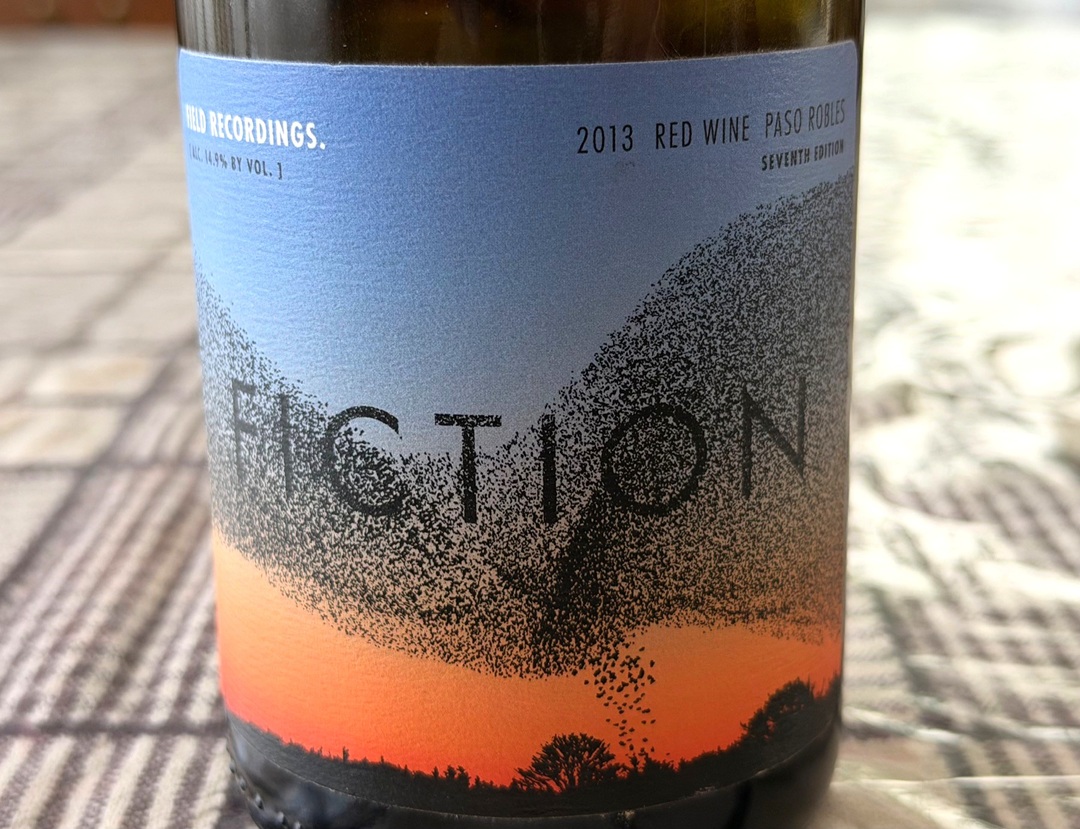
And then there was 2013 Fiction by Field Recordings Paso Robles (13.5% ABV, 31% Zinfandel, 26% Tempranillo, 15% Mourvèdre, 10% Grenache, 10% Syrah, 8% Touriga Nacional). This was my only bottle with an original label, which I really loved and much prefer to the current ones. There is nothing wrong with the current label, only that the original one, with a flock of birds, was conveying the message of bottled poetry a lot better – or rather music, as I wrote in my first post about this wine, Music, Recorded in the Vineyard.
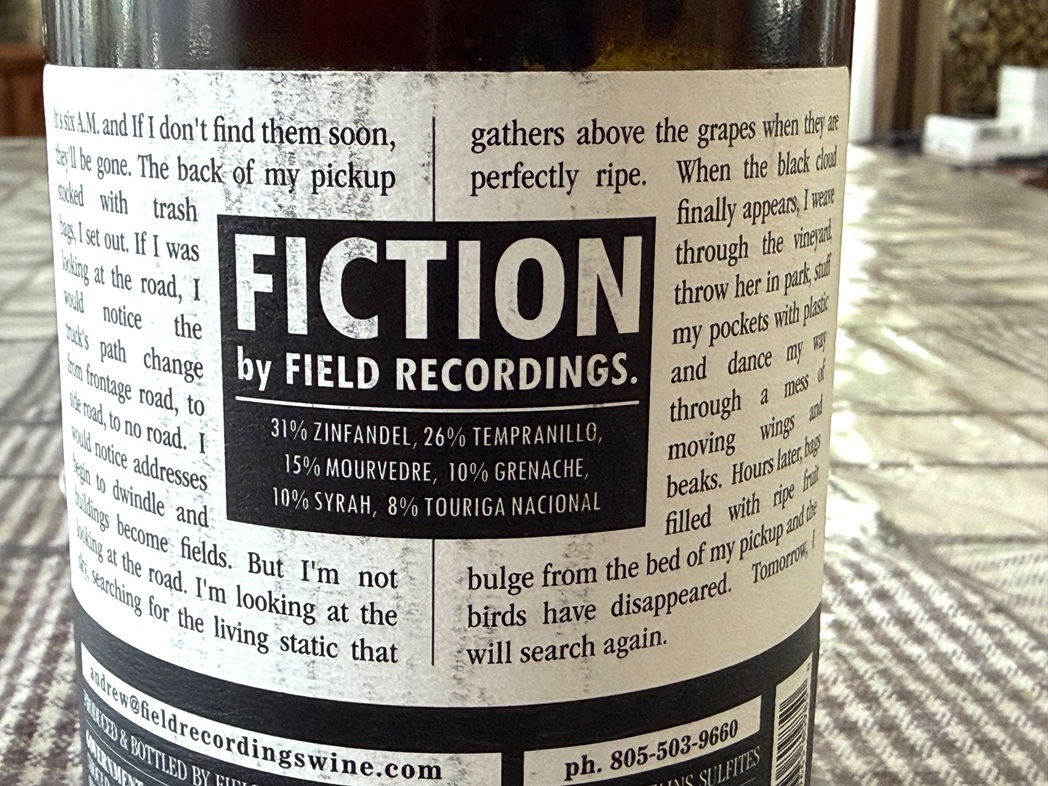
I also loved the back label. As this might be the last time I look at such a label (the current ones don’t carry any of the text), I would allow myself to cite the text written on that back label:
“It’s 6 A.M. and if I don’t find them soon, they’ll be gone. The back of my pickup stocked with trash bags, I head out. If I was looking at the road, I would notice the truck’s path change from frontage road, to side road, to no road. I would notice addresses begin to dwindle and buildings become fields. But I’m not looking at the road. I’m looking at the sky, searching for the living static that gathers above the grapes when they are perfectly ripe. When the black cloud finally appears, I weave through the vineyard, throw her in park, stuff my pockets with plastic and dance my way through a mess of moving wings and beaks. Hours later, bugs filled with ripe fruit, bulge from the bed of my pickup and the birds have disappeared. Tomorrow, I will search again.”
Now, let’s talk about the wine. Screwtop. 13 years old California Paso Robles blend. Stored at somewhat consistent conditions, away from direct sunlight and vibration, but not in the cellar or a wine cooler. Priced at not more than $20 originally (directly from the winery). And yet, one of the very best wines I have ever experienced. A truly memorable one.
I poured the wine in the glass, smelled it, and couldn’t put the glass down. The time slowed down. Sounds practically disappeared. The aroma was magical. And the wine in my mouth was too.
Dreams, smiles, baby laughter, endless meadows, fresh mountain forest air. I know, it sounds like a brain dump, but I don’t want even to try to describe this wine in technical terms – raspberries or blueberries are not important here, what’s important is how the wine makes you feel. Refined, elegant, layered palate, flavors are transitioning and interplaying in total harmony, each sip asking for the next. Am I exaggerating? I don’t know, and it is up to you to believe me or not. But the wine was absolutely stunning and memorable. That I’m completely sure about.
Here you are, my friends. An OTBN experience that will not be easy to beat.
Two amazing wines, an amazing experience, great memories.
I don’t know if I will be able to do better next year, but this is the beauty of wine – the mystery in the bottle.
Until the next time – cheers!
Daily Glass: Pure Pleasure
Of course, it is Wine Wednesday – but this was just a happenstance. Not anything I planned.
A traditional dilemma – what to open?
Checked one wine fridge – no, nothing spoke to me. Next thought – maybe Field Recordings?
Again, without much thought – how about that bottle? I passed it a few times before. What vintage is that? Oh, 2019, that might be good. Ha! It is also a Syrah! Nice, my wife loves Syrah, might be her favorite red grape. Prefect, we have a bottle to open.
Talk about wines made in the vineyard. I discovered Field Recordings wines almost 15 years ago. At that time, the wines were more of a side project for Andrew Jones, a consulting grape grower. By nature of his profession, Andrew had relationships with many grape growers. More importantly, he knew the best plots in their vineyards, and thus he knew where to find the best grapes when he needed them. And little by little, Field Recordings became a powerhouse and a darling of Paso Robles, with the wines of unbound creativity.
My first Field Recordings wine was the wine called Fiction – here is my post about that experience: Music, Recorded in the Vineyard. This was love at first sight. Fiction by Field Recordings was my wine of the year in 2011. And Field Recordings is the only wine club I ever joined, and I’m still a member there. Over the years, there were literally a handful of Field Recordings wines I didn’t enjoy, because for the most part, my favorite descriptor for the Field Recordings wines is probably “mind-blowing” or maybe “mind-boggling”. As was the case today.
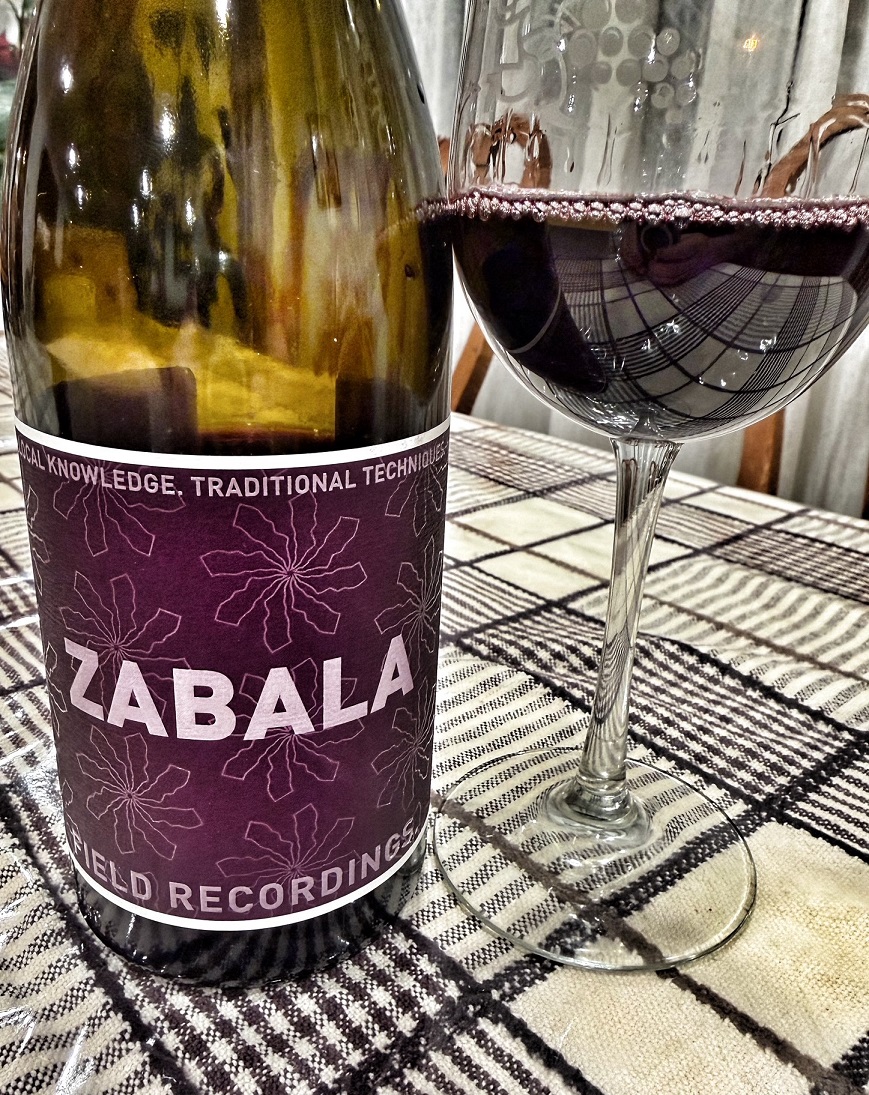
I opened the 2019 Field Recordings Zabala Zabala Vineyard Arroyo Seco (12.9 ABV, 100% Syrah) and poured it in the glass right away. The first whiff had a bit of the funk (love funk!) and a bramble. But on the palate… Oh my, the palate was a pure symphony. Well, a caveat – you have to love black pepper to call that experience a symphony. The palate was full of freshly ground, gorgeous, salivating black pepper. I experienced such purity only once before, while tasting the 2011 Michel Chapoutier Tournon Mathilda Shiraz from Australia. I was blown away by the purity of the pepper expression in that wine – and interestingly enough, after that first experience, I had a random success with the same vintage over a few years – but this is not the subject of this post.
This Zabala Syrah was literally mind-boggling (see, told ya, I just can’t avoid it). Dark bramble fruit, a little bit of funk, and lots and lots of freshly ground black pepper. Delicious, perfectly balanced, perfectly harmonious. A pure pleasure in the glass.
Maybe I just got lucky. I don’t have another bottle from the same vintage, so I will not be able to taste it in a year or a few years and report back. But we should enjoy the moment, and this moment in wine was immensely enjoyable. Wine should give you pleasure, and this was a pure pleasure.
So, what was your last mind-blowing wine experience?
And a Few Good Wines, Previously Was New Year 2026 Wine Escapades
For how long is it appropriate to celebrate the New Year?
Scrap that.
For how long is it appropriate to write a post about New Year’s celebratory wines? A week? Two? Four?
Okay, so as I’m writing this on the last day of the month, this is not a celebratory New Year’s post, but rather an account of wines we had an opportunity to experience.
As a tiny excuse to my tardiness, I want to mention that we celebrated the arrival of the New Year 2026 three times. So here are my notes from those celebrations.
Celebration #1- January 1st, New Year’s Day
To celebrate the New Year in style, I decided to do a Champagne-off between Pol Roger and Bollinger Champagnes. I have a lot of respect but very little experience with both, so I decided to compare them side by side.
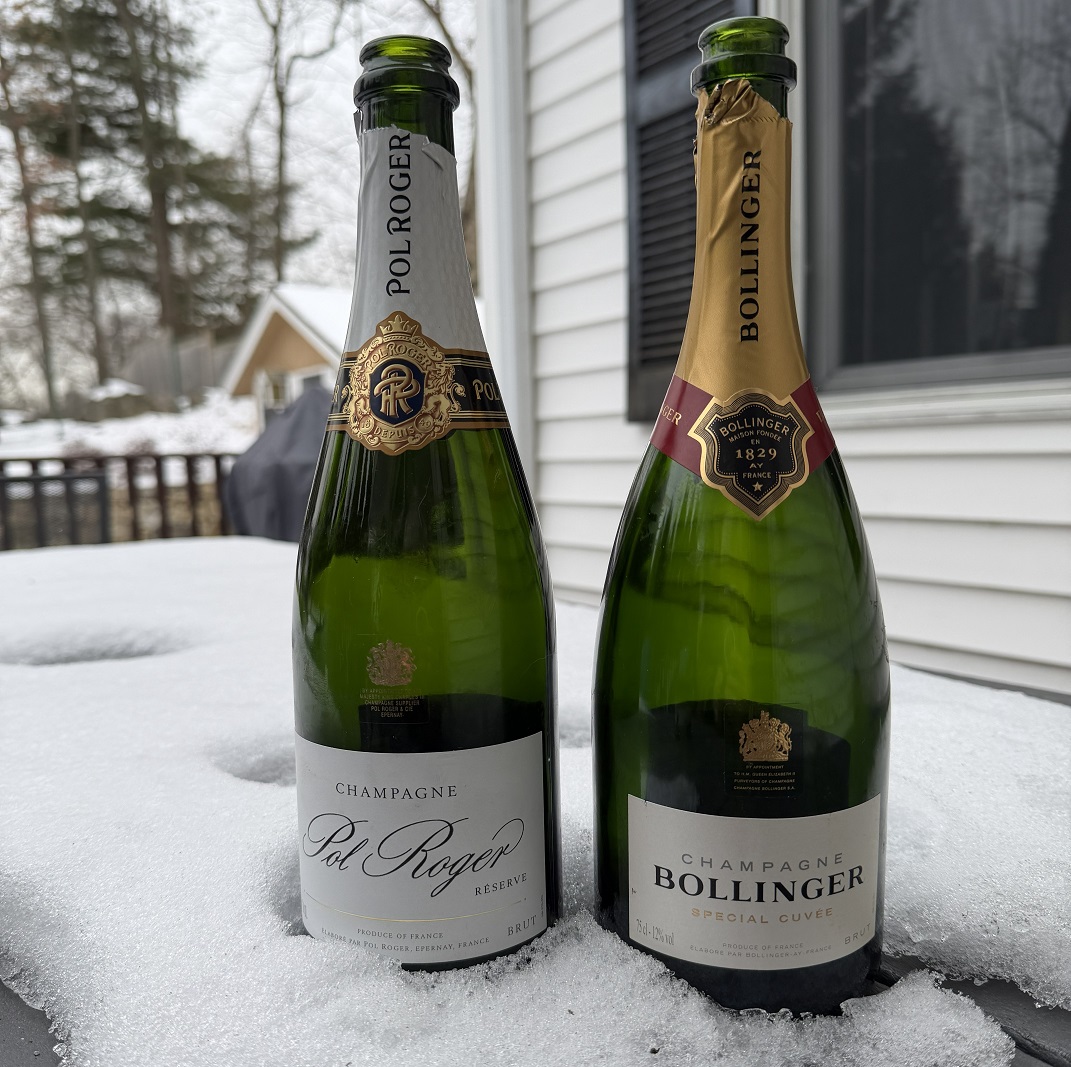
This was definitely an interesting experiment. Upon opening, Bollinger had a somewhat restricted nose, but nice palate with a hint of toasted bread, apples, and lemons. Pol Roger had a beautiful, inviting nose with freshly baked bread, minerality, and green apples. However, it was mostly flat on the palate, so after the first few sips, we decided to drink Bollinger first.
30-40 minutes later, I poured another glass of Pol Roger, and oh, the palate changed dramatically. Now there was everything you want in champagne – toasted notes of the freshly baked bread, apples, lemons, crisp acidity – all elegantly woven together. So while both Champagnes were excellent, my preference lies with Pol Roger.
NV Pol Roger Champagne Reserve Brut (12.5% ABV)
Beautiful, inviting nose, with toasted bread and apples.
Palate initially mostly closed, just acidity. After 30-40 minutes, the palate is alive with toasted bread, apples, lemon, minerality, crisp acidity.
8+
NV Bollinger Champagne Special Cuvée Brut (12% ABV)
Beautiful nose, apples, brioche
Restrained on the palate, lemon, crisp acidity, lots of energy, very elegant.
8, excellent Champagne
I also tasted this sparkling wine, even though it was mostly used in a delicious holiday cocktail:
2021 Casasetaro Pietrafumante Caprettone Spumante Methodo Classico Italy (12.5% ABV, 100% Caprettone (new for me!) grape)
Crisp, refreshing, with steely, minerally acidity. This makes you crave oysters in a heartbeat.
8, excellent
2019 Saxum James Berry Vineyard Paso Robles Willow Creek District (15.9% ABV, 55% Grenache, 29% Mataro, 13% Syrah, 3% Carignan)
Of course, 7 years is not an age when you want to open Saxum wine. Black fruit on the nose with some baking spices. Dark and brooding on the palate, black fruit, cocoa, a hint of the forest floor. A bit more mellow after being open for 3 days, more pleasant to drink.
8, delicious
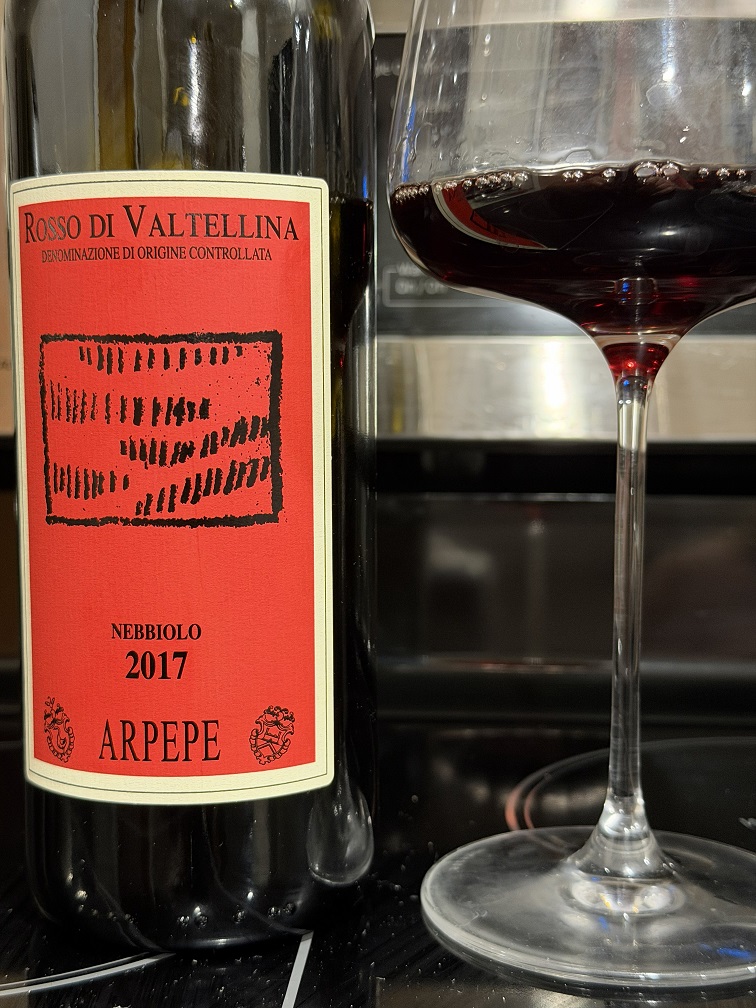
2017 ArPePe Nebbiolo Rosso di Valtellina DOC (13% ABV, 18 months total in big barrels and in bottle)
After a short breathing time, this wine showed brilliantly. Fresh cherries on the nose, restrained.
Cherries and violets on the palate, sandalwood, medium to full body, elegant, round, delicious. Glad we opened it.
8+, delicious
Second celebration:
On Saturday, we got together with friends to continue celebrating the New Year. This time, the wine lineup was a bit different, focusing more on the aged wines and the wines that might be past prime.
We started with a couple of Champagnes:
NV Veuve Fourny & Fils Champagne Brut Rosé Premiere Cru (12% ABV, disgorged 07/15)
Dark golden color
Apples, Almond extract, bread, tertiary aromas
Toasted bread on the palate, apples, brioche, cut through acidity even on day 6 after opening.
8+, while actual bubbles subsided, it was a very tasty wine. Really enjoyable even as a flat wine.
2017 Champagne Christophe Mignon Adn de Foudre Pinot Noir Brut Nature (12% ABV, disgorged 11/01/2024)
Bright Golden color
Apples and fresh bread
Apples, fresh bread, a touch of hazelnuts, cut through acidity. Very refreshing and very enjoyable.
8+, excellent, even on day 6
Next, this white wine was probably the most impressive out of all the wines we tasted that night:
2013 Domaine William Fevre Chablis Grand Cru Bougros (12.5% ABV)
Bright golden
A touch of gunflint, Granny Smith apples, lemon
Fresh, bright, apples, velvety smooth texture, great mid-palate presence, good structure, a distant hint of butter, impeccable balance.
9-/9, outstanding.
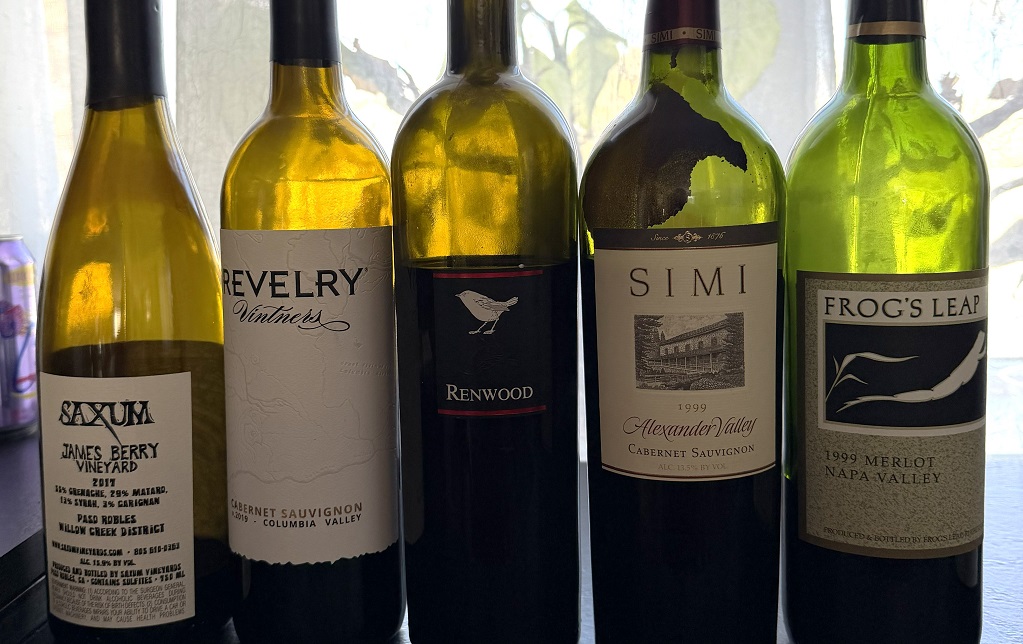
Then there were reds.
1999 Frog’s Leap Merlot Napa Valley (12.5% ABV)
1999 Simi Alexander Valley Cabernet Sauvignon (13.5% ABV)
Both wines were varietally correct upon opening, but it did felt that they were near the peak. No over yet, but having maybe only about 5 years of life left, before they will be officially declared past prime.
8- for each one.
2019 Revelry Vintners Cabernet Sauvignon Columbia Valley (13.9% ABV, 22 months in French oak)
Dark garnet
Cassis, blackberries, eucalyptus
Cassis, mint, blackberries, sweet basil, round, smooth, medium to full body, perfect balance, medium-long finish.
8+/9-, a beautiful wine.
1993 Renwood Grandpère Zinfandel Shenandoah Valley (15% ABV, Bottle #19727 of 1904 cases produced)
Dark garnet
Black fruit, good intensity
Tart blackberries, coffee, a touch of toasted hazelnuts, good acidity, still present tannins with a pleasant grip on the tongue, delicious.
9-, I wish more wines would have this energy and deliver this much pleasure
Celebration Number 3
The week after, we celebrated the New Year. Again. With friends, of course.
First, a couple of Champagnes.
NV Monmarthe Champagne Privilege Brut Premiere Cru (12.5% ABV, 50% Pinot Noir, 50% Chardonnay, aged for 36 months in the cellar)
Outstanding. Inviting nose, fresh apples with a touch of brioche.
Round, generous on the palate, roll-of-your-tongue delicious, fresh and elegant.
8+, excellent
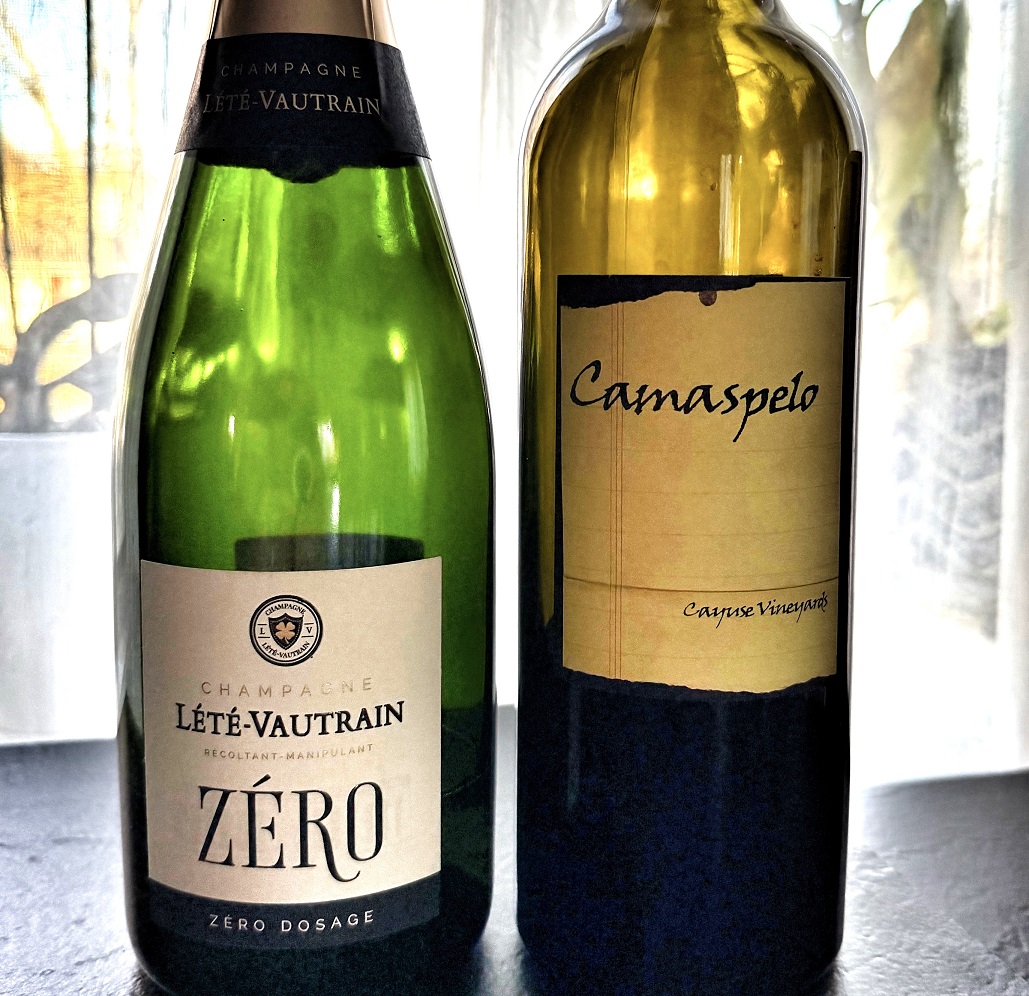
NV Lété-Vautran Chammpagne Zéro Brut (12.5% ABV, 40% Pinot Meunier, 40% Chardonnay, 20% Pinot Noir)
Crisp and fresh on the nose
Palate is crisp to the point of austerity. Elegant, full of energy, very lean.
8+, another wine that is begging to be paired with food
2022 Cayuse Vineyards Camaspelo Walla Walla Valley (13.8% ABV, Cabernet Sauvignon-dominant Bordeaux blend) – I know I was not supposed to touch this bottle, but I couldn’t resist the urge. This wine was clearly opened before its time. Probably 15-20 years would make it a bit more approachable from the get-go.
The wine was decanted, and yet the mineral, volcanic profile was the most prominent, same as with most any of the Cayuse wines in any case. After 2-3 days, the volcanic notes subsided, and the wine appeared more drinkable and enjoyable.
8, definitely needs time
2009 Tallulah Cabernet Sauvignon Napa Valley (14% ABV) – this was my last bottle. The wine was supposed to be special when I bought it, but it never reached that point. Well, until now, but with some reservations – even after decanting this wine, I had to wait for another 3-4 days for the wine to shine in varietally-correct way. But it did. It actually developed a cassis/mint/eucalyptus profile with a dash of dark chocolate.
8+ after extensive decanting.
There you have it, my friends – New Year 2026 wine escapade.
How was your January?
Struggles of the Winelover
Source: Pexels Cup of Couple
Yes, I’m on the streak. A self-focused experiment. I’m curious to see how many posts in a row I can write. Not just “hello – goodbye”, but posts with substance. Well, whatever. This is definitely not the topic of this post.
Oh, and here is a full disclosure – this post is about first-world problems. If you are not interested, you know where to click.
I bet you had no idea that winelovers struggle. No, not when we enjoy a glass of wine. When we enjoy wine, we simply ask for another glass. And no, not when we don’t enjoy wine. Then it is a very simple ask: “Can I have something else, please?” It is really that simple. If you don’t like the particular wine, there is no struggle – you just move on to the next.
The struggle starts when we need to choose the wine. At that moment, the struggle is real. A chain of thought might depend on the setting, but the unending back and forth is always the same.
When you are presented with the wine list at a restaurant, you need to decide based on price, based on mood, based on company, based on food. It always goes “this. Wait, no – this one. Hmmm. No, let’s go to a different region. Ah, yes, this one. No, wait, maybe this? Why is this so expensive? Ohh, why is this so cheap?” Well, got you. The last one is not real. If you know what you are doing, “why is it so cheap” is not the question you concern yourself with. But the rest of it? If you love wine and have ever chosen a bottle in a restaurant, tell me that I’m wrong. I dare you. Tell me that in the comments section. Go ahead, make my day.
The second one might be even worse. Now you need to select a wine for a dinner, get together with friends, a holiday, a birthday, an anniversary – you got the idea, right? This is where the struggle becomes even worse. When you need to choose a wine in the restaurant, you have a limited amount of time and a reasonably limited wine selection. None of it is in play at home. You start worrying about the wine months and months before the event – you can choose not to, of course, but only if you let yourself do this. Now think how many of us allow ourselves not do it, huh?
And here you are really screwed, as you have plenty of time to go “This! No, wait, that! Wait, no, no, I need something else”, following with “Is it too early? Can this already be past prime? It is my only bottle, should I open it now? What if it will be so much better in 10 years?”. And let’s not forget “Will they like it? Is that a good choice for that holiday? Is that special enough for the occasion? Maybe I can do better?” On, and on, and on. Endless. Frustrating. Annoying.
Why all of a sudden all of this soul-pouring sentiment? That’s easy, let me explain.
Any February is a tough month for the struggling winelover. You got Valentine’s Day in the middle of the short month, and then you have Open That Bottle Night (OTBN) on the last Saturday in February. And to add to the struggle, this particular February, we are flying to Florida to see our close friends, and they will have their wedding anniversary during our visit, so I definitely feel that I need to bring something appropriate to celebrate. There you go – three opportunities to struggle.
Source: Pexels Polina Tankilevitch
I still don’t know how we are celebrating Valentine’s Day. I’m sure we are not going to the restaurant, but we might decide to have some company. And it falls on Saturday this year, which is all the more reason to select a good bottle(s). In any case, what should we drink on Valentine’s Day? Yes, bubbles first, that is clear, but even that presents a dilemma. And what should follow the bubbles? What kind of red wine offers the best pairing for Valentine’s Day? If you have any thoughts – go ahead, don’t be shy.
Then the wedding anniversary – do I even have the right bottle for that? I have some vintage Champagnes, but nothing grand enough for the occasion. And while my friends generally like the wine, they are not wine geeks, so well-aged reds might not solicit the response I would want.
Last but not least is the mother of all winelover struggles – OTBN. The holiday was invented to help people crack open that special bottle still waiting for the right moment, which might never come. And yet OTBN is only one night, how many bottles can you open? Selecting the bottle for OTBN is ultra-difficult, especially when one has lots of wines in the quantity of … 1. When you have only one bottle, you need to decide if this is really the time, if the bottle can still improve, if the bottle is special enough. Ah, and please understand that “special” doesn’t mean “expensive”. A special bottle is simply a bottle with an attached memory, and for OTBN, we need to ensure that the bottle is special enough.
Here, I just shared my frustration with you, and I feel better. I even got some ideas for the wine to open on Valentine’s Day. And I’m pretty much decided on the OTBN bottles (it means nothing, really, everything can – and will – change quickly). But I do feel better at the moment.
So what would you tell me? Is this struggle real, or am I a spoiled, undeserving brat? You be the judge of it, but I know how it feels selecting a bottle for a month, in the endless loop between all the wine fridges and shelves. For me, it is definitely real. And for you? Hey, do tell your stories, I’m all ears…
“Drops of God” – A Must Watch For Winelovers
Rest assured – I have not suddenly turned into a movie critic.
But we just inhaled 8 episodes of the Drops of God series on Apple TV+. Apparently, we were late to the party, as the series premiered more than 2 years ago. And yet I accidentally came across it through a reel on Instagram. Next thing, my wife and I couldn’t stop watching it.
Set in France and Japan, you might think that the series is all about wine. But wine is a canvas, a truly mesmerizing canvas for anyone who loves the elixir of life, it is still only a canvas. The series is about love, family, friendship, sacrifices, passion, and wine’s unique ability to make people’s life better, bring people closer, and connect them.
That’s all I can tell you without any spoilers. And here is an official trailer:
Please, do yourself a favor – start watching it tonight. Who knows, you might want to thank me in the morning, when you are done watching it.
Cheers! Santé! 乾杯!
P.S. For some reason, the YouTube video above appeared to be broken on some of the devices. Just in case, here is a link to the show on Apple TV+.
Domaine Bousquet – Reaching New Heights
 I might be ostracized for saying this, but I will risk saying this anyway – the wine world is simple. It might even be called predictable.
Here is how it works. Plant the vineyard. Make sure it produces good grapes. Make good wines. Learn about your vineyard. Divide it into plots. Learn how those plots are different. Identify better plots. Grow better grapes. Make better wines. Repeat. Next, make great wines.
See? I told you it is simple, right? So above is a simple recipe for success. Agreed?
Okay, let’s get back down to earth. The simplicity described above is only an appearance, a view from the outside. The simplicity is achieved through the countless amounts of hard work, passion, dedication, vision. Other than that, it is very simple.
Domaine Bousquet is less than 30 years old, and yet it is one of the most impressive wine businesses in the world. How? Anecdotal evidence is in the fact that I tasted lots and lots of wines from Domaine Bousquet, and I’m yet to find the wine I didn’t like. To take it into the real perspective, please allow me to quote myself:
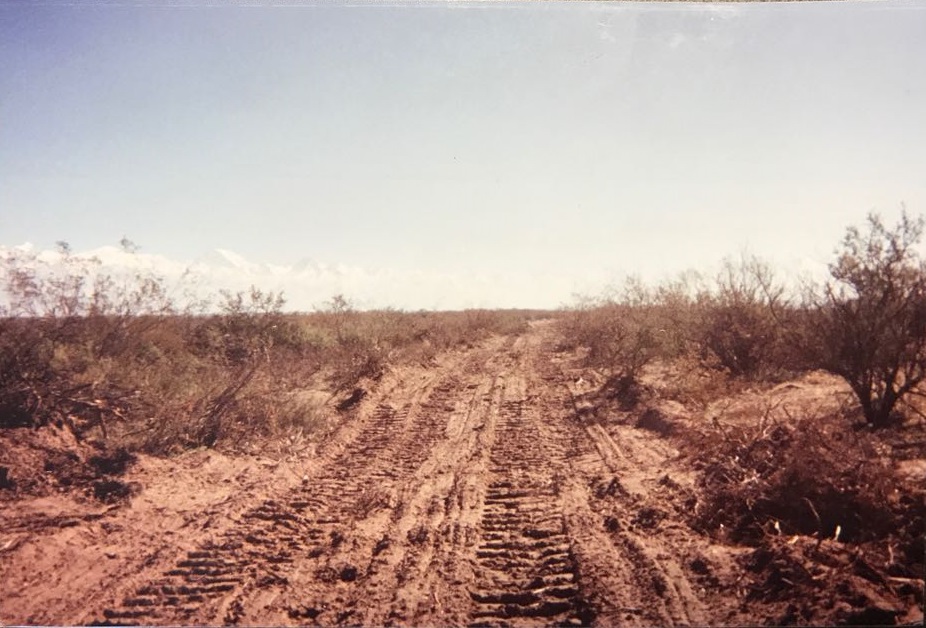
I wrote about the history of Domaine Bousquet very extensively on these pages, so I’m not going to regurgitate everything that I already said – instead, I would like to suggest that you read this post, and also this one. However, I will illustrate my statement about the most impressive wine business with a few pictures. Here is what high altitude (1,200 m/4,000 ft) desert looked like in 1990 when Frenchman Jean Bousquet first fell in love with the area while on vacation in Argentina:
Source: Domaine Bousquet
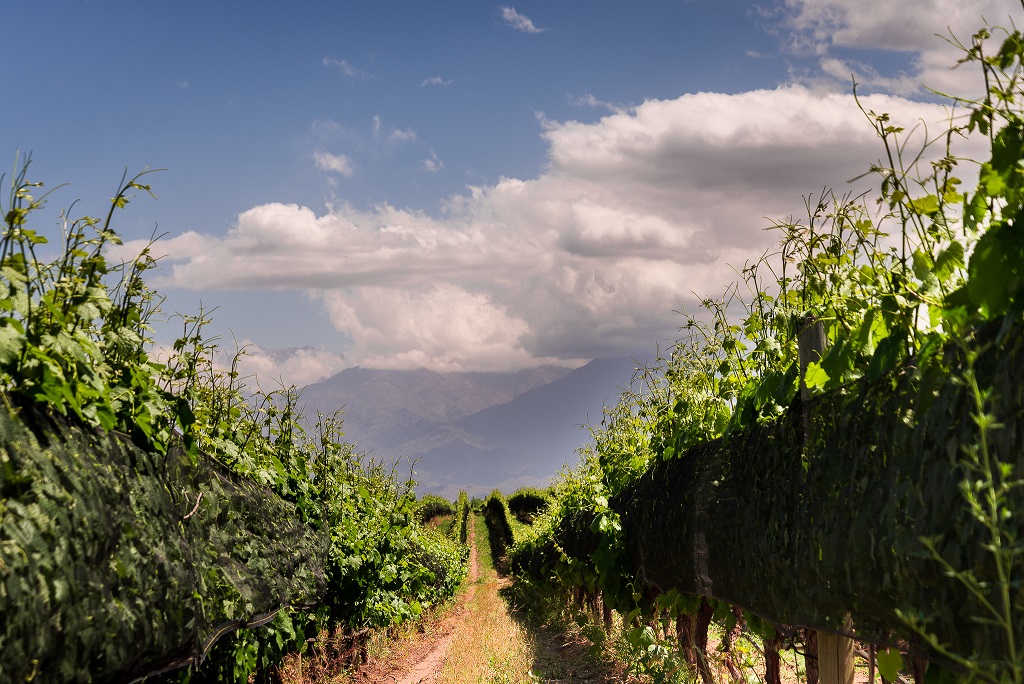
Here is what it looks like today:
Source: Domaine Bousquet
Here is what domain Bousquet has accomplished in less than 30 years, after being formed in 1997:
Certified B corporation, certified regenerative organic, biodynamic, USDA organic… you can continue decoding the icons on your own. 5 million bottles are produced annually, and I never had a wine from Domaine Bousquet that I didn’t like. I rest my case.

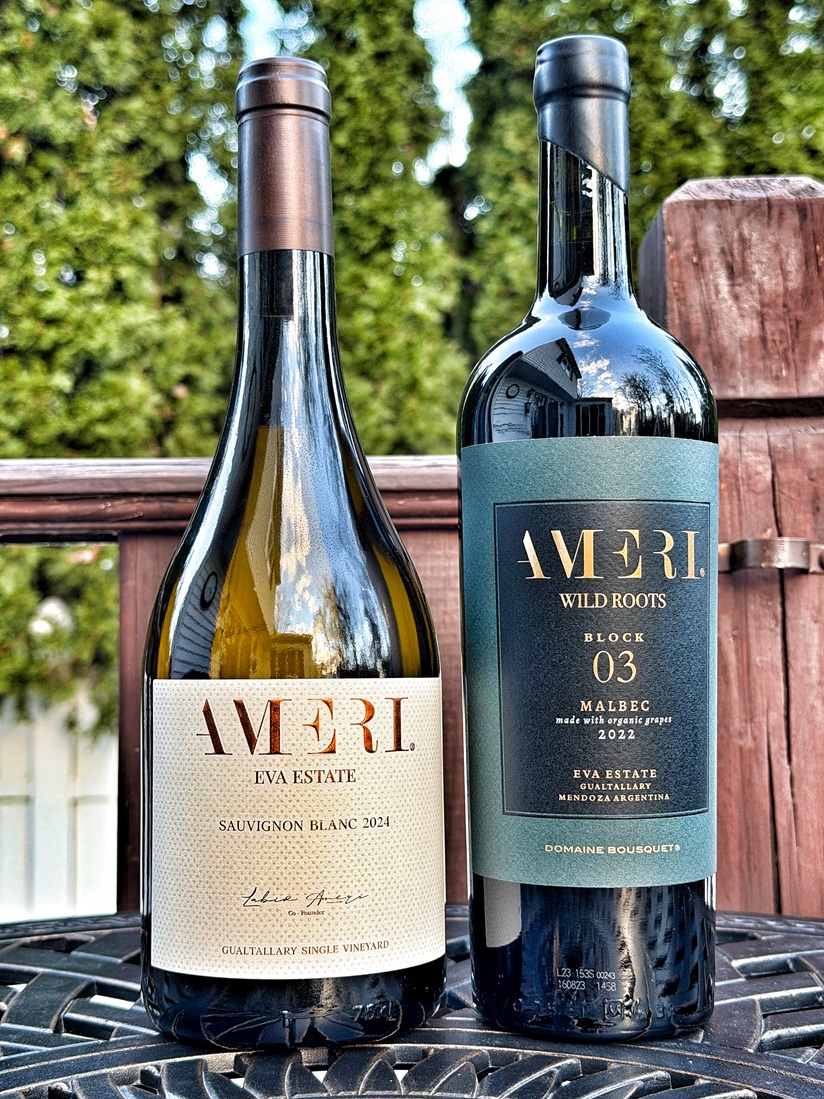
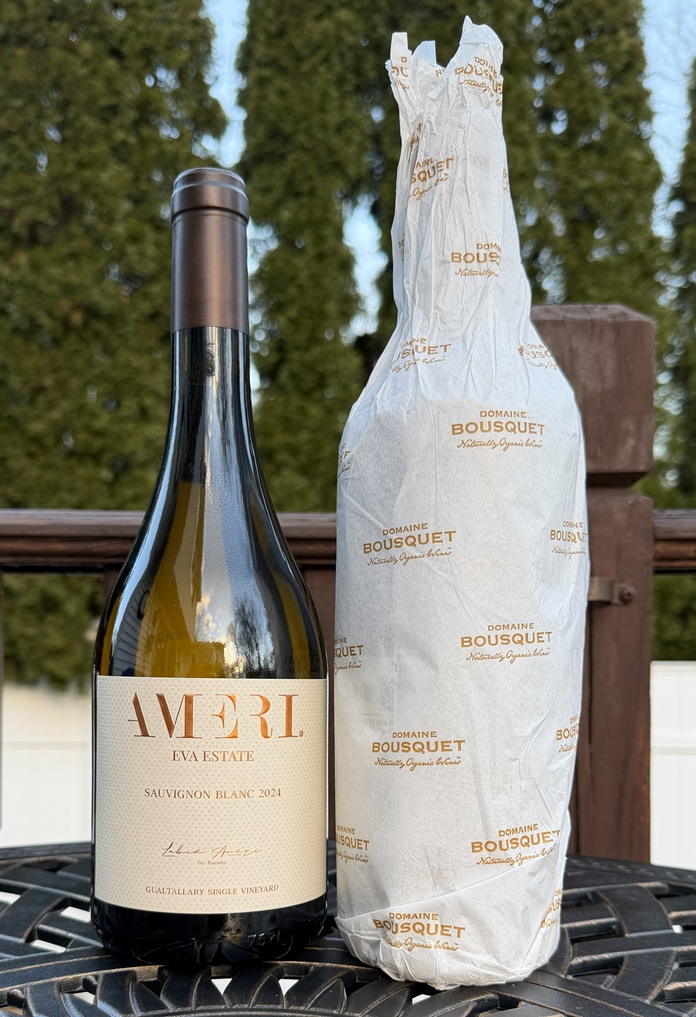
Recently, I was offered to taste two of the latest wines from the Domaine Bousquet, and this is why I had to talk about a simple recipe for making good great wines.
These wines are vineyard-specific, and even block-specific – as we mentioned, this often happens when the great wines are made. Quoting information on the Domaine Bousquet website, these wines are “Crafted from organic grapes grown in our Eva Estate vineyard in Gualtallary, Tupungato at 1,257 meters above sea level, in the heart of the Uco Valley. This wine originates from a detailed study of 123 soil pits conducted with geologist Guillermo Corona, which identified distinct soil profiles and geomorphic units across the vineyard.”
Both wines were nothing short of stunning.
2024 Domaine Bousquet Ameri Eva Estate Organic Sauvignon Blanc (12.5% ABV, $35, grapes sourced from Plot No 9, fermented in French oak barrels (50% new, 50% second use), aged for 8 months in barrel and 6 months in bottle) had a very unique profile for the Sauvignon Blanc. It didn’t have the grapefruit, nor it have a cat pee. Instead, it was reminiscent of a nice, balanced Chardonnay, with a hint of buttery notes and a touch of honey. Delicious, balanced whitestone fruit, lemon, smooth but vibrant. If we need a style comparison, Pouilly-Fumé is the only Sauvignon Blanc that comes to mind, and otherwise, Ornellaia’s Poggio Alle Gazze would be my next best comparison. A delicious wine (8+), probably the best Sauvignon Blanc I tasted in a while. Oh yes, and this wine will age. It went from restrained fruity on the first day to tart and acidic on the second to the beautiful fruit medley on the third. Definitely worth the price in my opinion.
2022 Domaine Bousquet Ameri Wild Roots Block 3 Organic Malbec (14.5% ABV, $85, fermented with native yeasts in 400-liter oak barrels, followed by a 30-day maceration, aged for 12 months in French oak, one year in bottle) was even more impressive than the previous wine. Layers of luscious fruit, cedar, a hint of vanilla (a hallmark of Malbec in my book), minerality, a touch of black currant, perfectly integrated tannins, impeccable balance. This wine would easily compete with the best California Cabernet Sauvignons, for sure in a blind tasting. (9-), will also age nicely, considering the evolution over the 3-4 days the wine was opened.
Here you are, my friends. Two new wines from Domaine Bousquet, two next-level wines. still competitively priced considering the amount of pleasure they are offering. I’m not sure what’s next for Domaine Bousquet, but one thing is for sure – I expect more great wines to come our way.
Until the next time – cheers!
For the Love of Madeira
 If I were to offer you a glass of Madeira, what would you say?
Okay, let’s take it up a notch: I assure you it will be a good Madeira.
Would you gladly accept it, or would you energetically decline?
I’m betting about 80% on the latter. And if you like wine, that would be simply your loss. But if you are in that 20%, accepting that glass of good Madeira would be a very wise decision.
Madeira has a long history of ups and downs, similar to many other wines. I wrote about Madeira a few times in the past (not enough!), so let me be obnoxious and quote one of my older posts about the history of Madeira.
Madeira wine takes its name from Madeira Island in Portugal. The history of Madeira, which started around the 15th century, is full of accidental discoveries, glory, overcoming of the hardship, rise and fall, and even love – if you are interested in the full story, you should take a look at the Madeira Wine website. In the 15th / 16th centuries, Madeira wine was created when wine was transported in barrels through the ocean to far away places such as India and China. It was found ( by accident, of course) that a long ocean voyage improves the taste of wine compared to the original one that went into the barrel. After many trial-and-error experiments, it became apparent that prolonged exposure to the warm weather was the culprit, and then the method of heating the wine up to 60°C (140°F) was invented. The process of heating up the wine is called Estufagem, and it is done after the wine is fermented in the oak barrels, same as any other wine – again, you can find more details online – you can find less colorful but more technical details on Wikipedia (click here). Just to give you a few more details from Madeira’s history, trade embargoes led to further improving Madeira by adding brandy spirits in order to preserve the wine. Barrels of Madeira left for a prolonged time under the rain led to the development of the new style of Madeira wine, called Rainwater.
In the 18th century, Madeira was one of the most popular wines in the world, especially in England and the United States. Madeira was used to toast the United States Declaration of Independence, and was highly regarded as a drink of distinction. Unfortunately, first mildew and then phylloxera epidemic delivered a way too powerful one-two punch, which the Madeira wine industry was unable to overcome. Madeira subsided to nearly a cooking wine level, and stayed like that for a long time. Luckily, overall uptake on the wine industry throughout the world helps to revive the Madeira industry, and now it is becoming possible to find a great drinking Madeira even in the US – and you will see why. And I have to note that one of the great qualities of Madeira is in the fact that, unlike practically any other wine, once you open a bottle of Madeira, it will stay the same more or less indefinitely, due to both the Estufagem method and fortification with the spirit.
Now that you have a bit of historical perspective, let’s take a deeper dive into Madeira wine.
Madeira is a beautiful island with a subtropical climate and luscious greenery. Madeira’s name means wood, oak – this is what the first settlers saw. Madeira’s climate sports tropical winds, hot summers, mild winters, and high humidity. It also offers lots of microclimates, from south to north. Mountains and forests cover 47% of the island, mostly with altitudes of up to 200 meters, reaching 700 meters in some areas.
There are about 475 hectares of vineyards growing on the island (about 1,200 acres), cultivated by 2,000 growers. Vineyards utilize a pergola system to ensure proper aeration.
Six main grapes are used in wine production on Madeira: Sercial, Verdelho, Boal, Malvasia, Tinta Negra, and Terrantez. It is interesting to note that Verdelho and Verdejo are different grapes! Another interesting fact is that Tinta Negra can be vinified as white, rosé, or red.
After the harvest, the grapes are pressed and fermented as with any other wines. Fermentation is subsequently stopped, depending on the desired sweetness, by adding neutral spirit. Next, the heating process takes place. Less expensive wines are usually subjected to continuous heating in the steel tanks surrounded by coils for at least 90 days. Higher-end Madeiras, especially the single-harvest ones, are usually heated using the system called Canteiro, where the wine in the oak barrels is secured in place using wooden beams (canteiro) and heated by mother nature for a prolonged period of time, inside the winery.
The majority of Madeira wines are blends, with the labels indicating the age and type of grapes (it is also possible to make Madeira without indicating age and the grapes). The age designations can be 5, 10, 15, 20, 30, 40, and 50 years. There are also single-harvest Madeiras, called Colheita, which should be aged for at least 5 years in oak, and Frasqueira which requires at least 20 years in oak. Another beauty of Madeira is in the fact that the wine can stay in the barrel indefinitely, and bottled only when needed – some of the known Frasqueiras exceed 200 years of age.
Three years ago, in 2022, I was lucky to attend the Madeira tasting in New York City, where I had an opportunity to taste some absolutely spectacular wines. The event included a Madeira Master Class as well as a walk-around tasting.
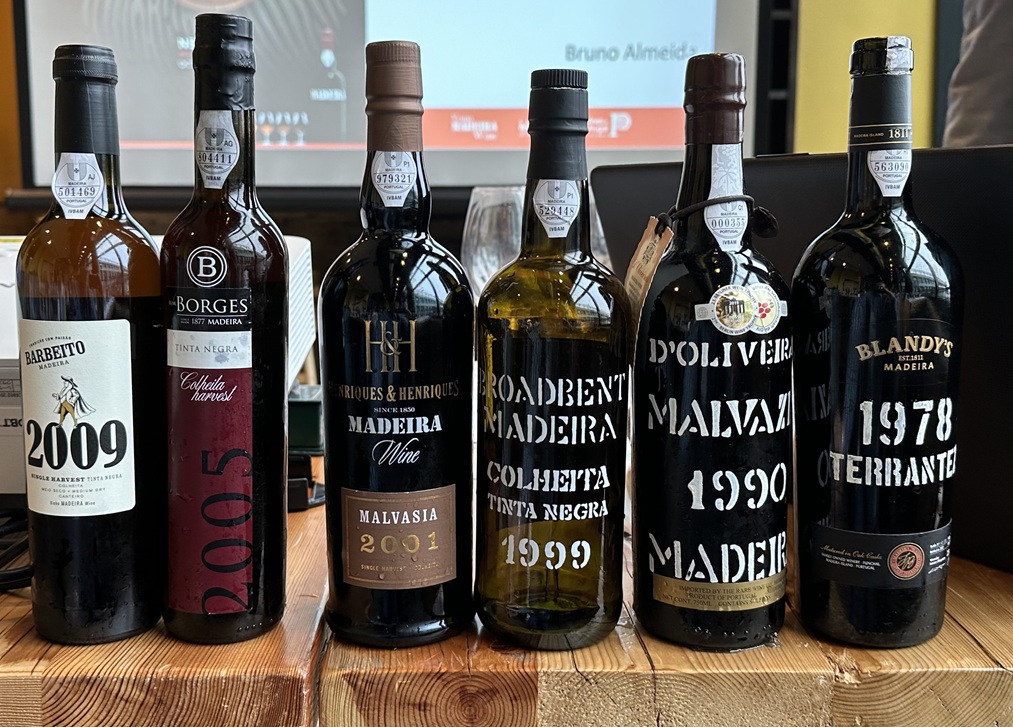
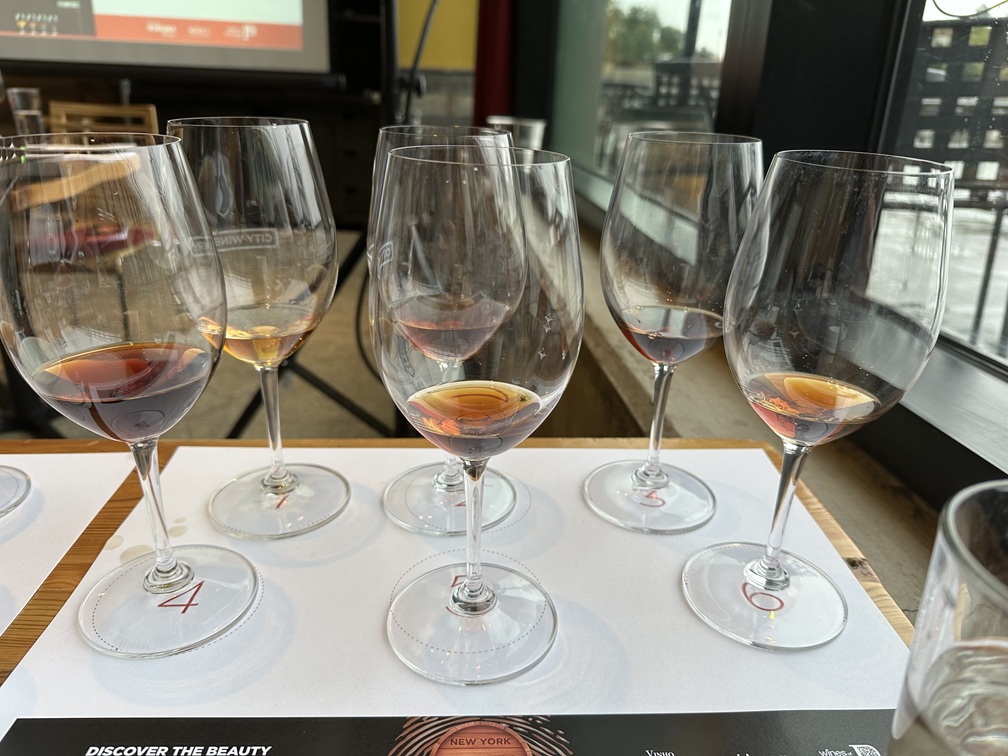


Here are the wines we tasted during the master class:
2009 Barbeito Single Harvest Tinta Negra
clean, open, light, easy to drink
2005 H.M. Borges Tinta Negra Colheita
Hazelnuts, dry fruit, figs, lemon, perfect acidity, beautiful dry fog finish. Lots of pleasure. Foie Gras would be perfect with it.
2001 Henriques and Henriques Malvasia Madeira
Complex herbaceous nose, nicely restrained
Salinity, acidity, supercomplex, dried fruit perfectly balanced
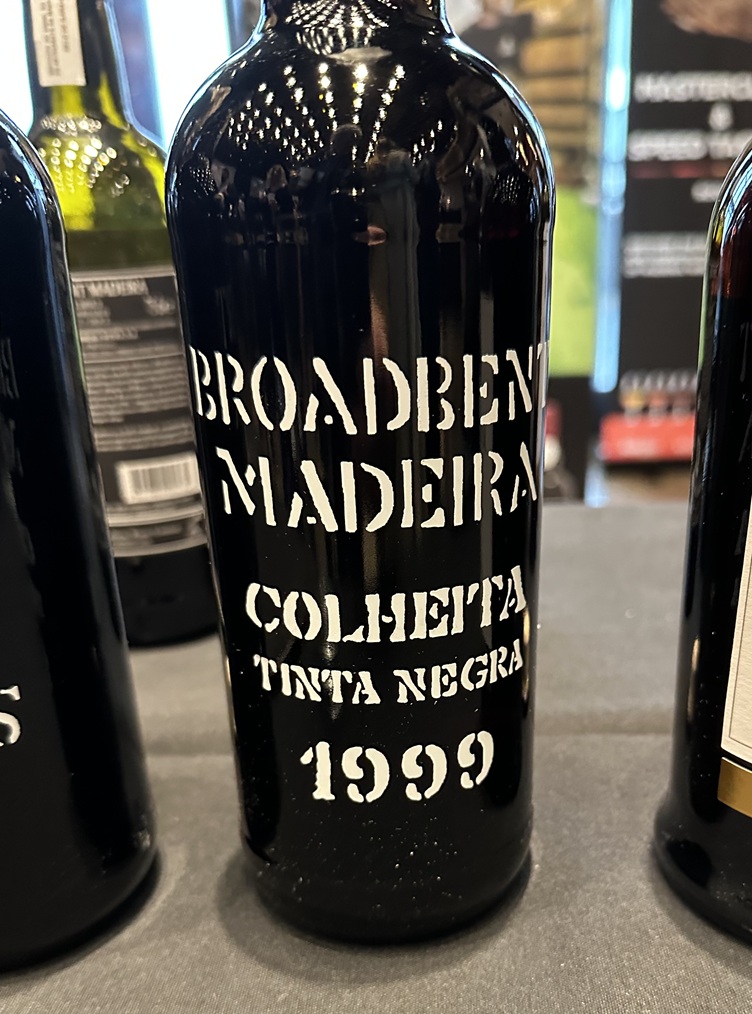
1999 Broadbent Tinta Negra Madeira Colheita
Chocolate, dried fruit compote, very restrained
Dried fruit, great acidity, toffee, tasty notes, outstanding.
1990 Pereira D’Oliveiras Malvasia Fresqueira Madeira
Bottled in 2018
Great herbaceous complexity, fall leaves, medicinal notes, eucalyptus
Amazing palate, dense, complex, loads of dried fruit and hazelnut. Superb.
1978 Blandy’s Fresqueira Terrantez Madeira
beautiful, herbal and vegetative notes, excellent balance, hazelnuts, salinity. Fresh and inviting.


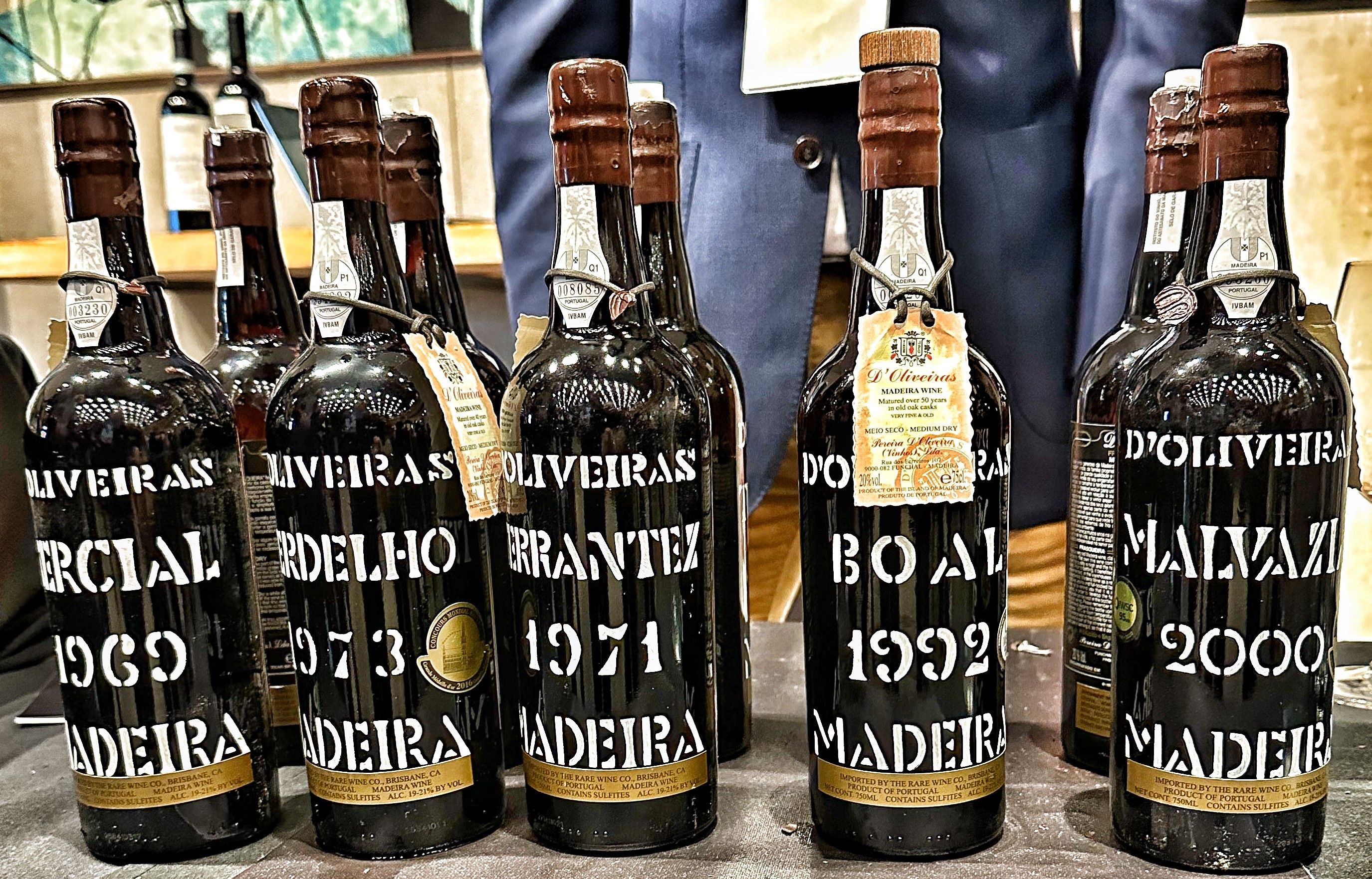
There were lots of gems in the walk-around tasting, such as Justino’s 1996, 1997, and 50 years old Madeiras; D’Olivera Colheita and Fresqueira Madeiras from 2000, 1992, 1973, 1971, and 1969 (1969 was bottled only in 2022); Broadbent 10 years old Sercial, Verdelho, Boal, as well as 1999 Tinta Negra Colheita, and others.
As I said before, Madeira really needs to be experienced, and you have a perfect opportunity to do so.
Coming November 18th, you can experience the beauty of Madeira for yourself. Here are all the details:
Experience the Magic of Madeira – Sip, Taste & Vote!
Tuesday, November 18, 2025 | 5:30pm – 8:30pm
Ideal Glass Studio | 9 W 8th Street, New York, NY 10011
Six producers, six bartenders, one delicious adventure.
You can get 2 tickets for the price of one ($55) using this link.
✨ Your ticket includes:
- Walk-Around Tasting featuring six top Madeira producers — taste rare bottles, some worth over $100.
- Cocktail Competition – six NY bartenders crafting unique Madeira cocktails. Taste and vote for your favorite!
- Food Pairings by Chef Nuno of Leitão.
- Mini “Speed Tastings” with Wines of Portugal Ambassador Eugénio Jardim, exploring Madeira styles in fun, 15-minute bursts.
- Cocktail Seminar: Madeira Cocktails Made Easy with bartender Francesco Dionese — learn how to shake, stir, and sip Madeira at home. (seating is limited).
Don’t miss your opportunity – and you can thank me later. Cheers!
For the Love of Riesling
 I love Riesling.
What do winelovers do when they love the wine?
That’s easy.
We want to share that love.
The biggest reward for a winelover is to offer someone a glass of wine and hear them say “oh, it is good!”.
Sharing the wine is the most enjoyable part of drinking the wine. We want the other people to experience the same joy as we do, we want them to experience the pleasure only the wine can deliver.
As I said before, I love Riesling.
Riesling might be the most underappreciated white grape. It is one of the main 3 white grapes (Chardonnay, Sauvignon Blanc, and Riesling). Riesling wines are made everywhere in the world – Germany, Alsace, Australia, New Zealand, New York (Finger Lakes, Hudson Valley), Canada, Oregon, California, and so on – and yet many of the wine drinkers wouldn’t even openly admit that they like Riesling and that they are happy to drink it.
It is hard to tell why that is. Many people associate the word Riesling with the word “Sweet”. It is a big mistake, as it means, for example, that they never experienced bone-dry, tongue-twisting Rieslings from the Claire Valley in Australia. I would even dare to say that the majority of the well-made Rieslings are not sweet, unless they are purposefully made to be sweet, such as BA or TBA German Rieslings. The main trait of Riesling, similarly to all other wines, is balance. As long as the Riesling is balanced, it is one of the most enjoyable white wines you can imagine. And it pairs well with the wide range of food. I’m telling you – Riesling is one of the best white wines in the world.
The love for wine needs to be shared. And so earlier in the year, I decided to do a Riesling wine tasting. My audience (family, future in-laws) wanted to learn more about the wines, and I have decided that tasting a bunch of Rieslings will offer an excellent educational opportunity (was I right? I have no idea, but I know we had fun).
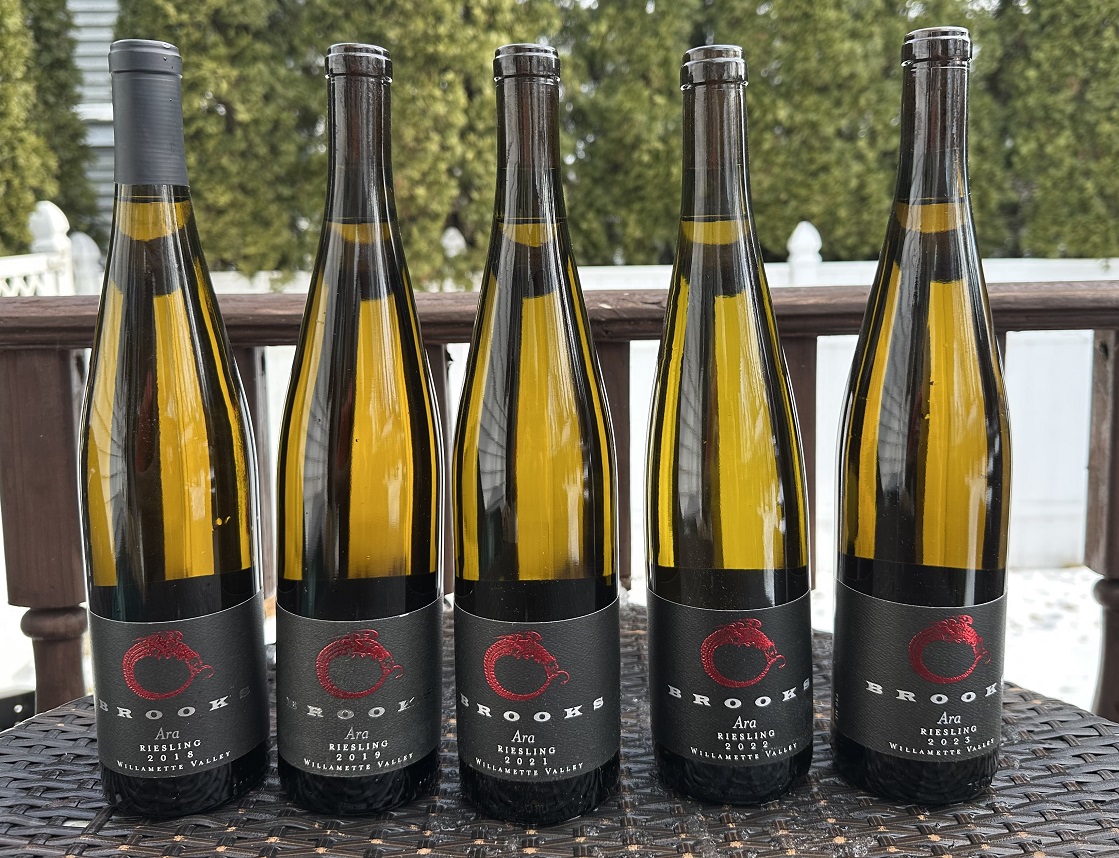
Ask me to name three of my favorite Cabernet Sauvignon producers, and I will quickly become frustrated – can I give you at least 10? 20 or 30 would be even better. The same would be for a Chardonnay, Syrah, and Tempranillo. When it comes to Riesling, however, that would be an easy task. Grosset from Australia. Smith-Madrone from California. Brooks from Oregon. This is my “top 3 Riesling producers” list. I would absolutely love to do a comparative testing of these 3 Rieslings, but I managed to get only 2. I got Smith-Madrone Rieslings first, and then when I got the idea for the tasting, I wrote to Brooks, and they were kind enough to send me a nice vertical of Brooks Rieslings. I also asked Ravines Wine Cellars from Finger Lakes for a similar set, but got no reply, so my tasting consisted of a vertical of Smith-Madrone Rieslings from 2018, 2019, 2021, and 2023, and Brooks Ara Riesling from 2018, 2019, 2021, 2022, and 2023 (both wineries didn’t produce wines in 2020).
It is important to note that Riesling can age very well, and aged Riesling is just a special experience. I did an online search and found out that it is rather hard to find aged Riesling anywhere, at least for the price I was willing to pay (age your Riesling, people, take my advice). I managed to find a bottle from 1997, which was seemingly in reasonable condition. At the same online store, I also managed to find a sparkling wine made out of Riesling, known in Germany as Sekt. I scored a bottle of Sekt at the same online store, and it became our first wine in the tasting.
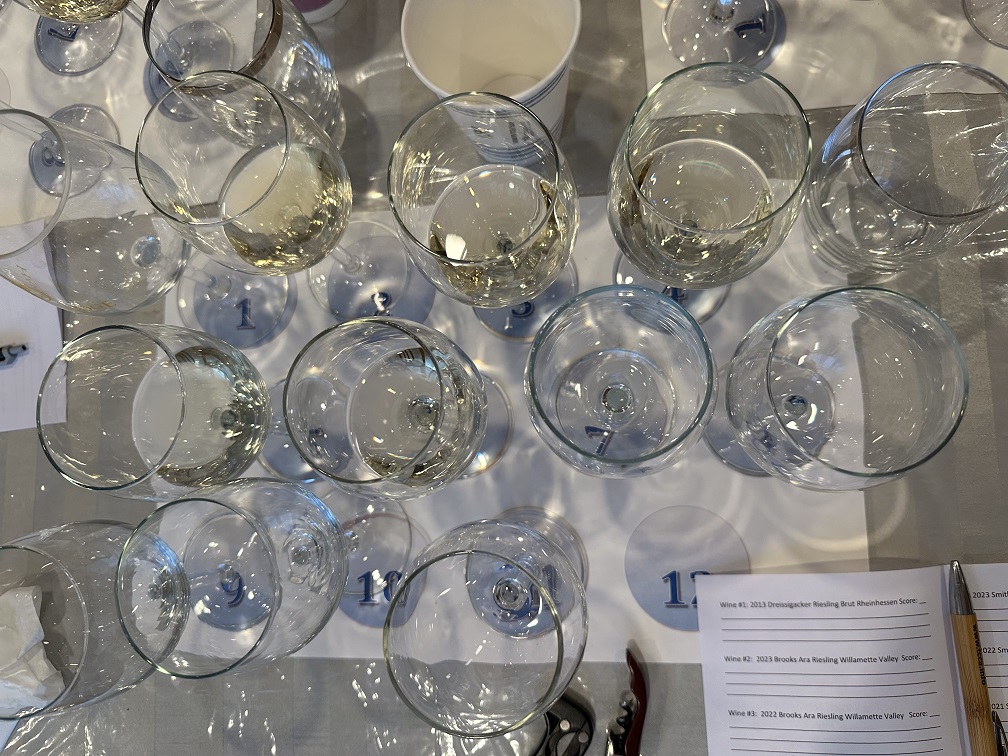
The tasting was non-blind as it had more of an educational purpose than anything else. Here is what transpired during the tasting (outside of the fact that I numbered Brooks Rieslings in the wrong order, so we tasted them from the older vintages to the newer, where I really wanted to go in the opposite direction):
Wine #1: 2013 Dreissigacker Riesling Brut Rheinhessen (12.5% ABV)
bubbles were still present, lemon, a touch of sugar, well balanced, very nice overall. Believe it or not, but this was the first Sekt that I liked.
8-
Wine #2: 2018 Brooks Ara Riesling Willamette Valley (14% ABV, 325 cases produced)
Beautiful color. Honey, petrol, explivit nose of tropical fruit
Great complexity, perfect balance, showing off an interplay of pear, apples, peach, even vanilla and quince. Delicious. 8
Wine #3: 2019 Brooks Ara Riesling Willamette Valley (13% ABV, 225 cases produced) – a very interesting wine, as my tasting notes for day 1 and upon re-tasting the next day differ dramatically.
Day 1: Very unusual, some honeydew, hint of pear. 8-
Day 2: Superb. Lean. Acidity is through the roof, fresh, crisp. Needs 20 years to become amazing. 8++
Wine #4: 2021 Brooks Ara Riesling Willamette Valley (12.5% ABV, 225 cases produced)
Day 1: Beautiful petrol and flowers on the nose
Fresh, petrol, complex, white fruit, excellent balance. 8+
Day 2: Petrol + earth. Beautiful, honey notes on the palate, much richer than ‘19. Still lean and mean. 8
Wine #5: 2022 Brooks Ara Riesling Willamette Valley (12.5% ABV, 150 cases produced)
Day 1: Flowers, touch of brown sugar
Most complex so far – wow, beautiful. 8+
Day 2: Petrol, hint of tropical fruit. Lemon with a touch of honey, lean, crisp, built for aging, let’s say another 20-something years. 8++
Wine #6: 2023 Brooks Ara Riesling Willamette Valley (12.5% ABV, 100 cases produced)
Day 1: Very muted nose. Palate is young, nice, concentrated. 8-
Day 2: Nose almost non-existent. Very lean palate with a hint of honey mixed with lemon. Need to develop for a long, very long time.
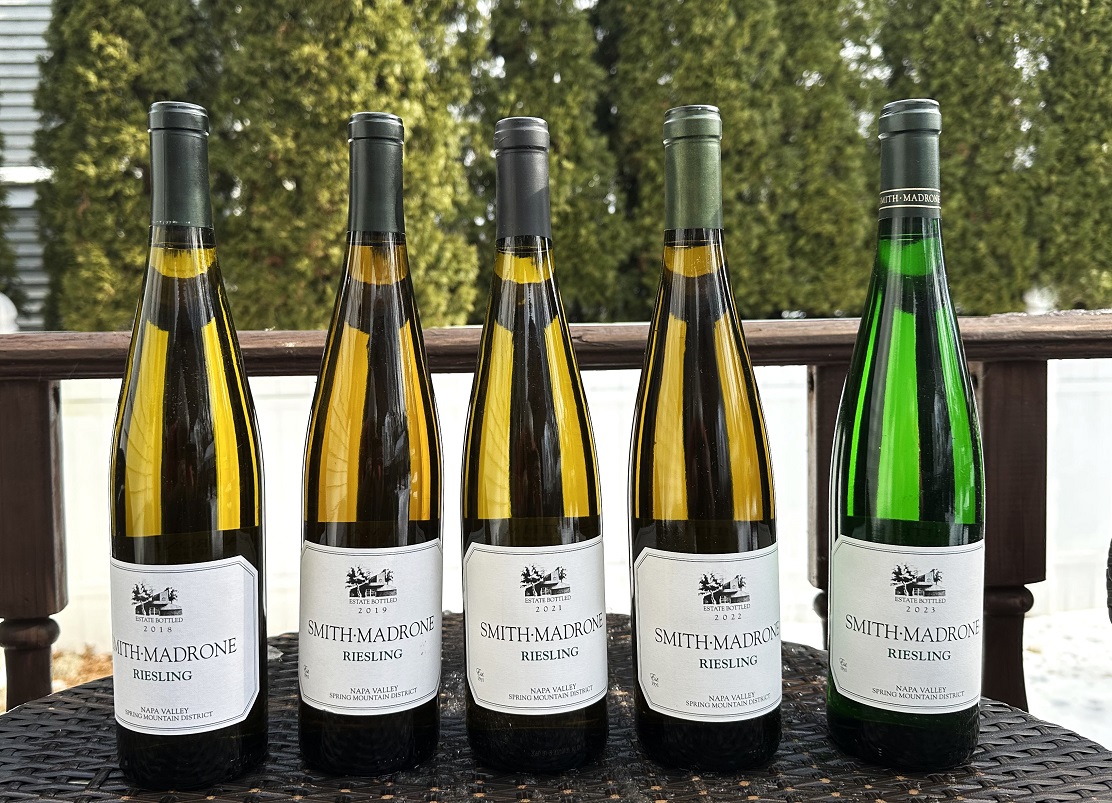
Wine #7: 2023 Smith-Madrone Riesling Spring Mountain (13.2% ABV)
Light color
Candy on the nose
White flowers, fruit medley, bitter orange, crisp, spectacular. 8+
Wine #8: 2022 Smith-Madrone Riesling Spring Mountain (13.2% ABV)
A touch of petrol
White fruit, white apples, delicious. 8+
Wine #9: 2021 Smith-Madrone Riesling Spring Mountain (13.2% ABV)
Petrol, beautiful
Lots of complexity, apples, excellent. 8
Wine #10: 2019 Smith-Madrone Riesling Spring Mountain (13.3% ABV)
Complex aromatics, flowers
Flowers on the palate, a touch of honey, beautiful, complex. 8+
Wine #11: 2018 Smith-Madrone Riesling Spring Mountain (13.3% ABV)
Beautiful, hint of petrol, white fruit.
Wow, playful, amazing. 8++
Wine #12: 1997 Dr. Fischer Ockfener Bockstein Riesling Kabinett Mosel (8% ABV)
Apple juice all the way, past prime. Still an interesting experience.


As always in such tastings, it is fun to figure out the group’s favorite wine. There were 8 of us tasting the wines, and everybody were asked to decide on 3 of their most favorite wines (mine were #11, #8, and #5), and then we took a vote. To my surprise, we had a clear winner after the first round – wine #8, 2022 Smith-Madrone Riesling, was everyone’s favorite, with wine #11, 2018 Smith-Madrone Riesling getting 5 votes. It was interesting that even wine #12, 1997 Riesling, got 3 votes (for me, it was an interesting experience, but not the wine I want to drink again).
As you can see from the notes above, I had a chance to re-taste the wines, this time at a bit of a slower pace. It is very clear that Brooks Rieslings needed more time to open, as you see that on the second day they showed a lot more of what they got, but even then, I believe they would benefit from another 20 years in the cellar, or maybe more.
As I’m writing this, I’m already dreaming of setting up the tasting of 20+ years old Rieslings. Give me Grosset, Brooks, Smith-Madrone, Zind-Humbrecht, and maybe Markus Molitor, from the early 2000s – and this would make it an absolutely amazing tasting. By the way, talking about dreams – what would your dream Riesling tasting include?
I can’t speak for my guests, but I really enjoyed the opportunity to taste such beautiful wines side by side. While both Brooks and Smith-Madrone perfectly exhibited my beloved petrol, Brooks Rieslings on average were a bit leaner than Smith-Madrone, while Smith-Madrone exhibited a richer bouquet on the palate. I’m saying this not in the comparative sense – each one of these wines would make me super-happy any time.
There you are, my friends – my Riesling experience. Do you like Riesling? What are your favorite “go-to” Rieslings?
Beautiful Wines of Smith-Madrone
I love the wines of Smith-Madrone.
I’m not even trying to make it a secret.
Yes, I’m biased. But I’m not ashamed of it.
Stu Smith and his brother, Charlie, founded the winery in 1971 in the Spring Mountain District of Napa Valley. When Stu was buying a property overflowing with trees, he was told that he was making the mistake of his life. But the best wines are born out of conviction – add perseverance, gamption, hard work, ingenuity, and imagination – just get all of these ingredients, and you might also be able to make some beautiful wines.
I told you that I love the wines of Smith-Madrone. Usually, love doesn’t require proof. But if you insist, I have one – not only I wrote about wines of Smith-Madrone on multiple occasions, but their wines had been included in my Top Wines of the Year lists 4 times – #11 in 2018 (Riesling), #1 (Cook’s Flat Reserve) and #14 (Riesling) in 2019, #3 in 2023 (Cabernet Sauvignon), and #4 in 2024 (Cook’s Flat Reserve). I don’t have any other wines that so consistently appear in the Top Wines lists.
For many years, Smith-Madrone produced only three wines – Riesling, Chardonnay, and Cabernet Sauvignon, with the addition of the Cook’s Flat Reserve Cabernet Sauvignon in exceptional years. A few years back, Rosé and Cabernet Franc joined the collection, and I was dying to try them ever since. This year, I finally got my hands on the wines (I rarely ask for samples, but this was one of such rare moments – I did ask…), so now I can share my tasting notes with you.
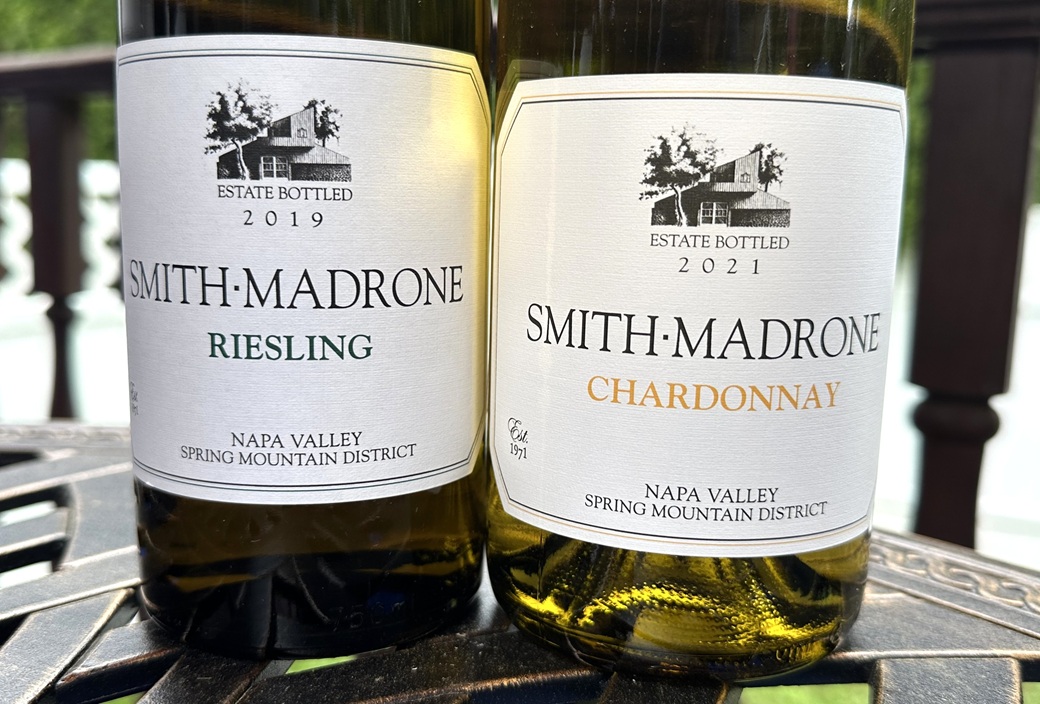
2019 Smith-Madrone Estate Riesling Spring Mountain District Napa Valley (13.3% ABV)
Light golden
Petrol mixed with honey and honeysuckle, a pure aromatherapy in the glass for a Riesling lover. Crisp, bright, honey with lemon in perfect harmony, clean and crisp finish with lots of energy.
9, a pure delight.
2021 Smith-Madrone Estate Chardonnay Spring Mountain District Napa Valley (14% ABV, 10 months in 50% new French oak)
Brilliant golden color
White plums and a touch of vanilla on the nose, a distant hint of gunflint (the wine is almost at room temperature). Apples, a touch of honey, vanilla, more apples, and a cleansing acidity. Delicious.
8+/9-, superb.


2023 Smith-Madrone Estate Rosé Spring Mountain District Napa Valley (14.2% ABV, 50% Merlot, 50% Cabernet Franc)
Beautiful, bright crimson red
Tart cherries, fresh, on the nose. Light, inviting, elegant.
Beautiful tart cherries on the palate, well present, round, delicious.
8+, delicious Rosé with character
2021 Smith-Madrone Estate Cabernet Franc Spring Mountain District Napa Valley (14.7% ABV, 89% Cabernet Franc, 11% Cabernet Sauvignon, 18 months in 60% new French oak)
Dark garnet
Ripe black currant, dark chocolate, fat, juicy, exciting. Delicious, black currant, dark chocolate, a rich California Cab Franc style, bell pepper came in later, together with a beautiful black pepper note, spicy and delicious.
8+/9-
Truth be told, I also got a sample of the 2021 Cabernet Sauvignon – but this is one of my most favorite Cabernet Sauvignons ever, so I couldn’t muster the courage to open the bottle yet, and will be waiting for the right occasion later this year – maybe a Thanksgiving celebration, as I did back in 2018.
I think both Rosé and Cabernet Franc are great additions to the portfolio. Both are produced in small quantities (131 cases of Rosé, 153 cases of Cabernet Franc), and Rosé is already gone (duh, summer is ending), but the Cab Franc is still available. And if we are talking about new additions, maybe we will see a sparkling wine one day? Or wait, I might have even a better idea – how about some late harvest Riesling? Knowing the quality of Smith-Madrone Riesling, if they were ever to produce a dessert-level Riesling, I’m sure it would be an absolute delight. Oh well, maybe one day…
Here you go, my friends. I hope you had a chance to discover the wines of Smith-Madrone for yourself. If you have not, head over to the Smith-Madrone website, admire the scenery of beautiful mountain vineyards, and get a few bottles for yourself to enjoy. I guarantee you will not regret it. Cheers!
Last Bottle Sign Up ($10 credit)




 Talk-A-Vino