New York Cabernet Franc Grand Tasting 2026
In my oenophile journey, Cabernet Franc was one of the early discoveries. It all started in Bordeaux, and I don’t mean visiting, just reading about it, not even so much tasting. Continuing that journey, at some point I arrived in the Loire, and there, of course, Cabernet Franc is the king. I wouldn’t remember what the very first Cabernet Franc I tasted was, but I’m sure it was a Cabernet Franc from Loire – Chinon, Saumur, I’m not sure.
As I live on the East Coast of the US, it is only logical that my Cabernet Franc journey continued while discovering East Coast wineries – Finger Lakes, Niagara on the Lake, Hudson Valley, Long Island. In the wine world of the East Coast, Cabernet Franc is the undisputed king of red wines – practically every winery I know of makes Cabernet Franc wine, and they make it quite successfully.
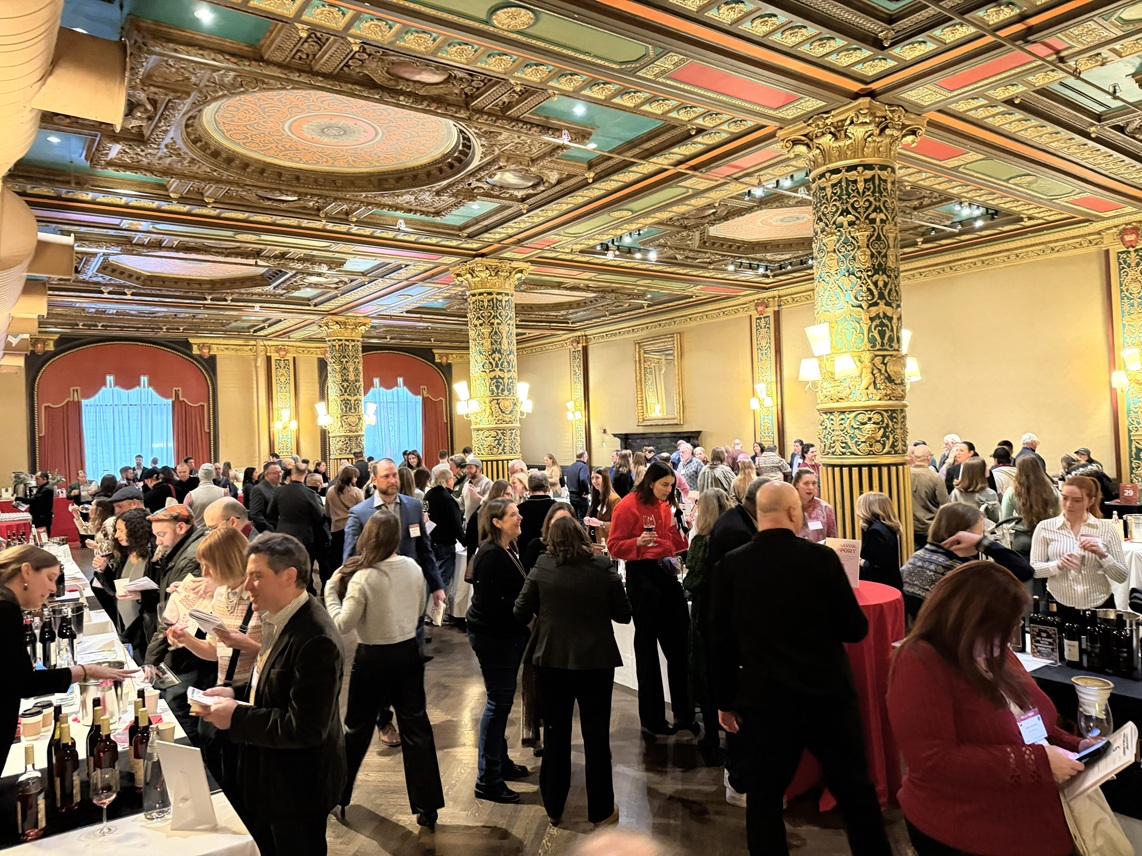
It is interesting how we hear things in our lives, and only many years later, those things of a sudden start making sense (call me slow, I’m sure I deserve it). When Lori Budd of Dracaena Wines started Cabernet Franc Day celebrations more than 10 years ago, it was all done under the slogan “Not just a blending grape”. Yes, I understood the slogan, but never thought of the full notion behind it. Getting into the wine world on the East Coast, Cabernet Franc was never a blending grape for me – the absolute majority of the Cabernet Franc experiences were with 100% Cabernet Franc wines. However, as the California wine world grew up following Bordeaux, Cabernet Franc was generally not taken seriously on their own, but only in the supporting roles to the major grapes – e.g., Cabernet Sauvignon, the kind of California. As I’m typing this sitting on the train on my way to New York City to attend the Cabernet Franc Grand Tasting, I finally realize what Lori meant by her slogan, bringing her love of the Cabernet Franc from the East Coast to reality on the West Coast, in California. Yes, of course, it is not just a blending grape, and I’m just about to deep dive into the world of 100+ Cabernet Franc bottling from 40 producers.
Okay. So everything written above was written on the train on my way to the Cabernet Franc Grand Tasting 2026. Now, I want to share my impressions about the event, about the Cabernet Franc wines, and the experience overall.
Let me start with the event itself. In a word, top-notch. Pay attention – these are the impressions of the wine blogger/writer/geek. From that point of view, the event was possibly the best-organized I have ever attended. Of course, I will explain, no need to nudge.
Before the event, I got the list of wineries and wines planned for the event. The list was sorted alphabetically, with all the wine details (vintage, ABV, grape composition, MSRP). In the event, the wineries were located in the same exact order! If I didn’t want to go one by one, I would just easily locate the winery I wanted! Okay, I get it, there were only about 40 wineries in the event, but I don’t see how this wouldn’t scale. Also, talking about organization – we had individual spit cups provided, and every (!) table had a large spittoon – an absolute convenience in the wine tasting. Every year, I attend probably 10, maybe 15 large wine tasting events, so from that experience, this was literally the best, if not the best ever.
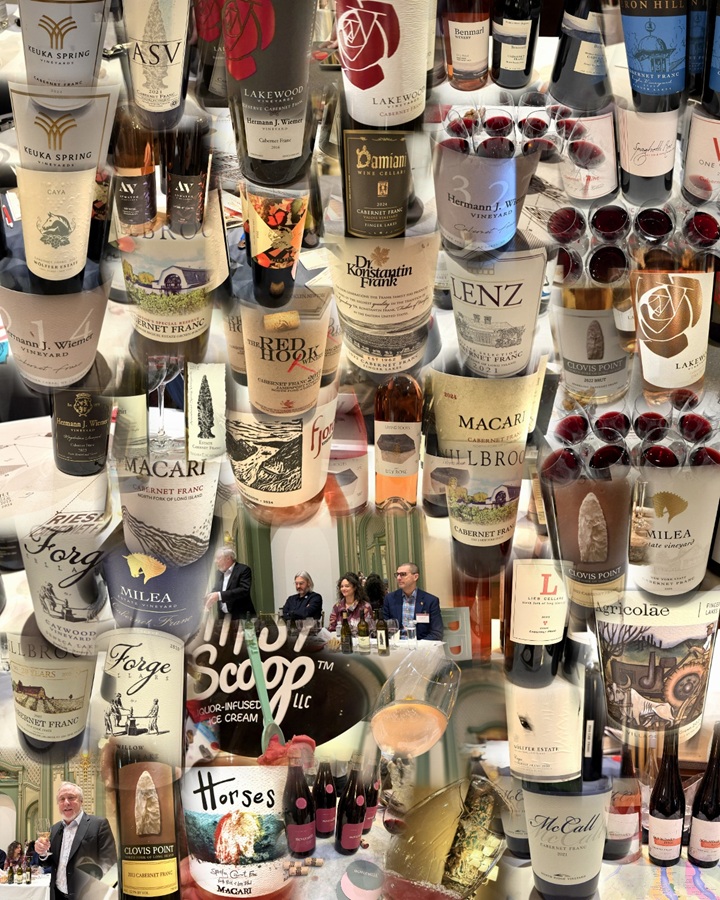
An impression of New York Cabernet Franc Grand Tasting in One Picture
Next part of the experience – Cabernet Franc seminar. My first attraction point to this seminar was the fact that it was led by Kevin Zraly, whom I really consider my wine teacher, after taking his Windows on the World wine school classes a few decades back. So I was very happy to be in his presence again. For the rest of it, the seminar experience was more of an “all over the place” type. It was too long (was supposed to be 1 hour, but it was 1:20 or so running time, plus a bit of a delay at the start). The panelists were all knowledgeable, but none of them were the winemakers, so I really didn’t learn much from them, and they all loved to talk. And the worst part, unfortunately, was the wines in the seminar, and here I’m a bit perplexed. I loved the classic method sparkling Cabernet Franc from Macari Vineyards on Long Island, which we were greeted with as we walked into the seminar room. I also loved the last wine #9, 2012 Cabernet Franc from the Arrowhead Spring Vineyards Niagara Escarpment- it was superb. The other 8 wines were all over the place, from greatness to a simple “no, I’m not drinking that” – but, if I overheard the panel correctly, the wines for tasting were poured 3 hours prior. If this is the case, this didn’t help those wines at all. Again, it is entirely possible that I completely misheard that. But for further details, please see my notes on the seminar wines below.
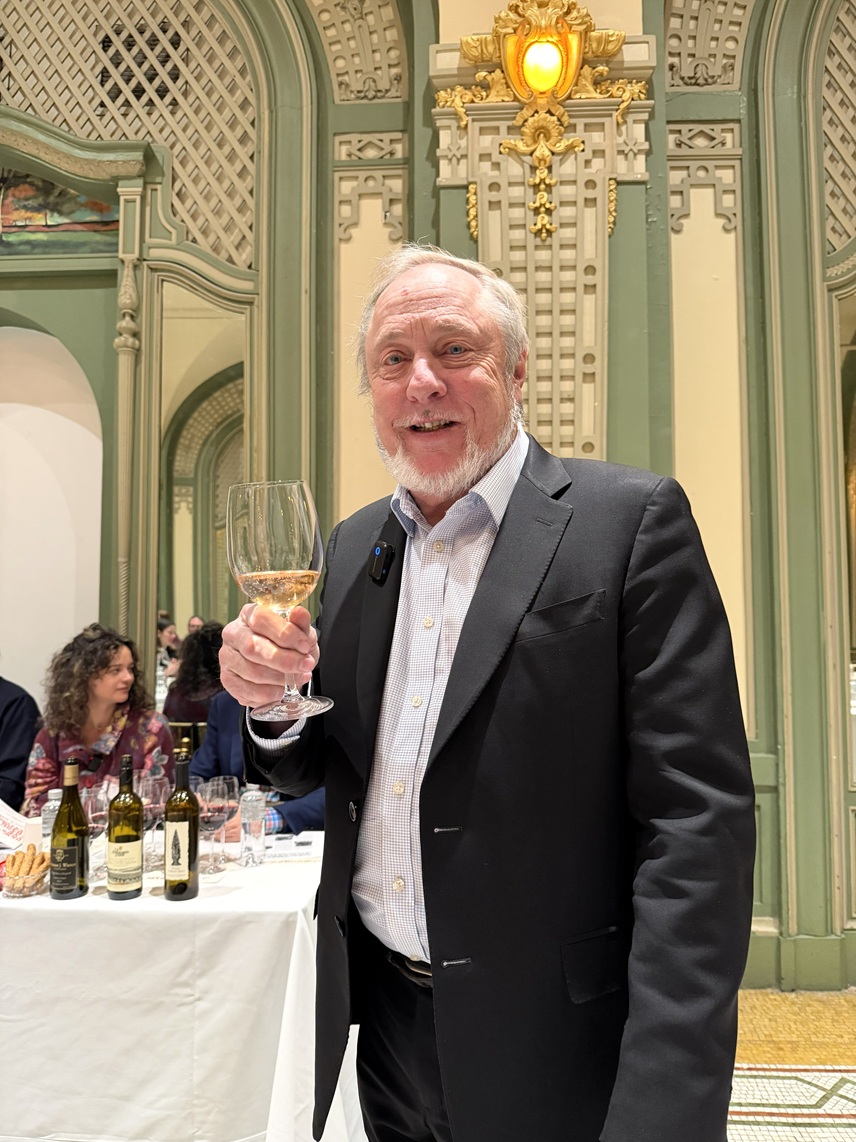
Kevin Zraly
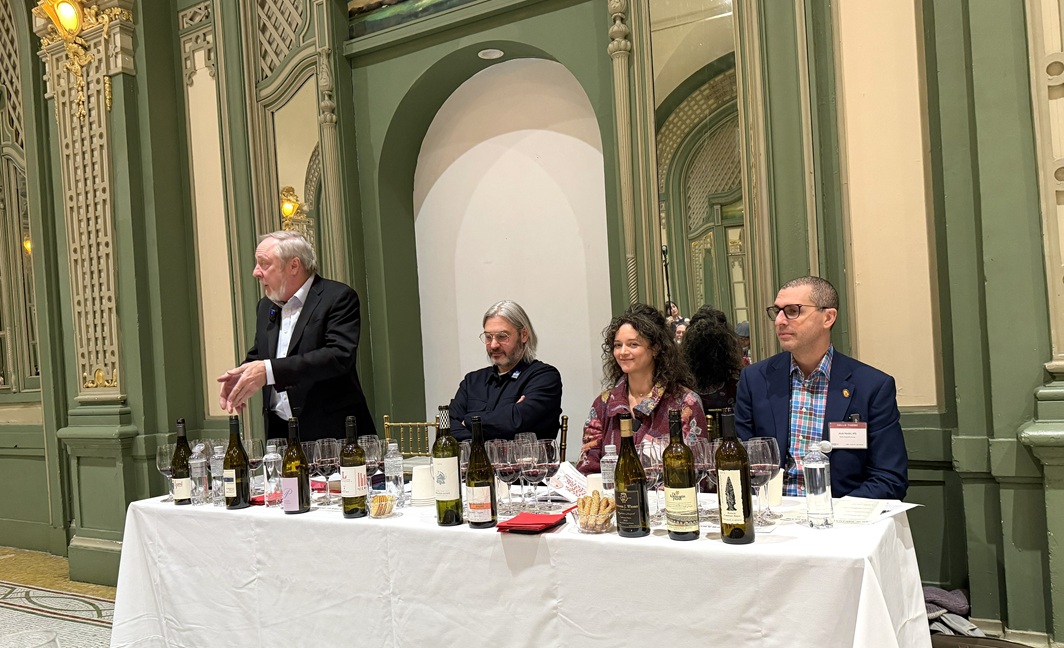
Now, let’s talk about my Cabernet Franc impressions after tasting and the seminar.
I have to say that it’s been a while since I had a deep immersion opportunity into the New York Cabernet Franc at any scale, never mind such a large and focused event – this was my first time attending it. But that is not even an important point. It’s been a significant lapse since I had New York Cabernet Franc, so all comparisons I was making were the present state of the New York Cabernet Franc versus New York Cabernet Franc as I remember it.
The State of New York has 7 defined AVAs – Champlain Valley, Finger Lakes, Hudson River Region, Upper Hudson, Lake Erie, Long Island, and the Niagara Escarpment. Out of this list, I’m mostly familiar with Finger Lakes, Hudson Valley (lumping together both Hudson regions), and Long Island. These were mostly the regions represented in the tasting, plus the Niagara Escarpment.
The State of New York’s Cabernet Franc definitely evolved compared to what I knew. This evolution now includes not only widely available Cabernet Franc Rosé, but also sparkling Cabernet Franc. I’m curious when (I think “when” is more appropriate than “if”, but of course I can be wrong) we will see Cabernet Franc Blanc (similar to what we see in the Oregon Pinot Noir scene). I also would think that at some point, we should see Cabernet Franc “port” just to complete the full range of Cabernet Franc expressions.
Now, to summarize my impressions, I have to use the word I don’t like using – interesting. Interesting is definitely not a very kind descriptor, but that’s the best I can do at the moment – let me explain.
I loved the absolute majority of Rosé wines across the board. They were elegant, mostly lean, and many of them capable of perfectly competing with Provence. The same goes for sparkling wines – fresh, generous, with a wide range of expressions, but I would be happy to drink the majority of them (if we exclude the price). But the main body of the tasting, Cabernet Franc reds, represented a mixed bag.
During the seminar, one of the panelists used the descriptor “finesse” to describe Cabernet Franc. I love this descriptor, but for me, finesse first and foremost means perfection of the balance. All your taste buds have to sing in unison for the wine to be declared as having “finesse”. For example, Cayuse wines might be the most expressive wines made in the United States, solely based on their ability to express the specific terroir, but the main descriptor for Cayuse wines is “power”, not “finesse”. Burgundian Pinot Noir possesses finesse, but the main expression of Oregon Pinot Noir is power, not finesse. Going back to our Cabernet Franc wines, I found “finesse” maybe in 2-3 wines out of 60 – 70 I tasted.
Tannins often were my main issue. And please note – tannins, not the use of oak. A number of wines were proudly unoaked. When the front of my mouth was literally locked up by the borderline painful tannins, and the winery rep was explaining that the wines were aged in stainless steel, I had to ask, “how is the wine so tannic?”. “Ah, we macerated with the skins for 71 days”, was the reply. Oh… I don’t know if it will help the wine to age better, but for those of us who want to drink the wine now… Please, don’t do this.
Along the lines of “finesse,” my second gripe would be another claim made during the seminar – “terroir”. It was said that now we can find similarities among the wines coming from the same “place”. That means that we should be able to find similarities between Cabernet Franc made in the Hudson Valley and successfully differentiate them from Cabernet Franc made in the Finger Lakes. Feel free to call me an amateur shmuck, but I would not be able to find similarities or differentiate most of the Cabernet Franc wines (excellent wines, mind you!) I tasted, even if my life depended on it.
On a positive side, practically all Cabernet Franc aged expressions were delicious. We had 2005, 2010, 2012, 2015, 2016, and other vintages with some age, and they were excellent across the board. The 2005 Millbrook was probably at its peak, and I don’t know how long that peak will last. But my general observation is that New York Cabernet Franc can age.
Please don’t get me wrong – there were lots of excellent Cabernet Franc reds in the tasting. If you want to surprise someone with a delicious red from the East Coast of the United States, a bottle of Cabernet Franc would probably be your top contender. Better yet – if you find – and afford – a library Cabernet Franc, your friends would thank you profusely.
Now, for what it’s worth, I would like to share my notes from the seminar and the tasting. One generic note – if grape composition is not listed, the wine is made from 100% Cabernet Franc.
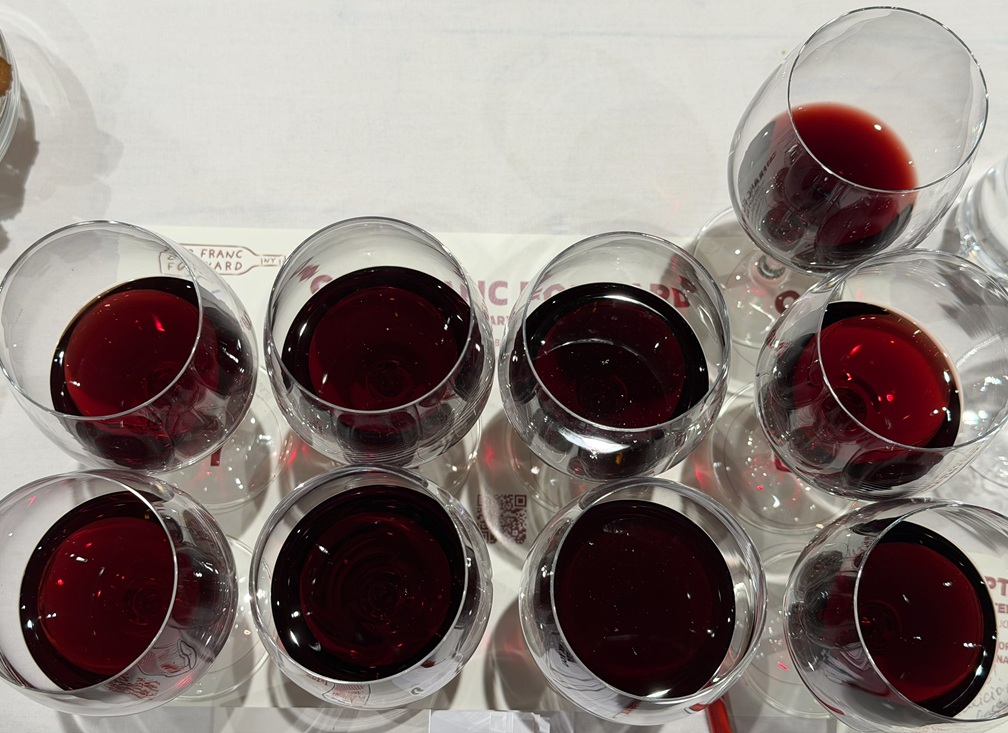
Seminar wines:
2024 Macari Vineyards “Horses” Cabernet Franc Pet Nat (11.4% ABV, $32) – wow! Fresh, delicious, crisp bubbles, just perfect.
1. 2024 Fjord Vineyards Estate Cabernet Franc Hudson River Region (12.6% ABV, $30)
A Wow nose, classic with cassis and tobacco.
The palate is disappointing. Green, aggressive
2. 2022 Benmarl Winery Estate Cabernet Franc Hudson River Region (13.7% ABV, $40)
Complex nose with graphite and herbs
Green, tight, tannic palate. Not enjoyable.
3. 2024 Paumanok Vineyards “Minimalist” Cabernet Franc North Fork of Long Island (12.5% ABV, $55)
Carrot Juice? Pomegranate?
Just no…
4. 2023 Lieb Cellars Estate Cabernet Franc North Fork of Long Island (12.9% ABV, 88% Cabernet Franc, 8% Cabernet Sauvignon, 3% Malbec, $38)
Classic nose
Classic palate
+++, nice, enjoyable
5. 2021 Wölffer Estate Vineyard “Caya” Cabernet Franc Long Island (13.5% ABV, 87% Cabernet Franc, 13% Merlot, $37)
Volcanic nose, pleasant, nice
The palate is powerful and balanced, earthy notes, tobacco, pronounced but balanced tannins.
+++-|, excellent
6. 2024 Boundary Breaks Vineyard Cabernet Franc Finger Lakes (13.5% ABV, 95% Cabernet Franc, 5% Merlot, $25)
Classic Nose on a lighter side.
Nice and classic palate, but tannins kick in quickly. Still, overall – not bad.
+++
7. 2023 Herman J.Wiemer Magdalena Vineyard Cabernet Franc (12.8% ABV, $45)
Rutherford dust on the nose, medicinal notes, bell pepper.
No bad, but fruit fades away quickly, leaving you with tannins.
8. 2020 Dr. Konstantin Frank Winery Cabernet Franc Finger Lakes (13% ABV, $28)
Beautiful, classic nose.
On the palate, the wine is balanced, with succulent fruit, tannins are present but well-balanced and appropriate.
+++-|
9. 2012 Arrowhead Spring Vineyards Library Selection Cabernet Franc, Niagara Escarpment
Nose is definitely medicinal, with iodine, cassis, and herbs.
Wow palate – wonderful, fresh, tight, great acidity, excellent.
++++, a special treat.
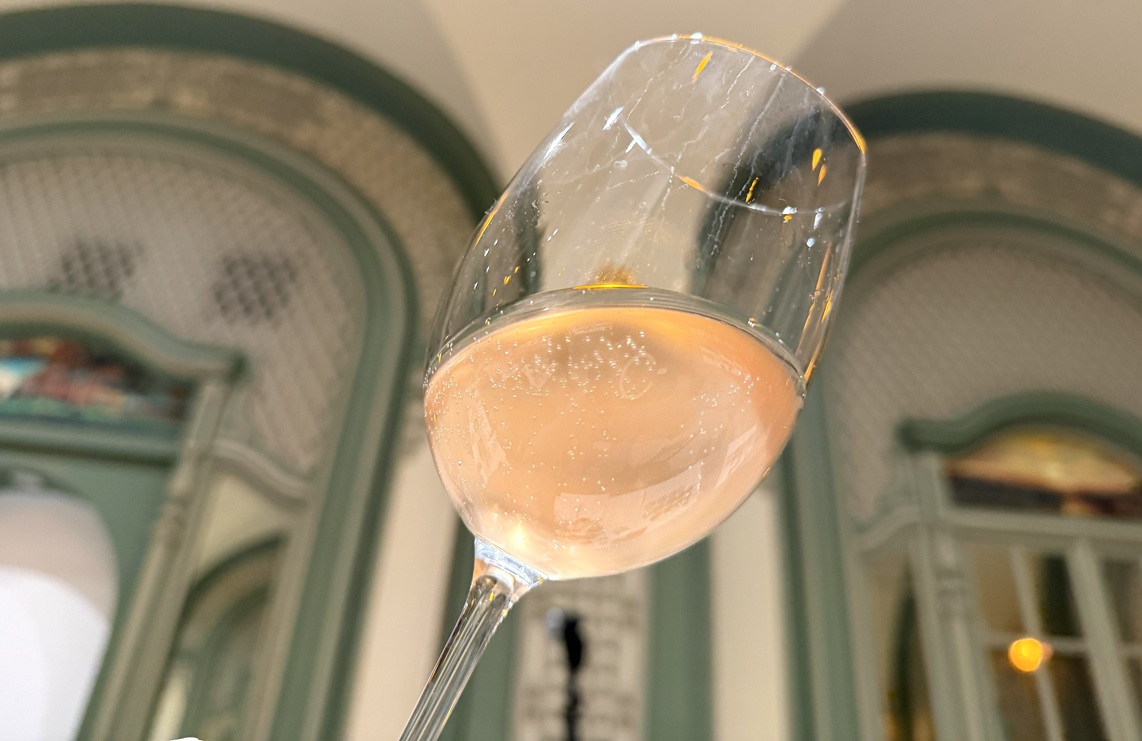
Here are my notes for the general tasting. I had time for about half of the tables (probably 23-24 out of 40), and the notes are very limited, as I mostly use my trade tasting rating system of “+” signs, with “+++” being a very solid rating. I’m also using “-|” as .5 improvement, so “++-|” basically means 2.5.
Okay, without further ado, here are the notes from the general tasting:
Apollo’s Praise 2024 Cabernet Franc – Picardie Finger Lakes (13% ABV, $28.00) – horrible. Green and biting
Arrowhead Spring Vineyards 2023 Cabernet Franc Stainless Steel Niagara Escarpment (12.5% ABV, $19.95) – gripping tannins (71 days maceration???)
Arrowhead Spring Vineyards 2023 Cabernet Franc Barrel Aged Niagara Escarpment (13.3% ABV, $24.95) – approacheable, nice
Atwater Vineyards 2024 Dry Rosé of Cabernet Franc/Blaufränkisch Finger Lakes (11.6% ABV, $27.00, 85% Cabernet Franc, 15% Blaufränkisch) – +++
Atwater Vineyards 2023 Cabernet Franc Finger Lakes (11.7% ABV, $32.00) – good
Atwater Vineyards 2024 Cabernet Franc Finger Lakes (14.1% ABV, $32.00) – ++, good
Benmarl Winery 2024 Pétillant Hudson River Region (12.3% ABV, $25.00) – +++, joy!
Benmarl Winery 2024 Dry Rosé Hudson River Region (12.2% ABV, $20.00) – ++-|, very good
Benmarl Winery 2022 Estate Cabernet Franc Hudson River Region (12.1% ABV, $40.00) – okay, strange. Petrol?
Boundary Breaks Vineyard 2024 Cabernet Franc Finger Lakes (13.5% ABV, $21.95, 95% Cabernet Franc, 5% Merlot) – ++
Boundary Breaks Vineyard 2024 Cabernet Franc Reserve Finger Lakes (13.5% ABV, $25.95) – ++, supposedly unoaked, gripping tannins
Boundary Breaks Vineyard 2024 Dry Rosé Finger Lakes (12.5% ABV, $15.95, 60% Cabernet Franc, 40% Cabernet Sauvignon) – on a sweeter side
Clovis Point Vineyard and Winery 2022 Cabernet Franc North Fork of Long Island (13.2% ABV, $45.00, 95% Cabernet Franc, 5% Malbec) – ++-|
Clovis Point Vineyard and Winery 2022 Sparkling Cabernet Franc (12% ABV, $49.00) – delicious! light sweetness
Damiani Wine Cellars 2024 Cabernet Franc Finger Lakes (13.5% ABV, $28.00) – +++
Damiani Wine Cellars 2024 Cabernet Franc Reserve Finger Lakes (13.7% ABV, $60.00) – +++
Damiani Wine Cellars 2024 Cabernet Franc Valois Vineyard Finger Lakes (14.1% ABV, $42.00) – +++
Damiani Wine Cellars 2022 Cabernet Franc Barrel Select Finger Lakes – superb
Dr. Konstantin Frank 2022 Cabernet Franc Finger Lakes (13% ABV, $27.99) – +++, classic, clean
EV&EM Vineyards 2023 Classic Cabernet Franc North Fork of Long Island (12.7% ABV, $58.00) – too lean. 2023 was a very difficult vintage
EV&EM Vineyards 2024 Classic Cabernet Franc North Fork of Long Island (12.7% ABV, $58.00) – much bigger than 2023. 2024 was an excellent year on Long Island
Fjord Vineyards 2024 Estate Cabernet Franc Hudson River Region (13.8% ABV, $30.00) – +++
Fjord Vineyards 2024 Estate Dry Rosé of Cabernet Franc Hudson River Region (12.6% ABV, $22.00) – +++, excellent, my favorite so far
Fjord Vineyards 2022 Estate Cabernet Franc Hudson River Region (13.1% ABV, $30.00) – ++-|, interesting, volcanic notes
Forge Cellars 2020 Willow Vineyard Cabernet Franc Seneca Lake Finger Lakes (13% ABV, $26.00) – good
Forge Cellars 2023 Caywood Vineyard Cabernet Franc Seneca Lake Finger Lakes (13% ABV, $28.00) – good


Hermann J. Wiemer Vineyard 2023 Cabernet Franc Finger Lakes (12.5% ABV, $27.00) – +++, excellent
Hermann J. Wiemer Vineyard 2023 Cabernet Franc Magdalena Vineyard Finger Lakes (12.8% ABV, $45.00) – +++, excellent. Surprise – I didn’t like it in the seminar… Go figure…
Hermann J. Wiemer Vineyard 2021 Library Vintage Cabernet Franc in Magnum Finger Lakes (12.5% ABV, $90.00) – +++-|, excellent, round, powerful
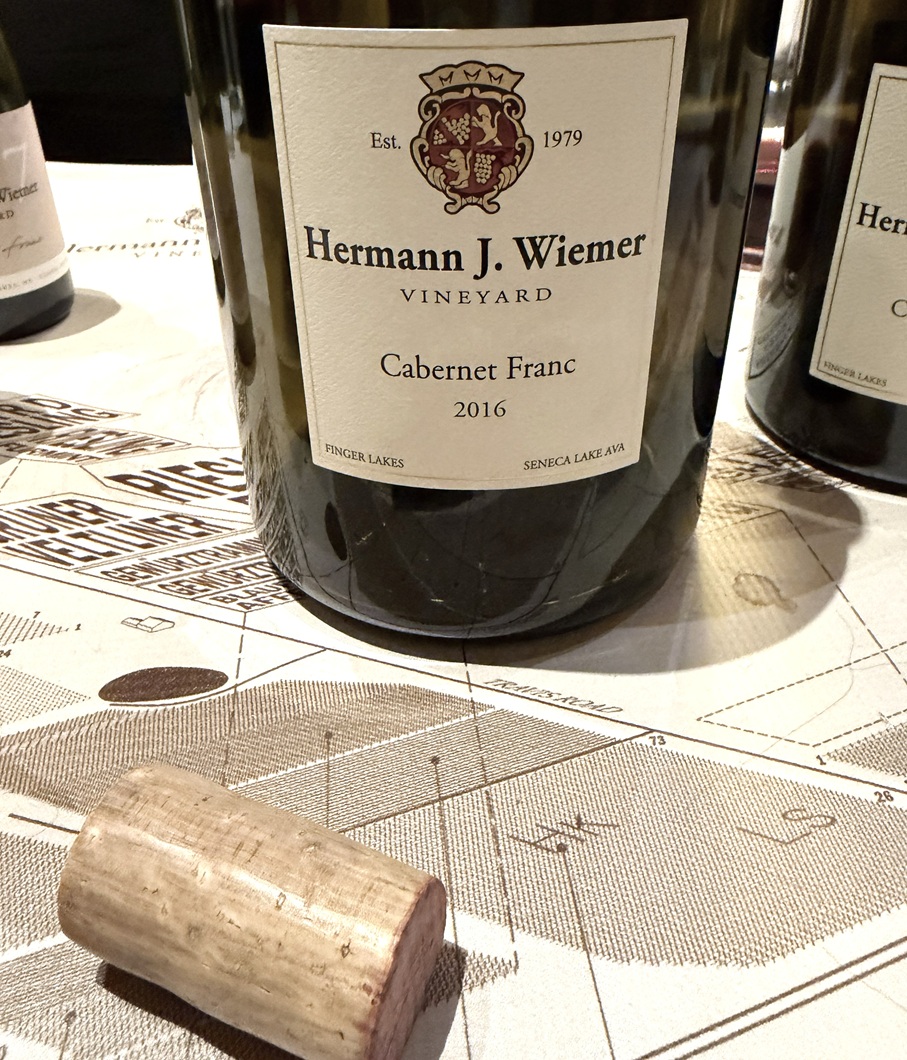
Hermann J. Wiemer Vineyard 2016 Library Vintage Cabernet Franc 3 Litre Finger Lakes (12.5% ABV, $360.00) – +++, excellent
Hermann J. Wiemer Vineyard 2019 Single Clone 214 Cabernet Franc Finger Lakes – an original Loire clone, very good
Hermann J. Wiemer Vineyard 2019 Single Clone 327 Cabernet Franc Finger Lakes – a Bordeaux clone, certified in 1975, very good
Heron Hill Winery 2020 Heron Hill Classic Cabernet Franc Finger Lakes (13.3% ABV, $22.00) – +++, nice, round, clean
Heron Hill Winery 2022 Ingle Vineyard Cabernet Franc Finger Lakes (13.8% ABV, $40.00) – +++, nice, round, clean
Keuka Spring Vineyards 2024 Cabernet Franc Finger Lakes (13.1% ABV, $28.99) – +++, excellent, clean, delicate, light color with a lip-smacking palate
Keuka Spring Vineyards 2025 Dry Rosé Finger Lakes (11.8% ABV, $19.99, 60% Cabernet Franc, 40% Blaufrankisch) – +++-|, a new favorite
Keuka Spring Vineyards 2024 Epic Finger Lakes (12.1% ABV, $29.99, 65% Cabernet Franc, 35% Blaufrankisch) – +++-|, excellent
Lakewood Vineyards 2024 Cabernet Franc Finger Lakes (13.8% ABV, $20.00) – good, light, nice color
Lakewood Vineyards 2020 Reserve Cabernet Franc Finger Lakes (15.9% ABV, $50.00) – good
Lakewood Vineyards 2024 Cabernet Franc Dry Rosé Finger Lakes (13.1% ABV, $18.00) – good
Lamoreaux Landing Wine Cellars – Rosé was too sweet, and I didn’t like any of the reds
Lenz Winery 2021 Estate Selection Cabernet Franc North Fork of Long Island, Peconic (13.5% ABV, $55.00) – excellent. This is a new project at Lenz. Until 2017, Cabernet Franc was used only for blending
Living Roots Wine & Co. 2025 Finger Lakes Pet-Nat Rosé Finger Lakes (12.8% ABV, $26.00, 50% Cabernet Franc, 50% Blaufrankisch) – too sweet
Living Roots Wine & Co. 2025 Finger Lakes Dry Rosé Finger Lakes (12% ABV, $22.00, 41% Cabernet Franc, 33% Pinot Noir, 26% Blaufrankisch) – excellent
Living Roots Wine & Co. 2023 Finger Lakes Cabernet Franc Finger Lakes (12.6% ABV, $30.00) – excellent
Macari Vineyards & Winery 2024 “Lifeforce” Cabernet Franc North Fork of Long Island (12.9% ABV, $30.00) – +++, excellent
Macari Vineyards & Winery 2022 Cabernet Franc North Fork of Long Island (12.9% ABV, $38.00) – excellent
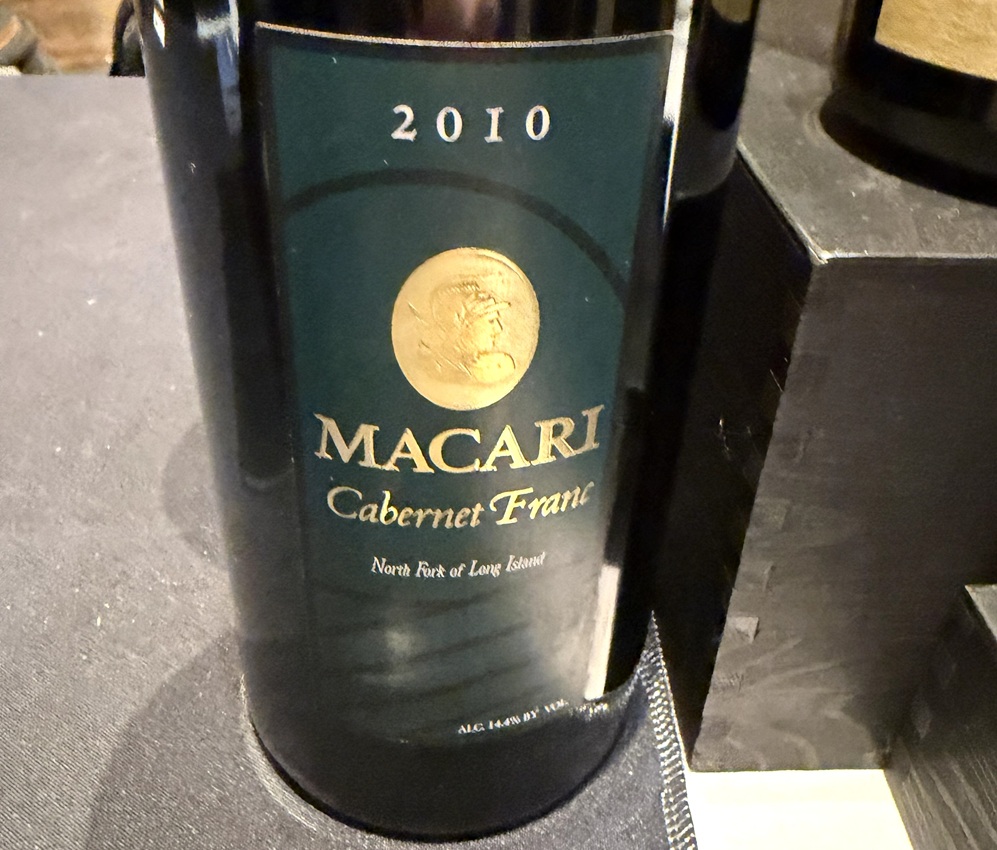
Macari Vineyards & Winery 2010 Cabernet Franc North Fork of Long Island – ++++, wow, powerful, delicious
McCall Wines 2021 Cabernet Franc North Fork, Long Island (12.8% ABV, $28.00) – +++, excellent
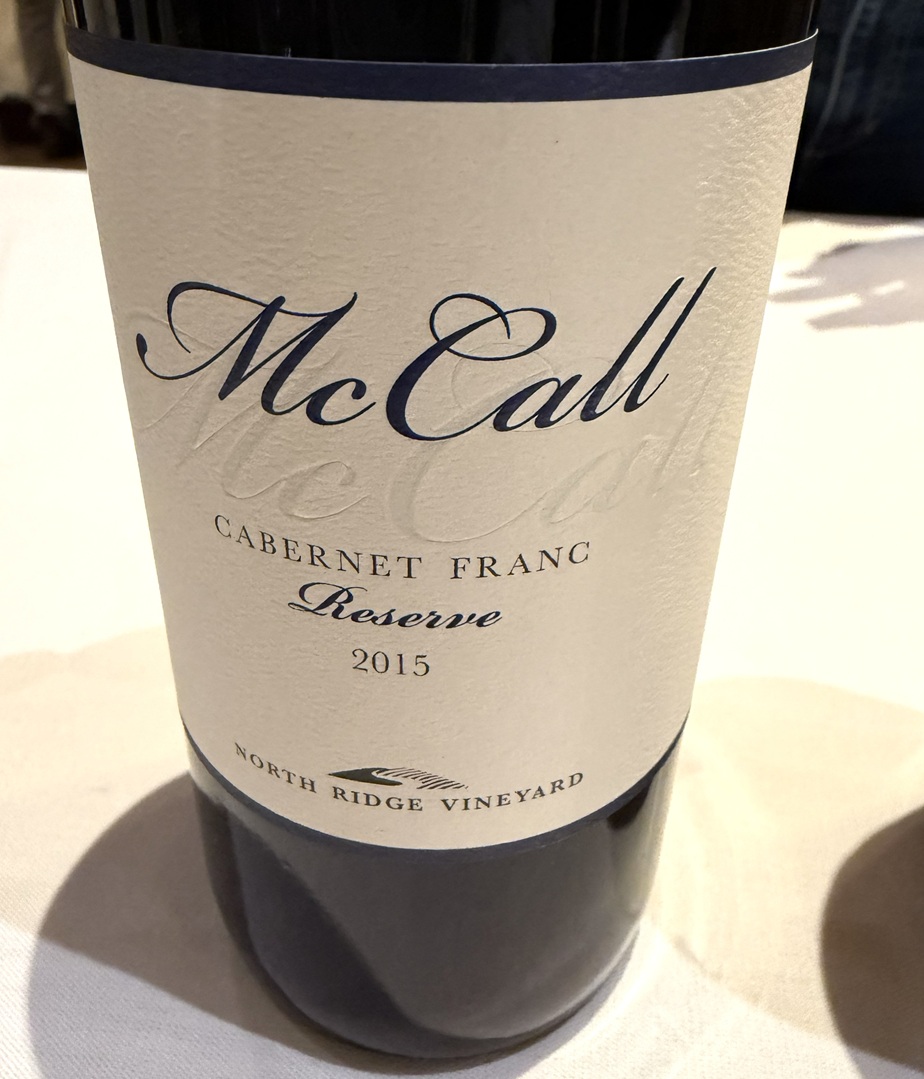
McCall Wines 2015 Cabernet Franc Reserve North Fork of Long Island (13% ABV, $49.00) – ++++, outstanding, elegant
Milea Estate Vineyard 2023 Milea Estate Vineyard Farmhouse Cabernet Franc Hudson River Region (12.5% ABV, $40.00) – ++-|, good
Milea Estate Vineyard 2023 Milea Estate Vineyard Reserve Cabernet Franc Hudson River Region (12.5% ABV, $50.00) – +++, excellent
Millbrook Vineyards & Winery 2025 Cabernet Franc Estate Rosé Hudson River Region (13.9% ABV, $30.00) – ++-|, good
Millbrook Vineyards & Winery 2023 Cabernet Franc Hudson River Region (13% ABV, $28.00) – ++-|, good
Millbrook Vineyards & Winery 2021 Cabernet Franc Proprietor’s Special Reserve Hudson River Region (13% ABV, $45.00) – +++, excellent
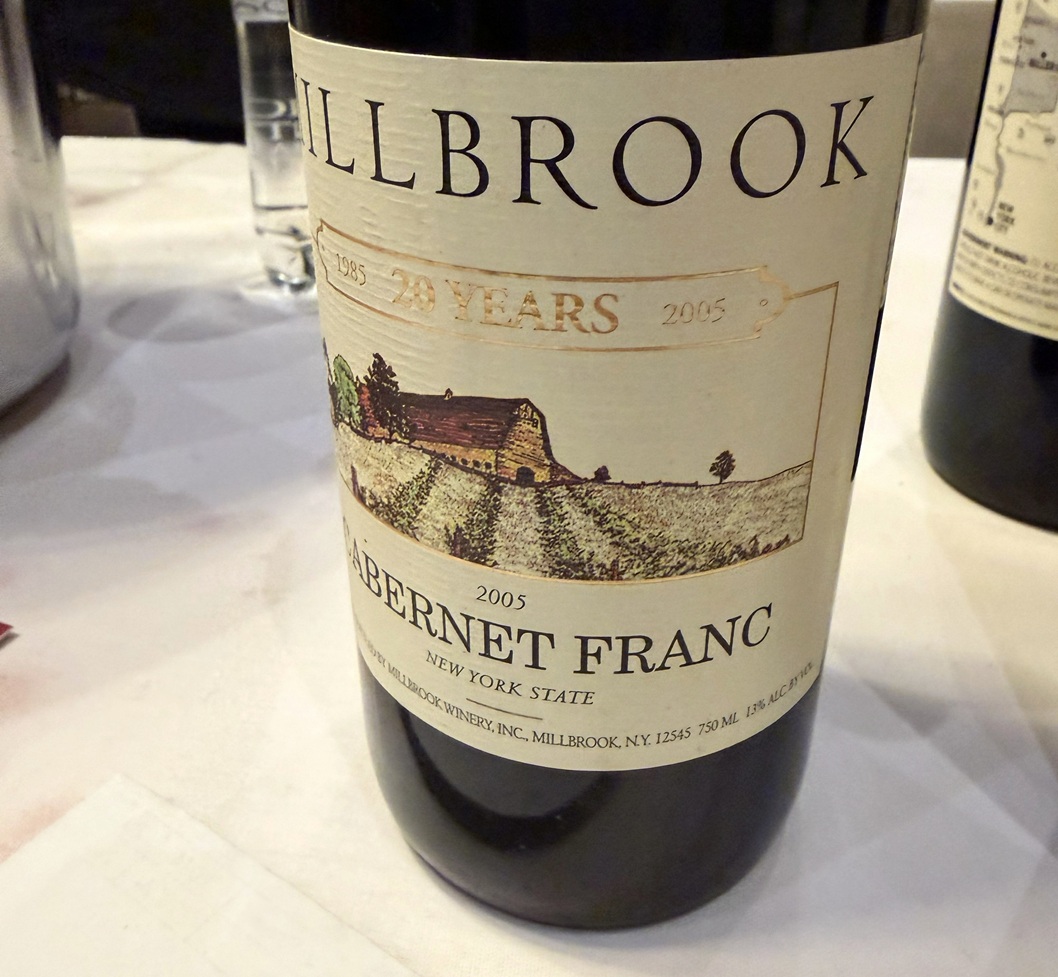
Millbrook Vineyards & Winery 2005 Cabernet Franc Hudson River Region (13% ABV, Library, 75% Cabernet Franc, 18% Merlot, 7% Cabernet Sauvignon) – ++++, wow, delicious. Oldest in the tasting. Might be at its peak
Neverstill Wines 2023 Cabernet Franc Finger Lakes / Hudson Valley (13%, $49.00) – good
One Woman Winery 2020 One Woman Cabernet Franc North Fork of Long Island (12.8% ABV, $42.00) – good
One Woman Winery 2022 One Woman Cabernet Franc North Fork of Long Island (12.8% ABV, $42.00) – good
Suhru & Lieb Vineyards 2023 Lieb Estate Cabernet Franc North Fork of Long Island (12.9% ABV, $38.00, 88% Cabernet Franc, 9% Cabernet Sauvignon, 3% Malbec) – good
Suhru & Lieb Vineyards 2024 Suhru Wines Rosé North Fork of Long Island (11.6% ABV, $21.00, 54% Cabernet Franc, 18% Merlot, 16% La Crescent, 12% Lagrein) – good, and a new grape!
The Red Hook Winery 2019 Jamesport Vineyard Cabernet Franc Long Island (14.1% ABV, $40.00) – good
Wölffer Estate Vineyard 2023 Estate Cabernet Franc Long Island (13.5% ABV, $25.00, 82% Cabernet Franc, 11% Merlot, 6% Cabernet Sauvignon, 1% Petit Verdot) – good
Wölffer Estate Vineyard 2021 Caya Cabernet Franc Long Island (13.5% ABV, $37.00, 87% Cabernet Franc, 13% Merlot) – good
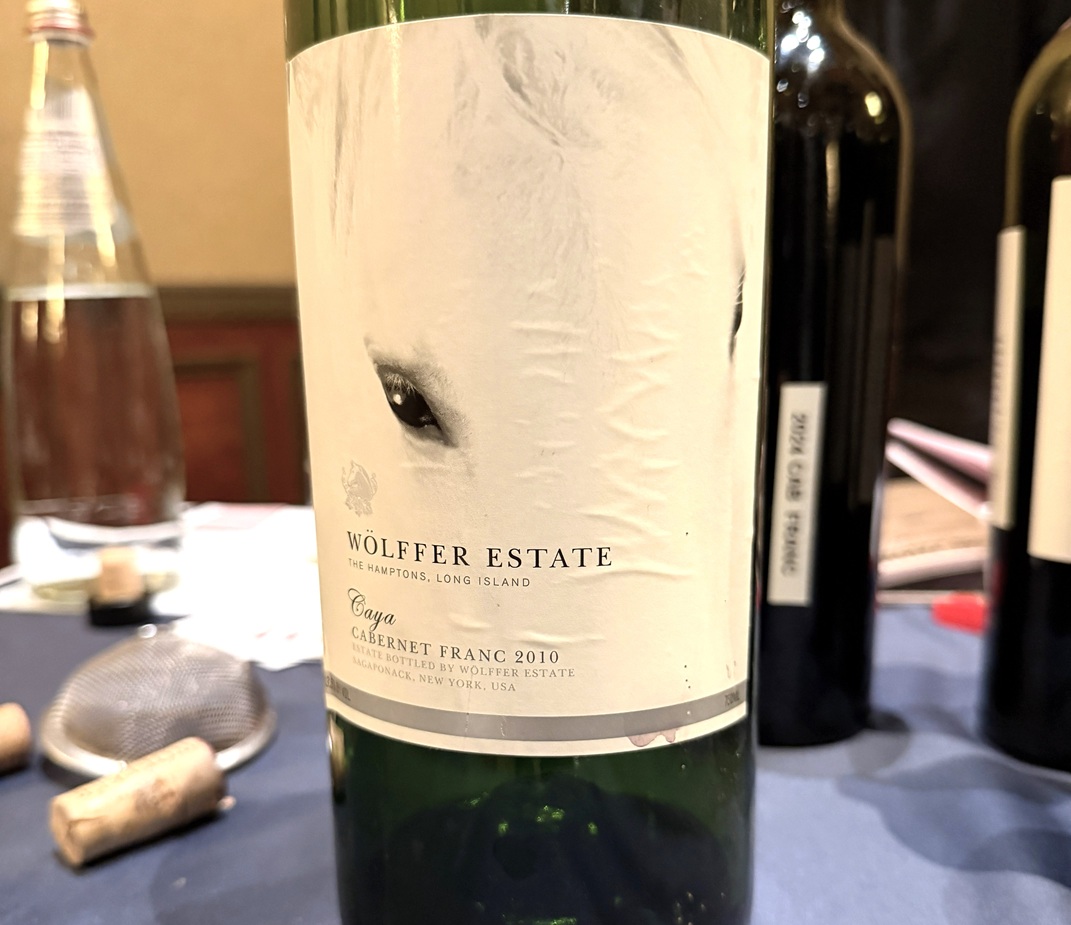
Wölffer Estate Vineyard 2010 Caya Library Selection Cabernet Franc Long Island (13.3% ABV, Library, 85% Cabernet Franc, 14.5% Merlot, 0.5% Cabernet Sauvignon) – outstanding
Uff, this was a long post. Hope you reached here, but if you didn’t, you are not reading this anyway 🙂
Until the next time – cheers!
Simple Recipes: Cottage Cheese
I can hear you saying “what?” Every supermarket sells at least 10 different kinds. Why should I bother making it?
I’m not here to argue. I’m here simply to share. This is what this whole blog is all about. Sharing the experiences for what it’s worth. Also, this blog serves as my personal memory journal. Once it is published here, I can always come back to it later. Anyway, let’s get back to the subject of this post.
I have two reasons for making my own cottage cheese. First, taste. Second, cost.
Food store offerings around the country might differ vastly, and I don’t know if we share the same experience. But here in my town, the cottage cheese selection in a typical supermarket is limited to 4-5 types, with the prices ranging from $3 to $7+ per pound. But strictly focusing on the taste, I find most of the cottage cheeses I tried edible, but none of them are really tasty.
I tried to find a good recipe to make cottage cheese many times. Made many attempts and wasted a lot of milk in the process. Until finally, my wife found a recipe on Instagram that seemed promising. We tried it, and it was a home run! We got tasty cottage cheese, and got a very good amount of it. As I told you, I was looking for a better taste and better cost, and this recipe answered both. And it is really, really simple.
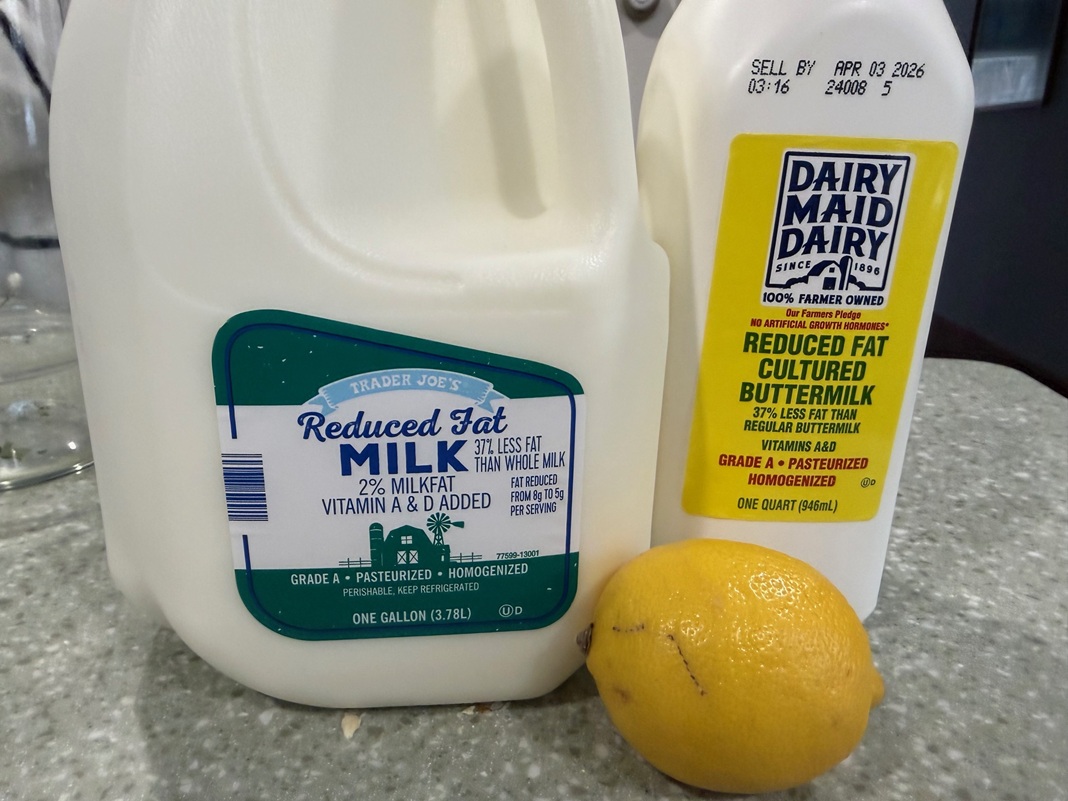
There are only 3 ingredients in this recipe – milk, kefir/buttermilk, and lemon. That’s it! You can make it all organic if you want by using only organic ingredients. You can also easily control the fat content. I’m not sure how well it will work if you use skim milk, but we have done this with both 2% milk and 4% (whole) milk, and we liked the result in both cases.
The first step is very simple – in the large pot, combine a gallon of milk, a quart of buttermilk, and the juice of one small lemon (2 tablespoons or less, unless you like sour things). Mix it, cover the pot, and put it into a warm place for 24 hours.
Here is where it gets a bit tricky. For this recipe to work, you need to maintain an average temperature of 85°F (I’m sure 80°F to 90°F will work equally well). We are lucky, as we have a room with a radiant heat floor where we can close the door and maintain this temperature. In the original video, the pot was placed outside in Florida, which I’m sure would give you the right temperature. Once summer comes, this will be our plan too. If necessary, you can heat up the pot to 85°F, and then cover it with blankets. Anyway, I’m assuming you can figure it out.
After 24 hours, when you open the pot, you should be able to see a “crust” floating on top. Put the pot on the stove and start gently heating it up, pretty much on the lowest setting. You need to bring the liquid to the boil, but not allow it to boil. This heating-up process should take about 45 minutes. Don’t rush it. It was tested multiple times – 45 minutes is what you need, give or take a few minutes.
Now, the most important step. Take the pot off the heat and let it cool off. It should cool off sufficiently for you to be able to put it into the refrigerator overnight. The next day, the cottage cheese will be collected at the bottom. Now, you can dump the whey, or you can use it – there are many options. We typically just drain the pot through the fine mesh and then just leave the mesh for another 30 minutes to let the water drain. As our goal is cottage cheese, which is granular, and not farmer cheese, which is usually compact and smooth, we don’t specifically squeeze the moisture out; we just let the cottage cheese drain. If you want to get to the farmer cheese consistency, you can, of course, use the cheesecloth and squeeze all the moisture out.
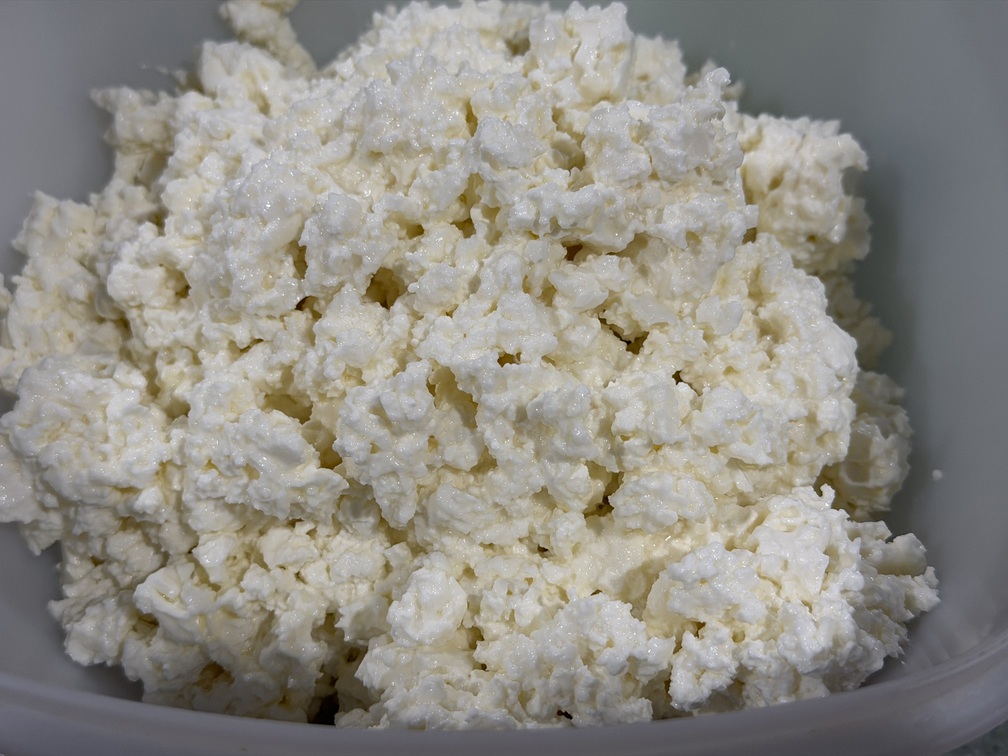
Voila! The cottage cheese is ready to be enjoyed in whatever way you like. By the way, we typically don’t add salt, but of course, you can.
As I mentioned cost as one of the factors in this exercise, let me give you the details. The gallon of 2% milk we typically use costs $3.99 at Trader Joe’s. The quart of buttermilk shown in the picture above is $2.99. We can count the lemon at $.50, so the total cost is $7.50. Our typical yield from 5 liters of liquid is 3 lb of cottage cheese, which brings our cost to roughly $2.50 per pound. This is definitely reasonable.
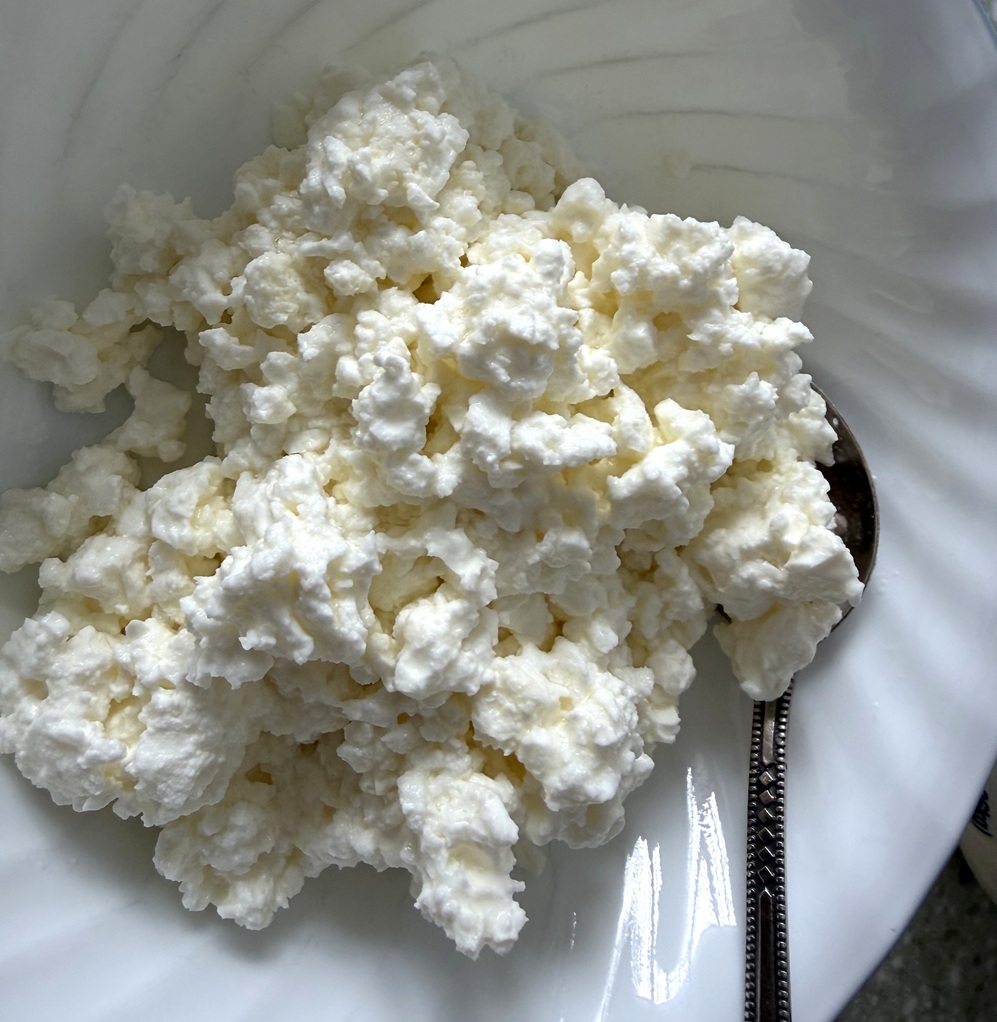
And yet the main goal here is tasty cottage cheese, and this is exactly what this recipe allows you to achieve. We are now making it every week, and it is our typical breakfast staple here.
There you are, my friends. A simple recipe worth making. If you try it, and I really encourage you to try it, I will be really curious to hear your feedback.
And until the next time – bon appetit!
Latest Wine News And Updates
The wonderful world of wine. Wine is definitely unique, arguably the one and only. What other product on this planet reappears every year literally, and not just as one, no, probably millions of new and unique ones? No wonder something is always happening in this amazing world. Let’s take a look at some of the latest news out there.
Opus Two
Opus One wine project, a collaboration started by wine’s greats, Robert Mondavi and Baron Philippe de Rothschild, hopes to extend its lead into the brand new world. What’s the brand new world in wine? Same as everywhere, the world dominated by AI. Opus One recently announced the brand new undertaking, Opus Two, the new wine which will be produced by AI. Opus One has partnered with Anthropic AI, the most “hands-on” AI engine out there, to build a new vineyard and the winery to start production of the Opus Two wine beginning in 2030. Opus One folks managed to sign a 20 years lease for the plot, not just somewhere, but at the Beckstoffer To Kalon vineyard, and now Claude, the new AI winemaker, is preparing to take full control of the grape growing and wine production using the team of human assistants (the plan is to gradually switch to cyborgs over the next 10 years). For now, Claude is finishing its rapid education course at UC Davis in California and getting ready to start making winemaking decisions. Never been a fan of Opus One, but I’m curious to try Opus Two once it is released.
DRC Moving Past Pinot Noir
Yes, you are reading this correctly. And you know what makes this story even crazier than it sounds? It is all because of the movie. Similarly to how the movie Sideways had a tremendous and prolonged negative effect on the sales of the Merlot, a wine movie is the culprit in the decision of Aubert de Villaine to move past beloved Pinot Noir. An obscure grape called Herbemont so lovingly portrayed in the Season 2 of the Drops of God, had a very significant effect on Aubert de Villaine, who supposedly said, “only Domaine de la Romanée-Conti wines can have such effect on people”, referring to the scene where competition judges all show absolute amazement after blindly tasting red Herbemont wine produced in Georgia. It is unclear how DRC will source Herbemont grapes, whether they will plant the vineyards (and where), or buy them from the growers, but DRC seems to be determined to start offering Herbemont wines over the next 5 years. Considering the astronomical prices of their regular Pinot Noir wines, it is hard to tell how expensive the Herbemont wines will be, but this is an exciting development in any case, so let’s wait and see.
Soon, wine-ing your food will be as easy as salting it
McCormick, one of the largest producers of spices in the USA, wants you to be able to wine your food, right after you salt it. Yes, you heard it correctly. McCormick is teaming up with one of the large wine producers in California (rumor has it that the wine producer is Jackson Family Wines, but this information has not been independently verified) and Whirlpool Corporation, which developed freeze-dried ice cream for NASA, to produce freeze-dried wine extract, which will be available to chefs and home cooks alike. Want to season your steak with Cabernet Sauvignon? No problems, here is your can of dry Cabernet Sauvignon. Want some Chardonnay on your chicken? Here you go. It was announced that the initial lineup will include Cabernet Sauvignon, Merlot, Pinot Noir, Chardonnay, and Sauvignon Blanc, all sourced in California. If successful, the lineup will expand to include more grape varieties and potentially even look beyond California. These new McCormick WineLine spices will soon appear at the grocery stores near you, so you should be on the lookout for them, as production will definitely be limited at the beginning.
Love wine too much? Enjoy it in more ways than before!
Here we have a combination of two seemingly unrelated factors. First, there are people who love wine too much and are happy to enjoy it at any time in any form. Second, the wine consumption is down, and we have to deal with the surplus of wine. To connect these two factors, recently we learned about not just one, but two new products guaranteed to make the wine lovers extra happy and help with dealing with wine surplus at the same time.
First, Colgate, one of the leading producers of dental hygiene products, entered into a partnership with Familia Torres, the largest wine producer in Spain, to create a new wine-flavored line of dental hygiene products, which will include toothpaste, mouthwash, and even dental floss. Initially, the taste profile of the dental products will be limited to Tempranillo and Viura, but it might expand later on with the addition of other types of wines. Colgate TotalWine-o line of products is expected to hit the shelves in early 2027.
Now, for even bigger news – Dove, leading manufacturer of bath and shower products, announced its partnership with Concha y Toro, a leading Chilean wine producer, to create a wine-infused line of shampoo and conditioners. Can you imagine coming out of the shower and your hair smelling like Carmenere? Soon, you will be able to! The new line of shampoo and conditioners, called Dove Wine Therapy, will initially include Carmenere and Sauvignon Blanc aromatics, with possible future options including Merlot and Viognier. The products will be available in the second half of 2027. Have you ever imagined how good you might smell after the shower? Now you can and should!
And we are done for today. Tomorrow will be a new day, and until then – cheers!
Seeking Amarone: Grace and Beauty of Cesari Amarone Bosan
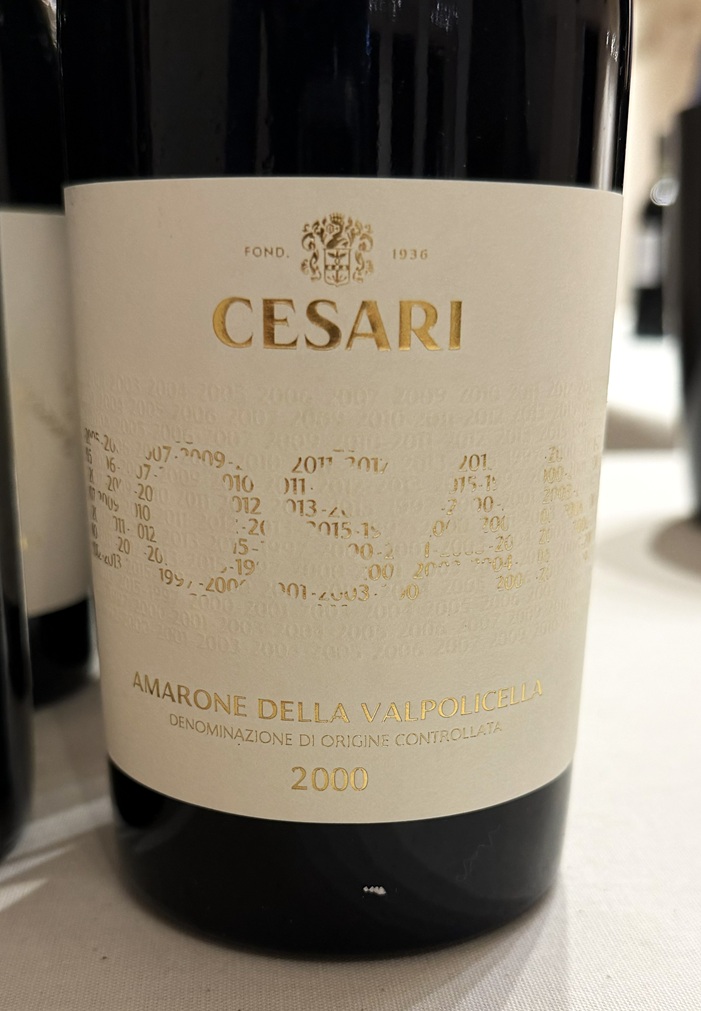 What do you think of Amarone? I know that some people simply dismiss it as an alcohol bomb, as many Amarone wines nowadays are sporting 16.5% ABV, and winemakers blame climate change. Okay, climate change is not the subject of this post, so let’s quickly rewind before we go too far.
Let me repeat the question – what do you think of Amarone? Love it, hate it, or indifferent?
While you are deep in your thoughts, let me share my take.
I love Amarone. I tried it for the first time in 2003, during Kevin Zraly’s Windows on the World wine school class. The wine we tried was 1998 Le Ragoze Amarone. The contrast of dry fruit assemblage on the nose with lean, focused, powerful, and perfectly balanced palate was stunning, delicious and memorable. And that was the beginning of my love-hate relationship with Amarone (please keep reading, I promise to explain all the high emotions).
Maybe a quick historical perspective would be appropriate here. Amarone wines are made in the Valpolicella region in Veneto Province. While winemaking across Italy goes back to Roman times, Amarone has not been around for too long. Historically, the Valpolicella region was best known for its sweet wines called Recioto. The grapes for Recioto production were first dried under the sun to concentrate sugars (this process is called Appassimento), and subsequently made into the sweet wine. In 1936, supposedly, a barrel of Recioto was forgotten in the cellar, the fermentation continued, and resulted in the dry and powerful wine which was called Amarone, which means Great Bitter, contrasting it with sweet Recioto. Amarone wines began to be internationally recognized in 1970th. Amarone della Valpolicella received the status of DOC in 1990 and advanced to DOCG in 2010.
Amarone is not my pivotal wine. Actually, I don’t have a pivotal wine as some wine lovers do – many wines left lasting impressions on me and I would be very hard pressed to identify “one and only”. But Amarone is definitely one of my favorite wines – except that I more or less gave up on it for now.
The “Seeking Amarone” theme of this blog post is not random. I wrote a few posts under the same theme in the past (none as of late), as that spectacular experience with 1998 Le Ragoze happened to be really hard to replicate. With the exception of a few Masi single vineyard Amarone, most of the Amarone I taste are lacking balance, with alcohol being not well integrated and simply destroying any joy the wine could bring. Side note – 16.5% ABV in itself means nothing. Anyone who casually enjoyed Turley or Carlisle Zinfandels can attest to the perfect balance and harmony those wines exhibit, at the same 16.5% of ABV.
Possibly a bigger issue affecting Amarone was a dramatic expansion of the DOC growing area, which allowed subpar quality fruit to become a fuel for Amarone’s attempt to meet the global growing demand – Amarone production increased from 1 million bottles to 16 million bottles in 2008. However, that didn’t affect single vineyard Amarone, and this brings us to the intended subject of this post – Cesari Bosan Amarone, a single vineyard Amarone from the heart of the Amarone Classico di Valpolicella.
During the Tre Bicchieri 2026 event in New York, I was lucky enough to attend the masterclass where we had an opportunity to deep dive into the world of Cesari Amarone. And not just Amarone, but single vineyard Amarone Bosan.
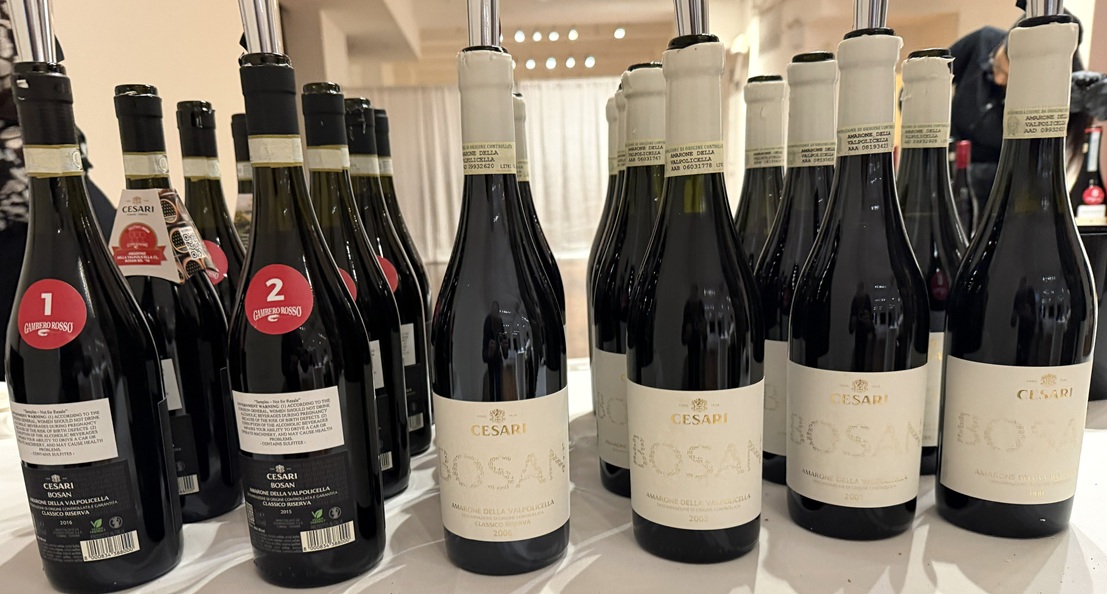
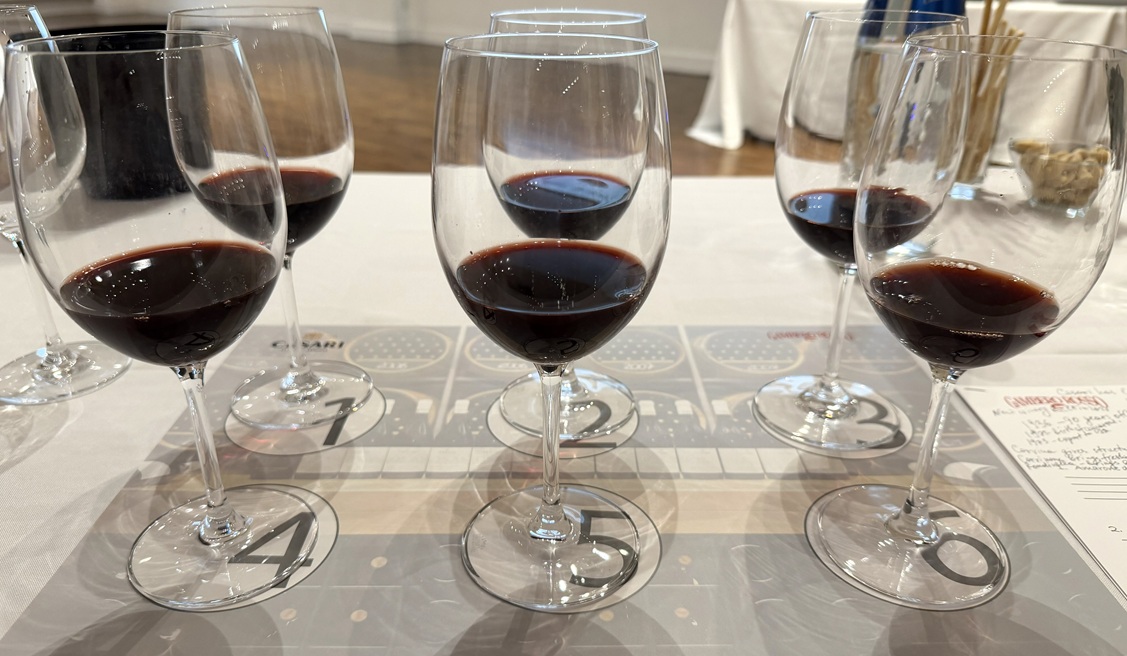
Cesari Winery was formed in 1936 (so this year Cesari is celebrating 90 years). The first vintage of Amarone was produced in 1971, and in 1973, Cesari Amarone began exporting to the USA. And talking about important dates, 1997 marked the beginning of production of Cesari’s single-vineyard Amarone, Bosan.
Bosan vineyard is located in the heart of the Amarone Classico della Valpolicella production zone, at about 1,500 feet elevation (500 meters), on the hills facing south and southeast with volcanic/limestone soils. The grapes for Bosan Amarone are harvested about 2 weeks prior to the grapes for the other wines in two passes. Speaking about the grapes, Cesari Bosan Amarone is always made from 3 main grape varieties, used always in the same proportions. Bosan wines are made from 40% Corvina grapes, giving structure and complexity; 40% Corvinone grapes, bringing freshness and crunchiness; finishing it up 20% of Rondinella grapes, bringing balance and color. By the way, while the grape composition remained the same over the years, the drying time (appassimento) has changed from 4 months in the previous years to about 3 months (90 days) now.
Production of Bosan Amarone is a labor of love for sure, as it takes 10(!) years to produce Amarone Bosan, and another 3 years for the wines to reach “historical vintage” designation. After drying the grapes, vinification and fermentation are conducted in stainless steel. After that, the wine rests in stainless steel for 3 years, then goes into the barriques for 2 years, back to stainless steel for 3 years, finishing off with at least 2 years in the bottle. If the wine is designated as a historical vintage, it will take another 3 years in the bottle. If anything, Cesari Amarone Bosan production commands respect.
We had an opportunity to taste 6 Bosan Riserva wines, going all the way back to the 2000 vintage, thanks to the generosity of the Cesari family. To say that this was a special experience would be an understatement – the experience was truly one of a kind. Here are my thoughts on the 6 wines we tasted.
2016 Cesari Bosan Amarone della Valpolicella Classico Riserva DOCG (15.5% ABV)
Beautiful, a touch of gunflint, dark fruit, minerality, cherries, rocky undertones
Powerful, crisp, firm and crunchy, rocky undertones, well-integrated tannins.
8+, great food wine, but perfectly enjoyable by itself
2015 Cesari Bosan Amarone della Valpolicella Classico Riserva DOCG (15.5% ABV)
Legs are more expressive than in 2016
Dark cherries on the nose
Rounder on the palate than 2016, dark fruit, tannins a bit untamed, green notes on the finish. Needs more time
8-/8
2006 Cesari Bosan Amarone della Valpolicella Classico Riserva DOC (15.5% ABV)
Beautiful nose, with dried fruit and a touch of dried fig.
Wow! Beautiful, balanced, perfectly integrated tannins, round, spectacular.
8+/9-
2003 Cesari Bosan Amarone della Valpolicella DOC (15.5% ABV)
A bit too much of the dry fruit, the nose suggested past prime. After some additional time in the glass, just fine.
Sublime, just needed the time to open. Still fresh tannins on the palate, round, well integrated, layered, with dry fruit undertones on the palate. Wow. delicious!
9-/9
2001 Cesari Bosan Amarone della Valpolicella DOC (15.5% ABV)
Intense nose, clean, open, elegant, hint of roasted meat, fresh red fruit, cocoa powder, a wow nose.
Wow. I can’t spit this wine! Wow, Round, elegant, layered, mind-boggling elegance, a touch of dried fruit. Impeccable balance.
9, a wow wine all around
2000 Cesari Bosan Amarone della Valpolicella DOC (15.5% ABV)
Intense tertiary aromas with the addition of roasted meat.
No tertiary aromas on the palate. Wow. Sweet cherries, perfect acidity, round, elegant, outstanding.
9-
Here we are – an Amarone worth seeking. Cesari Bosan Amarone will not be inexpensive, but it might be well worth it as a special treat.
So, have you finally come up with an answer to my question? Do you like Amarone? Hoping that you do, what is your favorite Amarone? Cheers!
As Expected and Full of Surprises
Today, I want to share two recent wine experiences. One, unfortunately, as expected. The second one is unexpectedly surprising.
About 10 days ago, I had the opportunity to open a wine from the 2002 vintage to celebrate my youngest daughter’s birthday. I don’t have a lot of 2002 lying around, so I had to decide which bottle to open.
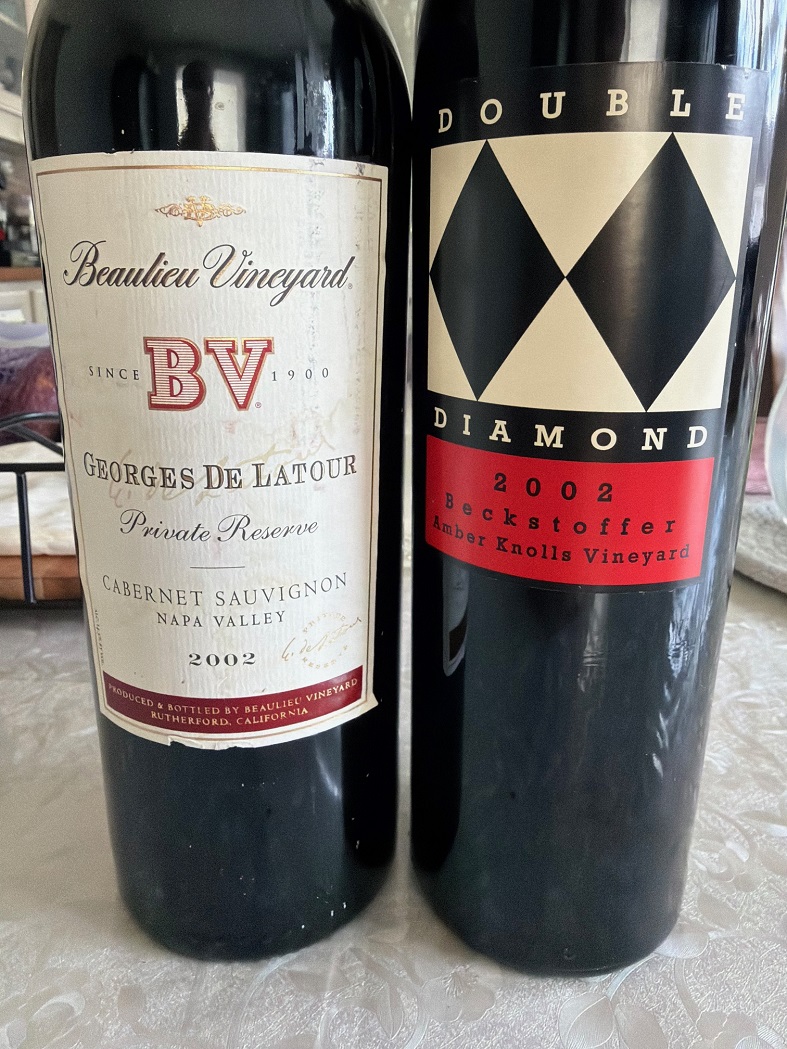
I asked wine friends on Twitter (can’t bring myself to call it X, I still prefer Twitter) which one of the two 2002 bottles you see in the picture above I should open. A few people said “come on, open both and compare!” which I would gladly do if I had a good supply of both. I also got suggestions to open BV, and somehow, this was also my inclination, so BV it was.
Now, deep inside, I knew that I was probably making a mistake opening my only bottle. Based on my experience, California Cabernet Sauvignon wines need 40+ years to truly shine, but hey – wine is meant to be drunk, especially when you have a good reason… So yeah, the decision was made.
BV, which stands for Beaulieu Vineyard, needs no introduction to wine lovers. One of the oldest producers in Napa Valley, and one of the legendary ones, as the name André Tchelistcheff, “The Maestro” and literally the father of Californian winemaking, is closely associated with BV, where he was making wines for almost 50 years. Georges de Latour Reserve, the wine named in honor of the winery’s founder, is a flagship Cabernet Sauvignon made at the winery. So while I was opening this 2002 Beaulieu Vineyard Georges de Latour Private Reserve Cabernet Sauvignon Rutherford Napa Valley (14.5% ABV), I knew that I’m making a mistake.
The mistake was very simple – too early. The wine of this caliber probably had another 25 years ahead of it before it would really reach its peak. Don’t get me wrong – the wine was classic and delicious, with Rutherford dust, gobs of black currant, mint and eucalyptus, powerful, voluptuous, big and fresh, with well-presented tannins. This was the wine in its prime, but not at a peak. As expected. And a bit sad as I know I can’t find out how well this wine could evolve. Sure, first-world problems.
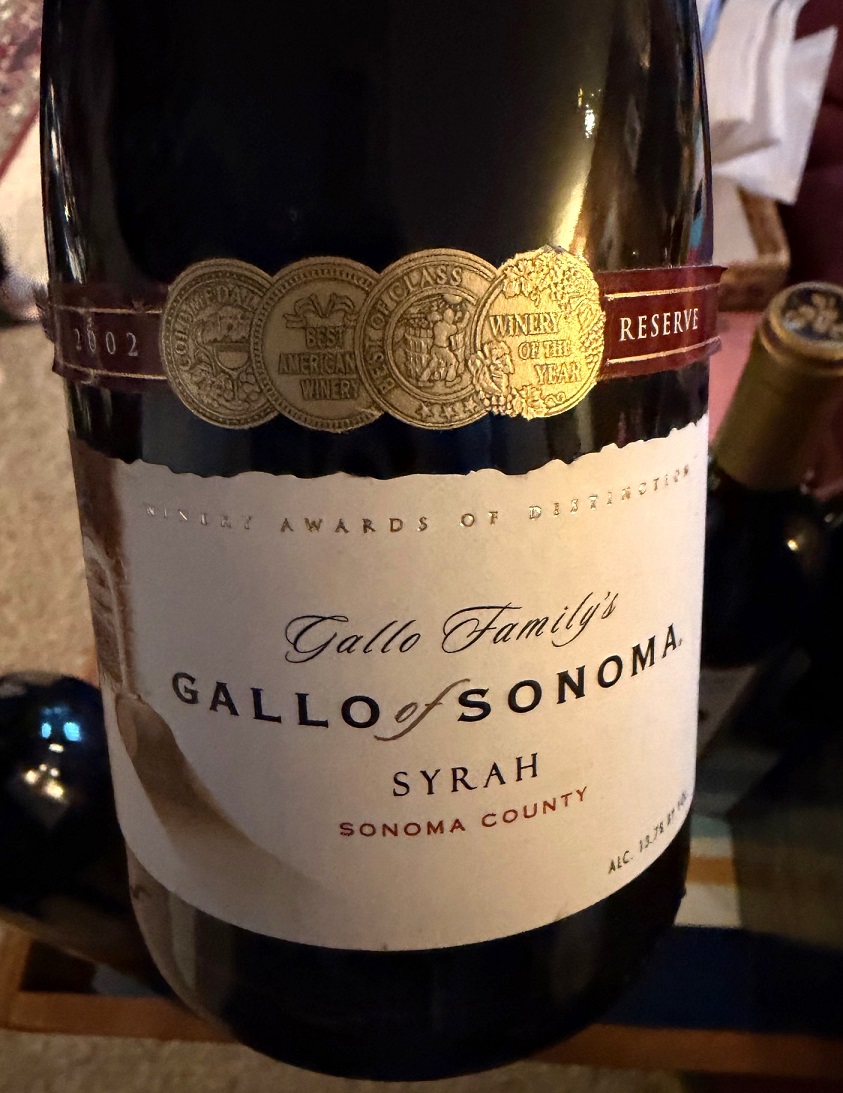
Now, let’s talk about surprises. Over the weekend, we visited friends whom we hadn’t seen in a while. Over the years, they have accumulated a variety of bottles – nothing of the “collector” level, no, just simple everyday wines which were acquired to be enjoyed at a party and simply left unopened. Now, when we come over, knowing that I’m a wine geek, they always love to pull out some random bottle to try. This time, the random bottle was a 2002 Gallo Family’s Gallo of Sonoma Syrah Reserve Sonoma County (13.75% ABV).
If you would generally offer me a bottle of Gallo wine, I would almost take it as an offense. I would never buy a Gallo wine on my own. But in this situation, why not? I had a backup in the form of Turley, so I was definitely not afraid :).
By the way, before we talk about the wine, you can also have a laugh at my expense. This is the first time that the actual Gallo wine is discussed on this blog – I can even quote myself saying “Rest assured – Gallo is the last wine I want to ever discuss on this blog“. And yet here I am, talking about Gallo wine on this blog. Never say never, huh?
The cork crumbled and I had to push it in, so we were pouring the wine into the glasses using a little tea mesh. The first smell was not bad at all – mostly plums, no tertiary aromas. The first sip found a well-rounded wine, with plums, roasted meat notes, still present tannins and earthy undertones. I was absolutely not expecting to be so pleasantly surprised by the wine, but I guess California wines are just full of surprises. And let’s not forget that this wine was probably acquired for $5 if not less…
I always advocate that California wines can age, and yet I was surprised at how well both wines have aged.
If you have California wines in your cellar, and you are not afraid to wait – give them time, let them surprise you at some point.
What do you think about the ability of Californian wines to age? For how long do you think you can wait to let your wines truly shine? Cheers!
Restaurant Files: 888 Sushi & Robata in Las Vegas
When it comes to food, Las Vegas is one of the top places in the US. There is no shortage of great restaurants in Las Vegas, no matter what cuisine you are craving.
Considering that the city of Las Vegas is located in the middle of a desert, you wouldn’t think that sushi should be one of the culinary staples there, but it is Las Vegas after all, the city of no limits.
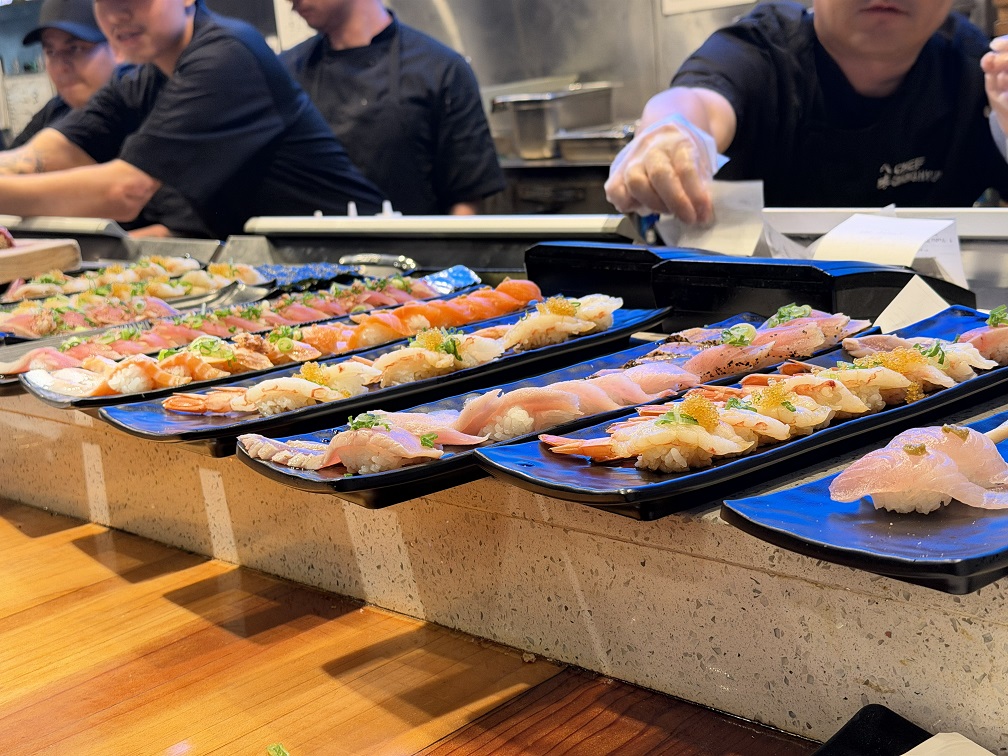
When visiting Las Vegas, which typically happens once a year for the work conference, I always try to include sushi in the dining repertoire. This year was no exception, and while researching online, I found this highly rated place, called 888 Sushi & Robata, which had very high ratings on Yelp, so it definitely got my interest. The only challenge was the fact that the restaurant doesn’t accept reservations and offers a waiting list instead.
I conveniently joined the waiting list on Yelp, and was told that even for the solo diner (none of my colleagues arrived yet), the wait time would be between 3 and 3.5 hours (we are talking about the middle of the day on Sunday). Okay, waiting is not a problem. I decided to walk to the restaurant as it was only about a mile away from the hotel, so I left about 40 minutes prior to the earliest time I could be seated according to the wait list information. Arrived at the restaurant, let them know that I was there, and as I was happy to sit in the bar, I was seated almost instantly (my waiting list was still not complete, but it worked fine).
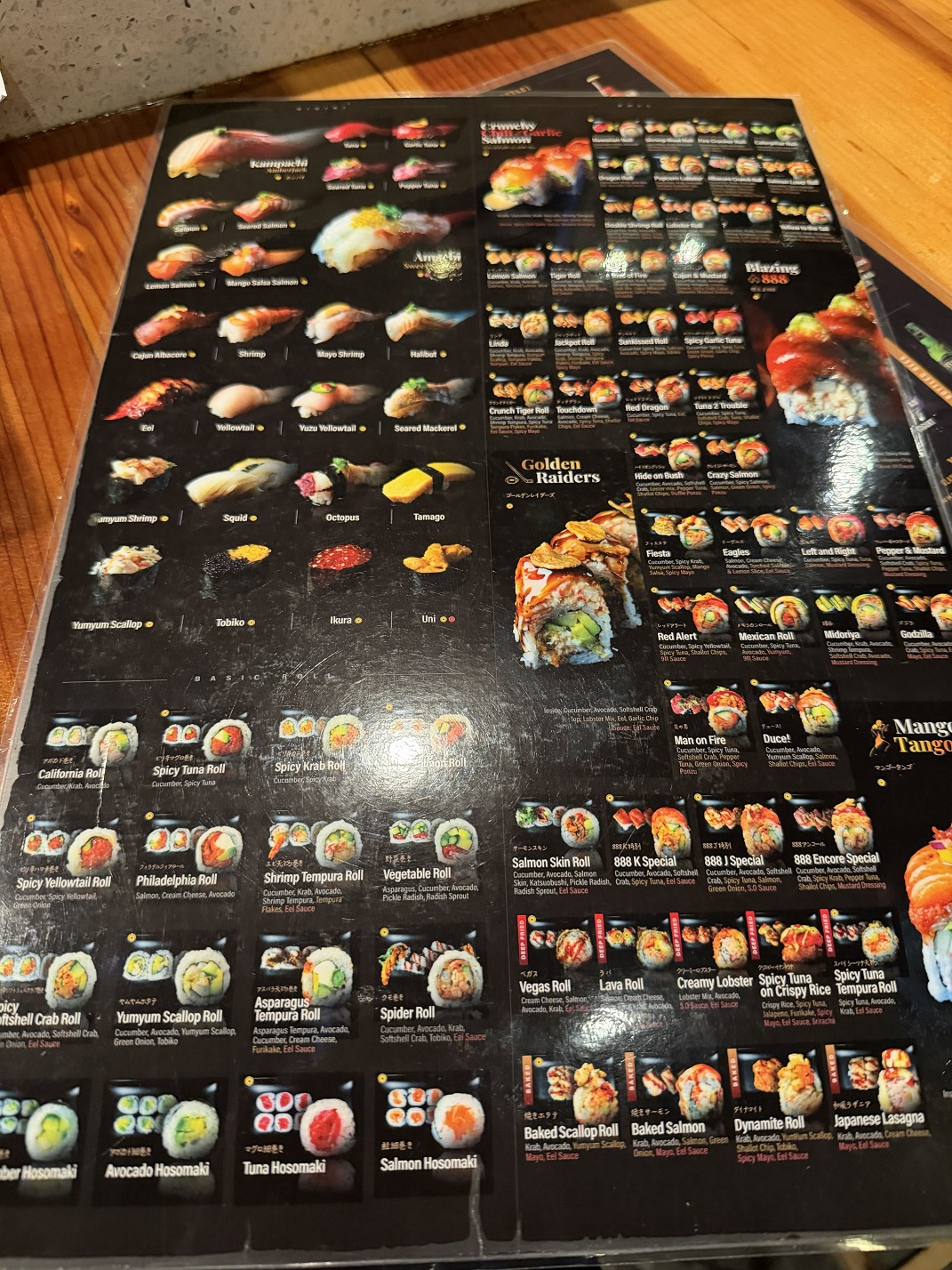
The restaurant offers a number of menus at different price levels and with different content. As I didn’t want the menu with Wagyu beef (carpaccio, etc.), I settled for the Sushi and Robata menu.
I was not familiar with the term Robata, so based on the menu, I figured that Robata is basically a Japanese BBQ, with food served on little skewers. The waiter explained that the restaurant is all you can eat, but you need to order as you go; this is not a buffet, and you have only 90 minutes to dine. Note that the menu is really overwhelming, but my waiter was very helpful and we were able to figure out I think an excellent program.
I fully took advantage of dining just by myself. I took a bunch of pictures and took notes for almost all the food I was having, so now all I need to do is share my notes with you. Here you go:
I started with a few Robata items:


Squid on the skewer – tasty, but a little chewy
Beef on the skewer – very good, tasty.
Kurobuta sausage, made from the famous Japanese Kurobuta pigs – superb, incredible amount of flavor. I would love to eat like 10 those little sausages at once.


The next few items were served on the small plates:
Crispy Calamari – wow! Crunchy
Tuna Poke – wow. Flavor!
And then there were sushi, many different types of sushi. What was very interesting was that generous pieces of fish were served with tiny, very tiny rice balls – I really appreciate that we were truly able to enjoy fish in the sushi.
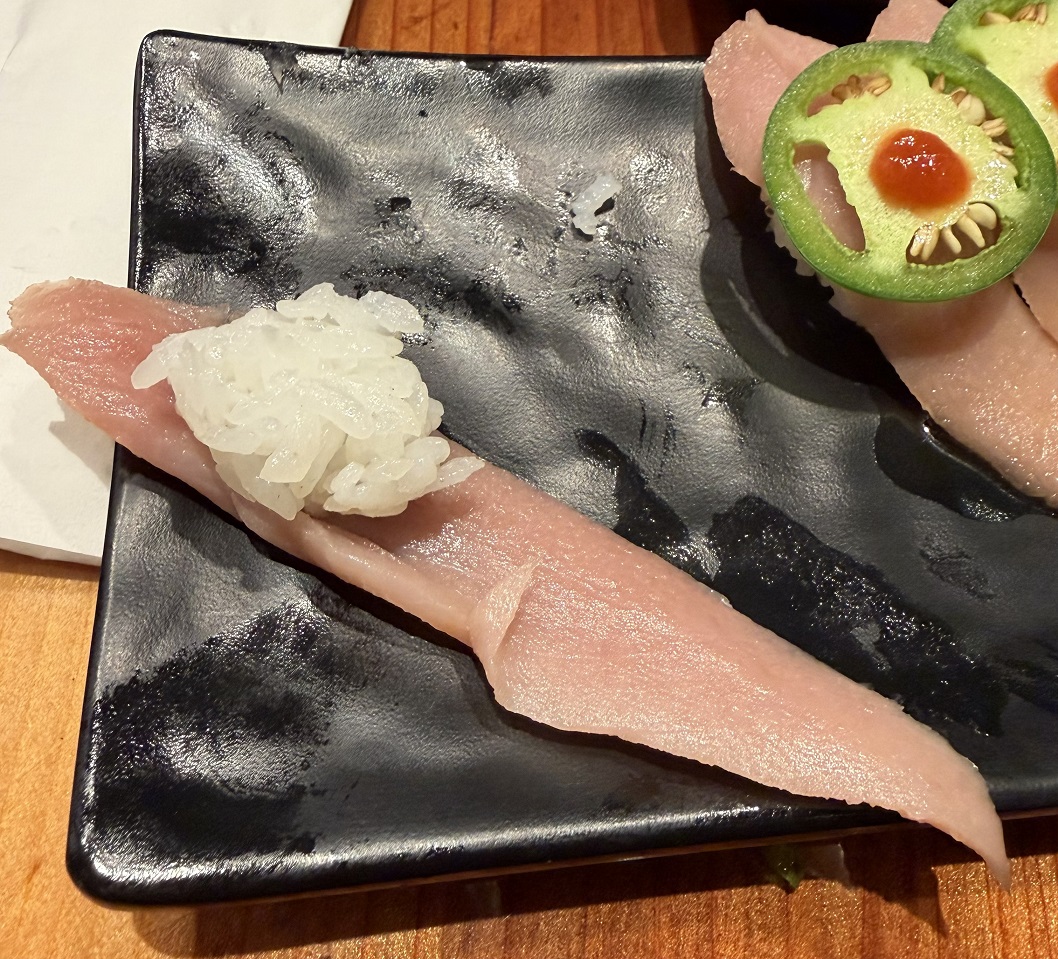
Salmon – a huge piece of fish and a tiny amount of rice
Salmon roll – very good
Yellowtail – perfect
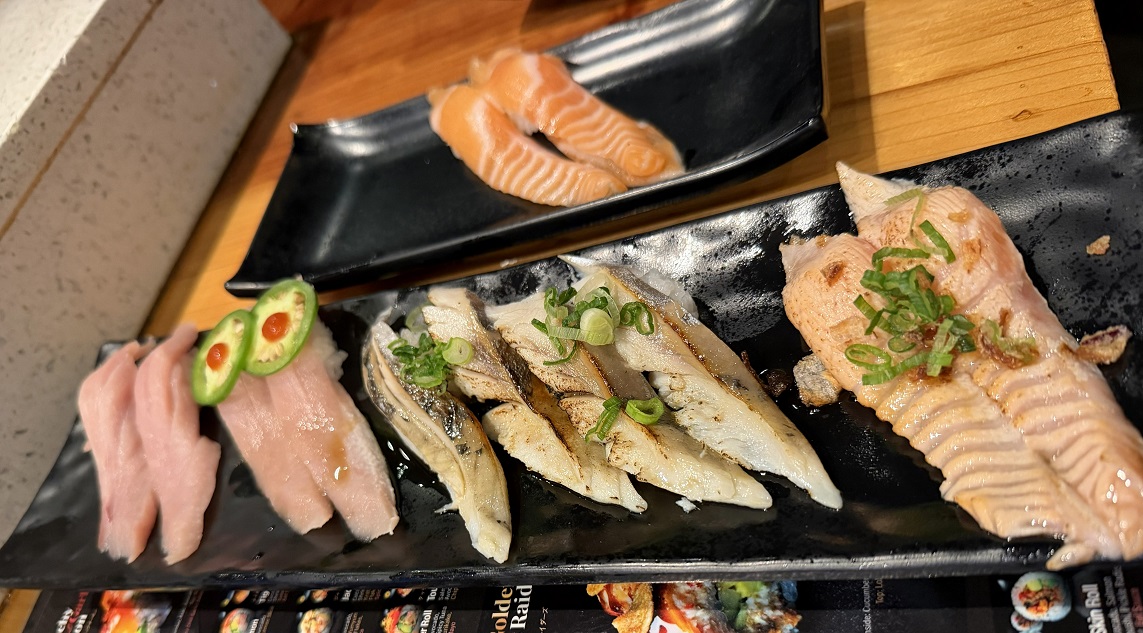
Seared salmon – wow. Absolute wow. A little slice of fatty salmon just very lightly seared – what a pleasure!
Mackerel – great, really good. Love mackerel!
Yuzu yellowtail – not very spicy. This was one of the few small disappointments – if you promise spicy, you better deliver 🙂
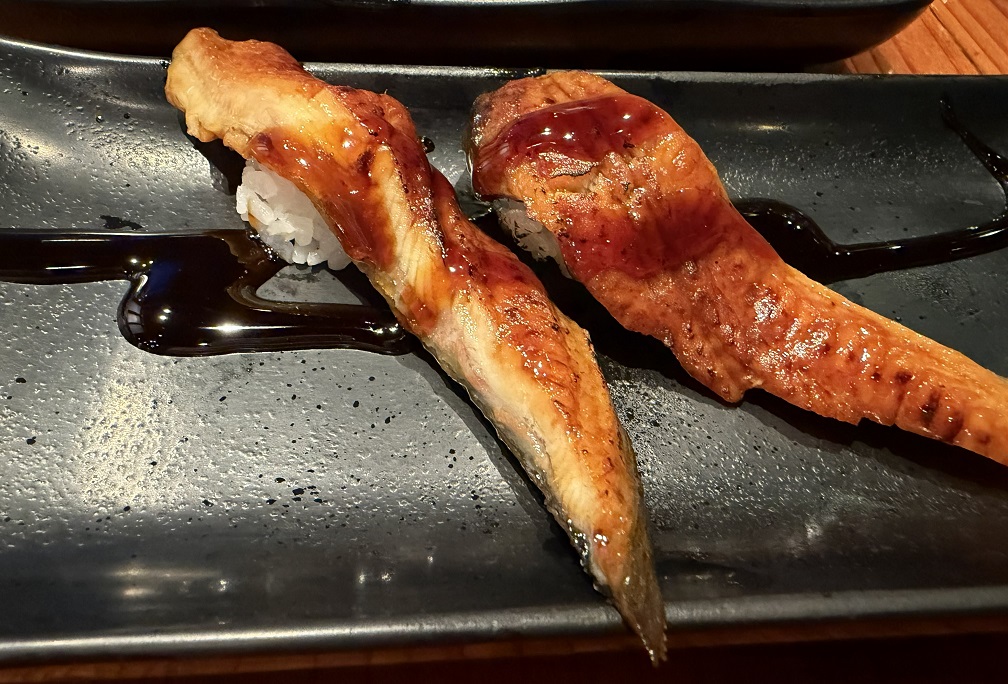
Eel – melt-in-your-mouth goodness. Love eel, this was delicious.
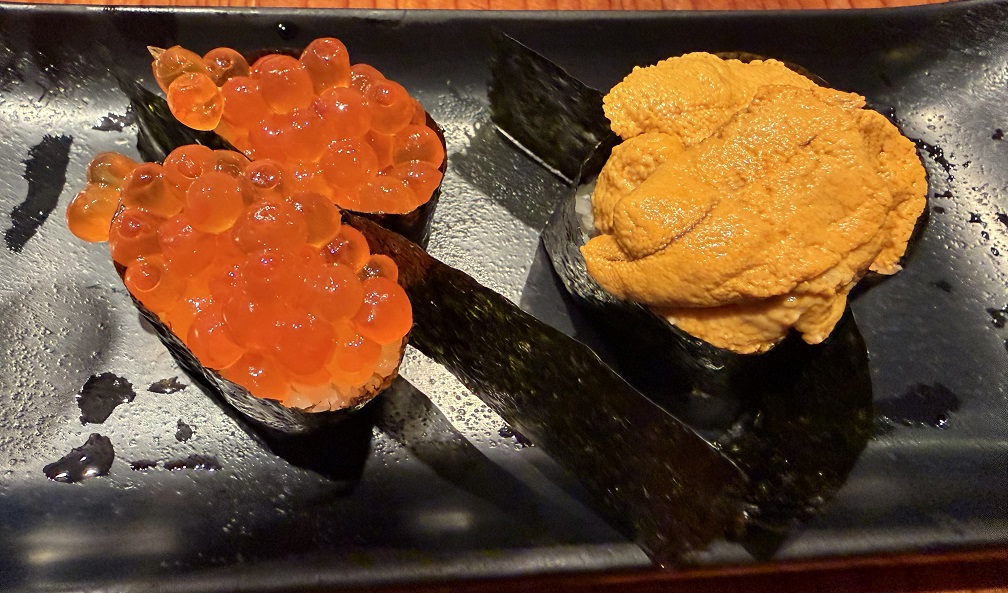
I asked for a few more pieces to complete the meal.
Ikura – superb. Delicious caviar, excellent quality.
Uni – good, a touch of bitterness which you can often find in the uni. I’m personally looking for a uniformly sweet profile.
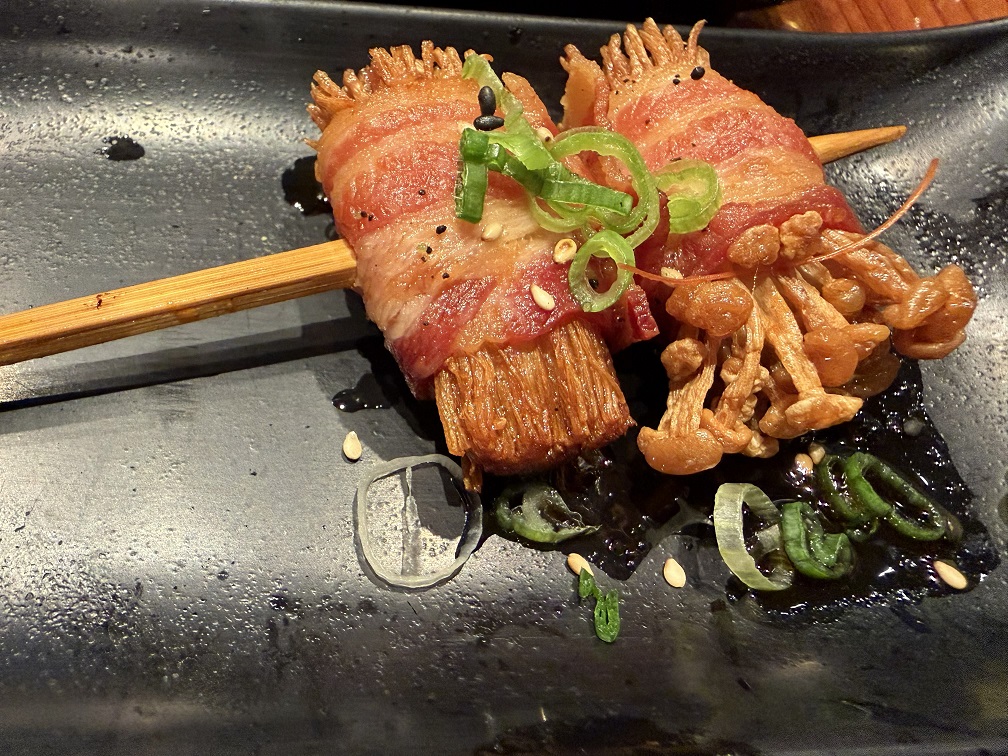
As I was looking for something else to complete the meal, I noticed in the Robata section a bacon-wrapped scallop, but it was not available. Instead, the waiter suggested that I should try a bacon-wrapped oyster mushroom. OMG.
Bacon-wrapped oyster mushroom – wow. Tastes similar to scallop. This is really something. A properly chewy, slightly sweet mushroom wrapped in a delicious, salty piece of bacon. Wow.
This was an amazing finish for an amazing meal. Well, almost finish, as I couldn’t resist a soft-serve green tea ice cream, which was delicious and refreshing.
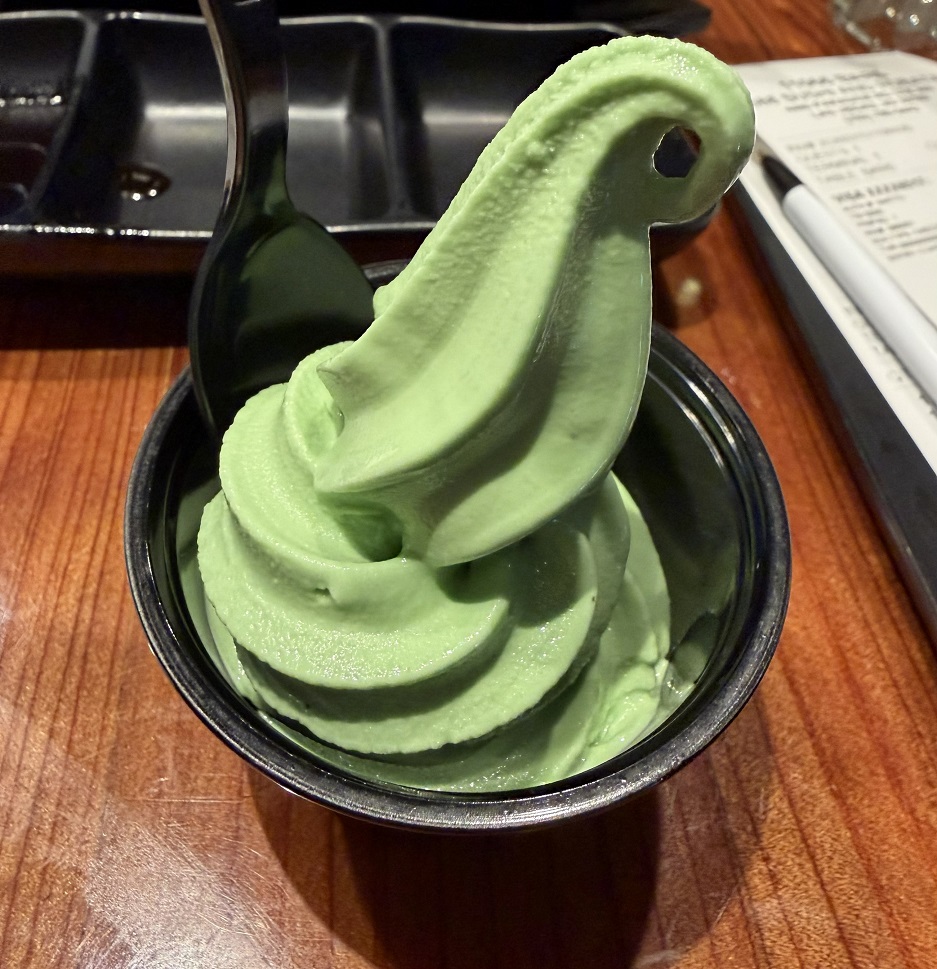
Here you go, my friends – 888 Sushi & Robata. If you are in Las Vegas, I can’t recommend it highly enough. Next time I’m in Las Vegas, this restaurant will definitely be on the list.
888 Sushi & Robata
4480 Paradise Rd #900,
Las Vegas, Nevada 89169
In Memoriam: Michel Rolland
Last week, the world of wine lost an icon. Michel Rolland, often referred to as “flying winemaker”, passed away at the age of 78. Michel Rolland influenced winemaking all around the globe, from France to the US Napa Valley, Argentina, Spain, South Africa, and even Israel.
There is lots and lots written about Michel Rolland in the form of articles and books, and his winemaking practices are sometimes portrayed as controversial. However, I truly believe the wines he helped craft made many wine lovers happy.
I was lucky enough to have the pleasure of sitting across from Michel Rolland and asking him questions – unlike most of my interviews, this one was done face-to-face 10 years ago, during one of his visits to New York. In memory of Michel Rolland, I would like to share that interview again on this blog.
One on One With Cristina Mercuri, Master of Wine
As you might know, I love interviews.
That didn’t happen from the first day of blogging. It took me some time to realize the value of conversation. But once it “clicked”, interviews became one of my favorite subjects on this blog – “Stories of Passion and Pinot” series might be the best proof of that.
Today’s interview is a bit different than the most. The majority of my interviews are with winemakers. However, today I would like to offer to your attention my conversation (virtual, as it often goes, even though this is one of the cases where I would much prefer a face-to-face format) with Cristina Mercuri, Master of Wine.
Cristina Mercuri is the first woman Master of Wine (MW) in Italy, and the fourth Italian MW overall. To put things in perspective, only 521 people have become Master of Wine since 1953, according to the Institute of Master of Wine as of February 2026. This is definitely an achievement to celebrate, so I was very excited when I got an opportunity to talk to Cristina. She is also the founder of Cristina Mercuri Wine Club – we will touch on that in our conversation below.
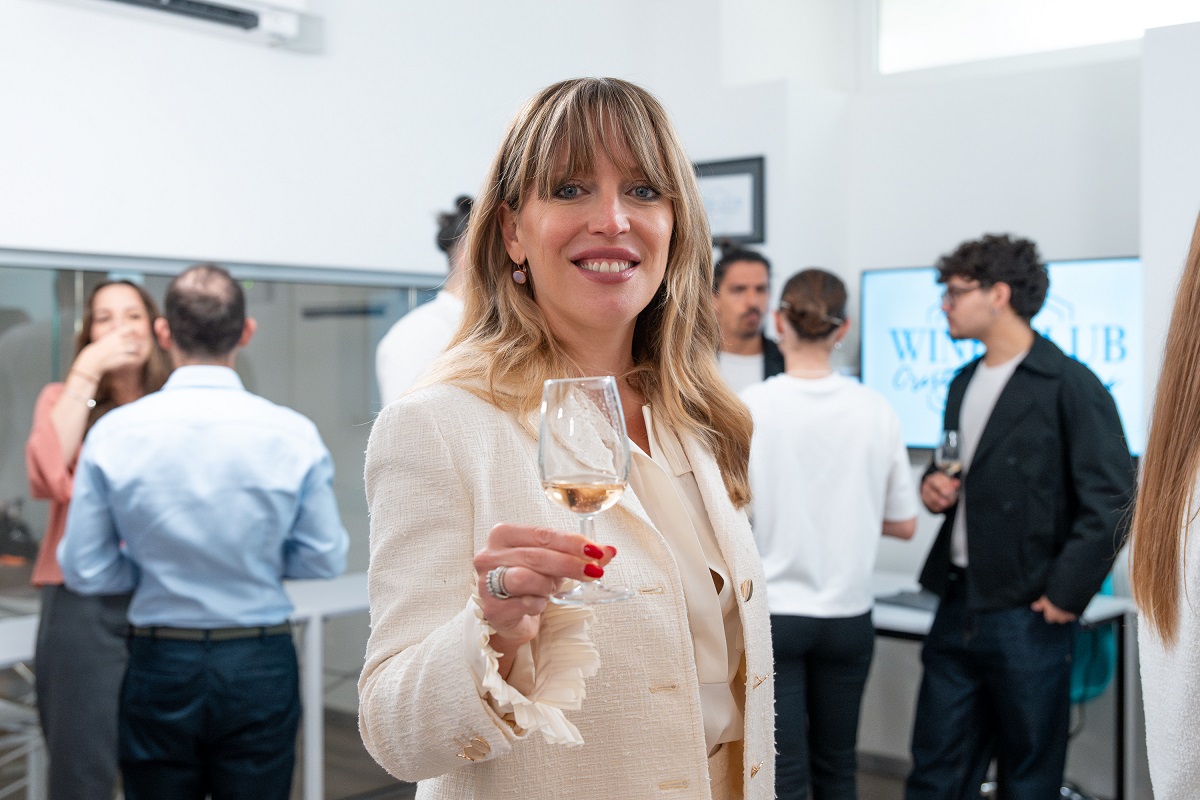
Cristina Mercuri
Here is what transpired in our conversation:
[TaV]: This might be a “duh” question, as you grew up in Italy, and yet – as a wine lover, not as a wine professional, how did you get into the world of wine? Family traditions? Was there a pivotal wine in your life?
[CM]: Wine was always present in my life in the way it often is in Italy: around the table, as part of everyday culture rather than something intellectualized. It belonged to meals, to conversations, to conviviality.
My real entry into the wine world happened much later. I was working as a lawyer and, despite having built a solid career, I felt increasingly bored and disconnected from what I was doing. I needed a radical change, something intellectually stimulating and culturally rich. Wine offered exactly that.
I began studying through the WSET programmes while still working in law, initially out of curiosity. Very quickly that curiosity turned into a serious commitment. By the end of 2015 I decided to leave the legal profession entirely and dedicate myself to wine. What started as a personal exploration became a new professional path.
[TaV]: What made you switch from a successful career in law to the unpredictable world of wine?
[CM]: Law gave me a very strong analytical framework, discipline and the ability to structure complex reasoning. But at a certain point I felt the need to work in a field where cultures creativity and human connection were more present.
Wine offered exactly that. It is an industry where agriculture, craftsmanship, economics and storytelling coexist. Each bottle represents a product, but also a narrative about land, people and time. I realized that the skills I had developed in law — critical thinking, precision, strategic analysis — could be applied in a different way to the wine world.
Leaving law was a significant decision, but it never felt like abandoning something. It felt like redirecting the same intellectual energy toward a field that resonates deeply with identity, culture and global exchange.
[TaV]: You recently became the first woman Master of Wine in Italy (and only the 4th in Italy overall) – how does it feel? What was the hardest part of the MW journey? What was your favorite part of studying?
[CM]: Becoming the first Italian woman Master of Wine is both a personal achievement and a symbolic milestone. In a different world it would be big news that another professional became an MW. In today’s reality, it also represents a small step toward greater diversity in a sector where leadership has long been male-dominated.
The hardest part of the journey is consistency. The MW programme is not only intellectually demanding, it requires years of sustained discipline while continuing to work professionally. Preparing for the Stage 2 examination felt almost like an Olympic training period: blind tasting every day, theory study, mock exams, mental preparation.
My favorite part was the intellectual depth of the programme. It forces you to think about wine from every possible perspective: viticulture, economics, geopolitics, consumer behaviour, communication. It teaches you that wine is not only about what is in the glass, but about the entire system around it.
[TaV]: If at all possible in this format, can you share with us the gist of your master thesis, “Wine, Women and Fascism: A Visual Analysis of the Representation of Women in Propaganda in Enotria (1922–1942)”?
[CM]: My research paper examined how women were represented in the Italian wine magazine Enotria during the Fascist period. I analyzed the covers published between the 1920s and early 1940s using visual semiotics and historical analysis.
What emerged was a very clear pattern: women were rarely portrayed as producers, professionals or decision-makers within the wine world. Instead, they appeared mainly as decorative figures, symbols of beauty, domesticity or national mythology. The visual language reflected broader political and cultural narratives of the time, where gender roles were tightly controlled and instrumentalized.
The research was interesting because it connects visual culture, political ideology and wine communication. It also helps explain why certain stereotypes persisted for decades in the way wine — and women in wine — have been represented.
[TaV]: I heard many times that women are better tasters than men. Do you share the same opinion?
[CM]: I don’t think wine tasting is determined by gender. Sensory ability can vary enormously between individuals, but excellence in tasting comes primarily from training, discipline and experience.
The best tasters I know share certain qualities: concentration, memory, analytical thinking and intellectual humility. Blind tasting especially is a skill that develops through repetition and structured practice.
Reducing tasting ability to gender risks oversimplifying something that is actually much more complex. Wine evaluation is a professional competence that can be developed by anyone willing to dedicate the time and rigor required.
[TaV]: There is a lot of talk everywhere that the world of wine at large is in trouble, as younger people either don’t drink wine at all, or have very specific requirements (low alcohol seems to be one of the most important ones, no oak, etc.). What do you think about young adults and wine? Does the wine industry at large need to do something to address it, or is it just a part of the cycle?
[CM]: I think the conversation around younger consumers often starts from the wrong assumption. It is not that young people reject wine; it is that they expect wine to speak a language that resonates with them.
For decades the industry communicated mainly through tradition, hierarchy and technical jargon. Younger consumers tend to look instead for transparency, authenticity and clarity. They want to understand what is in the glass, who made it, how it was produced and why it matters.
This requires a shift in communication more than a reinvention of wine itself. When wine is presented with honesty, clarity and relevance, younger audiences respond very positively. The future of wine depends largely on our ability to listen to those audiences and adapt the narrative accordingly.
[TaV]: Do you have a favorite Italian wine and/or producer?
[CM]: Italy is incredibly diverse, so choosing one wine is almost impossible. But if I had to mention a style that fascinates me deeply, I would say Etna Bianco. The combination of volcanic soils, altitude and Mediterranean light produces wines with remarkable tension, precision and aging potential.
Producers such as Maugeri or Palmento Costanzo are doing extraordinary work in expressing the subtle differences between contrade and elevations. Etna is a perfect example of how a historic territory can also represent the future of Italian wine.
[TaV]: Same question, taking the view of the world – can you share some names of your favorite wines and/or producers from around the world?
[CM]: I have always been deeply fascinated by Burgundy, particularly producers like Olivier Leflaive or Alain Chavy, who express incredible precision and terroir transparency in Chardonnay.
In Champagne, houses like Krug, Philipponnat or Yann Alexandre represent a philosophy of blending and long maturation that creates wines of extraordinary depth and longevity.
I also admire producers who work with clarity and restraint in different parts of the world — those who allow the vineyard to speak rather than imposing heavy stylistic signatures, like Creation in South Africa.
[TaV]: Do you have a wine cellar? If you do, what would we find there?
[CM]: Yes, I do have a cellar, although I tend to think of it as a working cellar rather than a collector’s one. You would find a mix of Italian classics — Barolo, Brunello, Etna — alongside Champagne and Burgundy.
There are also many bottles linked to personal moments: wines opened to celebrate milestones, wines shared with friends, wines connected to travel or professional encounters. For me a cellar is not only about aging potential; it is also a memory archive.
[TaV]: Can you tell us more about your project, Mercuri Wine Club? What are your aspirations? What are you trying to achieve? How do you see this project evolving over the next 10 years?
[CM]: Mercuri Wine Club was born from a desire to combine education, communication and strategic consultancy within the wine sector.
The project has two main dimensions. One focuses on education, offering structured training programmes that help professionals and enthusiasts understand wine with clarity and depth. The second focuses on strategic consultancy, helping wineries and wine institutions position themselves more effectively in international markets.
Over the next ten years I see the project evolving into a broader platform that connects education, market intelligence and communication. The wine industry needs more bridges between production, markets and consumers, and that is precisely the space where Mercuri Wine Club operates.
[TaV]: Last question: have you had a chance to watch Drops of God series on Apple TV? If you have, what do you think of it? If not, I can’t recommend it highly enough 🙂 [CM]: Yes, I have watched it, and I found it fascinating from a cultural perspective. The series captures something very real about wine: the emotional dimension, the role of memory, and the intensity of sensory perception. In that sense it does a good job of showing that tasting is not just technical evaluation, but also interpretation and personal experience.
At the same time, what slightly disappointed me is the risk of portraying wine tasting as something almost supernatural or accessible only to a few exceptional individuals. In reality, tasting wine is a skill that anyone can develop with curiosity, attention and practice. Blind tasting is not about superpowers, and it certainly shouldn’t be intimidating.
If anything, wine should invite people in, not push them away. The real beauty of tasting is that it sharpens perception and encourages dialogue. Anyone can sit at a table, taste a wine blind, and enjoy the process of discovering it. That sense of curiosity and shared exploration is what truly makes wine special.
Here you are, my friends. I hope you enjoyed reading our conversation, and until the next time – cheers!
OTBN 2026 – What a night!
Open That Bottle Night (OTBN for short) is one of my favorite wine holidays of the year – possibly simply the favorite.
The event, always taking place on the last Saturday in February, was created by Dorothy J. Gaiter and John Brecher, writers of the Wall Street Journal wine column, 27 years ago. The purpose of the event or a holiday, if you will, is simple. Every wine lover has a special bottle waiting for a special moment. Let’s declare that special moment has arrived, and let’s open that special bottle to enjoy it now – nobody knows what’s ahead in life, so we should enjoy things while we can.
As I said, this is possibly my favorite wine holiday, I always make an effort to participate, and a few times even wrote about them (here are posts from 2016, 2019, 2020, 2023, and 2025). Whether I’m celebrating with friends or just with my wife, I always make an effort to make that day wine-special – I believe I have never been disappointed so far, judging by “what a night!” being a favorite descriptor.
OTBN 2026 was no exception. Typically, my OTBN experience starts with self-inflicted drama – what to open???? I have more than a few bottles worthy of a “special” designation, and it is always hard (very hard!) to decide which one or two should be called special in a given year. In 2026, somehow I managed to solve this conundrum somewhat easily – the decision just materialized on its own as I was mindlessly moving wine cabinet shelves in and out.
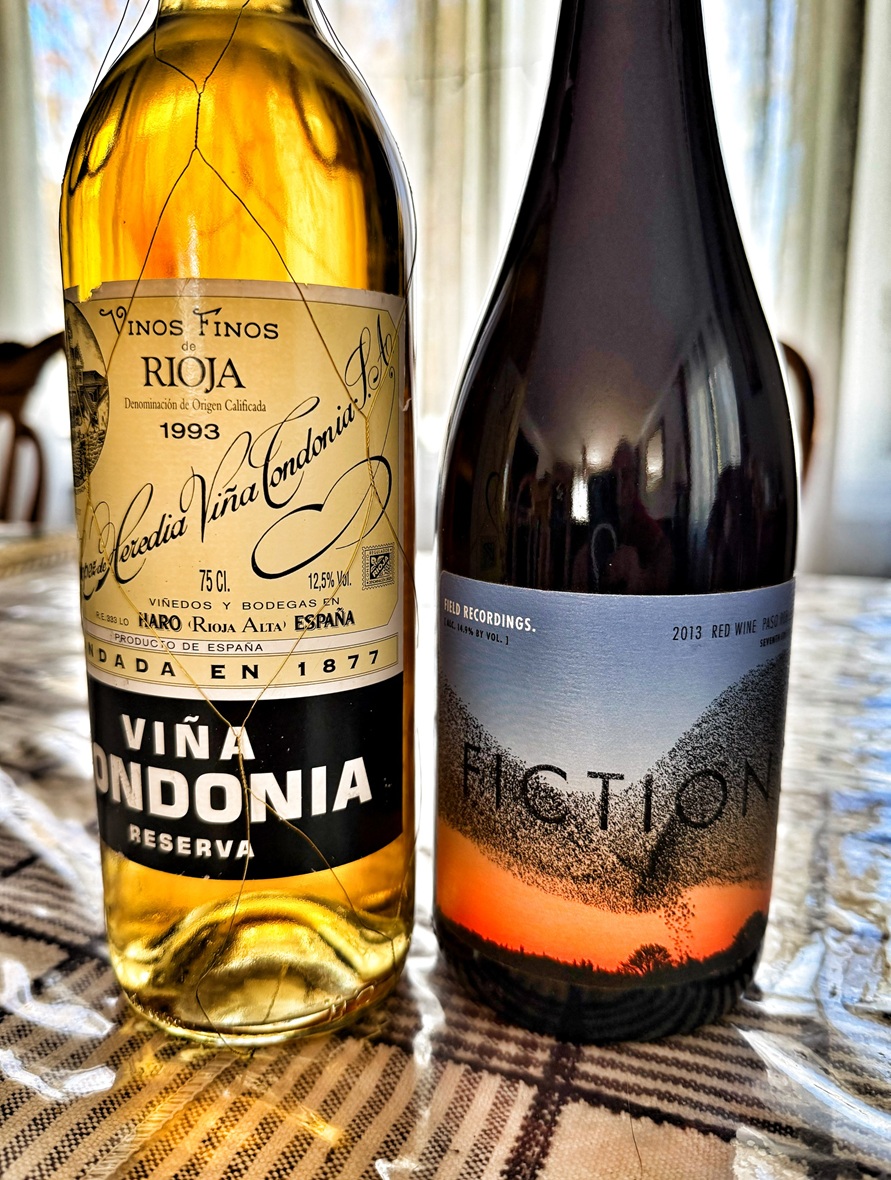
Lopez de Heredia needs no introduction to wine lovers. Way, way back, Lopez de Heredia Blanco was my first foray into white Rioja wines, and I have been a devoted follower ever since. Fiction by Field Recordings was the first wine that led to the discovery of the Field Recordings wines 17+ years ago, and it has been a perennial staple ever since. I can’t say what led to the decision on the 33-year-old white Rioja and 13-year-old California red blend, but this became one of the most memorable wine experiences ever.
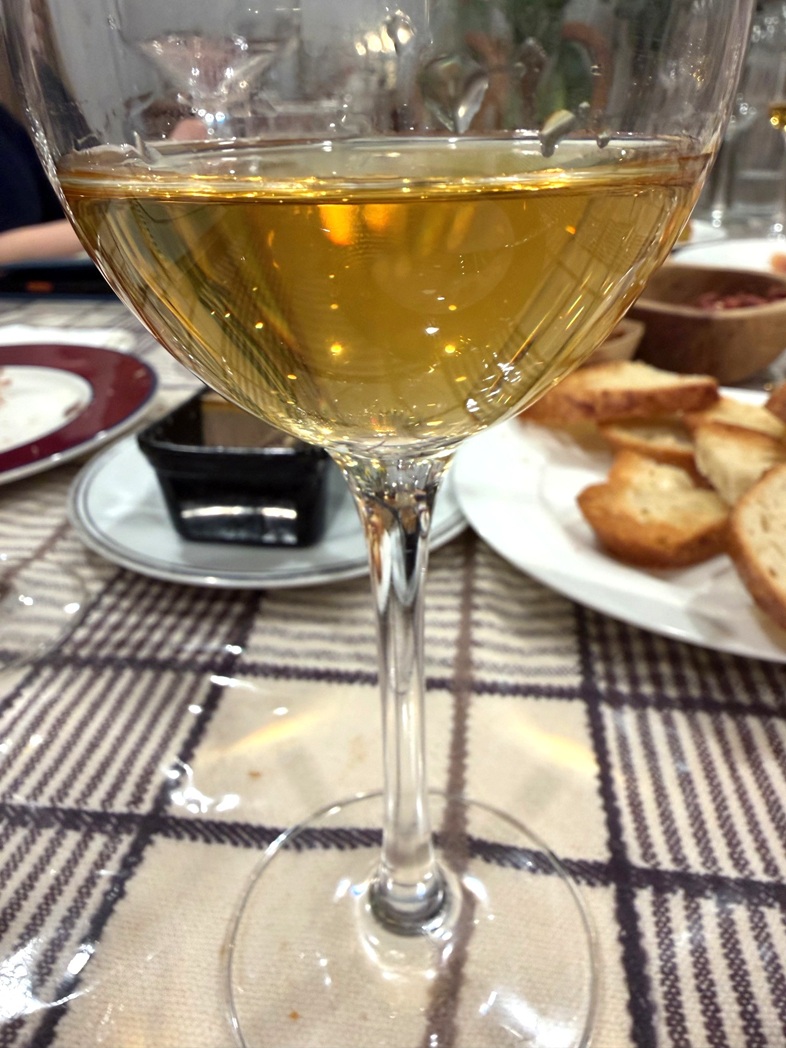
Let’s talk about 1993 Lopez de Heredia Viña Tondonia Blanco Rioja (12.5% ABV). I have to start by saying that I’m not a fan of oxidative white wines. When I mentioned on Twitter that I plan to open this bottle for the OTBN, some comments expressed excitement about oxidative and nutty notes, which I was supposed to find, similar to what you would find in a glass of Jerez. And so I was expecting to find that, and was wondering if I would be able to like that wine. And then there were literally none! Nothing oxidative on the nose, mostly minerality and whitestone fruit. And then a beautiful, complex, powerful structure on the palate, somewhat along the lines of a good Roussanne, still with perfect acidity and freshness. Oxidative notes were lurking in the background, showing up and instantly dissipating a few times, but those were only tiny glimpses, not taking anything away from the wine. An absolutely delightful experience, a 33-year-old white Rioja possibly at its peak (but I wouldn’t dare to insist).
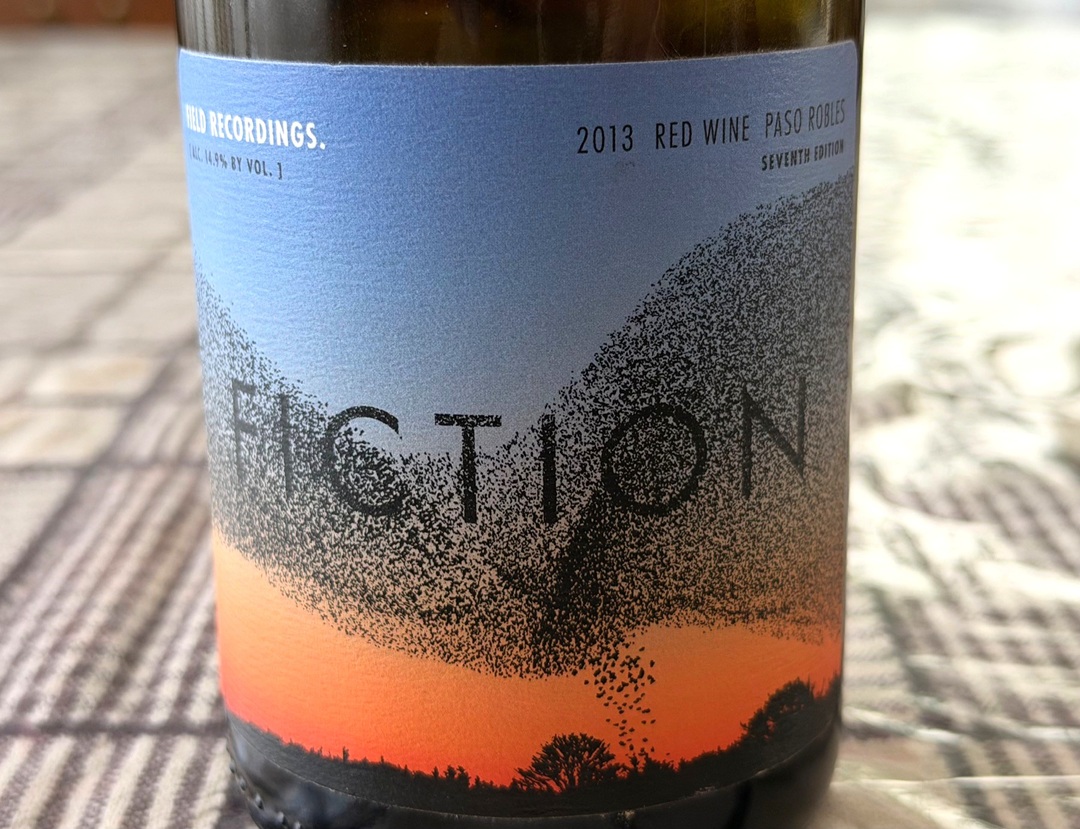
And then there was 2013 Fiction by Field Recordings Paso Robles (13.5% ABV, 31% Zinfandel, 26% Tempranillo, 15% Mourvèdre, 10% Grenache, 10% Syrah, 8% Touriga Nacional). This was my only bottle with an original label, which I really loved and much prefer to the current ones. There is nothing wrong with the current label, only that the original one, with a flock of birds, was conveying the message of bottled poetry a lot better – or rather music, as I wrote in my first post about this wine, Music, Recorded in the Vineyard.
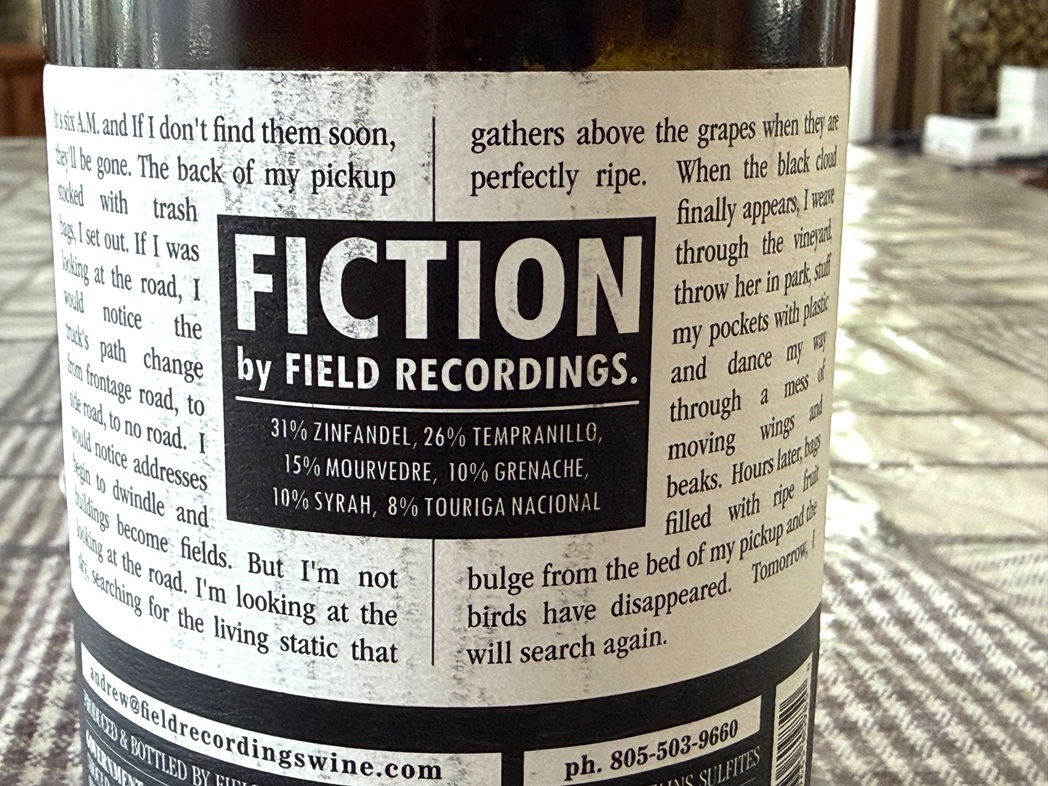
I also loved the back label. As this might be the last time I look at such a label (the current ones don’t carry any of the text), I would allow myself to cite the text written on that back label:
“It’s 6 A.M. and if I don’t find them soon, they’ll be gone. The back of my pickup stocked with trash bags, I head out. If I was looking at the road, I would notice the truck’s path change from frontage road, to side road, to no road. I would notice addresses begin to dwindle and buildings become fields. But I’m not looking at the road. I’m looking at the sky, searching for the living static that gathers above the grapes when they are perfectly ripe. When the black cloud finally appears, I weave through the vineyard, throw her in park, stuff my pockets with plastic and dance my way through a mess of moving wings and beaks. Hours later, bugs filled with ripe fruit, bulge from the bed of my pickup and the birds have disappeared. Tomorrow, I will search again.”
Now, let’s talk about the wine. Screwtop. 13 years old California Paso Robles blend. Stored at somewhat consistent conditions, away from direct sunlight and vibration, but not in the cellar or a wine cooler. Priced at not more than $20 originally (directly from the winery). And yet, one of the very best wines I have ever experienced. A truly memorable one.
I poured the wine in the glass, smelled it, and couldn’t put the glass down. The time slowed down. Sounds practically disappeared. The aroma was magical. And the wine in my mouth was too.
Dreams, smiles, baby laughter, endless meadows, fresh mountain forest air. I know, it sounds like a brain dump, but I don’t want even to try to describe this wine in technical terms – raspberries or blueberries are not important here, what’s important is how the wine makes you feel. Refined, elegant, layered palate, flavors are transitioning and interplaying in total harmony, each sip asking for the next. Am I exaggerating? I don’t know, and it is up to you to believe me or not. But the wine was absolutely stunning and memorable. That I’m completely sure about.
Here you are, my friends. An OTBN experience that will not be easy to beat.
Two amazing wines, an amazing experience, great memories.
I don’t know if I will be able to do better next year, but this is the beauty of wine – the mystery in the bottle.
Until the next time – cheers!
FeedSpot Top Wine Blogs 2026
 The best pleasures in life are unexpected ones, right?
You grab a bottle of wine. You know nothing about it. Open, swirl, sniff, sip. Whoa. OMG.
Unexpected. Delightful. Pleasant.
Wine might be the best carrier of unexpected pleasure. Of course, you can always win a lottery – but that is reserved for the selected few, and in many cases, the pain comes right after the pleasure. And then there are unexpected emails. Not, not the ones when you are informed that your unknown uncle passed away in the other hemisphere, and your millions are in the mail as long as you pay the modest fee of $5k. No, I’m not talking about those.
A few days ago, I got an email from FeedSpot informing me that my blog made the 100 Best Wine Blogs to Follow in 2026. Unexpected. And pleasant.
Last year, I also made the Top 100 list of 2025, so I’m definitely happy to receive the recognition again. Scrolling through the list, I find many familiar names, so kudos to all who are still happy to share their passion for wine.
Now I’m off to write about the delicious Amarone I recently had the pleasure of experiencing…
Last Bottle Sign Up ($10 credit)




 Talk-A-Vino