Archive
A Hidden Obsession
I made an interesting realization today – I have a hidden obsession.
Obsession doesn’t seem to be a good thing, especially when directed at someone. If this is an obsession for something, this is usually a different story.
Can obsession be hidden? Can you not realize that you have an obsession? Does obsession clearly manifest itself, or do we need to engage in a deep self-analysis to realize that we’ve been obsessed?
Okay, please worry not – first, I’m not engaged in obsession research while working on a degree in psychology. Second, we are only talking about my basic, simple, well-known obsession with wine. Nevertheless, today I realized that I had an obsession (a mini obsession? a sub-obsession? you will decide) that was literally hiding in plain sight.
Ten days ago we celebrated the arrival of the Jewish New Year (year 5784 in case you are wondering) – Rosh Hashanah. I always prefer to celebrate Jewish holidays with Israeli wines, but I almost never have any on hand, so I had to take a trip to a wine store. Long story short, I came back with two bottles of wine produced by Shiloh Winery, one of my favorite producers out of Israel.
On a big scale, Israel produces world-class wines. I had been exposed to Israeli wines for more than 25 years as I had been lucky to travel to Israel for work. Lots of Israeli wines are spectacular, but same as everywhere else, you have to go by producers. Some of the best Israeli wines are either not exported at all, or exported in minuscule quantities – and many of them are pretty expensive, especially outside of Israel. So finding good Israeli wines to drink outside of Israel is not necessarily an easy task.
During a dinner at a kosher restaurant in New York 6 years ago, I tasted a red wine called Shiloh Mosaic, and I immediately fell in love with it. The wine was simply a spectacular, rich, and opulent Bordeaux blend – I loved it so much that it made it to the Top Wines of 2017 as number 14. From that moment on, Shiloh literally became my go-to solution for all the Jewish holidays – and yes, you can even say that I became obsessed with it. Another wine from Shiloh, Shiloh Secret Reserve Cabernet Sauvignon made it to my Top 20 of 2020 list as number 18.
As I was getting ready to write this post, I searched my blog for the Shiloh references, and to my surprise, I discovered that Shiloh had been a hidden obsession for a while – for sure way before I thought I “discovered” it in 2017. Shiloh Secret Reserve Shiraz was included in the September 2014 Month in Wines post with a high rating; Shiloh Legend blend was lauded even before that in the May 2014 Month in Wines post. See, nothing can be hidden without becoming apparent – this is how I discovered my hidden obsession.


For this year’s celebration, I went with two wines from Shiloh that I hadn’t seen before – both of them under the Amichai by Shiloh label. As I bought wines at the large wine store, Total Wine, I was sure I would find all the wine information online. However, Shiloh Winery’s website didn’t offer any information about this brand. The distributor’s website offered exactly the same amount of information – zilch. And all my attempts to find any information online didn’t yield any results. Yes, the back labels offered basic facts, such as grape composition and oak regimen, but I was hoping to learn more – the inspiration, why the wines are called the way they are called, you know, the story. I can only assume that the wines represent a new project by Shiloh’s self-taught winemaker, Amichai Lourie, and maybe the project is so new that information didn’t make it to the website. Oh well, at least we got the wine.
I opened these wines for the Rosh Hashanah dinner, and everyone loved them, as both wines were delicious. I managed to save just half of the drop in each bottle so I was able to write my traditional notes the next day:
2018 Amichai by Shiloh Micah Judean Hills Israel (15% ABV, $57, 91% Cabernet Sauvignon, 7% Merlot, 2% Petit Verdot, 15 months in French oak barrels)
Garnet
Currant leaf, sweet cherry, eucalyptus
Cassis, earthy undertones, tobacco, dark, powerful, delicious.
8+, outstanding, will age well for another 10-15 years.
2018 Amichai by Shiloh Solomon Judean Hills Israel (15% ABV, $57, 93% Syrah, 7% Petit Verdot, 15 months in French oak barrels)
Dark garnet, almost black
Dark cherries, blackberries, mineral undertones
Blackberries, tart cherries, firm structure, firm tannins, white pepper, peppery finish, inky and powerful, tannins on the finish. Perfectly balanced.
8+, outstanding. Will age well for another 10-15 years.
Here you are, my friends. My obsession is no longer hidden. And I’m happy to face it, any time. L’Chaim!
When in Sweden…
 Here I am, talking about travel again. Well, this will be mostly about wine, but let’s talk about travel first.
This was my third time visiting Sweden (all three times were for work reasons). My first visit was to Malmo, a town located in the southern part of Sweden close to Copenhagen, and that visit was fully documented here (and here is the bonus part about my day in Copenhagen).
My other two visits were to Gothenburg (also known as Göteborg), the second-largest city in Sweden and the birthplace of Volvo cars. Both times I stayed at the Gothia Towers Hotel. Here comes an interesting (funny?) part. As I made it to the hotel this time, I noticed a large amusement park called Liseberg right across from the hotel entrance, with a Ferris wheel and rollercoasters. While walking with someone to the hotel from the bus stop, I asked if the amusement park was just built, and in response I got a very surprised look and the answer that the park was there even 20 years ago. Turns out my first visit to Gothenburg was in January of 2018, and spending all of the light hours inside the building didn’t give me a chance to see what’s actually around. Kind of funny and strange, I know.
I also remember from the previous visit that I wanted to find a Swedish wine to try. I remember walking into a large liquor store close to the hotel and asking someone if they had any Swedish wine I could buy – and I remember the salesperson telling me apologetically that they didn’t have anything on hand, but that he would be happy to order the wine for me which would take some time to arrive – that, of course, didn’t work for my schedule. Coming back now gave me some sense of hope of finding the local wine to try and adding one more check mark to the Wines of the World table.
Once I got situated at the hotel, my next trip was a traditional walk to the supermarket. For the absolute majority of trips, this is my standard routine – I generally prefer to drink sparkling water in the room, and this is the easiest way to get it (not even the question of least expensive – in many cases, hotels simply can’t supply bottled sparkling water). I’m also always eager to see the wine shelves at the supermarket, to see what is there and at what price. In Sweden, however, it is a bit tricky – alcohol sales are a government monopoly – Systembolaget is the chain of stores that can sell alcohol and liquor in Sweden, and of course, they control the prices and the selection.
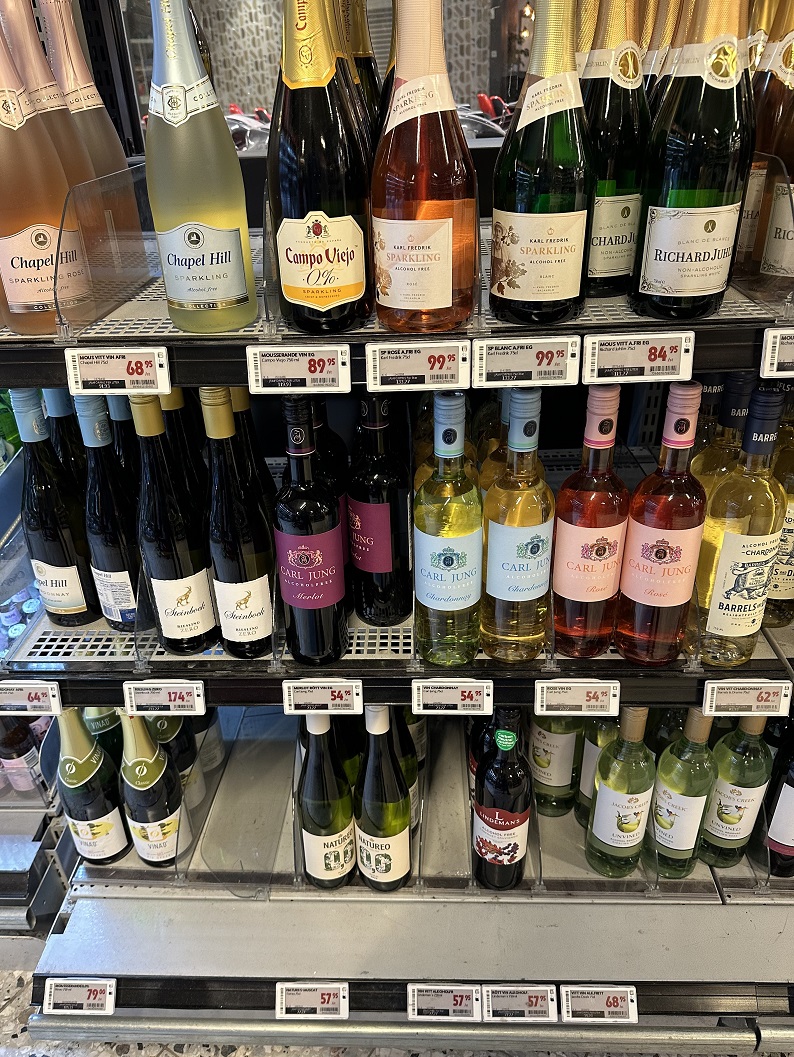
I visited the supermarket on Sunday, and Systembolaget stores are simply closed on Sunday (or at least the one I was near in Gothenburg). The supermarket actually offered wine – alcohol-free wine that is. I guess alcohol-free wine is a thing in Sweden, both locally produced (mostly from fruit, not grapes) and imported wines – and imported alcohol-free selection even included some familiar names, such as Campo Viejo, for example – you can see the sample selection in the pictures below:


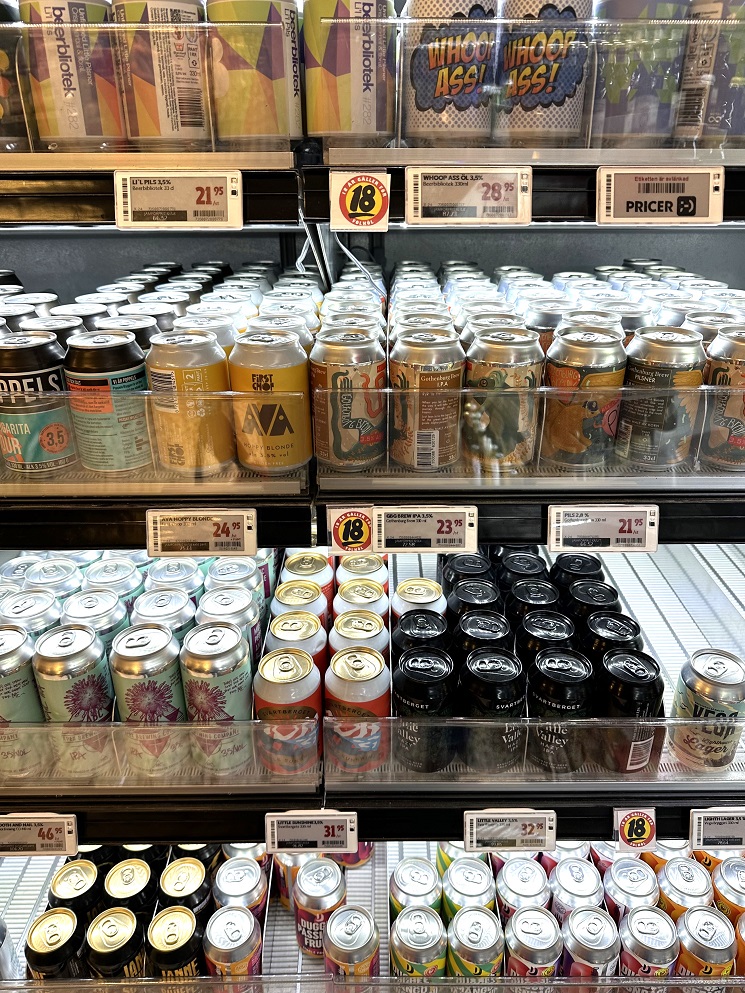
Apparently, low-alcohol beverages are allowed for sale at the supermarket, as there was a good selection of beer, and I even got a few to enjoy later in the room. Moreover, beer was a drink of choice at many of my dinners – while traveling when it comes to the “by glass” selection, I usually prefer beer as it is generally cheaper than wine and more error-prone. I had a number of good local beers during this trip.


And speaking about dinners, some were good, some were barely okay, and some were absolutely stunning (okay, not “some”, just one), as I already wrote about my visit to SK Mat & Manniscor. Actually, outside of that spectacular dinner, I had the best dish at lunch when we stopped by some random Italian place – the wild mushroom risotto was so good I had to literally stop myself from leaking the bowl (no picture though).


Before I will inundate you with pictures of the wines, just a few images of the town. As I mentioned before, this time around I was able to see the amusement park, and my room on the 17th floor afforded pretty good views as well – here is a little assemblage for you.




As I told you before, finding the Swedish wine was an important mission, so I tried to accomplish that at the first opportunity – I only didn’t realize that Systembolaget simply closes at 7 pm, and my meetings are typically not done until almost 8. The first half of the week went by and Thursday was my last hope before I would have to fly back on Friday. I found a little break in the meetings around 5 pm and went to the store.
The store was nice and spacious. After I made a few circles on my own, I realized that I would need some help finding the Swedish wine I was looking for. I asked the lady working there for help – she didn’t look very confident at first but with the help of the computer she was able to locate 3 different Swedish wines – real wines, with alcohol and made from grapes! (Ah, I’m so easily excitable).
As a general observation, I saw a good number of wines at a reasonable price, around $10 or less (divide the price you see in Swedish krona by 10 or 11 – that will give you the price in dollars).
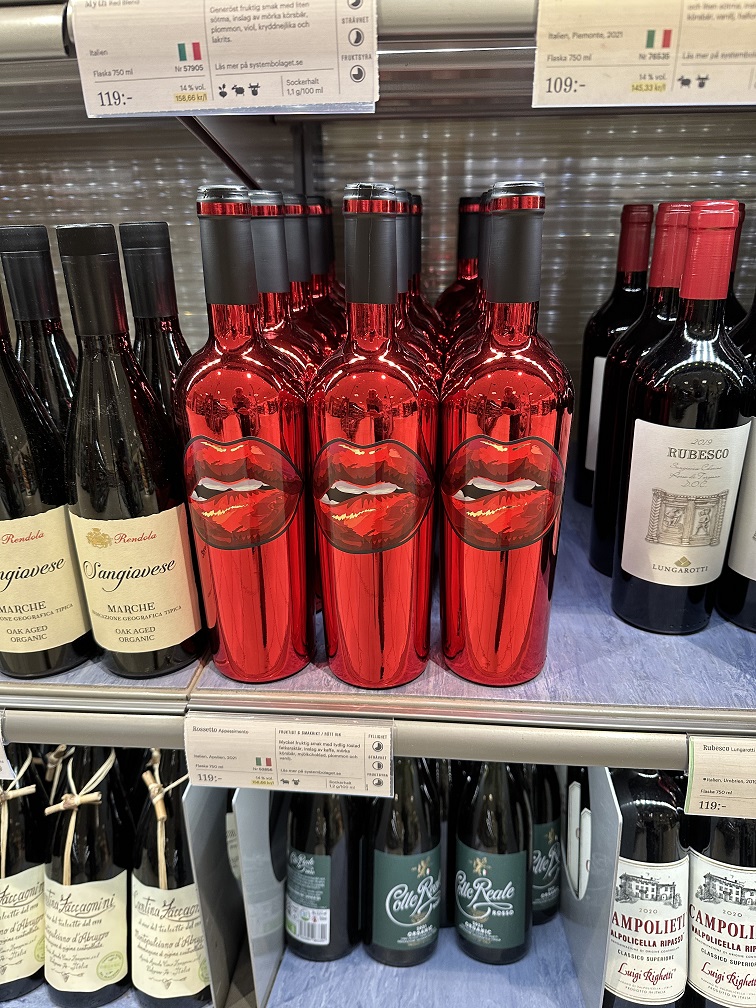
Some of the bottles looked like fun – if I were going on a hot date, I could’ve settled for this one with the lips:
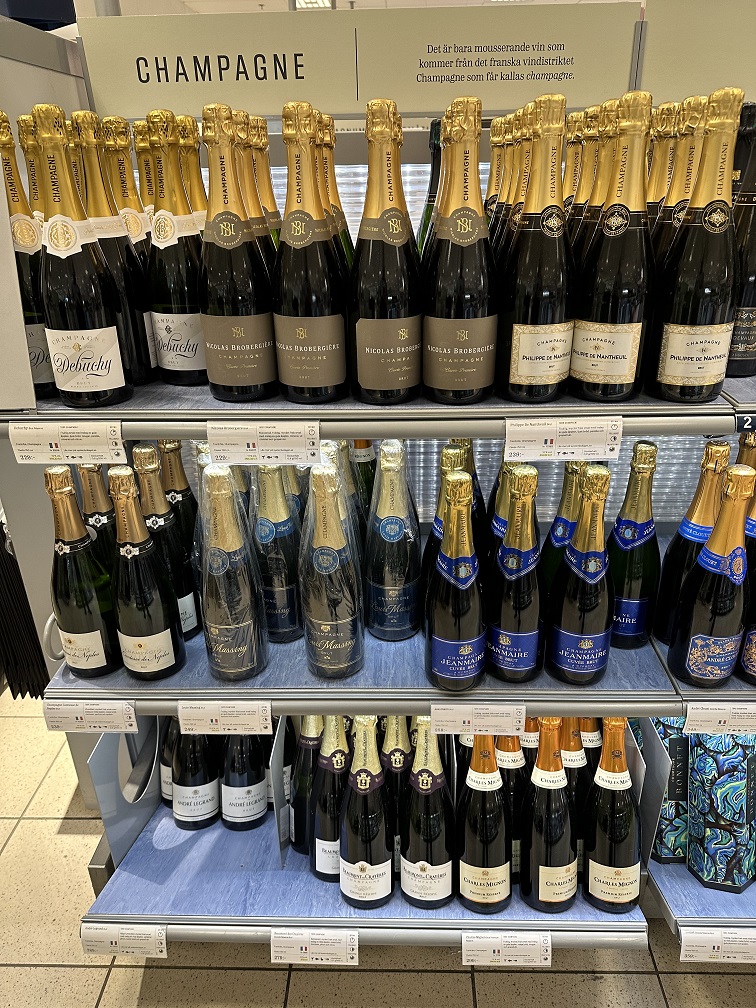
There was a good selection of reasonably priced Champagne, at least considering how much Champagne now costs in the US:
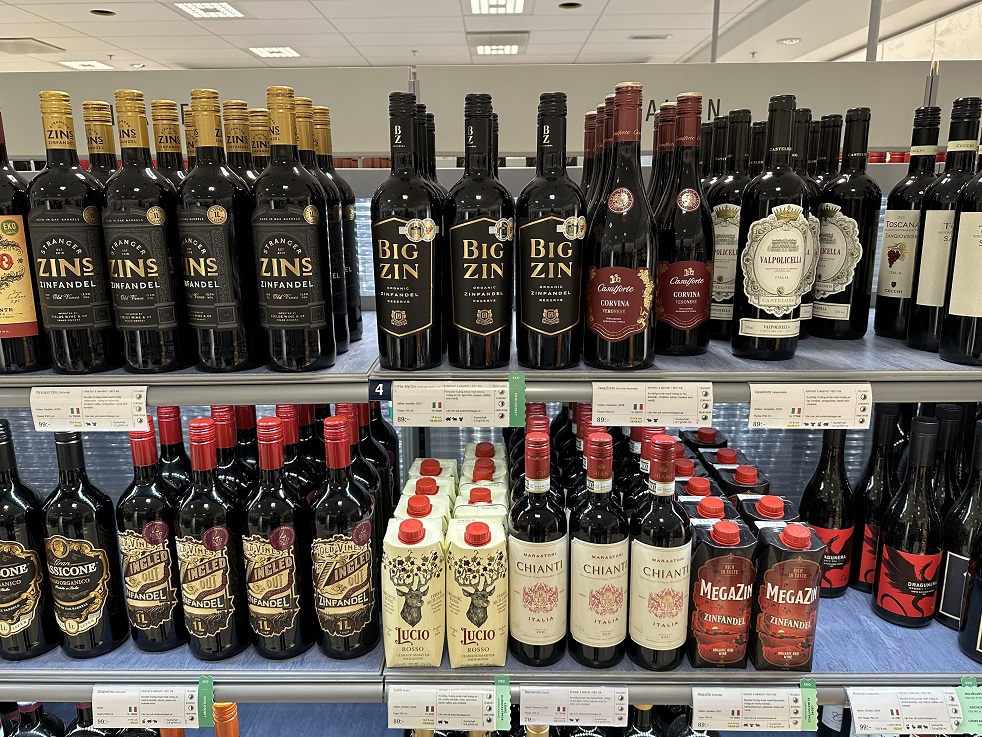
Lots of reasonably priced wines from Italy, France, and Australia:
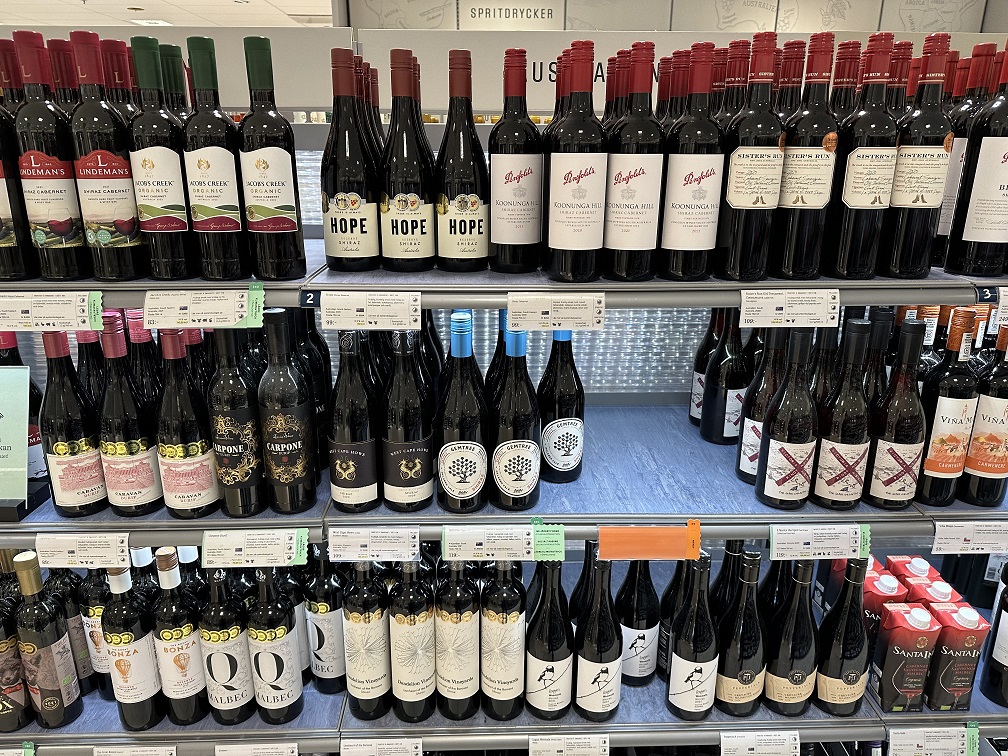
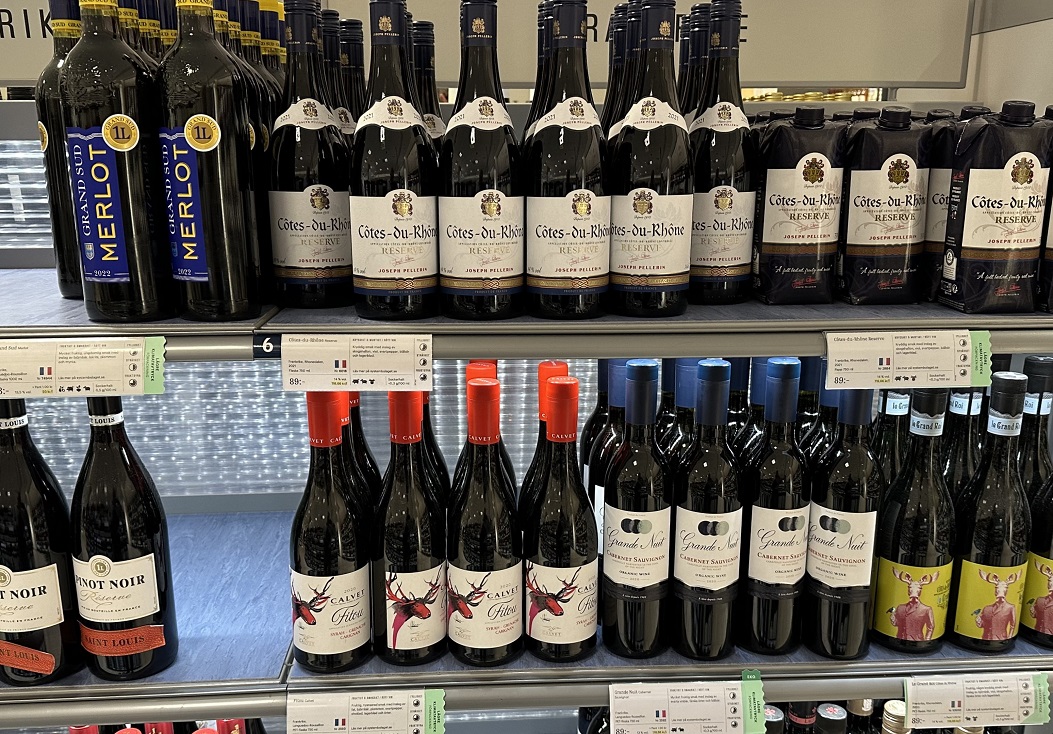
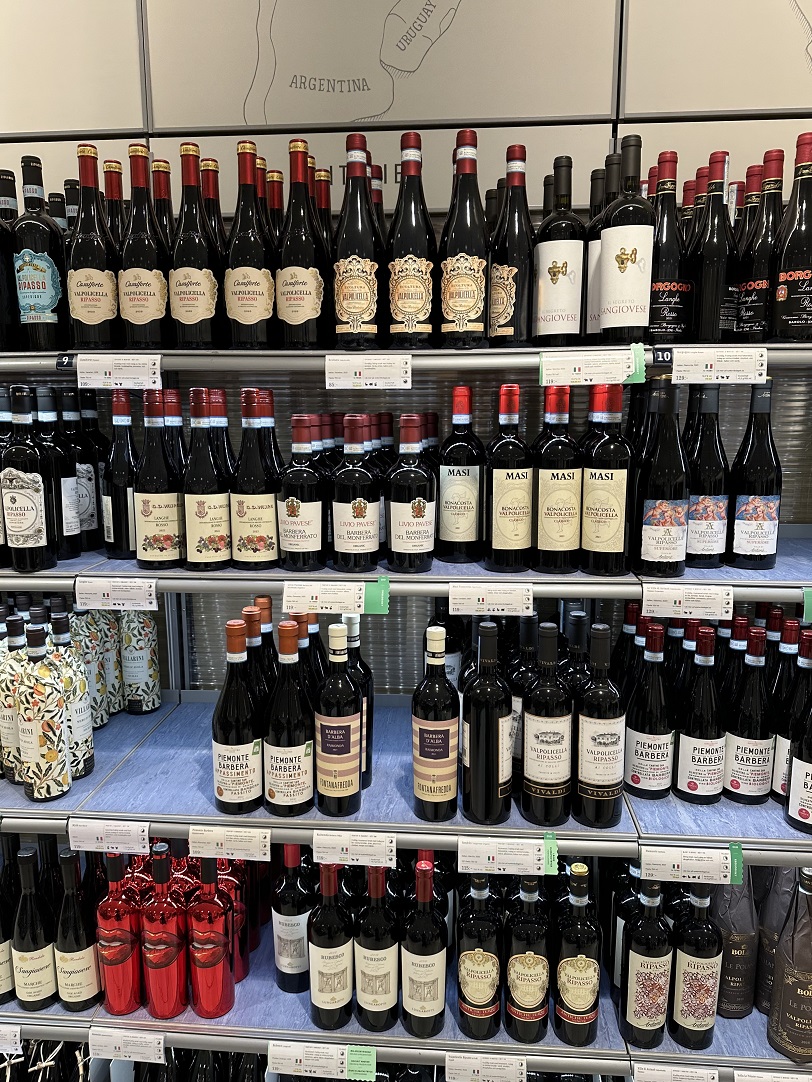
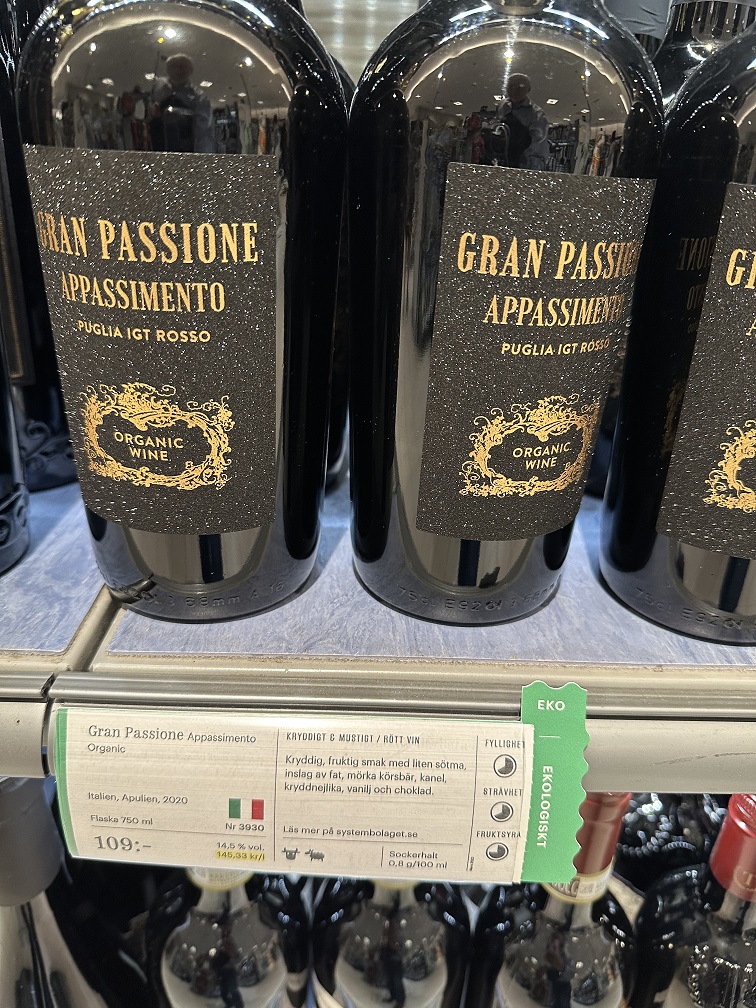
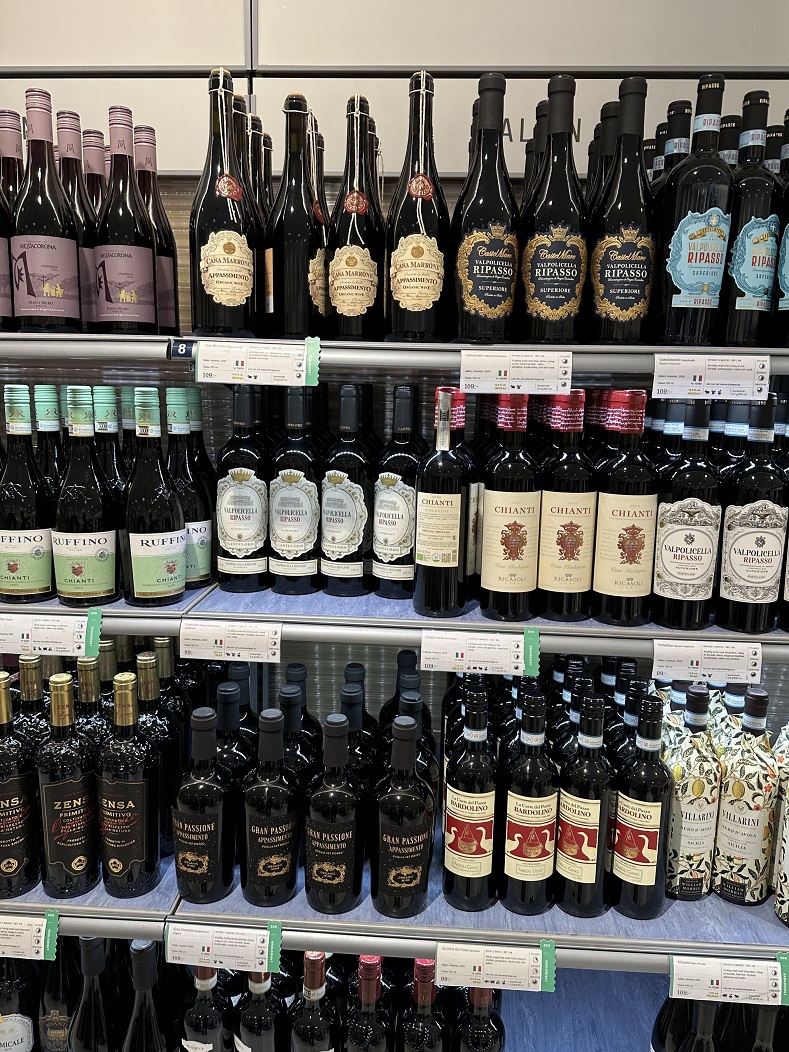
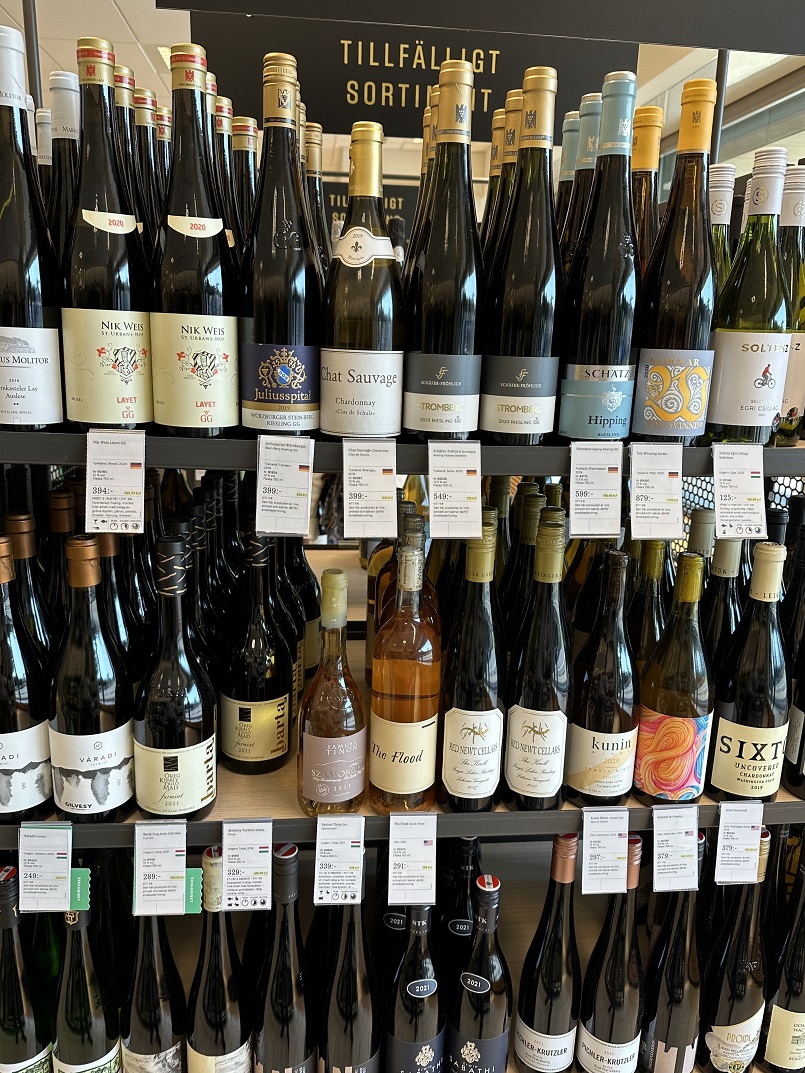
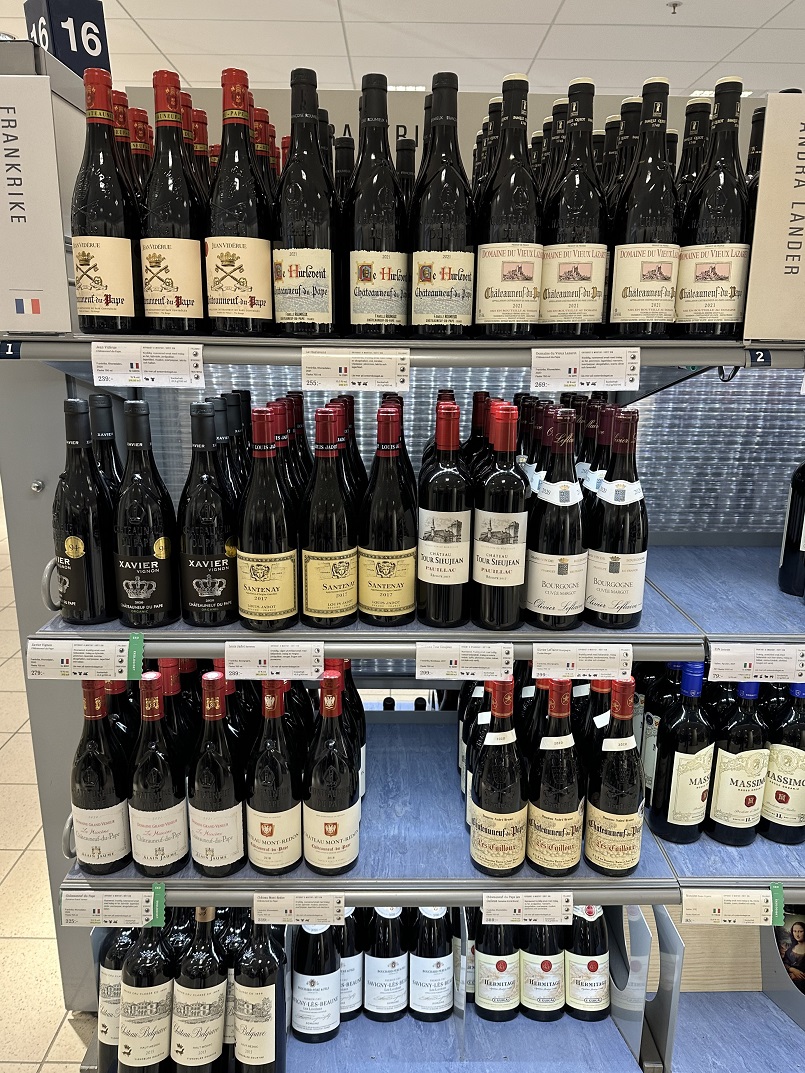
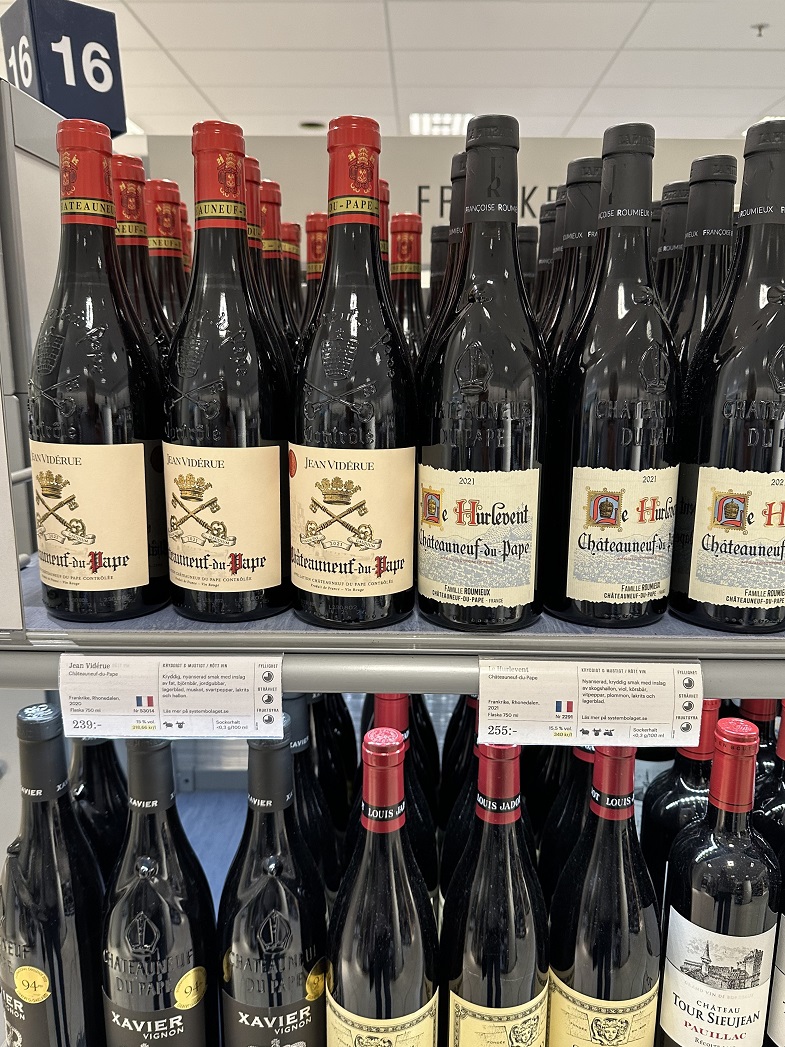
And here we are, the culmination point of the search – Swedish wines. These are quite expensive – yes, I understand it is not easy to grow grapes in Sweden.
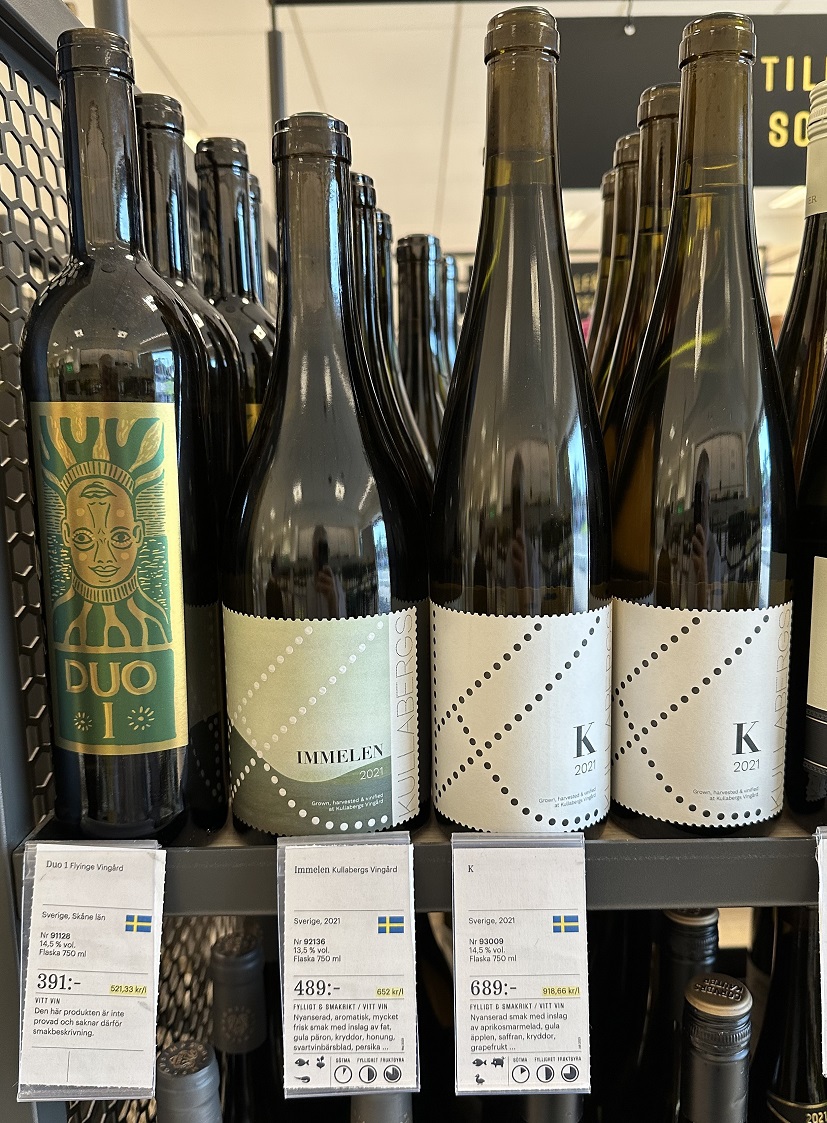
I settled for the “second cheapest wine”, which amounted to the hefty $45 – but hey, the price we pay for our hobbies…


Once I got into the hotel, I had to find a way to quickly chill the bottle, as it was my last evening to taste it and I had no intention of checking my luggage because of a random bottle. I got ice from the machine, added water, and did my best to submerge the bottle into the tiny ice bucket…
Before we talk about the taste, let’s talk about the wine itself – 2021 Kullabergs Vingård Immelen (13.5% ABV, mostly Solaris grape). The winery is located in the southwest part of Sweden, on the Kullaberg peninsula which is also a nature reserve (sometimes called Cape Kullaberg). The Kullabergs vineyard was planted in 2006. One of the main grapes at the vineyard is called Solaris – the grape selected in Germany in 1975, specifically developed to cope with cold climates. The wine I got from the store was mostly made from Solaris, at least according to the back label, even though the only technical note I found on the website was for Immelen 2019 which had 86% Solaris and 7% each of two other grapes.
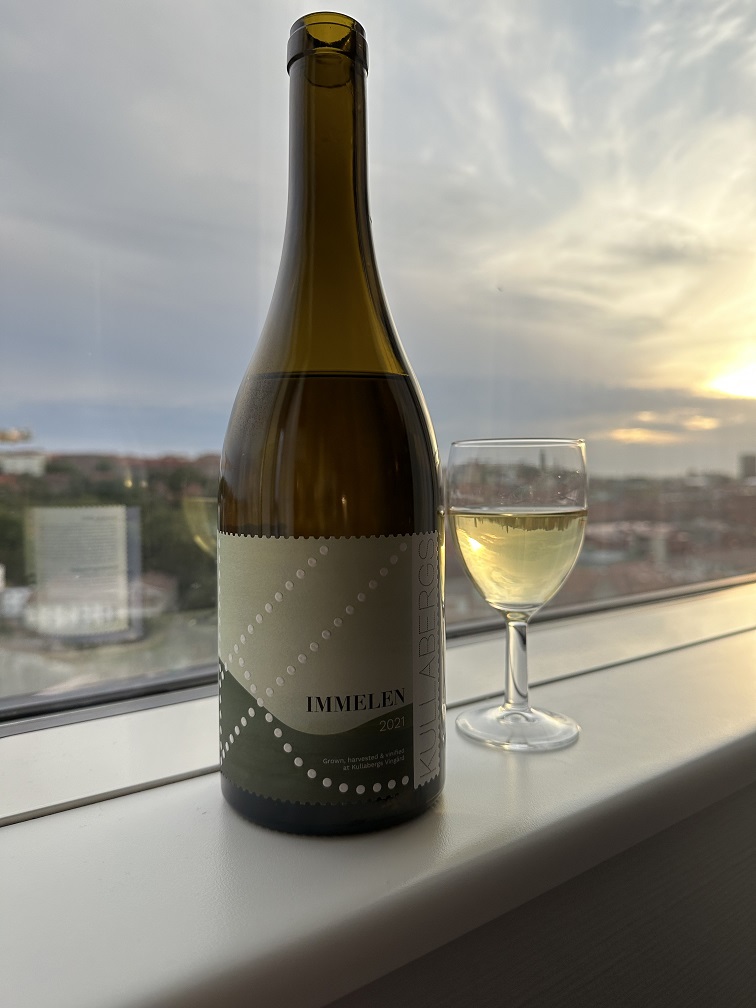
The wine was interesting. I wish I was able to fully chill it, but probably at around 55F it was showing a bit heavy, had notes of tropical fruit on the nose, plump and round body on the palate with a hint of grapefruit peel which offered a touch of bitter notes. Good acidity, and not a bad wine overall. It was reminiscent of Marsanne/Roussanne blends from the Southern Rhone if such a comparison would help. I’m happy I had an opportunity to taste this wine, add a checkmark to my wines of the world list, and a rare grape to the Hexavini journey. At $45, it is okay as once in a while exotic experience, but I will not pay this much for this wine a second time.
Here you are, my friends – a quick report from the trip to Sweden, mostly in pictures.
Hey, I heard Finland is starting to plant vines… guess what I will be hunting down next…
A Few Days in Paris
If you have followed this blog for some time, you know what the “a few days” title means. Yes, pictures. Lots and lots of pictures. This post will not be an exception – get ready to scroll.
Pictures have such an important role in our lives. Pictures solicit emotions, bring back memories and moments, and let us re-live those moments. Pictures can also serve as a personal journal, keeping all the dates in perfect order.

Probably my favorite shot of the entire week
Based on the pictures stored on my computer, I was able to figure out that the last time I was in Paris was almost 13 years ago, in October 2010. Of course, even if one is not familiar with Paris from the books, once you visit, that memory will be with you forever. Yes, I knew what I will find in Paris in a general sense, but the particulars, such as navigating this sprawling city, became rather blurred.
Once I arrived, though, it all came back rather quickly. Paris has one of the very best subway systems in the world when it comes to navigation – before every entrance, there is a full list of stations which you will find in a given direction – as long as you know where you are going, getting there is really easy.
This was a trip for work, and I was definitely lucky with the location of the meetings – a stone’s throw from the Eiffel Tower. For 5 days straight, I could look at the Eiffel Tower any time I would want. We even took some pictures from the roof of the building, admiring it from an even closer distance.
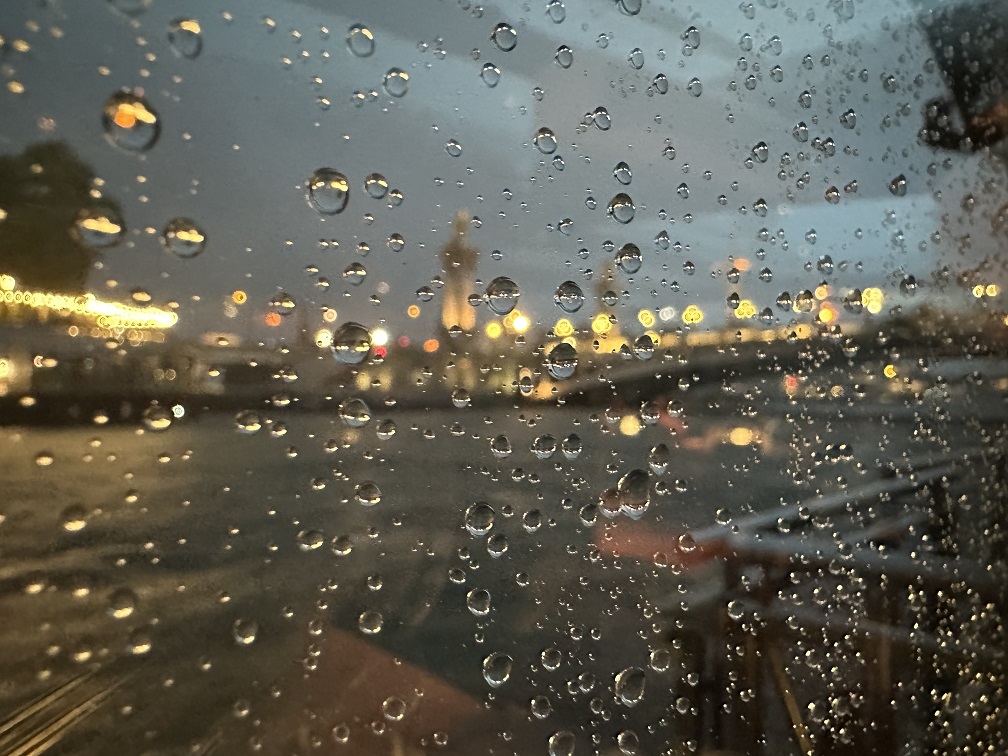
We also had a dinner cruise along the Sienne, allowing this photography junky to take a beautiful picture of the well-lit Eiffel Tower during the night – despite the rain which was going on the whole night but conveniently stopped as we were passing the Eiffel Tower, allowing for some magnificent pictures to be taken.
And then there were numerous strolls around the streets of Paris, allowing more magic to be captured. Remember I promised to inundate you with pictures? Here you go – and when you will be done scrolling, we will switch our attention to – yes, you guessed it – food and wine. See you in a minute or so.

















Now, food and wine, as nobody can talk about Paris without paying attention to food and wine. And wine and food.
Let’s talk about wine first.
First of all, I now did what I usually do during my trips, especially the European ones – visited the supermarket to see the selection of wines. Considering the location in the center of Paris, I think the prices look quite reasonable – good luck finding $3 wines in New York.
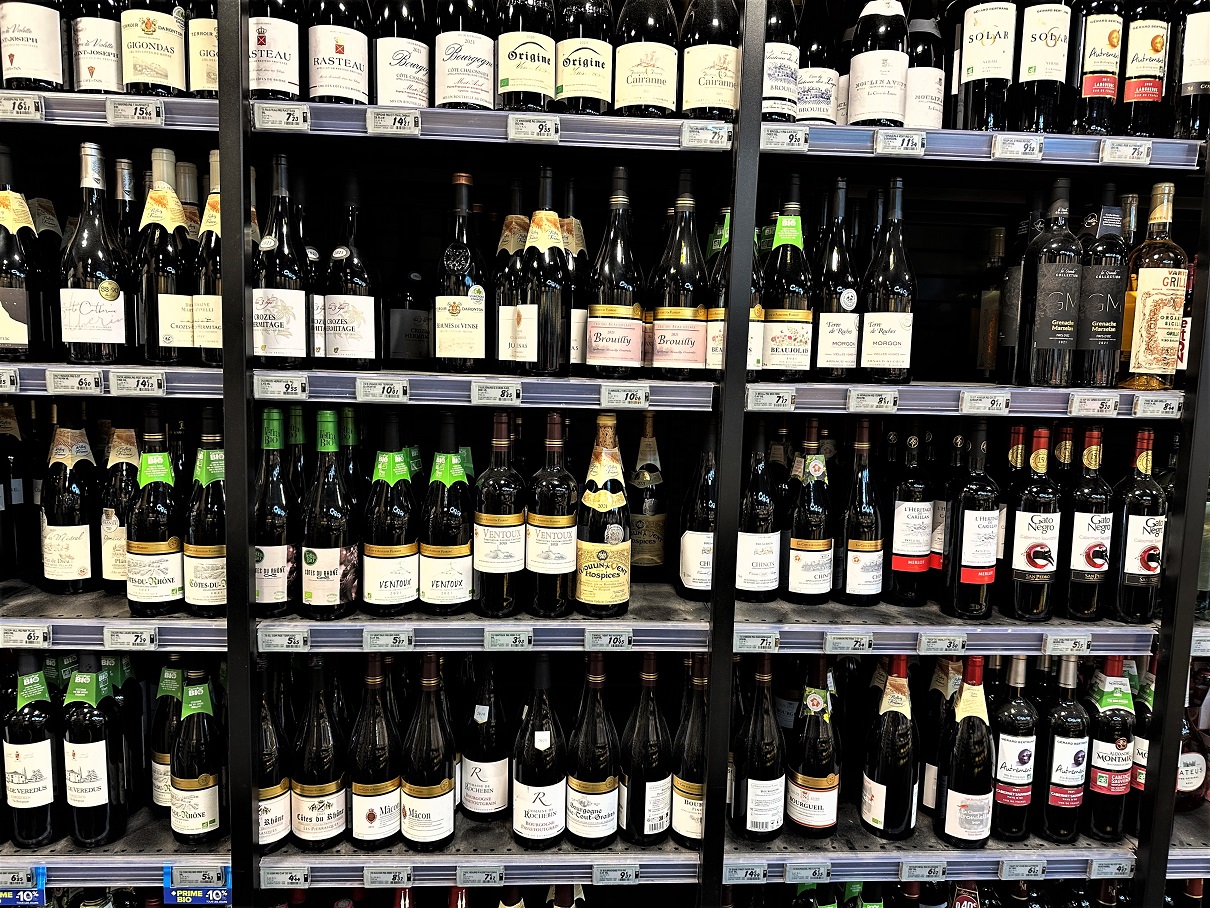


I grabbed two bottles to enjoy in my hotel room during the week. 2020 Rasteau AOP Cru de Cotes du Rhone at €7.23 was a very nice find. The wine needed a bit of time to open, but then offered a smokey, concentrated, powerful mouthfeel with a good amount of dark fruit. My second bottle was a bit more expensive – €9.28. It was 2021 Gérard Bertrand Solar 6 Syrah Cévennes IGP, a certified organic (Bio) and bee-friendly wine from the South of France. Along with Domaines Paul Max, Gérard Bertrand is one of my “safe choices” for situations where I need to pick a decent bottle of wine for a modest amount of money. This Syrah was quite generous, good amount of fruit, a tiny hint of black pepper, round and well-balanced. I run into the Gérard Bertrand wines a few more times during the trip – last time at the airport lounge in the form of the 2021 Gérard Bertrand Crémant de Limoux An 825 Brut, a blend of Chenin Blanc, Chardonnay and Pinot Noir, which was delicious in its own, but also perfect in Mimosa, with its firm structure and consistent bubbles.


I need to mention a few more wines. Of course, when in France, you should drink French wine. Except, maybe, when you are in a kosher restaurant. We visited L’As du Fallafel restaurant twice during the week (one of my colleagues eats Kosher, and then, of course, the food is just tasty), and an Israeli wine was a perfect option in my opinion. 2020 Gamla Cabernet Sauvignon Galilee was well approachable from the get-go, nice amount of dark fruit, good acidity, good structure, well-integrated tannins – a very nice wine overall. Last but not least was Chablis I had at the restaurant called Au Petit Marguery.
2021 Jean-Marc Brocard Chablis Vieilles Vignes de Sainte Claire was excellent. First, there was the nose of sapidity, minerality, and a touch of gunflint. I spent a good few minutes just admiring the aromatics before taking the first sip. The wine continued on the palate offering savory and complex mouthfeel with good acidity and restrained expression of the white-stone fruit. While working on this post, I looked up this wine – turns out that the grapes for this wine are harvested from the 70 years old vineyard with the roots of the vines extending for 25 meters into the Kimmeridgian soil. Now that will guarantee some complexity.
Now, let’s talk about food. There are two restaurants I want to mention. First called Suffren was an accidental find, as we were walking around looking for a place for dinner. I’m glad we stumbled upon it, as the food was outstanding, and the service was even better – happy and friendly. It was fun sitting at the table close to the entrance and observing the people waking in, shaking hands and talking with waiters – truly a neighborhood spot. The steak tartar was my choice of main course, and it was delicious. Everybody also got desserts, and polished their plates – profiteroles, baked Alaska, Crêpes Suzette (made tableside, of course).
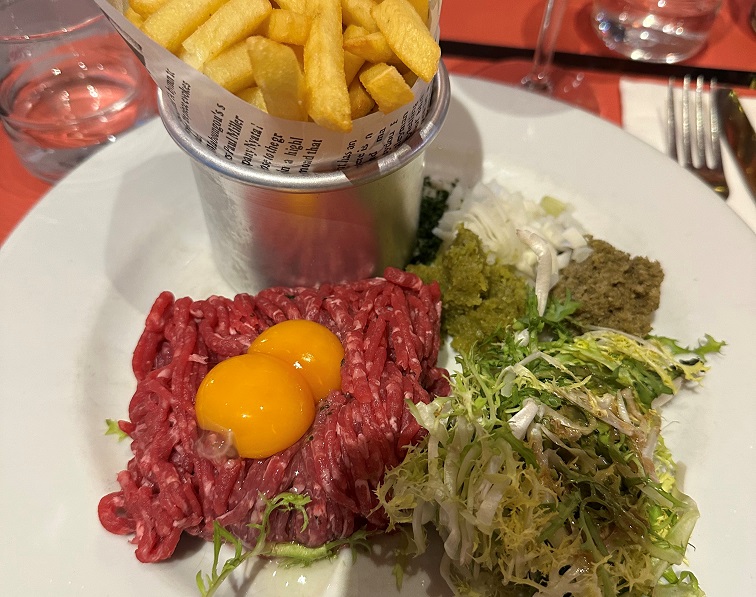 The second restaurant was Au Petit Marguery. I found the restaurant via search as an affordable restaurant offering traditional French cuisine. The food was good even though it didn’t leave me speechless. Foie Gras was good overall, but it was served with some sort of a sweet toast which I didn’t appreciate at all, and I was really expecting more condiments to accompany such a rich dish.


My main course was fish (have no idea which one), which was not bad, but again, not truly memorable. For dessert, I got an oversize profiterole which was not bad but not amazing, but again maybe it was competing with my overinflated expectations.
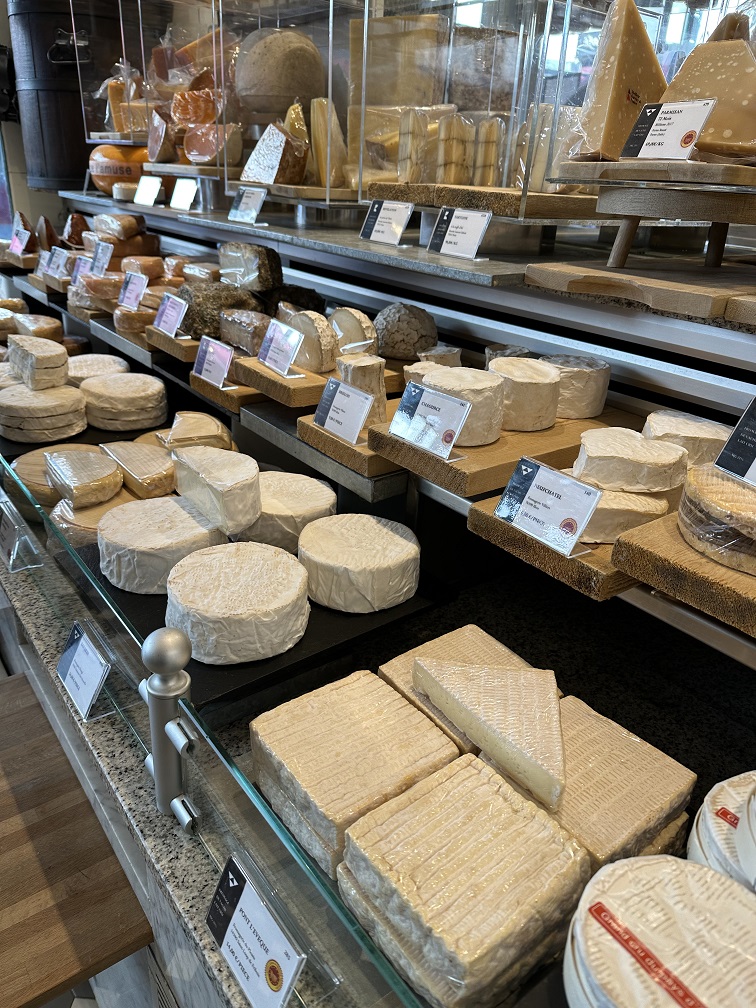
I also stopped by a few of the cheese stores – this is literally a mandatory activity when in France. Tea is something I love, but talk much about tea in this blog. I found my favorite tea store, Mariage Frères, a short walking distance from my hotel, and I got a few teas to bring home. Around the corner from the tea store, I found another one of my favorites – Le Café Lenôtre. I was really hoping for a cup of hot chocolate but was laughed at as nobody else wants to drink hot chocolate in July.


And now you have my full report. It was definitely fun to spend a week in Paris and see how your memories are coming back to you. Before we part, I would like to leave you with one of my favorite pictures, taken during the rainy trip along the Seine. I think it gives you a perfect Paris mood in one shot…
Latest Wine News and Updates
While wine production is one of the oldest industries in the world, the amount of new, innovative products and scientific breakthroughs in the wine world is nothing short of breathtaking. Let’s take a look at some of the latest news from the field.
Everyone agrees that fake wine is a big problem for the wine industry. There are many tools employed by winemakers to protect the identity of their wines, but the quest for the perfect solution is still ongoing. After 15 years of intensive research, the French INAO (The National Institute of origin and quality), together with the College of Veterinary Medicine at Auburn University in the US announced the successful results of the initial trials of dogs being able to sniff fake wines. As part of the Canine Performance Sciences program, dogs had been trained to identify wines that don’t match the original wine. The training is a very involved process requiring the dog to spend about 2 years at the winery memorizing the original flavor profile of the wines. Once trained, the dogs can easily distinguish the original bottles from the fakes, the same as working dogs who identify illegal substances at customs in airports. The training process is intense and costs about $50K per dog, so this solution is not for every winery. Nevertheless, according to INAO, it will take about 7 years to satisfy all the requests for the dogs received to date.
There are plenty of wine lovers who crave massive, tannin-loaded wines. Such wines are often quite expensive as they require a long aging time in the oak barrels which are costly. What if the oak flavor can be concentrated in the grape itself while it is growing? Impossible, you say? Scientists from UC Davis in California think otherwise. Instead of using the traditional rootstock, UC Davis scientists managed to graft Cabernet Sauvignon vines onto the french Limousin oak rootstock, and after about 7 years of experimentation it seems that resulting wines demonstrate much higher tannin concentration than the wines obtained from the same clone of Cabernet Sauvignon but not grafted on the oak rootstock. Obtaining the same level of tannins would require about 6 months of age for the wines in the control group. Once the research is complete, it will result in significant savings for the wine producers which [hopefully] will be passed on to wine lovers. We should expect to find the first wines based on the results of this research by approximately 2028.
Many wine lovers live with a simple motto – coffee in the morning, wine in the evening. The next news I would like to share with you will, in a way, be related to both beverages. How so? Everyone knows Nespresso, a French company that mastered the simplicity of the perfect cup of espresso at any time with the help of a tiny coffee capsule. Working on a special (very sizeable) grant from French LVMH conglomerate, Nespresso just announced a brand-new machine called – maybe you guessed it – Winepresso. Nespresso scientists found a way to convert the content of the wine bottle to the dry form which is encapsulated in the tiny wine capsule, literally identical to the coffee one. Now, with a push of a button, a perfect glass of your favorite beverage is in your hand at any moment. Based on the opinion of the expert panel, the Winepresso-produced wine is practically identical to the original wine, which is a pretty amazing achievement in itself. The initial set of capsules available upon commercial availability of Winepresso will include two Bordeaux reds, one red from Burgundy, and 3 whites from Loire. It is also known that Nespresso is actively involved in conversations with a few of the famous wineries in Napa Valley. The capsules will be sold in the 5-packs (to be identical to the standard 5 glasses in the bottle of wine). Winepresso machines are expected to appear at select retailers such as Williams-Sonoma and Bloomingdales in time for Christmas shopping. The prices for the capsules and the machines had not been disclosed yet. If successful, you can only imagine how successful this product will be from point of view of sustainability and reduction of the carbon footprint.
Open any news source today, and you are guaranteed to read about ChatGPT, artificial intelligence (AI) software. ChatGPT writes poems, articles, and marketing materials, conducts market research and lots more. It appears that the wine world is starting also to embrace ChatGPT in a variety of ways, many of them quite unexpected. Champagne Piper Heidsieck just announced that they will start a new line of non-vintage Champagne, called Piper Heidsiek AI, where ChatGPT will play the role of the Chef de Cave, responsible for blending the final wines. After the initial offering, both Blanc de Blancs and Blanc de Noirs will be produced. While it is an interesting announcement in itself, I’m concerned with the impact of the ChatGPT on all areas of human lives, now including even wine production. Well, we will see how this story will unfold.
That’s all the latest news I have for you, my friends. Until the next time – cheers!
Low Calories, Low Alcohol Wines – First Encounter
Low calories, low alcohol.
In my book, these are trigger words.
Don’t get me wrong – watching your caloric intake is definitely a first-world problem, and I generally pay attention to it when it comes to daily food. However, wine is an indulgence. I drink wine for pleasure. Wine is not a necessity. Yes, it is possible to live perfectly happily without drinking wine – however, this is a choice. And you already know what choice I made.
As I drink wine for pleasure, the number of calories is not a criterion I would ever use when selecting a wine to drink. The company, food, mood, ambiance, grape, region, winery, winemaker – there are lots of factors influencing the decision, but the number of calories in a glass of wine is definitely not one of them. If one selects wine by the number of calories, what is the point of drinking the wine? May I suggest water as a better choice?
Now, let’s scrap all of this. Let’s pretend I didn’t say yet anything in this post.
Apparently, knowing the calorie count in the glass of wine is important, especially if you are a part of Gen Z (not my opinion – this is what I read). Apparently, there is a demand for wines to have the same labels as any food product, listing all the ingredients and providing the breakdown of nutrients, calories, etc. ( I hope this will never materialize as a law – but oops, I’m not supposed to be expressing my opinion). And apparently, there is enough demand for low-calorie, low-alcohol, and alcohol-free wines that my friend Zak even allocated specific shelf space for such wines at his wine store in Stamford, as there are enough people asking for them.
As I visited the store and chatted with Zak about wine trends, he showed me these shelves with low-alcohol wines, and I surprised both him and myself by grabbing a bottle to taste.

There are a few reasons to be surprised. The first one, of course, is the fact that I decided to try a type of wine that I consider simply a gimmick. A bigger surprise was that I grabbed the bottle of Meiomi Pinot Noir – the wine I normally can’t stand. I don’t like pretty much any wine the Wagner family produces, including the flagship Caymus – and my dislike for Meiomi Pinot is very strong as I can’t get through the sweet and burning mouthfeel this wine delivers. And yet here I am – getting a low-calorie version of the wine I normally don’t drink. Talk about surprises.
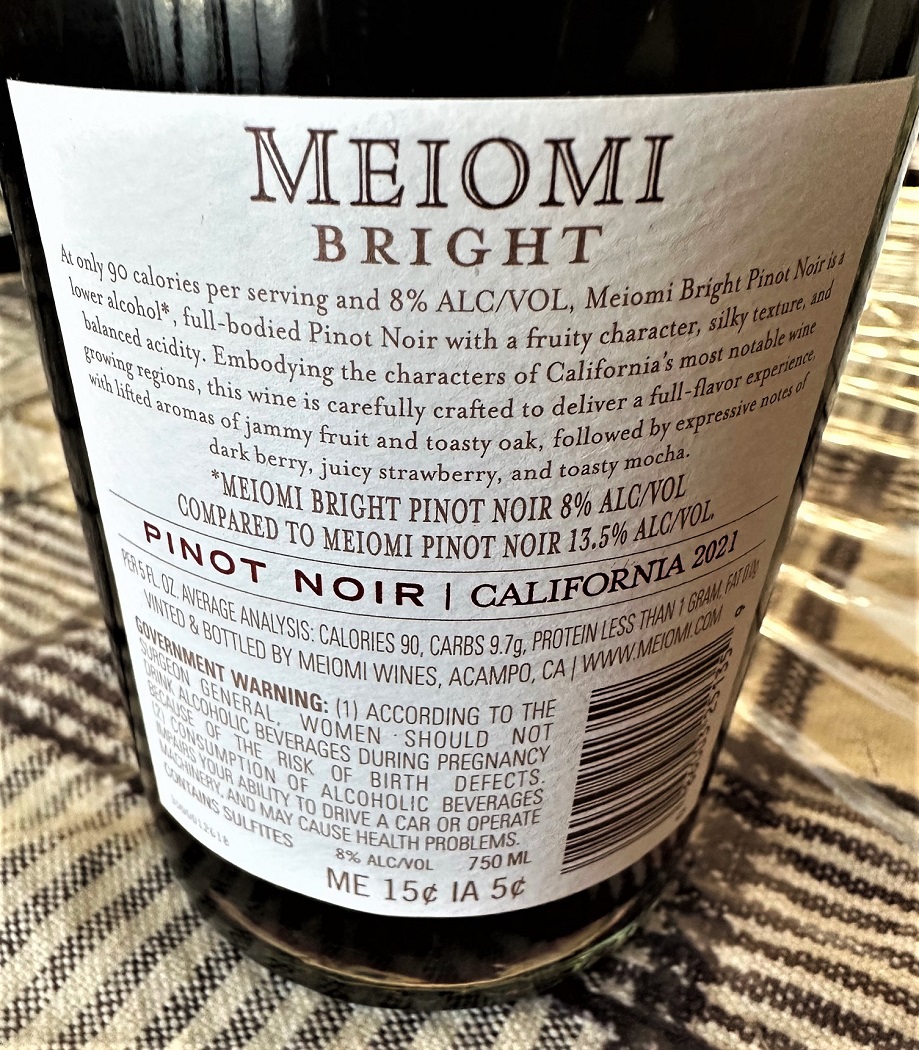
Let’s continue on the subject of surprises. To my yet another surprise, I didn’t dislike this 2021 Meiomi Bright Pinot Noir California (8% ABV, $19.99, 90 calories, 9.7g of carbs per 5 oz glass). I guess the reduced alcohol was good for this wine as it was showing a nice dark berry medley with blueberries and blackberries taking the leading role, supported by sweet oak and a nice silky mouthfeel. If it would not be for the cloyingly sweet finish, this would be a good wine experience overall – but again, the wine was quite palatable, even during re-tasting over the next 4 days.
This encounter with the low-alcohol, low-calorie wine made me do something which I had never done before – trying to understand the calories in wine.
I don’t pretend to be a scientist here, so below is my layman’s understanding of what we are dealing with when counting the number of calories in a glass of wine. I’m fully open to criticism, and if someone thinks this is all baloney and the calculations are all wrong, I will be delighted to correct this text to set things straight.
First, some basics. Calories in a glass of wine come from 2 sources – alcohol and sugar. There are 7 calories in one gram of alcohol (there are multiple sources of info on this, I used this one), which by the way makes alcohol the second highest source of calories after fat, which delivers 9 calories per gram. There are 4 calories in a gram of sugar (you can verify via google search). One more important point – a standard wine pour is considered 5 ounces glass, and there are 5 standard pours in a bottle of wine, which contains approximately 25 oz of wine. As we measure calories per gram, we need to convert between ounces and grams. One ounce is equal to 28.3495 grams – however, as I don’t want to deal with a calculator all the time, we will assume that 1 oz is equal to 30 grams, for the simplicity of this exercise.
Alcohol is always presented on the label in the form of ABV – Alcohol By Volume. Thus the percentage shown with the ABV letters simply identifies what percentage of the bottle content is pure alcohol, the one which clocks 7 calories per gram. To provide a simple example, a 1 liter of 10% ABV wine will contain 100 grams of alcohol. By the same token, a standard pour of such 10% ABV wine which amounts to 5 oz, will contain 0.5 oz of pure alcohol. If you want to do it in grams, with our previous assumptions, 5 oz is equal to 150 grams, which will translate into 15 g of pure alcohol – which in turn will deliver 15*7 = 105 calories per glass just for the alcohol portion of the content.
Now, let’s analyze our Meiomi wine based on what we just learned (yes, I know it says on the bottle “90 calories” front and center, but let’s see if we can come up with the same number). This Meiomi Pinot Noir has 8% ABV, which means that the standard pour/serving of 5 oz (150g) contains 12g of pure alcohol. 12*7 = 84, which brings us to the perfect proximity of the 90 calories. However, according to the information on the back label, the same 5 oz of wine contains 9.7g of carbs, and the only source of carbs in wine is residual sugar – this is the sugar left in the wine after fermentation was finished. We can safely round our 9.7g to 10g, and when multiplied by 4 (calories per gram of sugar) we will get 40 calories. Adding 84 and 40 brings us to 124 calories in that glass of Meiomi Pinot.
I wanted to compare this caloric count with any regular wine. As an example, I took information from the technical note of the 2020 Barra Cabernet Sauvignon from Mendocino. This wine has 14.5% ABV and 3.2 g/l of residual sugar. At 14.5% ABV, our 150g of Barra Cab (5 oz, standard pour) will contain 21.75g of pure alcohol, which will give us 152 calories from alcohol. 3.2 grams of sugar per liter will translate into approximately 0.5g of sugar per same standard pour which in turn will only add 2 calories, for the grand total of 154 calories. That also means that there is only 30 calories difference between low-calorie, low-alcohol, manipulated wine and normal wine. You can make your own conclusion, but I’m sure you can figure out mine.
There is one more thought I would like to share. I’m afraid that a low-alcohol wine can give people a false impression that they can simply drink more of it because each glass supposedly contains less. So it is not impossible to presume that someone can drink 3 glasses instead of two, based on the premise of “light wine”. Using our calculations above, there will be 372 calories in these 3 glasses – 2 glasses of Barra Cabernet Sauvignon will set you back 308. Again, you can (and should) make your own conclusions.
I clearly understand that my personal viewpoint and perception are not important at the scale of the market – when there is a demand, the product will appear. Low-calories, low-alcohol wines are here to stay, no matter what I think of them. But I’m glad this Meiomi Bright Pinot prompted me to do some research and acquire some understanding of the calories in wine.
I guess when they say “liquid diet”, they are not really kidding. Cheers!
Daily Glass: Yin and Yang
 Obey your inspiration.
Yin and Yang are too big of a concept to casually use while discussing everyday wines. Black and white. Darkness and light. Night and day. Passive and active. There is a lot of meaning behind the revolving black and white semi-spheres, and we would need a few (4, 5, …) bottles of wine to discuss it. So what gives?
I was drinking a bottle of wine for 5 days. Open, pour a little into a glass, drink, hope to be amazed, close, pump the air out, put aside. Repeat. And then I opened a bottle for a Friday night dinner of homemade tacos, and the wine was delicious and approachable from the moment it hit the glass. Yin and Yang, the brain said. This is a perfect title for the post. Who am I to argue?
Yin is a black portion of the circle of life. 2014 Bodegas Riojanas Rioja Gran Reserva (13.5% ABV, $19.99 at WTSO, $49.99 on the web) was the Yin at the moment.
Bodegas Riojanas was founded in 1890 by the Artacho family which had a long winemaking history prior to that. Unlike many other Rioja’s Greats, who set up their wineries close to the train station in Haro, Bodegas Riojanas winery was built in Cenicero, where the grapes grew. Bodegas Riojanas was among the 13 founding wineries behind the Rioja DOC denomination. Today, Bodegas Riojanas farms 250 acres of vineyards and produces a large number of white, red, Rosé, and sparkling wines.
Bodegas Riojanas Gran Reserva is one of the flagship wines. 100% Tempranillo, aged for 24-30 months in the casks, produced in traditional Rioja style. 2014 vintage was rated “good” in the official Rioja vintage classification – the best years are identified as “Excellent”, then “very good”, and then “good” – so we can say that this was an okay year. Traditional style Gran Reserva wines are typically tight and need time – and so was this wine. For 5 days, as I was tasting it little by little, the wine was opening up ever so slightly. Don’t get me wrong – it was drinkable for someone who likes the power and likes to drink super-structured, super-tight wines. On day 5, there was a glimpse of cherries and a cigar box, which was slowly replaced by the tannins on the finish. This is the wine with promise, but we need to wait until the Yin will turn.
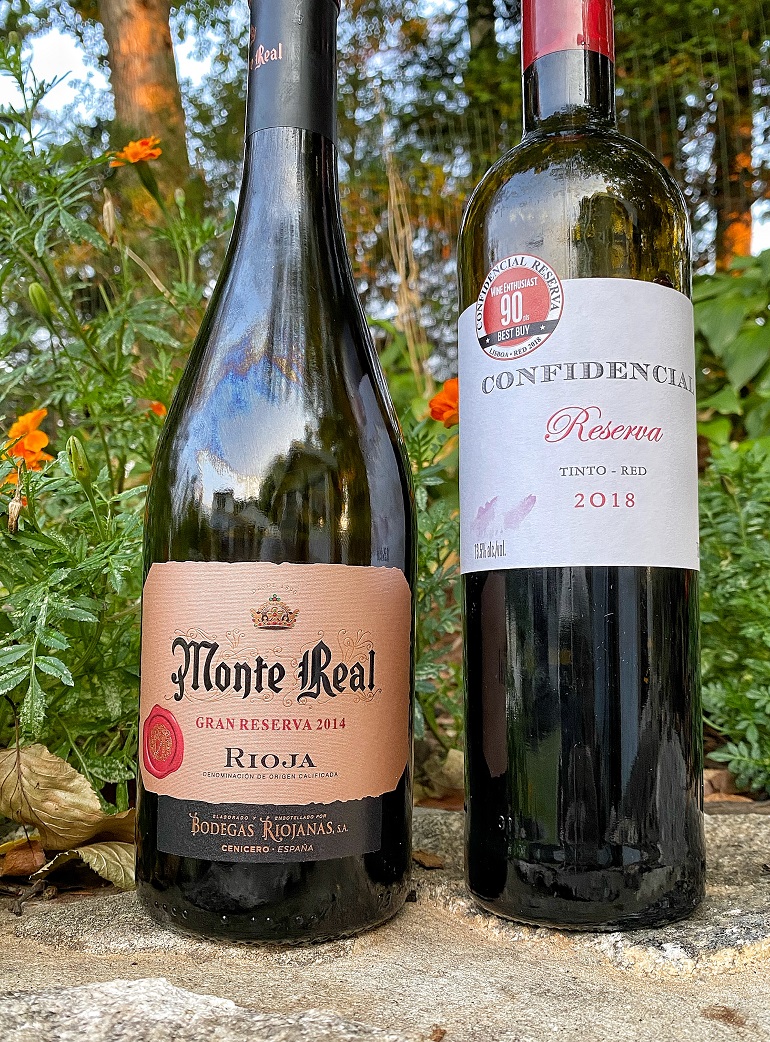
Now, the Yang – 2018 Casa Santos Lima Confidencial Reserva Vinho Regional Lisboa (13.5% ABV, $9.99, 10+ grape varieties, 6 months in the French oak cask).
Casa Santos Lima also has a history that lasts more than 100 years. The company had great success as a producer and exporter at the end of the 19th century. In 1990, the company was restarted, and today 90% of the produced wines are exported to more than 50 countries on 5 continents. Casa Santos Lima produces a wide range of wines in all the regions in Portugal, with a significant focus on providing value.
It is not for nothing this wine is called Confidencial. You might know that I excel and take pride in being a very capable grape sleuth. And nevertheless, as the name says, I was only able to find out that the wine is produced out of more than 10 confidential varieties – nowhere there are any hints on what those grapes might be.
This is not necessarily surprising. Yes, it can be a clever marketing play (humans love mystery), but at the same time, lots of grapes in Portugal are growing as field blends, where the grape grower doesn’t exactly know what grapes are growing in a given vineyard or a given plot – this might be a great idea to simply declare such blend as “confidential”.
Based on my experience with Portuguese grapes varieties, I would think that Touriga Nacional is a part of the blend, with the wild strawberries being a telltale sign. In any case, the wine was delicious with soft and supple wild strawberries and raspberries forming the core, and sage and other garden herbs playing a supporting role. Layered, velvety, and round – perfectly approachable and enjoyable right at this moment. (Drinkability: 8-/8).
Yin and Yang are all about harmony, and things that are changing in life – what was white can become black, and the other was around. The light can bring warmth or it can kill. The darkness can be scary, or it can be comforting.
With time, these two wines can completely change places. The Rioja might become absolutely stunning in 25-30 years., The Portuguese red might be past prime even in 10. The Yin and Yang can swap places. But we don’t know what will happen in the future, and that makes it all fun. Let’s drink to the harmony in life. Cheers!
Wine News and Updates
When it comes to the wine world, there is never a dull moment – things are happening all the time. Today, the world of wine is indelible from the world of technology, with no shortage of exciting products. Wine is also a business, big and important business, again, with no shortage of exciting developments. Let’s take a look at some of the latest business and technology wine news from around the globe.
Let’s start with something unexpected – cars. Cars and wine should never be mixed together – driving is one of the most dangerous tasks humans routinely perform, and it requires a clear sober head. So what can we talk about here? Let me tell you. last week Elon Musk made an interesting announcement. As Tesla feels the heat of the serious competition from all leading automakers, the electric carmaker decided to differentiate itself with the addition of an (albeit optional) reverse osmosis accessory which can remove alcohol from wine. This option, available exclusively for models S and X, would add about 5 grand to the list price of the vehicle. but the opportunity to enjoy your precious Latour or Harlan during the ride can not be passed on lightly. Open the compartment, pour in the bottle, and the spout on the dashboard will become operational once the alcohol is removed from the wine. Based on preliminary market data, Tesla has a hard time fulfilling all the requests for the accessory. We shall see if the other manufacturers will follow the suit.
The next news is almost a no-brainer. It is the one from the series “how I didn’t think of it before”. Coca-Cola company entered into a partnership agreement with Bacardi USA to produce a range of Rum and Coke products. The product line will include all possible permutations of Coke (Diet, Zero, and the others) with the full line of Bacardi rums – light rum, dark rum, and the others. The new product is expected to hit the store shelves at the end of May, just in time for the grilling season. Retail prices will start at $20 for the 4 pack, with consumers already waiting impatiently for the product. I’m really curious how Pepsi will respond, if ever – is Rum and Pepsi even a thing?
Our next news comes from the wine glassware leader, Riedel, which never stops innovating. As you know, Riedel glasses are developed to enhance the aromas of a specific type of wine – Pinot Noir, Cabernet Sauvignon, Chardonnay, and many other wines have glasses of the specific shape offering the best sensory experience to the wine drinkers. The only disadvantage of the wine-specific glasses is that you need to have them all on hand, as you never know what bottle of wine you will decide to open, and even storing so many different glasses might become a challenge in itself. To address the issue, it appears that for the past 10 years, Riedel was secretly working on a project with the United States Air Force Research laboratory to develop a glass that can change its form based on the request from the smartphone app. The glass is made of some smart material – again, the exact details and fiercely guarded – which responds to the electric impulses from the control module embedded in the stem and changes its shape as needed. The glass will appears soon in the wine catalogs, with the expected price tag of $750 for two – it is expected that the price will drop over the next 2-to 3 years as production will increase.
Can we talk about wine today and not talk about NFTs (Non-fungible tokens)? Of course not. Gallo family company, which had been producing wines in California since 1933, teamed up with Beeple, one of the most famous NFT artists in the world. to produce a series of unique labels, each one of them having its unique value, as is always the case with NFT art. About 14,000 cases of the 2021 Gallo Hearty Burgundy will be adorned with Beeple’s artwork and will be available at select retailers around the USA. Gallo will dictate the initial price for the NFT-labeled bottles, but the retailers will be allowed to sell the wine in the auction-like model, with 25% of the extra money going back to Gallo. These NFT-labeled bottles are expected to be a big hit with consumers, and reportedly many wine producers around the world, such as Torres in Spain, Concha y Toro from Chile, Cavit from Italy are in talks with NFT artists to create their own collections.
Our last news piece might be the most bazaar of them all. As you know, Korbel Champagne Cellars in California produces wine in California under the Champagne brand (California Champagne). Based on the source speaking on condition of anonymity, Bernard Arnault, top executive of the French luxury goods conglomerate LVMH (Louis Vuitton Moet Hennesy), got fed up with Champagne’s name being used outside of the Champagne region in France alongside coveted LVMH brands such as Krug, Dom Perignon, and Ruinart, and announced that LVMH entered into the definitive agreement to acquire Korbel at an undisclosed amount. The deal is subject to the approval of the boards of directors of both companies, expected to be closed in 6 months. Once the deal is complete, Korbel California Champagne will be renamed the Korbel California Sparkling wine.
That’s all the news I wanted to share at the moment. Cheers!
All You Ever Wanted To Know About Wine Education
Wine is an agricultural product.
Wine is clearly a unique agricultural product.
When you buy an apple, pear, cucumber, or eggplant, you really need to know nothing to make your selection – as long as it looks good and fresh, that’s all you need to know.
When you sell an apple, pear, cucumber, or eggplant, you don’t need to impress anyone with information – as long as whatever you sell looks good and fresh, that’s all which is needed.
When you are consuming an apple, pear, cucumber, or eggplant, you still need to know nothing to really enjoy it, as long as it tastes good and fresh.
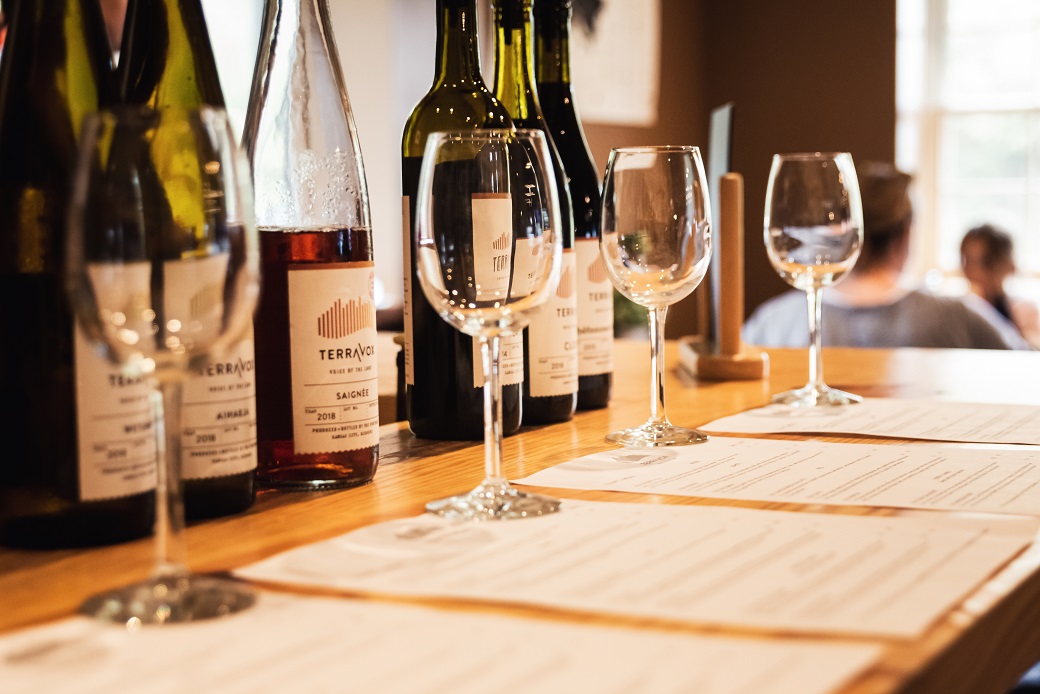
But when it comes to wine, knowledge is power, whether you are buying, selling, or consuming – where this wine is from, how was it made, for how long it can age, what is the best food to pair it with, what is the best way to serve it, and so on. On one side, you really don’t need to know anything about the wine to be able to enjoy it, but the uniqueness of wine is in the fact that the more you know about the wine, the more you might be able to enjoy it.
When it comes to wine education, there are lots and lots of resources – books, podcasts, websites, blogs. And then there is formal wine education.
What prompted this post was an excellent article on the Rack and Return website which provides an in-depth overview of all available formal wine education options. Here is what it covers:
- WSET – Wine and Spirit Education Trust
- WSG – Wine Scholar Guild
- CMS – Court of Master Sommeliers
- IMW – The Institute of Masters of Wine
- SWE – Society of Wine Educators
- ISG – International Sommelier Guild
- Regional Wine Study Centers
- Universities and Colleges
Without further ado, here is the link for you to the original article:
https://rackandreturn.com/the-definitive-guide-to-wine-education/
Enjoy!
Snow, Wine, and Valentine
First, there was snow.
Well, not true.
Last Saturday we had a break in winter weather. The thermometer hit 60ºF here in Stamford, and it was perfect grill weather. I’m not at the point of grilling in any weather (some of my friends are), but 60ºF in February definitely calls for some meat on the grill. While the meat was cooking, I enjoyed a beautiful sunset and a glass of 2018 TerraNoble Gran Reserva Carmenere Valle del Maule – the wine had cassis and a signature pyrazine (bell peppers) which was perfectly integrated, and practically disappeared after a few hours, leaving, luscious, layered, roll-of-your-tongue, seductive liquid in the glass (the bottle was practically gone by the end of the evening).


Then, there was snow. This snow was absolutely wonderful for a variety of reasons. For one, it was extremely photogenic, as you will see below (yep, pictures time!). But the main reason was that this snow was a total surprise. There was no weather channel hysteria, forcing people to run into the supermarkets, no warnings. We woke up to the beautiful white blanket, covering the ground, trees, and cars. It was beautiful, it was peaceful, it was happy. I took a few pictures from the deck, and then we took a slow walk with Penny – she kept on happily digging her nose into the snow, and I kept on trying to get a picture of that before the snow was melt, but I was not very successful, so you will not see a dog’s nose below.














For the Super Bowl, the game of power, I decided to open a powerful wine. If you would ask me to name wine that I associate with power, California Petite Sirah would be on the top of my list. This was my last bottle of 2010 Jeff Runquist Salman Vineyard Petite Sirah from Clarksburg – I’m glad I decided to open it, as I think the wine was at its peak. Cherries and cherry pits, on the nose and on the palate, round, succulent, juicy and delicious, with beautiful acidity and impeccable balance. This was definitely one delicious wine.

I also made almond cookies – these are made from almond flour, so they are completely gluten-free, soft, gooey, and delicious.


And Monday was Valentine’s day. For many years we prefer a simple family celebration with kids instead of going to the restaurant to participate in the ritual of poor service and mediocre food. I was really craving bubbles, so 2008 Berlucchi Palazzo Lana Satèn Reserva Franciacorta (disgorged in 2017) was exactly what we wanted – golden delicious apples on the palate and the nose, fine, delicate mousse, round and clean. Very elegant sparkler, good for any occasion.


That concludes the store of the few days in wines and pictures, mostly in pictures. Cheers!
Daily Glass: Uncomfortable Wine
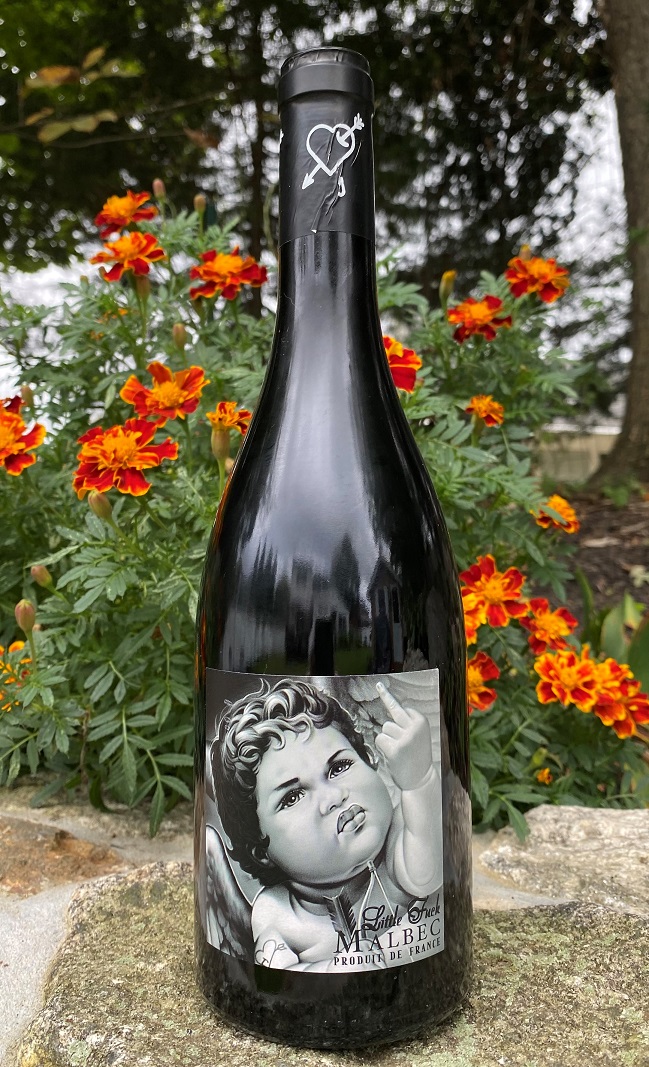 “Uncomfortable wine”??? What utter nonsense, right? Did the author had one too many glasses while writing this post?
The wine can be spoiled. The wine can taste bad. We can call it plonk, we can pour it out. But uncomfortable?
Shoes can be uncomfortable. The dress can be uncomfortable. The shirt’s collar might be too tight. Not knowing how to start a conversation with an attractive stranger might be uncomfortable. Not knowing how to answer a live interview question for the position you dreamed of your entire life is uncomfortable. Many, many things can be uncomfortable. But wine?
When I refer to wine as an art, the typical association in my mind is painting. As an art form, I imply that there are similarities between the bottle of wine and the painting on the wall. But maybe a book would be a better art form to compare?
Reaction to painting is instantaneous – you can, of course, spend hours looking at elaborate details and discovering new elements even if you saw the painting a thousand times before – but your first impression is unlikely to change, it might only deepen as time goes on. But with the book, first we see the cover, then we start reading, and if we found the book which speaks to us, by the time we reach the second page, nobody cares about that cover anymore.
When it comes to the wine, the bottle and the label matter – until we take the first sip. If we found “our wine”, the same as 300 pages book can be obsessively consumed within a few hours, a good bottle of wine will be gone in no time. And while you will be enjoying it, most likely you wouldn’t even remember how the label looked like.
What’s with this interlude and our comfort/uncomfort discussion you ask? Don’t worry, this is all connected.
So what can be uncomfortable about wine? Actually, many things. Remember – in the wine world, it is all about perception – except the taste, the pleasure, and your desire to have a second glass – of course, if you chose to be honest with yourself. Otherwise, perception is everything. Enjoying a glass of 2 buck chuck is uncomfortable. Bringing a $5 bottle of wine to your friends’ house is uncomfortable – knowing that it is an amazing bottle of wine without any regard for a price doesn’t make it less uncomfortable. Enjoying the glass of wine while your best friend hates it is uncomfortable. And then there are labels.
Okay, call me “captain obvious”, but this is where I was leading you all the way – the label can make you uncomfortable. There are enough wines in this world that have, for example, sexually suggestive or simply offensive words or images on the label. Ever saw the bottle of If You See Kay? This is a perfect example of suggestive language on the label – the book cover – for a perfectly delicious wine produced by Jayson Woodbridge. And there are wines that don’t even use suggestive language anymore – like the Little Fuck Malbec from Cahors.


When a friend sent me a picture of this label a few days ago, my first reaction was literally WTF – how can such a label be even approved (Jayson Woodbridge had lots of trouble getting his If You See Kay label approved 9 years ago)? But as the wine was available, I decided that I would not judge the book by its cover, and actually try reading it – and so I got the bottle.
I have to say that as soon as I got a hold of the bottle my negative impressions instantly started to diminish. This is hard to explain, as I don’t know if all the oenophiles feel the same way, but there are bottles that express “comfort” with its shape, weight, and overall feel in your hands. Once you take such a bottle in your hands, you can’t help yourself but say “oh, this is nice”. This was precisely the bottle. Outside of the wine name and the image on the label, the bottle was very comfortable and really created the anticipation – “oh yeah, I do want to open that bottle”. Even the label looked well designed in its shape and size and added the overall “comfort” feeling.
The wine didn’t disappoint – 2020 Vellas Père Et Fils Little Fuck Malbec Cahors AOP (14% ABV) was unapologetically a New World Malbec – big and brooding – and in a blind tasting I would confidently place it into Argentina, but never into the old world. The wine was full of raspberries, smoke, and sweet tobacco – on the nose and on the palate. Big, full-bodied, and powerful, but also well balanced and delicious – a very unapologetic Malbec I might be ashamed to bring to the acquaintance’s house but would be happy to drink at home or with close friends.
I’m really curious about the backstory of this wine. I don’t believe the name and images are random. Nicolas Vellas is a vigneron in the 4th generation at Vignobles Vellas, farming 300 acres of vines and producing a wide range of wines in the South of France. If this would be the only wine produced at the winery, yes, we could dismiss it as a gimmick. But this is simply one of many and the only one with such a unique label, so I truly believe there is a story for this wine, which is not easy to figure out – I even sent a message to the winery asking them to share the story if they can, but I’m not very hopeful. Well, actually lots of Vignoble Vellas wines have very creative labels – you can see them here, but I don’t know if there are any more of the “uncomfortable” ones.
Here you go, my friends. Uncomfortable wine which also happened to be delicious. Yeah, I’m okay with that. I’ll take delicious any day. And comfort? It comes after delicious.
Last Bottle Sign Up ($10 credit)




 Talk-A-Vino