Archive
Virgen Wines – No SO2 Organic and Delicious
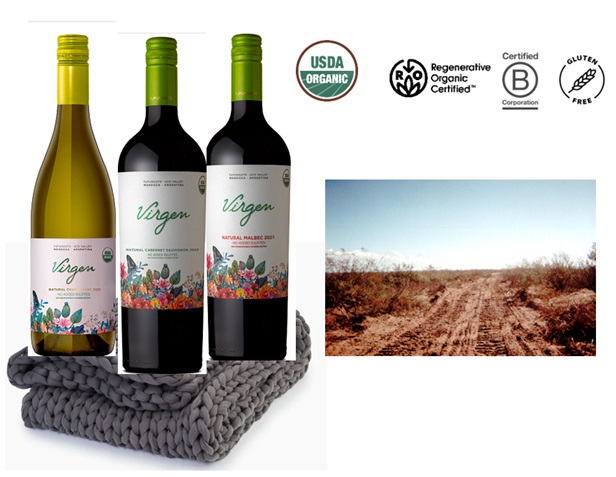 No added SO2.
Organic.
Delicious.
Simple, right?
Organic seems to be the word of the town. Four years ago, in 2019, 6.2% of the vineyards in the world were certified organic. In absolute terms, it doesn’t sound impressive. However, we need to take into account a few factors. First, many vineyards practice organic farming but are not inclined to undergo an official certification process due to the high cost. Second, and probably more important, is that from 2005 till 2019 the organic vineyard plantings increased by 13% per year, compared with non-organic vineyard plantings’ growth rate of 0.4% per year, according to the article in Drinks Business. I have a feeling that the organic vineyard growth could even have accelerated over the last four years, but we will need to wait to see the official data.
But grapes from organic vineyards don’t automatically mean that the wine can be called organic too – this gets a bit tricky, as every country has different rules for what wine can be called “organic” – this is why you can see on many labels the statement “made with organic grapes” instead of simple “organic”.
SO2, an abbreviation for Sulfur Dioxide, is an essential element in winemaking. It is used literally at every stage of the winemaking process because of a few important properties. SO2 is an anti-microbial agent, regulating harmful yeast and bacteria growth in wine. It also has anti-oxidative properties, protecting the wine from oxidation. It is important though that the use of SO2 is not excessive for a variety of reasons – one of such is an allergic reaction it can cause.
So here is the culprit – if you want to import your wine to the USA, and you want to be able to simply state on the label “organic”, you are not allowed to add sulfites (it is okay to add sulfites to the organic wine in Europe and Canada). This doesn’t mean that the wine will have no sulfites – sulfites are a natural by-product of fermentation, and they are always present in wine – but they will be present in minuscule quantities in the organic wines. However, not adding sulfites is not for the faint at heart – considering how many things can go wrong in the winemaking process – this is why today you see the majority of wines labeled with “made from organic grapes”.
Domain Bousquet was founded in 1990 in the high-altitude desert in Tupungato Uco Valley in Mendoza, Argentina, on the pure vision, passion, and conviction of its founder, Jean Bousquet. Jean was told that he is making a mistake of his life when he purchased 1,000 acres of nothing but dry, empty, arid land. Today, Domain Bousquet sustainably and organically farms 667 acres of vineyards, produces 50 million liters of wine, 95% of which is exported to 50 countries around the world, and ranks among the top 20 Argentinian wineries in terms of export. Domaine Bousquet also just extended its leadership in organic winemaking by introducing the wines produced without adding any SO2 – and this is exactly what we are talking about today.
Three new wines were just added to Domaine Bousquet’s collection, under the name of Virgen – Chardonnay, Cabernet Sauvignon, and Malbec. All three are certified USDA organic, unoaked, and have no added SO2. To ensure the proper handling that these wines require, Domaine Bousquet even decided to ship them wrapped in a blanket.
When I received an invitation to review these new wines, my instant inclination was a simple “nope, not doing that”. No USDA organic wines made me excited so far. But the next thought was … well, these are just the samples, it might be interesting – especially if I can compare them with the same wines made in the traditional way – and this is pretty much what I was able to do.

Winemaker Rodrigo Serrano. Source Domaine Bousquet
In my mind, producing wines without SO2 requires a leap of heart. So even before I got the wines, I decided to ask Domaine Bousquet’s winemaker, Rodrigo Serrano, a few questions about his inspiration and goals – here is our short conversation:
[TaV]: You had been farming organically since the beginning, so your wines have always been made from organic grapes. Getting USDA Organic certified is another test, as you now need to certify the entire winemaking process. Why did you decide to opt for this certification?
[RS/DB]: We did it because we had the opportunity to experience it in 2018. Little by little I moved away from the use of SO2, until I suggested trying a wine without using it. I felt like an innovator, without knowing the real magnitude of this.
[TaV]: Virgen wines do not have SO2 added, so special care must be taken during the transport of wines. How did you come up with the idea for a blanket? How does it help protect wines?
[RS/DB]: The theory says that the temperature is very harmful, so in a wine like this, in which there is no protection, extreme care is taken. Today with experience, we understand that both in Virgin and in the rest, the temperature is harmful, so we put the blanket in all shipments. It helps by generating an air chamber between the wall of the transport container and the wine box, obtaining less impact from the outside temperature on our bottles.
[TaV]: What is the expected shelf life of Virgen wines?
[RS/DB]: Initially I was not optimistic, today with more than 5 years of experience, we still have 2018 stock, and it remains correct.
[TaV]: Somewhat related question: Once virgin wines have arrived at someone’s home, how should they be stored? How long can they be stored before having to consume them?
[RS/DB]: It must be stored like the rest, away from light, with a temperature no higher than 20°C and no less than 5°C.
[TaV]: Can “SO2-free” wines age? Did you experiment with that?
[RS/DB]: It is a challenge that we have ahead of us, to work with sulfite-free wines for aging, we are working on it, but for the moment they are only projects.
[TaV]: I see that Domaine Bosquet is not only organic, it is also certified Organic Regenerative. How is Regenerative Organic different from just Organic? What did you have to do to obtain the Regenerative Organic certification? How long did it take you?
[RS/DB]: ROC is something incredible, and for this I recommend watching KISS the Ground. He will answer better than anyone. It took us a few years to certify it, but I don’t work extra, considering that our philosophy coincides 100%
[TaV]: Last question. Far beyond viticulture, Domaine Bosquet is also a certified B Corp. Why did you decide to become a B Corp? Why is this important for you?
[RS/DB]: As with ROC, the coincidence in our philosophy, measuring the social and environmental impact, led us to this certification in a natural way.


Obviously, the proof is in the pudding glass, so next I tasted the wines, and – spoiler alert – was blown away. Here are my notes in the exact order I tasted the wines:
2021 Domaine Bousquet Virgen Natural Cabernet Sauvignon Tupungato Uco Valley Mendoza Argentina (14% ABV, $13, no added SO2)
Dark garnet
Chocolate and tobacco on the nose, a hint of berries
Blackberries, a hint of cassis, black plums, minerally driven, rich and luscious, good structure, crisp acidity.
8, outstanding on its own, and a great surprise as the wine is unoaked.
2021 Domaine Bousquet Virgen Natural Malbec Tupungato Uco Valley Mendoza Argentina (14% ABV, $13, no added SO2)
Dark Garnet
A hint of barnyard upon opening. On the second day barnyard smell disappeared, leaving behind only dark fruit.
On the palate, the wine is just spectacular. Imagine taking a load of perfectly ripe, perfectly crunchy, perfectly fresh berries – blueberries, raspberries, and wild strawberries, and sending it into your mouth – now you know how this wine tastes. Perfect structure, perfect balance, perfect acidity.
8+/9-, kudos to the winemaker.
2022 Domaine Bousquet Virgen Natural Chardonnay Tupungato Uco Valley Mendoza Argentina (13.5% ABV, $13, no added SO2)
Light golden
Asian pear, herbs
The palate is matching the nose, Asian pear, a touch of honey, herbs.
7/7+ first day. The wine somewhat improved on the second day, but overall didn’t go anywhere near the reds
And here is my “Frame of reference”:
2021 Domaine Bousquet Cabernet Sauvignon Reserve Tupungato Uco Valley Mendoza (14.5% ABV, $19.99)
Garnet
Dark berries, cherries
A touch of cassis, eucalyptus, clean, classic, perfectly balanced, good acidity.
8, very good
2021 Domaine Bousquet Malbec Reserve Tupungato Uco Valley Mendoza (14.5% ABV, $19.99)
Garnet
Dark fruit, espressoFresh berries, salivating acidity, medium body, playful, perfectly balanced.
8+, delicious.
Let’s discuss our tasting.
First, both of the no SO2 reds were outstanding. The unadulterated fresh berries are really something to experience when they are delivered in a fully balanced, perfectly structured way. No SO2 Cabernet Sauvignon was perfectly on par with the reserve Cabernet Sauvignon; I liked no SO2 Malbec even more than the reserve version, even though I wouldn’t complain about either. Second, I managed to get the answer to the question about the aging of the no SO2 wines. I left both no SO2 Cabernet Sauvignon and Malbec on the countertop, closing back the screw cap, and the wines were perfectly delicious on the second and third days. In my book, that means that the wines have at least another 10 years of life easily. Not that I’m suggesting that you should age these wines, but it is good to know that you really don’t have to consume them the same day you got them from the store.
Here you are, my friends – organic, no SO2, and delicious. These wines are worth seeking out, whether you care about sulfites or not. And if you have friends who complain about headaches and sulfites – they might love you even more after they will taste these wines. If you had a chance to taste these wines already – let me know what you think!
The Land Whispers… You Just Need To Listen
 I love wine dinners. Especially the wine dinners with the winemaker.
I dread wine dinners. Especially the wine dinners with the winemaker.
I know, I don’t make much sense at the moment. Wine dinners are wonderful, and I really do love them. The dreadful part comes from the experience of not being able to write about those wine dinners in a timely fashion. “Timely fashion”, huh – there are wine dinners I never wrote about in 5 years and such memories can hunt you down – they definitely do for me. I don’t know why this is happening on a regular basis – the elation often experienced during open and engaging conversations about wine becomes an ephemeral spirit, woefully resistful and easily escaping the slightest attempt to capture it in the form of words…
Let’s see if I will be able to break my unsettling tradition.
Last week I had a wonderful time and experience tasting the wines of Viñedos Veramonte and speaking with Gonzalo Bertelsen, General Manager and Head Winemaker in a small group of wine lovers, around the dinner table at the Monterey Brasserie in New York. The conversation topics were ranging from low-alcohol wines (is that really a trend? Are people really asking for it or is that just a gimmick?) to the production of organic and biodynamic wines to “why Germans don’t want to drink organic wines from Chile” (I will not tell you why but you are welcome to guess) and to many other far and between. But most importantly we got to enjoy Viñedos Veramonte wines with and without the food.
Viñedos Veramonte was one of the first wineries in the Casablanca region, founded in 1990 by Agustin Huneeus, a Chilean wine pioneer. From the very beginning, the winery embraced organic viticulture – and more recently, the winery spent more than 6 years making estate vineyards officially organic certified, obtaining ECOCERT® organic certification, one of the most respected in the world. The project involved the conversion of more than 1,200 acres of vineyards in Casablanca and Colchagua valleys to organic and biodynamic farming, with the aim to also become fully Demeter’s biodynamic certified – which requires making changes in the winery, not only in the vineyard – plus importers also have to be biodynamic certified.
Viñedos Veramonte produces 4 distinct lines of wines – Veramonte, Ritual, Primus, and Neyen – all from organic grapes, of course. We had an opportunity to taste wines from all 4 lines.


We started with the 2022 Veramonte Sauvignon Blanc Reserva Casablanca Valley ($13.99 SRP). This wine has one of the biggest productions, and it is very important for Veramonte. Preserving freshness is paramount, so special care is taken to prevent any oxidation of the grapes and juice, and the wine is bottled as soon as possible. The wine was herbaceous and crisp, delicious on its own but also nicely supporting our first course – Grande Plateau of seafood containing oysters, clams, tuna tartare, and lobster. The Sauvignon Blanc pairing with the oysters was the best – and the oysters were delicious, probably my favorite component of the Grand Plateau.


Next, we moved on to the 2019 Ritual Chardonnay Casablanca Valley ($20.99 SRP, fermented in oak barrels and concrete tanks). I wrote about Ritual wines many times, last time only a few months ago – the wines are consistently delicious. The wine was paired with a choice of appetizer – crispy artichokes or barbecued prawns. I selected crispy artichokes, forgetting that artichokes are notoriously difficult to be paired with wine. The dish was delicious on its own, and the wine was also good – on its own.
We also tried the 2020 Primus Carmenere Apalta DO ($20.99 SRP) with our appetizer course. The wine was excellent and had a nice profile of cassis supported by the bell peppers, showing off the pyrazines. Some of the winemakers are trying to prevent the pyrazines from showing up by changing growing conditions, harvesting regime and more – but I personally enjoy the pyrazines’ flavor very much, it adds to the authenticity of the wine. While Carmenere was still not a perfect match for the artichokes, it offered a bit better pairing than the Chardonnay.
Now we were ready for the main course, and the new wine arrived.
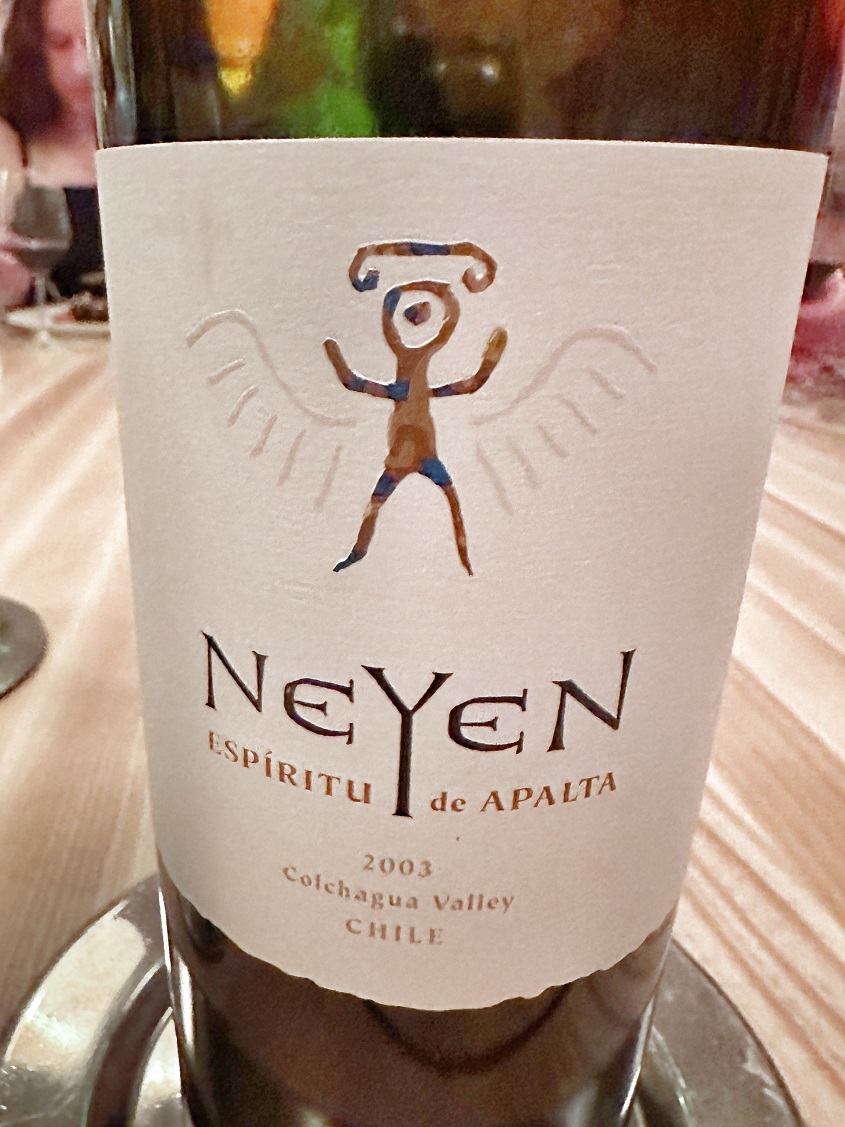


Last December I had an opportunity to try for the first time yet another Veramonte wine called Neyen. Neyen vineyards are located on a small parcel of land situated between the Andes Mountains and the Coastal Range. Neyen wines are literally always a blend of 50% Cabernet Sauvignon and 50% Carmenere, both coming from truly the old vines – Cabernet Sauvignon vines were planted in 1889, joined by Carmenere in 1936, which makes the vines respectively 134 and 87 years old.
In the local dialect, Neyen means “whisper”. The land whispers, you only need to listen to her – low intervention is what the Neyen winemakers practice. And this is the whisper you can taste.
The wine literally stopped me in my tracks. You know that stupid smile that you can’t control when something good is happening? This was my face upon the first whiff of the 2003 Neyen Espíritu de Apalta Apalta DO ($N/A) – the first vintage of Neyen wine ever produced. The time stopped – there was only the endless pleasure of aromatics that only mature wine can bring.
Time, wait. Don’t move. I’m still enjoying it. Please, just a few more moments.
Cassis and eucalyptus on the nose. Cassis and eucalyptus on the palate, silky smooth, perfectly integrated tannins, full body of the mature wine at its absolute peak, pleasure slowly descending layer after layer. This is the case where the words are clearly insufficient to describe the joy of the oenophile, but I hope I offered at least a glimpse.
For the main course, I selected Bluefin Tuna au Poivre with baby beets and citrus sauce – and to my delight, the 2003 Neyen offered a perfect pairing, elevating every bite of the food.
We also had the 2016 Neyen, Espíritu de Apalta Apalta DO ($N/A). Tasting 2016 after 2003 was somewhat of a mistake. 2016 is an excellent wine, but the beautiful core we were able to experience in 2003 was still covered by layers of baby fat, the wine showing a lot richer, almost jammy on the first sip, and in need of time to open up.
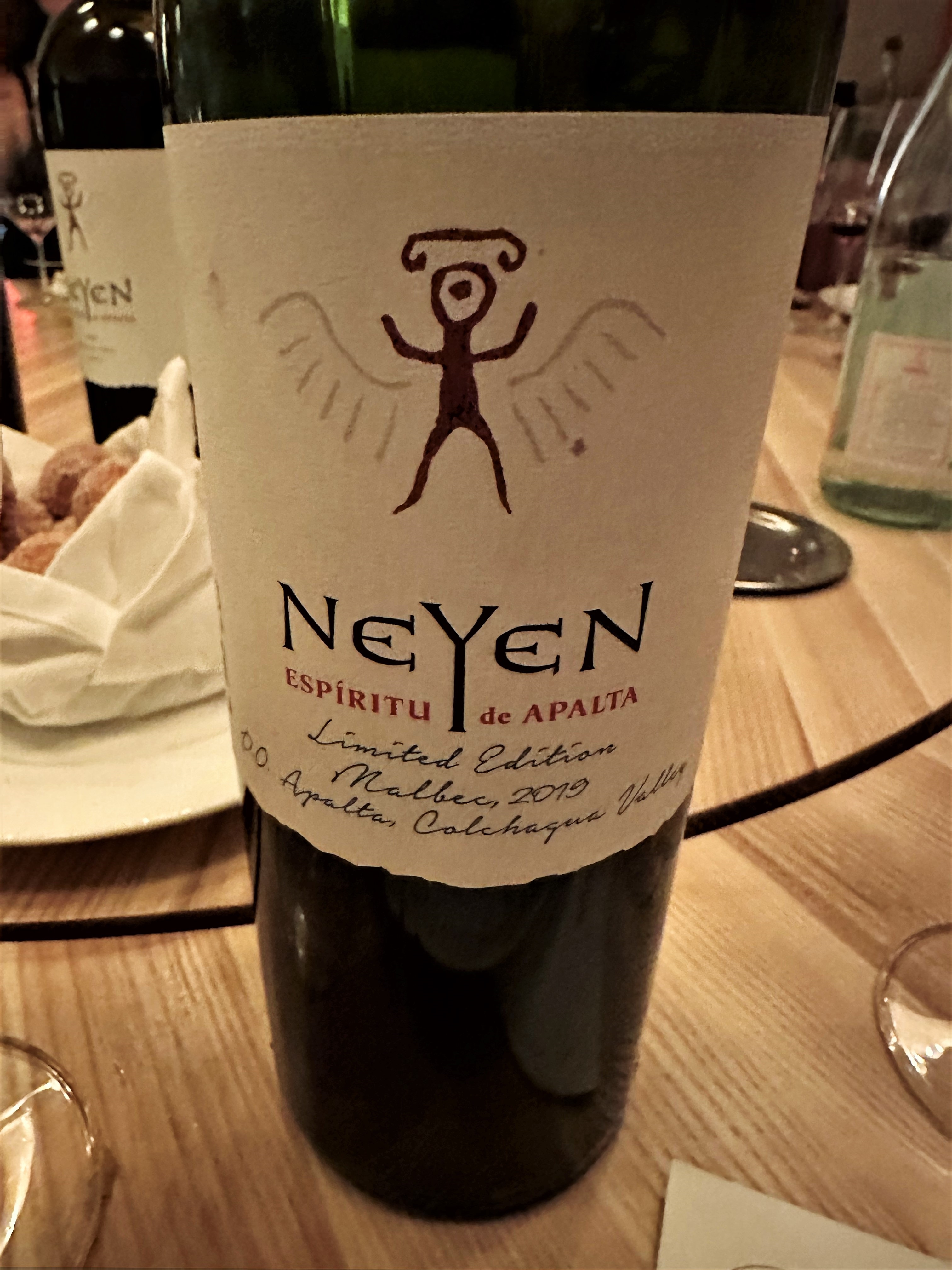
The culmination point of our evening, though, was … a bit unexpectedly, as we are talking about Chilean wines … the Malbec. 2019 Neyen Espíritu de Apalta Malbec Apalta DO ($149.99 SRP). 2016 was the first released vintage of this super low-intervention wine – harvested and destemmed by hand, fermented in small tanks, no machines, no electricity used in the production of this wine, aging only in 3rd and 4th use French oak barrels. This is the crown jewel of the Veramonte Neyen collection – even James Suckling agrees, rating this wine at 100 points. Only 200 cases of the wine were produced in 2019, with the US allocation standing at 40 cases.
The main word I would use to describe this wine would be “elegant”. The wine was showing beautiful eucalyptus notes, a lot leaner than most of the Argentinian Malbecs, begging comparison with old world Malbec, the Cahors. Elegant, layered, delicious.
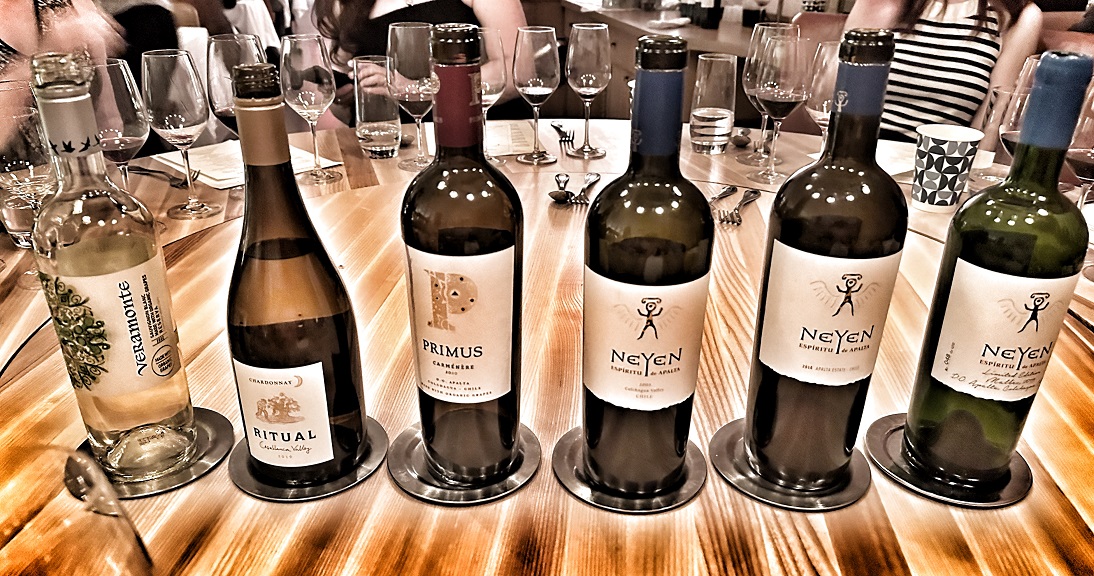
And this, my friends, brings us to the end of the wonderful evening. The company was great, the food was excellent, the wines were amazing.
Mother Nature whispers, and good things happen when we listen. I wish I had a case of this 2003 Neyen Espiritu de Apalta – that would really make me happy. Well, we generally don’t get to have all the things we want – and I’m grateful for the opportunity to experience such wines at least once.
Veramonte wines offer a great selection for every budget and every palate – check them out when you will have a chance. Cheers!
Chilean Sauvignon Blanc – The Adulthood
This post was supposed to be written last year… And then I almost made it in time for the Sauvignon Blanc day which was celebrated two days ago, on May 6th. Well, it is definitely a “better late than never” post, so for what it worth, let’s dive into it…
Today, friends, we are going to talk about Sauvignon Blanc.
If I would just “shoot from the hip”, Sauvignon Blanc doesn’t stand up as a grape with tremendous clout. Yes, it is one of the three major white wine grapes, along with Chardonnay and Riesling. And yet if there were a grape popularity contest, I would guess the championship would be decided between Cabernet Sauvignon and Chardonnay. Of course, Pinot and Syrah would-be contenders, but I still think the former two are really at the top of wine lovers’ minds.
But let’s take a closer look at Sauvignon Blanc. There is hardly a wine region in the world where Sauvignon Blanc is not growing – no point in recounting them, Sauvignon Blanc is successfully growing everywhere. Sauvignon Blanc makes sparkling, still, and dessert/late harvest wines. It shines solo everywhere, and I’m not talking about “usual suspects” – Sancerre, New Zealand, Chile, California – but I’m talking about some of the world’s best producers. Screaming Eagle, the “cult of the cults” producer in Napa Valley makes Sauvignon Blanc which is more allocated than their Cabernet Sauvignon. Gaja Alteni di Brassica and Poggio alle Gazze dell’Ornellaia, two of the 100% Sauvignon Blancs from Italy – I hope these names need no introduction. Let’s not forget the “Y” dry wine produced by Sauternes legend, Chateau d’Yquem. And then of course, there are countless blends… Sauvignon Blanc is everywhere.
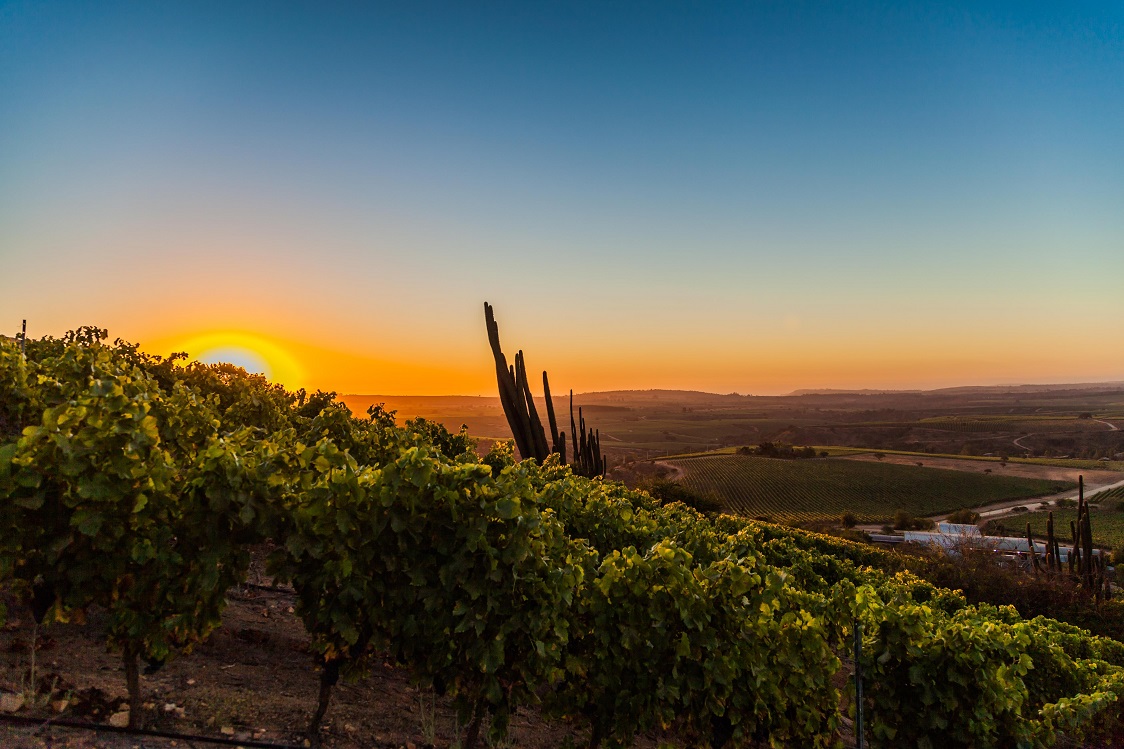
Garces Silva vineyard at sunset credit Jody Hortons
Never mind the blends – let’s talk about pure Sauvignon Blanc wines. In my opinion, there are 4 main distinct styles of Sauvignon Blanc – as there are 4 main production regions that we already mentioned – Sancerre, New Zealand, Chile, and California (Napa Valley primarily). Maybe I should say “there used to be” 4 main styles… In the old days, Sancerre could be identified by aromas of cat pee and freshly cut grass. New Zealand Sauvignon Blanc had a currant profile with currant leaves showing very well. It was popular to refer to the main component of the New Zealand Sauvignon Blanc profile as Gooseberry – I remember wine critics angrily saying that 90% of those who use the descriptor never tasted gooseberry in their lives. Chilean Sauvignon Blanc was similar to New Zealand, only shifting more towards grapefruit and a bit more sweetness in the profile. All three (Sancerre, New Zealand, and Chile) have changed today. And only Napa Valley style has not changed since the moment I tasted Napa Sauvignon Blanc for the first time – freshly cut grass is weaved together with bright but not sweet fruit – it is succulent, it is seductive, it is “in-your-face-beautiful-and-not-ashamed-of-it” – but we will have to talk about Napa Sauvignon Blanc some other day.
For a long time, New Zeland Sauvignon Blancs were consistent, with only Cloudy Bay standing apart from the rest, in a very delicious way. Then New Zealand decided to look for a new Sauvignon Blanc identity at some point, and I had an opportunity to taste this “new identity” at a tasting 8 years ago – it was an interesting experience, please read my notes if you are interested. I don’t know if the Chilean wine industry is closely following New Zealand, or if is this just a common trait of growing up, but this brings us to today’s subject – Chilean Sauvignon Blanc wines.
Compared to the Cabernet Sauvignon, the Chilean staple, Sauvignon Blanc is a very young grape. The first plantings of the Cabernet Sauvignon in Chile go back to the middle of the 19th century. The story of Sauvignon Blanc in Chile only started in the late 1970s. In 1978, there was a total of 8,154 acres of Sauvignon Blanc in Chile, accounting for 3.1% of all grape plantings (land under vine), mostly concentrated in Maule Valley. In the 1980s, new plantings of Sauvignon Blanc started to appear in the coastal regions of Casablanca, as well as Coquimbo, Valparaíso and O’Higgins. Coastal areas offered cooler weather, which brings herbal, citrussy expression with cut-through acidity in Sauvignon Blanc, contrasting with the areas with a continental climate, known to bring those grapefruit/tropical fruit notes I mentioned before as an old signature of Chilean Sauvignon Blanc.

Ventisquero vineyard. Source: Viña Ventisquero
Going beyond just new cooler coastal areas, winemakers also started paying attention to the inherent grape qualities, by choosing to experiment with different clones. Of course, it is only fair to assume that clonal selection is not just Pinot Noir or Chardonnay prerogative – nevertheless, until I started working on this article, I had no idea that Sauvignon Blanc clones are even a thing. Turns out that Davis Clone (#1) is known to impart citrusy qualities, Sancerre Clone (#242) is more herbal and fruity, and then there are other popular French clones #107, #241, and #317.
Today, Sauvignon Blanc is the second most planted grape variety in Chile with 37,614 acres under vine in 2019, accounting for 40% of all white grapes plantings. Sauvignon Blanc is the second most widely produced wine in Chile, with 13% of all the Chilean wine production volume (based on 2021 data). The majority of the Sauvignon Blanc plantings are now located in the coastal regions. Chilean Sauvignon Blanc has definitely grown up and it is ready to conquer the world.
To make the encounter with modern Chilean Sauvignon Blanc wines more practical, I had an opportunity to taste 8 Sauvignon Blanc wines, all coming from different producers and representing a number of regions. Here are my notes:

2021 Montes Sauvignon Blanc Limited Selection Leyda Valley DO (13.5% ABV, $15) – Montes is a very interesting winery in general – I had an opportunity to speak with the winemaker, and to learn more about the winery, you might want to read part 1 and part 2 of our conversation. Sauvignon Blanc grapes used in this wine, clones 1 and 242, were harvested from the vineyard located about 9 miles away from the Pacific Ocean on the western slopes of the Cordillera de la Costa mountain range.
Greenish pale
Inviting nose of fresh berries, grass, cassis leaves, some tropical fruit undertones, Napa SB-like presentation
Fresh, vibrant, tart, lean, lemon, a distant hint of freshly cut grass – truly refreshing on a hot day. Delicious.
8+, superb. Nicely complements creamy goat cheese.
2020 Casas del Bosque La Cantera Sauvignon Blanc Las Dichas Casablanca (13% ABV, $18) – Casas del Bosque is one of my favorite Chilean producers, I had a number of their wines on different occasions. The grape for this wine came from the vineyard located about 10 miles away from the Pacific Ocean, located on the mountain slopes.
Greenish pale
Freshly cut grass, green herbs, medium+ intensity, cassis leaves
Clean, light, good acidity, herbaceous profile, a touch of freshly cut grass. Lean.
8, excellent wine.
2021 Viña Koyle Costa La Flor Sauvignon Blanc San Antonio Leyda (12.5% ABV, $18, organic grapes) – Viña Koyle is one of the well-known Chilean organic wine producers – I had an opportunity to try some of their wines last year while working on the Chilean wines sustainability story last year. The grapes for this wine, clones 1 and 242, came from the vineyard located 5 miles away from the Pacific Ocean. The wine was aged for 4 months on the lees to soften the sharp acidity – as you can see in my notes below, cut-through acidity was still acutely present.
Light golden
Very restrained, distant hint of peach and guava
High acidity, a touch of freshly cut grass which quickly dissipated just leaving a tart finish.
8-, will be interesting with seafood.
2020 Viña Garcés Silva Amayna Sauvignon Blanc Leyda Valley DO (14% ABV, $25) – the grapes were harvested at the vineyard located 8.5 miles from the Pacific Ocean. The wine was aged for 6 months on fine lees.
Greenish pale
A hint of freshly cut grass
Tropical fruit profile with a hint of sweetness and a touch of grass
8-, nice
2020 Matetic EQ Coastal Valle Hermoso Casablanca DO (13.5% ABV, $20) – grapes for this wine came from the biodynamic vineyard in the Rosario Valley in Casablanca, just 3.5 miles away from the ocean.
Straw pale
Steely undertones, a distant hint of gunflint, a touch of lemon
Whitestone fruit, herbs, a touch of cassis leaves, finish is round and gorgeous with a whiff of freshly cut grass. Reminiscent of the Italian renditions of Sauvignon Blanc such as Ornellaia and similar.
8+/9-
2019 Viña Ventisquero Grey Glacier Sauvignon Blanc Atacama Valley (13% ABV, $25) – yet another winery I’m well familiar with. Curious fact – founded in 1998, Viña Ventisquero is turning 25 this year. The vineyard where the grapes for this wine came from is located 15 miles away from the ocean and in the middle of the Atacama desert, taking full advantage of the poor soils. The wine was aged in foudres to enhance its texture and improve aging capabilities.
Greenish pale
A hint of gunflint, earthy undertones, Dias tang hint of lemon
A hint of gunflint, crisp, clean, refreshing, clean acidity on the finish, nice textural presence with some salinity – should be a great oyster chaser.
8/8+, excellent
2021 Viña Tabali Talinay Sauvignon Blanc Valle de Limarí DO (13% ABV, $24) – the vineyard, called Talinay, eponymous with the mountain ridge where it is planted, is located 7 miles away from the ocean.
Greenish white
Minerally-driven nose, limestone, lemon, medium+ intensity
Crisp, fresh, lemon, minerality, a tiny hint of fresh cut grass which comes and goes.
8, this wine is asking for food. I want oysters… works well with Boursin cheese
2020 Viña Morandé Sauvignon Blanc Gran Reserva Casablanca Valley DO (13.5% ABV, $20, 12 months aged in oak foudres and concrete eggs) – Pablo Morandé was a Casablanca Valley pioneer, who started planting Sauvignon Blanc in the 1990s. Grapes for this wine came from Belén vineyard is in the Lo Ovalle region, 14 miles away from the ocean.
Straw pale
Fresh-cut grass with herbal undertones and minerality, sapidity (almost “meaty” smell if it makes any sense)
Clean, crisp palate, freshly cut grass, lemon, crisp acidic finish.
8, elegant and balanced.
Here you are, my friends. Beautiful, minerality-driven, world-class wines, with their own unique and delicious expressions. As you can tell from my notes, the tasting was 8 out of 8 success, which is generally not given.
I don’t know what is your take on Chilean Sauvignon Blanc and when did you taste it last time – it is definitely worth revisiting. and get ready to be pleasantly surprised.
Made With Organic Grapes: Viñedos Veramonte
“Made with organic grapes”. If you see these words on the wine label, are you more inclined to buy it, less inclined, or indifferent? Are you willing to pay more for the organic bottle of wine, as we accustomed now for the meat and produce?
Organic production implies that no synthetic pesticides, fungicides, insecticides were used in farming. It doesn’t mean that no pesticides etc. were used at all – it only bans the use of synthetics, and natural pesticides, etc. can still be used. Truth be told, organic doesn’t automatically mean better for consumers or the environment – even natural pesticides can have bad consequences – you can learn more in this excellent in-depth article.
When talking about organic wines, we need to keep in mind that “organic” is only a part of the story of the “better wines”. Sustainable viticulture, which doesn’t always overlap with organic, and then biodynamics, which again may or may not intersect with the other two, are important to take into account when talking about wines that are better for humans and the environment. Though considering the title – made with organic grapes – let’s stick to that part of the story.
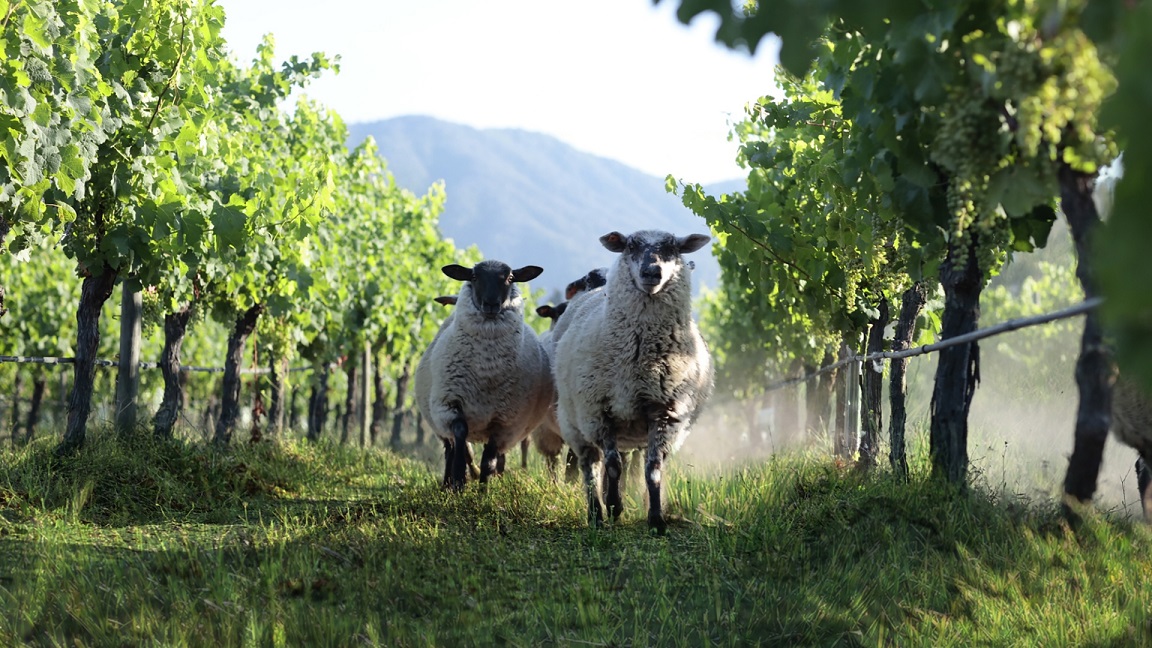
How to convey the organic farming concept in one picture. Source: Viñedos Veramonte
I remember the early days of seeing “organic” on the wine labels. Most of the organic wines I tasted 10-15 years ago were undrinkable. The “Organic” label is a big selling factor in itself, and I can only assume that some of the winemakers decided that good tasting wine is not a necessity if the wine is labeled as organic (I will refrain from putting names on the table, even though it is difficult to resist the urge). Even today, when “organic” designation is not just a marketing gimmick (in most of the cases), wine consumers seek first familiar producers, grapes, and region – the “organic” designation comes to a play only after all other requirements had been satisfied, as a “nice to have”. Of course, in the world of wine, most of the concepts are multidimensional, so I don’t want to oversimplify the “organic wine” – it goes well beyond of choice of pesticides and fertilizers, it also includes “no added sulfites” and other factors – but then again this is not the organic wine 101 post, so let’s leave this discussion for some other time too.
Lately, I tasted quite a few of the organic wines and was pleasantly surprised not only with the taste but also with the QPR (Quality Price Ratio) – while labeled “organic”, most of the wines didn’t command the premiums on the scale of organic apples or meat, and thus offer a great QPR. Here I want to share with you my encounter with delicious organic wines suitable for any budget. Let’s talk about it.
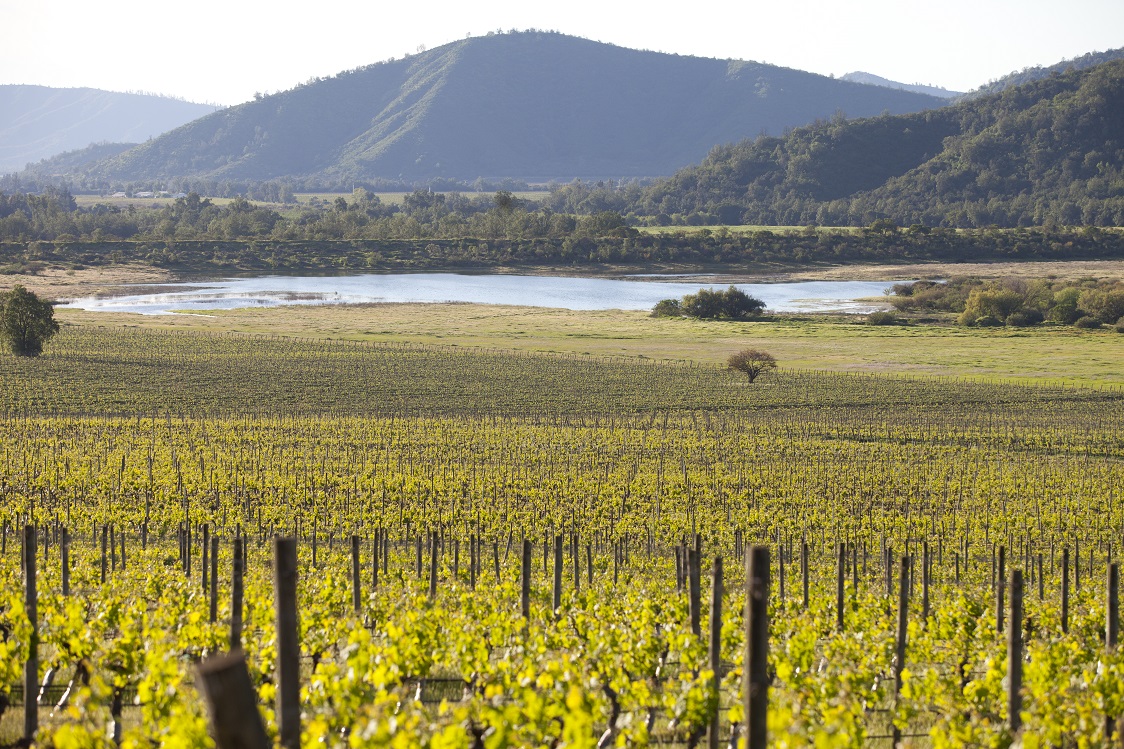
Source: Viñedos Veramonte
Agustin Huneeus, a Chilean wine pioneer, planted 100 acres of Sauvignon Blanc in the northern part of Casablanca valley in the late 1980s. In 1990, he founded Viñedos Veramonte, which became one of the first wineries in the region. From the moment the winery was found, the focus was on growing grapes in harmony with nature. After 6 years of hard work, in 2019, the winery obtained ECOCERT®organic certification, one of the most respected in the world. The project involved the conversion of more than 1,200 acres of vineyards in Casablanca and Colchagua valleys to organic and biodynamic farming, with the aim to also become fully Demeter’s biodynamic certified. The organic practices don’t stop at the vineyard – natural yeast and low intervention methods are used to produce the wine.


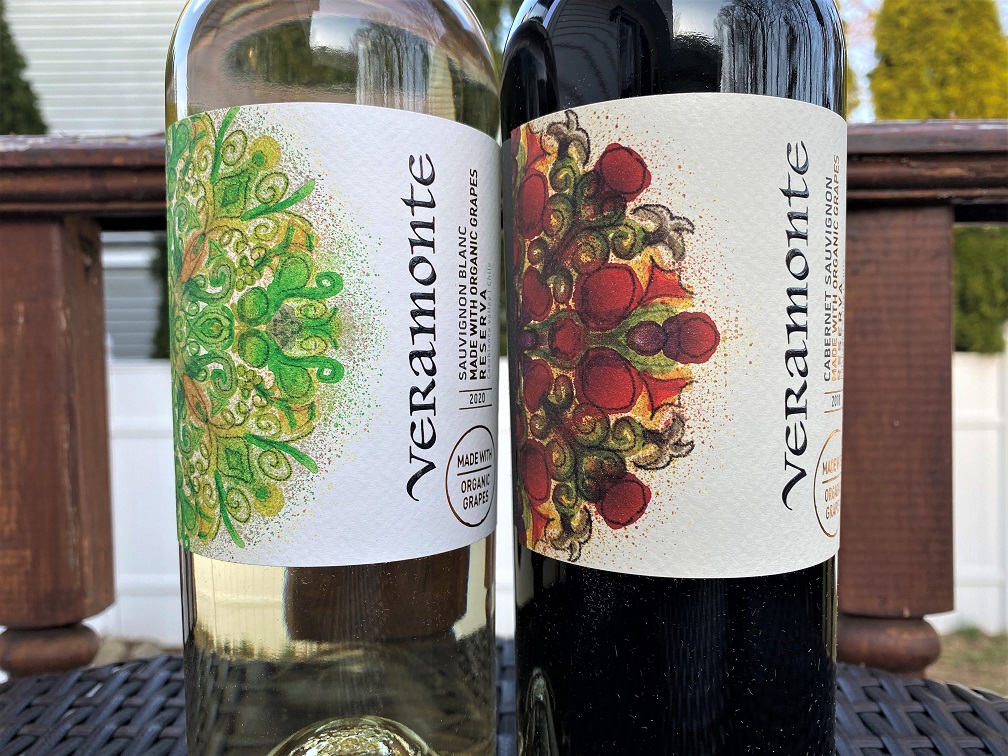
Can you taste all this care and attention in the glass? I think you can. I had the pleasure of trying a number of Veramonte wines (samples), and I think they were consistently delicious while offering an unbeatable QPR – see for yourself:
2019 Veramonte Sauvignon Blanc Reserva Casablanca Valley (13.5% ABV, $11.99, Vegan, organic grapes)
Straw pale
Distant hint of Whitestone fruit, a touch of cassis
Crisp, fresh, creamy, lemon notes, a touch of herbs – excellent
8/8-, perfect for summer, perfect for winter.
2020 Veramonte Sauvignon Blanc Reserva Casablanca Valley (13.5% ABV, $11.99, organic grapes)
Straw pale color
Touch of freshly cut grass, cat pee, medium+ intensity
Creamy and balanced on the palate, lemony acidity, freshly cut grass, elegant, restrained.
8/8+, outstanding.
2018 Veramonte Pinot Noir Reserva Casablanca Valley (14.5% ABV, $12.99, 8 months in oak, organic grapes)
Pale Ruby color
Touch of smoke, earthy undertones, classic Pinot
After about an hour – plums, earthy, medium body, well present sapidity, good acidity, good balance
8-, nicely drinkable
2018 Veramonte Carménere Reserva Casablanca Valley (14% ABV, $11.99, organic grapes)
Dark garnet, practically black.
Mint, black currant leaves
Black currant, coffee, very focused, good acidity, the wine shows tight, like a spring ready to snap.
8-, herbal notes are prevalent. Will see how it will be on the second day.
Second day- very concentrated, espresso, cherry pit. Good balance, but asking for the food to pair.
2019 Veramonte Cabernet Sauvignon Reserva Colchagua Valley (14% ABV, $11.99, 8 months in French oak, organic grapes)
Dark garnet
Cassis, a touch of bell pepper
Cassis and bell pepper on the palate, good balance, good acidity, medium body.
8, very enjoyable.
When it comes to organic wines, Viñedos Veramonte delivers wines you can drink every day and feel good about yourself, nature, and your wallet. Isn’t that a great combo?
What do you think of organic wines? Do you actually seek them out? Do you have any favorites?
In Rhythm With The Earth – Hawk and Horse Wines
 Wine is Art.
Wine is Magic.
Wine is a Mystery.
When you drink wine for pleasure (don’t take it for granted – there are many reasons why people drink wine – to fit into the crowd, to be socially accepted, to show your status – drinking for pleasure is only one of the reasons), mystery, art, magic – call it whatever way you want, but it all comes to a play when you take a sip. Wine is a complete mystery as you have no idea what will be your conscious and subconscious reaction to the experience of that sip – what memories will come to mind? What emotions will take you over? The magic is there, waiting for you in every glass of wine.
The magic and mystery in wine go well beyond that sip. “Well before” might be a better descriptor though. The creation of the delicious bottle of wine is not an exact science. It is an art. It is magic. It is a mystery. Mother Nature, who gifts us grapes, never repeats itself. Every year, every vintage is different. Every day of the growing season never repeats itself. It is up to the craft, the skill of the grape grower and the winemaker to create the wine which can magically transport you. And this magic starts in the vineyard.
I’m about to step into the controversial, really controversial space – the biodynamics. As I’m not an expert on the subject by any means, let me just share the definition of biodynamics from the Oxford Languages. Actually, here are two definitions:
Biodynamics is
1. The study of physical motion or dynamics in living systems.
2. A method of organic farming involving such factors as the observation of lunar phases and planetary cycles and the use of incantations and ritual substances.
It is the second definition that is interesting for us. And it is the last part of that definition, “the use of incantations and ritual substances”, which makes biodynamics so controversial for many people – I’m sure you heard of cow horns filled with manure and buried in the vineyard as part of biodynamic farming. Is that magic or pseudoscience? This is the question I don’t care to answer or get an answer for. Taken out of the context, that might sound strange. But the whole point of biodynamics is in creating a healthy ecosystem of the living things – bacteria in the soil, plants, vines, grapes, animals – everything should co-exist in harmony with each other and the Earth, create a habitat where the problems take care of themselves (magic!). When the vineyard is farmed biodynamically, it simply means that the grapes will be produced in the most natural way with the utmost attention on the health of all the elements of the ecosystem.
Delving into the depth of biodynamics rules is completely outside of the scope of this post – if you want to further your knowledge of biodynamics, there is no shortage of great books, articles, and blogs. My reason to share the excitement about biodynamics is simple – tasty wine.
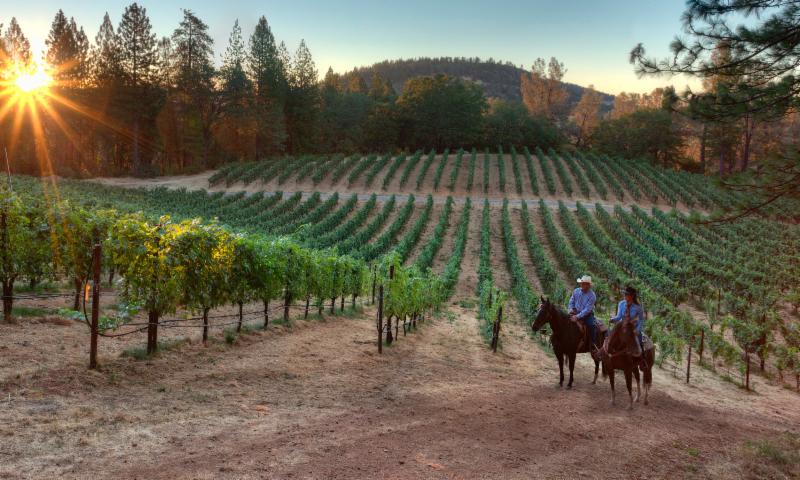
Source: Hawk and Horse Vineyard
Hawk and Horse Vineyards started as the dream of David Boies, who purchased an abandoned horse breeding farm in Lake County in California. His partners Mitch and Tracey Hawkins planted the first vineyard in 2001 in the red rocky volcanic soil, at an elevation of 1,800 to 2,200 feet. The first wine, released in 2004, was a great success. The 18 acres farm became California Certified Organic (CCOF) in 2004, and biodynamic Demeter-certified in 2008. If you want to have an example of what biodynamic farming is, you can read about the Hawk and Horse Vineyard biodynamic practices here – it will be well worth a few minutes of your time.
Hawk and Horse Vineyard grows primarily Bordeaux varieties. I had an opportunity to taste (sample) 5 wines from Hawk and Horse Vineyard, and I was literally blown away from the very first sip I took (magic!). Here are the notes:
2017 Hawk and Horse Vineyards Cabernet Franc Red Hills Lake County (14.3% ABV, $65, 100% French oak (40% new), 150 cases produced)
Garnet color
Wild strawberries, mint, mineral notes
Cassis, fresh black berries, sweet tobacco, well-integrated tannins, firm, tight, perfect structure, excellent balance. Worked perfectly with the steak.
Drinkability: 8+, wow
2017 Hawk and Horse Vineyards Petite Sirah Red Hills Lake County (14.1% ABV, $65, 100% French oak (40% new), 150 cases produced)
Garnet
Tobacco, earth, sandalwood
Silky smooth, round, tart cherries, perfect acidity, dark and powerful, perfect balance.
Drinkability: 8+
2017 Hawk and Horse Vineyards Petit Verdot Red Hills Lake County (14.1% ABV, $65, 100% French oak (40% new), 90 cases produced)
Dark garnet
Cherries, eucalyptus
Tart sweet cherries, dark fruit, dry tannins, firm structure. Super enjoyable over 3 days, the addition of tobacco and sweet dark fruit with balancing acidity. Succulent. Superb.
Drinkability: 8+
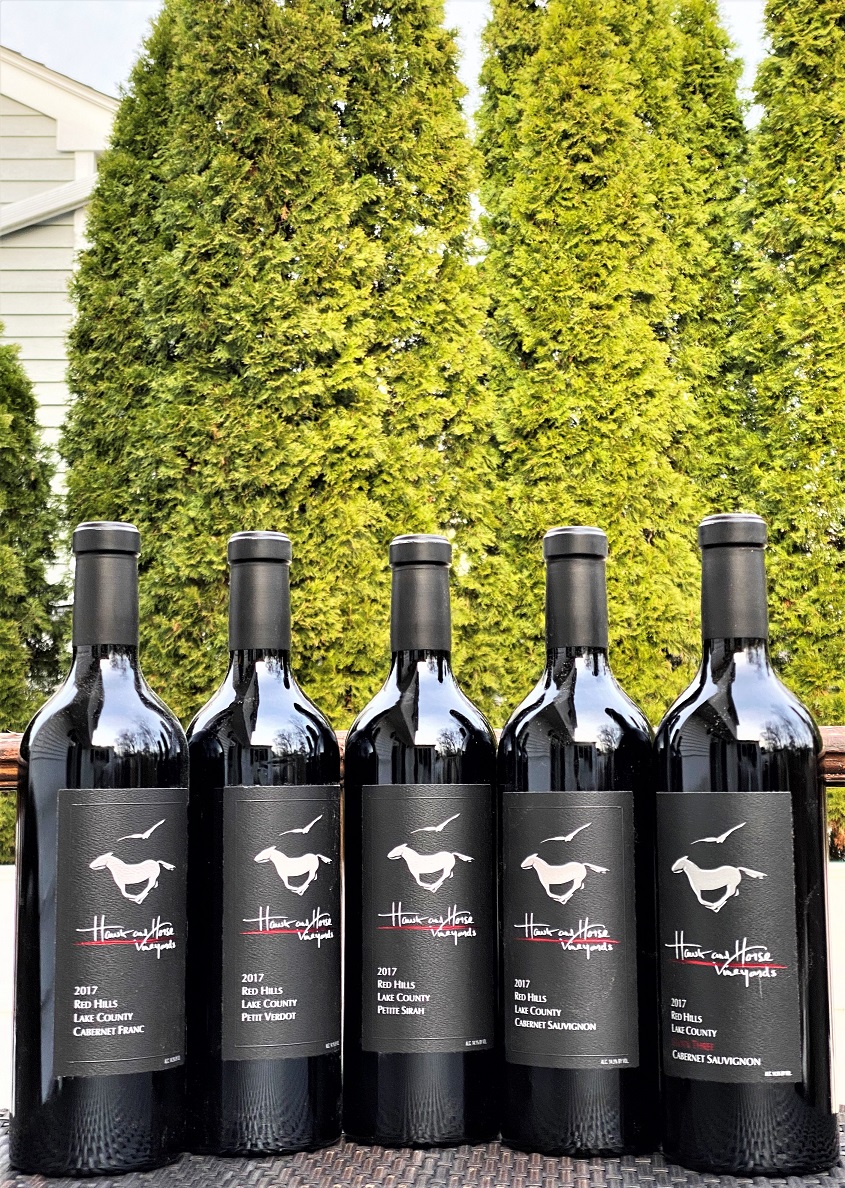
2017 Hawk and Horse Vineyards Cabernet Sauvignon Red Hills Lake County (14.3% ABV, $75, 98% Cabernet Sauvignon, 2% Petit Verdot, 100% French oak (80% new), 1800 cases produced)
Dark garnet
Earthy flavors, eucalyptus, a hint of cassis
Good acidity, well-integrated tannins, the lightest wine so far.
3 days later ( no air pumping, just reclosed)
The nose has a similar profile (cherries, eucalyptus, mint), maybe a touch higher intensity
Delicious on the palate, dark well-integrated fruit, firm tannins, tight core, lots of energy, a hint of espresso, perfect balance, medium-long finish.
This wine can be enjoyed now, especially with food. Or left alone for the next 15 years. Your choice.
Drinkability:8+
2017 Hawk and Horse Vineyards Cabernet Sauvignon Block Three Red Hills Lake County (14.3% ABV, $60, 85% Cabernet Sauvignon, 10% Petit Verdot, 5% Cabernet Franc, 100% French oak, 150 cases produced)
Dark garnet
Warm, inviting, succulent cherries, a hint of bell pepper, very delicate. Overall, ripe Bordeaux nose
It took this wine 4 days to fully open up. Bordeaux style, ripe berries with herbal undertones, well-integrated tannins, soft and dreamy.
Drinkability: 8/8+
Cabernet Franc, Petit Verdot, and Petite Sirah were absolutely delicious from the get-go. Both of the Cabernet Sauvignon wines, coming from the same vineyard and the same vintage really needed time – I don’t know if the type of oak used can make such a difference, but from my observations, it was clear that using more of the new oak made the wine a lot more concentrated and requiring the time in the cellar.
Here it is, my encounter with [magically], [mysteriously] delicious biodynamic wines. What do you think of biodynamics and biodynamic wines? What do you think of the magic of wines (no, you don’t have to answer that 🙂 ). Cheers!
Daily Glass: An Australian Score
I pride myself with very wide wine horizon. I scout wines from literally everywhere in the world – China, Japan, Croatia, Bulgaria or Hawaii – bring it on, the more obscure, the better, I will be happy to try them all.
Nevertheless, a majority of my daily drinking evolves around Italy, Spain, and California, with a little injection of France. The rest of the wine regions make a very sporadic appearance at our house – without any prejudice or malicious intent – just stating the fact.
Nevermind China and Japan, which are still going through an adolescence as wine producing countries – let’s talk about Australia instead. About 20 years ago Australia was leading wine imports in the USA. As you would enter a wine store, you were greeted with countless Australian wine selections.
Today, Australian wines are relegated to the back shelves, and they are definitely not on top of the wine consumer’s mind (in the USA for sure). Ups and downs are hard to analyze in the wine world (think of the devastating effect of the movie Sideways on Merlot consumption), and such an analysis is definitely not the point of this post, no matter how interesting such a discussion could’ve been.
As I stated before, Australian wines are rare guests at our table, and this is not deliberate – I enjoyed lots and lots of excellent Australian wines, and have an utmost respect to what this country can deliver. I’m always ready to seize an opportunity to try an Australian wine, especially if it comes with a recommendation.
Such recommendation can present itself in lots of different ways – a friend, a magazine, an Instagram post, a tweet – or an offer from the Last Bottle Wines, especially during the Last Bottle’s infamous Marathon events. During the Last Bottle Marathon, you can buy the wines in single bottle quantities, which I like the most as you can create your own tasting collection quickly and easily.


If the wine is offered for sale by the Last Bottle, it definitely serves as an endorsement for me. The folks at Last Bottle know the wines – if they offer something, it means the wine really worth trying. During the last Marathon, the 2015 Gemtree Uncut Shiraz McLaren Vale (14.5% ABV) attracted my attention. I don’t know what made me click the “buy” button – the name “Gemtree” (sounds interesting, isn’t it?), or the word ‘Uncut” (again, this somehow sounds cool to me as well), but I did click that button quickly. You see, you only have a split second to get the wine – you blink, you lose – and I scored the bottle of this Australian Shiraz.
I pulled the bottle from the wine fridge, twisted the top and poured into the glass. Dark ruby color, a whiff of the blackberries. The palate had a tremendous amount of salinity over the crunchy blackberries – I guess this was an effect of drinking this wine at a cellar temperature. But it was still attractive. While admiring the simple label I saw the word which made me very curious – “Biodynamic”, and then the back label provided lots more information about how this wine was made. To me, “sustainable” is a very important wine keyword, and whatever extras “biodynamic” entails, the biodynamic wine is always a sustainable wine – and it is definitely important for me.
After warming up, the wine became generous, layered, showed soft tannins and perfect crunchy backbone of dark fruit with some dark chocolate notes and touch of a spicy bite – all perfectly balanced and delicious (Drinkability: 8+). The name “Gemtree” kept me intrigued, and the picture on the label was very attractive in its simplicity, so I went to the Gemtree Wines website to learn a bit more. I rarely quote from the winery websites, but I think in this case this is quite appropriate (here is the link to the source):
“This is our Gemtree story…
There was once a tree. Not the tallest tree, nor the oldest tree, but a tree that had put its roots in just the right part of the paddock. Here the soil was deep and layered – sometimes hard and rocky, elsewhere soft and sandy – and the wind had just enough room to move, and even the rain – when it was kind enough to visit – would fall evenly and gently.
Because of its favoured position, the grasses grew tall against its trunk, and the wild flowers were easily encouraged to grow closely around it, and the insects and birds that looked to trees for shelter and for vantage, eagerly moved in.
One day a farmer approached the tree and wondered: “You do not grow the strongest, nor the fastest, so why is it that you grow the best fruit?”
The tree let the answer whisper through the wind in its branches: “If I am shown a patient mind and a gentle hand, if I am left to follow the rhythms of my seasons – to rest in Winter; to revive in Spring; to make busy in Summer; and to provide in Fall – then I can offer fruit that tastes not just of the ground upwards, but also of the sky downwards, and of everything around me.”
The farmer thought to himself: “This is truly a Gemtree – it takes only what it can give back to the land, it contributes to its surroundings, and it provides for those that live around it.”
This is the heart of the Gemtree story: growing better wine ~ naturally.“
Here you are, my friends. I don’t know how often you drink Australian wines, but Gemtree is definitely the name to keep in mind for your next round of wines from down under – I think you will be happy with your score. Cheers!
Last Bottle Sign Up ($10 credit)




 Talk-A-Vino