Restaurant Files: Tabard Inn in Washington DC
 Do you like restaurants with charm? In a lot of cases, people go to the restaurant for the good food and good service. Don’t get me wrong – these are my priorities too. But for me, experiencing a pleasure of just “being inside” is a great bonus too. You walk in, just glance around and say “ahh, I like it here” – this is what I mean by “charm”. You are at the restaurant, waiting for your dining companions to arrive, then you are walking to your table, get seated and situated, and all that time you are thoroughly pleased with surroundings and the atmosphere – I hope you get what I’m talking about here.
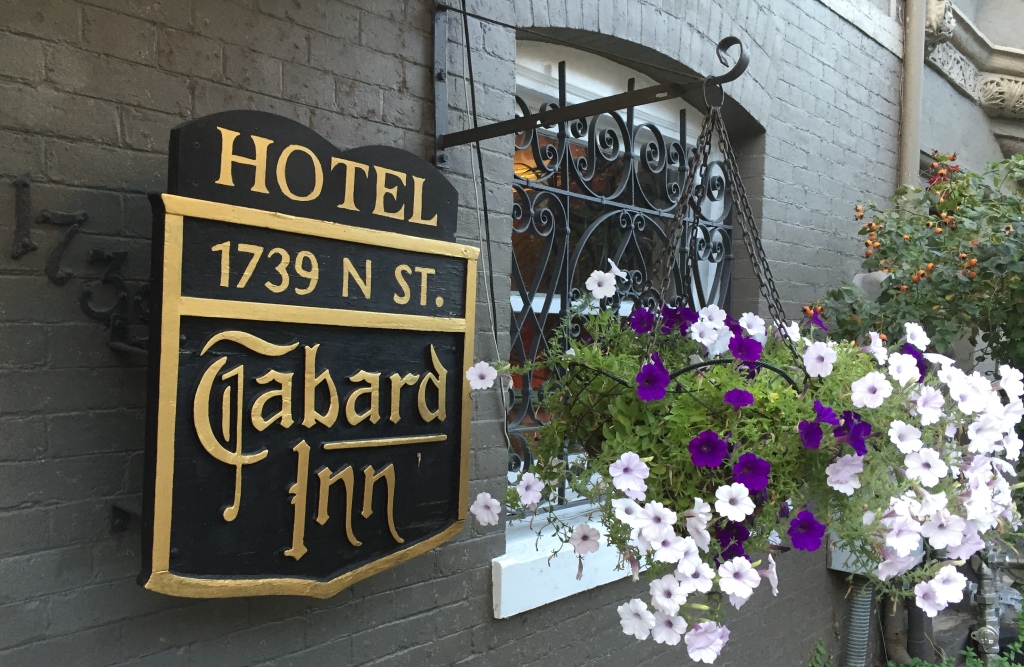
If you happened to be in the Washington DC, and would like to visit a restaurant with the charm, I got a recommendation for you – Tabard Inn Restaurant in the area known as Dupont Circle. The restaurant is located inside of the actual hotel (I would designate it more as a B&B) under the same name – Tabard Inn, with the rooms available throughout the three adjacent townhouses – but as I didn’t have a pleasure staying there, we are, of course, will be talking only about the restaurant.
I’m assuming you got my point about the atmosphere and ambiance (relaxing, pleasant, “old glove” comfortable), so let’s talk about food and wine – starting with the wine of course. I really liked the wine list at Tabard Inn – lots of good selections with reasonable prices. The wine list was well rounded internationally, so we managed to make two very interesting ( and highly successful!) choices. For the white, we had 2013 Sigalas Santorini Assyrtiko Santorini, Greece (14% ABV, 100% Assyriko, $55 at the restaurant). The group I was dining with typically prefers red wines. However, after trying this wine, the waiter had a hard time to keep the open bottle on the table – the wine was disappearing very quickly. Delicious nose of the white fruit, same white fruit on the palate, crisp, refreshing, medium-bodied, perfectly round – this was one excellent wine (Drinkability: 8).


I managed to surprise myself with the choice of red. It is seldom that I would consciously choose Bordeaux at the restaurant, don’t ask me why. Somehow this wine caught my eye – 2006 Bordeaux for $52. 2006 was a good year in Bordeaux, so why not? When the wine arrived, there was a nice surprise – it was from even a better vintage, one of the best from the 2000 decade – 2005. 2005 Chateau La Croix St André, Lalande-de-Pomerol (13% ABV, 80% Merlot, 20% Cabernet Sauvignon and Cabernet Franc), was at the peak of maturity. Stunning depth of dark fruit with spices, black currant, eucalyptus, classic, concentrated and delicious (Drinkability: 8+).
While Tabard Inn restaurant is not necessarily advertised as “farm-to-table”, the menu is focused on the seasonal ingredients and changes all the time. As the group, we usually like to share some appetizers, but somehow this time around, everybody were really focused on conversation (and the wine 🙂 ), so pretty much no food sharing took place. That simply means that I can only tell you about the dishes I selected for my dinner.


For the appetizer I had Tuna Tartar – very tasty, served with the sesame crisps. My main dish was Gumbo (Andouille sausage, shrimp, chicken confit, swordfish, fried oysters) – overall it was tasty, but when I hear “Gumbo”, my first thought is “Louisiana Gumbo” – the dish I had was lacking spicy heat for my personal preference (try to guess if I left anything on the plate because of that).


I had dessert in both standard and liquid forms. I’m a sucker for a bread pudding in any form, so when I heard that dish mentioned by our waiter, I had no choice – and it was very tasty. For the liquid dessert we shared a bottle of 2014 Elio Perrone Sourgal Moscato d’Asti Piedmont DOCG, which was perfectly balanced, not overly sweet, with fine bubbles and nicely refreshing, just a right finish for an excellent dinner.
Looking for the restaurant with the ambiance, charm, great wine list and delicious, seasonally-appropriate food in Washington, DC? I think I just told where to find it. Cheers!
Tabard Inn
1739 N St NW
Washington, DC 20036
Phone:(202) 785-1277
http://tabardinn.com/restaurant/
The Dinner Party Collective – Full Spring Menu and Smoked Salmon Recipe
 As Fall settling in the most of the Northern Hemisphere (slowly, I have to admit – it is still very warm and green here in Connecticut), the Spring is coming to the people of Southern Hemisphere, who are I’m sure very happy to forget the cold and embrace the sun. With Spring comes The Dinner Party Collective Spring Menu (if you need more information about The Dinner Party Collective, please see one of my previous posts about TDPC, as we call it for short).
Our Spring Menu had been fully published, and I was very happy to pair all the delicious dishes the wines, as you will see below in the wine pairing suggestions post:
Appetizer – Smoked Salmon Salad
Main course – Lemon Thyme Lamb Racks with Goat Cheese Aioli
Dessert – Lemon & Coconut Cheesecake with Strawberry Purée
I think all the dishes are absolutely spectacular, and I hope you are all already inviting your friends over for a delicious dinner (and let me know how the wine pairings would work).
This time around, I want to take a liberty to add a little trick, if you will, to one of the dishes on this menu – a Smoked Salmon Salad created by Margot from Gather and Graze. You see, my family loves smoked salmon in any shape and form – on the bagel, in the salad, in the appetizer, anywhere. When you buy smoked salmon from the store, there are couple of issues. First one is the taste and overall quality – sometimes it can be oversalted, dry or even rubbery. Second, the better quality smoked salmon is often quite expensive – Fairway store in Stamford charges $24 – $30 per pound of that smoked salmon. So instead of dealing with uncertain quality and high prices, you can make smoked salmon on your own – it is very easy – and you fully control the flavor profile. That’s right – when making smoked salmon on your own ( and you don’t have to make it taste “smoked” if you don’t like it), you can add any spices – dill, pepper, herbs – anything – and it is really easy to make.
Here is what you will need:
- 3 lb fresh salmon fillet, preferably with the skin (make sure all the pin bones are removed)
- 1 cup kosher salt (Kosher salt without iodine is a must for curing and brining)
- 1/2 cup brown sugar (I use “sugar in the raw”)
- pepper – by your taste
- liquid smoke (if you want to make “smoked salmon”)
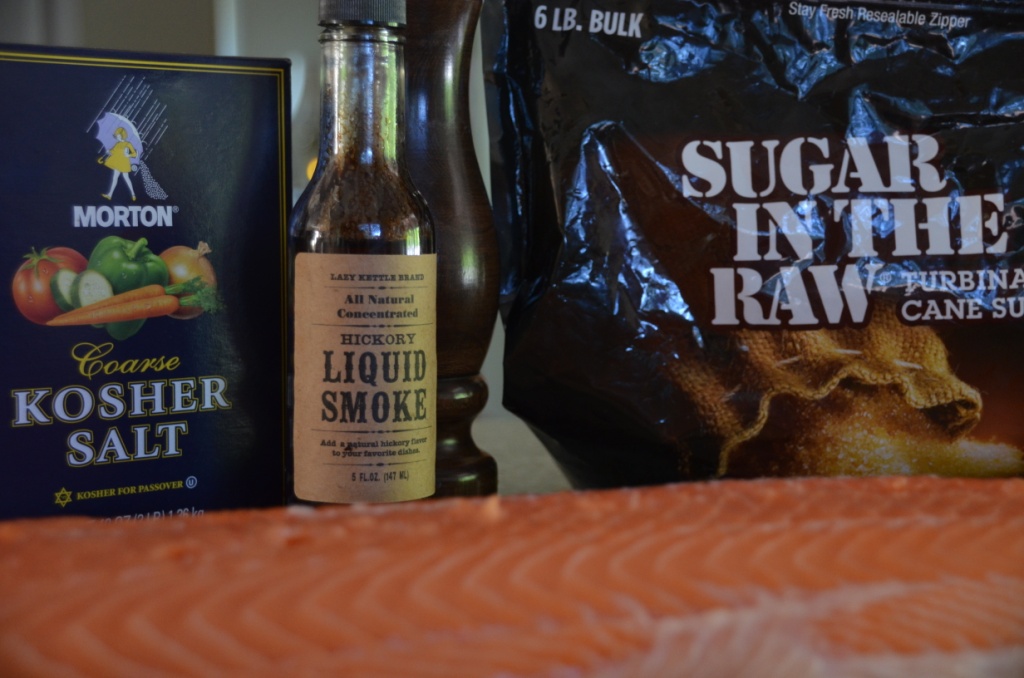 Above you see everything you need – please note the bottle of Liquid Smoke there – available at most of the supermarkets or you can order it online. Few drops will impart smoke flavor on any dish you are making.
Prepare the mix of kosher salt, brown sugar and pepper – feel free to add any other spices here you would want to use, and mix it all up – I do it right in the measuring glass:
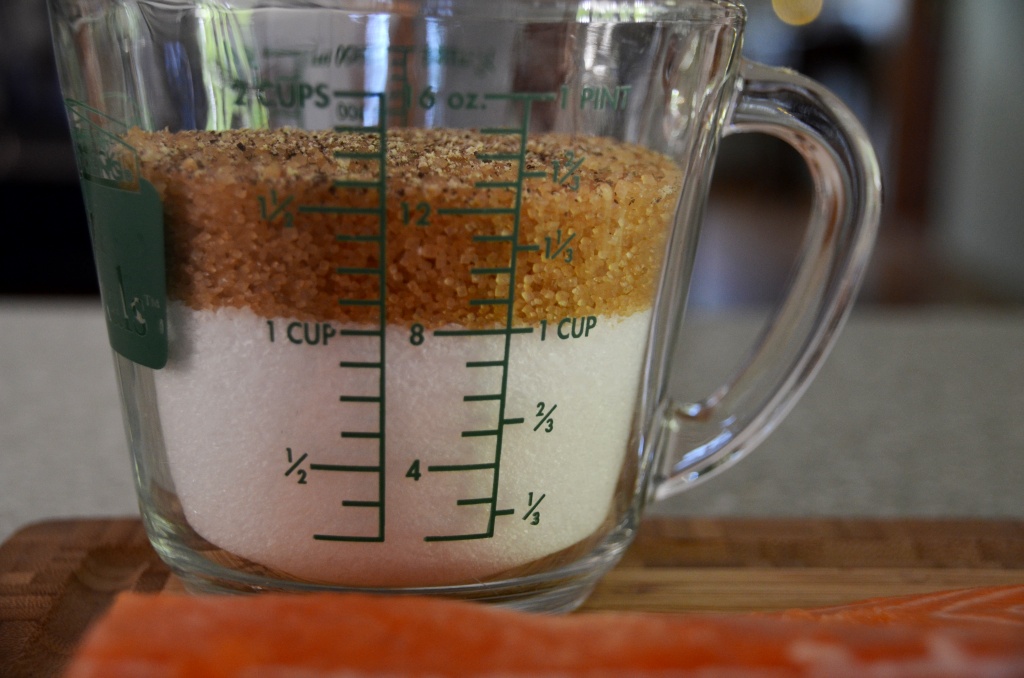 Put a very thin layer of the mix at the bottom of the large glass cooking dish (I’m sure you can use the foil tray as well, but I prefer using the glass tray), and put salmon filet on top:
 Now, completely cover the salmon with the mix, top and sides:
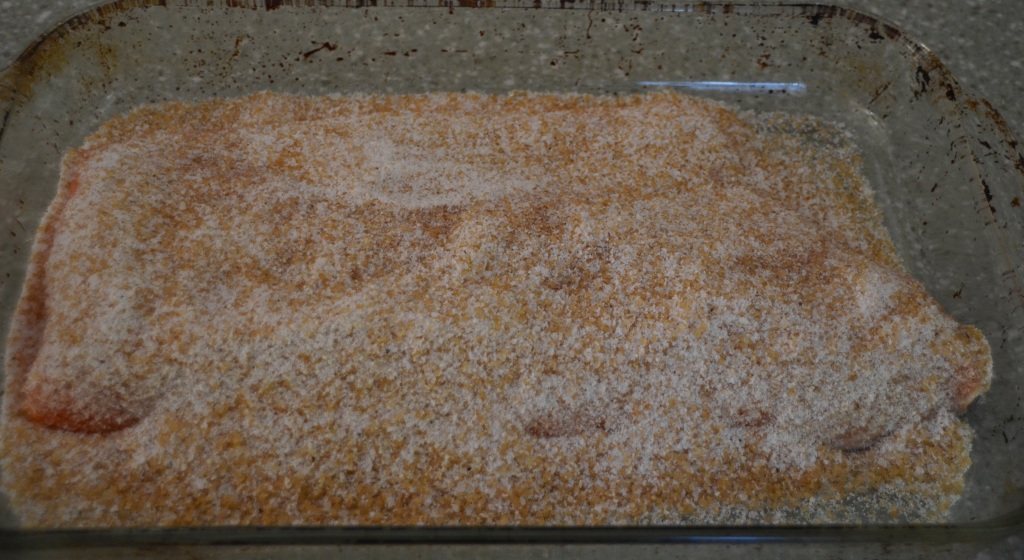 Cover with the plastic wrap and put it in the fridge for 24 hours. The next day, take it out of the fridge, and you will see something like that:
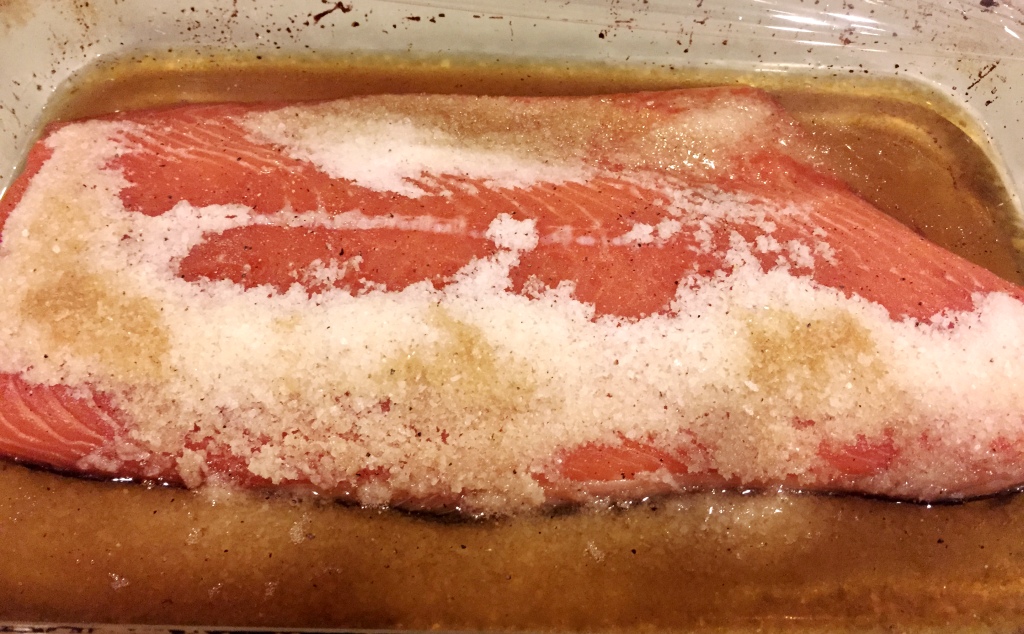 Drain the liquid (as much as you easily can, don’t strain it completely). Technically, salmon is now ready to eat – it is completely cured. From now on, I like to make it “smoked” so I add a few drops of Liquid Smoke all over salmon and around, cover with plastic wrap and put it in the fridge for another 12 hours. Important note – the longer you will keep salmon with the salt, the drier and denser it will become, as it will lose more juice.
After 12 hours, your smoked salmon is fully ready – get it out of the fridge, wash it thoroughly to rid of any salt, and lay it to rest on the board – you can keep it there for an hour or even longer. This is how it will look like:
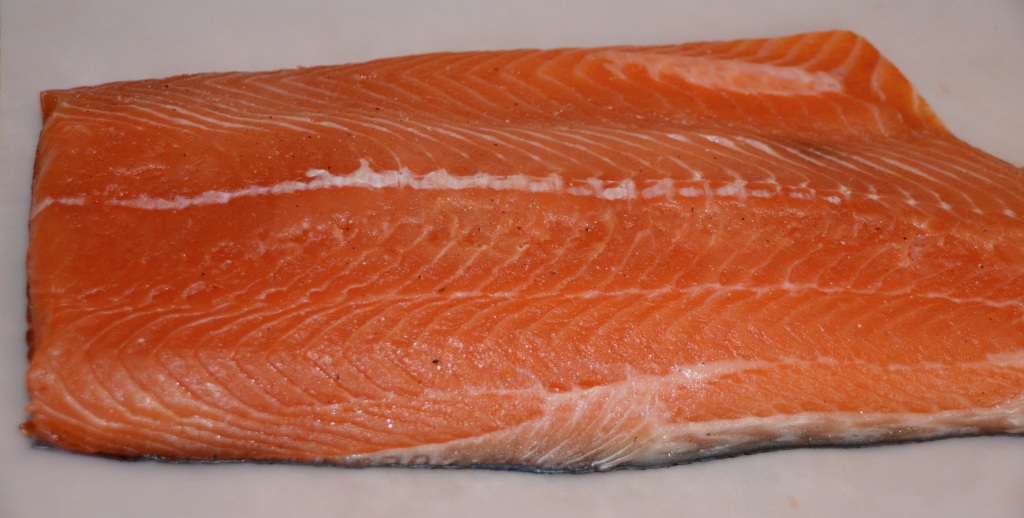 I like to give it even longer rest time if I’m not too hungry, so I would typically wrap it completely into the plastic wrap and put it back in the fridge for a few hours. Salt dries the surface completely, so by letting the salmon rest, it will redistribute the juices so it will become all moist and delicious. Last step – slice and enjoy!
 I would typically slice it off the skin as needed, and keep the rest wrapped in the plastic wrap in the fridge. As it is cured, it will last for a pretty long time – between a week and two for sure. It is also very easy to freeze as it is, right in the plastic wrap – and it can be thawed quickly as needed.
There you have it my friends – a simple smoked salmon recipe. Yes, do that at home!
If you will decide to make it – let me know how it will come out. Cheers!
Possibly The Best QPR Wines In The World Today?
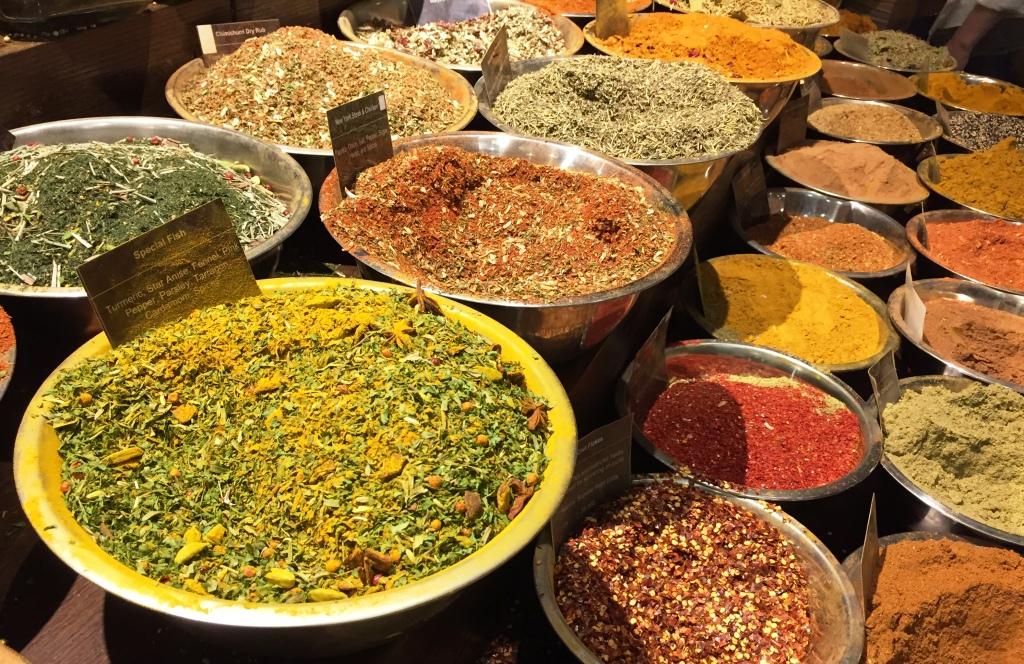 Today, I want to talk about wine and value. “Value” has an interesting meaning in the world of wine – may be as subjective as the concept of a “good wine” itself. To me, the value is not an absolute amount of money one paid for the bottle of wine – if you paid $3, but poured the bottle down the drain after half-finished first sip because it tasted terribly – was that still a “value”? Or was that a pure waste of money? By the same token, if the $20 bottle of wine gave you lots of pleasure in every tiniest drop (including the one you licked of the table), would that be a “good value”? Talking about the “value” of the wine, I prefer to use a proverbial term QPR, so happily adapted by the wine lovers – a Quality Price Ratio (this is what QPR stands for) conveys the “value” concept of wine a lot better than the sheer price itself.
One of the easiest and most straightforward ways to classify and analyze thousands and thousands of wines produced today in the world is by region, as wines from the same geographic area would typically have some similarities. Thinking about all the different wine producing regions in the world, which region do you think delivers the best QPR today? I’m really asking here to think about the region as a whole, rather then individual wines. Yes, you can find delicious Napa reds for $10, but this is rather an anomaly, as on average, you need to spend at least $25 – $30 for a good bottle, so we are definitely not talking about Napa here. Thus the question stands – what is your best QPR wine region in the world?
This question might be more difficult than it seems. Wine regions don’t stand still – they are constantly evolving. As the region becomes better known and more demanded, the price increase often accompanies this rise in popularity – which obviously affects the QPR. I used to consider Greek wines as a great QPR – but many Greek wines are now pushing the $30 boundary, while not consistent in quality – this immediately drives QPR down. I used to think of Israeli wines as a great value – but same thing is happening there, with lots of better wines moving north of $30, and wines under $20 been more of “hit and miss”. My next “go to” wines were Portuguese – but even here I now have a problem – wines under $20 are often only randomly tasty; wines at around $30 and up are consistently excellent, rivaling $100+ wines from the other regions, so in relative terms, they still offer a great value – but probably not the best QPR?
“Knowing what I know now”, the region which I think consistently delivers the best QPR at the moment (!) is Georgia – not the state down south in the US, of course, but an independent country. I always loved Georgian wines, but what prompted this broad statement about QPR was a recent Georgian Wine tasting I attended a week ago at Chelsea Market in New York. Wine after wine was delicious, and priced under $20 – that is a QPR I’m definitely happy about.
You don’t have to take my word for it – you should find a bottle of Georgian wine and try it for yourself. I really hope you did just that last Sunday, October 4th, as it was a #GeorgianWineDay in the social media – and if you actually had Georgian wine, I’m curious to know what it was. In any case, let me share the notes for the wines I tasted at the “Discover Georgia in New York” event at the colorful Chelsea Market. Below are the notes, using the “+” ratings. Pay attention to the prices and corresponding ratings – don’t know what you think, but I think the “QPR” is spelled very clearly across the full range of wines I tasted.


2013 Telavi Wine Cellar Marani Rkatsiteli Kakheti, Georgia ($10.99) – +++, very acidic, requires food
2013 Telavi Wine Cellar Marani Mtsvane-Kisi Kondoli Vineyards Kakheti, Georgia ($14.99) – +++, excellent, clean, lemon notes, touch of food


2013 Telavi Wine Cellar Marani Saperavi Kakheti, Georgia ($11.99) – +++, excellent, simple, an everyday wine, red fruit, crushed berries
2009 Telavi Wine Cellar Marani Red Kvareli Special Vicultural area, Kakheti, Georgia ($15.99) – ++++, beautiful, clean, great depth
2012 Telavi Wine Cellar Marani Saperavi Kondoli Vineyards Kakheti, Georgia ($18.99, 18 months in oak, starting from fermentation) – ++++, stunning! round and delicious


2007 Telavi Wine Cellar Marani Reserve SAPERAVI block Kondoli vineyards, Kakheti, Georgia ($70) – ++++1/2, off the charts, produced only in the best years, complex, round, delicious. Yes, it is $70, and it might be to expensive for an amazing QPR, but you should taste this wine first…


2006 Wineman Cabernet Sauvignon Kakheti, Georgia ($10.99) – ++++, wow!, pick of maturity, dark notes, concentrated – another wow!
2010 Wineman Ikhalto Red Kakheti, Georgia ($12.99, 50% Saperavi, 50% Cabernet Franc) – ++++, wow!, acidity, beautiful wine
2013 Wineman Kindzmarauli Special Viticultural Area Red Semi-Sweet Kakheti, Georgia (12% ABV, $15.99, 100% Saperavi) – ++++, beautiful, perfectly balanced sweetness


2011 Shalvino Kardenakhi Special Viticultural Area Kakheti, Georgia (18% ABV, $18.99, Blend of Rkatsiteli, Khikhvi, Goruli and Mtsvane) – ++++, made using Solera method, delicious, Pedro Ximenez like with a delicate balance
2013 Telavi Wine Cellar Satrapezo Rkatsiteli Ice Wine Kakheti, Georgia (10% ABV, $29.99 500ml) – +++1/2, beautiful, perfect balance, not overly sweet


2013 Teliani Valley Tsinandali White Kakheti, Georgia ($12.99) – +++, great acidity
2012 Teliani Valley Special Vicultural area Kakheti, Georgia ($17.99) – +++, great acidity, perfect, food friendly


2013 Schuchmann Rkatsiteli White Kakheti, Georgia ($15.99) – +++, touch of sweetness, nice balance
2013 Schuchmann Saperavi Red Kakheti, Georgia ($15.99) – +++, perfect, clean, great balance


2012 Vinoterra Kisi Kakheti, Georgia (13% ABV, $NA, Qvevri fermentation, Oak maturation) – +++, complex, very intense, unusual, thought provoking
What do you think? I understand that QPR is subjective and relative term – first, you have to like the wine, and then everyone’s idea of “value” is different – but I was (once again) blown away by the quality and consistency of what I tasted – I didn’t skip a single wine, those are all the wines which were presented in the tasting. This would make it 16 wines out of 16, which I would gladly drink again. I hope it gives you good frame of reference for my experience.
Thinking about the wines of the world, what would be your top region for the best QPR? And if you tasted any of the Georgian wines, what is your opinion about them? Cheers!
One on One With Winemaker: Jeff Fyfe from The Crossings Winery, New Zealand
 Few days ago I was offered an opportunity to meet Jeff Fyfe, senior winemaker at The Crossings Winery from New Zealand – only I couldn’t. What about the title of this post, you ask? No, I’m not trying to purposefully mislead you with some dark intent. What I did was very simple and logical 🙂 – I came up with a bunch of questions, and asked Jeff to answer them on his own. We can call it a “virtual interview”. I also had an opportunity to taste two of the latest wines from The Crossings – including the 2015 Sauvignon Blanc. I was quite excited about it, as my first wine of the current vintage typically is Beaujolais Nouveau, so this was a welcome deviation.
Let’s start with the interview. Imagine yourself out in the vineyard, on a sunny day, with the glass of cold and refreshing white wine, talking to Jeff Fyfe:
What was your favorite vintage(s) for both Pinot Noir and Sauvignon Blanc and why?
We have been extremely lucky in Marlborough in recent years with a number of great vintages in a row. In 2014 we had harvested all of the Pinot Noir prior to commencing any Sauvignon Blanc which is fairly unusual. This gave us the opportunity to focus on the varieties individually a little more than usual which was nice. There are some great Sauvignon Blancs from 2015 and we are excited about releasing them.
What was your most difficult vintage for both Pinot Noir and Sauvignon Blanc and why?
Both 2008 and 2009 were reasonably difficult vintages in the fact that the crops were slightly heavier than normal and we had some unseasonal rain during harvest making things difficult.
Many winemakers in NZ experiment with oak and Sauvignon Blanc. What do you think of that? Is this an up and coming trend? Do you make any oaked Sauvignon Blanc wines?
I don’t know if I would call it a trend, I think it is now a style in its own right in Marlborough. Many producers are making them, and have been for some time. Dog Point Section 94 is a great example of barrel fermented Sauvignon Blanc. They wines obviously age well, in my opinion the better examples show great balance and integration of the oak and the fruit. Some producers are also creating wines with small amounts of barrel fermented Sauvignon Blanc to add texture and weight to their tank fermented Sauvignon Blancs.
Today, there are many new grapes been planted in NZ – Chardonnay, Pinot Gris, Riesling, Gruner Veltliner, Syrah. I see that you are already making Riesling and Pinot Gris wines – do you have plans for any other new grapes?
Yes, we already make very small quantities of Chardonnay, Pinot Gris, and Riesling and we planted some Gruner Veltliner at our Willowflat vineyard 2 years ago, which is looking promising. I think Marlborough already produces world class aromatics, particularly from the cooler sites which enables longer ripening and extended hang time for the fruit which creates wines with texture, weight and acidity.
Outside of your own wines, what are your other favorite wines from New Zealand?
There are some great aromatics coming out of the Nelson region, Waimea, and Seifreid are favourites. Also Hawkes Bay Syrah, in my opinion the best examples can rival the great Syrahs of the world. Bilancia, Crossroads, Trinity Hill are all great examples.
What are your favorite Sauvignon Blanc wine outside of New Zealand – regions and/or producers?
White Bordeaux! If only I could drink them more often. Generally I like to drink Austrian or German Rieslings, there are so many amazing producers, Brundlmayer, Ansgar Clusserath, Donnhoff, Wittman to name a few.
Same question for Pinot Noir – favorite regions/wines/producers outside of New Zealand?
I tend to drink the wines coming from cooler climate regions as I like the elegance and finesse they can have, cooler parts of Australia such as Tasmania, and the Mornington Peninsula are great. There are obviously some pretty special wines coming out of Burgundy, I just can’t afford to drink them that often! Although when I do I enjoy wines from the appellation of Volnay.
If you would have a “do-over” opportunity – go back in time and start the winery again – would you still start it at the exact same place, or would you chose a different location, region or even country?
I wouldn’t change the location of the vineyards that’s for sure. We have 3 amazing vineyard locations in the Awatere Valley, each very unique which provides us with quality fruit to make the wines that we do.
Today, a lot of wineries around the world add sparkling and Rosé wines to their portfolios, but this trend doesn’t seem to catch up in New Zealand. Do you think this will change? Do you have any plans to start producing sparkling or Rosé wines?
There are already a number of producers in Marlborough making some great rosés. The demand for Marlborough Pinot Noir is strong, so I guess that has an impact on the ability of some producers to make Rose, hence why you don’t see them often on a global scale. At The Crossings we are hoping to make a rose in vintage 2016. It’s the same with sparkling wines in Marlborough, some world class wines being produced but on a reasonably small scale.
What is the oldest vintage of your own wines you ever tried? Do you think the wines held up well?
We recently had a vertical tasting of The Crossings Sauvignon Blanc from 2005 to 2015. We were pleasantly surprised at how well the wines were holding up. The majority of the older vintages still looked fresh, showing varietal character and maintained the mineral acidity that is signature of the Awatere Valley. All of the wines were under screw cap
* * *
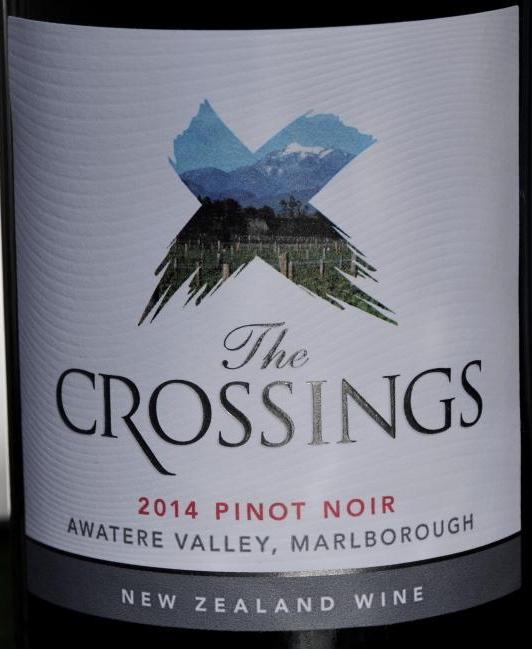 I think Jeff provided great answers. Hearing that 10 years old Sauvignon Blanc is still fresh makes me very happy – I love wines with an age on them, and I love it when the wines are aging gracefully, so I would love to try it by myself. Well, yes, I didn’t try the 2005 – instead, I tried the wine from the vintage Jeff was so happy about it – the 2015. I tasted latest releases of both Sauvignon Blanc and Pinot Noir, which I got as samples, courtesy of the importer, Deutsch Family Wine & Spirits. For you to understand how new the 2015 was, the bottle even didn’t have an official label on it yet.
Here are my tasting notes:
2015 The Crossings Sauvignon Blanc Awatare Valley Marlboro, New Zealand (13% ABV, SRP $14)
C: straw pale
N: beautiful fresh cut grass, just a hint of grapefruit, lemon zest
P: clean acidity, fresh, lemon undertones, herbal notes, perfectly balanced
V: 8, one of the very best NZ sauvignon Blanc wines I ever tasted. Summer day in the glass.
2014 The Crossings Pinot Noir Awatare Valley Marlboro, New Zealand (14% ABV, SRP $18)
C: dark ruby
N: smoke and raspberries, lavender, touch of mint, baking spices
P: sweet cherries, plums, hint of vanilla, touch of spices, good balance, medium body, medium-long finish.
V: 7+/8-, classic Marlboro Pinot Noir
There you have it, my friends – virtual interview and very real, delicious wines. Now, let me ask you a question – if you would have an opportunity to talk to the winemaker, what would be your questions? What do you think of our Q&A session? Happy Friday and Cheers!
5 Highlights and Hundreds of Wines
 Last weekend I attended a trade wine tasting – my first and pretty much the last for this year. My schedule simply didn’t align to do more, but may be it is even for the better?
I’m sure that most of the people see it very simply – “wine tasting = fun”. I tried many times to explain in this blog that “wine tasting = hard, tiring work” – no doubts 9 out of 10 people point to this statement and start laughing – but this is totally fine with me.
The tasting was organized by one of the Connecticut wholesalers – Worldwide Wines, to showcase all the new arrivals from the wineries and importers they represent in the state. According to the invitation, about 1,000 wines, beers and spirits were offered in the tasting. Duration of the event? 3.5 hours. Which simply means, if you want to taste them all, you have to move at a speed of roughly 5 wines/beers/spirits per minute. Yep, 5 per minute, 12 seconds each.
Of course nobody is trying to taste them all – you have to come with the plan. As I’m not operating a retail business, my plan was simple – to taste best of the best, simply based on the names. I mean no disrespect, but it means that Heitz takes precedence over Castle Rock, same way as Gaja would go over Cavit. This year, I managed to complete my plan quite successfully – you will see tasting notes below. At the end of these 3.5 hours I was really, really tired – but hey, it was worth it.
I managed to try close to 200 wines (including some spirits – no beer though), out of which I will share with you a bit more than a 100 – the wines which I really liked (yep, there were a lot). As this will be a very long list, I will first try to come up with 5 main highlights, before leaving you with bunch of wines to scroll through. But even before we get there, I can tell you that pretty much anything we tasted from California from 2012 vintage was excellent; there were 3 Gaja wines present in the tasting, and they were delicious, with Gaja Chardonnay, Rossj-Bass, being off the charts; for the first time I tried line of Cabernet Sauvignon wines from Nickel & Nickel, and they were very good; also for the first time (consistently missed it from a year to a year), I tried Darioush line of wines, and they were excellent. Now, for the promised 5 highlights, here we go:
- California Chardonnays are back! Well, this is a personal statement, of course. Over the past 4-5 years, I developed a tendency to avoid California Chardonnays in any tastings – I find all that “unoaked” stuff boring. I’m not looking for the “oak bombs” as they were called in the past, but I like my Chardonnays with vanilla, touch of butter and some weight on the palate. This year, out of the 10-12 Chardonnays which I tasted, there was not a single one I didn’t like. Of course I had some preferences, but still, as a group, they were outstanding. You will see the list of all Chardonnays I had a pleasure of tasting in the list below.
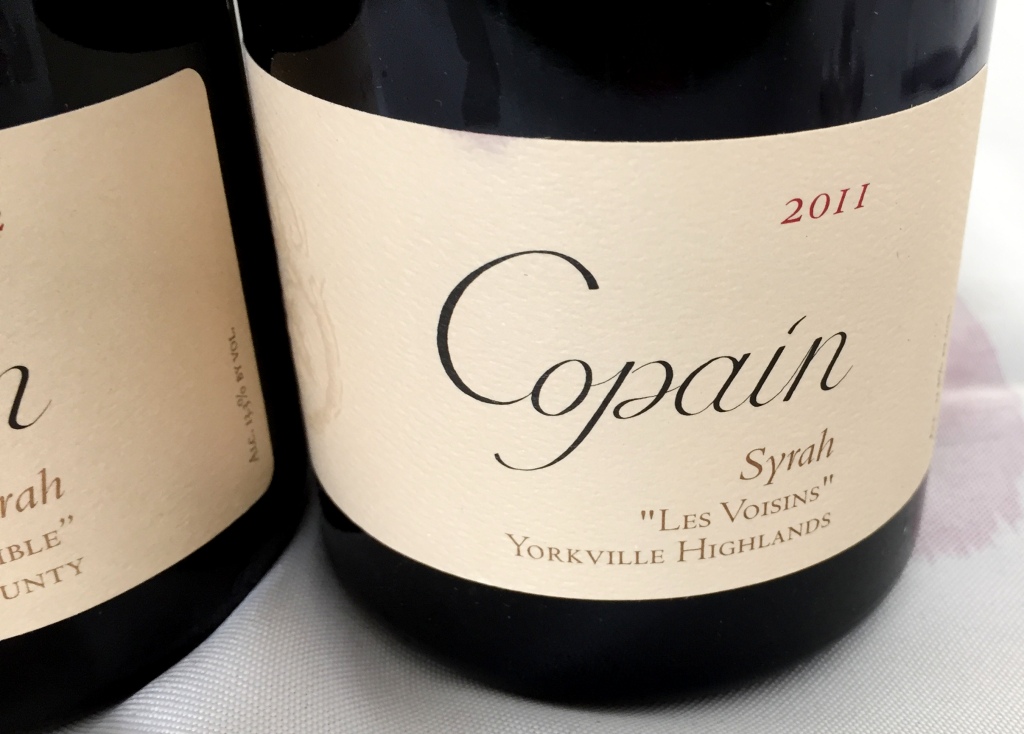
- There were lots and and lots of red wines I tasted at the event, many of them of the cult status – Sassicaia, Heitz, Shafer, Joseph Phelps and others. They were all excellent wines, but still, my absolute favorite red wine of the tasting was Copain Les Voisins Syrah Yorkville Highlands ($24.95) – the wine had stunning clarity of the Syrah, with pepper and restrained earthy profile.
- My top pick for the white wines might be even more surprising – Villa Wolf Gewurztraminer Pfalz, Germany ($10.49!!). I personally consider Gewurztraminer a very difficult grape to do right, for sure for my palate – this wine had such a beautiful balance of spiciness, fruit and acidity, it was simply a perfect sip in the glass. There is yet another highlight which goes to the white wines. Talking about a “group”, 5 white wines from Abbazia di Novacella in Alto Adige in Italy, where literally one better than another – every sip got a “wow” reaction – Kerner, Gruner Veltliner, Sylvaner, Sauvignon Blanc – one better that the other, literally.
- Not a revelation for me anymore, but still something to ponder at – there are amazing spirits made in the USA. Case in point – St. George Spirits from Alameda, California. You know, I don’t drink vodka at all, as it has no taste, and here I absolutely loved Green Chile Vodka from St. George. And then there was Gin, Absinthe, Coffee liquor – one “wow” after another. I want to include here their motto, as written on the web site: “We don’t distill to meet your expectations, we distill to exceed your imagination“. Yep.


- Last highlight is more of a note to self – “don’t drink Port in a middle of tasting”. For sure if it is a Heitz Ink Grade Port. Okay, let me explain. Generally people have a tendency to leave tasting of the sweet wines “for later”, just to make it easier for the palate. Problem is that by the time you decide to go back to those dessert wines, the tasting is way over. When it comes to the Heitz Ink Grade Port, I heard that it is amazing, but equally powerful, so it is better to leave it “for later” – thus I never tasted it before. This time around, I said “that’s it – I’m tasting it now”. Boy, what a mistake. The Heitz Port is a very interesting wine, made from 6 noble Portuguese grapes, typically used in production of the Port – of course this time growing in California, at one of the Heitz vineyards. This Port was delicious, but it had tremendous power of tannins, multiplied by the factor of the sweet dried fruit, all together shutting down your palate for good. I was desperately searching for the chunk of Parmesan, as I don’t think anything else can restore your palate in such a case. So yes, it was delicious – but I’m not drinking it again in a middle of the tasting…


As promised, those were my highlights. From here on, prepare to be inundated with my brief notes on lots and lots of wines. I used the “+” system for rating, and I didn’t include practically any wines with the “++” rating (there might be one or two). Also, lots of wines were absolutely exceptional, so they got the “++++” ratings. Last explanation: the price in the brackets is so called Connecticut minimal bottle price – the state of Connecticut dictates minimum price at which the wine can be sold to the consumers – retailers are not allowed to go any lower than that “min bottle” price. Therefore, it is likely that prices in many stores in Connecticut will be higher than what I included here. It is also quite possible that you can find lower prices in other states. Lastly, I tried to group the wines mostly by the grape type and/or type, to make it easier for you to navigate. Hope you will find this list useful.
Here we go:
Sparkling Wines:
NV Charles Heidsieck Brut ($55.99) – ++++, yeasty!!
NV Champagne Barons de Rothschild Rosé ($99.99) – +++, excellent
NV Champagne Duval Leroy Premier Cru ($45) – +++1/2, perfect balance
NV Champagne Duval Leroy Rosé ($59.99) – +++
Chardonnay:
2013 Calera Central Coast Chardonnay ($19.99) – +++
2013 Laetitia Chardonnay Estate, Arroyo Grande ($15.49) – ++++
2013 Copain Tous Ensemble Chardonnay Anderson Valley ($18.99) – ++++, beautiful
2013 Darioush Signature Chardonnay Napa Valley ($37.99) – ++++
2013 Far Niente EnRoute Chardonnay ($39.99) – +++, very nice
2013 Flanagan Chardonnay Russian River Valley – +++
2014 Heitz Wine Cellars Chardonnay ($24.99) – +++, great acidity
2014 FARM Napa Valley Chardonnay ($18.99) – +++, nice, bread notes
2014 Hooker “Breakaway” Chardonnay Knights Valley ($14.99) – +++, great QPR
2013 Merryvale Chardonnay Napa Valley ($24.99) – ++++, wow! classic!
2014 Crossbarn Chardonnay Sonoma ($21.99) – +++, perfect
2013 Paul Hobbs Chardonnay Russian River ($38.99) – ++++, beautiful, vanilla, wow!
2013 Maison Roche de Bellene Bourgogne Blanc Vieilles Vignes ($18.99) – ++++, Chablis-like, great minerality and gunflint
2013 Gaja Rossj-Bass Langhe ($77.99) – ++++
Cabernet Sauvignon and blends, California:
2012 Darioush Signature Cabernet Sauvignon Napa Valley ($99.99) – ++++, beautiful
2012 Darioush Signature Merlot Napa Valley ($45.99) – ++++, excellent
2012 Darioush Caravan Cabernet Sauvignon Napa Valley – +++1/2
2012 Darioush Signature Cabernet Franc Napa Valley ($46.99) – ++++, excellent


2012 Nickel & Nickel CC Ranch Cabernet Sauvignon ($79.99) – ++1/2, tannic
2012 Nickel & Nickel Quarry Cabernet Sauvignon ($79.99) – +++, clean, excellent
2012 Nickel & Nickel Sullenger Cabernet Sauvignon ($79.99) – +++, excellent
2012 Flanagan Cabernet Sauvignon Sonoma County ($68.99) – +++, nice
2010 Heitz Wine Cellars Napa Cabernet Sauvignon ($45.99) – +++1/2
2009 Heitz Wine Cellars Trailside Vineyard Cabernet Sauvignon ($63.99) – ++++, clean, excellent
2006 Heitz Wine Cellars Trailside Vineyard Cabernet Sauvignon ($59.99) – ++++, excellent
2010 Heitz Wine Cellars Martha’s Vineyard Cabernet Sauvignon ($174.99) – ++++, powerful
2009 Heitz Wine Cellars Martha’s Vineyard Cabernet Sauvignon ($174.99) – ++++, beautiful
2012 Honig Napa Cabernet Sauvignon ($35.99)- +++1/2
2012 Honig Bartolucci Vineyard Cabernet Sauvignon ($62.49) – ++++, beautifully refined
2012 Hoopes Oakville Cabernet Sauvignon ($49.99) – +++, nice
2012 Joseph Phelps Insignia ($189.99) – +++
2012 Joseph Phelps Cabernet Sauvignon ($55.99) – +++


2011 Shafer Cabernet Sauvignon, Hillside Select, Stags Leap District ($178.49) – +++1/2, excellent
2012 Hooker “Old Boys” Cabernet Sauvignon Na[pa Valley ($29.99) – +++, nice
2013 Venge Scout’s Honor Proprietary Red, Napa Valley ($31.99) – +++1/2, delicious!
2013 Venge Silencieux Cabernet Sauvignon, Napa Valley ($36.49) – ++++, beautiful Cabernet Sauvignon
2010 Merryvale Cabernet Sauvignon Napa Valley ($49.99) – +++, very good
2011 Paul Hobbs Cabernet Sauvignon Napa ($94.99) – +++1/2
2011 Paul Hobbs Cabernet Sauvignon Dr Crane Beckstoffer ($128.99) – ++++, wow!


2013 Pine Ridge Napa Cabernet Sauvignon ($49.99) – +++1/2, very clean
2012 Hanna Cabernet Sauvignon Alexander Valley ($29.99) – +++, herbal
Pinot Noir:
2013 Calera Central Coast Pinot Noir ($24.99) – +++1/2, very nice
2012 Calera deVilliers Vineyard, Mt Harlan Pinot Noir (34.99) – +++1/2, nice balance
2012 Calera Ryan Vineyards, Mt Harlan Pinot Noir ($36.99) – +++
2013 Laetitia Pinot Noir Estate, Arroyo Grande ($19.99) – +++
2013 Laetitia Pinot Noir Reserve du Domaine (32.00) – ++++
2013 Copain Tous Ensemble Pinot Noir Adderson Valley ($23.99) – ++++, wow
2012 Copain Les Voisins Pinot Noir Anderson Valley ($28.99) – ++++, delicious, elegant!
2012 Wild Ridge Pinot Noir Sonoma Coast ($40) – +++, wow! concentrated!


2011 Merryvale Pinot Noir Napa Valley ($29.99) – +++1/2, classic CA Pinot
2012 Foley Pinot Noir, Rancho Santa Rosa Estate ($32.99) – +++1/2
2013 Siduri Willammette Valley, Oregon ($24) – +++, excellent
2013 Archery Summit Premier Cuvee Pinot Noir ($35.99) – ++++, beautiful
2012 Archery Summit Red Hills Estate Pinot Noir ($59.99) – ++++
2011 Maison Roche de Bellene Bourgogne Rouge Vieilles Vignes ($18.99) – +++
2011 Maison Roche de Bellene Gevrey-Chambertin Vieilles Vignes ($38.99) – +++1/2
White Wines:
2014 Heitz Wine Cellars Sauvignon Blanc Napa Valley ($16.49) – +++1/2, excellent, clean
2014 Honig Sauvignon Blanc ($15.49) – +++, delicately balanced
2013 Honig Rutherford Sauvignon Blanc ($19.99) – +++, nice, complex
2013 Merryvale Sauvignon Blanc Napa Valley ($19.99) – +++, beautiful!
2013 Archery Summit Vireton Pinot Gris ($18.99) – +++, nice
2014 Abbazia di Novacella Kerner Alto Adige ($19.99) – ++++, wow! acidity!
2014 Abbazia di Novacella Gruner Veltliner Alto Adige ($19.99) – ++++, wow!
2014 Abbazia di Novacella Sauvignon Blanc Alto Adige ($19.99) – ++++, wow!
2014 Abbazia di Novacella Sylvaner Alto Adige ($19.99) – ++++, wow!
2013 Abbazia di Novacella Praepositus Kerner Alto Adige ($25.99) – ++++, wow!
2012 La Monacesca Verdicchio di Matelica 750ml 2012 12 $144.00 $12.99
2012 La Monacesca Verdicchio di Matelica Mirum 750ml 2012 12 $224.00 $19.99
2013 Villa Wolf Pinot Gris Pfalz ($11.99) – ++++, wow! clean
2014 Villa Wolf Gewurztraminer Pfalz ($10.49) – ++++, wow! beautifully balanced!
2012 Maximin Grunhause Riesling Feinherb Mosel ($15.99) – ++++, petrol!
2014 Dr Loosen Riesling Kabinett Blue Slate Mosel ($14.99) – ++++, beautiful, bright fruit
Red Wines:
2012 Copain Tous Ensemble Syrah Mendocino County ($18.51) – +++, nice, a bit too simplistic
2011 Copain Les Voisins Syrah Yorkville Highlands ($24.99) – ++++, oustanding
2012 Shafer Relentless, Napa Valley ($84.99) – +++, very good
2012 St. Francis Reserve Merlot ($39.99) – +++
2012 St. Francis Reserve Old Vines Zinfandel ($39.99) – +++1/2
2014 Lawer “Knights Valley” Syrah Rosé ($17.99) – ++++, outstanding
2010 Hooker “Blindside” Zinfandel California ($13.99) – +++, good
2011 Hooker “Home Pitch” Syrah Knights Valley ($12.99) – +++


2012 Tenuta San Guido Sassicaia ($174.99) – +++, clean, balanced, wow
2013 Tenuta San Guido Guidalberto ($44.99) – +++, beautiful Cabernet-like
2010 Tenuta di Biserno ($149.99) – +++
2012 Tenuta di Biserno Il Pino di Biserno ($59.99) – +++, herbal profile
2012 Ornellaia Le Serre Nuove Bolgheri ($50.99) – +++1/2
2012 Gaja Ca’Marcanda Magari Bolgheri ($69.99) – +++
2010 Gaja DaGromis Barolo ($71.99) – ++++
2008 Masi Riserva di Costasera Amarone della Valpolicella ($51.00) – +++
2008 VAIO Serego Alghieri Amarone della Valpolicella ($69.99) – +++, outstanding
2006 Masi Mazzano Amarone della Valpolicella ($116.00) – ++, somewhat disappointing for the single-vineyard Masi
2008 Marchesi di Fumanelli Amarone del Valpolicella ($54.49) – ++++, delicious, sweet fruit
2007 Marchesi di Fumanelli Octavius Amarone del Valpolicella Riserva ($100.99) – +++, nice


2012 Arnaldo Caprai Montefalco Rosso, Umbria ($19.99) – +++1/2, powerful
2013 Il Poggione Rosso di Montalcino ($22.99) – +++, simple, nice
2012 Feudo Maccari Saia Nero D’Avola ($26.99) – +++, great minerality
2012 Los Vascos Cabernet Sauvignon Reserve Chile ($16.99) – +++
2012 Los Vascos Carmenere Reserve Chile ($16.99) – +++
2011 Antigal UNO Cabernet Sauvignon, Mendoza, Argentina ($15.99) – +++, nice, classic
2009 Elderton Estate Cabernet Sauvignon Barossa, Australia ($57.99)- ++++, beautiful
2009 Elderton Command Shiraz Barossa, Australia ($73.95) – ++++, beautiful, roasted notes
2013 Two Hands Sexy Beast Cabernet Sauvignon McLaren Vale, Australia ($29.99) – +++, perfect
2008 Casa Ferreirinha Vinha Grande, Douro, Portugal ($14.99) – +++1/2 – delicious
2012 Crasto Old Vine Reserva, Douro, Portugal ($34.99) – +++
2012 Chateau Musar Jeune Rouge, Lebanon ($15.99) – +++1/2, excellent
2007 Chateau Musar Rouge, Lebanon ($N/A) – +++1/2, beautiful
2012 Domaine de Beaurenard Rasteau ($17.99)- +++
2012 Domaine de Beaurenard Boisrenard Chateauneuf du Pape ($49.99) – +++, green
2013 M. Chapoutier La Bernardine ($39.99) – +++


2011 Chateau Moulin de Duhart Pauillac ($38.99) – +++
2009 Chateau La Grave a Pomerol ($55.99) – +++
2009 Blason de L’Evangile Pomerol ($74.99) – ++++
2012 Perrin Cotes du Rhone Nature Organic ($9.99) – ++1/2, an outstanding QPR for an organic red wine
2012 Chateau de Beaucastel Chateauneuf du Pape Rouge ($79.99) – +++
2011 Rust en Vrede Estate Stellenbosch, South Africa ($32.99) – +++1/2
2010 Anthonij Rupert Optima Western Cape South Africa ($26.99) – +++1/2
Dessert wines:
2013 Donnafugata Ben Rye ($30.99) – +++, very nice
NV Heitz Wine Cellars Ink Grade Port ($27.99) – ++++, wow!
Spirits:
St. George Green Chile Vodka ($22.49) – flavor is stunning, with clear presence of Jalapeño and other green earthy peppers. Sipping
St. George California Citrus Vodka ($22.49) – another wow flavor, smooth and delicious
St. George Botanivore Gin ($27.25) – mellow with super-complexity. May be the best gin I ever tasted. Definitely sipping quality
St. George NOLA Coffee Liqueur ($27.25) – good morning, sir. Here is your coffee, extra strong.
St. George Absinthe Verte ($22, 200 ml) – find it and try it, as I can’t describe it. This is first absinthe produced in US after Prohibition. Would gladly drink it at any time.
The Dinner Party Collective – Full Fall/Autumn Menu
A quick update on the fun project I had been involved with – The Dinner Party Collective (TDPC for short). For those of you unfamiliar with TDPC – it is a collaborative project of food and wine bloggers, aimed at creating full dinner menus with focus on seasonal ingredients in both northern and southern hemispheres, and with all the dishes on the menu coming with suggested wine pairings. TDPC is a brain child of Margot from Gather and Graze, which started early in 2015. TDPC was mentioned in the WordPress article in July as one of the 4 food blogs to watch. Earlier in the year, we published a set of Winter and Summer menus.
Now the time has come for the Fall/Autumn and Spring menus. First, the Fall/Autumn menu was fully published, so here are all the links:
Appetizer – Trio of Root Vegetable Dips
Main Course – Beef Bourguignon
All the recipes include wine pairing notes and suggestions from Stefano (Flora’s Table, Clicks & Corks).
Spring menu overview will be coming out tomorrow, with the wine pairings and all the dishes to follow. Happy cooking! Cheers!
Turkish Wines – From Cradle to Adolescence
 I’m sure many of you heard about Turkish wines. More interesting question is – how many of you actually tasted Turkish wines, or at least saw them in the stores?
The jury is still out on the question of the birthplace of the winemaking – Turkey, Georgia, Armenia, Iran – I think Middle East was “the place”, but will any single country be ever able to claim the prize? Probably not. “You know, we were making wines 8,000 years ago” is a great conversation opener, but what really matters is what is inside the glass. It is quite possible that the wines made 8,000 years ago were absolutely amazing – don’t know if we will ever know that for sure, though – but that is not even important. What is important that today, even if you make a wonderful wine, the road to the consumer’s glass is long and winding, simply due to the sheer abundance of wines already available at any given moment to any consumer at any wine store.
If you have historical advantage, how do you prove your point? You have to educate people, you have to make them interested, and most importantly, you have to make them to try your wines. Based on my experience, Turkish winemakers and importers of Turkish wines are doing exactly that, and they seem to be determined to succeed.
I recently had an opportunity to taste Turkish wines made by Vinkara winery, and to talk to the winery’s founder, Ardıç Gürsel. First of all, talking about education, Vinkara’s web site offers wealth of information about history of winemaking in the Turkey. For my internal grape geek, it was fascinating to learn that Turkey has about 1,200 indigenous grape varieties (I wonder how would they call a 1000 grape level in The Wine Century club, huh?). Also according to the article on Vinkara’s web site, the winemaking originated about 15,000 years ago in Central Anatolia, which is now Turkey (may be that explains my obsession with wine, simply based on the name matching). Anyway, I will leave it for you to explore the web site, and let’s talk about the wines.
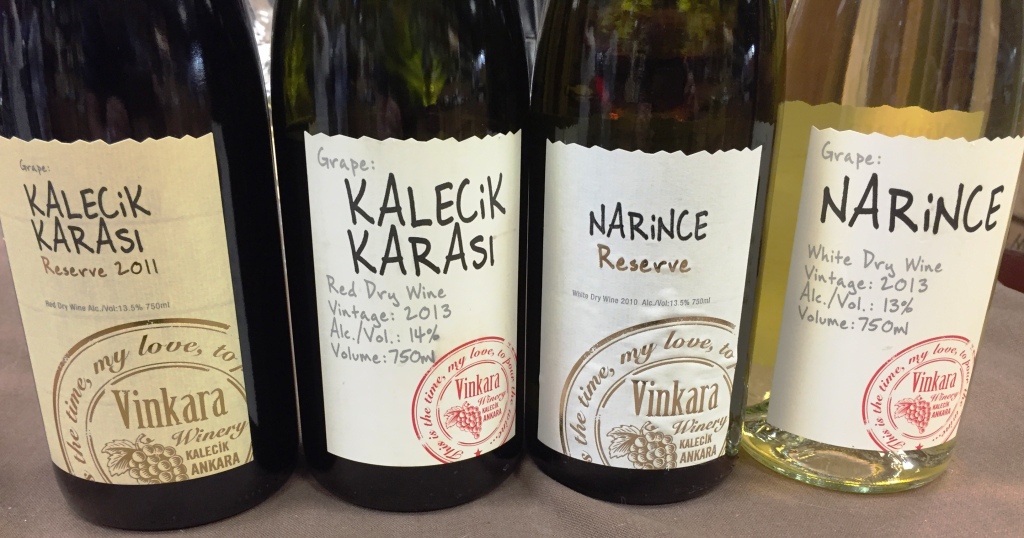
Vinkara seems to be very focused. They only grow 2 grapes, and they only make 4 wines. The two grapes are the white grape called Narince, and the red called Kalecik Karasi. As Vinkara takes great care in educating people, they are making sure you would know how to properly pronounce the names of the grapes, as they are not anything you would expect just by looking at the words themselves. As suggested on the Vinkara’s web site, Narince should be pronounced “Nah-rin-djeh, meaning “delicately” in Turkish”. And Kalecik Karasi is pronounced “Kah-le-djic-car-ah-ser as in British “Father”“. Vinkara makes two regular and two reserve wines, with both reserve wines spending 14 month in oak. I had an opportunity to taste all 4 wines, and here are my notes:
2013 Vinkara Narince Erbaa-Tokat, Turkey (13% ABV, SRP $16, 3 month resting on the lees)
C: Beautiful light yellow
N: grassy, inviting, hint of white fruit
P: touch of white fruit, refreshing, good acidity, excellent balance.
V: 8-, would gladly drink it any time
2010 Vinkara Narince Reserve Erbaa-Tokat, Turkey (13.5% ABV, SRP $28, 14 month in oak, 6 month in bottle)
C: Bright golden
N: Vanilla, butter, inviting, delicious
P: Nice acidity, touch of hazelnut, white plums, medium to full body, silky smooth, good balance
V: 7+, very nice but may be needed a bit more time in the glass to open up
2013 Vinkara Kalecik Karasi Kalecik-Ankara, Turkey (14% ABV, SRP $16, 12 month in stainless steel)
C: bright ruby
N: Touoch of spices, crushed berries, blackberries, tobacco
P: perceived lightness, medium body, long finish, good acidity, touch of ripe raspberries and smoke
V: 8-, food friendly and literally beggin for the grilled meat
2013 Vinkara Kalecik Karasi Kalecik-Ankara, Turkey (14% ABV, SRP $28, 14 month in oak, 6 month in bottle)
C: dark ruby
N: vanilla, baking spices
P: sweet cherries, soft tannins, medium body, sweet finish, touch of spices, hint of chocolate, reminiscent of Grenache
V: 7+, again it possibly needed more time to open up in the glass
As you can tell from my notes, these were definitely the wines I would gladly drink myself and offer to my guests – and the fact that they come with the story is definitely a bonus. As with any “young adults”, it is not easy to establish yourself and become noticeable. However, with the focus on education and on making good, honest, authentic wines, I think Turkish wine industry will make it just fine in this world – at least judging by Vinkara wines, they will.
Next time you are in the wine store and having an urge to try something new – ask for the Turkish wines, you might be pleasantly surprised. And leave me a comment after. Cheers!
Following Wines Til Sold Out – Anything Goes Marathon, September 2015
 It was a while since I posted one of these, but when I saw the announcement for the Wine Til Sold Out “Anything Goes” marathon, somehow I felt inclined to collect the data and create this post. As nobody has time to constantly watch all the wines been offered, the table below presents all (I hope) wines which were included in the marathon, so you can ponder at your own leisure – sorry, that might lead to some regrets too, but I can’t help you with that.
The fact that I didn’t do this in a while shows in the quality of data below, unfortunately – quite a bit of information is missing. I had to recreate the script, and the computer went to sleep right in a middle of a data collection and I lost it all on the wake up. But I hope you will still find it useful as limited as it is. You can see below the prices, the ratings and at what time the wines were offered and for how long they lasted.
Without further ado, here is the table with all the wines offered during marathon (including super-beauty double Barolo package offered right after). If you took part in the marathon, I’m curious to know what you got. And if you missed some wines – well, you can rant in that comments space below. Happy Wine Wednesday and cheers!
Here is the guide to the rating abbreviations (this list is ever inclusive – not all of them are used below): WS – Wine Spectator, WA – Wine Advocate, ST – Steven Tanzer, WE – Wine Enthusiast, WRO – Wine Review Online, W&S – Wine and Spirits, JS – James Suckling, RP – Robert Parker, JHN – Jonathan H. Newman, D – Decanter Magazine, rating goes in stars ( 5 stars is max), JH – James Halliday, TRR – The Rhone Report, BH – Burghound, IWR – International Wine Report, TLC – The Library Collection, PR – Pinot Report, TWN – The Wine News, LM – Luca Maroni, Sn – Snooth.com.
| Time | Wine | Rating | MSRP | Price | %off |
| 12:00a | Giacosa Barbaresco Santo Stefano 2005/2007 2-Pack | WA95, ST95 | $520.00 | $199.99 | 62% |
| 11:45p | Sullivan Vineyards Rutherford Estate 2012 Cabernet Sauvignon | JHN93 | $70.00 | $29.99 | 57% |
| 11:29p | Podere la Regola ‘La Regola’ Super Tuscan IGT Red Blend 2008 | WA93 | $46.00 | $22.99 | 50% |
| 11:13p | Achaval-Ferrer ‘Finca Mirador’ Mendoza Malbec 2008 | WA96, 93WS | $150.00 | $59.99 | 60% |
| 11:00p | Col d’Orcia ‘Il Veltro’ Brunello di Montalcino DOCG 2008 | $50.00 | $23.99 | 52% | |
| 10:44p | Clarendon Hills ‘Liandra Vineyard’ Clarendon Syrah 2007 | JH95 | $85.00 | $33.99 | 60% |
| 10:35p | Casalvento ‘Janus’ Toscana 2011 Half Bottle (375.00ml) | JS93 | $60.00 | $19.99 | 67% |
| 10:20p | Giacomo Borgogno et Figli Barolo Riserva DOCG 2004 Special Edition | JS93 | $110.00 | $39.99 | 64% |
| 10:06p | Chateau Luchey-Halde Pessac-Leognan Red Blend 2009 | IWR92+ | $95.00 | $29.99 | 68% |
| 9:50p | Philippe LeClerc Gevrey-Chambertin Les Champeaux 1er Cru 2011 | JHN92 | $120.00 | $49.99 | 58% |
| 9:36p | Champagne Tendil & Lombardi Cuvee Rose NV | WS90 | $69.00 | $29.99 | 57% |
| 9:30p | Domaine de Beaurenard Chateauneuf-du-Pape Boisrenard 2011 | WS93 | $75.00 | $39.99 | 47% |
| 9:15p | Eagles Trace Winery Estate Grown Napa Valley Merlot 2007 | $45.00 | $22.99 | 49% | |
| 9:00p | Barolo 2009 Single Vineyard Cru Ciabot Berton Roggeri | WRO94, JS93 | $90.00 | $32.99 | 63% |
| 8:45p | Marques del Puerto Bentus Reserva 2005 | WE92 | $60.00 | $19.99 | 67% |
| 8:36p | Rancho Zabaco Monte ‘Toreador’ 2010 Rosso Vineyard Sonoma Valley Zinfandel | WA93 | $60.00 | $26.99 | 55% |
| 8:23p | La Esquina Torrontes 2014 | $22.00 | $9.99 | 55% | |
| 8:09p | Corte Campagnola Amarone della Valpolicella Classico Gli Archi 2004 | WE92 | $54.99 | $29.99 | 45% |
| 8:00p | Krutz Family Cellars Stagecoach Vineyard Cabernet Sauvignon Napa Valley 2011 | $74.00 | $39.99 | 47% | |
| 7:49p | Lisini 2009 Brunello di Montalcino 93 rating and 53% | IWR93, WS91 | $78.00 | $36.99 | 53% |
| 7:34p | Sancerre 2013 ‘Les 7 Hommes ‘ 100% Sauvignon Blanc By Cherrier Pere & Fils | IWR90+ | $39.00 | $17.99 | 54% |
| 7:26p | Quinta Seara d’Ordens Vintage Port 2011 | WE92 | $90.00 | $37.99 | 58% |
| 7:16p | Colle Lungo Campo Cerchi Chianti Classico Riserva 2006 | $50.00 | $24.99 | 50% | |
| 7:04p | Domaine du Grand Tinel Chateauneuf du Pape 2012 | WS91, WA91 | $60.00 | $26.99 | 55% |
| 6:52p | Robert Young Estate Winery ‘Red Winery Road’ Chardonnay 2013 | $35.00 | $17.99 | 49% | |
| 6:41p | Piper Heidsieck Champagne Brut Rose Sauvage NV | WRO93, WS92 | $69.99 | $39.99 | 43% |
| 6:31p | Tempranillo ‘Valnuevo’ Toro 2006 Bodegas y Vinedos Tardencuba | WA93+ | $70.00 | $39.99 | 43% |
| 6:23p | Eagles Trace Wines ‘Latitude 38’ Estate Grown Napa Valley Red Blend 2011 | $85.00 | $34.99 | 59% | |
| 6:12p | Gaston and Pierre Ravaut Aloxe-Corton Vieilles Vignes 2009 Cote de Beaune | WS90 | $70.00 | $35.99 | 49% |
| 5:58p | Citille di Sopra ‘Poggio Ronconi’ Brunello di Montalcino DOCG 2010 | JS97 | $95.00 | $46.99 | 51% |
| 5:50p | Encantado Rutherford 2012 Cabernet Sauvignon | $50.00 | $22.99 | 54% | |
| 5:38p | Ernest Meurgey-Perron Meursault Premier Cru White Burgundy 2013 | JHN92 | $100.00 | $39.99 | 60% |
| 5:24p | Champagne Philippe Prie Cuvee Archange NV | WS92 | $95.00 | $34.99 | 63% |
| 5:15p | Mendoza Vineyards Gran Reserva Malbec 2011 | WA92 | $60.00 | $19.99 | 67% |
| 4:58p | Fontanafredda ‘Varej’ Barbera Piedmont DOC 2013 | $17.99 | $9.99 | 44% | |
| 4:48p | Champagne Henri Abele Rose NV | WS91 | $55.00 | $27.99 | 49% |
| 4:42p | Long Meadow Ranch Rutherford 2013 Reserve Red Blend | JHN93 | $100.00 | $29.99 | 70% |
| 4:36p | Antolini ‘Moropio’ Amarone della Valpolicella Classico 2010 | WE93 | $79.00 | $27.99 | 65% |
| 4:22p | Domaine Roger Sabon Chateauneuf-du-Pape Cuvee Prestige 2011 | WS93, WA93 | $80.00 | $39.99 | 50% |
| 4:16p | Sojourn Cellars ‘Campbell Ranch Vineyard’ Sonoma Coast Chardonnay 2012 | PR94 | $45.00 | $39.99 | 11% |
| 4:08p | Fattoria Scopone Brunello di Montalcino ‘Olivare’ DOCG 2010 | JS95 | $80.00 | $36.99 | 54% |
| 3:56p | Super Tuscan ‘Marchesale’ Terre del Marchesato Toscana IGT 2007 | WE94 | $80.00 | $33.99 | 58% |
| 3:44p | Ribera del Duero 2009 ‘Antonio Izquierdo’ Vendimia Seleccionada Bodegas Izquiredo | WA93 | $120.00 | $45.99 | 62% |
| 3:28p | Keating Wines ‘Buchignani Vineyard’ Dry Creek Valley Zinfandel 2012 | WE91 | $35.00 | $19.99 | 43% |
| 3:14p | Burgess Cellars ‘Library Release’ Napa Valley 1992 Cabernet Sauvignon | $150.00 | $89.99 | 40% | |
| 3:11p | Antonin Rodet Macon-Ige ‘Le Chaillou’ Chardonnay 2011 | JHN91 | $35.00 | $14.99 | 57% |
| 2:55p | Domaine Louis Cheze Cuvee ‘Anges’ Saint-Joseph AOC Syrah 2007 | WS93 | $75.00 | $29.99 | 60% |
| 2:42p | Sullivan Vineyards Rutherford Estate 2012 Cabernet Sauvignon | JHN93 | $70.00 | $29.99 | 57% |
| 2:29p | Bodegas Bioenos Gorys Crespiello 2010 91 rating and 72% | WA91 | $100.00 | $27.99 | 72% |
| 2:18p | Fontanafredda ‘Lazzarito’ Vigna La Delizia Barolo DOCG 1999 | WA92 | $170.00 | $49.99 | 71% |
| 2:08p | Guillaume Baptiste ‘L’Evidence’ 2014 Pouilly-Fume | JHN91+ | $35.00 | $15.99 | 54% |
| 1:58p | Pannier Egerie Champagne 2002 | WE92 | $100.00 | $39.99 | 60% |
| 1:52p | Casalvento Vineyards and Winery Chianti Classico Riserva DOCG 2010 | 94 | 47% | ||
| 1:46p | C. Donatiello Winery Russian River Valley Pinot Noir 2012 | 92 | 56% | ||
| 1:34p | Eagles Trace ‘Latitude 38’ Estate Grown Napa Valley Red Blend 2009 | 51% | |||
| 1:26p | Chateau Moulin de la Rose Saint-Julien 2008 | WE92 | 59% | ||
| 1:16p | Clarendon Hills ‘Blewitt Springs’ Clarendon Grenache 2007 | 93 | 46% | ||
| 1:08p | Valentina Cubi ‘Morar’ 2008 Amarone della Valpolicella | 93 | 59% | ||
| 1:01p | Beaulieu Vineyard Cabernet Sauvignon Rutherford 2012 | 94 | 43% | ||
| 12:50p | Tenimenti Soprani Barolo DOCG 2010 | 56% | |||
| 12:37p | Jamieson Ranch Vineyards ‘Reata’ 2012 Sonoma Coast Pinot Noir | 92 | 56% | ||
| 12:24p | Buoncristiani Family Winery ‘O.P.C.’ Napa Valley 2010 Proprietary Red Blend | 92 | 40% | ||
| 12:16p | Loacker Corte Pavone Brunello di Montalcino DOCG 2008 | 93 | 59% | ||
| 12:09p | H. Blin Champagne Brut NV | 91 | 59% | ||
| 11:50a | Maroon Winery Spring Mountain District Reserve 2011 Cabernet Sauvignon | 50% | |||
| 11:39a | Prosecco Bosco dei Cirmioli Veneto NV | 50% | |||
| 11:24a | Lisini 2009 Brunello di Montalcino | 93 | 53% | ||
| 11:16a | Vintage Port Wine and Soul ‘Pintas’ 2011 | 96 | 38% | ||
| 11:07a | Gran Reserva Rioja 2001 Bodegas Lar de Paula Gran Baroja | 90 | 47% | ||
| 11:02a | Encantado 2012 Stags Leap District Cabernet Sauvignon | 62% | |||
| 10:55a | Joseph Mellot Vigne de la Demoiselle Sancerre Rose 2014 | 44% | |||
| 10:47a | Bruno Giacosa Barbaresco DOCG 2005 | 50% | |||
| 10:41a | Pinot Noir Premier Cru Beaune Perrieres 2007 Maison Louis Latour | 90 | 57% | ||
| 10:26a | Champagne Veuve Doussot Brut Rose NV 100% Pinot Noir | 90 | 63% | ||
| 10:17a | Robert Stemmler Winery Estate Grown Carneros Pinot Noir 2011 | 91 | 55% | ||
| 10:08a | Groth Vineyards and Winery Reserve 2010 Cabernet Sauvignon | 94 | 36% | ||
| 9:53a | Barolo DOCG Cascina Adelaide ‘Fossati’ 2008 | WS93 | $125.00 | $39.99 | 68% |
| 9:44a | Domaine Roger Sabon Chateauneuf-du-Pape Cuvee Prestige 2008 | 93 | 63% | ||
| 9:34a | Sancerre 100% Sauvignon Blanc Vieilles Vignes 2012 Domaine Raimbault | 91 | 62% | ||
| 9:29a | Cru du Rhone Gigondas Vieilles Vignes 2011 Domaine du Grand Montmirail | 91 | 64% | ||
| 9:22a | Casa Brancaia ‘Ilatraia’ 2009 Maremma Toscana IGT | 94 | 56% | ||
| 9:15a | Beaulieu Vineyard ‘Tapestry’ Napa Valley Reserve Red Blend 2011 | 54% | |||
| 9:00a | Piper-Heidsieck Vintage Brut 2006 | 92 | 33% |
Wines Worth Seeking, and The Food To Match
When it comes to the wine produced in the world, Italy is an unquestionable leader – Italy produces more than twice as much wine as country in the second place – France, and 10 times more than US, which is #4 on the list (numbers from 2014). That essentially means two things:
- There are plenty of Italian wines available at any wine store, definitely the case in US.
- There are lots and lots of producers in Italy which are just starting to conquer the worldwide markets – and they often make wonderful wines.
What is the first region which comes to mind when you think about Italian wines? I bet it is Tuscany for the most, followed probably by Piedmont and then may be the Veneto. Well, we are not going to talk about any of those. Producer which I would like to bring to your attention comes from much lesser known area in central Italy, up on the Adriatic coast – the region called Marche.

Hills of Marche (source: San Giovanni web site)
I can confidently state that 6–7 years ago, absolute majority of the wine drinkers in US never heard of the region Marche. Over the past few years, the situation changed, and Marche wines started showing up in the wine stores, often offering a nice surprise to the consumers who are not afraid to venture out of the all so familiar Chianti, Barolo and Pinot Grigio.
As you probably guessed by now, Marche wines is what we will be talking about today – let me introduce to you Azienda Agrobiologica San Giovanni winery, located on the Piceno hills, few miles from town of Offida. Offida gives name to the Offida DOCG, a wine production area focused on the grape called Pecorino.
San Giovanni winery was officially founded in 1990 (the family was making wine for much longer time). The vineyards extend across 75 acres around the green hills, at an average altitude of about 1000 feet (320 meters). From the very beginning, the winery was built on all organic principles, with utmost respect to the land and the environment. As you would probably expect, the winery practices dry farming and uses only natural yeast. In a quest to produce wines most attuned with nature, San Giovanni winery is even using a different type of natural cork, produced from the sugar cane. As I was reading online, sugar cane corks are touted specifically as the best enclosure for organic wines, and they even boast negative carbon footprint, as sugar cane captures carbon dioxide – not sure how that works, but here is a link in case you want to educate yourself.
Before we will talk about the wines, one more important note about San Giovanni wines. Not only all the wines are organic, they are also Vegan! There are no animal products used in production of the wines, and in 2014 the winery became certified vegan as “Qualità Vegetariana Vegan” by CSQA.
San Giovani uses typical local varieties to produce their wines – Passerina, Pecorino, Trebbiano, Montepulciano and Sangiovese. Overall, San Giovanni makes two different lines of wines – Gyo, meant for an early consumption, and a group of wines more of a “reserve” level (I’m using the word “reserve” here as a very loose term, for the lack of common group’s name). During the tasting, which was also accompanied by a delicious meal, we had a pleasure of trying 4 different San Giovanni wines.
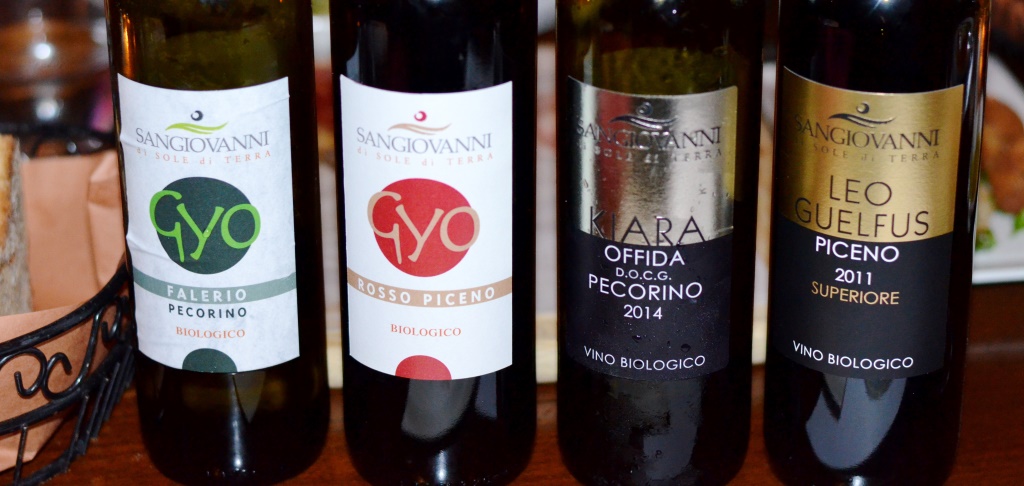 Here are my notes:
2014 Sangiovanni Gyo Pecorino Falerio DOP, Marche (13% ABV, SRP $13, 85% Pecorino, 15% Trebbiano)
N: White fruit, touch of grass
P: Hint of lemon peel, nice plumpness – almost Chardonnay-like, silky. Medium+ body, touch of bitterness.
V: 7+, nice
2014 Sangiovanni Kiara Pecorino Offida DOCG, Marche (13.5% ABV, SRP $20, 100% Pecorino) – this wine is named after owner’s daughter, Kiara. An interesting note – it is considered that Pecorino is at its best after 3 years in the bottle.
N: Bright stone fruit, leeches
P: sweet notes on the palate, apricots, medium to full body, nice acidity, good balance, long finish.
V: 8-, excellent


2014 Sangiovanni Gyo Ross Piceno DOP, Marche (13% ABV, SRP $13, 70% Montepulciano, 30% Sangiovese)
N: crushed fruit, fresh, blackberries
P: soft warm red fruit, nice layers, silky texture, polished and balanced
V: 8. Would be perceived as an expensive wine in the blind tasting. I would gladly drink this wine every day.
2014 Sangiovanni Leo Guelfus Piceno Superiore DOC, Marche (13.5% ABV, SRP $20, 70% Montepulciano, 30% Sangiovese, 18 month in oak, 18 month in the bottle)
N: Concentrated, plums, cherries, touch of herbs
P: Wow! Delicious, fruit, layers, spices, silky smooth, refined, long finish
V: 8+/9-, outstanding wine by itself, and one of the best values you can find at a price. This might be the wine with the best QPR I tasted throughout entire year.


As I mentioned already, the pleasures of the evening were not limited only to the wines. Our tasting took place at Cotto Wine Bar, a wonderful small outpost of authentic Italian cooking in Stamford, Connecticut.
Our hosts spent quite a bit of time going over the menu, looking for the dishes which would help to showcase the wines. As a first course, we had an excellent selection of various cured meats and cheeses – both Gyo and Kiara Pecorino wines perfectly accompanied these, providing nice backbone of acidity.


Next two pasta dishes arrived – Fettucine alla Bolognese (Fresh Homemade Pasta, Meat Ragu, Shaved Ricotta Salata) and Gnocchi alla Genovese (Basil Pesto, Oven Dried Tomato, Pine Nuts, Fresh Perline di Mozzarella), each one being very tasty. Sangiovanni Gyo Rosso Piceno was a perfect suitor here, weaving itself into the flavor profile of the dish.


Our last course consisted of two meat dishes – Agnello Scottadito (Grilled Lamb Chops, sauteed Brussel Sprouts, Pine Nuts and Raisins) and Straccetti Arugula e Parmigiano (Thinly sliced USDA Prime beef served with arugula, Parmesan Cheese and Balsamic Vinegar from Modena), meat cooked to perfection and delicious on its own. The Sangiovanni Leo Guelfus Piceno Superiore, with its firm structure, dark fruit and gentle tannins, perfectly complemented the meats, happily elevating every bite.


There you have it, my friends. Of course, there are lots of wines out there. But the great part of enjoyment of wine comes from the joy of discovery. And this is exactly what I’m taking about here. Sangiovanni wines bring together lots of unique qualities – not only these are tasty wines, but they are also organic, they are good for vegans, and they deliver an outstanding QPR. These are definitely the wines worth seeking.
And if you are ever in Stamford, and craving good Italian food, Cotto Wine Bar might be just “it”. Cheers!
Cotto Winebar and Trattoria
51 Bank St
Stamford, CT 06901
Phone: (203) 914-1400
http://cottowinebar.com/
[Wednesday’s] Meritage – Grenache Day, SHARE Campaign, Discover Georgia in New York
 Yes, I’m aware that this is very much not Wednesday, nevertheless – Meritage Time!
First of all – tomorrow, Friday September 18th, we will be [once again] celebrating the grape – this time, it is Grenache, a.k.a. Garnacha. Grenache definitely is one of the wine world’s darlings, enjoying huge popularity everywhere – France, Spain, California, Washington, Australia, South Africa. Whether part of a blend or playing solo, Grenache offers tremendous range of expressions and can easily be one of the most versatile red grapes. So tomorrow, grab a bottle of your favorite Grenache wine, join the festivities, and of course, share it with the world – use tag #GrenacheDay on Twitter or Instagram. You can also check out Grenache Day website and Facebook page.
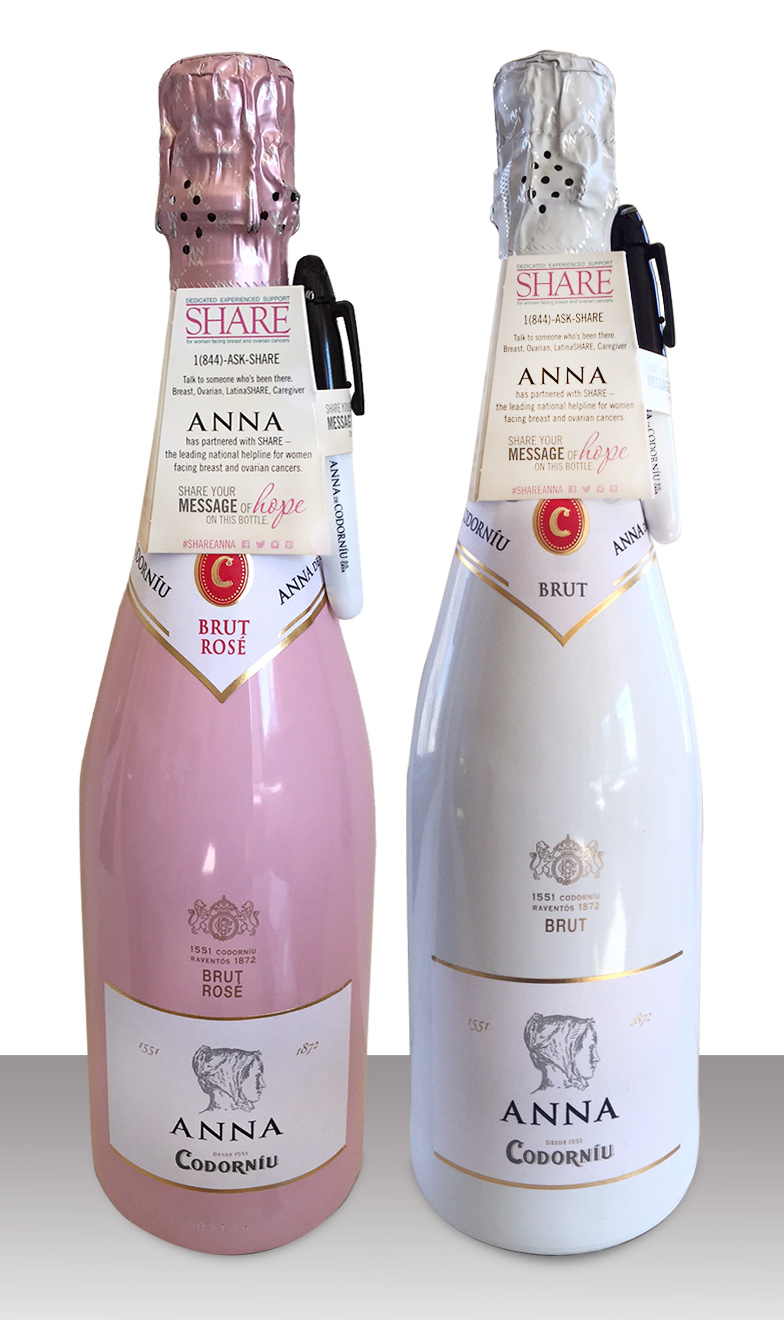
While this might be “an obsession of oenophile”, I can’t help but to notice how often wine is a subject of many “do good” initiatives – charity auctions, fund raisers. “drink for a cause” events. Here I want to bring to your attention one of such “do good” initiatives – partnership between Anna Codorniu, one of the best Cava producers from Spain, and SHARE, “a national organization that provides informed peer support, empowerment and educational resources to women affected by breast and ovarian cancers”. To support this cause, Anna Codorniu created special campaign called “Message on a Bottle” – I very rarely cite text from press releases, but let me just include this passage as a reference: “Anna de Codorníu will encourage consumers to engage with SHARE through the Message on a Bottle campaign encouraging consumers to write their messages of hope on the Anna bottle and connect with #SHAREANNA on social media. In-store displays and bottles will prominently feature information about SHARE, to access their services and become more involved. On September 21, Anna de Codorníu Brut and Brut Rosé will be served at the 12th Annual A Second Helping of Life benefit in New York City, featuring top chefs such as April Bloomfield, Anita Lo and Christina Tosi. (www.sharebenefit.org)”.
Last week I mentioned that Georgian Food and Wine event will take place in New York city on September 25-27, at Chelsea Markets – and here is the link for more information. Georgian hospitality is second to none, so if you have a slightest possibility of attending the event, I would highly recommend that you will make an effort to visit Chelsea Markets and experience #GeorgianBazaar firsthand.
And that is all I had for you for today. The glass is empty, but refill is on the way. Cheers!
Last Bottle Sign Up ($10 credit)




 Talk-A-Vino