Weekly Wine Quiz #62: Wine Trivia – Nebbiolo
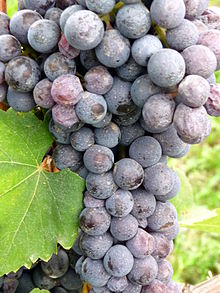
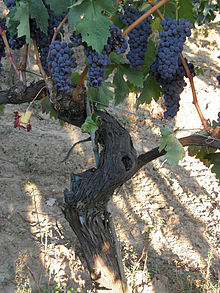
Nebbiolo grapes, picture from Wikipedia
Welcome to the weekend! Your new wine quiz has arrived.
Today our subject is the Italian grape called Nebbiolo – a power grape of Piedmont, solely responsible for some of the world’s best wines, Barolo and Barbareso.
As I’m working on this series of quizzes, I’m of course learning a lot myself. It was very interesting for me to realize, that unlike any other major red grape we talked about so far, Nebbiolo is pretty much confined to the 6 or so areas in Italy, where it makes wonderful wines – its world-wide spread is non existent, not even in the form of clones, like Zinfandel. And this is all despite the fact that Nebbiolo is quite an old grape, with first mentions going all the way back to the 13th century.
Nebbiolo is a very tricky grape to work with. It has the longest ripening cycle out of many grapes – buds early, ripens very late, prone both to mutation (there are about 40 known clones) and grape diseases. But – the resulting wines, like Barolo and Barbaresco, clearly worth the trouble, with wonderful aromatics, power and concentration. Also the ageing potential of the Nebbiolo wines is almost unlimited.
Now, to the quiz!
Q1: Explain the meaning of the name “Nebbiolo”
Q2: In one of the regions outside Piedmont, the wines are produced from Nebbiolo grapes in the style of Amarone – with grapes drying on the straw mats before they are pressed. Can you name that region?
Q3: True or False: Blending is not allowed for any of the wines produced from Nebbiolo grape in Piedmont region.
Q4: White grape used to be such a traditional blending partner for Nebbiolo that it was sometimes called White Barolo. Do you know the name of this grape?
Q5: In the blind tasting setting, the wines made out of Nebbiolo can be very distinguishable even before you take a first sip. Do you know what is this distinct feature of Nebbiolo wines?
Good luck, enjoy your weekend and cheers!
Wine Gadgets: Traveling With Wine
Few weeks ago, a fellow wine blogger Jeff, better known as The Drunken Cyclist in the wine blogging world, decided to challenge the wine bloggers to create blog posts relevant to the specific theme (this is a very popular trend among photography bloggers). The theme of the first challenge is Transportation. The post I’m about to present to you was supposed to the written in any case as part of the Wine Gadgets series, but it also very conveniently fits the theme of the challenge, so here we go.
A little intro: this is the fourth post in the Wine Gadgets series, where we are discussing different tools enhancing wine appreciation. In case you missed any of the prior posts, here are the links: Series Intro, Wine Pourers, Wine Preservers.
Can we use the words “wine” and “travel” interchangeably? Of course not, what kind of silly question is that! But think about your travel for a second. How often your travel plans include visiting the winery, no matter where you go? If you are reading this blog, I can safely say that for the most of you, if you are within the day travel from the winery, you are willing to make a detour. Do you visit the wine stores when you are visiting a different state or a different country? Of course you do! Thus it is safe to assume that your travel includes some happy encounters with wine.
But (oh, you knew the “but” is coming) – how many of you dreaded the trip back home, with all that wine you fell in love with, especially if that trip home include the scary, shiny beast called…a-e-r-o-p-l-a-n-e? The thought of the bottle of red wine in your luggage and then red liquid thinly covering your favorite shirt and dripping blood-like from the suitcase all over the luggage carousel can be paralyzing, no questions. But – there is no reason to be afraid of that scary, shiny beast. All you need to do is to use … of course, the wine gadgets.
So let’s talk about wine travel tools which you have at your disposal. And of course, not all the trips which include carrying of the wine include air travel – most of them will not, absolutely – thus we will talk about different tools, suitable for long distance wine travel and not.
Here is the list of some of the useful wine travel tools:
- Wine Picnic Carrier (can be called a Picnic Tote) – usually a short haul solution
- Wine Skin – pretty universal, but more applicable for the long haul
- Wine Luggage/Wine Transporter – mostly for the long haul
- Wine Tote – there are multiple versions, all for the short haul
- Wine Bag – definitely short haul, but most useful when visiting the wine store
Now, here are some pictures:


Wine bag
Now, let’s talk about these tools one by one.
Picnic wine carrier is a simple tool, suitable for short distance travel, or at least a travel where your luggage is not a subject of rough handling – having that wine tote in the trunk of your car is really not considered a “rough handling”. Added bonus is thermal insulation – if you will put a cold bottle of wine inside, the temperature will be preserved for a while. Many different kinds of the picnic tote are available, with capacity varying from 1 to 6 bottles.
Wine luggage is a serious tool. I bought mine about 5 years ago. For the most of those 5 years, I kept contemplating whether it is suitable for the trip or not. Problem is that this suitcase is really suitable just for wine, so traveling with two suitcases in the times when you only want to have carry on, doesn’t really sounds exciting. Besides, every time I would look at that suitcase, a fearful thought would visit – will it be actually able to protect the wine? Finally, for my last trip to Portugal, where I knew I will be around the wine I decided that it was now or never moment, and just went ahead. That was actually an excellent decision – wine suitcase performed perfectly, and I brought home 12 bottles of wine, all safe and sound. As you can see in the picture above, all the bottles are secured by the two straps, with the dividers between them. The suitcase also has sturdy sides and top and bottom, which protects your precious content quite well. From now on, when my plans will include carrying around substantial amount of wine, the wine suitcase is “it”.
Wine Tote is a simple tool to conveniently carry around a bottle or two of wine, also keeping it at colder temperature if it was previously chilled. I typically use it when I need to bring a bottle of white wine to the party. Then again, if you primarily travel by car, this tool has very limited value. If your travel includes public transportation and/or long distance walking, this can be quite convenient.
Next tool is called Wine Skin. Bubble wrap padded thick and sturdy plastic poach cut in the shape of a bottle – this tool is pure genius in my opinion (here is a link which explains how wine skin works). The poach has a bottom flap with adhesive, so you can completely enclose the bottle inside, air-tight. Even if your bottle will somehow break, the liquid will stay inside. Theoretically, this is single-use device, but I have my set of wine skins which I’m using and reusing for the past 4-5 years, and yet didn’t discard a single one – the adhesive still holds quite well. The great thing about wine skin that it has no weight, and it takes literally no space in your suitcase. Thus you have it with you in your trip, and in case you come across the wine you want to bring home, you can do it safely and without worrying – and if you don’t, that’s okay too.
Last tool for today is Wine Bag – at some point many wine stores carried them, and they were typically sold for $2.99. The wine bags are great for their intended purpose – to bring wine back from the wine store. Same way as it is popular now to go to the store with your own bag, the same idea works here. Wine bags are definitely a lot more convenient than a cardboard box which is hard to carry and then they should be disposed of, or the paper bags. But – I guess the problem is that a lot of wine store visits are very spontaneous, and people forget to bring the bag! Anyway, I have a few of those, and when I remember (!), I always bring them over.
If you are interested in any of these wine travel tools, here are few links from Amazon: Picnic Wine Carriers, Wine Skin
And as we have done before, here is our gadget poll:
So, what do you say? Do you have your preferred wine travel tools? What do you think about tools we discussed here?
In the next Gadgets post, we will talk about chillers. Until then – cheers!
Wednesday’s Meritage – Wine Quiz Answer, WTSO Cheapskate Wednesday in Progress, How To Taste Wine and more
Meritage Time!
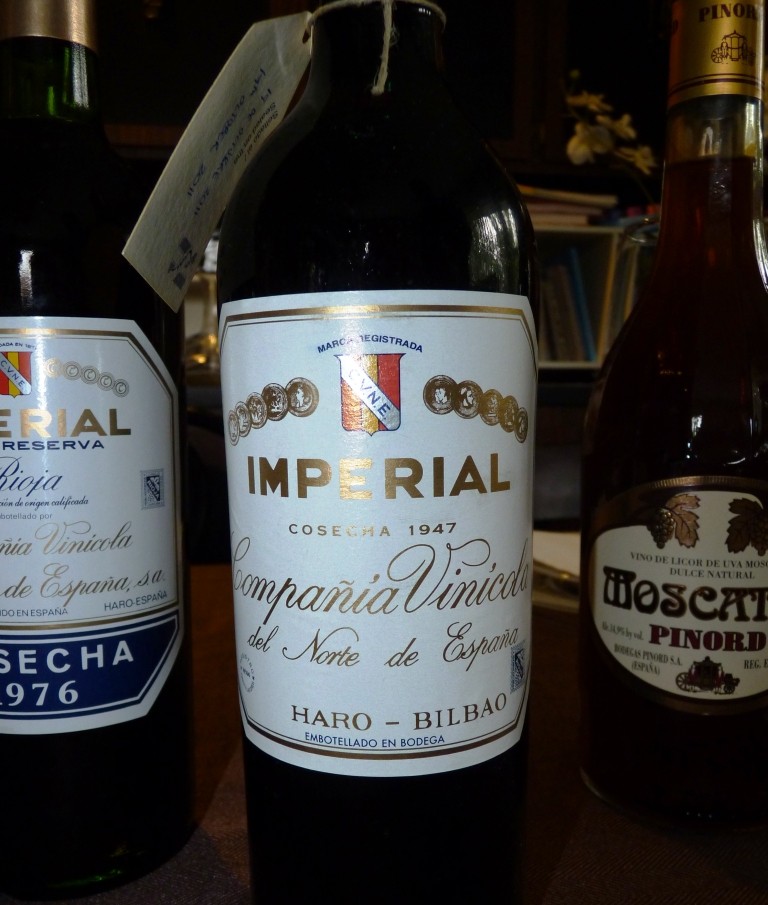 Let’s start with the answer to the wine quiz #61, grape trivia – Tempranillo. In the quiz, you were supposed to answer 5 questions about Tempranillo, the noble Spanish grape. Here are the questions with the answers:
Q1: What is the meaning of the name Tempranillo?
A1: Name Tempranillo comes from Spanish word temprano, which means “early”. Tempranillo typically ripens two weeks earlier compare to many other grapes.
Q2: Name 3 grapes, traditional blending partners of Tempranillo
A2: Traditionally, in Rioja wines, Tempranillo is blended with Mazuello, Grenache and Graciano.
Q3: What is common between Bodegas Muga, La Rioja Alta, Lopez de Heredia and Vina Real outside of the fact that all four are very famous Rioja producers and of course make wines out of Tempranillo?
A3: This was definitely a difficult question. What this four wonderful Rioja producers have in common is … location. All for wineries are located within walking distance from each other around old train station in Haro.
Q4: Tempranillo is used in production of the wine outside of Spain, which is at least equally famous to Rioja. Do you know what wine is that?
A4: Port. Tempranillo is known in Portugal under the name of Tinta Roriz, and it is one of the essential grapes in Port production.
Q5: Name two producers of Tempranillo wines – one is the most famous and another one is probably the most expensive.
A5: Another pretty difficult question. Vega Sicilia is definitely the most famous producer of Tempranillo wines with their flagship wine called Unico. And while it is quite expensive at $500+ per bottle, Dominio de Pingus makes probably the most expensive Tempranillo wines. Both wineries are located in Ribera del Duero region.
Based on the low participation in this quiz I can only say – people, you have to drink more Spanish wines (see, I’m only using bold font instead of capitalizing = screaming)! Especially from Rioja and Ribera del Duero. Anyway, as I said, at least two questions were quite difficult. We don’t have clear winner today, with Emil ( he doesn’t have a blog) coming the closest with about 3.5 points, so he definitely gets an honorable mention.
And now to the interesting stuff around vine and web!
First – don’t miss the WTSO Cheapskate Wednesday which is taking place today, June 19th. Yes, it is not super convenient to keep WTSO open in the browser and hit refresh all the time, but you have very few alternatives to that. You can also follow WTSO on Twitter – the only medium where new wine information is updated in real time. Make sure you have all your correct information on file with WTSO – shipping address and the credit card – otherwise you are risking to miss on the wine you want while you will be filling up the details (being there, done that). I posted many times before about WTSO events – if you are interesting in taking the look at the past sales, use this link.
Next, I want to bring to your attention an interesting article by Master Sommelier Tim Gaiser, called “How to taste wine”. I’m sure that many of you tried at various occasion to figure out what exactly is in your glass – it is a fun challenge to take random glass of wine, look, sniff, swirl, sip – and confidently say “Shiraz, Barossa, Penfolds, 1998 or 1999” and then find out that you’ve been right, or may be it was actually an Argentinian Malbec. Using techniques offered as part of any serious wine education (Master Sommeliers, WSET, Master of Wine, etc.) can actually increase your chances of being right. This article explains in good detail the approach to the blind tasting taken by Master Sommeliers.
If you are a Pinot Noir aficionado, this article might be for you. Written by Jay McInerney for Wall Street Journal, it is dedicated to David Hirsch of Hirsch Vineyards, one of the pioneers of Sonoma cool climate Pinot Noir.
Last but not least, here is an interesting blog post by W. Blake Gray, where he is talking about the study regarding cork taint. According to that study, 10% of the people actually prefer corked wines! For the first 10 minutes after I read it, I had mostly expletives roaming through my head – then I was able to compose myself and leave a [decent] comment. Yeah, well, no further comments – read it for yourself…
That’s all I have for you for today – the glass is empty! Refill is coming, and until the next time – cheers!
Zin Versus Zin Versus Zin
 I was in “zin’s mind” this past Father’s day. I don’t know how did that happened, but when I was thinking what bottle to open for dinner, “how about Zinfandel” thought came over. I had no reason to resist, so Zinfandel was it. And by the way – the title of this post sounds a bit antagonistic – but this is not the idea. I just happened to enjoy recently 3 different Zinfandel wines, hence the wording in the title.
Zinfandel is one of the pretty unique grapes – even if we will count Primitivo as Zinfandel (which technically is incorrect – it is only a very close relative), there are only a handful of places where Zinfandel wines are produced. But – the good news is that California, the primary Zinfandel’s habitat, has no shortage of excellent Zinfandel producers.
If you will take a look at my “Happy Father’s Day” picture, you can see two Zinfandels there – and these are the wines I want to talk about. First, a couple of words about producers. Turley Wine Cellars needs no introduction for any Zinfandel aficionado. Turley produces 28 wines, most of the them are Zinfandel with addition of few Petite Sirah and some others, coming from Napa, Sonoma, Lodi, Paso Robles and other primary areas in California. Turley is a “cult” winery, and while their wines can be found in some of the very select wine stores and restaurants, one really have to be on their mailing list to have more universal access to their wines (Turley was the first mailing list I was accepted onto – give me a second and slice of lemon to extinguish smile on my face).
The second producer is called The Wine Guerrilla. While not as well known as Turley, they also produce a full range of Zinfandel wines from the different areas in California. It is interesting to point out that The Wine Guerrilla is the only producer (to the best of my knowledge), which doesn’t make any other wines but Zinfandel. When your slogan is “The Art And Soul of Zinfandel”, I guess this is rather appropriate.
 I decanted both Turley and Wine Guerrilla Zinfandel for about 2 hours. Yes, I know this is not typical to use a decanter around Zinfandel, but both wineries make wines rather in restrained style, so I really wanted them to open up. First up – 2009 Turley Pesenti Vineyard Zinfandel Paso Robles (16% ABV). Even after two hours of decanting, the most I got on the nose was a hint of blackberries and some dark chocolate notes. The very first sip of the wine said “I’m big”. The first words which come to mind to describe this wine are “dense”, “firm”, “structured”. On the very firm structure the perfect fruit is weaved (hmm, interesting composition of the sentence – not a typical one for me, but I like it : ) ). More blackberries and dark chocolate on the palate, but also an “old world style” minerality was coming through, and then acidity was all in check. The wine is perfectly balanced, with tannins, alcohol, fruit and acidity being all together, in harmony. Drinkability: 8-
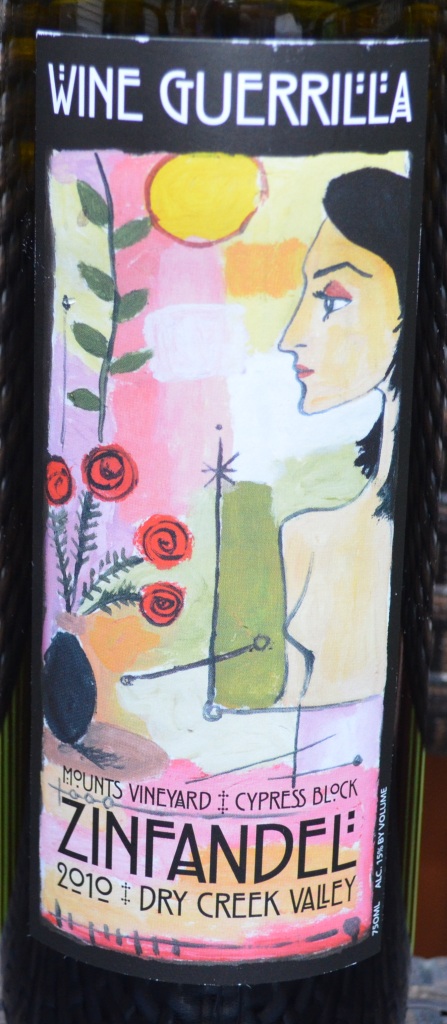 Now, let’s talk about 2010 Wine Guerrilla Mounts Vineyard Cypress Block Zinfandel Dry Creek Valley, Sonoma (15% ABV, 95% Zinfandel, 5% Petite Sirah, 300 cases produced). The wine showed a lot of dark fruit on the nose, mostly blackberries and cherries. On the palate, the wine was not as structurally dense as Turley, but instead it had layers of fruit with very nice luscious texture – ripe blackberries, cherries and dark chocolate, and a hint of eucalyptus. Very good acidity and overall nice and round wine, excellent balance. Drinkability: 8-
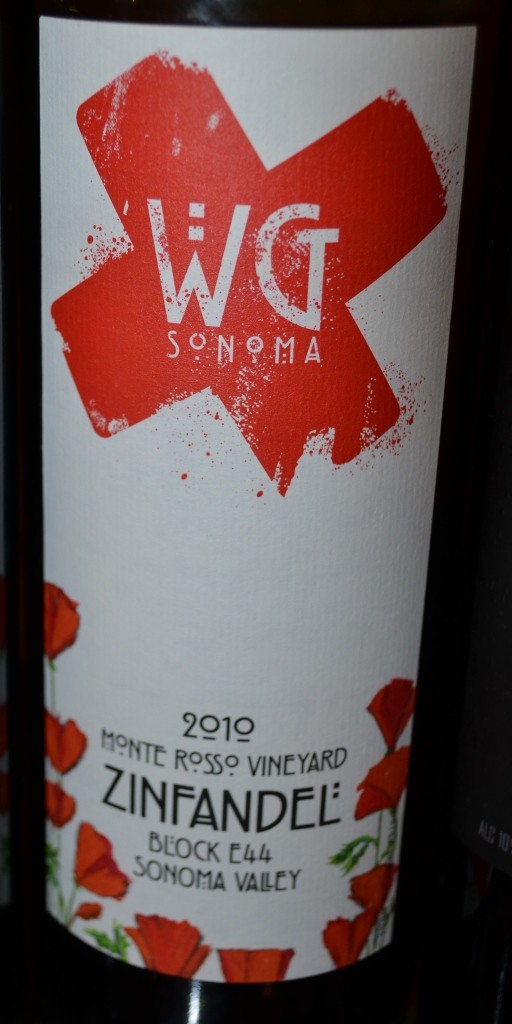
Did you notice a label of another Wine Guerrilla Zinfandel at the beginning of this post? It is there not for the purposes of decoration – it is actually another Wine Guerrilla Zinfandel which I had a week ago. 2010 Wine Guerrilla Monte Rosso Vineyard Block E44 Zinfandel Sonoma Valley (15% ABV, 200 cases produced) was totally unique in its style. To give you an idea, I would call it a Brunello of Zinfandels. After 2+ hours in decanter, the first thing which came to mind after the first sip was “dry”. This wine was soooo dry – uniquely dry for Zinfandel. It was also very herbaceous for the Zinfandel, with lots of dried herbs aromas, such as sage and oregano. It did show some fruit, but in very restrained, dialed back fashion. Definitely the most food friendly Zinfandel I ever tried, very balanced overall. Drinkability: 8
So I have to confess that I have one regret in regards to three wines I presented to you today. One, but big regret – I really want to taste these wines 10 years down the road! No, decanting didn’t do them any justice. These wines have to mature first, and then they will give you an ultimate pleasure. They were great and very enjoyable wines now, but they would become something much much bigger – if I would only have some spares…
Before we part, I want to share a few pictures from the Father’s day. Few weeks ago, my cousin got for me a new charcoal grill which is called “mangal” and it is mostly intended for making a kabob, but of course can be used as generic charcoal grill. Here are few pictures for you – with the warning – it might make you hungry…

Ribs and chicken

just chicken

just ribs
That’s all I have for you for now. Ahh, before I will forget – don’t miss the WTSO Cheapskate Wednesday tomorrow, June 19th. Expected to appear are Benziger Pinot Noir, Rioja DOC Crianza, Provenance Merlot, Pomo Nation Cabernet, Expo Cabernet and Edenhall Shiraz, of course in addition to many many other wines. Cheers!
Disclaimer: The Wine Guerrilla wines were provided courtesy of Wine Guerrilla. But of course all opinions are my own.
Happy Father’s Day!
To all of you Dads out there – today is your day! Enjoy it! I will raise my glass to all of you tonight – cheers!

Father’s Day in progress
Weekly Wine Quiz #61: Grape Trivia – Tempranillo
Tempranillo grapes as captured in Wikipedia
Welcome to the weekend! Here is your new wine quiz you’ve been waiting for so hard (yeah, okay, I know I’m pushing it, but may be at least a bit?)
And yes, we are continuing the grape trivia subject – by the way, if you are tired of it, do tell me – I will come up with something else. Just to let you know, we have two more red grapes to go through, and then we will switch to the whites for may be 8 different white grapes – then will see where we will end up.
Today’s subject is – Tempranillo! Just saying the word Tempranillo makes me very excited, as Rioja, one of the most well-known wines made out of Tempranillo grapes, are some of my all time favorites.
Tempranillo is indigenous grape originating in Spain, with more than 2000 years of history. It is black, thick-skinned grape, capable of surviving temperature swings of Mediterranean climate, with very hot days and cool nights. Tempranillo grapes are naturally low in acid and sugar content, so they often rely on blending partners to complement on both. Flavor profile of Tempranillo typically includes berries, leather (so famous in Rioja wines) and tobacco. Most famous Tempranillo wines come from Spain, from Rioja and Ribera del Duero regions, but Tempranillo is successfullygrowing in many other regions, including Portugal, California, Texas (up and coming star), South Africa, Australia and others.
And now, to the quiz!
Q1: What is the meaning of the name Tempranillo?
Q2: Name 3 grapes, traditional blending partners of Tempranillo
Q3: What is common between Bodegas Muga, La Rioja Alta, Lopez de Heredia and Vina Real outside of the fact that all four are very famous Rioja producers and of course make wines out of Tempranillo?
Q4: Tempranillo is used in production of the wine outside of Spain, which is at least equally famous to Rioja. Do you know what wine is that?
Q5: Name two producers of Tempranillo wines – one is the most famous and another one is probably the most expensive.
Enjoy the weekend and good luck with the quiz. And don’t forget to celebrate Dad tomorrow – Father’s Day, yay! Cheers!
Meet The Winemaker, Get Your Bottle Signed, Now What?
You come to the wine tasting, meet the winemaker. Talk about vintage, talk about history, taste the wine, get very excited, taste another wine, get even more excited, get a few bottles, and the winemaker signs them for you. So far so good, right?

d’Arenberg bottle, signed by Chester Osborn
You come home, put the bottles in the cellar. Now the time comes, and you remember that great wine you put aside to be enjoyed later. And you decide that the moment is now. You get the bottle. And it has a winemaker signature on it!!! Is it still the bottle of wine? Yes, but now, it is also the memorabilia! What now?
Yes, you can keep the signed book, baseball or baseball card, a cap, a painting and many other objects … forever!. You can take them out, show to the friends, tell the stories, rehash the memories, re-live the moment, pass those mementos from generation to generation if you wish. But wine? What do you do with the wine?

Another signed bottle I have – might be past prime already!
Drink the bottle and keep the empty, proudly displaying it (yeah, really not sure about that one)? Never open the bottle and keep it as is? But it is wine. It will not be good indefinitely…
So, what would you do? I’m asking this question as a generic one, not pertinent to the bottles I have. What would you do or what do you do with the signed bottles you have?
Happy Friday, friends. Cheers!
Wine Gadgets: Wine Preservers
Here comes new Gadgets’ Thursday. Today we will talk about Wine Preservers (in case you missed previous post where we talked about Wine Pourers, here is the link).
The idea behind wine preservers is simple but equally difficult to achieve. As soon as the bottle of wine is open, the oxygen gets in the contact with the wine, which sets of a rapid ageing process. The wine changes its taste as the result of this ageing process. While wine is in the closed bottle, it ages very slowly, as only trace amounts of oxygen (or none in case of screwtops) are getting into the contact with wine. As soon as cork is out, the ageing is fast and irreversible. The best defense – finish the bottle in one day (I know – this is what many of my readers will say) – but in a lot of cases, this simply doesn’t work this way. My wife likes wine, but sometimes she would prefer another drink or none at all – which leaves me one on one with the bottle. Can I finish it? Yes, and it happens from time to time. Is that a good thing – not really, may be for the wine it is, but not necessarily for me. Thus I want to make sure my wine still tastes good on the second day. If necessary or happened to be – on the third too. This is where you reach out to the wine preservers.
How do you preserve the wine from going bad once it is opened? By not letting oxygen get to it, of course. So there are few solutions which can be used here – not all of them are gadgets, but I will list them anyway:
- Box wine: Of course box wine is not a gadget. But the whole point is ( outside of environmental friendliness and low cost) is that by the nature of the design, box wine allows you to pour wine into the glass without letting oxygen inside the sealed bag. Once you “open” the box of wine (opening typically means getting the spout out of the carton), you can continue using it for the long time without any loss in the taste.
- Wine kegs: while not widely used, the wine can be distributed in the stainless steel kegs which are used by the restaurants to serve the wine on top. Not really an option for the home users (unless you entertain tremendously out of your house). Same as above, the wine is preserved as no oxygen gets back into the keg
- Inert gas preservers – the idea is based on using the inert gas, such as argon (which is heavier than oxygen) to displace the oxygen on top of the wine in the open bottle. There are few options available which are based on this approach:
- Enomatic wine dispenser – I kind of wish to have one at home (see picture below) – allows to have multiple bottles open at the same time, so consumers can run a “self-guided” tasting.
- A wine preserver system in the can (a can with the inert gas which can be sprayed into an open bottle to displace oxygen)
- Vacuum pump – allows to remove oxygen from the open bottle by pumping it out.
Here is the same, with the pictures:

From Wikipedia: Enomatic Wine Dispenser. Do you think I have one at home?


Wine Vacuum sealer


I have both vacuum pump and gas can, and I have to tell you that I use vacuum pump literally every day. Just to explain the usage:
For vacuum pump – insert rubber cork into the bottle, put vacuum pump on top, and pump the air out for as long as it is easy to move the handle – once the resistance becomes substantial, you know that you got all the air out.
For gas can – insert the straw into the bottle, push the top – you will hear the flow of gas under pressure. Keep pushing the top for about 2-3 seconds. Take out straw and quickly close the bottle with the cork.
Both vacuum pump and gas can allow you to accomplish the same goal – extend the life of your beloved beverage once the bottle is opened. Vacuum pump is very inexpensive (one time investment of $12.99 or so), and it will last you almost forever (mine is still working fine for the past 10+ years). At about $9.99 we can’t call gas can an expensive solution either, but you will have to replace them more often. One advantage of the gas can – you can use it to continue keeping wine for much longer time compare to the vacuum pump. I had a few times the need to taste the wine months prior to that wine actually being consumed. What I have done is open the bottle, pour out the amount I needed, use the gas can and put the cork or screwtop back and put the bottle back into the storage – it worked just fine and the wine tasted perfectly when it was opened much later.
Bottom line: I highly recommend using the wine preservers, whether it is a vacuum pump or gas can – they really help to remove that fear of opening the bottle only because you think that you will not be able to finish it and half of the good bottle will go to waste. It is one of the best of the useful, simple and inexpensive wine tools which help you to enjoy the wine more.
Now, to get your opinion on the subject, I created the poll which I plan to continue using for the future gadget posts – let me know what do you think about it. Please keep in mind that answering the poll questions is not a substitute for leaving the comment : ). I definitely would like to hear your opinion on today’s topic.
In case you have an urge to get one of the wine preservers now, here is what you can find on Amazon: Wine Preservers
And with this – we are done! Cheers!
A Bit Of Wine Data To Brighten Up Your Tuesday
I’m an infographics junkie. I can spend hours studying wittingly constructed graphs and pictures, representing data – sometimes totally unexpected.
Today I want to bring to your attention a very interesting set of charts compiled by the company called SpareFoot (interestingly enough, the company is in self-storage business), presenting the data around growth of wine consumption in US (remember, we are #1 right now, yay!). Enjoy and don’t forget to share your thoughts. Cheers!

Last Bottle Sign Up ($10 credit)




 Talk-A-Vino