Wednesday’s Meritage – Wine Quiz Answer, Chateau Latour, Natural Wines, Sauternes 2013 and more
 Meritage time!
Let’s start with the answer for the wine quiz #79, grape trivia – Cabernet Franc. In the quiz, you were supposed to answer 5 questions about a red grape called Cabernet Franc. Here are the questions, now with the answers:
Q1: One of the most famous wines in the world has Cabernet Franc as a major (2/3 or so) component of its blend. Do you know what wine is that?
A1: Unimitable Château Cheval Blanc uses at least 2/3 of Cabernet Franc grapes in their main wine
Q2: Cabernet Franc has a special relationship with the frost. Can you explain that?
A2: Icewine! The grapes should be frozen on the vine in order to produce the Icewine. While Icewine was typically produced from the white grapes, Inniskillin estate in Ontario was one of the pioneers who started producing Icewine from the red grapes, namely Cabernet Franc.
Q3: Which one doesn’t belong and why:
a. Bourgueil, b. Chinon, c. Saumur-Champigny, d. Saint-Chinian
A3: Saint-Chinian. It is an AOC in the Languedoc area which doesn’t make wines out of Cabernet Franc. The other three AOCs are located in the Loire, and all make Cabernet Franc wines.
Q4: This unique grape grows only in one place in the world, and it is a cross between Merlot and Cabernet Franc. Do you know what grape it is?
A4: Caberlot. I admit this was a difficult question. However, I mentioned this grape before, when I discovered it during VinItaly tasting this year (here is the link).
Q5: In Italy, Cabernet Franc is often confused for another rare Bordeaux grape. Do you know the name of that rare grape?
A5: Carmenere.
Looking at the results, we don’t have a winner today – however, both Frankly Wine and Eat with Namie get honorable mentions for properly answering 4 questions out of 5. Well done!
Now, to the interesting stuff around the web and vine!
Boy, what an eclectic mix I have for you today! First, just a quick last minute reminder – #MWWC4 vote closes today. If you still didn’t read and vote, you might have your last chance to do it here.
Now, how much do you know about Chateau Latour? Same as the most, you probably heard of it as a producer of one of the most sought-after wines in the world, and you probably know that it is generally very expensive. Recently, Chateau Latour made a lot of press by pulling out of the En primeur (wine futures) system, where wines are acquired by consumers before they are actually released, hedging both on saving the money and availability of the wine. Here is the link to the Wine-Searcher article, where you can actually learn a lot of interesting facts about Chateau Latour. I also want to mention that the Wine-searcher website is really becoming a great source of wine information, not just the price comparison tool.
Next subject – Natural wines. How much do you know about natural wines? What do you think of them as a category? Well, the article I want to bring to your attention is not exactly natural wine 101 tutorial, but it is rather a rant by Europe’s Best Sommelier of 2013, Arvid Rosengren, who is based in Copenhagen. A lot of his comments are most relevant for the local food and wine scene, but nevertheless, it makes a very interesting read.
Are you a fan of Sauternes, a sweet wine gems from Bordeaux? If you are, I have good news for you – 2013 is a great year, and you should be looking for these wines when they will be released. Contrary to 2012, when Chateau d’Yquem, the most coveted producer in Sauternes, decided not to produce their flagship Chateau d’Yquem wine, 2013 harvest shows a lot of botrytized grapes, which is a necessity to produce sweet wines in Sauternes. By the way, if you like red Bordeaux, 2013 doesn’t look all that great. Here is the link to the article where you can learn more.
The last piece I have for you has nothing to do with wine. It is written by Kimberly at whiskeytangofoxtrot4 blog, where she is talking about the power of the words. While her post, called Word, sounds rather personal, I think it is very powerful writing and it definitely well worth a few minutes of your time.
That’s all I have for you for today, folks. The glass is empty, but the refill is on its way. Cheers!
Just Arrived…
When I saw a big sturdy envelope yesterday in the mail, my first thought was “is that the…” – and yes, it was – my Quatro certificate from The Wine Century Club!

Wine Century Clun Quattro Certificate
Yes, I know that I tasted over 400 grapes, but somehow getting this piece of paper felt very good. And while I was thinking about the next level, the coveted 500, or Pentavini as it is called in The Wine Century Club, I didn’t feel encouraged – now I do. Thus you should expect to see more posts about obscure grapes and wines on this pages. But this is what makes it fun!
Join The Wine Century Club and start your journey now – you can thank me later! Cheers!
Henri’s Reserve – The Art Of Boutique Champagne
Did you know that every last Friday in October now has a designated “wine holiday”? Yep, and not just any wine holiday – it is actually a Global Champagne Day (Champagne and Friday perfectly go together, don’t they?) My “problem” (may all of our problems be so hard) of choosing the bottle of Champagne to open to celebrate Global Champagne Day last Friday was taken care of by invitation I got from Henri’s Reserve – to come and celebrate Champagne Day in style at Southport Galleries in Connecticut.


Henri’s Reserve is a boutique Champagne purveyor, primarily focusing on the small, artisanal Champagne producers. Most of the common Champagne people buy in the stores come from so called Champagne Houses, such as Moët & Chandon, Bollinger, Louis Roederer, Veuve Cliquot and many others. For the most part, Champagne houses buy the grapes from the grape growers, and make (blend) their wines to have a persistent, chateau-specific taste. At the same time, a number of grape growers (there are about 19,000 of them in Champagne) also produce their own wines. Until recently, those wines were literally impossible to find outside of France – but over the last 5-7 years, the situation changed and so called Growers Champagne became more available in US and other countries.
You might ask what is so special about Growers Champagne? While Champagne houses are mostly focused on blending to achieve their house-specific taste, growers are a lot more terroir-driven. Growers know their best vineyards and best parcels inside those vineyards, and that knowledge translates into unique wines with the sense of place – often at a lot more affordable price than the wine coming from the big houses. To give you one example, one of my favorite Champagnes from this tasting, Egly-Ouriet Grand Cru, comes form the village of Ambonnay. One of the most exclusive Champagne houses in the world, Krug, also produces the wine from the vineyards in the Ambonnay village. That Krug wine, called Clos de Ambonnay, would set you back at around $2700 per bottle (probably the most expensive Champagne on the market). While I’m not comparing Egly-Ouriet Champagne with Krug (never tasted Clos de Ambonnay), it costs almost 40 times less that that bottle of Krug, and at around $70, it is really an excellent Champagne.
Getting back to Henri’s Reserve – they actually make the Growers Champagnes available to the average wine consumer. If you look at Henri’s Reserve web site, you will find a lot of useful information about Champagne in general, pairing of Champagne with the food, how to open the Champagne bottle, entertaining with Champagne and a lot more. What is most important, though, is that you will be able to buy some of those excellent growers Champagnes.

Ruth Frantz of Henri’s Reserve addressing the audience
Now, let’s talk about our Global Champagne Day celebration. We had an opportunity to try 9 different Grower Champagnes. I didn’t focus on taking the detailed notes, as I was very busy mingling, so below is the list of the wines we tried with my brief notes. Don’t worry, it will be easy to figure out if I had any favorites.
NV Guiborat Fils Grand Cru Blanc de Blancs, Cramant (100% Chardonnay) – clean crisp acidity, a bit of brioche on the nose. Very good. Drinkability: 7+
NV Jacques Lassaigne Banc de Blancs Le Vignes de Mongueux (100% Chardonnay) – also perfectly clean and crisp, touch of yeast on the nose. Very good. Drinkability: 7+
2006 Guiborat Fils Grand Cru Blanc de Blancs, Cramant (100% Chardonnay) – has all the traits of vintage Champagne – brioche, toasted bread, apples, touch of yeast – but very delicately balanced, not over the top. Very good. Drinkability: 7+
NV Egly-Ouriet Brut Tradition Grand Cru, Ambonay (70% Pinot Noir, 30% Chardonnay) – a beautiful wine. Touch of yeast on the nose, crisp acidity and noticeable fruit notes on the palate – not in the terms of sweetness, but just more pronounced white fruit sensation than it would be in the typical Champagne. Outstanding. Drinkability: 8+
NV H. Blin Brut, Vincelles (80% Pinot Meunier, 20% Chardonnay) – perfect acidity with somewhat of a medium body, nice mid-palate weight, very round. Excellent. Drinkability: 8-
NV Pierre Gimonnet & Fils 1er Cru Brut Blanc de Blancs Sélection Belles Anneés (100% Charodnnay) – very nice nose of brioche and touch of apple, same on the palate with some interesting mineral undertones. Very good. Drinkability: 8-
2002 H. Blin Blin’s Brut Edition Limitée Millésimé (40% Pinot Meunier, 30% Pinot Noir, 30% Chardonnay) – this wine was the last one in the tasting, and it didn’t reach the optimal serving temperature, unfortunately (was too warm).
NV H. Billiot Grand Cru Brut Rosé, Ambonnay (80% Pinot Meunier, 20% Chardonnay) – crisp, clean, may be a bit too acidic for Rosé. Or may be it was too cold (can Champagne be too cold?). Drinkability: 7
NV Jean Laurent Blanc de Noirs, Celles-sur–Ource (100% Pinot Noir) – very nice, medium body, interesting complexity. Very good. Drinkability: 7+
I have a confession to make. I’m not a Champagne guy. I appreciate a glass of a good bubbly, whether it is Champagne, or Prosecco, or Cava – but Sparkling wine is not my usual daily wine. Having said that, you know what happened after this tasting? I was craving Champagne! I resolve not to wait until the next Global Champagne Day to satisfy that craving – and you might expect to see more sparkles in this blog. Thank you, Henri’s Reserve, for the great time! Cheers!
Weekly Wine Quiz #79: Grape Trivia – Cabernet Franc
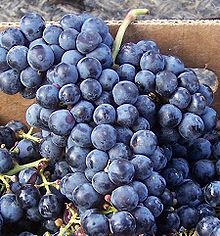
Cabernet Franc grapes, as shown in Wikipedia
The Wine Quiz series is not meant to intimidate. The whole idea here is to have fun and learn something new. When answering the questions, it is fully encouraged to use all available sources of information, including Google or any other search engine. There are no embarrassing answers – the most embarrassing thing is not giving it a try…
Welcome to the weekend and your new wine quiz!
We are continuing our grape trivia series, and we are back to the red grapes. Today’s subject is the red grape called Cabernet Franc.
According to many sources, Cabernet Franc is first appearing in Bordeaux in the 17th century, with a good chance of being around for much longer. From Bordeaux, it made it to Loire valley, where it is often used to produce single-varietal wines. In Bordeaux itself, Cabernet Franc is typically used as part of the blend together with Cabernet Sauvignon, Merlot, Petit Verdot and Malbec. Today Cabernet Franc is spread out all over the world, both used in Bordeaux-style blends (Meritage) and as single varietal bottlings – Australia, New Zealand, Italy, Chile, US, Argentina, Canada are all have a good amount of plantings of Cabernet Franc. In the US, Cabernet Franc is successfully grown all over the country, with some of the best wines coming from California, Washington and New York states.
Cabernet Franc is known to be a parent of Cabernet Sauvignon ( together with Sauvignon Blanc), so the typical flavor profile of Cabernet Franc is somewhat similar to the Cabernet Sauvignon, with black currant, raspberries and green bell peppers flavors being most typical. At the same time, Cabernet Franc wines often have more earthy aromatics and a little bit lighter in the body. Cabernet Franc also buds and ripens at least a week earlier than Cabernet Sauvignon, and it is more resistant to the low freezing temperatures during winter, which allows it to be cultivated successfully in the colder climates.
And now, to the quiz!
Q1: One of the most famous wines in the world has Cabernet Franc as a major (2/3 or so) components of its blend. Do you know what wine is that?
Q2: Cabernet Franc has a special relationship with the frost. Can you explain that?
Q3: Which one doesn’t belong and why:
a. Bourgueil
b. Chinon
c. Saumur-Champigny
d. Saint-Chinian
Q4: This unique grape grows only in one place in the world, and it is a cross between Merlot and Cabernet Franc. Do you know what grape it is?
Q5: In Italy, Cabernet Franc is often confused for another rare Bordeaux grape. Do you know the name of that rare grape?
Good luck, enjoy the quiz and your weekend! Cheers!
Farm-to-Table Dining At Its Best: Bailey’s Backyard in Ridgefield, CT
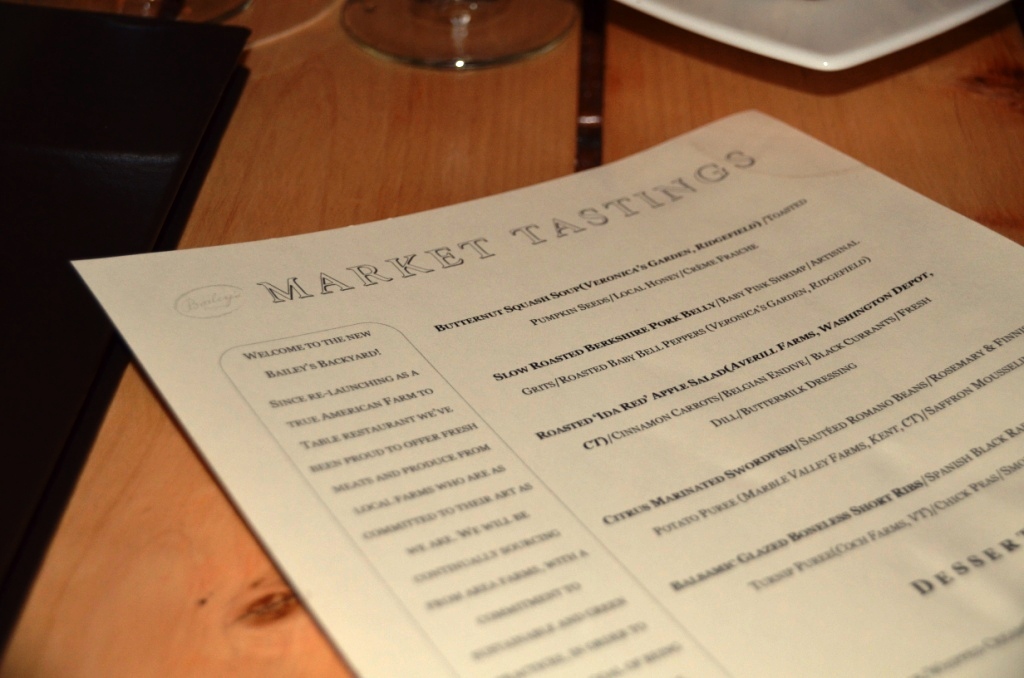 What do you think is the most important ingredient in the farm-to-table dining? Fresh local herbs? Fresh local cheese? Humanely raised chicken from the nearby farm? Based on my recent experience at Bailey’s Backyard, an American Farm-to-Table restaurant, the main ingredient of successful farm-to-table dining is … passion.
It was enough to listen to the Chef Forrest Pasternack, who was presenting each and every dish during the dinner, to see and feel the passion. Each and every ingredient had its place. The potatoes were not just the random potatoes from Idaho, there had an exact source – Maple Valley Farms in Kent, CT. Whipped cream was not coming from the random can acquired in the Restaurant Depot – it was coming from the farm in Litchfield, Connecticut. Every little ingredient had an exact source, and there was a relationship built behind all those ingredients – and that takes a lot of passion and hard labor.
And then you can see, or rather taste, the results of passion and hard labor. Each and every dish we had at the dinner had a soul. You could taste and admire each ingredient by itself, and then they played together in the concert, delivering an immaculate experience. As usual, I will attempt to present our dinner in the form of the pictures – it will not do the justice to the unique experience, but it probably can make you hungry.
We started with the cocktails, of course. Fresh and local ingredients in the cocktails are as important as in the food, and Brian, the master behind the bar, had a great selection of carefully crafted concoctions. I had The Ballard (Cucumber infused gin, fresh lemonade, splash of elderflower liqueur), which was tangy, a bit grassy and very refreshing.


The first item to appear on the table was, of course, the bread. To describe it, the first thing which comes to mind is “loaded” – raisins, cranberries, spices, perfectly breakable texture, very tasty – locally baked, of course:
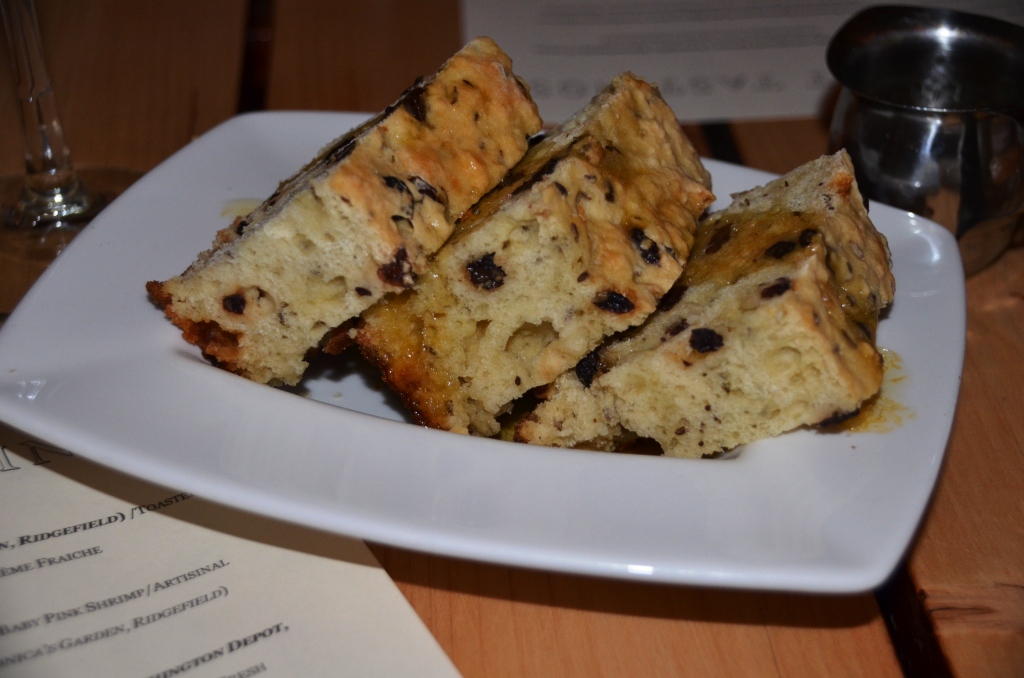
Fresh “loaded” bread
Our first dish was Butternut Squash Soup (butternut squash from Veronica’s Garden, Litchfield, Toasted Pumpkin Seeds, local honey, Crème fraîche) – it was presented step by step – first the plates with all the condiments came out, and the hot soup was poured into each individual plate. The soup was well balanced, with the nice creamy texture, a bit of a heat and a touch of cinnamon.


As you can imagine, for me the dinner should include wine (of course I can make exceptions – if I’m in the BBQ joint, beer is my friend). The wine list at Bailey’s Backyard is simple, but quite versatile, with most of the wines priced quite reasonably. Considering that this is a farm-to-table restaurant, the only change I would suggest is to add a selection of local (CT/NY/MA), organic and natural wines (in case Brian would read this post : ) ). I took a full advantage of the “by the glass” selection, and had three different wines with the dinner. First one was 2012 Actobat Pinot Gris, King Estate, Oregon. The cutting edge acidity which was present in this wine, was working very well with the soup – while accidental, this was a successful pairing.

King Estate Pinot Gris
Next up was Slow Roasted Berkshire Pork Belly (Baby Pink Shrimp, Artisanal Grits, Roasted Baby Bell Peppers – Veronica’s Garden, Ridgefield) – roasted baby bell peppers worked perfectly with pork – this was definitely an excellent combination. Sweetness of shrimp and creamy, oozy grits were adding a great complexity here as well.
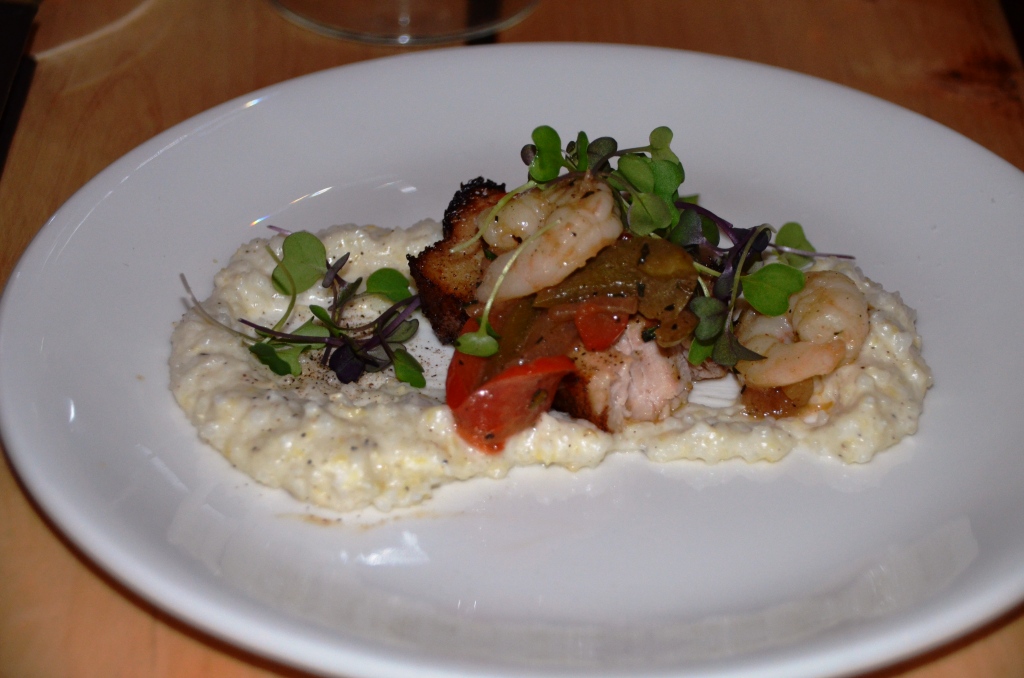
Slow Roasted Berkshire Pork Belly
Now for the next glass of wine I had 2012 Ernie Els “Big Easy” Chenin Blanc, Western Cape, South Africa – this wine had a bit less acidity than the Pinot Gris, and it had some nice body presence – medium to full body, somewhat plump with white stone fruit notes. Worked perfectly with the next two dishes.
Slightly changing the pace, the next dish was a salad – Roasted ‘Ida Red” Apple Salad (Apples – Averill Farms, Washington Depot, CT, Cinnamon Carrots, Belgian Endive, Black Currant, Fresh Dill, Buttermilk Dressing) – it was very interesting to listen to the passionate presentation of this dish by Chef Forrest, talking about black currants being soaked in the Riesling, mentioning all the farms where the different elements of the dish were sourced from – really different and unique. The dressing was perfectly balancing the dish, and everything worked together as a whole – perfect crunch in the texture, sweetness, acidity – including the bright visual appeal.


Next we were presented with Citrus Marinated Swordfish (Sauteed Romano Beans, Rosemary & Finnish Potato Puree – Maple Valley Farms, Kent, CT, Saffron Mousseline) – swordfish (caught that day in Boston) was perfectly cooked, which is not an easy task by itself, and then it was simply heavenly together with that homey, rustic puree (next time, I just want a bowlful of that puree). Excellent dish overall.


The dinner was nicely progressing according to our tasting menu, and then we had a surprise. White plate with the spoon appeared in front of everyone. Rested in the spoon was Herbed Ricotta Gnocchi with truffle powder. Chef Forrest came out to quickly present the dish, and then all of us happened to eat it almost at the same time. So this, my friends, was a true food porn at its best – forget the picture, the picture tells you nothing , but you had to hear that almost simultaneous moan coming from everybody, followed by the “oh my god” expressions. I remember some of the Food Network competitions required chefs to make the best single bite-sized food they can. Single bite or not, this was one of the most spectacular food experiences I ever had. I can’t describe it any better for you, sorry – but if you are in a mood for some food porn, the address of the restaurant is at the bottom of this post.
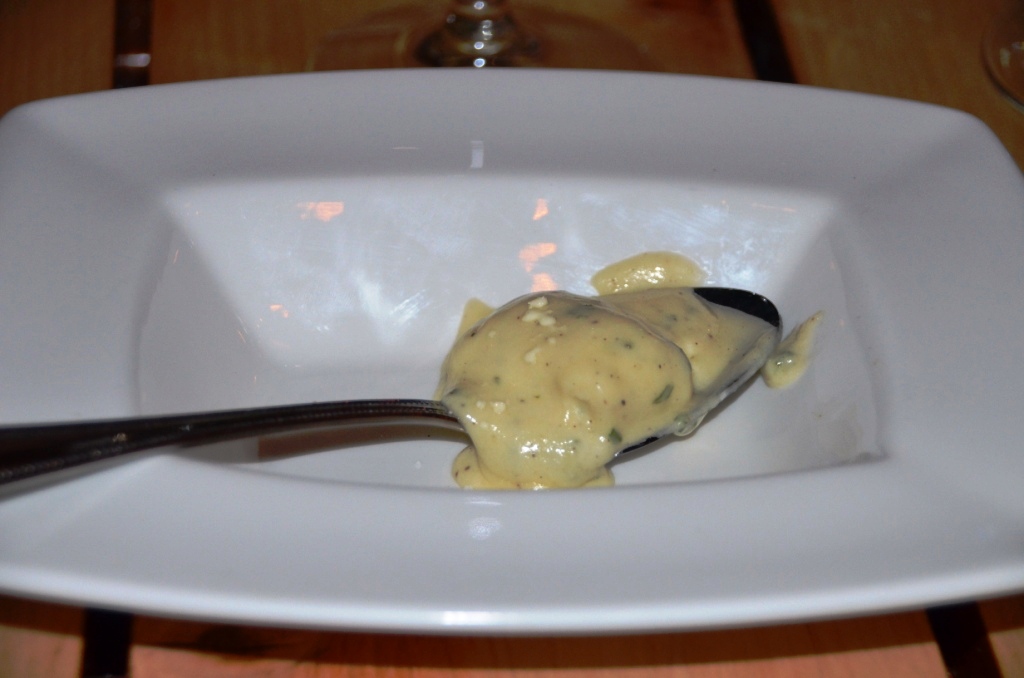
“omg” Herbed Ricotta Gnocchi
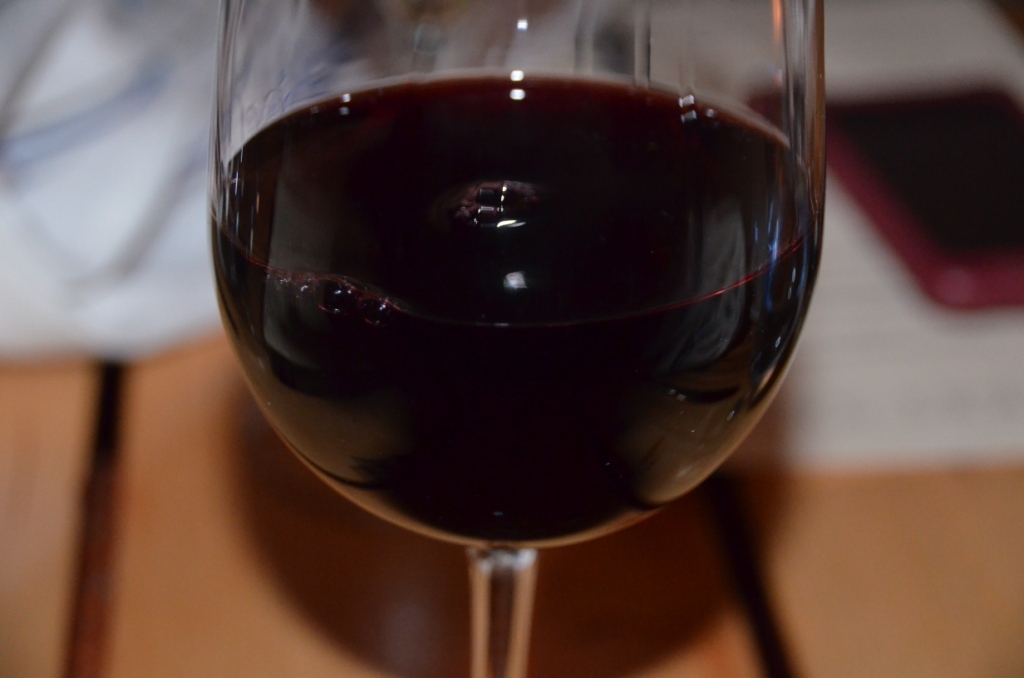
Before getting to our last main course dish, I got a glass of red wine – 2010 Rocca delle Macìe Sasyr Sangiovese Syrah, Tuscana IGT – dark red fruit nose, medium to big body, plums, hint of dark chocolate and espresso notes on the palate, nice balance. Enough power to stand up to the short ribs.
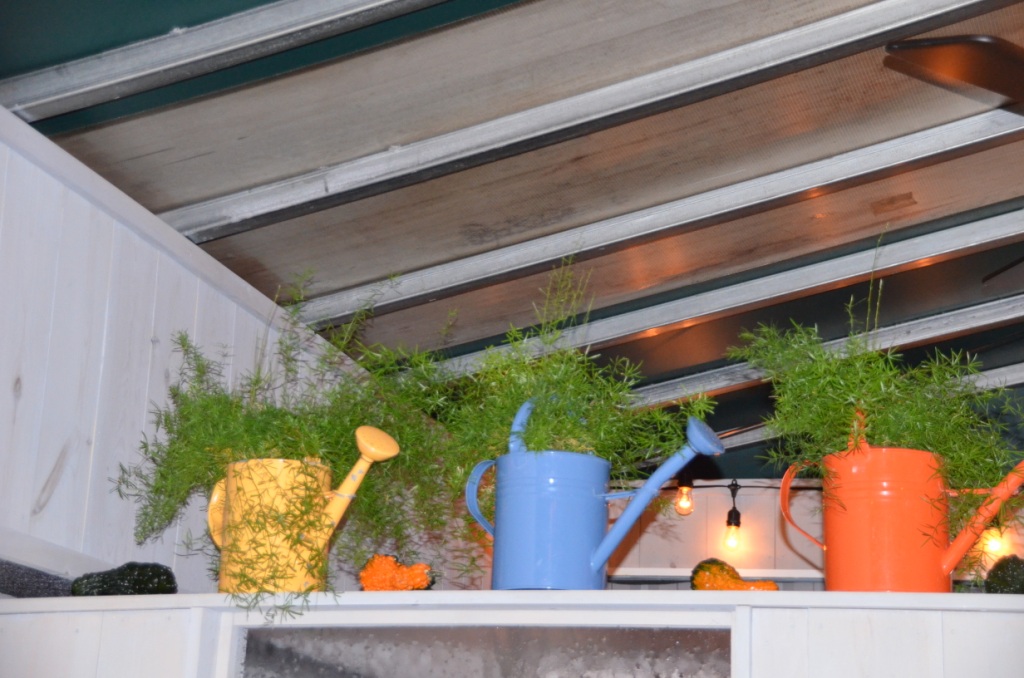
love the decor…
Last entree – Balsamic Glazed Boneless Short Rib (Spanish Black Radish, Gilfeather Turnip Puree – Coch Farms, VT, Chick Peas, Smoked Paprika) – I would have to call this dish an ultimate comfort food. Everything perfectly worked together, and if you ever had well prepared, slow cooked short rib, you know how heart-warming that meat gets, after it absorbs all the flavor and literally falls apart so it can be eaten with the spoon. This was a perfect finish to our main course.


And then there was dessert. We had two different desserts. First, it was Nutella Mousse (whipped cream – Arethusa Farms, Litchfield, CT, Chocolate Crumble) – perfectly light, not overly sweet, very tasty:

Our last dessert was Pumpkin Cloud 9 (Brioche “Pain Perdu”, Whipped Pumpkin Custard – Jansal Valley Farms, Westport, MA) – another staged dish, where the brioche arrived first, then the whipped pumpkin custard was individually scooped on top of each “toast” – another very balanced dish, not overwhelming with sugar or pumpkin notes itself. It was an excellent finish to the very tasty meal.


All the dinners come to an end. It is interesting to see how 3 hours go by unnoticed, when you have a great company, great food, great service. This was definitely a unique experience, listening to the Chef presenting each and every dish, talking about what farm-to-table really means, talking about all the farms and all the people who work very hard to create this wonderful experience.


As always, the last thing left to do is to thank Chef Forrest, drinks master Bryan Walsh, and the owner and our host Sal for their passion and the wonderful time we had. We will be back!
Disclaimer: I attended the dinner as a guest of management. All opinions are my own.
Bailey’s Backyard
23 Bailey Avenue
Ridgefield, CT 06877
203-431-0796
http://www.baileysbackyard.com

Wednesday’s Meritage – Wine Quiz Answer, Global Champagne Day, Dishcrawl SoNo, Tempranillo Day and more
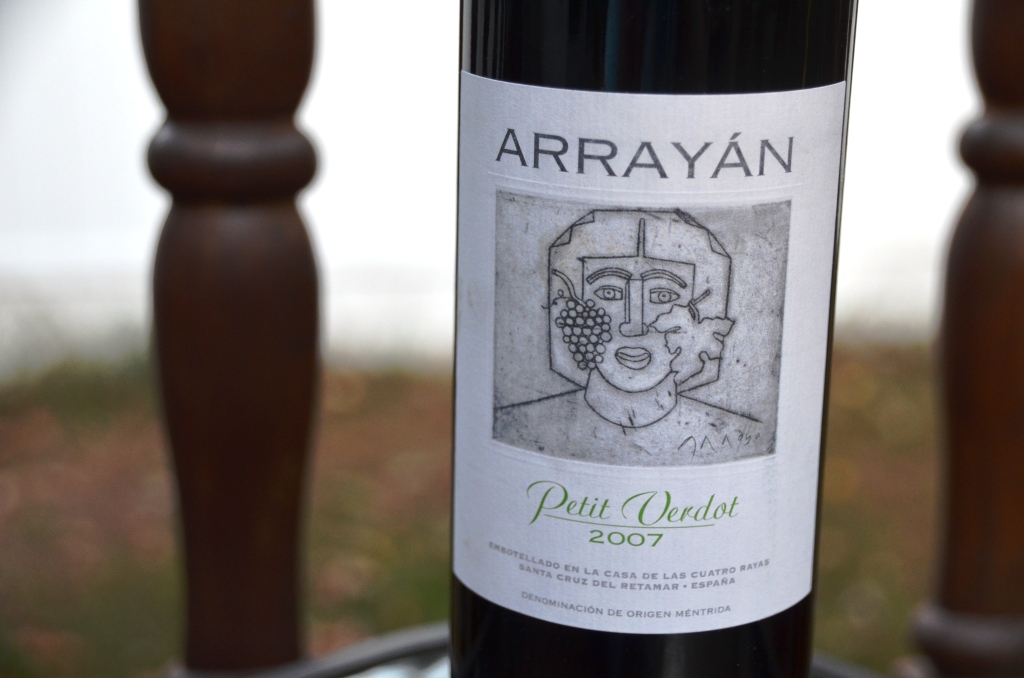
Arrayán Petit Verdot, Spain
Meritage time!
Let’s start from the answer to the wine quiz #78, grape trivia – Petit Verdot. In the quiz, you were supposed to answer 5 questions regarding the red grape called Petit Verdot. Here are the questions, now with the answers:
Q1: Explain the meaning of the name Petit Verdot
A1: Petit Verdot stands for the “little green”, as a reference to the small size of the grapes and the tendency to retain green (underripe) grapes even at the harvest time
Q2: Name four grapes, main blending partners of Petit Verdot in France
A2: We are talking about classic Bordeaux five here, the blending partners of Petit Verdot are Cabernet Sauvignon, Merlot, Cabernet Franc and Malbec
Q3: True or False: Australia’s plantings of Petit Verdot far exceed the plantings of Petit Verdot in France
A3: True. Australia embraced Petit Verdot starting from the second half of the 18th century, increasing its plantings, where Petit Verdot plantings in France had being on the downturn for a while.
Q4: While Petit Verdot is a difficult grape to work with, two events were major contributors to the demise of Petit Verdot in Bordeaux. Can you name those two events?
A4: Phylloxera epidemic in the late 1800s and the frost of 1956. As a difficult to grow and not essential grape, Petit Verdot followed the path of Malbec, with a dramatic reduction in plantings after the cataclysmic events.
Q5: While it is not impossible to find a pure 100% Petit Verdot wines made in Bordeaux, those wines are rather the exceptions. What is the typical percentage of Petit Verdot in Bordeaux blends?
A5: It is very often 1% to 2%, and in general stays under 5%. There are exceptions, of course.
Bonus question: what was your personal encounter with Petit Verdot? Do you have any memorable bottles?
Australia, Spain and [interestingly enough] Long Island, New York come to mind when I think of single-grape Petit Verdot bottlings. Some of the wines were just purely spectacular, like 2007 Jamesport Petit Verdot from Long Island, or this 2007 Arrayán Petit Verdot from Spain.
I’m glad to report that we had a good participation in the quiz, and most importantly, we have a lot of winners! Patrick Kleiner (who has no web site), the drunken cyclist and Vino in Love are all correctly answered all 5 questions, so they are our ultimate winners and get unlimited bragging rights. Well done! I also want to mention Duff’s Wines and Eat with Namie as they both made only minor mistakes and got about 4.5 correctly out of 5, so they both get an honorable mention.
Now, to the interesting stuff around the web and the vine!
I don’t have much of the interesting reads for you today, so it is mostly various events announcements.
First, don’t forget that Monthly Wine Writing Challenge #4 (#MWWC4) is in its final hours – it ends today, on October 23rd. The theme is “oops” – send your submission over to TheWineKat, and best to do it on Twitter with the hash tag #MWWC4.
Next, it appears that this coming Friday, October 25th, is a Global Champagne Day 2013 (I’m sure TheDrunkenCyclist is oozing with joy :- ) ). You have an option of finding a good place to celebrate in style, or just crack open whatever sparking goodness your heart desires, and celebrate the celebration drink!
While you still have time to get ready, don’t miss the International Tempranillo Day coming up on November 14th. There are plenty of Tempranillo events happening all over the country, and the good Tempranillo bottle is so easy to find nowadays, you have no excuse to miss this celebration.
Last but not least, at least for the local Connecticut foodies, Dishcrawl event is for South Norwalk (SoNo) will take place on November 20th. Based on my recent dining experiences in South Norwalk, this event shouldn’t be missed! For more details and to get your tickets, please visit Dishcrawl site.
That is all I have for you for today. The glass is empty – but refill is on the way. Until the next time – cheers!
Wine’s Oops Moments
 The Monthly Wine Writing Challenge started about four month ago with the goal to take the wine bloggers to the “next level” – one single word sets the theme, and all the willing wine bloggers create their best interpretation of the theme and its connection with the world of wine. In those four month the challenge themes went from “Transportation” to “Trouble”, then to “Possession”, and now to the current theme “Oops“, as set by the winner of the previous round, The Wine Kat.
Opps. What is the first thing which comes to mind when you here that short, but extremely universal expression? I don’t know about you, but somehow the first association for me was the song. I know I can’t compete with Food and Wine Hedonist when it comes to the hedonistic references to the popular culture, but in any case, Britney Spears “Oops, I did it again” was the very first thing which came to mind when I read the new theme, so here it is:
Yep, this video has nothing to do with wine, so let’s try to find our track here.
Life is generally filled with “oops” moments. Some can be funny, some can be sad. Some can be innocent, and some can be deadly, like missing the stop sign at a busy four-way intersection. The worst part of the oops moments is that they keep happening over and over, as we forget to learn from the previous ones. Technically, you are not supposed to step on the same rake twice, nevertheless, we like doing it over and over again.
Wine world is particularly prone to the oops moments. Problem is that you try one wine, and you think that you know them all. While there are so many factors affecting the taste of wine at a given moment – you mood, food, surroundings, company, price, label, your friend’s opinion, how long the bottle was open, is it at the optimal temperature… had enough? Nevertheless, it is enough to have one Chardonnay from Napa Valley not to our liking, where we will immediately generalize and come to the conclusion – okay, I’m not drinking Napa Chardonnay, just period – I had one, I know them all. That alone is a great source of the oops moments. But that is not all. Additionally, we are often not shy at all to state our opinion, as people think they have to have an opinion about wine, and it should be expressed, loud and clear – “yes, of course, they only make cheap wine in Australia”, “yes, I already had the Bordeaux once – it is a complete crap”. Often, it seems that wine simply breeds arrogance and snobbery – which leads to the multiple embarrassing oops moments.
Overcoming this tendency is actually a hard work, and we really need to keep the focus to stay humble and thoughtful around wine – for our own good.
Let me give you an example of couple of my own profound, embarrassing oops moments. About 6 years ago, I visited Ridge winery in California in Santa Cruz region. Ridge had being making wines since 1962, and has somewhat of the cult following, especially for their Monte Bello Cab. I visited the winery with the friend, and we were also on the mission to find a good bottle (at the reasonable price) to bring it that same evening for dinner at another friend’s house. So we tasted through the full line of wines, and we didn’t like a single one of them. I don’t know what could’ve caused that – may be it was a Root day for me, may be I was just in the wrong mood for the tasting, may be something else. But the important thing is that based on that tasting, I made a strong conclusion for myself – Ridge doesn’t make good wines, it is all marketing fluff. Then about 3 years ago, I saw a tweet from Jancis Robinson, where she mentioned that she is working on the line of classic wineries for a big tasting, and she is including Ridge as one of the exemplary wineries in US. Here comes me, who already tasted Ridge once, and therefore I’m an expert on the subject, with the comment that I don’t understand why is she even mentioning it, as I was at the winery and didn’t like any of their wines. Jancis responds to my comment that she disagrees, and Ridge shows perfect sense of place. Next thing someone sees my comment and gets very upset as it is impossible not to like Ridge, and if I don’t like it, I have to be blocked (I even wrote the post about it). Well, no, we didn’t get to the oops moment yet.
Then, about 8 month later, I was again in the close proximity of Ridge, and decided to give it another try. I don’t know what was different that time – may be a cheerful girl who was pouring the wine, a different weather, a flower or fruit day – don’t know, but… I not only liked the wine, I loved each and every wine I tasted (here is my post about the experience). Now, here you have a classic oops moment. I wish I could’ve kept quite in that twitter dialog with Jancis, I really wish I would’ve kept my opinion to myself – but no, I had to show my expertise – and eat my embarrassment thereafter.
In the spirit of “oops, I did it again”, I need to give you another example, this one is a very recent one. You see, I like New Zealand Sauvignon Blanc – fresh grapefruit, lemongrass, vivid acidity – very nice wine in general. I know that you can buy the majority of New Zealand Sauvignon Blanc in the range of $10 to $16, and they will be very good wines for the most of the cases. And then there is Cloudy Bay – a New Zealand Sauvignon Blanc which typically costs $26 or more. In my mind, the picture is clear – what can be so different about Cloudy Bay compare to any SB which is $10 to $16 cheaper – I had the others, I’m sure it can’t taste any differently (smart and not arrogant at all, right?). Then I see a blog post by Stefano, where he speaks very highly about Cloudy Bay, and the little genius inside gets me to make a comment that Cloudy Bay can’t be so much better and different to warrant paying that much more money for the bottle.
And then I come to the trade tasting, and see the Cloudy Bay being poured. I take the first sip, and it becomes my instant “oops” and “oh sh!t” moment, as the wine is stunningly beautiful, and of course I will be glad to pay more money for it – as it is really different from the mainstream.
There you have it my friends. The oops moments are unpleasant, and they will hunt you down – it really worth an effort to avoid at least the repetitions. Stay open, stay humble and keep learning – the wine world is yours to enjoy. Cheers!
P.S. If you got your own glorious “oops” moment and you are willing to share – this is what the comments section is for…
Port Barrels and Harvest
There are days when everything goes wrong. And then there are days when everything goes right (hmm, which one do you prefer?). And sometimes the bad day just … changes in the middle, and becomes a great day (yes, the worst case scenario is when the best day becomes a complete disaster, but let’s not go there, okay?).
My day didn’t start all that well. During the trip to Portugal, I had one and only one free day when I could take a drive along the Douro river and visit some wineries. Before the arrival, I asked the hotel to reserve the rental car, which should be automatic (yeah, I know, it is a substantial handicap – never learned how to drive the manual) and have GPS. Hotel’s email said “no problems, all arranged as you requested”.
We arrived at the Europcar rental pretty much as planned – a little bit after 9 am. I figured we will get a car, drive for about 2 hours, and will have enough time to visit 3 wineries. For some reason, the lady at the counter took about 40 minutes to do the paperwork. Finally, we get portable GPS, and then we are doing the walk around of a small car (I’m happy – my preference in Europe is to drive the compact car, as in the end of the day you need to park the car somewhere, and small car is a lot easier to deal with). All the little scratches are noted, we get inside. I put the key in the ignition, stat the car, and … oh shit, I can’t drive it – it is a stick-shift. I’m walking back to tell the lady that this is not the car which was requested, and that I can’t drive this car (meanwhile, I’m literally swearing at myself for not asking from the beginning about type of the transmission the car has – pretty much an hour of time is wasted). The lady (to be honest with you – I had a sneaky desire to avoid her from the first minute I saw her), proudly tells me that I got the car I requested. And after I explained that I can’t drive stick-shift, and I need an automatic car, she also happily informed me that there is nothing she can do.
Luckily, the second agent is free now, and I plead my case to her (the perspective of simply spending the day aimlessly wandering around Porto somehow doesn’t excite me even for a second). She at least tells me “let me see what I can do” – I also see the face of her colleague (the first lady) clearly expressing the hope that I would just walk away, not drive away in one of their coveted automatic cars.
The girl who is trying to help us is making a quick call and then tells me that yes, she has a car – but it will cost twice as much (€140). At this point, again, we have no choice, so yes, thank you, this is wonderful, can we have that car as soon as possible? Well, not so fast, she says – the car must be washed and re-fueled. My plea that dirty car will be just fine, and that I know how to fill the car, dies in vein. “It will be only 15 minutes”, she says. Finally, one hour later, we are presented with the white behemoth. We get in, and we pretty much have to start driving immediately as we are blocking someone’s private garage entrance, and the person who is trying to get out is not very happy with that. I barely manage to get this car to move, as some genius designed the parking on/off knob to be a separate button to the left of the steering column, functionally co-located with the parking brake…
I pull to the other side of the street and try to operate GPS – you see, that winery, called a “Quinta” in Portugal (which simply means “a farm”), doesn’t have a street address. The genius of the car design definitely had its say on GPS, as in that particular GPS you can’t enter a zip code, nor you can find a POI, as it only allows you to search for the places located right around you, and not at a distance of 140 km… Anyway, while I’m about to go back and to say that I’m not driving that piece of sh.. anywhere, my friend manages to enter just the town for our destination, and he also manages to calm me down (thank you, Sumit!), so off we go…
Once we get to the highway, my mood is improving (I actually love driving). Once we get off the highway (which is about 25 miles down the road), and we hit the small road going mostly along the river, I’m in nirvana… And who will not be, when this is what you see all around:


After driving for about 2 hours, we arrived to the town of S. Joao da Pesqueira (our destination). It is really time for lunch, and we are so behind our planned schedule. We managed to find an open restaurant – on Sunday, outside of the tourist area, food gets a little tricky. While in the restaurant, I’m desperately trying to get the Google maps on my Blackberry to work. We are asking for the directions – no such luck, as we also don’t have the detailed map of the S. Joao da Pesqueira, the town where the Quevedo, our destination, is located, and there is clear and present language barrier. I don’t really remember what I had for lunch, as I was all worried that we will not make it (yep, that little worried child inside got completely out of control).
After the lunch, based on the glimpses of GPS navigation, our waitress’ hand gestures and common sense, we continue driving forward. About 5 minutes later, we see this:
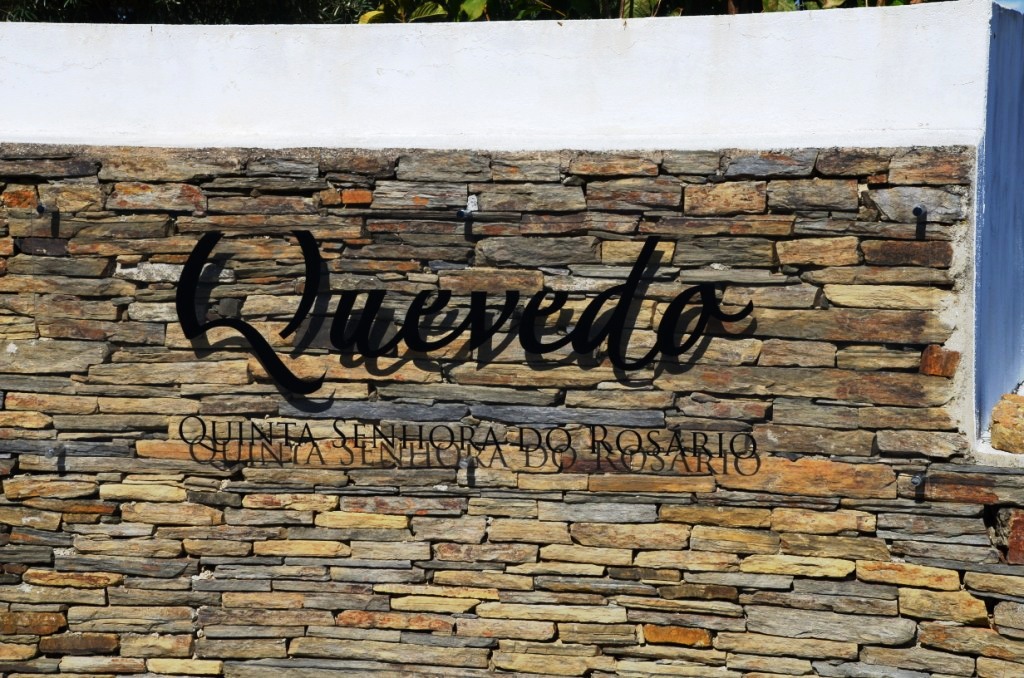 And the happy day didn’t stop from there on.
Here are the few pictures of what were looking at once we stepped out of the car:


As we were walking in, we were quickly greeted by Oscar, who I met during my previous visit to Porto. Oscar represents a fifth generation of the winemakers in Quevedo family, which had being making Port wines for about 300 years. Quevedo makes about 750,000 bottles of Port per year, and with Oscar’s efforts (in addition to being a winemaker, he also heads up all the export operations for Quevedo), about 97% of what they make is being exported. We also met Claudia, Oscar’s sister, who is in charge of making decisions on the final blend of the Port. You see, outside of Vintage, Late Bottled Vintage and Colheita Ports, which are all made out of the single vintage grapes, absolute majority of the Port wines are blends – and Claudia has the final say on deciding what goes into the bottle.
Actually, the day we arrived was right in a middle of the harvest, so Oscar was completely torn between talking to us, accepting incoming grapes (which requires assessment, weighting, calculating), and also taking care of the other groups of visitors ( mostly locals, if I’m guessing correctly). Nevertheless, Oscar gave us a full tour of the winery and a cellar tasting!
As it was the harvest time, we were lucky enough to see the full process of grapes being unloaded, destemmed by the machine and then going into the fermentation tank. I have the pictures for you down below, but while looking at them, you need to imagine a scent of freshly crashed grapes filling the air…


There is a lot of stainless steel at the winery. And of course they have their own bottling line.


After seeing all around the winery, we finally made it to the cellar – and this is where all the fun began.


Oscar brought 3 glasses, and we went from the barrel to the barrel, tasting the different port wines, right from the barrel! We started from 2010 Port, which Oscar said might become a LBV or Colheita – the determination will be made later on (for more on the Port classification and terminology, you can take a look at my earlier post here):
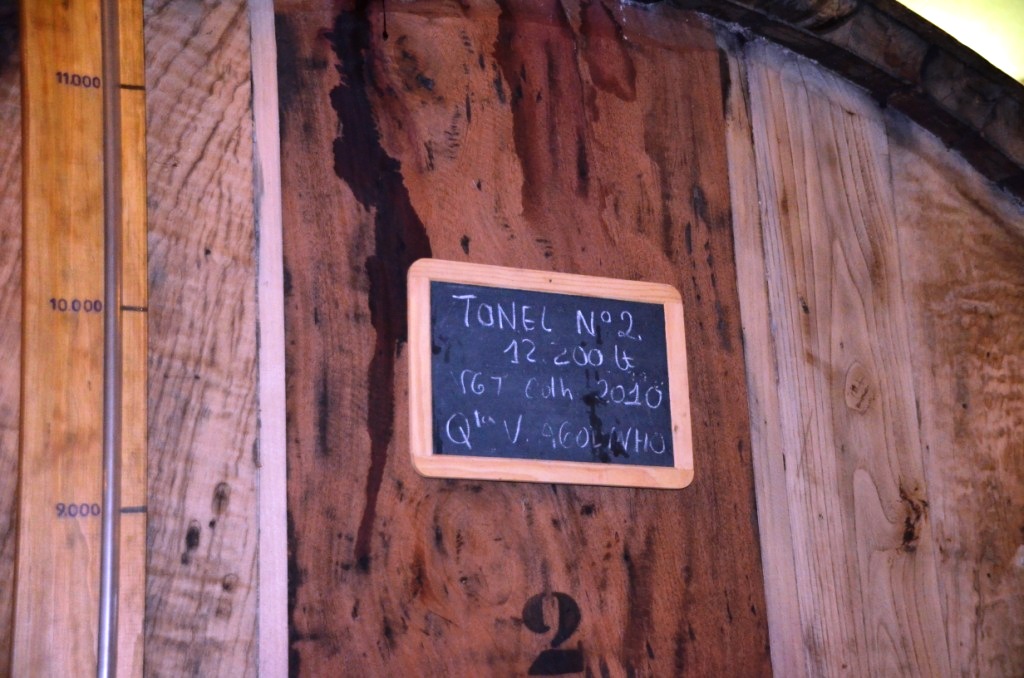
2010 Quevedo Port, may be LBV, may be Colheita
This 2010 Port was perfectly fresh, with blueberries and blackberries, great power, perfect acidity, and just bright and uplifting character.
Next we moved to the 2003 Colheita:

2003 Quevedo Colheita
2003 was a very hot year, but still it was declared a vintage year by many Port houses – which means that overall quality of the grapes was very high. This Port scaled more towards mature, dried fruit, like figs and may be dried apricots, but it was very balanced and still perfectly fresh.
Next up – 1996, and I finally managed to take a picture of Oscar’s hands pouring the Port:
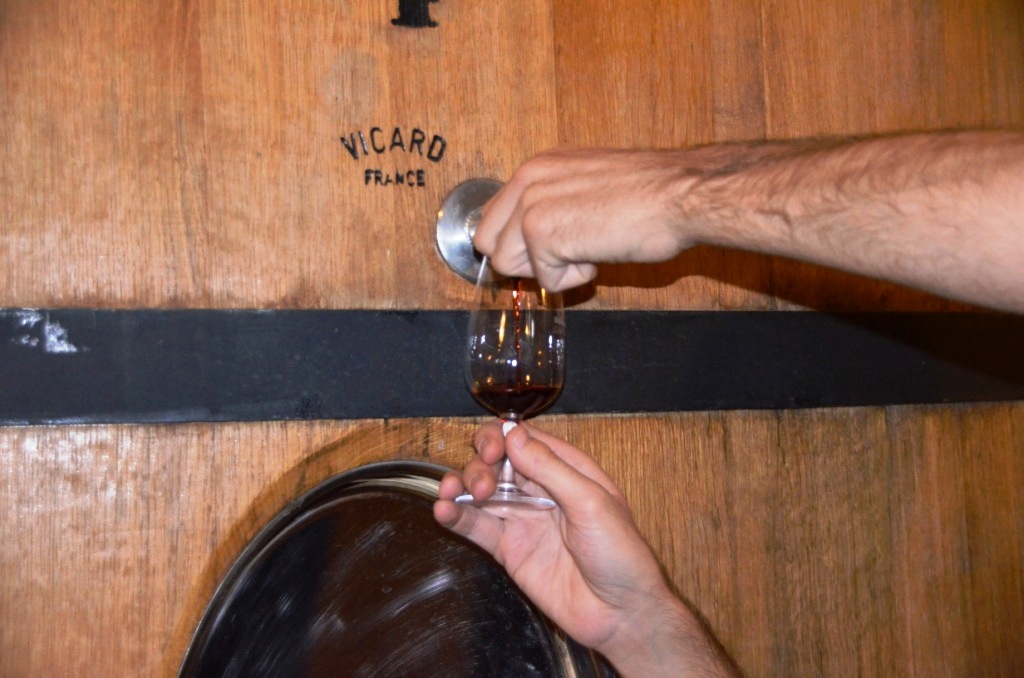
The best you can see in the cellar – Port is getting into YOUR glass!

1996 Quevedo Colheita
This 1996 Port was outstanding, mature, with perfect medley of dried fruit, figs, raisins, and excellent supporting acidity – I would gladly drink this every day ( who wouldn’t!).
And then there were two gems. First, 1970 White Port. Many people, even in Portugal, don’t know that aged white Port exists. Meanwhile, this Port of absolutely, unquestionably spectacular:

1970 White Port
Elegant, complex, somewhat reminiscent of the mature Pedro Ximenez sherry, but with the dialed back sweetness, perfectly mature fruit, hazelnuts and, believe it or not, still very refreshing and all around spectacular – this wine is definitely a candidate for the Wine of 2013. I really can’t put any “Drinkability” rating on this wine – this simply is something to be experienced.
And we finished with 1974 Colheita, which was in the final blending stages, to be bottled next year (2014) to commemorate 40 years:
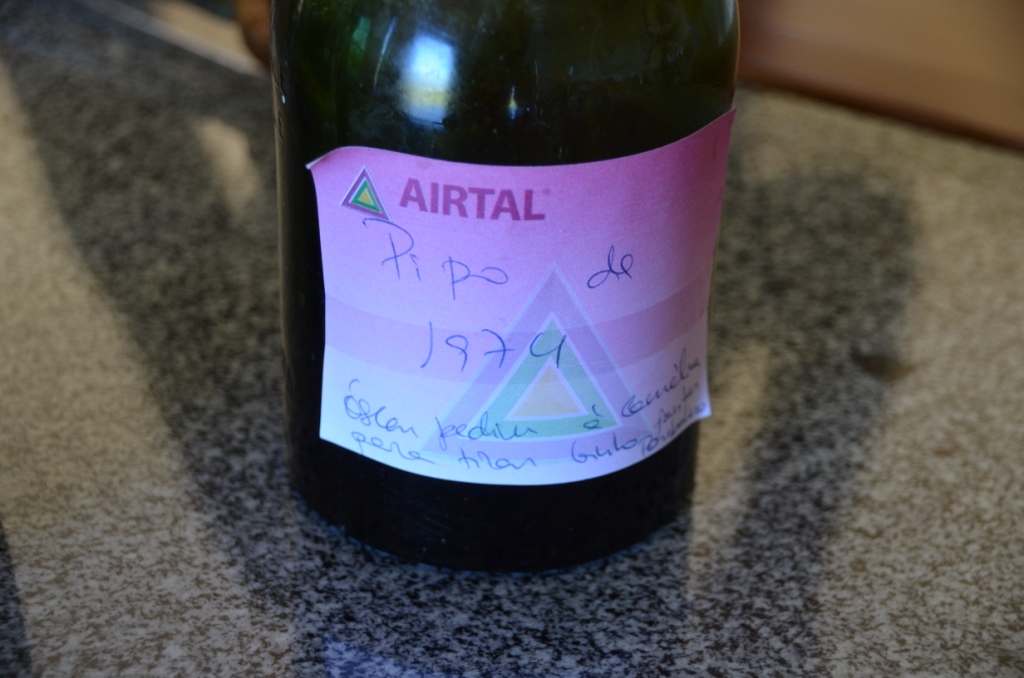
This Port will be bottled next year
There will be only 700 bottles produced. This Port was absolutely spectacular, very much on par with the white port we had before – very complex, with good amount of dried fruit, that nuttiness which only well aged Port or Jerez can demonstrate, all with still very present acidity. Same as the previous wine, this was really an experience, not just a sip of wine.
That’s was the end of our amazing tasting. We went for a walk around the vineyard, soaking up the sun and beginning of the autumnal beauty, enjoying the rest of the day which started ohh so not great.
I want to thank Oscar very much for finding the time in his extremely busy day and letting us experience those incredible wines. I also waht to thank my friend Sumit for bearing with my morning craziness and finally getting us to our destination. Let’s raise the glass for any day to become a perfect day, no matter how that day started. Cheers!
Weekly Wine Quiz #78: Grape Trivia – Petit Verdot
Petit Verdot, as shown in Wikipedia
The Wine Quiz series is not meant to intimidate. The whole idea here is to have fun and learn something new. When answering the questions, it is fully encouraged to use all available sources of information, including Google or any other search engine. There are no embarrassing answers – the most embarrassing thing is not giving it a try…
Welcome to the weekend and your new wine quiz!
We are continuing our grape trivia series, and we are back to the red grapes! Today’s subject is Petit Verdot.
Origins of Petit Verdot are unknown, and according to one of the theories, the grape came to Bordeaux region in France with ancient Romans. Petit Verdot is a very tricky grape in the vineyard – its early budding makes it susceptive to the early spring dangers, such as frost. Its very late ripening puts it in danger of the same frost and some of the diseases, At the same time, small berry with thick skin offers a lot of concentrated tannins and structure when it ripens properly.
This tricky behavior in the vineyard with tendency to underripe, results in Petit Verdot sometimes even not included in the final blend in Bordeaux wines. However, the grape behaves a lot more consistently in the warmer climates. Petit Vedot made it to Australia in 1800s, and it is successfully growing in most of the wine making countries around the world (Spain, Italy, US, Chile, Argentina, New Zealand), producing the best results in the warmer climates. in the US, it is growing in many regions across the country, from New York to Texas to California to Oregon. At its best, Petit Verdot produces dense, powerful, concentrated and age-worthy wines.
And now, to the quiz!
Q1: Explain the meaning of the name Petit Verdot
Q2: Name four grapes, main blending partners of Petit Verdot in France
Q3: True or False: Australia’s plantings of Petit Verdot far exceed the plantings of Petit Verdot in France
Q4: While Petit Verdot is a difficult grape to work with, two events were major contributors to the demise of Petit Verdot in Bordeaux. Can you name those two events?
Q5: While it is not impossible to find a pure 100% Petit Verdot wines made in Bordeaux, those wines are rather the exceptions. What is the typical percentage of Petit Verdot in Bordeaux blends?
Bonus question: what was your personal encounter with Petit Verdot? Do you have any memorable bottles?
Good luck, enjoy the quiz and your weekend! Cheers!
Southern Fun in South Norwalk
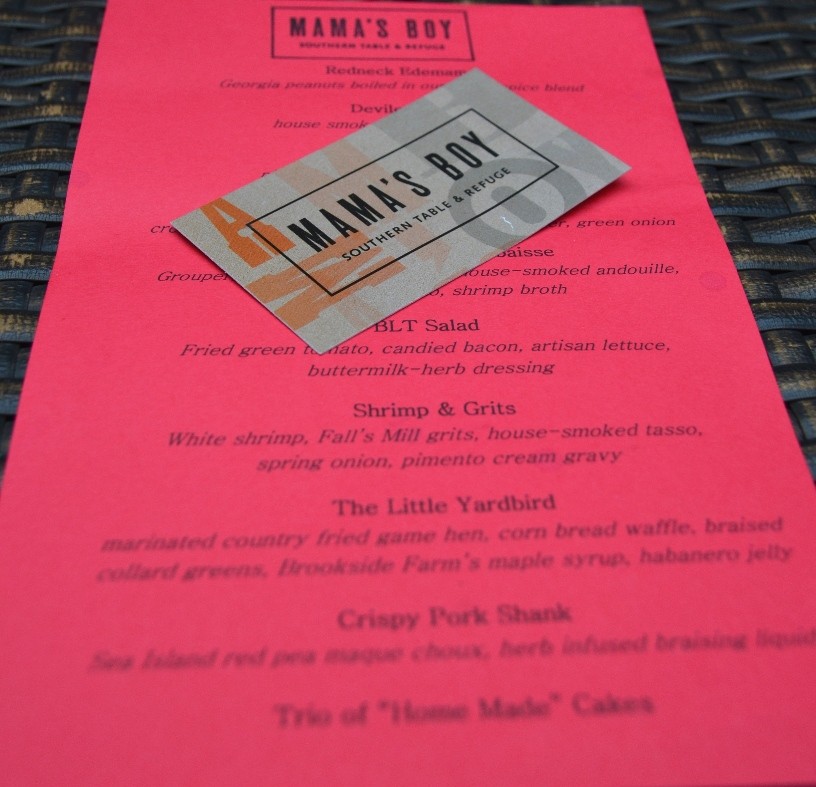 Looking for the Southern hospitality, great food, great cocktails and a great time? Shhhh… I got a place for you. Read on, but…may be you should eat something first, as there will be pictures. An aspiring food porn pictures. Yes, consider yourself warned.
And the Connecticut bloggers got together again! This time we visited a restaurant in Norwalk, Connecticut, called Mama’s Boy. The restaurant defines itself as “southern table and refuge”. On outside, the restaurant is located on the first floor of the ultra-modern glass-and-metal building. Inside, it is rustic, simple and inviting. You know you will be comfortable from the moment you walk through the door and set your foot on the dark wooden floor.
The first thing not to miss in Mama’s Boy is the bar. The bar is well stocked, showing the top shelf full of great southern favorites – bourbons and whiskeys. When you get the cocktail from the list, you know exactly what you are getting – it will not be just some vodka of questionable pedigree – depending on the cocktail you know that you are getting Ciroc, or Three Olives, or Fire Fly.
We had a few cocktails to start. The Dirty South (Homemade Sweet Tea, Fire Fly Vodka, Lemon) was outstanding and super dangerous – you have a full impression of drinking just a nicely sweetened iced tea with the slice of lemon, delicious and refreshing. You think you can have many of those. Until you realize that you talk slower. And need more time to move around.
Then I had the Blood Orange Jalapeno Margarita (Chinaco Blanco, Blood orange puree, Jalapeno). First of all, I was very impressed with the fact that they actually used Chinaco – this is very rare and one of the absolutely best tequilas you can find. And the taste was purely spectacular – a perfect balance of spicy and refreshing, with just enough sweetness. This was definitely my best cocktail I ever had. Until Chris, the maestro behind the bar counter, offered something which was not even on the menu – gin-based, barrel aged cocktail which didn’t have the official name, so it was called The Drink.

The Drink, in the process of creation
The Drink was based on gin, but then there were cucumbers of a different kind, as well as many other ingredients – it was a pleasure watching Chris really engaged in the process of creation of this masterpiece, tasting, adding, tasting again – until he reached the point of perfection. Once I tasted it, I realized that while previous cocktail was spectacular, The Drink was simply amazing – it got my “best ever” title, with the refreshing and uplifting combination of all the ingredients.


And then, there was food. The bread was presented in the form of a basket of warm cornbread muffins, accompanied by butter and a tangy “jelly”. The first dish which already was on the table was Redneck Edamame (Georgia peanuts boiled in house spice blend) – believe it or not, but these peanuts had practically complete textural identity with edamame! Definitely this was a very interesting dish to start with.
Next up – Deviled Eggs (house-smoked Tasso, okra pickles). I’m very particular about devilled eggs, as this was one of the dishes I grew up with, and we make it quite often at home. The Mama’s Boy devilled eggs were outright delicious, very generous, with bacony goodness of Tasso perfectly coming through in the creamy filling.


Fried Chicken Skins (pickled beets, jalapeno-garlic honey) were perfectly resembling fired calamari – I actual think it should be renamed on the menu into Redneck Calamari – but then they already have one Redneck dish listed : ) Light, crunchy, delicious – if you don’t read the name “chicken skin”, you would never guess what this dish was made out of. The sauce was delicious, tangy with a spicy twist.
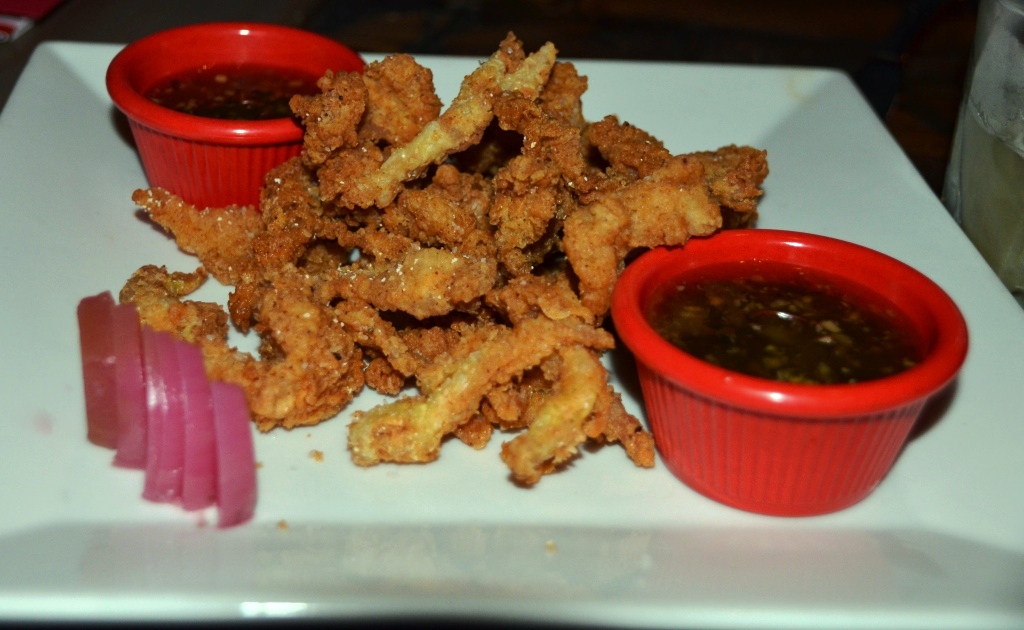
Fried Chicken Skins
Charleston Crab Cake (creamed corn, house smoked bacon, red pepper, green onion) came up next. As we tasted it, Valerie, who was sitting next to me, commented that she spent many years in Maryland, and she knows real crab cakes – and this one was probably one of the best she ever had (I fully concur). Big lumps of crab meat, perfectly seasoned, nice creamy corn goodness surrounding it – that was one delicious crabcake.
Once we were done with the crab cake, we were given small bowls, and then the big pot showed up in a middle of every table – Low-country Bouillabaisse (Grouper, white shrimp, mussels, house-smoked andouille, baby corn, potato, shrimp broth). I’m big fun of bouillabaisse dishes – if there is one on the menu, there is a high probability that it would be my choice. I know I’m abusing the word “perfect” throughout this post – but it is very difficult to fully represent the food and try to stay within the precise culinary terms – so let me continue abusing “perfect” and “delicious”, as there is not much else I have to say. This dish was Delicious! Touch of heat from andouille sausage, sweetness of mussels and baby corn, all perfectly wrapped around together. I’m glad we had bread, as it would be a crime to waste a single drop of that broth…


So at this point I was practically full (okay, not yet) – but I didn’t expect anything to topple our experience so far. And then the BLT Salad (fried green tomato, candied bacon, artisan lettuce, buttermilk-herb dressing) arrived… What can be so special about BLT, right? Well, everything, if B stands for lightly candied bacon, L stands for super-fresh and crunchy lettuce, and T stands for fried green tomatoes – every bite was ahh so good!
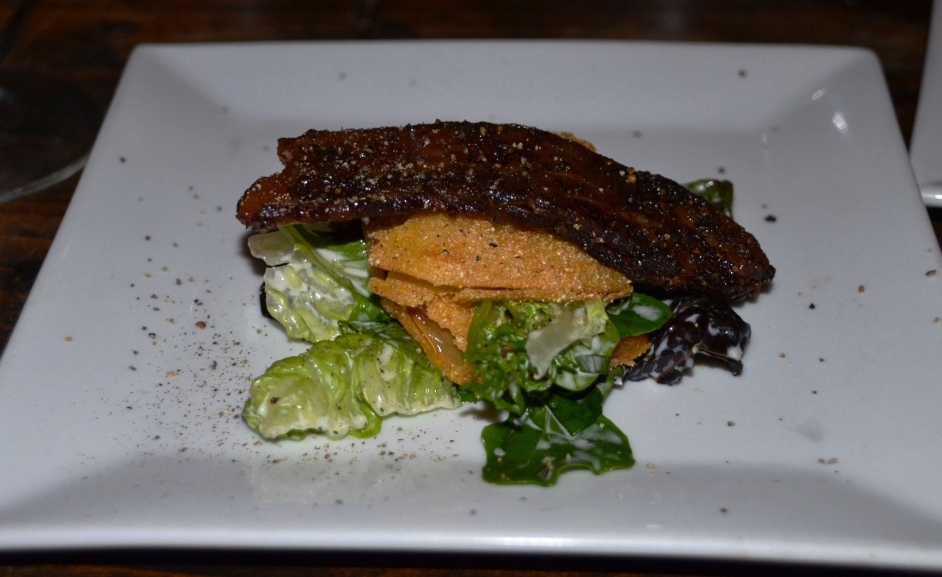
BLT Salad
Tired of the food pictures – here is the a little break for you – the back of the shirt of one of the waiters, and then Greer Fredericks, one of the owners of the Mama’s Boy, talking to Bonnie from The Home Place and her husband:


Next up – Shrimp and Grits (white shrimp, Fall’s Mill grits, house-smoked Tasso, spring onion, pimento cream gravy) – yes, I had no doubts that we will experience a southern favorite such as Shrimp and Grits. Beautifully presented, very delicious – creamy grits, perfectly cooked shrimp, nice complement of smoky bacon – all in all, an excellent ( and very filling) dish.
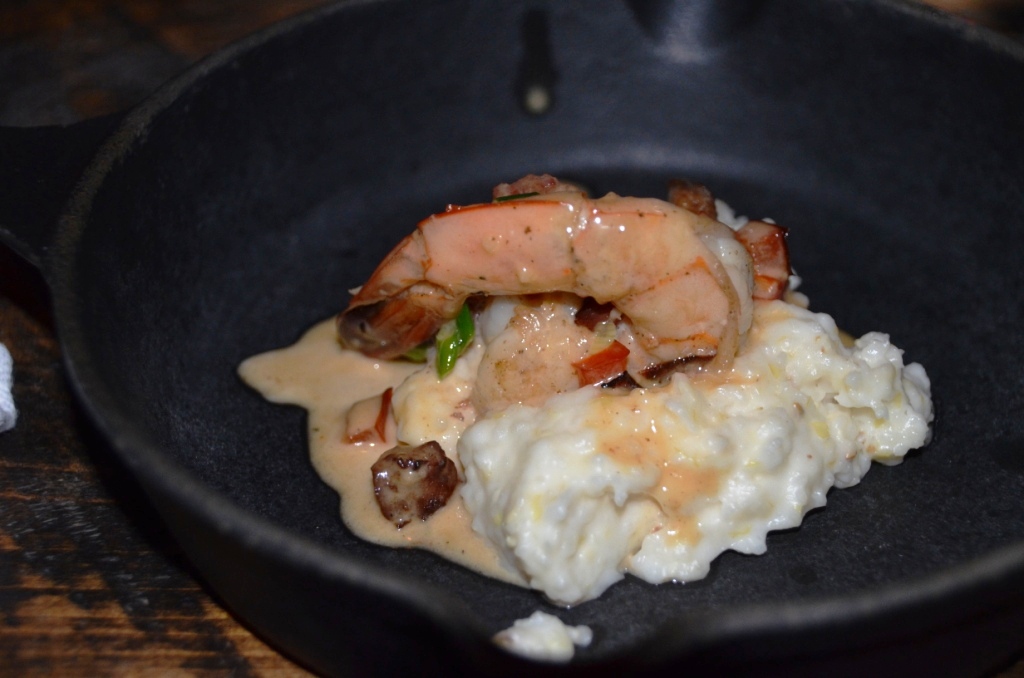
Shrimp and Grits
Next The Little Yardbird (marinated country fried game hen, corn bread waffle, braised collard greens, Brookside Farms maple syrup, habanero jelly) arrived – the cornbread waffle was perfectly supportive of the maple syrup, and the whole dish perfectly worked together, as you would expect of “chicken and waffles”.


Last but not least was Crispy Pork Shank (Sea Island red pea maque choux, herb infused braising liquid) – the peas and the borth were immaculate, and the shank was incredibly crispy and succulent at the same time. This was the only moment when people at the table regret having each other’s company – this shank required quiet, intimate one on one time with two hands on the bone…


We finished our southern food extravaganza with Trio of “Home Made” Cakes – that included Red Velvet Cake, Spice Cake and Carrot Cake. While I think consensus favorite was the spice cake, my personal winner was the carrot cake – I’m a carrot cake junkie, and I love when it is balanced in flavor so cinnamon and cloves and overall sugar are all together – so this cake was exactly like that.

Red Velvet Cake, Spice Cake, Carrot Cake
You know how it is easy to understand that you just visited a great restaurant? If the next day you crave the food you had the day before, that is clearly the sign of greatness. While the group was torn between Bouillabaisse and BLT, we were all chatting next day how great it would be to experience that wonderful food again – this constitutes glowing endorsement in my book. All left to say here is thank you – Thank you, Chef Scott Ostrander, for the wonderful meal. We will be back…
Disclaimer: I attended the dinner as a guest of management. All opinions are my own.
Mama’s Boy
19 North Water Street
South Norwalk, CT 06854
203.956.7171
http://www.mamasboyct.com
Facebook: mamasboyct
Twitter: @mamasboyct

Last Bottle Sign Up ($10 credit)




 Talk-A-Vino