Trader Joe’s Wines – Again Exceeding Expectations
Every time I get in a close proximity of the Trader Joe’s stores which sell wine, I always have to go and check out what is happening there – and, of course, try some wines. This time it was in November in California.
I don’t get to visit the Trader Joe’s wine section all that often – yes, we have Trader Joe’s here in Connecticut, but the only type of alcohol the stores can sell here is beer. My last experience with the wine section in Trader Joe’s was about a year ago. This time, I thought that the selection of wines and hard liquors expanded quite a bit, even though it was rather substantial even before. This time I saw a number of large format bottles, including 3L Italian wine for about $20! More spirits, including Calvados for $19.99 (I challenge you to find a Calvados for such a price at any wine store you frequent). I don’t know how Trader Joe’s can do this, but this is pretty remarkable.
Usually, when you see a cheap bottle of wine, the thought is – is that any good? So clearly in the spirit of research, I willingly subjected myself to the scientific drinking experiment – what $20 can buy for you? Okay, I have to be honest with you – I spent more money. A whole $3 more. So the experiment should be officially called “What wine $23 can buy for you at Trader Joe’s”. You can see my tasting line up in the picture below, and the notes follow right after.

What $23 can buy you at Trader Joe’s
And here are the notes:
2012 Cosmia Pinot Noir Sonoma County (13.5% ABV, $7.99) – ruby red in the glass, sweet cherries with a touch of smokiness on the nose, dark sweet cherries on the palate with some mushroom notes, round, simple, medium to long finish. Probably [one of] the best Pinot Noir wines the money can buy for $8. Drinkability: 7+
2013 Trader Joe’s Vinas Chilenas Chardonnay Reserva, Valle Central, Chile (13% ABV, $2.99) – light straw color in the glass, white apples, vanilla and touch of tropical fruit on the nose, crispy apple on the palate, vanilla, nice acidity, very round and balanced. Note that most of the notes are taken on the day number 4 after the bottle was opened – stored with the regular cork in the fridge. Pretty spectacular considering the price. Drinkability: 7+
2010 Cala de Poeti Maremma Toscana IGT, Italy (13% ABV, $5.99) – A super-Tuscan for $5.99, huh? Should be pretty laughable, you think? Not at all! Dark garnet color in the glass, nose of dark plums and herbs, dark cherries, eucalyptus, tart raspberries and dark chocolate on the palate, firm structure, still present tannins (on the day 4!), excellent balance. I’m duly impressed. Drinkability: 8-
2012 Black Mountain Vineyard Zinfandel, California (12.5% ABV, $5.99) – dark garnet color in the glass, gunpowder (!) and cherries on the nose (yep, I know, sorry), raspberries and blueberries on the palate, but not overly sweet, with balancing acidity, more of tobacco and gunpowder note on the palate (is that “too much sulfites”? No idea, the wine didn’t give me any adverse reaction). Quite an unusual rendition of Zinfandel, but very, very enjoyable. Drinkability: 7+
That’s all I have for you for today. Have you tasted these Trader Joe’s wines? What do you think of them? What do you think about Trader Joe’s wines in general? Comment away! Cheers!
Weekly Wine Quiz #83: Grape Trivia – Carménère
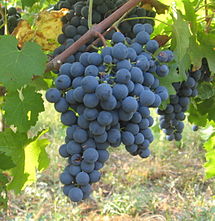
Carménère grapes. Source: Wikipedia
The Wine Quiz series is not meant to intimidate. The whole idea here is to have fun and learn something new. When answering the questions, it is fully encouraged to use all available sources of information, including Google or any other search engine. There are no embarrassing answers – the most embarrassing thing is not giving it a try…
Welcome to your new wine quiz!
We are continuing our grape trivia series, with the focus again on the red grapes, and today’s subject is Carménère.
Let’s start with pre-quiz before the quiz. Class, how many of you heard of the Carménère grape, raise your hands. Ok, now, how many of you tasted the Carménère wines, raise your hands. Okay, those of you who raised their hand twice, can probably skip directly to the main quiz, and for the rest of us, lets talk about Carménère.
When it comes to the Bordeaux, everybody knows five main grapes – Cabernet Sauvignon, Merlot, Cabernet Franc, Malbec and Petit Verdot. Truth of the matter is that it is actually six – and Carménère is that grape number six. Until the Phylloxera epidemic of the 1870s in France, Carménère was probably one of the leading grapes in Bordeaux. Carménère is related to the Cabernet family, it most likely predates both Cabernet Franc and Cabernet Sauvignon, and it was probably the driving force behind power and finesse of Claret of the 1800s and even before. However, Carménère is a difficult grape to work with – it ripens two to three weeks later than Merlot, and it is susceptible to the viticultural hazard called coulure – the condition when in the cold spring the buds will fail to turn into the flowers. It also doesn’t graft on the new rootstock very easily. So the combination these issues lead to the situation that after the Phylloxera epidemic, the grape was practically not replanted back in Bordeaux, and it was literally considered extinct (it exists today in France, but in the extremely low quantities).
During the 1850s, a lot of Cabernet Sauvignon and Merlot cuttings made it to Chile – both in legal and probably illegal ways. For the long time, Chilean winemakers were wondering, why some of their Merlot plantings ripen so late compare to the others, and have a different flavor profile – those grapes where considered to be a specific Chilean Merlot clone. Until in 1994 it was discovered that Chilean Merlot is actually a … Carménère! Carménère made it to Chile in 1850s as part of those Cabernet Sauvignon and Merlot cuttings, and it happened to strive in the warm and dry climate. Today, Chile has almost 9,000 hectares planted with Carménère, and it is widely considered one of the best wines Chile can produce.
When ripen properly, Carménère produces excellent powerful wines with the fruit profile somewhat similar to Cabernet Sauvignon and Merlot, but with very present herbal and spicy component of sage, pepper, eucalyptus and even menthol.
And now, to the quiz!
Q1: Explain the name of the grape Carménère
Q2:Similar to Merlot/Carménère confusion in Chile, the discovery was recently made in one of the well known old world wine producing countries – the grape they thought was ___, actually happened to be a Carménère. Name the grape, the country, and the region within this country where confusion took place.
Q3: As the sequel to the previous question – the confusion also spread into the New Wolrd winemaking country. Name the grape been mistaken and the country.
Q4: Wine Spectator calls wines rated in 95-100 range Classic (the highest and the most prestigious category). True or False: there are no Carménère-based wines rated in the Classic category
Q5: Name three grapes, often blended together with Carménère.
Good luck, enjoy the quiz and your weekend! Cheers!
Creative American Cuisine Experience at Bistro B in Bridgeport, CT
As soon as we finished our drinks at the Barnum Publick House, it was the time to walk for the whole 20 seconds to our dining destination – Bistro B in Bridgeport, Connecticut.
The restaurant inside is definitely done in the modern, simple style – leather, woods, clean colors, clean lines, solid high chairs. If interested, you can even take a pick into the kitchen from outside, to admire all the stainless steel marvels and busy people.


As we already had cocktails, it was the time to chose the wine. Bistro B features quite an interesting wine list. It is somewhat short, but the important fact is that it is extremely reasonably priced. Absolute majority of wines are priced within $24 to $30 range, with few occasional splurges to $36, and one, the most expensive wine at $40 – you don’t see this type of wine prices in the restaurants all that often ( no, it doesn’t sport Yellow Tale, Sutter Home or Crane Lake, if you are wondering). At the same time, majority of the wines were either quite safe or completely unknown to me, so as a self-admitted wine snob I had some challenges deciding what to drink.
We started with 2011 Pieropan Soave from Italy – the wine had hint of white stone fruit on the nose, simple and dry on the palate, with good acidity, but somewhat single-dimensional. Probably the issue was with my expectations which were rather based on my prior experience with Pieropan wines during Vinitaly tastings earlier this year (the two wines we had there were outstanding). Drinkability: 7
From Pieropan we switched to 2012 Mohua Sauvignon Blanc Marlborough New Zealand – typical New Zealand Sauvignon Blanc, but pleasantly restraint – there is enough grapefruit and lemon notes both on the nose and the palate, but not overpowering, not smash-in-your-face-grapefruit type of wine. Vibrant acidity, good balance. Drinkability: 7+
It was hard for me to chose the red wine (I’m a snob, remember?) – most of the choices didn’t pique my interest. I settled for 2010 Carmen Petite Sirah Gran Reserva Maipo Valley, Chile – dark garnet color in theglass,good amount of dark fruit on the nose, ripe raspberries and dark chocolate on the palate, acidity in check, overall very balanced. Drinkability: 7+


And then there was food. We started with the selection of Small Plates (appetizers).
First up was House Cured Salmon (Star Anise Pickes, Horseradish Mustard Cream, Brown Bread) – the salmon itself was impeccable, perfect texture and flavor (I cure my own salmon myself, so I’m very particular about it). The horseradish cream had some unusual perfumy component (not my favorite), but overall this was quite a successful dish.
Next up were BLT Sliders (Braised Pork Belly, Roma Tomatoes, Iceberg, Maple Aioli) – the sliders were not bad, and you really have to like pork belly to order this type of dish – but definitely this dish has a point for the interesting twist on BLT concept.
Chicken “Lollipops” (House Made BBQ Glaze, Best Blue Cheese Dressing) definitely gets thumbs up for originality and creativity (just caught myself feeling that I’m watching way too much of the Iron Chef, and take it way too seriously – I promise to get over it) – I like the concept, understand the idea and never saw it done before – unfortunately, the “lollipops” were a bit dry, I think this dish can be improved a bit in terms of texture. At the same time, overall flavor profile was excellent.
For our Garden Plates we had Lambs Lettuce (Crispy Artichokes, Roasted Garlic Hummus) – crispy artichokes were particularly tasty, but so was the salad as a whole – and I liked very much the colorful presentation.


Then the Large Plates came. Potato and Onion Encrusted Halibut (Forest Mushroom Ragout, Asparagus Tips, Truffle) was first – perfectly seasoned and cooked, delicious, flaky fish worked very well with mushrooms (spectacular flavor profile by itself) and asparagus. Definitely an excellent dish.
Next was Pork Schnitzel (Cucumber Salad, Mustard Honey Pan Roast) – this was my least favorite dish – the meat was too dry and too lemony for my taste. The side of cucumber salad was quite tasty.
Then the Roasted Hangar Steak (Pomme Frittes, Roasted Pears), which was served next, was, in a word, outstanding! Meat was perfectly done (medium-rare), and together with the sauce and that Carmen Petite Sirah it simply created a heavenly combination.
And when I thought nothing can beat that steak, the “Chicken Fried Chicken” (Crispy Amish Chicken Breast, Black Pepper Gravy, Cinnamon Spiced Baby Carrots) arrived, and the whole table had gone silent, and then very loud again – inexcitement. The chicken was spectacular –moist, flavorful, perfect crust on outside – and was absolutely delicious with the sauce. This dish definitely finished our main portion of the dinner on the high note.


Do you think we left restaurant without having the dessert? Think again – of course this is not possible. First, we had absolutely delicious coffee, maid in French Press right at the table – yay! Our dessert consisted of Butterscotch Pudding and Flourless Chocolate Cake – both were very tasty, but this is about all I can tell you at this point – hopefully the pictures give you an idea.


That concludes our great experience with the Creative American Cuisine, and as usual, I would like to finish this post by thanking Chef and Owner Jason Milanese and Chef Joe Italiano for the wonderful meal. Until the next time – cheers!
Disclaimer: I attended the restaurant as a guest of management. All opinions are my own.
Bistro B
1006 Broad Street
Bridgeport, CT 06604
E: info@bistrob.net
P: 203-908-4224
W: http://www.bistrob.net/

Wednesday’s Meritage – Wine Quiz Answer, Wine Spectotor Top 100, Perfect Holiday Gift Solution, and more
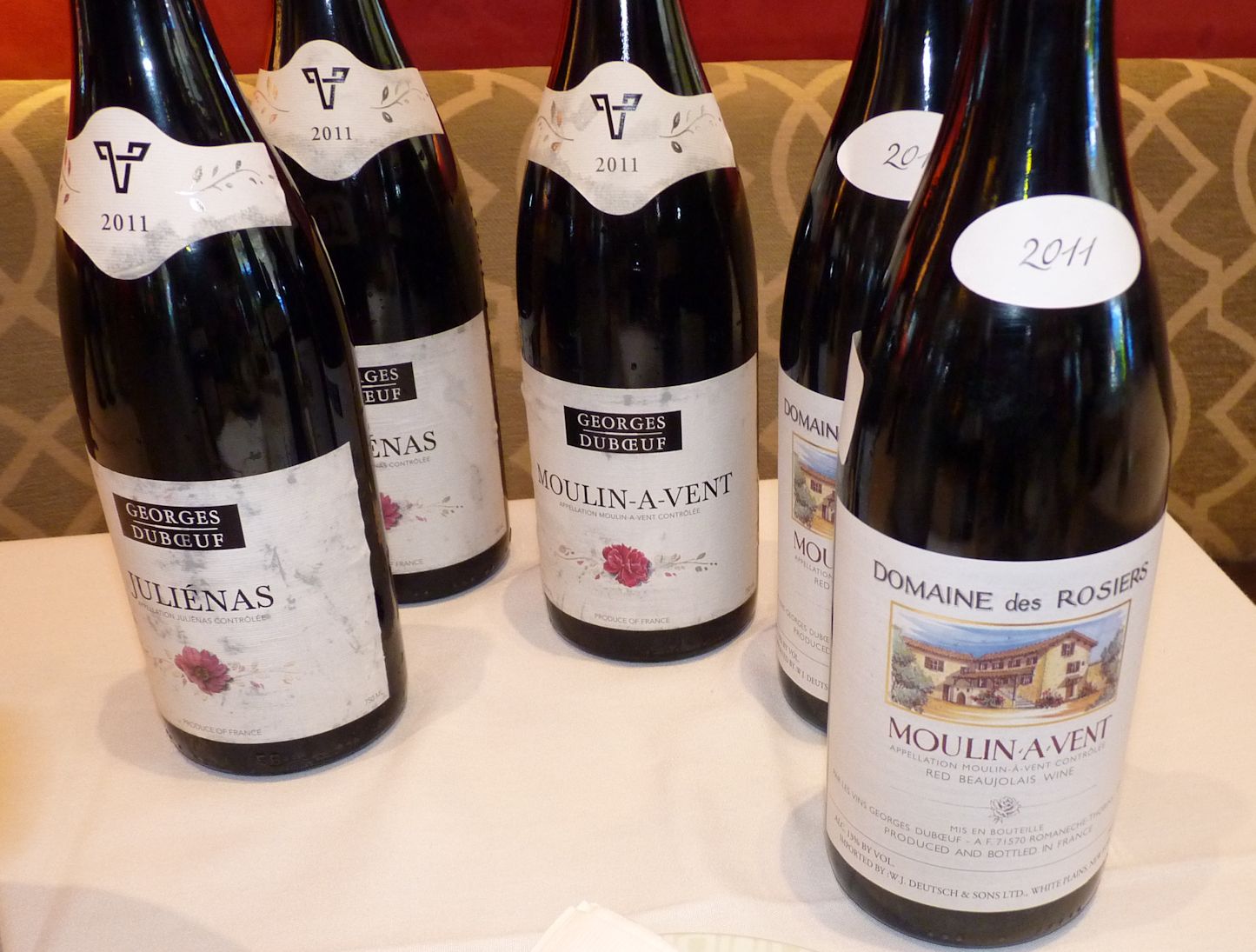 Meritage time!
First, let’s start with the answer for the wine quiz #82, grape trivia – Gamay.
In the quiz, you were supposed to answer 5 questions about red grape called Gamay. Here are the questions, now with the answers:
Q1: Gamay is closely associated with every third Thursday in November. Can you explain why?
A1: Beaujolais Nouveau is coming into town! While Beaujolais Nouveau was always the first wine of the harvest to be delivered to the restaurants and shops in Europe, in 1985 the phenomenon became more organized, settling on the third Thursday of November to make the new release available.
Q2: Carbonic maceration is an important method in production of wines made out of Gamay. Can you briefly explain what is carbonic maceration and how does it helps here?
A2: Carbonic maceration is a process where the grapes in a sealed tank are subjected to the flow of CO2, which start fermenting the juice inside of the whole grapes before they will be crushed. The resulting wine becomes fruity with very low presence of tannins. This process is particularly used inproduction of Beaujolais Nouveau and other Beaujolais wines. For more information, please refer to Wikipedia article.
Q3: Fill in the blanks: In Beaujolais, Fleuri is considered to produce the most ___ wine, and Moulin-à-Vent produces the most ___ wines.
A3: In Beaujolais, Fleuri is considered to produce the most feminine wine, and Moulin-à-Vent produces the most masculine wines. Feminine and Masculine are the descriptors typically used by wine professionals to describe the wines of Fleuri and Moulin-à-Vent wines.
Q4: Which one doesn’t belong and why:
a. Brouilly, b. Côte de Brouilly, c. Côte Chalonnaise, d. Juliénas, e. Régnié
A4: c. Côte Chalonnaise. The other four names are part of Cru de Beaujolais ten villages, but Côte Chalonnaise doesn’t belong there (it is an AOC in Burgundy).
Q5: True or False: Beaujolais Nouveau wines can be aged for a few years before consumption.
A5: False. The whole point of aging the wine is to wait for it to develop further in the bottle and become more enjoyable. Beaujolais Nouveau is meant to be enjoyed right away and should be consumed by May of next year – it doesn’t improve in the bottle.
So for the winners, Jeff the drunken cyclist continues his winning streak – he got correctly 5 out of 5, including the difficult question #3. Great job, Jeff – unlimited bragging rights are yours! I would like to also acknowledge Wayward Wine,Whine And Cheers For Wine and Eat with Namie who all correctly answered 4 questions out of 5. Well done!
Now, to the interesting stuff around the vine and the web!
On Monday, November 18th, Wine Spectator published their Top 100 list of Wines. Yes, I know, many dismiss the whole notion of Wine Spectator ratings and Top lists as closely associated with the advertizement dollars spent with publication. True or not, but I still have a lot of respect to Wine Spectator and definitely curios to see their “top wines” list. As Wine Spectator celebrates 25th anniversary, they whole web site is open to the public (typically it requiressubscription). I would highly recommend that you will take advantage of this opportunity and explore the site which has a great wealth of wine information. Also, here is the link to the WS Top 100 wines of 2013. I have to admit that I’m happy with Wine Spectator’s choice for the wine of the year – 2004 Cune Rioja Imperial Gran Reserva. In general, Cune Imperial makes great wines, and I think it is an excellent choice for the wine of the year.
Thinking about holiday gifts? Does your list include any wine lovers? If yes, you are in luck, but you will need to act quick. On December 2nd, WTSO will conduct a Gift Marathon (full info can be found here). As a traditional WTSO Marathon, there will be no announcements of new wines. But each wine will come gift packaged, with one bottle and two varietally correct Riedel glasses in the box. Most importantly – free shipping on each package (no minimums), and each packaged can be shipped directly to your gift recipient – this is the best part! Prices start from $44.95 per box (free shipping). I think this is a deal not to be missed, so point your browser to WTSO on December 2nd and happy hunting!
You know Wine-Searcher is a great resource for finding the wines online and comparing the prices. Are you curious what the other people looking for on the wine-searcher? Here is an interesting article, which tells you what the consumers in America are looking for. Based on the article, looks like most of the times people are looking for red Bordeaux blends – which makes sense, as there are a lot more Bordeaux blends produced nowadays. Anyway, for your own analysis and lots more data, take a look at the article.
When you make dinner, how often do you think about what wine should be opened for the food you are serving? Sometimes the pairing can be quite difficult, so I have no problems taking my food and wine separately. But when you hit the mark and the wine and food “work” together, it becomes the whole new level of experience. To help you in this process of pairing food and wine, here is the link to the web site I recently came across – I think it has a lot of good suggestions. Take a look – you might be able to pleasantly surprise yourself and your guests during your next dinner.
That’s all I have for you for today, folks. The glass is empty – but refill is on its way. Until the next time – cheers!
Beauty of Montefalco Rosso and Power of Sagrantino
About two month ago (yes, I know, I’m the speedy one) I was invited to participate in the virtual tasting. The subject – Italian wines. To be more precise, the wines from Umbria, made out of the grape called Sagrantino.
I never participated in the virtual tasting before, so I was not sure how it was going to work. The idea was simple. I will get the wine, which should be opened and tasted in parallel with the winemakers, who will be doing it live on ustream. Of course I gladly agreed to take part in this wine drinking tasting.
The subject was wines from Umbria, from the region called Montefalco. Actually, it was not just one tasting, but two – one for the wines called Montefalco Rosso, and the second one for the wines called Montefalco Sagrantino.
It appears that Sagrantino is an Italian indigenous grape, which seems to be cultivated in Umbria for at least 500 years, if not longer. However in the 1960s it became literally extinct, and if it would not be the effort of the few winemakers, Sagrantino would be gone completely from the winemaking scene.
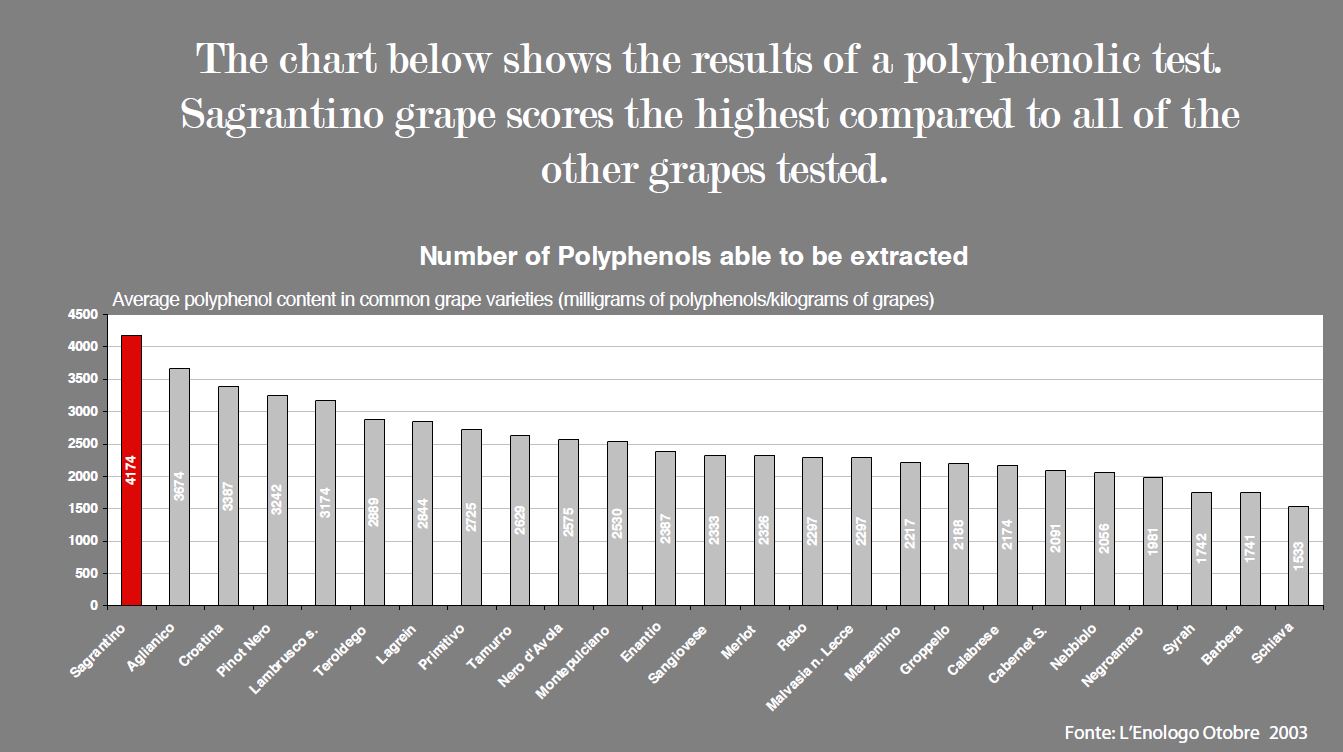
Sagrantino has dark and very thick skin, which results in very tannic and concentrated wines, literally black in color when young. Sagrantino has the highest polyphenolic content among most of the red grapes, if not among all red grapes in the world (take a look at the chart below). Just to get technical for a second, polyphenols (also called phenolic compounds) is a large group of chemical compounds, responsible for color, texture and mouthfeel of the wine (think tannins!), and the group also includes medically beneficial elements, such as reservatrol. As usual, I have to refer you to Wikipedia for additional reading, but I hope you get the point here.
My wines arrived few days before the tasting. As luck would have it, the day which the wines spent on the UPS truck, was one and only day in September when temperature outside reached 96F (extremely atypical for Connecticut in September). When I took the wines out of the box, I could feel that they are quite warm – on average, my wine thermometer showed all the bottles to be at around 84F, so I was obviously concerned… I opened a number of bottles the next day, and to my big relief, the was no sign of heat damage (I quickly closed the wines back using the gas canister) – I was ready for the tasting.
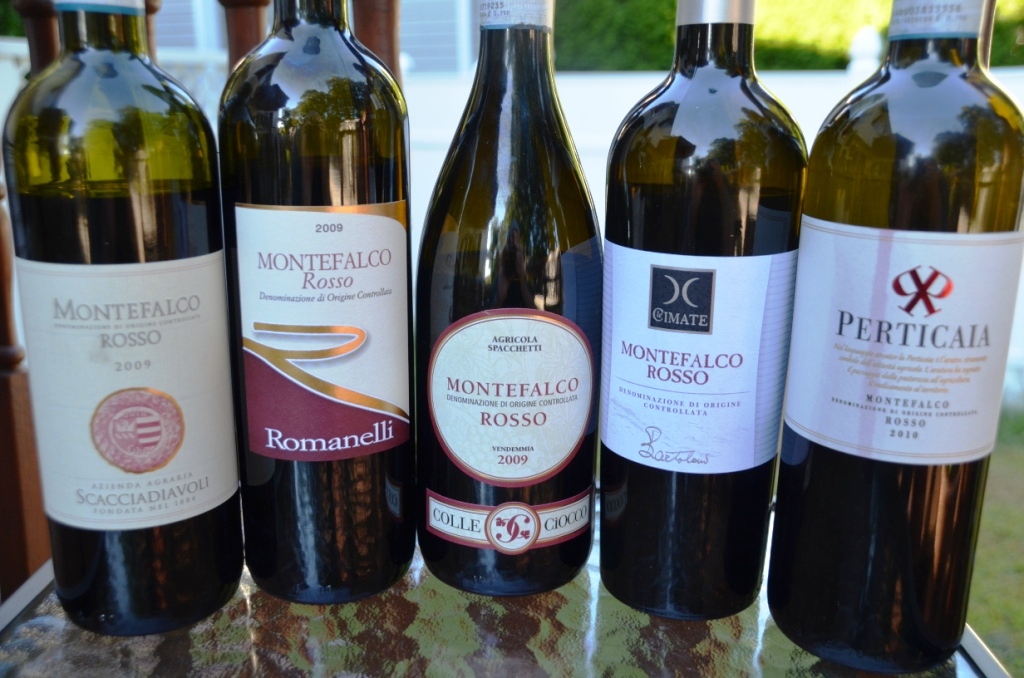
First day of tasting was dedicated to the wines called Montefalco Rosso. Montefalco Rosso wines typically are Sangiovese based, with the addition of 10% – 15% Sagrantino and 10%-15% Merlot and Cabernet Sauvignon. We had an opportunity to taste through 5 different wines:
At the specific time, the ustream broadcast started with live tasting, where the panel of winemakers from all 5 wineries were talking about their wines and answering the questions. The ustream broadcast was accompanied by the live twitter exchange among all the participants in the tasting. The twitter stream was used to ask panelists the questions, share tasting notes and impressions. Definitely was interesting to see and hear the diversity of opinion both from the panel, and from the audience on twitter. To be entirely honest, the most difficult part was to do a few things at once – taking my own notes, talking to the people on twitter and listening to the panelists – difficult, but well worth it!
Below are my notes for the 5 Montefalco Rosso wines we tasted (as you will see, not necessarily taken exactly during that live tasting session).
2009 Romanelli Montefalco Rosso DOC (14.5% ABV, Sangiovese 65%, Sagrantino 15%, Merlot 10%, Cabernet Sauvignon 10%, 12 month French oak, 6 month in the bottle) – good dark fruit, easy to drink. Drinkability: 7
2010 Perticaia Montefalco Rosso DOC (13.5% ABV, Sangiovese 70%, Sagrantino 15%, Colorino 15%, 12 month in stainless steel, 6 month in the bottle) – day 2 notes – outstanding. Dark inviting fruit with a hint of sage on the nose, spicy cherries (cherries + black pepper) on the palate, with tobacco notes in the background. Delicious! Drinkability: 8+
2010 Le Cimate Montefalco Rosso DOC (14.5% ABV, Sangiovese 60%, Sagrantino 15%, Merlot 15%, Cabernet Sauvignon 10%) – was perfectly drinkable 6 (!) days after opening the bottle. Spectacular. Supple, ripe cherries, perfect acidity, espresso and dark chocolate, powerful, balanced. Drinkability: 8+
2009 Scacciadiavoli Montefalco Rosso DOC (14% ABV, 60% Sangiovese, 15% Sagrantino, 25% Merlot, 12 month French oak, 6 month in bottle) – Excellent. Dark, spicy earthy nose with some gaminess. Excellent minerality and dark fruit on the palate. Drinkability: 8+
2009 Colle Ciocco Montefalco Rosso DOC (14% ABV, Sangiovese 70%, Sagrantino 15%, Merlot 15%, 12 month in oak barrels, 4 month in the bottle) – nice soft red fruit on the nose, sweet and supple fruit on the palate, good acidity, soft tannins. Drinkability: 7+
The next day we had the tasting of Montefalco Sagrantino wines. Montefalco Sagrantino wines are made out of 100% Sagrantino grapes. The tasting was done in the same format – panel of winemakers discusses the wines live via ustream, and twitter followers taste and discuss in parallel.
It was recommended to open wines one hour before the tasting. Considering how massive those wines are, I would think the right suggestion would’ve been to open them in the morning. I don’t know if it could make the difference, but I have to admit that my experience was rather frustrating during the live tasting. For the most of the wines, I couldn’t get any of the flavor descriptors and impressions, compare to what was exposed by the other twitter tasters. For instance, Arnaldo Caprai was showing literally as corked, where the other tasters had violets, black tea and other nice things to say. Literally only one or two wines cooperated with me during tasting. But – most of them came back nicely right after (see the notes).
Below are my notes for the Montefalco Sagrantino wines (all wines are 100% Sagrantino).
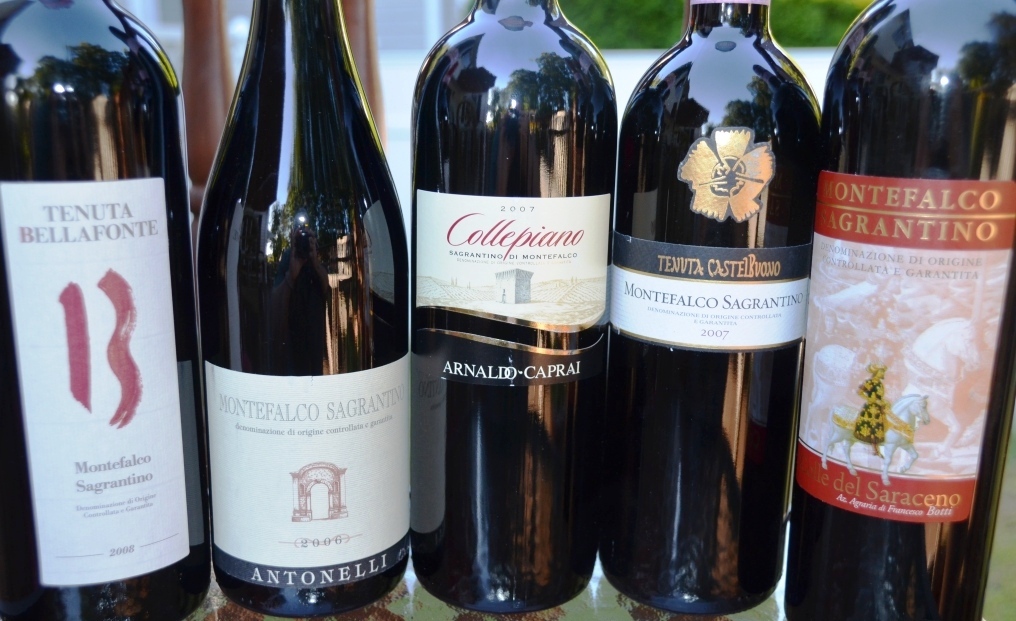
2006 Antonelli Montefalco Sagrantino DOCG (14.5% ABV, 15 month in oak, 12 month in the bottle) – Dark fruit on the nose, same on the palate, very restrained. I’m sure needed more time. Drinkability: 7+
2007 Caprai Collepiano Montefalco Sagrantino DOCG (14.5% ABV, 20-24 month in French oak barrique, minimum 6 month in the bottle) – opened on 09/17, then closed with the argon canister. Reopened on 09/23. Concentrated, very dark. Initially gave an impression of being mildly corked. After 3 days finally started to open up into something interesting. Very substantial tannins ( more of stem/seeds tannins than oak). Dark fruit with undertones of leather and black tea. Drinkability: 8-
2007 Tenuta Castelbuono Montefalco Sagrantino DOCG (14.5% ABV, 28 month in oak, 10 month in the bottle) – dark supple fruit on the palate, very powerful, a wine with “broad shoulders”. Beautifully opened over the next few days, showing roasted meat notes on the palate, good acidity, excellent balance. Drinkability: 8-
2008 Tenuta Bellafonte Montefalco Sagrantino DOCG (14% ABV, 36 month in large barrels, 10 month in bottle) – wine was first tasted on 9/17, then closed with gas canister. Reopened on 9/25. Powerful, concentrated, almost black color in the glass. Nice fruit undertones, cassis and plums, with more tannins coming in later. Overall delicious and “dangerous” wine. Drinkability: 8
2008 Colle del Saraceno Montefalco Sagrantino DOCG (14.5% ABV, 12 month stainless steel, 12 month French oak barriques, 6 month in the bottle) – this wine unfortunately showed signs of the heat damage. N/R.
All in all, this was a great experience. The virtual tasting format was pretty well done, and I definitely will be looking forward to more virtual wine tastings in the future. And for the wines – my notes are above, and I definitely recommend looking for Montefalco wines – both Rosso and Sagrantino well worth your attention. Cheers!
Disclaimer: The wines were provided complementary by the PR agency. All opinions are my own.
Bar Experience at Barnum Publick House in Bridgeport
 I’m the wine guy, as you know. Well, with a lot of affinity towards Scotch, Whiskey, Tequila… Beer too. Okay, you got the point – and it seems that I’m drifting away from what I’m trying actually to say here. Okay, let me try to get back on track. The point I’m trying to make is that cocktail is not generally something I’m going for. Part of the reason is that I’m actually (shh, it’s a secret, don’t tell anyone) intimidated by the cocktails. I don’t know the names, have only a weigh idea of the ingredients, and have a hard time making anything decent myself, even following the recipe precisely.
But the point of the matter is that this is changing lately. After tasting all the wonderful concoctions during our recent restaurant visits (Nola Oyster’s Bar, Mama’s Boy, Bailey’s Backyard) I’m very much inclined to start the evening with the cocktail, as it is quite amazing what the passionate bartender can create for you.
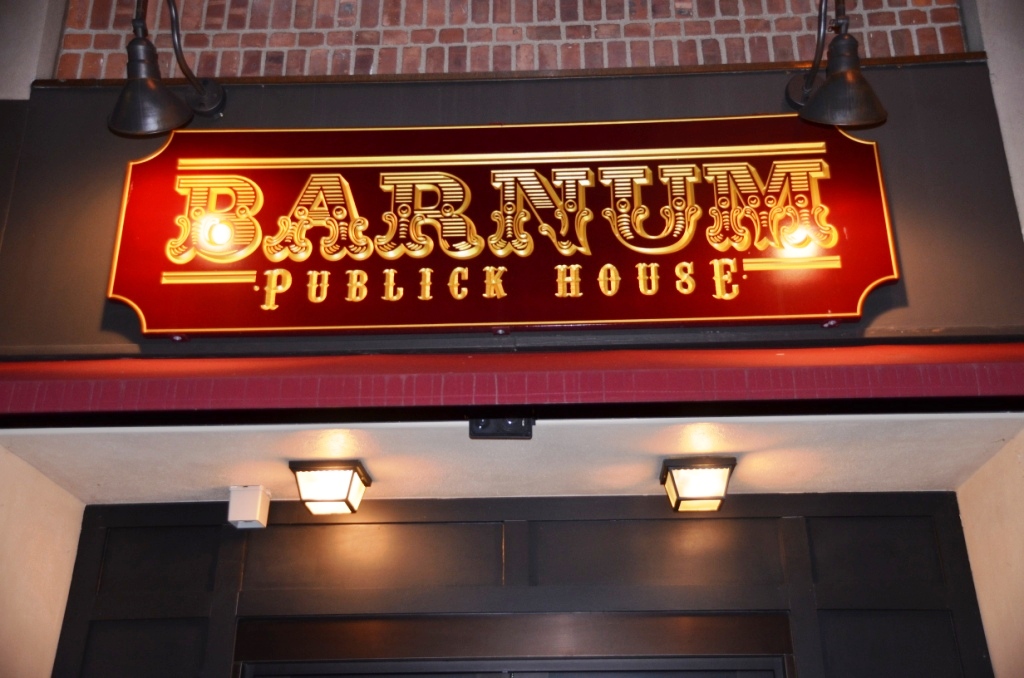
The place I want to talk about in this post is the Barnum Publick House in Bridgeport, Connecticut. Our dinner destination was Bistro B (the subject of next post), located within the same block as the Barnum Publick House, but before going to the dinner we had an opportunity to get some cocktails at Barnum Publick House – and I’m glad we did.
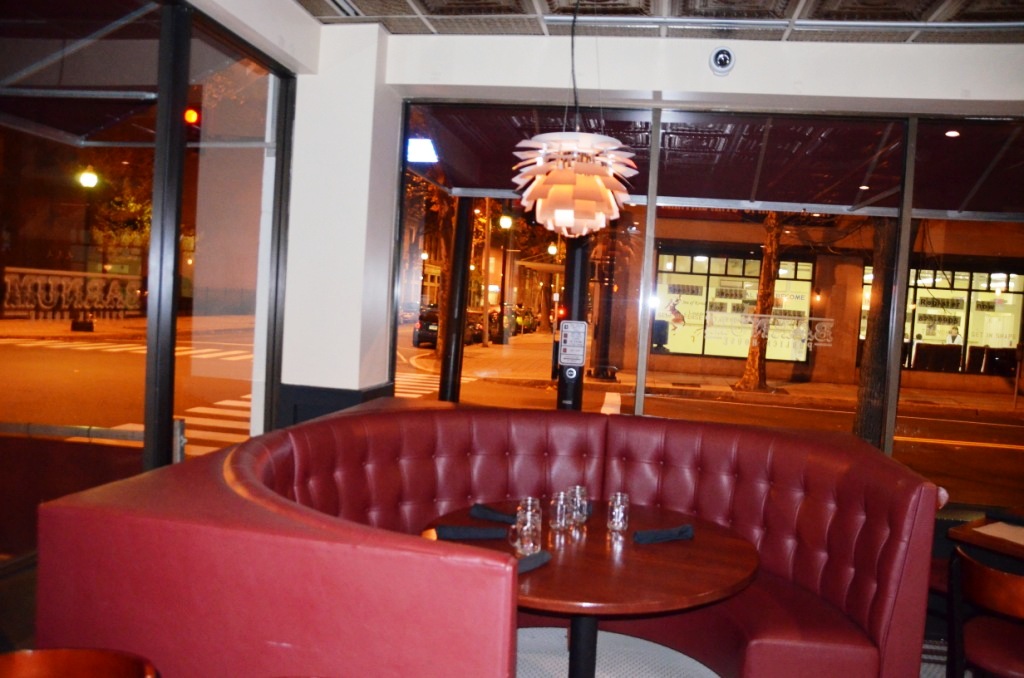
Once you walk in, you are greeted by the sophisticated decor, and the bar, which is definitely a centerpiece.
 The list of cocktails is all creative and unique:
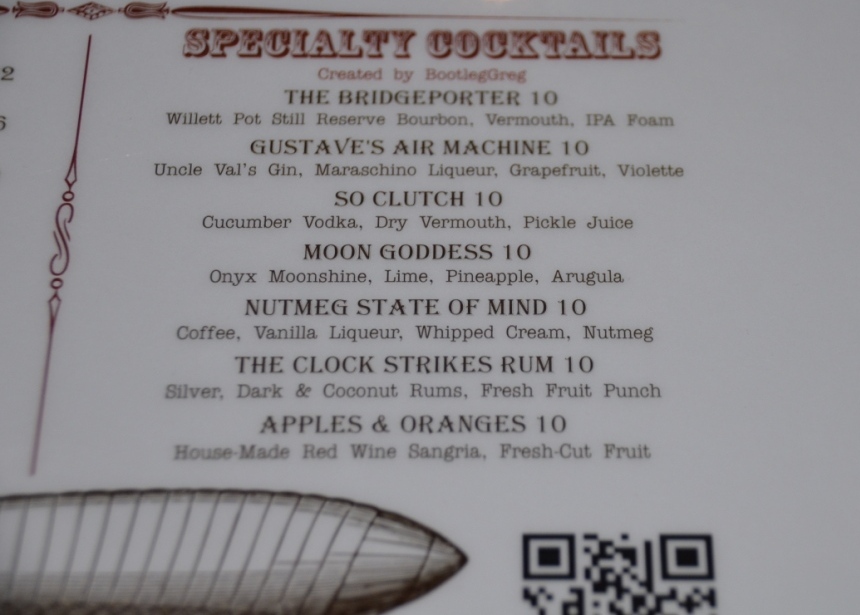
Cocktail menu at Barnum Publick House
I had The Bridgeporter (Willett Pot Still Reserve Bourbon,Vermouth, IPA Foam) – was definitely sold at the “IPA Foam”. Here it is in the making:


And here is the final result – very restrained, somewhat bitter, perfect to start the evening:

The Bridgeporter
Here are few other cocktails ordered by the people in our group:


So the bar requires bar food, right? And the bar food we got! Three different dishes, all perfectly executed.
Stonington Calamari (Spicy Flour, Sweet Chili Sauce) had just right amount of breading, served with tangy, somewhat sweet and spicy sauce:
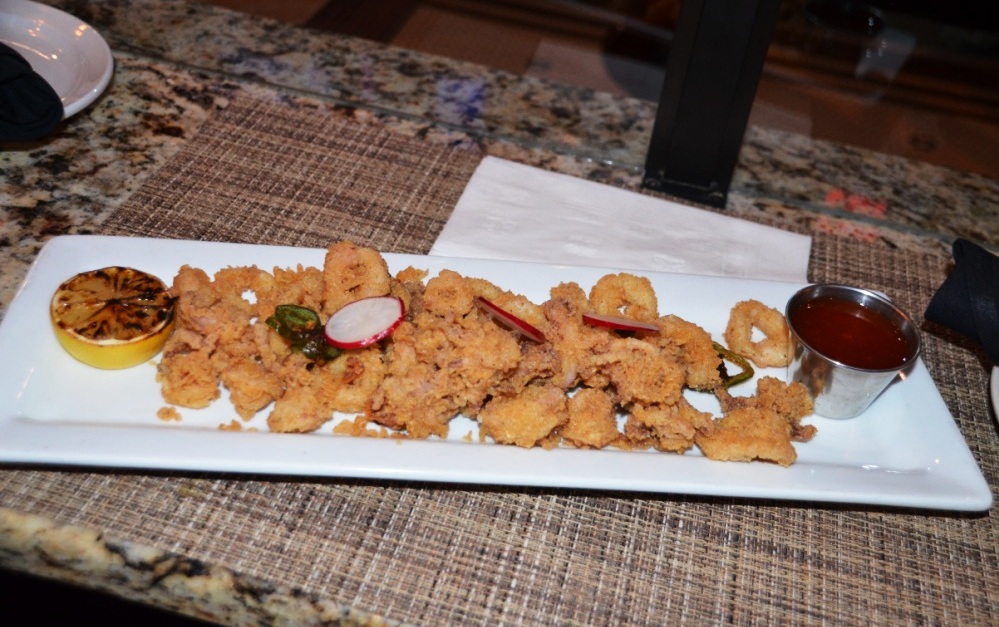
Stonington Calamari
Lump Crab Cakes (Warm Corn Relish, Lemon Tartar Sauce) – perfect texture, big lumps of crab meat, nicely seared on outside, very tasty:


Last but no least was Nachos. Hmm, I’m sure you got picture in your mind right? Corn chips, yellow cheese (I always wonder if that is really a cheese), droplets of ground beef and sprinkles of salsa. Well, get that picture out of your head – and take a look below, this is how Nachos should always look like – Short Rib Nachos (Jalapeno, Tomato, Cheese Sauce, Sour Cream, House Potato Chips) – potato chips, slow cooked short rib meat, perfectly layered and outright delicious in every bite.


That concludes our quick visit to Barnum Publick House – it was definitely fun. If you are up for the great time at the bar, with good cocktails and good food, the place is definitely recommended. Cheers!
Disclaimer: I visited Barnum Publick House as a guest of the management. All opinions are my own.
Barnum Publick House
1020 Broad Street
Bridgeport, CT 06604
(203) 690-1044
http://www.barnumpublickhouse.com/

Weekly Wine Quiz #82: Grape Trivia – Gamay

Gamay grapes
Source: Wikipedia
The Wine Quiz series is not meant to intimidate. The whole idea here is to have fun and learn something new. When answering the questions, it is fully encouraged to use all available sources of information, including Google or any other search engines. There are no embarrassing answers – the most embarrassing thing is not giving it a try…
Welcome to the weekend and your new wine quiz!
We are continuing our grape trivia series, with the focus again on the red grapes, and today’s subject is Gamay, also called Gamay Noir, and fully officially a Gamay Noir à Jus Blanc.
Gamay is a purple-skinned grape, taking its name from the village of Gamay, located south of Beaune in France. Gamay is considered to be a cross between Pinot Noir and ancient white grape called Gouais Blanc. First mentions of Gamay go all the way back to the 14th century, so it had being around for a while.
Gamay grapes have thin skin, and have a tendency to overproduce, creating the grapes with very high level of acidity and low sugar, which often results in the production of lightly colored and quite acidic wines. The overproduction and high acidity were the reasons for the Gamay being literally outlawed and pushed out of Burgundy by the royal rulers at the end of 14th century, to give way for much rounder Pinot Noir. As the result, Gamay mostly settled in Beaujolais area, where it became the major red grape variety. Gamay is used in Beaujolais to produce a wide range of wines, starting from the famous Beaujolais Nouveau, the wine produced within 6 weeks of the harvest – young, grape-y and quaffable, but usually not very exciting; and then going to the Cru Beaujolais ( there are 10 villages in Beaujolais, which have this status), which can be dense, concentrated and age-worthy.
In addition to Beaujolais, Gamay is also growing in Loire region, where it is often blended with other local grapes such as Cabernet Franc and Cot ( Malbec) and it is used to produce both red and Rosé wines. The Rosé from Loire are typically a lot fruitier than the ones from Provence. Gamay is also successfully grown in Switzerland, especially in the area around lake Geneva – it is often blended with Pinot Noir there. Outside of France, Gamay is planted in the number of regions, such as United States and Italy, but it doesn’t produce much of the well known wines. Interestingly enough, a world renowned wine writer and critic, Jancis Robinson, was raving about Gamay wines produced by Sorrenberg of Beechworth in north east Victoria, Australia – she mentioned that it might be “one of the most exciting Gamays I have ever tasted”.
And now, to the quiz!
Q1: Gamay is closely associated with every third Thursday in November. Can you explain why?
Q2: Carbonic maceration is an important method in production of wines made out of Gamay. Can you briefly explain what is carbonic maceration and how does it helps here?
Q3: Fill in the blanks: In Beaujolais, Fleuri is considered to produce the most ___ wine, and Moulin-à-Vent produces the most ___ wines.
Q4: Which one doesn’t belong and why:
a. Brouilly
b. Côte de Brouilly
c. Côte Chalonnaise
d. Juliénas
e. Régnié
Q5: True or False: Beaujolais Nouveau wines can be aged for a few years before consumption.
Good luck, enjoy the quiz and your weekend! Cheers!
Celebrate Tempranillo!
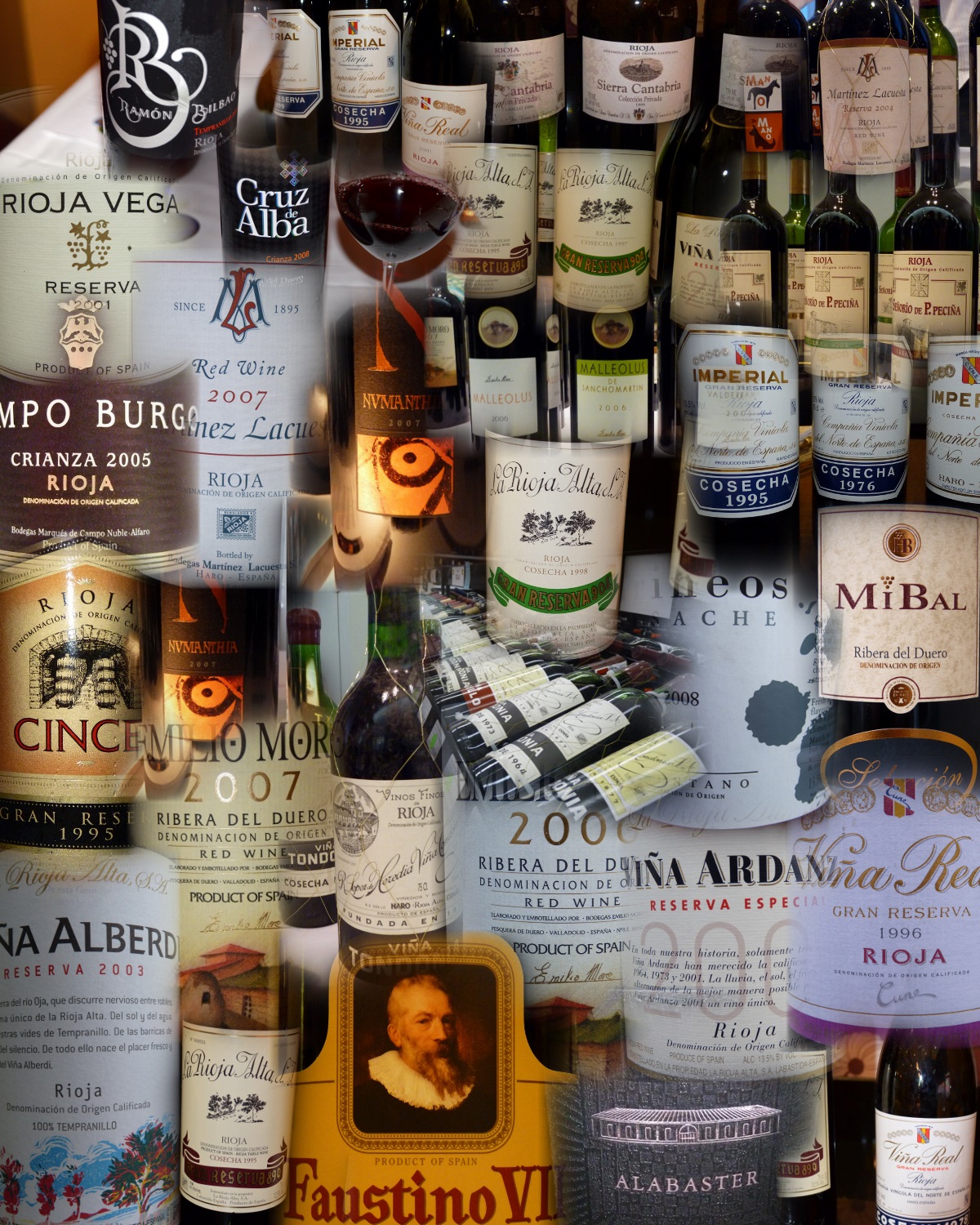 Today is an International Tempranillo Day 2013!
Tempranillo is an indigenous grape originated in Spain (by the way, do you know that Spain has the biggest area of grape plantings in the world?), with more than 2000 years of history. It is black, thick-skinned grape, capable of surviving temperature swings of Mediterranean climate, with very hot days and cool nights. Name Tempranillo comes from Spanish word temprano, which means “early”. Tempranillo typically ripens two weeks earlier compare to many other grapes. Tempranillo also one of the most widely planted red grapes in the world, with about 500,000 acres planted world-wide.
Tempranillo grapes are naturally low in acid and sugar content, so they often rely on blending partners to complement on both. Flavor profile of Tempranillo typically includes berries, leather (so famous in Rioja wines) and tobacco. Most famous Tempranillo wines come from Spain, from Rioja and Ribera del Duero regions, but Tempranillo is successfully growing in many other regions, including Portugal, California, Texas (up and coming star), South Africa, Australia and others. It is also interesting to note that Tempranillo is known under lots of different names (and as such, can throw some curve balls to The Wine Century club aficionados) – it is known in Spain as Tempranillo, Tinto Fino, Ull de Llebre, Tinto de Toro (this grape actually has clonal differences, similar to Sangiovese/Sangiovese Grosso), Cencibel and many others. It is known in Portugal as Tinta Roriz, Aragonez and Tinta Aragonez. But for the rest of the world it is simply known as Tempranillo.
So what is so great about Tempranillo? It has a few qualities which squarely set it on the line with the bets of the best in the wine world.
First, it has a great affinity for oak – Tempranillo wines can age and improve for the very long time in the oak barrels, and the resulting wine will pick up subtle nuances and complexity from that oak.
Tempranillo wines are very good at ageing. Best Tempranillo wines will rival best Bordeaux and Burgundy when it comes to improving with age and maintaining its youthful character. I have a first-hand account I can share with you – here is my experience with 1947 Rioja Imperial.
Last but absolutely not least in my book – Tempranillo wines are affordable! You can drink absolutely fabulous wines in the price range of $20 to $50, occasionally going into the $80+ – can you say the same about California Cabernet, or Burgundy, or Bordeaux? Not really… But with Tempranillo wines you do have this luxury. Of course there are Tempranillo wines which will cost $600+, but those are the exception, not the norm.
So what Tempranillo wines should you be drinking today, or any other day for that matter? I would love to give you a variety of recommendations, but come to think of it, I can only mention a few names coming strictly from Spain. There is nothing I can tell you about about Portuguese Tempranillo wines, as Tinta Roriz is typically blended with other grapes to produce Port. And while Tempranillo wines are made in Texas, California, Oregon, Washington and probably other states in US, most of those wines are available only at the wineries and rarely leave state limits.
But – when it comes to Tempranillo from Spain, I got favorites! Let me give you a few names of the producers – all the recommendations are personal, as I tasted many of their wines.
Rioja: La Rioja Alta, Bodegas Muga, Vina Real, Lopez de Heredia, Cune Imperial
Ribero del Duero: Emilio Moro, Vega Sicilia, Hasienda el Monsterio, Bodegas Alion
Toro: Teso La Monja, Numanthia
DO La Mancha: Bodegas Volver (one of the singularly best wines money can buy for around $15)
So I think it is the time to have a glass wine. Before we part let me leave you with a few interesting resources:
A vintage chart of Rioja wines, going all the way back to the 1925
A general vintage chart of Spanish wines, starting from 1992
A map of Spanish wine regions
And we are done here. Ahh, before I forget – Tempranillo Day now has a permanent spot in the calendar! It will be celebrated every second Thursday in November. Have a great Tempranillo Day and cheers!
Wednesday’s Meritage – Wine Quiz Answer, Tempranillo Day, Beaujolais Nouveau Coming Up, The Widow Who Reinvented Champagne, and more
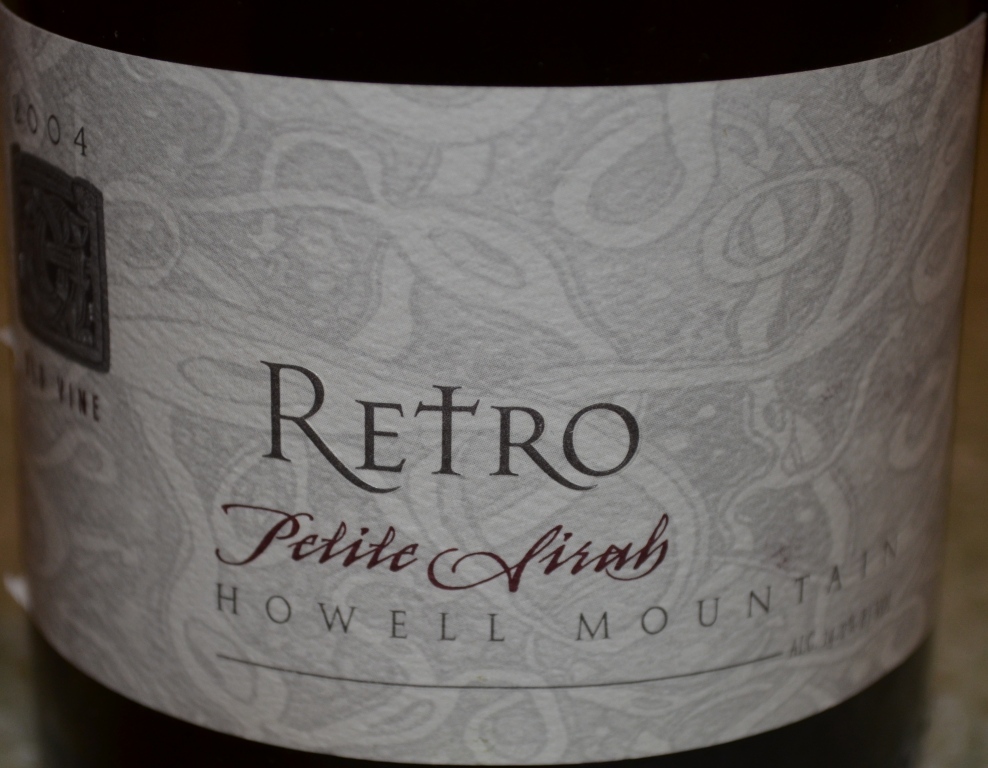 Meritage time!
First, let’s start with the answer for the wine quiz #81, grape trivia – Petite Sirah.
In the quiz, you were supposed to answer 5 questions about a red grape called Petite Sirah. Here are the questions, now with the answers:
Q1: Name the grape: In California, Petite Sirah is a popular blending addition to ___?
A1: Zinfandel. You can find a small percentage of Petite Sirah (5% – 10%) in many Zinfandel bottlings
Q2: When it comes to the wines in the United States, there is an interesting similarity between the Petite Sirah and Primitivo. Can you explain?
A2: The similarity comes from the fact that both Petite Sirah and Primitivo were the part of the same request to the TTB (government organization in charge of labeling), to allow the use of Durif interchangeably with Petite Sirah, and Zinfandel with Primitivo. It is interesting to note that contrary to the information in Wikipedia, which says that both requests were never resolved, it appears that Durif is officially recognized as a synonym to Petite Sirah, while Primitivo and Zinfandel are not – you can find the complete list of the approved names through the link to the list of approved grape names in this US government document.
Q3: Which one doesn’t belong and why:
a. Arizona, b. Illinois, c. New Mexico, d. New York, e. Texas
A3: d. New York – there is no Petite Sirah wines produced in New York (at least in the meaningful quantities).
Q4: In the bad, rainy growing season conditions in California, Petite Sirah can be a savior – can you explain why and how does it help?
A4: As the Petite Sirah is mildew resistant and provides supple tannins, color, and structure, in the bad years it can be added to Cabernet Sauvignon, Merlot, and other wines to improve the quality.
Q5: What love has to do with the Petite Sirah?
A5: “P.S. I Love You” is a consortium dedicated to the promotion of Petite Sirah wines.
Talking about the results, the drunken cyclist continues his winning streak, so he gets ( again) the prize of unlimited bragging rights. Well done!
Now, to the interesting stuff around the vine and the web!
First of all, tomorrow, November 14th, is an International Tempranillo Day! Tempranillo, the noble grape of Spain and Portugal, and the rising star of Texas is a source of many wonderful long-living wines, and it is definitely the grape worth celebrating. TAPAS, the society of producers and advocates of Tempranillo, lists a number of events celebrating the grape. But you don’t even need to go anywhere to celebrate the Tempranillo – just grab a bottle, maybe of Magnificent Rioja (but really, any Tempranillo wine will do), pour, smell, sip and enjoy!
Now, the next Thursday, November 21st, is the third Thursday in November. Do you know what it means? Yes, you are right – Beaujolais Nouveau! Every third Thursday in November, the young Beaujolais wine of the same year’s vintage, called Beaujolais Nouveau, is becoming available in all the wine stores around the world. It is not just the wine – Beaujolais Nouveau also means celebration and fun. Don’t forget to get the bottle and join the festivities!
I’m sure you know that classic Champagne with the yellow label on it – Veuve Cliquot, which would literally translate into a “widow Cliquot”. But do you know the role the Barbe-Nicole Cliquot Ponsardin, the actual person behind that label, played in pretty much enabling the whole Champagne industry to exist, and for the mere mortals to be able to afford a bottle of Champagne? Barbe-Nicole’s perseverance and her invention of the riddling were some of the key elements in making Champagne into what we readily enjoy today. Here is an article for you which is definitely worth reading – it is somewhat long but very fascinating and will be well worth your time. And you might even complement the reading with the glass of Champagne in your hand – it will be very appropriate.
The last piece I want to bring to your attention is Wine Spectator’s Top 100 wines of 2013 list, gradually exposed at the rate of a few wines per day at the Wine Spectator web site. There are various contests taking place right now to predict the Wine Spectator Wine of the Year 2013, including the one which Wine Spectator runs by itself. So far the Wines #10 – #7 had been revealed, and more wines will be announced every day finishing with the Wine of the Year on Friday, November 15th. The full top 100 list will be published on Monday, November 18th. Looking at the 4 of the top 10 announced so far, I can only say that I’m a bit surprised. One of the selection criteria for the Top 10 is affordability – with the wines #10 and #9 priced at $135, and wines #8 and #7 priced at $120, I feel like I missed the memo about a substantial increase in my salary, as those prices are definitely outside of the “affordable” realm, at least in my book. Also, as “availability” is another factor, highly allocated Quilceida Creek (wine #10) makes it also an interesting choice. I plan to come back to this subject next week when the full Top 100 list will be announced – but any of your comments meanwhile will be most welcome.
That’s all I have for you for today, folks. The glass is empty – but the refill is on its way. Until the next time – cheers!
Grand Simplicity – Gene & Georgetti Steakhouse in Chicago
Located in the River North District of downtown Chicago, Gene & Georgetti Steakhouse opened its doors in 1941. The restaurant had been open for 72 years – in such a dynamic culinary environment as Chicago, I think it really means something – very few restaurants survive for 6 month after they open, never mind the 72 years.
It is now became customary for me to check the reviews and opinions of the people prior to visiting the restaurant. All three sources I’m generally using (Yelp, TripAdvisor and Urbanspoon) had a consensus of 3.5 to 4 stars out of 5, based on 250+ reviews – this is solid enough in my book. Interestingly enough, recent reviews on Yelp were ranging from “Best steakhouse in the World” to “dated” and “How dare these people are to bring A-1 Steak sauce to my table”. Of course I had no choice but to find out by myself (ahh, it is such a hard work – eating in the restaurant, right? 🙂 )


As you walk through the door, you can see right away – this restaurant has a character. It is not trendy metal/leather/glass/wood type of place. Dark wooden paneling, classic red chairs, soft lighting.
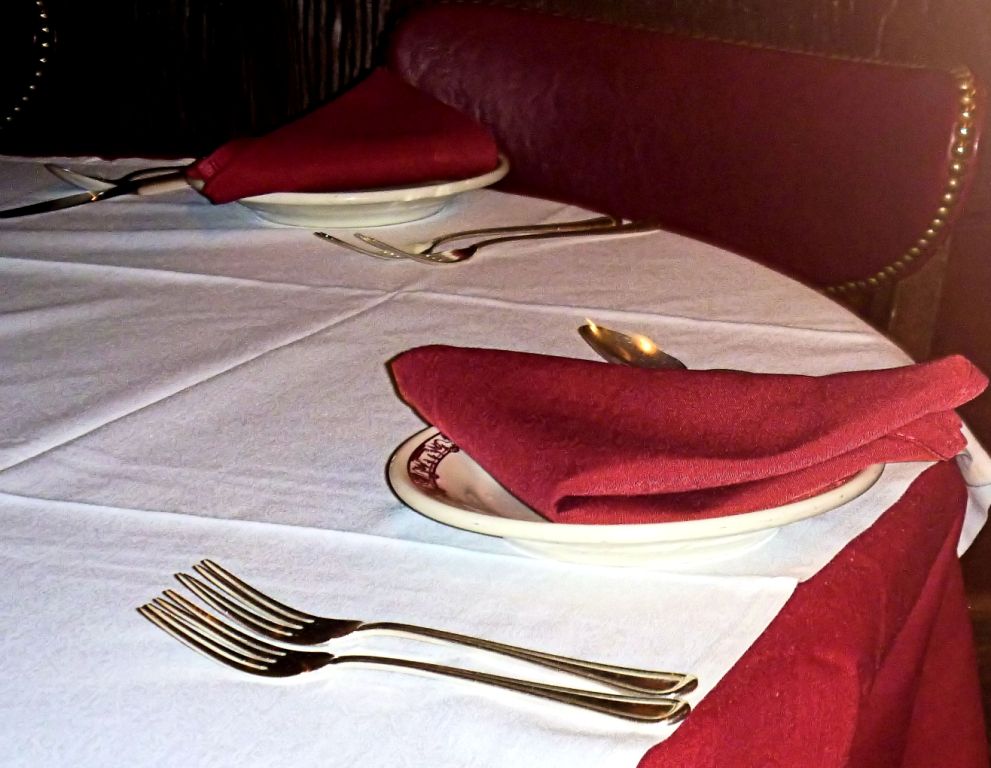 We were escorted to our table, and presented with the simple menu (two pages) and, of course, the wine list. As you know, wine is important to me, thus the content of the wine list is definitely of the high interest – both selection and prices. Gene & Georgetti’s wine list is mostly focused on California with some minor international presence – the selection is decent, and the prices are mostly okay. Yes, the selection can be a bit more diverse, and some of the prices can be also improved, but nevertheless, we were able to find a good bottle to drink with the dinner – 2010 Clos du Val Cabernet Sauvignon Napa Valley. At $64, this is about 2.5 times retail, which is definitely a reasonable price for that wine in rather an upscale restaurant.
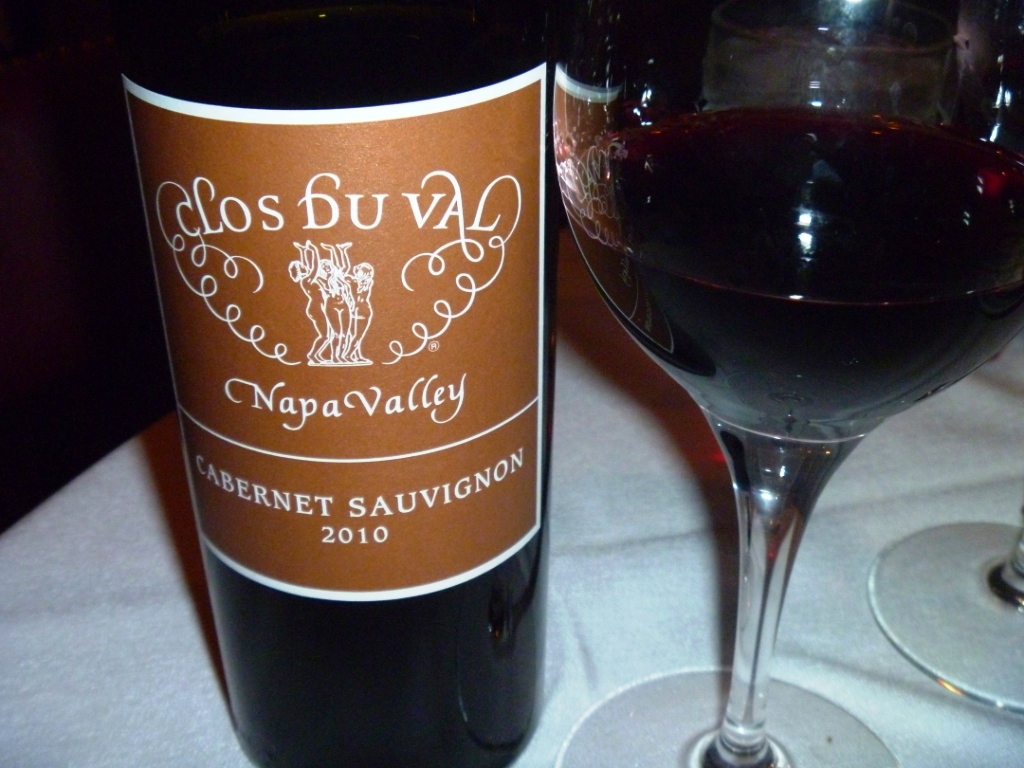
Clos du Val Cabernet Sauvignon
This 2010 Clos du Val Cabernet Sauvignon Napa Valley (13.5% ABV) had dark garnet color, inviting nose of red fruit. The wine needed a little bit of time to breathe in the glass, then it showed the typical cassis, a bit of chocolate and some plums on the palate, medium to full body, soft tannins, nice acidity and overall good balance – definitely worked well with our dinner.
The bread basket appeared first – a nice piece of baguette and the variety of bread sticks – all fresh, with very tasty crust, just “hard enough”.

Bread! (sorry, we ate a lot before I took a picture)
We started with the Fried Ravioli appetizer, which was served with the meat sauce:

Fried Ravioli with Meat Sauce
Simple, perfectly fried, very tasty and comfortable – making you literally feel like you are having a home-made meal, just at your family dinner table.
Next was the salad – fresh, crunchy iceberg lettuce with the Beefsteak tomato. I don’t know where the restaurant gets their tomatoes from – but this was probably single best piece of tomato I had in many years – absolutely perfect, fleshy, juicy and outright delicious.
For the dinner, which is served somewhat of a “family style” – with the sides to share – I ordered bone-in filet mignon (you don’t see those on every menu), and my dining companion went for the T-bone. We had sides of fries and grilled asparagus. I asked my steak to be made medium-rare plus – and so it was, with reddish center, perfect crust on outside, good till the last bite. I like also the way this beautiful hulk of meat was served – by itself on the plate, no sauce, no sides, no nothing – just a perfection, a grand simplicity of the great piece of meat. The potatoes looked and tasted as the real home fries – this is how I remember my dad would make home fried potatoes, many many years ago. This was definitely one great meal.
Try to guess – did we have dessert or not? Yes, good guess – you saw the size of that piece of meat – dessert was completely out of consideration.
The important thing to mention – service. The service was one of the best – very attentive but not overly intrusive. The dirty plates were picked up as soon as they were available, clean utensils showed up just in time – it was the work of many people, perfectly orchestrated.
There you have it – our experience at Gene & Georgetti. This is definitely a restaurant which is unique and different – the ambiance, the food, the service. If Chicago is in your plans, and you like good piece of meat – the address is below, measure it up for yourself. Cheers!
Gene & Georgetti Restaurant
500 N Franklin St
Chicago, IL 60610
Phone: (312) 527-3718

Last Bottle Sign Up ($10 credit)




 Talk-A-Vino