Archive
Re-post: Forgotten Vines: Madeira
During 2011 I wrote a number of posts for the project called The Art Of Life Magazine – of course talking about my favorite subject, wine. The project closed and even web site is down, but as I still like the posts I wrote, so I decided to re-post them in this blog. Also, in that project, posts were grouped into mini-series, such as “Forgotten Vines” you see here – I will continue re-posting them from time to time.
Also note that the series was written for a slightly different audience – I hope none of my readers will take offense in the fact that sometimes I’m stating the obvious…
 Our first post in the Forgotten Vines series was dedicated to Jerez, a not-so-easy-to-find-but-worth-looking-for fortified wine from Spain. Continuing the series, let’s move a little bit to Spain’s west side neighbor, Portugal.
Talking about Portugal’s place on the wine map, what wine comes to mind first? Yes, of course it is Port. And while Port is single most famous Portugal wine, it is not the Port we want to talk about here (don’t worry, Port is squarely positioned in the line of “must-have” experiences, and we will talk about it later). We need to move a bit more down the map in the south-west direction, about 1000 km (600 mi) to the island of Madeira.
Madeira wine takes its name from the name of Madeira Island. History of Madeira, which started at around 15th century, is full of accidental discoveries, glory, overcoming of the hardship, raise and fall, and even love – if you are interested in the full story, you should take a look at Madeira Wine web site. In the 15th / 16th centuries, Madeira wine was created and transported in the barrels through the ocean to the far places such as India and China. It was found ( by accident, of course), that long ocean voyage improves the taste of wine compare to the original one which went into the barrel. After many trial and error experiments, it became apparent that prolonged exposure to the warm weather is the culprit, and then the method of heating the wine up to the 60C (140F) was invented. The process of heating up the wine is called Estufagem, and it is done after the wine is fermented in the oak barrels, same as any other wine – again, you can find more details online – you can find less colorful but more technical details on Wikipedia (click here). Just to give you a few more details from Madeira’s history, trade embargoes led to further improving Madeira by adding brandy spirits in order to preserve the wine. Barrels of Madeira left for prolonged time under the rain lead to development of the new style of Madeira wine, called Rainwater.
In the 18th century, Madeira was one of the most popular wines in the world, especially in England and United States. Madeira was used to toast United States Declaration of Independence, and was highly regarded as a drink of distinction. Unfortunately, first mildew and then phylloxera epidemic delivered way too powerful one-two punch, which Madeira wine industry was unable to overcome. Madeira subsided to nearly a cooking wine level, and was staying like that for the long time. Luckily, overall uptake on the wine industry throughout the world helps to revive Madeira industry, and now it is becoming possible to find a great drinking Madeira even in US – and you will see why. And I have to note that one of the great qualities of Madeira is in the fact that unlike practically any other wine, once you open a bottle of Madeira, it will stay the same more or less indefinitely, due to both Estufagem method and fortification with the spirit.
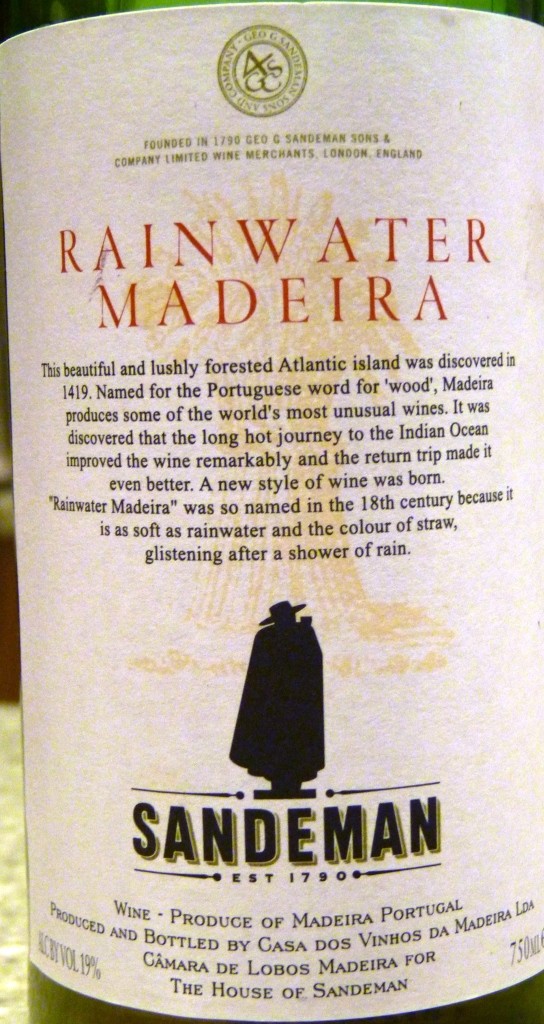
As we say here, time to open a bottle. Madeira comes in many different versions, from completely dry to the sweet. The Rainwater Madeira is somewhat of a simpler style, but still very enjoyable. This Sandeman Rainwater Madeira is deep and heavy on the nose, with hint of aged cheese and sweetness (overripe apple sweetness). On the palate, it shows the same concentration of the sweet notes, which is not really supported by acidity, so the wine comes somewhat unbalanced – however, as a desert wine to have with sharp cheese (like blue cheese, for instance), it will create a heavenly combination.
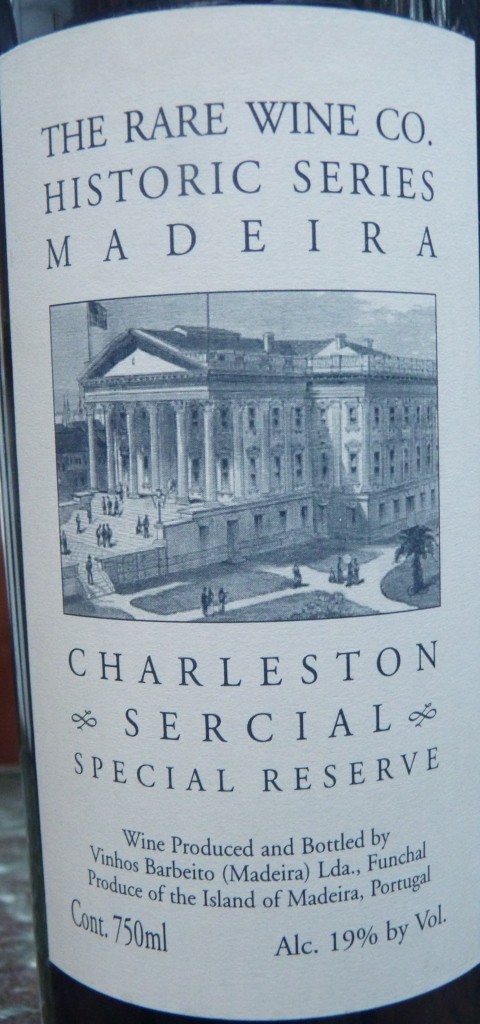 The next wine, Charleston Special Reserve Sercial is few levels up the previous wine. It comes as incredibly complex on the nose – nutty, with hint of sweetness and herbs, lots of herbs. Beautifully balanced on the palate with acidity and sweet delicate flavors of apple blending together perfectly. This Madeira has very long finish and can be used equally well before, during and after dinner – just take your pick. Definitely worth seeking.
Well, it is a great time to be a wine lover – abundance of experiences just grows daily. Now that you are empowered with the knowledge of Jerez and Madeira, it is time for personal encounter – find the bottle and enjoy it tonight!
Forgotten Vines: Jerez, a.k.a Sherry
During 2011 I wrote a number of posts for the project called The Art Of Life Magazine – of course talking about my favorite subject, wine. The project closed and even web site is down, but as I still like the posts I wrote, so I decided to re-post them in this blog. Also, in that project, posts were grouped into mini-series, such as “Forgotten Vines” you see here – I will continue re-posting them from time to time.
Also, note that the series was written for a slightly different audience – I hope none of my readers will take offense in the fact that sometimes I’m stating the obvious…
 I hope by now you learned a lot of secrets of the wine world – from great Rioja to second labels, French Sparkling wines, and wines of Languedoc. While there are still lots of secrets to discover, let’s take a break and change the subject a little bit. After all, we are on the hunt for unique experiences, aren’t we? What do you say if we will look for something which is hard to find? Would that be unique enough? Keep in mind, we are still talking about wines, not UFOs.
What will make a wine “hard to find”? Limited production would be one of the major factors – if there are only 100 cases made, and wine is good, of course, it will be hard to find (needless to say it will be also appropriately reflected in the price). Putting limited availability and cult factors aside, what if we simply forgot that some kind of wine exists, would it be then “hard to find”? Of course, it would. And believe it or not, with all the glut of wines coming into the world daily, there are still wines which are almost forgotten, which now became quite rare and “hard to find”. Let’s name the names: I’m talking about wines which had their glory days in the 16th through 19th centuries, and these wines are Jerez (also known as Sherry), Madeira and Marsala (yes, of course, you know Chicken Marsala dish, but Marsala was there first, before someone decided to cook chicken in it). Let’s explore those “forgotten vines”, as they are really worth it – but you will be the judge.
Is there something common between those wines except that they are forgotten? Yes, they are all fortified wines (to complete the list of fortified wines we need to add here Port – but Port will be a subject of a separate discussion), which means that they all had an addition of pure alcohol which acted as a preservative and affected the way the wine will be aging. Fortification also allowed the wines to be transported over long distances in the barrels, keeping them fresh.
Now, let’s extend the pleasure. Let’s talk about these wines one by one. And for no particular reason, let’s start with Jerez. Jerez wines come from Spain, and of course, the name is linked to the name of the place – a town called Jerez de la Frontera. The history of the wine goes all the way back to the beginning of the past millennia, with glory years spanning from 16th to the end of 19th century – an epidemic of phylloxera, a grapevine louse, devastated the region in 1894, and Jerez wines never made it all the way back. If you are interested in learning more about the history of the region, you can take a look at Wikipedia pages.
Jerez ( which is also often called Sherry) is produced mainly from the grapes called Palomino Fino and Pedro Ximenes, and it can be made in a variety of styles from very light to dark and heavy. There are a few interesting notes about making the Jerez. First, as we mentioned before, the wine is fortified with the addition of the brandy. As brandy added after the wine is fermented, typically Jerez is a dry wine – sweet versions are produced by blending in some sweet wines. Once brandy is added, Jerez goes through the aging process, which is called the Solera method. In this process, the wine is aging in the system of the barrels, where the youngest wine goes into the first barrel; however, when the new wine is added, some of the wine which was already aged for a while is moved to the next barrel. Such a process can continue for many decades, so the resulting wine obtains a tremendous level of complexity. Depending on the level of alcohol in the wine, a thin layer of yeast called Flor can develop in the barrels, protecting the wine from oxygen and allowing it to mellow out and obtain a very low level of acidity.
Enough talkin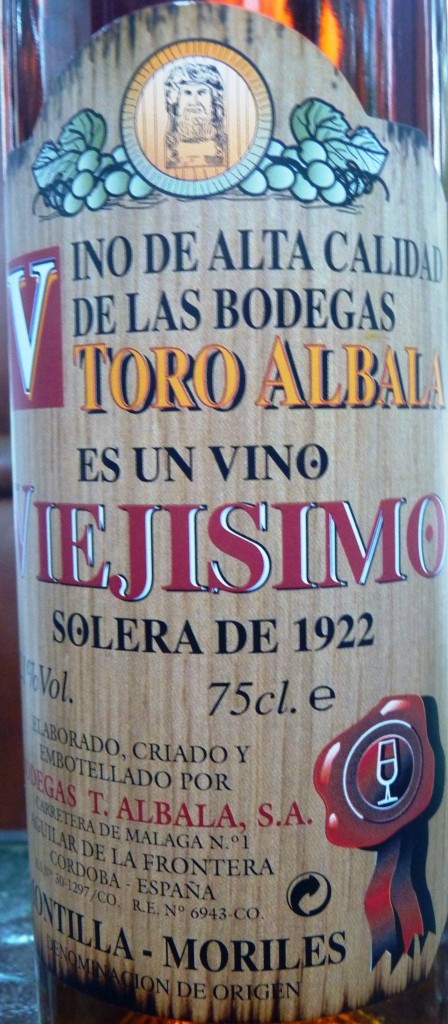 g – time to open a bottle. Let’s start with Don Gonzalo Oloroso VOS Jerez. This wine had been aged for at least 20 years (this is what VOS means). Very complex nose of nuts and caramel. Salty and gamey on the palate, with a hint of applewood smoke and again great complexity. This wine would perfectly complement the cheese and cured meats, but it is very pleasant to sip by itself.
The next wine, Bodegas Toro Albalo VieJisimo Solera de 1922 comes from a region called Montilla-Morales, which is neighboring Jerez and also can produce wines of Jerez style. Are you paying attention? 1922! It is not every day you can drink the wine which is almost 90 years old, and not go broke after the first sip (this wine costs less than $40/bottle). It is even better when such a wine gives you great pleasure. This wine shows an exceptional nose of immense complexity and pronounced herbs, such as oregano and sage. Similar saltiness on the palate as the previous wine, with excellent acidity, very balanced and complex at the same time, and very dry.
I hope I told you enough to make you want to try Jerez – you should definitely do it, and I’m sure you will not regret. And if you will be blown away – please let the rest of us know – as we would want the same. Cheers!
National ‘Drink Wine’ Day
As you might know, I’m following blog called Foodimentary for quite some time – it is fascinating to see all those food holidays celebrated literally every day.
It appears that today’s celebration is very close to near and dear subject of this very blog, hence the re-post.
Happy Drink Wine Day, everyone. Cheers!
Weekly Wine Quiz #47 – Frost and Grapes
 It is Saturday, therefore it is the time for our traditional wine quiz.
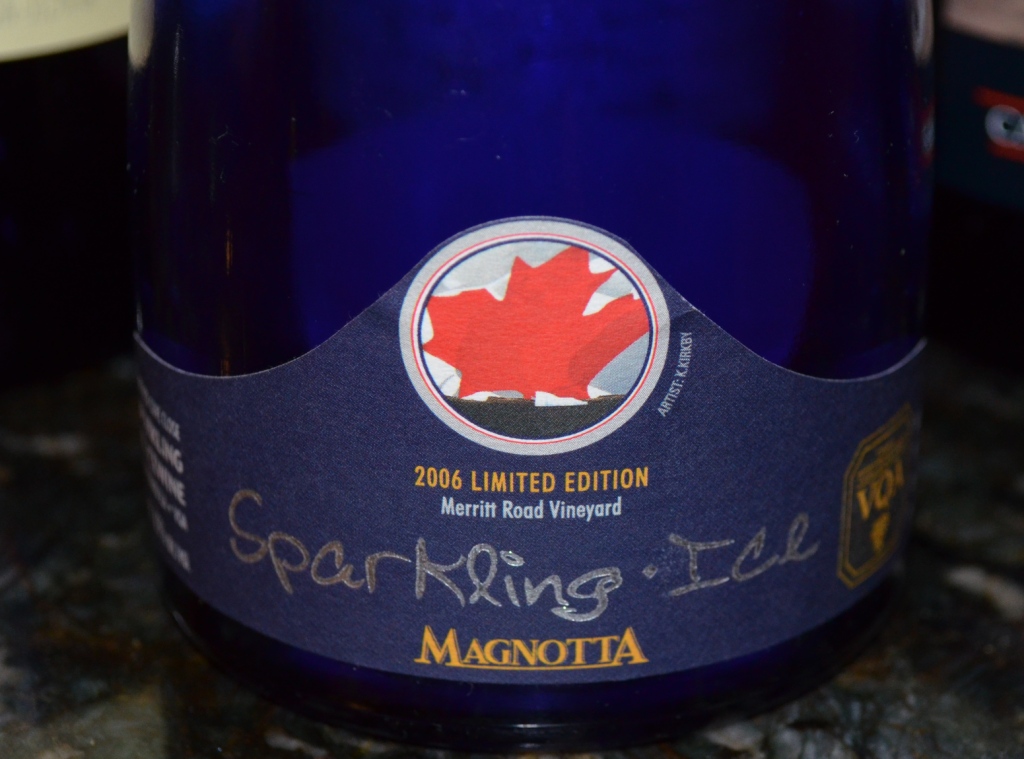
Quite honestly, I had something else in mind as the topic for the quiz (wanted to play around some etymology and urban legends) – but considering how white is everything outside (we got about 18 inches of snow here in Southern CT), I decided to take a totally different subject for the quiz – it will be all about Ice wines (a.k.a. Icewine and Eiswein).
Here are the questions for today’s quiz:
1. Briefly explain what Icewines are, including required conditions for harvesting of the grapes.
2. Which country is the biggest producer of the Icewine? As a bonus question, narrow it down to the specific region in that country.
3. Name two most popular white grape varieties for production of the Icewine.
4. Name the winery which pioneered Icewines made from the red grapes. Name that grape as well.
Good luck and have fun! Cheers!
Daily Glass: Wine Happenings on New Year’s Day, as well as before and after
New Year holiday in our family always means lots of food and drinks. And it is not even New Year’s evening – all the festivities start a few days before, and continue going into the New Year’s day itself. As the result, it means that a lot of wines were opened, and I don’t even want to talk about food (I refuse to touch the scale at least for the next two weeks).
We didn’t drink anything amazing (well, may be with the exception of one wine), at the same time we didn’t drink anything really bad, so here is a summary of what we went through (side note – I will make an attempt to produce “wine review” posts more regularly this year – call it New Year’s resolution or what).
 E1 Locations, Spain ($20, 14.5 ABV) – This wine is made by Dave Phinney, winemaker behind Orin Swift wines, and its goal is to showcase best grapes form the best places. E1 Locations is a blend of Garnacha, Tempranillo and Carinena, all grown in three famous regions in Spain – Rioja, Ribera Del Duero and Priorat. To be very honest with you, this is not my style of wine – it has a lot of heavy fruit ( I call it “burnt fruit”), some warm spice and hint of oak with not enough acidity – however, the wine opened up somewhat next day, showing brighter fruit and more harmony. Drinkability: 7+
 2009 Chateau Maison Blanche Medoc ($19.99?, 14% ABV, sorry for the picture of the ripped label) – tasting of this wine was an interesting experience. On the first day, it was drinkable, but lacked any excitement. The next day, it became plain bad – but I don’t pour wine down the drain easily, so I put it aside. Day number 3 – same story, not the wine I want to drink – and again I let it be. On the day number four, I decided to give this wine one final taste before disposing of it – and found it completely changed. The wine opened up, showing nice luscious fruit, supple tannins, good acidity and good overall balance, it became soft and round. This wine definitely needs time. And before I forget – this wine is made of 85% Merlot, 13% Cabernet Sauvignon, 2% Cabernet Franc. Drinkability: 8- (either decant when serving or cellar for a while).
 2008 Bogle Vineyards Phantom ($17, 14.5% ABV) – Bogle Vineyards is one of my favorite producers of inexpensive California wines. While they make pretty much a full line (Chardonnay, Zinfandel, Cabernet Sauvignon, etc.), Bogle Vineyards Petite Sirah typically represents an unbeatable QPR – it is simply an excellent wine usually priced at $11.99. The wine we had, Phantom, is a bit of a higher end – it is a blend of Zinfandel, Petite Sirah and Mourvedre. It drinks very well, showing a bouquet of warm spices on the nose, and a lot of nice bright fruit on the palate, ripe plums, touch of cinnamon and nutmeg, good acidity – quite an enjoyable wine. Drinkability: 8-
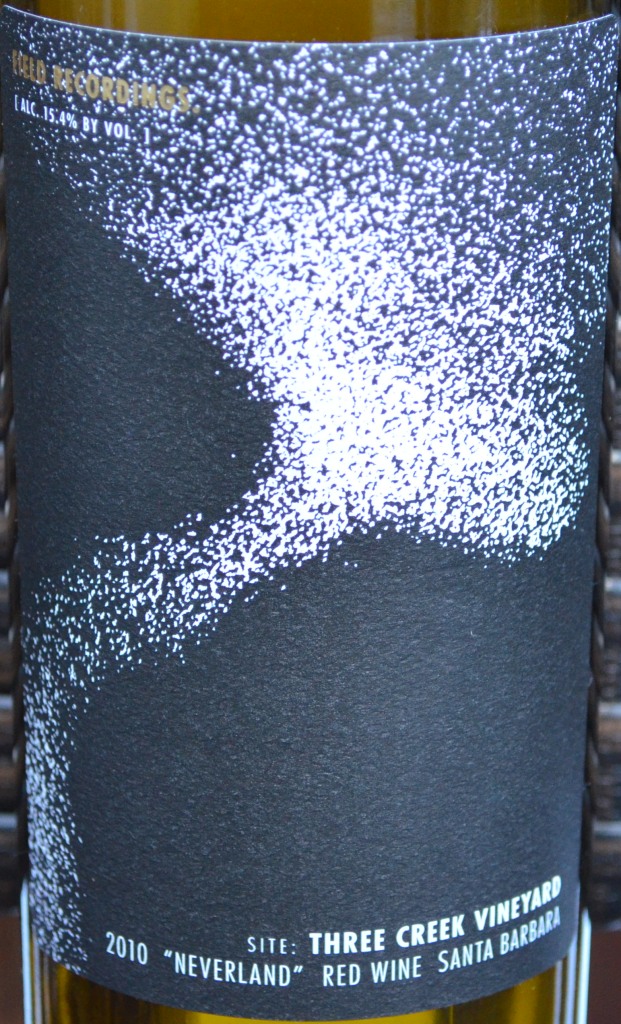 2010 Field Recordings “Neverland” Red Wine Santa Barbara ($26, 15.4% ABV) – Have you ever tried any wines from Field Recordings? You know, may be I shouldn’t even talk about this wine here? Too many people will find out, it will be hard to get, do I really need all that hassle? Well, okay – feels good sharing a secret.
Andrew Jones, winemaker behind Field Recordings, was grape grower first, working with many wineries and tending to their vineyards. Later on he started making his own wines, each of them coming from the different sites, from the places were particular grapes do particularly well. This wine, called Neverland, comes form the Three Creek Vineyard site, and it is a blend of 60% Cabernet Sauvignon, 24% Petit Verdot and 16% Malbec. The wine was perfectly balanced, with layered soft fruit, black currant and touch of blueberries, dark chocolate notes, very long and pleasant finish. Why I wanted to keep such a great wine to myself? Very simple – total production: 150 cases. When it’s gone, it’s gone… Drinkability: 9-
2011 Brick Lane Pinot Noir California ($?, 13.4% ABV) – When faced with the wines like this one, I always have a dilemma – do I write about them in this blog, or do I not? I don’t want to pretend to be a big critic and proudly proclaim my scores – I look at the wine rating mostly as a fun exercise. Anyway, as you probably guessed, this was not a very good wine. Thin, green, acidic, unbalanced, drinkable, but not delivering any pleasure. Drinkability: 6-
 2011 Dr. Hans VonMuller Riesling Spatlese Mosel ($11.99, 8% ABV) – I either don’t drink enough Riesling, or I don’t write enough about it, or both – somehow, I think Rieslings are scarcely discussed in this blog. For the Spatlese, this was a very modest Riesling – yes, it had an explicit sweetness – but it was not cloying by all means ( some of the 2010 and 2011 German Rieslings I tried had this clinging sweetness even at the Kabinett level). Sweetness was nicely balanced by acidity, and overall this was a very pleasant wine with good amount of white fruit, some apricot and may be peach, very enjoyable. Drinkability: 7+
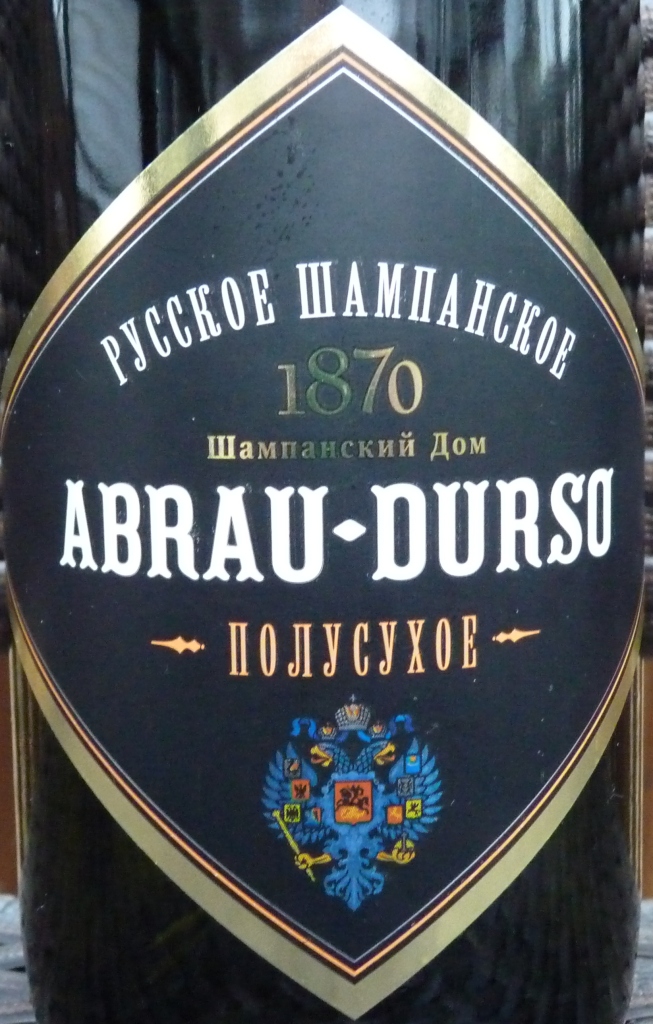 Now it is time to talk about Sparkling wines – I have a few to share with you. First, NV Abrau-Durso Semi-dry, Russia ($12.99) – as planned, we ringed the New Year 2013 with this wine. Yes, it is not the first time I write about Abrau-Durso in this blog (it was also my wine #19 in the Top wines of 2012 list) – but I can’t help it, as the wine is good! Apple and touch of yeast on the nose, very restrained white fruit on the palate, good acidity, hint of sweetness, perfectly refreshing bubbles – you have to try it to believe it. Drinkability: 8
We are almost done, I promise! A few more sparkling wines:
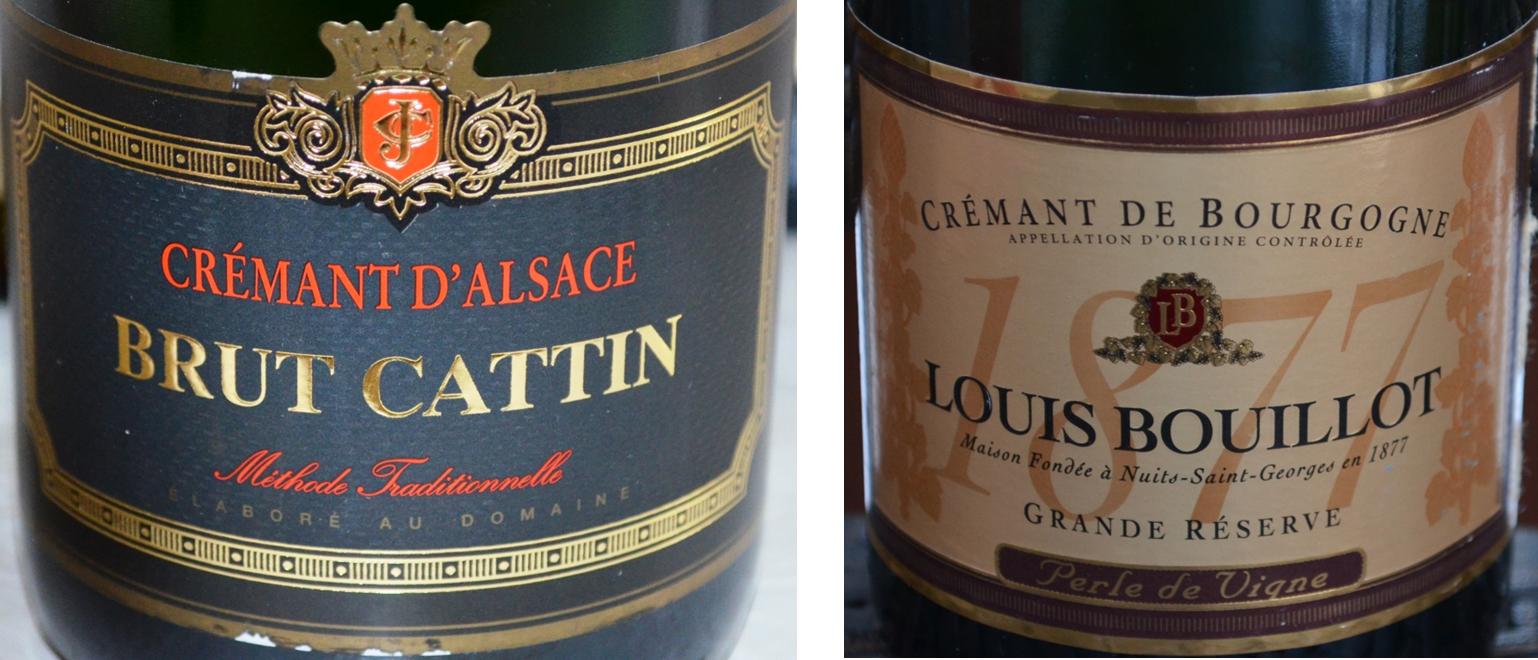 So here are NV Cremant D’Alsace Brut Cattin ($16.99, 12% ABV) and NV Cremant de Bourgogne Louis Bouillot Grande Reserve Perle de Vigne ($?, 12% ABV) – the reason I lump these two wines together is that they are literally indistinguishable (unfortunately!). It is interesting that grape composition is quite different between them – Cremant d’Alsace is made out of Pinot Blanc, Pinot Gris, Pinot Noir, Riesling and Chardonnay. Cremant de Bourgogne is a blend of Pinot Noir, Chardonnay, Gamay, and Aligoté. Both wines are drinkable – a bit of yeast, good acidity, crisp and refreshing – but not exciting. Drinkability: 7
 Peach Canei Italy ($4, 7.5% ABV) – I guess by even mentioning this “wine” ( it is more of a wine cocktail – it is peach flavored grape wine) in this blog I have to officially renounce a self-awarded title of a wine snob and never even try to claim it again.
I told my friend Zak that way back ( about 20 years ago), when I was just slowly getting into wines, Peach Canei was one of our favorite wines. I think only a young age protected Zak from having a heart attack – he was completely shocked. So he got me a bottle of the wonderful beverage as part of my New Year’s present. As you can imagine, I had no reason to cellar it, so we decided to open the bottle right away. It had a pronounced peach flavor, with a bit too much sweetness, lightly fizzed, probably could’ve used a bit more acidity. But – it was drinkable, and we managed to finish a bottle. It is highly unlikely that I would ever crave this wine, but again, it is not that terrible as you might think. Drinkability: 6.
That’s all I have for you regarding the wines – wait, don’t go yet. New Year is usually celebrated with lots of food – here are couple of pictures which will give you an idea of how the table looked like:


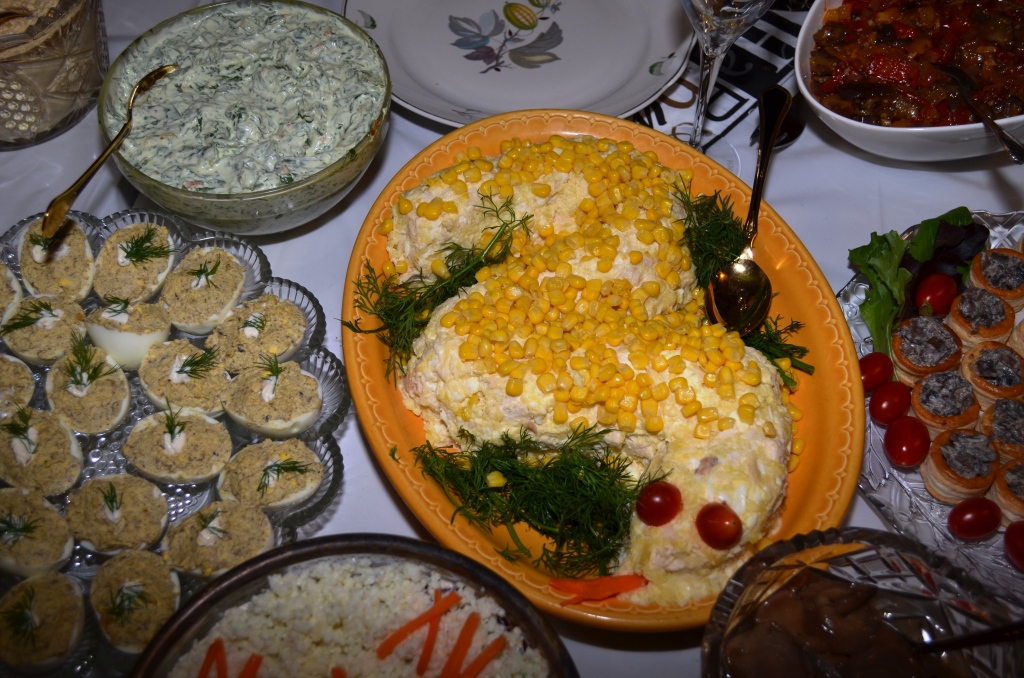
That’s all for today, folks. Did you have a most memorable New Year’s wine? Please use the comments section below and share! Cheers!
Re-Post: Best Hidden Secrets Of The Wine World: Second Labels
During 2011 I wrote a number of posts for the project called The Art Of Life Magazine – of course talking about my favorite subject, wine. The project closed, but I still like the posts I wrote, so I decided to re-post them in this blog. Also, in that project, posts were grouped into mini-series, such as “Best Hidden Secrets” you see here – I will continue re-posting them from time to time.
Also note that the series was written for a slightly different audience – I hope none of my readers will take offense in the fact that sometimes I’m stating the obvious…
Second labels. Second is a keyword here. Second – meaning second best? How good it is to be second best?
When it comes to competition, second best is always only second best. Second best means you scored less, you ran not as fast as the best, you jumped not as far as the best. By all means, you really tried – but someone else was better in the same art.
Luckily, the notion of “second best” is not applicable to the world of wine. Of course, you might have your favorite (the best) wine, and then second favorite wine, and the third, and the fourth and many others. However, those are your personal favorites which are driven by your own personal taste. It is entirely possible even that someone’s most favorite wine is totally not drinkable for someone else (I think this is one of the most fascinating aspects of the wine world.
So what is the second label? Many wineries around the world have one wine which is considered the best, most well known and well regarded. Such wine would be their “First Label”. Typically, those wines have two” external” characteristics: they are very expensive and made in the limited quantities – and one way or the other, these subsequently become driving factors to produce so called “second label” wines, which are at least less expensive (quantity still might be an issue).
Actually, officially designated second labels started in Bordeaux in France simply to avoid throwing out the grapes which didn’t make it into the best wines. What started from so called “first growth” Bordeaux wines from famous 1855 classification in the 18th century, the second label movement spread widely across many wine making regions in the last quarter of 20th century (you read more on the subject here). From being only a Bordeaux phenomenon, it became adopted by many wineries all over the world as their main wines elevated to the “cult” status.
Today many of the cult wines from California, Italy and Spain ( other regions joining in as well) have their second labels. It is interesting to point out one essential difference between Bordeaux second labels and the rest of the world. Based on In Bordeaux AOC rules, second label or not, if Chateau is specified on the wine label all the grapes (100%) for that wine have to come from the vineyards which belong to that Chateau. This is not the case for most of the world. For instance, when particular AVA (analog of AOC in USA) is mentioned on the wine label, it means only that at least 85% of the grapes in that wine should be coming from the specified AVA, and 15% of grapes can be coming from any other places. I’m not saying that this is good or bad – this is just something to take into account when talking about second label wines.
Now, putting all the technicalities aside, what is all the fuss? Why are we talking about some kind of “second labels” as a great secret of the wine world? Very simply, it is all about QPR. Let me give you an example. If you hadn’t done so recently, go check how much Chateau Latour or Chateau Lafite costs. 2008 (somewhat of a sleeper vintage, not declared as outstanding) Chateau Latour will cost $1,600 or more, and Chateau Lafite is somewhere in the $2,000 – $2,500 range. No, not for 5 cases – these are the prices per bottle… 2008 Les Forts de Latour, second label of Chateau Latour, will cost about $250 per bottle, and Carruades de Lafite, second label of Chateau Lafite, will cost about $600.This is still very steep, but I’m sure you can see the magnitude of price difference. In addition to the better QPR, second labels are ready to be enjoyed much faster compare to the main wines. You need to wait for 15-20 years for great Bordeaux to open up, and second labels often cane enjoyed right away or after the short time in the cellar.
Let’s talk about some practical examples, but instead of Bordeaux, let’s start from Italy.
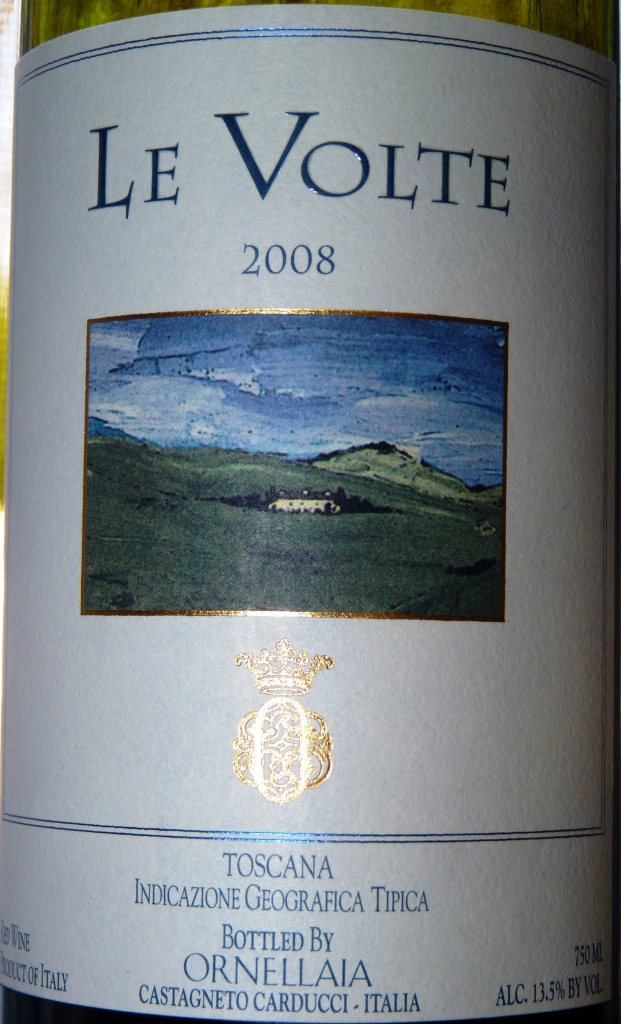 Le Volte is so called Super Tuscan wine made by Tenuta dell’Ornellaia. Their flagship wine, Ornellaia, has won numerous accolades and consistently rated above 95 points by various wine critics. You can buy Ornellaia for about $180 – $220 per bottle. Le Volte is produced by the same winery (it is technically a third label, with Le Serre Nouve being the second) from the grapes which were not selected for the main wine, and you can buy it for about $20-$25 per bottle (about one tenth of the price of Ornellaia).
2008 Le Volte was very tight and aggressive initially. After a while, it changed beautifully showing luscious fruit (dark fruits) and silky smooth tannins. It can be enjoyed right now with the appropriate breathing time (an hour in decanter might be the right call), but it will benefit from another 5 years in the cellar.
 Here is another example – Crouix de Beaucaillou, second label from Chateau Ducru Beaucaillou. Chateau Ducru Beaucaillou is so called second growth winery from Saint-Julien region in Bordeaux – again based on 1855 classification. Taking 2008 as a reference year again, their flagship wine, Chateau Ducru-Beaucaillou, can cost $110 and above (just for comparison, same wine from 2005, which was one of the best years in Bordeaux, will cost you $180+, and 2009 prices start from $250). 2005 Croix de Beaucaillou can be found for about $45 per bottle, which is one fourth of the price of the first label. This 2005 Croix de Beaucaillou opens one with beautiful nose of ripe black plums, oak and spice box. On the palate the wine is very restrained initially, and then opens up with some cedar notes and exhibits pronounced acidity and powerful tannins. Despite my earlier statement about second labels being ready to drink earlier, this particular wine definitely need more time in the cellar (but we should still keep in mind that 2005 was a great year).
After learning the first great secret of the wine world – beautiful Rioja wines, now you are armed with even more knowledge and you can have a lot of fun exploring the world of hidden gems, the second labels. Just to leave you with a little reference, below you will find a table with names of some of the second labels throughout the world, you can enjoy hunting for. And stay tuned, as more secrets are coming!
Note: this post was prompted by the post “Second Label Values” by the fellow blogger wpawinepirate.
Reference: Second Label Wines
| Primary Wine | Second label |
| France – Bordeaux, 1st growth | |
| Chateau Haut-Brion | Le Clarence de Haut-Brion |
| Chateau Lafite Rothschild | Carruades de Lafite Rothschild |
| Chateau Latour | Les Forts de Latour |
| Chateau Margaux | Pavillon Rouge |
| Chateau Mouton Rothschild | Le Petit Mouton |
| France – Bordeaux, others | |
| Chateau Ausone | Chapelle d’Ausone |
| Chateau Cheval Blanc | Le Petit Cheval |
| Château Rauzan-Ségla | Ségla |
| Château Léoville-Las Cases | Le Petit Lion de Marquis de las Cases (Clos du Marquis before 2007) |
| Château Léoville-Poyferré | Château Moulin Riche |
| Château Léoville Barton | La Réserve de Léoville Barton |
| Château Gruaud-Larose | Sarget de Gruaud-Larose |
| Château Lascombes | Chevalier de Lascombes |
| Château Pichon Longueville Baron | Les Tourelles de Longueville |
| Château Pichon Longueville Comtesse de Lalande | Reserve de la Comtesse |
| Château Ducru-Beaucaillou | La Croix de Beaucaillou |
| Château Cos d’Estournel | Les Pagodes de Cos |
| Italy | |
| Sassicaia | Tenuta San Guido Guidalberto |
| Ornellaia | Le Serre Nouve, Le Volte |
| Spain | |
| Vega Sicilia | Valbuena 5° |
| Alto Moncayo | Alto Moncayo Veraton |
| Bodegas El Nido | Clio |
| Clos Mogador | Clos Manyetes |
| USA – California | |
| Bryant Family | DB4 |
| Duckhorn | Migration, Decoy |
| Harlan Estate | Maiden |
| Pahlmeyer | Jayson |
| Paul Hobbs | Crossbarn |
| Screaming Eagle | Leviathan |
| Quilceda Creek | Quilceda Creek Columbia Valley Red |
Thanksgiving Experiences
 What, you said, what Thanksgiving? We are counting days before Santa will get down the chimney, and this guy is talking about Thanksgiving? Well, yes, life gets in the way, and we have to simply deal with it – while we celebrated Thanksgiving about 10 days ago, I had no chance to write this post. As this blog also has a function of my personal journal, a life’s scrap book, if you will, I want to keep this little page in it, so here we go.
We have a long standing tradition of celebrating Thanksgiving with very close friends, pretty much a family, who live in Boston. We also share a passion for cooking, so our Thanksgiving dinners never become a routine – every time we need to come up with something else in terms of both main dish and sides. We’ve been through quite a few things in terms of Thanksgiving dinner – regular turkey, Turducken, smoked turkey – probably the only one we didn’t do yet is deep-fried turkey – we were advised against it as a project, as it involves some work which is actually better be left for professionals.
This year’s ideas was a stuffed turkey of sort, but most likely this is not what you think. The idea was to debone the turkey, leaving only legs and wings. Cut up most of the meat, leaving a layer of about half an inch with the skin. Removed meat then is ground and made into a stuffing with addition of spices, sauteed wild mushrooms with onions, matzo meal and previously fried bacon (large chunks). Then it is all stuffed back into the bird, which is been sewn and then roasted. Here are some of the pictures to illustrate what was happening (pictures are courtesy of my daughter).
Here is turkey ready to be stuffed ( we marinated it for about two hours prior):

The same with the addition of stuffing:

Finishing up the sewing:

Done! Better than new:

In the bag and in the roasting pot:

Now it is actually ready to eat:
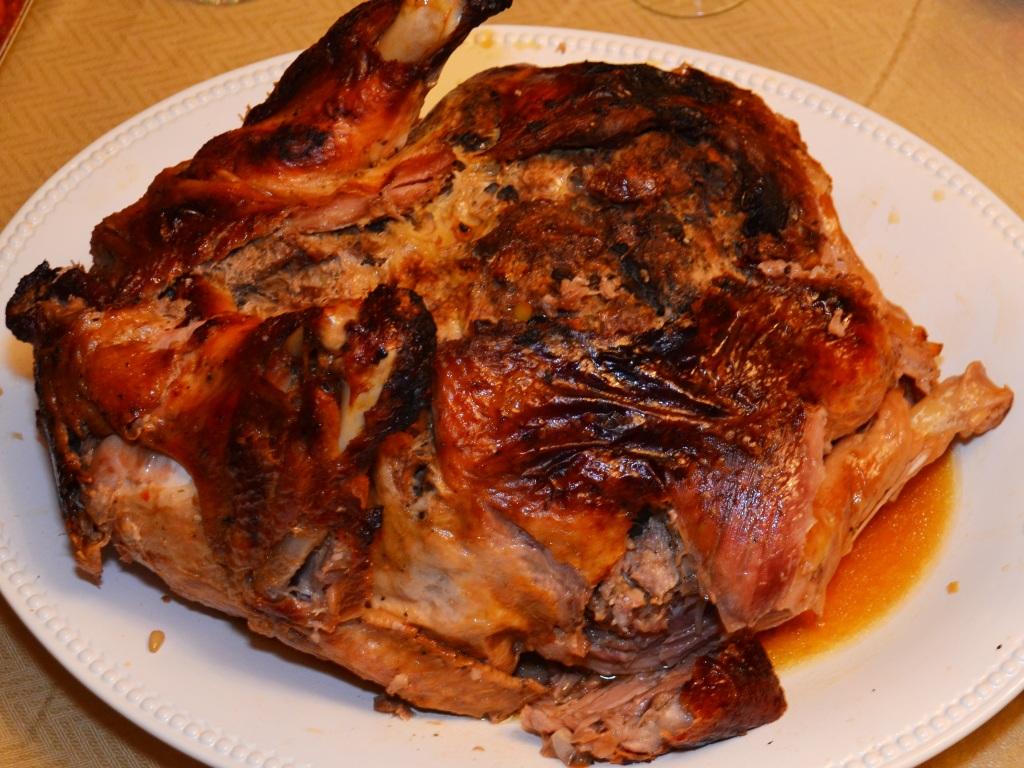
In case you are curious, this is how it looked inside:

We had a few sides – sorry about the pictures, but we were actually ready to eat, so my jumping up and down with the camera in search of composition and the lighting were not welcomed – not for a little bit.
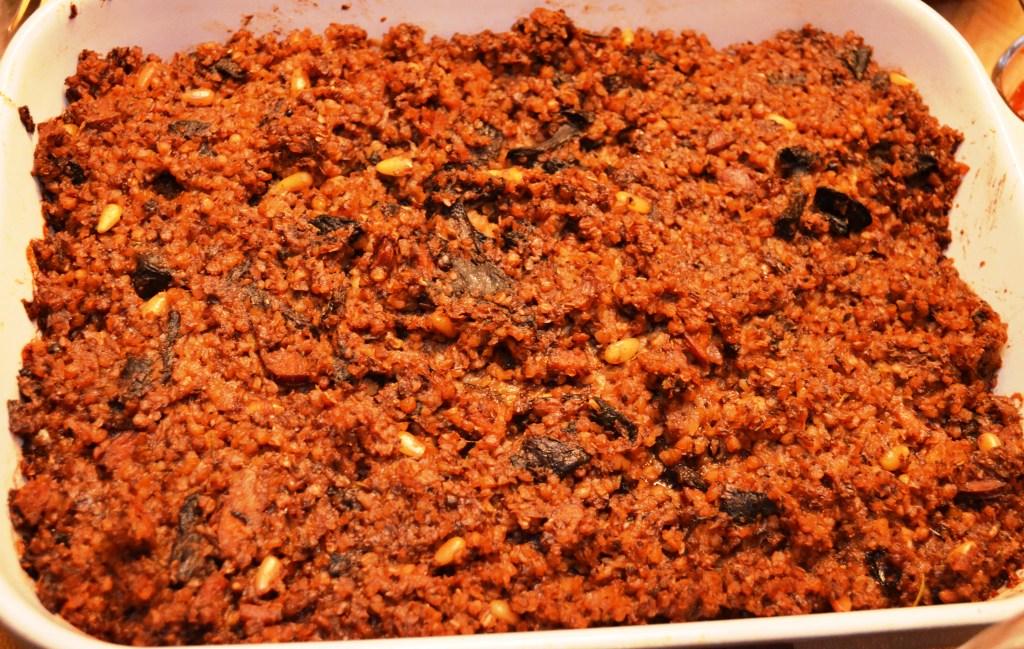
First, buckwheat with pine nuts, wild mushrooms and onions ( the same as went inside the turkey) and spicy Andalusian turkey sausage:
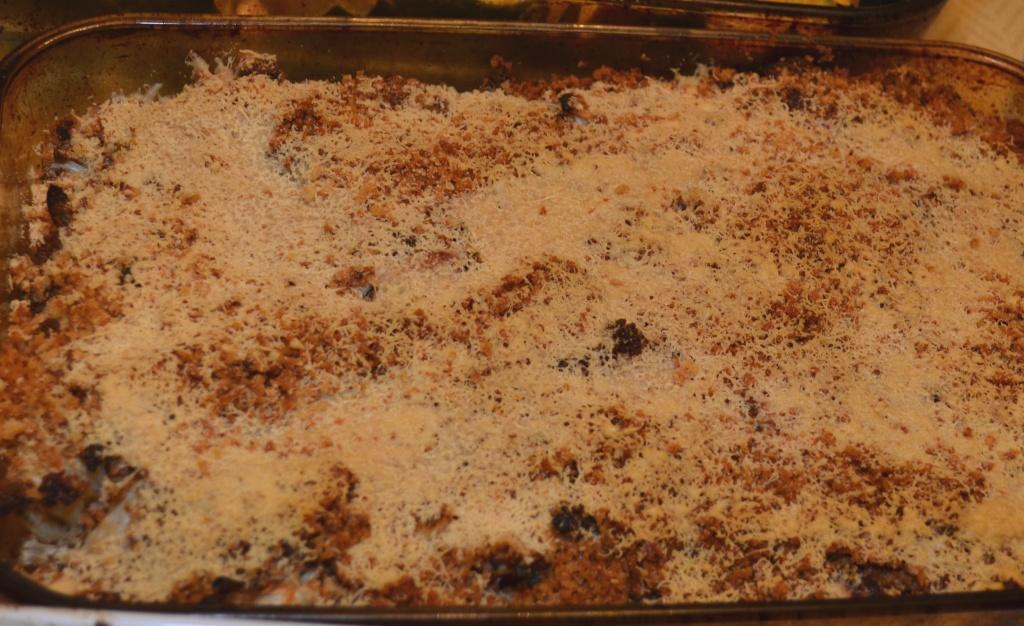
Roasted cauliflower with rosemary and pine nuts, covered with buttered Panko bread crumbs and grated Parmesan cheese (this is pretty much the whole recipe). The picture doesn’t do the justice to this dish, but it was tasty:
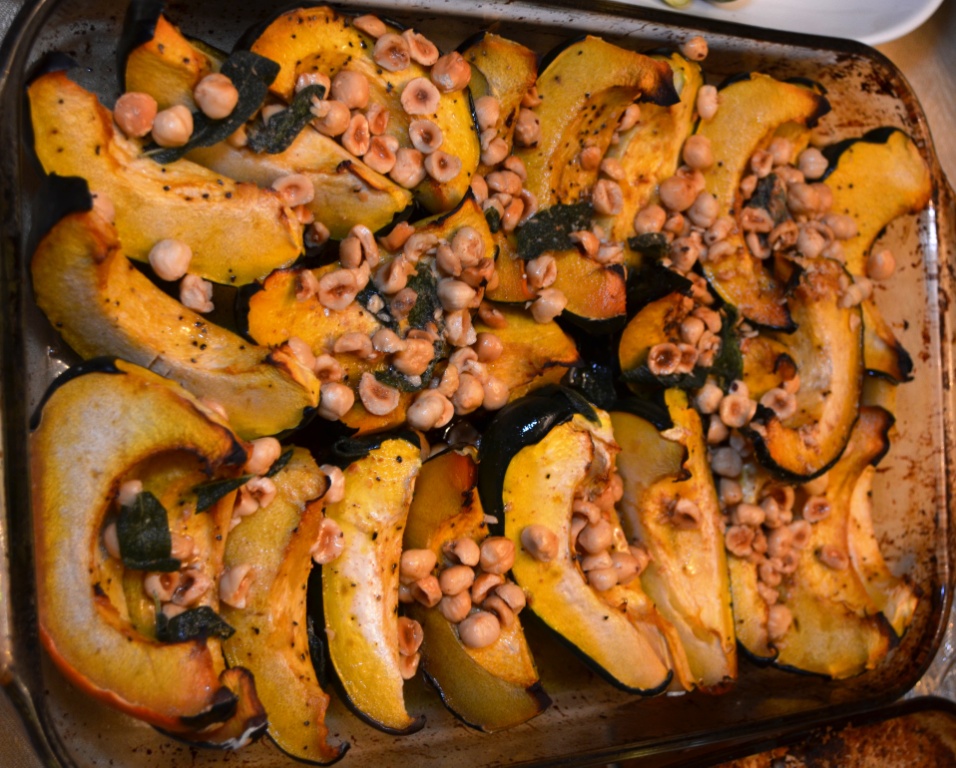
And then hazelnut-sage butter (stick of butter, cup of chopped hazelnuts and about a cup of whole sage leaves):

On top of roasted acorn squash ( again, this is practically the whole recipe):
Food was great, let’s talk about the wines. Been the wine guy as I am, I never try to exact the wine and food pairing for Thanksgiving – too many competing flavors, really hard to nail it. The best thing to do in my opinion is to chose middle of the road wines – nothing with super expressive taste, no fruit bombs, more of supple and round wines.
For the whites, in addition to Riesling which is not shown here, we had this two chardonnays:
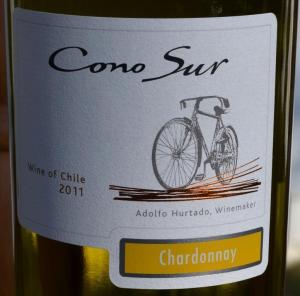

I like Cono Sur wines – they deliver great QPR, and generally are pleasant. This 2011 Cono Sur Chardonnay Chile had a hint of vanilla on the nose, good white fruit on the palate with some hint of butter, good acidity, but overall may be a touch too sweet to my taste (still unquestionably quaffable). The 2010 Banknote Counterfeit Chardonnay Sonoma County was lighter than I expected – some distant hint of toasted oak and butter, but overall light wine, not very expressive. I wanted to check if this wine was unoaked, but the winemaker’s web site doesn’t even list this wine there. Clearly a counterfeit…
And here are the reds, at least some of them:
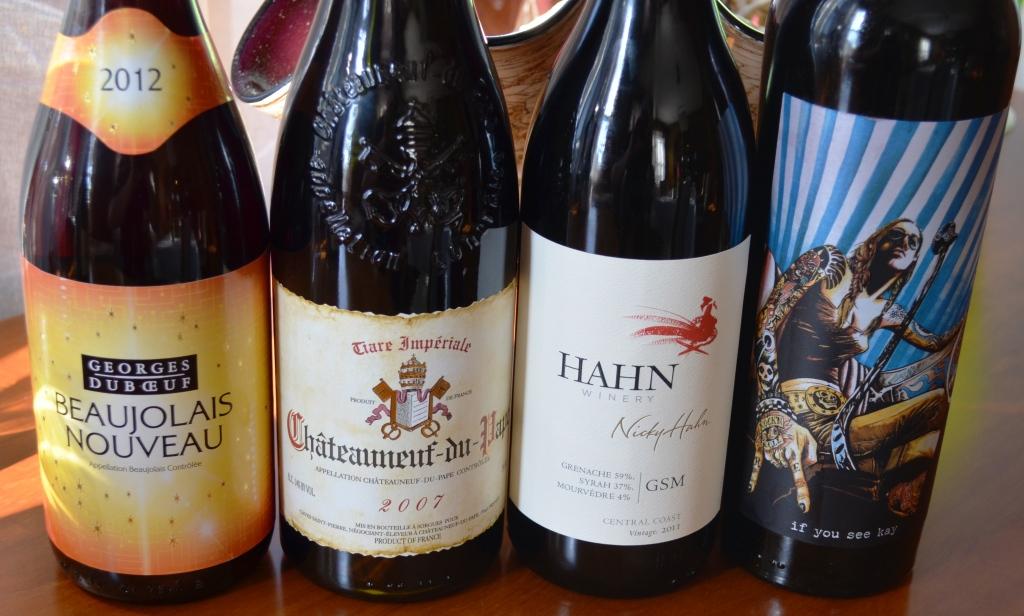
I previously talked about Beaujolais Nouveau, and I also shared my impressions of Tieare Imperiale CdP. 2011 Hahn Vineyards GSM Central Coast is a blend of Grenache, Syrah and Mouvedre. The wine showed a lot of plush fruit, very round and slick, but somehow it lacked the character for me – it was over-engineered, if such terminology can be used to describe the wine. But then I have to tell you – 2010 if you see kay Lazio IGT, the wine with the controversial label, was perfect. This wine, produced by Jayson Woodbridge, the winemaker behind very successful super-rich Hundred Acre Cabernet from California (plus many other successful wine projects), had perfect balance of all components – dark fruit, just the right amount of it, round supple tannins, touch of spices, coffee, and dark chocolate, refreshing acidity and lingering finish. This is definitely the wine to enjoy (in other words – get your bottle).
Before we are done here, I have to tell you about one more wine-related experience – visiting the wine store, to be precise. I found out by way of The Wellesley Wine Press, a blog I’m following, about quite unique wine store in the Boston area, called Bin Ends. As you can imagine from the name, many of the wines in the store come from the actual “bin ends”, last bottles of wines not sold in some other places. As my friends live in a very close proximity to this wine store, I couldn’t miss the opportunity to visit it – I spent about an hour there, just walking around and browsing somewhat small, but very interesting inventory. I picked up some of the interesting wines and looking forward to tasting them at some point:
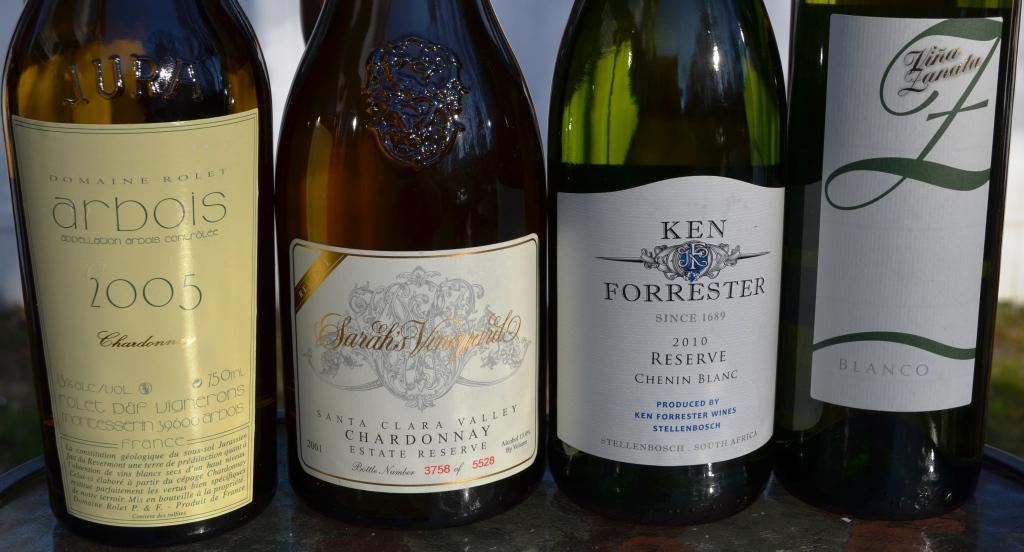
By the way, very unusual for me – all the wines above are white.
There you have it, folks – the Thanksgiving experience. Have a great week and cheers!
Beaujolais Nouveau 2012 – Not To Be Missed!
 Walk into the wine store on third Thursday in November, and most likely you are greeted with the abundance of wines with brightly colored labels, which were not there just a day ago. Yes, that means that Beaujolais Nouveau, the wine of new vintage, made out of grape called Gamay in Beaujolais in France, has arrived.
As with many other wine in France, Beaujolais wines have a very long history, despite the fact that officially Beaujolais AOC was established only in 1937. It was always a tradition in the region to make young fresh wine of the current vintage just to celebrate harvest. For the long time this was only a local tradition. In the 1970th, it became national phenomena in France. In the 1980th, the tradition of celebration spread out in Europe and then got to the North America – largely with the help of Georges Duboeuf, a négociant who recognized the marketing value of Beaujolais Nouveau (here is Wikipedia link if you want to read more on the subject).
Interestingly enough, the sheer marketing success of  Beaujolais Nouveau became its biggest problem, as many serious wine drinkers simply dismiss the wine as a marketing gimmick, which was definitely not something intended to happen.
This years marks 30th anniversary of Georges Duboeuf Beaujolais Nouveau celebrations, so a little bit of magic had being used to acknowledge the occasion. Each bottle of 2012 Georges Duboeuf Beaujolais Nouveau is wrapped in an Augmented Reality label, which can be used to deliver magical experience via free Georges Duboeuf Magic application available for download from iTunes (for more information use this link).
For many years by now, I’m always looking forward to trying Beaujolais Nouveau once it is released. What I remember from those past years is that the wine would show up very grapey and not very balanced. True, it is a young wine, but overall, I didn’t get much pleasure out of it. However, for the past 2-3 years, Beaujolais Nouveau had been steadily improving, showing more finesse, more substance and more balance. This year, 2012 – it simply got me to say “wow”.
2012 Georges Duboeuf Beaujolais Nouveau (ABV 12%, $8.99) had nice and inviting bright ruby color. From the moment the wine went into the glass, the aromas of fresh strawberries and raspberries literally filled the room. This is the wine which I can smell indefinitely. On the palate the wine was fresh and open, with the same strawberries and raspberries flavor profile, supplemented by good acidity. Medium body, very balanced and with medium length finish – definitely the wine to enjoy. Drinkability: 8
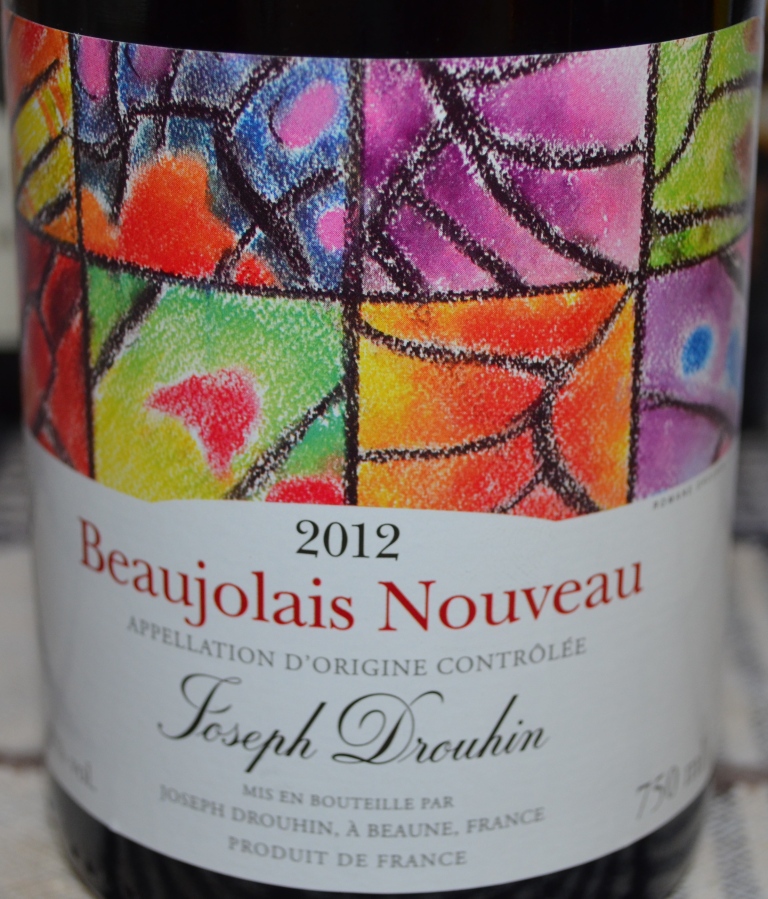 Almost as a tradition by now, I always get another bottle of Beaujolais Nouveau – for the most of the cases it is Beaujolais Nouveau made by Joseph Drouhin. This 2012 Joseph Drouhin Beaujolais Nouveau (ABV 12%, $10.99) had very similar color to Georges Duboeuf wine, may be a touch darker. The nose was less explicit with the actual fruit and somewhat grapey. On the palate this wine was a touch more dense than Georges Duboeuf, but also more closed in comparison with it. While Joseph Drouhin was a very decent wine in my opinion (Drinkability: 7), my strong preference goes to the Georges Duboeuf.
I don’t know how do you feel about Beaujolais Nouveau overall, but 2012 is definitely not to be missed. The wine is not only representing a great QPR, but it will also give you a lot of pleasure. Beaujolais Nouveau wines don’t age, and when they gone, they are gone. Don’t miss your chance to experience Beaujolais Nouveau – it’s worth it.
That’s all I wanted to share with you, folks. Until the next time – cheers!
I Love Surprises
Do you like surprises? Yeah, I see you saying “that depends” – ahh, as we grow up, the life is teaching us to be cautiously optimistic when we hear the word “surprise” – from unadulterated “Yay, surprise!!!”, thanks to the gentle pressure of the life lessons it becomes “hmmm, surprise???”.
Anyway, this post is about good surprises, so you can already sigh with relief. Let me get to it. Today I saw an e-mail from a friend which briefly mentioned “blind tasting”. Okay, as the whole e-mail was about something else, I ignored that “blind tasting” part. Then, when I heard the entrance door opening and closing, I figured that my friend had arrived. By the time I got downstairs to the kitchen, I was greeted with this:

Yes, call me slow, but only now I realized that the “blind tasting” part was related to me and that the bottle is actually waiting for me.
Okay, so double blind tasting – I’ve done that before, it was fun, so yes, let’s do it again. The cork is out, wine goes into the glass. Perfect fresh ruby color, bright and inviting. Fresh, very fresh raspberries on the nose, some hint of sweetness – based on the initial assessment, the wine appears to be young and gives an expectation of being somewhat lighter on the palate. Also, the nose has that touch of green (really a touch) and earthiness. My friend is impatiently pacing back and force – “what can you say, what can you say” she rather demands.
Okay, I think it is a young wine, 2 to 3 years of age. Also, based on the nose and appearance, my guess is that it is one of he local wines – Connecticut, Pennsylvania, New York Hudson Valley – my thought is that it is one of the indigenous varieties, like Chambourcin or Marital Foch.
She seems to be satisfied with my assessment, and we are moving on. On the palate, the wine shows some cherries and raspberries, and somewhat unusual (for me) tannins, in a very front of the mouth (I believe the wine spent time in oak, but I’m curious what type of oak it was exactly. Then the wine finishes with the hint of cinnamon and nutmeg. The wine is perfectly drinkable by itself, but should also nicely complement some charcuterie and lighter cheeses. All in all, it is a nice bottle of wine in my opinion, and I would put Drinkability at 7.
So now I’m allowed to remove the foil, and this is what I find:
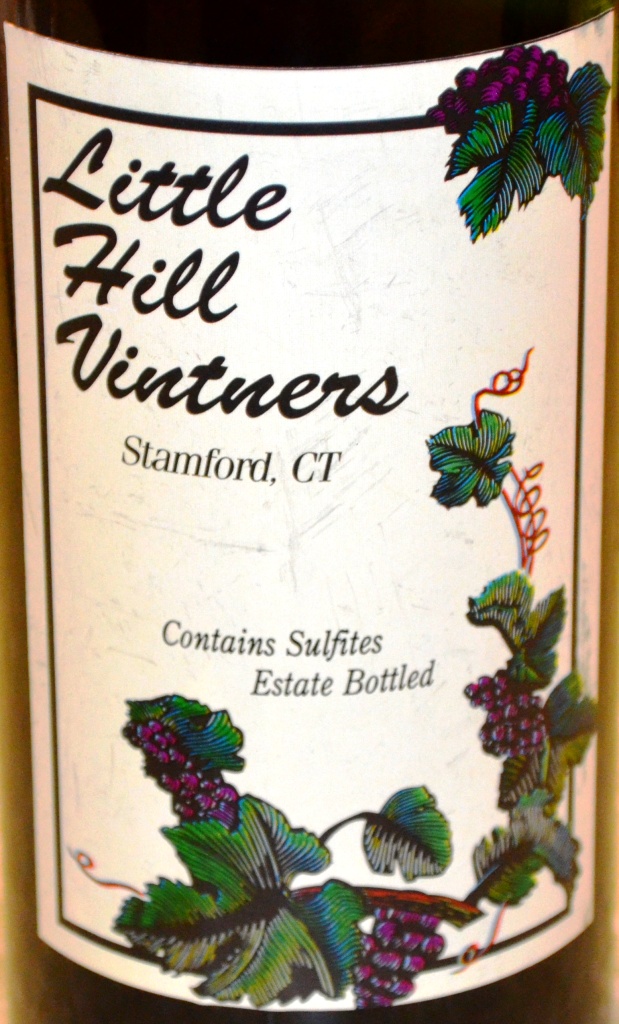
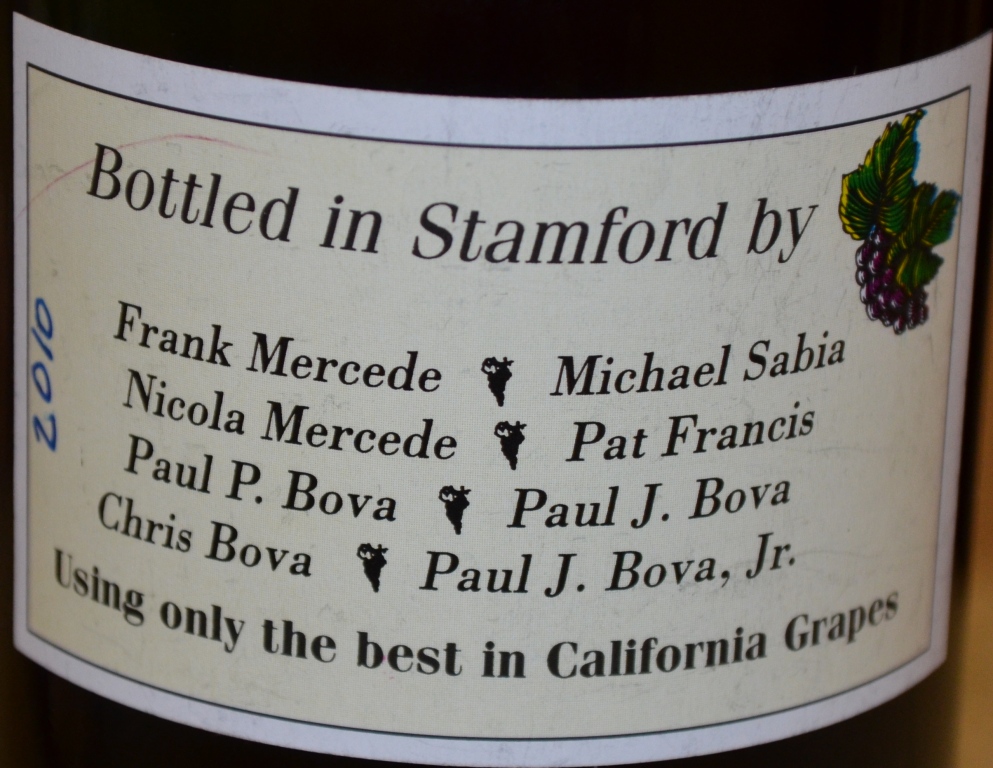
As the back label says “made from the best California grapes”, I’m clearly out of luck with my varietal guess. But at least I got the place (totally by accident, but – WOW – the wine is from my home town, Stamford!!), and the age – it is 2010 vintage, so I’m right there with my 2-3 years old guess.
There you have it – as I mentioned many times in this blog, blind tastings are fun! I’m definitely impressed with the fact that the wine of this level can be produced by the amateur winemakers, but hey – everybody got to start somewhere!
Wishing you all great wine experiences! Cheers!
Suggestive Labeling? Yes!
I realize it more and more now – I’m a sucker for a good wine labels. Yes, I know – don’t judge the book by its cover. Of course. But the first thing you see when you look at the bottle of wine is a label. Considering sheer number of wines in the average wine store, label is critical element of the wine’s success. It has to attract your attention. It has to seduce you. It has to promise you a great time. It has to be memorable. And the label has only a fraction of a second to make this all happen.
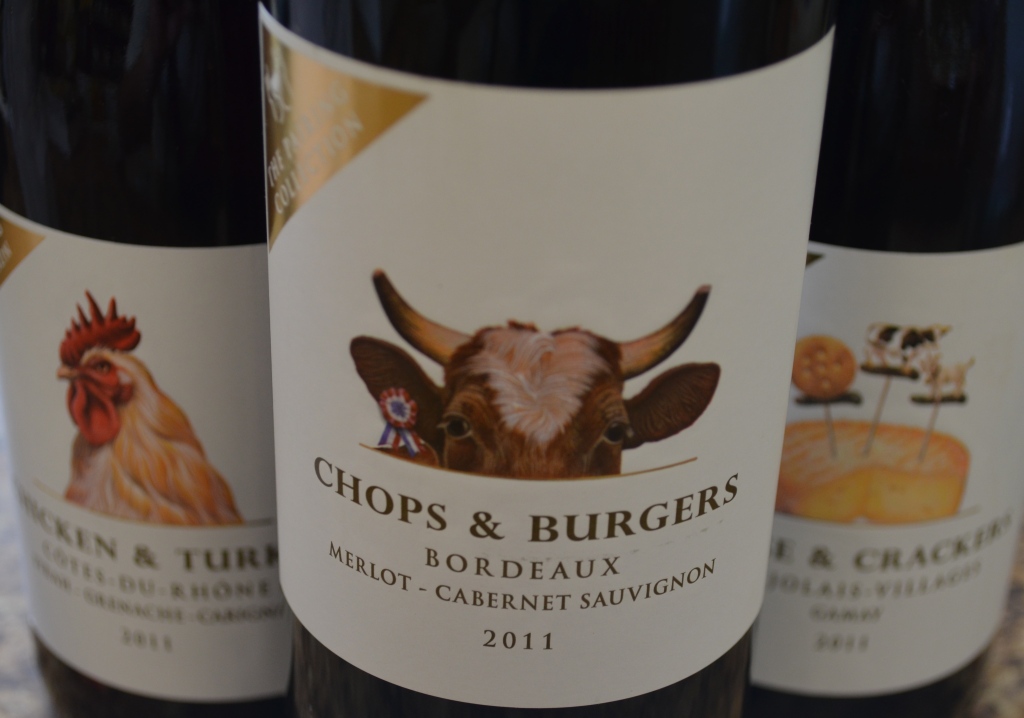
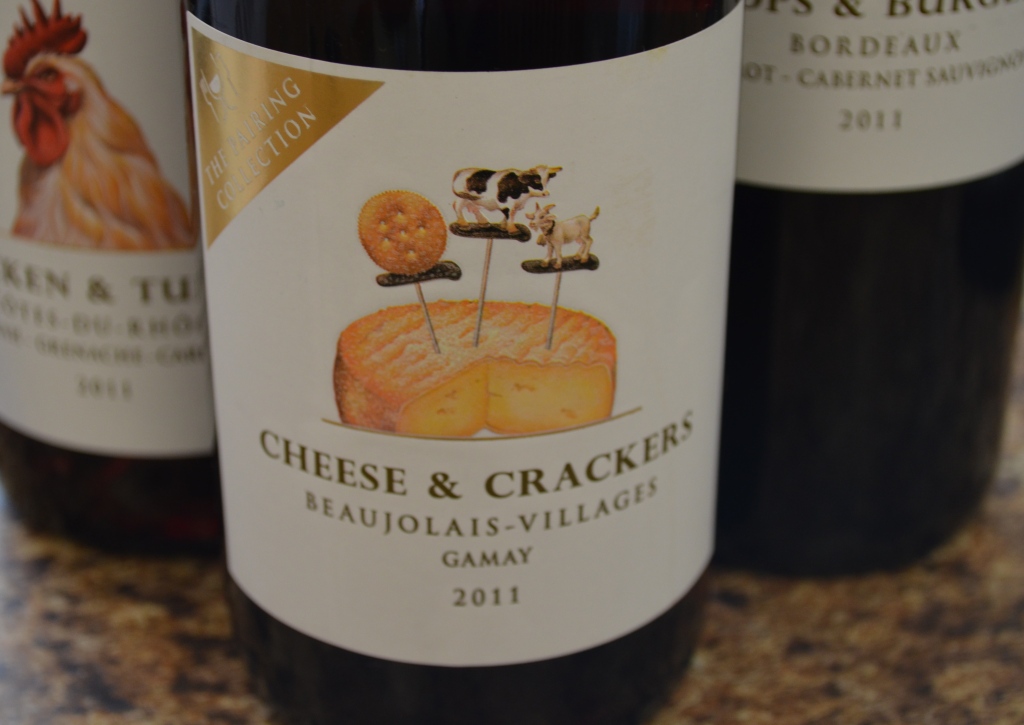
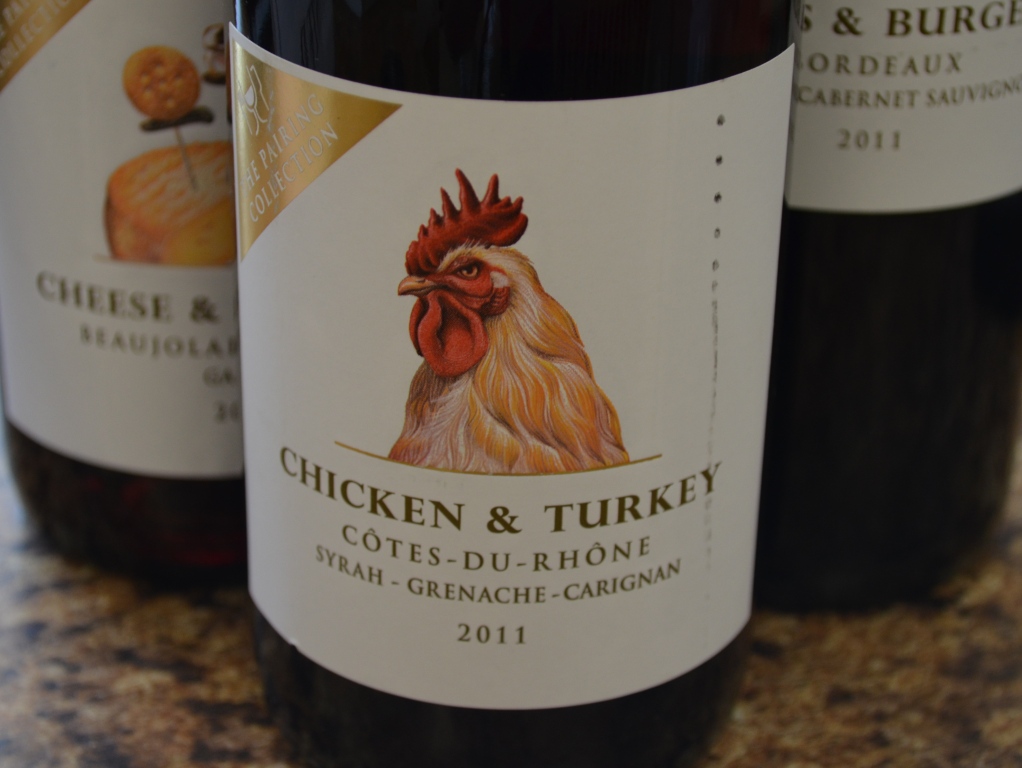
While visiting Cost Less Wines in Stamford, this is exactly what happened. Something caught my eye – the label I never saw before. I grabbed the bottle – and then there was another, and another, and another. A special project from Barton and Guestier – The Pairing Collection. If you remember Entwines, the joint project by Food Network and Wente, The Pairing Collection wines represent the next step – a very suggestive name and the picture on the front label, and the recipe in the back, and even QR code to take you to the specially designated The Pairing Collection web site – how cool is that?! Well, you be the judge – here are the labels.
Chops & Burgers Bordeaux red AOC:
Salmon & Trout Bordeaux white AOC:

And the back label:

Lobster & Shrimp Muscadet Sèvre et Maine AOC:

and here is the recipe for you:

Cheese & Crackers Beaujolais Village AOC:
Chicken & Turkey Côtes du Rhône AOC:
So, what do you say? Do these labels speak to you? Let me know! Cheers!
Last Bottle Sign Up ($10 credit)




 Talk-A-Vino