Archive
And a Few Good Wines, Previously Was New Year 2026 Wine Escapades
For how long is it appropriate to celebrate the New Year?
Scrap that.
For how long is it appropriate to write a post about New Year’s celebratory wines? A week? Two? Four?
Okay, so as I’m writing this on the last day of the month, this is not a celebratory New Year’s post, but rather an account of wines we had an opportunity to experience.
As a tiny excuse to my tardiness, I want to mention that we celebrated the arrival of the New Year 2026 three times. So here are my notes from those celebrations.
Celebration #1- January 1st, New Year’s Day
To celebrate the New Year in style, I decided to do a Champagne-off between Pol Roger and Bollinger Champagnes. I have a lot of respect but very little experience with both, so I decided to compare them side by side.
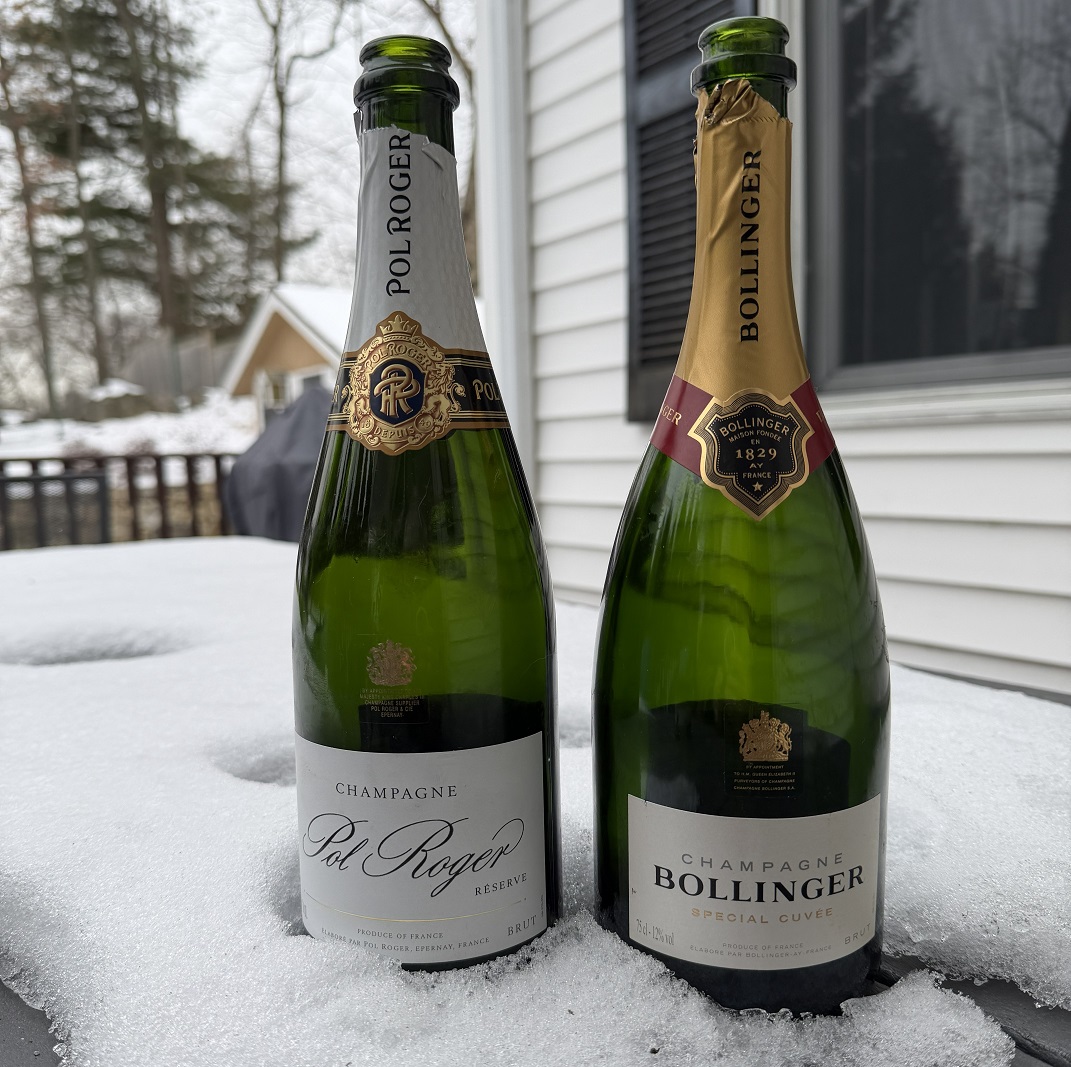
This was definitely an interesting experiment. Upon opening, Bollinger had a somewhat restricted nose, but nice palate with a hint of toasted bread, apples, and lemons. Pol Roger had a beautiful, inviting nose with freshly baked bread, minerality, and green apples. However, it was mostly flat on the palate, so after the first few sips, we decided to drink Bollinger first.
30-40 minutes later, I poured another glass of Pol Roger, and oh, the palate changed dramatically. Now there was everything you want in champagne – toasted notes of the freshly baked bread, apples, lemons, crisp acidity – all elegantly woven together. So while both Champagnes were excellent, my preference lies with Pol Roger.
NV Pol Roger Champagne Reserve Brut (12.5% ABV)
Beautiful, inviting nose, with toasted bread and apples.
Palate initially mostly closed, just acidity. After 30-40 minutes, the palate is alive with toasted bread, apples, lemon, minerality, crisp acidity.
8+
NV Bollinger Champagne Special Cuvée Brut (12% ABV)
Beautiful nose, apples, brioche
Restrained on the palate, lemon, crisp acidity, lots of energy, very elegant.
8, excellent Champagne
I also tasted this sparkling wine, even though it was mostly used in a delicious holiday cocktail:
2021 Casasetaro Pietrafumante Caprettone Spumante Methodo Classico Italy (12.5% ABV, 100% Caprettone (new for me!) grape)
Crisp, refreshing, with steely, minerally acidity. This makes you crave oysters in a heartbeat.
8, excellent
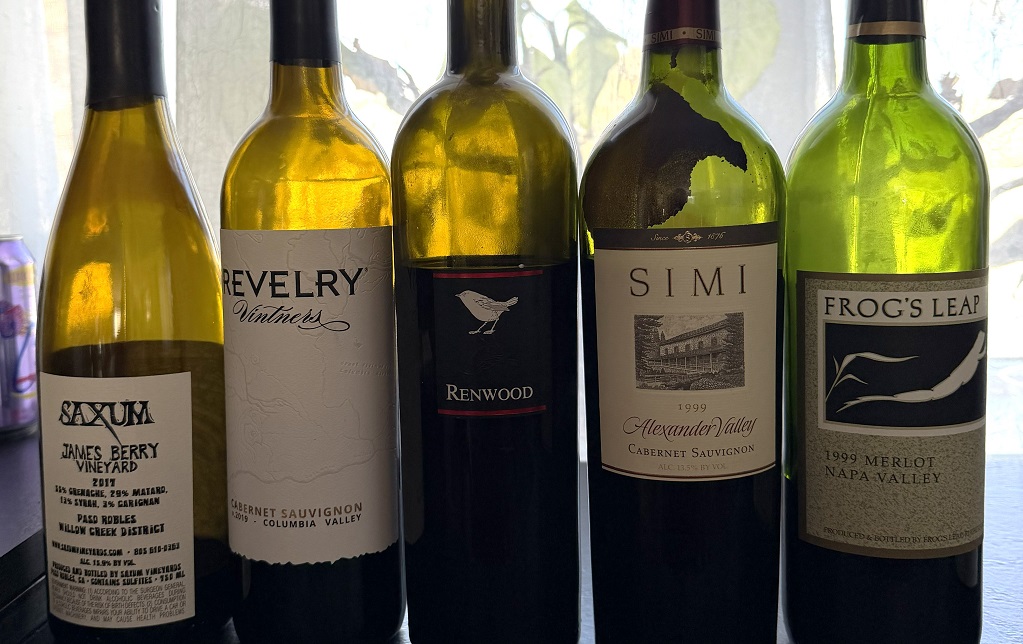
2019 Saxum James Berry Vineyard Paso Robles Willow Creek District (15.9% ABV, 55% Grenache, 29% Mataro, 13% Syrah, 3% Carignan)
Of course, 7 years is not an age when you want to open Saxum wine. Black fruit on the nose with some baking spices. Dark and brooding on the palate, black fruit, cocoa, a hint of the forest floor. A bit more mellow after being open for 3 days, more pleasant to drink.
8, delicious
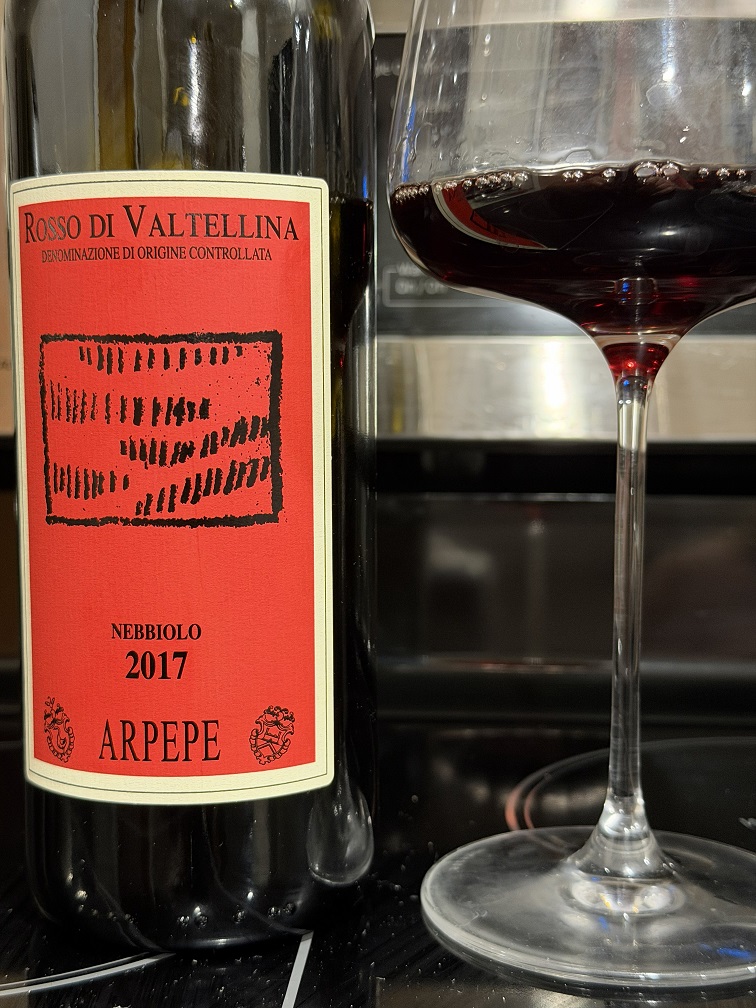
2017 ArPePe Nebbiolo Rosso di Valtellina DOC (13% ABV, 18 months total in big barrels and in bottle)
After a short breathing time, this wine showed brilliantly. Fresh cherries on the nose, restrained.
Cherries and violets on the palate, sandalwood, medium to full body, elegant, round, delicious. Glad we opened it.
8+, delicious
Second celebration:
On Saturday, we got together with friends to continue celebrating the New Year. This time, the wine lineup was a bit different, focusing more on the aged wines and the wines that might be past prime.
We started with a couple of Champagnes:
NV Veuve Fourny & Fils Champagne Brut Rosé Premiere Cru (12% ABV, disgorged 07/15)
Dark golden color
Apples, Almond extract, bread, tertiary aromas
Toasted bread on the palate, apples, brioche, cut through acidity even on day 6 after opening.
8+, while actual bubbles subsided, it was a very tasty wine. Really enjoyable even as a flat wine.
2017 Champagne Christophe Mignon Adn de Foudre Pinot Noir Brut Nature (12% ABV, disgorged 11/01/2024)
Bright Golden color
Apples and fresh bread
Apples, fresh bread, a touch of hazelnuts, cut through acidity. Very refreshing and very enjoyable.
8+, excellent, even on day 6
Next, this white wine was probably the most impressive out of all the wines we tasted that night:
2013 Domaine William Fevre Chablis Grand Cru Bougros (12.5% ABV)
Bright golden
A touch of gunflint, Granny Smith apples, lemon
Fresh, bright, apples, velvety smooth texture, great mid-palate presence, good structure, a distant hint of butter, impeccable balance.
9-/9, outstanding.
Then there were reds.
1999 Frog’s Leap Merlot Napa Valley (12.5% ABV)
1999 Simi Alexander Valley Cabernet Sauvignon (13.5% ABV)
Both wines were varietally correct upon opening, but it did felt that they were near the peak. No over yet, but having maybe only about 5 years of life left, before they will be officially declared past prime.
8- for each one.
2019 Revelry Vintners Cabernet Sauvignon Columbia Valley (13.9% ABV, 22 months in French oak)
Dark garnet
Cassis, blackberries, eucalyptus
Cassis, mint, blackberries, sweet basil, round, smooth, medium to full body, perfect balance, medium-long finish.
8+/9-, a beautiful wine.
1993 Renwood Grandpère Zinfandel Shenandoah Valley (15% ABV, Bottle #19727 of 1904 cases produced)
Dark garnet
Black fruit, good intensity
Tart blackberries, coffee, a touch of toasted hazelnuts, good acidity, still present tannins with a pleasant grip on the tongue, delicious.
9-, I wish more wines would have this energy and deliver this much pleasure
Celebration Number 3
The week after, we celebrated the New Year. Again. With friends, of course.
First, a couple of Champagnes.
NV Monmarthe Champagne Privilege Brut Premiere Cru (12.5% ABV, 50% Pinot Noir, 50% Chardonnay, aged for 36 months in the cellar)
Outstanding. Inviting nose, fresh apples with a touch of brioche.
Round, generous on the palate, roll-of-your-tongue delicious, fresh and elegant.
8+, excellent
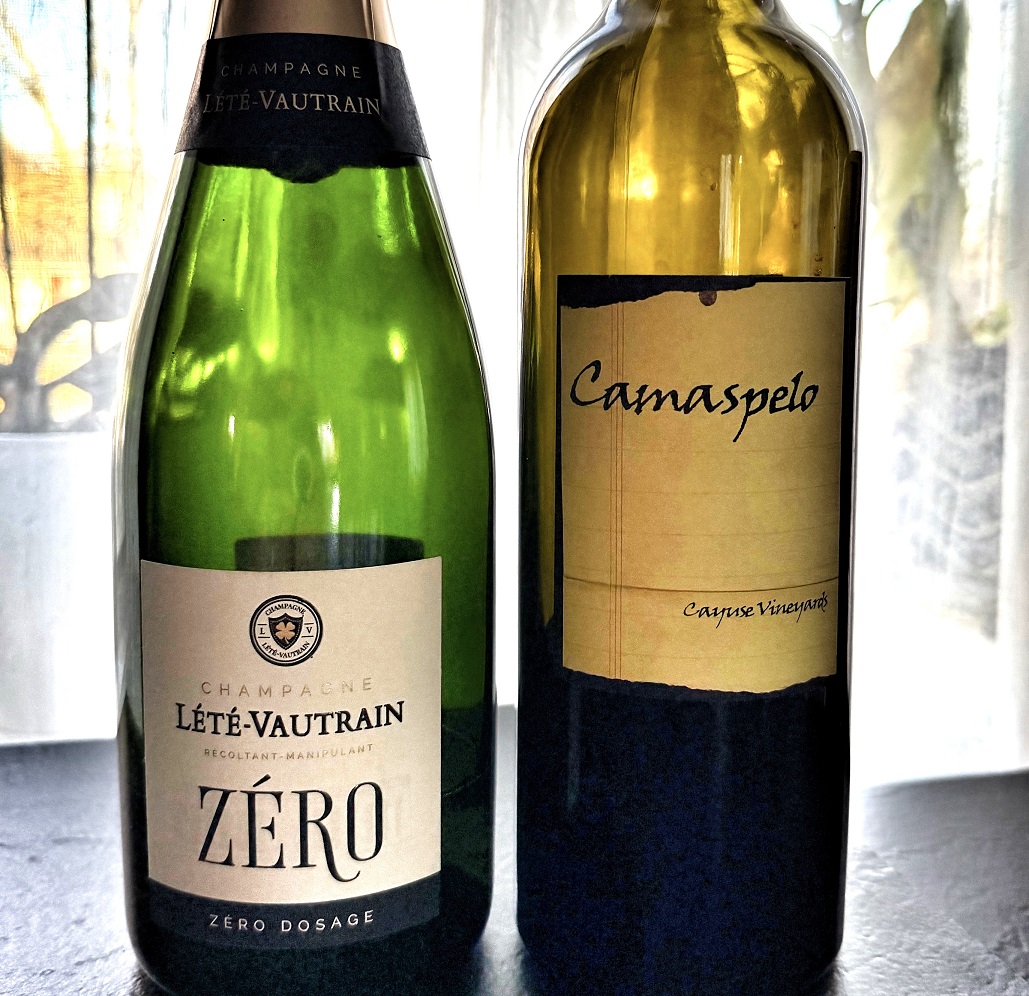
NV Lété-Vautran Chammpagne Zéro Brut (12.5% ABV, 40% Pinot Meunier, 40% Chardonnay, 20% Pinot Noir)
Crisp and fresh on the nose
Palate is crisp to the point of austerity. Elegant, full of energy, very lean.
8+, another wine that is begging to be paired with food
2022 Cayuse Vineyards Camaspelo Walla Walla Valley (13.8% ABV, Cabernet Sauvignon-dominant Bordeaux blend) – I know I was not supposed to touch this bottle, but I couldn’t resist the urge. This wine was clearly opened before its time. Probably 15-20 years would make it a bit more approachable from the get-go.
The wine was decanted, and yet the mineral, volcanic profile was the most prominent, same as with most any of the Cayuse wines in any case. After 2-3 days, the volcanic notes subsided, and the wine appeared more drinkable and enjoyable.
8, definitely needs time
2009 Tallulah Cabernet Sauvignon Napa Valley (14% ABV) – this was my last bottle. The wine was supposed to be special when I bought it, but it never reached that point. Well, until now, but with some reservations – even after decanting this wine, I had to wait for another 3-4 days for the wine to shine in varietally-correct way. But it did. It actually developed a cassis/mint/eucalyptus profile with a dash of dark chocolate.
8+ after extensive decanting.
There you have it, my friends – New Year 2026 wine escapade.
How was your January?
Struggles of the Winelover

Source: Pexels Cup of Couple
Yes, I’m on the streak. A self-focused experiment. I’m curious to see how many posts in a row I can write. Not just “hello – goodbye”, but posts with substance. Well, whatever. This is definitely not the topic of this post.
Oh, and here is a full disclosure – this post is about first-world problems. If you are not interested, you know where to click.
I bet you had no idea that winelovers struggle. No, not when we enjoy a glass of wine. When we enjoy wine, we simply ask for another glass. And no, not when we don’t enjoy wine. Then it is a very simple ask: “Can I have something else, please?” It is really that simple. If you don’t like the particular wine, there is no struggle – you just move on to the next.
The struggle starts when we need to choose the wine. At that moment, the struggle is real. A chain of thought might depend on the setting, but the unending back and forth is always the same.
When you are presented with the wine list at a restaurant, you need to decide based on price, based on mood, based on company, based on food. It always goes “this. Wait, no – this one. Hmmm. No, let’s go to a different region. Ah, yes, this one. No, wait, maybe this? Why is this so expensive? Ohh, why is this so cheap?” Well, got you. The last one is not real. If you know what you are doing, “why is it so cheap” is not the question you concern yourself with. But the rest of it? If you love wine and have ever chosen a bottle in a restaurant, tell me that I’m wrong. I dare you. Tell me that in the comments section. Go ahead, make my day.
The second one might be even worse. Now you need to select a wine for a dinner, get together with friends, a holiday, a birthday, an anniversary – you got the idea, right? This is where the struggle becomes even worse. When you need to choose a wine in the restaurant, you have a limited amount of time and a reasonably limited wine selection. None of it is in play at home. You start worrying about the wine months and months before the event – you can choose not to, of course, but only if you let yourself do this. Now think how many of us allow ourselves not do it, huh?
And here you are really screwed, as you have plenty of time to go “This! No, wait, that! Wait, no, no, I need something else”, following with “Is it too early? Can this already be past prime? It is my only bottle, should I open it now? What if it will be so much better in 10 years?”. And let’s not forget “Will they like it? Is that a good choice for that holiday? Is that special enough for the occasion? Maybe I can do better?” On, and on, and on. Endless. Frustrating. Annoying.
Why all of a sudden all of this soul-pouring sentiment? That’s easy, let me explain.
Any February is a tough month for the struggling winelover. You got Valentine’s Day in the middle of the short month, and then you have Open That Bottle Night (OTBN) on the last Saturday in February. And to add to the struggle, this particular February, we are flying to Florida to see our close friends, and they will have their wedding anniversary during our visit, so I definitely feel that I need to bring something appropriate to celebrate. There you go – three opportunities to struggle.
Source: Pexels Polina Tankilevitch
I still don’t know how we are celebrating Valentine’s Day. I’m sure we are not going to the restaurant, but we might decide to have some company. And it falls on Saturday this year, which is all the more reason to select a good bottle(s). In any case, what should we drink on Valentine’s Day? Yes, bubbles first, that is clear, but even that presents a dilemma. And what should follow the bubbles? What kind of red wine offers the best pairing for Valentine’s Day? If you have any thoughts – go ahead, don’t be shy.
Then the wedding anniversary – do I even have the right bottle for that? I have some vintage Champagnes, but nothing grand enough for the occasion. And while my friends generally like the wine, they are not wine geeks, so well-aged reds might not solicit the response I would want.
Last but not least is the mother of all winelover struggles – OTBN. The holiday was invented to help people crack open that special bottle still waiting for the right moment, which might never come. And yet OTBN is only one night, how many bottles can you open? Selecting the bottle for OTBN is ultra-difficult, especially when one has lots of wines in the quantity of … 1. When you have only one bottle, you need to decide if this is really the time, if the bottle can still improve, if the bottle is special enough. Ah, and please understand that “special” doesn’t mean “expensive”. A special bottle is simply a bottle with an attached memory, and for OTBN, we need to ensure that the bottle is special enough.
Here, I just shared my frustration with you, and I feel better. I even got some ideas for the wine to open on Valentine’s Day. And I’m pretty much decided on the OTBN bottles (it means nothing, really, everything can – and will – change quickly). But I do feel better at the moment.
So what would you tell me? Is this struggle real, or am I a spoiled, undeserving brat? You be the judge of it, but I know how it feels selecting a bottle for a month, in the endless loop between all the wine fridges and shelves. For me, it is definitely real. And for you? Hey, do tell your stories, I’m all ears…
A Weekend In Wines #4
Here we go again – another attempt at a series (I kind of question my mental health at the moment, as the definition of insanity is trying the same thing over and over again, each time expecting a different result – I’m so glad I’m not a doctor, whew).
Some time ago, I wrote a post called Weekend in Wines. Then there was A Weekend In Unique Wines. And also A Weekend in [Great] Wines. That makes it 3 attempts at the Weekend in Wines theme, hence the #4 in the title. Oh yes, and countless posts under the same name, which never left my head, never materialized in the form of letters and pictures on the screen. But those don’t count, don’t they? Okay, number 4 it is.
It is not every weekend that I experience the wines I feel an urge to talk about. But from time to time, the “weekend wines” turn out truly special, especially if we are meeting with friends or traveling somewhere just for a weekend. The name “Weekend in Wines” feels appropriate, so let’s see how far I will be able to get with this.
There is another interesting question: when does the wine weekend start? Well, it is not all that important, but sometimes I open an interesting bottle on Thursday, knowing that I will finish it on Friday, just to see how the wine will “age”. But then again, let’s not bother ourselves with small details.


The weekend in wines #4 actually started on Thursday, with 2022 Pazac Le Pigeonnier Costières de Nîmes AOP (14.5% ABV). Truth be told, I’m not a big fan of the Southern Rhone wines, I find them flat for my palate. So I had no expectations opening this bottle – and then was pleasantly surprised with a generous fruit, medium+ body and nicely contrasting acidity. Well drinkable and offering a good amount of pleasure (Drinkability: 8-). I pumped the air out and left the bottle on the counter until the next day – and on the next day, the wine started losing its “umph”, simply confirming that Southern Rhone wines are not built for ageing.
I needed something else to drink on Friday, then, and I pulled 2021 Field Recordings Nolan Alisos Canyon AVA (13.9% ABV, 100% Alicante Bouschet, Nolsn Ranch vineyard) from the wine fridge. I was first introduced to the Alicante Bouschet grape more than 20 years ago, in the guided tasting of Spanish wines at the Barcelona restaurant in Connecticut. Ever since, I had many pleasant encounters with wines made from this unique Teinturier grape. A quick explanation, if I may – Teinturier grapes have red skin and red flesh/juice, which is very unique – only about 20 grapes are Teinturier out of many thousands used in the winemaking (Georgian Saperavi is another good example of Teinturier grape). The absolute majority of the red-skinned grapes have clear juice. While coming originally from Spain, Alicante Bouschet is a popular grape in California, more as a blending grape, but also used in the single varietal wines by the likes of Carlisle and Turley. This wine was powerful and brooding, almost black in color, with cherries, roasted meat, and a bit of funk, well within the “pleasure boundaries for my palate. (Drinkability: 8)
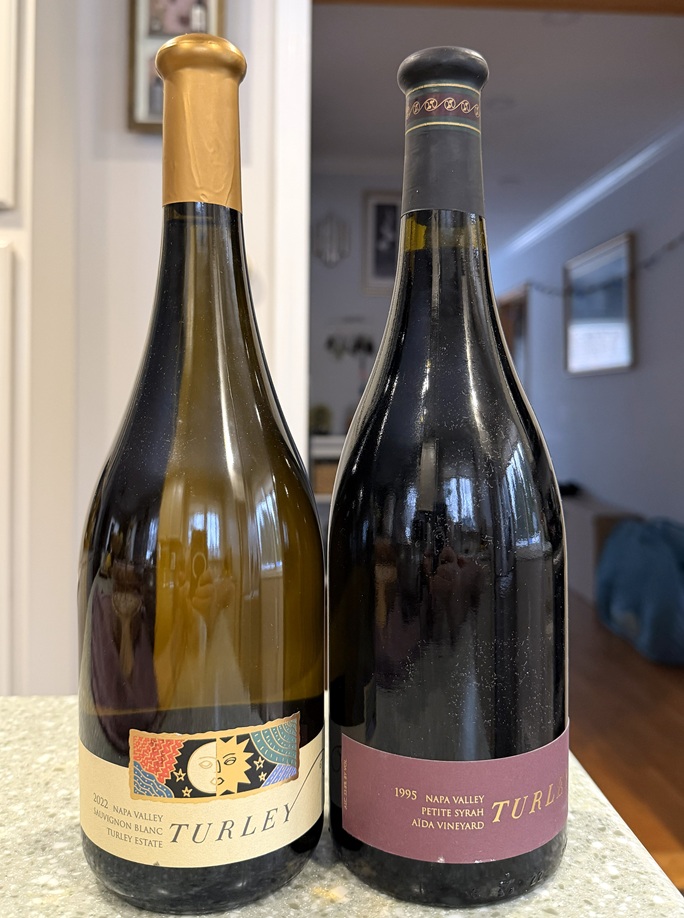
On Saturday, we were visiting our friends Francesca and Stefano, and of course, I had the pleasure nightmare of selecting a couple of special bottles to bring over. After a prolonged, painful back and forth, I finally settled on two bottles of Turley. First, 2022 Turley Sauvignon Blanc Estate Napa Valley (13.2% ABV). Turley Sauvignon Blanc is one of my perennial favorites. I had multiple vintages of this wine, and I have to say that Turley Sauvignon Blanc is always in a league of its own. You can’t provide a simple frame of reference, such as “oh, it is so much like Sancerre”, or “Similar to New Zealand”, and so on. The wine has great energy, it is round, it is silky, it is polished, it offers white stone fruit with good mid-palate weight, and a perfect balance. Always a treat. (Drinkability: 8+).
The next wine was an amazing treat. I recently got this 1995 Turley Petite Syrah Aida Vineyard Napa Valley (13.5% ABV) directly from Turley via the last mailing list offering. I’m on the Turley’s list probably for the past 15 years, I love Petite Sirah (Turley uses the spelling of Petite Syrah for some reason), but I never saw Petite Sirah from Aida Vineyard on any of the offers. We had to decant the wine as we were not careful pulling out a 31-year-old cork. I know that Larry Turley, the founder of Turley Winery, often said that Zinfandel is the wine Cab lovers actually want to drink. I know that this is Petite Sirah and not Zinfandel, but this 1995 Petite Sirah was truly mesmerizing – and Cabernet-like. In a blind tasting, I would not doubt that I’m drinking California Cabernet Sauvignon even for a second. The wine had a beautiful, succulent berry profile, with cedar box, eucalyptus, and mint, a fresh, zippy, and joyous palate. The tannins were perfectly integrated but still present, acidity was in check, ensuring the absolute freshness, and overall impeccable balance. A gem. (Drinkability: 9-/9).
Ahh, and one more interesting tidbit – the delicious pairing of this Turley Petite Sirah with Pasta Bolognese we had as a first dish. I would never think of pairing Petite Sirah with a pasta dish, as generally it would overpower it. However, this 30-year-old Petite Sirah mellowed and evolved enough to create a delicious pairing, complementing and enhancing the flavor. Love good surprises!


I asked Stefano if he had any Valtellina Sfursat in his cellar, as I was all of a sudden craving this expression of Nebbiolo after an earlier conversation on Twitter. He didn’t have the Sfursat, but he came back with 2001 ArPePe Sassella Rocce Rosse Reserva Valtellina DOCG (13% ABV). I love ArPePe wines, but they are generally not easy to find in the US. Interestingly enough, this wine literally showed no signs of age. It looked like it was just made, with cherries, sandalwood, violets and a touch of sapidity. To be entirely honest, I literally wanted this wine to show some age, maybe with some dried fruit notes, and it didn’t. I guess it would take another 20 years for it to reach its peak. Oh well, it was still tasty. (Drinkability: 8/8+).
And the last one for today – 2009 Carole Bouquet Sangue d’Oro Passito di Pantelleria, Sicily (14.5%). Once again, I was obnoxious enough to ask for Vin Santo to have with dessert. Stefano didn’t have any Vin Santo on hand, so he came back with this wine. I never heard of the producer, but the appellation is well-known for producing dessert wines from the Muscat of Alexandria grape, locally known as Zibibbo, with Donnafugata Ben Ryé being the most exemplatory specimen. It appears that this wine is produced by the famous French actress, Carole Bouquet, and it is not easy to find in the US. As the name of the appellation says, the wine is produced using the “passito” method, where the grapes are dried for a number of months before they are pressed into the wine, greatly increasing the concentration of flavors. The wine was delicious, loaded with succulent, ripe apricots with perfect acidity. Seductive, round, voluptuous – a perfect finish to a great evening with friends (Dinkability: 8/8+).
There you are, my friends. A weekend in wines. A weekend in great wines. A weekend in unique wines.
To more great wine weekends – cheers!
For the Love of Riesling
 I love Riesling.
What do winelovers do when they love the wine?
That’s easy.
We want to share that love.
The biggest reward for a winelover is to offer someone a glass of wine and hear them say “oh, it is good!”.
Sharing the wine is the most enjoyable part of drinking the wine. We want the other people to experience the same joy as we do, we want them to experience the pleasure only the wine can deliver.
As I said before, I love Riesling.
Riesling might be the most underappreciated white grape. It is one of the main 3 white grapes (Chardonnay, Sauvignon Blanc, and Riesling). Riesling wines are made everywhere in the world – Germany, Alsace, Australia, New Zealand, New York (Finger Lakes, Hudson Valley), Canada, Oregon, California, and so on – and yet many of the wine drinkers wouldn’t even openly admit that they like Riesling and that they are happy to drink it.
It is hard to tell why that is. Many people associate the word Riesling with the word “Sweet”. It is a big mistake, as it means, for example, that they never experienced bone-dry, tongue-twisting Rieslings from the Claire Valley in Australia. I would even dare to say that the majority of the well-made Rieslings are not sweet, unless they are purposefully made to be sweet, such as BA or TBA German Rieslings. The main trait of Riesling, similarly to all other wines, is balance. As long as the Riesling is balanced, it is one of the most enjoyable white wines you can imagine. And it pairs well with the wide range of food. I’m telling you – Riesling is one of the best white wines in the world.
The love for wine needs to be shared. And so earlier in the year, I decided to do a Riesling wine tasting. My audience (family, future in-laws) wanted to learn more about the wines, and I have decided that tasting a bunch of Rieslings will offer an excellent educational opportunity (was I right? I have no idea, but I know we had fun).
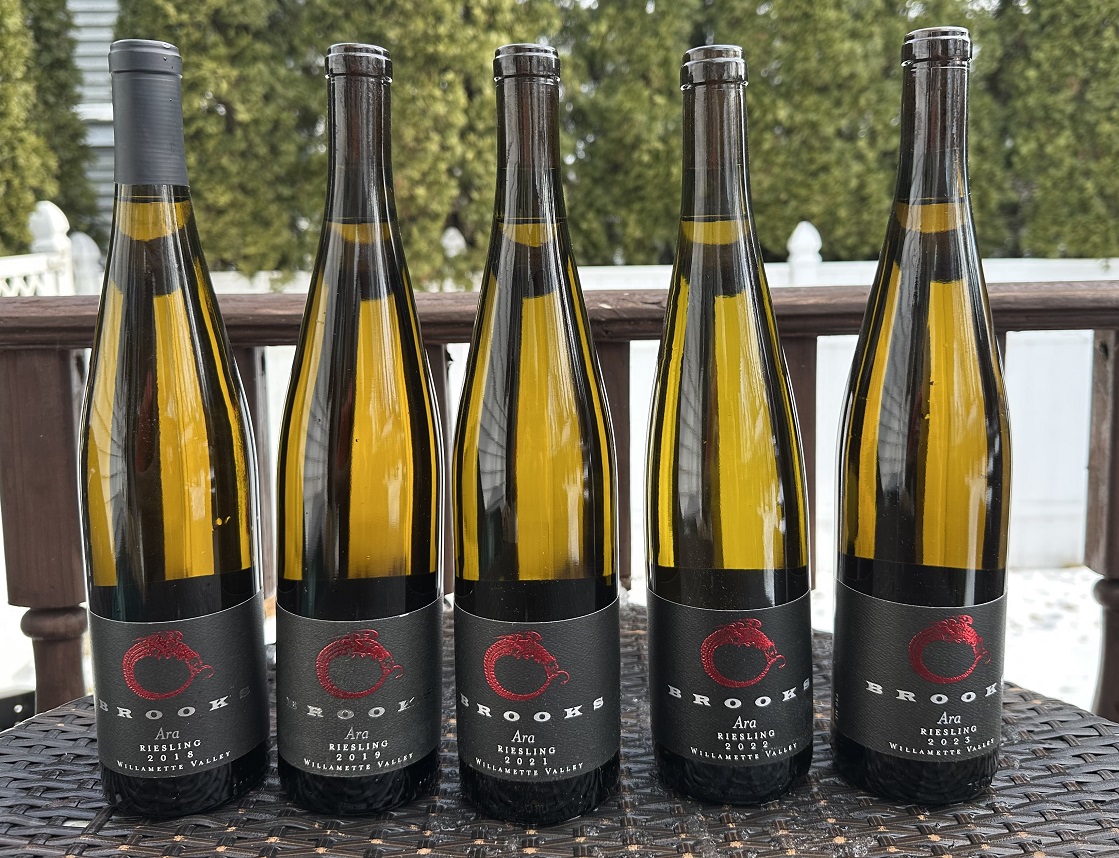
Ask me to name three of my favorite Cabernet Sauvignon producers, and I will quickly become frustrated – can I give you at least 10? 20 or 30 would be even better. The same would be for a Chardonnay, Syrah, and Tempranillo. When it comes to Riesling, however, that would be an easy task. Grosset from Australia. Smith-Madrone from California. Brooks from Oregon. This is my “top 3 Riesling producers” list. I would absolutely love to do a comparative testing of these 3 Rieslings, but I managed to get only 2. I got Smith-Madrone Rieslings first, and then when I got the idea for the tasting, I wrote to Brooks, and they were kind enough to send me a nice vertical of Brooks Rieslings. I also asked Ravines Wine Cellars from Finger Lakes for a similar set, but got no reply, so my tasting consisted of a vertical of Smith-Madrone Rieslings from 2018, 2019, 2021, and 2023, and Brooks Ara Riesling from 2018, 2019, 2021, 2022, and 2023 (both wineries didn’t produce wines in 2020).
It is important to note that Riesling can age very well, and aged Riesling is just a special experience. I did an online search and found out that it is rather hard to find aged Riesling anywhere, at least for the price I was willing to pay (age your Riesling, people, take my advice). I managed to find a bottle from 1997, which was seemingly in reasonable condition. At the same online store, I also managed to find a sparkling wine made out of Riesling, known in Germany as Sekt. I scored a bottle of Sekt at the same online store, and it became our first wine in the tasting.
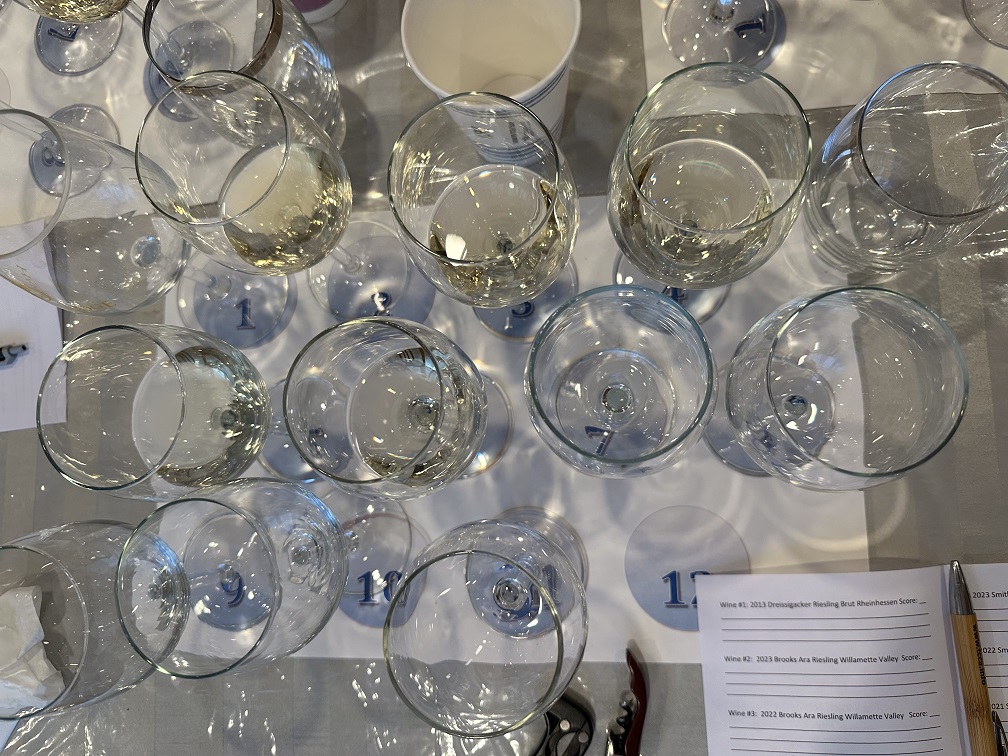
The tasting was non-blind as it had more of an educational purpose than anything else. Here is what transpired during the tasting (outside of the fact that I numbered Brooks Rieslings in the wrong order, so we tasted them from the older vintages to the newer, where I really wanted to go in the opposite direction):
Wine #1: 2013 Dreissigacker Riesling Brut Rheinhessen (12.5% ABV)
bubbles were still present, lemon, a touch of sugar, well balanced, very nice overall. Believe it or not, but this was the first Sekt that I liked.
8-
Wine #2: 2018 Brooks Ara Riesling Willamette Valley (14% ABV, 325 cases produced)
Beautiful color. Honey, petrol, explivit nose of tropical fruit
Great complexity, perfect balance, showing off an interplay of pear, apples, peach, even vanilla and quince. Delicious. 8
Wine #3: 2019 Brooks Ara Riesling Willamette Valley (13% ABV, 225 cases produced) – a very interesting wine, as my tasting notes for day 1 and upon re-tasting the next day differ dramatically.
Day 1: Very unusual, some honeydew, hint of pear. 8-
Day 2: Superb. Lean. Acidity is through the roof, fresh, crisp. Needs 20 years to become amazing. 8++
Wine #4: 2021 Brooks Ara Riesling Willamette Valley (12.5% ABV, 225 cases produced)
Day 1: Beautiful petrol and flowers on the nose
Fresh, petrol, complex, white fruit, excellent balance. 8+
Day 2: Petrol + earth. Beautiful, honey notes on the palate, much richer than ‘19. Still lean and mean. 8
Wine #5: 2022 Brooks Ara Riesling Willamette Valley (12.5% ABV, 150 cases produced)
Day 1: Flowers, touch of brown sugar
Most complex so far – wow, beautiful. 8+
Day 2: Petrol, hint of tropical fruit. Lemon with a touch of honey, lean, crisp, built for aging, let’s say another 20-something years. 8++
Wine #6: 2023 Brooks Ara Riesling Willamette Valley (12.5% ABV, 100 cases produced)
Day 1: Very muted nose. Palate is young, nice, concentrated. 8-
Day 2: Nose almost non-existent. Very lean palate with a hint of honey mixed with lemon. Need to develop for a long, very long time.
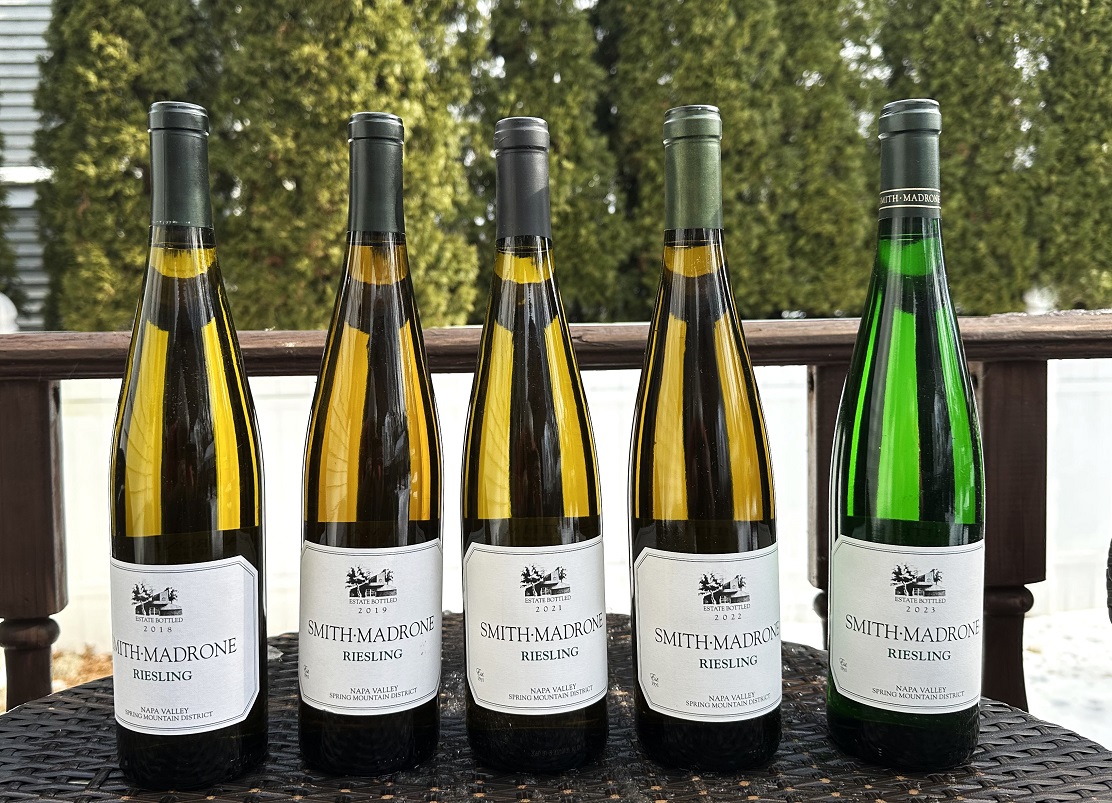
Wine #7: 2023 Smith-Madrone Riesling Spring Mountain (13.2% ABV)
Light color
Candy on the nose
White flowers, fruit medley, bitter orange, crisp, spectacular. 8+
Wine #8: 2022 Smith-Madrone Riesling Spring Mountain (13.2% ABV)
A touch of petrol
White fruit, white apples, delicious. 8+
Wine #9: 2021 Smith-Madrone Riesling Spring Mountain (13.2% ABV)
Petrol, beautiful
Lots of complexity, apples, excellent. 8
Wine #10: 2019 Smith-Madrone Riesling Spring Mountain (13.3% ABV)
Complex aromatics, flowers
Flowers on the palate, a touch of honey, beautiful, complex. 8+
Wine #11: 2018 Smith-Madrone Riesling Spring Mountain (13.3% ABV)
Beautiful, hint of petrol, white fruit.
Wow, playful, amazing. 8++
Wine #12: 1997 Dr. Fischer Ockfener Bockstein Riesling Kabinett Mosel (8% ABV)
Apple juice all the way, past prime. Still an interesting experience.


As always in such tastings, it is fun to figure out the group’s favorite wine. There were 8 of us tasting the wines, and everybody were asked to decide on 3 of their most favorite wines (mine were #11, #8, and #5), and then we took a vote. To my surprise, we had a clear winner after the first round – wine #8, 2022 Smith-Madrone Riesling, was everyone’s favorite, with wine #11, 2018 Smith-Madrone Riesling getting 5 votes. It was interesting that even wine #12, 1997 Riesling, got 3 votes (for me, it was an interesting experience, but not the wine I want to drink again).
As you can see from the notes above, I had a chance to re-taste the wines, this time at a bit of a slower pace. It is very clear that Brooks Rieslings needed more time to open, as you see that on the second day they showed a lot more of what they got, but even then, I believe they would benefit from another 20 years in the cellar, or maybe more.
As I’m writing this, I’m already dreaming of setting up the tasting of 20+ years old Rieslings. Give me Grosset, Brooks, Smith-Madrone, Zind-Humbrecht, and maybe Markus Molitor, from the early 2000s – and this would make it an absolutely amazing tasting. By the way, talking about dreams – what would your dream Riesling tasting include?
I can’t speak for my guests, but I really enjoyed the opportunity to taste such beautiful wines side by side. While both Brooks and Smith-Madrone perfectly exhibited my beloved petrol, Brooks Rieslings on average were a bit leaner than Smith-Madrone, while Smith-Madrone exhibited a richer bouquet on the palate. I’m saying this not in the comparative sense – each one of these wines would make me super-happy any time.
There you are, my friends – my Riesling experience. Do you like Riesling? What are your favorite “go-to” Rieslings?
and A Few Good Wines
Ohh, time flies (who knew? What a pathetic opening – I know, don’t say it.)
About a month More than 2 months ago, we hosted a party (about 40 people). When it comes to a party of this size, I never try to put out “the best stuff” at the beginning. Of course, I’m not talking about offering “plonk” to my guests – the wines will always be quality wines, those which I would be happy to drink every day – but they would be exactly that, “everyday”. So we started with some bubbles, whites, and Rosé. And then…
 Well, wait.
The first wine I want to mention was not in my “everyday” category – it was a magnum of the champagne that one of my friends brought to the party.
I never heard of Champagne Jacquesson before, so this was my first encounter with it – and I have to say it was a pleasant one.
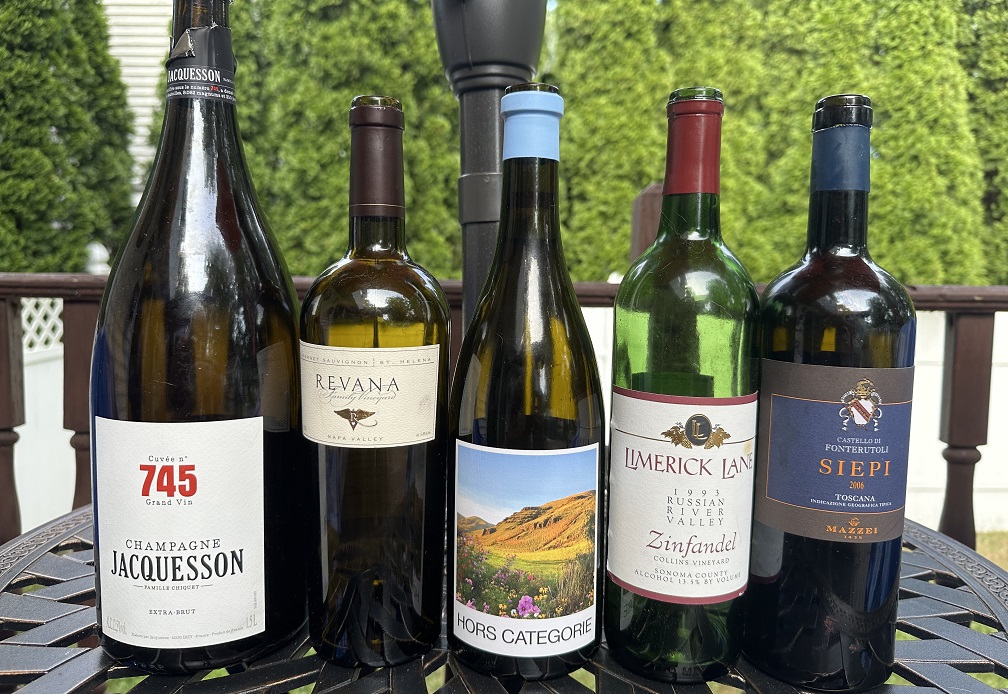
NV Champagne Jacquesson Cuvée 745 Grand Vin Extra Brut (12.5% ABV, harvest 2017, disgorged in 2022)
Perfectly classic champagne with toasted notes packaged in the generous fine mousse, deliciously present on the palate. Cut through acidity leads to a clean finish with some lingering plumpness. This magnum didn’t last for too long.
Let’s get back to where I started. As the party gets going, and people have a bite to eat, there is always a moment to say to your wino-friends “hold on, let me bring something”. Whatever happens next is totally unpredictable, as in most cases, I don’t have a plan, or if I do, it would be a really vague one.
Here is what we ended up tasting:
2007 Revana Cabernet Sauvignon St Helena Napa Valley (14.8% ABV) – I got the bottle as a present for a friend way back. Was always waiting for the right moment… The wine was stunning. A beautiful Cabernet Sauvignon, fresh, layered, cassis all the way, on the nose and on the palate, silky smooth and balanced. The bottle was gone in no time, but it was thoroughly enjoyed.
2014 Hors Categorie Syrah Hors Categorie Vineyard Walla Walla Valley (14.1% ABV). I truly don’t know what the right moment Christophe Barone wines is. Hors Categorie Syrah is one of his very top wines (expensive too). The wine was classic “liquid rock” from Washington, with enough gunflint and smoke to almost feel you visited the range. What was interesting is how quickly the wine was changing in the glass – from more rock to more fruit and back. I’m not sure this was the right moment. I should have a few more bottles, and all can say that I’m not touching them for as long as possible…
1993 Limerick Lane Zinfandel Collins Vineyard Russian River Valley (13.5% ABV) – the wine from my Benchmark Wine loot. 30 years young, and beautiful. No, it was not fresh like it was made yesterday, it went all into the tertiary aromas and flavors, but the body was there, the fruit was there, the acidity was there, and therefore, there was lots and lots of pleasure.
2006 Mazzei Castello di Fonterutoli Siepi Toscana IGT (14% ABV, 50% Sangiovese, 50% Merlot) – another wine brought by a friend. I never had this wine before. This is perfectly on point, beautiful as only Italian wines can be, lots of sweet cherries, a touch of mint, silky-smooth, round, delicious.
Huh, a few wines wine experiences down, and so many more to go. I’m trying to catch up on sharing my wine experiences of this year (well, that’s hardly sufficient), so stay tuned.
Wines of South America: Making Wine Geek and Wine Lover Happy
 Here is where it gets interesting. We all heard of wine geeks, people who get excited about little nerdy wine details, such as vineyard blocks, blending methodology, or amphorae versus cement tank aging. And then you have the wine lovers, aficionados – the people who simply go after the hedonistic pleasure of wine drinking. Can these two personas be happy at the same time? I can’t speak for all the wine people with multiple personalities, but I can definitely answer for this one, the moi. I attended Descorchados 2025 tasting of South American wines, and both inner geek and aficionado were happy.
Just in case you are curious, DescoRChadOS is a guide for the wine of South America, published since 1999. Descorchados also runs wine tasting events dedicated to the wines of South America, and the 2025 event was the first return of the tasting to New York City since 2019.
As a self-appointed wine geek, I love all the uncommon wine traits – new (to me) and lesser-known grape varieties, new (to me) and unknown, even obscure places, authentic (indigenous, autochthonous) grapes, low intervention/natural wines, unique wines and vineyards (e.g. old vineyards). In this tasting, I found all of these things – indigenous, unknown (and thus new to me) grapes harvested from the 200-year-old vineyards, from the countries I had never tasted the wines from before. Happy, happy, happy wine geek.
And then there were world-class, beautiful, delicious, hedonistic wines – Malbec, Syrah, classic method Sparkling wines – all in the same tasting. As I said, both geek and aficionado were very happy.
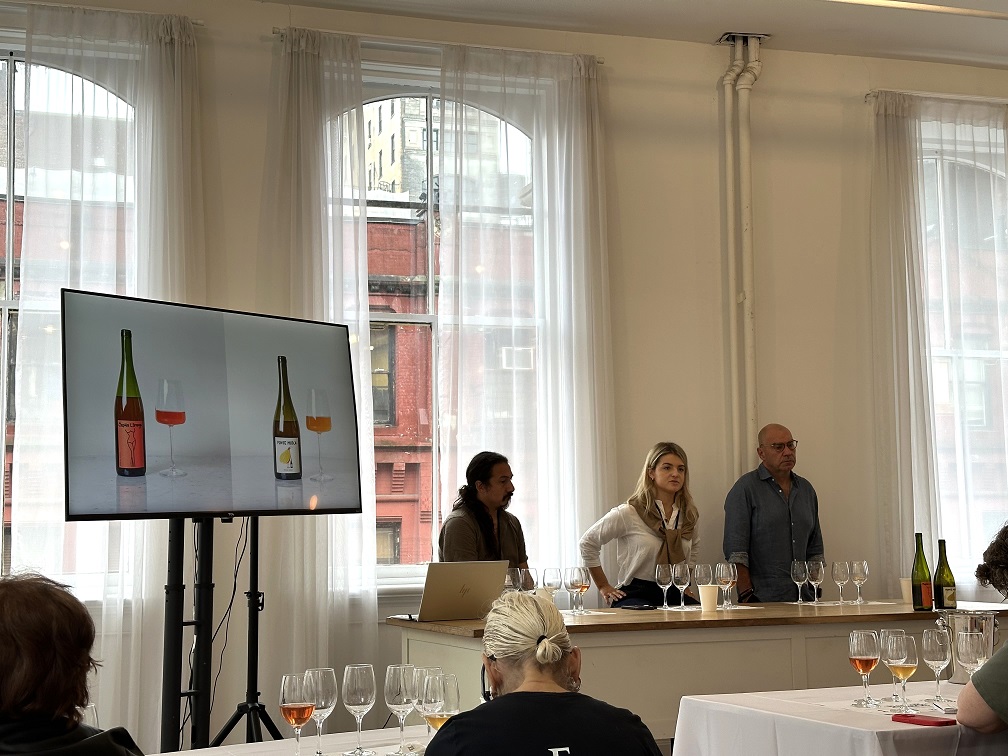
Let’s start with the unique portion first, as I had a chance to attend the masterclass presenting the historical wines of South America.
When it comes to wine from South America, Argentina and Chile are the two countries that come to mind first, followed by Uruguay and maybe Brazil. But the grapes had been growing in most of the South American countries for a long time, with vineyards usually started by European immigrants. It appears that the oldest vineyard in South America is called Tacoma and it is located in Perú, originally planted by Spanish immigrants in the 1540s.
I don’t know if a grape vine can survive for 500 years and continue to bear fruit. However, I now know that 200-year-old vineyards can still produce grapes, as I had an opportunity to taste the wines made with grapes harvested from 200-year-old vines.
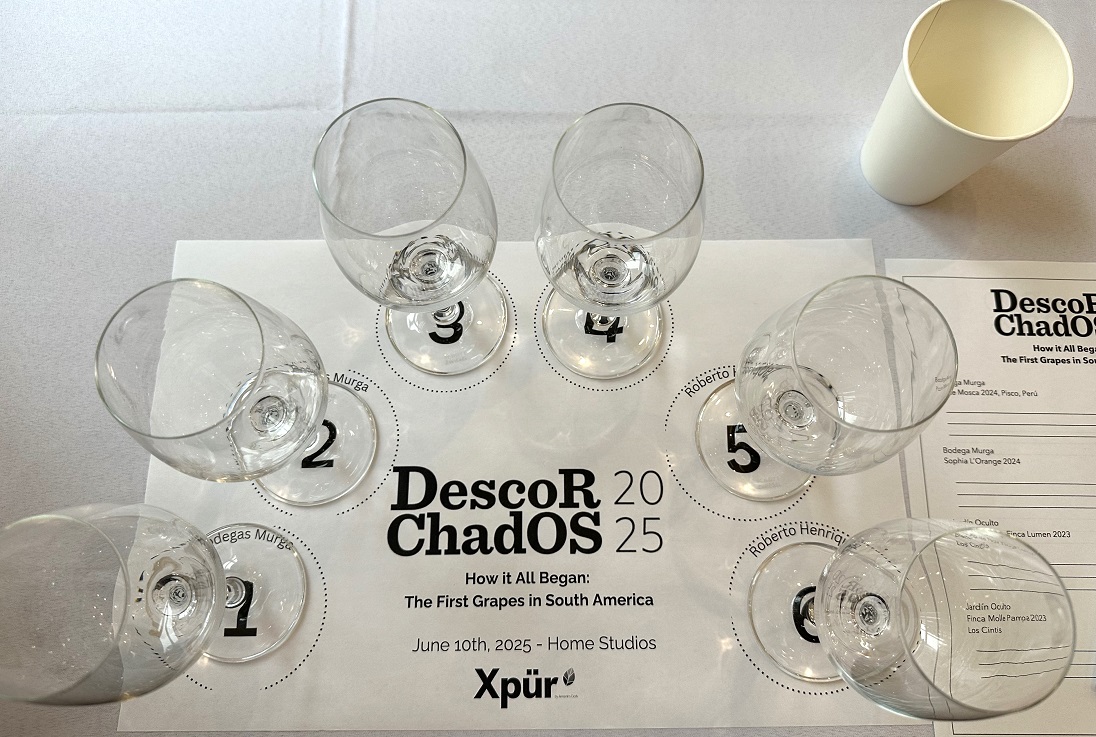
In the masterclass, we tasted 6 wines from 3 countries – Perú, Bolivia, and Chile, some of them produced from the unique grapes I never had before, so thanks to this tasting I can now add two countries to my list of Wines around the World, and increase the grape count by 3 – picture happy collector of experiences.
Here is what we tasted in the masterclass – but before the notes, just take a look at these colors! This tasting was definitely a feast for the eyes!
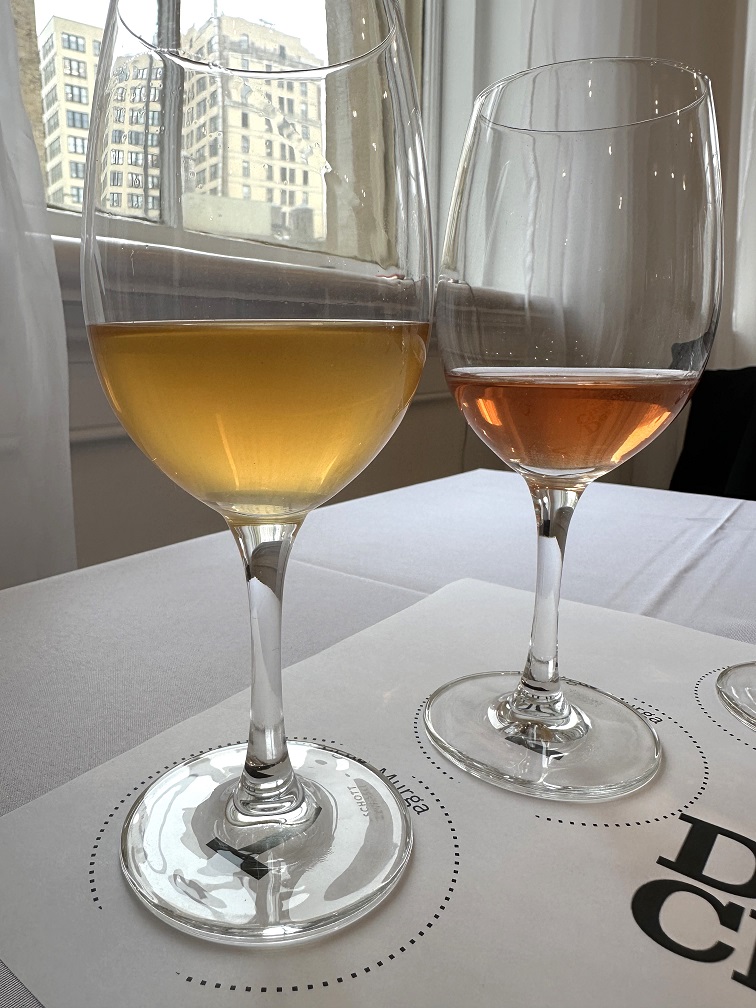
2024 Bodega Murga Ponte Mosca Pisco Perú (12.5% ABV, 34% Moscatel de Alejandría, 33% Moscatel Rosada, 33% Moscatel Negra, 65 days of skin contact)
Pisco is located south of Lima, capital of Perú, 25 minutes away from the Atlantic Ocean, featuring 4 different soil types in the region.
I can’t even comment on the color (beautiful!). The wine had a wonderful nose with explicit nutmeg and a hint of grapefruit. Interestingly dry and tart on the palate, with blood orange on the finish and pure acidity. A great specimen of skin contact wine, but you have to love skin contact. Will be great with seafood.
2024 Bodega Murga Sophia L’Orange Perú (10% ABV, 85% Quebranta, 15% Mollar grapes, 30 days of skin maceration, indigenous yeast)
Muted nose with a hint of smoke, strawberries, sapidity. Smokey strawberries on the palate with salivating clean, crisp acidity on the finish. I absolutely love it, but this is not the wine for everyone (geeks should be happy, though).
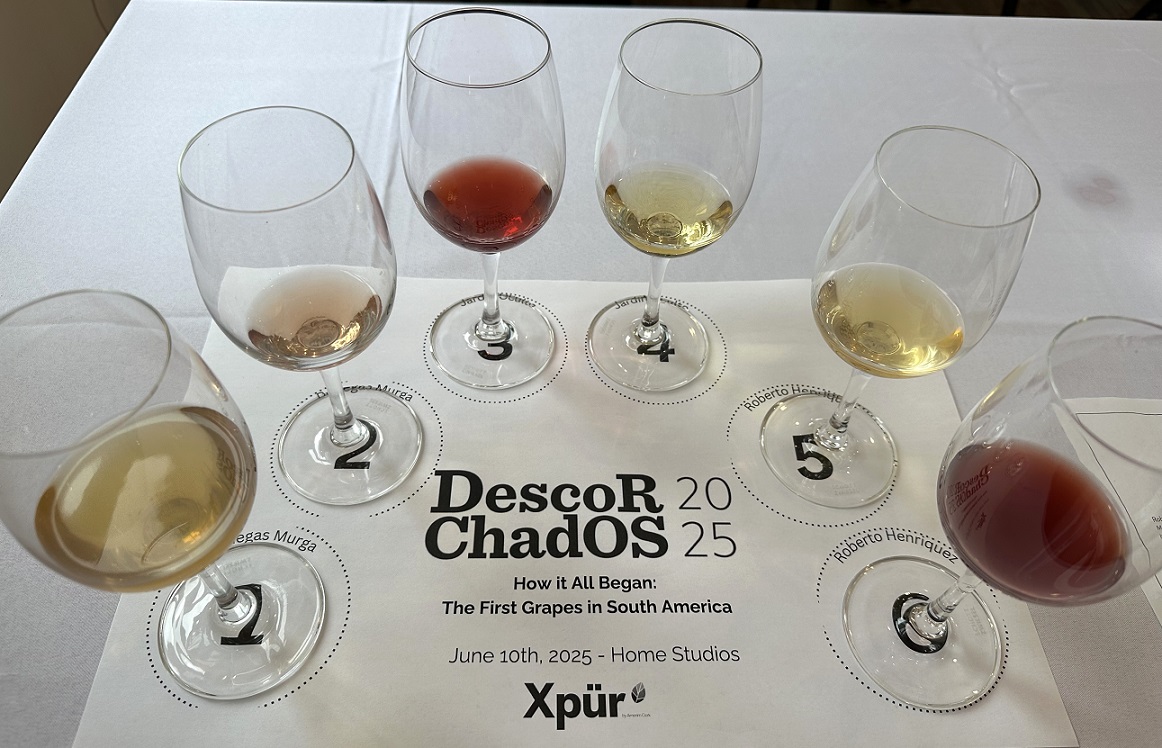
Just look at these colors!
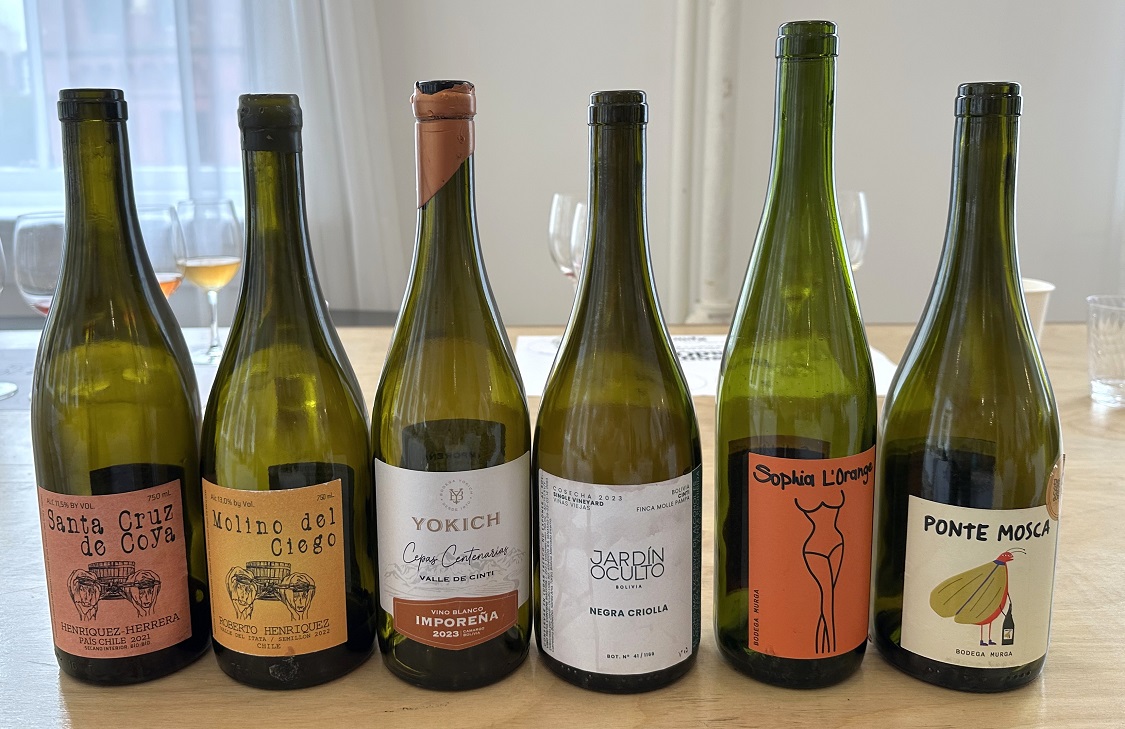
2023 Jardín Oculto Negra Criolla Finca Molle Pampa Cinti Bolivia (200! years old vineyard, 100% Negra Criolla, a.k.a. Listán Prieto a.k.a. País)
Cintis Valley is located in the south of Bolivia, at 7,500 feet altitude, 18” of rain a year – the only place in Bolivia where you can find “winter” for the grapes.
Fresh, crisp, underripe crushed raspberries on the nose. Tart, acidic, with sapidity well present, and with a bitter finish. I can drink it, but this is not your everyday wine; too bitter for me (my palate is particularly sensitive to bitter notes).
2023 Yokich Imporeña Vino Blanco Cepas Cententarias Valle de Cinti Bolivia (13% ABV, 100% Imporeña grape)
What a color! Honey and roasted meat on the nose (yeah, I know, don’t say it), somewhat cloying.
Good acidity on the palate, but I’m not sure this is the wine I want to drink again
2022 Roberto Henriquez Molino Del Ciego Itata Valley Chile (13% ABV, 100% Semillon, 100 years old vineyard)
Jalapeño pepper on the nose, bell peppers and spicy peppers on the palate, good acidity. I’m now hungry. Might be the most unusual rendering of Semillon I’ve ever tasted.
2021 Roberto Henriquez Santa Cruz de Coya Bio Bio Valley Chile (11.5% ABV, 100% País, 200 years old vineyard)
Lightly scented red fruit on the nose, explicit minerality, fresh acidity, tart strawberries, acidity on the finish. This is the wine from the 200-year-old vineyard – very impressive.


Here are the results of the masterclass: 3 new grapes, 2 new countries to add to the list, beautifully colorful wines, lots of geeky excitement (when was the last time you tried wine from a 200-year-old vineyard?).
Then there was a regular tasting with more than 200 wines represented – I didn’t have much time to spend there, but I managed to find some very tasty wines – sparkling and still. Here is the list of the wines I enjoyed outside of the masterclass:


NV Estrelas do Brasil Brut Método Tradicionel
NV Estrelas do Brasil Nature Rose Pinot Noir – superb!
NV Guatambu Nature – excellent
NV Cave Geisse Nature Método Tradicional D.O. Altos de Pinto Bandeira
2020 Neyen Espiritu de Apalta Malbec Colchagua Valley – classic!
2021 Emiliana Coyam Los Robles Estate Valle de Colchagua – excellent but needs time
2021 Emiliana Gê Valle de Colchagua – ready to drink now, delicious


2015 Casa Marin Syrah Miramar Vineyard San Antonio Valley Chile – surprisingly delicious (when I think Chile, I don’t think Syrah – but you should look for this wine)
NV Casa Marin Maria Luz Brut Nature San Antonio Valley Chile
2024 Casa Marin Sauvignon Blanc Cipreses Vineyard
That concludes my encounter with the unique world of South American wines – from geeky pleasures to hedonistic masterpieces, South America has a wine for everyone, you just need to look for it.
What were your geeky discoveries as of late? Or how about some hedonistic pleasures you want to talk about? Cheers!
Daily Glass: Double Lucky, Coast to Coast
Wine is meant for sharing.
How do you share the wine? Well, that depends.
Of course, everyone knows the best way. Get together around the table. Open the wine. Pour into glasses. Sip, savor, enjoy the conversation.
This is the best way. But sometimes, it is not the easiest way. For example, when one person lives on the East Coast and another on the West Coast. What is the best way to share the wine then? Yes, nowadays, it is easy to speak with your friends no matter where they are – and not only talk, but you can see each other too, that’s a given. But still, how do you share the wine?
If you are lucky, you both might have the same bottle of wine. And you can be even double-lucky – especially if you have the right bottle, such as No Girls Double Lucky #8.
Talking about all the luck(s), there are a few here at play. Both my friend Wendy and I had the same bottle of wine available to us. Moreover, we had the bottle from the same vintage – 2019. Now, barring all the bottle variations, we were basically sharing the exact same bottle of wine – never mind 2,500 miles apart, as Wendy lives in Seattle.
Double Lucky wine was released during the pandemic, in 2021, and I was lucky enough not only to get a bottle of the inaugural 2017 vintage (all people on the No Girls mailing list received a bottle of Double Lucky for free), but also to attend a zoom call with Christophe Baron, the creator and owner of Cayuse wines and of the Cayuse “side branches” such as No Girls, Horsepower and others, and Elizabeth Bourcier, the winemaker – you can find my detailed impressions here. If you will read that post, you will find out that I was rather torn on the 2017 vintage.
2018 Double Lucky fared a lot better in my book, and it even made it to the Top Two Dozen of 2022 as wine number 19. And now, the 2019.
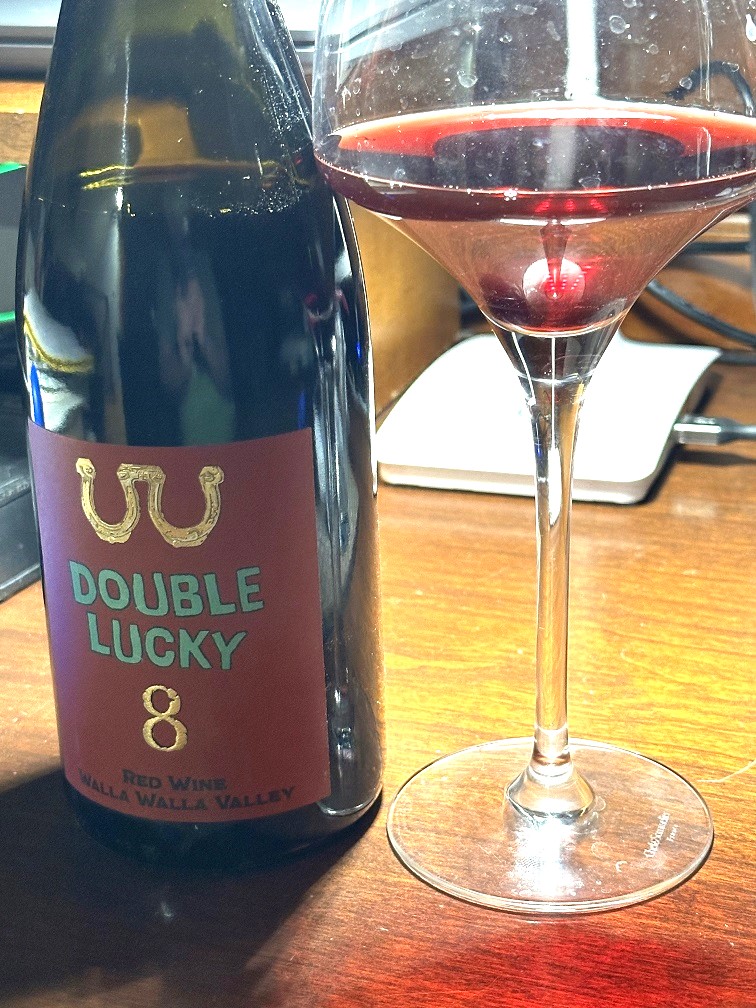
The 2019 No Girls Double Lucky #8 Walla Walla Valley (13.7% ABV, 34% Grenache, 33% Syrah, 33% Tempranillo, 21 months in neutral French oak) had a playful color, going from dark garnet to the crimson red, depending on the lighting. On the nose, on the first whiff, you can only talk about the rocks – the wine has a really profound minerality. Next, there is a hint of barnyard – just enough for those who like it, and we managed to agree with Wendy that we both love that little (or even not so little) funk on the nose – it makes the wine all the better (don’t talk to me about Brett). And then there were some cherries also present on the nose.
On the palate, the wine was all so interesting. We spoke with Wen for about 2 hours (wines, politics, families, popcorn, more wines – you know, just two friends catching up), and during these 2 hours, the wine kept changing. At first, the wine showed green bite, like chewing on the little branches of the wood (Elizabeth Bourcier is a big fan of whole cluster fermentation, and while it sounds wonderful, every time I hear the term, I almost cringe). After about 20 minutes, the green notes were gone, and the wine just had sweet cherries, olive tapenade, and rocks, lots of rocks. About an hour later, taking another sip, I suddenly discovered my beloved pepper! I love peppery notes of Syrah, this is an absolute hallmark in my book, so the wine definitely made me happy – and of course, it evoked memories of Michel Chapoutier Mathilda Shiraz, one of the most peppery Syrah renditions I ever tasted.
All in all, it was a great evening of wine and conversation – a double lucky we might even say, pun intended.
Never mind the distance – open a bottle and call your friends.
Until the next time – cheers!
Brunello di Montalcino 2020: Captivating, Bright, Succulent
Benvenutto Brunello is one of my favorite wine tasting to attend. If you like Italian wines, Brunello needs no introduction (and if you don’t, I’m not sure we can be friends) – one of the 3 big Bs of Italian winemaking – Barolo, Barbaresco, and Brunello.
Brunello is an epitome of the expression of the best known Italian red grape – Sangiovese. The Sangiovese growing in the Brunello di Montalcino proper is considered a clone – Sangiovese Grosso, but it is a Sangiovese nevertheless.
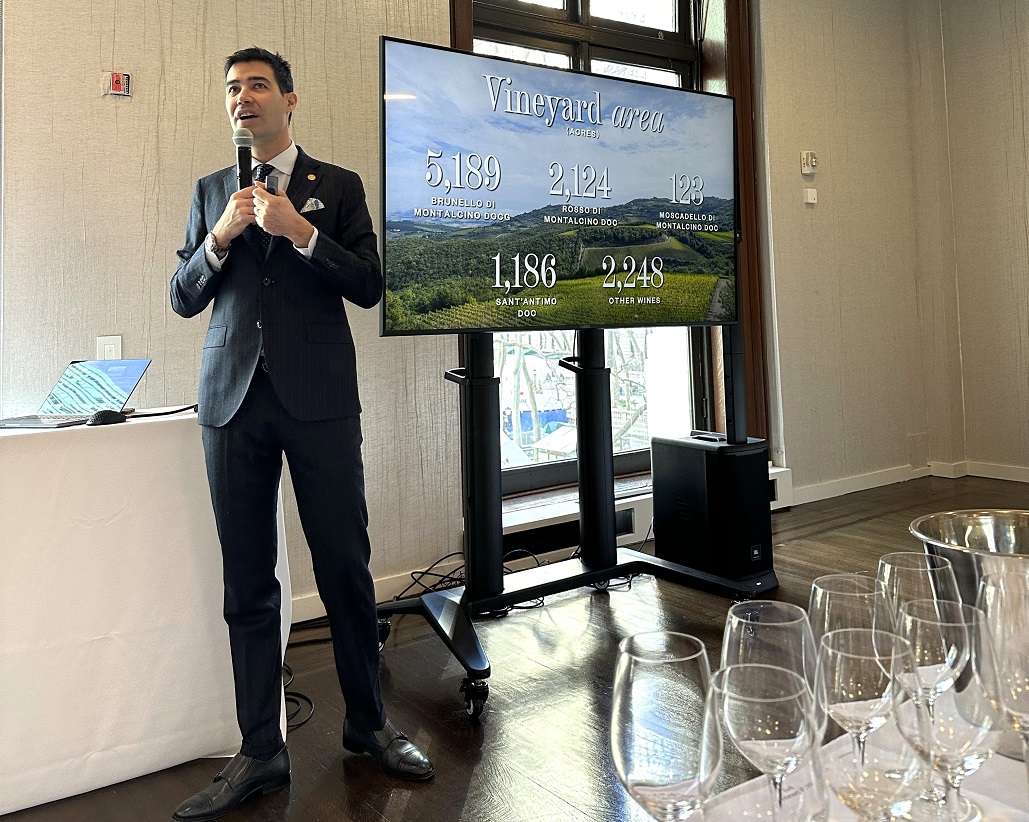
Brunello de Montalcino appellation is almost square, all located around the hill crowned with the town of Montalcino, with vineyards densely occupying 5,189 acres and located at various altitudes over a range of different soils. Different microclimate conditions, terroirs, guarantee a great diversity of styles among 200 or so producers in Brunello di Montalcino DOCG. Another interesting appellation within Brunello proper is Rosso di Montalcino DOC, occupying 2,124 acres (after expansion in 2020) of dedicated vineyards (Rosso DOC vineyards are only used for production of Rosso di Montalcino DOC). Take a look at this wonderful video providing an excellent overview of the Brunello di Montalcino region:
Gabrielle Gorelli, MW, led our highly informative Brunello Masterclass, providing a detailed overview of the 2020 vintage and the changes in vintage assessment that just went into effect.
The 2020 was a pivotal vintage for Brunello di Montalcino. Not because of the Brunello 2020 wines per se, but because of the fundamental changes made in assessment of the 2020 vintage and all future vintages to come.
Until 2020, Brunello di Montalcino vintages had quality assessment specified with the stars (from 1 to 5 stars) and a short slogan characterizing the vintage. For example, the 2014 vintage had a rating of 3 stars and was called “Grace under pressure”. 2015 had a rating of 5 stars, and it was called “Power and Purity”; the 2016 vintage was also rated 5 stars and called “Finesse and depth”.
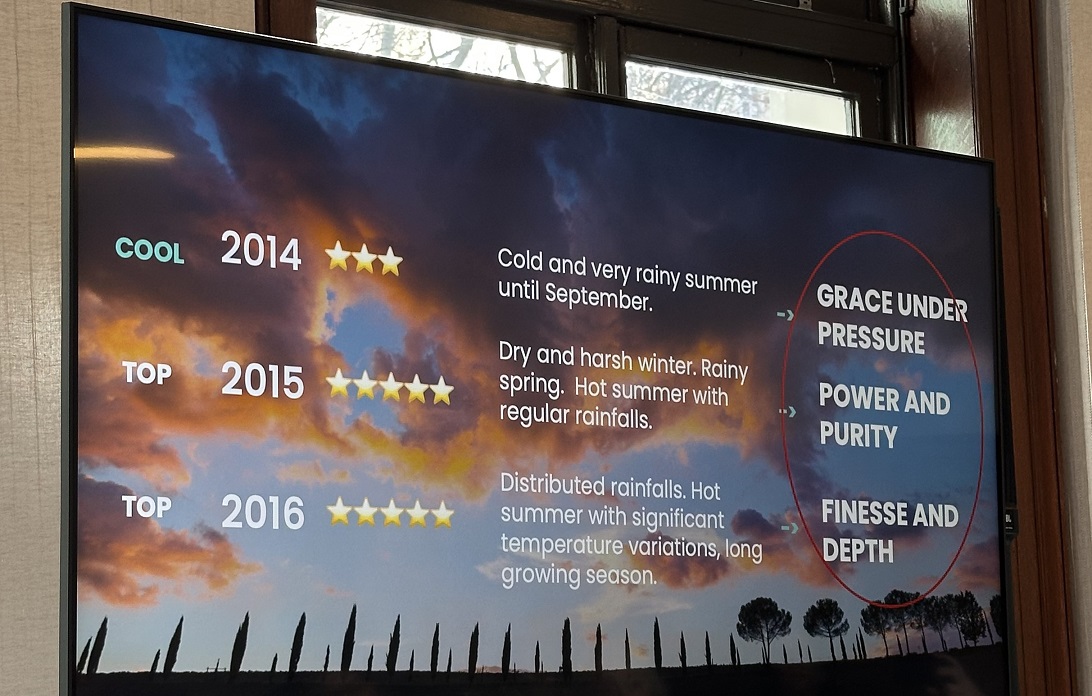
The 2020 Brunello vintage marks the end of the star ratings – this is the last vintage awarded a star rating (5 stars, in case you are wondering). Instead, Consorzio Brunello di Montalcino is introducing Brunello Forma, which will only provide a verbal description of the vintage moving forward.
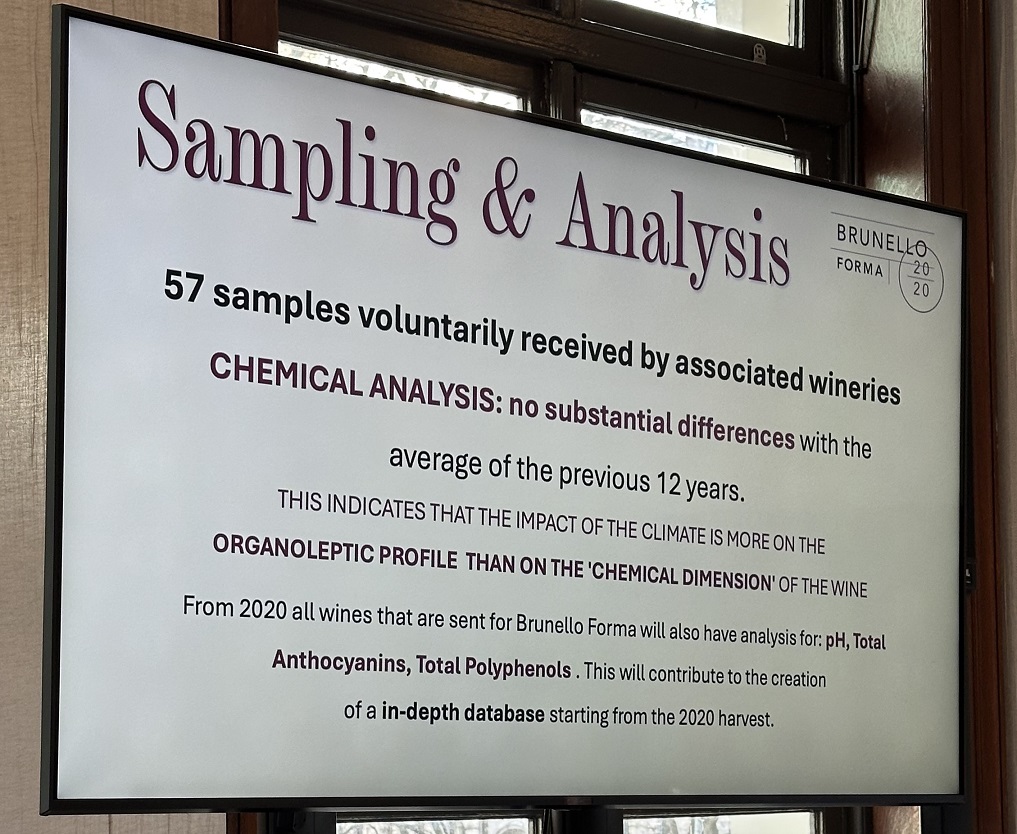
A significant amount of effort went into the creation of the new system. 39 weather stations were installed around the region to collect the microclimate data. Historical data of the past 12 years were collected and a significant number of samples from the past vintages were blind tasted to come up with the set of data which will allow to make vintage assessment more scientific, I guess.
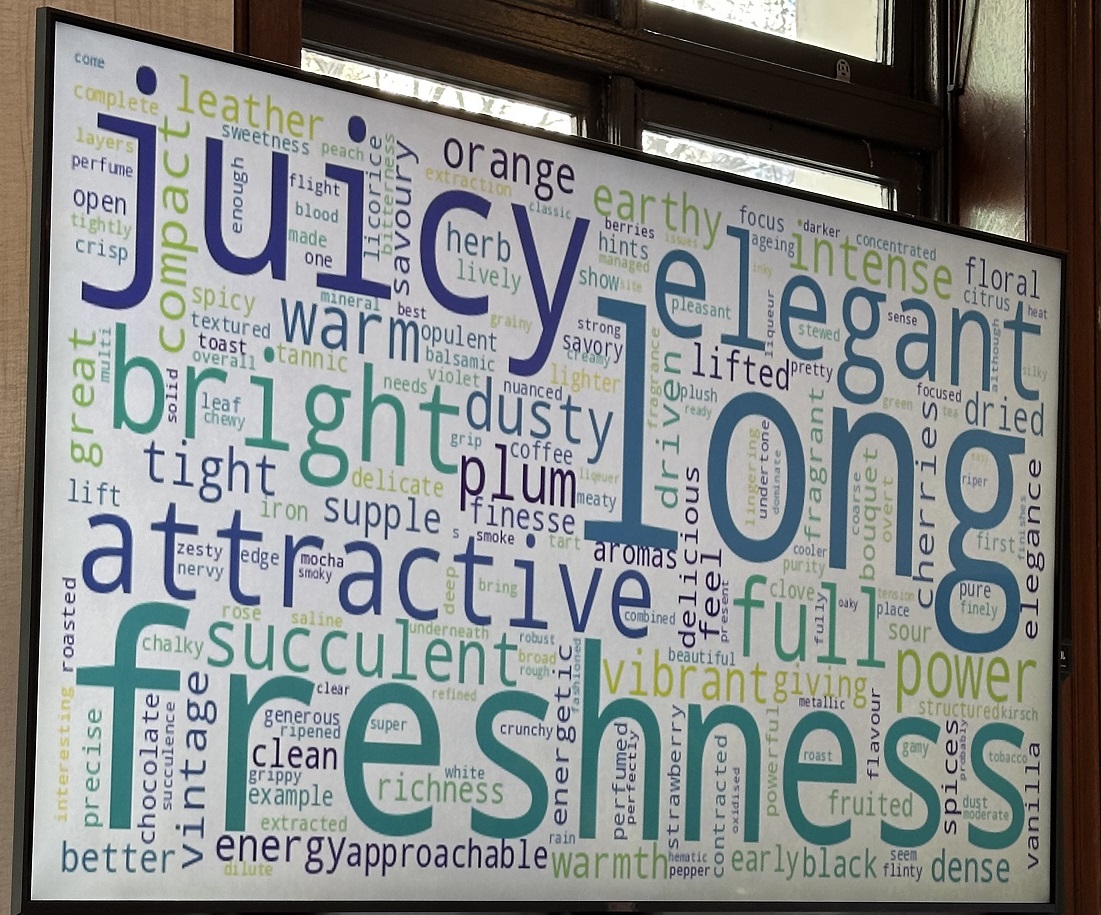
To come up with the vintage verbal assessment, a panel of industry experts (masters of wine, wine distributors, wine writers) ran extensive tasting of the 2020 wines, then collected and processed a large number of descriptors used by the panel members to crystallize the 2020 Brunello vintage description into these three words:
Captivating, Bright, Succulent
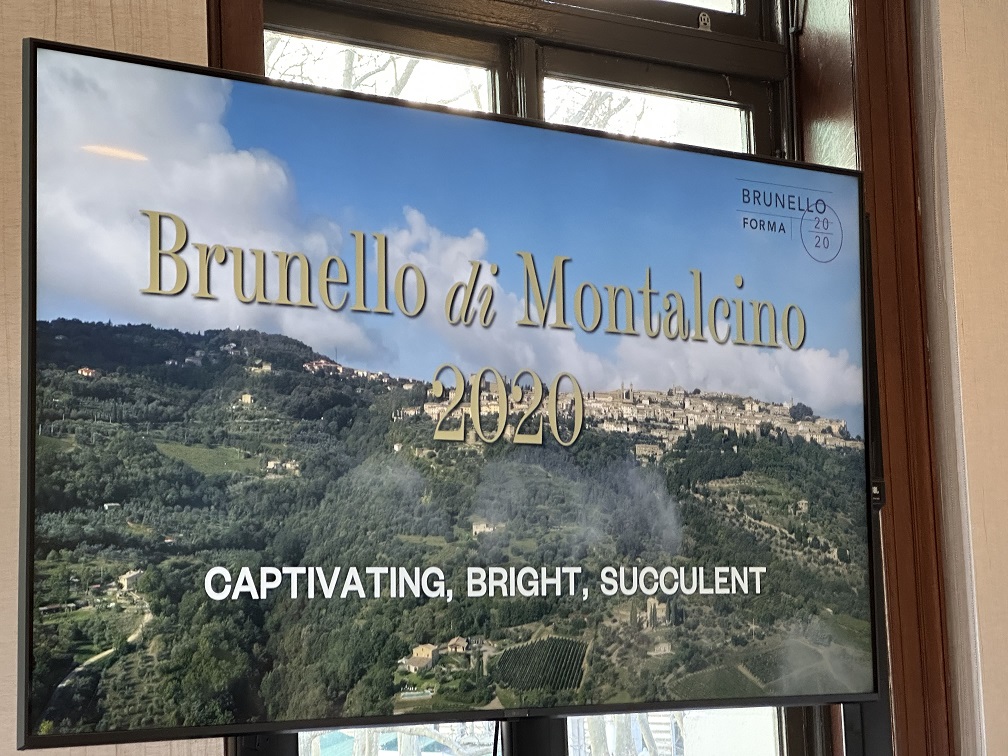
As an engineer at heart, I’m not a fan of words. Simple numerical (3 stars, 92) or verbal (fair, good, very good) rating quickly gives me everything I need to know about the vintage in general – captivating or succulent doesn’t set my expectations about a given wine – not now, and especially, not in the future.
However, as it was explained later on during the dinner with Giacomo Bartolommeo, Brunello winemaker at Caprili, the star ratings were hurting the wineries, as wine buyers preferred to ignore wines from 3-star vintages and focus on acquiring better-rated vintages, without much regard to the qualities of the particular wine. Moving to verbal descriptors eliminates the opportunity for a quick rating-based decision. Well, winemakers are in the business of selling their wines, so it is not my place to complain or judge.
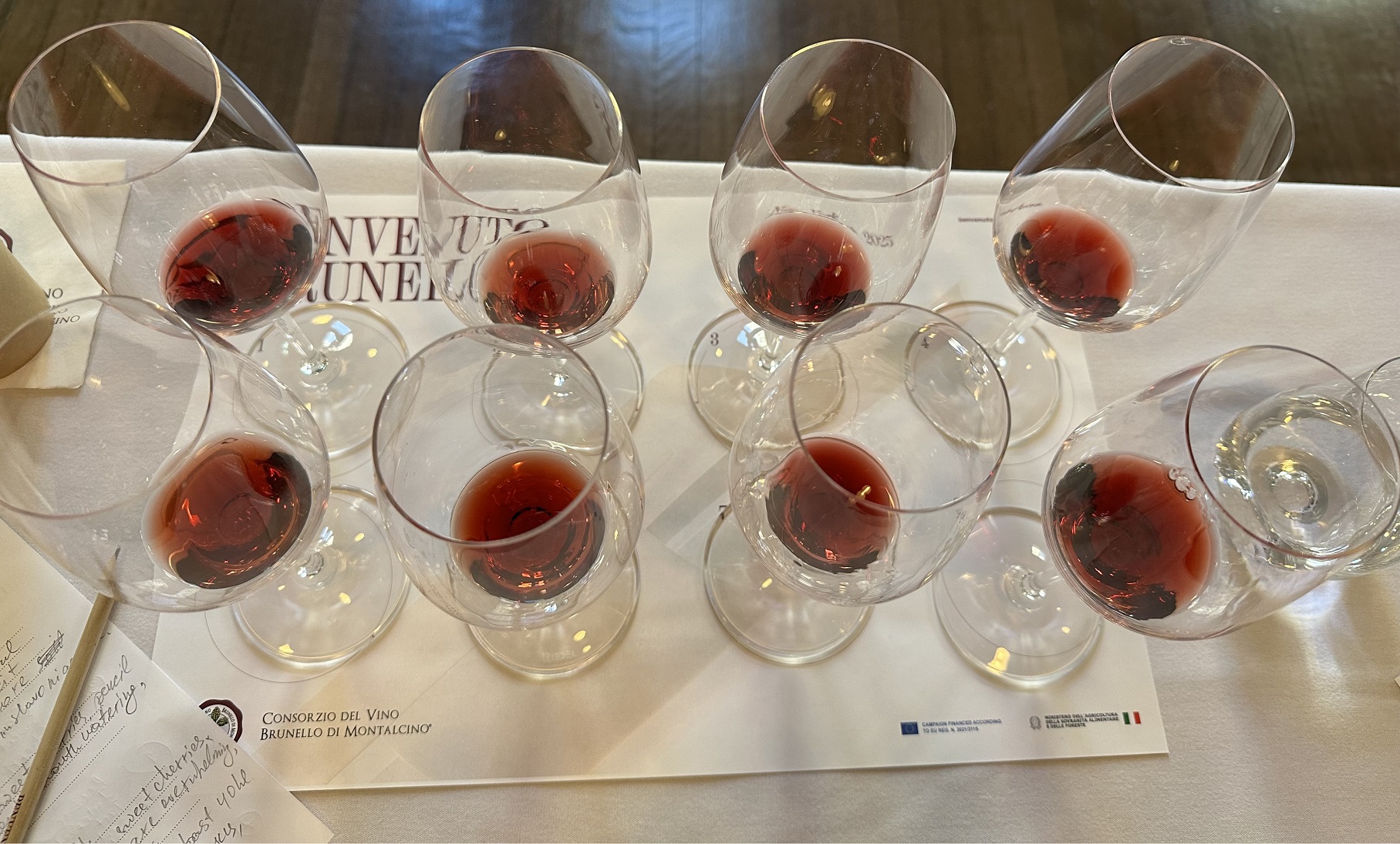
Then, of course, there were wines. I have to say that in the traditional Italian style (please take no offence), the tasting order was changed by our presenter, Gabrielle Gorelli, MW, compared to the order written on the notes page. However, I have to say that our tasting order was definitely the right one, showing progression from very tight and lean wines to wines that were softer and more approachable now. I attended both seminars, so below are my notes:
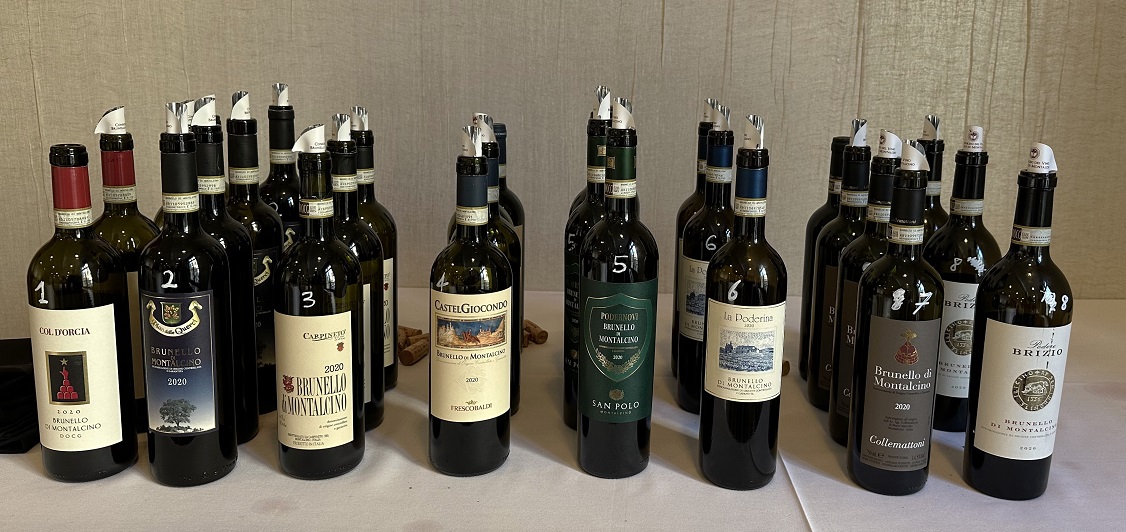
Morning Seminar
Col D’Orcia Brunello di Montalcino 2020
Ruby Color
Interesting nose, sapidity, earthy undertones, leather
Tart is the first sensation; tart cherries, expressive tannins, crisp acidity
Pian Delle Querci Brunello di Montalcino 2020 (36 months in Slavonian oak)
Dark ruby color
Sweet cherries, perfumy, very playful
Not as tart as the previous wine, but has very explicit tannins, good acidity, but lacking fruit, very lean
Carpineto Brunello di Montalcino 2020 (vineyards planted on the oldest soils, 3 years in big oak barrels)
Garnet color
Sweet tobacco, cherries, plums, attractive
Initially showed beautiful cherries, the tartness kicked in, followed by very dry finish with big but well integrated tannins
Marchesi Frescobaldi Castelgiocondo Brunello di Montalcino 2020 (single vineyard, aged in big casks)
Garnet color
Beautiful nose, elegant, perfumy, with a touch of sweet cherries.
Tart cherries on the palate, herbs, tart finish with well pronounced tannings.
San Polo Podernovi Brunello di Montalcino 2020 (30 months in light-toast 40hl casks)
Garnet color with bright reddish hues
Beautiful nose, elegant, perfumy, sweet cherries, eucalyptus.
Tart cherries, tannins are overwhelming, but the most elegant finish so far.
Probably can be enjoyed now after decanting
La Poderina Brunello di Montalcino 2020
Dark Garnet
Playful, bright red fruit, cherries, herbs, sweet oak.
Palate is a tad bitter, strange, had to swallow the wine instead of spitting to establish that it was not corked. Overall, not bad, but the nose is way better than the palate.
Collematoni Brunello di Montalcino 2020
Dark ruby color, beautiful
Beautiful nose, sweet fruit, cherries, sage, beautiful.
The best palate so far – round, with sweet and tart cherries, elegant, delicious.
8+
2020 Podere Brizio Brunello di Montalcino 2020 (38 months in oak)
Dark garnet
Beautiful, open, sweet fruit, sweet cherries, pencil shavings.
Tart cherries, explicit balsamic notes, succulent, mouthwatering, round, delicious, beautiful, superb.
8+
My favorite two wines of the morning seminar:


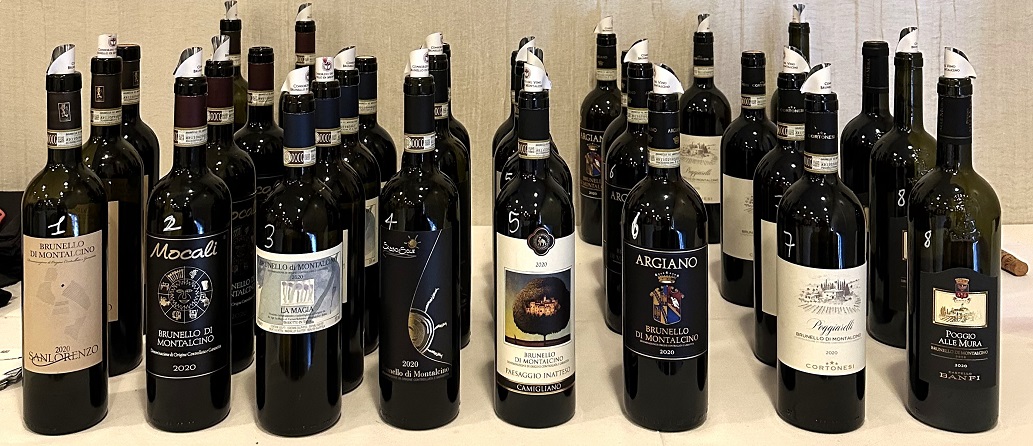
Afternoon seminar
Sanlorenzo Brunellodi Montalcino 2020 (aged in oak for about 3 years)
Garnet color
Beautiful, sweet fruit, cherries, dark undertones, earthiness.
Intense fruit quickly dissipates into very tart, very high expression tannins and acidity on the finish. Super-lean.
Mocali Brunello di Montalcino 2020
Dark garnet
Interesting nose, maybe racy is a good descriptor? Garrigue, some cherries show up a bit later.
Lots of sweet cherries which instantly disappear, but the finish is a bit less tart than the previous wine.
La Magia Brunello di Montalcino 2020
Very dark, practically black, darkest of the tasting so far
The nose is restrained, earthy and herbaceous
Sweet cherries, sweet oak, then tart, acidic, and ultra-tannic on the finish, very dry
Sassodisole Brunello di Montalcino 2020 (minimum 24 months in oak)
Dark Garnet
Cherries, sage, perfume, nice and open
Tart cherries, leather, well-integrated tannins
So far, the most approachable wine of the tasting
Camigliano Paesaggio Inatteso Brunello di Montalcino 2020 (30 months in oak barrels, 10 months in cement tanks after)
Bright ruby
Underbrush, a hint of smoke
Tart cherries, fresh cleansing acidity, acidic finish with some tannins, not bad.
Argiano Brunello di Montalcino 2020 (30 months in Slovenian oak casks of different capacities)
Dark garnet
Nice, inviting, round, dark fruit, a touch of crushed rocks.
Sweet cherries, crunchy and succulent, great energy, cherries on the finish, delicious.
8+, the best of the second seminar
Cortonesi Poggiarelli Brunello di Montalcino 2020 (24 months in oak)
Dark garnet, almost black, with bright hues
Amazing nose. Cherries that magically pull you in.
Fish and powerful opening on the palate, but bitter tannins set in.
Best nose of both tastings, 9-/9. Palate is not great right now – 7+
Banfi Poggio Alle Mura Brunello di Montalcino 2020 (24+ months in French oak)
Dark garnet with bright hues
Nice, open nose with lots of fresh herbs – sage, thyme.
Sweet dark fruit on the palate initially, then the palate is quickly shut down in front of the mouth. Again, if you swallow this wine instead of spitting, the wine is a lot more generous. Succulent is a perfect descriptor for such a wine. 8+
Best wines of the second seminar:


In addition to the seminars, there was tasting on the “main floor”. There were more of the excellent 2020 Brunellos, such as San Felice, Caprili, or Corte Pavone. There were also many of the 2019 Brunello di Montalcino Riserva wines, which were simply outstanding. Additionally, 2023 Rosso di Montalcino were presented by almost all participating wineries and were excellent across the board.
My Brunello deep immersion didn’t stop there. After the event was over, we went for dinner with John Fodera and Giacomo Bartolommei, the winemaker at Caprili, to the wonderful Italian New York restaurant Zero Otto Nove, famous not only for genuine Italian food but for the amazing wine list. There, Giacomo found 2001 Cerbaiona Brunello di Montalcino, which we ordered.
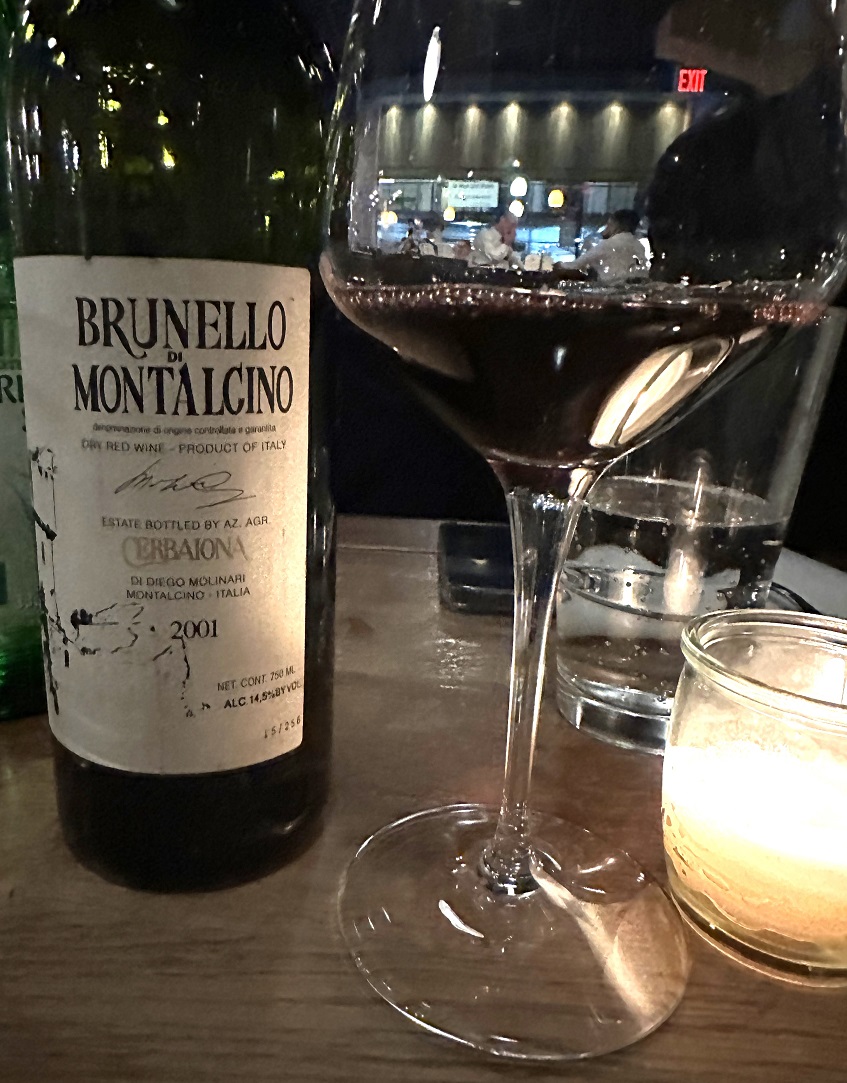


Wow, what a pleasure it was. Perfumy nose of succulent cherries, anis, eucalyptus. You can’t stop smelling the wine, you don’t even think of drinking it for a few minutes. Then you take a careful sip and experience an explosion of flavor with succulent cherries, balscami vinegar, iodine, and magic that only an Italian wine with age can offer. The experience was not identical to 1999 Soldera, but it was pretty darn close.
And now my Brunello report is complete. The 2020 vintage offers beautiful aromatics; it is approachable, it is succulent, it is captivating. Let’s raise the glass to the new era in Brunello and more tasty Brunello wines for us. Cheers!
Open That Bottle Night OTBN 2025 – What a Night!
What a Night! The end.
If I say “what a night”, can this serve as a sufficient wine descriptor?
Okay, of course not, but what a night it was.
As a wine lover, I really treasure Open That Bottle Night, or OTBN for short, taking place on the last Saturday in February. OTBN was created by the Wall Street Journal wine writers, Dorothy J. Gaiter and John Brecher, back in 1999, to encourage wine lovers around the world to open that long-stashed special bottle that might be long gone while waiting for a special enough day to be opened.
Now, if I describe the experience as “agonizing”, does that portray a happy vibe? I might be unique in my self-directed masochism, but “agonizing” is the best way to describe the days leading up to the OTBN sacred night. Agreeing with oneself on wines worthy to be opened for OTBN can’t be described any other way, as I endlessly circle around the bottles located all over the house (an extra challenge of not having a dedicated wine cellar).
This year’s OTBN accidentally worked better than it could’ve been. We had been trying to arrange a dinner with friends for a while, and February 22nd was not my preferred date as it was my only night home in between two weeklong business trips. But as we tried to push it out to a later date, we came to a realization that it is either now, or it will be pushed far away, and we already had been talking about this get together for about half a year. I was responsible for the wine, and the other two couples for the food. As I started thinking about wines I should bring, it downed on me – ohh, this is the last Saturday of February, which means … OTBN!
Selecting the wines instantly got a lot more interesting and a lot more challenging at the same time. Now I need to bring not just wines, but the wines worthy of OTBN, the wines special for whatever reason, as a bare minimum special at least to me.
Celebrating OTBN in the group has a great advantage – I don’t need to decide what this one special bottle is – we can cover the full proper “wine dinner range” – bubbles, white, red, dessert. This is exactly what I did – and here are the wines I selected, with all the notes and impressions attached.
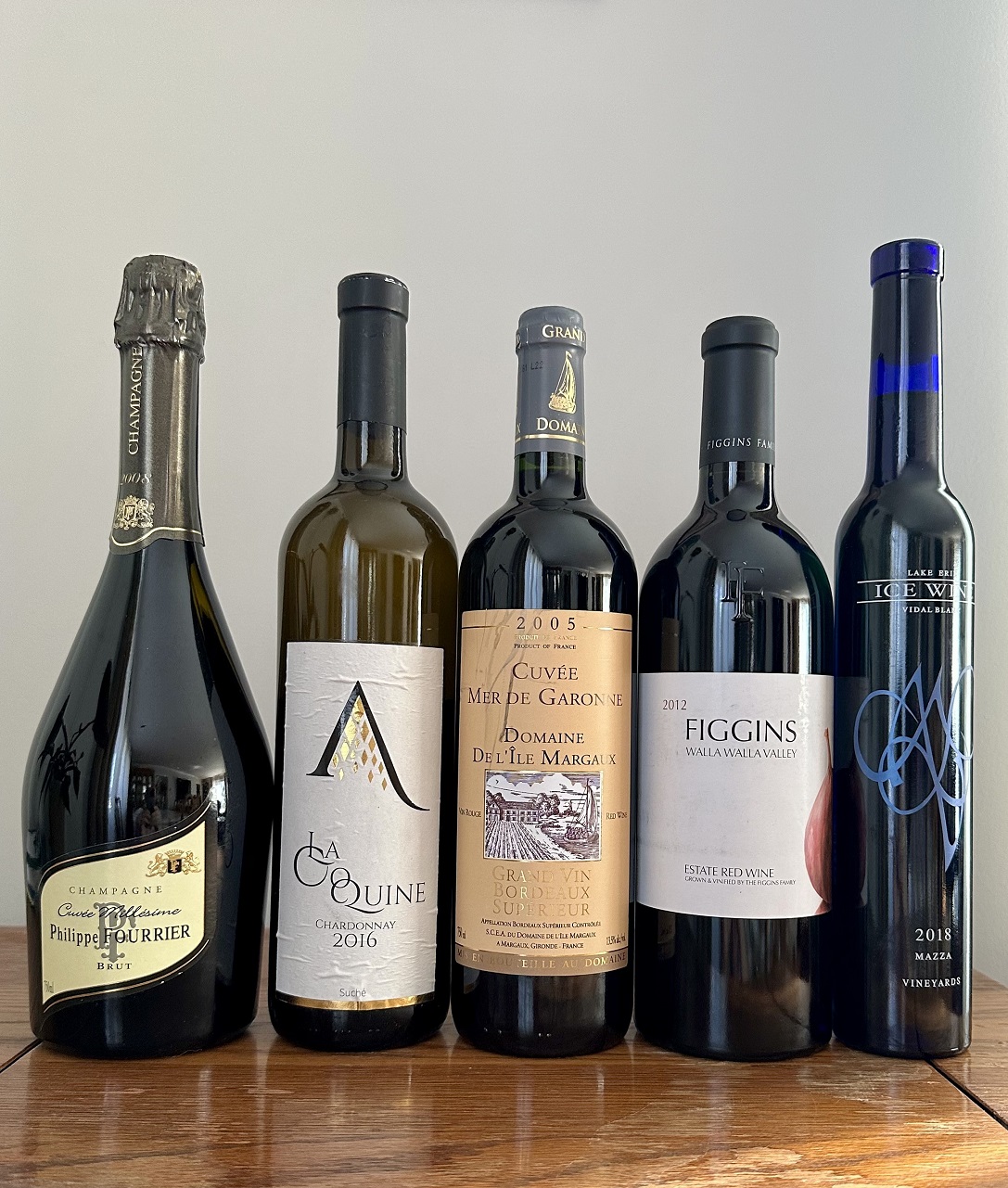
Bubbles – my selection is typically very limited at home, I have maybe 12 to 15 bottles of sparkling wines on hand, so deciding what is “special enough” is not easy – and the whole idea of OTBN is to work with your own cellar, so I had to really find that bottle inside. In the morning, I pulled out a shelf with sparkling wines from the fridge, and my inner voice said “how about this one”. Grabbed the bottle of 2008 Champagne Philippe Fourrier Brut Cuvée Millesime (12% ABV, I think I got it through WTSO a while back), and while checking the back label, I realized that this was also a vintage champagne, a 2008 – even better! Now the bottle has become a lot more worthwhile to open at OTBN.
What a joy this wine was. Perfectly substantial without going overboard – toasted bread, apples, yeast, fresh and full of energy – an absolute “wow” of the champagne experience, the wine that was very easy to like instead of looking for ways to convince oneself that you like it. Extra bonus – everyone loved the wine, which is never given in the group, especially when it comes to bubbles.
Next, 2016 Salabka La Coquine Chardonnay Czech Republic (12.5% ABV).
This wine was probably the most special in the group. This wine was associated with memories. I brought a few bottles of this same wine back from the Czech Republic in 2017, after tasting the wine at a dinner at Salabka city winery, located and growing their grapes within Prague city proper. This was my last bottle from that trip, and I already pulled it out of the fridge on multiple occasions, and put it back every time deciding “not today”. This time I decided that it was actually the time to pull that cork – but I didn’t have much hope for this 9 years old Chardonnay.
Oh my… what a wow wine it was. Perfectly intact cork with a few crystals. No age showing in the color, still light golden. And the nose and the palate showing apples, pears and vanilla, woven over a firm citrus core. Bristling acidity doesn’t get in the way of enjoying wine. Considering how fresh the wine was, I’m sure this wine had another 20 years of life ahead of it – and now I have a perfect reason, even a strong need to visit Prague again.
Next, time for reds.
In retrospect, the selection of reds was very interesting, I don’t think I would’ve done it better even if I tried. A 2005 Bordeaux and 2012 Washington estate red – sounds reasonably far apart, right? And yet somehow, the wines literally were singing in unison, just imagine 2012 red having a bit of a deeper voice.
Maybe this was due to very similar grape blends – both wines were blends of Cabernet Sauvignon, Merlot, and Petite Verdot, but the Washington red was simply a continuation of the French Bordeaux.
The 2005 Domaine De l’Île Margaux Cuvée Mer de Garonne Grand Vin Bordeaux Superieur (13.5% ABV, 33% Merlot, 33% Cabernet Sauvignon, 34% Petite Verdot)
comes from a unique place, a small island in the middle of the Gironde River, overlooking the great estates of Margaux. The wine opened up as a classic, beautiful Bordeaux, with cassis and eucalyptus on the bright nose, and more of the same on the palate. Perfectly fresh, beautiful layers of fruit, firm structure, impeccable balance. The 20 years of age were unnoticeable. The wine didn’t need decanting, but opened up beautifully in the glass.
The 2012 Figgins Estate Red Wine Walla Walla Valley (14.6% ABV, Cabernet Sauvignon, Petite Verdot, Merlot) was my only bottle which I got as a present some years back. Similar to Salabka Chardonnay, this wine was pulled out of the fridge on a number of occasions, only to be put back in again. Finally, this was the day. On the nose, it was very similar to the Bordeaux, only a bit more restrained. On the palate, it had the same cassis and eucalyptus, but the appearance was a bit “fattier” – more pronounced berries, juicier layers, a bit darker notes but still perfectly balanced and perfectly delicious.
And then the was time for dessert. Nothing makes me more ecstatic than an opportunity to open a bottle of a dessert wine. During most of the dinners, even when you plan to open the dessert wine, everyone starts complaining about how they don’t want to drink anything else, and the desire not to waste a whole bottle for just a few sips prevails. But this is OTBN, not just some regular wine dinner, so everyone simply has to go with the program.
I don’t know exactly how I got into possession of this 2018 Mazza Vineyards Vidal Blanc Ice Wine Lake Erie Pennsylvania (11.5% ABV, Harvest dates January 11 and 21, 2019) bottle – I guess someone just brought it as a present.
Boy, was this wine just an amazing finish for the evening… stunningly delicious, with ripe apricot on the nose, and ripe, juicy, succulent apricots on the palate enveloped in a perfect amount of acidity. This was the wine of impeccable balance, the balance of sweetness and acidity that makes or breaks dessert wines. This one was superb – we almost had to fight for who would get to finish a bottle – a pure joy to an oenophile’s heart.
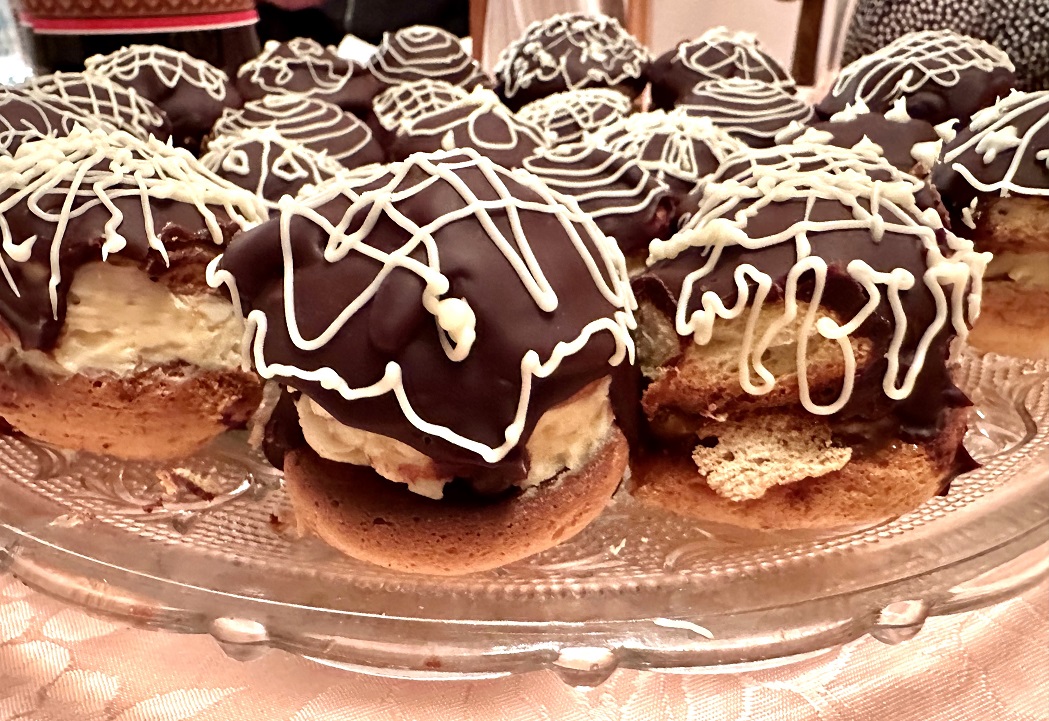
I also have to mention another special treat we had for dessert – small pastries that were popular back in Belarus growing up there, called Bouchée. These were specifically made as per the original Russian recipe and were absolutely sublime.
Another OTBN just became a history, a memorable memento. Luck or not, but these were 5 excellent, memorable wines – and a great company. Let’s raise the glass to the joy the wine is able to bring. Cheers to memorable nights!
Valentine’s Day 2025 – Reflecting on Wines
In my previous post, I complained about frustration with choosing the right wine for the right moment. That post ended with a picture of the wines I selected for Valentine’s Day 2025 – and now I want to talk about those wines.
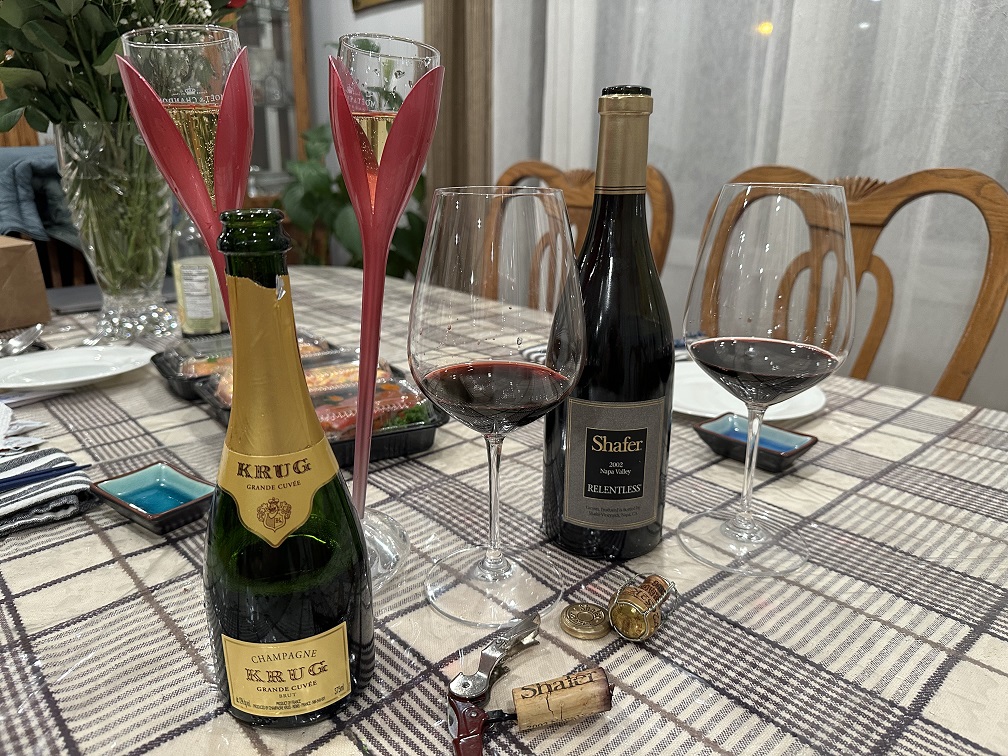
Following my own advice, our first wine was sparkling. Not just any sparkling – it was Champagne. And not just any Champagne – it was Krug.
I don’t want to sound elitist, but the only way to put is this: those who know, know Krug.
For the wine lovers en masse, the epitome of champagne is Dom Perignon. Maybe also Crystal on a good day. Krug definitely is lesser known, but for those who know, Krug is a cult, a religion, the only Champagne one can drink.
I joined that cult after experiencing Krug vintage and non-vintage wines during the PJ Wine Grand tasting in New York in 2010. Krug was an absolute revelation, I have never tasted anything like that ever before.
Then a few years later, in 2012, I came across an article by Alice Feiring, talking about changes in winemaking at Krug in 2003 which she said resulted in more or less the “end of Krug”. I referred to her article in my post, but unfortunately, the original article can’t be found so I can’t share any more details. I only remember tasting Krug at the trade tasting in the same year or maybe the year after, and thinking “well, it is not as good as I remembered it“.
Trade tasting is not always the best place to fully understand the wine, so Krug remained high on my “wines I want” list. Then a few years back, I got this half-bottle of Krug as a present for the new year, and this year I decided that Valentine’s Day is a perfect reason to open that bottle.
After struggling a bit with the cork, I managed to get the wine into our flutes (I know, I know – but it is a holiday, okay?). Smelling and tasting it left both me and my wife underwhelmed. Crisp and acidic for sure, but that’s what literally every other Champagne has, and Krug should really give you more. A few more sips and I closed the bottle, and back into the fridge it went.
Not so long ago, I read an article from a champagne pro, and he suggested that Champagne, similar to any other still wine, can and usually improves after opening. It can be placed into the fridge and enjoyed slowly over the next few days, and many of the Champagnes simply taste better the next day.
Why is this important? When I poured what was left of Krug into the glass the next day (okay, it was a regular glass), that was a totally different wine. Rich, layered, with toasted bread and apples. This was the real deal and it was delicious. I can’t tell you if it tasted like the one I was blown away by in 2010, but it was definitely an excellent Champagne. I guess there is an interesting lesson here for future encounters with Champagne, and not only with Krug.


After Krug’s image was somewhat restored in my eyes, I decided to learn more about the wine. Nowadays every bottle of Krug comes with its own unique code. When you go to the Krug website and type in the code, you get the most detailed information about the wine you can wish for – here are a few excerpts related to my bottle:
“Krug Grande Cuvée 170ème Édition
Composed around the harvest of 2014, Krug Grande Cuvée 170ème Édition is a blend of 195 wines from 12 different years. The youngest is from the year 2014 and the oldest dates back to 1998.
In all, reserve wines from the House’s extensive library made up 45% of the final blend, bringing the breadth and roundness so essential to each Édition of Krug Grande Cuvée.
The final composition of this champagne is 51% Pinot Noir, 38% Chardonnay and 11% Meunier.
Time in the cellar:
This half-bottle spent around 7 years in Krug’s cellars developing its generosity and elegance, receiving its cork in Autumn 2020.”
According to Julie Cavil, Krug Cellar Master:
“In this blend, the dynamic Pinot Noirs of 2014 came from a wide range of plots throughout the Champagne region, while fruity and full-bodied Chardonnays were selected from plots in the Montagne de Reims, Sézannais and Côte des Blancs. The Meuniers from the Vallée de la Marne Rive Gauche were particularly bright, with magnificent fruit expression from plots in Leuvrigny. To complement the wines of the year, we selected reserve Pinot Noirs from plots in the Montagne de Reims Sud renowned for their structure, including an Ambonnay from 2005. Reserve Chardonnays from plot’s wines from Avize and Mesnil-sur-Oger over a wide spectrum of years have a nice share of voice in this blend, while reserve plot’s wines of Meuniers add freshness, intensity and chiselled structure.”
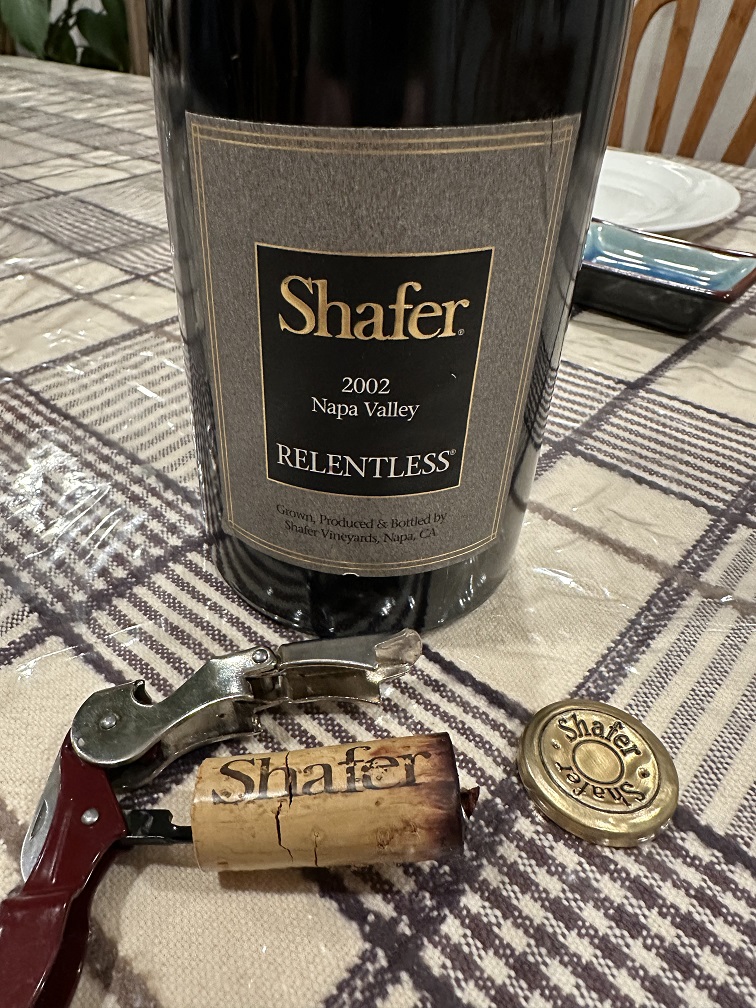
And then there was 2002 Shafer Relentless Napa Valley (14.5% ABV, 80% Syrah, 20% Petite Sirah). I tasted this wine a few times before at the trade tastings, but never had an opportunity to really spend some time with it.
Shafer needs no introductions to California wine lovers, with its fame closely associated with the flagship wine, Shafer Hillside Select Cabernet Sauvignon. Shafer Relentless is not as well known, but this Syrah blend has been around for more than two decades, named in honor of Shafer’s [relentless] winemaker, Elias Fernandez.
We didn’t decant the wine – it would probably help a bit, but I just didn’t want to deal with it. At first, the wine was tight, with well-noticeable tannins and an interplay of tar and cherries, with the addition of pepper. After some time in the glass and opened bottle, the tar subsided, leaving delicious peppery cherries to be admired around a layered but firm core. This 23 years old wine showed beautifully and it was a real treat.
Now the last piece – food. We stopped going out to the restaurants on Valentine’s Day a long time ago – the experience just not worth it. We were craving sushi for some reason, so that is what completed our Valentine’s Day dinner – here you can see some creative rolls from an Asian restaurant not too far from our house.


There you are my friends – our V-day reflections. How was your celebration? Any special wine experiences? Do tell! And until the next time – cheers!
Last Bottle Sign Up ($10 credit)




 Talk-A-Vino