Archive
Overcoming Writer’s Block (Actually, a Daily Glass Post)
 Over the course of last week, I found it almost impossible to write even a line in the blog. There is plenty of stuff to write about – Spanish Wine Festival, Bordeaux Vertical Tasting, many great wine encounters – and, nevertheless, not a line. Like someone turned the switch off. Until today, when I happened to share my frustration with my 12-year old son. He asked how my writing was going, and explained that it is not going well, as I can’t produce anything. Ah, writer’s block, he said, nodding understandingly. That’s it. As it often happens in my beloved Fantasy books, once you know the True Name of something or someone, you can control it. Here as well, once I managed to name my inability to write as a “writer’s block”, situation magically became controllable, and here I’m am – or to be more correct, here is the post, which I wanted to write before I will get to the couple of big subjects.
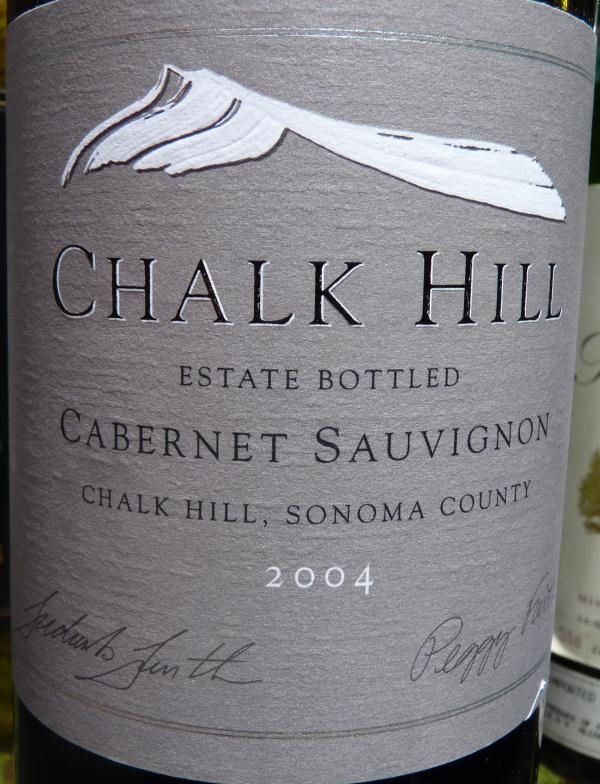
I wanted to talk about life lessons and tasting of the 2004 Chalk Hill Estate Bottled Cabernet Sauvignon, coming from very respectful producer in Sonoma County, Chalk Hill. Why life lessons, you ask? Very simple. I pride myself with being a semi-pro when it comes to wine. One of the important traits of such a self-image (in my opinion, of course), should be an ability to take the wines objectively – even if I don’t like the wine, I expect myself to be able to declare that while the wine is not in my style, it is still a good/well made wine.
First sip of this 2004 Cabernet – and I don’t follow that “objective” rule even for a split second – I declare wine as not my style at all and also simply as not being a goods wine. Reason for such declaration? The first sensation I got on the palate was “burnt fruit” – this is not necessarily a standard term, but I use it to describe an over-ripe fruit flavor, which used to be very common in inexpensive Australian Shiraz. Therefore, after the first sip, I declare that I can’t drink this wine at all.
Now, talk about luck – I was actually lucky that the wine, which was opened during a dinner with friends, was not finished completely. Subsequently, I had an opportunity to finish this wine two days after the bottle was opened (bottle was preserved with vacuum pump). As you can see, the word “opportunity” was used to describe the experience, so I guess you can sense some change. Yes, magical transformation took place over those two days. The wine became incredibly elegant, with silky smooth tannins and very gentle, yet powerful mouth-feel. Classic Cabernet fruit flavors, such as black currant and blackberries were present, together with hint of eucalyptus and cedar, in perfect harmony with acidity and tannins. This was truly a magnificent wine, and I was simply upset with my inability to recognize great wine from the get go. Drinkability: 9
Oh well, I learned my lesson, and I also learned to control writers’ block (hope both statements are true). And I will have to prove that I did by not repeating these mistakes again. Of course you will here about it – through this exact blog. Until the next time – cheers!
Tasting Wines of Anderson’s Conn Valley
 Once again Stew Leonard’s Wines brought up a excellent opportunity to experience wines (you can find some of the old posts about wine tasting at Stew Leonard’s Wines here). This time, the tasting included wines from Anderson’s Conn Valley Vineyards in Napa Valley, California.
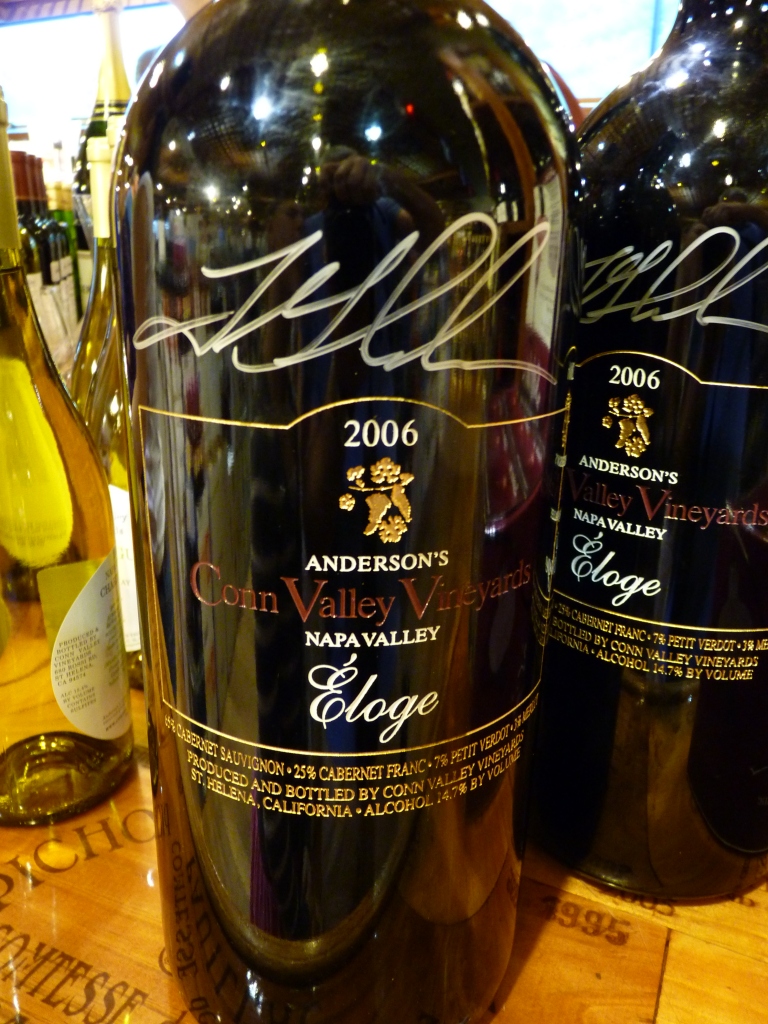
Four different wines were presented in the tasting: 2009 Anderson’s Conn Valley Prologue Chardonnay, 2008 Anderson’s Conn Valley Prologue Cabernet Sauvignon, 2008 Anderson’s Conn Valley Right Bank and 2008 Anderson’s Conn Valley Cabernet Sauvignon Reserve. There was also wine #5 there, 2006 Anderson’s Conn Valley Eloge, but only available for sale, not for tasting (in large, 3L bottle format, at $599 each).
2009 Anderson’s Conn Valley Prologue Chardonnay had a very nice nose of white fruit, very delicate and inviting. On the palate, it was also nice and light, but too sweet – the elegance was lost behind that unexpected sweetness. Don’t get me wrong – this was still a nice wine, and it was, of course, a dry wine – but it was asking for more acidity. And for my personal taste I like more tannins and butter. Drinkability: 7+
Next was 2008 Anderson’s Conn Valley Prologue Cabernet Sauvignon. As winemaker Todd Anderson, who was present at the tasting, said, “this wine for made for the price point”. The price point ( in that particular store) was $23.99, which would make it a reasonably priced Cabernet Sauvignon. The wine was oaky, with some fruit showing up in the background. It will probably improve over the next 4-5 years. Drinkability: 7
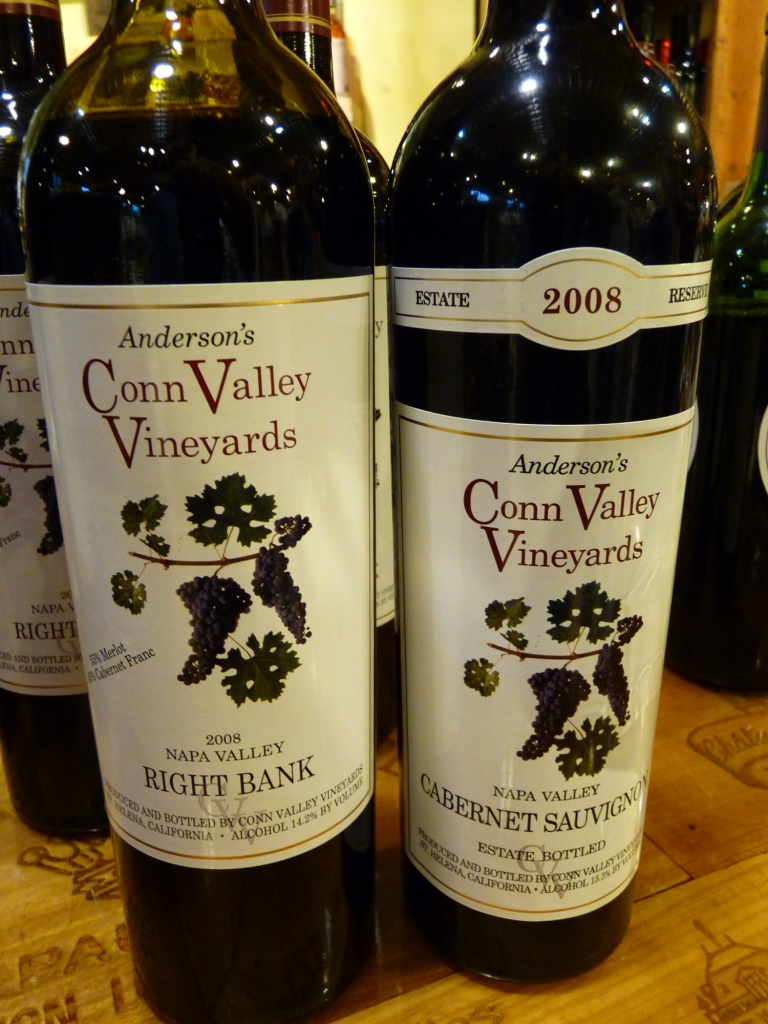 Next in the tasting was 2008 Anderson’s Conn Valley Right Bank red, which is a Bordeaux style blend ( Merlot/Cabernet Franc). This wine actually was quite enjoyable, with good structure and good balance of fruit, acidity and tannins, nice, very delicate earthy notes of the good Bordeaux, and with medium finish. This wine was best in tasting. It will also improve with ageing, probably over the next 10 years or more. Drinkability: 8-
Lat wine in the tasting was 2008 Anderson’s Conn Valley Cabernet Sauvignon Reserve, 100% Cabernet Sauvignon grape. This wine had a great nose of black currant and blackberries, and very delicate balance on the palate. At the same time, it was lacking the body and was falling short on the finish. It is quite possible that this wine will improve with age, or may be even with the breathing time, but as it was presented in the tasting, it was lacking the “umph” factor. Drinkability: 7+
Overall, it was great to be able to try good California wines, and if you are not following Stew Leonard’s Wines on Facebook, click here to open their page and become fun – this way you will not miss any opportunities to try some good wines. Until the next time – Cheers!
Wines of Georgia: You Have To Experience It To Believe It
 The subject of Georgian wines is not new on this blog – I wrote about Georgian wines on a number of occasions, and those were good occasions, or maybe rather even good surprises (you can find the posts here and here). But after I was lucky enough to attend a Georgian Wine tasting in New York City, I don’t want to talk about Georgian wines in terms of “good surprises” anymore – I think Georgian wines are ready to take a permanent high place in the wine’s “who is who” world.
There were about 60-70 wines presented in the tasting. I didn’t have a chance to taste each and every one of them, but among those I tried, there were no bad wines. There were some which were regular, there were some which were good, there were some which were great, and there were a few which were amazing. I think this is a pretty good lineup for the wines which I would collectively avoid only about a year ago, as those were mediocre at best. There is a definite trend up in the quality of Georgian wines, and I believe a lot of them are ready to meet the discerning palates of wine lovers around the world.
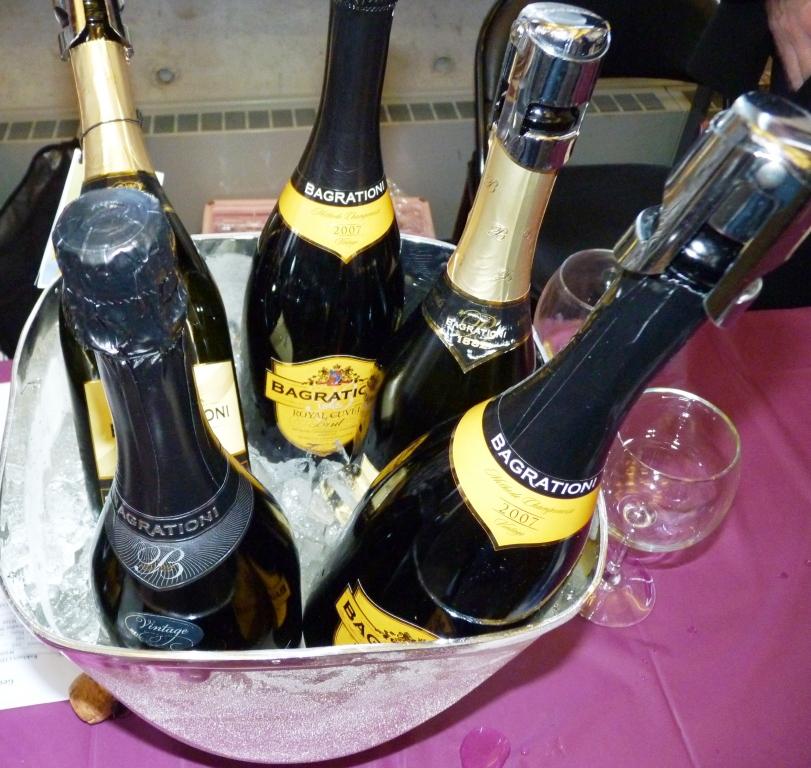
Let me share some of the notes and thoughts, supported by practical examples, of course. I already wrote before about Georgian sparkling wine called Bagrationi. It is produced for more than a hundred years, using traditional Méthode Champenoise. This time I had an opportunity to try four different wines, and they all were very good, but 2007 Bagrationi Royal Cuvee was a standout for me. Medium body, very balanced acidity, very round overall.
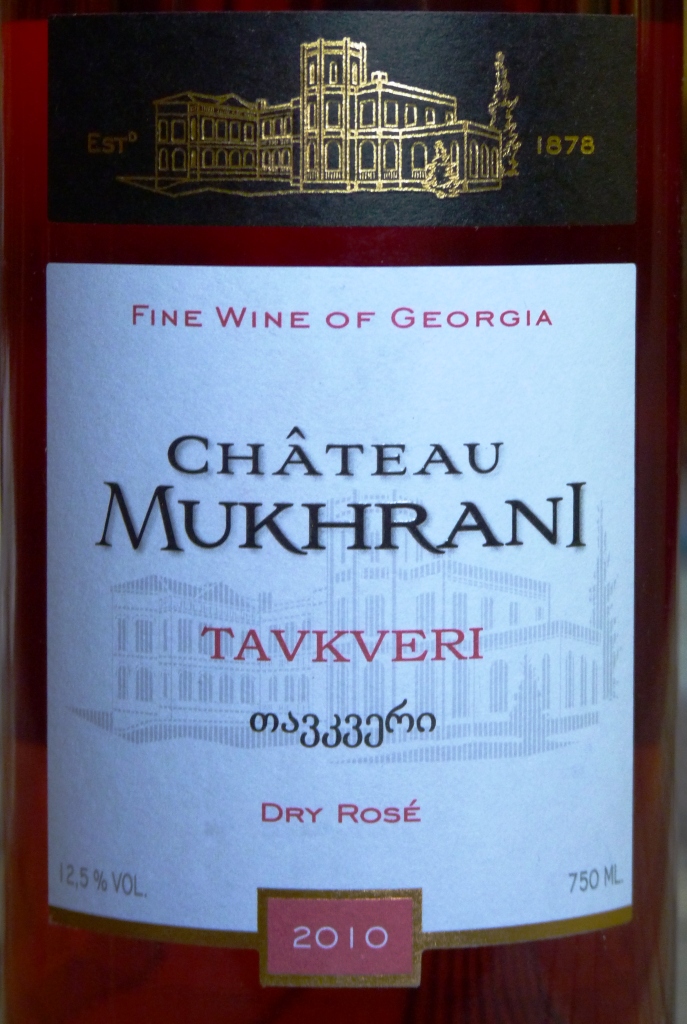 My next personal favorite was the 2010 Chateau Mukhrani Tavkveri Rose. This was one of the number of excellent wines presented by Chateau Mukhrani, and it played to my particular weakness to the Rose wines, especially during summertime. This wine is made out of the indigenous Georgian grape, Tavkveri, one of many other grapes which don’t grow anywhere else (based on information from Wikipedia, there are about 400 varieties growing in Georgia, with less than 40 used for commercial winemaking).
It is not easy to produce a rose wine with a character. Lots of available rose wines from all the different regions are virtually indistinguishable – a little bit of strawberry, and a little bit of acidity, nothing memorable. The Chateau Mukhrani Rose was totally different – lots of concentrated berry flavors, cranberries and sour cherries, all supported by very balanced acidity and a long finish – truly a great Rose.
Another wine from Chateau Mukhrani I have to mention was the 2009 Chateau Mukhrani Shavkapito. Another indigenous grape, Shavkapito, and yet another great tasting wine – good dark fruit expression, very round and layered with smooth and approachable tannins.
The next group of wines I have to mention are the wines made by Pheasant’s Tears and Alaverdi Monastery. What puts these wines aside even in such a distinguished crowd is a very unique method of making wines. Both wineries make wine using qvevri, a clay vessel lined with beeswax, which is used for fermenting and aging the wine. There were a number of wines presented, both red and white, all made using qvevri. The white wines were especially unique, as they sported a deep yellow color, which is typical for really old white wines, but not for white wines which are one or two years old. Most of those white wines also showed quite extensive tannins – without being aged in the oak. All of those characteristics ( deep yellow color, tannins) are coming from prolonged fermentation and aging process which takes place in the qvevri, where grapes are crushed and juice stays in contact with the skins and seeds for a period of up to 6 months. 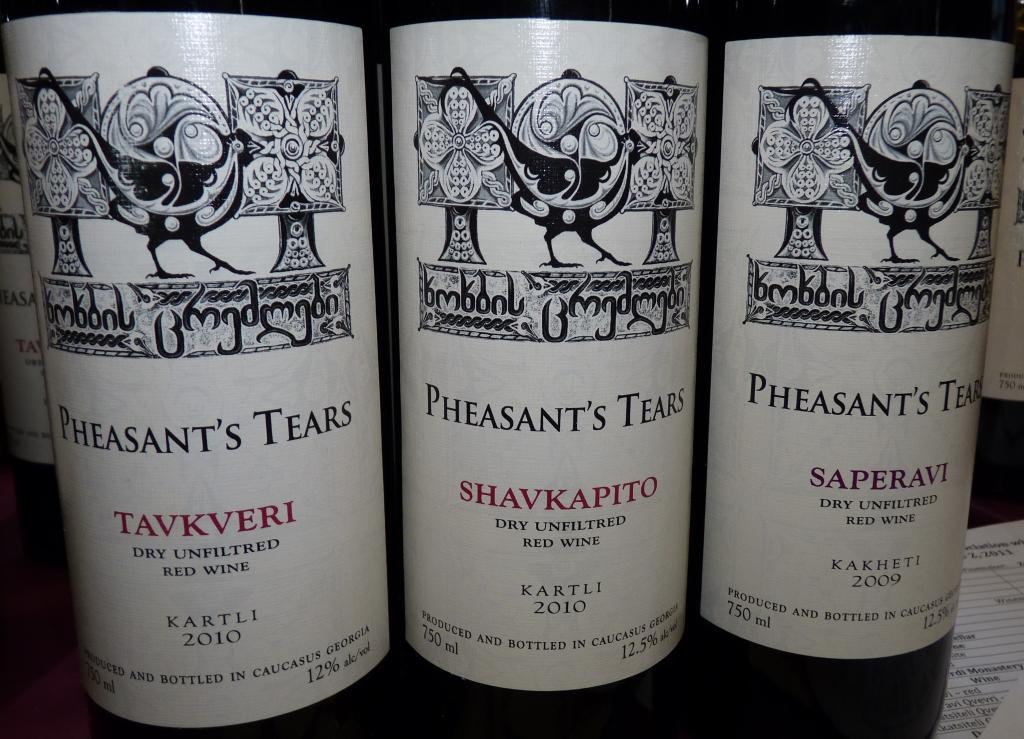 In addition to unique color and tannins, some of the white wines also exhibited Madeira style saltiness, coupled with enough sweetness and acidity to make the overall experience very pleasant. These are really unique wines, and you should try to find them – if you can.
Last but not least are the wines which were my absolute favorite in this tasting – Mukuzani and Saperavi red wines produced by Maisuradze wines.
 Both 2005 Maisuradze Wines Saperavi and 2005 Maisuradze Wines Mukuzani are produced from the Saperavi grape – one of the most popular grapes used in the production of red wines in Georgia. The difference between the wines is that Mukuzani contains only Saperavi grapes actually grown at Mukuzani vineyards. Another difference is the aging time in oak – Mukuzani spent 24 months in oak versus 12 months for Saperavi. Both wines are showing tremendous power and structure, and while Saperavi is more approachable, Mukuzani still needs time in the cellar – it will truly shine after another 10 years (at least) in the cellar. Both wines are excellent and definitely worth seeking.
The bottom line is simple – Georgian wines are ready for the prime time. They need a bit of marketing and a bit of luck, and then we will all have more wines to enjoy. But for now – takes this post to your local wine store, and ask them to get these wines for you – and then let me know what you think.
[Unanticipated] Burgundy Pleasure and Other Grape Encounters
 Looking through the cellar, many bottles have their stories, memories associated with them: “Ahh, I remember I brought this bottle from Italy. And it was raining like crazy when we stopped by that small wine shop in Paris, where this bottle is from. And this one – it was our vacation in Florida (coconut wine, anyone?). Aha, this one I got as a present for my birthday… And those five? I hope they will be as good as the first one was three years ago…”.
Then you stumble upon a bottle on which you go totally blank: “No, I don’t recognize the producer or the winery. Did I bring it from somewhere? Probably not. Where could I buy it? I think I got it as a present?”. Good thing in such a case is the fact that most likely you will have no expectations, so you will take this wine for what it is.
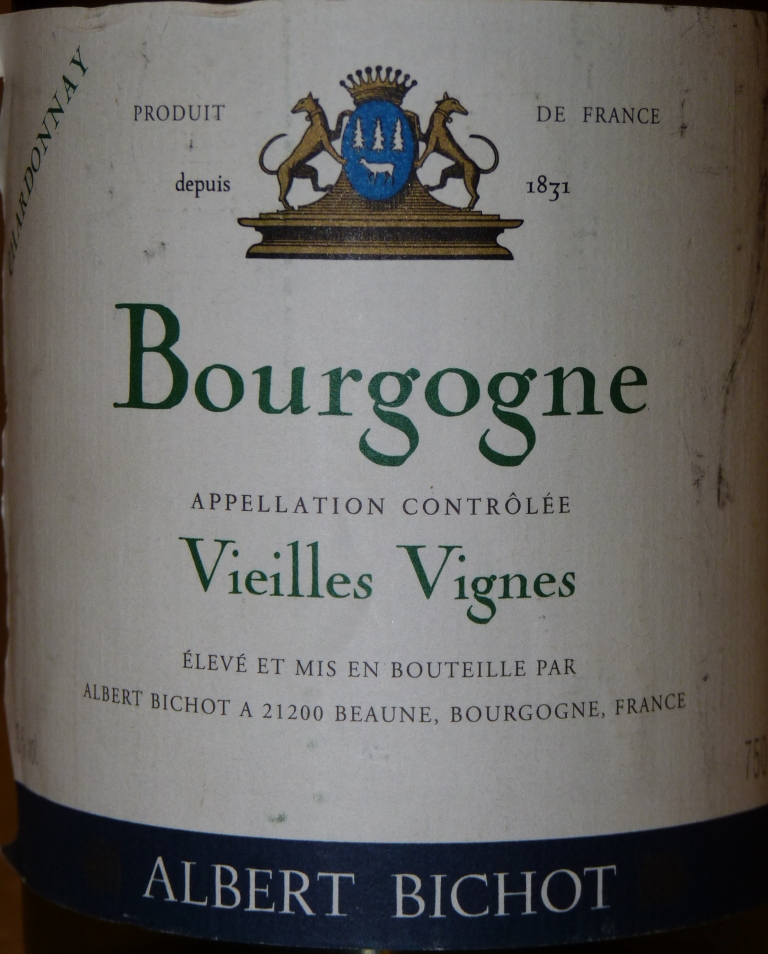
This was exactly my experience with 2004 Albert Bichot Vieilles Vignes Bourgogne – I had the bottle for a while, but how did it end up in my wine fridge, I had (and still have) no idea. Considering the wine was 7 years old, and from unknown ( for me) producer, it could’ve been already gone in terms of quality and pleasure, so the decision was made – the time has come to open the bottle.
This 2004 white Burgundy (100% Chardonnay, of course) happened to be in a perfect shape! Vanilla and touch of spices on the nose, hint of vanilla and lichee fruit on the palate, good acidity – very round and perfectly balanced (Drinkability: 8). Turns out it was a good choice – and having no expectations made it even better experience.
As I mentioned “other grape encounters”, let’s move from France to Italy. I recently had a chance to experience some of my most favorite wines – Amarone. You can read about it in details here – this is my post at The Art of Life Magazine. While the Amarone from Vaona was excellent, I’m still trying to find Amarone which will deliver the same mind-blowing experience I had with 1997 Le Ragose Amarone at the Windows on the World Wine School (read The Art of Life post for the full story) – of course full report is guaranteed if I will be able to find that wine.
And another “grape encounter”, this time moving across the globe east and south, we are getting from Italy to Georgia (and I’m not talking about one of the 50 US States). Few days ago, I was lucky enough to attend Georgian Wine tasting, which I can summarize in one short word: “WOW!”. Extensive report is coming in one of the near future posts, but for now I would like to mention great progress with unique grape count – it increased by 7! In case you are curios, here is the list of grapes and wines:
Chinuri – 2009 Pheasant’s Tears Chinuri Qvevry
Tetra – Alazanis Valley White
Goruli – 2009 Chateau Mukhrani Goruli Mtsvane
Pink Rkatsiteli – 2010 Alaverdi Monasteri Rkatsiteli Qvevry Rose
Kavkveri – 2010 Pheasant’s Tears Kavkveri Qvevry
Tavkvery – 2010 Pheasant’s Tears Tavkvery Qvevry
Shavkapito – 2009 Chateau Mukhrani Shavkapito
Total grape count now reached 324, and counting. Happy grape discoveries to everyone! Cheers!
Three Strikes and … In!
 Very interesting wine ordering experience during the last dinner at The Capital Grille in Paramus, New Jersey. The Capital Grille restaurant itself needs no introduction, of course – whether you like steak or not, every visit there is a dining experience (you can find my previous excited post here). I have to also acknowledge that part of our great experience during this visit was our waiter, Andre – his service was absolutely impeccable.
Ok, so let’s talk about ordering wine. Wine List at the Capital Grille is quite extensive, plus I’m very particular when it comes to wine ( who would’ve thought?) – and one of the things I’m always looking for for is QPR – I want to find the bottle which will taste good, and will have reasonable cost (have a real problem with paying triple-retail in a restaurant). So after 10 minutes of intense reading I finally decided on Ladera Napa Valley Cabernet Sauvignon 2006 – I like the wine very much (you can find one of the previous posts here), besides, at $58 it is less than double retail – makes me very happy. So I ask for the bottle of Ladera 2006, Andre comes back in a few minutes to inform us that they out of Ladera 2006. He start offering 2007 Cabernets – and of course, 2007 Napa valley Cabernets are lauded all over wine press, however, my experience with 2007s is less than stellar – a lot of them simply not ready yet (do I dare to say that they might be just not?). So I refuse his advice, and ask for Central Otago Pinot Noir, Amisfield 2006 – it is outside of QPR comfort zone at $69, but at least I know it is a good wine. Andrea comes back to inform us that they are out of that wine as well. No problems, I was almost ready for that (a bit surprising – two out), so my next choice was Ernesto Catena Locura 2006 blend from Argentina – I didn’t have that before, but at about $55 it was an interesting wine to try. Well, time to ask questions. Do you think we got that wine?
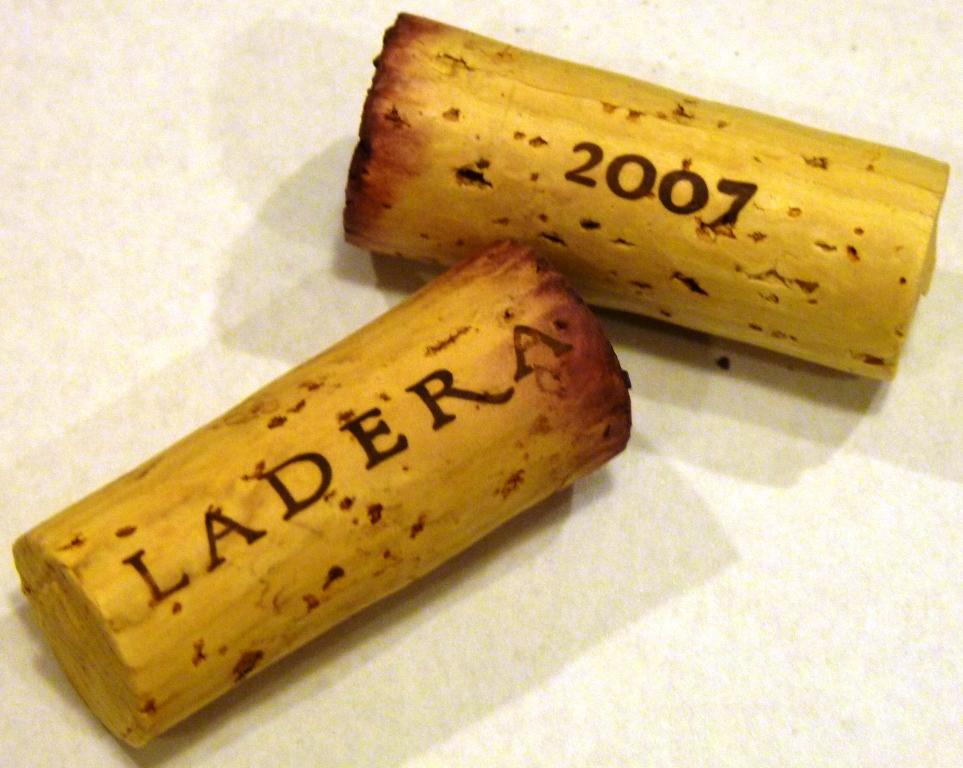 This time Andrea didn’t even show up. Instead, we were approached by the Sommelier (unfortunately we didn’t catch her name) with the bottle of Ladera 2007 in her hand. So we manage to ask for 3 wines from the wine list, which were not available! Of course it happens that the restaurant doesn’t have the wine you ask for, but 3 of them? Wow, we were impressed with our wine picking ability.
Anyway, after Sommelier assured us that she tried that Ladera 2007 and liked it very much, and moreover, if we don’t like the wine we can send it back – we decided to give a try. Oh boy, that happened to be a very good decision, as the wine was beautiful. Soft layered black and red fruit, just right amount of silky tannins, all perfectly balanced with acidity – that was a perfect wine for our dinner, and I would highly recommend this wine to anyone – it is ready to drink now, but as they say, the California Cabernet need about 13 years to shine – it will be interesting to put a few bottles in the cellar and enjoy them later.
So I’m glad to say that this story has a happy end (sometimes restaurant experience can be quite different). Also, if I can give you an advice, for the actual happy ending of the dinner (meaning: desert), try the Cheesecake – it is literally the heaven on earth, and I have to commend Andre for his recommendation – it is the best desert in the house. Until the next time – wishing you all great restaurant experience. Cheers!
Long Overdue–Notes From Michal Skurnik Wine Tasting
 Yes, this post is long overdue, as I hinted that it’s coming a while back. Better late than never, right? Here it is.
Let’s say you are in a wine store. Bottles, bottles are everywhere. Sometimes you know exactly what you want. Sometimes you don’t – and this is when it becomes challenging. How do you know if that bottle of wine is any good? Price is really not an indicator of quality. You can’t try the wine ( at least in the majority of cases). Yes, you can ask for the advice – then it really depends what store you are at (some of the store advice should be avoided at all costs). So, what do you do? Of course, using your iPhone is always an option, but this is not where I’m going right now. One possible solution is to look at the back label, which all the wines in the US have to have. Look for the name of the importer. And if it says “Michael Skurnik” or “Kermit Lynch”, you should smile, because you just learned that chances this bottle of wine is good just increased dramatically.
Why you are asking? Michael Skurnik Wines is so-called “importer” (they are also a wholesaler, but this information is typically not advertised on the label). It means that Michael Skurnik Wines company (MSW) works with thousands and thousands of wineries and other wine merchants all over the world to find the wines which will pass through their rigorous selection process and will be represented by Michael Skurnik Wines.
The wines chosen to be carried in the portfolio might not be all your favorite – but they all will be quality well-made wines. It means that MSW folks are doing all the hard work of selecting the best wines for you, and all you need to do is to enjoy the fruits of labor.
Few times a year wine importers and wholesalers organize special wine tasting events to present their portfolio to the trade. I was lucky to attend Michael Skurnik Wines Spring Grand Tasting, and I would like to share some of my personal highlights.
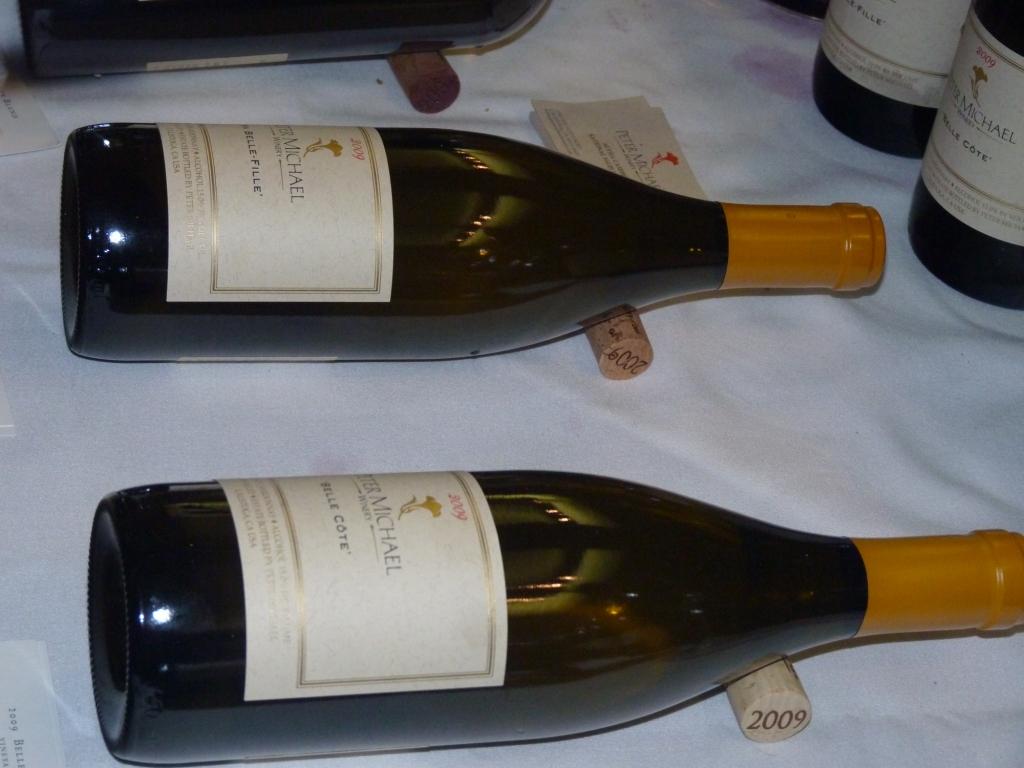
First and foremost, my personal “Best of tasting” is Peter Michael wines. Four 2009 Chardonnays were presented in the tasting (“Mon Plaisir”, “La Carriere”, “Belle Cote” and “Ma Belle-Fille”) – tremendous, all four are the best Chardonnays I ever tasted. Finesse and absolute balance – vanilla, toasted oak and butter all being present, but in absolute harmony with bright acidity, fruit and silky smooth tannins. I would put drinkability for all four at 9+. Just so you know, these are the cult wines, which affects the pricing and availability. These wines are available only through the mailing list or through select merchants – you might be able to find them at Wades Wines and Benchmark Wine Company.
The next highlight was an amazing line of Barolos. A mix of 2005, 2006, 2007 Barolos from Azella, Manzone, Renato Corino, Marengo, Altare, Clerico, Cavalotto – one was better than another, all beautiful and powerful wines. Anyone of the names I mentioned is worth seeking.
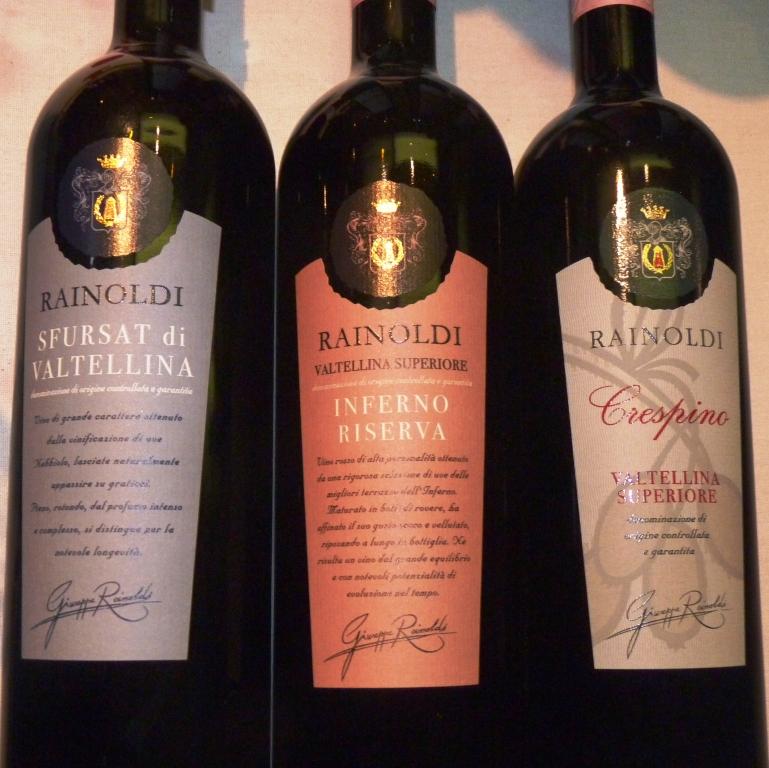 While the Barolos were great, they had a group of contenders, which were literally as good. Wines of Aldo Rainoldi come from the area in Lombardy region called Valtellina. These wines are produced from the same grape as all Barolos – Nebbiolo, with all the vineyards located at the very high altitude of 600+ meters (1800+ feet). I tried four different Aldo Rainoldi wines – 2007 Sassella, 2005 Crespino, 2006 Inferno Reserva and 2007 Sfursat Classico – all were truly outstanding and very comparable with great Barolos, but at the half price as the least.
In addition to all the wines in the tasting (about 700), there were some stronger spirits as well. One of the surprises was Calvados I tried. Calvados is a brandy which is made out of apples in the Calvados region of Normandy in France. Typically, I can drink it, but it is not something I would be seeking out. However, two of the Calvados presented at the tasting – Camut Calvados 6 years old and Camut Calvados Reserve 12 years old were simply incredible. Soft, smooth, elegant, great aroma of fresh apples, very delicate balance. They will not be easy to find, but I would highly recommend you will make an effort. You can try your luck at D&M, and believe me, you will not be disappointed.
That’s all, folks. There were many many more great wines, but you got to stop somewhere, right? Until the next time – cheers!
Daily Glass: Value Wines Project – Portugal, Italy and Oregon
 Here is another Value Wines project update. We had French, Portuguese and Italian wines covered in the project. Today’s update is bringing in a new region – Oregon.
So far I would say that the outcome of the project is very encouraging – a lot of good, very drinkable wines from all regions mentioned above, all priced very well. The wine from Oregon, 2009 Primarius Pinot Noir, however, I would have to call the biggest surprise of the project. Why so? It is not surprising that we can find good and inexpensive wines coming from Portugal, for instance – wine region is grossly ignored and underrated ( this is changing, though), so the winemakers have to price their wines accordingly. Oregon wines, on another side, are well known worldwide as a source of the Pinot Noirs, rivaling those of Burgundy – and so far my experience with any Oregon Pinot Noir under $15 had been largely negative (wimpy and diluted wines).
All in all, Primarius Pinot Noir ($11.99) was very good wine – smokiness and finesse of the classic Pinot Noir, layered and restrained fruit and very good balance – I think this is a great wine for the price (and even in general). I will put Drinkability at 7+.
 Next wine comes from Italy – 2009 Tedeschi Valpolicella Classico ($10.98), and it has both good and bad sides. For the bad side – the wine never came together in a glass. It tasted as all the taste elements – fruitiness, acidity, tannins and alcohol were pulling in the different directions. The wine is drinkable, but not really enjoyable – by itself. I would guess this is a food wine – paired together with some homemade marinara sauce over fresh pasta, it should taste ( and fare) quite differently. For now, I will put Drinkability at 6+. For the good side, I’m adding 3 new grapes with this wine – Rossignola, Negrara and Dindarella, so the total count increases to 312.
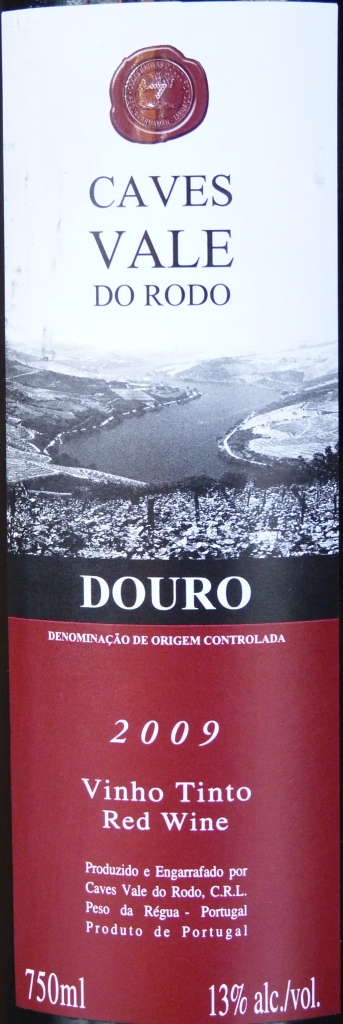
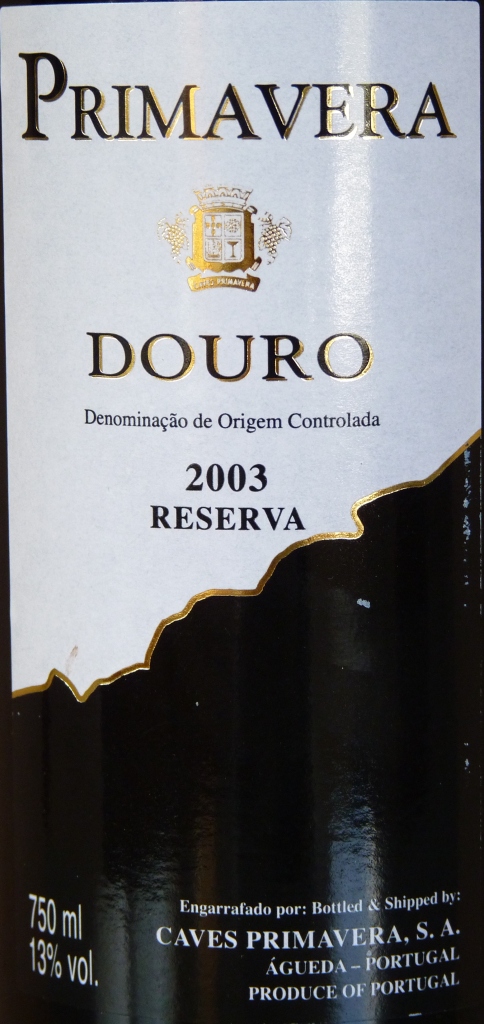
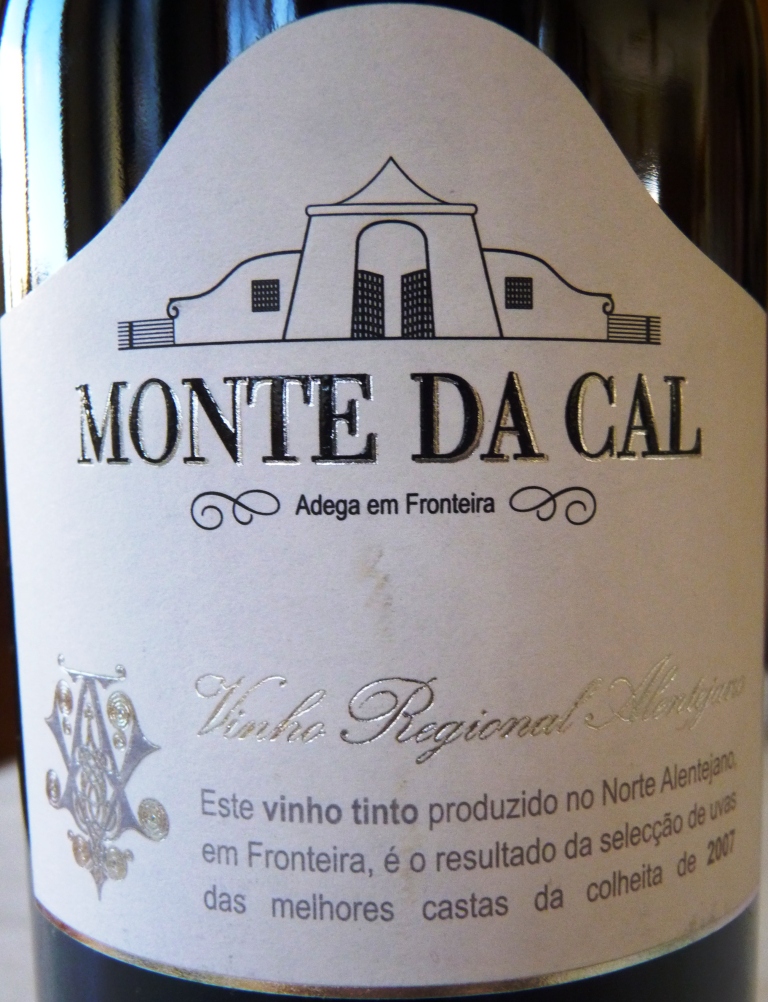
Three more wines from Portugal – 2009 Caves Vale do Rodo, Douro DOC ($6.98), 2003 Primavera Douro DOC Reserva ($6.98) and 2007 Monte Da Cal Vinho Regional Alentejano ($6.47). All three are very nice and simple wines, easy to drink and pleasant – and great value for the money. I will put Drinkability at 7 for all three.
This concludes Value Wines project update for today. Few more wines are left to try in the current batch – as usual, the report will be coming soon.
Pinot Noirs Battle – Let the Best (but Most Unexpected) Win
 When tasting the wine, there is a lot of factors that will affect the perceived taste ( like/don’t like). Some of those factors are objective, like temperature (chill the wine, and some flaws will disappear), and some of the factors are rather subjective, like your mood. I want to talk about another factor that is hard to categorize, but it can greatly affect what we think about wine. It is one and the same factor that comes in many forms – label, producer, cost, rating, and wine critic at the end of the day. Of course, there are exceptions to this rule, there are the best of us who can simply disregard all the known facts, and simply taste the wine for what it is. However, the majority of us (myself definitely included), will be influenced by what we know. Ah, Robert Parker rated this wine 93, it must be really great… This bottle of wine cost $100 – it must be great…
Well, there is a good way to eliminate this factor – it is called blind tasting. Considering this is summer, we decided to try a lighter red grape in the blind tasting format – so we chose Pinot Noir. The great thing about Pinot Noir is that it is grown in many different regions, and while the grape is the same, the wines from the different places will taste quite differently.
How do you run a blind wine tasting? Very easily. Each person brings a wine bottle in the paper bag and then opens it. All the bags are assigned random numbers. Then the wines get poured into the glasses which are standing on the mat with the numbers. Voila! Now all the wines can be tasted and independently assessed – no intimidation by any of the factors we mentioned above – in the glass they all look [almost] the same (oh, boy, I can be bitten up by professionals for such a lame claim, but oh well…).
We had 6 Pinot Noirs and went through them one by one, assessing the color, smell, and taste of each, exchanging thoughts ( like “I think this is California” or “I can’t smell anything”), but not enforcing opinions. Here are my short notes as we went along (you can actually see the picture of all 6 wines and then see how funny my notes are):
#1: New world, too much alcohol – 2006?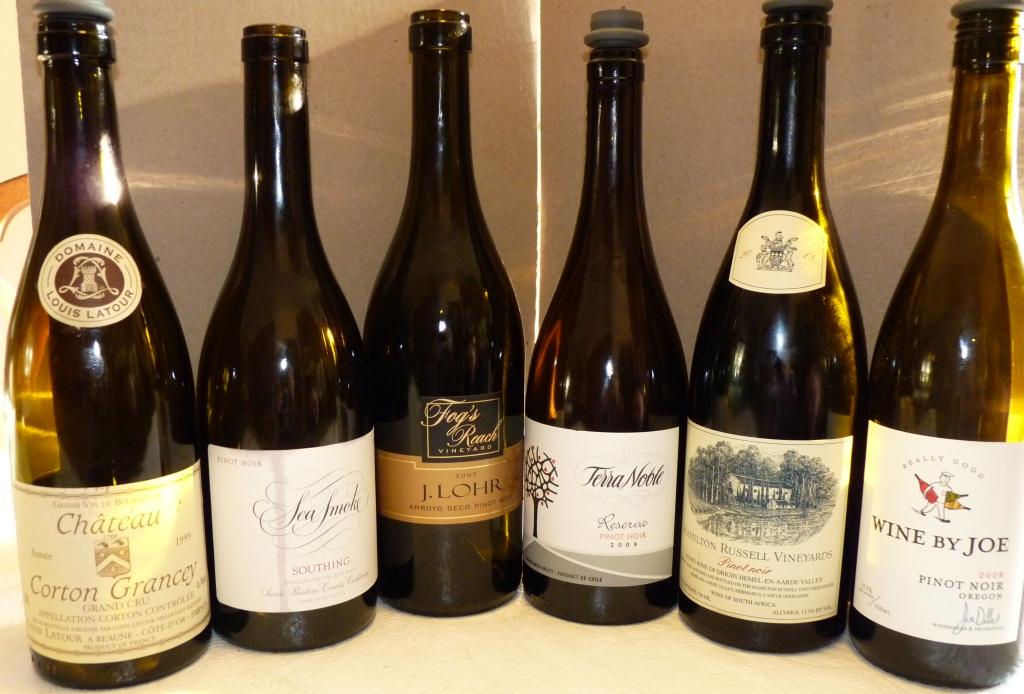 (Actual wine: Chateaux Corton Grancey 1999, Grand Cru Corton, France)
#2: New World, California, 2007/2008? (Actual Wine: Sea Smoke Southing 2007, Sta. Rita Hills, California)
#3: Not bad, needs time, Chile? (Actual wine: J. Lohr Fog’s Reach Pinot Noir 2007, Arroyo Seco, California)
#4: Bright acidity, fresh fruit, Oregon? (Actual wine: Terra Noble Pinot Noir Reserva, 2009, Casablanca Valley, Chile)
#5: Classic – perfect smoky nose (Actual wine: Hamilton Russell Pinot Noir 2008, South Africa)
#6: Young and reminded of Monastrell. Very nice (Actual wine: Wine by Joe Pinot Noir 2008, Oregon)
Once we tried all 6 wines, it was time to tally it up and proclaim the winner, after which all the wines were revealed out of their bags. I would think that considering the title of the post, you already guessed that something unusual is coming. True, though for me it was way too unusual. So the two winning wines were tied up – #3 and #5, both got the same number of votes. I can understand wine #3, J. Lohr Fog’s Reach Pinot Noir from Monterey County, California. California is known as the place for Pinot Noirs, especially with the help of the movie Sideways. But wine #5, which I thought had all the traits of the classic Burgundy – please tell me honestly, how many of you heard of ( never mind trying) Pinot Noir from South Africa?! Of course, there are great wines from South Africa – Cabernet Sauvignon, Shiraz, Chenin Blanc, Chardonnay, but Pinot Noir? And nevertheless, wine #5 was Hamilton Russell Pinot Noir from South Africa.
So here you have it – blind wine tasting, which removes all the intimidation and decision influencers, and leaves you one on one with the wine in a pure and honest fashion. No hints “oh, that should be good because…”, no pretension. Of course, there can be flaps. Wine #1 was spoiled (probably oxidation), so it should really be excused from the judgment. At the same time, wine #2, Sea Smoke Southing, would probably be a winner, simply because it is a cult Pinot, and it costs $80+ – if you can find it. And yet in the blind setting, it didn’t generate much response. Of course, there is always a happy chance that none of us has a sophisticated palate – but at the end of the day, the definition of the “best wine” is simple – it is the one which YOU consider the best, so I think we shouldn’t worry about it.
To conclude – get your friends together and try blind tasting one day – you might be surprised, but you will not be disappointed! Drink the wine, and have fun doing that :).
Cheers!
Last Bottle Sign Up ($10 credit)




 Talk-A-Vino