Archive
Weekly Wine Quiz #62: Wine Trivia – Nebbiolo
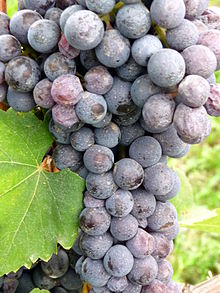
Nebbiolo grapes, picture from Wikipedia
Welcome to the weekend! Your new wine quiz has arrived.
Today our subject is the Italian grape called Nebbiolo – a power grape of Piedmont, solely responsible for some of the world’s best wines, Barolo and Barbareso.
As I’m working on this series of quizzes, I’m of course learning a lot myself. It was very interesting for me to realize, that unlike any other major red grape we talked about so far, Nebbiolo is pretty much confined to the 6 or so areas in Italy, where it makes wonderful wines – its world-wide spread is non existent, not even in the form of clones, like Zinfandel. And this is all despite the fact that Nebbiolo is quite an old grape, with first mentions going all the way back to the 13th century.
Nebbiolo is a very tricky grape to work with. It has the longest ripening cycle out of many grapes – buds early, ripens very late, prone both to mutation (there are about 40 known clones) and grape diseases. But – the resulting wines, like Barolo and Barbaresco, clearly worth the trouble, with wonderful aromatics, power and concentration. Also the ageing potential of the Nebbiolo wines is almost unlimited.
Now, to the quiz!
Q1: Explain the meaning of the name “Nebbiolo”
Q2: In one of the regions outside Piedmont, the wines are produced from Nebbiolo grapes in the style of Amarone – with grapes drying on the straw mats before they are pressed. Can you name that region?
Q3: True or False: Blending is not allowed for any of the wines produced from Nebbiolo grape in Piedmont region.
Q4: White grape used to be such a traditional blending partner for Nebbiolo that it was sometimes called White Barolo. Do you know the name of this grape?
Q5: In the blind tasting setting, the wines made out of Nebbiolo can be very distinguishable even before you take a first sip. Do you know what is this distinct feature of Nebbiolo wines?
Good luck, enjoy your weekend and cheers!
Wednesday’s Meritage – Wine Quiz Answer, WTSO Cheapskate Wednesday in Progress, How To Taste Wine and more
Meritage Time!
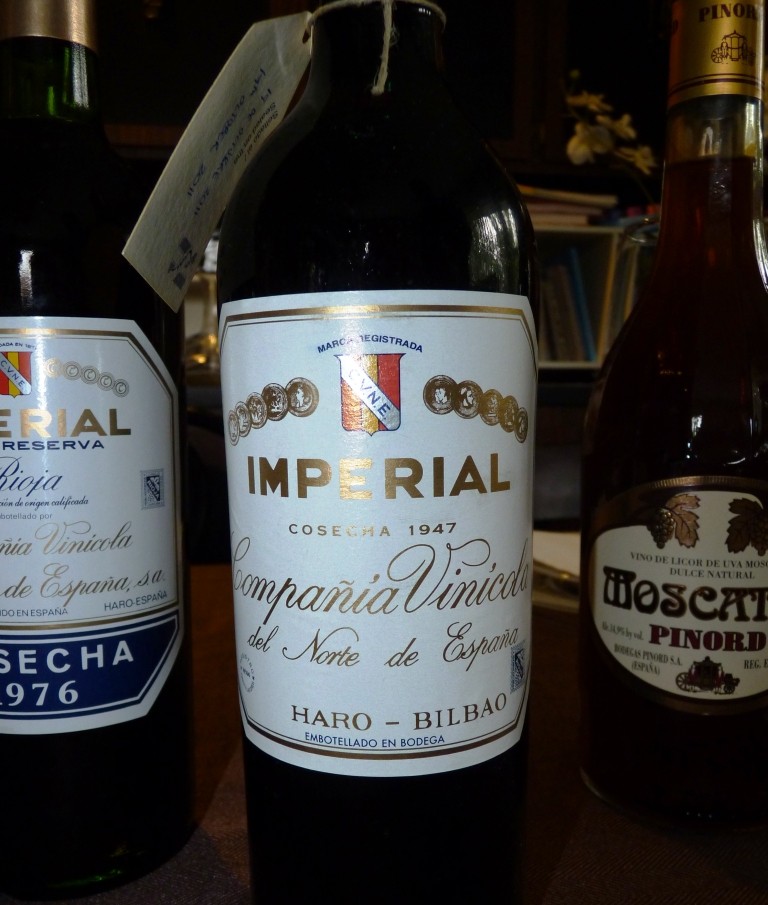 Let’s start with the answer to the wine quiz #61, grape trivia – Tempranillo. In the quiz, you were supposed to answer 5 questions about Tempranillo, the noble Spanish grape. Here are the questions with the answers:
Q1: What is the meaning of the name Tempranillo?
A1: Name Tempranillo comes from Spanish word temprano, which means “early”. Tempranillo typically ripens two weeks earlier compare to many other grapes.
Q2: Name 3 grapes, traditional blending partners of Tempranillo
A2: Traditionally, in Rioja wines, Tempranillo is blended with Mazuello, Grenache and Graciano.
Q3: What is common between Bodegas Muga, La Rioja Alta, Lopez de Heredia and Vina Real outside of the fact that all four are very famous Rioja producers and of course make wines out of Tempranillo?
A3: This was definitely a difficult question. What this four wonderful Rioja producers have in common is … location. All for wineries are located within walking distance from each other around old train station in Haro.
Q4: Tempranillo is used in production of the wine outside of Spain, which is at least equally famous to Rioja. Do you know what wine is that?
A4: Port. Tempranillo is known in Portugal under the name of Tinta Roriz, and it is one of the essential grapes in Port production.
Q5: Name two producers of Tempranillo wines – one is the most famous and another one is probably the most expensive.
A5: Another pretty difficult question. Vega Sicilia is definitely the most famous producer of Tempranillo wines with their flagship wine called Unico. And while it is quite expensive at $500+ per bottle, Dominio de Pingus makes probably the most expensive Tempranillo wines. Both wineries are located in Ribera del Duero region.
Based on the low participation in this quiz I can only say – people, you have to drink more Spanish wines (see, I’m only using bold font instead of capitalizing = screaming)! Especially from Rioja and Ribera del Duero. Anyway, as I said, at least two questions were quite difficult. We don’t have clear winner today, with Emil ( he doesn’t have a blog) coming the closest with about 3.5 points, so he definitely gets an honorable mention.
And now to the interesting stuff around vine and web!
First – don’t miss the WTSO Cheapskate Wednesday which is taking place today, June 19th. Yes, it is not super convenient to keep WTSO open in the browser and hit refresh all the time, but you have very few alternatives to that. You can also follow WTSO on Twitter – the only medium where new wine information is updated in real time. Make sure you have all your correct information on file with WTSO – shipping address and the credit card – otherwise you are risking to miss on the wine you want while you will be filling up the details (being there, done that). I posted many times before about WTSO events – if you are interesting in taking the look at the past sales, use this link.
Next, I want to bring to your attention an interesting article by Master Sommelier Tim Gaiser, called “How to taste wine”. I’m sure that many of you tried at various occasion to figure out what exactly is in your glass – it is a fun challenge to take random glass of wine, look, sniff, swirl, sip – and confidently say “Shiraz, Barossa, Penfolds, 1998 or 1999” and then find out that you’ve been right, or may be it was actually an Argentinian Malbec. Using techniques offered as part of any serious wine education (Master Sommeliers, WSET, Master of Wine, etc.) can actually increase your chances of being right. This article explains in good detail the approach to the blind tasting taken by Master Sommeliers.
If you are a Pinot Noir aficionado, this article might be for you. Written by Jay McInerney for Wall Street Journal, it is dedicated to David Hirsch of Hirsch Vineyards, one of the pioneers of Sonoma cool climate Pinot Noir.
Last but not least, here is an interesting blog post by W. Blake Gray, where he is talking about the study regarding cork taint. According to that study, 10% of the people actually prefer corked wines! For the first 10 minutes after I read it, I had mostly expletives roaming through my head – then I was able to compose myself and leave a [decent] comment. Yeah, well, no further comments – read it for yourself…
That’s all I have for you for today – the glass is empty! Refill is coming, and until the next time – cheers!
Zin Versus Zin Versus Zin
 I was in “zin’s mind” this past Father’s day. I don’t know how did that happened, but when I was thinking what bottle to open for dinner, “how about Zinfandel” thought came over. I had no reason to resist, so Zinfandel was it. And by the way – the title of this post sounds a bit antagonistic – but this is not the idea. I just happened to enjoy recently 3 different Zinfandel wines, hence the wording in the title.
Zinfandel is one of the pretty unique grapes – even if we will count Primitivo as Zinfandel (which technically is incorrect – it is only a very close relative), there are only a handful of places where Zinfandel wines are produced. But – the good news is that California, the primary Zinfandel’s habitat, has no shortage of excellent Zinfandel producers.
If you will take a look at my “Happy Father’s Day” picture, you can see two Zinfandels there – and these are the wines I want to talk about. First, a couple of words about producers. Turley Wine Cellars needs no introduction for any Zinfandel aficionado. Turley produces 28 wines, most of the them are Zinfandel with addition of few Petite Sirah and some others, coming from Napa, Sonoma, Lodi, Paso Robles and other primary areas in California. Turley is a “cult” winery, and while their wines can be found in some of the very select wine stores and restaurants, one really have to be on their mailing list to have more universal access to their wines (Turley was the first mailing list I was accepted onto – give me a second and slice of lemon to extinguish smile on my face).
The second producer is called The Wine Guerrilla. While not as well known as Turley, they also produce a full range of Zinfandel wines from the different areas in California. It is interesting to point out that The Wine Guerrilla is the only producer (to the best of my knowledge), which doesn’t make any other wines but Zinfandel. When your slogan is “The Art And Soul of Zinfandel”, I guess this is rather appropriate.
 I decanted both Turley and Wine Guerrilla Zinfandel for about 2 hours. Yes, I know this is not typical to use a decanter around Zinfandel, but both wineries make wines rather in restrained style, so I really wanted them to open up. First up – 2009 Turley Pesenti Vineyard Zinfandel Paso Robles (16% ABV). Even after two hours of decanting, the most I got on the nose was a hint of blackberries and some dark chocolate notes. The very first sip of the wine said “I’m big”. The first words which come to mind to describe this wine are “dense”, “firm”, “structured”. On the very firm structure the perfect fruit is weaved (hmm, interesting composition of the sentence – not a typical one for me, but I like it : ) ). More blackberries and dark chocolate on the palate, but also an “old world style” minerality was coming through, and then acidity was all in check. The wine is perfectly balanced, with tannins, alcohol, fruit and acidity being all together, in harmony. Drinkability: 8-
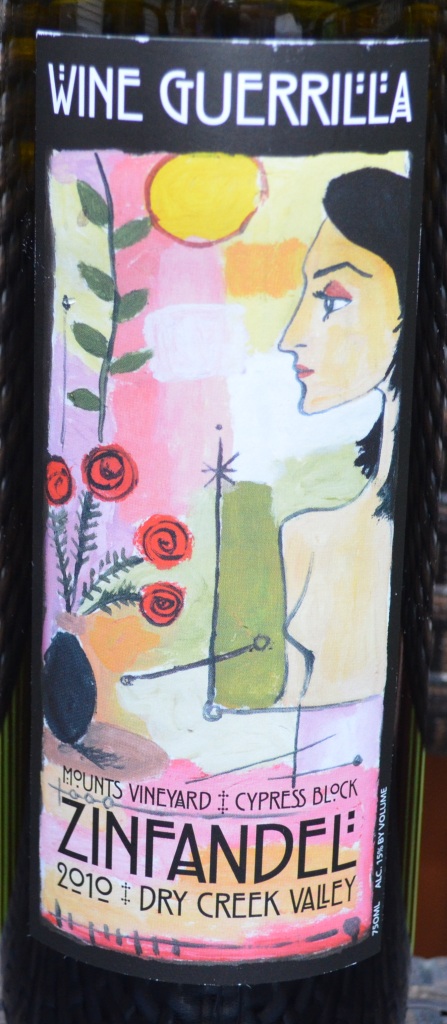 Now, let’s talk about 2010 Wine Guerrilla Mounts Vineyard Cypress Block Zinfandel Dry Creek Valley, Sonoma (15% ABV, 95% Zinfandel, 5% Petite Sirah, 300 cases produced). The wine showed a lot of dark fruit on the nose, mostly blackberries and cherries. On the palate, the wine was not as structurally dense as Turley, but instead it had layers of fruit with very nice luscious texture – ripe blackberries, cherries and dark chocolate, and a hint of eucalyptus. Very good acidity and overall nice and round wine, excellent balance. Drinkability: 8-
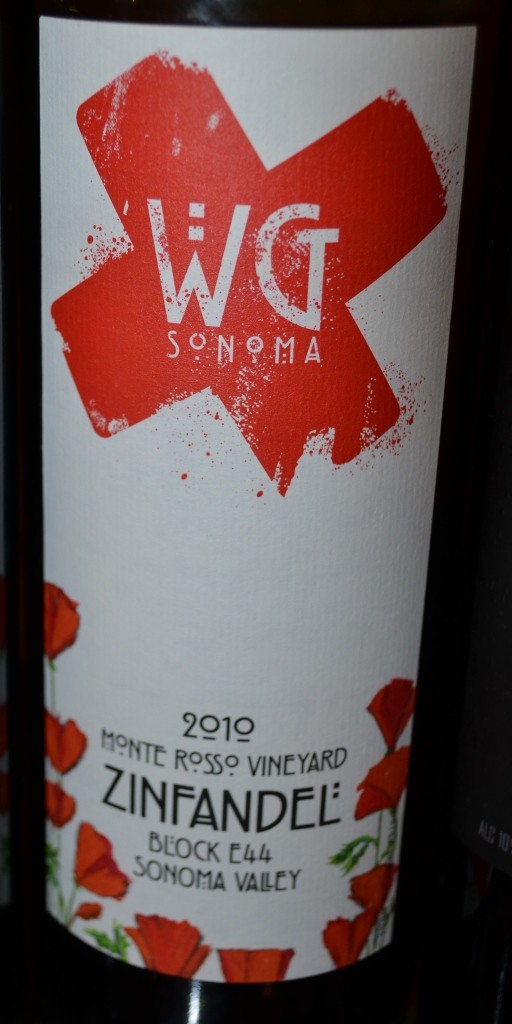
Did you notice a label of another Wine Guerrilla Zinfandel at the beginning of this post? It is there not for the purposes of decoration – it is actually another Wine Guerrilla Zinfandel which I had a week ago. 2010 Wine Guerrilla Monte Rosso Vineyard Block E44 Zinfandel Sonoma Valley (15% ABV, 200 cases produced) was totally unique in its style. To give you an idea, I would call it a Brunello of Zinfandels. After 2+ hours in decanter, the first thing which came to mind after the first sip was “dry”. This wine was soooo dry – uniquely dry for Zinfandel. It was also very herbaceous for the Zinfandel, with lots of dried herbs aromas, such as sage and oregano. It did show some fruit, but in very restrained, dialed back fashion. Definitely the most food friendly Zinfandel I ever tried, very balanced overall. Drinkability: 8
So I have to confess that I have one regret in regards to three wines I presented to you today. One, but big regret – I really want to taste these wines 10 years down the road! No, decanting didn’t do them any justice. These wines have to mature first, and then they will give you an ultimate pleasure. They were great and very enjoyable wines now, but they would become something much much bigger – if I would only have some spares…
Before we part, I want to share a few pictures from the Father’s day. Few weeks ago, my cousin got for me a new charcoal grill which is called “mangal” and it is mostly intended for making a kabob, but of course can be used as generic charcoal grill. Here are few pictures for you – with the warning – it might make you hungry…

Ribs and chicken

just chicken

just ribs
That’s all I have for you for now. Ahh, before I will forget – don’t miss the WTSO Cheapskate Wednesday tomorrow, June 19th. Expected to appear are Benziger Pinot Noir, Rioja DOC Crianza, Provenance Merlot, Pomo Nation Cabernet, Expo Cabernet and Edenhall Shiraz, of course in addition to many many other wines. Cheers!
Disclaimer: The Wine Guerrilla wines were provided courtesy of Wine Guerrilla. But of course all opinions are my own.
Weekly Wine Quiz #61: Grape Trivia – Tempranillo
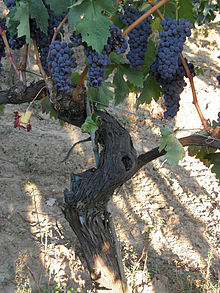
Tempranillo grapes as captured in Wikipedia
Welcome to the weekend! Here is your new wine quiz you’ve been waiting for so hard (yeah, okay, I know I’m pushing it, but may be at least a bit?)
And yes, we are continuing the grape trivia subject – by the way, if you are tired of it, do tell me – I will come up with something else. Just to let you know, we have two more red grapes to go through, and then we will switch to the whites for may be 8 different white grapes – then will see where we will end up.
Today’s subject is – Tempranillo! Just saying the word Tempranillo makes me very excited, as Rioja, one of the most well-known wines made out of Tempranillo grapes, are some of my all time favorites.
Tempranillo is indigenous grape originating in Spain, with more than 2000 years of history. It is black, thick-skinned grape, capable of surviving temperature swings of Mediterranean climate, with very hot days and cool nights. Tempranillo grapes are naturally low in acid and sugar content, so they often rely on blending partners to complement on both. Flavor profile of Tempranillo typically includes berries, leather (so famous in Rioja wines) and tobacco. Most famous Tempranillo wines come from Spain, from Rioja and Ribera del Duero regions, but Tempranillo is successfullygrowing in many other regions, including Portugal, California, Texas (up and coming star), South Africa, Australia and others.
And now, to the quiz!
Q1: What is the meaning of the name Tempranillo?
Q2: Name 3 grapes, traditional blending partners of Tempranillo
Q3: What is common between Bodegas Muga, La Rioja Alta, Lopez de Heredia and Vina Real outside of the fact that all four are very famous Rioja producers and of course make wines out of Tempranillo?
Q4: Tempranillo is used in production of the wine outside of Spain, which is at least equally famous to Rioja. Do you know what wine is that?
Q5: Name two producers of Tempranillo wines – one is the most famous and another one is probably the most expensive.
Enjoy the weekend and good luck with the quiz. And don’t forget to celebrate Dad tomorrow – Father’s Day, yay! Cheers!
Screw Top Versus Cork – The Jury Is Still Out
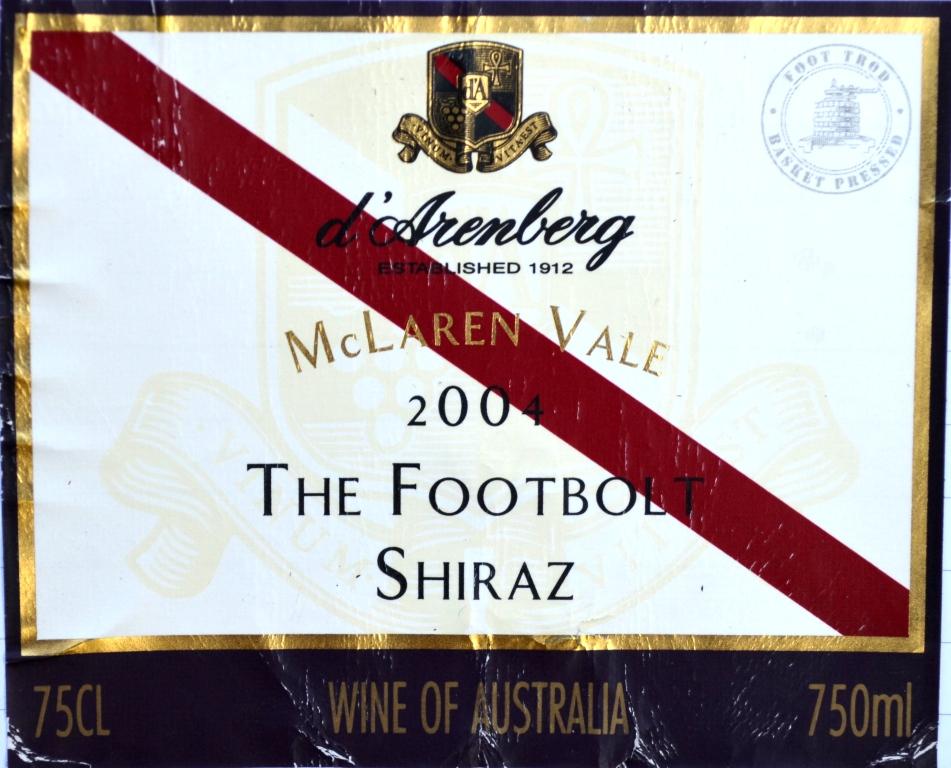 Inadvertently, I run an experiment of cork versus screw top, and the results were interesting enough to discuss them here.
About a week ago, I pulled out of the cellar (which is actually a wine fridge) the bottle of 2004 d’Arenberg The Footbolt Shiraz MacLaren Vale from Australia (14.5% ABV). As I confessed in my blogging addiction in the recent post, before the bottle is open, in addition to just regular anticipation of wine experience itself, now I have added anticipation of the possible blog post which can be written based on the wine experience.
Or not. There are many possible was for the experience not becoming a blog post. Too many things to write about, too little time. Or you just hit the “writer’s block”. Or the experience is not worthy of being captured. Which was the case with this Shiraz.
d’Arenberg is a well known Australian winery, which just celebrated 100 years last year, producing substantial range of typical Australian wines, such as Shiraz, Grenache, Chardonnay, Cabernet Sauvignon and more. I had pleasure of meeting Chester Osborn, d’Arenberg’s winemaker in third generation, and even have couple of bottles with his signature in my cellar (by the way, what do you do with those signed bottles? I should make a separate post to discuss this interesting question).
Now, I didn’t know what to expect from this bottle of Shiraz. The Footbolt is one of the introductory level Shiraz wines from d’Arenberg, but that doesn’t mean anything. Cork is out (regular cork, just keep reading to see why it is important), and judging by the color alone, this wine didn’t reach its prime yet – dark ruby in color. But the nose and then the palate were inconclusive. Acidity would jump up and down with every sip, and while the wine had enough fruit, it was simply not getting together, definitely lacking the balance which is all so important for me in the wine. So, based on this wine alone, the blog post was not born.
And then yesterday I pulled out another bottle of d’Arenberg wine from the same vintage:
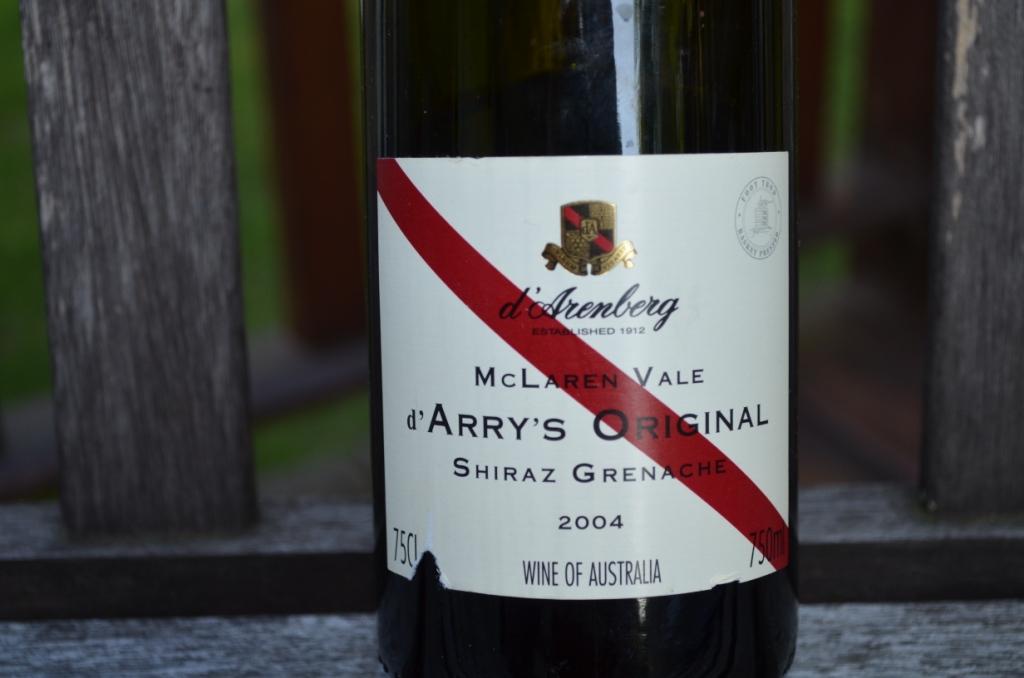
d’Arenberg Shiraz Grenache
2004 d’Arry’s Original Shiraz Grenache McLaren Vale (14.5% ABV) – a blend of 50% Shiraz and 50% Grenache . With the screw top. That was an “aha” moment. Same vintage as the previous wine – but wit the screw top – how different the experience will it be?
No “pop” of the pulled cork. Just a quiet “tsk-tsk-tsk” of unscrewing the top. In the glass, this wine looked like it was made yesterday – dark ruby, very concentrated color. From the get go, the wine showed beautiful fruit on the nose, ripe plums, equally supported on the palate with fresh fruit and energetic acidity.
About 45 minutes or so later, when I poured another glass, the wine tasted almost sweet – the thought was “what happened”? This was a totally a different wine compare to the way the wine started. Another half an hour or so – and we were presented with the new wine again – dark concentrated fruit, firm structure, tannins and acidity all summing up into a gorgeous balanced wine.
Wine ageing in the bottle is typically associated with the tiny inflow of oxygen through the cork. In case of screwtop, the oxygen doesn’t get to the wine at all. Thus my theory is that once you open a bottle under the screwtop, the very quick ageing process starts off, which takes the wine through the different “taste stages” in the rapid succession. Then at the same time, the wine is changing its taste in the glass no matter what, so may be that rapid taste changing has nothing to do with the way the bottle was closed.
Ideally, of course, I would love to compare two identical bottles (same wine, same vintage), only one closed with the screwtop and another one with the regular cork (I believe I actually read about some producers who are doing that). In this experiment, the Shiraz Grenache under the screwtop was a clear winner, but it is hard to tell what it has to do with the screwtop versus regular cork versus the two wines being just differently made.
I guess I can end this report with the words “to be continued…” – and I would love to hear your thoughts. Cheers!
Weekly Wine Quiz #60: Grape Trivia – Sangiovese

Sangiovese grapes close up from Wikipedia
Welcome to the weekend! Yep, it is the time for the new wine knowledge test.
We are continuing our Grape Trivia series, and today we will talk about Sangiovese – one of the most famous Italian grapes. Sangiovese is typically associated with Chianti, but in reality, Sangiovese is one of the most planted grapes all over Italy. One of the interesting issues is that Sangiovese, similarly to Pinot Noir, is very clone-prone, so it is known in different places under different names, such as Sangiovese Grosso, Prugnolo Gentile or Calabrese, to take a few.
Sangiovese is black skinned grape with cherry-dominant, earthy and savory profile. Sangiovese is capable of a wide range of expressions, starting from simple food friendly wines from Chianti to the oak-loaded monsters requiring long ageing and long decanting, coming from different regions in Tuscany and beyond. Absolute majority of Sangiovese plantings are located in Italy, but the grape is also slowly becoming popular in the other regions such as United States or Argentina.
Now, to the quiz! I thought that Zinfandel was not a simple quiz to compose, but then I realized that it is even more difficult to create an interesting quiz all around Sangiovese. For what it worth, 5 questions are below.
Q1: Grape, blending partner mostly of the past, typically leading to Sangiovese wines becoming dull and unexciting.
Q2: What is Fiasco, and how is it related to the Chianti wines?
Q3: On some of the bottles of Chianti, you could see an image of the black rooster. What is the meaning of it?
Q4: Tuscany no doubts is the major source of Sangiovese wines. Can you name 4 sub-regions in Tuscany, producing great wines with Sangiovese as the main variety?
Q5: Name 3 leading regions in United States producing Sangiovese wines. For an extra bonus, add your favorite producer(s).
Have a great weekend, have fun and cheers!
Daily Glass: Of Wonderwall and Unwooded Pinot
How can you tell when blogging is becoming an addiction? When you drink great wine, you think about it in the terms of the blog post. And when you are not producing that blog post for whatever reason, you become upset and feel incomplete…
I don’t want to feel incomplete – who does? And to avoid that feeling, let me tell you about few great wines I experienced recently.
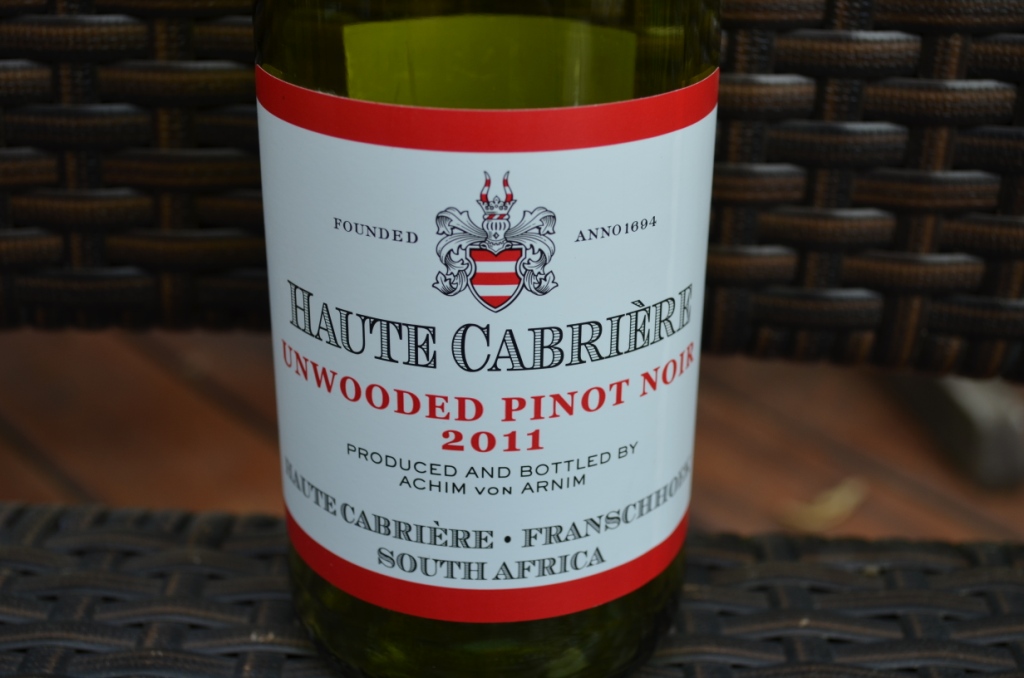 Last week, when it was hot and not crazy rainy as today (did someone up there forgot to turn off the faucet?), I walked into the wine store and told Zak that I’m in the mood for a nice bottle of Rosé. “Here”, he said handing me a bottle, “you have to try this”. Okay, I’m ready to try whatever Zak hands me with such a conviction. 2011 Haute Cabrière Unwooded Pinot Noir Franschhoek South Africa (12% ABV, $15.99) didn’t look like a Rosé, but hey, the proof is in the glass.
And what a proof it was! Light ruby color, the nose of strawberries, cranberries and onion peel (classic Rosé, huh?) – same on the palate – perfect substance, perfectly refreshing body – nothing wimpy, nothing sweet, only refreshing, light and exciting wine. This wine is produced by Achim von Arnim, whose blog is called Sun Soil Vine Man – which is also a motto of his winery. Tasting this unwooded Pinot Noir, I can say that his simple model works quite well. Drinkability: 8-
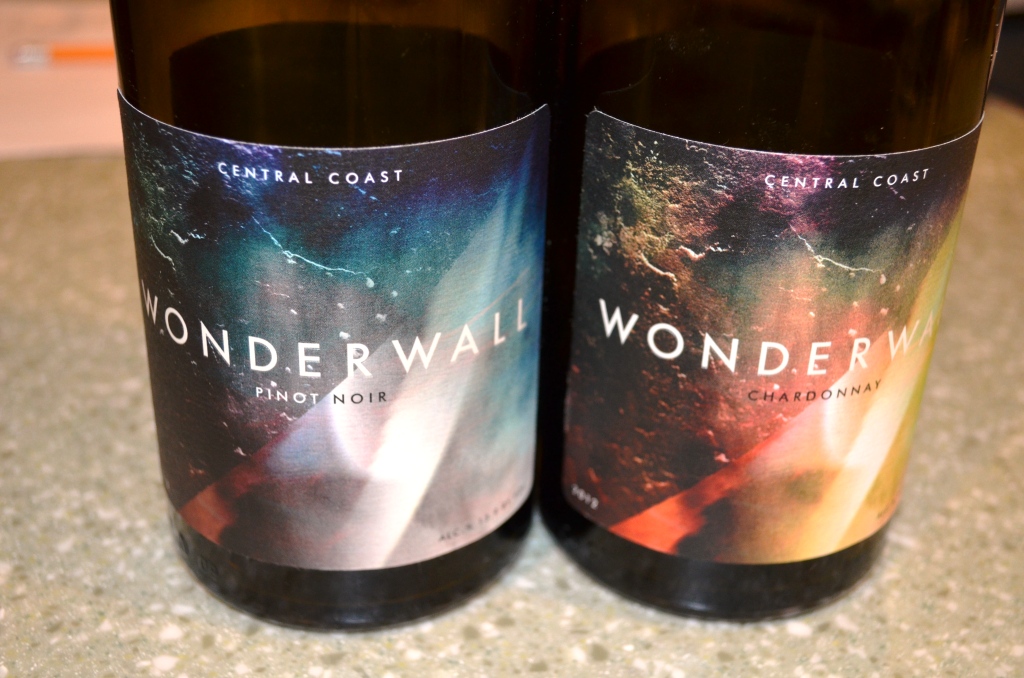
And then there was Wonderwall. First I tried 2012 Wonderwall Chardonnay Central Coast (14.9% ABV, $22/$17.60 for catalog members). These Wonderwall wines are produced by Andrew Jones, the winemaker behind Field Recordings wines, which I discussed many times in the blog – and of which I’m a big fun.
What is amazing about many Field Recordings wines is aromatics. Once you pour the wine into the glass, you simply can’t put it down – but not drinking, only smelling, and smelling and smelling. Some wines transform with their taste, and some just with their aromatics. Bright and beautiful fruit on the nose – together with fresh flowers. I experienced similar aromatics with some of the best Albarino wines – but not with California Chardonnay. Good amount of fruit on the palate, but tame, more controlled, balanced and perfectly weaved around acidity. When the bottle was finished (much faster than I would want to, unfortunately – this was my only bottle) – I smelled the bottle and it showed vanilla and touch of butter – but it was too late. I wish I had another bottle to try it at least in 3-4 years – oh well, may be someone will. Drinkability: 8
Then I had 2012 Wonderwall Pinot Noir Central Coast (13.9% ABV, $22/$17.60 for catalog members). To describe it in a few words, I would put it like this: from nose to palate – classic California Pinot Noir. Violet, cherries and hint of smokiness on the nose, cherries, cranberries and tart blackberries on the palate, all moving and evolving. On the palate, this wine is somewhat elusive, and it gives you a different perception with every sip. On the second day it showed bright, clean and assertive fruit, with mouthwatering acidity – you really want to give this wine some time (I will not, as again this was my only bottle). Drinkability: 7+
Before we part, I have to cite for you the words written on the back label of the Wonderwall wines:
“I’m unsure if it has been me, the grapes or the vineyards. There
has always been a barrier between me and the wine I wanted.
Finally, I have broken through the wall.”
That’s all I have for you, folks. And I feel better already. Cheers!
Wednesday’s Meritage – Wine Quiz Answer, Le Féret, En Premeur Tales, 1WD Giveaway and more
Meritage time!
Let’s start from the answer to the wine quiz #59, Grape Trivia – Zinfandel. In the quiz, you were supposed to answer 5 questions about California’s star grape, Zinfandel. 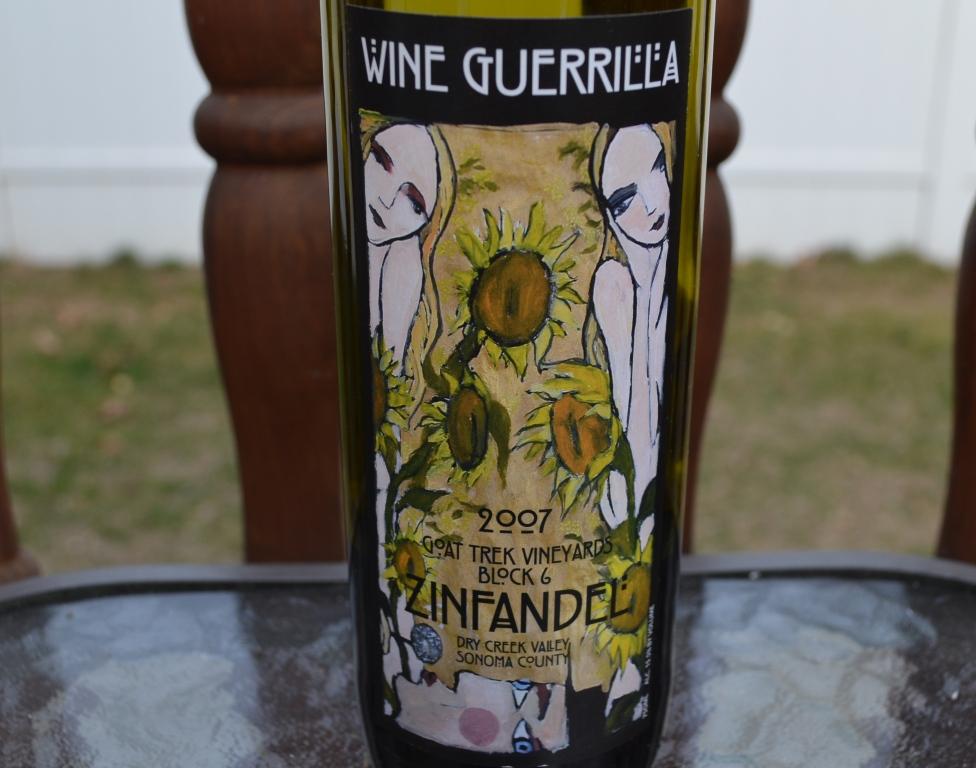
I know many people prefer to answer quizzes in the Google-free form – however, this Zinfandel quiz was somewhat of an exception. Let’s move on to the answers.
Q1: It was established recently that Zinfandel existed in Croatia under a different name, at least from the 15th century. Do you know what was that name?
A1. This was actually a tricky question. People, I mentioned Crljenak Kaštelanski right in the text of the quiz – I was hoping that this would be enough of a hint that this will not be a right answer. If someone will look into Wikipedia, you will be able to find that “After years of research and DNA testing of vines from vineyards across the globe, a single 90 year old grape vine from the garden of an elderly lady in Split, Croatia, provided the evidence to show that Zinfandel was a Croatian grape that has been known as Tribidrag since at least the 15th century.” So the correct answer for the question #1 is Tribidrag.
Q2: While Zinfandel typically listed on the label, very often some other grapes are added to the blend. Name one grape which can be considered a traditional blending partner of Zinfandel
A2: Petite Sirah. Look at the information on many Zinfandel wines, and you will often see at least some percentage of Petit Sirah to be a part of the blend.
Q3: Pink Zinfandel was discovered by accident. Can you explain how that happen, and possibly use the proper winemaking term for the “accident”
A3: Oops, sorry, I should’ve being checking my writing. It is actually White Zinfandel, not Pink, of course – pink is just a color… Anyway, I see that many of you figured out what I meant ( I will still correct the question) – yes, White Zinfandel was discovered as a result of the accident, which is called “stuck fermentation” – all the yeast dies and fermentation stopped before sugar was fully converted into the alcohol.
Q4: Two California winemakers are largely credited with putting red Zinfandel wines on the wine map. Can you name them?
A4: Most of you mentioned only the wineries – and the question was actually about the winemakers. But thedrunkencyclist was correct mentioning Ridge and Ravenswood – Paul Draper of Ridge and Joel Peterson of Ravenswood are largely considered the pioneers of California Zinfandel.
Q5: Most of the well known Zinfandel producers still make other wines from the different grapes. But there is one winery in California ( at least that I know of), which make nothing but Zinfandel wines. Can you name that winery?
A5: Yes, this was a tough question too. Most of the famous Zinfandel producers – Turley, Ravenswood, Rosenbloom, Seghesio, Robert Biale, and so on – are all producing other wines in addition to their great Zinfandels. The only winery I know of which produces Zinfandel and nothing but Zinfandel is Wine Guerilla – it is not for nothing they are calling themselves “An Art and Soul of Zinfandel”. Take a look at their line up – they are currently offering 13 different kinds of Zinfandel – and nothing but Zinfandel.
Summing it up, we don’t have winners this week, and Jeff, a.k.a. thedrunkencyclist gets an honorable mention with 3 correct answers out of 5.
Now, to the interesting stuff around vine and the web!
Have you heard of Editions Féret? I have to admit that I didn’t, not until I read a Wine Spectator article called “The Book that Defined Bordeaux“. It appears that the book, now called Editions Féret, or simply Le Féret, which started exactly 200 years ago as 84 pages travel guide, and had grown to become a 2,296 pages bible, largely defined Bordeaux wines, starting from famous 1855 classification – it was that book which rated the wines simply based on their prices in 1850, which was taken as a foundation of 1855 classification. Read the article, I think it is quite interesting.
According the post on Dr.Vino’s blog, it appears that during En Premeur, a primary Bordeaux event where new vintages are presented, one and the same wine can be “processed ” differently for the different groups of tasters – Americans will get the wine exposed to more of the new oak, and the same wine for the French audience will be finished to have more subtle showing of the fruit. Is it true? I have no idea. But it gets a final product into an interesting perspective – does it mean that one and the same Bordeaux wine can taste differently depending on where you will buy it ( in US or in Europe)? Hmmm…
Do you like giveaways? Of course you do, who doesn’t? So assuming that you do, please go and check this post at 1WineDude web site – if you leave a comment there, you will get a chance to wine one of the 5 memberships in the French Wine Society. I think it is not a bad deal, huh?
Last but not least – mark your calendars for June 19th – and make room in your wine cellars and their equivalents. Yep – WTSO is doing it again! Famous Cheapskate Wednesday is coming into town on June 19th – for more information please visit WTSO web site (you can find link in the “Buying Wine section to your right) or click this link.
That’s all I have for you for today, folks – the glass is empty. But refill is on on its way. Until the next time – cheers!
Daily Glass: WTSO Wines – Mockingbird Hill Cabernet Sauvignon, Just Add A Little Time…
 As you probably know, I’m a big fun of Wine Til Sold Out (WTSO). As someone who consumes wine all the time, I greatly appreciate an opportunity to save money but still drink great wines – and that is what WTSO allows us to do.
A number of wines sold by WTSO are really of an unknown pedigree. Yes, when the wine is offered for sale at WTSO, you get all the info associated with that wine – winemakers notes, technical details, etc. – but quite often, nothing else can be found on Internet.
The Mockingbird Hill wines belong to that group. I know that my WTSO posts are quite popular, and Mockingbird Hill wines come up quite often among search terms in my blog stats (yes, I do look at that info). But when I searched for the info on Mockingbird Hill wines, I was unable to find much. So I decided to try some of the Mockingbird Hill wines and write the review on my own.
Our wine today is 2011 Mockingbird Hill Cabernet Sauvignon Oakville Napa Valley (14.5% ABV, $19.99), 100% Cabernet Sauvignon (according to the info on WTSO web site). I have to honestly tell you that the pop-and-pour model failed completely for this wine. Open the bottle, pour into the glass, nice ruby color, sniff and…nothing. Really, not much to report. The first sip left me disappointed – definitely wine, but very tight, maybe some underripe blackberries. So I decided to stop right there (yes, this was not a happy stopping with a sigh), pump the air out and put it aside.
The next day… What do you think happened to this wine on the next day? Well, in a few words – it actually became pop’n pour wine. Great inviting nose of the succulent berries from the get go. Cassis and blackberries on the palate, bright and fresh, acidity, tannins, all together in a perfect harmony. It is pretty incredible what little time can do with the wine… Drinkability: 8-
I would definitely recommend this wine – as long as you are willing to give it little time. Yes, you can cellar it, or you can decant it – it is your choice, but in the end, you will not be disappointed.
That’s all I have for you folks for today. Happy Monday and cheers!
Last Bottle Sign Up ($10 credit)




 Talk-A-Vino