Archive
Valentine’s Day 2025 – Reflecting on Wines
In my previous post, I complained about frustration with choosing the right wine for the right moment. That post ended with a picture of the wines I selected for Valentine’s Day 2025 – and now I want to talk about those wines.
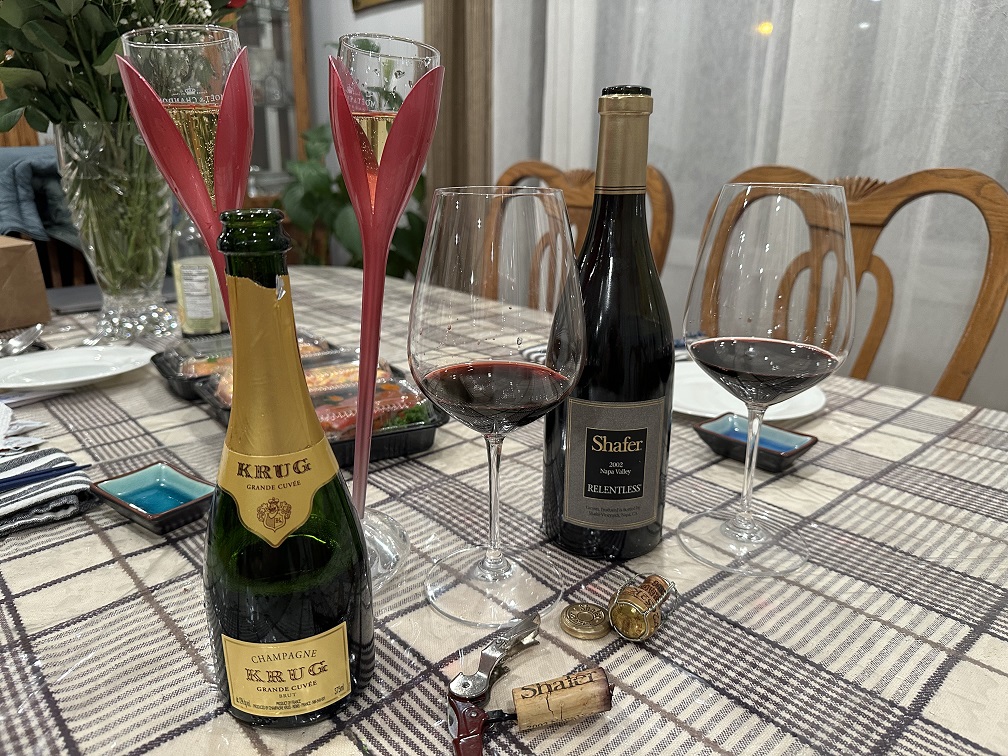
Following my own advice, our first wine was sparkling. Not just any sparkling – it was Champagne. And not just any Champagne – it was Krug.
I don’t want to sound elitist, but the only way to put is this: those who know, know Krug.
For the wine lovers en masse, the epitome of champagne is Dom Perignon. Maybe also Crystal on a good day. Krug definitely is lesser known, but for those who know, Krug is a cult, a religion, the only Champagne one can drink.
I joined that cult after experiencing Krug vintage and non-vintage wines during the PJ Wine Grand tasting in New York in 2010. Krug was an absolute revelation, I have never tasted anything like that ever before.
Then a few years later, in 2012, I came across an article by Alice Feiring, talking about changes in winemaking at Krug in 2003 which she said resulted in more or less the “end of Krug”. I referred to her article in my post, but unfortunately, the original article can’t be found so I can’t share any more details. I only remember tasting Krug at the trade tasting in the same year or maybe the year after, and thinking “well, it is not as good as I remembered it“.
Trade tasting is not always the best place to fully understand the wine, so Krug remained high on my “wines I want” list. Then a few years back, I got this half-bottle of Krug as a present for the new year, and this year I decided that Valentine’s Day is a perfect reason to open that bottle.
After struggling a bit with the cork, I managed to get the wine into our flutes (I know, I know – but it is a holiday, okay?). Smelling and tasting it left both me and my wife underwhelmed. Crisp and acidic for sure, but that’s what literally every other Champagne has, and Krug should really give you more. A few more sips and I closed the bottle, and back into the fridge it went.
Not so long ago, I read an article from a champagne pro, and he suggested that Champagne, similar to any other still wine, can and usually improves after opening. It can be placed into the fridge and enjoyed slowly over the next few days, and many of the Champagnes simply taste better the next day.
Why is this important? When I poured what was left of Krug into the glass the next day (okay, it was a regular glass), that was a totally different wine. Rich, layered, with toasted bread and apples. This was the real deal and it was delicious. I can’t tell you if it tasted like the one I was blown away by in 2010, but it was definitely an excellent Champagne. I guess there is an interesting lesson here for future encounters with Champagne, and not only with Krug.


After Krug’s image was somewhat restored in my eyes, I decided to learn more about the wine. Nowadays every bottle of Krug comes with its own unique code. When you go to the Krug website and type in the code, you get the most detailed information about the wine you can wish for – here are a few excerpts related to my bottle:
“Krug Grande Cuvée 170ème Édition
Composed around the harvest of 2014, Krug Grande Cuvée 170ème Édition is a blend of 195 wines from 12 different years. The youngest is from the year 2014 and the oldest dates back to 1998.
In all, reserve wines from the House’s extensive library made up 45% of the final blend, bringing the breadth and roundness so essential to each Édition of Krug Grande Cuvée.
The final composition of this champagne is 51% Pinot Noir, 38% Chardonnay and 11% Meunier.
Time in the cellar:
This half-bottle spent around 7 years in Krug’s cellars developing its generosity and elegance, receiving its cork in Autumn 2020.”
According to Julie Cavil, Krug Cellar Master:
“In this blend, the dynamic Pinot Noirs of 2014 came from a wide range of plots throughout the Champagne region, while fruity and full-bodied Chardonnays were selected from plots in the Montagne de Reims, Sézannais and Côte des Blancs. The Meuniers from the Vallée de la Marne Rive Gauche were particularly bright, with magnificent fruit expression from plots in Leuvrigny. To complement the wines of the year, we selected reserve Pinot Noirs from plots in the Montagne de Reims Sud renowned for their structure, including an Ambonnay from 2005. Reserve Chardonnays from plot’s wines from Avize and Mesnil-sur-Oger over a wide spectrum of years have a nice share of voice in this blend, while reserve plot’s wines of Meuniers add freshness, intensity and chiselled structure.”
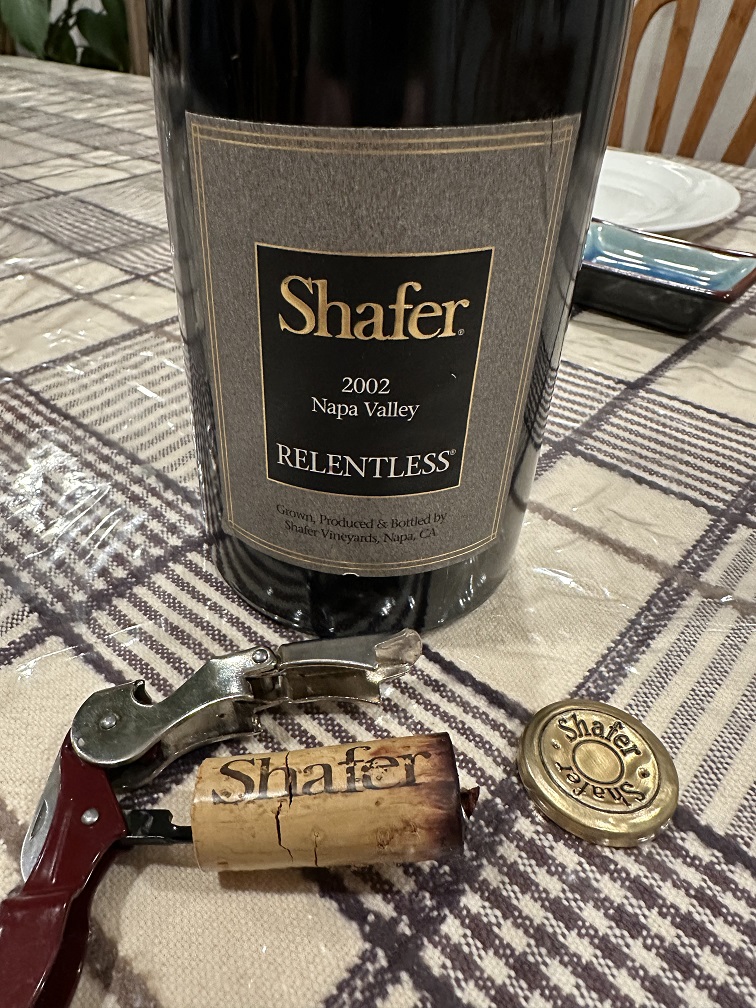
And then there was 2002 Shafer Relentless Napa Valley (14.5% ABV, 80% Syrah, 20% Petite Sirah). I tasted this wine a few times before at the trade tastings, but never had an opportunity to really spend some time with it.
Shafer needs no introductions to California wine lovers, with its fame closely associated with the flagship wine, Shafer Hillside Select Cabernet Sauvignon. Shafer Relentless is not as well known, but this Syrah blend has been around for more than two decades, named in honor of Shafer’s [relentless] winemaker, Elias Fernandez.
We didn’t decant the wine – it would probably help a bit, but I just didn’t want to deal with it. At first, the wine was tight, with well-noticeable tannins and an interplay of tar and cherries, with the addition of pepper. After some time in the glass and opened bottle, the tar subsided, leaving delicious peppery cherries to be admired around a layered but firm core. This 23 years old wine showed beautifully and it was a real treat.
Now the last piece – food. We stopped going out to the restaurants on Valentine’s Day a long time ago – the experience just not worth it. We were craving sushi for some reason, so that is what completed our Valentine’s Day dinner – here you can see some creative rolls from an Asian restaurant not too far from our house.


There you are my friends – our V-day reflections. How was your celebration? Any special wine experiences? Do tell! And until the next time – cheers!
An Evening of Pure Pleasure
Do you know what makes an oenophile’s heart melt and pound, what fills it with joy? Hearing their friends say after you pour the wine into their glasses
“Oh my god, this is so good!”
This brings a double pleasure – it is not only you now getting the pleasure from the aroma and the bouquet – but your friends also enjoying it as much as you do. Wine is meant for sharing, and this makes sharing so much more enjoyable…
Wine can never be taken for granted. Let’s remember that the wine continues changing even after bottling – each time we open the bottle, we find the content of the bottle in its unique state. Yes, we can hope that if you open all 12 bottles from the case at the same time, all wines will taste the same – but it is still a game of probabilities, with opportunities for the “bottle variation” to be increasingly more noticeable as the wine ages. And I’m not even talking about potential wine faults…
Next, there are expectations. Expectations are a big deal for the oenophile. Just one look at the bottle and an oenophile forms expectations – bottle appearance, place, producer, type of wine, vintage – everything is taken into account, and we know what to expect. It is the most joyous moment when the liquid in the glass meets expectations – and the most daunting when it does not (let’s not get to the corner case of Two Bucks Chuck, please). But there is more to the expectations in wine. One of the biggest challenges with wine expectations lies in the fact that it doesn’t matter how much you like the wine and how well your great expectations are met – everyone’s palate is different. It is hard learning to be okay with the fact that while you enjoy the wine immensely, your friend doesn’t care for it. It doesn’t make the wine bad. It doesn’t mean that you are wrong or did anything wrong. It simply means that taste is personal, you just need to learn to accept this simple fact of life – and not get upset.
You might wonder why I am talking about all this wine geek mumbo jumbo, why is that important? Simple. No matter how familiar you are with the wine you are pouring, or how many times you have had the wine from the same vintage and producer, when the wine reaches the glass, it is always the moment of revelation. Double that (triple? quadruple?) when you are poring wine for your friends. And even if you think that wine is perfectly perfect, you can never assume your friends will think the same. Wine can never be taken for granted.
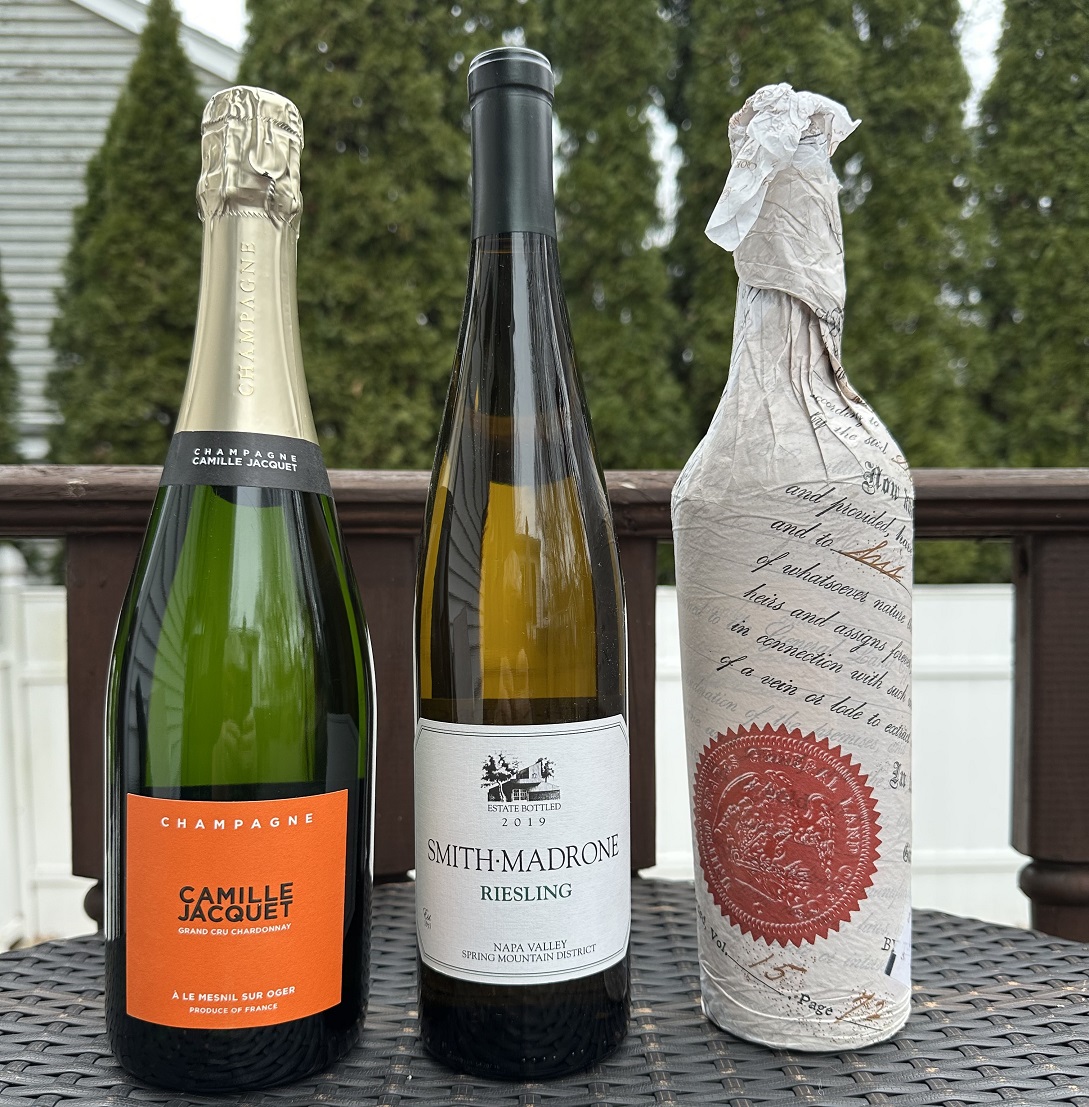 I guess I got lucky. At last weekend’s evening with our dear friends, I managed to hit a double “trifecta” :). Three delicious wines out of three, and my friends loved all three to the “oh my god, this is so good!” moment.
First wine – NV Champagne Camille Jacquet Brut Grand Cru Chardonnay A Le Mesnil-sur-Oger (12% ABV). I do not know the producer, but I had high expectations for this wine possibly for a silly reason. A small village Le Mesnil-sur-Oger is well known for the quality of its Chardonnay vineyards and a home to some of the best (if not the best ) Blanc de Blancs Champagnes in the world – Salon le Mesnil and Krug Clos du Mesnil. Knowing that Camille Jacquet Champagne comes from basically the same vineyard gave me high hopes (silly, as I said) for this Champagne. And my high expectations were perfectly met. Beautiful nose of toasted bread with a touch of apple, impeccably crisp, fresh and precise on the palate. The acidity was fully in check with the complexity of the toasted, baked goods on the palate, leading to an impeccable (yes, I know I already used that word) balance. “Oh my god, this is so good!” said my friends, and the wine disappeared in a jiffy.
Next, two beautiful wines from one of my favorite producers ever. Over the years, I wrote about Smith-Madrone wines extensively. Cooks’s Flat had been one of the Talk-a-Vino Top 10 Wines of the Year 2019 top wines (that year, I had 3 #1 wines, tell me about my inability to make decisions), and Smith-Madrone Cabernet Sauvignon was #3 on the Talk-a-Vino Top 23 of 2023. So I was very happy that I got the samples of Riesling and Cook’s Flat and was able to share both wines with my friends (I will also taste a nice vertical of Smith-Madrone Riesling, it will take a central stage on these pages soon).
Smith-Madrone Riesling is one of my favorite Rieslings in the world – it is one of the 3 if you are interested – Grosset Polish Hill Claire Valley Australia, Smith-Madrone from Napa Valley, and Brooks Ara from Oregon. This 2019 Smith-Madrone Riesling Spring Mountain District Napa Valley (13.3# ABV) was spectacular. First, it offered a tremendous pop of petrol on the nose – and nothing makes my Riesling lover’s heart happier than these petrol aromatics, coupled with a whiff of honeysuckle. On the palate, it was fresh, energetic, with a wide range of citrus flavors readily present, from Meyer lemon to oranges and mandarines, supported by clean acidity and a perfectly cleansing acidic finish. Delicious, and the second “oh my god, this is so good!” wine.


Finally, the 2018 Smith-Madrone Cook’s Flat Reserve Spring Mountain District Napa Valley (14.2% ABV, 87% Cabernet Sauvignon, 13% Cabernet Franc, 20 months in new French Oak). This wine is designated as “Reserve” and this is not random – it represents the best of the best Smith-Madrone makes, using the best plots, best grapes, and produced only in the best years. This wine also has a historical connection to the parcel of land where Smith-Madrone vineyards where replanted in 1972 – the tissue wrapping the Cook’s Flat bottle is a copy of a land grant document, signed by the President of the United States. Here is the description from the Smith-Madrone website:
“Cook’s Flat Reserve is a proprietary name for a wine that is the culmination of our 50 years of growing grapes and making wine in the mountains of the Spring Mountain District. The name refers to George Cook, the first owner of the property. ‘Cook’s Flat’ was the local oldtimers’ name for the eight-acre plateau-like vineyard block which was replanted in 1972.
The packaging expresses the property’s history and an uncompromising attention to detail. Each bottle is numbered and only around one thousand bottles are produced in each vintage. Each bottle is wrapped in tissue which has been printed with a multi-colored copy of the U.S. Land Office Patent which granted ownership to George Cook and was signed by President Chester Arthur on December 5, 1885. We proudly display the original at the winery.”
What I love about Smith-Madrone wines is textbook precision. So far literally everything I tasted from the winery had this textbook precision of flavor – Riesling is unmistakably Riesling, Chardonnay is unmistakably Chardonnay, Cabernet Sauvignon is unmistakably Cabernet Sauvignon.
This 2018 Cook’s Flat, a blend of Cabernet Sauvignon and Cabernet Franc, was also unmistakably a Cabernet. A core of black currant, a.k.a. cassis, and eucalyptus, supported by sweet tobacco and sweet oak, with a whiff of the bell pepper (love it). On the palate, the textbook flavors continued with succulent cassis, eucalyptus, a touch of mint and bell peppers, firm structure, perfectly integrated and perfectly present tannins, impeccable balance. Just a pure joy. “Oh my god, this is so good!” wine again disappeared in no time, with the last drops almost squeezed out of the bottle.
Here you are, my friends. An evening of pure pleasure – and a happy oenophile who managed to make his friends “oh my god, this is so good!” happy.
I have more happy stories to tell – stay tuned…
Brilliance of the Bubbles
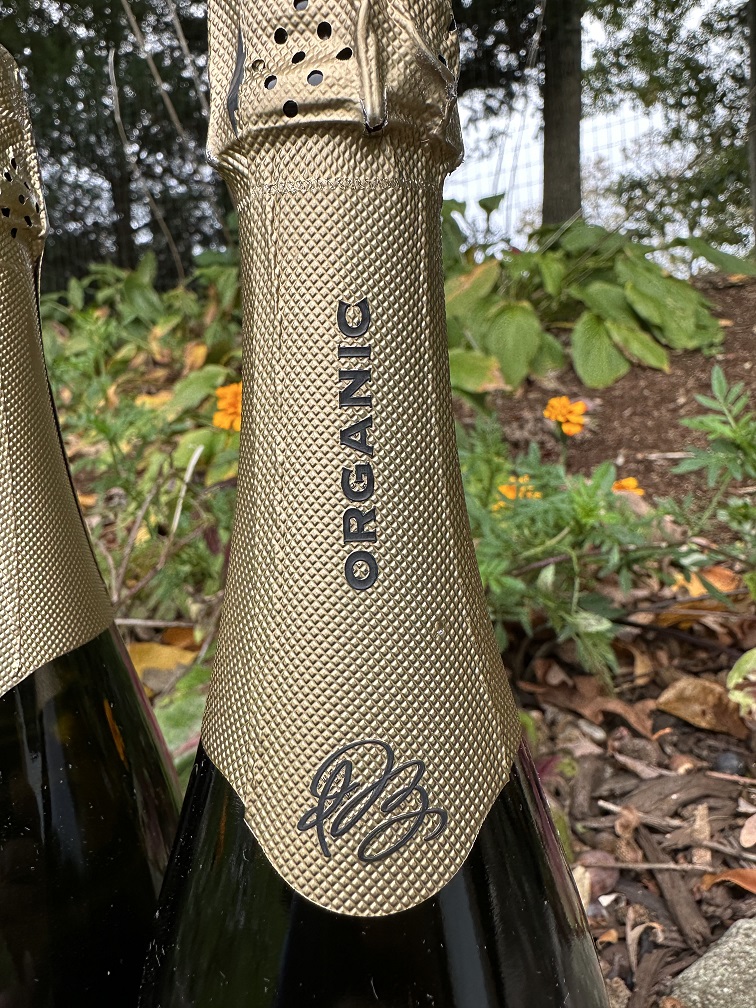 Champagne, anyone?
Well, I’m not in the mood to celebrate anything going on in the world right now. But I still drink wine, and while Champagne = Celebration is deeply ingrained in our minds, here I’m just talking about Champagne as a type of wine, the same as white, red, and Rosé. And I need to further correct myself – I’m not even talking about Champagne, the sparkling wine produced only in the Champagne region of France. The subject of today’s post is generic “bubbles”, the sparkling wine produced elsewhere in the world.
Simplistic on the surface, “bubbles” is an interesting wine category. Nobody is born craving wine, wine is an acquired taste. Bubbles might be the next level of acquired taste compared to wine, especially if we can exclude social pressure from consideration. Classic Champagne typically boasts cut-through acidity and is expected to be devoid of any traces of fruit for the joy of purists. And god forbid any sweetness can be detected in the glass… Not the wine someone intuitively craves. But this is not the biggest issue with the “bubbles”. The bigger problem is that people are well-trained to recognize the word Champagne, and once they hear that word, whether they truly love the liquid in the glass or not becomes irrelevant – “ahh, it is Champagne!”.
As anecdotal evidence, my favorite example is Kevin Zraly’s Windows on the World wine classes. The last class in the series of 8 started with Champagne. 4 wines were poured blindly to the group of roughly 120 students. After tasting all 4 wines, we were asked to have a show of hands for our favorite Champagne. I don’t remember details about wines #1, #2, and #3, but there was a somewhat equal spread between these three wines. Wine #4, however, had barely any hands raised. As the wines were revealed, Kevin Zraly said “and this is why, people, you shouldn’t drink vintage Champagne” – wine #4 was Dom Perignon, creme de la cream of Champagne world. Have we known that we were drinking Dom Perignon, I guarantee that wine #4 would be adored by everyone.
Before you get any wrong ideas, let me assure you – this is not a Champagne-bashing post. I love good Champagne as much as any other hard-core Champagne aficionado is. 2002 Pol Roger Sir Winston Churchill Champagne was my wine of the year in 2016. I have enjoyed immensely Krug, both vintage and non-vintage. Champagne Lanson, Duval-Leroy, Piper-Heidsieck, Bollinger, and on, and on, and on. But the point I’m trying to make here is that when looking for bubbles, you shouldn’t hang up on Champagne and only Champagne – sparkling wines are made everywhere today, and there are lots and lots of very worthy bubbles you can enjoy, as long as you are willing to accept that great sparkling wines don’t have to come only from Champagne.
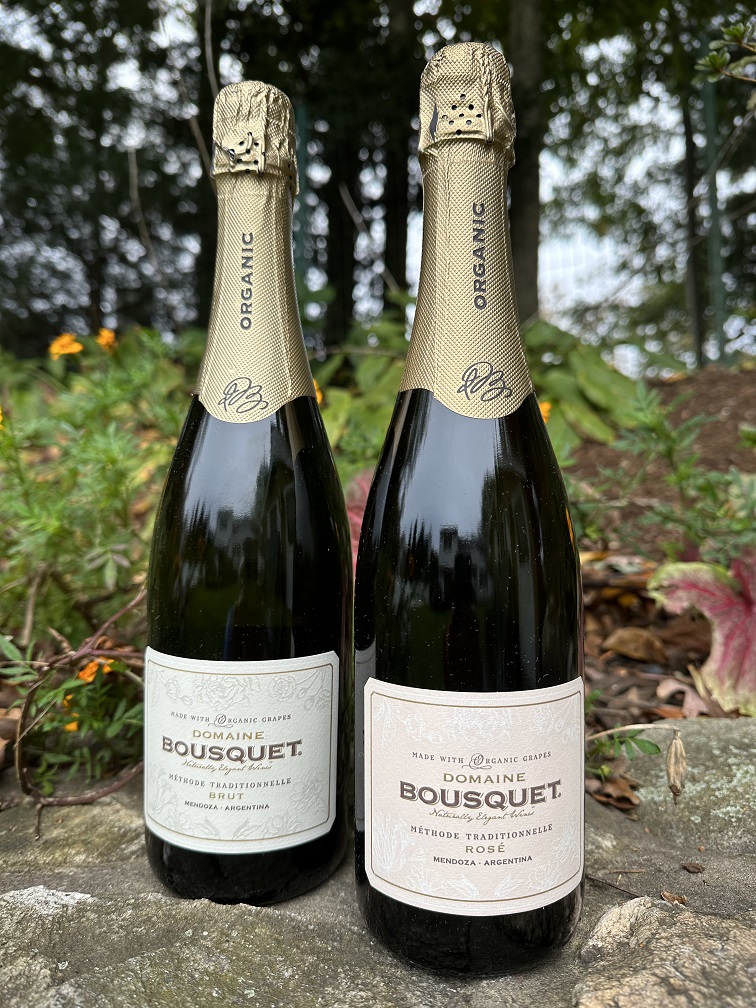
For an example of the great bubbles from outside of Champagne, let’s take a trip to Argentina. On a world scale, Argentina arguably didn’t reach yet the status of a world-class sparkling wine producer. And for me as a wine lover, this is very good news – it means I can still enjoy sparkling wines from Argentina at reasonable prices. Just to give you an example, we can look at the sparkling wines of South Africa, known as Cap Classique. Back 3 years ago, Graham Beck Brut Rosé Methode Cap Classique, one of my favorite sparkling wines from South Africa, could be found at my local wine shop for $16.99. The price two weeks ago? $30.99. So before it happens to Argentinian bubbles, let me bring you into the know.
Please meet Domaine Bousquet. Well, this might not be the correct way to introduce Domaine Bousquet here – if you are reading this blog regularly (are you??) then you already met Domaine Bousquet on multiple occasions. If you look at the Domaine Bousquet website, you will see that they present themselves as the #1 organic, regenerative and sustainable winery in Argentina. When I think of Domaine Bousquet, especially after tasting their wines, my first thought usually is “how do they do it???”. As an example of “how do they do it”, Domaine Bousquet offers USDA-certified organic wines (!) called Virgen that taste great and cost only $13 as the suggested retail price. And my latest discovery in the “how do they do it” category is two of their classic method sparkling wines.
I wrote about Domaine Bousquet sparkling wines before. Those were excellent wines produced using the Charmat method (secondary fermentation in the tank), the same method that is used in the production of Prosecco. These two new wines I’m talking about are produced using the classic method, with the secondary fermentation in the bottle – the same way classic Champagne wines are produced, hence the name Classic Method, a.k.a. Méthode Champenoise, a.k.a. Méthode Traditionnelle.


From the very first whiff, both wines were just spectacular. NV Domaine Bousquet Brut Organic Méthode Traditionnelle Mendoza Argentina (12% ABV, $18 SRP, 75% Chardonnay, 25% Pinot Noir, 6 months on the lees) had a perfect nose of freshly toasted bread, brioche and apples. The palate was followed with the same toasted bread notes, perfectly fine mousse, crispy profile with just apple notes, just a pure delight.
And NV Domaine Bousquet Brut Rosé Organic Méthode Traditionnelle Mendoza Argentina (12% ABV, $18 SRP, 75% Pinot Noir, 25% Chardonnay, 6 months on the lees) was even better – the wine had an absolute precision that only the best Champagne and sparkling wines possess. Salmon pink in the glass, freshly baked, just out of the oven toasted bread on the nose – I couldn’t and didn’t want to put my glass down for a few minutes. After appropriately admiring the bouquet, the first sip perfectly matched the expectations – fine mousse, cut-through acidity, brioche, green apples, perfect structure, impeccable balance.
If I were to pair dinner with these two wines, I would have fresh oysters and seafood with the Brut, and then a steak with the Brut Rosé – you can keep the salad.
Here are two brilliant sparkling wines from Argentina – organic and delicious. In a blind tasting, these two wines can safely challenge any Champagne or sparkling wines – and I would definitely put my money on the Domaine Bousquet wines to win the popular vote.
Taking the price into account, and the holiday season upon us, these are definitely case-buy recommendations – these wines are perfect as a gift and perfect to enjoy at any moment, knowing that you didn’t have to break the bank to get the pleasure.
Have you had these wines? What are your favorite sparkling wines outside of Champagne? Cheers!
Celebrate Champagne Day With Champagne Lanson
 Ooh, another wine holiday I almost missed – Champagne Day, celebrated on the 4th Friday in October. Not that I need a reason to open a bottle of wine, but a wine holiday offers an opportunity to reflect on a specific wine subject, which is always a fun exercise.
My personal Champagne journey was long and rocky (still going). Growing up on a sweet concoction called “sovertskoe shampanskoe” (still have no idea if it is made out of grapes), the profound acidity with no sweetness is not something that one can quickly and gleefully embrace. And the price… And then the French obnoxiously insisting that Champagne can only come from Champagne, phew… Lots of things to get over…
I had a few key learning experiences along the way. First, about 20 years ago, there was a blind tasting of the Champagnes during Windows on the World wine classes, where I learned that liking Dom Perignon, or any other vintage Champagne when you are not influenced by the label is not obvious. Then about 12 years ago, there was PJ Wine Grand tasting in New York, where the first taste of vintage (and even non-vintage) Krug became a proverbial nail on the head and a pivotal moment of discovering the true pleasure of Champagne. And I have to mention an encounter with 2002 Pol Roger Sir Winston Churchill Champagne about 6 years ago (the wine ended up being my 2016 wine of the year) – I spent about 10 minutes simply enjoying the aroma of the wine before even daring to take a sip. Yes, I can safely say that I love Champagne.
Okay, let me be careful here. I love Napa Valley Cabernet Sauvignon. I love Rioja. Yes, I love Champagne. However, this is not a blanket statement. I love the category but within the category, the “love” concept is very particular. There are 10-12 specific Rioja producers and brands that I love, and the rest of the Riojas don’t excite me even for a second. It is the same story with Champagne – there are a few producers that I love and respect, and then there are quite a few I don’t care for. But I’m always willing to learn, taste, and discover something new.
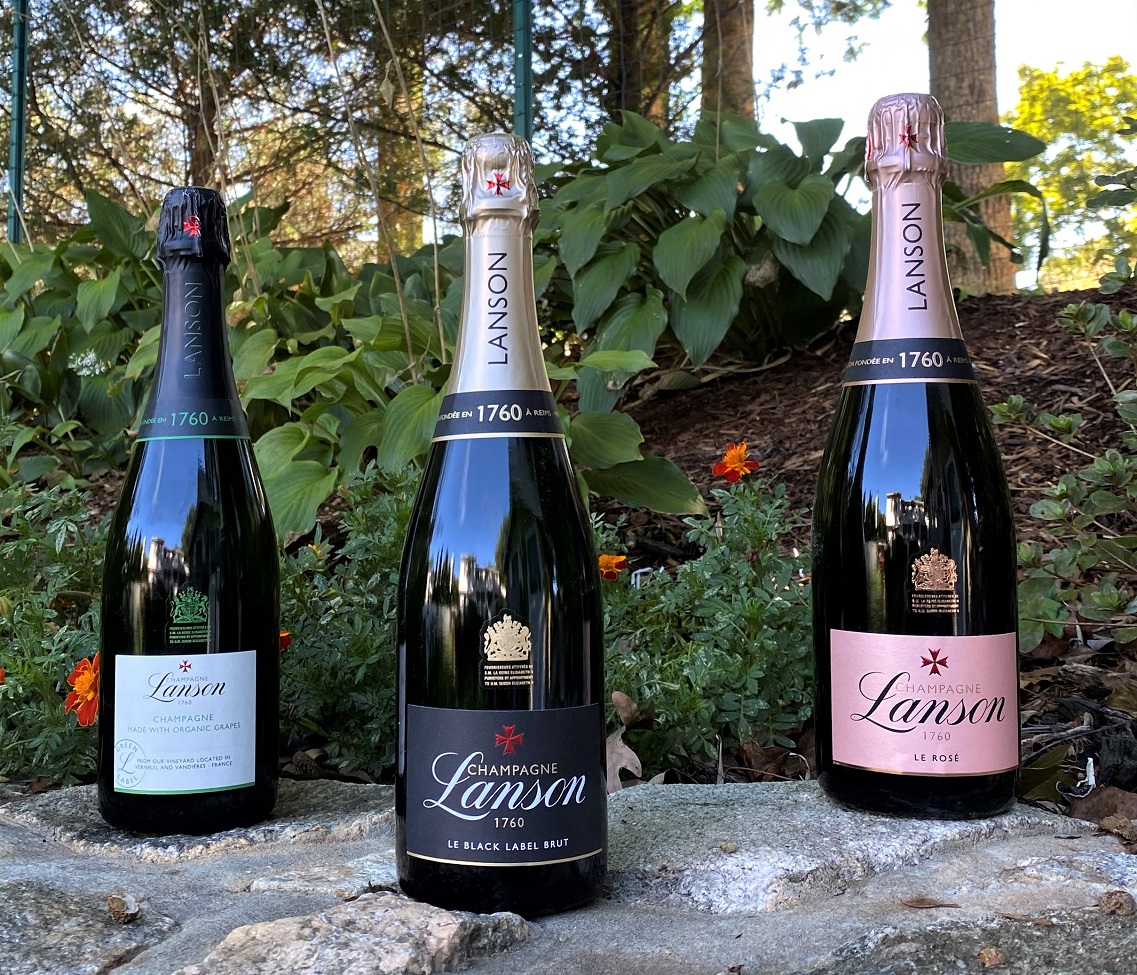
Talking about discovery, I need to share with you my latest Champagne discovery – Champagne Lanson.
Founded in 1760, Champagne Lanson is one of the oldest Champagne Houses. From the moment it was created, Lanson’s focus was always on foreign markets. By the late 19th century, Lanson was supplying champagne by royal appointment to the courts of the United Kingdom, Sweden, and Japan. It still remains the main Champagne supplier to the British royal family. It is also official champagne of Wimbledon tennis tournaments since 2001. Today, Lanson Champagne is exported to 80 countries.
Lanson has close relationships with the growers, having access to more than 100 vineyards throughout Champagne, 50% of which are Grand Crus and Premier Crus. Lanson also cultivates more than 140 acres of its own vineyards, out of which 40 acres are farmed organically and biodynamically.
What I’m looking for in Champagne is precision. My ideal champagne has perfectly persistent energetic bubbles, toasted bread aromas on the nose maybe with a touch of yeast and even gunflint, the same toasted bread notes on the palate, maybe a hint of an apple, and a perfect balance of fruit, acidity, and structure on the palate. Balance is a king for any wine, Champagne not excluded.


I had an opportunity to try 3 of the Lanson Champagnes, and they all didn’t disappoint.
NV Lanson Le Black Label Brut Champagne (12.5% ABV, $50, 50% Pinot Noir, 35% Chardonnay and 15% Pinot Meunier) had perfectly persistent fine mousse, toasted bread aromas on the nose, and crisp, precise and refreshing palate. Some of the best bubbles have this captivating effect – once you take a sip, you can’t wait to take another – this was this Champagne Lanson.
NV Lanson Le Rosé Champagne (12.5% ABV, $70, 50% Pinot Noir, 35% Chardonnay and 15% Pinot Meunier) showed very similarly on the nose, with toasted notes and a hint of floral undertones. On the palate, it was a bit more feminine than the previous wine, still crispy, but softer and more round, with the addition of a touch of strawberry. Absolutely delightful.
And yet NV Lanson Le Green Label Organic Champagne (12.5% ABV, $75, 50% Pinot Noir, 30% Pinot Meunier and 20% Chardonnay) was my favorite of the 3. Precision and energy. Vibrant and raw, this Champagne simply over-delivered – ultra-precise bubbles, energy, finesse and balance. Superb.
Talking about precision – Champagne Lanson eliminates the need for you to guess. Take a look at these back labels:
Harvest year, disgorgement date, all the technical details if you care to know them – everything is presented, simply and clearly. You don’t need to guess for how long that bottle of Champagne had been waiting for you on the shelf? With Lanson, just take a look at the back label, and you already know.
Here is my offering to you – beautiful Lanson champagne which now will join my “favorites” ranks. The Champagne that will make any celebration seem brighter.
Have you had Champagne Lanson before? What are your favorite Champagnes? Happy Champagne Day! Cheers!
Sparkle Every Day
Ohh, festive times… Bubbles, laughter, smiles, more bubbles, and more laughter and smiles.
We still think of bubbles as a holiday or otherwise celebratory wine, but it doesn’t have to be like this – every day is worth celebrating, and good bubbles bring something special – they have a magic power to make things better.
But now the bubbles are on everyone’s mind – the last two weeks before the New Year celebration, bubbles need to be consumed and gifted. Very appropriately, I’m inviting you on a trip around the world, to taste some sparkling wines, and maybe even find new favorites or discuss the old and familiar.
You can’t beat the classics, so let’s start in the place which started it all (I know it is contested, like everything else nowadays, but let’s just skip that discussion) – the Champagne, of course.


I’m starting today with Champagne which is unique and different, and in reality should warrant a full post, as this is Champagne with the story. In 1975, Bruno Paillard, tracing his family grower and negociant heritage back to 1704, started working as a Champagne negociant. In 1981, at 27 years of age, Bruno sold his old collectible Jaguar and started his own Champagne company with the vision of producing a different style of Champagne. In 1984, he designed a unique above-ground cellar to be able to fully control temperature during the production of Champagne. By 1988, he already was collecting raving reviews from the critics such as Hugh Johnson, and others.
Bruno Paillard calls his approach to Champagne production Multi-Vintage, as even non-vintage-designated wines still have known proportions of reserve (vintage) still wines used during production. Also, every bottle of Bruno Paillard Champagne carries a disgorgement date on its back label. I had an opportunity to taste Bruno Paillard Premiere Cuvee Champagne, which comprises 35 out of 320 Champagne crus, with up to 50% of the wine coming from 25 reserve vintage wines since 1985:
MV Bruno Paillard Premiere Cuvée Champagne (12% ABV, $60, 45% Pinot Noir, 33% Chardonnay, 22% Pinot Meunier, 36 months on the lees, 5 months in the bottle, disgorged in June 2020)
Fine mousse, crisp
Classic nose – toasted bread, very clean, delicate
Classic palate – toasted bread, minerality, a hint of apples, fresh, round, great energy, cut-through acidity, delicious overall
8+, superb. If you can drink it every day, more power to you – but it is well worth at least an occasional celebration.
As we are in Europe, let make another stop along the way – all the way down to the South of Italy – in Sicily.
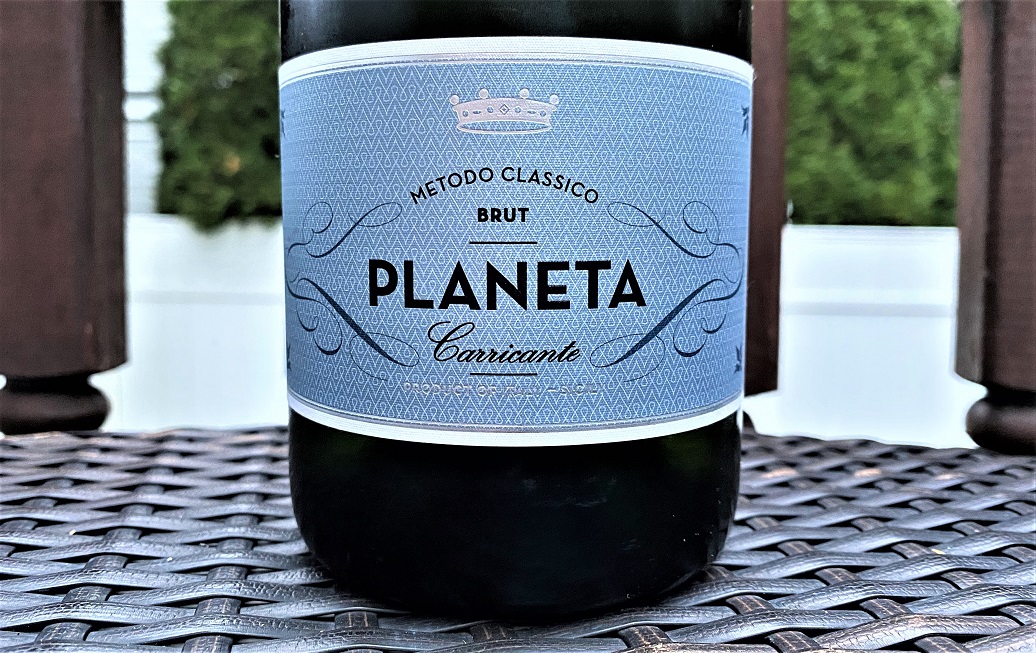
Italy is no stranger to spectacular classical style (method Champenoise) bubbles – powerful Ferrari and others up north in the Trentodoc, majestic Franciacorta in Lombardy, and more classic sparkling wines everywhere in between. However, this was my first encounter with the classic-style bubbles from Sicily.
Not to be overdone, this wine comes from Planeta, which is one of the most famous and best producers in Sicily – still, I never heard of their sparkling wines. This wine was made out of the local white grape called Carricante, but if you would try it blind, it would be very hard to distinguish this wine from an actual classic Champagne.
NV Planeta Carricante Brut Methodo Classico Sicilia DOC (12% ABV, $42, 100% Carricante)
Light Golden color
Beautiful intense nose, minerality, a touch of gunflint, toasted notes
A touch of green apple, minerality, toasted bread, good acidity, medium to full body.
8+, outstanding. Mostly available in restaurants, but you still can find it in a few liquor stores.


Now, let’s cross the Atlantic all the way and then some, going to the west side of North America – we are stopping by in California, to be precise. Here I have two wines to offer to your attention.
If you like California sparkling wines, then you don’t need an introduction to Scharffenberger. Found in 1981 by John Scharffenberger, the winery was built from the get-go for sparkling wine production, showcasing the terroir of Mendocino country.
In 2004, the winery became a part of the Roeder Collection. Overall, it continues the same traditions as 40 years ago, and today the 120 acres estate is sustainably farmed and Fish Friendly Farming certified.
Scharffenberger produces a range of Non-Vintage sparkling wines, all made using the classic method, all made from various proportions of Chardonnay and Pinot Noir. The wine I want to offer for your holiday festivities and casual daily life celebrations is Brut Rosé:
NV Scharffenberger Brut Rosé Excellence (12.5% ABV, $26, 55% Chardonnay, 45% Pinot Noir)
Salmon pink
Toasted bread, brioche, a touch of strawberries
Tart strawberries, hazelnut, freshly baked bread, crisp, generous, invigorating
8+, excellent bubbles for any day
Now, we are still staying in California, but moving about 2 hours south and east from Mendocino to the Russian River Valley. Here, in 1984, Judy Jordan started her J Vineyards and Winery (at the age of 25). Throughout the years, Judy acquired 9 vineyards, managing 300 acres of vines around the area. Her brother John Jordan manages the eponymous Jordan winery in Sonoma, producing “Chardonnay, Cabernet, and Hospitality” (I really love this quote of his as I had an opportunity to experience all three at the wine bloggers conference 2017).
During my first wine bloggers conference in 2014 in Santa Barbara, I attended joint Jordan reception, hosted by J Vineyards and Jordan Winery, creating the most magnificent experience between delicious J Vineyards bubbles and Jordan Cabernet verticals.
Why am I telling you all of this and how is it relevant to the J sparkling wine I tasted? Actually, there is no real connection, except the sad feeling of the loss of true authenticity, after J Vineyards was sold to E and J Gallo in 2015. If you visit the J Vineyards website today, it is all about selling the wine. There is no “about” section. There is no history of the estate. Just buy, buy, buy. Buy this or buy that. Okay, okay – I get it – wine is a business. But it can be a business with soul – sadly, I don’t think E and J Gallo know how to operate one.
This J Vineyards Cuvée 20 was originally produced to celebrate the 20th anniversary of the winery but then became a standard feature in the sparkling wine lineup.
NV J Vineyards Cuvée 20 Russian River Valley (12.5% ABV, $38)
Straw pale, fine mousse
Gunflint is a primary element
Toasted bread, gunflint, a touch of lemon, crisp, energetic, perfect cleansing acidity
8/8+, needs food – oysters, cheese, steak – any food.
Let’s now take a long flight down south, to the Argentinian desert, to visit Domaine Bousquet in Tupungato.


Actually, I already wrote a long post about Domaine Bousquet sparkling wines, at the beginning of this year. These are essentially the same wines I tasted before, only with the new labels. If you are interested in learning more about Domaine Bousquet, please refer to the post above, and I will just share my latest tasting notes here:
NV Domaine Bousquet Brut Tupungato Argentina (12% ABV, $13, 75% Chardonnay, 25% Pinot Noir, Charmat method, organic grapes, vegan)
A yellowish tint in the glass
A hint of apple, fresh, clean
Perfectly round, good acidity, a touch of toasted notes, apples, easy to drink
8-, very good
NV Domaine Bousquet Brut Tupungato Argentina (12% ABV, $13, 75% Pinot Noir, 25% Chardonnay, Charmat method, organic grapes, vegan)
beautiful salmon pink
fresh, a touch of strawberries
more strawberries on the palate, fresh, clean, good acidity, nice body
8-, perfect for every day
And we are done. I’m leaving you here with a few of the options for your festive and daily bubbles – different prices, different wines, but all worthy of a life celebration as it happens. Cheers!
Celebrate Life! Celebrate Champagne!
Is it only me or did the time accelerate for everyone? How come the store shelves are full of baking supplies and turkey condiments? It is still really warm here in Connecticut – did the summer end already? Does it mean that the holidays are coming?
Oh yes, the holidays!
I’m ashamed to admit but I believe I missed all or most of the wine holidays this year. Surprised with a large number of references to Champagne on social media, I decided to check the calendar, and yes – I almost missed yet another wine holiday – Champagne Day!
In victory you deserve it, in defeat you need it
It doesn’t matter who really said that (Napoleon, Churchill, or anyone else), but whoever said it, was right – in life, there is always a place for a glass of Champagne.
There are lots and lots of praise-worthy bubbles produced around the world – the rest of France outside of Champagne, Italy, Spain, Australia, California, Oregon, Georgia, and every place in between – but today it is all about Champagne.
Champagne had a tough time with the pandemic and other events, such as absolutely moronic labeling laws introduced in Russia, but nevertheless, people around the world are ready to celebrate, and Champagne sales are getting back to the pre-pandemic levels.
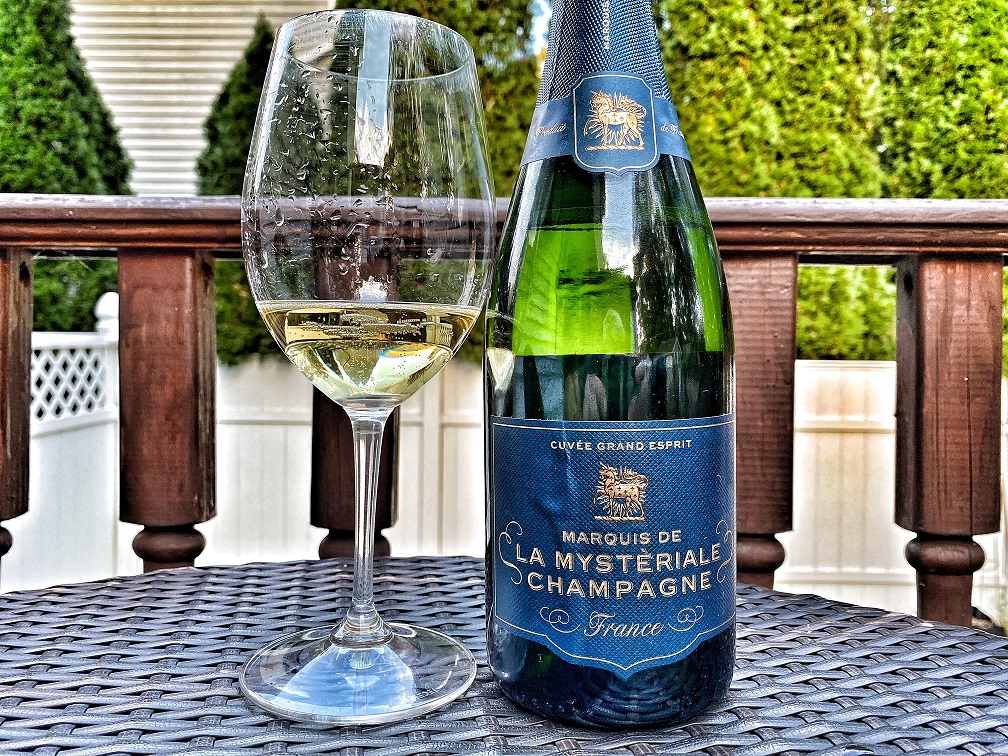
My celebratory Champagne of choice today is NV Marquis de la Mysteriale Brut Cuvée Grand Espirit (12.5% ABV) – perfectly suitable for every day, showing toasted bread notes on the nose, and crisp and refreshing on the palate. There is nothing spectacular about this wine, but for $20 (WTSO price), it is perfectly “good enough” to simply celebrate life, one day at a time. This was also the first time (I think) I had Champagne designated as MA – “Marque d’ Acheteur – A brand name owned by the purchaser, such as a restaurant, supermarket or wine merchant.”
A big part of Champagne fun is the process of opening the bottle using typically a special sword – so-called sabrage. Last year, I shared with you a little compilation of the sabrage gone wrong – very wrong. This year, I have a video collection of the amazing success of sabrage done with absolutely random objects, including tablespoon, iPhone, teaspoon, and even the high-heel shoe (and many others – see for yourself):
Here you are, my friends. Open a bottle of Champagne and celebrate life! Cheers!
Champagne, Champagne, Champagne for Everyone!
Yes, I issued the call for Champagne. And no, it is not because of the Friday night, lottery winning, huge job promotion, or an official ending of the COVID-19. Today, October 23rd, 2020 is the official celebration of the bubbles that became synonymous with success and life’s happy moments – today we celebrate Champagne, a quintessential celebration itself.
My appreciation for Champagne came long after wine became an obsession. I grew up drinking sweet bubbles of unknown pedigree under the name of “Soviet Champagne” – who would care about naming rights back then. So the first encounter with crisp, tiny, and ultra-acidic bubbles was not love at first sight. It is interesting that how I can’t name a pivotal wine, but I can easily name a pivotal Champagne – Krug Vintage, I don’t remember if it was 2002, 2003, or 2004, but that encounter with greatness during PJ Wine grand tasting in New York absolutely changed my perspective on the Champagne. And if you care to know, I even have my favorite Champagne of all times – 2002 Pol Roger Cuvee Sir Winston Churchill – pure magic.
Today, sparkling wines are produced everywhere. All countries, all types of grape (sparkling Tannat? no problems. Sparkling Shiraz? of course!), and literally all wineries. There are absolutely stunning bubbles produced in Italy (Franciacorta, Trentodoc), Spain, and the USA (if you ever had Roederer L’Ermitage or late disgorged Gloria Ferrer, you know what I’m talking about). But today, it is all about Champagne, in its pure form.
Champagne also has the capability of bonding the memories – as it is often linked to the special moments, just seeing that bottle of Perrier-Jouët, Cristal, Dom Perignon, or Bollinger can trigger the onslaught of happy thoughts. True, any wine can do this, but Champagne has some special powers.
In recognition of the holiday, I’m offering you a collage of some of my Champagne experiences:
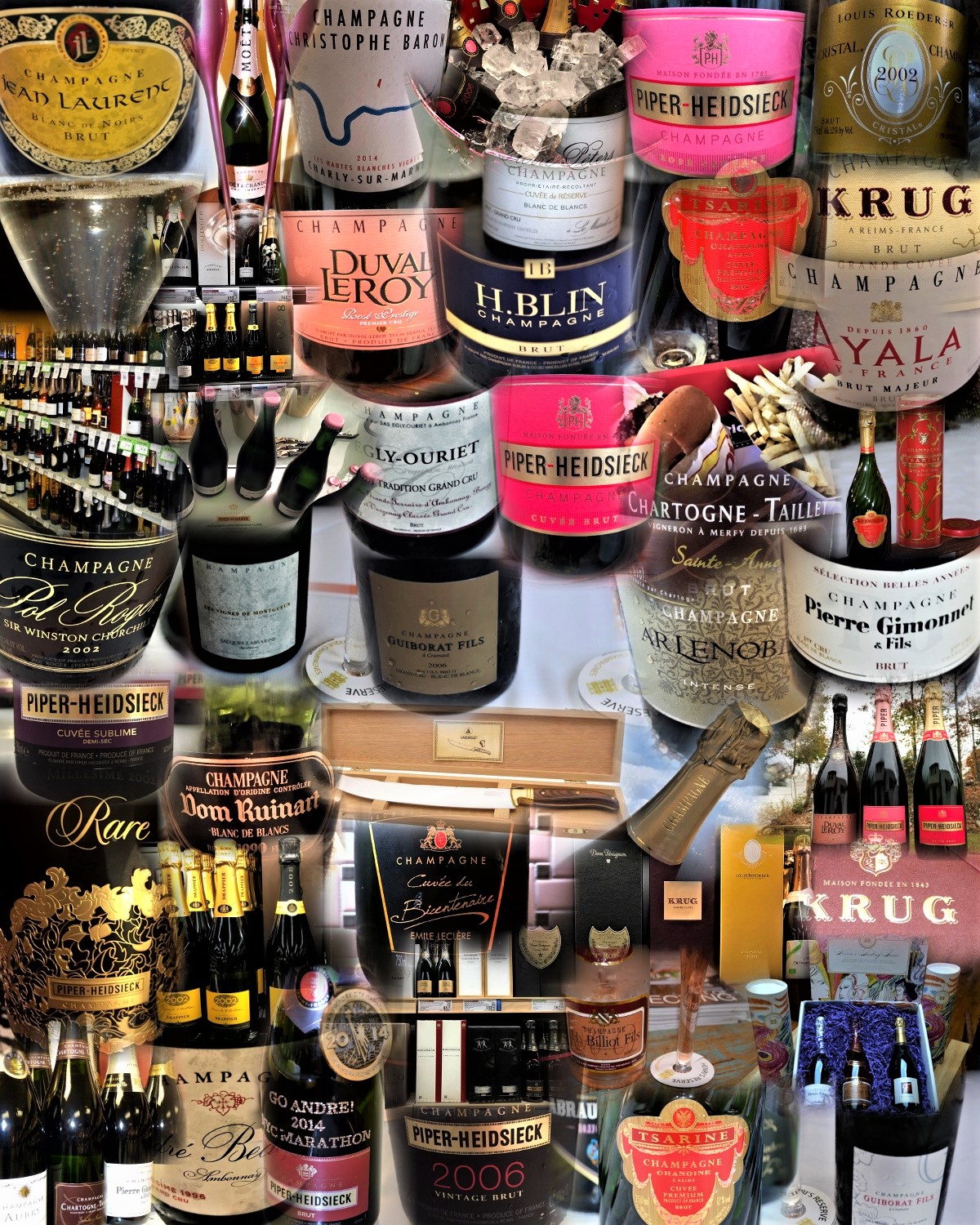
I also can’t miss an opportunity to mention the sabering – opening of the Champagne bottle with a special sword, the saber (hence the name). Sabering has some ground rules and requires basic skills – it can be done with the saber, but it is even more fun to use a random object, such as a wine glass, a stapler, or an iPhone – but this should be a conversation for another time. Sabering or not, but the opening of the Champagne bottle often goes wrong – and I want to leave you today with a little compilation of such, well, accidents.
One of my favorite quotes of all times is not about Champagne, but about life – in the words of the singer Pitbull, “every day above ground is a great day”. Don’t wait for a special occasion – open that Champagne bottle today – as the present should always be celebrated.
Cheers!
An Evening With Friends
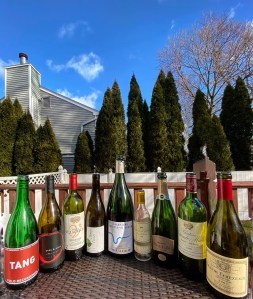 What is your favorite part about wine? Is it the taste? The buzz? The sheer appearance of the bottle sometimes resembling the work of art? The joy of owning an exclusive object? The coveted status symbol?
My answer will be simple. My favorite part about wine is the ability to share it. Take a sip, reflect, have a conversation, preferably a slow-paced one. Friends are the best pairing for wine. Opportunity to share the experience, pleasure, and joy. Sharing makes it all worth it.
New Year celebration (the main holiday for anyone with the Russian upbringing) is a multi-step process for us. We like to celebrate the arrival of the New Year as many times as possible – the evening before the New Year, a midnight Champagne toast, the New Year’s day dinner, and more dinners shortly after (this is when the bathroom scales are the worst nemesis). Some or all of these dinners have to include friends – and it is the best when friends share your wine passion.
Such was our dinner on Saturday, bringing together a group of friends who truly enjoy what the wine world has to offer. We all contributed to the evening, both with food and wines, to make it fun and interesting. Below is the transcript of our wine extravaganza, with highs, lows, and surprises.
While we were getting ready to start our dinner, our first wine was something unique and different – how many of you know what Piquette means? It appears that Piquette is yet another type of sparkling wines. The story of Piquette goes back to 18th century France when the whole wine industry was in full disarray. Piquette is literally made by converting water into the wine – using water to rehydrate grape skins left after the wine production. We had 2019 Field Recordings Tang Piquette Central Coast (7.1% ABV, Rehydrated skins of Pinot Gris and Chenin Blanc) which was made using this exact process – grape skins were hydrated in well water for a week, then pressed, after which a little bit of the table wine was added, and the wine was bottled with leftover yeast and sugar to continue fermenting right in the bottle. To me, the wine was reminiscent of cider – light fizz, fresh apple notes, cloudy appearance of a nice unfiltered cider. Would I drink this wine again? On a hot summer day – yes, why not, but this is not the wine I would actively seek.


It is difficult to assess the “uniqueness” of the wines. There can be many reasons for the “unique” wine designation – small production, wine not produced every vintage, the wine which is no longer produced. There are, of course, many other reasons. How about spending 10 years to finally make about 200 (!) bottles of a drinkable wine? Don’t know about you, but this is unquestionably unique in my book. And so there was 2017 Olivier Pittet Les Temps Passés Vin de Pays Romand Switzerland (14.2% ABV, Arvine Grosso). Petite Arvine is a popular white grape in Switzerland, producing nice, approachable white wines. On another hand, Petite Arvine’s sibling, nearly extinct thick-skinned Arvine Grosso (or Gross Arvine), is a nightmare to grow and to work with. This was the Arvine Grosso which took about 10 years to restore the plantings and achieve a drinkable result. The wine needed a few minutes to open up – then it was delicious, fresh, with a touch of underripe white plums, bright acidity and full-body, similar to Marsanne/Roussanne. I wish this wine would be a bit easier to procure and not just through a friend who lives in Switzerland…
I was happy that Stefano brought a bottle of 2008 Berlucchi Palazzo Lana Satèn Riserva Franciacorta (12% ABV) – I love Franciacorta sparkling wines, they always offer a playful variation of the classic Champagne. Berlucchi is the founder of the Franciacorta sparkling wine movement. This wine was also a Satèn, a unique Franciacorta creation, which is specifically made to be a bit gentler than a typical Champagne with the lesser pressure in the bottle. The wine was soft, fresh, delicate, and admired by the whole table enough to disappear literally in the instance.
The next wine was as unique as only inaugural vintage can be. Christophe Baron is best known as Washington Syrah master, with his Cayuse, No Girls, and Horsepower lines. But Christophe’s roots are actually in Champagne, so it shouldn’t be terribly surprising that he decided to embrace his heritage. The first bottling, with a promise of many more, was as unique as all Christophe Baron’s wines are – pure Pinot Meunier, vintage, and bottled only in magnums – 2014 Champagne Christophe Baron Brut Nature Les Hautes Blanches Vignes Charly-Sur-Marne (12.5% ABV, 100% Pinot Meunier, 1613 1.5L bottles produced). I made a mistake of slightly overchilling the wine, but it came to its senses shortly after it was opened. The wine was nicely sublime, with all the Champagne traits present – the acidity, brioche, apples – everything balanced and elegant. This was definitely an excellent rendition of Champagne, but to be entirely honest, at around $300 it costs considering tax and shipping, I’m not sure it was unique enough to justify the price. Oh well… definitely was an experience.


Before we move to the reds, a few words about the food. The New Year celebration is a special occasion, which is asking for a special menu. Our typical New Year dinner menu is heavy with appetizers and salads. Our staple salads are “traditional” – Olivie and “Herring under the fur coat”. For the appetizers, we had red caviar, bacon-wrapped dates, stuffed Belgium endives, different kinds of cold cuts and cheeses, tiny prosciutto/pecorino sandwiches, and I’m sure some other stuff. Tea-smoked duck and delicious lasagna comprised the main course, then finishing with loads of baked goods and candies. Yeah, don’t even think about dragging me onto a bathroom scale.
Let’s get back to wine.


The next wine belongs to the “interesting” category. NV Channing Daughters Over and Over Variation Twelve Long Island (12.5% ABV, Merlot, Dornfelder, Syrah, 208 cases produced), a multi-vintage wine which is produced using Ripasso and Solera methods. The name “Over and Over” is emblematic of the production method of this wine – there are many manipulations which I will not even try to describe – you better read it here. I’m all for the fun and complexity, but my problem is that I tasted the standard vintage Channing Daughters red wines which were literally identical to this Over and Over wine. It is great to play with your wine, no questions – but only if the end result is different, and better than the individual parts. The wine showed very youthful, with fresh crunchy fruit and cut through acidity – but it was lacking complexity. It is not a bad wine, but I was not moved by it.
Next up – 1996 Château Sociando-Mallet Haut-Médoc AOC (12.5% ABV) – this was a happy wine. The cork came out easily in one piece, and the wine was perfect from the get-go. The perfect minty nose of Bordeaux with a touch of cassis, some hints of mature fruit on the palate, but only the hints – still good acidity, solid core, excellent balance – the wine to enjoy. Yep, was gone in no time.


Of course, the duck on the menu is calling for the Pinot Noir, and what can be better than the Burgundy? 2007 Louis Jadot Grands Echézeaux Grand Cru AOC (13.5% ABV) was our designated match for the duck. The wine opened up beautifully, with succulent plums and a touch of smoke, a delicious, classic Burgundy. However, the joy lasted in the glass for about 10 minutes or so – next, all the fruit was gone, and while you know you are drinking wine, this wine had no sense of place of origin. I don’t know what happened – the wine closed up, needed more time, or was already at the last stretch of its life? Don’t know, and don’t think I will ever find out. Well, there is always another bottle, right?
Now, let’s talk about surprises. No, not the Chateau d’Yquem, which you would assume should qualify as a surprise – the 1999 Finca Villacreces Crianza Ribera Del Duero (13% ABV) was a real surprise. I heard the name of Finca Villacreces as one of the venerable Ribera del Duero producers, but I never had it before. When I was able to score this wine at the Benchmark Wine, I was very excited. The New Year’s celebration seemed to be a perfect opportunity to open it, especially as nobody had it before and we were all looking forward to getting acquainted.
The cork came out easily, in one piece with no sign of any issues. Once I poured the wine into the glass, on the first whiff, the scary thought instantly showed up – the wine might be corked. I tasted the wine, and it seemed just a touch off – it didn’t feel unquestionably corked, but the fruit was not coherent and the wine had sharp, raspy undertones which in my experience are associated with the corked wine. We moved the wine into the decanter and continued tasting it throughout the evening – it stayed practically unchanged.
This was not some random bottle I can get replaced at any store, so I really couldn’t just pour it out. And I’m an eternal optimist. So I used plastic wrap to cover the top of the decanter and left the wine standing there overnight. The next day, about 22-23 hours since the wine was opened, I decided to check on it. Oh my god. The wine completely changed. The hint of the musty cellar was gone. The mighty fruit appeared on the palate, layered, present, velvety and powerful, covering your whole mouth and making you extort “ohh, this is good”. I thoroughly enjoyed the wine after 24 hours in the decanter, and even the next day the tiny leftover was still drinkable. How is this possible? What has happened? I don’t have any answers, but if you have any ideas, please share.
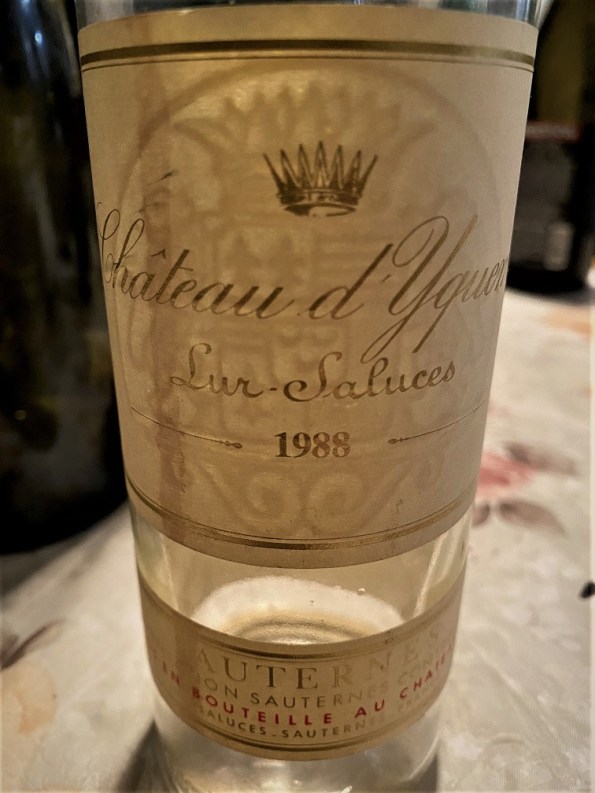
We finished the dinner on the high note – 1988 Château d’Yquem Lur-Saluces Sauternes AOC (13.5% ABV). I’m you sure you don’t need any introductions here – Château d’Yquem is the Bordeaux legend, an absolute hallmark of the Sauternes region, with every other Sauternes wine simply measured against the Château d’Yquem. A perfect pop of the cork from this bottle was music to my ears. The nose and the palate of this wine were in full harmony – it was all about apricots. Fresh apricots, dried apricots, candied apricots – the taste kept moving round and round. The apricots were supported by clean acidity, which became more noticeable as the wine had an opportunity to breathe. Well, this was a short time window in any case, as this half bottle was simply gone in the instance. This 32 years old wine was truly an experience and a perfect finish to our great evening with friends.
That’s all I have for you, my friends. How 2020 started for you? What did you have a chance to discover over the last few days? Cheers!
Bubbles for the New Year 2019
I pride myself with not discriminating against any type of wine – white, red, sparkling, Rosé, dessert, fortified, $2, $10, $100 – doesn’t matter.
In theory.
In reality, most of the days, I drink red. And wish that I would drink more white and bubbles. Especially bubbles.
But luckily, we have at least a few holidays in the year, where the only appropriate choice of wine [for me] is bubbles. New Year’s Eve is absolutely The One – bubbles all the way.
As with all the holidays, a little prep is involved – the word “little” is a clear exaggeration, as deciding about the wine is mission impossible around here. However, this year it was easier than usual. Shortly before the New Year day, I received a special etched bottle of Ferrari Trento, the oldest Italian traditional method sparkling wine and one of my absolute favorites (I wrote about Ferrari many times in the past), so it was an easy decision regarding the bubbles to ring the New Year in with. I also wanted to start the evening with some vintage Champagne but considering that nobody was thoughtful enough to send me the gift of Krug Vintage, I had to settle for whatever I already had in the cellar. And then there was a bottle of generic French sparkler (non-Champagne) “just in case”.
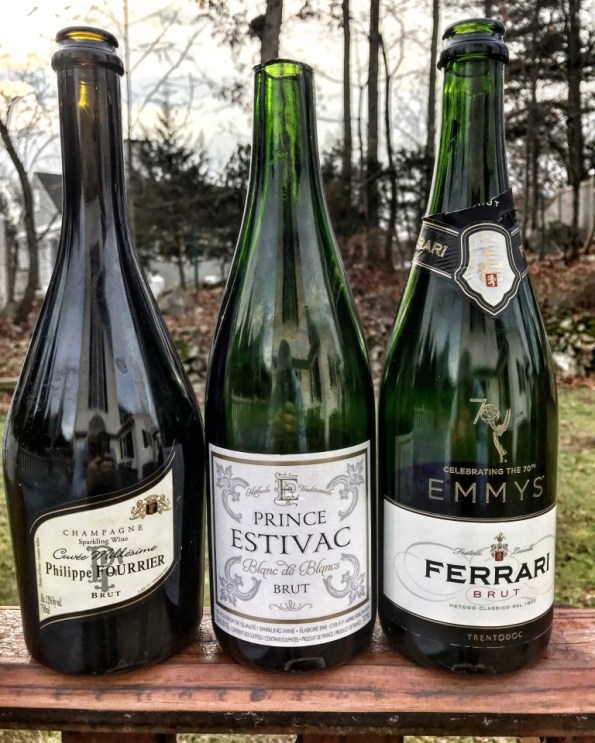
2008 Philippe Fourrier Cuvée Millésime Brut Champagne (12% ABV, $29.99 WTSO) was outstanding, just a perfect sip to start the holiday evening right. It had just the right amount of yeast and toasted bread notes on the nose, just enough to enjoy without going overboard. Apple and lemon notes on the palate, round, fresh, elegant, perfect balance – just a beautiful wine (Drinkability: 8+). It was also a steal at the price (seems that the wine is no longer available at WTSO).
The vintage Champagne disappeared in no time, it was still long before the apple would start its slide down in the Times Square, so the generic French sparkling wine was next. The weather outside was far from ideal for the New Year’s Eve (non-stop heavy rain) but it didn’t stop me from the pleasure of sabering the bottle into the darkness – worked like a charm even with the wine glass, unlike the #$%^ (insert your favorite expletive) with the saber at the French Laundry.
The NV Prince d’Estivac Blanc de Blancs Brut Vin Mousseux de Qualite (12% ABV, $13.99 WTSO, Melon de Bourgogne 50%, Ugni Blanc 25%, Chardonnay 25%) was excellent in its own right – fresh and vibrant, with rich mouthfeel, touch of a fresh apple, a bit bigger body than a typical Champagne – delicious in every drop (Drinkability: 8). It was also interesting learning for me as I’m not really familiar with “Vin Mousseux de Qualite” designation. It can be used for any French sparkling wine made with the traditional method. I’m assuming with the Vin Mousseux de Qualite designation the grapes can come from anywhere in France, where all of the Cremant wines (Cremant de Alsace, Cremant de Loire, …) require the grapes to be from the defined geographic area – if I’m wrong, please let me know in the comment.
Last but not least the time has come for the NV Ferrari Brut Trentodoc Emmys’ Special Edition (12.5% ABV, $24, 100% Chardonnay, 24+ month on the lees). Ferrari wines generally don’t disappoint, and this one was not an exception – crips, bright, bubbly (pun intended), good minerality, cut through acidity – sparkling wine worth any celebration (Drinkability: 8).
Of course, there was more than just the wine – New Year’s Eve is calling for a full table – here is a fragment of ours.
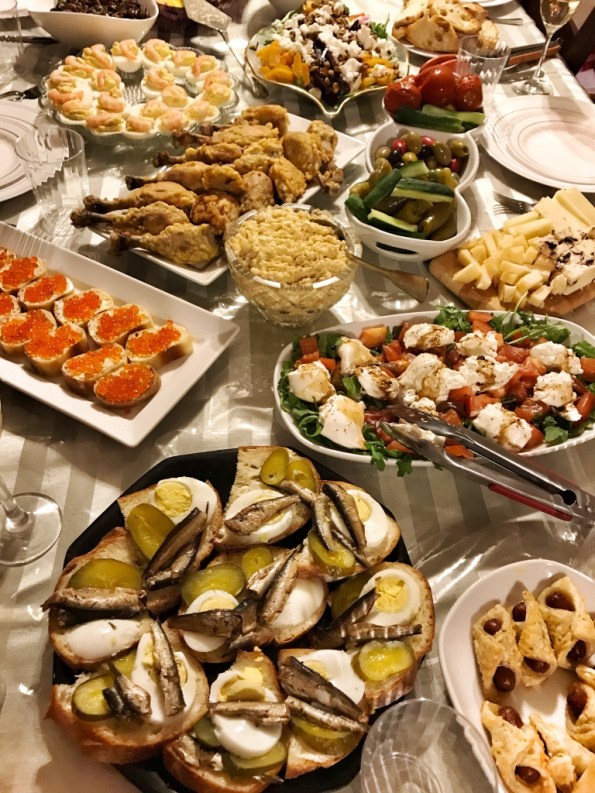
How did you celebrate the arrival of 2019? What were your bubbles of choice? Cheers!
One on One With Winemakers: Tasting The Stars
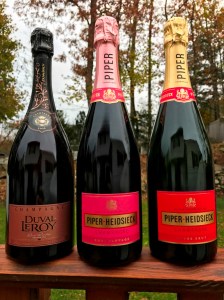 “Come quickly, I am tasting the stars!” – whether Dom Perignon said these words or not is not really important – but if you thought that we will be talking about the Champagne, you got it right! Also, plural mention of “winemakers” in the title is not a mistake – today’s “one on one” post is actually a double-feature.
The story of Duval-Leroy Champagne goes almost 160 years back, to 1859, when Edouard Leroy, wine négociant, met Jules Duval, grape grower – the rest is a history which you can read for yourself here. Today Duval-Leroy farms 200 hectares (about 500 acres) of vines, mostly in Premier and Grand Cru appellations, also using sustainable viticulture – Duval-Leroy is known as a pioneer of the sustainable grapegrowing in Champagne.
In 1785, “Heidsieck & Cie” company was founded with one dream – to create a Champagne worthy of a queen. After tasting the stars, Queen Marie Antoinette became the first “brand ambassador” for the Heidsieck Champagne. I don’t want to try to regurgitate here the rich history of Piper-Heidsieck Champagne, you would be far better of reading it for yourself, but for all these years, Piper-Heidsieck story always included royal families, fashion designers, and movies. The bottle of Piper-Heidsieck was the first Champagne to ever appear in the movie in 1933. Since 1993, Piper-Heidsieck is an official supplier of Cannes Film Festival, and many actors and producers were recognized with the special Piper-Heidsieck Award at film festivals around the world.
Now, let’s get to that double-feature interview I promised. I’m running this “one-on-one” series of the interviews for about 3 years now. Until now, there was always a unique set of questions, prepared specifically for the particular winery and the winemaker. This time, I decided to play it a bit differently – ask the same set of questions of two winemakers – however, in this case, there is a great “common space” between the subjects of the interview – they both make Champagne!
I had an opportunity to [yes, virtually] sit down with Sandrine Logette, Cellar Master of Champagne Duval-Leroy, and Séverine Frerson, Chef de Caves at Piper-Heidsieck, and here is what transpired:
[TaV]: What is your approach to the blending of Vins Clairs? How many Vins Clairs are typically comprising your most standard NV house blend?
[DL]: It is necessary to first think about the flavor profile you would like to achieve: the aromatic notes with its intensity and its descriptors, its mouthfeel, its volume, its angles, its power and persistence as well as the volume: number of bottles to produce, volume of reserve wines to use and volume of wine to save for future ‘liqueur d’expédition’. The vins clairs are tasted several times (at least twice) after the malolactic fermentation to familiarize ourselves with their characteristics. The first approach to blending is always a minimal concept; which is what I call it my ‘accounting idea’. It is tasted, assessed and compared to our first and last blends of this wine made in previous years. The vins clairs are then improved by modifying only one character at a time. The same improvement is repeated as many times as necessary to achieve the best result. We use about 45 to 55 vins clairs to produce our Champagne Duval-Leroy Brut Réserve.
[PH]: We blend over 100 crus to make Piper-Heidsieck’s NV cuvée: the Cuvée Brut. I think of the vins clairs (base wines) as spices stored in little boxes in her mind and I know exactly which boxes/spices (and proportions) I need to add to create the same taste every year.
[TaV]: Can you describe your “house style”?
[DL]: Our goal is to maintain the quality of our Brut Réserve NV vintage after vintage:
- A complex aromatic profile showing fruity notes of yellow peach, damson and subtle red berries along with notes of cocoa powder and toasted bread
- An integrated, round and generous mouthfeel but yet elegant and fresh.
[PH]: Piper-Heidsieck’s wine style is fruity, structured and complex, with lots of deepness. It’s a champagne to treat yourself and to share with your loved ones. Champagne serves as a bridge between people. It triggers and enhances moments of sharing, complicity and joy. And we are the ones who strive to create memorable experiences. It is all truly wonderful!
[TaV]: Somewhat of a continuation of the previous question: I don’t know if you ever experimented with this, but I wonder if a panel of wine consumers (non-experts) would be able to identify your standard NV offering in a blind tasting?
[DL]: We have worked with a panel of French consumers who tasted our Brut Réserve NV. This panel was able to detect the fruity nose without going into details and recognize the roundness of the mouthfeel and the integrated acidity.
[PH]: The goal of our Cellar Masters is to maintain Piper-Heidsieck’s style, and make it recognizable. Our wines are fruity, structured and profound but also well balanced, straight and bright. In the case of the Cuvée Brut, it’s a seductive champagne that you can recognize on your palate right away. What gives it away is its notes of almond and fresh hazelnut that are very lively, subtle and light. It’s a very smooth an pure champagne with notes of fresh pear and apple with a delicate hint of citrus fruits (pomelo). You can also taste the blonde grapes and juicy white fruits that create the lightness of the champagne.


[TaV]: Similar question to the second one, only now for the vintage Champagne – can you describe your house style?
[DL]: Our vintage “house style” is given by the characteristics of that specific year which varies according to the weather, therefore, the quality of the grapes (acid-sugar balance – fruit richness). We do not look for our vintage cuvées to be identical year after year. We make the best vintage with what nature has to offer.
[PH]: The Cellar Masters’ goal when creating a vintage champagne is to put a special year in a bottle. They want to take a snapshot of this particularly great year to keep it as a memory and reward the hard work of our vineyard team without forgetting about the Piper-Heidsieck style. Every vintage is different but they all answer to the Piper-Heidsieck style: wines that are fruity, structured with great depth. Our Cellar Masters took the best grapes from 2008 to put it in our current vintage: Vintage 2008 is a precise, elegant and free-spirit wine that showcases the greatest wines 2008 had to offer.
[TaV]: I would assume all (many?) of the Champagne houses have their “secret stash” of Champagnes which had not been disgorged yet – and the wines are disgorged on one by one basis, maybe for the special clients. Do you have such a “secret stash”? What are the oldest, not yet disgorged wines you have in your cellars?
[DL]: Of course, Duval-Leroy has its secret reserve Champagnes that are not disgorged and waiting in the cellar for that special request. Vintages such as 1979, 1982, 1986, 1988, 1990 … are kept in bottles and magnums (not systematically in each cuvée).
[PH]: We do have old cuvées in our Cellars, our “secret library” contains old NV from 1980 to now and different vintages from 1982 and on.
[TaV]: Are the Champagne styles changing to address the consumer demand? For instance, I would expect that people would like to drink more of Brut Nature/zero dosage and Rosé Champagne. What do you think?
[DL]: The Champagnes’ style may slightly vary depending on consumers demand, but not fundamentally change. Champagne is an Appellation d’Origine Contrôlée which defines production rules and style objectives of quality.
We have seen a greater demand for Champagne Rosé and 5 to 10% sales increase over the past 10 years.
Rosé Champagne is an accessible Champagne, more obvious in terms of taste, festive by its color and more enticing.
The growing demand is also linked to the fact that Rosé Champagne has more personality and a specific identity. It is definitely easier to produce due to warmer weather in recent years.
We find an equally interesting demand for low dosage Champagnes. These low dosages are made possible because of a better integrated acidity naturally due to the wines richness and roundness.
[PH]: We do see some trends in the industry, people tend to be more knowledgeable about what they consume and younger generations like to be more informed. They become more and more wine experts so they ask to question about dosage, disgorgement dates … We have our cuvée Essentiel that works really well with wine experts since they have all the information they need on the label (disgorgement date, bottling date, lot number…) and it’s an extra brut. At Piper-Heidsieck we have a wide range of champagnes to please everyone, we have Rosé Sauvage, Essentiel (extra brut) for wine experts and connoisseurs, our Cuvée Brut, a vintage and Cuvée Sublime (a demi-sec). Our range satisfies all consumers, from non-experts to wine lovers and our entire range has complimentary food pairings.
[TaV]: Champagne seems to enjoy higher popularity overall over the last few years. Do you expect that trend to continue? Are the challenges for Champagne which need to be overcome?
[DL]: Of course we want this trend to continue and Champagne to remain the leader sparkling wine out there. In order to overcome any challenges, the Champagne region needs to continue improving.
[PH]: This trend will continue for sure. As mentioned before, the younger generation tends to be more and more knowledgeable about what they consume, especially for wines. They gain interest and want to develop their palate and their knowledge about wine. With more educated consumers that know the quality of champagne and tend to pair champagne with food more and more often we will keep seeing an increasing popularity in champagne consumption in the upcoming years.
The biggest challenge we will be facing is climate change. The Earth is getting warmer and the climate is changing making it even more difficult for us to ensure the quality of grapes as the years go on. With the unpredictable weather, our vineyard team will have to work even harder to protect our vines and ensure a high quality. At Piper-Heidsieck we already took measures to protect the environment as much as we can with recycling measures, reducing our water consumption and gas emissions. It’s a global concern and a challenge that will affect all industries in one way or another.
Another challenge would be the increasing sales of other sparkling wine, but it’s not too concerning as sparkling wines and champagne are very different products consumed for different reasons. As the consumers are getting more knowledgeable they can tell the difference between sparkling wines and champagne and they consume one of the other at different occasions.
[TaV]: What is your most favorite Champagne you personally or your house overall ever produced and why?
[DL]: My favorite is our Femme de Champagne tête de cuvée and specifically the 1995 and 1996 vintages. Very great vintages with beautiful and precise balance and a great aging potential.
[PH]: I actually don’t have a favorite champagne! It all depends on the moment, when I will open it and with whom! I will choose the Cuvée Brut for a festive aperitif with friends. I love the Vintage 2008 for an intimate dinner and the Rosé Sauvage in the summer with a barbecue.
[TaV]: Champagne rules allow using 7 different grape varieties, yet absolute majority only uses 3 from that list. Have you ever experimented with using any of those 4 leftover grapes? If yes, did you get any interesting results?
[DL]: Since 1998, we regularly vinify one of the old grape varietal of Champagne called ‘petit meslier and produce a specific cuvée: Précieuses Parcelles. Petit Meslier is a white grape varietal that grows well in soils rich in clay (a natural cross between Gouais and Savagnin) in the right bank of Vallée de la Marne.
It is a varietal that struggles to ripen, therefore has a mouthfeel marked by sharp acidity and aromatic notes of rhubarb.
I chose to vinify it in barrels to add some fine oak and spicy notes. Currently, we are working on the 2007 vintage with a low dosage of 4 g / l.
It is a cuvée of curiosity, interesting for its rusticity and for an unusual “Taste” of Champagne.
[PH]: Piper-Heidsieck’s Cellar Masters never experienced with the other grapes, because they only focused on those 3 grapes and developed an expertise in those grapes.
[TaV]: Sparkling wines are produced absolutely everywhere in the world today. Have you tried any of the Methode Classique sparkling wines produced outside of France (Italy, Spain, South Africa, USA,…), and if yes, did you find anything you liked? You don’t have to love them, but maybe you liked just a little, tiny bit? 🙂
[DL]: Fifteen years ago, the Duval-Leroy family contemplated purchasing vineyards in England but decided otherwise. They’d rather stay focused on the terroirs of Champagne.
[PH]: Today sparkling wines are developing, but Champagne stays the luxurious sparkling wine of reference.
It’s always interesting to discover other regions – for example, I tasted high quality sparkling wines from Italy, Spain and Hungary and even if we are in the sparkling wine category they all had they own style and authenticity!
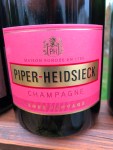
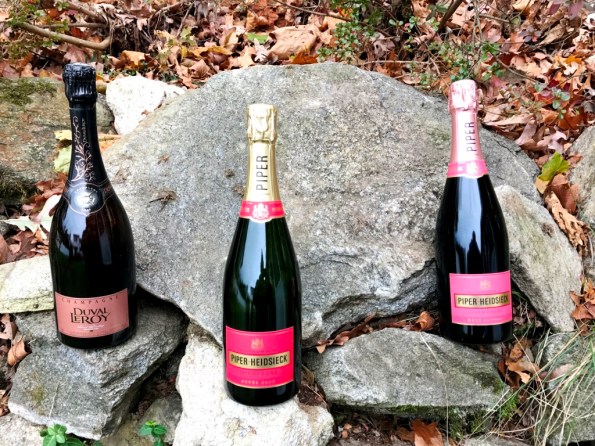
Time top drink some Champagne, isn’t it?
First, I wanted to try NV Duval-Leroy Rosé Prestige Premier Cru (Chardonnay/Pinot Noir blend) and NV Piper-Heidsieck Rosé Sauvage (50-55% Pinot Noir, 30-35% Meunier, 15-20% Chardonnay) side by side, as both are Rosé Champagne. There was a dramatic difference in appearance and taste profile. Duval-Leroy, in a word, was sublime. Delicate pinkish color, just a light salmon pink, whiff of the toasted bread, vibrant acidity on the palate, touch of lemon – seductive, and yes, sublime. Sauvage, on another hand, means “wild” in French – and that exactly how the Piper-Heidsieck was. Strawberry pink in the glass, fresh tart strawberries and a touch of yeast on the nose, and then generous toasted bread, granny smith apples and strawberries on the palate. Truly different and delicious in its own right.
NV Piper-Heidsieck Cuvée Brut (50-55% Pinot Noir, 30-35% Meunier, 15-20% Chardonnay, 10-20% reserve wines) was, in a word, classic – generous, voluptuous, touch of toasted bread and yeast, full mouthfeel, golden delicious apple sweetness, good minerality, very present and excellent overall.
Three Champagnes, three different wines, each delicious in its own right, each worthy to be a star of a special celebratory dinner or a quiet evening for two. And two conversations about the wines, the passion, the style, the stars. We spoke enough today; if you are still reading this, thank you and cheers!
Last Bottle Sign Up ($10 credit)




 Talk-A-Vino