Archive
Daily Glass: The Mood, The Vintage, Or Something Else?
Carlisle is one of my favorite California wine producers (who is, unfortunately, about to close the operation, but this is not the subject of this post). Carlisle is very well known for their Zinfandel wines, but their Rhone-style wines (Syrah, Petite Sirah, Grenache, Mourvedre, and others) are also excellent. I love their wines and have been on the mailing list for more than 10 years. I’m rarely disappointed by Carlisle wines, and yet I had a few “interesting” experiences.
Two years ago, in January of 2024, I opened a bottle of 2016 Carlisle Two Acres wine, and it turned out to be one of such “interesting” experiences. I didn’t like the wine, not when it was just opened, nor over the next few days it remained open. The wine was lacking balance, and since that time, I had a bit of trepidation whlie considering opening Two Acres again.
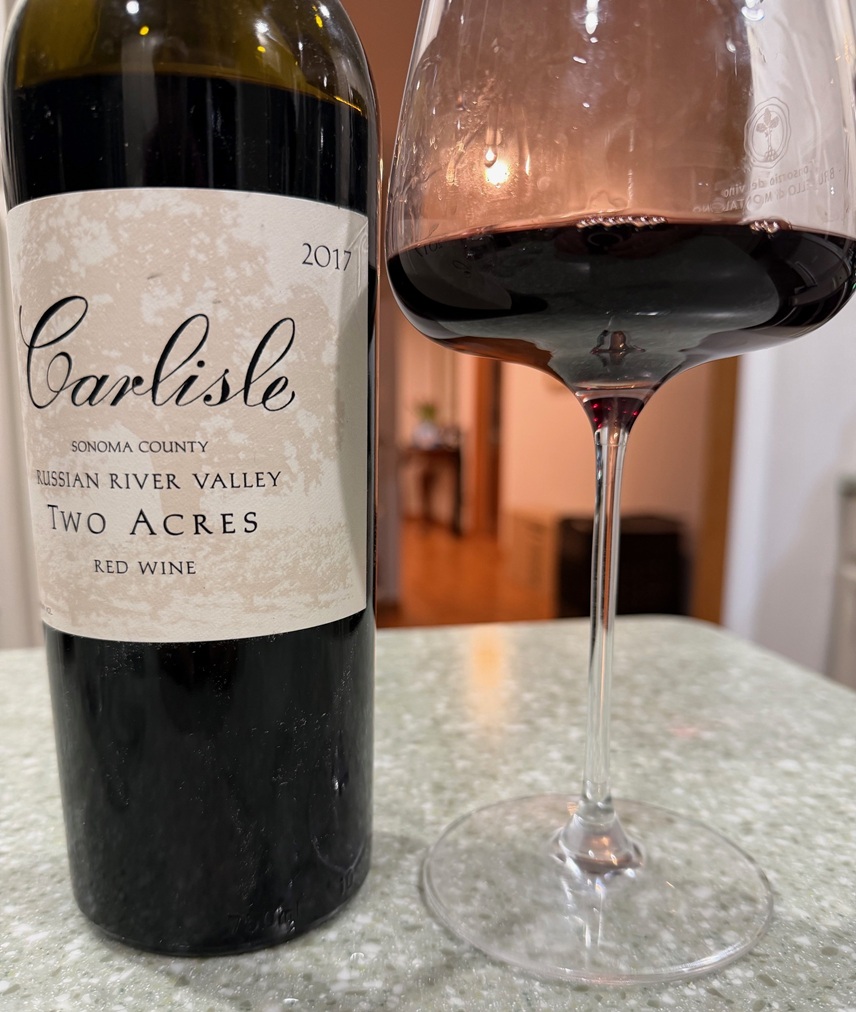
Today, I decided to give it another chance. This time, it was a 2017 Carlisle Two Acres Russian River Valley (14.9% ABV). Different vintage, a year difference in ageing (8 years versus 9 years). And the wine couldn’t be more different. Almost black color, dusty cherries on the nose, beautiful legs (couldn’t help but notice). Dusty cherries and herbs on the palate, perfect firm structure, full body, power and elegance, and perfect balance. This was one delicious wine. (Drinkability: 8+/9-)
There is a reason for the wine’s name Two Acres. The grapes for this wine come from the 2-acre vineyard parcel, which was originally planted in 1910. Carlisle took over the parcel in 1996, when the vineyard was practically dying, and restored the vineyard to full health in 2003. The original vineyard was planted with the Mourvèdre grapes, with the addition of Syrah, Petite Sirah, Carignan, Peloursin, and Alicante Bouschet. According to the Carlisle website, there are also a few Zinfandel vines in addition to nine whites of a variety called Helena (a white cross of Zinfandel and Mondeuse noir). Also, Two Acres wine is produced as Field Blend, which means that all the different grape varieties are harvested and processed together, without separating by varieties.
And now is the question – how come? How come I really didn’t like 2016 and loved 2017? Was there something with my mood? The difference between the vintages? On odd bottle? Of course, we will never know, but the analysis, even if futile, is still a part of the geeky wine fun.
I checked the Wine Spectator vintage chart for Rhone varieties in California, and according to the chart, 2016 was supposed to be far superior:
2016 – “A textbook vintage with nearly ideal growing conditions throughout the year”
2017 – “Dramatic weather conditions, from floods to heat waves to wildfires, led to a variable, challenging vintage”
And yet I liked 2017 a lot more. Of course, my 2016 could’ve been just an odd bottle. Or maybe I had a root day. Or just simply a bad day.
We will never know, because you can’t enter the same river twice. But if anything, I think my trepidation towards Carlisle Two Acres is now cured. And I’m ready to taste another bottle.
Until the next time – cheers!
P.S. Just for fun, a Day 2 update:
The wine evolved, now adding a touch of nutmeg, balsamic, and iodine, smothered on top of delicious black cherries with perfect acidity to support the new expression and keep the wine lean and firm, with an unnoticeable ABV. As I said before, a treat.
Oh, Grenache
 Last Friday, September 15th, we celebrated International Grenache Day. For those rare grape holidays I manage not to miss, I usually write a post on the actual day of celebration. This post didn’t make it on time (obviously), but I managed to open a beautiful bottle, so better late than never…
First, let’s talk about Grenache. Grenache, also known as Garnacha in Spain, is one of the major red wine grapes. Grenache is growing in all major winemaking regions – France, Spain, Italy (under the name of Cannonau), Australia, New Zealand, California, Washington, Israel, and many other places.
I’m sure that when people hear the name Grenache, the instant association is “red wine”. However, close relatives Grenache Blanc and Grenache Gris are also popular grapes, capable of producing delicious white wines – as they do, for example, in Southern Rhône.
Grenache is versatile – it can star on its own, but it is also a great team player. In Spain, Grenache, or rather, Garnacha, is the grape behind some of the most coveted wines of Priorat (Clos Erasmus, anyone?). Campo de Borja in Aragon is another Garnacha’s sacred land – if you have ever experienced the beauty of Alto Moncayo wines, you know what I’m talking about (if you didn’t, it is never too late to rectify). And in some regions, such as Rioja, Garnacha successfully plays a supporting role.
In France, Grenache is the driving force behind the wines of Southern Rhône – Gigondas, Chateauneuf-du-Pape, and everything in between fully relies on Grenache – both solo and as a part of the blend. I’m sure you heard of GSM, which stands for Grenache, Syrah, Mourvèdre – this trio constitutes an absolute majority of Southern Rhône wines, but GSM blends from Australia and the US will give Rhône wines great run for the money.
In the US, Grenache powers many California Rhône Rangers wines – Alban, Saxum, Pax, as well as many of the Washington wines – again, both in solo versions, such as single-vineyard No Girls and Horsepower wines and cult blended renditions such as Sine Qua None.
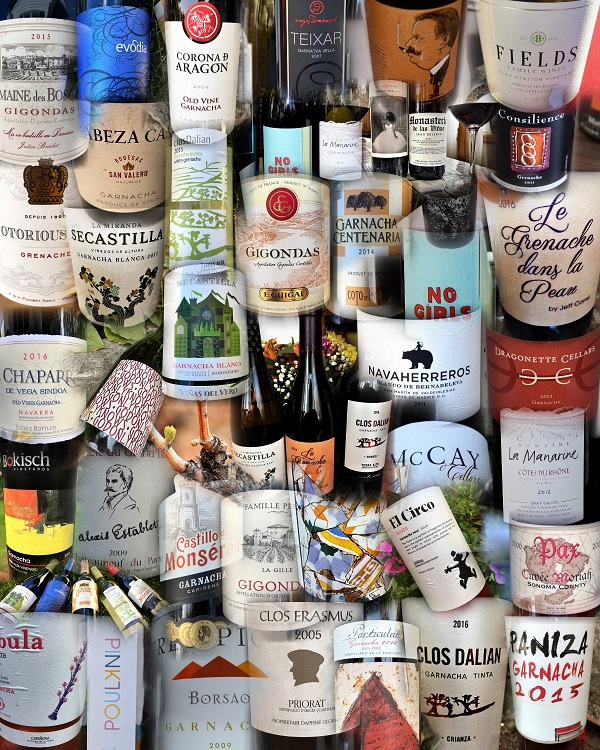
When it comes to the grape holidays, I take pleasure in going through the labels of the wines I had in the past and building a little collage to represent my experiences with the celebrated grape. I realized that even though I wrote about Grenache Day in the past, I never made a collage – fixing this problem was a lot of fun:
Now, let’s talk about the Grenache that put a smile on my face that Friday – 2015 Carlisle Grenache Rossi Ranch Sonoma Valley (15.4% ABV).
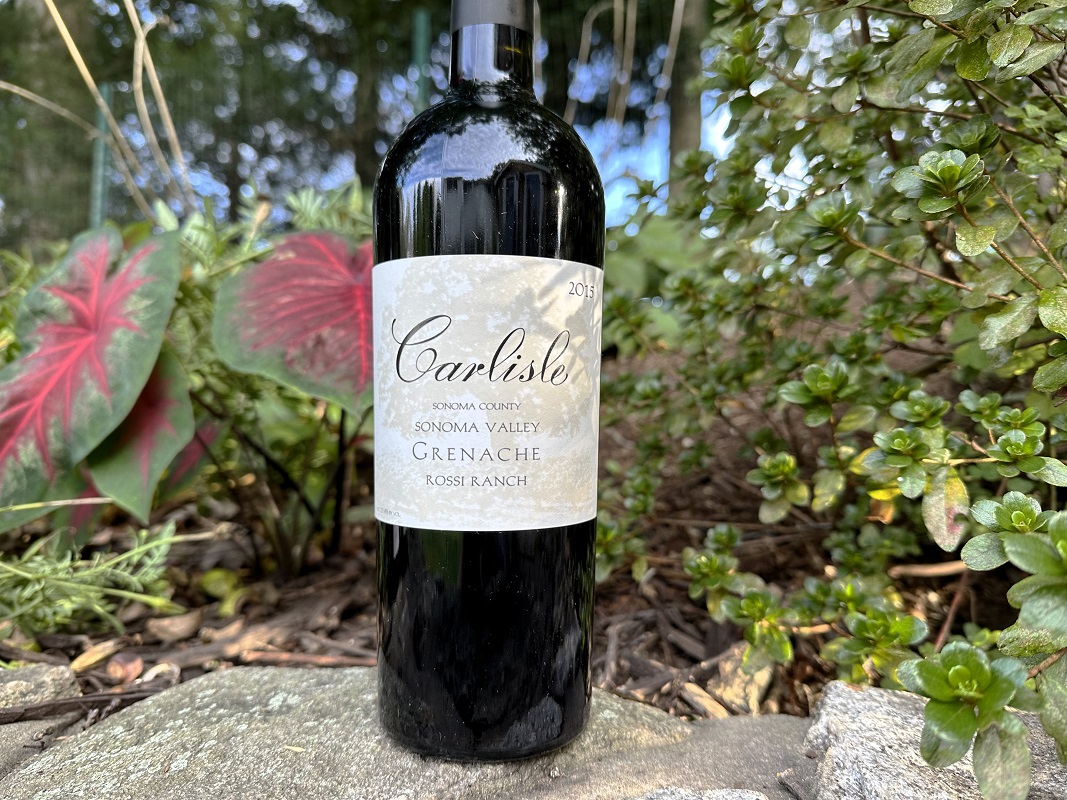
Carlisle is best known for their Zinfandel and Syrah wines. But they also make other wines, such as Grenache, Mourvèdre, Alicante Bouschet, albeit in small quantities and not every year. Carlisle Grenache is a rare animal – I’m not even sure I ever got any other Grenache via the mailing list. It appears that the 2014 vintage was not even bottled, as the wine couldn’t be tamed. However, 2015 worked very well, and Carlisle was able to produce the whooping amount … wait for it … of 77 cases. I don’t even know by what luck I was able to get a bottle, but I’m very happy that I did.
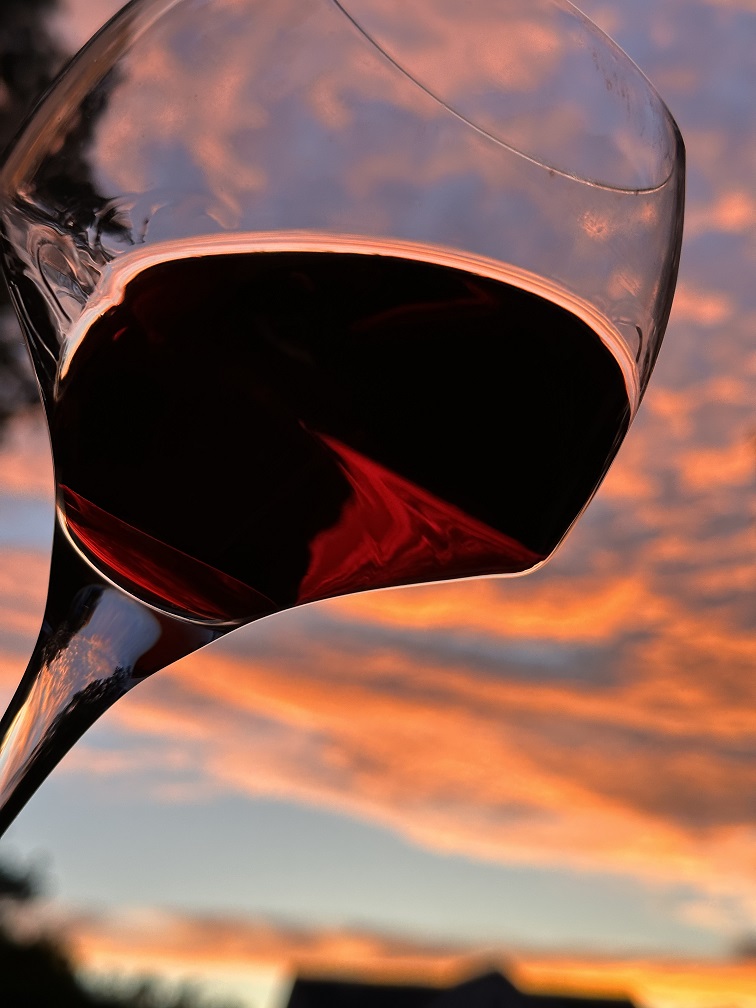
100% Grenache, aged in neutral oak. The wine was stunning – first, the nose, loaded with red berries and herbs, fresh, complex, and vibrant – one of those wines you want to smell indefinitely. When I finally got to sip the wine, it didn’t disappoint – the core of the red fruit, a hint of tobacco and just a tiny splash of dark chocolate, sage, vibrant, full of energy and impeccably balanced. And we got to enjoy the wine over a magnificent sunset – two pleasures at once…
This is my Grenache Day story. What Grenache experiences would you like to share?
Chasing DRC
Only yesterday I told you about some of the unicorns I’m chasing (the special breed, those made out of wine). And now I want to talk about the ultimate unicorn, the unicorn of unicorns if you will – Domaine de la Romanée-Conti, usually called by its abbreviated name – DRC.
Life is a series of random events. Sometimes we think we are in control, and sometimes we really are – but more often than not, things are just happening, and they are happening whether we are there to observe, learn, and experience, or not. While the events might be random, it is up to us to look for the patterns or the objects we desire. Once we know what we want, our subconscious is programmed to look for it any time all the time.
I had been following The Wellesley Wine Press blog for a very long time. Robert Dwyer, who is writing it, not only shares his opinion about wines but also has a great talent for finding amazing wine deals, all sorts of special discounts and promotions by credit cards, wineries, and wine merchants. When I got an email about Robert’s new post, “Domaine Romanée Conti meets Sonoma Coast: 2018 Vivier Pinot Noir [$37]”, my fingers were clicking the link even before I finished reading the title of the post, literally a reflexive reaction to detecting the words “Domaine Romanée Conti”.
You see, DRC might be the most coveted wine in the world. If it is not the one, maybe it is one of three or five of the most sought-after wines in the world. It is produced in minuscule amounts, and it is prohibitively, really prohibitively expensive for most of the mere mortals. DRC produces a number of wines, so to give you an example, there were a bit more than 2,000 cases produced of DRC La Tâche 2017, each bottle priced at $4,000+. And I honestly don’t care about owning a bottle, I just want to experience such wine at least once in a lifetime – so yes, the unicorn of unicorns.
You can imagine that opportunity to taste something even remotely related to DRC would trigger an immediate reaction. Skimming through Robert’s article, I learned that Vivier Pinot Noir is produced by Stephane Vivier, who was the winemaker for Hyde de Villaine, DRC’s joint venture in California, who started producing his own wines under the Vivier label. And at $37, this is the closest I can get to DRC without second-mortgaging the house. The same post also explained that the wine is available at Wine Access, the site I already had a good experience with – the rest was a no-brainer.

The wine quickly arrived, and I had to literally hold myself from opening the bottle while the UPS truck barely left the driveway. While I was admiring the simple design of the label, I really liked the description I found there: “Stéphane Vivier is a lazy winemaker. He watches. He waits. He plans. All the while letting the vineyards, the fruit, and “le climat” do the heavy lifting. So when you taste his wine, you taste what created it, not who“. That prompted me to take a look at the Vivier Wines website, where I learned that Stéphane Vivier was born and raised in Burgundy, where he also obtained a degree in viticulture and enology. He started working as a winemaker for Hyde de Villaine in 2002, and in 2009 he started making wines under the Vivier label with his wife Dana.
So how was the 2018 Vivier Pinot Noir Sonoma Coast (12.8% ABV)? Upon pouring into the glass, the first thing to notice was the beautiful, perfumy nose – fresh berries, violets, a touch of strawberries. On the palate, the wine was a typical, well-made Californian Pinot Noir, round, elegant, and polished – but unmistakably Californian, with a good amount of sweetness coming through. I can’t tell you what I was looking for, but I wanted to find something unique, something I didn’t experience in Californian Pinot Noir yet – but that didn’t happen.
On the second day, the wine changed its appearance. Both the nose and the palate pointed directly to Oregon. the nose became more earthy and less perfumy, and on the palate the wine was significantly more restrained, with iodine and earthy notes coming through a lot more noticeably. While the wine on the first day was good, I much more preferred how it was showing on the second day (Drinkability: 8-/8).
There you have it, my friends. Did I find DRC in California? Even if I did, I wouldn’t be able to tell, as I have no frame of reference. Did I discover a tasty Californian Pinot Noir? Absolutely. In 5, or maybe 10 years, it might become even amazing. Chase your dreams, my friends. Cheers!
Daily Glass: Meeting The Expectations
Expectations are essential in any area of human life. We find great joy when our expectations are exceeded, no matter what those expectations apply to – service, conversation, book, a dish at a restaurant, final grade – truly anything and everything. We are equally disappointed when our expectations are not met – subpar service, empty talk, boring book, bland dish, a B grade instead of an A. Believe me, works every time. Expectations are important, as they function as gates to happiness.
In theory, having low expectations is a perfect path to happiness – a solid guarantee that expectations will be easily exceeded and we will feel happy. Well, it is easier said than done. More often than not, the expectations are set on a subconscious level. When you read the test question, the brain instantly jumps in “I know the answer!” – left unchecked, the test grade might not meet the expectations. Or think about one of my favorite sources of disappointment while visiting the restaurant – the dish description which doesn’t meet your expectations. If the dish described as “spicy” it is better actually be spicy and not dull…
Expectations work exactly like that in the world of wine. One quick glance at the label unleashes a slew of instant impressions – ahh, Turley, yes, had this last year, maybe a different vintage, I think this is a great year, should be delicious, maybe need some time to breathe, ahh, and I remember not liking that wine at first, yeah, I still remember that… can I pull that cork already? Yep – one quick glance is quite enough.
Exceeding expectations is great, but, more often than not, meeting them is quite enough – especially if your expectations are already high enough. Here is my account of two wines perfectly meeting my expectations.
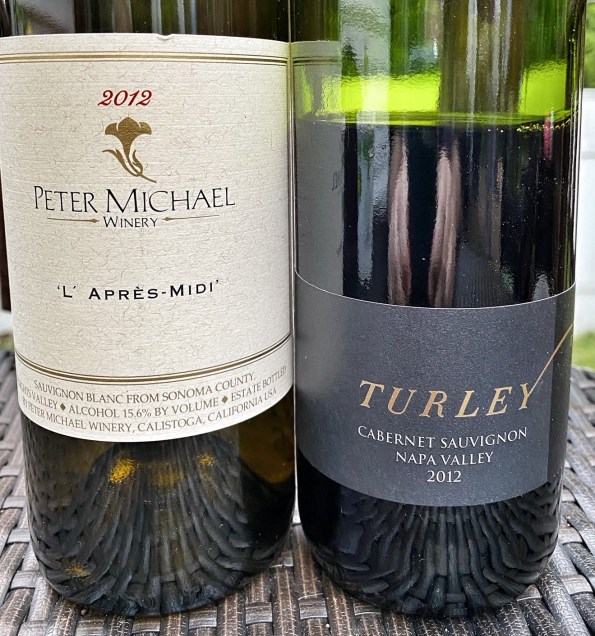
Peter Michael Winery requires no introduction to the wine lovers, producing some of the best Chardonnays, Pinot Noir, and Cabernet Sauvignon wines in California for more than 30 years. Turley Wine Cellars had been around for 27 years, and it is best known as producer of some of the most coveted Zinfandel wines. It is interesting that both wines I’m talking about here are sort of the oddballs for both producers – Peter Michael is not really known for its Sauvignon Blanc, and Larry Turley, the proprietor at Turley wines, was anti-Cabernet Sauvignon for a long time, so I’m not sure if wine lovers are even fully aware that Turley produces Cabernet Sauvignon for the past 5 years.
Both wineries are well known for their quality wines, and when you see their names on the label, you do expect to taste that quality in your glass. 2012 Peter Michael L’Aprés Midi Knights Valley Sonoma County (15.6% ABV) was superb from the get-go – a whiff of the fresh-cut grass, whitestone fruit, round mouthfeel, and clean acidity. The wine was really uncalifornian in its presentation – I would think I’m tasting Sancerre if I would taste this wine blind. The utmost elegance – and 8 years old fresh and vibrant Sauvignon Blanc is not an easy fit.
2012 Turley Cabernet Sauvignon Napa Cellars (14.1% ABV) also tasted as expected. As I opened the bottle, it was not the wine to drink – for sure not for my palate. Big, brooding, jammy, with a lot of semi-sweet dark chocolate and dark fruit. It was quintessential Californian and over the board. I’m sure it doesn’t sound great to many of you, but this is within the expectations, as Californian Cabernet Sauvignon are rarely pop’n’pour wines, and at 8 years of age, they are way too young. However, exactly as expected, the wine became magnificent on the second day. Cassis showed up, smothered with mint, eucalyptus, and a touch of anise. The medley of fruit and herbs was delicious, with perfect balancing acidity and velvety, roll-of-your-tongue, texture. Just the wine I would expect Turley to produce.
How often do you find the wines which meet your expectations? Better yet, how often your wine expectations are exceeded?
If Grapes Would Fight
The Duel.
How human. Or inhumane. Whatever way we want to spin it.
Yes, duels are the thing of the past. You walk on the street. You lightly bump into someone. You apologize. But the other man says that you didn’t hurt his shoulder. It was his honor which was hurt. And the only way to alleviate that pain is through the duel. Choose the day, the time, and the weapon – pistols are fine, or maybe you prefer the Épée. And be there, or else.
You and your witnesses show up at the agreed time in the agreed place. Your opponent will probably be there already with his suitors. Both of you line up, someone gives the command, you fight. One of you most likely will die. But this was expected. The honor will be cleared and not in pain anymore – for whoever will survive, that is. The end.
Oh, did I mention that those duels were not very legal for the most part even when they were very popular?
Now, imagine if those pistols would shoot grapes instead of bullets, and the only choice of weapon would be the type of grape? Let’s say, you will shoot with Cabernet Sauvignon, and your opponent with Petite Sirah, or maybe you will choose a Zinfandel and your opponent will load up with Syrah? I have no idea how the honor will be defended, but I’m sure nobody would die, and such a duel will be so much fun! I’m sure you have a good imagination – imagine the fully ripened grape hitting one of the opponents on the forehead, and splattering the juice all around, in the slow motion – that would be something to remember!
Okay, so grape shooting pistols are not on the market (yet?), but the grapes can duel all they want – if the winemaker desires.
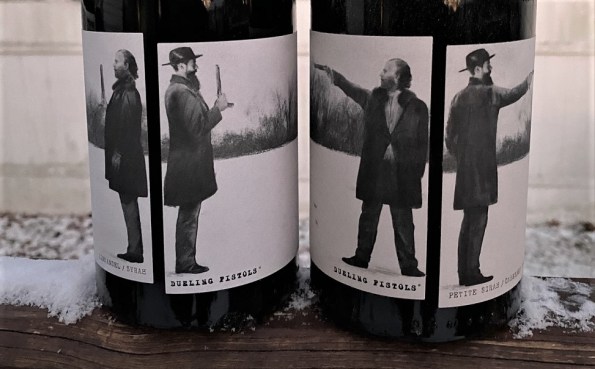
Cue in Dueling Pistols – the wines weaved around the mystery of two men, raising guns at each other at the dawn. We don’t know how they ended up there, or how shootout ends, but it is not important, as we should rather pay attention to wines.
The two Dueling Pistols wines represent 50/50 blends of the grapes that meet each other only after the fermentation is done separately. In one wine, Cabernet Sauvignon and Petite Sirah fight for supremacy; in the second wine, Zinfandel battles Syrah.
Never mind all this fight and battle talk. The wine is all about harmony – you want all the elements of the wine to be in full balance, playing together to deliver an amazing experience. So how these two wines did?


2016 Dueling Pistols Red Blend Dry Creek Valley (15% ABV, $49.99, 50% Syrah, 50% Zinfandel, 18 months in French oak, 30% new)
Dark Garnet
Very intense nose, tar, tobacco, roasted meat, mint
Crisp acidity, tart fruit, much lighter on the palate than expected based on the smell, sour cherries, significant herbal component
7+ initially, needs time
8- on the second and third days, the wine is softer and showing more fruit.
2016 Dueling Pistols Red Blend Paso Robles (15.5% ABV, $49.99, 50% Cabernet Sauvignon, 50% Petite Sirah, 18 months in French oak, 30% new)
Dark Garnet
Inviting nose of cherries and chocolate, with a hint of vanilla and licorice
The palate is smooth and gentle, well extracted, lip-smacking acidity, layers of flavor, velvety texture which makes you crave another sip even before you finished the first.
8/8+, very enjoyable
Here you are. A duel of grapes and even duel of wines. But – nobody got hurt, which is a great outcome of any duel, right?
Judging this fight, I have to say that Cabernet/Petite Sirah won this fight, at least in my corner. But you know what they say? YMMV, so go ahead, stage your own duel and have fun with it. Cheers!
P.S. These two wines were samples provided by Terlato Wines.
Last Bottle Sign Up ($10 credit)




 Talk-A-Vino