Archive
Daily Glass: The Mood, The Vintage, Or Something Else?
Carlisle is one of my favorite California wine producers (who is, unfortunately, about to close the operation, but this is not the subject of this post). Carlisle is very well known for their Zinfandel wines, but their Rhone-style wines (Syrah, Petite Sirah, Grenache, Mourvedre, and others) are also excellent. I love their wines and have been on the mailing list for more than 10 years. I’m rarely disappointed by Carlisle wines, and yet I had a few “interesting” experiences.
Two years ago, in January of 2024, I opened a bottle of 2016 Carlisle Two Acres wine, and it turned out to be one of such “interesting” experiences. I didn’t like the wine, not when it was just opened, nor over the next few days it remained open. The wine was lacking balance, and since that time, I had a bit of trepidation whlie considering opening Two Acres again.
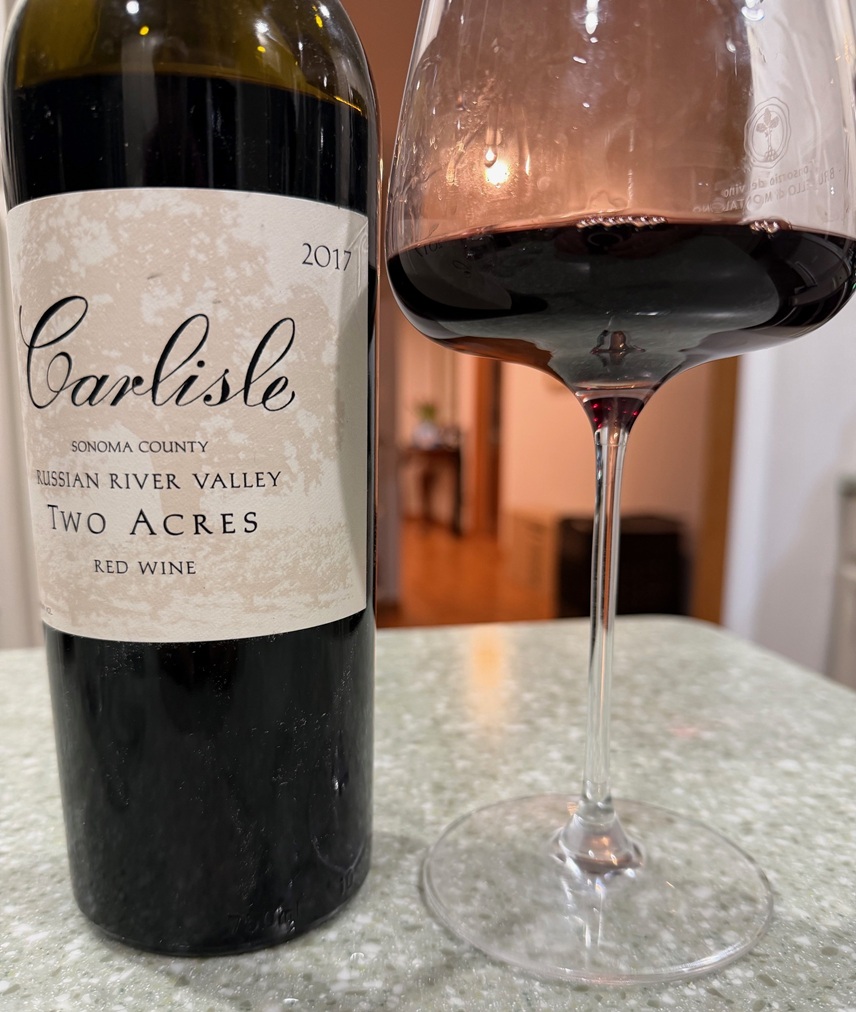
Today, I decided to give it another chance. This time, it was a 2017 Carlisle Two Acres Russian River Valley (14.9% ABV). Different vintage, a year difference in ageing (8 years versus 9 years). And the wine couldn’t be more different. Almost black color, dusty cherries on the nose, beautiful legs (couldn’t help but notice). Dusty cherries and herbs on the palate, perfect firm structure, full body, power and elegance, and perfect balance. This was one delicious wine. (Drinkability: 8+/9-)
There is a reason for the wine’s name Two Acres. The grapes for this wine come from the 2-acre vineyard parcel, which was originally planted in 1910. Carlisle took over the parcel in 1996, when the vineyard was practically dying, and restored the vineyard to full health in 2003. The original vineyard was planted with the Mourvèdre grapes, with the addition of Syrah, Petite Sirah, Carignan, Peloursin, and Alicante Bouschet. According to the Carlisle website, there are also a few Zinfandel vines in addition to nine whites of a variety called Helena (a white cross of Zinfandel and Mondeuse noir). Also, Two Acres wine is produced as Field Blend, which means that all the different grape varieties are harvested and processed together, without separating by varieties.
And now is the question – how come? How come I really didn’t like 2016 and loved 2017? Was there something with my mood? The difference between the vintages? On odd bottle? Of course, we will never know, but the analysis, even if futile, is still a part of the geeky wine fun.
I checked the Wine Spectator vintage chart for Rhone varieties in California, and according to the chart, 2016 was supposed to be far superior:
2016 – “A textbook vintage with nearly ideal growing conditions throughout the year”
2017 – “Dramatic weather conditions, from floods to heat waves to wildfires, led to a variable, challenging vintage”
And yet I liked 2017 a lot more. Of course, my 2016 could’ve been just an odd bottle. Or maybe I had a root day. Or just simply a bad day.
We will never know, because you can’t enter the same river twice. But if anything, I think my trepidation towards Carlisle Two Acres is now cured. And I’m ready to taste another bottle.
Until the next time – cheers!
P.S. Just for fun, a Day 2 update:
The wine evolved, now adding a touch of nutmeg, balsamic, and iodine, smothered on top of delicious black cherries with perfect acidity to support the new expression and keep the wine lean and firm, with an unnoticeable ABV. As I said before, a treat.
Daily Glass: Pure Pleasure
Of course, it is Wine Wednesday – but this was just a happenstance. Not anything I planned.
A traditional dilemma – what to open?
Checked one wine fridge – no, nothing spoke to me. Next thought – maybe Field Recordings?
Again, without much thought – how about that bottle? I passed it a few times before. What vintage is that? Oh, 2019, that might be good. Ha! It is also a Syrah! Nice, my wife loves Syrah, might be her favorite red grape. Prefect, we have a bottle to open.
Talk about wines made in the vineyard. I discovered Field Recordings wines almost 15 years ago. At that time, the wines were more of a side project for Andrew Jones, a consulting grape grower. By nature of his profession, Andrew had relationships with many grape growers. More importantly, he knew the best plots in their vineyards, and thus he knew where to find the best grapes when he needed them. And little by little, Field Recordings became a powerhouse and a darling of Paso Robles, with the wines of unbound creativity.
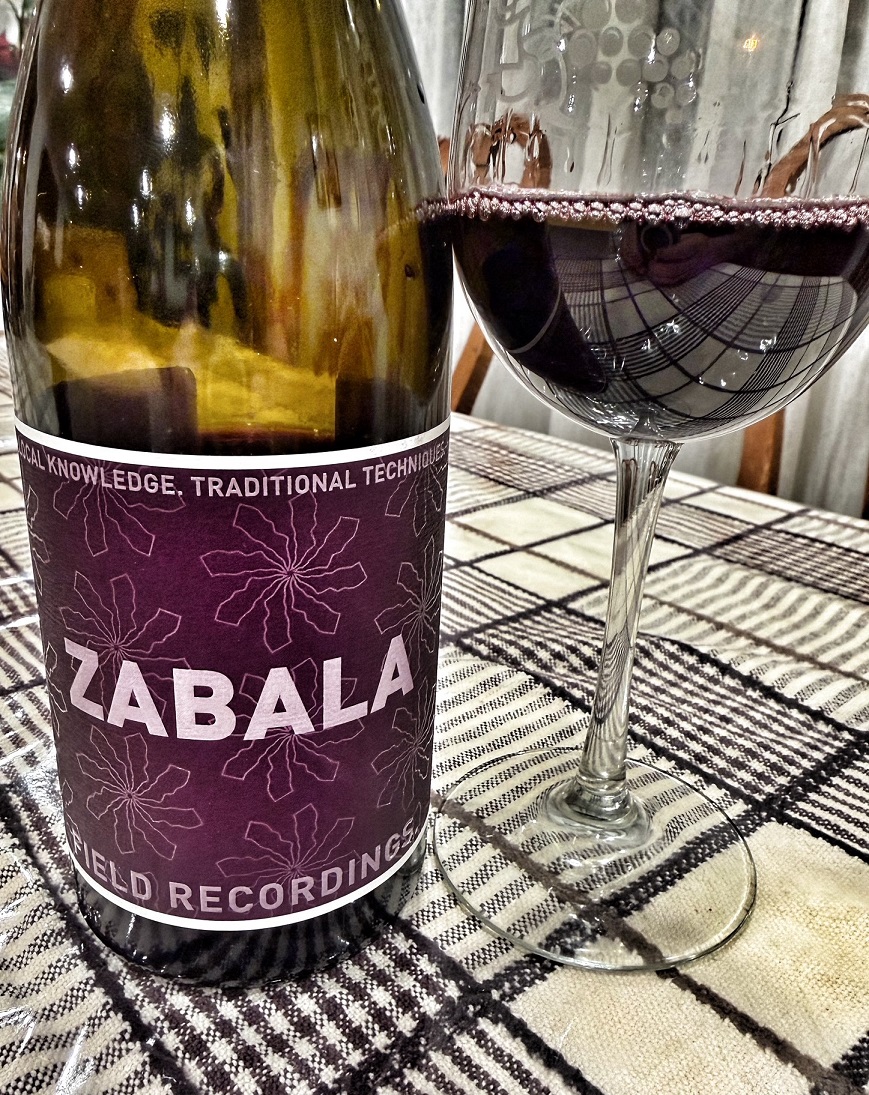
My first Field Recordings wine was the wine called Fiction – here is my post about that experience: Music, Recorded in the Vineyard. This was love at first sight. Fiction by Field Recordings was my wine of the year in 2011. And Field Recordings is the only wine club I ever joined, and I’m still a member there. Over the years, there were literally a handful of Field Recordings wines I didn’t enjoy, because for the most part, my favorite descriptor for the Field Recordings wines is probably “mind-blowing” or maybe “mind-boggling”. As was the case today.
I opened the 2019 Field Recordings Zabala Zabala Vineyard Arroyo Seco (12.9 ABV, 100% Syrah) and poured it in the glass right away. The first whiff had a bit of the funk (love funk!) and a bramble. But on the palate… Oh my, the palate was a pure symphony. Well, a caveat – you have to love black pepper to call that experience a symphony. The palate was full of freshly ground, gorgeous, salivating black pepper. I experienced such purity only once before, while tasting the 2011 Michel Chapoutier Tournon Mathilda Shiraz from Australia. I was blown away by the purity of the pepper expression in that wine – and interestingly enough, after that first experience, I had a random success with the same vintage over a few years – but this is not the subject of this post.
This Zabala Syrah was literally mind-boggling (see, told ya, I just can’t avoid it). Dark bramble fruit, a little bit of funk, and lots and lots of freshly ground black pepper. Delicious, perfectly balanced, perfectly harmonious. A pure pleasure in the glass.
Maybe I just got lucky. I don’t have another bottle from the same vintage, so I will not be able to taste it in a year or a few years and report back. But we should enjoy the moment, and this moment in wine was immensely enjoyable. Wine should give you pleasure, and this was a pure pleasure.
So, what was your last mind-blowing wine experience?
Beautiful Wines of Smith-Madrone
I love the wines of Smith-Madrone.
I’m not even trying to make it a secret.
Yes, I’m biased. But I’m not ashamed of it.
Stu Smith and his brother, Charlie, founded the winery in 1971 in the Spring Mountain District of Napa Valley. When Stu was buying a property overflowing with trees, he was told that he was making the mistake of his life. But the best wines are born out of conviction – add perseverance, gamption, hard work, ingenuity, and imagination – just get all of these ingredients, and you might also be able to make some beautiful wines.
I told you that I love the wines of Smith-Madrone. Usually, love doesn’t require proof. But if you insist, I have one – not only I wrote about wines of Smith-Madrone on multiple occasions, but their wines had been included in my Top Wines of the Year lists 4 times – #11 in 2018 (Riesling), #1 (Cook’s Flat Reserve) and #14 (Riesling) in 2019, #3 in 2023 (Cabernet Sauvignon), and #4 in 2024 (Cook’s Flat Reserve). I don’t have any other wines that so consistently appear in the Top Wines lists.
For many years, Smith-Madrone produced only three wines – Riesling, Chardonnay, and Cabernet Sauvignon, with the addition of the Cook’s Flat Reserve Cabernet Sauvignon in exceptional years. A few years back, Rosé and Cabernet Franc joined the collection, and I was dying to try them ever since. This year, I finally got my hands on the wines (I rarely ask for samples, but this was one of such rare moments – I did ask…), so now I can share my tasting notes with you.
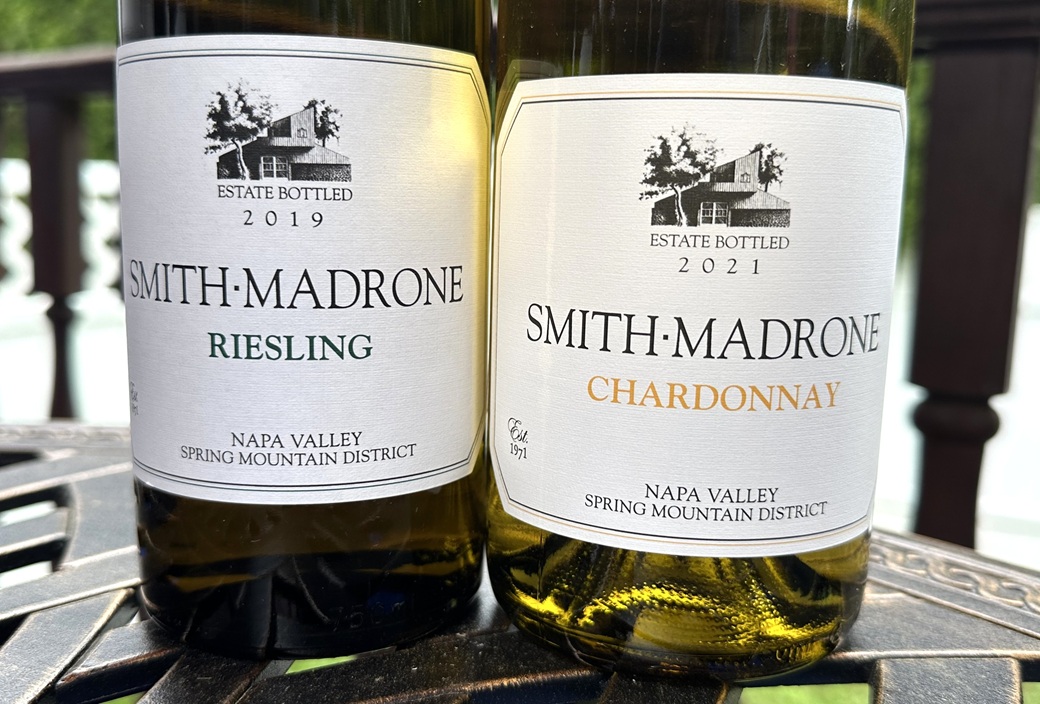
2019 Smith-Madrone Estate Riesling Spring Mountain District Napa Valley (13.3% ABV)
Light golden
Petrol mixed with honey and honeysuckle, a pure aromatherapy in the glass for a Riesling lover. Crisp, bright, honey with lemon in perfect harmony, clean and crisp finish with lots of energy.
9, a pure delight.
2021 Smith-Madrone Estate Chardonnay Spring Mountain District Napa Valley (14% ABV, 10 months in 50% new French oak)
Brilliant golden color
White plums and a touch of vanilla on the nose, a distant hint of gunflint (the wine is almost at room temperature). Apples, a touch of honey, vanilla, more apples, and a cleansing acidity. Delicious.
8+/9-, superb.


2023 Smith-Madrone Estate Rosé Spring Mountain District Napa Valley (14.2% ABV, 50% Merlot, 50% Cabernet Franc)
Beautiful, bright crimson red
Tart cherries, fresh, on the nose. Light, inviting, elegant.
Beautiful tart cherries on the palate, well present, round, delicious.
8+, delicious Rosé with character
2021 Smith-Madrone Estate Cabernet Franc Spring Mountain District Napa Valley (14.7% ABV, 89% Cabernet Franc, 11% Cabernet Sauvignon, 18 months in 60% new French oak)
Dark garnet
Ripe black currant, dark chocolate, fat, juicy, exciting. Delicious, black currant, dark chocolate, a rich California Cab Franc style, bell pepper came in later, together with a beautiful black pepper note, spicy and delicious.
8+/9-
Truth be told, I also got a sample of the 2021 Cabernet Sauvignon – but this is one of my most favorite Cabernet Sauvignons ever, so I couldn’t muster the courage to open the bottle yet, and will be waiting for the right occasion later this year – maybe a Thanksgiving celebration, as I did back in 2018.
I think both Rosé and Cabernet Franc are great additions to the portfolio. Both are produced in small quantities (131 cases of Rosé, 153 cases of Cabernet Franc), and Rosé is already gone (duh, summer is ending), but the Cab Franc is still available. And if we are talking about new additions, maybe we will see a sparkling wine one day? Or wait, I might have even a better idea – how about some late harvest Riesling? Knowing the quality of Smith-Madrone Riesling, if they were ever to produce a dessert-level Riesling, I’m sure it would be an absolute delight. Oh well, maybe one day…
Here you go, my friends. I hope you had a chance to discover the wines of Smith-Madrone for yourself. If you have not, head over to the Smith-Madrone website, admire the scenery of beautiful mountain vineyards, and get a few bottles for yourself to enjoy. I guarantee you will not regret it. Cheers!
Pinot Noir Battle – Let the Best (but Most Unexpected) Win…Again
It all started with a few tweets. I noticed a very high praise for the German Pinot Noirs shared by some of the European wine lovers I’m connected to on Twitter (still can’t make myself call it X, so you will have to forgive me for that). Particularly, Pinot Noir from Ahr was regarded as the best in the world, handily beating Burgundies on any occasion. I was intrigued and started searching for the Pinot Noir from Ahr, which proved to be challenging.
Ahr is a tiny region, one of the smallest in Germany – according to Wines of Germany, Ahr has only about 529 hectares of vineyards (around 1,323 acres), which comprises 40 single vineyards. 65% of the vineyard area is planted with Pinot Noir, about 860 acres – for comparison, the Jackson Family mostly Pinot Noir plantings in Oregon alone amount to roughly 600 acres. You can imagine that finding Pinot Noir from Ahr in the US was rather challenging.
The more I saw Ahr Pinot-praising tweets, the more I wanted to try it. Then one day I checked Wine.com, and there it was – Pinot Noir from Ahr, made by Meyer-Näkel. I quickly went to the Twitter folks to check if this wine would sufficiently represent the Ahr region, got an approving nod, and bought a bottle.
Once the wine arrived, I thought of the best way to try it. When it comes to learning about wine, tasting wines side by side is the best way to learn. Oh yeah, and if you want to be honest with yourself, blind tasting is the only way. We tend to be led by what we know, by our beliefs. Once we know that the wine costs $100, we want to believe that it is better than the bottle which costs $50. Once we see a bottle of Cabernet Sauvignon from Napa Valley in California, we automatically assume that it will be much better than the Cabernet Sauvignon from Lake County or Lodi. Nothing is wrong with us, this is how the brain works – so once you remove all the factors of influence, once you get one on one with the liquid in your glass without knowing the producer, the region, the price – it is very easy to be honest with yourself. So blind tasting it is.
Sometimes we don’t realize how fast the time passes. I love talking about blind tastings when I’m talking about wine, and I have a few of my favorite blind tasting examples, one of them particularly being the Pinot Noir blind tasting we have done in the past. What I didn’t realize is that the particular wine tasting I remember so well took place almost 15 years ago (time flies, isn’t it). The outcome of the tasting was very surprising, with South African Pinot Noir from Hamilton Russell beating California, Burgundy, and others – 15 years ago I didn’t even know that South Africa produced Pinot Noir!
Many things have happened in the wine world over these 15 years – of course, Pinot Noir is one of the oldest red wines produced in the world, but now it is literally produced everywhere – I don’t know if today there is a country which doesn’t produce Pinot Noir wines (maybe Spain?). Also, the quality of Pinot Noir throughout the world got a lot higher. The tasting you are about to read about is the perfect illustration of both points – the widespread geography and quality.
Okay, a blind tasting of Pinot Noir. The Ahr Pinot Noir got high praise, so we need to compare it with the best of the best – which means that we have to have California, Oregon, and Burgundy in the tasting, plus whatever else we might be able to find. I asked for a few samples of Oregon Pinot Noir. Very conveniently, Last Bottle had an offer for Chacra Pinot Noir from Patagonia – a different Pinot Noir from Chacra was James Suckling’s wine of the year recently, so this was a good addition to the tasting. Bottle by bottle, we assembled 12 Pinot Noirs from around the world, and the battlefield was ready to be set up.
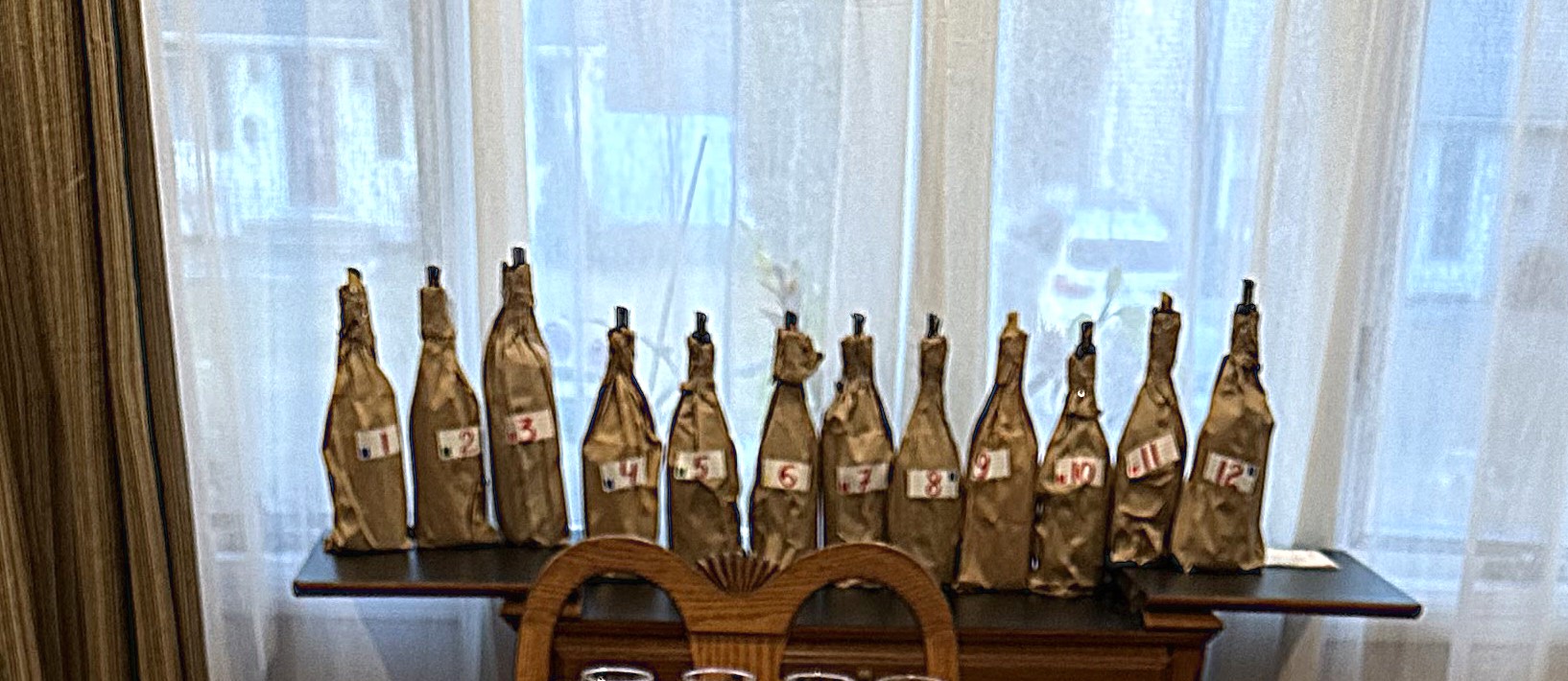
This is a blind tasting, so we placed all bottles in the paper bags, and then my daughter who was now a participant in the tasting put the labels randomly on the bags (15 years ago her role was limited only to attaching the labels :)). I also prepared a few of the “reference points” for everybody to use in the form of the crushed fruit in the glass – I didn’t find plums in the store, but we had many other relevant “references” – cherries, pomegranate, blueberries, raspberries, blackberries, and even liquid smoke.


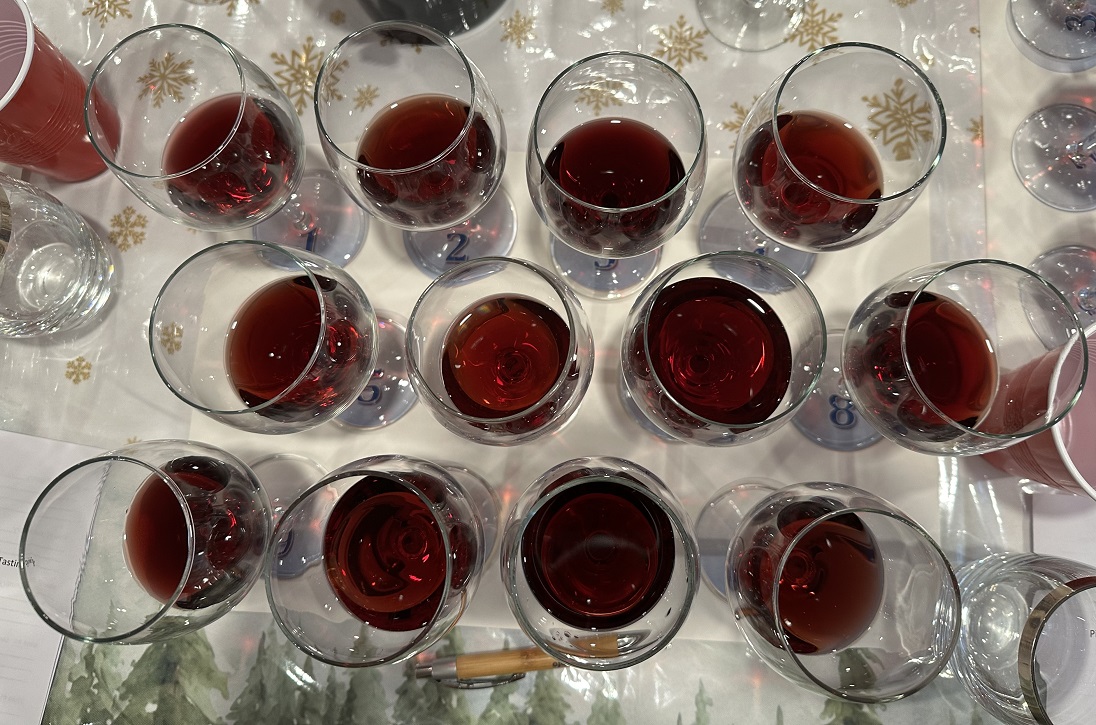
We also had paper for taking notes, and as a reference, I included all the countries that were present in the tasting so we could try guessing the countries for each wine. All countries except the two, as both Zak and I brought in one “surprise” each – Pinot Noir from the countries that are not really known as Pinot Noir producers – we didn’t know what wine the other person was bringing. Here is the list of countries that were offered for everyone’s reference: Argentina (Patagonia), California (Santa Rita Hills), France (Burgundy), Germany (Ahr), New York (Finger Lakes), New Zealand (Central Otago), Oregon (Willamette Valley, 2 wines), Poland, Washington, Surprise 1 (European country not listed above), Surprise 2.
Off we went, tasting and discussing the wines, trying to figure out what was what. Consciously tasting 12 wines in a row is not an easy fit, especially when you try to at least identify the countries. Also, each person (there were 8 of us) was supposed to decide on 3 of their favorite wines so we would be able to vote for the most popular wine of the night, so we had to score each wine. Here score is simply comparative within your notes – 1 through 5, E to A, doesn’t matter, as long as everyone can decide on their favorites.
Here are my notes for all 12 wines as the tasting was happening.
Wine #1: Country: New World (have no idea what I was thinking, I guess something outside of Europe), Vintage: 2021. Cherries, lots of cherries, raspberries, tart cherries on the palate, good balance, nice. Score: 8
Wine #2: Country: Oregon, Vintage: 2021. Iodine, cherries, tart, pepper, tannins, earthy, rocky. Score: 8+
Wine #3: Country: Poland?, Vintage: 2021. Cherries, initially fresh berries, fresh raspberries, sweet cherries, good balance. Score: 8
Wine #4: Country: Argentina?, Vintage: 2019. Gunflint, fresh, crisp, tart, rocky, cherries, excellent. Score:8/8+. Tasting again at the end of the tasting, the wine lost something, so finally score is 8
Wine #5: Country: California?, Vintage: ? Almost black color, dark, aged, medicinal nose, iodine, sweet cherries on the palate, tart. Score: 8-, after retesting later – 8, wine improved.
Wine #6: Country: Oregon? No, Vintage: ?, carrot juice on the nose, very grippy tannins on the palate, cherries. Score: 7+
Wine #7: Country: ? , Vintage: ? Beautiful color, Rutherford dust, hint of cherries, tannins and cherries on the palate, good balance. Score: 8 initially, 8+ after breathing
Wine #8: Country: Germany, Vintage: ? Love the garnet color, smoke, tar, concentrated nose. Wow! Superb – cherries, concentrated, good acidity, good balance. Score: 8++
Wine #9: Country: Oregon, Vintage: ? Pencil shavings, Rutherford dust, tannins, cherries, elegant but needs a touch more acidity. Score: 8
Wine #10: Country: ?, Vintage: ? Pomegranate seeds, cherries, very tight. Cool aid, cherry cola Score: 8-
Wine #11: Country: Finger Lakes, Vintage: ? Smoke and rubber, tar, on the nose. Rubber, tannins, cherries, became more balanced after breathing Score: 7+ initially, improved to 8 on the second tasting.
Wine #12: Country: Oregon, Vintage: ? Cherries, vegetation, cool aid on the nose. Cherries, good balance, good acidity, excellent. Score: 8+, went down to 8 after re-tasting as the finish showed sugar candy.
Ugh, this was not an easy tasting, but it was finally complete. Time to decide on favorites. First, everyone had to make their own decisions for the 3 favorite wines. After re-tasting and struggling, my list of favorites in descending order looked like this:
1st favorite: #8
2nd favorite: #2
3rd favorite: #7
Next, the vote. Remember, each person (there were 8 of us) was allowed to vote for 3 favorite wines, thus we just called the wine number and asked to see a show of hands. Here are the results.
Wine #1 – 1
Wine #2 – 5
Wine #3 – 1
Wine #4 – 0
Wine #5 – 0
Wine #6 – 3
Wine #7 – 3
Wine #8 – 3
Wine #9 – 3
Wine #10 – 1
Wine #11 – 1
Wine #12 – 3
Therefore we had a clear winner – wine number 2, and 5 wines in the second place with 3 votes each – #6, #7, #8, #9, and #12.
Next came the best and final part of the blind tasting – the reveal! Would you believe me If I told you that the revealed bottle elicited a loud “oh, wow, really” literally from everyone? Surprise after surprise after surprise.
The most popular wine? Pinot Noir from (drum roll, please)
Japan!
Seriously, Japan??? How? Yes, Japan makes wine, but to make Pinot Noir that shows better than Oregon, California, Burgundy, and all other countries? Just wow. Apparently, this is an impossible-to-get “cult” wine, produced in minuscule quantities, $100 wholesale but $300 retail if you can even find it? That was the first “surprise” wine.


Pinot Noir from Poland that was very good? How about that? My favorite wine of the tasting, Southern Lines from Central Otago, by some absolute miracle was $15 per bottle – how is that even possible (it is a case buy if you can find it at that price).
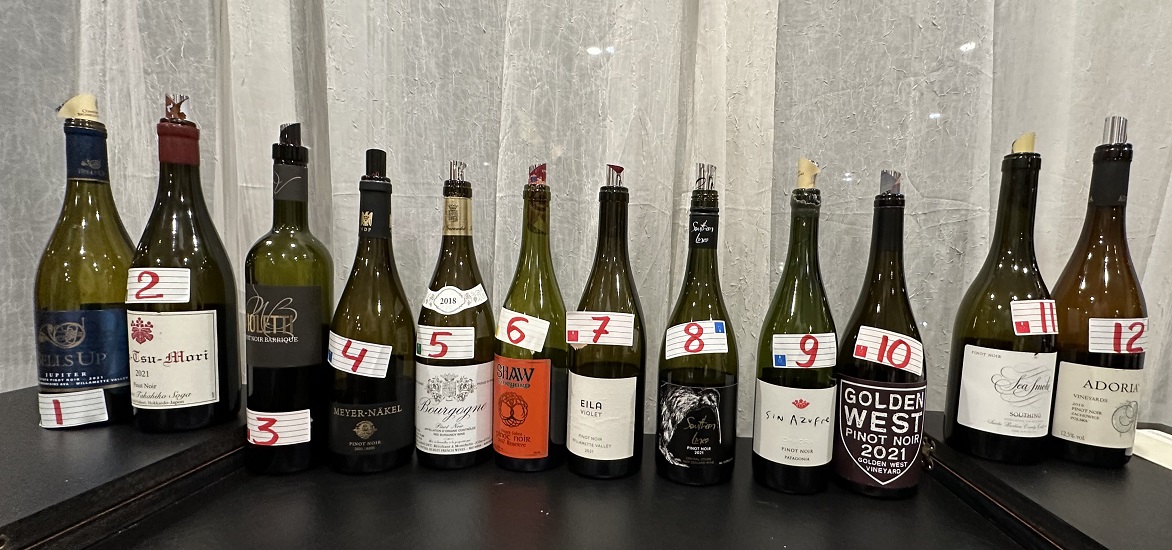
Here is the full list of wines in the numbered order:
- 2021 Bells Up Jupiter Pinot Noir Estate Chehalem Mountains AVA (13.5% ABV, $50)
- 2021 Domaine Takahiko Soga Nana-Tsu-Mori Pinot Noir Hokkaido Japan (13% ABV, $300?)
- 2022 Violetti-Rebbau Pinot Noir Barrique Vin de Pays Suisse (13% ABV, $N/A)
- 2021 Meyer-Näkel Pinot Noir Ahr Germany (12.5% ABV, $56 at Wine.com)
- 2018 Paul Garaudet Pinot Noir Bourgogne AOC (13% ABV, $39)
- 2017 Shaw Vineyard Pinot Noir Reserve Finger Lakes New York (13% ABV, $N/A)
- 2021 EILA Violet Pinot Noir Willamette Valley (12.7% ABV, $65)
- 2021 Southern Lines Pinot Noir Central Otago New Zealand (13.5% ABV, $15)
- 2022 Chakra Sin AzuFre Pinot Noir Patagonia Argentina (12% ABV, $30 Last Bottle)
- 2021 Golden West Pinot Noir Goden West Vineyard Royal Slope Washington (14% ABV, $21)
- 2011 Sea Smoke Southing Pinot Noir Santa Rita Hills Santa Barbara County (14.5% ABV, $100?)
- 2021 Adoria Vineyards Pinot Noir Zachowice Poland (12.5% ABV, $25)
You see, this is what blind tasting does. Under the guise of the brown bag, all wines are “the same”. You are not influenced by anything – “ahh, I brought this wine, it must be better”, “ahh, the guy in the store was raving about it so much”, “ahh, it got 99 points from Suckling” – none of this matters. You let your palate be the judge. Wine has to give you pleasure.


As the wines were left at my house after the tasting, I was the lucky bastard who had an opportunity to taste them over the few next days. This is not how the general population consumes wines, so this has very little bearing on the results and the whole tasting process, but I can tell you that for example, the Sea Smoke Southing became literally my favorite wine – it developed a depth of flavor and a beautiful complexity – if it would taste like that during the tasting it would be handily the wine number 1, for sure for me. The Pinot Noir from Ahr also developed additional layers, with gunflint and roasted meat notes now dominating the flavor profile in a very respectful manner, making it a lot more pleasant to drink – again, in that state it would again get a much higher rating in my book. And pretty much across the board, the Pinot Noirs continued their evolution and most of them were still drinkable even 5 days after being open – a testament to quality.
Here we are. 15 years later, the most unexpected Pinot Noir wins again. But this is the beauty of wine. The mystery, the enigma, the art. Wine is a liquid art form, and this tasting delivered an unmeasurable amount of pleasure and created new memories. This is what life is all about, isn’t it? Creating good great memories. And wine is exceptionally good at that. Onward and upward.
American Pleasures #10: Meyye Wines
Wine should give you pleasure – there is no point in drinking wine if it does not. Lately, I have had a number of samples of American wines that were delicious standouts – one after another, making me even wonder if someone cursed my palate. I enjoyed all those wines so much that I decided to designate a new series to them – the American Pleasures.
And we are back to talk about more delicious American wines.
Rob Campbell got into winemaking in 1992 when he started helping his future father-in-law Bruce Tichenor at Story Winery in Plymouth, California. 20 years and three other careers later, Rob decided that it was the time to go into the winemaking all the way, taking over the wine-making at the Story Winery. While producing award-winning wines at the Story Winery, Rob realized that he could also produce ultra-premium wines, capitalizing on the success of his 2014 Zinfandel. When the family decided to sell Story Winery in 2019, Rob finally got an opportunity to start making the wines he had always dreamt of, and he founded Meyye Wines.

With Meyye Wines, Rob wanted to honor his Native American heritage. Rob Campbell is a member of the Federated Indians of Graton Rancheria (Coastal Miwok/Southern Pomo), the tribe is based in Rohnert Park, California, which lies within Sonoma County. Meyye (pronounced may-yea) means ‘bird’ in the Coastal Miwok language, and the first 4 wines that Rob started producing are all called after the birds native to the different regions where Rob was sourcing the fruit from, using native Miwok names for the birds. You can also appreciate the beauty of these wine labels which started as photographs taken by acclaimed wildlife photographer Steve Zamek, expertly rendered to create a three-dimensional representation of an image of each bird.
As Rob explains:
“Native Americans have been making wine in California for over 250 years. I descend from multiple Mission Indians who worked vineyards or made wine in three different California missions in the 19th century (Mission San Jose, Sonoma, and San Rafael). I’m intentionally using the Coast Miwok language since the language was considered ‘officially dead’ in the past, but my people are making a concerted effort to restore it. In addition to being ultra-premium wines that taste great, it’s my small way of preserving our language by sharing it with native and non-native people alike. “
I had an opportunity to taste 4 of Rob’s wines, and they were literally one better than the other. I’m also sure you would be able to recognize the names of the vineyards and appreciate the pedigree of these wines.
Here are my notes:
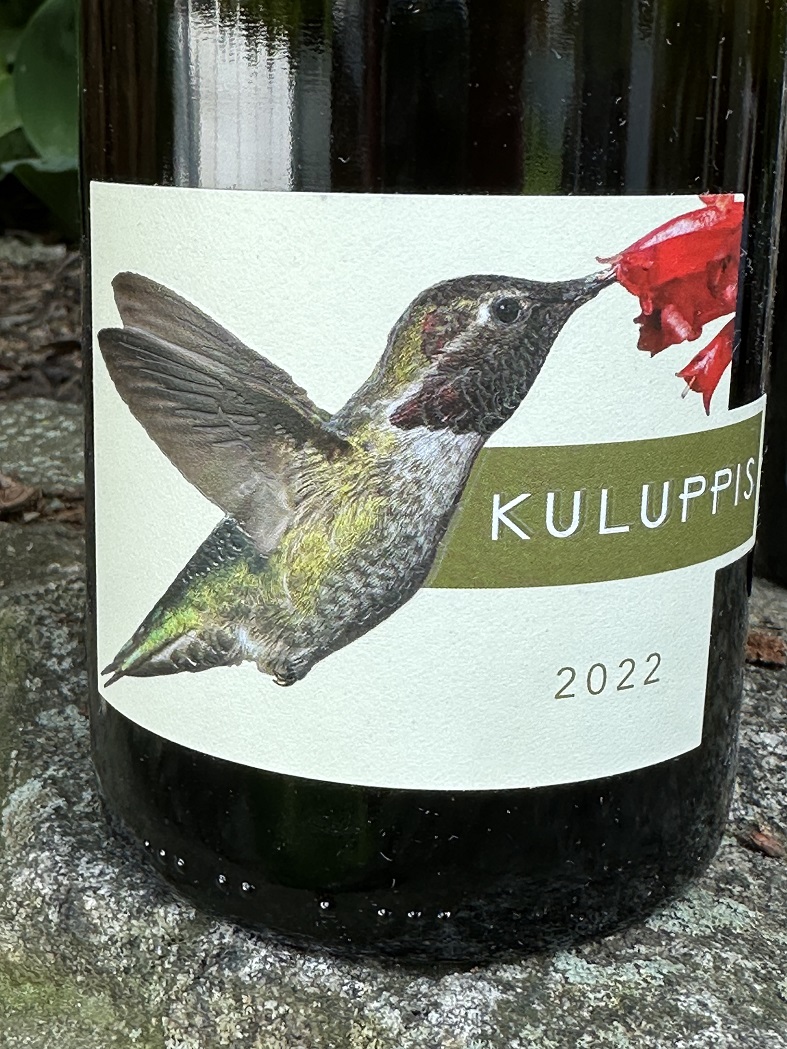
2022 Meyye Wines Kuluppis Chardonnay Sonoma County Los Carneros (13.7% ABV, $55, Sangiacomo vineyards, Kuluppis pronounced kuh-luu-pee; Anna’s hummingbird)
Light golden
Immediately upon opening – rich, opulent, butter, vanilla and tropical fruit on the nose, buttery toast on the palate, big, rich, hedonistic.
Literally 30 seconds later – a lot more restrained and leaner wine, all butter is gone, just some apples left. Well, no, there is still butter, just the toast is gone 🙂 nice and elegant, well balanced. Some perceived bitterness on the palate. Let’s see how it will develop.
Second day showed some honey notes and improved balance. Overall – excellent.
8+
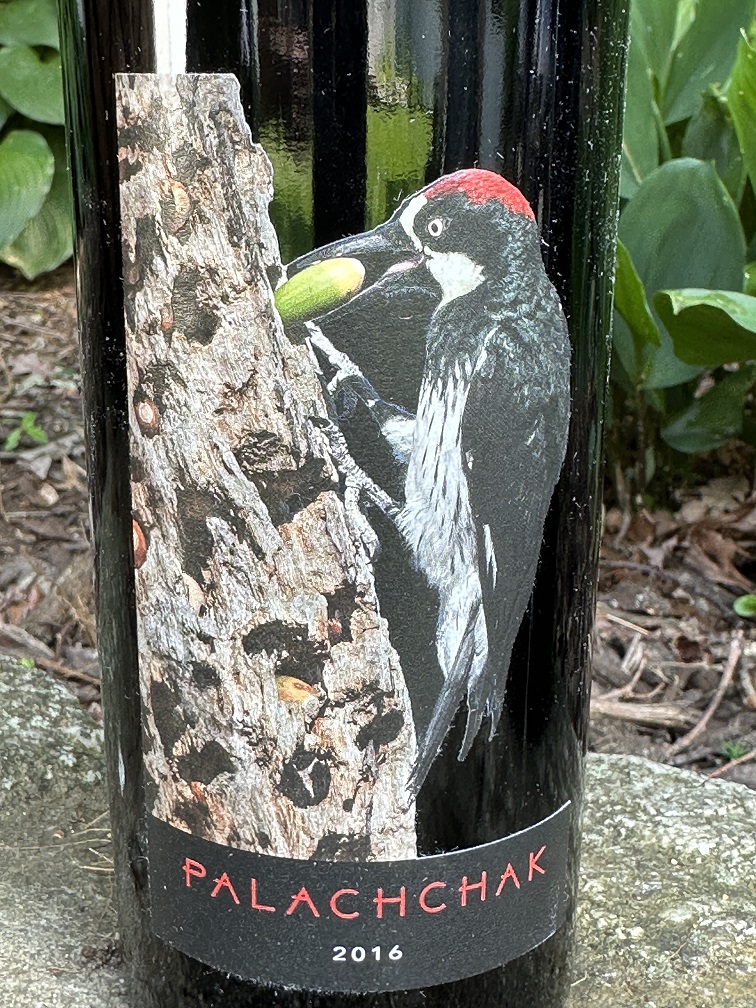
2016 Meyye Wines Palachchak Zinfandel Shenandoah Valley (15.5% ABV, $70, 90% Zinfandel, 10% Syrah, Palachchak pronounced pah-lah-chak; red-headed acorn woodpecker)
Dark chocolate and black currant, intense and beautiful
Blackberries and blueberries on the first day,
Dark chocolate with a touch of pepper, cherries, good structure, full body, clean acidity, good balance. Lasted for 4 days. Became a bit more round.
8
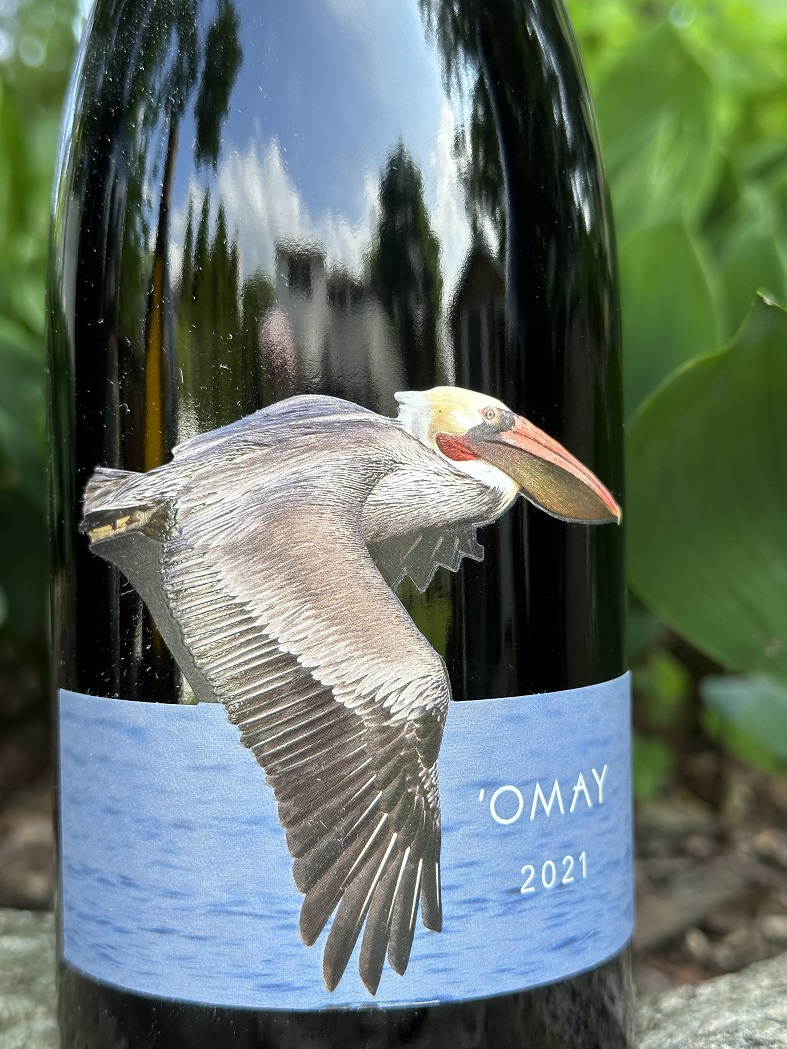
2021 Meyye Wines ‘Omay Pinot Noir Sonoma County Petaluma Gap AVA (13.9% ABV, $75, 100% Pommard Clone, Sangiacomo Vineyard, ‘Omay pronounced oh-may; brown pelican)
garnet
Smoke and plums, classic CA Pinot
Black Plums, violets, lavender, clean acidity, medium to full body – delicious.
8
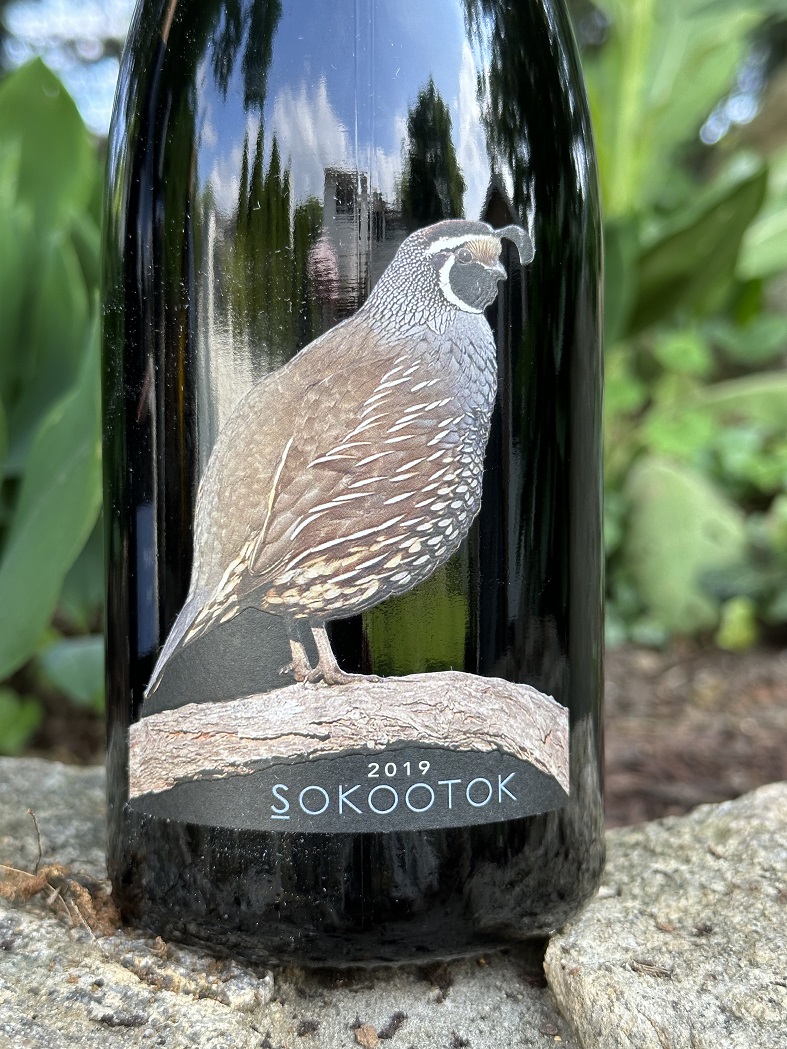
2019 Meyye Wines Sokootok Red Blend Sierra Foothills (14.5% ABV, $60, 50% Grenache, 28% Syrah, 10% Petite Sirah, 9% Counoise,
3% Zinfandel, Sokootok pronounced show-koh-tock; California quail)
Dark Ruby
Dark fruit, hint of minerality, sweet cherries, herbs
Black and red fruit, medium body, well-integrated tannins, good acidity, then tannins grip the finish – in a nice, but assertive way. This will develop nicely over the next 10-15 years.
8+, delicious.
Here you go, my friends. Another story of American Pleasures – delicious wines well worth seeking. And Meyye wines you will actually have to seek, due to their ultra-low production, so good luck to you.
Until the next time – cheers!
A Perfect Monday Wine?
Is there such a thing as the perfect wine for Monday?
Or, can there be a specific perfect wine for every day of the week?
Yes and no.
The answer is yes if you feel like it. You can create your own tradition – for example, “every Friday I drink Cabernet Sauvignon”, or “every Sunday I drink Chardonnay”. Sure, you can create such a tradition, but why?
A better answer is “no, there is no specific wine for every day of the week”, there is only wine you want to drink today.
On second thought, maybe? Just for Monday?
There is an abundance of jokes about Monday – purportedly the most difficult day of the week. Arrival of Monday means the weekend is over – and there is a whole work week ahead. But then Monday night means the first day of the week is over – and the weekend just got a little bit closer – isn’t that a reason to celebrate?
And yet, even if Monday deserves its own special wine, what that can be?
Ha! The answer is simple. It is what you crave. Your idea of special Monday wine doesn’t have to be the same as my idea, or anyone else’s idea. Whatever you decide to drink on Monday will be your special Monday wine. For this one Monday, of course.
For whatever reason, today I was craving power. “Power” is not your typical wine descriptor, no doubt every wine lover would have a personal definition of this term. To me “power” means big wine which gives you a lot to “chew on”, but I don’t mean it in the sense of the new French oak tannins literally numbing your taste buds for the next 5 hours. I’m talking more about the massive presence of the wine on your palate, full-bodied, with dark fruit and a variety of spices. My power wines are Petite Sirah, Montefalco Sagrantino, wines made from the Eastern European grape Vranec, maybe some of the renditions of Alicante Bouschet (this is not universal).
In the majority of the cases, the “power” wine should also have some age on it, to make it drinkable. Anyone who tried young California Petite Sirah or Montefalco Sagrantino will understand what I’m talking about.

My choice of the power wine with age – the 2014 Turley Petite Syrah Pesenti Vineyard Paso Robles (14.4% ABV). Turley is best known for its Zinfandel wines, but it also produces a number of Petite Sirah wines, which are equally outstanding.
The wine had the perfect amount of power I was looking for. Abundant red and black fruit, cherries and cherry pits, firm structure, full body, espresso and pepper showing up at random, perfect acidity, impeccable balance. Answering Kevin Zraly’s question – “does this wine give you pleasure” I can only say that this wine was definitely giving the pleasure and lots of it, as I’m looking at an empty bottle right now.
What would be your Monday wine choice?
Happy Wines of Barra
What are happy wines you may ask? Can the wine be happy? Can the wine be unhappy? Can the wine actually express emotion?
The first two questions probably don’t have an answer. But can the wine express emotion? You bet. That’s the whole point of wine appreciation. The wine that gives you joy. The wine that brings back happy memories. The wine that gives you happiness. The wine that gives you pleasure. The wine that doesn’t leave you indifferent. Not every wine in your glass will do that for you – but some will. I think it will be fair to call them Happy Wines.
Happy wines are those that put a smile on your face. You open a bottle, put the liquid into the glass, swirl, sniff, sip – and smile, because the wine is actually that good. It doesn’t have to be the best wine you ever tasted. It doesn’t have to be expensive or inexpensive. As long as the wine puts a smile on your face and makes you happy, you can call it a Happy Wine.
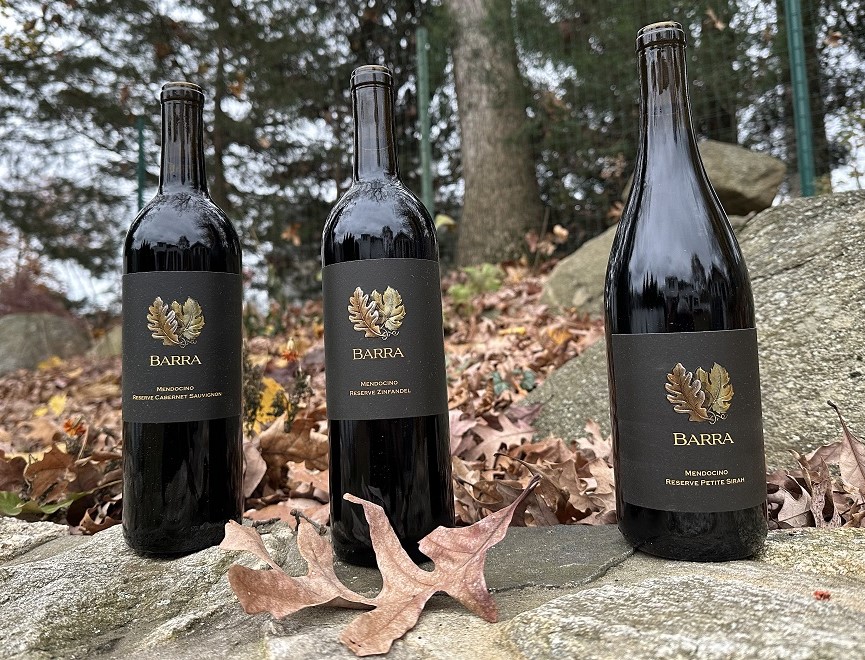
My latest happy wine discovery was the latest release of red wines from Barra of Mendocino. I already wrote about the winery before – you can find the complete two-part story here (part 1 and part 2) with all the details about this 50-year-old, 350-acre organically farmed estate located in Northern California, in Mendocino. Everything I tasted so far from Barra was outstanding, and this latest release of the 3 reserve red wines made from organic grapes didn’t disappoint either.
2020 Barra Reserve Petite Sirah Mendocino County (14.5% ABV, $28, 18 months / 30% new French oak, balance in neutral barrels, organic grapes)
Dark Garnet, practically black
Beautiful nose of red and black fruit
Sweet cherries, perfect acidity, well-integrated luscious tannins, layered, delicious.
8+, outstanding, and a unique rendition of PS which doesn’t require waiting.
2020 Barra Reserve Zinfandel Mendocino County (14.5% ABV, $26, 16 months / 25% new French oak, balance in neutral barrels, organic grapes)
Bright Ruby
Dark fruit and herbs on the nose, a hint of fresh coffee, tobacco
Tobacco, cherries, luscious texture, round, pleasant, with long finish.
8, excellent
I just wrote about Barra Cabernet Sauvignon in the previous post where I tasted it alongside two superb Napa Valley Cabs – but I’m happy to talk about this wine twice in a row 🙂
2021 Barra Reserve Cabernet Sauvignon Mendocino County (14.5% ABV, $28, 18 months / 30% new French oak, balance in neutral barrels, organic grapes)
Garnet
Eucalyptus, cherries, a hint of cassis
Eucalyptus, dark berries, cherries, cassis, well-integrated tannins, perfect balance, medium-long finish.
8, delicious
All three were happy wines – ready to drink from the moment the bottle was open, and thoroughly delicious, putting a smile on your face. I can also tell you that all three of these wines lasted for almost 7 days after being first opened, standing on the counter, with the air being pumped out – this is definitely a testament to the quality and to the longevity of these wines – while these wines will not set you back by anything comparable to any cult Californian wines, I guarantee you that they will age equally well or possibly even better.
Have you tried Barra of Mendocino wines? I would love to see the smile on your face once you do. Cheers!
Ode to Cab
 Ode to Cab.
Or we can just call it a Love Letter to Cabernet Sauvignon.
As an oenophile, I always try to maintain my “grape neutrality”. I can never name my favorite type of wine, never mind favorite wine. If you will hard press me against the wall with this question, I might say that it is Rioja, but the reality is a lot more complex than that.
If you search through articles in this blog, you will find a full range of wine styles and grapes. There are many blogs out there that cover specific region(s) or specific types of wine – but when I started writing close to 15 years ago, I knew that I would not be able to do that. This blog is about wine appreciation – any wine. “Wine should give you pleasure” – and so this is what my writing is primarily after – sharing the joy, the pleasure of wine, no matter what is the pedigree. Wines made from little-known grapes – Bobal, Trepat, Kekfrankos, Romorantin by tiny producers can give you as much pleasure as first growth Bordeaux, cult California, or best super-Tuscans. The liquid in the glass matters, and the only opinion that matters is yours and only yours – you can not enjoy the critic’s 100 points in your mouth.
This is my approach – try any wine with an open mind, and always be ready to be pleasantly surprised – or even blown away for that matter. And yet there is something about Cabernet Sauvignon that makes my heart race, especially coming from the producer I know or have heard of. Listen, I’m doing my best to tell you the truth, even though the “thought spoken is a lie”. But the brain gets all excited when I’m opening a bottle of the familiar Cabernet Sauvignon because I already know how good it can be. Very different from the excitement of the possible taste of DRC, Petrus, or Quintarelly (I’m yet to taste either) – because with those I wouldn’t know what to expect. But I do know what to expect from the well-made Cabernet Sauvignon that is ready to drink.
Even with the wines I happily call the favorites, I can’t tell you what I’m expecting to taste. I can’t describe my expectations when tasting La Rioja Alta, Ken Wright Pinot Noir, or Loacker Corte Pavone Brunello di Montalcino. I expect that I will like those wines as I know the producers and had their wines many times before – but I can’t tell you my exact expectations of the aroma or the taste of the wine. With Cabernet Sauvignon, I have very precise expectations of the aroma and the taste for me to like the wine. If I do not find the cassis (black currant) on both nose and palate when the bottle says “Cabernet Sauvignon” on it, there is no way I will like the wine, no matter how good the wine is for anyone else. Eucalyptus, mint, and a good structure are also expected, but with this some variations are possible. But when the expectations are met… the Cabernet Sauvignon is nothing but a pure, hedonistic pleasure.
So yes, deep down, Cabernet Sauvignon might be the most favorite wine of all – I just hope I will remember it next time I’m asked about my favorite wine.
Now, truth be told, I had a good reason for all this rambling about the beauty of Cabernet Sauvignon. A few weeks ago, I had an opportunity to conduct an accidental side-by-side tasting of the California Cabernet Sauvignon and the results were simply amazing.
With this tasting, we are taking a little trip. We will start in Northern California, where Barra of Mendocino is located. I wrote about their wines before, and now I have a few of the latest releases and I thought that Cabernet Sauvignon would be quite appropriate for the tasting.
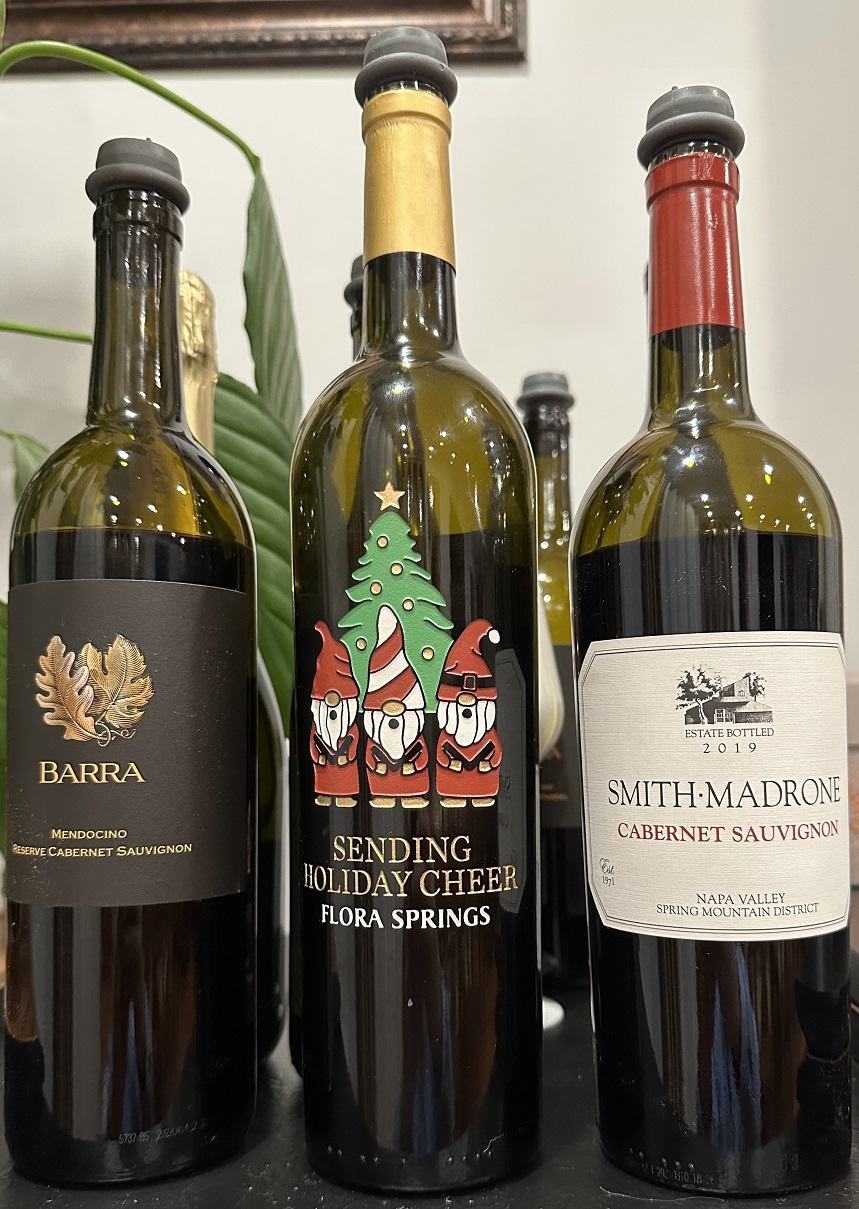
Barra Cabernet Sauvignon was the leanest of 3, but still had a perfectly recognizable Cabernet Sauvignon profile:
2021 Barra Reserve Cabernet Sauvignon Mendocino (14.5% ABV, $28, 18 months 30% new French oak, balance in neutral barrels)
Garnet
Eucalyptus, cherries, a hint of cassis
Eucalyptus, dark berries, cherries, cassis, well integrated tannins, perfect balance, medium-long finish.
8
Moving 80 miles southeast, we now arrive at the Flora Springs winery, located in the heart of the Napa Valley. Again, one of my favorite wineries in California, I wrote about their wines on multiple occasions.
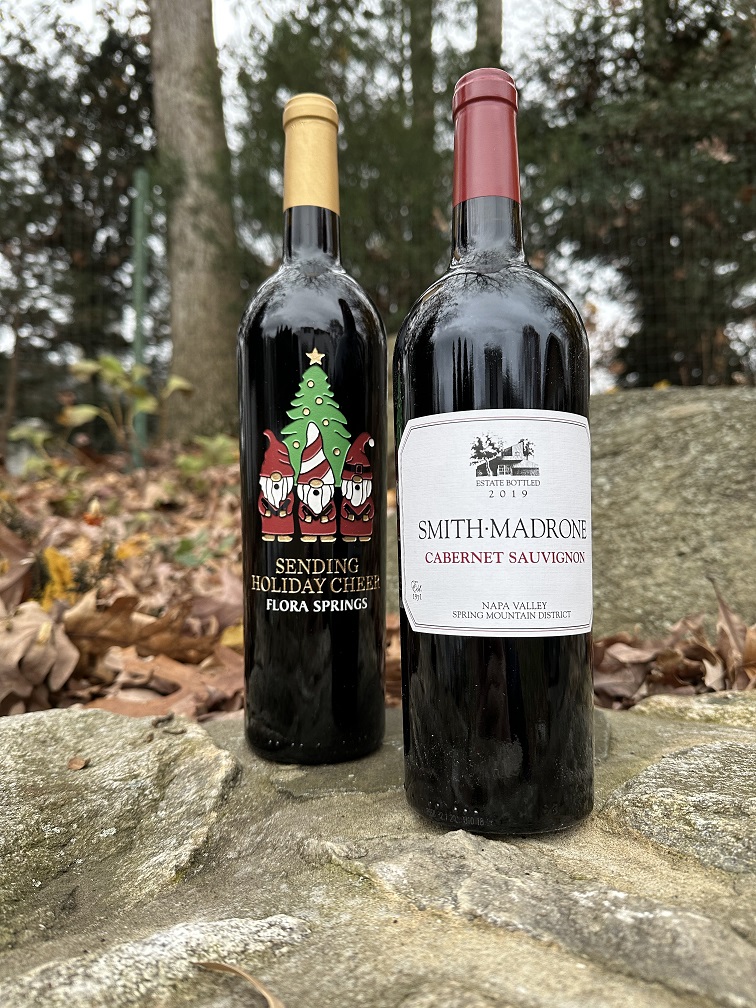
The wine I had an opportunity to taste was a special holiday release. Flora Springs is big on the holiday celebration, so this bottle features etched gnomes, perfectly appropriate for the holidays. But it is what’s inside that counts, and this wine was nothing short of spectacular.
2019 Flora Springs Red Wine Blend Napa Valley (14.5% ABV, $95, predominantly Cabernet Sauvignon, 18 months in 70% French and 30% American oak barrels)
Dark garnet
Cassis, mint, black tea, cassis is playing in and out – you can smell this wine forever. Cassis is prevalent, wow.
Burst of cassis at first, then tannins come in, offering some bitter notes around the otherwise perfect Cabernet core. A very powerful, delicious wine that needs time to soften up. Either decant for a few hours, or lose it in the cellar for 10 years. The winery says you can enjoy it through 2036 – I’m sure you can easily add another 20 years on top of that.
8/8+
Going back about 8 miles northwest, we now arrive at the Smith-Madrone, the winery located in the Spring Mountain district of Napa Valley. Smith-Madrone is yet another one of my favorite wineries, and the one I feel a bit guilty about as a writer. I wrote about Smith-Madrone wines on many occasions in this blog – 5 years ago, Smith-Madrone were my wines of choice to celebrate Thanksgiving; in 2019, Smith-Madrone Cabernet Sauvignon was my wine of the year. And I’m still yearning to write a post fully designated to the winery…
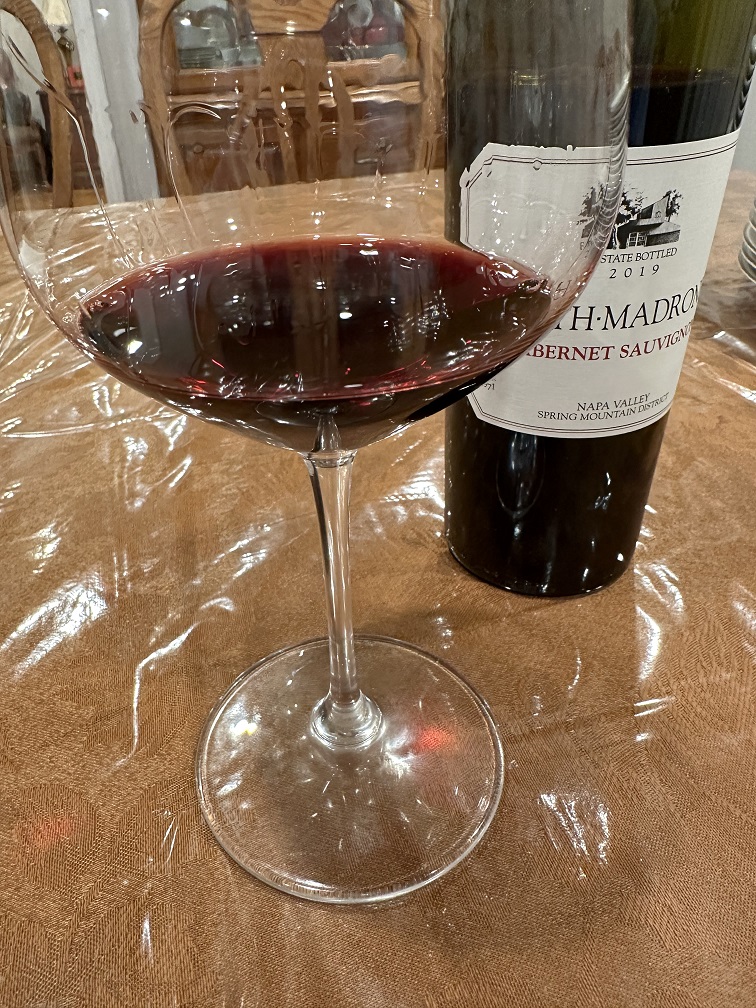
Nevertheless, Smith-Madrone Cabernet Sauvignon to me is one of the most textbook-proper, pure Cabernet Sauvignon wines there is. Not everyone would share my opinion – my sister-in-law with whom I was tasting these 3 Cabs, was preferring Flora Springs Cab, just for the sheer, unashamed beauty. But to me, a more subtle but very confident representation of the Cabernet Sauvignon by Smith-Madrone was just a perfection:
2019 Smith-Madrone Cabernet Sauvignon Spring Mountain District Napa Valley (14.3% ABV, $65, 83% Cabernet Sauvignon, 5% Merlot, 12% Cabernet Franc, 18 months in 55% new French oak)
Brilliant dark ruby
A perfection. A textbook Cabernet Sauvignon cassis, pure, perfectly precise cassis. You can think of a bell pepper – I’m not sure it is there, but it comes to mind.
The palate is amazing – cassis, eucalyptus, perfect minerality, a touch of the pencil shavings, salivating acidity. This is an impeccably balanced wine built for aging. In 10 years, it will be insanely good. In 20 – … well, I don’t want to even think about waiting that long…
9-, pure and superb.
If you like Cabernet Sauvignon, either one of these 3 wines will make you happy – each one perfectly representing their terroir and the vision of the winemaker, and yet unquestionably perfectly representing maybe the most noble grape of all.
So now you know what my secret passion, secret true wine love is. What’s yours?
No Tricks, Only Treats
Halloween is almost here – are you excited? Did you start planning your Halloween party already? I’m here to help you take it to the next level.
How? Easy. You know that on these pages, wine is the answer, but what is the question?
Well, let’s just clear something up – if you are looking for the wine to pair with candy or deliver a candy-equal amount of sugar in every sip, I can’t help you. But if you believe that your Halloween plans call for a simply delicious sip all of your guests will enjoy, I have something for you.
But first, let’s talk about ghosts. What can be more Halloween-y than a ghost? Ghosts are scary, as they are nowhere and everywhere. Same as with people, ghosts can be mean, but they also can be friendly. And anything and everything can be a ghost. How about a winery? Can a winery be a ghost? If a winery is a ghost, does it mean it is haunted and you should be scared walking into it?
Okay, okay, there is nothing to be afraid of. At the end of the 19th century, there were close to 800 wineries in California. Prohibition, which started in 1920, assisted by the phylloxera epidemic had a dramatic impact on the striving wine business. In the 1933, when prohibition was repealed, only 40 wineries survived. Many of those that didn’t became ghostly encampments, giving birth to the term “ghost winery”.
Flora Springs Winery was founded in 1978 by Flora and Jerry Komes in Napa Valley. Winery’s property included such “ghost winery” – Charles Brockhoff Winery, originally constructed in 1885. That winery was abandoned by the family after prohibition. John Komes, son of Jerry and Flora, completely renovated the old winery which became his family home to this day.
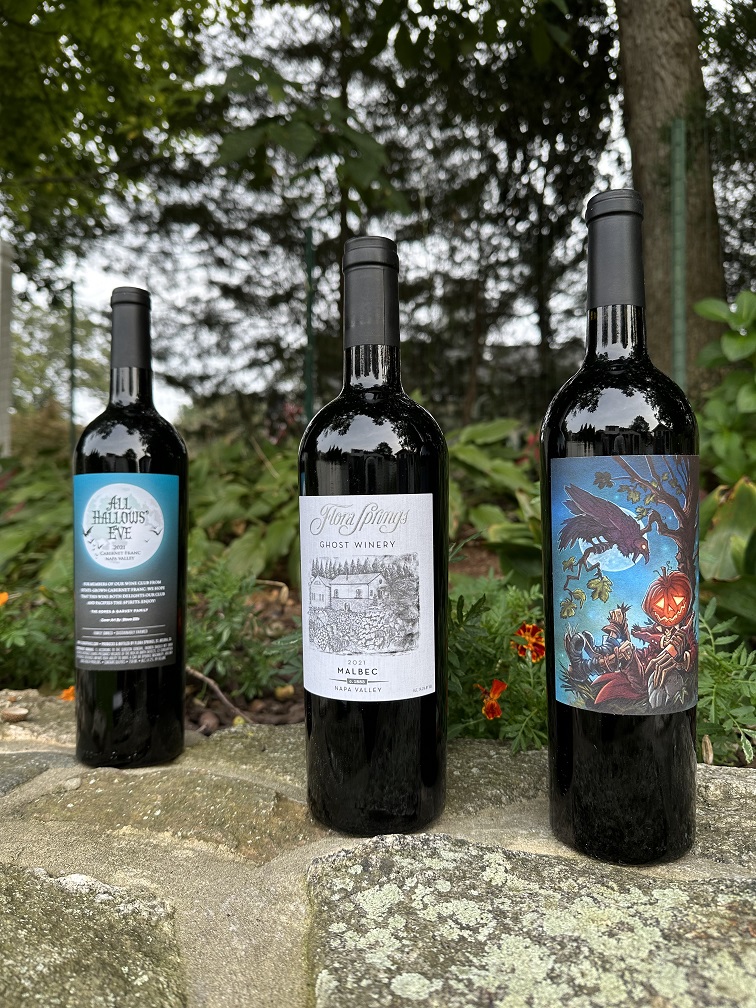
The ghostly past plays an important role at Flora Springs, especially at the time of Halloween, the only time of the year when ghosts are allowed to roam freely. With or without ghosts Halloween has been the subject of special attention at Flora Springs for the past 14 years. Throughout all these years, Flora Springs Winery always released special bottles, produced just for Halloween. Every Halloween bottle has a special label, different every year, designed by different artists. It is not only the label, it is also the grapes – for example, this year’s Halloween wines are made from Cabernet Franc and Malbec, and Flora Springs doesn’t produce any other single grape Cab Franc or Malbec wines. So yes, you can entertain your guests in a unique style.
I was lucky enough to taste samples of both Halloween wines Flora Springs has to offer this year.
Before we talk about wines, I would like to quote the description of the 2021 vintage from the Flora Springs website:
“The 2021 vintage in Napa Valley will be remembered for a smooth, uneventful growing season and harvest that produced low yields of intensely-flavored, small-sized grape clusters. The season started off with very little rain and continued as a dry, sunny summer led to a relatively cool fall with weeks of lovely weather. 2021 represented the second drought year in a row, and while concerning in the long term, the dry weather resulted in a more natural crop load on the vines, requiring less pruning and dropping of fruit. The resulting grapes were packed full of flavor leading to powerful, concentrated wines. ”


Now, let’s talk about Cab Franc.
The label for 2021 All Hallows Eve Cabernet Franc was produced by Steve Ellis, an artist who created illustrations for Marvel, DC, and many other franchises. This label is a perfect embodiment of the Halloween spirit, and it perfectly extends the collection of unique Halloween labels Flora Springs amassed over the year – take a look here, it is really fun. Here are my tasting notes for the wine:
2021 Flora Springs All Hallows Eve Cabernet Franc Napa Valley (14.2% ABV, $75, 18 months in French oak barrels, 350 cases produced)
Dark purple with a bright purple hue on the rim. And then it’s black
Inviting nose of sweet cherry and blueberry pie
More of the fresh blueberry pie profile with good acidity in the aftertaste, velvety, seductive, layered, smooth, very smooth – I guess luscious is a better word.
This is how California producers like to see Cabernet Franc. I’m missing pyrazines, my beloved bell peppers.
It shows a little bit lighter on the second day than on the first. 3rd day didn’t change much compared to the 2nd day. And then the bottle was empty
Drinkability: 8-/8, overall very good


And then there was Malbec. Napa Valley Malbec is quite rare and unique, and this wine didn’t disappoint – I also love the artistic rendering of the ghost winery on the label – it is simple and incredibly attractive at the same time.
2021 Flora Springs Ghost Winery Malbec Napa Valley (14.2% ABV, $60, 18 months in 60% French and 40% American oak barrels, 350 cases produced)
Dark garnet, practically black, but when low in the glass offers a beautiful dark purple hue
Succulent black raspberries on the nose
Inky, sweet cherries and cherry pit, a touch of sweet basil, beautiful textural presence, dark, concentrated, perfectly balanced.
Drinkability: 8+
There you are, my friends. A perfect set of wines to celebrate Halloween in style. Both wines are available at the Flora Springs website, and if you buy 3 bottles, you will get a $15 shipping – check the website for the details. And even if you don’t care about Halloween, these are just tasty wines for any occasion – and they will last for the next 10-20 years (the official winery recommendation is 10 years, but I believe they will easily last much longer).
Don’t be afraid of no ghost, especially if this ghost brings wine. Cheers!
American Pleasures #9: Balverne Wines
Wine should give you pleasure – there is no point in drinking wine if it does not. Lately, I have had a number of samples of American wines that were delicious standouts – one after another, making me even wonder if someone cursed my palate. I enjoyed all those wines so much that I decided to designate a new series to them – the American Pleasures.
And we are back to talk about more delicious American wines (after a long and unintended break).
I love how wine not only entices your senses but lets you play a sleuth, a researcher, a scientist, a philosopher – a different role on a different day, or all of them at once – take your pick.
I can give it to you right now [spoilers alert]: I got a sample of three California wines, one better than another, one of them possibly even WOTY 2023 (told ya, spoilers) – and ended up doing the whole research (thanks, Google) trying to connect layers one by one. From the roles I mentioned above, I played mostly a sleuth trying to understand how far history was taking me and how all the little pieces fit together. Ah, never mind, let’s just get to it.
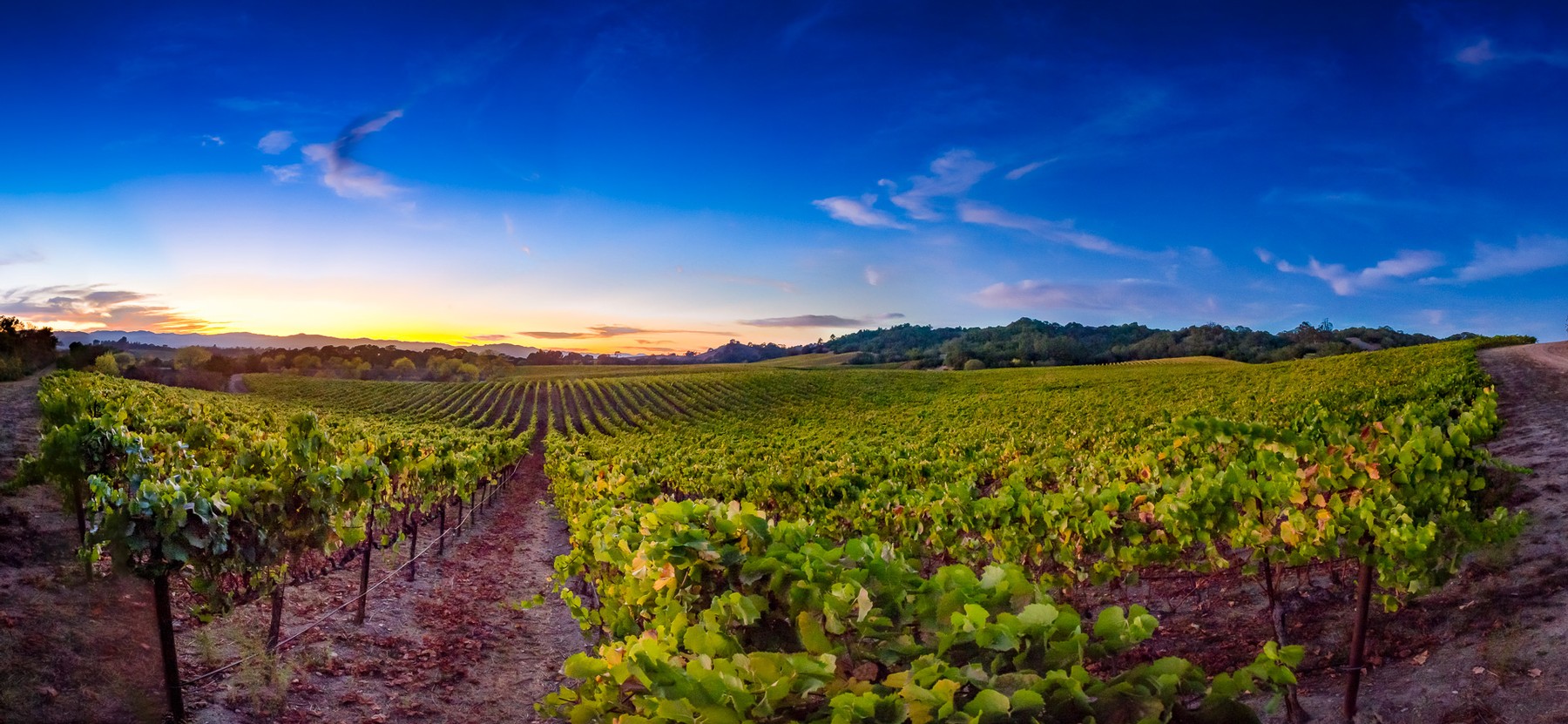
Source: Notre Vue Estates
In the center of this excitement are the wines produced by the Notre Vue Estate (Notre Vue stands for Our View in French) and called Balverne. Notre Vue is a 710 acres estate located in the heart of Sonoma County next to Healdsburg and acquired by Bob and Renee Stein in 1992. The history of the land where the estate is situated goes all the way back to 1841 when it was the part of Rancho Sotoyome land grant of 1841. The grapes had been growing on the estate starting from 1869, and commercially starting from 1907 – I’m assuming after the estate was acquired by Antonio Perelli-Minetti.
Let’s take a quick stop here – have you heard of Antonio Perelli-Minetti? I have to shamefully admit that I never have. We all know who Rober Mondavi and Andrew Tschelisteff are, but Antonio Perelli-Minetti? When Antonio Perelli-Minetti died in August of 1976 at the age of 95, his obituary in S.F. Chronicle was titled “Dean of winemakers is dead at 95″. Dean of winemakers – and with all my passion for wine, all the reading and learning, I never came across his name? Well, it may be just me… But then there is almost nothing written about him, for sure online… Okay, moving along…
The winemaking at the estate started in 1972 under the name of Balverne Cellars – supposedly, Balverne is a hybrid Anglo-French term meaning “a place of trees”, which is very appropriate for the estate. In the 1980s, two recent UC Davis graduates, Doug Nalle and John Kongsgaard (I’m sure both names need no introduction), made the estate famous with Balvernet Cellars wines being served at the White House dinners and at some of the finest restaurants in Los Angeles and New York. After Steins acquired the estate in 1992 they were mostly selling the estate grapes to some of the best wineries in California. The winemaking was reintroduced at the estate in 2005 under the name of Windsor Oaks Vineyards, and in 2013, the Balverne name was brought back.
Whew, done with the history. Let’s talk about the present.
At the heart of the Notre Vue estate lays 350 acres of “Forever Wild” Nature Preserve, covered by a variety of oak trees and inhabited by red-tailed hawks (Red-Tailed Hawk is a symbol of Balverne, depicted on every label), wild turkeys, owls, bluebirds, coyotes, bobcats, grey foxes, hares, rabbits and lots more. This Forever Wild nature oasis is a critical element of sustainable viticulture practiced throughout 250 acres of surrounding vineyards. These Sonoma’s Certified Sustainable vineyards are split into multiple blocks growing 18 grape varieties, and they span two of Sonoma County’s prominent AVAs – Russian River Valley and Chalk Hill.
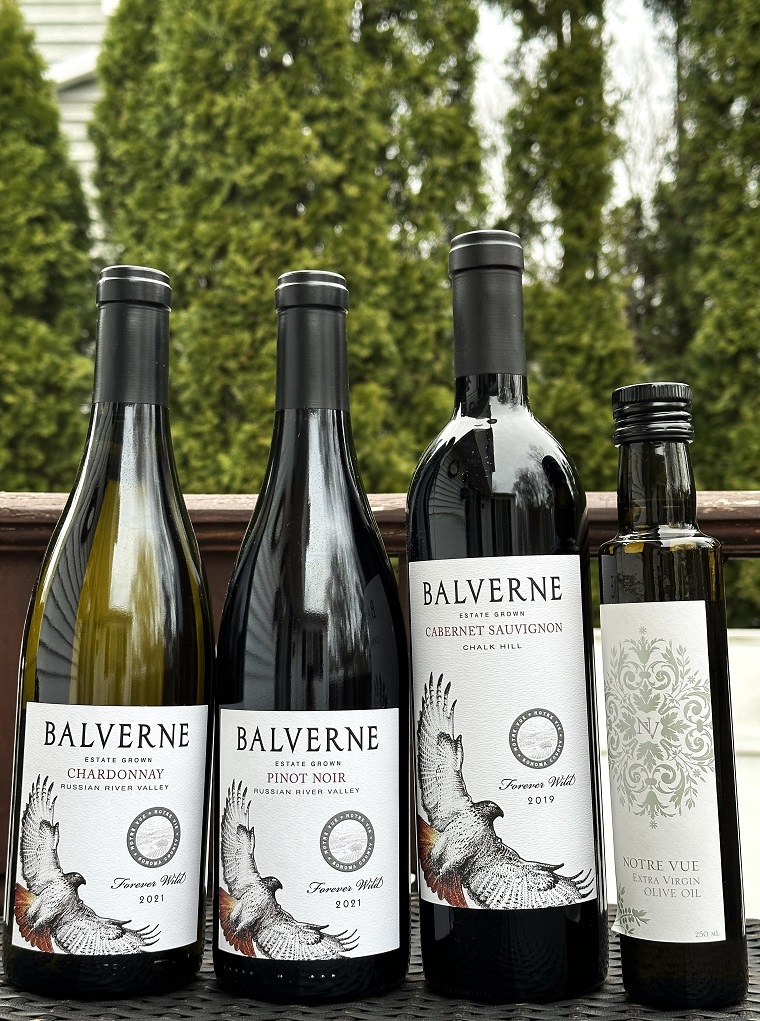 I had an opportunity to try 3 of Balverne’s recent releases – Pinot Noir, Cabernet Sauvignon, and Chardonnay. I would typically start tasting with the white wine – here, as I was tasting in the comfort of the house instead of the tasting room, I started with the red – Pinot Noir. The wine was excellent, tightly woven which is not always the case with California Pinot.
2021 Balverne Pinot Noir Russian River Valley AVA (14% ABV, $35, Pinot Noir clones 459 and 667 with a small percentage of 114 and 115, 9 months in 25% new French oak)
Dark garnet
Plums, violets, intense, inviting
Nicely restrained, dark cherries, tart, crisp, lean, well structured
8, excellent
Cabernet Sauvignon followed, being nothing short of excellent, and perfectly drinkable from the first pour.
2019 Balverne Cabernet Sauvignon Chalk Hill AVA (14.3% ABV, $48, 79% Cabernet Sauvignon, 9% Petit Verdot, 9% Malbec, 3% Cabernet Franc, 18 months in French oak)
Dark garnet
Eucalyptus, cassis
Everything weaves around the acidic core. Perfectly restrained, nice Bordeaux/old world style, harmonious, balanced, delicious.
8+, outstanding.
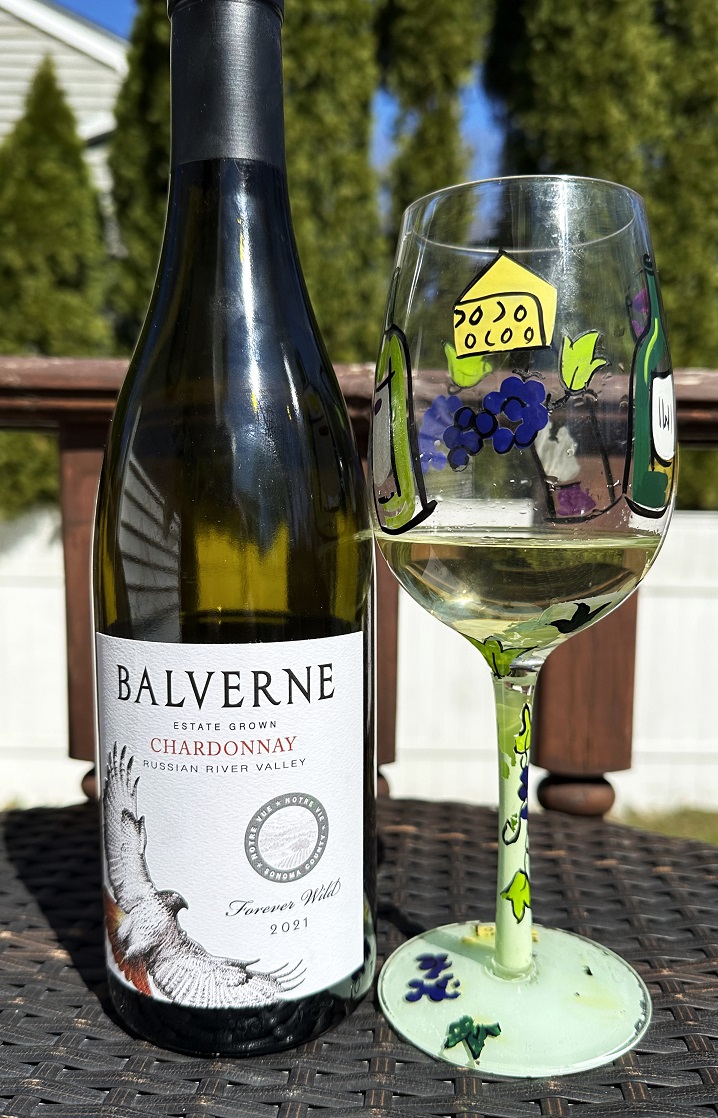 And then came Balverne Chardonnay.
I poured a glass without much thought. Sometimes, it is best to have no expectations – not low, not high, just none. This was the case, even after the first two very successful reds. White wine is difficult. With white wine, the winemaker has nowhere to hide. Even if it will be two out of three, this would be a successful encounter.
The very first whiff of the glass made me literally speechless. The following sip confirmed my excitement:
2021 Balverne Chardonnay Russian River Valley AVA (14.2% ABV, $35, clone 17, 5 months in 20% new French oak)
Light golden
Beautiful, varietally correct nose – vanilla, apple, lemon
The first sip blows your mind – vanilla, golden delicious apple, honey, lemon, minerality – impeccable balance and beauty only a Chardonnay is capable of expressing.
9, spectacular. This wine is just something. Something special.
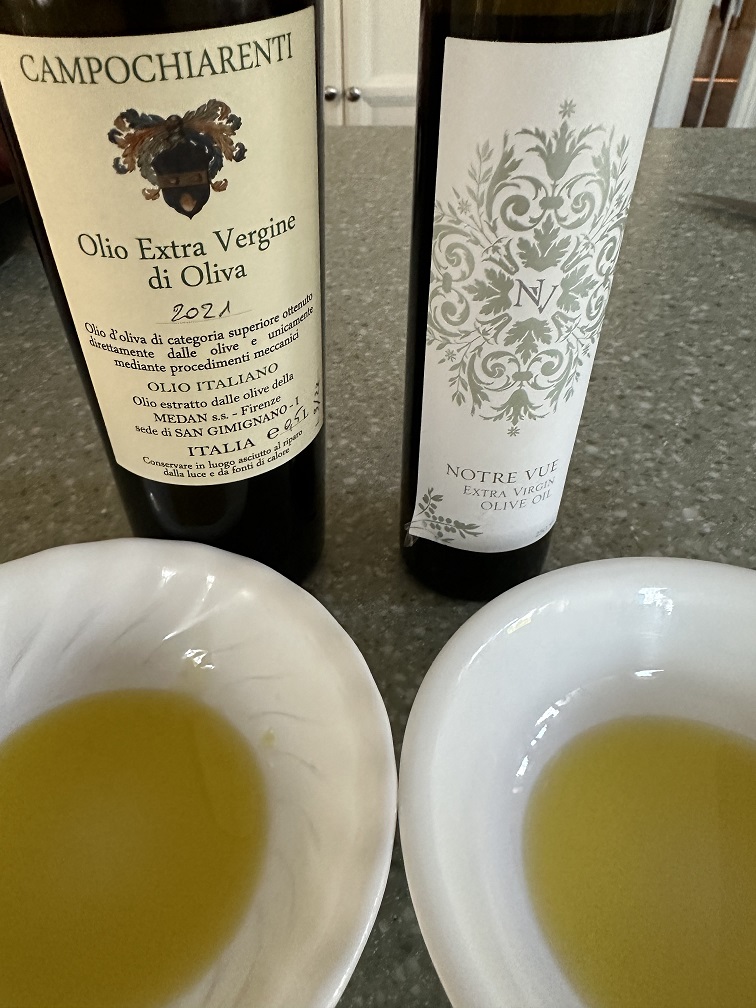
As you might see in one of the pictures above, my sample set went beyond wine – The Notre Vue’s own California Extra Virgin Olive Oil was a part of the package. I decided to do [an unfair] comparison between Californian and Italian EVOO. Both olive oils were expectedly different, with the Italian one showing green, tight, and peppery, and the Californian one being much more fruity. The beauty – it is not a competition, depending on what dish you are using the olive oil for, each one would have its own advantages.
Now you have a complete experience report, including my uninvited research (but everyone is entitled to their own version of fun). What’s important is that I presented to you three excellent wines, both on their own and as a value. Once you taste this Chardonnay, believe me, you’ll understand…
And we are done here. But – I always have more American pleasures to share, so stay tuned…
Last Bottle Sign Up ($10 credit)




 Talk-A-Vino