Archive
Weekly Wine Quiz #62: Wine Trivia – Nebbiolo
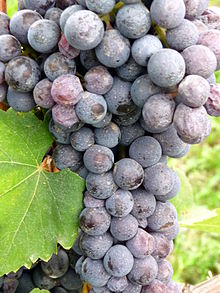
Nebbiolo grapes, picture from Wikipedia
Welcome to the weekend! Your new wine quiz has arrived.
Today our subject is the Italian grape called Nebbiolo – a power grape of Piedmont, solely responsible for some of the world’s best wines, Barolo and Barbareso.
As I’m working on this series of quizzes, I’m of course learning a lot myself. It was very interesting for me to realize, that unlike any other major red grape we talked about so far, Nebbiolo is pretty much confined to the 6 or so areas in Italy, where it makes wonderful wines – its world-wide spread is non existent, not even in the form of clones, like Zinfandel. And this is all despite the fact that Nebbiolo is quite an old grape, with first mentions going all the way back to the 13th century.
Nebbiolo is a very tricky grape to work with. It has the longest ripening cycle out of many grapes – buds early, ripens very late, prone both to mutation (there are about 40 known clones) and grape diseases. But – the resulting wines, like Barolo and Barbaresco, clearly worth the trouble, with wonderful aromatics, power and concentration. Also the ageing potential of the Nebbiolo wines is almost unlimited.
Now, to the quiz!
Q1: Explain the meaning of the name “Nebbiolo”
Q2: In one of the regions outside Piedmont, the wines are produced from Nebbiolo grapes in the style of Amarone – with grapes drying on the straw mats before they are pressed. Can you name that region?
Q3: True or False: Blending is not allowed for any of the wines produced from Nebbiolo grape in Piedmont region.
Q4: White grape used to be such a traditional blending partner for Nebbiolo that it was sometimes called White Barolo. Do you know the name of this grape?
Q5: In the blind tasting setting, the wines made out of Nebbiolo can be very distinguishable even before you take a first sip. Do you know what is this distinct feature of Nebbiolo wines?
Good luck, enjoy your weekend and cheers!
Weekly Wine Quiz #61: Grape Trivia – Tempranillo
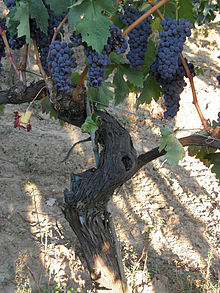
Tempranillo grapes as captured in Wikipedia
Welcome to the weekend! Here is your new wine quiz you’ve been waiting for so hard (yeah, okay, I know I’m pushing it, but may be at least a bit?)
And yes, we are continuing the grape trivia subject – by the way, if you are tired of it, do tell me – I will come up with something else. Just to let you know, we have two more red grapes to go through, and then we will switch to the whites for may be 8 different white grapes – then will see where we will end up.
Today’s subject is – Tempranillo! Just saying the word Tempranillo makes me very excited, as Rioja, one of the most well-known wines made out of Tempranillo grapes, are some of my all time favorites.
Tempranillo is indigenous grape originating in Spain, with more than 2000 years of history. It is black, thick-skinned grape, capable of surviving temperature swings of Mediterranean climate, with very hot days and cool nights. Tempranillo grapes are naturally low in acid and sugar content, so they often rely on blending partners to complement on both. Flavor profile of Tempranillo typically includes berries, leather (so famous in Rioja wines) and tobacco. Most famous Tempranillo wines come from Spain, from Rioja and Ribera del Duero regions, but Tempranillo is successfullygrowing in many other regions, including Portugal, California, Texas (up and coming star), South Africa, Australia and others.
And now, to the quiz!
Q1: What is the meaning of the name Tempranillo?
Q2: Name 3 grapes, traditional blending partners of Tempranillo
Q3: What is common between Bodegas Muga, La Rioja Alta, Lopez de Heredia and Vina Real outside of the fact that all four are very famous Rioja producers and of course make wines out of Tempranillo?
Q4: Tempranillo is used in production of the wine outside of Spain, which is at least equally famous to Rioja. Do you know what wine is that?
Q5: Name two producers of Tempranillo wines – one is the most famous and another one is probably the most expensive.
Enjoy the weekend and good luck with the quiz. And don’t forget to celebrate Dad tomorrow – Father’s Day, yay! Cheers!
Weekly Wine Quiz #60: Grape Trivia – Sangiovese

Sangiovese grapes close up from Wikipedia
Welcome to the weekend! Yep, it is the time for the new wine knowledge test.
We are continuing our Grape Trivia series, and today we will talk about Sangiovese – one of the most famous Italian grapes. Sangiovese is typically associated with Chianti, but in reality, Sangiovese is one of the most planted grapes all over Italy. One of the interesting issues is that Sangiovese, similarly to Pinot Noir, is very clone-prone, so it is known in different places under different names, such as Sangiovese Grosso, Prugnolo Gentile or Calabrese, to take a few.
Sangiovese is black skinned grape with cherry-dominant, earthy and savory profile. Sangiovese is capable of a wide range of expressions, starting from simple food friendly wines from Chianti to the oak-loaded monsters requiring long ageing and long decanting, coming from different regions in Tuscany and beyond. Absolute majority of Sangiovese plantings are located in Italy, but the grape is also slowly becoming popular in the other regions such as United States or Argentina.
Now, to the quiz! I thought that Zinfandel was not a simple quiz to compose, but then I realized that it is even more difficult to create an interesting quiz all around Sangiovese. For what it worth, 5 questions are below.
Q1: Grape, blending partner mostly of the past, typically leading to Sangiovese wines becoming dull and unexciting.
Q2: What is Fiasco, and how is it related to the Chianti wines?
Q3: On some of the bottles of Chianti, you could see an image of the black rooster. What is the meaning of it?
Q4: Tuscany no doubts is the major source of Sangiovese wines. Can you name 4 sub-regions in Tuscany, producing great wines with Sangiovese as the main variety?
Q5: Name 3 leading regions in United States producing Sangiovese wines. For an extra bonus, add your favorite producer(s).
Have a great weekend, have fun and cheers!
Wednesday’s Meritage – Wine Quiz Answer, Le Féret, En Premeur Tales, 1WD Giveaway and more
Meritage time!
Let’s start from the answer to the wine quiz #59, Grape Trivia – Zinfandel. In the quiz, you were supposed to answer 5 questions about California’s star grape, Zinfandel. 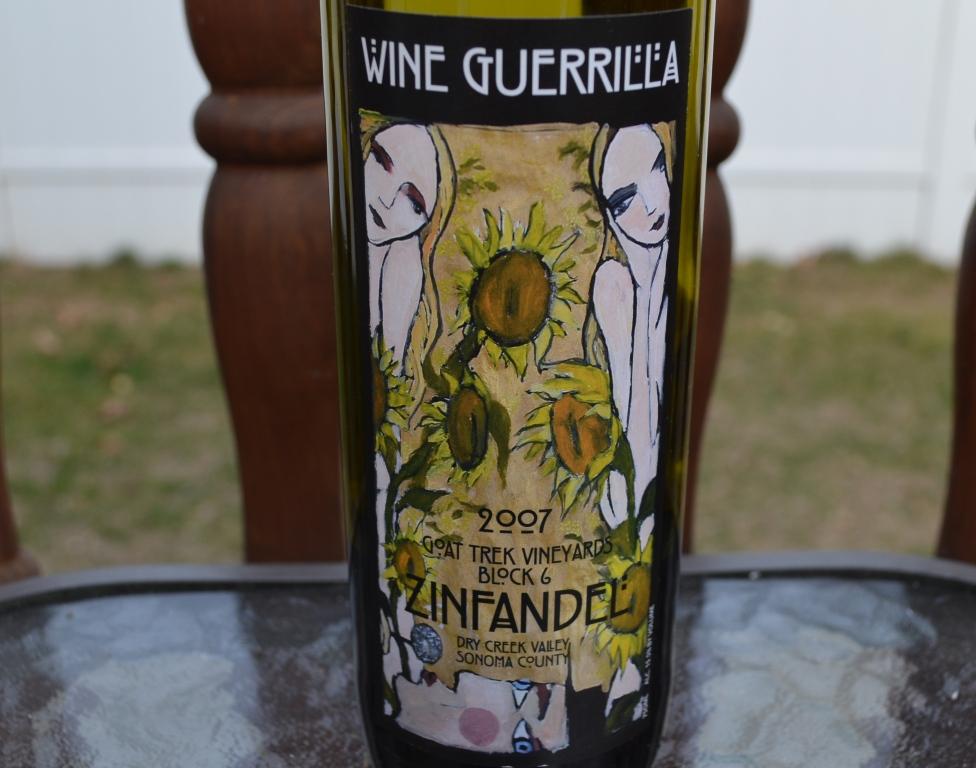
I know many people prefer to answer quizzes in the Google-free form – however, this Zinfandel quiz was somewhat of an exception. Let’s move on to the answers.
Q1: It was established recently that Zinfandel existed in Croatia under a different name, at least from the 15th century. Do you know what was that name?
A1. This was actually a tricky question. People, I mentioned Crljenak Kaštelanski right in the text of the quiz – I was hoping that this would be enough of a hint that this will not be a right answer. If someone will look into Wikipedia, you will be able to find that “After years of research and DNA testing of vines from vineyards across the globe, a single 90 year old grape vine from the garden of an elderly lady in Split, Croatia, provided the evidence to show that Zinfandel was a Croatian grape that has been known as Tribidrag since at least the 15th century.” So the correct answer for the question #1 is Tribidrag.
Q2: While Zinfandel typically listed on the label, very often some other grapes are added to the blend. Name one grape which can be considered a traditional blending partner of Zinfandel
A2: Petite Sirah. Look at the information on many Zinfandel wines, and you will often see at least some percentage of Petit Sirah to be a part of the blend.
Q3: Pink Zinfandel was discovered by accident. Can you explain how that happen, and possibly use the proper winemaking term for the “accident”
A3: Oops, sorry, I should’ve being checking my writing. It is actually White Zinfandel, not Pink, of course – pink is just a color… Anyway, I see that many of you figured out what I meant ( I will still correct the question) – yes, White Zinfandel was discovered as a result of the accident, which is called “stuck fermentation” – all the yeast dies and fermentation stopped before sugar was fully converted into the alcohol.
Q4: Two California winemakers are largely credited with putting red Zinfandel wines on the wine map. Can you name them?
A4: Most of you mentioned only the wineries – and the question was actually about the winemakers. But thedrunkencyclist was correct mentioning Ridge and Ravenswood – Paul Draper of Ridge and Joel Peterson of Ravenswood are largely considered the pioneers of California Zinfandel.
Q5: Most of the well known Zinfandel producers still make other wines from the different grapes. But there is one winery in California ( at least that I know of), which make nothing but Zinfandel wines. Can you name that winery?
A5: Yes, this was a tough question too. Most of the famous Zinfandel producers – Turley, Ravenswood, Rosenbloom, Seghesio, Robert Biale, and so on – are all producing other wines in addition to their great Zinfandels. The only winery I know of which produces Zinfandel and nothing but Zinfandel is Wine Guerilla – it is not for nothing they are calling themselves “An Art and Soul of Zinfandel”. Take a look at their line up – they are currently offering 13 different kinds of Zinfandel – and nothing but Zinfandel.
Summing it up, we don’t have winners this week, and Jeff, a.k.a. thedrunkencyclist gets an honorable mention with 3 correct answers out of 5.
Now, to the interesting stuff around vine and the web!
Have you heard of Editions Féret? I have to admit that I didn’t, not until I read a Wine Spectator article called “The Book that Defined Bordeaux“. It appears that the book, now called Editions Féret, or simply Le Féret, which started exactly 200 years ago as 84 pages travel guide, and had grown to become a 2,296 pages bible, largely defined Bordeaux wines, starting from famous 1855 classification – it was that book which rated the wines simply based on their prices in 1850, which was taken as a foundation of 1855 classification. Read the article, I think it is quite interesting.
According the post on Dr.Vino’s blog, it appears that during En Premeur, a primary Bordeaux event where new vintages are presented, one and the same wine can be “processed ” differently for the different groups of tasters – Americans will get the wine exposed to more of the new oak, and the same wine for the French audience will be finished to have more subtle showing of the fruit. Is it true? I have no idea. But it gets a final product into an interesting perspective – does it mean that one and the same Bordeaux wine can taste differently depending on where you will buy it ( in US or in Europe)? Hmmm…
Do you like giveaways? Of course you do, who doesn’t? So assuming that you do, please go and check this post at 1WineDude web site – if you leave a comment there, you will get a chance to wine one of the 5 memberships in the French Wine Society. I think it is not a bad deal, huh?
Last but not least – mark your calendars for June 19th – and make room in your wine cellars and their equivalents. Yep – WTSO is doing it again! Famous Cheapskate Wednesday is coming into town on June 19th – for more information please visit WTSO web site (you can find link in the “Buying Wine section to your right) or click this link.
That’s all I have for you for today, folks – the glass is empty. But refill is on on its way. Until the next time – cheers!
Weekly Wine Quiz #59: Grape Trivia – Zinfandel
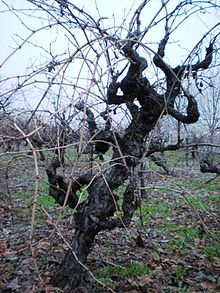
Traditional gnarly look of old Zinfandel vines. Picture from Wikipedia.
And the new weekend is upon us, together with the wine quiz.
We are continuing the grape trivia, and we are continuing exploring the red grapes (let me know if you think it is the time to switch to the whites). Today’s subject is Zinfandel, an American star.
Zinfandel is the black-skinned grape, known as an early ripening variety and capable of accumulating very high levels of sugar – this is one of the reasons why you can often see Zinfandel wines with alcohol by volume levels easily exceeding 15%.
Story of Zinfandel is one of the most fascinating ones compare to many other grapes you can think of – considering the amount of genetic research which went into establishing the origins of Zinfandel, the amount of attention this grape received is pretty mind boggling. After many years of back and force, it is now established that Zinfandel and Primitivo (an Italian grape from Apulia) are two individual clones of Croatian grape called Crljenak Kaštelanski. As The Drunken Cyclist, a regular winner of these quizzes, pointed out in his own quiz a while back, both Zinfandel and Primitivo are considered independent varieties and should be listed as separate varieties on the wine labels of the wines in US.
Another interesting part of the Zinfandel story is that actual powerful and seductive Zinfandel red wines as we know them now, almost became extinct at some point due to the success of sweet and insipid Pink Zinfandel wines (but please pay some respect – Pink Zinfandel still accounts for almost 10% of wine sales in US).
And now, to the quiz! As the subject is very narrow (Zinfandel is not growing all over the world), enlisting Google as your helper is totally fine (not that it was not with any of my quizzes before) – but this is up to you, of course. In any case, even if you can only answer a few questions – please do!
Q1: It was established recently that Zinfandel existed in Croatia under a different name, at least from the 15th century. Do you know what was that name?
Q2: While Zinfandel typically listed on the label, very often some other grapes are added to the blend. Name one grape which can be considered a traditional blending partner of Zinfandel
Q3: White Zinfandel was discovered by accident. Can you explain how that happen, and possibly use the proper winemaking term for the “accident”
Q4: Two California winemakers are largely credited with putting red Zinfandel wines on the wine map. Can you name them?
Q5: Most of the well known Zinfandel producers still make other wines from the different grapes. But there is one winery in California ( at least that I know of), which make nothing but Zinfandel wines. Can you name that winery?
Good luck, enjoy your weekend and cheers!
Weekly Wine Quiz #58: Grape Trivia – Syrah

Shiraz grapes. Source: Wikipedia
Welcome to the weekend! To start your weekend right, it is the time for our traditional grape and vine exercise.
We are continuing the grape trivia, and today’s subject is … Syrah, or as they call it in Australia, Shiraz.
Syrah is a red grape with thick black skin, capable of producing full-bodied, big and powerful wines. Primary aromas associated with Syrah are usually of blackberry and black pepper, but as the wine ages, it shows a number of very diverse flavors, such as leather, tobacco, chocolate and more. Syrah is known under the name of Shiraz in Australia and South Africa. France, United States (California, Washington, Oregon) and Australia are typically considered to be the source of the best in the world Syrah wines, but Spain, Italy, Chile and Argentina are all producing very interesting Syrah wines as well.
Now, let’s move on to the quiz. As before, the quiz consists of 5 questions, and the answers will be provided next Wednesday.
Q1: Where is Shiraz?
Q2: Which white grape often plays a role of blending companion for Shiraz?
Q3: One of the appellations below can be removed from the list – can you tell which one and why? For the answer to count, “why” explanation is required
A. Cornas
B. Côte-Rôtie
C. Crozes-Hermitage
D. Hermitage
E. Saint-Joseph
Q4: About 100 years ago, Syrah was a popular addition to the wines of one well known region – now this practice is totally illegal by the appellation rules. Do you know what region was that?
Q5: Where do you think are the oldest in the world continuously producing Syrah vineyards are located? Can you guess the approximate age of the vines?
Enjoy your weekend, good luck and cheers!
Weekly Wine Quiz #57 – Grape Trivia: Grenache, a.k.a Garnacha

Grenache Noir picture from Wikipedia
And we are continuing the Grape Trivia series – today’s focus is the red grape called Grenache (also known as Garnacha and Garnaxta in Spain).
Grenache is one of the most planted red grape in the world. It is a late ripening variety, which typically produces spicy, juicy, berry-flavored wines with high alcohol content. In the number of regions, such as Priorat in Spain, Châteauneuf-du-Pape in France or California and Washington in US, Grenache produces outstanding single-varietal wines, but more often than not it is used as a blending companion, adding juicy component and structure.
And now, to the quiz!
Q1: Name two grapes which are traditional blending partners of Grenache
Q2: Below is the list of countries which use Grenache in the winemaking. Sort the list by the area of Grenache plantings, from the highest acreage to the lowest:
A. Australia
B. France
C. Italy
D. Spain
E. United States
Q3: One winery in US is often credited with spearheading the success of Grenache in US. Can you name that winery?
Q4: A few centuries ago, Grenache was a popular blending addition in one of the regions in France, until it became illegal by the AOC rules. Do you know what region was that?
Q5: Same as for the number of other grapes, Grenache exists in three different grape variations – Grenache Noir, Grenache Blanc and Grenache Gris. There is one wine where it is absolutely legal to use all three grapes as the part of the blend. Can you name that wine?
Enjoy your weekend, have fun and good luck! Cheers!
Weekly Wine Quiz #56: What Is It?
It is Saturday, and wine quizzes are back at Talk-A-Vino!
I will continue the grape series with the next quiz (we already covered 3 grapes, so there are only about 200-300 left), but for today, I want to play one of my most favorite games – the one with the picture, you know?
Below is the picture which is very relevant to the wine world – do you know what it is, what it is for and how to use it?

Good luck, enjoy your weekend and don’t forget that Mother’s Day is tomorrow. Cheers!
Wednesday Meritage – Wine Quiz Answer, Bordeaux 2012, Bottle Variations, Dishcrawl and more
Meritage time!
Let’s start with the answer for Wine Quiz #55, Grape Trivia: Pinot Noir. In the quiz you were supposed to answer five questions about Pinot Noir grape – here are the questions with the answers:
Q1: Can you explain the source and meaning of the grape’s name “Pinot Noir”?
A: Pinot Noir literally translates as “black pine”, due to the grape cluster’s resemblance of the pine cone.
Q2: True or False: Burgundy has the biggest plantings of Pinot Noir in France?
A: False – Champagne has much bigger area planted with Pinot Noir
Q3: Match the wine/producer with its country/region:
| A. Mt. Difficulty | 1. Burgundy |
| B. Evening Land | 2. New Zealand |
| C. Fleury | 3. Champagne |
| D. Hamilton Russell | 4. Oregon |
| E. Clos de Tart | 5. South Africa |
A: A2, B4, C3, D5, E1
Q4: Which major wine-producing country is literally unknown as a Pinot Noir producer?
A: Spain. There are literally no Pinot Noir wines coming out of Spain
Q5: From 1990 to 2010, annual Pinot Noir harvest in California increased approximately:
a. 2 times, b. 3 times, c. 5 times, d. 7 times, e. 9 times
A: According to the information you can find here, production of Pinot Noir went from 32,000 tons in 1990 to 147,732 in 2010 – thus correct answer is C, about 5 times.
Looking at the answers, it seems that everybody had no issues answering first 3 questions, but the last two proved to be more difficult. Nevertheless, we have 2 winners – armchairsommelier and vinoinlove both answered all questions correctly, so they get unlimited bragging rights. Jeff at thedrunkencyclist gets honorable mention with 4 correct Google free answers, as well as RedWineDiva also with 4 correct answers. Well done!
By the way, what do you think the theme of the next quiz will be? I’m going along the lines of major grapes, so what do you think is next?
Now, to the interesting stuff around the grapevine. Let’s start from Bordeaux 2012, or En Primeur 2012 event which recently took place in Bordeaux. This event takes place in the Spring of each year in Bordeaux, and this is the time when Bordeaux wines of previous year are offered for the future sales, and prices for those future sales are set. En Primeur 2012 was different from most of the prior years’ events – first, because Chateau Latour, one of the five famous First Growth producers, stopped participating in this events (from now on, they will only sell their wines when they are actually ready to drink, not the futures). Second interesting element – China’s appetite for Bordeaux is getting smaller, and now prices need to be corrected. Anyway, here is a summary by Jancis Robinson, offering her insight after attending the En Primeur 2012.
Now, I want to bring to your attention an interesting article about… bottle variations. No, I’m not talking about imperfections of the glass – I’m talking about the actual content, the wine, being different from bottle to the bottle. Here is the link – I think it is a very interesting reading.
Do you like beer? Yes, of course it is okay to like beer even if you are a wine lover. So if you like beer, here is an interesting site for you – BrewGene. It is both a web site and an app, which will allow you to find information on the beer, see what the others think about it, get recommendations for similar beers and more – I think this is pretty cool, so check it out.
Last but not least, a couple of food events – sorry, they are really only local events, but I want to mention them in any case. Dishcrawl, which I mentioned in my previous Meritage post, just announced a new event on June 11th, which will be taking place in Old Greenwich, Connecticut. As of the time of this writing, there were still 17 tickets available – if you are local in the area, or plan to visit around June 11th date – don’t miss out. Here is the link to the web site for you.
Another food related event is Taste of Westport, which will take place on May 2nd from 6 pm to 9 pm. Here is the link with lots of information about the event, all coming from OmNomCT blog which is a priceless source of information about all things food and drink in CT – if you live in Connecticut or in a close proximity, and you are not following this blog, you have to correct this mistake immediately.
And that’s about all I have for you, folks. The glass is empty. Until the next time – cheers!
Last Bottle Sign Up ($10 credit)




 Talk-A-Vino