Archive
Portuguese Wines: Pleasures Worth Seeking, And Waiting For
Once again, I want to start with the question.
What is the most frustrating question you can ask a wine lover?
I get it – we are all different, and so are our sources of frustration. Of course, I get it. And nevertheless, give it a thought, please. If you consider yourself a wine lover (not a collector, not a snob, just someone who really appreciates the glass of that special grape juice) – what is the question you don’t like to hear the most?
Okay, fine, I will go first.
“What is your favorite wine?”
This is the most innocent question one might expect, isn’t it? Once you show your love of wine one way or another, people love to ask that question – ahh, so what is your favorite wine? I literally cringe every time when I hear that question, because it is very hard to explain how such a simple and innocent question can’t get a good, simple answer – and yet I can’t answer that question.
Every time I answer this question, I lie. When I say “I have no preference, I love them all” I lie because I have preferences. Lots and lots of preferences, and yes, I love them all, but then… Yeah. And when I say “I love Spanish Rioja” it is a lie, because I love Rioja from very particular producers, and not just any Rioja. Moreover, depending on the day, food, and company, there will be other wines that I love as much as I love Rioja. See, there is no escape from the lies.
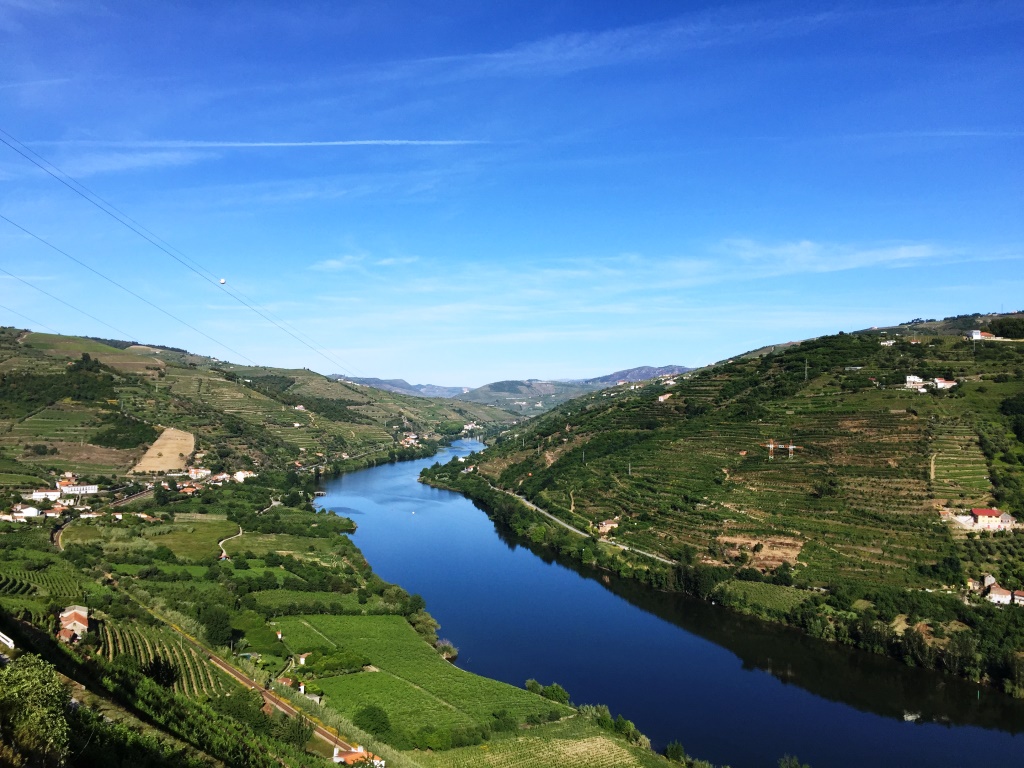
So when I say “I love Portuguese wines” it is one of those statements. Yes, I love Portuguese wines, but not all of them – I have preferences.
Portuguese wines became somewhat of an obsession to me about 15 years ago, but I don’t believe you would easily guess the reason why. It was not just because they were really, really inexpensive at the local Bottle King wine store in New Jersey ($5 per bottle was a pretty normal price, with occasional $4 showing up), but because they were made out of obscure grapes, and I was hunting down the obscure grapes to advance to the next levels of The Wine Century Club. Enjoying the wines was secondary, but spending countless hours with the search engine, trying to figure grape composition, grape synonyms – ohh, what a fun journey it was.
Based on what I just described, I wasn’t ready to claim my love for the Portuguese wines overall. In 2013, I was lucky enough to visit Porto, Portugal for work, and this is where it became literally love from first sight. At the restaurant, I just pointed to the bottle on the list. I had no idea what I’m ordering, but at €14 it didn’t seem like a big risk. The first sip made my eyes pop, and Portugal’s status was instantly elevated to the “oh my god” level. That wine was from Quinta do Cardo, a blend of Touriga Nacional, Touriga Franca, and a few other varieties – here is the original post.
A few more days into that same trip I had another wine which completely solidified my love for the Portuguese wines – Casa Burmester Reserva Douro – again, pure indulgence. There were lots more wines during that and two other trips to the Douro which made me form the opinion that Touriga Nacional is very similar to Cabernet Sauvignon in its ability to be grandstanding, to create the wine with a perfect flavor profile, perfect ripeness, perfect level of extraction and impeccable, sexiest mouthfeel. If you ever had Kamen Cabernet Sauvignon or Vérité La Joia, you would know what I’m talking about. Yes, I love Portuguese wines.
And one more thing about Portuguese wines. Similar to well-made California Cabernet Sauvignon, well-made Portuguese wines need time. Way too many times I had Portuguese wines which were not ready. I don’t know if analogies with Port are appropriate here (same grapes?), but Vintage Ports can easily age for 50+ years. I never had 50-years old wines from Portugal, but I have first-hand experience with, for example, 24 years old wine which was not ready to drink, not for a minute (you can read about it here).
When I was offered to try two Portuguese wines from the Douro, made by Prats and Symington, I quickly agreed – I told you already that I love Portuguese wines, remember?
I always like to talk first about the producer before discussing the wines. Only a few days ago I wrote at length about a number of Port wines produced by the Symington Family Estates, so this is the part of the story I don’t need to repeat – you can read it here. But understanding the “Prats” was a bit more challenging. The website section for Prats and Symington, or P+S how it is abbreviated provides rather limited information. I was only able to learn that “In 1999 our family formed a partnership to make top Douro wines with the Prats family of Bordeaux”, and that “the first Prats & Symington wine was Chryseia 2000 which received widespread national and international acclaim”. I felt as in my early days of combing Portuguese wine labels and information tidbits for the grape names, so I had to do a bit of research.
I was able to figure that Prats in P+S is actually Bruno Prats, former owner of Château Cos d’Estournel and experienced winemaker, who applied Bordeaux winemaking philosophy, especially around blending, to the production of the P+S wines, which resulted in the wines with the highest critic ratings in the history of Portuguese unfortified wines. This article in the Dinks Business online magazine explains Bruno’s winemaking philosophy very well.


The two wines we are talking about here are 2018 P+S Prazo de Roriz Douro (14.5% ABV, $17, 35% Touriga Franca, 20% Touriga Nacional, 20% Mixed varieties, 15% Tinta Roriz, 10% Tinta Barroca, 6 months in 400L neutral French oak Barrels) and 2019 P+S Post Scriptum de Chryseia Douro Red (14.2%, $27, 56% Touriga Franca, 33% Touriga Nacional, 7% Tinta Roriz, 4% Tinta Barroca).
There are two main vineyards used in the production of these two wines – Quinto de Roriz, one of the oldest and best vineyards in Portugal, already famous for its single-vineyard wines in the 18th century, and Quinta de Pedriz, a newly acquired vineyard in Rio Torta and specifically planted with Touriga Nacional and Touriga Franca grapes.
As these were two sample wines, I also got technical notes for both, which I typically like to glance over. Two items attracted my attention in the notes. First, there was a line there saying “Decanting: Not required”. Second, the “Storage and Serving” section stated ” Ready for immediate consumption”. Leaving decanting aside, “ready for immediate consumption” somehow bothered me.
Prazo de Roriz was actually as promised – from the moment the wine made it into the glass, the wild strawberries on the nose and palate, which I tend to believe are signature flavors of Touriga Nacional, were prominent, and the wine was perfectly extracted, round, concentrated, and overall delicious (Drinkability: 8). It was also “dangerous wine” as I like to call them – once opened, they tend to disappear without second notice.
The first sip of Post Scriptum, made me say “hmmm” and reach for the decanter. Decanter didn’t really help – two hours later, the wine was still ultra-dense and literally devoid of fruit. I don’t give up on the wines easily, so back into the bottle the wine went. Next 4 days, I would pull out a stopper, pour a sip, and put the stopper immediately back. On day number 5, the magic transformation completed – the wine all of a sudden opened with the same wild berries profile, perfect extraction, round and layered, and ready to be admired. (Drinkability: 8+).
Here you are, my friends. Portuguese wines are easy to love – you just need to find the right wines and have a bit of patience. But seriously, the rewards are handsome – these are some of the best wines in the world which you can still afford without an expense account. Happy [wine] hunting!
Wine Lover’s Guide To Lesser Known Wine Regions – Vinho Verde
Vinho Verde.
Let me ask you, wine lovers – when you hear the words “Vinho Verde”, what are the two things which are instantly come to mind? Let me guess – it should be “green” and “summer” – am I correct?
Let’s leave “green” aside for a minute and let’s talk about “summer”. Do you insist on pairing wine with the season? Of course, rich and opulent California Cabernet Sauvignon or tantalizing Barolo might not be the ideal choice of beverage for the pool party in the middle of summer. But then would you say that white wines should be only drunk when it is hot outside? Even if you will insist, I would have to disagree – the white is simply a color, and white wine can be equally enjoyed during any season. And to prove my point, let’s talk about Vinho Verde.
Oh, and let’s address the “green” thing – there nothing green about Vinho Verde. “Verde” here refers to the young wines – Vinho Verde wines are typically released 3-6 months after the harvest.

Here are some interesting facts about Vinho Verde. Vinho Verde is one of the oldest winemaking regions in Portugal, producing wine for the past 2,000 years. It is also the most northern wine region in Portugal, and the largest, with 51,000 acres planted. There are 19,000 grape growers and 600 wine producers, making over 85 million liters of wine, out of which 86% are white wines, and the rest is divided between Rosé, red and sparkling wines.
45 indigenous grape varieties are growing in Vinho Verde, out of which 9 are recommended – Alvarinho, Avesso, Azal, Arinto, Loureiro, and Trajadura for the whites, and Espadeira, Padeira, and Vinhão for the reds. Vinho Verde region subdivided into the 9 sub-regions named after rivers or towns – Monção, Melgaço, Lima, Basto, Cávado, Ave, Amarante, Baião, Sousa, and Paiva. It is also interesting to note that while Vinho Verde is identified as a DOC (top quality designation, similar to French AOC/AOP), the region called Minho Vinho Regional, completely overlaps Vinho Verde territory, however, its designation is similar to French Vin de Pays (lesser quality requirements).
Vinho Verde wines are typically low in alcohol and pair well with a wide variety of food. Quite often, Vinho Verde whites are also exhibiting very light fizz, this is really a hallmark of the region.
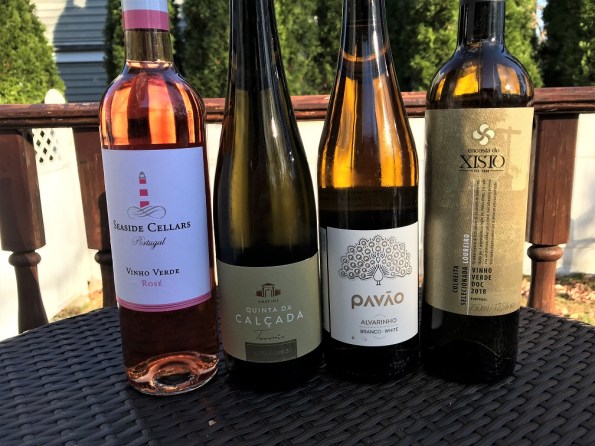
I had an opportunity to taste (samples) 3 whites and one Rosé from the region, here are my notes:
2018 Encosta do XISTO Vinho Verde DOC (12.5% ABV)
Straw pale with greenish hue
Vegetative nose, a touch of grass, sweet basil, restrained
A touch of fizz, lime, a hint of grapefruit, lots of minerality, fresh
8-
2018 Vercoope Pavāo Alvarinho Vinho Regional Minho (12% ABV, $8)
Light golden
Tropical fruit, candied lemon, sage, tobacco
Guava, a touch of honey, candied fruit, a touch of pink grapefruit. Good acidity.
7+/8-
2017 Seaside Cellars Rosé Vinho Verse DOC (11% ABV, $8, 40% Vinhão, 30% Borraçal, 30% Espadeiro)
Wild salmon pink
Nice minerality, whitestone fruit, a typical nose of white wine if there is such a thing
Underripe strawberries, good minerality, a distant hint of fizz, mostly on the finish.
7+/8-, fuller body than most of Rosé, not sweet at all despite low ABV. It also gives me two new rare grapes (Vinhão and Borraçal), which is always a nice bonus.
2018 Quinta da Calçada Alvarinho Vinho Regional Minho (13% ABV)
Light golden
Intense fresh lemon, a touch of grapefruit, noticeable minerality
Tart lemon, a touch of grapefruit, dry, intense, medium to full body, good minerality, good textural presence.
8, perfect any time you want a glass of dry white.
As you can tell, I liked all the wines. No, these wines are not mind-blowing, of course not. But considering the price, often less than $10, these wines offer an excellent, hard to beat QPR.
Here you go, my friends. No need to wait for the hot summer days. Just pick up a bottle of Vinho Verde, and enjoy it by itself, or pair it with good food and good company. You can thank me later. Cheers!
[Mind Boggling] Price of Wine
I’m again [lucky bastard] in Portugal, and get to enjoy this beautiful country. Of course one of the first places I have to visit is a supermarket, to see what’s new in the wine section (you can find some illustrations for my first encounter here). My eyes stop on the bottle of wine from the unknown region for me – Tejo. There were both red and white wines, standing next to each other, so I decided to grab both.

Let me give you description of the wines.
2012 Enóloga Antonina Barbosa Vinho Branco Tejo Vinho Regional (12.5% ABV, made from the Portuguese grape called Fernao Pires): Light yellowish color in the glass. Spectacular perfumed nose, resembling some of the best French Viognier – shows bright perfumed fruit, very elegant, not over the top. Very round and delicate on the palate, touch of apricot, peach and white apple, fresh acidity, perfectly dry and balanced. Drinkability: 8
2012 Enóloga Antonina Barbosa Vinho Tinto Tejo Vinho Regional (13% ABV, a blend of Aragonez, Castelao and Cabernet Sauvignon): Ruby red color in the glass. Fresh fruit nose, shows nice ripe concentrated fruit and a touch of earthiness. On the palate, very restrained, dry, touch of tart cherries, some earthiness and light tannins presence. Good acidity and good overall balance. Drinkability: 7
So we are looking at two good wines. Now, let me ask you a question. Based on the description above, how much these wines should cost?
I will give you a few seconds to think about.
And a few more seconds.
And a few more.
Ready? What do you think?
Okay, we can skip the drum roll, but let me know if you expected to see this number.
€1.29 each.
A whooping €1.29.
I think this is pretty impressive, that such a level of quality can be achieved at such a price of the wine. This wine is a private label, made for the Pingo Doce stores, by the Falua winery. Of course as this is the case with the private labels, no additional details can be found on the winery web site.
I also learned about relatively new designation for the Portuguese wines – Tejo Vinha Regional, which was created in 2009 to be used in the Ribatejo region. Ribatejo DOC (higher classification) is retained for some specific areas of the region.
That’s all I have for you for now. There were many other great wines, food and very special experiences, like Port barrel tasting all the way to the 1970 – this all hopefully will be shared in this blog in the orderly fashion.
So, can you top my quality/price ratio? I will let you think about it. Cheers!
Last Bottle Sign Up ($10 credit)




 Talk-A-Vino