Archive
One on One With Cristina Mercuri, Master of Wine
As you might know, I love interviews.
That didn’t happen from the first day of blogging. It took me some time to realize the value of conversation. But once it “clicked”, interviews became one of my favorite subjects on this blog – “Stories of Passion and Pinot” series might be the best proof of that.
Today’s interview is a bit different than the most. The majority of my interviews are with winemakers. However, today I would like to offer to your attention my conversation (virtual, as it often goes, even though this is one of the cases where I would much prefer a face-to-face format) with Cristina Mercuri, Master of Wine.
Cristina Mercuri is the first woman Master of Wine (MW) in Italy, and the fourth Italian MW overall. To put things in perspective, only 521 people have become Master of Wine since 1953, according to the Institute of Master of Wine as of February 2026. This is definitely an achievement to celebrate, so I was very excited when I got an opportunity to talk to Cristina. She is also the founder of Cristina Mercuri Wine Club – we will touch on that in our conversation below.
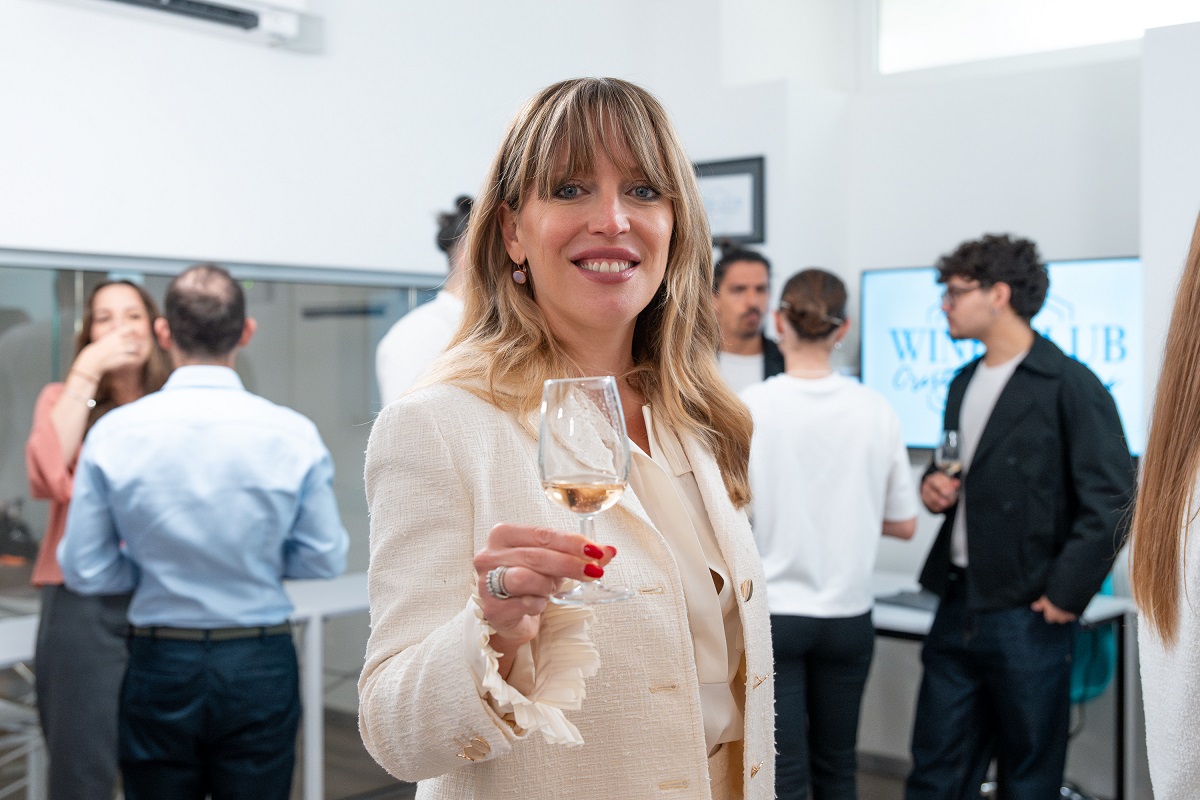
Cristina Mercuri
Here is what transpired in our conversation:
[TaV]: This might be a “duh” question, as you grew up in Italy, and yet – as a wine lover, not as a wine professional, how did you get into the world of wine? Family traditions? Was there a pivotal wine in your life?
[CM]: Wine was always present in my life in the way it often is in Italy: around the table, as part of everyday culture rather than something intellectualized. It belonged to meals, to conversations, to conviviality.
My real entry into the wine world happened much later. I was working as a lawyer and, despite having built a solid career, I felt increasingly bored and disconnected from what I was doing. I needed a radical change, something intellectually stimulating and culturally rich. Wine offered exactly that.
I began studying through the WSET programmes while still working in law, initially out of curiosity. Very quickly that curiosity turned into a serious commitment. By the end of 2015 I decided to leave the legal profession entirely and dedicate myself to wine. What started as a personal exploration became a new professional path.
[TaV]: What made you switch from a successful career in law to the unpredictable world of wine?
[CM]: Law gave me a very strong analytical framework, discipline and the ability to structure complex reasoning. But at a certain point I felt the need to work in a field where cultures creativity and human connection were more present.
Wine offered exactly that. It is an industry where agriculture, craftsmanship, economics and storytelling coexist. Each bottle represents a product, but also a narrative about land, people and time. I realized that the skills I had developed in law — critical thinking, precision, strategic analysis — could be applied in a different way to the wine world.
Leaving law was a significant decision, but it never felt like abandoning something. It felt like redirecting the same intellectual energy toward a field that resonates deeply with identity, culture and global exchange.
[TaV]: You recently became the first woman Master of Wine in Italy (and only the 4th in Italy overall) – how does it feel? What was the hardest part of the MW journey? What was your favorite part of studying?
[CM]: Becoming the first Italian woman Master of Wine is both a personal achievement and a symbolic milestone. In a different world it would be big news that another professional became an MW. In today’s reality, it also represents a small step toward greater diversity in a sector where leadership has long been male-dominated.
The hardest part of the journey is consistency. The MW programme is not only intellectually demanding, it requires years of sustained discipline while continuing to work professionally. Preparing for the Stage 2 examination felt almost like an Olympic training period: blind tasting every day, theory study, mock exams, mental preparation.
My favorite part was the intellectual depth of the programme. It forces you to think about wine from every possible perspective: viticulture, economics, geopolitics, consumer behaviour, communication. It teaches you that wine is not only about what is in the glass, but about the entire system around it.
[TaV]: If at all possible in this format, can you share with us the gist of your master thesis, “Wine, Women and Fascism: A Visual Analysis of the Representation of Women in Propaganda in Enotria (1922–1942)”?
[CM]: My research paper examined how women were represented in the Italian wine magazine Enotria during the Fascist period. I analyzed the covers published between the 1920s and early 1940s using visual semiotics and historical analysis.
What emerged was a very clear pattern: women were rarely portrayed as producers, professionals or decision-makers within the wine world. Instead, they appeared mainly as decorative figures, symbols of beauty, domesticity or national mythology. The visual language reflected broader political and cultural narratives of the time, where gender roles were tightly controlled and instrumentalized.
The research was interesting because it connects visual culture, political ideology and wine communication. It also helps explain why certain stereotypes persisted for decades in the way wine — and women in wine — have been represented.
[TaV]: I heard many times that women are better tasters than men. Do you share the same opinion?
[CM]: I don’t think wine tasting is determined by gender. Sensory ability can vary enormously between individuals, but excellence in tasting comes primarily from training, discipline and experience.
The best tasters I know share certain qualities: concentration, memory, analytical thinking and intellectual humility. Blind tasting especially is a skill that develops through repetition and structured practice.
Reducing tasting ability to gender risks oversimplifying something that is actually much more complex. Wine evaluation is a professional competence that can be developed by anyone willing to dedicate the time and rigor required.
[TaV]: There is a lot of talk everywhere that the world of wine at large is in trouble, as younger people either don’t drink wine at all, or have very specific requirements (low alcohol seems to be one of the most important ones, no oak, etc.). What do you think about young adults and wine? Does the wine industry at large need to do something to address it, or is it just a part of the cycle?
[CM]: I think the conversation around younger consumers often starts from the wrong assumption. It is not that young people reject wine; it is that they expect wine to speak a language that resonates with them.
For decades the industry communicated mainly through tradition, hierarchy and technical jargon. Younger consumers tend to look instead for transparency, authenticity and clarity. They want to understand what is in the glass, who made it, how it was produced and why it matters.
This requires a shift in communication more than a reinvention of wine itself. When wine is presented with honesty, clarity and relevance, younger audiences respond very positively. The future of wine depends largely on our ability to listen to those audiences and adapt the narrative accordingly.
[TaV]: Do you have a favorite Italian wine and/or producer?
[CM]: Italy is incredibly diverse, so choosing one wine is almost impossible. But if I had to mention a style that fascinates me deeply, I would say Etna Bianco. The combination of volcanic soils, altitude and Mediterranean light produces wines with remarkable tension, precision and aging potential.
Producers such as Maugeri or Palmento Costanzo are doing extraordinary work in expressing the subtle differences between contrade and elevations. Etna is a perfect example of how a historic territory can also represent the future of Italian wine.
[TaV]: Same question, taking the view of the world – can you share some names of your favorite wines and/or producers from around the world?
[CM]: I have always been deeply fascinated by Burgundy, particularly producers like Olivier Leflaive or Alain Chavy, who express incredible precision and terroir transparency in Chardonnay.
In Champagne, houses like Krug, Philipponnat or Yann Alexandre represent a philosophy of blending and long maturation that creates wines of extraordinary depth and longevity.
I also admire producers who work with clarity and restraint in different parts of the world — those who allow the vineyard to speak rather than imposing heavy stylistic signatures, like Creation in South Africa.
[TaV]: Do you have a wine cellar? If you do, what would we find there?
[CM]: Yes, I do have a cellar, although I tend to think of it as a working cellar rather than a collector’s one. You would find a mix of Italian classics — Barolo, Brunello, Etna — alongside Champagne and Burgundy.
There are also many bottles linked to personal moments: wines opened to celebrate milestones, wines shared with friends, wines connected to travel or professional encounters. For me a cellar is not only about aging potential; it is also a memory archive.
[TaV]: Can you tell us more about your project, Mercuri Wine Club? What are your aspirations? What are you trying to achieve? How do you see this project evolving over the next 10 years?
[CM]: Mercuri Wine Club was born from a desire to combine education, communication and strategic consultancy within the wine sector.
The project has two main dimensions. One focuses on education, offering structured training programmes that help professionals and enthusiasts understand wine with clarity and depth. The second focuses on strategic consultancy, helping wineries and wine institutions position themselves more effectively in international markets.
Over the next ten years I see the project evolving into a broader platform that connects education, market intelligence and communication. The wine industry needs more bridges between production, markets and consumers, and that is precisely the space where Mercuri Wine Club operates.
[TaV]: Last question: have you had a chance to watch Drops of God series on Apple TV? If you have, what do you think of it? If not, I can’t recommend it highly enough 🙂 [CM]: Yes, I have watched it, and I found it fascinating from a cultural perspective. The series captures something very real about wine: the emotional dimension, the role of memory, and the intensity of sensory perception. In that sense it does a good job of showing that tasting is not just technical evaluation, but also interpretation and personal experience.
At the same time, what slightly disappointed me is the risk of portraying wine tasting as something almost supernatural or accessible only to a few exceptional individuals. In reality, tasting wine is a skill that anyone can develop with curiosity, attention and practice. Blind tasting is not about superpowers, and it certainly shouldn’t be intimidating.
If anything, wine should invite people in, not push them away. The real beauty of tasting is that it sharpens perception and encourages dialogue. Anyone can sit at a table, taste a wine blind, and enjoy the process of discovering it. That sense of curiosity and shared exploration is what truly makes wine special.
Here you are, my friends. I hope you enjoyed reading our conversation, and until the next time – cheers!
Stories of Passion and Pinot: Kate Ayres of Penner-Ash Wine Cellars
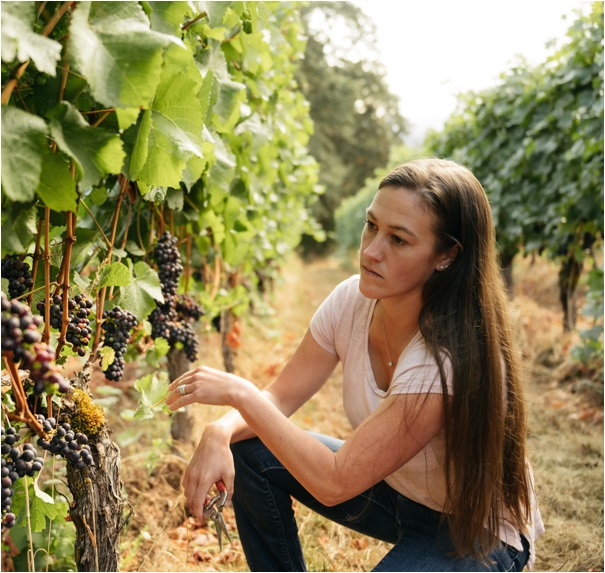
Kate Ayres. Source: Jackson Family Wines
125 cases of Pinot Noir in 1998.
9,000 cases of Pinot Noir, Syrah, Riesling, and Viognier in 2011.
16,000 square-foot winery building designed with human ergonomics in mind.
12 vineyards.
Numerous accolades.
This is a brief “history in numbers” of Penner-Ash Wine Cellars, founded by Lynn and Ron Penner-Ash in Northern Willamette Valley Yamhill-Carlton AVA in 1998. The winery quickly grew to prominence, best known for its lush, layered Pinot Noir. In 2016, Penner-Ash Wine Cellars was acquired by Jackson Family Wines (JFW), joining Gran Moraine, Zena Crown and other Oregon wineries as part of JFW’s “cool-climate” Pinot Noir portfolio.
Kate Ayres had become the Winemaker at Penner-Ash Wine Cellars in the spring of 2018. Continuing traditions is not an easy job, and so I had an opportunity to sit down (virtually) with Kate and ask her a few questions.
Here is what transpired in our conversation.
[TaV]: Reading about the history of the winery, I came across the fact that the winery was designed with “human ergonomics” in mind. Can you expand on this, provide some details for someone who never visited the winery?
[KA]: Lynn and I are both petite female winemakers and that was really a driving factor when creating our gravity flow winery. We tend to ferment in small fermenters (one-, two- and three-ton) that are just short enough that I can smell the tops of each tank at standing height. The tanks are all easily moveable by pallet jack and require very little “heavy lifting.” In addition, because of the tiered nature of the winery, we rarely use pumps and aren’t hauling hoses up and down the winery.
[TaV]: Also in the same historical overview, I found an interesting mention of “unanticipated soil diversity”. Why “unanticipated”, and how is this impactful from the point of view of the Penner-Ash wines overall?
[KA]: I believe this is in respect to our Estate Vineyard. We have 15 acres planted to Pinot Noir in the Yamhill-Carlton AVA, which is typically characterized as sedimentary soil. In the case of our vineyard, we have a volcanic line running down the middle of our upper Pommard and 666 blocks, down through our lower Pommard blocks.
[TaV]: What is your winemaking philosophy – whole cluster fermentation, natural yeast versus inoculated yeast, oak regimen, etc?
[KA]: We love experimentation in the winery and will pivot depending on what the vintage is throwing at us. There are some vineyards that we love to whole cluster ferment, but I wouldn’t consider us a “whole cluster” house. 25-40% in a fermenter is our happy spot. While we have a plethora of inoculated yeast strains we like to use, we are also happy to let tanks head in the native direction when it fits. Our oak regimen has evolved over the years to match our changing environment. We like lower impact barrels that can provide structure and sweetness, but less overt “oaky” aroma. Our basic philosophy at Penner-Ash remains the same as it was on our starting day. We craft beautifully textured and layered wines that are approachable and ageable. This is done with a diversity of vineyard sites, a simple approach to winemaking, and a delicate handling of the wines through their life.
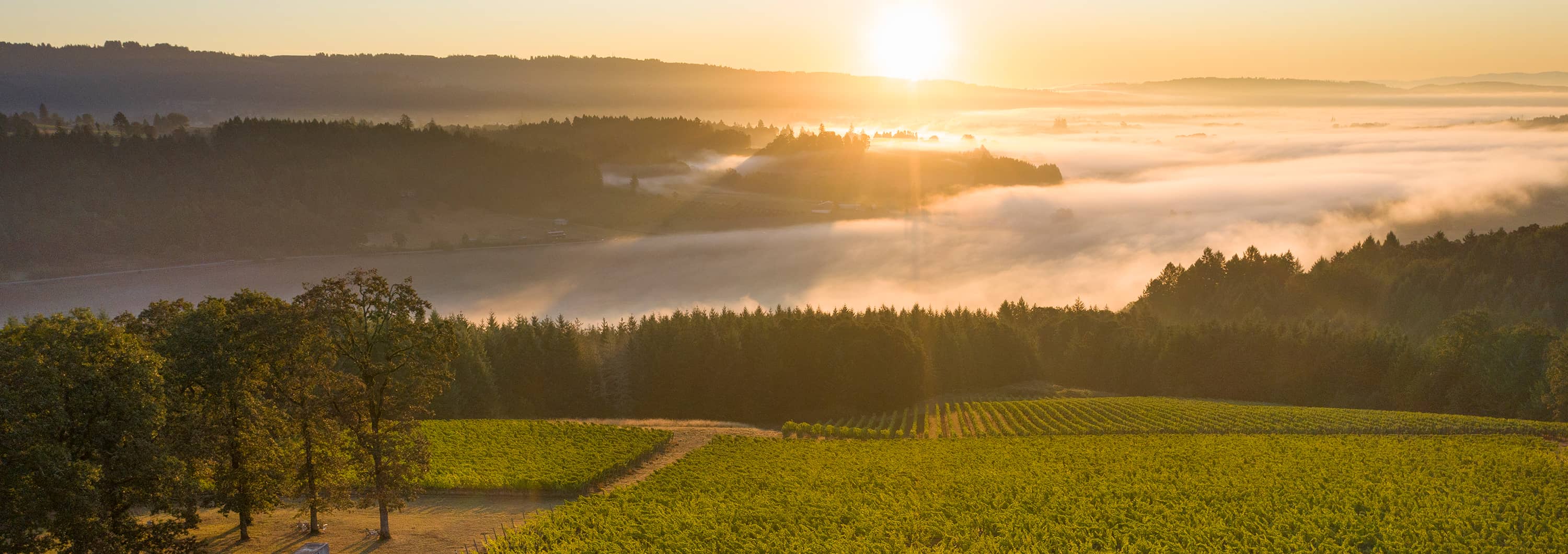
Penner-Ash Cellars. Source: Jackson Family Wines
[TaV]: At Penner-Ash, you get to work with many different vineyards. Do you have a most favorite and most challenging one?
[KA]: How cruel to pit them against each other! Each vineyard is so special to its location, and that is what makes my job so incredibly exciting and invigorating each harvest. For example, there are times when certain weather events just hit a single sub-AVA. So while that particular vineyard might be more difficult for that vintage, other vineyards may remain unaffected.
[TaV]: One question I like to ask all the winemakers I have a chance to speak with – what is your take on biodynamic viticulture?
[KA]: I think this has become such a polarizing question. There are many aspects to biodynamic viticulture which make so much sense to me. Working within the natural balance and diversity of the ecosystem seems like a no-brainer. I find it harder to see the relevance of the spray schedules, mixtures, and decisions based on moon phase.
[TaV]: Based on what I can see on your website, Penner-Ash offers today a large number of white and red wines. Sparkling and Rosé make a notable absence. Do you make any of the sparkling or Rosé? If not, any future plans?
[KA]: We make a rosé, but not a sparkling wine. As you’ve noted, we make many wines. At this point in time, I’d like to keep my focus on those wines that we know and we make well.
[TaV]: Practically all of your wines are vineyard-specific. Have you ever considered producing block-specific wines, from Penner-Ash Estate or any other vineyards?
[KA]: We have dabbled in block specific (clonal specific) wines for fun with the Shea Vineyard and have in the past put together a complete set for the consumer. It was a fun thing to show people, but was a huge labor of love (all hand bottled). They are certainly fun one-off projects to toy with, but harder to consider as a long-term product.
[TaV]: Going back to the wine lineup – the majority of the wines produced by Penner-Ash are Chardonnay and Pinot Noir. And then you have lonely Riesling and Syrah. Any plans for any other grape varieties? Maybe a Pinot Gris? Tempranillo? Something more eclectic?
[KA]: I’d love to dabble in a new red or two and we’ve also done some fun tasting of Chenin Blanc and Sauvignon Blanc from Oregon. I think Sauvignon Blanc coming out of the Willamette Valley is really interesting and fun.
[TaV]: Can you describe your typical day in the vineyards?
[KA]: As the growing season progresses my days usually start in the vineyard for the first couple of hours before returning to the winery to taste/blend/crush samples. We have a lot of vineyards to cover, so I tend to try to visit 2-3 vineyards in a morning if possible.
[TaV]: We can’t ignore climate change – how do you take the effects of it in your day to day operation? How are you taking it into account for the longer period, say the next 10 years?
[KA]: Looking at alternative varieties is certainly high on the list. In the more immediate future I’ve pulled back the amount of cap manipulation the wine sees in its lifetime. There was a time where we would punch down a fermenter three times a day. Now we find ourselves doing one punchdown a day and touching it twice just in the peak of fermentation. Our oak regimen as discussed earlier is also in response to warmer years. Of course it would be remiss of me if I didn’t note that much of the work is done in the vineyard. Whether it be in cover crops, tilling or not tilling between rows, leaf removal (or not), etc. These are all things we are working on for a warmer trend.
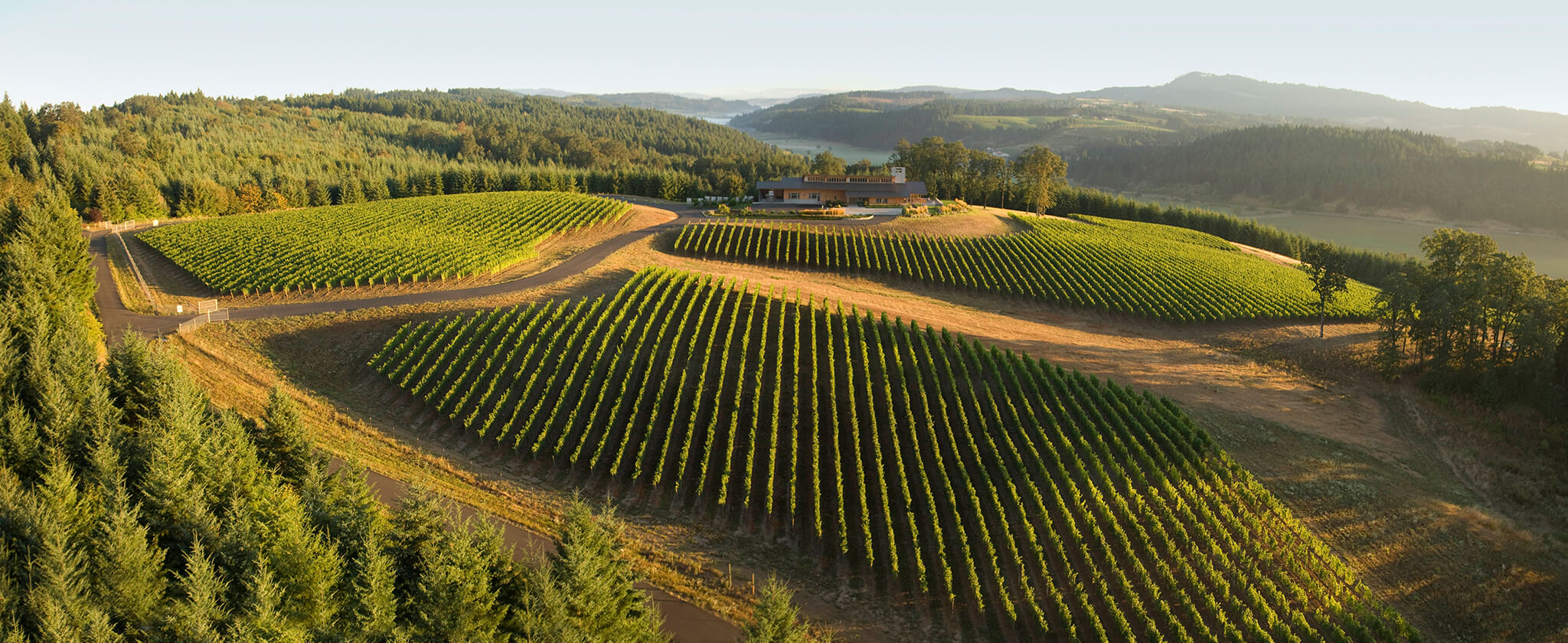
Penner-Ash Cellars. Source: Jackson Family Wines
[TaV]: Given an opportunity to work anywhere in the world, is there a winery or a winemaker you would choose to work at/with?
[KA]: I’ve been lucky enough to work in several winemaking regions in the world, but never in France. Given the relationship with Domaine Drouhin Oregon, I’d love to get a chance to work with Véronique.
[TaV]: Along the same lines – is there a wine you always wanted to make but didn’t get the chance to do it yet?
[KA]: That’s a hard one to answer. There are so many varieties of wine out there that it’s hard to put a finger on what exactly I’d desire to make most. I’m just happy that my early learning years took me to winegrowing areas that broadened my experiences and gave me an opportunity to create many different varieties of wines.
[TaV]: What was it like working with Lynn when you started at Penner-Ash in 2018?
[KA]: I actually started working with Lynn in May of 2016 but was promoted Winemaker in 2018. Working with Lynn has been one of the biggest delights of my career. As we all know, Lynn is a staple in this industry and that in and of itself can be intimidating, but she created such a warm and welcoming environment for me. We really worked in lockstep as she taught me about each of the vineyards we source fruit from; the pillars on which Penner-Ash rests. I can’t begin to recount the funny conversations we shared across the blending table from each other, the barrels we’ve tasted and scored, the fermenters we smelled together each morning. The relationship I was able to form with Lynn over the past nearly seven years has been nothing less than incredible. She was a mentor, but even more she became the most amazing colleague.


As usual, I had an opportunity to try a few wines from the Penner-Ash cellars – here are my notes:
2021 Penner-Ash Chardonnay Willamette Valley (14.6% ABV)
Straw pale
Apples, a touch of vanilla
Clean, crisp, Whitestone fruit and apples on the palate, distant hint of honeysuckle. The fruit quickly dissipated on the finish, with lingering tartness and afterward, acidity.
7+/8-, if you are looking for classic but very lean chardonnay, this is your wine.
2021 Penner-Ash Pinot Noir Willamette Valley (14.1% ABV)
Dark Ruby
Cherries, plums, and violets -classic Pinot nose
Very interesting temperature dependency
At room temperature, the wine appears as classic California Pinot Noir, with sweet cherries, plums, vanilla, borderline flabby
When served chilled, the wine is dark and concentrated, with a core of tart cherries and some espresso notes. Perfectly structured and full of energy.
Room temperature: 7/7+
Fridge temperature: 8-
Here you, my friends. Another story of passion for the finicky grape. Until the next time – cheers!
P.S. For more stories of Passion and Pinot please visit the series’ main page.
Celebrating Oregon Wine Month with Potter’s Vineyard Wines
I guess there is something special in the month of May as everybody wants to appropriate it..for their wine purposes. The story differs from year to year, but this particular May 2023 has at least 4 wine designations (if I missed something – I profusely apologize) – May is Finger Lakes Wine Month, Michigan Wine Month, Oregon Wine Month, and Washington Wine Month.
The good thing is – there are 31 days in the month of May – which is enough to celebrate the wines of many more states – or maybe even all 50 – with proper planning. But for today, I only would like to focus on one of the wine months – Oregon.
Oregon wine is near and dear to my heart. First of all, Oregon itself is a beautiful place – I love the pure, open, clean, spacious, and airy pine forest oh so different from New England’s sprawling intersection of ivies, and stunning vineyard views which you can enjoy everywhere. Some of the very best American wines are produced in Oregon. And the longest-running series of articles on this blog – Stories of Passion and Pinot, conversations with winemakers – is dedicated to Oregon winemakers who made Pinot Noir the passion of their lives.
20 years ago, Oregon wines could’ve been known as a one-trick pony with its sole focus on Pinot Noir. Today, that world-class Pinot Noir is joined by Chardonnay, Pinot Gris, Riesling, Syrah, Tempranillo, Sangiovese, and even Tannat. Sparkling wines and Rosé can be found almost at any winery. And Pinot Noir is not just for reds anymore – Pinot Noir Blanc, a.k.a. White Pinot Noir is the wine to look for. Oregon winemakers continue studying their vineyards, identifying unique blocks and plots in a quest to produce the most terroir-driven wines.
One of my most recent conversations in the Passion and Pinot series was with Bill Sanchez, the proprietor and winemaker at Potter’s Vineyard. Potter’s Vineyard is a small, 3.5 acres estate in Laurelwood District AVA in Willamette Valley, producing about 1,000 cases annually. Potter’s Vineyard is organic, LIVE and Salmon Safe certified, and committed to staying small – you can learn about this commitment and the overall philosophy of Potter’s Vineyard from our conversation which can be found here.
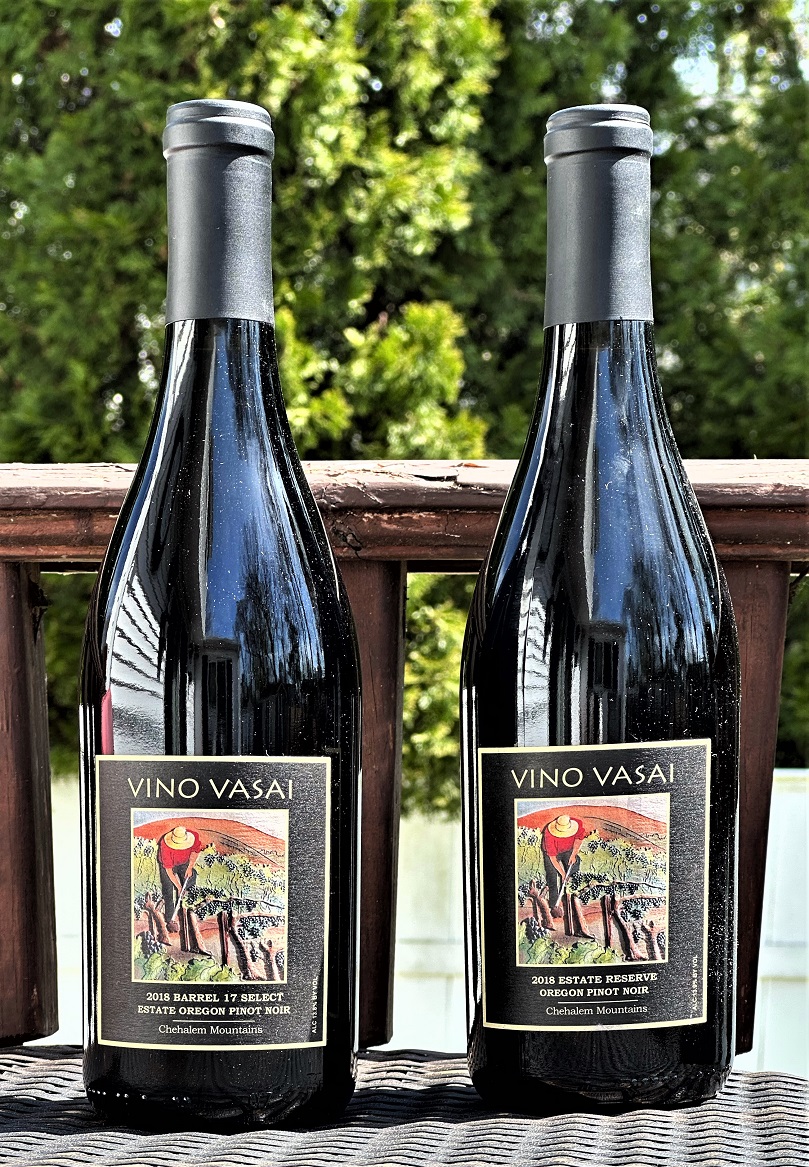
I don’t know about you, but I really admire these labels
Now I had an opportunity to taste a couple of the Potter’s Vineyard estate Pinot Noir wines, Barrel 17 Select and Reserve. Here are my notes:
2018 Vino Vasai Barrel 17 Select Estate Oregon Pinot Noir Chehalem Mountains (13.8% ABV, $48, Dijon clones)
Dark Ruby
Dark cherries, violets, minerality
Dark cherries, plums, medium to full body, firm structure, well-integrated tannins, luscious layers followed by the tart, long finish
8, excellent. Upon opening, the wine was lean and tight, Burgundian style. The next day opened up to show more of the Oregon Pinot power, still governed by restraint.
2018 Vino Vasai Pinot Noir Estate Reserve Chehalem Mountains (13.9% ABV, $58, Pommard clone, 75% new French oak )
Garnet
Beautiful legs (I rarely pay attention to those, but couldn’t help to notice)
Very enticing nose with sweet cherries, plums, eucalyptus
Cherries on the palate, tart, perfectly structured, harmonious and perfectly balanced. Craving food, but I can polish a bottle by myself.
8/8+, excellent.
Here you are, my friends – more of the delicious Oregon wines worth seeking. Oregon wine month is upon us, so if you need any suggestions, just click here.
And don’t be shy – if you got any of the Oregon wine favorites, please comment and leave notes for others.
Until the next time – cheers!
P.S. For more stories of Passion and Pinot please visit the series’ main page.
Stories of Passion and Pinot: Erik Kramer of WillaKenzie

Source: WillaKenzie Estate
The first LIVE Certified Sustainable winery in the Pacific Northwest, LIVE member 0001. Wines worthy of serving at the White House gala, state dinners, and even to the French President and British First lady. One of the first Direct to Consumer wine programs in Willamette valley. The list of accolades of the WillaKenzie Estate can go on and on.
Founded a little more than 30 years ago, WillaKenzie Estate takes its name from the eponymous sedimentary soils of Willamette Valley in Oregon where the winery is located. The name is also a tribute to the Willamette Valley’s two major rivers, the Willamette and McKenzie which are also displayed on the winery’s crest.
WilleKenzie Estate was founded in 1991 by Bernard and Ronni Lacroute who purchased 420 acres of farmland near the town of Yamhill, Oregon. Bernard and Ronni brought their Burgundian heritage to the newly planted vineyards, and with the help of another Frenchman, Laurent Montalieu, the first winemaker at WillaKanzie, produced its first vintage in 1995. The rest is history, as they say (if you are interested in more historical details, here is the link). In 2016, Lacroutes entrusted their legacy to the Jackson Family Wines.
In 2017, Erik Kramer became WillaKenzie’s third winemaker. I had an opportunity to sit down with Erik (yes, virtually), and ask him a few questions. Here is what transpired in our conversation:
[TaV]: Before making wines in Willamette Valley, you were working in New Zealand. New Zealand is also world-famous for its Pinot Noirs. How would you compare New Zealand and Oregon Pinot Noirs?
[EK]: That’s a broad question. With the Willamette Valley, we’re generally talking about one region with a few sub-appellations (e.g. Yamhill Carlton, Dundee Hills, etc.). When speaking about Pinot from the Willamette, it’s tough for me to do so without speaking about the climate, which moves between Mediterranean and Maritime. The result is a balanced expression of Pinot anchored in freshness and clarity of fruit. With New Zealand, there are quite a few different regions within the country where Pinot is being grown and each is a bit different. The region in New Zealand that often seems to garner the most attention is Central Otago, which has a climate that is much more continental than the Willamette Valley and it’s reflected in the wines that are grown there (dark, savory, and energetic). For me, the region in New Zealand that most resembles the Willamette Valley in terms of Pinot expression is Martinborough (complex Pinots with great energy and complexity). I believe Martinborough leans toward Mediterranean in terms of climate with similar levels of heat accumulation to the Willamette. It may just be a little drier on a year-round basis.
[TaV]: This conversation series is about “Passion for Pinot Noir”. What drives your passion for this grape commonly identified as a “finicky grape”?
[EK]: One of the things I love about Pinot is the level of complexity and cellaring potential it can offer in such a graceful and balanced package. It really can be the proverbial ‘iron fist in the velvet glove.’ One of my favorite Pinot memories dates to a conversation I had one evening at the home of a famous consulting oenologist named Andrea Paoletti. He’d consulted with many of the world’s best producers on viticulture, what to plant and where, clones, etc. We were sitting on his patio, overlooking his olive tree grove on a hillside just outside Chianti (it was a great evening!). I remember him saying to me over a glass of wine, “when Pinot Noir is good, I think it’s the best one.” He was speaking about the grape compared to all the others he’d worked with. That stuck with me, and I tend to agree.


[TaV]: It seems that you grow all the components of the sparkling wines (Chardonnay, Pinot Noir, even Pinot Meunier), and yet I don’t see a sparkling wine as part of WillaKenzie’s offerings. Will this change in the future, or do you have a particular reason not to produce Sparkling wines?
[EK]: Funny you ask this question! We tirage bottled our first WillaKenzie Estate Brut from the 2019 vintage in the summer of 2020 and have been bottling sparkling wines ever since then (made from the grapes you asked about). We just haven’t released anything yet. Our club members will be the first to get a glimpse of our first-ever Brut later this year.
[TaV]: Outside of the sparkling wines, any plans to plant new grapes? How about new types of wines, maybe Pinot Noir Blanco?
[EK]: On the new planting front, Chardonnay has become a much more important role player in our portfolio. We added about 4 acres of Chardonnay a few years ago and have an additional 3 acres planned for this spring (and more a few years down the road). We produce several terroir specific Pinot Noirs from several parts of the Estate and are moving in the same direction with Chardonnay (blanc and rouges from the same location). As far as new wines go, we bottled our first vintage of Tourdion (named after a 14th century Burgundian dance meant to signify a play on grape varieties). It’s a barrel fermented white blend that is made from Pinot Noir, Pinot Blanc, Pinot Gris and Pinot Meunier.
[TaV]: Today you make single vineyard wines. Any plans to produce “single block” wines?
[EK]: WillaKenzie Estate is a large, contiguous farm from which we produce several terroir specific wines that tell a story about the place. In essence, they are all single block wines from one Estate.
[TaV]: WillaKenzie was the first winery in Oregon to receive LIVE certification back in 2008. How do you see sustainability evolving at WillaKenzie today? Are there things you would like to change to further advance sustainability?
[EK]: Sustainability has always been an important part of the WillaKenzie identity. The farm has been managed sustainably since it was established in 1992. Maintaining a healthy, biologically diverse landscape is part of our holistic approach to land management. More recently, we established a bee colony on the Estate as well as experimented with different wildflower species. We also have several initiatives in place aimed at lowering our carbon footprint. We already have a solar array that provides between 40% and 50% of our power and we are looking at increasing the size of our array to provide up to 100% of our power. With that, we’re transitioning heavily to an all-electric model to move away from greenhouse gases and become more carbon neutral. We have a brand-new Ford F150 Lightning pickup truck that just rolled up last week. We already have one electric forklift and next year, we’ll replace the remaining gas-powered forklift with another electric unit. So yeah, we have a lot going on here.
[TaV]: Other than WKE, if you would have an opportunity to make wine at any winery in the world, what winery would you choose and why?
[EK]: This is a tough one. So many choices! I’ve already been very fortunate to work at some great places in and outside of the US. I guess if push comes to shove, I’d go with Ata Rangi in Martinborough, New Zealand right now. Those Pinots are so delicious, and I’ve not worked in Martinborough, but love the area. The bonus would be that I’d be able to visit my son on weekends (he’ll be studying at the University of Auckland for the next few years, which is only a few hours drive from there). Ask me again in 4 years and I’ll have a different answer. Probably something more obscure like living and working at Boutari in Santorini making delicious Asyrtiko and enjoying the view after work and on the weekend.
[TaV]: Where do you see yourself, and also WillaKenzie in 10 years?
[EK]: Me? I honestly don’t know and am not looking that far ahead right now, which is unusual since I’m a goal-oriented planner. Perhaps I’m still involved with WillaKenzie in some capacity? Perhaps I’m working on some exciting new wine project outside of the U.S.? Perhaps I’m teaching wine production or viticulture classes at some community college? As Eddie Vetter sings in the song ‘Release’ off Pearl Jam’s first album (Ten) – I’ll ride the wave where it takes me!
WillaKenzie in ten years? That’s easier. It’s regarded as one of the great estates of the Willamette Valley. The winery’s Estate Cuvee Pinot Noir and Chardonnay are on important wine lists around the country. Our club members have been enjoying WillaKenzie’s Brut and Blanc de Blanc in their club shipments. We are not just growing terroir specific Pinot Noirs from places on the Estate like Aliette and Emery, but also Chardonnays. Tourdion (that exciting white blend) is available nationally. The winery’s solar array now provides 100% of the Estate’s power supply. Our HVAC systems have been modified from LPG to electric. We have not just one bee colony, but several and our club members are taking WillaKenzie Estate honey home as gifts at club events. The list goes on and the future is very bright.

Okay, it is time to taste some wines:
2018 WillaKenzie Estate Chardonnay Yamhill-Carlton (13.8% ABV)
Straw pale
Apples, vanilla, a touch of honey, hint of fresh herbs
Granny Smith apple, tart lemon and lemon zest, good structure, crisp, good body, well integrated tannins on the finish
8, excellent by itself, but will work well with a range of dishes.
2019 WillaKenzie Estate Cuvée Pinot Noir Yamhill-Carlton (13.9% ABV)
Dark garnet
Cherries, sage, violets
Cherries, a hint of dark chocolate, cut-through, lip-smacking acidity supported by well-integrated tannins on the back end. Good structure, good balance. Succulent dark cherries on the medium+ finish.
8-/8, very nice.
Here you, my friends. Another story of passion for the finicky grape. When it’s good, it is really good. Until the next time – cheers!
P.S. For more stories of Passion and Pinot please visit the series’ main page.
Passion and Pinot Updates: Utopia Vineyard
 And then we arrived in Utopia.
When your destination is called Utopia Vineyard, poking some fun is irresistible, isn’t it?
Upon our arrival to Utopia Vineyard in Ribbon Ridge AVA, we were warmly greeted by Dan Warnshuis, proprietor and winemaker, who poured us a glass of Utopia Pinot Noir Blanc (yep, a white wine made out of Pinot Noir) and took us on the tour of the vineyard, glass in hand. After speaking with Dan virtually about a year ago, it was definitely a pleasure to shake hands and move from the virtual to the real world where things can be touched and smelled.
Utopia Vineyard looks different from Le Cadeau and Lenné – no fighting with the rocks here. Gentle slope elevation of only 20 feet from top to bottom makes it easier to tend for grapes. Utopia Vineyard is farmed using Sustainable Organic practices and was L.I.V.E. certified in 2008. Dan practices dry farming and uses cover crops every second row – in normal conditions though. Summer 2021 was so dry and hot that by the second week in August when we visited, all of the cover crops were removed so it will not compete with vines for access to water. The grapes looked perfectly healthy and beautiful despite the hot weather – you can see it for yourself in the pictures below.


I don’t know how the actual utopia should look like, but I find these vineyard views pretty compelling:

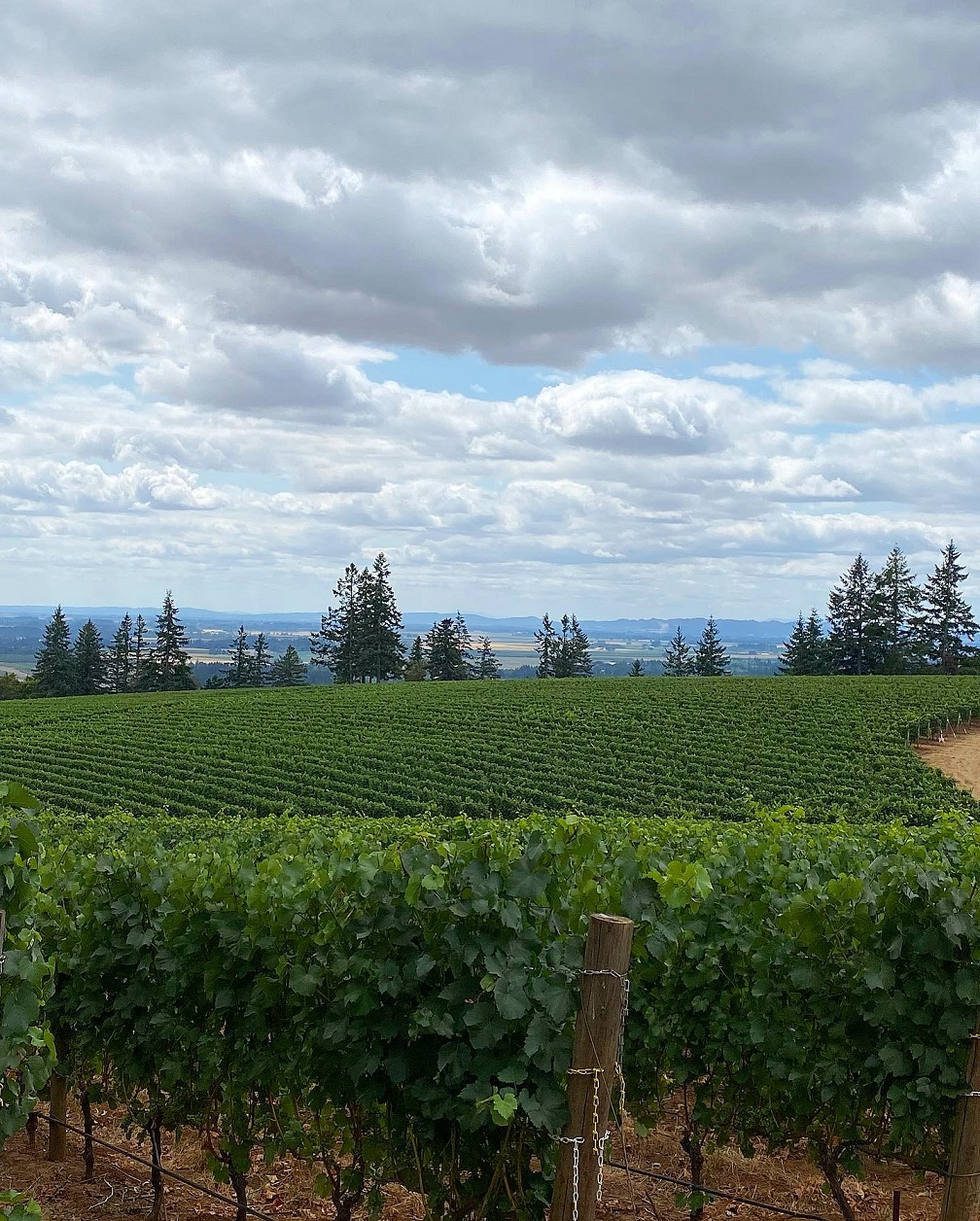
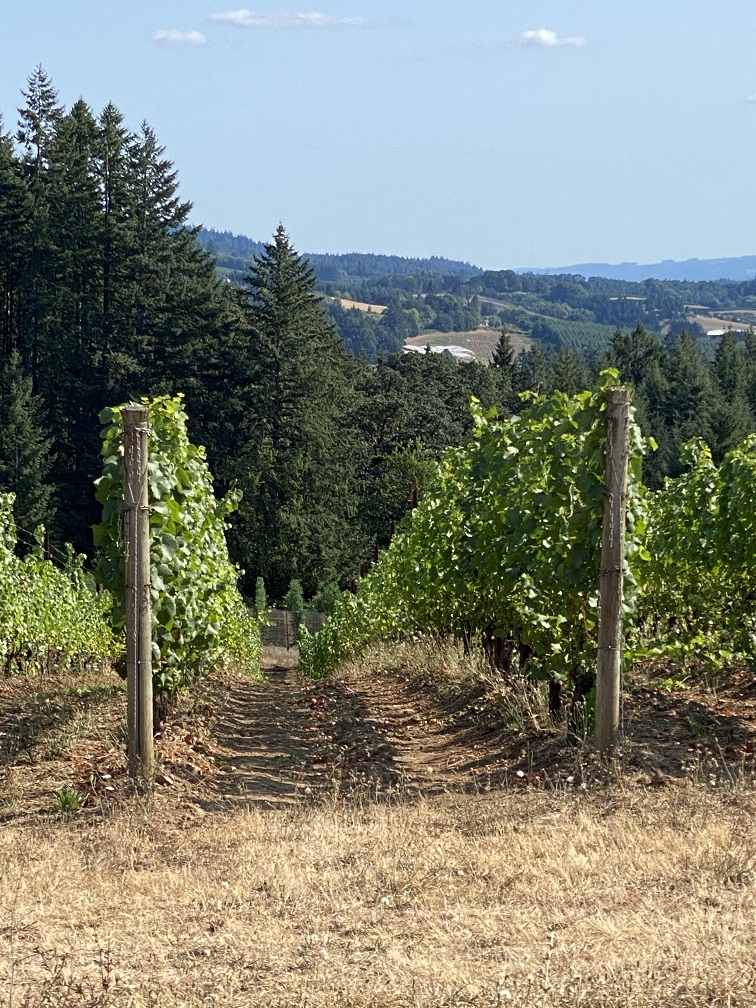
There are 12 clones of Pinot Noir growing at Utopia Vineyard – one of the wines we tasted was made out of all 12 clones. There are also 3 clones of Chardonnay growing there, planted in 2010. Talking about “fashionable wines”, Utopia Vineyard doesn’t produce sparkling wines, but Dan makes Pinot Noir Blanc, a white wine from the red grapes, which we tasted upon arrival, and also had the pleasure of tasting it directly from the barrel (all notes below).
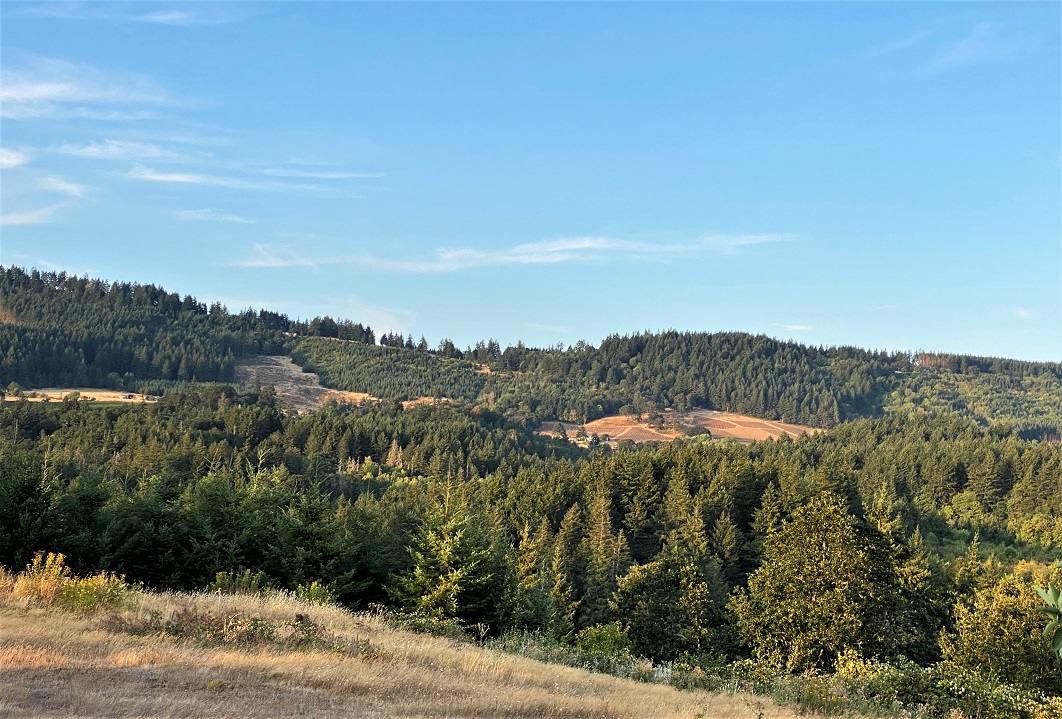
In 2018, Dan acquired additional 35 acres of land not far from Utopia Vineyard’s original location. That parcel of land also had a 5,500 sq. ft building which by the time of our arrival 3 years after the acquisition was fully converted into a state-of-the-art winery. We stopped by the winery a few times during our visit, and what was the most mind-boggling to me was that Dan was pretty much operating everything at the winery just by himself – moving barrels, emptying tanks, and so on. His son-in-law comes to help during the harvest, but otherwise, Dan is a one-man operation.
This additional property also hosts a freshly constructed log cabin which is called exactly that – Utopia Vineyard Log Cabin, which offers beautiful accommodations and spectacular views:
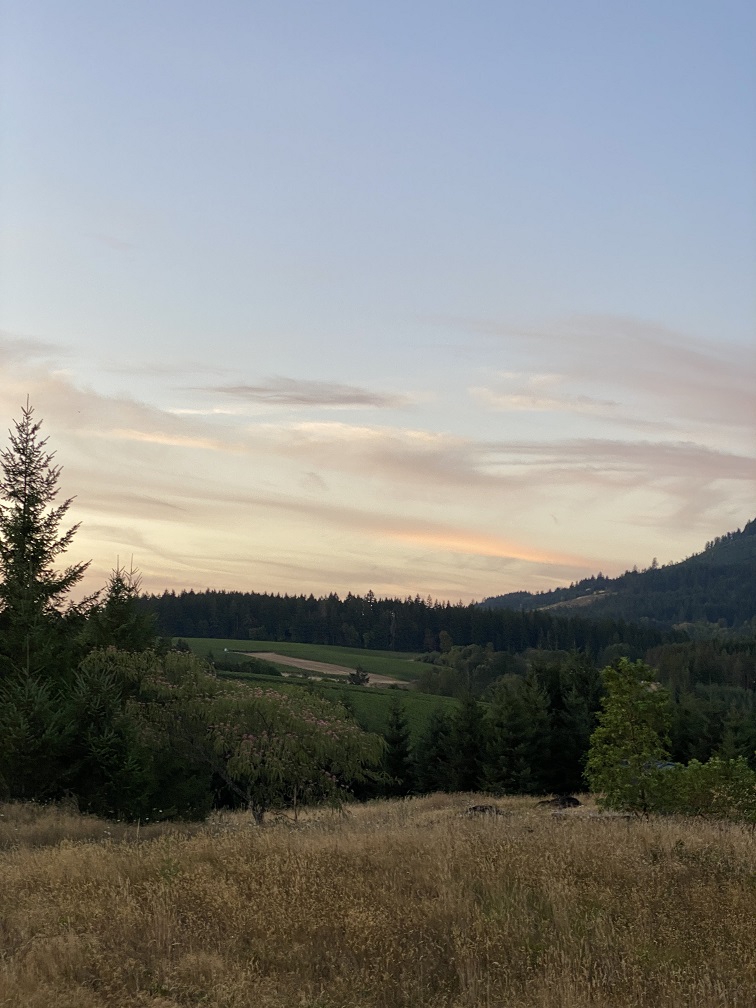
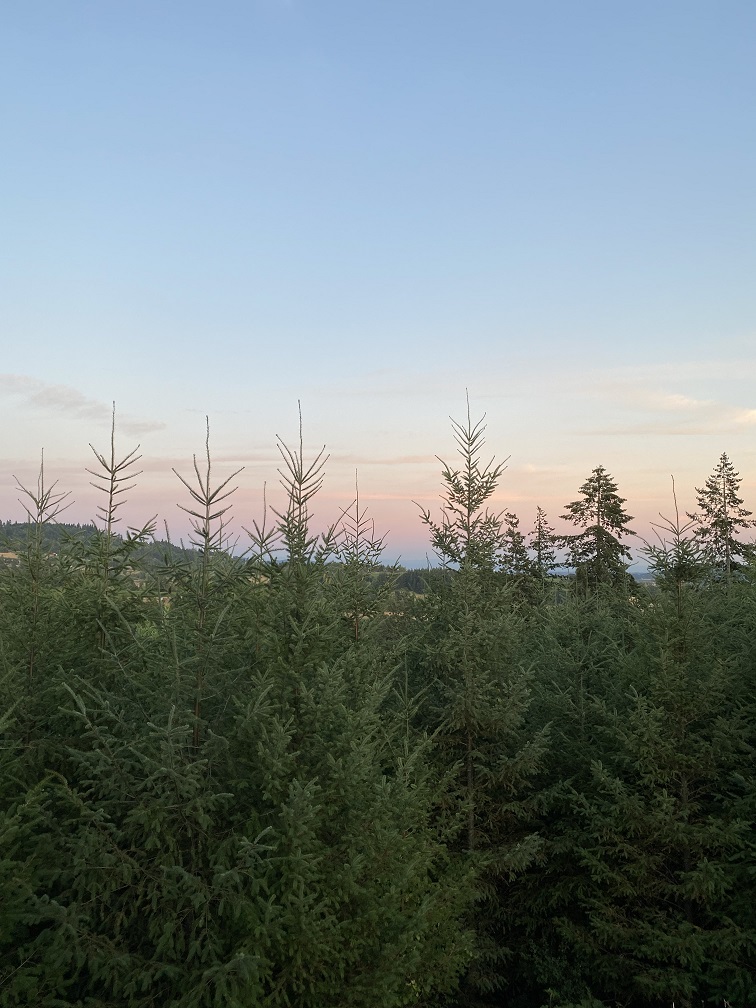

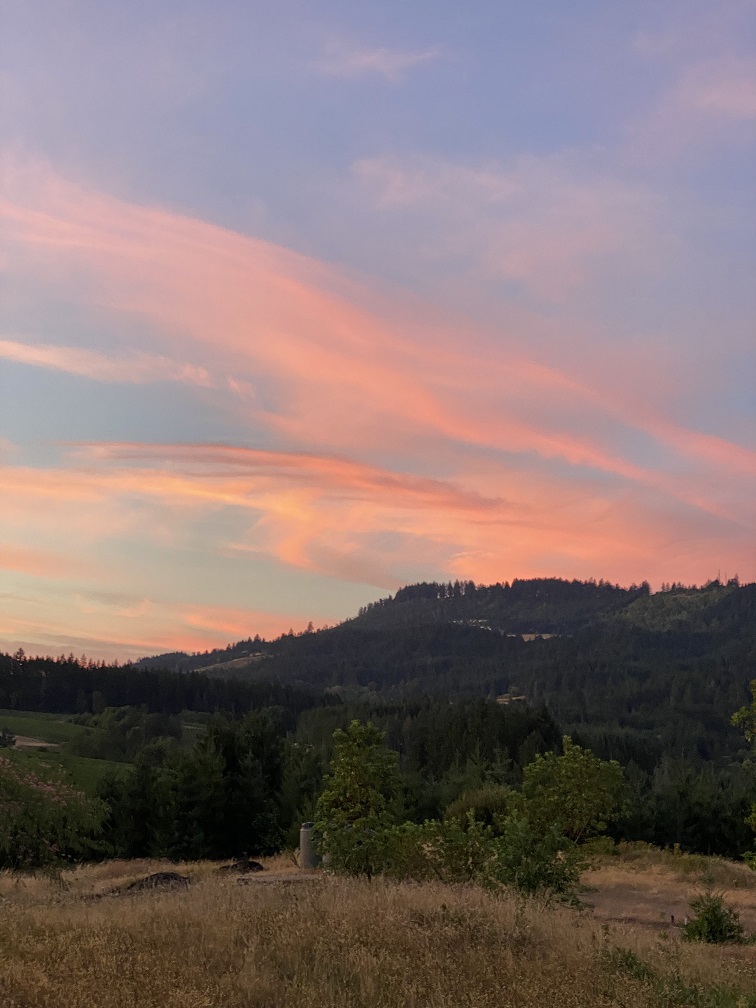
We visited Utopia Vineyard over two evenings and had some delicious food and tasted through a substantial range of Utopia Vineyard wines. I also learned about an interesting berry I never heard of before – Marionberry, which is a type of blackberry, which we tasted in the form of delicious pie – I wish this is something I can find here on the East coast. Marionberry takes its name from Marion County in Oregon, where it was selected in 1956 as a cross between Chehalem and Olallie blackberries.
Time to talk about wines – here are my notes:


2018 Utopia Bliss Pinot Noir Blanc Ribbon Ridge AVA ($45)
The nose of the buckwheat, yellow plums
Plums on the palate, good balance, good acidity, asks for food
8-


2015 Utopia Vineyard Chardonnay Estate Ribbon Ridge AVA ($45)
Nice, delicate, a hint of vanilla
A touch of vanilla, Golden delicious apples, good acidity
7+/8-
I mentioned before that we had an opportunity to taste some wines directly from the barrel.
2020 Chardonnay was outstanding, fresh apples and lemon, clean acidity, perfectly clean, vibrant, and balanced. If I would have an opportunity, I would drink this wine just like that.
2020 Pinot Noir Blanc from the barrel was even more exciting – a touch of toasted bread, a touch of fresh fruit, perfect minerality, vibrant, clean, full of energy. Again, I would love to drink this wine just like that.


2015 Utopia Vineyard Estate Pinot Noir Ribbon Ridge AVA ($55) – all 12 clones are used
Plums, cherries, a touch of iodine
Clean, crisp, plums, cherries and cranberries, good acidity
8, excellent
2014 Utopia Vineyard Estate Pinot Noir Ribbon Ridge AVA ($55)
A touch of sapidity, mushrooms,
Plums, round, soft, clean
8-


2013 Utopia Vineyard Estate Pinot Noir Ribbon Ridge AVA ($55)
Mushrooms, forest floor, underbrush
Earthy, restrained, plums, clean, round
8-
2017 Utopia Vineyard Estate Pinot Noir Ribbon Ridge AVA ($48)
Sweet plums, violets
Raspberries, red berries, round.
7+
2015 Utopia Vineyard Pinot Noir Clone 777 Estate Reserve Ribbon Ridge AVA ($65)
Violets, sweet plums, iodine
7+
2016 Utopia Paradise Pinot Noir Estate Reserve Ribbon Ridge AVA ($75)
Original 2002 plantings.
Mushrooms, underbrush, violets
Clean, ripe cherries, pepper, medium body,
8, excellent
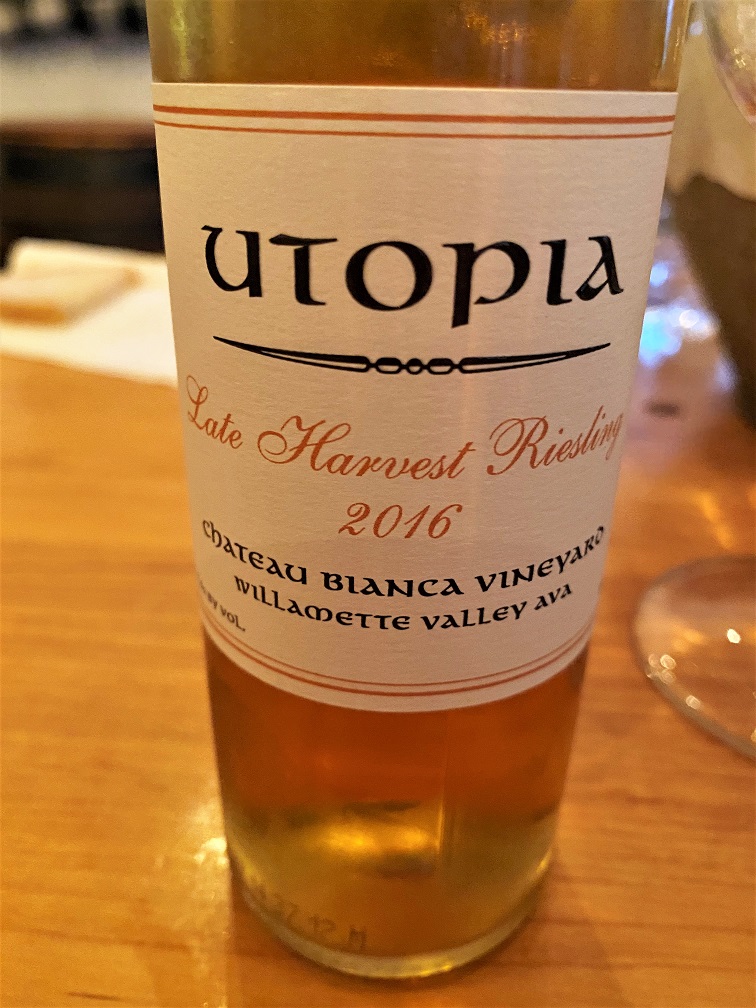
I was also excited to try a late harvest Riesling which was absolutely delicious:
2016 Utopia Late Harvest Riesling Chateau Bianca Vineyard Willamette Valley AVA ($40)
Beautiful apricots, a touch of honey, clean acidity, good balance. Delicious.
8
Talking to Dan we learned that 99 percent of the sales at the winery are direct to consumers, via the wine club and visitors. Dan also has a few customers who like to take his wines as a private label. Dan is very much involved with philanthropy, supporting the Oregon Museum of Science and Industry, The Hampton Opera center in Portland, OR, making wine donations, offering cabin stays, and more.
Utopia Vineyard offers something for everyone – if you will find yourself visiting Portland, you might want to take a 30 minutes trip southwest of Portland and find your utopia there. Or better yet, just stay in the cabin – everything else might be optional.
This post is a part of the Stories of Passion and Pinot series – click the link for more stories…
Stories of Passion and Pinot, And Not Only Pinot: Battle Creek Cellars
I love urban wineries (or city wineries as they are often called). Solvang, Woodinville, Walla Walla – each place was different but similar at the same time – unique wines, unique stories, unique experiences. I would venture to say that winemakers at the urban wineries have more freedom to create and experiment, as they can choose the vineyards they want to work with and the style of the wines they want to produce. My latest experience in Portland is a direct confirmation of this.
My last winery visit in Oregon was at the city winery called Battle Creek Cellars, located in Portland’s Pearl District. I was told that I’m going to meet a winemaker who not only makes wines but also plays American football professionally, and has a unique personality. And I had about one hour before I had to start heading to the airport to make my flight – somewhat of a challenge for me as it is in my nature to worry about not missing a flight.
Sarah Cabot, the winemaker, was already waiting for us as we arrived at the tasting room. We grabbed glasses, a few bottles and headed out to the patio in the back to taste wines and to talk.
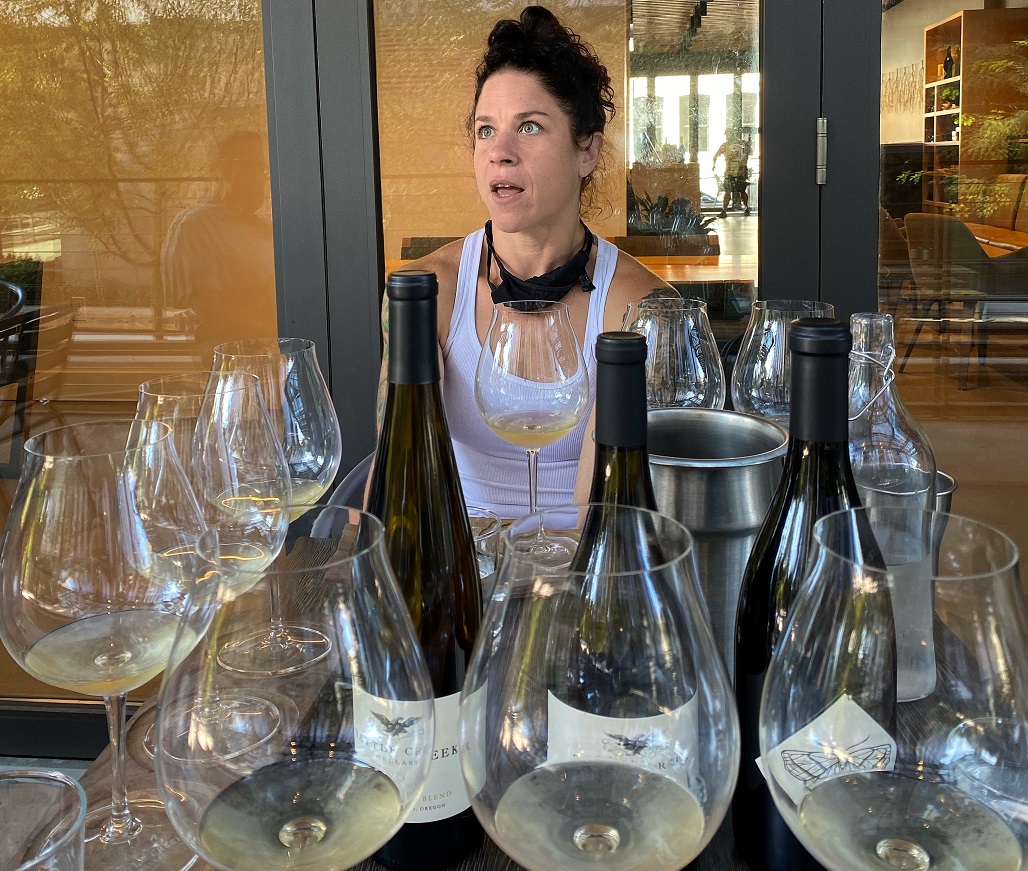
At the city winery, you can expect to find great wines, but you are not necessarily expecting to be blown away by what you taste and what you learn. The wines were absolutely spectacular, starting with the very first one 2018 Battle Creek Cellars Reserve White Blend – the wine had a distinct spicy nose, honey notes, and on the palate was clean, crisp with great acidity, creamy, and very different from the nose. This is where the unique sides of Sarah were already showing – she was getting the fruit from the vineyard where the vinegrower refused to tell her the exact composition of the blend – she only knew that Riesling and Gewürztraminer are a part of the blend, but the exact composition was not known.
Not only Sarah works with unknown grape blends, but she also uses a range of tools to produce the wines. For example, her 2019 Chardonnay Reserve was spectacular – round inviting nose with a hint of honey, and clean, crisp, and creamy green apple driven on the palate, a delicious rendition of Chardonnay – fermented in the sandstone jar.
Talking to Sarah I learned that while Battle Creek Cellars production is about 10,000 cases overall (6000 cases for unconditional Pinot Noir, 4000 cases of the other wines), Sarah is responsible for the production of more than 100,000 cases annually for her parent company, Precept Wine, Northwest’s largest private wine company. I also learned that Sarah greatly values the freedom to experiment which she has while working with her Battle Creek Cellars portfolio and that esoteric elitism, so common in the wine industry, is making her uncomfortable. And the amount of energy Sarah was exuding during our conversation, explaining all the different ways she utilizes when looking for the right vineyards and the right grapes and deciding how she would ferment and age any particular wines, was simply contagious.
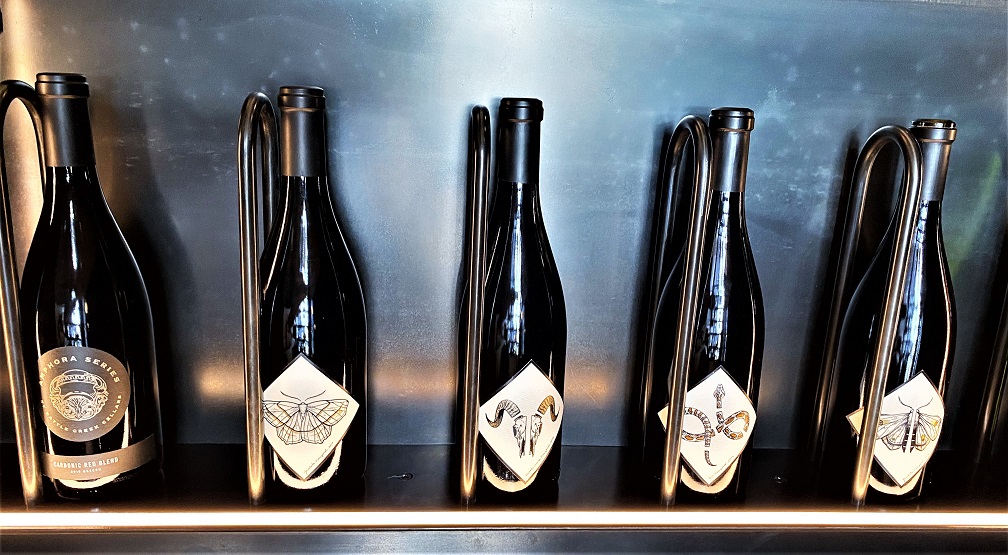


We tasted more wines:
2018 Battle Creek Cellars Reserve Rosé was simply outstanding, offering a whole array of sensory experiences – onion peel color, and the nose which prompted you to imagine yourself walking in the garden and smell strawberries, flowers, and just open meadows. The palate offered great acidity and was fresh and crisp.
2015 Battle Creek Vineyard Pinot Noir from the vineyard planted in 1998 was excellent, with cherries, mushrooms, chocolate on the nose, and more cherries, lean and crisp on the palate. Definitely an aging-worthy wine.
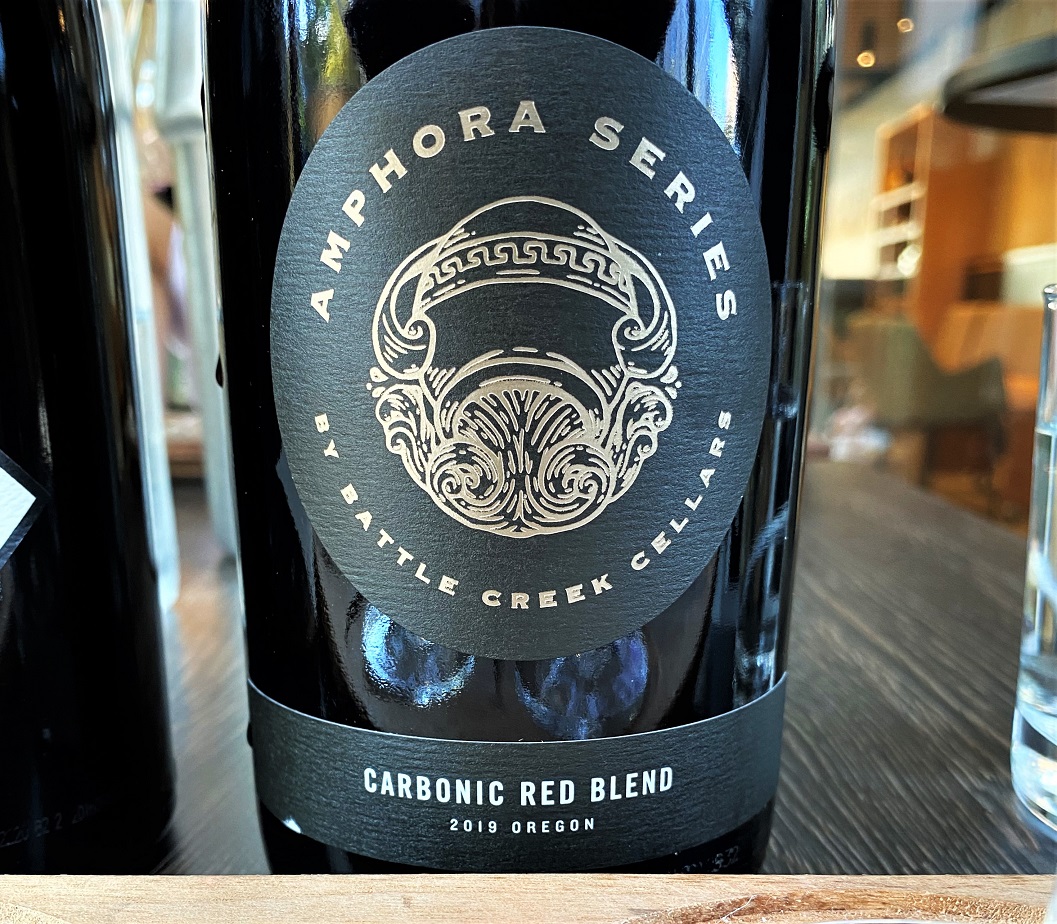 And then there was the 2019 Amphora Series Carbonic Red Blend Oregon which literally blew my mind… Grenache/Malbec blend, fermented whole cluster in amphorae for 30 days with skins. The nose was amazing with crunchy raspberries and cranberries, and then fresh fruit on the palate with beautiful supporting tannins was simply incredible, the wine you have to experience to believe it.
Next, we were out of time – but we agreed to continue the conversation, which we did using both emails with questions and a phone call, so I really had here the full experience as the writer.
Here is what transpired during our follow up conversation:
[TaV]: How did you get into the wine? When did you realize that making wine is your calling?
[SC]: I was working in casual fine dining restaurants as an undergraduate student in Boston and developed an initial fascination with wine there. Eventually, my life brought me back to the West coast and a sommelier I used to work with suggested that I go back to school for enology/viticulture when I mentioned to him that I was feeling unfulfilled in the service industry. I followed his advice and I knew, beyond a shadow of a doubt, that I had found my calling after my first day of classes.
[TaV]: What was the first memorable wine you made, the wine you were completely happy about?
[SC]: I guess that, to me, they have all been memorable in some way. As far as a wine that I’ve been “completely happy” about…I think that would be the 2018 Amphora Riesling. That wine made its own decisions and I couldn’t have made better ones if I had tried. Now, 3 years later, I feel even more ecstatic about it as I notice the developing notes of petrol that I’ve always coveted about fine Rieslings.


[TaV]: You seem to be working with lots of vessels to ferment and age wines – in addition to the standard vessels such as stainless steel and oak, you also use amphora, sandstone jars of different shapes, and probably a bunch of others. How do you decide when to use what, what grapes to put into what vessel and for what wine?
[SC]: This will probably sound a little silly, but the right fruit just seems to end up in the right vessel. It’s a combination of varietal, timing, and my whim in the moment. There’s no real formula to it.
[TaV]: When you were talking about your 2020 carbonic red blend, you mentioned that you instantly fell in love with Merlot you saw, and you wanted to make the wine exactly with the Merlot. How does it work for you? What was so special about that Merlot?
[SC]: More than the grapes themselves, it was the site where they were growing that made me feel inspired to work with Merlot for the first time since I was in school. It’s a special, beautiful, steep and windy vineyard in the Columbia Gorge AVA called Wind Horse Vineyard. The grower is passionate and engaged and I haven’t ever stood in a vineyard quite like it. I thought…if Merlot from anywhere is going to be extra interesting, it’s going to be from here. Sure enough, the aromatics and texture of the finished wine did not disappoint.
[TaV]: Do you use natural or commercial yeast? Winemakers often get religious about their yeast approach – what is yours?
[SC]: Since I make all my wine in a large winery among other producers, I can’t claim that my ferments are all completed by “native” yeast. I do often allow my ferments to begin spontaneously and finish on their own/without the addition of commercial yeast. I do have a few commercial yeasts that I particularly like to use which are all blends of Saccharomyces and non-sacch yeasts. I’ll use these in certain cases when it is a challenging fermentation environment and I don’t want an unwelcome microbial load to mask the fundamental sensory characteristics of the vineyard.
[TaV]: When you select fruit for your next wine, do you take into account factors such as sustainably/organically/biodynamically grown? Do you have any viticultural preferences?
[SC]: More than anything, I prefer to work with growers whose priority is to cultivate a healthy and long-term-sustainable ecosystem in the vineyard. Don’t necessarily have a strong feeling about the certification, but care about the ethos of the grower, how the vineyard is treated, and the surrounding area, not just the production environment. I try to work with the growers who take this symbiotically – sustainability is a key. The intention behind farming matters more than a certificate on a piece of paper.


[TaV]: Is there a winemaker you would call your mentor?
[SC]: Brian O’Donnell at the Belle Pente winery. Brian is the owner and winemaker, and this was my first job in Oregon right after enology school – he definitely created the framework that holds up my knowledge now as a winemaker. He taught me what his philosophy is and left me to my own devices to sink or swim. I made a few mistakes of my own, nothing too costly, but this was the best way to learn. I know general ethos and philosophy, and now it is my time to grow, improvise and get on my feet. There are other incredible winemakers I had mentorship moments with, but Brian is the closest to the real mentor.
[TaV]: Is there a dream wine you always wanted to make? What would that be?
[SC]: The perfect Pinot? Nah. High elevation Ribolla Gialla, oxidized. Similar to what Gravner produces in Friuli, it should have acid but should be ripe enough. I have yet to find the fruit in Oregon.
[TaV]: Your single-vineyard wine labels have beautiful simplicity and different images – what do these images represent?
[SC]: The avatar on each label represents the character of the wine, and it is unique to the vineyard. There are explanations of all the avatars on the back labels. The avatars are used for single-vineyard wines. Even when there is a vintage variation, the barrels selected to be bottled under a single-vineyard label have a consistent profile. The barrels selected to be the most identifiable features of the vineyard – power, finesse – and this is what characters represent.
[TaV]: As I promised, we need to talk about football. Does playing football helps you make wine? How about your work as a winemaker influencing the way you play?
[SC]: Football definitely helps me to do everything. That level of extreme physical exhaustion and violence is very cathartic, and this helps me to be a better winemaker dealing with pressure.
My work as a winemaker has had both positive and negative impacts on my game. As the negative impact, winemaking experience makes me second guess my decisions. However, as a winemaker I learn to react quickly and make decisions quickly, which helps, When I will retire from playing football I will need to start coaching because I will need this in my life.
[TaV]: During our conversation, you mentioned that working with Chardonnay is easy, but working with Pinot Noir is a pain in the butt. Do you care to expand on this? Can you be very specific?
[SC]: Chardonnay is not easy, but easier than Pinot. Working with Pinot is difficult because of the thinner skin and lower levels of phenolics, and it is not as protected by phenolics from the mistakes as Merlot or Syrah and is susceptible to all sorts of issues. Growing Pinot, if temperatures reach 88F, that affects the fruit, the vine can shoot down, and you don’t want to irrigate too much, so there is a constant worry. Because of thinner skin, it raisins a lot easier than others; when it is too wet, it breaks a lot easier than the others. With Pinot Noir, you can’t look away for one second.
[TaV]: Was there a pivotal wine for you, or a pivotal wine experience?
[SC]: There are 3. There is one that made me decide I love Pinot when I was 19 and working at the restaurant – 1996 Hartley-Ostini Hitching Post Pinot Noir from Santa Barbara. It tasted like candy, I was 19, and I loved it.
The red wine which made me realize how versatile the grape variety can be and how much where it grows to make a difference was Guigal Côte-Rôtie. I had learned about Syrah as a blending grape in Southern Rhone or Washington Syrah, and then I tired Côte-Rôtie, and my head was blown.
The white was really an assortment of whites from Trimbacbh – big, round, acidic, ultimate food wines.
[TaV]: Do you have an all-time favorite wine or wines?
[SC]: It will be Morgon. Duboeuff or Jean Foillard grand cru. Moulin-a-Vent would be a close second.
[TaV]: Given the opportunity, is there a winemaker you would want to make the wine with, or the winery you always dreamt of working at?
[SC]: I would love to have the opportunity to work side by side with Gravner or Radican, or anywhere in Jura, producing the traditional wines. Gravner is the ultimate. Gravner is the reason I got amphorae. I love their wines very much and I would love to learn there.
I can tell you that after the conversation with Sarah, I definitely want to try Gravner wines, and I can’t wait to experience the 2020 Amphora series which should be made with that magnificent Merlot…
Here you are, my friends. Another story of passion, Pinot, and not only Pinot, and pushing the envelope as far as it can go. If you are planning to visit Portland, make Battle Creek Cellars your “must stop”. Cheers!
This post is a part of the Stories of Passion and Pinot series – click the link for more stories…
One on One with Winemaker: Dennis Murphy, Caprio Cellars
Source: Caprio Cellars
It is a known fact that wine is produced in all 50 states in the US. And I will clearly risk it to alienate many people, but with all due respect to New York, Texas, and Virginia, there are only three belonging to the “big three” – California, Oregon, and Washington. It is Washington I want to talk about today.
I don’t know how this works, but when I think about Washington wines, I feel warm and fuzzy. I don’t know if it relates to wonderful experiences, such as the visit to Chateau Ste. Michelle, getting lost in Woodinville or exploring Walla Walla, or maybe it is because of some of the most amazing American wines being produced in Washington, such as the whole range of Cayuse wines, L’Ecole No41, Guardian Cellars, Mark Ryan, and countless others.
And today, I want to bring to your attention one of my very latest Washington wine discoveries – Caprio Cellars in Walla Walla.
On one side, Caprio Cellars’ story is absolutely “normal” (yes, an interesting choice of word here – what does “normal” even mean, right?). Dennis Murphy purchased a plot of land in Walla Walla Valley (previously a wheat field) in 2003. The first vines were planted in 2005, and the vineyard was called Eleanor in honor of Dennis’ grandmother, Eleanor Caprio; after the first harvest in 2008, the winery got the name of Caprio Cellars, and the rest is history. The second vineyard, Octave, was planted on the hillside in 2007. The latest high-altitude vineyard, Sanitella, was planted on the Oregon side of the Walla Walla AVA. Bordeaux varieties – Cabernet Sauvignon, Cabernet Franc, Merlot, and Malbec are planted across all three sustainably farmed vineyards, with the addition of Sauvignon Blanc planted on Sanitella.
This is where “normal” ends. What is unique about Caprio cellars is that your tasting is always complimentary (okay, yes, this still can happen in the other places). You also have complimentary chef-prepared dishes accompanying your tasting flight, with the seasonal menu – yes, complimentary, as in “free of charge” (I hope you are getting as impressed as I am because I’m not sure where else you can find that). And Dennis is very passionate about charities he supports. That definitely puts Caprio Cellars in the category of its own.
After tasting a few of the Caprio Cellars wines, I was ready to talk to Dennis. While we were unable to meet in person (something I really hope to rectify in the near future), we sat down with Dennis virtually, and he patiently answered all of my questions – and now I would like to share our conversation with you. Before we begin, one small note – this is a long conversation, and you definitely shouldn’t miss the answers to the questions at the end of this conversation. So I suggest you will settle in your favorite chair, pour yourself a glass of wine, and come along!
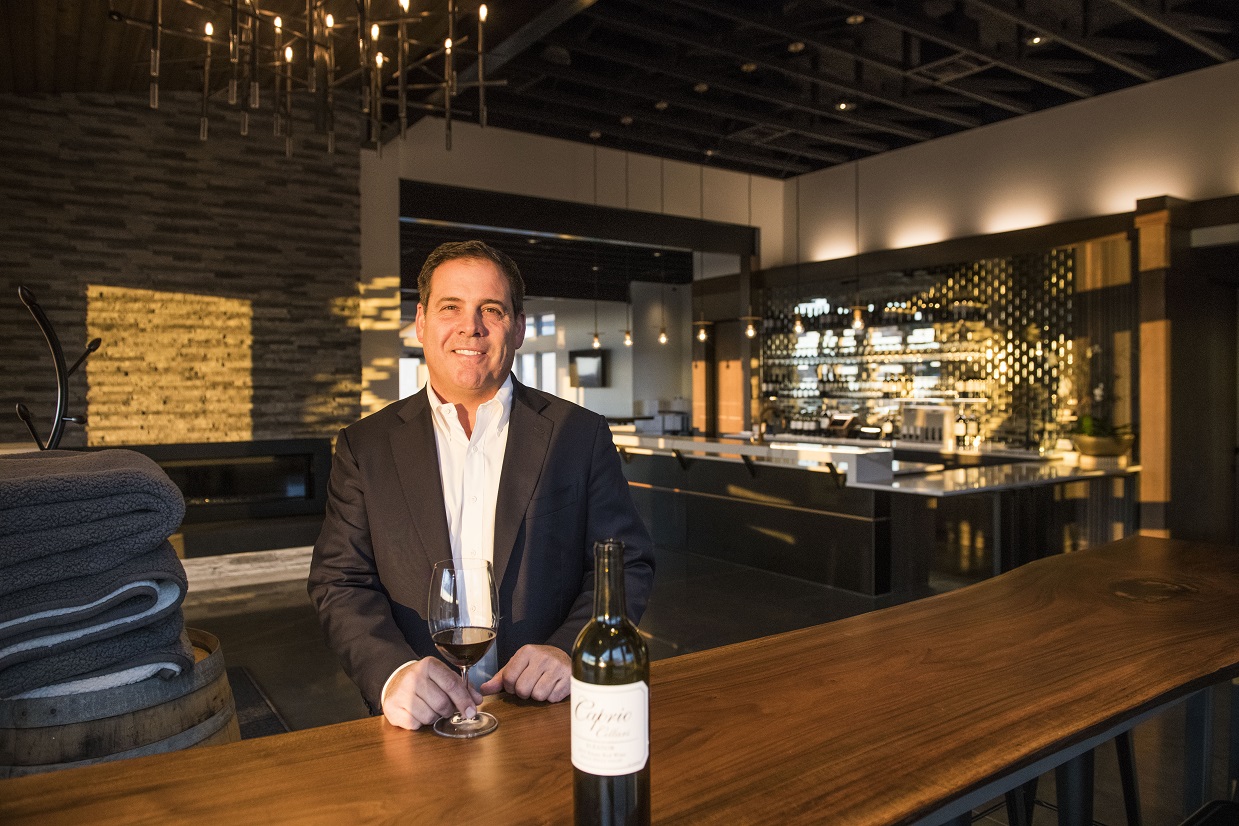
Dennis Murphy. Source: Caprio Cellars
[TaV]: Growing up, what was your exposure to the wine culture?
[DM]: Growing up, I remember my dad and grand parents making wine in the garage or the basement. Some was good, some was not so good. Wine was always a part of the dinner celebration, holidays and family gatherings.
[TaV]: Was there a pivotal wine in your life?
[DM]: The wine that brought me to Walla Walla was L’ Ecole No. 41 Merlot. I tasted this wine at a restaurant in Seattle and was blown away. I then started stopping at the winery and collecting the wine and eventually moved to Walla Walla.
[TaV]: When and how have you decided that you will own a winery?
[DM]: After tasting some Walla Walla wines and visiting Walla Walla, I fell in love with the town and moved. I could feel the energy in the wine scene emerging and moved to Walla Walla in 1999. There were just a hand full of wineries, so I started to make myself available during harvest and made some friends in the wine industry. In 2003 I purchased the winery estate property and in 2005 I planted my first vineyard, the Eleanor Vineyard.
[TaV]: Any plans for stepping outside of Bordeaux play – how about Syrah or Grenache which are so popular in Washington? Or maybe some Sangiovese or Tempranillo?
[DM]: I only make wines that I love to consume. I would look at Grenache, I love Grenache and think that the valley can produce some good fruit. We are making sparkling wine, I am intrigued to make a sparkling Rosé. I believe that focus is required to make world-class wine. I am focused on making world-class red Bordeaux-style wines from Walla Walla.
[TaV]: Considering your Italian heritage, do you have any favorite Italian wine regions, wines, or producers?
[DM]: It will not surprise you, I am a Super Tuscan guy. I think that the Cabernet Sauvignon and Merlot show very well. One of my favorite all time wines is the 1997 Ornellaia.
[TaV]: Are there any wineries and/or winemakers in Walla Walla who you would consider as your source of inspiration?
[DM]: Seven Hills/ Casey McClellan makes my favorite wine in the valley, the Pentad. Casey is a great winemaker, makes solid wines and the valley is fortunate to have him.
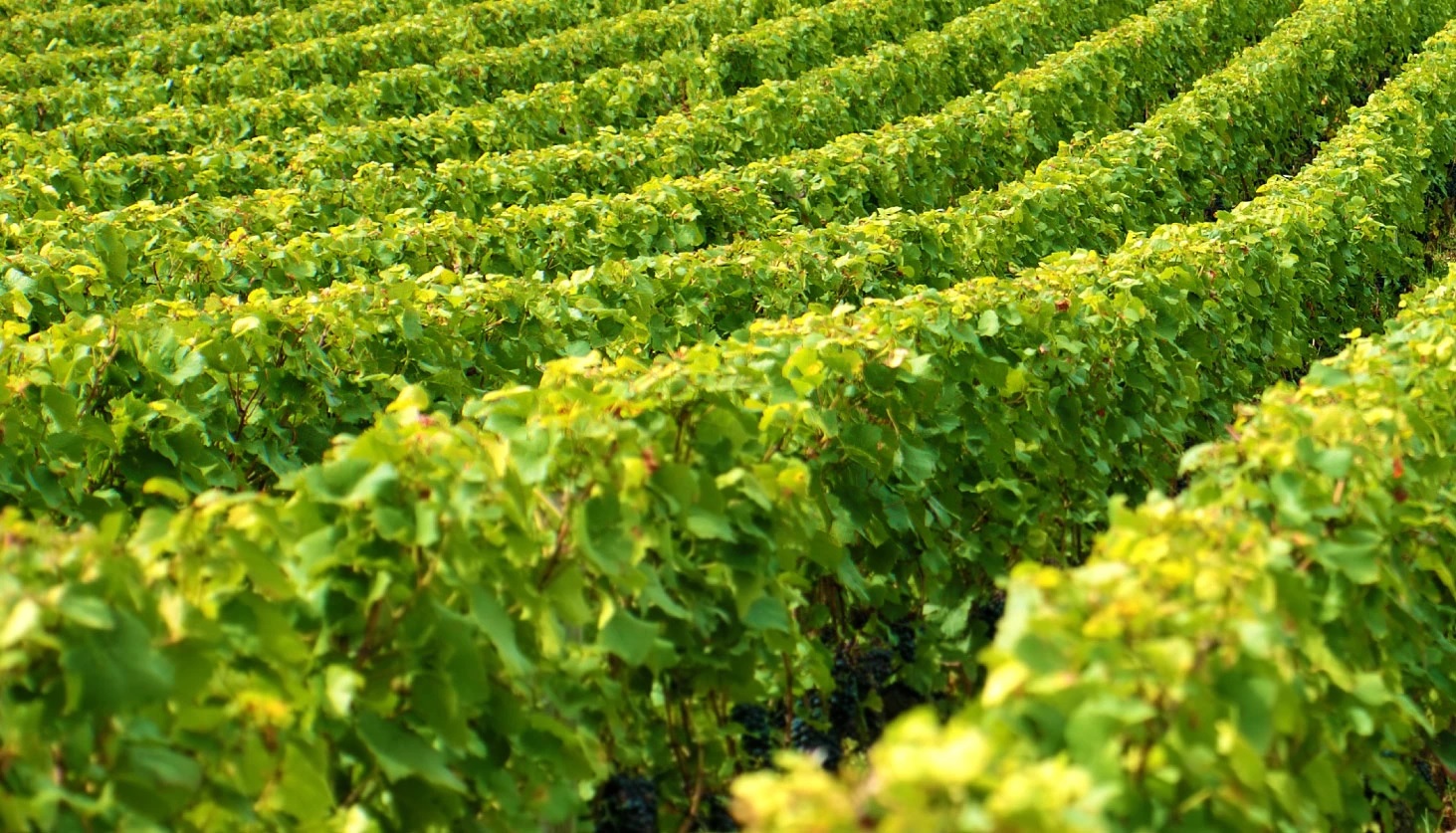
Source: Caprio Cellars
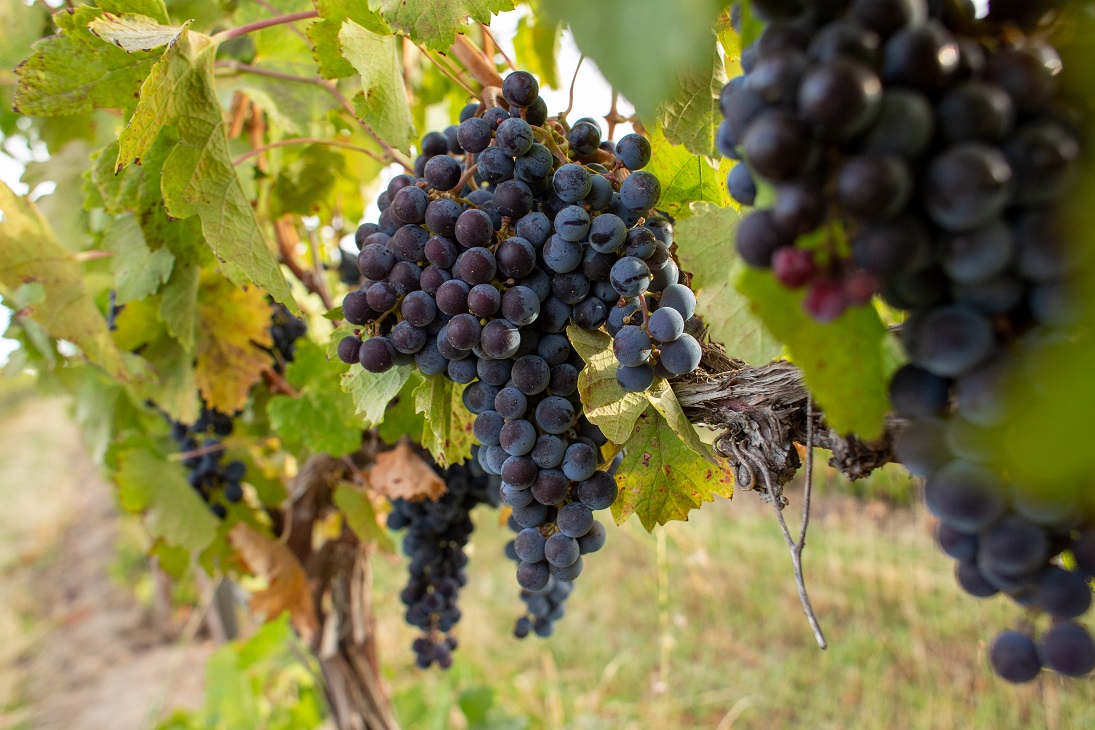
Source: Caprio Cellars
[TaV]: You are practicing sustainable farming – what does it entail in your daily routine?
[DM]: Sustainable farming is really about being as hands off the vineyard as possible, letting the land and crop do their thing naturally. Sustainable farming is very important for the industry and the environment. Mother Nature can provide anything that a chemical or synthetic can provide, you just have to work at it.
[TaV]: Any plans to advance your farming towards biodynamics?
[DM]: I do not have any current plans to farm biodynamic, but I have not ruled it out either.
[TaV]: First harvest at Caprio Cellars was in 2008. Do you still have any of those wines in your cellar? How are they evolving?
[DM]: Yes, I have the 2008 Caprio Cabernet Sauvignon, it was the only wine we made that year. I keep about 50 cases per vintage in the library, this would be considered a lot, but I like to keep more wine around for winemaker dinners, etc. The 2008 Caprio is holding up well and we get to visit it occasionally.
[TaV]: Any plans for more white wines in the future?
[DM]: Caprio grows Sauvignon Blanc and Semillon, these two varietals do well in our higher elevation Sanitella Vineyard. We release our Sauvignon Blanc in the spring, it is a crowd-pleaser and sells out quickly. We also make a rose’ of Cabernet Franc, this is a beautiful spring released wine as well.
[TaV]: Where do you see Caprio Cellars in 10-15 years?
[DM]: Caprio will be at our production goal of 5,000 cases per year. I believe this production is a sweet spot for a winery and you can still maintain quality. We will continue to provide a unique approach to hospitality, I am not sure what is next on that front, but we will continue to be the thought leader in our industry in the Walla Walla valley and push the envelope, it is in our DNA.


Let’s take a little break and taste some wines. I had an opportunity to taste two of the estate wines, Bordeaux blend, Eleanor, from 2017 and 2018 vintages. Here are my notes – and some related conversation right after:
2017 Caprio Cellars Eleanor Estate Red Walla Walla Valley (14.5% ABV, $48, 50% Cabernet Sauvignon, 28% Merlot, 12% Malbec, 10% Cabernet Franc, 65% Octave Vineyard / 35% Eleanor Vineyard, 18 months in 100% French oak – 35% new oak / 65% neutral barrel)
Dark Garnet
Minerality, underbrush, herbal profile – fruit undetectable
Expressive minerality, cherry pit, espresso, massive presence – typical Washington red which needs time (and hope) – and these are second day notes. Too big for my palate on the first day.
7+/8-
2018 Caprio Cellars Eleanor Estate Red Walla Walla Valley (14.5% ABV, $48, 59% Cabernet Sauvignon, 19% Merlot, 15% Malbec, 7% Cabernet Franc, 53% Octave Vineyard / 47% Eleanor Vineyard, 18 months in 100% French oak- 35% new oak / 65% neutral barrel)
Dark garnet
Blackberries, a touch of eucalyptus and cassis
Beautiful. Perfect mid-palate weight, silky smooth and velvety, cassis, cherries, supple, voluptuous.
8+, superb from the get-go.
[TaV]: This question is two-part about the wines I tasted:
First, the bottle of 2017 Eleanor is capped with foil, and 2018 is not. Why the change? Is this going to be the style moving forward?
[DM]: I am a traditional guy, I do love a foil cap on a bottle of wine. In line with our sustainability efforts, we held a customer focus group and it turns out that most customers prefer not to have the foil. We decided to leave it off in 2018 and it has been well received. I believe all future wines will not have a foil cap.
Now, the question which I never ask, but this time I have to. I tasted first 2017 Eleanor Red, and the wine was massive and tight – very typical for Washington reds, I call this type of wines “liquid rock” – lots of minerality and limited fruit. The wine opened up a bit on a second day but still was very tight. 2018 Eleanor Red, on the other hand, was approachable from the get go – Bordeaux style fruit, layered and smooth. Can you explain such a dramatic difference between these two wines? The grape composition is very similar, was that the terroir? Winemaking?
[DM]: Acid – the 2018 was the first vintage I nailed the acid level. It is a tight rope when it comes to acid, but 2018 and the 2019 are near perfect. I was pretty excited when I opened the 2018 Eleanor after bottling. Additionally, the vintages differed, 2017 was a tough year to get ripe, there were some photosynthesis issues that vintage. The 2018 vintage was a playbook vintage. What is funny is that in the tasing room we would taste the 2017 and 2018 side by side and the verdict was a 50/50 split. The 2017 was the fastest selling Eleanor we have produced, but the 2018 Eleanor is a critic’s favorite.
[TaV]: I understand that Caprio Cellars also supports a number of charities. What was the motivation behind this program? How do you decide what charities to support?
[DM]: Giving is a part of my every day living, it is in my fabric as a human. I created the phrase “give as you go”, this phrase is at the core of the purpose statement for my construction company. It was only natural for me to carry this belief to Caprio when we started. Caprio gives resources to many charities, mostly in the form of auction donations of wine and winemaker dinners. The winemaker dinners are very popular and bring a large amount of funds to the charity. Caprio focuses most monetary giving to First Story and Big Brother Big Sister. My construction company founded First Story and it helps families that otherwise would not have a home to get a home of their own. I have been a Big Brother for 18 years now and was on the board of directors, so it is a cause near and dear to me.


[TaV]: Last question is from the “how do they do it???” line. I understand that the wine tastings at Caprio Cellars are complementary. Not only that, but you also feed people! I read a number of discussions on professional wine forums with explanations that winery is a business and that literally how dare the wine lovers to expect their tasting to be complementary. And here is Caprio Cellars which does exactly that. So how do you do it and why? How is it working for you?
[DM]: I had no interest in opening a tasting room and charging a tasting fee. It seems like our industry has evolved into that business model. That model doesn’t make any sense to me. I wanted to disrupt the industry and focus on hospitality and the customer. Specifically focusing on the customer journey. We held focus groups at the beginning with Joseph Michelli (NYT bestselling author and consultant) from the Michelli group. Joseph believes that most businesses do not pay attention to their customers’ needs until it is too late in the customer journey. The Caprio tasting experience is based on the equity theory, I do something nice for you and in return, you will do something nice for me. The majority of the industry takes a tasting fee from the customer and gives it back “if you decide to buy”. We are all adults here; I do not need to take your money and give it back. I spent hours in other tasting rooms watching the customers sit in their group and have an agonizing group discussion on “how are we going to get out of here alive with our tasting fee”, discussions about you not liking the Syrah or him not liking the Chardonnay. Why put your customer through this process? At Caprio, we skip this pain point and we add the pleasure of a hand-crafted food pairing from our Executive Chef Ian Williams. My grandmother Eleanor Caprio is to blame or credit for the food pairing, if she knew I invited you over for a glass of wine and I didn’t offer you food, she would be very disappointed in me. The food program at Caprio was nonnegotiable when we opened, it is part of our program and a distinguishing advantage to our experience. Here is the punch line, if you like the food and wine pairing, we ask you to purchase a couple of additional bottles of Caprio to pay it forward to the next guest in our care. So far it is working out well and the ecosystem is taking care of itself, it is a beautiful thing, but somebody had to have the guts to try it.
Here we are, my friends. A wonderful story of passion, good wine, and a unique business approach. If your travel will bring you to Walla Walla, Caprio Cellars should be on your visit list. And if your travel will not bring you to Walla Walla … change your travel plans! Cheers!
Stories of Passion and Pinot: Le Cadeau Vineyard

Tom and Deb Mortimer. Source: Le Cadeau Vineyard
Hello, wine lovers.
I’m going to ask you for something very valuable – your time. About 20 minutes of it, as this is how long it should take you to read this post, one of the longest posts I ever published. But I’m not asking for your time for free – in return, I’m offering you one of the very best interviews ever published in the Stories of Passion and Pinot series, as well as the overarching One on One With Winemaker conversations.
Winemaking usually starts with passion, courage, and conviction – a belief that “you can”. Really. It is not always a degree in oenology (don’t get me wrong – of course that helps!), but the resolve to get going, as you have a burning desire to make world-class wine no matter what – this might be your main ingredient of success.
Tom and Deb Mortimer had such a resolve to make great Oregon Pinot Noir. After searching for a year, they found an uncultivated parcel of land on the south slope of Parrett Mountain in the Chehalem Mountains AVA, and the hard work began. Planting grapes, understanding your land, learning the soils and microclimates. All with the resolve to produce the best possible Pinot Noir. This is how the story of Le Cadeau Vineyard started (wonder if “Le Cadeau” means something? Keep on reading).
After tasting the wines of Le Cadeau, I was convinced that I want to learn more – which turned into a very enjoyable [virtual] conversation with Tom Mortimer, who generously offered his time to answer all of my questions. And this is what I want to share with you with a full conviction that it is well worth your time.
Here we go:
[TaV]: The story of Le Cadeau Vineyard started in 1996, when you purchased the 28 acres parcel in Chehalem Mountains AVA. When did you come up with the name Le Cadeau? What is the meaning behind this name?
[TM]: Le Cadeau (is French for “the gift”): We like to say that “the wine is not ‘the gift’; rather, “the wine is the excuse”—the true gift is the land and friendships.” When we first saw the Le Cadeau / BHV site, there was no view; it was obscured by scrub-oaks, blackberry bushes, and a lot of brush. Clearing the land was a bit like unwrapping a present, and ultimately a gorgeous view emerged. More significantly, rocky soils are coveted for top-tier vineyard sites. As we cleared the site, the broken volcanic basalt cobbles were revealed; rock in Oregon is rare, so we were very fortunate to find a rocky site. Lastly, wine is inherently relational. Enthusiasts get-into wine for the product, but ultimately, they stay in wine for the people; when the glass is empty, the relationships remain. So “the gift” has multiple manifestations.
[TaV]: When you found the parcel which became the future home for Le Cadeau, you said “For some reason, the property “felt right”. I don’t really know why”. So this was the love at first sight, right? Now, 23 years later, can you maybe better explain that feeling?
[TM]: Part of it was the location—the vineyard is only 35-minutes from downtown Portland, yet it was very serene countryside. We came from suburban Minneapolis to start this project; 22-years ago the Willamette Valley was much less developed, so this location was perfect for us. My wife (and I) didn’t want an isolated, rustic, farm experience. But other than the location, it was a beautiful site—south slope, about the right grade, I was fairly certain the view existed. It just had a different / better feeling than many of the other places we looked at.
At another level, I think I Iiked the fact that it was never-before-cultivated land. There was something about “starting a vineyard from scratch” that was appealing… of course, at the time, I had no idea what I was getting us into… which is actually a good thing. There are plenty of reasons to not take on a project like this. Sometimes it is better to not know what lies ahead.
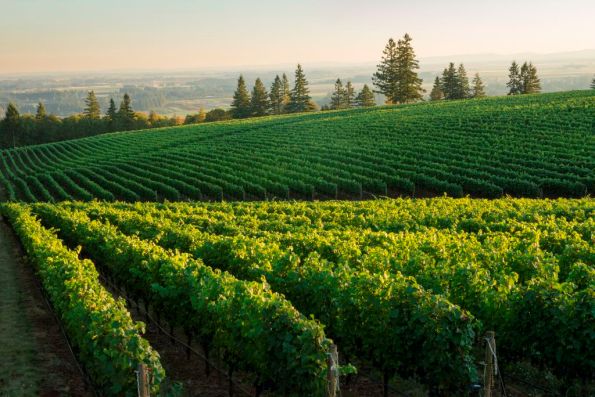
Source: Le Cadeau Vineyard
[TaV]: I really like the name “Black Hole Vineyard”, even though it has not necessarily a positive connotation about it. Have you ever bottled any wine which says “Black Hole Vineyard” on the label? What happened to that name? Is the Black Hole Vineyard simply became Le Cadeau Vineyard, or is it still exists under its own name?
[TM]: There was one “Black Hole” wine made by a fruit client. It was small production, and was only released to his wine club.
Our business is corporately divided into two companies: A farming company (the vineyard), and the wine biz. Most of the fruit from the vineyard is sold to the wine biz, but some is sold to notable clients. The farming company is named Black Hole Vineyard, LLC (or BHV, LLC), while the wine company is Le Cadeau. So in that regard, the name lives on. We also continue to personally refer to it as Black Hole among ourselves, and generally the winemakers like to call it Black Hole, vs. Le Cadeau. But at some point you need to make a brand decision, and focus your time and energy on that brand. We chose Le Cadeau vs. Black Hole. Obviously, it is a much more positive message, though perhaps not as amusing.
[TaV]: What made you believe that you can conquer the rocky soil? What was the drive behind your passion, developing your vineyard against the difficult terrain and the cash flow?
[TM]: As noted above, a good part of my confidence was rooted in ignorance. But as a wine collector I knew that many of the great wines of the world were grown in rocky soils. I figured, “if they can do it, so can I”.
Over the years I have come to discover that there is one tool that is central and more important than any other in developing and farming a rocky site. You might think that the tool is a chisel plow, or a big tractor, or whatever. But the reality is that the single-most-important tool is a checkbook. Unfortunately, unlike many of the folks that get into this business, my checkbook was about the size of a hand-held garden tool. With a vineyard that is raw ground and solid rock, it is better to start with a checkbook that is the size of a bulldozer… and a D8 at that. Fortunately, I kept my day-job.
[TaV]: How many Pinot Noir clones have you planted so far? Why so many?
[TM]: We’re up to about 16-Pinot Noir clones and 6-Chardonnay clones (the first Chardonnay, 2017, to be released in a couple months). Why so many?—there are a handful of reasons:
- a) I cannot recall ever having a single clone wine that I felt was as complete and interesting as a multi-clone wine. We don’t put them all in a single wine; our cuvees result from different combinations of clones, soils, and aspect (climate). Most of the cuvees have 3 to 5 clones, Diversité has the most with 7 that make up the majority of the wine, and another 2 or 3 that are there in small quantities.
- b) Curiosity and experimentation. Quite simply, clones are exciting. You wait for 3-years wondering what the fruit will look like and taste like. Often it takes several more years before you learn about the flavors, texture, physical characteristics of the fruit and how it affects the wine. So there is always a sense of anticipation. I liken clones to colors on an artist’s palette; they add “color” to wine—not in a literal sense, but in terms of variance, nuance, and complexity.
- c) Differentiation. I don’t want to make wine that is like everyone else’s.
- d) Optimization. Folks (i.e., typically winemakers) have varying views of how important clones are in the overall mix of variables. Most agree that the dirt / site are the most important elements, and I’d agree with that. But for many, “clones” would be further down the list. For me, the plant material is very central to extraordinary wine. Great wines only happen when there is great dirt, perfect climate, excellent farming / viticulture, the very best and site-matched plant material, and of course great winemaking. Like many things in life, something can only be as good as its weakest link.


[TaV]: Is there an Oregon (or maybe Burgundian) winery(ies) which were instrumental in the development of your own winemaking style?
[TM]: We have always wanted to make wines that are true to the estate site. In this regard, Le Cadeau is more of a European model, in that the “rock star” is the vineyard, not the winemaker. The wide range of cuvees exist to showcase the range of “faces” of the vineyard. But more recently we’ve been searching for more freshness and aromatic excitement. This is why I engaged our French consultant, Pierre Millemann several years ago. Not surprisingly, this has led us to produce higher acid / lower alcohol wines.
It would be difficult to pick a particular winery to reference against; again, our dirt / site is very unique. There are many wineries, both in Oregon, Europe, (and California) that we respect, but I think it would wrong to say that we try to emulate any of them.
[TaV]: Do you still have any bottles from the 2002 vintage? If you do, how do they hold?
[TM]: I have a few bottles of 2002. The last one I had was about 2-years ago. It was doing well, but I think it was past its prime. Keep in mind that the vines from that vintage were only 4-years old. I recently had an ’05 Diversité from magnum; it is going strong and will continue to last for a long time.
[TaV]: According to what I see on your website, you produce [at least] 7 Pinot Noir wines. Is there an idea behind such a range of Pinot wines? What are you trying to showcase?
[TM]: As noted above, the majority of the cuvees showcase various attributes of the vineyard: Rocky soils (Rocheux); the cooler East-side (Cote Est); clonal diversity (Diversité); heritage clones (Merci Reserve). More recently, we’ve added two cuvees that are more inclusive of winemaking technique—Trajet Reserve is 100% whole cluster; and “Pierre” has considerable input from our consultant, Pierre. It is about “freshness” and higher acidity.
[TaV]: Going back to the Pinot Noir clones – considering the sheer number of them, you must be blending your wines. What is your approach to blending? Do you have any Estate Pinot Noir wines where you trying to maintain consistency throughout the different vintages?
[TM]: Generally we favor co-fermentation of multiple clones in a single tank. Most of the cuvees are made of two separate tank fermentations that go to barrel separately, and are then combined to make the final cuvee. But for the most part, all of the wine from each ferment ultimately goes into the cuvee.
I like to say that the Le Cadeau wines are “made in the vineyard”… I don’t mean that literally, but rather that the specific “Cote Est” fruit is picked separately, and it is made into the Cote Est cuvee. Same for Rocheux, Diversité, and Merci. In this regard, there is clonal consistency from year to year, because the wine for each cuvee is consistently made from the same section of the vineyard. For example, Rocheux is always roughly 45% Dijon 777; 45% Pommard; and 10 % Wadenswil… that is what is planted in the sections where the Rocheux fruit is grown. … and fortunately, the vines don’t move around at night when we’re not looking… that would be a mess.
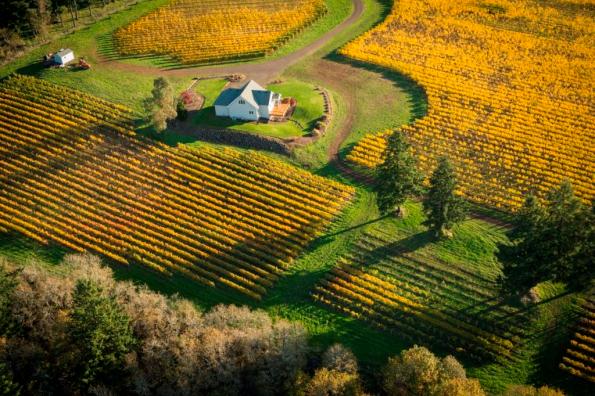
Aerial view over Le Cadeau Vineyard, Chehalem Mountain AVA, Willamette Valley, Oregon. Source: Le Cadeau Vineyard
[TaV]: How did you come to the idea of the Sparkling wines? You offer 2011 vintage sparkling wine, so clearly you started making sparkling wines before they became “the thing” in Oregon, so how did you get there?
[TM]: 2011 was a very cool, late, year, and the clusters were uneven. Some of them were quite large (a fairly rare event, given our rocky soils). On October 15th, the bigger clusters had only gotten to about 19-Brix—not good for still PN. I know we wouldn’t/couldn’t pull them all out on the sorting table, so we did a sort in the vineyard. I told the crew to harvest the three biggest clusters off of each plant in certain sections of the vineyard. Since these were at a perfect stage for sparkling, and we had them hanging on the vine for a full season at that point, it seems silly to drop that fruit on the ground. So we took a shot at sparkling—it worked out very well, so now we make it generally every other year.
[TaV]: I’m sure you knew this question is coming J – it seems that you only work with Pinot Noir grapes. Do you grow any other varieties? Do you have any plans for the white wines? If yes, what grapes would you plant?
[TM]: As noted above, we have 6-clones of Chardonnay that are now in production. The first Chardonnay will be 2017, released in a few months. We’ll only do Chardonnay at Le Cadeau (other than Pinot Noir). But under our other brand, Aubichon, we’ve made some wonderful “Alsatian Style” Pinot Gris, as well as a Pinot Gris-based Rosé, and a wine we call “Sur Peaux”, which is an “orange wine” from Pinot Gris. All the Pinot Gris is sourced from old vine vineyards, about 25-years old. So it’s nice fruit, and the wines are quite special.
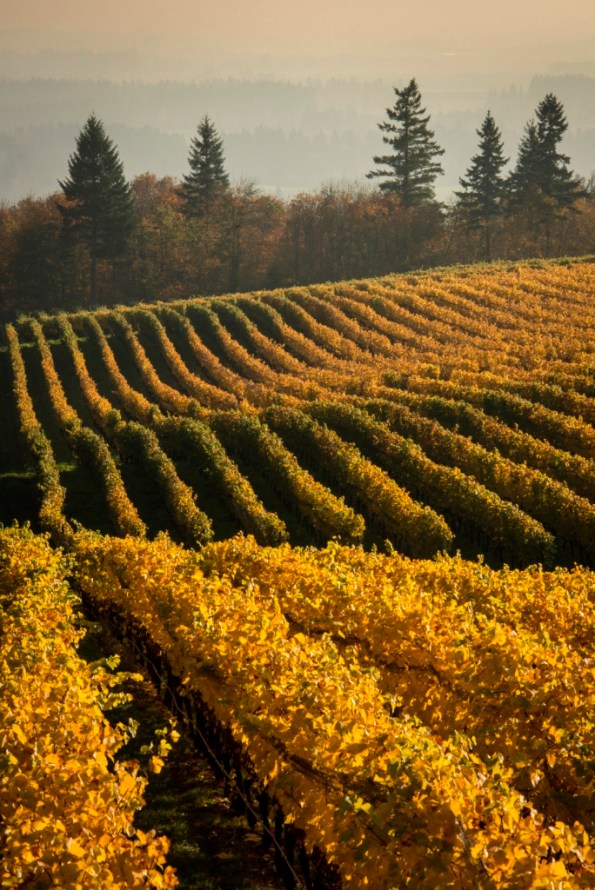
Le Cadeau, Chehalem Mountains AVA, Willamette Valley, Oregon. Source: Le Cadeau Vineyard
[TaV]: And one more common question I like to ask – when you are not drinking your own wines, what are your favorite wines and/or wineries, in Oregon or anywhere in the world?
[TM]: I have a diverse range of preferences:
I’m a huge fan of Weinbach in Alsace; Chave Hermitage is often special, Guigal Condrieu (the good version, not so much the standard one), Huet and Chidane Chenin Blanc; Fevre Chablis; Robert Weil German Reisling (and many others—Keller dry from their rocky vineyard is nice); any good Bonne Mares; love white Bordeaux—Chevalier, Smith H-L, and of course the “big guys”, but they’re too expensive. Barberescos from Italy—Gaja (also like Gaja Chardonnay), and I think Produtorri does an amazing job for the price, along with Albino Rocca. I’ve had a Foradori wine that I thought was special, certain Brunellos, but many have become Parker-ized, that’s unfortunate. I like Ciacci wines though. … the list goes on…
In Oregon, there are many that I respect, and a small group that I like, but I’d prefer to leave those thoughts anonymous.
[TaV]: What is ahead? Where do you see Le Cadeau in 10-15 years?
[TM]: I think we’re just beginning to make our best wines, and really beginning to understand the vineyard’s nuances. Some of our more exciting clones are still quite young, so it will be interesting to see what sort of wines we make from the more exciting clones when the vines are older. The 2018 wines that we have in the barrel are possibly our finest to date. Very excited about getting them into the bottle and out on the market.
I’m hopeful that our Chardonnay program will be noteworthy. Pierre’s guidance on Chardonnay has been very helpful. 2018 in barrel looks to be very promising, and I’m excited about the first 2019 fruit from a rocky grafted section of the vineyard. We have a couple interesting Larry Hyde clones of Chardonnay planted in that area as well. The fruit looks to be quite different. I’ll have a better sense of the Chardonnay potential in another year, but I’m hopeful that we can produce “the real deal”.
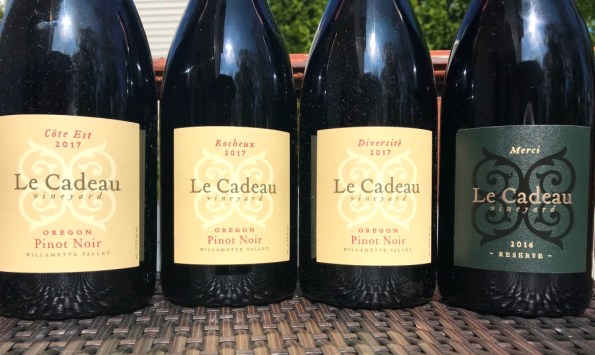
Thirsty? Here are my tasting notes for the wines:
2017 Le Cadeau Côte Est Pinot Noir Willamette Valley (13.9% ABV, $50, 145 cases made)
Dark Ruby
Smoke, plum, iodine, medium-plus intensity
Wow. Touch of smoke, Sage, medicinal notes (cough syrup), good acidity, excellent balance
8
2017 Le Cadeau Rocheux Pinot Noir Willamette Valley (13.2% ABV, $50, 174 cases made)
Dark Ruby
Plums, cherries, violets, intense, inviting
Bright, clean, succulent ripe cherries, licorice, great minerality, excellent balance, superb
8+
2017 Le Cadeau Diversité Estate Pinot Noir Willamette Valley (13.9% ABV, $50, 245 cases made)
Ruby
Delicate, lavender, a touch of smoke, perfect
Beautiful, plums, ripe strawberries, great acidity, baking spices, delicious overall
8+/9-
2016 Le Cadeau Merci Pinot Noir Reserve Chehalem Mountains Willamette Valley (14.1% ABV, $80, 143 cases made)
Garnet
Intense, ripe cherries and plums, candied fruit
Wow, great intensity, cherries, cherry compote, ripe plums, minerally notes, good acidity, good balance
8+
As you can tell, I really liked the wines – they were literally one better than another.
Here you go, my friends – yet another story of Passion and Pinot. I hope you enjoyed reading it as much as I enjoyed writing it, and I thank you for your time and attention.
Will there be more Passion and Pinot stories? Well, do you think the passion ran out of the Pinot winemakers and aficionados? I will bet my virtual DRC bottle that it did not. So we will continue our conversations as soon as the next opportunity will present itself.
Obey your passion!
P.S. Here are the links to the posts profiling wineries in this Passion and Pinot series, in alphabetical order:
Alloro Vineyard, Bells Up Winery, Ghost Hill Cellars, Iris Vineyards, Ken Wright Cellars, Knudsen Vineyards, Lenné Estate, Tendril Cellars, Youngberg Hill Vineyards, Vidon Vineyard
Stories of Passion and Pinot: Iris Vineyards
 Let me ask you something. If you would look at the mountainous parcel of land, completely destroyed by the brutal commercial logging – would you be able to envision there a beautiful Pinot Noir vineyard? (if you answered “no”, same as I did, don’t worry about it – this is why you and I are not in the winemaking business). When Richard Boyles and his wife Pamela saw such a logging-destroyed site at the south end of the Willamette Valley, they were able to see past the nature in distress. They were able to see the future vineyards and even future forest restored where it was before. They purchased about 1,000 acres site in 1992, and it became the home to the Iris Vineyards, with the name inspired by the beautiful wild Douglas iris covering the surrounding hills in spring.
Richard’s fate was sealed at the age of 7, when he assumed assistant winemaker duty to his grandmother, helping her to make the sweet, dessert wine. As they say it in the stories, the rest was history. Richard met Pamela while studying at the University of Oregon. Countless visits to Europe and living there for a while as Richard had a carrier in international business management and hospitality, helped Richard and Pamela to discover their wine passion – Burgundy, and its signature grape – Pinot Noir. That passion for Pinot helped Richard and Pamela to see through the broken trees and realize their dream of making the world-class Pinot Noir.
Well, there is also an additional element to that passion – a principle of Areté. Richard and Pamela learned about Areté in the university, while studying ancient Greek philosophy. This principle simply means that it is one’s moral obligation to achieve the highest potential the person can achieve. Give it a thought – Areté is really a great principal to live by; we will get back to it later on in this post.
Today Iris Vineyards farms about 43 acres of vineyards, located at 800 to 1,100 feet elevation (quite high for the Willamette Valley). The vineyards are surrounded by more than 500 acres of restored forest, mostly Douglas fir and Ponderosa Pine, as well as Oregon white oak. The main vineyard of the estate, Chalice Vineyard, was planted in 1996 and produced its first vintage in 2001. Pinot Noir takes two third of the plantings, following by the Pinot Gris and a small acreage of Chardonnay. Iris Vineyards also produces a number of other, less traditional wines (Viognier, Syrah, and more) from other appellations in Oregon, such as Applegate Valley.
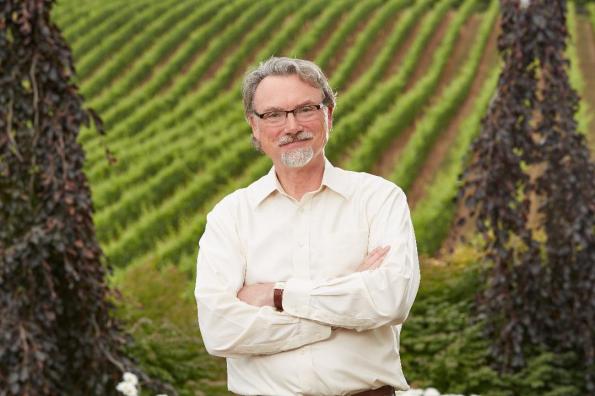
Richard Boyles
I was definitely intrigued by what I learned about the Iris Vineyards, so I took an opportunity to sit down with Richard Boyles (yes, once again it was a virtual conversation) and ask him a few questions. Here is what transpired:
[TaV]: You grew up tasting sweet wines. How did you end up with Pinot Noir becoming a passion?
[RB]: Although my first experience was sweet wines made and sampled with my grandmother, the wines I “grew-up” with were the wines served at family celebrations organized by my dad. These were usually red Bordeaux and reds and whites of Burgundy as well as German Rieslings. As you can see, with the exception of the Rieslings, these were dry wines that were intended to pair with food. I became more focused on Pinot Noir as it became clear that Oregon could grow world-class Pinot Noir with Oregon attitude. After graduation from the U of O, while living in Seattle, Pamela and I continued to explore the world of wine, visiting vineyards, tasting rooms and sampling primarily in Oregon and Washington and occasionally in Napa and Sonoma. Our interest in Pinot Noir solidified as a passion as Pamela and I explored different viticultural areas of Europe when we lived in Germany and Switzerland. We found ourselves gravitating to Burgundy for Pinot and Alsace for Pinot Gris.
[TaV]: What made you think that the parcel of land destroyed by logging would be an ideal place to grow Pinot Noir?
[RB]: In the Pacific Northwest logging is a part of the rural economy and landscape. In the case of our property, the fact that it had been logged and that we took on the legal obligation to replant the forest meant that we were able to acquire large acreage at a modest price. The property had a long history as a mixed forest operation, with cattle and timber harvests providing income to the owners. When we acquired the property, we replanted hundreds of acres of forest before we turned our attention to planting the vineyard on former pasture. The areas for vineyard plantation were selected for the Jory and Bellpine soils, south-facing slopes, elevation and for modestly steep slopes which allow the property to be farmed with standard farm equipment. While our purchase of the property was prompted by the vineyard potential, it has been equally satisfying to plant tens of thousands of Douglas fir trees that have now matured into a forest, an ecosystem really, supporting many species of flora and fauna.
[TaV]: I know that the concept of Areté and its relevance to everything you do is explained on the website, but can you explain one more time for our readers what Areté means for you and how does it apply to the Iris Vineyards and your wines?
[RB]: In addition to what is on the website and press kit, this is what I would say about Areté: Areté is a philosophy or way of being that says, “Hey buddy, you want to excel and standout? Then be deliberate about it. Figure out what skills and knowledge you need, practice them, perfect them if you can. Figure out what else will up your game. Go get that skill or knowledge. Repeat. Because that is what this life is all about. A constant aspiration to live up to the potential that is you. Why would you settle for less?” With respect to Areté at Iris, Areté is a cultural signpost. It tells team members and prospective team members what we value at Iris, how we want to be and be seen as an organization. It tells team members how they can contribute. We can only be an organization that exemplifies Areté if our team members embrace it, make decisions and plans by it. By making it clear what we are about, we attract like-minded team members. And, of course, Areté is a proclamation to the world about aspirations. So, we take it very seriously when we put the Areté name on the label of the wines that are the best examples of our craft.
[TaV]: I would guess that first was Pinot Noir, then Pinot Gris, then Chardonnay (curious – am I right?), but Iris Vineyards today offers way more than just 3 flagship Oregon grapes – how did you get to include Syrah, Tempranillo, Viognier into your repertoire?
[RB]: From the time we committed to establishing a vineyard, Pamela and I planned to grow Pinot Noir, Pinot Gris, and Chardonnay. The expansion into other varietals is the result of two factors: 1) the desire to create variety for our club members; and, 2) our winemaker, Aaron Lieberman’s curiosity, interest and skill at working with grape varieties beyond Pinot Noir, Pinot Gris and Chardonnay.
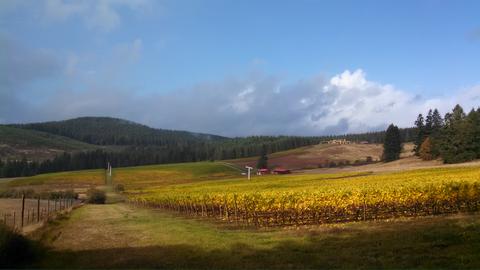
Source: Iris Vineyards
[TaV]: While it is not yet available on your website, I understand that you are about to introduce Iris Sparkling wines. Can you tell me more about this project, starting even with “why sparkling wines”?
[RB]: Much as the reintroduction of the Rosé program was in response to Pamela’s strong interest in Rosé and renewed consumer interest in the category, the sparkling wine program came about as a result of Aaron’s interest in, and interest in the challenge of making sparkling wine. Sparkling wine is the ultimate celebratory beverage. Our club members and tasting room visitors love our Methode Champenois Blanc de Noir and Blanc de Blanc. We reserve a small amount for weddings and other celebrations at the tasting room, though the sparklers routinely sell out prior to the subsequent release. Aaron can expand on what brought him to pursue sparkling.
[TaV]: Will sparkling wines be generally available or they will be offered as winery exclusive/club options?
[RB]: I anticipate that the sparkling wines will be available to club members, available at the tasting room, available to weddings and celebrations held on the property and perhaps to select accounts. I don’t anticipate that it will be available to broad distribution. These are intensely hand made wines requiring lots of time and attention. The sparklers will have an important but limited role in our line-up.
[TaV]: Considering the wide range of grapes you already use, do you have any plans to expand it any further?
[RB]: Our offerings will continue to evolve. Our core business is in Pinot Noir, Pinot Gris, Chardonnay, and Rosé. As we expand our vineyard, we will plant small amounts of Pinot Meunier and Pinot Blanc as well as a broader variety of clones of Pinot Noir and Pinot Gris. Pinot Meunier will have a place in our sparkling program. We will evaluate it as a potential stand-alone variety. Pinot Blanc will be a standalone bottling. I expect we will pare some wines from our current offerings as we respond to the tastes of our club members and tasting room visitors. 8. I’m assuming you started producing wines at the end of the 1990s. Do you still have any of your first releases available in the cellar? How do they hold up? What is the oldest of your own wines you ever tasted?
We first bottled wine under our own label in 2001. Prior to that, we sold the small volume of fruit coming from our vineyards to other producers. We recently sampled a bottle of 2008 Reserve Pinot Noir. We have a single bottle left. I wish we had more in our cellar. While this wine wasn’t deliberately built to last ten years, it is drinking very well. The 2012 Reserve Pinot is drinking nicely. Pamela and I have a few overlooked bottles of 2001 and 2002 Pinot Gris in our personal cellar. These were award winners 15 and sixteen years ago, including double platinum for 2002. As compelling as these wines were at two, three, four and even five-year-olds, they weren’t intended to age and are now past their prime. It’s a good reminder to drink while the drinking is good.
[TaV]: You are practicing sustainable farming. Can you explain what it means for you, how does it relate to the land, vineyards, grapes and so on? Have you ever looked at going Biodynamic?
[RB]: The goal of our farming practices is to produce fruit that meets our particular purposes. We use different farm practices and viticultural techniques for Pinot Noir that’s intended for Rose’ differently than the fruit that is intended for our estate bottling for instance. Our farm practices are conventional as we want to have all the tools available to produce the best fruit for the purpose while supporting the long-term productive capacity of the vineyard and operating a financially sustainable business. Farming isn’t static. We annually review best practices and new literature to improve what we do in the vineyard. While we have considered a Biodynamic approach, we believe we can produce better fruit for our purposes with a conventional approach to farming.
[TaV]: When you are not drinking your own wines, what are your favorite wines from Oregon, and from around the world?
[RB]: One of the notable things about the world of wine today is that so much great (and not so great) wine is accessible from all over the world. We see wine as an exploration, so we regularly try what we haven’t tried before. That is as likely to be a Pinot from a new Oregon producer, a Sauvignon Blanc from a new growing region or an obscure varietal we haven’t tasted in a while. Through exploration, we learn more than returning to the same things repeatedly. That said, we have a broad stable of wines of our own production. We do frequently return to those.
[TaV]: Where do you see Iris Vineyards in 15-20 years from now?
[RB]: I expect that Iris will garner increasing consumer attention as we offer compelling wines at a good value. I expect that we will continue to offer wines across a variety of complex profiles and price points. I don’t say across a variety of quality, because all of our wines are of high quality, they just differ in terms of complexity. Personally, in 15 or twenty years I hope to have more tractor time and hands-on time in the vineyard and in the winery, particularly at crush. Overseeing this and other businesses currently require that I focus on the big picture. It was a “need” to farm and a maker mentality that brought us into the business. I still craft beer, pickle and can. I look forward to re-creating my job description to allow more time in the vineyard and winery and less in the business of running a business.


Yes, I agree with you – it is time to drink. I had an opportunity to taste two of the Iris Vineyards Pinot Noir wines – here are my notes:
2017 Iris Vineyards D Block Pinot Noir Chalice Vineyard Willamette Valley (12.7% ABV, $39.99, 300 cases produced)
Bright Ruby
Light, elegant, plums, cherries, a touch of ripe strawberries
Sweet cherries, plums, great acidity, excellent balance
8-/8, nice and approachable
2016 Iris Vineyards Areté Willamette Valley (14.1% ABV, $59.99, 100 cases produced)
Dark Ruby
Touch of smoke, plums, a hint of cranberries
Iodine, Cherries, a touch of smoke, good balance
8/8+, very good wine, will be interesting to try it again in 10 years…
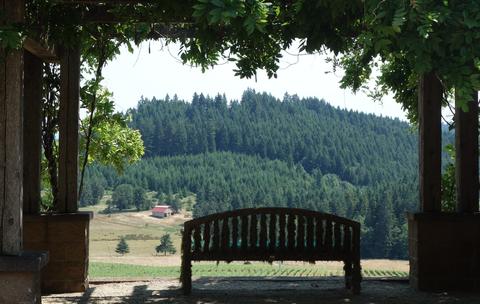
Source: Iris Vineyards
Here you are, my friends – another story of Passion and Pinot. Go pour yourself a glass of Pinot – more stories are ahead…
To be continued…
P.S. Here are the links to the posts profiling wineries in this Passion and Pinot series, in alphabetical order:
Alloro Vineyard, Bells Up Winery, Ghost Hill Cellars, Ken Wright Cellars, Knudsen Vineyards, Lenné Estate, Tendril Cellars, Youngberg Hill Vineyards, Vidon Vineyard
Stories of Passion and Pinot, Year 2019
Back in 2014, during the Wine Bloggers Conference in Santa Barbara (my first WBC), I was listening to the panel discussion of the professional wine writers, who basically had only one message for all the bloggers – interviews, interviews, interviews. Of course, they were talking about integrity, writing skills and other important subjects, but the concept of “interview” was brought up multiple times, with all the explanations how to do it properly, what, why, where and so on.
At that point, I had been writing my blog for about 5 years, and the idea of the interview didn’t resonate. “I want to write about the wine, not about some conversations and other people opinions” was my prevailing thought. “Interviews? I don’t want to do no interviews” (use of broken English intended).
You don’t need to fast forward too far to see how everything changed. Next year, I was offered a meeting with a winemaker which I couldn’t attend, so I said “all right – can we have a virtual conversation?” – and the concept of “One of One With Winemaker” posts was born. Since then, I’ve done quite a few interviews, most of them virtual and a few are in person – if you are curious, here is the link for you to see them all. Yes, the “virtual” concept might be limiting, as you can’t explore an interesting angle which would come up in the conversation. However, as most of my questions are unique and specifically tailored for a particular conversation, virtual interviews remove intimidation, allowing people time to provide the best answers.

In 2016, I had a conversation with Carl Giavanti, who asked if I would be interested to create a series of interviews with Oregonian winemakers – and that became the beginning of the Stories of Passion and Pinot series, all connected under the “One on One” umbrella. In 2016, I had an opportunity to “talk” to Ken Wright of Ken Wright Cellars, David Nemarnik of Alloro Vineyard, Mike Bayliss of Ghost Hill Cellars, Wayne Bailey of Youngberg Hill Vineyards, Steve Lutz of Lenné Estate, and Don Hagge of Vidon Vineyard. In the same series, Knudsen Vineyards was profiled in 2017, and last year I had a conversion with Tony Rynders of Tendril Cellars. All of these wineries are from Oregon, and all of them share a common passion for the Pinot Noir, one of the most finicky grapes out there.
You probably guessed that I’m not writing this post just to give you a retrospective into the Talk-a-Vino interviews. Yes, I’m writing it to tell you that the Stories of Passion and Pinot will continue in 2019, again with the help of Carl Giavanti. The wineries we will look at in the near future are:
By the way, do you know what “Bells Up” means? Well, if you do – great, if you don’t – you will learn all about it soon.
To be continued…
Last Bottle Sign Up ($10 credit)




 Talk-A-Vino