Archive
Weekly Wine Quiz #82: Grape Trivia – Gamay

Gamay grapes
Source: Wikipedia
The Wine Quiz series is not meant to intimidate. The whole idea here is to have fun and learn something new. When answering the questions, it is fully encouraged to use all available sources of information, including Google or any other search engines. There are no embarrassing answers – the most embarrassing thing is not giving it a try…
Welcome to the weekend and your new wine quiz!
We are continuing our grape trivia series, with the focus again on the red grapes, and today’s subject is Gamay, also called Gamay Noir, and fully officially a Gamay Noir à Jus Blanc.
Gamay is a purple-skinned grape, taking its name from the village of Gamay, located south of Beaune in France. Gamay is considered to be a cross between Pinot Noir and ancient white grape called Gouais Blanc. First mentions of Gamay go all the way back to the 14th century, so it had being around for a while.
Gamay grapes have thin skin, and have a tendency to overproduce, creating the grapes with very high level of acidity and low sugar, which often results in the production of lightly colored and quite acidic wines. The overproduction and high acidity were the reasons for the Gamay being literally outlawed and pushed out of Burgundy by the royal rulers at the end of 14th century, to give way for much rounder Pinot Noir. As the result, Gamay mostly settled in Beaujolais area, where it became the major red grape variety. Gamay is used in Beaujolais to produce a wide range of wines, starting from the famous Beaujolais Nouveau, the wine produced within 6 weeks of the harvest – young, grape-y and quaffable, but usually not very exciting; and then going to the Cru Beaujolais ( there are 10 villages in Beaujolais, which have this status), which can be dense, concentrated and age-worthy.
In addition to Beaujolais, Gamay is also growing in Loire region, where it is often blended with other local grapes such as Cabernet Franc and Cot ( Malbec) and it is used to produce both red and Rosé wines. The Rosé from Loire are typically a lot fruitier than the ones from Provence. Gamay is also successfully grown in Switzerland, especially in the area around lake Geneva – it is often blended with Pinot Noir there. Outside of France, Gamay is planted in the number of regions, such as United States and Italy, but it doesn’t produce much of the well known wines. Interestingly enough, a world renowned wine writer and critic, Jancis Robinson, was raving about Gamay wines produced by Sorrenberg of Beechworth in north east Victoria, Australia – she mentioned that it might be “one of the most exciting Gamays I have ever tasted”.
And now, to the quiz!
Q1: Gamay is closely associated with every third Thursday in November. Can you explain why?
Q2: Carbonic maceration is an important method in production of wines made out of Gamay. Can you briefly explain what is carbonic maceration and how does it helps here?
Q3: Fill in the blanks: In Beaujolais, Fleuri is considered to produce the most ___ wine, and Moulin-à-Vent produces the most ___ wines.
Q4: Which one doesn’t belong and why:
a. Brouilly
b. Côte de Brouilly
c. Côte Chalonnaise
d. Juliénas
e. Régnié
Q5: True or False: Beaujolais Nouveau wines can be aged for a few years before consumption.
Good luck, enjoy the quiz and your weekend! Cheers!
Wednesday’s Meritage – Wine Quiz Answer, Tempranillo Day, Beaujolais Nouveau Coming Up, The Widow Who Reinvented Champagne, and more
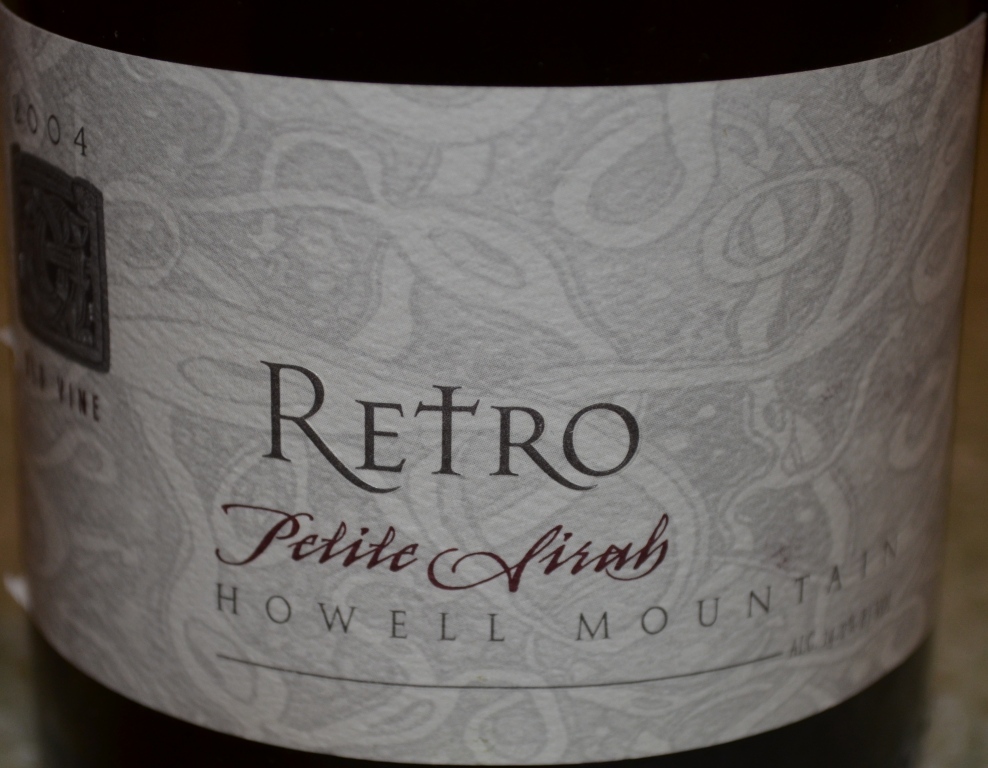 Meritage time!
First, let’s start with the answer for the wine quiz #81, grape trivia – Petite Sirah.
In the quiz, you were supposed to answer 5 questions about a red grape called Petite Sirah. Here are the questions, now with the answers:
Q1: Name the grape: In California, Petite Sirah is a popular blending addition to ___?
A1: Zinfandel. You can find a small percentage of Petite Sirah (5% – 10%) in many Zinfandel bottlings
Q2: When it comes to the wines in the United States, there is an interesting similarity between the Petite Sirah and Primitivo. Can you explain?
A2: The similarity comes from the fact that both Petite Sirah and Primitivo were the part of the same request to the TTB (government organization in charge of labeling), to allow the use of Durif interchangeably with Petite Sirah, and Zinfandel with Primitivo. It is interesting to note that contrary to the information in Wikipedia, which says that both requests were never resolved, it appears that Durif is officially recognized as a synonym to Petite Sirah, while Primitivo and Zinfandel are not – you can find the complete list of the approved names through the link to the list of approved grape names in this US government document.
Q3: Which one doesn’t belong and why:
a. Arizona, b. Illinois, c. New Mexico, d. New York, e. Texas
A3: d. New York – there is no Petite Sirah wines produced in New York (at least in the meaningful quantities).
Q4: In the bad, rainy growing season conditions in California, Petite Sirah can be a savior – can you explain why and how does it help?
A4: As the Petite Sirah is mildew resistant and provides supple tannins, color, and structure, in the bad years it can be added to Cabernet Sauvignon, Merlot, and other wines to improve the quality.
Q5: What love has to do with the Petite Sirah?
A5: “P.S. I Love You” is a consortium dedicated to the promotion of Petite Sirah wines.
Talking about the results, the drunken cyclist continues his winning streak, so he gets ( again) the prize of unlimited bragging rights. Well done!
Now, to the interesting stuff around the vine and the web!
First of all, tomorrow, November 14th, is an International Tempranillo Day! Tempranillo, the noble grape of Spain and Portugal, and the rising star of Texas is a source of many wonderful long-living wines, and it is definitely the grape worth celebrating. TAPAS, the society of producers and advocates of Tempranillo, lists a number of events celebrating the grape. But you don’t even need to go anywhere to celebrate the Tempranillo – just grab a bottle, maybe of Magnificent Rioja (but really, any Tempranillo wine will do), pour, smell, sip and enjoy!
Now, the next Thursday, November 21st, is the third Thursday in November. Do you know what it means? Yes, you are right – Beaujolais Nouveau! Every third Thursday in November, the young Beaujolais wine of the same year’s vintage, called Beaujolais Nouveau, is becoming available in all the wine stores around the world. It is not just the wine – Beaujolais Nouveau also means celebration and fun. Don’t forget to get the bottle and join the festivities!
I’m sure you know that classic Champagne with the yellow label on it – Veuve Cliquot, which would literally translate into a “widow Cliquot”. But do you know the role the Barbe-Nicole Cliquot Ponsardin, the actual person behind that label, played in pretty much enabling the whole Champagne industry to exist, and for the mere mortals to be able to afford a bottle of Champagne? Barbe-Nicole’s perseverance and her invention of the riddling were some of the key elements in making Champagne into what we readily enjoy today. Here is an article for you which is definitely worth reading – it is somewhat long but very fascinating and will be well worth your time. And you might even complement the reading with the glass of Champagne in your hand – it will be very appropriate.
The last piece I want to bring to your attention is Wine Spectator’s Top 100 wines of 2013 list, gradually exposed at the rate of a few wines per day at the Wine Spectator web site. There are various contests taking place right now to predict the Wine Spectator Wine of the Year 2013, including the one which Wine Spectator runs by itself. So far the Wines #10 – #7 had been revealed, and more wines will be announced every day finishing with the Wine of the Year on Friday, November 15th. The full top 100 list will be published on Monday, November 18th. Looking at the 4 of the top 10 announced so far, I can only say that I’m a bit surprised. One of the selection criteria for the Top 10 is affordability – with the wines #10 and #9 priced at $135, and wines #8 and #7 priced at $120, I feel like I missed the memo about a substantial increase in my salary, as those prices are definitely outside of the “affordable” realm, at least in my book. Also, as “availability” is another factor, highly allocated Quilceida Creek (wine #10) makes it also an interesting choice. I plan to come back to this subject next week when the full Top 100 list will be announced – but any of your comments meanwhile will be most welcome.
That’s all I have for you for today, folks. The glass is empty – but the refill is on its way. Until the next time – cheers!
Weekly Wine Quiz #80: Grape Trivia – Mourvèdre, a.k.a Monastrell
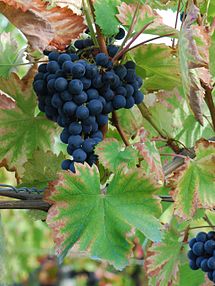
Mourvèdre grapes, as shown in Wikipedia
The Wine Quiz series does not mean to intimidate. The whole idea here is to have fun and learn something new. When answering the questions, it is fully encouraged to use all available sources of information, including Google or any other search engines. There are no embarrassing answers – the most embarrassing thing is not giving it a try…
Welcome to the weekend and your new wine quiz!
We are continuing our grape trivia series, with the focus again on the red grapes, and today’s subject is red grape called Mourvèdre, also known in Spain under the name of Monastrell, and also known as Mataro in Australia.
Mourvèdre is one of the very old grapes. According to the general consensus, Mourvèdre originated in Southern Spain at around 500 BC. From Spain, the grape spread into France, where it became popular in Roussillon region, and then made it into Provence and Rhone. Mourvèdre was brought into US and Australia in the 19th century, but it was used mostly for blending or even bulk juice production for home-made wines. It was not until the late 20th century when the grape started gaining popularity in US and Australia, producing both high end blends as well as single-grape wines.
Mourvèdre requires a warm climate and a substantial amount of sunshine in order to produce ripe, concentrated grapes. In the cooler conditions, the grape will exhibit mostly herbaceous and vegetative flavors, not very suitable for the winemaking. Under the proper growing conditions, Mourvèdre produces grapes with expressive fruit (blackberries, blueberries) and gamy flavors, with medium acidity. Mourvèdre also known for its thick skin, which allows for a good color and tannin extraction. Mourvèdre is used in a production of a single grape red wines (in Bandol, France, and many regions in Spain), as well as in various blends (for instance, it is one of the allowed 18 grapes in Châteauneuf-du-Pape). It is also used in a production of Rosé and sweet wines, and it is allowed to be blended into the Cava, Spanish Sparking wines (to make Cava Rosé).
And now, to the quiz!
Q1: Name two grapes, most famous blending partners of Mourvèdre.
Q2: Wine Spectator calls wines rated in 95-100 range Classic (the highest and the most prestigious category). True or False: there are no Mourvèdre-based wines rated in the Classic category
Q3: Fill in the gaps: The oldest, continuously producing Mourvèdre vine is located at ___ Vineyard in ___, and it is about ___ years old.
Q4: Explain potential origins for all three names of the grape – Mourvèdre, Mataró and Monastrell
Q5: True or False: France plantings of Mourvèdre far exceed the plantings in Spain (no tricks here – Mourvèdre and Monastrell are used interchangeably, you have to assume it is the same grape).
Good luck, enjoy the quiz and your weekend! Cheers!
Weekly Wine Quiz #79: Grape Trivia – Cabernet Franc
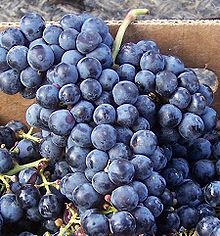
Cabernet Franc grapes, as shown in Wikipedia
The Wine Quiz series is not meant to intimidate. The whole idea here is to have fun and learn something new. When answering the questions, it is fully encouraged to use all available sources of information, including Google or any other search engine. There are no embarrassing answers – the most embarrassing thing is not giving it a try…
Welcome to the weekend and your new wine quiz!
We are continuing our grape trivia series, and we are back to the red grapes. Today’s subject is the red grape called Cabernet Franc.
According to many sources, Cabernet Franc is first appearing in Bordeaux in the 17th century, with a good chance of being around for much longer. From Bordeaux, it made it to Loire valley, where it is often used to produce single-varietal wines. In Bordeaux itself, Cabernet Franc is typically used as part of the blend together with Cabernet Sauvignon, Merlot, Petit Verdot and Malbec. Today Cabernet Franc is spread out all over the world, both used in Bordeaux-style blends (Meritage) and as single varietal bottlings – Australia, New Zealand, Italy, Chile, US, Argentina, Canada are all have a good amount of plantings of Cabernet Franc. In the US, Cabernet Franc is successfully grown all over the country, with some of the best wines coming from California, Washington and New York states.
Cabernet Franc is known to be a parent of Cabernet Sauvignon ( together with Sauvignon Blanc), so the typical flavor profile of Cabernet Franc is somewhat similar to the Cabernet Sauvignon, with black currant, raspberries and green bell peppers flavors being most typical. At the same time, Cabernet Franc wines often have more earthy aromatics and a little bit lighter in the body. Cabernet Franc also buds and ripens at least a week earlier than Cabernet Sauvignon, and it is more resistant to the low freezing temperatures during winter, which allows it to be cultivated successfully in the colder climates.
And now, to the quiz!
Q1: One of the most famous wines in the world has Cabernet Franc as a major (2/3 or so) components of its blend. Do you know what wine is that?
Q2: Cabernet Franc has a special relationship with the frost. Can you explain that?
Q3: Which one doesn’t belong and why:
a. Bourgueil
b. Chinon
c. Saumur-Champigny
d. Saint-Chinian
Q4: This unique grape grows only in one place in the world, and it is a cross between Merlot and Cabernet Franc. Do you know what grape it is?
Q5: In Italy, Cabernet Franc is often confused for another rare Bordeaux grape. Do you know the name of that rare grape?
Good luck, enjoy the quiz and your weekend! Cheers!
Weekly Wine Quiz #78: Grape Trivia – Petit Verdot
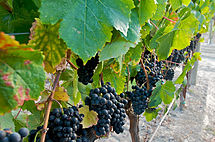
Petit Verdot, as shown in Wikipedia
The Wine Quiz series is not meant to intimidate. The whole idea here is to have fun and learn something new. When answering the questions, it is fully encouraged to use all available sources of information, including Google or any other search engine. There are no embarrassing answers – the most embarrassing thing is not giving it a try…
Welcome to the weekend and your new wine quiz!
We are continuing our grape trivia series, and we are back to the red grapes! Today’s subject is Petit Verdot.
Origins of Petit Verdot are unknown, and according to one of the theories, the grape came to Bordeaux region in France with ancient Romans. Petit Verdot is a very tricky grape in the vineyard – its early budding makes it susceptive to the early spring dangers, such as frost. Its very late ripening puts it in danger of the same frost and some of the diseases, At the same time, small berry with thick skin offers a lot of concentrated tannins and structure when it ripens properly.
This tricky behavior in the vineyard with tendency to underripe, results in Petit Verdot sometimes even not included in the final blend in Bordeaux wines. However, the grape behaves a lot more consistently in the warmer climates. Petit Vedot made it to Australia in 1800s, and it is successfully growing in most of the wine making countries around the world (Spain, Italy, US, Chile, Argentina, New Zealand), producing the best results in the warmer climates. in the US, it is growing in many regions across the country, from New York to Texas to California to Oregon. At its best, Petit Verdot produces dense, powerful, concentrated and age-worthy wines.
And now, to the quiz!
Q1: Explain the meaning of the name Petit Verdot
Q2: Name four grapes, main blending partners of Petit Verdot in France
Q3: True or False: Australia’s plantings of Petit Verdot far exceed the plantings of Petit Verdot in France
Q4: While Petit Verdot is a difficult grape to work with, two events were major contributors to the demise of Petit Verdot in Bordeaux. Can you name those two events?
Q5: While it is not impossible to find a pure 100% Petit Verdot wines made in Bordeaux, those wines are rather the exceptions. What is the typical percentage of Petit Verdot in Bordeaux blends?
Bonus question: what was your personal encounter with Petit Verdot? Do you have any memorable bottles?
Good luck, enjoy the quiz and your weekend! Cheers!
Weekly Wine Quiz #74: Grape Trivia – Trebbiano

Ugni Blanc grapes, as shown in Wikipedia
Welcome to the weekend and your new wine quiz!
We are continuing our grape trivia series, still focusing on the white grapes, and today’s subject is Trebbiano.
Have you had Trebbiano wines? How about Ugni Blanc? Before you answer no, think again. There is a very high degree of probability that you had the wine made either from Trebbiano, a.k.a. Ugni Blanc, or at least with Trebbiano being a part of the blend, as Trebbiano is second most planted grape in the world. Ugni Blanc is the most planted grape in France, spanning from Bordeaux to Provance to Corsica. In Italy, Trebbiano is allowed to be used in more than 80 different DOCs and has 7 DOCs of its own.
The grape’s historical (as well as genetical) roots are still not fully established yet. It seems that the first mentions come from the area of Bologna in Italy in 13th century. In the 14th century, the grape made it to France together with the Papal court, where it became known as Ugni Blanc. Starting from 16th century, the plantings of the Trebbiano increased quite substantially, but the grape practically never made it on its own. Trebbiano’s main characteristics include high acid, low sugar, minimum aromatics and vigorous growth, which are not the star quality when we are talking about the wines. At the same time, these very characteristics make it an excellent foundation for producing all kinds of distilled spirits – this is where majority of the Trebbiano/Ugni Blanc grapes are used today.
And now, to the quiz!
Q1: Ugni Blanc is a main grape in the production of what famous spirit?
Q2: Name the wine, in which Trebbiano was a required part of the blend, and it was considered to be the reason for a bad, flabby quality of that wine (it is no longer required to be used in that wine).
Q3: Trebbiano is often a foundation for the popular food product (containing no alcohol). Do you know what food product it is?
Q4: Contrary to the name, Trebbiano di Lugano is not considered to be a part of the Trebbiano family, but rather related to another Italian grape. Do you know what grape is that?
Q5: When used for the wine production (as opposed to the distilled spirits), Ugni Blanc is rarely used on its own – it is typically a part of the blend. Name 3 grapes, traditional blending partners of Ugni Blanc.
Good luck, enjoy the quiz and your weekend! Cheers!
Weekly Wine Quiz #73: Grape Trivia – Sémillon

Sémillon grapes affected by noble rot, as shown in Wikipedia
Welcome to the weekend and your new wine quiz!
We are continuing our grape trivia series, still focusing on the white grapes, and today’s subject is Sémillon.
Sémillon is a white grape, once considered the most planted grape in the world. One interesting fact is that the origin of Sémillon is not easy to pinpoint – while working on this quiz, I went through quite a few articles on Internet and even books, and it is hard to find any historical data outside of the fact that Sémillon was very popular in the early 19th century throughout the world. In the early 19th century, over the 90% of all grape plantings in South Africa was Sémillon – considering its popularity, it was simply called Wyndruif, the “wine grape”. Today, Sémillon occupies roughly 1% of the grape plantings in South Africa. It is still the most planted white grape in Bordeaux, where it is used in the production of most of the white wines, from dry wines of Pessac-Léognan, Graves and Entre-deux-mers, to the spectacular dessert jewels of Sauternes and Barsac. Sémillon plantings exist in many other winemaking countries – Australia, Chile, Italy, New Zealand, California and Washington in US – but you rarely hear about Sémillon, as it is mostly used as a blending grape. Well, this might be changing – but we will not be talking about it in the quiz.
The issue with Sémillon is that under normal growing conditions, it tends to produce plump and dull wines, the wines which are not showing much of the aromatics and have very low acidity. When the grape is forced to work hard, it can produce amazing wines. In Sauternes, Sémillon is typically affected by Botrytis cinerea, the noble rot, which leads to the shriveling of the grapes which concentrates the sugar – dessert wines produced from such shriveled grapes are some of the best in the world (Châteaud’Yquem, anyone?) – they also make some of the longest living wines in the world, being capable of ageing for 100 years and beyond. In Australia’s Hunter Valley region, the grapes are exposed to the harsh climate with the high level of humidity, which leads to the grapes accumulating high level of acidity. Hunter Valley Sémillon is known to age very well, and the wines also improve with age quite significantly.
And now, to the quiz!
Q1: Name a grape, primary blending partner of Sémillon
Q2: Below is the list of years. There is something common between all of them (and of course it has a relationship with Sémillon) – do you know what is common among those years?
1930, 1952, 1964, 1974, 2012
Q3: Ture or False: Sauternes produces only sweet wines
Q4: Name a key factor for the great tasting dry Sémillon wines
Q5: What is Semageddon?
There is nothing wrong with answering even only one question from the quiz – your participation is always appreciated! Also, without any regard to the questions, please share your personal experiences with Sémillon wines.
Good luck, enjoy the quiz and your weekend! Cheers!
Weekly Wine Quiz … Break!

Grapes!
It is Saturday, the weekend is ahead of us, and it is typically the time for the new wine quiz (I even have a tiny glimpse of selfish hope that may be you even “expected” one). Thereare plenty of grapes we can still talk about in meaningful ways, but for today, I want to take a little break, and just reflect back on our Grape Trivia series run.
Below you will find the list of the grape trivia quizzes included into the series so far. There are links for both quiz and the answer, feel free to play with them any way you want. And as always, any thoughts, comments and suggestions will be most appreciated!
The quizzes will resume next Saturday. Enjoy your weekend and cheers!
Red grapes:
WWQ #53 – Cabernet Sauvignon – Answer
WWQ #55 – Pinot Noir – Answer
WWQ #60 – Sangiovese – Answer
WWQ #61 – Tempranillo – Answer
White grapes:
WWQ #65 – Sauvignon Blanc – Answer
WWQ #66 – Chardonnay – Answer
WWQ #67 – Pinot Gris – Answer
WWQ #68 – Chenin Blanc – Answer
WWQ #70 – Gewurztraminer – Answer
Weekly Wine Quiz #69: Grape Trivia – Viognier
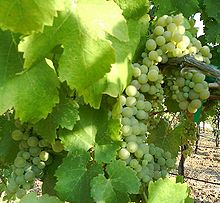
California Viognier grapes, as shown in Wikipedia
Welcome to the weekend and your new wine quiz!
We are continuing our grape trivia series, still focusing on the white grapes, and today’s subject is Viognier.
Talking about turbulent history here. Viognier is one of the oldest known white grapes in the world, with the first mentions attributed to the 280 AD. It is considered that Romans brought it to France from Croatia (of course the region was called differently in those times, but it is still geographically correct). Historically, Viognier wines were mostly made in the Northern Rhone region in France, and they were quite popular in the 1800. However, by the 1965, there were only 8 acres (!) planted in the world, producing minuscule amount of wine.
Viognier‘s renaissance started in 1980s, when the grape was brought into the United States and Australia. From that time on, the interest to the grape increased and even skyrocketed in the 21st century worldwide, with the plantings in France alone increasing 100-fold. Now Viognier is growing in pretty much every major winemaking country in the world, including Spain with some experimental plantings in Rioja area. In the United States alone, the grape is becoming more and more popular, and not only in California, but also in the states such as Texas and Virginia, producing very interesting wines (take a look at my notes from Viognier tasting in Texas).
Viognier at its best produces wines with very perfumy, floral nose, which are firm, structured and full bodied on the palate, with peach and apricot flavors often being most noticeable. The challenge of Viognier lies in the fact that the grape is naturally low in acidity, so if it is not ripen properly, it will produce sweet and not very drinkable plonk. One of the reason for Viognier to do much better nowadays is greatly improved winegrowing and winemaking techniques, which allow to produce great tasting wines more consistently.
And now, to the quiz!
Q1: Viognier stands pretty unique among all white grapes as it is often added or can be added as blending component during the production of the red wines around the world. Do you know the name of the red grape it typically accompanies?
Q2: Name the source of essentially the best and most long-living Viognier wines in the world
Q3: Viognier became so popular in the United States, that one of the states even called it “an official grape of the state”. Do you know which state it is?
a. California
b. New York
c. Texas
d. Virginia
Q4: Wine Spectator calls wines rated in 95-100 range Classic (the highest and the most prestigious category). True or False: there are no Viognier wines with Classic rating
Q5: Based on DNA research, Viognier has an unlikely cousin in Italy, which is not even the white grape, but red. Can you name that “cousin”?
Good luck, enjoy the quiz and your weekend! Cheers!
Weekly Wine Quiz #68: Grape Trivia – Chenin Blanc
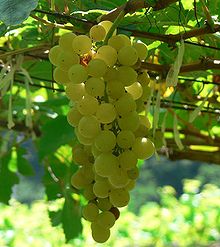
Chenin Blanc grapes, as pictured in Wikipedia
Welcome to the weekend and your new wine quiz!
Today we are continuing our grape trivia with the next white grape – Chenin Blanc. Chenin Blanc is one of the oldest known grapes in the world, with the first mentions tracing back to 9th century in Loire in France. In about 17th century it made it to South Africa, where it became one of the most popular grapes, and it continued spreading around the world. In France, it is mostly growing in the Loire valley, with probably the best wines coming from Anjou and Vouvray regions.
According to wine expert Jancis Robinson, Chenin Blanc is probably one of the most versatile white grapes in the world. It has very high level of natural acidity, and also capable of accumulating very high level of sugars, making it equally suitable for production Sparkling wines and luscious dessert wines. At the time, Chenin Blanc requires a lot of attention in the vineyard, as it has a tendency to overgrow. If harvested too early, its high level of acidity makes the resulting wines simply insipid, and if it overgrows, the resulting wine tends to lose it character making dull and uninteresting wines.
Traditionally, the best Chenin Blanc wines were made in France, with off-dry Vouvray being probably some of the very best examples (if you ever experienced a “wow” Vouvray wine, raise you hand – I personally have, and at about $15/bottle, it doesn’t require you to break the bank). Overall, as winemaking techniques improve all over the world, there are more and more interesting Chenin Blanc wines coming from South Africa, California, Washington, Texas and many other places.
And now, to the quiz!
Q1: True or false: South Africa grows (area -wise) twice as much Chenin Blanc as France
Q2: Do you know how Chenin Blanc is typically called in South Africa?
Q3: Based on DNA research, Chenin Blanc might be a parent of:
a. Pinot Blanc
b. Sauvignon Blanc
c. Marsanne
d. Ugni Blanc (Trebbiano)
Q4: Wine Spectator calls wines rated in 95-100 range Classic (the highest and the most prestigious category). True or False: there are no Chenin Blanc wines with Classic rating.
Q5: One of my all time favorite Chenin Blanc wines is made by the company called Field Recordings in California. It is a single-vineyard wine, coming from the vineyard which has the same name as one of the blockbuster movies of the 90s. Do you know how this vineyard is called?
Side note: Google is your friend. It is impossible to know everything, and when you research, you learn…
Good luck, have fun and cheers!
Last Bottle Sign Up ($10 credit)




 Talk-A-Vino