Archive
Drink Local: Texas, Georgia, Walmart
Whenever I travel, whether for work or leisure, I always love to try local wines – adding an occasional winery visit is a cherry on top, for sure.
Drinking local had been a habit for a long time (here are some posts if you are interested in my past discoveries), and I have to say that more often than not, the curiosity is rewarded handsomely, with tasty, unique and different wine discoveries.
At the end of June, I was in Texas, and of course, I wanted to taste the local wines. I didn’t have time to visit a supermarket, so to my delight, I found a full line of Texas wines at the happy hour at the Residence Inn hotel where I was staying. All the wines where from the winery called Messina Hof, which, according to the website, is a very prolific producer, offering 70 different wines – well, everything is bigger in Texas, right? Here is what I had an opportunity to try:


2017 Messina Hof GSM Texas (14%ABV, 52% Syrah, 35% Mourvedre, 13% Grenache) – earthy aromas, cherries, good acidity, tart blackberries, good structure, excellent overall. 8-
2016 Messina Hof Reflections of Love Private Reserve Texas (13.5% ABV, Merlot based blend?)
Touch of eucalyptus and dark fruit on the nose
Perfectly clean, varietals correct Bordeaux with cassis, well integrated tannins, crisp structure, excellent overall. 8
2016 Messina Hof Pinot Noir Private Reserve Texas (13.5% ABV) cherries on the nose, good cherries and and plums on the palate, well integrated, well balanced, medium plus weight, round, smooth. Not necessarily a traditional Pinot Noir rendition, but well enjoyable. 7+.


The only supermarket I managed to find the time to visit while in Texas was the one at Walmart. There was no Texas wine there (sad, but rather expected), but I couldn’t leave empty-handed, couldn’t I? I settled on two wines, both of which I picked solely on the basis of a cool label (yes, sorry, you can make as much fun of me as you want – I did like that critter label with the duck) and the price. I have to tell you that I actually got lucky, and ended up with two very decent wines:
NV Lucky Duck Shiraz South Eastern Australia (13% ABV, $3.99) – yes, simple, but very clean and nicely balanced. Good but not overbearing amount of red and black fruit, good acidity, warm spices. Medium body. Pleasant and easy to drink, outstanding QPR. 7+
2016 Prophecy Sauvignon Blanc Marlboro (12.5% ABV, $8.99) – unquestionably a New Zealand Sauvignon Blanc, while surprisingly restrained. Fresh, Crisp, cassis undertones, touch of tropical fruit and fresh cut grass, Meyer lemon notes, clean acidity. Excellent QPR. 8-
At the end of July, I had an opportunity to spend a weekend in Atlanta. I didn’t have much time, but still managed to squeeze in a quick visit to the local Total Wines, which, to my delight, carried the selection of the local wines:
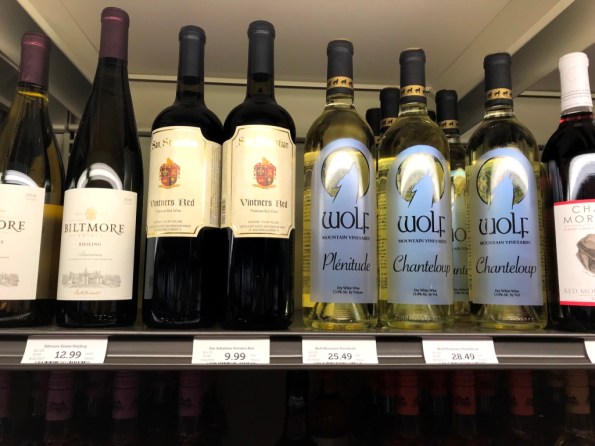

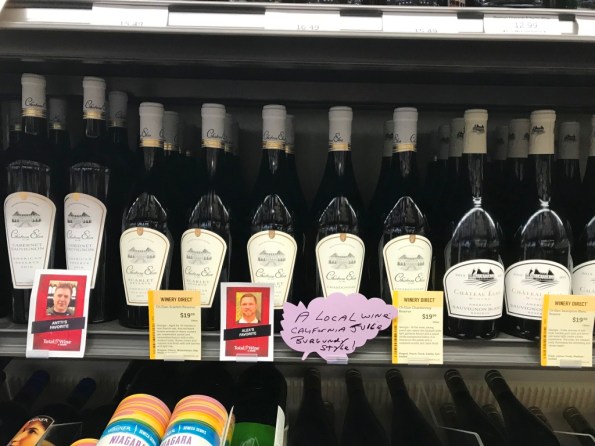
Many of the wines were either fruit wines or pointedly sweet wines, however, I managed to find the Château Élan wines, which promised to be dry, and were priced in the category I consider “reasonable” (at $19.99). Here are the notes for the wines I got:


2015 Château Élan American Sauvignon Blanc Reserve Georgia (13% ABV, $19.99)
Light golden
Touch of gunflint on the nose, herbal profile
Very unique and different on the palate compare to most of the Sauvignon Blanc wines. Green apple, tart lemon acidity, clean, fresh.
8-, more reminiscent of Chardonnay than Sauvignon Blanc – well drinkable and delicious overall.
2016 Château Élan American Cabernet Sauvignon Reserve Georgia (14.5% ABV, $19.99)
Dark garnet, almost black
Classic Cabernet all around – nose is open and inviting, with a touch of casis and mint
same on the palate – dark fruit, cassis, fresh cherries, medium+ body, soft tannins, good acidity and overall good balance.
8-, very quaffable
I wish I had an extra few hours to visit the winery, which I understand is located about an hour away from Atlanta, but this will have to wait until the next visit. In any case, I get to update my “wines of 50 United States” page with one more check-mark :).
That’s all I have for you, my friends. Any local discoveries you want to share? Cheers!
Drink Local, North Carolina Edition – Chatham Hill Winery
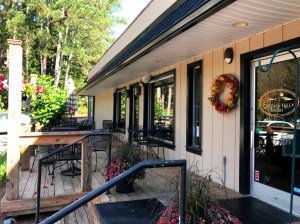 Once again, I was on the road. And as you know, if I have the slightest chance, I will look for the local wine. If I can also throw in a winery visit – that becomes a double pleasure.
In these terms, this time around, it was exactly a double pleasure. While visiting Raleigh in North Carolina I managed to squeeze in a short visit to the North Carolina winery call Chatham Hill, located in the town of Cary (about 20 minutes from Raleigh-Durham airport).
I had an opportunity to try North Carolina wines for the first time a few years ago while connecting through the Charlotte airport. I had favorable impressions after the first experience, thus was definitely looking forward to the opportunity to expand my “wine map” of the 50 United States.
The Chatham Hill Winery was founded in 1998. When Chatham Hill Winery opened, it was the 14th winery in the state of North Carolina – today, there are more than 185 wineries and 525 vineyards there. Chatham Hill was also the first urban winery in the North Carolina – they don’t own any vineyards. The absolute majority of the wines at Chatham Hill are made either from the North Carolina grapes, coming primarily from the Yadkin Valley AVA, or from the grapes shipped from California (Lodi).


Chatham Hill winery produces a good number of different wines, both dry and sweet, with the total production of about 5,000 cases per year. With this production, it is considered a “medium size” winery by the North Carolina standards. I tasted through many wines the winery offers, but took rather scarce notes, so for what it worth, here is a roundup:
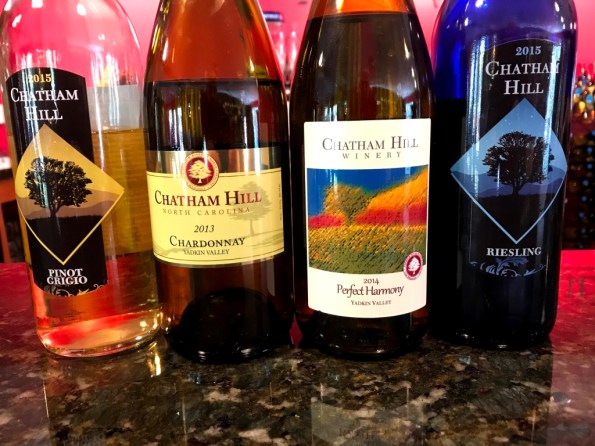
2013 Chatham Hill Winery Chardonnay Yadkin Valley North Carolina ($18) – a bit unusual, big body, good balance, nice overall
2015 Chatham Hill Winery Riesling Lodi California ($16) – not a traditional style, doesn’t speak Riesling to me, but still quite drinkable
2014 Chatham Hill Winery Perfect Harmony Yadkin Valley North Carolina ($25, unoaked, 70% Chardonnay, 30% Viognier) – dry, playful, tropical fruit notes
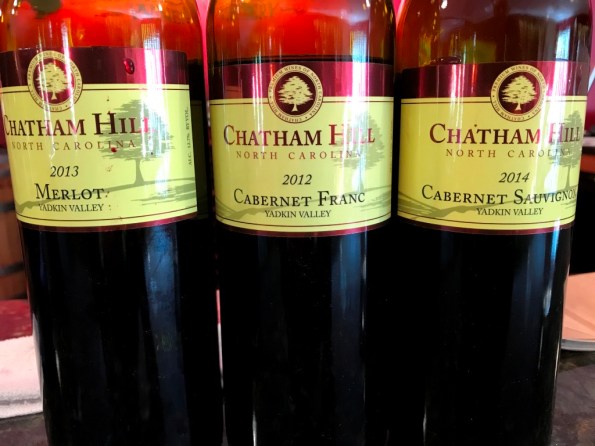
2012 Chatham Hill Winery Cabernet Franc Yadkin Valley North Carolina ($20) – soft, round, very pleasant
2014 Chatham Hill Winery Cabernet Sauvignon Yadkin Valley North Carolina ($20) – beautiful, smooth, blackcurrant on the nose and the palate, layered, great extraction, excellent wine overall and lots of wine for the money. Clearly my favorite wine from the tasting.
2013 Chatham Hill Winery Merlot Yadkin Valley North Carolina ($16) – excellent balance of fruit and acidity, dark fruit on the palate, very good overall


2015 Chatham Hill Winery Malbec ($18) – a bit sweeter than previous few wines, but refreshingly light for the Malbec and very pleasant overall.
2015 Chatham Hill Winery Petite Sirah ($22) – good fruit, good acidity
Chatham Hill Winery Muscadine Yadkin Valley North Carolina (11.5% ABV, $15) – Not sure what the vintage was, the wine was just released and not available yet for the public – raisins and dry fruit medley on the nose, touch of Isabella grapey profile on palate, clean acidity – very nice effort
I find trying local wines to be truly a humbling experience, always bringing out great surprises – that Cabernet Sauvignon was just a pure, varietally correct, stand out – would happily drink it again in a heartbeat.
The wine is simply an expression of passion and art, and there are truly no limits to the creativity and obsession wine lovers share, anywhere you go. Drink local, my friends!
Drink Local, Colorado Edition (and Don’t Lose Hope)
I’m an eternal optimist. Even when I’m worrying about something, deep inside, I still believe that everything will be okay – one way or the other (sometimes we really have to look for this “okay”, but this is a subject for the whole other post).
This “life’s attitude”, of course, reflects on my approach to wines. Particularly, a belief that in today’s world, good wines can be made everywhere and anywhere – not only in a few places we know can produce the good wines. And anywhere I travel, I’m always looking to prove myself right – which I call “drink local”.
This time, my travel took me to Denver, Colorado. Colorado sounds as good as any other state in the US to be able to produce wines, so once I situated at my hotel in downtown of Denver, off I went to the closest liquor store in Denver.
While walking to the store, literally few steps before it, I saw a sign for the “Wild Women Winery” – I couldn’t even believe my luck, to find a city winery short walking distance from the hotel, also with a very cool sounding name. So I walked in and situated at a bar table, looking at the bottles with super-creative, super-colorful labels.
Talking to the bartender, I learned that while the winery is located in the Colorado (downtown Denver, to be precise), they make wines from the grape juice which they get from California Central Valley, as the winemaker believes that local Colorado grapes are too young to produce a good wine. Fine – the proof is always in the glass, right?
I decided to try 3 wines for $5 (happened to be an extremely wise decision, as opposed to trying 7 for $10, you will understand why in a minute).


The first wine was Viognier – a touch of overripe Apple with sage on the nose. Good fruity palate nice acidity, golden delicious apples. Not my favorite, but not bad. Not amazing, but drinkable.
My next choice was Cab/Merlot blend and that wine really threw me off – too sweet all around, no balance, no acidity, just a sweet fruit. Don’t remember when was the last time I disliked the wine so intently.
At that point I realized that all of the wines the winery offers are non-vintage wines, so I tried to discuss it with the bartender, but unfortunately, she didn’t know what “vintage” means, and I had to face the issue that certain basic concepts we, oenophiles, take for granted, are not so easy to explain in the simple terms. Nevermind.
The last wine, Petite Sirah, had a sweet chocolate nose, bitter-sweet type. Sweet fruit compote on the palate, definitely too sweet, but more acidity than the previous wine. Mostly plum notes with the equivalent acidity of just ripe, but not overripe plum. A marginal improvement.
This visit really left me at the feeling of deep disconcert – I see a lot of passion on the labels, but the soulless concoctions inside the bottles were really conflicting with the bright images.
I gladly left the winery and headed over to the liquor store. Here I had another surprise – a sticker shock. I understand that the wine store is located in the downtown of Denver. But Colorado wines aren’t that well-known, aren’t they? There was a good selection of the local Colorado wines present, none of them cheaper than $20 (okay, $19.99 if it makes you feel any better). Really? On my recent trip to Canada, I had a phenomenal selection of tasty wines under $15. Now, especially after the first tasting fiasco, I had to spend $20+ for a bottle which I might just have to pour down the drain?


After going back and forth and trying (unsuccessfully) to obtain an advice of the store clerk (”I tasted only this one wine”, “yeah, yeah”, “huh, you don’t like sweet wines? Really?”), I settled on the bottle which looked the most Colorado-authentic while still staying in the low $20s- Two Rivers Syrah – at least the information on the back label suggested that the grapes were harvested in Colorado.


The wine was definitely an upgrade over the previous experience, but still no cigars. As this was nevertheless a better wine, here are my typical-style notes:
2015 Two Rivers Château Deux Fleuves Vineyards Syrah Mesa County, Colorado (14.1% ABV, $22.95)
C: dark garnet, nice visible legs
N: blackberries, tar, tobacco, sage, medium to high intensity
P: sweet berries, tobacco, good acidity
V: 7-, it is drinkable, but sweetness too prevalent.
7 on my the second day – sweetness subsided a bit, and roasted meat notes showed up. Still, the finish is mostly sweet fruit with a touch of tobacco.
On the last day before leaving Denver, I still had a bit of the free time and decided to give Colorado wines one more try. I found another wine store, still within short walking distance from the hotel, with good reviews on Google, and took 20 minutes walk. This store had a much smaller selection of Colorado wines, but a little bit better prices (by a few dollars, nothing major), and incomparably better, knowledgeable service. I left with the bottle of The Infinite Monkey Theorem Cabernet Franc – The Infinite Monkey Theorem is another city winery – but unlike Wile Women Winery, this one I would be happy to visit if I had more time.


Remember I told you about eternal optimism? It finally worked, as this Cabernet Franc was well worth of writing home about:
2015 The Infinite Monkey Theorem Cabernet Franc, Colorado (12.9% ABV, $21)
C: dark ruby
N: tobacco, sweet bell peppers, freshly crushed blackberries
P: bright, fresh, freshly crushed berries, intense sweet tobacco, a touch of pepper, clean acidity, vibrant.
V: 8, outstanding. Would gladly drink that every day.
There you have it, my friends – my first real encounter with Colorado wines. I was happy to prove myself right and find a good wine made in Colorado. As a collector of experiences, I was also happy to add another checkmark to the list of states I tried the wines from – if you are like me, feel free to compare your records 🙂 Have you had the wines from Colorado? Express yourself in the comments section below. Cheers!
Pleasures of Drinking Local
I love travel -seeing the world, different cultures, different people, different traditions, and, of course, different food and drinks. Food is given, as we all have to eat, so one way or the other we get to experience local cuisine. But then what I drink is also very important to me, with the same spirit of exploration.
I love drinking local. And, of course, when I say “drinking”, I primarily mean wine. When travel, I always make an effort to find and try local wines. Unknown and obscure? Perfect – the less I know about the wine, the more pleasure it brings. Drinking local wines doesn’t mean I have to visit the wineries. More often than not, my trips don’t include any spare time and any facilities to reach the wineries. But – in many places, and I would even say, in increasingly more places, you can still find local wine at local shops, as long as you willing to look for it.
It is, of course, the best when you are visiting places where the wine is part of the culture, like most countries in Europe (sorry, never been to Latin America or Australia, but somehow I think I would do fine there as well). If the wine is a part of the culture and tradition, it almost guarantees you authentic wine experiences – and what is very important – without breaking the bank. In the USA, for instance, the wine is still a part of the fashion and not part of the tradition, thus in USA, finding reasonably priced wines is extremely difficult, and finding locally produced and reasonably priced wines is simply a mission impossible. Wait, I didn’t mean for this post to be a rant, so let me get back on track.
This time around, my travel took me to Prague, the capital of the Czech Republic. I’m sure for many (most?) of people, as soon as they will hear “Czech Republic”, the very next image of the local drink is – of course – a beer. This makes perfect sense, as Czechs are internationally known for their beer, same as Germany or Belgium, and rightfully so. But – what most of the people don’t know is that Czechs also had been making wines almost forever – okay, starting from approximately the 2nd century – long enough? Czech wine never made it to the levels of fame of French or Italian wines – but that doesn’t decrease the pleasure of drinking Czech wines in any way.
I discovered Czech wines for myself last year, when I had delicious Pinot Noir and Pinot Gris ( you can read about it here). Thus I had no doubts that Czech wine is something I’m going to look for upon arrival.
The hotel I’m staying at is adjacent to the shopping mall, which includes a supermarket, a wine store and some other food stores, all of them selling wines. And mind you – at the prices which make you smile from ear to ear. So far I got the wines from the supermarket, and you will see the prices I paid in the descriptions of the wines, as usual.
I had an easy criterion for selecting the wines. Price – of course, but there was another important requirement – new grapes. As you can see the grape count in the right column of my blog page, I continue my grape journey, so I’m always on the lookout for the additions to the list. Of course, it is usually not that easy – the name of the grape in the local language might sound new and unique – but once you do the research, you can easily find out that there is nothing new about that grape. For instance, take a look at Rulandské modré – sounds unique, right? Meanwhile, it is only a local name for Pinot Noir. Or Rulandské šedé – must be something indigenous, right? Nope, it is simply the Pinot Gris.
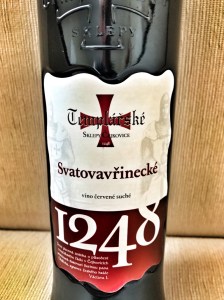
Obviously, that didn’t stop me. I found two new white grapes, and for the red, the name looked so cool (Svatovavřinecké) that I had to get it, despite the fact that this was the local name for the St. Laurent grape – well, how often do you drink St. Laurent wines anyway?
I started with the red wine, as whites needed some chilling – and 2015 Templářské Sklepy Svatovavřinecké Morava Czech Republic (11.5% ABV, 119 Kč ~ $5, 100% St. Laurent) didn’t disappoint – light garnet color. Pleasant nose with touch of spices, sage, lavender, tobacco, hint of blueberries. Fresh fruit on the palate, tobacco, pepper, medium body, mouth-watering acidity, light, pleasant. Drinkability: 8-/8, a proof that delicious wine doesn’t have to be a fruit or tannin bomb.
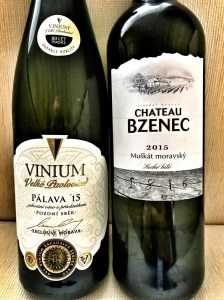
The whites where new, unique and different. One was made out of the grape called Muškat moravsky, which is a cross between Muscat Ottonel and Prachtraube. The other grape was called Pálava, and it was a cross between Müller Thurgau and Gewürztraminer, first selected in 1953. I’m always a bit concerned with the new white wines (many things can go wrong), but this two were simply a stand out. I guess I was simply lucky. Or may be my palate is cursed. Of well. Here are the notes for the white wines:
2015 Chateau Bzenec Muškat moravsky Morava Czech Republic (11.5% ABV, 119 Kč ~ $5)
Straw pale color. Perfumy nose, reminiscent of Gewurtztraminer but of a lesser intensity, white peaches, lemon undertones, touch of minerality. Delicious on the palate – succulent fresh whitestone fruit with practically no sweetness, ripe green apple and touch of lemon. Clean, balanced, fresh, excellent acidity. Medium-short finish, pleasure to drink. Very impressive. Drinkability: 8/8+
2015 Vinium Velké Pavlovice Pálava Pozdní Sber Morava Czech Republic (12% ABV, 239 Kč ~ $10)
Light golden color. Very pleasant nose, perfumy, touch of honey, tropical fruit (guava, pineapple), medium intensity. Delicious lip smacking palate – crisp acidity, medium to full body, wine is nicely present, mouth coating, acidity keeps lingering with tart apples underpinning, then some ripe apples showing with addition of white plums. Another excellent wine. Unique and different, perfectly enjoyable on its own, but will play very nicely with the food. Drinkability: 8/8+, outstanding.
That’s all I have for you, my friends. When travel, take risk, drink local – your reward will be new experience and lots and lots of pleasure. And if you will not like it – the experience will still be with you. Cheers!
Last Bottle Sign Up ($10 credit)




 Talk-A-Vino