Thanksgiving Wine Pairings
 As promised, this is follow up post to compare Thanksgiving expectations with experiences.
When it comes to the food, the star of our table was dish called Turducken. First time I read about turducken in the late nineties in the Wall Street Journal. Since then we made it a few times for Thanksgiving. The dish is somewhat labor-intense, but absolutely delicious when done right. The word turducken comes from the fact that the dish consists of partially deboned turkey, with fully deboned duck going inside of turkey, and then deboned chicken going inside of a duck. The idea of enclosing birds into each other during cooking is not new, it had being done in Europe for centuries. Turducken specifically is considered to be originated in New Orleans – and one of most popular cooking styles for it is Cajun.
The process of preparation starts from deboning of chicken, duck and then turkey (turkey is only partially deboned with legs and wings left untouched). Next very important step is brining. As critical as it is for smoking, brining helps to retain the moisture in the meat during long cooking time. Brining typically takes 12 hours, so you need to plan your time accordingly.
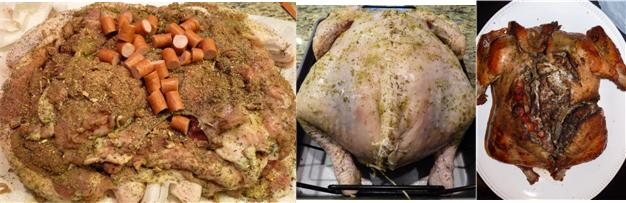
After brining, the process of preparation starts from laying down the turkey, adding spices (or stuffing) on top, then putting in the duck, repeat spices again and then chicken, plus you can put any desired stuffing as the last layer (we used smoked sausages in our case). The next step is to sew the turkey together and place it in the oven for about 5 – 6 hours. The resulting bird is very moist and flavorful, and – may I add – very easy to carve.
So what about wine? Turducken and all the side dishes, such as yams, pumpkin and wild rice stuffing, are very flavorful, so it is hard to tell apriori which wine will work the best – therefore it is an opportunity to experiment. We tried Joseph Drouhin Beaujolais Nouveau – this wine was completely lost next to turducken. Next one was Claraval, Spanish Grenache/Tempranillo blend – this wine well complemented the variety of flavors.
 The winner was Serradenari Barolo 2005. It was decanted for 3 hours prior to the dinner (as always suggested for classic Barolos), and the wine showed beautiful layers of fruit and earth, which worked very well with turducken and other dishes at the table.
Of course we shouldn’t forget about desert. No, there was no pumpkin pie at the table. Yes, it is violation of the tradition, but when nobody likes the dish, it is hard to justify getting it on the table. Instead, Pecan pie is one of traditional staples of the sweet portion of our Thanksgiving dinners:
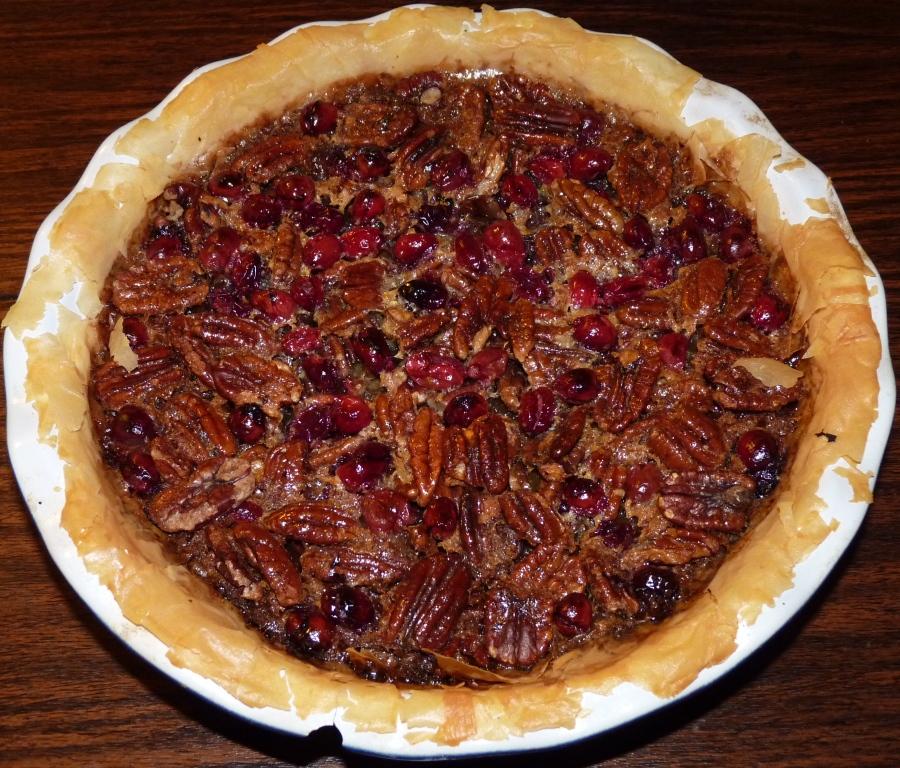 You are saying that coffee or tea would be the best match for such a dish? You are right, however, there are some exceptions here. We were lucky to have Rivesaltes 1936,
 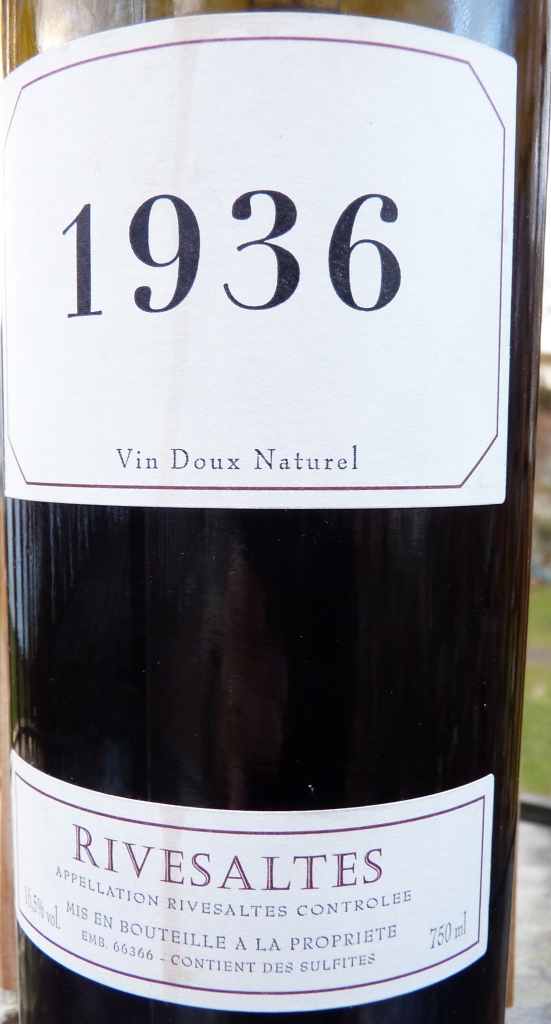 a desert wine produced in Roussillon region in South of France (courtesy of my friend Zak). This is a natural sweet wine, made out of Grenache grape and produced in the same style since 13th century. This wine has luscious layers of nuts, honey, cloves and other spices, without overpowering sweetness of many of the ice wines. It drinks as a very light wine (despite high alcohol content) and perfectly complements many different deserts.
So, I told you what was on our Thanksgiving table. Now, I would love to know what was your most memorable dish and wine?
Expectations: Thanksgiving Dinner
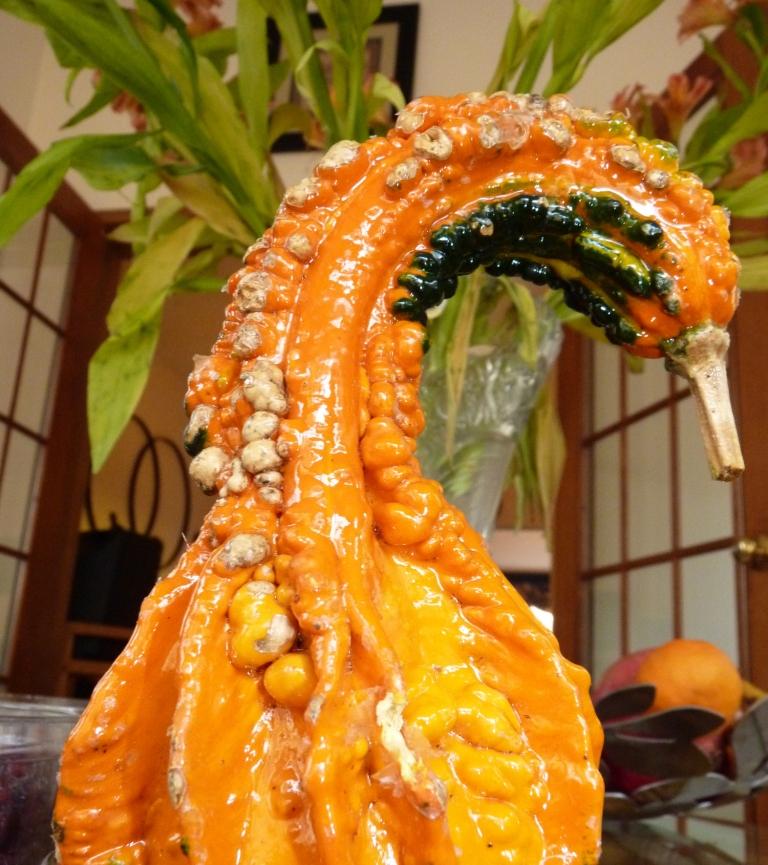 Thanksgiving day – friends, family, lots of food and wines. Culinary delight is definite part of the holiday – every possible ( and impossible) web site is full of new recipes to try and recommendations on what to serve.
I would love to write the blog post right after the dinner – but this would be literally impossible, as desire to sleep after a big meal will interfere. Therefore, let me just share my quick expectations. The staple dish for tonight is turducken – chicken inside duck inside turkey, all de-boned, of course, except turkey legs and wings. That is already in the oven and holds a big promise of the tasty meal ( pictures and details – in the later posts). There will be a lot more of traditional fall flavors – squash, pumpkin, sweet potatoes – all taking part in the feast.
Variety of flavors is expected of the food, and it is hard to tell which wine will work the best. Therefore, when in doubt – experiment! We plan to have Beaujolais Nouveau ( Joseph Drouhin), Barolo, Zinfandel and Claraval (Spanish red). Which one will pair the best? Hopefully one of the wines on the table. And if not – wine program for tonight also includes Rivesaltes 1936 and Bruichladdich 12 – expectations, expectations…
What will be on your table tonight?
Until later – Happy Thanksgiving!
Wine Till Sold Out (WTSO) – Value Wines At Your Doorstep
 I’m sure you saw in my prior posts mention of QPR – Quality Price Ratio. I like wine in general – but being able to achieve high QPR makes it even more enjoyable. One of the best ways to reach high QPR is to buy wine online. Wine-searcher is the best tool I know to find the wine online, but when it comes to buying wine it is hard to beat Wine Till Sold Out, or WTSO (you can now find them also on Facebook). What I like about WTSO is price (of course), simplicity, reliability and service. They do respond to your e-mails, and answer your questions! The reason I emphasize that is because when you deal with “value” businesses, often you have to give up on some of the elements, like service, for instance – and WTSO is pleasantly different. Information on the web site is simple, easy to understand and comprehensive, and wines are available on, well, first come first serve basis – yep, I missed a few wines are dearly regretted.
Just to give you an idea of what WTSO can bring you, I decided to collect the e-mail notification during one week (week of November 15th), so here is the information in the form of the table:
| Date | Time | Wine Name | Rating(s) | Original Price | WTSO Price | Min # ofBottles | % off |
| Nov 15 | 12:02a | Andre Farjon La Deveze Cotes du Rhone 2007 | $19.99 | $11.99 | 4 | 40% | |
| Nov 15 | 12:50p | Charles Heidsieck Brut Champagne Reserve Rose NV | WS93, WE92 | $79.99 | $49.99 | 2 | 38% |
| Nov 15 | 3:01p | Bodega LuzDivina Amigo Baloiro Beirzo Mencia 2005 | RP 91, W&S90 | $30.00 | $13.99 | 4 | 53% |
| Nov 15 | 4:19p | Miguel Torres ‘Salmos’ Priorat Red 2007 | W&S91,WS90 | $39.99 | $23.39 | 3 | 42% |
| Nov 15 | 7:33p | Juslyn Vineyards Vineyard Select Napa Valley Cabernet Sauvignon 2003 |
RP91 | $84.99 | $49.99 | 1 | 41% |
| Nov 16 | 12:02a | Champagne Charles Ellner Cuvee De Reserve Brut NV |
WS90 | $49.99 | $29.99 | 3 | 40% |
| Nov 16 | 11:49a | Reserve du Chateau Croix Mouton Bordeaux Superieur 2009 by Michel Rolland and Jean-Philippe Janoueix | $23.99 | $12.99 | 4 | 46% | |
| Nov 16 | 4:18p | Robert Storey Cellars Napa Valley Pinot Noir 2007 by Bill Knuttel | JHN92 | $31.99 | $17.99 | 4 | 44% |
| Nov 16 | 8:47p | Soos Creek Wine Cellars Artist Series #7 Columbia Valley Red Wine 2007 |
ST89, RP90 | $35.99 | $17.99 | 4 | 50% |
| Nov 17 | 12:01a | Il Palazzone Brunello di Montalcino 2003 | RP90 | $90.00 | $39.99 | 2 | 56% |
| Nov 17 | 12:00p | Valsanzo Vina Sanzo Reuda Verdejo 2009 | RP89 | $19.99 | $10.99 | 4 | 45% |
| Nov 17 | 3:31p | Flora Springs Winery & Vineyards Trilogy Napa Valley Red Wine 2006 |
RP90,JHN92 | $65.00 | $32.49 | 3 | 50% |
| Nov 17 | 9:32p | St. Supery Vineyards & Winery Elu Napa Valley Red Wine 2003 3.0L Double Magnum | W&S90,WRO92 | $350.00 | $159.99 | 1 | 54% |
| Nov 18 | 12:03a | Coelho Winery Paciencia Willamette Valley Pinot Noir 2007 |
WS89 | $35.99 | $14.99 | 4 | 58% |
| Nov 18 | 10:55a | Bodegas Y Vinedos Recoletas Vendimia Seleccionada 2004 | RP90 | $40.00 | $19.99 | 4 | 50% |
| Nov 18 | 1:34p | Feudi di San Gregorio Serpico Irpinia Rosso IGT 2003 |
WRO92,TWN92, RP92+ | $80 | $37.99 | 3 | 53% |
| Nov 18 | 6:03p | I Greppi Greppicante Bolgheri, DOC 2007 | WS92,RP90 | $29.99 | $19.99 | 4 | 33% |
| Nov 19 | 12:01a | Tom Eddy Napa Valley Cabernet Sauvignon 2005 | JHN94 | $90.00 | $39.99 | 2 | 56% |
| Nov 19 | 1:03p | Benessere Vineyards Napa Valley Estate Sangiovese 2006 | JHN90+ | $45.00 | $15.99 | 4 | 64% |
| Nov 19 | 4:01p | Gonfrier Freres Chateau de Lyde Cadillac Cotes de Bordeaux 2009 | $17.99 | $10.99 | 4 | 39% | |
| Nov 19 | 8:02p | Portal del Montsant Santbru 2007 | RP93 | $47.99 | $23.00 | 2 | 50% |
| Nov 20 | 12:02a | Maroon Winery Spring Mountain District, Napa Valley Cabernet Sauvignon 2007 |
$45.00 | $19.99 | 2 | 56% | |
| Nov 20 | 8:42a | Warwick Estate Professor Black Stellenbosch Sauvignon Blanc 2009 |
WS90 | $12.49 | $12.49 | 4 | 50% |
| Nov 20 | 1:07p | Altesino Brunello di Montalcino Montosoli DOCG 2003 | RP91, WS90 | $149.99 | $59.99 | 2 | 60% |
| Nov 20 | 5:05p | Chateau Bizard Serre de Courrent Cotes du Rhone 2007 | $34.99 | $19.99 | 4 | 43% | |
| Nov 20 | 6:55p | Saintsbury Lee Vineyard Carneros Pinot Noir 2007 | WS93 | $49.99 | $29.99 | 4 | 40% |
| Nov 21 | 12:03a | Feudi di San Gregorio Serpico Irpinia Rosso IGT 2001 |
WS94, RP92+ | $100.00 | $49.99 | 2 | 50% |
| Nov 21 | 11:35a | Domaine Fond Croze Cuvee Romanaise Cotes du Rhone 2007 | RP91 | $18.99 | $12.99 | 4 | 32% |
| Nov 21 | 12:47p | Casali di Bibbiano Argante Toscana Red Blend 2006 | WS91 | $44.99 | $18.99 | 3 | 58% |
| Nov 21 | 4:03p | St. Supery Vineyards & Winery Elu Napa Valley Meritage 2004 | TWN92 | $64.99 | $34.99 | 3 | 46% |
| Nov 21 | 5:50p | Domaine Drouhin Arthur Dundee Hills Willamette Valley Chardonnay 2007 | IWR91, WS91, ST90 | $55.00 | $19.99 | 3 | 64% |
To give you an idea about ratings: WS stands for Wine Spectator, RP = Robert Parker, WE = Wine Enthusiast, ST – Stephen Tanzer, WRO = Wine Review Online, TWN = The Wine News, JHN = Jonathan H. Newman. Min # of bottles column specifies minimum number of bottles to buy to get free shipping, which I never saw exceeding 4. Time column specifies the exact time when WTSO e-mail arrived to my mail box.
If you will scroll through the table, you will see that during one week, 31 different wines from California, Oregon, France, Spain, Italy and South Africa had being offered. The discounts ranged from 32% to the 64%, and wine ratings had being the range of 89 – 94.
Is WTSO The place to get all your wines? Of course not – you can’t beat good wine store, such as Cost Less Wines I talked about before. However, combination of QPR and good service definitely should put WTSO on your short list of places to buy the wine from. Happy hunting!
Looking Back … And Looking Forward
 Last Thursday, November 20th, was exactly 4 month as I started writing this blog. Four month sounds round enough to take a look back – of course, of course, this is too short of time to make any conclusions, however, when in the journey, knowing where you are can help you understand where are you going and how can you get there. Let’s talk some numbers first – and not because they mean something, but because they are simply available, and we, humans, like to play with them.
So the blog stats for 4 month include 52 posts, 1975 views, 98 comments and 15 e-mail subscribers. Is that good? I don’t know. Is that bad? I don’t know either. These are just numbers as they are. Well, I think I like 52 posts – it translates into 13 per month, which then translates into about 3 per week. There are also some other numbers which I want to mention – the “treble journey“. In my quest to try wines made out of 300 different grapes (this is where “treble” is coming from), I was at 240 four month ago, and now I’m at 277 – 37 grapes were added. Considering the challenges of finding wines made out of obscure grapes, I think this is very decent performance. I also will add 15 more in the near future, which will put 300 within practical reach – yes, it will be all covered in this blog.
During this 4 month, I learned a lot. I learned how to find new subjects, how to use keywords. I didn’t learn how to use categories – I hope this will come one day. I found some themes which will definitely continue here, like Experiences and Expectations. I think I had some good posts, and some which are just okay. Did I have any bad ones? Quite possible, but I will let you, my readers, to be the judge.
What I definitely want to have more of is interaction. I want my posts to be a catalyst for the conversation. I would love for this blog to be the place to exchange experiences – and I will get there, sooner or later.
What is ahead? I didn’t know I’m asking myself a difficult question. I don’t want to convert this post into a to do list. Therefore – I can only say that I will continue to look for my true style, and you should expect more posts about wine, food and life.
Experiencing Judgment of Paris, Courtesy of Stew Leonard’s Wines
 And again I have to thank folks at Stew Leonard’s Wines for putting together an interesting wine tasting event. This time we had an opportunity to relive legendary Judgment of Paris of 1976, a wine tasting event which put American wines on international wine map.
In 1976, a blind wine tasting took place in Paris. In that event, wines from Napa valley in California were put against classic French wines – and Californian wines won over French hands down, all in the event judged by the French wine critics and such, which became a turning moment for the whole American wine industry.
I have to mention that I just realized something: while I know some of the Napa wines presented at this Paris event, I have no idea what French wines they were competing against. Nevertheless, let’s talk about the wines presented at the tasting.
Starting with the white wines, there was Chateau Montelena Chardonnay from Napa valley, positioned against Michel Lelu Pouilly Fuisse from Burgundy. Chateau Montelena was one of the actual winners in the Judgment of Paris event (great story of Chateau Montelena is presented in the movie Bottle Shock). I don’t know if this Poilly Fuisse wine participated in the 1976 competition, but Chateau Montelena Chardonnay just beat it completely. The Pouilly Fuisse didn’t have much of anything going ( it belonged to the “also wine” category), where Chateau Montelena showed nice fruit and just right amount of oak, vanilla and butter – delicious!
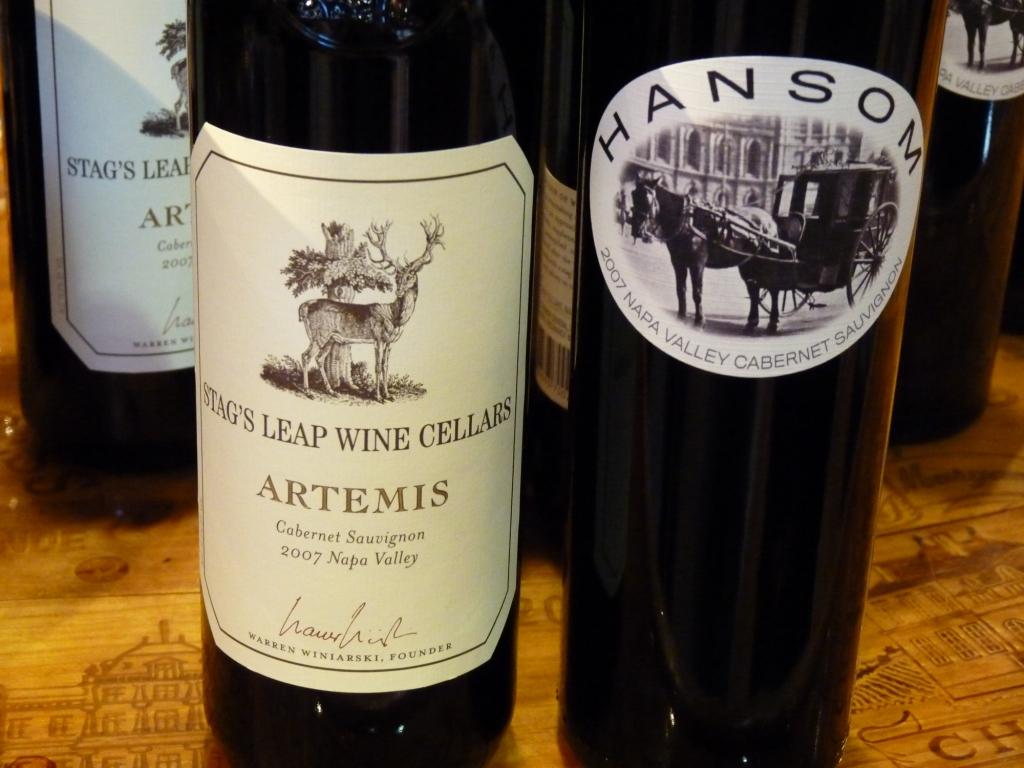 Talking about red wines, the Stag’s Leap Artemis was also one of the original participants in the 1976 Judgment event. In the Paris tasting, it was competing against the Bordeaux. During the tasting at Stew Leonard’s Wines, it was “competing” with another Napa red, called Hansom. Both reds are from the great 2007 vintage and need more time to fully develop. Hansom, which is 100% Cabernet Sauvignon, was a bit “overdone” to my taste, and it had noticeable “burnt fruit” on the palate – this is my personal terminology, which means that fruit and alcohol are not in harmonious balance with tannins and acidity. Artemis, which is predominantly Cabernet Sauvignon with small addition of Merlot and Petit Verdot, was very elegant and round, and the only thing it is asking for … is more time. It probably needs another 5-7 years to achieve true greatness. I assume that you can guess form this description that Artemis was my absolute favorite in this tasting.
In addition to tasting these four wines, I was able to try one more “off the record” wine, courtesy of Larry, who was manning the tasting station. I call it “off the record” because the wine was not the part of the tasting, but it simply happened to be open, and Larry was kind enough to give us a taste. The wine was called Block 2 Cabernet Sauvignon 2008 from Horse Heaven Hills area in Washington. To describe it quickly I would say that it was similar to Hansom in style, only done right – fruit forward but well balanced with enough acidity and tannins to make it a very pleasant wine (at $19.99 it is also a good value).
To conclude, I can only again say thank you to the Stew Leonard’s Wines folks, for putting together one great wine tasting after another. And they have done it again, by the way – it is Dom Perignon weekend at Stew Leonard’s Wines – don’t miss it!
Beaujolais Nouveau 2010 – Live Blog
 What’s up with the “live blog”? No, I don’t plan to show the live recording in the Gary V. style (for those unfamiliar with Gary V. – please go to the Wine Library TV site, I promise you will enjoy it). For all of my posts so far, I don’t write them at the same time as I taste the wine or visiting the restaurant. Yes, I might take some notes, but all of the writing is still done later on, mostly based on the memory (yes, I make an effort to memorize the experience).
However, today is a special day for many wine lovers across the globe. In the 1970s, the tradition started in France, in the appellation called Beaujolais, to celebrate the first wine produced from the harvest of the same year. What was the French national event in the 1970s, now became a worldwide celebration, which always takes place on the third Thursday in November, and today is the day.
Beaujolais red wines are made from the grape called Gamay, and the wines are produced in the style of the neighboring Burgundy (which are made from Pinot Noir), but typically are lighter and don’t age that well.
When it comes to the Beaujolais Nouveau, this wine is made in 6 weeks after the harvest, so it is really light and fruity wine which is not supposed to age (should be consumed by May of the following year). Also, similar to the Pinot Noir wines, Beaujolais wines should be served slightly chilled (about 55F).
Therefore, considering such a special day, I’m writing this blog as I actually try the wines, starting with the opening of the bottles – and this is why I called this blog “live”. I can also tell you that last year, even before I tried the wines from 2009, I read somewhere that they supposed to be very good wines, so I was already influenced as I was trying the wines (read my previous post if you are curious why is that). This year, I have no expectations whatsoever, except the knowledge that these are young wines and they will taste accordingly to the very young age.
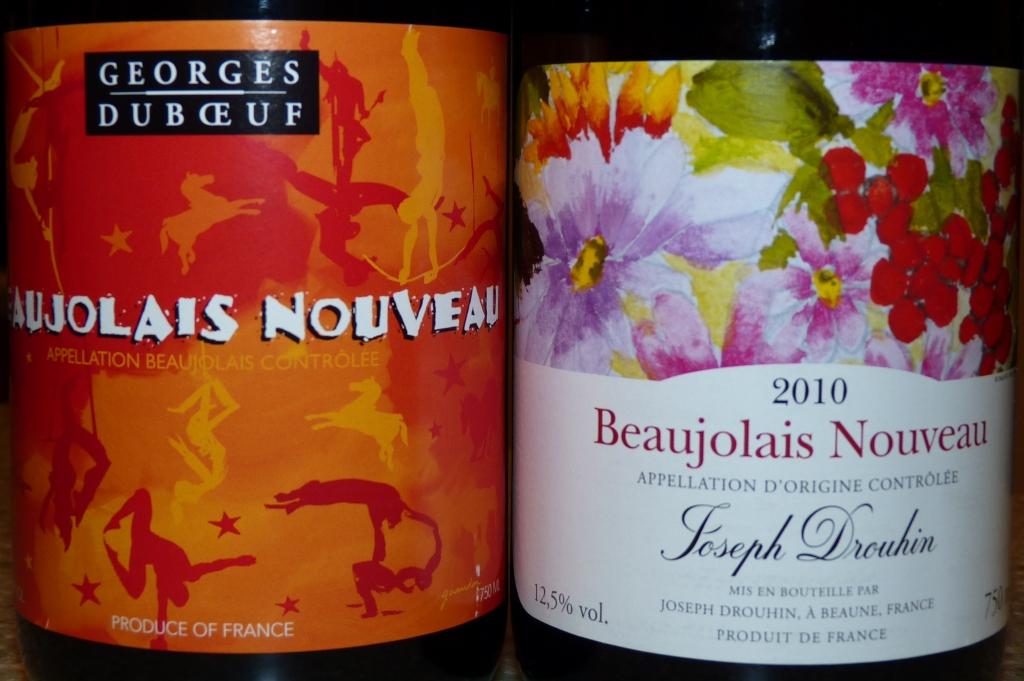
I decided to try Beaujolais Nouveau from two very famous French producers – Georges Duboeuf and Joseph Drouhin. The first producer, Joseph Drouhin used regular cork, and Duboeuf used synthetic one, both corks specifically imprinted for 2010 Beaujolais Nouveau. From the moment the bottles opened, Joseph Drouhin exhibited tremendous aroma of a fresh grape coming strongly right from the bottle, and for Duboeuf the same aroma was also noticeable, but less prominent. From here on, let’s diverge and talk about two wines separately.
Georges Duboeuf. Beautiful very intense dark garnet color. Nose is very solid, doesn’t have any off flavors which are common with very young wines. Cherries and raspberries are noticeable on the nose. With the first sip comes first surprise – the wine has very noticeable tannins. I don’t remember ever tasting the tannins in the Beaujolais Nouveau wines – wonder if this is the style of Duboeuf, but in any case that was a surprise – rather a good one, however. In addition to the cherries I can pick up some plums on the palate, all complemented by good acidity. This wine can be perfectly enjoyed by itself, but will also work very nicely with the wide range of lighter dishes or mild cheese. Considering the price of about $10 per bottle, this wine has great QPR.
Joseph Drouhin. The color is nearly identical – nice deep garnet. Nose is similar to Duboeuf, again without any off flavors. In addition to cherries I would say that there is a hint of strawberries, and again to my surprise, I would probably add a hint of white pepper to that bouquet, which is not something I would typically associate with Gamay grape. On the palate, I would dare to say that this wine has more flavor. I practically don’t pickup any tannins, but instead, there is a great amount of nice supple fruit (again, cherries, plums, raspberries) and very refreshing acidity – oops, and now tannins are coming in approximately 30-40 seconds after the sip of wine. Wow! If the first wine was good, this one is even better – and again, amazing QPR at $11/bottle.
Well, what can I tell you? There is a general sentiment among wine industry professionals that quality of the wines is becoming better and better every year. Tasting these two wines today, I can not agree more. I clearly remember a number of years ago tasting Beaujolais Nouveau with the only one afterthought – “please, I don’t want to ever touch this wine again, and… is it okay to pour the rest of this bottle down the drain?”. My experience this year is totally different. These wines are excellent, and if you didn’t do it yet, you have to go and buy a few bottles… and enjoy! In terms of drinkability, I would rate Duboeuf at 8-, and Drouhin at 8. And, yes, I know it is late, but I need another glass…
Wine Retail: Cost Less Wines and Liquors, Stamford, CT
 In order to drink wine (better: drink GOOD wine), we all have to get it somewhere. Outside of getting the wine as a present, “get wine” equals “buy wine”. There are few ways to go about buying wine. You can do it at the winery – often works well, you can try before you buy and get information. Then of course you can buy it online – this is most difficult method, as you have to know precisely what you are doing, wine can be damaged during shipping (I don’t mean broken bottle, think about summer heat, for instance). And the simplest way – buy the wine at the good local wine store. Well, it is simplest if you happened to know where this good local wine store is.
I want to bring to your attention my favorite wine store in Stamford – Cost Less Wines & Liquors (1073 High Ridge Road, (203) 329-2900), the good wine store. What am I looking for in a wine store? Yes, of course wine, but this is not the point. In no particular order, but good prices, selection, service, knowledgeable staff and overall store organization are all very important for the good wine store. Lets talk about these elements.
Store organization: Cost Less is easy to navigate. All the wines are grouped into the regions with easy access, with sparkling wines and kosher wines located in the separate sections. Beer and all different types of liquors (Scotch, whiskey, cognac and so on) located along the wall:

Great Selection: Store offers great selection in every section. Despite the limited size (store is not huge), all wine making regions are well represented – California, Washington, Oregon, France, Spain, Italy, South Africa, Germany, Austria, Australia, New Zealand, Argentina, Chile, Israel (I’m sure I forgot something) – and all sections are well stocked. There is a lot of interesting wines on the shelves, such as Staglin Cabernet Sauvignon (96 points from Wine Spectator, and don’t forget to look at the price):

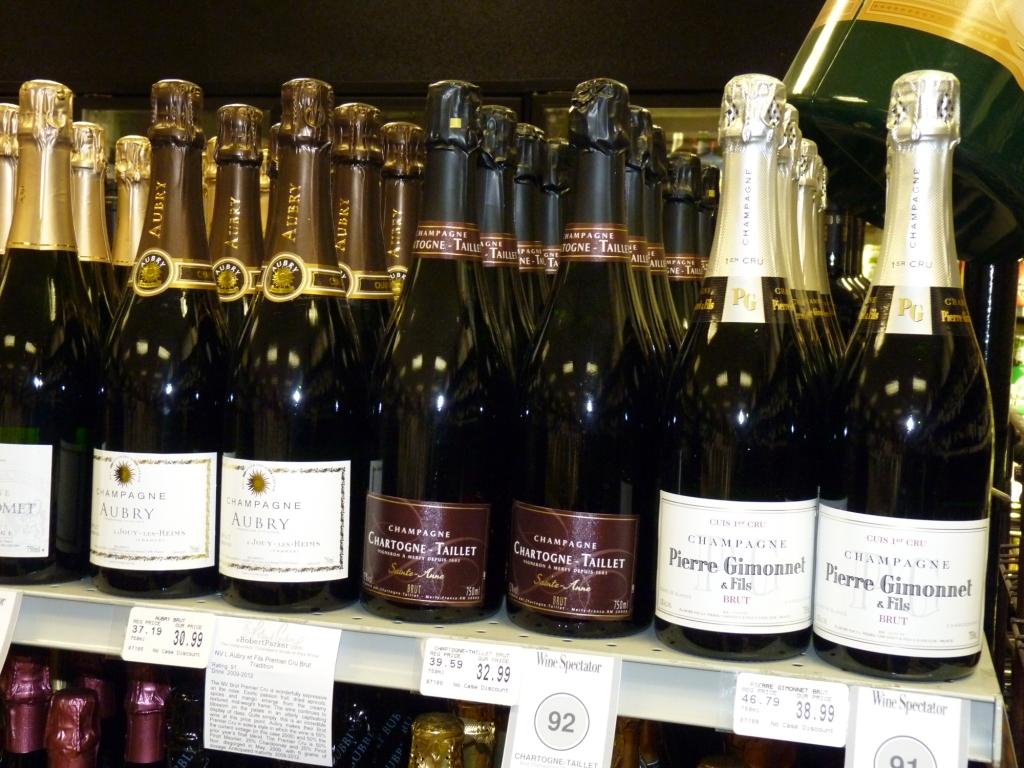
Another point on the subject of great selection is Growers Champagne. Demand for Growers Champagne is quite recent phenomena, so very few store carry them. Here is a brief description from Wikipedia: “While large Champagne houses, such as Mumm, may use grapes sourced from as many as 80 different vineyards, Grower Champagnes tend to be more terroir focused, being sourced from single or closely located vineyards around a village.” Cost Less got great selection already, and probably will offer even more in the future (if you had not tried one yet, I highly recommend that you will try it rather sooner than later):
Great selection of beers, with a lot of quite unique offerings (you can see one of my previous posts on this subject – all beers came from Cost Less). Excellent selection of cognac, tequila and vodka, and amazing selection of scotch, including some very unique offerings (note to self – not to use “unique offerings” repeatedly… but what should I do if I think they are?):

If I may, I would like to mention that Rosebank distillery is closed, so I don’t think there are too many bottles left as the one shown above. And if you take a look at the prices (30 years old single malt for $220 – WOW) that brings us to the next characteristic of a great store – good prices.
Good prices: as you can already see from the pictures, there are great prices all over the store. All the wines and liquors are well priced, compare to any other wine store in Stamford and around. There is also 10% discount on the mixed case purchases (as long as the wine is not sold at the minimum state price). On this subject, I must bring to your attention one of my favorite California Cabernet wines, Ladera:
 Take a good look at the price – the best price for magnum ( 1.5L) on the Wine Searcher is $59.99 (don’t forget to add shipping!), so I pretty much rest my case on the pricing.
Service and knowledgeable staff: you got it all. Store owner, Zak, is always available to answer questions, recommend wine or simply stand aside and let you browse through the selection without any pressure – I think this is the great talent ( I really don’t like being attacked in the store as you walk in – that never happens at Cost Less). If the wine you are looking for is not available in the store all you need to do is to ask Zak to get it for you – it is that easy.
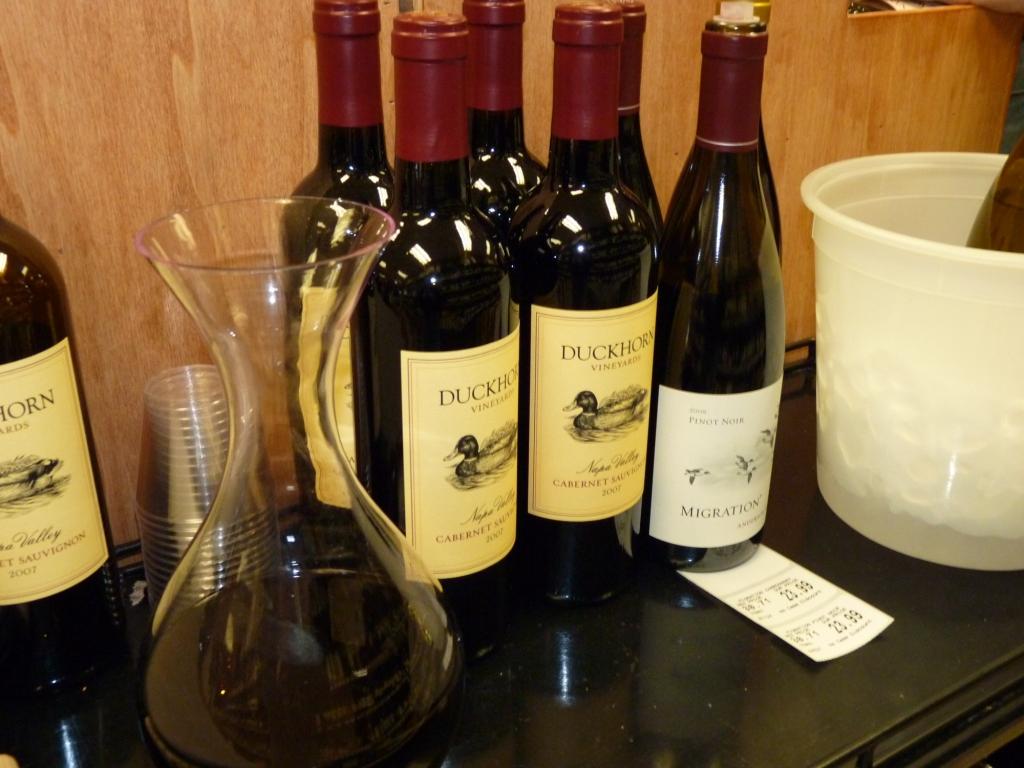
And to add one more point: if you reading my blog, you know how much I value opportunity to “experience” things. Along these lines, every Friday and Saturday, there is wine tasting at the store, where you can experience great wines, such as, for instance, Charles Mara or Duckhorn:
With the holidays coming, and wine being definitely important part of any celebration – head on to the Cost Less, you will not regret you did (hmmm, sounds like an advertisement, and I really didn’t mean it… or may be I did, just a little bit). Ahh, and don’t forget that Beaujolais nouveau will be released on Thursday (November 18, 2010) – who knows, I might run into you at Zak’s…
Taste Of Wine – Engineering Approach
 You might be baffled by the title of this post, but I promise to explain. I even expect that it will make sense in the end and will not be boring. No, this post will not be talking about kinds of machinery necessary to properly taste wine. Wine, in its seeming simplicity, has a mystic aura surrounding it. Perceived taste of wine is definitely one of the areas where mystery of wine unfolds – and this is what I want to discuss.
Quite frankly, blog post by W. Blake Gray “Why expensive wines taste better: Psychology 101” prompted me to think about subject of taste of wine, and the factors which affect the perceived taste. Being a computer engineer by education, I like to use an orderly approach when a phenomena needs to be analyzed. But wine has nothing to do with computer engineering you contend? True, but it doesn’t mean that we can’t use some interesting tools to put the thoughts in order. As a side note, I want to mention that I have experience successfully using engineer approach in totally non-engineering subjects – in college, together with my friend Alexander (Sasha) we converted whole semester course of philosophy into block-charts, one night before exam. It worked!
Please relax – there will be no block-charts or algorithms in this post. For putting the thoughts in order I would like to use tool from the Mind Mapping category, called FreeMind – you can find it on internet, and if not – send me a message and I will help. This tool allows you to put your thoughts in order, and then do the analysis. How? Let’s see. So here is the group of factors which affect the perceived taste of wine (good/bad, tasty/disguising and so on): Organoleptic (smell, color, taste and so on), Tools which can alter the taste, Expectations and Environment – note, that these are only my thoughts, though. Here is the same – but in the format of the mind map:

What are this “Expectations”, or what does “Environment” means, and do I include screwdriver into the “Tools” and why, you may ask? Let’s add one more level of details and then talk about it. So here is the expanded picture:

Now, there is a lot more we can talk about. Let’s start with expectations. There is a lot of factors which might influence our opinion about the wine by setting our expectations prior to opening the bottle. Do Ratings affect perceived taste of wine? You bet! “Robert Parker gave this wine 97 rating, I’m sure it should taste amazing”. “This wine is rated at 95 by Wine Spectator – I’m sure it will taste great!”. And then it does not – for you personally, it doesn’t. And there is nothing wrong with you – may be you are just in bad mood, or may be this magnificent Cabernet Sauvignon from Napa Valley simply doesn’t work well with Chinese sweet and sour chicken, or may be this is just not the wine you like. Those critics who rated the wine 95 points have to be objective ( this is their job), but you, consumer, don’t have to – like/don’t like is the best rating (we will discuss this in the future).
Where the wine was made (“I love the wines from Napa”, “German wines are the best in the world”…), who made it (“ahh, it is Petrus”, “oh my, this wine is made by Screaming Eagle”) and the price (“I paid $100 for this bottle!”, “yeah, I only paid $10 for this bottle”) – all will (or at least, might) influence the perceived taste. Do other people opinions affect our expectations? Absolutely. What about books, articles and advertisements? Yep, most definitely. However, it is very important to note that the more you learn about wines, and by learning I mostly mean trying different styles of wines coming from different regions, the less “affecting” these factors become.
Will the temperature affect the taste of wine? Of course. Will proper (or improper) decanting affect taste of wine – yes, in many cases. Some of the factors, such as decanting, might affect the taste in the two different ways – one is simply aesthetics, with the expectations are set with the sheer “wow” factor of the proper decanting, and another one is a physical effect, by allowing the wine to “breathe” , open up to reach the optimum flavor profile (yes, there is more to the decanting, but this is not what this post is all about).
We can go and discuss the factors one by one for a long time – it will make this post very long – and probably equally boring. But as we have an advantage of playing with the mind map, let me simply give you more food for thought – here is fully expanded version of this mind map. Remember, it is just a momentary snapshot of your thought process, and it is as fluid as thoughts themselves:
 Before we conclude, I would like to touch on of the important factors which is hiding there in the “Environment” group – blind wine tasting. Of course there are different levels of “blindness”. When you taste the wines as part of the Master Sommelier exams, you have no information about the wine, outside of what you can see, smell and taste. In many other cases, you know only a small piece of information – for instance, tasting the wines during the Windows of the World Wine School classes, we knew the region (Bordeaux, California…), but nothing beyond that. Why it is important to taste the wine blind? It eliminates most of the influencing factors which get in the way of you establishing very simple relationship with the glass of wine you have in your hand – I like it, or I don’t.
Well, I think it is enough for this post. I would love to hear from you – was it boring, was it interesting, am I totally off in my thought process. If you want more information on the mind mapping – I will be glad to send you links. If you want the mind map file for the Taste of Wine – drop me a note, I will be glad to send it to you. And most importantly, tell me your wine tasting stories – and keep learning about the wines!
80 Sips, Loud Music And New Grape (Treble Journey #277)
 Last Friday we attended “Around The World in 80 Sips” wine tasting event in New York City, organized by Bottlenotes. The idea of the event is to present wines from all over the world, from such wine stalwarts like France, Italy and Australia to literally unknown wine producing countries such as Lebanon. There were more than 100 wines presented in the event, which was not free ($75 standard ticket price, we paid $50, courtesy of The Austrian Wines).
Overall, I found the event somewhat challenging to enjoy. No, nothing wrong with the wines – there were a number of very good wines to taste. My first issue was really (I mean, really) loud music. There was not possible to talk face to face, never mind listening to the explanations about wines. The second issue was the sheer crowd. I really like wine tastings, big and small – if I only have a chance, I attend them as much as possible – wine tastings are the best places to learn and experience. I’ve being to all kinds of events – trade only and consumers, with thousands of wines present and with the handful of wines. I never being to the event where you have to stand for 10 minutes, not even in the line, but with your arm with the glass fully extended through the crowd, in the hope that wine will make it into your glass – mind you, we are not talking about tasting Petrus or Screaming Eagle here.
Leaving all the inconveniences aside, there were a number of good wines from those I was able to reach. Particularly, there were a number of interesting wines from Austria. This is where I managed to pick up grape #277, Rotgipfler, with the wine called Stadlmann Rotgipfler Tagelstiner 2008. My particlar favorite here was Fritsch Pinot Noir 2004, which had finesse and elegance of the classic Pinot, with more pronounced earthiness, typical for Austrian wines. It is interesting to note that we went through 3 bottles to really get the beauty of this wine showing – first was so so for some reason, second one corked but the third one was shining.
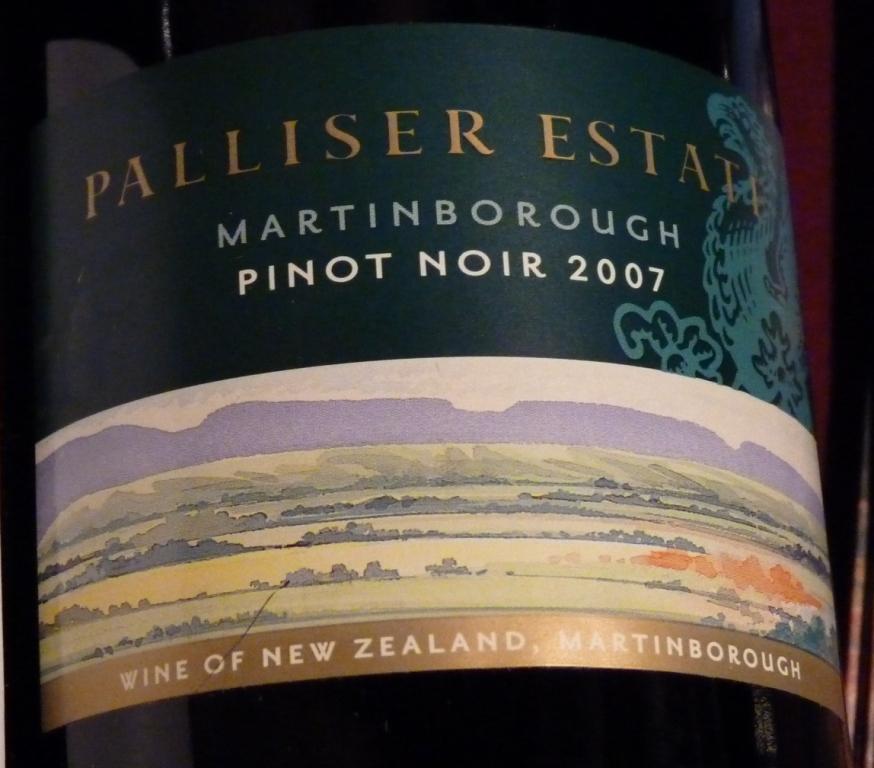 My overall tasting favorites were a couple of wines from New Zealand. First, a Pinot Noir 2007 from Palliser Estate in Martinborough. There were a number of good Pinot Noir wines from New Zealand, both from Martinborough and Central Orago, from 2007 and 2008 vintages. This particular Palliser Estate Pinot Noir had the most elegance out of the group, with classic Pinot smoky nose and restrained fruitiness of the New World wine.
The other two of my favorites where two white wines from New Zealand, one of them being total surprise. 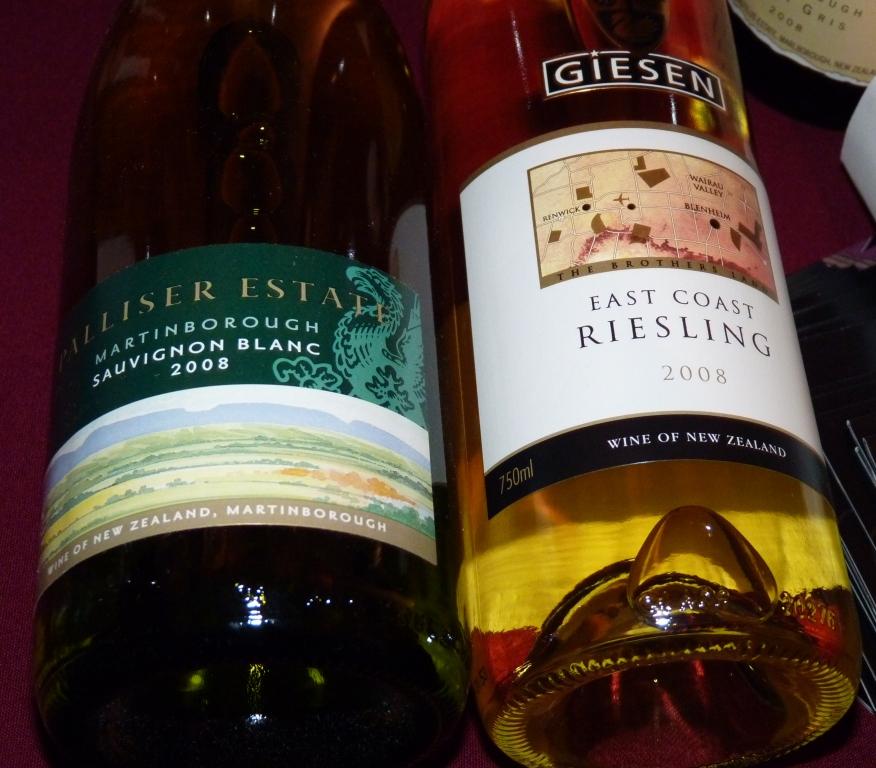 First was Sauvignon Blanc 2008 from the same Palliser Estate. I have to honestly admit that I have a weakness towards New Zealand Sauvignon Blancs – I enjoy them very much. The Palliser Estate Sauvignon Blanc had more of everything – not that it was a fruit bomb, no, simply the fruit was a lot more pronounced, such as in-your-face-gooseberry. I would put Drinkability of this wine at 8+.
And the surprise came in the form of Riesling from New Zealand. Why the surprise? First, I never had before a Riesling from New Zealand. Second, based on the experience with neighboring Australian Rieslings, which I find too dry and not pleasant, my expectations were quite low. And the surprise was in the fact that this particular East Coast Riesling from Giesen was actually tasting like … German Riesling, only done more in the fruit forward style (not sweet at all, the Kabinett level), very nice and pleasant.
To conclude: am I grateful for the experience I had? Of course. Wine tastings are always fun. Will I attend another Bottlenotes event? As of right now – I don’t think so, but hey, you never know…
Beer Experience For The Wine Lovers
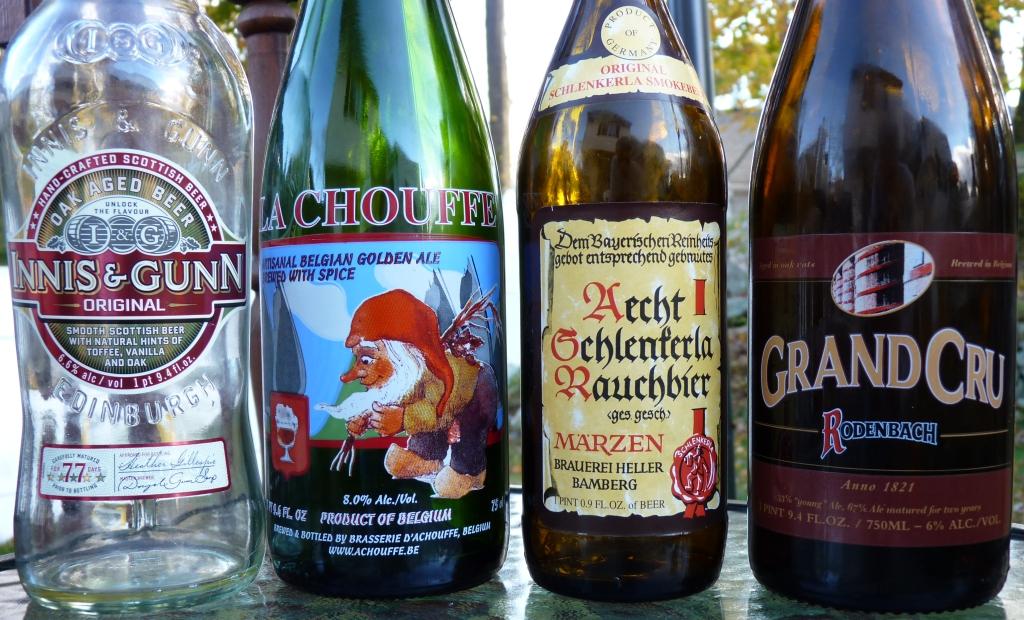 Does beer belongs to mostly a wine blog? You bet – anything which gives you a tasty experience does, and beer is no exception. It is interesting to observe feuds between beer and wine drinkers. Allegiance to one kind of drink can be almost religious, and then nobody is sparred during the “ahh, you are a [that other nasty beverage] drinker” encounters.
Yes, I would admit that beer is not a typical drink for me. One one side, I know how to preserve the leftover wine in the bottle ( vacuum pump, argon,…), and I’m really not sure what to so with the beer leftovers. Another issue for me is that once beer goes into the bottle, it doesn’t evolve anymore. The beer is valued for its freshness, and effectively for the “sameness” of the taste – any bottle of Samuel Adams Lager is expected to taste the same. Wine is a living thing, including in the bottle, so while you have an expectation of the taste, there is always an element of mystery when the wine bottle is opened.
I have to admit that the beer tasting experience we had last weekend made me think that I actually have to pay more attention to the beers! Many years ago (1993/1994, if I’m not mistaken), I was a member of “Beer Across America” club, where I was getting 2 6-packs of micro-brewed beers every month. It was very enjoyable experience for about year and a half, and then it became boring, so I stopped the membership (I wonder if this is the story with most of those “monthly clubs”). Tasting the four beers last weekend reminded me of that excitement – and I want to share the experience.
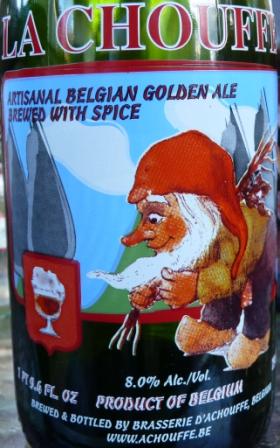 We had total of 4 different beers. The word “different” doesn’t even come close to explain how diversely those beers tasted. The most “standard” (only in terms of previous experience) was beer called La Chouffe, unfiltered Blond Ale, produced by Brasserie D’Achouffe from Belgium. Very fruity and pleasant beer, with lots of sweet notes on the palate. This was a very good example of Belgium Blonde Ale, completely adhering to its distinct style.
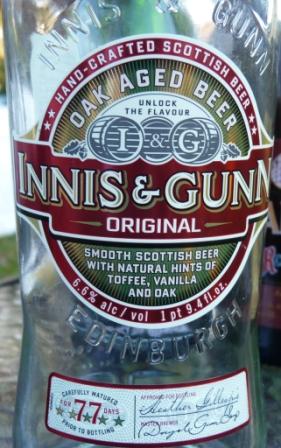 The next one was beer called Innis & Gunn Oak Aged Beer from Scotland. I would highly recommend this beer for any scotch-lover, as after smooth and round palate comes perfect finish with hint of single malt scotch (Highland or Speyside in style). Oak also imparts some interesting honey and vanilla notes on the palate, all in all making Innis & Gunn a very enjoyable beer.
The next beer should really be designated as “wine, masquerading as beer”. Rodenbach Grand Cru, another beer from Belgium, had probably the most unexpected taste from this group (polarizing too, as my friends Kfir and Hadas didn’t  like it at all, so it is two against one). To make wine parallel even more visible, you have to know that this beer undergoes double fermentation and resulting beer is produced as a mix of one-third of young beer and two-thirds of the beer aged in the oak casks for two ( Sic!) years! Therefore it is no wonder that liquid in your glass tastes “vinous” and has a great balance of acidity and fruits, with acidity being extremely noticeable, quite similar to any good wine. This beer should be experienced in order to truly believe it…
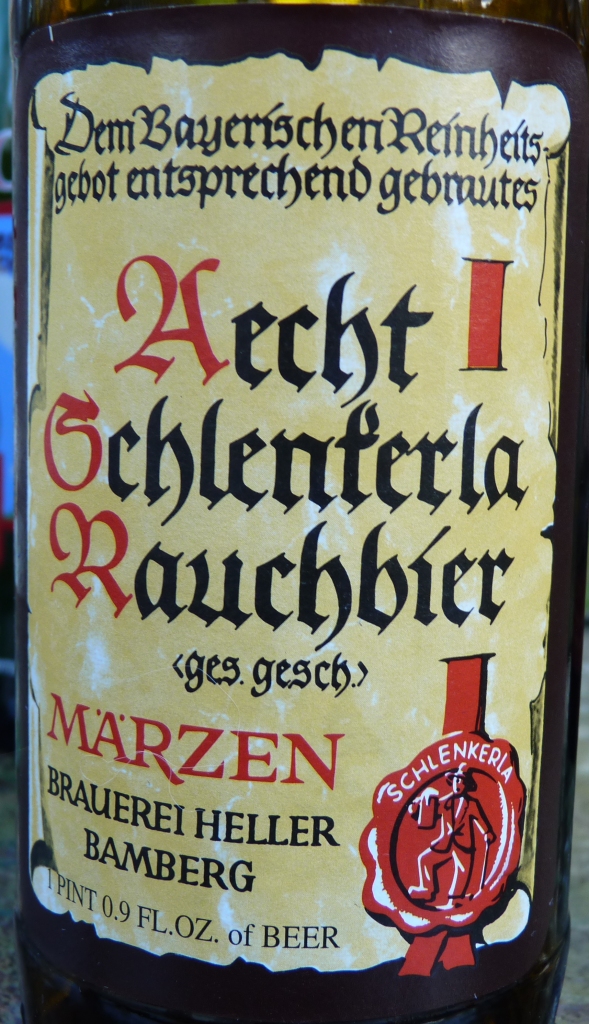 Now last, but not least – Aecht Schlenkerla Rauchbier, the original smokebeer from Germany. Not sure if I should be ashamed or not, but I definitely missed whole group of smoke beers – I discovered Belgium beers long time ago, but never heard of the smoke beers, which seems to be a category with good amount of offerings, considering that Wine Enthusiast has the whole section covering them. This particular beer which is called Schlenkerla, is brewed over the smoke of the burning beechwood logs, and then matured in the cellars. The resulting beer offers smooth taste with pronounced smokiness, which all together creates very delicious experience.
That’s all the experience I wanted to share, but if I can give you an advice – go find those beers and experience them for yourself. If you think you don’t like beer, give one of those a try – you might learn something new about yourself…
Last Bottle Sign Up ($10 credit)




 Talk-A-Vino

