Fine Wine Industry of New York Needs Your Help
It is mind boggling to me how many assaults on the free trade are rotating around wine industry. There are still many states which don’t allow direct shipment of the wine to consumers. Last year, we had to fight with HR 5034 and HR 1161, both greatly impacting consumer’s access to wine on simple and easy terms (no, it should be hard, and most of all, expensive, for you to buy the wine).
Latest in the chain of assaults – “At Rest” proposition in New York Senate, which is sponsored by two big wholesalers with the idea of forcing all wine distribution in the state of New York to go only through warehouses located in the state of New York. That would simply force many of the smaller fine wine merchants in New York, which use warehouses in New Jersey, to go out of business. Please contact your senator and make him or her to stop this insanity. Here is a complete text of e-mail petition which currently circulates the web – read it and sign it:
*********
Hi,
A critical issue to the very existence of the fine wine industry in New York has been brought to our attention and we wanted to make you aware of it. One of the largest liquor wholesalers is lobbying the State Senate to include an “at rest” provision in their 2012 budget. The practical effect of “at rest” means that only those distributors delivering product out of New York warehouses could legally sell you wine. Legislation such as this would affect essentially every wholesaler currently in operation other than the two biggest ones, since they almost all warehouse in New Jersey, including our company.
Imagine a landscape with only the two largest wholesalers remaining to work with. Selections would become painfully limited. Prices would most certainly rise. Service would plummet. Their pro-“at rest” argument (union warehouse jobs and revenue) is simply a veiled attempt by this wholesaler to destroy all of the fine wine wholesale competition, because m ost of your valued New York wholesalers would undoubtedly be forced to close their doors. We have contacted our State Senators to tell them that we oppose “at rest” in either legislation or budget language. We urge you to do the same before FRIDAY, MARCH 9th. Please contact your Senator to tell them you oppose “at rest.”
We thank you for your time, your attention, and most of all your support.
That’s why I signed a petition to The New York State Senate and Governor Andrew Cuomo, which says:
“Dear Senator,
It has come to our attention that one large wine & spirit wholesaler is lobbying you to include “at rest” in the 2012 budget. They are claiming “at rest” will create revenue for the State. But, as a licensed, small business that buys from many wine distributors, I do not agree that it would create revenue. Instead, I believe that “At rest” would result in hundreds of closed businesses, including both wholesalers and retailers, and at least a thousand unemployed New Yorkers. As such the State would lose hundreds of millions in taxable revenues from passing this bill. The volume of wine sold in the State (and the accompanying beverage excise tax revenue) would severely decrease. Consumer selection would be limited and the price of wine would escalate with the costs inevitably passed on to the consumer. Moreover, the ancillary effects of the resultant higher unemployment, lower sales and income tax revenues collected, would further exacer bate the current economic position of the state, not improve it. With the above in mind, we urge you NOT to vote for “at rest” either in legislation or in the budget language.
Thank You
”
Will you sign the petition too? Click here to add your name:
http://signon.org/sign/ny-state-senate-do-not?source=s.fwd&r_by=3057649
Thanks!
Best Wine Reviews Ever
 Aren’t you tired of reading wine reviews about “hint of apple”, “cinnamon and clove”, “coriander and last year’s rain”? Especially when you can’t find that specific flavor profile in your glass no matter what? Today I managed to come across two wine reviews which were much easier to assess and appreciate.
First, here is review of the Corison Cabernet Sauvignon (not so widely known but excellent Cabernet from Napa Valley) by Joe Roberts, a.k.a. 1WineDude (@1WineDude on twitter): “07 Corison Kronos Vineyard Cabernet Sauvignon (Napa Valley): Sort of like owning a trained black panther; dark, piercing & gorgeous.“. How do you like that? Is this is the wine you want to try or what? I don’t know about you, but I will be glad to meet this black panther at any time.
And the next one was a review by Adler Yarrow, who has one of the best wine blogs called Vinography. Latest two posts in that blog are on the subject which is an ultimate treasure for any wine lover – wines of Domaine Romanee-Conti (DRC, as it is typically called). DRC wines are considered best of the best, in any vintage and any time. So I think all people who are serious about wine can be divided into two categories – those who tasted DRC wines, and those who are dreaming about it. I belong to the second group ( sigh). Adler Yarrow belongs to the first, and he recently tasted full line of DRC 2009 wines – you can find his detailed notes here. But one particular review attracted my attention. It was for 2009 Domaine de la Romanée-Conti Grand Cru Montrachet, the only white wine produced by DRC and considered the rarest of the rare. While the descriptions there allude to the usual taste elements such as nuts and apples, one sentence I think puts that review in a totally different prospective: “In the mouth the wine has an incredible texture that I’m prompted to describe as liquid sex, and gorgeously balanced flavors that…“. Once you read this description, do you really care about the rest of the grapefruits and nuts, or do you really get one pounding question in your head: “where can I try this wine”?
I’m really glad to find those reviews – now I got a frame of reference for my own reviews to aspire to. What is your favorite wine review, the one which forced you to resolve “nothing can stop me, I will find and drink this wine”? Anyway, while you are thinking, let me go back to my dreams. Cheers!
Knowledge or Wisdom? repost from Whisky-online
Today I came across a blog post which stroke a chord – whether or not you are in love with whisky, this will universally apply to all of us who takes keen interest in Wine, Whisky, Beer, Rum or anything else you strive to know more about, because knowledge enhances the pleasure… Here it is:
http://whisky-online.com/blog/knowledge-or-wisdom/
Enjoy!
Wines of United States
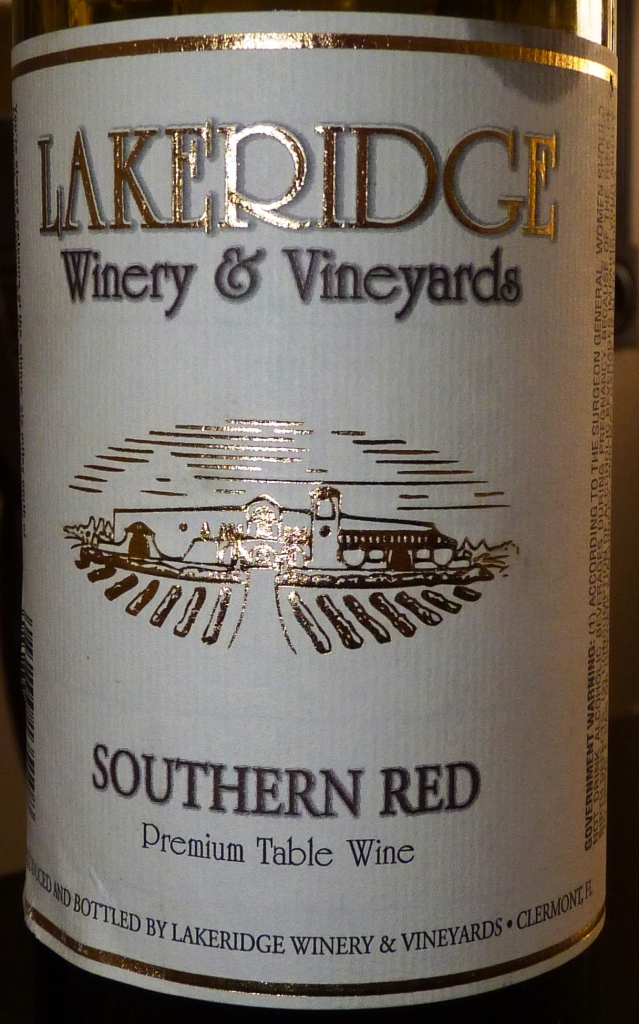 When you run a wine tasting, one of the great ways to keep people engaged all the time is to ask questions – trivia type and not. One of the simple warmup questions I like to ask the audience is “What do you think, how many states make the wine in the US? This sounds simple enough and goes into the “your guess is as good as mine” category. People usually start with some random number (trying to put sense into it, though), and sometime someone will say “all 50” – often just as a joke. Actually, it is the correct answer – for w while, all 50 states produce some wines.
So did you ever think of exploring and experiencing the wines of all 50 states? I’m sure you had California, Oregon, Washington and New York wines, but what about the other 46 states? Last week in Florida, I came across Lakeridge Winery Southern Red Premium Table Wine produced in Clermont, Florida. This wine allowed me to add one more grape to the grape count – Muscadin. And this wine prompted this blog post and the table which I would like to share with you, which lists my experiences with the grapes and wines of all United States to the date:
|
State |
Tasted Wine |
Visited Winery |
Comments |
| Alabama | |||
| Alaska | |||
| Arizona |
Y |
||
| Arkansas | |||
| California |
Y |
Y |
|
| Colorado | |||
| Connecticut |
Y |
||
| Delaware | |||
| Florida |
Y |
||
| Georgia | |||
| Hawaii |
Y |
Pineapple wine | |
| Idaho | |||
| Illinois | |||
| Indiana | |||
| Iowa | |||
| Kansas | |||
| Kentucky | |||
| Louisiana | |||
| Maine |
Y |
Y |
|
| Maryland | |||
| Massachusetts |
Y |
Y |
Truro Vineyards, Nashoba Winery |
| Michigan | |||
| Minnesota | |||
| Mississippi | |||
| Missouri | |||
| Montana | |||
| Nebraska | |||
| Nevada | |||
| New Hampshire | |||
| New Jersey |
Y |
||
| New Mexico |
Y |
||
| New York |
Y |
Y |
Fingerlakes, LI, Hudson |
| North Carolina | |||
| North Dakota | |||
| Ohio | |||
| Oklahoma | |||
| Oregon |
Y |
||
| Pennsylvania |
Y |
Y |
Chaddsford |
| Rhode Island | |||
| South Carolina | |||
| South Dakota | |||
| Tennessee | |||
| Texas |
Y |
||
| Utah | |||
| Vermont | |||
| Virginia |
Y |
Y |
Chrysalis, Williamsburg Winery |
| Washington |
Y |
||
| West Virginia | |||
| Wisconsin | |||
| Wyoming |
What is your experience with wines from 50 states? Can you count and share? It is definitely a fun exercise and might bring back some good memories while you are at it. Happy counting! Cheers!
Taste Expectations, Or Notes From The Blind Tasting
 If you had been drinking wine for a while, I would expect that you have developed certain taste expectations. As you drink the wines from the different regions, you find that the wines from the same geographic locality made from the same grapes would have somewhat of a similar taste and style (yes, of course, I just described what is properly called Terroir without using the word itself). At some point, the associations between the origin of the wine and its expected taste become engrained in your mind. Looking at the bottle of New Zealand Sauvignon Blanc, you are expecting to find bright acidity and citrus flavor profile even without opening the bottle. Looking at the bottle of California Cabernet Sauvignon you are expecting to find a good amount of fruit with some explicit black currant notes and a probably good amount of tannins – note that I’m really trying to generalize here, but you got the point.
This is the way the wine was for a very long time. However, when you taste modern wines, do you have a feeling that your expectations are no longer valid and don’t match reality any longer? I have had this experience many times lately, when Amarone didn’t taste like anything expected (you can find my rant of pain here), or when unoaked Chardonnay tastes rather like Pinot Grigio – and there are many more examples of “taste confusion”.
Recently, I had another case of “broken” taste expectations – this time it was somewhat sanctioned, as we did a double (almost) blind tasting. The theme was set a bit ambitiously, as France and Italy. The “ambitious” part is coming from the fact that these two countries on their own have such a variety of wine production that it makes it literally impossible to recognize the grape or at least the style of wine (either one of those countries would provide a plentiful selection for a double-blind tasting on its own). Anyway, with the main goal of having fun with the wines, we actually had a great time.
We blind tasted 5 wines, which happened to be 4 reds and one white. For what it is worth, here are my notes as we were moving along:
#1 – Very nice, a bit too sweet. I think Italy, Super Tuscan/Barbera/Dolcetto
#2 – earthy, nice, little green bell peppers, roasted notes? Bordeaux?
#3 – France, nice bright fruit, good sweetness, not enough acidity? No idea about the grape.
#4 – interesting, lots of fruit, very nice – no idea.
#5 – great, round, good fruit – no idea.
While I understand that these a rather limited wine descriptions, would you try to guess what was what? Well, you can see the answers below in the picture (wines are set in the order we tasted them, left to right):
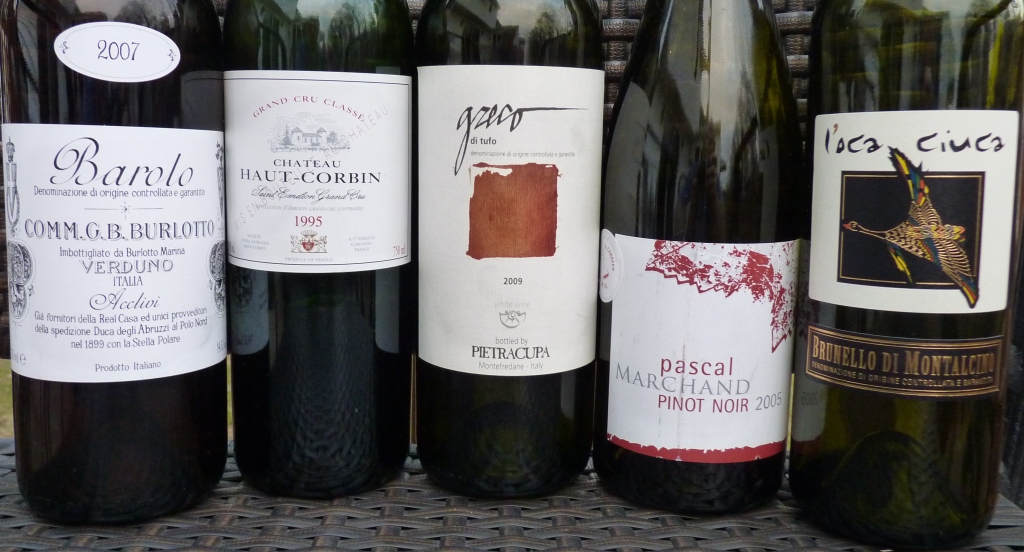
Here is an actual list: 2007 Comm. G. B. Burlotto Barolo Verduno; 1995, Chateau Haut-Corbin Saint-Emillion Grand Cru; 2009 Petracupa Greco di Tufo; 2005 Pascal Marchand Pinot Noir and L’oca Ciuca Brunello di Montalcino DOCG – now compare that with my guesses above…
In case you are curious – of course, we voted for the favorite – Brunello (#5) was a clear winner, with Greco de Tufo (#3) trailing it closely behind (one point difference).
Where is the case of broken taste expectations? Fruit forward, bright and loaded wine with well-masked tannins and almost non-existing earthiness, bright purple in color – 2007 Barolo? I’m very far from a Barolo expert, but this doesn’t match my expectations of Barolo, albeit well decanted. Even winning Brunello was quite uncharacteristic, lacking earthiness and tartness, the traditional Brunello bite. I can’t comment on Greco do Tufo (it was actually quite nice), and the only varietally correct wine was 1995 Bordeaux. Am I making too big of a deal from varietal correctness and taste expectations here? It depends. On their own, both Barolo and Brunello were good wines, but if I would order either one in the restaurant with the goal of pairing it with food, that could’ve been quite disappointing…
Okay, I can’t leave you with this sad impression of disappointment – it was not that bad at all. Also, we had a great cast of supporting wines, even with some pleasant surprises.

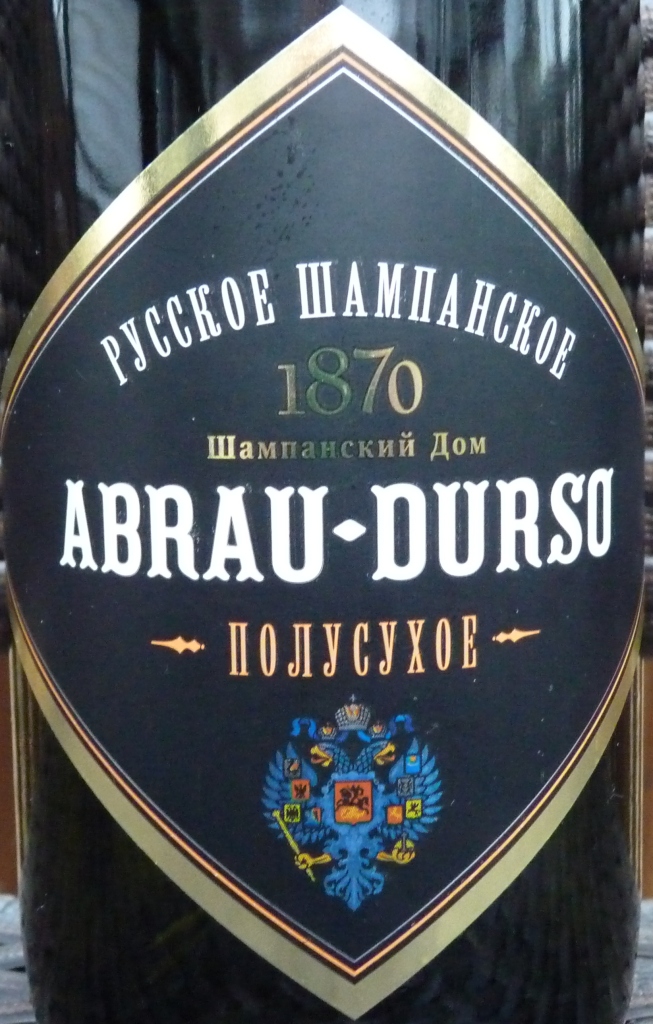
First, two sparkling wines. Chevalier de Grenelle Cuvee Reserve Saumur AOC, a blend of 90% Chenin Blanc with 10% Chardonnay was a very good, full-bodied sparkling wine, with good notes of apple and toasted oak. In addition to good wine, this was also a very special bottle – a magnum with the metal imprinted label. The second sparkling wine was even more unusual – Abrau-Durso Semi-Dry – a sparkling wine from Russia, made by the reincarnated famous producer of sparkling wines for the Russian Tzar (the original company was created in 1870). This wine had just a hint (a whiff) of sweetness, lightly toasted apple and nutmeg on the palate. Very refreshing and delicate. I suggest you will find a bottle and try it for yourself – there is a good chance you might like it.
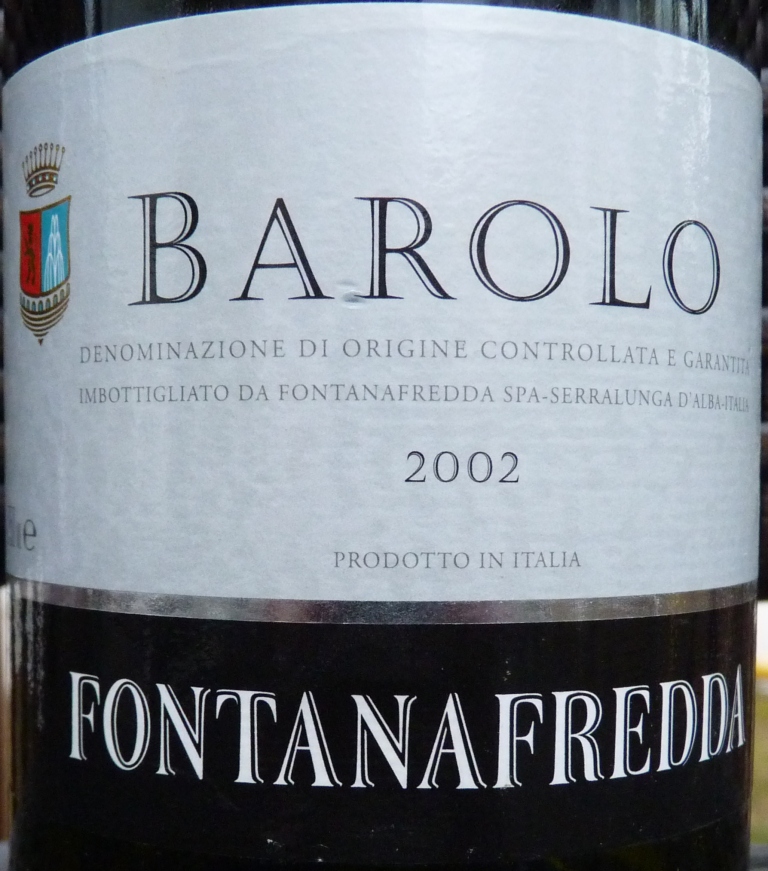 And for the last surprise – 2002 Fontanafredda Barolo DOCG. Why surprising? If you will look at the Wine Spectator’s Vintage Chart, you will see that 2002 was regarded as a very bad year for Barolo, with a rating of 72 and recommendation of wines being past prime. I decanted this bottle at some time in the late morning, and by the early evening, when we actually drank it, it opened up very nicely – while it was lacking powerful tannins, otherwise, it was quite enjoyable wine, very balanced with quite a bit of finesse.
Play with your wine, get friends together and do the blind tasting – I guarantee you will learn something new about your palate, your wine preferences, and maybe even your friends!
Cheers!
Valentine’s Day Food and Wine Experiences
 For many years already Valentine’s Day became our “home” holiday. What I mean is that we are not going to the restaurant – instead, we attempt to create the best possible experience at home. This past Valentine’s Day our attempt was quite successful. First, there was a Champagne. Ahh, what so special, say you, a sparkling wine? Well, we don’t drink Krug every day – Krug is our “special” sparkling wine, as both me and my wife fell in love with it 3 years ago, and nothing beat that ever since.
It was Krug Grand Cuvee Brut NV. Beautiful effervescent nose, with only a hint, a whiff of toasted apple, yeast and fresh bread – the same lightness on the palate, with perfect balance of fruit and acidity. Yes, I know, I fail to give you a critic-worthy description with lots of different elements of soil, the fruit and more – so you will need to take my word for it – this is The Champagne. Once you try Krug…well, you will continue to appreciate many other sparkling wines, but Krug will be the one you will crave. And if you care for my rating, I will put Drinkability at 9+.
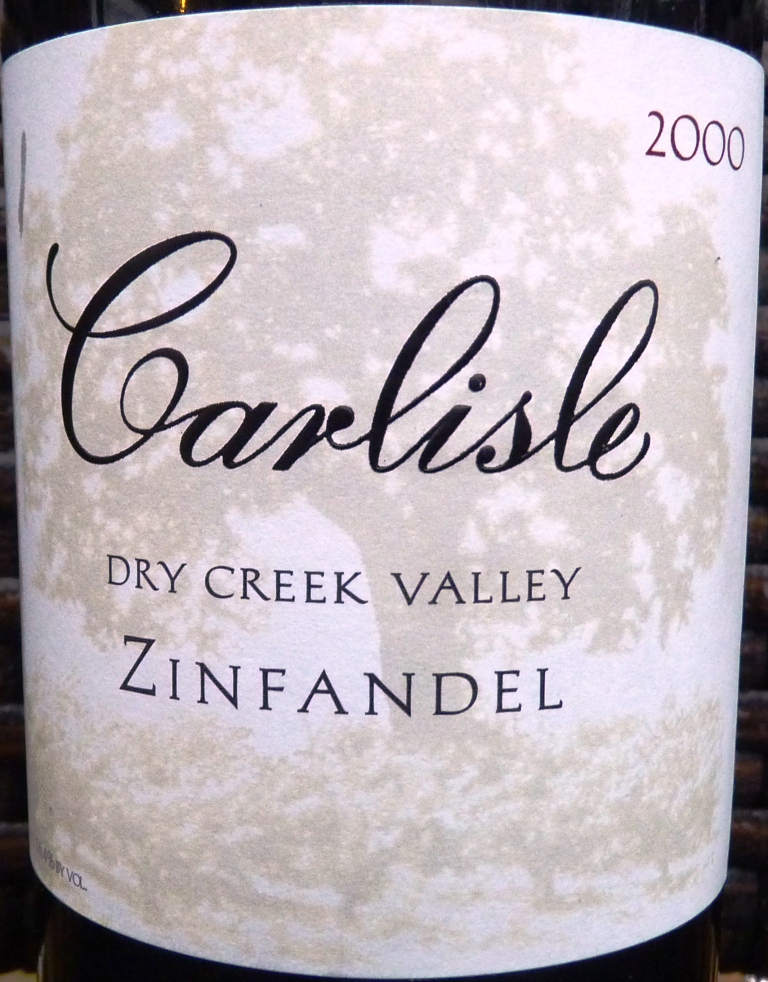 Believe it or not, but Krug was only the beginning of amazing wine experience. The next wine blew me away in many senses. First, it was a realization of a dream. For the long time, I wanted to try Carlisle Zinfandel – consistently high ratings in Wine Spectator, great reviews – many factors contributed into making Carlisle Zinfandel an object of desire. I signed up for the waiting list for the mailing list, I asked around – all to no avail. Then a few month ago I saw a bottle on the Benchmark Wine Company’s web site, priced at about $30 – voila, I got the bottle. Now I just needed special occasion.
Special occasions are easy, right? Valentine’s Day is special enough for us, so the bottle of 2000 Carlisle Zinfandel Dry Creek Valley was opened. The description? One word – “wow”. Beautiful nose of red fruit and smoke (raspberries and blueberries plus a hint of smokiness, to be more precise). Perfect balance of fruit, tannins and acidity on the palate – more playful fruit, eucalyptus, cedar box, spices, tobacco – all components are playing together to deliver an amazing experience.
Here is one interesting note for you. Carlisle web site has a table which is called Drinkability Chart, which lists all the different wines from the different vintages and ideal drinking window for those wines. According to that chart, optimal drinking window for this particular Zinfandel was 2002 – 2005. Well, what can I tell you? If you got a bottle of Carlisle which you think is undrinkable – send it my way, and I will thank you profusely. And just to show you how much I loved this wine, I have to tell you that this is the first time I put Drinkability of wine at 10-! Here is the link to my ratings page – you can judge for yourself.
As you can see, the wines were great – but there was also food. This year we decided to do a Rack of Lamb. Rack of Lamb is a dish which we typically enjoy in the restaurants (especially in French Canada), but it is not that difficult to make at home (once you overcome the sticker shock of a good rack of lamb).
I need a lot of rosemary with my rack of lamb – and this is what we did. A little bit of fresh pepper, and lots of fresh rosemary – with addition of some fresh sage as well. Here is the rack of lamb ready for the oven:
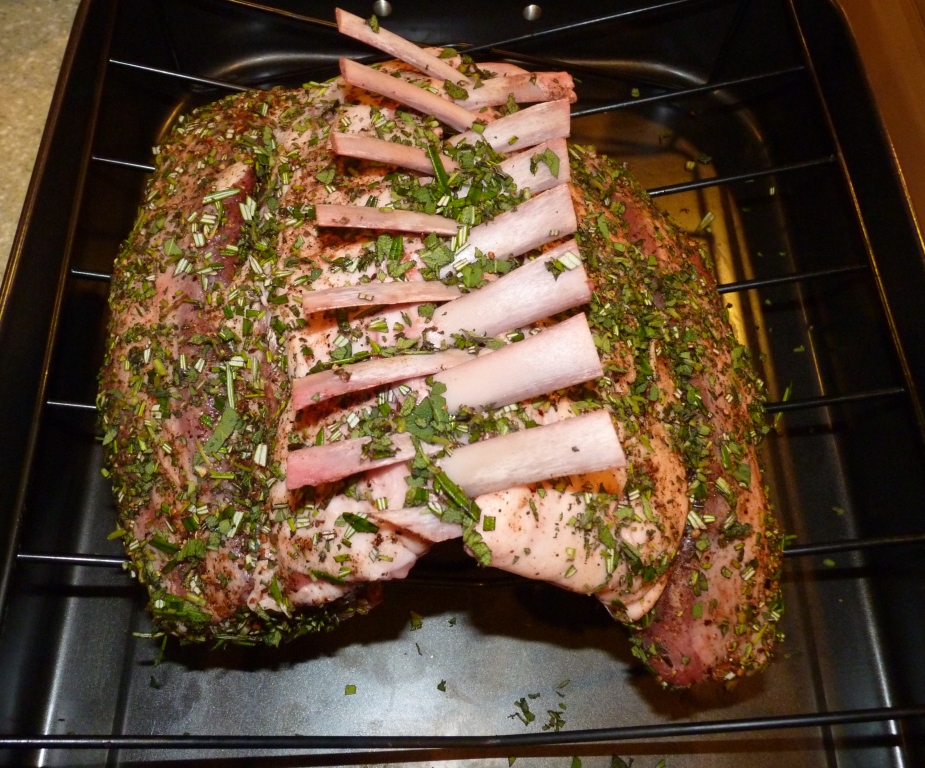
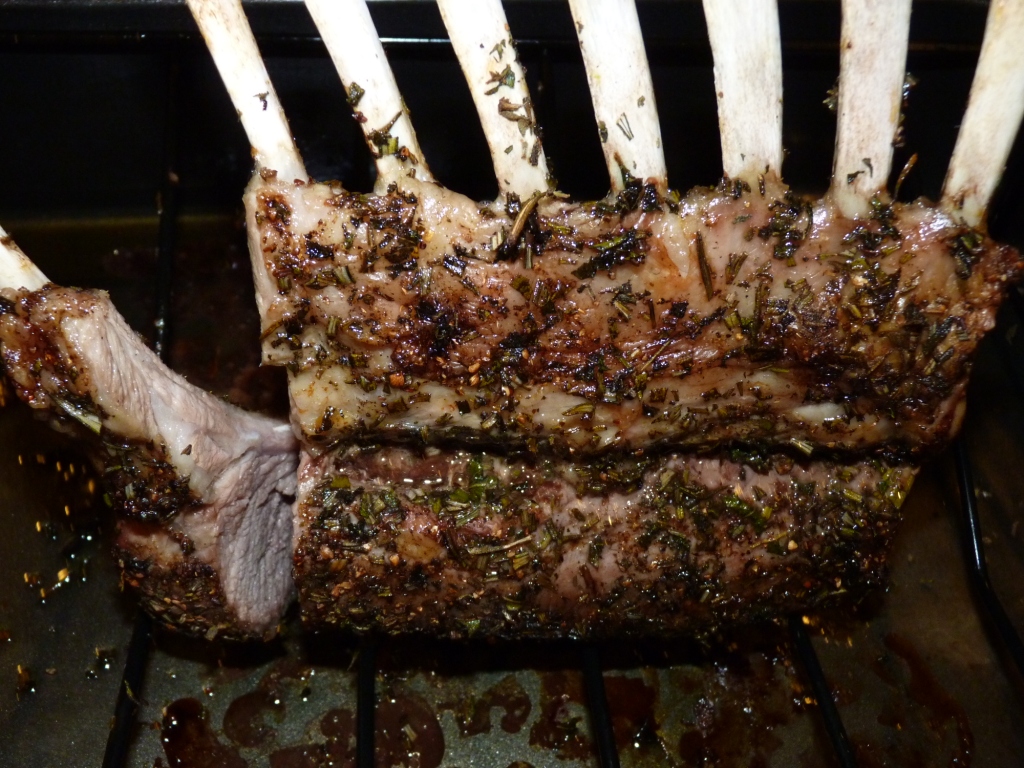
There are couple of techniques which I started using lately when it comes to roasts – and I like the results so far. First one is preheating oven to 500F – temperature is lowered one roast is put in, but it is enough to develop a nice crust. The second one is not using any salt until the roast is done ( so only using finishing salts) – the rationale here is that salt is draining juice out of the meat so it is better to be put on at the last stage. So far I had being very happy with an outcome using these simple rules. After 40 minutes in the oven ( 500F to start, then lowered to 400F), here is the final result:
And here is plated version:

Yes, I know, I should work on presentation – you don’t have to tell me that. But the taste was great, and lamb also paired quite well with the Carlisle Zinfandel – to double the pleasure!
That’s all, folks, for our wonderful Valentine’s Day food and wine experience. It will be hard to beat it next year, so I can only wish tat the next year will be not any worse than this year.
Cheers!
Following Wine Till Sold Out (Again) – Super Wednesday, February 15
 Once again, Wine Till Sold Out (a.k.a WTSO), one of my favorite online wine stores, had its “Super Wednesday” – an event which takes place about 4 times a year where the wines are sold online in rapid succession. Compared to some of the past “Super Wednesday” events (here is the post about the one from about a year ago) WTSO changed the model slightly. Previously, during Super Wednesday WTSO was offering wines at any price range, but as of lately, the wines are limited in price up to $18.99, and therefore all the wines have the same minimum quantity requirements of 4 bottles (minimum quantity is required to receive a free shipping, you can technically buy wine in any quantity). Considering that limited cost, these events are even called “Cheapskate Wednesday” now.
Quite honestly, I like the old model more – when it comes to the unknown wines, even at a lower cost, I usually buy one bottle just to try, and then more if I like the first one – as I don’t know majority of the wines offered in the events such as this one, paying $40 to $76 for 4 bottles of wine I might not like is not a great proposition – my preference is to look for the gems (and WTSO is The Place to find them), and to get one or two bottles of the wine which looks more interesting instead of four bottles of unknown wine.But if you know the wines, then of course there are lots of values to be had – but you have to act fast – and you have to use Twitter, as it is the only place where each new wine is advertized.
Anyway, I collected information about all the wines which were offered. I used different approach this year, so between improved Twitter and automated web site snapshots, I was able to collect a lot more information compare to the previous posts. Before I will present the full table to you, here are some of the comments and notes. The whole event took about 18 hours, from 6 AM Eastern until midnight on the same day, February 15th. About 100 wines had being offered, from $7.99 to $18.99. Some wines lasted only for a couple of minutes, and some lasted for 20 minutes or a bit longer ( very few). A lot of wines had being rated on the 100 points scale. Here is a quick guide to the rating abbreviations: WS – Wine Spectator, WA – Wine Advocate, ST – Steven Tanzer, WE – Wine Enthusiast, WRO – Wine Review Online, W&S – Wine and Spirits, MS – Mari Stull, JHN – Jonathan H. Newman, D – Decanter Magazine, rating goes in stars ( 5 stars is max). And here is the table:
| Time | Wine Name | Rating | Orig. Price | WTSO Price | % off |
| 6:00a | Soda Rock Winery Alexander Valley Cabernet Sauvignon 2006 | JHN91 | $35.00 | $14.99 | 57% |
| 6:08a | Bodegas Y Vinedos Pujanza Pujanza Rioja DOC 2007 | WA91 | $34.99 | $16.99 | 51% |
| 6:30a | Encantado (You Know The Winery!) Carneros Chardonnay 2010 | $32.00 | $13.99 | 56% | |
| 6:36a | I Greppi Greppicante Bolgheri, DOC 2008 | WS90 | $29.99 | $15 | 50% |
| 6:48a | Bodegas Silvano Garcia Vina Honda Crianza Jumilla, Spain 2006 | WA91, ST90 | $21.99 | $12.99 | 41% |
| 6:59a | St. Francis Winery & Vineyards Sonoma County Syrah 2006 | $20.00 | $12.99 | 35% | |
| 7:17a | Villa Andretti Napa Valley Chardonnay 2009 | $28.00 | $11.99 | 57% | |
| 7:24a | St. Francis Winery & Vineyards Claret Sonoma County Red Blend 2007 | 41% | |||
| 7:28a | Toad Hall Cellars Carneros, Napa Valley Pinot Noir 2007 | JHN91-92 | $25.00 | $14.99 | 40% |
| 7:32a | Clos Du Bois North Coast Chardonnay 2010 | 50% | |||
| 7:39a | Kenwood Vineyards Jack London Vineyard Sonoma Valley Cabernet Sauvignon 2007 | WRO89 | $35.00 | $18.99 | 46% |
| 7:42a | Andre Farjon La Deveze Cotes du Rhone 2007 By Philippe Cabie | 40% | |||
| 7:47a | Thumbprint Cellars Three Some Winemaker’s Reserve Sonoma County 2008 | $45.00 | $17.99 | 60% | |
| 7:55a | Adobe Road Winery Alexander Valley Meritage 2005 | 62% | |||
| 7:59a | Chateau Galand Bordeaux Superieur AOC 2005 | $31.49 | $12.99 | 59% | |
| 8:04a | David Bruce Winery Los Gatos Santa Lucia Highlands Chardonnay 2009 | $24.99 | $14.99 | 40% | |
| 8:19a | Turn 4 Bennett Lane Winery Napa Valley Cabernet Sauvignon 2008 | $25.99 | $15.99 | 38% | |
| 8:33a | Inman Faily Wines Russian River Valley Pinot Noir 2006 | ST90 | $45.00 | $17.99 | 60% |
| 8:44a | Wine Guerrilla Coffaro Vineyards Block 1 Old Vine Dry Creek Valley Zinfandel 2009 | $40.00 | $17.99 | 55% | |
| 8:52a | Bouchaine Vineyards Napa Valley Carneros Estate Pinot Noir 2006 | 92 | 53% | ||
| 8:59a | Shadowood Alexander Valley Merlot Reserve 2008 | JHN92 | $31.99 | $13.99 | 56% |
| 9:03a | Chateau de Lyde Cadillac Cotes de Bordeaux 2009 | $17.99 | $9.99 | 44% | |
| 9:15a | Mario Perelli-Minetti Winery Sonoma Coast Pinot Noir 2007 | 93 | 64% | ||
| 9:18a | Montes Limited Selection Leyda Valley Sauvignon Blanc 2010 #82 Top 100 2011 WE! | ||||
| 9:22a | Villa Petriolo Chianti DOCG 2008 | $19.99 | $9.99 | 50% | |
| 9:37a | Mathis Wines Sonoma Valley Grenache 2006 | MS90 | $39.99 | $15.99 | 60% |
| 9:53a | Starry Night Winery Lodi Zinfandel 2007 | 50% | |||
| 9:59a | Bodegas Ondarre Reserva Rioja 2004 #58 Top 100 Wines 2010! | WS91, D**** | $22.99 | $11.49 | 50% |
| 10:18a | Kingsford Manor Winery Napa Valley Rose Wine 2010 | JHN88 | $18.99 | $8.99 | 53% |
| 10:33a | Chateau Pavillon Bel-Air Lalande de Pomerol 2006 | 91 | 55% | ||
| 10:38a | Sergio Mionetto Valdobbiadene Extra Dry Sergio Rose N/V | $14.99 | $12.09 | 19% | |
| 10:55a | Oriel Wines Sygnet McLaren Vale Shiraz 2004 93WE! | 93 | 73% | ||
| 10:58a | Chateau De Ribebon Bordeaux Superieur 2009 By Aelie Aubert | WS89 | $18.99 | $10.99 | 42% |
| 11:15a | Spicerack Vineyards Punchdown Sonoma Coast Syrah 2008 | ST88+ | $29.99 | $13.99 | 53% |
| 11:30a | Soda Rock Winery Alexander Valley Chardonnay 2009 | $28.00 | $14.99 | 46% | |
| 11:45a | Bodegas Rejadorada Rosum Joven 2009 | $12.99 | $7.99 | 38% | |
| 12:00p | Pessagno Winery Idyll Times Vineyard Pinot Noir 2007 | WE90, CG90 | $40.00 | $17.99 | 55% |
| 12:05p | Brancott Estate Classic Range Marlborough Sauvignon Blanc 2010 | WRO91 | $13.99 | $8.49 | 39% |
| 12:15p | Veraonte Winery Ritual Casablanca Valley, Chile Pinot Noir 2007 | 40% | |||
| 12:22p | Grupo Bodegas Olarra Ondarre Cava Brut Millenium N/V | $21.99 | $10.99 | 50% | |
| 12:43p | Rouvre Saint Leger Laudun Cotes du Rhone Villages Blanc 2009 by Philippe Cabie | $30.00 | $17.99 | 40% | |
| 12:57p | Kunde Faily Estate Sonoma Valley Cabernet Sauvignon 2007 | WS87 | $20.99 | $9.99 | 52% |
| 1:15p | Azienda Agricola Piancornello Rosso di Montalcino DOCG 2009 | 90 | 45% | ||
| 1:21p | Terre Domini Solare Prosecco N/V | $12.99 | $8.99 | 31% | |
| 1:38p | Infinity Alexander Valley Cabernet Sauvignon 2009 | $24.99 | $12.99 | 48% | |
| 1:53p | Thumbprint Cellars Winemakers Reserve Four Play Alexander Valley Red 2009 | JHN91-92 | $45.00 | $17.99 | 60% |
| 2:09p | Juslyn Vineyards Spring Mountain Sauvignon Blanc 2008 | WA87 | $34.99 | $14.99 | 57% |
| 2:17p | Bodegas Poesia Clos Des Andes Malbec Reserva 2006 92 WA! 90-92 ST! | WA92, ST90-92 | $36.99 | $16.99 | 54% |
| 2:33p | Nord Vineyards Estate Wines Napa Valley Cabernet Sauvignon 2004 | 90 | 68% | ||
| 2:37p | Boisset Faily Estates Lyeth Sonoma County Meritage 2008 | $19.99 | $10.99 | 45% | |
| 2:52p | Petizos Mendoza Malbec 2007 | $14.99 | $9.99 | 33% | |
| 3:00p | Bodegas Beronia Rioja Rosado Tempranillo 2010 | $21.99 | $10.99 | 50% | |
| 3:15p | Mockingbird Hill Winery Sonoma County Chardonnay Reserve 2010 By Zach Long | JHN91+ | $27.00 | $12.99 | 52% |
| 3:27p | Chateau Le Gardera Bordeaux Superieur Grand Vin De Bordeaux 2008 | WS89 | $15.99 | $8.99 | 44% |
| 3:36p | Sola Winery Napa Valley Zinfandel 2006 | 58% | |||
| 3:41p | Clos des Miran Cuvee Speciale Cotes Du Rhone 2009 | $15.99 | $9.99 | 44% | |
| 3:51p | The Barrister Sonoma County Red Wine 2010 | JHN92 | $35.00 | $14.99 | 57% |
| 4:04p | Bodegas Resalte de Penafiel Pena Roble Ribera del Duero Joven 2007 | 90 | 56% | ||
| 4:13p | Maxwell Creek Winery Napa Valley Sauvignon Blanc 2009 | $22.99 | $11.49 | 50% | |
| 4:18p | Chateau Tanesse Cadillac Cotes de Bordeaux 2009 | $20.99 | $10.99 | 48% | |
| 4:33p | Doolittle Farms Moniz Vineyards St Helena, Napa Valley Cabernet Sauvignon 2008 | JHN92 | $40.00 | $17.99 | 55% |
| 4:38p | Noyes Wines Russian River Valley Pinot Noir 2007 | JHN91-92 | $34.99 | $18.99 | 46% |
| 4:54p | Bodegas Poesia Pasodoble Mendoza Proprietary Blend 2007 | WA89 | $15.99 | $9.99 | 38% |
| 5:09p | Lincourt Vineyards Santa Rita Hills Unoaked Chardonnay 2010 | JS90 | $19.99 | $12.09 | 40% |
| 5:23p | Yokayo Wines Buteo Alexander Valley Cabernet Sauvignon 2007 | 50% | |||
| 5:31p | Pope Valley Winery Eakle Ranch, Napa Valley Red 2007 | JHN91 | $30.00 | $13.49 | 55% |
| 5:38p | Cline Cellars Sonoma Coast Pinot Noir 2007 | ||||
| 5:42p | Villa Rocca IGT Pinot Grigio 2011 | $15.00 | $9.99 | 33% | |
| 5:56p | Orentano Wines Russian River Valley Pinot Noir 2005 | $36.00 | $17.99 | 50% | |
| 6:14p | Fitch Mountain Cellars Sonoma County Cabernet Sauvignon 2007 by Mike Duffy | pp | |||
| 6:18p | Cantina Pieve Vecchia Chorum Montecucco Sangiovese DOC 2007 | WE88 | $18.99 | $9.99 | 47% |
| 6:36p | Madonna Estate Carneros, Napa Valley Pinot Noir Reserve 2008 | JHN92 | $40.00 | $17.99 | 55% |
| 6:52p | Conti Serristori Chianti Classico DOCG 2007 | $19.99 | $10.99 | 45% | |
| 7:08p | Vina Almirante Albarino Vanidade Rias Baixas 2010 | WA90 | $23.99 | $12.99 | 46% |
| 7:19p | Mumm Napa Carneros Pinot Noir 2007 | $32.99 | $16.49 | 50% | |
| 7:26p | Bell Canyon Cellars Napa Valley Estate Vineyards Red Blend 2009 | JHN91-92 | $27.99 | $12.99 | 54% |
| 7:33p | Bodega LuzDivina Aigo Vinademoya Mencia 2006 | WA90 | $21.99 | $9.99 | 55% |
| 7:54p | Mazzocco Winery Mendocino County Hopland, California Sauvignon Blanc 2009 | JHN88-89 | $16.99 | $9.99 | 41% |
| 8:04p | Massimo Rivetti Serraboella Barbera d’Alba Red Wine 2005 | 91 | 65% | ||
| 8:09p | Thumbprint Cellars Winemakers Reserve Alexander Valley Cabernet Sauvignon 2009 | ||||
| 8:11p | Ottimino Ottimino Vineyard Russian River Valley Zinfandel 2006 | WE89 | $32.99 | $13.99 | 58% |
| 8:27p | Abadia da Cova Ribeira Sacra Barrica Mencia 2008 93 W&S! | W&S93 | $28.99 | $13.99 | 52% |
| 8:43p | Stonehedge Winery Terroir Select Pallini Ranch, Mendocino Zinfandel 2006 | JHN90 | $30.00 | $13.99 | 53% |
| 8:56p | Vinedos de Villaester Taurus Toro Tempranillo 2005 | WA88, ST88 | $14.99 | $8.99 | 40% |
| 9:15p | Maison Alain Paret Valvigneyre Cotes-Du-Rhone Viognier 2009 | WS88 | $22.00 | $10.99 | 50% |
| 9:27p | Abelis Carthago Lui Selection Castilla Leon Red 2005 | WA90 | $28.00 | $14.49 | 50% |
| 9:50p | Jermann Venezia Giulia IGT Sauvignon Blanc 2008 | WA88 | $35.00 | $15.99 | 54% |
| 10:06p | Oriel Wines Midnight Rabler Rutherford, Napa Valley Cabernet Sauvignon 2006 | WS88, WE87 | $35.00 | $16.99 | 51% |
| 10:16p | Carles Andreu Cava Brut Nature Reserve N/V | WA87 | $33.00 | $13.29 | 60% |
| 10:31p | Benessere Vineyards Napa Valley Rosato 2009 | JHN88 | $18.99 | $8.99 | 53% |
| 10:47p | Trinity Hill Hawke’s Bay Syrah 2007 | 89 | 58% | ||
| 10:53p | Passalacqua Heritage EstateGia Domella Cabernet2006 by Nick Goldschmidt | WE90 | $39.99 | $14.99 | 63% |
| 10:57p | St. Francis Winery Behler Vineyard Sonoma County Estate Merlot Blend 2005 | JHN92+ | $45.00 | $18.99 | 58% |
| 11:04p | Bodega Catena Zapata Catena Malbec Mendoza 2009 #58 Top 100 Wines 2011 WS! | ||||
| 11:10p | Croix de Basson Cotes de Provence Organic Red Wine 2007 | $16.99 | $9.99 | 41% | |
| 11:26p | Bodegas Vistalba Tomero Malbec Mendoza 2010 | $19.99 | $9.99 | 50% | |
| 11:33p | Valley Gate Vineyards Versada Vineyard, Napa Valley Chardonnay 2009 | JHN93-94 | $39.99 | $15.99 | 60% |
| 11:49p | Sonoma Acres Russian River Valley Pinot Noir 2009 | JHN92+ | $29.99 | $13.99 | 53% |
| 11:55p | Fattoria Vignavecchia Chianti Classico Riserva 2007 | 91 | 53% |
Happy analysis! Enjoy! And don’t forget to grab a glass of your favorite wine while you will be at it. Cheers!
Gastronomique, Without Fiesta
 I love tasting food. Tasting menus, wine tasting flights, tasting events are definitely my favorite way to experience food and wine. When I’m in the restaurant which offers a tasting menu, when affordable, I would always go for one.
Last year in Miami we went to the Sra. Martinez restaurant, we took the tasting menu, and it was a great experience – I wrote a blog post about it, which was titled “Fiesta Gastronomique“. The tasting menu which we took had about 10 different dishes, all brought to the table one by one, by the different people, given all the explanations about the food, in a perfectly orchestrated performance – hence the “Fiesta” in the title.
This year we went to another restaurant of the same chef, Michelle Bernstein (she owns Sra. Martinez), called Michy‘s (we even saw chef for a few minutes talking to the customers). Same as last time, we decided to go for the tasting menu. There were two tasting options available – one with an addition of the cold appetizers and one without. When we asked for advice as to which one would be recommended, our waiter told us that unless we are very hungry, he suggests taking the shorter menu – boy, were we happy with his recommendation as dinner progressed.
I can assume by now you are wondering why the post’s title leaves only Gastronimique and removes Fiesta from this experience? We had an amazing food -but it was presented in a different style. We still had all the explanations, yes, but the food was arriving all together in the family style setting – first three appetizers, then three entrees and then two desserts – all exquisite, great tasting food – but Fiesta was not there – it was rather quiet and relaxing gourmet dinner. Don’t get me wrong – I highly recommend Michy‘s and would gladly come back, and in case you are in Miami – don’t miss it, I’m just doing my best to convey the experience we had.
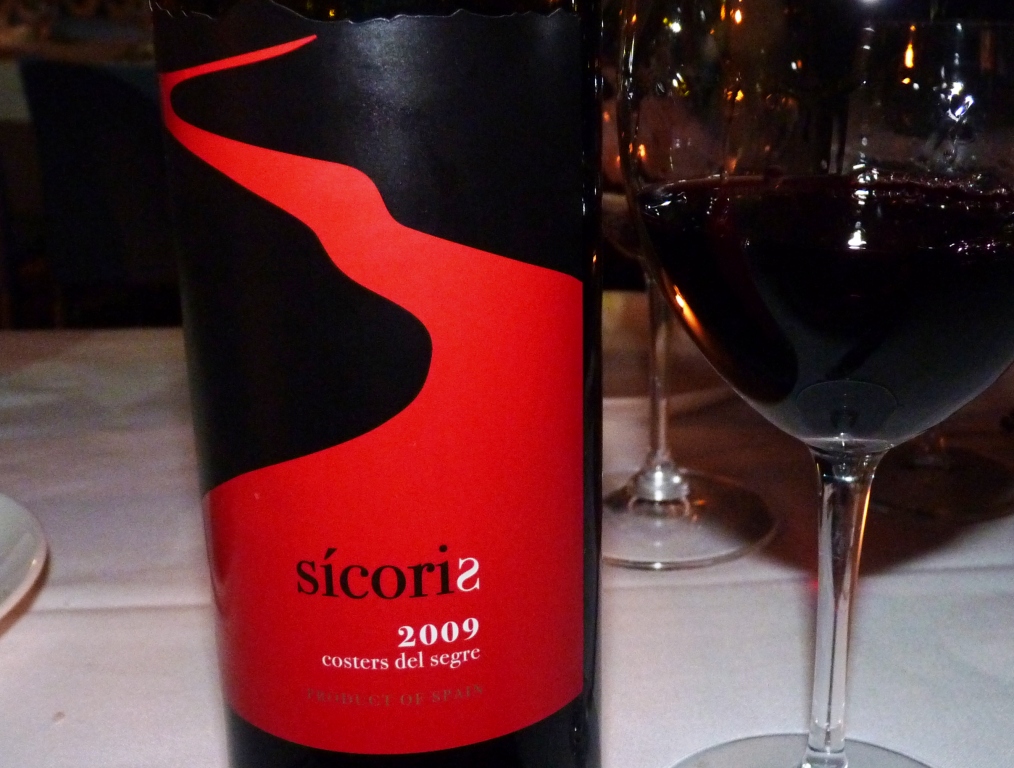
Anyway, let me entice you with some pictures and some additional notes. First, let’s start with wine. The wine list looks very good, with lots of different selections (it has more of a world-wide flare, where wine list at Sra. Martinez had decidedly bigger selection of Spanish wines). We ended up drinking 2009 Sicoris Costers del Segre DO, which is a blend of Grenache, Cabernet Sauvignon, Tempranillo, Merlot and Syrah. The wine have good fruit, medium to full body, a little sharpness on the edges but with good overall balance of fruit, tannins and acidity (Drinkability: 7+).
Our first appetizer course consisted of three different dishes. The first one, called Squash Blossoms with creamy polenta, was the best, simply incredible in the balance of taste and texture:

Foie Gras with Stuffed Pancake was also very good:

And then Beets Salad (how did they know I’m a sucker for a beets salad?):

Next three entrees showed up. First, Homemade Fettuccine with Carbonara Sauce – delicious:

Next, Slow Cooked Short Ribs – out of this world! These short ribs were cooked for 6 to 8 hours, and it was showing. Also, they perfectly paired with Sicoris wine, which was an added bonus:
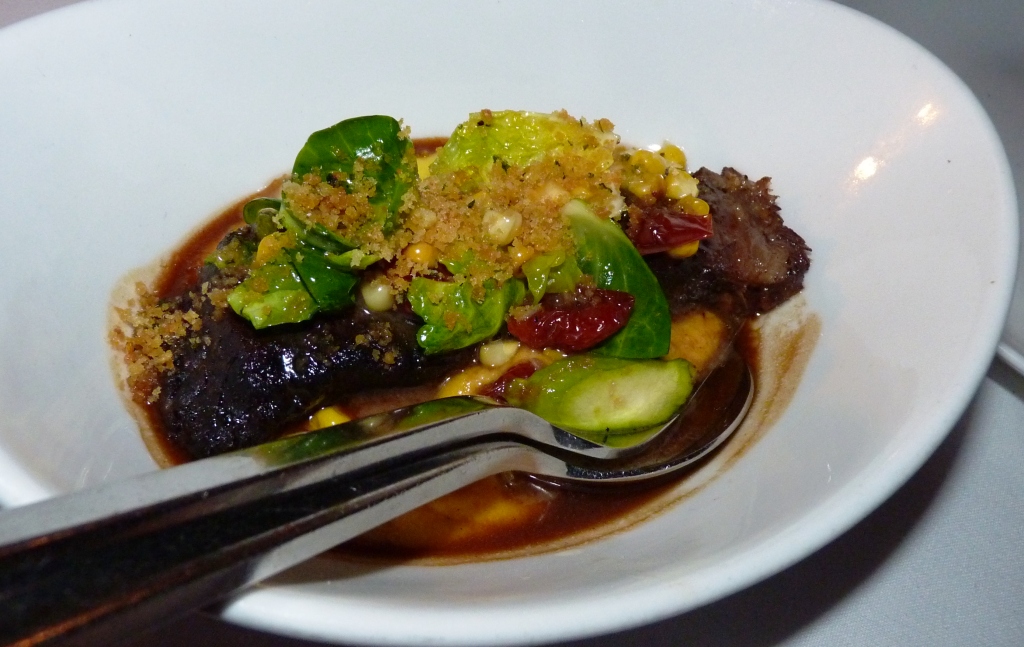
Last, but not the least entree was Snapper in Malaysian Sauce – tasty dish, and very large in size, so once again we were very happy with the fact that we took shorter version of the tasting menu:

Now, the dessert course included two dishes. First one was Brioche Bread Pudding – it was good, but not my favorite:

And the last dessert, Baked Apple Pie, was another “to die for” experience – probably the best Apple Pie I ever had:
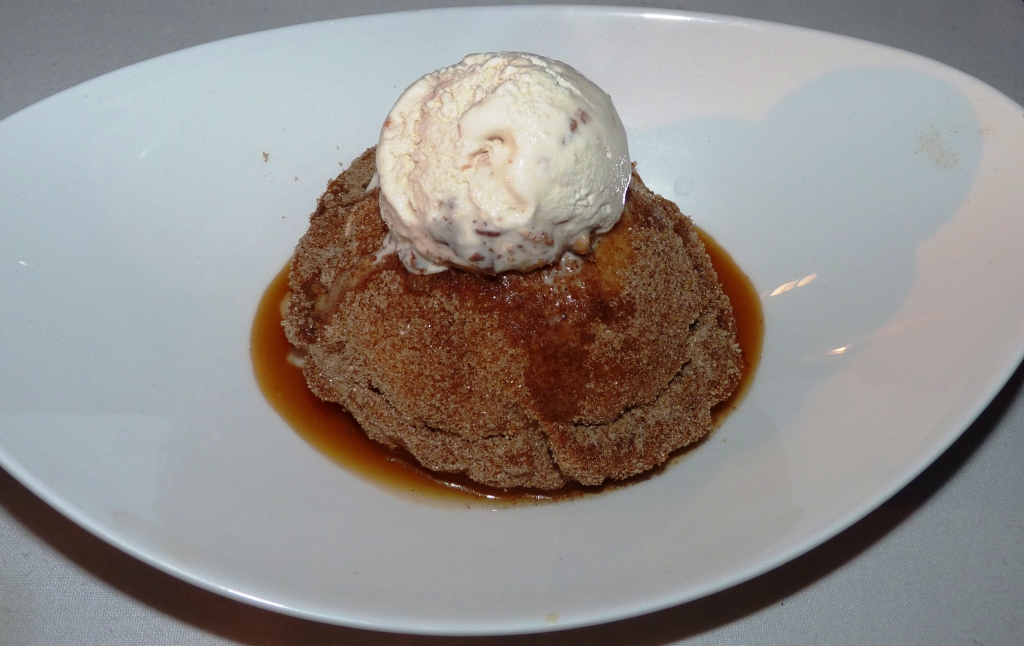
All in all, it was a great experience – great food, great wine, outstanding service (impeccable is the right word). Thank you for the wonderful meal, Chef Michelle Bernstein! [Ahh, watching too much Iron Chef…] Cheers!
Michy’s
6927 Biscayne Blvd
Miami, FL 33138
(305) 759-2001
http://michysmiami.com/

Color Me Happy
Why? Very simply, in one word – Anticipation. Anticipation is a big part of enjoying the wine. I can’t speak for everyone, but for me anticipation starts when the bottle is in my hands. Before I can actually hold that bottle, it is just a dream – I can dream of drinking DRC or Screaming Eagle one day, but this will only be a dream, a big “theory”. Once I hold the bottle, the dream is over – in a good sense, as this is when anticipation starts. This is “IT” – now it is practically possible, not theoretically, so now you can start planning that special moment – even if it will take place 10 years from now, but you know that barred all unforeseen circumstances, you will experience that bottle.

Case in point – 2008 Alban Patrina Estate Syrah Edna Valley. Why? Alban was one of the very first wineries in California which started producing “Rhone-style” reds (and I really like Rhone wines). Alban wines are almost impossible to get (it’s being already more than two years since I registered for the waiting list to get on the mailing list) and they are very highly regarded by all those who was able to try them. So now, thanks to the Wade’s Wines, I’m a happy owner of the wine I was dreaming about.
Hello, anticipation. Yes, color me happy! Cheers!
Tishbi Winery Experience – Wine, And Lots More
 Continuing the “Israeli Experiences” series, I want to talk about a great experience at Tishbi Winery.
While the Tishbi family had been in the “grapes business” since 1882, the actual Tishbi Winery was founded in 1984 in the foothills of Carmel mountain in the area called Zichron Yaacov. in addition to the vineyards in the Zichron Yaacov area, Tishbi also owns vineyards in the North and South areas of Israel.
First, we had to walk around the Visitors Center (which is brand new and modern looking), as there was a huge group (about 100 people we were told) participating in the tasting. Very nice modern facility, spacious and airy. Of course, the first thing we saw was wine:
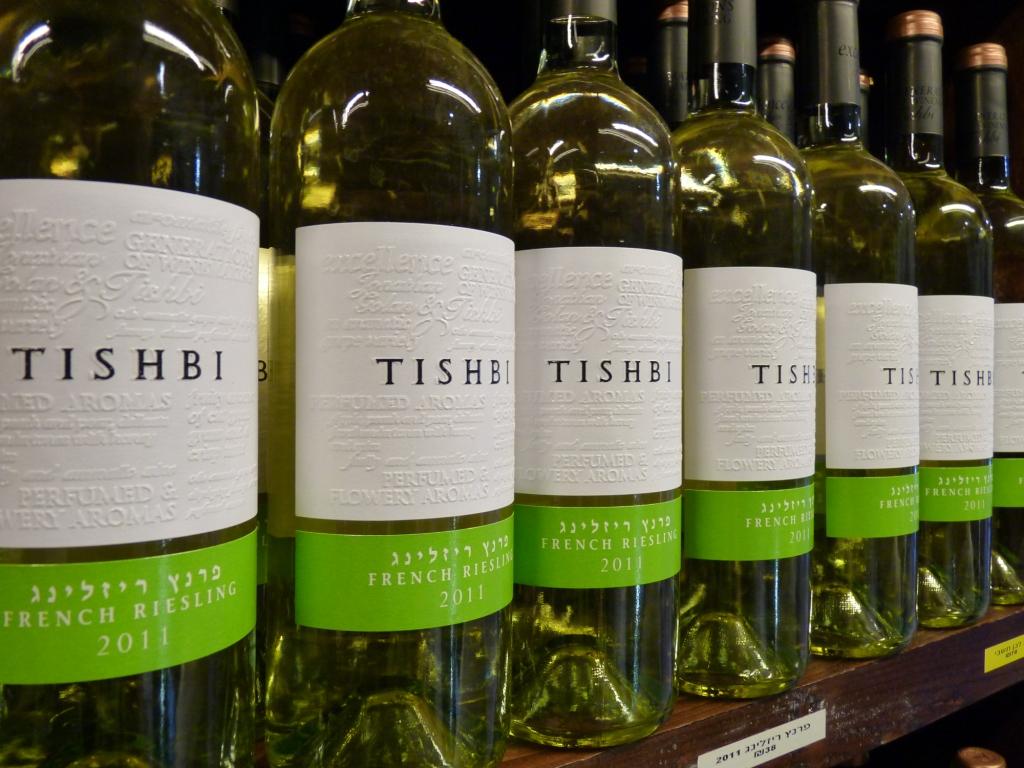
Riesling (as you can see, it is called “French Riesling” to distinguish from Emerald Riesling which is another Riesling variety growing only in Israel):
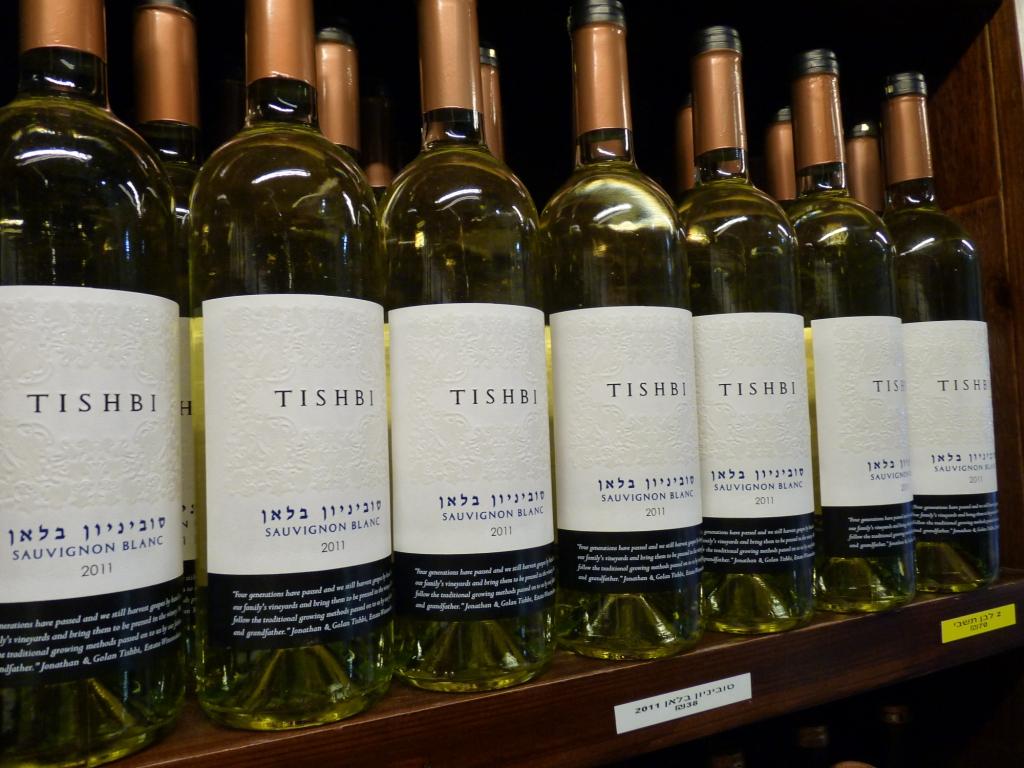
Sauvignon Blanc:
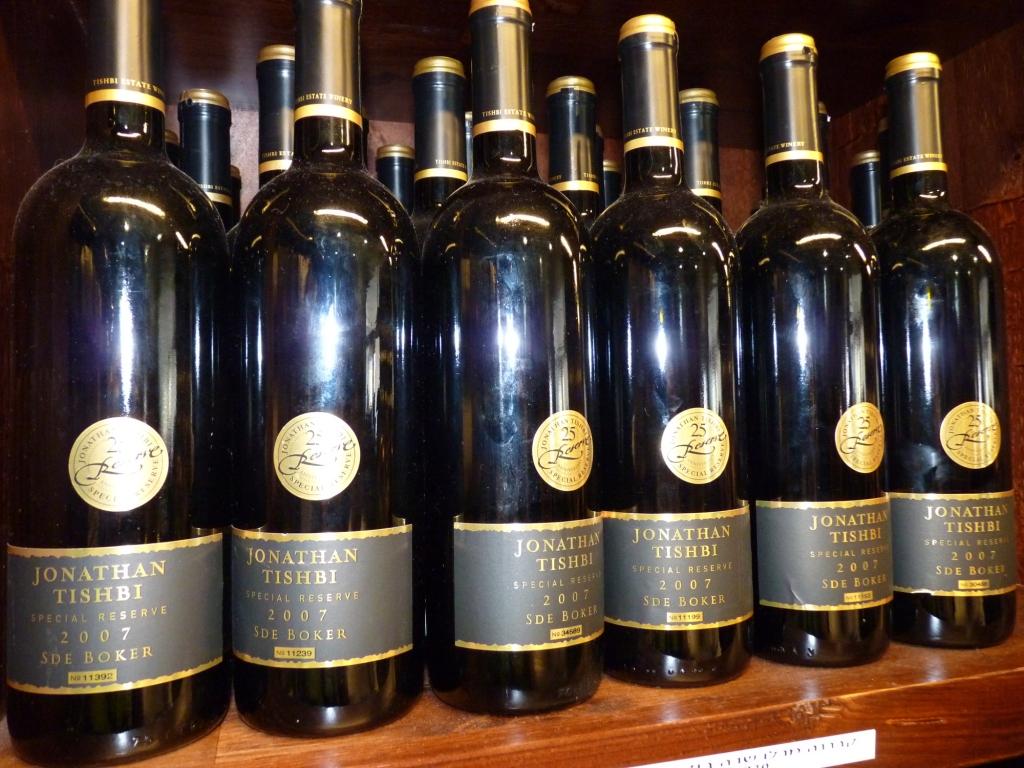
Jonathan Tishbi Special Reserve ( this wine is a blend of Cabernet Sauvignon, Merlot, and Cabernet Franc and it comes from Sde Boker vineyard located in Negev Desert):
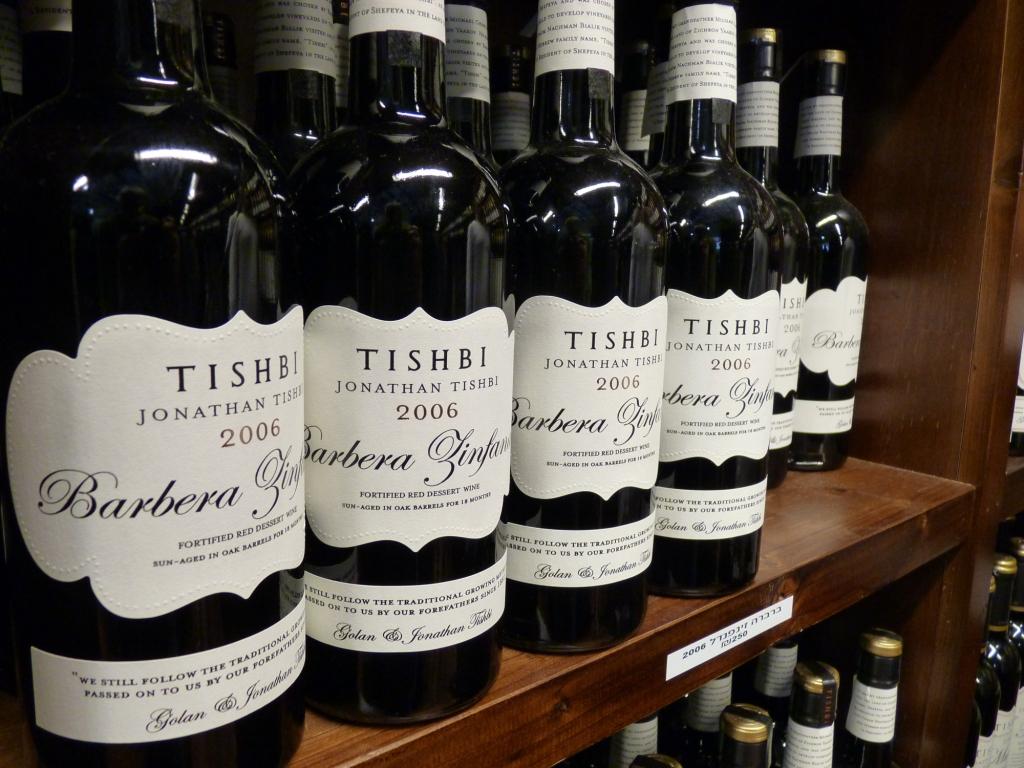
Barbera/ Zinfandel (!) Port (very interesting to see Zinfandel grape somewhere outside of the US):
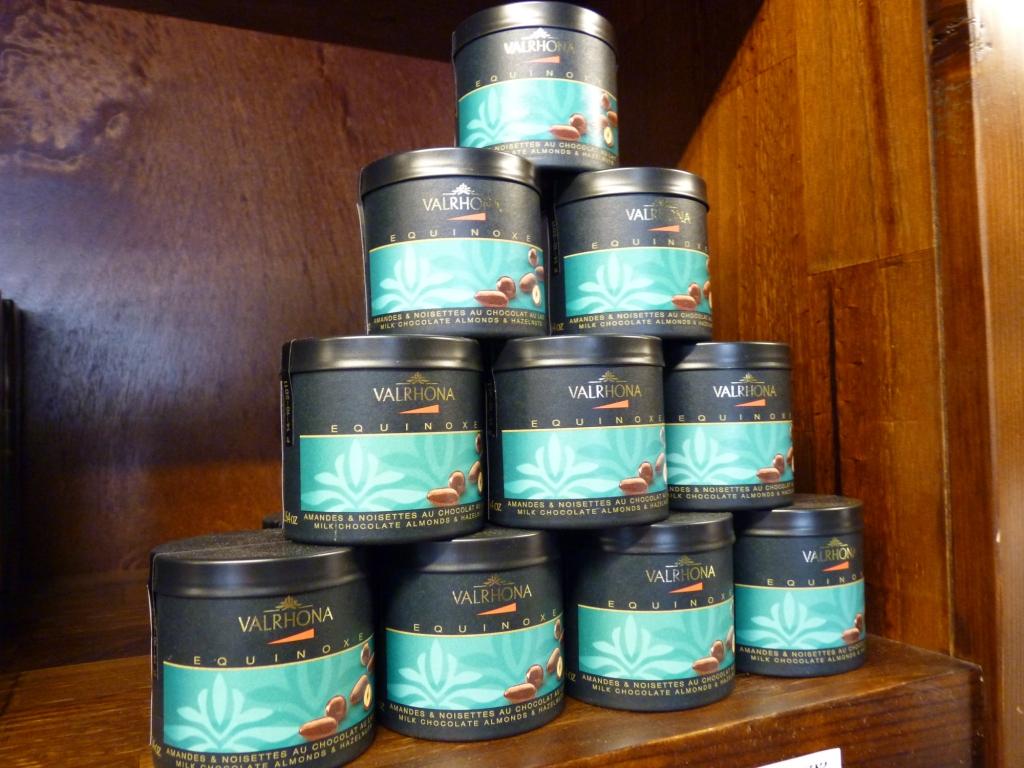
The next thing we noticed after all the wines was … chocolate! Not just random chocolate bar as a condiment – the shelves full of Valrhona Chocolate. It appears that Tishbi recently became one of the biggest distributors of the Valrhona chocolate in Israel. As part of the tasting, you can experience a special pairing of various “single cru” Valrhona chocolates with Tishbi’s wines.
Finally, we managed to escape the Visitors Center and found out that we can have a tasting in the cafe next door, which we did. Here are some of the note for the wines we tasted:
 We started with 2011 Tishbi Gewurztraminer, which was very nice, clean and simple, without strong bite which Gewurztraminer often has. 2008 Tishbi Special Reserve Chardonnay had a good body, good white fruit expression with a hint of vanilla, but it was a bit too sweet to my taste.
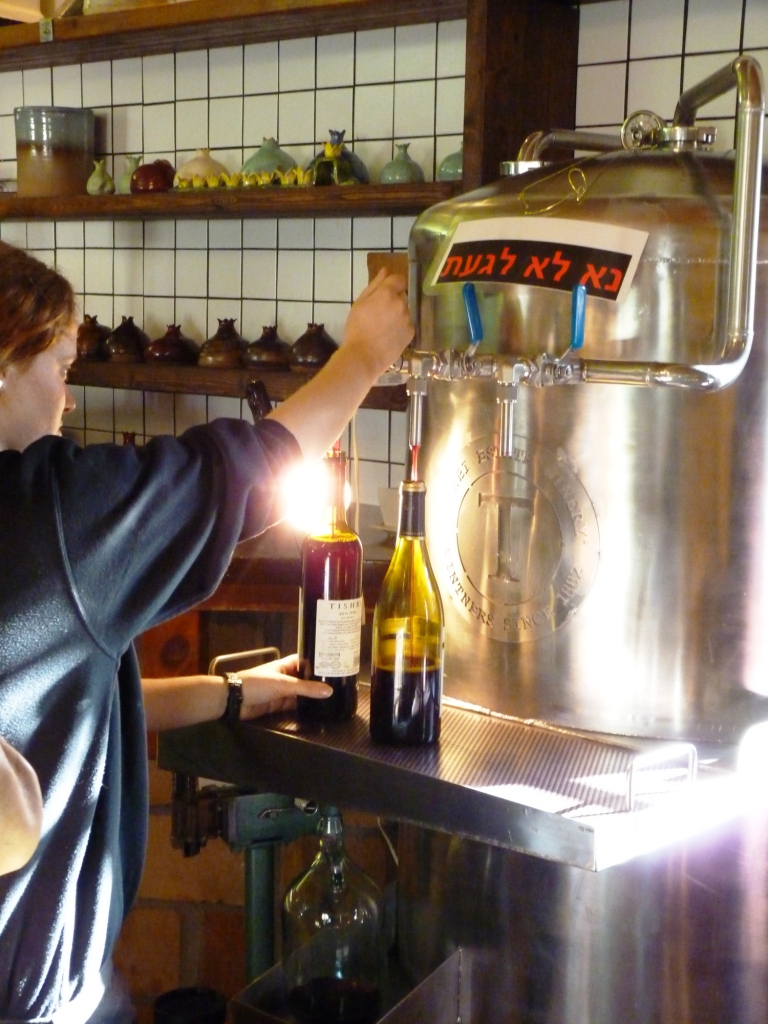
Those were the only white wines we tried, and then we switched to red. The first red was very surprising to me – 2011 Tishbi Cabernet Syrah. What is so surprising in the Cabernet? Well, note the year – it is last year’s harvest, and this Cabernet Sauvignon didn’t spend any time in the oak barrel! Moreover, it was poured from the stainless steel tank, which was located right there in the cafe. You can bring your own bottle and get it filled with this Cabernet Syrah blend for about $5 – this is the real deal, move over two buck chuck. I also would like to note that this was a very good wine – clean, with good fruit expression and perfect acidity. After that we tried a number of Tishbi Estate wines from 2007 vintage. 2007 Tishbi Estate Cabernet Sauvignon had a beautiful classic nose, but was a bit too sweet on the palate. As an added bonus I need to mention that it had Ruby Cabernet grape as part of the blend – which is a new grape for my grapes count, so I’m advancing to 361 now. 2007 Tishbi Estate Merlot was simply perfect – a great balance of all the components. 2007 Tishbi Estate Syrah was also very good, with pepper notes on the palate, full body, good concentration of tannins. 2007 Tishbi Estate Petite Sirah had good dense fruit and full body, coupled with the perfect acidity.
Last but not least we tried 2006 Tishbi Barbera Zinfandel Port wine. This wine spends a year and a half in the oak barrels before it is released. The wine was excellent, with good fruit and perfect balance, not overly sweet – and it also paired very nicely with the Valrhona chocolate (which is somewhat expected from the port). By the way, below you can see the process of pouring of that 2011 Cabernet Syrah:
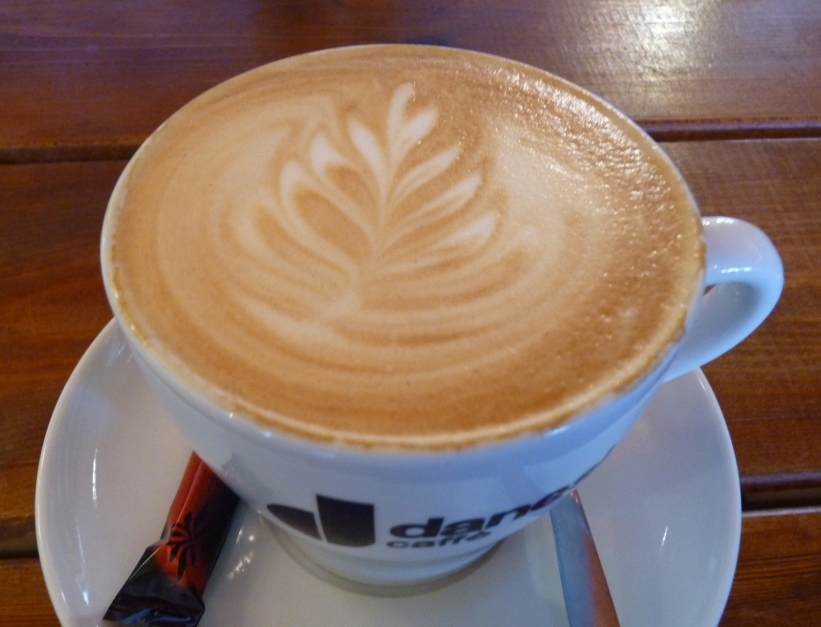
At this point we took a little break, and had the nearly perfect cup of cappuccino:
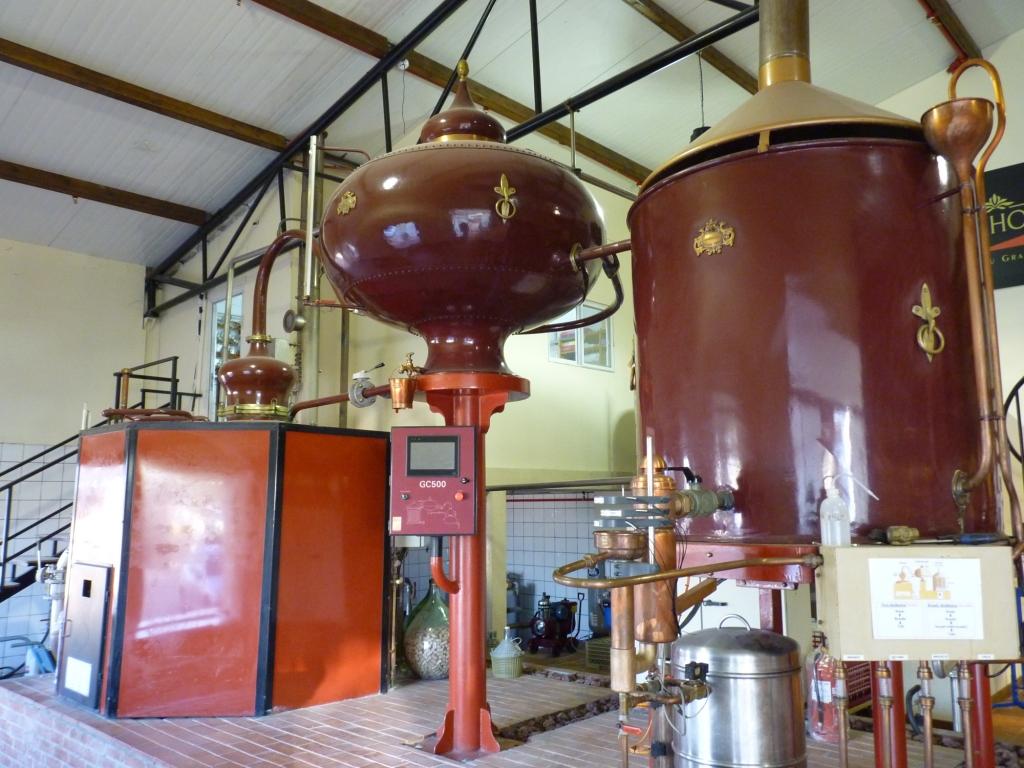
When we went back to the Visitors Center, we noticed something we overlooked before – a full distillery! Located right there in the Visitors Center, there is a still pot which is used to produce Tishbi Brandy:
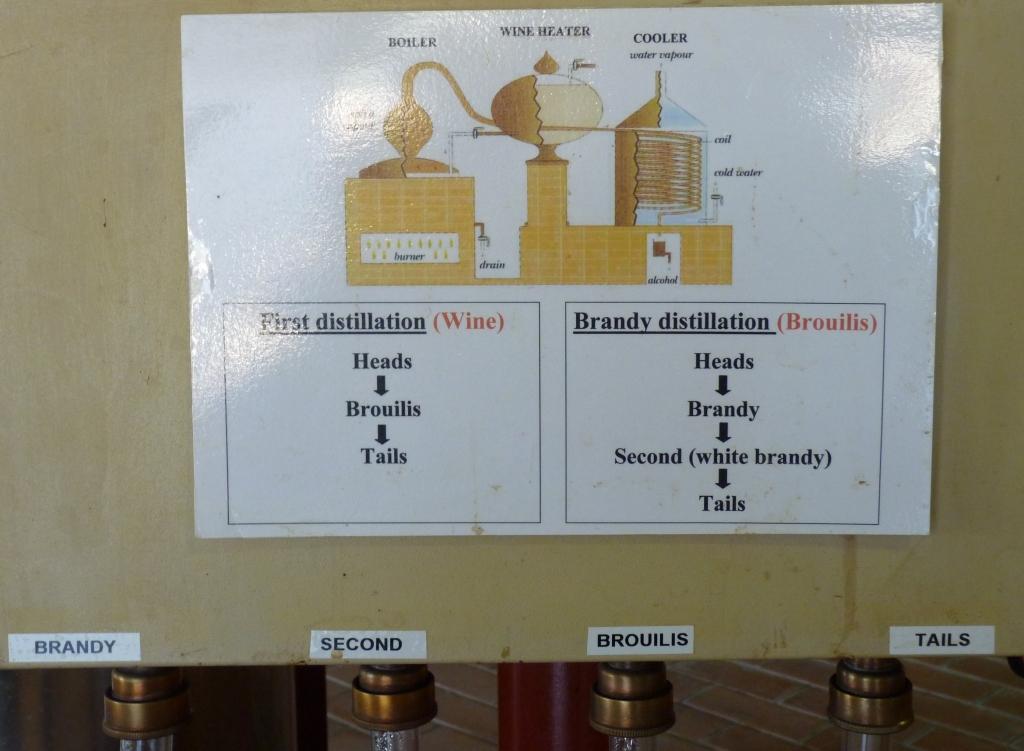
And here is an illustration which explains the distillation process:
Here is the end result of the distillation – Tishbi 16 years old Brandy:
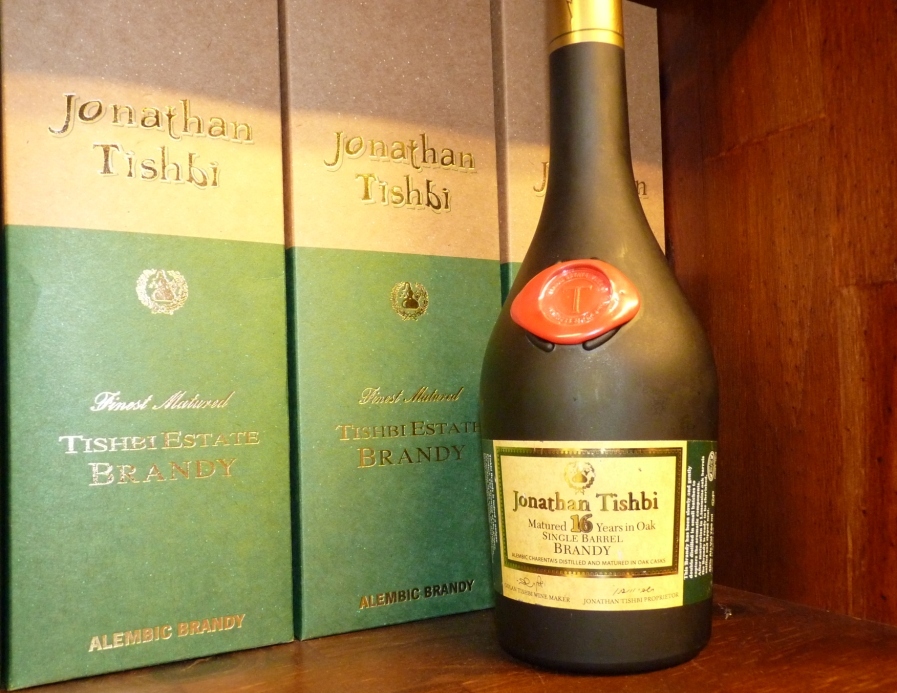
We were lucky, as we were also able to try that 16 years old brandy (typically you can try it only if you buy a bottle – considering that it costs about $450 for the bottle, you can imagine that I wouldn’t be trying that Brandy otherwise). I can’t help but to comment that I think the price is a bit high (okay, way too high).
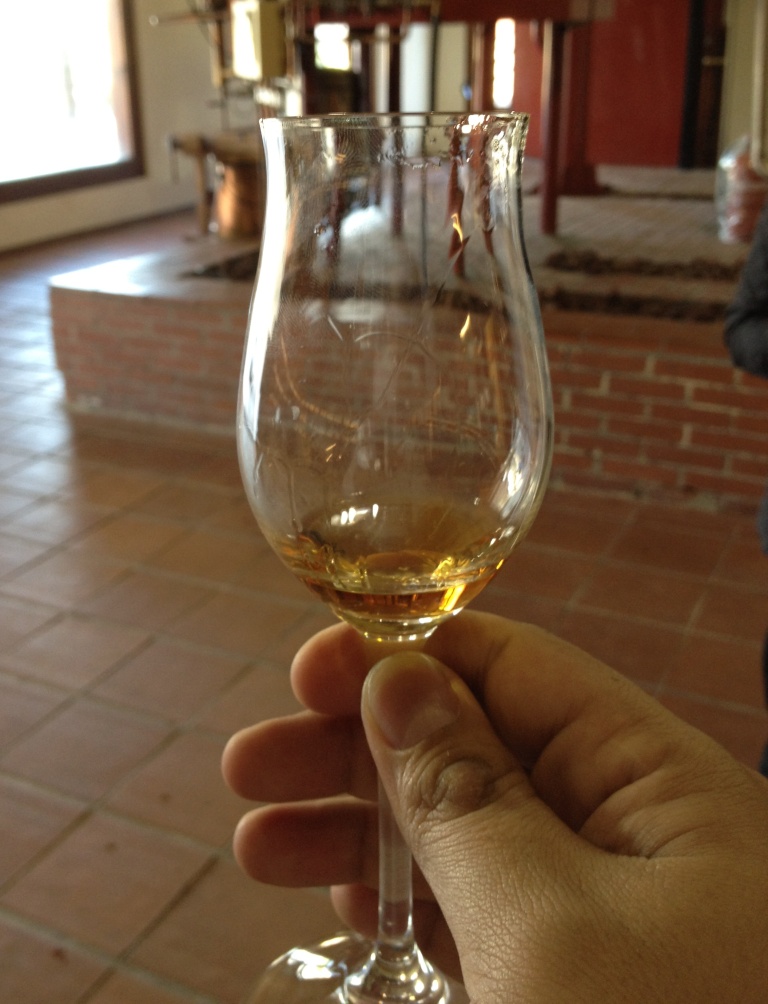
All in all, we had a great time at Tishbi – if you are visiting Israel, it is well worth a trip. Otherwise, you can find Tishbi wines in the stores in the US, and I would definitely recommend them. That concludes my report, folks – cheers!
Last Bottle Sign Up ($10 credit)




 Talk-A-Vino