Weekly Wine Quiz #49 – Once Upon A Time…
Saturday is here again, therefore it is time for the wine quiz!
This week’s quiz will be very different from the last one – and I really really hope to see more people participating.
Today’s quiz doesn’t really have much of the right answers – but I hope this will even make it more fun.
Below you will find some words and expressions, which are well known – and connected to the world of wine at least as the legend has it. So this is the legend I’m looking for – please tell me how the following words are connected to the world of wine (and here I’m including all things alcohol into the word “wine” – whiskey, sake, beer – all is “wine” in this context):
- Honeymoon
- Wet your whistle
- Rule of thumb
Remember – there are no wrong answers, so unleash your imagination…
Have fun and good luck! Have a great weekend and cheers!
Daily Glass: Study of La Rioja Alta Viña Alberdi
 On a given day, outside of any big holidays or special dinners, I have no idea what bottle I’m going to open in the evening. Sometimes it can be a painful procedure of looking at 20-30 bottles not been able to decide. Today, it was easy – @wineking3 mentioned on twitter that he had not the best experience with 2003 La Rioja Alta Vina Alberdi Reserva, which sparked my interest. You see, La Rioja Alta is one of the very best (and of my favorite) producers in Rioja, so I wanted to see if I can taste the same or similar wine – and I quite convinced that I should have some 2003 La Rioja Alta wine. Also it appears that Decanter magazine suggests that 2003 Rioja should be drunk now, however suggesting that better producers created powerful wines – which again only increased my interest.
La Rioja Alta was founded in 1890 by the group of five winegrowers in the Haro Station District. In 1941, the winery introduced its Viña Ardanza brand, which became one of the most famous in Rioja. In 1970, Viña Arana and Viña Alberdi were introduced, and since then La Rioja Alta wine had being produced under all three labels – but not in all the years. Each “brand” has it’s own unique source of grapes and grape composition, which is rather expected.
So as I pulled the 2003 La Rioja Alta Viña Alberdi Reserva from the wine fridge, somehow the thought came to my head – let’s use wine thermometer. You see, I have this nifty device called VinTemp, which is an infrared wine thermometer – it can perfectly measure temperature of the wine in the bottle without actually touching the wine. While I know that temperature has a great effect on the taste of wine, I practically never use this thermometer – but today I did, so the simple wine tasting became more of a study of the temperature effect on the wine.
According to the producer’s notes, 2003 was a very difficult year, due to the extreme heat and lack of the rainfall in July and August. As the result, only the grapes form the highest areas were used to produce the wine, which is made out of 100% Tempranillo coming from 3 different areas. The wine was fermented for 12 days, following by 26 days of malolactic fermentation and then aged for 2 years in American oak casks. The resulting wine has 13% ABV. That’s it – I’m done with all the technical and general stuff – let’s go to the tasting notes. Ahh, sorry, last detail – the winery notes recommend drinking the wine at 17°C (63°F).
The bottle is opened and the wine is poured. Initial temperature – 16.2°C (62°F). Color is dark ruby red, a color of mature red wine, but without brown hues. Rim variation – practically absent. The rim is clear and noticeable, which talks about some age, but it is clear. Nose: Mushrooms, earth, cherries, touch of barnyard – clearly an old world wine. Palate: Perfect acidity on the sides of the tongue, tart cherries, tannins. Tannins completely covering the mouth, very similar to Barolo, only with the wine been a bit lighter. And then there are more tannins. And they are going. And going. And going. For about one minute forty seconds ( yes, I looked at the clock). First verdict – perfectly dry wine. Need time to warm up and to open.
Second taste – about 20 minutes later, temperature measures 17.6°C (64°F). Nose – unchanged. Palate – more fruit, less tannins. Green notes, the wine almost tastes bitter. Worrying – is this the case of bad Rioja? Tannins are back, killing and overpowering.
Third taste – about an hour later, 19.3°C (67°F). Nose – coffee and chocolate showed up. Palate – beautiful. Fresh acidity. Bright fruit, cherries, blackberries. Still lots of tannins, but the fruit now comes first. Very round, smooth and expressive. Lots of pleasure.
Final verdict – Beautiful wine. Needs time!! Drinkability: 8
Let’s sum it up, shall we? In my opinion, this wine needs at least another 10 years to open up. And as you can see, the temperature plays key role here – considering level of tannins, the recommendation of 17°C is very surprising – you do need to drink this wine at a room temperature to let it show up in all its beauty.
Our study is complete. Now, can I have another glass? Cheers!
Wednesday’s Meritage – Wine Quiz Answer, Too Hot and Too Cold, Grading Wine Ratings and more
Meritage time!
I think I have a lot of interesting stuff for you , but – let’s start from the answer to the wine quiz #48, Let’s get a little technical. Considering that I got only one response to the quiz, I can only guess that I went too far – even though I really didn’t see it that way – my hope was that everybody will try to answer at least something – it is definitely fine to say “I have no idea” – makes it as good of an answer as anything else.
Anyway, in that quiz you were supposed to match wines in the list with some of the technical terms, and as a bonus part to explain what the terms mean. These were the terms presented: Appassimento, Estufagem, Flor, Malolactic fermentation, Noble Rot, Solera, Vintage. Here is the list of wines with the relevant terms and explanations:
A. Cabernet Sauvignon – this was a curve ball, as I warned you. None of the given terms are really associated with this wine.
B. Champagne – Vintage is only declared in the exceptional years
C. Chardonnay – Malolactic fermentation is often used to produce softer-tasting Chardonnay
D. Jerez – flor, solera
E. Madeira – Estufagem
F. Port – Vintage is declared only in exceptional years.
G. Riesling – Noble rot
H. Valtellina Sfursat – Appassimento – in production of Valtelina Sfursat, Nebbiolo grapes are dried before pressing, sometimes for 100+ days.
I. Vin Jaune – flor
All in all, VinoInLove gets an honorable mention, both for the courage and for providing a number of right answers. Also, this quiz forced me to add a feature to this blog which I wanted to do for the long time – a Wine Glossary! Now, instead of providing explanation for all the terms one by one, I can simply refer you to my new Wine Glossary page. And as it is new feature, I would love to hear from you – comments, yay, nay, suggestions – anything and everything goes!
And now, to the news!
Boy, so much stuff happens when you get away from the Reader for a while. Some of my “news” might not be new for you at all, but – I still would like to share it here.
First, I found this very interesting article by Dr. Vino, who writes for the Wine-Searcher site – the article hits close to home for all of us who gets wine shipped to them ( and who doesn’t nowadays). Do you know how your wine was stored during the shipping? Was it exposed to extreme heat or extreme cold? Both can equally destroy your wine, but for more details go read the article.
The next interesting article again comes from Dr. Vino and it is dedicated to all the number addicts and Champagne aficionados ( I know I have a few among my readers, but I will not name names). Want to know how many bottles were made, consumed and broken (okay, I’m pulling your leg here) – take a look at this post.
Can you name the wines which are produced by the iconic Spanish winery, Vega Sicilia? Unico? Yes, of course. Valbuena 5? Very good. How about some Rioja? No, no Rioja from Vega Sicilia? Well, there is now – two Rioja wines called Macan and Macam Classico from Vega Sicilia, and it looks like they might be even affordable (well, for now, anyway) – but of course, not available in US for now.
Do you know who Antonio Galloni is? If you do, great. If you don’t – you soon will. Antonio Galloni left Wine Advocate (surprise, surprise, after Wine Advocate was essentially sold to the group of Asian investors) to start his own web site. Get ready to look for the new abbreviation next to the wine ratings – AG, I guess. For more details you can click here.
And now, this mention of the wine ratings is a great segway to our last news subject for today – a very interesting Wall Street Journal article by Lettie Teague about the value of wine ratings and overall perception of good and bad wines. Would you actively seek 88 point rated wines, or would you go out of your way to drink only 95+ pointers? Robert Parker alone awarded last year 78 100-point ( perfect! ) scores, where Wine Spectator awarded … zero. Is 100 points losing its value as it becoming a lot more readily available, or famous Robert Parker’s palate is faltering? The article raises a lot of interesting questions and definitely is worth reading.
That’s all I have for you for today, folks. The glass is empty. Until the next time – cheers!
Bread and Amarone
Puzzled by the title? Don’t be. This is simply the post about our last Valentine’s Day experience – yes, somewhat belated, but still worth sharing.
Let’s start with the picture. No pink hearts here, only roses, but take a look – what is that lurking in the fuzzy background?

Yep, a Champagne glass, the Tulip! Before we get to the bread and Amarone, let’s talk about Champagne Sparkling wine. By the way, this political correctness is very tiring. Champagne is much faster to say and to write, but no-ooo, Champagne only comes from Champagne, and everything else should be called a Sparkling Wine. It is two words versus one, and takes twice as much time to say and read! And the worst part is that the Sparkling wine in very many cases tastes much better than Champagne, and don’t even get me going on the pricing… Okay, sorry, unintentional rant, let’s cut it out and go back to what I actually wanted to talk about.
 My definite preference is to start a holiday, especially the one like Valentine’s Day, with the glass of
 Cham, errr, Sparkling Wine. It creates mood. It says (loudly) “Celebrate!”. Lightness and effervesce of the bubbles simply picks you up. So this past Valentine’s day our choice of bubbly (yes, jargon – but – it is one word! and it means any sparkling wine, Champagne or not) was 2003 Roederer Estate L’Ermitage Brut Anderson Valley California. Perfectly structured, perfectly balanced, with full harmony both on the nose and the palate. Fresh bread, yeast, toasted apple, perfect acidity, long-living bubbles – all in all, one of the best sparkling wines I ever tasted. Drinkability: 8+
Now, to the bread! Let me not be original – I’m simple going to repeat the note (a huge Thank You, rather) of appreciation which is being expressed all over the blogosphere – the useful content, the advice, information, ideas which are shared by the bloggers are simply staggering. About a month ago I read the blog post by one of the fellow bloggers, Kim from She Wines Sometimes (if you are not following her blog – fix this mistake right now). The post was talking about making the bread! At home! In a simple way!
I have to admit – I love bread. When in France, I can survive on just baguette alone (okay, throw in a little cheese, will you?). But baking the bread at home was not anything I would fathom in my wildest dreams. Until I read Kim’s blog post. It sounded so easy – I had no choice, but to say – this is it, I’m making the bread!
When it comes to baking, I dread the precision of the recipes. I consider myself to be an okay cook – I can substitute ingredients, I can come up with my own recipes, where I can measure all the ingredients with very precise “I think this is enough” accuracy. It doesn’t work like that in baking. Replace baking powder with baking soda and you might end up with a complete flap instead of a good tasting product – and the same goes for many other ingredients. This is why I usually think about baking as something better left to the professionals – but then again, all the professionals start somewhere, don’t they?
I’m not going to repeat the recipe here – here is the link to the original. Of course I ended up making some mistakes. The recipe calls specifically for King Arthur bread flour. I didn’t print the recipe before going to the store, and of course I ended up with the regular King Arthur flour. At first I even forgot to buy the yeast – and the second trip to the store was in order. But, you know what? All this doesn’t matter. Because the bread tasted AMAZING!
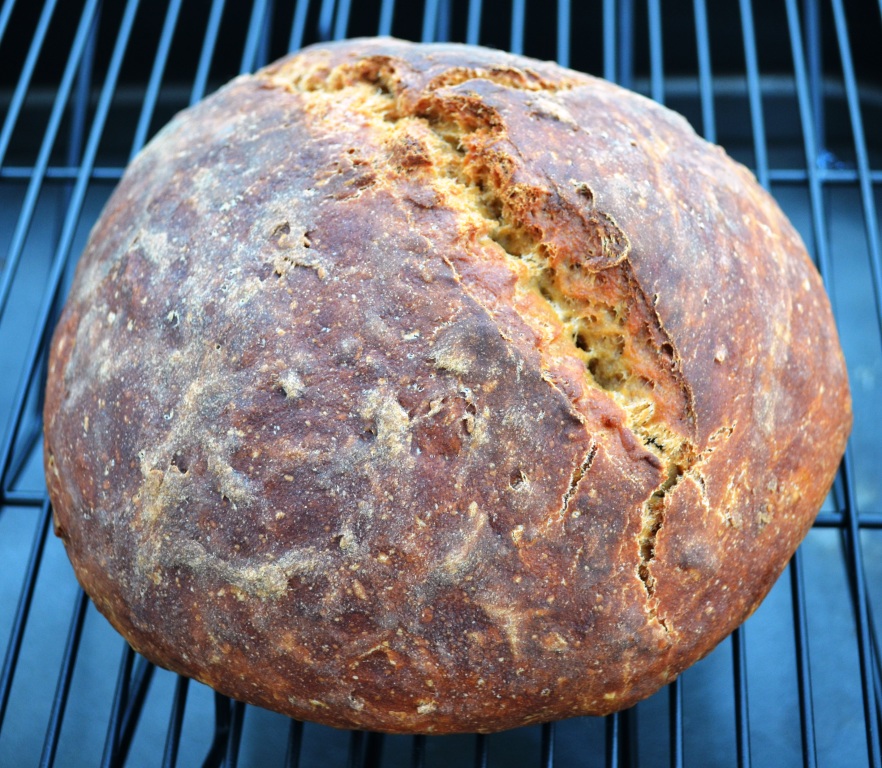
And the smell of the freshly baked bread when you just walk into the house – it is simply something heavenly (and pretty much priceless). The only thing I need to add here – Thank You Kim!
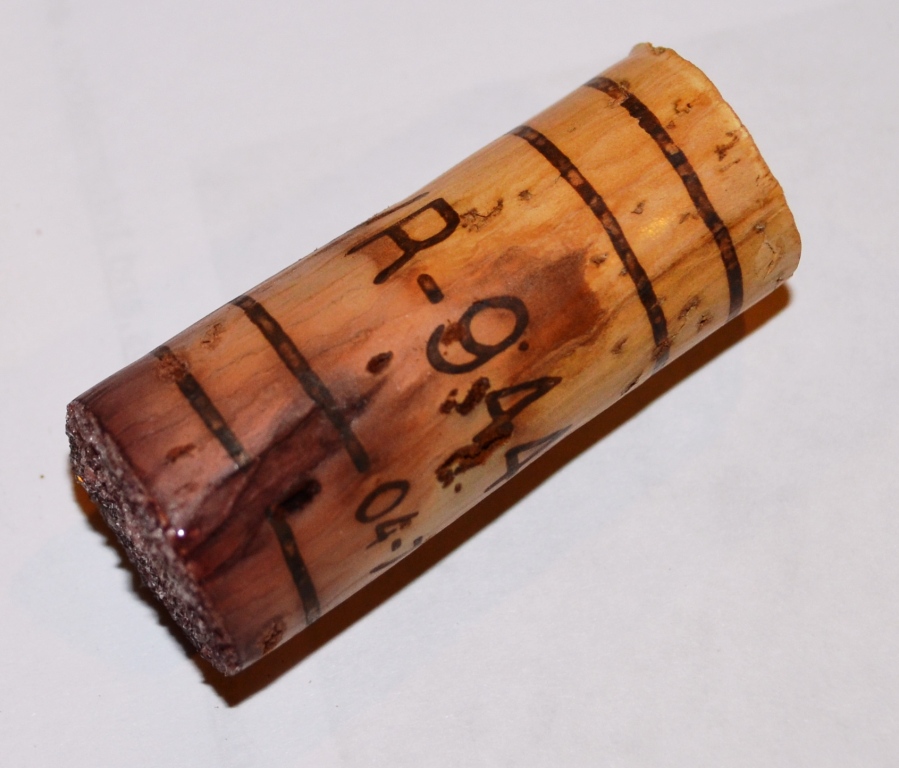 And now, to the wine. Not just any wine – Amarone! If you followed this blog for some duration of time, you know that I’m always on the lookout for the perfect Amarone, trying to replicate my moment of bliss smelling succulent raisins and tasting perfectly dry and powerful wine (here you can find a collection of my Amarone posts ). That “perfect wine” was 1997 Le Ragose Amarone, which I tasted in 2004, so the wine was 7 years old. And now it was Le Ragose Amarone again.
Looking at the cork, can you try to guess how the wine was? Did you write down your answer? Okay, good.
We opened the bottle of 1990 Le Ragose Amarone Della Valpolicella (so, did you guess correctly?). I have some experience opening old wines, and when you open a bottle of wine which is 23 years old, you expect trouble. I had my double-prong bottle opener ready, but when I removed the foil and looked at the cork, it appeared to be as fresh as it would be on the new bottle. And it actually was – the standard waiter corkscrew worked just fine!

And the wine was outstanding. No, it didn’t replicate my experience with 1997 – this was a lot more mature wine. But it had a perfect nose of dried fruit – not only raisins, but probably some dried cherries, fig, prunes. The palate showed mature beauty, with the fruit which is tamed, but still has perfect acidity to make it all work together – there was more dried fruit on the palate, more cherries, more prunes, leather and earthiness. Definitely was a great wine, and as an added bonus – it was only 14% ABV! All the modern Amarone are trying to exceed 16% by now, and one of the geniuses of the winemaking recently even told me that you need high alcohol to preserve the wine… ok, stop. Sorry. One rant per post. This one will have to wait for another time. All in all this 1990 Le Ragose was a great experience, so let’s live it at that. Drinkability: 9-.
That’s all I have for you for today folks. It is too late to ask about your Valentine’s day experiences by now, but did you drink any amazing wines lately? Or made bread : ) ? Cheers!
Following Wine Till Sold Out – Cheapskate Wednesday, February 20th
 About two weeks ago, on February 20th, WTSO (Wine Til Sold Out), one of my very favorite purveyors of great QPR wines, had another one of their Cheapskate events – all the wines are priced from $7.99 to $18.99, offered in the quantities of four, new wines are offered every 15 minutes or sooner, and all the notifications about new wines are only coming out on the Twitter. While I was on vacation and couldn’t take advantage of any offers, my faithful computer did its best to collect the information (which in the end of the day made me upset as I saw how many great deals I missed).
As I have done it before, I would like to share with you all the data, so you too can get upset – or not, as you can instead be happy about all the money you saved. Let me add few observations here. There were about 130 wines offered. Very few wines lasted 15 minutes, many wines disappeared in a matter of couple of minutes. I counted four very strange glitches, where the wine was seemingly offered at WTSO web site, but not showing up in the twitter stream – if you followed the event and saw that too, I would like to know what you think about it. This is definitely a first time for me observing such a discrepancy (not that this is all that essential though).
Before I will leave you with the data, here is the usual guide to rating abbreviations: WS – Wine Spectator, WA – Wine Advocate, ST – Steven Tanzer, WE – Wine Enthusiast, WRO – Wine Review Online, W&S – Wine and Spirits, JS – James Suckling, RP – Robert Parker, JHN – Jonathan H. Newman, D – Decanter Magazine, rating goes in stars ( 5 stars is max), JH – James Halliday, TRR – The Rhone Report, BH – Burghound.
Enjoy and cheers!
Weekly Wine Quiz #48: Let’s Get A Little Technical
 The Wine Quizzes are back at Talk-a-Vino! Be honest – I know you missed them, right? Okay, never mind. But – let’s proceed, shall we?
For today’s quiz I decided to play a game of pairing of the wine terms with the wines. What you will find below is the list of the wines (very random), and the list of wine terms associated with production of the wines. You will need to match the terms with the wines, considering typical and generic use (note the bold font here – it is an important disclaimer) – there are always exceptions to the rules. Note that one and the same term can be associated with different wines, and it is possible that few terms can be associated with one wine. As the bonus question, briefly explain what the term mean and how it relates to the wine. Note – you might encounter some strange surprises along the way.
Wines:
A. Cabernet Sauvignon
B. Champagne
C. Chardonnay
D. Jerez
E. Madeira
F. Port
G. Riesling
H. Valtellina Sfursat
I. Vin Jaune
Wine Terms:
1. Appassimento
2. Estufagem
3. Flor
4. Malolactic fermentation
5. Noble Rot
6. Solera
7. Vintage
As a side note, a lot of these wine terms had being discussed in this very blog.
Have fun and good luck! The answers are coming on Wednesday.
Have a great weekend and open something good tonight! Cheers!
Re-post: Forgotten Vines: Madeira
During 2011 I wrote a number of posts for the project called The Art Of Life Magazine – of course talking about my favorite subject, wine. The project closed and even web site is down, but as I still like the posts I wrote, so I decided to re-post them in this blog. Also, in that project, posts were grouped into mini-series, such as “Forgotten Vines” you see here – I will continue re-posting them from time to time.
Also note that the series was written for a slightly different audience – I hope none of my readers will take offense in the fact that sometimes I’m stating the obvious…
 Our first post in the Forgotten Vines series was dedicated to Jerez, a not-so-easy-to-find-but-worth-looking-for fortified wine from Spain. Continuing the series, let’s move a little bit to Spain’s west side neighbor, Portugal.
Talking about Portugal’s place on the wine map, what wine comes to mind first? Yes, of course it is Port. And while Port is single most famous Portugal wine, it is not the Port we want to talk about here (don’t worry, Port is squarely positioned in the line of “must-have” experiences, and we will talk about it later). We need to move a bit more down the map in the south-west direction, about 1000 km (600 mi) to the island of Madeira.
Madeira wine takes its name from the name of Madeira Island. History of Madeira, which started at around 15th century, is full of accidental discoveries, glory, overcoming of the hardship, raise and fall, and even love – if you are interested in the full story, you should take a look at Madeira Wine web site. In the 15th / 16th centuries, Madeira wine was created and transported in the barrels through the ocean to the far places such as India and China. It was found ( by accident, of course), that long ocean voyage improves the taste of wine compare to the original one which went into the barrel. After many trial and error experiments, it became apparent that prolonged exposure to the warm weather is the culprit, and then the method of heating the wine up to the 60C (140F) was invented. The process of heating up the wine is called Estufagem, and it is done after the wine is fermented in the oak barrels, same as any other wine – again, you can find more details online – you can find less colorful but more technical details on Wikipedia (click here). Just to give you a few more details from Madeira’s history, trade embargoes led to further improving Madeira by adding brandy spirits in order to preserve the wine. Barrels of Madeira left for prolonged time under the rain lead to development of the new style of Madeira wine, called Rainwater.
In the 18th century, Madeira was one of the most popular wines in the world, especially in England and United States. Madeira was used to toast United States Declaration of Independence, and was highly regarded as a drink of distinction. Unfortunately, first mildew and then phylloxera epidemic delivered way too powerful one-two punch, which Madeira wine industry was unable to overcome. Madeira subsided to nearly a cooking wine level, and was staying like that for the long time. Luckily, overall uptake on the wine industry throughout the world helps to revive Madeira industry, and now it is becoming possible to find a great drinking Madeira even in US – and you will see why. And I have to note that one of the great qualities of Madeira is in the fact that unlike practically any other wine, once you open a bottle of Madeira, it will stay the same more or less indefinitely, due to both Estufagem method and fortification with the spirit.
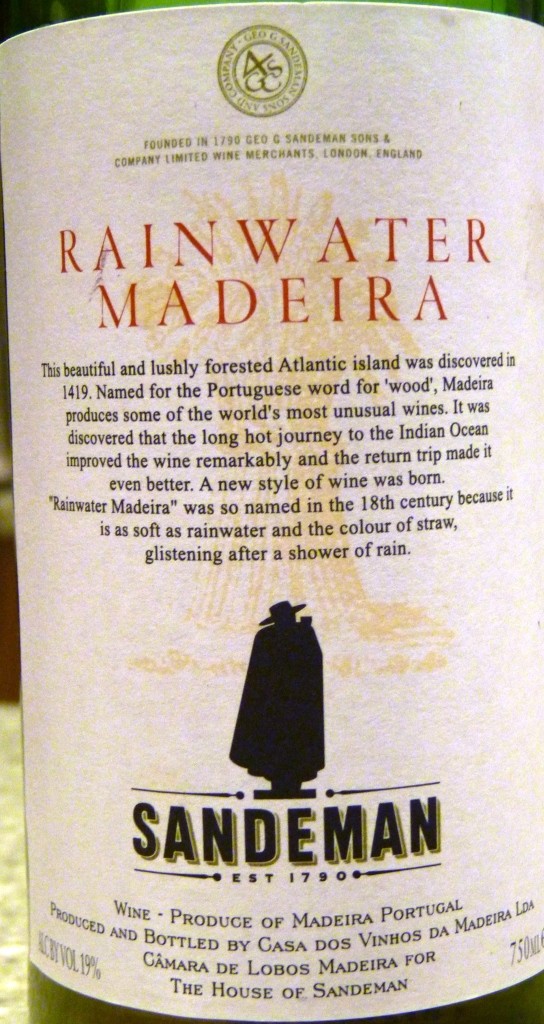
As we say here, time to open a bottle. Madeira comes in many different versions, from completely dry to the sweet. The Rainwater Madeira is somewhat of a simpler style, but still very enjoyable. This Sandeman Rainwater Madeira is deep and heavy on the nose, with hint of aged cheese and sweetness (overripe apple sweetness). On the palate, it shows the same concentration of the sweet notes, which is not really supported by acidity, so the wine comes somewhat unbalanced – however, as a desert wine to have with sharp cheese (like blue cheese, for instance), it will create a heavenly combination.
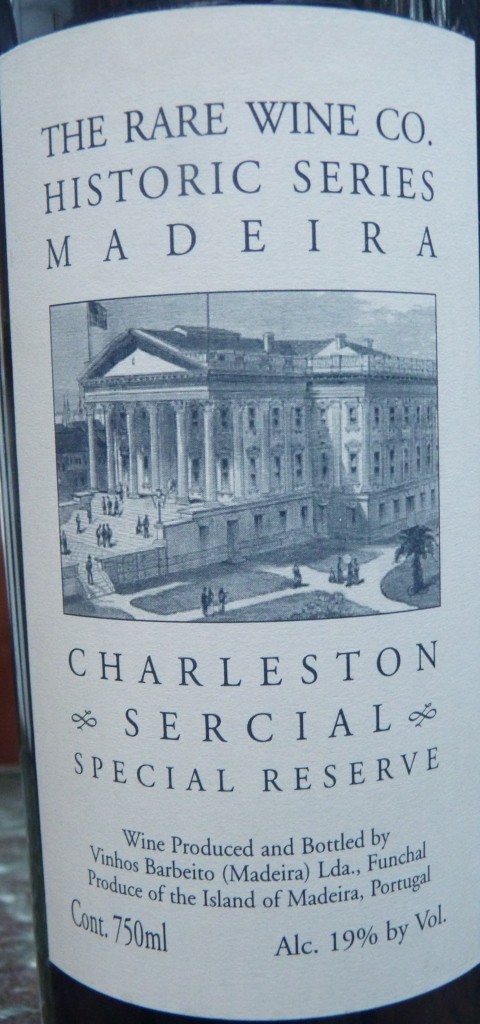 The next wine, Charleston Special Reserve Sercial is few levels up the previous wine. It comes as incredibly complex on the nose – nutty, with hint of sweetness and herbs, lots of herbs. Beautifully balanced on the palate with acidity and sweet delicate flavors of apple blending together perfectly. This Madeira has very long finish and can be used equally well before, during and after dinner – just take your pick. Definitely worth seeking.
Well, it is a great time to be a wine lover – abundance of experiences just grows daily. Now that you are empowered with the knowledge of Jerez and Madeira, it is time for personal encounter – find the bottle and enjoy it tonight!
Forgotten Vines: Jerez, a.k.a Sherry
During 2011 I wrote a number of posts for the project called The Art Of Life Magazine – of course talking about my favorite subject, wine. The project closed and even web site is down, but as I still like the posts I wrote, so I decided to re-post them in this blog. Also, in that project, posts were grouped into mini-series, such as “Forgotten Vines” you see here – I will continue re-posting them from time to time.
Also, note that the series was written for a slightly different audience – I hope none of my readers will take offense in the fact that sometimes I’m stating the obvious…
 I hope by now you learned a lot of secrets of the wine world – from great Rioja to second labels, French Sparkling wines, and wines of Languedoc. While there are still lots of secrets to discover, let’s take a break and change the subject a little bit. After all, we are on the hunt for unique experiences, aren’t we? What do you say if we will look for something which is hard to find? Would that be unique enough? Keep in mind, we are still talking about wines, not UFOs.
What will make a wine “hard to find”? Limited production would be one of the major factors – if there are only 100 cases made, and wine is good, of course, it will be hard to find (needless to say it will be also appropriately reflected in the price). Putting limited availability and cult factors aside, what if we simply forgot that some kind of wine exists, would it be then “hard to find”? Of course, it would. And believe it or not, with all the glut of wines coming into the world daily, there are still wines which are almost forgotten, which now became quite rare and “hard to find”. Let’s name the names: I’m talking about wines which had their glory days in the 16th through 19th centuries, and these wines are Jerez (also known as Sherry), Madeira and Marsala (yes, of course, you know Chicken Marsala dish, but Marsala was there first, before someone decided to cook chicken in it). Let’s explore those “forgotten vines”, as they are really worth it – but you will be the judge.
Is there something common between those wines except that they are forgotten? Yes, they are all fortified wines (to complete the list of fortified wines we need to add here Port – but Port will be a subject of a separate discussion), which means that they all had an addition of pure alcohol which acted as a preservative and affected the way the wine will be aging. Fortification also allowed the wines to be transported over long distances in the barrels, keeping them fresh.
Now, let’s extend the pleasure. Let’s talk about these wines one by one. And for no particular reason, let’s start with Jerez. Jerez wines come from Spain, and of course, the name is linked to the name of the place – a town called Jerez de la Frontera. The history of the wine goes all the way back to the beginning of the past millennia, with glory years spanning from 16th to the end of 19th century – an epidemic of phylloxera, a grapevine louse, devastated the region in 1894, and Jerez wines never made it all the way back. If you are interested in learning more about the history of the region, you can take a look at Wikipedia pages.
Jerez ( which is also often called Sherry) is produced mainly from the grapes called Palomino Fino and Pedro Ximenes, and it can be made in a variety of styles from very light to dark and heavy. There are a few interesting notes about making the Jerez. First, as we mentioned before, the wine is fortified with the addition of the brandy. As brandy added after the wine is fermented, typically Jerez is a dry wine – sweet versions are produced by blending in some sweet wines. Once brandy is added, Jerez goes through the aging process, which is called the Solera method. In this process, the wine is aging in the system of the barrels, where the youngest wine goes into the first barrel; however, when the new wine is added, some of the wine which was already aged for a while is moved to the next barrel. Such a process can continue for many decades, so the resulting wine obtains a tremendous level of complexity. Depending on the level of alcohol in the wine, a thin layer of yeast called Flor can develop in the barrels, protecting the wine from oxygen and allowing it to mellow out and obtain a very low level of acidity.
Enough talkin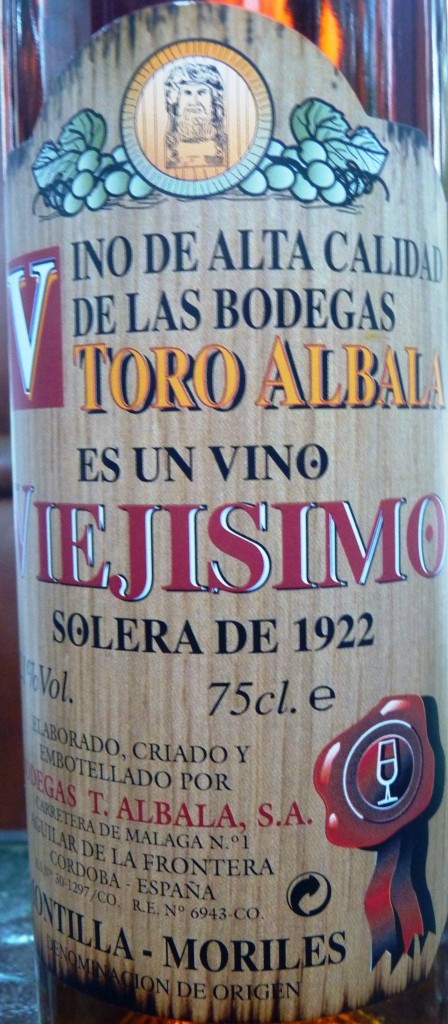 g – time to open a bottle. Let’s start with Don Gonzalo Oloroso VOS Jerez. This wine had been aged for at least 20 years (this is what VOS means). Very complex nose of nuts and caramel. Salty and gamey on the palate, with a hint of applewood smoke and again great complexity. This wine would perfectly complement the cheese and cured meats, but it is very pleasant to sip by itself.
The next wine, Bodegas Toro Albalo VieJisimo Solera de 1922 comes from a region called Montilla-Morales, which is neighboring Jerez and also can produce wines of Jerez style. Are you paying attention? 1922! It is not every day you can drink the wine which is almost 90 years old, and not go broke after the first sip (this wine costs less than $40/bottle). It is even better when such a wine gives you great pleasure. This wine shows an exceptional nose of immense complexity and pronounced herbs, such as oregano and sage. Similar saltiness on the palate as the previous wine, with excellent acidity, very balanced and complex at the same time, and very dry.
I hope I told you enough to make you want to try Jerez – you should definitely do it, and I’m sure you will not regret. And if you will be blown away – please let the rest of us know – as we would want the same. Cheers!
Rioja for the Stars, Or Don’t Miss The Oscars on Sunday!
And the Best Picture Award goes to … what, do you really think I know? Even if I do, I’m not telling… But – I know what you should be sipping while watching all the glitz and glamor – Rioja!
Why Rioja? May be because this is one of my all time most favorite wines? Okay, yeah, never mind. Then may be because Rioja is ready for the big Oscar celebration?
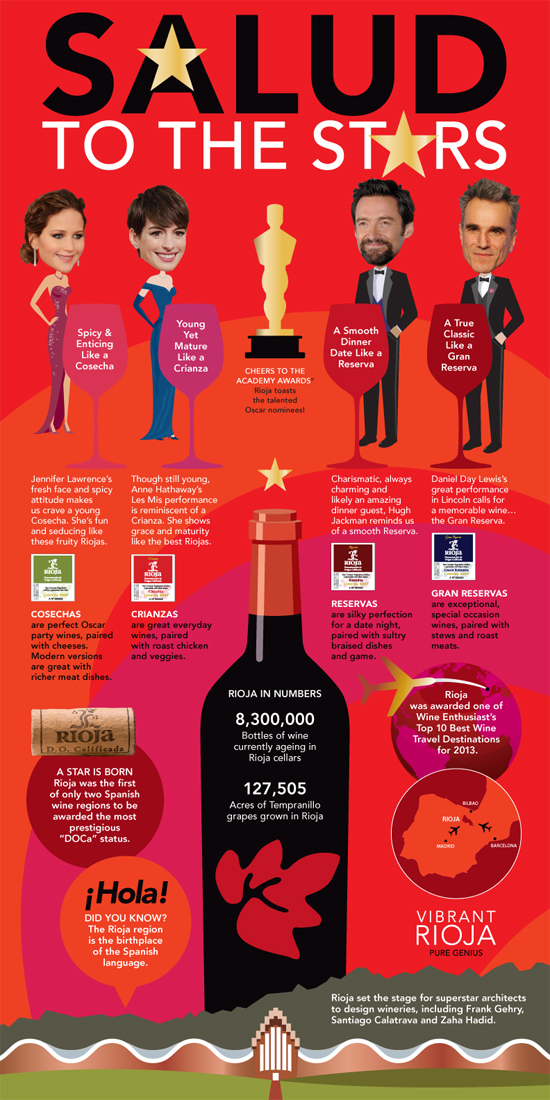
Yep, here is tons of information about Rioja and your favorite actors – all courtesy of Vibrant Rioja!
You can also mark your winners in advance and play the game of “Told you so!” later on with your friends:

Here is the link if you want to download an actual PDF file.
So, what are you going to open? I heard that 1996 Lopez de Heredia Viña Tondonia White Reserva should be able to help you to get through the opening ceremony, and 2001 La Rioja Alta Vina Ardanza Reserva Especial will pair perfectly with the “Best Movie” award, but then again, it is your choice.
No matter what you will end up doing, I hope you got my point – Rioja is always appropriate, no matter what the occasion. Open the bottle and enjoy! Cheers!
Re-post: Best Hidden Secrets Of The Wine World: Wines of Languedoc
During 2011 I wrote a number of posts for the project called The Art Of Life Magazine – of course talking about my favorite subject, wine. The project closed and even web site is down, but as I still like the posts I wrote, so I decided to re-post them in this blog. Also, in that project, posts were grouped into mini-series, such as “Best Hidden Secrets” you see here – I will continue re-posting them from time to time.
Also note that the series was written for a slightly different audience – I hope none of my readers will take offense in the fact that sometimes I’m stating the obvious…
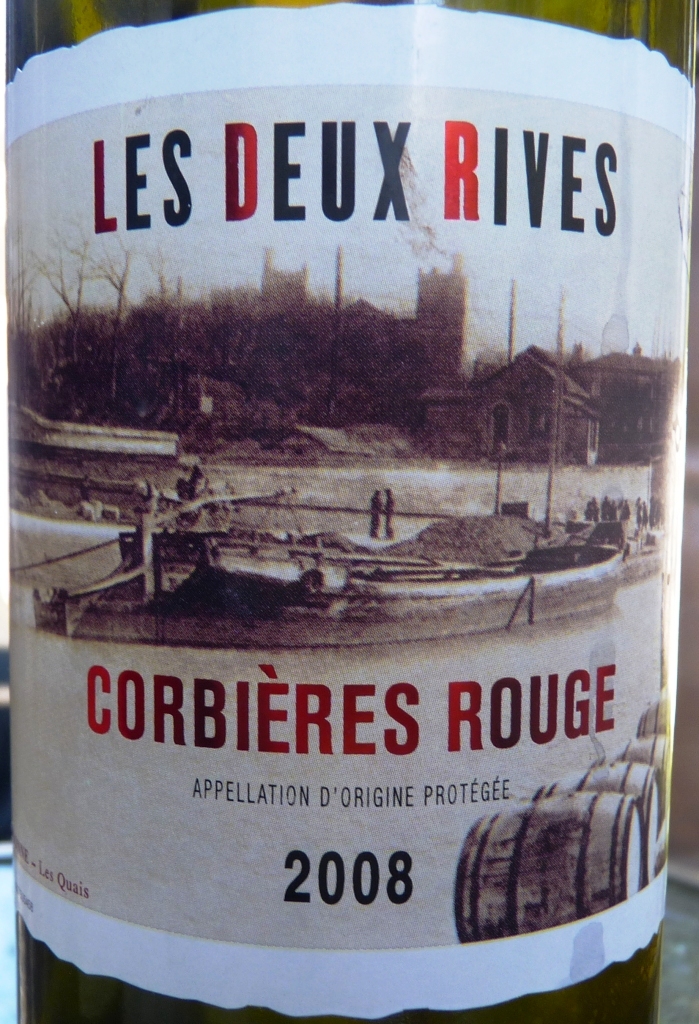 Continuing our “Best Secrets” series, we are going to … France again. However, we are going all the way down south, to the region called Languedoc-Roussillon (in most of the cases it is simply call Languedoc).
Why France again, and moreover, what is so special about Languedoc? First, don’t worry, we are just getting started in our “experiences” journey, we will be going all over the world, I promise. Now, to answer the question “why Languedoc”, let me simply give you some facts. Languedoc-Roussillon is single biggest wine making region in the world! It also produces one third of all the wines made in France. I think this is not bad for the beginning.
One of the great things about Languedoc wines is that while many other regions in France are strictly limited in the grape varieties used in the winemaking in that particular region, Languedoc is not. All white wines from Burgundy are made out of Chardonnay, and all the reds are from Pinot Noir. Red Bordeaux are predominantly made out of Cabernet Sauvignon and Merlot grapes – yes, with the addition of some other grapes, but in any case you will not find any wine which proudly specifies Bordeaux on the label and made out of Pinot Noir or Syrah. Languedoc is different – a lot more grapes can be used in the wine production throughout the region. Red wines can be made out of Cabernet Sauvignon, Merlot, Syrah, Grenache, Mourvedre, Cinsault and Carignan, whites can be made out of Chardonnay, Sauvignon Blanc, Chenin Blanc, Marsanne, Roussanne, Viognier, plus many other red and white grapes can be used in the wine production (for more information about the region, you can always look into Wiki page).
If you are surprised that you didn’t know about Languedoc wines before – don’t be, I’m sure you had Languedoc wines unknowingly. How come? A lot of it is in the labels. Have you seen “Vin de Pays d’Oc” on the labels of wine you were drinking? “Vin d Pays” literally means “Country wines” – level of quality which is one step above “vin de table” table wines, but less than level of AOC wines. But if Vin de Pays can be used with many wines, when you see “d’Oc” added to that it squarely points to Languedoc (last two letters of the region’s name) – if you think about it, I’m sure you had those wines before. There are other well known appellations within Languedoc, such as Corbieres, Minervois and St. Chinian, plus a number of other lesser known appellations. I want to point out that we already discussed one of the Languedoc wines in this “secrets” series of posts when we talked about French Sparkling Wines. That Blanquette de Limoux is produced in the Limoux appellation which is part of the Languedoc region (by the way, if you still didn’t give that Blanquette de Limoux a try, you should do it quickly!).
So what is so “secret” about Languedoc wines? Languedoc is one of the most dynamic wine making regions in France – new appellations created, rules are changing. Languedoc winemakers have more freedom to create, and they are making more and more of the high quality age-worthy wines. And because those wines are not as well known to the public as many others, they happen to represent a great value. Let me give you few examples.
 Let’s start with white: 2009 Domaine de L’Olivier Chardonnay Pays d’Oc. If you like Chardonnay, this is the wine to try. Very nice and very clean, great fruit expression – tropical fruits, touch of grapefruit, all with balancing and refreshing acidity and barely noticeable tannins. Great wine which delivers a lot of pleasure. To put things even in a better prospective I would like to note that retail price of this wine is about US $10 – you would have to get to the $30-$40 price range for Burgundy or California to achieve the same level of experience.
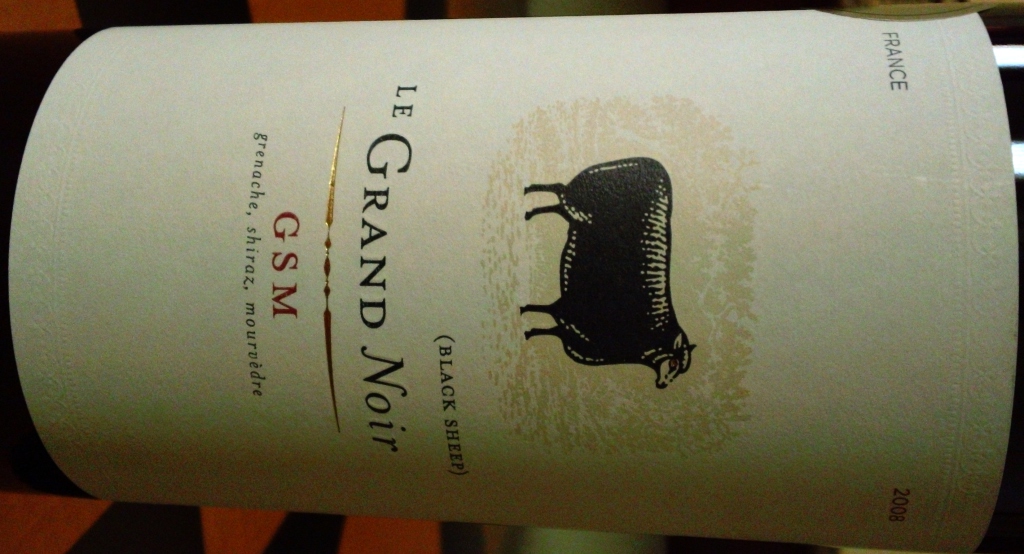 Another example – 2008 Black Sheep Le Grand Noir GSM blend from Minervois. As label suggests, this wine is made out of Grenache, Shiraz and Mourvedre grapes (which is a classic combination of the Rhone grapes). Again with the price tag of about US$10, this is a great deal. Very soft and gently layered fruit, soft tannins are present, but unobtrusive. Good acidity complements this wine well, delivering nice and pleasant experience. Again, considering the price, this is the wine to look for.
Now that you learned yet another secret, it is time to put that knowledge to the practical use. Did you have Rioja wine yet, or may be tried some second label? Now you know about Languedoc wines, so “to do” list just got longer. Go find the bottle and experience this wine tonight – and let me know if your experience was worth reading this article. And just to tell you about what’s ahead, the next time we will talk about something else – will take a break in the secrets series. For now I can only tell you that this “something else” is quite rare and almost forgotten – and I will tell you more the next time we meet…
Last Bottle Sign Up ($10 credit)




 Talk-A-Vino