Archive
Ten Wine Blogs I’m Reading
 In the world of wine, reading is second most important thing next to actually drinking the wines. Yes, of course, you can say that no, visiting vineyards and talking to the winemakers is a lot more important – and I would agree with you, however, it is reading that you can do at any time and a lot more often than actually visiting the wineries – at least for someone like me, where wine is a passion but not a profession.
When it comes to reading, books and magazines and indispensable – and there are hundreds and hundreds of them to read, starting from encyclopedias such as The World Atlas Of Wine by Hugh Johnson and Jancis Robinson, great day-to-day books such as Kevin Zraly’s Complete Wine Course to the Wine Spectator magazine which reviews thousands of wines in every issue.
Then there are wine blogs, like the one you are reading right now. Wine blogs deliver information in much timelier fashion than any books or magazines, and they also express a lot more of the author’s personality in a much more direct way than any book or magazine article – which makes them a great fun to read. I like reading blogs when I get a chance, and generally I come across many different blogs as lots of them are referring to each other (very common practice in blogging world). However, while my blog reading is often sporadic, simply based on available time, there are some blogs which I’m making an effort to at least skim through on the regular basis (using Google Reader) – and this is the list which I would like to share with you. The list below has no prioritization whatsoever, and I add few of my thoughts as to what kind of content you can find in the respective blog.
- 1WineDude – IT-convert Joe Roberts provides great insight into the world of wines. Lots of wines are reviewed using the A to F ratings ( no, I didn’t see a single F yet) as opposed to the popular 100 points scale.
- Fermentation – very interesting blog, covering a lot from the world of law, consumer rights, politics and more – of course all centered around wine.
- Serious About Wine – wants to see lots of new cool label designs? Flip through this blog’s pages, its worth it.
- The Feiring Line – Alice Feiring is a book writer and a blogger with “unique and different” point of view. Love her wine descriptions written directly on the bottle’s label.
- Dr. Vino – one of the best wine blogs overall, lots of interesting information tidbits from the wine world.
- The Wine Economist – Great source of information about wine, lots of stats of all kinds – merlot versus pinot noir consumption in the numbers, most requested wine of the past year and so on.
- The Gray Report – W. Blake Gray writes one of the most insightful and controversial wine blogs – I always love reading his posts. You should judge for yourself, though.
- Vinography – Superblog of wine blogs – lots of information plus a comprehensive list of wine blogs on the Internet
- Steve Heimoff Wine Blog – exactly as it says, a wine blog by Steve Heimoff, a wine writer and Wine Enthusiast magazine’s West Coast Editor. Lots of interesting information, especially as it comes to California wines.
- Paul Gregutt Unfined&Unfiltered – Paul Gregutt is a wine writer and a Northwest Editor for Wine Enthusiast magazine. He writes about wines of Pacific Northwest.
That’s all, folks for my list of ten blogs I’m reading – if you like wine, check them out for yourself. Cheers!
Wine and Time
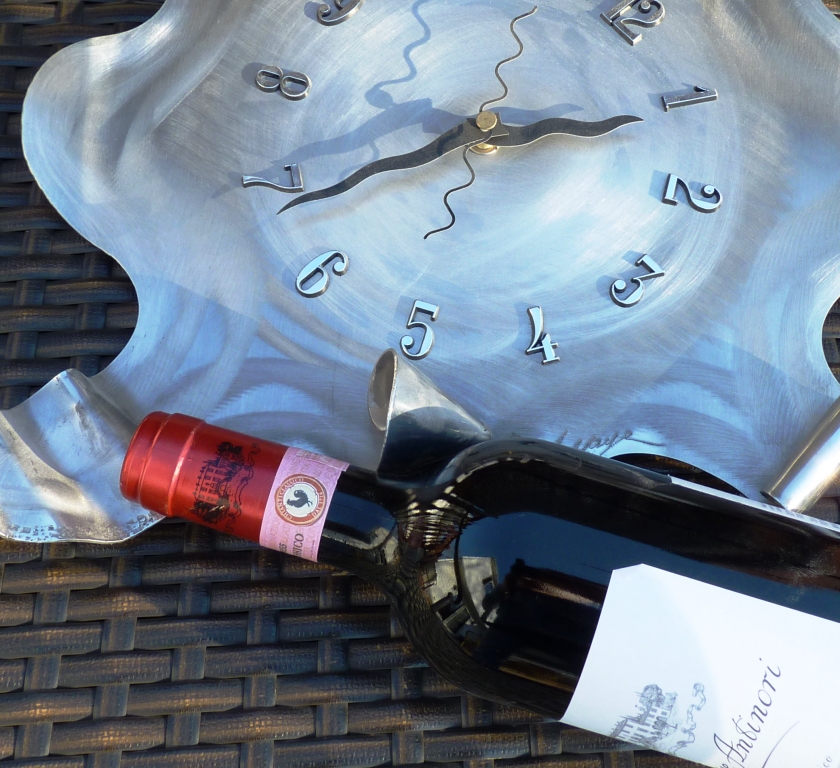 Of course time had being here forever, always moving, and always in one direction (someone, please prove me wrong!). Wine had being around for about 8,000 years, first appearing in the ancient Georgia (no, not the one down south, but the one from the Caucus region, on another continent). Wine is one of the few products literally not changed for such a long time in its form and its production methods – sans reverse osmosis machines, electrical presses and micro-oxygenation boxes. Considering such a long history, you can imagine that relationship between wine and time is very complex, and you would be right.
First, time is a necessary part and an attribute of the wine making process. For the vast majority of wines, if you read winery’s description of the wine, you will see something like “aged for so many month in …”. Sometimes the wine is aged in stainless steel tanks. Sometimes the wine is aged in clay vessels (very popular in Georgia now, the vessels are called Kvevri and produce very distinct wines). Lots of red wines are aged in oak barrels – American oak, French oak, Hungarian Oak, new oak, old oak – variations are endless. For many wines, duration and the type of the aging is a sole decision of winemaker (no pressure, but this decision will greatly affect quality and the taste of wine, and will define success and failure for it). For some of the wines, aging in a specific type of barrels is mandatory before the wine can be released – Rioja Gran Reserva should be aged for a minimum of 2 years in oak barrel and 3 years in the bottle to be officially designated as Rioja Gran Reserva. Barolo must be aged for 3 years, at least two of them in the oak barrel, and Barolo Riserva should be aged at least for 5 years. During the aging process, the wine is changing. Oak imparts very specific flavor, which we, humans, tend to like. Oak aging also acts as a preservative and helps wines to live long life.
Once all the aging is complete (in the tanks, barrels and bottles – whatever the aging was), wine is released – and this is when the second phase of the wine and time relationship kicks in.
This second phase is as tricky, if not trickier, as the first. Have you heard the phrase “needs time” in relation to the particular bottle of wine? If you will look at the wine reviews in Wine Spectator or any other publication which provides wine reviews, you would often see one of the phrases “Drink now”, “Best 2014-2020”, “Best after 2013” – these are the suggestions for how long the wine should be kept in the cellar before it should be consumed.
Why is that? What with all this aging? Why not open the bottle right away and just drink the wine? What was discovered at some point (don’t ask me when, but it was long time ago) is that wine actually changes its taste as it spends time in the bottle (the aging). And it doesn’t just change the taste arbitrarily, it tastes better. Young wines are often sharp, or somewhat single-toned in their taste – you might get pronounced acidity, or only sweetness, or lots of white apples – but only white apples. During aging, trace amounts of air are making its way into he bottle, and they lead to the wine changing its taste, improving to the better in majority of the cases – it becomes complex, bite softens up, bright and diverse fruit tones compensate for the pronounced acidity and the wine brings a lot more pleasure compare to the young wines. Mature wines deliver more pleasure – this is the whole philosophy behind wine aging.
Simple and easy, right? Well, this is were everything becomes complicated and confusing – as not all the wines should be aged (do not try to age Beaujolais Noveau, please) and also it is very tricky to make sure you would drink the wine at its peak – as whatever comes up, goes down in mother nature. This is where time transforms from the friend to the foe – and as a foe, it is merciless. After reaching maturity and staying there for a while, the wines are typically starting their decline in the taste (wine loses fruit, become very acidic, may be oxidized – and it stops delivering pleasure). Different wines made in the different styles will have different peak times and different lifespans. Some of the Jerez, Madeira and similar wines can go on literally for the hundreds of years. Good Rioja, Barolo or Bordeaux can be perfectly aged for 50 years or longer. Simple Cote du Rhone might only last for 3-5 years, same would be true for many of the Chardonnay wines. There is not crystal ball telling you precisely how long the wine will last and when will it taste the best – human trial and error is the best way to find that out. Of course there are many factors which might help you to decide whether to age the wine and if yes, for how long – the winery, the winemaker, the region’s wine style, success of the vintage and many others – but in the end of the day you would need to do the work (err, I meant the wine drinking) as the wine ages to find out when it tastes best to you.
So, does it worth to age wines if you don’t know what will happen to them in the end? For anyone who is into wines, and who had an opportunity to try a mature wine, the wine which reached its optimum taste, I’m sure this is a no-brainer question – yes, of course, and please, please give me more.
How one can experience aged wines? You got a few options. First, you can age it in your own cellar. Second, you can buy aged wines, either in a good wine store, such as Cost Less Wines in Stamford or Benchmark Wine Company. Note that you have to buy aged wines only from the trusted source – not aging the wines in the right conditions will simply ruin them, so you have to trust your source. Third option is to attend a wine tasting, such as PJ Wine Grand Tasting, where you can taste really amazing wines. However, you don’t have to wait of the Grand tasting, which takes place only once a year. If you live in a close proximity to Stamford, CT, you can attend a wine tasting at the Franklin Street Works gallery on Thursday, January 19th at 5:30 pm (here is the link for RSVP). The event is free and open to all. Here are the wines which will be presented in the tasting (the list might change at any time):
2003 Riesling, Mosel Saar River, Germany
1998 Merlot, Italy
2009 Stag’s Leap Hands of Time, Napa Valley
2009 Stag’s Leap Hands of Time, hyper-decanted using Nathan Myhrvold’s methodology.
So you should come and experience the relationship between time and wine for yourself – there is a good chance that you will even enjoy it! Cheers!
As One Year Is Winding Down, Another Year Begins
 Year 2011 is ending very shortly – how was it?
I’m very happy with t he wines I had an opportunity to experience in 2011 (please forgive me, but the term “wine” is used here in all-inclusive way – it also includes Scotch and other tasty alcohol) . There were lots of great wines – I already gave you my “top dozen“, but there were probably another 30-40 wines equally qualified to be included in the “top” list – like these gems from Margaux, great Spanish wines and many others.
Am I happy with the content of the blog? I think some of it was good, and some was just okay (honestly, don’t know if I did something bad – you tell me). I really want you, my readers, to be the judge of it. Was here anything which you really liked? Can you share that with me?
What I’m not happy with is the level of interaction. I know many of you actually read the posts, can you also tell me what do you think? “Great, Cool, Crap, BS, nonsense” – I would gladly take feedback, and consequently, dialog, in any form. Pleeeease?
I also wanted to give you a summary in the numbers ( posts, readers and so on) – but you know what – let’s forget the numbers, not so important. Ahh, only one quick update – on the grape count. Over the past few weeks, I added another 5, so the total count now stands at 360. Here are the new grapes:
Saint George – 2009 Skouras Red saint George Cabernet sauvignon, Peloponese, Greece
Savagnin – 2008 Benedicte & Stephane Tissot Selection Arbois, Jura, France
Noah – Renault Noah, New Jersey
Mouhtaro – 2009 Muses Estates Mouhtaro, Thivakos, Greece
Pais – 2009 Cuvee Del Maule, Chile
And now let’s spin our crystal ball – what is ahead of us, in 2012? One thing for sure – there will be lots of great wines. Wines are becoming better all over the world, and they are becoming more interesting. There will be more amazing natural wines, wines which don’t taste like anything else you tasted before. There will be more sparkling wines, there will be more rose wines, even in the winter.
As for anything else – I will continue to write about my experiences with wine, food and life. And if I can have one New Year wish, only one – I would love to see more comments.
That’s all, folks, for 2011. Make sure your favorite bubbly is chilled, your favorite food is on the table, and your friends are surrounding you. I wish you lots of luck, lots of love, lots of happiness, lots of health, and lots of amazing experiences. Happy 2012! Cheers!
Fears of the Oenophile
 If you are drinking wine only in the restaurant (and only because you have to) or twice a year at the parties, you can safely skip this post. For those of you enjoying the wines on more occasions (and without any occasion too) – please read on and tell me what do you think is real and what is the result of my inflamed imagination.
Would you think that there should be any fears associate with wine? That the fear is lurking around those shiny bottles? Actually, if you think about it, I believe there are quite a few. Let’s take a closer look.
1. “Spoiled wine” – I think this is the mildest of all – except when this is the last bottle of your favorite wine or a special bottle you proudly brought to someone’s house. Many different things can constitute spoiled wine – wine can be corked (musty, wet basement smell and painfully sharp taste with the similar musty flavor profile), or oxidized, or vinegary in taste. In general, it is considered that about 8% of all wine is corked – this is a very sad number if that hits you. Discovering that the wine is spoiled is an unpleasant surprise – but in many cases the problem can be easily addressed (get another bottle from the cellar or you tell your wine steward in the restaurant that the wine is spoiled, and you would typically get a new bottle of wine).
2. “is this wine ready to drink, or should it wait for a little longer?” Many wines improve with age. If you ever read wine reviews by Wine Spectator, Wine Advocate and the likes, you probably noticed phrases like “Drink Now”, “Best before 2015” or “Best 2015 to 2024” – these are wine critics’ recommendations for the particular wines to be at their pick, to be the most enjoyable. But most of the wines we buy (definitely the most of the wines I buy) don’t have any critics recommendations associated with them. So when is the right moment to get the most pleasure from the bottle? There are some general rules, like “California Cabernet reach their pick at about 13 years of age”, but in the end of the day you would need to have a good understanding of the wine regions and particular producers to reduce this fear factor.
3. “is this occasion special enough for this bottle?” Pairing the wine with the occasion can be very tricky and fearful. You are reaching out for that special bottle of Latour, but what if one of your guests will decide to add a little coke to her glass as the wine is too dry for her? Will this group of beer drinkers appreciate the 1964 Rioja Alta which you were planning to open just for this great occasion? Whether you like it or not but you have to address this fear by knowing the preference of your guests and then resolving that you will be happy with your wine selection no matter what.
4. “is this bottle special enough for this occasion?” This is almost the same as the previous one, but with a slightly different angle. Vey often, we are waiting for a “special occasion” to open that special bottle. Every time we don’t know if the occasion is special enough. We keep waiting, and waiting, and waiting, fearing that the right occasion still didn’t come. We definitely don’t want to end up like the main character of the movie “Sideways”, who had his 1961 Cheval Blanc with the hamburger at a fast food place, drinking the magnificent wine from the Styrofoam cup. If anyone remembers “Tastings” column in the Wall Street Journal written by Dorothy Gaiter and John Brecher (the column which I dearly miss), they created an event called OTBN (Open That Bottle Night), where they were encouraging all the wine lovers to reach out for that special bottle and open it on a designated date. I think this is the best solution to address the “special bottle” fear – we need to create special moments for our special bottles, and then everything will magically fall in place.
5. “will I enjoy this bottle as much as I did last time?” I think this is my personal biggest fear associated with wine. Sometimes, I get carried away by the glass of wine – it creates amazing memory of the fiery of taste, it comes through as truly exceptional experience. Once this happens, the next time I’m reaching for the same bottle of wine, the first question in my mind is: “what if it doesn’t taste that great”? What if something was wrong with me last time – special occasion, special surrounding, special atmosphere? What if this wine will not be as magical as last time – did something happened to the bottle or something happened to me, and if it is something which happened to me, then when? The previous time or now? There are all sorts of emotions involved here, and sometimes this specific fear is keeping me away from that special bottle of wine. The best antidote of course is trying the wine, and discovering it to be as good as the last time – that is the special moment of joy, I guess, for any oenophile (works for me for sure).
So, is there anything here you can attest to, or is it all caused by too much free time on my hands? Let me know you thoughts.
And as this is the time of the Holidays, Happy Holidays and Cheers!
Thanksgiving Wines
Please let me be unique and different and write a blog post about Thanksgiving wines (duh – I meant let me pretend that hundreds of bloggers and wine writers didn’t cover the subject yet as broad as possible). In essence, I’m not planning to offer you any advice. I think the variety of tastes, favors and simply palate preferences at Thanksgiving table is way to wide to be able to do any essential wine and food pairing. Therefore, I would say that there are no limitations to what wines you should have on your table – you simply have to be able to enjoy them with or without food. As far as this blog post is concerned, as I said, I’m not going to offer any advice – I will simply tell you what I have in plans for the thanksgiving meal and why. I will list here way more wines than we will be actually able to consume, but hey, more is better than less, right?
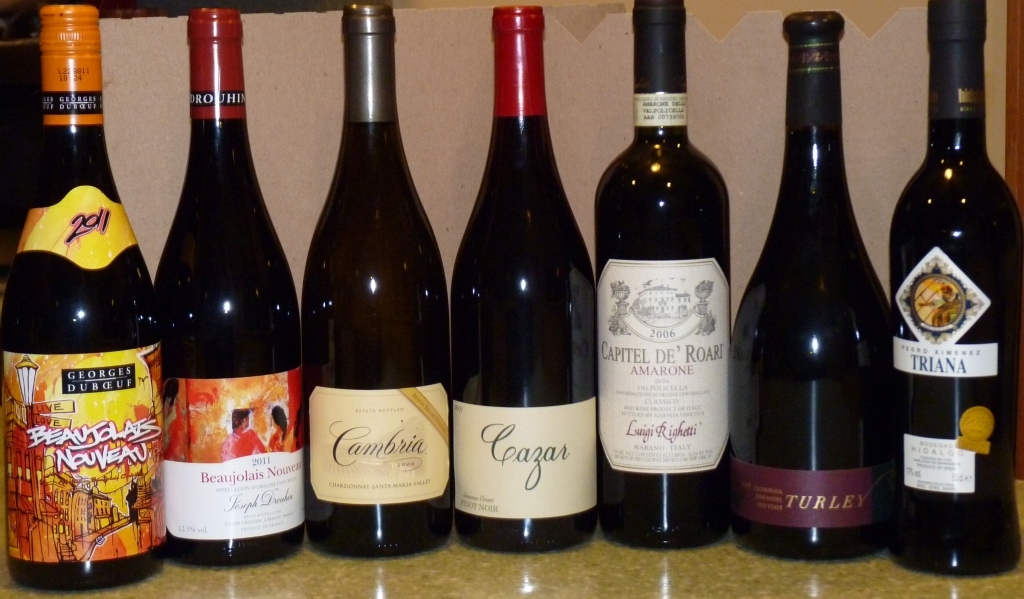
You can definitely start with sparkler, but as I don’t have one ready, 2011 Beaujolais Noveau will do just fine. Why? It should be slightly chilled (let’s say to under 60F), then it is quite refreshing with all the red fruit and mouthwatering acidity – good way to get ready to Thanksgiving meal.
Chardonnay is a must, preferably one from US. Why? Because Chardonnay is one of the great American wines, producing very good results in all different areas from California to Long Island. I would recommend Chardonnay which was aged in the oak barrels and has some butter, vanilla and toasted oak – not the stainless steel-fermented one, which often tastes indistinguishable from Pinot Grigio. My personal choice is 2006 Cambria Bench Break Santa Maria Valley – this is one of my favorites since I tried that at The Capital Grill, and I’m curious to see how it is developing (I still have few bottles left). Besides, I don’t have Peter Michael as my allocation didn’t come through yet.
The next wine is a 2009 Cazar Sonoma Coast Pinot Noir. Why? 2009 was a great year for California Pinot Noir, and this particular wine is simply meant for the Thanksgiving table with all the fresh and juicy cranberries and perfect acidity. I simply see this wine being great with turkey and many other dishes.
Amarone? Of course. Why? Simply because Amarone is one of my favorite wines, and every time we drink it, it is a special occasion. 2006 Luigi Righetti Capitel de Roari Amarone della Valpolicella is one of the simpler versions of a great wines ( also inexpensive compare to what Amarone typically costs), so I’m curious if it will work with the meal at all.
There can’t be Thanksgiving celebration without Zinfandel on the table. Why? Zinfandel is unique grape which doesn’t grow anywhere else outside of United States (with the exception of the close relative, Primitivo, which grows in Italy). Zinfandel has a unique flavor profile with lots of fresh berries and lots of power on the palate, which should bode well with the festive Thanksgiving meal. 2009 Turley Old Vines Zinfandel from Napa Valley is simply one of the great California Zinfandels, and I’m glad we will be able to share a bottle (it is not easy to get).
Time for desert. I’m selecting Bodegas Hidalgo Pedro Ximenez Triana. Why? First of all, this is the very old wine – as Jerez is made using Solera method, with new wines constantly blended with the older ones, this wine started at around 1750, so it can definitely serve as historic reference to the great holiday. And the second reason – this wine simply tastes phenomenal. I already wrote about it in one of the previous posts – the richness and the balance of this wine should really be experienced by any wine lover.
Will we drink all of these wines? Probably not. Will there be other wines on Thanksgiving table? You bet. Of course I will report on all the wonderful food and wine experience once the holiday is over, but for now I will be glad to hear what wines do you plan to have on your table.
That’s all, folks. Happy Thanksgiving and Cheers!
Counting Up and Counting Down
 It is that time of year again – all you hear from all the sides is counting up and down. Top 10s, Top 100s, 10 best of this and 5 best of that, umpteen days until Christmas and only so many days before Black Friday and Cyber Monday. So, let’s join in and do some counting here as well.
Starting with the closest one, tomorrow (or today, depending on when you will read this post) Wine Spectator will announce its number one wine of the year. Every year Wine Spectator publishes a list of top 100 wines of the year (paid subscribers can access those lists going all the way back to 1988). For now, top 9 wines of 2011 out of the 10 are already announced, and you can find that list on the Wine Spectator web site (the list is open to public until November 27th). Looking at the list, you can find there wines from California, Italy, France, Washington and Portugal, with ratings from 94 to 96 points and prices ranging from $35 to $90. We only have to wait until tomorrow to find out what the Wine Spectator Wine Of the Year 2011will be.
Moving on to the next countdown, there are only 2 days left until the release of Beaujolais Noveau – first wine of 2011 vintage officially released in France in Beaujolais region . Yes, this holiday didn’t exist until 1985, and you can call it just a marketing ploy – nevertheless, it became a modern tradition which is celebrated with midnight releases, parties, food, wine and all appropriate extravaganza. If we look at the trend of last 3-4 years, we actually have something to look forward to – the quality of the Beaujolais Noveau had being steadily increasing, with 2009 being really good, and last year’s, 2010 being even better than the one before. Stop by your neighborhood wine shop, talk to your friends, check your social media outlets – you will definitely find a place to celebrate wine’s new beginnings in style. If you live close to Stamford, CT, I can recommend the place already – stop by Cost Less Wines on Thursday for the taste of Beaujolais Noveau 2011.
Talking about events, here is last, but definitely not least – there are only 3 days left until PJ Wine Grand Tasting. This coming Friday, November 18th at Metropolitan Pavilion in New York City you will have an opportunity (it might be once in a life time opportunity) to try Dom Perignon, Cristal, Krug, 2006 Cheval Blanc, 2000 Chateau d’Yquem, 1990 Mouton-Rothschild, 1985 Chateau Haut-Brion, 1952 CVNE Vina Real Gran Reserva and many other incredible wines, all in one evening. It is still not too late to get your tickets, and you can use discount code Talk-a-Vino to get $10 off your ticket price (here is the link for you to click).
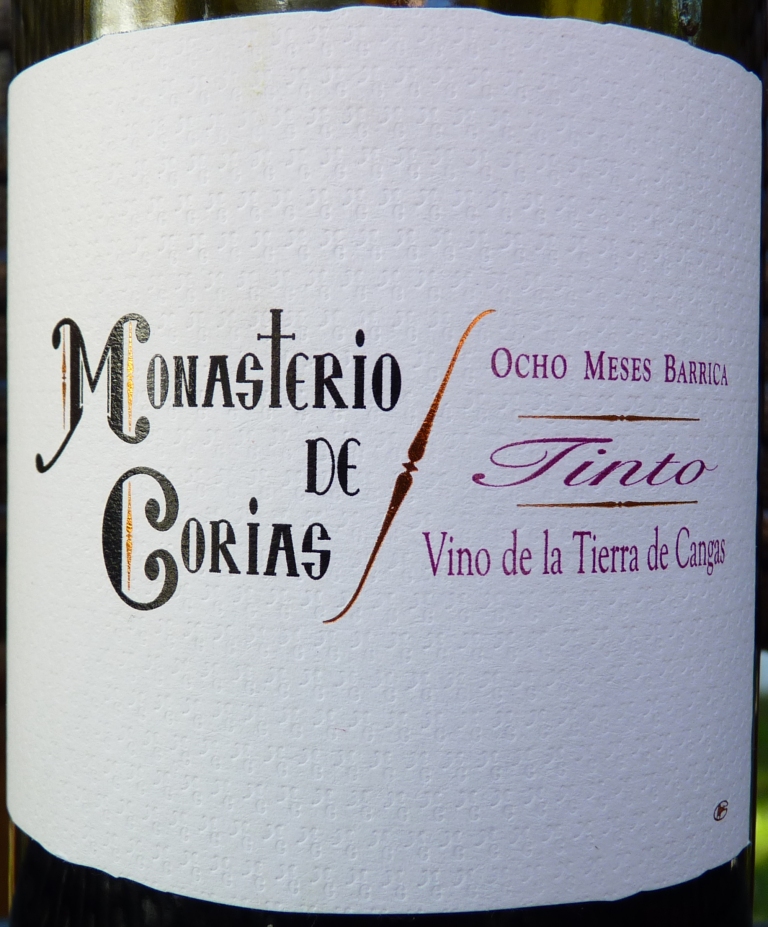
Lastly, I want to report some counting up – I added three more new grapes, thanks to the 2008 Monasterio de Corias Ocho Meses Tinto wine from Spain. The new grapes are Albarin Negro, Carrasquin and Verdejo Negro. The wine was very interesting, with pronounced acidity, limited fruit expression, good minerality and roasted tomatoes on the nose, very food friendly (Drinkability: 7+).
To conclude, I’m curios where you think the Wine Spectator Top Wine of the Year will be from. I’m torn between Oregon and Spain. Oregon is simply because I believe Oregon makes great wines and should be represented in the top 10. At the same time, Spanish wines are getting rapidly growing acceptance, and they are also great in my opinion, so it will be only fair if top wine of the year will be from Spain. Well, we are not going to wait for a long time. If you have any predictions, please share them here. Cheers!
Should You Really Drink Really Cheap Wines?
 My friend Emil forwarded me a copy of an article in the Slate magazine from November 2nd called “Drink Cheap Wine“, where the author explains his rationale behind the suggestion that everybody should drink really cheap wine. As someone who doesn’t have an unlimited budget and constantly looking for the QPR in wine, the subject stroke a cord, so I thought – how about we will discuss this with my readers?
Should we all start drinking only cheap [the cheapest?] wines? May be, but let’s take a look first at the reasons we drink wine.
Why do we drink wine? If the answer is “to get drunk”, we can stop right here, as there is no need to continue the discussion – at any price wine is too expensive for this purpose (switch to industrial alcohol, I think it should be a cheaper option).
Next reason can be – because it is a habit, a custom. I would dare to say that this is probably the main reason for Europeans to consume wine – this is part of the culture, this is how people there had being born and raised – wine is something which should accompany the food. Period. I’m not saying that people in Europe are not enjoying wine by itself – all I’m saying that they look at it differently. By the way, quite on contrary to what is stated in the article, I would sincerely doubt cheap wine in Europe is worse than in US – cheap wine and wine produced by cooperatives had being around for hundreds and hundreds of years, and it was produced to be consumed with food, so I expect it to have much higher acidity than any cheap US wine, which will be mostly sweet – and I will take acidity in wine over sweetness at any time.
Reason number three to drink wine is to get pleasure – as good bottle of wine is really an art! This is my main reason to drink wine – I like phenomenal range of variations of taste you can reflect upon – this is what makes wine so magical for me. Now, as soon as we look at the wine from this angle, while the cost is still very important, it is a whole different perspective – if cheap wine doesn’t give me pleasure, should I really drink it? Of course not, as still it will be a waste of money – it is better to drink water in such a case (yes, yes, all opinions expressed here are my own).
I perfectly understand what he author is saying about blind tasting and inability of the average consumer to distinguish between the cheap and non-cheap wines. However, if you will taste 10 wines (in the same blind tasting, of course), I would definitely expect that some of them you will like more, and some of them you will like less. Actually, if you like them all the same, or if you don’t like any of them at all, may be you should stick with the cheap wine. Otherwise, if you will find out that your favorite wine in the tasting costs $15, and the one you didn’t like was $3, what are you supposed to do? That is correct – you have to make a decision which will be suitable for you. If we agree that finding pleasure is one of the main ideas behind drinking wine, you simply have to make a decision based on your budget and your preferences – but you shouldn’t drink cheap wine!
So, what do you think? Should we all switch to the cheap wines and force ourselves to be happy with them? Or should we look for wines with the good QPRs which give us pleasure?
Comment now – it is your turn to speak. Cheers!
Celebrating Global #ChampagneDay
Yesterday the world of wine social media celebrated 2nd Global Champagne Day, honoring one of the most special beverages – French Champagne. Here is how we celebrated it:
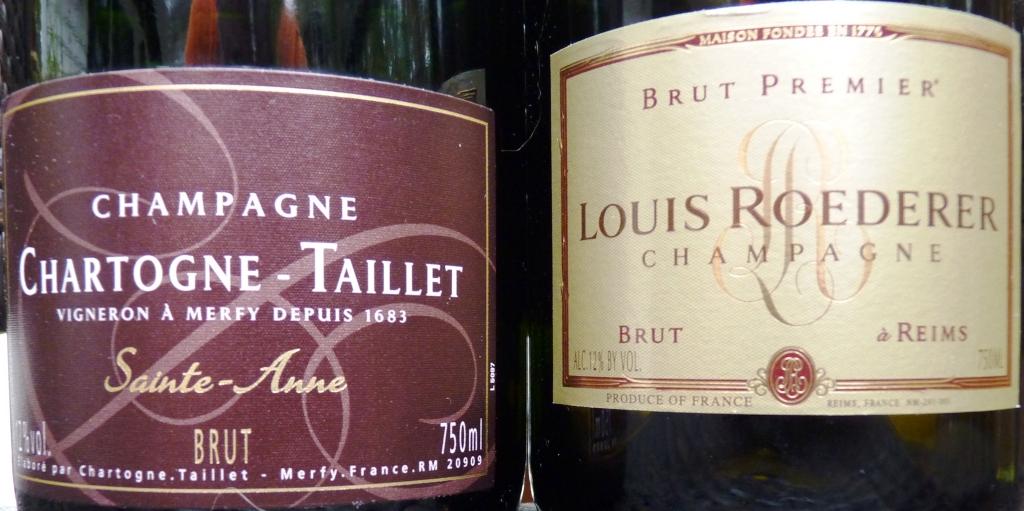
Louis Roederer Brut Premier NV was good, but not special in any way – nice fresh creamy bubbles, good acidity (Drinkability: 7). Louis Roederer makes one of the most famous Champagne in the world – Cristal, but this one of course was a standard non vintage version.
Champagne Chartogne -Taillet Cuvee Sainte-Anne, a growers champagne, was outstanding – yeasty, with a lot of fresh bread and toasted apple notes, refreshing and complex at the same time – this was not a simple thirst quencher, but a thought provoking wine. (Drinkability: 8).
How did you celebrate the Celebration Wine?
Daily Glass: Amarone (Trader Joe’s Amarone, It Is)
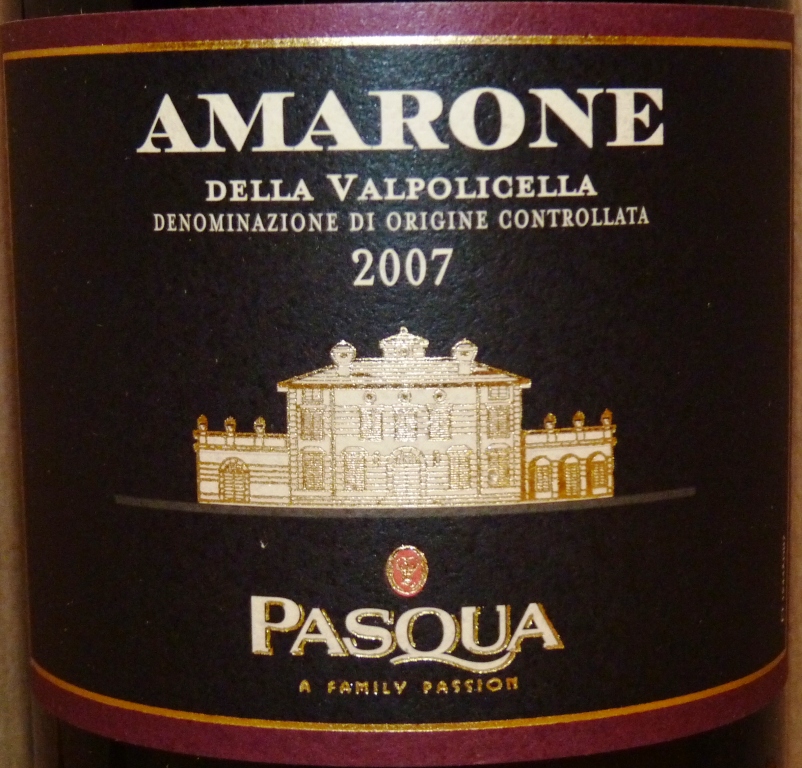 I’m continuing the quest for the best bottle of my favorite wine, Amarone (the concept of the “best bottle” also assumes great QPR). Last time we talked about Le Ragose Amarone, where I had big hopes which didn’t materialize (you can find the post here). This time, let’s talk about Amarone from … Trader Joe’s.
In the last post, I told you about my discovery of value wines at Trader Joe’s in Massachusetts. Value Cabernet Sauvignon or Chardonnay – of course. But value Amarone? Until now, my idea of value Amarone was Valpolicella Ripasso, the wine made by running juice through leftover grape skins after actual Amarone was already pressed. In general, good Amarone are hard to find for under $40, and the typical range is $60 – $100 in a good wine store. And when it comes to price, same as for any other wines, the sky is the limit – the amazing Masi Amarone I mentioned in the post about Wolrdwide Tasting, would cost you about $150 (good luck finding it), and Giuseppe Quintarelli Amarone would set you back by about $350 (however, I found some rave reviews saying that this wine worth every penny).
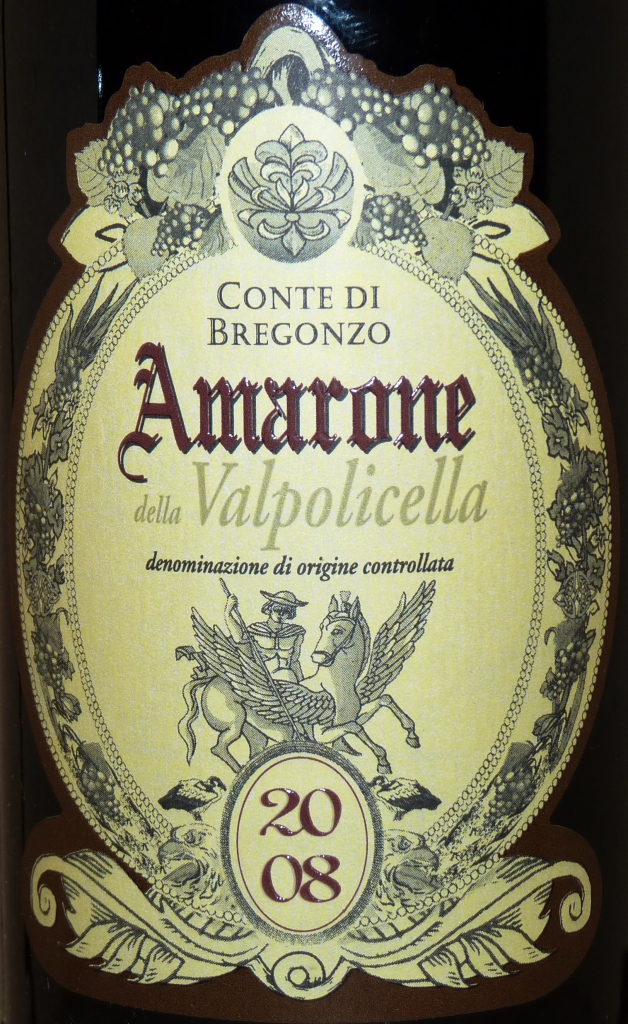 Now forget everything I told you about the prices. Here are two examples that don’t fit into the ranges I mentioned before, thanks to Trader Joe’s. First, 2007 Pasqua Amarone, $18.99 in Trader Joe’s. While lacking the traditional Amarone nose of juicy raisins, this wine exhibited power and balance. Lots of dark fruit, some coffee notes, hint of earthiness, good acidity – very enjoyable wine. Drinkability: 7+.
I liked the 2008 Conte di Bregonzo Amarone della Valpolicella ($16.99) even more. Bright dark fruit, some jammy notes supported by overall balance, minerality and good acidity – great all-around package – very drinkable and leaving you craving for more. And QPR? At $16.99, do I need to even bother? Yep, I thought so. Drinkability: 8-.
Just to conclude – yes, Trader Joe’s is a place for great value wines. Even more importantly, it is a place for excellent Amarone with amazing QPR.
What are you waiting for? Have you being to Trader Joe’s wine department already? You owe it to yourself to find the nearest Trader Joe’s with the wine section in it, and go enjoy it yourself – you can thank me later. Cheers!
Daily Glass: Experiencing Trader Joe’s Wines
When it comes to Trader Joe’s stores,  I’m a big fun – I think that everything sold there has good quality and fairly priced (in our wine terms, has good QPR).
I also heard that some of the Trader Joe’s stores also sell wine. Living in Connecticut, the most you can find in supermarket or a food store is beer (wine is sold only at the liquor stores). While visiting friends in Brookline in Massachusetts, I suddenly realized that Trader Joe’s is literally across the street from their house – and it might be selling wine!
Guess what? Yep, it does. The store itself was bigger than any Trader Joe’s I’ve being to before, but besides that, wine section was – Wow! Looking at the prices – double wow! Lots of wines at $4.99 ( outside of Trader Joe’s line called Charles Shaw, which is priced at $2.99), and overall, very substantial selection. Yes, I had before wines which were good and very inexpensive (same price range), but in general it is hit and miss.
Next I saw… 2 different Amarone at $16.99 and $18.99, a Barbaresco at $12.99 and Barolo for $16.99. Yes, you got it right – I got all of those except Barolo, and of course, tasting notes will be coming.
Let’s start from the basics – let me share my thoughts on Charles Shaw wines. First I tried 2010 Charles Shaw Cabernet Sauvignon. It was quite drinkable, however resembling more Beaujolais Nouveau, with its fresh fruit grapey taste. It was easy to drink, lighter bodied wine. Interestingly enough, on the second day this wine became very sweet and went beyond my style of enjoyment. Was it a great wine? No. Was it a good wine which you can drink occasionally – yes. Was it a great wine considering QPR, with the price of $2.99? Absolutely. Drinkability: 6+.
The next day I opened a bottle of 2009 Charles Shaw Chardonnay. The wine was very nice, had good amount of white fruit, some tropical fruit – but not overly fruity, with good acidity in the back. This was a good Chardonnay, with or without QPR. On the next day, wine developed some kind of chemical aftertaste, which disappeared as wine warmed up a bit, but overall it lost some of the brightness which was well exhibited on the first day.Drinkability: 7-.
To give you a bottom line, I think both wines were quite drinkable, and Chardonnay was more or less varietally correct (Cabernet was not so much). Would I want to drink these wines every day – not really, but occasionally – no problems at all. Do these wines have great QPR? You bet. Should you try one – absolutely. This is your call for action for tonight – find a Trader Joe’s store which sells wine, get a few different bottles of Charles Shaw wines, try them and report back here. Meanwhile, I’m all ready for my Amarone, so I need to go now. Cheers!
Last Bottle Sign Up ($10 credit)




 Talk-A-Vino