Archive
OTBN 2026 – What a night!
Open That Bottle Night (OTBN for short) is one of my favorite wine holidays of the year – possibly simply the favorite.
The event, always taking place on the last Saturday in February, was created by Dorothy J. Gaiter and John Brecher, writers of the Wall Street Journal wine column, 27 years ago. The purpose of the event or a holiday, if you will, is simple. Every wine lover has a special bottle waiting for a special moment. Let’s declare that special moment has arrived, and let’s open that special bottle to enjoy it now – nobody knows what’s ahead in life, so we should enjoy things while we can.
As I said, this is possibly my favorite wine holiday, I always make an effort to participate, and a few times even wrote about them (here are posts from 2016, 2019, 2020, 2023, and 2025). Whether I’m celebrating with friends or just with my wife, I always make an effort to make that day wine-special – I believe I have never been disappointed so far, judging by “what a night!” being a favorite descriptor.
OTBN 2026 was no exception. Typically, my OTBN experience starts with self-inflicted drama – what to open???? I have more than a few bottles worthy of a “special” designation, and it is always hard (very hard!) to decide which one or two should be called special in a given year. In 2026, somehow I managed to solve this conundrum somewhat easily – the decision just materialized on its own as I was mindlessly moving wine cabinet shelves in and out.
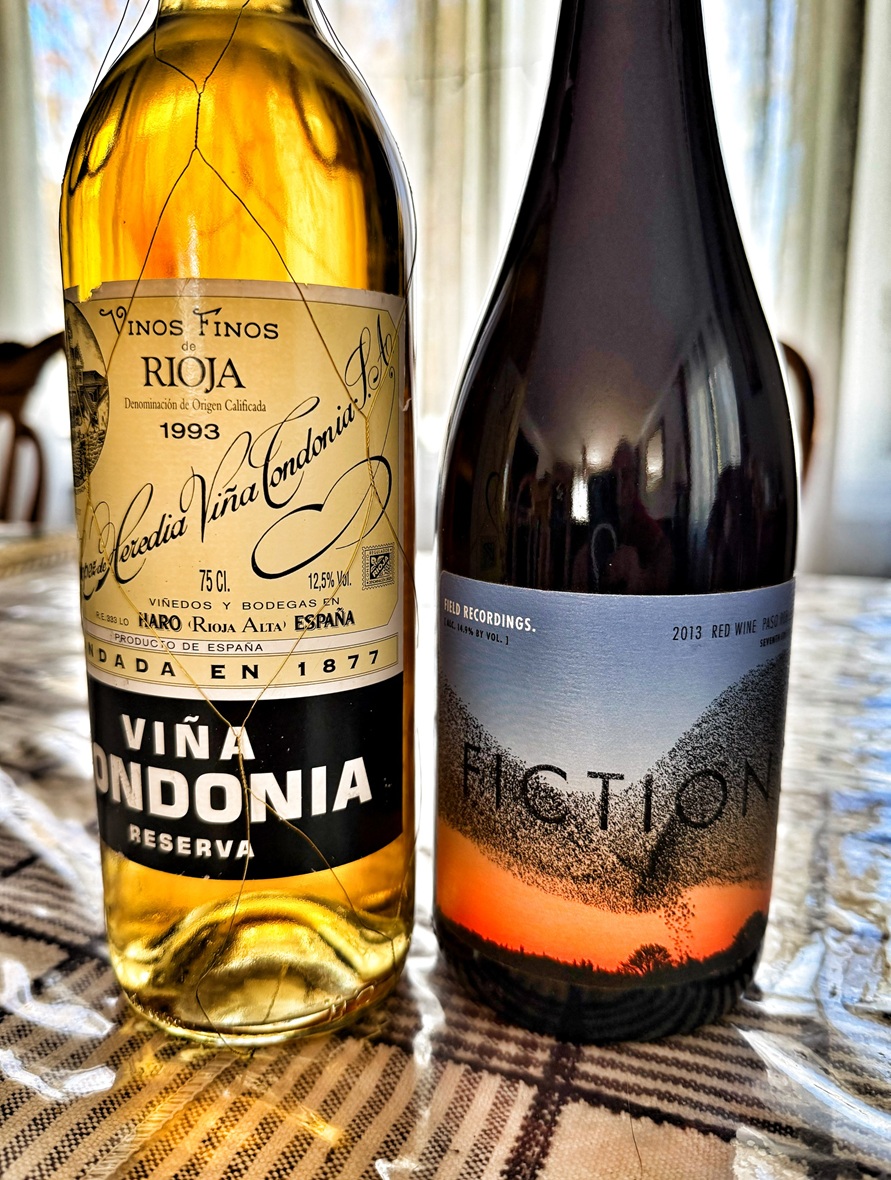
Lopez de Heredia needs no introduction to wine lovers. Way, way back, Lopez de Heredia Blanco was my first foray into white Rioja wines, and I have been a devoted follower ever since. Fiction by Field Recordings was the first wine that led to the discovery of the Field Recordings wines 17+ years ago, and it has been a perennial staple ever since. I can’t say what led to the decision on the 33-year-old white Rioja and 13-year-old California red blend, but this became one of the most memorable wine experiences ever.
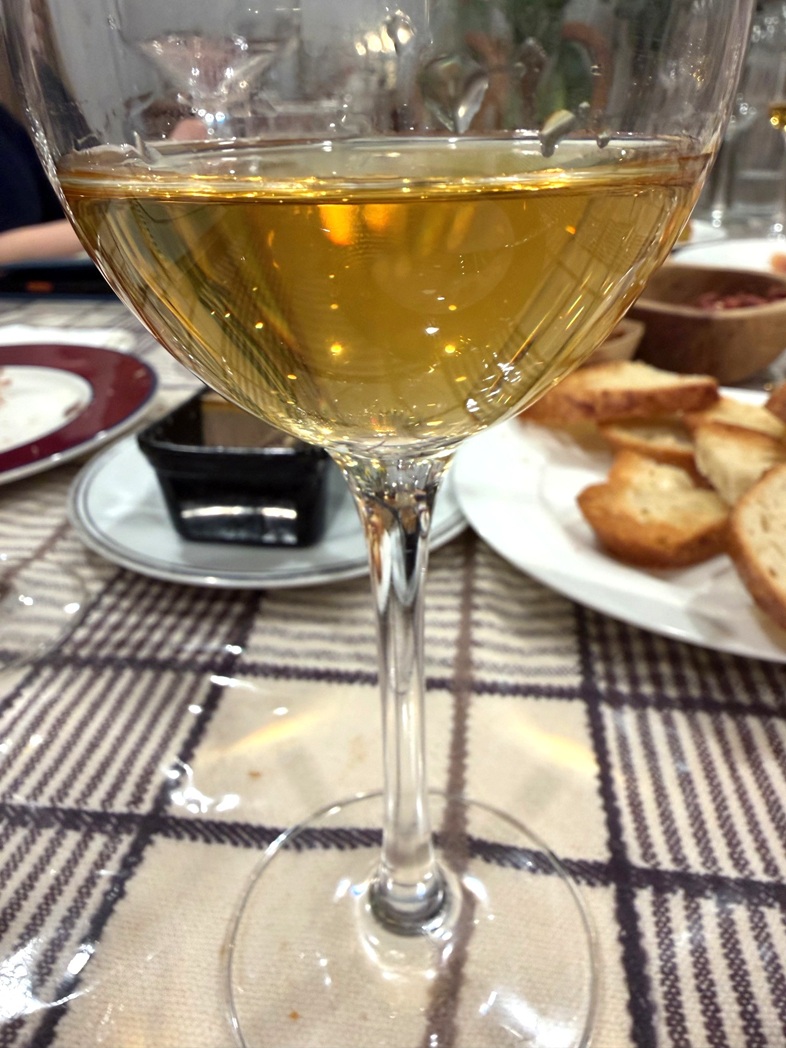
Let’s talk about 1993 Lopez de Heredia Viña Tondonia Blanco Rioja (12.5% ABV). I have to start by saying that I’m not a fan of oxidative white wines. When I mentioned on Twitter that I plan to open this bottle for the OTBN, some comments expressed excitement about oxidative and nutty notes, which I was supposed to find, similar to what you would find in a glass of Jerez. And so I was expecting to find that, and was wondering if I would be able to like that wine. And then there were literally none! Nothing oxidative on the nose, mostly minerality and whitestone fruit. And then a beautiful, complex, powerful structure on the palate, somewhat along the lines of a good Roussanne, still with perfect acidity and freshness. Oxidative notes were lurking in the background, showing up and instantly dissipating a few times, but those were only tiny glimpses, not taking anything away from the wine. An absolutely delightful experience, a 33-year-old white Rioja possibly at its peak (but I wouldn’t dare to insist).
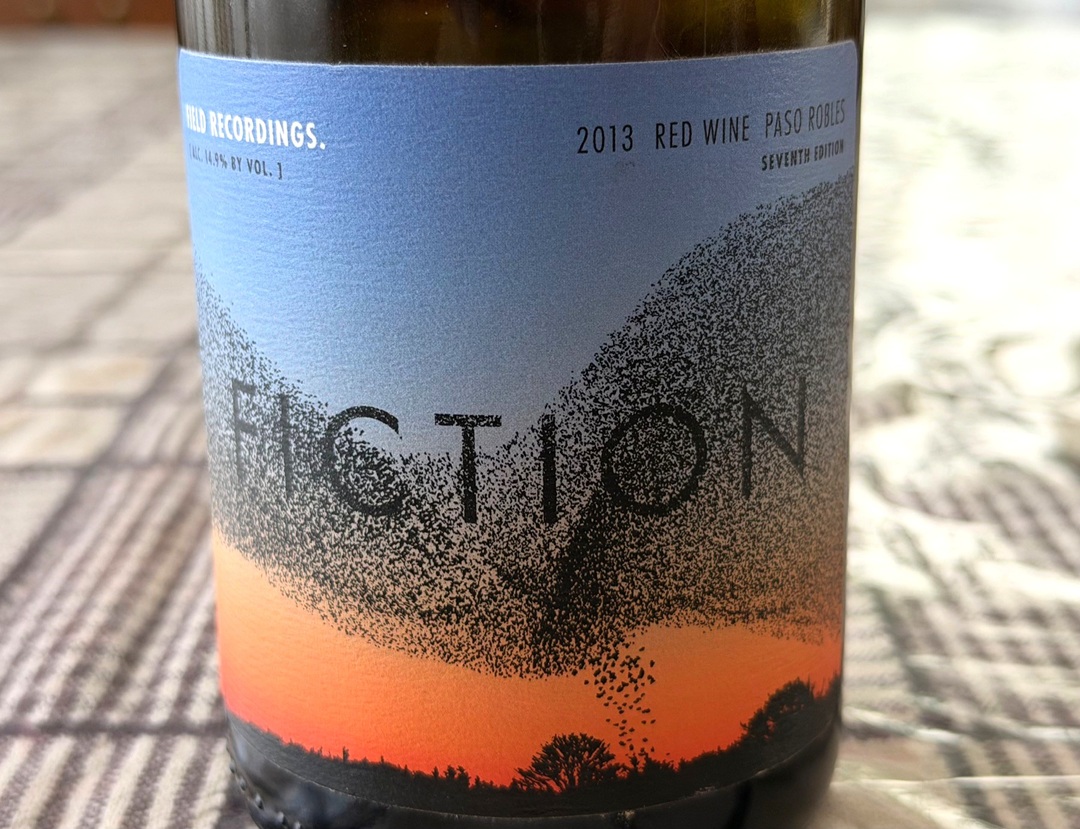
And then there was 2013 Fiction by Field Recordings Paso Robles (13.5% ABV, 31% Zinfandel, 26% Tempranillo, 15% Mourvèdre, 10% Grenache, 10% Syrah, 8% Touriga Nacional). This was my only bottle with an original label, which I really loved and much prefer to the current ones. There is nothing wrong with the current label, only that the original one, with a flock of birds, was conveying the message of bottled poetry a lot better – or rather music, as I wrote in my first post about this wine, Music, Recorded in the Vineyard.
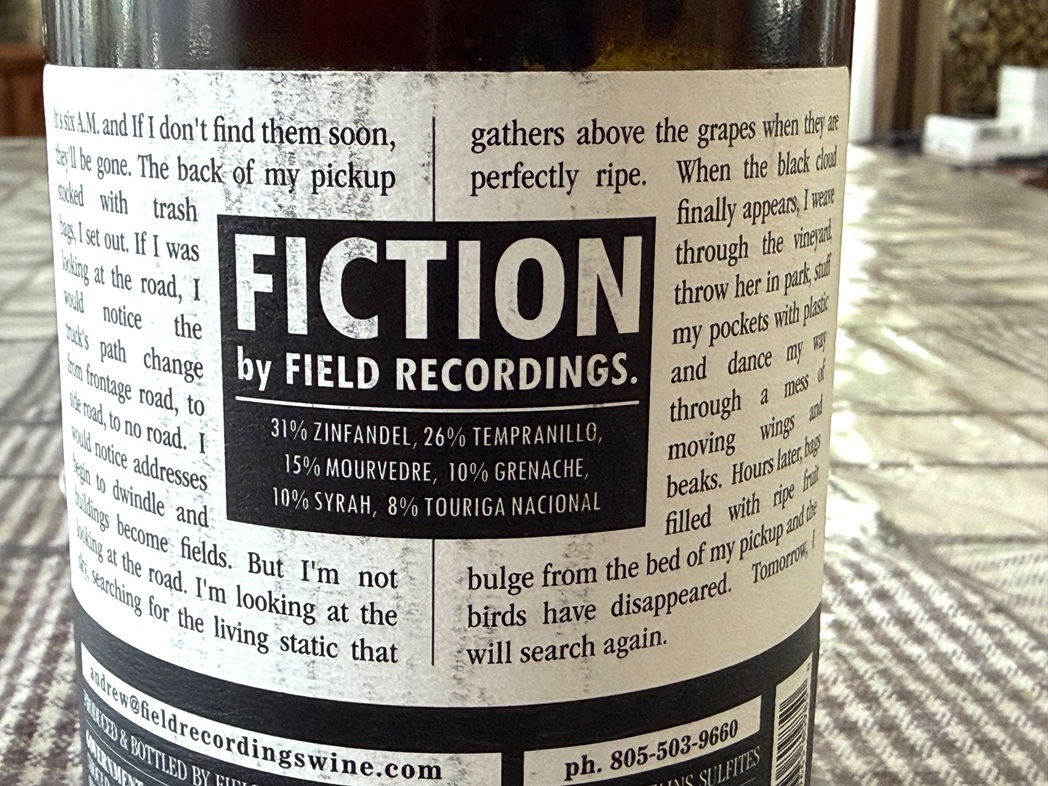
I also loved the back label. As this might be the last time I look at such a label (the current ones don’t carry any of the text), I would allow myself to cite the text written on that back label:
“It’s 6 A.M. and if I don’t find them soon, they’ll be gone. The back of my pickup stocked with trash bags, I head out. If I was looking at the road, I would notice the truck’s path change from frontage road, to side road, to no road. I would notice addresses begin to dwindle and buildings become fields. But I’m not looking at the road. I’m looking at the sky, searching for the living static that gathers above the grapes when they are perfectly ripe. When the black cloud finally appears, I weave through the vineyard, throw her in park, stuff my pockets with plastic and dance my way through a mess of moving wings and beaks. Hours later, bugs filled with ripe fruit, bulge from the bed of my pickup and the birds have disappeared. Tomorrow, I will search again.”
Now, let’s talk about the wine. Screwtop. 13 years old California Paso Robles blend. Stored at somewhat consistent conditions, away from direct sunlight and vibration, but not in the cellar or a wine cooler. Priced at not more than $20 originally (directly from the winery). And yet, one of the very best wines I have ever experienced. A truly memorable one.
I poured the wine in the glass, smelled it, and couldn’t put the glass down. The time slowed down. Sounds practically disappeared. The aroma was magical. And the wine in my mouth was too.
Dreams, smiles, baby laughter, endless meadows, fresh mountain forest air. I know, it sounds like a brain dump, but I don’t want even to try to describe this wine in technical terms – raspberries or blueberries are not important here, what’s important is how the wine makes you feel. Refined, elegant, layered palate, flavors are transitioning and interplaying in total harmony, each sip asking for the next. Am I exaggerating? I don’t know, and it is up to you to believe me or not. But the wine was absolutely stunning and memorable. That I’m completely sure about.
Here you are, my friends. An OTBN experience that will not be easy to beat.
Two amazing wines, an amazing experience, great memories.
I don’t know if I will be able to do better next year, but this is the beauty of wine – the mystery in the bottle.
Until the next time – cheers!
Open That Bottle Night OTBN 2025 – What a Night!
What a Night! The end.
If I say “what a night”, can this serve as a sufficient wine descriptor?
Okay, of course not, but what a night it was.
As a wine lover, I really treasure Open That Bottle Night, or OTBN for short, taking place on the last Saturday in February. OTBN was created by the Wall Street Journal wine writers, Dorothy J. Gaiter and John Brecher, back in 1999, to encourage wine lovers around the world to open that long-stashed special bottle that might be long gone while waiting for a special enough day to be opened.
Now, if I describe the experience as “agonizing”, does that portray a happy vibe? I might be unique in my self-directed masochism, but “agonizing” is the best way to describe the days leading up to the OTBN sacred night. Agreeing with oneself on wines worthy to be opened for OTBN can’t be described any other way, as I endlessly circle around the bottles located all over the house (an extra challenge of not having a dedicated wine cellar).
This year’s OTBN accidentally worked better than it could’ve been. We had been trying to arrange a dinner with friends for a while, and February 22nd was not my preferred date as it was my only night home in between two weeklong business trips. But as we tried to push it out to a later date, we came to a realization that it is either now, or it will be pushed far away, and we already had been talking about this get together for about half a year. I was responsible for the wine, and the other two couples for the food. As I started thinking about wines I should bring, it downed on me – ohh, this is the last Saturday of February, which means … OTBN!
Selecting the wines instantly got a lot more interesting and a lot more challenging at the same time. Now I need to bring not just wines, but the wines worthy of OTBN, the wines special for whatever reason, as a bare minimum special at least to me.
Celebrating OTBN in the group has a great advantage – I don’t need to decide what this one special bottle is – we can cover the full proper “wine dinner range” – bubbles, white, red, dessert. This is exactly what I did – and here are the wines I selected, with all the notes and impressions attached.
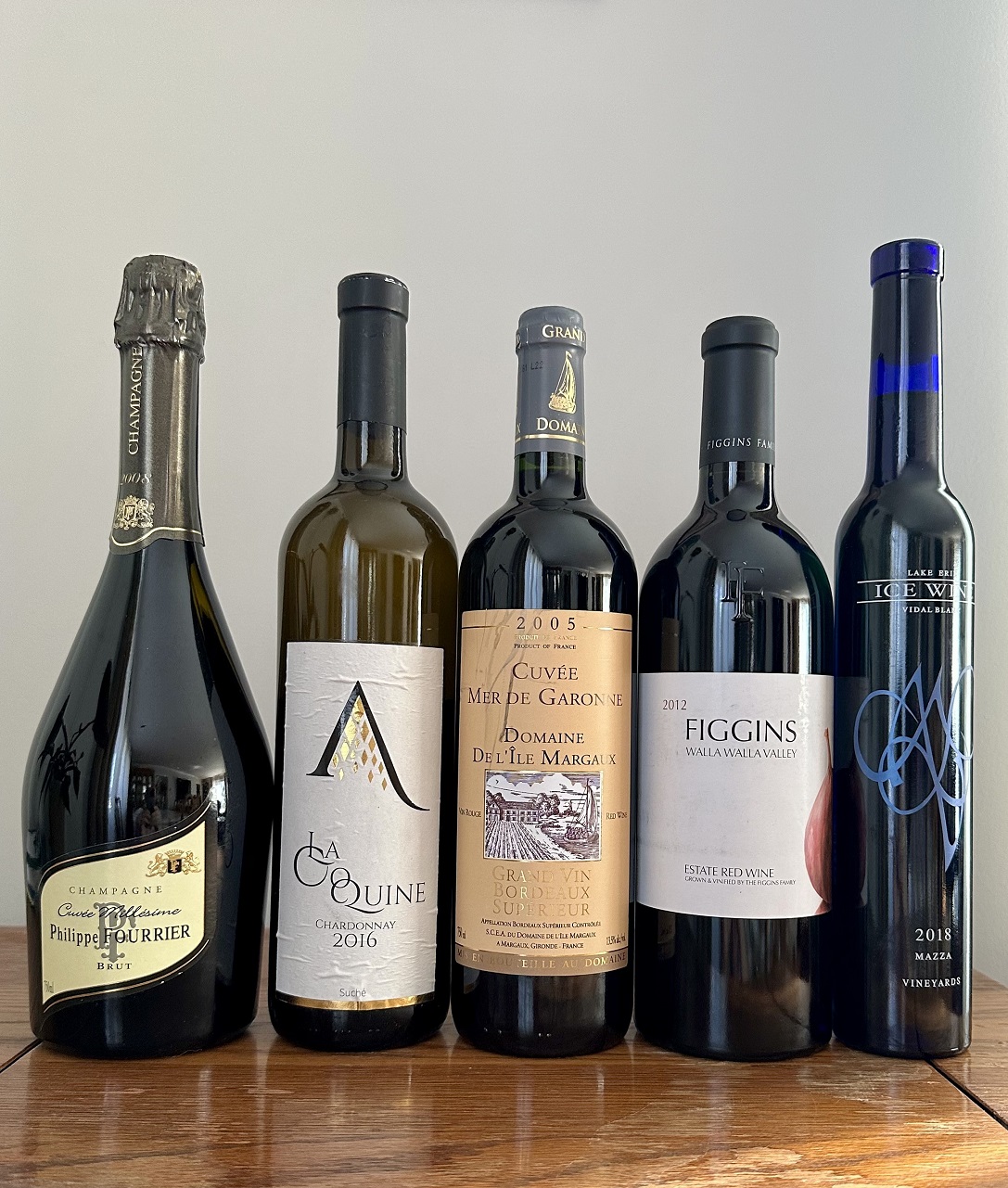
Bubbles – my selection is typically very limited at home, I have maybe 12 to 15 bottles of sparkling wines on hand, so deciding what is “special enough” is not easy – and the whole idea of OTBN is to work with your own cellar, so I had to really find that bottle inside. In the morning, I pulled out a shelf with sparkling wines from the fridge, and my inner voice said “how about this one”. Grabbed the bottle of 2008 Champagne Philippe Fourrier Brut Cuvée Millesime (12% ABV, I think I got it through WTSO a while back), and while checking the back label, I realized that this was also a vintage champagne, a 2008 – even better! Now the bottle has become a lot more worthwhile to open at OTBN.
What a joy this wine was. Perfectly substantial without going overboard – toasted bread, apples, yeast, fresh and full of energy – an absolute “wow” of the champagne experience, the wine that was very easy to like instead of looking for ways to convince oneself that you like it. Extra bonus – everyone loved the wine, which is never given in the group, especially when it comes to bubbles.
Next, 2016 Salabka La Coquine Chardonnay Czech Republic (12.5% ABV).
This wine was probably the most special in the group. This wine was associated with memories. I brought a few bottles of this same wine back from the Czech Republic in 2017, after tasting the wine at a dinner at Salabka city winery, located and growing their grapes within Prague city proper. This was my last bottle from that trip, and I already pulled it out of the fridge on multiple occasions, and put it back every time deciding “not today”. This time I decided that it was actually the time to pull that cork – but I didn’t have much hope for this 9 years old Chardonnay.
Oh my… what a wow wine it was. Perfectly intact cork with a few crystals. No age showing in the color, still light golden. And the nose and the palate showing apples, pears and vanilla, woven over a firm citrus core. Bristling acidity doesn’t get in the way of enjoying wine. Considering how fresh the wine was, I’m sure this wine had another 20 years of life ahead of it – and now I have a perfect reason, even a strong need to visit Prague again.
Next, time for reds.
In retrospect, the selection of reds was very interesting, I don’t think I would’ve done it better even if I tried. A 2005 Bordeaux and 2012 Washington estate red – sounds reasonably far apart, right? And yet somehow, the wines literally were singing in unison, just imagine 2012 red having a bit of a deeper voice.
Maybe this was due to very similar grape blends – both wines were blends of Cabernet Sauvignon, Merlot, and Petite Verdot, but the Washington red was simply a continuation of the French Bordeaux.
The 2005 Domaine De l’Île Margaux Cuvée Mer de Garonne Grand Vin Bordeaux Superieur (13.5% ABV, 33% Merlot, 33% Cabernet Sauvignon, 34% Petite Verdot)
comes from a unique place, a small island in the middle of the Gironde River, overlooking the great estates of Margaux. The wine opened up as a classic, beautiful Bordeaux, with cassis and eucalyptus on the bright nose, and more of the same on the palate. Perfectly fresh, beautiful layers of fruit, firm structure, impeccable balance. The 20 years of age were unnoticeable. The wine didn’t need decanting, but opened up beautifully in the glass.
The 2012 Figgins Estate Red Wine Walla Walla Valley (14.6% ABV, Cabernet Sauvignon, Petite Verdot, Merlot) was my only bottle which I got as a present some years back. Similar to Salabka Chardonnay, this wine was pulled out of the fridge on a number of occasions, only to be put back in again. Finally, this was the day. On the nose, it was very similar to the Bordeaux, only a bit more restrained. On the palate, it had the same cassis and eucalyptus, but the appearance was a bit “fattier” – more pronounced berries, juicier layers, a bit darker notes but still perfectly balanced and perfectly delicious.
And then the was time for dessert. Nothing makes me more ecstatic than an opportunity to open a bottle of a dessert wine. During most of the dinners, even when you plan to open the dessert wine, everyone starts complaining about how they don’t want to drink anything else, and the desire not to waste a whole bottle for just a few sips prevails. But this is OTBN, not just some regular wine dinner, so everyone simply has to go with the program.
I don’t know exactly how I got into possession of this 2018 Mazza Vineyards Vidal Blanc Ice Wine Lake Erie Pennsylvania (11.5% ABV, Harvest dates January 11 and 21, 2019) bottle – I guess someone just brought it as a present.
Boy, was this wine just an amazing finish for the evening… stunningly delicious, with ripe apricot on the nose, and ripe, juicy, succulent apricots on the palate enveloped in a perfect amount of acidity. This was the wine of impeccable balance, the balance of sweetness and acidity that makes or breaks dessert wines. This one was superb – we almost had to fight for who would get to finish a bottle – a pure joy to an oenophile’s heart.
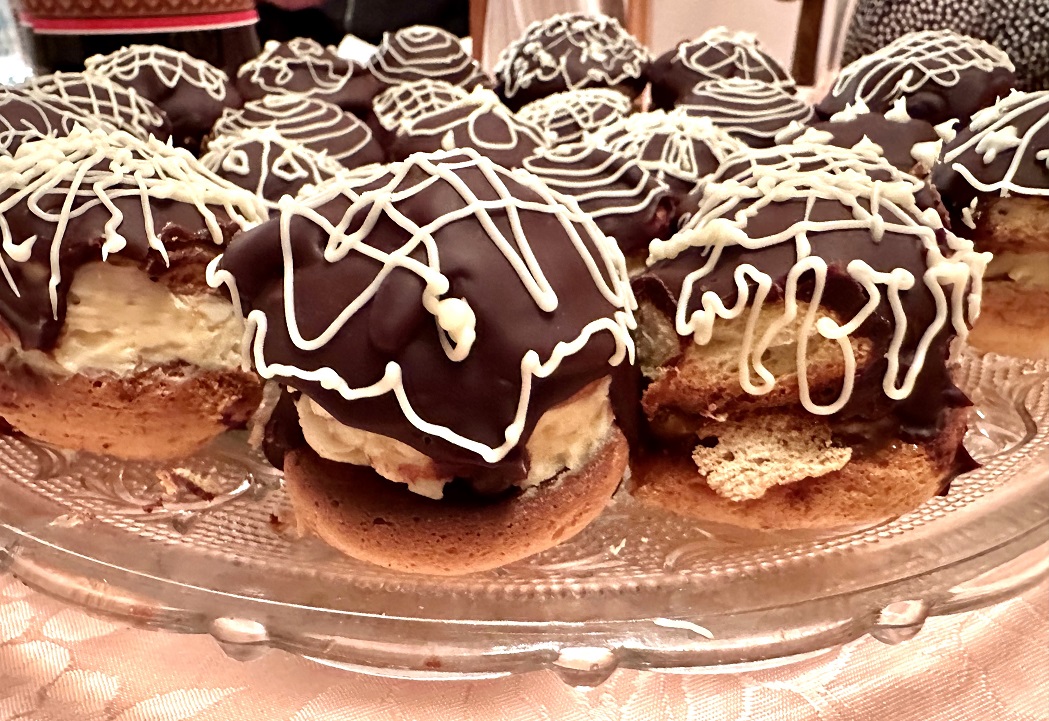
I also have to mention another special treat we had for dessert – small pastries that were popular back in Belarus growing up there, called Bouchée. These were specifically made as per the original Russian recipe and were absolutely sublime.
Another OTBN just became a history, a memorable memento. Luck or not, but these were 5 excellent, memorable wines – and a great company. Let’s raise the glass to the joy the wine is able to bring. Cheers to memorable nights!
OTBN Conundrum
OTBN, short for Open That Bottle Night, is my favorite wine holiday. Nowadays, there are lots and lots of wine holidays, usually associated with a particular grape – International Chardonnay Day, International Cabernet Day, Beaujolais Nouveau celebration, and so on. The majority of such wine holidays encourage you to open a bottle of wine made from a particular grape, whether there is a story behind the bottle or not. You can take these grape holidays with all seriousness and meticulously prepare and select the right bottle, or you can just grab any random bottle you will see in the store – or skip the grape holiday altogether if you don’t feel like drinking Cabernet Sauvignon or Chardonnay on that particular day.
OTBN is different. OTBN was invented for people who take their wine seriously. Or maybe rather those who take their wine too seriously. Over the years, we accumulate wine bottles that are deemed special; brought home from the winery you visited in France; got this bottle after an amazing tasting event; a bottle from an amazing family vacation many years ago; a bottle given to you by a dear friend. We can continue on and on, but you got the point.
Many of those special bottles in your collection would have some similar traits: they exist in the quantity of 1 and they are too special to be opened at random. Those special single bottles stay put in your cellar, waiting for the special company, special circumstances, special moment, special friend’s visit to be opened and enjoyed. More often than not, they keep waiting, and waiting, and waiting, because that special moment keeps not happening. And then, when it finally arrives, you might open that special bottle you preserved with the best care in the world, only to find that the content can solicit the memory but can’t bring you joy anymore because the wine in the bottle simply turned past prime. And it also kind of ruins the moment. This is why OTBN was invented, and this is what makes it such a great holiday for all the winos out there.
My personal conundrum draws exactly along the lines I just described. I have a lot of single bottles (actually, an absolute majority of my wines in single bottles – I practically never buy any wine by the case), and as such making a decision about a “special” bottle of wine for an event or a holiday, never mind the hallmark of them all, OTBN, a long and tedious process. “Is this bottle good enough? Okay, but I only have one. What if I will open it now and would never know how great it could’ve been? What do I do? What do I do?”
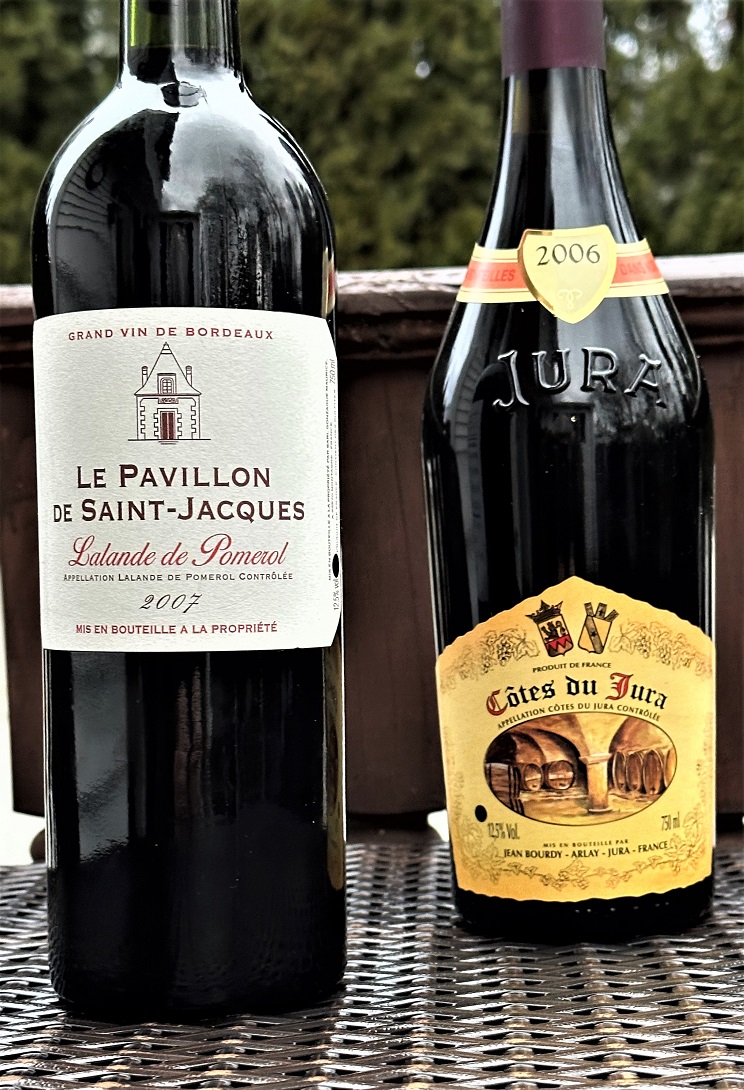
Same as the last year, I had to celebrate OTBN early this year due to the business trip spanning over the intended OTBN last Saturday of the month, February 25th. My wife doesn’t drink much wine nowadays, so I had to count primarily on myself. I had no good ideas coming to my head, there were no special bottles of wine I was ready to sacrifice. Looking at one of the wine fridges, I noticed the bottle of Jean Bourdy from Jura.
I don’t take Jura wines lightly, they are very hard to procure in the US. And then Jean Bourdy is a legend in itself – I better have a damn good reason to open such a special bottle. Then I thought that I already had some Jean Boardy in the past – maybe I would find some notes in the blog? I entered Jean Bourdy in the search box, and sure enough, this post came up. I tasted this wine in 2011 when I attended a Natural Wines seminar at PJ Wine store in New York – my first, a truly memorable encounter with natural (low intervention) wines as a category. I tasted this exact wine, 2006 Jean Bourdy Cotes Du Jura Rouge (fun fact: 2006 was the first vintage of Biodynamic wine production at Caves Jean Bourdy). I really liked the wine then, and my note said “It appears that wines of Jean Bourdy are known to age very well (note to self)”. As soon I saw this “note to self”, I instantly put that single bottle of Jean Bourdy back, as 17 years is most likely not an age for it.
In the same post, I noticed another wine that happened to be next to Jean Bourdy bottle on the same shelf – 2007 Le Pavillon de Saint Jacques Lalande de Pomerol. I pulled this bottle many times from the fridge before, always remembering that this was a natural wine, but again, no moment felt special enough. Then I read my note from 2011, which was clearly less than favorable. Here it is in its entirety:
“Very interesting. Smells like dirt, pure dirt after the rain. Very vegetative, no fruit on the palate, just pure dirt again. Almost no acidity. This wine was fermented in concrete tanks, aged for 18 months. It is “certified organic” and made with 90% Merlot and 10% Cabernet Franc – classic Pomerol wine. I would love to taste it in 10-15 years – I think it will greatly evolve, but it is not easy to say ” I like it” now”.
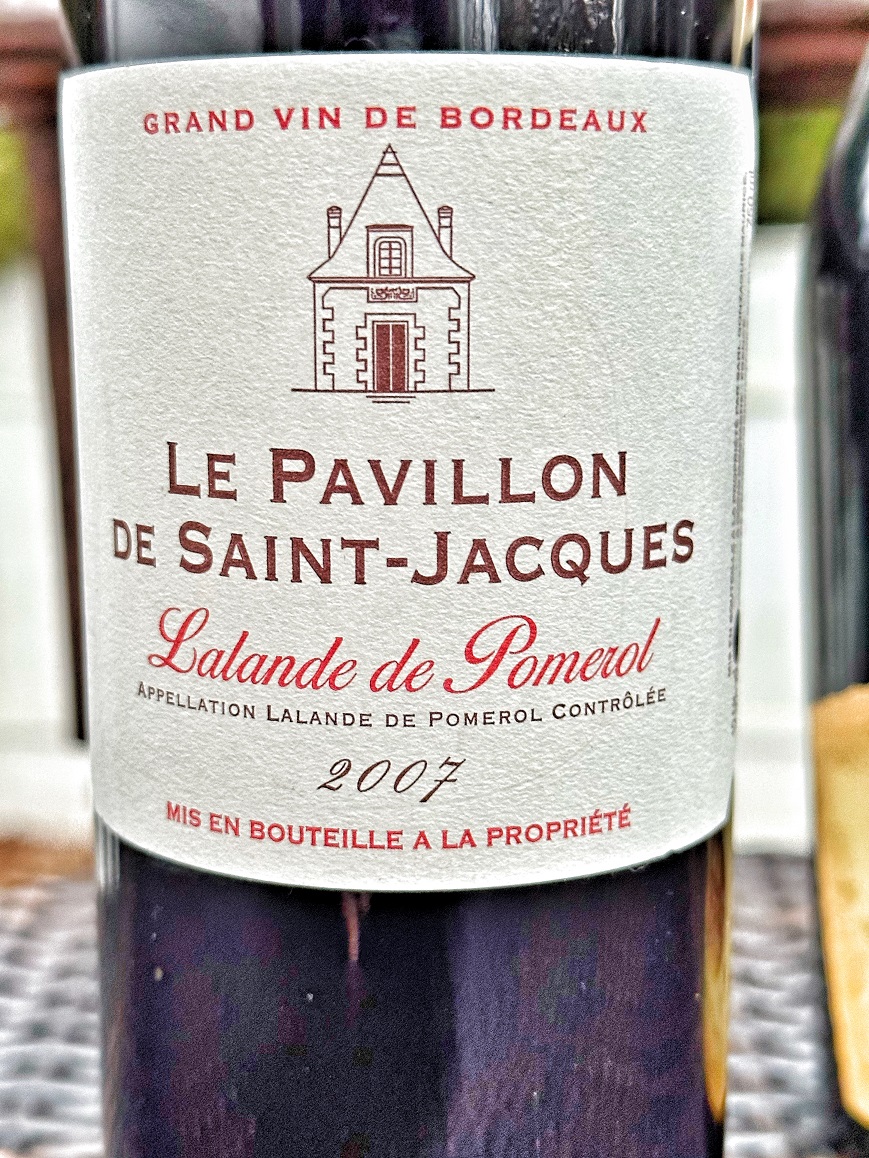
This “note to self” clearly stated that the wine was not good in 2011, but I should give it another try in 10-15 years. I was pretty much in the middle of that suggested term – 12 years after the original tasting, so opening that bottle all of a sudden became a perfect thing to do.
Cork came out easily, showing a good amount of crystals on the bottom, but otherwise perfectly fresh. The first sip instantly put my inner wine geek into a nirvana state. Barnyard. Pure, beautiful barnyard. If you belong to the group which screams “brett” at the first whiff of the barnyard smell on the wine, I’m sorry but we can’t be friends. Yes, there are limits to everything, but the reasonable amount (don’t ask me to quantify, everyone has to define their own “reasonable amount”) enhances the wine pleasure for me. I typically find barnyard associated with Syrah wines – possibly, this was my first Bordeaux with the barnyard aroma – but the barnyard aromas were followed by the classic, concentrated cassis. Layered, concentrated, softly rolling harmonious wine with perfect, firm structure and clean acidity. Beautiful, classic Bordeaux. This was truly an OTBN-worthy pure pleasure experience (by the way, my wife also loved the wine very much).
Here you go – my typical wine selection conundrum, happily resolved to make another memorable night. And as a bonus, the expectation of improvement of the wine with age fully came through (patting myself on the back).
The official OTBN night is almost here. You still have time to select the bottle or 5, maybe get some friends together and make some wonderful wine memories. If you want to celebrate only one wine holiday a year, make it OTBN – don’t risk the wine not being there for you, or you not being there for the wine.
And please share your OTBN stories – I would love to hear them.
Open That Bottle Night Eve, 2022
And just like that, Open That Bottle Night 2022 is upon us.
Considering the current state of the world, I’m really not in the mood to write about wine when people are dying because of some egomaniacal fucking moron… but based on my inability to do much anything about it, let’s still talk about Open That Bottle Night.
The Open That Bottle Night, or OTBN for short, created by Dorothy J. Gaiter and John Brecher, Wall Street Journal wine writers back in 1999, is always celebrated on the last Saturday in February. OTBN was created to help people to part with that special bottle while it still might taste great. Over the years, it became literally a holiday celebrated all around the world, with people reporting on all the amazing wines, and most importantly, amazing experiences of getting together with friends (here are my reports from the last 3 years – 2019, 2020, and 2021, plus many special reports from 2016).
This year, we had been invited to celebrate a birthday of a dear friend on that exact Saturday of the OTBN, so I have no options but to celebrate the night before or after, or maybe even both (this friend doesn’t care about wine, so combining the birthday celebration with OTBN is not an option). Thus I’m sitting here the night before the OTBN, sipping my OTBN wine and enjoying every little drop of it.
Deciding on the wine worthy of OTBN is always incredibly hard. I love aging wine, so I have a good selection, but it doesn’t mean that deciding on the bottle is easy. There are bottles that I determined to share with friends (actually, all of them, but I have to make exceptions, especially considering the lockdown life of the past 2 years). There are bottles which I don’t want to open too early. There are bottles I’m still not ready to part with. I’m telling you, people – it is difficult.
I don’t have any wine record-keeping system. I have a loose idea of the bottles I have, but I’m always ready to be surprised. Tonight, I opened one of the wine fridges, and pulled out the bottle which I had completely forgotten about – and as a bonus, this bottle also comes with a story.
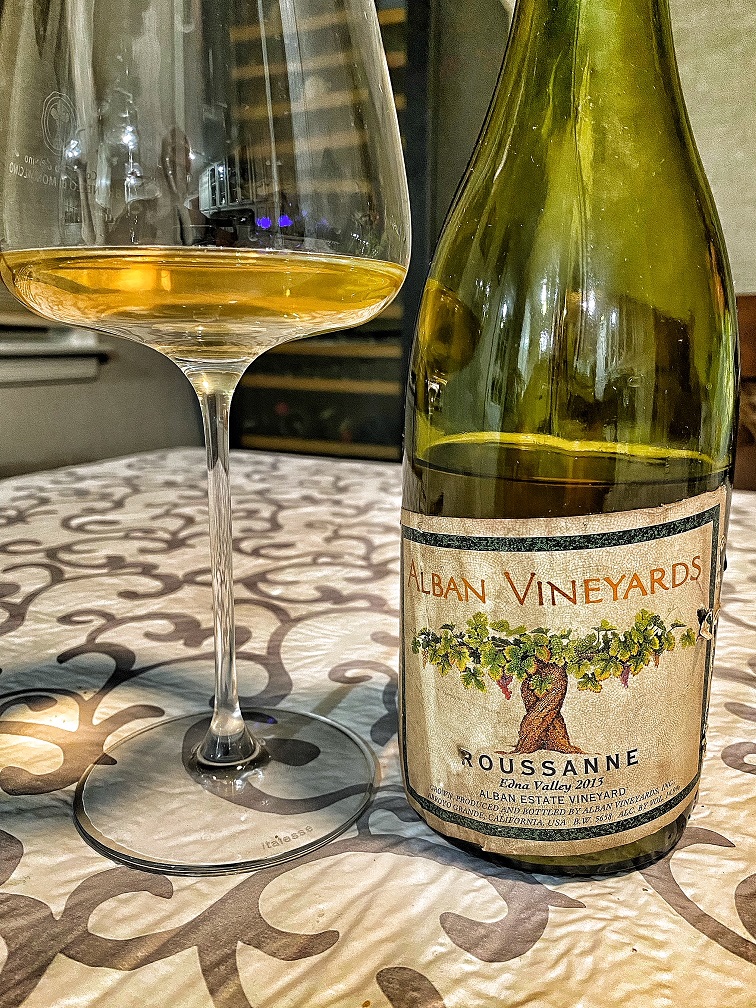
Let me tell you the story first. Take a look at the label – you can see that it looks crooked and dinted. So the rips in the label are from the shelves in my wine fridge, and they are not so interesting. But otherwise, the appearance of this label has a reason. Alban wines are allocated and are hard to get. When I got my allocation some time back, I only wanted to take 2 bottles, so the friend asked if she can have the rest. She filled up the form in her name, got the full allocation, and then shipped my two bottles back to me – a bottle of Patrina Syrah and this bottle of Roussanne. For some mysterious reason, she decided to reuse the inflatable packaging which is sometimes used to ship the wine instead of cardboard or styrofoam. The problem with that air-pumped enclosure is that it is not really reusable and not that reliable. When I got the box, the red liquid was slowly sipping through – you can imagine the fate of Patrina… At least the bottle of Roussanne was intact, with the exception of the label…
Pulling this bottle out from the bottom shelf was a moment of happiness. I love Roussanne, one of my favorite white grape varieties, and for some reason, I had been really craving Roussanne lately. So seeing this bottle which I completely forgot about was a moment of joy – this was IT. A perfect bottle for OTBN.
What can I tell you about this 2013 Alban Roussanne Edna Valley outside of the fact that it offers immense pleasure? We can start with a beautiful golden color. The nose of gunflint and honey at such intensity that you simply don’t want to put the glass down. Sniff, swirl, sniff, swirl, ahh. Gunflint, honey, salinity, and sapidity on the palate. This wine is fresh. This wine is alive, with a cut-through acidity on the long, long finish. This wine is viscous, roll-off-your-tongue goodness – after taking a sip, my wife said “ooh, this wine is fat!”. This wine is perfectly OTBN worthy. Not only that – this wine is perfectly Top 10 wines worthy.
So here is my OTBN story. Even if you don’t feel like celebrating, life is now. It is happening, and no moment will repeat itself. Pull that special bottle. Open that bottle – the special moment has arrived, it is now. Cheers, my friends.
Open That Bottle Night 2021 – What A Night!
Traditions, traditions, traditions.
Traditions need wine. Wine needs traditions. Makes sense? If not, express your disdain with a flaming comment. But if you are an oenophile (wine aficionado, wine snob, wine geek, …), you understand and can easily relate.
Open That Bottle Night, or OTBN for short, is one of the shortest living traditions of the wine world, where thousand years might be a good measure for some – OTBN was first celebrated in 1999 when it was created by the wine couple – Dorothy Gaiter and John Brecher, wine writers behind the “Tastings” column in Wall Street Journal. The OTBN was created to help wine lovers part with the special wine bottles which might otherwise become a waste.
There are two parts to any wine tradition – the first is a special wine itself, always carefully selected to match the tradition, and the second is sharing – sharing of that bottle with the world. Not with the whole world at once, but with the friends.
Let’s talk about finding and sharing.
Finding a proper bottle is never easy – and it might be even worse for the holiday such as OTBN, which was created specifically to help us part with the special bottle, the bottle which has a special meaning for us – no matter why and how, but special in whatever way. Sharing is typically not a problem – unless it is 2021 and the world is still mostly in lockdown – and that includes all of one’s wine friends.
I was lucky for the past many years to have wonderful celebrations of the OTBN with the friends, sharing the most amazing wine experiences (here is the first-hand account for 2017, 2019, and 2020). The only possible way to share OTBN 2021 was the one using for the majority of the gatherings during 2020 and 2021 – the virtual one. I’m not complaining – I’m grateful that at least we have the technology with allows us to spend time with each other face to face, no matter how physically distant we are. So sharing portion was rather easy, and now let’s talk about finding.
Finding is not even the right word. Finding is easy – but selecting is not. OTBN asks for that special bottle. Deciding on what makes one bottle more special than the other, when your cellar is full of unique bottles all present in the quantity of 1 (one), is the hard part. After some amount of deliberations, which included pulling numerous wine fridge shelves back and forth, back and forth, I settled on these four bottles:
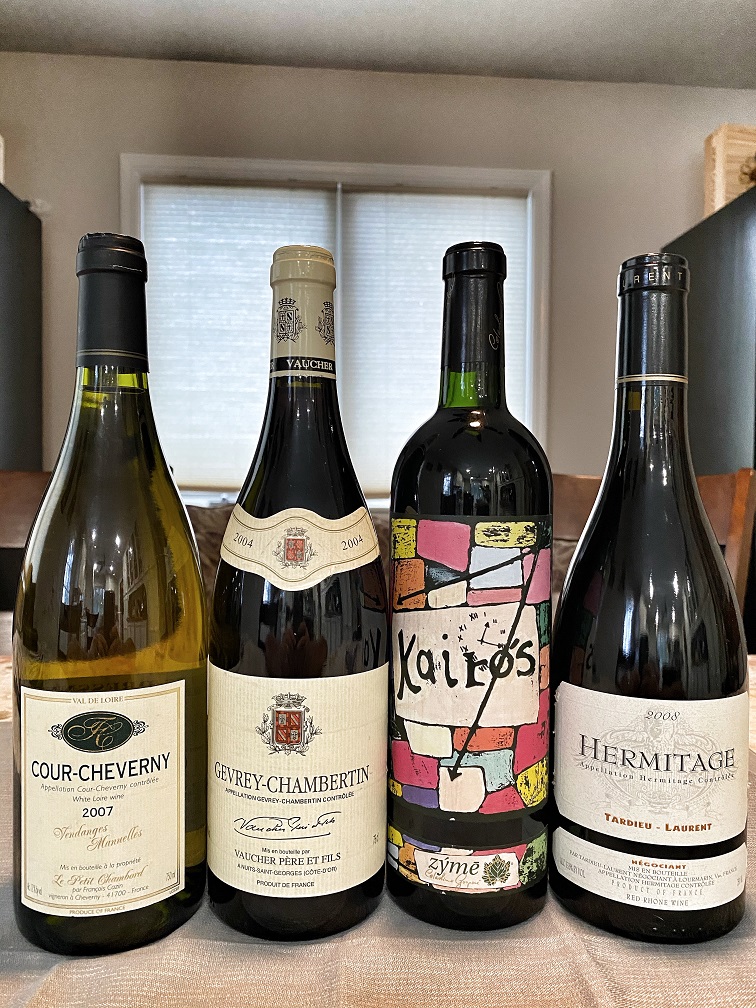
Let me explain my selection logic so you will see why it is such a daunting process for me.
First, the white wine, as I’m a big proponent of the balanced diet. 2007 François Cazin Le Petit Chambord Cour-Cheverny AOC might be called my unicorn wine, at least when it comes to whites. The first time I tried a different vintage of this exact wine when it was 10 years old and this wine became one of the brightest memories for me – the beauty and interplay of bright fruit, honey, and acidity were simply unforgettable. When young, this wine from the Loire, made out of the rare grape called Romorantin, is a single note acidic. With age, it develops into an absolute beauty. When I opened the bottle of this wine back in 2015, the wine was superb. When I brought it to Jim’s house for the OTBN 2019, 4 years later, it was “interesting” but absolutely not exciting. I was hoping for redemption, so this was an easy choice.
My next selection was 2008 Tardieu-Laurent Hermitage AOC. When I see Hermitage written on the label, you can literally hear me sigh. Hermitage to me is synonymous with the Syrah, and I love classic Syrah. And so does my wife – Syrah is her favorite grape. I have very few Hermitage wines in my cellar – and this one was calling my name for a long time (meaning: it was pulled off the shelf and placed back many times). Considering that 2008 had a rainy growing season and the vintage has low ratings (WS86, for example) and “Drink now” recommendation, this was an easy decision – no point in waiting any longer.
How many unicorns can one have? Well, having a unicorn would be nice, but I guess I’m talking about chasing them. So how many unicorns can one chase? Clearly, it seems that I’m chasing many. Good Amarone is the wine I’m always chasing. Giuseppe Quintarelly Amarone is more of an ephemeral dream for me, considering the price and availability – and it is definitely one of those unicorns I’m talking about. With 2004 Zýmē Kairos Veneto IGT, I’m getting as close to that unicorn as I can. This wine is produced by Celestino Gaspari, the winemaker for Giuseppe Quintarelli. As the label says “Produced from 15 varietals of grapes of Verona, it is a reflection and interpretation of our soil and the culture of its terroir”. In case you are curious, the 15 grapes are Garganega, Trebbiano Toscano, SauvignonBlanc, Chardonnay, Corvina, Corvinone, Rondinella, CabernetSauvignon, CabernetFranc, Merlot, Syraz, Teroldego, Croatina, Oseleta, Sangiovese, and Marzemino. This was my last bottle, and I scanned the pages of this very blog for a good 20 minutes last night as I couldn’t believe that I could’ve never written about this wine before – apparently, I have not. Anyway, I was afraid that it might be the time for this wine, thus it was added to the OTBN group. By the way, another interesting tidbit about this wine is that the name “Kairos” means “timely”, “appropriate”, and “the perfect moment”.


Every good plan A needs plan B, right? The backup. Have you ever went to a friend’s house with a bottle of wine, while another bottle stayed in your car just in case the first one would be corked? Yep, that’s the plan B we are talking about. 2004 Vaucher Pere et Fils Gevrey-Chambertin was my plan B. I don’t have a lot of Burgundies, so opening one is always a special moment. 2004 vintage was so so, with WS88 rating and “drink” recommendation, so this bottle was rightfully on the OTBN list, should the need and opportunity come.
Now you know all about selecting, and I want to say a few more words about sharing. Sharing wine is one of the best pleasures of drinking wine. The approving, understanding nod from the fellow wine lover after he or she is taking the sip from the bottle you brought really fills you up with joy. It might be even more satisfying than your own enjoyment of the same wine. Yet in today’s world, sharing the wine face to face is literally impossible, OTBN or not. To at least share the moment, I reached out to the technology which seemed to save the world from going mad – a virtual get-together over video. Zoom is my tool of choice, so after sending the invites to the group of bloggers, we got together at 7 pm on the OTBN Saturday.
We were not a big group – even in the virtual world, people are busy and have their own plans. But I’m really grateful to everyone who was able to spend that special Saturday time together – some for the whole 2 hours, some for 20-30 minutes, talking about wines, sharing life stories and experiences, and most importantly, having fun. You can scroll through the pictures below, I’m sure you will see some familiar faces.
So how was my OTBN? In other words, let me tell you more about the wines.


The miracle didn’t happen, and the white wine didn’t become suddenly magical. If I need to describe this 2007 François Cazin Le Petit Chambord Cour-Cheverny AOC in one word, the word would be “strange”. At some moments, it was oxidative and plump. In other moments, it was acidic. It never showed that amazing lemon and honey notes I was expecting. I still have one more bottle, but now I really need to forget it for as long as possible and see if the miracle will happen.
The Hermitage was … superb. First of all, opening it was a breeze – cork was perfectly intact, regular waiter’s corkscrew worked just fine. Drinking this 2008 Tardieu-Laurent Hermitage AOC was a great pleasure – a touch of pepper, a distant hint of a barnyard, round and delicious fruit. The wine was just right – perfectly balanced, round, and smooth. I don’t have a lot of experience with Hermitage, but this wine was clearly one of the best renditions of Syrah I had in a long time. “Elegant” would be the single word descriptor I would use.
The Kairos was the bottle I was concerned about the most. It could’ve been gone by now, especially considering such an eclectic blend of grapes. When I started opening this 2004 Zýmē Kairos Veneto IGT, first I decided to use the regular corkscrew, which worked perfectly fine for the Hermitage. Looking at the way the screw was going in, the cork seemed to be too soft, so I decided that it was the job for Ah-So – I’m glad this decision was not an afterthought I usually have after the cork is already broken in half – Ah-So worked perfectly well and the cork came out with no issues.
And the wine… The wine was magical. Dark fruit with a hint of dried fruit on the palate, perfectly firm and structured, powerful and elegant, with clean acidity and an impeccable balance. The wine was delicious on Saturday, and I also enjoyed that over the next two days. So now I regret not having any more bottles left – but I’m glad I had this special experience. Magical would be the word.
As two bottles of red had no issues whatsoever, the Burgundy was left aside and now will be waiting for its special moment to be opened and enjoyed.
And that, my friends, concludes my OTBN 2021 report. While the sharing was virtual, the experience and pleasure of the wine and the company were real, and it will stay in my memory as yet another great OTBN night. Hope you had fun too. Cheers!
What a night! Notes from OTBN 2020
 Open That Bottle Night is the best wine holiday out there. It is nice to celebrate all the individual grapes – Chardonnay Day, Albarigño Day and the likes – but that can’t compare with an opportunity to open a special or the most special bottle you have in your possession, and most importantly, share it with fellow oenophiles, the people who appreciate and respect that special bottle.
I’ve been lucky for two years in the row to be invited to someone’s house to celebrate OTBN – last year Jim VanBergen of JvBUncorked fame was our host, and this year John Fodera of the Tuscan Vines hosted of amazing wine night.
John did a great job organizing this memorable night for the group of people most of whom he never met face to face (yours truly included – we had been following each other for close to 10 years, but managed to avoid any face-to-face contact until now) – he developed a loyal group of followers as Italian wines expert, and I’m sure everyone was happy to finally meet him in person.
John managed to come up with a great program. After the round of Lambrusco bubbles (which is the rave nowadays) we started the evening with two blind tastings. We had 2 groups of 3 wines each, trying to identify at least a place and type of wine, and ideally even the producer. We also voted for the group’s favorites. I generally suck at blind tastings, so I did poorly (as expected). I also decided not to use the external factors in the tasting (I.e., John is Italian wine guy, so we should simply expect all the wines to be Italian; another guess would be that as John’s blog is called Tuscan Vines, all the wines will be from Tuscany).
Here are my notes for the first flight:
Wine 1: Touch of mint, full-body, good structure, a touch of black currant – super Tuscan?
Wine 2: great concentration, dark fruit, layered, silky smooth – Montepulciano di Abruzzo?
Wine 3: nice fruit, bright, good structure. Super Tuscan? New World?
Needless to say that I was absolutely wrong with all three. Again, I could’ve used a bit of psychology and figure out that John would be pouring only Tuscan wines, but I deliberately refused to do so. The wines were perfectly polished and complex, all three, without screaming “I’m Chianti” with the appearance of leather, tobacco, or tart cherries. To make a long story short, all three wines happened to be Chianti Classico Gran Selezione from 2016 vintage, provided to John by Chianti Classico Consortium. In the order of appearance, these were the wines:
2016 Fèlsina Chianti Classico Colonia Gran Selezione DOCG ($NA, 100% Sangiovese)
2016 Rocca delle Macìe Riserva di Fizzano Chianti Classico Gran Selezione DOCG ($NA, 95% Sangiovese, 5% Merlot)
2016 Fontodi Vigna Del Sorbo Chianti Classico Gran Selezione DOCG ($NA, 100% Sangiovese)
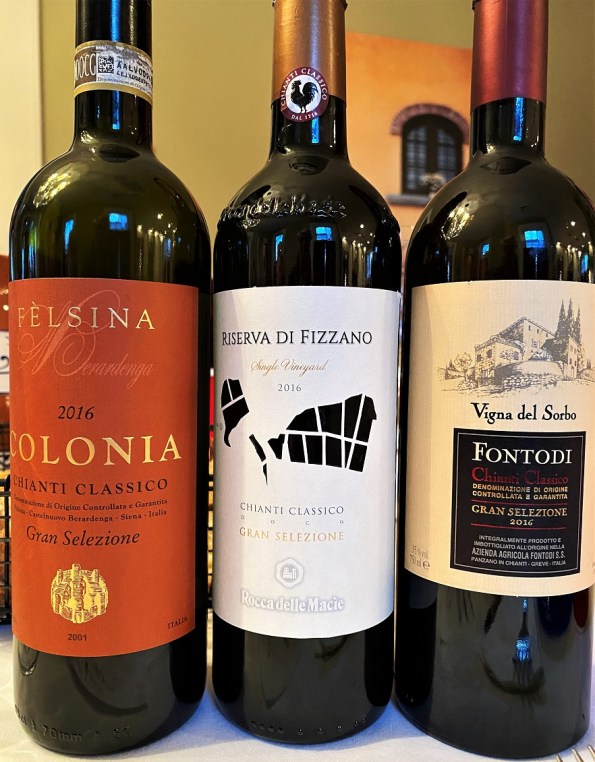


I want to add that the second wine, Rocca delle Macìe Riserva di Fizzano, won a popular vote with 5 votes out of 10 – this was also my favorite wine.
The next flight consisted again of three wines. Here are my notes:
Wine 1: dark fruit, eucalyptus, crushed berries, green tannins – Bordeaux blend, can be from anywhere
Wine 2: Roasted meat, plums, salami, plums on the palate – Grenache/GSM? Can be from anywhere
Wine 3: too aggressive, green tannins, black currant. Bordeaux blend, can be from anywhere.
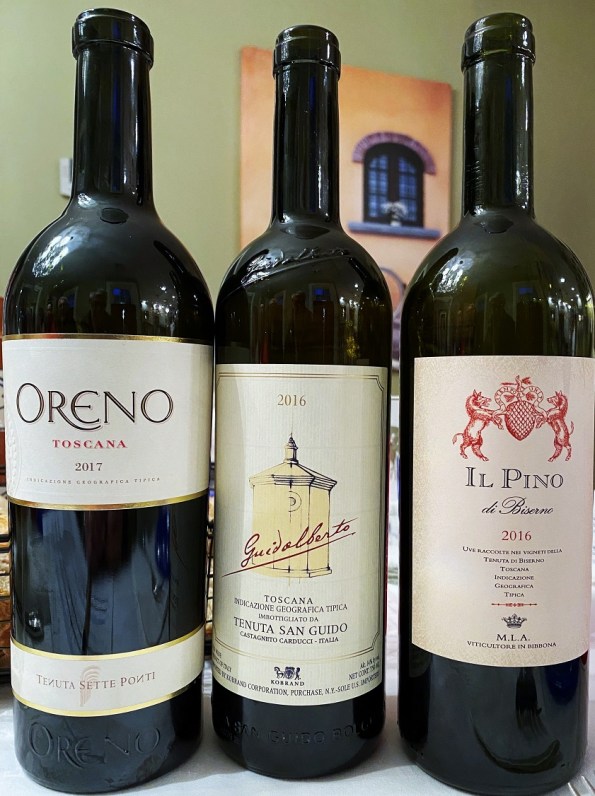
Again, I should’ve expected another line of Italian wines, but I thought John could play some tricks, so I didn’t go with an obvious idea of Super Tuscans. And I was wrong. All three wines were well-known Super Tuscans (these three wines were courtesy of Kobrand Wines):
2017 Tenuta Sette Ponti Oreno Toscana IGP ($75, 50% Merlot, 40% Cabernet Sauvignon, 10% Petit Verdot)
2016 Tenuta San Guido Guidalberto Toscana IGP ($54, 60% Cabernet Sauvignon, 40% Merlot)
2016 Lodovico Antinori Tenuta di Biserno Il Pino di Biserno Toscana IGP ($70, Cabernet Franc with Merlot, Cabernet Sauvignon, and Petit Verdot)
I really didn’t appreciate the tannic nature of wines number one and number three, and those tannins were not only aggressive but literally biting. Oh well. Wine #1, Oreno, was the crowd’s favorite (7 votes out of 10). This time around my vote didn’t match the majority, as I went with the wine #2, Guidalberto, as this was the only drinkable wine for my palate.


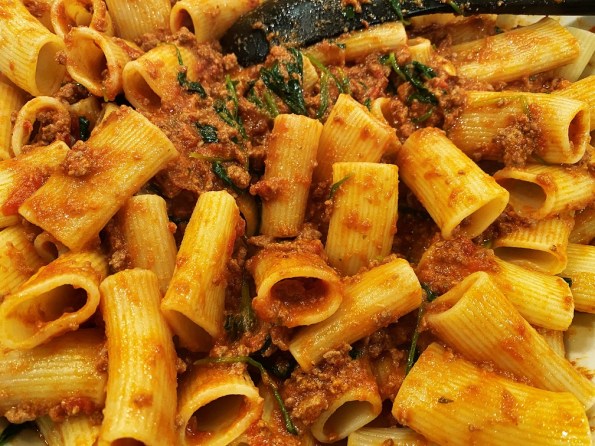
After finishing the tasting and discussing the results, it was time to eat. First, there was pasta bolognese, which John masterfully prepared:
And then there was meat. John decided to spoil the group with 2.5” porterhouse steaks, to make Bistecca Fiorentine:


We went to work the grill which was an interesting adventure, mining the grill to prevent flare-ups on a cold night. We actually had to make two attempts to get the steaks right, as they were still mooing after the first pass. But we managed to produce something delicious in the end and not ruin the amazing steaks.
Now, time to meditate. Nope, this was not an organized food prayer session. What happened was that the bottle of Soldera Brunello di Montalcino was poured out of the decanter. Mike Giordano brought a bottle 1999 Soldera Brunello de Montalcino in a completely unassuming, low-key, way. Gianfranco Soldera was a legend, who bought a property called Case Basse in Montalcino in 1972, with an aim to produce the best Brunello wines. By 1990s Soldera wines reached cult status, coupling impeccable quality with small production. Talking about Gianfranco Soldera and his wines would be best suited for a separate dedicated post, as controversy completely surrounded him; I have to say that I never expected to taste his wines – until this memorable OTBN.
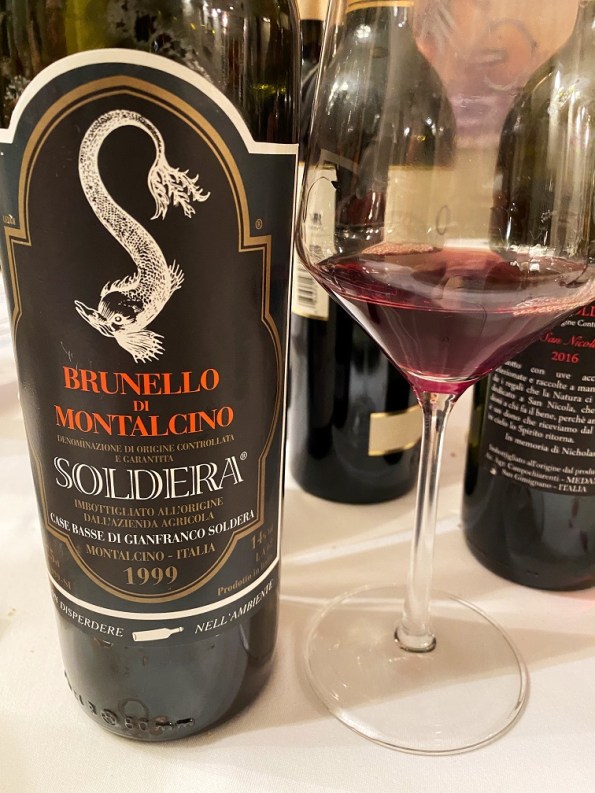
Just look at this color…
1999 Soldera Case Basse Brunello di Montalcino DOCG was truly a meditation wine. “Meditation wine” might not be a simple term to explain in words, but if you like wines, there is a chance that you experienced it at one time or the other. The nose, the aroma, and the bouquet of this wine were simply magical. Taking the whiff from the glass, the time was stopping – no need to try to analyze the amazing palette of flavors to come up with individual descriptors – this wine should be described purely on the sensory level, as every smell was bringing a pure, hedonistic pleasure. I didn’t care for food, I didn’t care for talking – I just wanted to take another smell, and another, and another. When I finally took a sip, the wine was magnificent on the palate too – a perfect balance of plums, cherries, textural layers, structure, sage, and rosemary – a perfect harmony of flavors. It is quite possible that this was my wine of the year 2020 – I know it is only March, but this was an experience that is seriously hard to beat. I don’t feel that I should even try rating this wine, but if I would dare, this would be my second ever 10- (don’t ask me why not 10, I have no idea what my perfect 10 wine should smell and taste like).
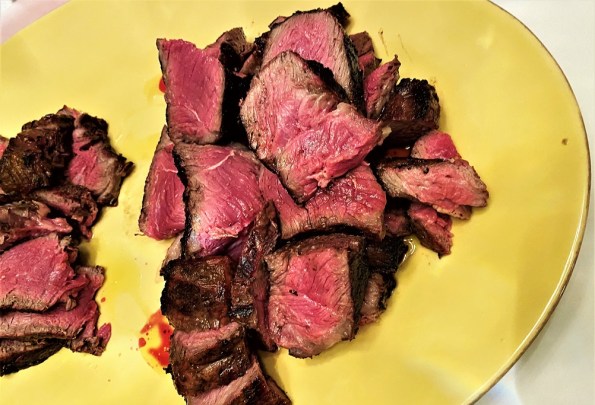
After the meditation session, just a few words on the dinner. In addition to the delicious meat, John made a couple of side dishes – the sautéed white beans were an absolute hit, adored by all literally as much as the beef. John actually promised to share a recipe – you can find the recipe in this post.
This was not the end of our wine program. We also had 2016 Campochiarenti San Nicola Chianti Colli Senesi – Campochiarenti is a producer John is always raving about in his posts, so it was definitely interesting to finally taste this wine (Campochiarenti wines at the moment are not imported into the US, but available directly from the winery). The wine was classic and simple, and for about $12 (if it will be imported into the US, this is the expected retail price) it will be definitely a great value. I brought a bottle of 2010 No Girls Grenache from Walla Walla in Washington, which was very tasty but radically non-Italian, so I don’t think it was well-received. I also brought one of my recent finds – 2016 Pedra Cancela Selecção do Enólogo from Dão, which was an old world and a lot closer to the overall theme, and an amazing QPR at $9 per bottle at the local Bottle King store. 2010 Capanna Brunello Di Montalcino was delicious, but it was a tough call to get everyone excited after experiencing the Soldera. Lastly, we had 1999 Natale Fantino Nepas Nebbiolo Passito Piedmont which was interestingly dry and light, but not necessarily my favorite.


That gives you more or less a full picture. We also had a wonderful spread of Italian desserts, and truth be told, for the first time ever I tasted cannoli which I liked. It appears that the good cannoli should be filled with cream at the moment of purchase and not before – now I will know.
And now we are done. How was your OTBN 2020? Cheers!
Wednesday Meritage – OTBN, Tre Bicchieri, Cru Bourgeois 2020 Classification, and More
Meritage Time!
Let’s start with my perennial favorite – Open That Bottle Night, or OTBN for short. OTBN movement was started by the Wall Street Journal wine writers, Dorothy J. Gaiter and John Brecher, back in 1999, to encourage wine lovers around the world to open up that long stashed special bottle which might be long gone while waiting for a special enough day. OTBN is always celebrated on the last Saturday in February, which will be falling on the February 29th this year. I had been a passionate supporter of this special wine holiday for many years. Last year, we had a great celebration hosted by Jim van Bergen of JvBUncorked fame. This year, John Fodera of Tuscan Vines will be hosting a wine dinner I’m very much looking forward to attending. The only question left is what bottle is special enough to be open this coming Saturday, but this will be hotly debated until the very moment of leaving the house. Oh well, these are the first world problems of the wine lover. I hope you have some special plans too.
Next, let’s talk about the Gambero Rosso Tre Bicchiery event. Gambero Rosso is a wine publication in Italy which every year rates about 45,000 Italian wines. Out of all these wines, about 1% receives prestigious Tre Bicchieri (three glasses) designation – 465 wines attained these honors in 2019. To celebrate the best of the best in Italian wines, Gambero Rosso conducts an annual Tre Bicchiery tastings around the world. Such tasting is coming to New York this coming Friday, February 28th – it is open to the trade and media only, so if you belong to one of these categories, don’t miss this fun tasting. You can register for the New York tasting using this link. After New York, the show will make a number of stops in California – here you can find the full list. If you are interested in learning more about Tre Bicchieri 2019 awards, here is a very informative link for you.
Our next tidbit is about French wines. On a perfectly unique date – 02/20/2020 – Alliance des Crus Bourgeois du Médoc announced its new classification of the Crus Bourgeois wineries. Crus Bourgeois is a classification which is one level below of the famous 1855 Crus Classés (Classified Growths), but still represents a high level of quality and is difficult to attain, as an application process is quite rigorous. The new 2020 classification is awarded for a period of 5 years. It includes 249 Châteaux with a total production of 28 million bottles. Out of 249, 14 Châteaux are classified as Cru Bourgeois Exceptionnel, 56 as Cru Bourgeois Supérieur, 179 as Cru Bourgeois. You can find all the interesting stats here.
Now, a bit of the advice – how to store wine. I’m sure many of you have a few bottles which you want to keep for some time – the reason is not important, it is your wine – but not everybody has a wine cellar in their house or an apartment. Even if you don’t have a wine cellar, it is not a problem – you can still preserve your wines in the perfect condition for the years to come. The folks at Redfin, real estate news and analysis firm, asked winemakers, wine experts, sommeliers and wine writers for advice on storing the wines at home, and assembled all the recommendations in the form of the blog post, which you can find here. I’m sure not all of those recommendations are universally applicable to everyone, but I’m also sure you might some useful details there.
Not to be outdone, one last note for today – about Georgian wines. If you are living in or will be visiting New York on Monday, March 2nd, you are in luck – Georgian wine tasting will be hosted at a restaurant called Chama Mama in lower Manhattan. There are actually two tastings – one for trade and press from 4 pm until 6 pm (you can find information here), and one for consumers from 6 pm until 9 pm (here is the link to buy tickets). I always consider Georgian wines to be some of the best in the world, so if you can make the tasting, you can thank me later.
That’s all I have for you today. The glass is empty, but the refill is on the way. Cheers!
OTBN 2019 – What a Night!
Open That Bottle Night (OTBN for short) is my favorite “wine holiday”. Of course, the absolute majority of celebrations in our lives – holidays (Mother’s Day, Father’s Day, Thanksgiving…), birthdays, weddings, anniversaries, promotions – include wine, but strictly in the supporting role. All the “grape days” are about wine, yes – but typically restricted to a specific grape. OTBN is a special day when the wine is a front and center of our celebration – OTBN is all about showing respect to those special bottles which all need the special, perfectly appropriate moment to be opened. OTBN allows us to say “the perfect moment has arrived” and just open That Bottle.
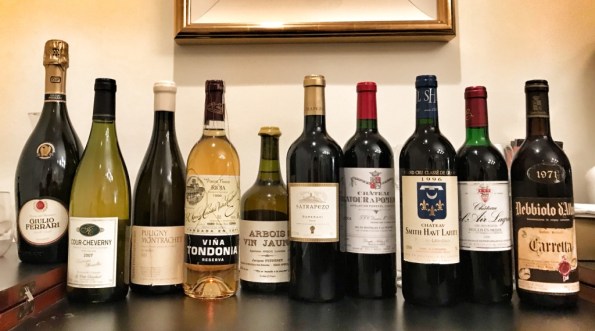
Almost full line up – few bottles are not shown
While I’m celebrating OTBN for a long time, this year’s event helped me to better appreciate the true purpose of this “holiday”. Okay, I have to say that I never had such a massive amount of wine opened for the OTBN – we went through 14 bottles – and each bottle was special in its own way. But until now, all of my OTBN experiences where strictly positive – the majority of the wines opened for OTBN were either at its peak or well drinkable at the moment but still promising to improve with time. But this year, in addition to absolutely stunning, mature, unparalleled wines we had wines which were either past prime or in the strange sleeping mode (yes, I’m an optimist), adding a good reason to follow the founding principals of the OTBN and pull the cork from That Bottle now.
Here are my notes for the wines we opened this year, together with a bit of explanation as to what made this wine special and my impressions.


2001 Giulio Ferrari Riserva del Fondatori Metodo Classico Trento DOC (100% Chardonnay)
Why: I was looking at this bottle for a long time. Ferrari makes some of the very best sparkling wines in Italy, and this is their flagship wine. At 18 years, it is a good age for the sparkling wine – and OTBN is a perfect reason to open a wine like that.
How was it: Amazing. Light bubbles, but the balance is amazing, light toasted notes, wow. The wine stayed fresh throughout the whole evening and was one of everyone’s favorites.
2013 Pierre-Yves Colin-Morey Puligny-Montrachet Le Trezin, Cote de Beaune
Why: Jim had multiple bottles of this wine and was worrying about Premox (Premature oxidation). Thus he put it out just to try.
How was it: Superb. delicious, classic burgundy, beautiful, elegant, round. Another one of the top choices for everyone.


2007 François Cazin Le Petit Chambord Cour-Cheverny AOC
Why: This is one of my favorite wines. When it was 10 years old, was literally blown away
How was it: Underwhelming. A touch of petrol, clean, good acidity, bud no bright fruit. Still delicious in its own way – I would gladly drink it any time. But – lucking the “umpf” which was expected… Still have 2 more bottles – will open later on and see.
2014 Damien Laureau Le Bel Ouvrage Savennières AOC
Why: Well, OTBN is an all-inclusive celebration. I rarely drink Savenniers, so it is always fun to experience something new.
How was it: Ok. For the 5 years old Chenin Blanc from the Loire, it was quite decent. Nice white wine – can’t say much more than that.


1996 Lopez de Heredia Viña Tondonia Blanco Reserva Rioja DOC
Why: why not? Lopez de Heredia is one of the very best Rioja Producers, and their Viña Tondonia Blanco might be one of the best white wines in Spain – at least from point of view of the wines which can age
How was it: A flop. Unless there was a flaw with this particular bottle, this wine was past prime and had no joy in it.
2015 Royal Tokaji The Oddity Hungary (100% Furmint)
Why: Furmit is the grape used in the production of the Hungarian Tokaji wines, some of the very best dessert wines in the world, easily rivaling the best Sauternes. Problem is – it is very difficult to prevent Furmit vineyards from the Noble Rot settling on the grapes – and thus it is rare – and difficult – to produce dry Furmint wine. Here comes The Oddity – dry Furmint wine.
How was it: Very good. Nice, clean, great minerality, balanced well-integrated palate, good acidity. Thank you, Lori, for this delicious find.
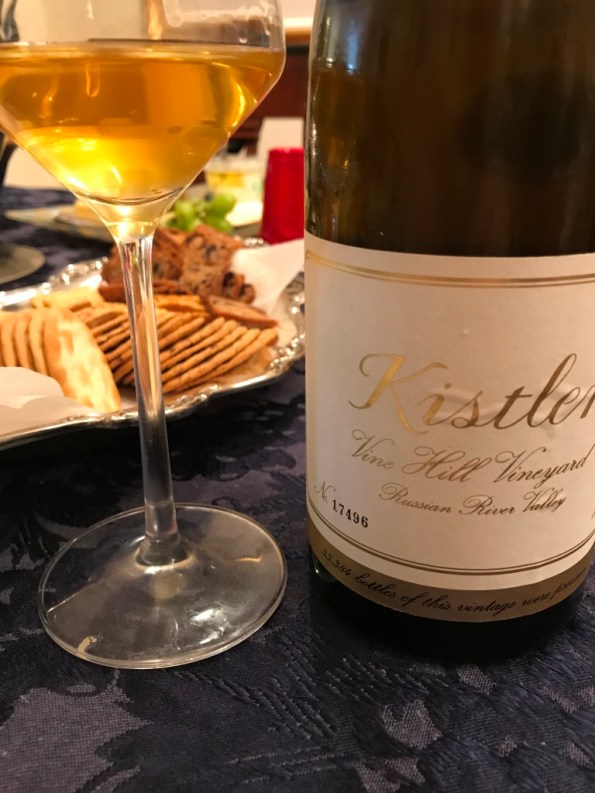
No filter – look at the color of this 24 years old Chardonnay
1995 Kistler Chardonnay Vine Hill Vineyard Russian River Valley
Why: Kistler is one of the best Chardonnay producers in California, so this alone is enough to include such wine into the OTBN line up. But then California Chardonnay rarely built to last for so long, so it was definitely the time to open this bottle.
How was it: Amazing. Almonds, apples, still present vanilla, a touch of smoke, good acidity – amazing for 24 years old white wine


2008 Jacques Puffeney Vin Jaune Arbois Jura
Why: Trying to explain the wine such as Vin Jaune to the uninitiated wine lovers presented an interesting challenge – I failed to explain what “oxidative” means. Anyway, putting this aside – Jura wines are rare. Vin Jaune wines are rare. Jacques Puffeney wines are beyond rare – 2014 was the last vintage which he commercially produced. This wine is absolutely OTBN worthy (thank you, Jim!)
How was it: Amazing. An oxidative nose which was also incredibly attractive, mature fruit, good acidity, elegant, present, delicious wine.
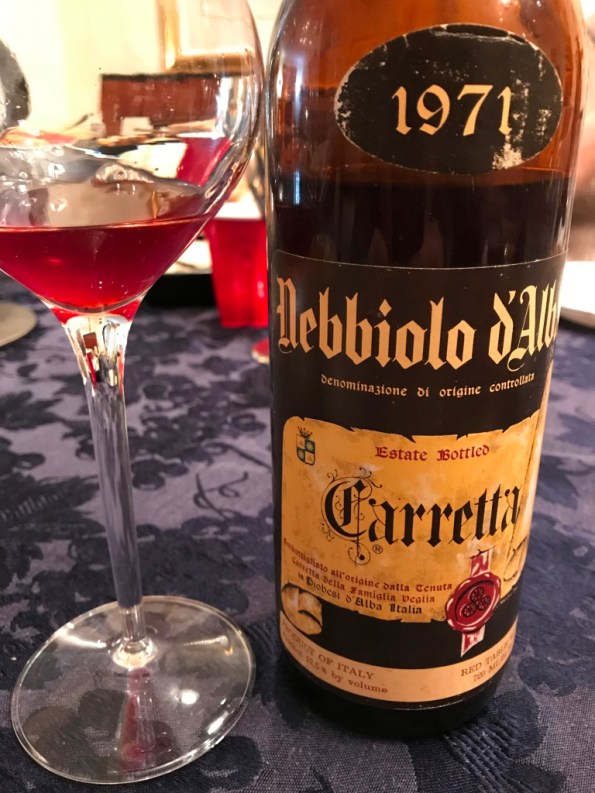
No filter – just look at the color of this wine! Amazing.
1971 Tenuta Carretta Nebbiolo d’Alba DOC
Why: 1971. Need we say more? Yes, the wine of such age is absolutely meant for OTBN.
How was it: Amazing, absolutely amazing. We poured it without decanting. The wine changed dramatically over the course of an hour. My first impressions were: pungent, with clean acidity, mature restrained fruit, still has lots of life left. Wow. About 15 minutes later, the wine totally changed and was the most reminiscent of a nice, concentrated Rosé – cranberries, a touch of strawberries, good acidity, very refreshing. Another 15 minutes made this wine most reminiscent of Jura red, a Poulsard if you will – light, great acidity, a touch of red fruit. Truly an amazing experience. And don’t forget to look at the color of this wine…


1986 Château Bel-Air Lagrave Moulis-en-Médoc AOC
Why: 33 years is a very respectable age for any wine – you really want to ask such wine “how ya doin”
How was it: Wow. Young, beautifully balanced, beautiful Bordeaux, just perfect. In a blind tasting, I would never identify this as a 33 years old wine. Yes, you can call me a failure.
1996 Château Smith Haut Lafitte Pessac-Léognan
Why: My exact question – why? Only because we could?
How was it: not ready. Needs time, mostly locked up. You would never think that 23 years old Bordeaux is not ready to drink, but it was not.


2004 Château Latour à Pomerol Pomerol AOC
Why: Same as previous wine – really, why?
How was it: Not ready. Closed nose, mostly cherries on the palate, need another 10-15 years.
2006 Telavi wine Cellar Satrapezo Saperavi Kakheti Georgia
Why: One of my most favorite Georgian wines. Limited production, a beautiful example of Georgian Saperavi. Most of the wine lovers are still unfamiliar with Georgian wines, so I really wanted to introduce this wine to the people.
How was it: Excellent. Still tight, beautiful fruit, big wine, could use more time. I was a bit concerned that this wine is reaching its peak – I was wrong. I’m sure another 5 years would do wonders here. Oh well…
2005 Weingut Petri Herxheimer Honigsack Scheurebe Trockenbeerenauslese Pfalz Germany (100% Scheurebe)
Why: For one, it is very appropriate to finish a great wine program with the dessert wine. And then how many of you even heard of Scheurebe? Scheurebe grape is a cross between Sylvaner and Riesling. It is quite rare, so yeah, a perfect choice for OTBN.
How was it: Spectacular. Not only it had great acidity which is essential in enjoyable TBA-level sweet wine, but it also showed a mix of honey and herbs – rosemary, sage, thyme – just an unbelievable concoction and ultimate pleasure in every sip. Thank you, Stef, for this treat.
Obviously, I can’t complain about such an amazing OTBN – however, as you saw, we had our share of disappointment. At the same time, the good greatly overweight the bad – 1971 Nebbiolo, 2001 Giulio Ferrari, 1995 Kistler, 2008 Vin Jaune, 1986 Bordeaux were all personal favorites and I would be glad to experience those wines again at any time.
Now that I told you about our OTBN, how was yours?
Open That Bottle Night – OTBN 2019
 Wine lovers – this is your public service announcement, so listen carefully.
Open That Bottle Night is Saturday, February 23, 2019.
I repeat – OTBN is taking place this coming Saturday! Are you ready?
Okay, so all of you who are familiar with the OTBN, please say “thank you for the reminder” and quietly retreat to your cellars in attempt to solve the unsolvable.
For those who don’t recognize the OTBN term, let me explain.
Open That Bottle Night (OTBN for short) movement was originated by Dorothy J. Gaiter and John Brecher, writers of the Wall Street Journal’s Tastings column. Back in 2000, they decided to help people to put their best wine bottles to the best possible use (e.g., drinking and enjoying them) by designating last Saturday in February as special “pull that cork” day.
All of us, wine lovers, have that “special bottle”. The birth year vintage, a gift from a special friend, a bottle brought from the special trip, a bottle signed by winemaker, special wedding present, or something special we managed to score many, many years ago – it is really not important what makes that bottle special. However, with all those “special bottle” designations, we keep waiting for that special, right, proper, one and only moment to pull that cork – and subsequently, we are risking one of two things:
- we might not be around to enjoy that special bottle of wine (not trying to use any “scare tactics” – this is just a part of life)
- the wine might not be around for us to enjoy it – ever heard of “past prime”?
Nobody knows what is the “right time” for the wine. We have our expectations, of course, but it is in human nature to doubt oneself, and thus we keep arguing with ourselves about the “right moment”. The “right moment” is also something entirely individual – the right age of the wine, a long-fought-for job promotion, wedding anniversary, significant birthday, or simply the right company. And so we are waiting and waiting and waiting – and risking one of the two outcomes I mentioned before. This is where OTBN comes to the rescue. OTBN makes an opening of that prized bottle a good enough reason in itself – it is really a celebration of life as it happens.
Ever since its creation, OTBN was getting an increased following from all over the world, with people from China, Hong Kong, Australia, Japan, Europe and, of course, the USA, gladly reporting about the opening of those long-cherished bottles – and their personal life stories.
It is the right time, wine lovers, to get that bottle ready. If you need any additional instructions, the Wall Street Journal took care of it by publishing the guide to the OTBN, so now you are guaranteed not to make any mistakes. Go, start thinking about that special bottle you are going to enjoy this Saturday – to celebrate life. And don’t forget to share your special moment with all of us. Will be waiting.
Open That Bottle Night – 2018 edition
We all have THAT bottle. How I mean it, you ask? Simple. We all have bottles which have special meaning for us. This one was brought home from the vacation 5 years ago. That one was given by a generous friend with the recommendation to wait for a special moment to drink it. Those in the corner came from the parent’s cellar. Ahh, these I found on a garage sale – would you believe it? Oh yes, and those I got during a great sale – yes, one of each, as I couldn’t afford to buy any more of them.
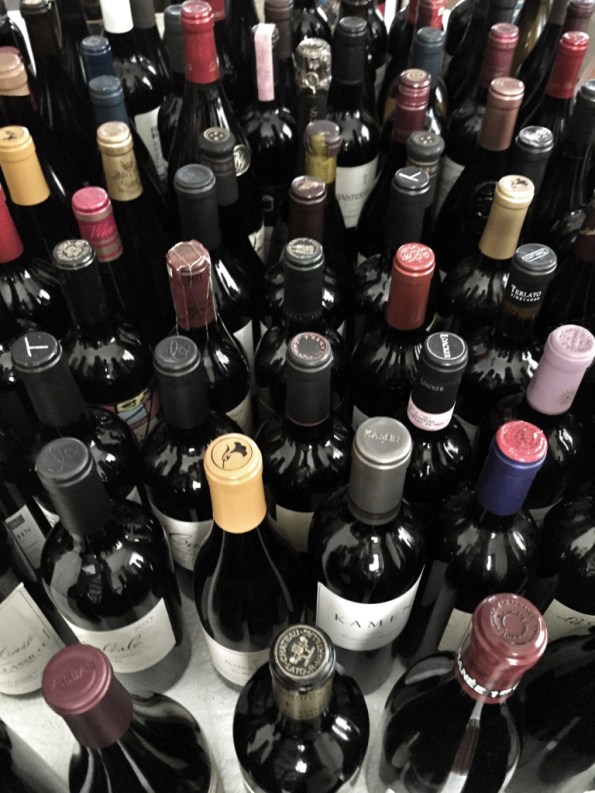
Wine is a perfect vehicle for creating special moments. Maybe the best there is. But this also is a problem in itself. We get attached to those special bottles, always doubting if this is the right moment to open them and keep waiting and waiting for a perfect one. Yes, the wine improves with age, but nothing is forever. There is always a chance that at the proper moment, the wine might not be there for us anymore, and we might not be there for the wine.
To help people with THAT bottle dilemma, Dorothy Gaiter and John Brecher, the journalists behind Wall Street Journal’s Tastings column at a time, created a special event which they called Open That Bottle Night (OTBN for short) back in 1999, celebrated always on the last Saturday in February. Now, almost for 20 years, OTBN helped wine aficionados around the world to ease the pain of parting with those special bottles and actually enjoy the wine in its prime time (or at least that is the intent and the hope).
The OTBN is truly all about the wine, so the oenophile gets its chance to agonize about the impossible choice, going from one bottle to another bottle and finding the reasons why this is not yet the time to claim for it to be THAT bottle. I went multiple times through all my wine fridges, joyfully finding and immediately grudgingly rejecting my choices. Three days later, I just grabbed two bottles which jumped to my attention and said “this is it! no more!”.
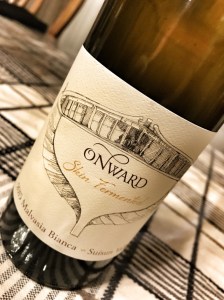 Let’s talk about our OTBN wines – there should be at least some reason for the wines to be “it”, right? So the white wine was interesting in many ways. First, it came to our house via the Secret Wine Santa exchange, courtesy of inimitable Drunken Cyclist. The wine is made out of the rare grape (Malvasia) which is absolutely uncommon for California; the wine is Skin Fermented, which seems now to be a popular term for what was known before as “orange wine” – the grapes are fermented in contact with skin, which is not typical for the white wine. Lastly, the wine comes from the Suisun Valley, which seems to be an up and coming region in California – for example, Caymus, a California wine powerhouse, recently released the new wine called Grand Durif (Durif is original French name for Petite Sirah), made from the grapes grown in the Suisun Valley.
2015 Onward Skin Fermented Malvasia Suisun Valley (12.8% ABV) – light golden in the glass (nothing says “orange wine”), beautiful tropical fruit on the nose – guava, passion fruit. On the palate, initially showed light fizz which went away in about 15 minutes. Cut through acidity, peppery spiciness, white underripe fruit, there is a touch of funk or maybe rather oxidative notes which hint at extended skin contact; overall – different and delicious (Drinkability: 8). Also much rounder on the second day. Probably requires food.
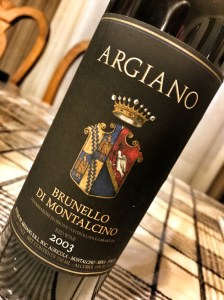 Now, the red doesn’t really have a story. I have no idea how did it make it into our house. Yes, it is a Brunello, which is generally good (one of the 3 big Bs of the Italian wines – Barolo, Barbaresco, and Brunello); Argiano seems to be a good producer even though I don’t know much about them. Lastly, the wine has good age on it, however, it is not much of an age for any of the big Bs. Oh yes, and it was my only bottle, which squarely puts it into THAT category.
2003 Argiano Brunello di Montalcino DOCG (14% ABV) – needed a bit of help from the decanter to open up (about an hour) – dark concentrated garnet color, no hint of age, deep tobacco and roasted meat on the nose, leather, cherry, cherry pit and a touch of plums on the palate. Right after opening, the wine seemed that it was either at prime or maybe already even past prime – after 3 hours in the decanter and a glass, the wine started closing, with fruit disappearing and fresh, young tannins taking its place. This wine would probably last for another 10 years – but I stand no chance to find out as this was my one and only bottle. Still, the verdict is simple – delicious (Drinkability: 8+/9-).
That sums it up, folks. I love OTBN, as the wine is meant to be drunk, and OTBN helps us to get THAT bottle out and experience it before its too late. How was your OTBN? Cheers!
Last Bottle Sign Up ($10 credit)




 Talk-A-Vino