Archive
Weekly Wine Quiz #55 – Grape Trivia: Pinot Noir
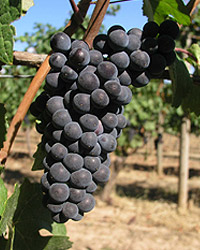
Image source: Wikipedia
And the time has come for the new wine quiz. Continuing with our Grape Trivia theme, the new quiz is about Pinot Noir.
Pinot Noir. The grape behind some of the most expensive and thought after wines in the world. Almost never blended with other grapes. A major weapon in the hands of ABC oenophiles (Anything But Cabernet). At the same time, one of the most finicky, difficult to deal with grapes. To produce great wines, Pinot Noir requires ideal growing conditions. It is genetically unstable, and can easily mutate in the vineyard, producing grapes which look nothing like their parents. It can also “throw a fit” during fermentation and take the process out of control. But – all of it worth the “goodness in the bottle”, so today there is no shortage of great Pinot Noir wines coming in from all over the world.
Pinot Noir is one of the oldest known Vitis Vinifera grapes, specifically grown to be used in winemaking, with historical references going all the way back to the 4th century in Burgundy, France. Today Pinot Noir is growing literally in every winemaking country in the world, with the wines taking on wide range of expressions depending on the location’s climate and soil. Taste profile of Pinot Noir often includes lighter red fruits and berries – cranberries, strawberries, tart cherries, with hint of smokiness and mushrooms (earthiness).
Now, to the quiz!
Q1: Can you explain the source and meaning of the grape’s name “Pinot Noir”?
Q2: True or False: Burgundy has the biggest plantings of Pinot Noir in France?
Q3: Match the wine/producer with its country/region:
| A. Mt. Difficulty | 1. Burgundy |
| B. Evening Land | 2. New Zealand |
| C. Fleury | 3. Champagne |
| D. Hamilton Russell | 4. Oregon |
| E. Clos de Tart | 5. South Africa |
Q4: Which major wine-producing country is literally unknown as a Pinot Noir producer?
Q5: From 1990 to 2010, annual Pinot Noir harvest in California increased approximately:
a. 2 times
b. 3 times
c. 5 times
d. 7 times
e. 9 times
Have fun, good luck and enjoy your weekend. Cheers!
Daily Glass: Wine Happenings – Georgian Wines, New French Discoveries, Australia Grand Experience and more
Every week (or almost every week) I think that I should start writing a summary post similar to what Jeff at therunkenccyclist does so well – once a week he produces a summary of the wines he had during the past week (here is an example of his recent post), which I think is a great way to round up your experiences.
My “Daily Glass” designation was supposed to be [almost] a daily summary for me, but as you know, things don’t always work in life as we think they should. Nevertheless, the week which is ending today was very “wine eventful” hence I’m sharing those wine happenings with you.
Let me start from 2005 Domaine Lafage El Maset Cotes du Roussillon. I got it at Last Bottle Wines during their last “madness” sale. At $8, you really have nothing to lose, right? Wine arrived about 3 weeks ago, looking good – inviting label, heavy bottle, good punt at the bottom – overall looks quite solid. Before opened the bottle, I went to look for information online – and I didn’t find much except a number of notes on Cellar Tracker, all looking very peculiar. Looks like people had very sporadic luck with this wine, with only one bottle out of three being drinkable, and another claim of one out of 10 (!).
First thing I didn’t like when opened the bottle was the cork. You see, I love real corks (yes, I had my share of corked wines – but this is not the subject of this post). I’m completely okay with screwtops – I would be surprised to see a screwtop on the bottle of DRC, but in general, I get it – and it makes it easier to open a bottle, especially when you travel. But the type of corks I have a problem with are plastic and synthetic corks. They are hard to pull out, and just look very artificial – they just don’t belong to the wine world, in my opinion. Besides, somehow I think that they have the worst impact on aging ability of the wine .


This wine was closed with red plastic cork ( you can see it in the picture). Okay, moving along. It is 8 years old wine, how about pop and pour? Pour, swirl, sip – ouch! The feeling of biting into a freshly cut tree brunch. Bitterrrr! My wife had her taste, put the glass down, and politely said “I think it should breath a little first”. Okay, got a decanter, pour half of the bottle in. By the way, the interesting fact is that after that first bitter sip, the wine stayed in my mouth with a very long and rather pleasant (!) finish – probably for the next 10+ minutes. Two and the half hours later… I wish I can tell you the wine magically transformed – no, it became only somewhat better. Dark fruit appeared, tannins became mellower, but the wine was not together – there was no harmony there.
We finished the bottle next day, and it still didn’t improve much more – may be it needed more time? I’m not sure, but I have one more bottle, which I plan to give a little time – will see what will happen. But I also have to tell you that I had one of the most surprising pairings with this wine – as you can guess from the picture, this wine paired excellently (I’m serious) with … cherry preserve! They were literally meant for each other – take a spoon of cherry preserve, sip of this wine – perfect! I never thought of wine and preserve together before – may be I should try it more often? This wine will stay unrated for now, as it is very hard to put a handle on this experience.
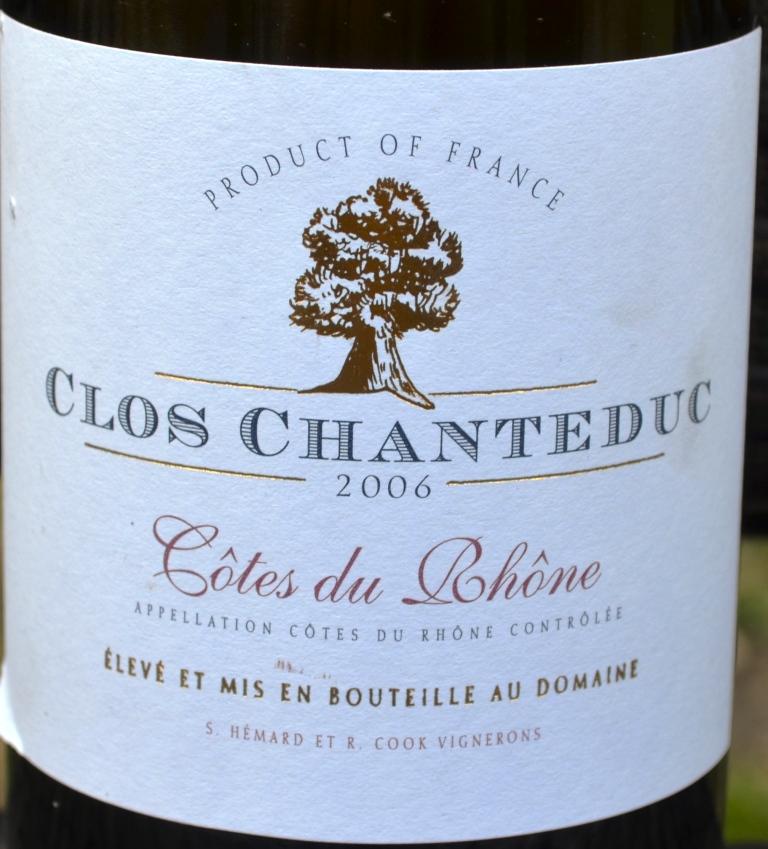 Next wine was also sourced from the Last Bottles – 2006 Clos Chanteduc Cotes Du Rhone. I was unable to find good information on this 2006 vintage, current available vintage of this wine is 2010, but I would assume that the composition stayed about the same, so it should be Grenache/Syrah blend (2/3 Grenache, 1/3 Syrah), a classic Rhone blend. The wine is associated with Patricia Wells, a well known chef living in France. While looking for information about this wine, I found an interesting post about 2009 version in the blog called Wayward Wine – here is a link for you, it is a good reading. Getting back to this 2006 wine, it was rather a typical Cote du Rhone – soft, supple, good mid-palate of plums and cherries – but may be too soft and too supple, it was missing a wow factor. Drinkability: 7.
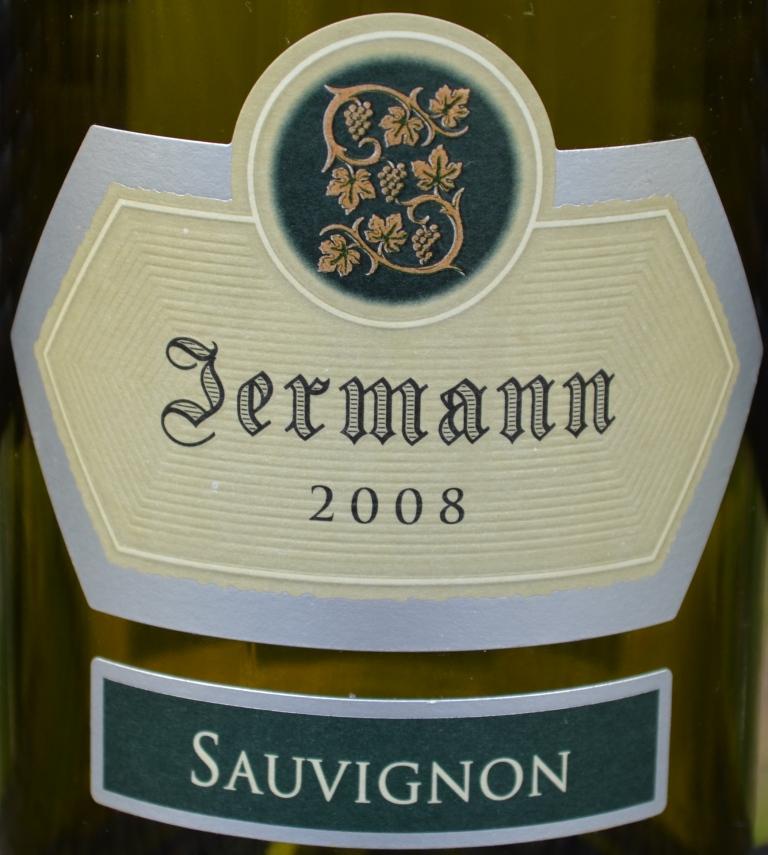 The next wine I want to mention is 2008 Jermann Sauvignon Blanc Venezia Giulia IGT. Jermann is one of my all time favorite Italian producers – I don’t think I tasted any wines I didn’t like from Jermann. This Sauvignon Blanc was closed with screwtop, and the wine is 5 years old – but it came out clean and round on the palate, with perfect amount of white fruit, some herbal notes, perfect minerality and acidity – very enjoyable by itself and with the food. Drinkability: 8-
Now, let’s get to the subject of this post and talk about Georgian and new French wines I discovered. Last Friday I stopped at the tasting at Fairway Market in Stamford, where Michael from importing company called Corus was presenting new Georgina wines. There were four wines included in the tasting, three of them definitely standouts.


2012 Marani Mtsavane is made out of 100% of indigenous Mtsvane grape – very dry, more reminiscent of Muscadet than anything else, with cutting acidity. Will be perfectly refreshing wine for the summer day, also will be very appropriate every time you will decide to serve oysters. Drinkability: 7+
2005 Wine Man Mukuzani – this wine is made out of 100% Saperavi grapes, also grown in one single place – village of Mukuzani. This wine is made by David Maisuradze, who makes amazing wines – here is my post mentioning couple of his wines I tasted before. When I took a first sip, my first thought was about dramatic difference this wine had with the 2005 El Maset I just had a few days ago (both wines are from 2005) – silky smooth, perfect dark fruit, cherries, blackberries, round tannins and balancing acidity – overall, a wine of perfect harmony. Drinkability: 8
2009 Wine Man Kinzmarauli – Kindzmarauli is one of the most famous Georgian wines. Because it was so famous before, you can’t even imagine the amount of fake insipid concoction which arrived to US about 10-15 years ago, knowing that Russian ex-patriots will buy anything under that name. When people realized that they had been doped, the wine lost its appeal and now have to slowly work up its reputation. Kindzmarauli is also made out of 100% Saperavi grapes, but it is semi-sweet. The fake Kindzmarauli wines had nothing but the sugar in them. When you taste this 2009 Kindzmarauli, you actually first get the perfect dry grape underpinning, and then the residual sweetness comes in. Excellent wine to serve with cheese – I think it might even beat Port when served next to Stilton. Drinkability: 8-
Now, for my French discovery – it might not be a discovery for you, but it is a new line of wines which are just being imported to Connecticut. The wines are made by Domaine Laroque in the area called Cité de Carcassonne, a part of Langueoc-Rossillion (Cité de Carcassonne has a status of IGP).


2012 Domaine Laroque Sauvignon Blanc Cite de Carcassonne – in a blind tasting, I would definitely say that this is a restrained version of New Zealand Sauvignon Blanc. Perfectly bright, with hint of grapefruit and lemon zest, refreshing, uplifting – make sure you have enough on hand for your summer entertainment – or you will deal with some upset guests. Drinkability: 8-
2012 Domaine Laroque Rose de Cabernet Cite de Carcassonne – nice, clean Rose, good amount of strawberries, good acidity. Drinkability: 7
2011 Domaine Laroque Cabernet Franc Cite de Carcassonne – this was a “wow” wine. Cabernet Franc is one of my favorite single-grape wines, which are so hard to find. This is two notches up most of the Loire stuff – I guess it is much closer to the best of Bordeaux and Calidornia – prefect dense red fruit, good minerality and herbs, firm structure, supple tannins and overall very balanced. This is what I call a “dangerous wine” – once you start drinking it, it is almost impossible to stop. Drinkability: 8
Are you tired of me yet? Okay, good – I have two more wines to tell you about.
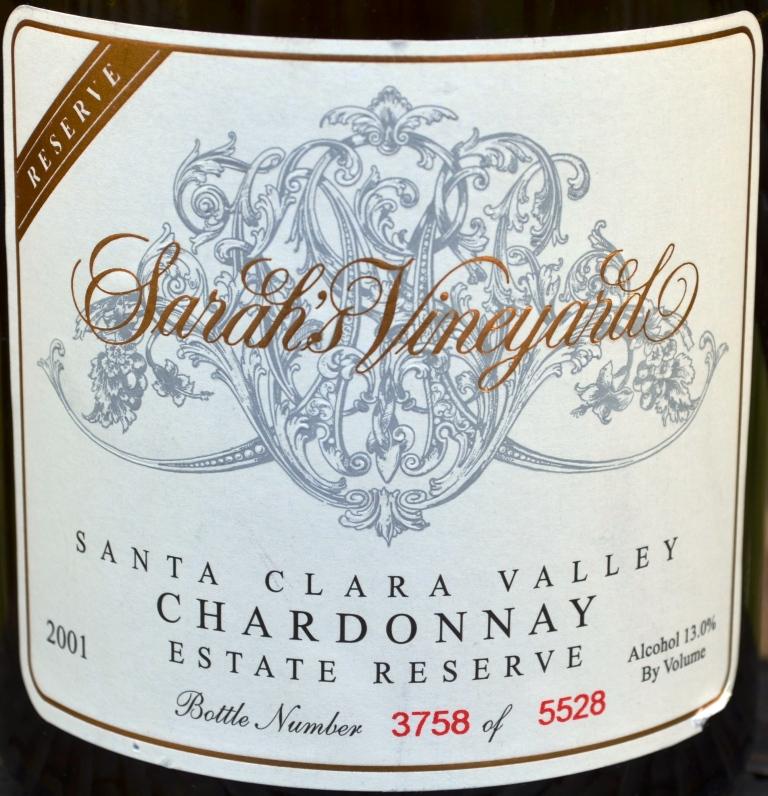 2001 Sarah’s Vineyard Chardonnay Estate Reserve Santa Clara Valley – I got it as Bin Ends in Massachusetts last year. The unfortunate part – this wine was past prime. Well, it was more like a nice sherry – dark yellow color, nicely oxidized. I was able to finish the bottle, but this was not an amazing experience by all means. Mostly you could taste almonds, and that was about all you could find on the palate. I will not rate this wine as it would be simply not fair.
Last, but not least at all – an amazing Aussie experience.
1999 Grant Burge Shadrach Cabernet Sauvignon South Australia – from the very first smell, the expectation was that a “wow” wine is ahead. Perfect dark fruit on the nose, a whiff of chocolate. And the very first sip confirmed that “wow” – blackberries, cherries and cassis, dark chocolate, cocoa, eucalyptus, touch of roasted flavors, perfectly firm and structured. Pronounced acidity, supporting tannins – all perfectly balanced. This was an outstanding glass of wine (it was my one and only bottle, sigh). By the way, you should read an interesting story behind the name of this wine – I don’t want to retype it, hence the picture of the back label below.Drinkability: 8+


That’s all I have for you for today. What was your best wine experience of the week? Have a great week ahead and cheers!
Weekly Wine Quiz #54 – Grapes Trivia: Merlot
 Here comes our next quiz in the Grape Trivia series. Today’s subject – Merlot.
Merlot is one of the most popular grapes in the world, used both for blending and single-varietal wines. Merlot has thin dark blue colored skin, and its taste profile typically includes plums, blackberries, chocolate and tobacco notes. As it is often compared with Cabernet Sauvignon, one of its most popular blending companions, Merlot ripens earlier than Cabernet Sauvignon, has higher sugar content and lesser level of tannins. While France has the biggest plantings of Merlot in the world, Merlot is universally grown in literally every wine producing country – great Merlot wines are produced in Australia, New Zealand, Italy, California, Washington, Long Island, Spain, Chile, Argentina and many other places.
Done with basic facts – let’s proceed with our quiz now, shall we?
Q1: Merlot was named after a:
A. town
B. person
C. bird
D. song
Q2: Name the movie where Merlot was dissed on uncountable number of occasions
Q3: One of the grapes from the list below was assumed to be a Merlot – but it was not. Do you know which grape was mistaken for the Merlot? Bonus question – name the country where confusion took place.
A. Mourvèdre
B. Carignan
C. Carménère
D. Cinsault
Q4: Some place, some time ago, Merlot successfully crossed (by accident) with Cabernet grape, and formed a new grape which produces pretty unique wines. Can you name that grape?
Q5: Chateau Petrus in Pomerol, France makes some of the very best (and most expensive) wines in the world, and those wines are 100% Merlot. Then there is another 100% Merlot wine, made in another country, which is considered a successful competition to Petrus and done very well against it in a number of blind tastings. Can you name that wine?
Have fun, good luck and enjoy your weekend! Cheers!
And Then There Was Zin…
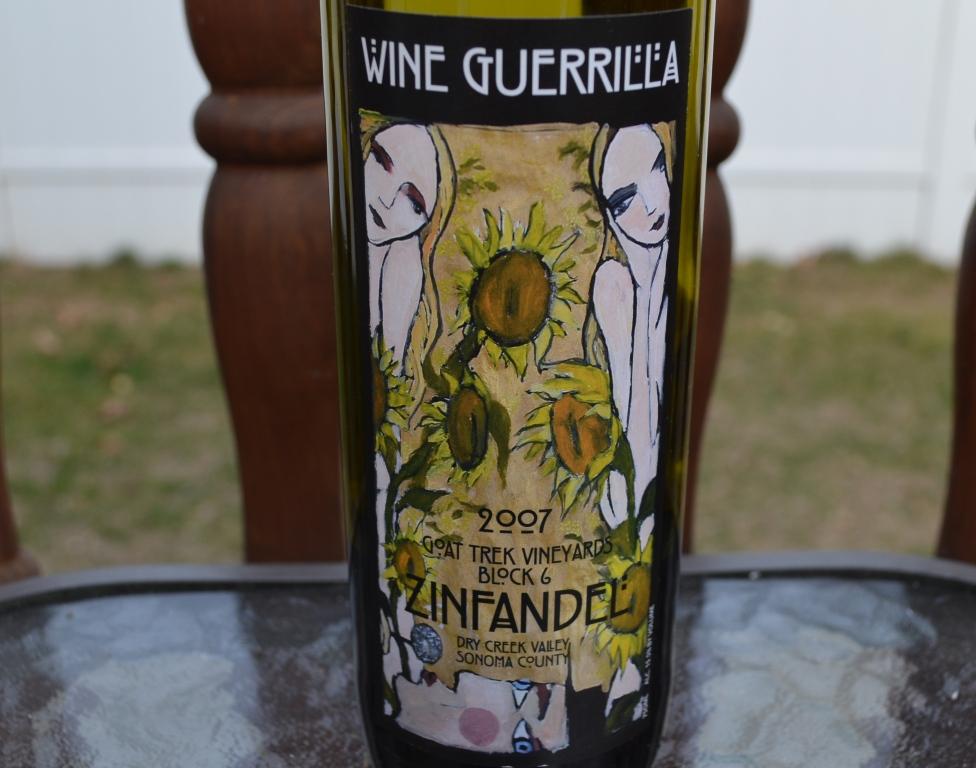 Only yesterday I wrote the post about difficult task of figuring out when the wine is at its peak. And then I opened a bottle of 2007 Zinfandel. Unscrewed the top and poured into the glass. Quick swirl, sniff – and I’m blown away. Pure dried figs. Beautiful. Pure. Clean. Nothing gets in the way. Not overpowering. Just clean and firmly present. May be there were other flavors there – from that moment on, I didn’t look for anything else. It was reincarnation of 1997 Le Ragose Amarone, the magnificent moment I keep re-living on and on.
The first sip brought in the same level of perfection. Dry. Round. Crisp, if you can apply that to the red wine. Dried figs, blueberries, sage, eucalyptus. No fruit jams of any kind. No sweetness at all. Prefect balance and harmony. Yes, this kind of wine makes you emotional and forces you to reflect.
The wine – 2007 Wine Guerrilla Goat Trek Vineyard Block 6 Zinfandel Dry Creek Valley Sonoma County (15.5% ABV). A blend of 87% Zinfandel, 7% Cabernet Franc and 6% Petite Sirah. This wine is made by Wine Guerrilla. And when the have a slogan “Wine Guerrilla – The Art and Soul of Zinfandel”, they are really not kidding. Take a look at their line of Zinfandel wines here.
6 years old wine. Did I manage to hit the peak? I have no idea. Is it possible that the wine would improve further. Quite possible, but this was my last bottle.
Oh yes, and there is a culprit here. The wine I enjoyed so much was a little warmer than the cellar temperature – my wine fridge is set for 55°, so I guess the wine was about 62°-64° when I was drinking it. The next day when I finished the bottle, it was much warmer, probably at about 72° – and while it was good, it was not magical. And the temperature of the wine is literally the last thing I want to deal with instead of just enjoying the wine. Oh well… I’m glad I had this experience in my life. Cheers!
Weekly Wine Quiz #53 – Grapes Trivia: Cabernet Sauvignon
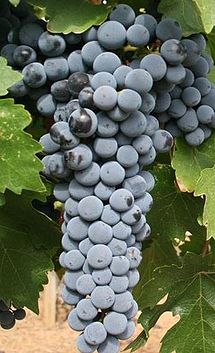
Image from Wikipedia
And the has come for our weekly wine quiz!
I like to organize things, when possible. So far my quizzes where a little bit (just kidding – really a lot) all over the place – from auctions to riddles to history; left, right and beyond. At the same time, I really would like to run a series of quizzes somehow related to each other. So I thought of this grape series, and that is the best I can come up with at the moment, so let me run with this.
This will be a series of posts dedicated to different grapes. Don’t wait for any substantial gotchas – at this point, there no plans for quizzes solely dedicated to Fiana or Romorantin (hmm, on the other side…). Instead, the quizzes will be dedicated to the mainstream grapes majority can attest to, such as Cabernet Sauvignon, Chardonnay, Pinot Noir and so on.
Today we are starting with the Cabernet Sauvignon grape. Cabernet Sauvignon needs no introduction – it is a mainstream grape in production of many of the best (and not) red wines in the world. In a few words Cabernet Sauvignon can be described as late ripening variety with thick skin and somewhat of a small berry. Flavor profile of Cabernet Sauvignon wines often includes eucalyptus, green bell peppers, mint and black currant (cassis). Cabernet Sauvignon has great affinity to oak and the wines are usually age very well. Cabernet Sauvignon is grown all over the world with most famous wines coming from Bordeaux, California, Australia, Argentina, Chile, Italy and Washington.
Here come the quiz questions:
Q1: Which two grapes are the parents of Cabernet Sauvignon?
Q2: The world’s oldest Cabernet Sauvignon vines are located in (name winery and/or vineyard for extra credit):
A. Bordeaux
B. Chile
C. California
D. Australia
E. Georgia
Q3: True or False: Since 2000, plantings of Cabernet Sauvignon increased in Bordeaux?
Q4: The second largest in the world plantings (by area) of Cabernet Sauvignon grapes are located in:
A. Australia
B. California
C. Chile
D. Hungary
E. Moldova
F. South Africa
Q5: Absolute majority of Bordeaux wines are blends. Name four grapes which are traditional blending companions of Cabernet Sauvignon in Bordeaux
Have fun and good luck! Enjoy your weekend and cheers!
Special Tasting Report: Trione Winery
A few month ago I got an email from Trione winery offering me a gift. Not just any gift – wine. Free wine. Words “free” and “wine” put together sound almost magical for the anyone who drinks wine daily (I refuse to take the calculator out – don’t ask). But the word “free” in the email usually means danger. After careful consideration, and actually looking at the winery web site, I decided that it was not a scam or phishing attempt, so I answered that I would be happy to get a free wine. The only caveat in the follow up response was that they can only ship wine to the limited number of states. Connecticut not included (of course). But New York was. And so my friend Emil became a recipient for the wine.
When Emil called me that he got the wine, he mentioned that the box looks very small. Well, okay – it is what it is – free wine, whatever the package is. And then some time later, the package made it to my house. A small black box, probably half of the shoebox in size. But there was actually wine inside. And this is how it looked like:
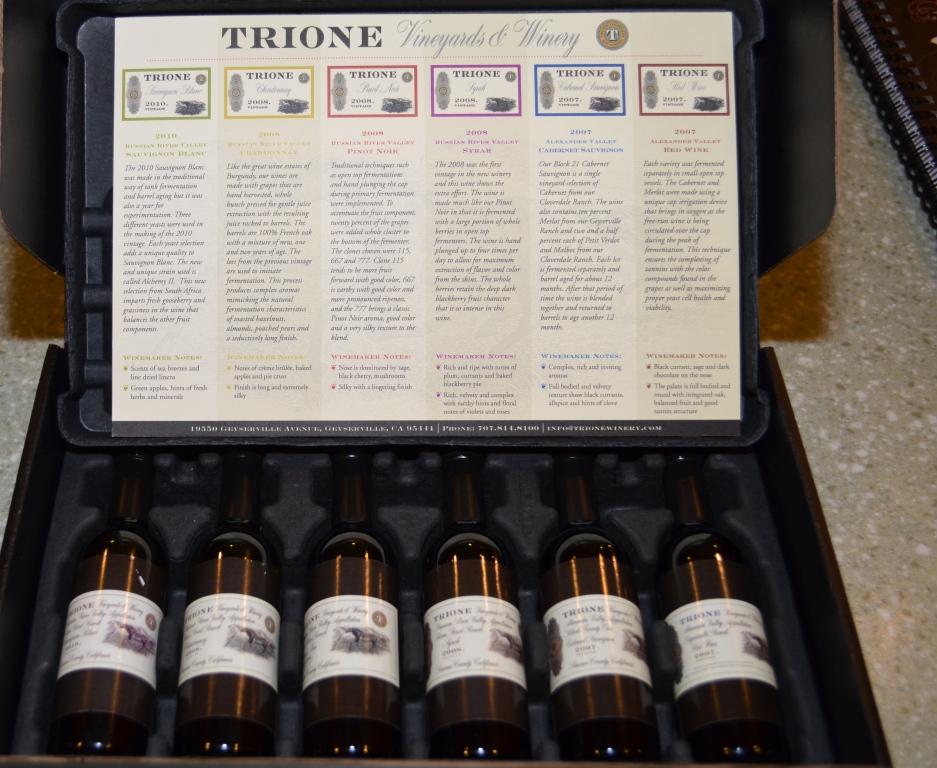
Trione Winery, which I never heard of before, is a new venture of Trione family who was growing grapes in Sonoma for 35 years. Here is what you can read on the front page of their web site:
“For over three decades, the Trione family has raised premium grapes that have been the foundation of many award-winning wines. Now we bring our grapes to you in wines bottled under our own label, Trione Vineyards & Winery. It is the culmination of our family’s long commitment to Sonoma County.”
Here are few more views for you (just trying to build up the anticipation here):


Another interesting detail – it appears that this tasting set consisting of the tiny bottles is actually a concept called Tasting Room. While web site provide literally no information, the card enclosed with the package explained the concept:
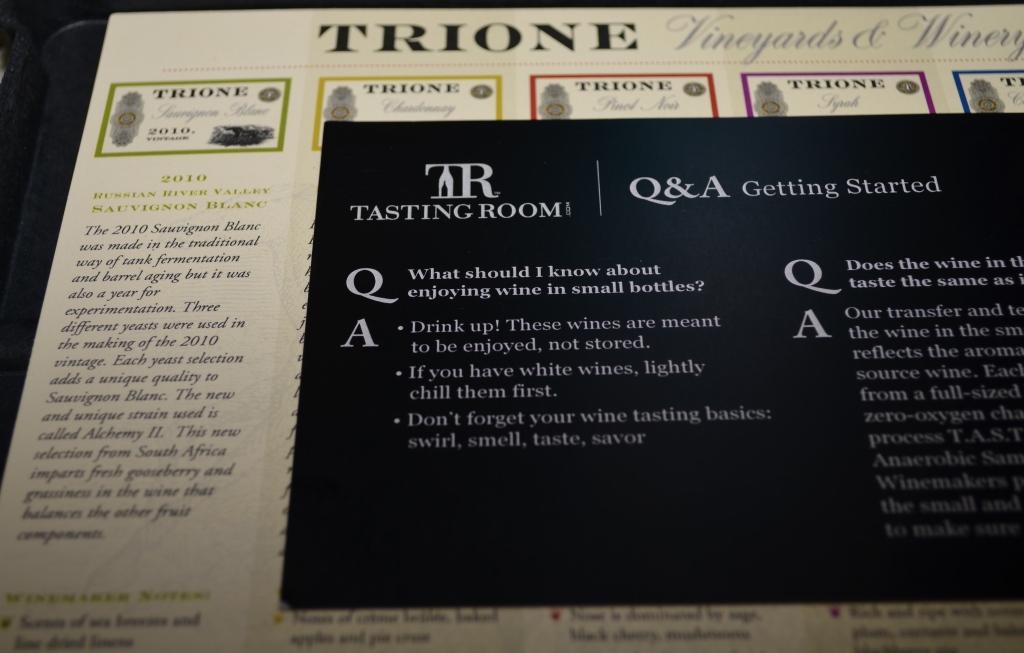
The wines are bottled in the small bottles using special technology which preserves all specifics of the wine, so it is exact same wine which will go into the regular bottles. The only exception – the wine in small bottles is not intended for aging (as you can imagine), so as the card says – drink up!
And with this, let me share my tasting notes. Well, not only mine – in majority of the cases we drink wine together with my wife, especially when we are looking at the interesting and unusual experience – so I’m including her tasting notes too.
2010 Trione Russian River Valley Sauvignon Blanc (14% ABV) – “Pear Grove” my wife said. Some fresh grass on the nose with a bit of grapefruit, but mostly earthy and herbaceous, Earthy and herbaceous on the palate as well, lots of residual acidity, but not “in-your-face”. Food friendly. Interesting. Drinkability: 7+
2010 Trione Russian River Valley Chardonnay(14.3% ABV) – nice butter on the nose, vanilla. Nose is very promising, but palate is not good, very acidic, no fruit, kind of flat. I’m sure it needs time or at least different serving temperature, therefore it is not rated.
2008 Trione Russian River Valley Pinot Noir (14.2% ABV) – Nice nose of dark fruit, tobacco, touch of roasted meat flavor. Nice palate of dark fruit, raspberries, plums, tobacco, pencil and sage undertones. Good palate, good balance. Very good overall. Drinkability: 8-
2008 Trione Russian River Valley Syrah (14.8% ABV) – Wow color – very dark, intense, almost black. My wife’s notes were “oh, this is good” , “great potential”, “very promising” (disclaimer – my wife loves Syrah, probably her favorite wines). Dark roasted fruit, silky smooth, perfect balance, perfect acidity, cherries, earthy notes. Definitely very promising. Very good overall. Drinkability: 8-
2007 Trione Alexander Valley Cabernet Sauvignon (14.5% ABV) – absolutely beautiful nose – perfectly classic, with mint and blackcurrant – textbook flavors. Coffee showed up later on the nose. Wife’s notes: “overpowering , but very yummy”. Big, powerful, silky smooth, noticeable tannins – but excellent balance. Touch over-extracted on the palate, but only in terms of power, not sweetness. Needs time. Drinkability: 8
2007 Trione Alexander Valley Red Wine (14.5% ABV) – Dark chocolate, coffee, blackberries on the palate, nice complexity. Beautiful, round and open fruit. Needs time. Drinkability: 8-
As you can see, it was a very enjoyable experience (it’s too bad that the bottles were that small) – next time you see Trione wine in the store, don’t just stand there, grab a bottle…
That concludes my special tasting report, folks. Until the next time (hopefully someone will send me good and free wine soon) – cheers!
Disclaimer: the wine was provided by Trione Vineyards and Winery free of charge. All opinions are my own.
Re-post: Best Hidden Secrets Of The Wine World: Wines of Languedoc
During 2011 I wrote a number of posts for the project called The Art Of Life Magazine – of course talking about my favorite subject, wine. The project closed and even web site is down, but as I still like the posts I wrote, so I decided to re-post them in this blog. Also, in that project, posts were grouped into mini-series, such as “Best Hidden Secrets” you see here – I will continue re-posting them from time to time.
Also note that the series was written for a slightly different audience – I hope none of my readers will take offense in the fact that sometimes I’m stating the obvious…
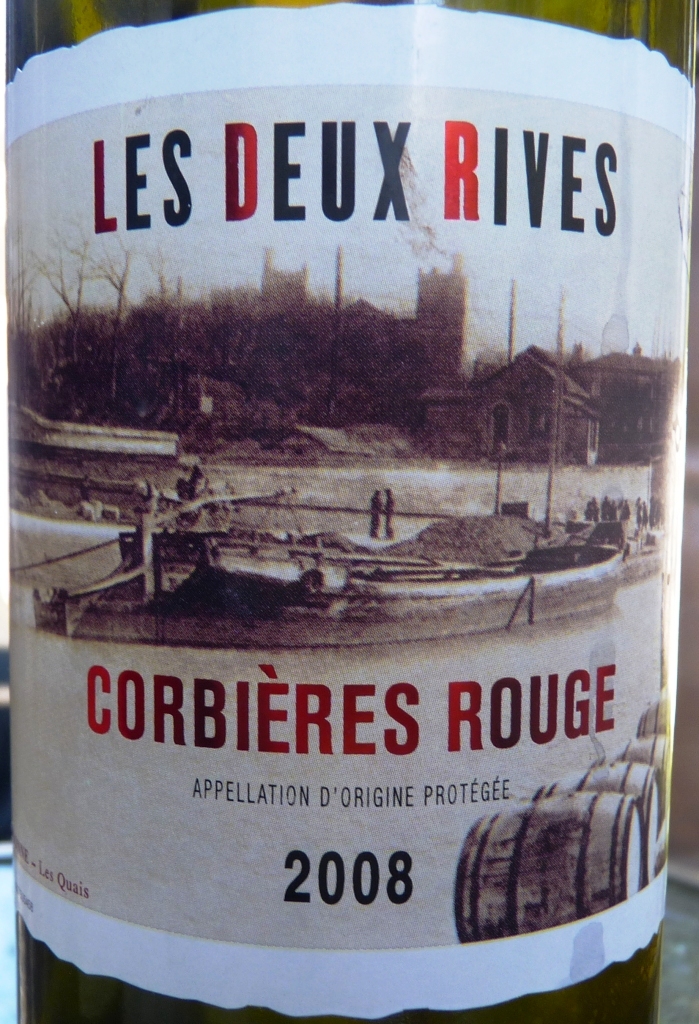 Continuing our “Best Secrets” series, we are going to … France again. However, we are going all the way down south, to the region called Languedoc-Roussillon (in most of the cases it is simply call Languedoc).
Why France again, and moreover, what is so special about Languedoc? First, don’t worry, we are just getting started in our “experiences” journey, we will be going all over the world, I promise. Now, to answer the question “why Languedoc”, let me simply give you some facts. Languedoc-Roussillon is single biggest wine making region in the world! It also produces one third of all the wines made in France. I think this is not bad for the beginning.
One of the great things about Languedoc wines is that while many other regions in France are strictly limited in the grape varieties used in the winemaking in that particular region, Languedoc is not. All white wines from Burgundy are made out of Chardonnay, and all the reds are from Pinot Noir. Red Bordeaux are predominantly made out of Cabernet Sauvignon and Merlot grapes – yes, with the addition of some other grapes, but in any case you will not find any wine which proudly specifies Bordeaux on the label and made out of Pinot Noir or Syrah. Languedoc is different – a lot more grapes can be used in the wine production throughout the region. Red wines can be made out of Cabernet Sauvignon, Merlot, Syrah, Grenache, Mourvedre, Cinsault and Carignan, whites can be made out of Chardonnay, Sauvignon Blanc, Chenin Blanc, Marsanne, Roussanne, Viognier, plus many other red and white grapes can be used in the wine production (for more information about the region, you can always look into Wiki page).
If you are surprised that you didn’t know about Languedoc wines before – don’t be, I’m sure you had Languedoc wines unknowingly. How come? A lot of it is in the labels. Have you seen “Vin de Pays d’Oc” on the labels of wine you were drinking? “Vin d Pays” literally means “Country wines” – level of quality which is one step above “vin de table” table wines, but less than level of AOC wines. But if Vin de Pays can be used with many wines, when you see “d’Oc” added to that it squarely points to Languedoc (last two letters of the region’s name) – if you think about it, I’m sure you had those wines before. There are other well known appellations within Languedoc, such as Corbieres, Minervois and St. Chinian, plus a number of other lesser known appellations. I want to point out that we already discussed one of the Languedoc wines in this “secrets” series of posts when we talked about French Sparkling Wines. That Blanquette de Limoux is produced in the Limoux appellation which is part of the Languedoc region (by the way, if you still didn’t give that Blanquette de Limoux a try, you should do it quickly!).
So what is so “secret” about Languedoc wines? Languedoc is one of the most dynamic wine making regions in France – new appellations created, rules are changing. Languedoc winemakers have more freedom to create, and they are making more and more of the high quality age-worthy wines. And because those wines are not as well known to the public as many others, they happen to represent a great value. Let me give you few examples.
 Let’s start with white: 2009 Domaine de L’Olivier Chardonnay Pays d’Oc. If you like Chardonnay, this is the wine to try. Very nice and very clean, great fruit expression – tropical fruits, touch of grapefruit, all with balancing and refreshing acidity and barely noticeable tannins. Great wine which delivers a lot of pleasure. To put things even in a better prospective I would like to note that retail price of this wine is about US $10 – you would have to get to the $30-$40 price range for Burgundy or California to achieve the same level of experience.
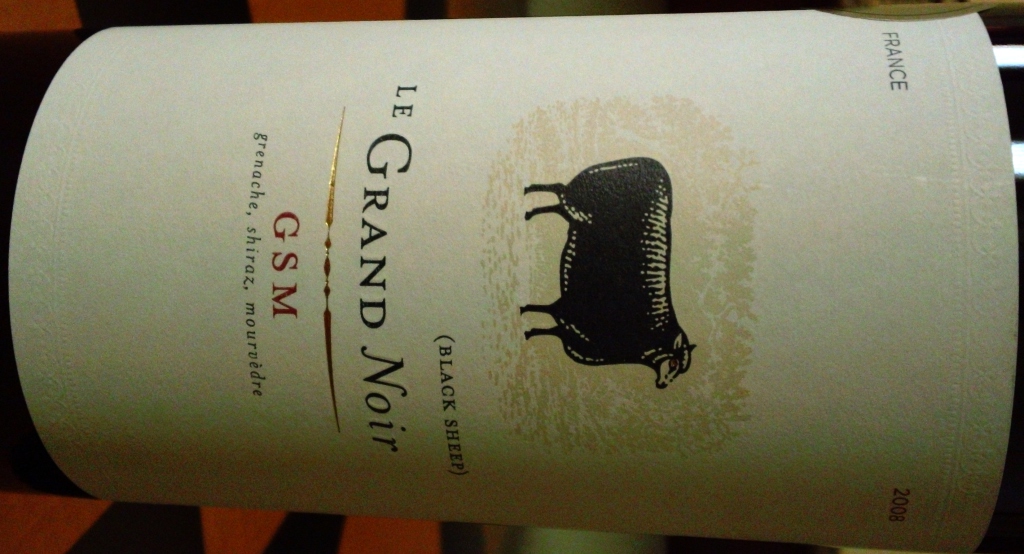 Another example – 2008 Black Sheep Le Grand Noir GSM blend from Minervois. As label suggests, this wine is made out of Grenache, Shiraz and Mourvedre grapes (which is a classic combination of the Rhone grapes). Again with the price tag of about US$10, this is a great deal. Very soft and gently layered fruit, soft tannins are present, but unobtrusive. Good acidity complements this wine well, delivering nice and pleasant experience. Again, considering the price, this is the wine to look for.
Now that you learned yet another secret, it is time to put that knowledge to the practical use. Did you have Rioja wine yet, or may be tried some second label? Now you know about Languedoc wines, so “to do” list just got longer. Go find the bottle and experience this wine tonight – and let me know if your experience was worth reading this article. And just to tell you about what’s ahead, the next time we will talk about something else – will take a break in the secrets series. For now I can only tell you that this “something else” is quite rare and almost forgotten – and I will tell you more the next time we meet…
Re-post: Affordable Luxuries of the Wine World: Crozes-Hermitage versus Hermitage
During 2011 I wrote a number of posts for the project called The Art Of Life Magazine – of course talking about my favorite subject, wine. The project closed and even web site is down, but as I still like the posts I wrote, I decided to re-post them in this blog. Also, in that project, posts were grouped into mini-series, such as “Affordable Luxuries” you see here – I will continue re-posting them from time to time.
Also note that the series was written for a slightly different audience – I hope none of my readers will take offense in the fact that sometimes I’m stating the obvious…
 Let’s once again put aside the “secrets” series (we’ve explored a lot just recently – South Africa, Georgia, Amarone…), and let’s take a look at the “affordable luxuries” of the wine world. I have to admit that I’m not absolutely sure that “affordable luxuries” is such a great name for the series (of course it will be more than one post), so if you will come up with the better name, please let me know!
And to make it clear, here is what I want to talk about. Let’s start from analogy using cars as an example. There are a number of cars which commonly referred to as “luxury”. Looking at Japanese cars, we have Lexus, Acura and Infinity as main luxury brands in US. These three brands listed above are off-shoots of Toyota, Honda and Nissan respectively. Now, talking about “affordable luxuries”, you can buy Toyota Camry instead of Lexus ES, and spend about $10,000 less. Similarly, you can buy Toyota Avalon instead of Lexus GS, and again spend about $10,000 less. Will you know you are driving Toyota instead of a Lexus? Of course you will. Will it bother you all the time? Chances are, it will not – as one of the main traits, reliability, is shared between both brands, in a long run you will most likely be happy with your choice and all the money you saved.
Taking this analogy to the wine world (we are done talking about cars), we can find lots of similar situations – and this is what we will be talking about in this series. When it comes to wine, some of the “affordable luxuries” will be based on the similarities of the “place”, and some of them might be based on the similarities of the “style”. To illustrate “place”-based comparison, we can look for instance, at Chateau Petrus. One of the most coveted wineries in Pomerol area in Bordeaux, France makes Merlot-based wine, which typically costs about $3000 per bottle, of course if you can get one. Alternatively, you can look, for instance, at Chateau Hosanna (Number 5 in my Top Dozen wines of 2010), which borders Chateau Petrus property in Pomerol. Chateau Hosanna is also made of out of Merlot (remember, from the neighboring vineyard) and retails for about $100. Is it going to taste the same – I’m sure it will not (while I loved Chateau Hosanna, I didn’t have a chance to try Chateau Petrus yet). Does it make sense to spend 30-fold to drink Chateau Petrus and not Chateau Hosanna? Unless you live in China, or otherwise financially set for life, I believe it does not.
For the “style” comparison, we can look at the wines made from the same grape, but in the different places, like late harvest wines and BA or TBA Rieslings and/or Sauternes. There are many different “affordable luxuries” for us to explore and enjoy the differences and similarities – so let’s start.
I don’t know if you heard of Hermitage – it is one of the most famous appellations in Northern Rhone area in France. The wines had being produced there since the 10th century, and in 17th-18th centuries, Hermitage wines had being a favorite of Russian Tsar. Hermitage wines are produced from the Syrah grape (small addition of white grapes Marsanne and Roussane is allowed), and known to age extremely well, lasting 50 years or even longer.
If we will look at some basic facts (here is the link), Hermitage is a tiny area of 345 acres, producing less than 800,000 bottles a year of mostly red wines. It is almost impossible to buy Hermitage wines for under $70.
Hermitage appellation is essentially surrounded from all sides by another appellation called Crozes-Hermitage, which uses exact same grape combinations (Syrah + possibly Marsanne and Roussane) and essentially has the same type of soil and very similar climate. Interestingly enough, Crozes-Hermitage appellation is about 10 times bigger (3200 acres), and produces about 10 times more wine (8 million bottles per year). If you want to see more basic facts, you can use this link. Crozes-Hermitage wine prices usually start at about $12 and go up from there.
So here is our pair for comparison – similar soil and climate, the same grapes – does it make sense to spend 5 times more on a bottle of Hermitage than on a bottle of Crozes-Hermitage? Let our palates be the judge. Let’s compare 2004 M. Chapoutier La Sizeranne Hermitage with 1992 Paul Jaboulet Domaine de Thalabert Crozes-Hermitage. Both wines are made by very reputable producers (M. Chapoutier and Paul Jaboulet), which is a good start.
Looking at 2004 La Sizeranne Hermitage, the wine appears very dense and concentrated on the palate, with very clear expression of black pepper profile of Syrah grape, with lots of dark red fruit (but the wine is not fruit forward at all). The wine also shows very good balance of tannins and acidity. It needs time to really shine – it would probably taste much better in 10 years or so. You can buy this wine for about $90.
 1992 Domaine de Thalabert Crozes-Hermitage already has some good age on it, and it showed outstanding in the tasting. Very playful, soft with lots of good fruit and refreshing acidity. This wine will probably continue aging well for another 5 years or so, but it is perfectly enjoyable right now. I was able to get it for $20 now, not ten years ago – but it is not easy to find it.
So, what can we conclude from this? Of course tasting just two bottles can’t be really used as a solid basis for comparison, but I would gladly drink that Crozes-Hermitage now, instead of waiting for Hermitage to mature, especially considering that you can get 4 bottles instead of one. Does it mean that Hermitage doesn’t worth the price? I wouldn’t squarely put it like this – probably the next experiment will need to include Hermitage and Crozes-Hermitage from the same year – then we will be in a better shape to conclude on something.
But – it is time to conclude this post, and if I can make a recommendation, go find the bottle of either wine, and be the judge yourself – and please don’t forget to share your thoughts. Cheers!
Perfect Winter Fare – Shiraz and Cassoulet
 You can call it “play it for Australia” (with a little bit of France). Or you can just call it Shiraz tasting. Whatever the name is, but a few months ago (actually, right after the hurricane Sandy – it was a miracle that we didn’t lose an electricity) we got together for a Shiraz blind tasting and the dinner.
For the blind tasting, we had two limitations imposed. First, the bottle was supposed to say “Shiraz” on it. Yes, of course Shiraz and Syrah are the same grapes, but – this was a limitation number one. Limitation number two (a soft one) – preferably, the Shiraz shouldn’t be coming from Barossa region. You wonder why? Easy. I had a couple of bottles in mind, all from Barossa, so I wanted others to do the hard work. Ahh, yes – and no blends were allowed – only 100% Shiraz.
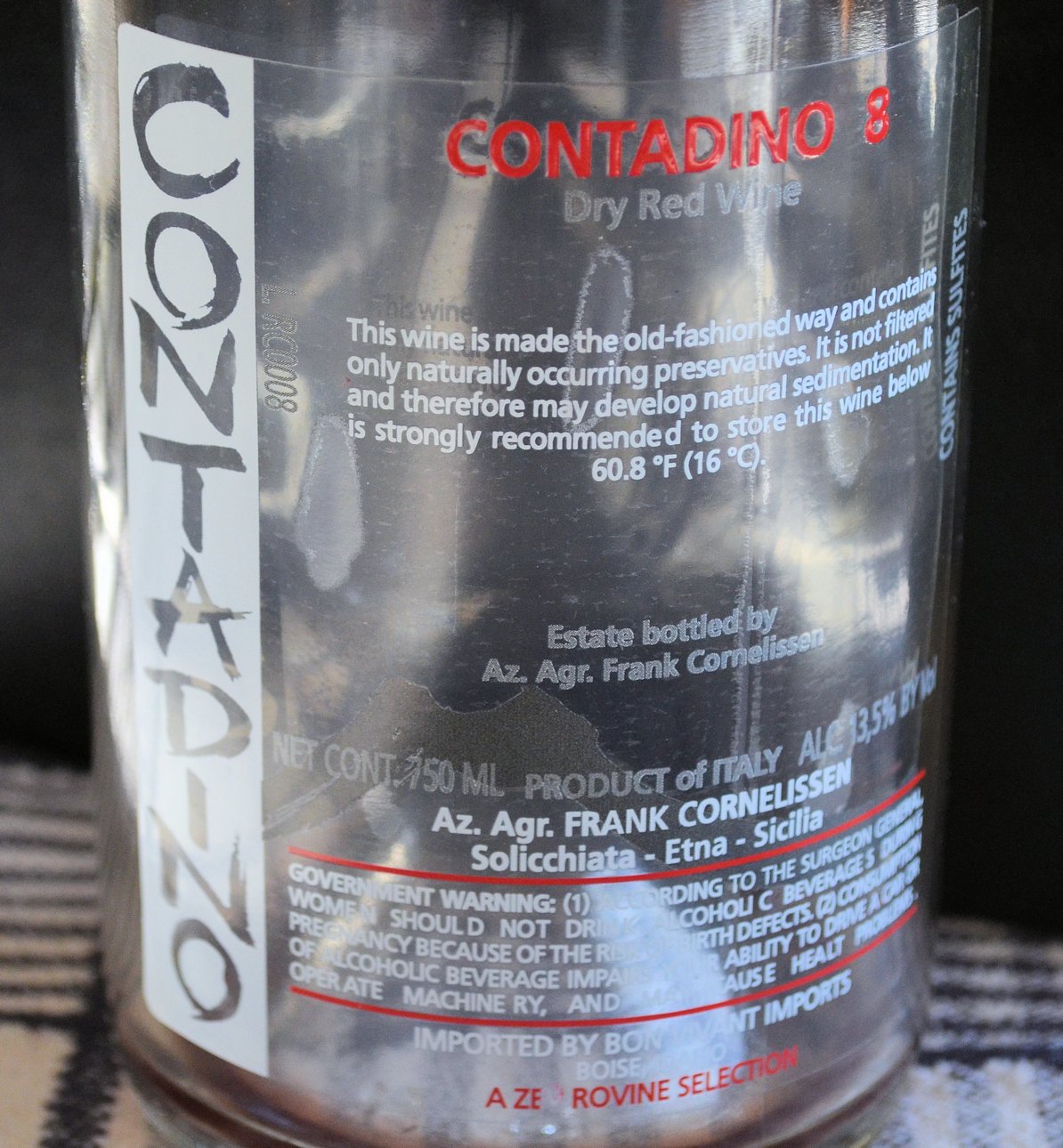 Before we started the tasting, I threw in a monkey wrench. Doesn’t sound right talking about wine, does it? So the role of this allegorical wrench was played by Frank Cornelissen Contadino 8 wine. Frank Cornelissen makes very interesting wines in Sicily – natural, low intervention wines from the grapes growing on volcanic soils of Etna. His aspiration is to let people actually to taste the soil, the actual stones in his wines, and he is probably succeeding with that (here is the link which explains the wine making philosophy – I think it is worth reading). This wine literally represents a very distinct experience – outside of acidity and minerality, there is very little else which you can taste – nevertheless, it is an interesting wine to try (well, I’m not sure we got too many votes of approval for this wine from the group, but still). Okay, let’s get back to the Shiraz.
The tasting was blind. Of course all the wines were Shiraz, but the blind tasting format allows you to focus only on the wine in your glass – no matter who producer is, how cute the animal is on the label (no, I didn’t expect anyone to pull off the Yellow Tail stunt, but thinking about it now, it could’ve been interesting), did someone tasted the wine before or who brought the bottle.
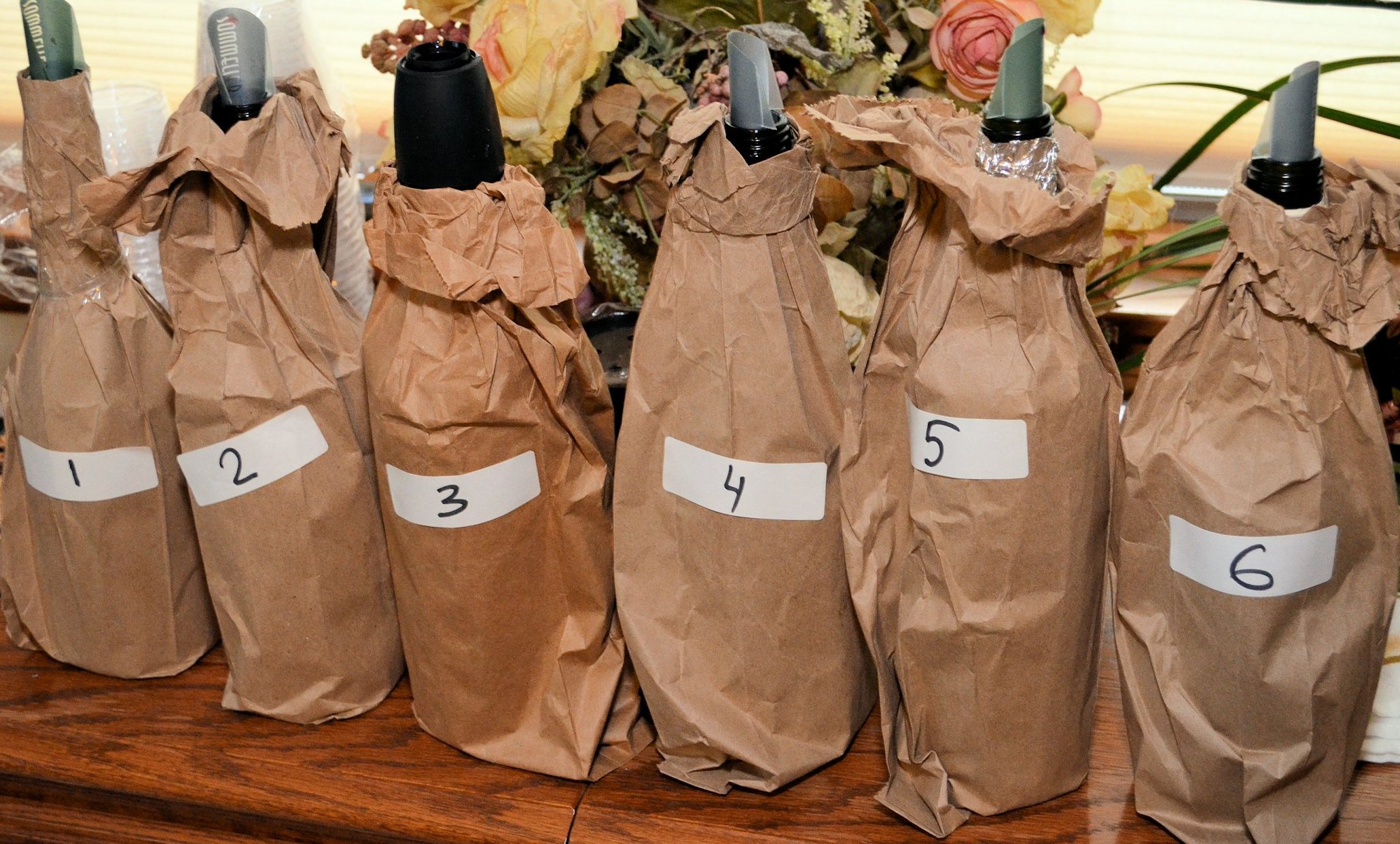
We had 6 wines in the tasting. As the tasting is blind, the person who brings the bottle, gets to open it and puts it in the brown bag. Then we ask kids to stick the numbers on the bags, completely at random. The wines are poured in the numbered glasses, and the fun begins.
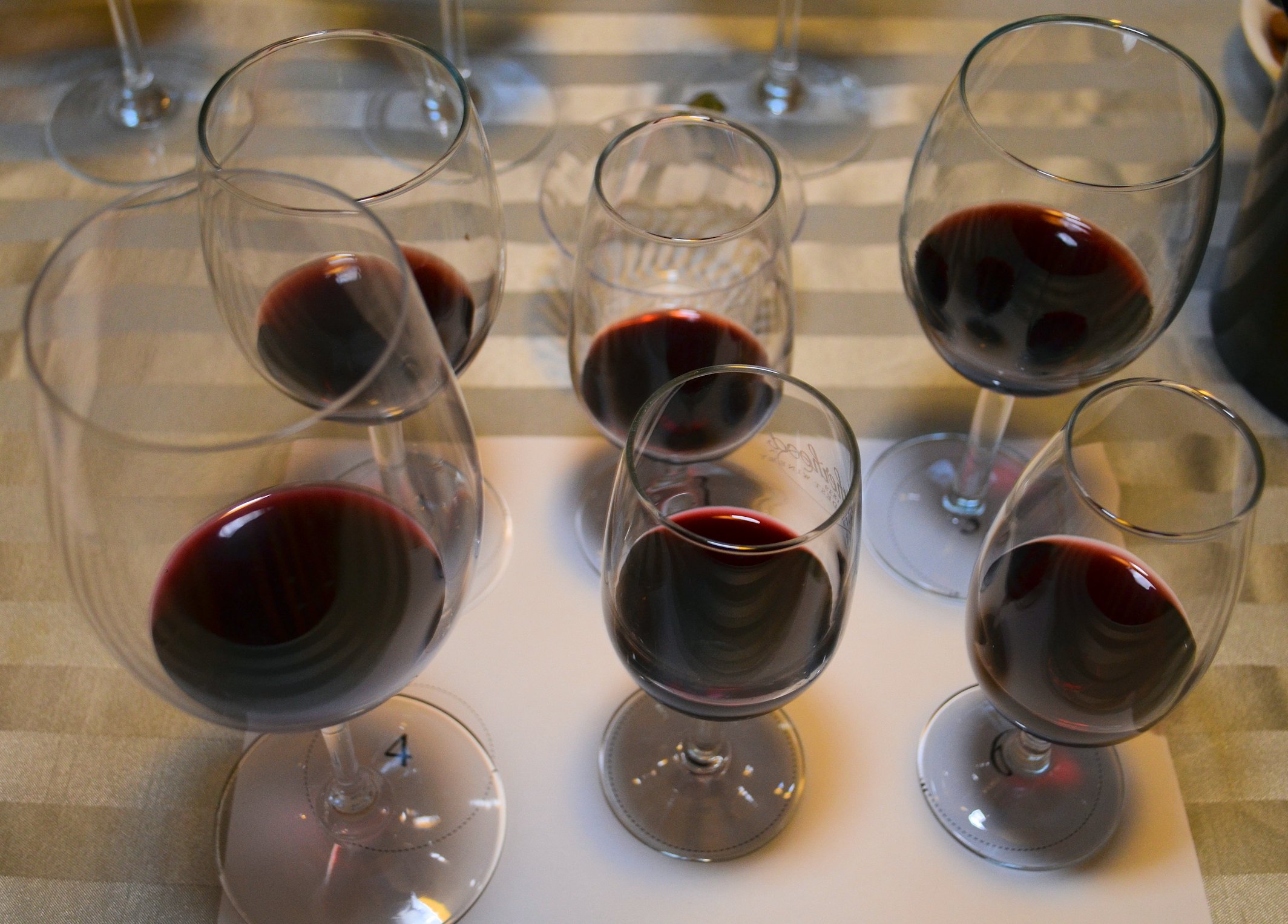
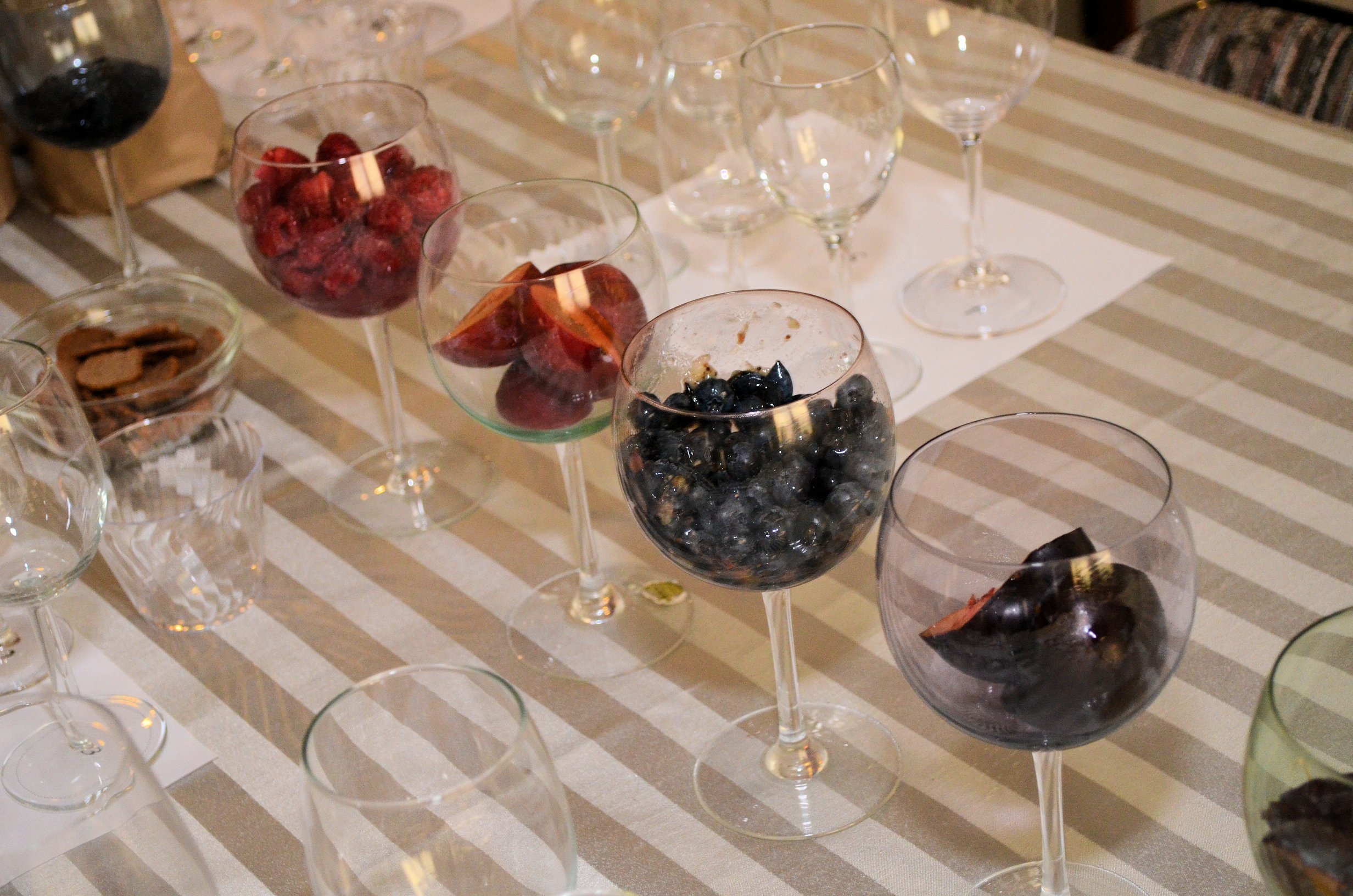
Shiraz is usually quite a playful wine when it comes to the fruit expressions, so this time we decided to add an interesting touch to our tasting – put the fruits on the table. We had raspberries, blackberries, blueberries and couple of different plums in the glasses, slightly smashed to release the flavor. The intent was to use those fruits as a reference while smelling and tasting the wine and to be able to identify what we were tasting. Not sure if it was a successful experiment, but as the very least it was fun.
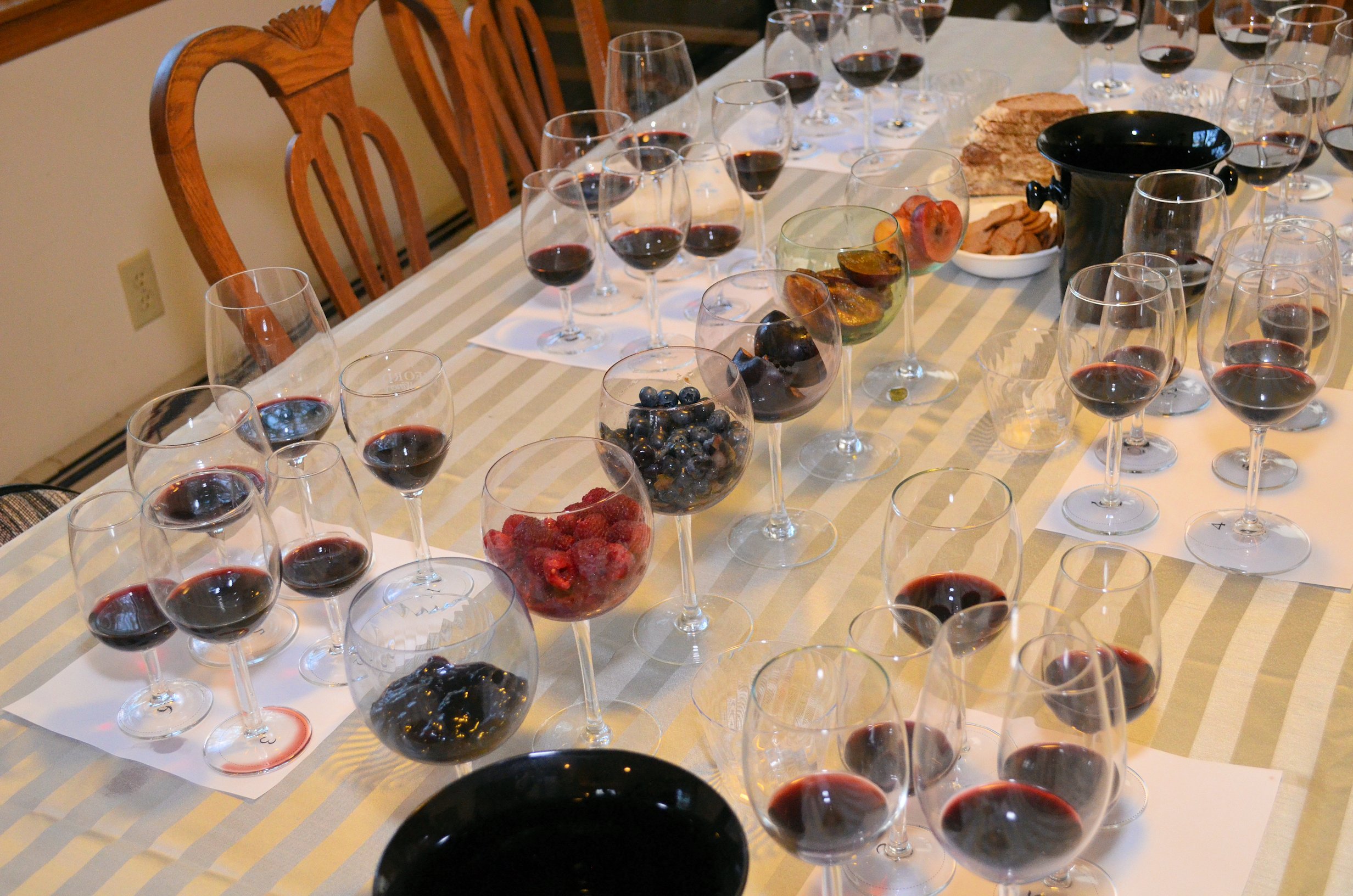
Now everybody are at the table and we start the tasting – sniff, swirl, sniff, more swirling, taste – talking and taking notes at the same time – no, there is no requirement to participate in conversation, but it is part of fun! And the notes are helpful at the end, when we take a popular vote to identify the most favorite wine of the group. Each person can vote for two wines, and the wine which will score the highest, will win. I case of a draw, we take an additional vote to select only one favorite between the two, so we still will have a winner – this all is necessary to have then a culmination point of unwrapping the winner and listening to the collective “ahh?” as pretty much in all of our blind tastings the winning wine was a complete surprise to everyone, including the person who brought the wine.
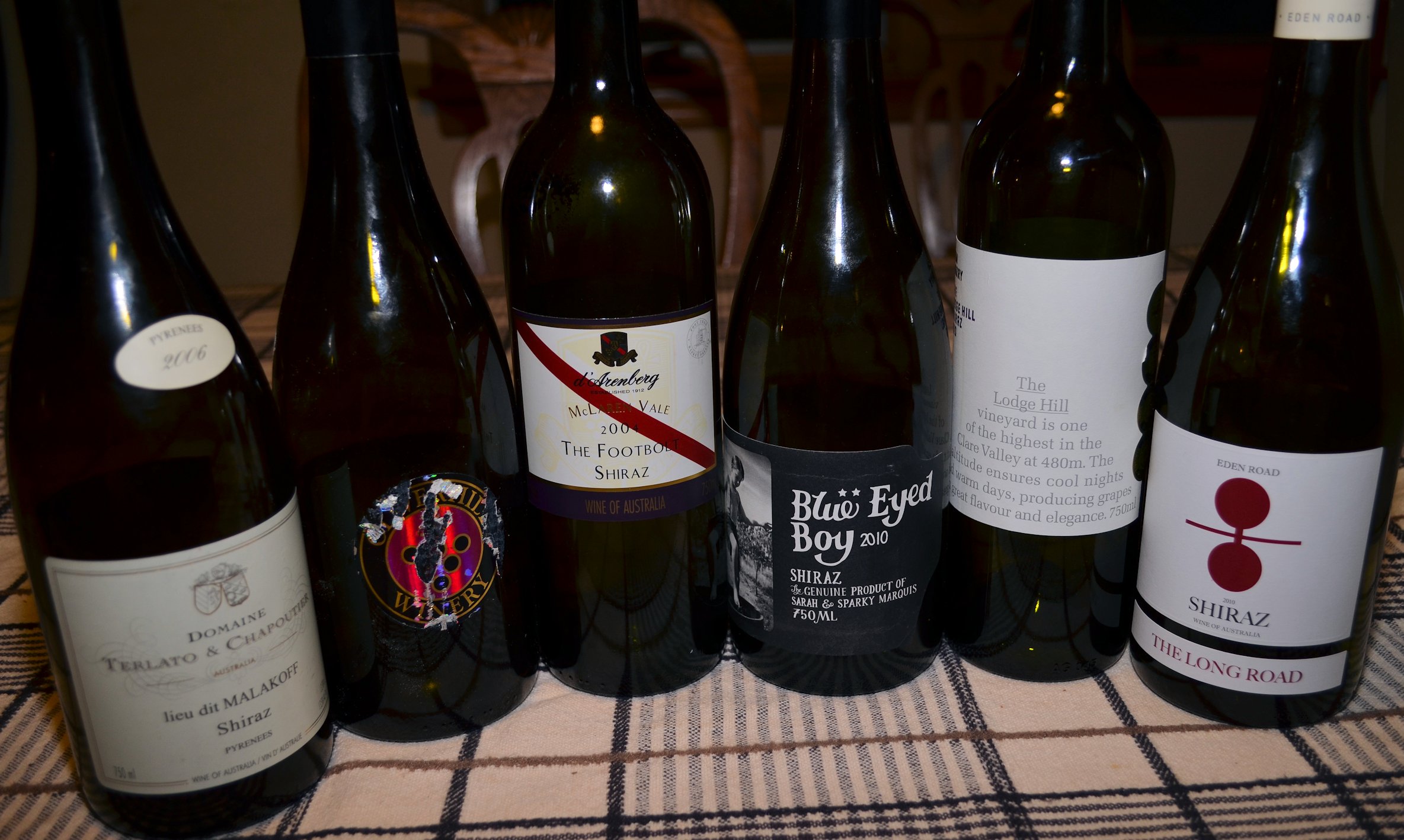
Once we have a winner, all the wines get unwrapped and admired, and everybody count their surprises for a few minutes. Here is our line up from this tasting:
And here are the notes:
1. 2006 Domaine Terlato & Chapoutier lieu dit Malakoff Shiraz Pyrenees (13.5% ABV) – little smoke, blueberries, a bit tart, very restrained. Not a typical Australian Shiraz.
2. 2005 Oliverhill “Jimmy Section” Shiraz McLaren Vale (96RP, no ABV as my label was badly damaged) – a little dust, tart cherries on the nose, blueberries, very sweet on the palate, jammy, a little short on the finish, overall pleasant.
3. 2004 d’Arenberg The Footbolt Shiraz McLaren Vale (14.5% ABV) – interesting blackberries, very tart, not balanced.
4. 2010 Molly Dooker Blue Eyed Boy Shiraz Australia (16.5% ABV) – very nice, dark chocolate, jammy, blackberries, dusty nose, overall very balanced.
5. 2010 Jim Barry the lodge hill Shiraz Clare Valley (14.5% ABV) – very round, balanced, plums on the nose.
6. 2010 Eden Road The Long Road Shiraz Canberra District Australia (13.5% ABV) – Smells very young, but with the tannins in the back. Good dark fruit.
Can you guess the winning wine? I will give you a few moments.
And the winning wine was…
And the winning wine was…
And the winning wine was …

2010 Molly Dooker Blue Eyed Boy Shiraz Australia – the wine got 8 popular votes out of 10. In the second place with 5 votes out of 10 was 2005 Oliverhill “Jimmy Section” Shiraz McLaren Vale – interestingly enough, this wine has a very high rating of Robert Parker ( 96), and expected maturity in 2011 – 2018 – I guess we opened it prematurely… Oh well.
And now – dinner time!
Did you notice the title of this post? Yep, the cassoulet was involved. No, it was probably not cold enough yet, and cassoulet is a dish from south of France, so Cote du Rhone wines would be typically more appropriate – but, cassoulet is one of my all time favorite dishes to make (and to eat too), so you got to do what you want to do, right?
I fell in love with cassoulet during one of my trips to Geneva a while ago. White beans, pork, duck, lamb, sausage – all so succulent and so “together”, a perfectly heart, soul and body warming dish. I tried to find it in the restaurants in US, but never succeeded. Then at some point I came across an article about Cassoulet in Wall Street Journal, which also contained Alain Ducasse recipe – this was a turning moment when I started making it myself. I don’t know what any other cassoulet aficionados would think, but to me it tastes the closest to those I admired in Geneva.
I would like to share the recipe with you – which is mostly Alain Ducasse recipe (here is a link to the article and recipe on WSJ site) – I made certain adaptations which don’t sacrifice the taste, in my opinion, but make it easier to prepare.
Here is list of ingredients – as copied from the original recipe – with my comments.
For the beans:
1.5 lb Tarbais beans or white kidney beans (I’m talking about beans below)
3 carrots
1 celery stalk
1 onion
2 heads of garlic
1 tomato? ( well, in the original recipe there is a mention of tomato being diced – but then it is not used for anything – therefore, I just don’t use it)
Salt
For the meat:
4 sweet Italian sausages
1 lb pork ribs
½ lb garlic sausage
1 lb lamb shoulder
1 lb pork belly
4 duck legs confit
4 qt. chicken stock
3 carrots
1 celery stalk
1 onion
1 head of garlic (I just use garlic cloves here)
1 tomato
2 Tbsp tomato paste
2 sprigs thyme
1 Bay leaf
Salt
12 whole black peppercorns
Cassoulet starts with beans. The subject of proper beans for the cassoulet can almost reach the level of religious war. The original recipe of Alain Ducasse calls for so called Tarbais beans. Good luck finding them here. May be you can order them in advance, but this is a bit too much preparedness for me. So we need a substitute. What’s important is to find beans which will sustain very long cooking time, but will not become a mush – you are looking to see and taste actual beans and not some kind of paste. I successfully used so called Great Northern beans, which can be found in supermarkets, and I believe so called Navy beans will work too, but I don’t remember trying them.
The process starts from soaking the beans overnight in a cold water. The actual cooking starts next day – but you still can do a few things in advance.
The recipe calls for duck leg confit. If you look into the recipes for duck confit, cooking it is a very lengthy process on its own. Buying duck confit is possible, but it is hard to find a supermarket which carries it. I successfully replaced duck confit with just fresh duck legs. Sometimes, finding the duck legs can be a problem too. This was my case this time. Well, when you want a cassoulet, you have to do whatever it takes… Duck flavor profile (gamey, nutty, etc. – you know how the duck tastes) is essential – replacing duck with chicken is not really an option. My solution – using the whole duck. I got the whole duck, cut it up into pieces, leaving the skin on legs and wings, but otherwise removing it together with the fat – there is way too much fat in the duck. I fried the duck in the evening, preserving all of rendered fat together with all the meat, so it was ready to go the next day.
Before we talk about the whole process, let me give you an idea about the sizing. I used 2 pounds of beans, cut up meat from the whole average size duck, about a pound of pork country style ribs, pound of Italian sausage (usually 5 pieces), about a pound of chicken garlic sausage, about a pound of lamb chops (4 large pieces). Instead of pork belly, I used one package of “bacon ends” from Trader Joe’s which were fried the day before. All together, this was enough to feed well 10 or so hungry adults, with some leftovers. Now, lets get back to the cooking.
In the morning, step one was to cook beans. Drain the water from overnight, put beans in the pot together with celery, carrots, garlic and the onion, season, cover with cold water and simmer for about 1.5 hours or until beans are tender but not falling apart. Discard carrots, celery and onion. Technically, you are supposed to discard garlic too, but I just couldn’t do it – so I reused it for the next step.
While beans are cooking, you can start working on the meat. First you will need to roast all the meat separately. I use the cast iron pot (you can also use a heavy skillet), and sear all the meat in batches – you will need to season it with salt and pepper. You really want meat to achieve a nice sear, so note that this operation will take time (usually it takes me about 1.5 hours using the amounts mentioned above). Once all the meat is seared by itself, add duck (whether you are using duck confit or the whole duck prepared the day before), add bacon ( unless you will use the pork belly), add diced vegetables and let it roast for another 10 minutes. Then I put together herbs, bay leaf and peppercorns into a cheese cloth, tie it up and use it as Bouquet garni – i.e., put it inside (this way you can remove it all together so nobody need to chase down that peppercorn out of the dish). Now, add broth, cover and let it simmer for about 1.5 hours.
Once done, strain cooking liquid into the beans and put all the meat on the cutting board and let it rest for about 20 minutes or so. Remove and discard all the bones, and cut up meat into large pieces.
We are ready for the last step. Preheat oven for 250F. Take the cast iron pot. Put all the cut up meat on the bottom. Gently put beans with liquid on the top (again, you want to preserve beans as they are, so you will need to handle them with love). Overall, you want to to have enough liquid in the pot, but without making the whole dish looking like soup. Put a good layer of bread crumbs on top of the dish (no skimping on the bread crumbs – having a nice crust on top is one of the important elements of cassoulet). Put uncovered pot in the oven for about 45 minutes. Take the pot out. When serving, make sure to go all the way to the bottom so you will get the meat together with beans. Now, most importantly – enjoy!
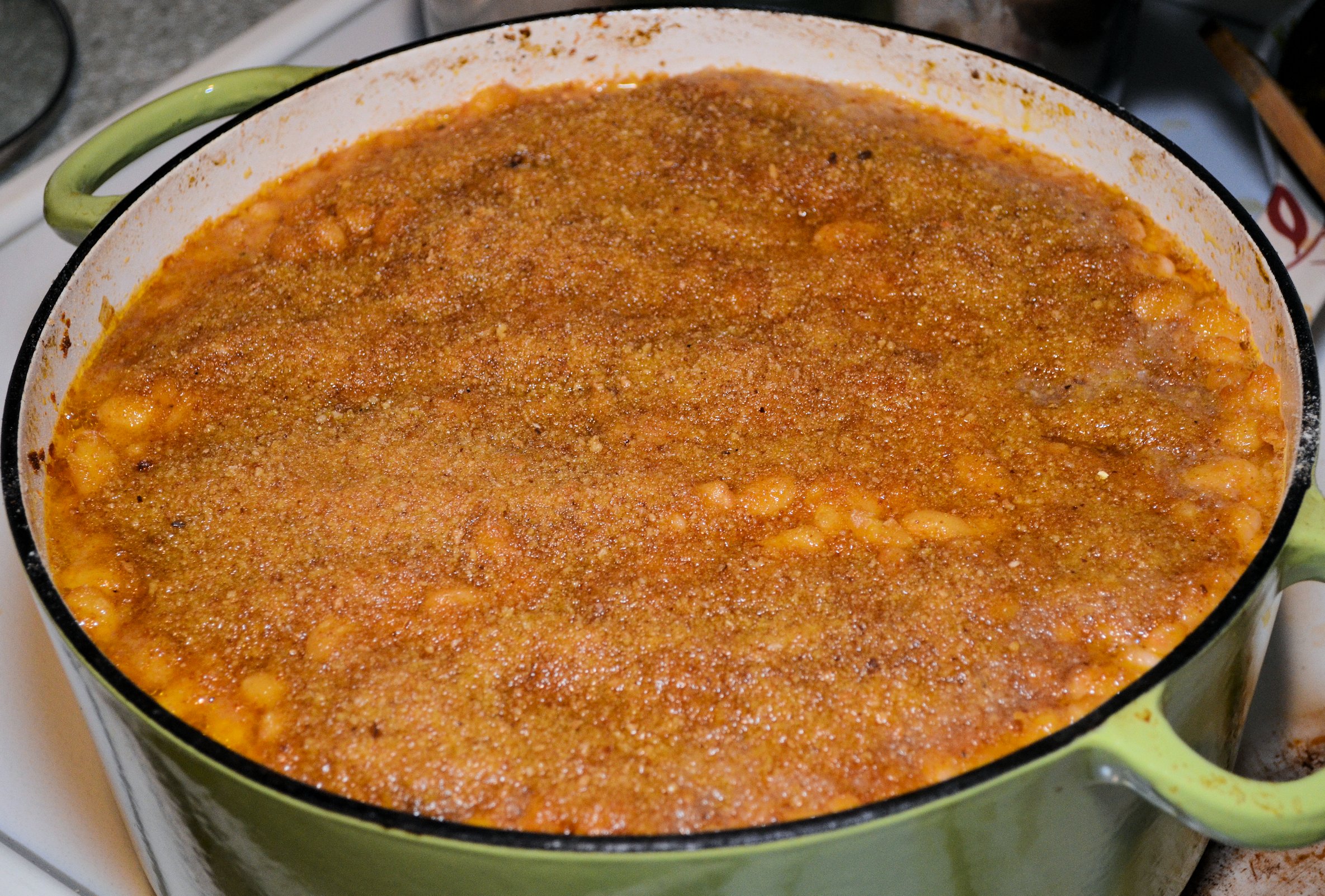
Also I have to mention that we had an outstanding “single plantation” chocolate as part of our dessert – can anything pair better with Shiraz than a spicy dark chocolate?

Never heard of “single plantation” chocolate before? Don’t worry, me too – but it appears that Akesson’s has a a substantial collection of single plantation chocolates, and the one we had was absolutely incredible.
Apologies for the post gone too long, but I think I’m finally done by now. I don’t know if I convinced you to make cassoulet, open a bottle of Shiraz or find that chocolate – but if you are still here and reading this – I’m happy. Until the next time – cheers!
Second Look – Wines of Cameron Hughes
Have you heard of Cameron Hughes? About three years ago, his name was one of the most mentioned in the wine and even general business press. In the 2009-2010, when the US economy was down, he created a business where he managed to take the wines which many wineries had no ability to sell, bottle them under his name and successfully sell – of course at a fraction of the price. Cabernet Sauvignon which winery had no ability to sell for $85, he was successfully selling for $18 – well, I guess you are not surprised. The small caveat was – you could never know what actual wine it was, as all of his dealings were protected under very strong non-disclosure agreements.
Why second look? Back in 2010, I tried some of his wines, and after failing to fall in love 3 or 4 times, I simply decided that I’m done trying. Two days ago, walking into Cost Less Wines in Stamford, I found a line of Cameron Hughes wines being tasted:

Do you think I could pass a free tasting? Even with my preconceived notion of Cameron Hughes wines, a free tasting is a free tasting, right?
Let me pause for a second and ask – do you think I liked any of the wines? Did I like 0, 1, 2, 3 or 4?
Okay, got an opinion? Let’s move on and see if you got it right.
2010 Cameron Hughes Lot 270 Sauvignon Blanc Russian River Valley ($10.99, 13.2% ABV)- from the first smell, this was a perfect beginning – bright, citrusy, fresh on the nose, with the same notion supported on the palate – grapefruit, lemon peel, white apple, perfect acidity – somewhat similar to New Zealand Sauvignon Blanc but more delicately weaved. This wine was close to Honig Sauvignon Blanc or Mara White Grass – but a bit cheaper then either one of those. Here is the link for the full info on Cameron Hughes site. And you probably got the idea that I liked the wine.
2010 Cameron Hughes Lot 314 Chardonnay Atlas Peak Napa Valley ($14.99, 14.2% ABV) – very nice vanilla on the nose, light and not aggressive – continuing with fresh balance of vanilla and white apples on the palate, light touch of oak, very remote hint of butter and may be some addition of papaya – very balanced, and very pleasant. Here is the link. And yes, you are right, I liked that one too.
2009 Cameron Hughes Lot 304 Meritage Napa Valley ($11.99, 14.5% ABV) – this wine is a blend of 64% Cabernet Franc, 23% Merlot, 9% Cabernet Sauvignon, 4% Petite Verdot. Very delicate red fruit aroma on the nose, nothing overboard, no jammy burnt fruit which is often associated with inexpensive California reds. Black currant, mint and eucalyptus on the palate, soft tannins, good acidity, overall very balanced. Yes, that is 3 out of three (and here is the link).
2011 Zin Your Face Zinfandel California ($16.99, 14.4% ABV) – this wine proudly advertizes itself right on the front label as “Spicy Jammy Yummy”. It has all the classic aromas on the nose – blueberries, blueberry pie, blackberries, the same profile is repeated on the palate – but it is too watery, it doesn’t have a supportive body density and power, and as the result appears somewhat sweet. While it is a well made wine, it is not the wine of my style. As the end result, we are staying with 3 out of 4 (here is the link).
As you can see from the notes, you can call me a convert – these are definitely the wines to buy, and they offer an excellent QPR for everyday drinking. I’m glad I stopped by, overcame my predisposition and can now put Cameron Hughes wines into “to drink” category.
If you have your own experience with Cameron Hughes wines or become a convert on something – please share it here.
Until the next time – cheers!
Last Bottle Sign Up ($10 credit)





