Archive
Restaurant Files: Mountain View Brasserie in Greenville, NY
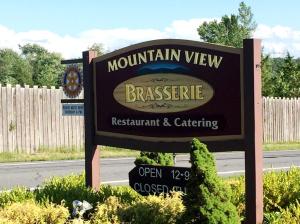 We already talked about our day in the Hudson Valley during traditional adults getaway trip (you can read about it here). Culmination point of the Saturday night was a special dinner. I call it “special” as this is something we always spend time preparing for as part of our getaway. Our ideal scenario is to find a restaurant which would do a special tasting menu for our group, and would allow us to bring our own wines which we would pair with the dishes. More often than not we are successful in this plan – this year was no exception.
The Mountain View Brasserie restaurant in Greenville, New York agreed to create for us a special tasting menu, and we came up with the wine pairings for all the dishes. Of course, the challenging part is doing the “blind” pairing if you will – all we have is the list of ingredients in the dish, and the pairing is solely based on our imagination. The good thing is that we usually do this “hard work” together with my friend Zak, who owns the wine store, so we have a good number of wine options. We always make an effort to keep the cost reasonable – talking about this dinner, only one of the wines was $25 retail, the rest were $20 or less.
For what it worth, here is our dinner menu, with the wine and pairing notes, and addition of the pictures. As the idea here was a relaxing dinner with friends and not a blogger’s dinner, all the pictures are taken with the iPhone and, well, it is what it is…


We started dinner with NV Rivarose Brut Rosé, Provence, France (Syrah/Grenache blend) which was nice, round and simple, well supporting the conversation.


Our first dish was Maryland Crab Cakes served with Lobster Sauce, which was delicious and very generous in size. We paired it with 2014 Templar Cellars Komtur Ekko Pinot Gris, Czech Republic (100% Pinot Gris) – I wrote about this wine before, and while the wine was excellent on its own, the pairing was simply outstanding, with the wine nicely complementing the dish.


Our next dish was House-smoked Salmon Napoleon with horseradish cream and gaufrettes garnished with capers and red onion – the dish was interesting, quite tasty, but rather unexpected under the category of “Napoleon”. Our wine pairing was 2015 Notorious Pink Grenache Rosé, Vin de France (100% Grenache), which was medium bodied Rosé, and the pairing was okay, but not mind-blowing (the flavors didn’t fight, but were not enhancing each other either).
Warm Hazelnut Crusted Goat Cheese with Market Greens was more successful as a dish, nice crunch on outside contrasting with the goat cheese acidic profile. We used the same wine for the pairing and it worked perfectly, complementing the dish very well.


You can’t have dinner without salad, right? We had Grilled Portobello Salad with Roasted Peppers, Fresh Mozzarella Cheese, Tomatoes, Spicy Walnuts, Market Greens with Balsamic Vinaigrette which was very tasty, but most importantly, it paired deliciously with 2014 Sangiovanni Kiara Pecorino Offida DOCG, Marche, Italy (100% Pecorino). Yet another wine I tasted before and loved, and it was perfectly complementing the salad flavors.
Vegetable Risotto with Parmigiano-Reggiano Cheese served with Roasted Sea Scallop was one of the absolute favorite dishes – perfectly seared scallop, working nicely with sweet flavors of corn risotto. Interestingly enough, we missed the sweetness as dominant taste element in this dish (just one word in our defense – corn was not listed among ingredients), and the same wine, Pecorino, didn’t work that well – it was just an okay pairing.


Our next dish was Baked Salmon Fillet with Orange and Olive Butter – again, perfect execution, moist and flavorful fish. The wine, 2011 Portal del Priorat Trossos Tros Blanc, Montsant, Spain (100% Grenache Blanc) was full-bodied, plump and delicious, working very well with the dish.


We were definitely looking forward to the Sautéed Wiener Schnitzel with Spaetzle, and the dish didn’t disappoint – very tasty, perfectly seasoned, delicious sauce. The pairing choice was 2013 Templar Cellars Komtur Ekko Pinot Noir, Czech Republic (100% Pinot Noir), yet again the wine I was familiar with – and I’m glad to admit that the pairing was spot on, with the perfect melding of flavors.


We finished our main course with Roasted Herb Crusted Rack of Lamb Provencal – I’m sure that even from the quick glance at the picture, you would expect that this was a tasty dish, as you can tell that meat was properly cooked – and you would be right, as it tasted appropriately delicious. Equally appropriate was our choice of wine pairing – succulent 2012 Seigneurs d’Aiguilhe, Côtes de Castillon, Bordeaux (Merlot/Cabernet Franc blend) Bordeaux, classic cassis and mint taste profile and classic complement to the lamb – outstanding pairing.
This concluded main portion of our dinner – and before we talk about dessert, I would like to commend restaurant on the smart way to present the tea. Take a look below:
 If you look in the middle of the picture on top, you will see a sand clock – what a great and simple way to help you steep that perfect cup of tea? Very thoughtful!


Our first dessert was Warm Apple Tart with Vanilla Bean Ice Cream and Caramel Bourbon Sauce – I’m sure you don’t need my lame description here, it was simply indulgent. And for the pairing – you can’t beat one of the best and most universal dessert wine pairings – Moscato d’Asti. We had 2015 Cascinetta Vietti Moscato D’Asti DOCG, Italy (100% Moscato d’Asti) – light, effervescent and clean.


Our last dish was Grand Marnier Chocolate Mousse with Fresh Orange Sections – excellent by itself, and pairing very well with 2014 Quady Essencia, California (100% Orange Muscat).
I think this was one of the most successful tasting dinners we put together, so for the next year, we have a very difficult task at hand – but we are up for the challenge. Cheers!
Mountain View Brasserie
10697 State Route 32
Greenville, NY 12083
Ph: (518) 966-5522
Restaurant Files: Omakase Experience at Nobu Las Vegas
As a bona fide foodie, I heard the word “omakase” many times. I had a vague idea that this is the term for the Japanese multi course meal, but that was all I knew about it.
During recent trip to Las Vegas, I stayed at the Caesars Palace, and had to walk every day past Japanese restaurant called Nobu. Nobu is a restaurant empire of the world renowned Chef Nobuyuki Matsuhisa, so temptation was building – and I succumbed to it.
I had no reservation, of course (getting reservation for many Las Vegas restaurants is mission impossible), but as in most of the Japanese restaurants, you can often score seat in the sushi bar – exactly where I ended up.
In absolute majority of cases, I prefer to taste lots of different dishes at the restaurant instead of having a lot of one – thus going for the tasting menu was a natural choice. I decided on Nobu Signature Omakase, which consisted of the 8 different courses. And to make the experience complete, I also took the suggested sake pairing course, so every dish was accompanied by a different sake.
Now, there was a bit of a challenge for a foodie. As I was sitting at the sushi bar, all the dishes we handed over by the array of sushi chefs. Each dish had a long list of ingredients, and between the overall noise (high), the pronunciation and the fact that all those chefs were busy, I couldn’t possibly capture the names of the dishes, nor the ingredients. Practically same thing was happening with the sake – names and descriptions were given very quickly, and short of asking to spell out the names, there is a limit to how many times one can repeat “excuse me, what did you say is the name of it”?
As the result, I had to play an internet sleuth, looking for pictures and using my rough notes, trying to figure out what exactly I was eating and drinking. While doing this, I found an interesting reference for many Sake terms – here is the link. Below you will find an overview of my experience – mostly in pictures, with some slivers of the names of the dishes and some of my impressions. Here we go:
Very first dish, handed down to me very quickly, was Deep Fried Fish Salad, served with Onigoroshi sake, aged for 10 years with the sounds of classical music (supposedly helps sake to mellow out)- nice, crisp, very refreshing. Salad was tasty, however not amazing.

Fried Fish Salad
Next up was Sashimi Salad with Lettuce Handrolls, which was served with a bit of a sweeter sake (nope, no idea about the name) . Vegetable roll was a masterpiece of flavor, I would eat it at any time. Tiny fried shrimp – wow. Salmon – spectacular.
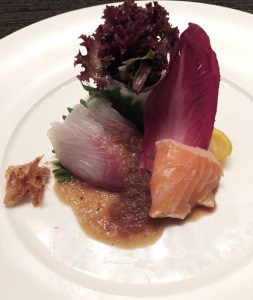
Next dish was Chef’s Sushi Assortment, which was served with with Hokusetsu Onigoroshi “Devil Killer” sake (with a bit of a spicy finish).
What I appreciated about the dish is that all the sushi pieces already had soy sauce and wasabi – exactly in the amount as Chef intended. Tuna was phenomenal. Picked ginger – wow. Great flavor on everything. Fried crunchy rice with caviar – delicious.

Next course was a Chef’s Sashimi Assortment, served with Hokusetsu Junmai sake. A pure wow dish, start to finish. Green ball you see in the picture is pickled Japanese peach – used to clean the palate, and it was delicious. Perfect sake. Toro Tartar with Wasabi Miso Sauce was divine – just give me a bowl and leave me alone. Yep, close the door, I said. All in all, one spectacular dish.


This was the end of the “appetizer” round, and the next two dishes were rather en entree style.
First, Black Cod Miso, which was served with Nobu ‘The Sake’ TK 40 sake from Nobu’s private stock. The sake was super complex and delicious. The cod was full of flavor and was melting in the mouth. Great dish.

Black Cod Miso
Next dish was Beef Toban Yaki, with beef sautéed in sake in ceramic cooking vessel (Toban). It was an okay dish – large sprout-like mushroom was a bit difficult to chew. However, the meat meat was tender and tasty.
 Last dish was Miso Soup, served in traditional Japanese style without a spoon. I was a bit surprised with the soup served in a standard black and purple plastic jar, commonly used at any simple Japanese restaurant. Soup was good, but again, nothing stood out about it. And yes, I didn’t think I should take a picture of it.
I was unable to capture the name of the dessert, nor the name of the dessert sake with fruit which was served together with it. Both were delicious, so the Omakase experience was finished on the high note.


There you go, my friends. A delicious, truly delicious experience, which I would be happy to repeat at any occasion. If you would have an opportunity to experience Omakase dining at Nobu, I can’t recommend it high enough. Cheers!
Nobu (at Caesars Palace)
3570 Las Vegas Boulevard South
Las Vegas, NV 89109
Ph: (702) 785-6628
http://www.noburestaurants.com/las-vegas-caesars-palace/experience/
Vintage Vespa: Podere Brizio Brunello Dinner
Brunello needs no introduction for the oenophiles. Quintessential, coveted Italian wines, coming from the heart of Tuscany, made from the signature Italian grape Sangiovese (Sangiovese Grosso clone, to be precise). Brunello di Montalcino was the first area in Italy which received in 1980 the status of DOCG (Denominazione di Origine Controllata e Garantita), top quality level designation for the Italian wines; Brunello are some of the most expensive wines coming from Italy today, with some of the bottle prices exceeding $500 on the release (Biondi Santi, Soldera). Wines had been produced in Montalcino for a very long time, going back to the middle ages – it is said that King Charlemagne frequented hills and taverns of the beautiful region – however, back then Montalcino was known for its white wine, called Moscadello. In the 1600s, the red Brunello started to take over the Moscadello, and today, most of the people don’t even know that the white wines are produced in the Montalcino region, as it is the powerful reds we all associate Montalcino with.
 Podere Brizio is a relatively young estate in Montalcino, founded in 1996. The estate has about 30 acres of vineyards, practices sustainable viticulture and in the process of becoming certified organic. The grapes are harvested by hand, natural yeasts are used in the winemaking process. Folks at Podere Brizio love the Montalcino history so much that they put “10 Parpagliola coin, coined in 1556 as a symbol of the Republic of Siena in a year in which about 600 noble Sienese families took refuge in the fortress of our town in order to keep the Sienese Republic alive” on the labels of their wines. Podere Brizio produces about 50,000 bottles annually, with the whole production consisting of 3 red wines – Rosso di Montalcino, Brunello di Montalcino and Brunello di Montalcino Riserva.
Now, let’s talk about the dinner, which took place at the restaurant called Vespa in Westport, Connecticut. Not only Vespa offers delicious Italian and Mediterranean food, but the restaurant boasts a wine list which has a lot of unique and interesting wines – when was the last time you saw Erbaluce from Piedmont, Cinque Terre Bianco from Liguria, Frappato from Sicily or a “wine geek special”, Rosso del Contadina from Frank Cornelissen, Sicilian maestro of natural wines? Owner Bobby Werhane has special affinity for the uncommon wines and not afraid to put them on the wine list, which of course makes Vespa a perfect food and wine destination for any foodie and wine aficionado alike – and Vintage Vespa is the series of the wine dinners which serves as a testament to that.
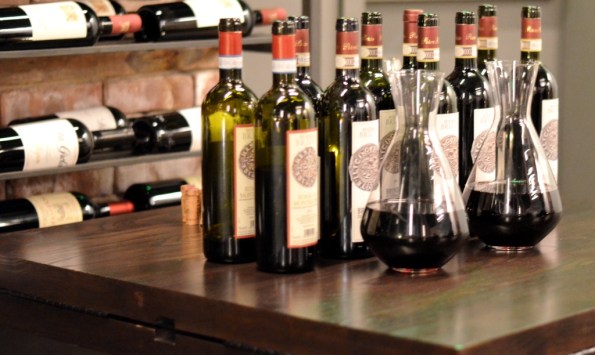
The wines made it into the decanters at some point
We tasted through 4 different wines from Podere Brizio – 2013 Rosso, and Brunello from 2010, 2007 and 2001 vintages, so in essence, this was a vertical tasting. There was one small challenge – the wines were not sufficiently decanted prior to the tasting. Brunello typically are big wines, and they need an ample time in the decanter, or they will not show all its beauty – as you will see from my tasting notes below, this is what happened.
Our dinner consisted of 4 courses. We started with Chicken Liver Pate (Red Onion Mostarda, Toasted Brioche) which had great texture and was absolutely delicious. To my surprise, 2013 Podere Brizio Rosso di Montalcino worked very well with the dish, contrasting the sweet nuances with its tart acidity.
Our second course was Ricotta Cavatelli (Braised Pork Shoulder, Tuscan Kale, Golden Raisins, Toasted Pine Nuts) – again, outstanding, touch of heat and great flavor, hearty and heartwarming (sorry, 2010 was too tight for that, so no pairing notes).


Our main course was Prosciutto Wrapped Veal Tenderloin (Pickeld Sautéed Carrots, Almond Purée) – my notes mostly consist of the exclamation points – wow! flavor! presentation!, so yes, the dish was a treat for the eyes and taste buds alike. After decanting, 2007 Brunello was an excellent complement to this dish, and 2001 Brunello worked very well too.


The desert was outstanding – Coffee Crunch Profiteroles (Mascarpone Cream, Cappuccino Gelato) – imagine a marriage of a classic Profiterole with classic Tiramisu – yep, that was good. And no, we didn’t try to pair the dessert with the wine, we just enjoyed it by itself.
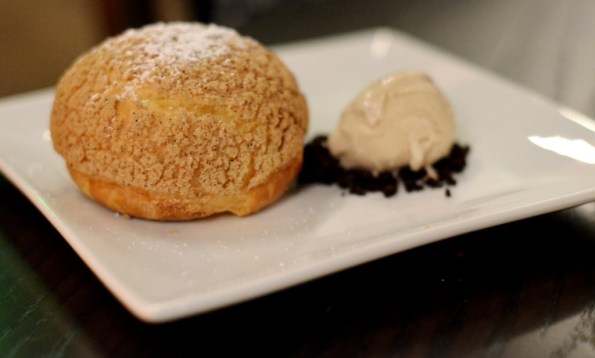 All in all, this was one delicious dinner we have to thank the Executive Chef David White for.
I did my best taking the tasting notes, juggling both delicious food and conversations with other guests, so for what it worth, my tasting notes are below:


2013 Podere Brizio Rosso di Montalcino (13.5% ABV)
C: Garnet
N: Tobacco, earthy undertones, violet
P: Clean acidity, medium body, tart cherries, blackberries, tobacco
V: 7+
2010 Podere Brizio Brunello di Montalcino (14.5% ABV)
C: Garnet
N: Violet, raspberries, blackberries
P: closed. Hint of tart cherries, but not much else
V: the wine was not decanted initially – and this is way too young, needed lots of time in the decanter. No rating.
2007 Podere Brizio Brunello di Montalcino (14.5% ABV)
C: Dark Garnet
N: Touch of plums, but mostly closed
P: Plums, nice tannins, good acidity.
V: 7+, needs time – should be decanted for at least 2 hours
2001 Podere Brizio Brunello di Montalcino (14% ABV)
C: dark Garnet, not a sign of age
N: Intense crushed berries, tar, leather, blackberries
P: Fresh tannins, great acidity, open, vibrant, great concentration and structure
V: 8/8+, just started to open, will shine in 5-10 years.
There you have it, my friends. Delicious food + Great wines = Vintage Vespa. Make sure to keep an eye on Vespa (probably their Facebook page is the easiest) so you will not miss the next wine dinner. Or better yet – head over to the restaurant and just make your own wine dinner – I’m sure you will not be disappointed. Cheers!
Vespa Westport
2A Post Rd West
Westport, CT 06880
Ph:(203) 557-9057
http://vespawestport.com/
New Versus Old – Is Wine World Upside Down?
This post is an entry for the 23rd Monthly Wine Writing Challenge (#MWWC23), with the theme of “New”. Previous themes in the order of appearance were: Transportation, Trouble, Possession, Oops, Feast, Mystery, Devotion, Luck, Fear, Value, Friend, Local, Serendipity, Tradition, Success, Finish, Epiphany, Crisis, Choice, Variety, Pairing, Second Chance.
New. We all crave, adore and worship new in our lives. New experience. New restaurant. New baby. New job. New car. New iPhone. New house. New puppy. Add “new” to practically any object, and it instantly becomes something exciting.
The “new” is not limited to the things and objects. New ways constantly appear, and we embrace them wholeheartedly. New technologies and new processes are born every day. Self-driving cars. 3D printers. We store our pictures in the cloud. It’s all new, new, new around us.
We love new so much that “old” becomes almost en expletive. We might attach “old” to the experiences, but not to the objects! Think about it. When you are looking for the used car, the dealer will refer to such a car exactly like that – used. She might even say “almost new” or “gently used”. But you will never hear from the dealer that they want to offer you this old car – unless you are in the market for antiques – but even then “old” descriptor will be avoided. Or let’s say you are looking for a house. Ever heard agent saying “let me show you this old house“? We learn to be afraid of the world “old”, as we don’t want to get old ourselves.
 Talking about wine world, the word “new” is exciting as in any other aspect of our lives. In essence, the whole wine world is built on the concept of new – ever year there is a new harvest, and a new wine will be produced from the grapes of that new harvest. New labels are made for the wines. New wineries are founded. New tasting rooms are built. New vineyards are planted. New processes are invented to press the grapes, to ferment them, to preserve wines, to bottle. New packaging (wine in a can, anyone? wine on tap?). New is a most prominent concept in the wine world.
But the concept of “old” is ohh so different when it comes to wines. “Old” in the wine world commands such a respect that we might not find in any other areas of human life. Let’s start in the vineyard. So you planted a new vineyard? Great. Now you need to wait until it will become old, as for the most of vineyards you need to wait at least 3-4 years before they will produce fruit suitable for winemaking. And that vineyard has to become old in the natural way, just by letting the time pass – there is no magic bullet.
To top it off, the older vineyard gets, the better it is. Ever seen the words “old vines” on the bottle? May be viñas viejas? Or how about vieilles vignes? These words mean exactly what they say – that this wine was made from the grapes harvested from the vineyards which had been around for a long time – 20 years, 30 years, 60 years, 100 years. The term “old vines” is typically not regulated, so there is no way of knowing exactly how old the vines are – but often the back label will give you that information. Very often that “age” is also reflected in the price – the older the car, the less it costs – but it is exactly opposite in the wines – the older the vines are, more expensive wine becomes (older vines yield less grapes with higher flavor concentration = tastier wine).
“Old” doesn’t stop in the vineyard. Lots and lots of wines are aged before they are released – both by law and by the desire of the winery. By law, non-vintage Champagne have to age for a minimum of 15 month, and vintage Champagne for at least 3 years – in reality, most of NV is aged for 2-3 years, and vintage is typically 4-10. By law, Rioja Gran Reserva requires at least 5 years of aging before the release. By law, Brunello Rieserva can be sold not earlier than 6 years after the harvest. Many of the wineries in California offer so called “library releases”, when the wines are aged for you in the winery’s cellar in the ideal conditions. Some wineries in Bordeaux sell their wines only 10 years after the harvest, including First Growth Chateau Latour, which recently declared that “vintages will be released when the chateau believes they are ready to drink”. Let’s go down all the way – how about some 100 year old Para Vintage Tawny from Seppeltsfield in Australia, which is released … yes, 100 years after the vintage date.
It is not that “old” is unquestionable winner in the world of wines. More often than not, “new” and “old” are clashing – sometimes in amicable ways, sometimes – not so much. One of the simplest “conflicts” – new oak versus used oak. This, of course, is what making winemakinng an art, as there is no hard and fast rule to when to age wine in old oak barrels versus new oak – each has its own benefits. Another form of the simple “conflict” is an internal fight which oenophile endures trying to decide when the wine from her cellar is ready to drink – there is also lots of good bad advice coming from all the wine professionals and the media – and we still are trying to figure that magical moment when the wine is perfectly “old“, or rather “aged” as we like to say, to maximize our pleasure. And then you got all those violent clashes between old and new – think about “traditional Barolo” versus “new style Barolo”. Think about fight for the Super Tuscans, attempts to introduce the new grapes in Brunello, or just any winemaker trying to do something new against the rules of the appellation.
Now, what do you think? Is wine world upside down for the new and old? Is there anything else which humans do where old commands equal or greater respect than new? Cheers!
Does the Wine Deserves Second Chance?
 This post is an entry for the 22nd Monthly Wine Writing Challenge (#MWWC22), with the theme of “Second Chance”. Previous themes in the order of appearance were: Transportation, Trouble, Possession, Oops, Feast, Mystery, Devotion, Luck, Fear, Value, Friend, Local, Serendipity, Tradition, Success, Finish, Epiphany, Crisis, Choice, Variety, Pairing.
Let me describe to you I’m sure a very familiar situation: the bottle of wine is opened, wine is poured in a glass, you take a sip and … you don’t like it. Too sweet, too acidic, too sharp, too tannic, too “biting” – it is not always that you follow a sip with “wow” or “ahh”. What do you do next? Of course I understand that this question doesn’t have a single answer, as everything depends on the context. And as a side note, it is also implied that the wine is not spoiled – not corked, not cooked, not oxidized – it is simply not to your liking.
Let’s assume that you opened the wine in the comfort of your home. You can simply put the glass aside and decide to wait and see if the wine will change (you of course hope for the better). If this happened in the restaurant, your choices are limited – if you just ordered this bottle out of your own will, in most of the cases you can’t send it back (remember, we said it is not spoiled) – you can ask for the wine to be chilled or decanted, but that is about all you can do. If you are at a friend’s house, you probably have only one choice – to smile and to say that this is delicious, unless you grew tired of that friendship long time ago, so then it might be a good opportunity to end it on a high note.
No matter what setting it was, let’s assume you didn’t get to the point of liking the wine, and now it is in your memory as the wine-I-never-want-to-touch-again. Would you ever think of giving this wine another chance?
Yes, I know. There is such an abundance of wine around us that if we don’t like something, why bother with any “second chances”? It is humanely impossible to taste all the wines produced in the world, so why bother with something which you were done and over with? Yes, by all means you have a point. But is there a tiny little voice inside your head, which says “may be that wine needed more time to open up”, or “may be I was just in the wrong mood”, or “may be my food overpowered the wine”? Do you ever get any of those “may be”s, so you would actually go and try the wine again, just because you are curious?
 I understand that this is matter of personality and an outlook on life in general, but more often than not, I find myself in the “may be?”, a “what if?” group. This is especially true when it comes to the wines which I open at home. If I take a sip of wine and don’t like it, I often put it aside, to try it on the next day. Or may be the day after next. Or may be even after that. One of my favorite examples is the bottle of 2002 Dunn Howell Mountain Cabernet Sauvignon, which opened up only on the 5th day (the wine was 11 years old when it was opened). When I took a first sip after just opening a bottle, the wine was tannic and literally devoid of fruit – there was no pleasure in that wine. Pumped the air out, put it aside for a day. Next day – literally no changes. And so was the story on the next day, and the next day. But I was not not ready to declare the wine a failure and just pour it out – kept giving it second chances. And the reward came on the day number 5, with layered fruit and delicious, powerful wine.
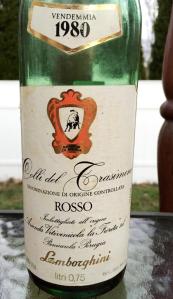
I have another example from literally 2 weeks ago, when we opened a bottle of 1980 Lamborghini Colli del Trasimeno Rosso (I can tell you that I bought the wine strictly on the basis of the fun name – Lamborghini – a car which I’m sure anyone would be happy to drive at least once). The wine was opened, went into a decanter – and for the whole evening nobody liked to drink it, as it tasted more as brine than the wine. I can’t tell you if I was giving the wine a conscious second chance, or was simply lazy to pour it out. Next day before clearing the decanter I decided to take a little sip – why not? And it appeared that the wine actually developed into delicious, mature wine, with the nose of tertiary aromas and palate full of sweet plums. Not the most amazing wine I ever had in my life, but perfectly delicious, mature wine which delivered lots of pleasure.
I could go on and on with similar examples, but I’m sure you got my point – the wine could’ve been discarded as “bad” and the great pleasure would be missed, if it wouldn’t be for the second chances.
So, what do you think? Do you have any “second chance” wine stories of your own, maybe with the happy ending? Do you think wines deserve their second chances? Cheers!
Oversold and Underappreciated Premise of Wine Pairing
This post is an entry for the 21st Monthly Wine Writing Challenge (#MWWC21), with the theme of “Pairing”. Previous themes in the order of appearance were: Transportation, Trouble, Possession, Oops, Feast, Mystery, Devotion, Luck, Fear, Value, Friend, Local, Serendipity, Tradition, Success, Finish, Epiphany, Crisis, Choice, Variety.
Let’s start from the mini quiz – is food and wine pairing an art or a science? Or is it neither and the question makes no sense?
I’m sure you can successfully argue both sides, as they do in debate competitions. Technically, cooking process is based on science – heat conduction, protein’s reaction to heat and cold, combining acid and alkaline – we can go on and on, of course the scientific approach to the food and then the pairing can be argued very well. But one and the same dish can be flawlessly composed from the scientific point of view – think about a steak which is perfectly cooked with a beautiful crust – but missing on all the seasoning and having either none or way too much salt – it would require an artistry and magic of the Chef to make it a wow food experience. So may be food and wine pairing is an art after all?
I don’t have an answer, and I don’t believe it is even important. The problem is that in many cases, that “food and wine pairing”, which is typically sought out and praised, is not possible, not universal and even not needed.
Yes, there are rules for the pairing of wine and food. Contrast, complement, balance of the body of the wine with the perception of the “weight” of the food, tannins and fat and so on. The rules work well when you create a tasting menu and pair each dish individually with the very specific wine, based on practical trial and error. However, once you try to extend your recommendation to say “try this stew with some Syrah wine”, that begs only one question – really? And overbearing Shiraz from Australia, or earthy, spicy and tremendously restrained Côte-Rôtie or espresso loaded Syrah from Santa Ynez Valley – which one?
Here is another example, simply a personal one. At a restaurant, my first food preference is seafood – scallops, bouillabaisse, fish – anything. My wife typically prefers meat, and so do many of our friends. Going by the standard rules (white with fish etc.), we are either stuck with water or have to order wine by the glass, and ordering wine by the glass is typically not something I enjoy doing – very often, “by the glass” list is short, boring and grossly overpriced. So instead of trying to pair wine with the food (don’t get me wrong – I like the “spot-on” pairing as much as any other foodie and oenophile), I prefer to pair the wine with the moment – a good bottle of wine which doesn’t match the food is still a lot better than crappy wine which would denigrate the experience.
Still not convinced? Think about a simple situation – old friends are coming for a visit, and you know that these friends like wine. Yes, I’m sure you will give some thought to the food, however, there is a good chance that you will comb your cellar over and over again in a search of the wines to create the meaningful wine program for the evening, even if the whole dinner would consist of one dish. You will spend time and time again thinking about your friends and trying to come up with a perfect, special, moment-appropriate and moment-enhancing wines.
Wine is an emotional connector. Wine elevates our experiences, making them a lot more memorable. You might have problem remembering what dish you had at a restaurant, but if the bottle of wine made you say “wow” on the first sip, there is a good chance that the special moment will stay in your memory, thanks to that special pairing which took place.
We pair wine with moments, and we pair wine with the people, for good and bad of it. If Aunt Mary comes for a visit, who enjoys a glass of Chardonnay with a cube of ice in it, is it really the time to break out Peter Michael or Gaja Rossj Bass? A Bogle Chardonnay would pair perfectly with Aunt Mary (not that there is anything wrong with Bogle – it is just perfectly priced for such occasions). However, if you know that your friend Jeff will stop by, who you know as a Pinot Noir aficionado, all the best Pinot Noir in your cellar will all of a sudden enter into a “chose me, I’m better” competition. And if none of them will win, the Pinot Noir at near by store will enter the fray. And keep in mind, all of this will be happening whether you will be serving steak, salmon or cheese and crackers…
Yes, when food is well paired with wine, it is really a special experience. But food and wine pairing which doesn’t work is really not the end of the world, it is still just a nuisance – and a learning experience, if you will. When the wine pairs well with the moments and the people, that’s when the memories are created, and that, as MasterCard likes to teach us, is priceless. Let’s drink to lots of special moments in our lives. Cheers!
Wagyu and Wine
 Wagyu burger, anyone? How about glass of Cab with it? Or may be a Pinot? Luckily, it is easy to solve that dilemma – as long as you have Capital Grille restaurant close by. Until November 22, Capital Grille has a special offering on the menu – 2 styles of Wagyu burgers, which you can pair with either 2012 Justin Isosceles Cabernet Sauvignon, Paso Robles or 2013 Landmark Overlook Pinot Noir, California, all for a fixed price of $25, which I think is a great deal for a lunch with a glass of nice wine.
It is so happened that my wife had a day off in a middle of the week – despite the fact that we both work in the same small town, our schedules never align for two of us to have lunch together during the week. As soon as I found out that she will be off on Wednesday, the plan was ready – lunch at Capital Grille it is!
Before we talk about pairings, let me talk about the wines. 2013 Landmark Overlook Pinot Noir, California was a perfect example of California Pinot Noir – touch of smoke, ripe fruit with good acidity, ripe plums, perfect balance – definitely an excellent wine. 2012 Justin Isosceles Cabernet Sauvignon, Paso Robles (15.5% ABV, 77% Cabernet Sauvignon, 12% Merlot, 11% Cabernet Franc) was over the top delicious, ripe, exuberant, showing a touch to sweet to my liking, but still delicious and very palatable wine.


And the burgers arrived. The Cheeseburger was served with Fried egg and crisp onions, and the other burger was served with Gorgonzola and black truffle ( this was my choice, and while I ordered it medium-rare-plus, somehow it had a very limited flavor – don’t know why…). So which wine do you think worked better with which burger?


The result of the pairing was very interesting. Landmark Pinot Noir ended up perfectly complementing either one of the burger, and unfortunately, Justin Cab was somewhat fighting with both. No, there was no competition – but Landmark Pinot Noir still won as a pairing choice.
Or at least it did so for me, so you should use your chance to find out. Head over to the Capital Grille, and let me know which pairing will work for you. Not in the mood for a burger? Go find those wines, as they were delicious. Cheers!
The Dinner Party Collective – Full Spring Menu and Smoked Salmon Recipe
 As Fall settling in the most of the Northern Hemisphere (slowly, I have to admit – it is still very warm and green here in Connecticut), the Spring is coming to the people of Southern Hemisphere, who are I’m sure very happy to forget the cold and embrace the sun. With Spring comes The Dinner Party Collective Spring Menu (if you need more information about The Dinner Party Collective, please see one of my previous posts about TDPC, as we call it for short).
Our Spring Menu had been fully published, and I was very happy to pair all the delicious dishes the wines, as you will see below in the wine pairing suggestions post:
Appetizer – Smoked Salmon Salad
Main course – Lemon Thyme Lamb Racks with Goat Cheese Aioli
Dessert – Lemon & Coconut Cheesecake with Strawberry Purée
I think all the dishes are absolutely spectacular, and I hope you are all already inviting your friends over for a delicious dinner (and let me know how the wine pairings would work).
This time around, I want to take a liberty to add a little trick, if you will, to one of the dishes on this menu – a Smoked Salmon Salad created by Margot from Gather and Graze. You see, my family loves smoked salmon in any shape and form – on the bagel, in the salad, in the appetizer, anywhere. When you buy smoked salmon from the store, there are couple of issues. First one is the taste and overall quality – sometimes it can be oversalted, dry or even rubbery. Second, the better quality smoked salmon is often quite expensive – Fairway store in Stamford charges $24 – $30 per pound of that smoked salmon. So instead of dealing with uncertain quality and high prices, you can make smoked salmon on your own – it is very easy – and you fully control the flavor profile. That’s right – when making smoked salmon on your own ( and you don’t have to make it taste “smoked” if you don’t like it), you can add any spices – dill, pepper, herbs – anything – and it is really easy to make.
Here is what you will need:
- 3 lb fresh salmon fillet, preferably with the skin (make sure all the pin bones are removed)
- 1 cup kosher salt (Kosher salt without iodine is a must for curing and brining)
- 1/2 cup brown sugar (I use “sugar in the raw”)
- pepper – by your taste
- liquid smoke (if you want to make “smoked salmon”)
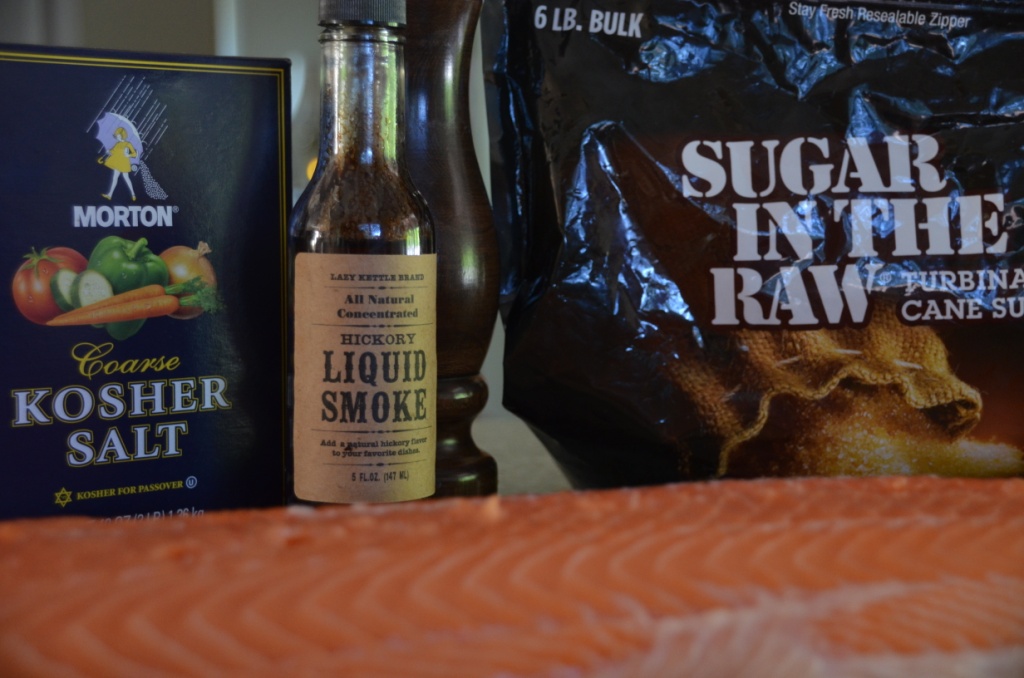 Above you see everything you need – please note the bottle of Liquid Smoke there – available at most of the supermarkets or you can order it online. Few drops will impart smoke flavor on any dish you are making.
Prepare the mix of kosher salt, brown sugar and pepper – feel free to add any other spices here you would want to use, and mix it all up – I do it right in the measuring glass:
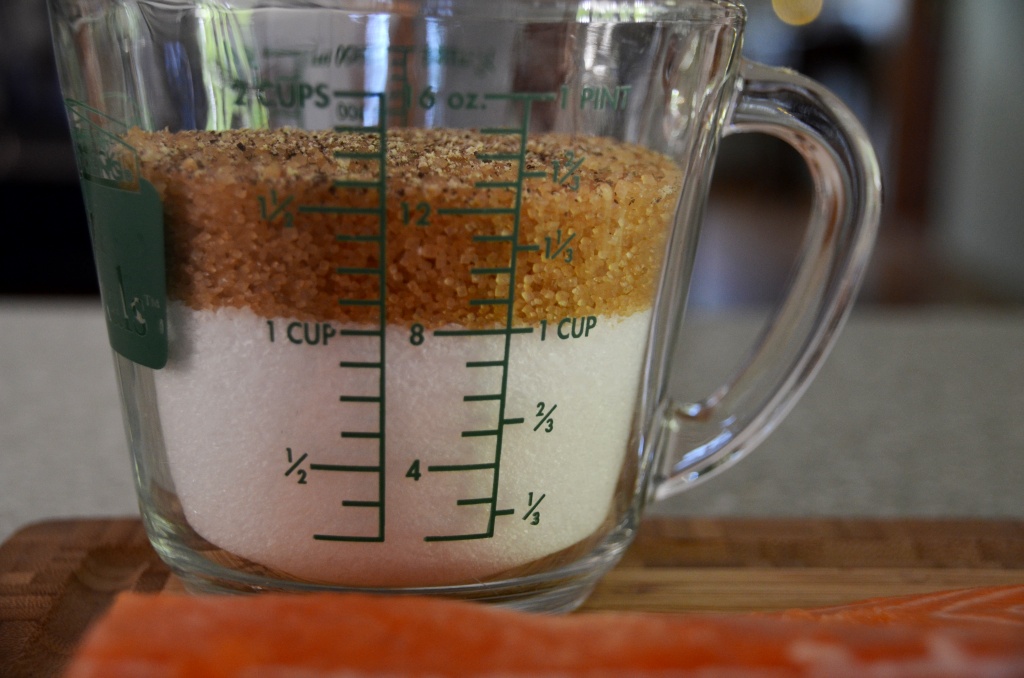 Put a very thin layer of the mix at the bottom of the large glass cooking dish (I’m sure you can use the foil tray as well, but I prefer using the glass tray), and put salmon filet on top:
 Now, completely cover the salmon with the mix, top and sides:
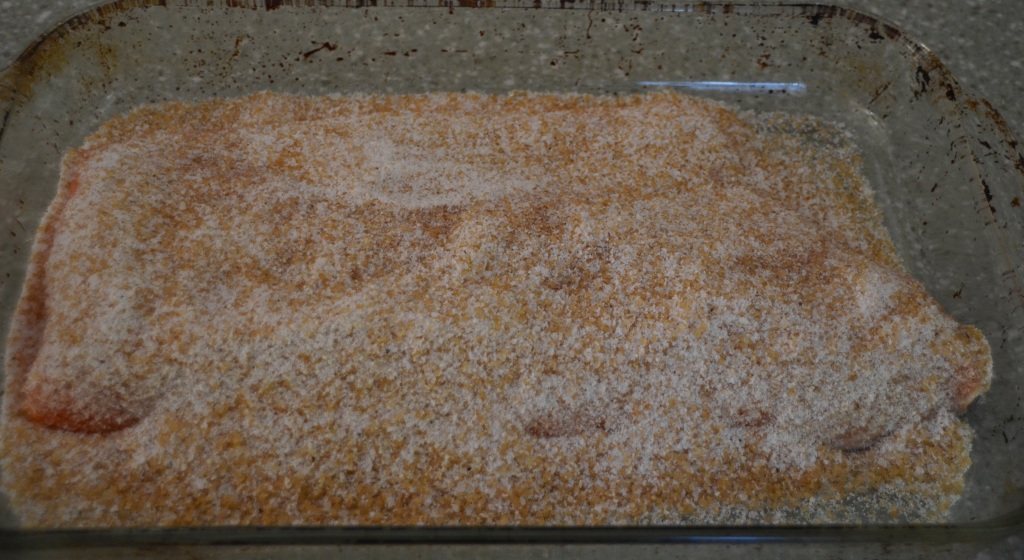 Cover with the plastic wrap and put it in the fridge for 24 hours. The next day, take it out of the fridge, and you will see something like that:
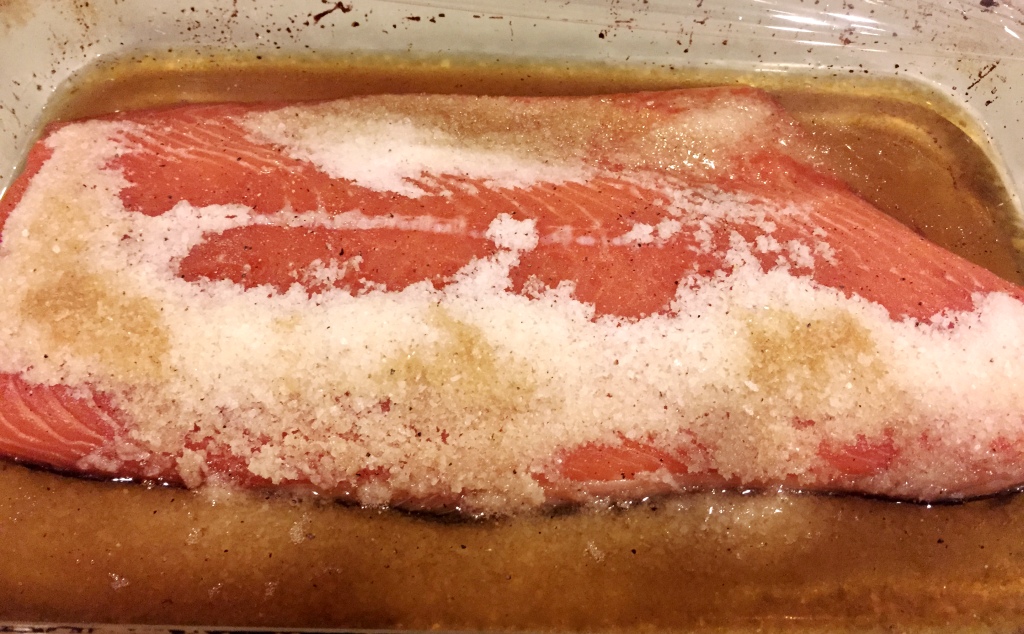 Drain the liquid (as much as you easily can, don’t strain it completely). Technically, salmon is now ready to eat – it is completely cured. From now on, I like to make it “smoked” so I add a few drops of Liquid Smoke all over salmon and around, cover with plastic wrap and put it in the fridge for another 12 hours. Important note – the longer you will keep salmon with the salt, the drier and denser it will become, as it will lose more juice.
After 12 hours, your smoked salmon is fully ready – get it out of the fridge, wash it thoroughly to rid of any salt, and lay it to rest on the board – you can keep it there for an hour or even longer. This is how it will look like:
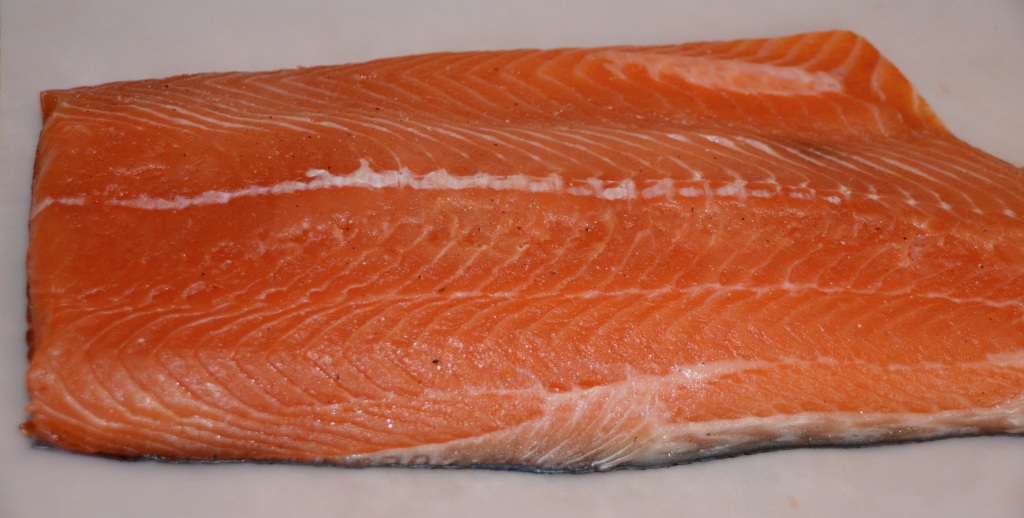 I like to give it even longer rest time if I’m not too hungry, so I would typically wrap it completely into the plastic wrap and put it back in the fridge for a few hours. Salt dries the surface completely, so by letting the salmon rest, it will redistribute the juices so it will become all moist and delicious. Last step – slice and enjoy!
 I would typically slice it off the skin as needed, and keep the rest wrapped in the plastic wrap in the fridge. As it is cured, it will last for a pretty long time – between a week and two for sure. It is also very easy to freeze as it is, right in the plastic wrap – and it can be thawed quickly as needed.
There you have it my friends – a simple smoked salmon recipe. Yes, do that at home!
If you will decide to make it – let me know how it will come out. Cheers!
The Dinner Party Collective – Full Fall/Autumn Menu
A quick update on the fun project I had been involved with – The Dinner Party Collective (TDPC for short). For those of you unfamiliar with TDPC – it is a collaborative project of food and wine bloggers, aimed at creating full dinner menus with focus on seasonal ingredients in both northern and southern hemispheres, and with all the dishes on the menu coming with suggested wine pairings. TDPC is a brain child of Margot from Gather and Graze, which started early in 2015. TDPC was mentioned in the WordPress article in July as one of the 4 food blogs to watch. Earlier in the year, we published a set of Winter and Summer menus.
Now the time has come for the Fall/Autumn and Spring menus. First, the Fall/Autumn menu was fully published, so here are all the links:
Appetizer – Trio of Root Vegetable Dips
Main Course – Beef Bourguignon
All the recipes include wine pairing notes and suggestions from Stefano (Flora’s Table, Clicks & Corks).
Spring menu overview will be coming out tomorrow, with the wine pairings and all the dishes to follow. Happy cooking! Cheers!
Wines Worth Seeking, and The Food To Match
When it comes to the wine produced in the world, Italy is an unquestionable leader – Italy produces more than twice as much wine as country in the second place – France, and 10 times more than US, which is #4 on the list (numbers from 2014). That essentially means two things:
- There are plenty of Italian wines available at any wine store, definitely the case in US.
- There are lots and lots of producers in Italy which are just starting to conquer the worldwide markets – and they often make wonderful wines.
What is the first region which comes to mind when you think about Italian wines? I bet it is Tuscany for the most, followed probably by Piedmont and then may be the Veneto. Well, we are not going to talk about any of those. Producer which I would like to bring to your attention comes from much lesser known area in central Italy, up on the Adriatic coast – the region called Marche.

Hills of Marche (source: San Giovanni web site)
I can confidently state that 6–7 years ago, absolute majority of the wine drinkers in US never heard of the region Marche. Over the past few years, the situation changed, and Marche wines started showing up in the wine stores, often offering a nice surprise to the consumers who are not afraid to venture out of the all so familiar Chianti, Barolo and Pinot Grigio.
As you probably guessed by now, Marche wines is what we will be talking about today – let me introduce to you Azienda Agrobiologica San Giovanni winery, located on the Piceno hills, few miles from town of Offida. Offida gives name to the Offida DOCG, a wine production area focused on the grape called Pecorino.
San Giovanni winery was officially founded in 1990 (the family was making wine for much longer time). The vineyards extend across 75 acres around the green hills, at an average altitude of about 1000 feet (320 meters). From the very beginning, the winery was built on all organic principles, with utmost respect to the land and the environment. As you would probably expect, the winery practices dry farming and uses only natural yeast. In a quest to produce wines most attuned with nature, San Giovanni winery is even using a different type of natural cork, produced from the sugar cane. As I was reading online, sugar cane corks are touted specifically as the best enclosure for organic wines, and they even boast negative carbon footprint, as sugar cane captures carbon dioxide – not sure how that works, but here is a link in case you want to educate yourself.
Before we will talk about the wines, one more important note about San Giovanni wines. Not only all the wines are organic, they are also Vegan! There are no animal products used in production of the wines, and in 2014 the winery became certified vegan as “Qualità Vegetariana Vegan” by CSQA.
San Giovani uses typical local varieties to produce their wines – Passerina, Pecorino, Trebbiano, Montepulciano and Sangiovese. Overall, San Giovanni makes two different lines of wines – Gyo, meant for an early consumption, and a group of wines more of a “reserve” level (I’m using the word “reserve” here as a very loose term, for the lack of common group’s name). During the tasting, which was also accompanied by a delicious meal, we had a pleasure of trying 4 different San Giovanni wines.
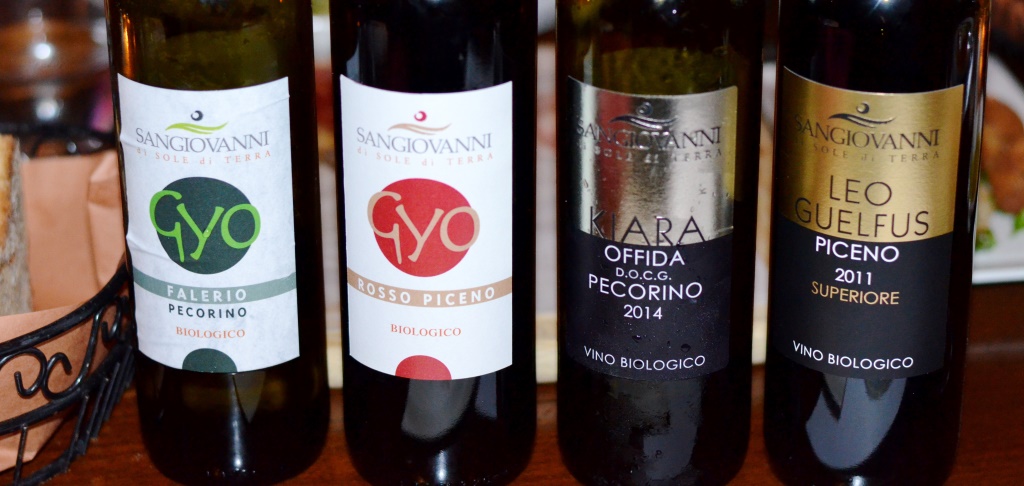 Here are my notes:
2014 Sangiovanni Gyo Pecorino Falerio DOP, Marche (13% ABV, SRP $13, 85% Pecorino, 15% Trebbiano)
N: White fruit, touch of grass
P: Hint of lemon peel, nice plumpness – almost Chardonnay-like, silky. Medium+ body, touch of bitterness.
V: 7+, nice
2014 Sangiovanni Kiara Pecorino Offida DOCG, Marche (13.5% ABV, SRP $20, 100% Pecorino) – this wine is named after owner’s daughter, Kiara. An interesting note – it is considered that Pecorino is at its best after 3 years in the bottle.
N: Bright stone fruit, leeches
P: sweet notes on the palate, apricots, medium to full body, nice acidity, good balance, long finish.
V: 8-, excellent


2014 Sangiovanni Gyo Ross Piceno DOP, Marche (13% ABV, SRP $13, 70% Montepulciano, 30% Sangiovese)
N: crushed fruit, fresh, blackberries
P: soft warm red fruit, nice layers, silky texture, polished and balanced
V: 8. Would be perceived as an expensive wine in the blind tasting. I would gladly drink this wine every day.
2014 Sangiovanni Leo Guelfus Piceno Superiore DOC, Marche (13.5% ABV, SRP $20, 70% Montepulciano, 30% Sangiovese, 18 month in oak, 18 month in the bottle)
N: Concentrated, plums, cherries, touch of herbs
P: Wow! Delicious, fruit, layers, spices, silky smooth, refined, long finish
V: 8+/9-, outstanding wine by itself, and one of the best values you can find at a price. This might be the wine with the best QPR I tasted throughout entire year.


As I mentioned already, the pleasures of the evening were not limited only to the wines. Our tasting took place at Cotto Wine Bar, a wonderful small outpost of authentic Italian cooking in Stamford, Connecticut.
Our hosts spent quite a bit of time going over the menu, looking for the dishes which would help to showcase the wines. As a first course, we had an excellent selection of various cured meats and cheeses – both Gyo and Kiara Pecorino wines perfectly accompanied these, providing nice backbone of acidity.


Next two pasta dishes arrived – Fettucine alla Bolognese (Fresh Homemade Pasta, Meat Ragu, Shaved Ricotta Salata) and Gnocchi alla Genovese (Basil Pesto, Oven Dried Tomato, Pine Nuts, Fresh Perline di Mozzarella), each one being very tasty. Sangiovanni Gyo Rosso Piceno was a perfect suitor here, weaving itself into the flavor profile of the dish.


Our last course consisted of two meat dishes – Agnello Scottadito (Grilled Lamb Chops, sauteed Brussel Sprouts, Pine Nuts and Raisins) and Straccetti Arugula e Parmigiano (Thinly sliced USDA Prime beef served with arugula, Parmesan Cheese and Balsamic Vinegar from Modena), meat cooked to perfection and delicious on its own. The Sangiovanni Leo Guelfus Piceno Superiore, with its firm structure, dark fruit and gentle tannins, perfectly complemented the meats, happily elevating every bite.


There you have it, my friends. Of course, there are lots of wines out there. But the great part of enjoyment of wine comes from the joy of discovery. And this is exactly what I’m taking about here. Sangiovanni wines bring together lots of unique qualities – not only these are tasty wines, but they are also organic, they are good for vegans, and they deliver an outstanding QPR. These are definitely the wines worth seeking.
And if you are ever in Stamford, and craving good Italian food, Cotto Wine Bar might be just “it”. Cheers!
Cotto Winebar and Trattoria
51 Bank St
Stamford, CT 06901
Phone: (203) 914-1400
http://cottowinebar.com/
Last Bottle Sign Up ($10 credit)




 Talk-A-Vino