Archive
Happiness-Inducing Wines of Lieb Cellars
 “Rising tide lifts all boats”.
As the wine growing in popularity all over the United States (still does, I hope), we witness the “wine countries” appearing everywhere – not just singular wineries, but the actual aggregations of the wineries, often presented as “wine trails”. While Napa and Sonoma definitely paved and continue leading the way to what the “wine country” is, you can find wineries all over the country offering not only wine tastings, but live music, concerts, dinners, special events and lots more.
Long Island wine country is the one closest to the New York City, making the wines for about 40 years by now. There is a very good chance, however, that even if you live in the USA, you never tasted Long Island wines – same as it is practically impossible to find the wines from Texas, Virginia, North Carolina, Arizona or Michigan anywhere outside of those states. So if I will tell you that Long Island makes world class Riesling, Chardonnay, Chenin Blanc and Merlot, you will probably have to take my word for it.
Over the past 10 years or so, visiting Long Island wineries on more or less a regular basis, I witnessed those wineries perfectly learning from Napa – both the good and the bad. On the good side, more and more knowledge is accumulated as to which vineyards and grapes do best, which individual plots do best, and the winemaking becoming more precise and resourceful. The bad side is in the fact that as the wines are getting better and better, it is less and less possible to enjoy the wines in the wine country itself, as it becomes more and more touristy – and visitors often get this “tourist special” treatment… Oops – no, we are not going into the rant, nope. Let me get to what I actually wanted to talk about.
When I was offered to taste some of the wines produced by Lieb Cellars, I had to do a bit of a research first. It turned out that despite visiting Long Island wineries every year, I never made it to Lieb Cellars and was pretty much unfamiliar with their wines. Therefore, I was looking at the best case – the wine country was coming to me, without any additional tourist distractions, yay!
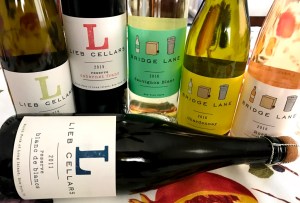
Now, I would like to finally explain the title of this post (after almost falling for a rant, yeah). When the wines arrived and I started taking them out of the box, the first thought was “wow, I love these labels!”. There is really nothing special about those labels, except that they are very clean and simple, and all of them use bright, cheerful colors. We eat with our eyes first – everybody know that – and it works for me the same with the the wine labels. Of course, what’s inside the bottle is far more important than the label itself, but good label makes you anticipate good wine – works for me every time.
In case of Lieb Cellars wines, the happiness-inducing labels were also perfectly supported by what was in the bottles, as you can tell from my tasting notes below. Few comments before I will leave you with them.
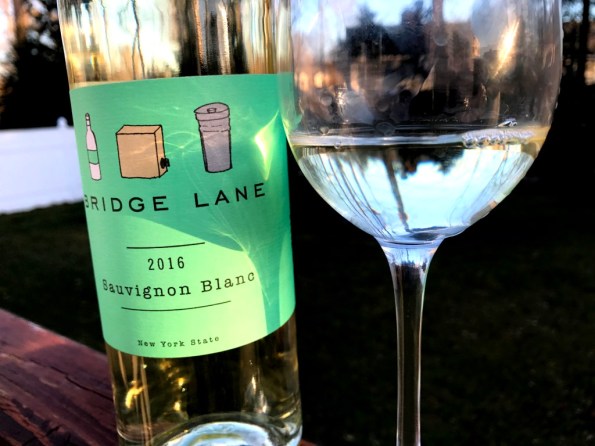
Lieb Cellars produces two different lines of wines. The first line, Lieb Cellars, is being produced since 1992. You can see those wines identified on the labels as Lieb Cellars, and today those are the Reserve wines made only from the estate-produced fruit. In 2004, Lieb Cellars started new line of wines called Bridge Lane – named after the farm road adjacent to one of the Lieb vineyards. While Bridge Lane are called a “second label” wines, there is nothing “second” about them – sustainably farmed, small crop, hand harvested wines, available in 3 different formats – standard bottle, 3L box and 20L kegs – whatever size your heart desires. You can even see those three available sizes pictured on the Bridge Lane labels.
Time to talk about the wines – here are my notes:


2016 Bridge Lane Chardonnay New York State (12.5% ABV, $15, 100% Chardonnay)
C: straw pale
N: lemon with distant hint of rosemary
P: lemon, tropical fruit, mango, Granny Smith apples
V: 7+/8-


2016 Bridge Lane Rosé New York State (11.9% ABV, $15, 49% cabernet Franc, 29% Merlot, 16% Malbec, 4% Pinot Noir, 2% Petit Verdot)
C: light onion peel
N: strawberries all the way, ripe strawberries, clean, inviting, fresh, touch of yeast Inessa which makes you smell it for a long time
P: strawberries on the palate, clean lemony acidity, firm and present. It would happily compete with any Provence Rosé
V: 8, wow, what a treat!


2016 Bridge Lane Sauvignon Blanc New York State (12.0% ABV, $15, 100% Sauvignon Blanc)
C: literally non-existent, straw pale extra light
N: fresh cut grass, medium intensity
P: lemon, tart fruit, cut through acidity. More of a Sancerre style – less fruit than California, less intensity than NZ. Clean acidity on the finish.
V: 8-, very enjoyable.


2011 Lieb Cellars Reserve Blanc de Blancs North Fork of Long Island, New York (12.5% ABV, $30, 48 months on the lees, 100% Pinot Blanc)
Appearance: Light golden color, fine mousse
N: touch of Apple, touch of yeast, delicious, open
P: touch of acidity, apples, lemon, restrained
V: 8/8+, the bottle can be gulped in one sitting


2015 Lieb Cellars Pinot Blanc Reserve North Fork of Long Island, New York (11.9% ABV, $20, 98% Pinot Blanc, 2% Riesling)
C: straw pale
N: white stone fruit, nice sweetness
P: beautiful, plump fruit, generous, delicious
V: 8, outstanding.


2015 Lieb Cellars Reserve Cabernet Franc North Fork of Long Island, New York (12.8% ABV, $30, 10 month in Hungarian oak, 85% Cabernet Franc, 9% Cabernet Sauvignon, 4% Merlot, 2% Petit Verdot)
C: dark ruby
N: mint, hint of mushrooms, touch of tobacco
P: fresh, open, blackberries, silky layers,
V: 7+/8-
The wines give us pleasure. It is not simple to convey that in words, but I hope I managed to share at least a glimpse of a pleasure brought by these Lieb Cellars wines. If anything, let me give you only one advice – find ’em and drink ’em. Cheers!
Precision of Flavors – Tasting the Wines of Achaval-Ferrer
 Drinking wine is a pleasure – for sure it should be, and if you don’t feel like it, maybe you shouldn’t drink it at all. At the same time, there are multiple ways to look at one and the same thing.
A pleasure of drinking of the glass of wine may be just as it sounds, very simple – take a sip of the liquid in the glass, say “ahh, it tastes good”, and continue to the next sip or with the conversation, whatever entices you the most at the moment.
Then there are many of us, wine lovers, who, professionally or unprofessionally, can’t stop just at that. Yes, we take pleasure in every sip, but then we need to dig in. We feel compelled to put on the Sherlock Holmes hat and play the wine sleuth, figuring out exactly what we are tasting in that very sip. What was that flavor? Was that a raspberry? Hmmm, maybe not. And that whiff of something? It is so familiar! Why can’t I put a name on it? Grrrr.
Everyone who engaged in that wine tasting exercise I’m sure can relate to what I’m saying. But every once in a while, we do get a break, when the flavor simply jumps at you, pristine and obvious. And the best twist here is when the flavor is matching to what is expected to find in the wine, like fresh cut grass in Sauvignon Blanc, black currant in Cabernet Sauvignon, or pepper in Syrah – don’t we love those pure and precise flavors?
Achaval-Ferrer winery is only about 20 years old, built on the passion and vision of a group of friends in Mendoza, Argentina. In those 20 years, Achaval-Ferrer accomplishments are nothing short of enviable. Achaval-Ferrer wines earned multiple Decanter magazine 5-star ratings (the highest). There are 29 wines from Argentina rated as “Classic” by Wine Spectator (95-100 ratings) – 13 out of those 29 wines are Achaval-Ferrer wines; the flagship Malbec Finca Altamira consistently getting 96 points rating year after year.
In addition to passion, vision, hard work and perseverance, the success foundation of Achaval-Ferrer is its high altitude vineyards, located from 700 to 1100 meters above sea level (2,300 – 3,600 ft). Three out of four main vineyards of Achaval-Ferrer are also about 100 years old, and boast pre-phylloxera vines, as Phylloxera simply can’t survive in those high mountains conditions. Now all left to do is to take the beautiful fruit those vineyards produce and make it into equally beautiful wines – the Achaval-Ferrer does it quite successfully.
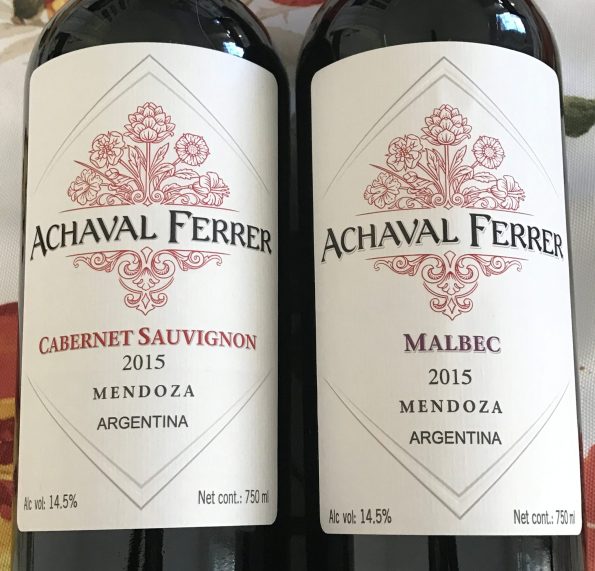
Here is what triggered my “precision of flavors” opening. I had an opportunity to taste a sample of Achaval-Ferrer wines recently, Cabernet Sauvignon and Malbec. While Malbec was a very good wine, but clearly needed time to mature, Cabernet Sauvignon was stunning, with flavors and aromas just jumping at your right away from the glass, with easy to relate to, textbook-correct cassis – also intensifying its purity with the time. This was a perfect example of why Argentinian wines are so popular and deserving of all your attention. And at a price of $24.99, the Cabernet Sauvignon offer an outstanding QPR, easily beating many classic Napa Cabs which would also cost you at least three times as much.
Here are my detailed notes:
2015 Achaval-Ferrer Cabernet Sauvignon Mendoza Argentina (14.5% ABV, $24.99, 100% Cabernet Sauvignon)
C: dark garnet, almost black
N: very intense, dark roasted fruit, cassis. The roasted fruit intensity diminishes as the wine breathes.
P: beautiful cassis, clean acidity, soft tannins, lots of layers. As the wine breathes, the tannins show better and more pronounced. Pure clean black currant after a day.
V: 8+, outstanding, wow. Will evolve.
2015 Achaval-Ferrer Malbec Mendoza Argentina (14.5% ABV, $24.99, 100% Malbec)
C: practically black
N: roasted meat, smoke, tar, intense, baking spices
P: dark fruit, bright acidity, mint, alcohol burn in the back?, succulent, lavender, spicy. Blueberries showed up on the second day.
V: 8, needs time, but perfectly delicious on the second day.
Here you are, my friends. Achaval-Ferrer definitely makes wines worthy of oenophile’s attention – and the QPR makes these wines worth seeking. Cheers!
Daily Glass: Will It Merlot?
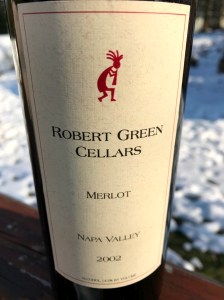 Yes, the title of this post is a play on the theme of some of the Good Mythical Morning episodes, where Rhett and Link are trying to figure out how far they can take the usual food items in the unusual directions, calling those episodes “Will It …” (if you are not watching the show, you really should, here is the link for you). But this is where the connection with the popular show ends.
And yes, we are talking about Merlot. But that also not very important, as the bottle was not opened just because I wanted to drink Merlot.
The vintage was the culprit – 2002 – as this is the year when my youngest daughter was born. And as I’m sure many of you, oenophiles, out there do, I love opening proper vintages to celebrate birthdays.
So the question was whether this 2002 Robert Green Cellars Merlot Napa Valley (14% ABV) would be still drinkable in 2017.
I presented this question to a few of the twitter winos, and the consensus was cautiously optimistic, presuming the wine was properly stored (the bottle actually never left wine fridge from the moment it got into the house). Wine Spectator rated 2002 Napa vintage at 89, and “Drink Recommendation” column had gloomy “Past peak” reference. I wanted to learn a bit more about the wine from the producer’s website, but the link on the back label was non-functional, and google didn’t offer much help searching for “Robert Green Cellars”.
Done with theoretical research – the proof is in the pudding wine glass anyway. The cork pulled out in a perfect condition. The wine is in the glass, and the first whiff had nice fruit in it, but the wine tasted a bit off. But – never judge the wine by the first sip, right? This rule is very important when it comes to the young wine, but this is even more important when it comes to the aged wines. 10 minutes in the glass brought this wine together – a perfect core of the dark fruit, maybe a touch of black currant, mint, firm structure, definitely a nice glass of wine.
About an hour and a half after the bottle was opened, it opened up even more, but somewhere in the distance, more on the finish than anything else, tertiary aromas started to appear – this is when I tweeted to the same group that the wine was perfect but at its peak. Another 30 minutes later, the wine started closing back, but only in a good sense – acidity came to the forefront, fresh young black and red fruit came to dominance – I was clearly looking at a young and delicious wine, not more than 3-4 years of age. Then, of course, the bottle was empty.


This was definitely a fun bottle of wine, with the self-attached “first world problems” – would the wine be still good or not. Believe it or not, but there was even the next level of fun associated with that wine. The little pictogram of the flute player, known as Kokopelli, which you see on the front label and the cork itself, most often is associated with fertility. What I didn’t know that Kokopelli also can be credited with the arrival of the spring. I have other 2002 bottles but somehow decided to open this particular one on the second official day of Spiring (the Spring in the USA started on March 20th). Oh well, as I said before, first world problems.
I think this wine Merlot perfectly, and I can only wish you same success and fun with your older bottles. I also want to leave you with the text from the back label of this bottle, as I think it perfectly finishes this post:
“The Joy Bringer” “This flute playing character is often credited with bringing the change of winter to spring, melting the snow and bringing about rain for a successful harvest. He is believed to represent the fertility of the untamed spirit of nature. Perhaps this joyful traveller’s greatest lesson is showing us that we shouldn’t take life so seriously. We hope the spirit of Kokopelli shines through in our wine and that it brings you as much joy and pleasure as it was for us to make. Enjoy the moment. Robert and Sue.”
Restaurant Files: The Art of Southern Cuisine at Peaches in Norwalk, CT
 Let me make a bold claim – Southern Cuisine might be the only authentic cuisine in the United States. Yes, New England got lobster and clam chowder, Maryland got blue crab and crab cakes, but it hardly constitutes a “cuisine”. Even barbeque is more of a cult or a culture if you will, but more often than not, the word “barbeque” would simply associate with the specific method of cooking rather than a cuisine in general.
Say “Southern cuisine”, and immediately the words and images for “shrimp and grits”, “chicken and waffles”, or ‘fried green tomatoes” pop in one’s head. Same as Thai, Japanese, or Mexican, Southern cuisine is something we can easily identify with.
While the Southern cuisine is, of course, better experienced in the South, over the last few years we were lucky here on the East Coast of the USA with a number of restaurants representing the cuisine very well. Today I want to offer you a perfect example – Peaches Restaurant in Norwalk, Connecticut, officially known as Peaches Southern Pub & Juke Joint. Peaches is the newest endeavor of the serial entrepreneur Greer Frederick, who is deeply involved in Connecticut restaurant scene for many years.
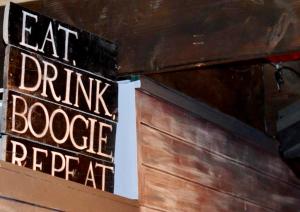
I love the rustic decor at Peaches, very homey and calming, but very modern at the same time:


Of course the restaurant visit started at the bar. Spicy Okratini (Oola Aloo Vodka, dirty okra juice, pickled okra) had a nice bite and literally no sweetness, which I really appreciate. Bee’s Knees (Bar Hill gin, fresh lemon, Mad Hatter honey) was made with an artisan Mad Hatter honey, which we also had an opportunity to taste. Again, despite the honey base, the cocktal was perfectly balanced with right amount of acidity and sweetness. Peaches’ Old Fashion (Rittenhouse Rye, Damerara sugar, Angostura bitters, Fee Brothers Peach bitters), was very tasty, but also a bit too generous with alcohol.


Once we got to our tables, the little bowl with various pickles was the very first plate arriving in front of us – not overly sour, quite tasty. Then our first appetizer showed up – Devilled Eggs (beet brined eggs, braised bacon, pickled okra). Definitely a very creative dish, an unexpected color of the eggs, nice touch with the bacon crumble on top, creamy. Devilled eggs are very popular in Russian cuisine, so I’m more accustomed to a different style, but this was still a tasty dish.


The Chopped Kale (charred corn, pickled beets, green goddess dressing, cotija cheese) was one of the best kale salads I ever had. Additional of charred corn worked very well, and creamy dressing was outstanding, very flavorful. The Fried Green Tomatoes (tomato jam, country ham, buttermilk ranch), a timeless Southern classic was excellent as well – great interplay of textures, and I would eat that tomato jam by the bowlful. Our last appetizer, the Country Fair Bacon (funnel cake batter, braised bacon, black pepper maple) was good, but maybe a bit too simple to my taste.


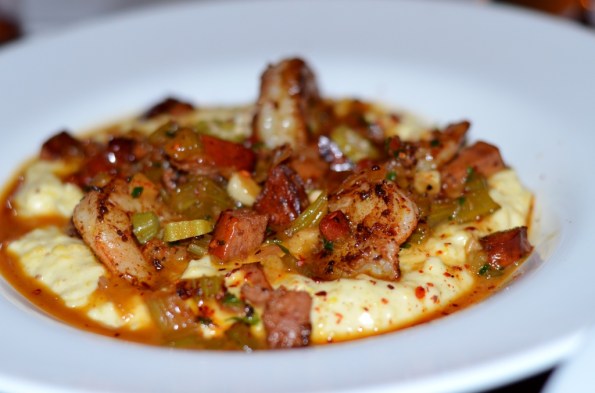
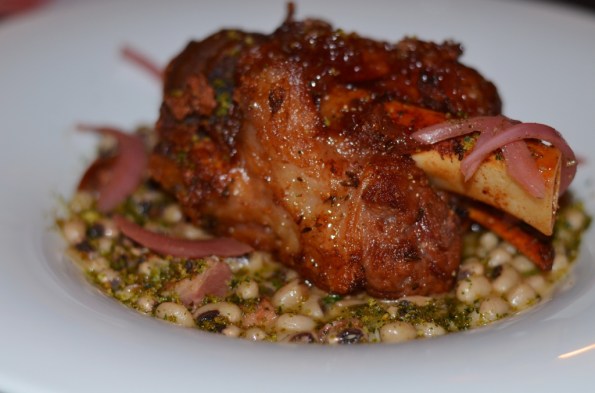
We started our entree round with another Southern classic – Shrimp and Grits (andouille, smoked shrimp broth, pickled okra, heirloom grits) – the grits were creamy and super-flavorful, one of the best ever, and the shrimp had a perfect amount of spice and cooked very well – that was one delicious experience. The Pork Shank (black eyed peas cassoulet, pickled veg, onion jam) was a standout. It was a huge hulk of meat on the bone, marinated for 36 hours and cooked at 275F for 3.5 hours – I can’t even describe how comforting this dish was. The meat was falling apart, and all you needed to do was just to savor ever little bite. Outstanding.
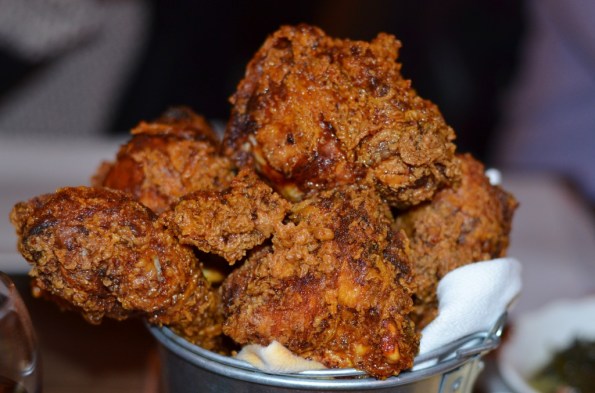
And then there was Bucket O’ Chicken (pickle-brined fried chicken + Nashville style cornbread, coleslaw, collard greens, mac ‘n’ cheese). Do you like properly made Southern style fried chicken? Then get away from the screen and head over to the Peaches right now – that dish was a quintessential Art of Southern Cuisine right on the table. We had both regular and Nashville Hot style – in both cases chicken is brined before cooking, but the Nashville Hot style has the addition of a hot sauce (smoked paprika, brown sugar, cayenne, oil) brushed on after the chicken is fried. It was also served with lots of different side dishes – cole slaw, collard greens, mac ‘n’ cheese and delicious corn bread – every bite of chicken was tender and bristling with flavor. It was also served with apple cider vinegar on a side, which, as Greer explained, is considered a Ketchup of the South. Great experience all in all.


Peaches is not called the “Pub and Juke Joint” for nothing. The restaurant has a second floor with another bar, perfectly suitable for dancing or as an event space, as well as an outdoor patio – definitely the space with a lot of potential.


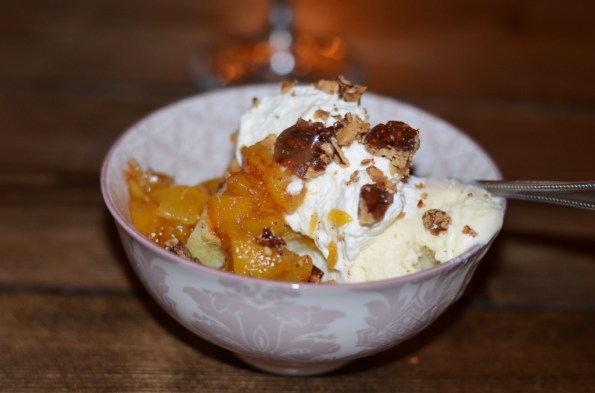
We finished this outstanding meal in style with Old Fashioned Southern Peach Cobbler (brown sugar peaches, vanilla ice cream) – delicious dessert, candied pecans packed a lot of flavor.
 I hope that the pictures and my notes explain my point about the Art of Southern Cuisine – this was truly a soulful cooking, and we experienced the tasty food with unmistakable personality – like the familiar face we are always happy to see in the crowd, the Southern Cuisine is something we can now spot anywhere we go.
Hope I didn’t make you too hungry. And if I did – oh well, I’m not going to apologise. Cheers!
Peaches Southern Pub & Juke Joint
7 Wall St
Norwalk, CT 06850
Phone number (203) 831-0399
http://www.peachesnorwalk.com
Last Bottle Sign Up ($10 credit)




 Talk-A-Vino