Archive
An Evening of Pure Pleasure
Do you know what makes an oenophile’s heart melt and pound, what fills it with joy? Hearing their friends say after you pour the wine into their glasses
“Oh my god, this is so good!”
This brings a double pleasure – it is not only you now getting the pleasure from the aroma and the bouquet – but your friends also enjoying it as much as you do. Wine is meant for sharing, and this makes sharing so much more enjoyable…
Wine can never be taken for granted. Let’s remember that the wine continues changing even after bottling – each time we open the bottle, we find the content of the bottle in its unique state. Yes, we can hope that if you open all 12 bottles from the case at the same time, all wines will taste the same – but it is still a game of probabilities, with opportunities for the “bottle variation” to be increasingly more noticeable as the wine ages. And I’m not even talking about potential wine faults…
Next, there are expectations. Expectations are a big deal for the oenophile. Just one look at the bottle and an oenophile forms expectations – bottle appearance, place, producer, type of wine, vintage – everything is taken into account, and we know what to expect. It is the most joyous moment when the liquid in the glass meets expectations – and the most daunting when it does not (let’s not get to the corner case of Two Bucks Chuck, please). But there is more to the expectations in wine. One of the biggest challenges with wine expectations lies in the fact that it doesn’t matter how much you like the wine and how well your great expectations are met – everyone’s palate is different. It is hard learning to be okay with the fact that while you enjoy the wine immensely, your friend doesn’t care for it. It doesn’t make the wine bad. It doesn’t mean that you are wrong or did anything wrong. It simply means that taste is personal, you just need to learn to accept this simple fact of life – and not get upset.
You might wonder why I am talking about all this wine geek mumbo jumbo, why is that important? Simple. No matter how familiar you are with the wine you are pouring, or how many times you have had the wine from the same vintage and producer, when the wine reaches the glass, it is always the moment of revelation. Double that (triple? quadruple?) when you are poring wine for your friends. And even if you think that wine is perfectly perfect, you can never assume your friends will think the same. Wine can never be taken for granted.
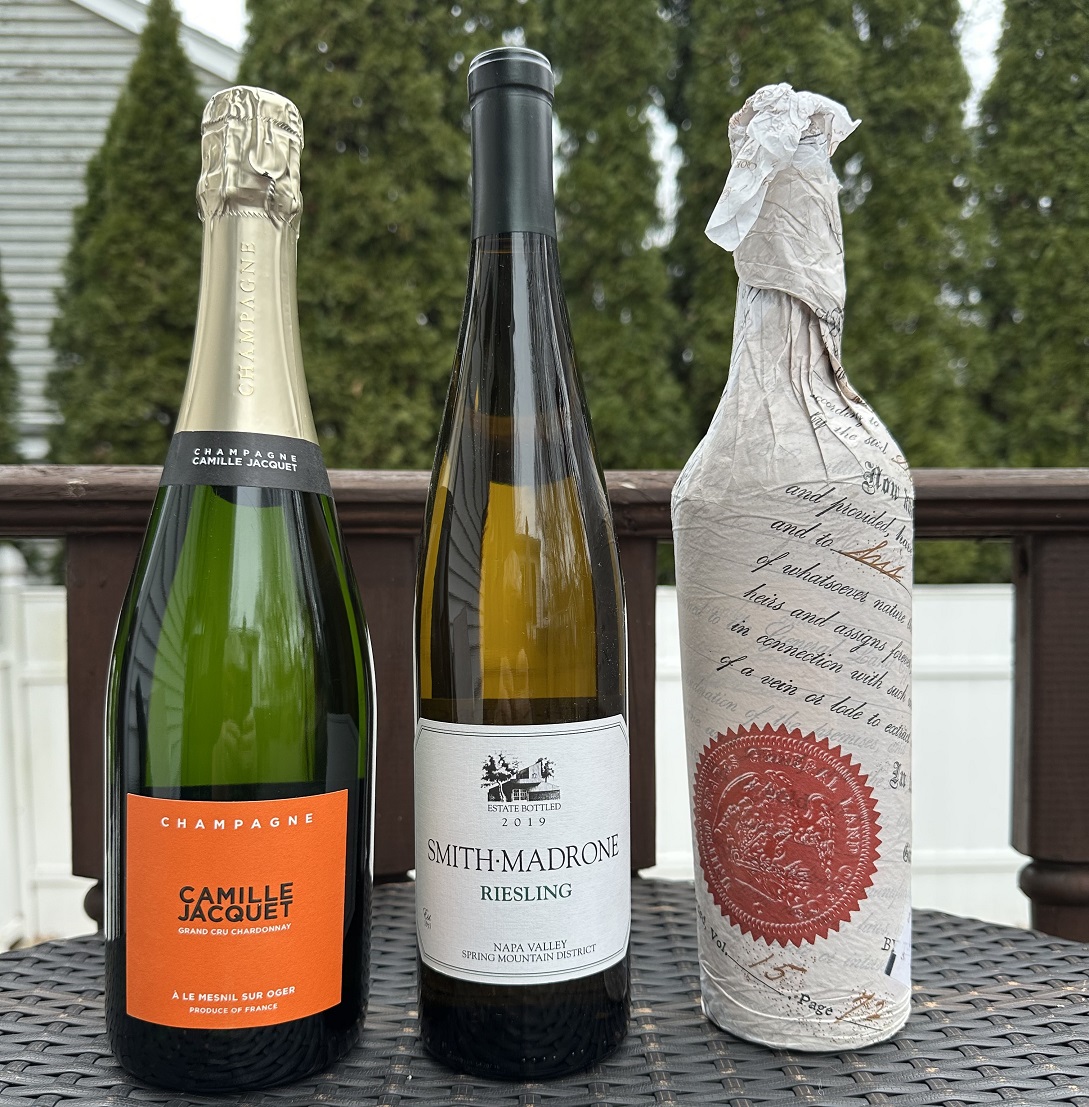 I guess I got lucky. At last weekend’s evening with our dear friends, I managed to hit a double “trifecta” :). Three delicious wines out of three, and my friends loved all three to the “oh my god, this is so good!” moment.
First wine – NV Champagne Camille Jacquet Brut Grand Cru Chardonnay A Le Mesnil-sur-Oger (12% ABV). I do not know the producer, but I had high expectations for this wine possibly for a silly reason. A small village Le Mesnil-sur-Oger is well known for the quality of its Chardonnay vineyards and a home to some of the best (if not the best ) Blanc de Blancs Champagnes in the world – Salon le Mesnil and Krug Clos du Mesnil. Knowing that Camille Jacquet Champagne comes from basically the same vineyard gave me high hopes (silly, as I said) for this Champagne. And my high expectations were perfectly met. Beautiful nose of toasted bread with a touch of apple, impeccably crisp, fresh and precise on the palate. The acidity was fully in check with the complexity of the toasted, baked goods on the palate, leading to an impeccable (yes, I know I already used that word) balance. “Oh my god, this is so good!” said my friends, and the wine disappeared in a jiffy.
Next, two beautiful wines from one of my favorite producers ever. Over the years, I wrote about Smith-Madrone wines extensively. Cooks’s Flat had been one of the Talk-a-Vino Top 10 Wines of the Year 2019 top wines (that year, I had 3 #1 wines, tell me about my inability to make decisions), and Smith-Madrone Cabernet Sauvignon was #3 on the Talk-a-Vino Top 23 of 2023. So I was very happy that I got the samples of Riesling and Cook’s Flat and was able to share both wines with my friends (I will also taste a nice vertical of Smith-Madrone Riesling, it will take a central stage on these pages soon).
Smith-Madrone Riesling is one of my favorite Rieslings in the world – it is one of the 3 if you are interested – Grosset Polish Hill Claire Valley Australia, Smith-Madrone from Napa Valley, and Brooks Ara from Oregon. This 2019 Smith-Madrone Riesling Spring Mountain District Napa Valley (13.3# ABV) was spectacular. First, it offered a tremendous pop of petrol on the nose – and nothing makes my Riesling lover’s heart happier than these petrol aromatics, coupled with a whiff of honeysuckle. On the palate, it was fresh, energetic, with a wide range of citrus flavors readily present, from Meyer lemon to oranges and mandarines, supported by clean acidity and a perfectly cleansing acidic finish. Delicious, and the second “oh my god, this is so good!” wine.


Finally, the 2018 Smith-Madrone Cook’s Flat Reserve Spring Mountain District Napa Valley (14.2% ABV, 87% Cabernet Sauvignon, 13% Cabernet Franc, 20 months in new French Oak). This wine is designated as “Reserve” and this is not random – it represents the best of the best Smith-Madrone makes, using the best plots, best grapes, and produced only in the best years. This wine also has a historical connection to the parcel of land where Smith-Madrone vineyards where replanted in 1972 – the tissue wrapping the Cook’s Flat bottle is a copy of a land grant document, signed by the President of the United States. Here is the description from the Smith-Madrone website:
“Cook’s Flat Reserve is a proprietary name for a wine that is the culmination of our 50 years of growing grapes and making wine in the mountains of the Spring Mountain District. The name refers to George Cook, the first owner of the property. ‘Cook’s Flat’ was the local oldtimers’ name for the eight-acre plateau-like vineyard block which was replanted in 1972.
The packaging expresses the property’s history and an uncompromising attention to detail. Each bottle is numbered and only around one thousand bottles are produced in each vintage. Each bottle is wrapped in tissue which has been printed with a multi-colored copy of the U.S. Land Office Patent which granted ownership to George Cook and was signed by President Chester Arthur on December 5, 1885. We proudly display the original at the winery.”
What I love about Smith-Madrone wines is textbook precision. So far literally everything I tasted from the winery had this textbook precision of flavor – Riesling is unmistakably Riesling, Chardonnay is unmistakably Chardonnay, Cabernet Sauvignon is unmistakably Cabernet Sauvignon.
This 2018 Cook’s Flat, a blend of Cabernet Sauvignon and Cabernet Franc, was also unmistakably a Cabernet. A core of black currant, a.k.a. cassis, and eucalyptus, supported by sweet tobacco and sweet oak, with a whiff of the bell pepper (love it). On the palate, the textbook flavors continued with succulent cassis, eucalyptus, a touch of mint and bell peppers, firm structure, perfectly integrated and perfectly present tannins, impeccable balance. Just a pure joy. “Oh my god, this is so good!” wine again disappeared in no time, with the last drops almost squeezed out of the bottle.
Here you are, my friends. An evening of pure pleasure – and a happy oenophile who managed to make his friends “oh my god, this is so good!” happy.
I have more happy stories to tell – stay tuned…
Celebrate Riesling!
I have to admit, I’m missing most of the grape holidays lately. While checking the Twitter feed today, I was surprised to find out that today we celebrate International Riesling Day. Considering the fact that I never wrote a post about Riesling Day, I couldn’t resist an opportunity to reminisce about my Riesling experiences.
Riesling is one of the 3 main white grape varieties – Chardonnay, Sauvignon Blanc, and Riesling. Of course, there are lots more white grape varieties in the world, but in terms of plantings and production volumes, these three grapes are way ahead of all other white grapes. However, despite the “main variety” consideration, Riesling’s position in the wine world is rather peculiar.
Riesling is capable of a full range of expressions, from bone dry and acidic Rieslings of the Clare Valley in Australia to the dense and viscous late harvest Rieslings made in different parts of the world. Germany, which has about 38% of all Riesling plantings in the world, is typically associated with Riesling – however, there is hardly a wine-producing region in the world where Riesling wines are not made – Germany, Austria, Alsace, Australia, New Zealand, Canada, California, Washington, Oregon, New York – Riesling is literally produced everywhere. And yet walk into any wine store of your choosing – Riesling is typically relegated to the far corner of the store which almost nobody would visit. You can barely find any Riesling on the restaurant’s wine lists. And many consumers are often shy about their love for Riesling as it is almost shameful to be seen with a glass of Riesling in public.
I don’t fully understand the cause of this phenomenon. Germany’s overcomplicated labeling laws might play a role. The fact that it is very difficult to assess the level of sweetness of a bottle of Riesling also plays a role – put a few of the Kabinett Rieslings in the row and see how different the sweetness levels will be where you expect them all to be about the same.
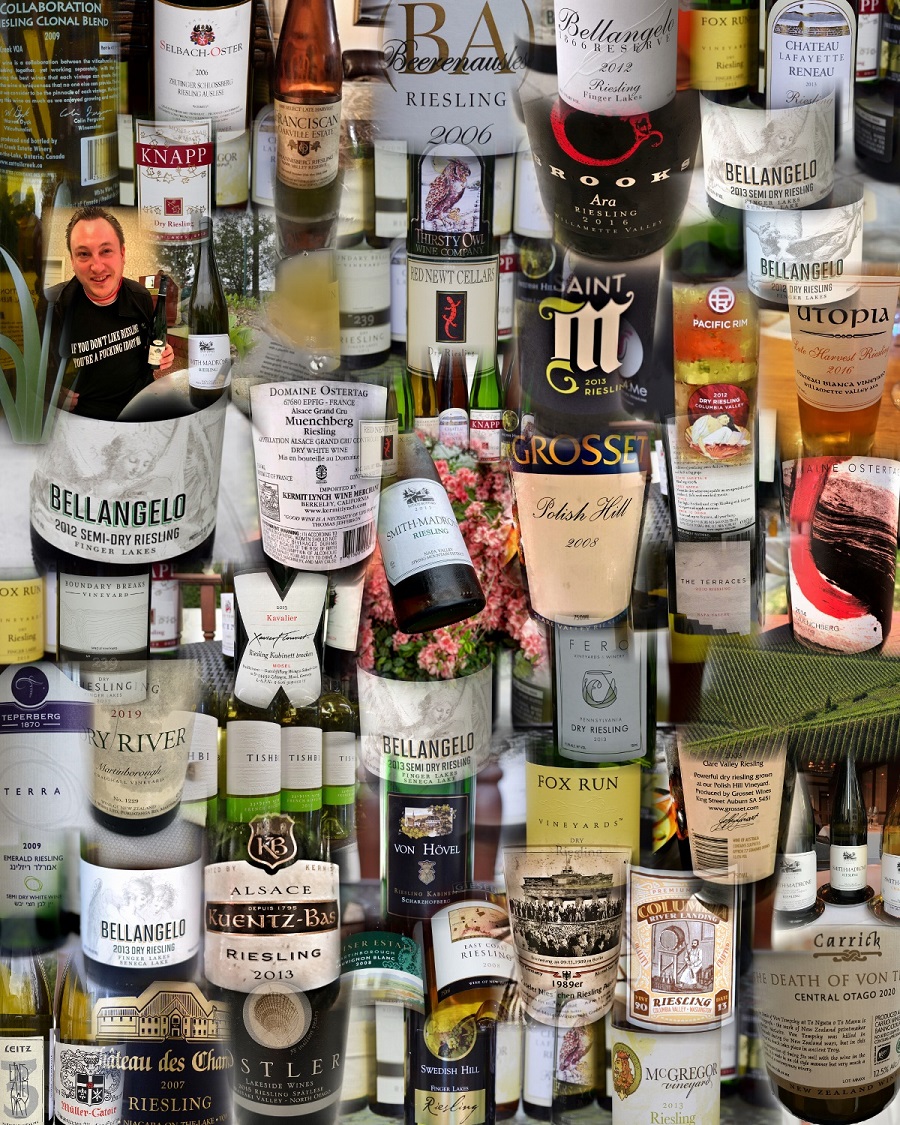 But those of us who trust our own palate and are not afraid of being seen with a glass of Riesling in our hand are typically in for a treat. The everpresent hint of honey, maybe pears, white flowers, and honeysuckle, supported by the cleansing acidity, and hopefully my favorite, a hint of petrol make these wines an absolute delight in my book. Most of the Rieslings also age very well – to understand the pleasure of the 20-30 years old Riesling you simply need to taste one for yourself – the words are very limited in describing the pleasure.
Over the years, I had plenty of delicious Rieslings. And yet if you would ask about the most memorable ones, I would easily give you 3. First, Brooks Ara Riesling from Oregon, which I tasted during a few of the Wine Bloggers Conferences – a pure standout. My next choice would be Smith-Madrone Riesling, which is rather surprising coming from Spring Mountain District in Napa Valley in California – nobody would ever associate California with Riesling, and yet you have a live, delicious proof.
And then, of course, there are Clare Valley Rieslings from Australia. Grosset Polish Hill Riesling from Clare Valley might be a quintessential pleasure, with its high energy, brilliant acidity, intertwined with the fruit – another wine that needs to be tasted to believe it.
I have come across many other excellent renditions of Riesling, but the three I just mentioned are definitely my personal standouts.
What do you think of Rieslings? Do you have your favorite Rieslings which you care to share with everyone?
Happy Reisling Day!
Thanksgiving with Smith-Madrone, And a Few More Delights
Holidays are all about pleasure. The pleasure of the company. The pleasure of food. The pleasure of wine. As the very least, they should be.
Let me tell you about the pleasures of my recent Thanksgiving – in one picture:

If this would be an Instagram, I could end my post here, but in this blog, I can add a few words, right?
Let’s talk about the wine first. Everyone has their ideas as what is the best Thanksgiving wine. Some talk about how difficult it is to pair any wine with the Thanksgiving table, due to the large variety of dishes and often prevalent sweet flavors (this is not universal, of course). I have a very simplistic view of the wine and food pairing – give me tasty food and good wine, and if they don’t work together – no problems, I’m happy to consume them one by one. Difficult or not, pairing is not the focal point of my Thanksgiving wine selection. I really have only one strong preference for the Thanksgiving wines – they should be all American. Thanksgiving we celebrate here in the USA is all about this country, and so the wine should match that. And thinking about American wines, you understand how easy it is nowadays to have all-American wine experience.
How many of you heard of Napa Valley? Okay, I see that look, this was a stupid question, I know. But let me go on. How many of you heard of Spring Mountain District? Okay, I see your facial expression changing to say “hmmm, I’m not so sure”. And the last question – how many of you heard of Smith-Madrone? Okay, don’t feel too bad, at the end of the day it is one of the about 400 wineries located in the Napa Valley, so of course, one can’t know all of them. But – this is why I’m talking about it – this is the winery you might want to get better acquainted with.
Smith-Madrone is one of the oldest wineries in Napa Valley, started by brothers Stuart and Charles Smith in 1971. Smith-Madrone property is about 200 acres, with some parts of the vineyards planted more than 100 years ago, all located near the top of the Spring Mountain in Napa Valley. The name Smith-Madrone combines the family name with the name of the evergreen Madrone trees, prominently growing at the property. Well, instead of me trying to regurgitate the past and present of the Smith-Madrone winery, let me direct you to this article – it is a good story, well worth a few minutes of your time.

When was the last time you had Napa Valley Riesling? If you answered “never”, it could’ve been my answer too – until I discovered this Smith-Madrone Riesling. Riesling is simply not a common grape for the Napa Valley, but Smith-Madrone produces the absolutely beautiful rendition of the famous grape. It might be due to the mountain fruit – all the Smith-Madrone vineyards located at the altitude of 1300 to 2000 feet, with slopes reaching 34%. Sustainable dry farming and winemaking practices also play a role, but one way or the other, the 2015 Smith-Madrone Riesling Spring Mountain District Napa Valley (12.9% ABV, $32) was just delicious. varietally correct both on the nose (honeysuckle, a touch of tropical fruit, lemon, apples) and the palate, which was beautifully balanced with golden delicious apples, a touch of honey and acidity. To make me ultra-happy, the Riesling is sported a distant hint of petrol, which is my pet peeve.
2015 Smith-Madrone Chardonnay Spring Mountain District Napa Valley (14.4% ABV, $40, 10 months in French oak) was equally beautiful. Again, the wines of that styling I call in my book “classic”. A touch of vanilla and apples on the nose, a distant hint of butter, continuing with the same vanilla and white apples on the palate. Clean acidity, noticeable minerally undertones, restrained, balanced – a very classic example of “how to do chardonnay right”.
With the risk of sounding very boring and repetitive, I have one more classic wine for you – 2014 Smith-Madrone Cabernet Sauvignon Spring Mountain District Napa Valley (13.9% ABV, $52, 85% Cabernet Sauvignon, 8% Cabernet Franc, 7% Merlot, 70% new French oak, 30% one-year-old French oak for 18 months). How classic was this wine? Bordeaux-classic. The mountain fruit was shining, showing great restraint. This was not an exuberant typical Napa Cab – lean, tight, well-structured, with cassis both on the nose and the palate, the wine was very enjoyable now, and it will be equally or more enjoyable in 30 years.
So that was my main wine story on the Thanksgiving day. The rest was about the food – starting the smoker as 9 am in the 21°F weather (about -6°C), and then watching the turkey slowly getting to the right temperature. The silver lining of that cold weather was the fact that instead of 4-4.5 hours in the smoker, it took about 6 hours to get that big bird to the right doneness – and slower cooking results in more tender and more flavorful meat. A glass of Smith-Madrone Riesling was adding to the cooking enjoyment.


After celebrating Thanksgiving at our house, we went to see our close friends in Boston. What I love about that house is that there are always a few of the older wine bottles laying somewhere on the shelf. You never know what you will find in the older bottle, but that is what makes it fun, isn’t it?


The first bottle I opened was 2007 Tishbi Cabernet-Petite Sirah Shomron Israel (12% ABV, 70% Cabernet Sauvignon, 30% Petite Sirah). Judging by the pronounced brickish, almost orange, color, my first thought was “this probably fully turned”. And it was not! Complex nose of dried fruit and herbs was supported by plums and prunes forward, but balanced palate. Good amount of acidity, tertiary aromas – this was a very enjoyable glass of wine. Only one glass, I have to say – by the time I wanted the second, the wine was gone.
Without much thinking, I pulled another wine, realizing later that I opened another wine from the same vintage – 2007 Marani Kondoli Vineyards Saperavi-Merlot Kakheti Georgia (13.5% ABV). This wine couldn’t be more different from the previous 2007 – dark garnet color, not a sign of any aging, tight, fresh, blackberries and blueberries on the nose and the palate, firm, fresh and young. I’m really curious about how much longer this wine could’ve last.
One last wine to mention – 2010 Massandra White Muscat Crimea Ukraine (16% ABV). Massandra winery roots go back to the old Tsar’s Russia in late 1800, but their cellars hold wines from the 18th century (if you are not familiar with Massandra wines, here is an article by Jancis Robinson). Massandra is best known for sweet fortified Muscat wines, like the one we tasted. To me, this 2010 was most reminiscent of a Sherry, and not necessarily an ultra-balanced one. But then the same Jancis Robinson’s article says that Massandra wines require 45-60 for the full maturity, so I guess the wine tasted within the expectations…
Spring Mountain District in Napa Valley, Israel, Georgia, and Ukraine – not a bad wine play for the holiday, what do you say?
Here you go, my friends. I will leave you with some beautiful wines to look for. And how was your Thanksgiving, if you still remember it? Cheers!
Last Bottle Sign Up ($10 credit)




 Talk-A-Vino