Archive
Stories and Passion and Pinot: Shane Moore of Gran Moraine
“Gran Moraine prides itself on producing experiential art in the form of Chardonnay, Pinot Noir and sparkling wines made to express the exquisite terroir of our Yamhill-Carlton Estate Vineyards.”
Experiential Art.
Not a bad way to introduce the winery, what do you think? Wine is art, all wine lovers can sign under such a statement, so “experiential art” sounds very near and dear to any wine lover’s heart.

Gran Moraine vineyard was planted in 2004 by Premier Pacific Vineyards in the Yamhill-Carlton district of Willamette Valley in Oregon, with 200 acres of hillside vines of Pinot Noir and Chardonnay. The vineyard took its name from moraines, glacial sediment left after the glacier movements in the last ice age. In 2013, the Gran Moraine Vineyard was acquired by Jackson Family and it is one of the 4 major properties owned by the Jackson Family in Oregon Willamette Valley.
I visited Gran Moraine last August and had an opportunity to taste a number of the wines and have a quick chat with the winemaker, Shane Moore. Then I followed up with the usual, virtual “conversation” and here is what transpired:
[TaV]: Was there a pivotal wine in your life?
{SM]: I’ve had plenty of wines that have possibly changed my life’s trajectory. However, I feel like the most pivotal wines in my existence have been those that seem to stop time. These wines provide my most fond wine moments and provide me with the most inspiration.
[TaV]: Is there a winemaker you would call your mentor? Someone you learned the most from as a winemaker?
[SM]: I think if I gave any specific shoutouts I’d be doing a disservice to so many of the amazingly talented and thoughtful winemakers I have had the pleasure to have worked with. Over my time I worked with and under at least 40 winemakers – I for sure learned a great deal from all of them. Another great group I both learned a lot and derived much inspiration from are the seasonal cellar workers we hire each year. With that I’m proud to say many have went on to become winemakers themselves.
[TaV]: Pinot Noir and Chardonnay wines are all about blocks and clones. How many clones of Pinot Noir and how many clones of Chardonnay do you grow? How many individual blocks do you identify for the Pinot Noir and Chardonnay?
[SM]: At the Gran Moraine Vineyard, there are 6 different clones of Pinot Noir and only 2 of Chardonnay. Every block is harvested and vinified separately. At any given time, there are around 100-120 different lots of wines. There are approximately 80 blocks – I don’t bring them all in – it’s too big of a vineyard for that – I bring in what I think of as around the top 30% of the acres.
[TaV]: Following up on the previous question – what is your approach to the blending of the final wines, both Pinot Noir and Chardonnay? Do you ever produce single block or single clone wines, and if you don’t do it now, do you have a plan to start producing such wines in the future?
[SM]: Blending final wines starts with having an abstract notion of the experience which you would like to have said “wine endue.” Then you purposely work within the parameters of the vineyard, the growing season and your production capabilities to craft something with that end goal in mind.
We will sometimes produce single clone or block wines when the wine is so profound that it would be a disservice to humanity to blend it away.
[TaV]: You already produce a few of the sparkling wines. What is your approach to harvesting the grapes for those wines – do you have specific plots which you designate for sparkling wines, or do you take an early pass through the vineyard prior to general harvest to get the grapes for the sparkling wine production?
[SM]: You know when you eat something so acidic that it makes your ears ring? I like to pick the fruit for sparkling wine when it’s just a little riper than that. We use specific blocks for the sparkling wine that are purposely farmed. Generally, these blocks are some of the most marginal sites on the vineyard; for example, north facing and heavier soils.
[TaV]: How much focus the sparkling wines program gets at Gran Moraine? Do you expect to produce more sparkling wines in the future, or you expect to stay at the level where you are at?
[SM]: Sparkling wine is currently about 15% of our production. I can see it growing some, it seems to be very popular.
[TaV]: Gran Moraine is a ~200 acres vineyard. If I understand it correctly, it is all planted with Pinot Noir and Chardonnay. Do you plan to plant any other grapes – Pinot Gris, for example, or will it stay strictly as it is right now?
[SM]: The suitable acres on the piece of land are pretty much planted out. I don’t think we’ll be grafting any of the Chardonnay or Pinot Noir over to anything else anytime soon.
[TaV]: When you make Gran Moraine Chardonnay, is there a specific style you are trying to achieve?
[SM]: I want the Chardonnay to have umami, electricity and tension. Of course, I also want it to be delicious.
[TaV]: Same question for the Gran Moraine Pinot Noir?
[SM]: With the Pinot I try to focus on it being beautiful and sleek creating power and complexity daftly by DJing with great music and surrounding it with happy people.
[TaV]: What are your favorite producers in Oregon? In the USA? In the world?
[SM]: Oregon: Adelsheim, Antica Terra, Antiquim Farm, Alexana, Belle Ponte, Brickhouse, Beaux Freres, Bethel Heights…..that’s just getting to the B’s! Too many really to mention – I’m always trading wine with people. I’m totally in love with Oregon wine.
USA: I’d have to go to CA and say some of my favorites there are Ridge, Drew, Papapietro Perry, Navarro, Hartford.
[TaV]: Is there a winemaker you would love to work with? A dream winemaker so to speak?
[SM]: Jean-Herve and Laurent Chiquet of Jacquesson. I hope they are listening. I’ve got ideas.
[TaV]: What’s ahead for Gran Moraine? Where do you see it in 10 years?
[SM]: We’ll probably be doing the same thing but hopefully with even more intention and weirder.
[TaV]: Is there a dream wine you always wanted to make? What would that be?
[SM]: A great New World Nebbiolo.


Here are the tasting notes for a few of the Gran Moraine wines I had an opportunity to taste during the visit:
Gran Moraine Brut Rosé Sparkling Wine Yamhill-Carlton (58% Pinot Noir, 41% Chardonnay, 6% Pinot Meunier)
Toasted notes on the nose
toasted bread, a touch of yeast, good acidity, crisp, clean
8, delicious
2018 Gran Moraine Chardonnay Yamhill-Carlton
A touch of honey notes, vanilla
Good acidity, good acidity, needs time
7+
2018 Gran Moraine Pinot Noir Estate
Brilliant fresh cherry notes, sage
Crisp, restrained, tart cherries and earthy notes, fresh tannins
7+
2017 Gran Moraine Upland Pinot Noir
Restrained nose, a touch of funk, cherries
Light palate, fresh, bright, cherries and cranberries
8-
Here you go, my friends. Another winery, another story of Passion and Pinot. Until the next time – cheers!
This post is a part of the Stories of Passion and Pinot series – click the link for more stories…
Stories of Passion and Pinot, Year 2019
Back in 2014, during the Wine Bloggers Conference in Santa Barbara (my first WBC), I was listening to the panel discussion of the professional wine writers, who basically had only one message for all the bloggers – interviews, interviews, interviews. Of course, they were talking about integrity, writing skills and other important subjects, but the concept of “interview” was brought up multiple times, with all the explanations how to do it properly, what, why, where and so on.
At that point, I had been writing my blog for about 5 years, and the idea of the interview didn’t resonate. “I want to write about the wine, not about some conversations and other people opinions” was my prevailing thought. “Interviews? I don’t want to do no interviews” (use of broken English intended).
You don’t need to fast forward too far to see how everything changed. Next year, I was offered a meeting with a winemaker which I couldn’t attend, so I said “all right – can we have a virtual conversation?” – and the concept of “One of One With Winemaker” posts was born. Since then, I’ve done quite a few interviews, most of them virtual and a few are in person – if you are curious, here is the link for you to see them all. Yes, the “virtual” concept might be limiting, as you can’t explore an interesting angle which would come up in the conversation. However, as most of my questions are unique and specifically tailored for a particular conversation, virtual interviews remove intimidation, allowing people time to provide the best answers.

In 2016, I had a conversation with Carl Giavanti, who asked if I would be interested to create a series of interviews with Oregonian winemakers – and that became the beginning of the Stories of Passion and Pinot series, all connected under the “One on One” umbrella. In 2016, I had an opportunity to “talk” to Ken Wright of Ken Wright Cellars, David Nemarnik of Alloro Vineyard, Mike Bayliss of Ghost Hill Cellars, Wayne Bailey of Youngberg Hill Vineyards, Steve Lutz of Lenné Estate, and Don Hagge of Vidon Vineyard. In the same series, Knudsen Vineyards was profiled in 2017, and last year I had a conversion with Tony Rynders of Tendril Cellars. All of these wineries are from Oregon, and all of them share a common passion for the Pinot Noir, one of the most finicky grapes out there.
You probably guessed that I’m not writing this post just to give you a retrospective into the Talk-a-Vino interviews. Yes, I’m writing it to tell you that the Stories of Passion and Pinot will continue in 2019, again with the help of Carl Giavanti. The wineries we will look at in the near future are:
By the way, do you know what “Bells Up” means? Well, if you do – great, if you don’t – you will learn all about it soon.
To be continued…
Stories of Passion and Pinot: David Nemarnik of Alloro Vineyard
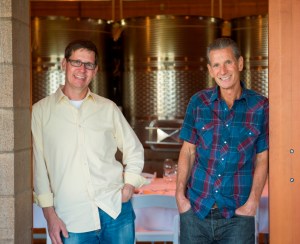
David Nemarnik and Tom Fitzpatrick. Source: Alloro Vineyard
Let’s say you are looking for the site to plant the vineyard of your dreams. After many years of research, you finally find what you were looking for – it should be perfect. And so the site you find is located on Laurel Ridge, and it has Laurelwood soils. Now assume you have an Italian heritage: how would you call your vineyard? What do you think of “Alloro Vineyard”? Alloro is an Italian for “laurel”, so it makes perfect sense, doesn’t it?
For sure it did for David Nemarnik, who was born into a Croatian – Italian family, and he was the one who started looking for the good vineyard site in Oregon in the late 1980s and finally purchased one in 1999 – and yes, named it Alloro Vineyard. First Pinot Noir vines were planted in 1999, and the first vintage was 2002. In addition to the Pinot Noir, the varietal line-up today also includes Chardonnay and Riesling.
Alloro Vineyard is a lot more than just a vineyard. Actually, the vineyard occupies only 33 acres out of the 80 acres estate, and the whole estate is a full-blown farm, with cattle, sheep, chicken, and gardens. Altogether, it became a holistic habitat, were growing grapes and making wines is simply part of the lifestyle, perfectly attuned to David’s family traditions. The vineyard is sustainably farmed, L.I.V.E. certified sustainable and certified Salmon-Safe. To top that off, David installed solar panels on the property, and now generates 100% of the electricity he needs for all the operations.
I had an opportunity to [yes, virtually] sit down with David and ask him a few questions, and here is what transpired from our conversation:
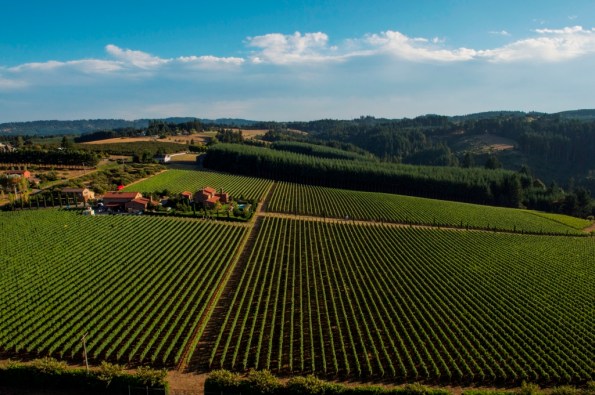
Alloro Winery, Chehalem Mountain AVA, Willamette Valley, Oregon. Source: Alloro Vineyard
TaV: Having Italian roots and memories of winemaking in Italy, have you ever thought of planting some of the Italian varietals? Moreover, Croatia also offers some interesting and unique grapes – how about those?
DN: I grew up with an Italian-American mother and grandmother who were all about family meals, which also always included wine. Not the high-end stuff, we are talking Familia Cribari Red Table Wine. My father was Croatian and born just outside of Trieste Italy. Family visits to my father’s village impressed upon me a lifestyle of artisan food and wine production. There was the home-made prosciutto and sausage, farm raised grain for bread, corn for polenta, and of course wine and grappa.
I love Nebbiolo and the wonderful Barolo and Barbaresco wines of Piedmonte. If I were to plant an Italian varietal it would be Nebbiolo. I was recently in Piedmonte and observed the grapes were at about the same stage of development as our own Pinot Noir vineyard here in Oregon. It would be fun to put in an acre or two. Learning and trying new things is part of what keeps this winegrowing business fun!
TaV: Why Riesling? This is not a very common grape for Oregon – how did you decide to plant Riesling? In a blind tasting with German, Alsatian, Finger Lakes, and Australian Riesling, where do you think people would most likely place your Riesling?
DN: Years ago in the mid-nineties, I was making wine in my garage for family and friends. This was mostly Cabernet and Zinfandel. A friend of mine who was making wine in his apartment bedroom closet finally was given an ultimatum from his wife that led him to join me in my garage. He turned me on to Riesling. I really like Riesling’s versatility, dry, off-dry, and sweet. So it was natural to plant my own Riesling and make an estate wine.
TaV: Any expansion plans for the vineyards? Maybe some new grapes outside of Pinot Noir and Chardonnay?
DN: Well we recently planted a new 5 acre block that is mostly Chardonnay with the balance Pinot noir. I planted this on the east side of the road for a different exposure and aspect. We also have our Riesling and a small block of Muscat. So we currently have 33 acres planted out of 130 acres total. I’m sure at some point I’ll plant more grapes, perhaps that small block of Nebbiolo.
TaV: You produced your first vintage in 2002, so starting from that year, what was your most difficult vintage for Pinot Noir and why?
DN: The most difficult vintage for me was 2011. 2011 was the coolest year with the least amount of heat units since I started farming grapes in 1999. Bud break and bloom were 3-4 weeks later than our average year. We had a very cool summer and by early October we still had not fully completed veraison and were worried the fruit would not have time to ripen sufficiently. We did everything we could, thinned to one cluster, pulled leaves on both sides, and prayed. Thankfully we had an incredible October with dry and sunny weather. In the end, we made some really nice wine.
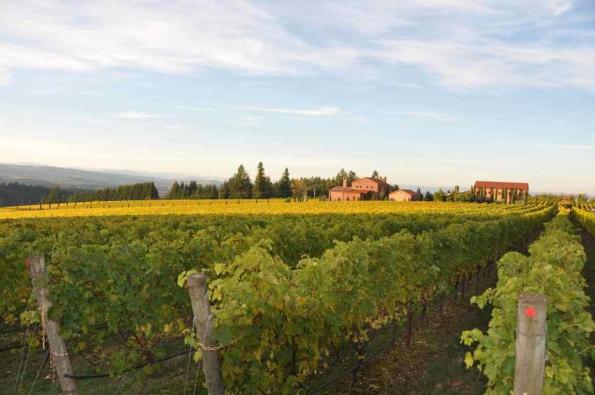
Source: Alloro Vineyard
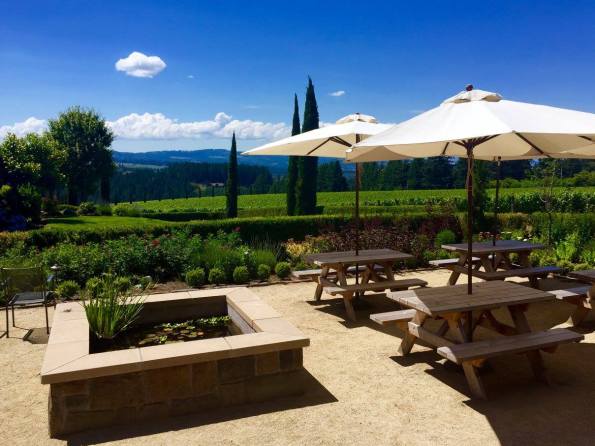
Terrazza view. Source: Alloro Vineyard
TaV: Continuing the previous question, what was your most favorite vintage and why
DN: My favorite vintage in the cellar is our 2010. What started off as a cool growing year transitioned to a mostly dry summer with mild temperatures leading to great conditions during that critical month of ripening prior to harvest. The wines are elegant and complex with a wonderful balance of red and dark fruit.
TaV: You operate not just a vineyard, but also a farm, a whole habitat with lots of things happening. I’m sure you had plenty of funny stories over the years – do you care to share some of them?
DN: Yes, Alloro is really a sustainable whole farm that includes raising hay for our cattle and sheep, as well as an extensive garden, hazelnuts, and numerous fruit trees. We compost manure from our cattle barn that is then spread on our fields as a natural fertilizer. We have a strong food culture that I would say is aligned with the Slow Food and Locavore folks.
One funny story has us picking strawberries in the garden. My chocolate lab named Abby disappears for a while and then returns with my neighbor’s Chinese runner duck in her mouth. The duck with its long neck sticking out of Abby’s mouth seems perfectly calm as she proudly brings me the duck. I carefully take the duck back to her owner’s pen…it never happened…
TaV: I’m assuming you produce your top of the line “Justina” Pinot Noir only in the best years – how many times have you produced it so far?
DN: Our Justina is a very special barrel selection. Although a blend of multiple barrels, it is a barrel equivalent (or 25 cases). Before any other barrel selections are made, we comb through every barrel looking for the very best of the vintage. Within the context of the vintage, our Justina has the most weight; the broadest, densest, finest, and most persistent texture; the most complex aromas; and typically a higher percentage of new oak. We have produced this wine every year since 2010.
TaV: You get all your power from solar energy. Was the winery designed like that from the very beginning, or did you install solar panels at some point later on?
DN: The winery was completed in time for our 2003 vintage. The solar panels were installed in 2008 as part of the Oregon Business Energy Tax System program. Our goal was to invest in a green sustainable energy source.
TaV: Which are more difficult to tend for – the vines or your farm animals?
DN: Oh, by FAR the vines!!
TaV: You produce White, Rosé, Red and Dessert wines. The only one which is missing is Sparkling wines. Any plans to produce your own sparkling wines?
DN: Possibly, if we were to add one new wine to our lineup, this would be it. We love bubbles!
TaV: When you are not drinking your own wines, what are your favorites from Oregon or around the world, both for whites and the reds?
DN: To be honest, I wish I spent more time visiting and tasting the many well-made wines produced here in our state. When I go to industry tastings I am always amazed at the overall quality. I am really excited about Oregon Chardonnay and what seems to be an explosion of well made sparkling wines. Outside of Oregon, I am a Barolo and Barbaresco fan.
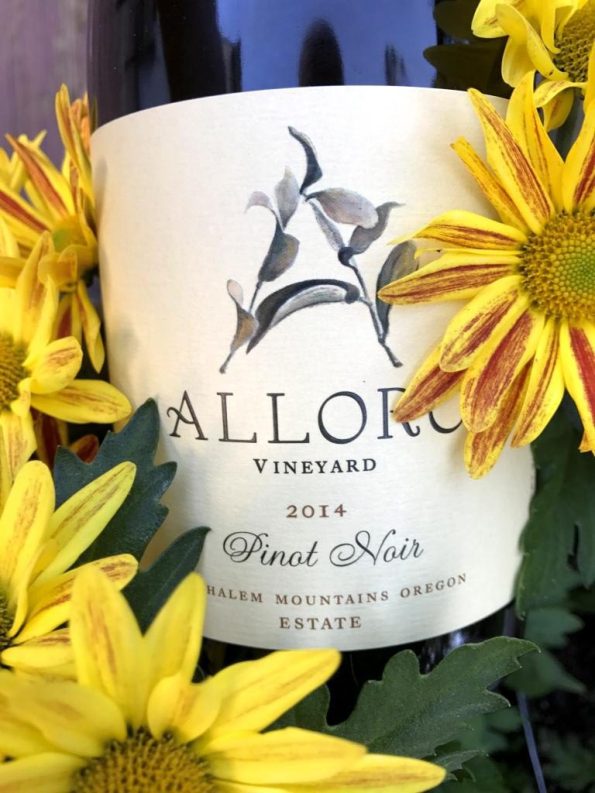
Of course, our conversation would be incomplete without tasting David’s wine. I had an opportunity to try his estate Pinot Noir and here are the notes:
2014 Alloro Vineyard Pinot Noir Estate Chehalem Mountains Oregon (14.1% ABV, $35)
C: Dark Ruby
N: earthy smoky plums with licorice, open, medium intensity
P: sweet red fruit, licorice, a touch of sage, espresso and mocha, excellent acidity, nice “meaty” undertones, medium long finish
V: 8, the wine has a lot of finesse, nice Burgundian style. Will evolve.

Source: Alloro Vineyard
Believe it or not, but our Passion and Pinot journey is almost over. 6 winemakers, 6 stories of Passion – and Pinot, of course. I’m not saying goodbye yet – Oregon is one of the hottest winemaking areas today in the USA, and with lots happening, I want to take another look at what we learned here and what might lay ahead. So I’m finishing the post with the rhetorical “stay tuned”… Is it Pinot time yet? Cheers!
To be continued…
P.S. This post is a part of the “Stories of Passion and Pinot” series <- click the link for more stories.
Last Bottle Sign Up ($10 credit)




 Talk-A-Vino