Archive
Understanding Ferguson
Do experiences have expiration dates? Of course not. As long as we learn something, the experience has its value – and thus it can be shared.
And so here I am, sharing another experience from 2 years ago. Yesterday, I was talking about the Sanford tasting which took place in June of 2019. Today, I’m sharing yet another experience from the same June of 2019. Just follow along, please.
I remember attending a trade tasting in New York, probably about 5 or 6 years ago. One of the wineries at that tasting was L’Ecole No 41, one of the best wineries in Walla Walla in Washington. The rep poured a taste for me and proudly said “this is Ferguson, our newest vineyard, and this wine is amazing, taste it”. I can still vividly remember the punch of tannins from the first sip and my very first thought “how is this amazing, I can’t taste anything here”.

L’Ecole No 41 needs no introduction to the wine lovers. The third winery in Walla Walla in Washington, founded by Jean and Baker Ferguson in 1983, one year before Walla Walla received an official AVA status. From the moment the winery was created, the focus was always on the Bordeaux varieties – Cabernet Sauvignon, Merlot, Cabernet Franc, Malbec, Petit Verdot.
Seven Hills Vineyard, 230 acres estate on the Oregon side of the appellation, is one of the oldest vineyards in Walla Walla, planted in 1980. L’Ecole No 41 manages Seven Hills Vineyard together with Pepper Bridge Winery and Leonetti Cellars, and it is a source of more than 1/3 of L’Ecole’s total red wine production.
The second vineyard, Pepper Bridge Vineyard, was planted in 1991 on the Washington side of Walla Walla. L’Ecole was the first winery to produce wines from the Pepper Bridge Vineyard.
In 2008, Ferguson Vineyard, named in honor of the founders of the winery, was planted on high elevation (1,350 ft – 1,450 ft) not far from the Seven Hills Vineyard, a thin layer of soil over the fractured basalt from 15-million-year-old lava flows. The vineyard now is 42 acres in size and the source of the latest additions to the L’Ecole portfolio – the one I was unable to appreciate during that trade tasting.


When I got the invite to attend L’Ecole No 41 tasting in New York at the Grapes and Grains restaurant, I got excited about the opportunity to have a deeper dive and learn more about L’Ecole No 41 wines.
What I learned from Constance Savage, General Manager of L’Ecole No 41 is that L’Ecole can be safely called a high mountain desert winery, with only 8” of precipitation per year. Irrigation is available, but very much controlled, forcing the vines to work hard.
The winemaking approach at the winery is very simple – let the terroir speak. Always do the same at the winery, and let Mother Nature to express itself. The winery is not trying to achieve persistent taste – and this can be easily seen in wines through the differences between the vintages. And this all works because the climate is very consistent.
We tasted through 4 sets of wines, each set containing 3 wines. Here is what I tasted with my notes.

The first set consisted of the 3 “classics” from the same 2008 vintage – Merlot, Cabernet Sauvignon, and Cabernet Franc. The wines were 11 years old when I tasted them, and still you can see that they were still showing substantial level tanning and potential to evolve for the next 10–20 years.
2008 L’Ecole no 41 Estate Merlot Seven Hills Vineyard Walla Walla Valley (14.5% ABV, 80% Merlot, 10% Cabernet Sauvignon, 10% Cabernet Franc, 18 months in small French oak barrels, 40% new)
Cherries, iodine, mint
Tart cherries, pepper, a touch of vanilla
8
2008 L’Ecole no 41 Estate Cabernet Franc Seven Hills Vineyard Walla Walla Valley (14.5% ABV, 100% Cabernet Franc, 22 months in small French oak barrels, 33% new, 198 cases produced)
Black currant, a touch of mocha
Tart, black currant, dry, very noticeable tannins
8, Block 8 Cabernet Franc is typically used for blending, except in the best years when enough grapes are harvested, so this wine was produced in 2006 and again in 2008.
2008 L’Ecole no 41 Estate Cabernet Sauvignon Seven Hills Vineyard Walla Walla Valley (14.5% ABV, 100% Cabernet Sauvignon, 22 months in small French oak barrels, 50% new, 188 cases produced)
Touch of sweet oak, black currant
Much more open than cab franc, but still tannins are present

The next set of wines was made with the fruit from Seven Hills Vineyard, and they all belonged to the series called Perigee – as a scientific term, Perigee is the closest point to the Earth in the Moon’s orbit. The focus of these wines is on the earthy characteristics of the Seven Hills Vineyard.
2006 L’Ecole no 41 Perigee Estate Seven Hills Vineyard Walla Walla Valley (14.4% ABV, 56% Cabernet Sauvignon, 34% Merlot, 10% Cabernet Franc, 22 months in small French oak barrels, 50% new)
Great complexity, plums, a touch of smoke and roasted meat, fresh onion peel (sorry about that)
Sweet plums, black currant, vanilla, good acidity, dry finish
8
2011 L’Ecole no 41 Perigee Estate Seven Hills Vineyard Walla Walla Valley (14.5% ABV, 60% Cabernet Sauvignon, 20% Merlot, 10% Cabernet Franc, 6% Malbec, 4% Petit Verdot, 22 months in small French oak barrels, 50% new)
Closed nose
The palate is raspberry driven, good acidity, good minerality
2016 L’Ecole no 41 Perigee Estate Seven Hills Vineyard Walla Walla Valley (14.5% ABV, 52% Cabernet Sauvignon, 21% Merlot, 11% Cabernet Franc, 9% Petit Verdot, 7% Malbec, 22 months in small French oak barrels, 40% new)
Fresh, bright, fresh leaves, freshly crushed berries
Vanilla, plums, mocha, young, big body, soft and velvety initially, with the tannins gripping mouth in the second wave
8
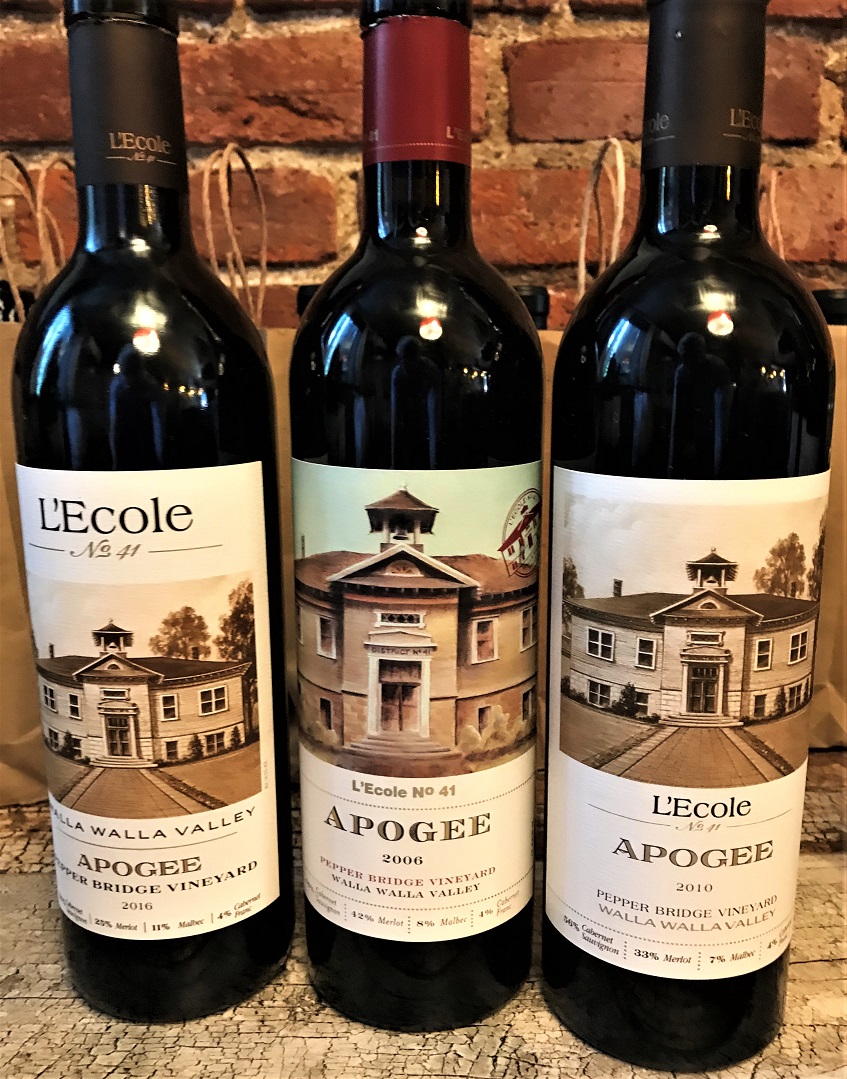
Next, we tasted the Apogee series of wines, sourced from the Pepper Bridge Vineyard. Apogee is the point in the orbit of the Moon when it has the greatest distance to Earth. The focus of these wines is to showcase the ultimate expression of the fruit.
2006 L’Ecole no 41 Apogee Estate Pepper Bridge Vineyard Walla Walla Valley (14.3% ABV, 46% Cabernet Sauvignon, 42% Merlot, 8% Malbec, 4% Cabernet Franc, 22 months in small French oak barrels, 50% new)
Touch of barnyard, intense, blackberries, minerality
Sapidity, onion jam, dark berries, baking spice, minerality,
8, wines are a lot more massive than previous ones
2010 L’Ecole no 41 Apogee Estate Pepper Bridge Vineyard Walla Walla Valley (14.5% ABV, 56% Cabernet Sauvignon, 33% Merlot, 7% Malbec, 4% Cabernet Franc, 22 months in small French oak barrels, 50% new)
Elegant, raspberries, fresh
Round, clean, well-structured tannins, delicious
9-
2016 L’Ecole no 41 Apogee Estate Pepper Bridge Vineyard Walla Walla Valley (14.5% ABV, 60% Cabernet Sauvignon, 25% Merlot, 11% Malbec, 4% Cabernet Franc, 22 months in small French oak barrels, 50% new)
Not ready – beautiful fruit and acidity, but tannins covering completely

And finally, the Ferguson. The vineyard built on top of the balsamic rock, so we should expect to see expressive minerality.
2011 L’Ecole no 41 Estate Ferguson Vineyard Walla Walla Valley (14.5% ABV, 57% Cabernet Sauvignon, 32% Merlot, 11% Cabernet Franc, 22 months in small French oak barrels, 50% new)
Smoke, gunflint, not a lot of fruit
Dark, powerful, perfectly structured, Bordeaux style, perfectly drinkable
9-
2016 L’Ecole no 41 Estate Ferguson Vineyard Walla Walla Valley (14.5% ABV, 62% Cabernet Sauvignon, 26% Merlot, 6% Malbec, 6% Cabernet Franc, 22 months in small French oak barrels, 50% new)
Young fruit, crunchy berries,
Killer tannins, lock your mouth
Not ready
2014 L’Ecole no 41 Cabernet Sauvignon Ferguson Vineyard Walla Walla Valley (14.5% ABV, 100% Cabernet Sauvignon, 22 months in small French oak barrels, 40% new)
Dark fruit, minerality
Touch of Black Currant, coffee, tannins are still overpowering, but you can taste the beauty of the wine. Needs at least another 10 years
8+
So what did I learn about Ferguson? These wines need time. And with time, they can be some of the best wines Washington has to offer.
As you can tell, 2011 Ferguson and 2010 Apogee were two of my most favorite wines, but really, give them time, and you will not go wrong with any of these wines. And it is interesting that all of the 2006 and 2008 can still enjoy more time in the cellar. For sure, L’Ecole makes some serious wines.
Do the experiences have expiration dates? Maybe only those which are not shared. Here, I did my part.
WBC18: Merlot Deep Dive with Masters of Merlot
I remember my first “deep dive” into the Washington wines at the Chateau Ste. Michelle winery a few years ago, where I was told about the power of Washington Merlot. The explanation was given on the example of a group visiting Chateau Ste. Michelle from California, who were complaining that Washington Cabernet Sauvignon was too soft and mild as opposed to the Cabernet Sauvignon from California. The group was offered to taste the Washington Merlot wines next, and this is where they found the right amount of “power” they were looking for (or maybe even a bit more).
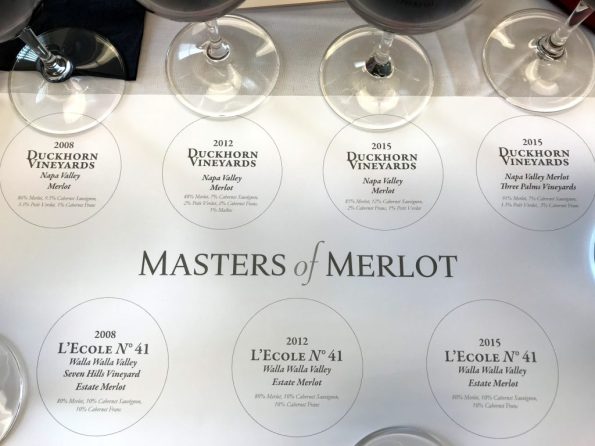
While attending Wine Bloggers Conference 2017, I was able to start the conference experience on a very high note with the deep dive pre-conference session on the California Cabernet Sauvignon, where we learned about one of the most classic California Cabs you can find – Beringer Cabernet Sauvignon. This year, at WBC18, we started on the equal, or maybe even higher note with the pre-conference session on Merlot. Very appropriately for being in Washington, and for the October being the #MerlotMe month, we were able not only taste a line of Merlot wines but to compare side by side the wines made by two of the Merlot pioneers and, unquestionably, the Masters – Duckhorn Vineyards from Napa Valley and L’Ecole No 41 from Walla Walla Valley.
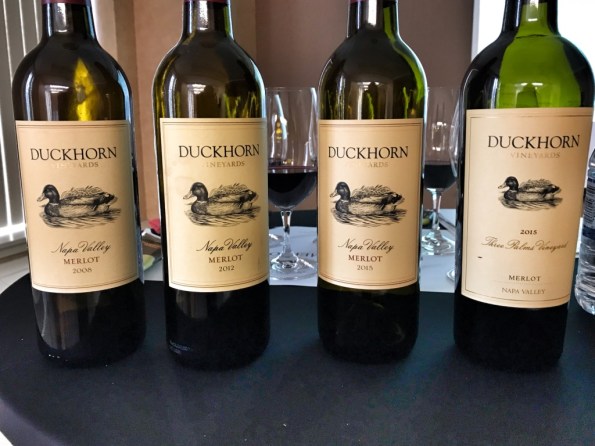
Dan and Margaret Duckhorn started Duckhorn Vineyards back in 1976, becoming one of the first 40 Napa Valley wineries. Even in those early days, it was clear that Cabernet Sauvignon was The Grape everybody wanted to work with. At that time, Dan and Margaret decided to proceed in their own way, and instead of joining the Cabernet Sauvignon movement, be unique and different and embrace the Merlot. Ever since their inaugural vintage in 1978, they never looked back and became known as Napa Valley Merlot pioneers and one of the best Merlot producers in the world, starting with their first release of Napa Valley Merlot in 1979. Today, Duckhorn Vineyards expanded dramatically and now comprise multiple wineries and brands around the USA – however, Merlot is the heart and soul of Duckhorn wines, and it is not surprising that 2014 Duckhorn Vineyards Three Palms Vineyard Merlot was the Wine Spectator’s 2017 Top 100 Wine of the Year.
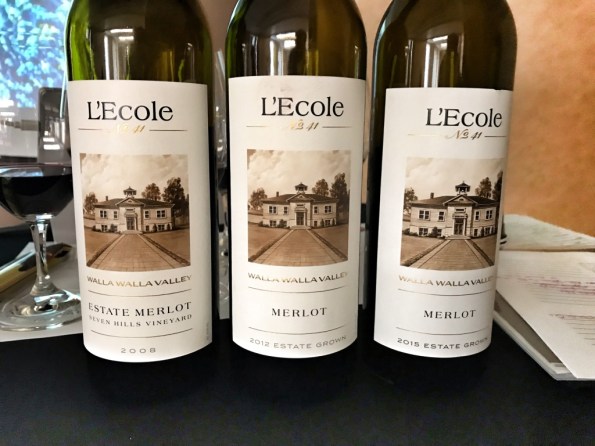
L’Ecole No 41 was founded by Baker and Jean Ferguson in 1983 when it became 3rd winery in Walla Walla, and 20th winery in the Washington state. Today the winery is run by the 3rd generation of the family, and sustainably farms estate Seven Hills and Ferguson vineyards. Merlot is the king in Washington, so it is not surprising that the L’Ecole crafts some of the best Merlot wines in Washington – however, their Cabernet Sauvignon, Syrah, and Bordeaux-style blends are equally world-famous.
Now that you know the bit of the history, let’s talk about our tasting. In our Masters of Merlot session, we had an opportunity to taste side by side Duckhorn Vineyards and L’Ecole No 41 Merlot from 2008, 2012 and 2015 vintages, plus a cherry on top (thank you, Duckhorn Vineyards) – 2015 Three Palms Merlot. Before I will leave you with the tasting notes for these beautiful Merlot wines, I just want to share some general observations. The three vintages of Duckhorn Merlot we were comparing had a different grape composition between the vintages while maintaining the same oak treatment for all the wines. As I mentioned in my summary post about WBC18 experiences, Washington weather is very consistent, so L’Ecole No 41 maintained the same grape percentages between the vintages and the same oak regimen – the changing parameters were only harvest dates and the vineyard source composition, which gradually shifted from solely a Seven Hills vineyard in 2008 to the 50/50 share between Seven Hills and Ferguson vineyards in 2015 (L’Ecole folks are ecstatic about the potential of the Ferguson Vineyard, now introducing more and more single vineyard wines from it).
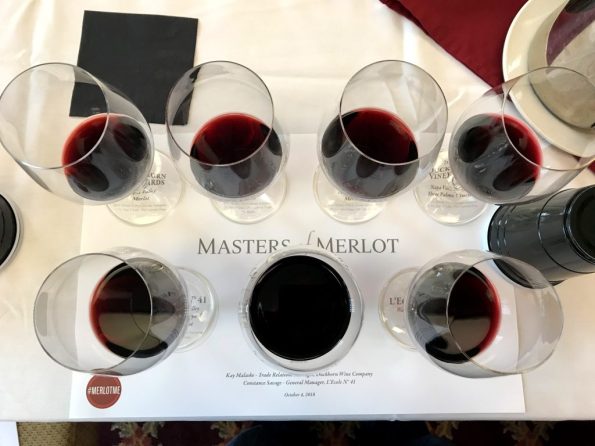
Now, it is (finally!) time to talk about the wines. Here we go, in the tasting order:
2008 L’Ecole No 41 Estate Merlot Seven Hills Vineyard Walla Walla Valley (14.5% ABV, $?, 80% Merlot, 10% Cabernet Sauvignon, 10% Cabernet Franc, 18 months in French oak)
Rutherford dust on the nose, chewy, dense, tart cherries, needs time! I want more fruit! Would love to try it in 5-8 years.
2008 Duckhorn Vineyards Merlot Napa Valley (14.5% ABV, $70, 86% Merlot, 9.5% Cabernet Sauvignon, 3.5% Petit Verdot, 1% Cabernet Franc, 16 months in French oak)
Raisins on the nose, very explicit, beautifully dry on the palate, sage, anise, tart, showed a bit of Rutherford dust after swirling, great acidity. Amarone! I want to drink it NOW!
2012 L’Ecole No 41 Estate Merlot Walla Walla Valley (14.5% ABV, $30, 80% Merlot, 10% Cabernet Sauvignon, 10% Cabernet Franc, 76% Seven Hills Vineyard, 24% Ferguson Vineyard, 18 months in French oak)
Espresso, Rutherford dust (a bit less explicit than 2008). More fruit on the palate, bright, beautiful.
2012 Duckhorn Vineyards Merlot Napa Valley (14.5% ABV, $65, 88% Merlot, 7% Cabernet Sauvignon, 2% Petit Verdot, 2% Cabernet Franc, 1% Malbec, 16 months in French oak)
Delicate, fresh plums, a touch of truffle notes, plums and lavender on the palate, delicate, fresh, round.
2015 L’Ecole No 41 Estate Merlot Walla Walla Valley (14.5% ABV, $36, 80% Merlot, 10% Cabernet Sauvignon, 10% Cabernet Franc, 50% Seven Hills Vineyard, 50% Ferguson Vineyard, 18 months in French oak)
Dark fruit, Rutherford dust, dark berries, a bit of bell pepper on the palate, plums, sapidity, interesting minerality. Needs time.
2015 Duckhorn Vineyards Merlot Napa Valley (14.5% ABV, $56, 85% Merlot, 12% Cabernet Sauvignon, 2% Cabernet Franc, 1% Petit Verdot, 16 months in French Oak)
Closed nose, a touch of mint, however – palate is beautifully ripe, open, clean, fresh fruit.
2015 Duckhorn Vineyards Merlot Three Palms Vineyard Napa Valley (14.7% ABV, $98, 91% Merlot, 7% Cabernet Sauvignon, 1.5% Petit Verdot, 0.5% Cabernet Franc, 18 months in French Oak)
Rich, opulent, caramel, anise, sage, on the palate coffee, ripe fruit, mocha, dark chocolate. Big and delicious.
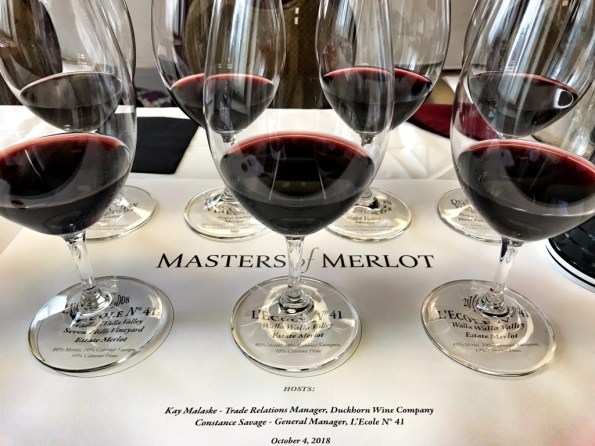
Were these wines similar, even between the different wineries? Of course. I love the presence of the Rutherford dust on many of the wines we tasted – after tasting best of the best in Rutherford in Napa Valley – the BV wines, I picked up that term and I always use it describe the perceived dusty impression of the wine’s aroma. L’Ecole Merlot was a lot more structured and minerally-driven. I would safely say that 2-3 hours in the decanter would help those wines a lot. The Duckhorn Merlot were a lot more fruit driven but offered an impeccable balance with that fruit. If I have to pick the favorite, it would be between 2008 Duckhorn (ahh, that Amarone-like beauty) and 2015 Duckhorn Three Palms, but there were really no bad wines in this tasting.
There you have it, my friends. Beautiful Merlot wines, easy to love and appreciate, and most importantly, offering lots of pleasure. How is your Merlot Me month going? What are your discoveries or the old favorites?
I have to say special thank you to Constance Savage of L’Ecole No 41 and Kay Malaske of Duckhorn Vineyards for offering this special tasting to the wine bloggers! Cheers!
Last Bottle Sign Up ($10 credit)




 Talk-A-Vino