Archive
Grape Holidays 2026
 I love grape holidays, I really do.
In theory.
And then I forget about them.
Next, I might occasionally see the grape holiday I already missed. Yes, grape holiday is not a New Year – you can celebrate it later, but still.
Last year, I shared the list of 2025 grape holidays in the hope that it would help me not to miss them. And yet I missed the absolute majority of them. I’m sure the story will repeat itself this year, but hey, let me at least share the list while most of the grape holidays are still ahead of us.
Here we go – grape holidays of 2026:
January 27, Tuesday – International Port Wine Day <– it’s today, by the way. Have a bottle of Port handy?
February 1, Sunday - International Furmint Day
February 16, Monday - International Syrah Day
February 28 – OTBN, Open That Bottle Night <– my favorite grape holiday
March 3, Tuesday - International Mulled Wine Day
March 13, Friday - International Riesling Day
March 21, Saturday - World Vermouth Day
April 14, Tuesday - Tannat Day
April 17, Friday - World Malbec Day
April 27, Monday - World Marselan Day
May 1, Friday - International Sauvignon Blanc Day. Celebrated on the first Friday of May
May 2, Saturday - International Baga Day. Celebrated every 1st Saturday of May.
May 9, Saturday - World Moscato Day
May 17, Sunday - Pinot Grigio Day
May 21, Thursday - International Chardonnay Day - Celebrated on the Thursday before Memorial Day (US) at the end of May
June 12, Friday - World Verdejo Day. Celebrated on the second Friday of June
June 13, Saturday – National Rosé Day
June 13, Saturday - Drink Chenin Blanc Day
June 21, Sunday - World Lambrusco Day
July 1, Wednesday – International Madeira Wine Day <– it is possible I just made that up, but hey, Madeira wine is well worth celebrating!
July 12, Sunday - International Cava Day
August 1, Saturday – World Albariño Day
August 13, Thursday - International Prosecco Day
August 18, Tuesday - International Pinot Noir Day
September 3, Thursday- International Cabernet Sauvignon Day – Celebrated on the first Thursday of September
September 4, Friday - National Chianti Day – Celebrated on the first Friday of September
September 10, Thursday - National Port Wine Day
September 18, Friday - International Grenache Day - Celebrated on the third Friday of September
October 5, Monday – World Vranec Day
October 6, Tuesday – Orange Wine Day
October 10, Saturday - International Pinotage Day – Celebrated on the second Saturday in October
October 14, Wednesday – Prokupac Day
October 23, Friday - World Champagne Day - Celebrated on the fourth Friday of October
October 26, Monday - International Mavrud Day
October 29, Thursday - International Carignan Day - Celebrated on the last Thursday in October
November 1, Sunday - International Xinomavro Day
November 7, Saturday - International Merlot Day
November 12, Thursday - International Tempranillo Day - Celebrated on the second Thursday of November
November 15, Sunday – Amphora Wine Day
November 19, Thursday - Beaujolais Nouveau Day - Celebrated on the third Thursday of November
November 24, Tuesday - International Carménère Day
December 1, Tuesday – International Maratheftiko Day
December 4, Friday - International Cabernet Franc Day
December 10, Thursday - World Aszú Day
December 16, Wednesday - Pinot Meunier Day
If you are one of the typical wine lovers, above you have a list of 45 days of the year (okay, 44) when you don’t need to bother yourself with the question “what do I want to drink tonight”. Here, the choice is made for you. No, don’t thank me, this is what wine friends are for.
In this whole list, there is one holiday I really don’t want to miss – the OTBN. Be forewarned – the holiday is only 4 weeks away. I don’t know about you, but my head is already spinning, going through “oh, not that… and not that one”.
Oh well. Whatever you choose to celebrate – happy grape holiday to you!
Celebrate Chardonnay! 2025 Edition
 Okay, I missed it again.
On Thursday, May 22, we celebrated Chardonnay Day. And I didn’t post about it.
Well, I didn’t entirely miss it. There was Charodnnay in my glass, so I only missed writing about it on time, but the celebration itself – yes, I participated.
Chardonnay is one of my favorite grapes. Well, those who know me understand that this is a difficult thing for me to say. I love wine in general, and therefore, I really don’t have grapes I don’t like. I might not be a fan of some producers, but grapes or varietal wines per se—I love them all. And yet, when it comes to favorite grapes, I have to shortlist Chardonnay among 20-30 ones I feel comfortable calling “favorites”.
Chardonnay is one of the most versatile grapes, perfectly capable of creating delicious wines from the bone-dry, unoaked versions to the full-on, hedonistic bombs. Chardonnay wines can be wonderful in still, sparkling, and even late harvest renditions, and they are produced literally everywhere – Asia, Middle East, Europe, North America, South America – see, I’m not even trying to be any more region specific, as it is pointless, or I would almost have to name every appellation in existence.
I also have another proof of the “favorite” status. In last year’s Chardonnay’s celebratory post, I counted the number of times Chardonnay wines were included in the Talk-a-Vino Top Wines of the year lists. During 14 years, there were only two years when Chardonnay wines were not present in the top two dozens, and a total of 19 Chardonnay wines were included in those top lists. Then, last year, 2024, the top wines list had 3 Chardonnay wines in it, including the 2024 wine of the year – an Italian Chardonnay from Banfi.
The pleasure of the well-made Chardonnay starts from the very first whiff from the glass. Vanilla, fresh apples, a touch of butter, and, if you are lucky, the honey. This is what makes me say “ahh” in the first place. And then, when vanilla, apples, butter, honey, smothered with a touch of lemon, continue in the first sip, this is where you say “oh my god…”. The key to this Chardonnay pleasure is in full harmony and balance of the flavors – if any of the components sticks out or is absent, this is where the pleasure instantly stops. Of course, the balance is a key element of any wine, but some of the wines can get away with too much acidity or too much oak and still give you pleasure, including a generic Chardonnay. But the harmony and balance are what differentiate a great Chardonnay from an average one.
I also love to use great Chardonnay as a reference point. For example, I compared my 2022 wine of the year, 2020 Abadia Retuerta L’Domaine from Ribera Del Duero, a Sauvignon Blanc-based blend, with Chablis. Chardonnay was also my analogy for the 2024 wine of the year, 2020 Mariasy Tokaji Furmint from Hungary, made from Furmint. And a few weeks ago, I had Grande Rocim White from Alentejo in Portugal (I have yet to write about it), made from 100% Portuguese native Arinto grape, which would successfully compete with Puligny-Montrachet I never had.


The wine I opened to celebrate Chardonnay Day was 2022 Maison Matisco Les Buis Saint-Véran AOC (13% ABV), one of my recent WTSO finds. The wine had a beautiful light golden color, and had a perfect Chardonnay profile as I described above – apples, vanilla, a distant hint of honey and butter (the last two might be just my imagination). The same profile continued on the palate, with the addition of the lemon. The wine initially had a slightly bitter aftertaste, which dissipated after a few hours. This wine will not make a list of great Chardonnays here at Talk-a-Vino, but I will be happy to open it any time I crave a Chard.
There, I told you my story. How did you celebrate Chardonnay Day?
Grape Holidays 2025
There are holidays, and then there are grape holidays.
Not that we need an extra reason to open a bottle of wine, but hey – life is worth celebrating, so if we don’t need a reason and nevertheless, we have a reason – there is nothing wrong with it, isn’t?
Every year, I celebrate a few of the grape holidays and miss most of them. For 2025, I decided to add the grape holidays list on this blog so there will always be an easy reference to the important events 🙂 Yes, I’m well aware that 1/3 of the year 2025 is already gone, but still, here is the Grape Holidays list starting from the beginning of 2025, just for the sake of completeness:
February 1 - International Furmint Day
February 16 - International Syrah Day
March 3 - International Mulled Wine Day
March 13 - International Riesling Day
March 21 - World Vermouth Day
April 14 - Tannat Day
April 17 - World Malbec Day
April 27 - World Marselan Day
May 2 - International Sauvignon Blanc Day. Celebrated on the first Friday of May
May 3 - International Baga Day. Celebrated every 1st Saturday of May.
May 9 - World Moscato Day
May 17 - Pinot Grigio Day
May 22 - International Chardonnay Day - Celebrated on the Thursday before Memorial Day (US) at the end of May
June 13 - World Verdejo Day. Celebrated on the second Friday of June
June 14 - Drink Chenin Blanc Day
June 21 - World Lambrusco Day
July 12 - International Cava Day
August 1 – World Albariño Day
August 13 - International Prosecco Day
August 18 - International Pinot Noir Day
September 4- International Cabernet Sauvignon Day – Celebrated on the first Thursday of September
September 5 - National Chianti Day – Celebrated on the first Friday of September
September 10 - National Port Wine Day
September 19 - International Grenache Day - Celebrated on the third Friday of September
October 5 – World Vranec Day
October 6 – Orange Wine Day
October 11 - International Pinotage Day
October 14 – Prokupac Day
October 24 - World Champagne Day - Celebrated on the fourth Friday of October
October 26 - International Mavrud Day
October 30 - International Carignan Day - Celebrated on the last Thursday in October
November 1 - International Xinomavro Day
November 7 - International Merlot Day
November 13 - International Tempranillo Day - Celebrated on the second Thursday of November
November 15 – Amphora Wine Day
November 20 - Beaujolais Nouveau Day - Celebrated on the third Thursday of November
November 24 - International Carménère Day
December 1 – International Maratheftiko Day
December 4 - International Cabernet Franc Day
December 10 - World Aszú Day
December 16 - Pinot Meunier Day
Here you go, my friends. Now you know, and now you have to celebrate grape holidays or else.
And if I’m missing any of the grape holidays, please leave a comment so I can add them.
Next up – International Sauvignon Blanc celebration! Get ready!
Celebrate Malbec! 2025 Edition
Do you know what I enjoy almost as much as sharing wine? Sharing pictures!
Today is World Malbec Day, where we celebrate a French grape called Malbec, or rather, Cot in its native Cahors region, which became a real star in Argentina. As bold a statement as it would be, Malbec made a world star wine producer out of Argentina, and Argentina made Malbec a world star grape.
As I mentioned before, the main reason for this post is to share my updated picture collage of some of my Malbec experiences. Here we go:
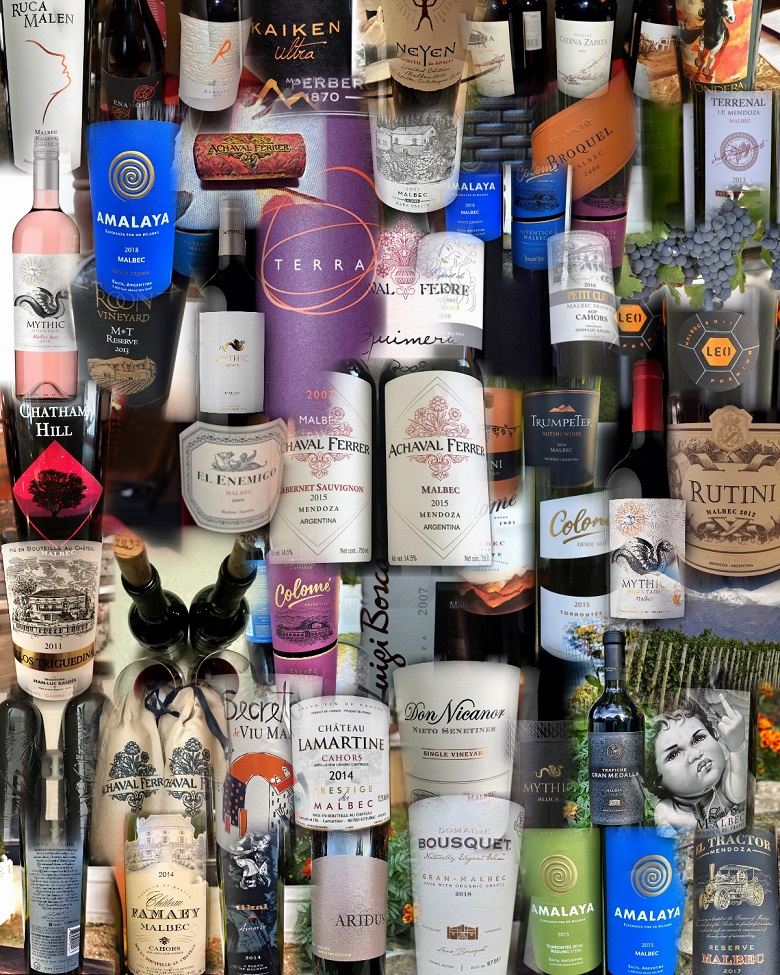
The last time I posted Malbec collage was 6 years ago, in 2019, you can find it here. Since then, in a true testament to the worldwide phenomenon of Malbec, I added a number of great Malbec experiences – organic Malbecs from Domain Bousquet in Argentina, a Little Fuck Malbec from Cahors in France, Flora Springs Ghost Winery Malbec from Napa Valley, Neyen Espíritu de Apalta Malbec from Chile, another Malbec from Argentina, Mythic, and I’m sure many more that I don’t even remember. Good Malbec is delicious, and we can leave it at that.
Don’t forget to celebrate Malbec. Even if you miss this special celebration, any day is a good day to drink Malbec. Oh yes, and if you have a favorite Malbec (or five), please share it in the comments!
Until the next grape holiday – cheers!
Reminiscing About Chardonnay
It’s been two weeks since the Chardonnay Day (May 23rd). So far I missed all the grape holidays this year, so why bother bringing it up, right?
Well, there are a few reasons. First, after carefully checking the blog, I realized that I never wrote about Chardonnay Day, which is a pity, because…
And here is the next reason – Chardonnay is one of my most favorite grapes. Of course, as a wine lover, you can say that I share this sentiment about every grape. Somewhat true, and yet in my book Chardonnay is different than most other white grapes.
While considered to originate in France, Chardonnay today is growing everywhere. I’m not sure if there is any well-known winemaking country that doesn’t produce Chardonnay – France, Italy, Australia, New Zealand, USA (everywhere – New York, Pennsylvania, California, Washington, Oregon, Virginia, Texas…), Chile, Argentina, South Africa and literally everywhere else.
Chardonnay can be produced in all wine “forms” – still, sparkling, dessert. In still wines, Chardonnay is best known as a solo player, even though sometimes it can be added to the blend. In sparkling wines, Chardonnay can be used just by itself, producing Blanc de Blancs sparklers, but it also plays very well with others, such as Pinot Noir and Pinot Meunier in the case of classic French Champagne. But even in the still format, the range of Chardonnay’s expressions is endless, from steely, razor-sharp cut-through acidity in the young Chablis or some of the unoaked Chardonnay wines from the new world to the big, buttery, “love my every curve” wines that almost are not made anymore in California. And speaking about dessert, let’s not forget “stickies” from Australia.
Another important characteristic of Chardonnay – properly made wines can age. There are very few aging-capable white wines. Riesling probably holds a crown there, but anyone who tried well-aged Chablis or Burgundy knows the joy of the heavenly, honey-and-lemon liquid which forces you to meditate over a glass of wine, not just drink it.
To prove my “special affinity” to Chardonnay, I decided to enlist the help of my Top Wine of the Year lists. At the end of every year, I publish the list of the most memorable wines of the year – what can be a better proof of recognition? I analyzed all of the lists from 2010 to 2023 to see how often Chardonnay was included, and only in its pure form, not as a part of the blend – and it appears that Chardonnay wines were a part of the Top Wines lists in 12 out of 14 years. For comparison, my beloved Rioja only made it into the 8 Top lists out of 14.
For what it is worth, in addition to my favorite collage picture of the Chardonnay wine labels over the years, I’m including here the list of my favorite Chardonnays of all time. I’m sure there are other wonderful Chardonnay wines that simply didn’t make it to the top list, but the list of wines below is still well-representative, Let’s take a look, in chronological order:
2010, #11 – Cambria Bench Break Chardonnay 2006, Santa Maria
2011, #4 – 2009 Peter Michael “Belle Cote” Estate Chardonnay
2012, #13 – 2008 Kovacs Nimrod Battonage Chardonnay, Eger Winery, Hungary
2013, a double entry
#12 – 2008 Seresin Chardonnay Reserve Marlboro New Zealand
#2 – 2005 Frédéric Gueguen Chablis Les Grandes Vignes
2015, #14 – 2012 Marchesi de’ Frescobaldi Pomino Bianco Benefizio Riserva DOC
2016, again a double-entry
#17 – 2001 The Lucas Winery Chardonnay Lodi California
#9 – 2015 Vidon Vineyard Chardonnay Estate Chehalem Mountains, Oregon
2017, yet another double
#13 – 2012 Sandhi Chardonnay Santa Barbara County
#12 – 2016 Salabka LA COQUINE Chardonnay Praha Czech Republic
2018, #6 – 2015 Domaine Jean-Noel Gagnard Chassagne-Montrachet Blanc 1er Cru Les Caillerets
2019, a triple!
#17 – 2017 Oceano Chardonnay Spanish Springs Vineyard San Luis Obispo County
#16 – 1990 Dom Ruinart Ruinart Blanc de Blancs Champagne
#9 – 2005 Giulio Ferrari Riserva del Fondatory Metodo Classico Trento
2020, a double
#10 – 2016 Domaine Anderson Estate Chardonnay Anderson Valley California
#8 – 2018 Landmark Vineyards Overlook Chardonnay Sonoma County
2021, a double again
#9 – 2013 Lynmar Estate Chardonnay Russian River Valley
#4 – 2018 Le Cadeau Vineyard Chardonnay Willamette Valley
2023, #1 – 2021 Balverne Chardonnay Russian River Valley AVA
Just to give you another bit of information, among the 19 wines listed above (creme de la creme of Talk-a-Vino Chardonnay experiences) there are 2 sparkling wines, the rest are still wines from 7 different countries and winemaking regions – France, Italy, California, Oregon, New Zealand, Hungary, Czech Republic.
Here you are, my friends. I already feel better – two weeks later, but I acknowledged one of my most favorite grapes.
What are your most memorable Chardonnay wines?
Celebrate Tannat!
Yesterday, April 14th, Tannat Day was celebrated around the world.
Obviously, I’m late to the “Celebrate Tannat” party, so why even bother, right?
Tell me honestly – have you ever forgotten to wish a happy birthday to a friend on the actual birthday day, only to call the next day, apologize, and still wish a happy birthday? If you have never done that, you can probably skip this post altogether as “too late”. For those who had been in this movie once or twice, let’s still celebrate the Tannat grape.
Tannat is an interesting grape due to a number of reasons. First, this is one of the most tannic grapes out there, with one of the highest levels of phenolic compounds in seeds and skin (you can check this article if you would like to get some actual scientific data), competing for the leadership here with Sagrantino grapes from Umbria in Italy. Second, Tannat’s story is very similar to the story of its very close cousin, Malbec.
I’m not implying that Tannat and Malbec are genetically related. But they share similar lifecycle stories. Both grapes originate from the cradle of the French wine world, Southwest France, also known as Sud Ouest. Once upon a time, Malbec used to be the king of Cahors, and Tannat was ruling in Madiran. Both grapes managed to lose their crowns and were reincarnated in full glory in South America – Malbec found kingship in Argentina, and Tannat became an uncontested star of Uruguayan winemaking.
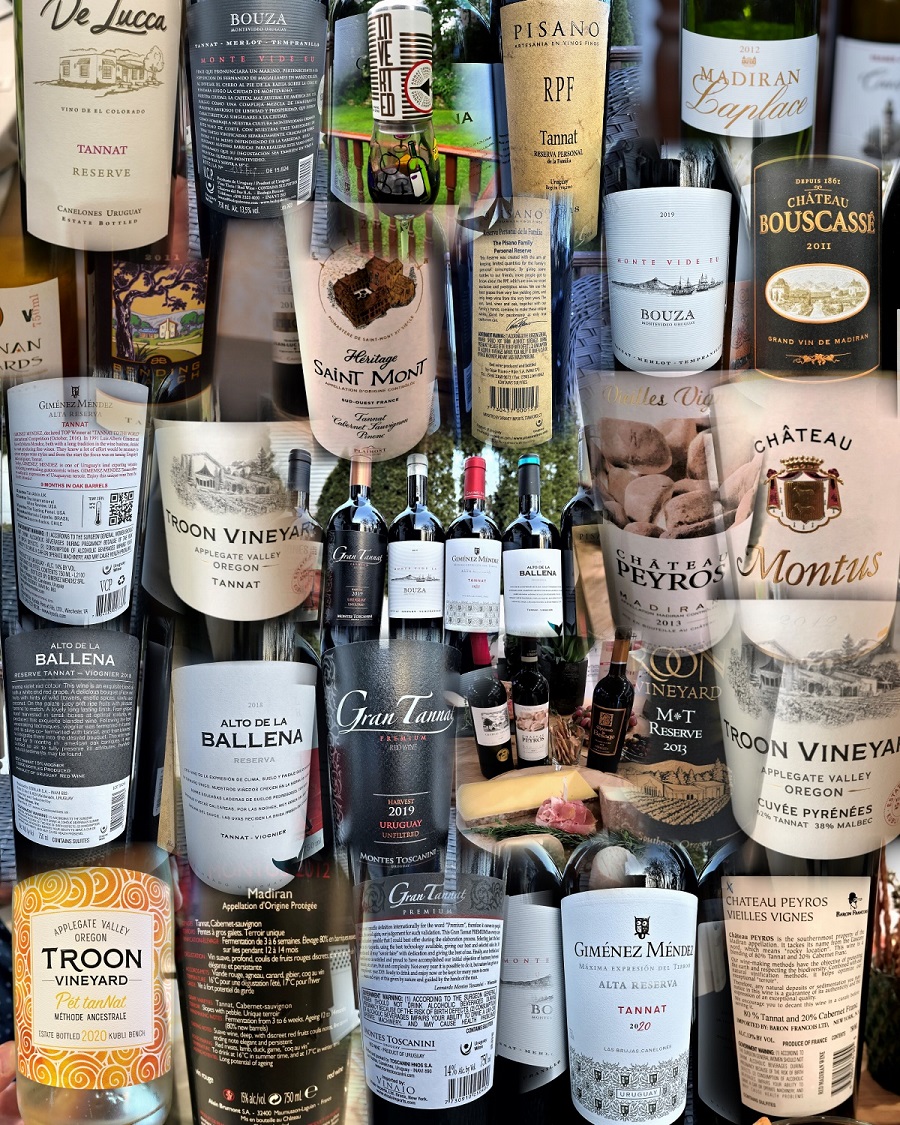
While Tannat found its new home in Uruguay, the grape is actually growing all around the world. But Uruguay is not just the new home. The interesting part about Tannat’s story in Uruguay is that the local winemakers found a way to tame its powerful tannins and acidity, and are able to produce delicious single-grape Tannat wines. However, Tannat can be found in Australia, Chile, Argentina, France, California, Oregon, Texas, and many other winemaking regions, where it is often used as a part of the blend.
While working on this post, I decided to check how often I mentioned Tannat one way or the other in my blog. From almost 1,500 posts, 34 posts contain the word “Tannat”. For comparison, 453 posts contain the words “Cabernet Sauvignon”, 13 times difference. However, just looking at the website word count, the word “Tannat” was mentioned in the blog about 700 times, and Cabernet Sauvignon about 2,500, less than 4 times difference.
Never mind the word count. As we said before, Tannat is the star of Uruguayan winemaking. Also, if you care to look for them, Madiran wines made somewhat of a comeback as of late, and Tannat is a major grape there. You can also find single-grape Tannat wines in Oregon, Texas, and Virginia. Speaking of Oregon, I have to mention the wines of Troon Vineyard. Craig Camp, the head winemaker at Troon, makes wonders with Tannat, from beautiful full-bodied organic reds to sparkling Tannat wines – Pet tanNat is definitely the wine to experience.
And then there is blending. If you would care to look at the list of grapes in the blend, lots of red wines from around the world have some amount of Tannat. Sometimes it is only 1% or 2%, but this might be enough to add acidity and tannins to the blend, to make the wine shine a little bit more.
Playing solo or in a minor supporting role, Tannat is well worth celebrating. Whether you celebrated Tannat yesterday or not, give this grape a chance – you might well like it in your glass.
Celebrate Pinot Noir!
Celebrate Pinot Noir!
Another grape holiday is upon us. This time we celebrate none less than Pinot Noir.
None less, huh? Is Pinot Noir so unique and special? Well, you be the judge.
Pinot Noir is the grape behind the world’s most expensive wines. While there are 10 or so major red grapes (Cabernet Sauvignon, Cabernet Franc, Merlot, Pinot Noir, Sangiovese, Tempranillo, Syrah, Grenache, Zinfandel, Nebbiolo), the ultimate supremacy crown can only be decided between Pinot Noir and Cabernet Sauvignon. Yes, it is bad to use money as a measure of influence, but it is one of the “objective” characteristics of wine in the free market. According to the Wine-Searcher lists of most expensive wines (by the way, there is a new feature on this blog – a new page Most Expensive Wines allows you to see always current list of most expensive wines for a select number of grapes and regions), red Burgundies (made out of 100% Pinot Noir) on average are 12 times (!) more expensive than Cabernet Sauvignon wines
Pinot Noir might be the most versatile red grape out there. Unlike most other red grapes, it produces a full range of wine styles. Let’s see.
White wine? Check. Pinot Noir Blanc is increasingly popular in Oregon and not only. Remember, the juice of Pinot Noir is clear, so it is not a problem to produce white Pinot Noir.
Sparkling wine? Triple check, I guess. Champagne Blanc de Noir is very often made from 100% Pinot Noir grapes and needs to introduction to wine lovers.
Rosé? Check. An increasingly popular addition to the repertoire of any Pinot Noir producer, in Oregon, California, and beyond.
Red wine? Well, duh. No check needed – first and foremost, Pinot Noir is a king of red wines.
Sweet/dessert? This is the only category that is still more an exception than the norm, but if you will look, you will have no problems finding late harvest Pinot Noir wines or Port-style Pinot Noir wines.
See – the whole range of wine styles. You can easily pair a whole dinner, from oysters to fish to steak and then dessert with Pinot Noir wines – try that with Cabernet.
One more unique fact about Pinot Noir is that it is practically never blended with any other grapes, with the exception of Champagne/sparkling wines. There can be lots of Pinot Noir clones mixed together – some of the producers grow 20 clones and more – but still, those are just clones. Of course, there are 100% Cabernet Sauvignon wines out there, but this is far from being the norm.
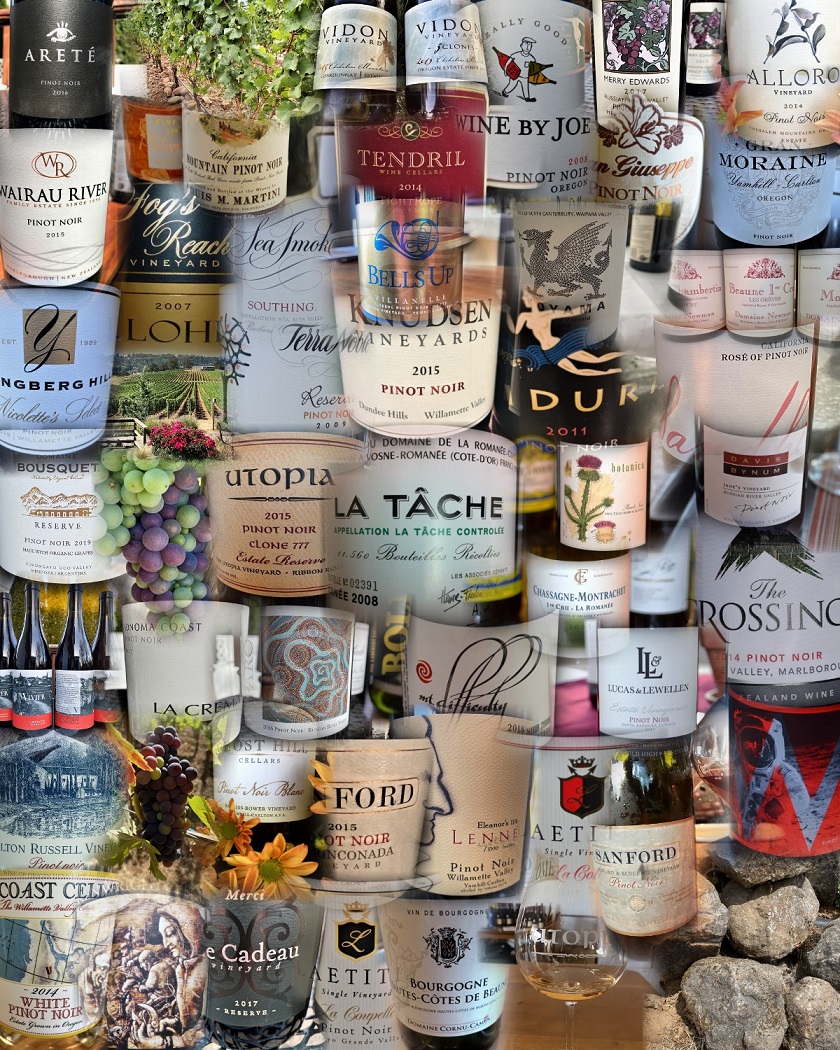
Pinot Noir is featured frequently on this very blog. As I was preparing this post, I decided to look at some statistics. It appears that Pinot Noir is the second most frequently mentioned red grape on the blog, with 356 posts related to the Pinot Noir (Cabernet Sauvignon is mentioned in 445 posts). It is interesting that Chardonnay is mentioned in the 357 posts, literally identical to Pinot Noir.
But it is not just the mentions – there are many memories associated with Pinot Noir.
I love saying that blind tasting is the best arbiter of the wines – in a blind tasting, it is just you and the liquid in the glass, nothing else influences your impression of the wine. It seems that our Pinot Noir blind tasting took place only yesterday – I was literally shocked to see that this post is 12 years old – the tasting took place in August of 2010. Who couldn’ve thought that 2008 Hamilton Russell Pinot Noir from South Africa would be our group’s favorite wine, beating grand cru Burgundy and cult Californian Pinot? I still have a bottle of that wine and I’m looking forward to experiencing the 12 years of evolution.
Another favorite Pinot Noir memory is the 1966 Louis M. Martini California Mountain Pinot Noir – an accidental $25 buy that ended up being a transcendental experience tasting the 48 years old wine from the Cabernet Sauvignon producer who is absolutely not known for the Pinot Noir wines.
And then there are lots and lots of memories of not only the wines but also of the people, passionate Pinot Noir winemakers, acquired through the work on the Stories of Passion and Pinot, an ongoing series of posts dedicated to Oregon Pinot Noir producers and Oregon Pinot Noir wines.
Did I prove my point? Is Pinot Noir the true King of Grapes? I don’t know. But for sure it is a grape worth celebrating. Cheers!
Wednesday’s Meritage #159
 Meritage Time!
January is almost over, and as many people talked about “dry January”, it was reasonably dry – not in terms of wines, but in terms of wine events. However, February promises to compensate abundantly and offers lots to look forward to.
Let’s start with the grape holidays. Next Tuesday, February 1st, is International Furmint Day. Furmint is one of the most famous Hungarian grapes, best known as the grape behind Tokaji, heavenly nectar. Furmint also can be vinified dry, although much harder to find compared to Tokaji. Either way, you have a holiday to celebrate. Two weeks later, on February 16th, we will celebrate one of my favorite grapes – Syrah, via International Syrah Day. Syrah should be much easier to find, so no excuses. There is also Global Drink Wine Day on February 18th, but for someone who drinks the wine every day, that is not something I can particularly celebrate.
Continuing the theme of celebrations, let’s talk about celebrating not a particular grape, but the whole wine region. Monday, February 7th, will mark the beginning of the New Zealand Wine Week. Two webinars will be offered – one focused on the New Zealand wines on the global wine scene, and the second one diving deep into the world of New Zealand Pinot Noir.
To complete the subject of celebration, the last one for today is the main wine holiday of the year – Open That Botte Night, or OTBN for short. The holiday was created 22 years ago by Dorothy J. Gaiter and John Brecher, writers of the Wall Street Journal’s Tastings column. The goal of the holiday is to help people to happily part with their prized bottles, taste those wines themselves, and share them with friends, hopefully while both wines and people are in their prime. OTBN is always celebrated on the last Saturday in February, which will be February 26th this year. It is time for you to already start thinking about those special bottles you would want to open.
The next event I want to bring to your attention is Oregon Wine Symposium. While this is definitely a technical event, focused on the winegrowers, winemakers, and winery owners, the event offers excellent educational content for any wine lover. This year’s event will consist of two parts. Virtual part with all the educational content will take place February 15-17, and then the Oregon Wine Symposium Live portion will follow on March 8-9. Virtual sessions will cover in-depth Oregon wine industry, looking into the overall state of the industry, the direct-to-consumer market, the management of the supply chain, and lots more. Again, this is a technical event, offering lots to learn for those who want to learn.
Last but not least will be the first trade tasting I plan to attend in person this year – the Tre Bicchieri 2022, taking place on Friday, February 25th. This event is a culmination point of the Gambero Rosso wine publication, offering an opportunity to taste the best of the best Italian wines selected during the prior year, those awarded three glasses rating by the publication. Tre Bicchiery is one of my favorite tastings of the year, usually full of great discoveries – here is the retrospective of the events I attended in the past. Considering that there was no Tre Bicchiery event in 2021, I can only hope that we will see some great wines at the event, and I will actually be able to plan my attendance properly to taste the most coveted wines, instead of finding a table with only empty bottles, as already happened at my first Tre Bicchieri event, and the empty bottles at the table were the legendary Masseto. The event will travel around the USA, with the stops in Los Angeles, San Francisco, Chicago, New York, Boston, and Houston, so hopefully, you will get your chance to attend.
That’s all I have for you for today. The glass is empty, but the refill is on the way. Cheers!
Thank you, #GrenacheDay
September 19th was yet another “wine holiday” – the Grenache Day. Grenache, which is known in Spain as Garnacha, needs no introduction for the oenophiles. One of the most planted red grapes in the world. A star of Châteauneuf-du-Pape, Priorat, California, Australia and many other countries and regions. A grape with the middle name “rich and opulent” (when was the last time you had a lean Grenache wine? No rush, think about it…). If big wines are your territory, Grenache is definitely your grape.
So what this “thank you” all about? Easy, let me explain. When I know about the certain “grape day”, I usually try to honor it by opening the wine made with that specific grape. Considering the connotation of the “holiday”, I also look for the somewhat of a special bottle. I’m not saying that I would casually open DRC for the Pinot Day (I wish I would have that choice), but still, it should be an interesting bottle. Talking about the holiday at hand, #GrenacheDay, I realized that Grenache is grossly underrepresented in my cellar. Cabernet, Pinot Noir, Syrah, Tempranillo, Zinfandel – plenty of choice, Grenache – not so much. Searching through the shelves, I noticed the bottle of 2006 Pax Cuvée Moriah. Checked the back label – 88% Grenache, definitely qualifies as Grenache for me. 2006 is considered young in my book, but – either that or some random non-grenache bottle. Done.
 Okay, so here is our wine – 2006 Pax Cuvée Moriah Sonoma County (15.9% ABV, 88% Grenache, 6% Mourvedre, 3% Syrah, 2% Counoise, 1% Roussanne). Cork is out, pour in the glass, swirl, smell. Beautiful. Bright fruit, spices, herbs – a delicious promise. On the palate, great concentration, big, texturally present, roasted meat and bright cherries, clean acidity, an excellent wine overall. Drinkability: 8+
I stepped away from my glass with a small amount of wine left in it. Come back 15-20 minutes later, ready to finish. Swirl, sip – the wine is past prime. Touch of stewed fruit and over-ripe plums. The wine completely transformed. So here is the “thank you” part. If it wouldn’t be for the “grape day”, I would still be waiting for the right moment. Only to find out at some point that all the pleasure was gone, without been experienced. Thanks to the #GrenacheDay, we were able to experience this wine still at its peak (it was only a tiny amount in the glass which turned around).
Let’s raise the glass to the grape holidays, the experience savers. Cheers!
Last Bottle Sign Up ($10 credit)




 Talk-A-Vino