Archive
Enjoying The Wine In The Can
Let me start with the question: what do you think of wines in the can?
I’ve seen rather an interesting reaction in social media (both Instagram and Twitter) when I post a picture of the wine in the can. It ranges from “Hmmm” to “Really???” to “How you can even talk about wine in the can???” to “I can’t believe there can be any good wine in the can”. Mind you, this doesn’t come from uninitiated people – wine pros of different walks have a very similar reaction when seeing the reference to the wine in the can. And I find this a bit surprising.
It’s been almost 5 years since I tried my first wine in the can. I don’t think I ever had a question “why wine in the can” (my first reaction was “wow, cool, something new and different!”) – my only question was “is it good?”. A can is just a different form of packaging – nothing more and nothing less. If you follow the subject of wine in the can, I’m sure you saw lots of different reasons and explanations to the question of “why” – “democratize wine”, “pinkies down”, “appeal to millennials” and blah blah blah. Whatever. I don’t think that simply putting wine in the can is the “magic bullet” for anything.
Of course, unique and different packaging helps to appeal to potentially a different category of consumers. But – the wine is binary. You either like it – or not. The proverbial question of the desire of the second glass is the key. Consumers might buy the can for the first time for its unique form. But they have to like it to come back and buy it again.
There is another interesting side of wine in the can in addition to the form factor. Making wine in the can allows winemakers to get ultimately creative, as you can work with a very small batches – and you can do truly uncommon things, such as finishing wine with beer hops or mixing Zinfandel with coffee – I’ve had plenty of oddly interesting concoctions, courtesy of Filed Recordings Can Club, the true pioneers of the wine in the can (Field Recordings Wine and Can club is the only wine club I belong to – because it never gets boring with Andrew Jones). Such a variety is also making it interesting for the curious wine lovers, who always have something new and different to try. And if you like something, you really want to run and grab it, while you can – the flip side of the small batch winemaking is that the wine is gone in no time.
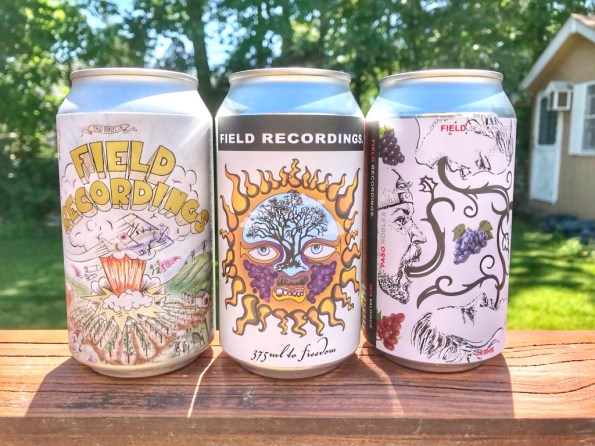
 Just to give an example, here are the notes for two of the latest shipments I received this year from the Field Recordings can club. The first one arrived just a few days ago, but I made an effort to familiarize myself with the wines quickly :). In case you are wondering, all these wines are priced at $5 per 375 ml can, so two cans would be somewhat equal to the $10 bottle of wine.
2018 Field Recordings Chardonnay Coquina VIneyard Rancho Arroyo Grande (12.1% ABV, 6 barrels produced) – fresh crunchy plums all the way, sprinkled with the lemon juice and some granny smith apples. Refreshing, round and delightful. Will make a beautiful summer day even better.
2018 Field Recordings Charbono Guglielmo Giovanni Vineyard Paso Robles (11.8% ABV) – how often do you drink Charbono (known in Argentina as Bonarda)? The producer recommended to serve this wine at the cellar temperature – I had it at a room temperature, and after 5 minutes in the glass (by the way, if you drink at home, feel free to use your favorite glass, you don’t have to drink from the can if you don’t want to) the wine was delicious – medium weight, supple dark fruit and spices, simple and easy to drink. Another winner for the summer day.
2018 Field Recordings Valdiguié Shell Creek Vineyard Paso Robles (13.7% ABV, one puncheon produced) – How about the Valdiguié grape? While typically found in the South of France, in Languedoc, the grape found its way into the US and was known for a while as Napa Gamay. I tried this wine at room temperature (too acidic and herbaceous, literally “leaf-forward”), from the fridge (much better than at the room temperature, good acidity, and underripe berries), and then at the “cellar temperature” (as recommended) – best, with excellent complexity, young berries, fennel, mint and lemon.
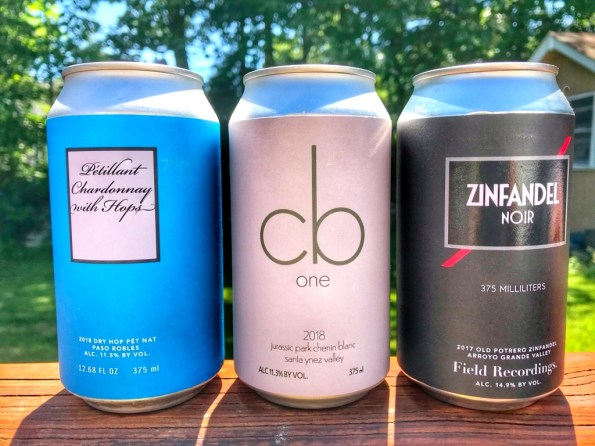 Here are the wines from the shipment earlier this year – note the completely different style of the labels – isn’t it fun? I tried only two of these so far, both superb:
2018 Field Recordings Dry Hop Chardonnay Pét Nat Paso Robles (11.5% ABV, 3 barrels produced) – ohhh, what a pleasure! Light fizz, dry hoppy notes, fresh apple, vibrant acidity, an impression of simply walking in the meadow – the can disappear in a few gulps, literally.
2018 Field Recordings Jurassic Park Chenin Blanc Santa Ynez Valley (11.3% ABV) – Chenin Blanc from Field Recordings never disappoints. This wine was made in two formats – a bottle and a can. It is yet something I need to try, but I have high hopes.
2017 Field Recordings Old Potrero Zinfandel Arroyo Grande Valey (14.9% ABV, 6 barrels produced) – this was mind-boggling. While I accept canned wines wholeheartedly, I still expect canned wines to challenge me – but there was nothing challenging about this wine. From the first smell and sip, this was an amazing California Zinfandel in its beauty – powerful, dense, loaded with blackberries, a touch of dark chocolate, lusciously layered and dangerous (we almost had to fight for the last drops). A wow in the can.
As you can tell, I’m pretty excited about the canned wines I tried – but this is not my main point. I’m simply suggesting that you should look at the wine in the can not as a gimmick, but as a product made with a purpose. Are all wines in the can good? Of course not. There will be some which you will like, and some which you will not. But it is the same with the wine in the bottle – there are some which you like, and some which you don’t. Don’t be afraid of the wine can – just give it a try. And prepare to be pleasantly surprised. Cheers!
5 Highlights and Hundreds of Wines
 Last weekend I attended a trade wine tasting – my first and pretty much the last for this year. My schedule simply didn’t align to do more, but may be it is even for the better?
I’m sure that most of the people see it very simply – “wine tasting = fun”. I tried many times to explain in this blog that “wine tasting = hard, tiring work” – no doubts 9 out of 10 people point to this statement and start laughing – but this is totally fine with me.
The tasting was organized by one of the Connecticut wholesalers – Worldwide Wines, to showcase all the new arrivals from the wineries and importers they represent in the state. According to the invitation, about 1,000 wines, beers and spirits were offered in the tasting. Duration of the event? 3.5 hours. Which simply means, if you want to taste them all, you have to move at a speed of roughly 5 wines/beers/spirits per minute. Yep, 5 per minute, 12 seconds each.
Of course nobody is trying to taste them all – you have to come with the plan. As I’m not operating a retail business, my plan was simple – to taste best of the best, simply based on the names. I mean no disrespect, but it means that Heitz takes precedence over Castle Rock, same way as Gaja would go over Cavit. This year, I managed to complete my plan quite successfully – you will see tasting notes below. At the end of these 3.5 hours I was really, really tired – but hey, it was worth it.
I managed to try close to 200 wines (including some spirits – no beer though), out of which I will share with you a bit more than a 100 – the wines which I really liked (yep, there were a lot). As this will be a very long list, I will first try to come up with 5 main highlights, before leaving you with bunch of wines to scroll through. But even before we get there, I can tell you that pretty much anything we tasted from California from 2012 vintage was excellent; there were 3 Gaja wines present in the tasting, and they were delicious, with Gaja Chardonnay, Rossj-Bass, being off the charts; for the first time I tried line of Cabernet Sauvignon wines from Nickel & Nickel, and they were very good; also for the first time (consistently missed it from a year to a year), I tried Darioush line of wines, and they were excellent. Now, for the promised 5 highlights, here we go:
- California Chardonnays are back! Well, this is a personal statement, of course. Over the past 4-5 years, I developed a tendency to avoid California Chardonnays in any tastings – I find all that “unoaked” stuff boring. I’m not looking for the “oak bombs” as they were called in the past, but I like my Chardonnays with vanilla, touch of butter and some weight on the palate. This year, out of the 10-12 Chardonnays which I tasted, there was not a single one I didn’t like. Of course I had some preferences, but still, as a group, they were outstanding. You will see the list of all Chardonnays I had a pleasure of tasting in the list below.
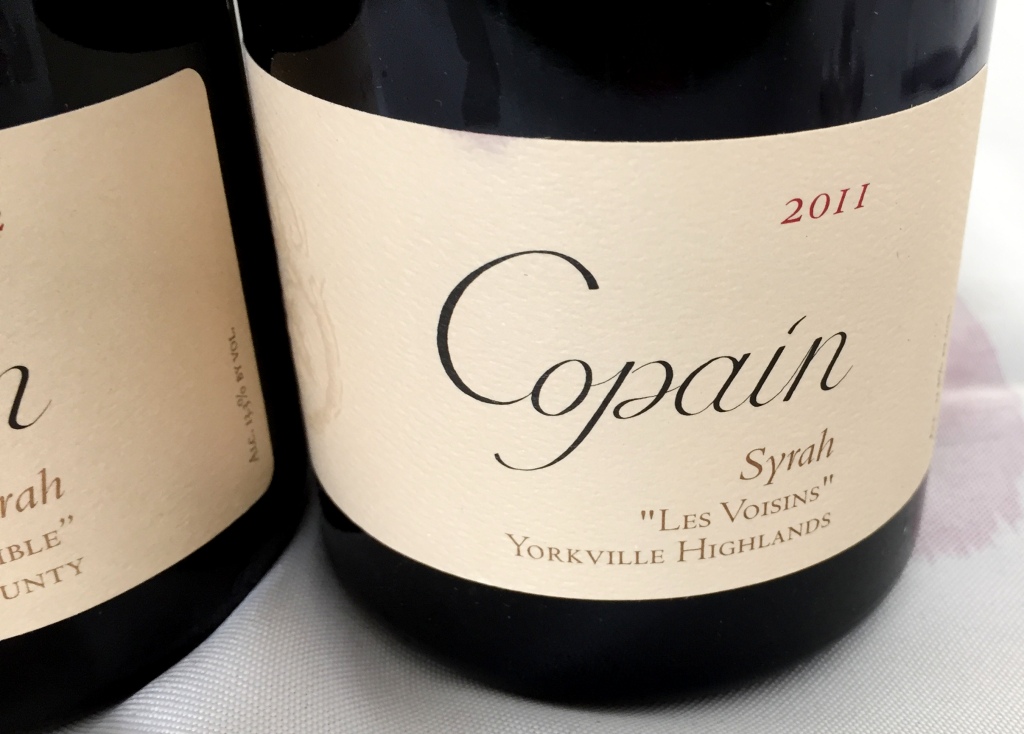
- There were lots and and lots of red wines I tasted at the event, many of them of the cult status – Sassicaia, Heitz, Shafer, Joseph Phelps and others. They were all excellent wines, but still, my absolute favorite red wine of the tasting was Copain Les Voisins Syrah Yorkville Highlands ($24.95) – the wine had stunning clarity of the Syrah, with pepper and restrained earthy profile.
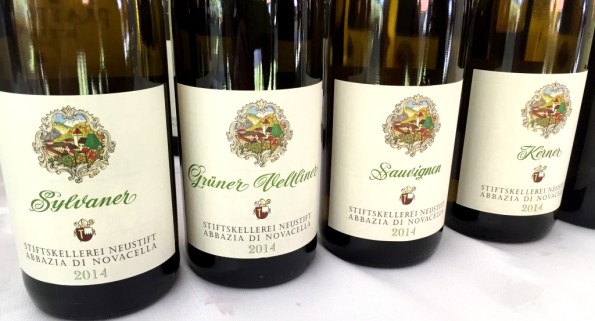
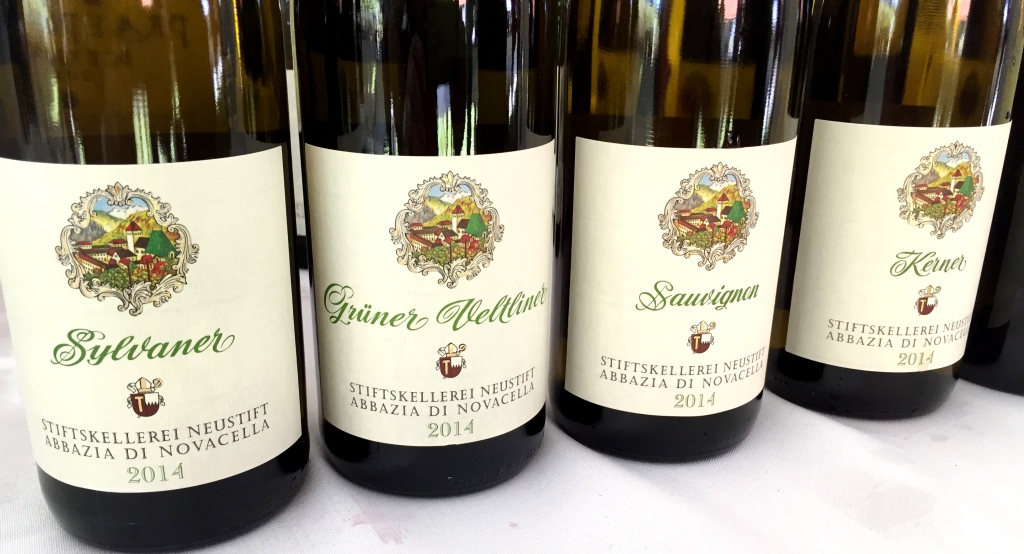
- My top pick for the white wines might be even more surprising – Villa Wolf Gewurztraminer Pfalz, Germany ($10.49!!). I personally consider Gewurztraminer a very difficult grape to do right, for sure for my palate – this wine had such a beautiful balance of spiciness, fruit and acidity, it was simply a perfect sip in the glass. There is yet another highlight which goes to the white wines. Talking about a “group”, 5 white wines from Abbazia di Novacella in Alto Adige in Italy, where literally one better than another – every sip got a “wow” reaction – Kerner, Gruner Veltliner, Sylvaner, Sauvignon Blanc – one better that the other, literally.
- Not a revelation for me anymore, but still something to ponder at – there are amazing spirits made in the USA. Case in point – St. George Spirits from Alameda, California. You know, I don’t drink vodka at all, as it has no taste, and here I absolutely loved Green Chile Vodka from St. George. And then there was Gin, Absinthe, Coffee liquor – one “wow” after another. I want to include here their motto, as written on the web site: “We don’t distill to meet your expectations, we distill to exceed your imagination“. Yep.


- Last highlight is more of a note to self – “don’t drink Port in a middle of tasting”. For sure if it is a Heitz Ink Grade Port. Okay, let me explain. Generally people have a tendency to leave tasting of the sweet wines “for later”, just to make it easier for the palate. Problem is that by the time you decide to go back to those dessert wines, the tasting is way over. When it comes to the Heitz Ink Grade Port, I heard that it is amazing, but equally powerful, so it is better to leave it “for later” – thus I never tasted it before. This time around, I said “that’s it – I’m tasting it now”. Boy, what a mistake. The Heitz Port is a very interesting wine, made from 6 noble Portuguese grapes, typically used in production of the Port – of course this time growing in California, at one of the Heitz vineyards. This Port was delicious, but it had tremendous power of tannins, multiplied by the factor of the sweet dried fruit, all together shutting down your palate for good. I was desperately searching for the chunk of Parmesan, as I don’t think anything else can restore your palate in such a case. So yes, it was delicious – but I’m not drinking it again in a middle of the tasting…


As promised, those were my highlights. From here on, prepare to be inundated with my brief notes on lots and lots of wines. I used the “+” system for rating, and I didn’t include practically any wines with the “++” rating (there might be one or two). Also, lots of wines were absolutely exceptional, so they got the “++++” ratings. Last explanation: the price in the brackets is so called Connecticut minimal bottle price – the state of Connecticut dictates minimum price at which the wine can be sold to the consumers – retailers are not allowed to go any lower than that “min bottle” price. Therefore, it is likely that prices in many stores in Connecticut will be higher than what I included here. It is also quite possible that you can find lower prices in other states. Lastly, I tried to group the wines mostly by the grape type and/or type, to make it easier for you to navigate. Hope you will find this list useful.
Here we go:
Sparkling Wines:
NV Charles Heidsieck Brut ($55.99) – ++++, yeasty!!
NV Champagne Barons de Rothschild Rosé ($99.99) – +++, excellent
NV Champagne Duval Leroy Premier Cru ($45) – +++1/2, perfect balance
NV Champagne Duval Leroy Rosé ($59.99) – +++
Chardonnay:
2013 Calera Central Coast Chardonnay ($19.99) – +++
2013 Laetitia Chardonnay Estate, Arroyo Grande ($15.49) – ++++
2013 Copain Tous Ensemble Chardonnay Anderson Valley ($18.99) – ++++, beautiful
2013 Darioush Signature Chardonnay Napa Valley ($37.99) – ++++
2013 Far Niente EnRoute Chardonnay ($39.99) – +++, very nice
2013 Flanagan Chardonnay Russian River Valley – +++
2014 Heitz Wine Cellars Chardonnay ($24.99) – +++, great acidity
2014 FARM Napa Valley Chardonnay ($18.99) – +++, nice, bread notes
2014 Hooker “Breakaway” Chardonnay Knights Valley ($14.99) – +++, great QPR
2013 Merryvale Chardonnay Napa Valley ($24.99) – ++++, wow! classic!
2014 Crossbarn Chardonnay Sonoma ($21.99) – +++, perfect
2013 Paul Hobbs Chardonnay Russian River ($38.99) – ++++, beautiful, vanilla, wow!
2013 Maison Roche de Bellene Bourgogne Blanc Vieilles Vignes ($18.99) – ++++, Chablis-like, great minerality and gunflint
2013 Gaja Rossj-Bass Langhe ($77.99) – ++++
Cabernet Sauvignon and blends, California:
2012 Darioush Signature Cabernet Sauvignon Napa Valley ($99.99) – ++++, beautiful
2012 Darioush Signature Merlot Napa Valley ($45.99) – ++++, excellent
2012 Darioush Caravan Cabernet Sauvignon Napa Valley – +++1/2
2012 Darioush Signature Cabernet Franc Napa Valley ($46.99) – ++++, excellent


2012 Nickel & Nickel CC Ranch Cabernet Sauvignon ($79.99) – ++1/2, tannic
2012 Nickel & Nickel Quarry Cabernet Sauvignon ($79.99) – +++, clean, excellent
2012 Nickel & Nickel Sullenger Cabernet Sauvignon ($79.99) – +++, excellent
2012 Flanagan Cabernet Sauvignon Sonoma County ($68.99) – +++, nice
2010 Heitz Wine Cellars Napa Cabernet Sauvignon ($45.99) – +++1/2
2009 Heitz Wine Cellars Trailside Vineyard Cabernet Sauvignon ($63.99) – ++++, clean, excellent
2006 Heitz Wine Cellars Trailside Vineyard Cabernet Sauvignon ($59.99) – ++++, excellent
2010 Heitz Wine Cellars Martha’s Vineyard Cabernet Sauvignon ($174.99) – ++++, powerful
2009 Heitz Wine Cellars Martha’s Vineyard Cabernet Sauvignon ($174.99) – ++++, beautiful
2012 Honig Napa Cabernet Sauvignon ($35.99)- +++1/2
2012 Honig Bartolucci Vineyard Cabernet Sauvignon ($62.49) – ++++, beautifully refined
2012 Hoopes Oakville Cabernet Sauvignon ($49.99) – +++, nice
2012 Joseph Phelps Insignia ($189.99) – +++
2012 Joseph Phelps Cabernet Sauvignon ($55.99) – +++


2011 Shafer Cabernet Sauvignon, Hillside Select, Stags Leap District ($178.49) – +++1/2, excellent
2012 Hooker “Old Boys” Cabernet Sauvignon Na[pa Valley ($29.99) – +++, nice
2013 Venge Scout’s Honor Proprietary Red, Napa Valley ($31.99) – +++1/2, delicious!
2013 Venge Silencieux Cabernet Sauvignon, Napa Valley ($36.49) – ++++, beautiful Cabernet Sauvignon
2010 Merryvale Cabernet Sauvignon Napa Valley ($49.99) – +++, very good
2011 Paul Hobbs Cabernet Sauvignon Napa ($94.99) – +++1/2
2011 Paul Hobbs Cabernet Sauvignon Dr Crane Beckstoffer ($128.99) – ++++, wow!


2013 Pine Ridge Napa Cabernet Sauvignon ($49.99) – +++1/2, very clean
2012 Hanna Cabernet Sauvignon Alexander Valley ($29.99) – +++, herbal
Pinot Noir:
2013 Calera Central Coast Pinot Noir ($24.99) – +++1/2, very nice
2012 Calera deVilliers Vineyard, Mt Harlan Pinot Noir (34.99) – +++1/2, nice balance
2012 Calera Ryan Vineyards, Mt Harlan Pinot Noir ($36.99) – +++
2013 Laetitia Pinot Noir Estate, Arroyo Grande ($19.99) – +++
2013 Laetitia Pinot Noir Reserve du Domaine (32.00) – ++++
2013 Copain Tous Ensemble Pinot Noir Adderson Valley ($23.99) – ++++, wow
2012 Copain Les Voisins Pinot Noir Anderson Valley ($28.99) – ++++, delicious, elegant!
2012 Wild Ridge Pinot Noir Sonoma Coast ($40) – +++, wow! concentrated!


2011 Merryvale Pinot Noir Napa Valley ($29.99) – +++1/2, classic CA Pinot
2012 Foley Pinot Noir, Rancho Santa Rosa Estate ($32.99) – +++1/2
2013 Siduri Willammette Valley, Oregon ($24) – +++, excellent
2013 Archery Summit Premier Cuvee Pinot Noir ($35.99) – ++++, beautiful
2012 Archery Summit Red Hills Estate Pinot Noir ($59.99) – ++++
2011 Maison Roche de Bellene Bourgogne Rouge Vieilles Vignes ($18.99) – +++
2011 Maison Roche de Bellene Gevrey-Chambertin Vieilles Vignes ($38.99) – +++1/2
White Wines:
2014 Heitz Wine Cellars Sauvignon Blanc Napa Valley ($16.49) – +++1/2, excellent, clean
2014 Honig Sauvignon Blanc ($15.49) – +++, delicately balanced
2013 Honig Rutherford Sauvignon Blanc ($19.99) – +++, nice, complex
2013 Merryvale Sauvignon Blanc Napa Valley ($19.99) – +++, beautiful!
2013 Archery Summit Vireton Pinot Gris ($18.99) – +++, nice
2014 Abbazia di Novacella Kerner Alto Adige ($19.99) – ++++, wow! acidity!
2014 Abbazia di Novacella Gruner Veltliner Alto Adige ($19.99) – ++++, wow!
2014 Abbazia di Novacella Sauvignon Blanc Alto Adige ($19.99) – ++++, wow!
2014 Abbazia di Novacella Sylvaner Alto Adige ($19.99) – ++++, wow!
2013 Abbazia di Novacella Praepositus Kerner Alto Adige ($25.99) – ++++, wow!
2012 La Monacesca Verdicchio di Matelica 750ml 2012 12 $144.00 $12.99
2012 La Monacesca Verdicchio di Matelica Mirum 750ml 2012 12 $224.00 $19.99
2013 Villa Wolf Pinot Gris Pfalz ($11.99) – ++++, wow! clean
2014 Villa Wolf Gewurztraminer Pfalz ($10.49) – ++++, wow! beautifully balanced!
2012 Maximin Grunhause Riesling Feinherb Mosel ($15.99) – ++++, petrol!
2014 Dr Loosen Riesling Kabinett Blue Slate Mosel ($14.99) – ++++, beautiful, bright fruit
Red Wines:
2012 Copain Tous Ensemble Syrah Mendocino County ($18.51) – +++, nice, a bit too simplistic
2011 Copain Les Voisins Syrah Yorkville Highlands ($24.99) – ++++, oustanding
2012 Shafer Relentless, Napa Valley ($84.99) – +++, very good
2012 St. Francis Reserve Merlot ($39.99) – +++
2012 St. Francis Reserve Old Vines Zinfandel ($39.99) – +++1/2
2014 Lawer “Knights Valley” Syrah Rosé ($17.99) – ++++, outstanding
2010 Hooker “Blindside” Zinfandel California ($13.99) – +++, good
2011 Hooker “Home Pitch” Syrah Knights Valley ($12.99) – +++


2012 Tenuta San Guido Sassicaia ($174.99) – +++, clean, balanced, wow
2013 Tenuta San Guido Guidalberto ($44.99) – +++, beautiful Cabernet-like
2010 Tenuta di Biserno ($149.99) – +++
2012 Tenuta di Biserno Il Pino di Biserno ($59.99) – +++, herbal profile
2012 Ornellaia Le Serre Nuove Bolgheri ($50.99) – +++1/2
2012 Gaja Ca’Marcanda Magari Bolgheri ($69.99) – +++
2010 Gaja DaGromis Barolo ($71.99) – ++++
2008 Masi Riserva di Costasera Amarone della Valpolicella ($51.00) – +++
2008 VAIO Serego Alghieri Amarone della Valpolicella ($69.99) – +++, outstanding
2006 Masi Mazzano Amarone della Valpolicella ($116.00) – ++, somewhat disappointing for the single-vineyard Masi
2008 Marchesi di Fumanelli Amarone del Valpolicella ($54.49) – ++++, delicious, sweet fruit
2007 Marchesi di Fumanelli Octavius Amarone del Valpolicella Riserva ($100.99) – +++, nice


2012 Arnaldo Caprai Montefalco Rosso, Umbria ($19.99) – +++1/2, powerful
2013 Il Poggione Rosso di Montalcino ($22.99) – +++, simple, nice
2012 Feudo Maccari Saia Nero D’Avola ($26.99) – +++, great minerality
2012 Los Vascos Cabernet Sauvignon Reserve Chile ($16.99) – +++
2012 Los Vascos Carmenere Reserve Chile ($16.99) – +++
2011 Antigal UNO Cabernet Sauvignon, Mendoza, Argentina ($15.99) – +++, nice, classic
2009 Elderton Estate Cabernet Sauvignon Barossa, Australia ($57.99)- ++++, beautiful
2009 Elderton Command Shiraz Barossa, Australia ($73.95) – ++++, beautiful, roasted notes
2013 Two Hands Sexy Beast Cabernet Sauvignon McLaren Vale, Australia ($29.99) – +++, perfect
2008 Casa Ferreirinha Vinha Grande, Douro, Portugal ($14.99) – +++1/2 – delicious
2012 Crasto Old Vine Reserva, Douro, Portugal ($34.99) – +++
2012 Chateau Musar Jeune Rouge, Lebanon ($15.99) – +++1/2, excellent
2007 Chateau Musar Rouge, Lebanon ($N/A) – +++1/2, beautiful
2012 Domaine de Beaurenard Rasteau ($17.99)- +++
2012 Domaine de Beaurenard Boisrenard Chateauneuf du Pape ($49.99) – +++, green
2013 M. Chapoutier La Bernardine ($39.99) – +++


2011 Chateau Moulin de Duhart Pauillac ($38.99) – +++
2009 Chateau La Grave a Pomerol ($55.99) – +++
2009 Blason de L’Evangile Pomerol ($74.99) – ++++
2012 Perrin Cotes du Rhone Nature Organic ($9.99) – ++1/2, an outstanding QPR for an organic red wine
2012 Chateau de Beaucastel Chateauneuf du Pape Rouge ($79.99) – +++
2011 Rust en Vrede Estate Stellenbosch, South Africa ($32.99) – +++1/2
2010 Anthonij Rupert Optima Western Cape South Africa ($26.99) – +++1/2
Dessert wines:
2013 Donnafugata Ben Rye ($30.99) – +++, very nice
NV Heitz Wine Cellars Ink Grade Port ($27.99) – ++++, wow!
Spirits:
St. George Green Chile Vodka ($22.49) – flavor is stunning, with clear presence of Jalapeño and other green earthy peppers. Sipping
St. George California Citrus Vodka ($22.49) – another wow flavor, smooth and delicious
St. George Botanivore Gin ($27.25) – mellow with super-complexity. May be the best gin I ever tasted. Definitely sipping quality
St. George NOLA Coffee Liqueur ($27.25) – good morning, sir. Here is your coffee, extra strong.
St. George Absinthe Verte ($22, 200 ml) – find it and try it, as I can’t describe it. This is first absinthe produced in US after Prohibition. Would gladly drink it at any time.
Weekly Wine Quiz #66: Grape Trivia – Chardonnay
Chardonnay grapes after harvest, as presented in Wikipedia
Welcome to the weekend!
Here we are, continuing our wine quizzes now with the (dare I say it) most famous white grape – Chardonnay!
Seriously, is there another grape which receives equal amount of attention? Not as a fad, but as a constant center of attention all the time, with new winemakers offering their own personal take on the grape, coming from all over the world, competing for supremacy with producers who boast hundreds and hundreds years of “prior experience”? Is there a winemaking country in the world *not* making wine out of Chardonnay – I doubt so…
Origins of Chardonnay go all the way back to the 12th century, starting (of course, where else) in France in Burgundy region. Today, Chardonnay is one of the most planted grapes in the world with 400,000 acres planted worldwide (and about quarter of that in California alone). Part of such a wide success of the Chardonnay can be attributed to the fact that Chardonnay is very adaptable, and can be successfully grown in various conditions, including climate and soils. Additionally, Chardonnay is very “malleable” in the hands of the winemaker and can be used in variety of styles both with and without oak, and successfully ranging in the expression from sparkling to light and acidic white wines, going all the way to the heavy, big and monumental wines and then continuing on to the dessert wines (Australian “sticky”s come to mind). As you can imagine, such a popularity with the wine makers leads to the overproduction of boring and indiscreet wines, which generates periodic consumer backlash and creation of the self-proclaimed ABC clubs (Anything But Chardonnay). Nevertheless, anyone who had ever experienced great Chardonnay – coming from France, California, Chile, Australia, New Zealand, Italy, Hungary and many other places, will always come back for more.
Now, to the quiz!
Q1: Name the producer of the most expensive Chardonnay wine in the world. As an added bonus, please also provide the name of the wine.
Q2: Chablis used to be the bustling Chardonnay producer in France, supplying most of the wine in Paris and beyond, until it came to the severe decline during the beginning to the middle of the 20th century. Do you know what was one of the biggest factors which led to that decline?
Q3: Name 3 main flavor descriptors of the *big* California Chardonnay
Q4: Judgement of Paris of 1976 was instrumental in bringing California Chardonnay onto the world-class wine map. Do you know which California winery we need to thank for that?
Q5: As with many other grapes, various clones had being developed for Chardonnay, to adapt better for the particular region and/or resulting wine style – for example, there is a number of so called Dijon clones of Chardonnay, which can be used by anyone wishing to produce a classic Burgundy style wine. One of the clones was developed in California in the middle of 20th century, and it is still a very popular choice among many California Chardonnay producers to the date. Can you name that clone?
Good luck, have fun, enjoy your weekend and cheers!
Last Bottle Sign Up ($10 credit)




 Talk-A-Vino