Archive
Re-Post: Best Hidden Secrets Of The Wine World: Second Labels
During 2011 I wrote a number of posts for the project called The Art Of Life Magazine – of course talking about my favorite subject, wine. The project closed, but I still like the posts I wrote, so I decided to re-post them in this blog. Also, in that project, posts were grouped into mini-series, such as “Best Hidden Secrets” you see here – I will continue re-posting them from time to time.
Also note that the series was written for a slightly different audience – I hope none of my readers will take offense in the fact that sometimes I’m stating the obvious…
Second labels. Second is a keyword here. Second – meaning second best? How good it is to be second best?
When it comes to competition, second best is always only second best. Second best means you scored less, you ran not as fast as the best, you jumped not as far as the best. By all means, you really tried – but someone else was better in the same art.
Luckily, the notion of “second best” is not applicable to the world of wine. Of course, you might have your favorite (the best) wine, and then second favorite wine, and the third, and the fourth and many others. However, those are your personal favorites which are driven by your own personal taste. It is entirely possible even that someone’s most favorite wine is totally not drinkable for someone else (I think this is one of the most fascinating aspects of the wine world.
So what is the second label? Many wineries around the world have one wine which is considered the best, most well known and well regarded. Such wine would be their “First Label”. Typically, those wines have two” external” characteristics: they are very expensive and made in the limited quantities – and one way or the other, these subsequently become driving factors to produce so called “second label” wines, which are at least less expensive (quantity still might be an issue).
Actually, officially designated second labels started in Bordeaux in France simply to avoid throwing out the grapes which didn’t make it into the best wines. What started from so called “first growth” Bordeaux wines from famous 1855 classification in the 18th century, the second label movement spread widely across many wine making regions in the last quarter of 20th century (you read more on the subject here). From being only a Bordeaux phenomenon, it became adopted by many wineries all over the world as their main wines elevated to the “cult” status.
Today many of the cult wines from California, Italy and Spain ( other regions joining in as well) have their second labels. It is interesting to point out one essential difference between Bordeaux second labels and the rest of the world. Based on In Bordeaux AOC rules, second label or not, if Chateau is specified on the wine label all the grapes (100%) for that wine have to come from the vineyards which belong to that Chateau. This is not the case for most of the world. For instance, when particular AVA (analog of AOC in USA) is mentioned on the wine label, it means only that at least 85% of the grapes in that wine should be coming from the specified AVA, and 15% of grapes can be coming from any other places. I’m not saying that this is good or bad – this is just something to take into account when talking about second label wines.
Now, putting all the technicalities aside, what is all the fuss? Why are we talking about some kind of “second labels” as a great secret of the wine world? Very simply, it is all about QPR. Let me give you an example. If you hadn’t done so recently, go check how much Chateau Latour or Chateau Lafite costs. 2008 (somewhat of a sleeper vintage, not declared as outstanding) Chateau Latour will cost $1,600 or more, and Chateau Lafite is somewhere in the $2,000 – $2,500 range. No, not for 5 cases – these are the prices per bottle… 2008 Les Forts de Latour, second label of Chateau Latour, will cost about $250 per bottle, and Carruades de Lafite, second label of Chateau Lafite, will cost about $600.This is still very steep, but I’m sure you can see the magnitude of price difference. In addition to the better QPR, second labels are ready to be enjoyed much faster compare to the main wines. You need to wait for 15-20 years for great Bordeaux to open up, and second labels often cane enjoyed right away or after the short time in the cellar.
Let’s talk about some practical examples, but instead of Bordeaux, let’s start from Italy.
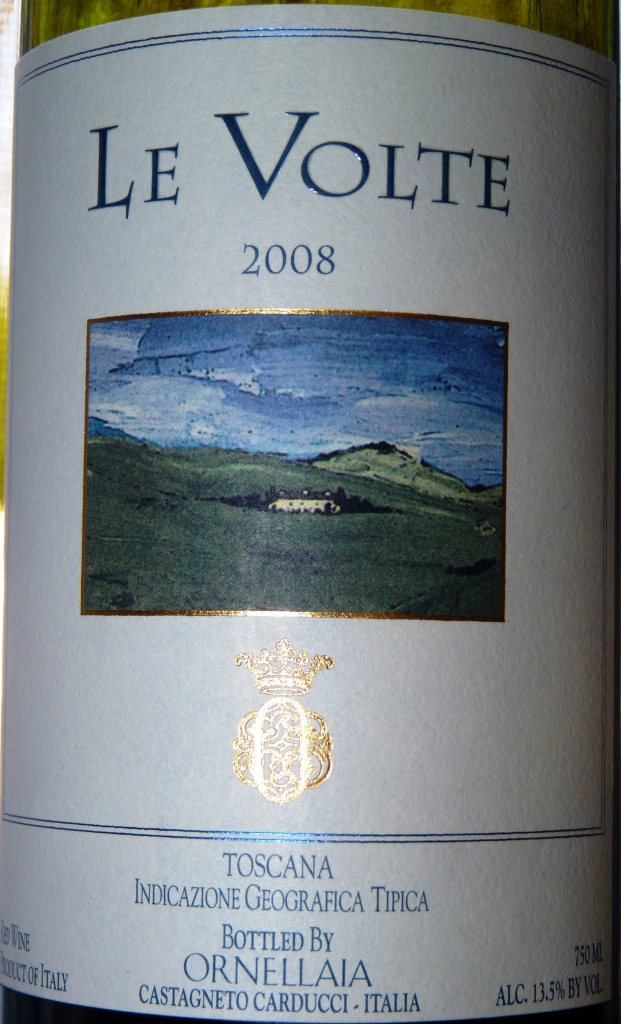 Le Volte is so called Super Tuscan wine made by Tenuta dell’Ornellaia. Their flagship wine, Ornellaia, has won numerous accolades and consistently rated above 95 points by various wine critics. You can buy Ornellaia for about $180 – $220 per bottle. Le Volte is produced by the same winery (it is technically a third label, with Le Serre Nouve being the second) from the grapes which were not selected for the main wine, and you can buy it for about $20-$25 per bottle (about one tenth of the price of Ornellaia).
2008 Le Volte was very tight and aggressive initially. After a while, it changed beautifully showing luscious fruit (dark fruits) and silky smooth tannins. It can be enjoyed right now with the appropriate breathing time (an hour in decanter might be the right call), but it will benefit from another 5 years in the cellar.
 Here is another example – Crouix de Beaucaillou, second label from Chateau Ducru Beaucaillou. Chateau Ducru Beaucaillou is so called second growth winery from Saint-Julien region in Bordeaux – again based on 1855 classification. Taking 2008 as a reference year again, their flagship wine, Chateau Ducru-Beaucaillou, can cost $110 and above (just for comparison, same wine from 2005, which was one of the best years in Bordeaux, will cost you $180+, and 2009 prices start from $250). 2005 Croix de Beaucaillou can be found for about $45 per bottle, which is one fourth of the price of the first label. This 2005 Croix de Beaucaillou opens one with beautiful nose of ripe black plums, oak and spice box. On the palate the wine is very restrained initially, and then opens up with some cedar notes and exhibits pronounced acidity and powerful tannins. Despite my earlier statement about second labels being ready to drink earlier, this particular wine definitely need more time in the cellar (but we should still keep in mind that 2005 was a great year).
After learning the first great secret of the wine world – beautiful Rioja wines, now you are armed with even more knowledge and you can have a lot of fun exploring the world of hidden gems, the second labels. Just to leave you with a little reference, below you will find a table with names of some of the second labels throughout the world, you can enjoy hunting for. And stay tuned, as more secrets are coming!
Note: this post was prompted by the post “Second Label Values” by the fellow blogger wpawinepirate.
Reference: Second Label Wines
| Primary Wine | Second label |
| France – Bordeaux, 1st growth | |
| Chateau Haut-Brion | Le Clarence de Haut-Brion |
| Chateau Lafite Rothschild | Carruades de Lafite Rothschild |
| Chateau Latour | Les Forts de Latour |
| Chateau Margaux | Pavillon Rouge |
| Chateau Mouton Rothschild | Le Petit Mouton |
| France – Bordeaux, others | |
| Chateau Ausone | Chapelle d’Ausone |
| Chateau Cheval Blanc | Le Petit Cheval |
| Château Rauzan-Ségla | Ségla |
| Château Léoville-Las Cases | Le Petit Lion de Marquis de las Cases (Clos du Marquis before 2007) |
| Château Léoville-Poyferré | Château Moulin Riche |
| Château Léoville Barton | La Réserve de Léoville Barton |
| Château Gruaud-Larose | Sarget de Gruaud-Larose |
| Château Lascombes | Chevalier de Lascombes |
| Château Pichon Longueville Baron | Les Tourelles de Longueville |
| Château Pichon Longueville Comtesse de Lalande | Reserve de la Comtesse |
| Château Ducru-Beaucaillou | La Croix de Beaucaillou |
| Château Cos d’Estournel | Les Pagodes de Cos |
| Italy | |
| Sassicaia | Tenuta San Guido Guidalberto |
| Ornellaia | Le Serre Nouve, Le Volte |
| Spain | |
| Vega Sicilia | Valbuena 5° |
| Alto Moncayo | Alto Moncayo Veraton |
| Bodegas El Nido | Clio |
| Clos Mogador | Clos Manyetes |
| USA – California | |
| Bryant Family | DB4 |
| Duckhorn | Migration, Decoy |
| Harlan Estate | Maiden |
| Pahlmeyer | Jayson |
| Paul Hobbs | Crossbarn |
| Screaming Eagle | Leviathan |
| Quilceda Creek | Quilceda Creek Columbia Valley Red |
Ten Cabernet Sauvignon Facts For The Cabernet Day

Cabernet Sauvignon Grapes, Wikipedia
Today (or it might be yesterday, depending on when I will finish this post), on August 30th, we are celebrating Cabernet wines, which include some of the most coveted and sought-after wines in the world.
For this event, I want to talk a bit about Cabernet wines in general. While Cabernet wines often include both Cabernet Sauvignon and Cabernet Franc grapes, I want to focus today on the wines which have Cabernet Sauvignon as the only or at least a primary ingredient – I should save something (Cabernet Franc, to be precise) for an easy post next year, shouldn’t I?
For what it worth, here are ten facts about Cabernet Sauvignon – some might be actual facts, and some might be… myths? I will let you be the judge…
- Cabernet Sauvignon grape is relatively young, first appearing in 17th century as the result of the cross between Cabernet Franc and Sauvignon Blanc grapes (hence the name).
- Cabernet Sauvignon grapes are very small with the thick skin, which means that the ratio of seeds and skin versus pulp is quite high, leading to lots of tannins being extracted during maceration process. More tannins = bigger wine, which usually also can age for a long time, but on a flip side needs an additional breathing time to open up.
- Cabernet Sauvignon wines are successfully made all over the world, but the best known regions are Bordeaux, California, Tuscany and Australia. These main regions are closely followed by Argentina, Chile, Israel, Spain and South Africa.
- Typical flavor profile of Cabernet Sauvignon wines include black currant (Cassis), green bell peppers and eucalyptus (not necessarily all at the same time).
- Not all the Bordeaux wine are predominantly Cabernet Sauvignon based. The wines made in Médoc and all the sub-appellations (situated on the left bank of Garonne river) are actually based on Cabernet Sauvignon (70% is quite typical). The wines made on the right bank of Dordogne river are predominantly Merlot wines (typically containing about 70% of Merlot grapes). Some of the most successful Bordeaux wines, such as Chateau Petrus and Le Pin, are actually made out of Merlot.
- The oldest continuously producing Cabernet Sauvignon vines in the world are located in Australia – it is Block 42 of the Kalimna Vineyard in the Barossa Valley, which belongs to Penfolds. It is assumed that the vines were planted between 1886 and 1888, which will give us an approximate age of 125 years.
- Typical California Cabernet Sauvignon wine needs about 13 years to reach its peak (see, I told you – patience is one of the important traits of oenophile).
- Malbec was the most popular grape in Bordeaux until early 18th century, when it was replaced by Cabernet Sauvignon.
- Cabernet Sauvignon holds the title of most expensive wine ever sold in the world. An Imperial (6L = 8 bottles) of 1992 Screaming Eagle Cabernet Sauvignon was sold at the auction (proceeds went to charity) for $500,000 in year 2000.
- When it comes to pairing with food, there are two combinations which are typically stand out. Cabernet Sauvignon and steak are usually go very well together, and same is true for Cabernet Sauvignon and dark chocolate (be advised – your mileage might vary).
That’s all I have for you for today, folks. I have to admit that I didn’t get a chance to drink Cabernet today (I promise to compensate tomorrow) – but I really want to know what was in your glass for the Cabernet day? Please comment below. Cheers!
Wine and Time
 Of course time had being here forever, always moving, and always in one direction (someone, please prove me wrong!). Wine had being around for about 8,000 years, first appearing in the ancient Georgia (no, not the one down south, but the one from the Caucus region, on another continent). Wine is one of the few products literally not changed for such a long time in its form and its production methods – sans reverse osmosis machines, electrical presses and micro-oxygenation boxes. Considering such a long history, you can imagine that relationship between wine and time is very complex, and you would be right.
First, time is a necessary part and an attribute of the wine making process. For the vast majority of wines, if you read winery’s description of the wine, you will see something like “aged for so many month in …”. Sometimes the wine is aged in stainless steel tanks. Sometimes the wine is aged in clay vessels (very popular in Georgia now, the vessels are called Kvevri and produce very distinct wines). Lots of red wines are aged in oak barrels – American oak, French oak, Hungarian Oak, new oak, old oak – variations are endless. For many wines, duration and the type of the aging is a sole decision of winemaker (no pressure, but this decision will greatly affect quality and the taste of wine, and will define success and failure for it). For some of the wines, aging in a specific type of barrels is mandatory before the wine can be released – Rioja Gran Reserva should be aged for a minimum of 2 years in oak barrel and 3 years in the bottle to be officially designated as Rioja Gran Reserva. Barolo must be aged for 3 years, at least two of them in the oak barrel, and Barolo Riserva should be aged at least for 5 years. During the aging process, the wine is changing. Oak imparts very specific flavor, which we, humans, tend to like. Oak aging also acts as a preservative and helps wines to live long life.
Once all the aging is complete (in the tanks, barrels and bottles – whatever the aging was), wine is released – and this is when the second phase of the wine and time relationship kicks in.
This second phase is as tricky, if not trickier, as the first. Have you heard the phrase “needs time” in relation to the particular bottle of wine? If you will look at the wine reviews in Wine Spectator or any other publication which provides wine reviews, you would often see one of the phrases “Drink now”, “Best 2014-2020”, “Best after 2013” – these are the suggestions for how long the wine should be kept in the cellar before it should be consumed.
Why is that? What with all this aging? Why not open the bottle right away and just drink the wine? What was discovered at some point (don’t ask me when, but it was long time ago) is that wine actually changes its taste as it spends time in the bottle (the aging). And it doesn’t just change the taste arbitrarily, it tastes better. Young wines are often sharp, or somewhat single-toned in their taste – you might get pronounced acidity, or only sweetness, or lots of white apples – but only white apples. During aging, trace amounts of air are making its way into he bottle, and they lead to the wine changing its taste, improving to the better in majority of the cases – it becomes complex, bite softens up, bright and diverse fruit tones compensate for the pronounced acidity and the wine brings a lot more pleasure compare to the young wines. Mature wines deliver more pleasure – this is the whole philosophy behind wine aging.
Simple and easy, right? Well, this is were everything becomes complicated and confusing – as not all the wines should be aged (do not try to age Beaujolais Noveau, please) and also it is very tricky to make sure you would drink the wine at its peak – as whatever comes up, goes down in mother nature. This is where time transforms from the friend to the foe – and as a foe, it is merciless. After reaching maturity and staying there for a while, the wines are typically starting their decline in the taste (wine loses fruit, become very acidic, may be oxidized – and it stops delivering pleasure). Different wines made in the different styles will have different peak times and different lifespans. Some of the Jerez, Madeira and similar wines can go on literally for the hundreds of years. Good Rioja, Barolo or Bordeaux can be perfectly aged for 50 years or longer. Simple Cote du Rhone might only last for 3-5 years, same would be true for many of the Chardonnay wines. There is not crystal ball telling you precisely how long the wine will last and when will it taste the best – human trial and error is the best way to find that out. Of course there are many factors which might help you to decide whether to age the wine and if yes, for how long – the winery, the winemaker, the region’s wine style, success of the vintage and many others – but in the end of the day you would need to do the work (err, I meant the wine drinking) as the wine ages to find out when it tastes best to you.
So, does it worth to age wines if you don’t know what will happen to them in the end? For anyone who is into wines, and who had an opportunity to try a mature wine, the wine which reached its optimum taste, I’m sure this is a no-brainer question – yes, of course, and please, please give me more.
How one can experience aged wines? You got a few options. First, you can age it in your own cellar. Second, you can buy aged wines, either in a good wine store, such as Cost Less Wines in Stamford or Benchmark Wine Company. Note that you have to buy aged wines only from the trusted source – not aging the wines in the right conditions will simply ruin them, so you have to trust your source. Third option is to attend a wine tasting, such as PJ Wine Grand Tasting, where you can taste really amazing wines. However, you don’t have to wait of the Grand tasting, which takes place only once a year. If you live in a close proximity to Stamford, CT, you can attend a wine tasting at the Franklin Street Works gallery on Thursday, January 19th at 5:30 pm (here is the link for RSVP). The event is free and open to all. Here are the wines which will be presented in the tasting (the list might change at any time):
2003 Riesling, Mosel Saar River, Germany
1998 Merlot, Italy
2009 Stag’s Leap Hands of Time, Napa Valley
2009 Stag’s Leap Hands of Time, hyper-decanted using Nathan Myhrvold’s methodology.
So you should come and experience the relationship between time and wine for yourself – there is a good chance that you will even enjoy it! Cheers!
Great [Accidental] Experience: Chateau Leoville Poyferre
 I recently mentioned that I started to write a series of posts for The Art Of Life Magazine. Currently, the series is covering Best Hidden Secrets of the Wine World, and last post was dedicated to the second labels. As the whole notion of the second labels was originated in France, of course my intent was to talk about one of the “second label” wines from Bordeaux.
I decided to go with Chateau Leoville Las Cases Clos Du Marquis, which is a second label of Chateau Leoville Las Cases Grand Vin de Leoville. 2005 was available ( and it was a great year), and I ordered (online) the Clos du Marquis for about $50 – of course I would be glad to go with second label of Chateau Latour, but that would ring about $500, which was definitely not budgeted for this exercise.
So I got the wine, it was the right year, and it was Chateau Leoville, so I tasted it for the post. Then I started working on the post, and of course I wanted to mention both first and the second label. This time I used the full name of the wine, Chateau Leoville Poyferre, and when I failed to find it as a second label, I finally understood that something is off! Well, it was a rare case of “off” to my benefit. Actually Chateau Leoville Poyferre which I got instead of Clos De Marquis is a first label (second label for this wine is called Château Moulin Riche), never mind the fact that it costs twice as much as Clos De Marquis was. I ended up getting another, real second label wine for The Art Of life Post, as talking about this wine would not help the goal of the article (La Croix de Beaucaillou was also not bad, as you can read for yourself in that post).
As everything in life has two sides, tasting this wine was also good and bad. The good part was in the fact that this wine, 2005 Chateau Leoville Poyferre from Saint Julien in Medoc, was outstanding. To describe it in the few words, it is muscles and power in a perfect balance. Perfect balance of dark fruit, spices, eucalyptus, tannins and acidity, however all in need of time. This wine needs another 10-12 years to really shine. Don’t get me wrong – it is perfectly enjoyable now – but it begs you to give it time to evolve. I would put drinkability to 9.
Where is the bad part, you ask? The bad part is that at $100 a bottle, it was truly an accidental experience – this is outside of my wine budget, so I will have to hope for another lucky mistake (yeah, fat chance). Oh well, I’m glad I had this experience and I was able to share it with you. Until the next time – cheers!
Bordeaux Weekend, Plus Random Thoughts
 Somehow, last weekend happened to evolve around Bordeaux. First, there was “Lafite Around The World” tasting at Saltwater Grille restaurant in Stamford, featuring Lafite-Rothschild wines from around the world (don’t worry, there was no “all you can drink” Chateau Lafite). The actual French wines (2008 Chardonnay from Languedoc and 2009 Lafite Reserve Speciale Blanc and Rouge) were rather unimpressive (drinkable, but not necessarily enjoyable). Chilean Los Vascos Cabernet Sauvignon Reserve is usually a good wine, and the 2008 was no exception. Amancaya, which is a blend of Malbec and Cabernet Sauvignon from Argentina, produced jointly by Lafite-Rothschild and Nicolas Catena, was best of tasting, with silky smooth tannins and soft full-bodied fruit expression. It perfectly complemented couple of excellent appetizers served at the tasting, such as steak tartar and roast beef.
 The next Bordeaux experience was courtesy of Cost Less Wines and Liquors, which was running a Bordeaux tasting. Two of the wines in that tasting were from 2009, which is being touted as the best vintage in Bordeaux in many decades. In general, comprehending young Bordeaux wines, especially from the great years (like 2000, 2003, 2005, 2009) is not simple, as Bordeaux wines really need time in the cellar to shine. The good thing about great years in Bordeaux is that you really don’t need to look for top producers (and deep into your retirement savings to be able to afford it) – pretty much any producer will deliver a very nice and enjoyable wine. I don’t know if it is just a year, or is it a widespread change in production methods in Bordeaux, but 2009s are a lot more approachable than 2000s – and quite enjoyable already.
As we discussed before, a lot of factors influence taste. I don’t know if this is just because of the widespread notion “2009 Bordeaux are great”, but when I was drinking these 2009s, a little voice in my head was saying “just think how amazing it will be in 10-15 years…”. If you can only learn once thing from the wine world, I think that “thing” should be … patience. From harvesting the grapes at the best moment to waiting for the wine to reach optimum age to even moving very slowly while pealing a label from the bottle – patience is a friend around wine…
To give you quick roundup on the tasting, the last two wines were my favorites – 2006 Marquis de Pez, a blend of Merlot and Cabernet Franc, was austere and fruit forward at the same time, and 2009 Chateau Haut Beyzac was very round and polished already – it’s good now, just imagine it in 10 years! And a bonus “feature” of these two wines – they both are under $15.
As Bordeaux 2009 start coming on the shelves, you will have to make a hard decision – drink now or wait. Not so hard, you say? Well, I heard that while 2009 was vintage of the century, 2010 might be even better….
Last Bottle Sign Up ($10 credit)




 Talk-A-Vino