Re-post: Best Hidden Secrets of The Wine World: Wines of South Africa
During 2011 I wrote a number of posts for the project called The Art Of Life Magazine – of course talking about my favorite subject, wine. The project closed, but I still like the posts I wrote, so I decided to re-post them in this blog. Also, in that project, posts were grouped into mini-series, such as “Best Hidden Secrets” you see here – I will continue re-posting them from time to time.
Also note that the series was written for a slightly different audience – I hope none of my readers will take offense in the fact that sometimes I’m stating the obvious…
 Continuing the subject of “secrets” of the wine world (you might remember our past conversations about Rioja, Second Labels, Georgian Wines and more), let’s talk about wines of South Africa. If you are asking why South African wines should be considered a “hidden secrets”, please read below.
As one would rightfully expect, history of South African wines is tightly intertwined with history of South Africa as a country. Winemaking in South Africa started in 17th century, and for the long time, South Africa was making dessert wines, some of them still famous, like Constantia. Most of the wines were exported into United Kingdom. Similar to the most of the winemaking world, South Africa experienced Phylloxera epidemic in the 19th century, and lots of vines had to be replanted. The 20th century was marked by the political issues – as apartheid was a bad problem for the South Africa, the institute of wine regulations by KWV also became a limitation for the wine industry. Combination of the KWV restrictions with boycott of the South African goods, including wines, as a means to fight apartheid regime, lead to South African wines staying largely non-existent for the wine lovers around the world. With collapse of apartheid the situation changed, and then KWV monopoly was also broken, which lead to the great advances in the South African wine making. If you want to read more about the history of
A number of different grapes are used in winemaking in South Africa. First we need to mention Chenin Blanc, which is still one the major white grapes used in wine production (it is also known locally under the name of Steen). Similar to the Loire valley, where Chenin Blanc is shining, it makes whole range of wines in South Africa, starting from very dry and acidic, and going all the way up to the dessert wines. Next we need to mentioned Pinotage, which is unique grape, produced and cultivated only in South Africa. Pinotage is a cross between Cinsault and Pinot Noir grapes, and has a number of strange characteristics, such as being reminiscent of liquefied rusty nails in the glass. Then whole bunch of international varietals are also planted (amount of those plantings is increasing), and it includes Chardonnay, Cabernet Sauvignon, Shiraz and many others.
 So why are we placing South African wines into the “secrets” category? Once you will try [good] wines from South Africa, chances are you will be blown away. It is important to note that South African wines are new world wines masquerading as an old world – which makes blind tasting with South African wines very challenging.
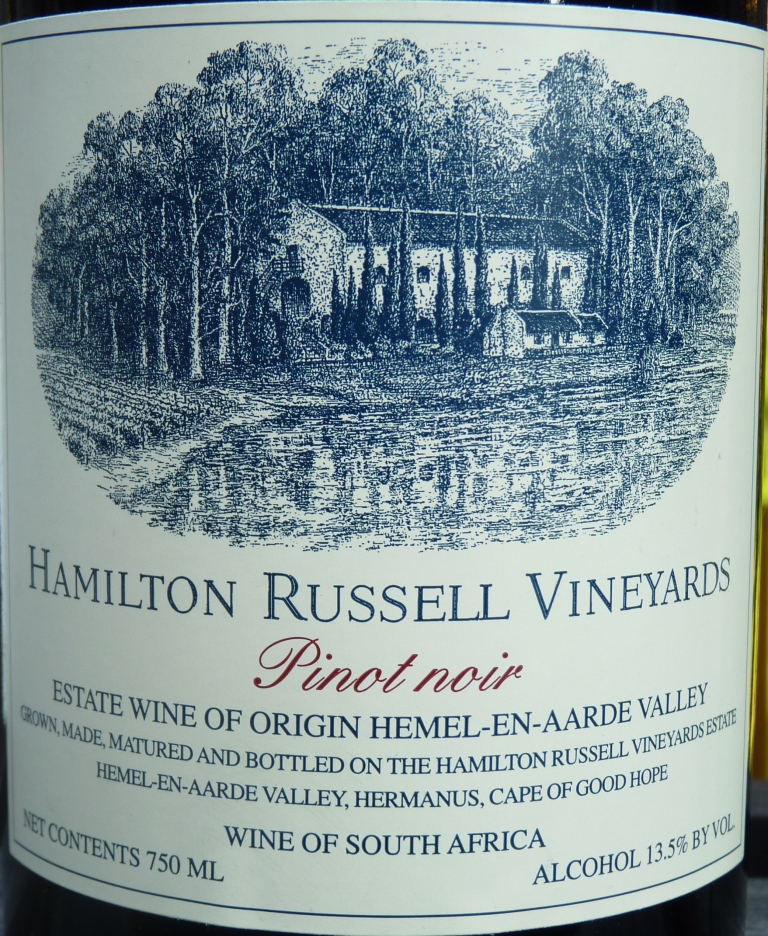
As our tradition goes, let’s open a bottle or two, and let’s talk about the wines. First, 2008 Hamilton Russell Pinot Noir. This wine is simply amazing – very restrained and polished, with beautiful restrained fruit, lots of smokiness and earthiness on the palate. This wine shows off as a classic Burgundy, and only when you look at the label you experience almost a shock – this wine is from South Africa, last place one would expect to produce classy Burgundy (you can read about our blind tasting experience here).
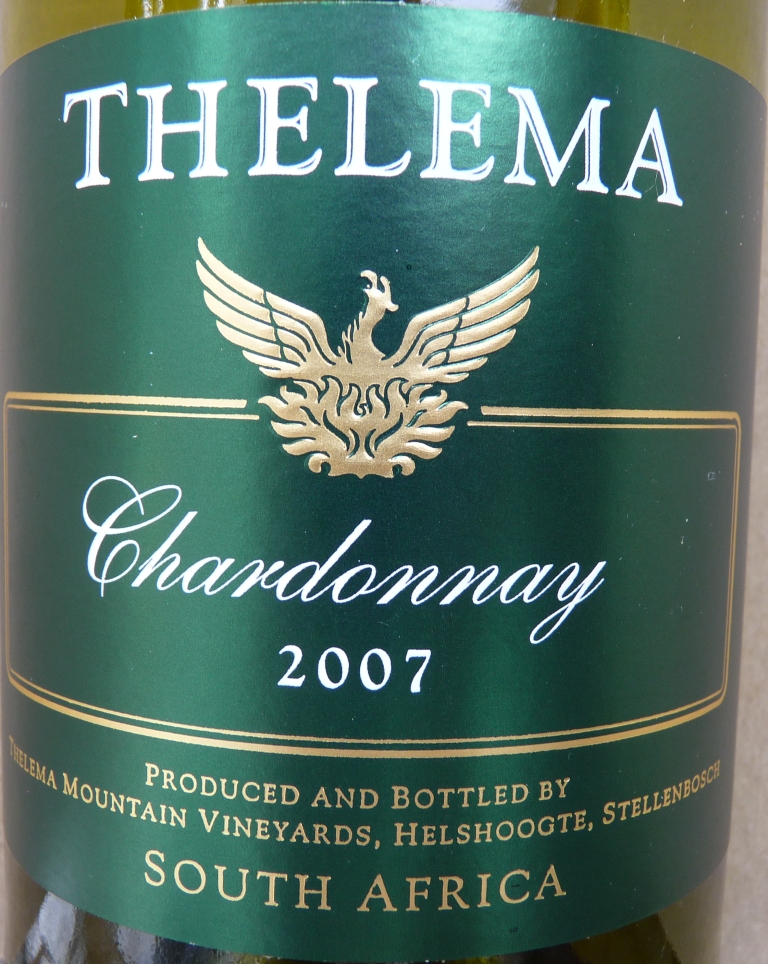
Then comes 2007 Thelema Chardonnay, again, very reminiscent of beloved White Burgundy – restrained, with balanced fruit, hint of butter and vanilla on the palate and good tannins – very elegant.
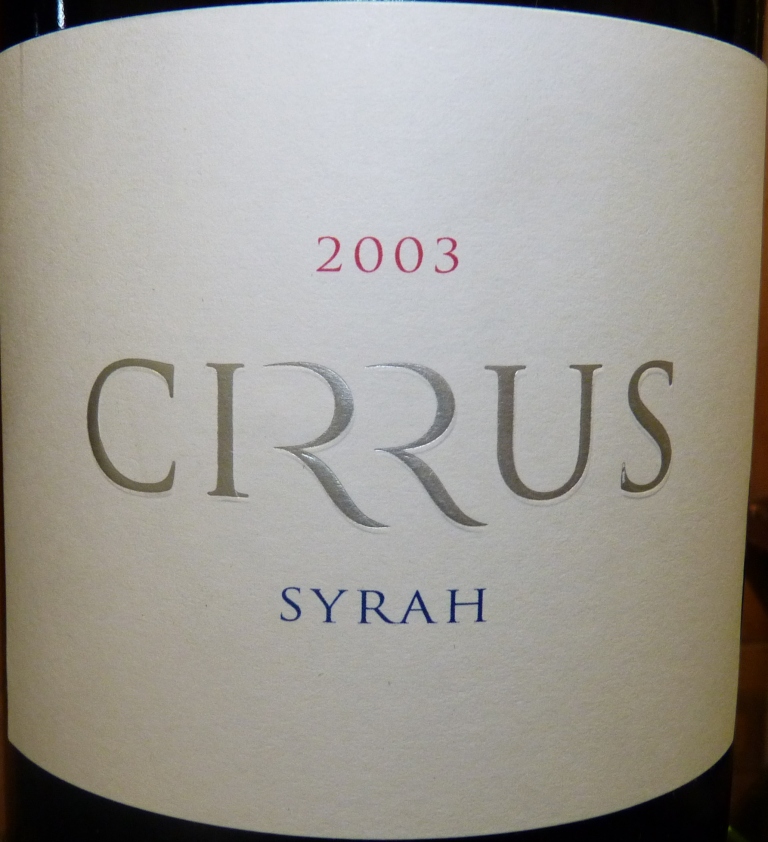 Last I would like to mention 2003 Cirrus wine – a predominantly Shiraz ( 96%) with addition of small amount of Viognier (4%). On the palate, this wine mostly represents liquid smoke, but it really comes alive in a glass, with excellent tannins, toned down fruit and perfect acidity, well balanced.
I don’t know if I manage to convince you in the “secrets” status of South African wines. But if you will think about it, either way you have to find a bottle of South African wine – to either agree or disagree with me. Look for the one we talked about here – and judge it for yourself. Cheers!
Wednesday’s Meritage – Wine Quiz Answer, Orange Wine Bad or Good?, Kegs of Wine, New Wine Magazine and more
Meritage time!
Let’s start with the answer for the wine quiz #44, What is in the numbers. In the quiz, you were supposed to identify what the numbers 100%, 75%, 85% and 95% mean all together and by themselves. As VinoinLove mentioned, it was a difficult quiz – I have to agree with him – but he cracked it nevertheless! So, yes, VinoinLove is a winner of the wine quiz #44, and here is the answer.
All the numbers are taken from the definition of American Viticultural Area (AVA):
100% – If California is specified on the label, 100% of the grapes should be from California (it is interesting to note that California is an exception – it is 75% for all other states).
75% – a grape source requirement for all other states
85% – a vintage designation requirement – if a vintage specified on the bottle, at least 85% of the grapes should be coming from that vintage. Interestingly enough, until 2006, the requirement was 95%
95% – has two meanings. When specific AVA is noted on the bottle (Napa Valley, for example), at least 95% of the grapes should belong to one and the same vintage. Also, when vineyard is specified on the label (for instance, To Kalon), at least 95% of the grapes should be sourced from that vineyard.
Care to learn more? Here is the link for you.
And now to the wine news. I found few of the interesting articles I want to bring to your attention. First, what do you think of orange wine? It’s being very much discussed subject for the past 2-3 years. You get orange wine when you ferment white grape in contact with the skin for a prolonged period of time. The resulting wine is typically quite distinguishable. With the popularity of course comes a controversy, a fad, chick and all other usual things. Here an article from SF Gate covering this subject of the orange wine. It is an interesting read, especially considering that the article starts with total bashing and ends with literally a praise for the orange wine. Do you have your own orange wine experience? If you do (or even if you don’t, but have an opinion), please share it in the comment section.
When you are in a bar or a restaurant, do you prefer beer on tap or in the bottle (well, of course assuming there is a decent selection of beer on tap)? My personal preference is beer on tap, as it is usually tastes fresher. Now, how about wine? On tap or in the bottle? What, never heard this question before? Coming to the bar near you – Wine on Tap. May be it is the time for you to get prepared? Here is the link for you with some good wine on tap suggestions. Let me know if you already experienced any of the wines on tap – I had not so far, but bused on the recommendations in the article, really would love to.
January 2013 was inaugural month not only for the US President, but also for the new wine magazine called By The Bottle. Magazine is available in electronic format only, currently for iPad with Android version coming soon. I just wrote the review about the first issue, which you can find here.
In the love of all the Top Ten lists and Statistics of all sorts, here is a list of Top Ten Wine Regions in the world, according to Wine Folly. Read, analyze, discuss, make conclusions – do whatever you usually do with numbers.
I think the glass is empty – will refill in a week. Cheers!
By The Bottle – First Time For Everything
Few days ago, I found an e-mail in my inbox. “Would you be interested in reviewing our new wine magazine called By The Bottle”? Hmmm, I love reading – books, magazines, blogs – but review? Take something and shred it apart? Or write pointless sweet mambo jumbo, pretending I’m saying something of essence? Both scenarios sound equally unappealing. Ahh, yes – and the magazine is all-electronic, an iPad version. I already had an experience with an iPad wine book I didn’t care for. What should I do, what should I do… I read the e-mail again. It said “the good, the bad and the ugly – we can take it”. Okay, so let’s see how bad it can be.
Going along of “don’t judge the book by its cover”, I had to make an effort from the get go.
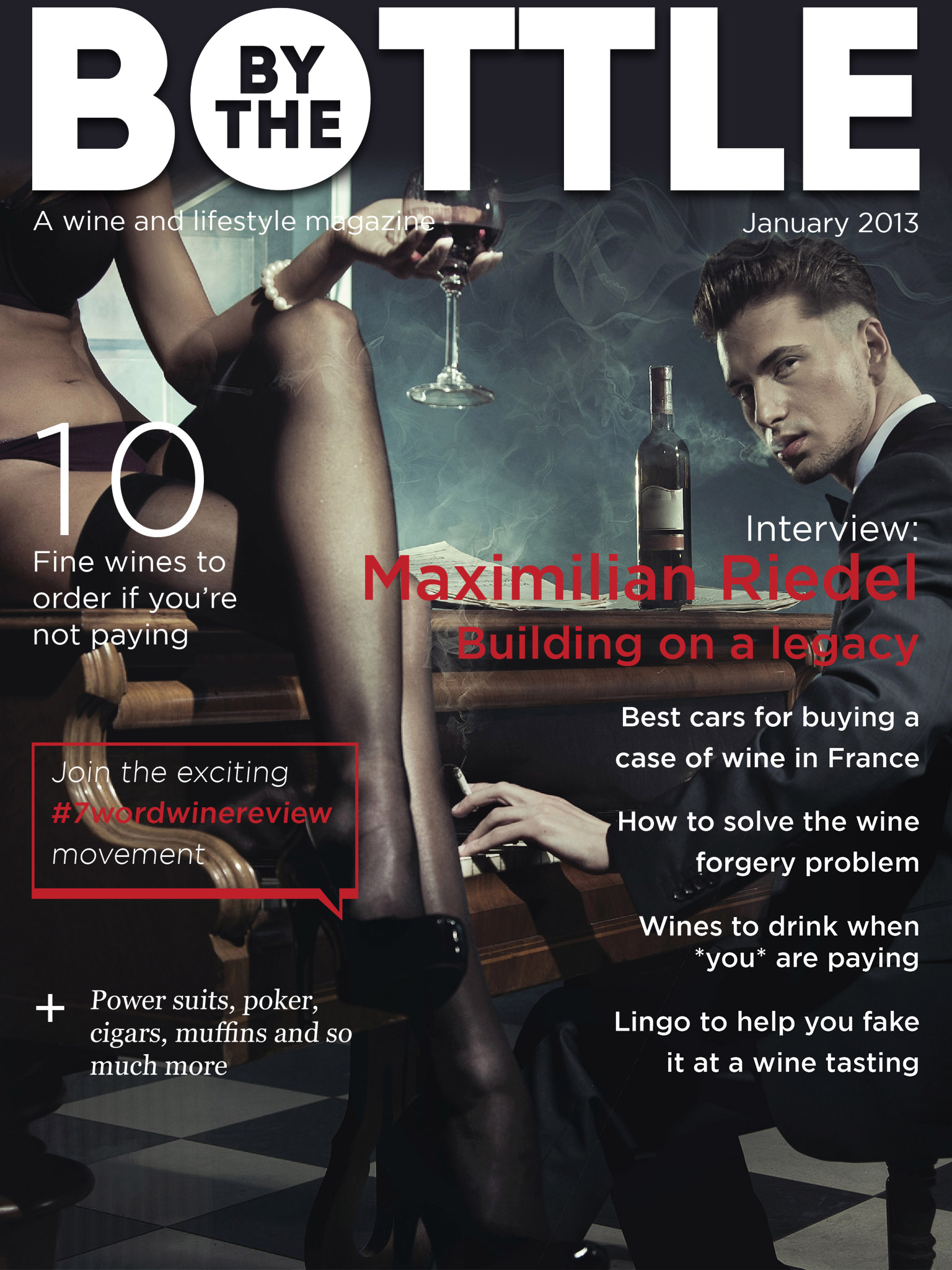 I didn’t like the cover. At all. The woman’s legs – okay, it is a cheap attention shot. The guy looks good, but what’s up with that cigarette? This is clearly not meant for the American audience – I would understand the cigar (kind of), but cigarette? Yes, may be I’m missing something, but I’m not aware of cigarettes becoming popular again in US. And I understand that the magazine hails from Europe (London, to be precise), but I didn’t read so far about smoking renaissance in UK. Thus to this point, one is clearly down, and I need to control my expectations for the rest.
Here is an important announcement: we reached the end of the bad news. From there on, it was actually interesting and entertaining.
The magazine’s promise is that it will have something for all different groups of wine lovers, from amateurs to the people “in the trade” – and it delivered.
Pictures, graphics, cars, bottles and people – all done at the level of an “eye candy”. Of course iPad’s graphics capabilities greatly help with it.
Navigation is simple and clear – you know where you are, the structure is linear and it is easy to go back and force. Definitely a plus.
And then the content.
I pretty much enjoyed all the features in the magazine. The interview with Maximilian Riedel, 11th generation glass-maker (well, actually he is a Head of US operations, but still) was quite interesting (I still don’t care for the “O” series of glasses, but it is just me).
Have you heard of #7wordwinereview? It is a whole movement around the world, against long but meaningless, not fun and repetitive wine reviews. It is taking place everywhere, and people are having fun with their wines (guess what we are doing at our next wine dinner).
I don’t want to take it away from you – there are many more fun things you can read and learn about – what car would be best if you are going on a wine buying spree in France (well, that would be best airline with best luggage policy for me), what is corked wine, mastering the wine speak and learning to look as a wine buff without knowing a thing (okay, my recommendation would be actually to learn about wines, but it was fun to read). A little bit about cigars, how to read a wine label, learning to play poker, useful wine accessories and lots more. Even an article proving that wine is the most romantic drink with some pretty graphic arguments as to why wine and not beer. All in all, there is a lot to read – with an added bonus that magazine is free, at least at the moment.
Let’s sum it up. There was the bad and the good, but ugly didn’t show up. I really like the format, the fact that magazine is concise and finite, a pleasure to flip through and easy to use. The content is good now, and potential is really unlimited (I have tons of ideas, but I’m sure people behind the magazine have one or two of their own). I’m looking forward to the next issue already.
Intrigued? Get your own copy (here is the link, or simply type the name “By The Bottle” in the search box in App store on your iPad), pour yourself a glass of wine and feel free to become a magazine critic. A least I did. Cheers!
Weekly Wine Quiz #44: What’s In The Numbers?
Saturday = Quiz Time, right? Well, of course not – there are thousands of more interesting things to do on Saturday than to solve the wine quiz, but in case you got a few free minutes, here is one for you.
Today’s quiz will be all about numbers. No, no, this is still a wine blog, no worries – so these numbers will be relevant to the wine world. Below you will find a group of numbers which have direct (and pretty strong) relationship with the wine world. While each number has individual meaning, the idea is that they are all related, together they define something. You will need to figure out where do they belong and what is the meaning of each number. Here we go:
A. 100%
B. 75%
C. 85%
D. 95%
Is there a controversy here? May be, but I’m not aware of it at this point, therefore, it is an official quiz.
Have fun and good luck! Cheers!
Of Scotch And Character
Quick trip to Scotland, anyone? Seriously, do you want to hear the wind and embrace the land? This is easy – turn the sound on and click here.
Do you want to make your experience even more realistic? Pour yourself a splash of Bruichladdich (may be even while sitting next to the fireplace), and you are there.
You probably figured by now that today we are once again going to talk about Scotch. If last week I was talking about the art of blending, as present by Compass Box, today I want to talk about pure character. Few days ago I tasted some new Scotches coming from Bruichladdich, a distillery located on island of Islay. Islay is one of the main areas in the Scotch production (the others are Highlands, Lowlands and Speyside), famous for their Scotches to be very peaty, smoky both on the nose and the palate.
Bruichladdich distillery is about 130 years old, definitely not the oldest, but considering the number of new products and limited releases I would dare to say, one of the most innovative. The proof is in the pudding, right? Err, in the Scotch in our case. So in the tasting, I had 4 different Bruichladdich Scotches which I never tasted before.

Bruichladdich Rocks was the lightest from the group – nice touch of smoke on the nose, very floral and mellow on the palate, as light and refreshing as Scotch can be (distillery tasting notes can be found here). .
Bruchladdich The Laddie Ten, as the name says, is 10 years old single malt – touch of iodine on the nose (not anywhere as medicinal as Talisker, with only a whiff of iodine), excellent, soft, round, with good viscosity, very gentle for what it is (distillery tasting notes can be found here).
Bruichladdich Islay Barley 2006 – yes, it is a very young Scotch, which I’m not even sure has a specific definition in the world of Scotch. Not only this is single malt, but all the barley used in production of this scotch comes from one specific farm (a single farm single malt?). Really unusual (especially for Islay), pure caramel on the nose, round and delicious (while I really enjoyed it, it felt more like “ladies scotch”). Again, here are the distillery tasting notes.
Bruichladdich Port Charlotte – The Peat Project – ahh, pure classic. This was classic Islay. Perfectly peaty and perfectly restrained at the same time. Bacony smoke on the nose, round, smooth, elegantly peaty on the palate and delicately weaved. While you can read the distillery notes here, I can’t help it but to cite a line from the description: “bottled using Islay spring water from the Octomore field of farmer James Brown” – does it get any better than that?
Our tour of Islay is over, folks. Go grab a bottle of Bruichladdich and enjoy the spirit and the character of the land. Cheers!
Re-post: Best Hidden Secrets of The Wine World: Wines of Georgia
In 2011 I wrote a number of posts for the project called The Art Of Life Magazine – of course talking about my favorite subject, wine. The project closed, but I still like the posts I wrote, so I decided to re-post them on this blog. Also, in that project, posts were grouped into mini-series, such as “Best Hidden Secrets” you see here – I will continue re-posting them from time to time.
Also note that the series was written for a slightly different audience – I hope none of my readers will take offense to the fact that sometimes I’m stating the obvious…
We are continuing our “secrets” discovering journey, this time moving a few thousand miles mostly east of Veneto, Italy, which was our last stop. Now we are in the fertile mountainous region called the Caucasus. To be more precise, our destination is Georgia, a small country with a rich history (the subject of Georgian Wines was already discussed in this blog, but a recent encounter with Georgian Wines convinced the author that this subject is worth talking about again).
For the sake of this blog, we will of course focus on the part of Georgian history which relates to wine. For beginners, Georgia is widely considered a cradle of winemaking. According to Wikipedia, wine production started in Georgia more than 8,000 years ago. With all due respect to the so-called “old world” of wine, that beats France, Italy, and other European countries by about 7,000 years.
Of course, truth to be told, multiple thousand years of history don’t translate directly into today’s advantage. For instance, the majority of the countries which existed thousands of years ago are not even remembered today. If everything goes well, that long history can only translate into traditions – good or bad, but traditions are just what they are: “typical ways of conducting certain activity”, or “an inherited or established way of thinking, feeling, or doing”, according to the definition from Merriam-Webster.
Fast forward to the middle of the 20th century, and Georgian wine-making traditions came under attack by the Soviet regime, and the Georgian wine-making industry became literally non-existent. Fast forward once again, to the last decade of the 20th century, and traditions came back into play, helping to re-born the Georgian wine industry. Of course, once the former soviet union collapsed and Georgia became independent, freedom had a “drugging” effect. A tremendous amount of mediocre (at the best) wine was produced, all in an attempt to “get rich quick”. This situation backfired, and Georgian wines went into the “ignore” category without any chance to rise to prominence (disclaimer: these are observations from the US-centered wine market).
Luckily, traditions, based on real, rich history and pride came to the rescue. Fast and greedy mostly disappeared, and real winemakers and businessman took their place. Those thousands of years of history and traditions became a multiplying force for skills, craftsmanship, and ambitions, and now started bringing us world-class wines. It is still very difficult to buy good Georgian wines in the US, you have to really know where to get them, but hopefully, this situation will change. Hmmm, maybe we don’t need that to change? Let’s keep it secret, so those in the know can continue enjoying first-growth Bordeaux quality wines at one-hundredth of the price?
 Time to talk about wines – after all, we need to put some substance behind the nice words. Let’s start with… Champagne? Err, Sparkling wine, of course, as Champagne can only come from Champagne. Enters Bagrationi 1882, which makes sparkling wines using traditional “Méthode Champenoise” for more than 100 years. Round, soft and creamy, with perfect acidity, bright and refreshing, this sparkling wine will successfully compete with any of the actual Champagnes and other sparkling wines. In the blind tasting (non-professional), 2007 Royal Cuvee was the best out of the 8 sparkling wines, including classic Champagnes (you can read about it here).
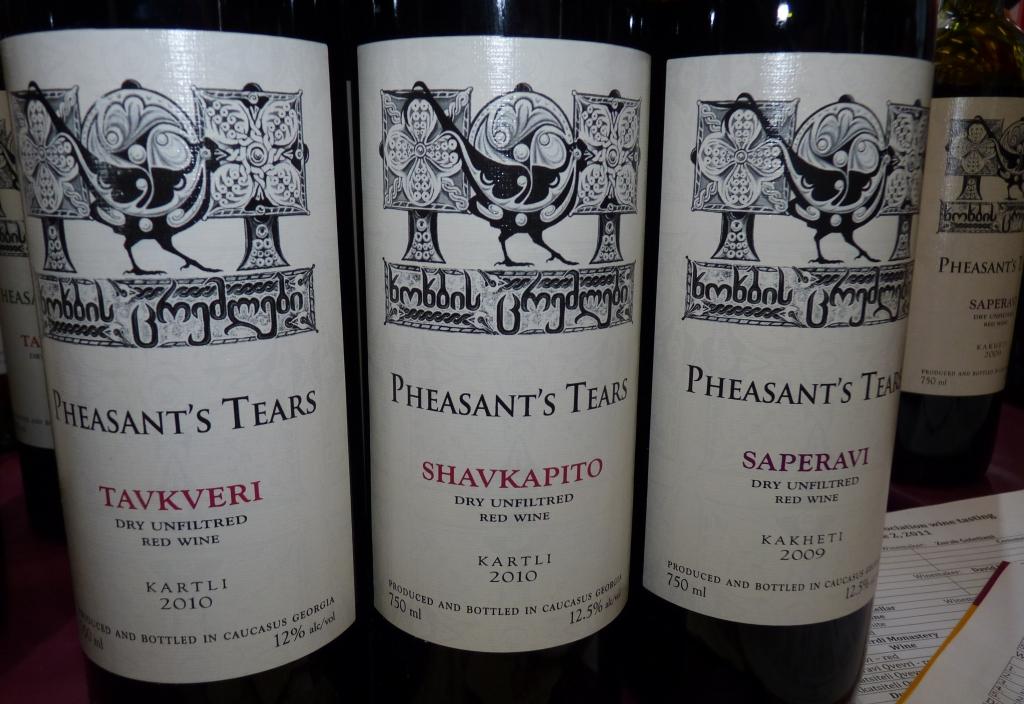 Moving along, let’s talk about some of the most unique wines I ever had a chance to taste. Pheasant’s Tears winery (as well as some others), produces wines using thousands-years old (talk about traditions) technology – the grapes are crushed and fermented for a prolonged period of time in the clay vessels called Qvevri. The resulting wines, made from different indigenous grapes, such as Kisi, Rkatsiteli, Tavkveri, Saperavi, and others, are very different from most of the other wines. Both whites and reds show very nice tannins which come from prolonged contact with skin and seeds (no oak aging whatsoever), as well as a great level of complexity somewhat similar to good Madeira. These wines should really be experienced, as words can’t do them enough justice.
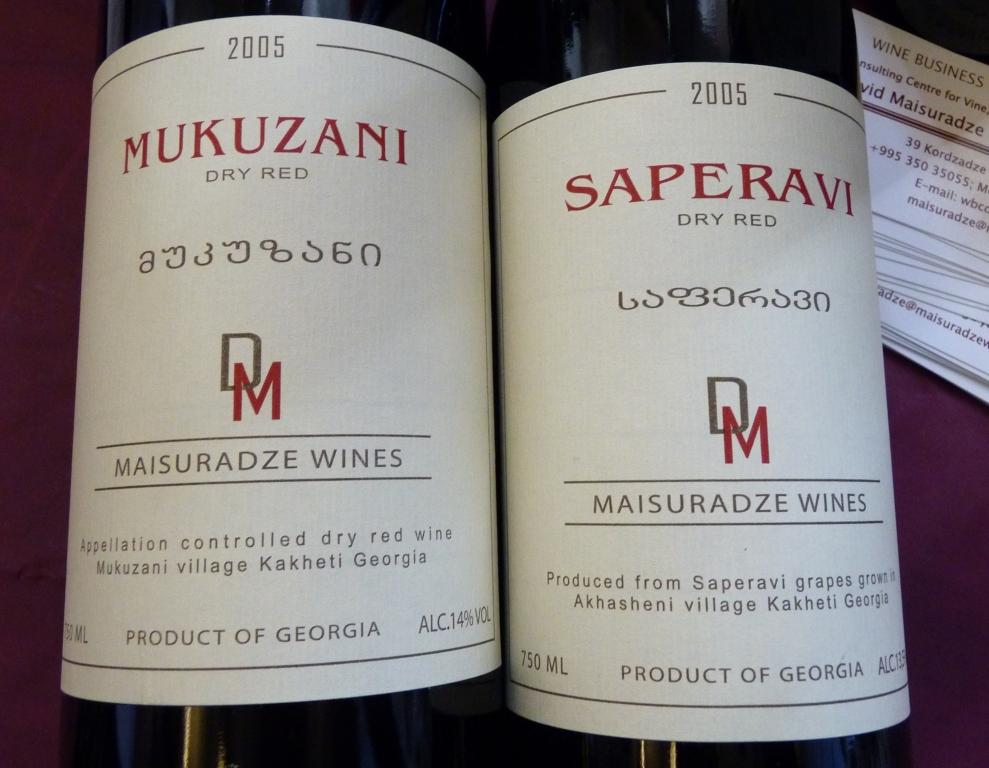 Last for this post, but not least, I want to mention true world-class winemaker-made classic wines. You know, those wines which are happily associated with winemakers or lead producers, such as Michel Rolland, Christian Moeux, Helen Turley, Andy Erickson ( Screaming Eagle), and many others. These wines are made by David Maisuradze out of the classic Georgian red grape called Saperavi. Both Mukuzani and Saperavi are truly amazing wines, with perfect layered dark fruit on the palate, perfect structure, powerful tannins, and excellent balance. 2005 Mukuzani shows more tannins at this point (it was aged for 24 months in the oak), and while it can be definitely enjoyed right now, it needs another 10-15 years to truly shine. Get it, if you can!
Georgian wines came back to the wine lovers to take the place they really deserve, the product of love and obsession supported by deep roots and traditions. While not easy to find, they are definitely worth looking for. Make an effort, find the bottle, try it, and send me a “thank you” note later on, as I’m sure you will be inclined to do. To the wonderful wine discoveries!
Wednesday’s Meritage – Wine Quiz Answer, Plonk in the Headlines, Gambero Rosso and more
Meritage Time!
Let’s start with the answer for the wine quiz #43, Which One Doesn’t Belong. In the quiz, you were given a list of 6 well know Burgundy wines and you were supposed to identify the one which shouldn’t be on the list and explain why. Same as last time, we have exactly the same two winners – both vinoinlove and thedrunkencyclist were able to correctly identify that Clos de Lambrays shouldn’t be on the list of Grand Cru Monopoles. Monopole essentially is a single appellation in Burgundy which is owned by single family/winery. Clos du Tart, La Grand Rue, La Romanée, La Romanée Conti and La Tache are all Grand Cru Monopoles ( they all have their respective single owners), but tiny portion of Clos de Lambrays has its own separate owner, which makes it unqualified for the “Monopole” denomination. Congratulations to our winners, they are doing great winning the second quiz in the row – will see how long their winning streak will last, but for now they definitely got the unlimited bragging rights.
And now, let’s move on to the interesting stuff around the grapevines. First, the upcoming presidential inauguration created a lot of waves (rather a small tsunami) in the wine world, by selecting Korbel undrinkable plonk as a sparkling wine of choice, and also calling it a “Champagne”. Considering absolutely astonishing availability of great sparkling wines (authentic!!!) made in this country, from New Mexico to California to Virginia to New York, I can only raise both eyebrows (I would raise more if I would have it) at this selection. For a better coverage, you should read what Dr. Vino and Chris Kassel have to say about it. I truly hope that this selection is not indicative of what we should be expecting here in US of the next four years…
What do you think of a blind wine tasting? Do you think it is humbling? You bet. Do you think it is educational? I’m sure it is. But don’t take my word for it – here is an interesting article published by the Wine Spectator and talking about blind tasting experience – I think it will be well worth of your time.
Last but not least – Italian wine lovers, rejoice! Thanks to Stefano from Flora’s table, we now know that Gambero Rosso, one of the most respected and prestigious Italian wine guides, will run the wine tasting events around the US over the next few weeks. For more information about Gambero Rosso events, please visit Stefano’s blog.
That’s all I have for you for today, folks. The glass is empty – but refill is on its way. Until the next time – cheers!
My Case For Bringing The End Of The World Back
 And why would anyone want to bring that “end of the world” craziness back, you ask? I’m sure many of the “preparedness kit” sellers would love that, as they would make ton of money [again]. My case is exactly opposite – I’m talking about saving money. On the critical “end of the world” necessity. Yep, wine.
As you could’ve notice in this blog, I’ve been a long time aficionado of Wine Til Sold Out (WTSO), which offers amazing savings on the wines. About half a year back, thedrunkencyclist introduced me to another value wine source – Last Bottle Wines. Last Bottle Wines operates very similarly to WTSO – one wine at a time, usually at a great price, and minimum number of bottles to buy in order to get free shipping. There are few differences compare to WTSO – for one, the wines are not shipped during hot months, unless you will make special arrangements (everything you buy is accumulated and shipped once weather allows). Another distinction is the fact that less than $10 wines are offered quite often.
Getting back to the “end of the world” connection. Couple of days before the end of the world was supposed to take place (December 21st, 2012 for those who happily dropped that date from the memory), Last Bottle Wines declared “end of the world” marathon. They were offering tremendous number of wines at a great prices, with no minimum quantity in order to get free shipping. Caveat? If the world ends, you are not getting your wines. Fair? I think so. Also, all the wines you buy are accumulated into one order which shipped after the new year. Fair again.
The only way to learn about new offerings was by clicking “refresh” in your browser all the time. But this inconvenience was a small price to pay for the gems which were offered. Well, forget the gems – great value wines we are talking about.
Need an example of a great value wine? Easy. 2007 Vine Hill Gatos Locos Pinot Noir Santa Cruz Mountains. Beautiful smoky nose. Dark dense fruit on the palate, ripe plums but precisely ripe and not over-extracted, coffee notes. Supple tannins, good acidity. Structure. Finesse. Balance. All for $9 (no, I’m not missing at least 1 in front or 0 at the end). And the person of a limited intelligence, who is writing this right now (yep, me), bought only two bottles (!). Well my only excuse – I had no idea…
All in all I got 5 different wines, for the total of one case (12 bottles), for which I paid a whooping $78…
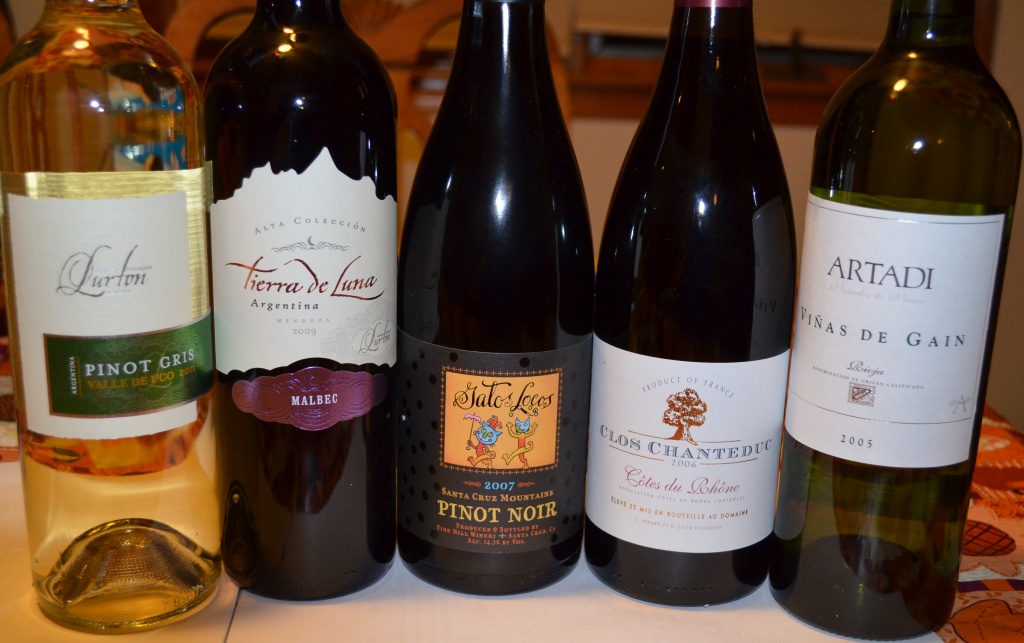
I also tried 2006 Clos Chanteduc Cotes du Rhone, which was very good, but not as amazing as the Gatos Locos Pinot.
So this is my case for asking to bring the “end of the world” back – may be, may be the Last Bottle Wines would do another sale, and I will be able to find more great wines at a great prices. On another hand, there is always hope that they would just have another sale without waiting for the next “end of the world” to be declared. We can even drink to that. Cheers!
Weekly Wine Quiz #43: Which One Doesn’t Belong?

Domaine Romanee-Conti La Tashe 2008
Time to play our weekly wine game!
I still don’t have a good idea for the series of quizzes, so we will continue jumping around for a while. As you can guess from the picture, today we will be talking about Burgundy.
When it comes to the grapes, Burgundy is probably the easiest to remember appellation in the world – they only use two grapes – all the reds are made out of Pinot Noir, and all the whites are made out of Chardonnay – easy, right? When you see a bottle of Burgundy, you don’t need to read the back label or search on internet to find out what grapes this wine is made out of, you immediately know it.
However, as everything in this world has two sides, so does Burgundy. The payback for the “grape simplicity” is probably the most complex in the world system of naming the wines, with Grand Crus, Primier Crus, Domaines, Clos and so on (no, we are not going into the Burgundy crash course here, this is just a prelude to the question).
Playing on this complexity (see, I’m honest), below is the list of Burgundy wineries, but one of them doesn’t belong – you will need to figure out which one and why:
- Clos de Lambrays
- Clos du Tart
- La Grand Rue
- La Romanée
- La Romanée Conti
- La Tache
Have fun and good luck! Cheers!
Compass Box – The Art of Blending
Innovation. This word is usually associated with high-tech industry, new cars, new gadgets, an iPhone 6 or 7 – I’m sure you got my point. Yet innovation is not a foreign word when we talk about food, and wine, and the other stuff we drink, even though the original concept didn’t change in many thousands or at least many hundreds of years.
If you scroll through the posts in this blog, you will see that most of them are about wine and food (with a bit of photography). However, from time to time I step outside of the wine world and talk about my second favorite type of enjoyable alcohol, Scotch – and this will be the subject of this post.
What was with all that talk about innovation, you ask? When it comes to Scotch, many of the products are deeply rooted in tradition. Yes, some distillery might change the label or the packaging, and that would be about the full extent of innovation. But then there are companies such as Compass Box – a relative newcomer in the world of fine whisky. Compass Box had a vision – a vision of taking the existent best of the breed whiskys from the different regions, aging them in the best available wood and then blending them together to create a new line of products which would be unique and exemplary at the same time. Most importantly – they managed to succeed with that approach and took their rightful place in the market.
About two month ago I had an opportunity to taste through the whole line of Signature Range of Compass Box whiskys, so here are my notes from that tasting.

Asyla – nice, standard, smooth
Oak Cross – touch of sweetness, very delicate, nice fruit
Spice Tree – very nice, less sweetness than Oak Cross, with coriander notes on the palate
Peat Monster – big, peaty, bad ass beauty, medicinal, round – perfect! Need campfire to pair
Hedonism – very viscous on the nose, nice, delicate, with touch of sweetness, very round – very nice, distinctly different from anything else.
Flaming Heart – beautiful. Peaty but very balanced. Best of tasting.
Orangerie – nice addition of fresh orange, very delicious.
I also sneaked by (no, I didn’t steal anything, I was offered the taste) Johnnie Walker Blue King George V Edition, which is pretty rare and needless to say, expensive – very oily in appearance and on the nose, but then super clean and fragrant on the palate, very very round (if you are into Scotch, this one should be on your “must try list”).
That is all I wanted to share with you, folks. If you know of Compass Box scotches and enjoy them, pour yourself another splash. If you never heard of them, try one – you might discover something new. If you don’t like scotch, there is a good chance you just didn’t happen to find the right one yet – keep trying as you might come across the one which will speak to you… Cheers!
Last Bottle Sign Up ($10 credit)




 Talk-A-Vino