Sunday Read: The Winegetter: Somewhere, Beyond the Sea
Today I decided to somewhat reverse the roles with Oliver, who writes an excellent blog called The Winegetter (if you want to learn about German wines, and wine appreciation overall – subscribe to his blog for sure). Typically on Sundays Oliver shares a thought-provoking article, which is usually worth reading. Oliver had being traveling in Asia for more than a month by now, and before he left for his trip, he undertook a very interesting project. He contacted many wine bloggers (myself included) and asked if they will be willing to write a guest post for his blog while he is traveling.
I personally liked the idea and agreed to participate (along with many others passionate folks). Oliver called this series “Somewhere, Beyond the Sea”, and he published quite a few guest posts in it already. Today (and it is still Sunday on East Coast), Oliver published my guest post about recent visit to Truro Vineyards on Cape Cod – hence I’m playing Oliver today and bringing my guest post to your attention under the theme of Sunday Read (note – it is not as thought-provoking as what Oliver would typically publish, but at least it is still Sunday). Here we go:
I have a few extra pictures to add to those which Oliver already included into the post, so here are these additional pictures for your viewing enjoyment:


Have a great week ahead and cheers!
Weekly Wine Quiz #69: Grape Trivia – Viognier
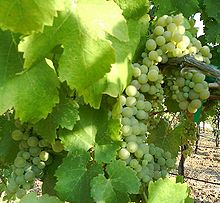
California Viognier grapes, as shown in Wikipedia
Welcome to the weekend and your new wine quiz!
We are continuing our grape trivia series, still focusing on the white grapes, and today’s subject is Viognier.
Talking about turbulent history here. Viognier is one of the oldest known white grapes in the world, with the first mentions attributed to the 280 AD. It is considered that Romans brought it to France from Croatia (of course the region was called differently in those times, but it is still geographically correct). Historically, Viognier wines were mostly made in the Northern Rhone region in France, and they were quite popular in the 1800. However, by the 1965, there were only 8 acres (!) planted in the world, producing minuscule amount of wine.
Viognier‘s renaissance started in 1980s, when the grape was brought into the United States and Australia. From that time on, the interest to the grape increased and even skyrocketed in the 21st century worldwide, with the plantings in France alone increasing 100-fold. Now Viognier is growing in pretty much every major winemaking country in the world, including Spain with some experimental plantings in Rioja area. In the United States alone, the grape is becoming more and more popular, and not only in California, but also in the states such as Texas and Virginia, producing very interesting wines (take a look at my notes from Viognier tasting in Texas).
Viognier at its best produces wines with very perfumy, floral nose, which are firm, structured and full bodied on the palate, with peach and apricot flavors often being most noticeable. The challenge of Viognier lies in the fact that the grape is naturally low in acidity, so if it is not ripen properly, it will produce sweet and not very drinkable plonk. One of the reason for Viognier to do much better nowadays is greatly improved winegrowing and winemaking techniques, which allow to produce great tasting wines more consistently.
And now, to the quiz!
Q1: Viognier stands pretty unique among all white grapes as it is often added or can be added as blending component during the production of the red wines around the world. Do you know the name of the red grape it typically accompanies?
Q2: Name the source of essentially the best and most long-living Viognier wines in the world
Q3: Viognier became so popular in the United States, that one of the states even called it “an official grape of the state”. Do you know which state it is?
a. California
b. New York
c. Texas
d. Virginia
Q4: Wine Spectator calls wines rated in 95-100 range Classic (the highest and the most prestigious category). True or False: there are no Viognier wines with Classic rating
Q5: Based on DNA research, Viognier has an unlikely cousin in Italy, which is not even the white grape, but red. Can you name that “cousin”?
Good luck, enjoy the quiz and your weekend! Cheers!
Wednesday’s Meritage – Wine Quiz Answer, New Life at Mayacamas, Few Reminders and more

Field Recordings Chenin Blanc Jurassic Park Vineyard
Meritage Time!
Let’s start with the answer to the wine quiz #68, grape trivia – Chenin Blanc. In the quiz, you were supposed to answer 5 questions about Chenin Blanc grape.
Here are the questions, now with the answers:
Q1: True or false: South Africa grows (area-wise) twice as much Chenin Blanc as France
A1: True. Chenin Blanc plantings in South Africa take a bit less than 25% of all grape plantings in the country, and it exceeds plantings in France by at least two times.
Q2: Do you know how Chenin Blanc is typically called in South Africa?
A2: Steen. Chenin Blanc is South Africa was traditionally called Steen, but as many wineries are improving quality of their Chenin Blanc wines, they also use the traditional “Chenin Blanc” name on the labels more and more.
Q3: Based on DNA research, Chenin Blanc might be a parent of:
a. Pinot Blanc, b. Sauvignon Blanc, c. Marsanne, d. Ugni Blanc (Trebbiano)
A3: Sauvignon Blanc.
Q4: Wine Spectator calls wines rated in 95-100 range Classic (the highest and the most prestigious category). True or False: there are no Chenin Blanc wines with Classic rating.
A4: False. While there are only 14 Classic Chenin Blanc wines to the date (all from Vouvray region in France), Domaine Huët Vouvray Cuvée Constance 1997 scored even perfect 100 points.
Q5: One of my all time favorite Chenin Blanc wines is made by the company called Field Recordings in California. It is a single-vineyard wine, coming from the vineyard which has the same name as one of the blockbuster movies of the 90s. Do you know how this vineyard is called?
A5: Jurassic Park! I’m really curious what would give such a name to the vineyard, but hey, this is how it is called. And Jurassic Park Chenin Blanc I had was spectacular.
I’m glad to report that we have lots of winners this time! Emil, SheWinesSometimes, VinoinLove and TheDrunkenCyclist answered all 5 questions correctly, and they get the coveted prize of unlimited bragging rights!
Now, to the interesting stuff around vine and web!
I have a few interesting things for you to read. First, an article by New York Times‘ Eric Asimov, talking about new life of Mayacamas Vineyards in Napa. Mayacamas is one of the historical vineyards in the region, originally built in 1889, and owned by Bob Travers and his wife since 1968. I experienced Mayacamas Cabernet Sauvignon only once, and it was a spectacular wine, done in very restrained and elegant style. Now the winery is acquired by Charles Banks, who owned Screaming Eagle in the past, and he brought in Andy Erickson, a past Screaming Eagle’s winemaker, to make wine at the Mayacamas. How Mayacamas will change is a big question for all of its fans, so you should read the article to learn more.
Here is an interesting read for you from W. Blake Gray, on the subject of [yeah, here we go again] wine tasting notes. Before you read the article, test yourself – do you know what gunflint is? You do? Great, do you know how does it taste like? My personal answer is “no” for both questions, but you go read the article to learn something new and get entertained.
The last article for today on the subject of Georgian wines, talking about new and interesting wines coming from the “cradle of winemaking”, as Georgia often is referred to. Go find the bottle of Georgian wine to enjoy while you will be reading the article.
We are getting closer to the few important dates (deadlines, rather) so here are your reminders:
August 14th – Wine Blogging Wednesday event, #WBW80 – Dry Rosé. All you need to do is to write a blog post pertinent to the subject, and submit it to the host. For all the details please click here. Let’s make it a success!
August 16th – deadline for submission for the Monthly Wine Writing Challenge #2, with the theme called Trouble. You can find all the rules here. I finally made my submission, so I sleep much better now. There is still time, get your trouble under control and write! Side note – if you are using twitter, I recommend using #MWWC hash tag for all submissions and discussions.
August 29th – Annual Cabernet Day 2013. Grab the bottle of your favorite Cab and join the festivities – here is the link to the invitation I received for this Cabernet Day, in case you want to state your participation officially.
That is all I have for you, folks. The glass is empty -but the refill is coming. Until the next time – cheers!
Wine … It Will Get You In Trouble
In June 2013, Jeff a.k.a.The Drunken Cyclist, started the Monthly Wine Writing Challenge, where the new theme is announced on about the monthly basis by the winner of the previous round. This month’s theme, as announced by The Armchair Sommelier, is “Trouble”.
To be entirely honest with you, I was about to give up on this challenge, as I couldn’t associate “wine” with “trouble”. Before I would “officially” give up, I did what would [probably] most of the married men do – ask the wife’s advice. So the first thing she said, “what do you mean you don’t know what to write about? How about the time when you quietly drunk most of the home-made plum wine when you were a kid”? Yeah, but I really never got into trouble for that, don’t think it was even noticed. “Okay, fine”, she said, “so what about that girl in the wine store…”? Aha – you could probably hear my brain clicking – now we are onto something…
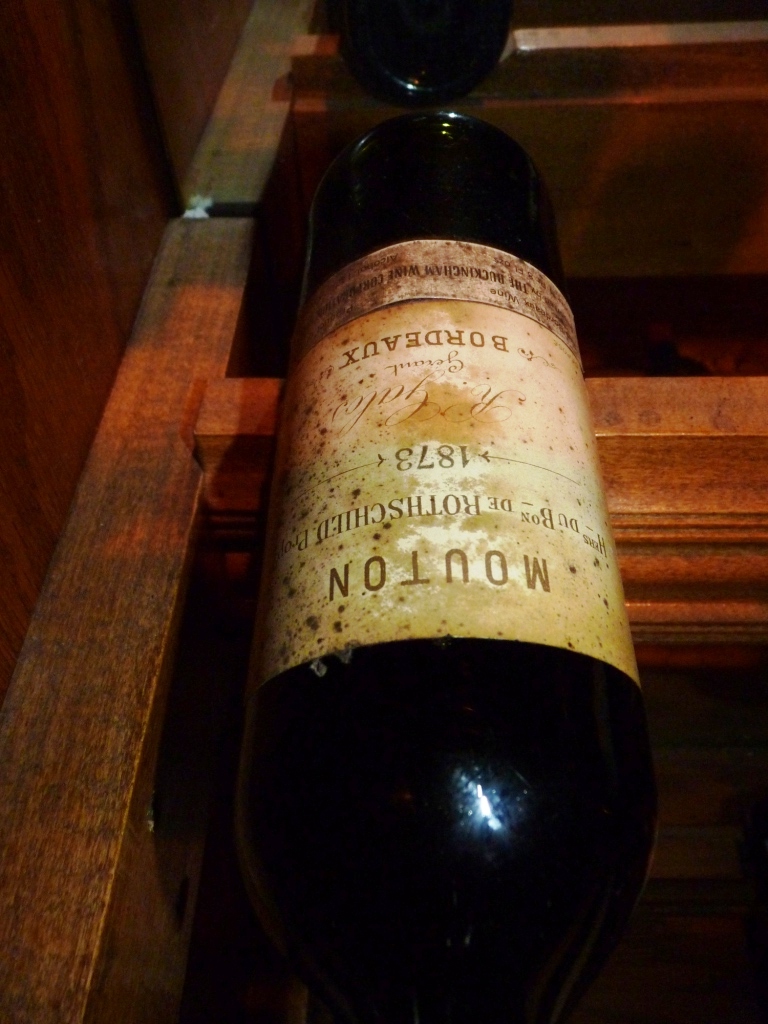
Mouton Rothschild
When you look at the bottle of wine, do you see a trouble lurking around ? No? Well, let me help you.
Think about bottle shapes. Probably 80% of all the wine bottles made worldwide will fall into one of two shape categories – Bordeaux or Burgundy. Yes, there are some shape variations even in those big classes, but they are nominal. Which means that if you will put next to each other a bottle of Bordeaux which retails for $6.99 and the one which will command $699, they will look very, very similar. What differentiates them? Yes, of course the content, but this is not something you know just by looking the bottle. So the only things which will differentiate those two bottles will be labels. See the trouble yet? Let’s continue.
In the wine store, one is guided by the visual cues – namely, the price tags. Take the cues out – and then even labels look identical. Yes, yes, before you call me an unintelligent low life and stop reading, give me a few more minutes and you will see where am I going. Of course, for the small group of crazy devoted wine geeks, every little word on the label is cherished and carefully assessed. 1982 vintage? Bordeaux? That’s nearly a heart attack. Tiny letters RM on the bottle of Champagne. La Turque, Qunitarelli, Alban, 1961, Pingus, Latour, 2000, To Kalon, Colgin, Riserva… I can go on and on and on with all those cherished words. We see any of those words on the label of the wine bottle, and the brain immediately sends out command for awe and appreciation.
Now, step outside of this crazy devoted circle. Outside of the wine store, does the bottle of 2009 Chateau Latour Bordeaux (about $1,600 per bottle, if you can find it) looks all that different from 2009 Chateau Moulin de Beausejour Bordeaux ($6.99, readily available at your Trader Joe‘s)? No, not really. Bottles look very similar in shape, both say “Bordeaux”, both have the same vintage listed – 2009, both have the word “Chateau” on them. Do you see it now? The trouble is not lurking anymore, it is looming, as a huge stormy cloud, full of wind and water.
Let me give two examples. Here are two real life stories of my friend Zak, the owner of the wine store in Stamford. The first one I only heard from Zak, and second one I witnessed myself.

2006 Ornellaia – sorry, Zak was out of Sassicaia
The lady comes into the store and asks for help. “I’m looking for the bottle of the Italian wine. I don’t remember the exact name, but I think it starts with “S”. If you will show me what you have, I will be able to recognize it”. Zak takes her to the Italian wines section. The lady looks around and says excitedly “this one!”, pointing at the bottle of Sassicaia. Then she looks at the price tag ($179 or so), looks at Zak, back at the price tag and says with the hope in her voice: “this is the case price, right?”. “No, madam, this is the bottle price”, answers Zak, and lady’s face becomes all overwhelmed with he emotions and she mutters “ahh, no wonder my husband got so upset when I used this wine for the pasta sauce…”. Turns out the husband was not at home, and the lady was looking for the bottle of red wine to add to the pasta sauce, and the bottle of Sassicaia looked not any different than any other bottle of the Italian wine… Trouble!
I’m standing in the store talking to Zak. The girl comes in with the bag of empty bottles and starts putting them one by one on the counter and then tells Zak: “I need to get this exact wines”. I’m, of course, curious, and I’m picking over Zak’s shoulder as he is looking at them one by one. Some kind of Spanish wine. Something else I don’t recognize. 1995 Chateau Mouton Rothschild. 1999 Riesling. Something … Wait, what? Mouton Rothschild 1995, one of the First Grows Bordeaux? That will be interesting. Zak points at that exact bottle and says: “I don’t have this wine, miss, and it will be hard to get it as this is an old vintage”. The girl asks if he can get the current vintage. Zak looks in the catalog and says “well, I’m not sure if it will be available, as this is highly allocated wine, but if it will be, it will be about $900… Yes, for a bottle”. You should have seen despair and horror on the girl’s face. Turns out her uncle left on a long trip, and left the girl to be house-sitting. Of course having the house party with the full access to the cellar was not what her uncle planned for, and now that he was coming back soon, the girl was on the recovery mission. Is that a trouble? One look at that girl’s face would tell you – yep, big time trouble!
There you have it, my friends. Wine is a dangerous thing, with the “trouble” spelled all over it… Or not. While there can be multiple personal “troubles” around the wine, which will seem serious to the person experiencing them (think about that girl), in a big schema things, we need to remember that at the most, all those troubles will become great (and funny, for the most part) stories to tell later on. Wine is just a beverage, and there always will be another bottle to drink. I can only wish to all of us, that the wine troubles would be the biggest troubles of our lives. You can pour another glass now. Cheers!
Weekly Wine Quiz #68: Grape Trivia – Chenin Blanc
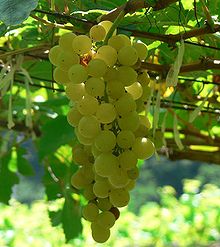
Chenin Blanc grapes, as pictured in Wikipedia
Welcome to the weekend and your new wine quiz!
Today we are continuing our grape trivia with the next white grape – Chenin Blanc. Chenin Blanc is one of the oldest known grapes in the world, with the first mentions tracing back to 9th century in Loire in France. In about 17th century it made it to South Africa, where it became one of the most popular grapes, and it continued spreading around the world. In France, it is mostly growing in the Loire valley, with probably the best wines coming from Anjou and Vouvray regions.
According to wine expert Jancis Robinson, Chenin Blanc is probably one of the most versatile white grapes in the world. It has very high level of natural acidity, and also capable of accumulating very high level of sugars, making it equally suitable for production Sparkling wines and luscious dessert wines. At the time, Chenin Blanc requires a lot of attention in the vineyard, as it has a tendency to overgrow. If harvested too early, its high level of acidity makes the resulting wines simply insipid, and if it overgrows, the resulting wine tends to lose it character making dull and uninteresting wines.
Traditionally, the best Chenin Blanc wines were made in France, with off-dry Vouvray being probably some of the very best examples (if you ever experienced a “wow” Vouvray wine, raise you hand – I personally have, and at about $15/bottle, it doesn’t require you to break the bank). Overall, as winemaking techniques improve all over the world, there are more and more interesting Chenin Blanc wines coming from South Africa, California, Washington, Texas and many other places.
And now, to the quiz!
Q1: True or false: South Africa grows (area -wise) twice as much Chenin Blanc as France
Q2: Do you know how Chenin Blanc is typically called in South Africa?
Q3: Based on DNA research, Chenin Blanc might be a parent of:
a. Pinot Blanc
b. Sauvignon Blanc
c. Marsanne
d. Ugni Blanc (Trebbiano)
Q4: Wine Spectator calls wines rated in 95-100 range Classic (the highest and the most prestigious category). True or False: there are no Chenin Blanc wines with Classic rating.
Q5: One of my all time favorite Chenin Blanc wines is made by the company called Field Recordings in California. It is a single-vineyard wine, coming from the vineyard which has the same name as one of the blockbuster movies of the 90s. Do you know how this vineyard is called?
Side note: Google is your friend. It is impossible to know everything, and when you research, you learn…
Good luck, have fun and cheers!
Wine in the Outdoors: GSI Outdoors Wine Carafe and Nesting Wine Glasses, Platypus PlatyPreserve Wine Preservation System
Yesterday I came across this post by Winingdaily, which will be perfectly fitting into my Wine Gadget’s series. In case you plan to spend time outdoors and still enjoy a glass of wine in style, you might find this information quite useful. Cheers!
Wednesday’s Meritage – Wine Quiz Answer, How To Make Wine Into a Cult, Interesting Videos, Few Reminders and more
 Meritage Time!
First and foremost, the answer to the weekly wine quiz #67, grape trivia – Pinot Gris, a.k.a. Pinot Grigio.
In the quiz, you were supposed to answer 5 questions about Pinot Gris grape – here are the questions, now with the answers.
Q1: Name Italian Pinot Grigio wine which is considered a golden standard of Pinot Grigio in the United States (people really ask for it by name).
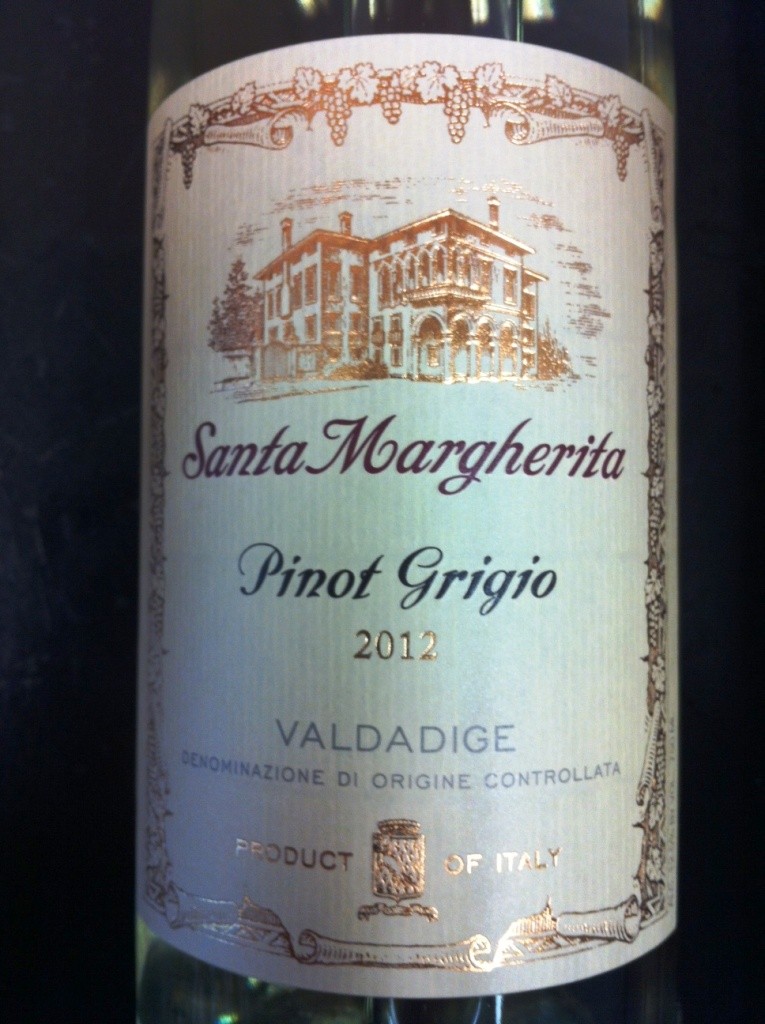
A1: Santa Margherita. In the 1979, a few cases of Santa Margherita were shipped to US by Billy Terlato, the wine importer. The marketing campaign in the 1980s happened to be pure genius ( I guess, I didn’t witness the campaign, but I can see the results) – the rest was history. In 2006 Santa Margherita alone sold 8.5M (that’s millions to you) bottles of Pinot Grigio worldwide, 65% in US. Mind-boggling, if you ask me… You can find some additoinal interesting information in this Imbibe.com article.
Q2: Name two famous regions in France which used to make wines out of Pinot Gris, but not anymore
A2: Both Burgundy and Champagne used to make Pinot Gris wines in the 18th century. Nowadays, both regions still grow Pinot Gris, but practically never use it for the mainstream winemaking.
Q3: When do you think Pinot Gris was first planted in Oregon?
a. 1947, b. 1966, c. 1978, d. 1990
A3: 1966. David Lett of Eyrie Vineyards planted first Pinot Gris vines in Oregon in 1966.
Q4: Wine Spectator calls wines rated in 95-100 range Classic. True or False: there are more classically rated Pinot Gris wines than Sauvignon Blanc?
A4: True. There are quite a few Pinot Gris (no Pinot Grigio, of course) with very high ratings, including 2001 Zind-Humbrecht Pinot Gris Alsace Clos Windsbuhl Sélection des Grains Nobles, which got 100 points. The highest of Sauvignon Blanc ratings belongs to 2005 Didier Dagueneau Pouilly-Fumé Pur Sang (97 points), and overall there are very few Sauvignon Blanc wines in the Classic ratings range.
Q5: During early 2000s, producers in Alsace had to change the way the Pinot Gris wines were typically labeled (you can still find the old name on the bottles from 1990s and before). Do you know what was changed and why? As an added bonus, please explain the origin of the old name.
A5: As with many grapes, the story is quite interesting. Pinot Gris originated in Burgundy, some time in 12th century. From there, it made it to Hungary, and then in 16th century it made it to Alsace, now under the name of Tokay d’Alsace. At the same time, Tokay ( Tokaj to be precise) is the name used for one of the best Hungarian wines, so in 1993 the agreement was reached in EU to phase out the use of “Tokay” in Alsace, which was completed in 2007.
I’m glad to tell you that we have the winner this time! Jeff, a.k.a. The Drunken Cyclist, nailed all 5 questions – he also did it Google-free, which deserved a special commendation – however I can only offer a double amount of the typical prize – unlimited bragging rights. Double unlimited? Not sure how that should work… but great job Jeff!
Now, to the interesting stuff around the vine and web!
First, here is an interesting story for you on how to make the wine into a cult wine. The story was published in the Drinks Business online magazine, so it is written more a trade article, but it makes an interesting reading nevertheless.
Now, I have two important reminders for you:
August 14th – Wine Blogging Wednesday event, #WBW80 – Dry Rosé. All you need to do is to write a blog post pertinent to the subject, and submit it to the host. For all the details please click here. Let’s make it a success!
August 16th – deadline for submission for the Monthly Wine Writing Challenge #2, with the theme called Trouble. You can find all the rules here. I personally have big trouble with this trouble, so I’m not sure if you will see an article from me… Oh well – I’ve seen a few submissions already, and they were worth the trouble!
Thanks to the tweet from the fellow oenophile Peter L. Zachar (@PeterZachar ), I came across an interesting series of videos about Bordeaux. Recorded by James Cluer, Master of Wine, the series is presenting some of the greatest estates in Bordeaux. Below is the first video of the series, and you can follow it from there.
And this is all I have for you for today. The glass is empty – but the refill is coming. Open something great tonight, and until the next time – cheers!
There is a Train Station in Haro
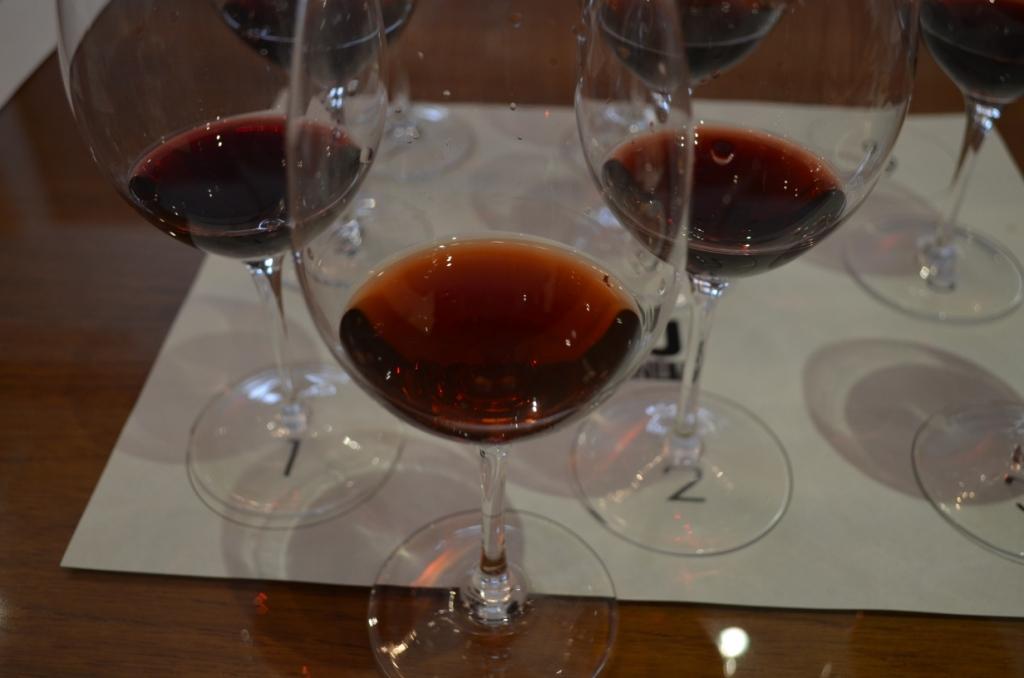 I remember talking to someone about great Rioja seminar I attended, and I remember being asked “why did you go to that Rioja seminar, don’t you already know everything you need about Rioja?”. I only raised my eyebrow. Yes, I make no secret that Rioja is one of my all time favorite wines (I’m sure you noticed if you read this blog for a while) – but there is always so much to learn around wine, you can never pass the educational opportunity. Especially when this is the seminar at PJ Wine store, where wine education always includes a glass (or two, or more) of great wine, just to make sure your newly acquired knowledge would be well anchored. As a side note, this seminar took place a while back (in March of 2013), but the experience was so good, it is still worth sharing.
Andrew Mulligan of Michael Skurnik Wines, who was running the seminar, was a wealth of knowledge on the subject of Rioja. Before we will talk about the wines in the seminar, here are some of the interesting facts about Rioja wines which we learned:
- There are four grape varieties allowed to be used in a production of red Rioja wines – Tempranillo, Garnacha (Grenache), Mazuelo and Graciano. Tempranillo is usually the main grape, which is responsible for main flavor profile and ageability of the Rioja. Garnacha adds body and power, Mazuelo – spicy flavors, Graciano – structure. There are no limitations for the exact wine composition, so all types of blends are possible
- Rioja wines are typically made out of grapes harvested from the different vineyards in the region. There are also single-vineyard Rioja wines, which are called Pago. Rioja Contino is an example of single vineyard Rioja.
- Production of all wines in Rioja is controlled by Consejo Regulador (Control Board), an organization founded in 1926. Consejo Regulador also sets vintage ratings for different years. You can find all vintage ratings (starting from 1926!) here.
- 2010 and 2011 vintages have “excellente” rating – Crianzas should be good already!
- Bodegas Muga, CVNE, Lopez de Heredia and La Rioja Alta wineries (some of the very best Rioja producers) are all located at four corners the train station in Haro – the location was chosen for the purposes of easy shipping of wines to UK.
- La Rioja Alta 890 line commemorates the 1890 when the winery was created. 904 commemorates 1904 when Ardanza winery was acquired and became a part of La Rioja Alta. The winery decided to call their wines this way (using 890 instead of 1890 and 904 instead of 1904) so consumers would not confuse commemoration dates with the dates of production.
- CVNE was founded by 1879 by two brothers, and it produces Rioja in two distinct styles under two different labels – CVNE and Vina Real. All the fruit for Vina Real comes from Rioja Alavesa region, and all the fruit in CVNE wines comes from Rioja Alta.
- CVNE Imperial label was started specifically for the UK market, and it was called like that because it was created during the UK’s “Imperial Century”.

Rioja seminar tasting line-up
Now, let me present to you the wines with my notes. All the wines are included in the order we tasted them.
CVNE Imperial Reserva 2005 – gorgeous nose, dark fruit, perfect acidity, cherries, perfectly balanced, but very masculine. Touch of eucalyptus. Very long finish. Drinkability: 8
La Rioja Alta Vina Arana Gran Reserva 2004 – Beautiful. A lot more delicate than the previous wine, more earthy, sage notes, very beautiful. Perfect acidity. Drinkability: 8
CVNE Cune Reserva 2004 – beautiful, very delicate, (all 4 grapes are used , Tempranilo 85%, 5% the rest), a bit too delicate for me. Drinkability: 7+
Vina Real Gran Reserva 2004 – Beautiful nose, similar to #1, but smooth palate, very nice, round. Drinkability: 8
La Rioja Alta Vina Ardanza Gran Reserva 2001 – Stunning. A lot of fruit, sweet on the finish. Perfect with food. Absolutely bright and young, you can never tell it is 12 years old. Residual sweetness of Grenache is coming through (20% of Grenache). Drinkability: 8+
CVNE Imperial Gran Reserva 2001 – Wow. Perfect fruit, less sweetness on the finish compare to the previous wine. Might be my best of tasting. Perfect power despite the age. Drinkability: 9-


La Rioja Alta Gran Reserva 904 1998 – Very interesting. A lot more herbs, more subtle, beautiful profile. Drinkability: 8+
La Rioja Alta Gran Reserva 890 1995 – Very different. Lots of herbs, subtle, beautiful. Drinkability: 8+
CVNE Vina Real Gran Reserva 1978 – Tobacco, leather, mature wine. Very nice. Still has enough fruit. Drinkability: 8
Yes, I know, my tasting notes are rather short and mostly describe the wines through emotions. However, I think you can see the progression in the flavor profile from the bright fruit to the more earthy, spicy, delicate notes. The common trait among these 9 wines? Elegance. Elegance and balance, to be precise. These are the wines you crave, as you know they will bring you lots of pleasure every time you will open them.
Andrew told us a story from his personal experience with the old Rioja wine. He ordered bottle of 1917 Rioja for the customer, and the customer … refused to take it later on. So the bottle was shared at the table in the restaurant, without much expectations, among the group of young wine professionals. On the very first sip, the table got quiet. And it stayed quiet for the next 5 minutes, as everybody just wanted to reflect on that special moment. I wish you great wine experiences, my friends. Cheers!
Divine Experience, or Happy 15th Anniversary Brasitas!
A few days ago I got an invitation to attend the wine dinner at Brasitas restaurant in Stamford, in honor of Brasitas 15 years anniversary. The invitation came through by ways of the Connecticut Bloggers group, run by Wendy and Greg Limauge (if you live and blog in Connecticut, you definitely want to be a part of this group). Now, take your wild guess – do you think I accepted the invitation? Okay, that was a dumb question, so let’s move on – closer to the great food and wine.
I had been to Brasitas a number of times before, and it is safe to say that this is one of my favorite spots in Stamford. Brasitas identifies its cuisine as “Latin Fusion”, and considering the food which is served there, this is a pretty good designation. Now our dinner this time was a special event. The menu consisted of 5 dishes, paired with the special wine program (courtesy of Brescome Barton, one of Connecticut wine distributors) – so let me share that with you (but please keep in mind that this can make you hungry…).
We started our evening in style, with the Cave based version of Kir Royale:


This Codorniu Brut Cava, Penedes had a tiny drop of raspberry liquor, which didn’t change its very dry, austere character of the Cava. It is interesting to note that Codorniu family makes wines for 5 centuries (starting in 1551), and it was one of the first Cava producers in the region in 1872.
The very first dish of the day was Ensalada Catalana (Baby Spinach, Manchego Cheese, Golden Raisins, Pinenuts, Caramelized Quince, Blue Cheese and Sherry Vinaigrette):
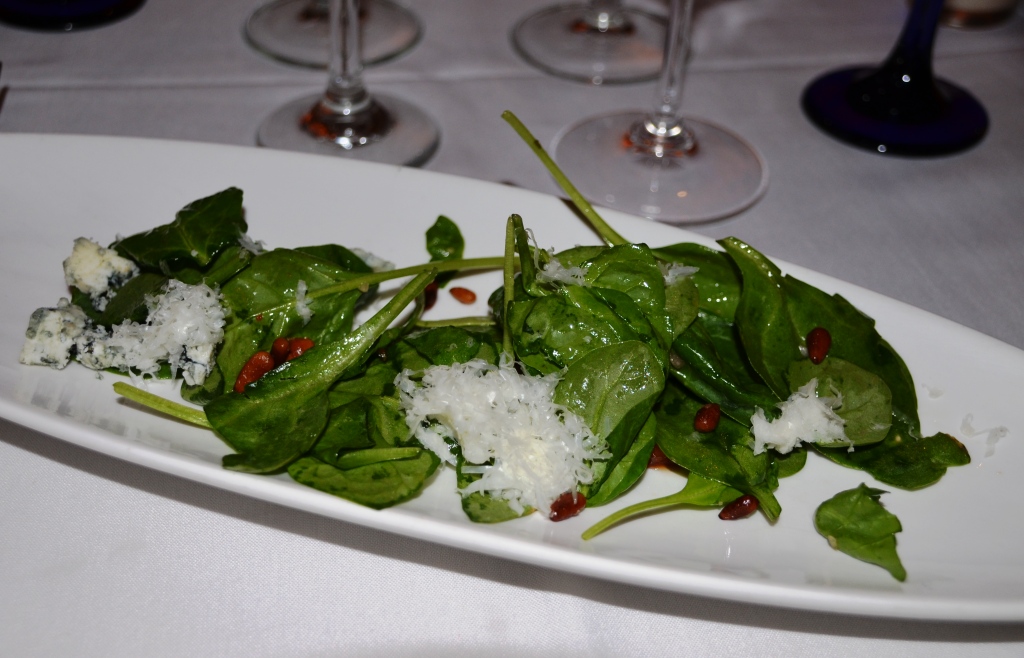
Ensalada Catalana
The caramelized quince provided perfect support for both blue cheese and Manchego, overall creating very nice and refreshing appetizer.
Our next wine was 2012 Mar de Frades Albariño, Val do Salnés, Rias Baixas DO:
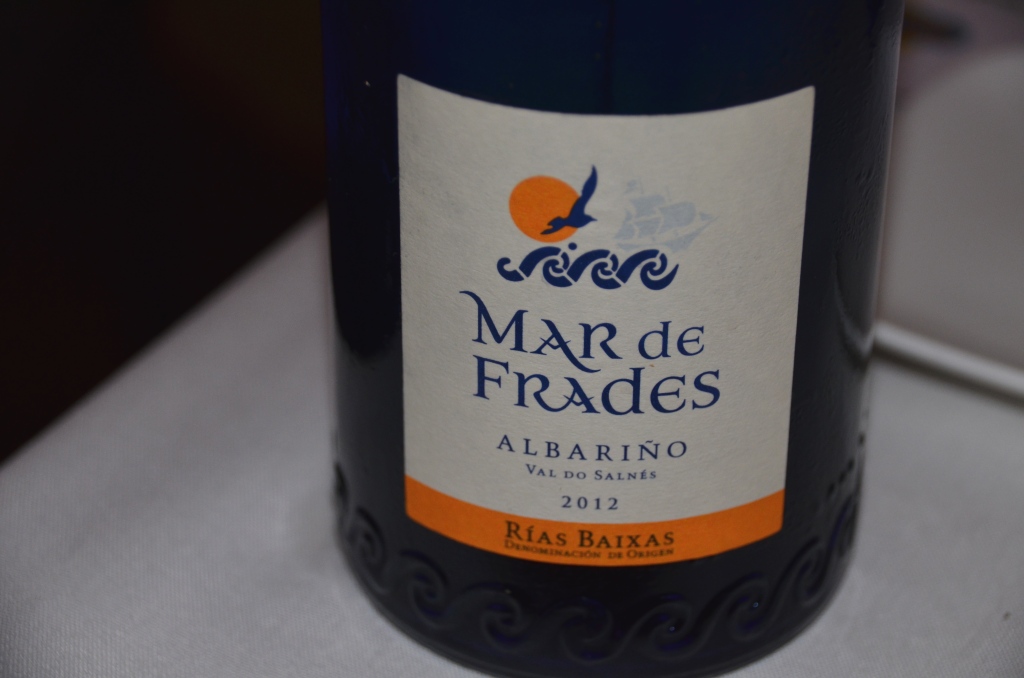
Mar de Frades Albariño
Mar de Frades means “A sea that is also a wine” in Galician. Bodegas Mar de Frades started producing wine in Val do Salnés region of Rias Baixas in 1987. The winery is located in the area where river Umia meets the sea, so you can see this sea relationship perfectly incorporated in the bottle itself. The label on this wine is also pretty unique, showing the blue ship on the label when the wine is at ideal drinking temperature (46F – 50F).
This 2012 Mar de Frades Albariño, Val do Salnés, Rias Baixas DO (100% Albariño, 12.5% ABV) had muted fruit on the nose, with nutty undertones, then it showed some white stone fruit. On the palate the wine was a little flat and acidic. I don’t know if this was really the right drinking temperature for the wine, as it showed more fruit as it warmed up. It was definitely not the Albariño I know, but I would think that it was specifically produced in this less fruity style. Drinkability: 7
Paired with Albariño was the dish called Pulpo a la Portuguesa (Roasted Portuguese Octopus, Bacalhau & Potato Cream, Charred Scallions, Chorizo, Mojo Verde):
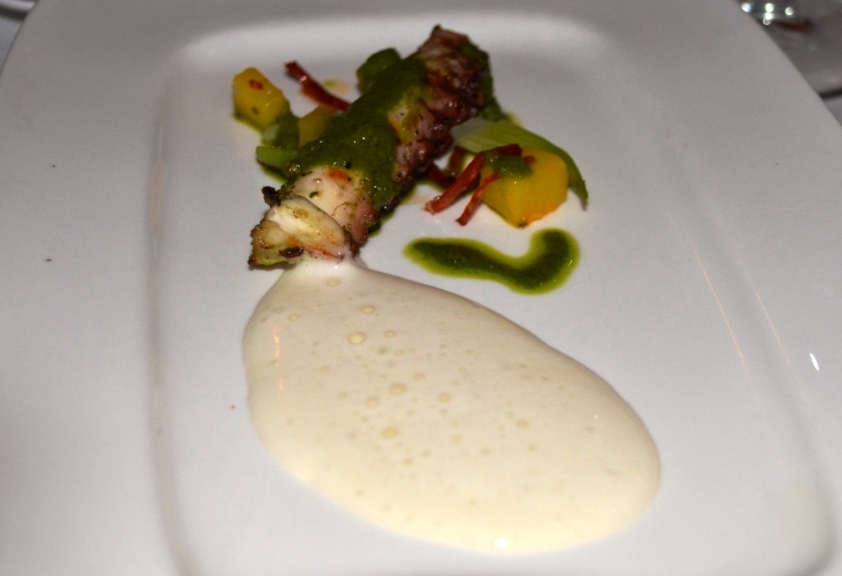
Pulpo a la Portuguesa
The octopus was perfectly cooked it was definitely the star of the dish ( as expected). I have to honestly tell you that Bacalhau was lost for me in that potato cream, and I would probably appreciate a bit more assertive presence from the chorizo, but overall that didn’t take much out of this excellent dish. An interesting side note – this was a first encounter with an octopus for a number of people at our table – but I think they all happened to like it!
Next up was 2010 Ramon Bilbao Crianza Rioja, Spain:


This 2010 Ramon Bilbao Crianza Rioja, Spain (100% Tempranillo, aged for 14 month in oak, 8 month in the bottle, 13.5% ABV) is produced by Bodegas Ramón Bilbao, founded in 1924 in Rioja Alta region. The winery had somewhat of the turbulent past, going through the number of owners but really turning around in 1999. The wine was outstanding (note to all – 2010 was a great vintage in Rioja, make sure to stock up on those wines). Nose was amazing – luscious dark fruit, some hints of eucalyptus. The nose sensation continued on the palate – dark red fruit, soft and luscious, perfect acidity, perfect balance overall, medium long finish. Drinkability: 8
This excellent Rioja was paired with… nothing else, but fish! The dish was called Pajespo con Romesco (Monkfish, Jamón Serrano, Saummer Pea Casserole, Ramesco Sauce, Pisto and Clam Broth):
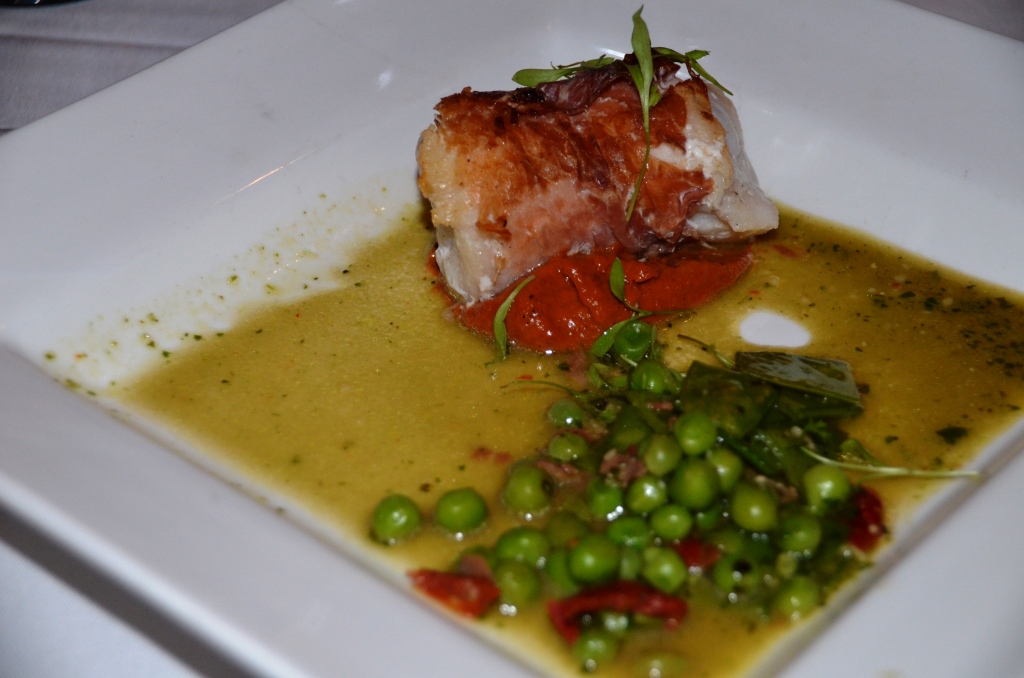
Pajespo con Romesco
How do you think the pairing was? In a word – spectacular! Earthy flavors of the sauce and nice saltiness of the fish wrapped in Jamón Serrano perfectly married the wine! I’m the first to ignore “fish with white…” rule, but in my experience this was the first truly spectacular pairing of such sort which I experienced. Bravo!
This was definitely the hard-to-top-off experience, but the next dish was … well, it was not better, but it was definitely on par.
First, the wine. 2008 Cruz de Alba Crianza Ribera del Duero, Spain:

Crus de Alba Ribera del Duero
This 2008 Cruz de Alba Crianza Ribera del Duero, Spain (100% Tempranillo, 15 month in barrel, 10 month in the bottle, 14.5% ABV) produced by Bodegas Cruz de Alba in Ribero del Duero region. This is relatively young winery, which came into existence only 10 years ago, in 2003. The winery web site is available only in Spanish, so just on my understanding it seems that this is a new venture of Bodegas Ramón Bilbao.
In general, the wines in Ribera del Duero are made from the same Tempranillo grapes as the wines of Rioja – but typically Ribera del Duero wines are more massive and concentrated than those of Rioja. This wine was no exception – dark fruit, structure, power, cherries, espresso and dark chocolate on the palate, perfect cut-through acidity, perfect balance. Definitely an outstanding example of Ribera del Duero wine. Drinkability: 8.
This wine was paired with probably a culmination dish of the evening – Chicharrón (Pork Belly Brined in Smoked Paprika, Cauliflower-Manchego Foam, Crispy Cauliflower, Chanterelle Mushrooms, Solera Vinegar, Pickled Cherries):

Chicharrón
This dish was a symphony of flavor and texture – succulent meat, the sauce with enough sweetness and acidity, crispy skin – all worked together perfectly. Cruz de Alba Crianza, with its sour cherries profile, was creating a delicious combination.
And then there was dessert – Torta de Aceite (Olive Oil and Rosemary Cake, Grapefruit Sorbet, Cosecha Miel Marinated Grapes):
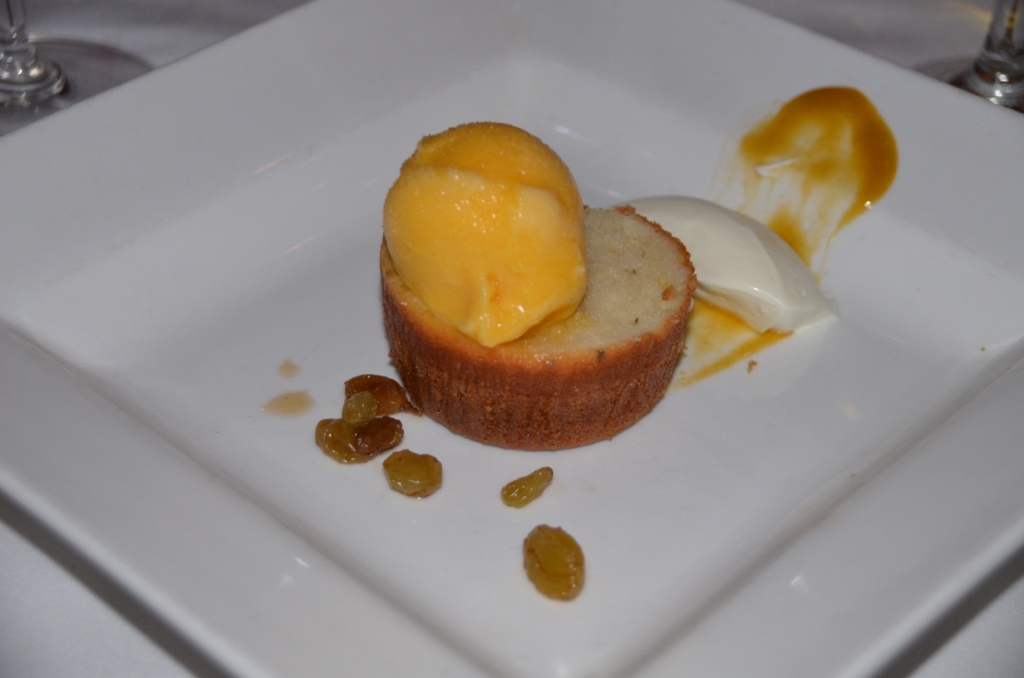
Torta de Aceite
The dessert was paired with Licor 43, a citrus essence with the touch of vanilla, which naturally complemented the dessert perfectly. This was a great finish to the fantastic meal.
Last, but not least – Jaime Guerrero, chef and owner of Brasitas, came to talk to us, which was a great ending for the evening:
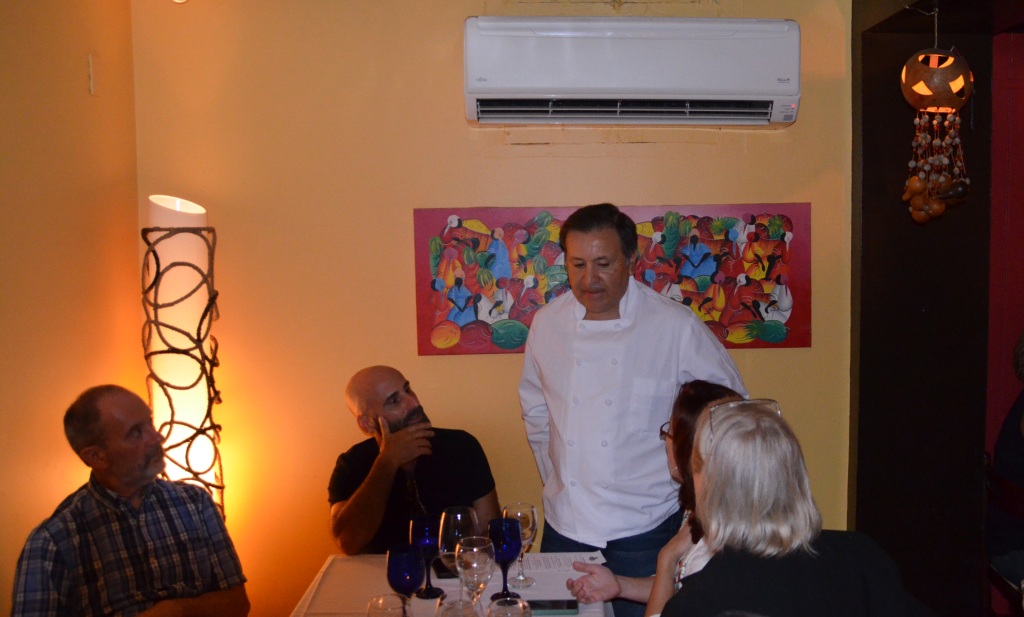
Jaime Guerrero, Chef and Owner of Brasitas, talking to CT Bloggers
There you have it, my friends – great dinner, great food, great wine, great company – life at its best. I really enjoyed meeting all the Connecticut Bloggers who came to this dinner – Denise (and Jay) from DeeCuisine, Alicia from Local Food Rocks, Bonnie from Home Place, Greg and Wendy from Connecticut Bloggers – and I hope to seem them again soon.
And we are done here. Until the next time – cheers!
Brasitas Restaurant
954 E Main St
Stamford, CT 06902
(203) 323-3176
http://www.brasitas.com/
Disclaimer: I was invited to this dinner as a guest of management. All opinions are my own.

Weekly Wine Quiz #67: Grape Trivia – Pinot Gris, a.k.a. Pinot Grigio
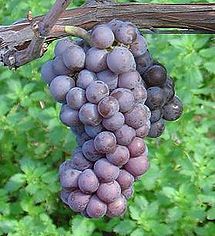
Pinot Gris cluster, as pictured in Wikipedia
Welcome to the weekend and your new wine quiz! Today’s subject is the grape called Pinot Gris, probably even better known as Pinot Grigio.
Pinot Gris is an old grape, cultivated since the middle ages in various regions in France. It had been shown based on the latest DNA research, that Pinot Gris is a very close relative of Pinot Noir. As you can see from the picture, the color of the grapes are somewhat of the grayish purple, and that what the “Gris”, or “Grigio” in the name stands for – Gray. It is almost a bit surprising that the white wine is made out of a grape with such a color of the skin.
Pinot Gris popularity in the world is steadily increasing, even surpassing Riesling and becoming third most popular grape in the world (I couldn’t find convincing numbers to this claim though). Pinot Gris was growing and producing great wines in Alsace since the 16th century, but it was Italian Pinot Grigio which created this world-wide phenomena in 1970s, propelling the grape from very local consumption in Italian restaurants to such a mass phenomena. I wonder if there is a book about geniuses of marketing who managed to create this Pinot Grigio revolution – this must be a fascinating read. Just to give you an interesting fact – Pinot Gris plantings in New Zealand increased 6.5 times (!) in 5 years from 2003 to 2008 – yeah, talk about popularity.
When it comes to the taste, it is interesting to note that there is a very substantial range of expression in the Pinot Gris wines. A lot of Italian mainstream Pinot Grigio has almost water-like consistency both in the taste and appearance (this is why many people presumably like it, and this is also why this type of wine is never served in my house – sorry for the sidetrack). But even in Italy, when you go further north to the Alto Adige region, the wines will show a lot more substance, with nice acidity and minerality. Then you got Oregon Pinot Gris, which typically have a perfect combination of white stone fruit and acidity, and going all the way back to Alsace, Pinot Gris makes luscious, opulent, full bodied white wines.
Now, let’s get to our quiz, shall we?
Q1: Name Italian Pinot Grigio wine which is considered a golden standard of Pinot Grigio in the United States (people really ask for it by name).
Q2: Name two famous regions in France which used to make wines out of Pinot Gris, but not anymore
Q3: When do you think Pinot Gris was first planted in Oregon?
a. 1947
b. 1966
c. 1978
d. 1990
Q4: Wine Spectator calls wines rated in 95-100 range Classic. True or False: there are more classically rated Pinot Gris wines than Sauvignon Blanc?
Q5: During early 2000s, producers in Alsace had to change the way the Pinot Gris wines were typically labeled (you can still find the old name on the bottles from 1990s and before). Do you know what was changed and why? As an added bonus, please explain the origin of the old name.
Have fun, enjoy your weekend and cheers!
Last Bottle Sign Up ($10 credit)




 Talk-A-Vino