Archive
Experiencing Texas Wines
I’ve heard [good things] about Texas wines before, but despite being in Texas countless number of times, I never had an opportunity to drink local wines. Thanks to Vino Volo, great wines are available on the go (this is not the first time I’m writing about Vino Volo – previous posts can be found here and here).
This time I was at San Antonio International airport, and I had enough time before the flight to taste some wines. As you know, I would never refuse an opportunity to try new wines, so when I saw “Taste of Texas” flight being available, the decision was very simple.
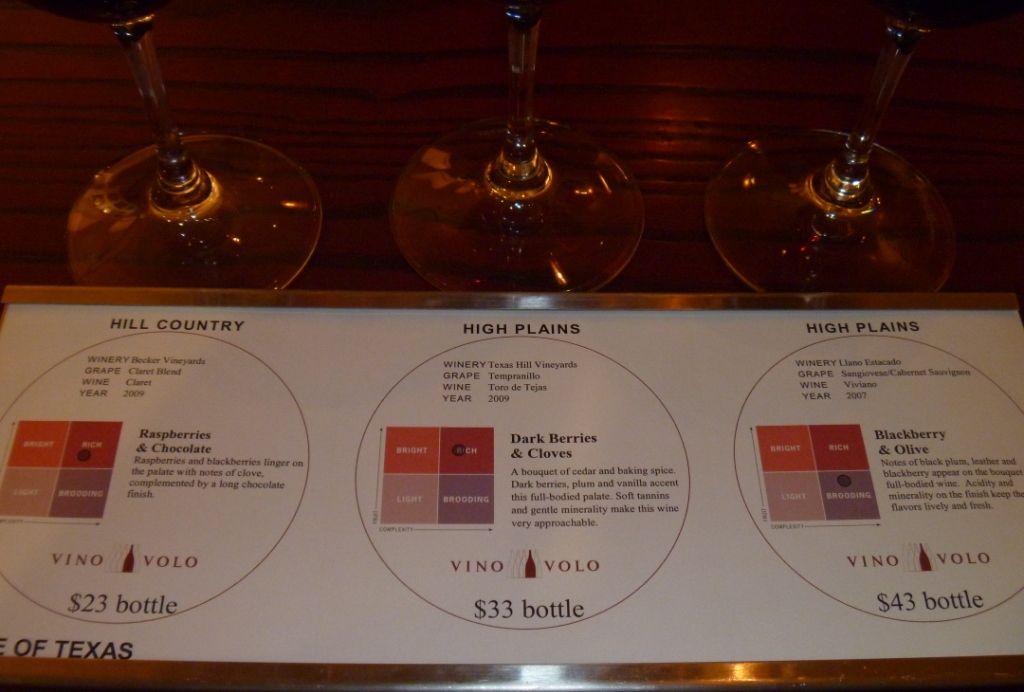
The flight consisted of three red wines, and all three were very good! The first wine was 2009 Becker Vineyards Claret, Hill County. The wine had nice nose with dark fruit, plums and blackberries, good acidity, rustic, with good tannins. The wine was very Bordeaux in style, but without characteristic bell peppers and greenness ( Drinkability: 7+).
Next wine was 2009 Texas Hill Vineyards Toro de Tejas, High Plains (100% Tempanillo) – the wine had smoke, dark fruit, hint of dark chocolate, very dense. This wine very well complemented chorizo and chickpeas chilli. Best of tasting (Drinkability – 8-).
Last wine in the flight was 2007 Llano Estacado Viviano, High Plains (Sangiovese/Cabernet Sauvignon blend). The wine had nose of green olives, and it was very nice on the palate, with hint of chocolate, soft tannins and good balance. Drinkability – 7+.
Overall , all three wines were well done, easy and pleasant to drink – my only regret (actually, two) would be that these wines are not available in Connecticut and also that even in the Texas restaurants, the emphasis is on California, and Texas wines are simply overlooked – definitely a mistake.
That’s all for now, folks. In the next blog post, we will explore the subject of wine fears – cheers!
Tasting Spanish Wines – Blind, Of Course
 Once again, we got together with the group of friends to play a fun game of blind wine tasting. This time the subject was Spain (in the past we had a lot of fun blind tasting Pinot Noir and Sparkling wines – you can read the posts here and here).
Why Spain? Spanish wines are getting a lot of recognition among wine lovers of all walks. On average, they deliver the best quality for the price (QPR) among most of other wine regions, and in the end end of the day they simply taste great and deliver lots of pleasure. So the theme was set, the bottles wrapped (every participant have to bring a bottle wrapped in paper bag) and opened, and the numbers are randomly assigned to the bottles.
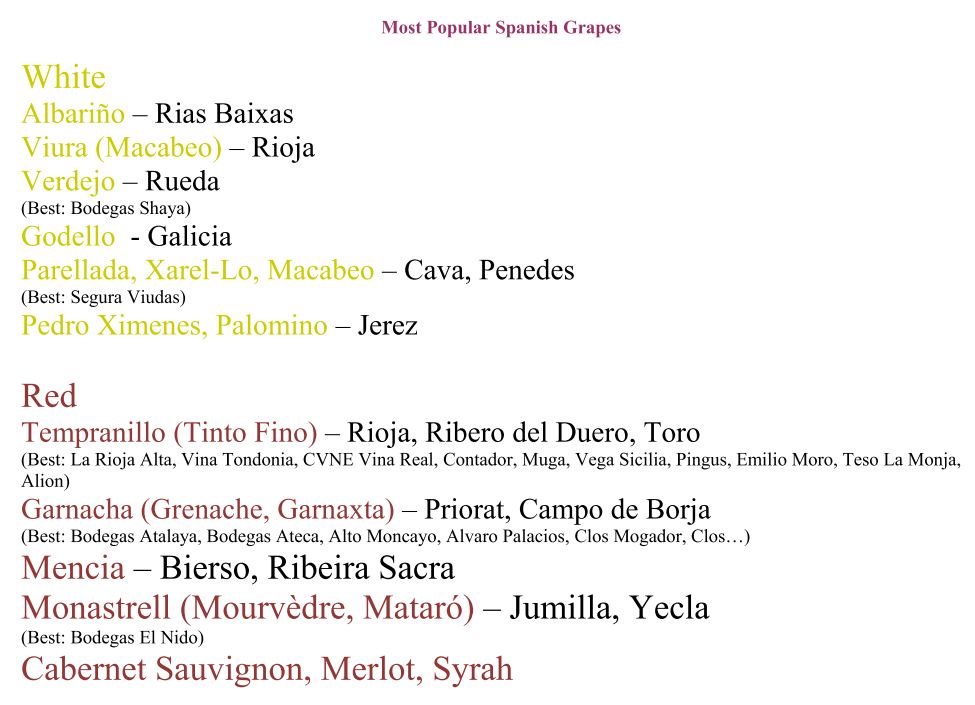
We had total of six wines, all red. The idea would be may be to identify the grape (an added bonus, of course), but mainly to see a consensus as to which wine would be the most favorite of the group – blind tasting has a great leveling effect – you are not intimidated by the price or a label, so you can stay true to your taste buds. Just to set the stage as to what are the most popular Spanish grapes, I prepared the following cheat sheet, which I’m including here in its entirety:
Off we went, so for what it worth, here are my notes as I took them during tasting – no corrections afterwards:
1 brick dust on the nose, good acidity, pepper – tempranillo
2 young wine, good fruit, open – mencia, monastrell?
3 earthy, tame fruit, age, good fruit, dark color, great acidity, pomegranate, smokiness
4 feels like it is corked, but I hope it is not. Fruit at the bottom. Final verdict – corked.
5 beautiful, most balanced, good fruit, plums- Grenache?
6 classic Rioja, cherries, acidity, best of tasting.
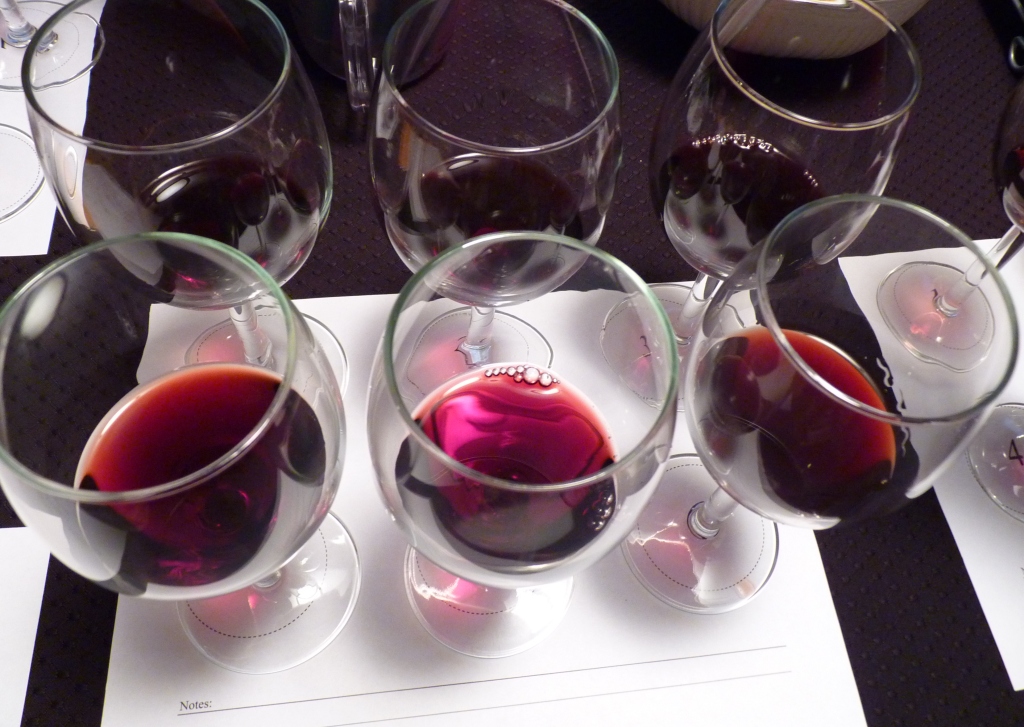
So, reading the descriptions, what do you think those wines are? This is always not an easy guess, as your mind is racing trying to pinpoint taste, texture and any other sensations you are experiencing at the moment against your mental database of the wines you tasted (that database is either resisting and says “nothing found” or goes all the way and says “it is similar to all 10 of these”).
And here are the actual wines:
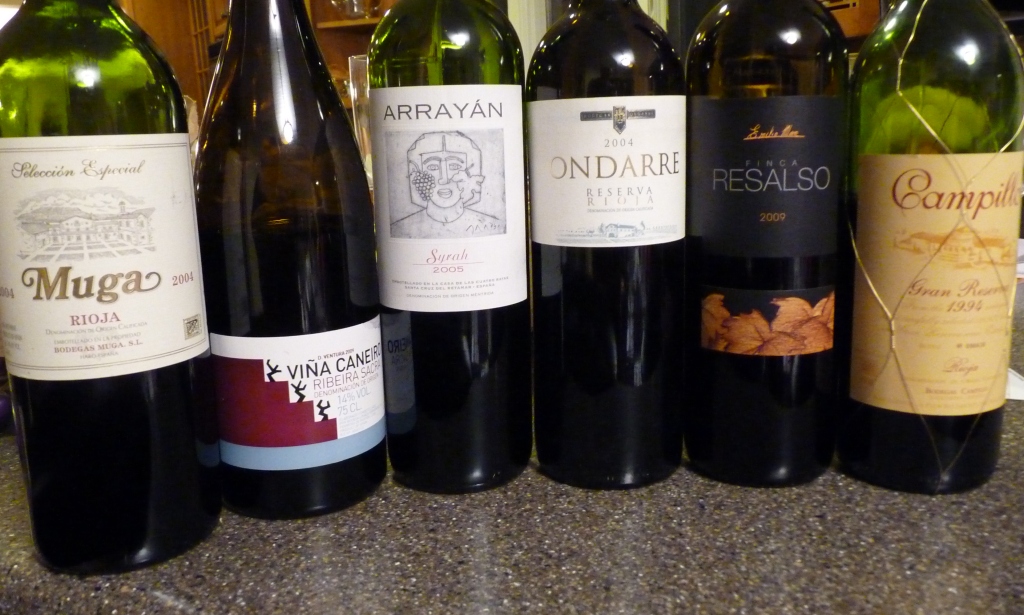
1. 2004 Bodegas Muga Rioja Selection Especiale
2. 2009 D. Ventura Vina Caneiro Ribeira Sacra DO
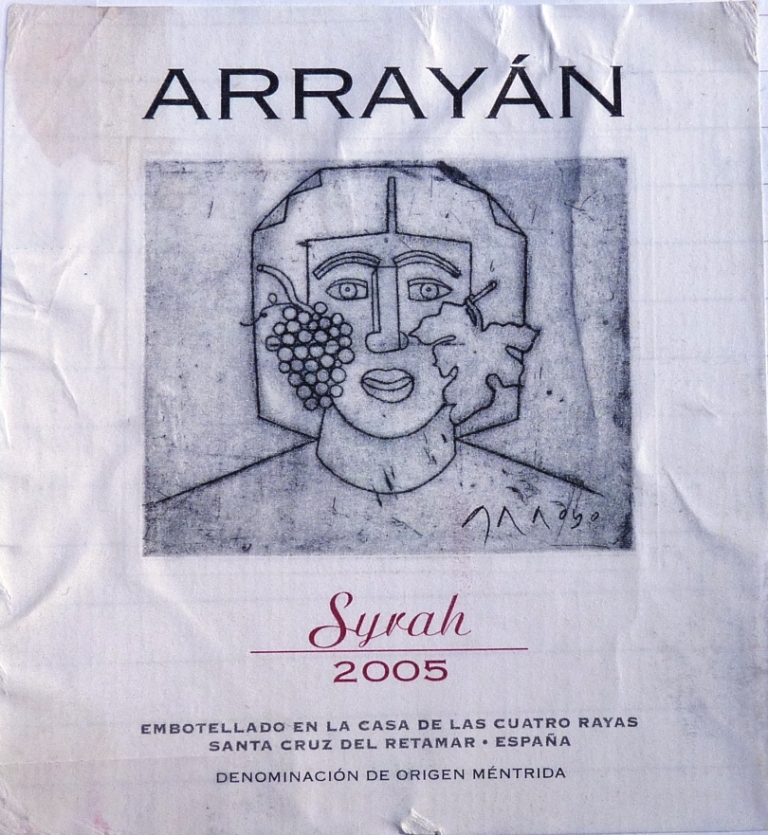
3. 2005 Arrayan Syrah, Mentrida DO
4. 2004 Bodegas Ondarre Rioja
5. 2009 Emilio Moro Finca Resalso, Ribero del Duero
6. 1994 Campillo Rioja Gran Reserva
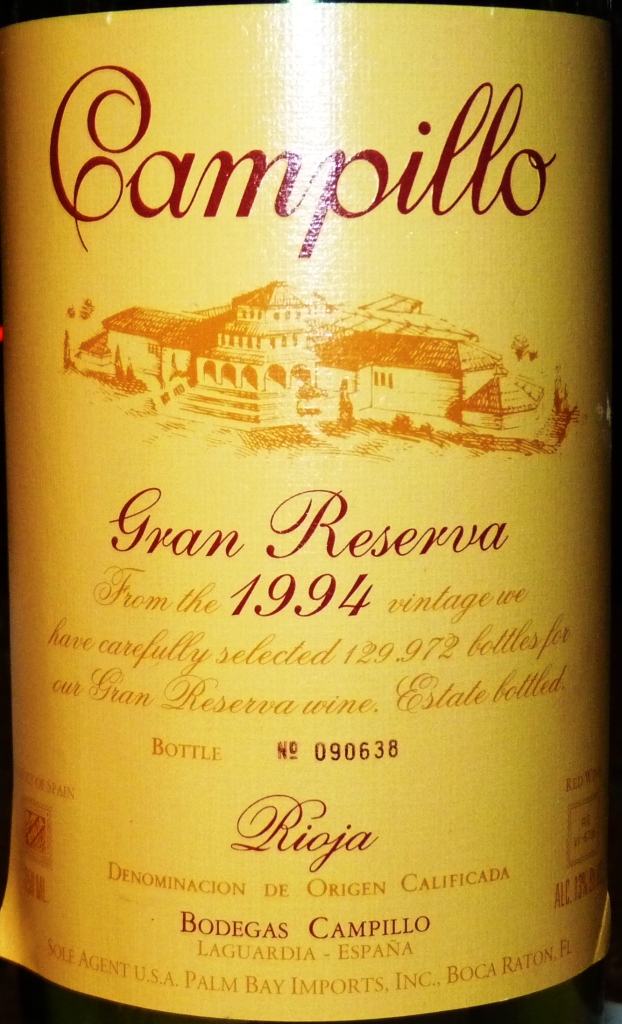 Now for the popularity vote, here is how it works. Everybody can vote for up to two wines (but don’t have to). If there will be one wine which will receive a majority of the votes, it will be declared a winner. If two bottles will receive the same number of votes, we would vote again for the one favorite out of the two.
Can you guess which wine won? If you guessed “Bodegas Campillo” (as the very least judging by the label to the left), you are correct. It won by the unanimous vote – everybody liked it. Distant second was Arrayan Syrah (half of the group voted for it). Bodegas Campillo was classic and pure Rioja, with all the clean flavors of cherries and cedar box, great acidity and very fresh, not even a hint of 17 years of age. Arrayan Syrah was probably the most unusual and unexpected wine in the group – beautiful, balanced, and very pleasant to drink. But just to give due respect to all 6 wines we tasted, all except the corked bottle were very good wines, worthy of being in the competition.
If you feel encouraged to try blind tasting on your own, I would suggest to avoid doing it for the whole country. Single region or a single grape (or a stable blend, such as GSM or Bordeaux) would work much better to showcase the range of possibilities. But other than this remark, I think blind tasting is the best way to learn about your wine preferences, to have great experience and to have fun! If you got blind tasting experiences of your own – please share them here! Cheers!
In Case You Wanted To Attend PJ Wine Grand Tasting But Still Undecided
here is something which might help you decide – you can save $10 of the ticket price if you will use discount code Talk-A-Vino, courtesy of PJ Wine (they happened to like my post and kindly offered a discount to Talk-A-Vino readers). If you are ready to buy your tickets, you can click here.
Enjoy! Cheers!
Why You Can’t Afford To Miss 2011 PJ Wine Grand Tasting
 If you are a wine lover who likes to experience amazing wines when possible – please keep reading, otherwise you can definitely skip this post. But if you are in love with your wine, there is one single wine tasting event this year which you can’t afford to miss – this event is PJ Wine Grand Tasting 2011, taking place on November 18th at Metropolitan Pavilion in New York City.
Why? I will give you three reasons.
1. Unique and Unforgettable Experience.
I attended PJ Wine Grand Tasting in 2009, and I still remember the taste of 2000 Château Léoville-las-Cases, 1999 Vega Sicilia “Unico”, 2000 Chateau Margaux, 1996 Krug among many many other equally noble wines. During Grand Tasting 2011, you will have an opportunity to taste Dom Perignon, Cristal, Krug, 2006 Cheval Blanc, 2000 Chateau d’Yquem, 1990 Mouton-Rothschild, 1985 Chateau Haut-Brion, 1952 CVNE Vina Real Gran Reserva and many more incredible wines – all in one evening. Can you tell me where else you will be able to experience any of those wines, forget even going through such a gem collection in one evening?
2. Tremendous value.
VIP admission at the Grand Tasting costs $159 (and I highly recommend VIP admission versus regular one, as all of great wines will not be in unlimited supply – you want to be there early). If you think this is a lot of money, let’s do some simple math. Assuming you will be able to find all the wines mentioned above (which is a challenge on its own), let’s see how much it will cost you to buy them (using wine-searcher, of course): 2006 Cheval Blanc – $700+, 2000 d’Yquem – $300+, 1990 Mouton-Rothschild – $400+, 1985 Haut-Brion – $450+, 1952 CVNE Vina Real Gran Reserva – $400. All together we are talking about $2,250+ just for these five wines. There will be hundreds of other wines deserving attention in this tasting, plus there will be great food. If this doesn’t represent value, I don’t know what does.
3. Plain and simple – you will have a great time!
There will be great wine, there will be great food, there will be great people, willing and able answer any of your wine questions. If you are thinking about going to the restaurant Friday night – equivalent experience at a restaurant in New York will cost you ten-fold – without any guarantees.
If you want to experience wines you will remember for the rest of your life, PJ Wine Grand Tasting is not an event to miss. To make your consciousness happy in addition to your palate, I have to mention that portion of what you pay will be going towards The Action Against Hunger. If you are ready to get your tickets, here is the link for you to click.
Disclaimer (in case we need one): Just to make everything clear – this is not a paid advertisement of any sort, and I’m not compensated in any way for writing this post. As usual, I only write about the things I believe in, and I truly believe that you will have an amazing experience if you will attend PJ Wine Grand Tasting 2011. Cheers!
Tasting Some Of The Oldest Wines Ever: Jerez
 Once again this year I was lucky enough to seize a great learning opportunity – a wine tasting seminar at PJ Wine store in New York. This time the subject of the seminar was Jerez, also known as Sherry (or Xerez). Jerez is one of the most interesting wines in the world, as its production methods (aging, in particular) are very different from most of the other wines for two reasons:
1. It is left to purposefully oxidize for many years during the aging process (something winemakers are desperately trying to prevent while making and then storing regular wines).
2. It is constantly blended with the older wines through the method called Solera, sometimes going back for a few hundred years (you can find some additional information about Jerez in this post at The Art of Life Magazine).
During the seminar we tried 8 different wines from Sanlucar – the area which is located close to Jerez, but has more marine influence as it is located on the coast of the Atlantic Ocean and next to the Guadalquivir River on the right. This location creates unique conditions for Flor – an algae-like film which grows on top of Jerez in the barrel and protects it from oxidation – where Flor can grow all year around (this is the not the case in Jerez, where Flor doesn’t last a full year). Another important factor is Albariza soil, which is a chalk-based, similar to the soil in Champagne, which adds an additional acidity to the wines.
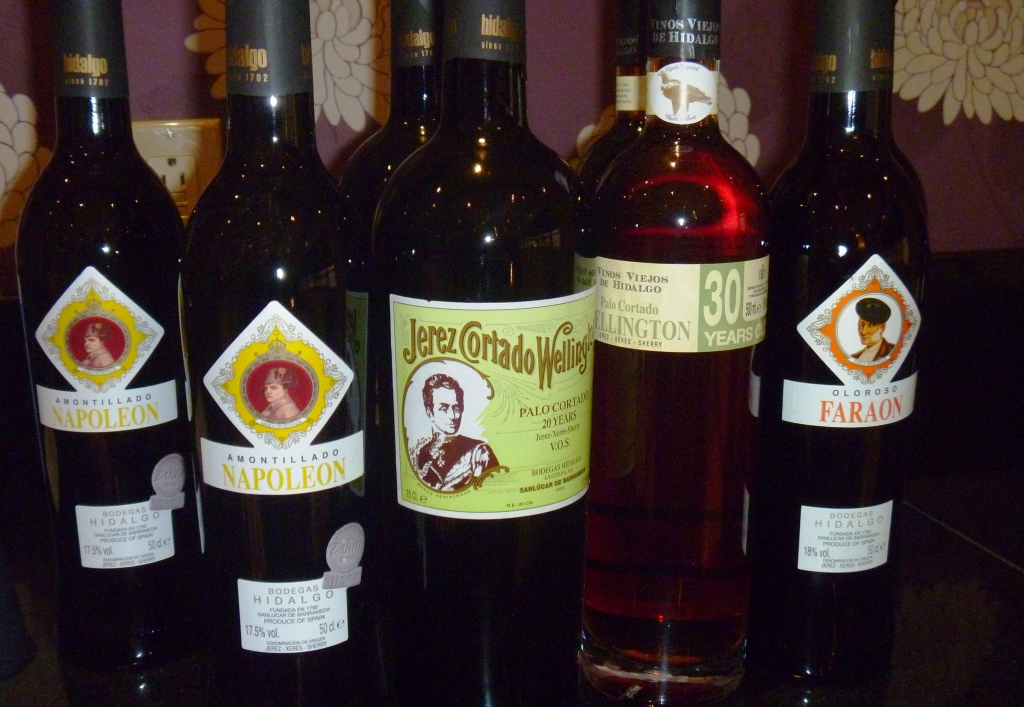
Here are the tasting notes for the wines as we tasted them.
1. Vinicola Hidalgo “La Gitana” Jerez-Xeres-Sherry Manzanilla NV:
Completely unoxidized. The nose of flor, but very clean, nice, beautiful acidity, a hint of white fruit, very dry. Goes well with bocorones, white vinegar cured mackerel.
2. Bodegas Hidalgo Pastrana Manzanilla Pasada – 92 pts (Wine and Spirits): greater intensity on the nose, touch more fruit intensity. Touch of oxidation, aged for about a year. Great with green olives.
3. Vinicola Hidalgo “Napoleon” Jeres-Xers-Sherry Amontillado NV– 90 pts (WA)
same as the first wine, but with oxidation. Very nice, a lot more complexity,
4. Bodegas Hidalgo Jerez Cortado Wellington, VOS +20 years – 91 pts (Wine and Spirits)
Wow – soft, beautiful, but pales out next to number 5
5. Bodegas Hidalgo Wellington Palo Cortado, VORS +30 years
Palo Cortado is the finest example of oxidized sherry. Phenomenal wine, solera started in 1750, soft, smooth, tremendous flavors, nuts, a hint of saltiness, roasted figs – outstanding…
6. Bodegas Hidalgo Faraon Olorosso – 91 pts (WA)
Very nice, soft, smooth,
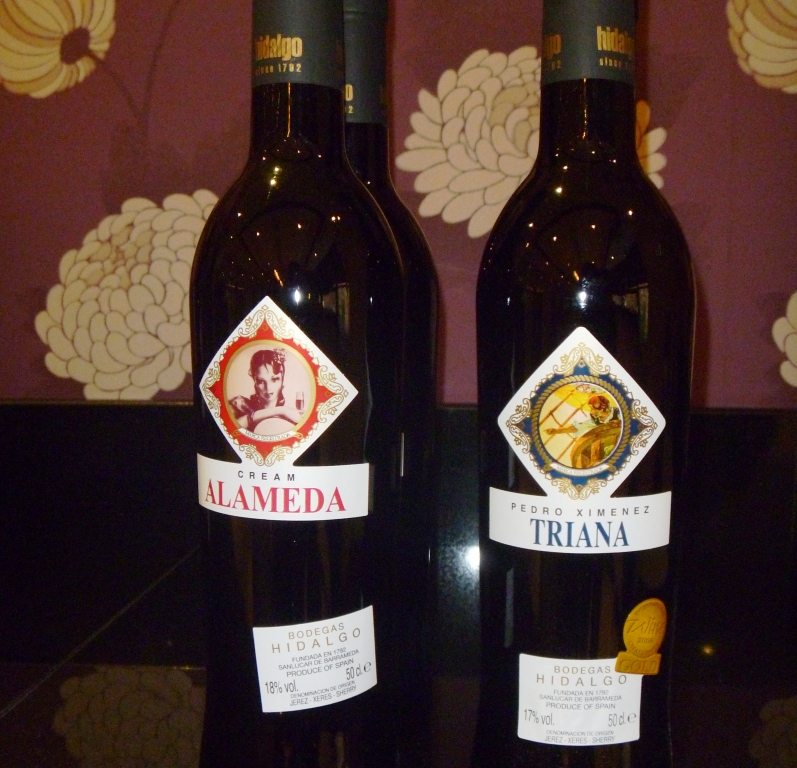
7. Bodegas Hidalgo Alameda Cream Sherry NV – 91 pts (WA)
Very nice, round, soft, sweet, but balanced enough. some baked apples.
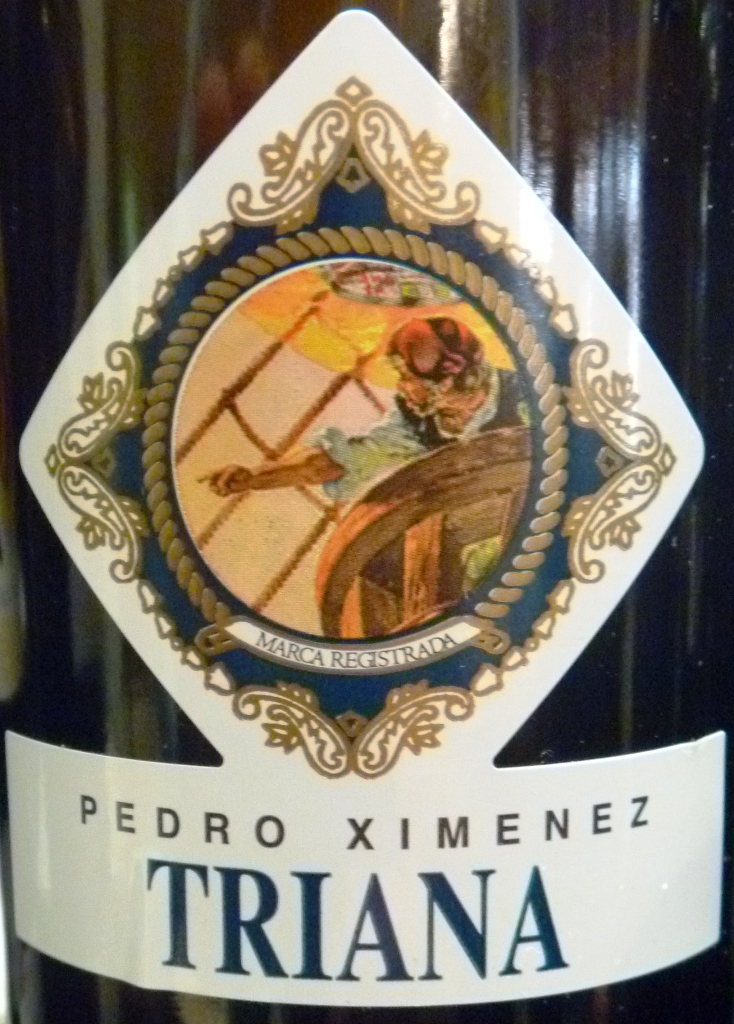
8. Bodegas Hidalgo Pedro Ximenez Viejo Triana:
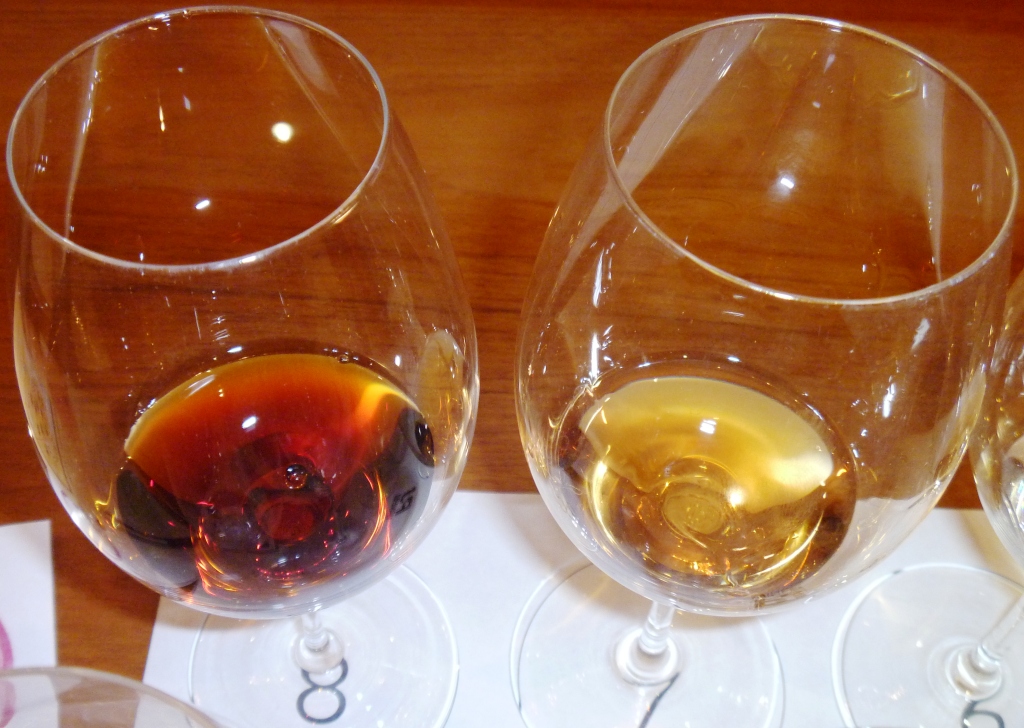
Wow! Figs, plums, jam, phenomenal concentration on the nose, same on the palate. This is liquid fig jam, balanced, good acidity – outstanding! This is the blend of 100 vintages, through the Solera method. My personal favorite from the tasting.
On the next picture, you can compare the intensity of color between Pedro Ximenez (much darker) and Cream Sherry wines:
And here are the correspondent wines:
All the wines were very good, however I would say that first Manzanilla, then number 5 Palo Cortado and last Pedro Ximenez were my favorites, with Pedro Ximenez being simply unforgettable. Most of these wines are available from the PJ Wine and they are all very affordable.
This was definitely a great experience, and I will be glad to repeat it again (and again). Until the next time – cheers!
P.S. PJ Wine Grand Tasting Event will take place on Friday, November 18th, at Metropolitan Pavilion in New York City. If you want to experience 2006 Cheval Blanc, 2000 d’Yquem, 1990 Mouton-Rothschild, 1985 Haut-Brion, 1952 CVNE Vina Real Gran Reserva, Krug, Cristal, Dom Perignon and hundreds of other wines – all in one night at one place (!!), don’t miss this event!
Notes from Slocum & Sons Wine Tasting in Connecticut
This past weekend I attended yet another great wine tasting by Connecticut wine distributor Slocum and Sons. Of course when hundreds of wines are presented in the tasting, there is a good chance of finding lots of great wines among them. This tasting was no exception – I had a lot of tasteful encounters at the event. Here are some notes, with pictures, as usual.
Let’s start with the sparkling wines. One of the first wines we tasted was Armand de Brignac Brut Gold (Ace of Spades):

The Champagne is this sparkled (no pun intended) bottle was good, with good body, green apple and zinging acidity running in the back. At the same time, as I’m always looking for QPR when I’m thinking about wine, this wine, the most expensive in the entire tasting, at about $270 per bottle, doesn’t not represent value at any level. If I have to spend this amount on the bottle of Champagne, I would much rather drink Krug.
Continuing sparkling wines category I have to mention Champagne Vollereaux, which is a Growers Champagne. We tried Vollereaux Brut NV, Vollereaux Rose Brut NV and 2004 Vollereaux Cuvee Marguerite – all beautiful wines, full flavored champagnes, with the most expensive one still being less than 1/4 of the price of Armand de Brignac – and delivering more pleasure.There were other great Champagnes there, such as Laurent Perrier and Veuve Clicquot, but I also have to mention a wide variety of excellent Cavas, sparkling wines from Spain – here is the picture of the line up of one of my all time favorites – Segura Viudas, with all four wines being one better than the other:

Moving one to the white wines, there were some personal discoveries and some “meet and greet” with old favorites. In the “personal discoveries” group first I would like to mention 2008 Trefethen Dry Riesling Oak Knoll District, Napa valley – this is the first California Riesling which I really enjoyed – it got all the beautiful white fruit, balancing acidity and even hint of petrol!

The next discovery are two wines from Bodegas Shaya – 2010 Bodegas Shaya Verdejo Rueda DO and 2009 Bodegas Shaya Habis Rueda DO.

Both wines are made from the 100 years old vines Verdejo, first wine fermented in stainless steel tanks and second one, Habis, fermented in French oak barrels. Bodegas Shaya comes out with very clean fruit and minerality expression, good acidity, very balanced. But once you taste Habis, the first and immediate impression is Wow – this will beat any Chardonnay! I don’t want to push it too far, but I would love to see this wine next to Peter Michael Chardonnays in the blind tasting – that would be a very interesting experiment.
Few more highlights in the white wines category. Three of the Talbott Chardonnays – 2009 Tabott Sleepy Hollow Chardonnay, 2009 Talbott Logan Chardonnay and 2009 Talbott Kali Hart Chardonnay were all outstanding, showcasing balanced wines, with good acidity, white fruit and hint of vanilla. I didn’t have Talbott wines before, so I was very impressed with the quality. And then in the “familiar category” I want to mention two Spanish whites, both of them I got to know thanks to the The Capital Grille’s “The Generous Pour” summer wine program. These wines are 2010 Jorge Ordonez Botani and 2010 Bodegas La Cana Albarigno.
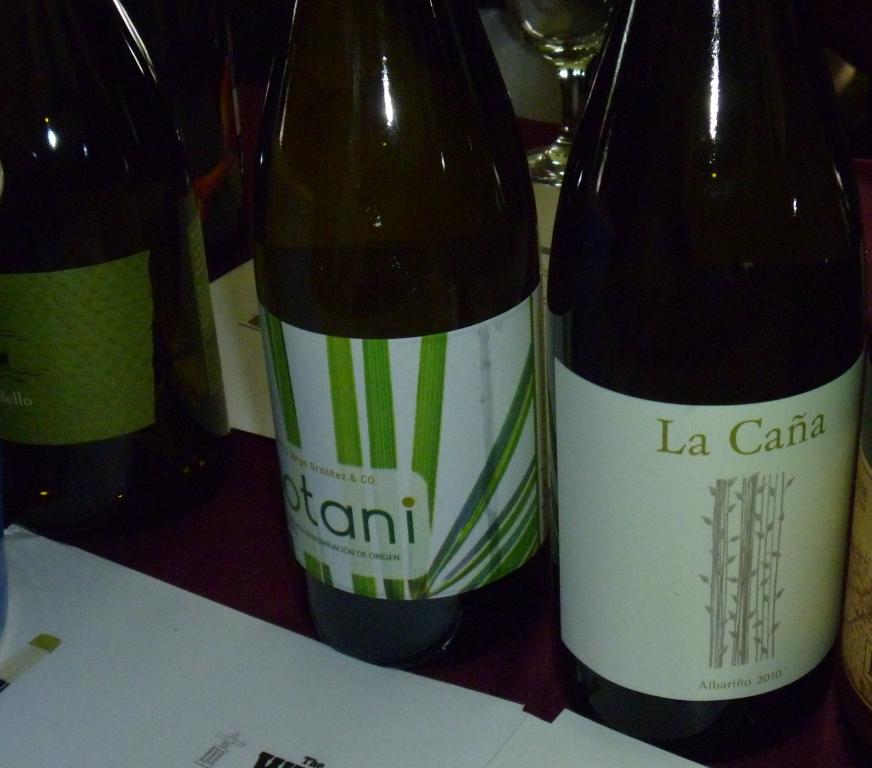
Both were beautifully refreshing, with floral notes on the nose, with La Cana having a bit more of acidity and mineral expression – both wines should be perfect on any summer day.
Coming to reds, the task of sharing my impressions becomes even more challenging – there were A LOT of great ( did I say “great”?) wines from Spain, California and France, so I will have to resolve to more of the pictures than words.
I want to start from the wines of Charles Mara. As some of you might remember, 2007 Mara Pinot Noir Laughlin Road Ranch was my most favorite wine last year (#1 in the Top Dozen). Now, I had an opportunity to try 2008 Mara Pinot Noir Laughlin Road Ranch Russian River Valley. What a radical departure! If I would be given those wines in the blind tasting, I would never even guess that those wines are coming from the same vineyard, left alone made by the same person. While 2007 was California Pinot at its best, 2008 is a pure Burgundy – dry, austere and in need of time – it probably needs another 5 years to open up.
Another very interesting wine was 2008 Mara Russian River Valley Zinfandel “old vines”:

As Charles Mara said himself, he was trying to make a “super-Tuscan” of Zinfandels, by blending zinfandel grape with Cabernet Sauvignon grapes from two different vineyards. I think he successfully accomplished that, ending up with powerful, dense red wine, showing beautiful fruit with a great restraint. This wine also need at least another 5 years to showcase fully.
Spanish reds selection at the tasting was so strong that it is nearly impossible to decide what wines should be mentioned and which were my favorites – El Nido, Alto Moncayo, Muga, Sierra Cantabria, Tesso La Monja – all powerful, beautiful wines, all age-worthy, delivering pleasure right now and for the next 30-40 years (or longer). I guess I would have to put a stick in the ground and say that 2007 Bodegas El Nido El Nido was my favorite Spanish wine in the tasting ( with the second thought in my head – well, yeah, and what about … ) – powerful, with amazing structure, firm tannins, good fruit, very balanced – “wow” was my single word descriptor.

By the way, standing next to El Nido are two Spanish wines, 2009 Blau and 2009 Can Blau – both were outstanding, fresh, with lots of sour cherries on the palate – and quite affordable for every day enjoyment.
There are few more reds I want to tell you about. First, it is Chateau Leoville Poyferre from Saint Julien. I already wrote about great experience with 2005 Chateau Leoville Poyferre Grand Cru Classe wine (here is the link to the post). This time I was able to try first, second and third labels of Chateau Leoville Poyferre – 2006 Chateau Leoville Poyferre Saint Julien Grand Cru Classe, 2006 Pavillion de Poyferre Saint Julien and 2008 Chateau Gulliver Bordeaux AOC.
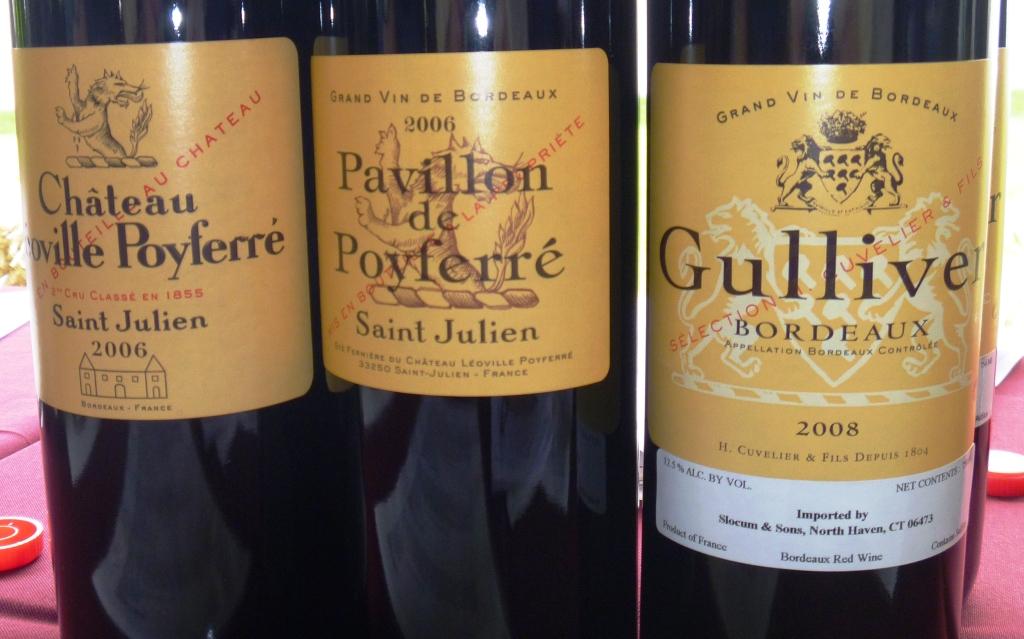
Chateau Gulliver was the lightest from the group, showing lots of earthy notes on the palate, and both Chateau Leoville Poyferre and Pavillion de Poyferre were big, powerful and well structured wines, with chewy tannins and lots of dark fruit, very balanced.
There was another set of wines which belong to the same group (owned by Chateau Leoville Poyferre), but coming from across the ocean – from Argentina, to be precise. These are the wines from Cuvelier Los Andes – take a look at the similarities in the label design:

Two out of four wines presented in the tasting were my favorite – 2009 Cuvelier Los Andes Cuvee Maule, soft and round, and 2007 Cuvelier Los Andes Grand Vin, a Malbec blend, big and powerful.
Last but not least was a group of wines from Ferraton, coming from Northern France – 2006 Ferraton St. Joseph La Source, 2007 Ferraton Cote Rotie L’Eglantine and 2006 Ferraton Hermitage Les Miaux:
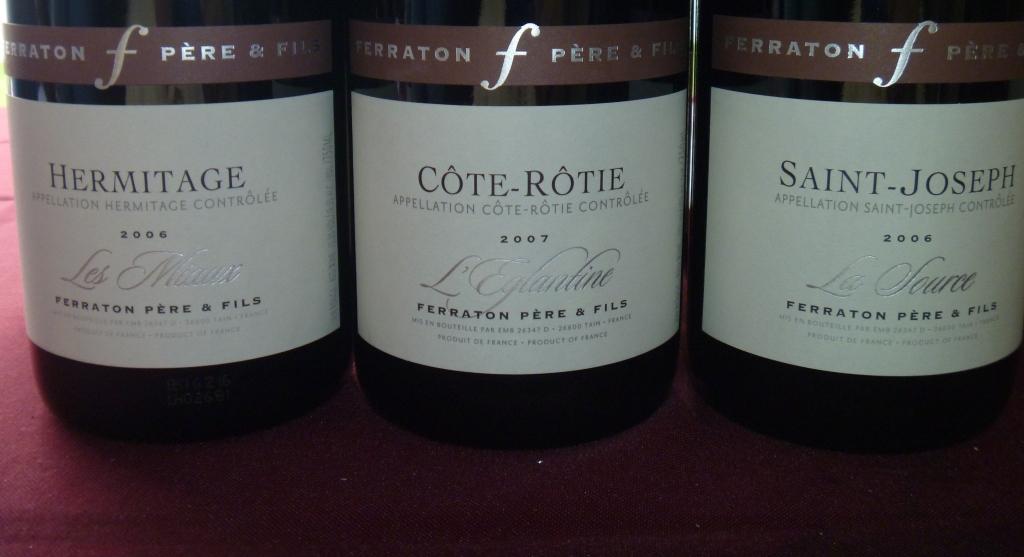
Both St. Joseph and Hermitage were classic Syrah wines, earthy, spicy, with the hint of white pepper and good amount of dark fruit. But my absolute favorite was Cote Rotie. First, I have to admit that it was my first ever taste of Cote Rotie. Actually Cote Rotie meaning in English is “roasted slope”, due to the amount of sunlight and positioning of the vineyards. You could actually taste all those roasted rocks in this wine, creating unforgettable impression. Needless to say this was my absolute favorite in the tasting.
I think it is time to finish – there were still more wines I wanted to share with you, but I think this is enough for now. More great stories is coming, but for now – cheers!
Food Network, Coming To The Bottle Near You
 Yesterday I found out that Food Network is not about only food anymore. Of course wine always was present in various Food Network shows, but only as a cooking ingredient. Now Food Network teamed up with Wente Vineyards to make your in-home entertainment easier by bringing you food friendly wines, which will also fit any budget (all wines are priced at $10.99 at Cost Less Wines and Liquors).
I’m ashamed to admit that I never heard about Wente Vineyards before, and it appears that they are the oldest continuously operated family-owned winery ( they’ve in business for more than 128 years) located close to San Francisco in Livermore Valley. It is interesting to note that Wente Vineyards has Certified Sustainable designation, which means that that they are using sustainable methods to produce their wines ( which is good for us, consumers).
So far there are 4 different wines in the Entwine series, two whites and two reds – Pinot Grigio, Chardonnay, Merlot and Cabernet Sauvignon.

The idea behind the Entwines is simple – food and wine are meant to be consumed together, and Food Network wants to help you to make the pairing effortless and enjoyable. On the Entwines dedicated web site you can find  recipes and food/wine pairing suggestions. Useful pairing information is also available on the back label of each and every bottle.
So what about wines themselves? I had an opportunity to try all four wines yesterday. They are all nice, easy to drink and should pair well with food – but may be they are too easy to drink for my taste. When I drink wine, I’m looking for the experience, and one of main questions which I’m trying to answer for myself is whether or not I would want to experience that wine again. While it might be interesting to try the Entwines with food, these are not the wines I would have a desire to experience again. At the same time, if you need to entertain a group of people, these wines will do just fine, exactly because of their simplicity (don’t forget also that they are inexpensive). In terms of Drinkability, I would rate them all at 7-, except Chardonnay which had more substance to it, so I will give it a 7.
You should try it for yourself – I’m sure these wines will be widely available. As for the Food Network and wines, I think they can kick it up a notch, by introducing a Wine Program. And guess what – I would be delighted to host it. Yep. We can all dream – let’s drink to that. Cheers!
Terroir, Unaltered
 Terroir. Sense of place exhibited by the wine. You can find definition of Terroir in Wikipedia, but interestingly enough, you can’t find it in Webster dictionary.
“Terroir” was always part of the winemaking, in transparent fashion, if you will. Wine was initially (we are talking thousands years ago) produced locally, to be consumed with local food. There was a traditional way of making the wine in each place, and it was repeated over and over, harvesting the same grapes from the same parcel of land. Even today you can find plenty of wines made for local consumption only, challenge is – you have to be “there” to taste them.
Needless to say that wine in those old days was made in “natural” and “organic” way, as it was the only way possible (no pesticides, no chemicals, no reverse osmosis machines, no oak dust, …). Then situation changed. While wine trade exists for thousands years, I would guess that extreme commercialization of it, which happened in the second half of the 20th century, and appearance of wine critics such as Robert Parker, forced a lot of change in the way the wine was produced. As for vast majority of commercial products, producer usually wants to limit the cost and maximize profits – when this principle is applied to wine production, we end up with a lot of wines which have no “terroir” concept whatsoever, and simply made to have a “familiar”, or “category required” taste. And as it is a commercial product, all means are good to guarantee an output and a profit (without going into any details, that includes all the stuff which you don’t want in or around your wine).
Luckily, the situation is changing. More and more wineries and winemakers are going back to the nature, and let terroir shine again, in its unadulterated form. Call it “organic”, “natural”, “sustainable” or “biodynamic” (each term has it’s own meaning and even philosophy behind it, but I have to refer you to Wikipedia to read more about it or we will never finish this post), but the main idea is similar among them all – interfere as little as possible, and let nature take its course. This is happening throughout the world, and in many cases is not even advertised on the bottle. For instance, Domaine Romanee-Conti, makers of some of the most famous (and expensive) wines in the world, are using organic farming and since 1985, and I’m sure there are lots of others which are simply doing it without much fanfare.
Sustainable, organic and natural are all very important, but there is more which goes into the winemaking process to let terroir to be the king. A lot of it goes back to that “do not interfere” concept. For instance, you can use 600 liter new oak barrels to age your wines, or you can use and reuse 15000 liter barrels. Which wine do you think will better showcase the terroir? Of course the bigger barrel will impart much much less oak flavor, and will let the grapes and soil to tell its story in a clear voice.
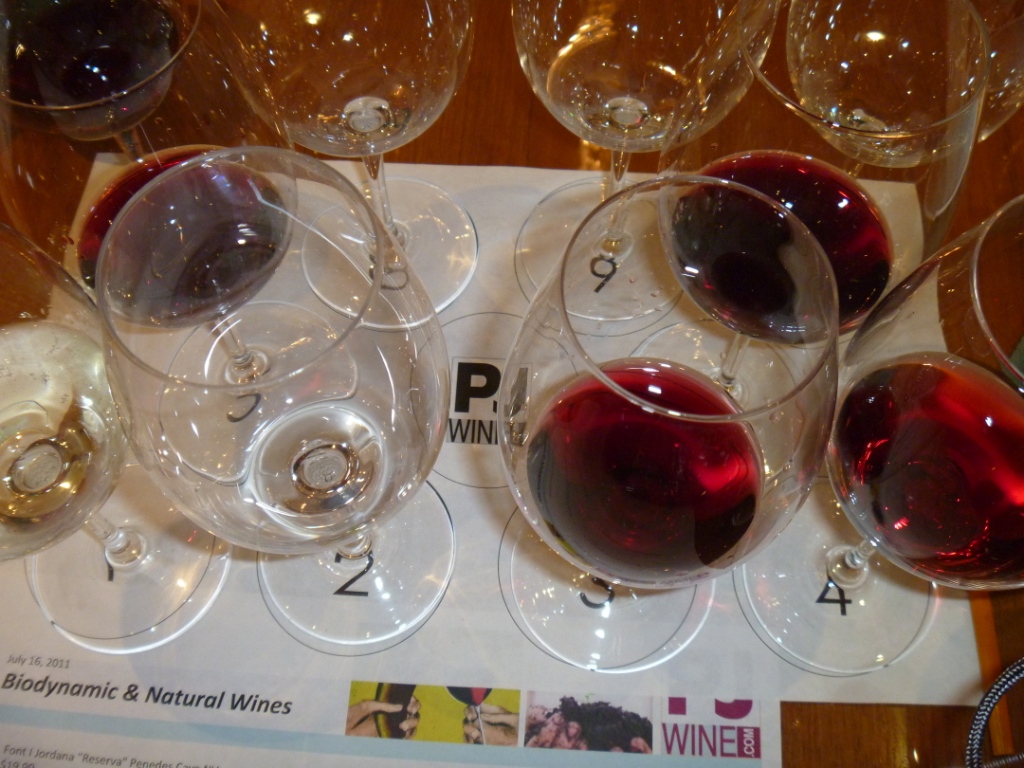
Okay, enough of this abstract talking, let’s talk about actual wines. I have to tell you that it was a seminar on Natural and Biodynamic wines, hosted by nobody else but PJ Wine, which prompted this post. This event was definitely both an education and experience, as all 10 wines presented in the seminar were not your average wines. To give you an idea, if you think about organic food, in many cases you only know that you are eating something which is healthier, better for you, but you can’t really taste it (if you are sure you can, I would love to play a blind tasting game with you). Talking about wines in that tasting, eight out of ten wines tasted totally different and unique – you can not necessarily tell that they are organic or natural, but you can tell that they can be distinguished from anything else you had before. These wines were made with “don’t interfere” concept in mind, letting the terroir to shine through. Another interesting fact about all the wines presented is none of them has alcohol level in excess of 13%, most of them are 11% or 12% – there were no jammy fruit bombs presented in the tasting (luckily!).
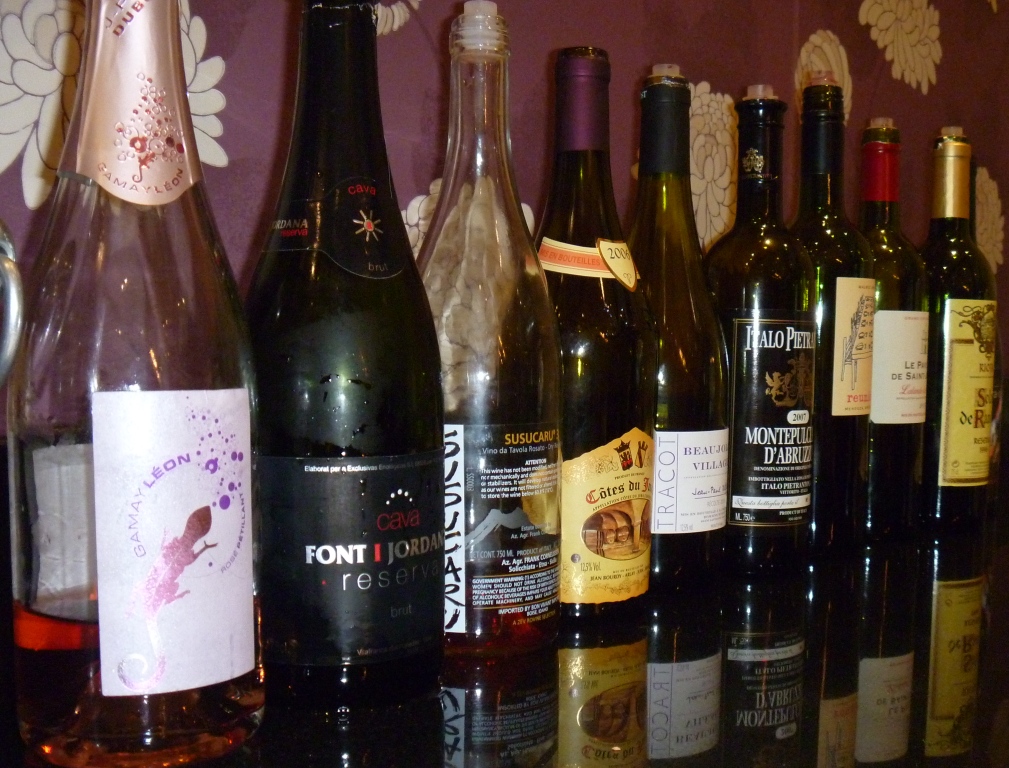
For what it worth, here are my notes, in the order the wines were presented.
Font I Jordana “Reserva” Penedes Cava NV – Interesting nose, with some yeastiness, full bodied. Very little amount of bubbles, almost none. Good acidity. Very refreshing due to the mouthwatering acidity. Good summer wine, but it is hard to call it a “sparkling wine”.
Jean Paul Dubost Gamayleon Rose Sparkling NV – Very unusual nose, almost off with some spoiled food smell, like spoiled strawberries. On the palate – honeysuckle, in its purest form, very small amount of bubbles, if any, good mouthwatering acidity.
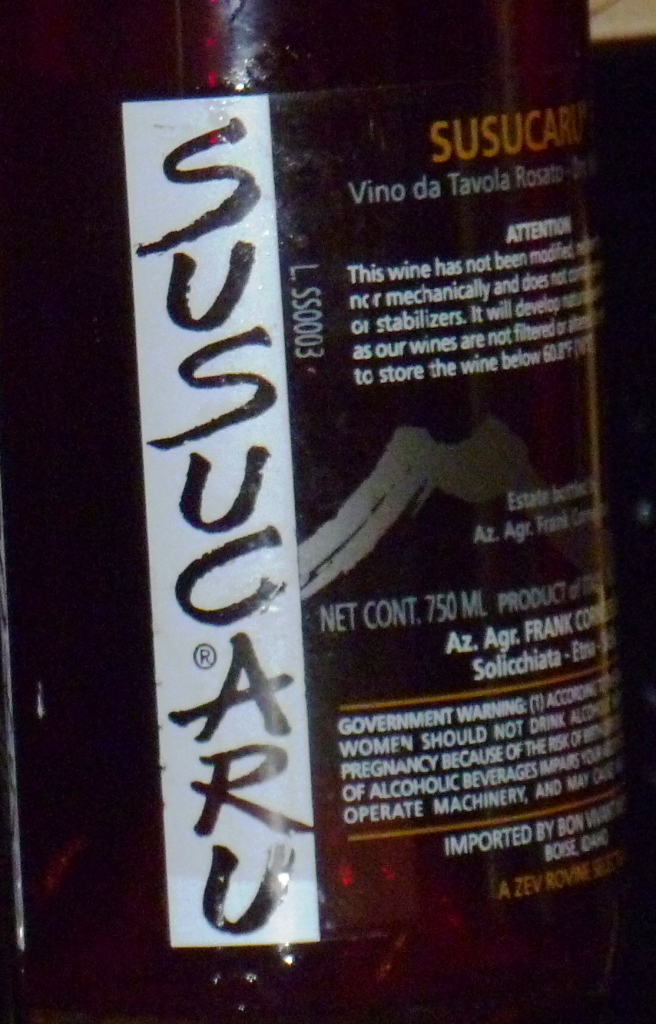 Frank Cornelissen Susucaru 3 Vino Da Tavola Rosato NV -Very interesting wine. Nose similar to Beaujolais Noveau, reminiscent of freshly pressed grapes. You can literally smell volcanic soil. Nose is perfumed with fresh soap aromas. Very unusual flavor profile – no strawberries (which is a typical component in many rose wine descriptions). Soap also comes as part of the aftertaste. Very herbal, with may be thyme being most prominent.
2009 Jean-Paul Dubost Beaujolais Villages “Tracot” –Very sweet nose. Big contrast between the nose and the palate, as plate is much drier, but overall there are pronounced raspberries, first on the nose, and then after dry start, the same on the palate. The wine just disappears in your mouth, doesn’t have any bottom – it is more juice than it is a wine.
2006 Jean Bourdy Cotes Du Jura Rouge – 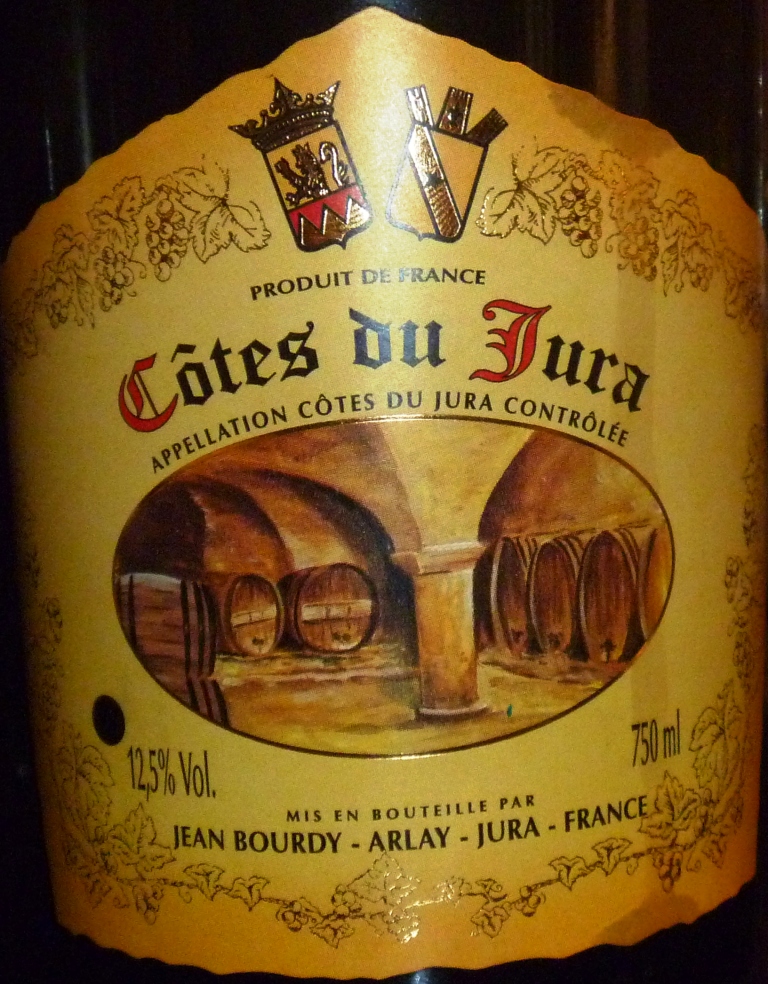 very interesting wine. Kitchen spice cabinet, like some nice rub, on the nose. Very good tannins, very nice and restrained overall on the palate, with some dry dill notes. Doesn’t show any age at all (and it is 5 years old). It appears that wines of Jean Bourdy are known to age very well (note to self). One of my favorites in the tasting.
2007 Italo Pietrantoj Montepulciano d’Abruzzo – The most unimpressive in the tasting so far. This is the case when I know it is good for me, as I’m told it is made differently, but can’t taste it at all. This wine actually was aged in 15,000 liter barrels for 2 years – but it is impossible to pick it up. It might be a food wine.
2009 Reunion Malbec Mendoza – Very grapey. Has some foundation, and some balanced fruit. Easy to drink, but not impressive at all.
2007 Le Pavillon de Saint Jacques Lalande de Pomerol –Very interesting. Smells like dirt, pure dirt after the rain. Very vegetative, no fruit on the palate, just pure dirt again. Almost no acidity. This wine was fermented in concrete tanks, aged for 18 month. It is “certified organic” and made with 90% Merlot and 10% Cabernet Franc – classic Pomerol wine. I would love to taste it in 10-15 years – I think it will greatly evolve, but it is not easy to say ” I like it” now.
1996 Bodegas Las Orcas “Solar de Randez” Rioja –Classic Rioja on the nose. Beautiful, with limited fruit expression, but very balanced. I guess this is how Rioja was in the old times. This is Reserva level Rioja. One of the best in the tasting.
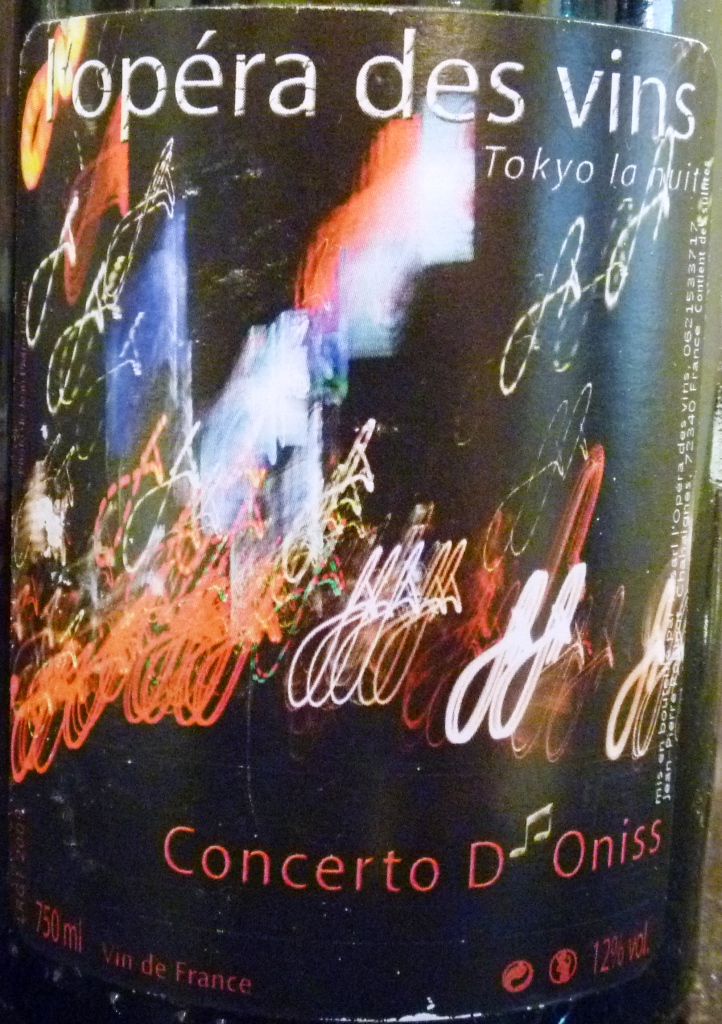
2009 Jean Pierre Robinot Concerto d’Oniss Pineau d’Aunis -Loire valley wine. Beautiful fruit, rose petals on the nose, funky. Beautiful palate, somewhat reminiscent of Beaujolais, but with more substance and good acidity. Best in the tasting.
I just realized that many of the descriptions above start with the words”very interesting” – these wines are truly interesting, they are all telling their own stories. These wines are letting the terroir to shine through. I might not be able to understand all their stories yet, but this is great, as we there is more to learn. You don’t have to try them all, but make an effort, find and try some of them – you might discover a whole new wine world. Happy learning! Cheers!
Canada Food and Wine Experiences, In Pictures
It appears to be very difficult to write blog posts while on the family vacation, despite all the desire to do so. Therefore, here is a quick report from Canada – all in pictures. I can tell you that so far I had being very happy with food, including restaurants in Niagara Falls (which was not expected considering that this is very popular tourist destination). I was also blown away by the quality of Canadian wine. Before the trip, I honestly thought that outside of the Icewine, Canadian wine would be on the level of Finger Lakes wines in NY, where whites can be drinkable, but reds are simply mediocre. Boy, was I wrong! We visited three wineries, and didn’t have a single bad wine! Well, this will be a subject of a separate blog post, so for now, here is quick report in pictures (warning – don’t look while hungry).
Nachos at Spicy Olive restaurant, Niagara Falls:

Beef Baron restaurant, Niagara Falls:
French Onion Soup:

Escargot:

Spare Ribs:

Wineries experience:
Inniskillin (from whites to reds to Icewines – outstanding, will discuss later):

Inniskillin Cabernet Sauvignon/Syrah and Cabernet Franc – WOW:
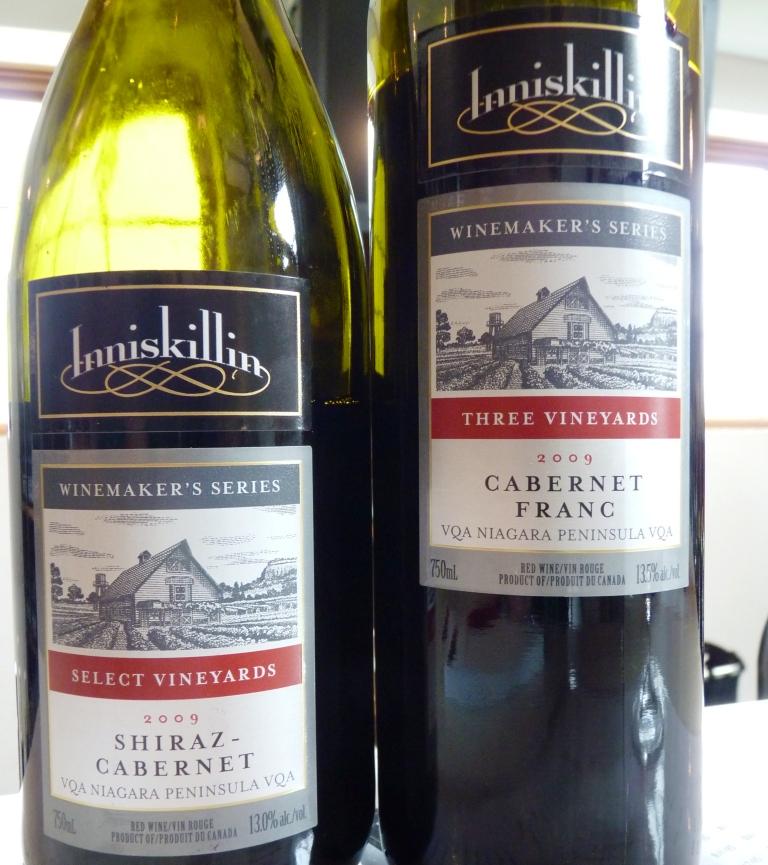
Inniskillin for those who can’t even drink wine:

Cattail Creek Winery, very interesting whites and reds:
Catastrophe series (note that labels depict real cats):

Chateau des Charmes – you should see that building:

Back to the restaurants:
Cora’s (Niagara Falls) – Breakfast done right!
Breakfast cocktail:

Crepes Egg and Cheese Panini:
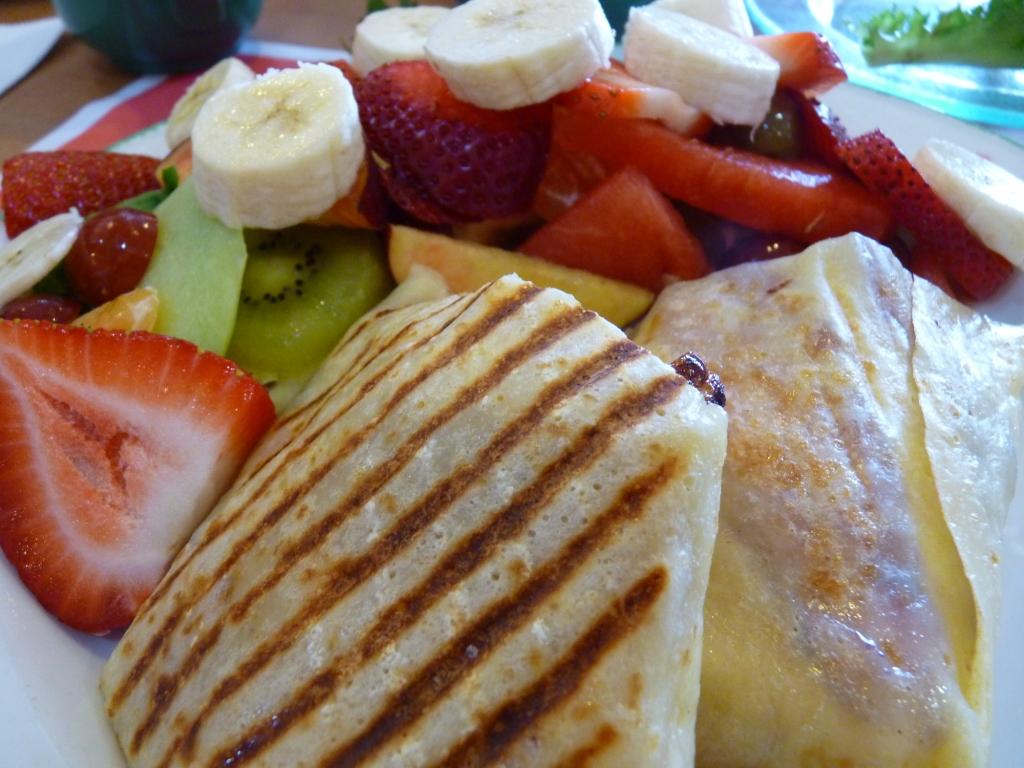
Crepe with Raspberries and cream cheese:
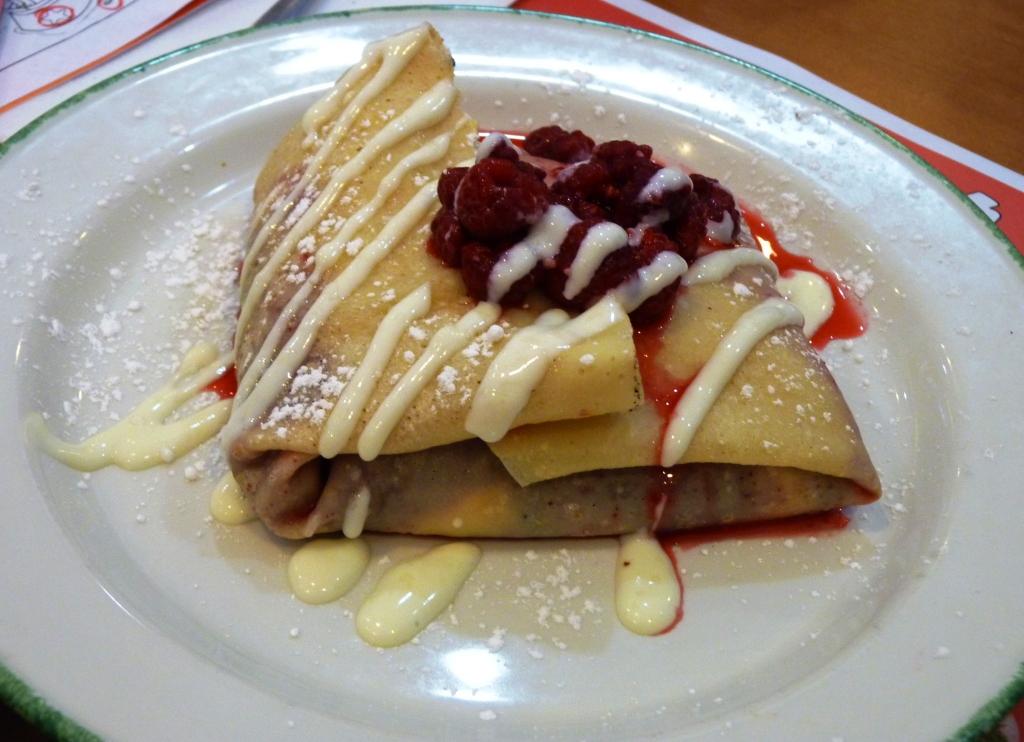
Blueberry Pancakes:

Will definitely talk more about wines in the future posts. If you are interested in reading more about restaurants, you can take a look at my page on Yelp (click here). Until the next time – cheers!
Cora
7555 Montrose Road
Niagara Falls, ON L2H3A4
(905) 358-1555
http://www.chezcora.com/home

War Of The Glasses: Does Wine Glass Matters?
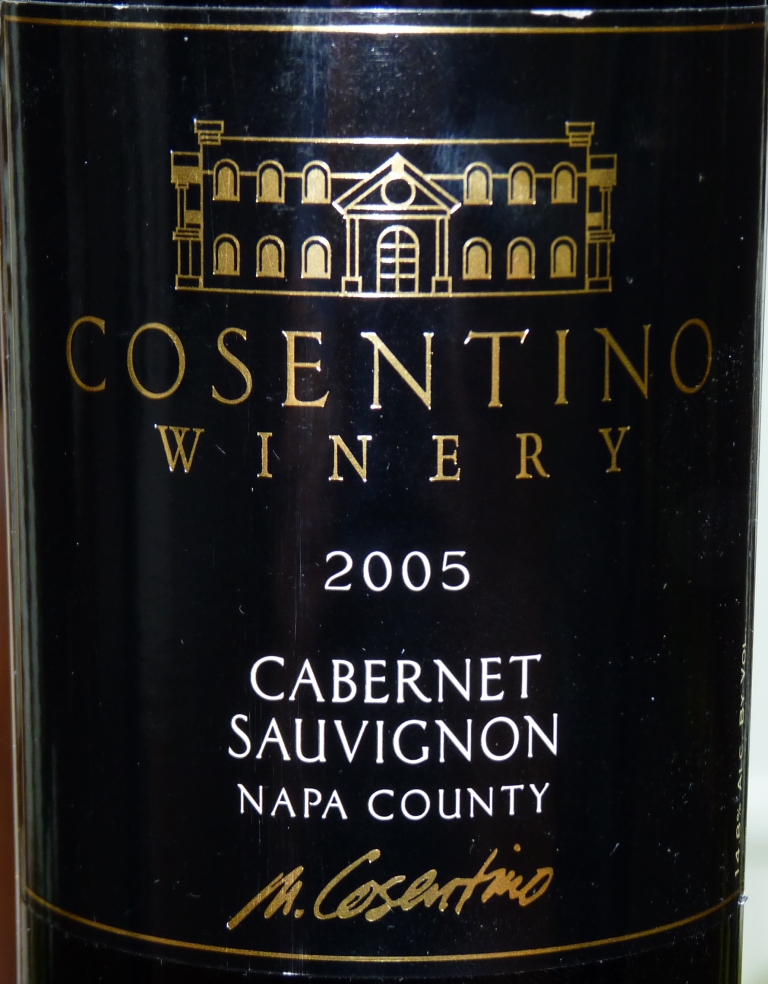 Of course the topic of wine glasses and their effect on wine’s perceived quality (which includes smell, taste and overall pleasure) is a very popular subject among wine lovers (professionals are also not immune to such discussions). I have no intention to claim any original or unique thoughts on the subject – instead, I want to merely report on my own personal experiment.
We started with 6 different glasses and a bottle of wine. For this experiment, I wanted to use a wine with classic flavor profile, nothing too obscure – seems that Cabernet Sauvignon would ideally fit the bill. I can tell you now that I was moderately happy with the choice of wine. While I like Cosentino wines, this 2005 Cosentino Napa Valley Cabernet Sauvignon was more fruit forward than I appreciate, but still it was not a very bad choice.
The glasses included: Riedel Cabernet Sauvignon Glass, Riedel Universal tasting (also can be called “restaurant special”, 489 0 in Riedel nomenclature) glass (holds 20 oz), a wide open, almost “square” glass (don’t know if it has a special name), small (8 oz) universal tasting glass, plastic cup and small paper cup.
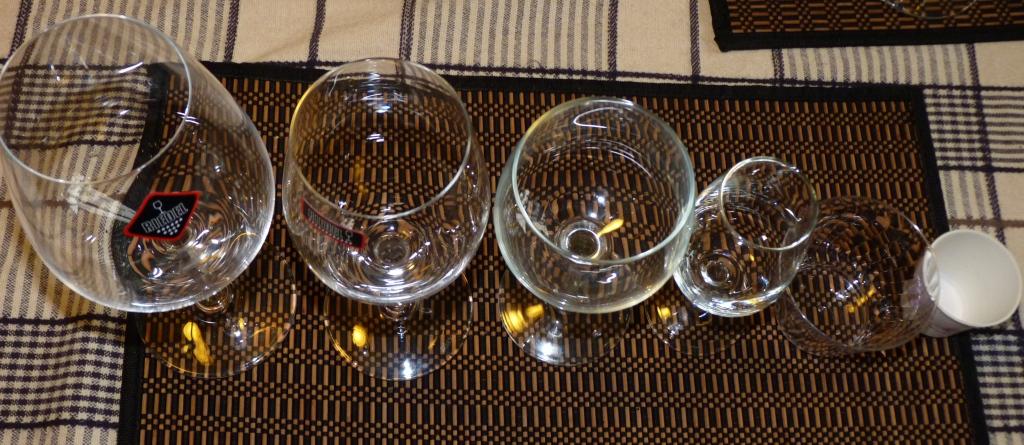
Now for the notes (results are presented in the exact succession as glasses were assessed):
Riedel Cabernet Glass:
Nose: big concentration, noticeable alcohol, smell of a wet dog (must be something wrong with me)
Palate: lots of fruit, black currant, still quite sharp
Riedel Universal (489 0):
Nose: good concentration of the fruit, alcohol is less noticeable
Palate: very good fruit, round taste
“Square” glass:
Nose: some fruit are a bit more open (black currant), overall less alcohol, less fruit concentration.
Palate: taste is ok, a bit less of everything
Small universal tasting glass (8 oz):
Nose: almost like previous one, noticeable fruit
Palate: the softest of all! Nice round fruit
Plastic cup:
Nose: literally nothing
Palate: ok, similar to the one above
Paper cup:
Nose: none
Palate: bad
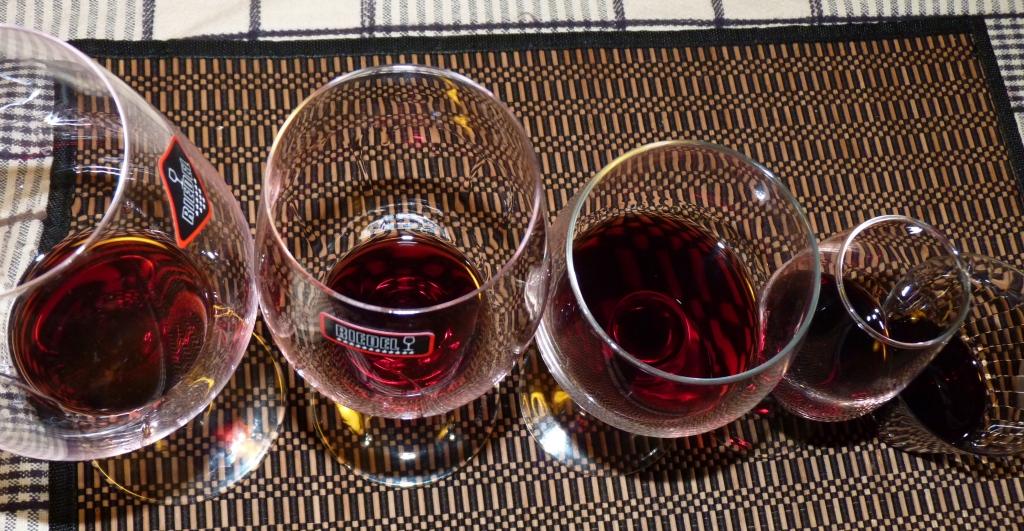
Let’s try to come up with some conclusions now. I think two universal tasting glasses fared the best – size difference didn’t matter. Of course bigger glass was more convenient to use, but outside of aesthetics of wine appearance in a bigger glass, they delivered literally the same flavor and taste. We can also safely say that paper cups shouldn’t be used if you are drinking wine to enjoy it (that was a definite looser). Plastic cup can be used, but you will lose the pleasure of the smell, so if you can avoid it, then avoid it. “Square” glass was okay, but again you will be losing on the aroma details. Lastly, Riedel Cabernet glass still requires more experiments. It was definitely not the best glass in this tasting, but I believe that it might enhance the taste of some particular Cabernet wine, most likely less alcohol, old-world style wine, where it will actually be able to enhance subtle aromas and flavors.
For now, don’t drink your wine from the paper cups, and save the money by avoiding those super-expensive “specialty” glasses, and you will do quite well. And if you have an opinion (different one? even better!) – leave a comment, and let’s have a debate. Cheers!
Last Bottle Sign Up ($10 credit)




 Talk-A-Vino