Archive
Expect the Unexpected?
Wine is meant to go with food.
Food is meant to go with wine.
Together, food and wine are supposed to give you a much better experience than two individually.
You already know all of this.
And yet this is theory. When met at the table, sometimes food and wine actually work together and deliver a heavenly, memorable experience. Sometimes, food and wine just coexist without interfering. And sometimes they clash, ruining the experience completely.
The food and wine pairings typically work in one of two cases:
- Food and wine are professionally paired. The chef and sommelier work together, adjusting the flavors of the dish to work with the wine which was selected as a pairing.
- Food and wine come from the same place and had been playing together nicely for centuries. Think about Beef Bourgogne paired with Bourgogne wine – I think we can trust this combination, don’t we? Or would you ever question Chianti with the pasta with nice red sauce?
Now, for most of the time, we are not traveling and we are not eating at the high-end restaurant, yet we still should be able to enjoy the elevated food and wine experience at home – the rules are simple, right?
Maybe the rules are simple indeed, but we need to tread carefully. Beef Bourgogne is made with Bourgogne wine, and all Bourgogne reds are made from Pinot Noir. So what would happen if we will make the dish with actual Bourgogne, and then try pairing it with a nice big Pinot from California? There is a good chance that you will not enjoy that combination, not at all.
Chianti is made out of the Sangiovese grape (predominantly) – but don’t try to pair your pasta with the Sangiovese from California – again, there lies a great opportunity for disappointment.
I’m not saying that Beef Bourgogne will never work with the California Pinot – find a more restrained version, such as Sanford Pinot Noir, for example, and you might be fine – or better yet, simply cook the dish using the same wine you want to drink. Similarly, there are some California Sangiovese that might perfectly complement and elevate your favorite spaghetti dish, such as Castello di Amorosa Sangiovese – but you should expect some trial and error on the road to perfection.
I love Georgian wines. I would gladly drink Georgian Saperavi on any day. I love Georgian cuisine – properly made, the flavors are incredible and so is the pleasure you will derive out of each and every dish. And considering that wine is an indelible part of the Georgian lifestyle literally for thousands of years, it is rather logical to assume that Georgian wines should work perfectly with Georgian dishes.
While I love Georgian cuisine, this is not the food I would generally try to make on my own, I prefer to defer the cooking to a few of the Georgian restaurants which we have in reasonable proximity, even though the experience is typically a mix of hit and miss. However, when my sister in law sent me the video with the recipe of the Georgian dish called Odjakhuri, the video looked so good that I decided that I must make the dish as soon as possible, considering that the main ingredients are near and dear to me from the childhood – meat and potatoes.
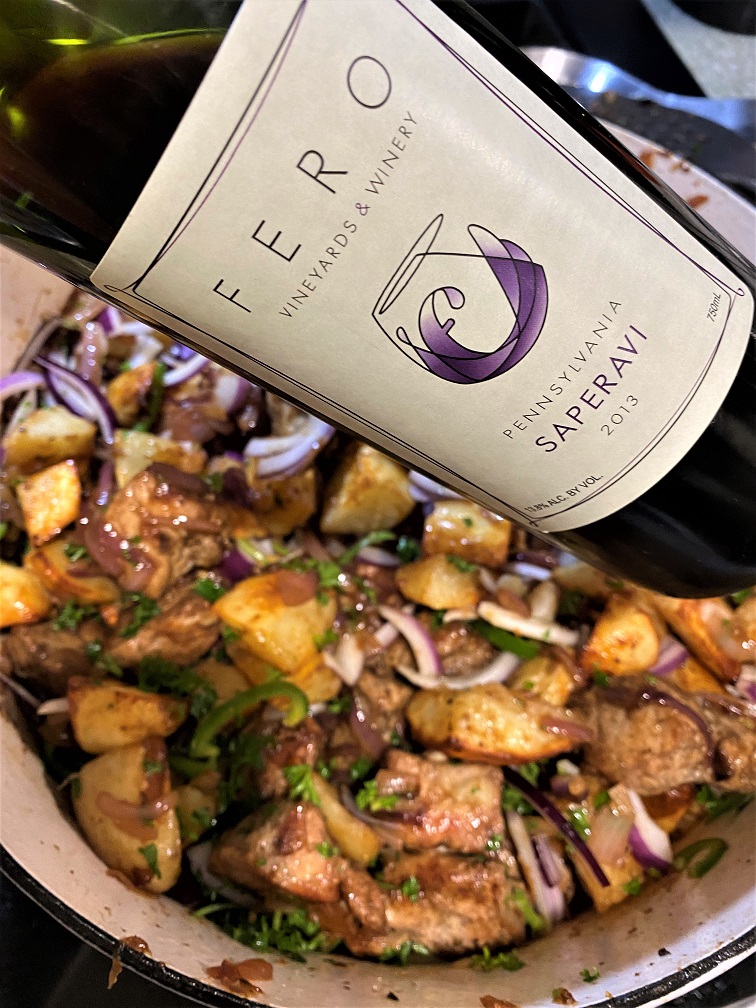
Back in 2015, we visited a winery in Pennsylvania called Fero Vineyards. In addition to all of the traditional east coast wines, the winery also was making the wine out of my beloved Georgian grape, Saperavi. I tried the wine during our visit, liked it very much (Fero Saperavi made it to the 2015 edition of my annual Top Dozen wines of the year list as #12), and brought home a bottle. After I decided that I will make an Odjakhuri for the Friday night dinner, I realized that I have no Georgian wines on hand – but then I remembered that I had a bottle of Fero Saperavi which I had been looking for a good reason to open for quite some time – and what can I be a better reason than trying it at a family dinner with Georgian dish?
To tell you the truth, I had no idea how it is going to work. First, the bottle I had was the 2013 Fero Saperavi. Who knows if the wine from Pennsylvania can age for 8 years? The wine might be gone already, way gone. But even if the wine is not gone, would Saperavi from Pennsylvania work with the flavors of the dish? Local wines work with local dishes because they went through a slow process of alignment over hundreds of years – well, maybe that is one of the reasons. And here we have a dish with the supposedly proper flavor profile, and proper grape from totally different terroir – everything is possible…
When I was opening the bottle of Fero, I had no expectations. Let me take that back. When I was opening the bottle of Fero, I was expecting that the wine will be past prime. And even if it will be still drinkable, that it will not work with the dish, not for a second. And I’m glad I didn’t make any bets with anyone because I lost on both counts.
The wine was perfectly fresh. It had a ruby color, not hinting at any age. On the nose, there were cherries and herbs, nicely restrained. On the palate, the wine showed a hint of cherries, sage, gamey undertones, tobacco. Perfectly live, perfectly fresh, excellent acidity, medium-plus finish.
The wine also perfectly complemented the dish, enhancing and elevating the flavors and creating a better experience.
Was this pure luck on both counts? The wine was perfectly drinkable and it complimented the dish very well? I don’t have an answer, I’m just reporting on the experience, and raising the question – where are the wine and food pairings created?
This pretty much ends my story about expecting the unexpected, but before we part, I want to leave you with the recipe for this simple and delicious dish.
Disclaimer: Odjakhuri in translation from Georgian means “family”. So as a family meal, I’m sure there are tons of “correct” recipes for this dish. The recipe which I’m sharing is exactly the one we made, thus this is the one I recommend.
Apology: I would love to share a video with you, but an actual video that I have is in the Russian language. Still, I believe it will be useful even without understanding the language, so here it is:
Odjakhuri – Georgian meat and potatoes family dish
Ingredients:
- Meat (pork, beef, chicken) – 2 lb
- Potatoes (Russet would work the best) – 4 lb
- Red onion, medium size, sliced – 4
- Garlic, chopped – 4 cloves
- Cilantro (can be replaced with parsley), chopped – 2 tbsp
- Hot pepper, sliced – 1
- Coriander, ground – 1 tsp
- Sweet paprika – 1 tsp
- Cayenne pepper – 1/2 tsp
- Dill (dried) – 1/2 tsp, optional
- Black pepper, ground – 1/2 tsp
- Salt, by taste
- Olive oil
Steps:
- Potatoes: Preheat oven to 375F. Peel potatoes and slice them into the pieces about 1 inch in size. Put into a large bowl. Add olive oil (you can use any oil you like for roasting), coriander, black pepper, cayenne, paprika, dill (if using), and 2 tbsp of salt (I prefer kosher salt). Mix everything together. Line roasting pan with parchment paper and arrange potatoes preferably in a single layer. Roast for 45-50 minutes – check readiness, potatoes should be crispy but shouldn’t be overlooked. Once ready, get it out of the oven and put it aside.
- Meat. Meat should be prepared as it would be for a kebab. Ideally, it should be sliced into 1-inch cubes and marinated overnight. You can, of course, just roast the meat without marinating it, but marination will add to the flavor of the dish. In our dish, we used bone-in pork loin, I just cut the meat off the bone. If you will be using pork, look for darker meat, it is less prone to drying up while frying.
- Once you put potatoes in the oven, you can start on the meat. Heat a small amount of oil on medium-high heat in the cast iron dutch oven, and fry the meat until ready. If meat is not marinated, use salt, pepper, and any other spices you would like. When ready, get the meat out of the pan. make an effort not to overcook the meat.
- Reduce heat to medium-low, add 3 sliced onions and sauté them slowly, pay attention not to burn them. When almost ready, in about 12 minutes, add garlic and let it cook for another 3 minutes. Now it is time to assemble the dish.
- Reduce heat to low. Return meat to the dutch oven, add roasted potatoes. Add fresh cilantro (or parsley), sliced hot pepper, and last sliced onion, mix everything lightly (try not to crush the potatoes). Let the dish heat up, uncovered, for about 10 minutes, to let the flavors meld. In 10 minutes, turn off the heat, serve and enjoy!
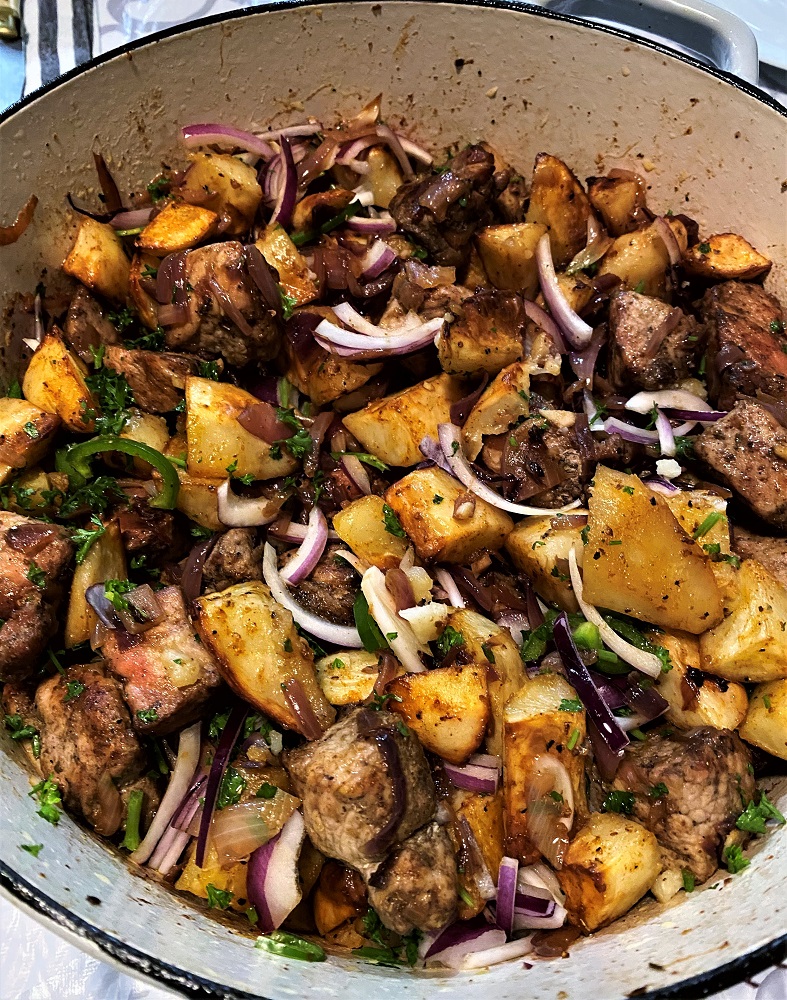
There you have it, my friends. If you don’t have Saperavi on hand, try it with any wine you’d like, and expect the unexpected. Cheers!
So Long, Catarratto. Welcome, Lucido
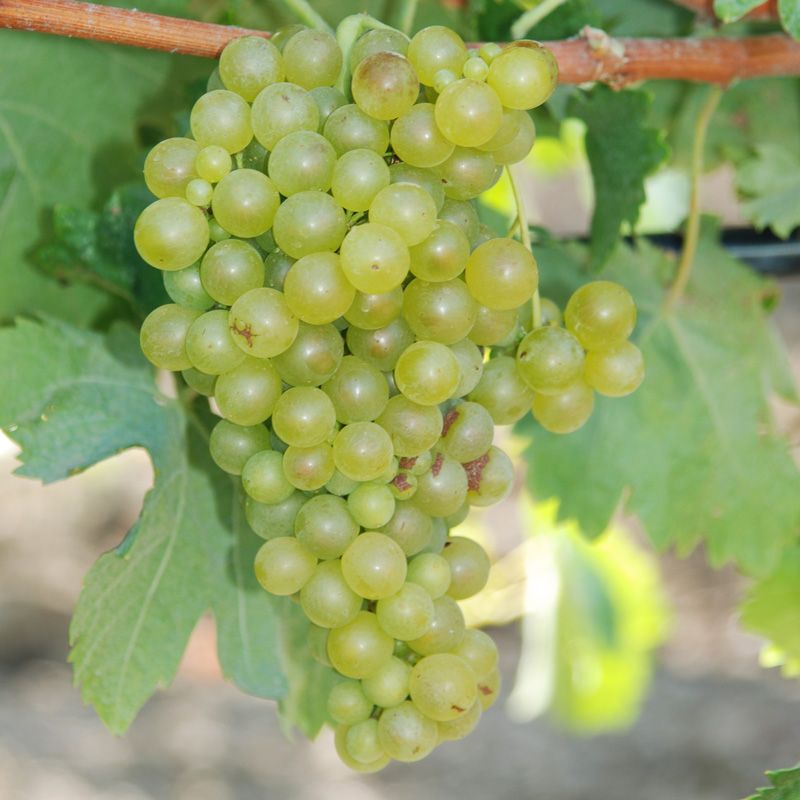
Catarratto grapes. Source: Sicily DOC website
It is a mouthful of the title, isn’t it?
“So long, Catarratto, welcome Lucido” – a bunch of strange words lumped together seemingly without any purpose, right?
Okay, I get it – some explaining is due.
Catarratto is the most planted white grape in Sicily and the second most planted white grape in Italy. Sicily has about 75 acres of Catarratto vines between two of its clones, Catarratto Bianco Comune and Catarratto Bianco Lucido, which represents 30% of the whole vineyard area in Sicily. Catarratto production increased from 17,300 bottles in 2012 to 730,000 bottles in 2020. And it is one of the historical varieties, growing forever on the island, producing fresh, round, and well-balanced wines. Sounds great, right? I would assume that you sense that the “but” is coming. So what is the problem with this picture? The name, Catarratto, is the problem.
Catarratto – pronounced “kah-tahr-rat-to”. Say it a few times, just for fun. Think if you will be comfortable ordering it in the restaurant, while just calling it by name instead of pointing with your finger on the line in the wine list saying “this”, “I want this”.
As Catarratto was growing in popularity, its name became a barrier. People don’t want to be embarrassed. And saying the word you don’t know how to pronounce requires a lot of courage. When Sicilian wines were presented at the seminar in China 10 years ago, there was enough of the anecdotal evidence collected in the form of videos with attendees struggling greatly while trying to pronounce the word Catarratto. And so it was well understood by the Sicilian winemakers that if they want to be successful with the wine which actually well deserves such success, something needs to be done.
Lucido is the name of one of the clones of Catarratto, and it is the name that often was used in ancient times. While Catarratto Bianco Lucido has a slightly different appearance compared with Catarratto Bianco Comune with Lucido grapes being shiny (hence the name), genetic research showed that both grapes are completely identical (speaking of genetics – another Italian grape, Garganega, is considered to be one of the parents of Catarratto, but then nobody knows where Garganega came from… ).
Sicilian DOC Consortium took this grape renaming task to the heart and after 2 years of lobbying, on November 21, 2018, the national Ministry issued a decree allowing the name Lucido to be used for any of the Catarratto wines produced in Sicily.
There are about 530 native grape varieties in existence in Italy, so it is obvious that setting up the precedent with renaming the grape variety was not taken lightly. But in the case of Catarratto/Lucido, it became very clear that considering the volume of production and possibilities of increased international demand, the hard-pronounced name of the grape variety became a gating issue of the wine’s success, and the right decision was made.
While Sicilian winemakers definitely appreciated the opportunity to change the name, it doesn’t mean that in mere 3 years you will see the name Lucido appear on all the wine labels. While we might think that the picture should look like this:


the 3 samples which I received looked like this:
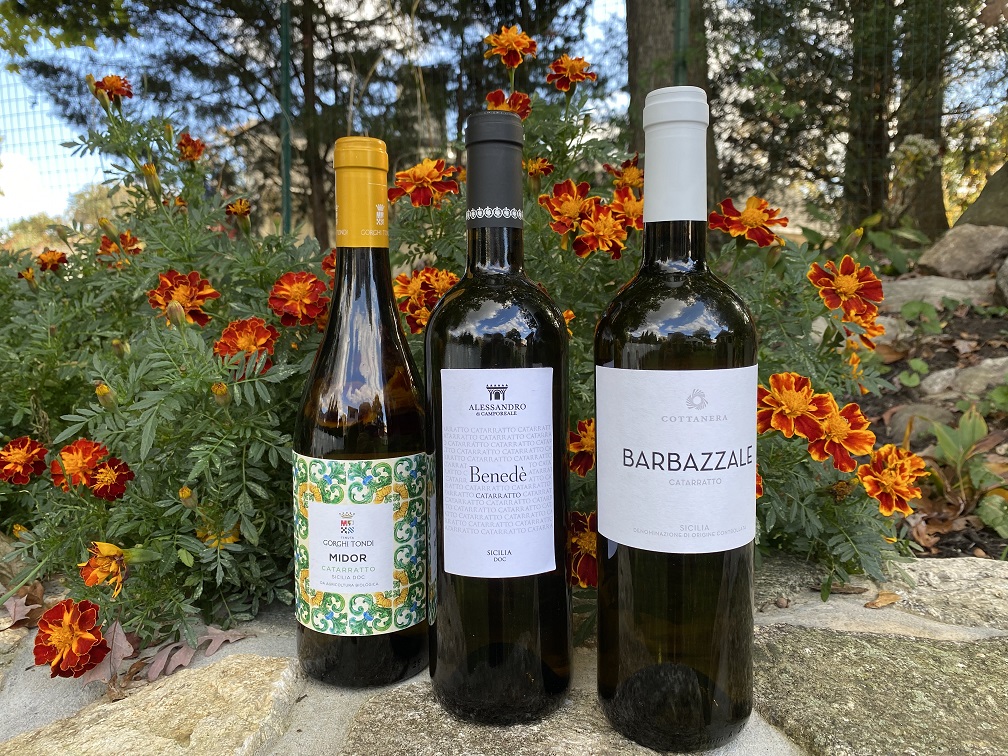
Well, whether Catarratto is difficult to pronounce or not had no bearing on the wines, as I loved all three of them:
2020 Cottanera Barbazzale Catarratto Sicilia DOC (12.5% ABV)
Straw pale
A hint of tropical fruit, lemon, herbs
Round, beautiful, Golden delicious apples, lemon, good acidity, clean and fresh.
8/8+, outstanding.
2020 Tenuta Gorghi Tondi Midor Catarratto Sicilia DOC (12.5% ABV, organic grapes)
Straw pale
Generous nose with a hint of vanilla, honey, and gunflint
Crisp, clear, precise, elegant, beautiful acidity, lemon, more gunflint, and Granny Smith apples.
8+, can be easily confused for a Chardonnay. Wine with finesse.
2019 Alessandro di Camporeale Benedè Catarratto Sicilia DOC (13% ABV)
Straw pale
Lemon, steely minerality
Crisp, tart, lemon, expressive minerality, clean acidity. Very refreshing
8, excellent food-friendly wine
I wouldn’t lie to you – Midor Catarratto was my most favorite wine, and I really admire its tile-styled label.
Catarratto’s name served the eponymous grape well, but the change is coming. It is a slow change, but as long as it is just the change of the name, and we will still get to enjoy the wine inside the bottle, it is the change that will help this wine to deliver pleasure to more wine lovers around the world.
And for you, my wine friends, Catarratto or Lucido – go find this wine and expand your wine vocabulary.
Welcome, Lucido.
P.S. For the grape geeks out there: as I was working on this post, I came across this article, which identifies Mantonico Bianco as the second parent (along with Garganega) of Catarratto. The article is from 2017, so it should be old news, but at least the Wikipedia article on Catarratto has no mention of it…
Celebrate Versatility of Sherry
Sherry. Jerez. Xerez.
I’m sure you’ve seen the name, at least one of the three. But when was the last time you actually had a sip of sherry? While you are trying to recall, let’s talk about it.
The winemaking area where the eponymous wine is produced, Jerez-Xérès-Sherry, is located in the south of Spain and is one of the oldest winemaking areas in Spain and in the world, producing wines since 1100 BC. Nowadays, Sherry is known as a fortified wine – meaning that a neutral spirit was added during wine production to stop the process of fermentation. However, the fortification of Sherry is relatively a young phenomenon, developed in the 17th-18th centuries – until then, Sherry was simply known as a high-quality wine. After developing its unique style as fortified wines aged typically for 8 years using the solera method (the wine is partially taken from the barrel for bottling, and the barrel is topped off with the wine from the new vintage, repeating the process for many years), Sherry became one of the most popular Spanish wines, competing for the crown with Rioja. Phylloxera infestation at the end of the 19th century delivered a lethal blow to the Sherry wine industry, from which it never fully recovered.

Sherry wines are unique and even mysterious. Only three grapes – Palomino, Pedro Ximénez, and Moscatel, are used in the production of sherries. Actually, Palomino is used in the production of about 95% of all Sherry wines. Five different styles of dry Sherry – Fino, Manzanilla, Amontillado, Palo Cortado, and Oloroso, are produced from the same palomino grape, each one with its own unique characteristics. Then you have a range of Cream sherries, typically combining one of the Palomino-based dry sherries with Pedro Ximénez, to achieve various degrees of sweetness. Last but not least would be Pedro Ximénez (typically abbreviated as PX) and Moscatel sherries, delivering oozing sweetness – but, when done properly, offering balancing acidity, and becoming heavenly nectar.
I discovered the world of Sherries more than 10 years ago, and really enjoyed that discovery for a while. Until for some mysterious reason (there is a mystery in Sherry, I’m telling you), I stopped enjoying most of them with the exception of PX. I was a bit confused as to why and how it happened and even shared my frustration and the attempted comeback in this post. Then a few months back, I poured myself a little glass of Oloroso from the leftover bottle from the past tasting (the beauty of Sherry – it can keep almost indefinitely after opening, don’t try that with wine), looking for the pre-dinner drink – and I was back in love. Pure mystery, but I’m not complaining.
Considering its range of styles, Sherry is one of the most versatile wines out there. You can pair it with your mood, as the expressions of the dry sherries are literally unmatched in the world of wine offering non-fruity complexity (nuttiness, salinity, herbaceousness, crisp acidity, and more); sweet sherries simply bring you into the world of hedonistic indulgences. You can also perfectly pair a whole dinner with Sherry, starting with a simple aperitif, as I did with the aforementioned Oloroso, and ending with PX, either by itself (good enough) or with a dessert (even better).
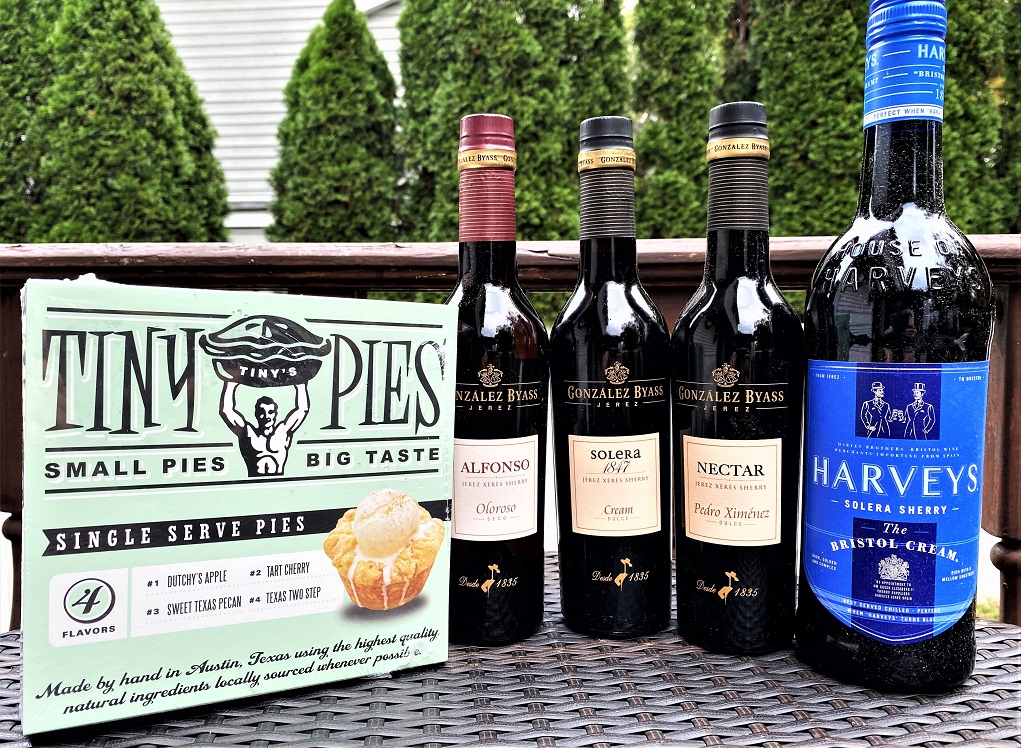
Oh yes, the dessert. This week, November 8 – 14, 2021, is designated as Sherry Week (#SherryWeek2021), a worldwide celebration of this unique wine. As part of the festivities, I received samples of the Sherry wines produced by González Byass, one of the purveyors of the fine Sherry wines. Moreover, the sherries were accompanied by dessert, and suggested pairings! I got a selection of pies from Tiny Pies to pair along with the Gonzalez Byass Sherries as follows:
- Apple Pie with Gonzalez Byass Alfonso Oloroso
- Pecan Pie with Harveys Bristol Cream
- Texas Two Step (a pecan and chocolate brownie pie) with Gonzalez Byass Solera 1847 Cream
- Cherry Pie with Gonzalez Byass Néctar Pedro Ximenez
Let me say first a few words about Tiny Pies. Tiny Pies company was born in 2010, in Austin, Texas, with its history starting from a simple question – quoting from the Tiny Pies website in the words of one of the founders, Amanda: “One day in 2010, my son, Andrew, innocently asked why he couldn’t take a piece of apple pie to school. I tried explaining to him that it wouldn’t be easy to eat. Andrew then suggested that we make a pie he “could eat with his hands””. The rest is history- today Tiny Pies operate 4 locations in Austin, and they also ship their pies countrywide, and yes, you can eat them with your hands.
Now, the sherries. Out of the four sherries I received, I was well familiar with 3 – Oloroso, Harveys Bristol Cream, and Néctar – instead of repeating my notes, you can find them in this post. González Byass Solera 1847 Cream Dulce (18% ABV, $17/375 ml, 75% Palomino, 25% Pedro Ximénez) was a new wine for me. At first, I got very excited about 1847 in the name, as I thought that maybe this is when the original solera was started and maybe it is still going (which would make it a 170 years old wine, not bad, right? :)). I asked the publicist this question, and the answer was a bit more prosaic but still worthwhile: The founder of González Byass, Manuel Maria González, founded the winery in 1835. His son turned 1 in 1847, so he decided to name the Sherry after the year he turned 1. Otherwise, the wines spent 8 years in solera, and each barrel is used for approximately 30 years. So one way or the other, but 1847 is not a random number.

Of course, I tasted the wine by itself, and it was delicious – dark amber color, complex and herbaceous nose. The palate was full of dried fruit, chocolate, and figs, with good acidity and perfect balance.
And now, to the pairing!
I obviously went along with the recommendations – here are my notes:
Apple Pie with Gonzalez Byass Alfonso Oloroso:
Interesting. Some contrasting notes, but not great. Best pairing – Pedro Ximenez. Worked perfectly, matching the cinnamon profile of the apple pie.
Pecan Pie with Harveys Bristol Cream:
Very nice. Excellent match on the nuttiness. Not so good with Cream 1847. Harveys complements perfectly and refreshes the palate after the bite.
Texas Two Step (a pecan and chocolate brownie pie) with Gonzalez Byass Solera 1847 Cream
Very good, pairing by the contrast. Sherry perfectly cuts through the sweetness.
Cherry Pie with Gonzalez Byass Néctar Pedro Ximenez
Not good. Néctar flavors clashed with the Cherry pie. Tried with all the sherries, and the only working was Harveys Bristol Cream, as it complimented the flavors of the cherry pie.
This was definitely a fun exercise – it is interesting to note that at least one of the 3 sweet sherries paired perfectly with the dessert – however, the Oloroso pairing with dessert was lost on my palate.
While I’m sharing my experience here, I’m really hoping that this would spark at least a little interest in you, my readers, to seek and try a sherry. Sherry wines are not gimmicks, they are versatile, inexpensive, and give you almost unlimited time to finish that bottle. No need to wait for Sherry Week 2022 to experience Sherry – visit your favorite retailer and give it a try. And then let’s compare notes…
Magnificent Rioja: CVNE Deep Dive
It is no secret that I have a special relationship with Rioja – I happily admitted it many times. When asked about my favorite wine, I always say that I don’t have one. And every time I give this answer, deep inside there is a bit of the uneasy feeling, the one you get when you know you are not lying, but somewhat flirting with the truth, as Rioja is probably “the one”.
What would make the Rioja so special for me? For one, it was a pivotal experience at the PJ Wine Rioja seminar, where I tasted through an incredible lineup, including a 45 years old Rioja, and it was still absolutely beautiful (later on I tasted 65 years old Rioja which was, again, superb). Also, when it comes to Rioja, I can easily give you a bunch of producer names, whose wines I would wholeheartedly recommend to a friend and also would be excited to drink at any time myself – come to California, I might have to pause for a moment while looking for the favorites to recommend – I hope it tells you something.
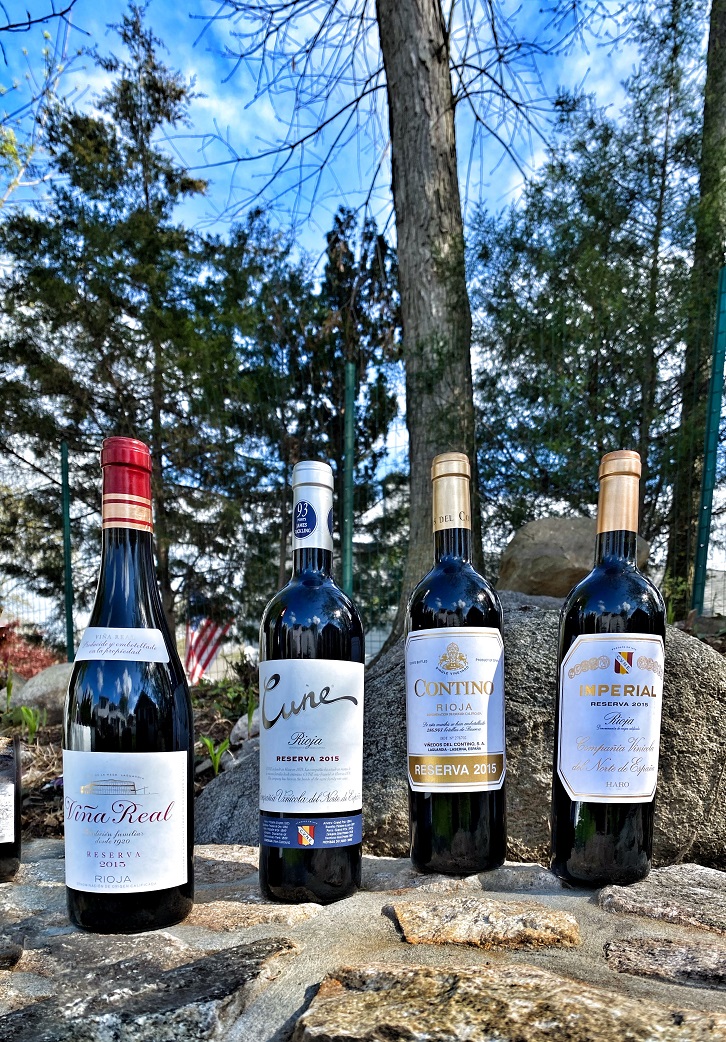
Speaking about favorite Riojas, I want to talk to you today about CVNE, also known as Cune due to a typesetting mistake. In 1879, the Real de Asúa brothers arrived in Haro for the reason not related to wine. Nevertheless, that’s how the story of Compañía Vinícola del Norte de España (C.V.N.E.), one of the most prominent Rioja producers, has begun. During its 140 years, CVNE remained a hallmark of quality and creativity. In 1915, CVNE introduced the very first White Rioja wine, Monopole. In 1973, CVNE founded Vinedos del Contino, the very first single-vineyard Rioja. Now in its 5th generation, CVNE continues to be a family winery and continues its advancement, now venturing even outside of Rioja, into Ribera del Duero and Valdeorras.
CVNE Rioja wines are produced at 5 wineries. First, there is the original Cune, which is simply a misspelled word for the CVNE, founded in 1879. In 1920, CVNE started production of Viña Real and Imperial Riojas. Viña Real was envisioned to be a more modern rendition of Rioja (in the 1920s), and Imperial was specifically produced for English markets. Imperial went on to become one of the most coveted Rioja wines, even becoming the wine #1 on the Wine Spectator’s Top 100 Wines list in 2013.
In 1973, Viñedos del Contino was created to become the first single-vineyard Rioja wine. In 1994, CVNE started its latest Rioja project, Real de Asúa, to honor the founders of the winery and create the most modern rendition of Rioja, using grapes from high altitude Villalba vineyards in Rioja Alta area.
Each one of these Riojas has its own, unique style. But can we taste the differences? I had a perfect opportunity to try answering this question. I got samples of 3 of the CVNE Rioja Reserva wines – Cune, Viña Real, and Imperial, all from 2015,. I also happened to have a few bottles of 2015 Contino Reserva and altogether this set out a perfect stage to try 4 different Rioja wines from the same vintage and technically, the same producer.
Before we get to wines, let’s say a few words about the vintage. Production of Rioja wines is strictly regulated by its governing body, Rioja Consejo Regulador, to ensure quality, and subsequently, the reputation of the Rioja wines around the world. All the vintages in Rioja have their official vintage ratings – Excellent, Very Good, Good, Medium, Normal. 2015 was officially designated as Very Good (not Excellent, such as 2001, 2004, or 2010, but still Very Good), which should still set a good level of expectations. 2015 vintage had a couple of unique characteristics, though. 2015 had the earliest harvest in the history of Rioja, starting early in September. It was also a very short harvest – typically, the harvest in Rioja takes about 2 months, with the feast of Virgen del Pilar usually taking place on October 12th, to celebrate the peak of the picking season. In 2015, the harvest was completed in 4 weeks so by October 12th all the picking was pretty much complete. How does any of this manifest in wines? I’m honestly not sure, that would require actually a vertical tasting – which I would be happy to conduct if I would have an opportunity.


So how were the wines? In a word – amazing. All four wines were absolutely gorgeous, delicious right now, and will continue to be delicious for the many years ahead. Here are my notes:
2015 Viña Real Reserva Rioja DOCa (14% ABV, $37, 90% Tempranillo, 10% Garnacha, Graciano, and Mazuelo)
Dark Garnet
Dark fruit, tobacco, espresso, expressive
Red and black fruit, cedar box, herbs, forest underbrush, firm, good structure
8/8+, lip smacking goodness. Delicious. If you are looking for a massive, earth-shattering wine, such as Walla Walla or California Cab, this is not the wine for you. But if you are looking for the wine which seduces and sings to you, give this wine a try.
2015 CVNE Cune Reserva Rioja DOCa (14% ABV, $29, 85% Tempranillo, 15% Garnacha, Graciano, and Mazuelo)
Dark garnet, almost black
Dark, brooding, minerality, cedar box, funk
Dark fruit, plums, explicit tannins, firm structure, fresh, good acidity.
8/8+, excellent, comforting, powerful, impossible to stop drinking.
2015 Contino Reserva Rioja DOCa (14% ABV, $46, 85% Tempranillo, 10% Graciano, 5% Mazuelo and Garnacha)
Dark garnet, almost black
Plums, cigar box, sweet tobacco
Complex, multilayered, earthy, dark fruit, clean acidity, lots of energy
8/8+, This is very early for this wine, but it is very enjoyable now, and it will be amazing with age


2015 Imperial Reserva Rioja DOCa (14% ABV, $50, 85% Tempranillo, 15% Graciano, Mazuelo, and Garnacha)
Dark Garnet
Earthy, spicy, red and black fruit, medium-plus intensity
Dark fruit, cigar box, firm, perfectly structured, delicious.
8+/9-, outstanding, lots of pleasure.
Believe it or not, but Imperial Rioja was my accidental pairing with BBQ chicken pizza, and the wine worked perfectly with it.
So now the secret is out. I’m lying when I’m claiming that I don’t have a favorite wine, and Rioja is the one. Well, I’m quite happy with my choice of affection – but do you have enough courage to name your favorite wine? Oh yes, with the coming holidays, any one of these Riojas would make a perfect present – to a friend, or to yourself. Go ahead, find it – everyone deserves a tasty Rioja. Cheers!
Daily Glass: Uncomfortable Wine
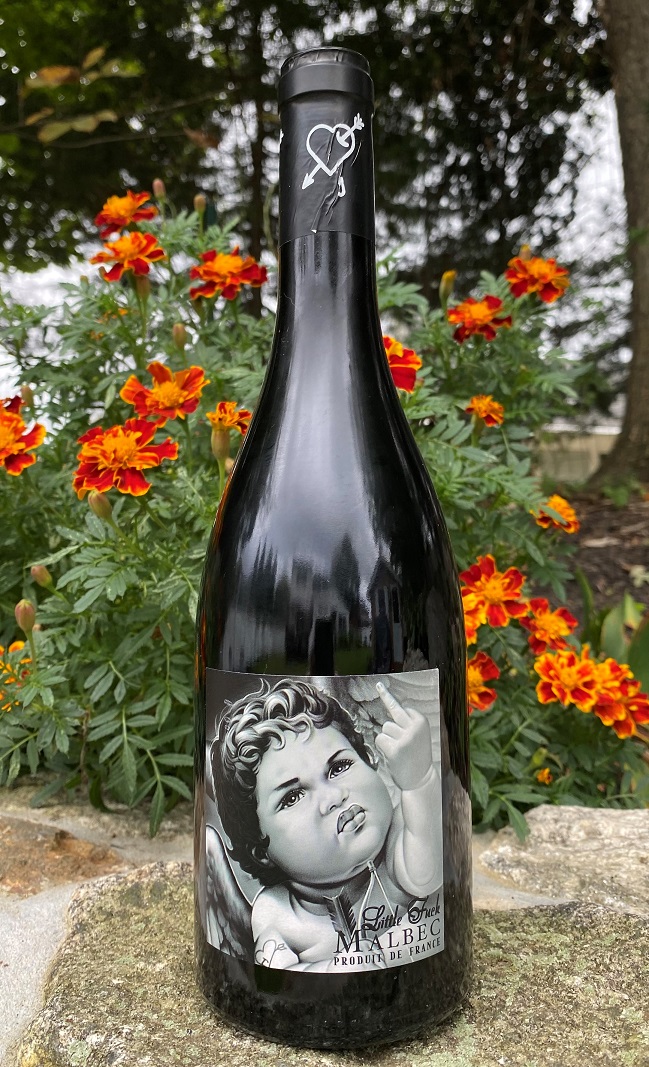 “Uncomfortable wine”??? What utter nonsense, right? Did the author had one too many glasses while writing this post?
The wine can be spoiled. The wine can taste bad. We can call it plonk, we can pour it out. But uncomfortable?
Shoes can be uncomfortable. The dress can be uncomfortable. The shirt’s collar might be too tight. Not knowing how to start a conversation with an attractive stranger might be uncomfortable. Not knowing how to answer a live interview question for the position you dreamed of your entire life is uncomfortable. Many, many things can be uncomfortable. But wine?
When I refer to wine as an art, the typical association in my mind is painting. As an art form, I imply that there are similarities between the bottle of wine and the painting on the wall. But maybe a book would be a better art form to compare?
Reaction to painting is instantaneous – you can, of course, spend hours looking at elaborate details and discovering new elements even if you saw the painting a thousand times before – but your first impression is unlikely to change, it might only deepen as time goes on. But with the book, first we see the cover, then we start reading, and if we found the book which speaks to us, by the time we reach the second page, nobody cares about that cover anymore.
When it comes to the wine, the bottle and the label matter – until we take the first sip. If we found “our wine”, the same as 300 pages book can be obsessively consumed within a few hours, a good bottle of wine will be gone in no time. And while you will be enjoying it, most likely you wouldn’t even remember how the label looked like.
What’s with this interlude and our comfort/uncomfort discussion you ask? Don’t worry, this is all connected.
So what can be uncomfortable about wine? Actually, many things. Remember – in the wine world, it is all about perception – except the taste, the pleasure, and your desire to have a second glass – of course, if you chose to be honest with yourself. Otherwise, perception is everything. Enjoying a glass of 2 buck chuck is uncomfortable. Bringing a $5 bottle of wine to your friends’ house is uncomfortable – knowing that it is an amazing bottle of wine without any regard for a price doesn’t make it less uncomfortable. Enjoying the glass of wine while your best friend hates it is uncomfortable. And then there are labels.
Okay, call me “captain obvious”, but this is where I was leading you all the way – the label can make you uncomfortable. There are enough wines in this world that have, for example, sexually suggestive or simply offensive words or images on the label. Ever saw the bottle of If You See Kay? This is a perfect example of suggestive language on the label – the book cover – for a perfectly delicious wine produced by Jayson Woodbridge. And there are wines that don’t even use suggestive language anymore – like the Little Fuck Malbec from Cahors.


When a friend sent me a picture of this label a few days ago, my first reaction was literally WTF – how can such a label be even approved (Jayson Woodbridge had lots of trouble getting his If You See Kay label approved 9 years ago)? But as the wine was available, I decided that I would not judge the book by its cover, and actually try reading it – and so I got the bottle.
I have to say that as soon as I got a hold of the bottle my negative impressions instantly started to diminish. This is hard to explain, as I don’t know if all the oenophiles feel the same way, but there are bottles that express “comfort” with its shape, weight, and overall feel in your hands. Once you take such a bottle in your hands, you can’t help yourself but say “oh, this is nice”. This was precisely the bottle. Outside of the wine name and the image on the label, the bottle was very comfortable and really created the anticipation – “oh yeah, I do want to open that bottle”. Even the label looked well designed in its shape and size and added the overall “comfort” feeling.
The wine didn’t disappoint – 2020 Vellas Père Et Fils Little Fuck Malbec Cahors AOP (14% ABV) was unapologetically a New World Malbec – big and brooding – and in a blind tasting I would confidently place it into Argentina, but never into the old world. The wine was full of raspberries, smoke, and sweet tobacco – on the nose and on the palate. Big, full-bodied, and powerful, but also well balanced and delicious – a very unapologetic Malbec I might be ashamed to bring to the acquaintance’s house but would be happy to drink at home or with close friends.
I’m really curious about the backstory of this wine. I don’t believe the name and images are random. Nicolas Vellas is a vigneron in the 4th generation at Vignobles Vellas, farming 300 acres of vines and producing a wide range of wines in the South of France. If this would be the only wine produced at the winery, yes, we could dismiss it as a gimmick. But this is simply one of many and the only one with such a unique label, so I truly believe there is a story for this wine, which is not easy to figure out – I even sent a message to the winery asking them to share the story if they can, but I’m not very hopeful. Well, actually lots of Vignoble Vellas wines have very creative labels – you can see them here, but I don’t know if there are any more of the “uncomfortable” ones.
Here you go, my friends. Uncomfortable wine which also happened to be delicious. Yeah, I’m okay with that. I’ll take delicious any day. And comfort? It comes after delicious.
Daily Glass: For The Love Of Appassimento
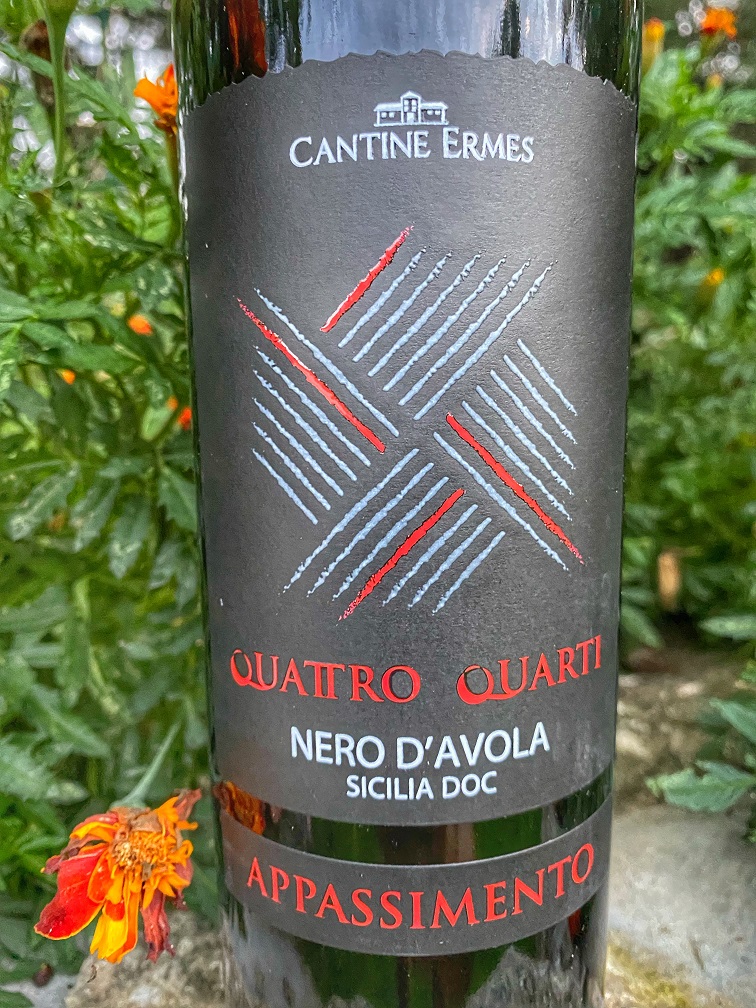 Appassimento is an Italian word that means “drying”. Thus very appropriately, appassimento is the process where after the harvest, grapes are dried for some time (from 3 weeks to 6 months) before being pressed and fermented. Now, the question to the audience: name any wine (just type, no need for producer) which is made from such dried grapes?
If you said Amarone della Valpolicella, Passito di Pantelleria, Recioto di Soave, or Recioto della Valpolicella, you can definitely give yourself a high five. While this method of wine production originated in Greece, Italy produces most of the appassimento wines in the world. Drying of the grapes increases the concentration of flavors and sugars and changes the structure of the tannins, bringing an extra layer of complexity to the wine.
While getting more complexity is great for any wine, it also comes at a cost. Drying of the grapes requires additional space, whether inside with good ventilation, or outside under the sun. There is additional time required to dry the grapes. And while drying, grapes lose moisture, thus you need to use a lot more grapes to get that same bottle of wine – no wonder Amarone is usually an expensive wine – but if you ever experienced good Amarone, or Passito, Recioto, Sfursat (Sforzato di Valtellina), Vin Santo, you know that it was well worth it.
Making wines from partially dried grapes is not limited only to Italy – I had delicious Australian Shiraz made from partially dried grapes (Alfredo Dried Grape Shiraz from South Australia), Pedro Ximenez Sherry from Spain. Overall, the wines from dried grapes are produced in most of the winemaking regions – Eastern Europe, Germany, Greece, USA, and others.
The appassimento wine which I would like to bring to your attention today is produced in Italy, but it is far from common. Nero d’Avola is known to produce big, well-structured Sicilian reds. But when you take Nero d’Avola grapes from four of the areas in Sicily where Nero d’Avola is known to grow best, then you dry the bunches of the grapes for 3 weeks in fruttaia (well-ventilated rooms) and then continue to make wine, you end up with delicious, round, perfectly approachable wine in its youth.
2019 Cantine Ermes Quattro Quarti Nero d’Avola DOC Appassimento (14% ABV, 100% Nero d’Avola, 4 months in 500l oak barrels) is produced by Cantine Ermes we spoke about earlier this year – the coop of 2,355 producers, farming 26,000 acres across a number of provinces in Sicily. The wine was ready to drink from the get-go, offering beautiful dark berries medley with sweet oak, herbs, and a hint of dried fruit, exactly as one would expect when appassimento is involved – soft, layered, comforting, and dangerous – the bottle was gone very quickly, not being able to put the glass down.
This was a perfect example of the appassimento wine – yes, it didn’t have the power of Amarone, but it also didn’t need any cellaring time, offered instant gratification, and it is a lot more affordable. Definitely the wine worth seeking.
Now, what are your favorite appassimento wines – Amarone and not?
Daily Glass: While I Was Out
This September probably was my worst blogging month ever. Whatever the frustrating reasons are, this is not the self-reflection blog (it is, of course, but only for wine, food, and life-related matters), so one thing we are not going to do is an analysis of that “dry period”. However, it was dry only for the words, but not for the wines, so let me share a few of the recent delicious encounters with you.
Let’s start with the 2009 Alban Vineyards Reva Estate Syrah Edna Valley (15.5% ABV), which I opened to celebrate our anniversary. Alban makes some of the very best Rhône-style wines in the USA, and this Reva Syrah didn’t disappoint – beautiful fruit on the nose with a touch of barnyard, layers of red and blue fruit on the palate with spicy, peppery underpinning. Delicious.
Next, we continue with a number of Field Recordings wines. It is no secret that I’m biased toward Field Recordings wines, ever since I discovered them more than 10 years ago (this is the only wine club I belong to). Field Recordings wines don’t cease to amaze with Andrew Jones’ talent to find one-of-a-kind vineyards to make one-of-a-kind wines.


2020 Field Recordings Domo Arigato (Mr. Ramato) Skin Contact Pinot Grigio Central Coast (12% ABV, $25, 52 barrels made) is skin contact Pinot Grigio, made in Ramato (copper) Italian style. A beautiful complexity on the nose without going overboard, fresh fruit and herbs, clean and unctuous on the palate – when the friend stopped over, we finished the bottle without even noticing. This wine is a blend of Pinot Gris from two sites on the Central Coast, each of which spent a month on the skins and then was aged in the neutral oak barrels.
2019 Field Recordings Festa Beato Farms Vineyard El Pomar District (11.5% ABV, $25, 100% Touriga Nacional, 12 months in Neutral American oak barrels, 6 barrels produced) really surprised me. Touriga Nacional is not the grape California is known for. Also, from my experience with Portuguese wines, Touriga Nacional from the Douro definitely benefits from a long time in oak (I much prefer Douro Reserva over the regular wines), so I opened the Californian rendition without much of the expectations.
Wow. Festa actually means Party in Portuguese, and what a party it was! Wild berries on the nose – wild blueberries and wild strawberries. The same fresh, crunchy, crispy, fresh wild berries on the palate, but well supported by the medium to the full body of the wine and perfectly balanced in and out, creating one delicious mouthfeel. Another wine you can’t stop drinking once you start.
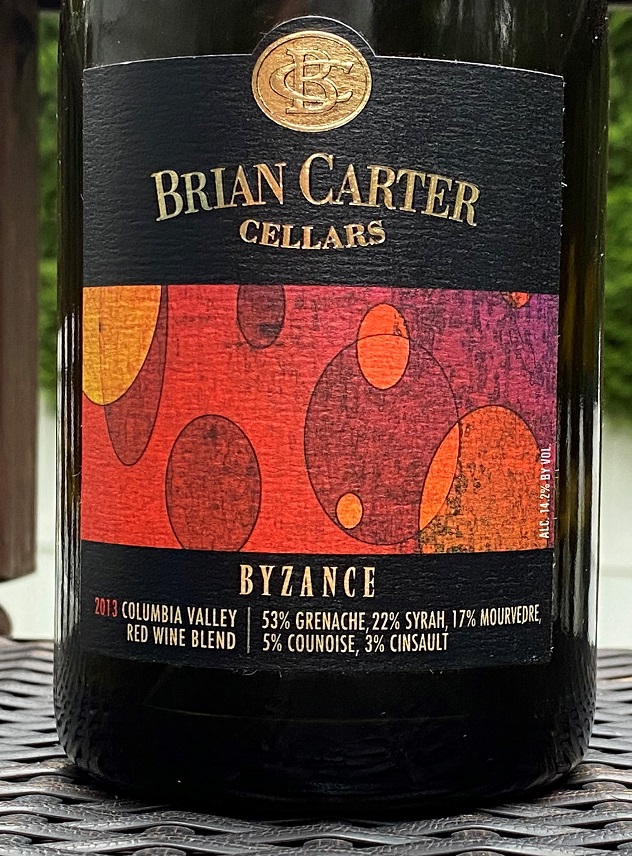 Let’s take a short break from the Field Recordings wines and let’s go visit Washington with the help of 2013 Brian Carter Cellars Byzance Red Wine Blend Columbia Valley (14% ABV, 53% Grenache, 22% Syrah, 17% Mourvedre, 5% Counoise, 3% Cinsault). I got this wine at one of the Last Bottle marathons, going strictly by the region, age, and price – never heard of the producer before. Turns out that Brian Carter had been making wines in Wahington since 1980, and he has a passion for blending – which this wine perfectly demonstrated. In my experience, 8 years is not an age for many Washington wines, so I opened the bottle not without trepidation. To my delight, the wine was simply superb – fresh cherries and blackberries on the nose, ripe cherries, mocha, and dark chocolate on the palate, soft, round, perfectly balanced, exciting, and delicious. And I didn’t need to wait for it even for a second. Pop, pour, enjoy. This is the wine that brings an instant regret with the first sip – why, why I didn’t buy a full case??
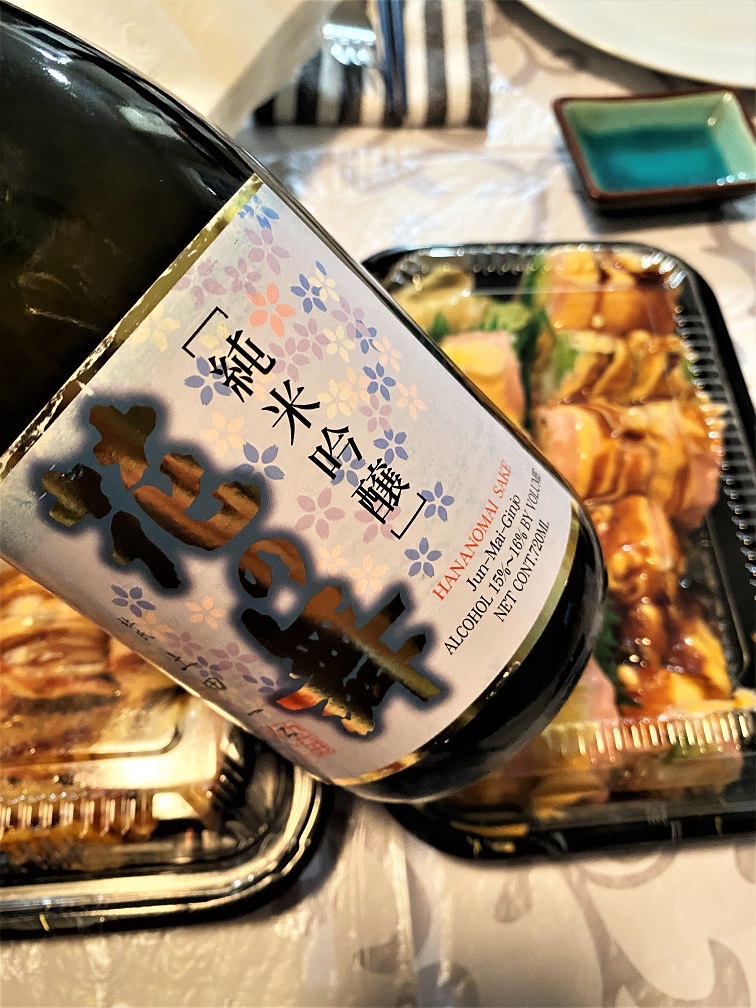
This next wine I want to talk about might surprise you, and this is something I very rarely discuss in this blog – it is Sake I want to share with you. As we planned to have sushi for dinner, the family requested sake to drink with it. I stopped at the wine store on my way to pick up sushi, and this Hananomai Sake Jun-Mai-Ginjo (15%-16% ABV) was recommended. What a great recommendation it was! I almost got the point of regretting buying only one bottle, as everyone couldn’t stop drinking it – nicely perfumed, light fruit notes on the palate, delicate and balanced – it perfectly complemented our eclectic selection of the sushi rolls.
And now, back to Field Recordings.

2018 Field Recordings Happy Accident Alicante Bouschet Vignoble Guillaume Jean Paso Robles (11.1% ABV, 10 months in stainless steel, 5 barrels produced) is another atypical California wine – made from the Alicante Bouchet grape. This is one of the few so-called teinturier grapes – red grapes which have not only red skin but also red flesh, thus producing red juice when pressed, without the need for skin contact (famous Georgian Saperavi is another example of the teinturier grape). Alicante Bouschet is a cross between Petit Bouschet and Grenache, and it was widely planted in California during Prohibition and lately increasingly planted in France, as well as in Spain and Portugal. The name of the wine has its own story, which I simply quote from the description I got with the wine club offering email: “Many things can go sideways in the cellar as we are ushering the fermentation along. In most wineries, a surprise visit from brettanomyces to your cellar could be a curse, but in this situation we are celebrating it. The funky wild yeast that is popular in the beer world brings out a signature funk. This signature funk, though, took 5 barrels of Alicante to another level. As a famous painter once said, there are no mistakes, just happy accidents.”
The wine offered an inviting nose of the fresh berries, continuing with tart, the dry mouthfeel of red and black fruit, and medium to full body. I think this wine would well benefit from another 3–4 years in the cellar, but it was quite enjoyable as is right now.
And that concludes our daily glass ride – hope you had some tasty wine discoveries lately!
While In Texas …
August was an eventful month – two trips back to back, something I didn’t experience in the past 18 months.
After a trip to Oregon to attend the Wine Media Conference and visit some of the wineries in Willamette Valley, I spent two days at home and got on the plane again, this time to attend a work event in San Antonio in Texas. This was a short but quite intense 4 days trip, so I really didn’t plan to look specifically for any local wines as I like doing during any of my trips. Until I walked into the Riverwalk Wine and Spirits.
You see, I was only looking for sparkling water, as this is what I prefer to drink, so buying wine was not a part of the plan (who am I kidding). But being in Texas, I had to look at the shelf with the local wines – located, as one would expect, in the far corner of the store. What do you think happened next? Of course… I love Marsanne and Roussanne wines, and the bottles were simply looking at me saying “yeah, we know you want us…”. I grabbed the bottle of Becker Claret to keep the whites company, and we happily left together.
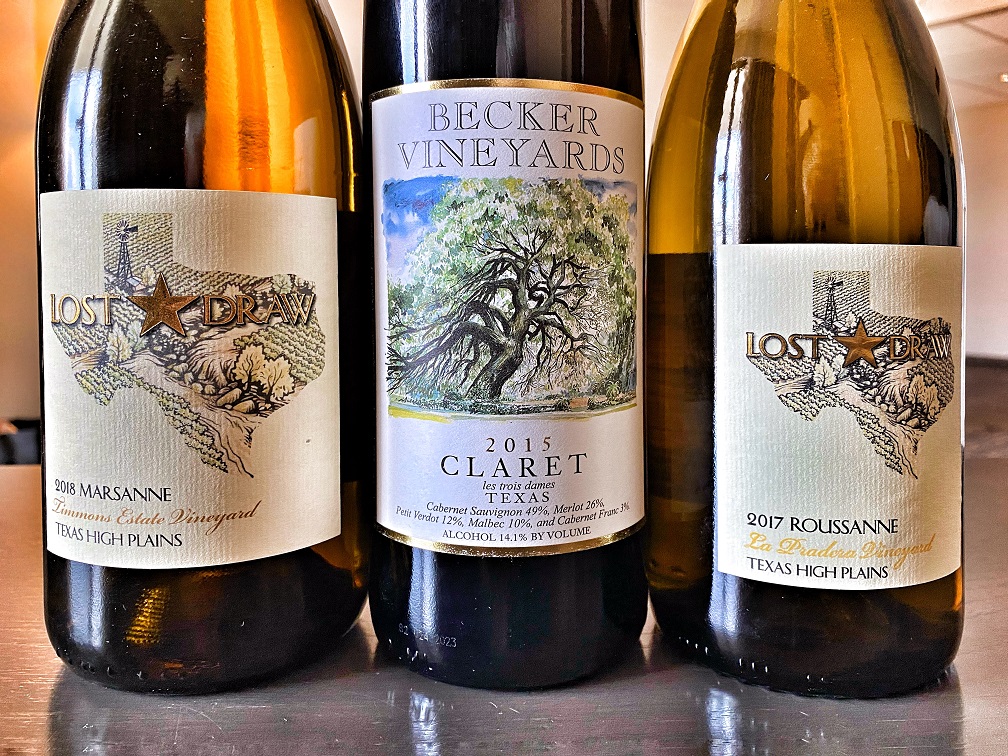
I’m familiar with Becker wines, had them a few times before – they also have quite memorable labels. But I don’t believe I ever tasted any wines from Lost Draw Cellars, so let’s talk about them first.
Lost Draw Cellars traces its origin to 1936 as a family business. The grapes were planted on the Lost Draw Vineyard site in 2005, and in 2012, Lost Draw Cellars bottled its first vintage. Today, Lost Draw Cellars produces a wide range of wines, focusing primarily on the Mediterranean varieties growing on the number of vineyards in Texas High Planes AVA – Viognier, Marsanne, Roussanne, Sangiovese, Tempranillo, and many others.
The two white wines I tried were, in a word, excellent.
2017 Lost Draw Cellars Roussanne La Pradera Vineyard Texas High Plains (13.2% ABV, $14.99)
Golden color
A touch of tropical fruit and gunflint, herbal notes
Fresh, round, lemon notes, complex, great acidity, good balance, good minerality
8, I would drink this wine any day
2018 Lost Draw Cellars Marsanne Timmons Estate Vineyard Texas High Plains (13.2% ABV, $14.99)
Light Golden
Butter, vanilla, nose reminiscent of Chardonnay
Vanilla, pronounced honey note, round, plump, creamy, good acidity, good balance
8+, superb.
The story of Becker Vineyards started when the Becker family decided to look for the log cabin to make it into a country getaway. They found their perfect cabin in 1990, along with 46 acres of land. Owning the vineyard was a long-time dream, so the first vines were planted in 1992, following by the first harvest in 1995. That humble beginning today became a 100,000 cases operation with numerous honors and accolades – for example, Becker wines were served at the White House on 7 different occasions.
I have to honestly say that I was very happy with my choice of red wine at the store – after the first sip, it was hard to wipe the smile off my face:
2015 Becker Vineyards Claret Les Trois Dames Texas (14.1% ABV, $14.99, 49% Cabernet Sauvignon, 26% Merlot, 12% Petite Verdot, 10% Malbec, 3% Cabernet Franc)
Garnet
Coffee, mocha, cassis, bell pepper
Cassis, bell pepper, eucalyptus, good acidity, soft tannins, perfect balance
9-, spectacular. Just pure pleasure in every sip. The wine is at its peak and it is an absolutely delicious rendition of classic French claret.
This was my second time tasting Becker Claret – the first time I had it in 2011 at Vino Volo at the airport. It was a 2009 vintage, thus I was tasting 2 years old wine. This time, it was a 6-year-old wine, and it definitely shined to its fullest.
That is my short story of finding delicious wines in Texas (at a great price too). Texas Hill County was one of the suggested locations for the next Wine Media Conference 2022 – for once, I would be absolutely ecstatic if that would be an actual choice – I would just need to bring a few of the wine suitcases with me…
We are done talking about wine, but there is something else I want to share with you. While in San Antonio, I stayed at Marriott Riverwalk hotel, in a room with a beautiful city view. Yes, it means pictures – I want to share with you that city view, taken at different times – together with a few flowers.





 And now we are done. If you will be visiting Texas, make sure to drink Texan wines – you don’t even need to thank me.
Made With Organic Grapes: Domaine Bousquet
Today we will be talking about two subjects we already discussed in the past. The first subject is the wines made from organic grapes. Organic grapes are becoming more and more available, and winemakers around the world are more eager to use organic grapes in winemaking, especially as wine consumers happily embrace the trend.
The second subject is the wines of Domaine Bousquet in Argentina. Last time we talked about unpretentious and delicious Domaine Bousquet bubbles, sparkling wines well suitable for every day. Today we want to continue that conversation and talk about few more wines.
The organic viticulture is fair and square a centerpiece of Domaine Bousquet winemaking. The picture below perfectly summarizes it – these are all the certifications that the domain already has:
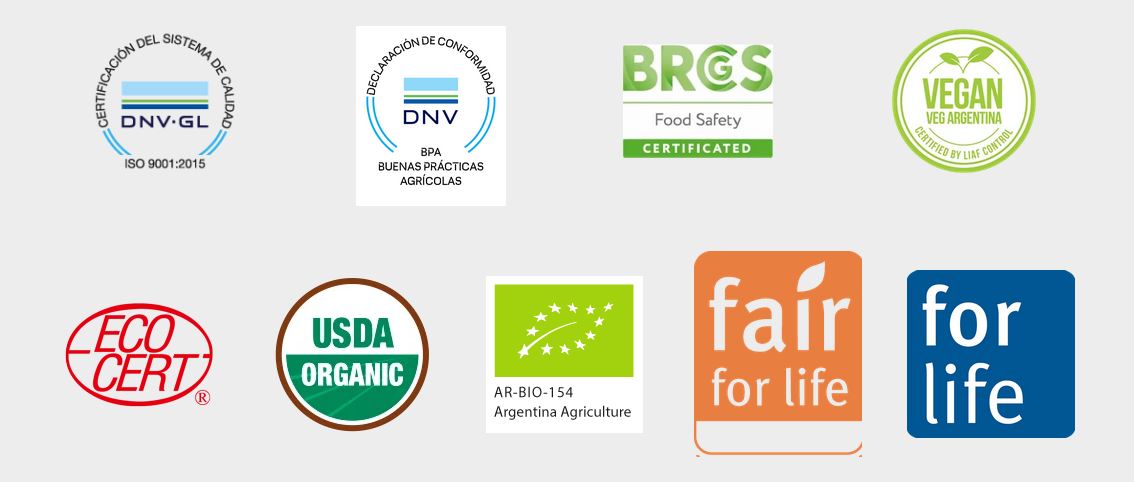
Source: Domaine Bousquet website
Organic viticulture is only a stepping stone for Domaine Bousquet – the goal is to convert to biodynamic farming in 2021/2022, which is not an easy task, considering the sheer size of Domaine Bousquet’s vineyards (more than 500 acres) and the fact that biodynamic viticulture is 30% more labor-intense compared with traditional methods, and 15% more intense than sustainable. But once you get on this road, there is no turning back.
Organic/sustainable/biodynamic is an important part, but still only a part of the story. The terroir is essential, and it is a classic combination of the soil and climate which contributes to the quality of the Domaine Bousquet wines. Many of the Domain Bousquet vineyards are located in the Gualtallary region of Uco Valley, at an altitude of about 4,200 feet. The high altitude by itself doesn’t guarantee the quality of the wines, but it helps. Domaine’s vineyards are located on the patches of sandy soils, which are great for the vines as they limit the spread of the disease, provide good drainage and force the vines to work hard to get to the water.
Gaultallary offers a desert-like climate, with constant winds blowing for the Andes, and less than 8 inches of rain being total precipitation for the year. In such conditions, it is important that Domaine Bousquet vineyards are located in areas with access to the ground water – not everybody in the Gaultallary is that lucky. And then there are Zonda winds (Zonda in local dialect means “The Witch’s Wind”, which are showing up in the spring, and they are dry (relative humidity of 0), strong, and unpredictable – but they help to reduce the crop size and concentrate the flavor.
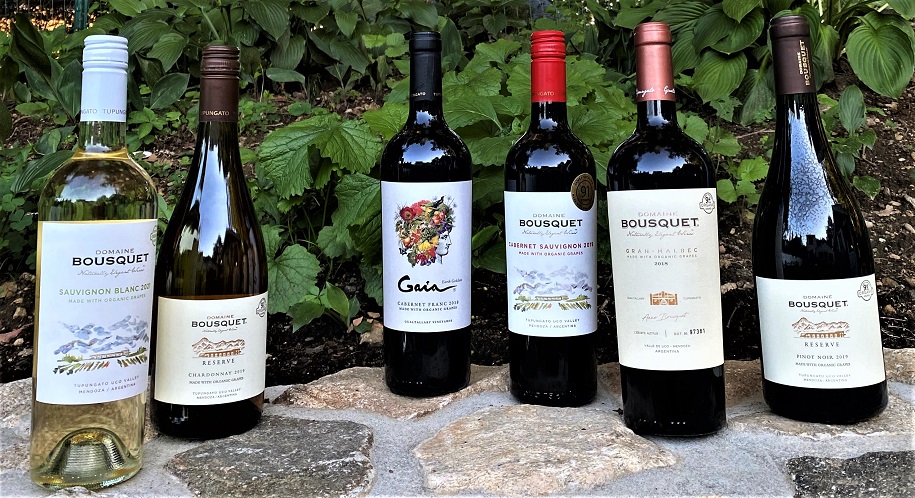
Domaine Bousquet produces about 10 different lines of wines. I was able to taste wine belonging to the 4 different lines (samples). Below are my notes.
First, 2 wines from the Premium selection:


2021 Domaine Bousquet Sauvignon Blanc Tupungato Uco Valley (12.5% ABV, $13)
Straw pale
Ultimately inviting nose, a touch of fresh grass, lemon, uplifting intensity.
Crisp, clean, lemony, grassy, tart, fresh, pure delight.
8+, perfect, delicious.
2019 Domaine Bousquet Cabernet Sauvignon Tupungato Uco Valley Mendoza (14% ABV, $13, no oak – unusual)
Dark Ruby
A touch of bell pepper, dark berries, medium-plus intensity
Bell pepper, eucalyptus, mint, blackberries, good acidity, fresh, good energy, good balance
8-/8, easy to drink. And I have to say that unoaked Cabernet Sauvignon is mind-boggling.
Next were two wines form the Reserve line:


2019 Domaine Bousquet Chardonnay Reserve Tupungato Uco Valley (14.5% ABV, $18)
Straw pale
Vanilla, a hint of butter, inviting, generous
Crisp, vibrant, a touch of butter and vanilla, tightly weaves around the citrus core. Excellent balance, delicious.
8+, superb. If this wine can age, it might be amazing, if this bright acidity will evolve into the honey note as it works with the best Chardonnays.
2019 Domaine Bousquet Pinot Noir Reserve Tupungato Uco Valley (14.5% ABV, $18, 6-8 months in French oak)
Dark ruby
Not very expressive, a hint of tart cherries
Tart cherries, bright acidity, crisp, tart
7/7+, not my wine, but should be okay as food wine or for those who like austere, bone-dry wines.
Next was the wine from the Gaia line – the wines dedicated to the goddess of Earth, Gaia, sporting a very attractive label. This is the second time I was able to taste the wine from the Gaia line – the first was Gaia Rosé, which was excellent. 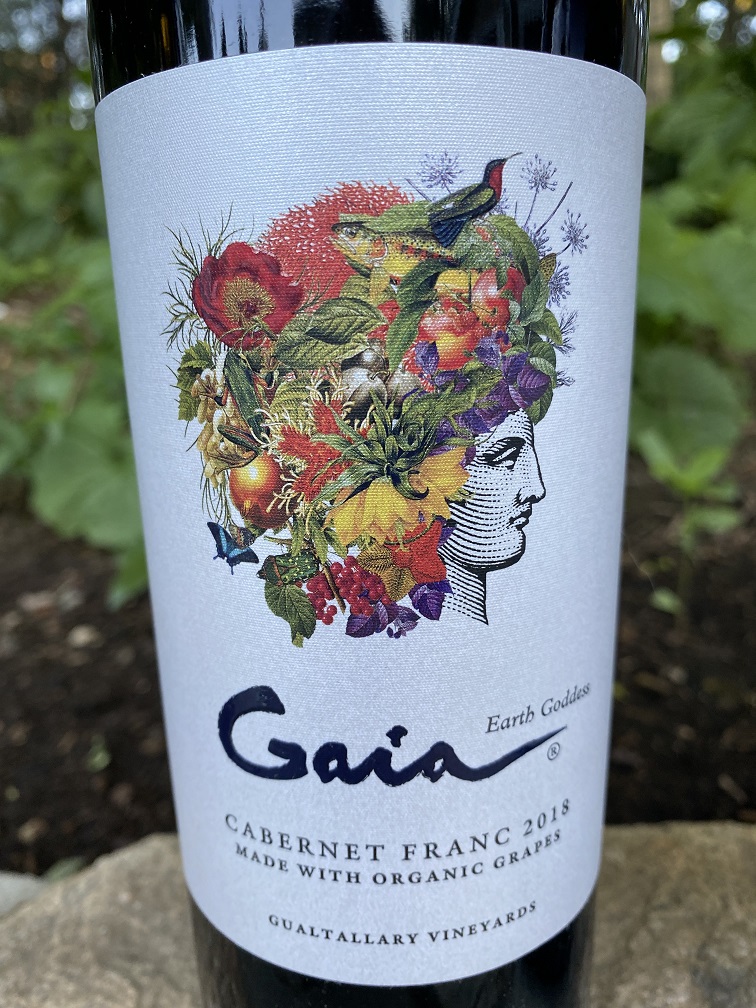
2019 Domaine Bousquet Gaia Cabernet Franc Gualtallary Vineyards (15% ABV, $20, 8-10 months in French oak)
Dark garnet
A touch of barnyard, earthy notes, dark berries
Dark fruit, explicit minerality, a distant hint of bell pepper, mint, dense, good structure
8-, not the most striking Cab Franc, but interesting on its own
And the last one for today – the wine from the Gran series:
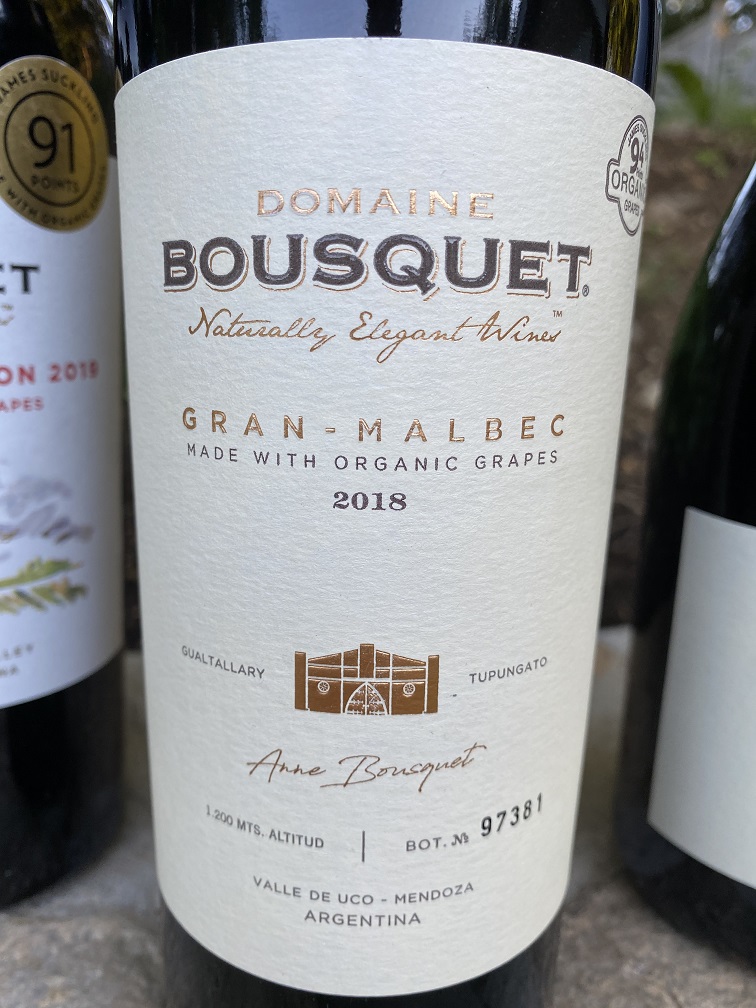
2018 Domaine Bousquet Gran-Malbec Valley de Uco (14.5% ABV, $25, 85% Malbec, 5% Cabernet Sauvignon, 5% Merlot, 5% Syrah, 10 months in French oak)
Dark garnet, almost black with purple hues
Dark fruit, eucalyptus, cassis, intense, powerful
Beautiful fruit on the palate, firm structure, big, brooding, perfectly balanced
8+, outstanding
Here you are, my friends – more organic wines you can choose from. As an added bonus, with Domaine Bousquet, you don’t have to break the bank to enjoy delicious organic wines any time you want. Cheers!
United In Ink
How about some ink, friends?
Does it sound strange?
In my wine vocabulary, wine is wine. I’ve heard people sometimes referring to wine as “juice” – if this term is used by the winemaker, they definitely have a pass – for the average wine consumers, it sounds a bit disrespectful. But that’s not the point here.
So it appears that the wine can be also referred to as “ink”. I only know of “Ink of Toro”, a different name for the Tempranillo growing in the Toro region in Spain, but otherwise, I never heard this term in conjunction with wine – until now.
When I’m offered the wine for the review, there is always the decision process involved – where the wine is from, do I expect to like it, would I be able to write about it, do I like the label. Labels, yes, let’s talk about labels.
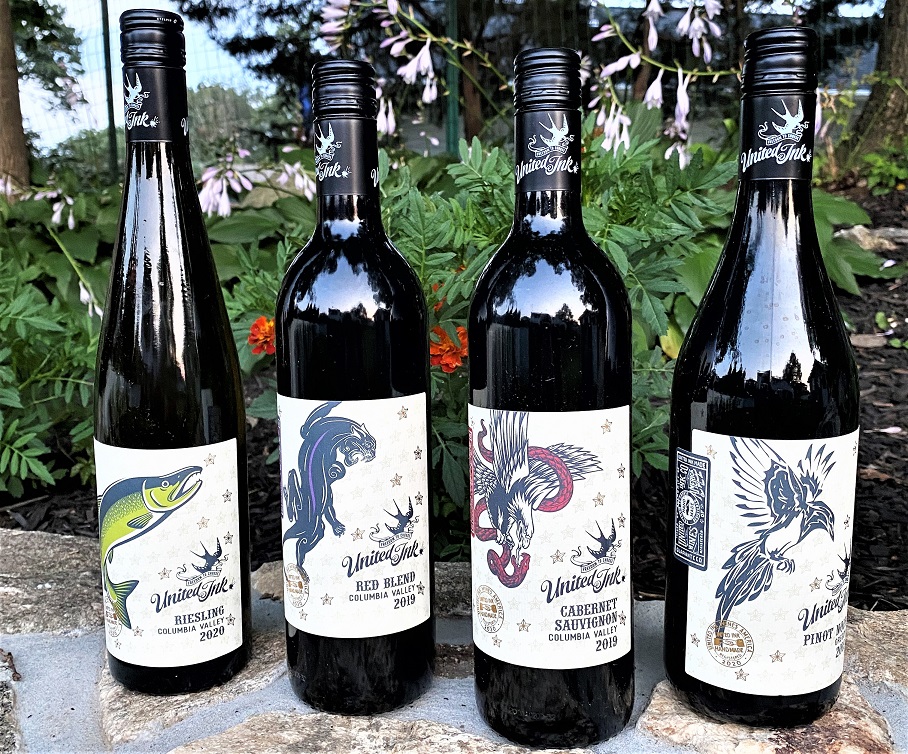
When I got an offer to review new series of wines from Mack and Schuhle called United Ink, the first thing which caught my eye was the labels, cool-looking labels. After reading that wines are from the Pacific Northwest, the region I well respect, and having a previous positive experience with Mack and Schuhle wines, I quickly agreed to taste the wines.
If you look at the labels carefully, it is not only the majestic creatures you can observe – each label also features a variety of stamps:
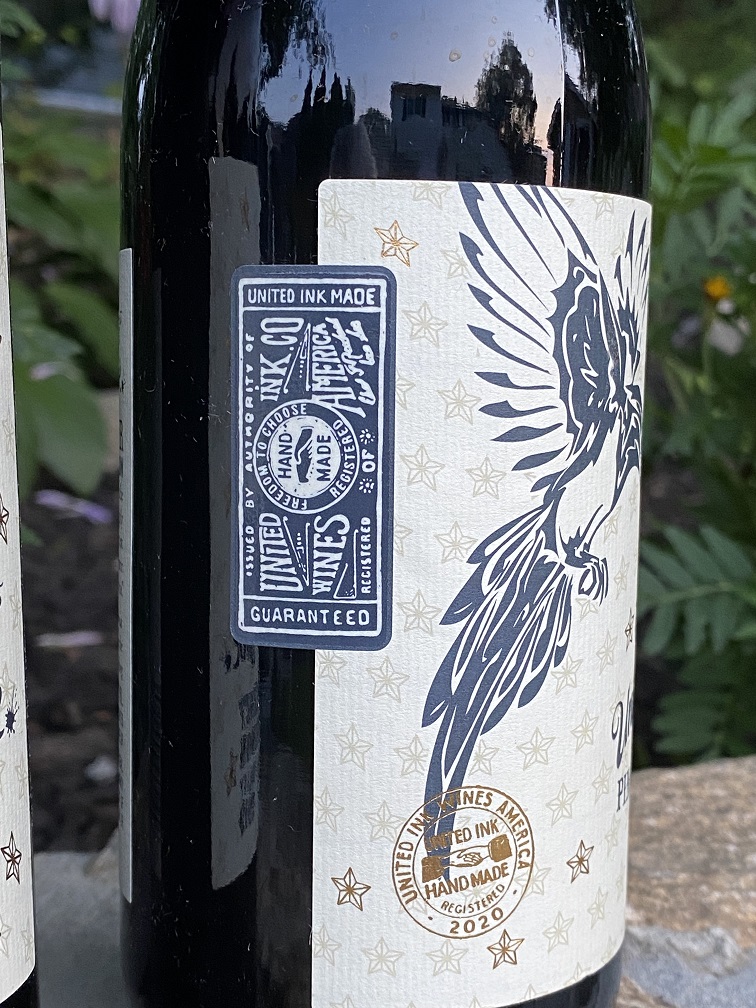


I tried to find explanations for the label design on the Mack and Schuhle website, but there was nothing offered, so I reached out to the PR agency and got the following answers to my questions:
- Why United Ink? What is the story/significance/idea behind this name?
The brand concept has to do with championing American viticulture and incorporating symbols including stars, traditional American tattoo art, and the idea of ink as a metaphor for wine
- Freedom to Choose is written on all labels – what is the idea of this statement?
Freedom to choose great wines instead of the everyday, homogenized, manufactured wines at the everyday price points, not having to pay big $$ for wines of similar quality
- “Hand made” stamp – any story behind it?
Hand crafted and blended by our winemakers Joe Dobbes and David Forsyth who are well respected in their regions
- “Guaranteed” mark/stamp attached to all the labels – any reasons for that? The idea behind it?
Guaranteed quality and authenticity is our cornerstone. We used a union stamp to express this contract with our customers/consumers.
The wines themselves were rather an enigma, akin to their mythical counterparts on the labels. With the exception of Riesling which was tasty from the get-go, the three reds didn’t show well initially – to the point of me having doubts if I would be able to write a post about the wines (remember – I don’t write negative reviews). I shared my concerns with the PR agency and got an answer that the wholesaler mentioned that it seems that screw caps somehow play a negative role, causing the wines to dumb down for a few days. This is exactly what happened as you can see from my tasting notes:
2020 United Ink Riesling Columbia Valley (12% ABV, $12)
Straw pale
Intense nose of white peach, white plums, and honey
Tropical fruit, guava, ripe white plums, honey undertone, fresh, good acidity, well balanced.
7+/8-, it appears sweeter than one might want from Riesling, but good balance definitely helps. Should be great with tangy cheese. Excellent with Comte (complements). Excellent with Manchego.
8 over the next 3 days – good balance and lots of pleasure.
2019 United Ink Red Blend Columbia Valley (14.1% ABV, $18, 60% Merlot, 20% Syrah, 20% Cabernet Sauvignon)
Dark garnet, practically black
Cherries, a touch of sapidity, black plums
Tart, tart cherries, nutmeg, salinity, good acidity on the finish, forest underbrush – an unusual expression. Spicy long finish with mouthwatering acidity.
7+, needs time. Was better on the second day.
8-/8 on the 3rd day – astringency disappeared from the finish, the wine became a lot more balanced.
2019 United Ink Cabernet Sauvignon Columbia Valley (14.1% ABV, $18, 90% Cabernet Sauvignon, 5% Merlot, 5% Cabernet Franc)
Dark garnet, almost black
Cinnamon, vanilla, sweet tobacco
Sweet tobacco, espresso, and dark chocolate on the palate, blackberries with undertones of the roasted meat. Unusual.
7+ initially
8- on the third day, a hint of cassis, improved balance.
2019 United Ink Pinot Noir Oregon (13% ABV, $22)
Dark Ruby
Plums, anise, a hint of smoke
Plums, smoke, light, appears under-extracted on the first day. A clear cigar profile on the finish.
7+ on the first day – need to see how the wine will evolve.
8 on the day 3 – violets joined plums with a touch of smoke and vanilla, round, well balanced, delicious
Here you are, my friends – the Ink of Pacific Northwest, for your imbibing pleasure. I’m happy the wines came around. If you will come across these wines, remember to decant them for at least 3-4 hours before drinking. Cheers!
Last Bottle Sign Up ($10 credit)




 Talk-A-Vino